EP0360175B1 - Magnetic recording medium - Google Patents
Magnetic recording medium Download PDFInfo
- Publication number
- EP0360175B1 EP0360175B1 EP19890117162 EP89117162A EP0360175B1 EP 0360175 B1 EP0360175 B1 EP 0360175B1 EP 19890117162 EP19890117162 EP 19890117162 EP 89117162 A EP89117162 A EP 89117162A EP 0360175 B1 EP0360175 B1 EP 0360175B1
- Authority
- EP
- European Patent Office
- Prior art keywords
- magnetic
- layer
- upper layer
- acid
- lower layer
- Prior art date
- Legal status (The legal status is an assumption and is not a legal conclusion. Google has not performed a legal analysis and makes no representation as to the accuracy of the status listed.)
- Expired - Lifetime
Links
- 230000005291 magnetic effect Effects 0.000 title claims description 124
- 239000006247 magnetic powder Substances 0.000 claims description 65
- 239000011230 binding agent Substances 0.000 claims description 51
- 229920005989 resin Polymers 0.000 claims description 27
- 239000011347 resin Substances 0.000 claims description 27
- 229910052751 metal Inorganic materials 0.000 claims description 15
- 239000002184 metal Substances 0.000 claims description 15
- 239000004800 polyvinyl chloride Substances 0.000 claims description 14
- 229920000915 polyvinyl chloride Polymers 0.000 claims description 14
- 229920005749 polyurethane resin Polymers 0.000 claims description 12
- 239000000203 mixture Substances 0.000 claims description 11
- PNEYBMLMFCGWSK-UHFFFAOYSA-N aluminium oxide Inorganic materials [O-2].[O-2].[O-2].[Al+3].[Al+3] PNEYBMLMFCGWSK-UHFFFAOYSA-N 0.000 claims description 8
- 125000001273 sulfonato group Chemical group [O-]S(*)(=O)=O 0.000 claims description 8
- VYPSYNLAJGMNEJ-UHFFFAOYSA-N Silicium dioxide Chemical compound O=[Si]=O VYPSYNLAJGMNEJ-UHFFFAOYSA-N 0.000 claims description 7
- GWEVSGVZZGPLCZ-UHFFFAOYSA-N Titan oxide Chemical compound O=[Ti]=O GWEVSGVZZGPLCZ-UHFFFAOYSA-N 0.000 claims description 7
- MCMNRKCIXSYSNV-UHFFFAOYSA-N Zirconium dioxide Chemical compound O=[Zr]=O MCMNRKCIXSYSNV-UHFFFAOYSA-N 0.000 claims description 6
- 229910052744 lithium Inorganic materials 0.000 claims description 4
- HBMJWWWQQXIZIP-UHFFFAOYSA-N silicon carbide Chemical compound [Si+]#[C-] HBMJWWWQQXIZIP-UHFFFAOYSA-N 0.000 claims description 4
- 229910010271 silicon carbide Inorganic materials 0.000 claims description 4
- 229910052708 sodium Inorganic materials 0.000 claims description 4
- 229910003145 α-Fe2O3 Inorganic materials 0.000 claims description 4
- DGAQECJNVWCQMB-PUAWFVPOSA-M Ilexoside XXIX Chemical group C[C@@H]1CC[C@@]2(CC[C@@]3(C(=CC[C@H]4[C@]3(CC[C@@H]5[C@@]4(CC[C@@H](C5(C)C)OS(=O)(=O)[O-])C)C)[C@@H]2[C@]1(C)O)C)C(=O)O[C@H]6[C@@H]([C@H]([C@@H]([C@H](O6)CO)O)O)O.[Na+] DGAQECJNVWCQMB-PUAWFVPOSA-M 0.000 claims description 3
- WHXSMMKQMYFTQS-UHFFFAOYSA-N Lithium Chemical group [Li] WHXSMMKQMYFTQS-UHFFFAOYSA-N 0.000 claims description 3
- QDOXWKRWXJOMAK-UHFFFAOYSA-N dichromium trioxide Chemical compound O=[Cr]O[Cr]=O QDOXWKRWXJOMAK-UHFFFAOYSA-N 0.000 claims description 3
- 125000004435 hydrogen atom Chemical group [H]* 0.000 claims description 3
- 239000000377 silicon dioxide Substances 0.000 claims description 3
- 239000011734 sodium Chemical group 0.000 claims description 3
- 229910006069 SO3H Inorganic materials 0.000 claims description 2
- ZLMJMSJWJFRBEC-UHFFFAOYSA-N Potassium Chemical group [K] ZLMJMSJWJFRBEC-UHFFFAOYSA-N 0.000 claims 2
- 229910052700 potassium Chemical group 0.000 claims 2
- 239000011591 potassium Chemical group 0.000 claims 2
- 229910052739 hydrogen Inorganic materials 0.000 claims 1
- 239000001257 hydrogen Substances 0.000 claims 1
- 239000010410 layer Substances 0.000 description 245
- 239000002245 particle Substances 0.000 description 31
- 238000000576 coating method Methods 0.000 description 23
- 235000014113 dietary fatty acids Nutrition 0.000 description 20
- 239000000194 fatty acid Substances 0.000 description 20
- 229930195729 fatty acid Natural products 0.000 description 20
- OKTJSMMVPCPJKN-UHFFFAOYSA-N Carbon Chemical compound [C] OKTJSMMVPCPJKN-UHFFFAOYSA-N 0.000 description 18
- 239000000843 powder Substances 0.000 description 18
- 238000006243 chemical reaction Methods 0.000 description 15
- 239000011248 coating agent Substances 0.000 description 15
- 150000004665 fatty acids Chemical class 0.000 description 13
- 241000557626 Corvus corax Species 0.000 description 11
- -1 polytetramethylene Polymers 0.000 description 11
- 230000001965 increasing effect Effects 0.000 description 10
- WNLRTRBMVRJNCN-UHFFFAOYSA-N adipic acid Chemical compound OC(=O)CCCCC(O)=O WNLRTRBMVRJNCN-UHFFFAOYSA-N 0.000 description 9
- 238000000034 method Methods 0.000 description 9
- OFOBLEOULBTSOW-UHFFFAOYSA-N Malonic acid Chemical compound OC(=O)CC(O)=O OFOBLEOULBTSOW-UHFFFAOYSA-N 0.000 description 8
- 235000019241 carbon black Nutrition 0.000 description 8
- 239000006229 carbon black Substances 0.000 description 8
- 230000000694 effects Effects 0.000 description 8
- 239000000126 substance Substances 0.000 description 8
- LYCAIKOWRPUZTN-UHFFFAOYSA-N Ethylene glycol Chemical compound OCCO LYCAIKOWRPUZTN-UHFFFAOYSA-N 0.000 description 7
- 230000008859 change Effects 0.000 description 7
- 238000001125 extrusion Methods 0.000 description 7
- 238000005259 measurement Methods 0.000 description 7
- 239000000178 monomer Substances 0.000 description 7
- 229920000642 polymer Polymers 0.000 description 7
- IJGRMHOSHXDMSA-UHFFFAOYSA-N Atomic nitrogen Chemical compound N#N IJGRMHOSHXDMSA-UHFFFAOYSA-N 0.000 description 6
- 229910052782 aluminium Inorganic materials 0.000 description 6
- CXMXRPHRNRROMY-UHFFFAOYSA-N sebacic acid Chemical compound OC(=O)CCCCCCCCC(O)=O CXMXRPHRNRROMY-UHFFFAOYSA-N 0.000 description 6
- 229940105289 carbon black Drugs 0.000 description 5
- 239000003973 paint Substances 0.000 description 5
- UPMLOUAZCHDJJD-UHFFFAOYSA-N 4,4'-Diphenylmethane Diisocyanate Chemical compound C1=CC(N=C=O)=CC=C1CC1=CC=C(N=C=O)C=C1 UPMLOUAZCHDJJD-UHFFFAOYSA-N 0.000 description 4
- KKEYFWRCBNTPAC-UHFFFAOYSA-N Terephthalic acid Chemical compound OC(=O)C1=CC=C(C(O)=O)C=C1 KKEYFWRCBNTPAC-UHFFFAOYSA-N 0.000 description 4
- 239000001361 adipic acid Substances 0.000 description 4
- 235000011037 adipic acid Nutrition 0.000 description 4
- WERYXYBDKMZEQL-UHFFFAOYSA-N butane-1,4-diol Chemical compound OCCCCO WERYXYBDKMZEQL-UHFFFAOYSA-N 0.000 description 4
- 239000003795 chemical substances by application Substances 0.000 description 4
- SZVJSHCCFOBDDC-UHFFFAOYSA-N ferrosoferric oxide Chemical compound O=[Fe]O[Fe]O[Fe]=O SZVJSHCCFOBDDC-UHFFFAOYSA-N 0.000 description 4
- 230000006872 improvement Effects 0.000 description 4
- XEEYBQQBJWHFJM-UHFFFAOYSA-N iron Substances [Fe] XEEYBQQBJWHFJM-UHFFFAOYSA-N 0.000 description 4
- QQVIHTHCMHWDBS-UHFFFAOYSA-N isophthalic acid Chemical compound OC(=O)C1=CC=CC(C(O)=O)=C1 QQVIHTHCMHWDBS-UHFFFAOYSA-N 0.000 description 4
- 239000006249 magnetic particle Substances 0.000 description 4
- SLCVBVWXLSEKPL-UHFFFAOYSA-N neopentyl glycol Chemical compound OCC(C)(C)CO SLCVBVWXLSEKPL-UHFFFAOYSA-N 0.000 description 4
- BDJRBEYXGGNYIS-UHFFFAOYSA-N nonanedioic acid Chemical compound OC(=O)CCCCCCCC(O)=O BDJRBEYXGGNYIS-UHFFFAOYSA-N 0.000 description 4
- 230000009467 reduction Effects 0.000 description 4
- 230000033458 reproduction Effects 0.000 description 4
- 229910018137 Al-Zn Inorganic materials 0.000 description 3
- 229910018185 Al—Co Inorganic materials 0.000 description 3
- 229910018507 Al—Ni Inorganic materials 0.000 description 3
- 229910018573 Al—Zn Inorganic materials 0.000 description 3
- 229910001030 Iron–nickel alloy Inorganic materials 0.000 description 3
- DNIAPMSPPWPWGF-UHFFFAOYSA-N Propylene glycol Chemical compound CC(O)CO DNIAPMSPPWPWGF-UHFFFAOYSA-N 0.000 description 3
- KDYFGRWQOYBRFD-UHFFFAOYSA-N Succinic acid Natural products OC(=O)CCC(O)=O KDYFGRWQOYBRFD-UHFFFAOYSA-N 0.000 description 3
- WGLPBDUCMAPZCE-UHFFFAOYSA-N Trioxochromium Chemical compound O=[Cr](=O)=O WGLPBDUCMAPZCE-UHFFFAOYSA-N 0.000 description 3
- 239000002253 acid Substances 0.000 description 3
- XAGFODPZIPBFFR-UHFFFAOYSA-N aluminium Chemical compound [Al] XAGFODPZIPBFFR-UHFFFAOYSA-N 0.000 description 3
- IISBACLAFKSPIT-UHFFFAOYSA-N bisphenol A Chemical compound C=1C=C(O)C=CC=1C(C)(C)C1=CC=C(O)C=C1 IISBACLAFKSPIT-UHFFFAOYSA-N 0.000 description 3
- 238000003490 calendering Methods 0.000 description 3
- 229910052799 carbon Inorganic materials 0.000 description 3
- 229910000423 chromium oxide Inorganic materials 0.000 description 3
- 230000000052 comparative effect Effects 0.000 description 3
- 229920001577 copolymer Polymers 0.000 description 3
- 230000003247 decreasing effect Effects 0.000 description 3
- MTHSVFCYNBDYFN-UHFFFAOYSA-N diethylene glycol Chemical compound OCCOCCO MTHSVFCYNBDYFN-UHFFFAOYSA-N 0.000 description 3
- 150000002009 diols Chemical class 0.000 description 3
- 238000007689 inspection Methods 0.000 description 3
- 239000000696 magnetic material Substances 0.000 description 3
- 239000000463 material Substances 0.000 description 3
- 238000002156 mixing Methods 0.000 description 3
- 229910052757 nitrogen Inorganic materials 0.000 description 3
- 229920001610 polycaprolactone Polymers 0.000 description 3
- 229920000139 polyethylene terephthalate Polymers 0.000 description 3
- 239000005020 polyethylene terephthalate Substances 0.000 description 3
- XDOFQFKRPWOURC-UHFFFAOYSA-N 16-methylheptadecanoic acid Chemical compound CC(C)CCCCCCCCCCCCCCC(O)=O XDOFQFKRPWOURC-UHFFFAOYSA-N 0.000 description 2
- VTYYLEPIZMXCLO-UHFFFAOYSA-L Calcium carbonate Chemical compound [Ca+2].[O-]C([O-])=O VTYYLEPIZMXCLO-UHFFFAOYSA-L 0.000 description 2
- IAYPIBMASNFSPL-UHFFFAOYSA-N Ethylene oxide Chemical compound C1CO1 IAYPIBMASNFSPL-UHFFFAOYSA-N 0.000 description 2
- 229910017114 Fe—Ni—Al Inorganic materials 0.000 description 2
- PEDCQBHIVMGVHV-UHFFFAOYSA-N Glycerine Chemical compound OCC(O)CO PEDCQBHIVMGVHV-UHFFFAOYSA-N 0.000 description 2
- 239000005057 Hexamethylene diisocyanate Substances 0.000 description 2
- UQSXHKLRYXJYBZ-UHFFFAOYSA-N Iron oxide Chemical compound [Fe]=O UQSXHKLRYXJYBZ-UHFFFAOYSA-N 0.000 description 2
- 239000005058 Isophorone diisocyanate Substances 0.000 description 2
- ZQPPMHVWECSIRJ-UHFFFAOYSA-N Oleic acid Natural products CCCCCCCCC=CCCCCCCCC(O)=O ZQPPMHVWECSIRJ-UHFFFAOYSA-N 0.000 description 2
- 241000872198 Serjania polyphylla Species 0.000 description 2
- XLOMVQKBTHCTTD-UHFFFAOYSA-N Zinc monoxide Chemical compound [Zn]=O XLOMVQKBTHCTTD-UHFFFAOYSA-N 0.000 description 2
- 238000010521 absorption reaction Methods 0.000 description 2
- 230000002776 aggregation Effects 0.000 description 2
- 238000004220 aggregation Methods 0.000 description 2
- 125000003118 aryl group Chemical group 0.000 description 2
- TZCXTZWJZNENPQ-UHFFFAOYSA-L barium sulfate Chemical compound [Ba+2].[O-]S([O-])(=O)=O TZCXTZWJZNENPQ-UHFFFAOYSA-L 0.000 description 2
- QMKYBPDZANOJGF-UHFFFAOYSA-N benzene-1,3,5-tricarboxylic acid Chemical compound OC(=O)C1=CC(C(O)=O)=CC(C(O)=O)=C1 QMKYBPDZANOJGF-UHFFFAOYSA-N 0.000 description 2
- OSGAYBCDTDRGGQ-UHFFFAOYSA-L calcium sulfate Chemical compound [Ca+2].[O-]S([O-])(=O)=O OSGAYBCDTDRGGQ-UHFFFAOYSA-L 0.000 description 2
- 125000004432 carbon atom Chemical group C* 0.000 description 2
- AYTAKQFHWFYBMA-UHFFFAOYSA-N chromium dioxide Chemical compound O=[Cr]=O AYTAKQFHWFYBMA-UHFFFAOYSA-N 0.000 description 2
- 238000013329 compounding Methods 0.000 description 2
- GHVNFZFCNZKVNT-UHFFFAOYSA-N decanoic acid Chemical compound CCCCCCCCCC(O)=O GHVNFZFCNZKVNT-UHFFFAOYSA-N 0.000 description 2
- 125000005442 diisocyanate group Chemical group 0.000 description 2
- QXYJCZRRLLQGCR-UHFFFAOYSA-N dioxomolybdenum Chemical compound O=[Mo]=O QXYJCZRRLLQGCR-UHFFFAOYSA-N 0.000 description 2
- 239000002270 dispersing agent Substances 0.000 description 2
- UKMSUNONTOPOIO-UHFFFAOYSA-N docosanoic acid Chemical compound CCCCCCCCCCCCCCCCCCCCCC(O)=O UKMSUNONTOPOIO-UHFFFAOYSA-N 0.000 description 2
- POULHZVOKOAJMA-UHFFFAOYSA-N dodecanoic acid Chemical compound CCCCCCCCCCCC(O)=O POULHZVOKOAJMA-UHFFFAOYSA-N 0.000 description 2
- 238000001035 drying Methods 0.000 description 2
- ZQPPMHVWECSIRJ-MDZDMXLPSA-N elaidic acid Chemical compound CCCCCCCC\C=C\CCCCCCCC(O)=O ZQPPMHVWECSIRJ-MDZDMXLPSA-N 0.000 description 2
- 238000005516 engineering process Methods 0.000 description 2
- 150000002148 esters Chemical class 0.000 description 2
- 229940117927 ethylene oxide Drugs 0.000 description 2
- 230000005294 ferromagnetic effect Effects 0.000 description 2
- 239000010439 graphite Substances 0.000 description 2
- 229910002804 graphite Inorganic materials 0.000 description 2
- IPCSVZSSVZVIGE-UHFFFAOYSA-N hexadecanoic acid Chemical compound CCCCCCCCCCCCCCCC(O)=O IPCSVZSSVZVIGE-UHFFFAOYSA-N 0.000 description 2
- RRAMGCGOFNQTLD-UHFFFAOYSA-N hexamethylene diisocyanate Chemical compound O=C=NCCCCCCN=C=O RRAMGCGOFNQTLD-UHFFFAOYSA-N 0.000 description 2
- FUZZWVXGSFPDMH-UHFFFAOYSA-N hexanoic acid Chemical compound CCCCCC(O)=O FUZZWVXGSFPDMH-UHFFFAOYSA-N 0.000 description 2
- WGCNASOHLSPBMP-UHFFFAOYSA-N hydroxyacetaldehyde Natural products OCC=O WGCNASOHLSPBMP-UHFFFAOYSA-N 0.000 description 2
- 239000011229 interlayer Substances 0.000 description 2
- 229910052742 iron Inorganic materials 0.000 description 2
- QXJSBBXBKPUZAA-UHFFFAOYSA-N isooleic acid Natural products CCCCCCCC=CCCCCCCCCC(O)=O QXJSBBXBKPUZAA-UHFFFAOYSA-N 0.000 description 2
- NIMLQBUJDJZYEJ-UHFFFAOYSA-N isophorone diisocyanate Chemical compound CC1(C)CC(N=C=O)CC(C)(CN=C=O)C1 NIMLQBUJDJZYEJ-UHFFFAOYSA-N 0.000 description 2
- 239000000314 lubricant Substances 0.000 description 2
- 238000004519 manufacturing process Methods 0.000 description 2
- 229940117969 neopentyl glycol Drugs 0.000 description 2
- WWZKQHOCKIZLMA-UHFFFAOYSA-N octanoic acid Chemical compound CCCCCCCC(O)=O WWZKQHOCKIZLMA-UHFFFAOYSA-N 0.000 description 2
- WLJVNTCWHIRURA-UHFFFAOYSA-N pimelic acid Chemical compound OC(=O)CCCCCC(O)=O WLJVNTCWHIRURA-UHFFFAOYSA-N 0.000 description 2
- 229920000728 polyester Polymers 0.000 description 2
- 229920002635 polyurethane Polymers 0.000 description 2
- 239000004814 polyurethane Substances 0.000 description 2
- CYIDZMCFTVVTJO-UHFFFAOYSA-N pyromellitic acid Chemical compound OC(=O)C1=CC(C(O)=O)=C(C(O)=O)C=C1C(O)=O CYIDZMCFTVVTJO-UHFFFAOYSA-N 0.000 description 2
- 238000001228 spectrum Methods 0.000 description 2
- 238000012360 testing method Methods 0.000 description 2
- HQHCYKULIHKCEB-UHFFFAOYSA-N tetradecanedioic acid Chemical compound OC(=O)CCCCCCCCCCCCC(O)=O HQHCYKULIHKCEB-UHFFFAOYSA-N 0.000 description 2
- DVKJHBMWWAPEIU-UHFFFAOYSA-N toluene 2,4-diisocyanate Chemical compound CC1=CC=C(N=C=O)C=C1N=C=O DVKJHBMWWAPEIU-UHFFFAOYSA-N 0.000 description 2
- 229910052725 zinc Inorganic materials 0.000 description 2
- 239000011701 zinc Substances 0.000 description 2
- BHHYHSUAOQUXJK-UHFFFAOYSA-L zinc fluoride Chemical compound F[Zn]F BHHYHSUAOQUXJK-UHFFFAOYSA-L 0.000 description 2
- 229910006297 γ-Fe2O3 Inorganic materials 0.000 description 2
- DNIAPMSPPWPWGF-VKHMYHEASA-N (+)-propylene glycol Chemical compound C[C@H](O)CO DNIAPMSPPWPWGF-VKHMYHEASA-N 0.000 description 1
- WRIDQFICGBMAFQ-UHFFFAOYSA-N (E)-8-Octadecenoic acid Natural products CCCCCCCCCC=CCCCCCCC(O)=O WRIDQFICGBMAFQ-UHFFFAOYSA-N 0.000 description 1
- RTTZISZSHSCFRH-UHFFFAOYSA-N 1,3-bis(isocyanatomethyl)benzene Chemical compound O=C=NCC1=CC=CC(CN=C=O)=C1 RTTZISZSHSCFRH-UHFFFAOYSA-N 0.000 description 1
- VGHSXKTVMPXHNG-UHFFFAOYSA-N 1,3-diisocyanatobenzene Chemical compound O=C=NC1=CC=CC(N=C=O)=C1 VGHSXKTVMPXHNG-UHFFFAOYSA-N 0.000 description 1
- YPFDHNVEDLHUCE-UHFFFAOYSA-N 1,3-propanediol Substances OCCCO YPFDHNVEDLHUCE-UHFFFAOYSA-N 0.000 description 1
- OHLKMGYGBHFODF-UHFFFAOYSA-N 1,4-bis(isocyanatomethyl)benzene Chemical compound O=C=NCC1=CC=C(CN=C=O)C=C1 OHLKMGYGBHFODF-UHFFFAOYSA-N 0.000 description 1
- ALQLPWJFHRMHIU-UHFFFAOYSA-N 1,4-diisocyanatobenzene Chemical compound O=C=NC1=CC=C(N=C=O)C=C1 ALQLPWJFHRMHIU-UHFFFAOYSA-N 0.000 description 1
- OVBFMUAFNIIQAL-UHFFFAOYSA-N 1,4-diisocyanatobutane Chemical compound O=C=NCCCCN=C=O OVBFMUAFNIIQAL-UHFFFAOYSA-N 0.000 description 1
- RTBFRGCFXZNCOE-UHFFFAOYSA-N 1-methylsulfonylpiperidin-4-one Chemical compound CS(=O)(=O)N1CCC(=O)CC1 RTBFRGCFXZNCOE-UHFFFAOYSA-N 0.000 description 1
- LNETULKMXZVUST-UHFFFAOYSA-N 1-naphthoic acid Chemical compound C1=CC=C2C(C(=O)O)=CC=CC2=C1 LNETULKMXZVUST-UHFFFAOYSA-N 0.000 description 1
- IIZPXYDJLKNOIY-JXPKJXOSSA-N 1-palmitoyl-2-arachidonoyl-sn-glycero-3-phosphocholine Chemical compound CCCCCCCCCCCCCCCC(=O)OC[C@H](COP([O-])(=O)OCC[N+](C)(C)C)OC(=O)CCC\C=C/C\C=C/C\C=C/C\C=C/CCCCC IIZPXYDJLKNOIY-JXPKJXOSSA-N 0.000 description 1
- TWJNQYPJQDRXPH-UHFFFAOYSA-N 2-cyanobenzohydrazide Chemical compound NNC(=O)C1=CC=CC=C1C#N TWJNQYPJQDRXPH-UHFFFAOYSA-N 0.000 description 1
- WMRCTEPOPAZMMN-UHFFFAOYSA-N 2-undecylpropanedioic acid Chemical compound CCCCCCCCCCCC(C(O)=O)C(O)=O WMRCTEPOPAZMMN-UHFFFAOYSA-N 0.000 description 1
- LQJBNNIYVWPHFW-UHFFFAOYSA-N 20:1omega9c fatty acid Natural products CCCCCCCCCCC=CCCCCCCCC(O)=O LQJBNNIYVWPHFW-UHFFFAOYSA-N 0.000 description 1
- QZWKEPYTBWZJJA-UHFFFAOYSA-N 3,3'-Dimethoxybenzidine-4,4'-diisocyanate Chemical compound C1=C(N=C=O)C(OC)=CC(C=2C=C(OC)C(N=C=O)=CC=2)=C1 QZWKEPYTBWZJJA-UHFFFAOYSA-N 0.000 description 1
- QLIQIXIBZLTPGQ-UHFFFAOYSA-N 4-(2-hydroxyethoxy)benzoic acid Chemical compound OCCOC1=CC=C(C(O)=O)C=C1 QLIQIXIBZLTPGQ-UHFFFAOYSA-N 0.000 description 1
- GZVHEAJQGPRDLQ-UHFFFAOYSA-N 6-phenyl-1,3,5-triazine-2,4-diamine Chemical compound NC1=NC(N)=NC(C=2C=CC=CC=2)=N1 GZVHEAJQGPRDLQ-UHFFFAOYSA-N 0.000 description 1
- QSBYPNXLFMSGKH-UHFFFAOYSA-N 9-Heptadecensaeure Natural products CCCCCCCC=CCCCCCCCC(O)=O QSBYPNXLFMSGKH-UHFFFAOYSA-N 0.000 description 1
- 239000005995 Aluminium silicate Substances 0.000 description 1
- 229910052582 BN Inorganic materials 0.000 description 1
- 235000021357 Behenic acid Nutrition 0.000 description 1
- PZNSFCLAULLKQX-UHFFFAOYSA-N Boron nitride Chemical compound N#B PZNSFCLAULLKQX-UHFFFAOYSA-N 0.000 description 1
- BMTAFVWTTFSTOG-UHFFFAOYSA-N Butylate Chemical compound CCSC(=O)N(CC(C)C)CC(C)C BMTAFVWTTFSTOG-UHFFFAOYSA-N 0.000 description 1
- 239000005632 Capric acid (CAS 334-48-5) Substances 0.000 description 1
- 239000005635 Caprylic acid (CAS 124-07-2) Substances 0.000 description 1
- 229920000298 Cellophane Polymers 0.000 description 1
- 229920008347 Cellulose acetate propionate Polymers 0.000 description 1
- 229920001747 Cellulose diacetate Polymers 0.000 description 1
- 229920002284 Cellulose triacetate Polymers 0.000 description 1
- ZAMOUSCENKQFHK-UHFFFAOYSA-N Chlorine atom Chemical compound [Cl] ZAMOUSCENKQFHK-UHFFFAOYSA-N 0.000 description 1
- 229910020630 Co Ni Inorganic materials 0.000 description 1
- RYGMFSIKBFXOCR-UHFFFAOYSA-N Copper Chemical compound [Cu] RYGMFSIKBFXOCR-UHFFFAOYSA-N 0.000 description 1
- 229910002440 Co–Ni Inorganic materials 0.000 description 1
- 229910015189 FeOx Inorganic materials 0.000 description 1
- 239000005639 Lauric acid Substances 0.000 description 1
- OYHQOLUKZRVURQ-HZJYTTRNSA-N Linoleic acid Chemical compound CCCCC\C=C/C\C=C/CCCCCCCC(O)=O OYHQOLUKZRVURQ-HZJYTTRNSA-N 0.000 description 1
- 229920000877 Melamine resin Polymers 0.000 description 1
- 235000021360 Myristic acid Nutrition 0.000 description 1
- TUNFSRHWOTWDNC-UHFFFAOYSA-N Myristic acid Natural products CCCCCCCCCCCCCC(O)=O TUNFSRHWOTWDNC-UHFFFAOYSA-N 0.000 description 1
- 229910017709 Ni Co Inorganic materials 0.000 description 1
- 229910003267 Ni-Co Inorganic materials 0.000 description 1
- 229910018104 Ni-P Inorganic materials 0.000 description 1
- 229910003262 Ni‐Co Inorganic materials 0.000 description 1
- 229910018487 Ni—Cr Inorganic materials 0.000 description 1
- 229910018536 Ni—P Inorganic materials 0.000 description 1
- 229910018605 Ni—Zn Inorganic materials 0.000 description 1
- 239000005642 Oleic acid Substances 0.000 description 1
- 235000021314 Palmitic acid Nutrition 0.000 description 1
- ALQSHHUCVQOPAS-UHFFFAOYSA-N Pentane-1,5-diol Chemical compound OCCCCCO ALQSHHUCVQOPAS-UHFFFAOYSA-N 0.000 description 1
- 239000002202 Polyethylene glycol Substances 0.000 description 1
- 239000004642 Polyimide Substances 0.000 description 1
- 239000004743 Polypropylene Substances 0.000 description 1
- 235000021355 Stearic acid Nutrition 0.000 description 1
- XSTXAVWGXDQKEL-UHFFFAOYSA-N Trichloroethylene Chemical compound ClC=C(Cl)Cl XSTXAVWGXDQKEL-UHFFFAOYSA-N 0.000 description 1
- ZJCCRDAZUWHFQH-UHFFFAOYSA-N Trimethylolpropane Chemical compound CCC(CO)(CO)CO ZJCCRDAZUWHFQH-UHFFFAOYSA-N 0.000 description 1
- BZHJMEDXRYGGRV-UHFFFAOYSA-N Vinyl chloride Chemical compound ClC=C BZHJMEDXRYGGRV-UHFFFAOYSA-N 0.000 description 1
- NNLVGZFZQQXQNW-ADJNRHBOSA-N [(2r,3r,4s,5r,6s)-4,5-diacetyloxy-3-[(2s,3r,4s,5r,6r)-3,4,5-triacetyloxy-6-(acetyloxymethyl)oxan-2-yl]oxy-6-[(2r,3r,4s,5r,6s)-4,5,6-triacetyloxy-2-(acetyloxymethyl)oxan-3-yl]oxyoxan-2-yl]methyl acetate Chemical compound O([C@@H]1O[C@@H]([C@H]([C@H](OC(C)=O)[C@H]1OC(C)=O)O[C@H]1[C@@H]([C@@H](OC(C)=O)[C@H](OC(C)=O)[C@@H](COC(C)=O)O1)OC(C)=O)COC(=O)C)[C@@H]1[C@@H](COC(C)=O)O[C@@H](OC(C)=O)[C@H](OC(C)=O)[C@H]1OC(C)=O NNLVGZFZQQXQNW-ADJNRHBOSA-N 0.000 description 1
- YIMQCDZDWXUDCA-UHFFFAOYSA-N [4-(hydroxymethyl)cyclohexyl]methanol Chemical compound OCC1CCC(CO)CC1 YIMQCDZDWXUDCA-UHFFFAOYSA-N 0.000 description 1
- 238000005299 abrasion Methods 0.000 description 1
- 239000003082 abrasive agent Substances 0.000 description 1
- 238000007259 addition reaction Methods 0.000 description 1
- 239000000654 additive Substances 0.000 description 1
- 239000000853 adhesive Substances 0.000 description 1
- 230000001070 adhesive effect Effects 0.000 description 1
- 239000002390 adhesive tape Substances 0.000 description 1
- 238000007754 air knife coating Methods 0.000 description 1
- 125000001931 aliphatic group Chemical group 0.000 description 1
- DTOSIQBPPRVQHS-PDBXOOCHSA-N alpha-linolenic acid Chemical compound CC\C=C/C\C=C/C\C=C/CCCCCCCC(O)=O DTOSIQBPPRVQHS-PDBXOOCHSA-N 0.000 description 1
- 235000020661 alpha-linolenic acid Nutrition 0.000 description 1
- KCZFLPPCFOHPNI-UHFFFAOYSA-N alumane;iron Chemical compound [AlH3].[Fe] KCZFLPPCFOHPNI-UHFFFAOYSA-N 0.000 description 1
- 235000012211 aluminium silicate Nutrition 0.000 description 1
- JFCQEDHGNNZCLN-UHFFFAOYSA-N anhydrous glutaric acid Natural products OC(=O)CCCC(O)=O JFCQEDHGNNZCLN-UHFFFAOYSA-N 0.000 description 1
- 239000002216 antistatic agent Substances 0.000 description 1
- 229940116226 behenic acid Drugs 0.000 description 1
- 230000015572 biosynthetic process Effects 0.000 description 1
- 239000013590 bulk material Substances 0.000 description 1
- REDJHYOGNNCVEJ-UHFFFAOYSA-N but-3-enoic acid;hydrochloride Chemical compound Cl.OC(=O)CC=C REDJHYOGNNCVEJ-UHFFFAOYSA-N 0.000 description 1
- KDYFGRWQOYBRFD-NUQCWPJISA-N butanedioic acid Chemical compound O[14C](=O)CC[14C](O)=O KDYFGRWQOYBRFD-NUQCWPJISA-N 0.000 description 1
- 229910000019 calcium carbonate Inorganic materials 0.000 description 1
- BVKZGUZCCUSVTD-UHFFFAOYSA-N carbonic acid Chemical compound OC(O)=O BVKZGUZCCUSVTD-UHFFFAOYSA-N 0.000 description 1
- 150000001732 carboxylic acid derivatives Chemical class 0.000 description 1
- 239000001913 cellulose Substances 0.000 description 1
- 229920002678 cellulose Polymers 0.000 description 1
- 229920002301 cellulose acetate Polymers 0.000 description 1
- 239000000460 chlorine Substances 0.000 description 1
- 229910052801 chlorine Inorganic materials 0.000 description 1
- 238000004140 cleaning Methods 0.000 description 1
- 238000009833 condensation Methods 0.000 description 1
- 230000005494 condensation Effects 0.000 description 1
- 238000006482 condensation reaction Methods 0.000 description 1
- 238000007796 conventional method Methods 0.000 description 1
- 229910052802 copper Inorganic materials 0.000 description 1
- 239000010949 copper Substances 0.000 description 1
- 230000007547 defect Effects 0.000 description 1
- 238000010586 diagram Methods 0.000 description 1
- KIQKWYUGPPFMBV-UHFFFAOYSA-N diisocyanatomethane Chemical compound O=C=NCN=C=O KIQKWYUGPPFMBV-UHFFFAOYSA-N 0.000 description 1
- NCTJHYCOXOYZMU-UHFFFAOYSA-L dipotassium;2-sulfoterephthalate Chemical compound [K+].[K+].OS(=O)(=O)C1=CC(C([O-])=O)=CC=C1C([O-])=O NCTJHYCOXOYZMU-UHFFFAOYSA-L 0.000 description 1
- PBOFFNYRKURMFP-UHFFFAOYSA-L dipotassium;5-sulfobenzene-1,3-dicarboxylate Chemical compound [K+].[K+].OS(=O)(=O)C1=CC(C([O-])=O)=CC(C([O-])=O)=C1 PBOFFNYRKURMFP-UHFFFAOYSA-L 0.000 description 1
- SZXQTJUDPRGNJN-UHFFFAOYSA-N dipropylene glycol Chemical compound OCCCOCCCO SZXQTJUDPRGNJN-UHFFFAOYSA-N 0.000 description 1
- UHPZWMQFJZYOMQ-UHFFFAOYSA-L disodium;2-sulfoterephthalate Chemical compound [Na+].[Na+].OS(=O)(=O)C1=CC(C([O-])=O)=CC=C1C([O-])=O UHPZWMQFJZYOMQ-UHFFFAOYSA-L 0.000 description 1
- 230000002708 enhancing effect Effects 0.000 description 1
- QGEOKXWFGANCJL-UHFFFAOYSA-N ethenyl acetate;hydrochloride Chemical compound Cl.CC(=O)OC=C QGEOKXWFGANCJL-UHFFFAOYSA-N 0.000 description 1
- NBVXSUQYWXRMNV-UHFFFAOYSA-N fluoromethane Chemical compound FC NBVXSUQYWXRMNV-UHFFFAOYSA-N 0.000 description 1
- 230000004907 flux Effects 0.000 description 1
- 125000000524 functional group Chemical group 0.000 description 1
- 230000009477 glass transition Effects 0.000 description 1
- 235000011187 glycerol Nutrition 0.000 description 1
- 238000007756 gravure coating Methods 0.000 description 1
- 238000000227 grinding Methods 0.000 description 1
- XXMIOPMDWAUFGU-UHFFFAOYSA-N hexane-1,6-diol Chemical compound OCCCCCCO XXMIOPMDWAUFGU-UHFFFAOYSA-N 0.000 description 1
- 229920001519 homopolymer Polymers 0.000 description 1
- 239000012948 isocyanate Substances 0.000 description 1
- 150000002513 isocyanates Chemical class 0.000 description 1
- NLYAJNPCOHFWQQ-UHFFFAOYSA-N kaolin Chemical compound O.O.O=[Al]O[Si](=O)O[Si](=O)O[Al]=O NLYAJNPCOHFWQQ-UHFFFAOYSA-N 0.000 description 1
- 239000000787 lecithin Substances 0.000 description 1
- 235000010445 lecithin Nutrition 0.000 description 1
- 229940067606 lecithin Drugs 0.000 description 1
- 229960004232 linoleic acid Drugs 0.000 description 1
- 229960004488 linolenic acid Drugs 0.000 description 1
- KQQKGWQCNNTQJW-UHFFFAOYSA-N linolenic acid Natural products CC=CCCC=CCC=CCCCCCCCC(O)=O KQQKGWQCNNTQJW-UHFFFAOYSA-N 0.000 description 1
- 239000007788 liquid Substances 0.000 description 1
- 150000002641 lithium Chemical group 0.000 description 1
- 238000005461 lubrication Methods 0.000 description 1
- VTHJTEIRLNZDEV-UHFFFAOYSA-L magnesium dihydroxide Chemical compound [OH-].[OH-].[Mg+2] VTHJTEIRLNZDEV-UHFFFAOYSA-L 0.000 description 1
- 239000000347 magnesium hydroxide Substances 0.000 description 1
- 229910001862 magnesium hydroxide Inorganic materials 0.000 description 1
- VZCYOOQTPOCHFL-UPHRSURJSA-N maleic acid Chemical compound OC(=O)\C=C/C(O)=O VZCYOOQTPOCHFL-UPHRSURJSA-N 0.000 description 1
- 239000011976 maleic acid Substances 0.000 description 1
- 238000000691 measurement method Methods 0.000 description 1
- JDSHMPZPIAZGSV-UHFFFAOYSA-N melamine Chemical compound NC1=NC(N)=NC(N)=N1 JDSHMPZPIAZGSV-UHFFFAOYSA-N 0.000 description 1
- CWQXQMHSOZUFJS-UHFFFAOYSA-N molybdenum disulfide Chemical compound S=[Mo]=S CWQXQMHSOZUFJS-UHFFFAOYSA-N 0.000 description 1
- 229910052982 molybdenum disulfide Inorganic materials 0.000 description 1
- WQEPLUUGTLDZJY-UHFFFAOYSA-N n-Pentadecanoic acid Natural products CCCCCCCCCCCCCCC(O)=O WQEPLUUGTLDZJY-UHFFFAOYSA-N 0.000 description 1
- 229910052759 nickel Inorganic materials 0.000 description 1
- QIQXTHQIDYTFRH-UHFFFAOYSA-N octadecanoic acid Chemical compound CCCCCCCCCCCCCCCCCC(O)=O QIQXTHQIDYTFRH-UHFFFAOYSA-N 0.000 description 1
- OQCDKBAXFALNLD-UHFFFAOYSA-N octadecanoic acid Natural products CCCCCCCC(C)CCCCCCCCC(O)=O OQCDKBAXFALNLD-UHFFFAOYSA-N 0.000 description 1
- 229960002446 octanoic acid Drugs 0.000 description 1
- XSXHWVKGUXMUQE-UHFFFAOYSA-N osmium dioxide Inorganic materials O=[Os]=O XSXHWVKGUXMUQE-UHFFFAOYSA-N 0.000 description 1
- TWNQGVIAIRXVLR-UHFFFAOYSA-N oxo(oxoalumanyloxy)alumane Chemical compound O=[Al]O[Al]=O TWNQGVIAIRXVLR-UHFFFAOYSA-N 0.000 description 1
- WXZMFSXDPGVJKK-UHFFFAOYSA-N pentaerythritol Chemical compound OCC(CO)(CO)CO WXZMFSXDPGVJKK-UHFFFAOYSA-N 0.000 description 1
- 150000003014 phosphoric acid esters Chemical class 0.000 description 1
- XNGIFLGASWRNHJ-UHFFFAOYSA-N phthalic acid Chemical compound OC(=O)C1=CC=CC=C1C(O)=O XNGIFLGASWRNHJ-UHFFFAOYSA-N 0.000 description 1
- IEQIEDJGQAUEQZ-UHFFFAOYSA-N phthalocyanine Chemical compound N1C(N=C2C3=CC=CC=C3C(N=C3C4=CC=CC=C4C(=N4)N3)=N2)=C(C=CC=C2)C2=C1N=C1C2=CC=CC=C2C4=N1 IEQIEDJGQAUEQZ-UHFFFAOYSA-N 0.000 description 1
- 230000000704 physical effect Effects 0.000 description 1
- 229920000515 polycarbonate Polymers 0.000 description 1
- 239000004417 polycarbonate Substances 0.000 description 1
- 229920001223 polyethylene glycol Polymers 0.000 description 1
- 239000004848 polyfunctional curative Substances 0.000 description 1
- 229920001721 polyimide Polymers 0.000 description 1
- 239000005056 polyisocyanate Substances 0.000 description 1
- 229920001228 polyisocyanate Polymers 0.000 description 1
- 238000006116 polymerization reaction Methods 0.000 description 1
- 229920005862 polyol Polymers 0.000 description 1
- 150000003077 polyols Chemical class 0.000 description 1
- 229920001155 polypropylene Polymers 0.000 description 1
- 229920001451 polypropylene glycol Polymers 0.000 description 1
- 229920000166 polytrimethylene carbonate Polymers 0.000 description 1
- 230000008569 process Effects 0.000 description 1
- 238000012545 processing Methods 0.000 description 1
- 238000007763 reverse roll coating Methods 0.000 description 1
- 229910052814 silicon oxide Inorganic materials 0.000 description 1
- 229920002545 silicone oil Polymers 0.000 description 1
- 125000004436 sodium atom Chemical group 0.000 description 1
- YXTFRJVQOWZDPP-UHFFFAOYSA-M sodium;3,5-dicarboxybenzenesulfonate Chemical compound [Na+].OC(=O)C1=CC(C(O)=O)=CC(S([O-])(=O)=O)=C1 YXTFRJVQOWZDPP-UHFFFAOYSA-M 0.000 description 1
- 239000002904 solvent Substances 0.000 description 1
- 238000005507 spraying Methods 0.000 description 1
- 239000008117 stearic acid Substances 0.000 description 1
- 239000001384 succinic acid Substances 0.000 description 1
- 230000002195 synergetic effect Effects 0.000 description 1
- 239000000454 talc Substances 0.000 description 1
- 229910052623 talc Inorganic materials 0.000 description 1
- 150000000000 tetracarboxylic acids Chemical class 0.000 description 1
- 229920002803 thermoplastic polyurethane Polymers 0.000 description 1
- 229920005992 thermoplastic resin Polymers 0.000 description 1
- 229920001187 thermosetting polymer Polymers 0.000 description 1
- OGIDPMRJRNCKJF-UHFFFAOYSA-N titanium oxide Inorganic materials [Ti]=O OGIDPMRJRNCKJF-UHFFFAOYSA-N 0.000 description 1
- RUELTTOHQODFPA-UHFFFAOYSA-N toluene 2,6-diisocyanate Chemical compound CC1=C(N=C=O)C=CC=C1N=C=O RUELTTOHQODFPA-UHFFFAOYSA-N 0.000 description 1
- VZCYOOQTPOCHFL-UHFFFAOYSA-N trans-butenedioic acid Natural products OC(=O)C=CC(O)=O VZCYOOQTPOCHFL-UHFFFAOYSA-N 0.000 description 1
- 150000003628 tricarboxylic acids Chemical class 0.000 description 1
- QXJQHYBHAIHNGG-UHFFFAOYSA-N trimethylolethane Chemical compound OCC(C)(CO)CO QXJQHYBHAIHNGG-UHFFFAOYSA-N 0.000 description 1
- ITRNXVSDJBHYNJ-UHFFFAOYSA-N tungsten disulfide Chemical compound S=[W]=S ITRNXVSDJBHYNJ-UHFFFAOYSA-N 0.000 description 1
- 150000003673 urethanes Chemical class 0.000 description 1
- 229920002554 vinyl polymer Polymers 0.000 description 1
- 239000011787 zinc oxide Substances 0.000 description 1
- 239000004711 α-olefin Substances 0.000 description 1
Images


Classifications
-
- G—PHYSICS
- G11—INFORMATION STORAGE
- G11B—INFORMATION STORAGE BASED ON RELATIVE MOVEMENT BETWEEN RECORD CARRIER AND TRANSDUCER
- G11B5/00—Recording by magnetisation or demagnetisation of a record carrier; Reproducing by magnetic means; Record carriers therefor
- G11B5/62—Record carriers characterised by the selection of the material
-
- G—PHYSICS
- G11—INFORMATION STORAGE
- G11B—INFORMATION STORAGE BASED ON RELATIVE MOVEMENT BETWEEN RECORD CARRIER AND TRANSDUCER
- G11B5/00—Recording by magnetisation or demagnetisation of a record carrier; Reproducing by magnetic means; Record carriers therefor
- G11B5/62—Record carriers characterised by the selection of the material
- G11B5/68—Record carriers characterised by the selection of the material comprising one or more layers of magnetisable material homogeneously mixed with a bonding agent
- G11B5/70—Record carriers characterised by the selection of the material comprising one or more layers of magnetisable material homogeneously mixed with a bonding agent on a base layer
- G11B5/702—Record carriers characterised by the selection of the material comprising one or more layers of magnetisable material homogeneously mixed with a bonding agent on a base layer characterised by the bonding agent
-
- G—PHYSICS
- G11—INFORMATION STORAGE
- G11B—INFORMATION STORAGE BASED ON RELATIVE MOVEMENT BETWEEN RECORD CARRIER AND TRANSDUCER
- G11B5/00—Recording by magnetisation or demagnetisation of a record carrier; Reproducing by magnetic means; Record carriers therefor
- G11B5/62—Record carriers characterised by the selection of the material
- G11B5/68—Record carriers characterised by the selection of the material comprising one or more layers of magnetisable material homogeneously mixed with a bonding agent
- G11B5/70—Record carriers characterised by the selection of the material comprising one or more layers of magnetisable material homogeneously mixed with a bonding agent on a base layer
- G11B5/714—Record carriers characterised by the selection of the material comprising one or more layers of magnetisable material homogeneously mixed with a bonding agent on a base layer characterised by the dimension of the magnetic particles
-
- Y—GENERAL TAGGING OF NEW TECHNOLOGICAL DEVELOPMENTS; GENERAL TAGGING OF CROSS-SECTIONAL TECHNOLOGIES SPANNING OVER SEVERAL SECTIONS OF THE IPC; TECHNICAL SUBJECTS COVERED BY FORMER USPC CROSS-REFERENCE ART COLLECTIONS [XRACs] AND DIGESTS
- Y10—TECHNICAL SUBJECTS COVERED BY FORMER USPC
- Y10T—TECHNICAL SUBJECTS COVERED BY FORMER US CLASSIFICATION
- Y10T428/00—Stock material or miscellaneous articles
- Y10T428/25—Web or sheet containing structurally defined element or component and including a second component containing structurally defined particles
-
- Y—GENERAL TAGGING OF NEW TECHNOLOGICAL DEVELOPMENTS; GENERAL TAGGING OF CROSS-SECTIONAL TECHNOLOGIES SPANNING OVER SEVERAL SECTIONS OF THE IPC; TECHNICAL SUBJECTS COVERED BY FORMER USPC CROSS-REFERENCE ART COLLECTIONS [XRACs] AND DIGESTS
- Y10—TECHNICAL SUBJECTS COVERED BY FORMER USPC
- Y10T—TECHNICAL SUBJECTS COVERED BY FORMER US CLASSIFICATION
- Y10T428/00—Stock material or miscellaneous articles
- Y10T428/25—Web or sheet containing structurally defined element or component and including a second component containing structurally defined particles
- Y10T428/256—Heavy metal or aluminum or compound thereof
-
- Y—GENERAL TAGGING OF NEW TECHNOLOGICAL DEVELOPMENTS; GENERAL TAGGING OF CROSS-SECTIONAL TECHNOLOGIES SPANNING OVER SEVERAL SECTIONS OF THE IPC; TECHNICAL SUBJECTS COVERED BY FORMER USPC CROSS-REFERENCE ART COLLECTIONS [XRACs] AND DIGESTS
- Y10—TECHNICAL SUBJECTS COVERED BY FORMER USPC
- Y10T—TECHNICAL SUBJECTS COVERED BY FORMER US CLASSIFICATION
- Y10T428/00—Stock material or miscellaneous articles
- Y10T428/25—Web or sheet containing structurally defined element or component and including a second component containing structurally defined particles
- Y10T428/256—Heavy metal or aluminum or compound thereof
- Y10T428/257—Iron oxide or aluminum oxide
-
- Y—GENERAL TAGGING OF NEW TECHNOLOGICAL DEVELOPMENTS; GENERAL TAGGING OF CROSS-SECTIONAL TECHNOLOGIES SPANNING OVER SEVERAL SECTIONS OF THE IPC; TECHNICAL SUBJECTS COVERED BY FORMER USPC CROSS-REFERENCE ART COLLECTIONS [XRACs] AND DIGESTS
- Y10—TECHNICAL SUBJECTS COVERED BY FORMER USPC
- Y10T—TECHNICAL SUBJECTS COVERED BY FORMER US CLASSIFICATION
- Y10T428/00—Stock material or miscellaneous articles
- Y10T428/25—Web or sheet containing structurally defined element or component and including a second component containing structurally defined particles
- Y10T428/258—Alkali metal or alkaline earth metal or compound thereof
-
- Y—GENERAL TAGGING OF NEW TECHNOLOGICAL DEVELOPMENTS; GENERAL TAGGING OF CROSS-SECTIONAL TECHNOLOGIES SPANNING OVER SEVERAL SECTIONS OF THE IPC; TECHNICAL SUBJECTS COVERED BY FORMER USPC CROSS-REFERENCE ART COLLECTIONS [XRACs] AND DIGESTS
- Y10—TECHNICAL SUBJECTS COVERED BY FORMER USPC
- Y10T—TECHNICAL SUBJECTS COVERED BY FORMER US CLASSIFICATION
- Y10T428/00—Stock material or miscellaneous articles
- Y10T428/25—Web or sheet containing structurally defined element or component and including a second component containing structurally defined particles
- Y10T428/259—Silicic material
-
- Y—GENERAL TAGGING OF NEW TECHNOLOGICAL DEVELOPMENTS; GENERAL TAGGING OF CROSS-SECTIONAL TECHNOLOGIES SPANNING OVER SEVERAL SECTIONS OF THE IPC; TECHNICAL SUBJECTS COVERED BY FORMER USPC CROSS-REFERENCE ART COLLECTIONS [XRACs] AND DIGESTS
- Y10—TECHNICAL SUBJECTS COVERED BY FORMER USPC
- Y10T—TECHNICAL SUBJECTS COVERED BY FORMER US CLASSIFICATION
- Y10T428/00—Stock material or miscellaneous articles
- Y10T428/26—Web or sheet containing structurally defined element or component, the element or component having a specified physical dimension
-
- Y—GENERAL TAGGING OF NEW TECHNOLOGICAL DEVELOPMENTS; GENERAL TAGGING OF CROSS-SECTIONAL TECHNOLOGIES SPANNING OVER SEVERAL SECTIONS OF THE IPC; TECHNICAL SUBJECTS COVERED BY FORMER USPC CROSS-REFERENCE ART COLLECTIONS [XRACs] AND DIGESTS
- Y10—TECHNICAL SUBJECTS COVERED BY FORMER USPC
- Y10T—TECHNICAL SUBJECTS COVERED BY FORMER US CLASSIFICATION
- Y10T428/00—Stock material or miscellaneous articles
- Y10T428/26—Web or sheet containing structurally defined element or component, the element or component having a specified physical dimension
- Y10T428/263—Coating layer not in excess of 5 mils thick or equivalent
- Y10T428/264—Up to 3 mils
- Y10T428/265—1 mil or less
-
- Y—GENERAL TAGGING OF NEW TECHNOLOGICAL DEVELOPMENTS; GENERAL TAGGING OF CROSS-SECTIONAL TECHNOLOGIES SPANNING OVER SEVERAL SECTIONS OF THE IPC; TECHNICAL SUBJECTS COVERED BY FORMER USPC CROSS-REFERENCE ART COLLECTIONS [XRACs] AND DIGESTS
- Y10—TECHNICAL SUBJECTS COVERED BY FORMER USPC
- Y10T—TECHNICAL SUBJECTS COVERED BY FORMER US CLASSIFICATION
- Y10T428/00—Stock material or miscellaneous articles
- Y10T428/31504—Composite [nonstructural laminate]
- Y10T428/31551—Of polyamidoester [polyurethane, polyisocyanate, polycarbamate, etc.]
- Y10T428/31554—Next to second layer of polyamidoester
-
- Y—GENERAL TAGGING OF NEW TECHNOLOGICAL DEVELOPMENTS; GENERAL TAGGING OF CROSS-SECTIONAL TECHNOLOGIES SPANNING OVER SEVERAL SECTIONS OF THE IPC; TECHNICAL SUBJECTS COVERED BY FORMER USPC CROSS-REFERENCE ART COLLECTIONS [XRACs] AND DIGESTS
- Y10—TECHNICAL SUBJECTS COVERED BY FORMER USPC
- Y10T—TECHNICAL SUBJECTS COVERED BY FORMER US CLASSIFICATION
- Y10T428/00—Stock material or miscellaneous articles
- Y10T428/31504—Composite [nonstructural laminate]
- Y10T428/31551—Of polyamidoester [polyurethane, polyisocyanate, polycarbamate, etc.]
- Y10T428/31573—Next to addition polymer of ethylenically unsaturated monomer
- Y10T428/3158—Halide monomer type [polyvinyl chloride, etc.]
-
- Y—GENERAL TAGGING OF NEW TECHNOLOGICAL DEVELOPMENTS; GENERAL TAGGING OF CROSS-SECTIONAL TECHNOLOGIES SPANNING OVER SEVERAL SECTIONS OF THE IPC; TECHNICAL SUBJECTS COVERED BY FORMER USPC CROSS-REFERENCE ART COLLECTIONS [XRACs] AND DIGESTS
- Y10—TECHNICAL SUBJECTS COVERED BY FORMER USPC
- Y10T—TECHNICAL SUBJECTS COVERED BY FORMER US CLASSIFICATION
- Y10T428/00—Stock material or miscellaneous articles
- Y10T428/31504—Composite [nonstructural laminate]
- Y10T428/31551—Of polyamidoester [polyurethane, polyisocyanate, polycarbamate, etc.]
- Y10T428/31609—Particulate metal or metal compound-containing
Definitions
- the present invention relates to magnetic recording media such as a magnetic tape, a magnetic sheet, a magnetic disk.
- Magnetic recording media such as a magnetic tape are generally manufactured by a method of coating a magnetic paint comprising magnetic powder, binder, and resin on a base material, then drying it.
- a recording medium with a plurality of magnetic layers is proposed for the purpose of increasing magnetic recording capacity, and improving as well as balancing magnetic recording characteristics in both the high frequency and low frequency area.
- the examples are shown in Japanese Patent Publication Open to Public Inspection (hereinafter referred to as Japanese Patent O. P. I. Publication) Nos. 98803/1973, 172142/1984, Japanese Patent Examined Publication No. 2218/1957, Japanese Patent O. P. I. Publication No. 64901/1976, Japanese Patent Examined Publication No. 12937/1981.
- the conventional techniques have not clearly disclosed the conditions to form an upper magnetic layer with good surface conditions on a lower magnetic layer, or the mutual relation of coating conditions of each layer in order to form magnetic layers with adequate surface conditions so that high output and a high S/N ratio can be obtained. Accordingly, some problems are caused as follows.
- the surface of a magnetic recording medium becomes too smooth like a mirror surface in some cases, so the rubbing noise of the tape in its running is too loud. In some cases the surface of a magnetic recording medium is so rough that C/N ratio, a ratio of carrier to noise, is lowered.
- the reproducing output can be increased over all frequency bands from the low frequency band to the high frequency band by using of a magnetic powder having a BET value of 28m 2 /g to 45m 2 /g, and that having a BET value of 18m 2 /g to 25m 2 /g in the upper and lower magnetic layer respectively.
- a magnetic powder having a BET value of 28m 2 /g to 45m 2 /g and that having a BET value of 18m 2 /g to 25m 2 /g in the upper and lower magnetic layer respectively.
- the same binder is used in each of the upper and lower layers.
- the upper layer is thinner than the lower layer.
- the upper layer thickness is generally 0.6 ⁇ m to 1 ⁇ m and the lower layer thickness is 1.5 ⁇ m to 4 ⁇ m.
- the finished surface of the upper layer is subject to the surface conditions of the lower layer, therefore the upper layer surface tends to become rough, being affected by the lower layer.
- BET value of the magnetic powder in the upper layer is comparatively large and the surface area of the particles is large or, in other words, the particle size is small. Therefore, the surface of the upper layer becomes flat and smooth.
- the surface of the upper layer is further improved because the same binder is used in each of the upper and lower layers.
- a magnetic medium which contains abrasive in both the upper magnetic layer and the lower one is shown in Japanese Patent O. P. I. Publications No. 146211/1988 and No. 47228/1985.
- the medium have disadvantages as follows.
- the patent publications describe that 1 or 2 parts by weight of alumina per 100 parts by weight of magnetic powder is added into the upper layer and the lower layer of the medium. But it was proved that those were not sufficient to reduce the rubbing noise and to raise still frame durability and RF output of the medium. It is thought that the cause is not only the amount of aluminum but also the very thin magnetic upper layer of the medium. In other words, it is speculated that there exist particular problems which can not be predicted in case of recording medium having a thicker single magnetic layer. Any measure to solve such problems is not described in the above-mentioned publications at all.
- DE-A-34 18 673 describes a magnetic recording medium comprising a non-magnetic support provided thereon two magnetic layers the lower of which containing a magnetic material having a BET specific surface area of at least 26 m 2 /g and the upper layer containing a magnetic material having a BET specific area of at least 35 m 2 /g.
- JP-A-60 124 025 describes a recording medium having double-layered magnetic layers the upper of which contains a magnetic material having a BET specific surface area of 25 to 35 m 2 /g.
- the binders of the magnetic layers are thermoplastic resins, thermosetting resins, reactive type resins or mixtures thereof.
- a magnetic recording medium comprising a non-magnetic support having provided thereon an upper magnetic layer positioned farther from the said support, and a lower magnetic layer positioned closer to said support
- said upper magnetic layer comprises a binder, a magnetic powder having an original BET specific surface area of not less than 30 m 2 /g and at least one abrasive selected from alumina, silicon carbide, Cr 2 O 3 , silica, ⁇ -Fe 2 O 3 , TiO 2 , and zirconia in a ratio of 3 to 20 parts per 100 parts by weight of said magnetic powder
- said lower magnetic layer comprises a binder and a magnetic powder having an original BET specific surface area of less than 30 m 2 /g
- the kinds of the binders contained in the upper and lower magnetic layer are the same, each binder containing polar groups selected from -SO 3 H and metal sulfonate groups, and containing a mixture of polyurethane resin and
- 'an original BET specific surface area' hereinafter referred to as simply 'a BET value', means a BET specific surface area of the magnetic powder before adding to a magnetic paint for making the magnetic layer.
- Fig. 1, Fig. 2, and Fig. 3 are sectional views of magnetic recording medium.
- Fig. 4 is a schematic illustration which shows the manufacturing process of the medium.
- Fig. 5 is a schematic sectional view of the extrusion coater.
- Fig. 6 is a graph which shows the change of the characteristic of RF output caused by the change of BET value of the magnetic powder.
- Fig. 7 is a graph which shows the change of Young's modulus caused by the change of BET value of the magnetic powder.
- Fig. 8 is a graph which shows the change of the rubbing noise relating to the amount of the abrasive powder contained in the upper magnetic layer.
- a magnetic recording medium which can record signals in high density and is excellent in the electromagnetic conversion characteristics, such as S/N ratio, output, in the high frequency area, by coating a plurality of magnetic layers on a support and by use of a magnetic powder having BET value of the specific surface area of not less than 30m 2 /g in the upper magnetic layer.
- the upper limit of the BET value should preferably be 70m 2 /g.
- BET value of the magnetic powder is smaller than 30m 2 /g and the particle size is comparatively large, therefore the electromagnetic conversion characteristic is improved especially in the low frequency area and Young's modulus of the lower layer is improved, and this leads to increasing the stiffness of the whole magnetic layers.
- the magnetic powder of the lower layer can be dispersed uniformly in the layer because the particle size of the powder is comparatively large. Therefore, output of the medium is increased and the surface of the upper layer can be controlled easily when this type of lower layer is used.
- BET value of the magnetic powder of the lower layer is preferably 20m 2 /g to 29m 2 /g and more preferably 20m 2 /g to 29m 2 /g.
- the length of the average major axis of the upper layer magnetic powder is 0.10 ⁇ m to 0.25 ⁇ m and that of the lower layer magnetic powder is 0.25 ⁇ m to 0.40 ⁇ m. It is also preferable that the ratio of the major axis length to the minor axis length of the upper layer magnetic powder is 7 to 9 and that of the lower layer magnetic powder is 9 to 12.
- each of the upper magnetic layer and the lower magnetic layer is bound by the same kind of binder. Accordingly, aggregation of magnetic paints is not caused on the boundary between the layers and affinity between the two layers is improved. For that reason, it becomes easy to coat the upper layer after the lower layer was coated and productivity of the magnetic recording medium is improved. It is thought that the reason for the improvement is that the upper layer get to fit well the lower layer.
- the composition of the magnetic recording medium of the present invention is adequate for the wet-on-wet multilayer coating method by which the upper layer is coated on the wet lower layer. It is also adequate for the wet-on-dry multilayer coating method by which the upper layer is coated on the dried lower layer.
- the surface conditions of the upper layer are improved by keeping BET value of the upper layer magnetic powder to be at 30m 2 /g or more and that of the lower layer magnetic powder to be smaller than 30m 2 /g, and using the same kind of binder for both upper and lower layers.
- the reasons why the upper surface conditions are improved are thought as follows. BET value of the lower layer magnetic powder is comparatively small and the boundary surface between the upper and lower layers tends to become rough. But the undesirable influence on the upper layer surface can be reduced by increasing BET value of magnetic powder in the upper layer. Furthermore, the boundary conditions between the upper layer and the lower layer are improved by using the same kind of binder for both layers.
- the stiffness of the lower layer is increased by using a magnetic powder having the specific BET value in the lower magnetic layer.
- Young's modulus of the recording medium is increased, so the fitness for slitting operation of it is improved.
- dropout is decreased because the binding strength between the upper layer and the lower layer is improved due to the same kind of binder used for both layers.
- the foregoing abrasive alumina or the like is contained in the ratio of 3 to 20 parts per 100 parts by weight of the magnetic powder. But the reduction of the rubbing noise and the improvement of the electromagnetic conversion characteristics can not be obtained simply because the abrasive is added to the upper layer.
- the objects of the invention can be attained not only by the abrasive in the upper layer but also by other components of the present invention such as limitation of BET values of magnetic powders each used for the upper and lower layer and the use of the same kind of binder for both of the upper layer and the lower layer. In other words, the object of the invention can be attained by a synergistic effect of these components of the invention.
- the rubbing noise can be reduced to a great extent by adding not less than 3 parts by weight of abrasive, preferably not less than 5 parts by weight, to the layer in spite of using magnetic powder having high BET value in order to improve electromagnetic conversion efficiency. Since the upper layer is thin, the amount of abrasive per unit volume can be kept sufficient for enhancing the abrasion effect. When more than 20 parts by weight of abrasive is added, it is too much, so the electromagnetic conversion characteristic is degraded and the strength of the layer is decreased.
- the amount of abrasive it is preferable to determine the amount of abrasive to be not more than 20 parts by weight. It is further preferable to keep the amount of abrasive in the range of 5 to 15 parts by weight. When the abrasive is used on the conditions mentioned above, cleaning effect of a magnetic recording medium is improved.
- the upper layer contains the above-mentioned abrasive to a specific extent and the binding strength between the upper layer and the lower layer is strong. As a result, the shavings produced or fallen magnetic powder during the slitting operation are remarkably reduced and dropout caused by the shavings attached to the recording medium is considerably decreased.
- the upper magnetic layer contains at least one of substances described below as the abrasive. They are alumina including ⁇ -alumina and ⁇ -alumina, silicon carbide, chromium oxide (Cr 2 O 3 ), silica, ⁇ -Fe 2 O 3 , TiO 2 , and zirconia. Those abrasives can either be contained in the lower layer or not. In case that the abrasive is contained in the lower layer, it is preferable to add not less than 10 parts per 100 parts by weight of magnetic powder in the lower layer. The smaller the amount of the abrasive contained in the lower layer, the less the surface of the upper layer is affected and the more electromagnetic conversion characteristics are improved.
- the average particle size of the abrasive contained in the upper layer is preferably not more than 0.6 ⁇ m and further preferably not more than 0.3 ⁇ m. The average particle size is defined as the average major axis length of 100 abrasive particles.
- the upper layer and the lower layer which are composed of the magnetic layers preferably adjoin with each other.
- the boundary between the upper layer and the lower layer will be explained as follows.
- the boundary having thickness of 0.1 ⁇ m to 0.3 ⁇ m,in which two types of magnetic powder each added to the upper and lower layers-- BET value of one is not less than 30m 2 /g and that of the other is smaller than 30m 2 /g--are present as a mixture is formed between the upper and lower layers
- this boundary is considered to belong to neither the upper layer nor the lower layer.
- the portion above the boundary is defined as the upper layer and the portion under the boundary is defined as the lower layer.
- a case in which such an obscure boundary does not exist in other words a case in which there exists a clear boundary between the upper layer and the lower layer, is also included in the present invention.
- BET value is the surface area per unit weight of the powder and it is a kind of physical quantity which is quite different from the average particle size.
- specific surface of magnetic powder is different from each other even if their average particle size of the powder is the same.
- One of the examples to measure the specific surface will be described as follows. The powder to be measured is deaerated while it is heated at the temperature of approximately 250°C for 30 to 60min. and the substance absorbed in the powder is removed. After that, the powder is put into a measuring apparatus and the initial nitrogen pressure is set to 0.5 Pa (Kg/m 2 ) to conduct absorption measurement with nitrogen at the liquid nitrogen temperature of -195°C.
- the specific surface area measurement method which is generally called B.E.T. Method; refer to J. Ame. Chem. Soc. 60 309(1938) for more details.
- Bulk Material Measurement Device''(Quantasorb) jointly manufactured by Yuasa Battery Company and Yuasa Ionics Company can be used to measure the specific surface or BET value.
- General explanation about the specific surface area and its measurement is described in detail in "Measurement of Particle" by J. M. DALLAVALLE, under joint authorship of CLYDEORR Jr, translated by Muta and others; published by Sangyo Tosho Sha Company.
- the sentence saying that binders are the 'same kind' means in a case of addition polymer, that monomers which compose of polymers used as binders respectively in the upper layer and the lower layer are the same.
- bonds for instance urethane bond or ester bond contained in polymers which are used as binders in the upper layer and the lower layer are the same. Even if the degree of polymerization is different from each other, they are defined as the 'same kind'.
- binders are defined as the 'same kind' even if the inclusion ratio of these monomers is different from each other.
- both binders In a case binder is hardened by a hardening agent, it is a necessary condition of being the 'same kind' that both binders contain the hardening agent. Even if monomers are the same, when one binder contains a hardening agent and the other binder does not contain it, the binders are not regarded as the same kind. When both binders do not contain a hardening agent, the binders are the 'same kind' when monomers or bonds are the same.
- the compounding ratio of the urethane resin to the polyvinylchloride resin is preferably 90 to 10 parts by weight of polyvinylchloride resin and more preferably 80 to 20 parts by weight of polyvinylchloride resin.
- the mixing ratio of polyvinylchloride resin exceeds 90 parts by weight, the coated layer becomes too fragile, its durability is degraded, and adhesion between the coated layer and its support becomes weak.
- the compounding ratio of polyvinylchloride resin is smaller than 10 parts by weight, magnetic powder tends to peel from the layer.
- the definition that the binders are the same kind is explained above.
- the same kinds of binders used in the upper layer and the lower layer are selected to be similar to each other in terms of solvent solubility of binders, surface tension and viscosity of the coating solution containing the binder, and drying rate of the coating solution after being coated.
- the mixed binders used in both the upper layer and the lower layer can for example be chosen from the following (1), (2), and (3).
- the binder to be used in the upper layer is chosen from (1)
- it is preferable that the binder to be used in the lower layer is also chosen from (1). This applies also to the occasion when the binder to be used is chosen from (2) or (3).
- magnetic powders used in the magnetic layer are ferrous oxide magnetic powder such as ⁇ -Fe 2 O 3 , co-containing ⁇ -Fe 2 O 3 , Fe 3 O 4 , co-containing Fe 3 O 4 , FeOx(4/3 ⁇ x ⁇ 3/2), and various kinds of ferromagnetic powder such as CrO 2 .
- magnetic metal powders can be used in the present invention. They are ferromagnetic powders such as metal magnetic powders of Fe, Ni, Co, Fe-Al, Fe-Al-Ni, Fe-Al-Co, Fe-Al-Zn, Fe-Ni-Co, Fe-Mn-Zn, Fe-Ni, Fe-Ni-Al, Fe-Ni Zn, Fe-Co-Ni-Cr, Fe-Co-Ni-P, Co-Ni.
- Iron magnetic metal powders which contain Fe of not less than 80atm% furthermore not less than 90atm%, are excellent in electric characteristics.
- Magnetic metal powders such as Fe-Al, Fe-Al-Ni, Fe-Al-Zn, Fe-Al-Co, Fe-Ni, Fe-Ni-Al, and Fe-Ni-Zn group, are preferable in terms of anticorrosion and dispersibility.
- Iron-Aluminum magnetic metal powders such as Fe-Al, Fe-Al-Ni, Fe-Al-Zn, Fe-Al-Co are especially preferable.
- a video recording tape has various uses with the progress of a portable machine. As a result, video tapes are used under various conditions. Accordingly, high anticorrosion is required to a video tape.
- Fe-Al series magnetic powder has high anticorrosion and is excellent in dispersibility. This fact is very important to realize high density recording, since dispersibility of magnetic powder can be sufficient for recording even though the magnetic powder has the large specific surface area.
- the aluminum content in the magnetic powder is kept in the range of 0.1 to 20 atomic%.
- a binder or resin which is used in the present invention has at least one of polar group which is selected from those of formula -SO 3 M, wherein M is for example a hydrogen atom, lithium atom, or sodium atom.
- a polyester polyurethane resin which contains metal sulphonate groups can be obtained by condensation reaction and addition reaction of three kinds of chemicals such as a dicarboxylic acid which contains a metal sulphonate group, a dicarboxylic acid which does not contain a metal sulphonate group, and diol and diisocyanate.
- the polyurethane resin can also be synthesized by introducing a metal sulphonate group into the diol.
- Carboxylic acid elements to be used in order to obtain the polyurethane resin are terephthalic acid, isophthalic acid, orthophthalic acid, aromatic dicarboxylic acid such as 1, 5-naphthalic acid; aromatic hydroxy carboxylic acid such as p-oxybenzoic acid, p-(hydroxy ethoxy) benzoic acid; aliphatic dicarboxylic acid such as succinic acid, adipic acid, azelaic acid, sebacic acid, dodecane dicarboxylic acid; tri and tetracarboxylic acid such as trimelitic acid, trimesic acid, pyromellitic acid.
- terephthalic acid isophthalic acid, adipic acid, and sebacic acid.
- Dicarboxylic acid components which contain metal sulfonate group are, for instance, sodium 5-sulfoisophthalate, potassium 5-sulfoisophthalate, sodium 2-sulfoterephthalate and potassium 2-sulfoterephthalate.
- a triol and/or a tetraol such as trimethylolethane, trimethylolpropane, glycerine, pentaerythritol may also be used together.
- isocyanate component to be used for obtaining polyurethane resin there may be given, as examples, 2,4-tolylenediisocyanate, 2,6-tolylenediisocyanate, p-phenylenediisocyanate, diphenylmethanediisocyanate, m-phenylenediisocyanate, hexamethylenediisocyanate, tetramethylenediisocyanate, 3,3'-dimethoxy-4, 4'-biphenylenediisocyanate, 4,4'-diisocyanate-diphenylether, 1,3-naphthalenediisocyanate, p-xylylenediisocyanate, m-xylylenediisocyanate, 1,3-diisocyanatemethylcyclohexane, 1,4-diisocyanatemethylcyclohexane, 4,4'-diisocyanatedicyclohex
- a magnetic recording medium of the invention is of a type wherein there is provided magnetic layer 2 comprising upper layer 2a and lower layer 2b on non-magnetic support 1 such as polyethyleneterephthalate, and there is further provided, if necessary, BC layer 3 on the surface opposite to magnetic layer 2 on the support, as shown in Fig. 1.
- over coat layer (OC layer) 4 may further be provided on magnetic layer 2 of the magnetic recording medium in Fig. 1.
- magnetic layer 2 may comprise two or more layers, for example, of upper layer 2a, interlayer 2b and lower layer 2c. In this case, however, upper layer 2a and interlayer 2b correspond to the upper layer and the lower layer of the invention respectively, and lower layer 2c may be of a different composition.
- Each of magnetic recording media shown in Figs. 1 - 3 may or may not be provided with a sublayer not illustrated between magnetic layer 2 and support 1, and support 1 may be given corona discharge processing.
- magnetic layers 2 can be formed on both surfaces of support 1.
- BET values of magnetic powders for the upper layer and the lower layer are each set to be not less than 30 m 2 /g and less than 30 m 2 /g, respectively and the same kind of binder is used, and further the characteristic values are set as following.
- Hc coercive force of the upper layer 2a
- the recording capacity is increased.
- Hc is set to be less than 63.7 kA/m (800 Oe) and not less than 47.8 kA/m (600 Oe), and more preferable to be from 51.8 to 59.7 kA/m (650 to 750 Oe).
- the residual magnetic flux density (Br) of the upper layer 2a is set to be from 1400 to 1600 kA/m (gausses), and that of the lower layer 2b is set to be from 1000 to 1400 kA/m (gausses).
- the coating thickness or layer thickness of upper layer 2a is preferably not more than 1.0 ⁇ m, especially, from 0.3 to 1.0 ⁇ m, and that of lower layer 2b is preferably from 1.5 to 4.0 ⁇ m, especially, from 2.0 to 3.5 ⁇ m.
- a fatty acid and/or fatty acid ester may be contained as a lubricant in at least upper layer 2a of magnetic layer 2.
- Such fatty acids may be of either the monobasic type or the dibasic, however, they should have preferably 6 to 30 carbon atoms and, more preferably, 12 to 22 carbon atoms.
- Such fatty acids may be exemplified as follows. 1) caproic acid 2) caprylic acid 3) capric acid 4) lauric acid 5) myristic acid 6) palmitic acid 7) stearic acid 8) isostearic acid 9) linolenic acid 10) linolic acid 11) oleic acid 12) elaidic acid 13) behenic acid 14) malonic acid 15) succinic acid 16) maleic acid 17) glutaric acid 18) adipic acid 19) pimelic acid 20) azelaic acid 21) sebacic acid 22) 1,12-dodecane dicarboxylic acid, and 23) octanedicarboxylic acid
- the fatty acid esters may be exemplified as follows.
- a fatty acid and a fatty acid ester such as above-mentioned ones are used together, it is possible to offset the defects caused in the case of a single application so as to improve the lubrication effects and to enhance a still-frame durability, running stability, S/N ratio and so forth, while displaying every special feature of both additives.
- a fatty acid may be added in an amount within the range of 0.2 to 10 parts by weight per 100 parts by weight of magnetic powder used and, preferably, 0.5 to 8.0 parts by weight. If an amount of fatty acid added is smaller to be out of the above-mentioned range, the dispersibility of magnetic powder is lowered and the runnability of a medium is apt to be lowered.
- an amount of fatty acid esters added may be within the range of 0.1 to 10 parts by weight to 100 parts by weight of magnetic powder and, more preferably, 0.2 to 8.5 parts by weight. If an amount of the esters added is smaller to be out of the above-mentioned range, the effect of the runnability improvement is little. If exceeding the range, the esters may ooze out and an output is apt to be lowered.
- lubricants including, for example, silicone-oil which may be of the carboxylic acid-modified type or of the ester-modified type, graphite, fluorocarbon, molybdenum disulfide, tungsten disulfide, fatty acid amide, ⁇ -olefin oxide, may also be added to a magnetic layer.
- an antistatic agent such as graphite
- a dipersant such as powdered lecithin or a phosphoric acid ester
- carbon black may also be used in combination. It is effective for the reduction of the friction coefficient and the reduction of rubbing noise to add to the upper layer of the magnetic layer the carbon black with a medium or greater particle size whose diameter is 20 - 300 m ⁇ in the proportion of 0.1 - 15 parts by weight preferably, and more preferably in the proportion of 0.1 - 7 parts by weight to one part of the magnetic powder.
- the magnetic layer On the lower layer of the magnetic layer, it is effective for the light-shielding, electroconductivity, an improvement of smooth running and for the decrease of dropout to add thereto the carbon black with a small particle size whose diameter is 10 - 70 m ⁇ in the proportion of 3 - 20 parts by weight preferably and more preferably in the proportion of 3 - 15 parts by weight to one part of the magnetic powder.
- Such light-shielding carbon blacks applicable to this purpose include, for example, Raven 2000 having a specific surface are of 190 m 2 /g and a particle size of 18 m ⁇ , 2100, 1170 and 1000 all manufactured by Columbia Carbon Company, and #100, #75, #40, #35, #30 and so forth each manufactured by Mitsubishi Chemical Industrial Company.
- Conductive carbon blacks include, for example, Conductex 975 having a BET value (hereinafter simply called BET) of 250 m 2 /g, a DBP oil-absorption (hereinafter simply called DBP) of 170 ml/100 gr, and a particle size of 24 m ⁇ , Conductex 900 having BET of 125 m 2 /g and a particle size of 27 m ⁇ , Conductex 40-220 having a particle size of 20 m ⁇ , and Conductex SC having BET of 220 m 2 /g, DBP of 115 ml/100 g, and a particle size of 20 m ⁇ , each manufactured by Columbian Carbon Company, Vulcan (Cabot Vulcan) XC-72 having a specific surface area of 254 m 2 /g and a particle size of 30 m ⁇ , and Vulcan P having a BET of 143 m 2 /g, a DBP of 118 ml/100 g, and a particle size of 20
- carbon blacks applicable to the invention include, for example, Vulcan 9 having a BET of 140 m 2 /g, a DBP of 114 ml/100 g and a particle size of 19 m ⁇ , manufactured by Cabot Company, #80 having a BET of 117 m 2 /g, a DBP of 113 ml/100 g and a particle size of 23 m ⁇ , manufactured by Asahi Carbon Company HS-100 having a BET of 32 m 2 /g, a DBP of 180 ml/100 g, and a particle size of 53 m ⁇ , manufactured by Denki Kagaku Company, #22B having a BET of 55 m 2 /g, a DBP of 131 ml/100 g and a particle size of 40 m ⁇ , #20B having a BET of 56 m 2 /g, a DBP of 115 ml/100 g and a particle size of 40 m ⁇ , and #3500 having a B
- a back-coat layer contains non-magnetic particles having an average particle size within the range of 10 m ⁇ to 1000 m ⁇ , because they are not so finely powdered but can display an excellent addition effect, when their particle size is within the above-mentioned range.
- Such non-magnetic particles include, for example, those of silicon oxide, titanium oxide, aluminum oxide, chromium oxide, silicon carbide, magnesium hydroxide, zinc oxide, ⁇ -Fe 2 O 3 , talc, kaolin, calcium sulfate, boron nitride, zinc fluoride, molybdenum dioxide, calcium carbonate, and barium sulfate.
- organic powder such as benzoguanamine type resins, melamine type resins, and phthalocyanine type resins, may also be used. Further, such organic powder and the foregoing inorganic powders may be used in combination.
- a material usable as a non-magnetic support 1 may include polyester such as polyethylene terephthalate, polypropylene, cellulose derivatives such as cellulose triacetate, cellulose diacetate, cellulose acetate butylate, cellulose acetate propionate, polycarbonate, polyvinyl chloride, polyimide, polyhydrazide group, metal (for example, aluminum, copper), paper and so forth.
- polyester such as polyethylene terephthalate, polypropylene, cellulose derivatives such as cellulose triacetate, cellulose diacetate, cellulose acetate butylate, cellulose acetate propionate, polycarbonate, polyvinyl chloride, polyimide, polyhydrazide group, metal (for example, aluminum, copper), paper and so forth.
- the blade coating method, the reverse roll coating method, the gravure coating method, the spray coating method, the cast coating method, the air doctor coating method, the air knife coating method and so forth are given as an example. Actually, they are mentioned on pages 253 - 277 in 'Coating Technology' (published by Asakura Shoten in 1971).
- Figs. 4 and 5 are schematic diagrams illustrating the manufacturing method of magnetic recording media such as, for example, magnetic tapes.
- Magnetic recording media are normally manufactured through the steps wherein magnetic paint which contains magnetic powder is coated on a base film, the coating is dried, and then the base film with magnetic layer is subjected to the calendering process while it is pressurized and heated so that the magnetic layer surface may be smoothed.
- film type support 1 fed from supply roll 10 is coated with magnetic paint by means of a multi-layer simultaneous coating conducted by the extrusion coater 16, to have thereon two magnetic layers, and then is conveyed to drier 12 where it is dried by hot air 14 jetting from nozzles 13 arranged at both upper and lower sides.
- the calender part 18 which is a combination of calender rolls 15, so as to be calendered. Then, it is wound round the take-up roll 24.
- the magnetic coating to be supplied to the extrusion coater 16 can be supplied through the in-line mixer (which is not illustrated here).
- Extrusion coater 16 is composed as shown in Fig. 5.
- two kinds of magnetic coatings 2a' and 2b' can be extruded from one head almost simultaneously. So, immediately after coating the first magnetic layer 2b namely, before the first layer is dried, the second layer 2a is coated on the first layer.
- the BET value of the magnetic powder for 2a is not less than 30 m 2 /g and that for 2b is less than 30 m 2 /g. This is an indispensable condition for multi-layer coating for 2b and 2a as shown in Fig. 5.
- a small BET value of the magnetic powder in 2b contributes to the excellent dispersibility in 2b', resulting in the excellent surface smoothness of 2a.
- first layer 2b is not necessarily be coated by the extrusion coater, but it is preferable from the productivity viewpoint that the second layer 2a is coated by the extrusion coater.
- the magnetic layer may have 3 or more layers in addition to the above-mentioned two-layer structure. But in any case, based on the present invention, BET values of the magnetic powder and the kinds of binder in the upper layer side and the lower layer side, preferably adjoining each other, are to be selected.
- 'part(s) herein means 'part(s) by weight'.
- 'Ex.' means Example and 'Comp. Ex.' means Comparative example.
- Magnetic coatings shown in the following Tables 1A to 1Z' were prepared, and coated through the multi-layer simultaneous coating on a polyethylene terephthalate base by an extrusion coater. Then, the coated base was dried, calendered (80°C, 70 kg/cm 2 ), wound and cured (70°C, 20 hours).
- the wide film thus prepared was slit to 1.27 cm (1/2 inch) width to be a video recording tape.
- a noisemeter 925 D/1 manufactured by Shiba-soku Corp. was used for measurement. Note that the value of comparative example 3 is defined as the standard value, 0 dB. High pass filter was at 4.2 MHz and low-pass filter was at 10 KHz. As a VTR, HR-D manufactured by JVC was used. Chroma S/N (C-S/N): ditto Dropout:
- VTR dropout counter manufactured by Shiba-soku Corp.
- Rubbing noise (i) With running the tape, reproduction was done to measure the system noise by a spectrum analyzer. (ii) A sample tape was subjected 10 times to the reproduction for the period of one minute to measure the rubbing noise by a spectrum analyzer. (iii) The average noise value for 10 passes at around 8 MHz noise level was read on the base 0 dB of a system noise. Still-frame durability:
- a cellophane adhesive tape was applied on the magnetic surface, and after one hour, the tape was peeled off to check how the magnetic layer was caused to come off.
- Adhesivity Between support and lower layer Between upper layer and lower layer Whole magnetic layer comes off to cause support to be seen Unacceptable Unacceptable Lower magnetic layer stays. Acceptable Unacceptable Both of upper and lower layer stay. Acceptable Acceptable
Landscapes
- Paints Or Removers (AREA)
- Magnetic Record Carriers (AREA)
Description
- The present invention relates to magnetic recording media such as a magnetic tape, a magnetic sheet, a magnetic disk.
- Magnetic recording media such as a magnetic tape are generally manufactured by a method of coating a magnetic paint comprising magnetic powder, binder, and resin on a base material, then drying it.
- Recently, in the field of magnetic recording medium, especially in the field of magnetic medium for videorecording which is required to record a high frequency signal, a recording medium with a plurality of magnetic layers is proposed for the purpose of increasing magnetic recording capacity, and improving as well as balancing magnetic recording characteristics in both the high frequency and low frequency area. The examples are shown in Japanese Patent Publication Open to Public Inspection (hereinafter referred to as Japanese Patent O. P. I. Publication) Nos. 98803/1973, 172142/1984, Japanese Patent Examined Publication No. 2218/1957, Japanese Patent O. P. I. Publication No. 64901/1976, Japanese Patent Examined Publication No. 12937/1981.
- However, the conventional techniques have not clearly disclosed the conditions to form an upper magnetic layer with good surface conditions on a lower magnetic layer, or the mutual relation of coating conditions of each layer in order to form magnetic layers with adequate surface conditions so that high output and a high S/N ratio can be obtained. Accordingly, some problems are caused as follows. The surface of a magnetic recording medium becomes too smooth like a mirror surface in some cases, so the rubbing noise of the tape in its running is too loud. In some cases the surface of a magnetic recording medium is so rough that C/N ratio, a ratio of carrier to noise, is lowered.
- In Japanese Patent O. P. I. Publication No. 56228/1983, on the other hand, it is disclosed that the reproducing output can be increased over all frequency bands from the low frequency band to the high frequency band by using of a magnetic powder having a BET value of 28m2/g to 45m2/g, and that having a BET value of 18m2/g to 25m2/g in the upper and lower magnetic layer respectively.An example is disclosed in which the same binder is used in each of the upper and lower layers. When the same binder is used in each of the upper and lower layers, aggregation rarely occurs on the boundary between the two layers and affinity between the two layers is improved. As a result, the surface of the upper layer is improved.
- Generally, the upper layer is thinner than the lower layer. The upper layer thickness is generally 0.6µm to 1µm and the lower layer thickness is 1.5µm to 4µm. The finished surface of the upper layer is subject to the surface conditions of the lower layer, therefore the upper layer surface tends to become rough, being affected by the lower layer. But in the case of a magnetic medium disclosed here, BET value of the magnetic powder in the upper layer is comparatively large and the surface area of the particles is large or, in other words, the particle size is small. Therefore, the surface of the upper layer becomes flat and smooth. In addition to that, the surface of the upper layer is further improved because the same binder is used in each of the upper and lower layers.
- But in the case of the magnetic medium disclosed in the above-mentioned Japanese Patent O. P. I. Publication No. 56228/1983, abrasive is not contained in the magnetic layers, especially in the upper layer. For that reason, the surface conditions of the upper layer is improved. On the other hand, abrasive efficiency of the magnetic layer is low and the surface becomes smooth beyond necessity. For the reasons explained above, the rubbing noise became louder when the surface of the tape came into sliding contact with a magnetic recording head. Furthermore, it was proved that RF output, still frame durability and the electro-magnetic conversion characteristic of the medium were degraded. It was also proved that formation of chips of magnetic powder fallen at the time of slitting of the medium were increased, and these chips could be adhered to the surface of the medium to cause dropout. It is thought that the magnetic powder falling was caused by large BET value of the upper layer magnetic powder.
- A magnetic medium which contains abrasive in both the upper magnetic layer and the lower one, is shown in Japanese Patent O. P. I. Publications No. 146211/1988 and No. 47228/1985. The medium have disadvantages as follows. The patent publications describe that 1 or 2 parts by weight of alumina per 100 parts by weight of magnetic powder is added into the upper layer and the lower layer of the medium. But it was proved that those were not sufficient to reduce the rubbing noise and to raise still frame durability and RF output of the medium. It is thought that the cause is not only the amount of aluminum but also the very thin magnetic upper layer of the medium. In other words, it is speculated that there exist particular problems which can not be predicted in case of recording medium having a thicker single magnetic layer. Any measure to solve such problems is not described in the above-mentioned publications at all.
- DE-A-34 18 673 describes a magnetic recording medium comprising a non-magnetic support provided thereon two magnetic layers the lower of which containing a magnetic material having a BET specific surface area of at least 26 m2/g and the upper layer containing a magnetic material having a BET specific area of at least 35 m2/g. JP-A-60 124 025 describes a recording medium having double-layered magnetic layers the upper of which contains a magnetic material having a BET specific surface area of 25 to 35 m2/g. The binders of the magnetic layers are thermoplastic resins, thermosetting resins, reactive type resins or mixtures thereof.
- It is an object of the present invention to provide a magnetic recording medium, which is, excellent in characteristics in terms of a rubbing noise, RF output and dropout, and has sufficient durability and adequate stiffness; and high productivity.
- The above-mentioned object of the invention is attained by a magnetic recording medium comprising a non-magnetic support having provided thereon an upper magnetic layer positioned farther from the said support, and a lower magnetic layer positioned closer to said support, wherein said upper magnetic layer comprises a binder, a magnetic powder having an original BET specific surface area of not less than 30 m2/g and at least one abrasive selected from alumina, silicon carbide, Cr2O3, silica, α-Fe2O3, TiO2, and zirconia in a ratio of 3 to 20 parts per 100 parts by weight of said magnetic powder, said lower magnetic layer comprises a binder and a magnetic powder having an original BET specific surface area of less than 30 m2/g, and wherein the kinds of the binders contained in the upper and lower magnetic layer are the same, each binder containing polar groups selected from -SO3H and metal sulfonate groups, and containing a mixture of polyurethane resin and polyvinyl chloride resin.
- In the above-mentioned, 'an original BET specific surface area', hereinafter referred to as simply 'a BET value', means a BET specific surface area of the magnetic powder before adding to a magnetic paint for making the magnetic layer.
- Fig. 1, Fig. 2, and Fig. 3 are sectional views of magnetic recording medium. Fig. 4 is a schematic illustration which shows the manufacturing process of the medium. Fig. 5 is a schematic sectional view of the extrusion coater. Fig. 6 is a graph which shows the change of the characteristic of RF output caused by the change of BET value of the magnetic powder. Fig. 7 is a graph which shows the change of Young's modulus caused by the change of BET value of the magnetic powder. Fig. 8 is a graph which shows the change of the rubbing noise relating to the amount of the abrasive powder contained in the upper magnetic layer.
- According to the present invention, it is possible to provide a magnetic recording medium which can record signals in high density and is excellent in the electromagnetic conversion characteristics, such as S/N ratio, output, in the high frequency area, by coating a plurality of magnetic layers on a support and by use of a magnetic powder having BET value of the specific surface area of not less than 30m2/g in the upper magnetic layer. In order to improve the advantageous effects, it is preferable to use the magnetic powder having a BET value not less than 45m2/g, more preferable not less than 50m2/g. The upper limit of the BET value should preferably be 70m2/g.
- On the other hand, in the lower layer of the medium BET value of the magnetic powder is smaller than 30m2/g and the particle size is comparatively large, therefore the electromagnetic conversion characteristic is improved especially in the low frequency area and Young's modulus of the lower layer is improved, and this leads to increasing the stiffness of the whole magnetic layers. In addition to that, the magnetic powder of the lower layer can be dispersed uniformly in the layer because the particle size of the powder is comparatively large. Therefore, output of the medium is increased and the surface of the upper layer can be controlled easily when this type of lower layer is used. BET value of the magnetic powder of the lower layer is preferably 20m2/g to 29m2/g and more preferably 20m2/g to 29m2/g.
- In the present invention, it is preferable that the length of the average major axis of the upper layer magnetic powder is 0.10µm to 0.25 µm and that of the lower layer magnetic powder is 0.25µm to 0.40µm. It is also preferable that the ratio of the major axis length to the minor axis length of the upper layer magnetic powder is 7 to 9 and that of the lower layer magnetic powder is 9 to 12.
- According to the invention, each of the upper magnetic layer and the lower magnetic layer is bound by the same kind of binder. Accordingly, aggregation of magnetic paints is not caused on the boundary between the layers and affinity between the two layers is improved. For that reason, it becomes easy to coat the upper layer after the lower layer was coated and productivity of the magnetic recording medium is improved. It is thought that the reason for the improvement is that the upper layer get to fit well the lower layer. The composition of the magnetic recording medium of the present invention is adequate for the wet-on-wet multilayer coating method by which the upper layer is coated on the wet lower layer. It is also adequate for the wet-on-dry multilayer coating method by which the upper layer is coated on the dried lower layer.
- As explained above, in this invention, the surface conditions of the upper layer are improved by keeping BET value of the upper layer magnetic powder to be at 30m2/g or more and that of the lower layer magnetic powder to be smaller than 30m2/g, and using the same kind of binder for both upper and lower layers. The reasons why the upper surface conditions are improved are thought as follows. BET value of the lower layer magnetic powder is comparatively small and the boundary surface between the upper and lower layers tends to become rough. But the undesirable influence on the upper layer surface can be reduced by increasing BET value of magnetic powder in the upper layer. Furthermore, the boundary conditions between the upper layer and the lower layer are improved by using the same kind of binder for both layers. The stiffness of the lower layer is increased by using a magnetic powder having the specific BET value in the lower magnetic layer. As a result, Young's modulus of the recording medium is increased, so the fitness for slitting operation of it is improved. Furthermore, dropout is decreased because the binding strength between the upper layer and the lower layer is improved due to the same kind of binder used for both layers.
- According to the present invention, the foregoing abrasive alumina or the like is contained in the ratio of 3 to 20 parts per 100 parts by weight of the magnetic powder. But the reduction of the rubbing noise and the improvement of the electromagnetic conversion characteristics can not be obtained simply because the abrasive is added to the upper layer. The objects of the invention can be attained not only by the abrasive in the upper layer but also by other components of the present invention such as limitation of BET values of magnetic powders each used for the upper and lower layer and the use of the same kind of binder for both of the upper layer and the lower layer. In other words, the object of the invention can be attained by a synergistic effect of these components of the invention. In a case of a magnetic recording medium which has a plurality of magnetic layers as in the present invention, it is necessary to improve the surface conditions of the upper layer by increasing BET value of the upper layer magnetic powder and bettering affinity between the upper layer and the lower layer in order to improve frequency characteristics and electromagnetic conversion characteristics of the recording medium. But the surface of the upper layer obtained in this way tends to become too smooth. In the present invention, not less than 3 parts by weight of abrasive powder is added to the upper layer in order to make the upper surface conditions proper and to give the adequate grinding capacity to the upper layer. A large amount of abrasive to be contained in the layer of the invention is considerably large comparing with a conventional magnetic recording medium. In view of conventional technology, the fact is quite unexpected that such a large amount of abrasive is used in the layer to obtain a magnetic recording medium with excellent magnetic recording characteristics. In the present invention, the rubbing noise can be reduced to a great extent by adding not less than 3 parts by weight of abrasive, preferably not less than 5 parts by weight, to the layer in spite of using magnetic powder having high BET value in order to improve electromagnetic conversion efficiency. Since the upper layer is thin, the amount of abrasive per unit volume can be kept sufficient for enhancing the abrasion effect. When more than 20 parts by weight of abrasive is added, it is too much, so the electromagnetic conversion characteristic is degraded and the strength of the layer is decreased. It is preferable to determine the amount of abrasive to be not more than 20 parts by weight. It is further preferable to keep the amount of abrasive in the range of 5 to 15 parts by weight. When the abrasive is used on the conditions mentioned above, cleaning effect of a magnetic recording medium is improved.
- On the other hand, when BET value of magnetic powder used in the upper layer is relatively large as not less than 30m2/g, generally speaking, dropout tends to occur as the magnetic powder falls from the layer during the slitting operation. In the present invention, the upper layer contains the above-mentioned abrasive to a specific extent and the binding strength between the upper layer and the lower layer is strong. As a result, the shavings produced or fallen magnetic powder during the slitting operation are remarkably reduced and dropout caused by the shavings attached to the recording medium is considerably decreased.
- According to the present invention, at least the upper magnetic layer contains at least one of substances described below as the abrasive. They are alumina including α-alumina and γ-alumina, silicon carbide, chromium oxide (Cr2O3), silica, α-Fe2O3, TiO2, and zirconia. Those abrasives can either be contained in the lower layer or not. In case that the abrasive is contained in the lower layer, it is preferable to add not less than 10 parts per 100 parts by weight of magnetic powder in the lower layer. The smaller the amount of the abrasive contained in the lower layer, the less the surface of the upper layer is affected and the more electromagnetic conversion characteristics are improved. The average particle size of the abrasive contained in the upper layer is preferably not more than 0.6µm and further preferably not more than 0.3µm. The average particle size is defined as the average major axis length of 100 abrasive particles.
- In this invention, the upper layer and the lower layer which are composed of the magnetic layers, preferably adjoin with each other. The boundary between the upper layer and the lower layer will be explained as follows. For example, in case that the boundary having thickness of 0.1µm to 0.3µm,in which two types of magnetic powder each added to the upper and lower layers-- BET value of one is not less than 30m2/g and that of the other is smaller than 30m2/g--are present as a mixture, is formed between the upper and lower layers, this boundary is considered to belong to neither the upper layer nor the lower layer. Accordingly, the portion above the boundary is defined as the upper layer and the portion under the boundary is defined as the lower layer. A case in which such an obscure boundary does not exist, in other words a case in which there exists a clear boundary between the upper layer and the lower layer, is also included in the present invention.
- In the present invention. foregoing BET value is the surface area per unit weight of the powder and it is a kind of physical quantity which is quite different from the average particle size. For instance, there exist some cases in which the specific surface of magnetic powder is different from each other even if their average particle size of the powder is the same. One of the examples to measure the specific surface will be described as follows. The powder to be measured is deaerated while it is heated at the temperature of approximately 250°C for 30 to 60min. and the substance absorbed in the powder is removed. After that, the powder is put into a measuring apparatus and the initial nitrogen pressure is set to 0.5 Pa (Kg/m2) to conduct absorption measurement with nitrogen at the liquid nitrogen temperature of -195°C. The specific surface area measurement method which is generally called B.E.T. Method; refer to J. Ame. Chem. Soc. 60 309(1938) for more details. "Bulk Material Measurement Device''(Quantasorb) jointly manufactured by Yuasa Battery Company and Yuasa Ionics Company can be used to measure the specific surface or BET value. General explanation about the specific surface area and its measurement is described in detail in "Measurement of Particle" by J. M. DALLAVALLE, under joint authorship of CLYDEORR Jr, translated by Muta and others; published by Sangyo Tosho Sha Company. It is also described in "Chemistry Handbook" (Applied Chapter, page 1170 to page 1171, by Japan Chemistry Academy, published by Maruzen Company on April 30, 1966). Although the specific surface area is simply mentioned as the surface area (m2/gu) in the above-mentioned Chemistry Handbook, it is the same as the specific surface area in this specification.
- In the present invention, the sentence saying that binders are the 'same kind', means in a case of addition polymer, that monomers which compose of polymers used as binders respectively in the upper layer and the lower layer are the same. In a case of condensation polymer, bonds for instance urethane bond or ester bond contained in polymers which are used as binders in the upper layer and the lower layer, are the same. Even if the degree of polymerization is different from each other, they are defined as the 'same kind'. In a case of copolymer which consists of a plurality of monomers, when monomers are the same, binders are defined as the 'same kind' even if the inclusion ratio of these monomers is different from each other. In a case binder is hardened by a hardening agent, it is a necessary condition of being the 'same kind' that both binders contain the hardening agent. Even if monomers are the same, when one binder contains a hardening agent and the other binder does not contain it, the binders are not regarded as the same kind. When both binders do not contain a hardening agent, the binders are the 'same kind' when monomers or bonds are the same.
- When using a binder in which a plurality of polymers are mixed, it is a necessary condition of being the 'same kind' of binder that a plurality of polymers contained in the upper layer and the lower layer are the same, satisfying the conditions mentioned above. But the mixing ratio of them can differ between the upper layer and the lower layer.
- Referring now in detail to concrete examples, the meaning of the phrase saying that 'binders are of the same type' will be explained as follows.
(1) For example, in a case of the kind of polyurethanes, even when they differ in Tg (glass transition point) and molecular weight (Mw, Mn), they are regarded as the same type.
(2) In a case of the kind of polyurethanes, even when they differ in their compositions such as diisocyanate in which tolylene diisocyanate, 4,4-diphenyl methan diisocyante, isophorone diisocyanate and hexamethylene diisocyanate are included, polyol, and glycol or they differ in their composition ratio, they are regarded as the same type as far as they have urethane bonds.
(3) Even when resin is modulated with functional or polar groups in it or not, urethanes are regarded as the same kind. The following functional group is an example as to explain the above-mentioned case.
- SO3M,
In the formula, M is a hydrogen atom, lithium or sodium.
An example will be given as follows concerning the above-mentioned (1), (2), and (3). Polyurethane resins UR8300 and N3132 used in Example 2 which will be explained later, are defined as the same kind. The details are as follows.UR8300 N3132 Tg +22°C -20°C Mw 40000 70000 Component MDI/NPG/PCL MDI/1,4-BG/ADA Polar group -SO3M None (Remarks) MDI: Methylene diisocyanate
NPG: Neopentylglycol
PCL: Polycaprolacton
1, 4-BG: 1, 4-butanediol
ADA: Adipic acid
(4) In a case of polyvinyl chloride resin and polyvinyl chloride-vinyl acetate copolymer, they obviously are not regarded as the same kind. The reason is that homopolymer and copolymer greatly differ in physical property even though the polymer composing component or monomer is common between the two.
(5) In order to be the same kind, it is necessary for the lower layer to contain the same kind of resins as the resins contained in the upper layer. In a case that mixtures of two kinds of resins, A and B, are used together, they are regarded to be the same kind even though the upper layer and the lower layer differ in the mixing ratio, for example as shown in the following table.A B Upper layer 80 parts 20 parts Lower layer 20 parts 80 parts - The compounding ratio of the urethane resin to the polyvinylchloride resin is preferably 90 to 10 parts by weight of polyvinylchloride resin and more preferably 80 to 20 parts by weight of polyvinylchloride resin. When the mixing ratio of polyvinylchloride resin exceeds 90 parts by weight, the coated layer becomes too fragile, its durability is degraded, and adhesion between the coated layer and its support becomes weak. When the compounding ratio of polyvinylchloride resin is smaller than 10 parts by weight, magnetic powder tends to peel from the layer.
- The definition that the binders are the same kind is explained above. When the present invention is put into practice, it is preferable that the same kinds of binders used in the upper layer and the lower layer are selected to be similar to each other in terms of solvent solubility of binders, surface tension and viscosity of the coating solution containing the binder, and drying rate of the coating solution after being coated.
- The mixed binders used in both the upper layer and the lower layer can for example be chosen from the following (1), (2), and (3). When the binder to be used in the upper layer is chosen from (1), it is preferable that the binder to be used in the lower layer is also chosen from (1). This applies also to the occasion when the binder to be used is chosen from (2) or (3).
- (1) Polyurethane resin + Polyvinyl chloride resin
- (2) Polyurethane resin + Polyvinyl chloride - vinyl - acetate resin
- (3) Polyurethane resin + Polyvinyl chloride resin + Polyvinyl chloride - vinyl acetate resin
- In the present invention, magnetic powders used in the magnetic layer are ferrous oxide magnetic powder such as γ-Fe2O3, co-containing γ-Fe2O3, Fe3O4, co-containing Fe3O4, FeOx(4/3 ≦ x ≦ 3/2), and various kinds of ferromagnetic powder such as CrO2.
- Furthermore the following magnetic metal powders can be used in the present invention. They are ferromagnetic powders such as metal magnetic powders of Fe, Ni, Co, Fe-Al, Fe-Al-Ni, Fe-Al-Co, Fe-Al-Zn, Fe-Ni-Co, Fe-Mn-Zn, Fe-Ni, Fe-Ni-Al, Fe-Ni Zn, Fe-Co-Ni-Cr, Fe-Co-Ni-P, Co-Ni. Iron magnetic metal powders which contain Fe of not less than 80atm% furthermore not less than 90atm%, are excellent in electric characteristics. Magnetic metal powders such as Fe-Al, Fe-Al-Ni, Fe-Al-Zn, Fe-Al-Co, Fe-Ni, Fe-Ni-Al, and Fe-Ni-Zn group, are preferable in terms of anticorrosion and dispersibility.
- Furthermore, Iron-Aluminum magnetic metal powders such as Fe-Al, Fe-Al-Ni, Fe-Al-Zn, Fe-Al-Co are especially preferable.
- Recently, a video recording tape has various uses with the progress of a portable machine. As a result, video tapes are used under various conditions. Accordingly, high anticorrosion is required to a video tape. Fe-Al series magnetic powder has high anticorrosion and is excellent in dispersibility. This fact is very important to realize high density recording, since dispersibility of magnetic powder can be sufficient for recording even though the magnetic powder has the large specific surface area.
- In a case of the above-mentioned Fe-Al series magnetic metal powder, it is preferable that the aluminum content in the magnetic powder is kept in the range of 0.1 to 20 atomic%.
- A binder or resin which is used in the present invention has at least one of polar group which is selected from those of formula
-SO3M,
wherein M is for example a hydrogen atom, lithium atom, or sodium atom. - A polyester polyurethane resin which contains metal sulphonate groups, can be obtained by condensation reaction and addition reaction of three kinds of chemicals such as a dicarboxylic acid which contains a metal sulphonate group, a dicarboxylic acid which does not contain a metal sulphonate group, and diol and diisocyanate. The polyurethane resin can also be synthesized by introducing a metal sulphonate group into the diol.
- A method wherein polyurethane resin, and vinyl chloride resin are modified by introducing polar groups can also be considered. Details of this method will be explained as follows.
- The above-mentioned resins and the chemicals such as
Cl-CH2 CH2 SO3 M,
Cl-CH2 CH2 OSO2 M,
which contain the polar groups and chlorine in their molecules, are condensed by dehydrochlorizating reaction. In the above-mentioned formulas, the meaning of M is the same as explained before. - Carboxylic acid elements to be used in order to obtain the polyurethane resin are terephthalic acid, isophthalic acid, orthophthalic acid, aromatic dicarboxylic acid such as 1, 5-naphthalic acid; aromatic hydroxy carboxylic acid such as p-oxybenzoic acid, p-(hydroxy ethoxy) benzoic acid; aliphatic dicarboxylic acid such as succinic acid, adipic acid, azelaic acid, sebacic acid, dodecane dicarboxylic acid; tri and tetracarboxylic acid such as trimelitic acid, trimesic acid, pyromellitic acid.
- It is preferable to use terephthalic acid, isophthalic acid, adipic acid, and sebacic acid.
- Dicarboxylic acid components which contain metal sulfonate group are, for instance, sodium 5-sulfoisophthalate, potassium 5-sulfoisophthalate, sodium 2-sulfoterephthalate and potassium 2-sulfoterephthalate.
- As a diol component mentioned above, there may be given, as examples, ethylene glycol, propylene glycol, 1,3-propanediol, 1,4-butanediol, 1,5-pentanediol, 1,6-hexanediol, neopentyl glycol, diethylene glycol, dipropylene glycol, 2,2,4-trimethyl-1,3-neopentanediol, 1,4-cyclohexane-dimethanol, ethyleneoxide addition product of bisphenol A, ethyleneoxide addition product of hydrogenated bisphenol A, polyethylene glycol, polypropylene glycol, polytetramethylene glycol. Further, a triol and/or a tetraol such as trimethylolethane, trimethylolpropane, glycerine, pentaerythritol may also be used together.
- As the aforesaid isocyanate component to be used for obtaining polyurethane resin, there may be given, as examples, 2,4-tolylenediisocyanate, 2,6-tolylenediisocyanate, p-phenylenediisocyanate, diphenylmethanediisocyanate, m-phenylenediisocyanate, hexamethylenediisocyanate, tetramethylenediisocyanate, 3,3'-dimethoxy-4, 4'-biphenylenediisocyanate, 4,4'-diisocyanate-diphenylether, 1,3-naphthalenediisocyanate, p-xylylenediisocyanate, m-xylylenediisocyanate, 1,3-diisocyanatemethylcyclohexane, 1,4-diisocyanatemethylcyclohexane, 4,4'-diisocyanatedicyclohexane, 4,4'-diisocyanatedicyclohexylmethane, isophoronediisocyanate,
- A magnetic recording medium of the invention is of a type wherein there is provided
magnetic layer 2 comprisingupper layer 2a andlower layer 2b onnon-magnetic support 1 such as polyethyleneterephthalate, and there is further provided, if necessary,BC layer 3 on the surface opposite tomagnetic layer 2 on the support, as shown in Fig. 1. As shown in Fig. 2, over coat layer (OC layer) 4 may further be provided onmagnetic layer 2 of the magnetic recording medium in Fig. 1. Further, as shown in Fig. 3,magnetic layer 2 may comprise two or more layers, for example, ofupper layer 2a,interlayer 2b andlower layer 2c. In this case, however,upper layer 2a andinterlayer 2b correspond to the upper layer and the lower layer of the invention respectively, andlower layer 2c may be of a different composition. - Each of magnetic recording media shown in Figs. 1 - 3 may or may not be provided with a sublayer not illustrated between
magnetic layer 2 andsupport 1, andsupport 1 may be given corona discharge processing. - Besides, when it is a magnetic disk,
magnetic layers 2 can be formed on both surfaces ofsupport 1. - Further explanation will be given about
magnetic layer 2 according to the present invention it is preferable that BET values of magnetic powders for the upper layer and the lower layer are each set to be not less than 30 m2/g and less than 30 m2/g, respectively and the same kind of binder is used, and further the characteristic values are set as following. - When coercive force (Hc) of the
upper layer 2a is not less than 55.7 kA/m (700 Oe) and not more than 159.2 kA/m (2000 Oe), the recording capacity is increased. As forlower layer 2b, it is preferable that Hc is set to be less than 63.7 kA/m (800 Oe) and not less than 47.8 kA/m (600 Oe), and more preferable to be from 51.8 to 59.7 kA/m (650 to 750 Oe). - Besides, it is preferable that the residual magnetic flux density (Br) of the
upper layer 2a is set to be from 1400 to 1600 kA/m (gausses), and that of thelower layer 2b is set to be from 1000 to 1400 kA/m (gausses). - Furthermore, the coating thickness or layer thickness of
upper layer 2a is preferably not more than 1.0 µm, especially, from 0.3 to 1.0 µm, and that oflower layer 2b is preferably from 1.5 to 4.0 µm, especially, from 2.0 to 3.5 µm. - In addition to the aforesaid magnetic powder and binding agent, a fatty acid and/or fatty acid ester may be contained as a lubricant in at least
upper layer 2a ofmagnetic layer 2. Such fatty acids may be of either the monobasic type or the dibasic, however, they should have preferably 6 to 30 carbon atoms and, more preferably, 12 to 22 carbon atoms. - Such fatty acids may be exemplified as follows.
1) caproic acid 2) caprylic acid 3) capric acid 4) lauric acid 5) myristic acid 6) palmitic acid 7) stearic acid 8) isostearic acid 9) linolenic acid 10) linolic acid 11) oleic acid 12) elaidic acid 13) behenic acid 14) malonic acid 15) succinic acid 16) maleic acid 17) glutaric acid 18) adipic acid 19) pimelic acid 20) azelaic acid 21) sebacic acid 22) 1,12-dodecane dicarboxylic acid, and 23) octanedicarboxylic acid - The fatty acid esters may be exemplified as follows.


- When a fatty acid and a fatty acid ester such as above-mentioned ones are used together, it is possible to offset the defects caused in the case of a single application so as to improve the lubrication effects and to enhance a still-frame durability, running stability, S/N ratio and so forth, while displaying every special feature of both additives. In this case, a fatty acid may be added in an amount within the range of 0.2 to 10 parts by weight per 100 parts by weight of magnetic powder used and, preferably, 0.5 to 8.0 parts by weight. If an amount of fatty acid added is smaller to be out of the above-mentioned range, the dispersibility of magnetic powder is lowered and the runnability of a medium is apt to be lowered. If exceeding the range, fatty acid may ooze out or an output is apt to be lowered. On the other hand, an amount of fatty acid esters added may be within the range of 0.1 to 10 parts by weight to 100 parts by weight of magnetic powder and, more preferably, 0.2 to 8.5 parts by weight. If an amount of the esters added is smaller to be out of the above-mentioned range, the effect of the runnability improvement is little. If exceeding the range, the esters may ooze out and an output is apt to be lowered.
- From the viewpoint of making the above-mentioned effects more excellent, a weight-ratio of a fatty acid to a fatty acid ester should preferably be within the range of a fatty acid/a fatty acid ester = 10/90 to 90/10. Further, such fatty acids may be able to display an effect of dispersing function. It may, therefore, be considered that an amount of other low molecular-weight dispersant may be reduced by making use of the fatty acid so as to improve the Young's modulus of a magnetic recording medium as much as such a reduction of the other low molecular weight dispersant used.
- Besides, the above-given fatty acids and fatty acid esters, other types of lubricants including, for example, silicone-oil which may be of the carboxylic acid-modified type or of the ester-modified type, graphite, fluorocarbon, molybdenum disulfide, tungsten disulfide, fatty acid amide, α-olefin oxide, may also be added to a magnetic layer.
- It is also allowed to add an antistatic agent such as graphite, and a dipersant such as powdered lecithin or a phosphoric acid ester into a magnetic layer and, further, carbon black may also be used in combination. It is effective for the reduction of the friction coefficient and the reduction of rubbing noise to add to the upper layer of the magnetic layer the carbon black with a medium or greater particle size whose diameter is 20 - 300 mµ in the proportion of 0.1 - 15 parts by weight preferably, and more preferably in the proportion of 0.1 - 7 parts by weight to one part of the magnetic powder. On the lower layer of the magnetic layer, it is effective for the light-shielding, electroconductivity, an improvement of smooth running and for the decrease of dropout to add thereto the carbon black with a small particle size whose diameter is 10 - 70 mµ in the proportion of 3 - 20 parts by weight preferably and more preferably in the proportion of 3 - 15 parts by weight to one part of the magnetic powder.
- Such light-shielding carbon blacks applicable to this purpose include, for example, Raven 2000 having a specific surface are of 190 m2/g and a particle size of 18 mµ, 2100, 1170 and 1000 all manufactured by Columbia Carbon Company, and #100, #75, #40, #35, #30 and so forth each manufactured by Mitsubishi Chemical Industrial Company.
- Conductive carbon blacks include, for example, Conductex 975 having a BET value (hereinafter simply called BET) of 250 m2/g, a DBP oil-absorption (hereinafter simply called DBP) of 170 ml/100 gr, and a particle size of 24 mµ, Conductex 900 having BET of 125 m2/g and a particle size of 27 mµ, Conductex 40-220 having a particle size of 20 mµ, and Conductex SC having BET of 220 m2/g, DBP of 115 ml/100 g, and a particle size of 20 mµ, each manufactured by Columbian Carbon Company, Vulcan (Cabot Vulcan) XC-72 having a specific surface area of 254 m2/g and a particle size of 30 mµ, and Vulcan P having a BET of 143 m2/g, a DBP of 118 ml/100 g, and a particle size of 20 mµ, each manufactured by Cabot Company, Raven 1040, 420, each manufactured by Cabot Company and Black-Pearls 2000 (BET 1475 m2/g, DBP 330 ml/100 g, and having a particle size of 15 mµ), and #44 manufactured by Mitsubishi Chemical Industrial Company, having a particle size of 15 mµ.
- Other carbon blacks applicable to the invention include, for example, Vulcan 9 having a BET of 140 m2/g, a DBP of 114 ml/100 g and a particle size of 19 mµ, manufactured by Cabot Company, #80 having a BET of 117 m2/g, a DBP of 113 ml/100 g and a particle size of 23 mµ, manufactured by Asahi Carbon Company HS-100 having a BET of 32 m2/g, a DBP of 180 ml/100 g, and a particle size of 53 mµ, manufactured by Denki Kagaku Company, #22B having a BET of 55 m2/g, a DBP of 131 ml/100 g and a particle size of 40 mµ, #20B having a BET of 56 m2/g, a DBP of 115 ml/100 g and a particle size of 40 mµ, and #3500 having a BET of 47 m2/g, a DBP of 187 ml/100 g and a particle size of 40 mµ, each manufactured by Mitsubishi Chemical Industrial Company and besides the above, CF-9, #4000, and MA-600, each manufactured by Mitsubishi Chemical Industrial Company, Black Pearls L, Monarck 800, Black Pearls 700, Black Pearls 1000, Black Pearls 880, Black Pearls 900, Black Pearls 1300 and Black Pearls 2000 and Sterling V, each manufactured by Cabot Company, Raven 410, Raven 3200, Raven 430, Raven 450. Raven 825, Raven 1255, Raven 1035, Raven 1000, Raven 5000, each manufactured by Columbian Carbon Company, and Ketchen Black FC.
- It is more preferable when a back-coat layer contains non-magnetic particles having an average particle size within the range of 10 mµ to 1000 mµ, because they are not so finely powdered but can display an excellent addition effect, when their particle size is within the above-mentioned range.
- Such non-magnetic particles include, for example, those of silicon oxide, titanium oxide, aluminum oxide, chromium oxide, silicon carbide, magnesium hydroxide, zinc oxide, α-Fe2O3, talc, kaolin, calcium sulfate, boron nitride, zinc fluoride, molybdenum dioxide, calcium carbonate, and barium sulfate. In addition to the above, organic powder such as benzoguanamine type resins, melamine type resins, and phthalocyanine type resins, may also be used. Further, such organic powder and the foregoing inorganic powders may be used in combination.
- It is further preferable to use carbon black together with the above-mentioned non-magnetic particles. If this is the case, the runnability of a medium may further be stabilized and the durability of the medium can further be improved by the combination with the functions of the non-magnetic particles.
- A material usable as a
non-magnetic support 1 may include polyester such as polyethylene terephthalate, polypropylene, cellulose derivatives such as cellulose triacetate, cellulose diacetate, cellulose acetate butylate, cellulose acetate propionate, polycarbonate, polyvinyl chloride, polyimide, polyhydrazide group, metal (for example, aluminum, copper), paper and so forth. - As a method to coat magnetic coating onto the non-magnetic support, the blade coating method, the reverse roll coating method, the gravure coating method, the spray coating method, the cast coating method, the air doctor coating method, the air knife coating method and so forth are given as an example. Actually, they are mentioned on pages 253 - 277 in 'Coating Technology' (published by Asakura Shoten in 1971).
- Besides, in the present invention, it is possible to improve durability by adding polyisocyanate type hardener to magnetic coating which contains a binder.
- Figs. 4 and 5 are schematic diagrams illustrating the manufacturing method of magnetic recording media such as, for example, magnetic tapes.
- Magnetic recording media are normally manufactured through the steps wherein magnetic paint which contains magnetic powder is coated on a base film, the coating is dried, and then the base film with magnetic layer is subjected to the calendering process while it is pressurized and heated so that the magnetic layer surface may be smoothed. These steps will be explained as follows, referring to Fig. 4
film type support 1 fed fromsupply roll 10 is coated with magnetic paint by means of a multi-layer simultaneous coating conducted by theextrusion coater 16, to have thereon two magnetic layers, and then is conveyed to drier 12 where it is dried byhot air 14 jetting fromnozzles 13 arranged at both upper and lower sides. Then, driedsupport 1 with magnetic layers is conveyed to thecalender part 18, which is a combination of calender rolls 15, so as to be calendered. Then, it is wound round the take-up roll 24. Incidentally, the magnetic coating to be supplied to theextrusion coater 16 can be supplied through the in-line mixer (which is not illustrated here). -
Extrusion coater 16 is composed as shown in Fig. 5. In the coater, two kinds ofmagnetic coatings 2a' and 2b' can be extruded from one head almost simultaneously. So, immediately after coating the firstmagnetic layer 2b namely, before the first layer is dried, thesecond layer 2a is coated on the first layer. In this case, it is very important as stated above to make an arrangement that the same kind of binder is used for both magnetic coatings, the BET value of the magnetic powder for 2a is not less than 30 m2/g and that for 2b is less than 30 m2/g. This is an indispensable condition for multi-layer coating for 2b and 2a as shown in Fig. 5. And, a small BET value of the magnetic powder in 2b contributes to the excellent dispersibility in 2b', resulting in the excellent surface smoothness of 2a. - In place of
single coater 16 in the above case, it is further possible to use two heads provided separately, one is for thefirst layer 2b and the other for thesecond layer 2a. Thefirst layer 2b is not necessarily be coated by the extrusion coater, but it is preferable from the productivity viewpoint that thesecond layer 2a is coated by the extrusion coater. - Further, the magnetic layer may have 3 or more layers in addition to the above-mentioned two-layer structure. But in any case, based on the present invention, BET values of the magnetic powder and the kinds of binder in the upper layer side and the lower layer side, preferably adjoining each other, are to be selected.
- Now, some examples of the invention will be detailed. In the following examples, the term, 'part(s), herein means 'part(s) by weight'. Further, 'Ex.' means Example and 'Comp. Ex.' means Comparative example.
- Magnetic coatings shown in the following Tables 1A to 1Z' were prepared, and coated through the multi-layer simultaneous coating on a polyethylene terephthalate base by an extrusion coater. Then, the coated base was dried, calendered (80°C, 70 kg/cm2), wound and cured (70°C, 20 hours).
- The wide film thus prepared was slit to 1.27 cm (1/2 inch) width to be a video recording tape.


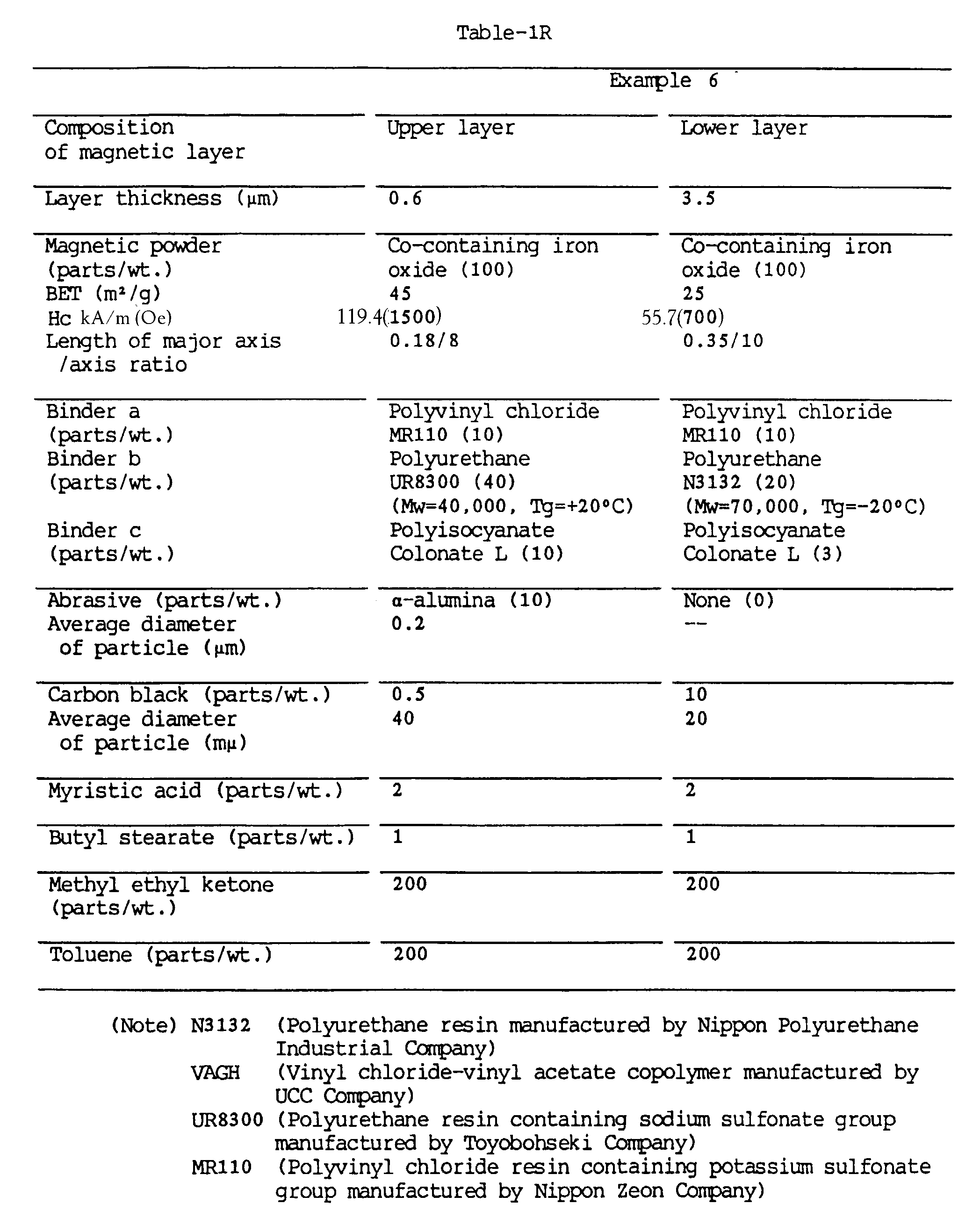
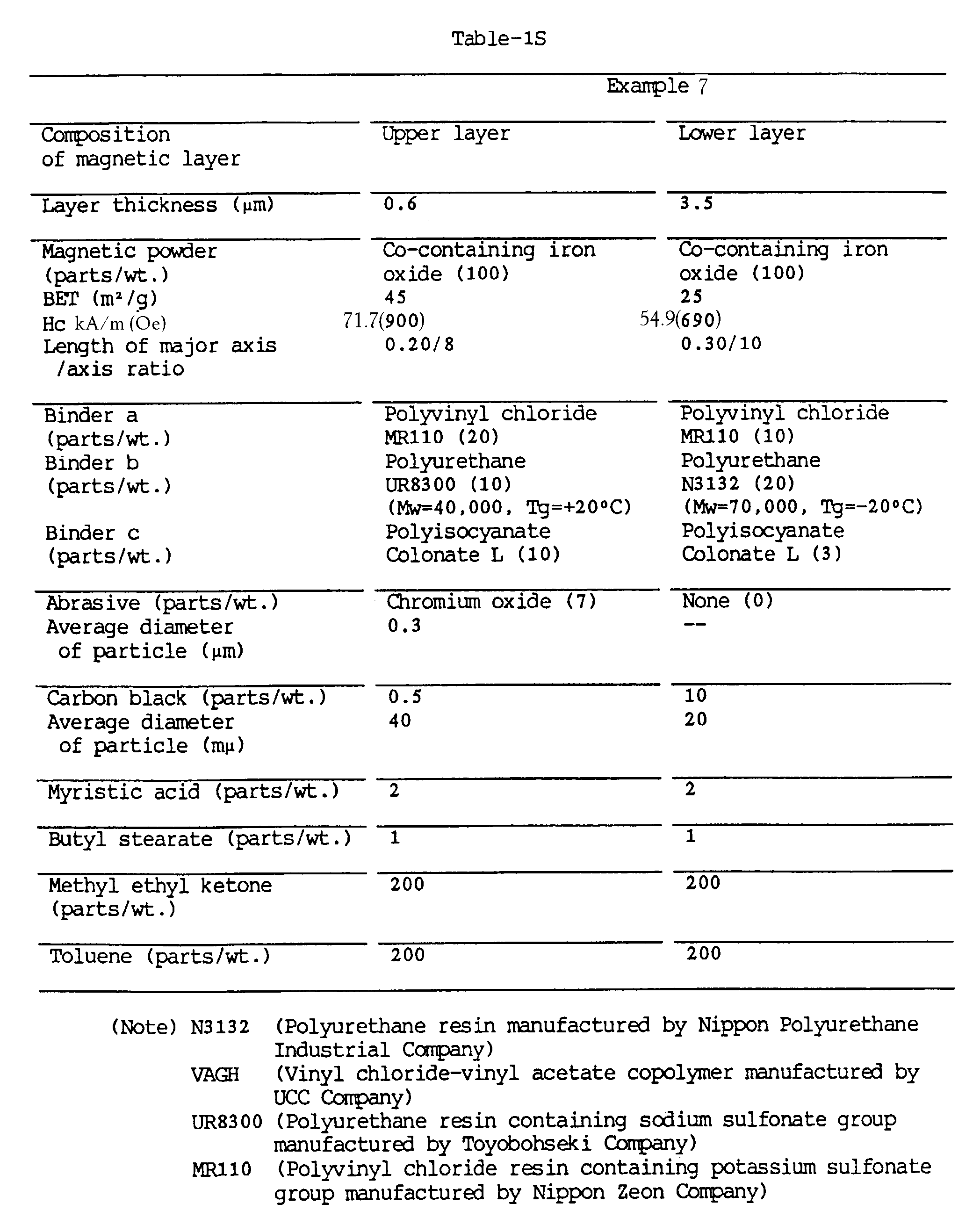


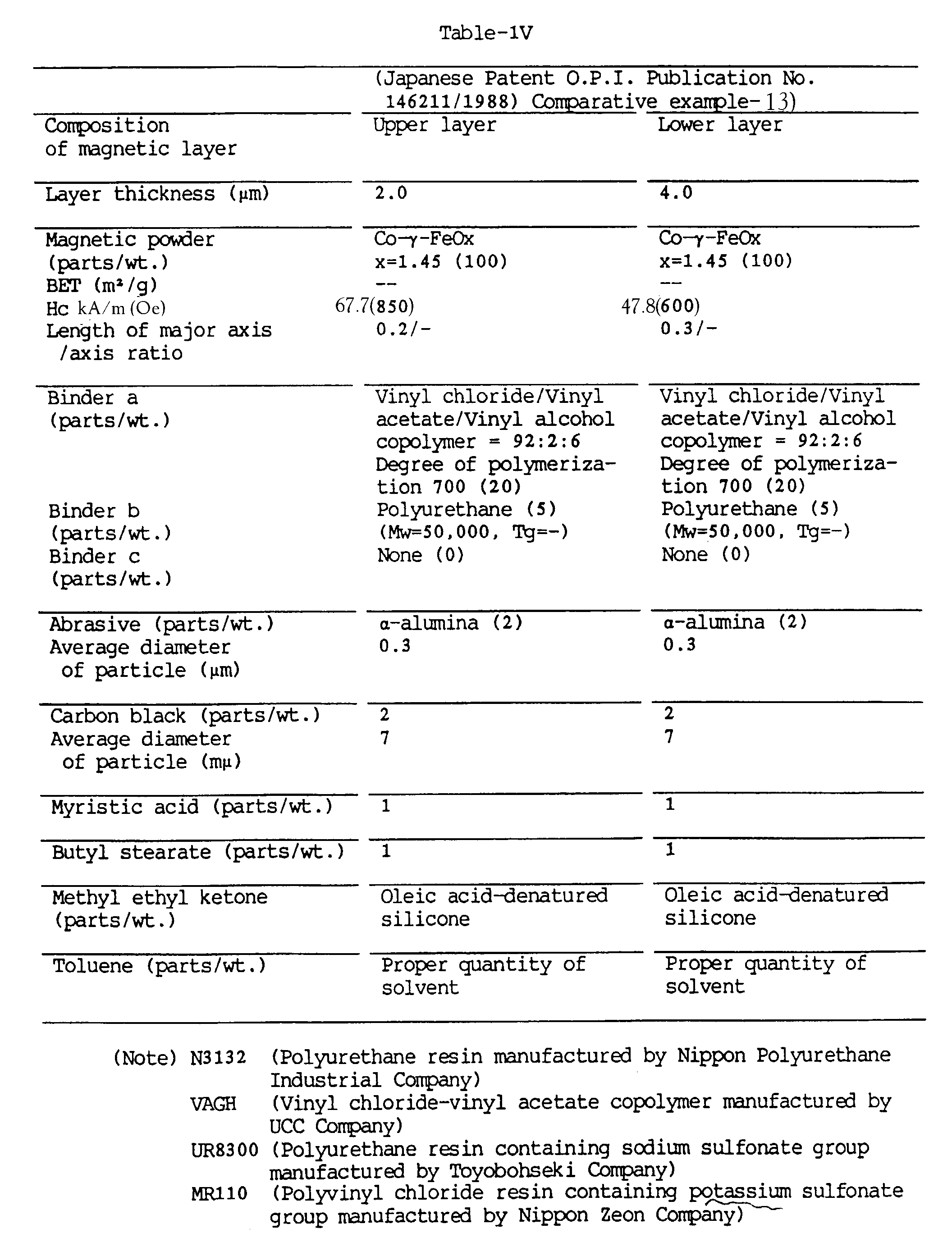

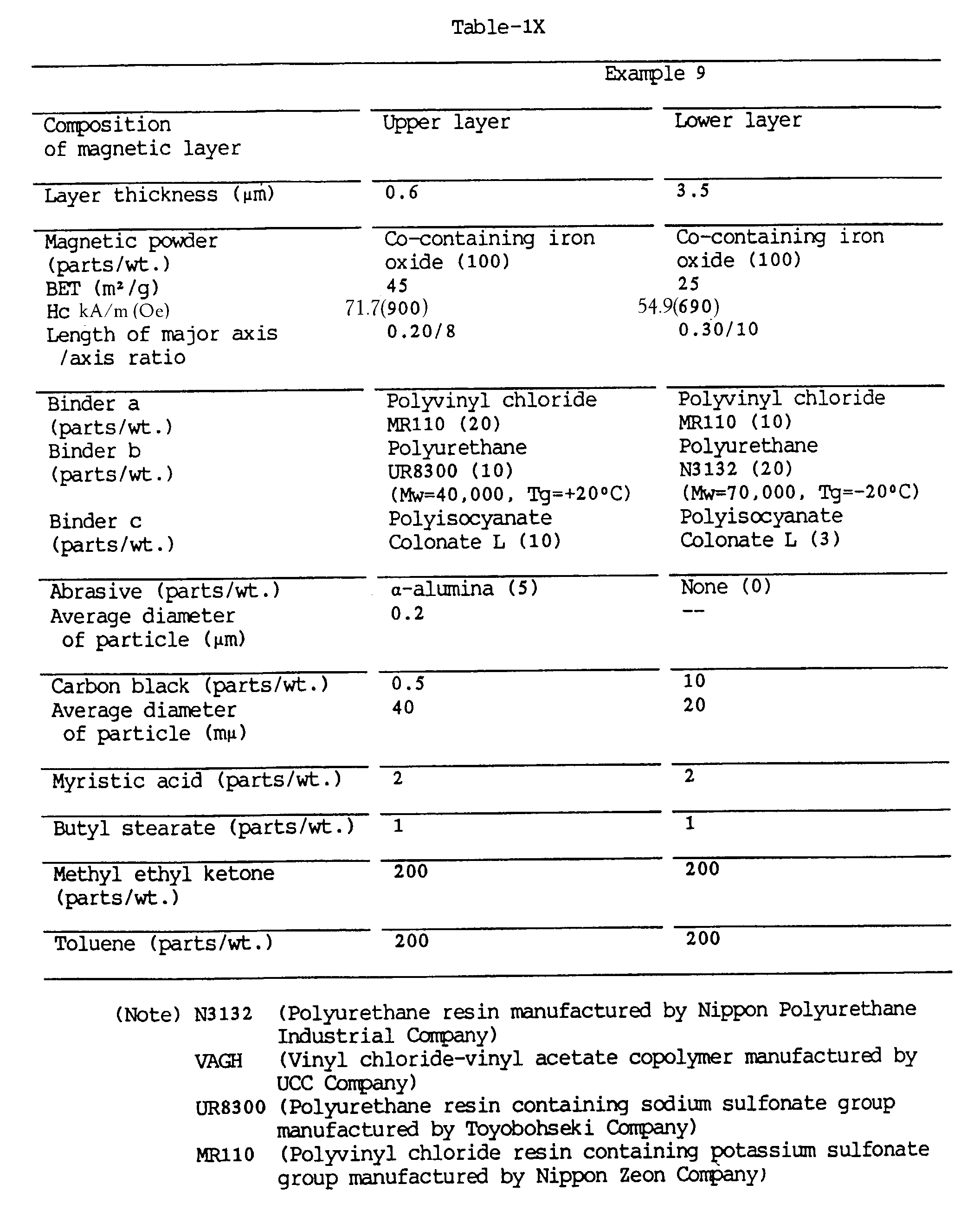


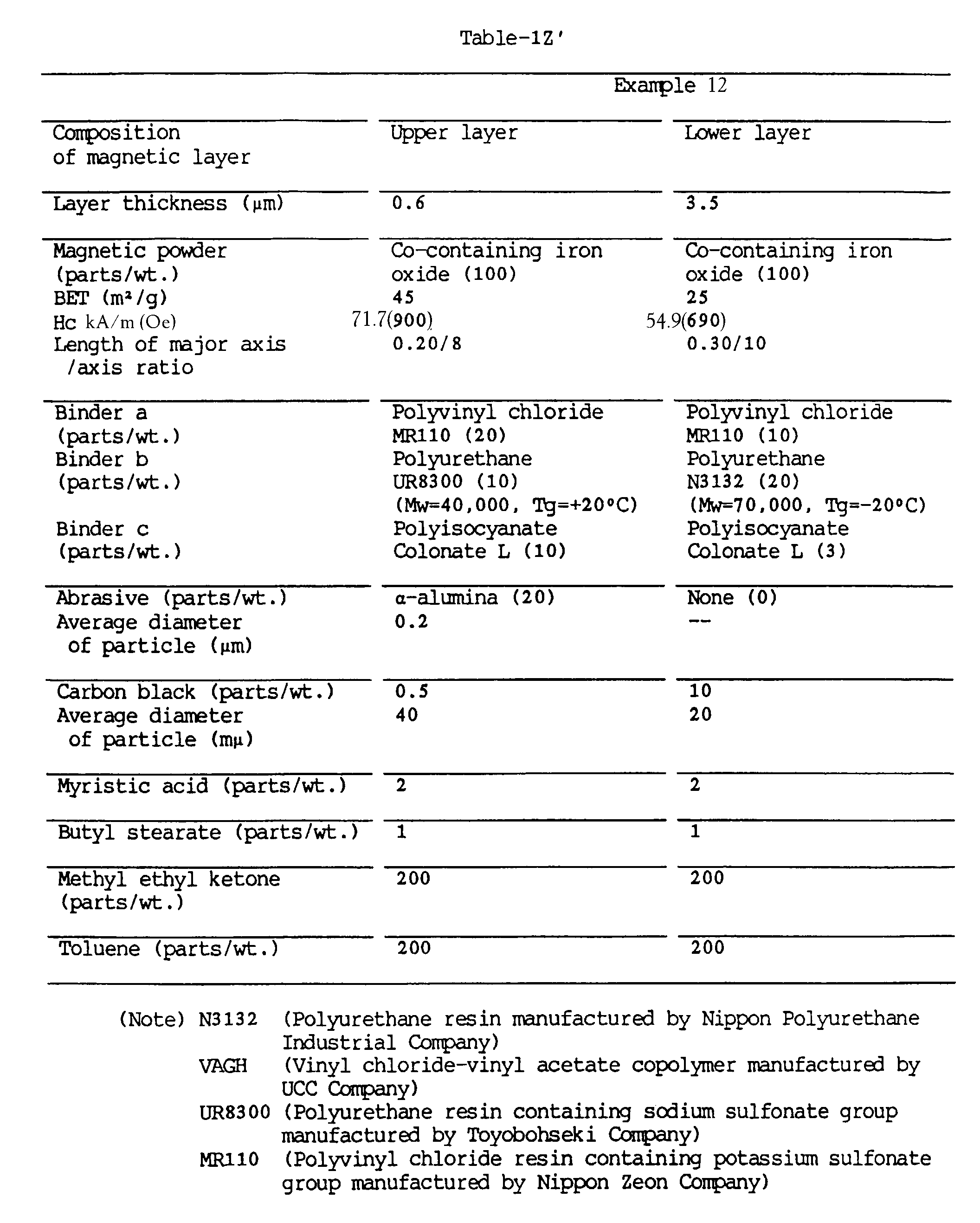
- Each tape mentioned above was measured in terms of its electric characteristics, dropout, still-frame durability, Young's modulus, stiffness and running smoothness and edge damage by the following method.
- By using a VTR deck for measurement of RF output, RF output at 4 MHz was measured. The value after 100 times of reproductions was illustrated. Note that the value of comparative example 3 is defined as the standard value, 0 dB.
Chroma output (C-output): ditto
Lumi-S/N (L-S/N): - For measurement, a noisemeter 925 D/1 manufactured by Shiba-soku Corp. was used. Note that the value of comparative example 3 is defined as the standard value, 0 dB. High pass filter was at 4.2 MHz and low-pass filter was at 10 KHz. As a VTR, HR-D manufactured by JVC was used.
Chroma S/N (C-S/N): ditto
Dropout: - For this measurement, VTR dropout counter, manufactured by Shiba-soku Corp., was used.
Rubbing noise:
(i) With running the tape, reproduction was done to measure the system noise by a spectrum analyzer. (ii) A sample tape was subjected 10 times to the reproduction for the period of one minute to measure the rubbing noise by a spectrum analyzer. (iii) The average noise value for 10 passes at around 8 MHz noise level was read on the base 0 dB of a system noise.
Still-frame durability: - The time required for the reproduction output of the still image to drop by 2 dB was indicated by a unit of a minute.
Running test: - A sample tape was subjected to running on a
VTR deck 50 times continuously under the conditions of 400C and the humidity of 80% to measure the decrease of RF output.
Edge damage: - The condition of a tape edge after being slit was checked in terms of the existence of damage.
- A cellophane adhesive tape was applied on the magnetic surface, and after one hour, the tape was peeled off to check how the magnetic layer was caused to come off.
Adhesivity Between support and lower layer Between upper layer and lower layer Whole magnetic layer comes off to cause support to be seen Unacceptable Unacceptable Lower magnetic layer stays. Acceptable Unacceptable Both of upper and lower layer stay. Acceptable Acceptable - The results are shown in Tables 2A - 2D.


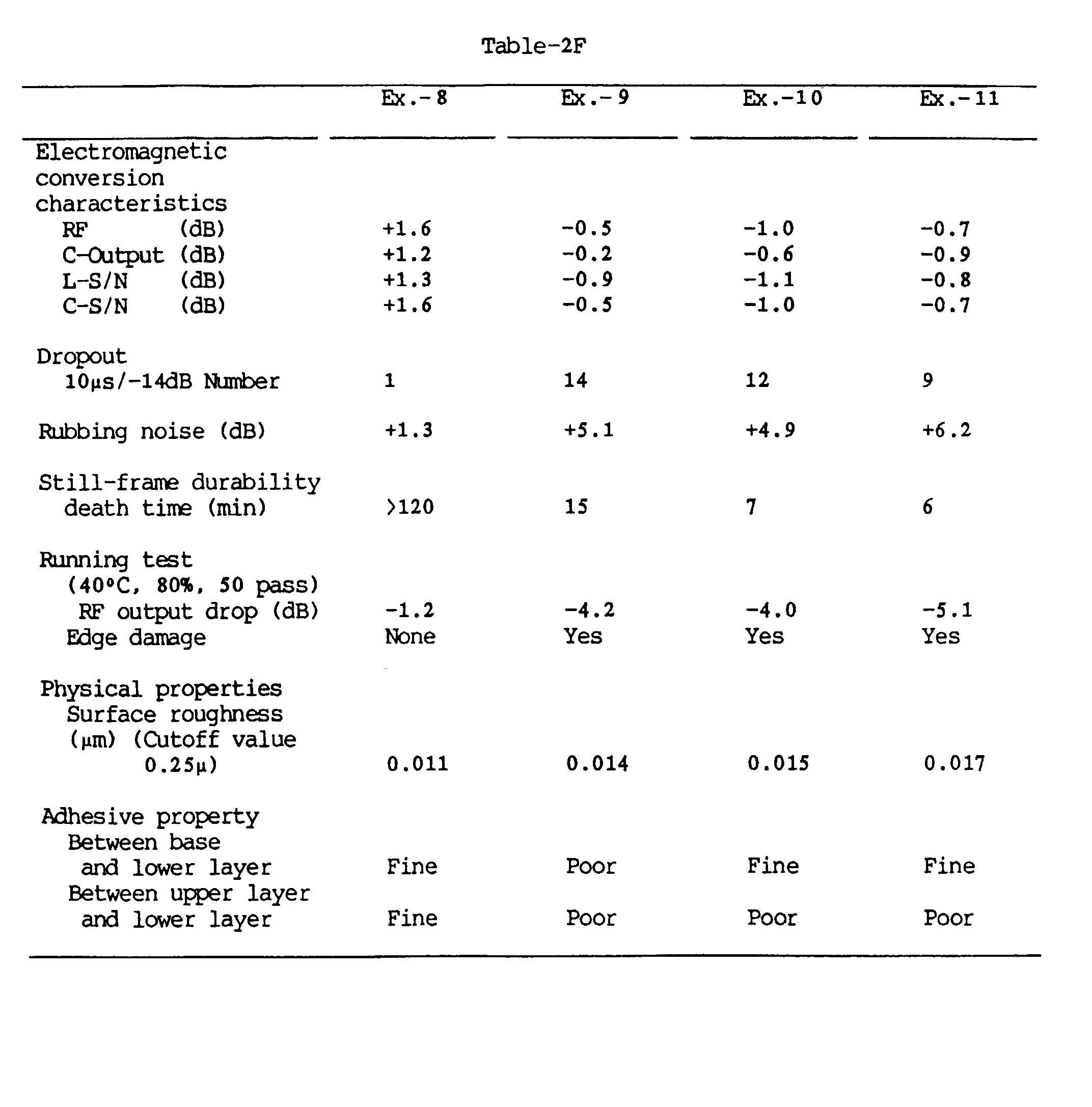

- From the results shown in Table 2A - 2D, it can be understood that the quality of tape improves as indicated in the following (1) - (7) by composing magnetic tape according to the present invention.
- (1) In Comp. Exs. 1 and 2 where the magnetic layer is single, almost all of the properties such as the electromagnetic conversion characteristics, dropout, the rubbing noise, and the like can not be improved. To the contrary, all properties can be improved by plural layers arranged according to the present invention, as shown in Exs. 1, 2, 3, 4, 5, and 6.
- (2) As for BET value, Comp. Ex. 4 containing a magnetic powder having a smaller BET value, which is out of the present invention, in the upper layer shows inefficient electromagnetic conversion characteristics, dropout. Comp. Ex. 5 containing a lower layer magnetic powder having a large BET value shows inferiority in the rubbing noise, adhesive strength, strength of the layer. Therefore, it can be understood that BET value of magnetic powder for the upper layer should not less than 30m2/g and that for the lower layer should be less than 30m2/g. Fig. 6 illustrates the variation of RF output on each example when BET is changed, where BET value of the lower layer magnetic powder is fixed at 25m2/g. Fig. 7 illustrates the variation of Young's modulus according to the change of BET value of the lower layer magnetic powder, where BET value of the upper layer magnetic powder is fixed at 45m2/g.
- (3) As for the binders used in the upper magnetic layer and the lower magnetic layer, when the same kind of binders are used according to the present invention, the electromagnetic conversion characteristics, dropout, and the like are improved. However, in Comp. Exs. 7, 8 and 9 where the binders are not the same, all of them are inferior in efficiency.
- (4) Abrasive should be contained at least in the upper layer according to the present invention. When it is not contained in the upper layer, the recording medium is inferior in the electromagnetic conversion characteristics, dropout, the rubbing noise, and durability of the layer as shown in Comp. Exs. 10 and 11. Comp. Ex. 11 is cited from the above-mentioned Japanese Patent Open to Public Inspection No. 56228/1983, where abrasive is not contained in both of the upper layer and the lower layer. The efficiency of its electromagnetic conversion characteristics becomes worse.
- (5) As shown in Exs. 7 and 8, the materials of the abrasive can be Cr2O3 or its mixture with α-alumina, where the abrasive is satisfactorily effective.
- (6) In Comp. Exs. 12, 13 and 14 which are cited from Japanese Patent Publication Open to Public Inspection No. 146211/1988, abrasive is contained in both the upper layer and the lower layer, but the content (especially the content of abrasive in the upper layer) is 2 parts by weight. The content is too low. As a result, it leads to a drop of RF output, an increase of the rubbing noise, and a decrease of still-image durability. On the other hand, when not less than 3 parts by weight of abrasive, furthermore not less than 5 parts by weight of abrasive is contained in the layers, its efficiency is greatly improved as shown in Exs. 1, 2, 9, and 10. Fig. 8 illustrates the change of the rubbing noise influenced by the content of the abrasive in the upper layer where the content of the abrasive is changed in the recipe of Ex. 1. In Comp. Ex. 14, the binders of the upper layer and that of the lower layer are different from each other. Therefore, the electromagnetic conversion characteristics, the rubbing noise, and durability of the layer become worse. In the case of Comp. Exs. 12, 13 and 14, the particle diameter of carbonblack used in the lower layer is 7mµ. It is comparatively small and small particles are not preferable to improve durability of the layer, the rubbing noise, dropout, and the like.
- (7) In the case of Comp. Exs. 12, 13 and 14, the efficiency does not reach the required level. The reason is considered to be that not only the content of abrasive is too low but also BET values of the upper layer and the lower layer are not adequately chosen.
Claims (3)
- A magnetic recording medium comprising a non-magnetic support having provided thereon an upper magnetic layer positioned farther from the said support, and a lower magnetic layer positioned closer to said support, whereinsaid upper magnetic layer comprises a binder, a magnetic powder having an original BET specific surface area of not less than 30 m2/g and at least one abrasive selected from alumina, silicon carbide, Cr2O3, silica, α-Fe2O3, TiO2, and zirconia in a ratio of 3 to 20 parts per 100 parts by weight of said magnetic powder,said lower magnetic layer comprises a binder and a magnetic powder having an original BET specific surface area of less than 30 m2/g, and wherein the kinds of the binders contained in the upper and lower magnetic layer are the same, each binder containing polar groups selected from -SO3H and metal sulfonate groups, and containing a mixture of polyurethane resin and polyvinyl chloride resin.
- The magnetic recording medium of claim 1, wherein the metal sulfonate group has the formula -SO3M, wherein M is lithium, sodium or potassium.
- The magnetic recording medium of claims 1 and 2, wherein the binders of the upper and the lower layer each contain a mixture of polyurethane resin and polyvinyl chloride resin, and at least one of the resins contained in each said upper and lower layer has a -SO3M group, in which M is hydrogen, lithium, sodium or potassium.
Applications Claiming Priority (4)
| Application Number | Priority Date | Filing Date | Title |
|---|---|---|---|
| JP234488/88 | 1988-09-19 | ||
| JP23448888 | 1988-09-19 | ||
| JP197489/89 | 1989-07-28 | ||
| JP19748989A JP2819029B2 (en) | 1988-09-19 | 1989-07-28 | Magnetic recording media |
Publications (3)
| Publication Number | Publication Date |
|---|---|
| EP0360175A2 EP0360175A2 (en) | 1990-03-28 |
| EP0360175A3 EP0360175A3 (en) | 1991-07-24 |
| EP0360175B1 true EP0360175B1 (en) | 1997-07-30 |
Family
ID=26510394
Family Applications (1)
| Application Number | Title | Priority Date | Filing Date |
|---|---|---|---|
| EP19890117162 Expired - Lifetime EP0360175B1 (en) | 1988-09-19 | 1989-09-16 | Magnetic recording medium |
Country Status (5)
| Country | Link |
|---|---|
| US (1) | US5084335A (en) |
| EP (1) | EP0360175B1 (en) |
| JP (1) | JP2819029B2 (en) |
| KR (1) | KR100190415B1 (en) |
| DE (1) | DE68928218D1 (en) |
Families Citing this family (12)
| Publication number | Priority date | Publication date | Assignee | Title |
|---|---|---|---|---|
| JP2893269B2 (en) * | 1989-04-11 | 1999-05-17 | コニカ株式会社 | Magnetic recording media |
| JP2647524B2 (en) * | 1990-01-23 | 1997-08-27 | 富士写真フイルム株式会社 | Magnetic recording media |
| US5336079A (en) * | 1991-03-06 | 1994-08-09 | Toray Industries, Inc. | Biaxially oriented laminated film comprising particles in a specific ratio of particle density |
| EP0566378B2 (en) † | 1992-04-14 | 2001-05-09 | Konica Corporation | Magnetic recording medium |
| US5644299A (en) * | 1993-07-29 | 1997-07-01 | Bindicator Company | Ultrasonic material level measurement |
| US5491051A (en) * | 1993-12-22 | 1996-02-13 | Eastman Kodak Company | Photographic element |
| US5371166A (en) * | 1993-12-22 | 1994-12-06 | The B. F. Goodrich Company | Polyurethane composition for use as a dispersing binder |
| US5432050A (en) * | 1994-02-08 | 1995-07-11 | Eastman Kodak Company | Photographic element having a transparent magnetic recording layer |
| US5747630A (en) * | 1997-03-13 | 1998-05-05 | Morton International, Inc. | Polyurethane binder for a magnetic recording medium |
| JP2000251240A (en) * | 1999-02-23 | 2000-09-14 | Sony Corp | Magnetic recording media |
| US7585576B2 (en) | 2002-12-19 | 2009-09-08 | Sony Corporation | Magnetic recording medium with dual magnetic layers including specific resins |
| KR20140018018A (en) * | 2012-08-03 | 2014-02-12 | 삼성전기주식회사 | Sensor for digitizer and method for manufacturing the same |
Family Cites Families (11)
| Publication number | Priority date | Publication date | Assignee | Title |
|---|---|---|---|---|
| DE2556188C3 (en) * | 1975-12-13 | 1979-07-05 | Basf Ag, 6700 Ludwigshafen | Flexible multilayer magnetogram carriers |
| DE2801452C2 (en) * | 1978-01-13 | 1985-03-28 | Agfa-Gevaert Ag, 5090 Leverkusen | Magnetic recording material |
| JPS57183630A (en) * | 1981-05-07 | 1982-11-12 | Fuji Photo Film Co Ltd | Magnetic recording medium |
| JPS5817539A (en) * | 1981-07-21 | 1983-02-01 | Sony Corp | Magnetic recording medium |
| JPS58205928A (en) * | 1982-05-25 | 1983-12-01 | Toshiba Corp | Magnetic recording medium |
| JPS59144042A (en) * | 1983-02-07 | 1984-08-17 | Hitachi Maxell Ltd | Magnetic recording medium |
| JPS60124025A (en) * | 1983-12-06 | 1985-07-02 | Fuji Photo Film Co Ltd | Magnetic recording medium |
| DE3418673A1 (en) * | 1984-05-19 | 1985-11-21 | Basf Ag, 6700 Ludwigshafen | Flexible magnetic recording carrier |
| JPS6157036A (en) * | 1984-08-27 | 1986-03-22 | Tdk Corp | magnetic recording medium |
| JPH0770047B2 (en) * | 1987-07-06 | 1995-07-31 | 富士写真フイルム株式会社 | Magnetic recording medium |
| JP2581583B2 (en) * | 1988-02-12 | 1997-02-12 | 富士写真フイルム株式会社 | Magnetic recording media |
-
1989
- 1989-07-28 JP JP19748989A patent/JP2819029B2/en not_active Expired - Fee Related
- 1989-09-14 US US07/407,337 patent/US5084335A/en not_active Expired - Lifetime
- 1989-09-16 EP EP19890117162 patent/EP0360175B1/en not_active Expired - Lifetime
- 1989-09-16 DE DE68928218T patent/DE68928218D1/en not_active Expired - Lifetime
- 1989-09-19 KR KR1019890013523A patent/KR100190415B1/en not_active Expired - Fee Related
Also Published As
| Publication number | Publication date |
|---|---|
| US5084335A (en) | 1992-01-28 |
| DE68928218D1 (en) | 1997-09-04 |
| KR900005387A (en) | 1990-04-14 |
| KR100190415B1 (en) | 1999-06-01 |
| EP0360175A2 (en) | 1990-03-28 |
| JP2819029B2 (en) | 1998-10-30 |
| JPH02168417A (en) | 1990-06-28 |
| EP0360175A3 (en) | 1991-07-24 |
Similar Documents
| Publication | Publication Date | Title |
|---|---|---|
| CA1161313A (en) | Magnetic recording medium | |
| US6835438B2 (en) | Magnetic recording tape | |
| US5084335A (en) | Magnetic recording medium comprising upper and lower magnetic layers | |
| EP0388818A2 (en) | Coating apparatus | |
| US5151323A (en) | Magnetic recording medium and manufacturing method thereof | |
| KR0155992B1 (en) | Magnetic recording media | |
| US5567502A (en) | Magnetic recording medium having a magnetic layer containing abrasive particles | |
| US5324582A (en) | Magnetic recording medium | |
| US5085915A (en) | Magnetic recording medium | |
| US5419943A (en) | Magnetic recording medium having a magnetic layer with a Tg of 80° C.° C. | |
| KR0150458B1 (en) | Magnetic recording media | |
| JPS6355722A (en) | Magnetic recording medium | |
| US5084336A (en) | Magnetic recording medium | |
| JP2647524B2 (en) | Magnetic recording media | |
| US5116658A (en) | Magnetic recording medium | |
| US6497948B2 (en) | Magnetic recording medium | |
| EP0415708B1 (en) | Magnetic recording medium | |
| EP0548880A1 (en) | Magnetic recording medium | |
| US5631062A (en) | Magnetic recording medium | |
| JP3252224B2 (en) | Magnetic recording media | |
| JPS61110335A (en) | Magnetic recording medium | |
| JP2004014038A (en) | Magnetic recording media | |
| JP2581970B2 (en) | Magnetic recording media | |
| KR19990029701A (en) | Magnetic recording medium | |
| JPH0380423A (en) | Magnetic recording medium |
Legal Events
| Date | Code | Title | Description |
|---|---|---|---|
| PUAI | Public reference made under article 153(3) epc to a published international application that has entered the european phase |
Free format text: ORIGINAL CODE: 0009012 |
|
| AK | Designated contracting states |
Kind code of ref document: A2 Designated state(s): DE FR GB |
|
| PUAL | Search report despatched |
Free format text: ORIGINAL CODE: 0009013 |
|
| AK | Designated contracting states |
Kind code of ref document: A3 Designated state(s): DE FR GB |
|
| 17P | Request for examination filed |
Effective date: 19911220 |
|
| 17Q | First examination report despatched |
Effective date: 19930412 |
|
| GRAG | Despatch of communication of intention to grant |
Free format text: ORIGINAL CODE: EPIDOS AGRA |
|
| GRAH | Despatch of communication of intention to grant a patent |
Free format text: ORIGINAL CODE: EPIDOS IGRA |
|
| GRAH | Despatch of communication of intention to grant a patent |
Free format text: ORIGINAL CODE: EPIDOS IGRA |
|
| GRAA | (expected) grant |
Free format text: ORIGINAL CODE: 0009210 |
|
| AK | Designated contracting states |
Kind code of ref document: B1 Designated state(s): DE FR GB |
|
| PG25 | Lapsed in a contracting state [announced via postgrant information from national office to epo] |
Ref country code: FR Effective date: 19970730 |
|
| REF | Corresponds to: |
Ref document number: 68928218 Country of ref document: DE Date of ref document: 19970904 |
|
| PGFP | Annual fee paid to national office [announced via postgrant information from national office to epo] |
Ref country code: FR Payment date: 19970909 Year of fee payment: 9 |
|
| PGFP | Annual fee paid to national office [announced via postgrant information from national office to epo] |
Ref country code: DE Payment date: 19970919 Year of fee payment: 9 |
|
| PG25 | Lapsed in a contracting state [announced via postgrant information from national office to epo] |
Ref country code: DE Effective date: 19971031 |
|
| EN | Fr: translation not filed | ||
| PLBE | No opposition filed within time limit |
Free format text: ORIGINAL CODE: 0009261 |
|
| STAA | Information on the status of an ep patent application or granted ep patent |
Free format text: STATUS: NO OPPOSITION FILED WITHIN TIME LIMIT |
|
| 26N | No opposition filed | ||
| REG | Reference to a national code |
Ref country code: GB Ref legal event code: IF02 |
|
| PGFP | Annual fee paid to national office [announced via postgrant information from national office to epo] |
Ref country code: GB Payment date: 20050914 Year of fee payment: 17 |
|
| GBPC | Gb: european patent ceased through non-payment of renewal fee |
Effective date: 20060916 |
|
| PG25 | Lapsed in a contracting state [announced via postgrant information from national office to epo] |
Ref country code: GB Free format text: LAPSE BECAUSE OF NON-PAYMENT OF DUE FEES Effective date: 20060916 |