EP0359389A1 - Antiarrhythmic agents - Google Patents
Antiarrhythmic agents Download PDFInfo
- Publication number
- EP0359389A1 EP0359389A1 EP89308064A EP89308064A EP0359389A1 EP 0359389 A1 EP0359389 A1 EP 0359389A1 EP 89308064 A EP89308064 A EP 89308064A EP 89308064 A EP89308064 A EP 89308064A EP 0359389 A1 EP0359389 A1 EP 0359389A1
- Authority
- EP
- European Patent Office
- Prior art keywords
- formula
- alkyl
- compound
- pyridyl
- pharmaceutically acceptable
- Prior art date
- Legal status (The legal status is an assumption and is not a legal conclusion. Google has not performed a legal analysis and makes no representation as to the accuracy of the status listed.)
- Ceased
Links
- 0 CC(C1(C2)C2C*C1)=C Chemical compound CC(C1(C2)C2C*C1)=C 0.000 description 6
- GDOPTJXRTPNYNR-UHFFFAOYSA-N CC1CCCC1 Chemical compound CC1CCCC1 GDOPTJXRTPNYNR-UHFFFAOYSA-N 0.000 description 1
Classifications
-
- C—CHEMISTRY; METALLURGY
- C07—ORGANIC CHEMISTRY
- C07D—HETEROCYCLIC COMPOUNDS
- C07D213/00—Heterocyclic compounds containing six-membered rings, not condensed with other rings, with one nitrogen atom as the only ring hetero atom and three or more double bonds between ring members or between ring members and non-ring members
- C07D213/02—Heterocyclic compounds containing six-membered rings, not condensed with other rings, with one nitrogen atom as the only ring hetero atom and three or more double bonds between ring members or between ring members and non-ring members having three double bonds between ring members or between ring members and non-ring members
- C07D213/04—Heterocyclic compounds containing six-membered rings, not condensed with other rings, with one nitrogen atom as the only ring hetero atom and three or more double bonds between ring members or between ring members and non-ring members having three double bonds between ring members or between ring members and non-ring members having no bond between the ring nitrogen atom and a non-ring member or having only hydrogen or carbon atoms directly attached to the ring nitrogen atom
- C07D213/60—Heterocyclic compounds containing six-membered rings, not condensed with other rings, with one nitrogen atom as the only ring hetero atom and three or more double bonds between ring members or between ring members and non-ring members having three double bonds between ring members or between ring members and non-ring members having no bond between the ring nitrogen atom and a non-ring member or having only hydrogen or carbon atoms directly attached to the ring nitrogen atom with hetero atoms or with carbon atoms having three bonds to hetero atoms with at the most one bond to halogen, e.g. ester or nitrile radicals, directly attached to ring carbon atoms
- C07D213/72—Nitrogen atoms
- C07D213/74—Amino or imino radicals substituted by hydrocarbon or substituted hydrocarbon radicals
-
- A—HUMAN NECESSITIES
- A61—MEDICAL OR VETERINARY SCIENCE; HYGIENE
- A61P—SPECIFIC THERAPEUTIC ACTIVITY OF CHEMICAL COMPOUNDS OR MEDICINAL PREPARATIONS
- A61P9/00—Drugs for disorders of the cardiovascular system
- A61P9/06—Antiarrhythmics
-
- C—CHEMISTRY; METALLURGY
- C07—ORGANIC CHEMISTRY
- C07D—HETEROCYCLIC COMPOUNDS
- C07D401/00—Heterocyclic compounds containing two or more hetero rings, having nitrogen atoms as the only ring hetero atoms, at least one ring being a six-membered ring with only one nitrogen atom
- C07D401/02—Heterocyclic compounds containing two or more hetero rings, having nitrogen atoms as the only ring hetero atoms, at least one ring being a six-membered ring with only one nitrogen atom containing two hetero rings
- C07D401/04—Heterocyclic compounds containing two or more hetero rings, having nitrogen atoms as the only ring hetero atoms, at least one ring being a six-membered ring with only one nitrogen atom containing two hetero rings directly linked by a ring-member-to-ring-member bond
Definitions
- This invention relates to antiarrhythmic agents useful in the treatment of cardiac arrhythmias.
- the compounds of the invention prolong the duration of the action potential in cardiac muscle and conducting tissue, and thereby increase refractoriness to premature stimuli.
- they are Class III antiarrhythmic agents according to the classification of Vaughan Williams (Antiarrhythmic Action, E. M. Vaughan Williams, Academic Press, 1980). They are effective in atria, ventricles and conducting tissue both in vitro and in vivo and are therefore useful for the prevention and treatment of a wide variety of ventricular and supraventricular arrhythmias including atrial and ventricular fibrillation. Because they do not alter the speed at which impulses are conducted, they have less propensity than current drugs (mostly Class I) to precipitate or aggravate arrhythmias, and they also produce less neurological side effects. Some of the compounds also have positive inotropic activity and therefore are particularly beneficial in patients with impaired cardiac pump function.
- the invention provides antiarrhythmic agents of the formulae:- and and their pharmaceutically acceptable salts, wherein X is O or N-(C1-C4 alkyl); R is C1-C4 alkyl; R1 is R2SO2NH- or R2CONH-, wherein R2 is C1-C4 alkyl, C3-C7 cycloalkyl or R3R4N-, wherein R3 und R4 are each independently selected from H and C1-C4 alkyl; "Het” is either (a) 2-, 3- or 4-pyridyl optionally substituted by 1 or 2 substituents, each independently selected from -NH2 and C1-C4 alkyl, or (b) 2-imidazolyl optionally substituted by 1 or 2 C1-C4 alkyl groups; m is 0, 1 or 2; n is 2, 3 or 4; and p is 1 or 2.
- C3 and C4 alkyl groups may be straight or branched chain.
- the C1-C4 alkyl group is methyl.
- R1 is CH3SO2NH-.
- Het is 2-, 3- or 4-pyridyl which may be optionally substituted by 1 or 2 substituents each independently selected from -NH2 and C1-C4 alkyl.
- "Het” is 4-pyridyl.
- m is 0 or 1.
- n is 2.
- p is 2.
- the pharmaceutically acceptable salts of the compounds of the formulae (IA) and (IB) include acid addition salts formed from acids which form non-toxic salts such as the hydrochloride, hydrobromide, hydroiodide, sulphate or bisulphate, phosphate or hydrogen phosphate, acetate, maleate, fumarate, lactate, tartarate, citrate, gluconate, benzoate, methanesulphonate, benzenesulphonate and p -toluenesulphonate salts.
- acids which form non-toxic salts such as the hydrochloride, hydrobromide, hydroiodide, sulphate or bisulphate, phosphate or hydrogen phosphate, acetate, maleate, fumarate, lactate, tartarate, citrate, gluconate, benzoate, methanesulphonate, benzenesulphonate and p -toluenesulphonate salts.
- Some of the compounds may also form metal salts, particularly alkaline earth and alkali metal salts. Examples include the sodium and potassium salts.
- Particularly preferred individual compounds are N-[4-(N′-Methyl-N′-[2-(N ⁇ -methyl-N ⁇ -[4-pyridyl]amino)ethyl]amino)phenyl]methanesulphonamide and N-[4-([1-(4-Pyridyl)piperidin-4-yl]methoxy)phenyl]methanesulphonamide, together with pharmaceutically acceptable salts thereof.
- the compounds of the formula (IA) or (IB) provided by the invention may be prepared by the following methods:-
- the compounds of the formula (IA) or (IB), wherein "HET” is pyridyl or pyridyl substituted by C1-C4 alkyl, and X, R, R1, m, n and p are as defined for formulae (IA) and (IB), are prepared from intermediates of the formula:- or wherein "HET” is pyridyl or pyridyl substituted by C1-C4 alkyl and X, R, m, n and p are as defined for formulae (IA) and (IB).
- a compound of the formula (IIIC) or (IIID) is either (a) reacted with a C1-C4 alkyl isothiocyanate in a suitable organic solvent, e.g. methanol or dichloromethane, at about room temperature to give a carbothioamide (IVA) or (IVB), wherein R6 is C1-C4 alkyl, or (b) reacted with a thiocyanate salt, e.g. ammonium, sodium or potassium thiocyanate, under acidic conditions to give a carbothioamide in which R6 is H.
- a suitable organic solvent e.g. methanol or dichloromethane
- the carbothioamide is then S-alkylated, preferably using a C1-C4 alkyl halide (preferably an iodide) or a compound of the formula (C1-C4 alkyl)SO3R7, or
- the S-alkyl derivative (VA) or (VB) can then be converted to an imidazole by two different methods.
- the S-alkyl derivative is reacted with the acetal (VI), e.g. by heating at from 60-130°C and preferably under reflux in a suitable organic solvent (such as pyridine), to form an intermediate guanidine.
- a suitable organic solvent such as pyridine
- the guanidine is then heated in aqueous acid, e.g. aqueous hydrochloric acid, and preferably under reflux, to cyclise it to the product (IC) or (IE).
- the S-alkyl derivative is converted to the imidazole (ID) or (IF) by reaction with propargylamine in a suitable organic solvent, e.g. pyridine, and typically at a temperature of from 60-130°C and preferably under reflux.
- a suitable organic solvent e.g. pyridine
- a suitable leaving group "Y” is introduced into a compound of the formula (VIIC) or (VIID) (prepared according to part (a)) by conventional methods, e.g. thionyl chloride or bromide; or methanesulphonyl chloride or methanesulphonic anhydride in the presence of an acid acceptor, to give a compound of the formula (VIIIA) or (VIIIB) which may be reacted with a (C1-C4 alkyl)amine by conventional techniques (e.g. using a 2-10 fold excess of the amine in an inert solvent, if necessary in a suitable "pressure vessel") to give a compound of the formula (VIIA) or (VIIB).
- Derivatisation of a compound of the formula (XA) or (XB) may be accomplished by conventional procedures similar to those previously described in Method 1 for the preparation of the compounds of the formulae (IA) and (IB).
- a suitable leaving group "W” is introduced into a compound of the formula (XIA) or (XIB) (prepared according to part (a)) by conventional methods, e.g. carbon tetrachloride or tetrabromide/triphenylphosphine; or methanesulphonyl chloride or methanesulphonic anhydride in the presence of an acid acceptor, to give a compound of the formula (XIIA) or (XIIB), that may be reacted with an amine of the formula:- by conventional techniques, e.g. in the presence of a suitable acid acceptor such as Na2CO2 and in a suitable organic solvent, to give a compound of the formula (IXA) or (IXB).
- a suitable acid acceptor such as Na2CO2
- the reaction is typically carried out in the presence of a suitable acid acceptor, e.g. NaHCO3, and at up to the reflux temperature, preferably under reflux, in a suitable organic solvent, e.g. n -butanol.
- a suitable acid acceptor e.g. NaHCO3
- a suitable organic solvent e.g. n -butanol.
- the reaction may also be carried out using pyridine as both the solvent and the acid acceptor.
- the invention also includes any novel intermediates disclosed herein, such as those of the formulae (IIA), (IIB), (IIIA) and (IIIB).
- salts are readily prepared by mixing solutions containing equimolar amounts of the free base and the desired acid.
- the salt generally precipitates from solution or is recovered by evaporation of the solvent.
- the biological activity of the compounds of the invention is assessed by measuring the effect of the compounds on atrial refractoriness.
- guinea pig right hemiatria are mounted in a bath containing physiological salt solution, with one end connected to a force transducer.
- the tissues are stimulated at 1 Hz using field electrodes.
- Effective refractory period (ERP) is measured by introducing premature stimuli (S2) after every 8th basic stimulus (S1).
- S1S2 coupling interval is gradually increased until S2 reproducibly elicits a propagated response. This is defined as the ERP.
- the test compound is then added to the bath and the concentration of compound required to increase ERP by 25% is determined (ED25).
- ERP is also measured in guinea pig right papillary muscles incubated in physiological saline solution. Muscles are stimulated at one end using bipolar electrodes and the propagated electrogram is recorded at the opposite end via a unipolar surface electrode. ERP is determined as above using the extrastimulus technique. Conduction time is obtained from a digital storage oscilloscope by measuring the interval between the stimulus artefact and the peak of the electrogram (i.e. the time required for the impulse to travel along the length of the muscle).
- Atrial and ventricular ERP's are also measured in anaesthetised or conscious dogs by the extrastimulus technique whilst the atrium or right ventrical is being paced at a constant rate.
- the compounds of the formulae (IA) or (IB) can be administered alone but will generally be administered in admixture with a pharmaceutical carrier selected with regard to the intended route of administration and standard pharmaceutical practice. They can be administered both to patients suffering from arrhythmias and also, prophylactically, to those likely to develop arrhythmias. For example, they may be administered orally in the form of tablets containing such excipients as starch or lactose, or in capsules either alone or in admixture with excipients, or in the form of elixirs or suspensions containing flavouring or colouring agents. They may be injected parenterally, for example, intravenously, intramuscularly or subcutaneously. For parenteral administration, they are best used in the form of a sterile aqueous solution which may contain other solutes, for example, enough salts or glucose to make the solution isotonic with blood.
- oral dosages of the compounds of the invention will be in the range from 1 to 75 mg daily, taken in up to 4 divided doses per day, for an average adult patient (70kg).
- individual tablets or capsules might contain 1 to 25mg of active compound, in a suitable pharmaceutically acceptable vehicle or carrier.
- Dosages for intravenous administration would be expected to be within the range 0.5 to 10mg per single dose as required.
- a severe cardiac arrhythmia is preferably treated by the i.v. route in order to effect a rapid conversion to the normal rhythm. Variations on these dosages may occur depending on the weight and condition of the subject being treated as will be determined by the medical practitioner.
- the present invention provides a pharmaceutical composition
- a pharmaceutical composition comprising a compound of the formula (IA) or (IB), as defined above, or a pharmaceutically acceptable salt thereof, together with a pharmaceutically acceptable diluent or carrier.
- the invention also provides a method of prevention or reducing cardiac arrhythmias in a human being, which comprises administering to said human being an effective amount of a compound of the formula (IA) or (IB), or a pharmaceutically acceptable salt thereof, or of a pharmaceutical composition as defined above.
- the invention yet further provides a compound of the formula (IA) or (IB), or a pharmaceutically acceptable salt thereof, for use as a medicament, in particular as an antiarrhythmic agent.
- the invention also provides the use of a compound of the formula (IA) or (IB), or of a pharmaceutically acceptable salt thereof, for the manufacture of a medicament for the prevention or reduction of cardiac arrhythmias.
- Methanesulphonyl chloride (0.151 g) was added dropwise to a stirred solution of 4-[2-(N-methyl-N-[4-pyridyl]amino)ethoxy]benzenamine (see Preparation 1) (0.292 g) in pyridine (10 ml). The solution was stirred at room temperature for 1 hour and then evaporated. The residue was triturated with dilute sodium bicarbonate solution and the solid was filtered off, washed with water and crystallised from ethanol/water to give the title compound, (0.16 g), m.p. 134-135°. Analysis %:- Found: C,56.12; H,6.06; N,13.08; C15H19N3O3S requires: C,56.03; H,5.96; N,13.07.
- Methylsulphamoyl chloride (0.39 g) was added dropwise to a stirred solution of 4-[(4-aminophenoxy)methyl]-1-[4-pyridyl]piperidine (see Preparation 4) (0.57 g) in pyridine (15 ml) and the mixture was stirred at room temperature for 6 hours. An additional 0.39 g of methylsulphamoyl chloride was then added and the mixture was stirred for a further 18 hours and then evaporated. The residue was partitioned between sodium bicarbonate solution and ethyl acetate. The organic layer was separated and the aqueous layer was extracted several times with ethyl acetate.
- Methyl isocyanate (0.18 g) was added to a stirred solution of 4-[(4-aminophenoxy)methyl]-1-[4-pyridyl]piperidine (see Preparation 4) (0.57 g) in dimethylformamide (10 ml) and the mixture was stirred at room temperature for 3 hours and then diluted with methanol (2 ml). The solid was filtered off and crystallised from methanol to give the title compound, (0.32 g), m.p. 222-224°. Analysis %:- Found: C,66.98; H,7.15; N,16.58; C19H24N4O2 requires: C,67.03; H,7.11; N,16.46.
- part (i) (1.78 g) with sodium hydride (0.53 g of a 50% dispersion in mineral oil) followed by 4-chloronitrobenzene according to the method of Preparation 1, part (ii) gave the title compound, (1.45 g), m.p. 142-143° (from ethyl acetate/hexane).
- part (ii) Hydrogenation of the product of part (ii) (1.10 g) according to the method of Preparation 1, part (iii) gave the title compound, (0.99 g), m.p. 209-210° (from ethyl acetate/ethanol).
- part (i) (1.92 g) with sodium hydride (0.53 g of a 50% dispersion in mineral oil) followed by 4-chloronitrobenzene (1.58 g) according to the method of Preparation 1, part (ii) gave the title compound (1.75 g), m.p. 119-120° (from ethyl acetate/hexane).
- part (ii) Hydrogenation of the product of part (ii) (1.50 g) according to the method of Preparation 1, part (iii) gave the title compound, (1.30 g), m.p. 207-209° (from ethanol).
- Dibenzyldicarbonate (28.6 g) was added portionwise to a stirred solution of 4-piperidinemethanol (11.3 g) in 1,4-dioxane (50 ml) and water (50 ml). The solution was stirred for 1 hour and then evaporated. Water was added to the residue and the mixture was extracted several times with ethyl acetate. The combined extracts were washed with water, dried (MgSO4) and evaporated to give an oil which was chromatographed on silica gel, eluting with ether. Earlier fractions contained impurity and the pure product was eluted in the later fractions. The product fractions were combined and evaporated to give a viscous oil, (18.45 g), which was used without further purification.
- Methanesulphonyl chloride (1.91 g) was added to a stirred solution of the product of part (iii) (5.15 g) in pyridine (50 ml) at 0°. The solution was stirred at room temperature for 18 hours and then evaporated. The residue was treated with aqueous sodium bicarbonate solution and the mixture was extracted several times with ethyl acetate. The combined extracts were washed with water, dried (Na2SO4) and evaporated. The residue was crystallised from ethyl acetate/hexane to give the title compound, (5.17 g), m.p. 150-151°. Analysis %:- Found: C,60.27; H,6.34; N,6.59; C21H26N2O5S requires: C,60.27; H,6.26; N,6.69;
Landscapes
- Chemical & Material Sciences (AREA)
- Organic Chemistry (AREA)
- Health & Medical Sciences (AREA)
- Nuclear Medicine, Radiotherapy & Molecular Imaging (AREA)
- Life Sciences & Earth Sciences (AREA)
- Cardiology (AREA)
- Heart & Thoracic Surgery (AREA)
- Chemical Kinetics & Catalysis (AREA)
- General Chemical & Material Sciences (AREA)
- Medicinal Chemistry (AREA)
- Engineering & Computer Science (AREA)
- Pharmacology & Pharmacy (AREA)
- Bioinformatics & Cheminformatics (AREA)
- Animal Behavior & Ethology (AREA)
- General Health & Medical Sciences (AREA)
- Public Health (AREA)
- Veterinary Medicine (AREA)
- Pharmaceuticals Containing Other Organic And Inorganic Compounds (AREA)
- Plural Heterocyclic Compounds (AREA)
- Pyridine Compounds (AREA)
Abstract
The invention provides antiarrhythmic agents of the formula:

and

and pharmaceutically acceptable salts thereof,
wherein X is 0 or N-(C₁-C₄ alkyl);
R is C₁-C₄ alkyl;
R¹ is R²SO₂NH- or R²CONH-,
wherein R² is C₁-C₄ alkyl, C₃-C₇ cycloalkyl or R³R⁴N-,
wherein R³ und R⁴ are each independently selected from H and C₁-C₄ alkyl;
"Het" is either (a) 2-, 3- or 4-pyridyl optionally substituted by 1 or 2 substituents, each independently selected from -NH₂ and C₁-C₄ alkyl, or (b) 2-imidazolyl optionally substituted by 1 or 2 C₁-C₄ alkyl groups;
m is 0, 1 or 2;
n is 2, 3 or 4;
and p is 1 or 2.
wherein X is 0 or N-(C₁-C₄ alkyl);
R is C₁-C₄ alkyl;
R¹ is R²SO₂NH- or R²CONH-,
wherein R² is C₁-C₄ alkyl, C₃-C₇ cycloalkyl or R³R⁴N-,
wherein R³ und R⁴ are each independently selected from H and C₁-C₄ alkyl;
"Het" is either (a) 2-, 3- or 4-pyridyl optionally substituted by 1 or 2 substituents, each independently selected from -NH₂ and C₁-C₄ alkyl, or (b) 2-imidazolyl optionally substituted by 1 or 2 C₁-C₄ alkyl groups;
m is 0, 1 or 2;
n is 2, 3 or 4;
and p is 1 or 2.
Description
- This invention relates to antiarrhythmic agents useful in the treatment of cardiac arrhythmias.
- The compounds of the invention prolong the duration of the action potential in cardiac muscle and conducting tissue, and thereby increase refractoriness to premature stimuli. Thus, they are Class III antiarrhythmic agents according to the classification of Vaughan Williams (Antiarrhythmic Action, E. M. Vaughan Williams, Academic Press, 1980). They are effective in atria, ventricles and conducting tissue both in vitro and in vivo and are therefore useful for the prevention and treatment of a wide variety of ventricular and supraventricular arrhythmias including atrial and ventricular fibrillation. Because they do not alter the speed at which impulses are conducted, they have less propensity than current drugs (mostly Class I) to precipitate or aggravate arrhythmias, and they also produce less neurological side effects. Some of the compounds also have positive inotropic activity and therefore are particularly beneficial in patients with impaired cardiac pump function.
- The invention provides antiarrhythmic agents of the formulae:-


wherein X is O or N-(C₁-C₄ alkyl);
R is C₁-C₄ alkyl;
R¹ is R²SO₂NH- or R²CONH-,
wherein R² is C₁-C₄ alkyl, C₃-C₇ cycloalkyl or R³R⁴N-,
wherein R³ und R⁴ are each independently selected from H and C₁-C₄ alkyl;
"Het" is either (a) 2-, 3- or 4-pyridyl optionally substituted by 1 or 2 substituents, each independently selected from -NH₂ and C₁-C₄ alkyl, or (b) 2-imidazolyl optionally substituted by 1 or 2 C₁-C₄ alkyl groups;
m is 0, 1 or 2;
n is 2, 3 or 4;
and p is 1 or 2. - C₃ and C₄ alkyl groups may be straight or branched chain.
Preferably, the C₁-C₄ alkyl group is methyl.
Preferably, R¹ is CH₃SO₂NH-.
Preferably, "Het" is 2-, 3- or 4-pyridyl which may be optionally substituted by 1 or 2 substituents each independently selected from -NH₂ and C₁-C₄ alkyl.
Most preferably, "Het" is 4-pyridyl.
Preferably, m is 0 or 1.
Preferably, n is 2.
Preferably, p is 2. - The pharmaceutically acceptable salts of the compounds of the formulae (IA) and (IB) include acid addition salts formed from acids which form non-toxic salts such as the hydrochloride, hydrobromide, hydroiodide, sulphate or bisulphate, phosphate or hydrogen phosphate, acetate, maleate, fumarate, lactate, tartarate, citrate, gluconate, benzoate, methanesulphonate, benzenesulphonate and p-toluenesulphonate salts.
- Some of the compounds, e.g. those in which R¹ is R²SO₂NH-, may also form metal salts, particularly alkaline earth and alkali metal salts. Examples include the sodium and potassium salts.
- Particularly preferred individual compounds are
N-[4-(N′-Methyl-N′-[2-(N˝-methyl-N˝-[4-pyridyl]amino)ethyl]amino)phenyl]methanesulphonamide and
N-[4-([1-(4-Pyridyl)piperidin-4-yl]methoxy)phenyl]methanesulphonamide, together with pharmaceutically acceptable salts thereof. - The compounds of the formula (IA) or (IB) provided by the invention may be prepared by the following methods:-
- (1) Preferably, the compounds of the formula (IA) or (IB), wherein "HET" is pyridyl or pyridyl substituted by C₁-C₄ alkyl, and X, R, R¹, m, n and p are as defined for formulae (IA) and (IB), are prepared from intermediates of the formula:-


- The compounds of the formula (IA) or (IB), wherein "Het", X, R, m, n and p are as defined for the formulae (IIA) and (IIB) and R¹ is
- a) R²SO₂NH-,
wherein R² is C₁-C₄ alkyl, C₃-C₇ cycloalkyl or R³R⁴N-, wherein R³ is H or C₁-C₄ alkyl and R⁴ is C₁-C₄ alkyl, can be prepared by reacting a compound of the formula (IIA) or (IIB) with a sulphonyl halide of the formula (C₁-C₄ alkyl or C₃-C₇ cycloalkyl)SO₂(Cl or Br), a sulphonic anhydride of the formula ([C₁-C₄ alkyl or C₃-C₇ cycloalkyl]SO₂)₂O or with a sulphamoyl chloride of the formula R³R⁴NSO₂Cl, wherein R³ is H or C₁-C₄ alkyl and R⁴ is C₁-C₄ alkyl, in the presence of a suitable acid acceptor, e.g. triethylamine or pyridine. The reaction is typically carried out at from 0°C to room temperature in a suitable organic solvent, e.g. methylene chloride. Preferably, the reaction is carried out using pyridine as both the solvent and the acid acceptor at room temperature; - b) H₂NSO₂NH-,
can be prepared by reacting a compound of the formula (IIA) or (IIB) with sulphamide at up to, and preferably at, the reflux temperature in a suitable organic solvent, e.g. 1,4-dioxane; - c) R²CONH-,
wherein R² is C₁-C₄ alkyl or C₃-C₇ cycloalkyl, can be prepared by acylating a compound of the formula (IIA) or (IIB) with either an acid halide of the formula (C₁-C₄ alkyl or C₃-C₇ cycloalkyl)CO(Cl or Br) or with an anhydride of the formula ([C₁-C₄ alkyl or C₃-C₇ cycloalkyl]CO)₂O. When an acid halide is employed the reaction is typically carried out from 0°C to room temperature in a suitable organic solvent, e.g. methylene chloride, and in the presence of a suitable acid acceptor, e.g. triethylamine or pyridine. The reaction may also be carried out using pyridine as both the solvent and the acid acceptor. When an acid anhydride is employed the reaction is typically carried out at up to the reflex temperature, preferably at 100°C, in a suitably compatible organic solvent, e.g. a carboxylic acid of the formula (C₁-C₄ alkyl or C₃-C₇ cycloalkyl)COOH; - d) H₂NCONH-,
can be prepared by reacting a compound of the formula (IIA) or (IIB) with sodium or potassium cyanate at up to, and preferably at the reflex temperature under acidic conditions, e.g. in aqueous acetic acid; - e) (C₁-C₄ alkyl)NHCONH-,
can be prepared by reacting a compound of the formula (IIA) or (IIB) with a C₁-C₄ alkyl isocyanate. The reaction is preferably carried out at room temperature in a suitable organic solvent, e.g. dimethylformamide, although if necessary elevated temperatures may be employed to accelerate the rate of reaction.
or - f) (C₁-C₄ alkyl)₂NCONH-,
can be prepared by reacting a compound of the formula (IIA) or (IIB) with a compound of the formula (C₁-C₄ alkyl)₂NCOCl. The reaction is typically carried out at from 0°C to the reflux temperature in a suitable organic solvent, e.g. methylene chloride, and in the presence of a suitable acid acceptor, e.g. triethylamine or pyridine. - (2) The compounds of the formula (IA) or (IB), wherein "Het", X, R, R¹, m, n and p are as defined for formulae (IA) and (IB), can be prepared from intermediates of the formula:-


- The compounds of the formula (IA) or (IB), wherein X, R, R¹, m, n and p are as defined for formulae (IA) and (IB) and "Het" is
- a) pyridyl or pyridyl substituted by C₁-C₄ alkyl, can be prepared by reacting a compound of the formula (IIIA) or (IIIB), wherein R⁵ is H, with a halopyridine of the formula

- b) pyridyl substituted by -NH₂ and optionally by C₁-C₄ alkyl, can be prepared by reduction of a compound of the formula (IIIA) or (IIIB), wherein R⁵ is

or - c) 2-imidazolyl or 2-imidazolyl substituted by C₁-C₄ alkyl, can be prepared from a compound of the formula (IIIA) or (IIIB), wherein R⁵ is H, according to the appropriate following scheme 1 or 2:-
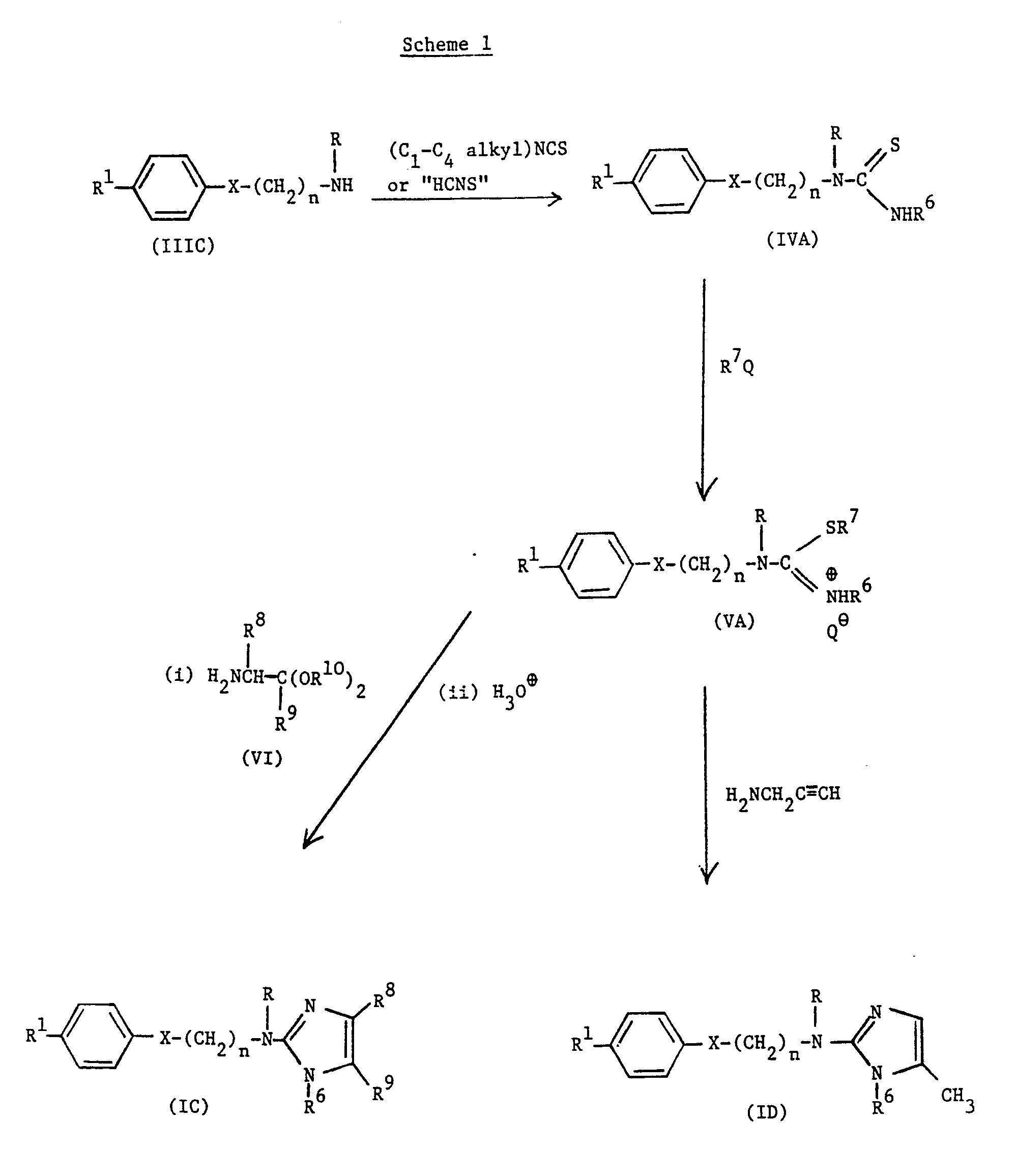


- In the first step, a compound of the formula (IIIC) or (IIID) is either (a) reacted with a C₁-C₄ alkyl isothiocyanate in a suitable organic solvent, e.g. methanol or dichloromethane, at about room temperature to give a carbothioamide (IVA) or (IVB), wherein R⁶ is C₁-C₄ alkyl, or (b) reacted with a thiocyanate salt, e.g. ammonium, sodium or potassium thiocyanate, under acidic conditions to give a carbothioamide in which R⁶ is H.
- The carbothioamide is then S-alkylated, preferably using a C₁-C₄ alkyl halide (preferably an iodide) or a compound of the formula (C₁-C₄ alkyl)SO₃R⁷,


- The S-alkyl derivative (VA) or (VB) can then be converted to an imidazole by two different methods.
- In the first method, the S-alkyl derivative is reacted with the acetal (VI), e.g. by heating at from 60-130°C and preferably under reflux in a suitable organic solvent (such as pyridine), to form an intermediate guanidine. The guanidine is then heated in aqueous acid, e.g. aqueous hydrochloric acid, and preferably under reflux, to cyclise it to the product (IC) or (IE).
- In the second method, the S-alkyl derivative is converted to the imidazole (ID) or (IF) by reaction with propargylamine in a suitable organic solvent, e.g. pyridine, and typically at a temperature of from 60-130°C and preferably under reflux.
- The intermediates of the formula (IIA), (IIB), (IIIA) or (IIIB) required for the preparation of the compounds of the invention of the formula (IA) or (IB) may be prepared by the following methods:-
- (1) The intermediates of the formulae (IIA) and (IIB), wherein "Het", X, R, m, n, and p are as previously defined for the formulae (IIA) and (IIB), can be prepared by conventional techniques, e.g. as described in Preparations 1 to 4 of the Preparations section, as summarised by the following scheme:-

- The starting materials
- a) of the formulae (VIIA) and (VIIB), wherein X is 0, and the compounds of the formula (VIIA), wherein Z is N-(C₁-C₄ alkyl), wherein the said C₁-C₄ alkyl group is identical to that selected for R in the formula (IIA), can be prepared by conventional techniques, e.g. as described in Preparations 1 to 4 of the Preparations section;
or - b) of the formulae (VIIA) and (VIIB), wherein X is N-(C₁-C₄ alkyl), may be prepared by conventional techniques according to the following scheme:-

- In a typical procedure, a suitable leaving group "Y" is introduced into a compound of the formula (VIIC) or (VIID) (prepared according to part (a)) by conventional methods, e.g. thionyl chloride or bromide; or methanesulphonyl chloride or methanesulphonic anhydride in the presence of an acid acceptor, to give a compound of the formula (VIIIA) or (VIIIB) which may be reacted with a (C₁-C₄ alkyl)amine by conventional techniques (e.g. using a 2-10 fold excess of the amine in an inert solvent, if necessary in a suitable "pressure vessel") to give a compound of the formula (VIIA) or (VIIB).
- (2) The intermediates of the formula (IIIA) and (IIIB), wherein X, R, R¹, m, n and p are as previously defined for the formulae (IIIA) and (IIIB) and R⁵ is H, can be prepared by conventional techniques, e.g. as described in Preparation 5 of the Preparations section, as summarised in the following scheme:-

- Derivatisation of a compound of the formula (XA) or (XB) may be accomplished by conventional procedures similar to those previously described in Method 1 for the preparation of the compounds of the formulae (IA) and (IB).
- The starting materials
- a) of the formulae (IXA) and (IXB), wherein X is 0, and the compounds of the formula (IXA), wherein X is N-(C₁-C₄ alkyl), wherein the said C₁-C₄ alkyl group is identical to that selected for R in the formula (IIIA), can be prepared by conventional techniques, e.g. as described in the Preparations section, in particular as in Preparation 5;
or - b) of the formulae (IXA) and (IXB), wherein X is N-(C₁-C₄ alkyl), may be prepared by conventional techniques according to the following scheme:-

- In a typical procedure, a suitable leaving group "W" is introduced into a compound of the formula (XIA) or (XIB) (prepared according to part (a)) by conventional methods, e.g. carbon tetrachloride or tetrabromide/triphenylphosphine; or methanesulphonyl chloride or methanesulphonic anhydride in the presence of an acid acceptor, to give a compound of the formula (XIIA) or (XIIB), that may be reacted with an amine of the formula:-

- (3) The intermediates of the formula (IIIA) or (IIIB), wherein X, R, R¹, m, n and p are as defined for formulae (IIIA) and (IIIB) and R⁵ is


- The reaction is typically carried out in the presence of a suitable acid acceptor, e.g. NaHCO₃, and at up to the reflux temperature, preferably under reflux, in a suitable organic solvent, e.g. n-butanol. The reaction may also be carried out using pyridine as both the solvent and the acid acceptor.
- The invention also includes any novel intermediates disclosed herein, such as those of the formulae (IIA), (IIB), (IIIA) and (IIIB).
- All of the above reactions are conventional,and appropriate reagents and reaction conditions for their performance and procedures for isolating the desired products will be well known to those skilled in the art in accordance with literature precedents and by reference to the Examples hereto.
- Pharmaceutically acceptable salts are readily prepared by mixing solutions containing equimolar amounts of the free base and the desired acid. The salt generally precipitates from solution or is recovered by evaporation of the solvent.
- The biological activity of the compounds of the invention is assessed by measuring the effect of the compounds on atrial refractoriness. In this test guinea pig right hemiatria are mounted in a bath containing physiological salt solution, with one end connected to a force transducer. The tissues are stimulated at 1 Hz using field electrodes. Effective refractory period (ERP) is measured by introducing premature stimuli (S₂) after every 8th basic stimulus (S₁). The S₁S₂ coupling interval is gradually increased until S₂ reproducibly elicits a propagated response. This is defined as the ERP. The test compound is then added to the bath and the concentration of compound required to increase ERP by 25% is determined (ED₂₅). ERP is also measured in guinea pig right papillary muscles incubated in physiological saline solution. Muscles are stimulated at one end using bipolar electrodes and the propagated electrogram is recorded at the opposite end via a unipolar surface electrode. ERP is determined as above using the extrastimulus technique. Conduction time is obtained from a digital storage oscilloscope by measuring the interval between the stimulus artefact and the peak of the electrogram (i.e. the time required for the impulse to travel along the length of the muscle).
- Atrial and ventricular ERP's are also measured in anaesthetised or conscious dogs by the extrastimulus technique whilst the atrium or right ventrical is being paced at a constant rate.
- For human use the compounds of the formulae (IA) or (IB) can be administered alone but will generally be administered in admixture with a pharmaceutical carrier selected with regard to the intended route of administration and standard pharmaceutical practice. They can be administered both to patients suffering from arrhythmias and also, prophylactically, to those likely to develop arrhythmias. For example, they may be administered orally in the form of tablets containing such excipients as starch or lactose, or in capsules either alone or in admixture with excipients, or in the form of elixirs or suspensions containing flavouring or colouring agents. They may be injected parenterally, for example, intravenously, intramuscularly or subcutaneously. For parenteral administration, they are best used in the form of a sterile aqueous solution which may contain other solutes, for example, enough salts or glucose to make the solution isotonic with blood.
- For administration to man in the curative or prophylactic treatment of cardiac conditions such as ventricular and supraventricular arrhythmias, including atrial and ventricular fibrillation, it is expected that oral dosages of the compounds of the invention will be in the range from 1 to 75 mg daily, taken in up to 4 divided doses per day, for an average adult patient (70kg). Thus for a typical adult patient, individual tablets or capsules might contain 1 to 25mg of active compound, in a suitable pharmaceutically acceptable vehicle or carrier. Dosages for intravenous administration would be expected to be within the range 0.5 to 10mg per single dose as required. A severe cardiac arrhythmia is preferably treated by the i.v. route in order to effect a rapid conversion to the normal rhythm. Variations on these dosages may occur depending on the weight and condition of the subject being treated as will be determined by the medical practitioner.
- Thus the present invention provides a pharmaceutical composition comprising a compound of the formula (IA) or (IB), as defined above, or a pharmaceutically acceptable salt thereof, together with a pharmaceutically acceptable diluent or carrier.
- The invention also provides a method of prevention or reducing cardiac arrhythmias in a human being, which comprises administering to said human being an effective amount of a compound of the formula (IA) or (IB), or a pharmaceutically acceptable salt thereof, or of a pharmaceutical composition as defined above.
- The invention yet further provides a compound of the formula (IA) or (IB), or a pharmaceutically acceptable salt thereof, for use as a medicament, in particular as an antiarrhythmic agent.
- The invention also provides the use of a compound of the formula (IA) or (IB), or of a pharmaceutically acceptable salt thereof, for the manufacture of a medicament for the prevention or reduction of cardiac arrhythmias.
- The following Examples, in which all temperatures are in °C, illustrate the invention:-
-

- Methanesulphonyl chloride (0.151 g) was added dropwise to a stirred solution of 4-[2-(N-methyl-N-[4-pyridyl]amino)ethoxy]benzenamine (see Preparation 1) (0.292 g) in pyridine (10 ml). The solution was stirred at room temperature for 1 hour and then evaporated. The residue was triturated with dilute sodium bicarbonate solution and the solid was filtered off, washed with water and crystallised from ethanol/water to give the title compound, (0.16 g), m.p. 134-135°.
Analysis %:- Found: C,56.12; H,6.06; N,13.08; C₁₅H₁₉N₃O₃S requires: C,56.03; H,5.96; N,13.07. -

- Treatment of N-(4-aminophenyl)-N,N′-dimethyl-N′-(4-pyridyl)-1,2-ethanediamine (see Preparation 2) (0.308 g) with methanesulphonyl chloride (0.151 g) in pyridine (10 ml) according to the method of Example 1 gave the title compound, (0.250 g), m.p. 199-200° (from ethanol/water).
Analysis %:- Found: C,57.41; H,6.65; N,16.76; C₁₆H₂₂N₄O₂S requires: C,57.46; H,6.63; N,16.75. -

- Treatment of 4-(4-aminophenoxy)-1-(4-pyridyl)piperidine (see Preparation 3) (0.323 g) with methanesulphonyl chloride (0.151 g) in pyridine (10 ml) according to the method of Example 1 gave the title compound, (0.260 g), m.p. 191-192° (from ethanol/water).
Analysis %:- Found: C,58.80; H,6.07; N,11.82; C₁₇H₂₁N₃O₃S requires: C,58.77; H,6.09; N,12.09. -

- Treatment of 4-[(4-aminophenoxy)methyl]-1-[4-pyridyl]piperidine (see Preparation 4) (0.567 g) with methanesulphonyl chloride (0.263 g) in pyridine (18 ml) according to the method of Example 1 gave the title compound, (0.50 g), m.p. 214-215° (from ethanol).
Analysis %:- Found: C,60.20; H,6.47; N,11.98; C₁₈H₂₃N₃O₃S requires: C,59.81; H,6.41; N,11.63. -

- Methylsulphamoyl chloride (0.39 g) was added dropwise to a stirred solution of 4-[(4-aminophenoxy)methyl]-1-[4-pyridyl]piperidine (see Preparation 4) (0.57 g) in pyridine (15 ml) and the mixture was stirred at room temperature for 6 hours. An additional 0.39 g of methylsulphamoyl chloride was then added and the mixture was stirred for a further 18 hours and then evaporated. The residue was partitioned between sodium bicarbonate solution and ethyl acetate. The organic layer was separated and the aqueous layer was extracted several times with ethyl acetate. The combined organic layers were washed with water, dried (Na₂SO₄) and evaporated. The solid residue was crystallised from ethanol to give the title compound, (0.30 g), m.p. 170.5-172.5°.
Analysis %:- Found: C,57.01; H,6.47; N,14.68; C₁₈H₂₄N₄O₃S requires: C,57.42; H,6.43; N,14.88. -

- Methyl isocyanate (0.18 g) was added to a stirred solution of 4-[(4-aminophenoxy)methyl]-1-[4-pyridyl]piperidine (see Preparation 4) (0.57 g) in dimethylformamide (10 ml) and the mixture was stirred at room temperature for 3 hours and then diluted with methanol (2 ml). The solid was filtered off and crystallised from methanol to give the title compound, (0.32 g), m.p. 222-224°.
Analysis %:- Found: C,66.98; H,7.15; N,16.58; C₁₉H₂₄N₄O₂ requires: C,67.03; H,7.11; N,16.46. -

- A solution of 4-[(4-aminophenoxy)methyl]-1-[4-pyridyl]piperidine (see Preparation 4) (0.57 g), acetic anhydride (1 ml) and acetic acid (1 ml) was heated on a steam bath for 3 hours and then evaporated. The residue was dissolved in water (2 ml) and the solution was made basic with sodium bicarbonate solution. The solid was filtered off, washed with water, dried and then chromatographed on silica gel eluting with dichloromethane/methanol (20:1). Earlier fractions contained impurity and pure product was eluted in the later fractions. The product fractions were combined and evaporated. The solid was crystallised from methanol to give the title compound, (0.34 g), m.p. 226-228°.
Analysis %:- Found: C,70.37; H,7.24; N,12.90; C₁₉H₂₃N₃O₂ requires: C,70.13; H,7.12; N,12.91. -

- A solution of N-[4-([1-(4-nitro-2-pyridyl)piperidin-4-yl]methoxy)phenyl]methanesulphonamide (see Preparation 5) (140 mg) in ethanol (50 ml) was hydrogenated at room temperature and 3.5 bar in the presence of 5% palladium on carbon until the required amount of hydrogen had been absorbed. The catalyst was filtered off and the filtrate was evaporated to give the product (120 mg), m.p. 213-214° (from ethyl acetate/methanol).
Analysis %:- Found: C,57.19; H,6.48; N,14.60; C₁₈H₂₄N₄O₃S requires: C,57.42; H,6.43; N,14.88. - The following Preparations, in which all temperatures are in °C, illustrate the preparation of the novel starting materials used in the previous Examples:-
-

- A mixture of 4-chloropyridine hydrochloride (4.50 g), 2-(methylamino)ethanol (2.25 g) and sodium bicarbonate (7.56 g) in isoamyl alcohol (50 ml) was heated under reflux for 70 hours and then evaporated. The residue was extracted several times with hot ethyl acetate and the combined extracts were filtered and evaporated until crystallisation commenced. The solution was allowed to cool and the solid was filtered off to give the title compound, (0.85 g), m.p. 90-91°.
Analysis %:- Found: C,63.17; H,8.02; N,18.63; C₈H₁₂N₂O requires: C,63.13; H,7.95; N,18.41. - Evaporation of the filtrate and crystallisation of the residue from ethyl acetate/hexane gave a further 0.33 g of pure product.
- Sodium hydrate (0.16 g of a 50% dispersion in mineral oil) was added portionwise to a stirred solution of the product of part (i) (0.45 g) in dry N,N-dimethylformamide (30 ml) and the mixture was stirred at 50° for 0.3 hour and then cooled to 5°. 4-Chloronitrobenzene (0.47 g) was added portionwise and the mixture was then stirred at room temperature for 2 hours and evaporated. Water was added and the mixture was extracted several times with dichloromethane. The combined extracts were dried (Na₂SO₄) and evaporated to give a yellow solid which was washed with hexane to remove mineral oil. The solid was chromatographed on silica gel using dichloromethane/methanol (10:1) as eluant. The product fractions were combined and evaporated to give pure product, (0.60 g), m.p. 88-89° (from ethyl acetate/hexane).
Analysis %:- Found: C,61.20; H,5.59; N,15.29; C₁₄H₁₅N₃O₃ requires: C,61.53; H,5.53; N,15.38. - A solution of the product of part (ii) (0.50 g) in methanol (30 ml) was hydrogenated at room temperature and 3.5 bar in the presence of 5% palladium on carbon (50 mg) until the required amount of hydrogen had been absorbed. The catalyst was filtered off and the filtrate was evaporated to give the product, (0.43 g), m.p. 141-142° (from ethyl acetate/hexane).
Analysis %:- Found: C,69.05; H,7.31; N,17.19; C₁₄H₁₇N₃O requires: C,69.11; H,7.04; N,17.27. -

- A mixture of 4-chloropyridine hydrochloride (15.0 g), N,N′-dimethyl-1,2-ethanediamine (22.0 g) and sodium bicarbonate (25.20 g) in isoamyl alcohol (100 ml) was heated under reflux for 48 hours and then evaporated. The residue was extracted several times with hot dichloromethane and the combined extracts were filtered and evaporated. The residue was distilled to give the product (8.30 g), b.p. 168-172° @ 15 mm.
Analysis %:- Found: C,65.03; H,9.20; N,25.48; C₉H₁₅N₃ requires: C,65.42; H,9.15; N,25.43. - A mixture of the product of part (i) (0.83 g), 4-fluoronitrobenzene (0.71 g) and sodium bicarbonate (1.0 g) in N,N-dimethylformamide (20 ml) was heated at 100° with stirring for 0.5 hour and then evaporated. The residue was stirred with water (2 ml) and the insoluble material was filtered off, washed with water and dried. The solid was chromatographed on silica gel. Elution with ethyl acetate/methanol (10:1) gave, after combination and evaporation of appropriate fraction, pure product (0.60 g), m.p. 126-127° (from ethyl acetate/hexane).
Analysis %:- Found: C,62.74; H,6.31; N,19.33; C₁₅H₁₈N₄O₂ requires: C,62.92; H,6.34; N,19.57. - A solution of the product of part (ii) (0.50 g) in methanol (50 ml) was hydrogenated at room temperature and 3.5 bar in the presence of 5% palladium on carbon (50 mg) until the required amount of hydrogen had been absorbed. The catalyst was filtered off and the filtrate was evaporated to give the title compound (0.45 g) as a gum which was used without further purification.
-

- A mixture of 4-chloropyridine hydrochloride (7.50 g), 4-hydroxypiperidine (5.06 g) and sodium bicarbonate (10.1 g) in isoamyl alcohol (60 ml) was heated under reflux with stirring for 60 hours and then evaporated. The residue was extracted several times with a boiling mixture of ethyl acetate/methanol (10:1) and the combined extracts were filtered and evaporated. The residue was sublimed at 120-150° and 0.2 mm pressure to give the pure product, (7.30 g), m.p. 155-156°.
Analysis %:- Found: C,67.21; H,7.77; N,15.77; C₁₀H₁₄N₂O requires: C,67.38; H,7.92; N,15.72. - Treatment of the product of part (i) (1.78 g) with sodium hydride (0.53 g of a 50% dispersion in mineral oil) followed by 4-chloronitrobenzene according to the method of Preparation 1, part (ii) gave the title compound, (1.45 g), m.p. 142-143° (from ethyl acetate/hexane).
Analysis %:- Found: C,64.24; H,5.68; N,14.05; C₁₆H₁₇N₃O₃ requires: C,64.20; H,5.72; N,14.04. - Hydrogenation of the product of part (ii) (1.10 g) according to the method of Preparation 1, part (iii) gave the title compound, (0.99 g), m.p. 209-210° (from ethyl acetate/ethanol).
Analysis %:- Found: C,71.59; H,7.23; N,15.52; C₁₆H₁₉N₃O requires: C,71.34; H,7.11; N,15.60. -

- Treatment of 4-chloropyridine hydrochloride (10.5 g) with 4-piperidinemethanol (8.06 g) and sodium bicarbonate (13.44 g) in isoamyl alcohol (100 ml) according to the method of Preparation 3, part (i), followed by purification by sublimation, gave the title compound, (5.35 g), m.p. 183-185°.
Analysis %:- Found: C,68.62; H,8.37; N,14.58; C₁₁H₁₆N₂O requires: C,68.71; H,8.39; N,14.57. - Treatment of the product of part (i) (1.92 g) with sodium hydride (0.53 g of a 50% dispersion in mineral oil) followed by 4-chloronitrobenzene (1.58 g) according to the method of Preparation 1, part (ii) gave the title compound (1.75 g), m.p. 119-120° (from ethyl acetate/hexane).
Analysis %:- Found: C,65.16; H,6.10; N,13.40; C₁₇H₁₉N₃O₃ requires: C,65.16; H,6.11; N,13.41. - Hydrogenation of the product of part (ii) (1.50 g) according to the method of Preparation 1, part (iii) gave the title compound, (1.30 g), m.p. 207-209° (from ethanol).
Analysis %:- Found: C,72.19; H,7,49; N,14.58; C₁₇H₂₁N₃O requires: C,72.05; H,7.47; N,14.83. -

- Dibenzyldicarbonate (28.6 g) was added portionwise to a stirred solution of 4-piperidinemethanol (11.3 g) in 1,4-dioxane (50 ml) and water (50 ml). The solution was stirred for 1 hour and then evaporated. Water was added to the residue and the mixture was extracted several times with ethyl acetate. The combined extracts were washed with water, dried (MgSO₄) and evaporated to give an oil which was chromatographed on silica gel, eluting with ether. Earlier fractions contained impurity and the pure product was eluted in the later fractions. The product fractions were combined and evaporated to give a viscous oil, (18.45 g), which was used without further purification.
- Sodium hydride (3.36 g of a 50% dispersion in mineral oil) was added portionwise to a stirred solution of the product of part (i) (17.43 g) in dry tetrahydrofuran (200 ml) and the mixture was stirred at room temperature for 1 hour. 4-Fluoronitrobenzene (9.87 g) was added dropwise and the mixture was stirred for a further 18 hours and then evaporated. Water was added to the residue and the mixture was extracted several times with dichloromethane. The combined extracts were washed with water, dried (MgSO)₄ and evaporated to give an oil which solidified on trituration with ether. The solid was filtered off, washed with a little ether and crystallised from ethyl acetate/hexane to give the product, (13.51 g), m.p. 121-122°.
Analysis %:- Found: C,64.40; H,6.07; N,7.24; C₂₀H₂₂N₂O₅ requires: C,64.85; H,5.99; N,7.56. - A solution of the product of part (ii) (10.0 g) in ethanol (400 ml) and 2N hydrochloric acid (200 ml) was heated to reflux with stirring. Zinc dust (8.80 g) was added at such a rate that the ensuing reaction was not too vigorous. The mixture was heated under reflux for 0.25 hour and then cooled and filtered. The filtrate was made basic with 0.88 ammonia solution and diluted with a large volume of water. The mixture was extracted several times with ethyl acetate and the combined extracts were washed with water and dried (Na₂SO₄). Evaporation of the solvent gave an oil which was chromatographed on silica gel, eluting with dichloromethane. Earlier fractions contained impurity and the pure product was eluted in the later fractions. The product fractions were combined and evaporated to give an oil, (5.50 g). The product darkened rapidly and was used directly without further purification.
- Methanesulphonyl chloride (1.91 g) was added to a stirred solution of the product of part (iii) (5.15 g) in pyridine (50 ml) at 0°. The solution was stirred at room temperature for 18 hours and then evaporated. The residue was treated with aqueous sodium bicarbonate solution and the mixture was extracted several times with ethyl acetate. The combined extracts were washed with water, dried (Na₂SO₄) and evaporated. The residue was crystallised from ethyl acetate/hexane to give the title compound, (5.17 g), m.p. 150-151°.
Analysis %:- Found: C,60.27; H,6.34; N,6.59; C₂₁H₂₆N₂O₅S requires: C,60.27; H,6.26; N,6.69; - A solution of the product of part (iv) (0.15 g) in ethanol was hydrogenated at 50° and 3.5 bar in the presence of 5% palladium on carbon until the required amount of hydrogen had been absorbed. The catalyst was filtered off and washed several times with hot ethanol. The combined filtrate and washings were evaporated to give the product, (0.10 g), m.p. 180-183°, which was used without further purification.
- A mixture of the product of part (v) (0.50 g), 2-chloro-4-nitropyridine (0.28 g) and sodium bicarbonate (1.00 g) in n-butanol (20 ml) was heated under reflux with stirring for 18 hours. The mixture was cooled, filtered, and the residue was washed with ethanol. The combined filtrate and washings were evaporated to give a gum which was chromatographed on silica gel eluting with ether. Earlier fractions gave impurity and the pure product was eluted in the later fractions. The product fractions were combined and evaporated to give the product, (0.21 g), m.p. 183.5-184.5° (from ethanol).
Analysis %:- Found: C,53.55; H,5.67; N,13.46; C₁₈H₂₂N₄O₅S requires: C,53.19; H,5.46; N,13.79.
Claims (19)
1. A compound of the formula:-

or

or a pharmaceutically acceptable salt thereof,
wherein X is 0 or N-(C₁-C₄ alkyl);
R is C₁-C₄ alkyl;
R¹ is R²SO₂NH- or R²CONH-,
wherein R² is C₁-C₄ alkyl, C₃-C₇ cycloalkyl or R³R⁴N-,
wherein R³ und R⁴ are each independently selected from H and C₁-C₄ alkyl;
"Het" is either (a) 2-, 3- or 4-pyridyl optionally substituted by 1 or 2 substituents, each independently selected from -NH₂ and C₁-C₄ alkyl, or (b) 2-imidazolyl optionally substituted by 1 or 2 C₁-C₄ alkyl groups;
m is 0, 1 or 2;
n is 2, 3 or 4;
and p is 1 or 2.
wherein X is 0 or N-(C₁-C₄ alkyl);
R is C₁-C₄ alkyl;
R¹ is R²SO₂NH- or R²CONH-,
wherein R² is C₁-C₄ alkyl, C₃-C₇ cycloalkyl or R³R⁴N-,
wherein R³ und R⁴ are each independently selected from H and C₁-C₄ alkyl;
"Het" is either (a) 2-, 3- or 4-pyridyl optionally substituted by 1 or 2 substituents, each independently selected from -NH₂ and C₁-C₄ alkyl, or (b) 2-imidazolyl optionally substituted by 1 or 2 C₁-C₄ alkyl groups;
m is 0, 1 or 2;
n is 2, 3 or 4;
and p is 1 or 2.
2. A compound of the formula (IA) or (IB) as claimed in claim 1 wherein "Het" is 2-, 3- or 4-pyridyl optionally substituted by 1 or 2 substituents, each independently selected from -NH₂ and C₁-C₄ alkyl.
3. A compound of the formula (IA) or (IB) as claimed in either claim 1 or 2 wherein C₁-C₄ alkyl is methyl.
4. A compound of the formula (IA) or (IB) as claimed in any one of claims 1 to 3 wherein R¹ is CH₃SO₂NH-.
5. A compound of the formula (IA) or (IB) as claimed in any one of claims 1 to 4 wherein "Het" is 4-pyridyl.
6. A compound of the formula (IB) as claimed in any one of claims 1 to 5 wherein m is 0 or 1.
7. A compound of the formula (IB) as claimed in any one of claims 1 to 6 wherein m is 1.
8. A compound of the formula (IA) as claimed in any one of claims 1 to 5 wherein n is 2.
9. A compound of the formula (IB) as claimed in any one of claims 1 to 7 wherein p is 2.
10. N-[4-(N′-Methyl-N′-[2-(N˝-methyl-N˝-[4-pyridyl]amino)ethyl]amino)phenyl]methanesulphonamide, or a pharmaceutically acceptable salt thereof.
11. N-[4-([1-(4-Pyridyl)piperidin-4-yl]methoxy)phenyl]methanesulphonamide, or a pharmaceutically acceptable salt thereof.
12. A pharmaceutical composition comprising a compound of the formula (IA) or (IB), or a pharmaceutically acceptable salt thereof, as claimed in any one of the preceding claims, together with a pharmaceutically acceptable diluent or carrier.
13. A compound of the formula (IA) or (IB), or a pharmaceutically acceptable salt or composition thereof, as claimed in any one of claims 1 to 11 and 12 respectively, for use as a medicament.
14. The use of a compound of the formula (IA) or (IB), or of a pharmaceutically acceptable salt or composition thereof, as claimed in any one of claims 1 to 11 and 12 respectively, for the manufacture of an antiarrhythmic agent.
15. A compound of the formula:-

or

wherein "Het" is 2-, 3- or 4-pyridyl optionally substituted by 1 or 2 C₁-C₄ alkyl substituents, and X, R, m, n and p are as defined in claim 1.
16. A compound of the formula:-

or

wherein X, R, R¹, m, n and p are as defined in claim 1 and R⁵ is

wherein q is 0 or 1, r is 0 or 1 and t is 1 or 2, with the proviso that the sum of r and t is 1 or 2.
Applications Claiming Priority (2)
| Application Number | Priority Date | Filing Date | Title |
|---|---|---|---|
| GB8819307 | 1988-08-13 | ||
| GB888819307A GB8819307D0 (en) | 1988-08-13 | 1988-08-13 | Antiarrhythmic agents |
Publications (1)
| Publication Number | Publication Date |
|---|---|
| EP0359389A1 true EP0359389A1 (en) | 1990-03-21 |
Family
ID=10642108
Family Applications (1)
| Application Number | Title | Priority Date | Filing Date |
|---|---|---|---|
| EP89308064A Ceased EP0359389A1 (en) | 1988-08-13 | 1989-08-08 | Antiarrhythmic agents |
Country Status (8)
| Country | Link |
|---|---|
| US (2) | US4968704A (en) |
| EP (1) | EP0359389A1 (en) |
| JP (1) | JPH0283369A (en) |
| DK (1) | DK394489A (en) |
| FI (1) | FI893808A7 (en) |
| GB (1) | GB8819307D0 (en) |
| IE (1) | IE892581L (en) |
| PT (1) | PT91439A (en) |
Cited By (17)
| Publication number | Priority date | Publication date | Assignee | Title |
|---|---|---|---|---|
| WO1992006080A1 (en) * | 1990-09-27 | 1992-04-16 | Pfizer Limited | Antiarrhythmic agents |
| WO1994020467A1 (en) * | 1993-03-03 | 1994-09-15 | Boehringer Mannheim Gmbh | New 4-aminopyridines, process for preparing the same and medicaments containing the same |
| US5556977A (en) * | 1993-03-29 | 1996-09-17 | Zeneca Limited | Heterocyclic derivatives |
| US5563141A (en) * | 1993-03-29 | 1996-10-08 | Zeneca Limited | Heterocyclic compounds |
| US5652242A (en) * | 1993-03-29 | 1997-07-29 | Zeneca Limited | Heterocyclic derivatives |
| US5750754A (en) * | 1993-03-29 | 1998-05-12 | Zeneca Limited | Heterocyclic compounds |
| US5753659A (en) * | 1993-03-29 | 1998-05-19 | Zeneca Limited | Heterocyclic compouds |
| EP0880501A1 (en) * | 1996-02-02 | 1998-12-02 | Zeneca Limited | Heterocyclic compounds useful as pharmaceutical agents |
| US6093718A (en) * | 1996-08-14 | 2000-07-25 | Zeneca Limited | Substituted pyrimidine derivatives and their pharmaceutical use |
| US6225309B1 (en) | 1994-09-26 | 2001-05-01 | Zeneca Limited | Aminoheterocyclic derivatives as antithrombotic or anticoagulant agents |
| US6300330B1 (en) | 1996-11-08 | 2001-10-09 | Zeneca Limited | Heterocycle derivatives which inhibit factor Xa |
| US6391880B1 (en) | 1997-02-13 | 2002-05-21 | Zeneca Limited | Heterocyclic compounds useful as oxido-squalene cyclase inhibitors |
| US6440972B1 (en) | 1997-02-13 | 2002-08-27 | Zeneca Limited | Heterocyclic compounds useful as oxido-squalene cyclase inhibitors |
| US6486154B1 (en) | 1997-07-29 | 2002-11-26 | Zeneca Limited | (Hetero) aryl-sulfonamide derivatives, their preparation and their use as factor XA inhibitors |
| US6723723B1 (en) | 1999-02-11 | 2004-04-20 | Astrazeneca | Heterocyclic derivatives as inhibitors of factor Xa |
| US7173025B1 (en) | 1996-02-02 | 2007-02-06 | Zeneca Limited | Aminoheterocyclic derivatives as antithrombotic or anticoagulant agents |
| EP2050744A1 (en) | 1999-02-10 | 2009-04-22 | AstraZeneca AB | Quinazoline derivatives as angiogenesis inhibitors |
Families Citing this family (5)
| Publication number | Priority date | Publication date | Assignee | Title |
|---|---|---|---|---|
| JP4327915B2 (en) * | 1998-03-30 | 2009-09-09 | 株式会社デ・ウエスタン・セラピテクス研究所 | Sulfonamide derivatives |
| KR100508174B1 (en) * | 2002-12-04 | 2005-08-17 | 현대자동차주식회사 | Check valve structure of reservoir cup |
| WO2005095380A1 (en) * | 2004-03-31 | 2005-10-13 | Nippon Soda Co., Ltd. | Cyclic amine compound and pest control agent |
| EP1932844B1 (en) | 2005-10-06 | 2015-09-02 | Nippon Soda Co., Ltd. | Cross-linked cyclic amine compounds and agents for pest control |
| JP2009174474A (en) * | 2008-01-25 | 2009-08-06 | Hitachi Ltd | Fuel pump module |
Citations (3)
| Publication number | Priority date | Publication date | Assignee | Title |
|---|---|---|---|---|
| EP0013408A1 (en) * | 1979-01-08 | 1980-07-23 | Hoechst Aktiengesellschaft | 4-Aminopyridines, process for their preparation and drugs containing them |
| EP0244115A2 (en) * | 1986-04-19 | 1987-11-04 | Pfizer Limited | Phenyl-piperazine anti-arrhythmia agents |
| EP0245997A2 (en) * | 1986-05-01 | 1987-11-19 | Pfizer Limited | N-substituted p-aminoethylsulphon anilides as antiarrhythmic agents, and intermediates therefor |
Family Cites Families (11)
| Publication number | Priority date | Publication date | Assignee | Title |
|---|---|---|---|---|
| US3159646A (en) * | 1960-01-13 | 1964-12-01 | American Cyanamid Co | Alkenoylamido and oxy phenylbenzotriazoles |
| BE623419A (en) * | 1961-10-10 | |||
| GB1239258A (en) * | 1967-10-20 | 1971-07-14 | ||
| DE1965042A1 (en) * | 1969-12-27 | 1971-07-15 | Konishiroku Photo Ind | Light-sensitive, color photographic recording material |
| GB1346764A (en) * | 1970-06-09 | 1974-02-13 | Agfa Gevaert | Ultraviolet absorbing filter layers |
| US3813255A (en) * | 1970-06-09 | 1974-05-28 | Agfa Gevaert Nv | Ultraviolet-absorbing polymers compositions and filter |
| US3794493A (en) * | 1970-06-19 | 1974-02-26 | Agfa Gevaert Ag | Photographic layers which contain uv-absorbers |
| DE2056177A1 (en) * | 1970-11-14 | 1972-05-25 | Agfa Gevaert AG, 5090 Leverkusen | Photographic layers containing compounds which absorb ultraviolet light |
| JPS53128333A (en) * | 1977-04-15 | 1978-11-09 | Fuji Photo Film Co Ltd | Prevention of influences of ultraviolet ray upon photosensitive material of silver halogenide |
| CH660828GA3 (en) * | 1980-03-28 | 1987-05-29 | ||
| DE3337024A1 (en) * | 1983-10-12 | 1985-04-25 | Hoechst Ag, 6230 Frankfurt | LIGHT SENSITIVE COMPOUNDS HAVING TRICHLORMETHYL GROUPS, METHOD FOR THE PRODUCTION THEREOF AND LIGHT SENSITIVE MIXTURE CONTAINING THESE COMPOUNDS |
-
1988
- 1988-08-13 GB GB888819307A patent/GB8819307D0/en active Pending
-
1989
- 1989-08-08 EP EP89308064A patent/EP0359389A1/en not_active Ceased
- 1989-08-11 JP JP1209514A patent/JPH0283369A/en active Pending
- 1989-08-11 PT PT91439A patent/PT91439A/en unknown
- 1989-08-11 IE IE892581A patent/IE892581L/en unknown
- 1989-08-11 DK DK394489A patent/DK394489A/en not_active Application Discontinuation
- 1989-08-11 FI FI893808A patent/FI893808A7/en not_active Application Discontinuation
- 1989-08-14 US US07/393,423 patent/US4968704A/en not_active Expired - Fee Related
-
1990
- 1990-08-23 US US07/572,081 patent/US5057528A/en not_active Expired - Fee Related
Patent Citations (3)
| Publication number | Priority date | Publication date | Assignee | Title |
|---|---|---|---|---|
| EP0013408A1 (en) * | 1979-01-08 | 1980-07-23 | Hoechst Aktiengesellschaft | 4-Aminopyridines, process for their preparation and drugs containing them |
| EP0244115A2 (en) * | 1986-04-19 | 1987-11-04 | Pfizer Limited | Phenyl-piperazine anti-arrhythmia agents |
| EP0245997A2 (en) * | 1986-05-01 | 1987-11-19 | Pfizer Limited | N-substituted p-aminoethylsulphon anilides as antiarrhythmic agents, and intermediates therefor |
Cited By (23)
| Publication number | Priority date | Publication date | Assignee | Title |
|---|---|---|---|---|
| WO1992006080A1 (en) * | 1990-09-27 | 1992-04-16 | Pfizer Limited | Antiarrhythmic agents |
| CN1046710C (en) * | 1993-03-03 | 1999-11-24 | 罗赫诊断器材股份有限公司 | New 4-aminopyridines, process for preparing the same and medicaments containing the same |
| AU682026B2 (en) * | 1993-03-03 | 1997-09-18 | Boehringer Mannheim Gmbh | New 4-aminopyridines, process for preparing the same and medicaments containing the same |
| WO1994020467A1 (en) * | 1993-03-03 | 1994-09-15 | Boehringer Mannheim Gmbh | New 4-aminopyridines, process for preparing the same and medicaments containing the same |
| US5556977A (en) * | 1993-03-29 | 1996-09-17 | Zeneca Limited | Heterocyclic derivatives |
| US5563141A (en) * | 1993-03-29 | 1996-10-08 | Zeneca Limited | Heterocyclic compounds |
| US5652242A (en) * | 1993-03-29 | 1997-07-29 | Zeneca Limited | Heterocyclic derivatives |
| US5728701A (en) * | 1993-03-29 | 1998-03-17 | Zeneca Limited | Heterocyclic derivatives |
| US5750754A (en) * | 1993-03-29 | 1998-05-12 | Zeneca Limited | Heterocyclic compounds |
| US5753659A (en) * | 1993-03-29 | 1998-05-19 | Zeneca Limited | Heterocyclic compouds |
| US6225309B1 (en) | 1994-09-26 | 2001-05-01 | Zeneca Limited | Aminoheterocyclic derivatives as antithrombotic or anticoagulant agents |
| US6730672B2 (en) | 1994-09-26 | 2004-05-04 | Zeneca Limited | Aminoheterocyclic derivatives as antithrombotic or anticoagulant agents |
| EP0880501A1 (en) * | 1996-02-02 | 1998-12-02 | Zeneca Limited | Heterocyclic compounds useful as pharmaceutical agents |
| US6313127B1 (en) | 1996-02-02 | 2001-11-06 | Zeneca Limited | Heterocyclic compounds useful as pharmaceutical agents |
| US7173025B1 (en) | 1996-02-02 | 2007-02-06 | Zeneca Limited | Aminoheterocyclic derivatives as antithrombotic or anticoagulant agents |
| US6093718A (en) * | 1996-08-14 | 2000-07-25 | Zeneca Limited | Substituted pyrimidine derivatives and their pharmaceutical use |
| US6300330B1 (en) | 1996-11-08 | 2001-10-09 | Zeneca Limited | Heterocycle derivatives which inhibit factor Xa |
| US6936610B2 (en) | 1996-11-08 | 2005-08-30 | Astrazeneca Uk Limited | Heterocyclic derivatives |
| US6391880B1 (en) | 1997-02-13 | 2002-05-21 | Zeneca Limited | Heterocyclic compounds useful as oxido-squalene cyclase inhibitors |
| US6440972B1 (en) | 1997-02-13 | 2002-08-27 | Zeneca Limited | Heterocyclic compounds useful as oxido-squalene cyclase inhibitors |
| US6486154B1 (en) | 1997-07-29 | 2002-11-26 | Zeneca Limited | (Hetero) aryl-sulfonamide derivatives, their preparation and their use as factor XA inhibitors |
| EP2050744A1 (en) | 1999-02-10 | 2009-04-22 | AstraZeneca AB | Quinazoline derivatives as angiogenesis inhibitors |
| US6723723B1 (en) | 1999-02-11 | 2004-04-20 | Astrazeneca | Heterocyclic derivatives as inhibitors of factor Xa |
Also Published As
| Publication number | Publication date |
|---|---|
| GB8819307D0 (en) | 1988-09-14 |
| IE892581L (en) | 1990-02-13 |
| US5057528A (en) | 1991-10-15 |
| DK394489A (en) | 1990-02-14 |
| PT91439A (en) | 1990-03-08 |
| FI893808A7 (en) | 1990-02-14 |
| DK394489D0 (en) | 1989-08-11 |
| US4968704A (en) | 1990-11-06 |
| JPH0283369A (en) | 1990-03-23 |
| FI893808A0 (en) | 1989-08-11 |
Similar Documents
| Publication | Publication Date | Title |
|---|---|---|
| US4968704A (en) | Pyridine compounds which are useful as anti-arrhythmic agents | |
| US4788196A (en) | Phenyl piperazine anti-arrhythmia agents | |
| EP0233051B1 (en) | Antiarrhythmic agents | |
| EP0281254B1 (en) | Antiarrythmic agents | |
| US5006561A (en) | Indane sulfonamide anti-arrhythmic agents and use | |
| US4990509A (en) | Sulfonamide anti-arrhythmic agents | |
| US4797401A (en) | 4-Substituted-1-(4-alkylsulphonamidophenyl)piperazines as antiarrhythmic agents | |
| EP0307121B1 (en) | Sulphonamide antiarrhythmic agents | |
| KR100234596B1 (en) | 3(2h)-pyridazinone derivatives and process for the preparation thereof | |
| US4835165A (en) | Antiarrhythmic 4-phenylpiperidines | |
| US4891372A (en) | Antiarrhythmic agents, compositions and method of use thereas | |
| EP0285284B1 (en) | N-phenethylaminoalkyl-benzamide anti-arrhythmia agents | |
| US5130334A (en) | Indane sulfonamide anti-arrhythmic agents | |
| JP2000516620A (en) | IL-8 receptor antagonist | |
| HU207511B (en) | Process for producing pirimidinium derivatives, nonionic formes of them and pharmaceutical compositions containing them | |
| EP0285323B1 (en) | Antiarrhythmic agents | |
| EP0324543A2 (en) | Antiarrhythmic agents | |
| WO1992006080A1 (en) | Antiarrhythmic agents | |
| US7183283B2 (en) | Piperidinyl-alkylamino-pyridazinone derivatives, a process for the preparation thereof and pharmaceutical compositions containing said compounds |
Legal Events
| Date | Code | Title | Description |
|---|---|---|---|
| PUAI | Public reference made under article 153(3) epc to a published international application that has entered the european phase |
Free format text: ORIGINAL CODE: 0009012 |
|
| 17P | Request for examination filed |
Effective date: 19890814 |
|
| AK | Designated contracting states |
Kind code of ref document: A1 Designated state(s): AT BE CH DE ES FR GB GR IT LI LU NL SE |
|
| 17Q | First examination report despatched |
Effective date: 19920318 |
|
| STAA | Information on the status of an ep patent application or granted ep patent |
Free format text: STATUS: THE APPLICATION HAS BEEN REFUSED |
|
| 18R | Application refused |
Effective date: 19940130 |