EP0359154A2 - Process for producing a magnetic recording medium for perpendicular recording - Google Patents
Process for producing a magnetic recording medium for perpendicular recording Download PDFInfo
- Publication number
- EP0359154A2 EP0359154A2 EP89116702A EP89116702A EP0359154A2 EP 0359154 A2 EP0359154 A2 EP 0359154A2 EP 89116702 A EP89116702 A EP 89116702A EP 89116702 A EP89116702 A EP 89116702A EP 0359154 A2 EP0359154 A2 EP 0359154A2
- Authority
- EP
- European Patent Office
- Prior art keywords
- substrate
- coating
- magnetic
- temperature
- layer
- Prior art date
- Legal status (The legal status is an assumption and is not a legal conclusion. Google has not performed a legal analysis and makes no representation as to the accuracy of the status listed.)
- Withdrawn
Links
- 230000005291 magnetic effect Effects 0.000 title claims abstract description 41
- 238000000034 method Methods 0.000 title claims abstract description 24
- 239000000758 substrate Substances 0.000 claims abstract description 38
- 238000000576 coating method Methods 0.000 claims abstract description 24
- 239000011248 coating agent Substances 0.000 claims abstract description 23
- 238000010438 heat treatment Methods 0.000 claims abstract description 12
- 239000002184 metal Substances 0.000 claims abstract description 12
- 229910052751 metal Inorganic materials 0.000 claims abstract description 12
- 229910017052 cobalt Inorganic materials 0.000 claims abstract description 11
- 239000010941 cobalt Substances 0.000 claims abstract description 11
- GUTLYIVDDKVIGB-UHFFFAOYSA-N cobalt atom Chemical compound [Co] GUTLYIVDDKVIGB-UHFFFAOYSA-N 0.000 claims abstract description 11
- 230000005294 ferromagnetic effect Effects 0.000 claims abstract description 11
- 238000004519 manufacturing process Methods 0.000 claims description 7
- 230000000052 comparative effect Effects 0.000 description 6
- 238000002474 experimental method Methods 0.000 description 6
- 238000000151 deposition Methods 0.000 description 5
- 238000005240 physical vapour deposition Methods 0.000 description 5
- 238000003860 storage Methods 0.000 description 5
- 229910045601 alloy Inorganic materials 0.000 description 4
- 239000000956 alloy Substances 0.000 description 4
- 230000008021 deposition Effects 0.000 description 4
- 230000007704 transition Effects 0.000 description 4
- 239000011230 binding agent Substances 0.000 description 3
- 230000006866 deterioration Effects 0.000 description 3
- 239000011521 glass Substances 0.000 description 3
- 239000000696 magnetic material Substances 0.000 description 3
- 238000004544 sputter deposition Methods 0.000 description 3
- RWSOTUBLDIXVET-UHFFFAOYSA-N Dihydrogen sulfide Chemical compound S RWSOTUBLDIXVET-UHFFFAOYSA-N 0.000 description 2
- 239000012876 carrier material Substances 0.000 description 2
- 239000013078 crystal Substances 0.000 description 2
- 230000005347 demagnetization Effects 0.000 description 2
- 238000001704 evaporation Methods 0.000 description 2
- 230000008020 evaporation Effects 0.000 description 2
- 239000010408 film Substances 0.000 description 2
- 230000005415 magnetization Effects 0.000 description 2
- 239000000463 material Substances 0.000 description 2
- 229910052763 palladium Inorganic materials 0.000 description 2
- 229920001721 polyimide Polymers 0.000 description 2
- 239000010409 thin film Substances 0.000 description 2
- 229910052719 titanium Inorganic materials 0.000 description 2
- 238000007738 vacuum evaporation Methods 0.000 description 2
- 238000007740 vapor deposition Methods 0.000 description 2
- 229910000531 Co alloy Inorganic materials 0.000 description 1
- 229910052804 chromium Inorganic materials 0.000 description 1
- 230000001427 coherent effect Effects 0.000 description 1
- 230000007423 decrease Effects 0.000 description 1
- 230000001419 dependent effect Effects 0.000 description 1
- 238000013461 design Methods 0.000 description 1
- 238000011161 development Methods 0.000 description 1
- 239000006185 dispersion Substances 0.000 description 1
- 238000010894 electron beam technology Methods 0.000 description 1
- 238000005516 engineering process Methods 0.000 description 1
- 230000002349 favourable effect Effects 0.000 description 1
- 239000007888 film coating Substances 0.000 description 1
- 238000009501 film coating Methods 0.000 description 1
- 239000011888 foil Substances 0.000 description 1
- 238000009776 industrial production Methods 0.000 description 1
- 230000010365 information processing Effects 0.000 description 1
- 238000001755 magnetron sputter deposition Methods 0.000 description 1
- 239000011159 matrix material Substances 0.000 description 1
- 229910001092 metal group alloy Inorganic materials 0.000 description 1
- VAOCPAMSLUNLGC-UHFFFAOYSA-N metronidazole Chemical compound CC1=NC=C([N+]([O-])=O)N1CCO VAOCPAMSLUNLGC-UHFFFAOYSA-N 0.000 description 1
- 229910052750 molybdenum Inorganic materials 0.000 description 1
- 230000000704 physical effect Effects 0.000 description 1
- 239000000049 pigment Substances 0.000 description 1
- 230000011514 reflex Effects 0.000 description 1
- 238000012552 review Methods 0.000 description 1
- 229910052703 rhodium Inorganic materials 0.000 description 1
- 229910052707 ruthenium Inorganic materials 0.000 description 1
- 239000007787 solid Substances 0.000 description 1
- 238000004528 spin coating Methods 0.000 description 1
- 238000000992 sputter etching Methods 0.000 description 1
- 238000010345 tape casting Methods 0.000 description 1
- 238000012360 testing method Methods 0.000 description 1
- 229910052721 tungsten Inorganic materials 0.000 description 1
- 229910052720 vanadium Inorganic materials 0.000 description 1
Images

Classifications
-
- G—PHYSICS
- G11—INFORMATION STORAGE
- G11B—INFORMATION STORAGE BASED ON RELATIVE MOVEMENT BETWEEN RECORD CARRIER AND TRANSDUCER
- G11B5/00—Recording by magnetisation or demagnetisation of a record carrier; Reproducing by magnetic means; Record carriers therefor
- G11B5/84—Processes or apparatus specially adapted for manufacturing record carriers
- G11B5/85—Coating a support with a magnetic layer by vapour deposition
Definitions
- the invention relates to a method for producing magnetic recording media for vertical recording by coating a non-magnetic substrate by means of a PVD method with a cobalt-containing, ferromagnetic metal layer which has a magnetic anisotropy perpendicular to the layer plane.
- the currently used magnetic recording media consist of a non-magnetic carrier material and a magnetic layer applied thereon, which is composed essentially of finely divided magnetic material in an organic binder matrix.
- a dispersion of the magnetic material in the solution of the organic binder is applied to the band-shaped or disk-shaped carrier material, which can be both flexible and rigid, by spin coating or knife coating and is physically and / or chemically solidified.
- Coherent thin layers of magnetic material offer themselves due to their physical properties as a storage medium with a significantly increased storage density.
- the former method With increasing storage density, the former method has the disadvantage of increasing demagnetization, as a result of which the recording density is limited.
- the demagnetization advantageously decreases with increasing storage density and therefore allows higher recording densities than with conventional longitudinal recording.
- the magnetic recording media suitable for vertical recording must have a magnetic layer whose preferred magnetic direction (magnetically easy axis) is perpendicular to the layer plane.
- (Co-Cr) alloys with Cr contents of 15 to 30 at.% Have proven to be a particularly favorable material for such magnetic layers (DE-A 2 842 609, US-A 4 210 946).
- Cr Cr
- PVD processes, sputtering and high vacuum evaporation have proven themselves as methods for the production of such thin (Co-Cr) layers (US Pat. Nos. 4,210,946, 4,429,016).
- the methods that come into question due to high rates for industrial production are vapor deposition (preferably for film coating) or magnetron sputtering with different embodiments, such as with planar magnetron or facing target arrangement (for solid substrates and foils), while sputtering in RF diode mode can only be used to a limited extent due to the low rate.
- the object was therefore to design a method for producing magnetic recording media which essentially consist of a substrate of one or more intermediate layers and a cobalt-containing ferromagnetic metal layer with perpendicular anisotropy in such a way that the layers sputtered in the magnetron mode or generated by high vacuum evaporation have both high H c (perpene) values and a pronounced crystallographic and magnetic vertical orientation.
- the task can be solved if at the beginning the coating of the substrate with the cobalt-containing, ferromagnetic metal layer, carried out according to a PVD method, the substrate has a temperature T S1 , which is brought to a higher temperature T S2 than T S1 by external heating of the substrate during the coating.
- the flexible or rigid substrate is cleaned in a known manner and optionally provided with one or more sublayers.
- the substrate is cold, ie T S1 is significantly below the temperature required to achieve the high H c (perpen) values, in particular at a temperature between -50 to + 100 ° C, preferably at room temperature.
- T S1 the deposition of the Co alloy is started, and a layer is applied with a thickness d 1 of 1 to 200 nm, preferably 5 to 50 nm.
- the substrate is applied to achieve the desired H c (perpen) value required temperature T S2 , which is preferably above 100 and up to 400 ° C, heated.
- the coating is not interrupted during the transition from T S1 to T S2 .
- the transition from T S1 to T S2 can be linear, but any other transitions from T S1 to T S2 are also possible.
- the heating time required to reach T S2 must be such that the layer thickness d 1 generated during T S1 plus the transition from T S1 to T S2 is significantly smaller than the total layer thickness d2.
- d2 / d1 2 to 20.
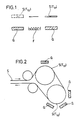
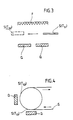
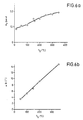
- FIGS. 1, 2, 3 and 4 Schematic representations for the method according to the invention are shown in FIGS. 1, 2, 3 and 4.
- the course of the rigid or flexible substrate (S) is given, specifying the respective temperature (T) in relation to the coating sources (Q) and the external heating (F).
- recording media for magnetic vertical recording can be produced by PVD methods with a high coating rate, which are distinguished from the prior art by the desired high coercive force H c (perpen) and at the same time by the very good crystallographic and magnetic vertical alignment of the magnetic layer .
- H c perpen
- the coercive field strength H c (perpen) measured in the magnetic layers in kA / m was determined using an oscillating magnetometer.
- the relative remanence m r (para) is used as a measure of the quality of the magnetic vertical alignment, determined from the hysteresis curve measured parallel to the layer plane. Layers with very good magnetic perpendicular alignment have very small m r (para) values of typically 0.10.
- the half- width width ⁇ ⁇ 50 of the rocking curve of the (002) reflex is used as a measure of the quality of the crystallographic vertical alignment. For very well oriented (Co-Cr) layers on glass, ⁇ ⁇ is 3 ° and increases to more than 20 ° for poorly oriented layers.
- Co79Cr21 layers were sputtered onto glass substrates cleaned by RF sputter etching in DC magnetron mode.
- the deposition rate was 200 nm / min and the layers had a thickness of 500 nm.
- the substrate temperature T S set before the start of the coating was between room temperature and 350 ° C.
- This desired increase in H c (perpene) had a marked deterioration in the crystallographic and magnetic vertical alignment tion to result ( Figure 6a and b).
- ⁇ ⁇ grew from 3.5 ° to 14.5 ° and m r (para) deteriorated from 0.09 to 0.19.
- Co79Cr21 layers were sputtered onto cleaned glass substrates in DC magnetron mode.
- the deposition rate was 200 nm / min and the layers had a thickness of 500 nm.
- the substrate temperature T S was increased from 20 ° C. to 180 ° C. by external heating and then kept constant during the further coating.
- Co78Cr22 layers were applied to a 50 ⁇ m thick polyimide film with a substrate temperature of 20 ° C by simultaneous evaporation of Co and Cr. Evaporation was carried out using two electron beam evaporators at a rate of 120 nm / min for Co and 36 nm / min for Cr. The 300 nm thick layers obtained have a low H c (perpene) of 26 kA / m.
- Co78Cr22 layers were prepared as described in Comparative Experiment 2.
- the polyimide film was heated to 150 ° C. by external heating before the start of the coating in order to achieve the desired increase in H c (perpen).
- Co78Cr22 layers were evaporated as described in comparative experiment 2.
- the film was heated very quickly, within 1 minute, to 150 ° C after depositing a 10 nm thick Co78Cr22 layer and then deposited a further 290 nm.
Landscapes
- Manufacturing Of Magnetic Record Carriers (AREA)
Abstract
Description
Die Erfindung betrifft ein Verfahren zur Herstellung von magnetischen Aufzeichnungsträgern für die Vertikalaufzeichnung durch Beschichten eines unmagnetischen Substrats mittels eines PVD-Verfahrens mit einer kobalthaltigen, ferromagnetischen Metallschicht, welche eine zur Schichtebene senkrechte magnetische Anisotropie aufweist.The invention relates to a method for producing magnetic recording media for vertical recording by coating a non-magnetic substrate by means of a PVD method with a cobalt-containing, ferromagnetic metal layer which has a magnetic anisotropy perpendicular to the layer plane.
Die zur Zeit üblicherweise eingesetzten magnetischen Aufzeichnungsträger bestehen aus einem unmagnetischen Trägermaterial und einer darauf aufgebrachten Magnetschicht, welche sich im wesentlichen aus feinteiligem magnetischem Material in einer organischen Bindemittelmatrix zusammensetzt. Hierbei wird auf das band- oder scheibenförmige Trägermaterial, das sowohl flexibel als auch starr sein kann, eine Dispersion des magnetischen Materials in der Lösung des organischen Bindemittels, durch Aufschleudern oder durch Rakeln aufgebracht und physikalisch und/oder chemisch verfestigt. Da jedoch die weitere Entwicklung der elektronischen Informationsverarbeitung zunehmend eine steigende Speicherdichte erfordert, ergeben sich für die magnetischen Aufzeichnungsträger mit einer Pigment/Bindemittel-Magnetschicht zunehmend Probleme.The currently used magnetic recording media consist of a non-magnetic carrier material and a magnetic layer applied thereon, which is composed essentially of finely divided magnetic material in an organic binder matrix. In this case, a dispersion of the magnetic material in the solution of the organic binder is applied to the band-shaped or disk-shaped carrier material, which can be both flexible and rigid, by spin coating or knife coating and is physically and / or chemically solidified. However, since the further development of electronic information processing increasingly requires increasing storage density, problems arise for magnetic recording media with a pigment / binder magnetic layer.
Kohärente dünne Schichten aus magnetischem Material, vorzugsweise Metallegierungen, bieten sich aufgrund ihrer physikalischen Eigenschaften als Speichermedium mit deutlich erhöhter Speicherdichte an. Hier wird zwischen der Longitudinalaufzeichnung, bei der die Magnetisierung der Schicht in der Schichtebene erfolgt, und der Vertikalaufzeichnung, bei der die Magnetisierung senkrecht zur Schicht erfolgt, unterschieden. Erstere Methode hat bei zunehmender Speicherdichte den Nachteil anwachsender Entmagnetisierung, wodurch die Aufzeichnungsdichte limitiert ist. Bei der Vertikalaufzeichnung hingegen nimmt die Entmagnetisierung in vorteilhafter Weise mit steigender Speicherdichte ab und erlaubt daher höhere Aufzeichnungsdichten als bei der herkömmlichen Longitudinalaufzeichnung.Coherent thin layers of magnetic material, preferably metal alloys, offer themselves due to their physical properties as a storage medium with a significantly increased storage density. A distinction is made here between the longitudinal recording, in which the magnetization of the layer takes place in the layer plane, and the vertical recording, in which the magnetization takes place perpendicular to the layer. With increasing storage density, the former method has the disadvantage of increasing demagnetization, as a result of which the recording density is limited. With vertical recording, however, the demagnetization advantageously decreases with increasing storage density and therefore allows higher recording densities than with conventional longitudinal recording.
Die für die Vertikalaufzeichnung geeigneten magnetischen Aufzeichnungsmedien müssen eine Magnetschicht aufweisen, deren magnetische Vorzugsrichtung (magnetisch leichte Achse) senkrecht zur Schichtebene verläuft. Als besonders günstiges Material für derartige Magnetschichten haben sich (Co-Cr)-Legierungen mit Cr-Gehalten von 15 bis 30 At.-% herausgestellt (DE-A 2 842 609, US-A 4 210 946). Neben Cr werden aber auch andere Legierungspartner wie V, W, Mo, Ti, Ru, Rh, Pd eingesetzt bzw. werden dreikom ponentige Legierungen des Types Co-Cr-M mit M = Ta, Rh, Pd u.a. mit Erfolg verwendet (J. Howard, "Thin films for magnetic recording technology: A review", J. Vac. Sci. Technol. A 4 (1986) 1 - 12). Allen diesen Materialien ist gemein, daß sie im hexagonalen Kristallgitter vorliegen und die magnetisch leichte Achse parallel zur c-Achse des Kristallgitters verläuft. Hieraus ergibt sich für die Anwendung dieser Legierungen als dünne Schichten für die Vertikalaufzeichnung die Forderung, daß die c-Achsen der die Schicht bildenden Kristallite möglichst alle senkrecht zur Schichtebene ausgerichtet sein müssen. Eine weitere Forderung betrifft die Koerzitivfeldstärke senkrecht zur Schichtebene (Hc(perpen)), wobei Hc(perpen) möglichst hoch sein sollte.The magnetic recording media suitable for vertical recording must have a magnetic layer whose preferred magnetic direction (magnetically easy axis) is perpendicular to the layer plane. (Co-Cr) alloys with Cr contents of 15 to 30 at.% Have proven to be a particularly favorable material for such magnetic layers (DE-A 2 842 609, US-A 4 210 946). In addition to Cr, other alloy partners such as V, W, Mo, Ti, Ru, Rh, Pd are also used, or tri-com component alloys of the type Co-Cr-M with M = Ta, Rh, Pd and others used successfully (J. Howard, "Thin films for magnetic recording technology: A review", J. Vac. Sci. Technol. A 4 (1986 ) 1 - 12). All of these materials have in common that they are present in the hexagonal crystal lattice and the magnetically easy axis runs parallel to the c-axis of the crystal lattice. For the use of these alloys as thin layers for vertical recording, this results in the requirement that the c-axes of the crystallites forming the layer must all be oriented perpendicular to the layer plane, if possible. Another requirement relates to the coercive force perpendicular to the layer plane (H c (perpen)), where H c (perpen) should be as high as possible.
Als Methoden für die Herstellung derartiger dünner (Co-Cr)-Schichten haben sich die PVD-Verfahren, Sputtern und Hochvakuumverdampfen, bewährt (US-A 4 210 946, US-A 4 429 016). Die aufgrund hoher Raten für die industrielle Produktion in Frage kommenden Methoden sind das Aufdampfen (bevorzugt für Folienbeschichtung) bzw. das Magnetron-Sputtern mit unterschiedlichen Ausführungsformen, wie z.B. mit Planar-Magnetron- oder Facing-Target-Anordnung (für feste Substrate und Folien), während Sputtern im RF-Dioden-Mode aufgrund der niedrigen Rate nur beschränkt einsetzbar ist.The PVD processes, sputtering and high vacuum evaporation have proven themselves as methods for the production of such thin (Co-Cr) layers (US Pat. Nos. 4,210,946, 4,429,016). The methods that come into question due to high rates for industrial production are vapor deposition (preferably for film coating) or magnetron sputtering with different embodiments, such as with planar magnetron or facing target arrangement (for solid substrates and foils), while sputtering in RF diode mode can only be used to a limited extent due to the low rate.
Bei der Herstellung der (Co-Cr)-Schichten für die Vertikalaufzeichnung hat sich gezeigt, daß die Güte der kristallographischen und magnetischen Senkrechtausrichtung ganz wesentlich durch die Art des verwendeten Substrates und durch zuvor auf das Substrat aufgebrachte Zwischenschichten (Ti, Si, Ge, u.a.) beeinflußt wird (M. Fukamato, Y. Honda, H. Kakibayashi und K. Yoshida, "Microstructure and Magnetic Properties of Co-Cr Thin Films Formed on Ge-Layer", IEEE Transact. Magn. 21 (1985) 1426 - 1428). Durch die Wahl eines geeigneten Substrates bzw. eines Substrates, das durch eine geeignete Zwischenschicht modifiziert worden ist, lassen sich Schichten mit sehr guter Senkrechtausrichtung sowohl durch Sputtern als auch durch Aufdampfen herstellen.During the production of the (Co-Cr) layers for the vertical recording, it has been shown that the quality of the crystallographic and magnetic vertical alignment is very much dependent on the type of substrate used and on intermediate layers (Ti, Si, Ge, etc., previously applied to the substrate) ) (M. Fukamato, Y. Honda, H. Kakibayashi and K. Yoshida, "Microstructure and Magnetic Properties of Co-Cr Thin Films Formed on Ge-Layer", IEEE Transact. Magn. 21 (1985) 1426-1428 ). By choosing a suitable substrate or a substrate that has been modified by a suitable intermediate layer, layers with very good vertical alignment can be produced both by sputtering and by vapor deposition.
Ferner ist bekannt, daß im RF-Dioden-Mode gesputterte (Co-Cr)-Schichten hohe Hc(perpen)-Werte und eine gute kristallographische Senkrechtausrichtung aufweisen (T. Wielinga und J. Lodder, "Co-Cr Films for Perpendicular Recording", IEEE Transact. Magn. 17, (1981), 3178-3180). Im Falle der beiden anderen Beschichtungsverfahren hingegen ist zusätzlich ein Aufheizen der Substrate erforderlich, um die geforderten hohen Hc(perpen)-Werte zu realisieren. Ohne Substratheizung liegt Hc(perpen) für Co₈₀Cr₂₀ typischerweise bei etwa 20 kA/m. Bei einer Substrattemperatur von ca. 250°C steigt Hc(perpen) auf rund 150 kA/m an. In nachteiliger Weise bewirkt das Aufheizen der Substrate neben der gewünschten Erhöhung von Hc(perpen) jedoch eine deutliche Verschlechterung der kristallographischen und magnetischen Senkrechtausrichtung der Schichten.It is also known that (Co-Cr) layers sputtered in RF diode mode have high H c (perpen) values and good crystallographic vertical alignment (T. Wielinga and J. Lodder, "Co-Cr Films for Perpendicular Recording ", IEEE Transact. Magn. 17 , (1981), 3178-3180). In the case of the other two coating methods, on the other hand, heating of the substrates is additionally required in order to achieve the required high H c (perpen) values. Without substrate heating, H c (perpen) for Co₈₀Cr₂₀ is typically around 20 kA / m. At a substrate temperature of approx. 250 ° C, H c (perpen) increases to around 150 kA / m. The heating of the substrates in addition to the desired increase in disadvantageously results in H c (perpen), however, a significant deterioration in the crystallographic and magnetic vertical alignment of the layers.
Es bestand daher die Aufgabe, ein Verfahren zur Herstellung magnetischer Aufzeichnungsträger, welche im wesentlichen aus einem Substrat einer oder mehrerer Zwischenschichten und einer Kobalt-haltigen ferromagnetischen Metallschicht mit Senkrechtanisotropie bestehen, derart auszugestalten, daß die im Magnetron-Mode gesputterten bzw. durch Hochvakuumverdampfung erzeugten Schichten sowohl hohe Hc(perpen)-Werte als auch eine ausgeprägte kristallographische und magnetische Senkrechtausrichtung aufweisen.The object was therefore to design a method for producing magnetic recording media which essentially consist of a substrate of one or more intermediate layers and a cobalt-containing ferromagnetic metal layer with perpendicular anisotropy in such a way that the layers sputtered in the magnetron mode or generated by high vacuum evaporation have both high H c (perpene) values and a pronounced crystallographic and magnetic vertical orientation.
Es wurde nun gefunden, daß sich mit einem Verfahren zur Herstellung von für die Vertikalaufzeichnung geeigneter magnetischer Aufzeichnungsträger durch Beschichten eines unmagnetischen Substrats nach einem PVD-Verfahren mit einer kobalthaltigen, ferromagnetischen Metallschicht mit einer zur Schichtebene senkrechten magnetischen Anisotropie die Aufgabe lösen läßt, wenn zu Beginn der nach einem PVD-Verfahren durchgeführten Beschichtung des Substrats mit der kobalthaltigen, ferromagnetischen Metallschicht das Substrat eine Temperatur TS1 aufweist, welche durch Fremdheizung des Substrats während der Beschichtung auf eine gegenüber TS1 höhere Temperatur TS2 gebracht wird.It has now been found that with a method for producing magnetic recording media suitable for vertical recording, by coating a non-magnetic substrate by a PVD method with a cobalt-containing, ferromagnetic metal layer with a magnetic anisotropy perpendicular to the layer plane, the task can be solved if at the beginning the coating of the substrate with the cobalt-containing, ferromagnetic metal layer, carried out according to a PVD method, the substrate has a temperature T S1 , which is brought to a higher temperature T S2 than T S1 by external heating of the substrate during the coating.
Nach dem erfindungsgemäßen Verfahren wird das flexible bzw. starre Substrat in bekannter Weise gereinigt und gegebenenfalls mit einer oder mehreren Unterschichten versehen. Zu diesem Zeitpunkt, also vor Beginn der Beschichtung mit der Co-haltigen Magnetschicht, ist das Substrat kalt, d.h. TS1 liegt deutlich unter der Temperatur, die zur Erreichung der hohen Hc(perpen)-Werte erforderlich ist, insbesondere bei einer Temperatur zwischen -50 bis +100°C, vorzugsweise bei Raumtemperatur. Bei dieser Substrattemperatur TS1 wird mit der Abscheidung der Co-Legierung begonnen, und es wird eine Schicht aufgebracht mit einer Dicke d₁ von 1 bis 200 nm, vorzugsweise 5 bis 50 nm. Im nächsten Schritt wird das Substrat auf die zur Erreichung des gewünschten Hc(perpen)-Wertes erforderliche Temperatur TS2, welche vorzugsweise über 100 und bis zu 400°C beträgt, aufgeheizt. Nach Erreichen von TS2 wird die Beschichtung fortgesetzt, bis die gewünschte Magnetschichtdicke d₂ erreicht ist, wobei d₁ « d₂ und d₂/d₁ = 3 bis 1 000, vorzugsweise 5 bis 20 ist. Bei einer vorteilhaften Ausgestaltung des erfindungsgemäßen Verfahrens wird die Beschichtung während des Übergangs von TS1 nach TS2 nicht unterbrochen. Der Übergang von TS1 nach TS2 kann dabei linear erfolgen, es sind aber auch beliebige andere Übergänge von TS1 nach TS2 möglich. Die für das Erreichen von TS2 erforderliche Aufheizzeit muß so angelegt sein, daß die während TS1 plus des Übergangs von TS1 nach TS2 erzeugte Schichtdicke d₁ deutlich kleiner ist als die Gesamtschichtdicke d₂. Vorzugsweise sollte dabei d₂/d₁ = 2 bis 20 betragen.According to the method according to the invention, the flexible or rigid substrate is cleaned in a known manner and optionally provided with one or more sublayers. At this point in time, that is to say before the coating with the Co-containing magnetic layer begins, the substrate is cold, ie T S1 is significantly below the temperature required to achieve the high H c (perpen) values, in particular at a temperature between -50 to + 100 ° C, preferably at room temperature. At this substrate temperature T S1 , the deposition of the Co alloy is started, and a layer is applied with a thickness d 1 of 1 to 200 nm, preferably 5 to 50 nm. In the next step, the substrate is applied to achieve the desired H c (perpen) value required temperature T S2 , which is preferably above 100 and up to 400 ° C, heated. After reaching T S2 , the coating is continued until the desired magnetic layer thickness d₂ is reached, where d₁ «d₂ and d₂ / d₁ = 3 to 1,000, preferably 5 to 20. In an advantageous embodiment of the method according to the invention, the coating is not interrupted during the transition from T S1 to T S2 . The transition from T S1 to T S2 can be linear, but any other transitions from T S1 to T S2 are also possible. The heating time required to reach T S2 must be such that the layer thickness d 1 generated during T S1 plus the transition from T S1 to T S2 is significantly smaller than the total layer thickness d₂. Preferably, d₂ / d₁ = 2 to 20.
Schematische Darstellungen für das erfindungsgemäße Verfahren sind in den Figuren 1, 2, 3 und 4 wiedergegeben. Hierbei ist der Verlauf des starren oder flexiblen Substrats (S) unter Angabe der jeweiligen Temperatur (T) in Bezug auf die Beschichtungsquellen (Q) und die Fremdheizungen (F) angegeben.Schematic representations for the method according to the invention are shown in FIGS. 1, 2, 3 and 4. Here, the course of the rigid or flexible substrate (S) is given, specifying the respective temperature (T) in relation to the coating sources (Q) and the external heating (F).
Mit dem erfindungsgemäßen Verfahren lassen sich Aufzeichnungsträger für die magnetische Vertikalaufzeichnung durch PVD-Verfahren mit hoher Beschichtungsrate herstellen, die sich gegenüber dem Stand der Technik durch die gewünschte hohe Koerzitivfeldstärke Hc(perpen)und gleichzeitig durch die sehr gute kristallographische und magnetische Senkrechtausrichtung der Magnetschicht auszeichnen. Damit wird gegenüber dem Stand der Technik eine deutliche Verbesserung erzielt, da bei den bekannten Verfahrensweisen die Verbesserung einer Eigenschaft die Verschlechterung der anderen zur Folge hatte.With the method according to the invention, recording media for magnetic vertical recording can be produced by PVD methods with a high coating rate, which are distinguished from the prior art by the desired high coercive force H c (perpen) and at the same time by the very good crystallographic and magnetic vertical alignment of the magnetic layer . This results in a significant improvement over the prior art, since in the known methods the improvement of one property resulted in the deterioration of the other.
Die Erfindung sei anhand der folgenden Beispiele im Vergleich zu Versuchen nach den bekannten Vorgehensweisen näher erläutert. Die an den Magnetschichten gemessene Koerzitivfeldstärke Hc(perpen) in kA/m wurde mit einem Schwingmagnetometer bestimmt. Als Maß für die Güte der magnetischen Senkrechtausrichtung wird die relative Remanenz mr(para) herangezogen, bestimmt aus der parallel zur Schichtebene gemessenen Hysteresekurve. Schichten mit sehr guter magnetischer Senkrechtausrichtung weisen sehr kleine mr(para)-Werte von typischerweise 0,10 auf. Als Maß für die Güte der kristallographischen Senkrechtausrichtung gilt die Halbwertsbreite Δ⊖50 der Rockingkurve des (002)-Reflexes. Für sehr gut orientierte (Co-Cr)-Schichten auf Glas liegt Δ⊖ bei 3° und steigt auf mehr als 20° für schlecht orientierte Schichten an.The invention will be explained in more detail with reference to the following examples in comparison to tests according to the known procedures. The coercive field strength H c (perpen) measured in the magnetic layers in kA / m was determined using an oscillating magnetometer. The relative remanence m r (para) is used as a measure of the quality of the magnetic vertical alignment, determined from the hysteresis curve measured parallel to the layer plane. Layers with very good magnetic perpendicular alignment have very small m r (para) values of typically 0.10. The half- width width Δ ⊖ 50 of the rocking curve of the (002) reflex is used as a measure of the quality of the crystallographic vertical alignment. For very well oriented (Co-Cr) layers on glass, Δ ⊖ is 3 ° and increases to more than 20 ° for poorly oriented layers.
Co₇₉Cr₂₁-Schichten wurden auf durch RF-Sputterätzen gereinigte Glassubstrate im DC-Magnetron-Mode aufgesputtert. Die Abscheiderate betrug 200 nm/min und die Schichten hatten eine Dicke von 500 nm. Die vor Beginn der Beschichtung eingestellte Substrattemperatur TS lag zwischen Raumtemperatur und 350°C. Als Folge der anwachsenden Substrattemperatur erhöhte sich Hc(perpen) von 15 kA/m (Raumtemperatur) auf 160 kA/m (TS = 350°C) (Figur 5). Diese gewünschte Erhöhung von Hc(perpen) hatte eine deutliche Verschlechterung der kristallographischen und magnetischen Senkrechtausrich tung zur Folge (Figur 6a und b). Δ⊖ wuchs von 3,5° auf 14,5° und mr(para) verschlechtert sich von 0,09 auf 0,19.Co₇₉Cr₂₁ layers were sputtered onto glass substrates cleaned by RF sputter etching in DC magnetron mode. The deposition rate was 200 nm / min and the layers had a thickness of 500 nm. The substrate temperature T S set before the start of the coating was between room temperature and 350 ° C. As a result of the increasing substrate temperature, H c (perpen) increased from 15 kA / m (room temperature) to 160 kA / m (T S = 350 ° C) (FIG. 5). This desired increase in H c (perpene) had a marked deterioration in the crystallographic and magnetic vertical alignment tion to result (Figure 6a and b). Δ ⊖ grew from 3.5 ° to 14.5 ° and m r (para) deteriorated from 0.09 to 0.19.
Co₇₉Cr₂₁-Schichten wurden auf gereinigte Glassubstrate im DC-Magnetron-Mode aufgesputtert. Die Abscheiderate betrug 200 nm/min und die Schichten hatten eine Dicke von 500 nm. Dabei wurde die Substrattemperatur TS während der Abscheidung der ersten 100 nm durch Fremdheizung von 20°C auf 180°C erhöht und dann während der weiteren Beschichtung konstant gehalten. Die resultierenden Schichten hatten folgenden Eigenschaften: Δ⊖ = 4°, mr(para) = 0,12 und Hc(perpen) = 80 kA/m.Co₇₉Cr₂₁ layers were sputtered onto cleaned glass substrates in DC magnetron mode. The deposition rate was 200 nm / min and the layers had a thickness of 500 nm. During the deposition of the first 100 nm, the substrate temperature T S was increased from 20 ° C. to 180 ° C. by external heating and then kept constant during the further coating. The resulting layers had the following properties: Δ ⊖ = 4 °, m r (para) = 0.12 and H c (perpen) = 80 kA / m.
Co₇₈Cr₂₂-Schichten wurden auf eine 50 µm dicke Polyimid-Folie mit einer Substrattemperatur von 20°C durch Simultanverdampfung von Co und Cr aufgebracht. Die Verdampfung erfolgte mittels zweier Elektronenstrahlverdampfer mit einer Rate von 120 nm/min für Co und 36 nm/min für Cr. Die erhaltenen 300 nm dicken Schichten weisen eine niedrige Hc(perpen) von 26 kA/m auf. Die kristallographische und magnetische Senkrechtausrichtung beträgt Δ⊖ = 11° und mr(para) = 0,16.Co₇₈Cr₂₂ layers were applied to a 50 µm thick polyimide film with a substrate temperature of 20 ° C by simultaneous evaporation of Co and Cr. Evaporation was carried out using two electron beam evaporators at a rate of 120 nm / min for Co and 36 nm / min for Cr. The 300 nm thick layers obtained have a low H c (perpene) of 26 kA / m. The crystallographic and magnetic vertical alignment is Δ ⊖ = 11 ° and m r (para) = 0.16.
Co₇₈Cr₂₂-Schichten wurden wie in Vergleichsversuch 2 beschrieben hergestellt. Die Polyimid-Folie wurde durch Fremdheizung vor Beginn der Beschichtung auf 150°C aufgeheizt, um die gewünschte Erhöhung von Hc(perpen) zu erzielen. Als Folge davon stieg zwar Hc(perpen) auf 54 kA/m, jedoch wurde die Senkrechtausrichtung deutlich verschlechtert: Δ⊖ = 20°, mr(para) = 0,29.Co₇₈Cr₂₂ layers were prepared as described in
Co₇₈Cr₂₂-Schichten wurden wie in Vergleichsversuch 2 beschrieben aufgedampft. Hierbei wurde die Folie nach Abscheiden einer 10 nm dicken Co₇₈Cr₂₂-Schicht sehr schnell, innerhalb von 1 Minute, auf 150°C aufgeheizt und danach weitere 290 nm abgeschieden. Diese Schichten hatten eine Hc(perpen) von 50 kA/m und mit Δ⊖ = 130 und mr(para) = 0,18 eine deutlich bessere Senkrechtorientierung als die konventionell hergestellten Schichten gemäß Vergleichsversuch 3.Co₇₈Cr₂₂ layers were evaporated as described in
Claims (5)
Applications Claiming Priority (2)
| Application Number | Priority Date | Filing Date | Title |
|---|---|---|---|
| DE3831484A DE3831484A1 (en) | 1988-09-16 | 1988-09-16 | METHOD FOR PRODUCING MAGNETIC RECORDING CARRIERS FOR VERTICAL RECORDING |
| DE3831484 | 1988-09-16 |
Publications (2)
| Publication Number | Publication Date |
|---|---|
| EP0359154A2 true EP0359154A2 (en) | 1990-03-21 |
| EP0359154A3 EP0359154A3 (en) | 1991-03-20 |
Family
ID=6363062
Family Applications (1)
| Application Number | Title | Priority Date | Filing Date |
|---|---|---|---|
| EP19890116702 Withdrawn EP0359154A3 (en) | 1988-09-16 | 1989-09-09 | Process for producing a magnetic recording medium for perpendicular recording |
Country Status (4)
| Country | Link |
|---|---|
| US (1) | US4997675A (en) |
| EP (1) | EP0359154A3 (en) |
| JP (1) | JPH02185712A (en) |
| DE (1) | DE3831484A1 (en) |
Family Cites Families (2)
| Publication number | Priority date | Publication date | Assignee | Title |
|---|---|---|---|---|
| JPS5891B2 (en) * | 1977-09-30 | 1983-01-05 | 俊一 岩崎 | magnetic recording medium |
| EP0036717A1 (en) * | 1980-03-07 | 1981-09-30 | Matsushita Electric Industrial Co., Ltd. | Magnetic recording medium |
-
1988
- 1988-09-16 DE DE3831484A patent/DE3831484A1/en not_active Withdrawn
-
1989
- 1989-09-07 US US07/403,890 patent/US4997675A/en not_active Expired - Fee Related
- 1989-09-09 EP EP19890116702 patent/EP0359154A3/en not_active Withdrawn
- 1989-09-14 JP JP1237382A patent/JPH02185712A/en active Pending
Non-Patent Citations (1)
| Title |
|---|
| IEEE TRANSACTIONS ON MAGNETICS, Band MAG-20, Nr. 5, September 1984, Seiten 768-770; Y. OTA et al.: "Evaporation conditions and magnetic properties of Co-O perpendicular magnetic films" * |
Also Published As
| Publication number | Publication date |
|---|---|
| JPH02185712A (en) | 1990-07-20 |
| US4997675A (en) | 1991-03-05 |
| DE3831484A1 (en) | 1990-03-29 |
| EP0359154A3 (en) | 1991-03-20 |
Similar Documents
| Publication | Publication Date | Title |
|---|---|---|
| DE69603013T2 (en) | MULTILAYER MAGNETIC RECORDING MEDIA AND MAGNETORESISTIVE DRIVE SYSTEMS | |
| EP0016404B1 (en) | Magnetic recording carrier and process for its manufacture | |
| DE3538852C2 (en) | ||
| DE69219936T2 (en) | Magnetic resistance effect element | |
| DE3443601C2 (en) | ||
| DE3415794A1 (en) | MAGNETIC RECORDING MEDIUM AND METHOD FOR PRODUCING THE SAME | |
| DE2613498A1 (en) | PROCESS FOR THE EPITAXIAL PRODUCTION OF THIN FILMS EXISTING FROM FE DEEP 3 0 DEEP 4 AND YPSILON FE DEEP 2 0 DEEP 3 ON SPECIAL MATERIALS | |
| DE2435887A1 (en) | DEVICE FOR THE PRODUCTION OF MAGNETIC RECORDING MEDIA | |
| DE2435901A1 (en) | METHOD OF MANUFACTURING A MAGNETIC RECORDING MATERIAL | |
| DE68923876T2 (en) | Data storage medium and method for its manufacture. | |
| DE3810244A1 (en) | FERROMAGNETIC FILM AND MAGNET HEAD MADE THEREFOR | |
| DE3726464A1 (en) | METHOD FOR PRODUCING MAGNETIC RECORDING CARRIERS | |
| DE3610432C2 (en) | ||
| DE3607500C2 (en) | ||
| DE3228044C2 (en) | Magnetic recording material | |
| DE2549509A1 (en) | PROCESS FOR THE PRODUCTION OF A COATING FROM A MAGNETIC OXIDE | |
| DE69318345T2 (en) | Cobalt-platinum magnetic film and manufacturing process | |
| DE3880852T2 (en) | Amorphous materials. | |
| DE2604367A1 (en) | PROCESS FOR INCREASING THE MAGNETIC PERMEABILITY OF BODIES MADE FROM A MAGNETIC ALLOY | |
| EP0143433B1 (en) | Magnetic-recording medium | |
| DE2747703A1 (en) | FERROMAGNETIC ALLOY AND METHOD FOR MANUFACTURING IT | |
| EP0359154A2 (en) | Process for producing a magnetic recording medium for perpendicular recording | |
| DE3336987A1 (en) | MAGNETIC RECORDING MEDIUM | |
| DE3204851C2 (en) | ||
| DE68914100T2 (en) | Soft magnetic multilayer film and magnetic head provided with such a soft magnetic multilayer film. |
Legal Events
| Date | Code | Title | Description |
|---|---|---|---|
| PUAI | Public reference made under article 153(3) epc to a published international application that has entered the european phase |
Free format text: ORIGINAL CODE: 0009012 |
|
| AK | Designated contracting states |
Kind code of ref document: A2 Designated state(s): DE FR GB NL |
|
| PUAL | Search report despatched |
Free format text: ORIGINAL CODE: 0009013 |
|
| 17P | Request for examination filed |
Effective date: 19901227 |
|
| AK | Designated contracting states |
Kind code of ref document: A3 Designated state(s): DE FR GB NL |
|
| 17Q | First examination report despatched |
Effective date: 19930908 |
|
| STAA | Information on the status of an ep patent application or granted ep patent |
Free format text: STATUS: THE APPLICATION HAS BEEN WITHDRAWN |
|
| 18W | Application withdrawn |
Withdrawal date: 19940730 |