EP0354787A1 - Oxaspiro[2,5]octane derivative - Google Patents
Oxaspiro[2,5]octane derivative Download PDFInfo
- Publication number
- EP0354787A1 EP0354787A1 EP89308113A EP89308113A EP0354787A1 EP 0354787 A1 EP0354787 A1 EP 0354787A1 EP 89308113 A EP89308113 A EP 89308113A EP 89308113 A EP89308113 A EP 89308113A EP 0354787 A1 EP0354787 A1 EP 0354787A1
- Authority
- EP
- European Patent Office
- Prior art keywords
- alkylcarbamoyl
- alkyl
- compound
- formula
- hydroxy
- Prior art date
- Legal status (The legal status is an assumption and is not a legal conclusion. Google has not performed a legal analysis and makes no representation as to the accuracy of the status listed.)
- Granted
Links
- VUEWYZJJYGPJDC-UHFFFAOYSA-N 1-oxaspiro[2.5]octane Chemical class C1OC11CCCCC1 VUEWYZJJYGPJDC-UHFFFAOYSA-N 0.000 title claims abstract description 9
- 150000001875 compounds Chemical class 0.000 claims abstract description 119
- 125000000217 alkyl group Chemical group 0.000 claims abstract description 105
- 125000005115 alkyl carbamoyl group Chemical group 0.000 claims abstract description 97
- 150000003839 salts Chemical class 0.000 claims abstract description 49
- 125000003545 alkoxy group Chemical group 0.000 claims abstract description 35
- 125000003178 carboxy group Chemical group [H]OC(*)=O 0.000 claims abstract description 32
- 125000004453 alkoxycarbonyl group Chemical group 0.000 claims abstract description 24
- 125000003917 carbamoyl group Chemical group [H]N([H])C(*)=O 0.000 claims abstract description 19
- 125000004414 alkyl thio group Chemical group 0.000 claims abstract description 12
- 125000000623 heterocyclic group Chemical group 0.000 claims abstract description 10
- 125000005116 aryl carbamoyl group Chemical group 0.000 claims abstract description 9
- 229910052736 halogen Inorganic materials 0.000 claims abstract description 9
- 150000002367 halogens Chemical class 0.000 claims abstract description 9
- 125000004423 acyloxy group Chemical group 0.000 claims abstract description 7
- 239000008194 pharmaceutical composition Substances 0.000 claims abstract description 4
- 239000004480 active ingredient Substances 0.000 claims abstract 2
- 238000004519 manufacturing process Methods 0.000 claims abstract 2
- -1 methylcarbamoyl Chemical group 0.000 claims description 51
- 125000004356 hydroxy functional group Chemical group O* 0.000 claims description 44
- 238000006243 chemical reaction Methods 0.000 claims description 34
- 150000003973 alkyl amines Chemical class 0.000 claims description 10
- 239000002253 acid Substances 0.000 claims description 6
- 238000005949 ozonolysis reaction Methods 0.000 claims description 6
- QMMFVYPAHWMCMS-UHFFFAOYSA-N Dimethyl sulfide Chemical compound CSC QMMFVYPAHWMCMS-UHFFFAOYSA-N 0.000 claims description 4
- 150000001412 amines Chemical class 0.000 claims description 4
- 239000003795 chemical substances by application Substances 0.000 claims description 4
- 239000002168 alkylating agent Substances 0.000 claims description 3
- 229940100198 alkylating agent Drugs 0.000 claims description 3
- 238000010531 catalytic reduction reaction Methods 0.000 claims description 3
- 239000003937 drug carrier Substances 0.000 claims description 3
- 125000006518 morpholino carbonyl group Chemical group [H]C1([H])OC([H])([H])C([H])([H])N(C(*)=O)C1([H])[H] 0.000 claims description 2
- 101100244083 Arabidopsis thaliana PKL gene Proteins 0.000 claims 1
- 125000005196 alkyl carbonyloxy group Chemical group 0.000 claims 1
- 125000000956 methoxy group Chemical group [H]C([H])([H])O* 0.000 claims 1
- 230000001590 oxidative effect Effects 0.000 claims 1
- 206010028980 Neoplasm Diseases 0.000 abstract description 4
- 230000033115 angiogenesis Effects 0.000 abstract description 4
- 230000002401 inhibitory effect Effects 0.000 abstract description 4
- 206010012689 Diabetic retinopathy Diseases 0.000 abstract description 2
- 201000004681 Psoriasis Diseases 0.000 abstract description 2
- 206010039073 rheumatoid arthritis Diseases 0.000 abstract description 2
- 125000002887 hydroxy group Chemical group [H]O* 0.000 abstract 6
- HEDRZPFGACZZDS-MICDWDOJSA-N Trichloro(2H)methane Chemical compound [2H]C(Cl)(Cl)Cl HEDRZPFGACZZDS-MICDWDOJSA-N 0.000 description 158
- RTZKZFJDLAIYFH-UHFFFAOYSA-N Diethyl ether Chemical compound CCOCC RTZKZFJDLAIYFH-UHFFFAOYSA-N 0.000 description 96
- 239000003921 oil Substances 0.000 description 58
- 235000019198 oils Nutrition 0.000 description 58
- 239000000203 mixture Substances 0.000 description 56
- YMWUJEATGCHHMB-UHFFFAOYSA-N Dichloromethane Chemical compound ClCCl YMWUJEATGCHHMB-UHFFFAOYSA-N 0.000 description 51
- OKKJLVBELUTLKV-UHFFFAOYSA-N Methanol Chemical compound OC OKKJLVBELUTLKV-UHFFFAOYSA-N 0.000 description 39
- 239000000243 solution Substances 0.000 description 37
- XEKOWRVHYACXOJ-UHFFFAOYSA-N Ethyl acetate Chemical compound CCOC(C)=O XEKOWRVHYACXOJ-UHFFFAOYSA-N 0.000 description 24
- 238000000034 method Methods 0.000 description 23
- HEMHJVSKTPXQMS-UHFFFAOYSA-M Sodium hydroxide Chemical compound [OH-].[Na+] HEMHJVSKTPXQMS-UHFFFAOYSA-M 0.000 description 21
- 239000012267 brine Substances 0.000 description 21
- HPALAKNZSZLMCH-UHFFFAOYSA-M sodium;chloride;hydrate Chemical compound O.[Na+].[Cl-] HPALAKNZSZLMCH-UHFFFAOYSA-M 0.000 description 21
- 239000002904 solvent Substances 0.000 description 20
- VLKZOEOYAKHREP-UHFFFAOYSA-N n-Hexane Chemical compound CCCCCC VLKZOEOYAKHREP-UHFFFAOYSA-N 0.000 description 19
- VYPSYNLAJGMNEJ-UHFFFAOYSA-N Silicium dioxide Chemical compound O=[Si]=O VYPSYNLAJGMNEJ-UHFFFAOYSA-N 0.000 description 18
- WYURNTSHIVDZCO-UHFFFAOYSA-N Tetrahydrofuran Chemical compound C1CCOC1 WYURNTSHIVDZCO-UHFFFAOYSA-N 0.000 description 18
- XLYOFNOQVPJJNP-UHFFFAOYSA-N water Substances O XLYOFNOQVPJJNP-UHFFFAOYSA-N 0.000 description 17
- JUJWROOIHBZHMG-UHFFFAOYSA-N Pyridine Chemical compound C1=CC=NC=C1 JUJWROOIHBZHMG-UHFFFAOYSA-N 0.000 description 16
- 239000000741 silica gel Substances 0.000 description 16
- 229910002027 silica gel Inorganic materials 0.000 description 16
- ZMXDDKWLCZADIW-UHFFFAOYSA-N N,N-Dimethylformamide Chemical compound CN(C)C=O ZMXDDKWLCZADIW-UHFFFAOYSA-N 0.000 description 15
- LFQSCWFLJHTTHZ-UHFFFAOYSA-N Ethanol Chemical compound CCO LFQSCWFLJHTTHZ-UHFFFAOYSA-N 0.000 description 14
- 238000004440 column chromatography Methods 0.000 description 14
- VEXZGXHMUGYJMC-UHFFFAOYSA-N Hydrochloric acid Chemical compound Cl VEXZGXHMUGYJMC-UHFFFAOYSA-N 0.000 description 13
- 238000001816 cooling Methods 0.000 description 13
- 239000011541 reaction mixture Substances 0.000 description 12
- 239000012044 organic layer Substances 0.000 description 11
- ZMANZCXQSJIPKH-UHFFFAOYSA-N Triethylamine Chemical class CCN(CC)CC ZMANZCXQSJIPKH-UHFFFAOYSA-N 0.000 description 10
- 230000002411 adverse Effects 0.000 description 10
- 238000003756 stirring Methods 0.000 description 10
- QTBSBXVTEAMEQO-UHFFFAOYSA-N Acetic acid Chemical compound CC(O)=O QTBSBXVTEAMEQO-UHFFFAOYSA-N 0.000 description 9
- KEAYESYHFKHZAL-UHFFFAOYSA-N Sodium Chemical compound [Na] KEAYESYHFKHZAL-UHFFFAOYSA-N 0.000 description 9
- 239000010779 crude oil Substances 0.000 description 9
- 239000012312 sodium hydride Substances 0.000 description 9
- 229910000104 sodium hydride Inorganic materials 0.000 description 9
- YLQBMQCUIZJEEH-UHFFFAOYSA-N tetrahydrofuran Natural products C=1C=COC=1 YLQBMQCUIZJEEH-UHFFFAOYSA-N 0.000 description 9
- VHYFNPMBLIVWCW-UHFFFAOYSA-N 4-Dimethylaminopyridine Chemical compound CN(C)C1=CC=NC=C1 VHYFNPMBLIVWCW-UHFFFAOYSA-N 0.000 description 8
- CEVCTNCUIVEQOY-UHFFFAOYSA-N 5-methoxy-4-[2-methyl-3-(3-methylbut-2-enyl)oxiran-2-yl]-1-oxaspiro[2.5]octan-6-ol Chemical compound O1C(CC=C(C)C)C1(C)C1C(OC)C(O)CCC21CO2 CEVCTNCUIVEQOY-UHFFFAOYSA-N 0.000 description 8
- 229910052784 alkaline earth metal Inorganic materials 0.000 description 8
- UMJSCPRVCHMLSP-UHFFFAOYSA-N pyridine Natural products COC1=CC=CN=C1 UMJSCPRVCHMLSP-UHFFFAOYSA-N 0.000 description 8
- WFDIJRYMOXRFFG-UHFFFAOYSA-N Acetic anhydride Chemical compound CC(=O)OC(C)=O WFDIJRYMOXRFFG-UHFFFAOYSA-N 0.000 description 6
- IJGRMHOSHXDMSA-UHFFFAOYSA-N Atomic nitrogen Chemical compound N#N IJGRMHOSHXDMSA-UHFFFAOYSA-N 0.000 description 6
- HEDRZPFGACZZDS-UHFFFAOYSA-N Chloroform Chemical compound ClC(Cl)Cl HEDRZPFGACZZDS-UHFFFAOYSA-N 0.000 description 6
- IAZDPXIOMUYVGZ-UHFFFAOYSA-N Dimethylsulphoxide Chemical compound CS(C)=O IAZDPXIOMUYVGZ-UHFFFAOYSA-N 0.000 description 6
- UIIMBOGNXHQVGW-UHFFFAOYSA-M Sodium bicarbonate Chemical compound [Na+].OC([O-])=O UIIMBOGNXHQVGW-UHFFFAOYSA-M 0.000 description 6
- YXFVVABEGXRONW-UHFFFAOYSA-N Toluene Chemical compound CC1=CC=CC=C1 YXFVVABEGXRONW-UHFFFAOYSA-N 0.000 description 6
- KRKNYBCHXYNGOX-UHFFFAOYSA-N citric acid Chemical compound OC(=O)CC(O)(C(O)=O)CC(O)=O KRKNYBCHXYNGOX-UHFFFAOYSA-N 0.000 description 6
- 238000010438 heat treatment Methods 0.000 description 6
- JQWHASGSAFIOCM-UHFFFAOYSA-M sodium periodate Chemical compound [Na+].[O-]I(=O)(=O)=O JQWHASGSAFIOCM-UHFFFAOYSA-M 0.000 description 6
- NXLNNXIXOYSCMB-UHFFFAOYSA-N (4-nitrophenyl) carbonochloridate Chemical compound [O-][N+](=O)C1=CC=C(OC(Cl)=O)C=C1 NXLNNXIXOYSCMB-UHFFFAOYSA-N 0.000 description 5
- 239000013078 crystal Substances 0.000 description 5
- 210000002889 endothelial cell Anatomy 0.000 description 5
- 239000004533 oil dispersion Substances 0.000 description 5
- 125000000466 oxiranyl group Chemical group 0.000 description 5
- 239000012279 sodium borohydride Substances 0.000 description 5
- 229910000033 sodium borohydride Inorganic materials 0.000 description 5
- CSNNHWWHGAXBCP-UHFFFAOYSA-L Magnesium sulfate Chemical compound [Mg+2].[O-][S+2]([O-])([O-])[O-] CSNNHWWHGAXBCP-UHFFFAOYSA-L 0.000 description 4
- BAVYZALUXZFZLV-UHFFFAOYSA-N Methylamine Chemical compound NC BAVYZALUXZFZLV-UHFFFAOYSA-N 0.000 description 4
- YNAVUWVOSKDBBP-UHFFFAOYSA-N Morpholine Chemical compound C1COCCN1 YNAVUWVOSKDBBP-UHFFFAOYSA-N 0.000 description 4
- CBENFWSGALASAD-UHFFFAOYSA-N Ozone Chemical compound [O-][O+]=O CBENFWSGALASAD-UHFFFAOYSA-N 0.000 description 4
- GLUUGHFHXGJENI-UHFFFAOYSA-N Piperazine Chemical compound C1CNCCN1 GLUUGHFHXGJENI-UHFFFAOYSA-N 0.000 description 4
- 229920002472 Starch Polymers 0.000 description 4
- 239000003513 alkali Substances 0.000 description 4
- 229910052783 alkali metal Inorganic materials 0.000 description 4
- 238000010828 elution Methods 0.000 description 4
- WGYKZJWCGVVSQN-UHFFFAOYSA-N propylamine Chemical compound CCCN WGYKZJWCGVVSQN-UHFFFAOYSA-N 0.000 description 4
- 239000008107 starch Substances 0.000 description 4
- DGAQECJNVWCQMB-PUAWFVPOSA-M Ilexoside XXIX Chemical compound C[C@@H]1CC[C@@]2(CC[C@@]3(C(=CC[C@H]4[C@]3(CC[C@@H]5[C@@]4(CC[C@@H](C5(C)C)OS(=O)(=O)[O-])C)C)[C@@H]2[C@]1(C)O)C)C(=O)O[C@H]6[C@@H]([C@H]([C@@H]([C@H](O6)CO)O)O)O.[Na+] DGAQECJNVWCQMB-PUAWFVPOSA-M 0.000 description 3
- KWYUFKZDYYNOTN-UHFFFAOYSA-M Potassium hydroxide Chemical compound [OH-].[K+] KWYUFKZDYYNOTN-UHFFFAOYSA-M 0.000 description 3
- QEXYOYAZVAJFCB-UHFFFAOYSA-N [4-[3-(2-hydroxyethyl)-2-methyloxiran-2-yl]-5-methoxy-1-oxaspiro[2.5]octan-6-yl] morpholine-4-carboxylate Chemical compound O1C(CCO)C1(C)C1C(OC)C(OC(=O)N2CCOCC2)CCC21CO2 QEXYOYAZVAJFCB-UHFFFAOYSA-N 0.000 description 3
- DBAKHXWFHOIUFO-UHFFFAOYSA-N [5-methoxy-4-[2-methyl-3-(3-methylbut-2-enyl)oxiran-2-yl]-1-oxaspiro[2.5]octan-6-yl] morpholine-4-carboxylate Chemical compound O1C(CC=C(C)C)C1(C)C1C(OC)C(OC(=O)N2CCOCC2)CCC21CO2 DBAKHXWFHOIUFO-UHFFFAOYSA-N 0.000 description 3
- GPYYZGCIYVGLHC-UHFFFAOYSA-N [5-methoxy-4-[2-methyl-3-(3-methylbut-2-enyl)oxiran-2-yl]-1-oxaspiro[2.5]octan-6-yl] n-cyclohexylcarbamate Chemical compound O1C(CC=C(C)C)C1(C)C1C(OC)C(OC(=O)NC2CCCCC2)CCC21CO2 GPYYZGCIYVGLHC-UHFFFAOYSA-N 0.000 description 3
- MOIKZONVZPMDRJ-UHFFFAOYSA-N [5-methoxy-4-[2-methyl-3-(3-methylbut-2-enyl)oxiran-2-yl]-1-oxaspiro[2.5]octan-6-yl] thiomorpholine-4-carboxylate Chemical compound O1C(CC=C(C)C)C1(C)C1C(OC)C(OC(=O)N2CCSCC2)CCC21CO2 MOIKZONVZPMDRJ-UHFFFAOYSA-N 0.000 description 3
- 125000002252 acyl group Chemical group 0.000 description 3
- 150000001340 alkali metals Chemical class 0.000 description 3
- FFBHFFJDDLITSX-UHFFFAOYSA-N benzyl N-[2-hydroxy-4-(3-oxomorpholin-4-yl)phenyl]carbamate Chemical compound OC1=C(NC(=O)OCC2=CC=CC=C2)C=CC(=C1)N1CCOCC1=O FFBHFFJDDLITSX-UHFFFAOYSA-N 0.000 description 3
- 239000003054 catalyst Substances 0.000 description 3
- 230000010261 cell growth Effects 0.000 description 3
- 239000000706 filtrate Substances 0.000 description 3
- 150000007529 inorganic bases Chemical class 0.000 description 3
- HAMGRBXTJNITHG-UHFFFAOYSA-N methyl isocyanate Chemical compound CN=C=O HAMGRBXTJNITHG-UHFFFAOYSA-N 0.000 description 3
- 125000002911 monocyclic heterocycle group Chemical group 0.000 description 3
- 229910052757 nitrogen Inorganic materials 0.000 description 3
- 150000007530 organic bases Chemical class 0.000 description 3
- 238000006722 reduction reaction Methods 0.000 description 3
- 230000002829 reductive effect Effects 0.000 description 3
- 239000011734 sodium Substances 0.000 description 3
- 229910052708 sodium Inorganic materials 0.000 description 3
- 235000019698 starch Nutrition 0.000 description 3
- RYHBNJHYFVUHQT-UHFFFAOYSA-N 1,4-Dioxane Chemical compound C1COCCO1 RYHBNJHYFVUHQT-UHFFFAOYSA-N 0.000 description 2
- RJDUKSRXAWOHCT-UHFFFAOYSA-N 2-[[5-methoxy-4-[2-methyl-3-(3-methylbut-2-enyl)oxiran-2-yl]-1-oxaspiro[2.5]octan-6-yl]oxy]acetic acid Chemical compound O1C(CC=C(C)C)C1(C)C1C(OC)C(OCC(O)=O)CCC21CO2 RJDUKSRXAWOHCT-UHFFFAOYSA-N 0.000 description 2
- 108091003079 Bovine Serum Albumin Proteins 0.000 description 2
- WKBOTKDWSSQWDR-UHFFFAOYSA-N Bromine atom Chemical compound [Br] WKBOTKDWSSQWDR-UHFFFAOYSA-N 0.000 description 2
- 0 CC(C(*)C1(CC2)OC1)C2O* Chemical compound CC(C(*)C1(CC2)OC1)C2O* 0.000 description 2
- VTYYLEPIZMXCLO-UHFFFAOYSA-L Calcium carbonate Chemical compound [Ca+2].[O-]C([O-])=O VTYYLEPIZMXCLO-UHFFFAOYSA-L 0.000 description 2
- 229920002134 Carboxymethyl cellulose Polymers 0.000 description 2
- ZAMOUSCENKQFHK-UHFFFAOYSA-N Chlorine atom Chemical compound [Cl] ZAMOUSCENKQFHK-UHFFFAOYSA-N 0.000 description 2
- QUSNBJAOOMFDIB-UHFFFAOYSA-N Ethylamine Chemical compound CCN QUSNBJAOOMFDIB-UHFFFAOYSA-N 0.000 description 2
- PXGOKWXKJXAPGV-UHFFFAOYSA-N Fluorine Chemical compound FF PXGOKWXKJXAPGV-UHFFFAOYSA-N 0.000 description 2
- DHMQDGOQFOQNFH-UHFFFAOYSA-N Glycine Chemical compound NCC(O)=O DHMQDGOQFOQNFH-UHFFFAOYSA-N 0.000 description 2
- UFHFLCQGNIYNRP-UHFFFAOYSA-N Hydrogen Chemical compound [H][H] UFHFLCQGNIYNRP-UHFFFAOYSA-N 0.000 description 2
- NQRYJNQNLNOLGT-UHFFFAOYSA-N Piperidine Chemical compound C1CCNCC1 NQRYJNQNLNOLGT-UHFFFAOYSA-N 0.000 description 2
- 239000002202 Polyethylene glycol Substances 0.000 description 2
- CDBYLPFSWZWCQE-UHFFFAOYSA-L Sodium Carbonate Chemical compound [Na+].[Na+].[O-]C([O-])=O CDBYLPFSWZWCQE-UHFFFAOYSA-L 0.000 description 2
- 229930006000 Sucrose Natural products 0.000 description 2
- CZMRCDWAGMRECN-UGDNZRGBSA-N Sucrose Chemical compound O[C@H]1[C@H](O)[C@@H](CO)O[C@@]1(CO)O[C@@H]1[C@H](O)[C@@H](O)[C@H](O)[C@@H](CO)O1 CZMRCDWAGMRECN-UGDNZRGBSA-N 0.000 description 2
- QAOWNCQODCNURD-UHFFFAOYSA-N Sulfuric acid Chemical compound OS(O)(=O)=O QAOWNCQODCNURD-UHFFFAOYSA-N 0.000 description 2
- DTQVDTLACAAQTR-UHFFFAOYSA-N Trifluoroacetic acid Chemical compound OC(=O)C(F)(F)F DTQVDTLACAAQTR-UHFFFAOYSA-N 0.000 description 2
- UXNUUHMYJXIVFZ-UHFFFAOYSA-N [4-[3-(2-hydroxyethyl)-2-methyloxiran-2-yl]-5-methoxy-1-oxaspiro[2.5]octan-6-yl] n-cyclohexylcarbamate Chemical compound O1C(CCO)C1(C)C1C(OC)C(OC(=O)NC2CCCCC2)CCC21CO2 UXNUUHMYJXIVFZ-UHFFFAOYSA-N 0.000 description 2
- APRLZHSZVREOFG-UHFFFAOYSA-N [5-methoxy-4-[2-methyl-3-(3-methylbut-2-enyl)oxiran-2-yl]-1-oxaspiro[2.5]octan-6-yl] (4-nitrophenyl) carbonate Chemical compound O1C(CC=C(C)C)C1(C)C1C(OC)C(OC(=O)OC=2C=CC(=CC=2)[N+]([O-])=O)CCC21CO2 APRLZHSZVREOFG-UHFFFAOYSA-N 0.000 description 2
- PBVLBMJXKARLBU-UHFFFAOYSA-N [5-methoxy-4-[2-methyl-3-(3-methylbut-2-enyl)oxiran-2-yl]-1-oxaspiro[2.5]octan-6-yl] 4,5-dihydroxyhex-2-enoate Chemical compound O1C(CC=C(C)C)C1(C)C1C(OC)C(OC(=O)C=CC(O)C(C)O)CCC21CO2 PBVLBMJXKARLBU-UHFFFAOYSA-N 0.000 description 2
- BVZJHEOQYOLZKK-UHFFFAOYSA-N [5-methoxy-4-[2-methyl-3-(3-methylbut-2-enyl)oxiran-2-yl]-1-oxaspiro[2.5]octan-6-yl] n-(2,2,2-trichloroacetyl)carbamate Chemical compound O1C(CC=C(C)C)C1(C)C1C(OC)C(OC(=O)NC(=O)C(Cl)(Cl)Cl)CCC21CO2 BVZJHEOQYOLZKK-UHFFFAOYSA-N 0.000 description 2
- NLCUHGXCGBILCI-UHFFFAOYSA-N [5-methoxy-4-[2-methyl-3-(3-methylbut-2-enyl)oxiran-2-yl]-1-oxaspiro[2.5]octan-6-yl] n-(3-hydroxypropyl)carbamate Chemical compound O1C(CC=C(C)C)C1(C)C1C(OC)C(OC(=O)NCCCO)CCC21CO2 NLCUHGXCGBILCI-UHFFFAOYSA-N 0.000 description 2
- SZSISHWVYFJIHG-UHFFFAOYSA-N [5-methoxy-4-[2-methyl-3-(3-methylbut-2-enyl)oxiran-2-yl]-1-oxaspiro[2.5]octan-6-yl] n-(3-methylsulfanylpropyl)carbamate Chemical compound O1C(CC=C(C)C)C1(C)C1C(OC)C(OC(=O)NCCCSC)CCC21CO2 SZSISHWVYFJIHG-UHFFFAOYSA-N 0.000 description 2
- 150000001342 alkaline earth metals Chemical class 0.000 description 2
- 150000003863 ammonium salts Chemical class 0.000 description 2
- AGEZXYOZHKGVCM-UHFFFAOYSA-N benzyl bromide Chemical compound BrCC1=CC=CC=C1 AGEZXYOZHKGVCM-UHFFFAOYSA-N 0.000 description 2
- GDTBXPJZTBHREO-UHFFFAOYSA-N bromine Substances BrBr GDTBXPJZTBHREO-UHFFFAOYSA-N 0.000 description 2
- 229910052794 bromium Inorganic materials 0.000 description 2
- 239000001506 calcium phosphate Substances 0.000 description 2
- 229910000389 calcium phosphate Inorganic materials 0.000 description 2
- 235000011010 calcium phosphates Nutrition 0.000 description 2
- 159000000007 calcium salts Chemical class 0.000 description 2
- 239000001768 carboxy methyl cellulose Substances 0.000 description 2
- 235000010948 carboxy methyl cellulose Nutrition 0.000 description 2
- 239000008112 carboxymethyl-cellulose Substances 0.000 description 2
- 239000001913 cellulose Substances 0.000 description 2
- 229920002678 cellulose Polymers 0.000 description 2
- 235000010980 cellulose Nutrition 0.000 description 2
- 239000003638 chemical reducing agent Substances 0.000 description 2
- 239000000460 chlorine Substances 0.000 description 2
- 229910052801 chlorine Inorganic materials 0.000 description 2
- PUYDIRPFUSLWRE-UHFFFAOYSA-N ethyl 4-[3-[6-(cyclohexylcarbamoyloxy)-5-methoxy-1-oxaspiro[2.5]octan-4-yl]-3-methyloxiran-2-yl]but-2-enoate Chemical compound CCOC(=O)C=CCC1OC1(C)C1C2(OC2)CCC(OC(=O)NC2CCCCC2)C1OC PUYDIRPFUSLWRE-UHFFFAOYSA-N 0.000 description 2
- PQJJJMRNHATNKG-UHFFFAOYSA-N ethyl bromoacetate Chemical compound CCOC(=O)CBr PQJJJMRNHATNKG-UHFFFAOYSA-N 0.000 description 2
- 238000002474 experimental method Methods 0.000 description 2
- 239000012091 fetal bovine serum Substances 0.000 description 2
- 238000001914 filtration Methods 0.000 description 2
- 238000003818 flash chromatography Methods 0.000 description 2
- 229910052731 fluorine Inorganic materials 0.000 description 2
- 239000011737 fluorine Substances 0.000 description 2
- 150000004820 halides Chemical class 0.000 description 2
- 229910052739 hydrogen Inorganic materials 0.000 description 2
- 239000001257 hydrogen Substances 0.000 description 2
- 230000007062 hydrolysis Effects 0.000 description 2
- 238000006460 hydrolysis reaction Methods 0.000 description 2
- HQKMJHAJHXVSDF-UHFFFAOYSA-L magnesium stearate Chemical compound [Mg+2].CCCCCCCCCCCCCCCCCC([O-])=O.CCCCCCCCCCCCCCCCCC([O-])=O HQKMJHAJHXVSDF-UHFFFAOYSA-L 0.000 description 2
- 229910052943 magnesium sulfate Inorganic materials 0.000 description 2
- 235000019341 magnesium sulphate Nutrition 0.000 description 2
- 229910052751 metal Inorganic materials 0.000 description 2
- 239000002184 metal Substances 0.000 description 2
- 229920000609 methyl cellulose Polymers 0.000 description 2
- 239000001923 methylcellulose Substances 0.000 description 2
- 235000010981 methylcellulose Nutrition 0.000 description 2
- LXCFILQKKLGQFO-UHFFFAOYSA-N methylparaben Chemical compound COC(=O)C1=CC=C(O)C=C1 LXCFILQKKLGQFO-UHFFFAOYSA-N 0.000 description 2
- 150000007522 mineralic acids Chemical class 0.000 description 2
- MUMZUERVLWJKNR-UHFFFAOYSA-N oxoplatinum Chemical compound [Pt]=O MUMZUERVLWJKNR-UHFFFAOYSA-N 0.000 description 2
- 229910003446 platinum oxide Inorganic materials 0.000 description 2
- 229920001223 polyethylene glycol Polymers 0.000 description 2
- BWHMMNNQKKPAPP-UHFFFAOYSA-L potassium carbonate Chemical compound [K+].[K+].[O-]C([O-])=O BWHMMNNQKKPAPP-UHFFFAOYSA-L 0.000 description 2
- 239000000843 powder Substances 0.000 description 2
- 238000012746 preparative thin layer chromatography Methods 0.000 description 2
- BDERNNFJNOPAEC-UHFFFAOYSA-N propan-1-ol Chemical compound CCCO BDERNNFJNOPAEC-UHFFFAOYSA-N 0.000 description 2
- QELSKZZBTMNZEB-UHFFFAOYSA-N propylparaben Chemical compound CCCOC(=O)C1=CC=C(O)C=C1 QELSKZZBTMNZEB-UHFFFAOYSA-N 0.000 description 2
- 229910000030 sodium bicarbonate Inorganic materials 0.000 description 2
- 235000017557 sodium bicarbonate Nutrition 0.000 description 2
- 239000007858 starting material Substances 0.000 description 2
- 239000005720 sucrose Substances 0.000 description 2
- 239000000454 talc Substances 0.000 description 2
- 229910052623 talc Inorganic materials 0.000 description 2
- 238000004809 thin layer chromatography Methods 0.000 description 2
- QORWJWZARLRLPR-UHFFFAOYSA-H tricalcium bis(phosphate) Chemical compound [Ca+2].[Ca+2].[Ca+2].[O-]P([O-])([O-])=O.[O-]P([O-])([O-])=O QORWJWZARLRLPR-UHFFFAOYSA-H 0.000 description 2
- NOOLISFMXDJSKH-ZDGBYWQASA-N (2s,5r)-5-methyl-2-propan-2-ylcyclohexan-1-ol Chemical compound CC(C)[C@@H]1CC[C@@H](C)CC1O NOOLISFMXDJSKH-ZDGBYWQASA-N 0.000 description 1
- VEEGZPWAAPPXRB-BJMVGYQFSA-N (3e)-3-(1h-imidazol-5-ylmethylidene)-1h-indol-2-one Chemical compound O=C1NC2=CC=CC=C2\C1=C/C1=CN=CN1 VEEGZPWAAPPXRB-BJMVGYQFSA-N 0.000 description 1
- KDKGWGUUUVROTO-UHFFFAOYSA-N 1-hydroxypiperazine Chemical compound ON1CCNCC1 KDKGWGUUUVROTO-UHFFFAOYSA-N 0.000 description 1
- YFULQQYJMCSJGR-UHFFFAOYSA-N 1-o-ethyl 4-o-[5-methyl-4-[2-methyl-3-(3-methylbut-2-enyl)oxiran-2-yl]-1-oxaspiro[2.5]octan-6-yl] piperazine-1,4-dicarboxylate Chemical compound C1CN(C(=O)OCC)CCN1C(=O)OC1C(C)C(C2(C)C(O2)CC=C(C)C)C2(OC2)CC1 YFULQQYJMCSJGR-UHFFFAOYSA-N 0.000 description 1
- UTQNKKSJPHTPBS-UHFFFAOYSA-N 2,2,2-trichloroethanone Chemical group ClC(Cl)(Cl)[C]=O UTQNKKSJPHTPBS-UHFFFAOYSA-N 0.000 description 1
- JVSFQJZRHXAUGT-UHFFFAOYSA-N 2,2-dimethylpropanoyl chloride Chemical compound CC(C)(C)C(Cl)=O JVSFQJZRHXAUGT-UHFFFAOYSA-N 0.000 description 1
- NGNBDVOYPDDBFK-UHFFFAOYSA-N 2-[2,4-di(pentan-2-yl)phenoxy]acetyl chloride Chemical compound CCCC(C)C1=CC=C(OCC(Cl)=O)C(C(C)CCC)=C1 NGNBDVOYPDDBFK-UHFFFAOYSA-N 0.000 description 1
- MAGOWDXUMRFONO-UHFFFAOYSA-N 2-[3-[5-methoxy-6-(methylcarbamoyloxy)-1-oxaspiro[2.5]octan-4-yl]-3-methyloxiran-2-yl]ethyl n-methylcarbamate Chemical compound CNC(=O)OCCC1OC1(C)C1C2(OC2)CCC(OC(=O)NC)C1OC MAGOWDXUMRFONO-UHFFFAOYSA-N 0.000 description 1
- HUKDAHLQBPALEQ-UHFFFAOYSA-N 2-[3-[6-(cyclohexylcarbamoyloxy)-5-methoxy-1-oxaspiro[2.5]octan-4-yl]-3-methyloxiran-2-yl]ethyl acetate Chemical compound O1C(CCOC(C)=O)C1(C)C1C(OC)C(OC(=O)NC2CCCCC2)CCC21CO2 HUKDAHLQBPALEQ-UHFFFAOYSA-N 0.000 description 1
- KRUNVIRASBIWMI-UHFFFAOYSA-N 2-[[5-methoxy-4-[2-methyl-3-(3-methylbut-2-enyl)oxiran-2-yl]-1-oxaspiro[2.5]octan-6-yl]oxy]-n-propylacetamide Chemical compound O1C(CC=C(C)C)C1(C)C1C(OC)C(OCC(=O)NCCC)CCC21CO2 KRUNVIRASBIWMI-UHFFFAOYSA-N 0.000 description 1
- TWFFMODVDQMWIV-UHFFFAOYSA-N 2-[[5-methoxy-4-[2-methyl-3-(3-methylbut-2-enyl)oxiran-2-yl]-1-oxaspiro[2.5]octan-6-yl]oxycarbonyl-methylamino]ethyl thiomorpholine-4-carboxylate Chemical compound O1C(CC=C(C)C)C1(C)C1C(OC)C(OC(=O)N(C)CCOC(=O)N2CCSCC2)CCC21CO2 TWFFMODVDQMWIV-UHFFFAOYSA-N 0.000 description 1
- OOSQQIVGLWYVOC-UHFFFAOYSA-N 2-[[5-methoxy-4-[2-methyl-3-(3-methylbut-2-enyl)oxiran-2-yl]-1-oxaspiro[2.5]octan-6-yl]oxycarbonylamino]ethyl n-methylcarbamate Chemical compound O1C(CC=C(C)C)C1(C)C1C(OC)C(OC(=O)NCCOC(=O)NC)CCC21CO2 OOSQQIVGLWYVOC-UHFFFAOYSA-N 0.000 description 1
- SIFVJMVWUQJJPF-UHFFFAOYSA-N 2-[[5-methoxy-4-[2-methyl-3-(3-methylbut-2-enyl)oxiran-2-yl]-1-oxaspiro[2.5]octan-6-yl]oxymethyl]pyridine Chemical compound O1C(CC=C(C)C)C1(C)C1C(OC)C(OCC=2N=CC=CC=2)CCC21CO2 SIFVJMVWUQJJPF-UHFFFAOYSA-N 0.000 description 1
- GTSDNRMOCACTIE-UHFFFAOYSA-N 2-[[5-methoxy-4-[2-methyl-3-(3-methylbut-2-enyl)oxiran-2-yl]-1-oxaspiro[2.5]octan-6-yl]oxymethyl]quinoline Chemical compound O1C(CC=C(C)C)C1(C)C1C(OC)C(OCC=2N=C3C=CC=CC3=CC=2)CCC21CO2 GTSDNRMOCACTIE-UHFFFAOYSA-N 0.000 description 1
- LBLYYCQCTBFVLH-UHFFFAOYSA-M 2-methylbenzenesulfonate Chemical compound CC1=CC=CC=C1S([O-])(=O)=O LBLYYCQCTBFVLH-UHFFFAOYSA-M 0.000 description 1
- YOETUEMZNOLGDB-UHFFFAOYSA-N 2-methylpropyl carbonochloridate Chemical compound CC(C)COC(Cl)=O YOETUEMZNOLGDB-UHFFFAOYSA-N 0.000 description 1
- BSKHPKMHTQYZBB-UHFFFAOYSA-N 2-methylpyridine Chemical class CC1=CC=CC=N1 BSKHPKMHTQYZBB-UHFFFAOYSA-N 0.000 description 1
- IWQJKZUMZVBZQK-UHFFFAOYSA-N 3-[[5-methoxy-4-[2-methyl-3-(3-methylbut-2-enyl)oxiran-2-yl]-1-oxaspiro[2.5]octan-6-yl]oxycarbonylamino]propyl (4-nitrophenyl) carbonate Chemical compound O1C(CC=C(C)C)C1(C)C1C(OC)C(OC(=O)NCCCOC(=O)OC=2C=CC(=CC=2)[N+]([O-])=O)CCC21CO2 IWQJKZUMZVBZQK-UHFFFAOYSA-N 0.000 description 1
- KSBABWMIDCROSK-UHFFFAOYSA-N 3-[[5-methoxy-4-[2-methyl-3-(3-methylbut-2-enyl)oxiran-2-yl]-1-oxaspiro[2.5]octan-6-yl]oxycarbonylamino]propyl n-(2-hydroxyethyl)-n-methylcarbamate Chemical compound O1C(CC=C(C)C)C1(C)C1C(OC)C(OC(=O)NCCCOC(=O)N(C)CCO)CCC21CO2 KSBABWMIDCROSK-UHFFFAOYSA-N 0.000 description 1
- UZLIVJVGDHZOGA-UHFFFAOYSA-N 3-[[5-methoxy-4-[2-methyl-3-(3-methylbut-2-enyl)oxiran-2-yl]-1-oxaspiro[2.5]octan-6-yl]oxycarbonylamino]propyl n-methylcarbamate Chemical compound O1C(CC=C(C)C)C1(C)C1C(OC)C(OC(=O)NCCCOC(=O)NC)CCC21CO2 UZLIVJVGDHZOGA-UHFFFAOYSA-N 0.000 description 1
- NHQDETIJWKXCTC-UHFFFAOYSA-N 3-chloroperbenzoic acid Chemical compound OOC(=O)C1=CC=CC(Cl)=C1 NHQDETIJWKXCTC-UHFFFAOYSA-N 0.000 description 1
- CSDQQAQKBAQLLE-UHFFFAOYSA-N 4-(4-chlorophenyl)-4,5,6,7-tetrahydrothieno[3,2-c]pyridine Chemical compound C1=CC(Cl)=CC=C1C1C(C=CS2)=C2CCN1 CSDQQAQKBAQLLE-UHFFFAOYSA-N 0.000 description 1
- YMRZMUDOPROCEI-UHFFFAOYSA-N 4-[3-(2-hydroxyethyl)-2-methyloxiran-2-yl]-5-methoxy-n-methyl-1-oxaspiro[2.5]octane-6-carboxamide Chemical compound O1C(CCO)C1(C)C1C(OC)C(C(=O)NC)CCC21CO2 YMRZMUDOPROCEI-UHFFFAOYSA-N 0.000 description 1
- MMAKPSCJLRBEOK-UHFFFAOYSA-N 4-[[5-methoxy-4-[2-methyl-3-(3-methylbut-2-enyl)oxiran-2-yl]-1-oxaspiro[2.5]octan-6-yl]oxycarbonylamino]butanoic acid Chemical compound O1C(CC=C(C)C)C1(C)C1C(OC)C(OC(=O)NCCCC(O)=O)CCC21CO2 MMAKPSCJLRBEOK-UHFFFAOYSA-N 0.000 description 1
- DNBDAJWFMLKGLK-UHFFFAOYSA-N 4-[[5-methoxy-4-[2-methyl-3-(3-methylbut-2-enyl)oxiran-2-yl]-1-oxaspiro[2.5]octan-6-yl]oxycarbonylamino]butyl n-methylcarbamate Chemical compound O1C(CC=C(C)C)C1(C)C1C(OC)C(OC(=O)NCCCCOC(=O)NC)CCC21CO2 DNBDAJWFMLKGLK-UHFFFAOYSA-N 0.000 description 1
- WJDOBTXNTCTJSY-UHFFFAOYSA-N 5,6-dimethoxy-4-[2-methyl-3-(3-methylbut-2-enyl)oxiran-2-yl]-1-oxaspiro[2.5]octane Chemical compound O1C(CC=C(C)C)C1(C)C1C(OC)C(OC)CCC21CO2 WJDOBTXNTCTJSY-UHFFFAOYSA-N 0.000 description 1
- FCKWXYUHCLMXKI-UHFFFAOYSA-N 5-methoxy-4-[2-methyl-3-(3-methylbut-2-enyl)oxiran-2-yl]-6-(naphthalen-1-ylmethoxy)-1-oxaspiro[2.5]octane Chemical compound O1C(CC=C(C)C)C1(C)C1C(OC)C(OCC=2C3=CC=CC=C3C=CC=2)CCC21CO2 FCKWXYUHCLMXKI-UHFFFAOYSA-N 0.000 description 1
- ZGIVXUUYXTTZID-UHFFFAOYSA-N 5-methoxy-4-[2-methyl-3-(3-methylbut-2-enyl)oxiran-2-yl]-6-(naphthalen-2-ylmethoxy)-1-oxaspiro[2.5]octane Chemical compound O1C(CC=C(C)C)C1(C)C1C(OC)C(OCC=2C=C3C=CC=CC3=CC=2)CCC21CO2 ZGIVXUUYXTTZID-UHFFFAOYSA-N 0.000 description 1
- XROWZIRZJAGOQE-UHFFFAOYSA-N 5-methoxy-6-[(4-methoxyphenyl)methoxy]-4-[2-methyl-3-(3-methylbut-2-enyl)oxiran-2-yl]-1-oxaspiro[2.5]octane Chemical compound O1C(CC=C(C)C)C1(C)C1C(OC)C(OCC=2C=CC(OC)=CC=2)CCC21CO2 XROWZIRZJAGOQE-UHFFFAOYSA-N 0.000 description 1
- ZDAYVZPKEPIJGA-UHFFFAOYSA-N 6-[(4-chlorophenyl)methoxy]-5-methoxy-4-[2-methyl-3-(3-methylbut-2-enyl)oxiran-2-yl]-1-oxaspiro[2.5]octane Chemical compound O1C(CC=C(C)C)C1(C)C1C(OC)C(OCC=2C=CC(Cl)=CC=2)CCC21CO2 ZDAYVZPKEPIJGA-UHFFFAOYSA-N 0.000 description 1
- ZCYVEMRRCGMTRW-UHFFFAOYSA-N 7553-56-2 Chemical compound [I] ZCYVEMRRCGMTRW-UHFFFAOYSA-N 0.000 description 1
- 244000215068 Acacia senegal Species 0.000 description 1
- QTBSBXVTEAMEQO-UHFFFAOYSA-M Acetate Chemical compound CC([O-])=O QTBSBXVTEAMEQO-UHFFFAOYSA-M 0.000 description 1
- 229910002012 Aerosil® Inorganic materials 0.000 description 1
- GUBGYTABKSRVRQ-XLOQQCSPSA-N Alpha-Lactose Chemical compound O[C@@H]1[C@@H](O)[C@@H](O)[C@@H](CO)O[C@H]1O[C@@H]1[C@@H](CO)O[C@H](O)[C@H](O)[C@H]1O GUBGYTABKSRVRQ-XLOQQCSPSA-N 0.000 description 1
- NLXLAEXVIDQMFP-UHFFFAOYSA-N Ammonia chloride Chemical class [NH4+].[Cl-] NLXLAEXVIDQMFP-UHFFFAOYSA-N 0.000 description 1
- 239000004475 Arginine Substances 0.000 description 1
- BVKZGUZCCUSVTD-UHFFFAOYSA-M Bicarbonate Chemical compound OC([O-])=O BVKZGUZCCUSVTD-UHFFFAOYSA-M 0.000 description 1
- PBVLBMJXKARLBU-VWNABXHMSA-N C([C@H]([C@H]([C@@H]1[C@]2(C)[C@H](O2)CC=C(C)C)OC)OC(=O)\C=C\C(O)C(C)O)C[C@@]21CO2 Chemical compound C([C@H]([C@H]([C@@H]1[C@]2(C)[C@H](O2)CC=C(C)C)OC)OC(=O)\C=C\C(O)C(C)O)C[C@@]21CO2 PBVLBMJXKARLBU-VWNABXHMSA-N 0.000 description 1
- ZLDHZHZLXCKFTH-UHFFFAOYSA-N COC1C(C2(CO2)CCC1OC(=O)C1NCCC(C1)OC(NC)=O)C1(OC1CC=C(C)C)C Chemical compound COC1C(C2(CO2)CCC1OC(=O)C1NCCC(C1)OC(NC)=O)C1(OC1CC=C(C)C)C ZLDHZHZLXCKFTH-UHFFFAOYSA-N 0.000 description 1
- OYPRJOBELJOOCE-UHFFFAOYSA-N Calcium Chemical compound [Ca] OYPRJOBELJOOCE-UHFFFAOYSA-N 0.000 description 1
- FBPFZTCFMRRESA-KVTDHHQDSA-N D-Mannitol Chemical compound OC[C@@H](O)[C@@H](O)[C@H](O)[C@H](O)CO FBPFZTCFMRRESA-KVTDHHQDSA-N 0.000 description 1
- FEWJPZIEWOKRBE-JCYAYHJZSA-N Dextrotartaric acid Chemical compound OC(=O)[C@H](O)[C@@H](O)C(O)=O FEWJPZIEWOKRBE-JCYAYHJZSA-N 0.000 description 1
- XBPCUCUWBYBCDP-UHFFFAOYSA-N Dicyclohexylamine Chemical class C1CCCCC1NC1CCCCC1 XBPCUCUWBYBCDP-UHFFFAOYSA-N 0.000 description 1
- 108010010803 Gelatin Proteins 0.000 description 1
- WQZGKKKJIJFFOK-GASJEMHNSA-N Glucose Natural products OC[C@H]1OC(O)[C@H](O)[C@@H](O)[C@@H]1O WQZGKKKJIJFFOK-GASJEMHNSA-N 0.000 description 1
- WHUUTDBJXJRKMK-UHFFFAOYSA-N Glutamic acid Natural products OC(=O)C(N)CCC(O)=O WHUUTDBJXJRKMK-UHFFFAOYSA-N 0.000 description 1
- 239000004471 Glycine Substances 0.000 description 1
- 229920000084 Gum arabic Polymers 0.000 description 1
- HTTJABKRGRZYRN-UHFFFAOYSA-N Heparin Chemical compound OC1C(NC(=O)C)C(O)OC(COS(O)(=O)=O)C1OC1C(OS(O)(=O)=O)C(O)C(OC2C(C(OS(O)(=O)=O)C(OC3C(C(O)C(O)C(O3)C(O)=O)OS(O)(=O)=O)C(CO)O2)NS(O)(=O)=O)C(C(O)=O)O1 HTTJABKRGRZYRN-UHFFFAOYSA-N 0.000 description 1
- 101001027128 Homo sapiens Fibronectin Proteins 0.000 description 1
- CPELXLSAUQHCOX-UHFFFAOYSA-N Hydrogen bromide Chemical compound Br CPELXLSAUQHCOX-UHFFFAOYSA-N 0.000 description 1
- 229920002153 Hydroxypropyl cellulose Polymers 0.000 description 1
- ODKSFYDXXFIFQN-BYPYZUCNSA-P L-argininium(2+) Chemical compound NC(=[NH2+])NCCC[C@H]([NH3+])C(O)=O ODKSFYDXXFIFQN-BYPYZUCNSA-P 0.000 description 1
- CKLJMWTZIZZHCS-REOHCLBHSA-N L-aspartic acid Chemical compound OC(=O)[C@@H](N)CC(O)=O CKLJMWTZIZZHCS-REOHCLBHSA-N 0.000 description 1
- WHUUTDBJXJRKMK-VKHMYHEASA-N L-glutamic acid Chemical compound OC(=O)[C@@H](N)CCC(O)=O WHUUTDBJXJRKMK-VKHMYHEASA-N 0.000 description 1
- GUBGYTABKSRVRQ-QKKXKWKRSA-N Lactose Natural products OC[C@H]1O[C@@H](O[C@H]2[C@H](O)[C@@H](O)C(O)O[C@@H]2CO)[C@H](O)[C@@H](O)[C@H]1O GUBGYTABKSRVRQ-QKKXKWKRSA-N 0.000 description 1
- 241000124008 Mammalia Species 0.000 description 1
- AFVFQIVMOAPDHO-UHFFFAOYSA-N Methanesulfonic acid Chemical compound CS(O)(=O)=O AFVFQIVMOAPDHO-UHFFFAOYSA-N 0.000 description 1
- 229910019142 PO4 Inorganic materials 0.000 description 1
- WUGQZFFCHPXWKQ-UHFFFAOYSA-N Propanolamine Chemical compound NCCCO WUGQZFFCHPXWKQ-UHFFFAOYSA-N 0.000 description 1
- VRDIULHPQTYCLN-UHFFFAOYSA-N Prothionamide Chemical compound CCCC1=CC(C(N)=S)=CC=N1 VRDIULHPQTYCLN-UHFFFAOYSA-N 0.000 description 1
- 229910019020 PtO2 Inorganic materials 0.000 description 1
- UIIMBOGNXHQVGW-DEQYMQKBSA-M Sodium bicarbonate-14C Chemical compound [Na+].O[14C]([O-])=O UIIMBOGNXHQVGW-DEQYMQKBSA-M 0.000 description 1
- DWAQJAXMDSEUJJ-UHFFFAOYSA-M Sodium bisulfite Chemical compound [Na+].OS([O-])=O DWAQJAXMDSEUJJ-UHFFFAOYSA-M 0.000 description 1
- DBMJMQXJHONAFJ-UHFFFAOYSA-M Sodium laurylsulphate Chemical compound [Na+].CCCCCCCCCCCCOS([O-])(=O)=O DBMJMQXJHONAFJ-UHFFFAOYSA-M 0.000 description 1
- QAOWNCQODCNURD-UHFFFAOYSA-L Sulfate Chemical compound [O-]S([O-])(=O)=O QAOWNCQODCNURD-UHFFFAOYSA-L 0.000 description 1
- 244000299461 Theobroma cacao Species 0.000 description 1
- 235000005764 Theobroma cacao ssp. cacao Nutrition 0.000 description 1
- 235000005767 Theobroma cacao ssp. sphaerocarpum Nutrition 0.000 description 1
- OKJPEAGHQZHRQV-UHFFFAOYSA-N Triiodomethane Natural products IC(I)I OKJPEAGHQZHRQV-UHFFFAOYSA-N 0.000 description 1
- ULXLTHICKFSRMS-UHFFFAOYSA-N [4-[3-[2-(2-ethoxy-2-oxoethoxy)ethyl]-2-methyloxiran-2-yl]-5-methoxy-1-oxaspiro[2.5]octan-6-yl] morpholine-4-carboxylate Chemical compound CCOC(=O)COCCC1OC1(C)C1C2(OC2)CCC(OC(=O)N2CCOCC2)C1OC ULXLTHICKFSRMS-UHFFFAOYSA-N 0.000 description 1
- JLLGAVASTLUOSB-UHFFFAOYSA-N [4-[3-[2-(butylcarbamoyloxy)ethyl]-2-methyloxiran-2-yl]-5-methoxy-1-oxaspiro[2.5]octan-6-yl] morpholine-4-carboxylate Chemical compound CCCCNC(=O)OCCC1OC1(C)C1C2(OC2)CCC(OC(=O)N2CCOCC2)C1OC JLLGAVASTLUOSB-UHFFFAOYSA-N 0.000 description 1
- YNLIRFPWGHYQHK-UHFFFAOYSA-N [4-[3-[2-[(3,4-dimethylphenyl)methoxy]ethyl]-2-methyloxiran-2-yl]-5-methoxy-1-oxaspiro[2.5]octan-6-yl] morpholine-4-carboxylate Chemical compound O1C(CCOCC=2C=C(C)C(C)=CC=2)C1(C)C1C(OC)C(OC(=O)N2CCOCC2)CCC21CO2 YNLIRFPWGHYQHK-UHFFFAOYSA-N 0.000 description 1
- NFJWKSXACQQZOK-UHFFFAOYSA-N [4-[3-[2-[(4-chlorophenyl)methoxy]ethyl]-2-methyloxiran-2-yl]-5-methoxy-1-oxaspiro[2.5]octan-6-yl] morpholine-4-carboxylate Chemical compound O1C(CCOCC=2C=CC(Cl)=CC=2)C1(C)C1C(OC)C(OC(=O)N2CCOCC2)CCC21CO2 NFJWKSXACQQZOK-UHFFFAOYSA-N 0.000 description 1
- IISLBSFLAXOHDW-UHFFFAOYSA-N [5-methoxy-4-[2-methyl-3-(2-phenylmethoxyethyl)oxiran-2-yl]-1-oxaspiro[2.5]octan-6-yl] morpholine-4-carboxylate Chemical compound O1C(CCOCC=2C=CC=CC=2)C1(C)C1C(OC)C(OC(=O)N2CCOCC2)CCC21CO2 IISLBSFLAXOHDW-UHFFFAOYSA-N 0.000 description 1
- CIDAHARHEIMYOI-VOTSOKGWSA-N [5-methoxy-4-[2-methyl-3-(3-methylbut-2-enyl)oxiran-2-yl]-1-oxaspiro[2.5]octan-6-yl] (e)-4-acetyloxybut-2-enoate Chemical compound O1C(CC=C(C)C)C1(C)C1C(OC)C(OC(=O)\C=C\COC(C)=O)CCC21CO2 CIDAHARHEIMYOI-VOTSOKGWSA-N 0.000 description 1
- GQGVWLUFUPTZRE-AATRIKPKSA-N [5-methoxy-4-[2-methyl-3-(3-methylbut-2-enyl)oxiran-2-yl]-1-oxaspiro[2.5]octan-6-yl] (e)-4-hydroxybut-2-enoate Chemical compound O1C(CC=C(C)C)C1(C)C1C(OC)C(OC(=O)\C=C\CO)CCC21CO2 GQGVWLUFUPTZRE-AATRIKPKSA-N 0.000 description 1
- JAPAXUWAENENNT-UHFFFAOYSA-N [5-methoxy-4-[2-methyl-3-(3-methylbut-2-enyl)oxiran-2-yl]-1-oxaspiro[2.5]octan-6-yl] 1,1-dioxo-1,4-thiazinane-4-carboxylate Chemical compound O1C(CC=C(C)C)C1(C)C1C(OC)C(OC(=O)N2CCS(=O)(=O)CC2)CCC21CO2 JAPAXUWAENENNT-UHFFFAOYSA-N 0.000 description 1
- UBHDOUQDNCBKIC-UHFFFAOYSA-N [5-methoxy-4-[2-methyl-3-(3-methylbut-2-enyl)oxiran-2-yl]-1-oxaspiro[2.5]octan-6-yl] 1-oxo-1,4-thiazinane-4-carboxylate Chemical compound O1C(CC=C(C)C)C1(C)C1C(OC)C(OC(=O)N2CCS(=O)CC2)CCC21CO2 UBHDOUQDNCBKIC-UHFFFAOYSA-N 0.000 description 1
- GWGUSOZRGIKUMA-UHFFFAOYSA-N [5-methoxy-4-[2-methyl-3-(3-methylbut-2-enyl)oxiran-2-yl]-1-oxaspiro[2.5]octan-6-yl] 2-(hydroxymethyl)pyrrolidine-1-carboxylate Chemical compound O1C(CC=C(C)C)C1(C)C1C(OC)C(OC(=O)N2C(CCC2)CO)CCC21CO2 GWGUSOZRGIKUMA-UHFFFAOYSA-N 0.000 description 1
- PULAIHGAUGSNBA-UHFFFAOYSA-N [5-methoxy-4-[2-methyl-3-(3-methylbut-2-enyl)oxiran-2-yl]-1-oxaspiro[2.5]octan-6-yl] 2-(methoxymethyl)pyrrolidine-1-carboxylate Chemical compound COCC1CCCN1C(=O)OC1C(OC)C(C2(C)C(O2)CC=C(C)C)C2(OC2)CC1 PULAIHGAUGSNBA-UHFFFAOYSA-N 0.000 description 1
- GJELOWTXWBLSQZ-UHFFFAOYSA-N [5-methoxy-4-[2-methyl-3-(3-methylbut-2-enyl)oxiran-2-yl]-1-oxaspiro[2.5]octan-6-yl] 2-methylpropyl carbonate Chemical compound O1C(CC=C(C)C)C1(C)C1C(OC)C(OC(=O)OCC(C)C)CCC21CO2 GJELOWTXWBLSQZ-UHFFFAOYSA-N 0.000 description 1
- DNRGNNPUDWAMPT-UHFFFAOYSA-N [5-methoxy-4-[2-methyl-3-(3-methylbut-2-enyl)oxiran-2-yl]-1-oxaspiro[2.5]octan-6-yl] 3-phenylprop-2-enoate Chemical compound O1C(CC=C(C)C)C1(C)C1C(OC)C(OC(=O)C=CC=2C=CC=CC=2)CCC21CO2 DNRGNNPUDWAMPT-UHFFFAOYSA-N 0.000 description 1
- ZMBZZKSDKFKQET-UHFFFAOYSA-N [5-methoxy-4-[2-methyl-3-(3-methylbut-2-enyl)oxiran-2-yl]-1-oxaspiro[2.5]octan-6-yl] 4,5-bis(phenylmethoxy)hex-2-enoate Chemical compound O1C(CC=C(C)C)C1(C)C1C(OC)C(OC(=O)C=CC(OCC=2C=CC=CC=2)C(C)OCC=2C=CC=CC=2)CCC21CO2 ZMBZZKSDKFKQET-UHFFFAOYSA-N 0.000 description 1
- GMDAMFILIWTUHS-UHFFFAOYSA-N [5-methoxy-4-[2-methyl-3-(3-methylbut-2-enyl)oxiran-2-yl]-1-oxaspiro[2.5]octan-6-yl] 4,5-diacetyloxyhex-2-enoate Chemical compound O1C(CC=C(C)C)C1(C)C1C(OC)C(OC(=O)C=CC(OC(C)=O)C(C)OC(C)=O)CCC21CO2 GMDAMFILIWTUHS-UHFFFAOYSA-N 0.000 description 1
- SWCHWYGXJSYGFF-UHFFFAOYSA-N [5-methoxy-4-[2-methyl-3-(3-methylbut-2-enyl)oxiran-2-yl]-1-oxaspiro[2.5]octan-6-yl] 4-(methylcarbamoyloxy)but-3-enoate Chemical compound O1C(CC=C(C)C)C1(C)C1C(OC)C(OC(=O)CC=COC(=O)NC)CCC21CO2 SWCHWYGXJSYGFF-UHFFFAOYSA-N 0.000 description 1
- MRMADPFEDINXAK-UHFFFAOYSA-N [5-methoxy-4-[2-methyl-3-(3-methylbut-2-enyl)oxiran-2-yl]-1-oxaspiro[2.5]octan-6-yl] 4-ethylsulfonylpiperazine-1-carboxylate Chemical compound C1CN(S(=O)(=O)CC)CCN1C(=O)OC1C(OC)C(C2(C)C(O2)CC=C(C)C)C2(OC2)CC1 MRMADPFEDINXAK-UHFFFAOYSA-N 0.000 description 1
- PJXZRYUHFNAZGK-UHFFFAOYSA-N [5-methoxy-4-[2-methyl-3-(3-methylbut-2-enyl)oxiran-2-yl]-1-oxaspiro[2.5]octan-6-yl] 4-hydroxypiperidine-1-carboxylate Chemical compound O1C(CC=C(C)C)C1(C)C1C(OC)C(OC(=O)N2CCC(O)CC2)CCC21CO2 PJXZRYUHFNAZGK-UHFFFAOYSA-N 0.000 description 1
- DBJJYYOGHACTNG-UHFFFAOYSA-N [5-methoxy-4-[2-methyl-3-(3-methylbut-2-enyl)oxiran-2-yl]-1-oxaspiro[2.5]octan-6-yl] carbamate Chemical compound O1C(CC=C(C)C)C1(C)C1C(OC)C(OC(N)=O)CCC21CO2 DBJJYYOGHACTNG-UHFFFAOYSA-N 0.000 description 1
- LEUHKQPZDUWRCX-UHFFFAOYSA-N [5-methoxy-4-[2-methyl-3-(3-methylbut-2-enyl)oxiran-2-yl]-1-oxaspiro[2.5]octan-6-yl] cyclohexanecarboxylate Chemical compound O1C(CC=C(C)C)C1(C)C1C(OC)C(OC(=O)C2CCCCC2)CCC21CO2 LEUHKQPZDUWRCX-UHFFFAOYSA-N 0.000 description 1
- HHZDIEWBLWLLMS-UHFFFAOYSA-N [5-methoxy-4-[2-methyl-3-(3-methylbut-2-enyl)oxiran-2-yl]-1-oxaspiro[2.5]octan-6-yl] n,n-dimethylcarbamate Chemical compound O1C(CC=C(C)C)C1(C)C1C(OC)C(OC(=O)N(C)C)CCC21CO2 HHZDIEWBLWLLMS-UHFFFAOYSA-N 0.000 description 1
- RCPNARVNUPQWBK-UHFFFAOYSA-N [5-methoxy-4-[2-methyl-3-(3-methylbut-2-enyl)oxiran-2-yl]-1-oxaspiro[2.5]octan-6-yl] n-(2-hydroxyethyl)-n-methylcarbamate Chemical compound O1C(CC=C(C)C)C1(C)C1C(OC)C(OC(=O)N(C)CCO)CCC21CO2 RCPNARVNUPQWBK-UHFFFAOYSA-N 0.000 description 1
- LXHSTZGSNYRXTF-UHFFFAOYSA-N [5-methoxy-4-[2-methyl-3-(3-methylbut-2-enyl)oxiran-2-yl]-1-oxaspiro[2.5]octan-6-yl] n-(2-hydroxyethyl)carbamate Chemical compound O1C(CC=C(C)C)C1(C)C1C(OC)C(OC(=O)NCCO)CCC21CO2 LXHSTZGSNYRXTF-UHFFFAOYSA-N 0.000 description 1
- KQJDYATVCHRJGT-UHFFFAOYSA-N [5-methoxy-4-[2-methyl-3-(3-methylbut-2-enyl)oxiran-2-yl]-1-oxaspiro[2.5]octan-6-yl] n-(2-methoxyethyl)carbamate Chemical compound O1C(CC=C(C)C)C1(C)C1C(OC)C(OC(=O)NCCOC)CCC21CO2 KQJDYATVCHRJGT-UHFFFAOYSA-N 0.000 description 1
- MDGMYNVFTZPVHH-UHFFFAOYSA-N [5-methoxy-4-[2-methyl-3-(3-methylbut-2-enyl)oxiran-2-yl]-1-oxaspiro[2.5]octan-6-yl] n-(3-methoxypropyl)carbamate Chemical compound O1C(CC=C(C)C)C1(C)C1C(OC)C(OC(=O)NCCCOC)CCC21CO2 MDGMYNVFTZPVHH-UHFFFAOYSA-N 0.000 description 1
- JDYPNSYPIZQBOH-UHFFFAOYSA-N [5-methoxy-4-[2-methyl-3-(3-methylbut-2-enyl)oxiran-2-yl]-1-oxaspiro[2.5]octan-6-yl] n-(4-chlorophenyl)carbamate Chemical compound O1C(CC=C(C)C)C1(C)C1C(OC)C(OC(=O)NC=2C=CC(Cl)=CC=2)CCC21CO2 JDYPNSYPIZQBOH-UHFFFAOYSA-N 0.000 description 1
- YTIQTHSJVNEWMQ-UHFFFAOYSA-N [5-methoxy-4-[2-methyl-3-(3-methylbut-2-enyl)oxiran-2-yl]-1-oxaspiro[2.5]octan-6-yl] n-[3-(2-oxopyrrolidin-1-yl)propyl]carbamate Chemical compound O1C(CC=C(C)C)C1(C)C1C(OC)C(OC(=O)NCCCN2C(CCC2)=O)CCC21CO2 YTIQTHSJVNEWMQ-UHFFFAOYSA-N 0.000 description 1
- WLLQCYDURLMYJH-UHFFFAOYSA-N [5-methoxy-4-[2-methyl-3-(3-methylbut-2-enyl)oxiran-2-yl]-1-oxaspiro[2.5]octan-6-yl] n-butylcarbamate Chemical compound O1C(CC=C(C)C)C1(C)C1C(OC)C(OC(=O)NCCCC)CCC21CO2 WLLQCYDURLMYJH-UHFFFAOYSA-N 0.000 description 1
- ZBMTUZJUYADRGH-UHFFFAOYSA-N [5-methoxy-4-[2-methyl-3-(3-methylbut-2-enyl)oxiran-2-yl]-1-oxaspiro[2.5]octan-6-yl] n-ethylcarbamate Chemical compound O1C(CC=C(C)C)C1(C)C1C(OC)C(OC(=O)NCC)CCC21CO2 ZBMTUZJUYADRGH-UHFFFAOYSA-N 0.000 description 1
- AMAXEUYAJTYMDS-UHFFFAOYSA-N [5-methoxy-4-[2-methyl-3-(3-methylbut-2-enyl)oxiran-2-yl]-1-oxaspiro[2.5]octan-6-yl] n-methylcarbamate Chemical compound O1C(CC=C(C)C)C1(C)C1C(OC)C(OC(=O)NC)CCC21CO2 AMAXEUYAJTYMDS-UHFFFAOYSA-N 0.000 description 1
- XDBXGWBKSNKXCN-UHFFFAOYSA-N [5-methoxy-4-[2-methyl-3-(3-methylbut-2-enyl)oxiran-2-yl]-1-oxaspiro[2.5]octan-6-yl] n-phenylcarbamate Chemical compound O1C(CC=C(C)C)C1(C)C1C(OC)C(OC(=O)NC=2C=CC=CC=2)CCC21CO2 XDBXGWBKSNKXCN-UHFFFAOYSA-N 0.000 description 1
- HBSGQXYOBLUFJL-UHFFFAOYSA-N [5-methoxy-4-[2-methyl-3-(3-methylbut-2-enyl)oxiran-2-yl]-1-oxaspiro[2.5]octan-6-yl] n-piperidin-1-ylcarbamate Chemical compound O1C(CC=C(C)C)C1(C)C1C(OC)C(OC(=O)NN2CCCCC2)CCC21CO2 HBSGQXYOBLUFJL-UHFFFAOYSA-N 0.000 description 1
- OQSCPSYPZIUHKX-UHFFFAOYSA-N [5-methoxy-4-[2-methyl-3-(3-methylbut-2-enyl)oxiran-2-yl]-1-oxaspiro[2.5]octan-6-yl] n-propan-2-ylcarbamate Chemical compound O1C(CC=C(C)C)C1(C)C1C(OC)C(OC(=O)NC(C)C)CCC21CO2 OQSCPSYPZIUHKX-UHFFFAOYSA-N 0.000 description 1
- PVAGFBXQKKVTQQ-UHFFFAOYSA-N [5-methoxy-4-[2-methyl-3-(3-methylbut-2-enyl)oxiran-2-yl]-1-oxaspiro[2.5]octan-6-yl] n-propylcarbamate Chemical compound O1C(CC=C(C)C)C1(C)C1C(OC)C(OC(=O)NCCC)CCC21CO2 PVAGFBXQKKVTQQ-UHFFFAOYSA-N 0.000 description 1
- VZYWEDNUIRLPFA-UHFFFAOYSA-N [5-methoxy-4-[2-methyl-3-(3-methylbut-2-enyl)oxiran-2-yl]-1-oxaspiro[2.5]octan-6-yl] piperidine-1-carboxylate Chemical compound O1C(CC=C(C)C)C1(C)C1C(OC)C(OC(=O)N2CCCCC2)CCC21CO2 VZYWEDNUIRLPFA-UHFFFAOYSA-N 0.000 description 1
- ROPAHJGMHNTLTQ-UHFFFAOYSA-N [5-methoxy-4-[2-methyl-3-(3-methylbutyl)oxiran-2-yl]-1-oxaspiro[2.5]octan-6-yl] carbamate Chemical compound O1C(CCC(C)C)C1(C)C1C(OC)C(OC(N)=O)CCC21CO2 ROPAHJGMHNTLTQ-UHFFFAOYSA-N 0.000 description 1
- RJRHCGIMNACHMW-UHFFFAOYSA-N [5-methoxy-4-[2-methyl-3-(3-methylbutyl)oxiran-2-yl]-1-oxaspiro[2.5]octan-6-yl] morpholine-4-carboxylate Chemical compound O1C(CCC(C)C)C1(C)C1C(OC)C(OC(=O)N2CCOCC2)CCC21CO2 RJRHCGIMNACHMW-UHFFFAOYSA-N 0.000 description 1
- RZVYFICCFVQXBI-UHFFFAOYSA-N [5-methoxy-4-[2-methyl-3-(3-methylbutyl)oxiran-2-yl]-1-oxaspiro[2.5]octan-6-yl] n-cyclohexylcarbamate Chemical compound O1C(CCC(C)C)C1(C)C1C(OC)C(OC(=O)NC2CCCCC2)CCC21CO2 RZVYFICCFVQXBI-UHFFFAOYSA-N 0.000 description 1
- ILHHTGQQWUZEMM-UHFFFAOYSA-N [5-methoxy-4-[2-methyl-3-(3-phenylprop-2-enyl)oxiran-2-yl]-1-oxaspiro[2.5]octan-6-yl] n-methylcarbamate Chemical compound O1C(CC=CC=2C=CC=CC=2)C1(C)C1C(OC)C(OC(=O)NC)CCC21CO2 ILHHTGQQWUZEMM-UHFFFAOYSA-N 0.000 description 1
- BYEMPZYTBTZVDE-UHFFFAOYSA-N [5-methoxy-4-[2-methyl-3-[2-(propylcarbamoyloxy)ethyl]oxiran-2-yl]-1-oxaspiro[2.5]octan-6-yl] morpholine-4-carboxylate Chemical compound CCCNC(=O)OCCC1OC1(C)C1C2(OC2)CCC(OC(=O)N2CCOCC2)C1OC BYEMPZYTBTZVDE-UHFFFAOYSA-N 0.000 description 1
- 239000000205 acacia gum Substances 0.000 description 1
- 235000010489 acacia gum Nutrition 0.000 description 1
- 125000002777 acetyl group Chemical group [H]C([H])([H])C(*)=O 0.000 description 1
- 150000008065 acid anhydrides Chemical class 0.000 description 1
- 125000003647 acryloyl group Chemical group O=C([*])C([H])=C([H])[H] 0.000 description 1
- 230000010933 acylation Effects 0.000 description 1
- 238000005917 acylation reaction Methods 0.000 description 1
- YKIOKAURTKXMSB-UHFFFAOYSA-N adams's catalyst Chemical compound O=[Pt]=O YKIOKAURTKXMSB-UHFFFAOYSA-N 0.000 description 1
- 229910001854 alkali hydroxide Inorganic materials 0.000 description 1
- 229910001860 alkaline earth metal hydroxide Inorganic materials 0.000 description 1
- 150000001350 alkyl halides Chemical class 0.000 description 1
- 125000004390 alkyl sulfonyl group Chemical group 0.000 description 1
- CEGOLXSVJUTHNZ-UHFFFAOYSA-K aluminium tristearate Chemical compound [Al+3].CCCCCCCCCCCCCCCCCC([O-])=O.CCCCCCCCCCCCCCCCCC([O-])=O.CCCCCCCCCCCCCCCCCC([O-])=O CEGOLXSVJUTHNZ-UHFFFAOYSA-K 0.000 description 1
- 229940063655 aluminum stearate Drugs 0.000 description 1
- 150000001408 amides Chemical class 0.000 description 1
- 235000001014 amino acid Nutrition 0.000 description 1
- 150000001413 amino acids Chemical class 0.000 description 1
- 239000004037 angiogenesis inhibitor Substances 0.000 description 1
- 229940121369 angiogenesis inhibitor Drugs 0.000 description 1
- 239000002246 antineoplastic agent Substances 0.000 description 1
- ODKSFYDXXFIFQN-UHFFFAOYSA-N arginine Natural products OC(=O)C(N)CCCNC(N)=N ODKSFYDXXFIFQN-UHFFFAOYSA-N 0.000 description 1
- 235000009697 arginine Nutrition 0.000 description 1
- 125000003435 aroyl group Chemical group 0.000 description 1
- 150000007860 aryl ester derivatives Chemical class 0.000 description 1
- 125000003118 aryl group Chemical group 0.000 description 1
- 235000003704 aspartic acid Nutrition 0.000 description 1
- 239000002585 base Substances 0.000 description 1
- JUHORIMYRDESRB-UHFFFAOYSA-N benzathine Chemical class C=1C=CC=CC=1CNCCNCC1=CC=CC=C1 JUHORIMYRDESRB-UHFFFAOYSA-N 0.000 description 1
- SRSXLGNVWSONIS-UHFFFAOYSA-M benzenesulfonate Chemical compound [O-]S(=O)(=O)C1=CC=CC=C1 SRSXLGNVWSONIS-UHFFFAOYSA-M 0.000 description 1
- 229940077388 benzenesulfonate Drugs 0.000 description 1
- 125000003236 benzoyl group Chemical group [H]C1=C([H])C([H])=C(C([H])=C1[H])C(*)=O 0.000 description 1
- WQZGKKKJIJFFOK-VFUOTHLCSA-N beta-D-glucose Chemical compound OC[C@H]1O[C@@H](O)[C@H](O)[C@@H](O)[C@@H]1O WQZGKKKJIJFFOK-VFUOTHLCSA-N 0.000 description 1
- OQFSQFPPLPISGP-UHFFFAOYSA-N beta-carboxyaspartic acid Natural products OC(=O)C(N)C(C(O)=O)C(O)=O OQFSQFPPLPISGP-UHFFFAOYSA-N 0.000 description 1
- 239000011230 binding agent Substances 0.000 description 1
- 230000005587 bubbling Effects 0.000 description 1
- 239000006189 buccal tablet Substances 0.000 description 1
- 235000014121 butter Nutrition 0.000 description 1
- 125000000484 butyl group Chemical group [H]C([*])([H])C([H])([H])C([H])([H])C([H])([H])[H] 0.000 description 1
- 125000004744 butyloxycarbonyl group Chemical group 0.000 description 1
- 235000001046 cacaotero Nutrition 0.000 description 1
- 239000011575 calcium Substances 0.000 description 1
- 229910052791 calcium Inorganic materials 0.000 description 1
- 229910000019 calcium carbonate Inorganic materials 0.000 description 1
- FNAQSUUGMSOBHW-UHFFFAOYSA-H calcium citrate Chemical compound [Ca+2].[Ca+2].[Ca+2].[O-]C(=O)CC(O)(CC([O-])=O)C([O-])=O.[O-]C(=O)CC(O)(CC([O-])=O)C([O-])=O FNAQSUUGMSOBHW-UHFFFAOYSA-H 0.000 description 1
- 239000001354 calcium citrate Substances 0.000 description 1
- AXCZMVOFGPJBDE-UHFFFAOYSA-L calcium dihydroxide Chemical compound [OH-].[OH-].[Ca+2] AXCZMVOFGPJBDE-UHFFFAOYSA-L 0.000 description 1
- 239000000920 calcium hydroxide Substances 0.000 description 1
- 229910001861 calcium hydroxide Inorganic materials 0.000 description 1
- 201000011510 cancer Diseases 0.000 description 1
- 239000002775 capsule Substances 0.000 description 1
- 125000001589 carboacyl group Chemical group 0.000 description 1
- 229910052799 carbon Inorganic materials 0.000 description 1
- 150000001721 carbon Chemical group 0.000 description 1
- 239000012876 carrier material Substances 0.000 description 1
- 210000004027 cell Anatomy 0.000 description 1
- 239000012230 colorless oil Substances 0.000 description 1
- 239000003085 diluting agent Substances 0.000 description 1
- 201000010099 disease Diseases 0.000 description 1
- 208000037265 diseases, disorders, signs and symptoms Diseases 0.000 description 1
- 239000002270 dispersing agent Substances 0.000 description 1
- 230000000694 effects Effects 0.000 description 1
- 150000002148 esters Chemical class 0.000 description 1
- FRYHCSODNHYDPU-UHFFFAOYSA-N ethanesulfonyl chloride Chemical compound CCS(Cl)(=O)=O FRYHCSODNHYDPU-UHFFFAOYSA-N 0.000 description 1
- 125000003754 ethoxycarbonyl group Chemical group C(=O)(OCC)* 0.000 description 1
- SRCZQMGIVIYBBJ-UHFFFAOYSA-N ethoxyethane;ethyl acetate Chemical compound CCOCC.CCOC(C)=O SRCZQMGIVIYBBJ-UHFFFAOYSA-N 0.000 description 1
- NSAPJBQWDPWZFJ-UHFFFAOYSA-N ethyl 2-[[5-methoxy-4-[2-methyl-3-(3-methylbut-2-enyl)oxiran-2-yl]-1-oxaspiro[2.5]octan-6-yl]oxy]acetate Chemical compound O1C(CC=C(C)C)C1(C)C1C(OC)C(OCC(=O)OCC)CCC21CO2 NSAPJBQWDPWZFJ-UHFFFAOYSA-N 0.000 description 1
- IRGFRGNBMXIXFI-UHFFFAOYSA-N ethyl 4-[3-[6-(cyclohexylcarbamoyloxy)-5-methoxy-1-oxaspiro[2.5]octan-4-yl]-3-methyloxiran-2-yl]butanoate Chemical compound CCOC(=O)CCCC1OC1(C)C1C2(OC2)CCC(OC(=O)NC2CCCCC2)C1OC IRGFRGNBMXIXFI-UHFFFAOYSA-N 0.000 description 1
- 125000001495 ethyl group Chemical group [H]C([H])([H])C([H])([H])* 0.000 description 1
- 238000001704 evaporation Methods 0.000 description 1
- 230000008020 evaporation Effects 0.000 description 1
- 239000000796 flavoring agent Substances 0.000 description 1
- 235000013355 food flavoring agent Nutrition 0.000 description 1
- 125000002485 formyl group Chemical group [H]C(*)=O 0.000 description 1
- 239000008273 gelatin Substances 0.000 description 1
- 229920000159 gelatin Polymers 0.000 description 1
- 235000019322 gelatine Nutrition 0.000 description 1
- 235000011852 gelatine desserts Nutrition 0.000 description 1
- 239000008103 glucose Substances 0.000 description 1
- 235000013922 glutamic acid Nutrition 0.000 description 1
- 239000004220 glutamic acid Substances 0.000 description 1
- 239000008187 granular material Substances 0.000 description 1
- 230000012010 growth Effects 0.000 description 1
- 125000003106 haloaryl group Chemical group 0.000 description 1
- 229960002897 heparin Drugs 0.000 description 1
- 229920000669 heparin Polymers 0.000 description 1
- 125000004051 hexyl group Chemical group [H]C([H])([H])C([H])([H])C([H])([H])C([H])([H])C([H])([H])C([H])([H])* 0.000 description 1
- 125000005935 hexyloxycarbonyl group Chemical group 0.000 description 1
- 239000001341 hydroxy propyl starch Substances 0.000 description 1
- 239000001863 hydroxypropyl cellulose Substances 0.000 description 1
- 235000010977 hydroxypropyl cellulose Nutrition 0.000 description 1
- 235000013828 hydroxypropyl starch Nutrition 0.000 description 1
- 239000005457 ice water Substances 0.000 description 1
- 230000005764 inhibitory process Effects 0.000 description 1
- 238000002347 injection Methods 0.000 description 1
- 239000007924 injection Substances 0.000 description 1
- PNDPGZBMCMUPRI-UHFFFAOYSA-N iodine Chemical compound II PNDPGZBMCMUPRI-UHFFFAOYSA-N 0.000 description 1
- 239000011630 iodine Substances 0.000 description 1
- 229910052740 iodine Inorganic materials 0.000 description 1
- INQOMBQAUSQDDS-UHFFFAOYSA-N iodomethane Chemical compound IC INQOMBQAUSQDDS-UHFFFAOYSA-N 0.000 description 1
- 125000000959 isobutyl group Chemical group [H]C([H])([H])C([H])(C([H])([H])[H])C([H])([H])* 0.000 description 1
- 239000012948 isocyanate Chemical class 0.000 description 1
- 150000002513 isocyanates Chemical class 0.000 description 1
- 125000001449 isopropyl group Chemical group [H]C([H])([H])C([H])(*)C([H])([H])[H] 0.000 description 1
- 125000005928 isopropyloxycarbonyl group Chemical group [H]C([H])([H])C([H])(OC(*)=O)C([H])([H])[H] 0.000 description 1
- 239000008101 lactose Substances 0.000 description 1
- JILPJDVXYVTZDQ-UHFFFAOYSA-N lithium methoxide Chemical compound [Li+].[O-]C JILPJDVXYVTZDQ-UHFFFAOYSA-N 0.000 description 1
- 239000000314 lubricant Substances 0.000 description 1
- 159000000003 magnesium salts Chemical class 0.000 description 1
- 235000019359 magnesium stearate Nutrition 0.000 description 1
- CRGZYKWWYNQGEC-UHFFFAOYSA-N magnesium;methanolate Chemical compound [Mg+2].[O-]C.[O-]C CRGZYKWWYNQGEC-UHFFFAOYSA-N 0.000 description 1
- VZCYOOQTPOCHFL-UPHRSURJSA-N maleic acid Chemical compound OC(=O)\C=C/C(O)=O VZCYOOQTPOCHFL-UPHRSURJSA-N 0.000 description 1
- 125000001160 methoxycarbonyl group Chemical group [H]C([H])([H])OC(*)=O 0.000 description 1
- 125000002496 methyl group Chemical group [H]C([H])([H])* 0.000 description 1
- 235000010270 methyl p-hydroxybenzoate Nutrition 0.000 description 1
- 239000004292 methyl p-hydroxybenzoate Substances 0.000 description 1
- 229960002216 methylparaben Drugs 0.000 description 1
- 125000004170 methylsulfonyl group Chemical group [H]C([H])([H])S(*)(=O)=O 0.000 description 1
- MKQLBNJQQZRQJU-UHFFFAOYSA-N morpholin-4-amine Chemical compound NN1CCOCC1 MKQLBNJQQZRQJU-UHFFFAOYSA-N 0.000 description 1
- XMWFMEYDRNJSOO-UHFFFAOYSA-N morpholine-4-carbonyl chloride Chemical compound ClC(=O)N1CCOCC1 XMWFMEYDRNJSOO-UHFFFAOYSA-N 0.000 description 1
- 125000002757 morpholinyl group Chemical group 0.000 description 1
- HNHVTXYLRVGMHD-UHFFFAOYSA-N n-butyl isocyanate Chemical compound CCCCN=C=O HNHVTXYLRVGMHD-UHFFFAOYSA-N 0.000 description 1
- 125000001624 naphthyl group Chemical group 0.000 description 1
- MXCYBILKGWKILT-UHFFFAOYSA-N o-[[5-methoxy-4-[2-methyl-3-(3-methylbut-2-enyl)oxiran-2-yl]-1-oxaspiro[2.5]octan-6-yl]] n-ethylcarbamothioate Chemical compound O1C(CC=C(C)C)C1(C)C1C(OC)C(OC(=S)NCC)CCC21CO2 MXCYBILKGWKILT-UHFFFAOYSA-N 0.000 description 1
- TVMXDCGIABBOFY-UHFFFAOYSA-N octane Chemical compound CCCCCCCC TVMXDCGIABBOFY-UHFFFAOYSA-N 0.000 description 1
- 150000007524 organic acids Chemical class 0.000 description 1
- 239000007800 oxidant agent Substances 0.000 description 1
- 230000003647 oxidation Effects 0.000 description 1
- 238000007254 oxidation reaction Methods 0.000 description 1
- 125000005476 oxopyrrolidinyl group Chemical group 0.000 description 1
- 125000001147 pentyl group Chemical group C(CCCC)* 0.000 description 1
- 125000001148 pentyloxycarbonyl group Chemical group 0.000 description 1
- 235000019271 petrolatum Nutrition 0.000 description 1
- 239000000546 pharmaceutical excipient Substances 0.000 description 1
- 125000001997 phenyl group Chemical group [H]C1=C([H])C([H])=C(*)C([H])=C1[H] 0.000 description 1
- NBIIXXVUZAFLBC-UHFFFAOYSA-K phosphate Chemical compound [O-]P([O-])([O-])=O NBIIXXVUZAFLBC-UHFFFAOYSA-K 0.000 description 1
- 239000010452 phosphate Substances 0.000 description 1
- 125000004193 piperazinyl group Chemical group 0.000 description 1
- LWMPFIOTEAXAGV-UHFFFAOYSA-N piperidin-1-amine Chemical compound NN1CCCCC1 LWMPFIOTEAXAGV-UHFFFAOYSA-N 0.000 description 1
- 125000005936 piperidyl group Chemical group 0.000 description 1
- 239000001267 polyvinylpyrrolidone Substances 0.000 description 1
- 229920000036 polyvinylpyrrolidone Polymers 0.000 description 1
- 235000013855 polyvinylpyrrolidone Nutrition 0.000 description 1
- XAEFZNCEHLXOMS-UHFFFAOYSA-M potassium benzoate Chemical compound [K+].[O-]C(=O)C1=CC=CC=C1 XAEFZNCEHLXOMS-UHFFFAOYSA-M 0.000 description 1
- 229910000027 potassium carbonate Inorganic materials 0.000 description 1
- 239000002244 precipitate Substances 0.000 description 1
- 238000002360 preparation method Methods 0.000 description 1
- 239000003755 preservative agent Substances 0.000 description 1
- 230000002335 preservative effect Effects 0.000 description 1
- 150000003141 primary amines Chemical class 0.000 description 1
- 230000035755 proliferation Effects 0.000 description 1
- 125000001501 propionyl group Chemical group O=C([*])C([H])([H])C([H])([H])[H] 0.000 description 1
- 125000001436 propyl group Chemical group [H]C([*])([H])C([H])([H])C([H])([H])[H] 0.000 description 1
- 235000010232 propyl p-hydroxybenzoate Nutrition 0.000 description 1
- 239000004405 propyl p-hydroxybenzoate Substances 0.000 description 1
- 125000004742 propyloxycarbonyl group Chemical group 0.000 description 1
- 229960003415 propylparaben Drugs 0.000 description 1
- 125000006239 protecting group Chemical group 0.000 description 1
- 238000000746 purification Methods 0.000 description 1
- 150000003222 pyridines Chemical class 0.000 description 1
- 125000004076 pyridyl group Chemical group 0.000 description 1
- 125000005493 quinolyl group Chemical group 0.000 description 1
- 229920006395 saturated elastomer Polymers 0.000 description 1
- 150000003335 secondary amines Chemical class 0.000 description 1
- 239000008159 sesame oil Substances 0.000 description 1
- 235000011803 sesame oil Nutrition 0.000 description 1
- 238000010898 silica gel chromatography Methods 0.000 description 1
- 235000015424 sodium Nutrition 0.000 description 1
- WXMKPNITSTVMEF-UHFFFAOYSA-M sodium benzoate Chemical compound [Na+].[O-]C(=O)C1=CC=CC=C1 WXMKPNITSTVMEF-UHFFFAOYSA-M 0.000 description 1
- 235000010234 sodium benzoate Nutrition 0.000 description 1
- 239000004299 sodium benzoate Substances 0.000 description 1
- 229960003885 sodium benzoate Drugs 0.000 description 1
- 229940001607 sodium bisulfite Drugs 0.000 description 1
- 229910000029 sodium carbonate Inorganic materials 0.000 description 1
- 239000001509 sodium citrate Substances 0.000 description 1
- NLJMYIDDQXHKNR-UHFFFAOYSA-K sodium citrate Chemical compound O.O.[Na+].[Na+].[Na+].[O-]C(=O)CC(O)(CC([O-])=O)C([O-])=O NLJMYIDDQXHKNR-UHFFFAOYSA-K 0.000 description 1
- QDRKDTQENPPHOJ-UHFFFAOYSA-N sodium ethoxide Chemical compound [Na+].CC[O-] QDRKDTQENPPHOJ-UHFFFAOYSA-N 0.000 description 1
- 235000010267 sodium hydrogen sulphite Nutrition 0.000 description 1
- 235000019333 sodium laurylsulphate Nutrition 0.000 description 1
- 159000000000 sodium salts Chemical class 0.000 description 1
- 239000007787 solid Substances 0.000 description 1
- 208000027765 speech disease Diseases 0.000 description 1
- 239000003381 stabilizer Substances 0.000 description 1
- 239000006190 sub-lingual tablet Substances 0.000 description 1
- 239000000126 substance Substances 0.000 description 1
- 229910052717 sulfur Inorganic materials 0.000 description 1
- 239000013589 supplement Substances 0.000 description 1
- 239000004094 surface-active agent Substances 0.000 description 1
- 239000000375 suspending agent Substances 0.000 description 1
- 239000000725 suspension Substances 0.000 description 1
- 239000003826 tablet Substances 0.000 description 1
- 229940095064 tartrate Drugs 0.000 description 1
- 125000000999 tert-butyl group Chemical group [H]C([H])([H])C(*)(C([H])([H])[H])C([H])([H])[H] 0.000 description 1
- BRNULMACUQOKMR-UHFFFAOYSA-N thiomorpholine Chemical compound C1CSCCN1 BRNULMACUQOKMR-UHFFFAOYSA-N 0.000 description 1
- 125000004568 thiomorpholinyl group Chemical group 0.000 description 1
- 125000003944 tolyl group Chemical group 0.000 description 1
- VZCYOOQTPOCHFL-UHFFFAOYSA-N trans-butenedioic acid Natural products OC(=O)C=CC(O)=O VZCYOOQTPOCHFL-UHFFFAOYSA-N 0.000 description 1
- 125000005270 trialkylamine group Chemical group 0.000 description 1
- 235000013337 tricalcium citrate Nutrition 0.000 description 1
- WRTMQOHKMFDUKX-UHFFFAOYSA-N triiodide Chemical compound I[I-]I WRTMQOHKMFDUKX-UHFFFAOYSA-N 0.000 description 1
- GETQZCLCWQTVFV-UHFFFAOYSA-N trimethylamine Chemical class CN(C)C GETQZCLCWQTVFV-UHFFFAOYSA-N 0.000 description 1
- IIHPVYJPDKJYOU-UHFFFAOYSA-N triphenylcarbethoxymethylenephosphorane Chemical compound C=1C=CC=CC=1P(C=1C=CC=CC=1)(=CC(=O)OCC)C1=CC=CC=C1 IIHPVYJPDKJYOU-UHFFFAOYSA-N 0.000 description 1
- 210000003606 umbilical vein Anatomy 0.000 description 1
- 239000003871 white petrolatum Substances 0.000 description 1
- 125000005023 xylyl group Chemical group 0.000 description 1
Classifications
-
- C—CHEMISTRY; METALLURGY
- C07—ORGANIC CHEMISTRY
- C07D—HETEROCYCLIC COMPOUNDS
- C07D407/00—Heterocyclic compounds containing two or more hetero rings, at least one ring having oxygen atoms as the only ring hetero atoms, not provided for by group C07D405/00
- C07D407/02—Heterocyclic compounds containing two or more hetero rings, at least one ring having oxygen atoms as the only ring hetero atoms, not provided for by group C07D405/00 containing two hetero rings
- C07D407/10—Heterocyclic compounds containing two or more hetero rings, at least one ring having oxygen atoms as the only ring hetero atoms, not provided for by group C07D405/00 containing two hetero rings linked by a carbon chain containing aromatic rings
-
- C—CHEMISTRY; METALLURGY
- C07—ORGANIC CHEMISTRY
- C07D—HETEROCYCLIC COMPOUNDS
- C07D303/00—Compounds containing three-membered rings having one oxygen atom as the only ring hetero atom
- C07D303/02—Compounds containing oxirane rings
- C07D303/12—Compounds containing oxirane rings with hydrocarbon radicals, substituted by singly or doubly bound oxygen atoms
- C07D303/18—Compounds containing oxirane rings with hydrocarbon radicals, substituted by singly or doubly bound oxygen atoms by etherified hydroxyl radicals
- C07D303/20—Ethers with hydroxy compounds containing no oxirane rings
- C07D303/22—Ethers with hydroxy compounds containing no oxirane rings with monohydroxy compounds
-
- A—HUMAN NECESSITIES
- A61—MEDICAL OR VETERINARY SCIENCE; HYGIENE
- A61P—SPECIFIC THERAPEUTIC ACTIVITY OF CHEMICAL COMPOUNDS OR MEDICINAL PREPARATIONS
- A61P35/00—Antineoplastic agents
-
- A—HUMAN NECESSITIES
- A61—MEDICAL OR VETERINARY SCIENCE; HYGIENE
- A61P—SPECIFIC THERAPEUTIC ACTIVITY OF CHEMICAL COMPOUNDS OR MEDICINAL PREPARATIONS
- A61P5/00—Drugs for disorders of the endocrine system
- A61P5/24—Drugs for disorders of the endocrine system of the sex hormones
-
- A—HUMAN NECESSITIES
- A61—MEDICAL OR VETERINARY SCIENCE; HYGIENE
- A61P—SPECIFIC THERAPEUTIC ACTIVITY OF CHEMICAL COMPOUNDS OR MEDICINAL PREPARATIONS
- A61P9/00—Drugs for disorders of the cardiovascular system
-
- C—CHEMISTRY; METALLURGY
- C07—ORGANIC CHEMISTRY
- C07D—HETEROCYCLIC COMPOUNDS
- C07D303/00—Compounds containing three-membered rings having one oxygen atom as the only ring hetero atom
- C07D303/02—Compounds containing oxirane rings
- C07D303/34—Compounds containing oxirane rings with hydrocarbon radicals, substituted by sulphur, selenium or tellurium atoms
-
- C—CHEMISTRY; METALLURGY
- C07—ORGANIC CHEMISTRY
- C07D—HETEROCYCLIC COMPOUNDS
- C07D405/00—Heterocyclic compounds containing both one or more hetero rings having oxygen atoms as the only ring hetero atoms, and one or more rings having nitrogen as the only ring hetero atom
- C07D405/02—Heterocyclic compounds containing both one or more hetero rings having oxygen atoms as the only ring hetero atoms, and one or more rings having nitrogen as the only ring hetero atom containing two hetero rings
- C07D405/12—Heterocyclic compounds containing both one or more hetero rings having oxygen atoms as the only ring hetero atoms, and one or more rings having nitrogen as the only ring hetero atom containing two hetero rings linked by a chain containing hetero atoms as chain links
Definitions
- This invention relates to a new oxaspiro[2,5]octane derivative or salt thereof. More particularly, it relates to a new oxaspiro[2,5]octane derivative or salt thereof which has an angiogenesis inhibitory activity, and therefore is useful as an angiogenesis inhibitor, especially for the treatment of solid tumors, to processes for the preparation thereof and to a pharmaceutical composition comprising the same.
- the oxaspiro[2,5]octane derivative of this invention can be represented by the following formula : wherein R1 is carbamoyl; lower alkylcarbamoyl; hydroxy(lower)alkylcarbamoyl; lower alkoxy(lower)alkylcarbamoyl; lower alkylthio(lower)alkylcarbamoyl; lower alkoxycarbonyl(lower)alkylcarbamoyl; lower alkylcarbamoyloxy(lower)alkylcarbamoyl; di(lower)alkylcarbamoyl; N-[hydroxy(lower)alkyl](lower)alkylcarbamoyl; N-[hydroxy(lower)alkyl](lower)alkylcarbamoyloxy(lower)alkylcarbamoyl; lower alkylcarbamoyloxy(lower)alkeno
- the salts of the object compound (I) are preferably pharmaceutically acceptable salts thereof and may include a metal salt such as an alkali metal salt (e.g., sodium salt, potassium salt, etc.) and an alkaline earth metal salt (e.g., calcium salt, magnesium salt, etc.), ammonium salt, an organic amine salt (e.g., trimethylamine salt, triethylamine salt, pyridine salt, picoline salt, dicyclohexylamine salt, N,N′-dibenzylethylenediamine salt, etc.), an organic acid salt (e.g, acetate, maleate, tartrate, methanesulfonate, benzenesulfonate, toluenesulfonate, etc.), an inorganic acid salt (e.g., hydrochloride, hydrobromide, sulfate, phosphate, etc.), or a salt with an amino acid (e.g., arginine, aspartic acid, glutamic
- the object compound (I) and pharmaceutically acceptable salt thereof can be prepared by, for example, the following processes.
- R1, R2 and R3 are each as defined above.
- R 1 a is carbamoyl, lower alkylcarbamoyl, hydroxy(lower)alkylcarbamoyl, lower alkoxy(lower)alkylcarbamoyl, lower alkylthio(lower)alkylcarbamoyl, lower alkoxycarbonyl(lower)alkylcarbamoyl, lower alkylcarbamoyloxy(lower)alkylcarbamoyl, di(lower)alkylcarbamoyl, N-[hydroxy(lower)alkyl](lower)alkylcarbamoyl, N-[hydroxy(lower)alkyl](lower)alkylcarbamoyloxy(lower)alkylcarbamoyl, lower alkylcar
- the starting compound (II) can be prepared in a conventional manner as, for example, that described in Journal of the American Chemical Society 94 , 2549 (1972).
- the starting compounds (III) and (IV) can also be prepared in a conventional manner as illustrated in working Examples mentioned below.
- the salts of the compound (Ia), (Ib), (Ig) and (It) may include an inorganic or organic acid salt as those exemplified in the explanation of the salts of the object compound (I).
- the salts of the compound (If) and (III) may include a metal salt, ammonium salt or an organic amine salt as those exemplified in the explanation of the salts of the object compound (I).
- the salts of the compounds (Ii), (Ij), (Ik), (In), (Io), (Ir) and (Is) are the same salt as those exemplified in the explanation of the salts of the object compound (I).
- lower alkyl in the terms “lower alkylcarbamoyl", “hydroxy(lower)alkylcarbamoyl", “lower alkoxy(lower)alkylcarbamoyl", “lower alkylthio(lower)alkylcarbamoyl", “lower alkoxycarbonyl(lower)alkylcarbamoyl", “lower alkylcarbamoyloxy(lower)alkylcarbamoyl”, “di(lower)alkylcarbamoyl", "ar(lower)alkyl", "N-[hydroxy(lower)alkyl](lower)alkylcarbamoyl", “N-[hydroxy(lower)alkyl](lower)alkylcarbamoyloxy(lower)alkylcarbamoyl", “lower alkylcarbamoyloxy(lower)alkenoyl", "N-
- Suitable "lower alkoxy” in the terms “lower alkoxy(lower)alkylcarbamoyl”, “lower alkoxycarbonyl(lower)alkylcarbamoyl”, “lower alkoxycarbonyl” and “lower alkoxy(lower)alkyl” may include methoxy, ethoxy, propoxy, butoxy, pentyloxy, hexyloxy and the like.
- Suitable "lower alkylthio" in the term “lower alkylthio(lower)alkylcarbamoyl” may include methylthio, ethylthio, propylthio, butylthio, pentylthio and hexylthio.
- Suitable "lower alkenoyl” in the term “lower alkylcarbamoyloxy(lower)alkenoyl", “hydroxy(lower)alkenoyl”, “acyloxy(lower).alkenoyl” and “diacyloxy(lower)alkenoyl” and “ar(lower)alkenoyl” is C3-C6 alkenoyl such as acryloyl, crotonoyl and the like.
- Suitable "cyclo(lower)alkylcarbamoyl” is “cyclo(C3-C7)alkylcarbamoyl” and may include cyclopropylcarbamoyl, cyclobutylcarbamoyl, cyclopentylcarbamoyl, cyclohexylcarbamoyl, cycloheptylcarbamoyl and the like.
- Suitable "aryl” in the terms “arylcarbamoyl”, “haloarylcarbamoyl”, “ar(lower)alkyl” and “ar(lower)alkenoyl” may include phenyl, tolyl, xylyl, naphthyl and the like.
- Suitable "halogen” in the terms “haloaryl” and “halogen” may include chlorine, bromine, iodine and fluorine.
- Suitable “heterocyclic” in the terms “N-[heterocycliccarbonyloxy(lower)alkyl](lower)alkylcarbamoyl”, “heterocycliccarbonyl”, “heterocycliccarbamoyl” and “heterocyclic(lower)alkyl” may include N-containing heteromonocyclic (e.g. pyridyl, pyrrolidyl, piperidyl, piperazinyl, 2-oxopyrrolidyl, etc.), N,O-containing heteromonocyclic (e.g. morpholinyl, etc.) N,S-containing heteromonocyclic (e.g. thiomorpholinyl, etc.), benzene-fused N-containing heterocyclic (e.g. quinolyl, etc.) and the like.
- N-containing heteromonocyclic e.g. pyridyl, pyrrolidyl, pipe
- Suitable "protected carbamoyl” is carbamoyl protected by a conventional carbamoyl protective group such as trichloroacetyl and the like.
- Suitable "protected carboxy” in the terms “protected carboxy(lower)alkyl” and “protected carboxy” may include an esterified carboxy such as lower alkoxy carbonyl (e.g. methoxycarbonyl, ethoxycarbonyl, propoxycarbonyl, isopropoxycarbonyl, butoxycarbonyl, pentyloxycarbonyl, hexyloxycarbonyl, etc.) and the like.
- lower alkoxy carbonyl e.g. methoxycarbonyl, ethoxycarbonyl, propoxycarbonyl, isopropoxycarbonyl, butoxycarbonyl, pentyloxycarbonyl, hexyloxycarbonyl, etc.
- acyl in the terms “acyloxy(lower)alkenoyl”, “diacyloxy(lower)alkenoyl” and “acyl” may include lower alkanoyl (e.g. formyl, acetyl, propionyl, etc.), aroyl (e.g. benzoyl, etc.) lower alkanesulfonyl (e.g. methanesulfonyl, ethanesulfonyl, etc.) and the like.
- lower alkanoyl e.g. formyl, acetyl, propionyl, etc.
- aroyl e.g. benzoyl, etc.
- lower alkanesulfonyl e.g. methanesulfonyl, ethanesulfonyl, etc.
- Suitable "acid residue” may include halogen (e.g. fluorine, bromine, iodine, chlorine, etc.).
- halogen e.g. fluorine, bromine, iodine, chlorine, etc.
- the object compound (Ia) or salt thereof can be prepared by reacting the compound (II) with the compound (III) or reactive derivatives thereof or salt thereof.
- the reactive derivatives of the compound (III) may include acid halide (e.g. acid chloride, etc.), acid anhydride, activated amide, activated ester, isocyanate (e.g. lower alkylisocyanate, cyclo(lower)alkylisocyanate, arylisocyanate, etc.) and the like.
- acid halide e.g. acid chloride, etc.
- acid anhydride e.g. acid anhydride
- activated amide e.g. lower alkylisocyanate, cyclo(lower)alkylisocyanate, arylisocyanate, etc.
- isocyanate e.g. lower alkylisocyanate, cyclo(lower)alkylisocyanate, arylisocyanate, etc.
- the reaction is preferably conducted in the presence of an organic or inorganic base as those exemplified in the explanation of the Process 2.
- This reaction is usually carried out in a solvent which does not adversely influence the reaction such as methanol, ethanol, propanol, tetrahydrofuran, chloroform and the like.
- the reaction temperature is not critical and the reaction can be carried out under heating to under cooling.
- the object compound (Ib) or salt thereof can be prepared by reacting the compound (II) with the compound (IV).
- This reaction is usually carried out in a solvent which does not adversely influence the reaction such as N,N-dimethylformamide, dimethylsulfoxide, tetrahydrofuran and the like.
- the reaction can preferably be conducted in the presence of an organic or inorganic base such as alkali metal (e.g. sodium), alkaline earth metal (e.g. calcium), alkali or alkaline earth metal hydride (e.g. sodium hydride, calcium hydride, etc.), alkali or alkaline earth metal hydroxide (e.g. sodium hydroxide, potassium hydroxide, calcium hydroxide, etc.), alkali or alkaline earth metal carbonate or bicarbonate (e.g. sodium carbonate, potassium carbonate, sodium bicarbonate), alkali or alkaline earth metal alkoxide (e.g. sodium ethoxide, lithium methoxide, magnesium methoxide), trialkylamine (e.g.
- an organic or inorganic base such as alkali metal (e.g. sodium), alkaline earth metal (e.g. calcium), alkali or alkaline earth metal hydride (e.g. sodium hydride, calcium hydride, etc.), alkali
- bicyclodiaza compound e.g. 1,5-diazabicyclo[3,4,0]nonene-5,1,5-diazabicyclo[5,4,0]undecene-5, etc. and the like.
- the reaction temperature is not critical and the reaction can be carried out under cooling to under heating.
- the compound (Id) or (If) can be prepared by subjecting the compound (Ic) or (Ie) to the removal reaction of the carbamoyl-(or carboxy-)protective group.
- the removal reaction of this process may include hydrolysis, reduction and the like.
- the hydrolysis is preferably carried out in the presence of inorganic or organic acid (e.g. hydrochloric acid, sulfuric acid, acetic acid, trifluoroacetic acid, etc.), or inorganic or organic base (e.g. sodium hydroxide, etc.).
- inorganic or organic acid e.g. hydrochloric acid, sulfuric acid, acetic acid, trifluoroacetic acid, etc.
- inorganic or organic base e.g. sodium hydroxide, etc.
- the reaction of this process is usually carried out in a solvent which does not adversely influence the reaction such as water, methanol, ethanol, propanol, acetic acid and the like, at a temperature range of cooling to heating.
- a solvent which does not adversely influence the reaction such as water, methanol, ethanol, propanol, acetic acid and the like
- the object compound (Ig) or (Ih) or salt thereof can be prepared by the compound (V) or (VI) or their reactive derivative at the carboxy group with an amine.
- the reactive derivative at the carboxy group of the compound (V) and (VI) may include an aryl ester thereof (e.g. p-nitrophenyl ester, etc.) and the like.
- the amine may include primary or secondary amine such as lower alkylamine, hydroxy(lower)alkylamine, lower alkylthio(lower)alkylamine, N-[hydroxy(lower)alkyl](lower)alkylamine, lower alkoxy(lower)alkylamine, lower alkoxy(lower)alkylamine, morpholine, piperazine, lower alkoxycarbonylpiperazine, lower alkylpiperidine, thiomorpholine, aminopiperidine, 2-oxopyrrolidinyl(lower)alkylamine, aminomorpholine, hydroxypiperazine, hydroxy(lower)alkylpyrrolidine, lower alkoxy(lower)alkylpyrrolidine and the like.
- primary or secondary amine such as lower alkylamine, hydroxy(lower)alkylamine, lower alkylthio(lower)alkylamine, N-[hydroxy(lower)alkyl](lower)alkyl
- This reaction is usually carried out in a solvent which does not adversely influence the reaction such as dichloromethane, chloroform, dimethylsulfoxide and the like.
- the reaction temperature is not critical and the reaction can be carried out under heating to under cooling.
- the compound (Ij) or salt thereof can be prepared by subjecting the compound (Ii) or salt thereof to ozonolysis and then reducing the resultant compound.
- the ozonolysis can be carried out in a conventional manner.
- the reduction can be carried out by using a conventional reducing agent such as alkali metal borohydride (e.g. sodium borohydride) and the like.
- a conventional reducing agent such as alkali metal borohydride (e.g. sodium borohydride) and the like.
- reaction is usually carried out in a solvent which does not adversely influence the reaction such as methanol, dichloromethane, chloroform, dimethylsulfoxide and the like.
- the reaction temperature is usually carried out under cooling.
- the compound (Ik) or salt thereof can be prepared by subjecting the compound (Ii) or salt thereof to ozonolysis and then treating the resultant compound with methyl sulfide and then reacting the resultant compound with the compound (VII).
- the ozonolysis and subsequent treatment with methyl sulfide can be carried out in a conventional manner.
- reaction can be carried out in a solvent which does not adversely influence the reaction such as dichloromethane under cooling.
- the last reaction is usually carried out in a solvent which does not adversely influence the reaction under heating to under cooling.
- the compound (Im) can be prepared by oxiding the compound (Il).
- the oxidation is usually carried out by using a conventional oxidizing agent (e.g. sodium periodide, haloperbenzoic acid etc.) in a solvent which does not adversely influence the reaction such as water, dioxane, dichloromethane, methanol and the like under cooling.
- a conventional oxidizing agent e.g. sodium periodide, haloperbenzoic acid etc.
- a solvent which does not adversely influence the reaction such as water, dioxane, dichloromethane, methanol and the like under cooling.
- the compound (Io) or salt thereof can be carried out by subjecting the compound (In) or salt thereof to the catalytic reduction.
- the catalytic reduction can be carried out by using a conventional catalyst (e.g. PtO2) in a solvent which does not adversely influence the reaction such as ethyl acetate and the like at ambient temperature.
- a conventional catalyst e.g. PtO2
- a solvent which does not adversely influence the reaction such as ethyl acetate and the like at ambient temperature.
- the compound (Iq) can be prepared by reducing the compound (Ip).
- the reduction is usually carried out by using a conventional reducing agent such as alkali metal borohydride (e.g. sodium borohydride) in a solvent which does not adversely influence the reaction such as water, methanol, dimethylformamide and the like under cooling to heating.
- a conventional reducing agent such as alkali metal borohydride (e.g. sodium borohydride) in a solvent which does not adversely influence the reaction such as water, methanol, dimethylformamide and the like under cooling to heating.
- the compound (Ir) can be prepared by reacting the compound (Ij) with an alkylating agent.
- the alkylating agent may include ar(lower)alkyl halide (e.g. benzyl bromide, etc.) and lower alkyl halo(lower)alkanate (e.g. ethyl bromoacetate, etc.) and the like.
- ar(lower)alkyl halide e.g. benzyl bromide, etc.
- lower alkyl halo(lower)alkanate e.g. ethyl bromoacetate, etc.
- This reaction is usually carried out in a solvent such as toluene, dimethylformamide and the like under mild condition.
- the compound (Is), (Iu) or salt thereof can be prepared by reacting the compound (Ij), (It) or salt thereof with an acylating agent.
- the acylating agent is represented by the formula : R8OH (VIII) wherein R8 is acyl or reactive derivative thereof or salt thereof.
- R8 is acyl or reactive derivative thereof or salt thereof.
- the reactive derivative of the compound (VIII) is the same as those exemplified in the explanation of that of the compound (III).
- This acylation is carried out under the same condition as that of Process 1.
- the compound (Iw) can be prepared by reacting the compound (Iv) or reactive derivative at the carboxy group with lower alkylamine.
- the lower alkylamine may include methylamine, ethylamine, propylamine and the like.
- the reactive derivative of the compound (Iv) may include acid halide and the like.
- the object compound of the above processes can be isolated and purified in a conventional manner.
- the object compound (I) of this invention has an angiogenesis inhibitory activity and therefore is useful for the treatment of solid tumor, rheumatoid arthritis, diabetic retinopathy, psoriasis and the like.
- Endothelial cells from human umbilical vein were used for this experiment.
- HUVEC (2 x 10³ cells per well) were plated on 96 wells microtiter plates previously coated with human fibronectin and incubated with MCDB 151 [GIBCO] medium supplemented with 15% FBS (fetal bovine serum), 100% ⁇ g/ml ECGS (Endothelial cell growth supplement), 10 ⁇ g/ml heparin in the presence of the test compound at 37°C under 5% CO2 in the air for 5 days.
- FBS fetal bovine serum
- ECGS Endothelial cell growth supplement
- 10 ⁇ g/ml heparin 10 ⁇ g/ml heparin in the presence of the test compound at 37°C under 5% CO2 in the air for 5 days.
- the growth rate of HUVEC was measured according to the MTT method [Cancer treatment Reports 71 , 1141 ⁇ 1149 (1987)].
- the test compound inhibited the proliferation of human umbilical endothelial cells.
- IC50 values [50% inhibition doses of the test compound to endothelial cell growth) of the test compound were graphically determined and are shown in the following table.
- the object compound (I) of this invention in admixture with pharmaceutically acceptable carriers can orally or parenterally be administered as antitumor agent to mammals including human being in a form of a pharmaceutical composition such as capsules, tablets, granules, powders, buccal tablets, sublingual tablets, and solutions.
- the pharmaceutically acceptable carriers may include various organic or inorganic carrier materials, which are conventionally used for pharmaceutical purpose, such as excipient (e.g. sucrose, starch, mannit, sorbit, lactose, glucose, cellulose, talc, calcium phosphate, calcium carbonate, etc.), binding agent (cellulose, methyl cellulose, hydroxypropylcellulose, polypropylpyrrolidone, gelatin, gum arabic, polyethyleneglycol, sucrose, starch, etc.), disentegrator (e.g.
- excipient e.g. sucrose, starch, mannit, sorbit, lactose, glucose, cellulose, talc, calcium phosphate, calcium carbonate, etc.
- binding agent cellulose, methyl cellulose, hydroxypropylcellulose, polypropylpyrrolidone, gelatin, gum arabic, polyethyleneglycol, sucrose, starch, etc.
- disentegrator e.g.
- starch carboxymethyl cellulose, calcium salt of carboxymethyl cellulose, hydroxypropyl-starch, sodium glycole-starch, sodium bicarbonate, calcium phosphate, calcium citrate, etc.
- lubricant e.g. magnesium stearate aerosil, talc, sodium laurylsulfate, etc.
- flavoring agent e.g. citric acid, mentol, glycine, organge powders, etc.
- preservative sodium benzoate, sodium bisulfite, methylparaben, propylparaben, etc.
- stabilizer citric acid, sodium citrate, acetic acid, etc.
- suspending agent e.g.
- dispersing agent e.g. surface active agent, etc.
- aqueous diluting agent e.g. water
- oils e.g. sesame oil, etc.
- base wax e.g. cacao butter, polyethyleneglycol, white petrolatum, etc.
- a dosage of the object compound (I) is to be varied depending on various factors such as kind of diseases, weight and/or age of a patient, and further the kind of administration route.
- the preferred dosage of the object compound (I) is usually selected from a dose range of 0.01-10 mg/kg/day in the case of injection and 0.5-50 mg/kg/day in the case of oral administration.
- the reaction mixture was diluted with ethyl acetate.
- the ethyl acetate solution was washed with water and brine and then dried over MgSO4. Evaporation of solvents in vacuo gave essentially pure alcohol, 4-[3-(2-hydroxyethyl)-2-methyloxiranyl]-5-methoxy-6-methylcarbamoyl-1-oxaspiro[2,5]octane (300 mg), which was used in the next step without further purification.
- the crude alcohol (29 mg) was dissolved in tetrahydrofuran (2 ml) at 0°C and sodium hydride (60% oil, 20 mg) was then added.
Landscapes
- Chemical & Material Sciences (AREA)
- Organic Chemistry (AREA)
- Health & Medical Sciences (AREA)
- Veterinary Medicine (AREA)
- General Health & Medical Sciences (AREA)
- Public Health (AREA)
- Chemical Kinetics & Catalysis (AREA)
- General Chemical & Material Sciences (AREA)
- Medicinal Chemistry (AREA)
- Nuclear Medicine, Radiotherapy & Molecular Imaging (AREA)
- Animal Behavior & Ethology (AREA)
- Pharmacology & Pharmacy (AREA)
- Life Sciences & Earth Sciences (AREA)
- Bioinformatics & Cheminformatics (AREA)
- Engineering & Computer Science (AREA)
- Cardiology (AREA)
- Diabetes (AREA)
- Endocrinology (AREA)
- Heart & Thoracic Surgery (AREA)
- Pharmaceuticals Containing Other Organic And Inorganic Compounds (AREA)
- Nitrogen And Oxygen Or Sulfur-Condensed Heterocyclic Ring Systems (AREA)
- Heterocyclic Carbon Compounds Containing A Hetero Ring Having Oxygen Or Sulfur (AREA)
- Furan Compounds (AREA)
- Plural Heterocyclic Compounds (AREA)
- Epoxy Compounds (AREA)
- Acyclic And Carbocyclic Compounds In Medicinal Compositions (AREA)
- Preparation Of Compounds By Using Micro-Organisms (AREA)
- Dental Preparations (AREA)
- Photoreceptors In Electrophotography (AREA)
- Polyesters Or Polycarbonates (AREA)
- Cereal-Derived Products (AREA)
- Seasonings (AREA)
- Organic Low-Molecular-Weight Compounds And Preparation Thereof (AREA)
Abstract
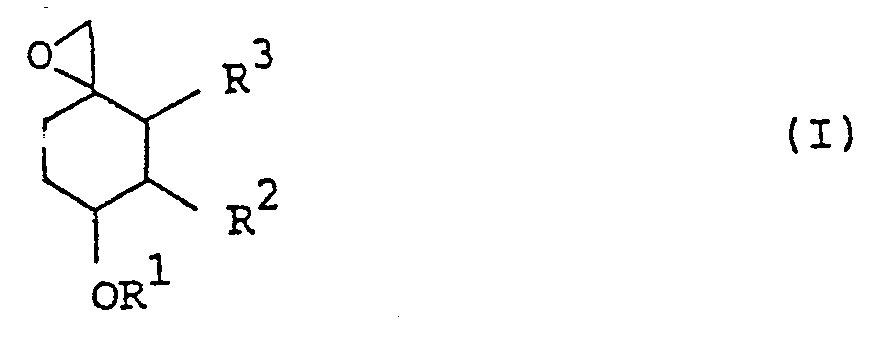
R¹ is carbamoyl;
lower alkylcarbamoyl;
hydroxy(lower)alkylcarbamoyl;
lower alkoxy(lower)alkylcarbamoyl;
lower alkylthio(lower)alkylcarbamoyl;
lower alkoxycarbonyl(lower)alkylcarbamoyl;
lower alkylcarbamoyloxy(lower)alkylcarbamoyl;
di(lower)alkylcarbamoyl;
N-[hydroxy(lower)alkyl](lower)alkylcarbamoyl;
N-[hydroxy(lower)alkyl](lower)alkylcarbamoyloxy(lower)alkylcarbamoyl;
lower alkylcarbamoyloxy(lower)alkenoyl;
N-[heterocycliccarbonyloxy(lower)alkyl](lower)alkylcarbamoyl;
cyclo(lower)alkylcarbamoyl;
arylcarbamoyl;
haloarylcarbamoyl;
protected carbamoyl;
lower alkylthiocarbamoyl;
heterocycliccarbamoyl;
ar(lower)alkenoyl;
lower alkoxycarbonyl;
heterocycliccarbonyl which may have lower alkyl, hydroxy, hydroxy(lower)alkyl, lower alkoxy(lower)alkyl or lower alkoxycarbonyl;
lower alkyl;
carboxy(lower)alkyl;
protected carboxy(lower)alkyl;
ar(lower)alkyl which may have halogen or lower alkoxy;
heterocyclic(lower)alkyl;
lower alkylcarbamoyl(lower)alkyl;
hydroxy(lower)alkenoyl;
acyloxy(lower)alkenoyl; or
diacyloxy(lower)alkenoyl;
R² is lower alkoxy and
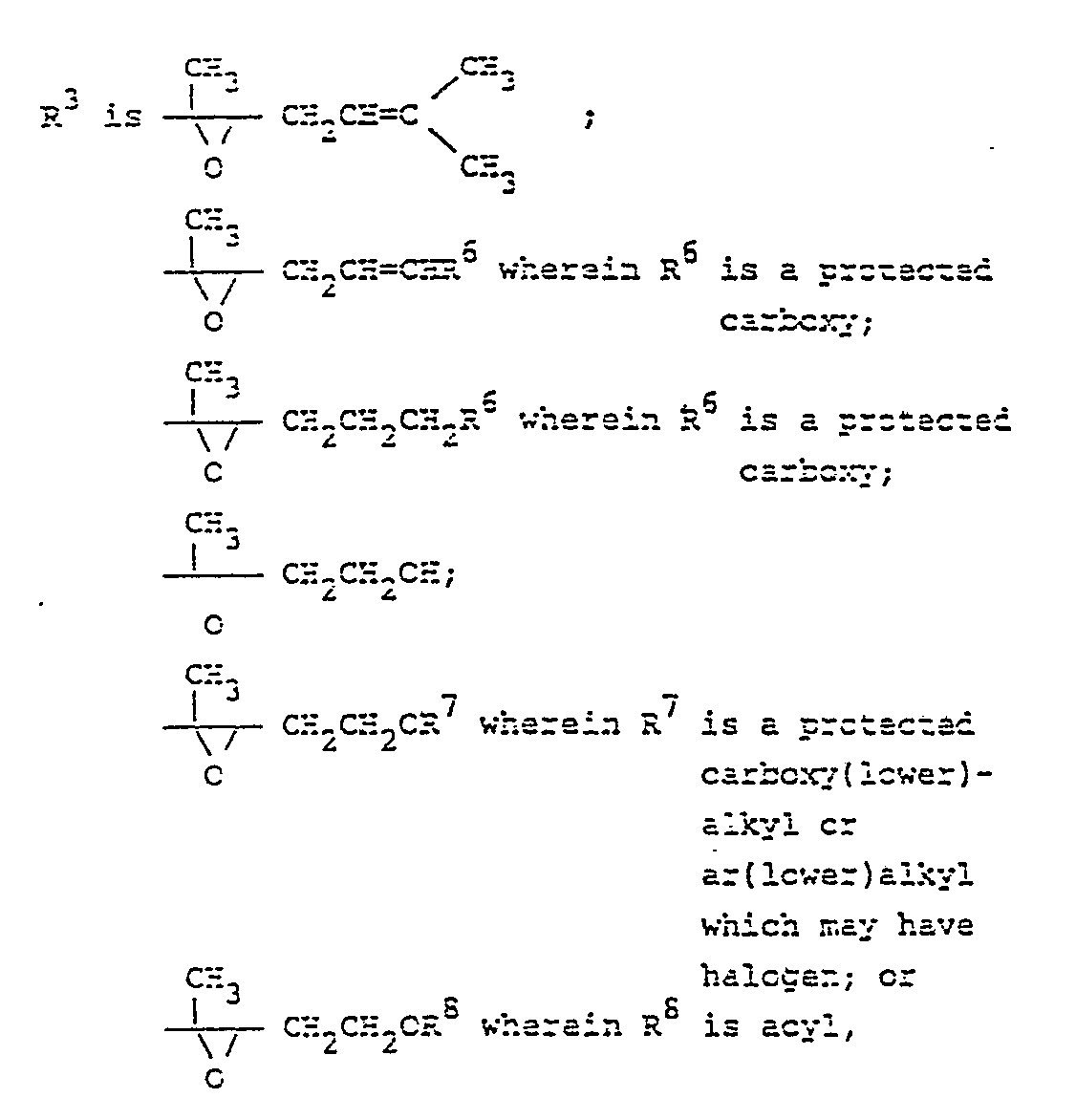
Description
- This invention relates to a new oxaspiro[2,5]octane derivative or salt thereof. More particularly, it relates to a new oxaspiro[2,5]octane derivative or salt thereof which has an angiogenesis inhibitory activity, and therefore is useful as an angiogenesis inhibitor, especially for the treatment of solid tumors, to processes for the preparation thereof and to a pharmaceutical composition comprising the same.
- The oxaspiro[2,5]octane derivative of this invention can be represented by the following formula :

R¹ is carbamoyl;
lower alkylcarbamoyl;
hydroxy(lower)alkylcarbamoyl;
lower alkoxy(lower)alkylcarbamoyl;
lower alkylthio(lower)alkylcarbamoyl;
lower alkoxycarbonyl(lower)alkylcarbamoyl;
lower alkylcarbamoyloxy(lower)alkylcarbamoyl;
di(lower)alkylcarbamoyl;
N-[hydroxy(lower)alkyl](lower)alkylcarbamoyl;
N-[hydroxy(lower)alkyl](lower)alkylcarbamoyloxy(lower)alkylcarbamoyl;
lower alkylcarbamoyloxy(lower)alkenoyl;
N-[heterocycliccarbonyloxy(lower)alkyl](lower)alkylcarbamoyl;
cyclo(lower)alkylcarbamoyl;
arylcarbamoyl;
haloarylcarbamoyl;
protected carbamoyl;
lower alkylthiocarbamoyl;
heterocycliccarbamoyl;
ar(lower)alkenoyl;
lower alkoxycarbonyl;
heterocycliccarbonyl which may have lower alkyl, hydroxy, hydroxy(lower)alkyl, lower alkoxy(lower)alkyl or lower alkoxycarbonyl;
lower alkyl;
carboxy(lower)alkyl;
protected carboxy(lower)alkyl;
ar(lower)alkyl which may have halogen or lower alkoxy;
heterocyclic(lower)alkyl;
lower alkylcarbamoyl(lower)alkyl;
hydroxy(lower)alkenoyl;
acyloxy(lower)alkenoyl; or
diacyloxy(lower)alkenoyl;
R² is lower alkoxy and
- The salts of the object compound (I) are preferably pharmaceutically acceptable salts thereof and may include a metal salt such as an alkali metal salt (e.g., sodium salt, potassium salt, etc.) and an alkaline earth metal salt (e.g., calcium salt, magnesium salt, etc.), ammonium salt, an organic amine salt (e.g., trimethylamine salt, triethylamine salt, pyridine salt, picoline salt, dicyclohexylamine salt, N,N′-dibenzylethylenediamine salt, etc.), an organic acid salt (e.g, acetate, maleate, tartrate, methanesulfonate, benzenesulfonate, toluenesulfonate, etc.), an inorganic acid salt (e.g., hydrochloride, hydrobromide, sulfate, phosphate, etc.), or a salt with an amino acid (e.g., arginine, aspartic acid, glutamic acid, etc.), and the like.
- According to this invention, the object compound (I) and pharmaceutically acceptable salt thereof can be prepared by, for example, the following processes.


R¹, R² and R³ are each as defined above.
R
lower alkylcarbamoyl,
hydroxy(lower)alkylcarbamoyl,
lower alkoxy(lower)alkylcarbamoyl,
lower alkylthio(lower)alkylcarbamoyl,
lower alkoxycarbonyl(lower)alkylcarbamoyl,
lower alkylcarbamoyloxy(lower)alkylcarbamoyl,
di(lower)alkylcarbamoyl,
N-[hydroxy(lower)alkyl](lower)alkylcarbamoyl,
N-[hydroxy(lower)alkyl](lower)alkylcarbamoyloxy(lower)alkylcarbamoyl,
lower alkylcarbamoyloxy(lower)alkenoyl,
N-[heterocycliccarbonyloxy(lower)alkyl](lower)alkylcarbamoyl, hydroxy(lower)alkenoyl,
acyloxy(lower)alkenoyl, diacyloxy(lower)alkenoyl,
cyclo(lower)alkylcarbamoyl, arylcarbamoyl,
haloarylcarbamoyl,
protected carbamoyl,
lower alkylthiocarbamoyl,
heterocycliccarbamoyl,
ar(lower)alkenoyl,
lower alkoxycarbonyl,
heterocycliccarbonyl which may have lower alkyl, hydroxy, hydroxy(lower)alkyl, lower alkoxy(lower)alkyl or lower alkoxycarbonyl,
R
carboxy(lower)alkyl;
protected carboxy(lower)alkyl;
ar(lower)alkyl which may have halogen or lower alkoxy; or
heterocyclic(lower)alkyl,
R
R
R
X is acid residue,
R
hydroxy(lower)alkylcarbamoyl,
lower alkoxy(lower)alkylcarbamoyl,
lower alkylthio(lower)alkylcarbamoyl,
lower alkoxycarbonyl(lower)alkylcarbamoyl,
lower alkylcarbamoyloxy- (lower)alkylcarbamoyl,
di(lower)alkylcarbamoyl,
N-[hydroxy(lower)alkyl](lower)alkylcarbamoyl,
cyclo(lower)alkylcarbamoyl,
arylcarbamoyl,
haloarylcarbamoyl,
protected carbamoyl,
morpholinocarbonyl,
morpholinocarbamoyl,
thiomorpholin-4-ylcarbonyl,
piperidinocarbonyl,
piperidinocarbamoyl,
hydroxypiperidinocarbonyl,
lower alkylpiperidinocarbonyl,
2-oxopyrrolidin-1-yl(lower)alkylcarbamoyl,
hydroxy(lower)alkylpyrrolidin-1-ylcarbonyl,
lower alkoxy(lower)alkylpyrrolidin-1-ylcarbonyl,
pyperazin-1-ylcarbonyl, or
lower alkoxycarbonylpiperazin-1-ylcarbonyl,
R⁴ is hydroxycarbonyloxy(lower)alkylcarbamoyl,
N-[hydroxycarbonyloxy(lower)alkyl](lower)alkylcarbamoyl or
hydroxycarbonyloxypiperidinocarbonyl,
R
N-[hydroxy(lower)alkyl](lower)alkylcarbamoyloxy(lower)alkylcarbamoyl,
lower alkylcarbamoyloxy(lower)alkenoyl,
N-[thiomorpholin-4-ylcarbonyloxy(lower)alkyl](lower)alkylcarbamoyl,
N-[morpholinocarbonyloxy(lower)alkyl](lower)alkylcarbamoyl or
lower alkylcarbamoyloxypiperidinocarbonyl,


R
- The starting compound (II) can be prepared in a conventional manner as, for example, that described in Journal of the American Chemical Society 94, 2549 (1972).
- The starting compounds (III) and (IV) can also be prepared in a conventional manner as illustrated in working Examples mentioned below.
- The salts of the compound (Ia), (Ib), (Ig) and (It) may include an inorganic or organic acid salt as those exemplified in the explanation of the salts of the object compound (I).
- The salts of the compound (If) and (III) may include a metal salt, ammonium salt or an organic amine salt as those exemplified in the explanation of the salts of the object compound (I).
- The salts of the compounds (Ii), (Ij), (Ik), (In), (Io), (Ir) and (Is) are the same salt as those exemplified in the explanation of the salts of the object compound (I).
- In the above and subsequent descriptions of this specification, suitable examples and illustrations of the various definitions are explained in detail in the followings.
- The term "lower" is intended to mean 1 to 6 carbon atom(s), unless otherwise indicated.
- Suitable "lower alkyl" in the terms "lower alkylcarbamoyl", "hydroxy(lower)alkylcarbamoyl", "lower alkoxy(lower)alkylcarbamoyl", "lower alkylthio(lower)alkylcarbamoyl", "lower alkoxycarbonyl(lower)alkylcarbamoyl", "lower alkylcarbamoyloxy(lower)alkylcarbamoyl", "di(lower)alkylcarbamoyl", "ar(lower)alkyl", "N-[hydroxy(lower)alkyl](lower)alkylcarbamoyl", "N-[hydroxy(lower)alkyl](lower)alkylcarbamoyloxy(lower)alkylcarbamoyl", "lower alkylcarbamoyloxy(lower)alkenoyl", "N-[heterocycliccarbonyloxy(lower)alkyl](lower)alkylcarbamoyl", "lower alkylthiocarbamoyl", "lower alkyl", "hydroxy(lower)alkyl", "lower alkoxy(lower)alkyl", "carboxy(lower)alkyl", "protected carboxy(lower)alkyl", "heterocyclic(lower)alkyl", "lower alkylcarbamoyl(lower)alkyl", "hydroxycarbonyloxy(lower)alkylcarbamoyl", "N-[hydroxycarbonyloxy(lower)alkyl](lower)alkylcarbamoyl", "N-[thiomorpholin-4-ylcarbonyloxy(lower)alkyl](lower)alkylcarbamoyl", "N-[morpholinocarbonyloxy(lower)alkyl](lower)alkylcarbamoyl" and "lower alkylcarbamoyloxypiperidinocarbonyl" may include methyl, ethyl, propyl, isopropyl, butyl, isobutyl, t-butyl, pentyl, hexyl and the like.
- Suitable "lower alkoxy" in the terms "lower alkoxy(lower)alkylcarbamoyl", "lower alkoxycarbonyl(lower)alkylcarbamoyl", "lower alkoxycarbonyl" and "lower alkoxy(lower)alkyl" may include methoxy, ethoxy, propoxy, butoxy, pentyloxy, hexyloxy and the like.
- Suitable "lower alkylthio" in the term "lower alkylthio(lower)alkylcarbamoyl" may include methylthio, ethylthio, propylthio, butylthio, pentylthio and hexylthio.
- Suitable "lower alkenoyl" in the term "lower alkylcarbamoyloxy(lower)alkenoyl", "hydroxy(lower)alkenoyl", "acyloxy(lower).alkenoyl" and "diacyloxy(lower)alkenoyl" and "ar(lower)alkenoyl" is C₃-C₆ alkenoyl such as acryloyl, crotonoyl and the like.
- Suitable "cyclo(lower)alkylcarbamoyl" is "cyclo(C₃-C₇)alkylcarbamoyl" and may include cyclopropylcarbamoyl, cyclobutylcarbamoyl, cyclopentylcarbamoyl, cyclohexylcarbamoyl, cycloheptylcarbamoyl and the like.
- Suitable "aryl" in the terms "arylcarbamoyl", "haloarylcarbamoyl", "ar(lower)alkyl" and "ar(lower)alkenoyl" may include phenyl, tolyl, xylyl, naphthyl and the like.
- Suitable "halogen" in the terms "haloaryl" and "halogen" may include chlorine, bromine, iodine and fluorine.
- Suitable "heterocyclic" in the terms "N-[heterocycliccarbonyloxy(lower)alkyl](lower)alkylcarbamoyl", "heterocycliccarbonyl", "heterocycliccarbamoyl" and "heterocyclic(lower)alkyl" may include N-containing heteromonocyclic (e.g. pyridyl, pyrrolidyl, piperidyl, piperazinyl, 2-oxopyrrolidyl, etc.), N,O-containing heteromonocyclic (e.g. morpholinyl, etc.) N,S-containing heteromonocyclic (e.g. thiomorpholinyl, etc.), benzene-fused N-containing heterocyclic (e.g. quinolyl, etc.) and the like.
- Suitable "protected carbamoyl" is carbamoyl protected by a conventional carbamoyl protective group such as trichloroacetyl and the like.
- Suitable "protected carboxy" in the terms "protected carboxy(lower)alkyl" and "protected carboxy" may include an esterified carboxy such as lower alkoxy carbonyl (e.g. methoxycarbonyl, ethoxycarbonyl, propoxycarbonyl, isopropoxycarbonyl, butoxycarbonyl, pentyloxycarbonyl, hexyloxycarbonyl, etc.) and the like.
- Suitable "acyl" in the terms "acyloxy(lower)alkenoyl", "diacyloxy(lower)alkenoyl" and "acyl" may include lower alkanoyl (e.g. formyl, acetyl, propionyl, etc.), aroyl (e.g. benzoyl, etc.) lower alkanesulfonyl (e.g. methanesulfonyl, ethanesulfonyl, etc.) and the like.
- Suitable "acid residue" may include halogen (e.g. fluorine, bromine, iodine, chlorine, etc.).
- The process as illustrated above and explained in more detail in the followings.
- The object compound (Ia) or salt thereof can be prepared by reacting the compound (II) with the compound (III) or reactive derivatives thereof or salt thereof.
- The reactive derivatives of the compound (III) may include acid halide (e.g. acid chloride, etc.), acid anhydride, activated amide, activated ester, isocyanate (e.g. lower alkylisocyanate, cyclo(lower)alkylisocyanate, arylisocyanate, etc.) and the like.
- The reaction is preferably conducted in the presence of an organic or inorganic base as those exemplified in the explanation of the Process 2.
- This reaction is usually carried out in a solvent which does not adversely influence the reaction such as methanol, ethanol, propanol, tetrahydrofuran, chloroform and the like.
- The reaction temperature is not critical and the reaction can be carried out under heating to under cooling.
- The object compound (Ib) or salt thereof can be prepared by reacting the compound (II) with the compound (IV).
- This reaction is usually carried out in a solvent which does not adversely influence the reaction such as N,N-dimethylformamide, dimethylsulfoxide, tetrahydrofuran and the like.
- The reaction can preferably be conducted in the presence of an organic or inorganic base such as alkali metal (e.g. sodium), alkaline earth metal (e.g. calcium), alkali or alkaline earth metal hydride (e.g. sodium hydride, calcium hydride, etc.), alkali or alkaline earth metal hydroxide (e.g. sodium hydroxide, potassium hydroxide, calcium hydroxide, etc.), alkali or alkaline earth metal carbonate or bicarbonate (e.g. sodium carbonate, potassium carbonate, sodium bicarbonate), alkali or alkaline earth metal alkoxide (e.g. sodium ethoxide, lithium methoxide, magnesium methoxide), trialkylamine (e.g. triethylamine), pyridine, bicyclodiaza compound (e.g. 1,5-diazabicyclo[3,4,0]nonene-5,1,5-diazabicyclo[5,4,0]undecene-5, etc. and the like.
- The reaction temperature is not critical and the reaction can be carried out under cooling to under heating.
- The compound (Id) or (If) can be prepared by subjecting the compound (Ic) or (Ie) to the removal reaction of the carbamoyl-(or carboxy-)protective group.
- The removal reaction of this process may include hydrolysis, reduction and the like.
- The hydrolysis is preferably carried out in the presence of inorganic or organic acid (e.g. hydrochloric acid, sulfuric acid, acetic acid, trifluoroacetic acid, etc.), or inorganic or organic base (e.g. sodium hydroxide, etc.).
- The reaction of this process is usually carried out in a solvent which does not adversely influence the reaction such as water, methanol, ethanol, propanol, acetic acid and the like, at a temperature range of cooling to heating.
- The object compound (Ig) or (Ih) or salt thereof can be prepared by the compound (V) or (VI) or their reactive derivative at the carboxy group with an amine.
- The reactive derivative at the carboxy group of the compound (V) and (VI) may include an aryl ester thereof (e.g. p-nitrophenyl ester, etc.) and the like.
- The amine may include primary or secondary amine such as lower alkylamine, hydroxy(lower)alkylamine, lower alkylthio(lower)alkylamine, N-[hydroxy(lower)alkyl](lower)alkylamine, lower alkoxy(lower)alkylamine, lower alkoxy(lower)alkylamine, morpholine, piperazine, lower alkoxycarbonylpiperazine, lower alkylpiperidine, thiomorpholine, aminopiperidine, 2-oxopyrrolidinyl(lower)alkylamine, aminomorpholine, hydroxypiperazine, hydroxy(lower)alkylpyrrolidine, lower alkoxy(lower)alkylpyrrolidine and the like.
- This reaction is usually carried out in a solvent which does not adversely influence the reaction such as dichloromethane, chloroform, dimethylsulfoxide and the like.
- The reaction temperature is not critical and the reaction can be carried out under heating to under cooling.
- The compound (Ij) or salt thereof can be prepared by subjecting the compound (Ii) or salt thereof to ozonolysis and then reducing the resultant compound.
- The ozonolysis can be carried out in a conventional manner.
- The reduction can be carried out by using a conventional reducing agent such as alkali metal borohydride (e.g. sodium borohydride) and the like.
- These reaction is usually carried out in a solvent which does not adversely influence the reaction such as methanol, dichloromethane, chloroform, dimethylsulfoxide and the like.
- The reaction temperature is usually carried out under cooling.
- The compound (Ik) or salt thereof can be prepared by subjecting the compound (Ii) or salt thereof to ozonolysis and then treating the resultant compound with methyl sulfide and then reacting the resultant compound with the compound (VII).
- The ozonolysis and subsequent treatment with methyl sulfide can be carried out in a conventional manner.
- These reaction can be carried out in a solvent which does not adversely influence the reaction such as dichloromethane under cooling.
- The last reaction is usually carried out in a solvent which does not adversely influence the reaction under heating to under cooling.
- The compound (Im) can be prepared by oxiding the compound (Iℓ).
- The oxidation is usually carried out by using a conventional oxidizing agent (e.g. sodium periodide, haloperbenzoic acid etc.) in a solvent which does not adversely influence the reaction such as water, dioxane, dichloromethane, methanol and the like under cooling.
- The compound (Io) or salt thereof can be carried out by subjecting the compound (In) or salt thereof to the catalytic reduction.
- The catalytic reduction can be carried out by using a conventional catalyst (e.g. PtO₂) in a solvent which does not adversely influence the reaction such as ethyl acetate and the like at ambient temperature.
- The compound (Iq) can be prepared by reducing the compound (Ip).
- The reduction is usually carried out by using a conventional reducing agent such as alkali metal borohydride (e.g. sodium borohydride) in a solvent which does not adversely influence the reaction such as water, methanol, dimethylformamide and the like under cooling to heating.
- The compound (Ir) can be prepared by reacting the compound (Ij) with an alkylating agent.
- The alkylating agent may include ar(lower)alkyl halide (e.g. benzyl bromide, etc.) and lower alkyl halo(lower)alkanate (e.g. ethyl bromoacetate, etc.) and the like.
- This reaction is usually carried out in a solvent such as toluene, dimethylformamide and the like under mild condition.
- The compound (Is), (Iu) or salt thereof can be prepared by reacting the compound (Ij), (It) or salt thereof with an acylating agent.
- The acylating agent is represented by the formula : R⁸OH (VIII) wherein R⁸ is acyl or reactive derivative thereof or salt thereof. The reactive derivative of the compound (VIII) is the same as those exemplified in the explanation of that of the compound (III).
- This acylation is carried out under the same condition as that of Process 1.
- The compound (Iw) can be prepared by reacting the compound (Iv) or reactive derivative at the carboxy group with lower alkylamine.
- The lower alkylamine may include methylamine, ethylamine, propylamine and the like. The reactive derivative of the compound (Iv) may include acid halide and the like.
- The reaction conditions of this process is the same as those of Process 1.
- The object compound of the above processes can be isolated and purified in a conventional manner.
- The object compound (I) of this invention has an angiogenesis inhibitory activity and therefore is useful for the treatment of solid tumor, rheumatoid arthritis, diabetic retinopathy, psoriasis and the like.
- The following test is given for the purpose of illustrating angiogenesis inhibitory activity of the object compound (I).
- Endothelial cells from human umbilical vein (HUVEC) were used for this experiment.
- HUVEC (2 x 10³ cells per well) were plated on 96 wells microtiter plates previously coated with human fibronectin and incubated with MCDB 151 [GIBCO] medium supplemented with 15% FBS (fetal bovine serum), 100% µg/ml ECGS (Endothelial cell growth supplement), 10 µg/ml heparin in the presence of the test compound at 37°C under 5% CO₂ in the air for 5 days. At the end of the experiments, the growth rate of HUVEC was measured according to the MTT method [Cancer treatment Reports 71, 1141∼1149 (1987)].
- The test compound inhibited the proliferation of human umbilical endothelial cells.
- IC₅₀ values [50% inhibition doses of the test compound to endothelial cell growth) of the test compound were graphically determined and are shown in the following table.

- The object compound (I) of this invention in admixture with pharmaceutically acceptable carriers can orally or parenterally be administered as antitumor agent to mammals including human being in a form of a pharmaceutical composition such as capsules, tablets, granules, powders, buccal tablets, sublingual tablets, and solutions.
- The pharmaceutically acceptable carriers may include various organic or inorganic carrier materials, which are conventionally used for pharmaceutical purpose, such as excipient (e.g. sucrose, starch, mannit, sorbit, lactose, glucose, cellulose, talc, calcium phosphate, calcium carbonate, etc.), binding agent (cellulose, methyl cellulose, hydroxypropylcellulose, polypropylpyrrolidone, gelatin, gum arabic, polyethyleneglycol, sucrose, starch, etc.), disentegrator (e.g. starch, carboxymethyl cellulose, calcium salt of carboxymethyl cellulose, hydroxypropyl-starch, sodium glycole-starch, sodium bicarbonate, calcium phosphate, calcium citrate, etc.), lubricant (e.g. magnesium stearate aerosil, talc, sodium laurylsulfate, etc.), flavoring agent (e.g. citric acid, mentol, glycine, organge powders, etc.), preservative (sodium benzoate, sodium bisulfite, methylparaben, propylparaben, etc.), stabilizer (citric acid, sodium citrate, acetic acid, etc.), suspending agent (e.g. methyl cellulose, polyvinylpyrrolidone, aluminum stearate, etc.), dispersing agent [e.g. surface active agent, etc.], aqueous diluting agent (e.g. water), oils (e.g. sesame oil, etc.), base wax (e.g. cacao butter, polyethyleneglycol, white petrolatum, etc.).
- A dosage of the object compound (I) is to be varied depending on various factors such as kind of diseases, weight and/or age of a patient, and further the kind of administration route.
- The preferred dosage of the object compound (I) is usually selected from a dose range of 0.01-10 mg/kg/day in the case of injection and 0.5-50 mg/kg/day in the case of oral administration.
- The following Examples are given for the purposre of illustrating this invention.
- To a solution of 6-hydroxy-5-methoxy-4-[2-methyl-3-(3-methyl-2-butenyl)oxiranyl]-1-oxaspiro[2,5]octane (14.8 mg) in freshly distilled tetrahydrofuran (0.5 ml) was added sodium hydride (2.5 mg) in one portion at 5°C. The mixture was stirred for half an hour at the same temperature and then methyl isocyanate (6 µℓ) was added thereto. After stirring at ambient temperature for 1.5 hours, the mixture was treated with methyl isocyanate (6 µℓ) to complete the reaction.
The reaction mixture was stirred for 3.25 hours at ambient temperature and diluted with diethyl ether. The organic layer was washed with brine, dried, and concentrated to give a crude oil which was purified by preparative thin layer column chromatography to yield 6-methylcarbamoyloxy-5-methoxy-4-[2-methyl-3-(3-methyl-2-butenyl)oxiranyl]-1-oxaspiro[2,5]octane (11 mg) as crystals.
mp : 92-93°C
IR (CHCl₃) : 3460, 3360, 1715 cm⁻¹
NMR (CDCl₃, δ) : 1.0-1.15 (1H, m), 1.20 (3H, s), 1.66 (3H, s), 1.73 (3H, s), 1.65-2.54 (6H, m), 2.54 (1H, d, J=5Hz), 2.55 (1H, t, J=6Hz), 2.79 (3H, d, J=5Hz), 2.97 (1H, d, J=5Hz), 3.47 (3H, s), 3.64 (1H, dd, J=11Hz and 3Hz), 4.75 (1H, br s), 5.20 (1H, t, J=8Hz), 5.50 (1H, br s) - The following compounds were prepared in a similar manner to that of Example 1.
(1) 5-Methoxy-4-[2-methyl-3-(3-methyl-2-butenyl)oxiranyl]-6-phenylcarbamoyloxy-1-oxaspiro[2,5]octane.
Oil
IR (CHCl₃) : 1720, 1600, 1520, 1440, 1380, 1200, 1100 cm⁻¹
NMR (CDCl₃, δ) : 1.04-1.16 (1H, m), 1.24 (3H, s), 1.66 (3H, s), 1.75 (3H, s), 1.74-2.50 (6H, m), 2.58 (1H, d, J=4Hz), 2.62 (1H, t, J=7Hz), 3.01 (1H, d, J=4Hz), 3.48 (3H, s), 3.72 (1H, dd, J=10Hz and 3Hz), 5.22 (1H, m), 5.56 (1H, m), 6.80 (1H, s), 7.05-7.45 (5H, m)
(2) 6-Ethylcarbamoyloxy-5-methoxy-4-[2-methyl-3-(3-methyl-2-butenyl)oxiranyl]-1-oxaspiro[2,5]octane.
mp : 65°C
IR (CHCl₃) : 3450, 1705 cm⁻¹
NMR (CDCl₃, δ) : 0.99-1.30 (1H, m), 1.14 (3H, t, J=8Hz), 1.22 (3H, s), 1.67 (3H, s), 1.75 (3H, s), 1.78-2.48 (6H, m), 2.56 (1H, d, J=4Hz), 2.58 (1H, t, J=5Hz), 2.99 (1H, d, J=4Hz), 3.22 (2H, m), 3.45 (3H, s), 3.64 (1H, dd, J=2Hz and 12Hz), 4.75 (1H, br s), 5.21 (1H, t, J=7Hz), 5.50 (1H, br s)
(3) 6-Isopropylcarbamoyloxy-5-methoxy-4-[2-methyl-3-(3-methyl-2-butenyl)oxiranyl]-1-oxaspiro[2,5]octane.
Oil
IR (CHCl₃) : 3430, 1700 cm⁻¹
NMR (CDCl₃, δ) : 1.00-1.23 (1H, m), 1.17 (6H, d, J=6Hz), 1.22 (3H, s), 1.66 (3H, s), 1.75 (3H, s), 1.78-2.48 (6H, m), 2.54 (1H, d, J=4Hz), 2.57 (1H, t, J=5Hz), 2.98 (1H, d, J=4Hz), 3.45 (3H, s), 3.65 (1H, dd, J=2Hz and 12Hz), 3.80 (1H, m), 4.61 (1H, d, J=7Hz), 5.21 (1H, t, J=7Hz), 5.48 (1H, s)
(4) 6-Cyclohexylcarbamoyloxy-5-methoxy-4-[2-methyl-3-(3-methyl-2-butenyl)oxiranyl]-1-oxaspiro[2,5]octane.
mp : 61°C
IR (CHCl₃) : 3440, 1700 cm⁻¹
NMR (CDCl₃, δ) : 0.99-2.49 (18H, m), 1.22 (3H, s), 1.66 (3H, s), 1.75 (3H, s), 2.55 (1H, d, J=4Hz), 2.57 (1H, t, J=5Hz), 2.97 (1H, d, J=4Hz), 3.45 (3H, s), 3.65 (1H, dd, J=2Hz and 12Hz), 4.69 (1H, d, J=8Hz), 5.22 (1H, t, J=7Hz), 5.46 (1H, s)
(5) 6-(4-Chlorophenylcarbamoyloxy)-5-methoxy-4-[2-methyl-3-(3-methyl-2-butenyl)oxiranyl]-1-oxaspiro[2,5]octane.
mp : 63-66°C
IR (CHCl₃) : 3430, 1720 cm⁻¹
NMR (CDCl₃, δ) : 1.04-1.18 (1H, m), 1.24 (3H, s), 1.68 (3H, s), 1.76 (3H, s), 1.83-2.50 (6H, m), 2.58 (1H, d, J=4Hz), 2.61 (1H, t, J=5Hz), 3.01 (1H, d, J=4Hz), 3.47 (3H, s), 3.72 (1H, dd, J=2Hz and 12Hz), 5.22(1H, t, J=7Hz), 5.58 (1H, br s), 6.88 (1H, br s), 7.21-7.42 (4H, m)
(6) 5-Methoxy-4-[2-methyl-3-(3-methyl-2-butenyl)oxiranyl]-6-(trichloroacetylcarbamoyloxy)-1-oxaspiro[2,5]octane.
Oil
IR (CHCl₃) : 3400, 1800, 1740 cm⁻¹
NMR (CDCl₃, δ) : 1.10-1.20 (1H, m), 1.21 (3H, s), 1.65 (3H, s), 1.74 (3H, s), 1.85-2.49 (6H, m), 2.58 (1H, d, J=4Hz), 2.62 (1H, t, J=5Hz), 3.00 (1H, d, J=4Hz), 3.50 (3H, s), 3.74 (1H, dd, J=12Hz and 2Hz), 5.19 (1H, t, J=7Hz), 5.68 (1H, br s), 8.87 (1H, br s)
(7) 6-Propylcarbamoyloxy-5-methoxy-4-[2-methyl-3-(3- methyl-2-butenyl)oxiranyl]-1-oxaspiro[2,5]octane.
mp : 87-88°C
IR (CHCl₃) : 3450, 1705, 1510, 1230, 1125, 1100 cm⁻¹
NMR (CDCl₃, δ) : 0.93 (3H, t, J=8Hz), 1.00-1.13 (1H, m), 1.21 (3H, s), 1.52 (2H, m), 1.68 (3H, s), 1.75 (3H, s), 1.80-2.48 (6H, m), 2.52 (1H, d, J=4Hz), 2.58 (1H, t, J=6Hz), 3.14 (2H, q, J=7Hz), 3,46 (3H, s), 3.65 (1H, dd, J=3Hz and 11Hz), 4.80 (1H, br s), 5.20 (1H, br t, J=7Hz), 5.45 (1H, br s)
(8) 6-(Butylcarbamoyloxy)-5-methoxy-4-[2-methyl-3-(3-methyl-2-butenyl)oxiranyl]-1-oxaspiro[2,5]octane.
mp : 68-69°C
IR (CHCl₃) : 3450, 1710, 1510, 1240, 1130, 1100 cm⁻¹
NMR (CDCl₃, δ) : 0.93 (3H, t, J=8Hz), 1.00-1.12 (1H, m), 1.22 (3H, s), 1.22-1.58 (4H, m), 1.57 (3H, s), 1.75 (3H, s), 1.75-2.45 (6H, m), 2.52 (1H, d, J=4Hz), 2.54 (1H, t, J=6Hz), 2.95 (1H, d, J=4Hz), 3.14 (2H, q, J=7Hz), 3.45 (3H, s), 3.63 (1H, dd, J=3Hz and 11Hz), 4.75 (1H, br s), 5.19 (1H, br t, J=7Hz), 5.50 (1H, br s)
(9) 6-Ethylthiocarbamoyloxy-5-methoxy-4-[2-methyl-3-(3-methyl-2-butenyl)oxiranyl]-1-oxaspiro[2,5]octane.
mp : 83-84°C
IR (Nujol) : 3300, 1535, 1190 cm⁻¹
NMR (CDCl₃, δ) : 0.98-1.14 (1H, m), 1.22 (3H, s), 1.66 (3H, s), 1.75 (3H, s), 1.22 (3H, t, J=6Hz), 1.78-2.50 (6H, m), 2.56 (1H, d, J=4Hz), 2.58 (1H, t, J=6Hz), 2.99 (1H, d, J=4Hz), 3.45 (3H, s), 3.56 (2H, qd, J=5Hz and 6Hz), 3.72 (1H, dd, J=2Hz and 12Hz), 5.21 (1H, br t, J=7Hz), 6.12 (1H, br s), 6.38-6.51 (1H, br s) - A solution of 5-methoxy-4-[2-methyl-3-(3-methyl-2-butenyl)oxiranyl]-6-(trichloroacetylcarbamoyloxy)-1-oxaspiro[2,5]octane (26 mg) and triethylamine (9.9 µℓ) in a mixture of water (0.8 ml) and ethanol (0.8 ml) was stirred overnight at ambient temperature. The mixture was diluted with diethyl ether and washed with brine. The mixture was dried and evaporated to yield 6-carbamoyloxy-5-methoxy-4-[2-methyl-3-(3-methyl-2-butenyl)oxiranyl]-1-oxaspiro[2,5]octane (18.2 mg) as white solids.
mp : 125-126°C
IR (CHCl₃) : 3300, 1720 cm⁻¹
NMR (CDCl₃, δ) : 1.10-1.20 (2H, m), 1.21 (3H, s), 1.66 (3H, s), 1.75 (3H, s), 1.85-2.48 (7H, m), 2.58 (1H, d, J=4Hz), 2.62 (1H, t, J=5Hz), 3.00 (1H, d, J=4Hz), 3.50 (3H, s), 3.74 (1H, dd, J=12Hz and 2Hz), 4.91 (1H, br s), 5.20 (1H, t, J=7Hz), 5.45 (1H, br s) - To a solution of 6-hydroxy-5-methoxy-4-[2-methyl-3-(3-methyl-2-butenyl)oxiranyl]-1-oxaspiro[2,5]octane (14.1 mg) in freshly distilled tetrahydrofuran (0.5 ml) was added sodium hydride (2.0 mg, 60% oil dispersion) in one portion at 5°C. The mixture was stirred for half an hour at the same temperature and then morpholinocarbonyl chloride (6.8 mg) was added thereto. The reaction mixture was stirred for 2 hours at ambient temperature and diluted with diethyl ether (2 ml). The organic layer was washed with water, dried and concentrated under reduced pressure. The residue was purified by column chromatography on silica gel (elution by diethyl ether/n-hexane = 2/1) to yield 5-methoxy-4-[2-methyl-3-(3-methyl-2-butenyl)oxiranyl]-6-(morpholinocarbonyloxy)-1-oxaspiro[2,5]octane (9.7 mg) as an oil.
IR (CHCl₃) : 1690, 1430, 1205 cm⁻¹
NMR (CDCl₃, δ) : 1.05-1.17 (1H, m), 1.20 (3H, s), 1.57 (3H, s), 1.73 (3H, s), 1.79-2.46 (6H, m), 2.54 (1H, d, J=4Hz), 2.60 (1H, t, J=6Hz), 3.00 (1H, d, J=4Hz), 3.47 (3H, s), 3.36-3.58 and 3.58-3.75 (9H, m), 5.22 (1H, m), 5.58 (1H, m) - The following compounds were prepared in a similar manner to that of Example 4.
(1) 6-Cinnamoyloxy-5-methoxy-4-[2-methyl-3-(3-methyl-2-butenyl)oxiranyl]-1-oxaspiro[2,5]octane.
Oil
IR (CHCl₃) : 1700, 1635, 1445, 1310, 1170 cm⁻¹
NMR (CDCl₃, δ) : 1.06-1.20 (1H, m), 1.25 (3H, s), 1.58 (3H, s), 1.76 (3H, s), 1.85-2.50 (6H, m), 2.48 (1H, d, J=4Hz), 2.62 (1H, t, J=6Hz), 3.02 (1H, d, J=4Hz), 3.48 (3H, s), 3.72 (1H, dd, J=10Hz and 3Hz), 5.22 (1H, m), 5.77 (1H, m), 6.50 (1H, d, J=15Hz), 7.33-7.58 (5H, m), 7.68 (1H, d, J=15Hz)
(2) 6-Cyclohexanoyloxy-5-methoxy-4-[2-methyl-3-(3-methyl-2-butenyl)oxiranyl]-1-oxaspiro[2,5]octane.
Oil
IR (CHCl₃) : 1720, 1405, 1375, 1170, 1130, 1100 cm⁻¹
NMR (CDCl₃, δ) : 1.00-1.14 (1H, m), 1.20 (3H, s), 1.20-2.25 (15H, m), 1.65 (3H, s), 1.72 (3H, s), 2.25-2.47 (2H, m), 2.55 (1H, d, J=4Hz), 2.60 (1H, t, J=6Hz), 2.98 (1H, d, J=4Hz), 3.40 (3H, s), 3.63 (1H, dd, J=3Hz and 11Hz), 5.20 (1H, br t, J=8Hz), 5.62 (1H, m)
(3) 6-Dimethylcarbamoyloxy-5-methoxy-4-[2-methyl-3-(3- methyl-2-butenyl)oxiranyl]-1-oxaspiro[2,5]octane.
Oil
IR (CHCl₃) : 1680, 1480, 1440, 1395, 1375, 1180 cm⁻¹
NMR (CDCl₃, δ) : 1.00-1.18 (1H, m), 1.22 (3H, s), 1.65 (3H, s), 1.75 (3H, s), 1.80-2.46 (6H, m), 2.53 (1H, d, J=4Hz), 2.58 (1H, d, J=6Hz), 2.90 (6H, s), 3.00 (1H, d, J=4Hz), 3.46 (3H, s), 3.63 (1H, dd, J=3Hz and 11Hz), 5.22 (1H, t, J=8Hz), 5.57 (1H, br s) - To a solution of 6-hydroxy-5-methoxy-4-[2-methyl-3-(3-methyl-2-butenyl)oxiranyl]-1-oxaspiro[2,5]octane (14.1 mg) in freshly distilled tetrahydrofuran (0.5 ml) was added sodium hydride (6.0 mg, 60% oil dispersion) in one portion at 5°C. The mixture was stirred for half an hour at the same temperature and then isobutyl chloroformate (7 mg) was added thereto. The reaction mixture was stirred for 2 hours at ambient temperature and then diluted with diethyl ether. The organic layer was washed with brine, dried, and concentrated under reduced pressure. The residue was purified by column chromatography on silica gel (elution by diethyl ether/n-hexane = 1/3) to yield 6-isobutoxycarbonyloxy-5-methoxy-4-[2-methyl-3-(3-methyl-2-butenyl)oxiranyl]-1-oxaspiro[2,5]octane (5.1 mg) as an oil.
IR (CHCl₃) : 1730, 1440, 1375, 1260, 1100 cm⁻¹
NMR (CDCl₃, δ) : 0.94 (6H, d, J=6Hz), 1.00-1.13 (1H, m), 1.20 (3H, s), 1.63 (3H, s), 1.73 (3H, s), 1.80-2.45 (7H, m), 2.52 (1H, d, J=4Hz), 2.55 (1H, t, J=6Hz), 2.95 (1H, d, J=4Hz), 3.45 (3H, s), 3.63 (1H, dd, J=7Hz and 11Hz), 3.90 (2H, m), 5.19 (1H, br t, J=8Hz), 5.45 (1H, br s) - To a solution of 6-hydroxy-5-methoxy-4-[2-methyl-3-(3-methyl-2-butenyl)oxiranyl]-1-oxaspiro[2,5]octane (14.1 mg) in freshly distilled tetrahydrofuran (0.5 ml) was added sodium hydride (60% oil dispersion, 2.0 mg) in one portion in an ice bath. The suspension was stirred for half an hour at the same temperature and thereto iodomethane (71 mg) was added. After stirring for 2 hours at ambient temperature, the mixture was diluted with diethyl ether and washed with water. The organic layer was dried and evaporated to give a crude oil which was purified by column chromatography on silica gel eluted by a mixture of diethyl ether and n-hexane (1:2) to yield 5,6-dimethoxy-4-[2-methyl-3-(3-methyl-2-butenyl)oxiranyl]-1-oxaspiro[2,5]octane (14.2 mg) as an oil.
IR (CHCl₃) : 1440, 1380, 1105 cm⁻¹
NMR (CDCl₃, δ) : 0.93-1.07 (1H, m), 1.20 (3H, s), 1.63 (3H, s), 1.72 (3H, s), 1.93-2.45 (6H, m), 2.51 (1H, d, J=4Hz), 2.56 (1H, t, J=6Hz), 2.95 (1H, d, J=4Hz), 3.42 (3H, s), 3.46 (3H, s), 3.59 (1H, dd, J=3Hz and 10Hz), 3.92 (1H, m), 5.19 (1H, m) - The following compounds were prepared in a similar manner to that of Example 7.
(1) 6-Benzyloxy-5-methoxy-4-[2-methyl-3-(3-methyl-2-butenyl)oxiranyl)-1-oxaspiro[2,5]octane.
Oil
IR (CHCl₃) : 1450, 1380 cm⁻¹
NMR (CDCl₃, δ) : 0.95-1.10 (1H, m), 1.22 (3H, s), 1.67 (3H, s), 1.74 (3H, s), 1.55-2.48 (6H, m), 2.53 (1H, d, J=5Hz), 2.58 (1H, t, J=6Hz), 2.96 (1H, d, J=5Hz), 3.41 (3H, s), 3.58 (1H, dd, J=11Hz and 2Hz), 4.10 (1H, m), 4.70 (2H, ABq, J=12Hz), 5.22 (1H, t, J=7.5Hz), 7.28-7.45 (5H, m)
(2) 5-Methoxy-4-[2-methyl-3-(3-methyl-2-butenyl)oxiranyl]-6-(2-pyridylmethoxy)-1-oxaspiro[2,5]octane.
Oil
IR (CHCl₃) : 1590, 1430, 1370, 1105 cm⁻¹
NMR (CDCl₃, δ) : 0.96-1.10 (1H, m), 1.23 (3H, s), 1.66 (3H, s), 1.75 (3H, s), 2.01-2.46 (6H, m), 2.52 (1H, d, J=4Hz), 2.60 (1H, t, J=7Hz), 3.97 (1H, d, J=4Hz), 3.43 (3H, s), 3.62 (1H, dd, J=3Hz and 10Hz), 4.18 (1H, m), 4.75 (1H, d, J=13Hz), 4.85 (1H, d, J=13Hz), 5.22 (1H, m), 7.16 (1H, m), 7.55-7.72 (2H, m), 8.52 (1H, m)
(3) 5-Methoxy-4-[2-methyl-3-(3-methyl-2-butenyl)oxiranyl]-6-(2-quinolylmethoxy)-1-oxaspiro[2,5]octane.
mp : 82-83°C
IR (CHCl₃) : 1420, 1375, 1200, 1100 cm⁻¹
NMR (CDCl₃, δ) : 0.97-1.12 (1H, m), 1.22 (3H, s), 1.68 (3H, s), 1.75 (3H, s), 2.02-2.48 (6H, m), 2.55 (1H, d, J=4Hz), 2.62 (1H, t, J=6Hz), 2.99 (1H, d, J=4Hz), 3.45 (3H, s), 3.65 (1H, dd, J=3Hz and 11Hz), 4.22 (1H, br s), 4.98 (2H, s), 5.24 (1H, m), 7.53 (1H, t, J=8Hz), 7.72 (1H, t, J=8Hz), 7.80 (1H, d, J=8Hz), 7.84 (1H, d, J=8Hz), 8.05 (1H, d, J=8Hz), 8.18 (1H, d, J=8Hz)
(4) 6-(4-Chlorobenzyloxy)-5-methoxy-4-[2-methyl-3-(3-methyl-2-butenyl)oxiranyl]-1-oxaspiro[2,5]octane.
Oil
IR (CHCl₃) : 1680, 1485, 1440, 1380, 1200 cm⁻¹
NMR (CDCl₃, δ) : 0.95-1.10 (1H, m), 1.21 (3H, s), 1.68 (3H, s), 1.74 (3H, s), 1.90-2.46 (6H, m), 2.52 (1H, d, J=4Hz), 2.56 (1H, t, J=6Hz), 2.96 (1H, d, J=4Hz), 3.41 (3H, s), 3.58 (1H, dd, J=3Hz and 10Hz), 4.08 (1H, br s), 4.60 (1H, d, J=10Hz), 4.71 (1H, d, J=10Hz), 5.20 (1H, br t, J=5Hz), 7.30 (4H, s)
(5) 5-Methoxy-6-(4-methoxybenzyloxy)-4-[2-methyl-3-(3-methyl-2-butenyl)oxiranyl]-1-oxaspiro[2,5]octane.
Oil
IR (CHCl₃) : 1605, 1505, 1440, 1375, 1300, 1240, 1205 cm⁻¹
NMR (CDCl₃, δ) : 0.91-1.08 (1H, m), 1.20 (3H, s), 1.62 (3H, s), 1.72 (3H, s), 1.88-2.44 (6H, m), 2.49 (1H, d, J=4Hz), 2.53 (1H, t, J=6Hz), 2.95 (1H, d, J=4Hz), 3.38 (3H, s), 3.56 (1H, dd, J=3Hz and 10Hz), 3.32 (3H, s), 4.07 (1H, br s), 4.55 (1H, d, J=11Hz), 4.65 (1H, d, J=11Hz), 5.20 (1H, br t, J=5Hz), 6.86 (2H, d, J=6Hz), 7.30 (2H, d, J=6Hz)
(6) 5-Methoxy-4-[2-methyl-3-(3-methyl-2-butenyl)oxiranyl]-6-(2-naphthylmethoxy)-1-oxaspiro[2,5]octane.
Oil
IR (CHCl₃) : 1440, 1370, 1220, 1100 cm⁻¹
NMR (CDCl₃, δ) : 0.95-1.08 (1H, m), 1.21 (3H, s), 1.65 (3H, s), 1.75 (3H, s), 1.92-2.45 (6H, m), 2.52 (1H, d, J=4Hz), 2.58 (1H, t, J=6Hz), 2.95 (1H, d, J=4Hz), 3.42 (3H, s), 3.59 (1H, dd, J=3Hz and 10Hz), 4.14 (1H, br t, J=8Hz), 4.78 (1H, d, J=13Hz), 4.88 (1H, d, J=13Hz), 7.35-7.66 (3H, m), 7.75-7.90 (4H, m)
(7) 5-Methoxy-4-[2-methyl-3-(3-methyl-2-butenyl)oxiranyl]-6-(1-naphthylmethoxy)-1-oxaspiro[2,5]octane.
Oil
IR (CHCl₃) : 1370, 1100 cm⁻¹
NMR (CDCl₃, δ) : 0.88-1.04 (1H, m), 1.22 (3H, s), 1.66 (3H, s), 1.72 (3H, s), 1.82-2.47 (6H, m), 2.49 (1H, d, J=4Hz), 2.58 (1H, t, J=5Hz), 2.93 (1H, d, J=4Hz), 3.42 (3H, s), 3.60 (1H, dd, J=2Hz and 12Hz), 4.22 (1H, br s), 5.03 (1H, d, J=12Hz), 5.22 (1H, br t, J=7Hz), 5.30 (1H, d, J=12Hz), 7.32-7.60 (4H, m), 7.22-7.90 (2H, m), 8.18-8.27 (1H, m)
(8) 6-Ethoxycarbonylmethoxy-5-methoxy-4-[2-methyl-3-(3-methyl-2-butenyl)oxiranyl]-1-oxaspiro[2,5]octane.
Oil
IR (CHCl₃) : 1740, 1440, 1380, 1130 cm⁻¹
NMR (CDCl₃, δ) : 0.95-1.10 (1H, m), 1.22 (3H, s), 1.28 (3H, t, J=7Hz), 1.66 (3H, s), 1.72 (3H, s), 2.02-2.48 (6H, m), 2.52 (1H, d, J=4Hz), 2.58 (1H, t, J=6Hz), 2.95 (1H, d, J=4Hz), 3.48 (3H, s), 3.60 (1H, dd, J=10Hz and 3Hz), 4.20 (3H, m), 4.25 (1H, d, J=16Hz), 4.48 (1H, d, J=16Hz), 5.20 (1H, m) - A mixture of 6-ethoxycarbonylmethoxy-5-methoxy-4-[2-methyl-3-(3-methyl-2-butenyl)oxiranyl]-1-oxasprio[2,5]octane (17 mg) and 1N aqueous sodium hydroxide solution (0.09 ml) in ethanol (0.2 ml) was stirred for one hour at ambient temperature. The solution was neutralized with 1N hydrochloric acid and the separated oil was extracted with diethyl ether. The solvent was dried and concentrated in vacuo to yield 6-carboxymethoxy-5-methoxy-4-[2-methyl-3-(3-methyl-2-butenyl)oxiranyl]-1-oxaspiro[2,5]octane (14.4 mg) as an oil.
IR (CHCl₃) : 3400, 1760, 1440, 1370, 1120 cm⁻¹
NMR (CDCl₃, δ) : 0.96-1.10 (1H, m), 1.22 (3H, s), 1.65 (3H, s), 1.72 (3H, s), 1.77-2.46 (6H, m), 2.46 (1H, d, J=4Hz), 2.62 (1H, t, J=6Hz), 2.95 (1H, d, J=4Hz), 3.56 (3H, s), 3.70 (1H, dd, J=10Hz and 3Hz), 3.95 (1H, m), 4.02 (1H, d, J=16Hz), 5.20 (1H, m), 5.80 (1H, br s) - To a mixture of 6-hydroxy-5-methoxy-4-[2-methyl-3-(3-methyl-2-butenyl)oxiranyl]-1-oxaspiro[2,5]octane (423 mg) and pyridine (474 mg) in dichloromethane (9 ml) was added portionwise 4-nitrophenyl chloroformate (1.2 g) at ambient temperature. After stirring for 3 hours, 5-methoxy-4-[2-methyl-3-(3-methyl-2-butenyl)oxiranyl]-6-(4-nitrophenoxycarbonyloxy)-1-oxaspiro[2,5]octane was prepared in the reaction mixture. To the mixture 3-amino-1-propanol (2.25 g) was added in one portion. The mixture was stirred for 2 hours at ambient temperature and then diluted with diethyl ether (20 ml). The solution was washed with brine, 1N aqueous hydrochloric acid, 1N aqueous sodium hydroxide, and brine successively. The solvent was dried and evaporated in vacuo to give a crude oil, which was purified by column chromatography on silica gel eluted by ethyl acetate to yield 6-(3-hydroxypropylcarbamoyloxy)-5-methoxy-4-[2-methyl-3-(3-methyl-2-butenyl)oxiranyl]-1-oxaspiro[2,5]octane (400 mg) as crystals.
mp : 56-58°C
IR (Nujol) : 3350, 1680, 1530, 1260 cm⁻¹
NMR (CDCl₃, δ) : 1.00-1.13 (1H, m), 1.21 (3H, s), 1.65 (3H, s), 1.73 (3H, s), 1.65-2.50 (10H, m), 2.52-2.61 (2H, m), 2.98 (1H, d, J=4Hz), 3.20-3.45 (1H, m), 3.48 (3H, s), 3.58-3.75 (4H, m), 5.20 (1H, br t, J=8Hz), 5.50 (1H, br s) - To a mixture of 6-(3-hydroxypropylcarbamoyloxy)-5-methoxy-4-[2-methyl-3-(3-methyl-2-butenyl)oxiranyl]-1-oxaspiro[2,5]octane (15 mg) and pyridine (12.3 mg) in dichloromethane (1 ml) was added portionwise 4-nitrophenyl chloroformate (32 mg) at ambient temperature. After stirring for 2 hours, 5-methoxy-4-[2-methyl-3-(3-methyl-2-butenyl)oxiranyl]-6-(4-nitrophenoxycarbonyloxypropylcarbamoyloxy)-1-oxaspiro[2,5]octane was prepared in the reaction mixture. To the mixture, 30% methanol solution of methylamine (7 mg) was added in one portion. The mixture was stirred for 1 hour at ambient temperature and diluted with diethyl ether (5 ml). The solution was washed with brine, 1N aqueous hydrochloric acid, 1N aqueous sodium hydroxide, and brine successively. The solvent was dried and evaporated in vacuo to give a crude oil, which was purified by column chromatography on silica gel eluted by diethyl ether to yield 5-methoxy-4-[2-methyl-3-[3-methyl-2-butenyl)oxiranyl]-6-[3-(methylcarbamoyloxy)propylcarbamoyloxy]-1-oxaspiro[2,5]octane (13.8 mg) as crystals.
mp : 52-54°C
IR (Nujol) : 3350, 1700, 1525, 1460, 1110 cm⁻¹
NMR (CDCl₃, δ) : 1.00-1.12 (1H, m), 1.71 (3H, s), 1.78 (3H, s), 1.80 (3H, s), 1.81-2.48 (9H, m), 2.50-2.62 (2H, m), 2.97 (3H, d, J=4Hz), 2.98 (1H, d, J=4Hz), 3.10-3.38 (2H, m), 3.45 (3H, s), 3.64 (1H, dd, J=3Hz and 11Hz), 4.02-4.38 (2H, m), 4.93-5.13 (1H, m), 5.13-5.25 (1H, m), 5.50 (1H, br s) - To a mixture of 6-hydroxy-5-methoxy-4-[2-methyl-3-(3-methyl-2-butenyl)oxiranyl]-1-oxaspiro[2,5]octane (9.2 g) and pyridine (10.3 g) in dichloromethane (92 ml) was added portionwise 4-nitrophenyl chloroformate (13.1 g) at ambient temperature. After stirring for 3 hours, 5-methoxy-4-[2-methyl-3-(3-methyl-2-butenyl)oxiranyl]-6-(4-nitrophenoxycarbonyloxy)-1-oxaspiro[2,5]octane was prepared in the reaction mixture. To the mixture morpholine (28.4 g) was added in one portion. The solution was stirred for 8 hours at ambient temperature and then diluted with diethyl ether (300 ml). The solution was washed with brine, 1N aqueous hydrochloric acid, 1N aqueous sodium hydroxide and brine successively. The solvent was dried and evaporated in vacuo to give 5-methoxy-4-[2-methyl-3-(3-methyl-2-butenyl)oxiranyl]-6-morpholinocarbonyloxy-1-oxaspiro[2,5]octane (13.1 g) as an oil.
IR (CHCl₃) : 1690, 1430, 1205 cm⁻¹
NMR (CDCl₃, δ) : 1.05-1.17 (1H, m), 1.20 (3H, s), 1.57 (3h, s), 1.73 (3H, s), 1.79-2.46 (6H, m), 2.54 (1H, d, J=4Hz), 2.60 (1H, t, J=6Hz), 3.00 (1H, d, J=4Hz), 3.47 (3H, s), 3.36-3.58 and 3.58-3.75 (9H, m), 5.22 (1H, m), 5.58 (1H, m) - The following compounds were prepared in a similar manner to that of Example 12.
(1) 5-Methoxy-4-[2-methyl-3-(3-phenyl-2-propenyl)oxiranyl]-6-methylcarbamoyloxy-1-oxaspiro[2,5]octane
mp : 45°C
IR (CHCl₃) : 3450, 1705 cm⁻¹
NMR (CDCl₃, δ) : 0.98-1.13 (1H, m), 1.26 (3H, s), 1.78-2.15 (4H, m), 2.43-2.64 (2H, m), 2.56 (1H, d, J=4Hz), 2.72 (1H, t, J=6Hz), 2.78 (3H, d, J=5Hz), 2.95 (1H, d, J=4Hz), 3.47 (3H, s), 3.66 (1H, dd, J=12 and 3Hz), 4.66-4.83 (1H, br s), 5.46-5.56 (1H, br s), 6.24 (1H, dt, J=16 and 7Hz), 6.56 (1H, d, J=16Hz), 7.19-7.41 (5H, m)
(2) 5-Methoxy-4-[2-methyl-3-(3-methyl-2-butenyl)oxiranyl]-6-(3-methylthiopropylcarbamoyloxy)-1-oxaspiro[2,5]octane.
Oil
IR (CHCl₃) : 3450, 1705 cm⁻¹
NMR (CDCl₃, δ) : 1.00-1.16 (1H, m), 1.23 (3H, s), 1.68 (3H, s), 1.76 (3H, s), 1.72-2.48 (8H, m), 2.13 (3H, s), 2.48-2.65 (4H, m), 3.00 (1H, d, J=4Hz), 3.30 (2H, dt, J=7Hz), 3.47 (3H, s), 3.66 (1H, dd, J=12 and 2Hz), 4.81-4.97 (1H, m), 5.22 (1H, br t, J=7Hz), 5.44-5.56 (1H, br s)
(3) 6-(4-Ethoxycarbonylpiperazinocarbonyloxy)-5-methyl-4-[2-methyl-3-(3-methyl-2-butenyl)oxiranyl]-1-oxaspiro[2,5]octane.
mp : 88-89°C
IR (Nujol) : 1690, 1230 cm⁻¹
NMR (CDCl₃, δ) : 1.05-1.18 (1H, m), 1.22 (3H, s), 1.28 (3H, t, J=7Hz), 1.66 (3H, s), 1.75 (3H, s), 1.78-2.13 (4H, m), 2.20 (1H, br t) J=7Hz), 2.26-2.48 (1H, m), 2.56 (1H, d, J=4Hz), 2.57 (1H, t, J=6Hz), 3.00 (1H, d, J=4Hz), 3.47 (3H, s), 3.38-3.60 (8H, br s), 3.65 (1H, dd, J=2Hz and 12Hz), 4.16 (2H, q, J=7Hz), 5.20 (1H, br t, J=7Hz), 5.58 (1H, br s)
(4) 6-(N-Hydroxyethyl-N-methylcarbamoyloxy)-5-methoxy-4-[2-methyl-3-(3-methyl-2-butenyl)oxiranyl]-1-oxaspiro[2,5]octane.
Oil
IR (CHCl₃) : 3450, 1680 cm⁻¹
NMR (CDCl₃) : 1.02-1.16 (1H, m), 1.21 (3H, s), 1.65 (3H, s), 1.75 (3H, s), 1.80-2.25 (5H, m), 2.27-2.48 (1H, m), 2.55 (1H, d, J=4Hz), 2.58 (1H, t, J=5Hz), 2.66-2.95 (1H, br), 2.96 (3H, s), 2.98 (1H, d, J=4Hz), 3.45 (3H, s), 3.40-3.48 (2H, br s), 3.64 (1H, dd, J=12, 2Hz), 3.69-3.83 (2H, m), 5.20 (1H, br t, J=7Hz), 5.46-5.62 (1H, br s) - To a mixture of 6-hydroxy-5-methoxy-4-[2-methyl-3-(3-methyl-2-butenyl)oxiranyl]-1-oxaspiro[2,5]octane (26 mg), pyridine (44 µl), and 4-dimethylaminopyridine (2 mg) in dichloromethane (0.8 ml) was added dropwise 4-nitrophenyl chloroformate (20 mg) at ambient temperature. After stirring for 2 hours, piperidine (40 µl) was added in one portion. The solution was stirred overnight at ambient temperature and then diluted with diethyl ether (20 ml). The mixture was washed with brine, aqueous saturated sodium bicarbonate solution, and brine successively. The mixture was dried and evaporated under reduced pressure to give a crude oil, which was purified by preparative thin layer chromatography to yield 5-methoxy-4-[2-methyl-3-(3-methyl-2-butenyl)oxiranyl]-6-piperidinocarbonyloxy-1-oxaspiro[2,5]octane (34.3 mg).
Oil
IR (CHCl₃) : 1680 cm⁻¹
NMR (CDCl₃, δ) : 1.03-1.16 (1H, m), 1.22 (3H, s), 1.66 (3H, s), 1.74 (3H, s), 1.46-2.46 (12H, m), 2.52 (1H, d, J=4Hz), 2.58 (1H, t, J=6Hz), 2.99 (1H, d, J=4Hz), 3.33-3.53 (4H, m), 3.46 (3H, s), 3.64 (1H, dd, J=2Hz and 12Hz), 5.21 (1H, br t, J=8Hz), 5.55 (1H, br s) - The following compounds were prepared in a similar manner to that of Example 14.
(1) 5-Methoxy-4-[2-methyl-3-(3-methyl-2-butenyl)oxiranyl-6-(4-methylpiperidinocarbonyloxy)-1-oxaspiro[2,5]octane
Oil
IR (CHCl₃) : 1680 cm⁻¹
NMR (CDCl₃) : 0.94 (3H, d, J=7Hz), 1.00-1.36 (3H, m), 1.22 (3H, s), 1.67 (3H, s), 1.75 (3H, s), 1.40-2.48 (9H, m), 2.54 (1H, d, J=4Hz), 2.58 (1H, t, J=7Hz), 2.63-2.92 (2H, m), 3.00 (1H, d, J=4Hz), 3.45 (3H, s), 3.64 (1H, dd, J=2Hz and 12Hz), 3.87-4.30 (2H, m), 5.20 (1H, t, J=7Hz), 5.55 (1H, br s)
(2) 5-Methoxy-4-[2-methyl-3-(3-methyl-2-butenyl)oxiranyl]-6-thiomorpholinocarbonyloxy-1-oxaspiro[2,5]octane.
mp : 71-72°C
IR (Nujol) : 1690, 1200, 1110 cm⁻¹
NMR (CDCl₃, δ) : 1.04-1.17 (1H, m), 1.21 (3H, s), 1.66 (3H, s), 1.74 (3H, s), 1.78-2.27 (5H, m), 2.28-2.46 (1H, m), 2.46-2.75 (6H, m), 3.00 (1H, d, J=4Hz), 3.45 (3H, s), 3.65 (1H, dd, J=2Hz and 12Hz), 3.63-3.83 (4H, m), 5.21 (1H, br t, J=7Hz), 5.56 (1H, br s)
(3) 5-Methoxy-4-[2-methyl-3-(3-methyl-2-butenyl)oxiranyl]-6-piperidinocarbamoyloxy-1-oxaspiro[2,5]octane.
Oil
IR (CHCl₃) : 3450, 1680 cm⁻¹
NMR (CDCl₃, δ) : 1.03-1.16 (1H, m), 1.22 (3H, s), 1.66 (3H, s), 1.75 (3H, s), 1.80-2.48 (6H, m), 1.43-1.70 (6H, m), 2.54 (1H, d, J=4Hz), 2.58 (1H, t, J=6Hz), 3.00 (1H, d, J=4Hz), 3.30-3.53 (4H, m), 3.46 (3H, s), 3.65 (1H, dd, J=2Hz and 12Hz), 5.21 (1H, br t, J=7Hz), 5.55 (1H, br s) (4) 5-Methoxy-4-[2-methyl-3-(3-methyl-2-butenyl)oxiranyl]-6-[3-(2-oxopyrrolidin-1-yl)propylcarbamoyloxy]-1-oxaspiro[2,5]octane.
Oil
IR (CHCl₃) : 3450, 1700, 1660 cm⁻¹
NMR (CDCl₃, δ) : 0.97-1.14 (1H, m), 1.21 (3H, s), 1.66 (3H, s), 1.75 (3H, s), 1.63-2.26 (9H, m), 2.27-2.49 (3H, m), 2.52 (1H, d, J=4Hz), 2.57 (1H, t, J=5Hz), 2.98 (1H, d, J=4Hz), 3.06-3.26 (2H, m), 3.30-3.52 (4H, m), 3.47 (3H, s), 3.63 (1H, dd, J=2Hz and 12Hz), 5.21 (1H, br t, J=7Hz), 5.46-5.65 (2H, m)
(5) 5-Methoxy-4-[2-methyl-3-(3-methyl-2-butenyl)oxiranyl]-6-morpholinocarbamoyloxy-1-oxasprio[2,5]octane.
mp : 122-123°C
IR (Nujol) : 3250, 1700, 1525, 1250, 1150, 1100 cm⁻¹
NMR (CDCl₃, δ) : 1.04-1.16 (1H, m), 1.22 (3H, s), 1.65 (3H, s), 1.75 (3H, s), 1.78-2.48 (6H, m), 2.55 (1H, d, J=4Hz), 2.56 (1H, t, J=6Hz), 2.76-2.93 (4H, br t, J=5Hz), 3.64 (1H, dd, J=12 and 2Hz), 3.45 (3H, s), 3.73-3.86 (4H, br t, J=5Hz), 5.20 (1H, br t, J=7Hz), 5.52 (1H, br s), 5.74 (1H, br s)
(6) 5-Methoxy-6-(2-methoxyethylcarbamoyloxy)-4-[2-methyl-3-(3-methyl-2-butenyl)oxiranyl]-1-oxaspiro[2,5]octane.
Oil
IR (CHCl₃) : 1700, 1510, 1440, 1380, 1200 cm⁻¹
NMR (CDCl₃, δ) : 0.96-1.12 (1H, m), 1.22 (3H, s), 1.68 (3H, s), 1.75 (3H, s), 1.77-2.48 (6H, m), 2.55 (1H, d, J=4Hz), 2.57 (1H, t, J=8Hz), 2.98 (1H, d, J=4Hz), 3.28-3.41 (2H, m), 3.38 (3H, s), 3.41-3.52 (2H, m), 3.45 (3H, s), 3.64 (1H, dd, J=3Hz and 12Hz), 5.05-5.28 (2H, m), 5.50 (1H, br s)
(7) 6-(4-Hydroxypiperidinocarbonyloxy)-5-methoxy-4-[2-methyl-3-(3-methyl-2-butenyl)oxiranyl]-1-oxaspiro[2,5]octane.
Oil
IR (CHCl₃) : 3530, 1720, 1110 cm⁻¹
NMR (CDCl₃) : 1.02-1.16 (1H, m), 1.22 (3H, s), 1.66 (3H, s), 1.75 (3H, s), 1.40-2.47 (11H, m), 2.55 (1H, d, J=4Hz), 2.57 (1H, t, J=6Hz), 3.00 (1H, d, J=4Hz), 3.02-3.22 (2H, m), 3.45 (3H, s), 3.64 (1H, dd, J=2Hz and 12Hz), 3.74-3.99 (3H, m), 5.20 (1H, br t, J=7Hz), 5.56 (1H, br s)
(8) 6-(2-Hydroxymethylpyrrolidinocarbonyloxy)-5-methoxy-4-[2-methyl-3-(3-methyl-2-butenyl)oxiranyl]-1-oxaspiro[2,5]octane.
Oil
IR (Neat) : 3450, 1680, 1420, 1105 cm⁻¹
NMR (CDCl₃, δ) : 1.04-1.16 (1H, m), 1.20 (3H, s), 1.66 (3H, s), 1.75 (3H, s), 1.75-2.48 (1H, m), 2.55 (1H, d, J=4Hz), 2.57 (1H, t, J=6Hz), 2.98 (1H, d, J=4Hz), 3.35-3.80 (8H, m), 3.90-4.04 (1H, m), 5.20 (1H, br t, J=8Hz), 5.60 (1H, br s)
(9) 5-Methoxy-6-(2-methoxymethylpyrrolidinocarbonyloxy)-4-[2-methyl-3-(3-methyl-2-butenyl)oxiranyl]-1-oxaspiro[2,5]octane.
Oil
IR (Neat) : 1690, 1410, 1100 cm⁻¹
NMR (CDCl₃, δ) : 1.00-1.18 (1H, m), 1.20 (3H, s), 1.65 (3H, s), 1.75 (3H, s), 1.77-2.46 (11H, m), 2.50-2.60 (2H, m), 2.98 (1H, d, J=4Hz), 3.15-3.58 (10H, m), 3.90-4.08 (1H, m), 5.20 (1H, br t, J=8Hz), 5.60 (1H, br s)
(10) 5-Methoxy-4-[2-methyl-3-(3-methyl-2-butenyl) oxiranyl]-6-(3-methylthiopropylcarbamoyloxy)-1-oxaspiro[2,5]octane.
Oil
IR (CHCl₃) : 3450, 1705 cm⁻¹
NMR (CDCl₃, δ) : 1.00-1.16 (1H, m), 1.23 (3H, s), 1.68 (3H, s), 1.76 (3H, s), 1.72-2.48 (8H, m), 2.13 (3H, s), 2.48-2.65 (4H, m), 3.00 (1H, 4Hz), 3.30 (2H, td, J=7Hz and 7Hz), 3.47 (3H, s), 3.66 (1H, dd, J=2Hz and 12Hz), 4.81-4.97 (1H, m), 5.22 (1H, br t, J=7Hz), 5.44-5.56 (1H, br s)
(11) 6-(2-Hydroxyethylcarbamoyloxy)-5-methoxy-4-[2-methyl-3-(3-methyl-2-butenyl)oxiranyl]-1-oxaspiro[2,5]octane.
mp : 57-58°C
IR (Neat) : 3355, 1710, 1525, 1250, 1100 cm⁻¹
NMR (CDCl₃, δ) : 1.06 (1H, m), 1.22 (3H, s), 1.67 (3H, s), 1.83 (3H, s), 1.85-2.48 (6H, m), 2.50-2.62 (2H, m), 2.72 (1H, br t, J=5Hz), 2.98 (1H, d, J=4Hz), 3.20-3.51 (2H, m), 3.46 (3H, s), 3.59-3.78 (3H, m), 5.11-5.35 (2H, m), 5.52 (1H, br s)
(12) 5-Methoxy-6-(3-methoxypropylcarbamoyloxy)-4-[2-methyl-3-(3-methyl-2-butenyl)oxiranyl]-1-oxaspiro-[2,5]octane.
mp : 55-56°C
IR (CHCl₃, δ) : 3460, 1710, 1105 cm⁻¹
NMR (CDCl₃, δ) : 0.96-1.14 (1H, m), 1.21 (3H, s), 1.66 (3H, s), 1.74 (3H, s), 1.68-2.46 (8H, m), 2.54 (1H, d, J=6Hz), 2.56 (1H, t, J=7Hz), 2.97 (1H, d, J=6Hz), 3.19-3.37 (2H, m), 3.33 (3H, s), 3.44 (3H, s), 3.38-3.50 (2H, m), 3.64 (1H, dd, J=14, 2Hz), 4.96-5.10 (1H, m), 5.21 (1H, br t, J=7Hz), 5.44-5.52 (1H, br s)
(13) 6-[(3-Ethoxycarbonyl)propylcarbamoyloxy]-5-methoxy-4-[2-methyl-3-(3-methyl-2-butenyl)oxiranyl]-1-oxaspiro[2,5]octane.
Oil
IR (CHCl₃) : 3440, 1715, 1505 cm⁻¹
NMR (CDCl₃) : 0.99-1.14 (1H, m), 1.21 (3H, s), 1.26 (3H, t, J=7Hz), 1.65 (3H, s), 1.74 (3H, s), 1.76-2.26 (6H, m), 2.27-2.48 (4H, m), 2.55 (1H, d, J=6Hz), 2.52-2.60 (1H, m), 2.97 (1H, d, J=6Hz), 3.12-3.32 (2H, m), 3.45 (3H, s), 3.64 (1H, dd, J=14, 2Hz), 4.14 (2H, q, J=7Hz), 4.89 (1H, br s), 5.12-5.26 (1H, m), 5.50 (1H, br s) - The following compounds were prepared in a similar manner to that of Example 11.
(1) 5-Methoxy-6-(4-methylcarbamoyloxypiperidinocarbonyloxy)-4-[2-methyl-3-(3-methyl-2-butenyl)oxiranyl]-1-oxaspiro[2,5]octane.
mp : 44-47°C
IR (Nujol) : 3350, 1720, 1690 cm⁻¹
NMR (CDCl₃, δ) : 1.02-1.16 (1H, m), 1.21 (3H, s), 1.65 (3H, s), 1.75 (3H, s), 1.47-2.25 (9H, m), 2.36-2.48 (1H, m), 2.55 (1H, d, J=4Hz), 2.57 (1H, t, J=6Hz), 2.81 (3H, d, J=5Hz), 3.01 (1H, d, J=4Hz), 3.18-3.40 (2H, m), 3.46 (3H, s), 3.56-3.83 (2H, m), 3.64 (1H, dd, J=2Hz and 12Hz), 4.54-4.70 (1H, br s), 4.74-4.95 (1H, br s), 5.20 (1H, br t, J=7Hz), 5.57 (1H, br s)
(2) 5-Methoxy-4-[2-methyl-3-(3-methyl-2-butenyl)oxiranyl]-6-[N-[2-(thiomorpholin-4-ylcarbonyloxy)ethyl]-N-methylcarbamoyloxy]-1-oxaspiro[2.5]octane.
Oil
IR (CHCl₃) : 1680, 1460, 1420, 1100 cm⁻¹
NMR (CDCl₃, δ) : 1.02-1.17 (1H, m), 1.21 (3H, s), 1.66 (3H, s), 1.75 (3H, s), 1.60-2.48 (6H, m), 2.50-2.75 (6H, m), 2.87-3.10 (4H, m), 3.46 (3H, s), 3.52-3.86 (7H, m), 4.15-4.34 (2H, m), 5.20 (1H, br t, J=7Hz), 5.56 (1H, br s)
(3) 6-[3-(N-Hydroxyethyl-N-methylcarbamoyloxy)propylcarbamoyloxy]-5-methoxy-4-[2-methyl-3-(3-methyl-2-butenyl)oxiranyl]-1-oxaspiro[2,5]octane.
Oil
IR (CHCl₃) : 3450, 1680 cm⁻¹
NMR (CDCl₃, δ) : 0.81-0.96 (2H, m), 0.97-1.13 (1H, m), 1.20 (3H, s), 1.65 (3H, s), 1.73 (3H, s), 1.68-2.25 (7H, m), 2.26-2.48 (1H, m), 2.54 (1H, d, J=4Hz), 2.56 (1H, t, J=6Hz), 2.97 (4H, s), 3.16-3.40 (2H, m), 3.43 (3H, s), 3.40-3.52 (2H, m), 3.64 (1H, dd, J=12, 2Hz), 3.68-3.85 (2H, br s), 4.19 (2H, t, J=6Hz), 5.20 (1H, br t, J=7Hz), 5.32-5.55 (1H, m)
(4) 5-Methoxy-4-[2-methyl-3-(3-methyl-2-butenyl)oxiranyl]-6-[3-morpholinocarbonyloxy)propylcarbamoyloxy]-1-oxaspiro[2,5]octane.
Oil
IR (CHCl₃) : 3450, 1690 cm⁻¹
NMR (CDCl₃, δ) : 0.98-1.13 (1H, m), 1.20 (3H, s), 1.65 (3H, s), 1.74 (3H, s), 1.72-2.26 (7H, m), 2.27-2.48 (1H, m), 2.54 (1H, d, J=4Hz), 2.56 (1H, t, J=5Hz), 2.98 (1H, d, J=4Hz), 3.15-3.36 (2H, m), 3.44 (3H, s), 3.42-3.52 (4H, m), 3.56-3.72 (5H, m), 4.17 (2H, t, J=7Hz), 4.98 (1H, br t, J=7Hz), 5.20 (1H, br t, J=7Hz), 5.49 (1H, br s)
(5) 5-Methoxy-4-[2-methyl-3-(3-methyl-2-butenyl)oxiranyl]-6-[2-(methylcarbamoyloxy)ethylcarbamoyloxy]-1-oxaspiro[2,5]octane.
Oil
IR (Neat) : 3350, 1710, 1530, 1250 cm⁻¹
NMR (CDCl₃, δ) : 0.98-1.15 (1H, m), 1.21 (3H, s), 1.64 (3H, s), 1.75 (3H, s), 1.75-2.45 (6H, m), 2.50-2.61 (2H, m), 2.78 (3H, d, J=5Hz), 2.96 (1H, d, J=4Hz), 3.40 (2H, m), 3.45 (3H, s), 3.62 (1H, dd, J=11 and 3Hz), 4.15 (2H, br t, J=5Hz), 4.77 (1H, br s), 5.08 (1H, br s), 5.20 (1H, t, J=7Hz), 5.48 (1H, br s)
(6) 5-Methoxy-4-[2-methyl-3-(3-methyl-2-butenyl)oxiranyl]-6-[4-(methylcarbamoyloxy)butylcarbamoyloxy]-1-oxaspiro[2,5]octane.
Oil
IR (Neat) : 3350, 1700, 1530, 1255, 1130, 1100 cm⁻¹
NMR (CDCl₃, δ) : 0.98-1.12 (1H, m), 1.20 (3H, s), 1.65 (3H, s), 1.74 (3H, s), 1.45-2.48 (10H, m), 2.49-2.61 (2H, m), 2.78 (3H, d, J=5Hz), 2.97 (1H, d, J=4Hz), 3.10-3.28 (2H, m), 3.45 (3H, s), 3.62 (1H, dd, J=15 and 3Hz), 4.00-4.13 (2H, m), 4.60-4.84 (2H, m), 5.20 (1H, br d, J=7Hz), 5.47 (1H, br s)
(7) 5-Methoxy-6-(3-methylcarbamoyloxy-2-propenylcarbonyloxy)-4-[2-methyl-3-(3-methyl-2-butenyl)oxiranyl]-1-oxaspiro[2,5]octane
Oil
IR (CHCl₃) : 3460, 1715 cm⁻¹
NMR (CDCl₃, δ) : 1.02-1.16 (1H, m), 1.23 (3H, s), 1.67 (3H, s), 1.75 (3H, s), 1.82-2.48 (6H, m), 2.56 (1H, d, J=4Hz), 2.60 (1H, t, J=6Hz), 2.86 (3H, d, J=5Hz), 3.00 (1H, d, J=4Hz), 3.44 (3H, s), 3.69 (1H, dd, J=3Hz and 12Hz), 4.70-4.90 (3H, m), 5.22 (1H, br t, J=7Hz), 5.69 (1H, br s), 6.06 (1H, d, J=16Hz), 6.95 (1H, td, J=4Hz and 16Hz) - To a solution of 6-cyclohexylcarbamoyloxy-5-methoxy-4-[2-methyl-3-(3-methyl-2-butenyl)oxiranyl]-1-oxaspiro[2,5]octane (20 mg) in a mixture of methanol (0.1 ml) and dichloromethane (5 ml) was passed through ozone at -78°C for 3 minutes. Nitrogen was bubbled into the solution at the same temperature to remove excess ozone. The solvents were evaporated and the residue was dissolved in methanol (2 ml). To the solution was added sodium borohydride (10 mg) in one portion at 5°C. The mixture was stirred at 5°C for 10 minutes and then concentrated in vacuo. The residue was dissolved in dichloromethane (20 ml), washed with brine, dried, and evaporated. The crude oil was purified by column chromatography on silica gel eluted with diethyl ether to yield 6-cyclohexylcarbamoyloxy-4-[3-(2-hydroxyethyl)-2-methyloxiranyl]-5-methoxy-1-oxaspiro[2,5]octane (11.6 mg).
Oil
IR (CHCl₃) : 3440, 1705, 1050 cm⁻¹
NMR (CDCl₃, δ) : 1.22 (3H, s), 1.00-2.15 (18H, m), 2.59 (1H, d, J=4Hz), 2.77 (1H, dd, J=5Hz and 5Hz), 2.91 (1H, d, J=4Hz), 3.46 (3H, s), 3.35-3.55 (1H, m), 3.66 (1H, dd, J=2Hz and 12Hz), 3.87 (2H, br s), 4.69 (1H, d, J=7Hz), 5.45 (1H, br s) - The following compound was prepared in a similar manner to that of Example 17.
4-[3-(2-Hydroxyethyl)-2-methyloxiranyl]-5-methoxy-6-morpholinocarbonyloxy-1-oxaspiro[2,5]octane.
Oil
IR (CHCl₃) : 3450, 1680, 1420, 1200 cm⁻¹
NMR (CDCl₃, δ) : 1.10-1.22 (1H, m), 1.20 (3H, s), 1.61-2.11 (6H, m), 2.60 (1H, d, J=4Hz), 2.80 (1H, dd, J=8 and 5Hz), 2.94 (1H, d, J=4Hz), 3.48 (3H, s), 3.35-3.55 (5H, m), 3.55-3.76 (5H, m), 3.76-3.95 (2H, m), 5.55 (1H, br s) - To a solution of 6-cyclohexylcarbamoyloxy-5-methoxy-4-[2-methyl-3-(3-methyl-2-butenyl)oxiranyl]-1-oxaspiro[2,5]octane (70 mg) in a mixture of methanol (0.1 ml) and dichloromethane (5 ml) was passed through ozone for 13 minutes at -78°C to give 6-cyclohexylcarbamoyloxy-5-methoxy-4-[2-methyl-3-formylmethyloxiranyl)-1-oxaspiro[2,5]octane in the reacting mixture. After babbling of nitrogen, methyl sulfide (0.2 ml) was added to the mixture at the same temperature. The mixture was stirred at -78°C for 15 minutes and allowed to warm to 0°C followed by the addition of carboethoxymethylene-triphenylphosphorane (150 mg). The mixture was stirred at ambient temperature for 18 hours and concentrated in vacuo. The residue was purified by column chromatography on silica gel eluted with a mixture of diethyl ether and n-hexane (1:1) to yield 6-cyclohexylcarbamoyloxy-4-[3-(3-ethoxycarbonyl-2-propenyl)-2-methyloxiranyl]-5-methoxy-1-oxaspiro[2,5]octane (53 mg) as an oil.
IR (CHCl₃) : 3450, 1705 cm⁻¹
NMR (CDCl₃, δ) : 1.01-1.17 (1H, m), 1.22 (3H, s), 1.28 (3H, t, J=7Hz), 1.19-2.14 (15H, m), 2.40-2.50 (2H, m), 2.58 (1H, d, J=4Hz), 2.71 (1H, dd, J=5Hz and 7Hz), 2.82 (1H, d, J=4Hz), 3.45 (3H, s), 3.42-3.52 (1H, m), 3.65 (1H, dd, J=2Hz and 12Hz), 4.20 (2H, q, J=7Hz), 4.66 (1H, br d, J=7Hz), 6.01 (1H, d, J=15Hz), 7.00 (1H, dt, J=6Hz and 15Hz) - To a solution of 6-(4,5-dihydroxy-2-hexenoyloxy)-5-methoxy-4-(2-methyl-3-(3-methyl-2-butenyl)oxiranyl]-1-oxaspiro[2,5]octane (412 mg) in a mixture of methanol (4 ml) and water (4 ml) was added sodium periodate (215 mg) in several portions at 5°C. The mixture was stirred for half hour at the same temperature and diluted with diethyl ether (30 ml). The mixture was washed with brine, dried, and concentrated in vacuo to give a crude oil, which was purified by column chromatography on silica gel (elution by diethyl ether/n-hexane = 1/1) to yield 6-(3-formylacryloyloxy)-5-methoxy-4-(2-methyl-3-(3-methyl-2-butenyl)oxiranyl]-1-oxaspiro[2,5]octane (251 mg) as an oil.
IR (CHCl₃) : 1720, 1695 cm⁻¹
NMR (CDCl₃, δ) : 1.06-1.20 (1H, m), 1.22 (3H, s), 1.66 (3H, s), 1.75 (3H, s), 1.89-2.48 (6H, m), 2.58 (1H, d, J=4Hz), 2.60 (1H, t, J=5Hz), 3.02 (1H, d, J=4Hz), 3.46 (3H, s), 3.72 (1H, dd, J=2Hz and 12Hz), 5.22 (1H, br t, J=7Hz), 5.70 (1H, br s), 6.78 (1H, d, J=16Hz), 6.98 (1H, dd, J=6Hz and 16Hz), 9.78 (1H, d, J=6Hz) - To a solution of 5-methoxy-4-[2-methyl-3-(3-methyl-2-butenyl)oxiranyl]-6-(thiomorpholin-4-ylcarbonyloxy)-1-oxaspiro[2,5]octane (41 mg) in 1,4-dioxane (2 ml) and water (0.2 ml) was added sodium periodate (21 mg) at ambient temperature. After stirring at the same temperature for 18 hours, the reaction mixture was diluted with diethyl ether. The precipitates were filtered off by celite and the filtrate was concentrated in vacuo. The residue was purified by column chromatography on silica gel (elution by ethyl acetate) to yield 5-methoxy-4-[2-methyl-3-(3-methyl-2-butenyl)oxiranyl]-6-(1-oxothiomorpholin-4-ylcarbonyloxy)-1-oxaspiro[2,5]octane (25 mg) as an oil.
IR (CHCl₃) : 1690, 1100, 900 cm⁻¹
NMR (CDCl₃, δ) : 1.08-1.20 (1H, m), 1.21 (3H, s), 1.68 (3H, s), 1.77 (3H, s), 1.72-2.29 (5H, m), 2.30-2.50 (1H, m), 2.60 (1H, d, J=4Hz), 3.02 (1H, d, J=4Hz), 2.50-3.06 (5H, m), 3.47 (3H, s), 3.66 (1H, dd, J=12, 2Hz), 3.82-4.18 (4H, m), 5.21 (1H, br t, J=7Hz), 5.65 (1H, br s). - To a solution of 5-methoxy-4-[2-methyl-3-(3-methyl-2-butenyl)oxiranyl]-6-(thiomorpholin-4-ylcarbonyloxy)-1-oxaspiro[2,5]octane (31 mg) in dichloromethane (2 ml) was added m-chloroperbenzoic acid (31 mg) at 0°C. After stirring at 0°C for 1 hour, the mixture was diluted with diethyl ether and washed with saturated sodium hydrogen carbonate and brine. The mixture was dried and concentrated to give a crude oil which was purified by preparative thin layer chromatography to yield 5-methoxy-4-[2-methyl-3-(3-methyl-2-butenyl)oxiranyl]-6-(1,1-dioxothiomorpholin-4-ylcarbonyloxy)-1-oxaspiro[2,5]octane (9 mg) as an oil.
IR (CHCl₃) : 1700, 1130 cm⁻¹
NMR (CDCl₃, δ) : 0.75-0.98 (1H, m), 1.20 (3H, s), 1.66 (3H, s), 1.75 (3H, s), 2.47-2.60 (1H, m), 2.56 (1H, d, J=4Hz), 3.00 (1H, d, J=4Hz), 1.06-2.45 (6H, m), 2.84-3.13 (4H, br s), 3.45 (3H, s), 3.65 (1H, dd, J=12, 2Hz), 3.72-4.26 (4H, br s), 5.20 (1H, br t, J=7Hz), 5.59 (1H, br s) - To a solution of 6-(4,5-dihydroxy-2-hexanoyloxy)-5-methoxy-4-[2-methyl-3-(3-methyl-2-butenyl)oxiranyl]-1-oxaspiro[2,5]octane (99 mg) in a mixture of methanol (2 ml) and water (2 ml) was added sodium periodate (62 mg) in one protion at 5°C. After stirring for half an hour at the same temperature, the mixture was treated with sodium borohydride (46 mg) for half an hour. The mixture was poured into ice water and the separated oil was extracted with diethyl ether. The organic layer was dried and concentrated in vacuo to give 6-(4-hydroxycrotonoyloxy)-5-methoxy-4-[2-methyl-3-(3-methyl-2-butenyl)oxiranyl]-1-oxaspiro[2,5]octane (71 mg) as an oil.
IR (CHCl₃) : 3400, 1705 cm⁻¹
NMR (CDCl₃, δ) : 1.02-1.16 (1H, m), 1.22 (3H, s), 1.67 (3H, s), 1.74 (3H, s), 1.83-2.48 (6H, m), 2.56 (1H, d, J=4Hz), 2.60 (1H, t, J=6Hz), 3.00 (1H, d, J=4Hz), 3.44 (3H, s), 3.68 (1H, dd, J=2Hz and 12Hz), 4.31-4.48 (2H, m), 5.21 (1H, br t, J=7Hz), 5.71 (1H, br s), 6.15 (1H, d, J=16Hz), 7.04 (1H, td, J=5Hz and 16Hz) - A solution of 5-methoxy-4-[2-methyl-3-(3-methyl-2-butenyl)oxiranyl]-6-morpholinocarbonyloxy-1-oxaspiro[2,5]octane (1.23 g) in ethyl acetate (12 ml) was hydrogenated under hydrogen (1 atm) in the presence of platinum oxide (120 mg) for 1 hour. The catalyst was removed by filtration and the filtrate was concentrated in vacuo. The residue was purified by column chromatography on silica gel eluted with a mixture of diethyl ether and n-hexane (1:1, V/V) to give 5-methoxy-4-[2-methyl-3-(3-methylbutyl)oxiranyl]-6-morpholinocarbonyloxy-1-oxaspiro [2,5]octane (996 mg) as an oil, which was standing on to give crystals.
mp : 64-65°C
IR (Nujol) : 1700, 1240, 1115 cm⁻¹
NMR (CDCl₃, δ) : 0.90 (6H, d, J=6Hz), 1.18 (3H, s), 1.08-1.70 (6H, m), 1.80-2.12 (4H, m), 2.55 (1H, dd, J=7 and 5Hz), 2.60 (1H, d, J=4Hz), 2.88 (1H, d, J=4Hz), 3.36-3.55 (8H, m), 3.60-3.77 (4H, m), 5.58 (1H, m) - The following compounds were prepared in a similar manner to that of Example 24.
(1) 6-Cyclohexylcarbamoyloxy-5-methoxy-4-[2-methyl-3-(3-methylbutyl)oxiranyl]-1-oxaspiro[2,5]octane.
IR (CHCl₃) : 3440, 1700 cm⁻¹
NMR (CDCl₃, δ) : 0.91 (6H, d, J=7Hz), 1.00-2.17 (20H, m), 1.19 (3H, s), 2.53 (1H, dd, J=4Hz and 7Hz), 2.58 (1H, d, J=4Hz), 2.88 (1H, d, J=4Hz), 3.44 (3H, s), 3.46-3.57 (1H, m), 3.64 (1H, dd, J=2Hz and 12Hz), 4.67 (1H, br d, J=7Hz), 5.45 (1H, br s)
(2) 6-Carbamoyloxy-5-methoxy-4-[2-methyl-3-(3-methylbutyl)oxiranyl]-1-oxaspiro[2,5]octane.
mp : 93-94°C
IR (Nujol) : 3450, 3350, 3300, 3200, 1720, 1605, 1320, 1120, 1080 cm⁻¹
NMR (CDCl₃, δ) : 0.90 (6H, d, J=6Hz), 1.05-2.20 (10H, m), 1.20 (3H, s), 2.55 (1H, dd, J=7 and 5Hz), 2.62 (1H, d, J=4Hz), 2.90 (1H, d, J=4Hz), 3.45 (3H, s), 3.67 (1H, dd, J=11 and 3Hz), 4.69 (2H, br s), 5.47 (1H, m) - A solution of 6-cyclohexylcarbamoyloxy-4-[3-(3-ethoxycarbonyl-2-propenyl)-2-methyloxiranyl]-5-methoxy-1-oxaspiro[2,5]octane (46 mg) in ethyl acetate (30 ml) was hydrogenated under hydrogen (1 atm) in the presence of platinum oxide (5 mg) for 2 hours. The catalyst was removed by filtration and the filtrate was concentrated in vacuo. The residue was purified by column chromatography on silica gel eluted with a mixture of diethyl ether and n-hexane (1:1) to give 6-cyclohexylcarbamoyloxy-4-[3-(3-ethoxycarbonylpropyl)-2-methyloxiranyl]-5-methoxy-1-oxaspiro[2,5]octane as an oil.
IR (CHCl₃) : 3440, 1710, 900 cm⁻¹
NMR (CDCl₃, δ) : 1.18 (3H, s), 1.26 (3H, t, J=6Hz), 1.00-1.52 (10H, m), 1.52-2.18 (9H, m), 2.28-2.52 (2H, m), 2.59 (1H, dd, J=2Hz and 5Hz), 2.60 (1H, d, J=4Hz), 2.84 (1H, d, J=4Hz), 3.45 (3H, s), 3.34-3.53 (1H, m), 3.63 (1H, dd, J=3Hz and 11Hz), 4.13 (2H, q, J=6Hz), 4.67 (1H, br d, J=8Hz), 5.46 (1H, br s) - To a solution of 4-[3-(2-hydroxyethyl)-2-methyloxiranyl]-5-methoxy-6-(morpholinocarbonyloxy)-1-oxaspiro[2,5]octane (14.4 mg) in a mixture of anhydrous tetrahydrofuran (1 ml) and N,N-dimethylformamide (1 ml) was added sodium hydride (60% oil dispersion, 4.7 mg) in one portion under ice cooling. The mixture was stirred for half an hour at the same temperature and benzylbromide (13.3 mg) was added. After sitrred for 2 hours at ambient temperature, the reaction was quenched with water (2 ml) and extracted with diethyl ether (1 ml) three times. The combined organic layers were washed with water, dried, and evaporated in vacuo. The residue was purified by column chromatography on silica gel (diethyl ether/n-hexane = 1/1) to give 4-[3-(2-benzyloxyethyl)-2-methyloxiranyl]-5-methoxy-6-(morpholinocarbonyloxy)-1-oxaspiro[2,5]octane (4.8 mg).
mp : 96-97°C
IR (CHCl₃) : 1690, 1430, 1240, 1105 cm⁻¹
NMR (CDCl₃, δ) : 1.02-1.16 (1H, m), 1.19 (3H, s), 1.16-2.10 (6H, m), 2.50 (1H, d, J=4Hz), 2.78 (1H, dd, J=8 and 5Hz), 2.94 (1H, d, J=4Hz), 3.41-3.52 (7H, m), 3.60-3.72 (7H, m), 4.53 (2H, s), 5.55 (1H, m), 7.36 (5H, br s) - The following compounds were prepared in a similar manner to that of Example 27.
(1) 4-{3-[2-(3,4-Dimethylbenzyloxy)ethyl]-2-methyloxiranyl}-5-methoxy-6-(morpholinocarbonyloxy)-1-oxaspiro[2,5]octane.
Oil
IR (Neat) : 1695, 1420, 1240, 1105 cm⁻¹
NMR (CDCl₃, δ) : 1.02-1.15 (1H, m), 1.20 (3H, s), 1.61-2.10 (6H, m), 2.22 and 2.28 (each 3H, 2 isomers'), 2.48 and 2.50 (1H, d, J=4Hz, 2 isomers'), 2.76 (1H, dd, J=8 and 5Hz), 2.95 and 2.98 (1H, d, J=4Hz, 2 isomers'), 3.40-3.55 (5H, m), 3.47 (3H, s), 3.55-3.80 (6H, m), 4.48 and 4.55 (2H, 2 isomers'), 5.58 (1H, br s), 7.01-7.20 (3H, m)
(2) 4-{3-[2-(4-Chlorobenzyloxy)ethyl]-2-methyloxiranyl}-5-methoxy-6-(morpholinocarbonyloxy)-1-oxaspiro[2,5]octane.
Oil
IR (Neat) : 1690, 1420, 1240, 1105 cm⁻¹
NMR (CDCl₃, δ) : 1.05-1.16 (1H, m), 1.20 (3H, s), 1.65-2.10 (6H, m), 2.51 (1H, d, J=4Hz), 2.75 (1H, dd, J=8 and 5Hz), 2.94 (1H, d, J=4Hz), 3.46 (3H, s), 3.40-3.55 (5H, m), 3.55-3.70 (6H, m), 4.49 (2H, s), 5.58 (1H, br s), 7.22-7.36 (4H, m) - To a solution of 4-[3-(2-hydroxyethyl)-2-methyloxiranyl]-5-methoxy-6-morpholinocarbonyloxy)-1-oxaspiro[2,5]octane (76.2 mg) in a mixture of toluene (2 ml) and N,N-dimethylformamide (1 ml) was added sodium hydride (20.5 mg) in one portion under ice cooling. The mixture was stirred for half an hour at the same temperature and ethyl bromoacetate (68.5 mg) was added. After stirred for 3 hours at ambient temperature, the reaction mixture was quenched with aqueous saturated ammonium chloride solution (2 ml). The organic layer was washed with brine, dried, and evaporated in vacuo. The residue was purified by column chromatography on silica gel (diethyl ether) to give 4-[3-(2-ethoxycarbonylmethoxyethyl)-2-methyloxiranyl]-5-methoxy-6-(morpholinocarbonyloxy)-1-oxaspiro[2,5]octane (66.9 mg).
Oil
IR (Neat) : 1740, 1685, 1450, 1260, 1140 cm⁻¹
NMR (CDCl₃, δ) : 1.04-1.15 (1H, m), 1.20 (3H, s), 1.30 (3H, t, J=7Hz), 1.58-2.14 (6H, m), 2.58 (1H, d, J=4Hz), 2.80 (1H, dd, J=8 and 5Hz), 3.00 (1H, d, J=4Hz), 3.47 (3H, s), 3.32-3.55 (4H, m), 3.55-3.78 (7H, m), 4.10 (2H, s), 4.20 (2H, q, J=7Hz), 5.58 (1H, br s) - To a solution of 4-[3-(2-hydroxyethyl)-2-methyloxiranyl]-5-methoxy-6-(morpholinocarbonyloxy)-1-oxaspiro[2,5]octane (11.1 mg) in anhydrous tetrahydrofuran (1 ml) was added sodium hydride (60% oil dispersion, 2.4 mg) in one portion under ice cooling. The mixture was stirred for half an hour at the same temperature and butyl isocyanate (4.5 mg) was added. After stirred for 2 hours at ambient temperature, the solvent was diluted with diethyl ether (2 ml) and washed with water, dried, and evaporated in vacuo. The residue was purified by flash chromatography on silica gel (ethyl acetate) to afford 4-[3-(2-butylcarbamoyloxyethyl)-2-methyloxiranyl]-5-methoxy-6-(morpholinocarbonyloxy)-1-oxaspiro[2,5]octane (10.8 mg).
Oil
IR (Neat) : 3350, 1690, 1420, 1240, 1105 cm⁻¹
NMR (CDCl₃, δ) : 0.92 (3H, t, J=6Hz), 1.22 (3H, s), 1.10-1.58 (5H, m), 1.70-2.10 (6H, m), 2.58 (1H, d, J=4Hz), 2.70 (1H, dd, J=8 and 5Hz), 2.88 (1H, d, J=4Hz), 3.18 (2H, dt, J=6Hz), 3.47 (3H, s), 3.40-3.55 (5H, m), 3.55-3.88 (4H, m), 4.12-4.36 (2H, m), 4.70-4.83 (1H, m), 5.55 (1H, br s) - The following compound was prepared in a similar manner to that of Example 30.
4-[2-Methyl-3-(2-propylcarbamoyloxyethyl)oxiranyl]-5-methoxy-6-(morpholinocarbonyloxy)-1-oxaspiro[2,5]octane.
Oil
IR (Neat) : 3350, 1690, 1420, 1240, 1105 cm⁻¹
NMR (CDCl₃, δ) : 0.92 (3H, t, J=6Hz), 1.20 (3H, s), 1.10-2.10 (9H, m), 2.58 (1H, d, J=4Hz), 2.70 (1H, dd, J=8 and 5Hz), 2.88 (1H, d, J=4Hz), 3.13 (2H, dt, J=6Hz), 3.47 (3H, s), 3.40-3.55 (5H, m), 3.55-3.88 (4H, m), 4.12-4.36 (2H, m), 4.70-4.83 (1H, m), 5.55 (1H, br s) - A mixture of 6-cyclohexylcarbamoyloxy-4-[3-(2- hydroxyethyl)-2-methyloxiranyl]-5-methoxy-1-oxaspiro[2,5]octane (5 mg), acetic anhydride (12 µℓ), pyridine (11 µl), and 4-dimethylaminopyridine (1 mg) in dichloromethane (1 ml) was stirred for 1.1 hours at ambient temperature. The mixture was diluted with diethyl ether and washed with brine (4X). The organic layer was dried and concentrated in vacuo. The residue was purified by column chromatography on silica gel to yield 4-[3-(2-acetoxyethyl)-2-methyloxiranyl]-6-cyclohexylcarbamoyloxy-5-methoxy-1-oxaspiro[2,5]octane as an oil (3.7 mg).
IR (CHCl₃) : 3450, 1710 cm⁻¹
NMR (CDCl₃, δ) : 1.00-1.50 (9H, m), 1.20 (3H, s), 1.51-2.17 (8H, m), 2.08 (3H, s), 2.60 (1H, d, J=4Hz), 2.68 (1H, dd, J=4Hz and 7Hz), 2.86 (1H, d, J=4Hz), 3.45 (3H, s), 3.38-3.55 (1H, m), 3.65 (1H, dd, J=3Hz and 12Hz), 4.13-4.36 (2H, m), 4.66 (1H, br d, J=7Hz), 5.45 (1H, br s) - A mixture of 6-hydroxy-5-methoxy-4-[2-methyl-3-(3-methyl-2-butenyl)oxiranyl]-1-oxaspiro[2,5]octane (400 mg), p-nitrophenyl chloroformate (570 mg) and pyridine (1.37 ml) in dichloromethane (6 ml) was stirred for 3 hours at ambient temperature and then piperazine (1.0 g) was added thereto. After stirring at ambient temperature for half an hour, the mixture was treated with ethanesulfonyl chloride (183 mg). The reaction mixture was stirred for 15 minutes at 0°C and for 3 hours at ambient temperature. The resulting mixture was diluted with diethyl ether and washed with 1N HCl, 1N NaOH and brine. The organic layer was dried and concentrated in vacuo to give a crude oil which was purified by silica gel column chromatography to yield 6-[4-(ethanesulfonyl)piperazin-1-ylcarbonyloxy]-5-methoxy-4-[2-methyl-3-(3-methyl-2-butenyl)oxiranyl]- 1-oxaspiro[2,5]octane as crystal.
mp : 91-92°C (Ether/hexane)
IR (Nujol) : 1680, 1455 cm⁻¹
NMR (CDCl₃, δ) : 1.07-1.20 (1H, m), 1.23 (3H, s), 1,40 (3H, t, J=7Hz), 1.69 (3H, s), 1.78 (3H, s), 1.57-2.50 (6H, m), 2.59 (1H, d, J=4Hz), 2.58 (1H, t, J=6Hz), 2.99 (2H, q, J=7Hz), 3.03 (1H, d, J=4Hz), 3.10-3.95 (8H, m), 3.49 (3H, s), 3.67 (1H, dd, J=12, 2Hz), 5.23 (1H, br t, J=7Hz), 5.62 (1H, br s) - A mixture of 6-(4,5-dihydroxy-2-hexenoyloxy)-5-methoxy-4-[2-methyl-3-(3-methyl-2-butenyl)oxiranyl]-1-oxaspiro[2,5]octane (which is the same compound as "WF 2015A" and was prepared in the same manner as that described in European Patent Application Publication No. 0314401) (34 mg), acetic anhydride (34 µl), pyridine (30 µl), and 4-dimethylaminopyridine (1 mg) in dichloromethane (0.7 ml) was stirred overnight at ambient temperature. The mixture was diluted with diethyl ether and washed with brine (X3). The organic layer was dried and concentrated in vacuo to yield 6-(4,5-diacetoxy-2-hexenoyloxy)-5-methoxy-4-[2-methyl-3-(3-methyl-2-butenyl)oxiranyl]-1-oxaspiro[2,5]octane (41.7 mg) as a colorless oil.
IR (CHCl₃) : 1730, 1720 cm⁻¹
NMR (CDCl₃, δ) : 1.23 (3H, s), 1.26 (3H, s), 1.05-1.15 (1H, m), 1.66 (3H, s), 1.74 (3H, s), 1.7-2.5 (6H, m), 2.04 (3H, s), 2.14 (3H, s), 2.57 (1H, d, J=4Hz), 2.60 (1H, t, J=5, 4Hz), 3.00 (1H, d, J=4Hz), 3.42 (3H, s), 3.70 (1H, dd, J=12Hz and 2Hz), 5.12 (1H, m), 5.21 (1H, t, J=7Hz), 5.59 (1H, m), 5.71 (1H, m), 6.10 (1H, dd, J=15Hz and 1Hz) - The following compounds were prepared in a similar manner to that of Example 34.
(1) 6-(4,5-Dibenzyloxy-2-hexenoyloxy)-5-methoxy-4-[2-methyl-3-(3-methyl-2-butenyl)oxiranyl]-1-oxaspiro[2,5]octane.
mp : 37-39°C
IR (CHCl₃) : 1715, 1260, 1100 cm⁻¹
NMR (CDCl₃, δ) : 1.02-1.18 (1H, m), 1.20 (3H, s), 1.49 (3H, d, J=6Hz), 1.65 (3H, s), 1.75 (3H, s), 1.81-2.45 (6H, m), 2.55 (1H, d, J=4Hz), 2.57 (1H, t, J=6Hz), 2.98 (1H, d, J=6Hz), 3.43 (3H, s), 3.70 (1H, dd, J=3Hz and 10Hz), 5.68 [1H, br t, J=8Hz), 5.43-5.57 (1H, m), 5.70 (1H, br s), 5.95 (1H, br s), 6.22 (1H, dd, J=1Hz and 15Hz), 7.07 (1H, dd, J=5Hz and 15Hz), 7.35-7.68 (6H, m), 7.93-8.12 (4H, m)
(2) 6-(4-Acetoxycrotonoyloxy)-5-methoxy-4-[2-methyl-3-(3-methyl-2-butenyl)oxiranyl]-1-oxaspiro[2,5]octane.
Oil
IR (CHCl₃) : 1730, 1715 cm⁻¹
NMR (CDCl₃, δ) : 1.03-1.18 (1H, m), 1.22 (3H, s), 1.66 (3H, s), 1.75 (3H, s), 1.84-2.50 (6H, m), 2.15 (3H, s), 2.56 (1H, d, J=4Hz), 2.60 (1H, t, J=6Hz), 3.00 (1H, d, J=4Hz), 3.44 (3H, s), 3.69 (1H, dd, J=2Hz and 12Hz), 4.71-4.78 (2H, m), 5.22 (1H, br t, J=7Hz), 5.70 (1H, br s), 6.09 (1H, d, J=16Hz), 6.94 (1H, td, J=5Hz and 16Hz) - To a mixture of 6-carboxymethoxy-5-methoxy-4-[2-methyl-3-(3-methyl-2-butenyl)oxiranyl]-1-oxaspiro[2,5]octane (9.0 mg), triethylamine (2.5 mg), and 4-dimethylaminopyridine (0.6 mg) in dichloromethane (1 ml) was added dropwise tert-butylcarbonyl chloride (3.5 mg) under ice cooling. The mixture was stirred for half an hour at ambient temperature and propylamine (2.9 mg) was added. After stirred for 2 hours at the same temperature, the solution was washed with water, aqueous HCl solution, saturated aqueous NaHCO₃ solution, and brine successively. The organic layer was dried and concentrated in vacuo. The residue was purified by flash chromatography on silica gel (diethyl ether - ethyl acetate = 1-1) to give 5-methoxy-4-[2-methyl-3-(3-methyl-2-butenyl)oxiranyl]-6-propylcarbamoylmethoxy-1-oxaspiro[2,5]octane (7.6 mg).
Oil
IR (Neat) : 3350, 1660, 1540, 1440, 1380, 1110 cm⁻¹
NMR (CDCl₃, δ) : 0.92 (3H, t, J=7Hz), 0.95-1.06 (1H, m), 1.22 (3H, s), 1.45-1.70 (2H, m), 1.65 (3H, s), 1.73 (3H, s), 1.90-2.46 (6H, m), 2.55 (1H, d, J=4Hz), 2.58 (1H, t, J=8Hz), 2.96 (1H, d, J=4Hz), 3.08-3.42 (2H, m), 3.48 (3H, s), 3.60 (1H, dd, J=11 and 3Hz), 3.88 (1H, d, J=15Hz), 3.95 (1H, br s), 4.14 (1H, d, J=15Hz), 5.22 (1H, br t, J=8Hz), 7.50 (1H, br s) - The following compound was prepared in a similar manner to that of Example 9.
6-(3-Carboxypropylcarbamoyloxy)-5-methoxy-4-[2-methyl-3-(3-methyl-2-butenyl)oxiranyl]-1-oxaspiro[2,5]octane.
Oil
IR (CHCl₃) : 3440, 3100, 1710, 1100 cm⁻¹
NMR (CDCl₃, δ) : 0.95-1.12 (1H, m), 1.21 (3H, s), 1.66 (3H, s), 1.75 (3H, s), 1.70-2.52 (10H, m), 2.53 (1H, d, J=7Hz), 2.76 (1H, t, J=7Hz), 2.94 (1H, d, J=6Hz), 2.96-3.18 (2H, m), 3.43 (3H, s), 3.58 (1H, dd, J=14, 2Hz), 4.92-5.06 (1H, m), 5.18 (1H, br t, J=7Hz), 5.47 (1H, br s) - To a solution of 5-methoxy-4-[(2-methyl-3-(3-methyl-2-butenyl)oxiranyl]-6-methylcarbamoyloxy-1-oxaspiro[2,5]octane (382 mg) in a mixture of methanol (1.0 ml) and dichloromethane (10 ml) was passed through ozone for 5 minutes at -78°C. After bubbling of nitrogen, solvent was removed and methanol (5 ml) was added to this mixture. This solution was cooled to 0°C and sodium borohydride (20 mg) was then added. The reaction mixture was stirred for 30 minutes at 0°C, and then water (3 ml) was added. The reaction mixture was diluted with ethyl acetate. The ethyl acetate solution was washed with water and brine and then dried over MgSO₄. Evaporation of solvents in vacuo gave essentially pure alcohol, 4-[3-(2-hydroxyethyl)-2-methyloxiranyl]-5-methoxy-6-methylcarbamoyl-1-oxaspiro[2,5]octane (300 mg), which was used in the next step without further purification. The crude alcohol (29 mg) was dissolved in tetrahydrofuran (2 ml) at 0°C and sodium hydride (60% oil, 20 mg) was then added. The reaction mixture was stirred for 30 minutes and methyl isocyanate (11 µl) was added. The mixture was stirred for 6 hours at ambient temperature. The solution was recooled (0°C) and diluted with ether (10 ml) and water (1 ml) was cautiously added. The extracted ether solution was washed with brine and dried (MgSO₄). The solvents were removed in vacuo, and the resulting residue was purified by thin layer chromatography to provide 5-methoxy-4-[2-methyl-3-(2-methylcarbamoyloxyethyl)oxiranyl]-6-methylcarbamoyloxy-1-oxaspiro[2,5]octane (4.4 mg).
NMR (CDCl₃, δ) : 1.05-1.23 (1H, m), 1.20 (3H, s), 1.73-2.12 (6H, m), 2.59 (1H, d, J=4Hz), 2.71 (1H, dd, J=8, 5Hz), 2.78 (3H, d, J=5Hz), 2.79 (3H, d, J=5Hz), 2.87 (1H, d, J=4Hz), 3.46 (3H, s), 3.65 (1H, dd, J=12, 3Hz), 4.15-4.49 (2H, m), 4.64-4.83 (2H, br s), 5.43-5.53 (1H, br s)
Claims (5)

R¹ is carbamoyl;
lower alkylcarbamoyl;
hydroxy(lower)alkylcarbamoyl;
lower alkoxy(lower)alkylcarbamoyl;
lower alkylthio(lower)alkylcarbamoyl;
lower alkoxycarbonyl(lower)alkylcarbamoyl;
lower alkylcarbamoyloxy(lower)alkylcarbamoyl;
di(lower)alkylcarbamoyl;
N-[hydroxy(lower)alkyl](lower)alkylcarbamoyl;
N-[hydroxy(lower)alkyl](lower)alkylcarbamoyloxy(lower)alkylcarbamoyl;
lower alkylcarbamoyloxy(lower)alkenoyl;
N-[heterocycliccarbonyloxy(lower)alkyl](lower)alkylcarbamoyl;
cyclo(lower)alkylcarbamoyl;
arylcarbamoyl;
haloarylcarbamoyl;
protected carbamoyl;
lower alkylthiocarbamoyl;
heterocycliccarbamoyl;
ar(lower)alkenoyl;
lower alkoxycarbonyl;
heterocycliccarbonyl which may have lower alkyl, hydroxy, hydroxy(lower)alkyl, lower alkoxy(lower)alkyl or lower alkoxycarbonyl;
lower alkyl;
carboxy(lower)alkyl;
protected carboxy(lower)alkyl;
ar(lower)alkyl which may have halogen or lower alkoxy;
heterocyclic(lower)alkyl;
lower alkylcarbamoyl(lower)alkyl;
hydroxy(lower)alkenoyl;
acyloxy(lower)alkenoyl; or
diacyloxy(lower)alkenoyl;
R² is lower alkoxy and

R¹ is lower alkylcarbamoyl,
R² is lower alkoxy and

R¹ is methylcarbamoyl,
R² is methoxy and
R³ is the same as defined in claim 2.

R¹ is carbamoyl;
lower alkylcarbamoyl;
hydroxy(lower)alkylcarbamoyl;
lower alkoxy(lower)alkylcarbamoyl;
lower alkylthio(lower)alkylcarbamoyl;
lower alkoxycarbonyl(lower)alkylcarbamoyl;
lower alkylcarbamoyloxy(lower)alkylcarbamoyl;
di(lower)alkylcarbamoyl;
N-[hydroxy(lower)alkyl](lower)alkylcarbamoyl;
N-[hydroxy(lower)alkyl](lower)alkylcarbamoyloxy(lower)alkylcarbamoyl;
lower alkylcarbamoyloxy(lower)alkenoyl;
N-[heterocycliccarbonyloxy(lower)alkyl](lower)alkylcarbamoyl;
cyclo(lower)alkylcarbamoyl;
arylcarbamoyl;
haloarylcarbamoyl;
protected carbamoyl;
lower alkylthiocarbamoyl;
heterocycliccarbamoyl;
ar(lower)alkenoyl;
lower alkoxycarbonyl;
heterocycliccarbonyl which may have lower alkyl, hydroxy, hydroxy(lower)alkyl, lower alkoxy(lower)alkyl or lower alkoxycarbonyl;
lower alkyl;
carboxy(lower)alkyl;
protected carboxy(lower)alkyl;
ar(lower)alkyl which may have halogen or lower alkoxy;
heterocyclic(lower)alkyl;
lower alkylcarbamoyl(lower)alkyl;
hydroxy(lower)alkenoyl;
acyloxy(lower)alkenoyl; or
diacyloxy(lower)alkenoyl;
R² is lower alkoxy and

which comprises,
(a) reacting a compound of the formula :

R

or reactive derivative thereof
or salt thereof
to give a compound of the formula :
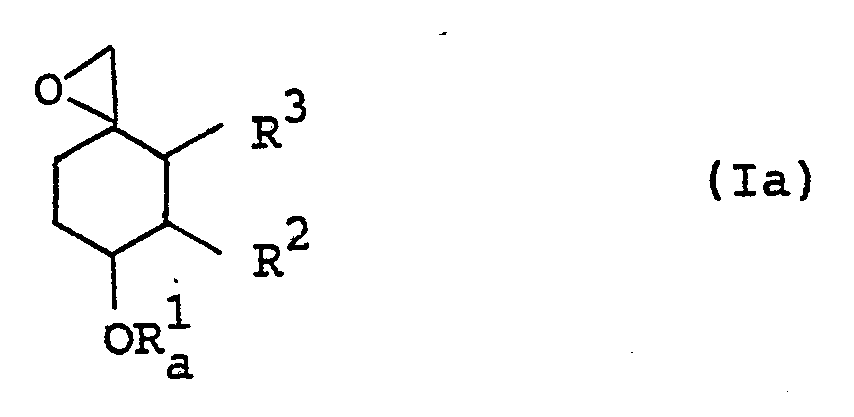
(b) reacting a compound of the formula :

R

to give a compound of the formula :

(c) subjecting a compound of the formula :


(e) reacting a compound of the formula :

to give a compound of the formula :

(f) reacting a compound of the formula :

to give a compound of the formula :


to ozonolysis and then reducing the resultant compound to give a compound of the formula :

(h) subjecting a compound of the formula :

to ozonolysis and then treating the resultant compound with methyl sulfide and then reacting the resultant compound with a compound of the formula :
(R⁵)₃P=CHR⁶ (VII)
to give a compound of the formula :

(i) oxidizing a compound of the formula :


to catalytic reduction
to give a compound of the formula :

(k) reducing a compound of the formula :


(m) reacting a compound of the formula :

with an acylating agent
to give a compound of the formula :

(n) reacting a compound of the formula :

with an acylating agent
to give a compound of the formula :


to give a compound of the formula :

R¹, R² R³ are each as defined above,
R

lower alkylcarbamoyl,
hydroxy(lower)alkylcarbamoyl,
lower alkoxy(lower)alkylcarbamoyl,
lower alkylthio(lower)alkylcarbamoyl,
lower alkoxycarbonyl(lower)alkylcarbamoyl,
lower alkylcarbamoyloxy(lower)alkylcarbamoyl,
di(lower)alkylcarbamoyl,
N-[hydroxy(lower)alkyl](lower)alkylcarbamoyl,
N-[hydroxy(lower)alkyl](lower)alkylcarbamoyloxy(lower)alkylcarbamoyl,
lower alkylcarbamoyloxy(lower)alkenoyl,
N-[heterocycliccarbonyloxy(lower)alkyl](lower)alkylcarbamoyl,
hydroxyalkenoyl,
acyloxyalkenoyl, diacyloxyalkenoyl,
cyclo(lower)alkylcarbamoyl,
arylcarbamoyl,
haloarylcarbamoyl,
protected carbamoyl,
lower alkylthiocarbamoyl,
heterocycliccarbamoyl,
ar(lower)alkenoyl,
lower alkoxycarbonyl,
heterocycliccarbonyl which may have lower alkyl, hydroxy, hydroxy(lower)alkyl, lower alkoxy(lower)alkyl or lower alkoxycarbonyl,
R

carboxy(lower)alkyl;
protected carboxy(lower)alkyl;
ar(lower)alkyl which may have halogen or lower alkoxy; or heterocyclic(lower)alkyl,
R

R

R

X is acid residue,
R

lower alkoxy(lower)alkylcarbamoyl,
lower alkylthio(lower)alkylcarbamoyl,
lower alkoxycarbonyl(lower)alkylcarbamoyl,
lower alkylcarbonyloxy(lower)alkylcarbamoyl,
di(lower)alkylcarbamoyl,
N-[hydroxy(lower)alkyl](lower)alkylcarbamoyl,
cyclo(lower)alkylcarbamoyl,
arylcarbamoyl,
haloarylcarbamoyl,
protected carbamoyl,
morpholinocarbonyl,
morpholinocarbamoyl,
thiomorpholin-4-ylcarbonyl,
piperidinocarbonyl,
piperidinocarbamoyl,
hydroxypiperidinocarbonyl,
lower alkylpiperidinocarbonyl,
2-oxopyrrolidin-1-yl(lower)alkylcarbamoyl,
hydroxy (lower)alkylpyrrolidin- 1-ylcarbonyl,
lower alkoxy(lower)alkylpyrrolidin-1-ylcarbonyl,
pyperazin-1-ylcarbonyl, or
lower alkoxycarbonylpiperazin-1-ylcarbonyl,
R⁴ is hydroxycarbonyloxy(lower)alkylcarbamoyl,
N-[hydroxycarbonyloxy(lower)alkyl](lower)alkylcarbamoyl or
hydroxycarbonyloxypiperidinocarbonyl,
R

N-[hydroxy(lower)alkyl](lower)alkylcarbamoyloxy(lower)alkylcarbamoyl,
lower alkylcarbamoyloxy(lower)alkenoyl,
N-[thiomorpholin-4-ylcarbonyloxy(lower)alkyl](lower)alkylcarbamoyl,
N-[morpholinocarbonyloxy(lower)alkyl](lower)alkylcarbamoyl or
lower alkylcarbamoyloxypiperidinocarbonyl,


R

Applications Claiming Priority (8)
| Application Number | Priority Date | Filing Date | Title |
|---|---|---|---|
| GB8819256 | 1988-08-12 | ||
| GB8819258 | 1988-08-12 | ||
| GB888819258A GB8819258D0 (en) | 1988-08-12 | 1988-08-12 | Oxaspiro(2 5)octane compound |
| GB888819256A GB8819256D0 (en) | 1988-08-12 | 1988-08-12 | Oxaspiro(2 5)octane derivative |
| GB8908029 | 1989-04-10 | ||
| GB898908029A GB8908029D0 (en) | 1989-04-10 | 1989-04-10 | Oxaspriro(2,5)octane derivative |
| GB8909794 | 1989-04-28 | ||
| GB898909794A GB8909794D0 (en) | 1989-04-28 | 1989-04-28 | Cyclohexane derivative |
Publications (2)
| Publication Number | Publication Date |
|---|---|
| EP0354787A1 true EP0354787A1 (en) | 1990-02-14 |
| EP0354787B1 EP0354787B1 (en) | 1995-02-15 |
Family
ID=27450157
Family Applications (1)
| Application Number | Title | Priority Date | Filing Date |
|---|---|---|---|
| EP89308113A Expired - Lifetime EP0354787B1 (en) | 1988-08-12 | 1989-08-09 | Oxaspiro[2,5]octane derivative |
Country Status (18)
| Country | Link |
|---|---|
| US (2) | US5789405A (en) |
| EP (1) | EP0354787B1 (en) |
| JP (2) | JP2773275B2 (en) |
| KR (1) | KR0130765B1 (en) |
| CN (1) | CN1051703C (en) |
| AT (1) | ATE118490T1 (en) |
| AU (1) | AU632056B2 (en) |
| CA (1) | CA1340291C (en) |
| DE (1) | DE68921114T2 (en) |
| DK (1) | DK171987B1 (en) |
| ES (1) | ES2067546T3 (en) |
| FI (1) | FI97805C (en) |
| GR (1) | GR3015382T3 (en) |
| HU (1) | HU211569A9 (en) |
| IE (1) | IE66923B1 (en) |
| IL (1) | IL91250A (en) |
| NO (1) | NO173236C (en) |
| PH (1) | PH26256A (en) |
Cited By (35)
| Publication number | Priority date | Publication date | Assignee | Title |
|---|---|---|---|---|
| US5180735A (en) * | 1989-08-31 | 1993-01-19 | Takeda Chemical Industries, Ltd. | Cyclohexanol derivatives, production and use thereof |
| US5196406A (en) * | 1990-05-25 | 1993-03-23 | Takeda Chemical Industries, Ltd. | Cyclodextrin complex of fumagillin derivative |
| US5204345A (en) * | 1989-03-06 | 1993-04-20 | Takeda Chemical Industries, Ltd. | 6-epifumagillols and the pharmaceutical use thereof |
| EP0608419A4 (en) * | 1991-09-18 | 1995-01-11 | Fujisawa Pharmaceutical Co | Transocular preparation. |
| US5422363A (en) * | 1992-12-16 | 1995-06-06 | Takeda Chemical Industries, Inc. | Stable pharmaceutical composition of fumagillol derivatives |
| US5486508A (en) * | 1991-06-21 | 1996-01-23 | Takeda Chemical Industries Ltd. | Cyclodextrin composition |
| EP0739887A1 (en) * | 1995-04-27 | 1996-10-30 | Adir Et Compagnie | Cyclohexane compounds, process for their preparation and pharmaceutical compositions containing them |
| FR2733499A1 (en) * | 1995-04-27 | 1996-10-31 | Adir | NOVEL SUBSTITUTED TETRAHYDROPYRANO (3,2-D) OXAZOLONES, PROCESS FOR PREPARING THEM AND PHARMACEUTICAL COMPOSITIONS CONTAINING SAME |
| EP0359036B1 (en) * | 1988-09-01 | 1997-03-26 | Takeda Chemical Industries, Ltd. | Fumagillol derivatives |
| US5710148A (en) * | 1995-03-06 | 1998-01-20 | Senju Pharmaceuticals Co., Ltd. | Corneal opacification inhibitory composition |
| US5719167A (en) * | 1995-08-07 | 1998-02-17 | Alcon Laboratories, Inc. | Angiostatic compounds |
| US5767293A (en) * | 1988-08-12 | 1998-06-16 | Fujisawa Pharmaceutical Co., Ltd. | Oxaspiro 2,5! octane derivative |
| US5798356A (en) * | 1995-08-07 | 1998-08-25 | Alcon Laboratories, Inc. | Angiostatic compounds |
| EP0867180A4 (en) * | 1995-10-11 | 1999-09-15 | Fujisawa Pharmaceutical Co | Vascular permeation inhibitor |
| WO1999061432A1 (en) * | 1998-05-12 | 1999-12-02 | Biochem Pharma Inc. | Fumagillin analogs and their use as angiogenesis inhibitors |
| US6040337A (en) * | 1998-05-15 | 2000-03-21 | Chong Kun Dang Corporation | 5-demethoxyfumagillol derivatives and processes for preparing the same |
| US6063812A (en) * | 1998-05-15 | 2000-05-16 | Chong Kun Dang Corporation | Fumagillol derivatives and processes for preparing the same |
| US7084108B2 (en) | 2000-11-01 | 2006-08-01 | Praecis Pharmaceuticals, Inc. | Therapeutic agents and methods of use thereof for the modulation of angiogenesis |
| EP1503749A4 (en) * | 2002-05-02 | 2008-04-09 | Praecis Pharm Inc | Methionine aminopeptidase-2 inhibitors and methods of use thereof |
| WO2010138719A1 (en) | 2009-05-28 | 2010-12-02 | Mersana Therapeutics, Inc. | Polyal drug conjugates comprising variable rate-releasing linkers |
| WO2012171020A1 (en) | 2011-06-10 | 2012-12-13 | Mersana Therapeutics, Inc. | Protein-polymer-drug conjugates |
| US8399512B2 (en) | 2007-11-28 | 2013-03-19 | Mersana Therapeutics, Inc. | Biocompatible biodegradable fumagillin analog conjugates |
| WO2014093394A1 (en) | 2012-12-10 | 2014-06-19 | Mersana Therapeutics, Inc. | Protein-polymer-drug conjugates |
| WO2014093640A1 (en) | 2012-12-12 | 2014-06-19 | Mersana Therapeutics,Inc. | Hydroxy-polmer-drug-protein conjugates |
| WO2015054659A1 (en) | 2013-10-11 | 2015-04-16 | Mersana Therapeutics, Inc. | Protein-polymer-drug conjugates |
| WO2015054669A1 (en) | 2013-10-11 | 2015-04-16 | Asana Biosciences, Llc | Protein-polymer-drug conjugates |
| WO2016100778A1 (en) | 2014-12-19 | 2016-06-23 | Takeda Pharmaceutical Company Limited | Fumagillol derivatives |
| WO2017027684A1 (en) * | 2015-08-11 | 2017-02-16 | Zafgen, Inc. | Fumagillol heterocyclic compounds and methods of making and using same |
| US9944613B2 (en) | 2015-08-11 | 2018-04-17 | Zafgen, Inc. | Fumagillol spirocyclic compounds and fused bicyclic compounds and methods of making and using same |
| WO2018098269A2 (en) | 2016-11-23 | 2018-05-31 | Mersana Therapeutics, Inc. | Peptide-containing linkers for antibody-drug conjugates |
| WO2018237262A1 (en) | 2017-06-22 | 2018-12-27 | Mersana Therapeutics, Inc. | Methods of producing drug-carrying polymer scaffolds and protein-polymer-drug conjugates |
| WO2020092385A1 (en) | 2018-10-29 | 2020-05-07 | Mersana Therapeutics, Inc. | Cysteine engineered antibody-drug conjugates with peptide-containing linkers |
| WO2023156996A1 (en) * | 2022-02-16 | 2023-08-24 | Yissum Research Development Company Of The Hebrew University Of Jerusalem Ltd. | Metap2 inhibitors and uses thereof |
| WO2024013723A1 (en) | 2022-07-15 | 2024-01-18 | Pheon Therapeutics Ltd | Antibody drug conjugates that bind cdcp1 and uses thereof |
| WO2025149667A1 (en) | 2024-01-12 | 2025-07-17 | Pheon Therapeutics Ltd | Antibody drug conjugates and uses thereof |
Families Citing this family (36)
| Publication number | Priority date | Publication date | Assignee | Title |
|---|---|---|---|---|
| JPH0660095B2 (en) * | 1988-09-01 | 1994-08-10 | 武田薬品工業株式会社 | Angiogenesis inhibitors |
| JPH0660168B2 (en) * | 1988-09-01 | 1994-08-10 | 武田薬品工業株式会社 | 0-substituted fumagillol derivative |
| US5290807A (en) * | 1989-08-10 | 1994-03-01 | Children's Medical Center Corporation | Method for regressing angiogenesis using o-substituted fumagillol derivatives |
| US6017954A (en) * | 1989-08-10 | 2000-01-25 | Children's Medical Center Corp. | Method of treating tumors using O-substituted fumagillol derivatives |
| US6207704B1 (en) | 1997-06-09 | 2001-03-27 | Massachusetts Institute Of Technology | Type 2 methionine aminopeptidase [MetAP2] inhibitors and uses thereof |
| US7105482B2 (en) * | 2000-11-01 | 2006-09-12 | Praecis Pharmaceuticals, Inc. | Methionine aminopeptidase-2 inhibitors and methods of use thereof |
| US6548477B1 (en) | 2000-11-01 | 2003-04-15 | Praecis Pharmaceuticals Inc. | Therapeutic agents and methods of use thereof for the modulation of angiogenesis |
| EP1699812A2 (en) * | 2003-12-29 | 2006-09-13 | Praecis Pharmaceuticals Inc. | Inhibitors of methionine aminopeptidase-2 and uses thereof |
| US7931261B2 (en) * | 2006-01-24 | 2011-04-26 | Goss International Americas, Inc. | Signature hopper with lap straightening device |
| US8865746B2 (en) * | 2008-07-18 | 2014-10-21 | Zafgen, Inc. | Methods of treating an overweight or obese subject |
| WO2010065883A2 (en) | 2008-12-04 | 2010-06-10 | Zafgen Corporation | Method of treating an overweight or obese subject |
| WO2010065877A2 (en) | 2008-12-04 | 2010-06-10 | Zafgen Corporation | Methods of treating an overweight or obese subject |
| EP2486004B1 (en) | 2009-10-09 | 2017-05-03 | Zafgen, Inc. | Sulphone compounds for use in the treatment of obesity |
| US8815309B2 (en) | 2010-01-08 | 2014-08-26 | Zafgen, Inc. | Methods of treating a subject with benign prostate hyperplasia |
| AU2011204267B2 (en) | 2010-01-08 | 2015-12-03 | Zafgen Corporation | Fumagillol type compounds and methods of making and using same |
| WO2011127304A2 (en) | 2010-04-07 | 2011-10-13 | Zafgen Corporation | Methods of treating an overweight subject |
| CN103249735B (en) | 2010-07-22 | 2016-04-06 | 扎夫根股份有限公司 | Tricyclic compounds and methods for their preparation and use |
| PH12013500934A1 (en) | 2010-11-09 | 2022-10-24 | Zafgen Inc | Crystalline solids of a metap-2 inhibitor and methods of making and using same |
| WO2012075020A1 (en) | 2010-11-29 | 2012-06-07 | Zafgen Corporation | Treatment of obesity using non-daily administration of 6 - 0 - (4 - dimethylaminoethoxy) cinnamoyl fumagillol |
| KR20140006888A (en) | 2011-01-26 | 2014-01-16 | 자프겐 인크. | Tetrazole compounds and methods of making and using same |
| CN103534244B (en) | 2011-03-08 | 2016-10-12 | 扎夫根股份有限公司 | Oxaspiro [2.5] Octane derivatives and the like |
| AU2012253759B2 (en) | 2011-05-06 | 2016-01-21 | Zafgen Inc. | Tricyclic sulfonamide compounds and methods of making and using same |
| CA2835261C (en) | 2011-05-06 | 2019-06-04 | Zafgen, Inc. | Partially saturated tricyclic compounds and methods of making and using same |
| BR112013028666A2 (en) | 2011-05-06 | 2017-08-08 | Zafgen Inc | tricyclic pyrazolo sulfonamide compounds and methods for making and using the same |
| EP2763671A2 (en) | 2011-10-03 | 2014-08-13 | Zafgen, Inc. | Methods of treating age related disorders |
| MX2014008706A (en) | 2012-01-18 | 2015-03-05 | Zafgen Inc | Tricyclic sulfonamide compounds and methods of making and using same. |
| JP2015509102A (en) | 2012-01-18 | 2015-03-26 | ザフゲン,インコーポレイテッド | Tricyclic sulfone compounds and methods for making and using the same |
| US9260419B2 (en) | 2012-05-07 | 2016-02-16 | Zafgen, Inc. | Polymorphic salt of a metap-2 inhibitor and methods of making and using same |
| AU2013259617A1 (en) | 2012-05-08 | 2014-11-27 | Zafgen, Inc. | Treating hypothalamic obesity with MetAP2 inhibitors |
| MX356755B (en) * | 2012-05-09 | 2018-06-11 | Zafgen Inc | Fumigillol type compounds and methods of making and using same. |
| JP2015536981A (en) | 2012-11-05 | 2015-12-24 | ザフゲン,インコーポレイテッド | Tricyclic compounds and methods for their production and use |
| NZ707773A (en) | 2012-11-05 | 2019-05-31 | Zafgen Inc | Methods of treating liver diseases |
| BR112015010223A2 (en) | 2012-11-05 | 2017-07-11 | Zafgen Inc | tricyclic compounds for use in the treatment and / or control of obesity |
| CN105228610A (en) | 2013-03-14 | 2016-01-06 | 扎夫根股份有限公司 | The method for the treatment of kidney diaseases and other disease |
| CN108530375B (en) * | 2018-05-29 | 2020-04-21 | 南京药石科技股份有限公司 | Intermediate of 4-oxa-7-azaspiro[2.5]octane or its salt and preparation method thereof |
| WO2024040009A2 (en) * | 2022-08-17 | 2024-02-22 | Primetime Life Sciences, Llc | Inhibitors of methionine aminopeptidase-2 and methods of preparation and uses thereof |
Family Cites Families (6)
| Publication number | Priority date | Publication date | Assignee | Title |
|---|---|---|---|---|
| JPH0629278B2 (en) * | 1985-06-26 | 1994-04-20 | 藤沢薬品工業株式会社 | Oxaspiro octane compound |
| PH26256A (en) * | 1988-08-12 | 1992-04-01 | Fujisawa Pharmaceutical Co | Oxaspiro [2,5] octane derivative |
| JPH0660168B2 (en) * | 1988-09-01 | 1994-08-10 | 武田薬品工業株式会社 | 0-substituted fumagillol derivative |
| ES2099064T3 (en) * | 1988-09-01 | 1997-05-16 | Takeda Chemical Industries Ltd | DERIVATIVES OF FUMAGILLOL. |
| KR0141692B1 (en) * | 1988-09-01 | 1998-06-01 | 우메모또 요시마사 | Angiogenesis inhibitory agent |
| ATE87623T1 (en) * | 1989-03-06 | 1993-04-15 | Takeda Chemical Industries Ltd | 6-EPIFUMAGILLOLS, THEIR PREPARATION AND USE. |
-
1989
- 1989-08-01 PH PH39029A patent/PH26256A/en unknown
- 1989-08-02 IE IE250589A patent/IE66923B1/en not_active IP Right Cessation
- 1989-08-07 JP JP1204257A patent/JP2773275B2/en not_active Expired - Lifetime
- 1989-08-08 IL IL9125089A patent/IL91250A/en not_active IP Right Cessation
- 1989-08-09 DE DE68921114T patent/DE68921114T2/en not_active Expired - Fee Related
- 1989-08-09 EP EP89308113A patent/EP0354787B1/en not_active Expired - Lifetime
- 1989-08-09 ES ES89308113T patent/ES2067546T3/en not_active Expired - Lifetime
- 1989-08-09 DK DK390989A patent/DK171987B1/en not_active IP Right Cessation
- 1989-08-09 AT AT89308113T patent/ATE118490T1/en not_active IP Right Cessation
- 1989-08-09 AU AU39453/89A patent/AU632056B2/en not_active Ceased
- 1989-08-10 CA CA000607998A patent/CA1340291C/en not_active Expired - Fee Related
- 1989-08-11 NO NO893235A patent/NO173236C/en unknown
- 1989-08-11 KR KR1019890011591A patent/KR0130765B1/en not_active Expired - Fee Related
- 1989-08-11 CN CN93104924A patent/CN1051703C/en not_active Expired - Fee Related
- 1989-08-11 FI FI893794A patent/FI97805C/en not_active IP Right Cessation
-
1991
- 1991-06-05 US US07/711,420 patent/US5789405A/en not_active Expired - Fee Related
-
1994
- 1994-08-05 US US08/287,589 patent/US5767293A/en not_active Expired - Fee Related
-
1995
- 1995-03-13 GR GR950400533T patent/GR3015382T3/en unknown
- 1995-06-22 HU HU95P/P00365P patent/HU211569A9/en unknown
-
1996
- 1996-03-25 JP JP8067849A patent/JP2970524B2/en not_active Expired - Fee Related
Non-Patent Citations (3)
| Title |
|---|
| CHEMICAL ABSTRACTS, vol. 105, no. 7, August 18, 1986, Columbus, Ohio, USA FUJISAWA PHARMACEUTICAL CO. "Manufacture of immuno- suppressive FR-65814 with Penicillium jensenii" page 515, column 2, Abstract- -no. 59 452p & Jpn. Kokai Tokkyo Koho JP 61 33 181 (86 33 181) * |
| CHEMICAL ABSTRACTS, vol. 106, no. 21, May 25, 1987, Columbus, Ohio, USA FUJISAWA PHARMACEUTICAL CO. "Oxaspirooctane compounds as immunosuppressants" page 706, column 2, Abstract-no. 176 153y & Jpn. Kokai Tokkyo Koho JP 62 00 476 (87 00 476) * |
| CHEMICAL ABSTRACTS, vol. 106, no. 23, June 8, 1987, Columbus, Ohio, USA FUJISAWA PHARMACEUTICAL CO. "Immunosuppressent manu- facture by Penicillium species" page 604, column 2, Abstract- -no. 194 770b & Jpn. Kokai Tokkyo Koho JP 61 257 921 (86 257 921) * |
Cited By (52)
| Publication number | Priority date | Publication date | Assignee | Title |
|---|---|---|---|---|
| US5789405A (en) * | 1988-08-12 | 1998-08-04 | Fujisawa Pharmaceutical Co., Ltd. | Oxaspiro(2,5)octane derivative |
| US5767293A (en) * | 1988-08-12 | 1998-06-16 | Fujisawa Pharmaceutical Co., Ltd. | Oxaspiro 2,5! octane derivative |
| EP0359036B1 (en) * | 1988-09-01 | 1997-03-26 | Takeda Chemical Industries, Ltd. | Fumagillol derivatives |
| US5698586A (en) * | 1988-09-01 | 1997-12-16 | Takeda Chemical Industries, Ltd | Angiogenesis inhibitory agent |
| US5204345A (en) * | 1989-03-06 | 1993-04-20 | Takeda Chemical Industries, Ltd. | 6-epifumagillols and the pharmaceutical use thereof |
| US5180735A (en) * | 1989-08-31 | 1993-01-19 | Takeda Chemical Industries, Ltd. | Cyclohexanol derivatives, production and use thereof |
| US5196406A (en) * | 1990-05-25 | 1993-03-23 | Takeda Chemical Industries, Ltd. | Cyclodextrin complex of fumagillin derivative |
| US5486508A (en) * | 1991-06-21 | 1996-01-23 | Takeda Chemical Industries Ltd. | Cyclodextrin composition |
| EP0519428B1 (en) * | 1991-06-21 | 2000-09-20 | Takeda Chemical Industries, Ltd. | Cyclodextrin compositions with fumagillol derivates |
| EP0608419A4 (en) * | 1991-09-18 | 1995-01-11 | Fujisawa Pharmaceutical Co | Transocular preparation. |
| US5422363A (en) * | 1992-12-16 | 1995-06-06 | Takeda Chemical Industries, Inc. | Stable pharmaceutical composition of fumagillol derivatives |
| US5710148A (en) * | 1995-03-06 | 1998-01-20 | Senju Pharmaceuticals Co., Ltd. | Corneal opacification inhibitory composition |
| EP0739887A1 (en) * | 1995-04-27 | 1996-10-30 | Adir Et Compagnie | Cyclohexane compounds, process for their preparation and pharmaceutical compositions containing them |
| FR2733499A1 (en) * | 1995-04-27 | 1996-10-31 | Adir | NOVEL SUBSTITUTED TETRAHYDROPYRANO (3,2-D) OXAZOLONES, PROCESS FOR PREPARING THEM AND PHARMACEUTICAL COMPOSITIONS CONTAINING SAME |
| WO1996033999A1 (en) * | 1995-04-27 | 1996-10-31 | Adir Et Compagnie | NOVEL SUBSTITUTED TETRAHYDROPYRANO[3,2-d]OXAZOLONES, METHOD FOR THEIR PREPARATION AND PHARMACEUTICAL COMPOSITIONS CONTAINING THEM |
| FR2733498A1 (en) * | 1995-04-27 | 1996-10-31 | Adir | NOVEL CYCLOHEXANIC COMPOUNDS, PROCESS FOR THEIR PREPARATION AND PHARMACEUTICAL COMPOSITIONS CONTAINING THEM |
| US5798356A (en) * | 1995-08-07 | 1998-08-25 | Alcon Laboratories, Inc. | Angiostatic compounds |
| US5719167A (en) * | 1995-08-07 | 1998-02-17 | Alcon Laboratories, Inc. | Angiostatic compounds |
| US6180626B1 (en) | 1995-10-11 | 2001-01-30 | Fujisawa Pharmaceutical Co., Ltd. | Vascular-permeability suppressants |
| EP0867180A4 (en) * | 1995-10-11 | 1999-09-15 | Fujisawa Pharmaceutical Co | Vascular permeation inhibitor |
| WO1999061432A1 (en) * | 1998-05-12 | 1999-12-02 | Biochem Pharma Inc. | Fumagillin analogs and their use as angiogenesis inhibitors |
| US6040337A (en) * | 1998-05-15 | 2000-03-21 | Chong Kun Dang Corporation | 5-demethoxyfumagillol derivatives and processes for preparing the same |
| US6063812A (en) * | 1998-05-15 | 2000-05-16 | Chong Kun Dang Corporation | Fumagillol derivatives and processes for preparing the same |
| KR100357542B1 (en) * | 1998-05-15 | 2002-10-18 | 주식회사종근당 | Fumagillol derivatives and preparation method thereof |
| CN100352810C (en) * | 1998-05-15 | 2007-12-05 | 株式会社钟根堂 | Fumagillol derivatives and processes for preparing the same |
| US7084108B2 (en) | 2000-11-01 | 2006-08-01 | Praecis Pharmaceuticals, Inc. | Therapeutic agents and methods of use thereof for the modulation of angiogenesis |
| EP1503749A4 (en) * | 2002-05-02 | 2008-04-09 | Praecis Pharm Inc | Methionine aminopeptidase-2 inhibitors and methods of use thereof |
| US8399512B2 (en) | 2007-11-28 | 2013-03-19 | Mersana Therapeutics, Inc. | Biocompatible biodegradable fumagillin analog conjugates |
| WO2010138719A1 (en) | 2009-05-28 | 2010-12-02 | Mersana Therapeutics, Inc. | Polyal drug conjugates comprising variable rate-releasing linkers |
| EP3228325A1 (en) | 2011-06-10 | 2017-10-11 | Mersana Therapeutics, Inc. | Protein-polymer-drug conjugates |
| WO2012171020A1 (en) | 2011-06-10 | 2012-12-13 | Mersana Therapeutics, Inc. | Protein-polymer-drug conjugates |
| WO2014093394A1 (en) | 2012-12-10 | 2014-06-19 | Mersana Therapeutics, Inc. | Protein-polymer-drug conjugates |
| WO2014093640A1 (en) | 2012-12-12 | 2014-06-19 | Mersana Therapeutics,Inc. | Hydroxy-polmer-drug-protein conjugates |
| WO2015054659A1 (en) | 2013-10-11 | 2015-04-16 | Mersana Therapeutics, Inc. | Protein-polymer-drug conjugates |
| WO2015054669A1 (en) | 2013-10-11 | 2015-04-16 | Asana Biosciences, Llc | Protein-polymer-drug conjugates |
| US11434278B2 (en) | 2013-10-11 | 2022-09-06 | Asana Biosciences, Llc | Protein-polymer-drug conjugates |
| US10316080B2 (en) | 2013-10-11 | 2019-06-11 | Asana Biosciences, Llc | Protein-polymer-drug conjugates |
| US10328089B2 (en) | 2014-12-19 | 2019-06-25 | Takeda Pharmaceutical Company Limited | Fumagillol derivatives |
| US9827255B2 (en) | 2014-12-19 | 2017-11-28 | Takeda Pharmaceutical Company Limited | Fumagillol derivatives |
| WO2016100778A1 (en) | 2014-12-19 | 2016-06-23 | Takeda Pharmaceutical Company Limited | Fumagillol derivatives |
| US9682965B2 (en) | 2015-08-11 | 2017-06-20 | Zafgen, Inc. | Fumagillol heterocyclic compounds and methods of making and using same |
| US10023561B2 (en) | 2015-08-11 | 2018-07-17 | Zafgen, Inc. | Fumagillol heterocyclic compounds and methods of making and using same |
| CN108026085A (en) * | 2015-08-11 | 2018-05-11 | 扎夫根股份有限公司 | Fumidil alcohol heterocyclic compound and preparation and use its method |
| WO2017027684A1 (en) * | 2015-08-11 | 2017-02-16 | Zafgen, Inc. | Fumagillol heterocyclic compounds and methods of making and using same |
| US9944613B2 (en) | 2015-08-11 | 2018-04-17 | Zafgen, Inc. | Fumagillol spirocyclic compounds and fused bicyclic compounds and methods of making and using same |
| WO2018098269A2 (en) | 2016-11-23 | 2018-05-31 | Mersana Therapeutics, Inc. | Peptide-containing linkers for antibody-drug conjugates |
| WO2018237262A1 (en) | 2017-06-22 | 2018-12-27 | Mersana Therapeutics, Inc. | Methods of producing drug-carrying polymer scaffolds and protein-polymer-drug conjugates |
| WO2020092385A1 (en) | 2018-10-29 | 2020-05-07 | Mersana Therapeutics, Inc. | Cysteine engineered antibody-drug conjugates with peptide-containing linkers |
| WO2023156996A1 (en) * | 2022-02-16 | 2023-08-24 | Yissum Research Development Company Of The Hebrew University Of Jerusalem Ltd. | Metap2 inhibitors and uses thereof |
| WO2024013723A1 (en) | 2022-07-15 | 2024-01-18 | Pheon Therapeutics Ltd | Antibody drug conjugates that bind cdcp1 and uses thereof |
| WO2024013724A1 (en) | 2022-07-15 | 2024-01-18 | Pheon Therapeutics Ltd | Antibody-drug conjugates |
| WO2025149667A1 (en) | 2024-01-12 | 2025-07-17 | Pheon Therapeutics Ltd | Antibody drug conjugates and uses thereof |
Also Published As
Similar Documents
| Publication | Publication Date | Title |
|---|---|---|
| EP0354787B1 (en) | Oxaspiro[2,5]octane derivative | |
| EP0354767B1 (en) | Cyclohexane derivative | |
| KR0141692B1 (en) | Angiogenesis inhibitory agent | |
| US5166172A (en) | Fumagillol derivatives and pharmaceutical compositions thereof | |
| UA129890C2 (en) | THIENO[3,2-b]PYRIDINE-7-AMINE COMPOUNDS FOR THE TREATMENT OF FAMILY DYSAUTONOMIA | |
| EP0682020A1 (en) | Fumagillol derivatives useful as angiogenesis inhibitors | |
| JPH03275666A (en) | Phenylcarboxylic acid derivative having hetero ring | |
| EP0921122B1 (en) | Epoxysuccinamide derivatives or salts thereof | |
| US11142512B2 (en) | Nebivolol synthesis method and intermediate compound thereof | |
| EP0510700A2 (en) | Azole compounds, their production and use | |
| RU2068412C1 (en) | Octane oxaspiro [2,5]derivative and process for preparation thereof (variants) | |
| KR100339831B1 (en) | New ethyl arizidine derivatives and their preparation methods | |
| SE500706C2 (en) | Dikloranilinförening | |
| DK166820B1 (en) | METHOD FOR PREPARING 1- (2,6-DIMETHYLPHENOXY) -2-AMINOPROPAN OR ANY ACID ADDITION SALT FROM 2,6-DIMETHYLPHENOL | |
| Arnone et al. | Synthesis and reactivity of enantiomerically pure 2-fluoromethyl-2-(1′-p-tolylsulfinyl) alkyl oxiranes | |
| KR100551944B1 (en) | Novel epoxysuccinamide derivative or salt thereof | |
| JPH06220034A (en) | O-substituted fumagillol derivative |
Legal Events
| Date | Code | Title | Description |
|---|---|---|---|
| PUAI | Public reference made under article 153(3) epc to a published international application that has entered the european phase |
Free format text: ORIGINAL CODE: 0009012 |
|
| AK | Designated contracting states |
Kind code of ref document: A1 Designated state(s): AT BE CH DE ES FR GB GR IT LI LU NL SE |
|
| 17P | Request for examination filed |
Effective date: 19900802 |
|
| 17Q | First examination report despatched |
Effective date: 19920821 |
|
| GRAA | (expected) grant |
Free format text: ORIGINAL CODE: 0009210 |
|
| AK | Designated contracting states |
Kind code of ref document: B1 Designated state(s): AT BE CH DE ES FR GB GR IT LI LU NL SE |
|
| REF | Corresponds to: |
Ref document number: 118490 Country of ref document: AT Date of ref document: 19950315 Kind code of ref document: T |
|
| REF | Corresponds to: |
Ref document number: 68921114 Country of ref document: DE Date of ref document: 19950323 |
|
| ET | Fr: translation filed | ||
| REG | Reference to a national code |
Ref country code: ES Ref legal event code: FG2A Ref document number: 2067546 Country of ref document: ES Kind code of ref document: T3 |
|
| ITF | It: translation for a ep patent filed | ||
| REG | Reference to a national code |
Ref country code: GR Ref legal event code: FG4A Free format text: 3015382 |
|
| PLBE | No opposition filed within time limit |
Free format text: ORIGINAL CODE: 0009261 |
|
| STAA | Information on the status of an ep patent application or granted ep patent |
Free format text: STATUS: NO OPPOSITION FILED WITHIN TIME LIMIT |
|
| 26N | No opposition filed | ||
| REG | Reference to a national code |
Ref country code: GB Ref legal event code: IF02 |
|
| PGFP | Annual fee paid to national office [announced via postgrant information from national office to epo] |
Ref country code: GR Payment date: 20050713 Year of fee payment: 17 |
|
| PGFP | Annual fee paid to national office [announced via postgrant information from national office to epo] |
Ref country code: NL Payment date: 20050803 Year of fee payment: 17 Ref country code: GB Payment date: 20050803 Year of fee payment: 17 |
|
| PGFP | Annual fee paid to national office [announced via postgrant information from national office to epo] |
Ref country code: DE Payment date: 20050804 Year of fee payment: 17 Ref country code: SE Payment date: 20050804 Year of fee payment: 17 |
|
| PGFP | Annual fee paid to national office [announced via postgrant information from national office to epo] |
Ref country code: FR Payment date: 20050809 Year of fee payment: 17 |
|
| PGFP | Annual fee paid to national office [announced via postgrant information from national office to epo] |
Ref country code: AT Payment date: 20050811 Year of fee payment: 17 |
|
| PGFP | Annual fee paid to national office [announced via postgrant information from national office to epo] |
Ref country code: CH Payment date: 20050815 Year of fee payment: 17 |
|
| PGFP | Annual fee paid to national office [announced via postgrant information from national office to epo] |
Ref country code: LU Payment date: 20050921 Year of fee payment: 17 |
|
| PGFP | Annual fee paid to national office [announced via postgrant information from national office to epo] |
Ref country code: ES Payment date: 20050927 Year of fee payment: 17 |
|
| PGFP | Annual fee paid to national office [announced via postgrant information from national office to epo] |
Ref country code: BE Payment date: 20051013 Year of fee payment: 17 |
|
| PG25 | Lapsed in a contracting state [announced via postgrant information from national office to epo] |
Ref country code: AT Free format text: LAPSE BECAUSE OF NON-PAYMENT OF DUE FEES Effective date: 20060809 |
|
| PG25 | Lapsed in a contracting state [announced via postgrant information from national office to epo] |
Ref country code: SE Free format text: LAPSE BECAUSE OF NON-PAYMENT OF DUE FEES Effective date: 20060810 |
|
| PG25 | Lapsed in a contracting state [announced via postgrant information from national office to epo] |
Ref country code: LI Free format text: LAPSE BECAUSE OF NON-PAYMENT OF DUE FEES Effective date: 20060831 Ref country code: CH Free format text: LAPSE BECAUSE OF NON-PAYMENT OF DUE FEES Effective date: 20060831 Ref country code: BE Free format text: LAPSE BECAUSE OF NON-PAYMENT OF DUE FEES Effective date: 20060831 |
|
| PGFP | Annual fee paid to national office [announced via postgrant information from national office to epo] |
Ref country code: IT Payment date: 20060831 Year of fee payment: 18 |
|
| PG25 | Lapsed in a contracting state [announced via postgrant information from national office to epo] |
Ref country code: DE Free format text: LAPSE BECAUSE OF NON-PAYMENT OF DUE FEES Effective date: 20070301 Ref country code: NL Free format text: LAPSE BECAUSE OF NON-PAYMENT OF DUE FEES Effective date: 20070301 |
|
| REG | Reference to a national code |
Ref country code: CH Ref legal event code: PL |
|
| EUG | Se: european patent has lapsed | ||
| GBPC | Gb: european patent ceased through non-payment of renewal fee |
Effective date: 20060809 |
|
| NLV4 | Nl: lapsed or anulled due to non-payment of the annual fee |
Effective date: 20070301 |
|
| REG | Reference to a national code |
Ref country code: FR Ref legal event code: ST Effective date: 20070430 |
|
| REG | Reference to a national code |
Ref country code: ES Ref legal event code: FD2A Effective date: 20060810 |
|
| PG25 | Lapsed in a contracting state [announced via postgrant information from national office to epo] |
Ref country code: GB Free format text: LAPSE BECAUSE OF NON-PAYMENT OF DUE FEES Effective date: 20060809 |
|
| BECA | Be: change of holder's address |
Owner name: *ASTELLAS PHARMA INC.3-11, NIHONBASHI-HONDO 2-CHOM Effective date: 20060111 |
|
| BECN | Be: change of holder's name |
Owner name: *ASTELLAS PHARMA INC. Effective date: 20060111 |
|
| BERE | Be: lapsed |
Owner name: *ASTELLAS PHARMA INC. Effective date: 20060831 |
|
| PG25 | Lapsed in a contracting state [announced via postgrant information from national office to epo] |
Ref country code: ES Free format text: LAPSE BECAUSE OF NON-PAYMENT OF DUE FEES Effective date: 20060810 |
|
| PG25 | Lapsed in a contracting state [announced via postgrant information from national office to epo] |
Ref country code: FR Free format text: LAPSE BECAUSE OF NON-PAYMENT OF DUE FEES Effective date: 20060831 |
|
| PG25 | Lapsed in a contracting state [announced via postgrant information from national office to epo] |
Ref country code: LU Free format text: LAPSE BECAUSE OF NON-PAYMENT OF DUE FEES Effective date: 20060809 |
|
| PG25 | Lapsed in a contracting state [announced via postgrant information from national office to epo] |
Ref country code: GR Free format text: LAPSE BECAUSE OF NON-PAYMENT OF DUE FEES Effective date: 20070302 |
|
| PG25 | Lapsed in a contracting state [announced via postgrant information from national office to epo] |
Ref country code: IT Free format text: LAPSE BECAUSE OF NON-PAYMENT OF DUE FEES Effective date: 20070809 |