EP0351292A2 - Amperometrisches Verfahren zur Messung des Säuregrades - Google Patents
Amperometrisches Verfahren zur Messung des Säuregrades Download PDFInfo
- Publication number
- EP0351292A2 EP0351292A2 EP89401944A EP89401944A EP0351292A2 EP 0351292 A2 EP0351292 A2 EP 0351292A2 EP 89401944 A EP89401944 A EP 89401944A EP 89401944 A EP89401944 A EP 89401944A EP 0351292 A2 EP0351292 A2 EP 0351292A2
- Authority
- EP
- European Patent Office
- Prior art keywords
- ultra
- microelectrode
- electrode
- counter
- measuring
- Prior art date
- Legal status (The legal status is an assumption and is not a legal conclusion. Google has not performed a legal analysis and makes no representation as to the accuracy of the status listed.)
- Granted
Links
Images
Classifications
-
- G—PHYSICS
- G01—MEASURING; TESTING
- G01N—INVESTIGATING OR ANALYSING MATERIALS BY DETERMINING THEIR CHEMICAL OR PHYSICAL PROPERTIES
- G01N27/00—Investigating or analysing materials by the use of electric, electrochemical, or magnetic means
- G01N27/26—Investigating or analysing materials by the use of electric, electrochemical, or magnetic means by investigating electrochemical variables; by using electrolysis or electrophoresis
- G01N27/416—Systems
- G01N27/49—Systems involving the determination of the current at a single specific value, or small range of values, of applied voltage for producing selective measurement of one or more particular ionic species
Definitions
- the present invention relates to an amperometric method for measuring the concentration of dissolved species.
- very slightly conductive is meant a medium whose conductivity is less than about 10 ⁇ 4, in general at 10 ⁇ 5 ohm ⁇ 1, cm ⁇ 1.
- esters of mineral acids or of organic acids and more particularly the esters of phosphoric acids have developed significantly as a constituent or component of synthetic lubricating oil, of heat exchanger fluid or as an additive in actuating fluids.
- esters during their degradation often lead to acids, for example by hydrolysis, by thermolytic or oxidative cleavage. They can also give acids by oxidation of alcohol to aldehyde and then to acid.
- the acidity released is extremely harmful, changes the lubricating properties and risks attacking the metal parts with which the fluid is brought into contact.
- This has the double disadvantage of appreciably modifying the composition of the fluid and on the other hand, of reducing the resistance of the containers in which said fluids are located.
- one of the aims of the present invention is to provide a method for measuring the degradation of fluids of the type described above which is direct.
- Another object of the present invention is to provide a method of the above type which measures the acidity released by the degradation of fluids of the above type.
- Another object of the present invention is to provide a method which does not require frequent interventions at the place of measurement.
- Another object of the present invention is to provide a method of the above type which does not require modification of the fluids during or by addition of titration reagents.
- Another object of the present invention is to provide a device which is capable of implementing a method of the above type.
- ultra-microelectrode a microelectrode whose surface is at most equal to 8000 square micrometers.
- amperometric techniques Another of the major limitations of amperometric techniques is that until now they have required the presence of an indifferent electrolyte, especially when the medium in which the measurement is made is a medium which is not very conductive of electricity.
- the surface of the ultra-microelectrode which is conditioned by the diameter of the wire from which it is made and which corresponds substantially to the surface of its cross section plays a very important role in the measurement.
- the surface must be smaller the lower the dielectric constant of the medium in which the acidity is to be measured.
- the surface must be smaller the lower the dielectric constant of the medium in which the acidity is to be measured.
- an ultra-microelectrode 100 ⁇ m in diameter for dielectric constants of the order of 80, it is advisable to descend to values around 50 ⁇ m for dielectric constants below of 40, diameters corresponding to 10 ⁇ m make it possible to descend to dielectric constants of the order of 5.
- it should not be greater than 50 ⁇ m for dielectric constants greater than 30, to 10 ⁇ m for dielectric constants included between 10 and 15 and of the order of 1 ⁇ m for dielectric constants between 5 and 10.
- ultra-microelectrodes whose diameter is as small as possible. Only the manufacturing techniques constitute a limiting factor, as well as the current detection measures which must then be of a sensitivity greater than the nanoampere. Thus, there is a compromise to be found between the sensitivity of the devices measuring the intensity passing between the two electrodes which is limited, and on the other hand, the section of the wires used for the manufacture of ultra-microelectrodes.
- ultra-microelectrodes are generally produced from a wire of substantially cylindrical shape, embedded in a sheath generally of glass, and the end of which is polished so that the cross section of the metal wire constitutes the microelectrode.
- the ultra-microelectrode is composed of a surface substantially in the form of a disc, the diameter of which is very small.
- the imposed potential difference is preferably chosen in such a way that the potential taken by the ultra-microelectrode is located in the potential zone corresponding to the diffusion limit current of the chemical species whose concentration is to be measured. If it is not possible to reach this diffusion limit current, it is according to the present invention to reduce the surface of the ultra-microelectrode.
- This technique is well suited for measuring an acidity whose upper limit is 10 ⁇ 1 N advantageously 10 ⁇ 2 N and the lower limit 10 ⁇ 5 advantageously 10 ⁇ 4 and preferably 10 ⁇ 3 N; the lower limits are moreover limitations which are not linked to the electrochemical factors according to the present invention, but are linked to the devices having to impose the potential between the two electrodes and to measure the intensity passing through the cell.
- the acidity measurement can be determined for all acids whose pK a values are at most equal to 11, preferably to 7. These values are only rough since these values are values given for an acidity measured in water and that the actual acidities vary depending on the environment.
- the ratio of the surfaces of these two electrodes is preferably at least equal to 10 advantageously to 100 (a significant figure). In difficult cases, when a ratio of 10 is found to be insufficient, those skilled in the art will increase this ratio until a further increase in the ratio no longer changes the results. As there is in fact no significant upper limit of this ratio and since this ratio depends on the medium and on the nature of the counter-electrode and of the species in solution, in general we use for safety ratios much higher than that of 10 and ratios greater than 1000 (or even 10,000) can be indicated as satisfactory.
- the anode is made of a non-polarizable metal, such as for example platinum, or that the anode is made of an electro-soluble element under the conditions of the experiment.
- the electro-soluble element is preferably not harmful to the environment. Zinc is ideal for measurement in phosphorus ester media.
- the counter electrodes with a very large surface relative to the surface of the ultra-microelectrode and made of electro-soluble metal that is to say giving rise to an anodic oxidation reaction and whose oxidation product is soluble in the medium under the conditions of the experiment give particularly good results and particularly well reproducible.
- the present measurement method gives particularly good results, and is well suited to the measurement of the acidity released in aprotic organic or inorganic esters (preferably oxygenated acids) whose dielectric constant is less than 30, this acidity being released by decomposition or said esters or their solvents or their solutes.
- Said esters can be diluted in a proportion varying from 1 / 10th to 10 in various diluents with very low conductivity, from preferably, said esters represent at least one third of the fluid by volume; more specifically, the technique according to the invention is well suited for mixtures of phosphoric esters such as those of the various tert-butylphenyl and phenyl phosphates such as that sold under the brand FYRQUEL VPF.
- the ultra-microelectrode can be made of various metals or alloys or conductive materials, but preferably those used such as gold, platinum and their family have a low overvoltage for hydrogen; stainless steel holds a special place and also gives excellent results.
- the most targeted mineral acid esters are oxygen esters.
- the radicals R can themselves have various functional groups which correspond to specific uses of said functional fluids.
- the acidity of a diesterified phosphoric acid corresponds to that of the first function of said acid.
- This acidity is easily measurable according to the technique of the present invention. It is also possible to envisage thus measuring the degradation of phosphonic, phosphinic esters, or even of trialkyl phosphine oxide, an alkyl having here the meaning of the group R.
- the acidity of the carboxylic acids, or even of the phenols can also be determined according to this technique, which is advantageous for measuring the degradation of fatty substances of vegetable or animal origin.
- the measurement method according to the present invention should not be limited to nuclear uses only or to the case where the fluid is difficult to access.
- the simplicity of the measurement, its reliability, the accessibility of the necessary equipment make the process accessible for any use where the fluids of the type described above are used.
- a reference electrode can be used, when the identification of a parasitic phenomenon or species requires it. However, the measurement must remain exceptional and only be carried out on a temporary basis.
- Another object of the present invention is to provide a device for implementing the above method.
- the object is achieved by an amperometric device for the measurement of chemical species in solution in a very slightly conducting medium, characterized by the fact that it comprises an ultra-microelectrode, a counter-electrode, a stabilized potential supply and a means for measuring the intensity between said ultra-microelectrode and said counter-electrode and by the fact that the ratio between the surface of the counter-electrode and the ultra-microelectrode is at least equal to 10.
- a preferred device for implementing the invention is a device which consists of a counter-electrode whose surface is greater than 10,000 times that of the electrode described below and an ultra-microelectrode whose diameter effective disk is less than 100 microns and preferably less than 10 microns.
- Ultra-microelectrodes placed on the market such as those sold by the company TACUSSEL are suitable for this use.
- Electrodes are connected to a potentiostat fitted with an amperometric measurement system, such as that sold by the company P.A.R. (Princeton Applied Research) under the name PAR 174A.
- P.A.R. Primary Applied Research
- the measurement mode chosen (for example impulse or sinusoidal superimposed) does not modify the essence of the invention and provides these specific features specific to the method according to the invention.
- the polarograph "reference electrode” and “auxiliary” plugs are short-circuited and connected to the zinc electrode.
- the working electrode is connected to the ultra-microelectrode of platinum.
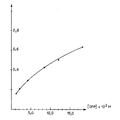
- the potential imposed between ultra-microelectrode and counter-electrode is 1.00V.
- the solution was at rest during the measurement and it was not degassed. If the solution is stirred, similar results are obtained but the values of the measured currents are slightly higher. The degassing of the solution results in a slight decrease in the measured currents, of the order of 10%.
Landscapes
- Chemical & Material Sciences (AREA)
- Life Sciences & Earth Sciences (AREA)
- Health & Medical Sciences (AREA)
- Physics & Mathematics (AREA)
- Chemical Kinetics & Catalysis (AREA)
- Electrochemistry (AREA)
- Molecular Biology (AREA)
- Analytical Chemistry (AREA)
- Biochemistry (AREA)
- General Health & Medical Sciences (AREA)
- General Physics & Mathematics (AREA)
- Immunology (AREA)
- Pathology (AREA)
- Investigating Or Analyzing Materials By The Use Of Electric Means (AREA)
Applications Claiming Priority (2)
| Application Number | Priority Date | Filing Date | Title |
|---|---|---|---|
| FR8809161A FR2634022B1 (fr) | 1988-07-06 | 1988-07-06 | Procede amperometrique pour mesurer l'acidite |
| FR8809161 | 1988-07-06 |
Publications (3)
| Publication Number | Publication Date |
|---|---|
| EP0351292A2 true EP0351292A2 (de) | 1990-01-17 |
| EP0351292A3 EP0351292A3 (de) | 1992-10-07 |
| EP0351292B1 EP0351292B1 (de) | 1994-12-07 |
Family
ID=9368145
Family Applications (1)
| Application Number | Title | Priority Date | Filing Date |
|---|---|---|---|
| EP89401944A Expired - Lifetime EP0351292B1 (de) | 1988-07-06 | 1989-07-06 | Amperometrisches Verfahren zur Messung des Säuregrades |
Country Status (4)
| Country | Link |
|---|---|
| US (1) | US5015957A (de) |
| EP (1) | EP0351292B1 (de) |
| DE (1) | DE68919765T2 (de) |
| FR (1) | FR2634022B1 (de) |
Cited By (1)
| Publication number | Priority date | Publication date | Assignee | Title |
|---|---|---|---|---|
| EP0581081A1 (de) * | 1992-07-15 | 1994-02-02 | Prominent Dosiertechnik Gmbh | Verfahren zur Bestimmung von Persäuren |
Families Citing this family (4)
| Publication number | Priority date | Publication date | Assignee | Title |
|---|---|---|---|---|
| US9140679B2 (en) | 2010-12-28 | 2015-09-22 | Chevron U.S.A. Inc. | Process for characterizing corrosivity of refinery feedstocks |
| US9103813B2 (en) | 2010-12-28 | 2015-08-11 | Chevron U.S.A. Inc. | Processes and systems for characterizing and blending refinery feedstocks |
| US9464242B2 (en) | 2010-12-28 | 2016-10-11 | Chevron U.S.A. Inc. | Processes and systems for characterizing and blending refinery feedstocks |
| WO2012092012A2 (en) | 2010-12-28 | 2012-07-05 | Chevron U.S.A. Inc. | Processes and systems for characterizing and blending refinery feedstocks |
Family Cites Families (4)
| Publication number | Priority date | Publication date | Assignee | Title |
|---|---|---|---|---|
| US3436329A (en) * | 1964-12-11 | 1969-04-01 | Beckman Instruments Inc | Microelectrode and method of making same |
| US3647641A (en) * | 1970-10-26 | 1972-03-07 | Gen Electric | Reactant sensor and method of using same |
| US4406751A (en) * | 1982-08-11 | 1983-09-27 | Blass Karl G | Electrochemical determination of orthophosphoric monoester phosphohydrolase activity (EC 3.1.3.1 and EC 3.1.3.2: alkaline and acid phosphatases) |
| WO1988000342A1 (en) * | 1986-07-04 | 1988-01-14 | Ici Australia Operations Pty. Ltd. | Method and apparatus for amperometric detection |
-
1988
- 1988-07-06 FR FR8809161A patent/FR2634022B1/fr not_active Expired - Lifetime
-
1989
- 1989-07-05 US US07/375,578 patent/US5015957A/en not_active Expired - Fee Related
- 1989-07-06 EP EP89401944A patent/EP0351292B1/de not_active Expired - Lifetime
- 1989-07-06 DE DE68919765T patent/DE68919765T2/de not_active Expired - Fee Related
Cited By (1)
| Publication number | Priority date | Publication date | Assignee | Title |
|---|---|---|---|---|
| EP0581081A1 (de) * | 1992-07-15 | 1994-02-02 | Prominent Dosiertechnik Gmbh | Verfahren zur Bestimmung von Persäuren |
Also Published As
| Publication number | Publication date |
|---|---|
| US5015957A (en) | 1991-05-14 |
| DE68919765D1 (de) | 1995-01-19 |
| EP0351292B1 (de) | 1994-12-07 |
| FR2634022B1 (fr) | 1991-05-24 |
| EP0351292A3 (de) | 1992-10-07 |
| DE68919765T2 (de) | 1995-08-03 |
| FR2634022A1 (fr) | 1990-01-12 |
Similar Documents
| Publication | Publication Date | Title |
|---|---|---|
| Jagner et al. | Derivative potentiometric stripping analysis with a thin film of mercury on a glassy carbon electrode | |
| Yao et al. | Carbon nanotube/poly (methyl methacrylate)(CNT/PMMA) composite electrode fabricated by in situ polymerization for microchip capillary electrophoresis | |
| Agui et al. | Analytical applications of cylindrical carbon fiber microelectrodes. Simultaneous voltammetric determination of phenolic antioxidants in food | |
| EP0351292B1 (de) | Amperometrisches Verfahren zur Messung des Säuregrades | |
| Arfin et al. | Review on detection of phenol in water | |
| Abad-Gil et al. | Poly (methylene blue)-ternary deep eutectic solvent/Au nanoparticle modified electrodes as novel electrochemical sensors: Optimization, characterization and application | |
| JPH0816672B2 (ja) | 完全な油分析技法 | |
| Wen et al. | Anodic and cathodic pulse amperometric detection of metal ions separated by capillary electrophoresis | |
| CN119563107A (zh) | 设备以及具备其的氢氧化物离子浓度的测定装置及使用其的氢氧化物离子浓度的测定方法 | |
| Muppariqoh et al. | Detection of vitamin b1 (thiamine) using modified carbon paste electrodes with polypyrrole | |
| De Vitre et al. | Preparation and properties of a mercury-plated iridium-based microelectrode | |
| Ojani et al. | A New Voltammetric Sensor for Hydrazine Based on Michael Addition Reaction Using 1‐Amino‐2‐naphtol‐4‐sulfonic Acid | |
| N’Dri et al. | An electrochemical method for the determination of trace mercury (II) by formation of complexes with indigo carmine food dye and its analytical application | |
| Akhtar et al. | Detection of haloacetic acids at conductive electroactive polymer-modified microelectrodes | |
| Toniolo et al. | An Ionic‐Liquid Based Probe for the Sequential Preconcentration from Headspace and Direct Voltammetric Detection of Phenols in Wastewaters | |
| Lee et al. | Determination of cytochrome c with cellulose–DNA modified carbon paste electrodes | |
| Zarei et al. | Electrochemical determination of riboflavin by an ionic liquid modified carbon paste electrode as a sensitive sensor | |
| Poels et al. | Potentiometric detection in capillary electrophoresis with a conducting oligomer electrode | |
| FR2527775A1 (fr) | Surveillance a distance de fluide fonctionnel contenant un ester | |
| Mylonakis et al. | A study of the determination of Cu (II) by anodic stripping voltammetry on a novel nylon/carbon fiber electrode | |
| Winkler et al. | Ac voltammetric measurements of fast charge-transfer processes at ultramicroelectrodes | |
| WO2019026517A1 (ja) | 溶液中に存在する対象物質の検出方法および検出するためのシステム | |
| Pourghobadi et al. | Alumina nanoparticles modified carbon paste electrode as a new voltammetric sensor for determination of dopamine | |
| Zieja et al. | Electrooxidation and electroreduction of undiluted acetonitrile at platinum microelectrodes. In situ determination of water in acetonitrile | |
| Rapta et al. | Determination of potassium in fatty acid methyl esters applying an ion-selective potassium electrode |
Legal Events
| Date | Code | Title | Description |
|---|---|---|---|
| PUAI | Public reference made under article 153(3) epc to a published international application that has entered the european phase |
Free format text: ORIGINAL CODE: 0009012 |
|
| AK | Designated contracting states |
Kind code of ref document: A2 Designated state(s): BE CH DE ES FR GB IT LI NL SE |
|
| PUAL | Search report despatched |
Free format text: ORIGINAL CODE: 0009013 |
|
| AK | Designated contracting states |
Kind code of ref document: A3 Designated state(s): BE CH DE ES FR GB IT LI NL SE |
|
| 17P | Request for examination filed |
Effective date: 19930322 |
|
| 17Q | First examination report despatched |
Effective date: 19931227 |
|
| GRAA | (expected) grant |
Free format text: ORIGINAL CODE: 0009210 |
|
| AK | Designated contracting states |
Kind code of ref document: B1 Designated state(s): BE CH DE ES FR GB IT LI NL SE |
|
| PG25 | Lapsed in a contracting state [announced via postgrant information from national office to epo] |
Ref country code: IT Free format text: LAPSE BECAUSE OF FAILURE TO SUBMIT A TRANSLATION OF THE DESCRIPTION OR TO PAY THE FEE WITHIN THE PRE;WARNING: LAPSES OF ITALIAN PATENTS WITH EFFECTIVE DATE BEFORE 2007 MAY HAVE OCCURRED AT ANY TIME BEFORE 2007. THE CORRECT EFFECTIVE DATE MAY BE DIFFERENT FROM THE ONE RECORDED.SCRIBED TIME-LIMIT Effective date: 19941207 Ref country code: NL Effective date: 19941207 Ref country code: ES Free format text: THE PATENT HAS BEEN ANNULLED BY A DECISION OF A NATIONAL AUTHORITY Effective date: 19941207 |
|
| GBT | Gb: translation of ep patent filed (gb section 77(6)(a)/1977) |
Effective date: 19941213 |
|
| REF | Corresponds to: |
Ref document number: 68919765 Country of ref document: DE Date of ref document: 19950119 |
|
| PG25 | Lapsed in a contracting state [announced via postgrant information from national office to epo] |
Ref country code: SE Effective date: 19950307 |
|
| NLV1 | Nl: lapsed or annulled due to failure to fulfill the requirements of art. 29p and 29m of the patents act | ||
| PG25 | Lapsed in a contracting state [announced via postgrant information from national office to epo] |
Ref country code: BE Effective date: 19950731 Ref country code: CH Effective date: 19950731 Ref country code: LI Effective date: 19950731 |
|
| PLBE | No opposition filed within time limit |
Free format text: ORIGINAL CODE: 0009261 |
|
| STAA | Information on the status of an ep patent application or granted ep patent |
Free format text: STATUS: NO OPPOSITION FILED WITHIN TIME LIMIT |
|
| 26N | No opposition filed | ||
| BERE | Be: lapsed |
Owner name: ELECTRICITE DE FRANCE SERVICE NATIONAL Effective date: 19950731 |
|
| REG | Reference to a national code |
Ref country code: CH Ref legal event code: PL |
|
| PGFP | Annual fee paid to national office [announced via postgrant information from national office to epo] |
Ref country code: GB Payment date: 20010629 Year of fee payment: 13 |
|
| PGFP | Annual fee paid to national office [announced via postgrant information from national office to epo] |
Ref country code: FR Payment date: 20010711 Year of fee payment: 13 |
|
| PGFP | Annual fee paid to national office [announced via postgrant information from national office to epo] |
Ref country code: DE Payment date: 20010717 Year of fee payment: 13 |
|
| REG | Reference to a national code |
Ref country code: GB Ref legal event code: IF02 |
|
| PG25 | Lapsed in a contracting state [announced via postgrant information from national office to epo] |
Ref country code: GB Free format text: LAPSE BECAUSE OF NON-PAYMENT OF DUE FEES Effective date: 20020706 |
|
| PG25 | Lapsed in a contracting state [announced via postgrant information from national office to epo] |
Ref country code: DE Free format text: LAPSE BECAUSE OF NON-PAYMENT OF DUE FEES Effective date: 20030201 |
|
| GBPC | Gb: european patent ceased through non-payment of renewal fee |
Effective date: 20020706 |
|
| PG25 | Lapsed in a contracting state [announced via postgrant information from national office to epo] |
Ref country code: FR Free format text: LAPSE BECAUSE OF NON-PAYMENT OF DUE FEES Effective date: 20030331 |
|
| REG | Reference to a national code |
Ref country code: FR Ref legal event code: ST |