EP0351041B1 - Dust control mat with non-cleated borders - Google Patents
Dust control mat with non-cleated borders Download PDFInfo
- Publication number
- EP0351041B1 EP0351041B1 EP89304811A EP89304811A EP0351041B1 EP 0351041 B1 EP0351041 B1 EP 0351041B1 EP 89304811 A EP89304811 A EP 89304811A EP 89304811 A EP89304811 A EP 89304811A EP 0351041 B1 EP0351041 B1 EP 0351041B1
- Authority
- EP
- European Patent Office
- Prior art keywords
- rubber
- silicone
- pad
- edges
- backing
- Prior art date
- Legal status (The legal status is an assumption and is not a legal conclusion. Google has not performed a legal analysis and makes no representation as to the accuracy of the status listed.)
- Expired - Lifetime
Links
- 239000000428 dust Substances 0.000 title claims abstract description 33
- 239000000463 material Substances 0.000 claims abstract description 48
- 229920001971 elastomer Polymers 0.000 claims abstract description 33
- 229920001296 polysiloxane Polymers 0.000 claims abstract description 16
- 230000007704 transition Effects 0.000 claims abstract description 5
- 239000004744 fabric Substances 0.000 claims description 20
- 238000009747 press moulding Methods 0.000 claims description 10
- 238000000034 method Methods 0.000 claims description 6
- 238000004073 vulcanization Methods 0.000 claims description 6
- 239000000835 fiber Substances 0.000 claims description 4
- 238000004519 manufacturing process Methods 0.000 claims description 4
- 238000003825 pressing Methods 0.000 claims description 3
- 239000002131 composite material Substances 0.000 claims description 2
- 238000000465 moulding Methods 0.000 description 6
- 230000000694 effects Effects 0.000 description 3
- 229920000742 Cotton Polymers 0.000 description 1
- 239000004809 Teflon Substances 0.000 description 1
- 229920006362 Teflon® Polymers 0.000 description 1
- 229920005549 butyl rubber Polymers 0.000 description 1
- 238000012986 modification Methods 0.000 description 1
- 230000004048 modification Effects 0.000 description 1
- 229920000728 polyester Polymers 0.000 description 1
- 239000000758 substrate Substances 0.000 description 1
Images

Classifications
-
- B—PERFORMING OPERATIONS; TRANSPORTING
- B29—WORKING OF PLASTICS; WORKING OF SUBSTANCES IN A PLASTIC STATE IN GENERAL
- B29C—SHAPING OR JOINING OF PLASTICS; SHAPING OF MATERIAL IN A PLASTIC STATE, NOT OTHERWISE PROVIDED FOR; AFTER-TREATMENT OF THE SHAPED PRODUCTS, e.g. REPAIRING
- B29C59/00—Surface shaping of articles, e.g. embossing; Apparatus therefor
- B29C59/02—Surface shaping of articles, e.g. embossing; Apparatus therefor by mechanical means, e.g. pressing
-
- A—HUMAN NECESSITIES
- A47—FURNITURE; DOMESTIC ARTICLES OR APPLIANCES; COFFEE MILLS; SPICE MILLS; SUCTION CLEANERS IN GENERAL
- A47G—HOUSEHOLD OR TABLE EQUIPMENT
- A47G27/00—Floor fabrics; Fastenings therefor
- A47G27/04—Carpet fasteners; Carpet-expanding devices ; Laying carpeting; Tools therefor
- A47G27/0406—Laying rugs or mats
- A47G27/0412—Anti-skid layers
-
- A—HUMAN NECESSITIES
- A47—FURNITURE; DOMESTIC ARTICLES OR APPLIANCES; COFFEE MILLS; SPICE MILLS; SUCTION CLEANERS IN GENERAL
- A47L—DOMESTIC WASHING OR CLEANING; SUCTION CLEANERS IN GENERAL
- A47L23/00—Cleaning footwear
- A47L23/22—Devices or implements resting on the floor for removing mud, dirt, or dust from footwear
- A47L23/26—Mats or gratings combined with brushes ; Mats
- A47L23/266—Mats
-
- B—PERFORMING OPERATIONS; TRANSPORTING
- B29—WORKING OF PLASTICS; WORKING OF SUBSTANCES IN A PLASTIC STATE IN GENERAL
- B29D—PRODUCING PARTICULAR ARTICLES FROM PLASTICS OR FROM SUBSTANCES IN A PLASTIC STATE
- B29D99/00—Subject matter not provided for in other groups of this subclass
- B29D99/0057—Producing floor coverings
-
- B—PERFORMING OPERATIONS; TRANSPORTING
- B32—LAYERED PRODUCTS
- B32B—LAYERED PRODUCTS, i.e. PRODUCTS BUILT-UP OF STRATA OF FLAT OR NON-FLAT, e.g. CELLULAR OR HONEYCOMB, FORM
- B32B37/00—Methods or apparatus for laminating, e.g. by curing or by ultrasonic bonding
-
- B—PERFORMING OPERATIONS; TRANSPORTING
- B29—WORKING OF PLASTICS; WORKING OF SUBSTANCES IN A PLASTIC STATE IN GENERAL
- B29K—INDEXING SCHEME ASSOCIATED WITH SUBCLASSES B29B, B29C OR B29D, RELATING TO MOULDING MATERIALS OR TO MATERIALS FOR MOULDS, REINFORCEMENTS, FILLERS OR PREFORMED PARTS, e.g. INSERTS
- B29K2021/00—Use of unspecified rubbers as moulding material
-
- B—PERFORMING OPERATIONS; TRANSPORTING
- B29—WORKING OF PLASTICS; WORKING OF SUBSTANCES IN A PLASTIC STATE IN GENERAL
- B29K—INDEXING SCHEME ASSOCIATED WITH SUBCLASSES B29B, B29C OR B29D, RELATING TO MOULDING MATERIALS OR TO MATERIALS FOR MOULDS, REINFORCEMENTS, FILLERS OR PREFORMED PARTS, e.g. INSERTS
- B29K2083/00—Use of polymers having silicon, with or without sulfur, nitrogen, oxygen, or carbon only, in the main chain, as moulding material
-
- B—PERFORMING OPERATIONS; TRANSPORTING
- B29—WORKING OF PLASTICS; WORKING OF SUBSTANCES IN A PLASTIC STATE IN GENERAL
- B29L—INDEXING SCHEME ASSOCIATED WITH SUBCLASS B29C, RELATING TO PARTICULAR ARTICLES
- B29L2031/00—Other particular articles
- B29L2031/30—Vehicles, e.g. ships or aircraft, or body parts thereof
- B29L2031/3005—Body finishings
- B29L2031/3017—Floor coverings
-
- B—PERFORMING OPERATIONS; TRANSPORTING
- B29—WORKING OF PLASTICS; WORKING OF SUBSTANCES IN A PLASTIC STATE IN GENERAL
- B29L—INDEXING SCHEME ASSOCIATED WITH SUBCLASS B29C, RELATING TO PARTICULAR ARTICLES
- B29L2031/00—Other particular articles
- B29L2031/732—Floor coverings
- B29L2031/7324—Mats
Definitions
- This invention relates generally to rubber-backed dust control floor mats of the type which have a pile surface on one side and a rubber or rubber-like material on the other side.
- Mats of this type are generally used in access ways where people tend to brush or scrape their feet in order to prevent carrying of moisture and/or dirt, accumulated on their footwear, into other areas of the premises. Normally these mats are located in areas of high pedestrian traffic, such as doorways.
- a dust control mat comprising: a pile surface fabric, a rubber or rubber-like material connected to said pile surface fabric and extending beyond at least two edges of said pile surface fabric and a plurality of friction resistant cleats on the bottom of said rubber-like material under said pile surface fabric but not extending beyond at least said two edges thereof (as is known generally from US-A-4741065); characterised in that a border portion of said rubber-like material extending beyond at least said two edges of said pile surface fabric is thicker than the body of said rubber-like material under said pile surface fabric, and said rubber-like material has an arcuate shaped transition area between the body of the rubber-like material and the thicker edges thereof, said border portion lying flat on the ground, in use, and the bottom surfaces of the cleats being substantially co-planar with the bottom surface of the border portion.
- a pad for use in forming cleats in a dust control mat backed by rubber or rubber-like material comprising a length of silicone or silicone-like material having two longitudinal edges and having a horizontal surface with a plurality of perforations formed therein (as is known generally from US-A-4741065); characterised in that the distance between the longitudinal edges of the pad is less than the distance between the longitudinal edges of the mat to be formed and in that said pad is cut along said longitudinal edges at an angle to said horizontal surface of between 10° and 25° so as to provide an inclined undersurface along said longitudinal edges.
- a method of forming a unitary dust control mat having a pile fibre upper surface and a rubber or rubber-like backing comprising the steps of: placing a pad of perforated silicone or silicone-like material on the surface of a conveyor belt, placing a strip of rubber or rubber-like material on top of the silicone-like pad placing a layer of pile fabric on top of the rubber-like material to form a layered structure, indexing the layered structure into a heated press moulding machine, applying pressure to the layered structure in the press moulding machine to vulcanize the rubber-like material and cause the rubber-like material to pass through the perforations in the silicone-like pad to form cleats, indexing the vulcanised and adhered layered structure to a stripping station outside the press moulding machine and stripping the composite structure from the conveyor belt and the silicone-like pad (as is known generally from US-A-4731275); characterised in that said silicone-like pad has a width less than the desired dust control mat
- a method of making a cleated, unitary dust control mat comprising the steps of: placing a perforated silicone or silicone-like pad having perforations therein onto a conveyor belt, placing a rubber or rubber-like backing material over the silicone-like pad, placing a pile fabric on top of the rubber-like backing material to form a layered structure, placing the layered structure into a heated press moulding machine, supplying heat and pressure to the layered structure to cause the rubber-like backing to be vulcanised to the pile fabric, and the rubber-like material to be forced through the perforations in the silicone-like pad to form cleats, and stripping the vulcanised dust control mat off the conveyor belt and the silicone-like pad (as is known generally from US-A-4731275); characterised in that said silicone-like pad has a width less than the desired dust control mat, the longitudinal edges of the silicone-like pad being cut at an angle to provide an inclined undersurface therealong; and in that the rubber-
- the mats 10 consist of pile yarns 14 of cotton, polyester, etc. tufted through a woven or nonwoven substrate 16 of suitable material with the bottom 18 of the tufts adhered to the rubber or rubber-like backing 20 during vulcanization. Molded integral with or otherwise secured to the bottom of the backing 20 are a plurality of anti-creep cleats 22. Each of the mats commonly have a border portion 24 therearound.
- the mat 10 of this invention is assembled, molded and vulcanized on the machine, generally designated 26, of Figure 1.
- the machine 26 uses an endless, Teflon-coated conveyor belt 27 to carry the mats 10 from the assembly station 28, through the preheater 30 into the press molding apparatus 32 and out to the separating station 34.
- the press molding apparatus can be of any suitable type such as that shown in US-A-4,447,201.
- a dust control mat which has the bottom of the outer two longitudinal edges uncleated and a thickness of rubber at such edges which is approximately 10% greater in thickness than the rubber in the body of the rubber mat.
- the mats were preassembled at station 28 by just laying down a perforated silicone pad or silicone-like pad such as butyl rubber on the conveyor belt 27.
- the silicone pad was of a length to accommodate one dust control mat or a plurality of mats and had a width at least equal to the desired width of rubber backing. Then a rubber backing was placed over the silicone pad and a tufted fabric placed on top of the rubber backing.
- the conveyor belt 27 was then indexed to place the preassembled mat in the preheater 30 which has a temperature in the range of 115°C - 127°C (240°F - 260°F).
- the conveyor belt 27 is again indexed to move the first vulcanized mat into the stripping station to be removed from the silicone pad and the conveyor belt 27 while the second and third preassemblies are being indexed into the press mold 32 and the preheater 30, respectively, and a fourth preassembled mat is being put together.
- a multiplicity of silicone pads can be placed side by side and can be any desired length. Also, depending on the size of the mat a plurality of mats can be treated simultaneously at any one station depending on the size of the assembly station, preheater or press mold, etc.
- the above-described method produces a dust control mat of reduced thickness due to a portion of the rubber from the rubber backing being used to produce the cleats. This loss of rubber was approximately 10% and contributed to the edge rippling problem.
- a perforated silicone pad 36 was selected which is 5 - 10 cm (2 - 4 inches) narrower along each longitudinal edge so the longitudinal edges 38 will maintain the original rubber thickness while the cleats 22 are being formed on the interior of the mat 10 during press molding.
- the smooth longitudinal edge or border 38 will have a thickness of about 1.32 mm (52 mils) while the body of the rubber backing will have a thickness of about 1.2 mm (47 mils) thereby providing a stiffening effect at the edges to reduce the tendency to ripple.
- the longitudinal underedges of the silicone pad are cut at an angle 42 of between 10° - 25°, preferably 20°, so that during molding and vulcanization it will bend or deflect over as shown in Figure 4 to form the radius 40 as shown in Figure 5.
- the above modifications provide a cleated dust control mat in which the rubber backing has smooth longitudinal edges of a thickness of 10% greater than the thickness of the cleated body of the rubber backing.
- These thicker longitudinal edges or borders provide a stiffening effect which reduces rippling tendencies and increases tear strength. Increased tear strength is particularly important along longitudinal edges where most of border tearing usually occurs. This additional thickness also causes the edges to curl down to increase the tendency to hug the covered surface. Additionally, since the width of the silicone pads has been reduced, the cost of the pad has been reduced while ease of handling, because of reduced size, has been increased.
Landscapes
- Engineering & Computer Science (AREA)
- Mechanical Engineering (AREA)
- Carpets (AREA)
- Lock And Its Accessories (AREA)
- Catching Or Destruction (AREA)
- Input From Keyboards Or The Like (AREA)
- Outer Garments And Coats (AREA)
- Casting Or Compression Moulding Of Plastics Or The Like (AREA)
- Laminated Bodies (AREA)
- Securing Of Glass Panes Or The Like (AREA)
Abstract
Description
- This invention relates generally to rubber-backed dust control floor mats of the type which have a pile surface on one side and a rubber or rubber-like material on the other side. Mats of this type are generally used in access ways where people tend to brush or scrape their feet in order to prevent carrying of moisture and/or dirt, accumulated on their footwear, into other areas of the premises. Normally these mats are located in areas of high pedestrian traffic, such as doorways.
- In recent years certain dust control mats, such as that shown in US-A-4,741,065, have been molded with cleats on the bottom surface thereof to prevent walking or creeping of the mats when placed on a surface to be protected. It has been found that this type of mat has a tendency to have higher edge rippling than uncleated mats. This rippling effect is very noticeable in those mats in which the cleats on the undersurface thereof extend generally to the edges of the rubber mat.
- Therefore, it is an object of this invention to provide a method to produce a cleated dust control mat that has substantially reduced edge rippling characteristics.
- In accordance with a first aspect of the invention there is provided a dust control mat comprising: a pile surface fabric, a rubber or rubber-like material connected to said pile surface fabric and extending beyond at least two edges of said pile surface fabric and a plurality of friction resistant cleats on the bottom of said rubber-like material under said pile surface fabric but not extending beyond at least said two edges thereof (as is known generally from US-A-4741065); characterised in that a border portion of said rubber-like material extending beyond at least said two edges of said pile surface fabric is thicker than the body of said rubber-like material under said pile surface fabric, and said rubber-like material has an arcuate shaped transition area between the body of the rubber-like material and the thicker edges thereof, said border portion lying flat on the ground, in use, and the bottom surfaces of the cleats being substantially co-planar with the bottom surface of the border portion.
- In accordance with a second aspect of the invention there is provided a pad for use in forming cleats in a dust control mat backed by rubber or rubber-like material, comprising a length of silicone or silicone-like material having two longitudinal edges and having a horizontal surface with a plurality of perforations formed therein (as is known generally from US-A-4741065); characterised in that the distance between the longitudinal edges of the pad is less than the distance between the longitudinal edges of the mat to be formed and in that said pad is cut along said longitudinal edges at an angle to said horizontal surface of between 10° and 25° so as to provide an inclined undersurface along said longitudinal edges.
- In accordance with a third aspect of the invention there is provided a method of forming a unitary dust control mat having a pile fibre upper surface and a rubber or rubber-like backing comprising the steps of: placing a pad of perforated silicone or silicone-like material on the surface of a conveyor belt, placing a strip of rubber or rubber-like material on top of the silicone-like pad placing a layer of pile fabric on top of the rubber-like material to form a layered structure, indexing the layered structure into a heated press moulding machine, applying pressure to the layered structure in the press moulding machine to vulcanize the rubber-like material and cause the rubber-like material to pass through the perforations in the silicone-like pad to form cleats, indexing the vulcanised and adhered layered structure to a stripping station outside the press moulding machine and stripping the composite structure from the conveyor belt and the silicone-like pad (as is known generally from US-A-4731275); characterised in that said silicone-like pad has a width less than the desired dust control mat, the strip of rubber-like material being placed on top of the silicone-like pad such that its longitudinal edges overlap the edges of the silicone-like pad, vulcanisation of the rubber-like material further causing the longitudinal edges thereof to bend over the edges of the silicone-like pad to form uncleated border portions of a thickness greater than the body of the rubber-like material, and said rubber-like backing extending beyond at least two of the edges of said pile fiber upper surface.
- In accordance with a forth aspect of the invention there is provided a method of making a cleated, unitary dust control mat comprising the steps of: placing a perforated silicone or silicone-like pad having perforations therein onto a conveyor belt, placing a rubber or rubber-like backing material over the silicone-like pad, placing a pile fabric on top of the rubber-like backing material to form a layered structure, placing the layered structure into a heated press moulding machine, supplying heat and pressure to the layered structure to cause the rubber-like backing to be vulcanised to the pile fabric, and the rubber-like material to be forced through the perforations in the silicone-like pad to form cleats, and stripping the vulcanised dust control mat off the conveyor belt and the silicone-like pad (as is known generally from US-A-4731275); characterised in that said silicone-like pad has a width less than the desired dust control mat, the longitudinal edges of the silicone-like pad being cut at an angle to provide an inclined undersurface therealong; and in that the rubber-like backing material is placed over the silicone-like pad with the edges thereof extending beyond the longitudinal edges of the silicone-like pad, vulcanisation of the rubber-like backing causing the longitudinal edges of the silicone-like pad to be bent over by the rubber-like backing to form uncleated rubber-like edges for the dust control mat of greater thickness than the body of the rubber-like backing material.
- Other objects and advantages of the invention will become readily apparent as the specification proceeds to describe the invention with reference to the accompanying drawings, in which:
- Figure 1 is a schematic representation of the dust control mat manufacturing machine;
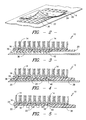
- Figure 2 shows a molded dust control mat as it exits from the press molding machine;
- Figure 3 is the dust control mat preassembled prior to molding thereof;
- Figure 4 shows the molded dust control mat prior to being stripped off the conveyor belt; and
- Figure 5 is a partial cross-sectional view of a completed, vulcanized dust control mat.
- In the preferred form of the invention the
mats 10 consist ofpile yarns 14 of cotton, polyester, etc. tufted through a woven ornonwoven substrate 16 of suitable material with thebottom 18 of the tufts adhered to the rubber or rubber-like backing 20 during vulcanization. Molded integral with or otherwise secured to the bottom of thebacking 20 are a plurality ofanti-creep cleats 22. Each of the mats commonly have aborder portion 24 therearound. - The
mat 10 of this invention is assembled, molded and vulcanized on the machine, generally designated 26, of Figure 1. Themachine 26 uses an endless, Teflon-coatedconveyor belt 27 to carry themats 10 from theassembly station 28, through thepreheater 30 into thepress molding apparatus 32 and out to the separatingstation 34. The press molding apparatus can be of any suitable type such as that shown in US-A-4,447,201. To overcome or alleviate the above-mentioned edge rippling problems it is desired to produce a dust control mat which has the bottom of the outer two longitudinal edges uncleated and a thickness of rubber at such edges which is approximately 10% greater in thickness than the rubber in the body of the rubber mat. - In production of dust control mats prior to the herein-disclosed invention the mats were preassembled at
station 28 by just laying down a perforated silicone pad or silicone-like pad such as butyl rubber on theconveyor belt 27. The silicone pad was of a length to accommodate one dust control mat or a plurality of mats and had a width at least equal to the desired width of rubber backing. Then a rubber backing was placed over the silicone pad and a tufted fabric placed on top of the rubber backing. Theconveyor belt 27 was then indexed to place the preassembled mat in thepreheater 30 which has a temperature in the range of 115°C - 127°C (240°F - 260°F). When the conveyor belt has been indexed another dust control mat is preassembled atstation 28 while the first preassembled mat is being preheated. After a period of approximately four (4) minutes theconveyor belt 27 is again indexed to place the preheated mat into thepress mold 32 and the second preassembled mat into thepreheater 30 while a third mat is being preassembled. In thepress mold 32, at a temperature in the range of approximately 160°C - 171°C (320°F - 340°F) the rubber backing is vulcanized to the tufted fabric under the action of a pressing force to extrude the soft rubber through the perforations in the silicone pad to form thecleats 22 therein. - After another four (4) minutes the
conveyor belt 27 is again indexed to move the first vulcanized mat into the stripping station to be removed from the silicone pad and theconveyor belt 27 while the second and third preassemblies are being indexed into thepress mold 32 and thepreheater 30, respectively, and a fourth preassembled mat is being put together. - It should be understood that a multiplicity of silicone pads can be placed side by side and can be any desired length. Also, depending on the size of the mat a plurality of mats can be treated simultaneously at any one station depending on the size of the assembly station, preheater or press mold, etc. The above-described method produces a dust control mat of reduced thickness due to a portion of the rubber from the rubber backing being used to produce the cleats. This loss of rubber was approximately 10% and contributed to the edge rippling problem.
- To overcome this problem a
perforated silicone pad 36 was selected which is 5 - 10 cm (2 - 4 inches) narrower along each longitudinal edge so thelongitudinal edges 38 will maintain the original rubber thickness while thecleats 22 are being formed on the interior of themat 10 during press molding. In the preferred form of the invention the smooth longitudinal edge orborder 38 will have a thickness of about 1.32 mm (52 mils) while the body of the rubber backing will have a thickness of about 1.2 mm (47 mils) thereby providing a stiffening effect at the edges to reduce the tendency to ripple. - To prevent excessive stress between the body of the rubber backing material and the longitudinal edge or
border 38 at thetransition point 40 it is desired to have a radius of curvature rather than a sharp vertical transition. To accomplish this, as shown in Figure 3, the longitudinal underedges of the silicone pad are cut at anangle 42 of between 10° - 25°, preferably 20°, so that during molding and vulcanization it will bend or deflect over as shown in Figure 4 to form theradius 40 as shown in Figure 5. - The above modifications provide a cleated dust control mat in which the rubber backing has smooth longitudinal edges of a thickness of 10% greater than the thickness of the cleated body of the rubber backing. These thicker longitudinal edges or borders provide a stiffening effect which reduces rippling tendencies and increases tear strength. Increased tear strength is particularly important along longitudinal edges where most of border tearing usually occurs. This additional thickness also causes the edges to curl down to increase the tendency to hug the covered surface. Additionally, since the width of the silicone pads has been reduced, the cost of the pad has been reduced while ease of handling, because of reduced size, has been increased. Although the preferred embodiment of the invention has been described, it is contemplated that many changes may be made without departing from the scope or spirit of the claims.
Claims (8)
- A dust control mat (10) comprising: a pile surface fabric (14, 16), a rubber or rubber-like material (20) connected to said pile surface fabric (14, 16) and extending beyond at least two edges of said pile surface fabric (14, 16) and a plurality of friction resistant cleats (22) on the bottom of said rubber-like material (20) under said pile surface fabric (14, 16) but not extending beyond at least said two edges thereof; characterised in that a border portion (38) of said rubber-like material (20) extending beyond at least said two edges of said pile surface fabric (14, 16) is thicker than the body of said rubber-like material (20) under said pile surface fabric (14, 16), and said rubber-like material (20) has an arcuate shaped transition area between the body of the rubber-like material (20) and the thicker edges thereof, said border portion (38) lying flat on the ground, in use, and the bottom surfaces of the cleats (22) being substantially co-planar with the bottom surface of the border portion (38).
- The dust control mat (10) of Claim 1 wherein the border portion (38) is approximately 10% thicker than the body of said rubber-like material.
- A pad (36) for use in forming cleats (22) in a dust control mat (10), backed by rubber or rubber-like material, comprising a length of silicone or silicone-like material having two longitudinal edges and having a horizontal surface with a plurality of perforations formed therein; characterised in that the distance between the longitudinal edges of the pad (36) is less than the distance between the longitudinal edges of the mat (10) to be formed and in that said pad (36) is cut along said longitudinal edges at an angle (42) to said horizontal surface of between 10° and 25° so as to provide an inclined undersurface along said longitudinal edges.
- The pad (36) of Claim 3 wherein said angle is approximately 20°.
- A method of forming a unitary dust control mat (10) having a pile fibre upper surface (14, 16) and a rubber or rubber-like backing (20) comprising the steps of: placing a pad of perforated silicone or silicone-like material (36) on the surface of a conveyor belt (27), placing a strip of rubber or rubber-like material (20) on top of the silicone-like pad (36), placing a layer of pile fabric (14, 16) on top of the rubber-like material (20) to form a layered structure, indexing the layered structure into a heated press moulding machine (32), applying pressure to the layered structure in the press moulding machine (32) to vulcanize the rubber-like material (20) and cause the rubber-like material (20) to pass through the perforations in the silicone-like pad (36) to form cleats (22), indexing the vulcanised and adhered layered structure to a stripping station (34) outside the press moulding machine (32) and stripping the composite structure from the conveyor belt (27) and the silicone-like pad (36); characterised in that said silicone-like pad (36) has a width less than the desired dust control mat (10), the strip of rubber-like material (20) being placed on top of the silicone-like pad (36) such that its longitudinal edges overlap the edges of the silicone-like pad (36), vulcanisation of the rubber-like material (20) further causing the longitudinal edges thereof to bend over the edges of the silicone-like pad (36) to form uncleated border portions (38) of a thickness greater than the body of the rubber-like material (20), and said rubber-like backing (20) extending beyond at least two of the edges of said pile fiber upper surface (14, 16).
- The method of Claim 5 wherein the layered structure is preheated (30) prior to passage into the press moulding machine (32).
- A method of making a cleated, unitary dust control mat (10) comprising the steps of: placing a perforated silicone or silicone-like pad (36) having perforations therein onto a conveyor belt (27), placing a rubber or rubber-like backing material (20) over the silicone-like pad (36), placing a pile fabric (14, 16) on top of the rubber-like backing material (20) to form a layered structure, placing the layered structure into a heated press moulding machine (32), supplying heat and pressure to the layered structure to cause the rubber-like backing (20) to be vulcanised to the pile fabric (14, 16), and the rubber-like material (20) to be forced through the perforations in the silicone-like pad to form cleats (22), and stripping the vulcanised dust control mat (10) off the conveyor belt (27) and the silicone-like pad (36); characterised in that said silicone-like pad (36) has a width less than the desired dust control mat (10), the longitudinal edges of the silicone-like pad (36) being cut at an angle to provide an inclined undersurface therealong; and in that the rubber-like backing material (20) is placed over the silicone-like pad (36) with the edges thereof extending beyond the longitudinal edges of the silicone-like pad (36), vulcanisation of the rubber-like backing (20) causing the longitudinal edges of the silicone-like pad to be bent over by the rubber-like backing (20) to form uncleated rubber edges (38) for the dust control mat (10) of greater thickness than the body of the rubber backing material (20).
- The method of Claim 7 wherein the layered structure is preheated (30) prior to being supplied to the press moulding machine (32).
Priority Applications (1)
| Application Number | Priority Date | Filing Date | Title |
|---|---|---|---|
| AT89304811T ATE95996T1 (en) | 1988-07-11 | 1989-05-11 | DOORMAT WITH A BORDER WITHOUT PUBS. |
Applications Claiming Priority (2)
| Application Number | Priority Date | Filing Date | Title |
|---|---|---|---|
| US21697088A | 1988-07-11 | 1988-07-11 | |
| US216970 | 1988-07-11 |
Publications (3)
| Publication Number | Publication Date |
|---|---|
| EP0351041A2 EP0351041A2 (en) | 1990-01-17 |
| EP0351041A3 EP0351041A3 (en) | 1991-09-11 |
| EP0351041B1 true EP0351041B1 (en) | 1993-10-20 |
Family
ID=22809163
Family Applications (1)
| Application Number | Title | Priority Date | Filing Date |
|---|---|---|---|
| EP89304811A Expired - Lifetime EP0351041B1 (en) | 1988-07-11 | 1989-05-11 | Dust control mat with non-cleated borders |
Country Status (7)
| Country | Link |
|---|---|
| EP (1) | EP0351041B1 (en) |
| JP (2) | JPH02167109A (en) |
| AT (1) | ATE95996T1 (en) |
| CA (1) | CA1335649C (en) |
| DE (1) | DE68910027T2 (en) |
| DK (1) | DK172220B1 (en) |
| ES (1) | ES2044109T3 (en) |
Families Citing this family (16)
| Publication number | Priority date | Publication date | Assignee | Title |
|---|---|---|---|---|
| EP1005818A3 (en) * | 1991-05-03 | 2009-04-08 | International Automotive Components Group North America, Inc. | Floor mat and method of making same |
| US5154961A (en) * | 1991-05-03 | 1992-10-13 | The Akro Corporation | Floor mat and method of making same |
| GB9313043D0 (en) * | 1993-06-24 | 1993-08-11 | Collie Carpets Ltd | Scarper carpet materials |
| GB2304623A (en) * | 1995-09-01 | 1997-03-26 | Walk Off Mats Ltd | Mat manufacture |
| USRE38422E1 (en) | 1999-08-13 | 2004-02-10 | Milliken & Co. | Cushioned carpeted floor mat with at least one cushioning integrated rubber protrusion |
| US6296919B1 (en) * | 1999-08-13 | 2001-10-02 | Milliken & Company | Cushioned carpeted floor mat with at least one cushioning integrated rubber protrusion |
| US6303068B1 (en) | 1999-09-24 | 2001-10-16 | Milliken & Company | Process of making a cleated floor mat |
| DE60122489T2 (en) * | 2000-05-19 | 2007-03-15 | Milliken & Co. | CLAMP-FORMING WEBWARE FOR MANUFACTURING ANTI-RHINE FLOOR MATS |
| CN1449259A (en) * | 2000-09-01 | 2003-10-15 | 美利肯公司 | Cushioned rubber floor mat article and method |
| US6921502B1 (en) | 2000-09-01 | 2005-07-26 | Milliken & Company | Cushioned rubber floor mat article and method |
| US6420015B1 (en) | 2000-09-27 | 2002-07-16 | Milliken & Company | Cushioned rubber floor mat and process |
| US6589631B1 (en) | 2000-10-04 | 2003-07-08 | Milliken & Company | Flashless rubber floor mat and method |
| US6382350B1 (en) | 2001-04-02 | 2002-05-07 | Collins & Aikman Products Corp. | Molded acoustic and decorative mats and methods for forming the same |
| EP1467647A1 (en) * | 2002-01-24 | 2004-10-20 | Milliken Denmark A/S | Washable floor mat |
| US6595321B1 (en) | 2002-03-28 | 2003-07-22 | Collins & Aikman Products Co. | Floor mats having peripheral apertures with acoustic absorbing material |
| JP5888206B2 (en) * | 2012-11-06 | 2016-03-16 | 株式会社シンコーモールド | Method for forming irregularities on the rubber surface |
Family Cites Families (13)
| Publication number | Priority date | Publication date | Assignee | Title |
|---|---|---|---|---|
| JPS5113943B1 (en) * | 1970-02-27 | 1976-05-06 | ||
| JPS5248824Y2 (en) * | 1974-07-12 | 1977-11-07 | ||
| JPS56108785U (en) * | 1980-01-24 | 1981-08-24 | ||
| JPS57205115A (en) * | 1981-06-13 | 1982-12-16 | Towa Kogyo Kk | New manufacturing method of three-dimensional decorative soft tile board |
| US4447201A (en) * | 1981-06-29 | 1984-05-08 | Clean-Tex A/S | Vulcanizing press for vulcanizing flat articles |
| US4727697A (en) * | 1982-04-02 | 1988-03-01 | Vaux Thomas M | Impact absorbing safety matting system |
| JPS5995016A (en) * | 1982-11-24 | 1984-05-31 | ダスキンフランチヤイズ株式会社 | Dust control mat |
| JPS59105892A (en) * | 1982-12-10 | 1984-06-19 | Kurita Water Ind Ltd | water treatment agent |
| US4532098A (en) * | 1983-12-02 | 1985-07-30 | Campbell Clarence R | Method for fabricating non-linear side wall conveyor belting |
| GB2171902B (en) * | 1985-03-08 | 1988-03-30 | Cannon Rubber Ltd | Floor mat |
| JPH0220104Y2 (en) * | 1985-09-13 | 1990-06-01 | ||
| US4731275A (en) * | 1986-12-29 | 1988-03-15 | 501 Andersen Company, Inc. | Carpet assembly which resists lateral movement and process of producing the same |
| US4741065A (en) * | 1987-03-09 | 1988-05-03 | Milliken Research Corporation | Interlocking dust control mats |
-
1989
- 1989-05-11 DE DE89304811T patent/DE68910027T2/en not_active Expired - Fee Related
- 1989-05-11 ES ES89304811T patent/ES2044109T3/en not_active Expired - Lifetime
- 1989-05-11 AT AT89304811T patent/ATE95996T1/en not_active IP Right Cessation
- 1989-05-11 EP EP89304811A patent/EP0351041B1/en not_active Expired - Lifetime
- 1989-05-24 JP JP1129040A patent/JPH02167109A/en active Pending
- 1989-05-31 CA CA000601362A patent/CA1335649C/en not_active Expired - Fee Related
- 1989-07-11 DK DK341289A patent/DK172220B1/en not_active IP Right Cessation
-
1993
- 1993-02-10 JP JP5023005A patent/JP2728349B2/en not_active Expired - Fee Related
Also Published As
| Publication number | Publication date |
|---|---|
| CA1335649C (en) | 1995-05-23 |
| JPH05245098A (en) | 1993-09-24 |
| EP0351041A3 (en) | 1991-09-11 |
| ATE95996T1 (en) | 1993-11-15 |
| DK341289D0 (en) | 1989-07-11 |
| EP0351041A2 (en) | 1990-01-17 |
| ES2044109T3 (en) | 1994-01-01 |
| JP2728349B2 (en) | 1998-03-18 |
| DK341289A (en) | 1990-01-12 |
| DE68910027D1 (en) | 1993-11-25 |
| JPH02167109A (en) | 1990-06-27 |
| DE68910027T2 (en) | 1994-03-31 |
| DK172220B1 (en) | 1998-01-12 |
Similar Documents
| Publication | Publication Date | Title |
|---|---|---|
| US4886692A (en) | Dust control mat with non-cleated borders | |
| CA1335649C (en) | Dust control mat with non-cleated borders | |
| US4902465A (en) | Process for forming dust control mat with non-cleated borders | |
| KR100324865B1 (en) | Floor mat and continuous process for the manufacture thereof | |
| US4769895A (en) | Interlocking dust control mats | |
| EP0512904B1 (en) | Floor mat and method of making same | |
| US4741065A (en) | Interlocking dust control mats | |
| US6520763B1 (en) | Apparatus for forming cleated floor mat | |
| EP0073222A4 (en) | Anti-slip mat and method of making the same. | |
| JPH05508448A (en) | Endless belt for dewatering press with long nip | |
| US4731275A (en) | Carpet assembly which resists lateral movement and process of producing the same | |
| US4744843A (en) | Release treatment using a non-reinforcing, non-woven fabric for conveyor belt curing | |
| GB2114053A (en) | A web-form floor covering | |
| US5932317A (en) | Dust control mat with co-calendered reinforcing strips | |
| KR920009271B1 (en) | A floorcloth and preparing method thereof | |
| US4725476A (en) | Rug underlay | |
| JPS62137028A (en) | Integrated mat | |
| JPH047213B2 (en) | ||
| USRE24937E (en) | Method for fabricating a carpet unit | |
| JP3497908B2 (en) | Door mat | |
| US2930729A (en) | Method for fabricating a carpet unit | |
| DE60122489T2 (en) | CLAMP-FORMING WEBWARE FOR MANUFACTURING ANTI-RHINE FLOOR MATS | |
| JP3434035B2 (en) | Dust mat | |
| WO1998001067A1 (en) | Improvements in or relating to floor coverings | |
| JP3817060B2 (en) | Manufacturing method of floor mat |
Legal Events
| Date | Code | Title | Description |
|---|---|---|---|
| PUAI | Public reference made under article 153(3) epc to a published international application that has entered the european phase |
Free format text: ORIGINAL CODE: 0009012 |
|
| AK | Designated contracting states |
Kind code of ref document: A2 Designated state(s): AT BE CH DE ES FR GB GR IT LI LU NL SE |
|
| PUAL | Search report despatched |
Free format text: ORIGINAL CODE: 0009013 |
|
| AK | Designated contracting states |
Kind code of ref document: A3 Designated state(s): AT BE CH DE ES FR GB GR IT LI LU NL SE |
|
| 17P | Request for examination filed |
Effective date: 19911009 |
|
| 17Q | First examination report despatched |
Effective date: 19920714 |
|
| GRAA | (expected) grant |
Free format text: ORIGINAL CODE: 0009210 |
|
| ITF | It: translation for a ep patent filed | ||
| AK | Designated contracting states |
Kind code of ref document: B1 Designated state(s): AT BE CH DE ES FR GB GR IT LI LU NL SE |
|
| REF | Corresponds to: |
Ref document number: 95996 Country of ref document: AT Date of ref document: 19931115 Kind code of ref document: T |
|
| REF | Corresponds to: |
Ref document number: 68910027 Country of ref document: DE Date of ref document: 19931125 |
|
| REG | Reference to a national code |
Ref country code: ES Ref legal event code: FG2A Ref document number: 2044109 Country of ref document: ES Kind code of ref document: T3 |
|
| ET | Fr: translation filed | ||
| REG | Reference to a national code |
Ref country code: GR Ref legal event code: FG4A Free format text: 3010127 |
|
| EPTA | Lu: last paid annual fee | ||
| PLBE | No opposition filed within time limit |
Free format text: ORIGINAL CODE: 0009261 |
|
| STAA | Information on the status of an ep patent application or granted ep patent |
Free format text: STATUS: NO OPPOSITION FILED WITHIN TIME LIMIT |
|
| 26N | No opposition filed | ||
| EAL | Se: european patent in force in sweden |
Ref document number: 89304811.6 |
|
| PGFP | Annual fee paid to national office [announced via postgrant information from national office to epo] |
Ref country code: AT Payment date: 20010320 Year of fee payment: 13 |
|
| PGFP | Annual fee paid to national office [announced via postgrant information from national office to epo] |
Ref country code: GR Payment date: 20010427 Year of fee payment: 13 |
|
| REG | Reference to a national code |
Ref country code: GB Ref legal event code: IF02 |
|
| PGFP | Annual fee paid to national office [announced via postgrant information from national office to epo] |
Ref country code: LU Payment date: 20020404 Year of fee payment: 14 |
|
| PGFP | Annual fee paid to national office [announced via postgrant information from national office to epo] |
Ref country code: BE Payment date: 20020429 Year of fee payment: 14 |
|
| PG25 | Lapsed in a contracting state [announced via postgrant information from national office to epo] |
Ref country code: AT Free format text: LAPSE BECAUSE OF NON-PAYMENT OF DUE FEES Effective date: 20020511 |
|
| PGFP | Annual fee paid to national office [announced via postgrant information from national office to epo] |
Ref country code: NL Payment date: 20020513 Year of fee payment: 14 |
|
| PG25 | Lapsed in a contracting state [announced via postgrant information from national office to epo] |
Ref country code: GR Free format text: LAPSE BECAUSE OF NON-PAYMENT OF DUE FEES Effective date: 20021206 |
|
| PGFP | Annual fee paid to national office [announced via postgrant information from national office to epo] |
Ref country code: SE Payment date: 20030326 Year of fee payment: 15 Ref country code: CH Payment date: 20030326 Year of fee payment: 15 |
|
| PGFP | Annual fee paid to national office [announced via postgrant information from national office to epo] |
Ref country code: FR Payment date: 20030423 Year of fee payment: 15 |
|
| PGFP | Annual fee paid to national office [announced via postgrant information from national office to epo] |
Ref country code: ES Payment date: 20030505 Year of fee payment: 15 |
|
| PG25 | Lapsed in a contracting state [announced via postgrant information from national office to epo] |
Ref country code: LU Free format text: LAPSE BECAUSE OF NON-PAYMENT OF DUE FEES Effective date: 20030511 |
|
| PG25 | Lapsed in a contracting state [announced via postgrant information from national office to epo] |
Ref country code: BE Free format text: LAPSE BECAUSE OF NON-PAYMENT OF DUE FEES Effective date: 20030531 |
|
| BERE | Be: lapsed |
Owner name: *MILLIKEN RESEARCH CORP. Effective date: 20030531 |
|
| PG25 | Lapsed in a contracting state [announced via postgrant information from national office to epo] |
Ref country code: NL Free format text: LAPSE BECAUSE OF NON-PAYMENT OF DUE FEES Effective date: 20031201 |
|
| NLV4 | Nl: lapsed or anulled due to non-payment of the annual fee |
Effective date: 20031201 |
|
| PGFP | Annual fee paid to national office [announced via postgrant information from national office to epo] |
Ref country code: GB Payment date: 20040505 Year of fee payment: 16 |
|
| PG25 | Lapsed in a contracting state [announced via postgrant information from national office to epo] |
Ref country code: SE Free format text: LAPSE BECAUSE OF NON-PAYMENT OF DUE FEES Effective date: 20040512 Ref country code: ES Free format text: LAPSE BECAUSE OF NON-PAYMENT OF DUE FEES Effective date: 20040512 |
|
| PG25 | Lapsed in a contracting state [announced via postgrant information from national office to epo] |
Ref country code: LI Free format text: LAPSE BECAUSE OF NON-PAYMENT OF DUE FEES Effective date: 20040531 Ref country code: CH Free format text: LAPSE BECAUSE OF NON-PAYMENT OF DUE FEES Effective date: 20040531 |
|
| PGFP | Annual fee paid to national office [announced via postgrant information from national office to epo] |
Ref country code: DE Payment date: 20040630 Year of fee payment: 16 |
|
| EUG | Se: european patent has lapsed | ||
| REG | Reference to a national code |
Ref country code: CH Ref legal event code: PL |
|
| PG25 | Lapsed in a contracting state [announced via postgrant information from national office to epo] |
Ref country code: FR Free format text: LAPSE BECAUSE OF NON-PAYMENT OF DUE FEES Effective date: 20050131 |
|
| REG | Reference to a national code |
Ref country code: FR Ref legal event code: ST |
|
| PG25 | Lapsed in a contracting state [announced via postgrant information from national office to epo] |
Ref country code: IT Free format text: LAPSE BECAUSE OF NON-PAYMENT OF DUE FEES;WARNING: LAPSES OF ITALIAN PATENTS WITH EFFECTIVE DATE BEFORE 2007 MAY HAVE OCCURRED AT ANY TIME BEFORE 2007. THE CORRECT EFFECTIVE DATE MAY BE DIFFERENT FROM THE ONE RECORDED. Effective date: 20050511 Ref country code: GB Free format text: LAPSE BECAUSE OF NON-PAYMENT OF DUE FEES Effective date: 20050511 |
|
| REG | Reference to a national code |
Ref country code: ES Ref legal event code: FD2A Effective date: 20040512 |
|
| PG25 | Lapsed in a contracting state [announced via postgrant information from national office to epo] |
Ref country code: DE Free format text: LAPSE BECAUSE OF NON-PAYMENT OF DUE FEES Effective date: 20051201 |
|
| GBPC | Gb: european patent ceased through non-payment of renewal fee |
Effective date: 20050511 |