EP0350521A1 - Process for the production of 2,3,5,6-tetrachloropyridine and 2,3,6-trichloropyridine - Google Patents
Process for the production of 2,3,5,6-tetrachloropyridine and 2,3,6-trichloropyridine Download PDFInfo
- Publication number
- EP0350521A1 EP0350521A1 EP88111233A EP88111233A EP0350521A1 EP 0350521 A1 EP0350521 A1 EP 0350521A1 EP 88111233 A EP88111233 A EP 88111233A EP 88111233 A EP88111233 A EP 88111233A EP 0350521 A1 EP0350521 A1 EP 0350521A1
- Authority
- EP
- European Patent Office
- Prior art keywords
- trichloropyridine
- tetrachloropyridine
- chlorine
- process according
- polychloropyridine
- Prior art date
- Legal status (The legal status is an assumption and is not a legal conclusion. Google has not performed a legal analysis and makes no representation as to the accuracy of the status listed.)
- Withdrawn
Links
- GPAKJVMKNDXBHH-UHFFFAOYSA-N 2,3,6-trichloropyridine Chemical compound ClC1=CC=C(Cl)C(Cl)=N1 GPAKJVMKNDXBHH-UHFFFAOYSA-N 0.000 title claims abstract description 21
- FATBKZJZAHWCSL-UHFFFAOYSA-N 2,3,5,6-tetrachloropyridine Chemical compound ClC1=CC(Cl)=C(Cl)N=C1Cl FATBKZJZAHWCSL-UHFFFAOYSA-N 0.000 title claims abstract description 15
- 238000000034 method Methods 0.000 title claims description 31
- 238000004519 manufacturing process Methods 0.000 title description 3
- FILKGCRCWDMBKA-UHFFFAOYSA-N 2,6-dichloropyridine Chemical compound ClC1=CC=CC(Cl)=N1 FILKGCRCWDMBKA-UHFFFAOYSA-N 0.000 claims abstract description 12
- 239000012808 vapor phase Substances 0.000 claims abstract description 9
- 239000000460 chlorine Substances 0.000 claims description 21
- 229910052801 chlorine Inorganic materials 0.000 claims description 21
- ZAMOUSCENKQFHK-UHFFFAOYSA-N Chlorine atom Chemical compound [Cl] ZAMOUSCENKQFHK-UHFFFAOYSA-N 0.000 claims description 17
- 238000004821 distillation Methods 0.000 claims description 5
- 229910052739 hydrogen Inorganic materials 0.000 claims description 4
- 238000009833 condensation Methods 0.000 claims description 3
- 230000005494 condensation Effects 0.000 claims description 3
- 230000007704 transition Effects 0.000 claims description 2
- 238000005660 chlorination reaction Methods 0.000 abstract description 15
- 239000000543 intermediate Substances 0.000 abstract description 4
- FJNNGKMAGDPVIU-UHFFFAOYSA-N 2,4,6-trichloropyridine Chemical compound ClC1=CC(Cl)=NC(Cl)=C1 FJNNGKMAGDPVIU-UHFFFAOYSA-N 0.000 abstract description 3
- 239000004009 herbicide Substances 0.000 abstract description 2
- 239000002917 insecticide Substances 0.000 abstract description 2
- VZGDMQKNWNREIO-UHFFFAOYSA-N tetrachloromethane Chemical compound ClC(Cl)(Cl)Cl VZGDMQKNWNREIO-UHFFFAOYSA-N 0.000 description 16
- IJGRMHOSHXDMSA-UHFFFAOYSA-N Atomic nitrogen Chemical compound N#N IJGRMHOSHXDMSA-UHFFFAOYSA-N 0.000 description 14
- 229950005499 carbon tetrachloride Drugs 0.000 description 8
- JUJWROOIHBZHMG-UHFFFAOYSA-N Pyridine Chemical compound C1=CC=NC=C1 JUJWROOIHBZHMG-UHFFFAOYSA-N 0.000 description 7
- 229910052757 nitrogen Inorganic materials 0.000 description 7
- 239000000376 reactant Substances 0.000 description 7
- 238000006243 chemical reaction Methods 0.000 description 6
- 239000000047 product Substances 0.000 description 6
- 239000007858 starting material Substances 0.000 description 6
- FZFNDUTVMQOPCT-UHFFFAOYSA-N 2,3,4,6-tetrachloropyridine Chemical class ClC1=CC(Cl)=C(Cl)C(Cl)=N1 FZFNDUTVMQOPCT-UHFFFAOYSA-N 0.000 description 4
- YMWUJEATGCHHMB-UHFFFAOYSA-N Dichloromethane Chemical compound ClCCl YMWUJEATGCHHMB-UHFFFAOYSA-N 0.000 description 4
- DNDPLEAVNVOOQZ-UHFFFAOYSA-N 2,3,4,5,6-pentachloropyridine Chemical compound ClC1=NC(Cl)=C(Cl)C(Cl)=C1Cl DNDPLEAVNVOOQZ-UHFFFAOYSA-N 0.000 description 3
- -1 2,3,6-trichloropyridine 2,3,5,6-tetrachloropyridine 2,3,4,6-tetrachloropyridine Chemical compound 0.000 description 3
- PXHVJJICTQNCMI-UHFFFAOYSA-N Nickel Chemical compound [Ni] PXHVJJICTQNCMI-UHFFFAOYSA-N 0.000 description 3
- VYPSYNLAJGMNEJ-UHFFFAOYSA-N Silicium dioxide Chemical compound O=[Si]=O VYPSYNLAJGMNEJ-UHFFFAOYSA-N 0.000 description 3
- 238000004458 analytical method Methods 0.000 description 3
- 239000006227 byproduct Substances 0.000 description 3
- 150000001875 compounds Chemical class 0.000 description 3
- 239000000203 mixture Substances 0.000 description 3
- 239000011541 reaction mixture Substances 0.000 description 3
- BSKHPKMHTQYZBB-UHFFFAOYSA-N 2-methylpyridine Chemical class CC1=CC=CC=N1 BSKHPKMHTQYZBB-UHFFFAOYSA-N 0.000 description 2
- XKRFYHLGVUSROY-UHFFFAOYSA-N Argon Chemical compound [Ar] XKRFYHLGVUSROY-UHFFFAOYSA-N 0.000 description 2
- VEXZGXHMUGYJMC-UHFFFAOYSA-N Hydrochloric acid Chemical compound Cl VEXZGXHMUGYJMC-UHFFFAOYSA-N 0.000 description 2
- 238000009835 boiling Methods 0.000 description 2
- 239000007795 chemical reaction product Substances 0.000 description 2
- 238000001514 detection method Methods 0.000 description 2
- 239000003085 diluting agent Substances 0.000 description 2
- 239000007789 gas Substances 0.000 description 2
- IXCSERBJSXMMFS-UHFFFAOYSA-N hydrogen chloride Substances Cl.Cl IXCSERBJSXMMFS-UHFFFAOYSA-N 0.000 description 2
- 229910000041 hydrogen chloride Inorganic materials 0.000 description 2
- 239000003701 inert diluent Substances 0.000 description 2
- 238000002156 mixing Methods 0.000 description 2
- 239000003960 organic solvent Substances 0.000 description 2
- UMJSCPRVCHMLSP-UHFFFAOYSA-N pyridine Natural products COC1=CC=CN=C1 UMJSCPRVCHMLSP-UHFFFAOYSA-N 0.000 description 2
- 238000010791 quenching Methods 0.000 description 2
- 230000035484 reaction time Effects 0.000 description 2
- CNLIIAKAAMFCJG-UHFFFAOYSA-N 2,3,5-trichloropyridine Chemical compound ClC1=CN=C(Cl)C(Cl)=C1 CNLIIAKAAMFCJG-UHFFFAOYSA-N 0.000 description 1
- OKTJSMMVPCPJKN-UHFFFAOYSA-N Carbon Chemical compound [C] OKTJSMMVPCPJKN-UHFFFAOYSA-N 0.000 description 1
- KZBUYRJDOAKODT-UHFFFAOYSA-N Chlorine Chemical compound ClCl KZBUYRJDOAKODT-UHFFFAOYSA-N 0.000 description 1
- 241000361255 Diogenes Species 0.000 description 1
- CYTYCFOTNPOANT-UHFFFAOYSA-N Perchloroethylene Chemical group ClC(Cl)=C(Cl)Cl CYTYCFOTNPOANT-UHFFFAOYSA-N 0.000 description 1
- 229910052786 argon Inorganic materials 0.000 description 1
- 238000003965 capillary gas chromatography Methods 0.000 description 1
- 229910052799 carbon Inorganic materials 0.000 description 1
- 239000003054 catalyst Substances 0.000 description 1
- 150000008280 chlorinated hydrocarbons Chemical class 0.000 description 1
- 150000005753 chloropyridines Chemical class 0.000 description 1
- 239000000470 constituent Substances 0.000 description 1
- 238000001816 cooling Methods 0.000 description 1
- 239000013078 crystal Substances 0.000 description 1
- 238000002425 crystallisation Methods 0.000 description 1
- 230000008025 crystallization Effects 0.000 description 1
- 230000007423 decrease Effects 0.000 description 1
- 230000000694 effects Effects 0.000 description 1
- 238000001704 evaporation Methods 0.000 description 1
- 230000008020 evaporation Effects 0.000 description 1
- 238000004508 fractional distillation Methods 0.000 description 1
- 239000005457 ice water Substances 0.000 description 1
- 238000011835 investigation Methods 0.000 description 1
- 230000014759 maintenance of location Effects 0.000 description 1
- 238000012856 packing Methods 0.000 description 1
- 239000011148 porous material Substances 0.000 description 1
- 150000003222 pyridines Chemical class 0.000 description 1
- 239000010453 quartz Substances 0.000 description 1
- 238000001953 recrystallisation Methods 0.000 description 1
- 238000007670 refining Methods 0.000 description 1
- 230000001105 regulatory effect Effects 0.000 description 1
- 230000000717 retained effect Effects 0.000 description 1
- 239000000377 silicon dioxide Substances 0.000 description 1
- 239000002002 slurry Substances 0.000 description 1
- 230000003068 static effect Effects 0.000 description 1
- 239000000126 substance Substances 0.000 description 1
- 229950011008 tetrachloroethylene Drugs 0.000 description 1
- 239000002699 waste material Substances 0.000 description 1
Classifications
-
- C—CHEMISTRY; METALLURGY
- C07—ORGANIC CHEMISTRY
- C07D—HETEROCYCLIC COMPOUNDS
- C07D213/00—Heterocyclic compounds containing six-membered rings, not condensed with other rings, with one nitrogen atom as the only ring hetero atom and three or more double bonds between ring members or between ring members and non-ring members
- C07D213/02—Heterocyclic compounds containing six-membered rings, not condensed with other rings, with one nitrogen atom as the only ring hetero atom and three or more double bonds between ring members or between ring members and non-ring members having three double bonds between ring members or between ring members and non-ring members
- C07D213/04—Heterocyclic compounds containing six-membered rings, not condensed with other rings, with one nitrogen atom as the only ring hetero atom and three or more double bonds between ring members or between ring members and non-ring members having three double bonds between ring members or between ring members and non-ring members having no bond between the ring nitrogen atom and a non-ring member or having only hydrogen or carbon atoms directly attached to the ring nitrogen atom
- C07D213/60—Heterocyclic compounds containing six-membered rings, not condensed with other rings, with one nitrogen atom as the only ring hetero atom and three or more double bonds between ring members or between ring members and non-ring members having three double bonds between ring members or between ring members and non-ring members having no bond between the ring nitrogen atom and a non-ring member or having only hydrogen or carbon atoms directly attached to the ring nitrogen atom with hetero atoms or with carbon atoms having three bonds to hetero atoms with at the most one bond to halogen, e.g. ester or nitrile radicals, directly attached to ring carbon atoms
- C07D213/61—Halogen atoms or nitro radicals
Definitions
- 2,3,5,6-Tetrachloropyridine and 2,3,5-trichloropyridine are chemical intermediates which are extensively used in the production of commercial insecticides and herbicides. Their production has been the object of many investigations and new methods having improved economics or other desirable features continue to be sought. Methods which employ available starting materials of much lower value or which might otherwise be disposed of as waste are particularly valuable. The present invention relates to such a method.
- 2,3,5,6-tetrachloropyridine and 2,3,6-trichloropyridine can be produced with high selectivity by the vapor phase chlorination respectively of 2,3,6-trichloropyridine and 2,6-dichloropyridine.
- 2,3,5,6-Tetrachloropyridine can likewise be produced from 2,6-dichloropyridine.
- Ratios of 2,3,5,6- to 2,3,4,6-tetrachloropyridine of at least 8:1 and usually greater than 10:1 are obtained from 2,3,6-trichloropyridine and ratios of 2,3,6- to 2,4,6-trichloropyridine of at least 0.7:1 and usually greater than 1:1 are obtained from 2,6-dichloropyridine by chlorination under the conditions of the present invention.
- a polychloropyridine of the formula wherein X represents Cl or H is selectively prepared by a process which is characterized by contacting with chlorine in the vapor phase at 300°C to 450°C a less chlorinated polychloropyridine of the formula wherein X represents Cl or H.
- 2,3,5,6-Tetrachloropyridine is produced in high yield and with excellent selectivity in the process of the present invention by chlorination of 2,6-dichloropyridine, 2,3,6-trichloropyridine or mixtures of the two in the vapor phase under specified conditions.
- 2,3,6-trichloropyridine is produced in good yield and with excellent selectivity from 2,6-dichloropyridine.
- Chlorine and the polychloropyridine reactant are combined and allowed to react in the vapor phase.
- Any reactor which is suitable for vapor phase chlorination reactions can be used in the process.
- Such reactors may be designed for either batch or continuous operations; however, those designed for continuous operation are preferred.
- the reactor may be designed for plug flow, turbulent flow, transition flow or other types of flow and may involve plain, baffled or packed cavities.
- Such reactors are constructed so that there is efficient mixing of chlorine and the compound to be chlorinated. This is variously accomplished by means of inlet patterns, turbulent flow, reactor packing, and the like.
- One type of reactor suitable for the process and its operation are described in U.S. Patent 3,420,833.
- the molar ratio of chlorine to polychloropyridine reactant employed generally ranges from 2:1 to 40:1. Preferably, ratios of 3:1 to 30:1 and more preferably, ratios of at least 6:1 to 30:1 are employed.
- An inert diluent is normally employed in the process as an aid to mixing and to promote temperature and flow rate control.
- Chlorocarbons which are unreactive in the process such as carbon tetrachloride and tetrachloroethylene, and unreactive gases, such as nitrogen and argon, are typical examples.
- the means of introducing the inert diluent into the reactor is not critical, but it is often preferred to introduce it as a mixture with the polychloropyridine reactant.
- the weight ratio of diluent to polychloropyridine reactant is typically 20:1 to 0.5:1.
- the present process gives 2,3,6-trichloro-pyridine or 2,3,5,6-tetrachloropyridine in high selectivity and good yield when the reactor is maintained at 300°C to 450°C. Above this temperature, the selectivity of the reaction to 2,3,6-trichloropyridine and 2,3,5,6-tetrachloropyridine decreases and over-chlorination to pentachloropyridine takes place. As a result, the yields of the desired products are reduced. At lower temperatures, the process is too slow to be commercially useful. Reaction temperatures above 320°C are preferred and those above 350°C are especially preferred. Reaction temperatures below 450°C are preferred as are those below 440°, 430°, and 420°C.
- the pressure in the reactor is not critical. Pressures from atmospheric to 200 psi (1379 kPa) are typical and from atmospheric to 100 psi (689 kPa) are preferred. Typically, the reactor pressure is simply that which normally develops in the reactor under the conditions employed although the reaction rate is faster at higher pressures and higher pressures may, therefore, be preferred.
- the chlorination reaction mixture is retained in the reactor until a significant portion of the 2,6-dichloropyridine or 2,3,6-trichloropyridine reactant has been consumed or until a significant amount of 2,3,6-trichlorpyridine or 2,3,5,6-tetrachloropyridine product has formed.
- Reaction times retention times in continuous reactors
- Reaction times are generally controlled by the size and shape of the reactor and the ratios and flow rates of the reactants and diluents employed.
- the reaction mixtures obtained are usually cooled to condense the organic constituents and, optionally, the hydrogen chloride by-product. This is typically accomplished by passing the vapors through a quantity of cooled organic solvent, such as carbon tetrachloride or methylene chloride. Carbon tetrachloride is preferred. It is often convenient to employ a quantity of previously obtained reaction product for this purpose.
- the organic components of the mixture are condensed and the major portion of the hydrogen chloride by-product is allowed to exit the system as a gas. Condensation of the reaction products by external cooling is also a suitable method.
- the 2,3,6-trichloropyridine and 2,3,5,6-tetrachloropyridine prepared in the process are separable from the condensate described above by conventional means.
- the condensate is distilled using one or more distillation apparatuses. Unreacted starting materials and intermediates are lower boiling than the desired products and can be readily separated and recovered by distillation. They can be recycled to the chlorination reactor to improve the efficiency of the process. Over-chlorination by-products are higher boiling and can also be readily separated by distillation. Isomers can be removed by careful fractional distillation, by crystal refining, by recrystallization from appropriate organic solvents, or by other conventional means.
- 2,6-Dichloropyridine and 2,3,6-trichloropyridine are available compounds which can be prepared by the chlorination of pyridines and picolines and by other methods well known in the art. They are often obtained as unwanted co-products in pyridine and picoline chlorination processes.
- An isothermal plug flow reactor constructed of Nickel-200 and consisting of four 4 ft. (1.2 m) sections of 0.62 in. (1.57 cm) I.D. (0.75 in. (1.9 cm) O.D.) pipe enclosed inside a furnace and heated by four semi-cylindrical Lindberg heaters regulated by a Diogenes controller was employed.
- the reactor was equipped with a 1 ft. (0.3 m) Nickel-200 Kenics static mixer at the inlet end. A 0.5 in. (1.27 cm) O.D. nitrogen feed pipe and a 0.5 in. (1.27 cm) O.D.
- Double shell Nickel-200 chlorine/nitrogen feed pipe (chlorine in the inner shell and nitrogen in the outer shell), both of which were surrounded by four semi-cylindrical Lindberg heaters and equipped with rotameters were used to transport the reactants to the mixer.
- a polychloropyridine evaporation chamber with an inlet port for the polychloropyridine was installed in the nitrogen feed pipe between the heaters and the mixer.
- the reactor was further equipped on the outlet end with a cold-trap assembly consisting of two or three traps containing a dry ice-methylene chloride slurry and a carbon tetrachloride quench column.
- Example 2 The reactor and procedure described in Example 1 were employed. Chlorine and 2,6-dichloropyridine (as a ten percent solution in carbon tetrachloride) were fed to the reactor in a 20:1 mole ratio along with an appropriate amount of nitrogen to achieve the desired residence times. The conditions employed and results obtained are given in the following Table II. TABLE II EFFLUENT ANALYSIS (Mole Percent) Run No. Temp., °C Res. Time, Sec.
- 2,3,6-Trichloropyridine as a 10 percent solution in carbon tetrachloride was vaporized and fed into the reactor and chlorine was fed from a cylinder using a rotameter to control the rate.
- At the temperature setting of 350°C (the actual temperature in the reactor ranged from about 320°C at the inlet to 380°C at the outlet) with a residence time of 23.5 sec.
Landscapes
- Chemical & Material Sciences (AREA)
- Organic Chemistry (AREA)
- Pyridine Compounds (AREA)
- Agricultural Chemicals And Associated Chemicals (AREA)
- Organic Low-Molecular-Weight Compounds And Preparation Thereof (AREA)
Abstract
Vapor phase chlorination of 2,6-dichloropyridine produces 2,3,6-trichloropyridine selectively over isomeric 2,4,6-trichloropyridine and of 2,3,6-trichloropyridine produces 2,3,5,6-tetrachloropyridine in high selectivity over isomeric 2,3,4,6-tetrachloroyridine at temperatures of 300°C to 450°C. The products are intermediates for insecticides and herbicides.
Description
- 2,3,5,6-Tetrachloropyridine and 2,3,5-trichloropyridine are chemical intermediates which are extensively used in the production of commercial insecticides and herbicides. Their production has been the object of many investigations and new methods having improved economics or other desirable features continue to be sought. Methods which employ available starting materials of much lower value or which might otherwise be disposed of as waste are particularly valuable. The present invention relates to such a method.
- The vapor phase chlorination of pyridine to obtain various mono- and polychloropyridine products is known. In one study, the intermediate mono- and polychloropyridine compounds were identified and the rate constants for each chlorination event at 500°C were determined (H. Suschitzky, Polychloroaromatic Compounds (1974), page 440). Analysis of the rate constants given leads to the conclusion that under these conditions 2,3,6-trichloropyridine will produce 2,3,5,6- and 2,3,4,6-tetrachloropyridines in an approximately 3 to 1 ratio and 2,6-dichloropyridine will produce 2,3,6- and 2,4,6-trichloropyridines in an approximately 1 to 3 ratio.
- It has now been found that 2,3,5,6-tetrachloropyridine and 2,3,6-trichloropyridine can be produced with high selectivity by the vapor phase chlorination respectively of 2,3,6-trichloropyridine and 2,6-dichloropyridine. 2,3,5,6-Tetrachloropyridine can likewise be produced from 2,6-dichloropyridine. Ratios of 2,3,5,6- to 2,3,4,6-tetrachloropyridine of at least 8:1 and usually greater than 10:1 are obtained from 2,3,6-trichloropyridine and ratios of 2,3,6- to 2,4,6-trichloropyridine of at least 0.7:1 and usually greater than 1:1 are obtained from 2,6-dichloropyridine by chlorination under the conditions of the present invention.
- In the present invention a polychloropyridine of the formula

is selectively prepared by a process which is characterized by contacting with chlorine in the vapor phase at 300°C to 450°C a less chlorinated polychloropyridine of the formula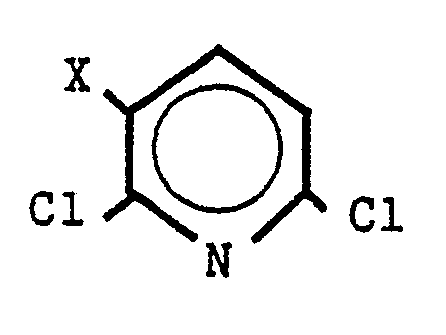
- No catalyst or porous material such as silica or carbon is required. The polychloropyridine products prepared in the process are readily recoverable by condensation of the reaction mixtures and are readily purified by distillation or crystallization.
- Surprisingly high yields of 2,3,5,6-tetrachloropyridine and 2,3,6-trichloropyridine are obtainable by the process due to the unexpectedly high selectivity of the chlorination under the specified conditions.
- 2,3,5,6-Tetrachloropyridine is produced in high yield and with excellent selectivity in the process of the present invention by chlorination of 2,6-dichloropyridine, 2,3,6-trichloropyridine or mixtures of the two in the vapor phase under specified conditions. In a like manner, 2,3,6-trichloropyridine is produced in good yield and with excellent selectivity from 2,6-dichloropyridine.
- Chlorine and the polychloropyridine reactant are combined and allowed to react in the vapor phase. Any reactor which is suitable for vapor phase chlorination reactions can be used in the process. Such reactors may be designed for either batch or continuous operations; however, those designed for continuous operation are preferred. Additionally, the reactor may be designed for plug flow, turbulent flow, transition flow or other types of flow and may involve plain, baffled or packed cavities. Generally, such reactors are constructed so that there is efficient mixing of chlorine and the compound to be chlorinated. This is variously accomplished by means of inlet patterns, turbulent flow, reactor packing, and the like. One type of reactor suitable for the process and its operation are described in U.S. Patent 3,420,833.
- Sufficient chlorine is employed in the process to effect the desired chlorination and to provide a suitable reaction rate, but not so much as to create a chlorine recycle problem. The molar ratio of chlorine to polychloropyridine reactant employed generally ranges from 2:1 to 40:1. Preferably, ratios of 3:1 to 30:1 and more preferably, ratios of at least 6:1 to 30:1 are employed.
- An inert diluent is normally employed in the process as an aid to mixing and to promote temperature and flow rate control. Chlorocarbons which are unreactive in the process, such as carbon tetrachloride and tetrachloroethylene, and unreactive gases, such as nitrogen and argon, are typical examples. Carbon tetrachloride and nitrogen, used separately or together, are often preferred. The means of introducing the inert diluent into the reactor is not critical, but it is often preferred to introduce it as a mixture with the polychloropyridine reactant.
- The weight ratio of diluent to polychloropyridine reactant is typically 20:1 to 0.5:1. The present process gives 2,3,6-trichloro-pyridine or 2,3,5,6-tetrachloropyridine in high selectivity and good yield when the reactor is maintained at 300°C to 450°C. Above this temperature, the selectivity of the reaction to 2,3,6-trichloropyridine and 2,3,5,6-tetrachloropyridine decreases and over-chlorination to pentachloropyridine takes place. As a result, the yields of the desired products are reduced. At lower temperatures, the process is too slow to be commercially useful. Reaction temperatures above 320°C are preferred and those above 350°C are especially preferred. Reaction temperatures below 450°C are preferred as are those below 440°, 430°, and 420°C.
- The pressure in the reactor is not critical. Pressures from atmospheric to 200 psi (1379 kPa) are typical and from atmospheric to 100 psi (689 kPa) are preferred. Typically, the reactor pressure is simply that which normally develops in the reactor under the conditions employed although the reaction rate is faster at higher pressures and higher pressures may, therefore, be preferred.
- The chlorination reaction mixture is retained in the reactor until a significant portion of the 2,6-dichloropyridine or 2,3,6-trichloropyridine reactant has been consumed or until a significant amount of 2,3,6-trichlorpyridine or 2,3,5,6-tetrachloropyridine product has formed. Reaction times (retention times in continuous reactors) of 0.1 sec. to 180 sec. are typical while times of 1 sec. to 120 sec. are preferred. Reaction times are generally controlled by the size and shape of the reactor and the ratios and flow rates of the reactants and diluents employed.
- At the conclusion of the reaction period, the reaction mixtures obtained are usually cooled to condense the organic constituents and, optionally, the hydrogen chloride by-product. This is typically accomplished by passing the vapors through a quantity of cooled organic solvent, such as carbon tetrachloride or methylene chloride. Carbon tetrachloride is preferred. It is often convenient to employ a quantity of previously obtained reaction product for this purpose. Typically, the organic components of the mixture are condensed and the major portion of the hydrogen chloride by-product is allowed to exit the system as a gas. Condensation of the reaction products by external cooling is also a suitable method.
- The 2,3,6-trichloropyridine and 2,3,5,6-tetrachloropyridine prepared in the process are separable from the condensate described above by conventional means. Typically, the condensate is distilled using one or more distillation apparatuses. Unreacted starting materials and intermediates are lower boiling than the desired products and can be readily separated and recovered by distillation. They can be recycled to the chlorination reactor to improve the efficiency of the process. Over-chlorination by-products are higher boiling and can also be readily separated by distillation. Isomers can be removed by careful fractional distillation, by crystal refining, by recrystallization from appropriate organic solvents, or by other conventional means.
- 2,6-Dichloropyridine and 2,3,6-trichloropyridine are available compounds which can be prepared by the chlorination of pyridines and picolines and by other methods well known in the art. They are often obtained as unwanted co-products in pyridine and picoline chlorination processes.
- The following examples are presented to illustrate the process.
- An isothermal plug flow reactor constructed of Nickel-200 and consisting of four 4 ft. (1.2 m) sections of 0.62 in. (1.57 cm) I.D. (0.75 in. (1.9 cm) O.D.) pipe enclosed inside a furnace and heated by four semi-cylindrical Lindberg heaters regulated by a Diogenes controller was employed. The reactor was equipped with a 1 ft. (0.3 m) Nickel-200 Kenics static mixer at the inlet end. A 0.5 in. (1.27 cm) O.D. nitrogen feed pipe and a 0.5 in. (1.27 cm) O.D. double shell Nickel-200 chlorine/nitrogen feed pipe (chlorine in the inner shell and nitrogen in the outer shell), both of which were surrounded by four semi-cylindrical Lindberg heaters and equipped with rotameters were used to transport the reactants to the mixer. A polychloropyridine evaporation chamber with an inlet port for the polychloropyridine was installed in the nitrogen feed pipe between the heaters and the mixer. The reactor was further equipped on the outlet end with a cold-trap assembly consisting of two or three traps containing a dry ice-methylene chloride slurry and a carbon tetrachloride quench column.
- 2,3,6-Trichloropyridine was dissolved in carbon tetrachloride to obtain a ten percent solution and this was fed to the reactor operating under the conditions shown in the table below. The total contents of the traps and quench column were allowed to evaporate to remove the highly volatile components and were then analyzed by internal standardized capillary gas chromatography. The results are shown in the following Table I.
TABLE I EFFLUENT ANALYSIS (Mole Percent) Run No. Temp., °C Res. Time, Sec. Cl₂:SM* molar ratio 2,3,6-trichloropyridine 2,3,5,6-tetrachloropyridine 2,3,4,6-tetrachloropyridine 2,3,5,6: 2,3,4,6 ratio Pentachloropyridine 1 440 0.49 16.3 87.5 11.9 0.5 24 0.08 2 440 0.49 16.9 83.5 16.1 0.4 40 0.01 3 410 0.49 18.0 89.0 11.0 **ND >100 ND 4 410 0.49 18.8 84.3 15.7 ND >157 ND 5 380 0.49 20.7 86.4 13.6 ND >136 ND 6 380 0.50 22.8 86.3 13.7 ND >137 ND 7 350 0.51 25.5 87.6 12.4 ND >124 ND 8 350 0.50 21.2 94.1 5.9 ND > 59 ND 9 320 0.50 20.0 95.8 4.2 ND > 42 ND 10 320 0.50 20.4 95.2 4.8 ND > 48 ND *SM is "starting material" - 2,3,6-trichloropyridine **ND is "not detected"; lower limit of detection below 0.10 percent - The reactor and procedure described in Example 1 were employed. Chlorine and 2,6-dichloropyridine (as a ten percent solution in carbon tetrachloride) were fed to the reactor in a 20:1 mole ratio along with an appropriate amount of nitrogen to achieve the desired residence times. The conditions employed and results obtained are given in the following Table II.
TABLE II EFFLUENT ANALYSIS (Mole Percent) Run No. Temp., °C Res. Time, Sec. 2,6-dichloropyridine 2,4,6-trichloropyridine 2,3,6-trichloropyridine 2,3,6: 2,4,6 ratio 2,3,4,6-tetrachloropyridine 2,3,5,6-tetrachloropyridine 2,3,5,6: 2,3,4,6 ratio 1 450 0.69 91.33 4.74 3.52 0.74 *ND 0.41 >4 2 450 0.69 90.43 5.12 3.86 0.75 0.06 0.53 9 3 430 0.69 94.81 2.40 2.31 0.96 ND 0.48 >5 4 430 0.69 95.10 2.34 2.16 0.92 ND 0.40 >4 5 410 0.70 97.02 1.03 1.60 1.55 ND 0.36 >4 6 410 0.69 96.37 1.09 2.15 1.97 ND 0.39 >4 7 380 1.69 97.17 0.79 1.55 1.96 ND 0.49 >5 8 380 1.71 97.21 0.88 1.43 1.63 ND 0.48 >5 **ND is "not detected"; limit of detection below about 0.10 percent - A simple 5.8L quartz 5/1 (length to diameter) vapor phase chlorinator equipped with electrical heaters, a temperature controller, chlorine and polychloropyridine inlet tubes, and, on the outlet end, two ice-water cooled cold traps and a scrubber column connected in series was employed. The chlorine and polychloropyridine inlet tubes were further equipped with heaters. 2,3,6-Trichloropyridine as a 10 percent solution in carbon tetrachloride was vaporized and fed into the reactor and chlorine was fed from a cylinder using a rotameter to control the rate. At the temperature setting of 350°C (the actual temperature in the reactor ranged from about 320°C at the inlet to 380°C at the outlet) with a residence time of 23.5 sec. and a mole ratio of chlorine to 2,3,6-trichloropyridine of 20, the effluent analyzed (mole percent) as follows: starting material, 95.74 percent; 2,3,4,6--tetrachloropyridine, 0.18 percent; 2,3,5,6-tetrachloropyridine, 1.70 percent; and pentachloropyridine, 2.27 percent. The ratio of 2,3,5,6-tetrachloropyridine to 2,3,4,6-tetrachloropyridine was, accordingly, 9.4.
Claims (9)
1. A process for selectively preparing a polychloropyridine of the formula

wherein X represents Cl or H
which is characterized by contacting with chlorine in the vapor phase at 300°C to 450°C a less chlorinated polychloropyridine of the formula 
wherein X represents Cl or H.
which is characterized by contacting with chlorine in the vapor phase at 300°C to 450°C a less chlorinated polychloropyridine of the formula
2. A process according to Claim 1 wherein the contacting is done at 320°C to 450°C.
3. A process according to Claim 1 wherein the contacting is conducted in a continuous manner.
4. A process according to Claim 3 wherein the contacting is conducted under conditions of turbulent or transition flow.
5. A process according to Claim 1 wherein the polychloropyridine prepared is further recovered by condensation.
6. A process according to Claim 5 wherein the polychloropyridine recovered is further purified by distillation.
7. A process according to Claim 1 wherein 2,6-dichloropyridine is contacted with chlorine and 2,3,6-trichloropyridine is prepared.
8. A process according to Claim 1 wherein 2,6-dichloropyridine is contacted with chlorine and 2,3,5,6-tetrachloropyridine is prepared.
9. A process according to Claim 1 wherein 2,3,6-trichloropyridine is contacted with chlorine and 2,3,5,6-tetrachloropyridine is prepared.
Applications Claiming Priority (1)
| Application Number | Priority Date | Filing Date | Title |
|---|---|---|---|
| US5018687A | 1987-05-13 | 1987-05-13 |
Publications (1)
| Publication Number | Publication Date |
|---|---|
| EP0350521A1 true EP0350521A1 (en) | 1990-01-17 |
Family
ID=27270028
Family Applications (2)
| Application Number | Title | Priority Date | Filing Date |
|---|---|---|---|
| EP88904890A Expired - Lifetime EP0363404B1 (en) | 1987-05-13 | 1988-05-12 | Process for the production of 2,3,5,6-tetrachloropyridine and 2,3,6-trichloropyridine |
| EP88111233A Withdrawn EP0350521A1 (en) | 1987-05-13 | 1988-07-13 | Process for the production of 2,3,5,6-tetrachloropyridine and 2,3,6-trichloropyridine |
Family Applications Before (1)
| Application Number | Title | Priority Date | Filing Date |
|---|---|---|---|
| EP88904890A Expired - Lifetime EP0363404B1 (en) | 1987-05-13 | 1988-05-12 | Process for the production of 2,3,5,6-tetrachloropyridine and 2,3,6-trichloropyridine |
Country Status (12)
| Country | Link |
|---|---|
| US (1) | US4785112A (en) |
| EP (2) | EP0363404B1 (en) |
| JP (1) | JP2588268B2 (en) |
| KR (1) | KR910001441B1 (en) |
| AT (1) | ATE119152T1 (en) |
| AU (1) | AU606170B2 (en) |
| CA (1) | CA1301764C (en) |
| DE (1) | DE3853209T2 (en) |
| DK (1) | DK162983C (en) |
| HU (1) | HU204255B (en) |
| IL (1) | IL86360A0 (en) |
| WO (1) | WO1988008839A1 (en) |
Families Citing this family (2)
| Publication number | Priority date | Publication date | Assignee | Title |
|---|---|---|---|---|
| US5319088A (en) * | 1991-11-26 | 1994-06-07 | Dowelanco | Selective gas phase chlorination of polychlorinated β-picolines to produce 2,3,5,6-tetrachloropyridine and its precursors |
| CN116283745B (en) * | 2022-12-30 | 2024-09-17 | 重庆华歌生物化学有限公司 | Method for preparing 2,3, 6-trichloropyridine and co-producing trichloroacetyl chloride from 3-chloropyridine |
Citations (3)
| Publication number | Priority date | Publication date | Assignee | Title |
|---|---|---|---|---|
| US3420833A (en) * | 1967-09-08 | 1969-01-07 | Dow Chemical Co | Vapor phase production of polychlorinated compounds |
| US3538100A (en) * | 1968-03-15 | 1970-11-03 | Olin Corp | Process for preparing highly chlorinated pyridines |
| EP0239904A2 (en) * | 1986-03-31 | 1987-10-07 | Makhteshim Chemical Works Limited | Method of preparing 2,3,6-trichloropyridine and 2,3,5,6-tetrachloropyridine in the gas phase |
Family Cites Families (6)
| Publication number | Priority date | Publication date | Assignee | Title |
|---|---|---|---|---|
| US3186994A (en) * | 1962-10-18 | 1965-06-01 | Dow Chemical Co | Polychloropyridines |
| US3251848A (en) * | 1963-11-12 | 1966-05-17 | Dow Chemical Co | Vapor phase production of 2-chloropyridine and 2, 6-dichloropyridine |
| NL130304C (en) * | 1964-02-12 | |||
| GB1532038A (en) * | 1976-10-26 | 1978-11-15 | Ici Ltd | Process for the preparation of 2,3,5-trichloropyridine |
| US4281135A (en) * | 1979-06-11 | 1981-07-28 | The Dow Chemical Company | Preparation of highly chlorinated pyridines |
| US4705859A (en) * | 1986-07-22 | 1987-11-10 | The Dow Chemical Company | Polychloropyridine production from polychloro-2,3-lutidines |
-
1988
- 1988-01-19 US US07/145,799 patent/US4785112A/en not_active Expired - Lifetime
- 1988-05-09 CA CA000566310A patent/CA1301764C/en not_active Expired - Fee Related
- 1988-05-12 AT AT88904890T patent/ATE119152T1/en not_active IP Right Cessation
- 1988-05-12 AU AU17960/88A patent/AU606170B2/en not_active Ceased
- 1988-05-12 DE DE3853209T patent/DE3853209T2/en not_active Expired - Fee Related
- 1988-05-12 EP EP88904890A patent/EP0363404B1/en not_active Expired - Lifetime
- 1988-05-12 KR KR1019890700031A patent/KR910001441B1/en not_active Expired
- 1988-05-12 WO PCT/US1988/001596 patent/WO1988008839A1/en not_active Ceased
- 1988-05-12 JP JP63504603A patent/JP2588268B2/en not_active Expired - Fee Related
- 1988-05-12 IL IL86360A patent/IL86360A0/en not_active IP Right Cessation
- 1988-07-13 EP EP88111233A patent/EP0350521A1/en not_active Withdrawn
- 1988-07-20 HU HU883785A patent/HU204255B/en not_active IP Right Cessation
-
1989
- 1989-11-13 DK DK567489A patent/DK162983C/en not_active IP Right Cessation
Patent Citations (3)
| Publication number | Priority date | Publication date | Assignee | Title |
|---|---|---|---|---|
| US3420833A (en) * | 1967-09-08 | 1969-01-07 | Dow Chemical Co | Vapor phase production of polychlorinated compounds |
| US3538100A (en) * | 1968-03-15 | 1970-11-03 | Olin Corp | Process for preparing highly chlorinated pyridines |
| EP0239904A2 (en) * | 1986-03-31 | 1987-10-07 | Makhteshim Chemical Works Limited | Method of preparing 2,3,6-trichloropyridine and 2,3,5,6-tetrachloropyridine in the gas phase |
Also Published As
| Publication number | Publication date |
|---|---|
| EP0363404A4 (en) | 1991-01-30 |
| EP0363404A1 (en) | 1990-04-18 |
| AU606170B2 (en) | 1991-01-31 |
| EP0363404B1 (en) | 1995-03-01 |
| DE3853209D1 (en) | 1995-04-06 |
| JP2588268B2 (en) | 1997-03-05 |
| DK567489A (en) | 1990-01-11 |
| CA1301764C (en) | 1992-05-26 |
| HUT50321A (en) | 1990-01-29 |
| KR890701561A (en) | 1989-12-20 |
| WO1988008839A1 (en) | 1988-11-17 |
| IL86360A0 (en) | 1988-11-15 |
| KR910001441B1 (en) | 1991-03-07 |
| JPH02504265A (en) | 1990-12-06 |
| US4785112A (en) | 1988-11-15 |
| DK162983C (en) | 1992-06-01 |
| ATE119152T1 (en) | 1995-03-15 |
| DK567489D0 (en) | 1989-11-13 |
| HU204255B (en) | 1991-12-30 |
| DK162983B (en) | 1992-01-06 |
| AU1796088A (en) | 1988-12-06 |
| DE3853209T2 (en) | 1995-06-29 |
Similar Documents
| Publication | Publication Date | Title |
|---|---|---|
| US4241213A (en) | Process for producing 2-chloro-5-trichloromethyl pyridine | |
| US4288599A (en) | Process for producing pyridine derivatives having a trifluoromethyl group at β-position thereof | |
| US4266064A (en) | Process for producing chloro β-trifluoromethylpyridines | |
| EP0078410B1 (en) | Process for producing 3-chloro-5-trifluoromethylpyridines | |
| JPS6017788B2 (en) | Production of 2,3-dichloro-5-trichloromethylpyridine | |
| US4393214A (en) | Preparation of 2-chloro-5-trifluoromethylpyridine and 2-chloro-5-perchlorofluoromethylpyridines | |
| US4420618A (en) | Process for producing 5-chloro-β-trifluoromethylpyridines | |
| EP0363404B1 (en) | Process for the production of 2,3,5,6-tetrachloropyridine and 2,3,6-trichloropyridine | |
| US5247093A (en) | Chlorination process | |
| EP0544267B1 (en) | Selective gas phase chlorination of polychlorinated beta-picolines to produce 2,3,5,6-tetrachloropyridine and its precursors | |
| JPS61280445A (en) | Production of beta-chloropivalic acid chloride | |
| US4487935A (en) | Production of mixtures rich in 6-chloro-2-trichloromethyl pyridine | |
| US4801716A (en) | Process for preparing 2,3,4,5-tetrachloro-6-(trichloromethyl) pyridine | |
| US3804840A (en) | Manufacture of halogenated pyridine derivatives | |
| US3591597A (en) | Vapor phase production of monochlorocyanopyridines | |
| US3575992A (en) | Vapor phase production of dichlorocyanopyridines | |
| US4891108A (en) | Process for preparing tetrahalopyridines | |
| US3153045A (en) | Process for the simultaneous preparation of 2-bromopyridine and 2-chloropyridine | |
| KR100315272B1 (en) | Chlorination Method | |
| JPS6134415B2 (en) | ||
| US5229520A (en) | Polychlorodipyridoimidazolium compounds and their use in the preparation of pentachloropyridine | |
| KR840000698B1 (en) | Method for preparing pyridine derivative having trifluoromethyl group at β | |
| JPS6130666B2 (en) | ||
| JPS6130665B2 (en) |
Legal Events
| Date | Code | Title | Description |
|---|---|---|---|
| PUAI | Public reference made under article 153(3) epc to a published international application that has entered the european phase |
Free format text: ORIGINAL CODE: 0009012 |
|
| AK | Designated contracting states |
Kind code of ref document: A1 Designated state(s): AT ES |
|
| 17P | Request for examination filed |
Effective date: 19900716 |
|
| RAP1 | Party data changed (applicant data changed or rights of an application transferred) |
Owner name: DOWELANCO |
|
| 17Q | First examination report despatched |
Effective date: 19920922 |
|
| STAA | Information on the status of an ep patent application or granted ep patent |
Free format text: STATUS: THE APPLICATION IS DEEMED TO BE WITHDRAWN |
|
| 18D | Application deemed to be withdrawn |
Effective date: 19930203 |