EP0349999A2 - Process for preparing highly active water-dispersible pesticides - Google Patents
Process for preparing highly active water-dispersible pesticides Download PDFInfo
- Publication number
- EP0349999A2 EP0349999A2 EP89112233A EP89112233A EP0349999A2 EP 0349999 A2 EP0349999 A2 EP 0349999A2 EP 89112233 A EP89112233 A EP 89112233A EP 89112233 A EP89112233 A EP 89112233A EP 0349999 A2 EP0349999 A2 EP 0349999A2
- Authority
- EP
- European Patent Office
- Prior art keywords
- urea
- mixture
- parts
- difluorobenzoyl
- phenyl
- Prior art date
- Legal status (The legal status is an assumption and is not a legal conclusion. Google has not performed a legal analysis and makes no representation as to the accuracy of the status listed.)
- Withdrawn
Links
- 0 Bc1c(*)c(*)cc(NC(NC(c2c(*)cccc2*)=O)=O)c1* Chemical compound Bc1c(*)c(*)cc(NC(NC(c2c(*)cccc2*)=O)=O)c1* 0.000 description 2
Classifications
-
- A—HUMAN NECESSITIES
- A01—AGRICULTURE; FORESTRY; ANIMAL HUSBANDRY; HUNTING; TRAPPING; FISHING
- A01N—PRESERVATION OF BODIES OF HUMANS OR ANIMALS OR PLANTS OR PARTS THEREOF; BIOCIDES, e.g. AS DISINFECTANTS, AS PESTICIDES OR AS HERBICIDES; PEST REPELLANTS OR ATTRACTANTS; PLANT GROWTH REGULATORS
- A01N25/00—Biocides, pest repellants or attractants, or plant growth regulators, characterised by their forms, or by their non-active ingredients or by their methods of application, e.g. seed treatment or sequential application; Substances for reducing the noxious effect of the active ingredients to organisms other than pests
- A01N25/12—Powders or granules
- A01N25/14—Powders or granules wettable
-
- A—HUMAN NECESSITIES
- A01—AGRICULTURE; FORESTRY; ANIMAL HUSBANDRY; HUNTING; TRAPPING; FISHING
- A01N—PRESERVATION OF BODIES OF HUMANS OR ANIMALS OR PLANTS OR PARTS THEREOF; BIOCIDES, e.g. AS DISINFECTANTS, AS PESTICIDES OR AS HERBICIDES; PEST REPELLANTS OR ATTRACTANTS; PLANT GROWTH REGULATORS
- A01N47/00—Biocides, pest repellants or attractants, or plant growth regulators containing organic compounds containing a carbon atom not being member of a ring and having no bond to a carbon or hydrogen atom, e.g. derivatives of carbonic acid
- A01N47/08—Biocides, pest repellants or attractants, or plant growth regulators containing organic compounds containing a carbon atom not being member of a ring and having no bond to a carbon or hydrogen atom, e.g. derivatives of carbonic acid the carbon atom having one or more single bonds to nitrogen atoms
- A01N47/28—Ureas or thioureas containing the groups >N—CO—N< or >N—CS—N<
- A01N47/34—Ureas or thioureas containing the groups >N—CO—N< or >N—CS—N< containing the groups, e.g. biuret; Thio analogues thereof; Urea-aldehyde condensation products
Definitions
- the present invention relates to a process for the preparation of highly active water-dispersible pesticide formulations, more particularly, to a process for the preparation of a water-dispersible pesticide formulation comprising as an active ingredient a pesticidal component of the benzoyl phenyl urea series.
- water-dispersible pesticide formulations comprising as an active ingredient a benzoyl phenyl urea compound, such as diflubenzuron, triflumuron, chlorofluazuron, teflubenzuron or flufenoxuron are known.
- These conventional water-dispersible pesticide formulations are prepared by adding the active ingredient to a carrier and a surface active agent, and mixing and pulverizing them. At the time of application, such a water-dispersible pesticide is diluted with water to form a suspension to spray on an object.
- the conventional water-dispersible pesticide or wettable powder formulations comprising, for example, diflubenzuron, triflumuron, chlorofluazuron, teflubenzuron or flufenoxuron as an active ingredient are defective in that the activity is lower than that of an emulsion. Accordingly, when a conventional water-dispersible pesticide is diluted with water and the resulting suspension is sprayed on an object, in order to attain a high pesticidal effect, it is necessary to spray a large quantity of the suspension, and problems such as environmental pollution and increased costs arise.
- the inventors made research into developing a process for preparing a water-dispersible pesticide having none of the above-mentioned defects, and as a result, found that when a water-dispersible pesticide formulation is prepared by using a part or all of an active ingredient in the form of a solution in an organic solvent, such as acetone or N-methyl-2-pyrrolidone, to mix the active ingredient with a carrier and the like, a formulation having very high pesticidal effect can be obtained.
- an organic solvent such as acetone or N-methyl-2-pyrrolidone
- a process for preparing a highly active water-dispersible pesticide which comprises dissolving at least a part of an insecticidally effective benzoyl phenyl urea series compound represented by the following formula: wherein x represents Cl, F, Br or CF3; Y represents H, Cl, F or Br; z represents, Cl, F, Br, CN, CF3, CHF2, OCF3, OCF2H, SCF3, OCF2CHF2, OCF2CHFCl, OCF2CHFBr or a substituent of the formula wherein E represents CH or N and J represents H, Cl, F, or Br; and A, B, and D each independently represent H, CH3, F, Cl or Br in an organic solvent to obtain a mixture comprising a solution containing the pesticidal component, combining the so obtained mixture with a carrier material, and pulverizing combined mixture and carrier material.
- an insecticidally effective benzoyl phenyl urea series compound represented by the following formula: wherein x represents Cl,
- the benzoyl phenyl urea series compound used in the practice of the present invention is represented by the following formula: wherein: X represents Cl, F, Br or CF3; Y represents H, Cl, F or Br; Z represents, Cl, F, Br, CN, CF3, CHF2, 0CF3, OCF2H, SCF3, OCF2CHF2, OCF2CHFCl, OCF2CHFBr or a substituent of the formula wherein E represents CH or N and J represents H, Cl, F, or Br; and A, B, and D each independently represent H, CH3, F, Cl or Br.
- Suitable examples of the benzoyl phenyl urea series compound used in the present invention include, for example, 1-[3,5-dichloro-4-(1,1,2,2-tetrafluoroethoxy)phenyl]-3-(2,6-difluorobenzoyl)urea, 1-[3,5-dichloro-4-(3-chloro-5-trifluoromethyl-2-pyridyloxy)phenyl]-3-(2,6-difluorobenzoyl)urea (chlorofluazuron), 1-(3,5-dichloro-2-4-difluorophenyl)-3-(2,6-difluorobenzoyl)urea (teflubenzuron), 1-( 4-chlorophenyl)-3-(2,6-difluorobenzoyl)urea (diflubenzuron), 1-(4-trifluoromethoxyphenyl)-3-(2-chlorobenzoyl)urea (
- the organic solvents advantageously used in the present invention include alcohols such as methyl alcohol, ethyl alcohol, isopropyl alcohol and ethylene glycol, ketones such as acetone, methyl ethyl ketone and cyclohexanone, ethers such as dioxane and tetrahydrofuran, aliphatic hydrocarbons such as cyclohexane, solvent naphtha and kerosene, aromatic hydrocarbons such as xylene, trimethylbenzene, tetramethylbenzene, halogenated hydrocarbons such as chloroform, chlorobenzene, tetrachloromethane and dichloromethane, esters such as glycerol esters of fatty acids, nitriles such as acetonitrile, highly polar solvents such as N-methyl-2-pyrrolidone, dimethyl sulfoxide and dimethylformamide and mixtures thereof.
- alcohols such as methyl alcohol, eth
- epoxidized plant oils such as epoxidized soybean oil and epoxidized coconut oil
- preferred solvents include easily volatile solvents such as acetone, dichloromethane, chloroform or methyl alcohol and almost non-volatile solvents such as N-methyl-2-pyrrolidone, cyclohexanone or dimethylformamide.
- Suitable solvents generally dissolve acylurea insecticides to the extent of at least about five percent and are unreactive toward them.
- the active ingredient and the solvent are generally mixed in quantities which provide a weight ratio of active ingredient to solvent of from 0.01 to 100, more suitably from 0.05 to 50, most suitably from 0.1 to 10.
- a surface active agent and a carrier are generally added to the solution.
- Anionic surface active agents of the sulfate and sulfonate types are typically used as the surface active agent.
- a polyoxyethylene type non-ionic surface active agent, a water-soluble polymeric substance or a polyoxyethylene ether phosphate type anionic surface active agents can be used.
- the sulfate type anionic surface active agents include, for example, alkyl sulfate salts having 12 to 18 carbon atoms, polyoxyethylene C8 ⁇ 12 alkyl phenyl ether sulfate salts, polyoxyethylene C12 ⁇ 18 ether sulfate salts, and polyoxyethylene/poly-oxypropylene block polymer sulfate salts.
- alkyl sulfate salts having 12 to 18 carbon atoms
- polyoxyethylene C8 ⁇ 12 alkyl phenyl ether sulfate salts polyoxyethylene C12 ⁇ 18 ether sulfate salts
- polyoxyethylene/poly-oxypropylene block polymer sulfate salts polyoxyethylene/poly-oxypropylene block polymer sulfate salts.
- K, Na, NH4 and aminium salts can be mentioned as the cation.
- the sulfonate type surface active agents include, for example, dodecylbenzenesulfonates (Na, NH4 and aminium salts), mono- and di-alkyl (having 4 carbon atoms) naphthalenesulfonates (Na and NH4 salts) naphthalenesulfonate (Na salt)/formalin condensates, dialkyl (having 6 to 8 carbon atoms) sulfosuccinates (Na salt), and ligninsulfonates (Na and Ca salts).
- dodecylbenzenesulfonates Na, NH4 and aminium salts
- mono- and di-alkyl having 4 carbon atoms
- naphthalenesulfonates Na and NH4 salts
- naphthalenesulfonate Na salt
- Formalin condensates dialkyl (having 6 to 8 carbon atoms) s
- the non-ionic surface active agents include, for example, polyoxyethylene nonylphenyl ether, polyoxyethylene styryl (or benzyl) phenyl ether, polyoxyethylene sorbitan alkylates, and esters of polyoxyethylene fatty acid having 12 to 18 carbon atoms.
- polymeric substances there can be mentioned polyvinyl alcohol, carboxymethyl cellulose, starch, alginates, and polyacrylic acid salts of Na and amines.
- Cationic surface active agents and amphoteric surface active agents can be used if desired.
- Suitable carriers include, for example, plant powders such as soybean powder and wheat flour, mineral powders such as as diatomaceous earth, apatite, gypsum, talc, bentonite, clay, kaolin, calcium carbonate, montmorillonite, feldspar and quartz, and organic and inorganic compounds such as sodium benzoate, urea, Glauber salt, alumina, precipitated silica, (sometimes described as white carbon) and mixtures thereof.
- plant powders such as soybean powder and wheat flour
- mineral powders such as as diatomaceous earth, apatite, gypsum, talc, bentonite, clay, kaolin, calcium carbonate, montmorillonite, feldspar and quartz
- organic and inorganic compounds such as sodium benzoate, urea, Glauber salt, alumina, precipitated silica, (sometimes described as white carbon) and mixtures thereof.
- Adjuvants other than the carrier that are customarily used in the field of agricultural chemicals can be appropriately incorporated so as to enhance the pesticidal effect as desired.
- adjuvants include a spreading agent, an emulsifier, a decomposition-prevention agent, a solidification-preventing agent and an activity-increasing agent, such as soybean lecithin.
- another agricultural chemical such as an insecticide, an acaricide, a nematicide, a fungicide, an anti-viral agent, an insect attractant, a herbicide and a plant growth regulator, can be used in combination with the active ingredient if desired. An enhanced effect can sometimes be obtained in this case.
- the amount of the adjuvant or the other agricultural chemical used varies dependent on the kind of adjuvant or agricultural chemical, and can easily be determined by a person skilled in the art.
- insecticides, acaricides or nematicides include organic phosphoric acid ester compounds such as O-(4-bromo-2-chlorophenyl) O-ethyl S-propyl phosphorothioate, 2,2-dichlorovinyl dimethyl phosphate, ethyl 3-methyl-4-methylthiophenyl isopropylphosphoramidate, O,O-dimethyl O-4-nitro- m -tolyl phosphorothioate, O-ethyl O-4-nitrophenyl phenylphosphonothioate, O,O-diethyl O-2-isopropyl-6-methylpyrimidine-4-yl phosphorothioate, O,O-dimethyl O-(3,5,6-trichloro-2-pyridyl) phosphorothioate, O,S-dimethyl acetylphoroamido-thioate and O-(2,
- fungicides examples include organic phosphoric compunds such as S-benzyl O,O-diisopropyl phosphorothioate, O-ethyl S,S-diphenyl phosphorodithioate and aluminum ethyl hydrogen phosphate; organic chlorine compounds such as 4,5,6,7-tetrachlorophthalide and tetrachloroisophthalonitrile; dithiocarbamate compounds such as manganese ethylenebis(dithiocarbamate) polymer, zinc ethylenebis(dithiocarbamate) polymer, zinc-manganese ethylenebis(dithiocarbamate) compounds, zinc bis(dimethyldithiocarbamate) and zinc propylene-bis(dithiocarbamate) polymer; N-halogenothioalkyl compounds such as 3a,4,7,7a-tetrahydro-N-(trichloromethanesulfenyl)
- the active pesticidal ingredient is generally incorporated in the formulation an amount of 5 to 80 percent, preferably 5 to 40 percent, based on the total weight of the water-dispersible pesticide.
- a preferred amount of the organic solvent is 1/10 to 10 times the amount of the active pesticidal ingredient.
- the water-dispersible pesticide formulation of the present invention can easily be prepared by utilizing existing equipment in the art. For example, powder components such as the carrier and surface active agent are charged into a ribbon type mixer or a screw type mixer, and a mixture formed by dissolving a part or all of the active pesticidal ingredient in the organic solvent is added and mixed with the carrier and the like at a temperature of from 20 to 100°C, more preferably from 30 to 80°C. To uniformly mix the components, the mixture is next disintegrated by passing it through a pulverizer such as a hammer mill, a pin mill or a jet-o-mizer. The pulverization product is typically uniformly mixed again with the ribbon type or screw type mixer to obtain the intended water-dispersible pesticide. If a high-speed rotary vane mixer such as a juice mixer type blender or a Henschel mixer is used, the mixing/pulverizing/mixing process as mentioned above can be accomplished in one apparatus merely by adjusting the stirring speed.
- N-methyl-2-pyrrolidone was dissolved 10 parts of 1-[3,5-dichloro-4-(3-chloro-5-trifluoromethyl-2-pyridyloxy)phenyl]-3-(2,6-difluorobenzoyl)urea at an elevated temperature of 40°C, and, thereafter, 15 parts of precipitated silica, 4 parts of naphthalene-sulfonate/formalin condensate (Demoul NTM supplied by Kao), 3 parts of polyoxyethylene nonylphenyl ether (New Calgen 405HTM supplied by Takemoto Yushi), 20 parts of diatomaceous earth and 33 parts of clay were incorporated and uniformly mixed into the solution.
- the blend was pulverized and mixed by a high-speed rotary vane type mixer (juice mixer type blender) to obtain a wettable powder.
- N-methyl-2-pyrrolidone was dissolved 10 parts of 1-[2-fluoro-4-(2-chloro-4-trifluoromethylphenoxy)phenyl]-3-(2,6-difluorobenzoyl)urea at an elevated temperature of 40°C, and, thereafter, 25 parts of precipitated silica, 4 parts of polyoxyethylene alkylphenyl ether ester salt (Dixsol WATM supplied by Dai-Ichi Kogyo), 2 parts of naphthalene-sulfonic acid/formalin condensate (Demoul NTM supplied by Kao), in parts of soybean lecithin and 30 parts of diatomaceous earth were incorporated and uniformly mixed into the solution. The mixture was finely pulverized by a jet-o-mizer to obtain a wettable powder.
- Dixsol WATM polyoxyethylene alkylphenyl ether ester salt
- Demoul NTM supplied by Kao
- a wettable powder was prepared in the same manner as described in Example 1 except that 45 parts of clay was used instead of N-methyl-2-pyrrolidone.
- a wettable powder was prepared in the same manner as described in Example 2 except that 55 parts of clay was used instead of cyclohexanone.
- a wettable powder was prepared in the same manner as described in Example 3 except that acetone was not used.
- a wettable powder was prepared in the same manner as described in Example 4 except that dichloromethane was not used.
- a wettable powder was prepared in the same manner as described in Example 5 except that N-methyl-2-pyrrolidone clay was not used and the amount of clay was changed to 48 parts.
- a wettable powder was prepared in the same manner as described in Example 10 except that dichloromethane was not used.
- a wettable powder was prepared in the same manner as described in Example 6 except that methyl alcohol was not used.
- a wettable powder was prepared in the same manner as described in Example 7 except that chloroform was not used.
- a wettable powder was prepared in the same manner as described in Example 8 except that dimethylformamide was not used and the amount of clay was changed to 49 parts.
- a wettable powder was prepared in the same manner as described in Example 9 except that N-methyl-2-pyrrolidone was not used and the amount of clay was changed to 34 parts.
- a wettable powder was prepared in the same manner as described in Example 10 except that dichloromethane was not used.
- a wettable powder was prepared in the same manner as described in Example 11 except that N-methyl-2-pyrrolidone was not used and the amount of diatomaceous earth was changed to 55 parts.
- Each of the wettable powders obtained in Examples 1, 2, 3 and 4 and Comparative Examples 1, 2, 3 and 4 was diluted with water.
- Cabbage leaves were immersed in each chemical liquid, and the leaves were air-dried and placed in an individual polyvinyl chloride resin cups. Then, 4th-instar larvae of diamondback moth were set free in each cup.
- the cups were placed in a chamber maintained at a temperature of 25°C and a relative humidity of 65 percent, and after 10 days, the number of insects emerging was examined. Five larvae were set free in each test cup, and 20 larvae were tested with respect to each concentration.
- Each of the wettable powders obtained in Examples 5, 6, 7 and 8 and Comparative Examples 5, 6, 7 and 8 was diluted with water.
- Cabbage leaves were individually immersed for 60 seconds in each chemical liquid, air-dried and placed in a polyvinyl chloride resin cup.
- Five 3rd-instar larvae of tobacco cutworm were set free in each cup, and the cups were placed in a chamber maintained at a temperature of 25°C and a relative humidity of 65 percent. After 5 days, the control in percent was recorded.
- Table 2 Wettable Powder Tested Concentration (ppm) Control (%) after 5 Days wettable powder obtained in Example 5 5 100 0.5 90 wettable powder obtained in Example 6 5 100 0.5 85 wettable powder obtained in Example 7 5 100 0.5 85 wettable powder obtained in Example 8 5 100 0.5 85 wettable powder obtained in Comparative Example 5 5 100 0.5 50 wettable powder obtained in Comparative Example 6 5 100 0.5 45 wettable powder obtained in Comparative Example 7 5 100 0.5 45 wettable powder obtained in Comparative Example 8 5 100 0.5 30 untreated control section - 0
- Each of the wettable powders obtained in Examples 9, 10 and 11 and Comparative Examples 9, 10 and 11 was diluted with water. Rice seedlings were immersed for 60 seconds in each chemical liquid, air-dried, and placed in a polyvinyl chloride resin cup. Five 3rd-instar larvae were set free in each cup, and the cups were preserved in a chamber maintained at a temperature of 25°C and a relative humidity of 65 percent. After 5 days, the control percent was recorded.
Landscapes
- Life Sciences & Earth Sciences (AREA)
- General Health & Medical Sciences (AREA)
- Health & Medical Sciences (AREA)
- Wood Science & Technology (AREA)
- Pest Control & Pesticides (AREA)
- Plant Pathology (AREA)
- Engineering & Computer Science (AREA)
- Dentistry (AREA)
- Agronomy & Crop Science (AREA)
- Zoology (AREA)
- Environmental Sciences (AREA)
- Toxicology (AREA)
- Agricultural Chemicals And Associated Chemicals (AREA)
Abstract
A highly active water-dispersible pesticide formulation is prepared by dissolving at least a part of a benzoyl phenyl urea series insecticidal compound in an organic solvent, contacting the so obtained mixture with a carrier material, and pulverizing the resulting mixture. The pesticidal formulation obtained has higher pesticidal activity than formulations prepared by a conventional dry methods.
Description
- The present invention relates to a process for the preparation of highly active water-dispersible pesticide formulations, more particularly, to a process for the preparation of a water-dispersible pesticide formulation comprising as an active ingredient a pesticidal component of the benzoyl phenyl urea series.
- Many water-dispersible pesticide formulations comprising as an active ingredient a benzoyl phenyl urea compound, such as diflubenzuron, triflumuron, chlorofluazuron, teflubenzuron or flufenoxuron are known. These conventional water-dispersible pesticide formulations are prepared by adding the active ingredient to a carrier and a surface active agent, and mixing and pulverizing them. At the time of application, such a water-dispersible pesticide is diluted with water to form a suspension to spray on an object.
- The conventional water-dispersible pesticide or wettable powder formulations comprising, for example, diflubenzuron, triflumuron, chlorofluazuron, teflubenzuron or flufenoxuron as an active ingredient are defective in that the activity is lower than that of an emulsion. Accordingly, when a conventional water-dispersible pesticide is diluted with water and the resulting suspension is sprayed on an object, in order to attain a high pesticidal effect, it is necessary to spray a large quantity of the suspension, and problems such as environmental pollution and increased costs arise.
- The inventors made research into developing a process for preparing a water-dispersible pesticide having none of the above-mentioned defects, and as a result, found that when a water-dispersible pesticide formulation is prepared by using a part or all of an active ingredient in the form of a solution in an organic solvent, such as acetone or N-methyl-2-pyrrolidone, to mix the active ingredient with a carrier and the like, a formulation having very high pesticidal effect can be obtained.
- More specifically, in accordance with the present invention, there is provided a process for preparing a highly active water-dispersible pesticide, which comprises dissolving at least a part of an insecticidally effective benzoyl phenyl urea series compound represented by the following formula:

x represents Cl, F, Br or CF₃;
Y represents H, Cl, F or Br;
z represents, Cl, F, Br, CN, CF₃, CHF₂, OCF₃, OCF₂H, SCF₃, OCF₂CHF₂, OCF₂CHFCl, OCF₂CHFBr or a substituent of the formula
A, B, and D each independently represent H, CH₃, F, Cl or Br
in an organic solvent to obtain a mixture comprising a solution containing the pesticidal component, combining the so obtained mixture with a carrier material, and pulverizing combined mixture and carrier material. - The benzoyl phenyl urea series compound used in the practice of the present invention is represented by the following formula:

X represents Cl, F, Br or CF₃;
Y represents H, Cl, F or Br;
Z represents, Cl, F, Br, CN, CF₃, CHF₂, 0CF₃, OCF₂H, SCF₃, OCF₂CHF₂, OCF₂CHFCl, OCF₂CHFBr or a substituent of the formula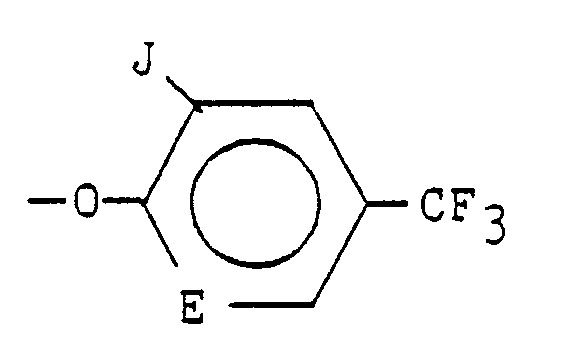
A, B, and D each independently represent H, CH₃, F, Cl or Br. - Suitable examples of the benzoyl phenyl urea series compound used in the present invention include, for example, 1-[3,5-dichloro-4-(1,1,2,2-tetrafluoroethoxy)phenyl]-3-(2,6-difluorobenzoyl)urea, 1-[3,5-dichloro-4-(3-chloro-5-trifluoromethyl-2-pyridyloxy)phenyl]-3-(2,6-difluorobenzoyl)urea (chlorofluazuron), 1-(3,5-dichloro-2-4-difluorophenyl)-3-(2,6-difluorobenzoyl)urea (teflubenzuron), 1-( 4-chlorophenyl)-3-(2,6-difluorobenzoyl)urea (diflubenzuron), 1-(4-trifluoromethoxyphenyl)-3-(2-chlorobenzoyl)urea (triflumuron) and 1-[2-fluoro-4-(2-chloro-4-trifluoromethylphenoxy)phenyl]-3-(2,6-difluorobenzoyl)urea (flufenoxuron) and mixtures thereof.
- The organic solvents advantageously used in the present invention include alcohols such as methyl alcohol, ethyl alcohol, isopropyl alcohol and ethylene glycol, ketones such as acetone, methyl ethyl ketone and cyclohexanone, ethers such as dioxane and tetrahydrofuran, aliphatic hydrocarbons such as cyclohexane, solvent naphtha and kerosene, aromatic hydrocarbons such as xylene, trimethylbenzene, tetramethylbenzene, halogenated hydrocarbons such as chloroform, chlorobenzene, tetrachloromethane and dichloromethane, esters such as glycerol esters of fatty acids, nitriles such as acetonitrile, highly polar solvents such as N-methyl-2-pyrrolidone, dimethyl sulfoxide and dimethylformamide and mixtures thereof. In some cases, epoxidized plant oils such as epoxidized soybean oil and epoxidized coconut oil can be used. Examples of preferred solvents include easily volatile solvents such as acetone, dichloromethane, chloroform or methyl alcohol and almost non-volatile solvents such as N-methyl-2-pyrrolidone, cyclohexanone or dimethylformamide. Suitable solvents generally dissolve acylurea insecticides to the extent of at least about five percent and are unreactive toward them. The active ingredient and the solvent are generally mixed in quantities which provide a weight ratio of active ingredient to solvent of from 0.01 to 100, more suitably from 0.05 to 50, most suitably from 0.1 to 10.
- After a part or all of the active ingredient has been dissolved in an organic solvent as mentioned above, a surface active agent and a carrier (diluent) are generally added to the solution. Anionic surface active agents of the sulfate and sulfonate types are typically used as the surface active agent. Alternately, a polyoxyethylene type non-ionic surface active agent, a water-soluble polymeric substance or a polyoxyethylene ether phosphate type anionic surface active agents can be used. The sulfate type anionic surface active agents include, for example, alkyl sulfate salts having 12 to 18 carbon atoms, polyoxyethylene C₈₋₁₂ alkyl phenyl ether sulfate salts, polyoxyethylene C₁₂₋₁₈ ether sulfate salts, and polyoxyethylene/poly-oxypropylene block polymer sulfate salts. In these salts, K, Na, NH₄ and aminium salts can be mentioned as the cation. The sulfonate type surface active agents include, for example, dodecylbenzenesulfonates (Na, NH₄ and aminium salts), mono- and di-alkyl (having 4 carbon atoms) naphthalenesulfonates (Na and NH₄ salts) naphthalenesulfonate (Na salt)/formalin condensates, dialkyl (having 6 to 8 carbon atoms) sulfosuccinates (Na salt), and ligninsulfonates (Na and Ca salts). The non-ionic surface active agents include, for example, polyoxyethylene nonylphenyl ether, polyoxyethylene styryl (or benzyl) phenyl ether, polyoxyethylene sorbitan alkylates, and esters of polyoxyethylene fatty acid having 12 to 18 carbon atoms. As polymeric substances, there can be mentioned polyvinyl alcohol, carboxymethyl cellulose, starch, alginates, and polyacrylic acid salts of Na and amines. Cationic surface active agents and amphoteric surface active agents can be used if desired.
- Suitable carriers (diluents) include, for example, plant powders such as soybean powder and wheat flour, mineral powders such as as diatomaceous earth, apatite, gypsum, talc, bentonite, clay, kaolin, calcium carbonate, montmorillonite, feldspar and quartz, and organic and inorganic compounds such as sodium benzoate, urea, Glauber salt, alumina, precipitated silica, (sometimes described as white carbon) and mixtures thereof.
- Adjuvants other than the carrier that are customarily used in the field of agricultural chemicals can be appropriately incorporated so as to enhance the pesticidal effect as desired. Examples of such adjuvants include a spreading agent, an emulsifier, a decomposition-prevention agent, a solidification-preventing agent and an activity-increasing agent, such as soybean lecithin. Moreover, another agricultural chemical such as an insecticide, an acaricide, a nematicide, a fungicide, an anti-viral agent, an insect attractant, a herbicide and a plant growth regulator, can be used in combination with the active ingredient if desired. An enhanced effect can sometimes be obtained in this case. The amount of the adjuvant or the other agricultural chemical used varies dependent on the kind of adjuvant or agricultural chemical, and can easily be determined by a person skilled in the art.
- Examples of the insecticides, acaricides or nematicides advantageously employed include organic phosphoric acid ester compounds such as O-(4-bromo-2-chlorophenyl) O-ethyl S-propyl phosphorothioate, 2,2-dichlorovinyl dimethyl phosphate, ethyl 3-methyl-4-methylthiophenyl isopropylphosphoramidate, O,O-dimethyl O-4-nitro-m-tolyl phosphorothioate, O-ethyl O-4-nitrophenyl phenylphosphonothioate, O,O-diethyl O-2-isopropyl-6-methylpyrimidine-4-yl phosphorothioate, O,O-dimethyl O-(3,5,6-trichloro-2-pyridyl) phosphorothioate, O,S-dimethyl acetylphoroamido-thioate and O-(2,4-dichlorophenyl) O-ethyl S-propyl phosphordithioate; carbamate compounds such as 1-naphthyl methylcarbamate, 2-isopropoxyphenyl methylcarbamate, 2-methyl-2-methylthiopropionaldehyde O-methylcarbamoyloxime, 2,3-dihydro-2,2-dimethylbenzofuran-7-yl methylcarbamate, dimethyl N,N-(thiobis[(methylimino)carbonyloxy])ethaneimidothioate, S-methyl-N-(methylcarbamoyloxy) thioacetoimidate, N,N-dimethylcarbamoyloxyimino-2-(methylthio)acetamide, 2-(ethylthiomethyl)phenyl methylcarbamate, 2-dimethylamino-5,6-dimethylpyridin-4-yl dimethylcarbamate and S,S′-2-dimethylaminotrimethylene bisthiocarbamate; organic chlorine compounds such as 2,2,2-trichloro-1,1-bis(4-chlorophenyl)ethanol and 4-chlorophenyl 2,4,5-trichlorophenyl sulfone; organic metal compounds such as tricyclohexyl tin hydroxide; pyrethroid compounds such as (RS)-α-cyano-3-phenoxy-benzyl (RS)2-(4-chlorophenyl)-3-methyl butyrate, 3-phenoxybenzyl (1RS)cis,trans-3-(2,2-dichlorovinyl)-2,2-dimethylcyclopropanecarboxylate, (RS)-α-cyano-3-phenoxybenzyl (1RS)cis,trans-3-(2,2-dichlorovinyl)-2,2-dimethylcyclopropanecarboxylate, (S)-α-cyano-3-phenoxybenzyl (1R)cis-3-(2,2-dibromovinyl)-2,2-dimethylcyclopropanecarboxylate, (RS)-α-cyano-3-phenoxybenzyl (1RS)cis,trans-3-(2-chloro-3,3,3-trifluoropropenyl)-2,2-dimethylcyclopropanecarboxylate and 4-methyl-2,3,5,6-tetrafluorobenzyl 3-(2-chloro-3,3,3-trifluoro-1-propen-1-yl)-2,2-dimethylcyclopropanecarboxylate; such compounds as 2-tert-butylimino-3-isopropyl-5-phenyl-3,4,5,6-tetrahydro-2H-1,3,5-thiazine-4-one, trans-5-(4-chlorophenyl)-N-cyclohexyl-4-methyl-2-oxothiazolidinone-3-carboxamide, N-methyl-bis(2,4-xylyliminomethyl)amine and N′-(4-chloro-o-tolyl)-N,N-dimethylformamide; juvenile hormone-like compounds such as isopropyl (2E,4E)-11-methoxy-3,7,11-trimethyl-2,4-dodecadienoate, and other compounds much as dinitro compounds, organic sulfur compounds, urea compounds and triazine compounds. Moreover, agricultural chemical microorganisms, such as BT agents, and insect pathogenic virus inhibitors can be used in combination with other argicultural chemicals.
- Examples of the fungicides are organic phosphoric compunds such as S-benzyl O,O-diisopropyl phosphorothioate, O-ethyl S,S-diphenyl phosphorodithioate and aluminum ethyl hydrogen phosphate; organic chlorine compounds such as 4,5,6,7-tetrachlorophthalide and tetrachloroisophthalonitrile; dithiocarbamate compounds such as manganese ethylenebis(dithiocarbamate) polymer, zinc ethylenebis(dithiocarbamate) polymer, zinc-manganese ethylenebis(dithiocarbamate) compounds, zinc bis(dimethyldithiocarbamate) and zinc propylene-bis(dithiocarbamate) polymer; N-halogenothioalkyl compounds such as 3a,4,7,7a-tetrahydro-N-(trichloromethanesulfenyl)phthalimide, 3a,4,7,7a-tetrahydro-N-(1,1,2,2,-tetrachloroethanesulfenyl)phthalimide and N-(trichloromethylsulfenyl)phthalimide; dicarboxyimide compounds such as 3-(3,5-dichlorophenyl)-N-isopropyl-2,4-dioxoimidazolidine-1-carboxamide, (RS)-3-(3,5-dichlorophenyl)-5-methyl-5-vinyl-1,3-oxazolidine-2,4-dione and N-(3,5-dichlorophenyl)-1,2-dimethylcyclopropane-1,2-dicarboximide; benzimidazole compounds such as methyl-1-(butylcarbamoyl)benzimidazol-2-yl carbamate and dimethyl 4,4′-(o-phenylene)-bis(3-thioallophanate); azole compounds such as 1-(4-chlorophenoxy)-3,3-dimethyl-1-(1H-1,2,4-triazol-1-yl)butanone, 1-(biphenyl-4-yloxy)-3,3-dimethyl-1-( 1H-1,2,4-triazol-1-yl)butane-2-ol, 1-[N-(4-chloro-2-trifluoromethyl phenyl)-2-propoxyacetoimidoyl]imidazole, 1-[2-(2,4-dichlorophenyl)-4-ethyl-1,3-dioxolane-2-ylmethyl]-1H-1,2,4-triazole, 1-[2-(2,4-dichlorophenyl)-4-propyl-1,3-dioxalan-2-ylmethyl]-1H-1,2,4-triazole and 1-[2-(2,4-dichlorophenyl)pentyl]-1H-1,2,4-triazole; carbinol compounds such as 2,4′-dichloro-α-(pyrimidin-5-yl)benzhydryl alcohol and (±)2,4′-difluoro-α-(1H-1,2,4-triazole-1-ylmethyl)benzhydryl alcohol; benzanilide compounds such as 3′-isopropoxy-o-toluanilide and α,α,α-trifluoro-3′-isopropoxy-o-toluanilide; acylalanine compounds such as methyl N-(2-methyoxyacetyl)-N-(2,6-xylyl)-DL-alaninate; pyridinamine compounds such as 3-chloro-N-(3-chloro-2,6-dinitro-4-α,α,α-trifluorotolyl)-5-trifluoromethyl-2-pyridinamine; and other compounds such as piperazine compounds, morpholine compounds, anthraquinone compounds, quinoxaline compounds, crotonic acid compounds, sulfenic acid compounds, urea compounds and antibiotic substances.
- The active pesticidal ingredient is generally incorporated in the formulation an amount of 5 to 80 percent, preferably 5 to 40 percent, based on the total weight of the water-dispersible pesticide. A preferred amount of the organic solvent is 1/10 to 10 times the amount of the active pesticidal ingredient.
- The water-dispersible pesticide formulation of the present invention can easily be prepared by utilizing existing equipment in the art. For example, powder components such as the carrier and surface active agent are charged into a ribbon type mixer or a screw type mixer, and a mixture formed by dissolving a part or all of the active pesticidal ingredient in the organic solvent is added and mixed with the carrier and the like at a temperature of from 20 to 100°C, more preferably from 30 to 80°C. To uniformly mix the components, the mixture is next disintegrated by passing it through a pulverizer such as a hammer mill, a pin mill or a jet-o-mizer. The pulverization product is typically uniformly mixed again with the ribbon type or screw type mixer to obtain the intended water-dispersible pesticide. If a high-speed rotary vane mixer such as a juice mixer type blender or a Henschel mixer is used, the mixing/pulverizing/mixing process as mentioned above can be accomplished in one apparatus merely by adjusting the stirring speed.
- The water-dispersible pesticide formulations of the present invention will now be described with reference to the following examples, comparative examples and experiments. These examples are illustrative and should not be construed as limiting. Unless otherwise specified, all of "parts" and "percent" in these examples are by weight.
- In 20 parts of N-methyl-2-pyrrolidone heated at 40°C was dissolved 15 parts of 1-[3,5-dichloro-4-(1,1,2,2-tetrafluoroethoxy)phenyl]-3-(2,6-difluorobenzoyl)urea. Thereafter 25 parts of precipitated silica, 3 parts of polyoxyethylene alkylphenyl ether sulfate salt (Dixsol WR™ supplied by Dai-Ichi Kogyo), 2 parts of lignin-sulfonate salt (San-X P252™ supplied by Sanyo Kokusaku Pulp), 10 parts of diatomaceous earth and 25 parts of clay were incorporated in the solution. The mixture was finely pulverized by a jet-o-mizer to obtain a wettable powder.
- In 15 parts of cyclohexanone heated at 40°C was dissolved 10 parts of 1-[3,5-dichloro-4-(1,1,2,2-tetrafluoroethoxy)phenyl]-3-(2,6-difluorobenzoyl)urea, and, thereafter, 20 parts of precipitated silica, 3 parts of polyoxyethylene nonylphenyl ether (Newcol 564™ supplied by Nippon Nyukazai), 2 parts of San-X P252, 5 parts of soybean lecithin, 5 parts of diatomaceous earth and 40 parts of clay were incorporated in the solution. The mixture was finely pulverized by a jet-o-mizer to obtain a wettable powder.
- Fifteen parts of 1-[3,5-dichloro-4-(1,1,2,2-tetrafluoroethoxy)phenyl]-3-(2,6-difluorobenzoyl)urea was dissolved in acetone in an amount 8 times the amount of the active ingredient, and 10 parts of precipitated silica, 4 parts of ammonium polyoxyethylene alkylaryl ether sulfate (Agrysol W-150™ supplied by Kao), 2 parts of lignin-sulfonate salt (San-X P-201™ supplied by Sanyo Kokusaku Pulp) and 69 parts of clay were incorporated in the solution. The acetone was removed by volatilization in a rotary evaporator and the residue was uniformly mixed and pulverized by a hammer type pulverizer to obtain a wettable powder.
- Fifteen parts of 1-[3,5-dichloro-4-(1,1,2,2-tetrafluoroethoxy)phenyl]-3-(2,6-difluorobenzoyl)urea was dissolved in dichloromethane in an amount 10 times the amount of the active ingredient, and, thereafter, 10 parts of precipitated silica, in parts of alkylaryl sulfonate (Lunox P65-L™ supplied by Toho Kagaku), 2 parts of San-X P201, and 69 parts of clay were incorporated in the solution. Dichlorometnane was volatilized by a rotary evaporator and the residue was uniformly mixed and pulverized by a hammer type pulverizer to obtained a wettable powder.
- In 15 parts of N-methyl-2-pyrrolidone was dissolved 10 parts of 1-[3,5-dichloro-4-(3-chloro-5-trifluoromethyl-2-pyridyloxy)phenyl]-3-(2,6-difluorobenzoyl)urea at an elevated temperature of 40°C, and, thereafter, 15 parts of precipitated silica, 4 parts of naphthalene-sulfonate/formalin condensate (Demoul N™ supplied by Kao), 3 parts of polyoxyethylene nonylphenyl ether (New Calgen 405H™ supplied by Takemoto Yushi), 20 parts of diatomaceous earth and 33 parts of clay were incorporated and uniformly mixed into the solution. The blend was pulverized and mixed by a high-speed rotary vane type mixer (juice mixer type blender) to obtain a wettable powder.
- Ten parts of 1-[3,5-dichloro-4-(3-chloro-5-trifluoromethyl-2-pyridyloxy)phenyl]-3-(2,6-difluorobenzoyl)urea was dissolved in methyl alcohol in an amount 6 times the amount of the active ingredient at an elevated temperature of 40°C, and, thereafter, 10 parts of precipitated silica, 3 parts of an anionic surface active agent (Detergent NO6F™ supplied by Kao), 2 parts of San-X P252, 10 parts of diatomaceous earth and 65 parts of clay were incorporated in the solution. Methyl alcohol was volatilized by a rotary evaporator, and the residue was uniformly mixed and pulverized and by a high-peed rotary vane type mixer (juice mixer type blender) to obtain a wettable powder.
- Ten parts of 1-(3,5-dichloro-2,4-difluorophenyl)-3-(2,6-difluorobenzoyl)urea was dissolved in chloroform in an amount 8 times the amount of the active ingredient at an elevated temperature of 40°C, and, thereafter, 10 parts of precipitated silica, in parts of naphthalene-sulfonate/formalin condensate (Demoul T™ supplied by Kao), 3 parts of phenylphenol sulfonate/formalin condensate (New Calgen 9131™ supplied by Takemoto Yushi), 20 parts of diatomaceous earth and 53 parts of clay were incorporated into the solution. Chloroform was volatilized by a rotary evaporator and the residue was uniformly mixed and finely pulverized by a jet-o-mizer to obtain a wettable powder.
- In 20 parts of dimethylformamide was dissolved 10 parts of 1-(3,5-dichloro-2,4-difluorophenyl)-3-(2,6-difluorobenzoyl)urea at an elevated temperature of 50°C and 25 parts of precipitated silica, 4 parts of polyoxyethylene alkylphenyl ether sulfate salt (Dixsol W-66™ supplied by Dai-Ichi Kogyo), 2 parts of San-X P252, 10 parts of diatomaceous earth and 29 parts of clay were incorporated and uniformly mixed into the solution. The mixture was finely pulverizer by a jet-o-mizer to obtained a wettable powder.
- Thirty parts of 1-(4-chlorophenyl)-3-(2,6-difluorobenzoyl)urea was partially dissolved in 20 parts of N-methyl-2-pyrrolidone at an elevated temperature of 40°C, and, thereafter, 20 parts of precipitated silica, in parts of sodium lauryl sulfate (Emal 10 powder™ supplied by Kao), 2 parts of special aromatic sulfonic acid/formalin condensate (Demoul™ MS supplied by Kao), 10 parts of diatomaceous earth and 14 parts of clay were incorporated and uniformly mixed into the solution. The mixture was pulverized by a hammer type pulverizer to obtain a wettable powder.
- Forty parts of 1-(4-trifluoromethoxyphenyl)-3-(2-chlorobenzoyl)urea was partially dissolved in dichloromethane in an amount 5 times the amount of the active ingredient at an elevated temperature of 40°C, and, thereafter, 5 parts of precipitated silica, 3 parts of alkyl sulfate (Sorpol 8070™ supplied by Toho Kogaku), 2 parts of San-X P201 and 50 parts of clay were incorporated in the solution. Dichloromethane was removed by volatilization in a rotary evaporator. The residue was uniformly mixed and the mixture was pulverized by a hammer type pulverizer to obtain a wettable powder.
- In 25 parts of N-methyl-2-pyrrolidone was dissolved 10 parts of 1-[2-fluoro-4-(2-chloro-4-trifluoromethylphenoxy)phenyl]-3-(2,6-difluorobenzoyl)urea at an elevated temperature of 40°C, and, thereafter, 25 parts of precipitated silica, 4 parts of polyoxyethylene alkylphenyl ether ester salt (Dixsol WA™ supplied by Dai-Ichi Kogyo), 2 parts of naphthalene-sulfonic acid/formalin condensate (Demoul N™ supplied by Kao), in parts of soybean lecithin and 30 parts of diatomaceous earth were incorporated and uniformly mixed into the solution. The mixture was finely pulverized by a jet-o-mizer to obtain a wettable powder.
- A wettable powder was prepared in the same manner as described in Example 1 except that 45 parts of clay was used instead of N-methyl-2-pyrrolidone.
- A wettable powder was prepared in the same manner as described in Example 2 except that 55 parts of clay was used instead of cyclohexanone.
- A wettable powder was prepared in the same manner as described in Example 3 except that acetone was not used.
- A wettable powder was prepared in the same manner as described in Example 4 except that dichloromethane was not used.
- A wettable powder was prepared in the same manner as described in Example 5 except that N-methyl-2-pyrrolidone clay was not used and the amount of clay was changed to 48 parts.
- A wettable powder was prepared in the same manner as described in Example 10 except that dichloromethane was not used.
- A wettable powder was prepared in the same manner as described in Example 6 except that methyl alcohol was not used.
- A wettable powder was prepared in the same manner as described in Example 7 except that chloroform was not used.
- A wettable powder was prepared in the same manner as described in Example 8 except that dimethylformamide was not used and the amount of clay was changed to 49 parts.
- A wettable powder was prepared in the same manner as described in Example 9 except that N-methyl-2-pyrrolidone was not used and the amount of clay was changed to 34 parts.
- A wettable powder was prepared in the same manner as described in Example 10 except that dichloromethane was not used.
- A wettable powder was prepared in the same manner as described in Example 11 except that N-methyl-2-pyrrolidone was not used and the amount of diatomaceous earth was changed to 55 parts.
- Each of the wettable powders obtained in Examples 1, 2, 3 and 4 and Comparative Examples 1, 2, 3 and 4 was diluted with water. Cabbage leaves were immersed in each chemical liquid, and the leaves were air-dried and placed in an individual polyvinyl chloride resin cups. Then, 4th-instar larvae of diamondback moth were set free in each cup. The cups were placed in a chamber maintained at a temperature of 25°C and a relative humidity of 65 percent, and after 10 days, the number of insects emerging was examined. Five larvae were set free in each test cup, and 20 larvae were tested with respect to each concentration.
- The results are shown in Table 1.
Table 1 Wettable Powder Tested Concentration (ppm) Number of Emerging Insects wettable powder obtained in Example 1 5 0 0.5 0 wettable powder obtained in Example 2 5 0 0.5 0 wettable powder obtained in Example 3 5 0 0.5 1 wettable powder obtained in Example 4 5 0 0.5 1 wettable powder obtained in Comparative Example 1 5 0 0.5 2 wettable powder obtained in Comparative Example 2 5 0 0.5 2 wettable powder obtained in Comparative Example 3 5 0 0.5 3 wettable powder obtained in Comparative Example 4 5 0 0.5 3 untreated control section - 20 - Each of the wettable powders obtained in Examples 5, 6, 7 and 8 and Comparative Examples 5, 6, 7 and 8 was diluted with water. Cabbage leaves were individually immersed for 60 seconds in each chemical liquid, air-dried and placed in a polyvinyl chloride resin cup. Five 3rd-instar larvae of tobacco cutworm were set free in each cup, and the cups were placed in a chamber maintained at a temperature of 25°C and a relative humidity of 65 percent. After 5 days, the control in percent was recorded.
- The results are shown in Table 2.
Table 2 Wettable Powder Tested Concentration (ppm) Control (%) after 5 Days wettable powder obtained in Example 5 5 100 0.5 90 wettable powder obtained in Example 6 5 100 0.5 85 wettable powder obtained in Example 7 5 100 0.5 85 wettable powder obtained in Example 8 5 100 0.5 85 wettable powder obtained in Comparative Example 5 5 100 0.5 50 wettable powder obtained in Comparative Example 6 5 100 0.5 45 wettable powder obtained in Comparative Example 7 5 100 0.5 45 wettable powder obtained in Comparative Example 8 5 100 0.5 30 untreated control section - 0 - Each of the wettable powders obtained in Examples 9, 10 and 11 and Comparative Examples 9, 10 and 11 was diluted with water. Rice seedlings were immersed for 60 seconds in each chemical liquid, air-dried, and placed in a polyvinyl chloride resin cup. Five 3rd-instar larvae were set free in each cup, and the cups were preserved in a chamber maintained at a temperature of 25°C and a relative humidity of 65 percent. After 5 days, the control percent was recorded.
- The results are shown in Table 3.
Table 3 Wettable Powder Tested Concentration (ppm) Control (%) after 5 Days wettable powder obtained in Example 9 10 100 1 75 wettable powder obtained in Example 10 10 100 1 80 wettable powder obtained in Example 11 10 100 1 70 wettable powder obtained in Comparative Example 9 10 95 1 20 wettable powder obtained in Comparative Example 10 10 90 1 25 wettable powder obtained in Comparative Example 11 10 90 1 15 untreated control section - 0
Claims (13)
1. A process for preparing a highly active water-dispersible pesticide which comprises dissolving at least a part of an insecticidally effective benzoyl phenyl urea series compound represented by the following formula:

wherein:
X represents Cl, F, Br or CF₃;
Y represents H, Cl, F or Br;
Z represents, Cl, F, Br, CN, CF₃, CHF₂, OCF₃, OCF₂H, SCF₃, OCF₂CHF₂, OCF₂CHFCl, OCF₂CHFBr or a substituent of the formula 
wherein E represents CH or N and J represents H, Cl, F, or Br; and
A, B, and D each independently represent H, CH₃, F, Cl or Br
in an organic solvent to obtain a mixture comprising a solution containing the insecticidal compound, combining the so obtained mixture with a carrier material, and pulverizing the combined mixture and carrier material.
X represents Cl, F, Br or CF₃;
Y represents H, Cl, F or Br;
Z represents, Cl, F, Br, CN, CF₃, CHF₂, OCF₃, OCF₂H, SCF₃, OCF₂CHF₂, OCF₂CHFCl, OCF₂CHFBr or a substituent of the formula
A, B, and D each independently represent H, CH₃, F, Cl or Br
in an organic solvent to obtain a mixture comprising a solution containing the insecticidal compound, combining the so obtained mixture with a carrier material, and pulverizing the combined mixture and carrier material.
2. A process of Claim 1 wherein the mixing and pulverizing steps are conducted at temperatures of from 20 to 100°C.
3. A process of Claim 1 wherein the insecticidal compound and the solvent are mixed in quantities which provide a weight ratio of active ingredient to solvent of from 0.01 to 100.
4. A process of Claim 1 wherein the benzoyl phenyl urea series compound is selected from 1-[3,5-dichloro-4-(1,1,2,2-tetrafluoroethoxy)phenyl]-3-(2,6-difluorobenzoyl)urea, 1-[3,5-dichloro-4-(3-chloro-5-trifluoromethyl-2-pyridyloxyl)phenyl]-3-(2,6-difluorobenzoyl)urea, 1-(3,5-dichloro-2,4-difluorophenyl)-3-(2,6-difluorobenzoyl)urea, 1-(4-chlorophenyl)-3-(2,6-difluorobenzoyl)urea, 1-(4-(trifluoromethoxyphenyl)-3-(2-chlorobenzoyl)urea and 1-[2-fluoro-4-(2-chloro-4-trifluoromethylphenoxy)phenyl]-3-(2,6-difluorobenzoyl)urea.
5. A process of Claim 1 wherein the carrier material is a plant powder, a mineral powder, an inorganic compound, an organic compound or a mixture thereof.
6. A process of Claim 5 wherein the carrier material is a soybean powder, wheat flour, diatomaceous earth, apatite, gypsum, talc, bentonite, clay, kaolin, calcium carbonate, montmorillonite, feldspar, quartz, sodium benzoate, urea, Glauber salt, alumina, precipitated silica or a mixture thereof.
7. A process of Claim 1 wherein the solvent is selected from alcohols, ketones, ethers, aliphatic hydrocarbons, aromatic hydrocarbons, halogenated hydrocarbons, esters, nitriles, highly polar solvents, epoxidized plant oils, epoxidized coconut oil and mixtures thereof.
8. A process of Claim 7 wherein the solvent is acetone, dichloromethane, chloroform, methyl alcohol, N-methyl-2-pyrrolidone, cyclohexanone or dimethylformamide.
9. A process of Claim 1 which further comprises adding a surface active agent to the mixture of the insecticidal compound and carrier material.
10. A process of Claim 9 wherein the surface active agent is selected from a sulfate or sulfonate type anionic surface active agent, polyoxyethylene type non-ionic surface active agent, a water-soluble polymeric substance and a polyoxyethylene ether phosphate type anionic surface active agent.
11. A process of Claim 1 which further comprises adding an adjuvant selected from a spreading agent, an emulsifier, a decomposition-preventing agent, a solidification-preventing agent, an activity-increasing agent and a mixture thereof to the mixture of the insecticidal compound and carrier material.
12. A process of Claim 1 which further comprises adding an agricultural chemical selected from an insecticide, an acaricide, a nematicide, a fungicide, an anti-viral agent, an insect attractant, a herbicide, a plant growth regulator and a mixture thereof to the mixture of the insecticidal compound and carrier material.
13. A process of Claim 9 wherein the insecticidal compound is 1-[3,5-dichloro-4-(1,1,2,2-tetrafluoroethoxy)phenyl]-3-(2,6-difluorobenzoyl)urea, the carrier is precipitated silica and the surface active agent is a sulfate type anionic surface active agent.
Applications Claiming Priority (2)
| Application Number | Priority Date | Filing Date | Title |
|---|---|---|---|
| JP63168672A JP2661709B2 (en) | 1988-07-08 | 1988-07-08 | Production method of highly active pesticide wettable powder |
| JP168672/88 | 1988-07-08 |
Publications (2)
| Publication Number | Publication Date |
|---|---|
| EP0349999A2 true EP0349999A2 (en) | 1990-01-10 |
| EP0349999A3 EP0349999A3 (en) | 1991-04-17 |
Family
ID=15872351
Family Applications (1)
| Application Number | Title | Priority Date | Filing Date |
|---|---|---|---|
| EP19890112233 Withdrawn EP0349999A3 (en) | 1988-07-08 | 1989-07-05 | Process for preparing highly active water-dispersible pesticides |
Country Status (7)
| Country | Link |
|---|---|
| US (1) | US5264213A (en) |
| EP (1) | EP0349999A3 (en) |
| JP (1) | JP2661709B2 (en) |
| AU (1) | AU617196B2 (en) |
| CA (1) | CA1334629C (en) |
| EG (1) | EG19679A (en) |
| NZ (1) | NZ229803A (en) |
Cited By (2)
| Publication number | Priority date | Publication date | Assignee | Title |
|---|---|---|---|---|
| EP0757891A3 (en) * | 1990-08-24 | 1997-06-04 | Bayer Ag | Solid formulations |
| WO2003049540A1 (en) * | 2001-12-12 | 2003-06-19 | Makhteshim Chemical Works Ltd. | Water dispersible granules containing benzoylphenylurea pesticides |
Families Citing this family (21)
| Publication number | Priority date | Publication date | Assignee | Title |
|---|---|---|---|---|
| ZA938081B (en) * | 1992-10-30 | 1995-05-02 | Basf Corp | Granular water soluble or hygroscopic agricultural formulations and methods of making them |
| US5476833A (en) * | 1994-05-13 | 1995-12-19 | Fersch; Kenneth E. | Water dispersible agricultural chemical granules coated with thin PVA film to reduce/eliminate container residue |
| AUPM926794A0 (en) * | 1994-11-04 | 1994-12-01 | Daratech Pty Ltd | Herbicidal formulations |
| WO1996025918A1 (en) * | 1995-02-24 | 1996-08-29 | Nanosystems L.L.C. | Aerosols containing nanoparticle dispersions |
| CA2149164C (en) * | 1995-05-11 | 2009-03-03 | Zlatko Korunic | Diatomaceous earth insecticidal composition |
| WO1997046093A1 (en) * | 1996-06-07 | 1997-12-11 | Nippon Soda Co., Ltd. | Granular hydrating agent |
| PT936860E (en) * | 1996-10-25 | 2002-07-31 | Monsanto Technology Llc | COMPOSITION AND METHOD FOR TREATING PLANTS WITH EXOGENEOUS CHEMICALS |
| ES2182048T3 (en) | 1996-10-25 | 2003-03-01 | Monsanto Technology Llc | COMPOSITION AND PROCEDURE TO TREAT PLANTS WITH EXOGENOUS CHEMICAL SUBSTANCES. |
| US8236352B2 (en) | 1998-10-01 | 2012-08-07 | Alkermes Pharma Ireland Limited | Glipizide compositions |
| AU6283299A (en) * | 1998-10-01 | 2000-04-17 | Elan Pharma International Limited | Controlled release nanoparticulate compositions |
| US20080213378A1 (en) * | 1998-10-01 | 2008-09-04 | Elan Pharma International, Ltd. | Nanoparticulate statin formulations and novel statin combinations |
| US8293277B2 (en) | 1998-10-01 | 2012-10-23 | Alkermes Pharma Ireland Limited | Controlled-release nanoparticulate compositions |
| US7521068B2 (en) | 1998-11-12 | 2009-04-21 | Elan Pharma International Ltd. | Dry powder aerosols of nanoparticulate drugs |
| US6428814B1 (en) * | 1999-10-08 | 2002-08-06 | Elan Pharma International Ltd. | Bioadhesive nanoparticulate compositions having cationic surface stabilizers |
| US6969529B2 (en) * | 2000-09-21 | 2005-11-29 | Elan Pharma International Ltd. | Nanoparticulate compositions comprising copolymers of vinyl pyrrolidone and vinyl acetate as surface stabilizers |
| US6656504B1 (en) | 1999-09-09 | 2003-12-02 | Elan Pharma International Ltd. | Nanoparticulate compositions comprising amorphous cyclosporine and methods of making and using such compositions |
| US7198795B2 (en) | 2000-09-21 | 2007-04-03 | Elan Pharma International Ltd. | In vitro methods for evaluating the in vivo effectiveness of dosage forms of microparticulate of nanoparticulate active agent compositions |
| US20030129242A1 (en) * | 2002-01-04 | 2003-07-10 | Bosch H. William | Sterile filtered nanoparticulate formulations of budesonide and beclomethasone having tyloxapol as a surface stabilizer |
| AU2003230691A1 (en) * | 2002-03-20 | 2003-10-08 | Elan Pharma International Ltd. | Nanoparticulate compositions of angiogenesis inhibitors |
| RU2409953C1 (en) * | 2007-01-22 | 2011-01-27 | Ачер-Дэниелс-Мидленд Компани | Water-dispersible compositions containing naturally occurring nematicide, lecithin and co-surfactant |
| US20180153159A1 (en) | 2015-05-22 | 2018-06-07 | Akzo Nobel Chemicals International B.V. | Fatty nitrile solvents for agricultural formulations |
Family Cites Families (16)
| Publication number | Priority date | Publication date | Assignee | Title |
|---|---|---|---|---|
| FR1573875A (en) * | 1967-12-13 | 1969-07-11 | ||
| US3989842A (en) * | 1970-05-15 | 1976-11-02 | U.S. Philips Corporation | Certain substituted benzoyl urea insecticides |
| US3989942A (en) * | 1974-12-13 | 1976-11-02 | International Telephone And Telegraph Corporation | Retro-reflecting laser responser and data modulator |
| DE2601780B2 (en) * | 1976-01-20 | 1979-07-26 | Bayer Ag, 5090 Leverkusen | N-phenyl-N'-benzoylureas, process for their preparation and their use as insecticides |
| USRE32418E (en) * | 1977-05-13 | 1987-05-12 | The Dow Chemical Company | Substituted(((phenyl)amino)carbonyl)-benzamides |
| US4170657A (en) * | 1977-05-13 | 1979-10-09 | The Dow Chemical Company | Substituted(((phenyl)amino)carbonyl)-benzamides |
| DE2726684A1 (en) * | 1977-06-14 | 1979-01-04 | Hoechst Ag | Insecticidal di:halo-benzoyl-phenylurea derivs. - useful for plant protection or textile preservation |
| DE2801316A1 (en) * | 1978-01-13 | 1979-07-19 | Bayer Ag | SUBSTITUTED N-PHENYL-N '- (2-CHLORINE-6-FLUORO-BENZOYL) UREAS, METHOD FOR THEIR PRODUCTION AND THEIR USE AS INSECTICIDES |
| EP0004030B1 (en) * | 1978-03-13 | 1981-12-30 | Ciba-Geigy Ag | Substituted n-phenyl-n'-fluorbenzoyl ureas, methods for their preparation and their use in combating pests |
| DE3161657D1 (en) * | 1980-11-22 | 1984-01-19 | Celamerck Gmbh & Co Kg | Urea derivatives, preparation and use |
| US4452631A (en) * | 1981-07-06 | 1984-06-05 | Eli Lilly And Company | Urea herbicides |
| US4468405A (en) * | 1981-07-30 | 1984-08-28 | The Dow Chemical Company | Substituted N-aroyl N'-phenyl urea compounds |
| GB8308749D0 (en) * | 1983-03-30 | 1983-05-11 | Dow Chemical Co | Emulsifiable concentrate formulations of pesticides |
| JPS60193960A (en) * | 1984-03-15 | 1985-10-02 | Ishihara Sangyo Kaisha Ltd | N-benzoyl-n'-phenylurea compound and insecticide containing same |
| JPS62155248A (en) * | 1985-12-27 | 1987-07-10 | Ishihara Sangyo Kaisha Ltd | N-benzoyl-n'-phenylurea compound and insecticide containing same |
| EP0231152A3 (en) * | 1986-01-30 | 1988-10-05 | Ciba-Geigy Ag | Phenylbenzoyl ureas |
-
1988
- 1988-07-08 JP JP63168672A patent/JP2661709B2/en not_active Expired - Lifetime
-
1989
- 1989-07-04 NZ NZ229803A patent/NZ229803A/en unknown
- 1989-07-05 EP EP19890112233 patent/EP0349999A3/en not_active Withdrawn
- 1989-07-07 AU AU37953/89A patent/AU617196B2/en not_active Ceased
- 1989-07-07 CA CA000605043A patent/CA1334629C/en not_active Expired - Fee Related
- 1989-07-07 US US07/377,026 patent/US5264213A/en not_active Expired - Fee Related
- 1989-07-09 EG EG32989A patent/EG19679A/en active
Cited By (2)
| Publication number | Priority date | Publication date | Assignee | Title |
|---|---|---|---|---|
| EP0757891A3 (en) * | 1990-08-24 | 1997-06-04 | Bayer Ag | Solid formulations |
| WO2003049540A1 (en) * | 2001-12-12 | 2003-06-19 | Makhteshim Chemical Works Ltd. | Water dispersible granules containing benzoylphenylurea pesticides |
Also Published As
| Publication number | Publication date |
|---|---|
| CA1334629C (en) | 1995-03-07 |
| AU617196B2 (en) | 1991-11-21 |
| AU3795389A (en) | 1990-01-11 |
| EP0349999A3 (en) | 1991-04-17 |
| JP2661709B2 (en) | 1997-10-08 |
| US5264213A (en) | 1993-11-23 |
| EG19679A (en) | 1995-12-31 |
| NZ229803A (en) | 1991-11-26 |
| JPH0219307A (en) | 1990-01-23 |
Similar Documents
| Publication | Publication Date | Title |
|---|---|---|
| US5264213A (en) | Process for preparing highly active water-dispersible pesticides | |
| CA1241850A (en) | Process for selectively controlling weeds in crops of useful plants | |
| KR100545123B1 (en) | Herbicidal composition | |
| CS271471B2 (en) | Insecticide and acaricide and method of active substances production | |
| CH673557A5 (en) | ||
| KR920004981B1 (en) | Process for preparing organic phosphorus compound | |
| CN1069163C (en) | A herbicidal composition having a reduced phytotoxicity | |
| FI69626C (en) | ACYLUREOR VILKA AER ANVAENDBARA SOM INSEKTICIDER SAMT ETT FOERFARANDE FOER FRAMSTAELLNING AV DEM | |
| HU181443B (en) | Herbicide composition containing two components with synergetic activity | |
| RU2083562C1 (en) | Pyridine derivatives, process for preparation thereof, insecticidal composition | |
| CA1126287A (en) | Substituted benzoylimidates, their preparation and compositions comprising them for insecticidal use | |
| US5256674A (en) | Imidazolidine derivatives, process for producing the same and pesticides containing the same | |
| US4200653A (en) | Insecticidal compound and method of use | |
| KR100446837B1 (en) | Method for producing pesticide-containing granular fertilizer composition | |
| JPH01319467A (en) | Benzoisothiazole based compound, production thereof and insecticide containing the same | |
| JPH02207066A (en) | Hydrazine-based compound, production thereof and controller against harmful animal containing same | |
| JPH026496A (en) | Organic phosphoric acid amide compound, its production and harmful animal-controlling agent containing the same compound | |
| JPH0320201A (en) | Production of highly active agricultural chemical dust | |
| JPS62155260A (en) | N-benzoyl-n'-pyridylurea and insecticide containing same | |
| PL152734B1 (en) | Insecticidal and saprophyticidal specific | |
| JPS62155248A (en) | N-benzoyl-n'-phenylurea compound and insecticide containing same | |
| JPS6348256A (en) | N-benzoyl-n'-phenylurea based compound and insecticide containing said compound | |
| JP3005300B2 (en) | Imidazolidine derivatives, their production methods and pesticidal agents containing them | |
| PL151683B1 (en) | Insecticide and/or acaricide | |
| JPH0586035A (en) | Selective pyrazoline insecticide and bactericide |
Legal Events
| Date | Code | Title | Description |
|---|---|---|---|
| PUAI | Public reference made under article 153(3) epc to a published international application that has entered the european phase |
Free format text: ORIGINAL CODE: 0009012 |
|
| AK | Designated contracting states |
Kind code of ref document: A2 Designated state(s): BE DE FR GB IT NL SE |
|
| PUAL | Search report despatched |
Free format text: ORIGINAL CODE: 0009013 |
|
| AK | Designated contracting states |
Kind code of ref document: A3 Designated state(s): BE DE FR GB IT NL SE |
|
| STAA | Information on the status of an ep patent application or granted ep patent |
Free format text: STATUS: THE APPLICATION HAS BEEN WITHDRAWN |
|
| RAP1 | Party data changed (applicant data changed or rights of an application transferred) |
Owner name: DOWELANCO |
|
| 18W | Application withdrawn |
Withdrawal date: 19910830 |