EP0348252B1 - Procédé pour réduire le coefficient de frottement et l'usure entre une piéce métallique et une pièce à base d'un polymère ou copolymère organique et son application à des prothèses articulaires et des emboîtements travaillant dans des milieux marins - Google Patents
Procédé pour réduire le coefficient de frottement et l'usure entre une piéce métallique et une pièce à base d'un polymère ou copolymère organique et son application à des prothèses articulaires et des emboîtements travaillant dans des milieux marins Download PDFInfo
- Publication number
- EP0348252B1 EP0348252B1 EP89401418A EP89401418A EP0348252B1 EP 0348252 B1 EP0348252 B1 EP 0348252B1 EP 89401418 A EP89401418 A EP 89401418A EP 89401418 A EP89401418 A EP 89401418A EP 0348252 B1 EP0348252 B1 EP 0348252B1
- Authority
- EP
- European Patent Office
- Prior art keywords
- organic polymer
- copolymer
- wear
- reducing
- polyethylene
- Prior art date
- Legal status (The legal status is an assumption and is not a legal conclusion. Google has not performed a legal analysis and makes no representation as to the accuracy of the status listed.)
- Expired - Lifetime
Links
- 0 C*C(*C(C)C)[N+]([O-])=* Chemical compound C*C(*C(C)C)[N+]([O-])=* 0.000 description 1
Images

Classifications
-
- B—PERFORMING OPERATIONS; TRANSPORTING
- B29—WORKING OF PLASTICS; WORKING OF SUBSTANCES IN A PLASTIC STATE IN GENERAL
- B29C—SHAPING OR JOINING OF PLASTICS; SHAPING OF MATERIAL IN A PLASTIC STATE, NOT OTHERWISE PROVIDED FOR; AFTER-TREATMENT OF THE SHAPED PRODUCTS, e.g. REPAIRING
- B29C59/00—Surface shaping of articles, e.g. embossing; Apparatus therefor
- B29C59/16—Surface shaping of articles, e.g. embossing; Apparatus therefor by wave energy or particle radiation, e.g. infrared heating
-
- A—HUMAN NECESSITIES
- A61—MEDICAL OR VETERINARY SCIENCE; HYGIENE
- A61F—FILTERS IMPLANTABLE INTO BLOOD VESSELS; PROSTHESES; DEVICES PROVIDING PATENCY TO, OR PREVENTING COLLAPSING OF, TUBULAR STRUCTURES OF THE BODY, e.g. STENTS; ORTHOPAEDIC, NURSING OR CONTRACEPTIVE DEVICES; FOMENTATION; TREATMENT OR PROTECTION OF EYES OR EARS; BANDAGES, DRESSINGS OR ABSORBENT PADS; FIRST-AID KITS
- A61F2/00—Filters implantable into blood vessels; Prostheses, i.e. artificial substitutes or replacements for parts of the body; Appliances for connecting them with the body; Devices providing patency to, or preventing collapsing of, tubular structures of the body, e.g. stents
- A61F2/02—Prostheses implantable into the body
- A61F2/30—Joints
- A61F2/30767—Special external or bone-contacting surface, e.g. coating for improving bone ingrowth
-
- A—HUMAN NECESSITIES
- A61—MEDICAL OR VETERINARY SCIENCE; HYGIENE
- A61L—METHODS OR APPARATUS FOR STERILISING MATERIALS OR OBJECTS IN GENERAL; DISINFECTION, STERILISATION OR DEODORISATION OF AIR; CHEMICAL ASPECTS OF BANDAGES, DRESSINGS, ABSORBENT PADS OR SURGICAL ARTICLES; MATERIALS FOR BANDAGES, DRESSINGS, ABSORBENT PADS OR SURGICAL ARTICLES
- A61L27/00—Materials for grafts or prostheses or for coating grafts or prostheses
- A61L27/14—Macromolecular materials
-
- A—HUMAN NECESSITIES
- A61—MEDICAL OR VETERINARY SCIENCE; HYGIENE
- A61L—METHODS OR APPARATUS FOR STERILISING MATERIALS OR OBJECTS IN GENERAL; DISINFECTION, STERILISATION OR DEODORISATION OF AIR; CHEMICAL ASPECTS OF BANDAGES, DRESSINGS, ABSORBENT PADS OR SURGICAL ARTICLES; MATERIALS FOR BANDAGES, DRESSINGS, ABSORBENT PADS OR SURGICAL ARTICLES
- A61L27/00—Materials for grafts or prostheses or for coating grafts or prostheses
- A61L27/14—Macromolecular materials
- A61L27/16—Macromolecular materials obtained by reactions only involving carbon-to-carbon unsaturated bonds
-
- A—HUMAN NECESSITIES
- A61—MEDICAL OR VETERINARY SCIENCE; HYGIENE
- A61L—METHODS OR APPARATUS FOR STERILISING MATERIALS OR OBJECTS IN GENERAL; DISINFECTION, STERILISATION OR DEODORISATION OF AIR; CHEMICAL ASPECTS OF BANDAGES, DRESSINGS, ABSORBENT PADS OR SURGICAL ARTICLES; MATERIALS FOR BANDAGES, DRESSINGS, ABSORBENT PADS OR SURGICAL ARTICLES
- A61L27/00—Materials for grafts or prostheses or for coating grafts or prostheses
- A61L27/50—Materials characterised by their function or physical properties, e.g. injectable or lubricating compositions, shape-memory materials, surface modified materials
-
- A—HUMAN NECESSITIES
- A61—MEDICAL OR VETERINARY SCIENCE; HYGIENE
- A61F—FILTERS IMPLANTABLE INTO BLOOD VESSELS; PROSTHESES; DEVICES PROVIDING PATENCY TO, OR PREVENTING COLLAPSING OF, TUBULAR STRUCTURES OF THE BODY, e.g. STENTS; ORTHOPAEDIC, NURSING OR CONTRACEPTIVE DEVICES; FOMENTATION; TREATMENT OR PROTECTION OF EYES OR EARS; BANDAGES, DRESSINGS OR ABSORBENT PADS; FIRST-AID KITS
- A61F2310/00—Prostheses classified in A61F2/28 or A61F2/30 - A61F2/44 being constructed from or coated with a particular material
- A61F2310/00005—The prosthesis being constructed from a particular material
- A61F2310/00011—Metals or alloys
- A61F2310/00017—Iron- or Fe-based alloys, e.g. stainless steel
-
- A—HUMAN NECESSITIES
- A61—MEDICAL OR VETERINARY SCIENCE; HYGIENE
- A61L—METHODS OR APPARATUS FOR STERILISING MATERIALS OR OBJECTS IN GENERAL; DISINFECTION, STERILISATION OR DEODORISATION OF AIR; CHEMICAL ASPECTS OF BANDAGES, DRESSINGS, ABSORBENT PADS OR SURGICAL ARTICLES; MATERIALS FOR BANDAGES, DRESSINGS, ABSORBENT PADS OR SURGICAL ARTICLES
- A61L2400/00—Materials characterised by their function or physical properties
- A61L2400/18—Modification of implant surfaces in order to improve biocompatibility, cell growth, fixation of biomolecules, e.g. plasma treatment
-
- B—PERFORMING OPERATIONS; TRANSPORTING
- B29—WORKING OF PLASTICS; WORKING OF SUBSTANCES IN A PLASTIC STATE IN GENERAL
- B29C—SHAPING OR JOINING OF PLASTICS; SHAPING OF MATERIAL IN A PLASTIC STATE, NOT OTHERWISE PROVIDED FOR; AFTER-TREATMENT OF THE SHAPED PRODUCTS, e.g. REPAIRING
- B29C35/00—Heating, cooling or curing, e.g. crosslinking or vulcanising; Apparatus therefor
- B29C35/02—Heating or curing, e.g. crosslinking or vulcanizing during moulding, e.g. in a mould
- B29C35/08—Heating or curing, e.g. crosslinking or vulcanizing during moulding, e.g. in a mould by wave energy or particle radiation
- B29C35/0866—Heating or curing, e.g. crosslinking or vulcanizing during moulding, e.g. in a mould by wave energy or particle radiation using particle radiation
- B29C2035/0872—Heating or curing, e.g. crosslinking or vulcanizing during moulding, e.g. in a mould by wave energy or particle radiation using particle radiation using ion-radiation, e.g. alpha-rays
-
- B—PERFORMING OPERATIONS; TRANSPORTING
- B29—WORKING OF PLASTICS; WORKING OF SUBSTANCES IN A PLASTIC STATE IN GENERAL
- B29K—INDEXING SCHEME ASSOCIATED WITH SUBCLASSES B29B, B29C OR B29D, RELATING TO MOULDING MATERIALS OR TO MATERIALS FOR MOULDS, REINFORCEMENTS, FILLERS OR PREFORMED PARTS, e.g. INSERTS
- B29K2023/00—Use of polyalkenes or derivatives thereof as moulding material
- B29K2023/04—Polymers of ethylene
- B29K2023/06—PE, i.e. polyethylene
- B29K2023/0608—PE, i.e. polyethylene characterised by its density
- B29K2023/065—HDPE, i.e. high density polyethylene
-
- B—PERFORMING OPERATIONS; TRANSPORTING
- B29—WORKING OF PLASTICS; WORKING OF SUBSTANCES IN A PLASTIC STATE IN GENERAL
- B29K—INDEXING SCHEME ASSOCIATED WITH SUBCLASSES B29B, B29C OR B29D, RELATING TO MOULDING MATERIALS OR TO MATERIALS FOR MOULDS, REINFORCEMENTS, FILLERS OR PREFORMED PARTS, e.g. INSERTS
- B29K2023/00—Use of polyalkenes or derivatives thereof as moulding material
- B29K2023/04—Polymers of ethylene
- B29K2023/06—PE, i.e. polyethylene
- B29K2023/0658—PE, i.e. polyethylene characterised by its molecular weight
- B29K2023/0683—UHMWPE, i.e. ultra high molecular weight polyethylene
-
- B—PERFORMING OPERATIONS; TRANSPORTING
- B29—WORKING OF PLASTICS; WORKING OF SUBSTANCES IN A PLASTIC STATE IN GENERAL
- B29L—INDEXING SCHEME ASSOCIATED WITH SUBCLASS B29C, RELATING TO PARTICULAR ARTICLES
- B29L2031/00—Other particular articles
- B29L2031/747—Lightning equipment
-
- Y—GENERAL TAGGING OF NEW TECHNOLOGICAL DEVELOPMENTS; GENERAL TAGGING OF CROSS-SECTIONAL TECHNOLOGIES SPANNING OVER SEVERAL SECTIONS OF THE IPC; TECHNICAL SUBJECTS COVERED BY FORMER USPC CROSS-REFERENCE ART COLLECTIONS [XRACs] AND DIGESTS
- Y10—TECHNICAL SUBJECTS COVERED BY FORMER USPC
- Y10S—TECHNICAL SUBJECTS COVERED BY FORMER USPC CROSS-REFERENCE ART COLLECTIONS [XRACs] AND DIGESTS
- Y10S623/00—Prosthesis, i.e. artificial body members, parts thereof, or aids and accessories therefor
- Y10S623/901—Method of manufacturing prosthetic device
Definitions
- the present invention relates to a method for reducing the coefficient of friction and wear between a metal part and a part based on an organic polymer or copolymer and finds an application in joint prostheses and in sockets working in marine environments.
- Joint prostheses or rotational or sliding sockets generally have two parts which rub against each other. Generally, at least one of these parts is metallic. The other is made of polymer or is covered with a layer based on an organic polymer or copolymer. The friction and wear resistance of the torque is acceptable but could be improved by suitable surface treatments.
- Polyethylene is generally used as the polymer.
- the metals used are generally stainless steels, alloys based on cobalt or titanium. Instead of metals, other materials can also be used (ceramics, composites such as carbon-carbon, etc.).
- the present invention aims to provide a method making it possible in particular to reduce friction and wear between such parts operating in a chlorinated aqueous environment such as physiological liquid or the marine environment.
- the subject of the present invention is a method for reducing the coefficient of friction and wear between a metal part and a part based on an organic polymer or copolymer, in a chlorinated aqueous medium, characterized in that l the part based on an organic polymer or copolymer is subjected to a surface treatment by ion implantation, of at least one element chosen from nitrogen, argon, oxygen and carbon.
- the present invention applies in particular in the case where the polymer is a polyethylene, such as a high density polyethylene, and of very high molecular weight, but other polymers can be used: low density polymers, reinforced polymers (fibers , particles ..), etc.
- the principle of ion implantation consists in ionizing at least one atomic species chosen from nitrogen, argon, oxygen, carbon or other, then accelerating it in an electric field at energies from 10 to 500 keV, preferably from 10 to 300 keV and more advantageously still from 50 to 150 keV.
- the implantation dose is generally from 1012 to 1017 ions / cm2.
- the polyethylene used is Ertalene HD 1000, CESTILENE MC (density 0.94, modulus of elasticity of 650 MPa), complies with ISO 5834/2 and NF S90 - 418 standards and / or high molecular weight polyethylene.
- Cylindrical (pions) and hemispherical (wells) samples of polyethylene have undergone an ion implantation treatment of nitrogen, argon, oxygen, carbon and others, in a device developed and manufactured by UNIREC. . (Robert LEVEQUE and Claude CHABROL, Application of ion implantation in the field of mechanical construction, GAMI Days on March 8 and 9, 1988, Paris).
- the implantation energy was 80 keV.
- Friction tests between polyethylene parts and metal parts stainless steel in accordance with ISO 5832-I-NF S90-401 standards and titanium alloy in accordance with ISO 5832-III-NF S90-405 standards on two machines developed and manufactured at the Netherlands Nationale Su Southerneure des Mines de Saint-Etienne.
- test conditions stress, speed, environment are close to those of a hip prosthesis.
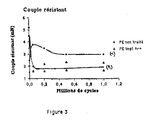
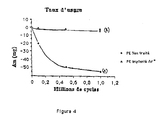
- Figures 3 and 4 relate to the same tests of untreated 316 L stainless steel spheres in comparison with cups of untreated polyethylene or treated by implantation of argon ions.
- Fig.3 shows that the resistive torque is lower when the polyethylene is implanted with argon (curve 2) than when it is not treated (curve 1, identical to curve 1 in Fig.1).
- Fig. 4 shows that the wear rate ⁇ m of the polyethylene is much lower (5 mg versus 50 mg) when the polyethylene is implanted with argon (curve 2) than when it is not treated (curve 1, identical to curve 1 in Fig. 2).
Landscapes
- Health & Medical Sciences (AREA)
- Chemical & Material Sciences (AREA)
- Oral & Maxillofacial Surgery (AREA)
- Transplantation (AREA)
- Life Sciences & Earth Sciences (AREA)
- Animal Behavior & Ethology (AREA)
- General Health & Medical Sciences (AREA)
- Public Health (AREA)
- Veterinary Medicine (AREA)
- Dermatology (AREA)
- Medicinal Chemistry (AREA)
- Epidemiology (AREA)
- Engineering & Computer Science (AREA)
- Toxicology (AREA)
- Orthopedic Medicine & Surgery (AREA)
- Biomedical Technology (AREA)
- Heart & Thoracic Surgery (AREA)
- Vascular Medicine (AREA)
- Chemical Kinetics & Catalysis (AREA)
- Cardiology (AREA)
- Materials For Medical Uses (AREA)
- Connections Effected By Soldering, Adhesion, Or Permanent Deformation (AREA)
- Addition Polymer Or Copolymer, Post-Treatments, Or Chemical Modifications (AREA)
- Lining Or Joining Of Plastics Or The Like (AREA)
- Laminated Bodies (AREA)
- Prostheses (AREA)
- Moulds For Moulding Plastics Or The Like (AREA)
- Treatments Of Macromolecular Shaped Articles (AREA)
Description
- La présente invention concerne un procédé pour réduire le coefficient de frottement et l'usure entre une pièce métallique et une pièce à base d'un polymère ou copolymère organique et trouve une application dans des prothèses articulaires et dans des emboitements travaillant dans des milieux marins.
- Les prothèses articulaires ou les emboitements à rotation ou à glissement comportent généralement deux pièces qui frottent l'une contre l'autre. Généralement, au moins l'une de ces pièces est métallique. L'autre est en polymère ou est recouverte d'une couche à base d'un polymère ou copolymère organique. La résistance au frottement et à l'usure du couple est acceptable mais pourrait être améliorée par des traitements de surfaces adaptés.
- On utilise généralement comme polymère du polyéthylène. Les métaux utilisés sont généralement des aciers inoxydables, des alliages à base de cobalt ou de titane. A la place des métaux, on peut utiliser également d'autres matériaux (céramiques, composites comme le carbone-carbone, etc.).
- La présente invention vise à fournir un procédé permettant notamment de réduire le frottement et l'usure entre de telles pièces fonctionnant dans un environnement aqueux chloruré tel que le liquide physiologique ou le milieu marin.
- A cet effet, la présente invention a pour objet un procédé pour réduire le coefficient de frottement et l'usure entre une pièce métallique et une pièce à base d'un polymère ou copolymère organique, dans un milieu aqueux chloruré, caractérisé en ce que l on fait subir à la pièce à base d'un polymère ou copolymère organique, un traitement superficiel par implantation ionique, d'au moins un élément choisi parmi l'azote, l'argon, l'oxygenè et le carbone.
- La présente invention s'applique en particulier dans le cas où le polymère est un polyéthylène, tel qu'un polyéthylène haute densité, et à très haut poids moléculaire, mais d'autres polymères peuvent être utilisés : polymères basse densité, polymères renforcés (fibres, particules..), etc..
- Le principe de l'implantation ionique consiste à ioniser au moins une espèce atomique choisie parmi l'azote, l'argon, l'oxygène, le carbone ou autre, puis à l'accélérer dans un champ électrique à des énergies de 10 à 500 keV, de préférence de 10 à 300 keV et plus avantageusement encore de 50 à 150 keV.
- On opère généralement sous des pressions de 10⁻² à 10⁻⁴ Pa. Dans ces conditions, les ions pénètrent dans la couche à base de polymère ou de copolymère jusqu'à une profondeur qui peut atteindre plusieurs microns.
- La dose d'implantation est généralement de 10¹² à 10¹⁷ ions/cm².
- Le compte rendu des essais suivants met en évidence l'amélioration obtenue par la mise en oeuvre du procédé selon l'invention.
- Le polyéthylène utilisé est de l'Ertalène HD 1000, CESTILENE MC (densité 0,94, module d'élasticité de 650 MPa), conforme aux normes ISO 5834/2 et NF S90 - 418 et/ou du polyéthylène à poids moléculaire élevé.
- Des échantillons cylindriques (pions) et hémi-sphériques (cupules) de polyéthylène ont subi un traitement d'implantation ionique d'azote, d'argon, d'oxygène, de carbone et autres, dans un appareil mis au point et fabriqué par UNIREC. (Robert LEVEQUE et Claude CHABROL, Application de l'implantation ionique dans le domaine de la construction mécanique, Journées de GAMI les 8 et 9 mars 1988, Paris).
- L'énergie d'implantation a été de 80 keV.
- Des essais de frottement entre des pièces en polyéthylène et des pièces métalliques (acier inoxydable conforme aux normes ISO 5832-I-NF S90-401 et alliage de titane conforme aux normes ISO 5832-III-NF S90-405 sur deux machines mises au point et fabriquées à l'Ecole Nationale Supérieure des Mines de Saint-Etienne.
- L'une de ces machines est du type pion-disque, l'autre est du type sphère-cupule. (A. PICHAT, J. RIEU, C.CHABROL, A.RAMBERT, Effet de l'implantation ionique sur la résistance à l'usure et à la fatique de matériaux pour applications orthopédiques. Colloque Int. sur les matériaux résistant à l'usure, Bulletin du Cercle d'Etude des Métaux, 1987, 15-14, p. 9-1).
- Les essais sont réalisés sur des pièces de qualité orthopédique fabriquées par la société SERF, à Décines.
- Les conditions d'essais (contrainte, vitesse, environnement sont proches de celles d'une prothèse de hanche).
- Tous les essais sont réalisés en milieu liquide physiologique artificiel (solution de RINGER).
- A titre d'exemple, les résultats obtenus sur le couple sphère en acier inoxydable - cupule en polyéthylène, sont reportés sur les figures 1, 2, 3 et 4.
- Les courbes montrent l'évolution du couple résistant (Fig.1) et celle du taux d'usure du polyéthylène exprimé en perte de mase m (Fig.2), en fonction du temps t et du nombre de cycles N avec :
- 1 - couple PE non traité / Acier inoxydable 316L non traité
- 2 - couple PE non traité / Acier inoxydable 316L implanté à l'azote
- 3 - couple PE implanté à l'azote/ Acier inoxydable 316L non traité
- 4 - couple PE implanté à l'azote/ Acier inoxydable 316L implanté à l'azote.
- Ces essais ont été arrêtés à 1 million de cycles; des essais plus longs ont toutefois permis de vérifier que les effets bénéfiques de l'implantation étaient conservés.
- Ces résultats mettent en évidence qu'en l'absence de toute implantantion, l'usure est importante et qu'en pratique l'implantation du polyéthylène seule suffit déjà pour obtenir un couple de frottement et un taux d'usure du polyéthylène notablement plus faibles (courbe 3).
- Les Figures 3 et 4 sont relatives aux mêmes essais de sphères en acier inoxydable 316 L non traité en comparaison avec des cupules en polyéthylène non traité ou traité par implantation d'ions argon. La Fig.3 montre que le couple résistant est plus faible lorsque le polyéthylène est implanté à l'argon (courbe 2) que lorsqu'il n'est pas traité (courbe 1, identique à la courbe 1 de la Fig.1).
- La Fig.4 montre que le taux d'usure Δ m du polyéthylène est beaucoup plus faible (5 mg contre 50 mg) lorsque le polyéthylène est implanté à l'argon (courbe 2) que lorsqu'il n'est pas traité (courbe 1, identique à la courbe 1 de la Fig.2).
- Ces résultats montrent qu'une implantation ionique du polyéthylène avec de l'argon donne une diminution du couple de frottement et une réduction du taux d'usure du polyéthylène comparables à celles obtenues avec une implantation ionique du polyéthylène avec de l'azote.
- Lors des essais d'implantation ionique d'argon et d'azote, il est introduit de manière incontrôlée, une faible quantité de carbone qui contribue aux résultats des essais décrits ci-dessus.
Claims (7)
- Procédé pour réduire le coefficient de frottement et l usure entre une pièce métallique et une pièce à base d'un polymère ou copolymère organique, dans un milieu aqueux chloruré, caractérisé en ce que l'on fait subir à la pièce à base d'un polymère ou copolymère organique, un traitement superficiel par implantation ionique d'au moins un élément choisi parmi l'azote, l'argon, l'oxygène et le carbone.
- Procédé selon la revendication 1, caractérisé en ce que le polymère est un polyéthylène.
- Procédé selon l'une quelconque des revendications 1 ou 2, caractérisé en ce que l'implantation est effectuée avec une énergie de 10 à 300 keV.
- Procédé selon la revendication 3, caractérisé en ce que l'implantation est effectuée avec une énergie de 50 à 150 keV.
- Elément de prothèse articulaire du type comportant une pièce métallique frottant sur une pièce ou une couche d'un polymère ou copolymère organique, caractérisée en ce que la surface de l'élément de polymère organique en contact avec la pièce métallique a été traitée par un procédé selon l'une quelconque des revendications 1 à 4.
- Prothèse articulaire comportant un élément tel que défini à la revendication 5.
- Emboitements à rotation ou à glissement travaillant dans des milieux marins et comportant une pièce métallique frottant sur une pièce ou une couche d'un polymère ou copolymère organique, caractérisés en ce que la surface de l'élément de polymère organique en contact avec la pièce métallique a été traité par un procédé selon l'une quelconque des revendications 1 à 4.
Priority Applications (1)
| Application Number | Priority Date | Filing Date | Title |
|---|---|---|---|
| AT89401418T ATE91957T1 (de) | 1988-05-24 | 1989-05-24 | Verfahren zum erniedrigen des reibungskoeffizienten und des verschleisses zwischen einem metallischen teil und einem teil aus einem organischen polymer oder copolymer und dessen anwendung bei gelenkprothesen und im maritimen bereich wirkenden gelenkverbindungen. |
Applications Claiming Priority (2)
| Application Number | Priority Date | Filing Date | Title |
|---|---|---|---|
| FR8806890 | 1988-05-24 | ||
| FR8806890A FR2631832B1 (fr) | 1988-05-24 | 1988-05-24 | Procede pour reduire le coefficient de frottement et l'usure entre une piece metallique et une piece a base d'un polymere ou copolymere organique et son application a des protheses articulaires |
Publications (2)
| Publication Number | Publication Date |
|---|---|
| EP0348252A1 EP0348252A1 (fr) | 1989-12-27 |
| EP0348252B1 true EP0348252B1 (fr) | 1993-07-28 |
Family
ID=9366557
Family Applications (1)
| Application Number | Title | Priority Date | Filing Date |
|---|---|---|---|
| EP89401418A Expired - Lifetime EP0348252B1 (fr) | 1988-05-24 | 1989-05-24 | Procédé pour réduire le coefficient de frottement et l'usure entre une piéce métallique et une pièce à base d'un polymère ou copolymère organique et son application à des prothèses articulaires et des emboîtements travaillant dans des milieux marins |
Country Status (7)
| Country | Link |
|---|---|
| US (1) | US5480683A (fr) |
| EP (1) | EP0348252B1 (fr) |
| AT (1) | ATE91957T1 (fr) |
| CA (1) | CA1340046C (fr) |
| DE (1) | DE68907806T2 (fr) |
| ES (1) | ES2045487T3 (fr) |
| FR (1) | FR2631832B1 (fr) |
Families Citing this family (42)
| Publication number | Priority date | Publication date | Assignee | Title |
|---|---|---|---|---|
| ATE166582T1 (de) * | 1992-04-21 | 1998-06-15 | Vance Products Inc | Oberflächenbehandelte medizinische vorrichtungen |
| WO1995021212A1 (fr) * | 1994-02-03 | 1995-08-10 | Smith & Nephew Plc | Traitement de surface |
| GB2286347B (en) * | 1994-02-10 | 1998-04-29 | Atomic Energy Authority Uk | Improved load-bearing polymeric materials |
| US5593719A (en) * | 1994-03-29 | 1997-01-14 | Southwest Research Institute | Treatments to reduce frictional wear between components made of ultra-high molecular weight polyethylene and metal alloys |
| US7494507B2 (en) * | 2000-01-30 | 2009-02-24 | Diamicron, Inc. | Articulating diamond-surfaced spinal implants |
| US7678325B2 (en) * | 1999-12-08 | 2010-03-16 | Diamicron, Inc. | Use of a metal and Sn as a solvent material for the bulk crystallization and sintering of diamond to produce biocompatbile biomedical devices |
| CA2166450C (fr) | 1995-01-20 | 2008-03-25 | Ronald Salovey | Polyethylene de masse moleculaire tres elevee, reticule chimiquement, pour articulations artificielles chez l'homme |
| US8563623B2 (en) * | 1996-02-13 | 2013-10-22 | The General Hospital Corporation | Radiation melt treated ultra high molecular weight polyethylene prosthetic devices |
| US20020156536A1 (en) * | 1996-02-13 | 2002-10-24 | Harris William H. | Polyethylene hip joint prosthesis with extended range of motion |
| US8865788B2 (en) | 1996-02-13 | 2014-10-21 | The General Hospital Corporation | Radiation and melt treated ultra high molecular weight polyethylene prosthetic devices |
| US5879400A (en) * | 1996-02-13 | 1999-03-09 | Massachusetts Institute Of Technology | Melt-irradiated ultra high molecular weight polyethylene prosthetic devices |
| JP2000514481A (ja) | 1996-07-09 | 2000-10-31 | ザ オーソピーディック ホスピタル | 放射線及び熱処理を用いた低摩耗ポリエチレンの架橋 |
| US6228900B1 (en) | 1996-07-09 | 2001-05-08 | The Orthopaedic Hospital And University Of Southern California | Crosslinking of polyethylene for low wear using radiation and thermal treatments |
| US6017975A (en) | 1996-10-02 | 2000-01-25 | Saum; Kenneth Ashley | Process for medical implant of cross-linked ultrahigh molecular weight polyethylene having improved balance of wear properties and oxidation resistance |
| US6692679B1 (en) | 1998-06-10 | 2004-02-17 | Depuy Orthopaedics, Inc. | Cross-linked molded plastic bearings |
| US6187045B1 (en) | 1999-02-10 | 2001-02-13 | Thomas K. Fehring | Enhanced biocompatible implants and alloys |
| US6627141B2 (en) | 1999-06-08 | 2003-09-30 | Depuy Orthopaedics, Inc. | Method for molding a cross-linked preform |
| US6245276B1 (en) | 1999-06-08 | 2001-06-12 | Depuy Orthopaedics, Inc. | Method for molding a cross-linked preform |
| US7556763B2 (en) * | 1999-12-08 | 2009-07-07 | Diamicron, Inc. | Method of making components for prosthetic joints |
| US7569176B2 (en) * | 1999-12-08 | 2009-08-04 | Diamicron, Inc. | Method for making a sintered superhard prosthetic joint component |
| US8603181B2 (en) * | 2000-01-30 | 2013-12-10 | Dimicron, Inc | Use of Ti and Nb cemented in TiC in prosthetic joints |
| US20050203630A1 (en) * | 2000-01-30 | 2005-09-15 | Pope Bill J. | Prosthetic knee joint having at least one diamond articulation surface |
| US20100025898A1 (en) * | 2000-01-30 | 2010-02-04 | Pope Bill J | USE OF Ti AND Nb CEMENTED TiC IN PROSTHETIC JOINTS |
| US20040199260A1 (en) * | 2000-01-30 | 2004-10-07 | Pope Bill J. | Prosthetic joint component having at least one sintered polycrystalline diamond compact articulation surface and substrate surface topographical features in said polycrystalline diamond compact |
| ES2286131T3 (es) * | 2000-07-31 | 2007-12-01 | Massachusetts General Hospital | Componente acetabular monopolar constreñido. |
| US6818172B2 (en) * | 2000-09-29 | 2004-11-16 | Depuy Products, Inc. | Oriented, cross-linked UHMWPE molding for orthopaedic applications |
| ES2173817B1 (es) * | 2001-04-16 | 2003-10-16 | Fundacion Inasmet | Metodo para la fabricacion de implantes endo-oseos o protesis medicas mediante la tecnica de implantacion ionica. |
| US6655845B1 (en) * | 2001-04-22 | 2003-12-02 | Diamicron, Inc. | Bearings, races and components thereof having diamond and other superhard surfaces |
| US20030019106A1 (en) * | 2001-04-22 | 2003-01-30 | Diamicron, Inc. | Methods for making bearings, races and components thereof having diamond and other superhard surfaces |
| US7186364B2 (en) * | 2002-01-28 | 2007-03-06 | Depuy Products, Inc. | Composite prosthetic bearing constructed of polyethylene and an ethylene-acrylate copolymer and method for making the same |
| US7819925B2 (en) * | 2002-01-28 | 2010-10-26 | Depuy Products, Inc. | Composite prosthetic bearing having a crosslinked articulating surface and method for making the same |
| US20040002770A1 (en) * | 2002-06-28 | 2004-01-01 | King Richard S. | Polymer-bioceramic composite for orthopaedic applications and method of manufacture thereof |
| US7938861B2 (en) * | 2003-04-15 | 2011-05-10 | Depuy Products, Inc. | Implantable orthopaedic device and method for making the same |
| US20040262809A1 (en) * | 2003-06-30 | 2004-12-30 | Smith Todd S. | Crosslinked polymeric composite for orthopaedic implants |
| US20050133277A1 (en) * | 2003-08-28 | 2005-06-23 | Diamicron, Inc. | Superhard mill cutters and related methods |
| WO2005047559A1 (fr) * | 2003-11-13 | 2005-05-26 | Lifenova Biomedical, S.A. | Procede de fabrication d'implants endo-osseux ou de protheses medicales par implantation ionique, et implant endo-osseux ou prothese medicale obtenus |
| US7384430B2 (en) * | 2004-06-30 | 2008-06-10 | Depuy Products, Inc. | Low crystalline polymeric material for orthopaedic implants and an associated method |
| US7896921B2 (en) * | 2004-12-30 | 2011-03-01 | Depuy Products, Inc. | Orthopaedic bearing and method for making the same |
| US7883653B2 (en) | 2004-12-30 | 2011-02-08 | Depuy Products, Inc. | Method of making an implantable orthopaedic bearing |
| US7879275B2 (en) * | 2004-12-30 | 2011-02-01 | Depuy Products, Inc. | Orthopaedic bearing and method for making the same |
| US8449991B2 (en) * | 2005-04-07 | 2013-05-28 | Dimicron, Inc. | Use of SN and pore size control to improve biocompatibility in polycrystalline diamond compacts |
| US8663359B2 (en) | 2009-06-26 | 2014-03-04 | Dimicron, Inc. | Thick sintered polycrystalline diamond and sintered jewelry |
Family Cites Families (7)
| Publication number | Priority date | Publication date | Assignee | Title |
|---|---|---|---|---|
| US3913520A (en) * | 1972-08-14 | 1975-10-21 | Precision Thin Film Corp | High vacuum deposition apparatus |
| BG32652A1 (en) * | 1980-03-13 | 1982-09-15 | Kolev | Method for surface laying of metals on synthetic, natural and artificial polymers |
| DE3433210C1 (de) * | 1984-09-10 | 1986-06-05 | Hans Dr.med. Dr.med.dent. 8000 München Scheicher | Mittel zur Fuellung von Knochen- und Zahndefekten,zum Knochenaufbau,fuer Knochenkontaktschichten und fuer Knochen- und Zahnwurzelersatz und Verwendung von Carbonatapatit fuer diesen Zweck |
| US4743493A (en) * | 1986-10-06 | 1988-05-10 | Spire Corporation | Ion implantation of plastics |
| US4764394A (en) * | 1987-01-20 | 1988-08-16 | Wisconsin Alumni Research Foundation | Method and apparatus for plasma source ion implantation |
| JPS63215578A (ja) * | 1987-02-28 | 1988-09-08 | 株式会社豊田中央研究所 | セラミツク材料表面への固体潤滑被膜の形成方法 |
| US4872922A (en) * | 1988-03-11 | 1989-10-10 | Spire Corporation | Method and apparatus for the ion implantation of spherical surfaces |
-
1988
- 1988-05-24 FR FR8806890A patent/FR2631832B1/fr not_active Expired - Lifetime
-
1989
- 1989-05-23 CA CA000600386A patent/CA1340046C/fr not_active Expired - Fee Related
- 1989-05-24 EP EP89401418A patent/EP0348252B1/fr not_active Expired - Lifetime
- 1989-05-24 AT AT89401418T patent/ATE91957T1/de not_active IP Right Cessation
- 1989-05-24 ES ES89401418T patent/ES2045487T3/es not_active Expired - Lifetime
- 1989-05-24 DE DE89401418T patent/DE68907806T2/de not_active Expired - Fee Related
-
1993
- 1993-12-16 US US08/167,111 patent/US5480683A/en not_active Expired - Fee Related
Also Published As
| Publication number | Publication date |
|---|---|
| US5480683A (en) | 1996-01-02 |
| ES2045487T3 (es) | 1994-01-16 |
| CA1340046C (fr) | 1998-09-15 |
| FR2631832B1 (fr) | 1994-05-27 |
| EP0348252A1 (fr) | 1989-12-27 |
| ATE91957T1 (de) | 1993-08-15 |
| FR2631832A1 (fr) | 1989-12-01 |
| DE68907806D1 (de) | 1993-09-02 |
| DE68907806T2 (de) | 1994-03-10 |
Similar Documents
| Publication | Publication Date | Title |
|---|---|---|
| CA1340046C (fr) | Procede pour reduire le coefficient de frottement et l'usure entre une piece a basee d'un polymere ou cololymere organique et son application a des protheses articulaires et des emboitements rravaillant dans des milieux marins | |
| CN100566762C (zh) | 高分子材料制人工关节部件 | |
| Allen et al. | Sliding wear behaviour of ion implanted ultra high molecular weight polyethylene against a surface modified titanium alloy Ti-6Al-4V | |
| Dong et al. | Surface engineering to improve tribological performance of Ti–6Al–4V | |
| US5123924A (en) | Surgical implants and method | |
| FR2984170A1 (fr) | Gel de decontamination et procede de decontamination de surfaces par trempage utilisant ce gel. | |
| EP0045706B1 (fr) | Pièce frittée à base de fer et son procédé de fabrication | |
| JP2984203B2 (ja) | 人工関節用摺動部材の製造方法 | |
| JP2000129019A (ja) | 摺動部材 | |
| Singh et al. | Contemporary development on the performance and functionalization of ultra high molecular weight polyethylene (UHMWPE) for biomedical implants | |
| US20200155723A1 (en) | Highly hydrophilic coatings for biomedical applications | |
| Tewari et al. | Tribological behavior of polyimides | |
| CA3019885C (fr) | Procede de traitement de surface d'un materiau metallique biocompatible et implant traite par ledit procede | |
| Ju et al. | Plasma surface modification of NiTi shape memory alloy | |
| RU2354668C1 (ru) | Способ изготовления полимерных деталей трения скольжения для искусственных эндопротезов | |
| Feyerabend et al. | Cytocompatibility of a free machining titanium alloy containing lanthanum | |
| Vadiraj et al. | Fretting fatigue studies of titanium nitride-coated biomedical titanium alloys | |
| RU2300537C1 (ru) | Способ изготовления полимерных деталей трения скольжения из сверхвысокомолекулярного полиэтилена для искусственных эндопротезов | |
| Oñate et al. | Wear behaviour of nitrogen-implanted AISI 420 martensitic stainless steel | |
| EP0076714A1 (fr) | Prothèse articulaire améliorée en polymère et son procédé de préparation | |
| Hirvonen et al. | Unlubricated friction and wear of an ion beam mixed, nitrogen‐implanted Fe50Ti50 surface alloy on AISI 304 stainless steel | |
| Allen et al. | The effect of ion implantation on the sliding wear behaviour of ultrahigh molecular weight polyethylene against an oxidised titanium alloy Ti-6Al-4V | |
| JP2009066387A (ja) | 生体用複合材料及びその製造方法 | |
| EP0491795A1 (fr) | Retenteur de liquides aqueux encapsule, procede pour sa preparation | |
| Xu et al. | Tribological Behavior of High Density Polyethylene Nanocomposites With Silane Treated Carbon Nanofibers |
Legal Events
| Date | Code | Title | Description |
|---|---|---|---|
| PUAI | Public reference made under article 153(3) epc to a published international application that has entered the european phase |
Free format text: ORIGINAL CODE: 0009012 |
|
| AK | Designated contracting states |
Kind code of ref document: A1 Designated state(s): AT BE CH DE ES FR GB GR IT LI LU NL SE |
|
| RIN1 | Information on inventor provided before grant (corrected) |
Inventor name: RAMBERT, ANDRE Inventor name: RABBE, LOUIS MARIE, Inventor name: RIEU, JEAN-FRANCOIS, EMILE, Inventor name: PICHAT, ANNE, LOUISE, MARIE (NEE NEDELEC) Inventor name: LEVEQUE, ROBERT Inventor name: ROBELET, MARC Inventor name: CHABROL, CLAUDE |
|
| 17P | Request for examination filed |
Effective date: 19900611 |
|
| 17Q | First examination report despatched |
Effective date: 19910628 |
|
| GRAA | (expected) grant |
Free format text: ORIGINAL CODE: 0009210 |
|
| AK | Designated contracting states |
Kind code of ref document: B1 Designated state(s): AT BE CH DE ES FR GB GR IT LI LU NL SE |
|
| REF | Corresponds to: |
Ref document number: 91957 Country of ref document: AT Date of ref document: 19930815 Kind code of ref document: T |
|
| REF | Corresponds to: |
Ref document number: 68907806 Country of ref document: DE Date of ref document: 19930902 |
|
| ITF | It: translation for a ep patent filed | ||
| GBT | Gb: translation of ep patent filed (gb section 77(6)(a)/1977) |
Effective date: 19931108 |
|
| REG | Reference to a national code |
Ref country code: GR Ref legal event code: FG4A Free format text: 3009459 |
|
| REG | Reference to a national code |
Ref country code: ES Ref legal event code: FG2A Ref document number: 2045487 Country of ref document: ES Kind code of ref document: T3 |
|
| PLBE | No opposition filed within time limit |
Free format text: ORIGINAL CODE: 0009261 |
|
| STAA | Information on the status of an ep patent application or granted ep patent |
Free format text: STATUS: NO OPPOSITION FILED WITHIN TIME LIMIT |
|
| EPTA | Lu: last paid annual fee | ||
| 26N | No opposition filed | ||
| EAL | Se: european patent in force in sweden |
Ref document number: 89401418.2 |
|
| REG | Reference to a national code |
Ref country code: GB Ref legal event code: IF02 |
|
| PGFP | Annual fee paid to national office [announced via postgrant information from national office to epo] |
Ref country code: NL Payment date: 20020416 Year of fee payment: 14 |
|
| PGFP | Annual fee paid to national office [announced via postgrant information from national office to epo] |
Ref country code: SE Payment date: 20020417 Year of fee payment: 14 Ref country code: AT Payment date: 20020417 Year of fee payment: 14 |
|
| PGFP | Annual fee paid to national office [announced via postgrant information from national office to epo] |
Ref country code: GR Payment date: 20020426 Year of fee payment: 14 |
|
| PGFP | Annual fee paid to national office [announced via postgrant information from national office to epo] |
Ref country code: DE Payment date: 20020510 Year of fee payment: 14 |
|
| PGFP | Annual fee paid to national office [announced via postgrant information from national office to epo] |
Ref country code: LU Payment date: 20020514 Year of fee payment: 14 Ref country code: ES Payment date: 20020514 Year of fee payment: 14 |
|
| PGFP | Annual fee paid to national office [announced via postgrant information from national office to epo] |
Ref country code: FR Payment date: 20020515 Year of fee payment: 14 |
|
| PGFP | Annual fee paid to national office [announced via postgrant information from national office to epo] |
Ref country code: BE Payment date: 20020603 Year of fee payment: 14 |
|
| PGFP | Annual fee paid to national office [announced via postgrant information from national office to epo] |
Ref country code: CH Payment date: 20030415 Year of fee payment: 15 |
|
| PGFP | Annual fee paid to national office [announced via postgrant information from national office to epo] |
Ref country code: GB Payment date: 20030516 Year of fee payment: 15 |
|
| PG25 | Lapsed in a contracting state [announced via postgrant information from national office to epo] |
Ref country code: LU Free format text: LAPSE BECAUSE OF NON-PAYMENT OF DUE FEES Effective date: 20030524 Ref country code: AT Free format text: LAPSE BECAUSE OF NON-PAYMENT OF DUE FEES Effective date: 20030524 |
|
| PG25 | Lapsed in a contracting state [announced via postgrant information from national office to epo] |
Ref country code: SE Free format text: LAPSE BECAUSE OF NON-PAYMENT OF DUE FEES Effective date: 20030525 |
|
| PG25 | Lapsed in a contracting state [announced via postgrant information from national office to epo] |
Ref country code: ES Free format text: LAPSE BECAUSE OF NON-PAYMENT OF DUE FEES Effective date: 20030526 |
|
| PG25 | Lapsed in a contracting state [announced via postgrant information from national office to epo] |
Ref country code: BE Free format text: LAPSE BECAUSE OF NON-PAYMENT OF DUE FEES Effective date: 20030531 |
|
| BERE | Be: lapsed |
Owner name: *NITRUVID Effective date: 20030531 |
|
| PG25 | Lapsed in a contracting state [announced via postgrant information from national office to epo] |
Ref country code: NL Free format text: LAPSE BECAUSE OF NON-PAYMENT OF DUE FEES Effective date: 20031201 |
|
| PG25 | Lapsed in a contracting state [announced via postgrant information from national office to epo] |
Ref country code: DE Free format text: LAPSE BECAUSE OF NON-PAYMENT OF DUE FEES Effective date: 20031202 |
|
| PG25 | Lapsed in a contracting state [announced via postgrant information from national office to epo] |
Ref country code: GR Free format text: LAPSE BECAUSE OF NON-PAYMENT OF DUE FEES Effective date: 20031203 |
|
| EUG | Se: european patent has lapsed | ||
| PG25 | Lapsed in a contracting state [announced via postgrant information from national office to epo] |
Ref country code: FR Free format text: LAPSE BECAUSE OF NON-PAYMENT OF DUE FEES Effective date: 20040130 |
|
| NLV4 | Nl: lapsed or anulled due to non-payment of the annual fee |
Effective date: 20031201 |
|
| REG | Reference to a national code |
Ref country code: FR Ref legal event code: ST |
|
| PG25 | Lapsed in a contracting state [announced via postgrant information from national office to epo] |
Ref country code: GB Free format text: LAPSE BECAUSE OF NON-PAYMENT OF DUE FEES Effective date: 20040524 |
|
| PG25 | Lapsed in a contracting state [announced via postgrant information from national office to epo] |
Ref country code: LI Free format text: LAPSE BECAUSE OF NON-PAYMENT OF DUE FEES Effective date: 20040531 Ref country code: CH Free format text: LAPSE BECAUSE OF NON-PAYMENT OF DUE FEES Effective date: 20040531 |
|
| REG | Reference to a national code |
Ref country code: ES Ref legal event code: FD2A Effective date: 20030526 |
|
| GBPC | Gb: european patent ceased through non-payment of renewal fee |
Effective date: 20040524 |
|
| REG | Reference to a national code |
Ref country code: CH Ref legal event code: PL |
|
| PG25 | Lapsed in a contracting state [announced via postgrant information from national office to epo] |
Ref country code: IT Free format text: LAPSE BECAUSE OF NON-PAYMENT OF DUE FEES;WARNING: LAPSES OF ITALIAN PATENTS WITH EFFECTIVE DATE BEFORE 2007 MAY HAVE OCCURRED AT ANY TIME BEFORE 2007. THE CORRECT EFFECTIVE DATE MAY BE DIFFERENT FROM THE ONE RECORDED. Effective date: 20050524 |