EP0348098A2 - Verfahren zur Messung von Gammastrahlung in Bohrlöchern - Google Patents
Verfahren zur Messung von Gammastrahlung in Bohrlöchern Download PDFInfo
- Publication number
- EP0348098A2 EP0348098A2 EP89306050A EP89306050A EP0348098A2 EP 0348098 A2 EP0348098 A2 EP 0348098A2 EP 89306050 A EP89306050 A EP 89306050A EP 89306050 A EP89306050 A EP 89306050A EP 0348098 A2 EP0348098 A2 EP 0348098A2
- Authority
- EP
- European Patent Office
- Prior art keywords
- gamma ray
- borehole
- tracer
- unknown
- standard
- Prior art date
- Legal status (The legal status is an assumption and is not a legal conclusion. Google has not performed a legal analysis and makes no representation as to the accuracy of the status listed.)
- Withdrawn
Links
Images

Classifications
-
- G—PHYSICS
- G01—MEASURING; TESTING
- G01V—GEOPHYSICS; GRAVITATIONAL MEASUREMENTS; DETECTING MASSES OR OBJECTS; TAGS
- G01V5/00—Prospecting or detecting by the use of ionising radiation, e.g. of natural or induced radioactivity
- G01V5/04—Prospecting or detecting by the use of ionising radiation, e.g. of natural or induced radioactivity specially adapted for well-logging
- G01V5/06—Prospecting or detecting by the use of ionising radiation, e.g. of natural or induced radioactivity specially adapted for well-logging for detecting naturally radioactive minerals
-
- E—FIXED CONSTRUCTIONS
- E21—EARTH OR ROCK DRILLING; MINING
- E21B—EARTH OR ROCK DRILLING; OBTAINING OIL, GAS, WATER, SOLUBLE OR MELTABLE MATERIALS OR A SLURRY OF MINERALS FROM WELLS
- E21B47/00—Survey of boreholes or wells
- E21B47/10—Locating fluid leaks, intrusions or movements
- E21B47/11—Locating fluid leaks, intrusions or movements using tracers; using radioactivity
Definitions
- This invention relates to a method of gamma ray well logging.
- Gamma ray spectroscopy well logging tools are significantly expanding the use of multiple radioactive isotope tracers in monitoring downhole operations. These well logging tools can measure the energy of gamma rays which are emitted by radioactive tracers placed in the well being logged. Multiple tracer surveys may be obtained by deconvolving the gamma ray spectral data into contributions from each individual isotope as a function of depth. Multiple logs can give such useful information as fluid fracture height versus proppant height, as well as the effectiveness of multi-stage treatments and hydraulic fracturing operations.
- Well cementing applications can include the locations of different types of cements and measurement of average radial cement thickness.
- a potential problem which can occur in the use of multiple tracers in a gamma ray spectroscopy tracer logging system is that, due to variations in the Compton scattering and photoelectric absorption of gamma rays between the tracer source and the detector, the shape of the gamma ray spectrum can change with changes in tracer location.
- the change of shape of such gamma ray energy spectra due to Compton scattering and photoelectric absorption can impair a weighted least-square fitting technique which assumes as the standard spectra those taken but with the tracer in a particular geometrical region (i.e. the formation), if this region is different from the actual tracer location in the well of interest. For example, if some of the tracers in a well borehole are actually located inside the casing, but the standard spectra were derived for tracers located only in the formation, the computed tracer concentration will be in error.
- a method of performing gamma ray well logging of one or more radioactive tracer isotopes in an unknown cased well borehole in which method there are used standard gamma ray energy spectra of selected individual tracer elements disposed in at least two different geometrical regions spaced apart from a gamma ray detector, said at least two geometrical regions being disposed with respect to said detector such that distinct gamma ray energy spectral shapes for the same selected individual tracer element are produced when said selected tracer is disposed in each of said geometrical regions, said standard spectra being used in the analysis of gamma ray count data taken in the unknown borehole, said method comprising the steps of: moving a a well logging instrument sized and adapted for passage through a well borehole through the unknown well bore and detecting gamma radiation emitted from one or more selected radioactive tracer isotopes at different depth levels in the well borehole; separating said detected gamma radiation into a
- the invention also provides such a method wherein said standard gamma ray energy spectra of selected individual tracer elements have been taken at least substantially with the individual tracer elements disposed within a cased standard borehole and disposed without a cased standard borehole, and wherein at said depth levels in the unknown borehole, said measured unknown gamma ray energy spectrum is separated into component parts attributable to each such selected radioactive tracer isotope disposed within the unknown borehole and disposed without the unknown borehole.
- the invention further provides a method of performing gamma ray well logging of plural radioactive tracer isotopes in an unknown cased well borehole, in which method there are used standard gamma ray energy spectra of selected individual tracer elements taken at least substantially with the individual tracer elements disposed within a cased standard borehole and disposed without a cased standard borehole, said spectra being used in the analysis of gamma ray count data taken in the unknown borehole, said method comprising the steps of: moving a well logging instrument sized and adapted for passage through a well borehole through the unknown well borehole and detecting gamma radiation emitted from plural selected radioactive tracer isotopes at different depth levels in the well borehole; separating said detected gamma radiation into a measured unknown gamma ray spectrum at each of a plurality of depth levels in the unknown borehole; at such depth levels in the unknown borehole, separating said measured unknown gamma ray energy spectrum into parts attributable to each such radio
- the measured or observed gamma ray spectra in a tracer logging system using a gamma ray spectral logging tool are compensated for the occurrence within and without the well borehole of the gamma ray spectra attributable to the tracer elements.
- Tracers having half lives ranging from 2.7 to 250 days and comprising gold-198 (198Au), iodine-131 (131I), antimony-124 (124Sb), iridium-192 (192Ir), scandium-46 (46Sc), and silver-110m ( 110m Ag), can for example be used for this purpose.
- Sample or standard gamma ray spectra using the above referenced tracers or others as may be desired, singly or in combination and disposed inside the borehole or exterior to the well casing, in a cased well, are fitted using a weighted-least squares technique. This technique can be performed in real-time at the well site at logging speeds varying from 10-30 ft. per minute (3.05 to 9.14 m/minute).
- the direct deconvolution of the borehole and formation components of each of the tracers used in the measured spectra can be applied to situations where up to three tracers are utilized and have components both in the well borehole and in the formation. This can result in the fitting of up to six standard spectral curves to the measured spectra in the unknown borehole.
- the geometrical location of one or more tracers is known prior to the execution of the deconvolution program, then it may be possible to simplify the problem by eliminating one or more unnecessary spectral standards from the fitting process. For example, if it is known that tracer A in a two tracer job is located only in the formation, then the borehole standard spectral component for tracer A can be left out of the deconvolution process.
- the tracers which are utilized are weighted-least squares fitted utilizing only a single standard spectrum (for instance, the formation standard) for each of the tracer isotopes. That is to say, only formation tracer gamma ray spectral shapes are assumed to be present.
- Estimated elemental concentrations are then computed for each tracer.
- zones above or below the zone of interest that is to say, zones where only the borehole count rate of the tracer is present
- the spectral deconvolution will result in considerably erroneous elemental concentrations due to the improper spectral shape of the formation standard spectra being fitted to measured spectra which comprise mostly borehole component(s).
- the data is then reprocessed a second time using a new composite standard shape for each tracer.
- the new standard spectra S(d) are assumed to be a function of the vertical depth (d) in the well borehole and are assumed to be a linear combination of the borehole (B) and formation (F) standard spectra as given by equation 1.
- S(d) x B + (1-x) F, x 1 (1)
- the parameter x will, in general, be different for each tracer and can be determined from the relative concentration of each tracer which was calculated using the nominally fit log on the first logging run in a zone of the well containing only borehole tracer, compared to the rest of the well.
- x could be further refined with each succeeding process step, using the "u” and "u + v" estimates from the preceding run to develop partition functions for the borehole and formation components. This process will be described in more detail subsequently.
- the two tracer components are assumed to be borehole and formation components.
- the observed spectra are composites of count rates from tracers distributed in two other geometrical regions, each with distinct spectral shapes, such as cement and formation components, then the same comments apply to solving for these other two component shapes using the appropriate standards together with the unknown spectra.
- Gamma ray energy spectra which are separated into numerous energy channels over the energy range from approximately 0 to approximately 3.5 Mev can be utilized according to the principles of the above patent and application to fit elemental standard spectra made in laboratory known conditions to the measured spectra taken in unknown well boreholes.
- elemental standard spectra made in laboratory known conditions to the measured spectra taken in unknown well boreholes.
- Several components of standard spectra of elements dispersed behind the casing in a formation are contemplated for use in this technique.
- the weighted-least squares fitting of the standard spectral data taken in boreholes under known conditions are extended to include the shapes of the spectra taken with a known tracer element disposed both inside the well borehole and exterior to the well borehole for cue or more of the chosen set of tracer elements which have been described hereinbefore for use in this type of tracer logging.
- radioactive isotopes as tracers is widespread throughout the oil industry. Such applications can be particularly important in producing wells and field operations. It is almost always necessary to case and cement a well before it is tested and put on line so that zones of interest can be isolated and so that a seal can be maintained between adjacent geological formations and the surface.
- the stimulation of hydrocarbon bearing formations via hydraulic fracturing is a routine operation in many oil wells. In such situations, it is possible to add radioactive tracers to one or more of the constituents of the slurry pumped downhole.
- a gamma ray well logging tool having a gamma ray spectral capability can detect the gamma rays emitted by the tracer elements when the gamma ray spectrum is separated into its energy components at various depth levels of the well. Resulting well logs can show the location of the tracers which are presumably where the accompanying materials were placed in the well.
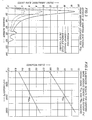
- Figure 2 of the drawings illustrates the dramatic change of shape of the gamma ray spectrum when a radioactive tracer element is placed in the borehole (as indicated by the dotted line drawing of Figure 2) and in the formation (as indicated by the solid drawing of Figure 2) for iridium-192.
- Figure 3 of the drawings illustrates the change of shape effect due to Compton scattering with a scandium-46 tracer located, according to solid curve in the formation, according to the long dashed curve in the cement annulus, and, according to the dotted curve, with the scandium-46 disposed in the borehole fluid in 51 ⁇ 2 inch (14.0cm) casing.
- the gamma ray spectrum of iridium-192 from the formation clearly has a different character due to a larger fraction of lower energy scattered gamma rays than the gamma ray spectrum of iridium-192 in the borehole.
- the 311 keV peak in the iridium-192 gamma ray formation spectrum is almost totally obscured by the down scattered radiation. This is the peak occurring in approximately channel 28 of the drawing of Figure 2.
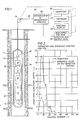
- a pressure housing 11 which may comprise a steel hosing 11 having a special low atomic number window 12 which may be comprised of a graphite epoxy laminate as disclosed in U.S. Patent 4,504,736 can be used in this logging instrument.
- a titanium pressure housing could be advantageously used.
- a two-inch (5.1cm) by twelve-inch (30.5cm) cylindrically shaped sodium iodide, thallium activated crystal 13 is disposed in the lower end of the pressure housing 11.
- a coincidence gain stabilizing detector 14 is used to stabilize the gain of the system according to U.S. Patent 4,300,043.
- a photomultiplier amplifier combination 15 is optically coupled to the thallium activated sodium iodide crystal 13 and produces output pulses having a height proportional to the intensity of the energy lost in the sodium iodide crystal by the gamma rays passing therethrough.
- a dual range analog to digital converter 16 is connected to the output of the photomultiplier tube and a digitized gamma ray spectrum is supplied therefrom to a data accumulator 17.
- a microprocessor controller 18 receives output from the data accumulator 17 and also is capable of inputting data to accumulator 17.
- the microprocessor controller 18 also supplies a stabilizer signal for high voltage control on output line 19 as illustrated.
- Formatted and encoded gamma ray energy spectra are provided as output from the microprocessor controller 18 on line 21 to a cable driver amplifier 22 from whence they are transmitted via a telemetry system (not illustrated) on the well logging cable 23, for transmission to the surface in a conventional manner.
- the armored well logging cable 23 passes over a sheave wheel 24 at the surface which (as indicated by the dotted line 25), provides depth information to the computer 26, a recorder 27, and a magnetic tape 28 drive. Signals from the armored well logging cable 23 are supplied to a demodulator 29 for input to the surface computer 26.
- the recorder 27 displays outputs from the computer 26 which may comprise elemental abundances and gamma ray energy spectra, etc.
- the direct display of the gamma ray spectra may also be supplied on a cathode ray tube type device 30, if desired.
- the computer 26 also supplies outputs to the magnetic tape units 28 which may be driven as a function of borehole depth along with the recorder 27.
- Compton ratio measurements utilizing the downscattering difference principle have been used in the past to identify the distance from the detector of a flowing stream of activated oxygen and a vertical water flow tool. See, for example, Arnold and Paap, Journal of Petroleum Technology, January 1979, pages 121-130 , "QUANTITATIVE MONITORING WATER FLOW BEHIND AND IN WELL BORE CASING". A more recent paper discuss the feasibility of using Compton downscattering ratios to determine the location of a tracer downhole with respect to a gamma ray spectroscopy logging tool.
- R c is defined to be a high energy count rate (in the range 350 keV to 3000 keV) divided by a low energy count rate (150 keV to 350 keV).
- R c becomes larger as the tracer location approaches the tool. It is also clear that the absolute R c ratio magnitude is a strong function of the gamma ray energy emitted from this each tracer. R c usually increases as the average energy increases. Similar results for R c have also been obtained from gamma ray spectroscopy data gathered using a large diameter tool with a titanium tool case as well as a small diameter tool with steel toolcase.
- the Compton ratio, R c can be useful in single element tracer jobs to identify the mean radial location of the tracer. It can also be used to partition the weighted-least square fit sensitivity matrix elements between the borehole and formation components as described earlier in equation (1).
- Another application for R c with a single tracer is in the investigation of cement and gravel pack placement operations.
- the application of R c in the analysis of multi-isotope tracer data is less clear since the R c for each tracer can vary widely. However, the general trends for individual isotopes can be distinguished so R c can be used at least qualitatively for these cases. Recent work has shown that it is possible to determine the average diameter of cement columns which have been tagged with radioactive tracers.
- One of the features of the present invention is that measurements in the low energy photoelectric region can be made when using a well logging tool having a low atomic number toolcase. Photoelectric ratio measurements can make it possible to distinguish the distribution of tracers inside and outside the casing.
- Low energy spectra in the range 0-350 KeV are shown in Figures 5a and 5b.
- the spectra overlayed in Figure 5a show the difference in photoelectric absorption from gold 198 gamma rays originating in the formation outside a cemented 51 ⁇ 2 (14.0cm) casing relative to those coming from the inside of the casing.
- the spectra can be visually divided into three energy ranges as indicated.
- the lowest energy range P is sensitive to photoelectric absorption differences caused by the casing.
- the mid-energy range M is a region for which the photoelectric absorption and the Compton downscattering effects are nearly of the same importance.
- the upper energy range C is that for which Compton downscattering is significant and photoelectric absorption is negligible.
- a ratio R p of gamma ray count rates in window M compared to window P is clearly photoelectrically sensitive and yet not markedly affected by Compton scattering effects.
- R p is not very sensitive to whether the gamma rays from a tracer outside the casing, are coming from the cement or the formation.
- R p has a characteristic relative to R c in that it is not affected by changes in the radial tracer distribution outside the casing, while at the same time R p is sensitive to the fraction of tracer inside the casing.
- Table 2 shows photoelectric ratio measurements made with a low-atomic number toolcase similar to the system of Figure 1 for the various tracers previously discussed and potassium.
- the tracer material is either in the borehole, in the cement or in the formation. Note that in each case R p is sensitive to changes from inside the casing to outside the casing, but, is not much effected by changes occurring outside the casing. TABLE 2 PHOTOELECTRIC RATIO MEASUREMENTS FOR LOW-Z TOOLCASE TOOL.
- R p is similar in magnitude for all the tracer isotopes. This is due in part to a selection of the energy ranges P and M. Therefore, R p can be interpreted for the presence of tracers in the borehole fluid in multiple tracer operations without accurate knowledge of either of the relative concentrations of all the tracers involved or of the radial distribution of any tracer outside the casing. It should be noted that R p is sensitive to changes in casing diameter. It must be recalled, however, that R p may only be obtained if the low Z toolcase is used in the gamma ray spectral tool. Both the titanium or steel toolcases can prevent gamma rays in the photoelectric energy region from reaching the detectors. R p , like R c , can be used to partition the sensitivity matrix for each tracer between borehole and formation components, as disclosed in equation 1.
- multiple tracers are used to determine fracture height or proppant height in a logging run.
- a plurality of standard spectra for each of the chosen tracers is utilized.
- the unknown gamma ray spectrum is measured in the depth region of interest in the unknown borehole.
- the weighted least squares technique which is described in the aforementioned copending U.S.
- the photoelectric ratio R p or the Compton ratio R c as previously defined may be observed and utilized along with Equation 1 to determine the x-parameter in partitioning the sensitivity matrix between borehole and formation components for each tracer.
- These composite sensitivity matrix elements are then used to solve for the total concentrations of each tracer.
- the borehole and formation component will not be separated in this solution, however, but the answers will be more accurate for total tracer concentrations because more accurate overall "standard" spectra for each element will have been used in the least-squares fit.
- x (3) That is, where u is the approximate computed concentration of tracer in a zone containing only borehole tracer and u + v is the approximate computed concentration of tracer in all other zones containing both borehole and formation tracers. These approximate concentrations are obtained using only prespecified tracers standard spectra, fitted to the observed data in an initial estimate to the concentrations. It may be possible to assist in determining the zone containing only borehole tracer by using the value of R p or R c in this zone (comparing to expected values for borehole located tracers).
- the parameter x can be determined by measuring the photoelectric ratio R p or Compton ratio R c as an approximate indicator of partitioning between the borehole and formation tracer concentrations; it might be desirable in some multitracer applications to determine x using the technique described in equation (3) above. It may also be possible to determine the partitioning parameter x using some other criterion which approximately partitions the observed spectral count rates between borehole and formation components.
- the standard spectra S(d) of equation (1) for each tracer may be characterized as a linear combination of the B and F spectra as previously stated with respect to Equation (1) once the x parameter has been determined in any of the foregoing manners.
- the computed concentrations using S(d) will be total concentrations for each tracer (no borehole vs formation component will be obtained).
- the techniques of the present invention disclose alternative methods for measuring the amount of tracer material in a well borehole and the surrounding formation. In one embodiment, this may be done simultaneously on one pass of a gamma ray spectral logging instrument wherein both borehole and formation standard matrix elements are input to a least-squares fitting technique, and the observed concentrations contain both borehole and formation components of these standard spectra.
- the sensitivity matrix elements for both borehole and formation components are not explicitly considered, but rather only one standard spectral shape for each tracer is input to the fitting program.
- the spectral shape S(d) for each tracer is determined by partitioning S(d) between a borehole component and a formation component.
- the partitioning parameter "x" is obtained from several possible sources of information, including: a photoelectric ratio R p , a Compton ratio R c , an initial estimate of borehole versus formation count rates based on a knowledge of zones in the well where only borehole counts are present, or possibly some other partitioning function based on borehole size or on an a priori knowledge of the approximate anticipated borehole versus formation count rates based on the specific procedures and events which occurred during the specific pumping operation.
Landscapes
- Physics & Mathematics (AREA)
- Life Sciences & Earth Sciences (AREA)
- Geology (AREA)
- Engineering & Computer Science (AREA)
- Environmental & Geological Engineering (AREA)
- Geophysics (AREA)
- Mining & Mineral Resources (AREA)
- General Life Sciences & Earth Sciences (AREA)
- Fluid Mechanics (AREA)
- Geochemistry & Mineralogy (AREA)
- High Energy & Nuclear Physics (AREA)
- General Physics & Mathematics (AREA)
- Geophysics And Detection Of Objects (AREA)
- Measurement Of Radiation (AREA)
Applications Claiming Priority (2)
| Application Number | Priority Date | Filing Date | Title |
|---|---|---|---|
| US211521 | 1988-06-24 | ||
| US07/211,521 US4939361A (en) | 1988-06-24 | 1988-06-24 | Method for correcting gamma ray spectra for borehole tracer interference |
Publications (2)
| Publication Number | Publication Date |
|---|---|
| EP0348098A2 true EP0348098A2 (de) | 1989-12-27 |
| EP0348098A3 EP0348098A3 (de) | 1991-05-08 |
Family
ID=22787274
Family Applications (1)
| Application Number | Title | Priority Date | Filing Date |
|---|---|---|---|
| EP19890306050 Withdrawn EP0348098A3 (de) | 1988-06-24 | 1989-06-15 | Verfahren zur Messung von Gammastrahlung in Bohrlöchern |
Country Status (2)
| Country | Link |
|---|---|
| US (1) | US4939361A (de) |
| EP (1) | EP0348098A3 (de) |
Cited By (1)
| Publication number | Priority date | Publication date | Assignee | Title |
|---|---|---|---|---|
| EP0387055A3 (de) * | 1989-03-10 | 1992-06-10 | Halliburton Logging Services, Inc. | Verfahren zur Messung von Gammastrahlung in Bohrlöchern für radiale Entfernungen von Tracerelementen |
Families Citing this family (10)
| Publication number | Priority date | Publication date | Assignee | Title |
|---|---|---|---|---|
| US5153431A (en) * | 1991-04-05 | 1992-10-06 | Computalog Research, Inc. | Well logging radioactive detector assembly |
| US5225674A (en) * | 1992-01-21 | 1993-07-06 | Texaco Inc. | Method of delineating naturally fractured intervals in subterranean formations |
| US5635712A (en) * | 1995-05-04 | 1997-06-03 | Halliburton Company | Method for monitoring the hydraulic fracturing of a subterranean formation |
| US6037585A (en) * | 1997-10-28 | 2000-03-14 | Halliburton Energy Services, Inc. | Determination of radioactive scale distribution using gamma ray logging technique |
| US7893398B2 (en) * | 2008-08-01 | 2011-02-22 | Baker Hughes Incorporated | Compensated mineralogy tool and processing |
| US8648309B2 (en) | 2010-10-04 | 2014-02-11 | Carbo Ceramics Inc. | Spectral identification of proppant in subterranean fracture zones |
| US8809798B2 (en) | 2013-01-11 | 2014-08-19 | Baker Hughes Incorporated | Methods to enhance nuclear spectroscopy analysis |
| WO2016171668A1 (en) * | 2015-04-21 | 2016-10-27 | Halliburton Energy Services, Inc. | Formation independent cement evaluation with active gamma ray detection |
| WO2017214325A1 (en) * | 2016-06-08 | 2017-12-14 | Halliburton Energy Services, Inc. | Correcting borehole signal contributions from neutron-induced gamma ray spectroscopy logs |
| CN119507878B (zh) * | 2023-08-24 | 2025-11-04 | 中国石油天然气集团有限公司 | 全谱测井数据的油水对比度获取方法、装置及设备 |
Family Cites Families (4)
| Publication number | Priority date | Publication date | Assignee | Title |
|---|---|---|---|---|
| US3402769A (en) * | 1965-08-17 | 1968-09-24 | Go Services Inc | Fracture detection method for bore holes |
| US4178506A (en) * | 1977-09-06 | 1979-12-11 | Dresser Industries, Inc. | Method for detecting fractures in formations surrounding earth boreholes |
| US4825071A (en) * | 1985-04-05 | 1989-04-25 | Halliburton Logging Services Inc. | Gamma ray borehole logging method and apparatus having compensation for borehole attenuation effects |
| US4717825A (en) * | 1986-07-23 | 1988-01-05 | Halliburton Company | Method and apparatus for anomalous radioactive deposition compensation in spectral gamma ray well logging |
-
1988
- 1988-06-24 US US07/211,521 patent/US4939361A/en not_active Expired - Lifetime
-
1989
- 1989-06-15 EP EP19890306050 patent/EP0348098A3/de not_active Withdrawn
Cited By (1)
| Publication number | Priority date | Publication date | Assignee | Title |
|---|---|---|---|---|
| EP0387055A3 (de) * | 1989-03-10 | 1992-06-10 | Halliburton Logging Services, Inc. | Verfahren zur Messung von Gammastrahlung in Bohrlöchern für radiale Entfernungen von Tracerelementen |
Also Published As
| Publication number | Publication date |
|---|---|
| US4939361A (en) | 1990-07-03 |
| EP0348098A3 (de) | 1991-05-08 |
Similar Documents
| Publication | Publication Date | Title |
|---|---|---|
| US4825073A (en) | Method for determining depth of penetration of radioactive tracers in formation fractures | |
| US4857729A (en) | Method of radioactive well logging | |
| US6552333B1 (en) | Apparatus and methods for determining gravel pack quality | |
| US5410152A (en) | Low-noise method for performing downhole well logging using gamma ray spectroscopy to measure radioactive tracer penetration | |
| US5635712A (en) | Method for monitoring the hydraulic fracturing of a subterranean formation | |
| EP0143529B1 (de) | Vielfachmessvorrichtung zur Bestimmung natürlicher Gammastrahlung in einem Bohrloch | |
| US4415805A (en) | Method and apparatus for evaluating multiple stage fracturing or earth formations surrounding a borehole | |
| CA1217881A (en) | Gain stabilized natural gamma ray detection of casing thickness in a borehole | |
| US4071755A (en) | Method for in situ evaluation of the source rock potential of earth formations | |
| EP0443936A1 (de) | Verfahren und Vorrichtung zur Zementschätzung bei einem Bohrloch | |
| US4939361A (en) | Method for correcting gamma ray spectra for borehole tracer interference | |
| US5578820A (en) | Method for determining cement thickness in a well annulus | |
| US6927390B2 (en) | Gamma ray spectroscopy logging-while-drilling system | |
| US4574193A (en) | Method for logging fluid flow rate, water fraction, and/or salinity of water flowing into a well | |
| CA1118911A (en) | Method for ascertaining optimum location for well stimulation and/or perforation | |
| US5165275A (en) | Compensated gamma ray mudlog | |
| US20080156975A1 (en) | Multi-evaluation core logger | |
| US6037585A (en) | Determination of radioactive scale distribution using gamma ray logging technique | |
| Gadekea et al. | Trancerscan: A Spectroscopy Technique For Determining The Distribution Of Multiplte Radioactive Tracers In Downhole Operations | |
| US2692755A (en) | Process and apparatus for logging boreholes | |
| US4578579A (en) | Method for depth referencing hydrocarbon gas shows on mud logs | |
| US4459479A (en) | Determination of casing thickness using a natural gamma ray spectroscopy technique | |
| US4691772A (en) | Process for obtaining permeability logs using radioactive drilling mud additives | |
| US4780266A (en) | Method for detecting drilling fluid in the annulus of a cased wellbore | |
| Oliver et al. | Continuous carbon/oxygen (C/O) logging-instrumentation, interpretive concepts and field applications |
Legal Events
| Date | Code | Title | Description |
|---|---|---|---|
| PUAI | Public reference made under article 153(3) epc to a published international application that has entered the european phase |
Free format text: ORIGINAL CODE: 0009012 |
|
| AK | Designated contracting states |
Kind code of ref document: A2 Designated state(s): DE FR GB IT NL |
|
| PUAL | Search report despatched |
Free format text: ORIGINAL CODE: 0009013 |
|
| AK | Designated contracting states |
Kind code of ref document: A3 Designated state(s): DE FR GB IT NL |
|
| RHK1 | Main classification (correction) |
Ipc: E21B 47/00 |
|
| 17P | Request for examination filed |
Effective date: 19910605 |
|
| 17Q | First examination report despatched |
Effective date: 19920722 |
|
| STAA | Information on the status of an ep patent application or granted ep patent |
Free format text: STATUS: THE APPLICATION HAS BEEN WITHDRAWN |
|
| 18W | Application withdrawn |
Withdrawal date: 19951018 |