EP0347128A1 - Process for production of a high molecular weight ethylene a-olefin elastomer with a metallogene alumoxane catalyst - Google Patents
Process for production of a high molecular weight ethylene a-olefin elastomer with a metallogene alumoxane catalyst Download PDFInfo
- Publication number
- EP0347128A1 EP0347128A1 EP89305877A EP89305877A EP0347128A1 EP 0347128 A1 EP0347128 A1 EP 0347128A1 EP 89305877 A EP89305877 A EP 89305877A EP 89305877 A EP89305877 A EP 89305877A EP 0347128 A1 EP0347128 A1 EP 0347128A1
- Authority
- EP
- European Patent Office
- Prior art keywords
- catalyst
- ethylene
- olefin
- zirconocene
- alumoxane
- Prior art date
- Legal status (The legal status is an assumption and is not a legal conclusion. Google has not performed a legal analysis and makes no representation as to the accuracy of the status listed.)
- Granted
Links
- 239000003054 catalyst Substances 0.000 title claims abstract description 175
- VGGSQFUCUMXWEO-UHFFFAOYSA-N Ethene Chemical compound C=C VGGSQFUCUMXWEO-UHFFFAOYSA-N 0.000 title claims abstract description 60
- 239000005977 Ethylene Substances 0.000 title claims abstract description 60
- 238000000034 method Methods 0.000 title claims abstract description 55
- 229920001971 elastomer Polymers 0.000 title claims abstract description 43
- 239000000806 elastomer Substances 0.000 title claims abstract description 42
- 230000008569 process Effects 0.000 title claims abstract description 35
- 238000004519 manufacturing process Methods 0.000 title abstract description 17
- ZMMRKRFMSDTOLV-UHFFFAOYSA-N cyclopenta-1,3-diene zirconium Chemical class [Zr].C1C=CC=C1.C1C=CC=C1 ZMMRKRFMSDTOLV-UHFFFAOYSA-N 0.000 claims abstract description 54
- 238000006116 polymerization reaction Methods 0.000 claims abstract description 53
- 239000004711 α-olefin Substances 0.000 claims abstract description 51
- VYPSYNLAJGMNEJ-UHFFFAOYSA-N Silicium dioxide Chemical compound O=[Si]=O VYPSYNLAJGMNEJ-UHFFFAOYSA-N 0.000 claims abstract description 47
- 239000002002 slurry Substances 0.000 claims abstract description 46
- 239000000178 monomer Substances 0.000 claims abstract description 41
- 229910052726 zirconium Inorganic materials 0.000 claims abstract description 24
- QCWXUUIWCKQGHC-UHFFFAOYSA-N Zirconium Chemical group [Zr] QCWXUUIWCKQGHC-UHFFFAOYSA-N 0.000 claims abstract description 21
- 125000000217 alkyl group Chemical group 0.000 claims abstract description 21
- 239000003085 diluting agent Substances 0.000 claims abstract description 21
- 239000000741 silica gel Substances 0.000 claims abstract description 20
- 229910002027 silica gel Inorganic materials 0.000 claims abstract description 20
- 239000001301 oxygen Chemical group 0.000 claims abstract description 14
- 229910052760 oxygen Chemical group 0.000 claims abstract description 14
- 239000007788 liquid Substances 0.000 claims abstract description 12
- 125000004122 cyclic group Chemical group 0.000 claims abstract description 11
- 239000007791 liquid phase Substances 0.000 claims abstract description 10
- RTAQQCXQSZGOHL-UHFFFAOYSA-N Titanium Chemical group [Ti] RTAQQCXQSZGOHL-UHFFFAOYSA-N 0.000 claims abstract description 8
- 125000002947 alkylene group Chemical group 0.000 claims abstract description 8
- 150000004820 halides Chemical group 0.000 claims abstract description 8
- 150000004678 hydrides Chemical group 0.000 claims abstract description 8
- 239000010936 titanium Chemical group 0.000 claims abstract description 8
- 229910052719 titanium Inorganic materials 0.000 claims abstract description 8
- 229910052735 hafnium Chemical group 0.000 claims abstract description 7
- VBJZVLUMGGDVMO-UHFFFAOYSA-N hafnium atom Chemical group [Hf] VBJZVLUMGGDVMO-UHFFFAOYSA-N 0.000 claims abstract description 7
- 150000001336 alkenes Chemical class 0.000 claims abstract description 6
- JRZJOMJEPLMPRA-UHFFFAOYSA-N olefin Natural products CCCCCCCC=C JRZJOMJEPLMPRA-UHFFFAOYSA-N 0.000 claims abstract description 6
- 125000006165 cyclic alkyl group Chemical group 0.000 claims abstract description 5
- 125000003118 aryl group Chemical group 0.000 claims abstract description 4
- 238000006243 chemical reaction Methods 0.000 claims description 40
- AQZWEFBJYQSQEH-UHFFFAOYSA-N 2-methyloxaluminane Chemical compound C[Al]1CCCCO1 AQZWEFBJYQSQEH-UHFFFAOYSA-N 0.000 claims description 36
- -1 tetrahydroindenyl Chemical group 0.000 claims description 23
- 239000000463 material Substances 0.000 claims description 22
- 125000004805 propylene group Chemical group [H]C([H])([H])C([H])([*:1])C([H])([H])[*:2] 0.000 claims description 21
- QQONPFPTGQHPMA-UHFFFAOYSA-N propylene Natural products CC=C QQONPFPTGQHPMA-UHFFFAOYSA-N 0.000 claims description 20
- 239000000203 mixture Substances 0.000 claims description 17
- 229910052782 aluminium Inorganic materials 0.000 claims description 16
- 229930195733 hydrocarbon Natural products 0.000 claims description 13
- 150000002430 hydrocarbons Chemical class 0.000 claims description 13
- 239000004215 Carbon black (E152) Substances 0.000 claims description 11
- NOQWABVRFAHTQD-UHFFFAOYSA-L [Cl-].[Cl-].C12=CC=CCC2CCC1[Zr+2]C1C2=CC=CCC2CC1 Chemical group [Cl-].[Cl-].C12=CC=CCC2CCC1[Zr+2]C1C2=CC=CCC2CC1 NOQWABVRFAHTQD-UHFFFAOYSA-L 0.000 claims description 10
- 239000000377 silicon dioxide Substances 0.000 claims description 10
- XAGFODPZIPBFFR-UHFFFAOYSA-N aluminium Chemical compound [Al] XAGFODPZIPBFFR-UHFFFAOYSA-N 0.000 claims description 9
- QVGXLLKOCUKJST-UHFFFAOYSA-N atomic oxygen Chemical compound [O] QVGXLLKOCUKJST-UHFFFAOYSA-N 0.000 claims description 9
- 125000004432 carbon atom Chemical group C* 0.000 claims description 8
- VPGLGRNSAYHXPY-UHFFFAOYSA-L zirconium(2+);dichloride Chemical compound Cl[Zr]Cl VPGLGRNSAYHXPY-UHFFFAOYSA-L 0.000 claims description 5
- VXNZUUAINFGPBY-UHFFFAOYSA-N 1-Butene Chemical compound CCC=C VXNZUUAINFGPBY-UHFFFAOYSA-N 0.000 claims description 4
- 238000007334 copolymerization reaction Methods 0.000 claims description 4
- 229910052809 inorganic oxide Inorganic materials 0.000 claims description 4
- 238000010924 continuous production Methods 0.000 claims description 3
- HQQADJVZYDDRJT-UHFFFAOYSA-N ethene;prop-1-ene Chemical group C=C.CC=C HQQADJVZYDDRJT-UHFFFAOYSA-N 0.000 claims description 3
- 229910052751 metal Inorganic materials 0.000 claims description 2
- 239000002184 metal Substances 0.000 claims description 2
- 229920001198 elastomeric copolymer Polymers 0.000 claims 1
- 230000004584 weight gain Effects 0.000 claims 1
- 235000019786 weight gain Nutrition 0.000 claims 1
- 239000002245 particle Substances 0.000 abstract description 6
- 229920000181 Ethylene propylene rubber Polymers 0.000 abstract description 3
- YXFVVABEGXRONW-UHFFFAOYSA-N Toluene Chemical compound CC1=CC=CC=C1 YXFVVABEGXRONW-UHFFFAOYSA-N 0.000 description 75
- 229920000642 polymer Polymers 0.000 description 31
- 230000000694 effects Effects 0.000 description 23
- OFBQJSOFQDEBGM-UHFFFAOYSA-N n-pentane Natural products CCCCC OFBQJSOFQDEBGM-UHFFFAOYSA-N 0.000 description 20
- 238000009826 distribution Methods 0.000 description 14
- VLKZOEOYAKHREP-UHFFFAOYSA-N n-Hexane Chemical class CCCCCC VLKZOEOYAKHREP-UHFFFAOYSA-N 0.000 description 14
- 229920001577 copolymer Polymers 0.000 description 12
- 239000002904 solvent Substances 0.000 description 11
- IJGRMHOSHXDMSA-UHFFFAOYSA-N Atomic nitrogen Chemical compound N#N IJGRMHOSHXDMSA-UHFFFAOYSA-N 0.000 description 10
- 239000000843 powder Substances 0.000 description 10
- 238000003756 stirring Methods 0.000 description 10
- 229920003023 plastic Polymers 0.000 description 9
- 239000004033 plastic Substances 0.000 description 9
- 239000000243 solution Substances 0.000 description 8
- 230000000052 comparative effect Effects 0.000 description 7
- 125000001495 ethyl group Chemical group [H]C([H])([H])C([H])([H])* 0.000 description 7
- 239000007787 solid Substances 0.000 description 7
- 125000000058 cyclopentadienyl group Chemical group C1(=CC=CC1)* 0.000 description 6
- QWTDNUCVQCZILF-UHFFFAOYSA-N isopentane Chemical compound CCC(C)C QWTDNUCVQCZILF-UHFFFAOYSA-N 0.000 description 6
- ZSWFCLXCOIISFI-UHFFFAOYSA-N endo-cyclopentadiene Natural products C1C=CC=C1 ZSWFCLXCOIISFI-UHFFFAOYSA-N 0.000 description 5
- 239000007789 gas Substances 0.000 description 5
- 238000010438 heat treatment Methods 0.000 description 5
- 229920001903 high density polyethylene Polymers 0.000 description 5
- 239000004700 high-density polyethylene Substances 0.000 description 5
- 229910052757 nitrogen Inorganic materials 0.000 description 5
- XLYOFNOQVPJJNP-UHFFFAOYSA-N water Substances O XLYOFNOQVPJJNP-UHFFFAOYSA-N 0.000 description 5
- 239000004698 Polyethylene Substances 0.000 description 4
- ATUOYWHBWRKTHZ-UHFFFAOYSA-N Propane Chemical compound CCC ATUOYWHBWRKTHZ-UHFFFAOYSA-N 0.000 description 4
- PNEYBMLMFCGWSK-UHFFFAOYSA-N aluminium oxide Inorganic materials [O-2].[O-2].[O-2].[Al+3].[Al+3] PNEYBMLMFCGWSK-UHFFFAOYSA-N 0.000 description 4
- 238000004458 analytical method Methods 0.000 description 4
- 230000015572 biosynthetic process Effects 0.000 description 4
- 239000012442 inert solvent Substances 0.000 description 4
- 229920000573 polyethylene Polymers 0.000 description 4
- 239000011949 solid catalyst Substances 0.000 description 4
- 238000003786 synthesis reaction Methods 0.000 description 4
- PBKONEOXTCPAFI-UHFFFAOYSA-N 1,2,4-trichlorobenzene Chemical compound ClC1=CC=C(Cl)C(Cl)=C1 PBKONEOXTCPAFI-UHFFFAOYSA-N 0.000 description 3
- UHOVQNZJYSORNB-UHFFFAOYSA-N Benzene Chemical compound C1=CC=CC=C1 UHOVQNZJYSORNB-UHFFFAOYSA-N 0.000 description 3
- 239000012298 atmosphere Substances 0.000 description 3
- 238000001816 cooling Methods 0.000 description 3
- AFABGHUZZDYHJO-UHFFFAOYSA-N dimethyl butane Natural products CCCC(C)C AFABGHUZZDYHJO-UHFFFAOYSA-N 0.000 description 3
- 238000001035 drying Methods 0.000 description 3
- 239000000499 gel Substances 0.000 description 3
- 239000008187 granular material Substances 0.000 description 3
- 230000000977 initiatory effect Effects 0.000 description 3
- 229920000092 linear low density polyethylene Polymers 0.000 description 3
- 239000004707 linear low-density polyethylene Substances 0.000 description 3
- 125000002496 methyl group Chemical group [H]C([H])([H])* 0.000 description 3
- 239000002516 radical scavenger Substances 0.000 description 3
- 230000035484 reaction time Effects 0.000 description 3
- VOITXYVAKOUIBA-UHFFFAOYSA-N triethylaluminium Chemical compound CC[Al](CC)CC VOITXYVAKOUIBA-UHFFFAOYSA-N 0.000 description 3
- 239000012808 vapor phase Substances 0.000 description 3
- KVNYFPKFSJIPBJ-UHFFFAOYSA-N 1,2-diethylbenzene Chemical compound CCC1=CC=CC=C1CC KVNYFPKFSJIPBJ-UHFFFAOYSA-N 0.000 description 2
- CRSBERNSMYQZNG-UHFFFAOYSA-N 1-dodecene Chemical compound CCCCCCCCCCC=C CRSBERNSMYQZNG-UHFFFAOYSA-N 0.000 description 2
- LIKMAJRDDDTEIG-UHFFFAOYSA-N 1-hexene Chemical compound CCCCC=C LIKMAJRDDDTEIG-UHFFFAOYSA-N 0.000 description 2
- KWKAKUADMBZCLK-UHFFFAOYSA-N 1-octene Chemical compound CCCCCCC=C KWKAKUADMBZCLK-UHFFFAOYSA-N 0.000 description 2
- RGSFGYAAUTVSQA-UHFFFAOYSA-N Cyclopentane Chemical compound C1CCCC1 RGSFGYAAUTVSQA-UHFFFAOYSA-N 0.000 description 2
- YNQLUTRBYVCPMQ-UHFFFAOYSA-N Ethylbenzene Chemical compound CCC1=CC=CC=C1 YNQLUTRBYVCPMQ-UHFFFAOYSA-N 0.000 description 2
- UFHFLCQGNIYNRP-UHFFFAOYSA-N Hydrogen Chemical compound [H][H] UFHFLCQGNIYNRP-UHFFFAOYSA-N 0.000 description 2
- CPLXHLVBOLITMK-UHFFFAOYSA-N Magnesium oxide Chemical compound [Mg]=O CPLXHLVBOLITMK-UHFFFAOYSA-N 0.000 description 2
- IMNFDUFMRHMDMM-UHFFFAOYSA-N N-Heptane Chemical class CCCCCCC IMNFDUFMRHMDMM-UHFFFAOYSA-N 0.000 description 2
- GWEVSGVZZGPLCZ-UHFFFAOYSA-N Titan oxide Chemical compound O=[Ti]=O GWEVSGVZZGPLCZ-UHFFFAOYSA-N 0.000 description 2
- MCMNRKCIXSYSNV-UHFFFAOYSA-N Zirconium dioxide Chemical compound O=[Zr]=O MCMNRKCIXSYSNV-UHFFFAOYSA-N 0.000 description 2
- 239000001273 butane Substances 0.000 description 2
- 125000000484 butyl group Chemical group [H]C([*])([H])C([H])([H])C([H])([H])C([H])([H])[H] 0.000 description 2
- 150000001875 compounds Chemical class 0.000 description 2
- 238000012937 correction Methods 0.000 description 2
- 230000008021 deposition Effects 0.000 description 2
- 239000000539 dimer Substances 0.000 description 2
- 238000001914 filtration Methods 0.000 description 2
- 238000005227 gel permeation chromatography Methods 0.000 description 2
- 239000011521 glass Substances 0.000 description 2
- 239000002638 heterogeneous catalyst Substances 0.000 description 2
- 239000001257 hydrogen Substances 0.000 description 2
- 229910052739 hydrogen Inorganic materials 0.000 description 2
- 239000012535 impurity Substances 0.000 description 2
- 238000010348 incorporation Methods 0.000 description 2
- 239000004615 ingredient Substances 0.000 description 2
- 238000002347 injection Methods 0.000 description 2
- 239000007924 injection Substances 0.000 description 2
- 229910003480 inorganic solid Inorganic materials 0.000 description 2
- 239000003446 ligand Substances 0.000 description 2
- 238000002156 mixing Methods 0.000 description 2
- 230000000051 modifying effect Effects 0.000 description 2
- IJDNQMDRQITEOD-UHFFFAOYSA-N n-butane Chemical compound CCCC IJDNQMDRQITEOD-UHFFFAOYSA-N 0.000 description 2
- 239000003960 organic solvent Substances 0.000 description 2
- YWAKXRMUMFPDSH-UHFFFAOYSA-N pentene Chemical compound CCCC=C YWAKXRMUMFPDSH-UHFFFAOYSA-N 0.000 description 2
- 239000012071 phase Substances 0.000 description 2
- 125000001997 phenyl group Chemical group [H]C1=C([H])C([H])=C(*)C([H])=C1[H] 0.000 description 2
- 230000000379 polymerizing effect Effects 0.000 description 2
- 229920000098 polyolefin Polymers 0.000 description 2
- 238000002360 preparation method Methods 0.000 description 2
- 239000001294 propane Substances 0.000 description 2
- 125000001436 propyl group Chemical group [H]C([*])([H])C([H])([H])C([H])([H])[H] 0.000 description 2
- 150000003839 salts Chemical class 0.000 description 2
- 239000011343 solid material Substances 0.000 description 2
- 241000894007 species Species 0.000 description 2
- 125000001424 substituent group Chemical group 0.000 description 2
- YBYIRNPNPLQARY-UHFFFAOYSA-N 1H-indene Natural products C1=CC=C2CC=CC2=C1 YBYIRNPNPLQARY-UHFFFAOYSA-N 0.000 description 1
- 229910018516 Al—O Inorganic materials 0.000 description 1
- UAPQTNLKJHLGKL-UHFFFAOYSA-N C[SiH](C)C=[Si](C)C Chemical group C[SiH](C)C=[Si](C)C UAPQTNLKJHLGKL-UHFFFAOYSA-N 0.000 description 1
- VEXZGXHMUGYJMC-UHFFFAOYSA-M Chloride anion Chemical compound [Cl-] VEXZGXHMUGYJMC-UHFFFAOYSA-M 0.000 description 1
- 229920000089 Cyclic olefin copolymer Polymers 0.000 description 1
- XDTMQSROBMDMFD-UHFFFAOYSA-N Cyclohexane Chemical compound C1CCCCC1 XDTMQSROBMDMFD-UHFFFAOYSA-N 0.000 description 1
- OTMSDBZUPAUEDD-UHFFFAOYSA-N Ethane Chemical compound CC OTMSDBZUPAUEDD-UHFFFAOYSA-N 0.000 description 1
- 241001441571 Hiodontidae Species 0.000 description 1
- 229920010126 Linear Low Density Polyethylene (LLDPE) Polymers 0.000 description 1
- 239000004793 Polystyrene Substances 0.000 description 1
- XBDQKXXYIPTUBI-UHFFFAOYSA-M Propionate Chemical compound CCC([O-])=O XBDQKXXYIPTUBI-UHFFFAOYSA-M 0.000 description 1
- XUIMIQQOPSSXEZ-UHFFFAOYSA-N Silicon Chemical group [Si] XUIMIQQOPSSXEZ-UHFFFAOYSA-N 0.000 description 1
- HMDDXIMCDZRSNE-UHFFFAOYSA-N [C].[Si] Chemical group [C].[Si] HMDDXIMCDZRSNE-UHFFFAOYSA-N 0.000 description 1
- KXKVLQRXCPHEJC-UHFFFAOYSA-N acetic acid trimethyl ester Natural products COC(C)=O KXKVLQRXCPHEJC-UHFFFAOYSA-N 0.000 description 1
- 230000003679 aging effect Effects 0.000 description 1
- 150000001335 aliphatic alkanes Chemical class 0.000 description 1
- 238000000149 argon plasma sintering Methods 0.000 description 1
- 230000008901 benefit Effects 0.000 description 1
- 235000010290 biphenyl Nutrition 0.000 description 1
- 239000004305 biphenyl Substances 0.000 description 1
- 238000000071 blow moulding Methods 0.000 description 1
- 238000009835 boiling Methods 0.000 description 1
- 239000012986 chain transfer agent Substances 0.000 description 1
- 230000008859 change Effects 0.000 description 1
- 239000007810 chemical reaction solvent Substances 0.000 description 1
- 239000003795 chemical substances by application Substances 0.000 description 1
- KOPOQZFJUQMUML-UHFFFAOYSA-N chlorosilane Chemical class Cl[SiH3] KOPOQZFJUQMUML-UHFFFAOYSA-N 0.000 description 1
- 229910052681 coesite Inorganic materials 0.000 description 1
- 238000010960 commercial process Methods 0.000 description 1
- 229910000365 copper sulfate Inorganic materials 0.000 description 1
- ARUVKPQLZAKDPS-UHFFFAOYSA-L copper(II) sulfate Chemical compound [Cu+2].[O-][S+2]([O-])([O-])[O-] ARUVKPQLZAKDPS-UHFFFAOYSA-L 0.000 description 1
- 229910052906 cristobalite Inorganic materials 0.000 description 1
- 150000001923 cyclic compounds Chemical class 0.000 description 1
- 150000001924 cycloalkanes Chemical class 0.000 description 1
- 125000004976 cyclobutylene group Chemical group 0.000 description 1
- 125000004956 cyclohexylene group Chemical group 0.000 description 1
- KOMDZQSPRDYARS-UHFFFAOYSA-N cyclopenta-1,3-diene titanium Chemical compound [Ti].C1C=CC=C1.C1C=CC=C1 KOMDZQSPRDYARS-UHFFFAOYSA-N 0.000 description 1
- 125000004979 cyclopentylene group Chemical group 0.000 description 1
- 238000010908 decantation Methods 0.000 description 1
- 125000002704 decyl group Chemical group [H]C([H])([H])C([H])([H])C([H])([H])C([H])([H])C([H])([H])C([H])([H])C([H])([H])C([H])([H])C([H])([H])C([H])([H])* 0.000 description 1
- 150000001993 dienes Chemical class 0.000 description 1
- ZIOQFHFYVWYPJP-UHFFFAOYSA-N dimethyl(methylidene)silane Chemical group C[Si](C)=C ZIOQFHFYVWYPJP-UHFFFAOYSA-N 0.000 description 1
- 238000004090 dissolution Methods 0.000 description 1
- 229940069096 dodecene Drugs 0.000 description 1
- 239000013536 elastomeric material Substances 0.000 description 1
- 238000010828 elution Methods 0.000 description 1
- 238000001125 extrusion Methods 0.000 description 1
- 238000007765 extrusion coating Methods 0.000 description 1
- 239000000945 filler Substances 0.000 description 1
- 238000010528 free radical solution polymerization reaction Methods 0.000 description 1
- 230000009477 glass transition Effects 0.000 description 1
- DMEGYFMYUHOHGS-UHFFFAOYSA-N heptamethylene Natural products C1CCCCCC1 DMEGYFMYUHOHGS-UHFFFAOYSA-N 0.000 description 1
- 125000003187 heptyl group Chemical group [H]C([*])([H])C([H])([H])C([H])([H])C([H])([H])C([H])([H])C([H])([H])C([H])([H])[H] 0.000 description 1
- 125000004051 hexyl group Chemical group [H]C([H])([H])C([H])([H])C([H])([H])C([H])([H])C([H])([H])C([H])([H])* 0.000 description 1
- 238000000265 homogenisation Methods 0.000 description 1
- 229920001519 homopolymer Polymers 0.000 description 1
- 125000001183 hydrocarbyl group Chemical group 0.000 description 1
- 125000000743 hydrocarbylene group Chemical group 0.000 description 1
- 125000002887 hydroxy group Chemical group [H]O* 0.000 description 1
- 125000003454 indenyl group Chemical group C1(C=CC2=CC=CC=C12)* 0.000 description 1
- 239000011261 inert gas Substances 0.000 description 1
- 238000001746 injection moulding Methods 0.000 description 1
- 125000000959 isobutyl group Chemical group [H]C([H])([H])C([H])(C([H])([H])[H])C([H])([H])* 0.000 description 1
- 238000002955 isolation Methods 0.000 description 1
- 125000001972 isopentyl group Chemical group [H]C([H])([H])C([H])(C([H])([H])[H])C([H])([H])C([H])([H])* 0.000 description 1
- 238000004811 liquid chromatography Methods 0.000 description 1
- 229910052744 lithium Inorganic materials 0.000 description 1
- 238000011068 loading method Methods 0.000 description 1
- 239000000395 magnesium oxide Substances 0.000 description 1
- 238000003760 magnetic stirring Methods 0.000 description 1
- UUVIQYKKKBJYJT-ZYUZMQFOSA-N mannosulfan Chemical compound CS(=O)(=O)OC[C@@H](OS(C)(=O)=O)[C@@H](O)[C@H](O)[C@H](OS(C)(=O)=O)COS(C)(=O)=O UUVIQYKKKBJYJT-ZYUZMQFOSA-N 0.000 description 1
- 239000003607 modifier Substances 0.000 description 1
- TVMXDCGIABBOFY-UHFFFAOYSA-N n-Octanol Natural products CCCCCCCC TVMXDCGIABBOFY-UHFFFAOYSA-N 0.000 description 1
- 125000000740 n-pentyl group Chemical group [H]C([H])([H])C([H])([H])C([H])([H])C([H])([H])C([H])([H])* 0.000 description 1
- 125000001400 nonyl group Chemical group [H]C([*])([H])C([H])([H])C([H])([H])C([H])([H])C([H])([H])C([H])([H])C([H])([H])C([H])([H])C([H])([H])[H] 0.000 description 1
- 125000002347 octyl group Chemical group [H]C([*])([H])C([H])([H])C([H])([H])C([H])([H])C([H])([H])C([H])([H])C([H])([H])C([H])([H])[H] 0.000 description 1
- 239000003921 oil Substances 0.000 description 1
- 125000002524 organometallic group Chemical group 0.000 description 1
- 125000000913 palmityl group Chemical group [H]C([*])([H])C([H])([H])C([H])([H])C([H])([H])C([H])([H])C([H])([H])C([H])([H])C([H])([H])C([H])([H])C([H])([H])C([H])([H])C([H])([H])C([H])([H])C([H])([H])C([H])([H])C([H])([H])[H] 0.000 description 1
- 125000001147 pentyl group Chemical group C(CCCC)* 0.000 description 1
- ZUOUZKKEUPVFJK-UHFFFAOYSA-N phenylbenzene Natural products C1=CC=CC=C1C1=CC=CC=C1 ZUOUZKKEUPVFJK-UHFFFAOYSA-N 0.000 description 1
- 239000004014 plasticizer Substances 0.000 description 1
- 229920001195 polyisoprene Polymers 0.000 description 1
- 229920002223 polystyrene Polymers 0.000 description 1
- 239000011148 porous material Substances 0.000 description 1
- 238000012545 processing Methods 0.000 description 1
- 239000000376 reactant Substances 0.000 description 1
- 239000012429 reaction media Substances 0.000 description 1
- 238000004064 recycling Methods 0.000 description 1
- 238000010992 reflux Methods 0.000 description 1
- 229930195734 saturated hydrocarbon Natural products 0.000 description 1
- 230000002000 scavenging effect Effects 0.000 description 1
- 235000012239 silicon dioxide Nutrition 0.000 description 1
- 239000012798 spherical particle Substances 0.000 description 1
- 238000003892 spreading Methods 0.000 description 1
- 230000007480 spreading Effects 0.000 description 1
- 229910052682 stishovite Inorganic materials 0.000 description 1
- 239000000454 talc Substances 0.000 description 1
- 229910052623 talc Inorganic materials 0.000 description 1
- 125000000383 tetramethylene group Chemical group [H]C([H])([*:1])C([H])([H])C([H])([H])C([H])([H])[*:2] 0.000 description 1
- 238000012546 transfer Methods 0.000 description 1
- 229910052723 transition metal Inorganic materials 0.000 description 1
- 150000003624 transition metals Chemical class 0.000 description 1
- 229910052905 tridymite Inorganic materials 0.000 description 1
- MCULRUJILOGHCJ-UHFFFAOYSA-N triisobutylaluminium Chemical compound CC(C)C[Al](CC(C)C)CC(C)C MCULRUJILOGHCJ-UHFFFAOYSA-N 0.000 description 1
- 238000007738 vacuum evaporation Methods 0.000 description 1
- 230000008016 vaporization Effects 0.000 description 1
- 239000003643 water by type Substances 0.000 description 1
- 239000008096 xylene Substances 0.000 description 1
- 150000003738 xylenes Chemical class 0.000 description 1
Classifications
-
- C—CHEMISTRY; METALLURGY
- C08—ORGANIC MACROMOLECULAR COMPOUNDS; THEIR PREPARATION OR CHEMICAL WORKING-UP; COMPOSITIONS BASED THEREON
- C08F—MACROMOLECULAR COMPOUNDS OBTAINED BY REACTIONS ONLY INVOLVING CARBON-TO-CARBON UNSATURATED BONDS
- C08F210/00—Copolymers of unsaturated aliphatic hydrocarbons having only one carbon-to-carbon double bond
-
- C—CHEMISTRY; METALLURGY
- C08—ORGANIC MACROMOLECULAR COMPOUNDS; THEIR PREPARATION OR CHEMICAL WORKING-UP; COMPOSITIONS BASED THEREON
- C08F—MACROMOLECULAR COMPOUNDS OBTAINED BY REACTIONS ONLY INVOLVING CARBON-TO-CARBON UNSATURATED BONDS
- C08F210/00—Copolymers of unsaturated aliphatic hydrocarbons having only one carbon-to-carbon double bond
- C08F210/16—Copolymers of ethene with alpha-alkenes, e.g. EP rubbers
-
- C—CHEMISTRY; METALLURGY
- C08—ORGANIC MACROMOLECULAR COMPOUNDS; THEIR PREPARATION OR CHEMICAL WORKING-UP; COMPOSITIONS BASED THEREON
- C08F—MACROMOLECULAR COMPOUNDS OBTAINED BY REACTIONS ONLY INVOLVING CARBON-TO-CARBON UNSATURATED BONDS
- C08F4/00—Polymerisation catalysts
- C08F4/42—Metals; Metal hydrides; Metallo-organic compounds; Use thereof as catalyst precursors
- C08F4/44—Metals; Metal hydrides; Metallo-organic compounds; Use thereof as catalyst precursors selected from light metals, zinc, cadmium, mercury, copper, silver, gold, boron, gallium, indium, thallium, rare earths or actinides
- C08F4/60—Metals; Metal hydrides; Metallo-organic compounds; Use thereof as catalyst precursors selected from light metals, zinc, cadmium, mercury, copper, silver, gold, boron, gallium, indium, thallium, rare earths or actinides together with refractory metals, iron group metals, platinum group metals, manganese, rhenium technetium or compounds thereof
- C08F4/62—Refractory metals or compounds thereof
- C08F4/64—Titanium, zirconium, hafnium or compounds thereof
- C08F4/659—Component covered by group C08F4/64 containing a transition metal-carbon bond
- C08F4/65912—Component covered by group C08F4/64 containing a transition metal-carbon bond in combination with an organoaluminium compound
-
- C—CHEMISTRY; METALLURGY
- C08—ORGANIC MACROMOLECULAR COMPOUNDS; THEIR PREPARATION OR CHEMICAL WORKING-UP; COMPOSITIONS BASED THEREON
- C08F—MACROMOLECULAR COMPOUNDS OBTAINED BY REACTIONS ONLY INVOLVING CARBON-TO-CARBON UNSATURATED BONDS
- C08F4/00—Polymerisation catalysts
- C08F4/42—Metals; Metal hydrides; Metallo-organic compounds; Use thereof as catalyst precursors
- C08F4/44—Metals; Metal hydrides; Metallo-organic compounds; Use thereof as catalyst precursors selected from light metals, zinc, cadmium, mercury, copper, silver, gold, boron, gallium, indium, thallium, rare earths or actinides
- C08F4/60—Metals; Metal hydrides; Metallo-organic compounds; Use thereof as catalyst precursors selected from light metals, zinc, cadmium, mercury, copper, silver, gold, boron, gallium, indium, thallium, rare earths or actinides together with refractory metals, iron group metals, platinum group metals, manganese, rhenium technetium or compounds thereof
- C08F4/62—Refractory metals or compounds thereof
- C08F4/64—Titanium, zirconium, hafnium or compounds thereof
- C08F4/659—Component covered by group C08F4/64 containing a transition metal-carbon bond
- C08F4/65916—Component covered by group C08F4/64 containing a transition metal-carbon bond supported on a carrier, e.g. silica, MgCl2, polymer
-
- C—CHEMISTRY; METALLURGY
- C08—ORGANIC MACROMOLECULAR COMPOUNDS; THEIR PREPARATION OR CHEMICAL WORKING-UP; COMPOSITIONS BASED THEREON
- C08F—MACROMOLECULAR COMPOUNDS OBTAINED BY REACTIONS ONLY INVOLVING CARBON-TO-CARBON UNSATURATED BONDS
- C08F4/00—Polymerisation catalysts
- C08F4/42—Metals; Metal hydrides; Metallo-organic compounds; Use thereof as catalyst precursors
- C08F4/44—Metals; Metal hydrides; Metallo-organic compounds; Use thereof as catalyst precursors selected from light metals, zinc, cadmium, mercury, copper, silver, gold, boron, gallium, indium, thallium, rare earths or actinides
- C08F4/60—Metals; Metal hydrides; Metallo-organic compounds; Use thereof as catalyst precursors selected from light metals, zinc, cadmium, mercury, copper, silver, gold, boron, gallium, indium, thallium, rare earths or actinides together with refractory metals, iron group metals, platinum group metals, manganese, rhenium technetium or compounds thereof
- C08F4/62—Refractory metals or compounds thereof
- C08F4/64—Titanium, zirconium, hafnium or compounds thereof
- C08F4/659—Component covered by group C08F4/64 containing a transition metal-carbon bond
- C08F4/6592—Component covered by group C08F4/64 containing a transition metal-carbon bond containing at least one cyclopentadienyl ring, condensed or not, e.g. an indenyl or a fluorenyl ring
- C08F4/65922—Component covered by group C08F4/64 containing a transition metal-carbon bond containing at least one cyclopentadienyl ring, condensed or not, e.g. an indenyl or a fluorenyl ring containing at least two cyclopentadienyl rings, fused or not
-
- Y—GENERAL TAGGING OF NEW TECHNOLOGICAL DEVELOPMENTS; GENERAL TAGGING OF CROSS-SECTIONAL TECHNOLOGIES SPANNING OVER SEVERAL SECTIONS OF THE IPC; TECHNICAL SUBJECTS COVERED BY FORMER USPC CROSS-REFERENCE ART COLLECTIONS [XRACs] AND DIGESTS
- Y10—TECHNICAL SUBJECTS COVERED BY FORMER USPC
- Y10S—TECHNICAL SUBJECTS COVERED BY FORMER USPC CROSS-REFERENCE ART COLLECTIONS [XRACs] AND DIGESTS
- Y10S526/00—Synthetic resins or natural rubbers -- part of the class 520 series
- Y10S526/904—Monomer polymerized in presence of transition metal containing catalyst at least part of which is supported on a polymer, e.g. prepolymerized catalysts
-
- Y—GENERAL TAGGING OF NEW TECHNOLOGICAL DEVELOPMENTS; GENERAL TAGGING OF CROSS-SECTIONAL TECHNOLOGIES SPANNING OVER SEVERAL SECTIONS OF THE IPC; TECHNICAL SUBJECTS COVERED BY FORMER USPC CROSS-REFERENCE ART COLLECTIONS [XRACs] AND DIGESTS
- Y10—TECHNICAL SUBJECTS COVERED BY FORMER USPC
- Y10S—TECHNICAL SUBJECTS COVERED BY FORMER USPC CROSS-REFERENCE ART COLLECTIONS [XRACs] AND DIGESTS
- Y10S526/00—Synthetic resins or natural rubbers -- part of the class 520 series
- Y10S526/943—Polymerization with metallocene catalysts
Definitions
- This invention relates to a process for preparing high molecular weight ethylene- ⁇ -olefin elastomers, preferably an ethylene-propylene elastomer, by liquid phase polymerization of the requisite monomers in the presence of a zirconium, titanium, or hafnium metallocene/alumoxane catalyst system.
- the process is carried out as a slurry polymerization utilizing a zirconocene/alumoxane catalyst in supported form on a silica gel support with the ⁇ -olefin monomer maintained in liquid state and used in excess to serve as a polymerization diluent.
- the supported zirconocene/alumoxane catalyst is prepolymerized with ethylene or another olefin to provide spherical, free-flowing catalyst particles which give free-flowing particulate elastomer product from the slurry polymerization.
- Ethylene-propylene elastomers find many end-use applications due to their resistance to weather, good heat aging properties and their ability to be compounded with large quantities of fillers and plasticizers.
- Typical automotive uses are radiator and heater hose, vacuum tubing, weather stripping and sponge doorseals.
- Typical industrial uses are for sponge parts, gaskets and seals.
- sequence distribution is of little consequence in determining polymer properties since primarily one monomer is present in the chain. Accordingly, in plastic copolymers the majority monomer will be present in the form of long monomeric blocks.
- sequence distribution is thus of little concern with respect to polymeric plastics, it is a critical factor to be considered with respect to elastomers. If the olefinic monomers tend to form long blocks which can crystallize, elastic properties of the polymer are poorer than in a polymer with short monomer sequences in the chain.
- titanium catalysts which can produce stereoregular propylene sequences are particularly disadvantageous since creating blocks of either ethylene or propylene will lead to undesirable levels of crystallinity in an elastomer.
- sequence distribution is primarily a function of the catalyst components chosen. It can thus be seen that the artisan must exercise extreme care in selecting a catalyst system for making elastomers, with their critical dependency on sequence distribution. It can also be seen that, on the other hand, no such restrictions apply to the selection of a catalyst system for making plastic polymer.
- the ⁇ -olefin may act as a chain transfer agent.
- the molecular weight modifying effect of the ⁇ -olefin may be insignificant.
- catalysts that give high molecular weight plastic copolymers may produce low molecular weight polymers unsuitable for elastomer applications.
- undesirable molecular weight distribution changes can occur or the compositional distribution can change.
- European Patent Application 206,794 discloses that certain supported metallocene/alumoxane systems, particularly bis(cyclopentadienyl) transition metal metallocenes, in which the cyclopentadienyl ligands are unsubstituted or substituted and may be bridged by an alkylene or a silanylene group, are useful for polymerizing ethylene to a homopolymer or to a copolymer with an ⁇ -olefin for purposes of modifying the clarity or impact properties of the polyethylene polymer product.
- amorphous ethylene-propylene copolymers may be produced by metallocene/alumoxane catalyst systems in which the metallocene component is a particular species of metallocene.
- the term "EPC" means a copolymer of ethylene and an ⁇ -olefin which exhibits the properties of an elastomer as defined in ASTM D1566 under rubber.
- ASTM D1566 ASTM D1566 under rubber.
- the EPC's so produced have been too low in molecular weight to be suitable for use as a commercial elastomeric material, especially when the elastomer has more than 20 wt% incorporated propylene.
- the activities of the catalysts employed have been too low for production of products with low residues of catalyst in a reasonable time.
- an alumoxane system with dimethylsilanylenedicyclopentadienyl zirconium dichloride or bis(cyclopentadienyl) titanium diphenyl will catalyze production of a low molecular weight EPC, and that such catalyst systems may be employed in conjunction with other distinct metallocene/alumoxane catalyst systems to produce reactor blends of an EPC with high density polyethylene (HDPE) and linear low density polyethylene (LLDPE) such as, HDPE/EPC, LLDPE/EPC, HDPE/LLDPE/EPC reactor blends or the like.
- the EPC component of the blends so produced -- which by itself by reason of its low molecular weight is not a commercially useful elastomer -- is useful in the context of a modifier blend component for the base HDPE or LLDPE with which it is coproduced.
- Japanese Kokai numbers 119,215; 121,707; and 121,709 disclose production of soft copolymers variously of ethylene- ⁇ -olefin, propylene- ⁇ -olefin, butylene- ⁇ -olefin, using a metallocene/alumoxane catalyst system wherein the metallocene is a metal salt of a lower alkylene bridged -bis(cyclopentadienyl), -bis(indenyl) or -bis(tetrahydroindenyl) compound.
- the Japanese Kokai represent that copolymer products may be produced by a gas or liquid phase reaction procedure to have a wide range of properties such as crystallinities from 0.5-60%, while having a molecular weight distribution (MWD) less than 3 with low levels of boiling methyl acetate soluble components.
- the Japanese Kokai represent that such copolymerization may be carried out in the presence of such catalysts at tempeatures from -80 to 50°C under pressures ranging from ambient to 30 kg/cm2.
- the reaction conditions illustrated are temperatures of -10 to -20°C at reaction times of from 5 to 30 hours using solution polymerization with toluene as the solvent.
- a process as illustrated by the operating examples of the first two Japanese Kokai is not attractive from a standpoint of commercial production since the long reaction times, low temperatures and need to separate polymer product from the reaction solvent impose severe increases in production cost of the resulting copolymer material.
- the process of Japanese Kokai 121,709 is also unattractive for commercial production due to the use of toluene as a solvent and the expense of separating and recycling the large volume of solvent.
- EPC elastomers of commercially acceptable properties may be produced within a range of reaction conditions which are suitable for commercial practice, using metallocene/alumoxane catalyst systems, has not been demonstrated.
- an EPC elastomer to be considered to have commercially acceptable properties it should have a Mooney viscosity (ML1+8 at 127°C) no less than 10, a weight-average molecular weight no less than 110,000, a glass transition temperature below -40°C and a degree of crystallinity no greater than 25%.
- EPC elastomers should also have a molecular weight distribution characterized by the ratio of weight-average to number-average molecular weights of 5 or less.
- reaction conditions most economical, hence commercially viable for practice, under which EPC elastomers should be produced is a reaction temperature ranging from 0 to 80°C at reaction residence times of less than 6 hours.
- the reaction conditions should minimize or eliminate the number of extrinsic treatment steps needed to isolate the polymer product in final marketable form.
- the product be produced in the form of granules suspended in the reaction medium for ease of isolation and subsequent processing.
- the catalyst be sufficiently active that removal of catalyst residue (deashing) from the product is not needed.
- the invention comprises a process employing a metallocene/alumoxane catalyst system in which the metallocene is a specific class of zirconocene, titanocene or hafnocene which provides for the production of high molecular weight ethylene- ⁇ -olefin elastomers under reaction conditions suitable for commercial practice.
- metallocenes preferably a zirconocene
- the metallocene/alumoxane catalyst in a slurry reaction process results in the production of high molecular weight ethylene- ⁇ -olefin elastomers which typically have a low ash content (where ash refers to the catalyst and cocatalyst residue in the polymer), so that deashing is not required.
- the metallocene component of the metallocene/alumoxane catalyst system employed in the practice of the process of this invention is of the following formula: wherein M is zirconium, titanium or hafnium; each R1 independently is a C1-C20 linear, branched or cyclic alkyl group or a C2-C4 cyclic alkylene group which forms a fused ring system; R2 is a C1-C6 linear, branched or cyclic alkylene, a Si1-Si2 alkyl substituted silanylene group or an alkyl substituted silaalkylene group; each X independently is a halide, hydride, oxygen bridge of a metallocene dimer, or a hydrocarbyl radical such as an aryl group or a linear, branched or cyclic alkyl group; "y” is a number 2, 3 or 4, and "b” is a number 0 or 1.
- M is zirconium.
- a preferred catalyst system is of the following formula: wherein M, X, R1, R2, and "b" are as previously defined and “z” is a number 0, 1 or 2.
- the most preferred catalysts are those of formula II wherein M is zirconium, "b” is 1 and R2 is an alkyl substituted silanylene group.
- the process may be practiced with the catalyst in non-supported form by adding the metallocene and alumoxane in hydrocarbon solutions to the polymerization diluent.
- the metallocene/alumoxane catalyst system is used in a heterogeneous form on a catalyst support, such as a silica gel support, and polymerization is carried out by a slurry polymerization technique in which an ⁇ -olefin monomer suitable for use as a polymerization diluent is used in excess and maintained in the liquid state.
- slurry polymerization it is meant that the product polymer is produced in the form of granules suspended in the polymerization diluent. More preferably, the supported metallocene/alumoxane catalyst is prepolymerized with ethylene or an ⁇ -olefin to control EPC granule size and size distribution for the direct production of granular EPC products from the slurry process.
- This invention relates to a process for producing in high yield ethylene- ⁇ -olefin elastomers of high molecular weight, low crystallinity, and low ash.
- a catalyst system comprising metallocene/alumoxane systems which are highly active for the production of high molecular weight ethylene- ⁇ -olefin elastomers in a slurry polymerization process.
- EPC means a copolymer of ethylene and an ⁇ -olefin which exhibits the properties of an elastomer.
- the ⁇ -olefins suitable for use in the preparation of elastomers with ethylene are preferably C3-C16 ⁇ -olefins.
- Illustrative non-limiting examples of such ⁇ -olefins are propylene, 1-butene, 1-pentene, 1-hexene, 1-octene and 1-dodecene. If desired, more than one ⁇ -olefin may be incorporated.
- the EPC elastomers may contain about 20 up to about 90 weight percent ethylene, more preferably about 30 to 85 weight percent ethylene, and most preferably about 35 to about 80 weight percent ethylene.
- the catalyst employed in the method of this invention is a metallocene/alumoxane system wherein the metallocene component of the catalyst system is of the formula: wherein M is zirconium, titanium or hafnium; the R2 bridging group, if present, is a linear, branched or cyclic alkylene group having from one to six carbon atoms, an alkyl substituted silaalkylene group having from one to two silicon atoms in place of carbon atoms in the bridge, or a Si1-Si2 alkyl substituted silanylene group; each R1 independently is a linear or branched hydrocarbyl radical having from one to twenty carbon atoms or a cyclic hydrocarbylene di-radical having carbon atoms joined to different ring positions of the cyclopentadienyl group to form a C4-C6 fused ring system; each X independently is a hydride, halide, oxygen bridge of a metallocene dimer, or
- the metallocene is preferably a zirconocene, that is M is zirconium.
- Exemplary R1 hydrocarbyl radicals are methyl, ethyl, propyl, butyl, amyl, isoamyl, hexyl, isobutyl, heptyl, octyl, nonyl, decyl, cetyl, 2-ethylhexyl, phenyl, and the like.
- Exemplary R1 hydrocarbylene di-radicals are ethylene, propylene, butylene or the like.
- the R1 group is a cyclic hydrocarbylene of butylene which is joined to adjacent ring positions of the cyclopentadiene to provide a tetrahydroindenyl fused ring structure.
- the metallocene component of the catalyst system is a zirconocene of the formula: wherein R1 is a linear or branched hydrocarbyl radical having from 1 to 20 carbon atoms; "z" is an integer number from 0 to 2; and R2, X and "b" are as previously described.
- Exemplary R2 linear alkylene radicals are methylene, ethylene, propylene, butylene, pentylene, hexylene and the like.
- R2 cyclic alkylene diradicals are cyclobutylene, cyclopentylene, cyclohexylene and the like.
- Exemplary R2 alkyl substituted silanylene groups are dimethylsilanylene, methylethyl silanylene, diethylsilanylene, tetramethyldisilanylene, tetraethyldisilanylene, and the like.
- the R2 group may also be an alkyl substituted silaalkylene group, i.e. a bridge composed of a carbon-silicon sequence, e.g. -Si(R′)2-C(R ⁇ )2- wherein R′ is lower alkyl and R ⁇ is hydrogen or lower alkyl.
- R2 alkyl substituted silaalkylene groups are 1-sila-1,1-dimethylethylene, 2-sila-2,2-dimethylpropylene, 1,3-disila-1,1,3,3-tetramethyl propylene and the like.
- R2 is ethylene, dimethylsilanylene or "b" is 0 and R2 is absent, most preferably R2 is dimethylsilanylene.
- the preferred zirconocenes contain bis(tetrahydroindenyl), ethylene-bis(tetrahydroindenyl) and dimethylsilanylene-bis(tetrahydroindenyl) ligands, with dimethylsilanylene-bis(tetrahydroindenyl) zirconocenes the most preferred.
- Exemplary of suitable zirconocenes are bis(tetrahydroindenyl) zirconium dichloride, ethylene bridged bis(tetrahydroindenyl) zirconium dichloride, and dimethylsilanylene bridged bis(tetrahydroindenyl) zirconium dichloride.
- the alumoxane component of the catalyst system is an oligomeric aluminum compound represented by the general formula (R-Al-O) n , which is a cyclic compound, or R(R-Al-O-) n AlR2, which is a linear compound.
- R is a C1-C5 alkyl radical, for example, methyl, ethyl, propyl, butyl or pentyl and "n" is an integer from 1 to about 50. Most preferably, R is methyl and "n" is at least 4.
- Alumoxanes can be prepared by various procedures known in the art.
- an aluminum alkyl may be treated with water dissolved in an inert organic solvent, or it may be contacted with a hydrated salt, such as hydrated copper sulfate suspended in an inert organic solvent, to yield an alumoxane.
- a hydrated salt such as hydrated copper sulfate suspended in an inert organic solvent
- the catalyst employed in the method of the invention is formed upon admixture of a metallocene, preferably a zirconocene, as specified, with an alumoxane.
- the catalyst system may be prepared as a non-supported catalyst by mixing the requisite metallocene and alumoxane in a suitable diluent either in the presence or absence of monomers.
- the polymerization employing non-supported catalysts can be carried out either by solution or slurry polymerization procedures.
- the catalyst system is preferably prepared and employed as a heterogeneous catalyst by adsorbing the requisite metallocene and alumoxane components on a catalyst support material such as silica gel, alumina or other suitable inorganic support material.
- the heterogeneous form of catalyst system is particularly suitable for a slurry polymerization procedure.
- the polymerization diluent For the production of EPC elastomers in accordance with the method of this invention, it is preferred to utilize the ⁇ -olefin monomers in liquified state as the polymerization diluent.
- slurry polymerization takes place in liquid diluents in which the polymer product is substantially insoluble.
- the diluent for a slurry polymerization is one or more hydrocarbons with less than 5 carbon atoms. If desired, saturated hydrocarbons such as ethane, propane, or butane may be used in whole or part as the diluent.
- the ⁇ -olefin monomer or a mixture of different ⁇ -olefin monomers may be used in whole or part as the diluent.
- the diluent comprises a major part the ⁇ -olefin monomer or monomers to be polymerized.
- the support material for preparing a heterogeneous catalyst may be any finely divided inorganic solid porous support, such as talc, silica, alumina, silica-alumina or mixtures thereof.
- Other inorganic oxides that may be employed either alone or in combination with silica or silica-alumina are magnesia, titania, zirconia, and the like.
- the inorganic oxides should be dehydrated, as is well known in the art, to remove water. If desired, the residual surface hydroxyl groups in the inorganic solid porous support may be removed by additional heating or by reaction with dehydroxylating agents such as lithium alkyls, silyl chlorides, aluminum alkyls, or preferably with alumoxane.
- a preferred catalyst support is a dehydrated inorganic oxide treated with an alumoxane, more preferably methylalumoxane.
- a suitable support material is a dehydrated silica gel treated with methylalumoxane.
- the normally hydrocarbon soluble metallocene and alumoxane are prepared as a heterogeneous supported catalyst by deposition on a support material, such as a dehydrated silica gel treated with methylalumoxane.
- a suitable silica gel would have a particle diameter in the range 1-600 microns, preferably 10-100 microns; a surface area of 50-1000 m2/g, preferably 100-500 m2/g; and a pore volume of 0.5-3.5 cm3/g.
- the silica gel may be heat treated at 100-1000°C, preferably 300-800°C for a period of 1-100 hours, preferably 3-24 hours, to insure its use in dehydrated form.
- the catalyst system obtained through contacting of the metallocene and the alumoxane cocatalyst may be formed prior to introduction of these components into the reactor, or, alternatively, it may be formed in the reactor.
- the mole ratio of Al to Zr in the reactor is desirably in the range 10-5000, preferably 20-4000 and most preferably 20-1000.
- the preferred ratio of Al to Zr is in the range 1-200, desirably 20-200.
- additional alumoxane cocatalyst may be used in the reactor so that the total ratio of Al to Zr is in the range 10-5000, preferably 20-4000 and most preferably 20-1000.
- a small amount of another alkylaluminum compound such as triethylaluminum or trisobutylaluminum, may be added to the reactor together with, or instead of, additional alumoxane, for the purposes of scavenging any impurities which may be present in the reactor.
- the catalyst or cocatalyst may be contacted in the reactor with one of the components present on a suitable support, as described below.
- zirconocenes of the specified cases are the preferred metallocenes. Consequently further discussion of the catalyst will be with specific reference to zirconocenes although it should be understood that similar conditions and procedures are applicable to titanocenes and hafnocenes as well.
- a dehydrated silica gel is contacted with alumoxane and subsequently with the zirconocene.
- the zirconocene can be added to a dehydroxylated support material prior to contacting the support material with an alumoxane.
- the alumoxane dissolved in a suitable inert hydrocarbon solvent is added to the support material either dry or slurried in the same or other suitable hydrocarbon liquid and thereafter the zirconocene is added to the slurry, preferably after drying the support under vacuum and reslurrying in a light hydrocarbon.
- the zirconocene is added to the slurry in an amount sufficient to provide from about 0.02 to about 5.0 weight percent zirconium metal based on total catalyst weight.
- the zirconocene is more preferably added in an amount to provide from about 0.10 to about 1.0 weight percent zirconium metal based on total catalyst weight.
- the treatment of the support material is conducted in an inert solvent.
- the same inert solvent or a different inert solvent is also employed to dissolve the zirconocene and alumoxanes.
- Preferred solvents include the various hydrocarbons which are liquid at treatment temperatures and pressures and in which the individual ingredients are soluble.
- useful solvents include the alkanes such as propane, butane, pentane, iso-pentane, hexanes, heptanes, octanes and nonanes; cycloalkanes such as cyclopentane and cyclohexane; and aromatics such as benzene, toluene, xylenes, ethylbenzene and diethylbenzene.
- alkanes such as propane, butane, pentane, iso-pentane, hexanes, heptanes, octanes and nonanes
- cycloalkanes such as cyclopentane and cyclohexane
- aromatics such as benzene, toluene, xylenes, ethylbenzene and diethylbenzene.
- Sufficient solvent should be employed so as to provide adequate heat transfer away from the catalyst components during reaction and
- the temperature maintained during the contact of the reactants can vary widely, such as, for example, from 0° to 100°C. Greater or lesser temperatures can also be employed.
- the reaction between the alumoxane and the support material is rapid, however, it is desirable that the alumoxane be contacted with the support material for about one half hour up to eighteen hours or greater. Preferably, the reaction is maintained for about one hour at 25-100°C.
- the individual ingredients as well as the recovered catalyst components must be protected from oxygen and moisture. Therefore, the reactions are performed in an oxygen and moisture free atmosphere and the catalyst is recovered in an oxygen and moisture free atmosphere. Preferably, therefore, the reactions are performed in the presence of an inert dry gas such as, for example, nitrogen.
- the recovered solid catalyst is maintained in the inert gas atmosphere.
- the solid material can preferably be treated with a small amount of monomer, e.g. ethylene, to form an amount of polymer on the solid catalyst materials to increase the catalyst weight at least 50%, desirably from about 100 to about 500% based on the total weight of catalyst and support material.
- a small amount of monomer e.g. ethylene
- Such treatment is hereafter referred to as prepolymerization of the catalyst.
- the solid material can be recovered by any well-known technique.
- the solid catalyst material can be recovered from the liquid by filtration, by vacuum evaporation, or by decantation. The solid is thereafter dried under a stream of pure dry nitrogen or dried under vacuum.
- Prepolymerization of the solid catalyst material aids in obtaining an EPC elastomer produced therefrom during slurry polymerization in well-defined particle form.
- the prepolymerized catalyst may be rinsed with a hydrocarbon to provide the good granular particle form.
- Prepolymerization also greatly reduces the requirement for alumoxane. For example, an Al:Zr ratio of 1000:1 or greater for alumoxane:zirconocene is needed for high activity when the alumoxane is added to the liquid phase of the reactor, but a ratio less than 100:1 is sufficient when the alumoxane is incorporated into the prepolymerized catalyst.
- the ratio of aluminum to zirconium may range from about 1:1 to 500:1, preferably from about 20:1 to 100:1, and high activities will still be obtained.
- the supported catalyst is prepared in the following manner 1) forming a slurry by the addition of the alumoxane dissolved in a suitable solvent, toluene for example, to the support; 2) stirring the slurry at 60-80°C for 30-60 minutes; 3) removal of solvent under vacuum with heating sufficient to produce a dry powder; 4) adding a light hydrocarbon, pentane for example, to slurry the powder; 5) adding a solution of the zirconocene in pentane or a minimum amount of toluene and stirring for 15-60 minutes at 20-60°C; 6) prepolymerizing with ethylene or other olefin in the pentane slurry and then collecting, rinsing and drying the catalyst.
- a suitable solvent toluene for example
- alumoxane for best particle form, it is preferred to add no alumoxane to the reactor beyond what is on the prepolymerized catalyst.
- Sufficient aluminum alkyl, such as triethylaluminum or triisobutylaluminum, to scavenge impurities in the feeds may be added, but not an excess.
- an EPC elastomer is produced by slurry polymerization utilizing the ⁇ -olefin monomer or mixture of monomers as the polymerization diluent in which a supported zirconocene/alumoxane catalyst system is suspended.
- Ethylene is added to the reaction vessel in an amount sufficient to produce the desired ethylene content in the EPC product.
- the differential pressure of ethylene, in excess of the vapor pressure of the ⁇ -olefin monomer, required to produce a given ethylene content depends on the structure of the zirconocene used.
- the polymerization process is carried out at an ethylene differential pressure of from about 10 to about 1000 psi, most preferably from about 40 to about 600 psi; and the polymerization diluent is maintained at a temperature of from about -10 to about 100°C; preferably from about 10 to about 70°C, and most preferably from about 20 to about 60°C.
- the ethylene and ⁇ -olefin monomers copolymerize to an EPC elastomer.
- the polymerization may be carried out as a batchwise slurry polymerization or as a continuous slurry polymerization.
- the procedure of continuous process slurry polymerization is preferred, in which event ethylene, liquid ⁇ -olefin, and catalyst are continuously supplied to the reaction zone in amounts equal to the EPC polymer, ethylene, ⁇ -olefin, and catalyst removed from the reaction zone in the product stream.
- one means for carrying out the process of the present invention is as follows: In a stirred-tank reactor liquid propylene monomer is introduced. Feed ethylene gas is introduced either into the vapor phase of the reactor, or sparged into the liquid phase as well known in the art.
- the reactor contains a liquid phase composed substantially of liquid propylene together with dissolved ethylene gas, and a vapor phase containing vapors of all monomers.
- Catalyst and cocatalyst (and/or scavenger aluminum alkyl) are introduced via nozzles in either the vapor or liquid phase.
- the reactor temperature and pressure may be controlled via reflux of vaporizing ⁇ -olefin monomer (autorefrigeration), as well as by cooling coils, jackets etc.
- the polymerization rate is controlled by the rate of catalyst addition, or by the concentration of cocatalyst manipulated separately.
- the ethylene content of the polymer product is determined by the zirconocene used and by the ratio of ethylene to propylene in the reactor, which is controlled by manipulating the relative feed rates of these components to the reactor.
- zirconocenes with more open reaction sites incorporate propylene more easily than those with more hindered sites.
- Reaction sites become more open with shorter bridges between the cyclopentadienyl rings and more hindered by addition of bulkier substituents to the rings.
- a short bridge between the rings such as a dimethylsilanylene bridge.
- the incorporation can be varied by adjustment of the ethylene/propylene ratio in the reactor.
- the polymer product molecular weight is controlled, optionally, by controlling other polymerization variables such as the temperature, or by a stream of hydrogen introduced to the gas phase of the reactor, as is well known in the art.
- the polymer product which leaves the reactor is recovered by flashing off gaseous ethylene and propylene at reduced pressure, and, if necessary, conducting further devolatilization in equipment such as a devolatilizing extruder.
- the residence time of the catalyst in the reactor generally is from about 20 minutes to 8 hours, preferably 30 minutes to 6 hours, and more preferably 30 minutes to 4 hours.
- the final properties of the EPC elastomer produced by the process of the invention are related to the zirconocene structure and the reaction conditions, particularly the ethylene/propylene ratio and reaction temperature.
- the various zirconocenes in Table I exhibit different activities for a given set of reaction conditions. Naturally, higher activity catalysts are preferred provided that the catalyst can produce the desired polymer properties. However, less active catalysts may be preferred for their specific incorporation characteristics. For instance, to reduce total reactor pressure while making high ethylene content EPC, an unbridged or long bridged zirconocene may be preferred. These catalysts are very long lived, so longer reaction times will result in a higher yield of an EPC elastomer for a given catalyst concentration, providing a product with low catalyst residues.
- a MAO-treated silica gel was prepared in the same manner as in Example 1, except that 25 ml of MAO (Ethyl Corporation, 1 M in aluminum) was added instead of 30 ml. 5 g of the resulting MAO-treated silica gel was weighed into a 50 ml Schlenk flask equipped with a magnetic stir bar in a dry box. 250 mg of bis(tetrahydroindenyl)zirconium dichloride was added to 7 ml of toluene, and the toluene solution was added dropwise to the MAO-treated silica gel support with magnetic stirring over 30 minutes. The solid caked.
- Example 2 In a dry box, 2.0 g of the MAO-treated silica gel support made in Example 1 was weighed into a 50 ml Schlenk flask equipped with a 1 inch magnetic stir bar. 50 mg of ethylene-bis(tetrahydroindenyl)zirconium dichloride was dissolved in 3 ml of toluene with the aid of a heat gun. After dissolution, the solution was added dropwise to the 2 g of MAO-treated silica gel and then 4 ml of additional dry toluene was added to convert the powder into a slurry. This was removed from the dry box and stirred at 55°C in an oil bath for 30 minutes. The slurry was then evacuated on a Schlenk line. When completely dry, 1.834 g of solids were recovered with a nominal loading of 2.4 wt% zirconocene or 0.52 wt% Zr.
- ethylene was added at 4 mmol/min for 30 min.
- the powder was collected and dried on a fritted glass funnel in a dry box.
- 4.37 g of prepolymerized catalyst was collected as a tan powder with several larger pieces of polymer from the flask walls.
- the catalyst was nominally 19 wt% silica, 5.7 wt% methylalumoxane, 0.25 wt% zirconocene (0.057% Zr), and 75 wt% polyethylene.
- the supported catalyst is only 25 wt% of the prepolymerized catalyst, this is labeled PP(400)THIZ in Table III, indicating that the catalyst was prepolymerized to 400% of its original weight and contained the tetrahydroindenyl zirconocene (THIZ).
- ethylene was added at 6 mmol/min. for 30 minutes.
- the powder was then collected on a fritted glass funnel in the dry box, washed three times with 30 ml of dry pentane, and dried. Collected was 6.17 g of prepolymerized catalyst as a tan powder with several larger pieces of polymer from the flask walls.
- the catalyst was nominally 12 wt% methylalumoxane, 0.65 wt% zirconocene (0.13 wt% Zr), and 67 wt% polyethylene. Since the catalyst was prepolymerized to 308% of its original weight, this is labeled PP(308)STHI in Table III.
- a clean, dry one liter autoclave was flushed with propylene and a measured quantity of MAO in toluene (Ethyl Corporation, reported as 1M in aluminum) was added by syringe.
- the reactor was then charged with 500 ml of liquid propylene and brought to the temperature for reaction, where the pressure in the autoclave was measured. The pressure in the reactor was then increased by a measured incremental pressure in addition of ethylene.
- a measured quantity of the zirconocene dissolved in 3 ml of toluene was injected into the autoclave. Ethylene was supplied to maintain the initial total pressure in the autoclave.
- Example 8 The same procedure of Example 8 was followed except that the supported catalyst was injected as a slurry in 3 ml of hexane.
- Catalyst compositions, quantities of catalyst and of cocatalyst, temperatures and ethylene pressures for the runs are given in Table II.
- Example 9 The same procedure of Example 9 was followed, except that no alumoxane cocatalyst was used. Instead, TEAL was used as a scavenger for the polymerization, and the alumoxane incorporated in the prepolymerized catalyst provided the only cocatalyst. Details of the examples using prepolymerized catalysts are given in Table III.
- Table I illustrates the effects of zirconocene structure on activity and product properties for a series of runs under similar conditions.
- Active catalysts cause strong exotherms at the initiation of the reaction.
- the polymer products invariably foul the reactor internal surfaces when using nonsupported catalysts.
- the combination of fouling and initial exotherm makes these runs difficult to control, causes broadening of the molecular weight distribution, lowers the molecular weight of the products, and makes reproducibility difficult.
- Runs A14-A16 show that replacement of chloride by phenyl, trimethylsilylmethyl or an oxygen bridge to a second zirconocene has little effect on the activity or molecular weight of the products.
- Table II compares the behavior of supported catalysts prepared from two or the most active zirconocenes of this invention with that of a catalyst prepared from one of the best comparative zirconocenes.
- the comparative catalyst employed in runs B1-B3 show that high activity and high molecular weight are not simultaneously obtained; this is especially true for lower ethylene contents.
- the comparative catalyst of runs B1-B3 gave much lower molecular weight products at lower than 70 wt% ethylene. This problem is eliminated with the catalysts of this invention.
- good quality EPC may be obtained with the catalysts employed in this invention even in the absence of additional alumoxane added to the slurry (run B11), the activity is dramatically lower. To obtain high activity, it was required to add additional MAO.
- Table III illustrates the improved performance obtained with the prepolymerized form of the supported catalysts.
- the initiation exotherm was virtually undetectable in spite of the excellent high activities obtained.
- these catalysts did not foul the reactor, and in most cases the particulate product was comprised of individual spherical particles of polymer. This is a significant advantage for slurry polymerization with this type of catalyst.
- a Used 0.4 mg zirconocene, 8 mL of Methylalumoxane (0.8 M in Al), 100 psi of ethylene.
- b Used 4 mL of methylalumoxane (0.8 M in Al), 50 psi of ethylene, 60 minute run.
- c Used 0.13 mg zirconocene.
- d Used 0.25 mg zirconocene and 2 mL of methylalumoxane.
- Zirconocene formula of the zirconocene component of the catalyst Catalyst: PP(nnn)THIZ is a (THI)2ZrCl2containing catalyst prepolymerized with ethylene to nnn % of its nonprepolymerized weight, and PP(nnn)STHI is the same but containing Me2Si(THI)2ZrCl2.
- Kg/g-Zr/h Kg of polymer obtained per gram of zirconium per hour of reaction
- Kg/g-cat/h Kg of polymer obtained per gram of catalyst per hour of reaction
- C2 wt% weight % ethylene in the polymer product as per ASTM D3900
- M w 103 weight average molecular weight of the product as determined from DRI (in thousands)
- MWD molecular weight distribution as expressed by the ratio of the weight average to number average molecular weights ML1+8, 127°C: Mooney viscosity as per ASTM D1646
Landscapes
- Chemical & Material Sciences (AREA)
- Health & Medical Sciences (AREA)
- Chemical Kinetics & Catalysis (AREA)
- Medicinal Chemistry (AREA)
- Polymers & Plastics (AREA)
- Organic Chemistry (AREA)
- Transition And Organic Metals Composition Catalysts For Addition Polymerization (AREA)
- Addition Polymer Or Copolymer, Post-Treatments, Or Chemical Modifications (AREA)
Abstract
Description
- This invention relates to a process for preparing high molecular weight ethylene-α-olefin elastomers, preferably an ethylene-propylene elastomer, by liquid phase polymerization of the requisite monomers in the presence of a zirconium, titanium, or hafnium metallocene/alumoxane catalyst system. Preferably, the process is carried out as a slurry polymerization utilizing a zirconocene/alumoxane catalyst in supported form on a silica gel support with the α-olefin monomer maintained in liquid state and used in excess to serve as a polymerization diluent. Most preferably, the supported zirconocene/alumoxane catalyst is prepolymerized with ethylene or another olefin to provide spherical, free-flowing catalyst particles which give free-flowing particulate elastomer product from the slurry polymerization.
- As is well known to those skilled in the art, various processes and catalysts exist for the homopolymerization or copolymerization of α-olefins. For example, processes are known for polymerizing ethylene or propylene, either alone or in the presence of small quantities of other monomers, to produce plastics. These plastics are typically used in such applications as blow and injection molding, extrusion coating, film and sheeting, pipe, wire and cable. Also for example, it is well known to copolymerize ethylene, propylene, and optionally a third monomer such as non-conjugated dienes, to make elastomers. Ethylene-propylene elastomers find many end-use applications due to their resistance to weather, good heat aging properties and their ability to be compounded with large quantities of fillers and plasticizers. Typical automotive uses are radiator and heater hose, vacuum tubing, weather stripping and sponge doorseals. Typical industrial uses are for sponge parts, gaskets and seals.
- Due to their different properties and end uses, it is important to distinguish between those factors affecting elastomeric or plastic properties of α-olefin polymers. While such factors are many and complex, a major one of instant concern is that related to sequence distribution of the monomers throughout the polymer chain.
- For polyolefin plastics, sequence distribution is of little consequence in determining polymer properties since primarily one monomer is present in the chain. Accordingly, in plastic copolymers the majority monomer will be present in the form of long monomeric blocks.
- While sequence distribution is thus of little concern with respect to polymeric plastics, it is a critical factor to be considered with respect to elastomers. If the olefinic monomers tend to form long blocks which can crystallize, elastic properties of the polymer are poorer than in a polymer with short monomer sequences in the chain.
- For example, titanium catalysts which can produce stereoregular propylene sequences are particularly disadvantageous since creating blocks of either ethylene or propylene will lead to undesirable levels of crystallinity in an elastomer.
- At a given comonomer composition, sequence distribution is primarily a function of the catalyst components chosen. It can thus be seen that the artisan must exercise extreme care in selecting a catalyst system for making elastomers, with their critical dependency on sequence distribution. It can also be seen that, on the other hand, no such restrictions apply to the selection of a catalyst system for making plastic polymer.
- To avoid crystallinity in copolymers, it is also necessary to use a catalyst that produces a material with a narrow compositional distribution so that fractions containing a high content of one monomer are not present.
- Furthermore, when making ethylene-α-olefin copolymers it is well known that the α-olefin may act as a chain transfer agent. For essentially crystalline copolymers with low α-olefin content, the molecular weight modifying effect of the α-olefin may be insignificant. However, when making copolymers with compositions in the elastomer range, catalysts that give high molecular weight plastic copolymers may produce low molecular weight polymers unsuitable for elastomer applications. In a similar fashion, undesirable molecular weight distribution changes can occur or the compositional distribution can change.
- In view of the complicated and poorly understood relationship beteween polymer composition and catalyst performance, it is difficult for the artisan to predict the behavior of a catalyst for the production of an elastomer if it has only been used previously to make plastic homo- or copolymers.
- European Patent Application 206,794 discloses that certain supported metallocene/alumoxane systems, particularly bis(cyclopentadienyl) transition metal metallocenes, in which the cyclopentadienyl ligands are unsubstituted or substituted and may be bridged by an alkylene or a silanylene group, are useful for polymerizing ethylene to a homopolymer or to a copolymer with an α-olefin for purposes of modifying the clarity or impact properties of the polyethylene polymer product.
- The art has also indicated that amorphous ethylene-propylene copolymers may be produced by metallocene/alumoxane catalyst systems in which the metallocene component is a particular species of metallocene. As used in the art the term "EPC" means a copolymer of ethylene and an α-olefin which exhibits the properties of an elastomer as defined in ASTM D1566 under rubber. However, as heretofore reported, the EPC's so produced have been too low in molecular weight to be suitable for use as a commercial elastomeric material, especially when the elastomer has more than 20 wt% incorporated propylene. Also, the activities of the catalysts employed have been too low for production of products with low residues of catalyst in a reasonable time.
- In European Patent Application 128,046 it is indicated that an alumoxane system with dimethylsilanylenedicyclopentadienyl zirconium dichloride or bis(cyclopentadienyl) titanium diphenyl will catalyze production of a low molecular weight EPC, and that such catalyst systems may be employed in conjunction with other distinct metallocene/alumoxane catalyst systems to produce reactor blends of an EPC with high density polyethylene (HDPE) and linear low density polyethylene (LLDPE) such as, HDPE/EPC, LLDPE/EPC, HDPE/LLDPE/EPC reactor blends or the like. The EPC component of the blends so produced -- which by itself by reason of its low molecular weight is not a commercially useful elastomer -- is useful in the context of a modifier blend component for the base HDPE or LLDPE with which it is coproduced.
- Japanese Kokai numbers 119,215; 121,707; and 121,709 disclose production of soft copolymers variously of ethylene-α-olefin, propylene-α-olefin, butylene-α-olefin, using a metallocene/alumoxane catalyst system wherein the metallocene is a metal salt of a lower alkylene bridged -bis(cyclopentadienyl), -bis(indenyl) or -bis(tetrahydroindenyl) compound. The Japanese Kokai represent that copolymer products may be produced by a gas or liquid phase reaction procedure to have a wide range of properties such as crystallinities from 0.5-60%, while having a molecular weight distribution (MWD) less than 3 with low levels of boiling methyl acetate soluble components. The Japanese Kokai represent that such copolymerization may be carried out in the presence of such catalysts at tempeatures from -80 to 50°C under pressures ranging from ambient to 30 kg/cm². Yet in the examples of the first two Japanese Kokai, which illustrate actual production of such materials, the reaction conditions illustrated are temperatures of -10 to -20°C at reaction times of from 5 to 30 hours using solution polymerization with toluene as the solvent. A process as illustrated by the operating examples of the first two Japanese Kokai is not attractive from a standpoint of commercial production since the long reaction times, low temperatures and need to separate polymer product from the reaction solvent impose severe increases in production cost of the resulting copolymer material. The process of Japanese Kokai 121,709 is also unattractive for commercial production due to the use of toluene as a solvent and the expense of separating and recycling the large volume of solvent.
- A process by which EPC elastomers of commercially acceptable properties may be produced within a range of reaction conditions which are suitable for commercial practice, using metallocene/alumoxane catalyst systems, has not been demonstrated. For an EPC elastomer to be considered to have commercially acceptable properties, it should have a Mooney viscosity (ML₁₊₈ at 127°C) no less than 10, a weight-average molecular weight no less than 110,000, a glass transition temperature below -40°C and a degree of crystallinity no greater than 25%. For certain applications, e.g. extrusion performance, EPC elastomers should also have a molecular weight distribution characterized by the ratio of weight-average to number-average molecular weights of 5 or less. The range of reaction conditions most economical, hence commercially viable for practice, under which EPC elastomers should be produced is a reaction temperature ranging from 0 to 80°C at reaction residence times of less than 6 hours. Desirably, the reaction conditions should minimize or eliminate the number of extrinsic treatment steps needed to isolate the polymer product in final marketable form. Hence, it is desirable for the production method to employ as a reaction diluent one or more of the monomers rather than an inert solvent from which the polymer product must later be separated. It is also desirable that the product be produced in the form of granules suspended in the reaction medium for ease of isolation and subsequent processing. Finally, it is desirable that the catalyst be sufficiently active that removal of catalyst residue (deashing) from the product is not needed.
- The invention comprises a process employing a metallocene/alumoxane catalyst system in which the metallocene is a specific class of zirconocene, titanocene or hafnocene which provides for the production of high molecular weight ethylene-α-olefin elastomers under reaction conditions suitable for commercial practice. Employment of one of the specified metallocenes, preferably a zirconocene, in the metallocene/alumoxane catalyst in a slurry reaction process results in the production of high molecular weight ethylene-α-olefin elastomers which typically have a low ash content (where ash refers to the catalyst and cocatalyst residue in the polymer), so that deashing is not required.
- The metallocene component of the metallocene/alumoxane catalyst system employed in the practice of the process of this invention is of the following formula:

- A preferred catalyst system is of the following formula:

- Utilizing the defined metallocene in the metallocene/alumoxane catalyst with which the process is practiced, the process may be practiced with the catalyst in non-supported form by adding the metallocene and alumoxane in hydrocarbon solutions to the polymerization diluent. Preferably, the metallocene/alumoxane catalyst system is used in a heterogeneous form on a catalyst support, such as a silica gel support, and polymerization is carried out by a slurry polymerization technique in which an α-olefin monomer suitable for use as a polymerization diluent is used in excess and maintained in the liquid state. By "slurry" polymerization it is meant that the product polymer is produced in the form of granules suspended in the polymerization diluent. More preferably, the supported metallocene/alumoxane catalyst is prepolymerized with ethylene or an α-olefin to control EPC granule size and size distribution for the direct production of granular EPC products from the slurry process.
- This invention relates to a process for producing in high yield ethylene-α-olefin elastomers of high molecular weight, low crystallinity, and low ash. In particular, it relates to a catalyst system comprising metallocene/alumoxane systems which are highly active for the production of high molecular weight ethylene-α-olefin elastomers in a slurry polymerization process.
- As used herein the term "EPC" means a copolymer of ethylene and an α-olefin which exhibits the properties of an elastomer. The α-olefins suitable for use in the preparation of elastomers with ethylene are preferably C₃-C₁₆ α-olefins. Illustrative non-limiting examples of such α-olefins are propylene, 1-butene, 1-pentene, 1-hexene, 1-octene and 1-dodecene. If desired, more than one α-olefin may be incorporated.
- The EPC elastomers may contain about 20 up to about 90 weight percent ethylene, more preferably about 30 to 85 weight percent ethylene, and most preferably about 35 to about 80 weight percent ethylene.
- The catalyst employed in the method of this invention is a metallocene/alumoxane system wherein the metallocene component of the catalyst system is of the formula:


- The preferred zirconocenes contain bis(tetrahydroindenyl), ethylene-bis(tetrahydroindenyl) and dimethylsilanylene-bis(tetrahydroindenyl) ligands, with dimethylsilanylene-bis(tetrahydroindenyl) zirconocenes the most preferred. Exemplary of suitable zirconocenes are bis(tetrahydroindenyl) zirconium dichloride, ethylene bridged bis(tetrahydroindenyl) zirconium dichloride, and dimethylsilanylene bridged bis(tetrahydroindenyl) zirconium dichloride.
- Methods for preparing the required metallocene component are known in the art, for example see H. H. Brintzinger,et al.; Journal of Organometallic Chemistry, Vol. 288, p. 63 (1985); C. S. Bajgur, W. R. Tikkanen, J. L. Petersen; Inorg. Chem., Vol. 24, pp. 2539-2546 (1985).
- The alumoxane component of the catalyst system is an oligomeric aluminum compound represented by the general formula (R-Al-O)n, which is a cyclic compound, or R(R-Al-O-)nAlR₂, which is a linear compound. In the general alumoxane formula R is a C₁-C₅ alkyl radical, for example, methyl, ethyl, propyl, butyl or pentyl and "n" is an integer from 1 to about 50. Most preferably, R is methyl and "n" is at least 4. Alumoxanes can be prepared by various procedures known in the art. For example, an aluminum alkyl may be treated with water dissolved in an inert organic solvent, or it may be contacted with a hydrated salt, such as hydrated copper sulfate suspended in an inert organic solvent, to yield an alumoxane. Generally, however prepared, the reaction of an aluminum alkyl with a limited amount of water yields a mixture of the linear and cyclic species of the alumoxane.
- The catalyst employed in the method of the invention is formed upon admixture of a metallocene, preferably a zirconocene, as specified, with an alumoxane. The catalyst system may be prepared as a non-supported catalyst by mixing the requisite metallocene and alumoxane in a suitable diluent either in the presence or absence of monomers. The polymerization employing non-supported catalysts can be carried out either by solution or slurry polymerization procedures. In the context of the present invention the catalyst system is preferably prepared and employed as a heterogeneous catalyst by adsorbing the requisite metallocene and alumoxane components on a catalyst support material such as silica gel, alumina or other suitable inorganic support material.
- The heterogeneous form of catalyst system is particularly suitable for a slurry polymerization procedure. For the production of EPC elastomers in accordance with the method of this invention, it is preferred to utilize the α-olefin monomers in liquified state as the polymerization diluent. As a practical limitation, slurry polymerization takes place in liquid diluents in which the polymer product is substantially insoluble. Preferably, the diluent for a slurry polymerization is one or more hydrocarbons with less than 5 carbon atoms. If desired, saturated hydrocarbons such as ethane, propane, or butane may be used in whole or part as the diluent. Likewise, the α-olefin monomer or a mixture of different α-olefin monomers may be used in whole or part as the diluent. Most preferably the diluent comprises a major part the α-olefin monomer or monomers to be polymerized.
- The support material for preparing a heterogeneous catalyst may be any finely divided inorganic solid porous support, such as talc, silica, alumina, silica-alumina or mixtures thereof. Other inorganic oxides that may be employed either alone or in combination with silica or silica-alumina are magnesia, titania, zirconia, and the like. The inorganic oxides should be dehydrated, as is well known in the art, to remove water. If desired, the residual surface hydroxyl groups in the inorganic solid porous support may be removed by additional heating or by reaction with dehydroxylating agents such as lithium alkyls, silyl chlorides, aluminum alkyls, or preferably with alumoxane. A preferred catalyst support is a dehydrated inorganic oxide treated with an alumoxane, more preferably methylalumoxane. A suitable support material is a dehydrated silica gel treated with methylalumoxane.
- The normally hydrocarbon soluble metallocene and alumoxane are prepared as a heterogeneous supported catalyst by deposition on a support material, such as a dehydrated silica gel treated with methylalumoxane. A suitable silica gel would have a particle diameter in the range 1-600 microns, preferably 10-100 microns; a surface area of 50-1000 m²/g, preferably 100-500 m²/g; and a pore volume of 0.5-3.5 cm³/g. The silica gel may be heat treated at 100-1000°C, preferably 300-800°C for a period of 1-100 hours, preferably 3-24 hours, to insure its use in dehydrated form.
- The catalyst system obtained through contacting of the metallocene and the alumoxane cocatalyst may be formed prior to introduction of these components into the reactor, or, alternatively, it may be formed in the reactor. In the case wherein a zirconocene is employed and the active system is formed in the reactor, the mole ratio of Al to Zr in the reactor is desirably in the range 10-5000, preferably 20-4000 and most preferably 20-1000. In the case that the active system is formed outside the reactor, the preferred ratio of Al to Zr is in the range 1-200, desirably 20-200. In this case, additional alumoxane cocatalyst may be used in the reactor so that the total ratio of Al to Zr is in the range 10-5000, preferably 20-4000 and most preferably 20-1000. Likewise, in this case, a small amount of another alkylaluminum compound, such as triethylaluminum or trisobutylaluminum, may be added to the reactor together with, or instead of, additional alumoxane, for the purposes of scavenging any impurities which may be present in the reactor. In all of the above, the catalyst or cocatalyst may be contacted in the reactor with one of the components present on a suitable support, as described below.
- As stated before, zirconocenes of the specified cases are the preferred metallocenes. Consequently further discussion of the catalyst will be with specific reference to zirconocenes although it should be understood that similar conditions and procedures are applicable to titanocenes and hafnocenes as well.
- In the preferred case a dehydrated silica gel is contacted with alumoxane and subsequently with the zirconocene. If desired the zirconocene can be added to a dehydroxylated support material prior to contacting the support material with an alumoxane. In accordance with the preferred embodiment of this invention, the alumoxane dissolved in a suitable inert hydrocarbon solvent is added to the support material either dry or slurried in the same or other suitable hydrocarbon liquid and thereafter the zirconocene is added to the slurry, preferably after drying the support under vacuum and reslurrying in a light hydrocarbon. The zirconocene is added to the slurry in an amount sufficient to provide from about 0.02 to about 5.0 weight percent zirconium metal based on total catalyst weight. The zirconocene is more preferably added in an amount to provide from about 0.10 to about 1.0 weight percent zirconium metal based on total catalyst weight.
- The treatment of the support material, as mentioned above, is conducted in an inert solvent. The same inert solvent or a different inert solvent is also employed to dissolve the zirconocene and alumoxanes. Preferred solvents include the various hydrocarbons which are liquid at treatment temperatures and pressures and in which the individual ingredients are soluble. Illustrative examples of useful solvents include the alkanes such as propane, butane, pentane, iso-pentane, hexanes, heptanes, octanes and nonanes; cycloalkanes such as cyclopentane and cyclohexane; and aromatics such as benzene, toluene, xylenes, ethylbenzene and diethylbenzene. Sufficient solvent should be employed so as to provide adequate heat transfer away from the catalyst components during reaction and to permit good mixing.
- The temperature maintained during the contact of the reactants can vary widely, such as, for example, from 0° to 100°C. Greater or lesser temperatures can also be employed. The reaction between the alumoxane and the support material is rapid, however, it is desirable that the alumoxane be contacted with the support material for about one half hour up to eighteen hours or greater. Preferably, the reaction is maintained for about one hour at 25-100°C.
- At all times, the individual ingredients as well as the recovered catalyst components must be protected from oxygen and moisture. Therefore, the reactions are performed in an oxygen and moisture free atmosphere and the catalyst is recovered in an oxygen and moisture free atmosphere. Preferably, therefore, the reactions are performed in the presence of an inert dry gas such as, for example, nitrogen. The recovered solid catalyst is maintained in the inert gas atmosphere.
- Upon completion of the deposition of the zirconocene and alumoxane on the support, the solid material can preferably be treated with a small amount of monomer, e.g. ethylene, to form an amount of polymer on the solid catalyst materials to increase the catalyst weight at least 50%, desirably from about 100 to about 500% based on the total weight of catalyst and support material. Such treatment is hereafter referred to as prepolymerization of the catalyst. Then the solid material, as such or as prepolymerized, can be recovered by any well-known technique. For example, the solid catalyst material can be recovered from the liquid by filtration, by vacuum evaporation, or by decantation. The solid is thereafter dried under a stream of pure dry nitrogen or dried under vacuum.
- Prepolymerization of the solid catalyst material aids in obtaining an EPC elastomer produced therefrom during slurry polymerization in well-defined particle form. The prepolymerized catalyst may be rinsed with a hydrocarbon to provide the good granular particle form. Prepolymerization also greatly reduces the requirement for alumoxane. For example, an Al:Zr ratio of 1000:1 or greater for alumoxane:zirconocene is needed for high activity when the alumoxane is added to the liquid phase of the reactor, but a ratio less than 100:1 is sufficient when the alumoxane is incorporated into the prepolymerized catalyst. For a prepolymerized catalyst the ratio of aluminum to zirconium may range from about 1:1 to 500:1, preferably from about 20:1 to 100:1, and high activities will still be obtained.
- Most preferably, the supported catalyst is prepared in the following manner 1) forming a slurry by the addition of the alumoxane dissolved in a suitable solvent, toluene for example, to the support; 2) stirring the slurry at 60-80°C for 30-60 minutes; 3) removal of solvent under vacuum with heating sufficient to produce a dry powder; 4) adding a light hydrocarbon, pentane for example, to slurry the powder; 5) adding a solution of the zirconocene in pentane or a minimum amount of toluene and stirring for 15-60 minutes at 20-60°C; 6) prepolymerizing with ethylene or other olefin in the pentane slurry and then collecting, rinsing and drying the catalyst. For best particle form, it is preferred to add no alumoxane to the reactor beyond what is on the prepolymerized catalyst. Sufficient aluminum alkyl, such as triethylaluminum or triisobutylaluminum, to scavenge impurities in the feeds may be added, but not an excess.
- In accordance with the preferred procedure of this invention an EPC elastomer is produced by slurry polymerization utilizing the α-olefin monomer or mixture of monomers as the polymerization diluent in which a supported zirconocene/alumoxane catalyst system is suspended. Ethylene is added to the reaction vessel in an amount sufficient to produce the desired ethylene content in the EPC product. The differential pressure of ethylene, in excess of the vapor pressure of the α-olefin monomer, required to produce a given ethylene content depends on the structure of the zirconocene used. Generally the polymerization process is carried out at an ethylene differential pressure of from about 10 to about 1000 psi, most preferably from about 40 to about 600 psi; and the polymerization diluent is maintained at a temperature of from about -10 to about 100°C; preferably from about 10 to about 70°C, and most preferably from about 20 to about 60°C. Under the conditions as above indicated the ethylene and α-olefin monomers copolymerize to an EPC elastomer.
- The polymerization may be carried out as a batchwise slurry polymerization or as a continuous slurry polymerization. The procedure of continuous process slurry polymerization is preferred, in which event ethylene, liquid α-olefin, and catalyst are continuously supplied to the reaction zone in amounts equal to the EPC polymer, ethylene, α-olefin, and catalyst removed from the reaction zone in the product stream.
- Without limiting in any way the scope of the invention, one means for carrying out the process of the present invention is as follows: In a stirred-tank reactor liquid propylene monomer is introduced. Feed ethylene gas is introduced either into the vapor phase of the reactor, or sparged into the liquid phase as well known in the art. The reactor contains a liquid phase composed substantially of liquid propylene together with dissolved ethylene gas, and a vapor phase containing vapors of all monomers. Catalyst and cocatalyst (and/or scavenger aluminum alkyl) are introduced via nozzles in either the vapor or liquid phase. The reactor temperature and pressure may be controlled via reflux of vaporizing α-olefin monomer (autorefrigeration), as well as by cooling coils, jackets etc. The polymerization rate is controlled by the rate of catalyst addition, or by the concentration of cocatalyst manipulated separately. The ethylene content of the polymer product is determined by the zirconocene used and by the ratio of ethylene to propylene in the reactor, which is controlled by manipulating the relative feed rates of these components to the reactor.
- As shown in Table I, for a given set of reaction conditions, zirconocenes with more open reaction sites incorporate propylene more easily than those with more hindered sites. Reaction sites become more open with shorter bridges between the cyclopentadienyl rings and more hindered by addition of bulkier substituents to the rings. To open the reaction site, even where a bulky substituent is carried by the cyclopentadienyl rings, it is preferred to employ a short bridge between the rings, such as a dimethylsilanylene bridge. However, for any zirconocene the incorporation can be varied by adjustment of the ethylene/propylene ratio in the reactor.
- The polymer product molecular weight is controlled, optionally, by controlling other polymerization variables such as the temperature, or by a stream of hydrogen introduced to the gas phase of the reactor, as is well known in the art. The polymer product which leaves the reactor is recovered by flashing off gaseous ethylene and propylene at reduced pressure, and, if necessary, conducting further devolatilization in equipment such as a devolatilizing extruder. In a continuous process the residence time of the catalyst in the reactor generally is from about 20 minutes to 8 hours, preferably 30 minutes to 6 hours, and more preferably 30 minutes to 4 hours.
- The final properties of the EPC elastomer produced by the process of the invention are related to the zirconocene structure and the reaction conditions, particularly the ethylene/propylene ratio and reaction temperature.
- The various zirconocenes in Table I exhibit different activities for a given set of reaction conditions. Naturally, higher activity catalysts are preferred provided that the catalyst can produce the desired polymer properties. However, less active catalysts may be preferred for their specific incorporation characteristics. For instance, to reduce total reactor pressure while making high ethylene content EPC, an unbridged or long bridged zirconocene may be preferred. These catalysts are very long lived, so longer reaction times will result in a higher yield of an EPC elastomer for a given catalyst concentration, providing a product with low catalyst residues.
- In the Examples which illustrate the practice of the invention the analytical techniques described below were employed for the analysis of the resulting EPC elastomer products. The Mooney viscosity, ML₁+₈,127°C, was measured in a Monsanto Mooney Viscometer according to ASTM D1646. Polymer ethylene content was determined by infrared analysis according to ASTM D3900. Molecular weight determinations for EPC elastomer products were made by gel permeation chromatography (GPC) according to the following technique. Molecular weights and molecular weight distributions were measured using a Waters 150 gel permeation chromatograph equipped with a differential refractive index (DRI) detector and a Chromatix KMX-6 on-line light scattering photometer. The system was used at 135°C with 1,2,4-trichlorobenzene as the mobile phase. Shodex (Showa Denko America, Inc.) polystyrene gel columns 802, 803, 804 and 805 were used. This technique is discussed in "Liquid Chromatography of Polymers and Related Materials III", J. Cazes editor, Marcel Dekker, 1981, p. 207 which is incorporated herein by reference. No corrections for column spreading were employed; however, data on generally accepted standards, e.g. National Bureau of Standards Polyethlene 1484 and anionically produced hydrogenated polyisoprenes (an alternating ethylene-propylene copolymer) demonstrated that such corrections on Mw/Mn were less than 0.05 units. Mw/Mn was calculated from an elution time. The numerical analyses were performed using the commercially available Beckman/CIS customized LALLS software in conjunction with the standard Gel Permeation package, run on a Hewlett-Packard 1000 computer.
- In a dry box, 30 ml of a solution of methylalumoxane (MAO) in toluene (supplied by Ethyl Corporation under label identification as 1M in aluminum) was added to 15 g of Davison 955 silica gel which had been dried at 800°C for 4 hours. The solvent was removed under vacuum.
- A MAO-treated silica gel was prepared in the same manner as in Example 1, except that 25 ml of MAO (Ethyl Corporation, 1 M in aluminum) was added instead of 30 ml. 5 g of the resulting MAO-treated silica gel was weighed into a 50 ml Schlenk flask equipped with a magnetic stir bar in a dry box. 250 mg of bis(tetrahydroindenyl)zirconium dichloride was added to 7 ml of toluene, and the toluene solution was added dropwise to the MAO-treated silica gel support with magnetic stirring over 30 minutes. The solid caked. After 5 minutes of homogenization using a stir bar, 6 ml of additional dry toluene was added to slurry the silica. The flask was removed from the dry box to a vacuum line and toluene was removed under vacuum. The dried solids nominally contain 4.8% by weight of the catalyst system or 1.1 wt% Zr.
- In a dry box, 2.0 g of the MAO-treated silica gel support made in Example 1 was weighed into a 50 ml Schlenk flask equipped with a 1 inch magnetic stir bar. 50 mg of ethylene-bis(tetrahydroindenyl)zirconium dichloride was dissolved in 3 ml of toluene with the aid of a heat gun. After dissolution, the solution was added dropwise to the 2 g of MAO-treated silica gel and then 4 ml of additional dry toluene was added to convert the powder into a slurry. This was removed from the dry box and stirred at 55°C in an oil bath for 30 minutes. The slurry was then evacuated on a Schlenk line. When completely dry, 1.834 g of solids were recovered with a nominal loading of 2.4 wt% zirconocene or 0.52 wt% Zr.
- In a dry box, a solution of 50 mg of dimethylsilanylene bis(tetrahydroindenyl)zirconium dichloride in 3 ml of toluene was added dropwise to 2.0 g of the MAO-treated silica gel of Example 1 which was vigorously stirred with a magnetic stir bar. Another 4 ml of toluene was then added to slurry the solids. The slurry was stirred at 55°C for 30 minutes and then the solvent was removed under vacuum. The catalyst is nominally 2.4 wt% zirconocene or 0.49 wt% Zr.
- To 5 g of Davison 948 silica gel (dried at 800°C for 4 hours) in a 500 ml flask equipped with a magnetic stir bar, was added 85 ml of MAO in toluene (Ethyl Corporation, reported 1 M in aluminum). The toluene was removed under vacuum, with heating to 45°C. To 1.08 g of the solid residue (which had been rinsed with 10 ml, then 4 ml of dry pentane, filtering after each rinse), magnetically stirred in 25 ml of dry pentane, was added 11 mg of bis(tetrahydroindenyl)zirconium dichloride dissolved in 25 ml of dry pentane. The slurry was then stirred at room temperature for one hour.
- With water bath cooling of the reaction flask, ethylene was added at 4 mmol/min for 30 min. The powder was collected and dried on a fritted glass funnel in a dry box. 4.37 g of prepolymerized catalyst was collected as a tan powder with several larger pieces of polymer from the flask walls. The catalyst was nominally 19 wt% silica, 5.7 wt% methylalumoxane, 0.25 wt% zirconocene (0.057% Zr), and 75 wt% polyethylene. Since the supported catalyst is only 25 wt% of the prepolymerized catalyst, this is labeled PP(400)THIZ in Table III, indicating that the catalyst was prepolymerized to 400% of its original weight and contained the tetrahydroindenyl zirconocene (THIZ).
- To 240 g of Davison 948 silica gel (dried at 800°C) in a 2 gallon reactor equipped with a mechanical stirrer, was added 2500 ml of methylalumoxane in toluene (5.5 wt% Al). The toluene was removed with sparging nitrogen while heating to 80°C. The reactor was cooled to 25°C and the powder rinsed twice with 2 liters of dry isopentane, decanting to the top of the settled slurry after each rinse. Four liters of isopentane was then added to slurry the powder, and a solution of 5.0 g of bis(tetrahydroindenyl)zirconium dichloride in 300 ml of toluene was added over 10 minutes with vigorous stirring. Ethylene was added to the stirring slurry for 1.5 hours while the temperature was controlled to below 30°C. The slurry was allowed to settle and was transferred to the dry box where it was dried on a filter and stored under nitrogen. 941 g of tan powder was collected which was nominally 24 wt% silica, 6.9 wt% methylalumoxane, 0.50 wt% zirconocene (0.12 wt% Zr), and 67 wt% polyethylene. Since the supported catalyst is only 33 wt% of the prepolymerized catalyst, this is labeled PP(300)THIZ in Table III, indicating that the catalyst was prepolymerized to 300% of its original weight and contained the tetrahydroindenyl zirconocene.
- To 10 g of Davison 948 silica gel (dried at 800°C for 4 hours) in a 500 ml flask equipped with a magnetic stir bar, was added 200 ml of MAO in toluene (from Ethyl Corporation, reported 1 M in aluminum). The toluene was removed under vacuum, after heating at 80°C for 1 hour. To 2 g of the solid residue, magnetically stirred under nitrogen in 35 ml of dry pentane, was added 40 mg of dimethylsilanylene-bis(tetrahydroindenyl)zirconium dichloride (STHI) dissolved in 3 ml of dry toluene. The slurry was then stirred at room temperature for 15 minutes.
- With water bath cooling of the reaction flask, ethylene was added at 6 mmol/min. for 30 minutes. The powder was then collected on a fritted glass funnel in the dry box, washed three times with 30 ml of dry pentane, and dried. Collected was 6.17 g of prepolymerized catalyst as a tan powder with several larger pieces of polymer from the flask walls. The catalyst was nominally 12 wt% methylalumoxane, 0.65 wt% zirconocene (0.13 wt% Zr), and 67 wt% polyethylene. Since the catalyst was prepolymerized to 308% of its original weight, this is labeled PP(308)STHI in Table III.
- A clean, dry one liter autoclave was flushed with propylene and a measured quantity of MAO in toluene (Ethyl Corporation, reported as 1M in aluminum) was added by syringe. The reactor was then charged with 500 ml of liquid propylene and brought to the temperature for reaction, where the pressure in the autoclave was measured. The pressure in the reactor was then increased by a measured incremental pressure in addition of ethylene. To start the run, a measured quantity of the zirconocene dissolved in 3 ml of toluene was injected into the autoclave. Ethylene was supplied to maintain the initial total pressure in the autoclave. After reaction for the desired length of time, the monomers were flashed off, and the temperature brought to 25°C. The polymer product was recovered from the reactor and dried in a vacuum oven at 50°C overnight. Amounts and types of catalysts used and the results of the polymerizations are reported in Table I
- The same procedure of Example 8 was followed except that the supported catalyst was injected as a slurry in 3 ml of hexane. Catalyst compositions, quantities of catalyst and of cocatalyst, temperatures and ethylene pressures for the runs are given in Table II.
- The same procedure of Example 9 was followed, except that no alumoxane cocatalyst was used. Instead, TEAL was used as a scavenger for the polymerization, and the alumoxane incorporated in the prepolymerized catalyst provided the only cocatalyst. Details of the examples using prepolymerized catalysts are given in Table III.
- Table I illustrates the effects of zirconocene structure on activity and product properties for a series of runs under similar conditions. Active catalysts cause strong exotherms at the initiation of the reaction. The polymer products invariably foul the reactor internal surfaces when using nonsupported catalysts. The combination of fouling and initial exotherm makes these runs difficult to control, causes broadening of the molecular weight distribution, lowers the molecular weight of the products, and makes reproducibility difficult.
- Nonetheless, the runs in Table I show that most of the zirconocenes with structures according to the invention (A10-A16) are more active and provide higher molecular weight products than runs with the comparative catalysts (A1-A9). The apparent exceptions are with the comparative catalyst of runs A7 to A9, which is not in accord with the structures claimed, but still provided good molecular weight product at a reasonable activity in run A7. However, this molecular weight is obtained only at the expense of very high ethylene contents. At lower ethylene content, this catalyst gave lower molecular weights as shown by runs A8 and A9. The catalysts used in runs A11-A14 are clearly the most active and provide high molecular weight elastomers over a broad range of ethylene content.
- Runs A14-A16 show that replacement of chloride by phenyl, trimethylsilylmethyl or an oxygen bridge to a second zirconocene has little effect on the activity or molecular weight of the products.
- Table II compares the behavior of supported catalysts prepared from two or the most active zirconocenes of this invention with that of a catalyst prepared from one of the best comparative zirconocenes. The comparative catalyst employed in runs B1-B3 show that high activity and high molecular weight are not simultaneously obtained; this is especially true for lower ethylene contents. The comparative catalyst of runs B1-B3 gave much lower molecular weight products at lower than 70 wt% ethylene. This problem is eliminated with the catalysts of this invention. Although good quality EPC may be obtained with the catalysts employed in this invention even in the absence of additional alumoxane added to the slurry (run B11), the activity is dramatically lower. To obtain high activity, it was required to add additional MAO. In all of these runs, the products fouled the reactor as did the nonsupported catalysts. Broader MWDs are also noted where initiation exotherms cause high temperatures. Although the activity of the supported catalysts is somewhat reduced on a g-Zr basis from that of the nonsupported catalysts, the activity on a g-cat basis is well above the 1000 g/g-cat/h desirable for a commercial process.
- Table III illustrates the improved performance obtained with the prepolymerized form of the supported catalysts. For these catalysts, the initiation exotherm was virtually undetectable in spite of the excellent high activities obtained. Furthermore, in contrast to the fouling invariably obtained with the catalysts in Tables I and II, these catalysts did not foul the reactor, and in most cases the particulate product was comprised of individual spherical particles of polymer. This is a significant advantage for slurry polymerization with this type of catalyst.
TABLE I Propylene Slurry Polymerizations Using Unsupported Catalysts (Example 8) Run Zirconocene Exotherm °C Yield g Activity Kg/g-Zr/h Ethylene wt% Mw 10³ MWD ML 1+8,127°C Comparative examples: A1 Me₂C(Cp)₂ZrCl₂ 1 7 105 70 172 - - A2 Me₂Si(Cp)₂ZrCl₂ 1 18 281 38 37 - - A3 (BenzylCp)₂ZrCl₂ 1 12 254 66 113 - - A4 Me₂Si(MeCp)₂ZrCl₂ 1 33 553 44 72 - - A5 Et(Ind)₂ZrCl₂ 13 36 668 41 49 2.3 - A6 Me₂Si(Ind)₂ZrCl₂ 15 36 707 36 51 2.7 - A7 (n-BuCp)₂ZrCl₂ 10 64 1137 83 249 2.6 67 A8a (n-BuCp)₂ZrCl₂ 1 29 656 68 126 2.0 17 A9b (n-BuCP)₂ZrCl₂ 1 36 322 54 66 2.5 - Invention examples: A10 (n-BuTHI)₂ZrCl₂ 4 59 1330 79 209 2.9 61 A11c (THI)₂ZrCl₂ 12 47 3300 83 390 3.6 54 A12d Et(THI)₂ZrCl₂ 24 73 2740 50 281 3.4 86 A13 Me₂Si(THI)₂ZrCl₂ 16 113 2260 40 265 10.6 52 A14 (THI)₂ZrPh₂ 25 116 2460 76 218 7.3 73 A15 (THI)₂Zr(TMSM)₂ 8 80 1770 84 - - - A16 [(THI)₂ZrCl]₂O 20 103 1690 75 - - - NOTE: unless otherwise specified, used 0.5 mg zirconocene, 4 mL of methylalumoxane (1M in Al), 50°C, 500 mL propylene, 150 psi differential pressure of ethylene, 30 min run. a. Used 0.4 mg zirconocene, 8 mL of Methylalumoxane (0.8 M in Al), 100 psi of ethylene. b. Used 4 mL of methylalumoxane (0.8 M in Al), 50 psi of ethylene, 60 minute run. c. Used 0.13 mg zirconocene. d. Used 0.25 mg zirconocene and 2 mL of methylalumoxane. TABLE II Propylene Slurry Polymerizations Using Supported Catalysts (Example 9) Run Zirconocene Catalyst MAO ml C₂ psi T °C Δ T °C Yield g Activity Kg/g-Zr/h Activity Kg/g-cat/h C₂ wt% M w 10³ MWD ML 1+8,127°C Zirc MAO mg Comparative examples: B1 (n-BuCp)₂ZrCl₂ 2.3% 7% 20 6 100 50 1 14 240 1.4 71 125 2.1 - B2 (n-BuCp)₂ZrCl₂ 2.3% 7% 20 6 125 65 0 13 220 1.3 74 99 2.4 - B3 (n-BuCp)₂ZrCl₂ 2.3% 7% 20 6 125 35 1 6 100 0.6 84 351 2.4 - Invention examples: B4 (THI)₂ZrCl₂ 4.8% 11% 10 1 150 50 14 56 1020 11.1 76 - - 52 B5 (THI)₂ZrCl₂ 4.8% 11% 10 1 150 35 16 39 710 7.8 80 700 6.4 no melt B6 (THI)₂ZrCl₂ 4.8% 11% 10 1 80 50 10 77 1410 15.4 63 161 6.0 40 B7 (THI)₂ZrCl₂ 4.8% 9% 10 5 100 50 14 111 2030 22.2 58 182 7.0 27 B8 (THI)₂ZrCl₂ 4.8% 9% 10 2 100 50 10 83 1520 16.6 69 - - 37 B9 (THI)₂ZrPh₂ 4.2% 16% 5 1 150 50 2 22 1120 8.9 83 - - - B10 (THI)₂ZrPh₂ 4.2% 16% 5 1 100 50 2 25 1250 9.9 76 224 2.8 - B11 (THI)₂ZrPh₂ 4.2% 16% 50 a 150 50 1 27 140 1.1 79 318 3.2 98 B12 (THI)₂ZrPh₂ 4.2% 16% 5 2 100 50 1 19 930 7.4 72 193 3.2 - B13 Et(THI)₂ZrCl₂ 2.4% 11% 50 1 150 50 16 98 760 3.9 61 456 5.3 109 B14 Me₂Si(THI)₂ZrCl₂ 2.4% 11% 50 1 150 50 10 56 240 2.4 46 315 3.8 83 B15 Me₂Si(THI)₂ZrCl₂ 2.4% 11% 10 1 150 50 1 20 400 4.0 45 - - - B16 Me₂Si(THI)₂ZrCl₂ 2.4% 11% 10 b 250 50 1 19 380 3.8 57 255 2.3 - B17 Me₂Si(THI)₂ZrCl₂ 2.4% 11% 10 b 250 40 1 19 380 3.8 60 388 2.5 - NOTE: used 500 mL propylene, 30 min run. a. Used 0.3 mL of 25% TEAL in hexane. b. Used 1 mL of methylalumoxane and 1 mL of 25% TEAL in hexane. TABLE III Propylene Slurry Polymerizations Using Prepolymerized Catalysts (Example 10) Run Catalyst Catalyst 25% TEAL ml C₂ psi T °C Δ T °C Yield g Activity Kg/g-Zr/h Activity Kg/g-cat/h C₂ wt% M w 10³ MWD ML 1+8,127°C Zirc MAO mg C1 PP(200)THIZ 0.60% 13% 195 0.1 150 50 0.5 37 280 0.380 77 310 3.3 100 C2 PP(300)THIZ 0.32% 7% 300 0.1 125 50 0.5 46 420 0.304 74 273 3.4 107 C3 PP(400)THIZ 0.24% 6% 450 0.1 150 50 2.5 154 1250 0.686 69 302 3.6 88 C4 PP(400)THIZ 0.24% 6% 200 0.1 100 50 0.1 54 980 0.535 64 209 3.1 98 C5a PP(400)THIZ 0.24% 6% 200 0.1 150 40 1.0 23 280 0.151 77 345 3.7 76 C6 PP(400)THIZ 0.24% 6% 400 0.1 100 40 1.0 53 480 0.262 71 323 3.2 87 C7 PP(400)THIZ 0.24% 6% 200 0.1 125 45 0.4 26 470 0.255 74 318 4.0 93 C8b PP(300)THIZ 0.50% 7% 250 0.5 125 50 - 185 1290 1.480 76 300 2.8 107 C9 PP(277)THIZ 0.72% 13% 200 0.1 125 50 1.0 57 350 0.574 75 362 2.7 81 C10 PP(277)THIZ 0.72% 13% 200 0.1 125 50 1.9 98 600 0.979 72 -- -- -- C11 PP(308)STHI 0.65% 12% 100 0.1 250 40 0.8 62 950 1.230 51 285 2.2 74 C12 PP(330)STHI 0.61% 11% 100 0.1 250 40 0.5 58 940 1.150 53 302 2.2 98 C13 PP(308)STHI 0.65% 12% 100 0.1 400 40 0.5 61 940 1.220 66 325 2.7 109 NOTE: unless otherwise noted, used 500 mL propylene, 30 min run. a. 45 min run. b. Two liter autoclave with 1250 ml propylene. 


- Zirconocene: formula of the zirconocene component of the catalyst
Catalyst: PP(nnn)THIZ is a (THI)₂ZrCl₂containing catalyst prepolymerized with ethylene to nnn % of its nonprepolymerized weight, and PP(nnn)STHI is the same but containing Me₂Si(THI)₂ZrCl₂. - Zirc: wt % zirconocene in the supported or prepolymerized catalyst
MAO: wt % methylalumoxane in the supported or prepolymerized catalyst
mg: weight of catalyst used in the run
MAO ml: quantity of methylalumoxane (1 M in toluene) added as cocatalyst to the liquid phase of the slurry
25% TEAL ml: quantity of triethylaluminum (25 wt% in hexane) used as a scavenger cocatalyst
C₂ psi: incremental pressure of ethylene, above the vapor pressure of propylene, used for the run
T °C: reaction temperature
Exotherm °C: magnitude of the temperature exotherm observed upon injection of catalyst
ΔT °C: magnitude of the temperature exotherm observed upon injection of catalyst
Yield g: weight of polymer, after drying, recovered from the reaction - Kg/g-Zr/h: Kg of polymer obtained per gram of zirconium per hour of reaction
- Kg/g-cat/h: Kg of polymer obtained per gram of catalyst per hour of reaction
C₂ wt%: weight % ethylene in the polymer product as per ASTM D3900
Mw 10³: weight average molecular weight of the product as determined from DRI (in thousands)
MWD: molecular weight distribution as expressed by the ratio of the weight average to number average molecular weights
ML₁+₈, 127°C: Mooney viscosity as per ASTM D1646
Claims (20)
adding an α-olefin monomer in which an EPC elastomer is substantially insoluble to a reaction vessel in an amount and under pressure sufficient to allow utilization of said α-olefin in liquified form as a polymerization diluent:
adding ethylene to said α-olefin monomer polymerization diluent in an amount sufficient to maintain a desired ethylene/α-olefin ratio in the liquid phase of the reaction vessel and;
adding to the mixture of monomers a metallocene/alumoxane catalyst system wherein the metallocene component of the catalyst is of the formula:

reacting the mixture of olefin monomers for a time sufficient to permit copolymerization of said ethylene and α-olefin monomers to an EPC elastomer.

adding an α-olefin monomer to a reaction vessel in an amount and under a pressure sufficient to allow utilization of said α-olefin in a liquified state as a polymerization diluent;
adding ethylene to said α-olefin polymerization diluent in an amount sufficient to maintain a desired ethylene/propylene ratio in the liquid phase in the reaction vessel, and;
adding to the mixture of monomers a supported metallocene/alumoxane catalyst which has been prepolymerized with ethylene or an α-olefin to a weight increase of at least 50% based on the total weight of the catalyst and support material wherein the catalyst support is an alumoxane treated inorganic oxide and the metallocene component of the catalyst is of the formula:
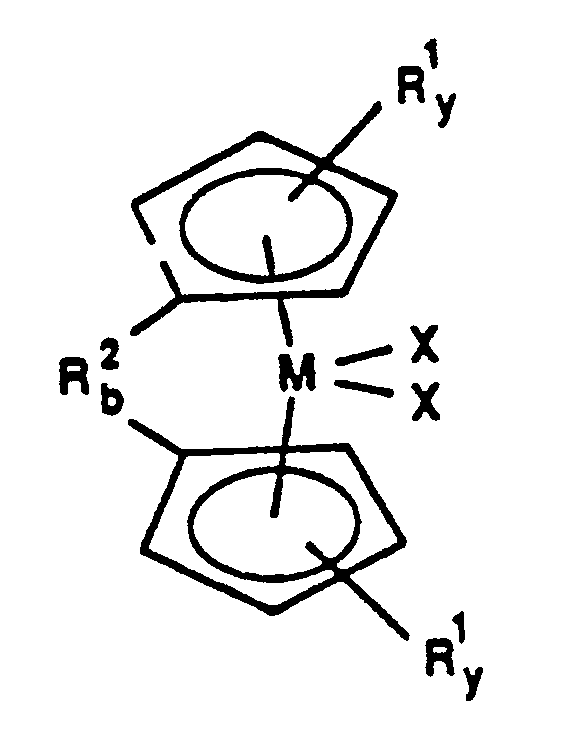
reacting the mixture of olefin monomers for a time sufficient to permit copolymerization of said ethylene and α-olefin monomers to an EPC elastomer.

an inorganic support which has been dried and treated with an alumoxane followed by addition of zirconocene of structure:

followed by a prepolymerization treatment with ethylene or an α-olefin to increase the weight of the catalyst by at least 50 wt%.

Applications Claiming Priority (2)
| Application Number | Priority Date | Filing Date | Title |
|---|---|---|---|
| US207819 | 1988-06-16 | ||
| US07/207,819 US4871705A (en) | 1988-06-16 | 1988-06-16 | Process for production of a high molecular weight ethylene a-olefin elastomer with a metallocene alumoxane catalyst |
Publications (2)
| Publication Number | Publication Date |
|---|---|
| EP0347128A1 true EP0347128A1 (en) | 1989-12-20 |
| EP0347128B1 EP0347128B1 (en) | 1994-06-01 |
Family
ID=22772119
Family Applications (1)
| Application Number | Title | Priority Date | Filing Date |
|---|---|---|---|
| EP89305877A Revoked EP0347128B1 (en) | 1988-06-16 | 1989-06-09 | Process for production of a high molecular weight ethylene a-olefin elastomer with a metallogene alumoxane catalyst |
Country Status (9)
| Country | Link |
|---|---|
| US (1) | US4871705A (en) |
| EP (1) | EP0347128B1 (en) |
| JP (1) | JPH0284407A (en) |
| KR (1) | KR900000392A (en) |
| CN (1) | CN1042160A (en) |
| AU (1) | AU631550B2 (en) |
| BR (1) | BR8902914A (en) |
| DE (1) | DE68915616T2 (en) |
| ES (1) | ES2053991T3 (en) |
Cited By (24)
| Publication number | Priority date | Publication date | Assignee | Title |
|---|---|---|---|---|
| EP0316155A3 (en) * | 1987-11-09 | 1991-07-24 | Chisso Corporation | A transition-metal compound having a substituted, bridged bis-cyclopentadienyl ligand |
| EP0444474A1 (en) * | 1990-02-26 | 1991-09-04 | BASF Aktiengesellschaft | Soluble catalyst systems for polymerisation of C2 to C10 alk-1-enes |
| EP0399348A3 (en) * | 1989-05-20 | 1992-08-12 | Hoechst Aktiengesellschaft | Process for preparing ethylenpolymers |
| EP0519237A3 (en) * | 1991-06-18 | 1993-01-27 | Basf Aktiengesellschaft | Soluble catalyst systems for preparing poly-1-alcenes with high molecular weight |
| EP0452920A3 (en) * | 1990-04-18 | 1993-03-17 | Mitsui Petrochemical Industries, Ltd. | Process for the preparation of an ethylene copolymer and an olefin polymer, and catalysts for olefin polymerization |
| WO1993023439A3 (en) * | 1992-05-18 | 1994-03-17 | Exxon Chemical Patents Inc | Method for making and using a supported metallocene catalyst system |
| WO1994011410A1 (en) * | 1992-11-06 | 1994-05-26 | Chevron Research And Technology Company, A Division Of Chevron U.S.A. Inc. | ALPHA-OLEFIN POLYMERIZATION CATALYSTS COMPRISING SUPPORTED CYCLOPENTADIENYL GROUP 6b METAL OXO, THIO, IMIDO AND PHOSPHIDO COMPOUNDS AND PROCESS FOR POLYMERIZING ALPHA-OLEFINS |
| WO1995016716A1 (en) * | 1993-12-14 | 1995-06-22 | Exxon Chemical Patents Inc. | Process for producing elastomers with an indenyl metallocene catalyst system |
| WO1995021874A1 (en) * | 1994-02-11 | 1995-08-17 | Exxon Chemical Patents Inc. | Polymerization catalyst systems, their production and use |
| WO1995030698A1 (en) * | 1994-05-06 | 1995-11-16 | Dsm N.V. | Process for the preparation of an elastomeric polymer from ethylene, alpha-olefin and optionally diene |
| DE4431644A1 (en) * | 1994-08-01 | 1996-03-07 | Danubia Petrochem Deutschland | Olefin polymerisation catalyst esp. for direct isotactic/elastomer polypropylene@ prodn. |
| US5565533A (en) * | 1992-06-18 | 1996-10-15 | Montell Technology Company Bv | Process for preparing an ethylenic copolymer |
| EP0790259A1 (en) * | 1996-02-19 | 1997-08-20 | Fina Research S.A. | Supported metallocene-alumoxane catalysts for the preparation of polyethylene having a broad monomodal molecular weight distribution |
| EP0816399A1 (en) * | 1996-07-02 | 1998-01-07 | Montell Technology Company bv | Slurry process for the preparation of elastomeric ethylene copolymers |
| EP0874003A1 (en) * | 1997-04-22 | 1998-10-28 | Fina Technology, Inc. | Process for co-polymerization of olefins |
| NL1006346C2 (en) * | 1997-06-18 | 1998-12-21 | Dsm Nv | Process for the preparation of high temperature polyolefins using Zr metallocenes. |
| RU2133758C1 (en) * | 1993-06-30 | 1999-07-27 | Монтелл Текнолоджи Компани Б.В. | Ethylene-propylene copolymers, method of preparing thereof, and molded products |
| US5965678A (en) * | 1997-07-02 | 1999-10-12 | Bayer Ag | Catalyst system based on monoazadiene metal complexes |
| US5990253A (en) * | 1992-11-11 | 1999-11-23 | Dsm N.V. | Indenyl compounds and catalyst components for the polymerization of olefins |
| RU2143441C1 (en) * | 1993-09-13 | 1999-12-27 | Монтелл Текнолоджи Компани Б.В. | Elastomeric ethylene polymers and method of preparing thereof |
| RU2161627C2 (en) * | 1993-09-13 | 2001-01-10 | Монтелл Текнолоджи Компани Б.В. | Method of preparing ethylene polymers, and products prepared therefrom |
| WO2003037941A1 (en) * | 2001-10-31 | 2003-05-08 | Borealis Technology Oy | Two-step polymerization process |
| EP2119732A1 (en) | 2008-05-16 | 2009-11-18 | Borealis Technology Oy | Metallocene catalyst compositions with improved properties, process for its preparation and use for preparing polyolefin homo- or copolymers |
| EP0513380B2 (en) † | 1990-11-30 | 2011-02-23 | Idemitsu Kosan Company Limited | Process for producing olefinic polymer |
Families Citing this family (244)
| Publication number | Priority date | Publication date | Assignee | Title |
|---|---|---|---|---|
| CA1327673C (en) * | 1988-06-16 | 1994-03-08 | Sigmund Floyd | Process for production of high molecular weight epdm elastomers using a metallocene-alumoxane catalyst system |
| CA1334841C (en) * | 1988-09-13 | 1995-03-21 | Mamoru Kioka | Olefin polymerization catalyst component, process for production thereof, olefin polymerization catalysts, and process for polymerizing olefins |
| KR920007040B1 (en) * | 1988-09-14 | 1992-08-24 | 미쓰이세끼유 가가꾸 고오교오 가부시끼가이샤 | Polymerizing catalyst of olefins and process for the preparation of olefin polimerization |
| DE3836059A1 (en) * | 1988-10-22 | 1990-05-03 | Hoechst Ag | METHOD FOR PRODUCING AN ETHYLENE PROPYLENE COPOLYMER |
| IT1237398B (en) * | 1989-01-31 | 1993-06-01 | Ausimont Srl | CATALYSTS FOR THE POLYMERIZATION OF OLEFINE. |
| US6025448A (en) | 1989-08-31 | 2000-02-15 | The Dow Chemical Company | Gas phase polymerization of olefins |
| US5387568A (en) * | 1989-10-30 | 1995-02-07 | Fina Technology, Inc. | Preparation of metallocene catalysts for polymerization of olefins |
| ES2077056T3 (en) * | 1989-10-30 | 1995-11-16 | Fina Research | PROCESS OF PREPARATION OF POLYOLEFIN POWDER WITH A MORPHOLOGY CONTROLLED BY METALOCENE CATALYSIS. |
| JP2826362B2 (en) * | 1990-02-13 | 1998-11-18 | 三井化学株式会社 | Method for producing solid catalyst for olefin polymerization, solid catalyst for olefin polymerization, and method for polymerizing olefin |
| US6294625B1 (en) * | 1990-03-20 | 2001-09-25 | Exxonmobil Chemical Patents Inc. | Catalyst system of enhanced productivity and its use in polymerization process |
| US6538080B1 (en) | 1990-07-03 | 2003-03-25 | Bp Chemicals Limited | Gas phase polymerization of olefins |
| US5239022A (en) * | 1990-11-12 | 1993-08-24 | Hoechst Aktiengesellschaft | Process for the preparation of a syndiotactic polyolefin |
| US5243001A (en) * | 1990-11-12 | 1993-09-07 | Hoechst Aktiengesellschaft | Process for the preparation of a high molecular weight olefin polymer |
| DE59107926D1 (en) * | 1990-11-12 | 1996-07-18 | Hoechst Ag | Metallocenes with ligands from 2-substituted indenyl derivatives, processes for their preparation and their use as catalysts |
| USRE39561E1 (en) * | 1990-11-12 | 2007-04-10 | Basell Polyoefine Gmbh | Metallocenes containing ligands of 2-substituted indenyl derivatives, process for their preparation, and their use as catalysts |
| CA2071706C (en) * | 1991-06-20 | 1996-09-17 | Junichi Imuta | Catalyst for olefin polymerization, process for the polymerization of olefin, and transition metal compound employable for the catalyst |
| US5246783A (en) * | 1991-08-15 | 1993-09-21 | Exxon Chemical Patents Inc. | Electrical devices comprising polymeric insulating or semiconducting members |
| JP3402473B2 (en) * | 1991-08-20 | 2003-05-06 | 日本ポリケム株式会社 | Olefin polymerization catalyst |
| US5461017A (en) * | 1991-12-13 | 1995-10-24 | Mobil Oil Corporation | Olefin polymerization catalysts |
| US5362824A (en) * | 1991-12-13 | 1994-11-08 | Mobil Oil Corporation | Olefin polymerization catalysts |
| FI112233B (en) * | 1992-04-01 | 2003-11-14 | Basell Polyolefine Gmbh | Catalyst for olefin polymerization, process for its preparation and its use |
| US6143854A (en) | 1993-08-06 | 2000-11-07 | Exxon Chemical Patents, Inc. | Polymerization catalysts, their production and use |
| US5393851A (en) * | 1992-05-26 | 1995-02-28 | Fina Technology, Inc. | Process for using metallocene catalyst in a continuous reactor system |
| DE69333773T2 (en) | 1992-11-13 | 2006-04-06 | Cryovac, Inc. | Heat shrinkable films obtained by single-site catalysis. |
| US5554310A (en) | 1992-12-17 | 1996-09-10 | Exxon Chemical Patents Inc. | Trisubstituted unsaturated polymers |
| US5859159A (en) * | 1992-12-17 | 1999-01-12 | Exxon Chemical Patents Inc. | Dilute process for the polymerization of non-ethylene α-olefin homopolymers and copolymers using metallocene catalyst systems |
| US5602067A (en) * | 1992-12-28 | 1997-02-11 | Mobil Oil Corporation | Process and a catalyst for preventing reactor fouling |
| US5332706A (en) * | 1992-12-28 | 1994-07-26 | Mobil Oil Corporation | Process and a catalyst for preventing reactor fouling |
| US5523136A (en) * | 1993-04-30 | 1996-06-04 | Cypress Packaging | Packaging film, packages and methods for using them |
| US5372980A (en) * | 1993-06-03 | 1994-12-13 | Polysar | Bimetallic metallocene alumoxane catalyst system and its use in the preparation of ethylene-alpha olefin and ethylene-alpha olefin-non-conjugated diolefin elastomers |
| AU701139B2 (en) | 1993-06-24 | 1999-01-21 | Bemis Company, Inc. | Improved structures of polymers made from single site catalysts |
| US6645641B2 (en) * | 1993-06-24 | 2003-11-11 | Pechiney Plastic Packaging, Inc. | Structures of polymers made from single site catalysts |
| AU714055B2 (en) * | 1993-06-24 | 1999-12-16 | Bemis Company, Inc. | Improved structures of polymers made from single site catalysts |
| US7316833B1 (en) | 1993-06-24 | 2008-01-08 | Penchiney Emballage Flexible Europe | Multi-layer thermoplastic films and packages made therefrom |
| US6270867B1 (en) | 1993-06-24 | 2001-08-07 | Pechiney Plastic Packaging, Inc. | Structures of polymers made from single site catalysts |
| US5486585A (en) * | 1993-08-26 | 1996-01-23 | Exxon Chemical Patents Inc. | Amidosilyldiyl bridged catalysts and method of polymerization using said catalysts. |
| JPH09503008A (en) | 1993-09-17 | 1997-03-25 | エクソン・ケミカル・パテンツ・インク | Polymerization catalyst systems, their production and use |
| US5466649A (en) * | 1993-10-15 | 1995-11-14 | Exxon Chemical Patents Inc. | Polymerization catalyst systems, their production and use |
| US5491207A (en) * | 1993-12-14 | 1996-02-13 | Exxon Chemical Patents Inc. | Process of producing high molecular weight ethylene-α-olefin elastomers with an indenyl metallocene catalyst system |
| US5691422A (en) * | 1994-03-07 | 1997-11-25 | Exxon Chemical Patents Inc. | Saturated polyolefins having terminal aldehyde or hydroxy substituents and derivatives thereof |
| US5674950A (en) * | 1994-03-07 | 1997-10-07 | Exxon Chemical Patents Inc. | Polymers having terminal hydroxyl aldehyde, or alkylamino substitutents and derivatives thereof |
| US5498581A (en) | 1994-06-01 | 1996-03-12 | Phillips Petroleum Company | Method for making and using a supported metallocene catalyst system |
| US5936041A (en) * | 1994-06-17 | 1999-08-10 | Exxon Chemical Patents Inc | Dispersant additives and process |
| CN1203097C (en) * | 1994-07-11 | 2005-05-25 | 埃克森美孚化学专利公司 | Succinimide Dispersants for Lubricating Oils Derived from Heavy Polyamines |
| US5763543A (en) * | 1994-09-14 | 1998-06-09 | Exxon Chemical Patents Inc. | Olefin polymerization process with little or no scavenger present |
| US5712353A (en) * | 1994-10-31 | 1998-01-27 | Exxon Chemical Patents Inc. | Gas phase polymerization process |
| TW369547B (en) * | 1994-09-21 | 1999-09-11 | Mitsui Chemicals Inc | Olefin polymerization catalyst and process for olefin polymerization |
| US5565128A (en) * | 1994-10-12 | 1996-10-15 | Exxon Chemical Patents Inc | Lubricating oil mannich base dispersants derived from heavy polyamine |
| US5625015A (en) | 1994-11-23 | 1997-04-29 | Exxon Chemical Patents Inc. | Method for making supported catalyst systems and catalyst systems therefrom |
| US6287613B1 (en) | 1994-12-12 | 2001-09-11 | Cryovac Inc | Patch bag comprising homogeneous ethylene/alpha-olefin copolymer |
| US5578690A (en) * | 1995-04-28 | 1996-11-26 | Northwestern University | Silyl-terminated interpolymer of ethylene and method for preparing silyl-terminated polyolefins |
| US5705578A (en) * | 1995-05-04 | 1998-01-06 | Phillips Petroleum Company | Method for making and using a supported metallocene catalyst system |
| US5519099A (en) * | 1995-06-07 | 1996-05-21 | Industrial Technology Research Institute | Organometallic catalysts containing hydrotris(pyrazolyl) borate and cyclopentadienyl groups, and processes of employing the same |
| CA2225493A1 (en) | 1995-08-10 | 1997-02-20 | Exxon Chemical Patents, Inc. | Metallocene stabilized alumoxane |
| US5652202A (en) * | 1995-08-15 | 1997-07-29 | Exxon Chemical Patents Inc. | Lubricating oil compositions |
| US5558802A (en) * | 1995-09-14 | 1996-09-24 | Exxon Chemical Patents Inc | Multigrade crankcase lubricants with low temperature pumpability and low volatility |
| US5856255A (en) * | 1996-01-22 | 1999-01-05 | Albemarle Corporation | Preparation of supported auxiliary catalysts at elevated temperature and pressure in a closed vessel |
| US5814399A (en) * | 1996-03-12 | 1998-09-29 | Tenneco Packaging | Stretch wrap films |
| US5976682A (en) * | 1996-03-12 | 1999-11-02 | Tenneco Packaging | Stretch wrap films |
| US5902684A (en) * | 1996-03-12 | 1999-05-11 | Tenneco Packaging Inc. | Multilayered Metallocene stretch wrap films |
| USRE38429E1 (en) * | 1996-03-12 | 2004-02-17 | Tyco Plastics Services Ag | Stretch wrap films |
| US5752362A (en) * | 1996-03-12 | 1998-05-19 | Tenneco Packaging | Stretch wrap films |
| US5749202A (en) * | 1996-03-12 | 1998-05-12 | Tenneco Packaging | Stretch wrap films |
| US5998017A (en) * | 1996-03-12 | 1999-12-07 | Tenneco Packaging | Stretch wrap films |
| US6225426B1 (en) | 1996-04-10 | 2001-05-01 | Uniroyal Chemical Company, Inc. | Process for producing polyolefin elastomer employing a metallocene catalyst |
| WO1997048735A1 (en) | 1996-06-17 | 1997-12-24 | Exxon Chemical Patents Inc. | Mixed transition metal catalyst systems for olefin polymerization |
| US5705579A (en) * | 1996-07-17 | 1998-01-06 | Phillips Petroleum Company | Olefin polymerization |
| US7919561B2 (en) * | 1996-09-04 | 2011-04-05 | Exxonmobil Chemical Patents Inc. | Process of producing thermoplastic polymer blends |
| US5919535A (en) * | 1996-12-05 | 1999-07-06 | Tenneco Packaging | Fins for plastic bags |
| US6376035B1 (en) | 1996-12-05 | 2002-04-23 | Pactiv Corporation | Zipper fins for plastic bags |
| US5851070A (en) * | 1996-12-05 | 1998-12-22 | Tenneco Packaging Inc. | Seals for plastic bags |
| BR9713748A (en) | 1996-12-17 | 2000-03-21 | Exxon Chemical Patents Inc | Thermoplastic elastomeric compositions |
| US6180736B1 (en) | 1996-12-20 | 2001-01-30 | Exxon Chemical Patents Inc | High activity metallocene polymerization process |
| US5989725A (en) * | 1997-01-16 | 1999-11-23 | Tenneco Packaging | Clear high molecular weight film |
| CA2276214A1 (en) | 1997-02-07 | 1998-08-13 | Exxon Chemical Patents, Inc. | Preparation of vinyl-containing macromers |
| DE69809192T2 (en) * | 1997-02-07 | 2003-07-24 | Exxonmobil Chemical Patents Inc., Baytown | PROPYLENE POLYMERS CONTAINING POLYETHYLENE MACROMONOMERS |
| US6013378A (en) * | 1997-03-17 | 2000-01-11 | Tenneco Packaging | HMW HDPE film with improved impact strength |
| US6093480A (en) * | 1997-05-21 | 2000-07-25 | Tenneco Packaging | Stretch wrap films |
| US5907942A (en) * | 1997-05-21 | 1999-06-01 | Tenneco Packaging | Stretch wrap films |
| US5922441A (en) * | 1997-06-11 | 1999-07-13 | Tenneco Packaging Inc. | Stretch wrap films |
| US5907943A (en) * | 1997-06-11 | 1999-06-01 | Tenneco Packaging Inc. | Stretch wrap films |
| US6075103A (en) * | 1997-06-13 | 2000-06-13 | Northwestern University | Silyl-terminated polymer and method for preparing silyl-terminated polyolefins |
| WO1998057996A1 (en) * | 1997-06-14 | 1998-12-23 | The Board Of Trustees Of The Leland Stanford, Jr. University | ETHYLENE ENHANCEMENT OF PROCESSES FOR SYNTHESIS OF HIGH MELTING THERMOPLASTIC ELASTOMERIC α-OLEFIN POLYMERS (PRE/EPE EFFECTS) |
| US6153551A (en) | 1997-07-14 | 2000-11-28 | Mobil Oil Corporation | Preparation of supported catalyst using trialkylaluminum-metallocene contact products |
| DE19732804A1 (en) | 1997-07-30 | 1999-02-04 | Bayer Ag | Catalysts based on fulven metal complexes |
| US6921794B2 (en) * | 1997-08-12 | 2005-07-26 | Exxonmobil Chemical Patents Inc. | Blends made from propylene ethylene polymers |
| US7232871B2 (en) | 1997-08-12 | 2007-06-19 | Exxonmobil Chemical Patents Inc. | Propylene ethylene polymers and production process |
| US7026404B2 (en) * | 1997-08-12 | 2006-04-11 | Exxonmobil Chemical Patents Inc. | Articles made from blends made from propylene ethylene polymers |
| US6635715B1 (en) | 1997-08-12 | 2003-10-21 | Sudhin Datta | Thermoplastic polymer blends of isotactic polypropylene and alpha-olefin/propylene copolymers |
| US6083611A (en) * | 1997-11-12 | 2000-07-04 | Tenneco Packaging, Inc. | Roll wrap film |
| EP1037931B1 (en) | 1997-12-08 | 2004-02-04 | Albemarle Corporation | Catalyst compositions of enhanced productivity |
| US6677265B1 (en) | 1997-12-08 | 2004-01-13 | Albemarle Corporation | Process of producing self-supported catalysts |
| US6551955B1 (en) | 1997-12-08 | 2003-04-22 | Albemarle Corporation | Particulate group 4 metallocene-aluminoxane catalyst compositions devoid of preformed support, and their preparation and their use |
| US6184327B1 (en) | 1997-12-10 | 2001-02-06 | Exxon Chemical Patents, Inc. | Elastomeric propylene polymers |
| US6117962A (en) * | 1997-12-10 | 2000-09-12 | Exxon Chemical Patents Inc. | Vinyl-containing stereospecific polypropylene macromers |
| US6197910B1 (en) | 1997-12-10 | 2001-03-06 | Exxon Chemical Patents, Inc. | Propylene polymers incorporating macromers |
| US6479685B2 (en) | 1998-01-09 | 2002-11-12 | The Board Of Trustees Of The Leland Standard Junior University | Metallocene catalysts for synthesis of high-melting polyolefin copolymer elastomers |
| US6518378B2 (en) | 1998-01-09 | 2003-02-11 | The Board Of Trustees Of The Leland Stanford Junior University | High-melting polyolefin copolymer elastomers, catalysts and methods of synthesis |
| US6169151B1 (en) | 1998-01-09 | 2001-01-02 | The Board Of Trustees Of The Leland Stanford Junior University | High-melting polyolefin copolymer elastomers, catalysts and methods of synthesis |
| DE19812881A1 (en) | 1998-03-24 | 1999-10-07 | Bayer Ag | New dendrimeric compounds, a process for their preparation and their use as catalysts |
| KR100398740B1 (en) * | 1998-04-09 | 2003-12-31 | 주식회사 엘지화학 | Bridged metallocene catalyst having substituent at alpha position |
| US6306960B1 (en) | 1998-05-13 | 2001-10-23 | Exxonmobil Chemical Patents Inc. | Articles formed from foamable polypropylene polymer |
| ES2220058T3 (en) | 1998-05-13 | 2004-12-01 | Exxonmobil Chemical Patents Inc. | PROPYLENE HOMOPOLYMERS AND METHODS OF MANUFACTURING THEM. |
| US6784269B2 (en) | 1998-05-13 | 2004-08-31 | Exxonmobil Chemical Patents Inc. | Polypropylene compositions methods of making the same |
| US6245868B1 (en) | 1998-05-29 | 2001-06-12 | Univation Technologies | Catalyst delivery method, a catalyst feeder and their use in a polymerization process |
| JP2002519497A (en) | 1998-07-01 | 2002-07-02 | エクソンモービル・ケミカル・パテンツ・インク | Elastic blend comprising a crystalline propylene polymer and a crystallizable propylene polymer |
| EP0969019A1 (en) * | 1998-07-02 | 2000-01-05 | Fina Research S.A. | Polyolefin production |
| US6225427B1 (en) | 1998-10-15 | 2001-05-01 | Uniroyal Chemical Company, Inc. | Olefin polymerization process employing metallocene catalyst provided by cocatalyst activation of a metallocene procatalyst |
| US6469188B1 (en) * | 1999-01-20 | 2002-10-22 | California Institute Of Technology | Catalyst system for the polymerization of alkenes to polyolefins |
| US6174930B1 (en) | 1999-04-16 | 2001-01-16 | Exxon Chemical Patents, Inc. | Foamable polypropylene polymer |
| WO2000074934A1 (en) * | 1999-06-07 | 2000-12-14 | Champlain Cable Corporation | Improved battery cable |
| US6303718B1 (en) | 1999-09-17 | 2001-10-16 | Bayer Aktiengesellschaft | Composition based on fluorine-containing metal complexes |
| CN1209404C (en) | 1999-09-01 | 2005-07-06 | 埃克森化学专利公司 | Gas-permeable film and its preparation method |
| US6476164B1 (en) | 1999-10-22 | 2002-11-05 | Exxonmobil Chemical Patents Inc. | Carbenium cationic complexes suitable for polymerization catalysts |
| US6475946B1 (en) | 1999-10-22 | 2002-11-05 | Exxonmobil Chemical Patents Inc. | Olefin polymerization catalysis with aryl substituted carbenium cationic complexes |
| US6489480B2 (en) | 1999-12-09 | 2002-12-03 | Exxonmobil Chemical Patents Inc. | Group-15 cationic compounds for olefin polymerization catalysts |
| US6822057B2 (en) * | 1999-12-09 | 2004-11-23 | Exxon Mobil Chemical Patents Inc. | Olefin polymerization catalysts derived from Group-15 cationic compounds and processes using them |
| US6977287B2 (en) * | 1999-12-10 | 2005-12-20 | Exxonmobil Chemical Patents Inc. | Propylene diene copolymers |
| CN1407995A (en) * | 1999-12-10 | 2003-04-02 | 埃克森化学专利公司 | Propylene diene copolymerized polymers |
| US6809168B2 (en) * | 1999-12-10 | 2004-10-26 | Exxonmobil Chemical Patents Inc. | Articles formed from propylene diene copolymers |
| MXPA02006197A (en) | 1999-12-20 | 2002-12-09 | Exxon Chemical Patents Inc | Processes for the preparation polyolefin resins using supported ionic catalysts. |
| MXPA02006199A (en) * | 1999-12-22 | 2003-10-15 | Exxon Chemical Patents Inc | Polypropylenebased adhesive compositions. |
| US6809209B2 (en) | 2000-04-07 | 2004-10-26 | Exxonmobil Chemical Patents Inc. | Nitrogen-containing group-13 anionic compounds for olefin polymerization |
| US6528448B1 (en) * | 2000-04-28 | 2003-03-04 | Phillips Petroleum Company | Polymerization catalyst compositions and processes to produce polymers and bimodal polymers |
| CA2311068C (en) | 2000-06-08 | 2010-03-09 | Nova Chemicals Corporation | Process to prepare ethylene propylene elastomer |
| AU2001275932A1 (en) * | 2000-07-17 | 2002-01-30 | Honeywell International Inc. | Supported catalyst systems |
| US6858767B1 (en) | 2000-08-11 | 2005-02-22 | Uniroyal Chemical Company, Inc. | Process for producing liquid polyalphaolefin polymer, metallocene catalyst therefor, the resulting polymer and lubricant containing same |
| US7220804B1 (en) * | 2000-10-13 | 2007-05-22 | Univation Technologies, Llc | Method for preparing a catalyst system and its use in a polymerization process |
| US6534609B2 (en) | 2001-03-13 | 2003-03-18 | Chevron Phillips Chemical Company Lp | Method for making and using a metallocene catalyst system |
| DE60238049D1 (en) | 2001-04-12 | 2010-12-02 | Exxonmobil Chem Patents Inc | Process for the polymerization of propylene and ethylene in solution |
| US7511104B2 (en) | 2001-06-20 | 2009-03-31 | Exxonmobil Chemical Patents Inc. | Polyolefins made by catalyst comprising a noncoordinating anion and articles comprising them |
| US7220801B2 (en) * | 2001-06-22 | 2007-05-22 | Exxonmobil Chemical Patents Inc. | Metallocene-produced very low density polyethylenes or linear low density polyethylenes as impact modifiers |
| WO2003046022A1 (en) * | 2001-11-27 | 2003-06-05 | Basell Polyolefine Gmbh | Process for the treatment of polymer compositions |
| US6916892B2 (en) * | 2001-12-03 | 2005-07-12 | Fina Technology, Inc. | Method for transitioning between Ziegler-Natta and metallocene catalysts in a bulk loop reactor for the production of polypropylene |
| AU2002362036A1 (en) * | 2001-12-05 | 2003-06-23 | Exxonmobil Chemical Patents Inc. | Bulky borate activations |
| US7074865B2 (en) * | 2002-04-12 | 2006-07-11 | Dow Global Technologies Inc. | Azaborolyl group 4 metal complexes, catalysts and olefin polymerization process |
| US20030236365A1 (en) * | 2002-06-24 | 2003-12-25 | Fina Technology, Inc. | Polyolefin production with a high performance support for a metallocene catalyst system |
| US7119155B2 (en) * | 2002-10-25 | 2006-10-10 | Exxonmobil Chemical Patents Inc. | Polymerized catalyst composition II |
| US7319083B2 (en) * | 2002-10-25 | 2008-01-15 | Exxonmobil Chemical Patents Inc. | Polymerized catalyst composition |
| US7176158B2 (en) * | 2002-10-25 | 2007-02-13 | Exxonmobil Chemical Patents Inc. | Polymerization catalyst composition |
| US20040152591A1 (en) * | 2002-10-25 | 2004-08-05 | Guo-Xin Jin | Polymerized metallocene catalyst composition |
| US7195806B2 (en) * | 2003-01-17 | 2007-03-27 | Fina Technology, Inc. | High gloss polyethylene articles |
| WO2004094487A1 (en) | 2003-03-21 | 2004-11-04 | Dow Global Technologies, Inc. | Morphology controlled olefin polymerization process |
| US6908876B2 (en) * | 2003-04-16 | 2005-06-21 | Saudi Basic Industries Corporation | Supported metallocene catalyst system for olefin polymerization, method for making and using the same |
| IN2012DN06460A (en) * | 2003-07-09 | 2015-10-09 | Dsm Ip Assets Bv | |
| US7947776B2 (en) | 2003-08-25 | 2011-05-24 | Dow Global Technologies Llc | Aqueous dispersion, its production method, and its use |
| US8946329B2 (en) | 2003-08-25 | 2015-02-03 | Dow Global Technologies Llc | Coating compositions |
| US7763676B2 (en) | 2003-08-25 | 2010-07-27 | Dow Global Technologies Inc. | Aqueous polymer dispersions and products from those dispersions |
| US8779053B2 (en) | 2003-08-25 | 2014-07-15 | Dow Global Technologies Llc | Coating compositions |
| US8349929B2 (en) * | 2003-08-25 | 2013-01-08 | Dow Global Technologies Llc | Coating composition and articles made therefrom |
| US9169406B2 (en) | 2003-08-25 | 2015-10-27 | Dow Global Technologies Llc | Coating compositions |
| US7803865B2 (en) | 2003-08-25 | 2010-09-28 | Dow Global Technologies Inc. | Aqueous dispersion, its production method, and its use |
| US8357749B2 (en) | 2003-08-25 | 2013-01-22 | Dow Global Technologies Llc | Coating composition and articles made therefrom |
| TW200517426A (en) | 2003-08-25 | 2005-06-01 | Dow Global Technologies Inc | Aqueous dispersion, its production method, and its use |
| US8722787B2 (en) | 2003-08-25 | 2014-05-13 | Dow Global Technologies Llc | Coating composition and articles made therefrom |
| US8158711B2 (en) | 2003-08-25 | 2012-04-17 | Dow Global Technologies Llc | Aqueous dispersion, its production method, and its use |
| JP2005099712A (en) * | 2003-08-28 | 2005-04-14 | Sharp Corp | Display device drive circuit and display device |
| US20050234198A1 (en) * | 2004-04-20 | 2005-10-20 | Fina Technology, Inc. | Heterophasic copolymer and metallocene catalyst system and method of producing the heterophasic copolymer using the metallocene catalyst system |
| GB0411742D0 (en) | 2004-05-26 | 2004-06-30 | Exxonmobil Chem Patents Inc | Transition metal compounds for olefin polymerization and oligomerization |
| US20060052540A1 (en) | 2004-09-09 | 2006-03-09 | Maria Ellul | Thermoplastic vulcanizates |
| EP1805229A1 (en) | 2004-10-28 | 2007-07-11 | Dow Gloval Technologies Inc. | Method of controlling a polymerization reactor |
| US7163906B2 (en) * | 2004-11-04 | 2007-01-16 | Chevron Phillips Chemical Company, Llp | Organochromium/metallocene combination catalysts for producing bimodal resins |
| US7169864B2 (en) * | 2004-12-01 | 2007-01-30 | Novolen Technology Holdings, C.V. | Metallocene catalysts, their synthesis and their use for the polymerization of olefins |
| BRPI0517210B1 (en) | 2004-12-17 | 2017-01-24 | Dow Global Technologies Inc | “composition suitable for tubes, composition suitable for blown films, composition suitable for blow molded articles, tube, film, blow molded article and method for improving the creep flow behavior of a resin” |
| US7232869B2 (en) * | 2005-05-17 | 2007-06-19 | Novolen Technology Holdings, C.V. | Catalyst composition for olefin polymerization |
| EP1896542B1 (en) | 2005-06-24 | 2018-06-20 | ExxonMobil Chemical Patents Inc. | Plasticized functionalized propylene copolymer adhesive composition |
| ES2721552T3 (en) | 2005-10-25 | 2019-08-01 | Gen Cable Technologies Corp | Improved lead-free insulation compositions containing metallocene polymers |
| US7709577B2 (en) | 2005-12-07 | 2010-05-04 | Exxonmobil Chemical Patents Inc. | Process of making polymer blends |
| ATE529431T1 (en) | 2005-12-14 | 2011-11-15 | Exxonmobil Chem Patents Inc | HALOGEN-SUBSTITUTED METALLOCENE COMPOUNDS FOR OLEFIN POLYMERIZATION |
| EP1803747A1 (en) | 2005-12-30 | 2007-07-04 | Borealis Technology Oy | Surface-modified polymerization catalysts for the preparation of low-gel polyolefin films |
| KR20090014329A (en) * | 2006-05-02 | 2009-02-10 | 다우 글로벌 테크놀로지스 인크. | High density polyethylene compositions, methods of making the same, articles made therefrom, and methods of making such articles |
| US7456244B2 (en) * | 2006-05-23 | 2008-11-25 | Dow Global Technologies | High-density polyethylene compositions and method of making the same |
| US7256240B1 (en) | 2006-12-22 | 2007-08-14 | Exxonmobil Chemical Patents Inc. | Process of making polymer blends |
| WO2008136849A1 (en) * | 2007-05-02 | 2008-11-13 | Dow Global Technologies Inc. | High-density polyethylene compositions, method of making the same, injection molded articles made therefrom, and method of making such articles |
| US7968623B2 (en) * | 2007-08-06 | 2011-06-28 | General Cable Technologies Corp. | Tree resistant insulation compositions |
| US7981517B2 (en) * | 2007-08-28 | 2011-07-19 | Dow Global Technologies Inc. | Bituminous compositions and methods of making and using same |
| US7928162B2 (en) | 2007-09-13 | 2011-04-19 | Exxonmobil Research And Engineering Company | In-line process for producing plasticized polymers and plasticized polymer blends |
| KR101207294B1 (en) * | 2007-10-16 | 2012-12-03 | 시노펙 양지 페트로케미컬 컴퍼니 엘티디. | Supported non-metallocene catalyst and its preparation method |
| WO2009052701A1 (en) | 2007-10-16 | 2009-04-30 | Sinopec Yangzi Petrochemical Company Ltd. | Non-metallocene catalyst supported on magnesium compound and its preparation method |
| US7906588B2 (en) * | 2007-10-26 | 2011-03-15 | Exxonmobil Chemical Patents Inc. | Soft heterogeneous isotactic polypropylene compositions |
| US7884165B2 (en) * | 2008-07-14 | 2011-02-08 | Chevron Phillips Chemical Company Lp | Half-metallocene catalyst compositions and their polymer products |
| EP2172490A1 (en) | 2008-10-03 | 2010-04-07 | Ineos Europe Limited | Controlled polymerisation process |
| EP2358767B1 (en) | 2008-12-18 | 2013-02-20 | Univation Technologies, LLC | Method for seed bed treatment for a polymerization reaction |
| MX2011008053A (en) | 2009-01-30 | 2012-01-12 | Dow Global Technologies Llc | High-density polyethylene compositions, method of producing the same, closure devices made therefrom, and method of making such closure devices. |
| US20120028866A1 (en) | 2010-07-28 | 2012-02-02 | Sudhin Datta | Viscosity Modifiers Comprising Blends of Ethylene-Based Copolymers |
| US9127151B2 (en) | 2009-04-28 | 2015-09-08 | Exxonmobil Chemical Patents Inc. | Polymer compositions having improved properties as viscosity index improvers and use thereof in lubricating oils |
| US8378042B2 (en) * | 2009-04-28 | 2013-02-19 | Exxonmobil Chemical Patents Inc. | Finishing process for amorphous polymers |
| WO2011050566A1 (en) | 2009-10-26 | 2011-05-05 | 中国石油化工股份有限公司 | Supported non-metallocene catalyst, preparation method and uses thereof |
| WO2011050565A1 (en) | 2009-10-26 | 2011-05-05 | 中国石油化工股份有限公司 | Supported non-metallocene catalyst, manufacturing method and application thereof |
| EP2500364B1 (en) | 2009-11-13 | 2020-03-04 | China Petroleum & Chemical Corporation | Supported non-metallocene catalyst preparation method and application thereof |
| US8952113B2 (en) | 2009-11-13 | 2015-02-10 | China Petroleum & Chemical Corp. | Supported nonmetallocene catalyst, preparation and use thereof |
| WO2011078923A1 (en) | 2009-12-23 | 2011-06-30 | Univation Technologies, Llc | Methods for producing catalyst systems |
| EP2357035A1 (en) | 2010-01-13 | 2011-08-17 | Ineos Europe Limited | Polymer powder storage and/or transport and/or degassing vessels |
| US9416206B2 (en) * | 2010-01-22 | 2016-08-16 | Exxonmobil Chemical Patents Inc. | Lubricating oil compositions and method for making them |
| JP5498588B2 (en) | 2010-01-27 | 2014-05-21 | エクソンモービル・ケミカル・パテンツ・インク | Copolymers, compositions thereof and methods for their production |
| US8058461B2 (en) | 2010-03-01 | 2011-11-15 | Exxonmobil Chemical Patents Inc. | Mono-indenyl transition metal compounds and polymerization therewith |
| EP2383298A1 (en) | 2010-04-30 | 2011-11-02 | Ineos Europe Limited | Polymerization process |
| EP2383301A1 (en) | 2010-04-30 | 2011-11-02 | Ineos Europe Limited | Polymerization process |
| US20130137331A1 (en) | 2010-06-15 | 2013-05-30 | Galen C. Richeson | Nonwoven Fabrics Made From Polymer Blends And Methods For Making Same |
| SG186167A1 (en) | 2010-07-28 | 2013-01-30 | Exxonmobil Chem Patents Inc | Ethylene based copolymer compositions as viscosity modifiers and methods for making them |
| CA2802109C (en) | 2010-07-28 | 2015-04-07 | Exxonmobil Chemical Patents Inc. | Viscosity modifiers comprising blends of ethylene-based copolymers |
| EP2598569B1 (en) | 2010-07-28 | 2018-04-18 | ExxonMobil Chemical Patents Inc. | Viscosity modifiers comprising blends of ethylene-based copolymers |
| US20120037397A1 (en) | 2010-08-10 | 2012-02-16 | General Cable Technologies Corporation | Polymer compositions and their use as cable coverings |
| EP2646479B1 (en) | 2010-11-29 | 2014-10-15 | Ineos Sales (UK) Limited | Polymerisation control process |
| CA2824771A1 (en) | 2011-01-14 | 2012-07-19 | W.R. Grace & Co.-Conn. | Process of making modified metallocene catalyst, catalyst produced and use thereof |
| US8309748B2 (en) | 2011-01-25 | 2012-11-13 | Chevron Phillips Chemical Company Lp | Half-metallocene compounds and catalyst compositions |
| US8383740B1 (en) | 2011-08-12 | 2013-02-26 | Ineos Usa Llc | Horizontal agitator |
| EP2573091A1 (en) | 2011-09-23 | 2013-03-27 | Lummus Novolen Technology Gmbh | Process for recycling of free ligand from their corresponding metallocene complexes |
| ES2665545T3 (en) | 2011-10-17 | 2018-04-26 | Ineos Europe Ag | Control of the polymer degassing process |
| US9139794B2 (en) | 2012-02-03 | 2015-09-22 | Exxonmobil Chemical Patents Inc. | Process for the production of polymeric compositions useful as oil modifiers |
| US10316176B2 (en) | 2012-02-03 | 2019-06-11 | Exxonmobil Chemical Patents Inc. | Polymer compositions and methods of making them |
| EP2809716B1 (en) | 2012-02-03 | 2018-01-24 | ExxonMobil Chemical Patents Inc. | Process for the production of polymeric compositions useful as oil modifiers |
| WO2014078919A1 (en) | 2012-11-26 | 2014-05-30 | Braskem S.A. | Metallocene catalyst supported by hybrid supporting means, process for producing same, polimerization process for producing an ethylene homopolymer or copolymer with broad or bimodal molar mass distribution, use of the supported metallocene catalyst and ethylene polymer with broad or bimodal molar mass distribution |
| US9422444B2 (en) | 2012-12-28 | 2016-08-23 | Dow Global Technologies Llc | Coating compositions |
| IN2015DN03815A (en) | 2012-12-28 | 2015-10-02 | Univation Tech Llc | |
| JP6258968B2 (en) | 2012-12-28 | 2018-01-10 | ダウ グローバル テクノロジーズ エルエルシー | Coating composition and articles made therefrom |
| WO2014109832A1 (en) | 2013-01-14 | 2014-07-17 | Univation Technologies, Llc | Methods for preparing catalyst systems with increased productivity |
| WO2016094848A1 (en) | 2014-12-12 | 2016-06-16 | Exxonmobil Chemical Patents Inc. | Organosilica materials for use as adsorbents for oxygenate removal |
| WO2016094843A2 (en) | 2014-12-12 | 2016-06-16 | Exxonmobil Chemical Patents Inc. | Olefin polymerization catalyst system comprising mesoporous organosilica support |
| WO2016171807A1 (en) | 2015-04-20 | 2016-10-27 | Exxonmobil Chemical Patents Inc. | Catalyst composition comprising fluorided support and processes for use thereof |
| WO2016172099A1 (en) | 2015-04-20 | 2016-10-27 | Exxonmobil Chemical Patents Inc. | Polyethylene composition |
| US10377841B2 (en) | 2015-05-08 | 2019-08-13 | Exxonmobil Chemical Patents Inc. | Polymerization process |
| US10550207B2 (en) | 2015-12-04 | 2020-02-04 | Lg Chem, Ltd. | Method for preparing supported hybrid metallocene catalyst, and supported hybrid metallocene catalyst using the same |
| WO2018063765A1 (en) | 2016-09-27 | 2018-04-05 | Exxonmobil Chemical Patents Inc. | Polymerization process |
| WO2018063767A1 (en) | 2016-09-27 | 2018-04-05 | Exxonmobil Chemical Patents Inc. | Polymerization process |
| WO2018063764A1 (en) | 2016-09-27 | 2018-04-05 | Exxonmobil Chemical Patents Inc. | Polymerization process |
| WO2018118155A1 (en) | 2016-12-20 | 2018-06-28 | Exxonmobil Chemical Patents Inc. | Polymerization process |
| WO2019103800A1 (en) | 2017-11-21 | 2019-05-31 | Exxonmobil Chemical Patents Inc. | Bimodal copolymer compositions useful as oil modifiers |
| US11591417B2 (en) | 2017-12-13 | 2023-02-28 | Exxonmobil Chemical Patents Inc. | Deactivation methods for active components from gas phase polyolefin polymerization processes |
| EP3724302A1 (en) | 2017-12-13 | 2020-10-21 | Chevron Oronite Company LLC | Bimodal copolymer compositions useful as oil modifiers and lubricating oils comprising the same |
| WO2019173030A1 (en) | 2018-03-08 | 2019-09-12 | Exxonmobil Chemical Patents Inc. | Methods of preparing and monitoring a seed bed for polymerization reactor startup |
| EP3788081B1 (en) | 2018-05-02 | 2025-07-02 | ExxonMobil Chemical Patents Inc. | Methods for scale-up from a pilot plant to a larger production facility |
| CN112055720B (en) | 2018-05-02 | 2022-11-22 | 埃克森美孚化学专利公司 | Method for scaling up from pilot plant to larger production facility |
| WO2020014138A1 (en) | 2018-07-09 | 2020-01-16 | Exxonmobil Chemical Patents Inc. | Polyethylene cast films and methods for making the same |
| WO2020023207A1 (en) | 2018-07-26 | 2020-01-30 | Exxonmobil Chemical Patents Inc. | Multilayer foam films and methods for making the same |
| US11993699B2 (en) | 2018-09-14 | 2024-05-28 | Fina Technology, Inc. | Polyethylene and controlled rheology polypropylene polymer blends and methods of use |
| US11649331B2 (en) | 2018-11-13 | 2023-05-16 | Exxonmobil Chemical Patents Inc. | Polyethylene blends and films |
| US20220025135A1 (en) | 2018-11-13 | 2022-01-27 | Exxonmobil Chemical Patents Inc. | Polyethylene Films |
| WO2020163079A1 (en) | 2019-02-06 | 2020-08-13 | Exxonmobil Chemical Patents Inc. | Films and backsheets for hygiene articles |
| EP3927765A1 (en) | 2019-02-20 | 2021-12-29 | Fina Technology, Inc. | Polymer compositions with low warpage |
| US20230018505A1 (en) | 2019-12-17 | 2023-01-19 | Exxonmobil Chemical Patents Inc. | Films Made of Polyethylene Blends for Improved Sealing Performance and Mechanical Properties |
| WO2021183337A1 (en) | 2020-03-12 | 2021-09-16 | Exxonmobil Chemical Patents Inc. | Films made of polyethylene blends for improved bending stiffness and high md tear resistance |
| MX2023011768A (en) | 2021-04-26 | 2023-10-10 | Fina Technology | Thin single-site catalyzed polymer sheets. |
| CN117098785A (en) | 2021-04-30 | 2023-11-21 | 埃克森美孚化学专利公司 | Method for transition between different polymerization catalysts in a polymerization reactor |
Citations (3)
| Publication number | Priority date | Publication date | Assignee | Title |
|---|---|---|---|---|
| EP0206794A1 (en) * | 1985-06-21 | 1986-12-30 | Exxon Chemical Patents Inc. | Supported polymerization catalyst |
| EP0128046B1 (en) * | 1983-06-06 | 1987-10-21 | Exxon Research And Engineering Company | Process and catalyst for producing reactor blend polyolefins |
| EP0260999A1 (en) * | 1986-09-19 | 1988-03-23 | Exxon Chemical Patents Inc. | High pressure, high temperature polymerization of ethylene |
Family Cites Families (5)
| Publication number | Priority date | Publication date | Assignee | Title |
|---|---|---|---|---|
| US4295991A (en) * | 1978-09-26 | 1981-10-20 | Exxon Research & Engineering Co. | Titanium trichloride catalyst component and the process for the production thereof |
| US4701432A (en) * | 1985-11-15 | 1987-10-20 | Exxon Chemical Patents Inc. | Supported polymerization catalyst |
| US4658078A (en) * | 1986-08-15 | 1987-04-14 | Shell Oil Company | Vinylidene olefin process |
| US5077255A (en) * | 1986-09-09 | 1991-12-31 | Exxon Chemical Patents Inc. | New supported polymerization catalyst |
| CA1327673C (en) * | 1988-06-16 | 1994-03-08 | Sigmund Floyd | Process for production of high molecular weight epdm elastomers using a metallocene-alumoxane catalyst system |
-
1988
- 1988-06-16 US US07/207,819 patent/US4871705A/en not_active Expired - Lifetime
-
1989
- 1989-06-09 ES ES89305877T patent/ES2053991T3/en not_active Expired - Lifetime
- 1989-06-09 EP EP89305877A patent/EP0347128B1/en not_active Revoked
- 1989-06-09 DE DE68915616T patent/DE68915616T2/en not_active Expired - Fee Related
- 1989-06-15 AU AU36459/89A patent/AU631550B2/en not_active Ceased
- 1989-06-16 CN CN89106344A patent/CN1042160A/en active Pending
- 1989-06-16 JP JP1154392A patent/JPH0284407A/en active Pending
- 1989-06-16 KR KR1019890008358A patent/KR900000392A/en not_active Withdrawn
- 1989-06-16 BR BR898902914A patent/BR8902914A/en not_active Application Discontinuation
Patent Citations (3)
| Publication number | Priority date | Publication date | Assignee | Title |
|---|---|---|---|---|
| EP0128046B1 (en) * | 1983-06-06 | 1987-10-21 | Exxon Research And Engineering Company | Process and catalyst for producing reactor blend polyolefins |
| EP0206794A1 (en) * | 1985-06-21 | 1986-12-30 | Exxon Chemical Patents Inc. | Supported polymerization catalyst |
| EP0260999A1 (en) * | 1986-09-19 | 1988-03-23 | Exxon Chemical Patents Inc. | High pressure, high temperature polymerization of ethylene |
Cited By (40)
| Publication number | Priority date | Publication date | Assignee | Title |
|---|---|---|---|---|
| EP0316155A3 (en) * | 1987-11-09 | 1991-07-24 | Chisso Corporation | A transition-metal compound having a substituted, bridged bis-cyclopentadienyl ligand |
| EP0399348A3 (en) * | 1989-05-20 | 1992-08-12 | Hoechst Aktiengesellschaft | Process for preparing ethylenpolymers |
| EP0444474A1 (en) * | 1990-02-26 | 1991-09-04 | BASF Aktiengesellschaft | Soluble catalyst systems for polymerisation of C2 to C10 alk-1-enes |
| US5132262A (en) * | 1990-02-26 | 1992-07-21 | Basf Aktiengesellschaft | Soluble catalyst systems for the polymerization of C2 - to C10 -alk-l-enes |
| US5840815A (en) * | 1990-04-18 | 1998-11-24 | Mitsui Petrochemical Industries, Ltd. | Gas-phase or slurry polymerization process for the preparation of an olefin polymer |
| EP0452920A3 (en) * | 1990-04-18 | 1993-03-17 | Mitsui Petrochemical Industries, Ltd. | Process for the preparation of an ethylene copolymer and an olefin polymer, and catalysts for olefin polymerization |
| CN1042433C (en) * | 1990-04-18 | 1999-03-10 | 三井化学株式会社 | Process for the preparation of olefin polymers |
| US5883205A (en) * | 1990-04-18 | 1999-03-16 | Mitsui Chemicals, Inc. | Process for the preparation of an ethylene copolymer and prepolymerized solid catalyst for olefin polymerization |
| US5374700A (en) * | 1990-04-18 | 1994-12-20 | Mitsui Petrochemical Industries, Ltd. | Ethylene copolymer |
| EP0513380B2 (en) † | 1990-11-30 | 2011-02-23 | Idemitsu Kosan Company Limited | Process for producing olefinic polymer |
| EP0519237A3 (en) * | 1991-06-18 | 1993-01-27 | Basf Aktiengesellschaft | Soluble catalyst systems for preparing poly-1-alcenes with high molecular weight |
| US5296434A (en) * | 1991-06-18 | 1994-03-22 | Basf Aktiengesellschaft | Soluble catalyst systems for the preparation of polyalk-1-enes having high molecular weights |
| EP0692499A3 (en) * | 1991-06-18 | 1996-03-06 | Basf Ag | Polyalkene-1 with high molecular weight |
| EP1123941A1 (en) * | 1992-05-18 | 2001-08-16 | ExxonMobil Chemical Patents Inc. | Method for making and using a supported metallocene catalyst system |
| WO1993023439A3 (en) * | 1992-05-18 | 1994-03-17 | Exxon Chemical Patents Inc | Method for making and using a supported metallocene catalyst system |
| US5554704A (en) * | 1992-05-18 | 1996-09-10 | Exxon Chemical Patents, Inc. | Controlled particle size polyolefins from silica supported prepolymerized matallocene catalyst |
| US5565533A (en) * | 1992-06-18 | 1996-10-15 | Montell Technology Company Bv | Process for preparing an ethylenic copolymer |
| WO1994011410A1 (en) * | 1992-11-06 | 1994-05-26 | Chevron Research And Technology Company, A Division Of Chevron U.S.A. Inc. | ALPHA-OLEFIN POLYMERIZATION CATALYSTS COMPRISING SUPPORTED CYCLOPENTADIENYL GROUP 6b METAL OXO, THIO, IMIDO AND PHOSPHIDO COMPOUNDS AND PROCESS FOR POLYMERIZING ALPHA-OLEFINS |
| US5990253A (en) * | 1992-11-11 | 1999-11-23 | Dsm N.V. | Indenyl compounds and catalyst components for the polymerization of olefins |
| US6331600B1 (en) | 1993-06-30 | 2001-12-18 | Basell Technology Company Bv | Elastomeric copolymers of ethylene and propylene |
| RU2133758C1 (en) * | 1993-06-30 | 1999-07-27 | Монтелл Текнолоджи Компани Б.В. | Ethylene-propylene copolymers, method of preparing thereof, and molded products |
| US6046287A (en) * | 1993-09-13 | 2000-04-04 | Montell Technology Company Bv | Process for the preparation of elastomeric copolymers of ethylene |
| EP0643079B1 (en) * | 1993-09-13 | 2000-10-25 | Montell Technology Company bv | Process for the preparation of elastomeric copolymers of ethylene and products obtained therefrom |
| RU2143441C1 (en) * | 1993-09-13 | 1999-12-27 | Монтелл Текнолоджи Компани Б.В. | Elastomeric ethylene polymers and method of preparing thereof |
| RU2161627C2 (en) * | 1993-09-13 | 2001-01-10 | Монтелл Текнолоджи Компани Б.В. | Method of preparing ethylene polymers, and products prepared therefrom |
| US6262215B1 (en) | 1993-09-13 | 2001-07-17 | Montell Technology Company Bv | Elastomeric copolymer of ethylene |
| WO1995016716A1 (en) * | 1993-12-14 | 1995-06-22 | Exxon Chemical Patents Inc. | Process for producing elastomers with an indenyl metallocene catalyst system |
| WO1995021874A1 (en) * | 1994-02-11 | 1995-08-17 | Exxon Chemical Patents Inc. | Polymerization catalyst systems, their production and use |
| WO1995030698A1 (en) * | 1994-05-06 | 1995-11-16 | Dsm N.V. | Process for the preparation of an elastomeric polymer from ethylene, alpha-olefin and optionally diene |
| NL9400758A (en) * | 1994-05-06 | 1995-12-01 | Dsm Nv | Process for the preparation of a high molecular weight polymer from ethylene, alpha olefin and optionally diene. |
| DE4431644A1 (en) * | 1994-08-01 | 1996-03-07 | Danubia Petrochem Deutschland | Olefin polymerisation catalyst esp. for direct isotactic/elastomer polypropylene@ prodn. |
| EP0790259A1 (en) * | 1996-02-19 | 1997-08-20 | Fina Research S.A. | Supported metallocene-alumoxane catalysts for the preparation of polyethylene having a broad monomodal molecular weight distribution |
| US5914289A (en) * | 1996-02-19 | 1999-06-22 | Fina Research, S.A. | Supported metallocene-alumoxane catalysts for the preparation of polyethylene having a broad monomodal molecular weight distribution |
| EP0816399A1 (en) * | 1996-07-02 | 1998-01-07 | Montell Technology Company bv | Slurry process for the preparation of elastomeric ethylene copolymers |
| EP0874003A1 (en) * | 1997-04-22 | 1998-10-28 | Fina Technology, Inc. | Process for co-polymerization of olefins |
| NL1006346C2 (en) * | 1997-06-18 | 1998-12-21 | Dsm Nv | Process for the preparation of high temperature polyolefins using Zr metallocenes. |
| WO1998057997A1 (en) * | 1997-06-18 | 1998-12-23 | Dsm N.V. | PROCESS FOR PREPARING POLYOLEFINS AT A HIGH TEMPERATURE WITH THE AID OF Zr METALLOCENES |
| US5965678A (en) * | 1997-07-02 | 1999-10-12 | Bayer Ag | Catalyst system based on monoazadiene metal complexes |
| WO2003037941A1 (en) * | 2001-10-31 | 2003-05-08 | Borealis Technology Oy | Two-step polymerization process |
| EP2119732A1 (en) | 2008-05-16 | 2009-11-18 | Borealis Technology Oy | Metallocene catalyst compositions with improved properties, process for its preparation and use for preparing polyolefin homo- or copolymers |
Also Published As
| Publication number | Publication date |
|---|---|
| AU631550B2 (en) | 1992-12-03 |
| AU3645989A (en) | 1989-12-21 |
| DE68915616T2 (en) | 1994-09-15 |
| US4871705A (en) | 1989-10-03 |
| DE68915616D1 (en) | 1994-07-07 |
| BR8902914A (en) | 1990-02-01 |
| EP0347128B1 (en) | 1994-06-01 |
| ES2053991T3 (en) | 1994-08-01 |
| CN1042160A (en) | 1990-05-16 |
| KR900000392A (en) | 1990-01-30 |
| JPH0284407A (en) | 1990-03-26 |
Similar Documents
| Publication | Publication Date | Title |
|---|---|---|
| US4871705A (en) | Process for production of a high molecular weight ethylene a-olefin elastomer with a metallocene alumoxane catalyst | |
| US5001205A (en) | Process for production of a high molecular weight ethylene α-olefin elastomer with a metallocene alumoxane catalyst | |
| US5491207A (en) | Process of producing high molecular weight ethylene-α-olefin elastomers with an indenyl metallocene catalyst system | |
| JP2556969B2 (en) | New supported catalyst for polymerization | |
| JP3274686B2 (en) | Polymerization process for producing polyolefin elastomers, cation-forming cocatalyst for activating metallocene procatalysts, polyolefin elastomers having unique properties and products made therefrom | |
| JP4049403B2 (en) | Process for the production of supported catalyst components for use in the production of polyolefins | |
| US4914253A (en) | Method for preparing polyethylene wax by gas phase polymerization | |
| US5183867A (en) | Polymerization process using a new supported polymerization catalyst | |
| US4808561A (en) | Supported polymerization catalyst | |
| US4897455A (en) | Polymerization process | |
| EP0495849B1 (en) | Olefin polymerization catalyst from trialkylaluminum mixture, silica gel and a metallocene | |
| EP0646137B1 (en) | Supported catalyst for 1-olefin(s) (co)polymerization | |
| JP2756537B2 (en) | Method for producing high molecular weight EPDM elastomer using metallocene / alumoxane catalyst system | |
| KR940005545B1 (en) | New polymerization catalysts | |
| EP0758346B1 (en) | Process for the preparation of an elastomeric polymer from ethylene, alpha-olefin and optionally diene | |
| EP0952995B1 (en) | Olefin polymerization catalyst composition having increased activity | |
| JP3292649B2 (en) | Method for producing homopolymer or copolymer of α-olefin | |
| EP1216261B1 (en) | Catalyst compositions for polymerizing olefins to multimodal molecular weight distribution polymer, processes for production and use of the catalyst | |
| JPH09227626A (en) | Production of long-chain branched polyethylene | |
| JP3459272B2 (en) | Olefin polymerization and copolymerization methods | |
| WO1995016716A1 (en) | Process for producing elastomers with an indenyl metallocene catalyst system | |
| JP3398439B2 (en) | Method for producing poly-α-olefin | |
| KR100332016B1 (en) | Polyolefin Production Method and Polyolefin Catalyst | |
| JPH04353502A (en) | Production of olefin polymer | |
| JP3172594B2 (en) | Method for producing olefin polymer |
Legal Events
| Date | Code | Title | Description |
|---|---|---|---|
| PUAI | Public reference made under article 153(3) epc to a published international application that has entered the european phase |
Free format text: ORIGINAL CODE: 0009012 |
|
| 17P | Request for examination filed |
Effective date: 19890629 |
|
| AK | Designated contracting states |
Kind code of ref document: A1 Designated state(s): BE DE ES FR GB IT NL SE |
|
| 17Q | First examination report despatched |
Effective date: 19910215 |
|
| GRAA | (expected) grant |
Free format text: ORIGINAL CODE: 0009210 |
|
| AK | Designated contracting states |
Kind code of ref document: B1 Designated state(s): BE DE ES FR GB IT NL SE |
|
| ET | Fr: translation filed | ||
| REF | Corresponds to: |
Ref document number: 68915616 Country of ref document: DE Date of ref document: 19940707 |
|
| REG | Reference to a national code |
Ref country code: ES Ref legal event code: FG2A Ref document number: 2053991 Country of ref document: ES Kind code of ref document: T3 |
|
| ITF | It: translation for a ep patent filed | ||
| EAL | Se: european patent in force in sweden |
Ref document number: 89305877.6 |
|
| PLBI | Opposition filed |
Free format text: ORIGINAL CODE: 0009260 |
|
| PGFP | Annual fee paid to national office [announced via postgrant information from national office to epo] |
Ref country code: NL Payment date: 19950313 Year of fee payment: 7 |
|
| PGFP | Annual fee paid to national office [announced via postgrant information from national office to epo] |
Ref country code: SE Payment date: 19950315 Year of fee payment: 7 Ref country code: FR Payment date: 19950315 Year of fee payment: 7 Ref country code: DE Payment date: 19950315 Year of fee payment: 7 |
|
| PGFP | Annual fee paid to national office [announced via postgrant information from national office to epo] |
Ref country code: GB Payment date: 19950330 Year of fee payment: 7 |
|
| PGFP | Annual fee paid to national office [announced via postgrant information from national office to epo] |
Ref country code: ES Payment date: 19950410 Year of fee payment: 7 Ref country code: BE Payment date: 19950410 Year of fee payment: 7 |
|
| 26 | Opposition filed |
Opponent name: SPHERILENE S.R.L. Effective date: 19950223 |
|
| NLR1 | Nl: opposition has been filed with the epo |
Opponent name: SPHERILENE S.R.L |
|
| PG25 | Lapsed in a contracting state [announced via postgrant information from national office to epo] |
Ref country code: GB Effective date: 19960609 |
|
| PG25 | Lapsed in a contracting state [announced via postgrant information from national office to epo] |
Ref country code: SE Effective date: 19960610 Ref country code: ES Free format text: LAPSE BECAUSE OF NON-PAYMENT OF DUE FEES Effective date: 19960610 |
|
| PG25 | Lapsed in a contracting state [announced via postgrant information from national office to epo] |
Ref country code: BE Effective date: 19960630 |
|
| PLAB | Opposition data, opponent's data or that of the opponent's representative modified |
Free format text: ORIGINAL CODE: 0009299OPPO |
|
| BERE | Be: lapsed |
Owner name: EXXON CHEMICAL PATENTS INC. Effective date: 19960630 |
|
| PG25 | Lapsed in a contracting state [announced via postgrant information from national office to epo] |
Ref country code: NL Effective date: 19970101 |
|
| R26 | Opposition filed (corrected) |
Opponent name: MONTELL TECHNOLOGY COMPANY BV Effective date: 19950223 |
|
| GBPC | Gb: european patent ceased through non-payment of renewal fee |
Effective date: 19960609 |
|
| PG25 | Lapsed in a contracting state [announced via postgrant information from national office to epo] |
Ref country code: FR Effective date: 19970228 |
|
| PG25 | Lapsed in a contracting state [announced via postgrant information from national office to epo] |
Ref country code: DE Effective date: 19970301 |
|
| EUG | Se: european patent has lapsed |
Ref document number: 89305877.6 |
|
| NLR1 | Nl: opposition has been filed with the epo |
Opponent name: MONTELL TECHNOLOGY COMPANY BV |
|
| NLV4 | Nl: lapsed or anulled due to non-payment of the annual fee |
Effective date: 19970101 |
|
| RDAH | Patent revoked |
Free format text: ORIGINAL CODE: EPIDOS REVO |
|
| REG | Reference to a national code |
Ref country code: FR Ref legal event code: ST |
|
| RDAG | Patent revoked |
Free format text: ORIGINAL CODE: 0009271 |
|
| STAA | Information on the status of an ep patent application or granted ep patent |
Free format text: STATUS: PATENT REVOKED |
|
| 27W | Patent revoked |
Effective date: 19970425 |