EP0345775B1 - Oxa- or thia-zoline derivative - Google Patents
Oxa- or thia-zoline derivative Download PDFInfo
- Publication number
- EP0345775B1 EP0345775B1 EP89110381A EP89110381A EP0345775B1 EP 0345775 B1 EP0345775 B1 EP 0345775B1 EP 89110381 A EP89110381 A EP 89110381A EP 89110381 A EP89110381 A EP 89110381A EP 0345775 B1 EP0345775 B1 EP 0345775B1
- Authority
- EP
- European Patent Office
- Prior art keywords
- atom
- compound
- group
- carbon atoms
- formula
- Prior art date
- Legal status (The legal status is an assumption and is not a legal conclusion. Google has not performed a legal analysis and makes no representation as to the accuracy of the status listed.)
- Expired - Lifetime
Links
- 150000003549 thiazolines Chemical class 0.000 title description 7
- IMSODMZESSGVBE-UHFFFAOYSA-N 2-Oxazoline Chemical compound C1CN=CO1 IMSODMZESSGVBE-UHFFFAOYSA-N 0.000 title description 2
- 150000001875 compounds Chemical class 0.000 claims description 78
- 125000004432 carbon atom Chemical group C* 0.000 claims description 29
- 241000238631 Hexapoda Species 0.000 claims description 17
- 125000005843 halogen group Chemical group 0.000 claims description 15
- 241000238876 Acari Species 0.000 claims description 14
- 230000000895 acaricidal effect Effects 0.000 claims description 14
- 125000000217 alkyl group Chemical group 0.000 claims description 14
- 229910052801 chlorine Inorganic materials 0.000 claims description 14
- 229910052731 fluorine Inorganic materials 0.000 claims description 14
- 125000004435 hydrogen atom Chemical group [H]* 0.000 claims description 14
- 125000003545 alkoxy group Chemical group 0.000 claims description 13
- 125000001309 chloro group Chemical group Cl* 0.000 claims description 12
- 125000001153 fluoro group Chemical group F* 0.000 claims description 12
- 125000002023 trifluoromethyl group Chemical group FC(F)(F)* 0.000 claims description 12
- WKBOTKDWSSQWDR-UHFFFAOYSA-N Bromine atom Chemical group [Br] WKBOTKDWSSQWDR-UHFFFAOYSA-N 0.000 claims description 11
- 239000000642 acaricide Substances 0.000 claims description 8
- 239000012024 dehydrating agents Substances 0.000 claims description 8
- 239000002917 insecticide Substances 0.000 claims description 8
- 125000000449 nitro group Chemical group [O-][N+](*)=O 0.000 claims description 6
- 230000001473 noxious effect Effects 0.000 claims description 6
- 238000000034 method Methods 0.000 claims description 5
- 125000004430 oxygen atom Chemical group O* 0.000 claims description 5
- 229910052717 sulfur Inorganic materials 0.000 claims description 5
- 125000000876 trifluoromethoxy group Chemical group FC(F)(F)O* 0.000 claims description 5
- 239000002671 adjuvant Substances 0.000 claims description 4
- 125000004434 sulfur atom Chemical group 0.000 claims description 4
- 125000004414 alkyl thio group Chemical group 0.000 claims description 3
- 125000002887 hydroxy group Chemical group [H]O* 0.000 claims description 3
- 238000002360 preparation method Methods 0.000 claims description 3
- IOHPVZBSOKLVMN-UHFFFAOYSA-N 2-(2-phenylethyl)benzoic acid Chemical compound OC(=O)C1=CC=CC=C1CCC1=CC=CC=C1 IOHPVZBSOKLVMN-UHFFFAOYSA-N 0.000 claims description 2
- MYMOFIZGZYHOMD-UHFFFAOYSA-N Dioxygen Chemical compound O=O MYMOFIZGZYHOMD-UHFFFAOYSA-N 0.000 claims description 2
- 150000001414 amino alcohols Chemical class 0.000 claims description 2
- 125000004093 cyano group Chemical group *C#N 0.000 claims description 2
- 229910052760 oxygen Inorganic materials 0.000 claims description 2
- 239000001301 oxygen Substances 0.000 claims description 2
- 239000000203 mixture Substances 0.000 description 43
- XEKOWRVHYACXOJ-UHFFFAOYSA-N Ethyl acetate Chemical compound CCOC(C)=O XEKOWRVHYACXOJ-UHFFFAOYSA-N 0.000 description 27
- UHOVQNZJYSORNB-UHFFFAOYSA-N Benzene Chemical compound C1=CC=CC=C1 UHOVQNZJYSORNB-UHFFFAOYSA-N 0.000 description 24
- WYURNTSHIVDZCO-UHFFFAOYSA-N Tetrahydrofuran Chemical compound C1CCOC1 WYURNTSHIVDZCO-UHFFFAOYSA-N 0.000 description 20
- 238000009472 formulation Methods 0.000 description 20
- LFQSCWFLJHTTHZ-UHFFFAOYSA-N Ethanol Chemical compound CCO LFQSCWFLJHTTHZ-UHFFFAOYSA-N 0.000 description 17
- OKKJLVBELUTLKV-UHFFFAOYSA-N Methanol Chemical compound OC OKKJLVBELUTLKV-UHFFFAOYSA-N 0.000 description 15
- HEMHJVSKTPXQMS-UHFFFAOYSA-M Sodium hydroxide Chemical compound [OH-].[Na+] HEMHJVSKTPXQMS-UHFFFAOYSA-M 0.000 description 15
- ZMANZCXQSJIPKH-UHFFFAOYSA-N Triethylamine Chemical compound CCN(CC)CC ZMANZCXQSJIPKH-UHFFFAOYSA-N 0.000 description 15
- 239000002904 solvent Substances 0.000 description 15
- XLYOFNOQVPJJNP-UHFFFAOYSA-N water Substances O XLYOFNOQVPJJNP-UHFFFAOYSA-N 0.000 description 15
- FAPWRFPIFSIZLT-UHFFFAOYSA-M Sodium chloride Chemical compound [Na+].[Cl-] FAPWRFPIFSIZLT-UHFFFAOYSA-M 0.000 description 14
- VLKZOEOYAKHREP-UHFFFAOYSA-N n-Hexane Chemical compound CCCCCC VLKZOEOYAKHREP-UHFFFAOYSA-N 0.000 description 14
- FYSNRJHAOHDILO-UHFFFAOYSA-N thionyl chloride Chemical compound ClS(Cl)=O FYSNRJHAOHDILO-UHFFFAOYSA-N 0.000 description 14
- 239000012141 concentrate Substances 0.000 description 13
- -1 methoxy, ethoxy, n-propoxy, isopropoxy, n-butoxy, isobutoxy, sec-butoxy, tert-butoxy, n-pentoxy Chemical group 0.000 description 13
- 239000000126 substance Substances 0.000 description 13
- 230000000749 insecticidal effect Effects 0.000 description 12
- 230000015572 biosynthetic process Effects 0.000 description 10
- 238000003786 synthesis reaction Methods 0.000 description 10
- YLQBMQCUIZJEEH-UHFFFAOYSA-N tetrahydrofuran Natural products C=1C=COC=1 YLQBMQCUIZJEEH-UHFFFAOYSA-N 0.000 description 10
- YXFVVABEGXRONW-UHFFFAOYSA-N Toluene Chemical compound CC1=CC=CC=C1 YXFVVABEGXRONW-UHFFFAOYSA-N 0.000 description 9
- 239000007864 aqueous solution Substances 0.000 description 9
- 239000004563 wettable powder Substances 0.000 description 9
- HEDRZPFGACZZDS-MICDWDOJSA-N Trichloro(2H)methane Chemical compound [2H]C(Cl)(Cl)Cl HEDRZPFGACZZDS-MICDWDOJSA-N 0.000 description 8
- 238000006243 chemical reaction Methods 0.000 description 8
- 239000004495 emulsifiable concentrate Substances 0.000 description 8
- XHXFXVLFKHQFAL-UHFFFAOYSA-N phosphoryl trichloride Chemical compound ClP(Cl)(Cl)=O XHXFXVLFKHQFAL-UHFFFAOYSA-N 0.000 description 8
- 239000000243 solution Substances 0.000 description 8
- 238000003756 stirring Methods 0.000 description 8
- 0 CCC(CC)C1C2N(C)*CC12 Chemical compound CCC(CC)C1C2N(C)*CC12 0.000 description 7
- 239000002253 acid Substances 0.000 description 7
- 150000004945 aromatic hydrocarbons Chemical class 0.000 description 7
- 239000011780 sodium chloride Substances 0.000 description 7
- HEDRZPFGACZZDS-UHFFFAOYSA-N Chloroform Chemical compound ClC(Cl)Cl HEDRZPFGACZZDS-UHFFFAOYSA-N 0.000 description 6
- LYCAIKOWRPUZTN-UHFFFAOYSA-N Ethylene glycol Chemical compound OCCO LYCAIKOWRPUZTN-UHFFFAOYSA-N 0.000 description 6
- UIIMBOGNXHQVGW-UHFFFAOYSA-M Sodium bicarbonate Chemical compound [Na+].OC([O-])=O UIIMBOGNXHQVGW-UHFFFAOYSA-M 0.000 description 6
- QAOWNCQODCNURD-UHFFFAOYSA-N Sulfuric acid Chemical compound OS(O)(=O)=O QAOWNCQODCNURD-UHFFFAOYSA-N 0.000 description 6
- 235000013601 eggs Nutrition 0.000 description 6
- 239000003921 oil Substances 0.000 description 6
- 238000007363 ring formation reaction Methods 0.000 description 6
- RTZKZFJDLAIYFH-UHFFFAOYSA-N Diethyl ether Chemical compound CCOCC RTZKZFJDLAIYFH-UHFFFAOYSA-N 0.000 description 5
- PMZURENOXWZQFD-UHFFFAOYSA-L Sodium Sulfate Chemical compound [Na+].[Na+].[O-]S([O-])(=O)=O PMZURENOXWZQFD-UHFFFAOYSA-L 0.000 description 5
- 239000000969 carrier Substances 0.000 description 5
- 239000008187 granular material Substances 0.000 description 5
- 231100000194 ovacidal Toxicity 0.000 description 5
- 230000003151 ovacidal effect Effects 0.000 description 5
- 229920006395 saturated elastomer Polymers 0.000 description 5
- CTQNGGLPUBDAKN-UHFFFAOYSA-N O-Xylene Chemical compound CC1=CC=CC=C1C CTQNGGLPUBDAKN-UHFFFAOYSA-N 0.000 description 4
- VYPSYNLAJGMNEJ-UHFFFAOYSA-N Silicium dioxide Chemical compound O=[Si]=O VYPSYNLAJGMNEJ-UHFFFAOYSA-N 0.000 description 4
- 241000607479 Yersinia pestis Species 0.000 description 4
- 238000000862 absorption spectrum Methods 0.000 description 4
- MVPPADPHJFYWMZ-UHFFFAOYSA-N chlorobenzene Chemical compound ClC1=CC=CC=C1 MVPPADPHJFYWMZ-UHFFFAOYSA-N 0.000 description 4
- 238000001816 cooling Methods 0.000 description 4
- 239000003995 emulsifying agent Substances 0.000 description 4
- 239000000706 filtrate Substances 0.000 description 4
- 239000011521 glass Substances 0.000 description 4
- 239000007788 liquid Substances 0.000 description 4
- 238000000655 nuclear magnetic resonance spectrum Methods 0.000 description 4
- CYQAYERJWZKYML-UHFFFAOYSA-N phosphorus pentasulfide Chemical compound S1P(S2)(=S)SP3(=S)SP1(=S)SP2(=S)S3 CYQAYERJWZKYML-UHFFFAOYSA-N 0.000 description 4
- 239000011541 reaction mixture Substances 0.000 description 4
- 238000010898 silica gel chromatography Methods 0.000 description 4
- ILWRPSCZWQJDMK-UHFFFAOYSA-N triethylazanium;chloride Chemical compound Cl.CCN(CC)CC ILWRPSCZWQJDMK-UHFFFAOYSA-N 0.000 description 4
- 239000008096 xylene Substances 0.000 description 4
- ZWEHNKRNPOVVGH-UHFFFAOYSA-N 2-Butanone Chemical compound CCC(C)=O ZWEHNKRNPOVVGH-UHFFFAOYSA-N 0.000 description 3
- CSCPPACGZOOCGX-UHFFFAOYSA-N Acetone Chemical compound CC(C)=O CSCPPACGZOOCGX-UHFFFAOYSA-N 0.000 description 3
- WEVYAHXRMPXWCK-UHFFFAOYSA-N Acetonitrile Chemical compound CC#N WEVYAHXRMPXWCK-UHFFFAOYSA-N 0.000 description 3
- 241001600408 Aphis gossypii Species 0.000 description 3
- YMWUJEATGCHHMB-UHFFFAOYSA-N Dichloromethane Chemical compound ClCCl YMWUJEATGCHHMB-UHFFFAOYSA-N 0.000 description 3
- PEDCQBHIVMGVHV-UHFFFAOYSA-N Glycerine Chemical compound OCC(O)CO PEDCQBHIVMGVHV-UHFFFAOYSA-N 0.000 description 3
- 241000721621 Myzus persicae Species 0.000 description 3
- ZMXDDKWLCZADIW-UHFFFAOYSA-N N,N-Dimethylformamide Chemical compound CN(C)C=O ZMXDDKWLCZADIW-UHFFFAOYSA-N 0.000 description 3
- 241000358422 Nephotettix cincticeps Species 0.000 description 3
- 244000046052 Phaseolus vulgaris Species 0.000 description 3
- KWYUFKZDYYNOTN-UHFFFAOYSA-M Potassium hydroxide Chemical compound [OH-].[K+] KWYUFKZDYYNOTN-UHFFFAOYSA-M 0.000 description 3
- 241001454293 Tetranychus urticae Species 0.000 description 3
- 239000003795 chemical substances by application Substances 0.000 description 3
- YWEUIGNSBFLMFL-UHFFFAOYSA-N diphosphonate Chemical compound O=P(=O)OP(=O)=O YWEUIGNSBFLMFL-UHFFFAOYSA-N 0.000 description 3
- 239000000428 dust Substances 0.000 description 3
- 238000000921 elemental analysis Methods 0.000 description 3
- NYPJDWWKZLNGGM-UHFFFAOYSA-N fenvalerate Chemical compound C=1C=C(Cl)C=CC=1C(C(C)C)C(=O)OC(C#N)C(C=1)=CC=CC=1OC1=CC=CC=C1 NYPJDWWKZLNGGM-UHFFFAOYSA-N 0.000 description 3
- 150000008282 halocarbons Chemical class 0.000 description 3
- 230000002140 halogenating effect Effects 0.000 description 3
- DLYUQMMRRRQYAE-UHFFFAOYSA-N phosphorus pentoxide Inorganic materials O1P(O2)(=O)OP3(=O)OP1(=O)OP2(=O)O3 DLYUQMMRRRQYAE-UHFFFAOYSA-N 0.000 description 3
- 238000010992 reflux Methods 0.000 description 3
- 150000003839 salts Chemical class 0.000 description 3
- 229910000030 sodium bicarbonate Inorganic materials 0.000 description 3
- 235000017557 sodium bicarbonate Nutrition 0.000 description 3
- 125000004169 (C1-C6) alkyl group Chemical group 0.000 description 2
- FYGHSUNMUKGBRK-UHFFFAOYSA-N 1,2,3-trimethylbenzene Chemical compound CC1=CC=CC(C)=C1C FYGHSUNMUKGBRK-UHFFFAOYSA-N 0.000 description 2
- RYHBNJHYFVUHQT-UHFFFAOYSA-N 1,4-Dioxane Chemical compound C1COCCO1 RYHBNJHYFVUHQT-UHFFFAOYSA-N 0.000 description 2
- VGPIBGGRCVEHQZ-UHFFFAOYSA-N 1-(biphenyl-4-yloxy)-3,3-dimethyl-1-(1,2,4-triazol-1-yl)butan-2-ol Chemical compound C1=NC=NN1C(C(O)C(C)(C)C)OC(C=C1)=CC=C1C1=CC=CC=C1 VGPIBGGRCVEHQZ-UHFFFAOYSA-N 0.000 description 2
- MBGDFHMHQBJEEX-UHFFFAOYSA-N 2,4-bis(2-chlorophenyl)-4,5-dihydro-1,3-oxazole Chemical compound ClC1=CC=CC=C1C1N=C(C=2C(=CC=CC=2)Cl)OC1 MBGDFHMHQBJEEX-UHFFFAOYSA-N 0.000 description 2
- XICWOAGGOZFRNQ-UHFFFAOYSA-N 2-(2-methoxyphenyl)-4-phenyl-4,5-dihydro-1,3-thiazole Chemical compound COC1=CC=CC=C1C1=NC(C=2C=CC=CC=2)CS1 XICWOAGGOZFRNQ-UHFFFAOYSA-N 0.000 description 2
- WNZQDUSMALZDQF-UHFFFAOYSA-N 2-benzofuran-1(3H)-one Chemical compound C1=CC=C2C(=O)OCC2=C1 WNZQDUSMALZDQF-UHFFFAOYSA-N 0.000 description 2
- BZRSDKWKRYHGSU-UHFFFAOYSA-N 4-(4-tert-butylphenyl)-2-(2-chloro-6-fluorophenyl)-4,5-dihydro-1,3-oxazole Chemical compound C1=CC(C(C)(C)C)=CC=C1C1N=C(C=2C(=CC=CC=2F)Cl)OC1 BZRSDKWKRYHGSU-UHFFFAOYSA-N 0.000 description 2
- 239000004925 Acrylic resin Substances 0.000 description 2
- 229920000178 Acrylic resin Polymers 0.000 description 2
- IAZDPXIOMUYVGZ-UHFFFAOYSA-N Dimethylsulphoxide Chemical compound CS(C)=O IAZDPXIOMUYVGZ-UHFFFAOYSA-N 0.000 description 2
- 241000196324 Embryophyta Species 0.000 description 2
- 239000005909 Kieselgur Substances 0.000 description 2
- JLTDJTHDQAWBAV-UHFFFAOYSA-N N,N-dimethylaniline Chemical compound CN(C)C1=CC=CC=C1 JLTDJTHDQAWBAV-UHFFFAOYSA-N 0.000 description 2
- 241001556089 Nilaparvata lugens Species 0.000 description 2
- 240000007594 Oryza sativa Species 0.000 description 2
- 235000007164 Oryza sativa Nutrition 0.000 description 2
- 231100000674 Phytotoxicity Toxicity 0.000 description 2
- JUJWROOIHBZHMG-UHFFFAOYSA-N Pyridine Chemical compound C1=CC=NC=C1 JUJWROOIHBZHMG-UHFFFAOYSA-N 0.000 description 2
- 235000006140 Raphanus sativus var sativus Nutrition 0.000 description 2
- CDBYLPFSWZWCQE-UHFFFAOYSA-L Sodium Carbonate Chemical compound [Na+].[Na+].[O-]C([O-])=O CDBYLPFSWZWCQE-UHFFFAOYSA-L 0.000 description 2
- 241000488589 Tetranychus kanzawai Species 0.000 description 2
- YASYVMFAVPKPKE-UHFFFAOYSA-N acephate Chemical compound COP(=O)(SC)NC(C)=O YASYVMFAVPKPKE-UHFFFAOYSA-N 0.000 description 2
- 239000004480 active ingredient Substances 0.000 description 2
- 239000003905 agrochemical Substances 0.000 description 2
- 238000007605 air drying Methods 0.000 description 2
- 150000001346 alkyl aryl ethers Chemical class 0.000 description 2
- FPIPGXGPPPQFEQ-OVSJKPMPSA-N all-trans-retinol Chemical compound OC\C=C(/C)\C=C\C=C(/C)\C=C\C1=C(C)CCCC1(C)C FPIPGXGPPPQFEQ-OVSJKPMPSA-N 0.000 description 2
- 239000005667 attractant Substances 0.000 description 2
- WPYMKLBDIGXBTP-UHFFFAOYSA-N benzoic acid Chemical compound OC(=O)C1=CC=CC=C1 WPYMKLBDIGXBTP-UHFFFAOYSA-N 0.000 description 2
- 229960005286 carbaryl Drugs 0.000 description 2
- CVXBEEMKQHEXEN-UHFFFAOYSA-N carbaryl Chemical compound C1=CC=C2C(OC(=O)NC)=CC=CC2=C1 CVXBEEMKQHEXEN-UHFFFAOYSA-N 0.000 description 2
- DUEPRVBVGDRKAG-UHFFFAOYSA-N carbofuran Chemical compound CNC(=O)OC1=CC=CC2=C1OC(C)(C)C2 DUEPRVBVGDRKAG-UHFFFAOYSA-N 0.000 description 2
- UISUNVFOGSJSKD-UHFFFAOYSA-N chlorfluazuron Chemical compound FC1=CC=CC(F)=C1C(=O)NC(=O)NC(C=C1Cl)=CC(Cl)=C1OC1=NC=C(C(F)(F)F)C=C1Cl UISUNVFOGSJSKD-UHFFFAOYSA-N 0.000 description 2
- 239000000460 chlorine Substances 0.000 description 2
- 239000004927 clay Substances 0.000 description 2
- 238000004440 column chromatography Methods 0.000 description 2
- FHIVAFMUCKRCQO-UHFFFAOYSA-N diazinon Chemical compound CCOP(=S)(OCC)OC1=CC(C)=NC(C(C)C)=N1 FHIVAFMUCKRCQO-UHFFFAOYSA-N 0.000 description 2
- UOAMTSKGCBMZTC-UHFFFAOYSA-N dicofol Chemical compound C=1C=C(Cl)C=CC=1C(C(Cl)(Cl)Cl)(O)C1=CC=C(Cl)C=C1 UOAMTSKGCBMZTC-UHFFFAOYSA-N 0.000 description 2
- 235000014113 dietary fatty acids Nutrition 0.000 description 2
- QQQYTWIFVNKMRW-UHFFFAOYSA-N diflubenzuron Chemical compound FC1=CC=CC(F)=C1C(=O)NC(=O)NC1=CC=C(Cl)C=C1 QQQYTWIFVNKMRW-UHFFFAOYSA-N 0.000 description 2
- 238000007865 diluting Methods 0.000 description 2
- 239000002270 dispersing agent Substances 0.000 description 2
- AWZOLILCOUMRDG-UHFFFAOYSA-N edifenphos Chemical compound C=1C=CC=CC=1SP(=O)(OCC)SC1=CC=CC=C1 AWZOLILCOUMRDG-UHFFFAOYSA-N 0.000 description 2
- RRAFCDWBNXTKKO-UHFFFAOYSA-N eugenol Chemical compound COC1=CC(CC=C)=CC=C1O RRAFCDWBNXTKKO-UHFFFAOYSA-N 0.000 description 2
- 239000000194 fatty acid Substances 0.000 description 2
- 229930195729 fatty acid Natural products 0.000 description 2
- ZNOLGFHPUIJIMJ-UHFFFAOYSA-N fenitrothion Chemical compound COP(=S)(OC)OC1=CC=C([N+]([O-])=O)C(C)=C1 ZNOLGFHPUIJIMJ-UHFFFAOYSA-N 0.000 description 2
- 239000000417 fungicide Substances 0.000 description 2
- 238000003898 horticulture Methods 0.000 description 2
- RAXXELZNTBOGNW-UHFFFAOYSA-N imidazole Natural products C1=CNC=N1 RAXXELZNTBOGNW-UHFFFAOYSA-N 0.000 description 2
- 150000007529 inorganic bases Chemical class 0.000 description 2
- FCOAHACKGGIURQ-UHFFFAOYSA-N iprobenfos Chemical compound CC(C)OP(=O)(OC(C)C)SCC1=CC=CC=C1 FCOAHACKGGIURQ-UHFFFAOYSA-N 0.000 description 2
- 238000002955 isolation Methods 0.000 description 2
- 238000004519 manufacturing process Methods 0.000 description 2
- 125000002496 methyl group Chemical group [H]C([H])([H])* 0.000 description 2
- 150000004045 organic chlorine compounds Chemical class 0.000 description 2
- 239000012044 organic layer Substances 0.000 description 2
- BWHMMNNQKKPAPP-UHFFFAOYSA-L potassium carbonate Chemical compound [K+].[K+].[O-]C([O-])=O BWHMMNNQKKPAPP-UHFFFAOYSA-L 0.000 description 2
- 239000000843 powder Substances 0.000 description 2
- UOHMMEJUHBCKEE-UHFFFAOYSA-N prehnitene Chemical compound CC1=CC=C(C)C(C)=C1C UOHMMEJUHBCKEE-UHFFFAOYSA-N 0.000 description 2
- 238000001953 recrystallisation Methods 0.000 description 2
- 235000009566 rice Nutrition 0.000 description 2
- 239000007787 solid Substances 0.000 description 2
- 239000003381 stabilizer Substances 0.000 description 2
- 239000007858 starting material Substances 0.000 description 2
- 239000000454 talc Substances 0.000 description 2
- 229910052623 talc Inorganic materials 0.000 description 2
- VZGDMQKNWNREIO-UHFFFAOYSA-N tetrachloromethane Chemical compound ClC(Cl)(Cl)Cl VZGDMQKNWNREIO-UHFFFAOYSA-N 0.000 description 2
- LDVVMCZRFWMZSG-OLQVQODUSA-N (3ar,7as)-2-(trichloromethylsulfanyl)-3a,4,7,7a-tetrahydroisoindole-1,3-dione Chemical compound C1C=CC[C@H]2C(=O)N(SC(Cl)(Cl)Cl)C(=O)[C@H]21 LDVVMCZRFWMZSG-OLQVQODUSA-N 0.000 description 1
- XGWIJUOSCAQSSV-XHDPSFHLSA-N (S,S)-hexythiazox Chemical compound S([C@H]([C@@H]1C)C=2C=CC(Cl)=CC=2)C(=O)N1C(=O)NC1CCCCC1 XGWIJUOSCAQSSV-XHDPSFHLSA-N 0.000 description 1
- SCYULBFZEHDVBN-UHFFFAOYSA-N 1,1-Dichloroethane Chemical compound CC(Cl)Cl SCYULBFZEHDVBN-UHFFFAOYSA-N 0.000 description 1
- OCJBOOLMMGQPQU-UHFFFAOYSA-N 1,4-dichlorobenzene Chemical compound ClC1=CC=C(Cl)C=C1 OCJBOOLMMGQPQU-UHFFFAOYSA-N 0.000 description 1
- DTQJMAHDNUWGFH-UHFFFAOYSA-N 2,4-diphenyl-4,5-dihydro-1,3-oxazole Chemical class C1OC(C=2C=CC=CC=2)=NC1C1=CC=CC=C1 DTQJMAHDNUWGFH-UHFFFAOYSA-N 0.000 description 1
- TZVBTDGJCFCHPW-UHFFFAOYSA-N 2-(3-chlorophenyl)-4-[(4-methylphenyl)methyl]-4,5-dihydro-1,3-oxazole Chemical compound C1=CC(C)=CC=C1CC1N=C(C=2C=C(Cl)C=CC=2)OC1 TZVBTDGJCFCHPW-UHFFFAOYSA-N 0.000 description 1
- PRLVTUNWOQKEAI-UHFFFAOYSA-N 2-(tert-butylimino)-5-phenyl-3-(propan-2-yl)-1,3,5-thiadiazinan-4-one Chemical compound O=C1N(C(C)C)C(=NC(C)(C)C)SCN1C1=CC=CC=C1 PRLVTUNWOQKEAI-UHFFFAOYSA-N 0.000 description 1
- BOTNFCTYKJBUMU-UHFFFAOYSA-N 2-[4-(2-methylpropyl)piperazin-4-ium-1-yl]-2-oxoacetate Chemical compound CC(C)C[NH+]1CCN(C(=O)C([O-])=O)CC1 BOTNFCTYKJBUMU-UHFFFAOYSA-N 0.000 description 1
- HALZSHRJUMADMG-UHFFFAOYSA-N 2-amino-2-(2-chlorophenyl)ethanol Chemical compound OCC(N)C1=CC=CC=C1Cl HALZSHRJUMADMG-UHFFFAOYSA-N 0.000 description 1
- TXUFIGBVDCUITR-UHFFFAOYSA-N 2-amino-2-(4-tert-butylphenyl)ethanol Chemical compound CC(C)(C)C1=CC=C(C(N)CO)C=C1 TXUFIGBVDCUITR-UHFFFAOYSA-N 0.000 description 1
- IJXJGQCXFSSHNL-UHFFFAOYSA-N 2-amino-2-phenylethanol Chemical compound OCC(N)C1=CC=CC=C1 IJXJGQCXFSSHNL-UHFFFAOYSA-N 0.000 description 1
- KGABCHNHTDSRSH-UHFFFAOYSA-N 2-amino-3-(4-methylphenyl)propan-1-ol Chemical compound CC1=CC=C(CC(N)CO)C=C1 KGABCHNHTDSRSH-UHFFFAOYSA-N 0.000 description 1
- GFNAJZAKJGKJCS-UHFFFAOYSA-N 2-chloro-6-fluorobenzoyl chloride Chemical compound FC1=CC=CC(Cl)=C1C(Cl)=O GFNAJZAKJGKJCS-UHFFFAOYSA-N 0.000 description 1
- ONIKNECPXCLUHT-UHFFFAOYSA-N 2-chlorobenzoyl chloride Chemical compound ClC(=O)C1=CC=CC=C1Cl ONIKNECPXCLUHT-UHFFFAOYSA-N 0.000 description 1
- RZNHSEZOLFEFGB-UHFFFAOYSA-N 2-methoxybenzoyl chloride Chemical compound COC1=CC=CC=C1C(Cl)=O RZNHSEZOLFEFGB-UHFFFAOYSA-N 0.000 description 1
- ZJVRKZHJTMVANC-UHFFFAOYSA-N 2-methyl-N-phenyl-6-propan-2-ylperoxybenzamide Chemical compound C(C)(C)OOC1=C(C(=CC=C1)C)C(=O)NC1=CC=CC=C1 ZJVRKZHJTMVANC-UHFFFAOYSA-N 0.000 description 1
- FSCWZHGZWWDELK-UHFFFAOYSA-N 3-(3,5-dichlorophenyl)-5-ethenyl-5-methyl-2,4-oxazolidinedione Chemical compound O=C1C(C)(C=C)OC(=O)N1C1=CC(Cl)=CC(Cl)=C1 FSCWZHGZWWDELK-UHFFFAOYSA-N 0.000 description 1
- WHIHIKVIWVIIER-UHFFFAOYSA-N 3-chlorobenzoyl chloride Chemical compound ClC(=O)C1=CC=CC(Cl)=C1 WHIHIKVIWVIIER-UHFFFAOYSA-N 0.000 description 1
- NMWKWBPNKPGATC-UHFFFAOYSA-N 4,5,6,7-tetrachloro-2-benzofuran-1(3H)-one Chemical compound ClC1=C(Cl)C(Cl)=C2COC(=O)C2=C1Cl NMWKWBPNKPGATC-UHFFFAOYSA-N 0.000 description 1
- BGNGWHSBYQYVRX-UHFFFAOYSA-N 4-(dimethylamino)benzaldehyde Chemical compound CN(C)C1=CC=C(C=O)C=C1 BGNGWHSBYQYVRX-UHFFFAOYSA-N 0.000 description 1
- XJFIKRXIJXAJGH-UHFFFAOYSA-N 5-chloro-1,3-dihydroimidazo[4,5-b]pyridin-2-one Chemical group ClC1=CC=C2NC(=O)NC2=N1 XJFIKRXIJXAJGH-UHFFFAOYSA-N 0.000 description 1
- ZCYVEMRRCGMTRW-UHFFFAOYSA-N 7553-56-2 Chemical group [I] ZCYVEMRRCGMTRW-UHFFFAOYSA-N 0.000 description 1
- 239000005995 Aluminium silicate Substances 0.000 description 1
- 241001124076 Aphididae Species 0.000 description 1
- 241000273311 Aphis spiraecola Species 0.000 description 1
- 239000005711 Benzoic acid Substances 0.000 description 1
- 239000005885 Buprofezin Substances 0.000 description 1
- 239000005745 Captan Substances 0.000 description 1
- KXDHJXZQYSOELW-UHFFFAOYSA-M Carbamate Chemical compound NC([O-])=O KXDHJXZQYSOELW-UHFFFAOYSA-M 0.000 description 1
- ZAMOUSCENKQFHK-UHFFFAOYSA-N Chlorine atom Chemical compound [Cl] ZAMOUSCENKQFHK-UHFFFAOYSA-N 0.000 description 1
- 239000005945 Chlorpyrifos-methyl Substances 0.000 description 1
- 241001414720 Cicadellidae Species 0.000 description 1
- 240000008067 Cucumis sativus Species 0.000 description 1
- 235000010799 Cucumis sativus var sativus Nutrition 0.000 description 1
- UMIKWXDGXDJQJK-UHFFFAOYSA-N Cuelure Chemical compound CC(=O)CCC1=CC=C(OC(C)=O)C=C1 UMIKWXDGXDJQJK-UHFFFAOYSA-N 0.000 description 1
- XDTMQSROBMDMFD-UHFFFAOYSA-N Cyclohexane Chemical compound C1CCCCC1 XDTMQSROBMDMFD-UHFFFAOYSA-N 0.000 description 1
- 239000005893 Diflubenzuron Substances 0.000 description 1
- BRLQWZUYTZBJKN-UHFFFAOYSA-N Epichlorohydrin Chemical compound ClCC1CO1 BRLQWZUYTZBJKN-UHFFFAOYSA-N 0.000 description 1
- ZKZVMJCBZRDEEY-UHFFFAOYSA-N FC(C=1C(=C(C=CC=1)OOC(C)C)C(=O)NC1=CC=CC=C1)(F)F Chemical compound FC(C=1C(=C(C=CC=1)OOC(C)C)C(=O)NC1=CC=CC=C1)(F)F ZKZVMJCBZRDEEY-UHFFFAOYSA-N 0.000 description 1
- 235000019733 Fish meal Nutrition 0.000 description 1
- PXGOKWXKJXAPGV-UHFFFAOYSA-N Fluorine Chemical compound FF PXGOKWXKJXAPGV-UHFFFAOYSA-N 0.000 description 1
- 239000005786 Flutolanil Substances 0.000 description 1
- 241001466042 Fulgoromorpha Species 0.000 description 1
- 239000005661 Hexythiazox Substances 0.000 description 1
- 241001470017 Laodelphax striatella Species 0.000 description 1
- 241000272317 Lipaphis erysimi Species 0.000 description 1
- 241001465754 Metazoa Species 0.000 description 1
- 239000005916 Methomyl Substances 0.000 description 1
- PHSPJQZRQAJPPF-UHFFFAOYSA-N N-alpha-Methylhistamine Chemical compound CNCCC1=CN=CN1 PHSPJQZRQAJPPF-UHFFFAOYSA-N 0.000 description 1
- HRYILSDLIGTCOP-UHFFFAOYSA-N N-benzoylurea Chemical class NC(=O)NC(=O)C1=CC=CC=C1 HRYILSDLIGTCOP-UHFFFAOYSA-N 0.000 description 1
- 241000383683 Nippolachnus piri Species 0.000 description 1
- 241000488581 Panonychus citri Species 0.000 description 1
- 241000488583 Panonychus ulmi Species 0.000 description 1
- FQYUMYWMJTYZTK-UHFFFAOYSA-N Phenyl glycidyl ether Chemical compound C1OC1COC1=CC=CC=C1 FQYUMYWMJTYZTK-UHFFFAOYSA-N 0.000 description 1
- 244000088415 Raphanus sativus Species 0.000 description 1
- 235000005733 Raphanus sativus var niger Nutrition 0.000 description 1
- 240000001970 Raphanus sativus var. sativus Species 0.000 description 1
- 125000000066 S-methyl group Chemical group [H]C([H])([H])S* 0.000 description 1
- DBMJMQXJHONAFJ-UHFFFAOYSA-M Sodium laurylsulphate Chemical compound [Na+].CCCCCCCCCCCCOS([O-])(=O)=O DBMJMQXJHONAFJ-UHFFFAOYSA-M 0.000 description 1
- 241000176086 Sogatella furcifera Species 0.000 description 1
- 235000019764 Soybean Meal Nutrition 0.000 description 1
- 229920002472 Starch Polymers 0.000 description 1
- NINIDFKCEFEMDL-UHFFFAOYSA-N Sulfur Chemical compound [S] NINIDFKCEFEMDL-UHFFFAOYSA-N 0.000 description 1
- 241000344246 Tetranychus cinnabarinus Species 0.000 description 1
- 239000005858 Triflumizole Substances 0.000 description 1
- 235000021307 Triticum Nutrition 0.000 description 1
- 244000098338 Triticum aestivum Species 0.000 description 1
- 150000001298 alcohols Chemical class 0.000 description 1
- 150000001338 aliphatic hydrocarbons Chemical class 0.000 description 1
- 125000002877 alkyl aryl group Chemical group 0.000 description 1
- 150000008055 alkyl aryl sulfonates Chemical class 0.000 description 1
- 150000005215 alkyl ethers Chemical class 0.000 description 1
- 239000011717 all-trans-retinol Substances 0.000 description 1
- 235000019169 all-trans-retinol Nutrition 0.000 description 1
- PNEYBMLMFCGWSK-UHFFFAOYSA-N aluminium oxide Inorganic materials [O-2].[O-2].[O-2].[Al+3].[Al+3] PNEYBMLMFCGWSK-UHFFFAOYSA-N 0.000 description 1
- 235000012211 aluminium silicate Nutrition 0.000 description 1
- 150000001408 amides Chemical class 0.000 description 1
- 125000000129 anionic group Chemical group 0.000 description 1
- 150000004984 aromatic diamines Chemical class 0.000 description 1
- 150000003851 azoles Chemical class 0.000 description 1
- RIOXQFHNBCKOKP-UHFFFAOYSA-N benomyl Chemical compound C1=CC=C2N(C(=O)NCCCC)C(NC(=O)OC)=NC2=C1 RIOXQFHNBCKOKP-UHFFFAOYSA-N 0.000 description 1
- 239000000440 bentonite Substances 0.000 description 1
- 229910000278 bentonite Inorganic materials 0.000 description 1
- SVPXDRXYRYOSEX-UHFFFAOYSA-N bentoquatam Chemical compound O.O=[Si]=O.O=[Al]O[Al]=O SVPXDRXYRYOSEX-UHFFFAOYSA-N 0.000 description 1
- ZVSKZLHKADLHSD-UHFFFAOYSA-N benzanilide Chemical class C=1C=CC=CC=1C(=O)NC1=CC=CC=C1 ZVSKZLHKADLHSD-UHFFFAOYSA-N 0.000 description 1
- 150000001556 benzimidazoles Chemical class 0.000 description 1
- 235000010233 benzoic acid Nutrition 0.000 description 1
- MITFXPHMIHQXPI-UHFFFAOYSA-N benzoxaprofen Natural products N=1C2=CC(C(C(O)=O)C)=CC=C2OC=1C1=CC=C(Cl)C=C1 MITFXPHMIHQXPI-UHFFFAOYSA-N 0.000 description 1
- 230000004071 biological effect Effects 0.000 description 1
- GDTBXPJZTBHREO-UHFFFAOYSA-N bromine Substances BrBr GDTBXPJZTBHREO-UHFFFAOYSA-N 0.000 description 1
- 229910052794 bromium Inorganic materials 0.000 description 1
- PRLVTUNWOQKEAI-VKAVYKQESA-N buprofezin Chemical compound O=C1N(C(C)C)\C(=N\C(C)(C)C)SCN1C1=CC=CC=C1 PRLVTUNWOQKEAI-VKAVYKQESA-N 0.000 description 1
- JHRWWRDRBPCWTF-OLQVQODUSA-N captafol Chemical compound C1C=CC[C@H]2C(=O)N(SC(Cl)(Cl)C(Cl)Cl)C(=O)[C@H]21 JHRWWRDRBPCWTF-OLQVQODUSA-N 0.000 description 1
- 229940117949 captan Drugs 0.000 description 1
- 150000004657 carbamic acid derivatives Chemical class 0.000 description 1
- 230000031902 chemoattractant activity Effects 0.000 description 1
- HRBKVYFZANMGRE-UHFFFAOYSA-N chlorpyrifos-methyl Chemical compound COP(=S)(OC)OC1=NC(Cl)=C(Cl)C=C1Cl HRBKVYFZANMGRE-UHFFFAOYSA-N 0.000 description 1
- 229910052570 clay Inorganic materials 0.000 description 1
- 239000012230 colorless oil Substances 0.000 description 1
- 230000001276 controlling effect Effects 0.000 description 1
- 239000013078 crystal Substances 0.000 description 1
- 230000007423 decrease Effects 0.000 description 1
- GUJOJGAPFQRJSV-UHFFFAOYSA-N dialuminum;dioxosilane;oxygen(2-);hydrate Chemical compound O.[O-2].[O-2].[O-2].[Al+3].[Al+3].O=[Si]=O.O=[Si]=O.O=[Si]=O.O=[Si]=O GUJOJGAPFQRJSV-UHFFFAOYSA-N 0.000 description 1
- 150000008056 dicarboxyimides Chemical class 0.000 description 1
- 229940117389 dichlorobenzene Drugs 0.000 description 1
- 229940019503 diflubenzuron Drugs 0.000 description 1
- SBZXBUIDTXKZTM-UHFFFAOYSA-N diglyme Chemical compound COCCOCCOC SBZXBUIDTXKZTM-UHFFFAOYSA-N 0.000 description 1
- MZGNSEAPZQGJRB-UHFFFAOYSA-N dimethyldithiocarbamic acid Chemical compound CN(C)C(S)=S MZGNSEAPZQGJRB-UHFFFAOYSA-N 0.000 description 1
- YDEXUEFDPVHGHE-GGMCWBHBSA-L disodium;(2r)-3-(2-hydroxy-3-methoxyphenyl)-2-[2-methoxy-4-(3-sulfonatopropyl)phenoxy]propane-1-sulfonate Chemical compound [Na+].[Na+].COC1=CC=CC(C[C@H](CS([O-])(=O)=O)OC=2C(=CC(CCCS([O-])(=O)=O)=CC=2)OC)=C1O YDEXUEFDPVHGHE-GGMCWBHBSA-L 0.000 description 1
- 150000004659 dithiocarbamates Chemical class 0.000 description 1
- 238000001035 drying Methods 0.000 description 1
- 150000002148 esters Chemical class 0.000 description 1
- 150000002170 ethers Chemical class 0.000 description 1
- 125000001495 ethyl group Chemical group [H]C([H])([H])C([H])([H])* 0.000 description 1
- HOXINJBQVZWYGZ-UHFFFAOYSA-N fenbutatin oxide Chemical compound C=1C=CC=CC=1C(C)(C)C[Sn](O[Sn](CC(C)(C)C=1C=CC=CC=1)(CC(C)(C)C=1C=CC=CC=1)CC(C)(C)C=1C=CC=CC=1)(CC(C)(C)C=1C=CC=CC=1)CC(C)(C)C1=CC=CC=C1 HOXINJBQVZWYGZ-UHFFFAOYSA-N 0.000 description 1
- 239000004467 fishmeal Substances 0.000 description 1
- 235000013312 flour Nutrition 0.000 description 1
- 239000011737 fluorine Substances 0.000 description 1
- PTCGDEVVHUXTMP-UHFFFAOYSA-N flutolanil Chemical compound CC(C)OC1=CC=CC(NC(=O)C=2C(=CC=CC=2)C(F)(F)F)=C1 PTCGDEVVHUXTMP-UHFFFAOYSA-N 0.000 description 1
- NVVZQXQBYZPMLJ-UHFFFAOYSA-N formaldehyde;naphthalene-1-sulfonic acid Chemical compound O=C.C1=CC=C2C(S(=O)(=O)O)=CC=CC2=C1 NVVZQXQBYZPMLJ-UHFFFAOYSA-N 0.000 description 1
- 150000002334 glycols Chemical class 0.000 description 1
- 150000004820 halides Chemical class 0.000 description 1
- 230000026030 halogenation Effects 0.000 description 1
- 238000005658 halogenation reaction Methods 0.000 description 1
- BHEPBYXIRTUNPN-UHFFFAOYSA-N hydridophosphorus(.) (triplet) Chemical compound [PH] BHEPBYXIRTUNPN-UHFFFAOYSA-N 0.000 description 1
- 150000002460 imidazoles Chemical class 0.000 description 1
- 229910052500 inorganic mineral Inorganic materials 0.000 description 1
- 238000011835 investigation Methods 0.000 description 1
- ONUFESLQCSAYKA-UHFFFAOYSA-N iprodione Chemical compound O=C1N(C(=O)NC(C)C)CC(=O)N1C1=CC(Cl)=CC(Cl)=C1 ONUFESLQCSAYKA-UHFFFAOYSA-N 0.000 description 1
- 125000000959 isobutyl group Chemical group [H]C([H])([H])C([H])(C([H])([H])[H])C([H])([H])* 0.000 description 1
- 125000001972 isopentyl group Chemical group [H]C([H])([H])C([H])(C([H])([H])[H])C([H])([H])C([H])([H])* 0.000 description 1
- 125000001449 isopropyl group Chemical group [H]C([H])([H])C([H])(*)C([H])([H])[H] 0.000 description 1
- NLYAJNPCOHFWQQ-UHFFFAOYSA-N kaolin Chemical compound O.O.O=[Al]O[Si](=O)O[Si](=O)O[Al]=O NLYAJNPCOHFWQQ-UHFFFAOYSA-N 0.000 description 1
- 239000003350 kerosene Substances 0.000 description 1
- 150000002576 ketones Chemical class 0.000 description 1
- 230000007246 mechanism Effects 0.000 description 1
- BCTQJXQXJVLSIG-UHFFFAOYSA-N mepronil Chemical compound CC(C)OC1=CC=CC(NC(=O)C=2C(=CC=CC=2)C)=C1 BCTQJXQXJVLSIG-UHFFFAOYSA-N 0.000 description 1
- UHXUZOCRWCRNSJ-QPJJXVBHSA-N methomyl Chemical compound CNC(=O)O\N=C(/C)SC UHXUZOCRWCRNSJ-QPJJXVBHSA-N 0.000 description 1
- 229920000609 methyl cellulose Polymers 0.000 description 1
- 239000001923 methylcellulose Substances 0.000 description 1
- 235000010981 methylcellulose Nutrition 0.000 description 1
- 235000010755 mineral Nutrition 0.000 description 1
- 239000011707 mineral Substances 0.000 description 1
- 230000003129 miticidal effect Effects 0.000 description 1
- 229910052901 montmorillonite Inorganic materials 0.000 description 1
- 125000004108 n-butyl group Chemical group [H]C([H])([H])C([H])([H])C([H])([H])C([H])([H])* 0.000 description 1
- 125000001298 n-hexoxy group Chemical group [H]C([H])([H])C([H])([H])C([H])([H])C([H])([H])C([H])([H])C([H])([H])O* 0.000 description 1
- 125000001280 n-hexyl group Chemical group C(CCCCC)* 0.000 description 1
- 125000000740 n-pentyl group Chemical group [H]C([H])([H])C([H])([H])C([H])([H])C([H])([H])C([H])([H])* 0.000 description 1
- 125000004712 n-pentylthio group Chemical group C(CCCC)S* 0.000 description 1
- 125000004123 n-propyl group Chemical group [H]C([H])([H])C([H])([H])C([H])([H])* 0.000 description 1
- 125000001971 neopentyl group Chemical group [H]C([*])([H])C(C([H])([H])[H])(C([H])([H])[H])C([H])([H])[H] 0.000 description 1
- 150000002825 nitriles Chemical class 0.000 description 1
- 150000007530 organic bases Chemical class 0.000 description 1
- 150000002902 organometallic compounds Chemical class 0.000 description 1
- 150000002903 organophosphorus compounds Chemical class 0.000 description 1
- 230000003071 parasitic effect Effects 0.000 description 1
- RLLPVAHGXHCWKJ-UHFFFAOYSA-N permethrin Chemical compound CC1(C)C(C=C(Cl)Cl)C1C(=O)OCC1=CC=CC(OC=2C=CC=CC=2)=C1 RLLPVAHGXHCWKJ-UHFFFAOYSA-N 0.000 description 1
- 229960000490 permethrin Drugs 0.000 description 1
- 230000000361 pesticidal effect Effects 0.000 description 1
- 239000000575 pesticide Substances 0.000 description 1
- 150000003014 phosphoric acid esters Chemical class 0.000 description 1
- FAIAAWCVCHQXDN-UHFFFAOYSA-N phosphorus trichloride Chemical compound ClP(Cl)Cl FAIAAWCVCHQXDN-UHFFFAOYSA-N 0.000 description 1
- XKJCHHZQLQNZHY-UHFFFAOYSA-N phthalimide Chemical compound C1=CC=C2C(=O)NC(=O)C2=C1 XKJCHHZQLQNZHY-UHFFFAOYSA-N 0.000 description 1
- 229920000642 polymer Polymers 0.000 description 1
- 229920002635 polyurethane Polymers 0.000 description 1
- 229910000027 potassium carbonate Inorganic materials 0.000 description 1
- QXJKBPAVAHBARF-BETUJISGSA-N procymidone Chemical compound O=C([C@]1(C)C[C@@]1(C1=O)C)N1C1=CC(Cl)=CC(Cl)=C1 QXJKBPAVAHBARF-BETUJISGSA-N 0.000 description 1
- 239000002728 pyrethroid Substances 0.000 description 1
- UMJSCPRVCHMLSP-UHFFFAOYSA-N pyridine Natural products COC1=CC=CN=C1 UMJSCPRVCHMLSP-UHFFFAOYSA-N 0.000 description 1
- 125000002914 sec-butyl group Chemical group [H]C([H])([H])C([H])([H])C([H])(*)C([H])([H])[H] 0.000 description 1
- 150000004760 silicates Chemical class 0.000 description 1
- 229910000029 sodium carbonate Inorganic materials 0.000 description 1
- 235000019333 sodium laurylsulphate Nutrition 0.000 description 1
- 239000004455 soybean meal Substances 0.000 description 1
- 235000019698 starch Nutrition 0.000 description 1
- 239000008107 starch Substances 0.000 description 1
- 239000011593 sulfur Substances 0.000 description 1
- 239000004094 surface-active agent Substances 0.000 description 1
- 125000000999 tert-butyl group Chemical group [H]C([H])([H])C(*)(C([H])([H])[H])C([H])([H])[H] 0.000 description 1
- 125000001973 tert-pentyl group Chemical group [H]C([H])([H])C([H])([H])C(*)(C([H])([H])[H])C([H])([H])[H] 0.000 description 1
- HSMVPDGQOIQYSR-KGENOOAVSA-N triflumizole Chemical compound C1=CN=CN1C(/COCCC)=N/C1=CC=C(Cl)C=C1C(F)(F)F HSMVPDGQOIQYSR-KGENOOAVSA-N 0.000 description 1
- 239000005418 vegetable material Substances 0.000 description 1
- AMHNZOICSMBGDH-UHFFFAOYSA-L zineb Chemical compound [Zn+2].[S-]C(=S)NCCNC([S-])=S AMHNZOICSMBGDH-UHFFFAOYSA-L 0.000 description 1
Classifications
-
- C—CHEMISTRY; METALLURGY
- C07—ORGANIC CHEMISTRY
- C07D—HETEROCYCLIC COMPOUNDS
- C07D263/00—Heterocyclic compounds containing 1,3-oxazole or hydrogenated 1,3-oxazole rings
- C07D263/02—Heterocyclic compounds containing 1,3-oxazole or hydrogenated 1,3-oxazole rings not condensed with other rings
- C07D263/08—Heterocyclic compounds containing 1,3-oxazole or hydrogenated 1,3-oxazole rings not condensed with other rings having one double bond between ring members or between a ring member and a non-ring member
- C07D263/10—Heterocyclic compounds containing 1,3-oxazole or hydrogenated 1,3-oxazole rings not condensed with other rings having one double bond between ring members or between a ring member and a non-ring member with only hydrogen atoms, hydrocarbon or substituted hydrocarbon radicals, directly attached to ring carbon atoms
-
- A—HUMAN NECESSITIES
- A01—AGRICULTURE; FORESTRY; ANIMAL HUSBANDRY; HUNTING; TRAPPING; FISHING
- A01N—PRESERVATION OF BODIES OF HUMANS OR ANIMALS OR PLANTS OR PARTS THEREOF; BIOCIDES, e.g. AS DISINFECTANTS, AS PESTICIDES OR AS HERBICIDES; PEST REPELLANTS OR ATTRACTANTS; PLANT GROWTH REGULATORS
- A01N43/00—Biocides, pest repellants or attractants, or plant growth regulators containing heterocyclic compounds
- A01N43/72—Biocides, pest repellants or attractants, or plant growth regulators containing heterocyclic compounds having rings with nitrogen atoms and oxygen or sulfur atoms as ring hetero atoms
- A01N43/74—Biocides, pest repellants or attractants, or plant growth regulators containing heterocyclic compounds having rings with nitrogen atoms and oxygen or sulfur atoms as ring hetero atoms five-membered rings with one nitrogen atom and either one oxygen atom or one sulfur atom in positions 1,3
-
- A—HUMAN NECESSITIES
- A01—AGRICULTURE; FORESTRY; ANIMAL HUSBANDRY; HUNTING; TRAPPING; FISHING
- A01N—PRESERVATION OF BODIES OF HUMANS OR ANIMALS OR PLANTS OR PARTS THEREOF; BIOCIDES, e.g. AS DISINFECTANTS, AS PESTICIDES OR AS HERBICIDES; PEST REPELLANTS OR ATTRACTANTS; PLANT GROWTH REGULATORS
- A01N43/00—Biocides, pest repellants or attractants, or plant growth regulators containing heterocyclic compounds
- A01N43/72—Biocides, pest repellants or attractants, or plant growth regulators containing heterocyclic compounds having rings with nitrogen atoms and oxygen or sulfur atoms as ring hetero atoms
- A01N43/74—Biocides, pest repellants or attractants, or plant growth regulators containing heterocyclic compounds having rings with nitrogen atoms and oxygen or sulfur atoms as ring hetero atoms five-membered rings with one nitrogen atom and either one oxygen atom or one sulfur atom in positions 1,3
- A01N43/76—1,3-Oxazoles; Hydrogenated 1,3-oxazoles
-
- C—CHEMISTRY; METALLURGY
- C07—ORGANIC CHEMISTRY
- C07D—HETEROCYCLIC COMPOUNDS
- C07D263/00—Heterocyclic compounds containing 1,3-oxazole or hydrogenated 1,3-oxazole rings
- C07D263/02—Heterocyclic compounds containing 1,3-oxazole or hydrogenated 1,3-oxazole rings not condensed with other rings
- C07D263/08—Heterocyclic compounds containing 1,3-oxazole or hydrogenated 1,3-oxazole rings not condensed with other rings having one double bond between ring members or between a ring member and a non-ring member
- C07D263/10—Heterocyclic compounds containing 1,3-oxazole or hydrogenated 1,3-oxazole rings not condensed with other rings having one double bond between ring members or between a ring member and a non-ring member with only hydrogen atoms, hydrocarbon or substituted hydrocarbon radicals, directly attached to ring carbon atoms
- C07D263/12—Heterocyclic compounds containing 1,3-oxazole or hydrogenated 1,3-oxazole rings not condensed with other rings having one double bond between ring members or between a ring member and a non-ring member with only hydrogen atoms, hydrocarbon or substituted hydrocarbon radicals, directly attached to ring carbon atoms with radicals containing only hydrogen and carbon atoms
-
- C—CHEMISTRY; METALLURGY
- C07—ORGANIC CHEMISTRY
- C07D—HETEROCYCLIC COMPOUNDS
- C07D263/00—Heterocyclic compounds containing 1,3-oxazole or hydrogenated 1,3-oxazole rings
- C07D263/02—Heterocyclic compounds containing 1,3-oxazole or hydrogenated 1,3-oxazole rings not condensed with other rings
- C07D263/08—Heterocyclic compounds containing 1,3-oxazole or hydrogenated 1,3-oxazole rings not condensed with other rings having one double bond between ring members or between a ring member and a non-ring member
- C07D263/10—Heterocyclic compounds containing 1,3-oxazole or hydrogenated 1,3-oxazole rings not condensed with other rings having one double bond between ring members or between a ring member and a non-ring member with only hydrogen atoms, hydrocarbon or substituted hydrocarbon radicals, directly attached to ring carbon atoms
- C07D263/14—Heterocyclic compounds containing 1,3-oxazole or hydrogenated 1,3-oxazole rings not condensed with other rings having one double bond between ring members or between a ring member and a non-ring member with only hydrogen atoms, hydrocarbon or substituted hydrocarbon radicals, directly attached to ring carbon atoms with radicals substituted by oxygen atoms
-
- C—CHEMISTRY; METALLURGY
- C07—ORGANIC CHEMISTRY
- C07D—HETEROCYCLIC COMPOUNDS
- C07D277/00—Heterocyclic compounds containing 1,3-thiazole or hydrogenated 1,3-thiazole rings
- C07D277/02—Heterocyclic compounds containing 1,3-thiazole or hydrogenated 1,3-thiazole rings not condensed with other rings
- C07D277/08—Heterocyclic compounds containing 1,3-thiazole or hydrogenated 1,3-thiazole rings not condensed with other rings having one double bond between ring members or between a ring member and a non-ring member
- C07D277/10—Heterocyclic compounds containing 1,3-thiazole or hydrogenated 1,3-thiazole rings not condensed with other rings having one double bond between ring members or between a ring member and a non-ring member with only hydrogen atoms, hydrocarbon or substituted hydrocarbon radicals, directly attached to ring carbon atoms
Definitions
- This invention relates to a novel oxa- or thia-zoline derivative, a process for its production, and use of it as an insecticidal and acaricidal (miticidal) agent.
- PCT International Application Publication No. WO 82/02046 discloses 2,4 diphenyl-2-oxa- or thia-zoline derivatives and 2-phenyl-4-benzyl-2-oxa- or thia-zoline derivatives.
- Insecticides and/or acaricides have been used to protect useful crops and plants from noxious insects and mites in agriculture, horticulture and forestry. Insects and mites parasitic on plants have been acquiring resistance to existing insecticides and/or acaricides, and this problem has particularly become serious in recent years. When the same chemical is repeatedly applied to these pests, the controlling effect of the chemical on these pests inevitably decreases.
- the alkyl group having not more than 6 carbon atoms may be linear or branched alkyl group such as methyl, ethyl, n-propyl, isopropyl, n-butyl, isobutyl, sec-butyl, tert-butyl, n-pentyl, isoamyl, tert-pentyl, neopentyl or n-hexyl.
- alkoxy group having not more than 6 carbon atoms and alkylthio group having not more than 6 carbon atoms denote a (C1-C6 alkyl)-O-group and a (C1-C6 alkyl)-S-group, respectively.
- these groups include methoxy, ethoxy, n-propoxy, isopropoxy, n-butoxy, isobutoxy, sec-butoxy, tert-butoxy, n-pentoxy and n-hexoxy; and methylthio, ethylthio, n-propylthio, isopropylthio, n-butylthio, isobutylthio, tert-butylthio and n-pentylthio.
- halogen atom includes fluorine, chlorine, bromine and iodine atoms.
- n is preferably zero in formula (I) above.
- one of X1 and X2 represents a hydrogen atom, and the other represents an alkyl group having not more than 6 carbon atoms, an alkoxy group having not more than 6 carbon atoms, a fluorine atom, a chlorine atom, a trifluoromethyl group, or a trifluoromethoxy group, or (b) X1 and X2, being identical or different, each represents an alkyl group having not more than 6 carbon atoms, an alkoxy group having not more than 6 carbon atoms, a fluorine atom, a chlorine atom, a bromine atom or a trifluoromethyl group.
- Y1 and Y2 being identical or different, each represent an alkyl group having not more than 6 carbon atoms, an alkoxy group having not more than 6 carbon atoms, a fluorine atom, a chlorine atom, a bromine atom, or a trifluoromethyl group.
- Z is desirably an oxygen atom.
- Especially preferred compounds of formula (I) are 2,4-diphenyl-2-oxazoline derivatives of the following formulae wherein X11 represents a linear or branched alkyl group having not more than 6 carbon atoms, an alkoxy group having not more than 6 carbon atoms, a halogen atom, a trifluoromethyl group or a trifluoromethoxy group, and X12, X22, Y11 and Y21 each represent a halogen atom, particularly Cl or F.
- the compound of formula (I) of this invention can be produced, for example, by reacting an aminoalcohol derivative represented by the following formula wherein X1, X2 and n are as defined above, with a benzoic acid derivative represented by the following formula wherein R represents a hydroxyl group or a halogen atom, and Y1 and Y2 are as defined above, in the presence of a dehydrating agent and, if required, a base.
- the reaction of the compound of formula (II) with the compound of formula (III) is carried out at a relatively high temperature, for example, at a temperature of about 70 °C to the refluxing temperature of the solvent, preferably at a temperature of 100 to 140 °C , the compound of formula (I) can be produced in one step.
- this reaction is carried out usually in a solvent.
- the solvent may be, for example, an aromatic hydrocarbon such as benzene, toluene or xylene or a halogenated aromatic hydrocarbon such as chlorobenzene or dichlorobenzene.
- the dehydrating agent may be, for example, sulfuric acid, thionyl chloride, phosphorus oxychloride, phosphorus pentoxide or phosphorus pentasulfide.
- the dehydrating agent is used generally in an amount of 1 to 5 moles, preferably 1.5 to 3 moles, per mole of the compound of formula (II).
- a compound of formula (III) in which R is a hydroxyl group is used as a starting material in the above reaction, it is not particularly necessary to use a base.
- the reaction is preferably carried out in the presence of a base.
- examples of usable bases are inorganic bases such as sodium hydroxide, potassium hydroxide, potassium carbonate, sodium carbonate, and sodium hydrogen carbonate, and organic bases such as triethylamine, N,N-dimethylaniline, pyridine and 4-N,N-dimethylaminopyridine.
- the amount of the base used is not strictly limited. Usually, its suitable amount is 1 to 3 equivalents, preferably 1.2 to 2 moles, per mole of the compound of formula (III).
- the proportion of the compound of formula (III) relative to the compound of formula (II) is not critical and may be varied over a wide range. Generally, it is convenient to use the compound of formula (III) in an amount of 1 to 3 moles, especially 1 to 1.5 moles, per mole of the compound of formula (II).
- the reaction of the compound of formula (II) with the acid halide of formula (III) may usually be carried out in a solvent.
- the solvent may be, for example, water; an alcohol such as methanol and ethanol; an ether such as diethyl ether, tetrahydrofuran, dioxane and diglyme; an aromatic hydrocarbon such as benzene, toluene and xylene; or a halogenated hydrocarbon such as dichloromethane, dichloroethane, chloroform and carbon tetrachloride.
- the intermediate compound of formula (IV) may be isolated, or may be directly subjected to the next cyclizing reaction without isolation.
- Examples of the dehydrating agent used in this cyclization reaction are as given above. If sulfuric acid, thionyl chloride, phosphorus oxychloride or phosphorus pentoxide is used, a compound of formula (I) in which Z is an oxygen atom is obtained. If phosphorus pentasulfide is used, a compound of formula (I) in which Z is a sulfur atom is obtained.
- the dehydrating agent may be used generally in an amount of 0.5 to 2 moles, preferably 0.8 to 1.5 moles, per mole of the compound of formula (IV).
- the cyclization reaction may be carried out in the aromatic hydrocarbon solvent or the halogenated aromatic hydrocarbon solvent at a temperature of generally about 70 °C to the refluxing temperature of the solvent, preferably at a temperature of 100 to 140 °C.
- the compound of formula (I) in which Z is an oxygen atom may also be produced by reacting the compound of formula (IV) with a halogenating agent and treating the resulting compound of formula wherein W represents a halogen atom, and X1, X2, Y1, Y2 and n are as defined above, with a base to cyclize it.
- halogenating agent used for halogenating the compound of formula (IV) are thionyl chloride, phosphorus oxychloride, phosphorus trichloride and phosphorus tribromide. Generally, it is used in an amount of 1 to 3 moles, preferably 1.2 to 2 moles, per mole of the compound of formula (IV).
- the halogenation of the compound of formula (IV) may be carried out in a solvent, preferably the aromatic hydrocarbon or halogenated hydrocarbon mentioned hereinabove.
- the reaction temperature is generally about 0 to 120 °C, preferably 20 to 70 °C.
- the compound of formula (V) may be subjected to the cyclization reaction with or without prior isolation. Usually, it is preferred to carry out the cyclization reaction in the presence of an alcohol such as methanol or ethanol, and the inorganic base mentioned above.
- the suitable amount of the base is generally 1 to 3 equivalents, preferably 1.2 to 2 equivalents, per mole of the compound of formula (V).
- the cyclization reaction temperature that can be employed conveniently is generally about 50 to 100 °C, preferably 60 to 80 °C.
- the resulting compound of formula (I) may be isolated and purified by known methods, for example column chromatography and recrystallization.
- Benzene, methanol, ethanol, chloroform, n-hexane, ethyl acetate, or mixtures thereof may be used as a solvent for column chromatography or recrystallization.
- a 100 ml eggplant-shaped flask containing this concentrate and 30 ml of ethanol was heated to 70 °C over an oil bath with stirring, and then 15 ml of a 3 % aqueous solution of sodium hydroxide was added over 10 minutes. The mixture was further stirred at 70 °C for 20 minutes, and concentrated under reduced pressure. Benzene (100 ml) was added to the concentrate, and the mixture was washed with a saturated aqueous solution of sodium chloride, dried over anhydrous sodium sulfate, and concentrated under reduced pressure.
- a 100 ml eggplant-shaped flask was charged with 1.4 g (7.25 millimoles) of 2-amino-2-(4-t-butylphenyl)-1-ethanol and 0.73 g (7.25 millimoles) of triethylamine and 30 ml of tetrahydrofuran, and a solution of 1.4 g (7.25 millimoles) of 2-chloro-6-fluorobenzoyl chloride in 10 ml of tetrahydrofuran was added over 30 minutes to the flask with ice cooling and stirring. The mixture was stirred further for 3 hours at room temperature. The resulting triethylamine hydrochloride was removed by a glass filter, and the filtrate was concentrated under reduced pressure.
- the concentrate, thionyl chloride(2,6g;21.8 millimoles) and 50 ml of benzene were put in a 200 ml eggplant-shaped flask, and refluxed for 5 hours.
- the reaction mixture was concentrated under reduced pressure.
- Fifty milliliters of methanol was added to the remaining oil, and the mixture was heated to 60 °C.
- To the mixture was added dropwise 5 ml of a 15 % aqueous solution of sodium hydroxide. After the addition, the mixture was stirred at the same temperature for 1 hour, transferred into water, and extracted with ethyl acetate.
- a 100 ml eggplant-shaped flask containing this concentrate and 30 ml of ethanol was heated to 70 °C over an oil bath with stirring, and 15 ml of a 3 % aqueous solution of sodium hydroxide was added over 10 minutes.
- the mixture was further stirred at 70 °C for 20 minutes, and concentrated under reduced pressure.
- Benzene (100 ml) was added to the concentrate, and the mixture was washed with a saturated aqueous solution of sodium chloride, dried over anhydrous sodium sulfate, and concentrated under reduced pressure.
- the compounds of formula (I) provided by this invention show strong ovicidal and pesticidal activities against insects and mites noxious to agriculture and horticulture, and have little phytotoxicity to useful crops. Accordingly, they are useful as active ingredients of agricultural-horticultural insecticides and acaricides.
- the compounds of this invention can be expected to exhibit an excellent control efficacy against insects and mites which do damage to useful crops.
- pests include aphids such as Myzus persicae , Aphis gossypii , Lipaphis erysimi , Aphis citricola and Nippolachnus piri ; planthoppers and leafhoppers such as Nephotettix cincticeps , Laodelphax striatellus , Sogatella furcifera and Nilaparvata lugens ; and mites such as Tetranychus urticae, Tetranychus cinnabarinus , Tetranychus kanzawai , Panonychus ulmi and Panonychus citri .
- aphids such as Myzus persicae , Aphis gossypii , Lipaphis erysimi , Aphis citricola and Nippolachnus piri .
- planthoppers and leafhoppers such as Nephotettix cinctic
- one or more compounds of formula (I) may be used as such, or usually as various formulations in admixture with agronomically acceptable adjuvants.
- Carriers, emulsifiers, dispersants and stabilizers may be cited as adjuvants that can be used in formulation.
- the carriers include solid and liquid carriers.
- the solid carriers are powders of minerals such as diatomaceous earth, talc, clay, alumina, kaolin, montmorillonite, silicates and white carbons; and powders of animal or vegetable materials such as starch, soybean meal, wheat flour and fish meal.
- liquid carriers examples include water; alcohols such as methanol and ethylene glycol; ketones such as acetone and methyl ethyl ketone; ethers such as dioxane and tetrahydrofuran; aliphatic hydrocarbons such as kerosene and lamp oil; aromatic hydrocarbons such as xylene, trimethylbenzene, tetramethylbenzene, cyclohexane and solvent naphtha; halogenated hydrocarbons such as chloroform and chlorobenzene; acid amides sush as dimethylformamide; esters such as ethyl acetate; nitriles such as acetonitrile; and sulfur-containing compounds such as dimethyl sulfoxide.
- alcohols such as methanol and ethylene glycol
- ketones such as acetone and methyl ethyl ketone
- ethers such as dioxane and tetrahydrofuran
- aliphatic hydrocarbons
- emulsifiers examples include non-ionic emulsifiers such as polyoxyalkylene alkyl ethers, polyoxyalkylene alkylaryl ethers, polyoxyalkylene fatty acid esters and polyoxyalkylene sorbitan fatty acid esters; anionic emulsifiers such as alkylaryl sulfuric ester salts and polyoxyalkylene alkylaryl sulfuric acid esters, and mixtures of these.
- dispersants examples include ethylene glycol, glycerol, ligninsulfonic acid salts, methyl cellulose, alkylsulfuric acid ester salts, alkylbenzenesulfonic acid salts, dialkylsulfosuccinic acid ester salts, naphthalenesulfonic acid-formaldehyde condensate, polyoxyalkylene alkylsulfuric acid ester salts, and mixtures of these.
- stabilizers examples include phosphoric acid esters, epichlorohydrin, phenyl glycidyl ether, glycols, nonionic surface-active agents, and aromatic diamines.
- the formulation containing the compound of formula (I) provided by this invention may, as required, contain other agricultural chemicals such as other insecticides, other acaricides, fungicides and attractants to produce a higher efficacy.
- organophosphate compounds such as Fenitrothion (O,O-dimethyl O-4-nitro-m-tolyl phosphorothioate), Diazinon (O,O-diethyl O-2-isopropyl-6-methylpyrimidin-4-yl phosphorothioate), Chlorpyrifos-methyl [O,O-dimethyl O-(3,5,6-trichloro-2-pyridyl)phosphorothioate] and Acephate (O,S-dimethyl-acetyl phosphoroamidothioate); carbamate compounds such as Carbaryl (1-naphthylmethyl carbamate), Carbofuran (2,3-dihydro-2,2-dimethylbenzofuran-7-yl-methylcarbamate) and Methomyl [S-methyl N-(methylcarbamoyloxy)thioacetoimidate]; organochlorine compounds such as Dico
- fungicides include organophosphorus compounds such as Iprobenfos (S-benzyl O,O-diisopropylphosphorothioate) and Edifenphos (O-ethyl S,S-diphenylphosphorodithioate); organochlorine compounds such as Phthalide (4,5,6,7-tetrachlorophthalide); dithiocarbamate compounds such as a polymer of Zineb [zinc ethylenebis(dithiocarbamate)] and Polycarbamate [dizincbis(dimethyldithiocarbamate)]; N-halogenothioalkyl compounds such as Captan [3a,4,7,7a-tetrahydro-N-(trichloromethanesulfenyl)phthalimide] and Captafol [3a,4,7,7a-tetrahydro-N-(1,1,2,2-tetrachloroethanesulfenyl)
- Illustrative of the attractant are benzoic acid, 4-allyl-2-methoxyphenol and 4-(p-acetoxyphenyl)-2-butanone.
- the compound (I) of this invention may be formulated into a wettable powder, granules, a dust, a pulverulent composition, an emulsifiable concentrate or a sol together with the above-described adjuvants by methods known in the field of preparing agricultural chemicals.
- the proportion of the active compound of formula (I) in these formulations may be varied widely depending upon the type of the compound (I) or the type of formulation. Generally, its suitable proportion is 0.01 to 80 % by weight, and the preferred proportion of the compound of formula (I) may be 0.01 to 50 % by weight, especially preferably 0.1 to 20 % by weight, for a liquid preparation, an emulsifiable concentrate and a wettable powder, and 0.01 to 20 % by weight, especially preferably 0.1 to 10 % by weight, for a dust, a pulverulent composition and granules.
- the formulation containing the compound (I) of the invention may be used to control noxious insects and/or mites by applying it directly to insects or mites noxious to agricultural and horticultural crops, or to their habitat.
- the rate of the compound of formula (I) to be applied at this time may be properly varied depending upon the type of the active compound, the type of the formulation or the state of occurrence of the pests. It may be applied generally at a rate of 1 to 10,000 g/hectare, preferably 10 to 1,000 g/hectare. Specifically, in the case of the emulsifiable concentrate, liquid preparation and wettable powder, they are usually diluted to 1,000 to 10,000 times, and can be applied at a rate of 1,000 to 10,000 liters per hectare. In the case of the dust, pulverulent composition and granules, they may be applied at a rate of 2 to 40 kg per 10 hectare.
- Xylene (67 parts) are added to 20 parts of compound No. 45 of the invention, 3 parts of alkylaryl sulfonate and 10 parts of polyoxyalkylene alkylaryl ether. They are uniformly dissolved to give an emulsifiable concentrate.
- Kidney bean leaf pieces were placed on a wet filter paper, and female adults of the mite were inoculated at a rate of 10 mites per leaf, and allowed to lay eggs for 24 hours. Thereafter, the female adults were removed.
- a chemical with a predetermined concentration wettable powder prepared in accordance with Formulation Example 2 and diluted with water
- Kidney bean leaf pieces were placed on a wet filter paper, and female adults of the mite were inoculated at a rate of 10 mites per leaf, and allowed to lay eggs for 24 hours. Thereafter, the female adults were removed.
- a chemical with a predetermined concentration emulsifiable concentrate prepared in accordance with Formulation Example 1 and diluted with water
- Kidney bean leaf pieces were placed on a wet filter paper, and female adults of the mites were inoculated at a rate of 10 mites per leaf, and allowed to lay eggs for 24 hours. Thereafter, the female adults were removed.
- the leaf pieces were left to stand in an incubator (25 °C). Seven days later, the number of larvae hatched from the eggs was counted, and a chemical with a predetermined concentration (emulsifiable concentrate prepared in accordance with Formulation Example 1 and diluted with water) was sprayed onto the leaf pieces, and the leaf pieces were allowed to stand in an incubator (25 °C). Seven days later, the number of adults was counted under a microscope, and the acaricidal ratio on the hatched larvae was calculated from the following formula.
- Japanese radish seedlings in the two-main leaf stage were grown in a cup, and apterous adults of Myzus persicae were inoculated on the radish seedlings at a rate of 5 insects per seedling and caused to larviposit nymphs for 3 days. Then, the adults were removed, and a chemical with a predetermined concentration (a solution of the wettable powder of Formulation Example 2 diluted with water to a concentration of 500 ppm) was sprayed onto the seedlings. The treated seedlings were placed in a greenhouse, 96 hours later, the number of dead insects was counted. The insecticidal ratio was calculated in accordance with the following formula. The test was conducted through three replicates for each area, and the results are shown in Table 4.
- a chemical (a solution prepared by diluting the wettable powder of Formulation Example 2 with water to 100 ppm) was sprayed onto rice seedlings planted in cups. After air drying, a cylindrical cover made of acrylic resin was put over each cup, and nymphs of Nephotettix cincticeps were released into the cup at a rate of 10 insects per seedling. The cup was closed by gauze. The treated seedlings were placed in a greenhouse. Seven days later, the number of dead insects was examined, and the insecticidal ratio was calculated as in Example 4. The test was conducted through 3 replicates for each area, and the results are shown in Table 5.
- a chemical (a solution prepared by diluting the emulsifiable concentrate of Formulation Example 1 with water to 100 ppm) was sprayed onto rice seedling planted in cups. After air drying, a cylindrical cover made of acrylic resin was put over each cup, and nymphs of Nilaparvata lugens were released into the cup at a rate of 10 insects per seedling. The cup was closed by gauze. The treated seedlings were placed in a greenhouse. Seven days later, the number of dead insects was examined, and the insecticidal ratio was calculated as in Example 4. The test was conducted through 3 replicates for each area, and the results are shown in Table 5.
Landscapes
- Organic Chemistry (AREA)
- Chemical & Material Sciences (AREA)
- Life Sciences & Earth Sciences (AREA)
- Health & Medical Sciences (AREA)
- Plant Pathology (AREA)
- Engineering & Computer Science (AREA)
- Dentistry (AREA)
- General Health & Medical Sciences (AREA)
- Wood Science & Technology (AREA)
- Zoology (AREA)
- Environmental Sciences (AREA)
- Pest Control & Pesticides (AREA)
- Agronomy & Crop Science (AREA)
- Heterocyclic Carbon Compounds Containing A Hetero Ring Having Nitrogen And Oxygen As The Only Ring Hetero Atoms (AREA)
- Agricultural Chemicals And Associated Chemicals (AREA)
- Thiazole And Isothizaole Compounds (AREA)
Description
- This invention relates to a novel oxa- or thia-zoline derivative, a process for its production, and use of it as an insecticidal and acaricidal (miticidal) agent.
- Some papers have been published on 2,4-diphenyl-2-oxa- or thia-zoline compounds. For example, see Chem. Ber., 47, 1866-1873 (1914); Tetrahedron Letters, 22 (45), 4471-4474 (1981); Chemical Abstracts, 98 (18), 160087k; J. Org. Chem., 52, 2523-2530 (1987), and Can. J. Chem. (1980), 58, 2562-2566.
- PCT International Application Publication No. WO 82/02046 (Schering AG) discloses 2,4 diphenyl-2-oxa- or thia-zoline derivatives and 2-phenyl-4-benzyl-2-oxa- or thia-zoline derivatives.
- These references, however, fail to disclose the biological activities, particularly insecticidal or acaricidal activities, of these compounds.
- Insecticides and/or acaricides have been used to protect useful crops and plants from noxious insects and mites in agriculture, horticulture and forestry. Insects and mites parasitic on plants have been acquiring resistance to existing insecticides and/or acaricides, and this problem has particularly become serious in recent years. When the same chemical is repeatedly applied to these pests, the controlling effect of the chemical on these pests inevitably decreases.
- From a practical viewpoint, attempts have been made to solve the problem of pesticide resistance by avoiding the continuous application of the same chemical and applying different chemicals in proper order, or by using a mixture of chemicals having different actions and mechanisms. It has been particularly desired to develop new types of insecticides and acaricides.
- In order to meet such a desire, the present inventors made extensive investigations, and have now found that certain novel 2,4-diphenyl-2-oxa- or thia-zoline derivatives and 2-phenyl-4-benzyl-2-oxa- or thia-zoline derivatives show very outstanding and particularly marked insecticidal and acaricidal activities with very low phytotoxicity on useful crops.
- Thus, according to this invention, there is provided a compound represented by the following formula

wherein
X¹ and X² are identical or different and each represents a hydrogen atom, an alkyl group having not more than 6 carbon atoms, an alkoxy group having not more than 6 carbon atoms, a halogen atom, a trifluoromethyl group or a trifluoromethoxy group;
Y¹ and Y² are identical or different and each represents a hydrogen atom, an alkyl group having not more than 6 carbon atoms, an alkoxy group having not more than 6 carbon atoms, an alkylthio group having not more than 6 carbon atoms, a cyano group, a nitro group, a halogen atom or a trifluoromethyl group;
Z represents an oxygen or sulfur atom; and
n is 0 or 1;
with the proviso that - (a) in the case where n is 0 and X¹ and X² are a hydrogen atom at the same time, Y¹ and Y² each cannot represent a hydrogen atom, a fluorine atom, a chlorine atom, a bromine atom or a nitro group, and
- (b) in the case where n is 1 and each of X¹ and X² is a hydrogen atom, a fluorine atom, a chlorine atom or a bromine atom, Y¹ and Y² each cannot represent a hydrogen atom, a fluorine atom, a chlorine atom, a bromine atom or a nitro group.
- The alkyl group having not more than 6 carbon atoms may be linear or branched alkyl group such as methyl, ethyl, n-propyl, isopropyl, n-butyl, isobutyl, sec-butyl, tert-butyl, n-pentyl, isoamyl, tert-pentyl, neopentyl or n-hexyl.
- The alkoxy group having not more than 6 carbon atoms and alkylthio group having not more than 6 carbon atoms denote a (C₁-C₆ alkyl)-O-group and a (C₁-C₆ alkyl)-S-group, respectively. Specific examples of these groups include methoxy, ethoxy, n-propoxy, isopropoxy, n-butoxy, isobutoxy, sec-butoxy, tert-butoxy, n-pentoxy and n-hexoxy; and methylthio, ethylthio, n-propylthio, isopropylthio, n-butylthio, isobutylthio, tert-butylthio and n-pentylthio.
- The "halogen atom" includes fluorine, chlorine, bromine and iodine atoms.
- Usually, n is preferably zero in formula (I) above.
- Preferably, with regard to X¹ and X², (a) one of X¹ and X² represents a hydrogen atom, and the other represents an alkyl group having not more than 6 carbon atoms, an alkoxy group having not more than 6 carbon atoms, a fluorine atom, a chlorine atom, a trifluoromethyl group, or a trifluoromethoxy group, or (b) X¹ and X², being identical or different, each represents an alkyl group having not more than 6 carbon atoms, an alkoxy group having not more than 6 carbon atoms, a fluorine atom, a chlorine atom, a bromine atom or a trifluoromethyl group.
- As regards Y¹ and Y², it is preferred that Y¹ and Y², being identical or different, each represent an alkyl group having not more than 6 carbon atoms, an alkoxy group having not more than 6 carbon atoms, a fluorine atom, a chlorine atom, a bromine atom, or a trifluoromethyl group.
- Generally, Z is desirably an oxygen atom.
- Especially preferred compounds of formula (I) are 2,4-diphenyl-2-oxazoline derivatives of the following formulae


wherein X¹¹ represents a linear or branched alkyl group having not more than 6 carbon atoms, an alkoxy group having not more than 6 carbon atoms, a halogen atom, a trifluoromethyl group or a trifluoromethoxy group, and X¹², X²², Y¹¹ and Y²¹ each represent a halogen atom, particularly Cl or F. - The compound of formula (I) of this invention can be produced, for example, by reacting an aminoalcohol derivative represented by the following formula

wherein X¹, X² and n are as defined above, with a benzoic acid derivative represented by the following formula
wherein R represents a hydroxyl group or a halogen atom, and Y¹ and Y² are as defined above, in the presence of a dehydrating agent and, if required, a base. - When the reaction of the compound of formula (II) with the compound of formula (III) is carried out at a relatively high temperature, for example, at a temperature of about 70 °C to the refluxing temperature of the solvent, preferably at a temperature of 100 to 140 °C , the compound of formula (I) can be produced in one step.
- Preferably, this reaction is carried out usually in a solvent. The solvent may be, for example, an aromatic hydrocarbon such as benzene, toluene or xylene or a halogenated aromatic hydrocarbon such as chlorobenzene or dichlorobenzene. The dehydrating agent may be, for example, sulfuric acid, thionyl chloride, phosphorus oxychloride, phosphorus pentoxide or phosphorus pentasulfide. The use of sulfuric acid, thionyl chloride, phosphorus oxychloride or phosphorus pentoxide gives a compound of formula (I) in which Z is an oxygen atom, and the use of phosphorus pentasulfide gives a compound of formula (I) in which Z represents a sulfur atom. Desirably, the dehydrating agent is used generally in an amount of 1 to 5 moles, preferably 1.5 to 3 moles, per mole of the compound of formula (II).
- When a compound of formula (III) in which R is a hydroxyl group is used as a starting material in the above reaction, it is not particularly necessary to use a base. However, when a compound of formula (III) in which R represents a halogen atom, the reaction is preferably carried out in the presence of a base. Examples of usable bases are inorganic bases such as sodium hydroxide, potassium hydroxide, potassium carbonate, sodium carbonate, and sodium hydrogen carbonate, and organic bases such as triethylamine, N,N-dimethylaniline, pyridine and 4-N,N-dimethylaminopyridine. The amount of the base used is not strictly limited. Usually, its suitable amount is 1 to 3 equivalents, preferably 1.2 to 2 moles, per mole of the compound of formula (III).
- The proportion of the compound of formula (III) relative to the compound of formula (II) is not critical and may be varied over a wide range. Generally, it is convenient to use the compound of formula (III) in an amount of 1 to 3 moles, especially 1 to 1.5 moles, per mole of the compound of formula (II).
- When a compound of formula (III) in which R is a halogen atom is used as the starting material and the reaction is carried out in the presence of the base at a relatively low temperature, for example about 0 to 50 °C, preferably 5 to 20 °C, a compound represented by the following formula

wherein X¹, X², Y¹, Y² and n are as defined above, is formed as an intermediate. Cyclization of the compound of formula (IV) in the presence of a dehydrating agent can also give the compound of formula (I). - The reaction of the compound of formula (II) with the acid halide of formula (III) may usually be carried out in a solvent. The solvent may be, for example, water; an alcohol such as methanol and ethanol; an ether such as diethyl ether, tetrahydrofuran, dioxane and diglyme; an aromatic hydrocarbon such as benzene, toluene and xylene; or a halogenated hydrocarbon such as dichloromethane, dichloroethane, chloroform and carbon tetrachloride.
- The intermediate compound of formula (IV) may be isolated, or may be directly subjected to the next cyclizing reaction without isolation. Examples of the dehydrating agent used in this cyclization reaction are as given above. If sulfuric acid, thionyl chloride, phosphorus oxychloride or phosphorus pentoxide is used, a compound of formula (I) in which Z is an oxygen atom is obtained. If phosphorus pentasulfide is used, a compound of formula (I) in which Z is a sulfur atom is obtained. The dehydrating agent may be used generally in an amount of 0.5 to 2 moles, preferably 0.8 to 1.5 moles, per mole of the compound of formula (IV).
- The cyclization reaction may be carried out in the aromatic hydrocarbon solvent or the halogenated aromatic hydrocarbon solvent at a temperature of generally about 70 °C to the refluxing temperature of the solvent, preferably at a temperature of 100 to 140 °C.
- The compound of formula (I) in which Z is an oxygen atom may also be produced by reacting the compound of formula (IV) with a halogenating agent and treating the resulting compound of formula

wherein W represents a halogen atom, and X¹, X², Y¹, Y² and n are as defined above, with a base to cyclize it. - Examples of the halogenating agent used for halogenating the compound of formula (IV) are thionyl chloride, phosphorus oxychloride, phosphorus trichloride and phosphorus tribromide. Generally, it is used in an amount of 1 to 3 moles, preferably 1.2 to 2 moles, per mole of the compound of formula (IV).
- The halogenation of the compound of formula (IV) may be carried out in a solvent, preferably the aromatic hydrocarbon or halogenated hydrocarbon mentioned hereinabove. The reaction temperature is generally about 0 to 120 °C, preferably 20 to 70 °C.
- The compound of formula (V) may be subjected to the cyclization reaction with or without prior isolation. Usually, it is preferred to carry out the cyclization reaction in the presence of an alcohol such as methanol or ethanol, and the inorganic base mentioned above. The suitable amount of the base is generally 1 to 3 equivalents, preferably 1.2 to 2 equivalents, per mole of the compound of formula (V).
- The cyclization reaction temperature that can be employed conveniently is generally about 50 to 100 °C, preferably 60 to 80 °C.
- The resulting compound of formula (I) may be isolated and purified by known methods, for example column chromatography and recrystallization.
- Benzene, methanol, ethanol, chloroform, n-hexane, ethyl acetate, or mixtures thereof may be used as a solvent for column chromatography or recrystallization.
- The production of the compound of formula (I) will be specifically described by the following examples.
- A solution of 1.75 g (10 millimoles) of 2-chlorobenzoyl chloride in 15 ml of tetrahydrofuran was added over 30 minutes with ice cooling and stirring to a 100 ml eggplant-shaped flask containing 1.72 g (10 millimoles) of 2-amino-2-(2-chlorophenyl)-ethanol, 1.01 g (10 millimoles) of triethylamine and 30 ml of tetrahydrofuran. The mixture was further stirred at 20 °C for 3 hours, and the triethylamine hydrochloride formed was removed by a glass filter. The filtrate was concentrated under reduced pressure.
- Thionyl chloride (5 ml; 68 millimoles) was added at a time to a 100 ml eggplant-shaped flask containing the concentrate and 30 ml of benzene, and the the mixture was refluxed for 3 hours with stirring. The reaction mixture was cooled to room temperature, and concentrated under reduced pressure. The concentrate was dissolved in 100 ml of ethyl acetate, washed with a saturated aqueous solution of sodium hydrogen carbonate, dried over anhydrous sodium sulfate, and then concentrated under reduced pressure. A 100 ml eggplant-shaped flask containing this concentrate and 30 ml of ethanol was heated to 70 °C over an oil bath with stirring, and then 15 ml of a 3 % aqueous solution of sodium hydroxide was added over 10 minutes. The mixture was further stirred at 70 °C for 20 minutes, and concentrated under reduced pressure. Benzene (100 ml) was added to the concentrate, and the mixture was washed with a saturated aqueous solution of sodium chloride, dried over anhydrous sodium sulfate, and concentrated under reduced pressure. The concentrate was purified by silica gel column chromatography (mobile phase: hexane/ethyl acetate=7/3) to give 2-(2-chlorophenyl)-4-(2-chlorophenyl)-2-oxazoline (compound No. 12) as a yellow viscous oil. Yield 1.1 g (42.7 %).
-

- 4.13 (t, J=8Hz, 1H), 4.97 (t, J=8Hz, 1H), 5.88 (dd, J₁=8Hz, J₂=8Hz, 1H), 7.1-8.1 (m, 8H).
- 2900-3050 (CH), 1650 (C=N).
- A 100 ml eggplant-shaped flask was charged with 1.4 g (7.25 millimoles) of 2-amino-2-(4-t-butylphenyl)-1-ethanol and 0.73 g (7.25 millimoles) of triethylamine and 30 ml of tetrahydrofuran, and a solution of 1.4 g (7.25 millimoles) of 2-chloro-6-fluorobenzoyl chloride in 10 ml of tetrahydrofuran was added over 30 minutes to the flask with ice cooling and stirring. The mixture was stirred further for 3 hours at room temperature. The resulting triethylamine hydrochloride was removed by a glass filter, and the filtrate was concentrated under reduced pressure. The concentrate, thionyl chloride(2,6g;21.8 millimoles) and 50 ml of benzene were put in a 200 ml eggplant-shaped flask, and refluxed for 5 hours. The reaction mixture was concentrated under reduced pressure. Fifty milliliters of methanol was added to the remaining oil, and the mixture was heated to 60 °C. To the mixture was added dropwise 5 ml of a 15 % aqueous solution of sodium hydroxide. After the addition, the mixture was stirred at the same temperature for 1 hour, transferred into water, and extracted with ethyl acetate. The extract was purified by silica gel column chromatography (mobile phase: hexane/ethyl acetate=8/2) to give 2-(2-chloro-6-fluorophenyl)-4-(4-t-butylphenyl)-2-oxazoline (compound No. 45) as a colorless oil. Yield 1.8 g (74.9 %).
-

- 1.33 (s, 9H), 4.30 (t, J=9Hz, 1H), 4.80 (t, J=8Hz, 1H), 5.48 (dd), J₁=8Hz, J₂=9Hz, 1H), 6.9-7.8 (m, 7H).
- 2860-3100 (CH), 1676 (C=N)
- A solution of 1.75 g (10 millimoles) of 3-chlorobenzoyl chloride in 15 ml of tetrahydrofuran was added with ice cooling and stirring to a 100 ml eggplant-shaped flask containing 1.61 g (10 millimoles) of 2-amino-3-(4-methyl-phenyl)-1-propanol, 1.01 g (10 millimoles) of triethylamine and 30 ml of tetrahydrofuran over the course of 30 minutes. The mixture was further stirred at 20 °C for 3 hours. The resulting triethylamine hydrochloride was removed by a glass filter, and the filtrate was concentrated under reduced pressure. Thionyl chloride (5 ml; 68 millimoles) was added at a time to a 100 ml eggplant-shaped flask containing this concentrate and 30 ml of benzene. With stirring, the mixture was refluxed for 3 hours. The reaction mixture was cooled to room temperature, and concentrated under reduced pressure. The concentrate was dissolved in 100 ml of ethyl acetate, washed with a saturated aqueous solution of sodium hydrogen carbonate, dried over anhydrous sodium sulfate, and concentrated under reduced pressure. A 100 ml eggplant-shaped flask containing this concentrate and 30 ml of ethanol was heated to 70 °C over an oil bath with stirring, and 15 ml of a 3 % aqueous solution of sodium hydroxide was added over 10 minutes. The mixture was further stirred at 70 °C for 20 minutes, and concentrated under reduced pressure. Benzene (100 ml) was added to the concentrate, and the mixture was washed with a saturated aqueous solution of sodium chloride, dried over anhydrous sodium sulfate, and concentrated under reduced pressure. The concentrate was purified by silica gel column chromatography (mobile phase: hexane/ethyl acetate=7/3) to give 2-(3-chloropheny1)-4-(4-methylbenzyl)-2-oxazoline (compound No. 108) as a yellow viscous oil. Yield 1.7 g (59.5 %).
-

- 2.33 (s, 3H), 2.6-3.5 (m, 2H), 4.0-4.9 (m, 3H), 7.0-7.9 (m, 8H).
- 2850-3100 (CH), 1654 (C=N).
- A solution of 1.71 g (10 millimoles) of 2-methoxybenzoyl chloride in 15 ml of tetrahydrofuran was added with ice cooling and stirring to a 100 ml eggplant-shaped flask containing 1.37 g (10 millimoles) of 2-amino-2-phenyl-ethanol, 1.01 g (10 millimoles) of triethylamine and 30 ml of tetrahydrofuran over the course of 30 minutes. The mixture was further stirred at 20 °C for 3 hours. The resulting triethylamine hydrochloride was removed by a glass filter, and the filtrate was concentrated under reduced pressure.
- A 100 ml eggplant-shaped flask containing the resulting concentrate, 1.78 g (8 millimoles) of phosphorus pentasulfide and 30 ml of toluene was subjected to refluxing for 16 hours. The reaction mixture was cooled to 20 °C. A 30 % aqueous solution of sodium hydroxide (20 ml) was added, and the organic layer was separated. The organic layer was washed with a saturated aqueous solution of sodium chloride, dried over anhydrous sodium sulfate, and concentrated under reduced pressure. The concentrate was purified by silica gel column chromatography (mobile phase: hexane/ethyl acetate=8/2) to give 2-(2-methoxyphenyl)-4-phenyl-2-thiazoline (compound No. 110) as yellow crystals. Yield 2.1 g (77.8 %).

- 3.95 (s, 3H), 5.70 (t, J=9Hz, 1H), 7.0-8.2 (m, 9H).
- 2850-3100 (CH), 1594 (C=N).
- The compounds indicated in Table 1 were synthesized in the same way as in Synthesis Examples 1 to 4. Table 1 also describes the compounds obtained in Synthesis Examples 1 to 4.


- The compounds of formula (I) provided by this invention, as seen from Test Examples given hereinafter, show strong ovicidal and pesticidal activities against insects and mites noxious to agriculture and horticulture, and have little phytotoxicity to useful crops. Accordingly, they are useful as active ingredients of agricultural-horticultural insecticides and acaricides. The compounds of this invention can be expected to exhibit an excellent control efficacy against insects and mites which do damage to useful crops. These pests include aphids such as Myzus persicae, Aphis gossypii, Lipaphis erysimi, Aphis citricola and Nippolachnus piri; planthoppers and leafhoppers such as Nephotettix cincticeps, Laodelphax striatellus, Sogatella furcifera and Nilaparvata lugens; and mites such as Tetranychus urticae, Tetranychus cinnabarinus, Tetranychus kanzawai, Panonychus ulmi and Panonychus citri.
- For use as an active ingredient of an insecticide and acaricide, one or more compounds of formula (I) may be used as such, or usually as various formulations in admixture with agronomically acceptable adjuvants.
- Carriers, emulsifiers, dispersants and stabilizers may be cited as adjuvants that can be used in formulation.
- The carriers include solid and liquid carriers. Examples of the solid carriers are powders of minerals such as diatomaceous earth, talc, clay, alumina, kaolin, montmorillonite, silicates and white carbons; and powders of animal or vegetable materials such as starch, soybean meal, wheat flour and fish meal. Examples of the liquid carriers are water; alcohols such as methanol and ethylene glycol; ketones such as acetone and methyl ethyl ketone; ethers such as dioxane and tetrahydrofuran; aliphatic hydrocarbons such as kerosene and lamp oil; aromatic hydrocarbons such as xylene, trimethylbenzene, tetramethylbenzene, cyclohexane and solvent naphtha; halogenated hydrocarbons such as chloroform and chlorobenzene; acid amides sush as dimethylformamide; esters such as ethyl acetate; nitriles such as acetonitrile; and sulfur-containing compounds such as dimethyl sulfoxide.
- Examples of the emulsifiers include non-ionic emulsifiers such as polyoxyalkylene alkyl ethers, polyoxyalkylene alkylaryl ethers, polyoxyalkylene fatty acid esters and polyoxyalkylene sorbitan fatty acid esters; anionic emulsifiers such as alkylaryl sulfuric ester salts and polyoxyalkylene alkylaryl sulfuric acid esters, and mixtures of these.
- Examples of the dispersants include ethylene glycol, glycerol, ligninsulfonic acid salts, methyl cellulose, alkylsulfuric acid ester salts, alkylbenzenesulfonic acid salts, dialkylsulfosuccinic acid ester salts, naphthalenesulfonic acid-formaldehyde condensate, polyoxyalkylene alkylsulfuric acid ester salts, and mixtures of these.
- Examples of the stabilizers include phosphoric acid esters, epichlorohydrin, phenyl glycidyl ether, glycols, nonionic surface-active agents, and aromatic diamines.
- The formulation containing the compound of formula (I) provided by this invention may, as required, contain other agricultural chemicals such as other insecticides, other acaricides, fungicides and attractants to produce a higher efficacy.
- Examples of such other insecticides and acaricides include organophosphate compounds such as Fenitrothion (O,O-dimethyl O-4-nitro-m-tolyl phosphorothioate), Diazinon (O,O-diethyl O-2-isopropyl-6-methylpyrimidin-4-yl phosphorothioate), Chlorpyrifos-methyl [O,O-dimethyl O-(3,5,6-trichloro-2-pyridyl)phosphorothioate] and Acephate (O,S-dimethyl-acetyl phosphoroamidothioate); carbamate compounds such as Carbaryl (1-naphthylmethyl carbamate), Carbofuran (2,3-dihydro-2,2-dimethylbenzofuran-7-yl-methylcarbamate) and Methomyl [S-methyl N-(methylcarbamoyloxy)thioacetoimidate]; organochlorine compounds such as Dicofol [2,2,2-trichloro-1,1-bis(4-chlorophenyl)ethanol]; organometallic compounds such as Fenbutatin oxide [hexakis(beta,beta-dimethylphenethyl)distannoxane]; pyrethroid compounds such as Fenvalerate [(RS)-alpha-cyano-3-phenoxybenzyl (RS)-2-(4-chlorophenyl)-3-methylbutyrate)] and Permethrin [3-phenoxybenzyl (IRS)-cis,trans-3-(2,2-dichlorovinyl)-2,2-dimethylcyclopropane carboxylate]; benzoylurea compounds such as Diflubenzuron [1-(4-chlorophenyl)-3-(2,6-difluorobenzoyl)urea] and Chlorfluazuron [1-(3,5-dichloro-4-(3-chloro-5-trifluoromethyl-2-pyridyloxy)phenyl)-3-(2,6-difluorobenzoyl)urea]; and other compounds such as Buprofezin (2-t-butylimino-3-isopropyl-5-phenyl-3,4,5,6-tetrahydro-2H-1,3,5-thiadiazin-4-one) and Hexythiazox [trans-5-(4-chlorophenyl)-N-cyclohexyl-4-methyl-2-oxothiazolidinone-3-carboxamide).
- Examples of the fungicides include organophosphorus compounds such as Iprobenfos (S-benzyl O,O-diisopropylphosphorothioate) and Edifenphos (O-ethyl S,S-diphenylphosphorodithioate); organochlorine compounds such as Phthalide (4,5,6,7-tetrachlorophthalide); dithiocarbamate compounds such as a polymer of Zineb [zinc ethylenebis(dithiocarbamate)] and Polycarbamate [dizincbis(dimethyldithiocarbamate)]; N-halogenothioalkyl compounds such as Captan [3a,4,7,7a-tetrahydro-N-(trichloromethanesulfenyl)phthalimide] and Captafol [3a,4,7,7a-tetrahydro-N-(1,1,2,2-tetrachloroethanesulfenyl)phthalimide]; dicarboximide compounds such as Glycophene [3-(3,5-dichlorophenyl)-N-isopropyl-2,4-dioxoimidazolidin-1-carboxamide], Vinclozolin [(RS)-3-(3,5-dichlorophenyl)-5-methyl-5-vinyl-1,3-oxazolidin-2,4-dione] and Procymidox [N-(3,5-diclorophenyl)-1,2-dimethylcyclopropane-1,2-dicarboximide]; benzimidazole compounds such as Benomyl [methyl 1-(butylcarbamoyl)benzimidazole-2-yl carbamate]; azole compounds such as Bitertanol [1-(biphenyl-4-yloxy)-3,3-dimethyl-1-(1H-1,2,4-triazol-1-yl)butan-2-ol] and Triflumizole [1-(N-(4-chloro-2-trifluoromethylphenyl)-2-propoxy-acetimidoyl)imidazole]; and benzanilide compounds such as Mepronil (3-isopropoxy-O-toluanilide) and Flutolanil (alpha,alpha,alpha-trifluoro-3-isopropoxy-O-toluanilide).
- Illustrative of the attractant are benzoic acid, 4-allyl-2-methoxyphenol and 4-(p-acetoxyphenyl)-2-butanone.
- The compound (I) of this invention may be formulated into a wettable powder, granules, a dust, a pulverulent composition, an emulsifiable concentrate or a sol together with the above-described adjuvants by methods known in the field of preparing agricultural chemicals.
- The proportion of the active compound of formula (I) in these formulations may be varied widely depending upon the type of the compound (I) or the type of formulation. Generally, its suitable proportion is 0.01 to 80 % by weight, and the preferred proportion of the compound of formula (I) may be 0.01 to 50 % by weight, especially preferably 0.1 to 20 % by weight, for a liquid preparation, an emulsifiable concentrate and a wettable powder, and 0.01 to 20 % by weight, especially preferably 0.1 to 10 % by weight, for a dust, a pulverulent composition and granules.
- The formulation containing the compound (I) of the invention may be used to control noxious insects and/or mites by applying it directly to insects or mites noxious to agricultural and horticultural crops, or to their habitat.
- The rate of the compound of formula (I) to be applied at this time may be properly varied depending upon the type of the active compound, the type of the formulation or the state of occurrence of the pests. It may be applied generally at a rate of 1 to 10,000 g/hectare, preferably 10 to 1,000 g/hectare. Specifically, in the case of the emulsifiable concentrate, liquid preparation and wettable powder, they are usually diluted to 1,000 to 10,000 times, and can be applied at a rate of 1,000 to 10,000 liters per hectare. In the case of the dust, pulverulent composition and granules, they may be applied at a rate of 2 to 40 kg per 10 hectare.
- Formulation examples are given below to illustrate the formulation of the compound of formula (I) provided by the invention. All parts in these examples are by weight.
- Xylene (67 parts) are added to 20 parts of compound No. 45 of the invention, 3 parts of alkylaryl sulfonate and 10 parts of polyoxyalkylene alkylaryl ether. They are uniformly dissolved to give an emulsifiable concentrate.
- Twenty parts of compound No. 48 of the invention, 10 parts of white carbon, 3 parts of polyoxyalkylene alkylaryl ether sulfate, 2 parts of alkylbenzenesulfonic acid salt and 65 parts of diatomaceous earth are mixed and pulverized to give a wettable powder.
- Ten parts of compound No. 67 of the invention, 10 parts of white carbon and 80 parts of fine powdery clay were mixed and pulverized to give a pulverulent composition.
- Five parts of compound No. 76 of the invention, 0.5 part of sodium laurylsulfate, 3 parts of sodium ligninsulfonate, 20 parts of bentonite and 71.5 parts of talc are uniformly mixed and kneaded with a moderate amount of water. The kneaded mixture is granulated by a granulator and dried by a fluidized drying apparatus to form granules.
- The following Test Examples are given to demonstrate the excellent insecticidal and acaricidal efficacy of the active compounds of formula (I) provided by this invention.
- Kidney bean leaf pieces were placed on a wet filter paper, and female adults of the mite were inoculated at a rate of 10 mites per leaf, and allowed to lay eggs for 24 hours. Thereafter, the female adults were removed. A chemical with a predetermined concentration (wettable powder prepared in accordance with Formulation Example 2 and diluted with water) was sprayed onto the leaf pieces and the leaf pieces were left to stand in an incubator (25 °C). Seven days later, the number of larvae hatched from the eggs was calculated under a microscope, and the ovicidal ratio was counted from the following formula. The test was conducted through 3 replicates for each area, and the results are shown in Table 2.

- Kidney bean leaf pieces were placed on a wet filter paper, and female adults of the mite were inoculated at a rate of 10 mites per leaf, and allowed to lay eggs for 24 hours. Thereafter, the female adults were removed. A chemical with a predetermined concentration (emulsifiable concentrate prepared in accordance with Formulation Example 1 and diluted with water) was sprayed onto the leaf pieces and the leaf pieces were left to stand in an incubator (25 °C). Seven days later, the number of larvae hatched from the eggs was counted under a microscope, and the ovicidal ratio was calculated as in Test Example 1. The test was conducted through 3 replicates for each area, and the results are shown in Table 2.


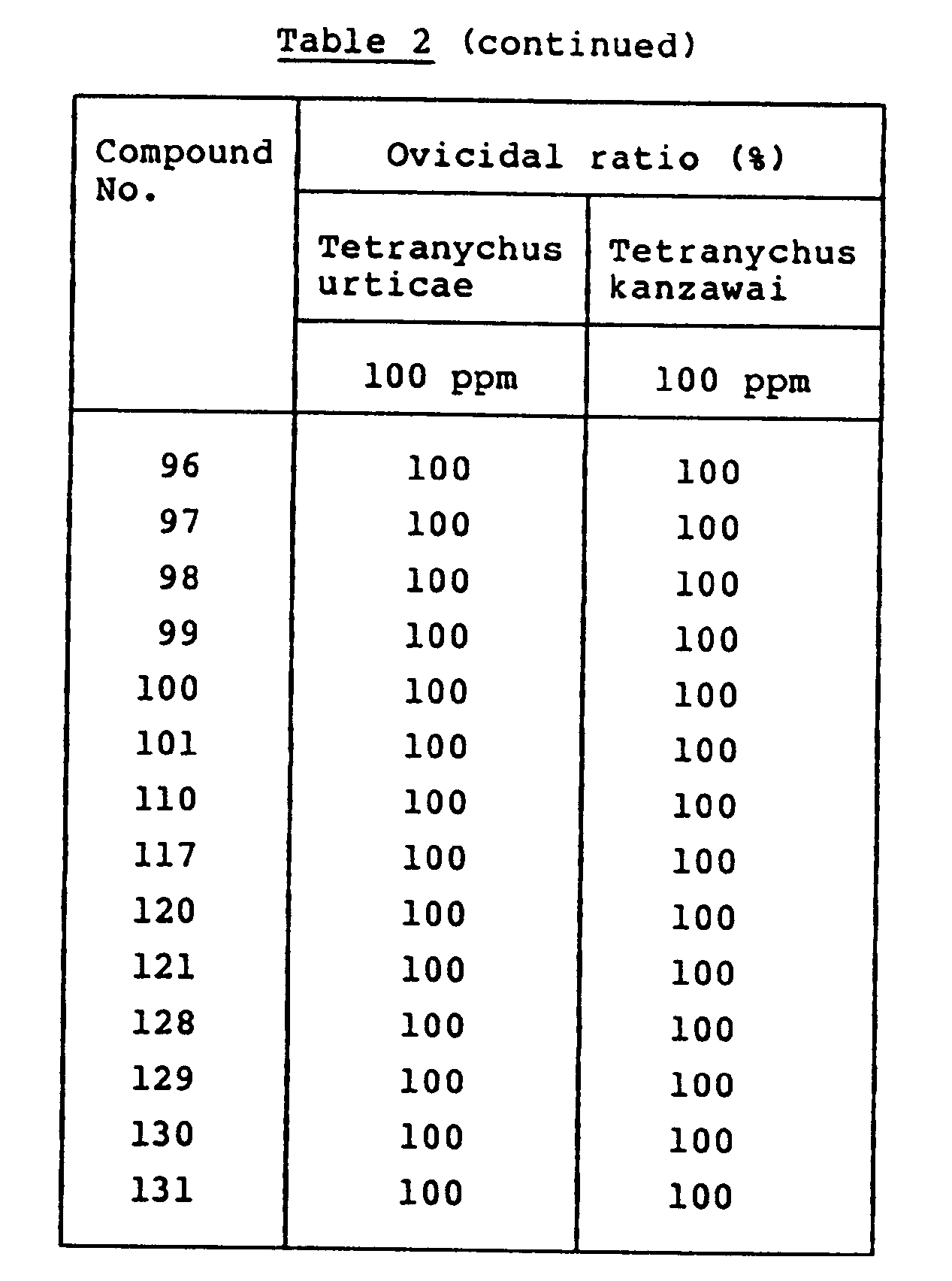
- Kidney bean leaf pieces were placed on a wet filter paper, and female adults of the mites were inoculated at a rate of 10 mites per leaf, and allowed to lay eggs for 24 hours. Thereafter, the female adults were removed. The leaf pieces were left to stand in an incubator (25 °C). Seven days later, the number of larvae hatched from the eggs was counted, and a chemical with a predetermined concentration (emulsifiable concentrate prepared in accordance with Formulation Example 1 and diluted with water) was sprayed onto the leaf pieces, and the leaf pieces were allowed to stand in an incubator (25 °C). Seven days later, the number of adults was counted under a microscope, and the acaricidal ratio on the hatched larvae was calculated from the following formula.

- The test was conducted through 3 replicates for each area, and the results are shown in Table 3.

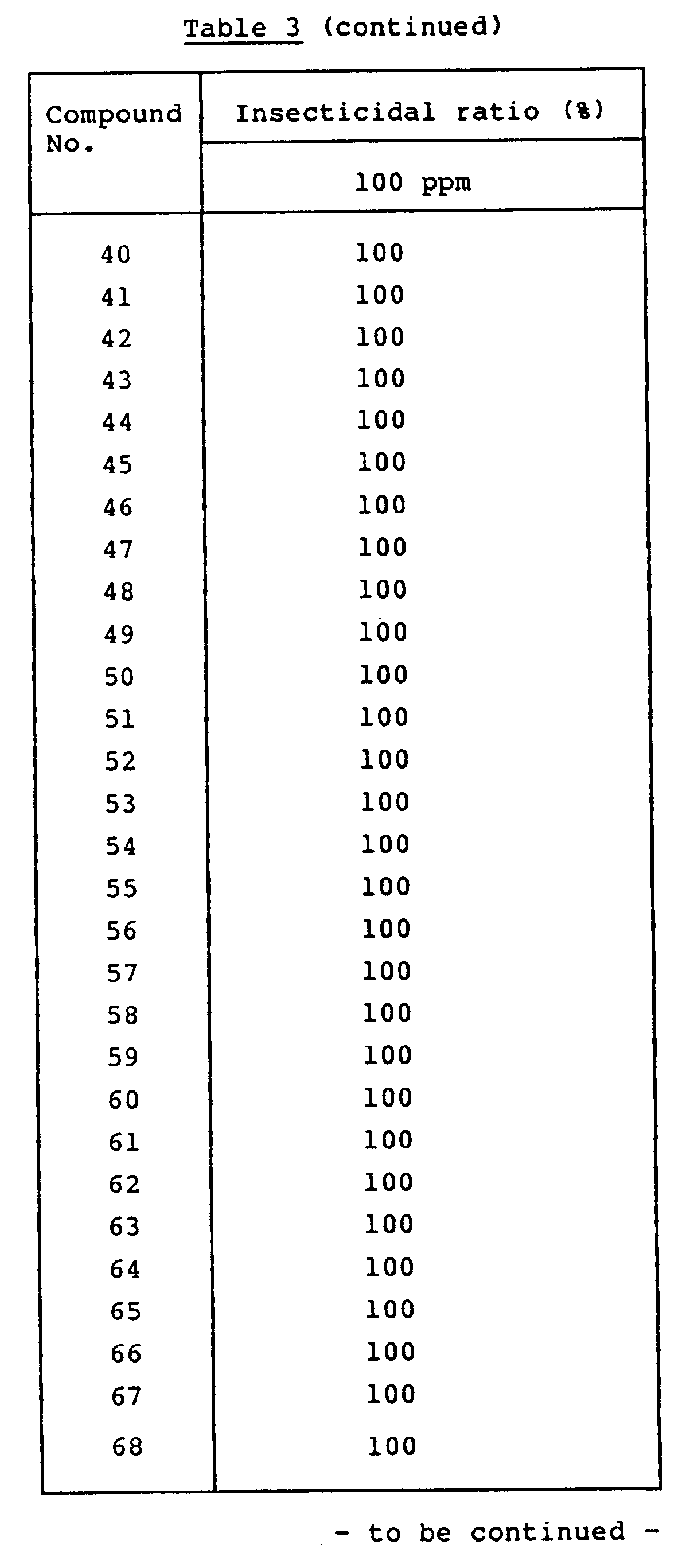


- Japanese radish seedlings in the two-main leaf stage were grown in a cup, and apterous adults of Myzus persicae were inoculated on the radish seedlings at a rate of 5 insects per seedling and caused to larviposit nymphs for 3 days. Then, the adults were removed, and a chemical with a predetermined concentration (a solution of the wettable powder of Formulation Example 2 diluted with water to a concentration of 500 ppm) was sprayed onto the seedlings. The treated seedlings were placed in a greenhouse, 96 hours later, the number of dead insects was counted. The insecticidal ratio was calculated in accordance with the following formula. The test was conducted through three replicates for each area, and the results are shown in Table 4.

- On cucumber seedlings in the one main leaf stage planted in a cup, apterous adults of Aphis gossypii were inoculated at a rate of 5 insects per seedling and caused to larviposit nymphs for 3 days. Then, the adults were removed, and a chemical with a predetermined concentration (a solution of the wettable powder of Formulation Example 2 diluted with water to a concentration of 500 ppm) was sprayed onto the seedlings. The treated seedlings were placed in a greenhouse, and the number of dead insects was counted 96 hours later. The insecticidal ratio was calculated as in Test Example 4. The test was conducted through 3 replicates for each area, and the results are shown in Table 4.


- A chemical (a solution prepared by diluting the wettable powder of Formulation Example 2 with water to 100 ppm) was sprayed onto rice seedlings planted in cups. After air drying, a cylindrical cover made of acrylic resin was put over each cup, and nymphs of Nephotettix cincticeps were released into the cup at a rate of 10 insects per seedling. The cup was closed by gauze. The treated seedlings were placed in a greenhouse. Seven days later, the number of dead insects was examined, and the insecticidal ratio was calculated as in Example 4. The test was conducted through 3 replicates for each area, and the results are shown in Table 5.
- A chemical (a solution prepared by diluting the emulsifiable concentrate of Formulation Example 1 with water to 100 ppm) was sprayed onto rice seedling planted in cups. After air drying, a cylindrical cover made of acrylic resin was put over each cup, and nymphs of Nilaparvata lugens were released into the cup at a rate of 10 insects per seedling. The cup was closed by gauze. The treated seedlings were placed in a greenhouse. Seven days later, the number of dead insects was examined, and the insecticidal ratio was calculated as in Example 4. The test was conducted through 3 replicates for each area, and the results are shown in Table 5.


Claims (12)

X¹ and X² are identical or different and each represents a hydrogen atom, an alkyl group having not more than 6 carbon atoms, an alkoxy group having not more than 6 carbon atoms, a halogen atom, a trifluoromethyl group or a trifluoromethoxy group;
Y¹ and Y² are identical or different and each represents a hydrogen atom, an alkyl group having not more than 6 carbon atoms, an alkoxy group having not more than 6 carbon atoms, an alkylthio group having not more than 6 carbon atoms, a cyano group, a nitro group, a halogen atom or a trifluoromethyl group;
Z represents an oxygen or sulfur atom; and
n is 0 or 1;
with the proviso that


in the presence of a dehydrating agent, or

Applications Claiming Priority (2)
| Application Number | Priority Date | Filing Date | Title |
|---|---|---|---|
| JP14054788 | 1988-06-09 | ||
| JP140547/88 | 1988-06-09 |
Publications (2)
| Publication Number | Publication Date |
|---|---|
| EP0345775A1 EP0345775A1 (en) | 1989-12-13 |
| EP0345775B1 true EP0345775B1 (en) | 1992-04-08 |
Family
ID=15271214
Family Applications (1)
| Application Number | Title | Priority Date | Filing Date |
|---|---|---|---|
| EP89110381A Expired - Lifetime EP0345775B1 (en) | 1988-06-09 | 1989-06-08 | Oxa- or thia-zoline derivative |
Country Status (7)
| Country | Link |
|---|---|
| US (1) | US4977171A (en) |
| EP (1) | EP0345775B1 (en) |
| JP (1) | JPH0285268A (en) |
| KR (1) | KR940008747B1 (en) |
| CN (1) | CN1024794C (en) |
| DE (1) | DE68901154D1 (en) |
| ES (1) | ES2033049T3 (en) |
Families Citing this family (42)
| Publication number | Priority date | Publication date | Assignee | Title |
|---|---|---|---|---|
| AU634608B2 (en) * | 1989-12-09 | 1993-02-25 | Kyoyu Agri Co., Ltd. | 2-substituted phenyl-2-oxazoline or thiazoline derivatives, process for producing the same and insectides and acaricides containing the same |
| JP2941937B2 (en) * | 1990-01-25 | 1999-08-30 | キヤノン株式会社 | Liquid crystalline compound, liquid crystalline composition containing the same compound, usage thereof, liquid crystalline device and display using the same compound |
| AU658955B2 (en) * | 1992-01-28 | 1995-05-04 | Sumitomo Chemical Company, Limited | An oxazoline derivative, its production and its use |
| US5444079A (en) * | 1992-04-22 | 1995-08-22 | E. I. Du Pont De Nemours And Company | Arthropodicidal oxazolines |
| JP3189011B2 (en) * | 1992-04-28 | 2001-07-16 | 八洲化学工業株式会社 | 2- (2,6-difluorophenyl) -4- (2-ethoxy-4-tert-butylphenyl) -2-oxazoline |
| ES2107027T3 (en) * | 1992-05-26 | 1997-11-16 | Du Pont | OXAZALINES AND ARTHROPODIC TIAZOLINS. |
| US5633271A (en) * | 1992-05-26 | 1997-05-27 | E. I. Du Pont De Nemours And Company | Arthropodicidal oxazolines and thiazolines |
| JP3209576B2 (en) * | 1992-06-12 | 2001-09-17 | 八洲化学工業株式会社 | Acaricide |
| US5354905A (en) * | 1992-10-23 | 1994-10-11 | Yashima Chemical Industry Co., Ltd. | N-alkoxymethyl benzamide derivative and manufacturing method therefor, and manufacturing method for benzamide derivative using this N-alkoxymethyl benzamide derivative |
| DE4304197A1 (en) * | 1993-02-12 | 1994-08-18 | Bayer Ag | Substituted oxazoles |
| US5458793A (en) * | 1993-05-13 | 1995-10-17 | The Lubrizol Corporation | Compositions useful as additives for lubricants and liquid fuels |
| TW259693B (en) * | 1993-08-04 | 1995-10-11 | Du Pont | |
| ES2105940B1 (en) * | 1993-09-22 | 1998-07-01 | Sumitomo Chemical Co | AN INSECTICIDE AND ACARICIDE COMPOSITION, A METHOD FOR REPRESSING INSECTS AND MITTINGS AND USE OF SUCH COMPOSITION. |
| ES2128529T3 (en) * | 1993-11-26 | 1999-05-16 | Ube Industries | DERIVATIVES OF OXAZOLINE, PROCEDURE FOR ITS PREPARATION AND AGRICULTURAL AND HORTICOLE COMPOSITIONS FOR THE CONTROL OF HARMFUL ORGANISMS THAT CONTAIN THEM. |
| US5798376A (en) * | 1994-01-17 | 1998-08-25 | Bayer Aktiengesellschaft | Azatrioxaspiroalkenes and their use as insecticidal, acaricidal and nematocidal agents |
| DE4401099A1 (en) * | 1994-01-17 | 1995-07-20 | Bayer Ag | Substituted oxazolines |
| DE4401101A1 (en) * | 1994-01-17 | 1995-07-20 | Bayer Ag | Phenylthio-oxazoline derivatives |
| EP0741714A1 (en) * | 1994-01-24 | 1996-11-13 | E.I. Du Pont De Nemours And Company | Arthropodicidal 2-oxa and thia-zolines |
| US5948820A (en) * | 1994-08-22 | 1999-09-07 | Yoshitomi Pharmaceutical Industries, Ltd. | Benzene compound and pharmaceutical use thereof |
| DE69524962T4 (en) * | 1994-08-22 | 2003-08-28 | Mitsubishi Pharma Corp., Osaka | BENZENE DERIVATIVES AND THEIR MEDICAL USE |
| CZ104797A3 (en) * | 1994-10-06 | 1997-07-16 | Bayer Ag | Substituted biphenyloxazolines, process of their preparation, intermediates for their preparation, preparations in which said substances are comprised and their application |
| DE4444111A1 (en) * | 1994-12-12 | 1996-06-13 | Bayer Ag | Substituted m-biphenyloxazoline derivatives |
| BR9510149A (en) * | 1995-01-20 | 1998-06-02 | Du Pont | Compound arthropodicidal composition and method for arthropod control |
| IL117513A0 (en) * | 1995-04-18 | 1996-07-23 | Du Pont | Oxazoline and thiazoline compounds and their use as arthropodicides |
| DE19528778A1 (en) * | 1995-08-04 | 1997-02-06 | Bayer Ag | 4-alkyl-1,3-oxa (thia) zoline derivatives |
| BR9610961A (en) * | 1995-10-12 | 1999-05-04 | Du Pont | Compound arthropodicidal composition and method for controlling arthropods |
| DE19548419A1 (en) | 1995-12-22 | 1997-06-26 | Bayer Ag | Substituted thiazolines |
| US5767281A (en) * | 1996-02-01 | 1998-06-16 | E. I. Du Pont De Nemours And Company | Arthropodicidal oxazolines and thiazolines |
| DE19648011A1 (en) * | 1996-11-20 | 1998-05-28 | Bayer Ag | Cyclic imines |
| CO5031296A1 (en) * | 1997-11-04 | 2001-04-27 | Novartis Ag | DERIVATIVES OF AZOLINA, COMPOUNDS THAT CONTAIN IT AND METHOD FOR THE PREPARATION AND APPLICATION OF SUCH COMPOUND |
| DE19826671A1 (en) | 1998-06-16 | 1999-12-23 | Hoechst Schering Agrevo Gmbh | 1,3-oxazoline and 1,3-thiazoline derivatives, processes for their preparation and their use as pesticides |
| TWI275589B (en) | 2000-06-22 | 2007-03-11 | Dow Agrosciences Llc | 2-(3,5-disubstituted-4-pyridyl)-4-(thienyl, thiazolyl or arylphenyl)-1,3-oxazoline compounds |
| KR100347010B1 (en) * | 2000-07-19 | 2002-08-03 | 한국에너지기술연구원 | A method of manufacturing single side corrugated ceramic sheet for gas adsorption. |
| MXPA04006709A (en) * | 2002-01-11 | 2004-10-04 | Sankyo Co | Amino alcohol derivative or phosphonic acid derivative and medicinal composition containing these. |
| US6573286B1 (en) | 2002-06-21 | 2003-06-03 | Dow Agrosciences Llc | 2-(2,6-disubstituted phenyl)-4-aryl-5-alkyl-1,3-oxazoline compounds |
| KR20110136901A (en) | 2004-02-24 | 2011-12-21 | 상꾜 가부시키가이샤 | Amino alcohol compounds |
| CA2510559A1 (en) * | 2004-08-11 | 2006-02-11 | Sumitomo Chemical Company, Limited | A pesticidal composition comprising an ester compound and an oxazoline compound |
| CN103098819B (en) * | 2012-12-30 | 2016-05-25 | 湖南农大海特农化有限公司 | The Synergistic mite killing composition of second mite azoles and gamma cyhalothrin |
| CN103113318A (en) * | 2013-02-26 | 2013-05-22 | 南京工业大学 | New etoxazole compound, preparation method and acaricidal activity thereof |
| CN103141501B (en) * | 2013-03-22 | 2014-07-23 | 青岛瀚生生物科技股份有限公司 | Dinotefuran and etoxazole compounded insecticidal composition |
| CN105693648A (en) * | 2016-03-01 | 2016-06-22 | 浙江博仕达作物科技有限公司 | Fluorobenzene oxazole compound and application thereof |
| WO2017188078A1 (en) * | 2016-04-28 | 2017-11-02 | 住友化学株式会社 | Heterocyclic compound |
Family Cites Families (8)
| Publication number | Priority date | Publication date | Assignee | Title |
|---|---|---|---|---|
| US2714082A (en) * | 1955-07-26 | New oxazoline derivatives | ||
| US3268544A (en) * | 1964-11-12 | 1966-08-23 | Thiokol Chemical Corp | Preparation of 2-oxazolines and 2-thiazolines |
| DE1545668A1 (en) * | 1965-04-24 | 1969-08-07 | Huels Chemische Werke Ag | Process for the preparation of addition compounds containing active bromine |
| US3440247A (en) * | 1966-08-26 | 1969-04-22 | Lubrizol Corp | Reaction products of phosphite diesters with imidazolines or oxazolines |
| US4153703A (en) * | 1977-06-30 | 1979-05-08 | Uniroyal, Inc. | Method of controlling insects and acarids with certain aryl-substituted thiazoles |
| US4443611A (en) * | 1978-12-05 | 1984-04-17 | The Dow Chemical Company | Liquid phase preparation of 2-H-2-oxazolines and 2-substituted-2-oxazolines |
| IT1193212B (en) * | 1979-08-10 | 1988-06-15 | Anic Spa | DISPERSING ADDITIVES FOR LUBRICANTS AND METHOD FOR THEIR PREPARATION |
| DE3047759A1 (en) * | 1980-12-15 | 1982-07-15 | Schering Ag, 1000 Berlin Und 4619 Bergkamen | METHOD FOR PRODUCING (DELTA) (UP ARROW) 2 (UP ARROW) -N-HETEROCYCLES |
-
1989
- 1989-06-02 US US07/360,866 patent/US4977171A/en not_active Expired - Lifetime
- 1989-06-07 JP JP1142888A patent/JPH0285268A/en active Granted
- 1989-06-08 ES ES198989110381T patent/ES2033049T3/en not_active Expired - Lifetime
- 1989-06-08 EP EP89110381A patent/EP0345775B1/en not_active Expired - Lifetime
- 1989-06-08 DE DE8989110381T patent/DE68901154D1/en not_active Expired - Fee Related
- 1989-06-09 CN CN89103877A patent/CN1024794C/en not_active Expired - Fee Related
- 1989-06-09 KR KR1019890007981A patent/KR940008747B1/en not_active Expired - Fee Related
Non-Patent Citations (2)
| Title |
|---|
| CHEMICAL ABSTRACTS, vol. 94, no. 3, 19th January 1981, page 432, abstract no. 15626y, Columbus, Ohio, USA; G.S. BATES et al.: "A mild, general preparation of N-acyl aziridines and 2-substituted 4(S)-benzyloxazolines" * |
| JOURNAL OF ORGANIC CHEMISTRY, vol. 52, 1987, pages 2523-2530; O. TSUGE et al.: "Regioselective cycloadditions of N-protonated azomethine ylides and 2-azaallyl anions generated from N-(silymethyl) thioimidates, synthetic equivalents of nonstabilized nitrile ylides" * |
Also Published As
| Publication number | Publication date |
|---|---|
| JPH0417952B2 (en) | 1992-03-26 |
| CN1038809A (en) | 1990-01-17 |
| EP0345775A1 (en) | 1989-12-13 |
| ES2033049T3 (en) | 1993-03-01 |
| CN1024794C (en) | 1994-06-01 |
| KR940008747B1 (en) | 1994-09-26 |
| KR910000657A (en) | 1991-01-29 |
| US4977171A (en) | 1990-12-11 |
| JPH0285268A (en) | 1990-03-26 |
| DE68901154D1 (en) | 1992-05-14 |
Similar Documents
| Publication | Publication Date | Title |
|---|---|---|
| US4977171A (en) | Oxa- or thia-zoline derivative | |
| EP0432661B1 (en) | 2-Substituted phenyl-2-oxazoline or thiazoline derivatives, process for producing the same and insecticides and acaricides containing the same | |
| EP0639572B1 (en) | 2-(2,6-difluorophenyl)-4-(2-ethoxy-4-tert-butylphenyl)-2-oxazoline | |
| JPWO1993022297A1 (en) | 2-(2,6-difluorophenyl)-4-(2-ethoxy-4-tert-butylphenyl)-2-oxazoline | |
| JP2610988B2 (en) | New heterocyclic compounds and insecticides | |
| JP2583429B2 (en) | Imidazolines and insecticides | |
| JP2884412B2 (en) | Insecticidal cyano compounds | |
| EP0483647A1 (en) | Hydrazine compounds or their salts, processes for producing them and pesticides containing them | |
| JPH0762006B2 (en) | 2-Substituted phenyl-2-oxa- or thiazoline derivatives, process for their production and insecticides and acaricides containing the same | |
| US4670451A (en) | Benzoxazolone-2 compounds and fungicidal use thereof | |
| EP0686345B1 (en) | Insecticidal and miticidal agent | |
| EP0286006B1 (en) | Thiadiazole derivative, and insecticidal and miticidal composition containing the derivative as the effective ingredient | |
| JP2888946B2 (en) | Oxazoline derivatives and insecticides and acaricides containing the same | |
| EP0437784B1 (en) | Imidazolidine derivatives, process for producing the same and pesticides containing the same | |
| EP0842931A1 (en) | Oxopropionitrile derivatives and insect rest control agents | |
| JP3574785B2 (en) | Acaricide | |
| JPH02207066A (en) | Hydrazine-based compound, production thereof and controller against harmful animal containing same | |
| JP2700743B2 (en) | Organophosphorus compound, process for producing the same, and insecticide, acaricide and nematicide containing the compound | |
| JP3005300B2 (en) | Imidazolidine derivatives, their production methods and pesticidal agents containing them | |
| JPH04173778A (en) | Nitroguanidine derivative, its production and harmful life controlling agent containing the same | |
| JPH083140A (en) | Imidazole compounds and pest control agents containing them | |
| JPH08208611A (en) | Imidazo(4,5-b)pyridine-based compound and pest-controlling agent containing the same | |
| JPS62161782A (en) | Pyridine compound having saturated heterocyclic group and fungicide containing same |
Legal Events
| Date | Code | Title | Description |
|---|---|---|---|
| PUAI | Public reference made under article 153(3) epc to a published international application that has entered the european phase |
Free format text: ORIGINAL CODE: 0009012 |
|
| AK | Designated contracting states |
Kind code of ref document: A1 Designated state(s): BE CH DE ES FR GB IT LI NL |
|
| RIN1 | Information on inventor provided before grant (corrected) |
Inventor name: SUZUKI, JUNJI Inventor name: ITOH, YOSHIAKI Inventor name: TODA, KAZUYA Inventor name: ISHIDA, TATSUYA Inventor name: IKEDA, TATSUFUMI Inventor name: TSUKIDATE, YOKICHI Inventor name: KIKUCHI, YASUO |
|
| 17P | Request for examination filed |
Effective date: 19900515 |
|
| 17Q | First examination report despatched |
Effective date: 19900921 |
|
| GRAA | (expected) grant |
Free format text: ORIGINAL CODE: 0009210 |
|
| AK | Designated contracting states |
Kind code of ref document: B1 Designated state(s): BE CH DE ES FR GB IT LI NL |
|
| ITF | It: translation for a ep patent filed | ||
| REF | Corresponds to: |
Ref document number: 68901154 Country of ref document: DE Date of ref document: 19920514 |
|
| ET | Fr: translation filed | ||
| PLBE | No opposition filed within time limit |
Free format text: ORIGINAL CODE: 0009261 |
|
| STAA | Information on the status of an ep patent application or granted ep patent |
Free format text: STATUS: NO OPPOSITION FILED WITHIN TIME LIMIT |
|
| REG | Reference to a national code |
Ref country code: ES Ref legal event code: FG2A Ref document number: 2033049 Country of ref document: ES Kind code of ref document: T3 |
|
| 26N | No opposition filed | ||
| REG | Reference to a national code |
Ref country code: GB Ref legal event code: IF02 |
|
| REG | Reference to a national code |
Ref country code: CH Ref legal event code: PFA Owner name: KYOYU AGRI CO., LTD. Free format text: YASHIMA CHEMICAL INDUSTRIAL CO., LTD#6, NIHONBASHI-HONCHO 1-CHOME#CHUO-KU/TOKYO (JP) -TRANSFER TO- KYOYU AGRI CO., LTD.#14-10, FUTAKO 6-CHOME#TAKATSU-KU, KAWASAKI-SHI (JP) |
|
| REG | Reference to a national code |
Ref country code: CH Ref legal event code: PFA Owner name: KYOYU AGRI CO., LTD. Free format text: KYOYU AGRI CO., LTD.#14-10, FUTAKO 6-CHOME#TAKATSU-KU, KAWASAKI-SHI (JP) -TRANSFER TO- KYOYU AGRI CO., LTD.#14-10, FUTAGO 6-CHOME#TAKATSU-KU, KAWASAKI-SHI, KANAGAWA 213-0002 (JP) |
|
| REG | Reference to a national code |
Ref country code: ES Ref legal event code: PC2A |
|
| REG | Reference to a national code |
Ref country code: GB Ref legal event code: 711B |
|
| NLT1 | Nl: modifications of names registered in virtue of documents presented to the patent office pursuant to art. 16 a, paragraph 1 |
Owner name: YASHIMA CHEMICAL INDUSTRY CO., LTD. Owner name: KYOYU AGRI CO., LTD. |
|
| REG | Reference to a national code |
Ref country code: GB Ref legal event code: 711G |
|
| REG | Reference to a national code |
Ref country code: FR Ref legal event code: CD Ref country code: FR Ref legal event code: CA Ref country code: FR Ref legal event code: RM |
|
| PGFP | Annual fee paid to national office [announced via postgrant information from national office to epo] |
Ref country code: DE Payment date: 20060601 Year of fee payment: 18 |
|
| PGFP | Annual fee paid to national office [announced via postgrant information from national office to epo] |
Ref country code: ES Payment date: 20060605 Year of fee payment: 18 |
|
| PGFP | Annual fee paid to national office [announced via postgrant information from national office to epo] |
Ref country code: GB Payment date: 20060607 Year of fee payment: 18 |
|
| PGFP | Annual fee paid to national office [announced via postgrant information from national office to epo] |
Ref country code: CH Payment date: 20060612 Year of fee payment: 18 |
|
| PGFP | Annual fee paid to national office [announced via postgrant information from national office to epo] |
Ref country code: NL Payment date: 20060616 Year of fee payment: 18 |
|
| PGFP | Annual fee paid to national office [announced via postgrant information from national office to epo] |
Ref country code: BE Payment date: 20060621 Year of fee payment: 18 |
|
| PGFP | Annual fee paid to national office [announced via postgrant information from national office to epo] |
Ref country code: FR Payment date: 20060628 Year of fee payment: 18 |
|
| PGFP | Annual fee paid to national office [announced via postgrant information from national office to epo] |
Ref country code: IT Payment date: 20060630 Year of fee payment: 18 |
|
| BERE | Be: lapsed |
Owner name: *KYOYU AGRI CO. LTD Effective date: 20070630 |
|
| REG | Reference to a national code |
Ref country code: CH Ref legal event code: PL |
|
| GBPC | Gb: european patent ceased through non-payment of renewal fee |
Effective date: 20070608 |
|
| NLV4 | Nl: lapsed or anulled due to non-payment of the annual fee |
Effective date: 20080101 |
|
| PG25 | Lapsed in a contracting state [announced via postgrant information from national office to epo] |
Ref country code: BE Free format text: LAPSE BECAUSE OF NON-PAYMENT OF DUE FEES Effective date: 20070630 |
|
| REG | Reference to a national code |
Ref country code: FR Ref legal event code: ST Effective date: 20080229 |
|
| PG25 | Lapsed in a contracting state [announced via postgrant information from national office to epo] |
Ref country code: CH Free format text: LAPSE BECAUSE OF NON-PAYMENT OF DUE FEES Effective date: 20070630 Ref country code: DE Free format text: LAPSE BECAUSE OF NON-PAYMENT OF DUE FEES Effective date: 20080101 Ref country code: LI Free format text: LAPSE BECAUSE OF NON-PAYMENT OF DUE FEES Effective date: 20070630 Ref country code: NL Free format text: LAPSE BECAUSE OF NON-PAYMENT OF DUE FEES Effective date: 20080101 |
|
| PG25 | Lapsed in a contracting state [announced via postgrant information from national office to epo] |
Ref country code: GB Free format text: LAPSE BECAUSE OF NON-PAYMENT OF DUE FEES Effective date: 20070608 |
|
| REG | Reference to a national code |
Ref country code: ES Ref legal event code: FD2A Effective date: 20070609 |
|
| PG25 | Lapsed in a contracting state [announced via postgrant information from national office to epo] |
Ref country code: FR Free format text: LAPSE BECAUSE OF NON-PAYMENT OF DUE FEES Effective date: 20070702 |
|
| PG25 | Lapsed in a contracting state [announced via postgrant information from national office to epo] |
Ref country code: ES Free format text: LAPSE BECAUSE OF NON-PAYMENT OF DUE FEES Effective date: 20070609 |
|
| PG25 | Lapsed in a contracting state [announced via postgrant information from national office to epo] |
Ref country code: IT Free format text: LAPSE BECAUSE OF NON-PAYMENT OF DUE FEES Effective date: 20070608 |