EP0345611B1 - High alkalinity liquid automatic dishwasher detergent compositions - Google Patents
High alkalinity liquid automatic dishwasher detergent compositions Download PDFInfo
- Publication number
- EP0345611B1 EP0345611B1 EP89109765A EP89109765A EP0345611B1 EP 0345611 B1 EP0345611 B1 EP 0345611B1 EP 89109765 A EP89109765 A EP 89109765A EP 89109765 A EP89109765 A EP 89109765A EP 0345611 B1 EP0345611 B1 EP 0345611B1
- Authority
- EP
- European Patent Office
- Prior art keywords
- composition
- alkali metal
- clay
- fatty acid
- weight
- Prior art date
- Legal status (The legal status is an assumption and is not a legal conclusion. Google has not performed a legal analysis and makes no representation as to the accuracy of the status listed.)
- Expired - Lifetime
Links
- 239000000203 mixture Substances 0.000 title claims abstract description 124
- 239000003599 detergent Substances 0.000 title claims description 22
- 239000007788 liquid Substances 0.000 title abstract description 16
- 239000000460 chlorine Substances 0.000 claims abstract description 38
- 229910052801 chlorine Inorganic materials 0.000 claims abstract description 38
- ZAMOUSCENKQFHK-UHFFFAOYSA-N Chlorine atom Chemical compound [Cl] ZAMOUSCENKQFHK-UHFFFAOYSA-N 0.000 claims abstract description 37
- 239000007844 bleaching agent Substances 0.000 claims abstract description 34
- 229910052751 metal Inorganic materials 0.000 claims abstract description 32
- 239000002184 metal Substances 0.000 claims abstract description 32
- 150000003839 salts Chemical class 0.000 claims abstract description 27
- 230000009974 thixotropic effect Effects 0.000 claims abstract description 20
- 239000004927 clay Substances 0.000 claims abstract description 18
- 238000010936 aqueous wash Methods 0.000 claims abstract description 8
- 239000011777 magnesium Substances 0.000 claims abstract description 6
- 229960000892 attapulgite Drugs 0.000 claims abstract description 5
- 229910052749 magnesium Inorganic materials 0.000 claims abstract description 5
- 229910052625 palygorskite Inorganic materials 0.000 claims abstract description 5
- FYYHWMGAXLPEAU-UHFFFAOYSA-N Magnesium Chemical compound [Mg] FYYHWMGAXLPEAU-UHFFFAOYSA-N 0.000 claims abstract description 4
- 239000011575 calcium Substances 0.000 claims abstract description 4
- 229910052791 calcium Inorganic materials 0.000 claims abstract description 4
- 229910052782 aluminium Inorganic materials 0.000 claims abstract description 3
- XAGFODPZIPBFFR-UHFFFAOYSA-N aluminium Chemical compound [Al] XAGFODPZIPBFFR-UHFFFAOYSA-N 0.000 claims abstract description 3
- -1 alkali metal tripolyphosphate Chemical class 0.000 claims description 35
- 235000014113 dietary fatty acids Nutrition 0.000 claims description 35
- 239000000194 fatty acid Substances 0.000 claims description 35
- 229930195729 fatty acid Natural products 0.000 claims description 35
- 239000006260 foam Substances 0.000 claims description 23
- XLYOFNOQVPJJNP-UHFFFAOYSA-N water Substances O XLYOFNOQVPJJNP-UHFFFAOYSA-N 0.000 claims description 17
- 150000001875 compounds Chemical class 0.000 claims description 16
- 229910000288 alkali metal carbonate Inorganic materials 0.000 claims description 13
- 150000008041 alkali metal carbonates Chemical class 0.000 claims description 13
- 230000000994 depressogenic effect Effects 0.000 claims description 11
- 239000002253 acid Substances 0.000 claims description 9
- SUKJFIGYRHOWBL-UHFFFAOYSA-N sodium hypochlorite Chemical compound [Na+].Cl[O-] SUKJFIGYRHOWBL-UHFFFAOYSA-N 0.000 claims description 9
- 235000019832 sodium triphosphate Nutrition 0.000 claims description 9
- 239000005708 Sodium hypochlorite Substances 0.000 claims description 8
- 229910052783 alkali metal Inorganic materials 0.000 claims description 8
- 229910052910 alkali metal silicate Inorganic materials 0.000 claims description 8
- 150000008044 alkali metal hydroxides Chemical class 0.000 claims description 7
- 125000000217 alkyl group Chemical group 0.000 claims description 7
- 229910021647 smectite Inorganic materials 0.000 claims description 7
- 125000004432 carbon atom Chemical group C* 0.000 claims description 6
- 239000011149 active material Substances 0.000 claims description 5
- QIQXTHQIDYTFRH-UHFFFAOYSA-N octadecanoic acid Chemical compound CCCCCCCCCCCCCCCCCC(O)=O QIQXTHQIDYTFRH-UHFFFAOYSA-N 0.000 claims description 4
- 239000011701 zinc Substances 0.000 claims description 4
- 229910019142 PO4 Inorganic materials 0.000 claims description 3
- 235000021355 Stearic acid Nutrition 0.000 claims description 3
- OQCDKBAXFALNLD-UHFFFAOYSA-N octadecanoic acid Natural products CCCCCCCC(C)CCCCCCCCC(O)=O OQCDKBAXFALNLD-UHFFFAOYSA-N 0.000 claims description 3
- 239000008117 stearic acid Substances 0.000 claims description 3
- 229910052725 zinc Inorganic materials 0.000 claims description 3
- HCHKCACWOHOZIP-UHFFFAOYSA-N Zinc Chemical compound [Zn] HCHKCACWOHOZIP-UHFFFAOYSA-N 0.000 claims description 2
- 229910052787 antimony Inorganic materials 0.000 claims description 2
- 229910052793 cadmium Inorganic materials 0.000 claims description 2
- 229910052742 iron Inorganic materials 0.000 claims description 2
- 229910052748 manganese Inorganic materials 0.000 claims description 2
- 229910052759 nickel Inorganic materials 0.000 claims description 2
- 229910052758 niobium Inorganic materials 0.000 claims description 2
- 229910052718 tin Inorganic materials 0.000 claims description 2
- 229910052719 titanium Inorganic materials 0.000 claims description 2
- 229910052720 vanadium Inorganic materials 0.000 claims description 2
- 229910052726 zirconium Inorganic materials 0.000 claims description 2
- 159000000007 calcium salts Chemical class 0.000 claims 1
- 239000010452 phosphate Substances 0.000 claims 1
- 239000010936 titanium Substances 0.000 claims 1
- 239000002562 thickening agent Substances 0.000 abstract description 10
- 238000009472 formulation Methods 0.000 abstract description 8
- 230000001965 increasing effect Effects 0.000 abstract description 4
- OYPRJOBELJOOCE-UHFFFAOYSA-N Calcium Chemical compound [Ca] OYPRJOBELJOOCE-UHFFFAOYSA-N 0.000 abstract description 3
- GUJOJGAPFQRJSV-UHFFFAOYSA-N dialuminum;dioxosilane;oxygen(2-);hydrate Chemical compound O.[O-2].[O-2].[O-2].[Al+3].[Al+3].O=[Si]=O.O=[Si]=O.O=[Si]=O.O=[Si]=O GUJOJGAPFQRJSV-UHFFFAOYSA-N 0.000 abstract description 3
- KWLMIXQRALPRBC-UHFFFAOYSA-L hectorite Chemical compound [Li+].[OH-].[OH-].[Na+].[Mg+2].O1[Si]2([O-])O[Si]1([O-])O[Si]([O-])(O1)O[Si]1([O-])O2 KWLMIXQRALPRBC-UHFFFAOYSA-L 0.000 abstract description 3
- 229910000271 hectorite Inorganic materials 0.000 abstract description 3
- 229910052901 montmorillonite Inorganic materials 0.000 abstract description 3
- XOOUIPVCVHRTMJ-UHFFFAOYSA-L zinc stearate Chemical compound [Zn+2].CCCCCCCCCCCCCCCCCC([O-])=O.CCCCCCCCCCCCCCCCCC([O-])=O XOOUIPVCVHRTMJ-UHFFFAOYSA-L 0.000 abstract description 3
- 150000004668 long chain fatty acids Chemical class 0.000 abstract description 2
- 239000004411 aluminium Substances 0.000 abstract 1
- HEMHJVSKTPXQMS-UHFFFAOYSA-M Sodium hydroxide Chemical compound [OH-].[Na+] HEMHJVSKTPXQMS-UHFFFAOYSA-M 0.000 description 42
- 239000004615 ingredient Substances 0.000 description 20
- 239000004094 surface-active agent Substances 0.000 description 19
- 150000004665 fatty acids Chemical class 0.000 description 17
- CDBYLPFSWZWCQE-UHFFFAOYSA-L Sodium Carbonate Chemical compound [Na+].[Na+].[O-]C([O-])=O CDBYLPFSWZWCQE-UHFFFAOYSA-L 0.000 description 14
- 235000011121 sodium hydroxide Nutrition 0.000 description 14
- 150000002739 metals Chemical class 0.000 description 11
- DGAQECJNVWCQMB-PUAWFVPOSA-M Ilexoside XXIX Chemical compound C[C@@H]1CC[C@@]2(CC[C@@]3(C(=CC[C@H]4[C@]3(CC[C@@H]5[C@@]4(CC[C@@H](C5(C)C)OS(=O)(=O)[O-])C)C)[C@@H]2[C@]1(C)O)C)C(=O)O[C@H]6[C@@H]([C@H]([C@@H]([C@H](O6)CO)O)O)O.[Na+] DGAQECJNVWCQMB-PUAWFVPOSA-M 0.000 description 9
- 239000004115 Sodium Silicate Substances 0.000 description 9
- 238000004140 cleaning Methods 0.000 description 9
- WQYVRQLZKVEZGA-UHFFFAOYSA-N hypochlorite Chemical compound Cl[O-] WQYVRQLZKVEZGA-UHFFFAOYSA-N 0.000 description 9
- 229910052708 sodium Inorganic materials 0.000 description 9
- 239000011734 sodium Substances 0.000 description 9
- NTHWMYGWWRZVTN-UHFFFAOYSA-N sodium silicate Chemical compound [Na+].[Na+].[O-][Si]([O-])=O NTHWMYGWWRZVTN-UHFFFAOYSA-N 0.000 description 9
- 229910052911 sodium silicate Inorganic materials 0.000 description 9
- 239000003381 stabilizer Substances 0.000 description 9
- CEGOLXSVJUTHNZ-UHFFFAOYSA-K aluminium tristearate Chemical compound [Al+3].CCCCCCCCCCCCCCCCCC([O-])=O.CCCCCCCCCCCCCCCCCC([O-])=O.CCCCCCCCCCCCCCCCCC([O-])=O CEGOLXSVJUTHNZ-UHFFFAOYSA-K 0.000 description 8
- 239000004033 plastic Substances 0.000 description 8
- 239000000243 solution Substances 0.000 description 8
- VYPSYNLAJGMNEJ-UHFFFAOYSA-N Silicium dioxide Chemical compound O=[Si]=O VYPSYNLAJGMNEJ-UHFFFAOYSA-N 0.000 description 7
- 239000000047 product Substances 0.000 description 7
- 229910000029 sodium carbonate Inorganic materials 0.000 description 7
- 235000017550 sodium carbonate Nutrition 0.000 description 6
- 229940063655 aluminum stearate Drugs 0.000 description 5
- 239000006185 dispersion Substances 0.000 description 5
- 238000003860 storage Methods 0.000 description 5
- 239000013008 thixotropic agent Substances 0.000 description 5
- BPQQTUXANYXVAA-UHFFFAOYSA-N Orthosilicate Chemical compound [O-][Si]([O-])([O-])[O-] BPQQTUXANYXVAA-UHFFFAOYSA-N 0.000 description 4
- 239000000499 gel Substances 0.000 description 4
- KWIUHFFTVRNATP-UHFFFAOYSA-N glycine betaine Chemical compound C[N+](C)(C)CC([O-])=O KWIUHFFTVRNATP-UHFFFAOYSA-N 0.000 description 4
- 239000002689 soil Substances 0.000 description 4
- BVKZGUZCCUSVTD-UHFFFAOYSA-L Carbonate Chemical compound [O-]C([O-])=O BVKZGUZCCUSVTD-UHFFFAOYSA-L 0.000 description 3
- OAICVXFJPJFONN-UHFFFAOYSA-N Phosphorus Chemical compound [P] OAICVXFJPJFONN-UHFFFAOYSA-N 0.000 description 3
- YXFVVABEGXRONW-UHFFFAOYSA-N Toluene Chemical compound CC1=CC=CC=C1 YXFVVABEGXRONW-UHFFFAOYSA-N 0.000 description 3
- 150000001340 alkali metals Chemical class 0.000 description 3
- 150000001412 amines Chemical class 0.000 description 3
- 239000003795 chemical substances by application Substances 0.000 description 3
- 238000004851 dishwashing Methods 0.000 description 3
- 230000000694 effects Effects 0.000 description 3
- 150000002148 esters Chemical class 0.000 description 3
- 230000005764 inhibitory process Effects 0.000 description 3
- HQKMJHAJHXVSDF-UHFFFAOYSA-L magnesium stearate Chemical compound [Mg+2].CCCCCCCCCCCCCCCCCC([O-])=O.CCCCCCCCCCCCCCCCCC([O-])=O HQKMJHAJHXVSDF-UHFFFAOYSA-L 0.000 description 3
- 238000004519 manufacturing process Methods 0.000 description 3
- 239000000463 material Substances 0.000 description 3
- 238000002156 mixing Methods 0.000 description 3
- 238000005191 phase separation Methods 0.000 description 3
- 239000011574 phosphorus Substances 0.000 description 3
- 229910052698 phosphorus Inorganic materials 0.000 description 3
- 239000000843 powder Substances 0.000 description 3
- 239000000377 silicon dioxide Substances 0.000 description 3
- 230000000087 stabilizing effect Effects 0.000 description 3
- 239000000375 suspending agent Substances 0.000 description 3
- 239000003760 tallow Substances 0.000 description 3
- IAYPIBMASNFSPL-UHFFFAOYSA-N Ethylene oxide Chemical compound C1CO1 IAYPIBMASNFSPL-UHFFFAOYSA-N 0.000 description 2
- 235000010469 Glycine max Nutrition 0.000 description 2
- 244000068988 Glycine max Species 0.000 description 2
- VEXZGXHMUGYJMC-UHFFFAOYSA-N Hydrochloric acid Chemical compound Cl VEXZGXHMUGYJMC-UHFFFAOYSA-N 0.000 description 2
- KKCBUQHMOMHUOY-UHFFFAOYSA-N Na2O Inorganic materials [O-2].[Na+].[Na+] KKCBUQHMOMHUOY-UHFFFAOYSA-N 0.000 description 2
- 240000007594 Oryza sativa Species 0.000 description 2
- 235000007164 Oryza sativa Nutrition 0.000 description 2
- ATTZFSUZZUNHBP-UHFFFAOYSA-N Piperonyl sulfoxide Chemical compound CCCCCCCCS(=O)C(C)CC1=CC=C2OCOC2=C1 ATTZFSUZZUNHBP-UHFFFAOYSA-N 0.000 description 2
- GWEVSGVZZGPLCZ-UHFFFAOYSA-N Titan oxide Chemical compound O=[Ti]=O GWEVSGVZZGPLCZ-UHFFFAOYSA-N 0.000 description 2
- 150000007513 acids Chemical class 0.000 description 2
- AZDRQVAHHNSJOQ-UHFFFAOYSA-N alumane Chemical class [AlH3] AZDRQVAHHNSJOQ-UHFFFAOYSA-N 0.000 description 2
- 125000000129 anionic group Chemical group 0.000 description 2
- 239000012736 aqueous medium Substances 0.000 description 2
- 239000007864 aqueous solution Substances 0.000 description 2
- 230000008901 benefit Effects 0.000 description 2
- 229960003237 betaine Drugs 0.000 description 2
- 230000015572 biosynthetic process Effects 0.000 description 2
- CJZGTCYPCWQAJB-UHFFFAOYSA-L calcium stearate Chemical compound [Ca+2].CCCCCCCCCCCCCCCCCC([O-])=O.CCCCCCCCCCCCCCCCCC([O-])=O CJZGTCYPCWQAJB-UHFFFAOYSA-L 0.000 description 2
- 229910052681 coesite Inorganic materials 0.000 description 2
- 229910052906 cristobalite Inorganic materials 0.000 description 2
- POULHZVOKOAJMA-UHFFFAOYSA-N dodecanoic acid Chemical compound CCCCCCCCCCCC(O)=O POULHZVOKOAJMA-UHFFFAOYSA-N 0.000 description 2
- 238000005187 foaming Methods 0.000 description 2
- IPCSVZSSVZVIGE-UHFFFAOYSA-N hexadecanoic acid Chemical compound CCCCCCCCCCCCCCCC(O)=O IPCSVZSSVZVIGE-UHFFFAOYSA-N 0.000 description 2
- XLYOFNOQVPJJNP-UHFFFAOYSA-M hydroxide Chemical compound [OH-] XLYOFNOQVPJJNP-UHFFFAOYSA-M 0.000 description 2
- 229910052500 inorganic mineral Inorganic materials 0.000 description 2
- 239000002609 medium Substances 0.000 description 2
- 235000010755 mineral Nutrition 0.000 description 2
- 239000011707 mineral Substances 0.000 description 2
- UHGIMQLJWRAPLT-UHFFFAOYSA-N octadecyl dihydrogen phosphate Chemical compound CCCCCCCCCCCCCCCCCCOP(O)(O)=O UHGIMQLJWRAPLT-UHFFFAOYSA-N 0.000 description 2
- 125000000913 palmityl group Chemical group [H]C([*])([H])C([H])([H])C([H])([H])C([H])([H])C([H])([H])C([H])([H])C([H])([H])C([H])([H])C([H])([H])C([H])([H])C([H])([H])C([H])([H])C([H])([H])C([H])([H])C([H])([H])C([H])([H])[H] 0.000 description 2
- HWGNBUXHKFFFIH-UHFFFAOYSA-I pentasodium;[oxido(phosphonatooxy)phosphoryl] phosphate Chemical compound [Na+].[Na+].[Na+].[Na+].[Na+].[O-]P([O-])(=O)OP([O-])(=O)OP([O-])([O-])=O HWGNBUXHKFFFIH-UHFFFAOYSA-I 0.000 description 2
- 239000010451 perlite Substances 0.000 description 2
- 235000019362 perlite Nutrition 0.000 description 2
- 235000021317 phosphate Nutrition 0.000 description 2
- 150000003013 phosphoric acid derivatives Chemical class 0.000 description 2
- 150000003014 phosphoric acid esters Chemical class 0.000 description 2
- 150000003112 potassium compounds Chemical class 0.000 description 2
- 159000000001 potassium salts Chemical class 0.000 description 2
- 235000009566 rice Nutrition 0.000 description 2
- 238000009991 scouring Methods 0.000 description 2
- 150000004760 silicates Chemical class 0.000 description 2
- 235000012239 silicon dioxide Nutrition 0.000 description 2
- 235000019795 sodium metasilicate Nutrition 0.000 description 2
- 229910052682 stishovite Inorganic materials 0.000 description 2
- 239000000126 substance Substances 0.000 description 2
- 238000012360 testing method Methods 0.000 description 2
- 229910052905 tridymite Inorganic materials 0.000 description 2
- 238000005406 washing Methods 0.000 description 2
- WRIDQFICGBMAFQ-UHFFFAOYSA-N (E)-8-Octadecenoic acid Natural products CCCCCCCCCC=CCCCCCCC(O)=O WRIDQFICGBMAFQ-UHFFFAOYSA-N 0.000 description 1
- JBVOQKNLGSOPNZ-UHFFFAOYSA-N 2-propan-2-ylbenzenesulfonic acid Chemical class CC(C)C1=CC=CC=C1S(O)(=O)=O JBVOQKNLGSOPNZ-UHFFFAOYSA-N 0.000 description 1
- LQJBNNIYVWPHFW-UHFFFAOYSA-N 20:1omega9c fatty acid Natural products CCCCCCCCCCC=CCCCCCCCC(O)=O LQJBNNIYVWPHFW-UHFFFAOYSA-N 0.000 description 1
- QSBYPNXLFMSGKH-UHFFFAOYSA-N 9-Heptadecensaeure Natural products CCCCCCCC=CCCCCCCCC(O)=O QSBYPNXLFMSGKH-UHFFFAOYSA-N 0.000 description 1
- 239000005995 Aluminium silicate Substances 0.000 description 1
- 235000019737 Animal fat Nutrition 0.000 description 1
- 206010020751 Hypersensitivity Diseases 0.000 description 1
- WHXSMMKQMYFTQS-UHFFFAOYSA-N Lithium Chemical compound [Li] WHXSMMKQMYFTQS-UHFFFAOYSA-N 0.000 description 1
- 241001465754 Metazoa Species 0.000 description 1
- 229910019093 NaOCl Inorganic materials 0.000 description 1
- CTQNGGLPUBDAKN-UHFFFAOYSA-N O-Xylene Chemical compound CC1=CC=CC=C1C CTQNGGLPUBDAKN-UHFFFAOYSA-N 0.000 description 1
- 239000005642 Oleic acid Substances 0.000 description 1
- ZQPPMHVWECSIRJ-UHFFFAOYSA-N Oleic acid Natural products CCCCCCCCC=CCCCCCCCC(O)=O ZQPPMHVWECSIRJ-UHFFFAOYSA-N 0.000 description 1
- 235000021314 Palmitic acid Nutrition 0.000 description 1
- 229920000388 Polyphosphate Polymers 0.000 description 1
- ZLMJMSJWJFRBEC-UHFFFAOYSA-N Potassium Chemical compound [K] ZLMJMSJWJFRBEC-UHFFFAOYSA-N 0.000 description 1
- DBMJMQXJHONAFJ-UHFFFAOYSA-M Sodium laurylsulphate Chemical compound [Na+].CCCCCCCCCCCCOS([O-])(=O)=O DBMJMQXJHONAFJ-UHFFFAOYSA-M 0.000 description 1
- 239000003082 abrasive agent Substances 0.000 description 1
- UBNVDFUEPGQZQS-UHFFFAOYSA-N acetic acid;n,n-dimethyldodecan-1-amine Chemical compound CC([O-])=O.CCCCCCCCCCCC[NH+](C)C UBNVDFUEPGQZQS-UHFFFAOYSA-N 0.000 description 1
- 239000004480 active ingredient Substances 0.000 description 1
- 239000000654 additive Substances 0.000 description 1
- 238000013019 agitation Methods 0.000 description 1
- 229910001854 alkali hydroxide Inorganic materials 0.000 description 1
- 229910000318 alkali metal phosphate Inorganic materials 0.000 description 1
- 229910052784 alkaline earth metal Inorganic materials 0.000 description 1
- 150000001342 alkaline earth metals Chemical class 0.000 description 1
- 125000002947 alkylene group Chemical group 0.000 description 1
- 230000007815 allergy Effects 0.000 description 1
- 229940037003 alum Drugs 0.000 description 1
- PNEYBMLMFCGWSK-UHFFFAOYSA-N aluminium oxide Inorganic materials [O-2].[O-2].[O-2].[Al+3].[Al+3] PNEYBMLMFCGWSK-UHFFFAOYSA-N 0.000 description 1
- 229910000323 aluminium silicate Inorganic materials 0.000 description 1
- 235000012211 aluminium silicate Nutrition 0.000 description 1
- 229940083916 aluminum distearate Drugs 0.000 description 1
- RDIVANOKKPKCTO-UHFFFAOYSA-K aluminum;octadecanoate;hydroxide Chemical compound [OH-].[Al+3].CCCCCCCCCCCCCCCCCC([O-])=O.CCCCCCCCCCCCCCCCCC([O-])=O RDIVANOKKPKCTO-UHFFFAOYSA-K 0.000 description 1
- 230000003466 anti-cipated effect Effects 0.000 description 1
- 239000000440 bentonite Substances 0.000 description 1
- 229910000278 bentonite Inorganic materials 0.000 description 1
- SVPXDRXYRYOSEX-UHFFFAOYSA-N bentoquatam Chemical compound O.O=[Si]=O.O=[Al]O[Al]=O SVPXDRXYRYOSEX-UHFFFAOYSA-N 0.000 description 1
- MWOBKFYERIDQSZ-UHFFFAOYSA-N benzene;sodium Chemical compound [Na].C1=CC=CC=C1 MWOBKFYERIDQSZ-UHFFFAOYSA-N 0.000 description 1
- 229910052797 bismuth Inorganic materials 0.000 description 1
- 239000004067 bulking agent Substances 0.000 description 1
- 235000013539 calcium stearate Nutrition 0.000 description 1
- 239000008116 calcium stearate Substances 0.000 description 1
- 229910052799 carbon Inorganic materials 0.000 description 1
- 150000004649 carbonic acid derivatives Chemical class 0.000 description 1
- 125000003178 carboxy group Chemical group [H]OC(*)=O 0.000 description 1
- 238000006243 chemical reaction Methods 0.000 description 1
- 150000001805 chlorine compounds Chemical class 0.000 description 1
- 125000001309 chloro group Chemical group Cl* 0.000 description 1
- 239000012459 cleaning agent Substances 0.000 description 1
- 238000004040 coloring Methods 0.000 description 1
- 238000010954 commercial manufacturing process Methods 0.000 description 1
- 239000007859 condensation product Substances 0.000 description 1
- 239000013078 crystal Substances 0.000 description 1
- 238000000354 decomposition reaction Methods 0.000 description 1
- 230000007812 deficiency Effects 0.000 description 1
- 239000013530 defoamer Substances 0.000 description 1
- 239000008367 deionised water Substances 0.000 description 1
- 229910021641 deionized water Inorganic materials 0.000 description 1
- 230000001419 dependent effect Effects 0.000 description 1
- 230000001687 destabilization Effects 0.000 description 1
- 230000000368 destabilizing effect Effects 0.000 description 1
- CRPOUZQWHJYTMS-UHFFFAOYSA-N dialuminum;magnesium;disilicate Chemical compound [Mg+2].[Al+3].[Al+3].[O-][Si]([O-])([O-])[O-].[O-][Si]([O-])([O-])[O-] CRPOUZQWHJYTMS-UHFFFAOYSA-N 0.000 description 1
- CEJLBZWIKQJOAT-UHFFFAOYSA-N dichloroisocyanuric acid Chemical compound ClN1C(=O)NC(=O)N(Cl)C1=O CEJLBZWIKQJOAT-UHFFFAOYSA-N 0.000 description 1
- 150000005690 diesters Chemical class 0.000 description 1
- DWVAEDTZGRQKKP-UHFFFAOYSA-N diethyl(tetradecyl)azanium;pentanoate Chemical compound CCCCC([O-])=O.CCCCCCCCCCCCCC[NH+](CC)CC DWVAEDTZGRQKKP-UHFFFAOYSA-N 0.000 description 1
- UGMCXQCYOVCMTB-UHFFFAOYSA-K dihydroxy(stearato)aluminium Chemical compound CCCCCCCCCCCCCCCCCC(=O)O[Al](O)O UGMCXQCYOVCMTB-UHFFFAOYSA-K 0.000 description 1
- 230000003292 diminished effect Effects 0.000 description 1
- HNPSIPDUKPIQMN-UHFFFAOYSA-N dioxosilane;oxo(oxoalumanyloxy)alumane Chemical compound O=[Si]=O.O=[Al]O[Al]=O HNPSIPDUKPIQMN-UHFFFAOYSA-N 0.000 description 1
- 235000021186 dishes Nutrition 0.000 description 1
- VFNGKCDDZUSWLR-UHFFFAOYSA-N disulfuric acid Chemical class OS(=O)(=O)OS(O)(=O)=O VFNGKCDDZUSWLR-UHFFFAOYSA-N 0.000 description 1
- GVGUFUZHNYFZLC-UHFFFAOYSA-N dodecyl benzenesulfonate;sodium Chemical class [Na].CCCCCCCCCCCCOS(=O)(=O)C1=CC=CC=C1 GVGUFUZHNYFZLC-UHFFFAOYSA-N 0.000 description 1
- 125000003438 dodecyl group Chemical group [H]C([H])([H])C([H])([H])C([H])([H])C([H])([H])C([H])([H])C([H])([H])C([H])([H])C([H])([H])C([H])([H])C([H])([H])C([H])([H])C([H])([H])* 0.000 description 1
- SYELZBGXAIXKHU-UHFFFAOYSA-N dodecyldimethylamine N-oxide Chemical compound CCCCCCCCCCCC[N+](C)(C)[O-] SYELZBGXAIXKHU-UHFFFAOYSA-N 0.000 description 1
- 230000008030 elimination Effects 0.000 description 1
- 238000003379 elimination reaction Methods 0.000 description 1
- 230000002708 enhancing effect Effects 0.000 description 1
- 239000000945 filler Substances 0.000 description 1
- 239000012530 fluid Substances 0.000 description 1
- 235000013305 food Nutrition 0.000 description 1
- 235000013373 food additive Nutrition 0.000 description 1
- 239000002778 food additive Substances 0.000 description 1
- 239000008233 hard water Substances 0.000 description 1
- 229910001385 heavy metal Inorganic materials 0.000 description 1
- BXFPJFWOBWLKSR-UHFFFAOYSA-N hexadecyl(dimethyl)azanium;hexanoate Chemical compound CCCCCC([O-])=O.CCCCCCCCCCCCCCCC[NH+](C)C BXFPJFWOBWLKSR-UHFFFAOYSA-N 0.000 description 1
- 150000004687 hexahydrates Chemical class 0.000 description 1
- 230000036571 hydration Effects 0.000 description 1
- 238000006703 hydration reaction Methods 0.000 description 1
- 230000003165 hydrotropic effect Effects 0.000 description 1
- 150000004679 hydroxides Chemical class 0.000 description 1
- 239000003112 inhibitor Substances 0.000 description 1
- 230000003993 interaction Effects 0.000 description 1
- 230000007794 irritation Effects 0.000 description 1
- QXJSBBXBKPUZAA-UHFFFAOYSA-N isooleic acid Natural products CCCCCCCC=CCCCCCCCCC(O)=O QXJSBBXBKPUZAA-UHFFFAOYSA-N 0.000 description 1
- 235000015110 jellies Nutrition 0.000 description 1
- 239000008274 jelly Substances 0.000 description 1
- NLYAJNPCOHFWQQ-UHFFFAOYSA-N kaolin Chemical compound O.O.O=[Al]O[Si](=O)O[Si](=O)O[Al]=O NLYAJNPCOHFWQQ-UHFFFAOYSA-N 0.000 description 1
- 229910052744 lithium Inorganic materials 0.000 description 1
- 230000007774 longterm Effects 0.000 description 1
- 159000000003 magnesium salts Chemical class 0.000 description 1
- 235000019359 magnesium stearate Nutrition 0.000 description 1
- 238000012423 maintenance Methods 0.000 description 1
- 238000000034 method Methods 0.000 description 1
- 125000002496 methyl group Chemical group [H]C([H])([H])* 0.000 description 1
- 150000004712 monophosphates Chemical class 0.000 description 1
- ONHFWHCMZAJCFB-UHFFFAOYSA-N myristamine oxide Chemical compound CCCCCCCCCCCCCC[N+](C)(C)[O-] ONHFWHCMZAJCFB-UHFFFAOYSA-N 0.000 description 1
- 125000001421 myristyl group Chemical group [H]C([*])([H])C([H])([H])C([H])([H])C([H])([H])C([H])([H])C([H])([H])C([H])([H])C([H])([H])C([H])([H])C([H])([H])C([H])([H])C([H])([H])C([H])([H])C([H])([H])[H] 0.000 description 1
- WQEPLUUGTLDZJY-UHFFFAOYSA-N n-Pentadecanoic acid Natural products CCCCCCCCCCCCCCC(O)=O WQEPLUUGTLDZJY-UHFFFAOYSA-N 0.000 description 1
- 230000003472 neutralizing effect Effects 0.000 description 1
- ZQPPMHVWECSIRJ-KTKRTIGZSA-N oleic acid Chemical compound CCCCCCCC\C=C/CCCCCCCC(O)=O ZQPPMHVWECSIRJ-KTKRTIGZSA-N 0.000 description 1
- 235000021313 oleic acid Nutrition 0.000 description 1
- 230000003647 oxidation Effects 0.000 description 1
- 238000007254 oxidation reaction Methods 0.000 description 1
- MPQXHAGKBWFSNV-UHFFFAOYSA-N oxidophosphanium Chemical class [PH3]=O MPQXHAGKBWFSNV-UHFFFAOYSA-N 0.000 description 1
- AUONHKJOIZSQGR-UHFFFAOYSA-N oxophosphane Chemical compound P=O AUONHKJOIZSQGR-UHFFFAOYSA-N 0.000 description 1
- 230000020477 pH reduction Effects 0.000 description 1
- 239000002304 perfume Substances 0.000 description 1
- 230000000737 periodic effect Effects 0.000 description 1
- 239000000049 pigment Substances 0.000 description 1
- 238000005498 polishing Methods 0.000 description 1
- 229920000642 polymer Polymers 0.000 description 1
- 239000001205 polyphosphate Substances 0.000 description 1
- 235000011176 polyphosphates Nutrition 0.000 description 1
- 229920001296 polysiloxane Polymers 0.000 description 1
- 229920001021 polysulfide Polymers 0.000 description 1
- 235000021395 porridge Nutrition 0.000 description 1
- 239000011591 potassium Substances 0.000 description 1
- 229910052700 potassium Inorganic materials 0.000 description 1
- 239000003755 preservative agent Substances 0.000 description 1
- 230000009467 reduction Effects 0.000 description 1
- 238000012827 research and development Methods 0.000 description 1
- 239000004576 sand Substances 0.000 description 1
- 238000007127 saponification reaction Methods 0.000 description 1
- 229910000275 saponite Inorganic materials 0.000 description 1
- 229920006395 saturated elastomer Polymers 0.000 description 1
- 239000003352 sequestering agent Substances 0.000 description 1
- 239000002002 slurry Substances 0.000 description 1
- 239000001509 sodium citrate Substances 0.000 description 1
- NLJMYIDDQXHKNR-UHFFFAOYSA-K sodium citrate Chemical compound O.O.[Na+].[Na+].[Na+].[O-]C(=O)CC(O)(CC([O-])=O)C([O-])=O NLJMYIDDQXHKNR-UHFFFAOYSA-K 0.000 description 1
- FQENQNTWSFEDLI-UHFFFAOYSA-J sodium diphosphate Chemical compound [Na+].[Na+].[Na+].[Na+].[O-]P([O-])(=O)OP([O-])([O-])=O FQENQNTWSFEDLI-UHFFFAOYSA-J 0.000 description 1
- 235000019333 sodium laurylsulphate Nutrition 0.000 description 1
- DZCAZXAJPZCSCU-UHFFFAOYSA-K sodium nitrilotriacetate Chemical compound [Na+].[Na+].[Na+].[O-]C(=O)CN(CC([O-])=O)CC([O-])=O DZCAZXAJPZCSCU-UHFFFAOYSA-K 0.000 description 1
- 125000005472 straight-chain saturated fatty acid group Chemical group 0.000 description 1
- 239000006228 supernatant Substances 0.000 description 1
- 239000013589 supplement Substances 0.000 description 1
- MDDUHVRJJAFRAU-YZNNVMRBSA-N tert-butyl-[(1r,3s,5z)-3-[tert-butyl(dimethyl)silyl]oxy-5-(2-diphenylphosphorylethylidene)-4-methylidenecyclohexyl]oxy-dimethylsilane Chemical compound C1[C@@H](O[Si](C)(C)C(C)(C)C)C[C@H](O[Si](C)(C)C(C)(C)C)C(=C)\C1=C/CP(=O)(C=1C=CC=CC=1)C1=CC=CC=C1 MDDUHVRJJAFRAU-YZNNVMRBSA-N 0.000 description 1
- TUNFSRHWOTWDNC-HKGQFRNVSA-N tetradecanoic acid Chemical compound CCCCCCCCCCCCC[14C](O)=O TUNFSRHWOTWDNC-HKGQFRNVSA-N 0.000 description 1
- RYCLIXPGLDDLTM-UHFFFAOYSA-J tetrapotassium;phosphonato phosphate Chemical compound [K+].[K+].[K+].[K+].[O-]P([O-])(=O)OP([O-])([O-])=O RYCLIXPGLDDLTM-UHFFFAOYSA-J 0.000 description 1
- 235000019818 tetrasodium diphosphate Nutrition 0.000 description 1
- UEUXEKPTXMALOB-UHFFFAOYSA-J tetrasodium;2-[2-[bis(carboxylatomethyl)amino]ethyl-(carboxylatomethyl)amino]acetate Chemical compound [Na+].[Na+].[Na+].[Na+].[O-]C(=O)CN(CC([O-])=O)CCN(CC([O-])=O)CC([O-])=O UEUXEKPTXMALOB-UHFFFAOYSA-J 0.000 description 1
- 230000001988 toxicity Effects 0.000 description 1
- 231100000419 toxicity Toxicity 0.000 description 1
- UNXRWKVEANCORM-UHFFFAOYSA-I triphosphate(5-) Chemical compound [O-]P([O-])(=O)OP([O-])(=O)OP([O-])([O-])=O UNXRWKVEANCORM-UHFFFAOYSA-I 0.000 description 1
- 230000002087 whitening effect Effects 0.000 description 1
- 239000008096 xylene Substances 0.000 description 1
Classifications
-
- C—CHEMISTRY; METALLURGY
- C11—ANIMAL OR VEGETABLE OILS, FATS, FATTY SUBSTANCES OR WAXES; FATTY ACIDS THEREFROM; DETERGENTS; CANDLES
- C11D—DETERGENT COMPOSITIONS; USE OF SINGLE SUBSTANCES AS DETERGENTS; SOAP OR SOAP-MAKING; RESIN SOAPS; RECOVERY OF GLYCEROL
- C11D3/00—Other compounding ingredients of detergent compositions covered in group C11D1/00
- C11D3/16—Organic compounds
- C11D3/20—Organic compounds containing oxygen
- C11D3/2075—Carboxylic acids-salts thereof
- C11D3/2079—Monocarboxylic acids-salts thereof
-
- C—CHEMISTRY; METALLURGY
- C11—ANIMAL OR VEGETABLE OILS, FATS, FATTY SUBSTANCES OR WAXES; FATTY ACIDS THEREFROM; DETERGENTS; CANDLES
- C11D—DETERGENT COMPOSITIONS; USE OF SINGLE SUBSTANCES AS DETERGENTS; SOAP OR SOAP-MAKING; RESIN SOAPS; RECOVERY OF GLYCEROL
- C11D17/00—Detergent materials or soaps characterised by their shape or physical properties
- C11D17/0008—Detergent materials or soaps characterised by their shape or physical properties aqueous liquid non soap compositions
- C11D17/003—Colloidal solutions, e.g. gels; Thixotropic solutions or pastes
-
- C—CHEMISTRY; METALLURGY
- C11—ANIMAL OR VEGETABLE OILS, FATS, FATTY SUBSTANCES OR WAXES; FATTY ACIDS THEREFROM; DETERGENTS; CANDLES
- C11D—DETERGENT COMPOSITIONS; USE OF SINGLE SUBSTANCES AS DETERGENTS; SOAP OR SOAP-MAKING; RESIN SOAPS; RECOVERY OF GLYCEROL
- C11D3/00—Other compounding ingredients of detergent compositions covered in group C11D1/00
- C11D3/02—Inorganic compounds ; Elemental compounds
- C11D3/12—Water-insoluble compounds
- C11D3/124—Silicon containing, e.g. silica, silex, quartz or glass beads
- C11D3/1246—Silicates, e.g. diatomaceous earth
- C11D3/1253—Layer silicates, e.g. talcum, kaolin, clay, bentonite, smectite, montmorillonite, hectorite or attapulgite
- C11D3/1266—Layer silicates, e.g. talcum, kaolin, clay, bentonite, smectite, montmorillonite, hectorite or attapulgite in liquid compositions
-
- C—CHEMISTRY; METALLURGY
- C11—ANIMAL OR VEGETABLE OILS, FATS, FATTY SUBSTANCES OR WAXES; FATTY ACIDS THEREFROM; DETERGENTS; CANDLES
- C11D—DETERGENT COMPOSITIONS; USE OF SINGLE SUBSTANCES AS DETERGENTS; SOAP OR SOAP-MAKING; RESIN SOAPS; RECOVERY OF GLYCEROL
- C11D3/00—Other compounding ingredients of detergent compositions covered in group C11D1/00
- C11D3/395—Bleaching agents
- C11D3/3956—Liquid compositions
Definitions
- the present invention relates to built aqueous liquid automatic dishwasher detergent compositions.
- thixotropic cleansing compositions should be highly viscous in a quiescent state, Bingham plastic in nature, and have relatively high yield values. When subjected to shear stresses, however, such as being shaken in a container or squeezed through an orifice, they should quickly fluidize and, upon cessation of the applied shear stress, quickly revert to the high viscosity/Bingham plastic state. Stability is likewise of primary importance, i.e. there should be no significant evidence of phase separation or leaking after long standing.
- the automatic dishwashing detergent hereinafter also designated ADD, contain (1) sodium tripolyphosphate (NaTPP) to soften or tie up hard-water minerals and to emulsify and/or peptize soil; (2) sodium silicate to supply the alkalinity necessary for effective detergency and to provide protection for fine china glaze and pattern; (3) sodium carbonate, generally considered to be optional, to enhance alkalinity; (4) a chlorine-releasing agent to aid in the elimination of soil specks which lead to water spotting; and (5) defoamer/surfactant to reduce foam, thereby enhancing machine efficiency and supplying requisite detergency.
- NaTPP sodium tripolyphosphate
- sodium silicate to supply the alkalinity necessary for effective detergency and to provide protection for fine china glaze and pattern
- sodium carbonate generally considered to be optional, to enhance alkalinity
- a chlorine-releasing agent to aid in the elimination of soil specks which lead to water spotting
- defoamer/surfactant
- U.S. Patent 3,985,668 describes abrasive scouring cleaners of gel-like consistency containing (1) suspending agent, preferably the Smectite and attapulgite types of clay; (2) abrasive, e.g. silica sand or perlite; and (3) filler comprising light density powdered polymers, expanded perlite and the like, which has a buoyancy and thus stabilizing effect on the composition in addition to serving as a bulking agent, thereby replacing water otherwise available for undesired supernatant layer formation due to leaking and phase destabilization.
- suspending agent preferably the Smectite and attapulgite types of clay
- abrasive e.g. silica sand or perlite
- filler comprising light density powdered polymers, expanded perlite and the like, which has a buoyancy and thus stabilizing effect on the composition in addition to serving as a bulking agent, thereby replacing water otherwise available for undesired supernatant layer formation
- silicates, carbonates, and monophosphates can be included as further optional ingredients to supply or supplement building function not provided by the buffer, the amount of such builder not exceeding 5% of the total composition, according to the patent. Maintenance of the desired (greater than) pH 10 levels is achieved by the buffer/builder components. High pH is said to minimize decomposition of chlorine bleach and undesired interaction between surfactant and bleach. When present, NaTPP is limited to 5%, as stated. Foam killer is not disclosed.
- liquid ADD compositions which have properties desirably characterizing thixotropic, gel-type structure and which include each of the various ingredients necessary for effective detergency within an automatic dishwasher.
- the normally gel-like aqueous automatic dishwasher detergent composition having thixotropic properties includes the following ingredients, on a weight basis:
- compositions so formulated are low-foaming; are readily soluble in the washing medium and most effective at pH values best conducive to improved cleaning performance, viz, pH 10.5-14.
- the compositions are normally of gel consistency, i.e. a highly viscous, opaque jelly like material having Bingham plastic character and thus relatively high yield values. Accordingly, a definite shear force is necessary to initiate or increase flow. Under such conditions, the composition is quickly fluidized and easily dispersed. When the shear force is discontinued, the fluid composition quickly reverts to a high viscosity, Bingham plastic state closely approximating its prior consistency.
- the patented thixotropic cleaning agent has a viscosity of at least 30 Pa.s at 20°C as determined with a rotational viscometer at a spindle speed of 5 revolutions per minute.
- the composition is based on a mixture of finely divided hydrated sodium metasilicate, an active chlorine compound and a thickening agent which is a foliated silicate of the hectorite type. Small amount of nonionic tensides and alkali metal carbonates and/or hydroxides may be used.
- compositions exemplified in the examples of US-A-4 752 409 included 2.2 weight percent or 3.1 weight percent of a caustic soda solution (50% NaOH), to provide composition pH's of about 13.
- a caustic soda solution 50% NaOH
- the wash bath had a pH of under 11, such as 10.9.
- US-A-4 752 409 was published on 21.6.1988, i.e. after the prority date (9.6.1988).
- the corresponding DE-A-37 29 381 was published on 10.3.1988.
- the dishwasher composition comprises 5% by weight of sodium corbonate.
- GB-A-2 193 724 describes similar compositions. Again, in all examples the composition comprises 5% by weight of sodium carbonate.
- aqueous thixotropic automatic diswasher composition comprising by weight:
- LADD effectiveness is directly related to (a) available chlorine levels; (b) alkalinity; (c) solubility in washing medium; and (d) foam inhibition. Therefore, it has been suggested that the pH of the LADD composition be at least about 9.5, most preferably at least about 12.5 Amounts of from about 0.5 to 6 weight percent of NaOH and about 2 to 9 weight percent of sodium carbonate in the LADD composition are proposed in US-A-4 752 409.
- the types and amounts of the alkaline components are chosen so that when the composition is added to an aqueous wash bath to provide a concentration of 10 grams of composition per liter of wash bath the pH of the wash bath becomes at least 11.2, preferably at least 11.5, such as from 11.5 to 13.5, preferably 11.5 to 12.5
- the cleaning performance is improved and at the same time the rheological properties, and particularly, physical stability, are also improved. Furthermore, the benefit of reduction of loss of active chlorine is also obtained.
- Example 4 the quantity of sodium hydroxide was increased from 2.2 weight percent (1.1 weight percent a.i.) to 6.2 weight percent (3.1 weight percent a.i.) with a corresponding decrease in the added water content, the sodium carbonate and sodium metasilicate levels remaining unchanged at 5.0% and 15.74% (7.48% a.i.), respectively.
- Tests for cleaning performance and rheological behavior for the high alkalinity composition of Example 4 demonstrated that these compositions were superior to the control composition (2.2 weight percent caustic soda solution). However, when tested for available chlorine content, the control composition was slightly superior to the Example 4 composition. In contrast, when a high alkalinity formulation according to the invention was prepared by increasing the caustic soda concentration at the expense of sodium carbonate then not only cleaning performance and rheological properties are improved, but loss of available chlorine content, as compared to the control, is substantially reduced as well. Similarly, replacing Na2CO3 by additional alkali metal silicate also reduces available chlorine loss while improving cleaning performance and stabilizing rheological properties.
- the high alkalinity is achieved in a clay-thickened, fatty acid salt stabilized, chlorine-bleach containing liquid automatic dishwasher detergent composition
- the alkaline compounds include, on an active basis, based on the total composition, from 3 to 20 weight percent alkali metal silicate, from 1.0 to 4.5 weight percent alkali metal hydroxide, and from 0 to about 4 weight percent alkali metal carbonate, with the proviso that the total amount of alkali metal hydroxide and alkali metal carbonate is no more than 6.5 weight percent and the total amount of alkali metal silicate and alkali metal carbonate is no more than 20 weight percent, the pH of the composition being at least 12.8, and the pH of 1 liter of aqueous wash bath containing 10 grams of the composition preferably being at least 11.5.
- the amounts of alkali metal silicate, alkali metal carbonate and alkali metal hydroxide are such that when the composition is diluted to 10g/liter the pH of the
- alkali metal of the alkaline compounds is preferably sodium, the corresponding potassium compounds, or mixtures of sodium and potassium compounds can also be used.
- the sodium silicate which provides alkalinity and protection of hard surfaces, such as fine china glaze and pattern, is employed in an amount ranging from 3 to 20 weight percent, preferably about 5 to 15 weight percent, in the composition.
- the sodium silicate is generally added in the form of an aqueous solution, preferably having Na2O:SiO2 ratio of 1:1.3 to 1:2.8, especially preferably 1:2.0 to 1:2.6.
- aqueous solution preferably having Na2O:SiO2 ratio of 1:1.3 to 1:2.8, especially preferably 1:2.0 to 1:2.6.
- NaOH and sodium hypochlorite are also often added in the form of a preliminary prepared aqueous dispersion or solution.
- liquid automatic dishwasher detergent compositions of this invention also include an alkali metal phosphate detergency builder, such as sodium tripolyphosphate (NaTPP), and this too will contribute to the pH of the composition.
- an alkali metal phosphate detergency builder such as sodium tripolyphosphate (NaTPP)
- the preferred NaTPP is employed in the LADD composition in a range of 8 to 35 weight percent, preferably 20 to 30 weight percent, and should preferably be free of heavy metal which tends to decompose or inactivate the preferred sodium hypochlorite and other chlorine bleach compounds.
- the NaTPP may be anhydrous or hydrated, including the stable hexahydrate with a degree of hydration of 6 corresponding to about 10% by weight of water or more.
- Especially preferred LADD compositions are obtained, for example, when using a 0.5:1 to 2:1 weight ratio of anhydrous to hexahydrated NaTPP, values of about 1:1 being particularly preferred.
- detergency builders-sequestrants include, for instance, trisodium nitrilotriacetate, tetrasodiumethylenediamine tetraacetate, sodium citrate, and the corresponding potassium salts. Tetrapotassium or tetrasodium pyrophosphate can also be used. However, sodium tripolyphosphate is highly preferred where phosphorus-containing detergents are permitted.
- Foam inhibition is important to increase dishwasher machine efficiency and minimize destabilizing effects which might occur due to the presence of excess foam within the washer during use. Foam may be sufficiently reduced by suitable selection of the type and/or amount of detergent active material, the main foam-producing component. The degree of foam is also somewhat dependent on the hardness of the wash water in the machine whereby suitable adjustment of the proportions of NaTPP which has a water softening effect may aid in providing the desired degree of foam inhibition. However, it is generally preferred to include a chlorine bleach stable foam depressant or inhibitor.
- each type of ester may represent independently a C12-C20 alkyl group.
- the ethoxylated derivatives of each type of ester for example, the condensation products of one mole of ester with from 1 to 10 moles, preferably 2 to 6 moles, more preferably 3 or 4 moles, ethylene oxide can also be used.
- Some examples of the foregoing are commercially available, such as the products SAP from Hooker and LPKn-158 from Knapsack. Mixtures of the two types, or any other chlorine bleach stable types, or mixtures of mono- and diesters of the same type, may be employed.
- a mixture of mono- and di-C16-C18 alkyl acid phosphate esters such as monostearyl/distearyl acid phosphates 1.2/1, and the 3 to 4 mole ethylene oxide condensates thereof.
- proportions of 0.1 to 5 weight percent, preferably 0.1 to 0.5 weight percent, of foam depressant in the composition is typical, the weight ratio of detergent active component (d) to foam depressant (e) generally ranging from about 10:1 to 1:1 and preferably 5:1 to 1:1.
- Other defoamers which may be used include, for example, the known silicones, such as available from Dow Chemicals.
- the stabilizing salts such as the stearate salts, for example, aluminum stearate, are also effective as foam killers.
- any chlorine bleach compound may be employed in the compositions of this invention, such as dichloro-isocyanurate, dichloro-dimethyl handantoin, or chlorinated TSP, alkali metal or alkaline earth metal, e.g. potassium, lithium, magnesium and especially sodium, hypochlorite is preferred.
- the composition should contain sufficient chlorine bleach compound to provide 0.2 to 4.0% by weight of available chlorine, as determined, for example, by acidification of 100 parts of the composition with excess hydrochloric acid.
- a solution containing 0.2 to 4.0% by weight of sodium hypochlorite contains or provides roughly the same percentage of available chlorine. 0.8 to 1.6% by weight of available chlorine is especially preferred.
- sodium hypochlorite (NaOCl) solution of from 11 to 13% available chlorine in amounts of 3 to 20%, preferably 7 to 12%, can be advantageously used.
- Detergent active material useful herein must be stable in the presence of chlorine bleach, especially hypochlorite bleach, and those of the organic anionic, amine oxide, phosphine oxide, sulphoxide or betaine water dispersible surfactant types are preferred, the first mentioned anionics being most preferred. They are used in amounts ranging from 0.1 to 5% preferably 0.3 to 2.0%.
- Particularly preferred surfactants herein are the linear or branched alkali metal mono- and/or di-(C8-C14) alkyl diphenyl oxide mono- and/or disulphates, commercially available for example as DOWFAX (registered trademark) 3B-2 and DOWFAX 2A-1.
- the surfactant should be compatible with the other ingredients of the composition.
- Suitable surfactants include the primary alkylsulphates, alkylsulphonates, alkylarylsulphonates and sec.-alkylsulphates.
- Examples include sodium C10-C18 alkylsulphates such as sodium dodecylsulphate and sodium tallow alcoholsulphate; sodium C10-C18 alkanesulphonates such as sodium hexadecyl-1-sulphonate and sodium C12-C18 alkylbenzenesulphonates such as sodium dodecylbenzenesulphonates.
- the corresponding potassium salts may also be employed.
- the amine oxide surfactants are typically of the structure R2R1N ⁇ O, in which each R represents a lower alkyl group, for instance, methyl, and R1 represents a long chain alkyl group having from 8 to 22 carbon atoms, for instance a lauryl, myristyl, palmityl or cetyl group.
- R1 represents a long chain alkyl group having from 8 to 22 carbon atoms, for instance a lauryl, myristyl, palmityl or cetyl group.
- a corresponding surfactant phosphine oxide R2R1PO or sulphoxide RR1SO can be employed.
- Betaine surfactants are typically of the structure R2R1N ⁇ R''COO-, in which each R represents a lower alkylene group having from 1 to 5 carbon atoms.
- these surfactants include lauryl-dimethylamine oxide, myristyl-dimethylamine oxide, the corresponding phosphine oxides and sulphoxides, and the corresponding betaines, including dodecyldimethylammonium acetate, tetradecyldiethylammonium pentanoate, hexadecyldimethylammonium hexanoate and the like.
- the alkyl groups in these surfactants should be linear, and such compounds are preferred.
- Thixotropic thickeners i.e. thickeners for suspending agents which provide an aqueous medium with thixotropic properties
- thickeners for suspending agents which provide an aqueous medium with thixotropic properties
- Those used according to the invention comprise the inorganic, colloid-forming clays, preferably of smectite and/or attapulgite types. These materials are used in amounts of 0.1 to 10, preferably 1 to 5 weight percent, to confer the desired thixotropic properties and Bingham plastic character.
- the desired thixotropic properties and Bingham plastic character can be obtained in the presence of lesser amounts of the thixotropic thickeners.
- amounts of the inorganic colloid-forming clays of the smectite and/or attapulgite types in the range of from 0.1 to 3%, preferably 0.1 to 2.5%, especially 0.1 to 2%, are generally sufficient to achieve the desired thixotropic properties and Bingham plastic character when used in combination with the physical stabilizer.
- Smectite clays include montmorillonite (bentonite), hectorite, smectite, saponite, and the like. Montmorillonite clays are preferred and are available under the tradenames such as Thixogel (registered trademark) No. 1 and Gelwhite (registered trademark) GP, H, etc., from Georgia Kaolin Company; and ECCAGUM (registered trademark) GP, H, etc., from Luthern Clay Products. Attapulgite clays include the materials commercially available under the tradename Attagel (registered trademark), i.e. Attagel 40, Attagel 50 and Attagel 150 from Engelhard Minerals and Chemicals Corporation.
- Attagel registered trademark
- the fatty acids are the higher aliphatic fatty acids having from 12 to 18 carbon atoms, inclusive of the carbon atom of the carboxyl group of the fatty acid.
- the aliphatic radical may be saturated or unsaturated and may be straight or branched. Straight chain saturated fatty acids are preferred.
- Mixtures of fatty acids may be used, such as those derived from natural sources, such as tallow fatty acid, coco fatty acid, soya fatty acid, etc., or from synthetic sources available from industrial manufacturing processes.
- examples of the fatty acids from which the polyvalent metal salt stabilizers can be formed include, for example, dodecanoic acid, palmitic acid, myristic acid, stearic acid, oleic acid, tallow fatty acid, coco fatty acid, soya fatty acid, mixtures of these acids, etc. Stearic acid and mixed fatty acids are preferred.
- the preferred metals are the polyvalent metals of Groups IIA, IIB and IIIB, such as magnesium, calcium, aluminum and zinc, although other polyvalent metals, including those of Groups IIIA, IVA, VA, IB, IVB, VB, VIB, VIIB and VIII of the Periodic Table of the Elements can also be used. Specific examples of such other polyvalent metals include Ti, Zr, V, Nb, Mn, Fe, Co, Ni, Cd, Sn, Sb, Bi, etc. Generally, the metals may be present in the divalent to pentavalent state. Preferably, the metal salts are used in their higher oxidation states.
- the metal salt should be selected by taking into consideration the toxicity of the metal.
- the calcium and magnesium salts are especially higher preferred as generally safe food additives.
- the aluminum salts are available in the triacid form, e.g. aluminum stearate as aluminum tristearate, Al (C17-H35COO)3.
- the monoacid salts e.g. aluminum monostearate and diacid salts, e.g. aluminum distearate, and mixtures of two or three of the mono-, di- and tri-acid salts can be used for those metals, e.g. Al, with valences of +3, and mixtures of the mono-and di-acid salts can be used for those metals, e.g. Zn, with valences of +2.
- the diacids of the +2 valent metals and the triacids of the +3 valent metals, the tetraacids of the +4 metals, and the pentacids of the +5 valent metals be used in predominant amounts.
- the metal salts are generally commercially available but can be easily produced by, for example, saponification of a fatty acid, e.g. animal fat, followed by treatment with an hydroxide or oxide of the polyvalent metal, for example, in the case of the aluminum salt, with alum, alumina, etc., or by reaction of a soluble metal salt with a soluble fatty acid salt.
- Calcium stearate i.e. calcium distearate, magnesium stearate, i.e. magnesium distearate, aluminum stearate, i.e. aluminum tristearate, and zinc stearate, i.e. zinc distearate, are the preferred polyvalent fatty acid salt stabilizers.
- Mixed fatty acid metal salts such as the naturally occurring acids, e.g. coco acid, as well as mixed fatty acids resulting from the commercial manufacturing process are also advantageously used as an inexpensive but effective source of the long chain fatty acid.
- the amount of the fatty acid salt stabilizer to achieve the desired enhancement of physical stability will depend on such factors as the nature of the fatty acid salt, the nature and amount of the thixotropic agent, detergent active compound, inorganic salts, especially NaTPP, other LADD ingredients, as well as the anticipated storage and shipping conditions.
- amounts of the polyvalent metal fatty acid salt stabilizing agents in the range of from 0.02 to 1%, preferably from 0.06 to 0.8%, especially preferably from 0.08 to 0.4%, provide a long term stability and absence of phase separation upon standing or during transport at both low and elevated temperatures as are required for a commercially acceptable product.
- the addition of the fatty acid salt not only increases physical stability but also provides a simultaneous increase in apparent viscosity.
- the composition contains from 0.1 to 0.5 % of the metal salt of an aliphatic fatty acid and from 0.1 to 2 % by weight of the colloid-forming clay. Ratios of fatty acid salt to thixotropic agent in the range of from about 0.08-0.4 weight percent fatty acid salt and from about 1-2.5 weight percent thixotropic agent are usually sufficient to provide these simultaneous benefits and, therefore, the use of these ingredients in these ratios is most preferred.
- the amount of water contained in these composition should, of course, be neither so high as to produce unduly low viscosity and fluidity, nor so low as to produce unduly high viscosity and low flowability, thixotropic properties in either case being diminished or destroyed. Such amount is readily determined by routine experimentation in any particular instance, generally ranging from about 30 to 75 weight percent, preferably about 35 to 65 weight percent.
- the water should also be preferably deionized or softened.
- the foam depressor (when employed) is preliminarily provided as an aqueous dispersion, as is the thickening agent.
- the foam depressant dispersion, caustic soda (when employed) and inorganic salts are first mixed at elevated temperatures in aqueous solution (deionized water) and, thereafter, cooled, using agitation throughout. Bleach, surfactant, fatty acid metal salt stabilizer and thickener dispersion at room temperature are thereafter added to the cooled (25-35°C) solution. Excluding the chlorine bleach compound, total salt concentration (NaTPP, sodium silicate and carbonate) is generally about 20 to 50 weight percent, preferably about 30 to 40 weight percent in the composition.
- Another highly preferred method for mixing the ingredients of the LADD formulations involves first forming a mixture of the water, foam suppressor, detergent, physical stabilizer (fatty acid salt) and thixotropic agent, i.e. clay. These ingredients are mixed together under high shear conditions, preferably starting at room temperature, to form a uniform dispersion. To this premixed portion, the remaining ingredients are introduced under low shear mixing conditions. For instance, the required amount of the premix is introduced into a low shear mixer and thereafter the remaining ingredients are added, with mixing, either sequentially or simultaneously. Preferably, the ingredients are added sequentially, although it is not necessary to complete the addition of all of one ingredient before beginning to add the next ingredient. Furthermore, one or more of the ingredients can be divided into portions and added at different times.
- compositions may be included in small amounts, generally less than about 3 weight percent, such as perfume, hydrotropic agents such as the sodium benzene, toluene, xylene and cumene sulphonates, preservatives, dyestuffs and pigments and the like, all of course being stable to chlorine bleach compound and high alkalinity (properties of all the components).
- hydrotropic agents such as the sodium benzene, toluene, xylene and cumene sulphonates
- preservatives dyestuffs and pigments and the like
- dyestuffs and pigments and the like all of course being stable to chlorine bleach compound and high alkalinity (properties of all the components).
- Especially preferred for coloring are the chlorinated phthalocyanines and polysulphides of aluminosilicate which provide, respectively, pleasing green and blue tints.
- TiO2 may be employed for whitening or neutralizing off-shades.
- liquid ADD compositions of this invention are readily employed in known manner for washing dishes, other kitchen utensils and the like in an automatic dishwasher, provided with a suitable detergent dispenser, in an aqueous wash bath containing an effective amount of the composition, generally sufficient to fill or partially fill the automatic dispenser cup of the particular machine being used.
- compositions as shown in Table 1 are prepared with varying amounts of alkaline compounds.
- the monostearyl phosphate foam depressant and Dowfax 3B-2 detergent active compound are added to the mixture just before the Pharmagel H clay thickener; all of the NaOH is added after the clay.
- Table II The resulting liquid ADD formulations as shown in Table I are measured for cleaning performance (Table II); and for density, and physical stability (phase separation) on standing and in a shipping test. The results are shown in Table III.
- Commercially available powdery ADD, pH 12.2 2) Dishes with rice and cuttery with rice and porridge
- control composition and the compositions of Run Nos. 3 and 5 were aged at 4°C, room temperature (RT), 35°C or 43°C and the viscosity of each sample was measured after storage in a plastic bottle for 1, 4, 6 and 12 weeks with a Brookfield LVT viscometer using a No. 54 spindle at 3 rpm. The results are shown in Table IV.
- Control composition and the compositions of Run Nos. 3 and 5 and a referent example in which the aluminum stearate of the control composition was omitted and the amount of clay increased to 2% were tested to measure rheological properties after standing at room temperature for 10 days, 6 weeks and 3 months.
- the results are shown in Table V.
Landscapes
- Chemical & Material Sciences (AREA)
- Life Sciences & Earth Sciences (AREA)
- Engineering & Computer Science (AREA)
- Chemical Kinetics & Catalysis (AREA)
- Oil, Petroleum & Natural Gas (AREA)
- Wood Science & Technology (AREA)
- Organic Chemistry (AREA)
- Dispersion Chemistry (AREA)
- Health & Medical Sciences (AREA)
- Emergency Medicine (AREA)
- Inorganic Chemistry (AREA)
- Detergent Compositions (AREA)
Abstract
Description
- The present invention relates to built aqueous liquid automatic dishwasher detergent compositions.
- Commercially available household-machine dishwasher detergents provided in powder form have several disadvantages, e.g. non-uniform composition; costly operations necessary in their manufacture; tendency to cake in storage at high humidities, resulting in the formation of lumps which are difficult to disperse; dustiness, a source of particular irritation to users who suffer allergies; and tendency to cake in the dishwasher machine dispenser. Liquid forms of such compositions, however, generally cannot be used in automatic dishwashers.
- Recent research and development activity has focused on the gel or "thixotropic" form of such compositions, e.g. scouring cleansers and automatic-dishwasher products characterized as thixotropic pastes. Dishwasher products so provided are primarily objectionable in that they are insufficiently viscous to remain "anchored" in the dispenser cup of the dishwasher. Ideally, thixotropic cleansing compositions should be highly viscous in a quiescent state, Bingham plastic in nature, and have relatively high yield values. When subjected to shear stresses, however, such as being shaken in a container or squeezed through an orifice, they should quickly fluidize and, upon cessation of the applied shear stress, quickly revert to the high viscosity/Bingham plastic state. Stability is likewise of primary importance, i.e. there should be no significant evidence of phase separation or leaking after long standing.
- The provision of automatic-dishwasher compositions in gel form having the aforedescribed properties has thus for proven problematical, particularly as regards compositions for use in home dishwasher machines. For effective use, it is generally recommended that the automatic dishwashing detergent, hereinafter also designated ADD, contain (1) sodium tripolyphosphate (NaTPP) to soften or tie up hard-water minerals and to emulsify and/or peptize soil; (2) sodium silicate to supply the alkalinity necessary for effective detergency and to provide protection for fine china glaze and pattern; (3) sodium carbonate, generally considered to be optional, to enhance alkalinity; (4) a chlorine-releasing agent to aid in the elimination of soil specks which lead to water spotting; and (5) defoamer/surfactant to reduce foam, thereby enhancing machine efficiency and supplying requisite detergency. See, for example, SDA Detergents in Depth, "Formulations Aspects of Machine Dishwashing," Thomas Oberle (1974). Cleansers approximating to the aforedescribed compositions are mostly liquids or powders. Combining such ingredients in a gel form effective for home-machine use has proved difficult. Generally, such compositions omit hypochlorite bleach, since it tends to react with other chemically active ingredients, particularly surfactant. Thus, U.S. Patent 4,115,308 discloses thixotropic automatic dishwasher pastes containing a suspending agent, e.g. CMC, synthetic clays or the like; inorganic salts including silicates, phosphates and polyphosphates; a small amount of surfactant and a suds depressor. Bleach is not disclosed. U.S. Patent 4,147,650 is somewhat similar, optionally including Cl-(hypochlorite) bleach but no organic surfactant or foam depressant. The product is described, moreover, as a detergent slurry with no apparent thixotropic properties.
- U.S. Patent 3,985,668 describes abrasive scouring cleaners of gel-like consistency containing (1) suspending agent, preferably the Smectite and attapulgite types of clay; (2) abrasive, e.g. silica sand or perlite; and (3) filler comprising light density powdered polymers, expanded perlite and the like, which has a buoyancy and thus stabilizing effect on the composition in addition to serving as a bulking agent, thereby replacing water otherwise available for undesired supernatant layer formation due to leaking and phase destabilization. The foregoing are the essential ingredients. Optional ingredients include hypochlorite bleach, bleach stable surfactant and buffer, e.g. silicates, carbonates, and monophosphates. Builders, such as NaTPP, can be included as further optional ingredients to supply or supplement building function not provided by the buffer, the amount of such builder not exceeding 5% of the total composition, according to the patent. Maintenance of the desired (greater than) pH 10 levels is achieved by the buffer/builder components. High pH is said to minimize decomposition of chlorine bleach and undesired interaction between surfactant and bleach. When present, NaTPP is limited to 5%, as stated. Foam killer is not disclosed.
- In U.K. Patent Application GB 2,116,199A and GB 2,140,450A, both of which are assigned to Colgate-Palmolive, liquid ADD compositions are disclosed which have properties desirably characterizing thixotropic, gel-type structure and which include each of the various ingredients necessary for effective detergency within an automatic dishwasher. The normally gel-like aqueous automatic dishwasher detergent composition having thixotropic properties includes the following ingredients, on a weight basis:
- (a) 5 to 35% alkali metal tripolyphosphate;
- (b) 2.5 to 20% sodium silicate;
- (c) 0 to 9% alkali metal carbonate;
- (d) 0.1 to 5% chlorine bleach stable, water dispersible organic detergent active material;
- (e) 0 to 5% chlorine bleach stable foam depressant;
- (f) chlorine bleach compound in an amount to provide about 0.2 to 4% of available chlorine;
- (g) thixotropic thickener in an amount sufficient to provide the composition with thixotropy index of about 2.5 to 10;
- (h) sodium hydroxide, as necessary, to adjust pH; and
- (i) water, balance.
- ADD compositions so formulated are low-foaming; are readily soluble in the washing medium and most effective at pH values best conducive to improved cleaning performance, viz, pH 10.5-14. The compositions are normally of gel consistency, i.e. a highly viscous, opaque jelly like material having Bingham plastic character and thus relatively high yield values. Accordingly, a definite shear force is necessary to initiate or increase flow. Under such conditions, the composition is quickly fluidized and easily dispersed. When the shear force is discontinued, the fluid composition quickly reverts to a high viscosity, Bingham plastic state closely approximating its prior consistency.
- U.S. Patent 4,511,487, dated April 16, 1985, describes a low-foaming detergent paste for dishwashers. The patented thixotropic cleaning agent has a viscosity of at least 30 Pa.s at 20°C as determined with a rotational viscometer at a spindle speed of 5 revolutions per minute. The composition is based on a mixture of finely divided hydrated sodium metasilicate, an active chlorine compound and a thickening agent which is a foliated silicate of the hectorite type. Small amount of nonionic tensides and alkali metal carbonates and/or hydroxides may be used.
- While these previously disclosed liquid ADD formulations are not subject or are subject to a lesser degree to one or more of the above-described deficiencies, it has been found that in actual practice, still further improvements in stability are required to increase the shelf-life of the product and thereby enhance consumer acceptance.
- In US-A-4 752 409 (application Serial No. 903,924 filed September 5, 1986) some of the present inventors described the use of minor amounts of fatty acid metal salts, such as aluminum stearate, as antisettling additives to improve physical stability and rheological properties of clay based thixotropic aqueous liquid ADD compositions.
- Although this prior application disclosed alkalinity levels to provide LADD compositions with pH's of at least 9.5, preferably at least 12.5, in actual practice these composition pH levels corresponded to pH levels in the aqueous wash bath which were substantially lower, usually below pH 11. For instance, the compositions exemplified in the examples of US-A-4 752 409 included 2.2 weight percent or 3.1 weight percent of a caustic soda solution (50% NaOH), to provide composition pH's of about 13. However, when added to the aqueous wash bath at a typical concentration level of about 10 grams per liter, the wash bath had a pH of under 11, such as 10.9.
- US-A-4 752 409 was published on 21.6.1988, i.e. after the prority date (9.6.1988). The corresponding DE-A-37 29 381 was published on 10.3.1988. In all examples of DE-A-37 29 381 the dishwasher composition comprises 5% by weight of sodium corbonate.
- GB-A-2 193 724 describes similar compositions. Again, in all examples the composition comprises 5% by weight of sodium carbonate.
- While these prior compositions provide improved physical stability and acceptable cleaning performance it was desired to achieve still better cleaning performance. Toward this end the present inventors decided to increase the alkalinity level of the clay/fatty acid salt-containing liquid ADD compositions as disclosed in the aforementioned US-A-4 752 409.
- It was discovered, and this was totally unexpected, that at the higher alkalinity levels, the decrease in available chlorine, for chlorine bleach containing compositions, was substantially reduced.
- Accordingly, it is an object of the invention to provide chlorine bleach-containing liquid ADD compositions in which loss of available chlorine with time is reduced.
- This object of the invention is achieved by providing an aqueous thixotropic automatic diswasher composition comprising by weight:
- a) 5 to 35% alkali metal tripolyphosphate;
- b) 3 to 20% alkali metal silicate;
- c) 0 to 4% alkali metal carbonate;
- d) 1.0 to 4.5% alkali metal hydroxide;
- e) 0.1 to 5% chlorine bleach stable, water-dispersible organic detergent active material;
- f) 0 to 5% chlorine bleach stable foam depressant;
- g) chlorine bleach compound in an amount to provide 0.2 to 4% of available chlorine;
- h) 0.1 to 10% of inorganic colloid-forming clay;
- i) 0.02 to 1% of a polyvalent metal salt of an aliphatic fatty acid having from 12 to 18 carbon atoms; and
- j) water;
- It is known that LADD effectiveness is directly related to (a) available chlorine levels; (b) alkalinity; (c) solubility in washing medium; and (d) foam inhibition. Therefore, it has been suggested that the pH of the LADD composition be at least about 9.5, most preferably at least about 12.5 Amounts of from about 0.5 to 6 weight percent of NaOH and about 2 to 9 weight percent of sodium carbonate in the LADD composition are proposed in US-A-4 752 409.
- In accordance with the present invention the types and amounts of the alkaline components are chosen so that when the composition is added to an aqueous wash bath to provide a concentration of 10 grams of composition per liter of wash bath the pH of the wash bath becomes at least 11.2, preferably at least 11.5, such as from 11.5 to 13.5, preferably 11.5 to 12.5 By operating at these higher than normal alkalinity levels the cleaning performance is improved and at the same time the rheological properties, and particularly, physical stability, are also improved. Furthermore, the benefit of reduction of loss of active chlorine is also obtained.
- To achieve these high pH levels it is necessary to increase the total concentration of the alkaline components, as compared to the levels actually used in the prior known LADD compositions. Such a composition is shown as Example 4 in US-A-4 752 409:
Ingredient Amount (A.I.) wt% Sodium silicate (47.5% sol'n Na₂O/SiO₂=1/2.4) 7.48 Monostearyl phosphate 0.16 Dowfax 3B-2 0.36 Thermphos NW 12.0 Thermphos N Hexa 12.0 Aluminum tristearate 0.1 Sodium carbonate, anhydrous 5.0 Caustic soda solution (50% NaOH) 3.1 Pharmagel Euroclay (Mg/Al silicate clay) 1.25 Sodium hypochlorite solution (11%) 1.0 Water balance pH 13 to 13.4. - In this Example 4, the quantity of sodium hydroxide was increased from 2.2 weight percent (1.1 weight percent a.i.) to 6.2 weight percent (3.1 weight percent a.i.) with a corresponding decrease in the added water content, the sodium carbonate and sodium metasilicate levels remaining unchanged at 5.0% and 15.74% (7.48% a.i.), respectively.
- Tests for cleaning performance and rheological behavior for the high alkalinity composition of Example 4 demonstrated that these compositions were superior to the control composition (2.2 weight percent caustic soda solution). However, when tested for available chlorine content, the control composition was slightly superior to the Example 4 composition. In contrast, when a high alkalinity formulation according to the invention was prepared by increasing the caustic soda concentration at the expense of sodium carbonate then not only cleaning performance and rheological properties are improved, but loss of available chlorine content, as compared to the control, is substantially reduced as well. Similarly, replacing Na₂CO₃ by additional alkali metal silicate also reduces available chlorine loss while improving cleaning performance and stabilizing rheological properties.
- Therefore, in accordance with this invention, the high alkalinity is achieved in a clay-thickened, fatty acid salt stabilized, chlorine-bleach containing liquid automatic dishwasher detergent composition wherein the alkaline compounds include, on an active basis, based on the total composition, from 3 to 20 weight percent alkali metal silicate, from 1.0 to 4.5 weight percent alkali metal hydroxide, and from 0 to about 4 weight percent alkali metal carbonate, with the proviso that the total amount of alkali metal hydroxide and alkali metal carbonate is no more than 6.5 weight percent and the total amount of alkali metal silicate and alkali metal carbonate is no more than 20 weight percent, the pH of the composition being at least 12.8, and the pH of 1 liter of aqueous wash bath containing 10 grams of the composition preferably being at least 11.5. According to a particularly preferred embodiment the amounts of alkali metal silicate, alkali metal carbonate and alkali metal hydroxide are such that when the composition is diluted to 10g/liter the pH of the diluted composition is from 11.5 to 13.5.
- Although the alkali metal of the alkaline compounds: silicate, carbonate and hydroxide, is preferably sodium, the corresponding potassium compounds, or mixtures of sodium and potassium compounds can also be used.
- The sodium silicate, which provides alkalinity and protection of hard surfaces, such as fine china glaze and pattern, is employed in an amount ranging from 3 to 20 weight percent, preferably about 5 to 15 weight percent, in the composition. The sodium silicate is generally added in the form of an aqueous solution, preferably having Na₂O:SiO₂ ratio of 1:1.3 to 1:2.8, especially preferably 1:2.0 to 1:2.6. At this point, it should be mentioned that most of the other components of this composition, especially NaOH and sodium hypochlorite, are also often added in the form of a preliminary prepared aqueous dispersion or solution.
- The liquid automatic dishwasher detergent compositions of this invention also include an alkali metal phosphate detergency builder, such as sodium tripolyphosphate (NaTPP), and this too will contribute to the pH of the composition.
- The preferred NaTPP is employed in the LADD composition in a range of 8 to 35 weight percent, preferably 20 to 30 weight percent, and should preferably be free of heavy metal which tends to decompose or inactivate the preferred sodium hypochlorite and other chlorine bleach compounds. The NaTPP may be anhydrous or hydrated, including the stable hexahydrate with a degree of hydration of 6 corresponding to about 10% by weight of water or more. Especially preferred LADD compositions are obtained, for example, when using a 0.5:1 to 2:1 weight ratio of anhydrous to hexahydrated NaTPP, values of about 1:1 being particularly preferred.
- In addition to or in place of part or all of the NaTPP detergency builder, other phosphorus or non-phosphorus inorganic or organic detergency builder salts can also be used in the composition. Examples of suitable detergency builders-sequestrants include, for instance, trisodium nitrilotriacetate, tetrasodiumethylenediamine tetraacetate, sodium citrate, and the corresponding potassium salts. Tetrapotassium or tetrasodium pyrophosphate can also be used. However, sodium tripolyphosphate is highly preferred where phosphorus-containing detergents are permitted.
- Foam inhibition is important to increase dishwasher machine efficiency and minimize destabilizing effects which might occur due to the presence of excess foam within the washer during use. Foam may be sufficiently reduced by suitable selection of the type and/or amount of detergent active material, the main foam-producing component. The degree of foam is also somewhat dependent on the hardness of the wash water in the machine whereby suitable adjustment of the proportions of NaTPP which has a water softening effect may aid in providing the desired degree of foam inhibition. However, it is generally preferred to include a chlorine bleach stable foam depressant or inhibitor. Particularly effective are the alkyl phosphonic acid esters of the formula

and especially the alkyl acid phosphate esters of the formula
In the above formulas, one or both R groups in each type of ester may represent independently a C₁₂-C₂₀ alkyl group. The ethoxylated derivatives of each type of ester, for example, the condensation products of one mole of ester with from 1 to 10 moles, preferably 2 to 6 moles, more preferably 3 or 4 moles, ethylene oxide can also be used. Some examples of the foregoing are commercially available, such as the products SAP from Hooker and LPKn-158 from Knapsack. Mixtures of the two types, or any other chlorine bleach stable types, or mixtures of mono- and diesters of the same type, may be employed. Especially preferred is a mixture of mono- and di-C₁₆-C₁₈ alkyl acid phosphate esters such as monostearyl/distearyl acid phosphates 1.2/1, and the 3 to 4 mole ethylene oxide condensates thereof. When employed, proportions of 0.1 to 5 weight percent, preferably 0.1 to 0.5 weight percent, of foam depressant in the composition is typical, the weight ratio of detergent active component (d) to foam depressant (e) generally ranging from about 10:1 to 1:1 and preferably 5:1 to 1:1. Other defoamers which may be used include, for example, the known silicones, such as available from Dow Chemicals. In addition, it is an advantageous feature of this invention that many of the stabilizing salts, such as the stearate salts, for example, aluminum stearate, are also effective as foam killers. - Although any chlorine bleach compound may be employed in the compositions of this invention, such as dichloro-isocyanurate, dichloro-dimethyl handantoin, or chlorinated TSP, alkali metal or alkaline earth metal, e.g. potassium, lithium, magnesium and especially sodium, hypochlorite is preferred. The composition should contain sufficient chlorine bleach compound to provide 0.2 to 4.0% by weight of available chlorine, as determined, for example, by acidification of 100 parts of the composition with excess hydrochloric acid. A solution containing 0.2 to 4.0% by weight of sodium hypochlorite contains or provides roughly the same percentage of available chlorine. 0.8 to 1.6% by weight of available chlorine is especially preferred. For example, sodium hypochlorite (NaOCl) solution of from 11 to 13% available chlorine in amounts of 3 to 20%, preferably 7 to 12%, can be advantageously used.
- Detergent active material useful herein must be stable in the presence of chlorine bleach, especially hypochlorite bleach, and those of the organic anionic, amine oxide, phosphine oxide, sulphoxide or betaine water dispersible surfactant types are preferred, the first mentioned anionics being most preferred. They are used in amounts ranging from 0.1 to 5% preferably 0.3 to 2.0%. Particularly preferred surfactants herein are the linear or branched alkali metal mono- and/or di-(C₈-C₁₄) alkyl diphenyl oxide mono- and/or disulphates, commercially available for example as DOWFAX (registered trademark) 3B-2 and DOWFAX 2A-1. In addition, the surfactant should be compatible with the other ingredients of the composition. Other suitable surfactants include the primary alkylsulphates, alkylsulphonates, alkylarylsulphonates and sec.-alkylsulphates. Examples include sodium C₁₀-C₁₈ alkylsulphates such as sodium dodecylsulphate and sodium tallow alcoholsulphate; sodium C₁₀-C₁₈ alkanesulphonates such as sodium hexadecyl-1-sulphonate and sodium C₁₂-C₁₈ alkylbenzenesulphonates such as sodium dodecylbenzenesulphonates. The corresponding potassium salts may also be employed.
- As other suitable surfactants or detergents, the amine oxide surfactants are typically of the structure R₂R¹N→O, in which each R represents a lower alkyl group, for instance, methyl, and R¹ represents a long chain alkyl group having from 8 to 22 carbon atoms, for instance a lauryl, myristyl, palmityl or cetyl group. Instead of an amine oxide, a corresponding surfactant phosphine oxide R₂R¹PO or sulphoxide RR¹SO can be employed. Betaine surfactants are typically of the structure R₂R¹N←R''COO-, in which each R represents a lower alkylene group having from 1 to 5 carbon atoms. Specific examples of these surfactants include lauryl-dimethylamine oxide, myristyl-dimethylamine oxide, the corresponding phosphine oxides and sulphoxides, and the corresponding betaines, including dodecyldimethylammonium acetate, tetradecyldiethylammonium pentanoate, hexadecyldimethylammonium hexanoate and the like. For biodegradability, the alkyl groups in these surfactants should be linear, and such compounds are preferred.
- Surfactants of the foregoing type, all well known in the art, are described, for example, in U.S. Patents 3,985,668 and 4,271,030.
- Thixotropic thickeners, i.e. thickeners for suspending agents which provide an aqueous medium with thixotropic properties, are known in the art and should, of course, be stable in these compositions, e.g. stable to high alkalinity and chlorine bleach compounds, such as sodium hypochlorite. Those used according to the invention comprise the inorganic, colloid-forming clays, preferably of smectite and/or attapulgite types. These materials are used in amounts of 0.1 to 10, preferably 1 to 5 weight percent, to confer the desired thixotropic properties and Bingham plastic character. However, in the presence of the metal salt fatty acid stabilizers the desired thixotropic properties and Bingham plastic character can be obtained in the presence of lesser amounts of the thixotropic thickeners. For example, amounts of the inorganic colloid-forming clays of the smectite and/or attapulgite types in the range of from 0.1 to 3%, preferably 0.1 to 2.5%, especially 0.1 to 2%, are generally sufficient to achieve the desired thixotropic properties and Bingham plastic character when used in combination with the physical stabilizer.
- Smectite clays include montmorillonite (bentonite), hectorite, smectite, saponite, and the like. Montmorillonite clays are preferred and are available under the tradenames such as Thixogel (registered trademark) No. 1 and Gelwhite (registered trademark) GP, H, etc., from Georgia Kaolin Company; and ECCAGUM (registered trademark) GP, H, etc., from Luthern Clay Products. Attapulgite clays include the materials commercially available under the tradename Attagel (registered trademark), i.e. Attagel 40, Attagel 50 and Attagel 150 from Engelhard Minerals and Chemicals Corporation. Mixtures of smectite and attaculgite types in weight ratios of 4:1 to 1:5 are also useful herein. Abrasives or polishing agents should be avoided in the LADD compositions as they may mar the surface of fine dishware, crystal and the like.
- The fatty acids are the higher aliphatic fatty acids having from 12 to 18 carbon atoms, inclusive of the carbon atom of the carboxyl group of the fatty acid. The aliphatic radical may be saturated or unsaturated and may be straight or branched. Straight chain saturated fatty acids are preferred. Mixtures of fatty acids may be used, such as those derived from natural sources, such as tallow fatty acid, coco fatty acid, soya fatty acid, etc., or from synthetic sources available from industrial manufacturing processes.
- Thus, examples of the fatty acids from which the polyvalent metal salt stabilizers can be formed include, for example, dodecanoic acid, palmitic acid, myristic acid, stearic acid, oleic acid, tallow fatty acid, coco fatty acid, soya fatty acid, mixtures of these acids, etc. Stearic acid and mixed fatty acids are preferred.
- The preferred metals are the polyvalent metals of Groups IIA, IIB and IIIB, such as magnesium, calcium, aluminum and zinc, although other polyvalent metals, including those of Groups IIIA, IVA, VA, IB, IVB, VB, VIB, VIIB and VIII of the Periodic Table of the Elements can also be used. Specific examples of such other polyvalent metals include Ti, Zr, V, Nb, Mn, Fe, Co, Ni, Cd, Sn, Sb, Bi, etc. Generally, the metals may be present in the divalent to pentavalent state. Preferably, the metal salts are used in their higher oxidation states. Naturally, for LADD compositions, as well as any other applications where the invention composition will or may come into contact with articles used for the handling, storage or serving of food products or which otherwise may come into contact with or be consumed by people or animals, the metal salt should be selected by taking into consideration the toxicity of the metal. For this purpose, the calcium and magnesium salts are especially higher preferred as generally safe food additives.
- Many of these metal salts are commercially available. For example, the aluminum salts are available in the triacid form, e.g. aluminum stearate as aluminum tristearate, Al (C₁₇-H₃₅COO)₃. The monoacid salts, e.g. aluminum monostearate and diacid salts, e.g. aluminum distearate, and mixtures of two or three of the mono-, di- and tri-acid salts can be used for those metals, e.g. Al, with valences of +3, and mixtures of the mono-and di-acid salts can be used for those metals, e.g. Zn, with valences of +2. It is most preferred that the diacids of the +2 valent metals and the triacids of the +3 valent metals, the tetraacids of the +4 metals, and the pentacids of the +5 valent metals, be used in predominant amounts.
- The metal salts, as mentioned above, are generally commercially available but can be easily produced by, for example, saponification of a fatty acid, e.g. animal fat, followed by treatment with an hydroxide or oxide of the polyvalent metal, for example, in the case of the aluminum salt, with alum, alumina, etc., or by reaction of a soluble metal salt with a soluble fatty acid salt.
- Calcium stearate, i.e. calcium distearate, magnesium stearate, i.e. magnesium distearate, aluminum stearate, i.e. aluminum tristearate, and zinc stearate, i.e. zinc distearate, are the preferred polyvalent fatty acid salt stabilizers. Mixed fatty acid metal salts, such as the naturally occurring acids, e.g. coco acid, as well as mixed fatty acids resulting from the commercial manufacturing process are also advantageously used as an inexpensive but effective source of the long chain fatty acid.
- The amount of the fatty acid salt stabilizer to achieve the desired enhancement of physical stability will depend on such factors as the nature of the fatty acid salt, the nature and amount of the thixotropic agent, detergent active compound, inorganic salts, especially NaTPP, other LADD ingredients, as well as the anticipated storage and shipping conditions.
- According to the invention, amounts of the polyvalent metal fatty acid salt stabilizing agents in the range of from 0.02 to 1%, preferably from 0.06 to 0.8%, especially preferably from 0.08 to 0.4%, provide a long term stability and absence of phase separation upon standing or during transport at both low and elevated temperatures as are required for a commercially acceptable product.
- Depending on the amounts, proportions and types of physical stabilizers and thixotropic agents, the addition of the fatty acid salt not only increases physical stability but also provides a simultaneous increase in apparent viscosity. According to one embodiment of the invention the composition contains from 0.1 to 0.5 % of the metal salt of an aliphatic fatty acid and from 0.1 to 2 % by weight of the colloid-forming clay. Ratios of fatty acid salt to thixotropic agent in the range of from about 0.08-0.4 weight percent fatty acid salt and from about 1-2.5 weight percent thixotropic agent are usually sufficient to provide these simultaneous benefits and, therefore, the use of these ingredients in these ratios is most preferred.
- The amount of water contained in these composition should, of course, be neither so high as to produce unduly low viscosity and fluidity, nor so low as to produce unduly high viscosity and low flowability, thixotropic properties in either case being diminished or destroyed. Such amount is readily determined by routine experimentation in any particular instance, generally ranging from about 30 to 75 weight percent, preferably about 35 to 65 weight percent. The water should also be preferably deionized or softened.
- According to one preferred method of making these compositions, one should dissolve or disperse first all the inorganic salts, i.e. carbonate (when employed), silicate and tripolyphosphate, in the aqueous medium. Thickening agent is added last. The foam depressor (when employed) is preliminarily provided as an aqueous dispersion, as is the thickening agent. The foam depressant dispersion, caustic soda (when employed) and inorganic salts are first mixed at elevated temperatures in aqueous solution (deionized water) and, thereafter, cooled, using agitation throughout. Bleach, surfactant, fatty acid metal salt stabilizer and thickener dispersion at room temperature are thereafter added to the cooled (25-35°C) solution. Excluding the chlorine bleach compound, total salt concentration (NaTPP, sodium silicate and carbonate) is generally about 20 to 50 weight percent, preferably about 30 to 40 weight percent in the composition.
- Another highly preferred method for mixing the ingredients of the LADD formulations involves first forming a mixture of the water, foam suppressor, detergent, physical stabilizer (fatty acid salt) and thixotropic agent, i.e. clay. These ingredients are mixed together under high shear conditions, preferably starting at room temperature, to form a uniform dispersion. To this premixed portion, the remaining ingredients are introduced under low shear mixing conditions. For instance, the required amount of the premix is introduced into a low shear mixer and thereafter the remaining ingredients are added, with mixing, either sequentially or simultaneously. Preferably, the ingredients are added sequentially, although it is not necessary to complete the addition of all of one ingredient before beginning to add the next ingredient. Furthermore, one or more of the ingredients can be divided into portions and added at different times. Good results have been obtained by adding the remaining ingredients in the following sequence: sodium hydroxide, alkali metal carbonate, sodium silicate, alkali metal tripolyphosphate (hydrated), alkali metal tripolyphosphate (anhydrous or up to 5% water), bleach (preferably, sodium hypochlorite) and sodium hydroxide.
- Other conventional ingredients may be included in these compositions in small amounts, generally less than about 3 weight percent, such as perfume, hydrotropic agents such as the sodium benzene, toluene, xylene and cumene sulphonates, preservatives, dyestuffs and pigments and the like, all of course being stable to chlorine bleach compound and high alkalinity (properties of all the components). Especially preferred for coloring are the chlorinated phthalocyanines and polysulphides of aluminosilicate which provide, respectively, pleasing green and blue tints. TiO₂ may be employed for whitening or neutralizing off-shades.
- The liquid ADD compositions of this invention are readily employed in known manner for washing dishes, other kitchen utensils and the like in an automatic dishwasher, provided with a suitable detergent dispenser, in an aqueous wash bath containing an effective amount of the composition, generally sufficient to fill or partially fill the automatic dispenser cup of the particular machine being used.
- The invention may be put into practice in various ways and a number of specific embodiments will be described to illustrate the invention with reference to the accompanying examples.
- All amounts of proportions referred to herein are by weight of the composition unless otherwise indicated.
- In order to demonstrate the effect of the alkalinity of the fatty acid metal salt stabilized, clay thickened liquid ADD formulations, compositions as shown in Table 1 are prepared with varying amounts of alkaline compounds.

- In preparing these formulations, the monostearyl phosphate foam depressant and Dowfax 3B-2 detergent active compound are added to the mixture just before the Pharmagel H clay thickener; all of the NaOH is added after the clay.
- The resulting liquid ADD formulations as shown in Table I are measured for cleaning performance (Table II); and for density, and physical stability (phase separation) on standing and in a shipping test. The results are shown in Table III.
Table II Composition Run No. CLEANING PERFORMANCE AVERAGE RATING ON MIXED SOILS AVERAGE RATING ON STARCHY SOILS 2) 1 5.71 3.80 2 5.85 4.00 CONTROL 5.12 3.50 POWDER 1) 6.11 4.61 1) Commercially available powdery ADD, pH = 12.2 2) Dishes with rice and cuttery with rice and porridge 
- The control composition and the compositions of Run Nos. 3 and 5 were aged at 4°C, room temperature (RT), 35°C or 43°C and the viscosity of each sample was measured after storage in a plastic bottle for 1, 4, 6 and 12 weeks with a Brookfield LVT viscometer using a No. 54 spindle at 3 rpm. The results are shown in Table IV.

- The Control composition and the compositions of Run Nos. 3 and 5 and a referent example in which the aluminum stearate of the control composition was omitted and the amount of clay increased to 2% were tested to measure rheological properties after standing at room temperature for 10 days, 6 weeks and 3 months. The results are shown in Table V.

- Using the control composition, and the compositions of Run Nos. 1, 3 and 5 the available chlorine levels remaining after storage at room temperature, 35°C and 43°C for 2, 4, 6 or 12 weeks was measured. The results are shown in Table VI.
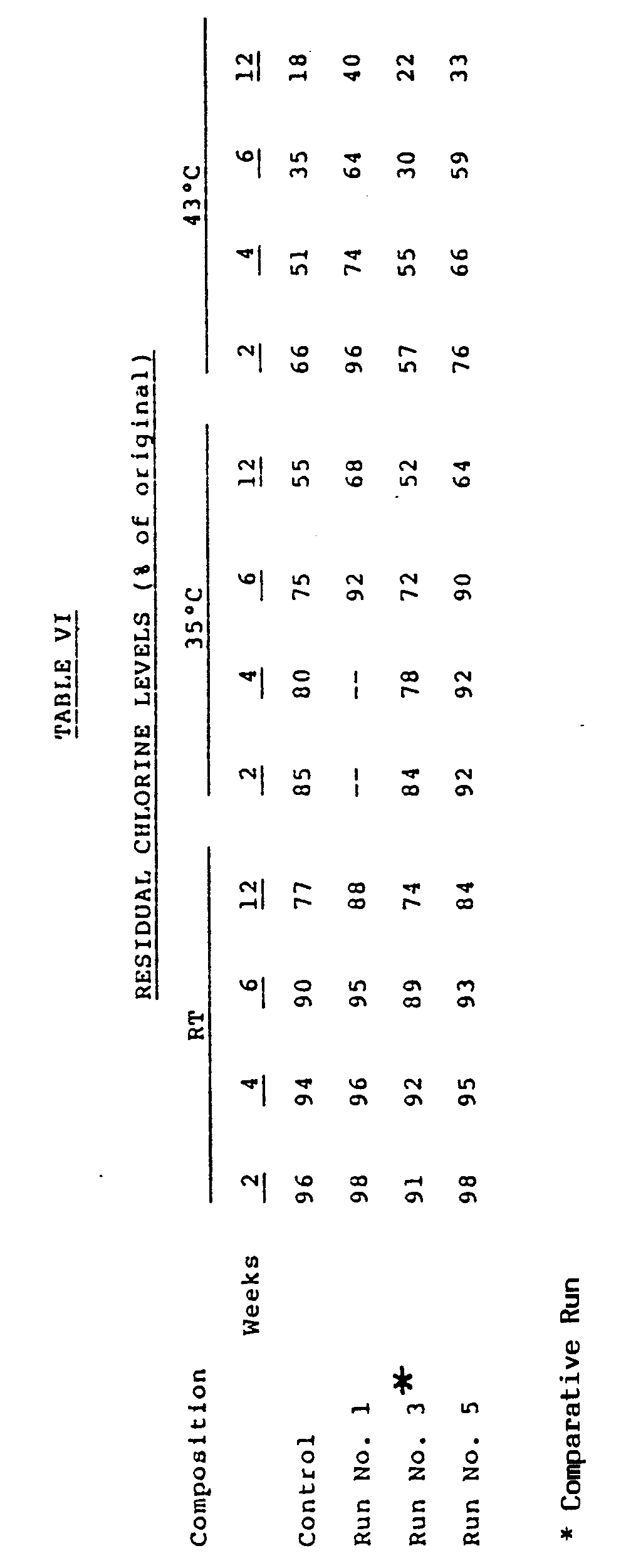
Claims (10)
- An aqueous thixotropic automatic diswasher composition comprising by weight:a) 5 to 35% alkali metal tripolyphosphate;b) 3 to 20% alkali metal silicate;c) 0 to 4% alkali metal carbonate;d) 1.0 to 4.5% alkali metal hydroxide;e) 0.1 to 5% chlorine bleach stable, water-dispersible organic detergent active material;f) 0 to 5% chlorine bleach stable foam depressant;g) chlorine bleach compound in an amount to provide 0.2 to 4% of available chlorine;h) 0.1 to 10% of inorganic colloid-forming clay;i) 0.02 to 1% of a polyvalent metal salt of an aliphatic fatty acid having from 12 to 18 carbon atoms; andj) water;with the proviso that the total amount of alkali metal hydroxide and alkali metal carbonate is no more than 6.5% by weight and the total amount of alkali metal silicate and alkali metal carbonate is no more than 20% by weight, the pH of the composition being at least 12.8 and the pH of 1 liter of aqueous wash bath containing 10 g of the composition being at least 11.2.
- The composition of claim 1 wherein the polyvalent metal is selected from the group consisting of Mg, Ca, Ti, Zr, V, Nb, Mn, Fe, Co, Ni, Cd, Sn, Sb, Bi, Al and Zn.
- The composition of claim 1 wherein the metal salt of an aliphatic fatty acid is the aluminum, zinc, magnesium or calcium salt of stearic acid.
- The composition according to any of the preceding claims wherein the Clay (h) is an attapulgite clay or a smectite clay.
- The composition of claim 4 wherein the amount of the clay (h) is in the range of from 0.1 to 3%.
- The composition according to any of the preceding claims which contains from 0.1 to 0.5% of the metal salt of an aliphatic fatty acid (i) and from 0.1 to 2% by weight of the colloid-forming clay (h).
- The composition according to any of the preceding claims wherein the bleach compound (f) is sodium hypochlorite.
- The composition according to any of the preceding claims which contains at least about 0.1% by weight of the foam depressant (e).
- The composition of claim 8 in which the foam depressant is an alkyl acid phosphate ester, an alkyl phosphonic acid ester containing 1 or 2 C₁₂-₂₀ alkyl groups, an ethoxylated product thereof or a mixture thereof.
- The composition according to any of the preceding claims wherein the amount of components (b), (c) and (d) is such that when the composition is diluted to 10 g/liter the pH of the diluted composition is from 11.5 to 13.5.
Applications Claiming Priority (2)
| Application Number | Priority Date | Filing Date | Title |
|---|---|---|---|
| US20447688A | 1988-06-09 | 1988-06-09 | |
| US204476 | 1994-03-01 |
Publications (3)
| Publication Number | Publication Date |
|---|---|
| EP0345611A2 EP0345611A2 (en) | 1989-12-13 |
| EP0345611A3 EP0345611A3 (en) | 1990-12-12 |
| EP0345611B1 true EP0345611B1 (en) | 1995-11-08 |
Family
ID=22758050
Family Applications (1)
| Application Number | Title | Priority Date | Filing Date |
|---|---|---|---|
| EP89109765A Expired - Lifetime EP0345611B1 (en) | 1988-06-09 | 1989-05-30 | High alkalinity liquid automatic dishwasher detergent compositions |
Country Status (14)
| Country | Link |
|---|---|
| EP (1) | EP0345611B1 (en) |
| JP (1) | JPH0243300A (en) |
| AT (1) | ATE130028T1 (en) |
| AU (1) | AU3598789A (en) |
| BR (1) | BR8902755A (en) |
| CA (1) | CA1319308C (en) |
| DE (1) | DE68924727D1 (en) |
| DK (1) | DK284689A (en) |
| IL (1) | IL90481A0 (en) |
| MX (1) | MX169914B (en) |
| NO (1) | NO892361L (en) |
| NZ (1) | NZ229351A (en) |
| PT (1) | PT90771B (en) |
| ZA (1) | ZA894153B (en) |
Families Citing this family (8)
| Publication number | Priority date | Publication date | Assignee | Title |
|---|---|---|---|---|
| US5279755A (en) * | 1991-09-16 | 1994-01-18 | The Clorox Company | Thickening aqueous abrasive cleaner with improved colloidal stability |
| US5346641A (en) * | 1992-01-17 | 1994-09-13 | The Clorox Company | Thickened aqueous abrasive cleanser with improved colloidal stability |
| JP2871941B2 (en) * | 1992-02-19 | 1999-03-17 | ザ、プロクター、エンド、ギャンブル、カンパニー | Aqueous detergent composition for hard surfaces containing calcium ions |
| CA2107938C (en) * | 1993-01-11 | 2005-01-11 | Clement K. Choy | Thickened hypochlorite solutions with reduced bleach odor and methods of manufacture and use |
| US5529711A (en) * | 1993-09-23 | 1996-06-25 | The Clorox Company | Phase stable, thickened aqueous abrasive bleaching cleanser |
| US5470499A (en) * | 1993-09-23 | 1995-11-28 | The Clorox Company | Thickened aqueous abrasive cleanser with improved rinsability |
| US5929008A (en) * | 1997-09-29 | 1999-07-27 | The Procter & Gamble Company | Liquid automatic dishwashing compositions providing high pH wash solutions |
| US20080108537A1 (en) * | 2006-11-03 | 2008-05-08 | Rees Wayne M | Corrosion inhibitor system for mildly acidic to ph neutral halogen bleach-containing cleaning compositions |
Family Cites Families (3)
| Publication number | Priority date | Publication date | Assignee | Title |
|---|---|---|---|---|
| US4752409A (en) * | 1985-06-14 | 1988-06-21 | Colgate-Palmolive Company | Thixotropic clay aqueous suspensions |
| US4801395A (en) * | 1986-08-07 | 1989-01-31 | Colgate-Palmolive Company | Thixotropic clay aqueous suspensions containing long chain saturated fatty acid stabilizers |
| ZA887068B (en) * | 1987-09-29 | 1990-05-30 | Colgate Palmolive Co | Thixotropic aqueous liquid automatic dishwashing detergent composition |
-
1989
- 1989-05-30 AT AT89109765T patent/ATE130028T1/en not_active IP Right Cessation
- 1989-05-30 NZ NZ229351A patent/NZ229351A/en unknown
- 1989-05-30 DE DE68924727T patent/DE68924727D1/en not_active Expired - Lifetime
- 1989-05-30 EP EP89109765A patent/EP0345611B1/en not_active Expired - Lifetime
- 1989-05-30 MX MX016249A patent/MX169914B/en unknown
- 1989-06-01 ZA ZA894153A patent/ZA894153B/en unknown
- 1989-06-01 IL IL90481A patent/IL90481A0/en unknown
- 1989-06-02 AU AU35987/89A patent/AU3598789A/en not_active Abandoned
- 1989-06-07 CA CA000602003A patent/CA1319308C/en not_active Expired - Fee Related
- 1989-06-07 PT PT90771A patent/PT90771B/en not_active IP Right Cessation
- 1989-06-08 NO NO89892361A patent/NO892361L/en unknown
- 1989-06-09 DK DK284689A patent/DK284689A/en unknown
- 1989-06-09 BR BR898902755A patent/BR8902755A/en not_active Application Discontinuation
- 1989-06-09 JP JP1148184A patent/JPH0243300A/en active Pending
Also Published As
| Publication number | Publication date |
|---|---|
| NZ229351A (en) | 1992-07-28 |
| PT90771B (en) | 1995-03-31 |
| ZA894153B (en) | 1991-02-27 |
| JPH0243300A (en) | 1990-02-13 |
| EP0345611A3 (en) | 1990-12-12 |
| CA1319308C (en) | 1993-06-22 |
| PT90771A (en) | 1989-12-29 |
| NO892361L (en) | 1989-12-11 |
| BR8902755A (en) | 1990-02-01 |
| ATE130028T1 (en) | 1995-11-15 |
| EP0345611A2 (en) | 1989-12-13 |
| DE68924727D1 (en) | 1995-12-14 |
| IL90481A0 (en) | 1990-01-18 |
| MX169914B (en) | 1993-07-30 |
| DK284689A (en) | 1989-12-10 |
| DK284689D0 (en) | 1989-06-09 |
| AU3598789A (en) | 1989-12-14 |
| NO892361D0 (en) | 1989-06-08 |
Similar Documents
| Publication | Publication Date | Title |
|---|---|---|
| US4752409A (en) | Thixotropic clay aqueous suspensions | |
| US4857226A (en) | Thixotropic clay aqueous suspensions containing polyacrylic acid polymer or copolymer stabilizers | |
| US4801395A (en) | Thixotropic clay aqueous suspensions containing long chain saturated fatty acid stabilizers | |
| US4836946A (en) | Thixotropic clay aqueous suspensions containing alkali metal fatty acid salt stabilizers | |
| US4740327A (en) | Automatic dishwasher detergent compositions with chlorine bleach having thixotropic properties | |
| GB2176495A (en) | Dishwasher detergent compositions | |
| GB2140450A (en) | Thixotropic automatic dishwasher composition with chlorine bleach | |
| CA1317846C (en) | Thixotropic aqueous liquid automatic dishwashing detergent composition | |
| US4968445A (en) | Thixotropic aqueous liquid automatic dishwashing detergent composition | |
| US5089161A (en) | Thixotropic aqueous liquid automatic dishwashing detergent composition | |
| GB2185037A (en) | Dishwasher thioxtotropic detergent compositions | |
| US4889653A (en) | Thixotropic aqueous liquid automatic dishwashing detergent composition containing anti-spotting and anti-filming agents | |
| AU616906B2 (en) | Thickened aqueous no- or low- phosphate built cleaning composition | |
| US4970016A (en) | Thixotropic aqueous liquid automatic dishwashing detergent composition | |
| AU620050B2 (en) | Thixotropic aqueous liquid automatic dishwashing detergent composition | |
| US4968446A (en) | Thixotropic aqueous liquid automatic dishwashing detergent composition | |
| EP0314061A2 (en) | Thixotropic aqueous liquid automatic dishwashing detergent composition | |
| CA1319308C (en) | High alkalinity liquid automatic dishwasher detergent compositions | |
| US5057237A (en) | Thixotropic liquid automatic dishwasher detergent composition with improved physical stability | |
| US5084198A (en) | Thixotropic aqueous liquid automatic dishwashing detergent composition | |
| AU608047B2 (en) | Thixotropic clay aqueous suspensions containing polycarboxylic acids and metal salts thereof stabilizers | |
| AU606130B2 (en) | Thixotropic clay aqueous suspensions | |
| US4971717A (en) | Aqueous liquid automatic dishwashing detergent composition with improved anti-filming and anti-spotting properties | |
| AU616206B2 (en) | Thixotropic aqueous liquid automatic dishwashing detergent composition |
Legal Events
| Date | Code | Title | Description |
|---|---|---|---|
| PUAI | Public reference made under article 153(3) epc to a published international application that has entered the european phase |
Free format text: ORIGINAL CODE: 0009012 |
|
| AK | Designated contracting states |
Kind code of ref document: A2 Designated state(s): AT BE CH DE ES FR GB GR IT LI NL SE |
|
| PUAL | Search report despatched |
Free format text: ORIGINAL CODE: 0009013 |
|
| AK | Designated contracting states |
Kind code of ref document: A3 Designated state(s): AT BE CH DE ES FR GB GR IT LI NL SE |
|
| 17P | Request for examination filed |
Effective date: 19910126 |
|
| 17Q | First examination report despatched |
Effective date: 19930602 |
|
| GRAA | (expected) grant |
Free format text: ORIGINAL CODE: 0009210 |
|
| AK | Designated contracting states |
Kind code of ref document: B1 Designated state(s): AT BE CH DE ES FR GB GR IT LI NL SE |
|
| PG25 | Lapsed in a contracting state [announced via postgrant information from national office to epo] |
Ref country code: IT Free format text: LAPSE BECAUSE OF FAILURE TO SUBMIT A TRANSLATION OF THE DESCRIPTION OR TO PAY THE FEE WITHIN THE PRE;WARNING: LAPSES OF ITALIAN PATENTS WITH EFFECTIVE DATE BEFORE 2007 MAY HAVE OCCURRED AT ANY TIME BEFORE 2007. THE CORRECT EFFECTIVE DATE MAY BE DIFFERENT FROM THE ONE RECORDED.SCRIBED TIME-LIMIT Effective date: 19951108 Ref country code: NL Free format text: LAPSE BECAUSE OF FAILURE TO SUBMIT A TRANSLATION OF THE DESCRIPTION OR TO PAY THE FEE WITHIN THE PRESCRIBED TIME-LIMIT Effective date: 19951108 Ref country code: GR Free format text: LAPSE BECAUSE OF FAILURE TO SUBMIT A TRANSLATION OF THE DESCRIPTION OR TO PAY THE FEE WITHIN THE PRESCRIBED TIME-LIMIT Effective date: 19951108 Ref country code: LI Effective date: 19951108 Ref country code: AT Effective date: 19951108 Ref country code: ES Free format text: THE PATENT HAS BEEN ANNULLED BY A DECISION OF A NATIONAL AUTHORITY Effective date: 19951108 Ref country code: BE Effective date: 19951108 Ref country code: CH Effective date: 19951108 |
|
| REF | Corresponds to: |
Ref document number: 130028 Country of ref document: AT Date of ref document: 19951115 Kind code of ref document: T |
|
| REF | Corresponds to: |
Ref document number: 68924727 Country of ref document: DE Date of ref document: 19951214 |
|
| PG25 | Lapsed in a contracting state [announced via postgrant information from national office to epo] |
Ref country code: SE Effective date: 19960208 |
|
| PG25 | Lapsed in a contracting state [announced via postgrant information from national office to epo] |
Ref country code: DE Effective date: 19960209 |
|
| ET | Fr: translation filed | ||
| NLV1 | Nl: lapsed or annulled due to failure to fulfill the requirements of art. 29p and 29m of the patents act | ||
| REG | Reference to a national code |
Ref country code: CH Ref legal event code: PL |
|
| PGFP | Annual fee paid to national office [announced via postgrant information from national office to epo] |
Ref country code: FR Payment date: 19960524 Year of fee payment: 8 |
|
| PG25 | Lapsed in a contracting state [announced via postgrant information from national office to epo] |
Ref country code: GB Effective date: 19960530 |
|
| PLBE | No opposition filed within time limit |
Free format text: ORIGINAL CODE: 0009261 |
|
| STAA | Information on the status of an ep patent application or granted ep patent |
Free format text: STATUS: NO OPPOSITION FILED WITHIN TIME LIMIT |
|
| 26N | No opposition filed | ||
| GBPC | Gb: european patent ceased through non-payment of renewal fee |
Effective date: 19960530 |
|
| PG25 | Lapsed in a contracting state [announced via postgrant information from national office to epo] |
Ref country code: FR Free format text: LAPSE BECAUSE OF NON-PAYMENT OF DUE FEES Effective date: 19980130 |
|
| REG | Reference to a national code |
Ref country code: FR Ref legal event code: ST |