EP0345035A2 - Appareil pour le traitement de textes avec fonction pour la modification de caractères - Google Patents
Appareil pour le traitement de textes avec fonction pour la modification de caractères Download PDFInfo
- Publication number
- EP0345035A2 EP0345035A2 EP89305468A EP89305468A EP0345035A2 EP 0345035 A2 EP0345035 A2 EP 0345035A2 EP 89305468 A EP89305468 A EP 89305468A EP 89305468 A EP89305468 A EP 89305468A EP 0345035 A2 EP0345035 A2 EP 0345035A2
- Authority
- EP
- European Patent Office
- Prior art keywords
- code
- area
- processing device
- designate
- text processing
- Prior art date
- Legal status (The legal status is an assumption and is not a legal conclusion. Google has not performed a legal analysis and makes no representation as to the accuracy of the status listed.)
- Withdrawn
Links
Images




Classifications
-
- G—PHYSICS
- G06—COMPUTING OR CALCULATING; COUNTING
- G06F—ELECTRIC DIGITAL DATA PROCESSING
- G06F40/00—Handling natural language data
- G06F40/10—Text processing
- G06F40/103—Formatting, i.e. changing of presentation of documents
- G06F40/117—Tagging; Marking up; Designating a block; Setting of attributes
Definitions
- This invention relates to a text processing device with a character modifying function, more particularly, to a device having a function capable of designating a text area being separated by a predetermined code (for example, space code or page feed code etc.) with a simple and quick operation, and further granting the desired character modifying information (for example, underline or boldface type etc.) to the codes existing on the designated area.
- a predetermined code for example, space code or page feed code etc.
- the above described character modifying operation is carried out for the characters in the designated area.
- the designated areas usually consist of a particular unit of text such as one or more words, lines, paragraphs and pages.
- the above described method of using the cursor in the area to be designated area has often suffered inconvenience in operation.
- the area to be designated is a word or a line, it has been difficult to stop the cursor exactly at the end of the word or the line after its continuous movement.
- cursor movement operation has taken an long time .
- the method of setting the start and end pointsof the area to be designated with the cursor has an advantage that the cursor moving operation can be accomplished in a shorter length of time.
- this is also associated with a trouble of more frequent key operation. It is to be noted that the similar problem exists in a system in which a print head on a carriage is moved instead of the cursor relative to a printing medium.
- the text processing device has a function capable of easily designating the desired areas in a text file data when an operator wants to move the data included in the area to an another portion of the text file, to copy the data over to another area, and to delete all of the data in the area. Therefore, the operator is able to easily execute the above operations.
- a text processing device comprising memory means for storing codes corresponding to text file data including a plurality of character strings and represent means for representing the text file data, the text processing device further comprising; designate means for designating a represented point in the text file data; select means for selecting at least one of the codes stored in the memory means; search means for beginning search operation of the code selected by the select means from the represented point designated by the designate means; and area determine means for determining a designate area based upon the represented point designated by the designate means and a result of the search operation executed by the search means.
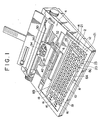
- Fig. 1 shows an electronic typewriter as a text processing device embodying the present invention, which is provided with a keyboard 2 and a print mechanism 4, between which a liquid crystal display 6 for displaying a predetermined number of lines is provided.
- the keyboard 2 includes a plurality of character keys 8 such as alphabetical keys 8A, numeric keys 8B and a period key 8C for inputting codes corresponding to each of the keys as well as a plurality of function keys including a space key 10, a return key 12, a page feed key 14 for inputting function codes corresponding to each of the keys, both are used for preparing or revising text files.
- character keys 8 such as alphabetical keys 8A, numeric keys 8B and a period key 8C for inputting codes corresponding to each of the keys as well as a plurality of function keys including a space key 10, a return key 12, a page feed key 14 for inputting function codes corresponding to each of the keys, both are used for preparing or revising text files.
- character modifying keys 16 for inputting a character modifying information (underline, boldface typing etc.) code to be granted to the codes existing in a predetermined area of the text file
- search key 18 for searching the selected code in the text file copy key 19 for setting copy mode
- move key 20 for setting move mode
- cursor movement keys 21 for moving a cursor 22 in the liquid crystal panel 6, and execution key 23 for executing a processing in accordance with the set mode, are provided on the keyboard 2.
- the print mechanism 4 comprises a platen 30 serving as a sheet feed roller and a carriage 32 movable along the platen 30.
- a wheel cassette 36 accommodating a print wheel 34, an well-known print hammer (not shown) and a solenoid 38 for driving the print hammer, and a ribbon cassette 42 housing therin a print ribbon.
- the type responsive to a key input is selected by a rotation of the print wheel 34 and is printed on a print sheet by hammering the print hammer, whereupon the carriage 32 is moved by one character.
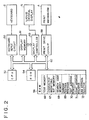
- the keyboard 2 is electrically connected to a known CPU (Central Processing Unit) 52 through a keyboard input circuit 50 so that the codes corresponding to the keys operated on the keyboard 2 are transmitted to the CPU 52.
- the CPU 52 is also electrically connected to a ROM (Read Only Memory) 54, a RAM (Random Access Memory) 56, a printer driver 58, a display controller 60 and a display memory 61, all interconnected by means of a common bus 62.
- ROM 54 contains a control programs stored to implement operation control of the electronic typewriter acocrding to the embodiment.
- RAM 56 contains a text memory 66 for storing text file data, a character modifying bit memory 67, a search code memory 68, current position register 69 for temporarily storing an address data corresponding to the current cursor 22 position, text address register 70 for storing an address data corresponding to the data read out position of the text memory 66, start address register 71 for storing an address data of the text address register 70 when a search operation is started, end address register 72 for storing an address data of the text address register 70 when a search operation is terminated and other counters and registers having areas for storing various data.
- the functions and operations of the memory 67 and 68 as mentioned above will be described later.
- a value of the current position register 69 is identical with the value of the text address register 70.
- the printer driver 58 controls an well-known driving motor (not shown) for driving the carriage 32 and the print wheel 34 in response to the type select signal corresponding to the carriage moving signal and characters to be printed which are transmitted from the CPU 52.
- the display controller 60 is a unit for representing characters and character modifying symbols (underline etc.) on the liquid crystal display 6. It is provided with an well-known character generator not shown, for storing a number of character patterns corresponding to characters and is connected to the liquid crystal display 6.
- the display memory 61 is a memory for storing the codes corresponding to the characters displayed on the liquid crystal display 6, and is connected to the display controller 60 by means of the common bus 62.
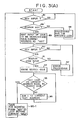
- Fig. 3(A) when a key on the keyboard 2 is depressed with a processing in step 81, it is examined whether or not the inputted code by the key depression is a code corresponding to the search key 18. If the code input is not through the search key 18, step 98 for any processing corresponding to the inputted code is executed. For example, the cursor 22 is moved in the text file data by means of operations of the cursor movement keys 21. If the depressed key is the search key 18, processings 89 through 96 are executed.
- step 89 after an address data of the text address register 70 corresponding to the current cursor position in the display 6 are stored in the start address register 71, a plurarity of data each corresponding to the code included in the text file are displayed on the liquid crystal display 6. An operator selects one of the displayed data by depressing the key corresponding to the data, further, the text area between the points at which the search key 18 is depressed and the selected code exists will be designated as the designation area and the addresses corresponding to the designated area will be saved, as described later.
- steps 90 and 91 when the operator depresses a certain key in accordance with an indication displayed on the liqid crystal display 6, it is examined whether or not the inputted code by the key depression is one of the predetermined searchable codes, for example, space code, punctuation code, comma code, period code, return code, page feed code and other codes, which are previously registered as the codes used to separate the text data code. If the inputted code is one of the searchable codes, the code (referred to as search code below) is stored in the search code memory 68 in step 92. If the inputted code is not the search code, error processing takes place in step 97 in responce to a buzzer or like warning signal to inform the operator that a key corresponding to the unsearchable code was depressed.
- search code for example, space code, punctuation code, comma code, period code, return code, page feed code and other codes, which are previously registered as the codes used to separate the text data code.
- step 93 After the inputting and storing of the searchable code, well-known search operation is executed (see Fig. 3(A)). Further, it is examined, in step 93, whether or not the text data code at the current address of the text address corresponding to the current cursor 22 position (at the time of inputting the search code) is equal to the address corresponding to the search code. This is carried out to check whether the position of the text address is at the just after position of the end terminal of the designation area.
- step 93 If the text address is not at the just after position of the end terminal of the designation area, it is determined "NO" in step 93 so that the processings in step 95 are repeated until the search code is found in the text data code.
- step 95 the address data of the current text address register 70 and the current position register 69 are both respectively incremented, and the processing returns to step 93.
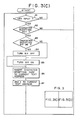
- step 93 When the end terminal of the designation area is found, or after the search operation is finished on the point at which the selected search code is located, it is determined "YES" in step 93 so that the area designating operation is terminated to store the address data substracted by "1" from the address data of the text address register 70 into the end address register 72, while the data included between the address data of the start address register 71 and the end address register 72 are displayed in reverse colour. (see step 96-1 of Fig. 3(B)). Further, the processing returns to step 81.
- step 93 and 95 the search operation as shown in step 93 and 95 is executed again in accordance with the search code having been already stored in step 98, from the current cursor 22 position.
- the code searched again as described above is found in the text file, the subtracted address data by "1" from the address data of the text address register 70 is stored in the end address register 72, and the data included between the start address register 71 and the end address register 72 are displayed in reverse colour as the data in the designated area, and finally, the processing returns to step 81.
- the designated area is increased by a predetermined unit (i.e. a unit bounded by the two desired search codes) with a simple operation.
- the area between the address data corresponding to the position at which the cursor 22 primarily exist (i.e. the moment when the search key 18 has been depressed) and the position just before the search code is found, is determined as the designated area. It may be considered that the area between the position at which the search code primarily exist and secondary exist, is determined as the designated area and displayed in reverse colour, as the second embodiment.
- the address data of the text address register 70 are stored in the end address register 72 as they are. In other words, the data included in the area designated by means of the search operation are displayed in reverse colour.
- the search operation is started by depressing the search key 18. When an operator wants to designate an word halfway, the above operation for designating an area is effective.
- step 100 examines whether the search code is space code or not, and the processing goes to 96-1 in an affirmative determination, while goes to 96-2 in a negative determination.
- the contents of the third embodiment are identical with the contents of the first embodiment in case that the search code is space code, while with the second embodiment in other case.
- the area bounded by a word is determined as an designated area when the space code is selected as the search code, and the area bounded by a sentence or a page is respectyively determined when period code or page feed code is selected.
- the keys for selecting the search code are not necessarily to be the function keys such as the space key or the period key as described above, but may be alphabetical numeric, and other characteristic keys.
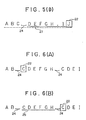
- a program with so-called word search function in which a character string such as word or sentence is inputted as an end terminal of the designated area, as illustrated in Fig. 6(A) and (B).
- the character string "CDE” is inputted as the end terminal of the designated area.
- the steps 90, 91, 92, of Fig. 3(A) with a plurality of steps for inputting data to be searched and beginning search operation of the inputted data by depressing the search key 23.
- the cursor 22 is moved to the beginning of the data to be searched or the end of the data.
- search operation is executed toward the beginning of the text with a diretion key.
- the desired character modifying information for example, underline, boldface type etc. is granted to the characters included in the designated area.
- the character modifying keys 16 refers to the keys for specifying the types of character modification, such as underline, boldface, superscript and subscript etc.
- step 82 If the depressed key on the keyboard 2 is one of the character modifying keys 16 (step 82, "YES"), it is examined in step 83 whether or not a character modifying bit, or a flag corresponding to each of the character modifying keys 16, is on. If a character modifying bit responsive to the key depression is on, the character modifying bit is switched to off in step 84, while if it is off, it is switched to on in step 85. In other words, on and off operation takes place every time when the character modifying key is depressed.
- One of these keys is depressed (step 85) and the character modifying operation corresponding to the depressed key is executed, and the key is depressed (step 84) when the character modifying operation is to be terminated as described later. In both cases, a character modifying symbol code is inserted into the text file memory 66.
- step 86 a code corresponding to the key depression is inserted into the text address corresponding to the data of the current text address register 70, and each successive data are shifted backward respectively, then, in step 87, "1" is added to the address data of the text address register 70 for updating according to the code insertion.
- step 88 When it is determined that the inputted code through the keyboared 2 is not the character modifying code, it is examined whether or not the inputted code is corresponding to the search key 18 (step 88). If it is determined that the inputted code is not corresponding to the search key 18, any processing responsive to the inputted code is executed in step 98. On the other hand, in case that the inputted code is the search code, the area designation proccesings are executed from step 89 to 93, similar to the processings shown in Fig. 3(A). Furthermore, in step 94, the character modifying code is granted to each of the codes included in the designated area.
- the character modifying code to be granted is a code whose character modifying bit is set into "ON" state in step 85.
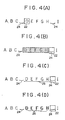
- Fig. 4(A) and (C) through (G) are display examples of the area designating operation and the character modifying operation for the characters in the designated area.
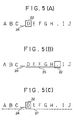
- symbol " " represents a space data 24.
- the character modifying information to be granted is determined. During these processings, a cursor 22 or the position corresponding to the address data of the text address register 70 is, for example, located on the character "D" as shown in Fig. 4(A). In steps 88 through 92 of Fig. 3(C), one of search codes is selected. In Fig. 4(C) through (G), the space code is selected as the search code separating the text data code. If the character modifying information to be granted is, for example, underline, the characters "D" through “H” are modified by the underline 25 as illustrated in Fig. 4(C).
- the information to be granted is subscript or superscript
- the number of subscript or superscript is simultaneously determined in step 82 with the character modifying information.
- the characters in the designated area are granted the desired number as a subscript or a superscript, as illustrated in Fig. 4(E) and (F).
- the determined information is boldface type or strikeover of erase line, the characters are modified as respectively illustrated in Fig. 4(D) or (G).
- any codes other than the space are considered. If period code is selected as the search code, the characters are modified as illustrated in Fig. 5(A) and (B), and page feed code is selected, the characters are modified as illustrated in Fig. 5(C) and (D). Numeral 27 shows the end of a page. In other words, when period is selected, character modification for one sentence can be executed by specifying the end terminal of the designated area by depressing the period key, and character modification for one page can be executed by depressing the page feed key both are provided, not shown, on the keyboard 2.
- step 89-1 it is further possible to input the desired number "N" in step 89-1.
- the search operation for searching the selected search code is continued till the "N"th code is found in step 93-1 throug 95.
- the present invention is also applicable to a typewriter or a similar device provided with no display screen.
Landscapes
- Engineering & Computer Science (AREA)
- Theoretical Computer Science (AREA)
- Audiology, Speech & Language Pathology (AREA)
- Health & Medical Sciences (AREA)
- Computational Linguistics (AREA)
- General Health & Medical Sciences (AREA)
- Physics & Mathematics (AREA)
- General Engineering & Computer Science (AREA)
- General Physics & Mathematics (AREA)
- Artificial Intelligence (AREA)
- Document Processing Apparatus (AREA)
- Accessory Devices And Overall Control Thereof (AREA)
- Dot-Matrix Printers And Others (AREA)
- Record Information Processing For Printing (AREA)
Applications Claiming Priority (2)
| Application Number | Priority Date | Filing Date | Title |
|---|---|---|---|
| JP134116/88 | 1988-05-31 | ||
| JP63134116A JPH021348A (ja) | 1988-05-31 | 1988-05-31 | 文字修飾機能を有する文書作成装置 |
Publications (2)
| Publication Number | Publication Date |
|---|---|
| EP0345035A2 true EP0345035A2 (fr) | 1989-12-06 |
| EP0345035A3 EP0345035A3 (fr) | 1991-10-02 |
Family
ID=15120835
Family Applications (1)
| Application Number | Title | Priority Date | Filing Date |
|---|---|---|---|
| EP19890305468 Withdrawn EP0345035A3 (fr) | 1988-05-31 | 1989-05-31 | Appareil pour le traitement de textes avec fonction pour la modification de caractères |
Country Status (2)
| Country | Link |
|---|---|
| EP (1) | EP0345035A3 (fr) |
| JP (1) | JPH021348A (fr) |
Cited By (1)
| Publication number | Priority date | Publication date | Assignee | Title |
|---|---|---|---|---|
| EP0567233A1 (fr) * | 1992-04-22 | 1993-10-27 | Brother Kogyo Kabushiki Kaisha | Appareil d'impression pour ruban |
Families Citing this family (1)
| Publication number | Priority date | Publication date | Assignee | Title |
|---|---|---|---|---|
| JP2589413B2 (ja) * | 1991-03-28 | 1997-03-12 | 三田工業株式会社 | 複写機 |
Family Cites Families (1)
| Publication number | Priority date | Publication date | Assignee | Title |
|---|---|---|---|---|
| DE3241170A1 (de) * | 1982-11-08 | 1984-05-10 | Siemens AG, 1000 Berlin und 8000 München | Anordnung zum loeschen von texten |
-
1988
- 1988-05-31 JP JP63134116A patent/JPH021348A/ja active Pending
-
1989
- 1989-05-31 EP EP19890305468 patent/EP0345035A3/fr not_active Withdrawn
Cited By (1)
| Publication number | Priority date | Publication date | Assignee | Title |
|---|---|---|---|---|
| EP0567233A1 (fr) * | 1992-04-22 | 1993-10-27 | Brother Kogyo Kabushiki Kaisha | Appareil d'impression pour ruban |
Also Published As
| Publication number | Publication date |
|---|---|
| JPH021348A (ja) | 1990-01-05 |
| EP0345035A3 (fr) | 1991-10-02 |
Similar Documents
| Publication | Publication Date | Title |
|---|---|---|
| US5127748A (en) | Documentation system having multilingual function | |
| EP0295311B1 (fr) | Systeme de traitement de textes possedant une fonction de recherche et de remplacement | |
| EP0315957B1 (fr) | Appareil pour traitement de textes | |
| EP0039393A2 (fr) | Méthode et dispositif pour la terminaison automatique de mots pour appareils enregistreurs de textes | |
| US4994968A (en) | Word processing device | |
| US4888730A (en) | Memory typewriter with count of overused words | |
| US5331337A (en) | Data processing apparatus with self-repeat function | |
| EP0267769B1 (fr) | Machine à écrire électronique avec fonction de vérification de l'orthographe | |
| US4553219A (en) | Typewriter having calculating capability | |
| US5097417A (en) | Text processing apparatus with adjustment for right margin flush | |
| US4639151A (en) | Electronic typewriter which prints selected portions of a text | |
| EP0274438B1 (fr) | Dispositif de dactylographie | |
| US4934851A (en) | Text processing system including plural text and corresponding memories | |
| EP0271321B1 (fr) | Appareil d'affichage pour machines à écrire | |
| US4974978A (en) | Typewriter having a carriage which is shifted when no character is stored in a memory, space data has been input, and the typewriter operates in a mode in which a plurality of input character data is stored and then printed at one time | |
| EP0292726B1 (fr) | Mémoire tampon pour correction | |
| US4933896A (en) | Word processing apparatus for comparing entered data with stored data from a selected address and in a selected order | |
| US5013167A (en) | Bounded word replace function for an electronic typewriter erasing a zone bounded by erroneous characters | |
| EP0274436B1 (fr) | Appareil de traitement de textes | |
| EP0293238A2 (fr) | Système de traitement de texte | |
| JPH0457512B2 (fr) | ||
| EP0186746A2 (fr) | Appareil électronique de traitement de mots | |
| US5121481A (en) | Text (word processor) having right end justified variable size display area for information related to input data | |
| EP0334605A2 (fr) | Système de gestion de documents avec la capacité d'affichage de mots de conseils | |
| EP0345088B1 (fr) | Dispositif de traitement de caractères |
Legal Events
| Date | Code | Title | Description |
|---|---|---|---|
| PUAI | Public reference made under article 153(3) epc to a published international application that has entered the european phase |
Free format text: ORIGINAL CODE: 0009012 |
|
| AK | Designated contracting states |
Kind code of ref document: A2 Designated state(s): DE FR GB IT |
|
| PUAL | Search report despatched |
Free format text: ORIGINAL CODE: 0009013 |
|
| AK | Designated contracting states |
Kind code of ref document: A3 Designated state(s): DE FR GB IT |
|
| 17P | Request for examination filed |
Effective date: 19920211 |
|
| STAA | Information on the status of an ep patent application or granted ep patent |
Free format text: STATUS: THE APPLICATION HAS BEEN WITHDRAWN |
|
| 17Q | First examination report despatched |
Effective date: 19940607 |
|
| 18W | Application withdrawn |
Withdrawal date: 19940603 |