EP0344541A1 - Single-dose espresso maker for infusions in general, to be disposed of after use - Google Patents
Single-dose espresso maker for infusions in general, to be disposed of after use Download PDFInfo
- Publication number
- EP0344541A1 EP0344541A1 EP89109029A EP89109029A EP0344541A1 EP 0344541 A1 EP0344541 A1 EP 0344541A1 EP 89109029 A EP89109029 A EP 89109029A EP 89109029 A EP89109029 A EP 89109029A EP 0344541 A1 EP0344541 A1 EP 0344541A1
- Authority
- EP
- European Patent Office
- Prior art keywords
- container
- water
- infusion
- product
- espresso maker
- Prior art date
- Legal status (The legal status is an assumption and is not a legal conclusion. Google has not performed a legal analysis and makes no representation as to the accuracy of the status listed.)
- Withdrawn
Links
- 238000001802 infusion Methods 0.000 title claims abstract description 61
- 235000015114 espresso Nutrition 0.000 title claims abstract description 44
- XLYOFNOQVPJJNP-UHFFFAOYSA-N water Substances O XLYOFNOQVPJJNP-UHFFFAOYSA-N 0.000 claims abstract description 85
- 238000007789 sealing Methods 0.000 claims abstract description 13
- 238000010438 heat treatment Methods 0.000 claims abstract description 6
- 238000001914 filtration Methods 0.000 claims abstract description 4
- 235000013353 coffee beverage Nutrition 0.000 claims description 18
- 230000002093 peripheral effect Effects 0.000 claims description 14
- 239000011796 hollow space material Substances 0.000 claims description 10
- 241001122767 Theaceae Species 0.000 claims description 6
- 239000011521 glass Substances 0.000 claims description 4
- 238000006757 chemical reactions by type Methods 0.000 claims description 2
- 239000000463 material Substances 0.000 description 11
- 229910052751 metal Inorganic materials 0.000 description 10
- 239000002184 metal Substances 0.000 description 10
- BQCADISMDOOEFD-UHFFFAOYSA-N Silver Chemical compound [Ag] BQCADISMDOOEFD-UHFFFAOYSA-N 0.000 description 6
- 230000009467 reduction Effects 0.000 description 6
- 229910052709 silver Inorganic materials 0.000 description 6
- 239000004332 silver Substances 0.000 description 6
- 235000013361 beverage Nutrition 0.000 description 5
- 239000000796 flavoring agent Substances 0.000 description 4
- 235000019634 flavors Nutrition 0.000 description 4
- 229910052782 aluminium Inorganic materials 0.000 description 3
- XAGFODPZIPBFFR-UHFFFAOYSA-N aluminium Chemical compound [Al] XAGFODPZIPBFFR-UHFFFAOYSA-N 0.000 description 3
- 239000007769 metal material Substances 0.000 description 3
- 238000006243 chemical reaction Methods 0.000 description 2
- 230000008878 coupling Effects 0.000 description 2
- 238000010168 coupling process Methods 0.000 description 2
- 238000005859 coupling reaction Methods 0.000 description 2
- 239000007788 liquid Substances 0.000 description 2
- 239000008267 milk Substances 0.000 description 2
- 235000013336 milk Nutrition 0.000 description 2
- 210000004080 milk Anatomy 0.000 description 2
- 206010037660 Pyrexia Diseases 0.000 description 1
- 239000000654 additive Substances 0.000 description 1
- 239000003795 chemical substances by application Substances 0.000 description 1
- 150000001875 compounds Chemical class 0.000 description 1
- 239000011888 foil Substances 0.000 description 1
- 238000004519 manufacturing process Methods 0.000 description 1
- 239000000203 mixture Substances 0.000 description 1
- 238000012986 modification Methods 0.000 description 1
- 230000004048 modification Effects 0.000 description 1
- 239000000843 powder Substances 0.000 description 1
- 238000004321 preservation Methods 0.000 description 1
- 230000000284 resting effect Effects 0.000 description 1
Images


Classifications
-
- A—HUMAN NECESSITIES
- A47—FURNITURE; DOMESTIC ARTICLES OR APPLIANCES; COFFEE MILLS; SPICE MILLS; SUCTION CLEANERS IN GENERAL
- A47J—KITCHEN EQUIPMENT; COFFEE MILLS; SPICE MILLS; APPARATUS FOR MAKING BEVERAGES
- A47J31/00—Apparatus for making beverages
- A47J31/24—Coffee-making apparatus in which hot water is passed through the filter under pressure, i.e. in which the coffee grounds are extracted under pressure
- A47J31/30—Coffee-making apparatus in which hot water is passed through the filter under pressure, i.e. in which the coffee grounds are extracted under pressure with hot water under steam pressure
-
- A—HUMAN NECESSITIES
- A47—FURNITURE; DOMESTIC ARTICLES OR APPLIANCES; COFFEE MILLS; SPICE MILLS; SUCTION CLEANERS IN GENERAL
- A47J—KITCHEN EQUIPMENT; COFFEE MILLS; SPICE MILLS; APPARATUS FOR MAKING BEVERAGES
- A47J36/00—Parts, details or accessories of cooking-vessels
- A47J36/24—Warming devices
- A47J36/28—Warming devices generating the heat by exothermic reactions, e.g. heat released by the contact of unslaked lime with water
-
- B—PERFORMING OPERATIONS; TRANSPORTING
- B65—CONVEYING; PACKING; STORING; HANDLING THIN OR FILAMENTARY MATERIAL
- B65D—CONTAINERS FOR STORAGE OR TRANSPORT OF ARTICLES OR MATERIALS, e.g. BAGS, BARRELS, BOTTLES, BOXES, CANS, CARTONS, CRATES, DRUMS, JARS, TANKS, HOPPERS, FORWARDING CONTAINERS; ACCESSORIES, CLOSURES, OR FITTINGS THEREFOR; PACKAGING ELEMENTS; PACKAGES
- B65D81/00—Containers, packaging elements, or packages, for contents presenting particular transport or storage problems, or adapted to be used for non-packaging purposes after removal of contents
- B65D81/34—Containers, packaging elements, or packages, for contents presenting particular transport or storage problems, or adapted to be used for non-packaging purposes after removal of contents for packaging foodstuffs or other articles intended to be cooked or heated within the package
- B65D81/3484—Packages having self-contained heating means, e.g. heating generated by the reaction of two chemicals
-
- B—PERFORMING OPERATIONS; TRANSPORTING
- B65—CONVEYING; PACKING; STORING; HANDLING THIN OR FILAMENTARY MATERIAL
- B65D—CONTAINERS FOR STORAGE OR TRANSPORT OF ARTICLES OR MATERIALS, e.g. BAGS, BARRELS, BOTTLES, BOXES, CANS, CARTONS, CRATES, DRUMS, JARS, TANKS, HOPPERS, FORWARDING CONTAINERS; ACCESSORIES, CLOSURES, OR FITTINGS THEREFOR; PACKAGING ELEMENTS; PACKAGES
- B65D85/00—Containers, packaging elements or packages, specially adapted for particular articles or materials
- B65D85/70—Containers, packaging elements or packages, specially adapted for particular articles or materials for materials not otherwise provided for
- B65D85/804—Disposable containers or packages with contents which are mixed, infused or dissolved in situ, i.e. without having been previously removed from the package
- B65D85/8043—Packages adapted to allow liquid to pass through the contents
- B65D85/8055—Means for influencing the liquid flow inside the package
-
- B—PERFORMING OPERATIONS; TRANSPORTING
- B65—CONVEYING; PACKING; STORING; HANDLING THIN OR FILAMENTARY MATERIAL
- B65D—CONTAINERS FOR STORAGE OR TRANSPORT OF ARTICLES OR MATERIALS, e.g. BAGS, BARRELS, BOTTLES, BOXES, CANS, CARTONS, CRATES, DRUMS, JARS, TANKS, HOPPERS, FORWARDING CONTAINERS; ACCESSORIES, CLOSURES, OR FITTINGS THEREFOR; PACKAGING ELEMENTS; PACKAGES
- B65D85/00—Containers, packaging elements or packages, specially adapted for particular articles or materials
- B65D85/70—Containers, packaging elements or packages, specially adapted for particular articles or materials for materials not otherwise provided for
- B65D85/804—Disposable containers or packages with contents which are mixed, infused or dissolved in situ, i.e. without having been previously removed from the package
- B65D85/8043—Packages adapted to allow liquid to pass through the contents
- B65D85/8061—Filters
-
- B—PERFORMING OPERATIONS; TRANSPORTING
- B65—CONVEYING; PACKING; STORING; HANDLING THIN OR FILAMENTARY MATERIAL
- B65D—CONTAINERS FOR STORAGE OR TRANSPORT OF ARTICLES OR MATERIALS, e.g. BAGS, BARRELS, BOTTLES, BOXES, CANS, CARTONS, CRATES, DRUMS, JARS, TANKS, HOPPERS, FORWARDING CONTAINERS; ACCESSORIES, CLOSURES, OR FITTINGS THEREFOR; PACKAGING ELEMENTS; PACKAGES
- B65D2581/00—Containers, packaging elements, or packages, for contents presenting particular transport or storage problems, or adapted to be used for non-packaging purposes after removal of contents
- B65D2581/34—Containers, packaging elements, or packages, for contents presenting particular transport or storage problems, or adapted to be used for non-packaging purposes after removal of contents for packaging foodstuffs or other articles intended to be cooked or heated within
- B65D2581/3401—Cooking or heating method specially adapted to the contents of the package
- B65D2581/3402—Cooking or heating method specially adapted to the contents of the package characterised by the type of product to be heated or cooked
- B65D2581/3409—Brewing coffee or tea
Definitions
- the present invention relates to a single-dose espresso maker for preparing various kinds of infusions, such as coffee, tea, camomile tea, and the like, prearranged as a cartridge containing all of the necessary components, to be disposed of after use.
- the espresso makers for one or two coffee cups are constituted by a water container, a cup-filter to be filled with ground coffee and by a container with a perforated bottom wall to be coupled, by screwing down, with the underlying water container, with the interposition of a sealing gasket.
- a purpose of the present invention is of providing a single-dose espresso maker as a sealed cartridge, so conceived as to make it possible different types of infusions either with water or with other liquids to be prepared as required, which espresso maker is suitable for being disposed of after use.
- Another purpose of the present invention is of providing an "use-and-throw-away" espresso maker, having such a structure as to enable the user to adjust water pressure, according to the types of infusions to be obtained, at the most suitable values in order to obtain the best exhaustion to be obtained of the infusion material in powder form, without same water establishing preferential passage paths.
- a further purpose of the present invention is of providing a single-dose espresso maker which essentially is an enbloc device, easy to be used, highly reliable, and also equipped with its own standalone heat source.
- Not a least purpose is of providing an espresso maker so conceived as to secure a perfect preservation over time of the product from which the infusion has to be made, to make it possible liquids different from water to be used, and to practically result cheap and manufacturable from both metal material and high-temperature-resistant plastic materials.
- a single-dose espresso maker for producing infusions in general, and useable once only which is constituted, according to the present invention, by at least two container bodies, one of which, substantially having the shape of a glass destined to contain the water to be heated in order to prepare the infusion, and the other of which substantially has the shape of a filter-container destined to contain a dose of product from which the infusion has to be made, such as coffee, tea, camomile flower, and the like, corresponding to one cup of infusion, with the mouths of said containers being coupled with each other along their respective peripheral edges and tightly sealed with the interposition of a disk-shaped element having a pre-established mechanical strength in order to keep water tightly confined and separated from the product from which the infusion has to be made, and of at least one disk-shaped element provided with one or more holes, so as to enable, after the water container being heated, the pressure developed by the same water to break said disk-shaped sealing element,
- said two container bodies are coupled with each other in a mutually opposite position, with the water container being positioned above the filter-container element containing the infusion product, and therefore with the movement of water taking place from up downwards, in the body of said water container a large housing being provided in order to house a heat source, for instance of the chemical-reaction type.
- said two container bodies are positioned in a mutually opposite position, with the water container being positioned under the container containing the product from which the infusion has to be made, with inside the water container a bell-shaped element being housed, having such dimensions as to define an annular hollow space with the wall of the external container, so as to make it possible the bell-shaped element to move upwards from the bottom of the same container when the container of water is heated, under the thrust applied by water pressure, and water to be forced to flow upwards through said hollow space and then flow through the product from which the infusion has to be made, which infusion, leaving the espresso maker from the upper side of said espresso maker, is collected inside a container coaxially anchored, either stably or with possibility of removal, to the same container of the product from which the infusion has to be made.
- the disposable ("use-and-throw-away”) espresso maker according to the present invention is constituted by a container 1 made from metal or from another, high-temperature-resistant material, substantially having the shape of an upside-down glass, on whose bottom wall 1a a housing 1b of either cylindrical or conical shape is provided, designed to house a heat source, e.g., an hexothermic-reaction chemical compound, an electrical resistor, or the like.
- a heat source can be provided also all around said water container, or also in housings provided on the sides, or the like.
- the mouth of the container 1 is provided with a peripheral edge 1c having such dimensions as to be then capable, during the assembling step, of being "grafted" by the piece shown in Figure 5.
- a disk of very thin metal 2 e.g., an aluminum foil
- a second metal disk 3 e.g., of aluminum
- a third metal disk 4 e.g., of aluminum
- the espresso maker contains furthermore a container 5 having a shape e.g. semispherical, perforated like the filter of the usual coffee makers available from the market, but only in its dashed portion 5a (see Figure 5), which will contain the material used for preparing the infusion (ground coffee, tea leaves, and so forth).
- a container 5 having a shape e.g. semispherical, perforated like the filter of the usual coffee makers available from the market, but only in its dashed portion 5a (see Figure 5), which will contain the material used for preparing the infusion (ground coffee, tea leaves, and so forth).
- the espresso maker is assembled by grafting with the peripheral edge 5b of the container 5 the peripheral edges of all of the four further elements, according to the order as shown in Figure 7.
- the grafting can be also accomplished by using the peripheral edge of the container 1, suitably modified, which in that case will be the one which grafts the other components.
- the container 1 which contains water
- the thin sheet of silver paper 2 the disk 3 with large, or variously shaped, one or more holes 3a
- the disk 4 with normal holes.
- the edge of the filter-container 5 by grafting all of the four elements, secures the tight water sealing.
- the device operates as follows: after introducing the heat source into the purposely provided housing 1b, of either cylindical or conical shape (which heat source can be either an electrical resistor or a chemical reaction), water is heated and generates water vapour. When the pressure of this latter reaches a certain value (which is determined by the thickness of the disk of silver paper 2 with relation to the shape, the number, and the surface area of the holes of the disk 3), the silver paper will be torn at one or more points, and water will flow downwards invading the chamber between the disks 3 and 4 and then will pass through the holes of the filter 4, with a same pressure throughout the circular surface even in case the silver paper was torn at one point only; water will then flood the material for the infusion contained inside the container 5, will extract the soluble portions thereof and will fall into the container which will have been placed under the cartridge-shaped espresso maker, causing the folded edge 5b to rest on an extremely simple "U"-shaped support 6 made from a metal wire, as schematically shown in Figure 6, or in a whatever
- Figure 8 shows the outer outline of the finished cartridge.
- the cartridge-shaped espresso maker disclosed hereinabove offers the practical advantage that the pressure of water, and hence its temperature, can be controlled by suitably varying the thickness of the disk-shaped, tight-sealing element 2, as well as the diameter of the hole or holes 3a of the disk 3; by changing these parameters, which substantially regulate also the time required to produce the infusion, several types of infusions can be accomplished: for instance, coffee, which requires more severe temperature conditions, tea, which, on the contrary, requires milder thermal conditions, and still other beverages.
- the manufacturer of the cartridges can pack and deliver a wide range of infusions, by practically using just one type of cartridge.
- water can be replaced by milk, sugared water or water containing additives and/or correcting agents, so that various types of beverages can be obtained without the infusion products having to be handled, and without the risk that the holes of the filtering elements may get closed up.
- the espresso maker in the form of a sealed cartridge can be so accomplished, as to be suitable for being used in upside-down position as compared to that disclosed and illustrated in Figures from 1 to 8.
- a cartridge can be provided, which is capable of producing the infusion in the top portion of the cartridge, and of collecting it inside a container 7 positioned coaxially with the same cartridge.
- the various elements are grafted with one another along their peripheral edge, as in the precebding case.
- This cartridge is furthermore provided, in order to enable heated water to flow upwards and pass through the product enclosed inside the filter-container 5, with a cylindrical bell-shaped element 8 coaxially inserted inside the container 1, and having such dimensions of height and diameter, as to create a cylindrical hollow space 8a between the same bell and the inner wall of the container 1, which is suitable for enabling heated water to flow from the container 1 to the filering disks, and then into the filter-container 5.
- This particular form of practical embodiment constitutes a cartridge in which water, by being heated, and generating water vapour inside the same bell, will enable said vapour to lift the same bell, detaching it from the bottom of the container 1, thus pushing same water to rise inside the hollow space 8a, up to flow through the filters 3 and 4, and then through the infusion product; three small protrusions (e.g. of 1 mm) at a mutual distance of 120° provided onto the bottom of the bell-shaped element will enable the water to flow even when the bell is raised.
- the infusion is then collected inside the container 7, also grafted to the other elements.
- this type of cartridge after producing the infusion, is disposed of, together with the container 7.
- the cylindrical container 1 for water is coaxially inserted inside a larger container 2; both of said containers are given a slight conical shape and are positioned upside-down; the product from which the infusion has to be produced is contained inside the chamber A between the blind bottom of the container 1 and the perforated bottom wall 2a of the container 2, which constitutes the outlet filter for the infusion.
- the container 1 is destined to contain water and is tightly sealed by means of a disk 10 made from a metal material, or from any other suitable materials, connected, under tightly sealing conditions, with both the coaxial containers 1 and 2 by grafting its peripheral edge 10a around the peripheral edges 1a, 2a of both containers 1, 2, in the same way as in the practical embodiments depicted in the preceding figures.
- the disk-shaped, tight-sealing element 10 has, besides its edge 10a prearranged for being bent around the edges of the containers, an additional ring-shaped hollow 11 ( Figures 10-11), performing the task of stiffening the cover-bottom of the container of water, as well as of creating a better surface of contact with the heating plate (not shown in the figures) which will supply heat, as well as of constituting a small reserve container for water, in order to prevent the sealing disk 10 and the container 1 from being immediately dried.
- the tight sealing between the base disk 10 and the edge of the mouth of water container 1 can be accomplished by either of two way, equally efficacious in order to enable the container 1 to get detached from the disk 10 and to move upwards under the thrust exerted by water pressure during the cartridge heating.
- the first way consists in providing along the peripheral edge 1a ( Figure 12) of the container 1, in case said container 1 is made from a plastic material, two reductions in thickness: the first reduction in thickness concerns the "Z" regions which, in the practical embodiment shown in Figures 10 and 12, are four, but which can also be three regions at a mutual distance of 120 o , or even more than 4, all at a same mutual distance; they have the shape of an elongated oval arc; the second reduction in thickness concerns the "Z'" regions ( Figure 11), which are interposed between the "Z" regions, and therefore are in a same number as them.
- the espresso maker By having available a heat source, the espresso maker according to Figure 10, but complete with the infusion collecting container 14 (see Figure 15) (wherein this container can be either of a plastic material -- either with or without a handle -- also of disposable character, or of metal -- with a handle -- to be used again), water is heated and generates water vapour. This latter cannot escape from the container 1 and generates a certain pressure inside it. When said pressure reaches a certain value (0.4-0.5 bar), the reductions in thickness provided at the "Z'" regions enable the container 1 to move upwards for a few tenths of a millimetre, with water applying a pressure to the reductions in thickness at the "Z" regions.
- a certain value 0.4-0.5 bar
- the correct operation of the espresso maker accomplished as disclosed by referring to the Figures from 10 to 15 depends, above all, on the following structural and dimensional factors, i.e.: - on the correct ratio of the surface area of the disk 10 to the surface area of the heat source (electrical mini plate); - on the type of plastic material used for both containers, and possibly also for the collecting container 14; and - on the correct dimensioning of the thicknesses and of the surface areas at the edge 1a of the container 1.
- the container 1 is made from metal, inasmuch as in that case the differences in thickness would be difficult, and maybe even impossible, to accomplish, first of all a small "lifting" thereof will have to be rendered possible by adopting a very thin thickness for the same container, and furthermore in order to cause the ruptures to take place, which are necessary for water passage, cuts - as deep as possible - will be produced along most perimeter of "Z" regions. Such cuts, under the thrust applied by the pressure will yield, and water will be enabled to flow through the cracks which will be formed.
- Figure 14 shows a further form of practical embodiment of the container 1 and of the disk 10.
- the container 1 (whether of metal or of plastic material) is literally “stoppered” by a circular protrusion 10b provided on the disk 10, so that only an inner pressure of about 0.4-0.5 bar (corresponding, owing to the concerned surface area, to a total thrust of about 10 kg), succeeds in detaching the container 1 from the disk 10 and in pushing it upwards, in order to cause water to pass and (advantageously) "compress" ground coffee.
- Figure 16 shows finally a form of practical embodiment totally made from a metal material, easily understandable after the preceding disclosure.
- the container 1, which contains water, is tightly sealed by the circular protrusion "D" provided at the bottom of the container 2, which "grafts" at "A” the filter 15, under which ground coffee is enclosed.
- the container 14a (a separate piece which, as already said, can be either made from a metal -- in this case, it being re-useable -- or from a plastic material, in this case it being of use-and-throw-away type), "matches" the short conical portion "C" of the container 2, creating the tight sealing for beverage collection.
Landscapes
- Engineering & Computer Science (AREA)
- Food Science & Technology (AREA)
- Mechanical Engineering (AREA)
- Chemical & Material Sciences (AREA)
- Chemical Kinetics & Catalysis (AREA)
- Life Sciences & Earth Sciences (AREA)
- Apparatus For Making Beverages (AREA)
Abstract
The present invention consists of a single-dose espresso maker for preparing infusions in general, to be disposed of after being used. It consists of two glass-shaped containers (1, 5), one of which contains water to be heated and the other of which, equipped with a filtering bottom wall, contains the infusion product; the mutually opposite mouths of both said containers are coupled with each other by grafting, with the interposition of a water-sealing disk-shaped element of pre-established strength (2), which can be broken by the pressure developed by heated water; and of at least one perforated disk-shaped element (4). After heating the water containing element, the pressure of generated water vapour causes the breakage of said sealing disk, enabling water to flow through the filter-container containing the infusion product and hence the desired infusion to be produced and fed to a container associated with the espresso maker.
Description
- The present invention relates to a single-dose espresso maker for preparing various kinds of infusions, such as coffee, tea, camomile tea, and the like, prearranged as a cartridge containing all of the necessary components, to be disposed of after use.
- It is well known that the espresso makers for one or two coffee cups, normally for household use, are constituted by a water container, a cup-filter to be filled with ground coffee and by a container with a perforated bottom wall to be coupled, by screwing down, with the underlying water container, with the interposition of a sealing gasket.
- These types of espresso makers, obviously re-useable many times, besides being limited to the production of coffee infusions, suffer, in practice, from the drawback of requiring water to be charged, the dose of ground coffee to be charged to the filter and a source of heat, such as a gas flame, an electrical heater, or the like, to be available each time that the espresso maker has to be used. These operations have all to be carried out carefully, above all as regards the metering of water and of ground coffee, in order to obtain an infusion having the desired characteristics of flavour and taste. Furthermore, inasmuch as the pressure, and therefore the temperature under which the water flows through the coffee blend cannot be controlled, not always adequately exhausting the product from which the infusion is made is possible, in that, in some cases, the water flows along preferential paths through the same product, with the density and the flavour of the obtained infusion being consequently reduced.
- It is known as well that the present re-chargeable espresso makers, precisely due to the fact that they operate at uncontrollable pressure and temperatures, do not enable the user to use them in order to obtain either infusions different from coffee infusions, or particular types of beverages, such as, e.g., beverages with milk, flavours, and the like.
- A purpose of the present invention is of providing a single-dose espresso maker as a sealed cartridge, so conceived as to make it possible different types of infusions either with water or with other liquids to be prepared as required, which espresso maker is suitable for being disposed of after use.
- Another purpose of the present invention is of providing an "use-and-throw-away" espresso maker, having such a structure as to enable the user to adjust water pressure, according to the types of infusions to be obtained, at the most suitable values in order to obtain the best exhaustion to be obtained of the infusion material in powder form, without same water establishing preferential passage paths.
- A further purpose of the present invention is of providing a single-dose espresso maker which essentially is an enbloc device, easy to be used, highly reliable, and also equipped with its own standalone heat source.
- Not a least purpose is of providing an espresso maker so conceived as to secure a perfect preservation over time of the product from which the infusion has to be made, to make it possible liquids different from water to be used, and to practically result cheap and manufacturable from both metal material and high-temperature-resistant plastic materials.
- These and still further purposes, which will be clearer from the following, are practically achieved by a single-dose espresso maker for producing infusions in general, and useable once only, which is constituted, according to the present invention, by at least two container bodies, one of which, substantially having the shape of a glass destined to contain the water to be heated in order to prepare the infusion, and the other of which substantially has the shape of a filter-container destined to contain a dose of product from which the infusion has to be made, such as coffee, tea, camomile flower, and the like, corresponding to one cup of infusion, with the mouths of said containers being coupled with each other along their respective peripheral edges and tightly sealed with the interposition of a disk-shaped element having a pre-established mechanical strength in order to keep water tightly confined and separated from the product from which the infusion has to be made, and of at least one disk-shaped element provided with one or more holes, so as to enable, after the water container being heated, the pressure developed by the same water to break said disk-shaped sealing element, making it possible water to flow through the dose of product from which the infusion has to be made, and hence the infusion to be produced and fed to a cup, or the like.
- More particularly, according to a first form of practical embodiment of the present invention, said two container bodies are coupled with each other in a mutually opposite position, with the water container being positioned above the filter-container element containing the infusion product, and therefore with the movement of water taking place from up downwards, in the body of said water container a large housing being provided in order to house a heat source, for instance of the chemical-reaction type.
- According to another form of practical embodiment of the present invention, said two container bodies are positioned in a mutually opposite position, with the water container being positioned under the container containing the product from which the infusion has to be made, with inside the water container a bell-shaped element being housed, having such dimensions as to define an annular hollow space with the wall of the external container, so as to make it possible the bell-shaped element to move upwards from the bottom of the same container when the container of water is heated, under the thrust applied by water pressure, and water to be forced to flow upwards through said hollow space and then flow through the product from which the infusion has to be made, which infusion, leaving the espresso maker from the upper side of said espresso maker, is collected inside a container coaxially anchored, either stably or with possibility of removal, to the same container of the product from which the infusion has to be made.
- The present finding is disclosed in greater detail in the following according to some forms of practical embodiment thereof, with reference to the hereto attached drawing tables, given for merely illustrative and non-limiting purposes, in which:
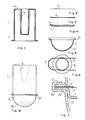
- Figure 1 shows an upside-down glass container, constituting a component of the disposable espresso maker according to the present invention;
- Figures from 2 to 4 show separate side views of the disk-shaped filtering elements of the coffee maker according to the present invention;
- Figure 5 shows the container of the product from which the infusion has to be made, suitable for being coupled with the elements of above Figures from 1 to 4;
- Figure 6 shows a support element associated with the espresso maker according to the previous figures;
- Figure 7 shows a portion of peripheral grafting suitable for connecting, under tightly sealed conditions, all of the elements of the espresso maker;
- Figure 8 shows the finished cartridge-shaped espresso maker ready for use, accomplished according to a first form of practical embodiment;
- Figure 9 shows a side view of a second form of practical embodiment of a disposable espresso maker, accomplished according to the present finding;
- Figure 10 shows a further form of practical embodiment of an espresso maker, also according to the present invention;
- Figure 11 shows a bottom plan view, i.e., from the side of the mouth of the container according to Figure 10;
- Figures 12, 13, 14 respectively show the three components separate from each other and the region of coupling by grafting of the same elements which constitute the espresso maker according to Figure 10;
- Figure 15 shows a side elevation view of the complete espresso maker, obtained with the elements of the Figures from 12 to 14, and
- Figure 16 shows a side elevation view of an espresso maker partially modified as compared to the espresso maker of Figures 10 and 15.
- Referring to the above figures, and in particular to Figures from 1 to 8, the disposable ("use-and-throw-away") espresso maker according to the present invention, as depicted, ready for use, in Figure 8, is constituted by a
container 1 made from metal or from another, high-temperature-resistant material, substantially having the shape of an upside-down glass, on whosebottom wall 1a a housing 1b of either cylindrical or conical shape is provided, designed to house a heat source, e.g., an hexothermic-reaction chemical compound, an electrical resistor, or the like. Of course, such a heat source can be provided also all around said water container, or also in housings provided on the sides, or the like. The mouth of thecontainer 1 is provided with aperipheral edge 1c having such dimensions as to be then capable, during the assembling step, of being "grafted" by the piece shown in Figure 5. - With the
container 1, the following can be furthermore associated: a disk of very thin metal 2 (e.g., an aluminum foil), similar to the usual silver paper, the thickness of which, as we'll see in the following, shall be suitably selected; a second metal disk 3 (e.g., of aluminum), provided with one or more holes 3a, with the number, the shape and the total surface area of said hole(s) being such as to be capable together with the thickness of thethin disk 2, of causing the whole device to operate correctly; and a third metal disk 4 (e.g., of aluminum), perforated in a way similar to the perforations of the filters of the usual espresso makers available on the market; its perforated portion being anyway slightly spaced (at a distance of about 2, 3 or 4 mm) from its edge 4a, in that (as we'll see in the following) water, by flowing downwards through one or more holes of thedisk 3, after breaking at one or more point(s) the silver paper which constitutes thedisk 2, should continue to flow downwards with a pressure which is the same throughout the circular surface, in order to make it possible the product from which the infusion has to be made to be better exhausted, without preferential flow paths being determined. - The espresso maker contains furthermore a
container 5 having a shape e.g. semispherical, perforated like the filter of the usual coffee makers available from the market, but only in its dashedportion 5a (see Figure 5), which will contain the material used for preparing the infusion (ground coffee, tea leaves, and so forth). - The espresso maker is assembled by grafting with the
peripheral edge 5b of thecontainer 5 the peripheral edges of all of the four further elements, according to the order as shown in Figure 7. - Obviously, the grafting can be also accomplished by using the peripheral edge of the
container 1, suitably modified, which in that case will be the one which grafts the other components. - More precisely, as shown in Figure 7, from up downwards assembled are: the
container 1, which contains water; the thin sheet ofsilver paper 2; thedisk 3 with large, or variously shaped, one or more holes 3a; thedisk 4, with normal holes. - The edge of the filter-
container 5, by grafting all of the four elements, secures the tight water sealing. - The device operates as follows: after introducing the heat source into the purposely provided housing 1b, of either cylindical or conical shape (which heat source can be either an electrical resistor or a chemical reaction), water is heated and generates water vapour. When the pressure of this latter reaches a certain value (which is determined by the thickness of the disk of
silver paper 2 with relation to the shape, the number, and the surface area of the holes of the disk 3), the silver paper will be torn at one or more points, and water will flow downwards invading the chamber between thedisks filter 4, with a same pressure throughout the circular surface even in case the silver paper was torn at one point only; water will then flood the material for the infusion contained inside thecontainer 5, will extract the soluble portions thereof and will fall into the container which will have been placed under the cartridge-shaped espresso maker, causing the foldededge 5b to rest on an extremely simple "U"-shaped support 6 made from a metal wire, as schematically shown in Figure 6, or in a whatever else way. - Figure 8 shows the outer outline of the finished cartridge.
- The cartridge-shaped espresso maker disclosed hereinabove offers the practical advantage that the pressure of water, and hence its temperature, can be controlled by suitably varying the thickness of the disk-shaped, tight-sealing
element 2, as well as the diameter of the hole or holes 3a of thedisk 3; by changing these parameters, which substantially regulate also the time required to produce the infusion, several types of infusions can be accomplished: for instance, coffee, which requires more severe temperature conditions, tea, which, on the contrary, requires milder thermal conditions, and still other beverages. - Therefore, with a pre-established set of
disks - According to a different form of practical embodiment, also according to the present finding, the espresso maker in the form of a sealed cartridge can be so accomplished, as to be suitable for being used in upside-down position as compared to that disclosed and illustrated in Figures from 1 to 8.
- In fact, by placing the container of
water 1 at the bottom (see Figure 9), with itsbottom wall 1a being slightly sunken, so as to generate a continuous edge 1b (or with said edge being provided with separate peduncles), in order to keep the container stably resting on a heating plate (e.g., a gas-fed, or an electrical heating plate, or the like), and coupling with its upper mouth a filter-container 5 for the infusion product, with the interposition of a disk-shaped element 4 provided with one or more large hole(s) 4a and, above this latter, of aperforated metal disk 3, a cartridge can be provided, which is capable of producing the infusion in the top portion of the cartridge, and of collecting it inside a container 7 positioned coaxially with the same cartridge. Also in this case, the various elements are grafted with one another along their peripheral edge, as in the precebding case. - This cartridge is furthermore provided, in order to enable heated water to flow upwards and pass through the product enclosed inside the filter-
container 5, with a cylindrical bell-shaped element 8 coaxially inserted inside thecontainer 1, and having such dimensions of height and diameter, as to create a cylindrical hollow space 8a between the same bell and the inner wall of thecontainer 1, which is suitable for enabling heated water to flow from thecontainer 1 to the filering disks, and then into the filter-container 5. - This particular form of practical embodiment constitutes a cartridge in which water, by being heated, and generating water vapour inside the same bell, will enable said vapour to lift the same bell, detaching it from the bottom of the
container 1, thus pushing same water to rise inside the hollow space 8a, up to flow through thefilters - Also this type of cartridge, after producing the infusion, is disposed of, together with the container 7.
- In Figures from 10 to 15 a further different arrangement of the elements which constitute the cartridge according to the present invention is displayed.
- According to this form of practical embodiment of the present invention, the
cylindrical container 1 for water is coaxially inserted inside alarger container 2; both of said containers are given a slight conical shape and are positioned upside-down; the product from which the infusion has to be produced is contained inside the chamber A between the blind bottom of thecontainer 1 and the perforated bottom wall 2a of thecontainer 2, which constitutes the outlet filter for the infusion. - The
container 1 is destined to contain water and is tightly sealed by means of adisk 10 made from a metal material, or from any other suitable materials, connected, under tightly sealing conditions, with both thecoaxial containers peripheral edges 1a, 2a of bothcontainers - The disk-shaped, tight-
sealing element 10 has, besides its edge 10a prearranged for being bent around the edges of the containers, an additional ring-shaped hollow 11 (Figures 10-11), performing the task of stiffening the cover-bottom of the container of water, as well as of creating a better surface of contact with the heating plate (not shown in the figures) which will supply heat, as well as of constituting a small reserve container for water, in order to prevent the sealingdisk 10 and thecontainer 1 from being immediately dried. - Inside the
container 2 of the infusion product (Figure 13) three or more longitudinal,equidistant ribs 12 are relieved in order to keep thecontainer 1 trued and with possibility of shifting upwards (as we'll see in the following), generating between saidcontainers hollow space 13 capable of enabling water to rise up in order to enter the A region between the coaxial containers. - The tight sealing between the
base disk 10 and the edge of the mouth ofwater container 1 can be accomplished by either of two way, equally efficacious in order to enable thecontainer 1 to get detached from thedisk 10 and to move upwards under the thrust exerted by water pressure during the cartridge heating. - The first way consists in providing along the
peripheral edge 1a (Figure 12) of thecontainer 1, in case saidcontainer 1 is made from a plastic material, two reductions in thickness: the first reduction in thickness concerns the "Z" regions which, in the practical embodiment shown in Figures 10 and 12, are four, but which can also be three regions at a mutual distance of 120o, or even more than 4, all at a same mutual distance; they have the shape of an elongated oval arc; the second reduction in thickness concerns the "Z'" regions (Figure 11), which are interposed between the "Z" regions, and therefore are in a same number as them. - Said reductions in thickness are provided for a purpose which is explained in the following disclosure of how the device operates.
- By having available a heat source, the espresso maker according to Figure 10, but complete with the infusion collecting container 14 (see Figure 15) (wherein this container can be either of a plastic material -- either with or without a handle -- also of disposable character, or of metal -- with a handle -- to be used again), water is heated and generates water vapour. This latter cannot escape from the
container 1 and generates a certain pressure inside it. When said pressure reaches a certain value (0.4-0.5 bar), the reductions in thickness provided at the "Z'" regions enable thecontainer 1 to move upwards for a few tenths of a millimetre, with water applying a pressure to the reductions in thickness at the "Z" regions. Inasmuch as such redutions in thickness are considerable, and the walls are hence very thin, under the thrust applied by the constantly increasing water vapour pressure ruptures will be produced, through which water can pass, rise along thehollow space 13 between thecontainers 1 and 2 (which hollow space cannot be eliminated owing to the presence of the protrusions 12) and reach the ground coffee contained inside the "A" chamber in order to flow through it, extracting the flavours contained in it, and then be collected inside the container 14 (Figure 15). - The correct operation of the espresso maker accomplished as disclosed by referring to the Figures from 10 to 15 depends, above all, on the following structural and dimensional factors, i.e.:
- on the correct ratio of the surface area of thedisk 10 to the surface area of the heat source (electrical mini plate);
- on the type of plastic material used for both containers, and possibly also for the collectingcontainer 14; and
- on the correct dimensioning of the thicknesses and of the surface areas at theedge 1a of thecontainer 1. - In that regard, we stress that the lifting of even just 2 tenths of a millimetre of the
container 1 from thedisk 10 is sufficient for water passage, in that such an opening approximately corresponds to the opening of a tube of 6 mm of diameter. - If, on the contrary, the
container 1 is made from metal, inasmuch as in that case the differences in thickness would be difficult, and maybe even impossible, to accomplish, first of all a small "lifting" thereof will have to be rendered possible by adopting a very thin thickness for the same container, and furthermore in order to cause the ruptures to take place, which are necessary for water passage, cuts - as deep as possible - will be produced along most perimeter of "Z" regions. Such cuts, under the thrust applied by the pressure will yield, and water will be enabled to flow through the cracks which will be formed. - Figure 14 shows a further form of practical embodiment of the
container 1 and of thedisk 10. The container 1 (whether of metal or of plastic material) is literally "stoppered" by acircular protrusion 10b provided on thedisk 10, so that only an inner pressure of about 0.4-0.5 bar (corresponding, owing to the concerned surface area, to a total thrust of about 10 kg), succeeds in detaching thecontainer 1 from thedisk 10 and in pushing it upwards, in order to cause water to pass and (advantageously) "compress" ground coffee. - Figure 16 shows finally a form of practical embodiment totally made from a metal material, easily understandable after the preceding disclosure.
- The
container 1, which contains water, is tightly sealed by the circular protrusion "D" provided at the bottom of thecontainer 2, which "grafts" at "A" thefilter 15, under which ground coffee is enclosed. - The container 14a (a separate piece which, as already said, can be either made from a metal -- in this case, it being re-useable -- or from a plastic material, in this case it being of use-and-throw-away type), "matches" the short conical portion "C" of the
container 2, creating the tight sealing for beverage collection. - Both circular "B" edges - which lap each other -provided on both containers are necessary in order to prevent ground coffee from occupying the circumferential hollow space 13b existing between said containers. When the
container 1 will move upwards, opening the tight seal "D", the rib "B" on the same container will be lifted, generating the necessary opening for water to pass. - From the above, it is clear that when the finding according to the present invention is practiced, it may be supplied with further variants and modifications of both structural and functional character, concerning both the geometrical shape and the dimensions thereof, without departing from the scope of protection of the same finding.
Claims (7)
1. Single-dose espresso maker for producing various kinds of infusions, and useable once only, characterized in that it is constituted by at least two container bodies, one of which, substantially having the shape of a glass destined to contain the water to be heated in order to prepare the infusion, and the other of which substantially has the shape of a filter-container destined to contain a dose of product from which the infusion has to be made, such as coffee, tea, camomile flower, and the like, corresponding to one cup of infusion, with the mouths of said containers being coupled with each other along their respective peripheral edges and tightly sealed with the interposition of a disk-shaped element having a pre-established mechanical strength in order to keep water tightly confined and separated from the product from which the infusion has to be made, and of at least one disk-shaped element provided with one or more holes, so as to enable, after water container being heated, the pressure developed by the same water to break said disk-shaped sealing element, making it possible water to flow through the dose of product from which the infusion has to be made, and hence the infusion to be produced and fed to a cup, or the like.
2. Espresso maker according to claim 1, characterized in that said two glass-shaped containers for water and for the infusion product are coupled with each other in a mutually opposite position, with the water container being positioned above the filter-container containing the product from which the infusion has to be made, with inside and/or around the body of water container housings being provided in order to house a standalone heat sources of the chemical-reaction type, or the like.
3. Espresso maker according to claim 1, characterized in that said two glass-shaped containers are positioned in a mutually opposite position, with the water container being positioned under the container containing the product from which the infusion has to be made, with inside the water container a bell-shaped element being coaxially housed, with said bell-shaped element being suitable for defining an annular hollow space with the wall of the external container, with said bell-shaped element being suitable for being lifted under the thrust applied by the heated water in order to enable said water to flow upwards through said hollow space, to flow through the product, with the infusion being then expelled and collected inside a container coaxially anchored, either stably or with possibility of removal, to the same container of the product from which the infusion has to be made.
4. Espresso maker according to claim 1, characterized in that the mouths of said glass-shaped containers are provided with a protruding peripheral edge, with at least one of said peripheral edges being so dimensioned at to be capable of being bent around the edge of said tight-sealing disk-shaped elements and of said filtering disk element, in order to tightly seal the container of water separately from the container of the product from which the infusion has to be made.
5. Espresso maker according to claim 3, characterized in that said bell-shaped element is mounted coaxially guided inside said water container by vertical ribs provided on the inner surface of the same container.
6. Espresso maker according to claim 3, characterized in that said liftable bell element is anchored to the bottom of water container by means of a forcing of its opening against ring-shaped reliefs or grooves provided on the same bottom of the container, with the unlocking of the bell element being caused by the pressure generated by heated water.
7. Espresso maker according to claim 1, characterized in that both said containers, respectively for water and for the product from which the infusion has to be made, are arranged the one coaxially inside the other one, in an upside-down position and closed at their bottom by grafting by a heat-absorbing disk-shaped element, with said water container being provided, along its peripheral annular edge, with regions of reduced thickness or with cuts suitable for making it possible the same container to be initially and partially lifted during the heating, relatively to the heat absorbing disk element, and then water to pass between said coaxial containers, and therefore said water enter the chamber containing the product from which the infusion has to be made, with said infusion leaving the espresso maker from the top of the external container and being collected inside a container associated with the espresso maker, coaxial with it.
Applications Claiming Priority (4)
| Application Number | Priority Date | Filing Date | Title |
|---|---|---|---|
| IT8220588 | 1988-06-02 | ||
| IT8882205A IT1235255B (en) | 1988-06-02 | 1988-06-02 | Single dose expresso maker using throw away cartridge |
| IT8221088 | 1988-07-18 | ||
| IT8882210A IT1229801B (en) | 1988-07-18 | 1988-07-18 | Single dose expresso maker using throw away cartridge |
Publications (1)
| Publication Number | Publication Date |
|---|---|
| EP0344541A1 true EP0344541A1 (en) | 1989-12-06 |
Family
ID=26330018
Family Applications (1)
| Application Number | Title | Priority Date | Filing Date |
|---|---|---|---|
| EP89109029A Withdrawn EP0344541A1 (en) | 1988-06-02 | 1989-05-19 | Single-dose espresso maker for infusions in general, to be disposed of after use |
Country Status (3)
| Country | Link |
|---|---|
| US (1) | US5104666A (en) |
| EP (1) | EP0344541A1 (en) |
| JP (1) | JPH0236821A (en) |
Cited By (12)
| Publication number | Priority date | Publication date | Assignee | Title |
|---|---|---|---|---|
| EP0512468A1 (en) * | 1991-05-10 | 1992-11-11 | Societe Des Produits Nestle S.A. | Closed cartridge for making a beverage |
| US5259295A (en) * | 1990-10-04 | 1993-11-09 | Eberhard Timm | Container for the preparation of hot drinks |
| WO2001028394A1 (en) * | 1999-10-15 | 2001-04-26 | Thermotic Developments Limited | Self-heating or self-cooling containers |
| WO2001092128A1 (en) * | 2000-05-29 | 2001-12-06 | Roy Kevin Miller | Food and beverage container |
| WO2005006928A1 (en) * | 2003-06-19 | 2005-01-27 | Meador Keith J | Brewing apparatus and method |
| US6948421B2 (en) | 2002-02-28 | 2005-09-27 | Keith Joseph Meador | Brewing apparatus |
| EP1658796A2 (en) | 2004-11-18 | 2006-05-24 | The H.A.P. Group | Coffee machine and method for producing a hot drink |
| EP1658795A1 (en) * | 2004-11-18 | 2006-05-24 | The H.A.P. Group | Coffee machine and method for producing a hot drink |
| WO2008075188A1 (en) * | 2006-12-18 | 2008-06-26 | George James Sowden | Coffee maker |
| WO2010031440A1 (en) * | 2008-09-19 | 2010-03-25 | Adriana Brizio | Can for the extemporaneous preparation of beverages by extraction and/or infusion, provided with a safety lid |
| US8383179B2 (en) | 2007-02-19 | 2013-02-26 | Vincent Stefan David Gielen | Self-heating container for preparing a fresh hot drink |
| ITAN20130047A1 (en) * | 2013-03-06 | 2014-09-07 | Sauro Bianchelli | APPLIANCE |
Families Citing this family (32)
| Publication number | Priority date | Publication date | Assignee | Title |
|---|---|---|---|---|
| JPH0832249B2 (en) * | 1990-10-31 | 1996-03-29 | コフェア、ソシエテ、アノニム | Method for formulating liquid products and apparatus for carrying out the method |
| TW199884B (en) * | 1991-05-08 | 1993-02-11 | Sociere Des Produits Nestle S A | |
| US5895672A (en) * | 1998-01-13 | 1999-04-20 | Cooper; Barry Patrick Wesley | Product and process for preparing a tea extract |
| US5902620A (en) * | 1998-02-17 | 1999-05-11 | Hp Intellectual Corp. | Apparatus and method for making beverages in a microwave oven |
| JP2001130652A (en) * | 1999-11-02 | 2001-05-15 | Office Ozawa:Kk | Storage bag |
| US6517878B2 (en) | 2000-08-16 | 2003-02-11 | James Heczko | Beverage preparation system |
| US6520070B1 (en) | 2000-08-16 | 2003-02-18 | James Heczko | Food packaging and preparation system utilized therewith |
| EP1367924B1 (en) | 2001-03-16 | 2007-07-04 | The Procter & Gamble Company | Beverage brewing devices for preparing creamy beverages |
| US6619188B1 (en) * | 2002-02-28 | 2003-09-16 | Keith Joseph Meador | Brewing apparatus and method |
| US20040045443A1 (en) * | 2002-06-19 | 2004-03-11 | Lazaris Nicholas G. | Disposable beverage filter package |
| US7640843B2 (en) | 2003-01-24 | 2010-01-05 | Kraft Foods R & D, Inc. | Cartridge and method for the preparation of beverages |
| ITBO20030062A1 (en) * | 2003-02-13 | 2004-08-14 | Ima Spa | CAPSULE USED FOR THE PREPARATION OF AN INFUSED BEVERAGE. |
| JP2005152551A (en) * | 2003-11-20 | 2005-06-16 | Masaki Terada | One-way coffee maker |
| ITGE20040020A1 (en) * | 2004-03-12 | 2004-06-12 | Termozeta Spa | Pre-packaged filler for espresso coffee machines, and dispenser group suitable for the use of this filler. |
| US7387063B2 (en) * | 2004-03-29 | 2008-06-17 | Javavoo, Llc | Beverage brewing system |
| WO2005102866A1 (en) * | 2004-04-27 | 2005-11-03 | Tessa Worldwide Pte. Ltd. | METHOD OF PRODUCING A PACKAGED PRODUCT, e.g. CANNED COFFEE |
| US12318032B2 (en) | 2005-04-18 | 2025-06-03 | Bl Patents, Llc | Cold brew beverage brewing systems |
| US8720321B2 (en) * | 2005-04-18 | 2014-05-13 | Bean Logik Llc | Apparatus for extracting cold-brewed coffee concentrate |
| ITGE20050072A1 (en) * | 2005-09-14 | 2007-03-15 | Termozeta Spa | ESPRESSO COFFEE MACHINE. |
| EP2112898B1 (en) * | 2007-02-20 | 2011-04-20 | Koninklijke Philips Electronics N.V. | Beverage maker, comprising an easy-to-clean duct system having at least one duct for conveying a fluid beverage ingredient |
| DE102007045784B4 (en) * | 2007-09-25 | 2010-12-16 | Reinhold Wein | Self-sufficient hot-food preparation device for prepared foods, in particular instant hot-beverage makers |
| ES2457220T5 (en) * | 2008-04-30 | 2017-12-19 | Nestec S.A. | Sealed capsule to contain beverage ingredients and that has an inlet side membrane |
| DE102009058240A1 (en) * | 2009-12-14 | 2011-06-16 | Hendrik Meyl | Apparatus and method for producing mixed drinks using electromagnetic radiation |
| NZ601264A (en) | 2010-01-29 | 2014-10-31 | Nestec Sa | Capsule and system for preparing a beverage by centrifugation in a beverage production device |
| CN102858210B (en) * | 2010-02-08 | 2016-10-19 | 雀巢产品技术援助有限公司 | Method for conveying coffee beverages by centrifugation in a beverage production device |
| USD637484S1 (en) | 2010-09-02 | 2011-05-10 | Keurig, Incorporated | Beverage cartridge |
| USD647398S1 (en) | 2010-09-02 | 2011-10-25 | Keurig Incorporated | Beverage cartridge |
| USD647399S1 (en) | 2010-09-02 | 2011-10-25 | Keurig, Incorporated | Beverage cartridge |
| US8361527B2 (en) | 2010-09-02 | 2013-01-29 | Keurig, Incorporated | Beverage cartridge |
| US20140182458A1 (en) * | 2012-12-31 | 2014-07-03 | Obed Fernandez | Microwave Beverage Cartridge Holder |
| ES2695164T3 (en) * | 2013-07-10 | 2019-01-02 | Nestec Sa | A capsule for the preparation of beverages |
| USD766655S1 (en) | 2014-11-25 | 2016-09-20 | Bean Logik Llc | Body of a cold brew coffee system |
Citations (7)
| Publication number | Priority date | Publication date | Assignee | Title |
|---|---|---|---|---|
| FR1208904A (en) * | 1958-11-27 | 1960-02-26 | Coffee maker of the so-called overturning type, heated by an exothermic chemical reaction | |
| FR1537255A (en) * | 1967-08-22 | 1968-08-23 | Coffee maker for family use for the production of espresso | |
| DE2065589A1 (en) * | 1969-01-30 | 1974-06-06 | Battelle Memorial Institute | CARTRIDGE FOR PREPARING A HOT DRINK |
| US4167899A (en) * | 1977-08-12 | 1979-09-18 | Mccormick James B | Disposable unitary coffee maker |
| FR2515497A1 (en) * | 1981-11-02 | 1983-05-06 | Sanvitale Salvatore | PERCOLATOR FOR THE PREPARATION OF COFFEE BREW |
| EP0112086A2 (en) * | 1982-12-03 | 1984-06-27 | Francesco Berardi | Drink maker |
| FR2593694A1 (en) * | 1986-02-03 | 1987-08-07 | Olivier Gilles | Drinks kit: self-heating, automatic device for food-grade drinks |
Family Cites Families (14)
| Publication number | Priority date | Publication date | Assignee | Title |
|---|---|---|---|---|
| FR545824A (en) * | 1921-01-29 | 1922-10-21 | Rational and economical coffee maker for the preparation of express coffee | |
| US2685248A (en) * | 1950-04-15 | 1954-08-03 | Amerika Matts Ab | Pressure brewing apparatus for hot beverages |
| US3077156A (en) * | 1957-11-12 | 1963-02-12 | Egi Mario | Percolator |
| FR1235252A (en) * | 1958-09-30 | 1960-07-01 | Coffee maker | |
| CH384737A (en) * | 1961-04-26 | 1965-02-26 | Albertini Cesare | Coffee maker with electric heating |
| US3193388A (en) * | 1963-07-05 | 1965-07-06 | Conrey Thurman Max | Brewing device for potable liquids |
| US3336857A (en) * | 1965-05-27 | 1967-08-22 | Corning Glass Works | Invertible drip coffee maker |
| DE1579408C3 (en) * | 1965-09-02 | 1974-02-28 | Luciano Montelupo Fiorentino Florenz Mancioli (Italien) | Coffee machine for domestic use |
| US3413910A (en) * | 1966-08-31 | 1968-12-03 | Sanvitale Salvatore | Coffeemaking device |
| US3670641A (en) * | 1969-12-31 | 1972-06-20 | Luciano Mancioli | Beverage infusion apparatus, for example coffee |
| US3757670A (en) * | 1972-02-10 | 1973-09-11 | Sunbeam Corp | Expresso coffeemaker |
| CH605293A5 (en) * | 1976-12-17 | 1978-09-29 | Nestle Sa | |
| US4386109A (en) * | 1981-02-25 | 1983-05-31 | Raytheon Company | Microwave expresso coffee maker and process |
| US4498375A (en) * | 1984-03-01 | 1985-02-12 | Dante Bedini | Automatic coffee pot |
-
1989
- 1989-05-19 EP EP89109029A patent/EP0344541A1/en not_active Withdrawn
- 1989-06-02 JP JP1142007A patent/JPH0236821A/en active Pending
-
1991
- 1991-04-18 US US07/687,761 patent/US5104666A/en not_active Expired - Fee Related
Patent Citations (7)
| Publication number | Priority date | Publication date | Assignee | Title |
|---|---|---|---|---|
| FR1208904A (en) * | 1958-11-27 | 1960-02-26 | Coffee maker of the so-called overturning type, heated by an exothermic chemical reaction | |
| FR1537255A (en) * | 1967-08-22 | 1968-08-23 | Coffee maker for family use for the production of espresso | |
| DE2065589A1 (en) * | 1969-01-30 | 1974-06-06 | Battelle Memorial Institute | CARTRIDGE FOR PREPARING A HOT DRINK |
| US4167899A (en) * | 1977-08-12 | 1979-09-18 | Mccormick James B | Disposable unitary coffee maker |
| FR2515497A1 (en) * | 1981-11-02 | 1983-05-06 | Sanvitale Salvatore | PERCOLATOR FOR THE PREPARATION OF COFFEE BREW |
| EP0112086A2 (en) * | 1982-12-03 | 1984-06-27 | Francesco Berardi | Drink maker |
| FR2593694A1 (en) * | 1986-02-03 | 1987-08-07 | Olivier Gilles | Drinks kit: self-heating, automatic device for food-grade drinks |
Cited By (19)
| Publication number | Priority date | Publication date | Assignee | Title |
|---|---|---|---|---|
| US5259295A (en) * | 1990-10-04 | 1993-11-09 | Eberhard Timm | Container for the preparation of hot drinks |
| EP0512468A1 (en) * | 1991-05-10 | 1992-11-11 | Societe Des Produits Nestle S.A. | Closed cartridge for making a beverage |
| WO2001028394A1 (en) * | 1999-10-15 | 2001-04-26 | Thermotic Developments Limited | Self-heating or self-cooling containers |
| WO2001092128A1 (en) * | 2000-05-29 | 2001-12-06 | Roy Kevin Miller | Food and beverage container |
| US6880550B2 (en) | 2000-05-29 | 2005-04-19 | Roy Kevin Miller | Food and beverage container |
| US6948421B2 (en) | 2002-02-28 | 2005-09-27 | Keith Joseph Meador | Brewing apparatus |
| WO2005006928A1 (en) * | 2003-06-19 | 2005-01-27 | Meador Keith J | Brewing apparatus and method |
| EP1658795A1 (en) * | 2004-11-18 | 2006-05-24 | The H.A.P. Group | Coffee machine and method for producing a hot drink |
| EP1658796A2 (en) | 2004-11-18 | 2006-05-24 | The H.A.P. Group | Coffee machine and method for producing a hot drink |
| EP1658796A3 (en) * | 2004-11-18 | 2006-06-21 | The H.A.P. Group | Coffee machine and method for producing a hot drink |
| EP1987749A2 (en) | 2004-11-18 | 2008-11-05 | Press Unique B.V. | Coffee machine and method for producing a hot drink |
| EP1987749A3 (en) * | 2004-11-18 | 2008-11-12 | Press Unique B.V. | Coffee machine and method for producing a hot drink |
| WO2008075188A1 (en) * | 2006-12-18 | 2008-06-26 | George James Sowden | Coffee maker |
| US8383179B2 (en) | 2007-02-19 | 2013-02-26 | Vincent Stefan David Gielen | Self-heating container for preparing a fresh hot drink |
| EP2125567B1 (en) * | 2007-02-19 | 2013-06-05 | Vincent Stefan David Gielen | Self-heating container for preparing a fresh hot drink |
| WO2010031440A1 (en) * | 2008-09-19 | 2010-03-25 | Adriana Brizio | Can for the extemporaneous preparation of beverages by extraction and/or infusion, provided with a safety lid |
| CN102065733B (en) * | 2008-09-19 | 2013-06-12 | 阿德里安娜·布里齐奥 | Cans for instant preparation of beverages by extraction and/or infusion with safety cap |
| US9259117B2 (en) | 2008-09-19 | 2016-02-16 | Adriana Brizio | Can for the extemporaneous preparation of beverages by extraction and/or infusion, provided with a safety lid |
| ITAN20130047A1 (en) * | 2013-03-06 | 2014-09-07 | Sauro Bianchelli | APPLIANCE |
Also Published As
| Publication number | Publication date |
|---|---|
| JPH0236821A (en) | 1990-02-06 |
| US5104666A (en) | 1992-04-14 |
Similar Documents
| Publication | Publication Date | Title |
|---|---|---|
| EP0344541A1 (en) | Single-dose espresso maker for infusions in general, to be disposed of after use | |
| EP1767467B1 (en) | Cartridge containing a substance for extracting a beverage | |
| US4642443A (en) | Apparatus for brewing coffee in microwave ovens | |
| EP1579792B1 (en) | Integrated cartridge for extracting a beverage from a particulate substance | |
| JP6386529B2 (en) | Method, apparatus and capsule for extracting beverages | |
| JP4448125B2 (en) | Beverage storage and distribution cans that can also be used for instant production of beverages by extraction and / or decoction | |
| US4143590A (en) | Coffee maker assembly | |
| US5902620A (en) | Apparatus and method for making beverages in a microwave oven | |
| AU618040B2 (en) | Method and apparatus for preparing filtered coffee | |
| EP3484788B1 (en) | Coffee capsule for preparing turkish coffee | |
| EP1594763A1 (en) | A capsule to be used to prepare an infused beverage | |
| MXPA06006416A (en) | Apparatus for brewing and method for making the same. | |
| CA2908570C (en) | Coffee pad for use in a coffee machine. | |
| US20130045307A1 (en) | Brew Cartridge | |
| EP1579791B1 (en) | Integrated cartridge for extracting a beverage from a particulate substance | |
| US5884551A (en) | Microwavable beverage maker | |
| EP2771258B1 (en) | Modular capsule kit with variable volume | |
| GB2174890A (en) | In-cup drink and drinking cup | |
| EP0705206A1 (en) | Tea filter pack for automatic brewers | |
| US3396654A (en) | Coffee maker | |
| WO2016013932A1 (en) | Pad for use in a machine for preparing at least one part of a single beverage serving, system including a machine and method for preparing a beverage with such a system | |
| US2467817A (en) | Coffee-making device | |
| NL2038314B1 (en) | Beverage capsule with elevated dome shaped needle penetration region | |
| ITTV20100103A1 (en) | ADAPTER DEVICE FOR A MACHINE FOR THE PREPARATION AND DELIVERY OF DRINKS OBTAINED BY INFUSION OF A RAW POLVERULENT MATERIAL. |
Legal Events
| Date | Code | Title | Description |
|---|---|---|---|
| PUAI | Public reference made under article 153(3) epc to a published international application that has entered the european phase |
Free format text: ORIGINAL CODE: 0009012 |
|
| AK | Designated contracting states |
Kind code of ref document: A1 Designated state(s): AT BE CH DE ES FR GB GR LI LU NL SE |
|
| 17P | Request for examination filed |
Effective date: 19900509 |
|
| 17Q | First examination report despatched |
Effective date: 19910909 |
|
| STAA | Information on the status of an ep patent application or granted ep patent |
Free format text: STATUS: THE APPLICATION IS DEEMED TO BE WITHDRAWN |
|
| 18D | Application deemed to be withdrawn |
Effective date: 19930621 |