EP0344083A2 - Deutliche Spezifizierung einer gültigen Struktur und eines gültigen Inhalts eines Datenstroms von zusammengesetzten Dokumenten - Google Patents
Deutliche Spezifizierung einer gültigen Struktur und eines gültigen Inhalts eines Datenstroms von zusammengesetzten Dokumenten Download PDFInfo
- Publication number
- EP0344083A2 EP0344083A2 EP89480062A EP89480062A EP0344083A2 EP 0344083 A2 EP0344083 A2 EP 0344083A2 EP 89480062 A EP89480062 A EP 89480062A EP 89480062 A EP89480062 A EP 89480062A EP 0344083 A2 EP0344083 A2 EP 0344083A2
- Authority
- EP
- European Patent Office
- Prior art keywords
- entity
- function set
- attribute
- document
- data stream
- Prior art date
- Legal status (The legal status is an assumption and is not a legal conclusion. Google has not performed a legal analysis and makes no representation as to the accuracy of the status listed.)
- Withdrawn
Links
Images
Classifications
-
- G—PHYSICS
- G06—COMPUTING OR CALCULATING; COUNTING
- G06F—ELECTRIC DIGITAL DATA PROCESSING
- G06F40/00—Handling natural language data
- G06F40/20—Natural language analysis
- G06F40/205—Parsing
- G06F40/226—Validation
Definitions
- the present invention generally relates to digital communications and, more particularly, to a revisable document architecture which allows the various data stream structures and content that are valid for a particular compound document to be explicitly specified in tabular form.
- the invention provides a way to verify a compound data stream to determine if a compound document conforms to a specified architecture function set.
- LAN local area network
- teleprocessing networks The management of a data stream in a digital communications network, such as a local area network (LAN) or larger teleprocessing networks, presents many problems, particularly where the data streams generated at various terminals of workstations operating with a variety of application programs generate data streams which have different control characters and protocols.
- the end users may be an application program, a storage device or an operator at a display terminal.
- Serving the end users are a set of communications functions dealing with the language, including formatting, translation and/or editing, dialogue discipline to control data flow, transmission control including flow rate control and sequence control, and transportation including passage of signals through a more or less complex transmission network between addressable units.
- the data stream structure in terms of the permitted states that can appear in the data stream and the entities that may appear in each state, (2) the entities that may appear in each entity or the fact that an entity is atomic, i.e., a leaf node entity, (3) the attributes that may be declared by an entity, and (4) the values that may appear for an attribute.
- a tabular format is used to explicitly describe valid data stream organizations and content.
- the invention contemplates a table driven compound document verifier that remains unmodified across any architecture changes, addition of new document processing products, function enhancements to existing products, modifications of existing function sets, and addition of new function sets.
- An application acting as a general purpose compound document data stream verifier can identify each deviation from a specified function set in a compound document. Further, a generalized application verifier can be written to test the output of document generation and modification applications to determine if they are in compliance with the architecture and to identify those applications that do not comply and in what aspects they deviated from the architecture and its specified function set.
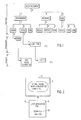
- Element Description Element 1 ⁇ Document- ⁇ Environment, Resource, Page; Any Order> Element 2 ⁇ Environment- ⁇ Begin, Style, End; Specified Order> Element 3 ⁇ Resource- ⁇ Begin, Picture, End; Specified Order> Element 4 ⁇ Page- ⁇ Begin, Text, End; Specified Order> Element 5 ⁇ Begin- ⁇ Name; Must Appear Once and Only Once> Element 6 ⁇ End> Element 7 ⁇ Style- ⁇ Line_Type,...; Appears One or More Times> Element 8 ⁇ Picture- ⁇ ...; Appears One or More Times> Element 9 ⁇ Name- ⁇ Character String; Must Appear Once and Only Once> ... ...
- More complex relationships can be expressed using the mathematical notion of parentheses. For example, several entities appearing in any order any number of times can be expressed as : Appears One or More Times (Choose One (Text, Picture))
- a table driven verification routine can unambiguously determine if a data stream is properly constructed for a specified compound document function set.
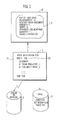
- FIG. 1 there is illustrated a screen 10 on which is displayed a function set definition menu 12.
- the menu is presented by application 13 that is running in device 14, such as a computer terminal or workstation, and which has been initiated by an operator of device 14.
- the application allows for the definition of function set entities including collections of structured fields (document, master environment group, resource group, page, and so on) and single structured fields (Begin Document, Include Master Environment Group, Begin Master Environment Group, and so on).
- the application also allows for the definition of the permitted content of a structured field grouping which is in effect a list of each single structured field that can occur in the structured field group and the relationship between each structured field in the group (e.g., can appear in any order but one and only one time).
- the application allows for the definition of the permitted content (attributes) which is in effect a list of each attribute that can occur in the single structured field and the relationship between each attribute in the single structured field.
- the application also allows for the definition of the permitted values of an attribute which is in effect a list of each value that can occur in the attribute.
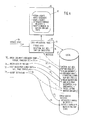
- Figure 3 shows the prompts that are used to get information from the operator to fill in Function Set Description Table "FS1".
- the operator selects "Document” thereby declaring the root entity to be "Document”. Any known selection process will suffice.
- the cursor can be placed on the response area and a function key can be used to cycle through the available choices.
- the operator selects it by depressing a designated key on the keyboard, such as the ENTER key.
- the application recognizes "Document” as an entity which is composed of a structured field group and asks for the content relationship with the prompt "RELATIONSHIP:”.
- the operator selects "O" which means the content must appear as entered.
- the application now prompts "CONTENT:”, and the operator enters "Begin Document".
- the operator enters "1" declaring that this structured field must appear but only one time in "Document”.
- the application next prompts for attribute order with the prompt “ORDER:”.
- the operator selects "U” declaring that the attributes can appear in any order within "Begin Document”.
- the application then prompts for an attribute with the prompt "ATTRIBUTE:”.
- the operator selects "Document Name”.
- the operator enters "1" declaring that "Begin Document” must appear but only one time.
- the operator enters "Character” declaring that "Document Name” may be composed out of any combination of coded graphic characters that are available on the code page that is in force when character name is interpreted.
- the attribute/value prompt cycle is now repeated until the operator declares that the last attribute and its value has been entered by depressing some keyboard key such as the ENTER key.
- the application returns to the prompt for entity content which is the next entity to be selected after "Begin Document".
- document 19 "HISDOC” is received at device 14.
- Document 19 contains an attribute in its "Begin Document” structured field which identifies the function set that was used to generate its content.
- the function set attribute's value is "FS1".
- the operator of device 14 wishes to verify that "HISDOC” is validly constructed. Therefore, the operator activates the application 15 which searches "HISDOC” and determines from the function set attribute on "Begin Document” that "HISDOC” has declared that it conforms to function set "FS1".
- Application 15 then retrieves from local permanent storage 17 Function Set Description Table 16 named "FS1". Note that if "FS1" was not found in local permanent storage, a request to retrieve it from remote permanent storage 18 would be issued.
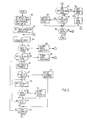
- the logic of the process according to the invention is illustrated in more detail in the flow diagram shown in Figure 5.
- the process begins at function block 50 where the initial state is set, the document is accessed and the function set is determined.
- function block 52 the table describing the function set is retrieved and then, in function block 54, the document entity is retrieved.
- a test is then made in decision block 56 to determine if the entity is valid and, if valid, a subsequent test is made in decision block 58 to determine if the entity in a valid state. If so, the entity attribute is retrieved in function block 60, and a test is made in decision block 62 to determine if the attribute is valid.
- the attribute value is retrieved in function block 64, and a test is made in decision block 66 to determine if the attribute value is valid. If so, a test is made in decision block 68 to determine if the tested value was the last value. If not, control loops back to function block 64, and the next attribute value is retrieved and tested for valid. Should an attribute value be found not valid at decision block 66, a report of the value deviation is made in function block 70 before control goes to decision block 68. When the last value has been tested, a test is made in decision block 72 to determine if the last attribute has been retrieved and tested. If not, control loops back to function block 60 to retrieve and test the next entity attribute. If the attribute is found not to be valid in decision block 62, a report of the attribute is made in function block 74 before control goes to decision block 72.
- control goes, via connector A, to decision block 76 where a test is made to determine if the entity set a new state. If so, the current state is saved in function block 78, and then the new state is set in function block 80; otherwise, a test is made in decision block 82 to determine if the entity ended the state. If so, the previous state is restored in function block 84; otherwise, control goes directly to decision block 86 where at test is made to determine if the last entity has been processed. Control also passes to decision block 86 from function blocks 80 and 84. A negative result of the tests in decision blocks 56 and 58 result in a report of entity deviation or state violation in function blocks 88 and 90 before control passes to decision block 86 via connector C. If the test in decision block 86 is negative, that is the last entity has not been processed, control then loops back to function block 54, via connector B, to retrieve the next document entity; otherwise, the process stops.
- the advantages of the invention includes the ability of an application acting as a general purpose compound document data stream verifier to determine if a compound document conforms to a specified architecture function set.
- the application verifier can be general purpose and independent of the function set defined, documents created, and generators that create the documents.
Landscapes
- Engineering & Computer Science (AREA)
- Theoretical Computer Science (AREA)
- Audiology, Speech & Language Pathology (AREA)
- Health & Medical Sciences (AREA)
- Computational Linguistics (AREA)
- General Health & Medical Sciences (AREA)
- Physics & Mathematics (AREA)
- General Engineering & Computer Science (AREA)
- General Physics & Mathematics (AREA)
- Artificial Intelligence (AREA)
- Document Processing Apparatus (AREA)
- Debugging And Monitoring (AREA)
- Information Retrieval, Db Structures And Fs Structures Therefor (AREA)
- Computer And Data Communications (AREA)
Applications Claiming Priority (2)
| Application Number | Priority Date | Filing Date | Title |
|---|---|---|---|
| US197878 | 1988-05-24 | ||
| US07/197,878 US4905146A (en) | 1988-05-24 | 1988-05-24 | Explicit specification of valid compound document data stream structure and content |
Publications (2)
| Publication Number | Publication Date |
|---|---|
| EP0344083A2 true EP0344083A2 (de) | 1989-11-29 |
| EP0344083A3 EP0344083A3 (de) | 1992-02-26 |
Family
ID=22731109
Family Applications (1)
| Application Number | Title | Priority Date | Filing Date |
|---|---|---|---|
| EP19890480062 Withdrawn EP0344083A3 (de) | 1988-05-24 | 1989-04-25 | Deutliche Spezifizierung einer gültigen Struktur und eines gültigen Inhalts eines Datenstroms von zusammengesetzten Dokumenten |
Country Status (4)
| Country | Link |
|---|---|
| US (1) | US4905146A (de) |
| EP (1) | EP0344083A3 (de) |
| JP (1) | JPH01307860A (de) |
| BR (1) | BR8902375A (de) |
Families Citing this family (5)
| Publication number | Priority date | Publication date | Assignee | Title |
|---|---|---|---|---|
| US5784619A (en) * | 1995-05-05 | 1998-07-21 | Apple Computer, Inc. | Replaceable and extensible notebook component of a network component |
| US7818728B1 (en) * | 2005-04-04 | 2010-10-19 | Qd Technology Llc | Maximizing system resources used to decompress read-only compressed analytic data in a relational database table |
| US7590641B1 (en) | 2005-04-04 | 2009-09-15 | Qd Technology, Llc | Selecting various algorithms to compress columns of analytic data in a read-only relational database in a manner that allows decompression of the compressed data using minimal system resources |
| US20090187586A1 (en) * | 2006-03-31 | 2009-07-23 | Qd Technology Llc | Selecting various algorithms to compress columns of analytic data in a read-only relational database in a manner that allows decompression of the compressed data using minimal system resources |
| US9201854B1 (en) | 2006-10-25 | 2015-12-01 | Hewlett-Packard Development Company, L.P. | Methods and systems for creating, interacting with, and utilizing a superactive document |
Family Cites Families (3)
| Publication number | Priority date | Publication date | Assignee | Title |
|---|---|---|---|---|
| US4723211A (en) * | 1984-08-30 | 1988-02-02 | International Business Machines Corp. | Editing of a superblock data structure |
| JPS61183743A (ja) * | 1985-02-09 | 1986-08-16 | Omron Tateisi Electronics Co | コンパイラ |
| JPS62249269A (ja) * | 1986-04-23 | 1987-10-30 | Toshiba Corp | 文書処理装置 |
-
1988
- 1988-05-24 US US07/197,878 patent/US4905146A/en not_active Expired - Fee Related
-
1989
- 1989-03-09 JP JP1055256A patent/JPH01307860A/ja active Pending
- 1989-04-25 EP EP19890480062 patent/EP0344083A3/de not_active Withdrawn
- 1989-05-24 BR BR898902375A patent/BR8902375A/pt not_active Application Discontinuation
Non-Patent Citations (5)
| Title |
|---|
| IBM TECHNICAL DISCLOSURE BULLETIN. vol. 27, no. 1B, June 1984, ARMONK, NY, US pages 784 - 785; G.E. WATSON AND K.M. YU: 'Data stream conversion: A method to correct invalid field names and field descriptors' * |
| IBM TECHNICAL DISCLOSURE BULLETIN. vol. 28, no. 8, January 1986, ARMONK, NY, US page 3603; 'Control filtering in an L3P datastream' * |
| IEEE INTERNATIONAL CONFERENCE ON COMMUNICATIONS '86 vol. 3/3, June 1986, TORONTO, CA pages 1419 - 1423; I.R CAMPBELL-GRANT: 'Piloting the office document architecture' * |
| IEEE TRANSACTIONS ON SOFTWARE ENGINEERING. vol. SE-9, no. 2, March 1983, NEW YORK, US pages 119 - 127; L.F RUBIN: 'Syntax-directed pretty printing - A first step towards a syntax-directed editor' * |
| SPRING COMPCON 84 March 1984, SAN FRANCISCO, US pages 465 - 472; D.C. ENGELBART: 'Authorship provisions in augment' * |
Also Published As
| Publication number | Publication date |
|---|---|
| EP0344083A3 (de) | 1992-02-26 |
| BR8902375A (pt) | 1990-01-16 |
| JPH01307860A (ja) | 1989-12-12 |
| US4905146A (en) | 1990-02-27 |
Similar Documents
| Publication | Publication Date | Title |
|---|---|---|
| Ousterhout | An Introduction to TCL and TK | |
| EP0858629B1 (de) | System und verfahren zum generieren von anwendungsprogrammen und deren dokumentation | |
| US4969093A (en) | Method of data stream construct management utilizing format shells and shell fragments | |
| US5450545A (en) | Generation of rules-based computer programs using data entry screens | |
| Bancilhon et al. | On Line Processing of Compacted Relations. | |
| WO1993023817A1 (en) | Data interchange system | |
| WO1993023817A9 (en) | Data interchange system | |
| US6542595B1 (en) | Process, generating module, server, control module and storage means for the creation of validation rules | |
| EP0689136A1 (de) | Aktualisierungsbedingungen von Transaktionen, die abbrechen können | |
| US5379407A (en) | Error handling in a state-free system | |
| US4905146A (en) | Explicit specification of valid compound document data stream structure and content | |
| Bahlke et al. | The psg-programming system generator | |
| Davis | Rapid prototyping using executable requirements specifications | |
| Van Reeuwijk | Tm: A code generator for recursive data structures | |
| Belokopytov et al. | Cargo database management package | |
| EP0371943A2 (de) | System und Verfahren zur Erzeugung von Programmiersprachenübersetzern | |
| Flanagan et al. | SUPES: A Software Utilities Package for the Engineering Sciences | |
| Su et al. | A semi-automatic data base translation system for achieving data sharing in a network environment | |
| Ruschitzka | Heterogeneous data translations based on environment grammars | |
| US20050080608A1 (en) | Simulator for request/response systems | |
| Aubry et al. | An image handling system for medical image processing | |
| Tomcik | Computer aided design of algorithmic state controllers for digital systems | |
| Hong et al. | Integrated software development environment based on CCITT/SDL for telecommunication systems | |
| EP0433071A2 (de) | Verfahren und Vorrichtung zur Verwaltung nichtuniformer Daten | |
| CN121936417A (zh) | 电池测试数据导出方法及电子设备 |
Legal Events
| Date | Code | Title | Description |
|---|---|---|---|
| PUAI | Public reference made under article 153(3) epc to a published international application that has entered the european phase |
Free format text: ORIGINAL CODE: 0009012 |
|
| AK | Designated contracting states |
Kind code of ref document: A2 Designated state(s): DE FR GB |
|
| 17P | Request for examination filed |
Effective date: 19900326 |
|
| PUAL | Search report despatched |
Free format text: ORIGINAL CODE: 0009013 |
|
| AK | Designated contracting states |
Kind code of ref document: A3 Designated state(s): DE FR GB |
|
| 17Q | First examination report despatched |
Effective date: 19940729 |
|
| GRAH | Despatch of communication of intention to grant a patent |
Free format text: ORIGINAL CODE: EPIDOS IGRA |
|
| GRAH | Despatch of communication of intention to grant a patent |
Free format text: ORIGINAL CODE: EPIDOS IGRA |
|
| STAA | Information on the status of an ep patent application or granted ep patent |
Free format text: STATUS: THE APPLICATION IS DEEMED TO BE WITHDRAWN |
|
| 18D | Application deemed to be withdrawn |
Effective date: 19961101 |