EP0343687B1 - Heat sensitive recording paper - Google Patents
Heat sensitive recording paper Download PDFInfo
- Publication number
- EP0343687B1 EP0343687B1 EP89109634A EP89109634A EP0343687B1 EP 0343687 B1 EP0343687 B1 EP 0343687B1 EP 89109634 A EP89109634 A EP 89109634A EP 89109634 A EP89109634 A EP 89109634A EP 0343687 B1 EP0343687 B1 EP 0343687B1
- Authority
- EP
- European Patent Office
- Prior art keywords
- paper
- heat sensitive
- sensitive recording
- recording paper
- base paper
- Prior art date
- Legal status (The legal status is an assumption and is not a legal conclusion. Google has not performed a legal analysis and makes no representation as to the accuracy of the status listed.)
- Expired - Lifetime
Links
Images
Classifications
-
- B—PERFORMING OPERATIONS; TRANSPORTING
- B41—PRINTING; LINING MACHINES; TYPEWRITERS; STAMPS
- B41M—PRINTING, DUPLICATING, MARKING, OR COPYING PROCESSES; COLOUR PRINTING
- B41M5/00—Duplicating or marking methods; Sheet materials for use therein
- B41M5/26—Thermography ; Marking by high energetic means, e.g. laser otherwise than by burning, and characterised by the material used
- B41M5/40—Thermography ; Marking by high energetic means, e.g. laser otherwise than by burning, and characterised by the material used characterised by the base backcoat, intermediate, or covering layers, e.g. for thermal transfer dye-donor or dye-receiver sheets; Heat, radiation filtering or absorbing means or layers; combined with other image registration layers or compositions; Special originals for reproduction by thermography
- B41M5/41—Base layers supports or substrates
-
- Y—GENERAL TAGGING OF NEW TECHNOLOGICAL DEVELOPMENTS; GENERAL TAGGING OF CROSS-SECTIONAL TECHNOLOGIES SPANNING OVER SEVERAL SECTIONS OF THE IPC; TECHNICAL SUBJECTS COVERED BY FORMER USPC CROSS-REFERENCE ART COLLECTIONS [XRACs] AND DIGESTS
- Y10—TECHNICAL SUBJECTS COVERED BY FORMER USPC
- Y10T—TECHNICAL SUBJECTS COVERED BY FORMER US CLASSIFICATION
- Y10T428/00—Stock material or miscellaneous articles
- Y10T428/31504—Composite [nonstructural laminate]
- Y10T428/31971—Of carbohydrate
- Y10T428/31993—Of paper
Definitions
- the present invention relates to a base paper in a heat sensitive recording paper, i.e. thermographic recording paper, on which recording can be carried out by means of a thermal head, thermal pen, or the like.
- a heat sensitive recording paper i.e. thermographic recording paper
- Sheets of heat sensitive recording paper were originally applied to printers for medical purposes and instrumentation purposes and have been recently used increasingly in the fields of facsimiles and terminal image output devices. This has been attended upon a need for heat sensitive recording paper which, at high speeds of recording, exhibits higher sensitivity and provides higher quality images than does the conventional.
- a measure hitherto taken is optimizing materials for heat sensitive recording layers or optimizing the way of dispersing these materials.
- effects adequate to satisfy said need cannot be obtained with this measure alone.
- it is practiced, as an approach through physical properties of paper to elevate the surface smoothness of heat sensitive recording paper, thereby improving the conformity, in other words, the ability to contact intimately, of the paper with the thermal head.
- US-A 4,682,191 describes a heat-sensitive recording paper comprising a paper support having thereon a heat-sensitive color forming layer, wherein said paper support contains at least 10% by weight of a pigment and has an internal bonding strength as defined by Tappi-RC-308 of from 0.5 to 2.5 kg ⁇ cm.
- the present inventors studied intensively the conformation (intimate contact state) of heat sensitive recording paper with the thermal head at the time of printing. This is considered to occur on the ground; even if the surface of base paper is smoothed by calendering, the thickness of base paper cannot be uniformed and hence it is infeasible to uniform or keep constant the pressure exerted on the thermal head by the platen roll through the recording paper. Thus the conformity of the recording paper with the thermal head cannot be achieved.
- the present invention is directed to a base paper in a heat sensitive recording paper having a thickness distribution that the average amplitude of paper thickness variation, between 0.2 mm and 1.0 mm wavelengths of paper thickness variation, does not exceed 0.5 ⁇ m and the intensity of any variation peak does not exceed 1.5 times the intensity of adjacent wavelength components in the power spectrum.
- the above variation in the thickness of paper can be determined by continuously measuring the thickness of paper with a differential transformer type of micrometer as described in "Paper Structure and Properties", p. 161, edited by J.A. Bristow or "Handbook of Physical and Mechanical Testing of Paper and Paperboard", p. 411, edited by R.E. Mark.
- the measurement is conducted by using a steel ball of 0.2 mm diameter as a testing head at a test pressure of 12 g while moving the paper specimen at a speed of 2 mm/sec.
- wavelength used in the present specification means the distance between two successive points in a wave derived from frequency analysis of the thickness variation curve and the term “amplitude” means the height between a maximum point and the successive minimum point of the wave.
- these values are determined by processing the signal of thickness variation with a frequency analyzer (an FFT analyzer or the like) and thereby obtaining the power spectrum.
- a frequency analyzer an FFT analyzer or the like
- differentiate variation peak used in the present specification means a peak having an intensity of 1.5 times or larger than that of two adjacent wavelength components in the power spectrum.
- the heat sensitive recording paper of the present invention is paper overlaid with a heat sensitive layer which, on heating, develops color.
- This recording paper is useful as a recording material in thermal pen printers of measuring instruments, thermal printers of computer terminal units, printers for CRT image copying, thermographic facsimiles, etc.
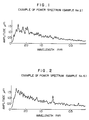
- Fig. 1 shows a power spectrum of thickness variation for a sheet of heat sensitive recording paper pertaining to the present invention.
- Fig. 2 shows a power spectrum of thickness variation for a sheet of heat sensitive recording paper pertaining to the prior art.
- the heat sensitive recording base paper and the heat sensitive recording paper, pertaining to the present invention, are produced by
- Forming fabric for use in the operation (1) may be those commercially available selected properly according to the purpose of the product recording paper. Optimum pressures of wet pressing depend upon the nature of raw material pulp, the type of paper machine and some other factors. Although a pressure of about 1.2 times larger than that applied in common operation provides generally a density of base paper of 0.8 g/cm3, it is a matter of course that the pressure should be chosen according to results of preliminary tests for examining whether the intended density is obtained or not.
- the coating, in the operation (3) may be formed according to the conventional method by using a pigment and a binder which are commonly used for heat sensitive recording paper.
- the intended base paper for thermography and the intended heat sensitive recording paper can be obtained that have average amplitudes not exceeding 0.5 ⁇ m in the wavelength varied between 0.2 mm and 1.0 mm and exhibit no distinctive variation peak in the above-stated range of wavelength.
- the thickness variation only in the above wavelength range brings up a problem is considered as follows: neither the sensitivity nor the dot reproducibility is affected by any variation in the thickness that has a wavelength exceeding 1.0 mm (any such variation that the interval between two successive maximum of thickness is larger than 1.0 mm) or that has a less wavelength than 0.2 mm; because the wavelength exceeding 1.0 mm is very large as compared with the dot interval (8 dots/mm) and the thickness variation having a wavelength less than 0.2 mm is reduced by the pressure from the platen roll at the time of printing.
- Average amplitudes, in the above wavelength range, exceeding 0.5 ⁇ m are undesirable, since this means the presence of outstanding variation in the thickness within said range and in consequence gets no comformability and then makes it impossible to achieve sufficient print density and good reproducibility of dots in printing.
- the base paper for heat sensitive recording paper is produced from materials which are chosen on demand from ordinary raw materials of paper such as wood pulp, synthetic pulp, fillers, sizing agents, paper reinforcing agents, and dyes.
- a coating comprising an oil-absorbing pigment can be provided on the surface of base paper to improve the compressibility, heat retentivity and some other properties.
- the heat sensitive recording paper of the present invention may have any of known heat sensitive recording layers of the leuco dye type, light-fixable diazo type, metal salt type, antifading type, etc.
- suitable heat sensitive recording layers are as follows: A leuco dye type as described in JAP-A-57-87995, a light-fixable diazo type as described in JAP-A-57-120591, a metal salt type as described in JAP-A-62-284782 and an antifading type as described in JAP-A-63-193881.
- Preferred recording layers are of the leuco dye type and the antifading type in view of their versatility and performance characteristics.
- the heat sensitive recording layer can be formed by using known coating methods including blade coating, air knife coating, gravure coating, roll coating and bar coating. Further an over coating can be provided to protect the heat sensitive recording layer.
- Base paper having the basis weight of 45 g/m2, the density of 0.80 g/cm3 and the Beck smoothness of 90 seconds was prepared by beating 30 parts of needle-leaf tree kraft pulp and 70 parts of broad-leaf tree kraft pulp up to a Canadian standard freeness of 200 ml, adding 10 parts of precipitated calcium carbonate (tradename TP-121, manufactured by Okutama Kogyo Co., Ltd.), 2 parts of cationic starch (tradename Cato F, manufactured by Oji-National Co., Ltd.) and 0.2 part of a neutral sizing agent (tradename Hercon W, manufactured by Dick-Hercules Co., Ltd.) and processing the resulting slurry in a longscreen paper machine using a 3-ply woven plastic wire (tradename TT-5000, manufactured by Nippon Filcon Co., Ltd. air permeability 165 cm3/cm2 ⁇ sec). The resulting base paper was coated with 3.5 g/m2 of oxidized starch by using a size press
- the opposite side of the base paper was coated with a coating dispersion for an intermediate layer, prepared in Preparation Example 1 which is described later, by using a blade coater to give a coating weight of 8 g/m2 and with a heat sensitive coating dispersion prepared in Preparation Example 2 by using an air knife coater to give a coating weight of 3 g/m2 successively.
- the thus prepared paper having a heat sensitive recording layer was supercalendered so that the heat sensitive recording surface might have a Beck smoothness of 300 to 400 seconds, This recording material is designated as Sample No. 1.
- Base paper having the basis weight of 45 g/m2 was prepared by processing the same compound slurry of materials for paper as used in Example 1 with a longscreen paper machine using a bronze wire (tradename LV 70, manufactured by Nippon Filco Co., Ltd.). In this case, the line pressure of wet press was varied, thereby two different types of base paper having a density of 0.80 g/cm3 (Beck smoothness 80 seconds) and a density of 0.85 g/cm3 (Beck smoothness 100 seconds) were given, respectively.
- a heat sensitive recording material was prepared according to the procedure of Example 2 except that the density of base paper was controlled to 0.75 g/cm3 by reducing the line pressure of the wet press. This recording material is designated as Sample No. 4.
- a heat sensitive recording material was prepared according to the procedure of Example 1 except that the back side of base paper prepared in Comparative Example 1 was coated with an intermediate coating dispersion prepared in Preparation Example 1 by using a blade coater to give a coating weight of 3 g/m2. This recording material is designated as Sample No. 5.
- a heat sensitive recording material was prepared from paper coated with a heat sensitive layer as in Comparative Example 1 by supercalendering with relatively high line-pressed; thereby the Beck smoothness of heat sensitive surface was raised from about 350 seconds, which is the usual value, to 620 seconds.
- This recording material is designated as Sample No. 6.
- a heat sensitive recording material was prepared according to the procedure of Example 1 except that the line pressure of wet press was reduced to obtain a base paper density of 0.73 g/cm3. This recording material is designated as Sample No. 7.
- Base paper having the density of 0.75 g/cm3, prepared in Comparative Example 1 was machine-calendered so as to raise its density up to 0.85 g/cm3 (Beck smoothness: 180 seconds). This base paper was processed according to the procedure of Example 1. This recording material is designated as Sample No. 8.
- a coating dispersion for intermediate layer purposes was prepared by stirring a mixture of the following composition: Burnt kaolin (Ansilex®, manufactured by Engelhard Minerals & Chemicals Corp.) 100 parts Styrene-butadiene copolymer latex (50% aqueous dispersion) 24 parts Phosphate-esterified starch (MS-4600, manufactured by Nippon Shokuhin-Kako Co., Ltd. 10% aqueous solution) 60 parts Water 52 parts
- a liquid [A] and a liquid [B] were prepared from mixtures of the following respective compositions by sand-milling to an average particle diameter of about 1 ⁇ m.
- Composition for liquid [A] 3,3-Dibutylamino-6-methyl-7-anilinofluoran 40 parts 10% Aqueous solution of polyvinyl alcohol 20 parts Water 40 parts
- Composition for liquid [B] Bisphenol A 50 parts Benzyloxynaphthalene 50 parts 10% Aqueous solution of polyvinyl alcohol 50 parts Water 100 parts
- a heat sensitive coating dispersion was prepared by mixing liquids [A] and [B] and other ingredients in the following proportions: Liquid [A] 50 parts Liquid [B] 250 parts Zinc stearate (40% dispersion) 25 parts 10% Aqueous solution of polyvinyl alcohol 216 parts Calcium carbonate 50 parts Water 417 parts
- Print densities shown in Table 1 were determined as follows: Dots were printed on samples of heat sensitive recording paper by using a GIII facsimile tester (Model TH-PMD, supplied by Okura Denki Co., Ltd.) and applying power for 0.6 m second and then the reflective optical densities of printed dots were measured by using a Macbeth densitometer (Model RD-918). Heat sensitive recording paper needs to have a sensitivity of at least 0.8 in terms of the print density.
Landscapes
- Physics & Mathematics (AREA)
- Optics & Photonics (AREA)
- Heat Sensitive Colour Forming Recording (AREA)
- Paper (AREA)
Description
- The present invention relates to a base paper in a heat sensitive recording paper, i.e. thermographic recording paper, on which recording can be carried out by means of a thermal head, thermal pen, or the like.
- Sheets of heat sensitive recording paper were originally applied to printers for medical purposes and instrumentation purposes and have been recently used increasingly in the fields of facsimiles and terminal image output devices. This has been attended upon a need for heat sensitive recording paper which, at high speeds of recording, exhibits higher sensitivity and provides higher quality images than does the conventional. To meet this need, a measure hitherto taken is optimizing materials for heat sensitive recording layers or optimizing the way of dispersing these materials. However, effects adequate to satisfy said need cannot be obtained with this measure alone. Hence it is practiced, as an approach through physical properties of paper, to elevate the surface smoothness of heat sensitive recording paper, thereby improving the conformity, in other words, the ability to contact intimately, of the paper with the thermal head.
- Various calender treatments of heat sensitive recording paper, that is, paper coated with a heat sensitive layer, are practiced to improve the comformity of the recording paper. However, the surface smoothing of heat sensitive recording paper by calendering alone cannot sufficiently improve the comformity of the paper at the time of printing, wherein the back side of said paper is rolled out with a platen roll and then pressed to the thermal head, and hence cannot provide such high sensitivity nor dot reproducibility as expected.
- As regards the base paper, much satisfactory paper is not obtained even when the surface smoothness is improved by calendering under proper conditions.
- US-A 4,682,191 describes a heat-sensitive recording paper comprising a paper support having thereon a heat-sensitive color forming layer, wherein said paper support contains at least 10% by weight of a pigment and has an internal bonding strength as defined by Tappi-RC-308 of from 0.5 to 2.5 kg·cm.
- It is an object of the present invention to provide a base paper in a heat sensitive recording paper which is improved in conformity with the thermal head at the time of printing and superior in sensitivity and dot reproducibility.
- In order to achieve the above object, the present inventors studied intensively the conformation (intimate contact state) of heat sensitive recording paper with the thermal head at the time of printing. This is considered to occur on the ground; even if the surface of base paper is smoothed by calendering, the thickness of base paper cannot be uniformed and hence it is infeasible to uniform or keep constant the pressure exerted on the thermal head by the platen roll through the recording paper. Thus the conformity of the recording paper with the thermal head cannot be achieved.
- Further, detailed investigation was made on the variation in the thickness of heat sensitive recording paper, the optical density of thermographic print on the paper and the dot reproducibility thereon.
- The present invention is directed to a base paper in a heat sensitive recording paper having a thickness distribution that the average amplitude of paper thickness variation, between 0.2 mm and 1.0 mm wavelengths of paper thickness variation, does not exceed 0.5 µm and the intensity of any variation peak does not exceed 1.5 times the intensity of adjacent wavelength components in the power spectrum.
- The above variation in the thickness of paper can be determined by continuously measuring the thickness of paper with a differential transformer type of micrometer as described in "Paper Structure and Properties", p. 161, edited by J.A. Bristow or "Handbook of Physical and Mechanical Testing of Paper and Paperboard", p. 411, edited by R.E. Mark. The measurement is conducted by using a steel ball of 0.2 mm diameter as a testing head at a test pressure of 12 g while moving the paper specimen at a speed of 2 mm/sec.
- The term "wavelength" used in the present specification means the distance between two successive points in a wave derived from frequency analysis of the thickness variation curve and the term "amplitude" means the height between a maximum point and the successive minimum point of the wave.
- In practice, these values are determined by processing the signal of thickness variation with a frequency analyzer (an FFT analyzer or the like) and thereby obtaining the power spectrum.
- The term "distinctive variation peak" used in the present specification means a peak having an intensity of 1.5 times or larger than that of two adjacent wavelength components in the power spectrum.
- The heat sensitive recording paper of the present invention is paper overlaid with a heat sensitive layer which, on heating, develops color. This recording paper is useful as a recording material in thermal pen printers of measuring instruments, thermal printers of computer terminal units, printers for CRT image copying, thermographic facsimiles, etc.
- Fig. 1 shows a power spectrum of thickness variation for a sheet of heat sensitive recording paper pertaining to the present invention.
- Fig. 2 shows a power spectrum of thickness variation for a sheet of heat sensitive recording paper pertaining to the prior art.
- The heat sensitive recording base paper and the heat sensitive recording paper, pertaining to the present invention, are produced by
- (1) using a 2-ply, 2.5-ply, or 3-ply forming fabric of fine texture, preferably made of plastic filaments, having an air permeability of up to 300 cm³/cm²·sec,
- (2) adjusting the pressure of wet press in the paper machine to such a level that the base paper after wet pressing may have a density of at least 0.8 g/cm³,
- (3) providing a coating on one side of base paper that is opposite to the side on which a heat sensitive recording layer will be formed, thereby uniforming the thickness of the whole base paper, or
- (4) combining properly the above operations (1)-(3). All of the operations (1)-(3), of course, may be combined together, but this is usually unnecessary.
- Forming fabric for use in the operation (1) may be those commercially available selected properly according to the purpose of the product recording paper. Optimum pressures of wet pressing depend upon the nature of raw material pulp, the type of paper machine and some other factors. Although a pressure of about 1.2 times larger than that applied in common operation provides generally a density of base paper of 0.8 g/cm³, it is a matter of course that the pressure should be chosen according to results of preliminary tests for examining whether the intended density is obtained or not. The coating, in the operation (3), may be formed according to the conventional method by using a pigment and a binder which are commonly used for heat sensitive recording paper.
- According to the operation stated above, the intended base paper for thermography and the intended heat sensitive recording paper can be obtained that have average amplitudes not exceeding 0.5 µm in the wavelength varied between 0.2 mm and 1.0 mm and exhibit no distinctive variation peak in the above-stated range of wavelength.
- The reason why the thickness variation only in the above wavelength range brings up a problem, is considered as follows: neither the sensitivity nor the dot reproducibility is affected by any variation in the thickness that has a wavelength exceeding 1.0 mm (any such variation that the interval between two successive maximum of thickness is larger than 1.0 mm) or that has a less wavelength than 0.2 mm; because the wavelength exceeding 1.0 mm is very large as compared with the dot interval (8 dots/mm) and the thickness variation having a wavelength less than 0.2 mm is reduced by the pressure from the platen roll at the time of printing.
- Average amplitudes, in the above wavelength range, exceeding 0.5 µm are undesirable, since this means the presence of outstanding variation in the thickness within said range and in consequence gets no comformability and then makes it impossible to achieve sufficient print density and good reproducibility of dots in printing.
- The base paper for heat sensitive recording paper, according to the present invention, is produced from materials which are chosen on demand from ordinary raw materials of paper such as wood pulp, synthetic pulp, fillers, sizing agents, paper reinforcing agents, and dyes.
- A coating comprising an oil-absorbing pigment can be provided on the surface of base paper to improve the compressibility, heat retentivity and some other properties.
- The heat sensitive recording paper of the present invention may have any of known heat sensitive recording layers of the leuco dye type, light-fixable diazo type, metal salt type, antifading type, etc.
- For example, suitable heat sensitive recording layers are as follows: A leuco dye type as described in JAP-A-57-87995, a light-fixable diazo type as described in JAP-A-57-120591, a metal salt type as described in JAP-A-62-284782 and an antifading type as described in JAP-A-63-193881.
- Preferred recording layers are of the leuco dye type and the antifading type in view of their versatility and performance characteristics.
- For the heat sensitive recording paper of the present invention, the heat sensitive recording layer can be formed by using known coating methods including blade coating, air knife coating, gravure coating, roll coating and bar coating. Further an over coating can be provided to protect the heat sensitive recording layer.
- The present invention is illustrated in more detail with reference to the following examples. In these examples, parts and percentages (%) are all by weight. Coating weights therein are on the dry basis unless noted.
- Base paper having the basis weight of 45 g/m², the density of 0.80 g/cm³ and the Beck smoothness of 90 seconds was prepared by beating 30 parts of needle-leaf tree kraft pulp and 70 parts of broad-leaf tree kraft pulp up to a Canadian standard freeness of 200 ml, adding 10 parts of precipitated calcium carbonate (tradename TP-121, manufactured by Okutama Kogyo Co., Ltd.), 2 parts of cationic starch (tradename Cato F, manufactured by Oji-National Co., Ltd.) and 0.2 part of a neutral sizing agent (tradename Hercon W, manufactured by Dick-Hercules Co., Ltd.) and processing the resulting slurry in a longscreen paper machine using a 3-ply woven plastic wire (tradename TT-5000, manufactured by Nippon Filcon Co., Ltd. air permeability 165 cm³/cm²·sec). The resulting base paper was coated with 3.5 g/m² of oxidized starch by using a size press.
- The opposite side of the base paper was coated with a coating dispersion for an intermediate layer, prepared in Preparation Example 1 which is described later, by using a blade coater to give a coating weight of 8 g/m² and with a heat sensitive coating dispersion prepared in Preparation Example 2 by using an air knife coater to give a coating weight of 3 g/m² successively. The thus prepared paper having a heat sensitive recording layer was supercalendered so that the heat sensitive recording surface might have a Beck smoothness of 300 to 400 seconds, This recording material is designated as Sample No. 1.
- Base paper having the basis weight of 45 g/m² was prepared by processing the same compound slurry of materials for paper as used in Example 1 with a longscreen paper machine using a bronze wire (tradename LV 70, manufactured by Nippon Filco Co., Ltd.). In this case, the line pressure of wet press was varied, thereby two different types of base paper having a density of 0.80 g/cm³ (Beck smoothness 80 seconds) and a density of 0.85 g/cm³ (Beck smoothness 100 seconds) were given, respectively.
- These different types of base paper were treated according to the procedure of Example 1. Two heat sensitive recording materials were thus produced. These recording materials are designated as Sample Nos. 2 and 3.
- A heat sensitive recording material was prepared according to the procedure of Example 2 except that the density of base paper was controlled to 0.75 g/cm³ by reducing the line pressure of the wet press. This recording material is designated as Sample No. 4.
- A heat sensitive recording material was prepared according to the procedure of Example 1 except that the back side of base paper prepared in Comparative Example 1 was coated with an intermediate coating dispersion prepared in Preparation Example 1 by using a blade coater to give a coating weight of 3 g/m². This recording material is designated as Sample No. 5.
- A heat sensitive recording material was prepared from paper coated with a heat sensitive layer as in Comparative Example 1 by supercalendering with relatively high line-pressed; thereby the Beck smoothness of heat sensitive surface was raised from about 350 seconds, which is the usual value, to 620 seconds. This recording material is designated as Sample No. 6.
- A heat sensitive recording material was prepared according to the procedure of Example 1 except that the line pressure of wet press was reduced to obtain a base paper density of 0.73 g/cm³. This recording material is designated as Sample No. 7.
- Base paper, having the density of 0.75 g/cm³, prepared in Comparative Example 1 was machine-calendered so as to raise its density up to 0.85 g/cm³ (Beck smoothness: 180 seconds). This base paper was processed according to the procedure of Example 1. This recording material is designated as Sample No. 8.
- A coating dispersion for intermediate layer purposes was prepared by stirring a mixture of the following composition:
Burnt kaolin (Ansilex®, manufactured by Engelhard Minerals & Chemicals Corp.) 100 parts Styrene-butadiene copolymer latex (50% aqueous dispersion) 24 parts Phosphate-esterified starch (MS-4600, manufactured by Nippon Shokuhin-Kako Co., Ltd. 10% aqueous solution) 60 parts Water 52 parts - A liquid [A] and a liquid [B] were prepared from mixtures of the following respective compositions by sand-milling to an average particle diameter of about 1 µm.
Composition for liquid [A]: 3,3-Dibutylamino-6-methyl-7-anilinofluoran 40 parts 10% Aqueous solution of polyvinyl alcohol 20 parts Water 40 parts Composition for liquid [B]: Bisphenol A 50 parts Benzyloxynaphthalene 50 parts 10% Aqueous solution of polyvinyl alcohol 50 parts Water 100 parts - Subsequently, a heat sensitive coating dispersion was prepared by mixing liquids [A] and [B] and other ingredients in the following proportions:
Liquid [A] 50 parts Liquid [B] 250 parts Zinc stearate (40% dispersion) 25 parts 10% Aqueous solution of polyvinyl alcohol 216 parts Calcium carbonate 50 parts Water 417 parts - Results of experiments in the above examples are summarized in Table 1.

- Print densities shown in Table 1 were determined as follows: Dots were printed on samples of heat sensitive recording paper by using a GIII facsimile tester (Model TH-PMD, supplied by Okura Denki Co., Ltd.) and applying power for 0.6 m second and then the reflective optical densities of printed dots were measured by using a Macbeth densitometer (Model RD-918). Heat sensitive recording paper needs to have a sensitivity of at least 0.8 in terms of the print density.
- It is evident from Table 1: such heat sensitive recording paper that the average amplitude of the thickness variation in the wavelength varied between 0.2 and 1.0 mm does not exceed 0.5 mm and no distinctive variation peak is present in the above wavelength range, exhibits high print density and superior dot reproducibility regardless of the smoothness of its heat sensitive recording surface.
Claims (3)
- A base paper in a heat sensitive recording paper having a thickness distribution that the average amplitude of paper thickness variation, between 0.2 mm and 1.0 mm wavelengths of paper thickness variation, does not exceed 0.5 µm and the intensity of any variation peak does not exceed 1.5 times the intensity of adjacent wavelength components in the power spectrum.
- A process for preparing a base paper according to claim 1 wherein a 2-ply, 2.5-ply or 3-ply forming fabric of fine texture having an air permeability not exceeding 300 cm³/cm² x sec. is used and the pressure of wet press in the paper machine is adjusted so that the base after wet pressing has a density of at least 0.8 g/cm³.
- Use of a base paper of claim 1 in a heat sensitive recording paper wherein the heat sensitive recording layer of the recording paper either comprises a leuco dye or is made of an antifading type.
Applications Claiming Priority (2)
| Application Number | Priority Date | Filing Date | Title |
|---|---|---|---|
| JP131274/88 | 1988-05-27 | ||
| JP13127488 | 1988-05-27 |
Publications (3)
| Publication Number | Publication Date |
|---|---|
| EP0343687A2 EP0343687A2 (en) | 1989-11-29 |
| EP0343687A3 EP0343687A3 (en) | 1991-01-23 |
| EP0343687B1 true EP0343687B1 (en) | 1994-11-09 |
Family
ID=15054101
Family Applications (1)
| Application Number | Title | Priority Date | Filing Date |
|---|---|---|---|
| EP89109634A Expired - Lifetime EP0343687B1 (en) | 1988-05-27 | 1989-05-29 | Heat sensitive recording paper |
Country Status (4)
| Country | Link |
|---|---|
| US (1) | US5024986A (en) |
| EP (1) | EP0343687B1 (en) |
| JP (1) | JP3042844B2 (en) |
| DE (1) | DE68919277T2 (en) |
Families Citing this family (2)
| Publication number | Priority date | Publication date | Assignee | Title |
|---|---|---|---|---|
| EP1010542B1 (en) * | 1998-12-18 | 2003-09-10 | Ricoh Company, Ltd. | Thermosensitive recording material |
| US6630424B2 (en) * | 1999-12-17 | 2003-10-07 | Ricoh Company, Ltd. | Thermosensitive recording material, block copy sheet using the recording material and printing plate prepared by using the block copy sheet |
Family Cites Families (10)
| Publication number | Priority date | Publication date | Assignee | Title |
|---|---|---|---|---|
| JPS5423545A (en) * | 1977-07-22 | 1979-02-22 | Mitsubishi Paper Mills Ltd | Heat sensitive paper with reduced adherability of dregs to thermal head |
| JPS5869097A (en) * | 1981-10-21 | 1983-04-25 | Fuji Photo Film Co Ltd | Heat sensitive recording paper |
| JPS58134788A (en) * | 1982-02-05 | 1983-08-11 | Ricoh Co Ltd | heat sensitive recording sheet |
| US4521793A (en) * | 1982-02-27 | 1985-06-04 | Asahi Kasei Kogyo Kabushiki Kaisha | Coloring method and color-forming material |
| JPS61179786A (en) * | 1985-02-05 | 1986-08-12 | Fuji Photo Film Co Ltd | Thermal recording paper |
| JPS61191262U (en) * | 1985-05-20 | 1986-11-28 | ||
| JPS6215394A (en) * | 1985-07-09 | 1987-01-23 | 日本フイルコン株式会社 | Double fabric for papermaking |
| JPS6225084A (en) * | 1985-07-25 | 1987-02-03 | Fuji Photo Film Co Ltd | Thermal recording paper |
| JPS63193881A (en) * | 1987-02-06 | 1988-08-11 | Mitsubishi Paper Mills Ltd | Thermal recording material |
| JPS63203378A (en) * | 1987-02-19 | 1988-08-23 | Fuji Photo Film Co Ltd | Thermal recording paper |
-
1989
- 1989-05-19 JP JP01126474A patent/JP3042844B2/en not_active Expired - Fee Related
- 1989-05-26 US US07/357,190 patent/US5024986A/en not_active Expired - Lifetime
- 1989-05-29 EP EP89109634A patent/EP0343687B1/en not_active Expired - Lifetime
- 1989-05-29 DE DE68919277T patent/DE68919277T2/en not_active Expired - Lifetime
Non-Patent Citations (1)
| Title |
|---|
| J. Summercorn in "Pulp and Paper", October 1989, pages 102-105. * |
Also Published As
| Publication number | Publication date |
|---|---|
| JP3042844B2 (en) | 2000-05-22 |
| JPH0248985A (en) | 1990-02-19 |
| DE68919277T2 (en) | 1995-04-27 |
| EP0343687A2 (en) | 1989-11-29 |
| DE68919277D1 (en) | 1994-12-15 |
| EP0343687A3 (en) | 1991-01-23 |
| US5024986A (en) | 1991-06-18 |
Similar Documents
| Publication | Publication Date | Title |
|---|---|---|
| AU704722B2 (en) | Recording paper and method of preparing the same | |
| US5589259A (en) | Ink jet recording paper | |
| US6214449B1 (en) | Ink jet recording paper | |
| US6177188B1 (en) | Recording medium and ink jet recording process using it | |
| EP0291315B1 (en) | Heat-sensitive recording paper | |
| US20020164464A1 (en) | Glossy inkjet coated paper | |
| GB2112155A (en) | Heat-sensitive recording sheets | |
| DE69414449T2 (en) | Transfer paper and its manufacturing process | |
| DE69909406T3 (en) | Recording sheet containing alumina or alumina hydrate, and process for its preparation | |
| EP0373903B1 (en) | Thermo-sensitive recording label paper | |
| EP0900668B1 (en) | Substrate for cast-coated paper and cast-coated paper using the same | |
| EP0806301A1 (en) | Cast-coated pressure-sensitive adhesive sheet for ink jet recording | |
| EP0887199B1 (en) | Ink jet recording sheet | |
| EP1700952B1 (en) | Coated paper adapted to newsprint printing ink and process for producing the same | |
| DE4037870A1 (en) | METHOD FOR PRODUCING COATED PAPER | |
| EP0343687B1 (en) | Heat sensitive recording paper | |
| US6261670B1 (en) | Hot melt ink transfer recording sheet and process for producing same | |
| EP0806300A2 (en) | Ink jet recording paper | |
| JPS5869097A (en) | Heat sensitive recording paper | |
| GB2217866A (en) | Thermal transfer image-receiving sheet | |
| US5177053A (en) | Thermal transfer image-receiving sheet | |
| JP3244817B2 (en) | Thermal recording paper | |
| JPH03162993A (en) | Thermal transfer image receiving sheet | |
| JPH082695B2 (en) | Base paper for thermal recording paper | |
| EP0402041A1 (en) | Heat-sensitive recording sheet |
Legal Events
| Date | Code | Title | Description |
|---|---|---|---|
| PUAI | Public reference made under article 153(3) epc to a published international application that has entered the european phase |
Free format text: ORIGINAL CODE: 0009012 |
|
| AK | Designated contracting states |
Kind code of ref document: A2 Designated state(s): DE FR GB |
|
| PUAL | Search report despatched |
Free format text: ORIGINAL CODE: 0009013 |
|
| AK | Designated contracting states |
Kind code of ref document: A3 Designated state(s): DE FR GB |
|
| 17P | Request for examination filed |
Effective date: 19910326 |
|
| 17Q | First examination report despatched |
Effective date: 19930324 |
|
| GRAA | (expected) grant |
Free format text: ORIGINAL CODE: 0009210 |
|
| AK | Designated contracting states |
Kind code of ref document: B1 Designated state(s): DE FR GB |
|
| REF | Corresponds to: |
Ref document number: 68919277 Country of ref document: DE Date of ref document: 19941215 |
|
| ET | Fr: translation filed | ||
| PLBI | Opposition filed |
Free format text: ORIGINAL CODE: 0009260 |
|
| 26 | Opposition filed |
Opponent name: CHIBA TECHNICAL CONSULTATIONS, INC. Effective date: 19950808 |
|
| PLBO | Opposition rejected |
Free format text: ORIGINAL CODE: EPIDOS REJO |
|
| APAC | Appeal dossier modified |
Free format text: ORIGINAL CODE: EPIDOS NOAPO |
|
| APAE | Appeal reference modified |
Free format text: ORIGINAL CODE: EPIDOS REFNO |
|
| APAC | Appeal dossier modified |
Free format text: ORIGINAL CODE: EPIDOS NOAPO |
|
| PLBN | Opposition rejected |
Free format text: ORIGINAL CODE: 0009273 |
|
| STAA | Information on the status of an ep patent application or granted ep patent |
Free format text: STATUS: OPPOSITION REJECTED |
|
| 27O | Opposition rejected |
Effective date: 19971128 |
|
| PGFP | Annual fee paid to national office [announced via postgrant information from national office to epo] |
Ref country code: GB Payment date: 20010523 Year of fee payment: 13 |
|
| REG | Reference to a national code |
Ref country code: GB Ref legal event code: IF02 |
|
| PG25 | Lapsed in a contracting state [announced via postgrant information from national office to epo] |
Ref country code: GB Free format text: LAPSE BECAUSE OF NON-PAYMENT OF DUE FEES Effective date: 20020529 |
|
| GBPC | Gb: european patent ceased through non-payment of renewal fee |
Effective date: 20020529 |
|
| APAH | Appeal reference modified |
Free format text: ORIGINAL CODE: EPIDOSCREFNO |
|
| PGFP | Annual fee paid to national office [announced via postgrant information from national office to epo] |
Ref country code: DE Payment date: 20080605 Year of fee payment: 20 |
|
| PGFP | Annual fee paid to national office [announced via postgrant information from national office to epo] |
Ref country code: FR Payment date: 20080514 Year of fee payment: 20 |