EP0343675B1 - Mikrophonapparat für eine Videokamera - Google Patents
Mikrophonapparat für eine Videokamera Download PDFInfo
- Publication number
- EP0343675B1 EP0343675B1 EP89109485A EP89109485A EP0343675B1 EP 0343675 B1 EP0343675 B1 EP 0343675B1 EP 89109485 A EP89109485 A EP 89109485A EP 89109485 A EP89109485 A EP 89109485A EP 0343675 B1 EP0343675 B1 EP 0343675B1
- Authority
- EP
- European Patent Office
- Prior art keywords
- signal
- sound pickup
- zoom
- signals
- zoom position
- Prior art date
- Legal status (The legal status is an assumption and is not a legal conclusion. Google has not performed a legal analysis and makes no representation as to the accuracy of the status listed.)
- Expired - Lifetime
Links
Images



Classifications
-
- H—ELECTRICITY
- H04—ELECTRIC COMMUNICATION TECHNIQUE
- H04R—LOUDSPEAKERS, MICROPHONES, GRAMOPHONE PICK-UPS OR LIKE ACOUSTIC ELECTROMECHANICAL TRANSDUCERS; ELECTRIC HEARING AIDS; PUBLIC ADDRESS SYSTEMS
- H04R3/00—Circuits for transducers
- H04R3/005—Circuits for transducers for combining the signals of two or more microphones
-
- H—ELECTRICITY
- H04—ELECTRIC COMMUNICATION TECHNIQUE
- H04R—LOUDSPEAKERS, MICROPHONES, GRAMOPHONE PICK-UPS OR LIKE ACOUSTIC ELECTROMECHANICAL TRANSDUCERS; ELECTRIC HEARING AIDS; PUBLIC ADDRESS SYSTEMS
- H04R2410/00—Microphones
- H04R2410/05—Noise reduction with a separate noise microphone
Definitions
- This invention relates to a microphone apparatus for a video camera which is equipped with an optical zoom lens and microphones to provide video and audio signals to a video tape recorder. More particularly, this invention relates to a microphone apparatus according to the preamble of claim 1, the directivity of which can be varied in accordance with the control of the zoom lens to suitably match images and sounds.
- Microphone apparatus for producing acoustic zoom effects on the basis of monaural sound recording in which the directivity or both the directivity and the sensitivity of a microphone are varied have been proposed (for example, Y. Ishigaki et al.: "Zoom Microphone” presented at the 67th Convention of the Audio Engineering Society (Oct. 31 to Nov. 3, 1980), pre-print 1713 (A-7), and US-A-3,837,736).
- the working angle at half maximum of the variable-directivity microphone is 360 degrees in the omnidirectional state, 180 degrees in the unidirectional state, and 100 degrees in the second order pressure gradient unidirectional state (i.e., the telescopic state). Namely, the working angle of the variable-directivity microphone is very wide in comparison with the viewing angle of the zoom lens.
- the acoustic zooming magnification of a microphone is about 2.7, i.e., the acoustic zooming magnification of the microphone is very much smaller than the zooming magnification of the optical zoom lens.
- the distance factor means a distance from a sound source to a directional microphone which is positioned so as to produce noise and echo signals equivalent to those obtained in an omnidirectional microphone separated from a sound source by a unit distance.
- the distance factors of an omnidirectional microphone, a unidirectional microphone and a second order pressure-gradient microphone are 1, about 1.7 and about 2.7, respectively (see, for example, "An Anthology of Articles on Microphones" from the pages of the Journal of the Audio Engineering Society vol. 1-vol. 27 (1953-1979)", p.62).
- a microphone apparatus which can produce acoustic zoom effects on the basis of two-channel stereo sound recording is known.
- An apparatus of this type is disclosed as a stereo sound processor for television broadcasting, in US-A-4,594,610.
- This processor is designed to use two microphones to conduct a stereo recording.
- the two microphones are disposed on the right and left of a stage, separately from a video camera, to generate microphone signals L and R from which a sum signal (L+R) and a difference signal (L-R) are produced.
- the mixing ratio of the sum signal (L+R) and the difference signal (L-R) is controlled in accordance with the control of the zoom lens of the video camera, so that the monophonic sum signal (L+R) is greater than the difference signal (L-R) in the telescopic mode, and, to the contrary, the difference signal (L-R) is greater than the monophonic sum signal (L+R) in the wide viewing angle mode.
- This apparatus can solve a problem in a two-channel stereo recording and reproducing system in which the sum signal (L+R) and the difference signal (L-R) are delivered without any processing, which problem is that, when images and sounds are recorded simultaneously by panning the video camera to the left and zooming in, the zoomed subject is displayed largely in the center on the television image, but the sound is delivered only from the left loudspeaker.
- the microphone since the microphone is not installed on the video camera, the pan operation of the video camera is performed regardless of the direction of the principal axis of the directivity of the microphone.
- the sound source When the sound source is positioned in the panned direction, therefore, no problem is caused. But, when the sound source is not in the panned direction, the displayed image and the reproduced sound fail to coincide with each other.
- a conventional microphone apparatus for example, disclosed in the above-mentioned three prior art references is provided with a signal means for generating a signal corresponding to the zooming magnification of the zoom lens.
- This signal means comprises a potentiometer the resistance of which can be changed by sliding a contactor which is driven in accordance with the movement of the zoom lens, through a means mechanically interconnecting the contactor and the zoom lens.
- a conventional microphone apparatus provided with such a signal means has a problem in that mechanical vibrations propagate through the casing or the space to the microphone to generate noise signals. Since the resistance of the potentiometer must be high in view of the power consumption, the level of the noise electromagnetically induced in the potentiometer is so high that the noise is mixed into the signals of the microphone. In the potentiometer, moreover, ncises are generated when the contactor of the potentiometer is slid, to be mixed into the signals of the microphone. Besides, a pctentiometer, which is a slide-type variable resistor, has problems in reliability and reproducibility, resulting in that a potentiometer is not suitable to be used as a part which is frequently operated.
- This microphone apparatus includes a potentiometer which regulates the voltage supply to two microphones.
- This potentiometer controls the amplification of microphone signals in accordance with a position signal which is derived from position sensors arranged in connection with the lens system of a video camera.
- This position sensor or zoom position detection means functions on the basis of the interaction of mechanical and electrical portions.
- the zoom position detection means detects the zoom position of said zoom lens without making mechanical contact with said zoom lens.
- the first and second signal means further comprise an analog multiplexer which selects one of channels in accordance with a digital signal, and each of said first and second control signals is a DC signal the level of which corresponds to said selected channel.
- the first and second signal means further comprise: an analog multiplexer which selects one of channels in accordance with a digital signal; a reference voltage source connected to the common terminal of said analog multiplexer; resistors one end of each of which is connected corresponding one of said channels of said analog multiplexer; and a reference resistor, one end of said reference resistor being connected to other end of each of said resistors, and the other end of said reference resistor being grounded.
- the mixing ratio of said stereo sound pickup signals is set to 100%, and the mixing ratio of said superdirectional sound pickup signal is set to 0%, and, at the telescopic zoom position of said zoom lens, the mixing ratio of said stereo sound pickup signals is set to 0%, and the mixing ratio of said superdirectional sound pickup signal is set to 100%, said mixing ratios being varied within said ranges in proportion to the variation of the viewing angle of said zoom lens.
- the first and second sum signals are varied in proportion to a power of a zooming magnification of said zoom lens.
- the first and second sum signals are varied in proportion to a power ranging 0.3 to 0.5 of a zooming magnification of said zoom lens.
- the mixing ratio of said stereo sound pickup signals at the wide viewing angle zoom position of said zoom lens, is set to 100%, and the mixing ratio of said superdirectional sound pickup signal is set to 0%, and, at the telescopic zoom position of said zoom lens, the mixing ratio of said superdirectional sound pickup signal is set to be larger than the mixing ratios of said stereo sound pickup signals, said mixing ratios being varied within said ranges in proportion to the variation of the viewing angle of said zoom lens.
- the zoom position detection means further comprises: two reflector areas formed on the outer periphery of a zoom ring of said zoom lens, each of said reflector areas being formed by a material of a high reflection index material and having a triangle shape which elongates along the rotation direction of said zoom ring; a light emitting means for irradiating light on said reflector areas; and a light receiving means for detecting light reflected from each reflector areas, and said first and second control signals are analog signals.
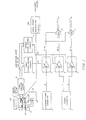
- Figure 1 is a block diagram of a microphone apparatus according to the invention.
- Figure 2a shows a reflector pattern formed on the zoom ring of the zoom lens in the apparatus of Fig. 1.
- Figure 2b is a circuit diagram of the zooming magnification detection means.
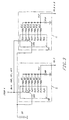
- Figure 3 is a circuit diagram illustrating the first and second signal means.
- Figure 4 is a graph showing the relation between the control voltage and the attenuation in the first, second and third amplifying means.
- Figure 5 is a graph showing a preferable relation between a viewing angle of the zoom lens and the mixing ratio of the superdirectional sound pickup signal to the stereo sound pickup signal.
- Figure 6 is a graph showing preferable relations between a zooming magnification of the zoom lens and the magnitudes of the sum signals supplied from the first and second adding means.
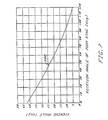
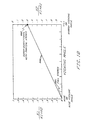
- Figure 7 is a graph showing the relation between the viewing angle of the zoom lens and the rotation angle of the zoom ring.
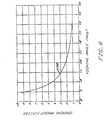
- Figure 8 is a graph showing the relation between the viewing angle and the zooming magnification of the zoom lens.
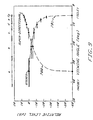
- Figure 9 is a diagram showing the relation between the viewing angle and the mixing levels of the the superdirectional sound pickup signal and stereo sound pickup signal, when the zoom lens having the properties shown in Figs. 7 and 8 and the mixing is conducted under the relations shown in Figs. 5 and 6.
- Figure 10 is a graph showing another preferable relation between a viewing angle of the zoom lens and the mixing ratio of the superdirectional sound pickup signal to the stereo sound pickup signal.
- Figure 11a is a block diagram of another microphone apparatus according to the invention.
- Figure 11b shows a reflector pattern formed on the zoom ring of the zoom lens in the apparatus of Fig. 11a.
- Figure 11c is a diagram illustrating the zoom position detection means of the apparatus of Fig. 11a.
- FIG. 1 is a block diagram of a microphone apparatus for a video camera according to the invention.
- the microphone apparatus of Fig. 1 comprises an optical zoom lens 1 , a superdirectional sound pickup means 2 , a stereo sound pickup means 3 , a zoom position sensor 4 , first and second mixing control circuits 5 and 6 , and first to third amplifiers 7 - 9 .
- the zoom lens 1 incorporates a lens optical system 100 for focusing the light from an object, and a photoelectric converting device 200 for converting the image of the object formed by the lens optical system 100 into electric signals.
- the lens optical system 100 is a conventional optical system composed cf plural fixed and movable lens elements.
- a typical example of the photoelectric converting devices 200 is a charge coupled device (CCD).
- the output signals of the photoelectric converting device 200 are supplied to a video signal processing circuit 300 and processed therein in a usual manner to be converted into image signals such as composite television signals, RGB signals, and two-channel component signals composed of luminance signals and color signals.
- the superdirectional sound pickup means or microphone 2 and the stereo sound pickup means or microphone 3 are disposed so that their front faces are directed along the center line of the viewing angle of the zoom lens 1 .
- the superdirectional microphone 2 picks up the sound field existing in a narrow range in its frontal direction, and produces a monaural superdirectional sound pickup signal D .
- the stereo microphone 3 picks up the sound field existing in a wide range in its frontal direction, and generates stereo sound pickup signals L and R .
- the zoom lens 1 is provided with a zoom ring 21 which can be rotated to vary the focal length of the zoom lens 1 .
- the focal length corresponds, as shown in Fig. 7, uniquely to the rotation angle of the zoom ring 21 . Namely, when rotating the zoom ring 21 in one direction, the viewing angle varies from the wide viewing angle to the telescopic, or, to the contrary, when rotating the zoom ring 21 in the reverse direction, the viewing angle changes from the telescopic to the wide viewing angle.
- the zoom ring 21 can be rotated not only by a manual operation but also by a motor-driven operation.
- a gear G1 formed at one end of the zoom ring 21 is meshed with a gear G2 mounted on the shaft of a driving motor 20 so that the rotation of the driving motor 20 energized by a power source B1 is transmitted to the zoom ring 21 through the gears G1 and G2 .
- the modes of zoom-in and zoom-out are changed over by switching over the rotation direction of the driving motor 20 by a switch SW1 .
- the circumferential surface of the zoom ring 21 is formed by a black material of a low reflection index.
- a reflector 22 patterned as shown in Fig. 2a has an elongated rectangular shape and is formed on the surface of the zoom ring 21 .
- the zoom position sensor 4 comprises three reflection type photosensors which, as shown in Fig. 2b, are arranged so as to face the reflector 22 , and detect the rotation angle of the zoom ring 21 to deliver a 3-bit digital zoom position signal (A0, A1, A2).
- the first mixing control circuit 5 is connected to the zoom position sensor 4 , and receives the zoom position signal (A0, A1, A2) to produce a first control signal Vc1 of a DC voltage the level of which corresponds to the zoom position signal (A0, A1, A2) (Fig. 3).
- the second mixing control circuit 6 is connected to the zoom position sensor 4, and receives the zoom position signal (A0, A1, A2) to produce a second control signal Vc2 of a DC voltage the level of which corresponds to the zoom position signal (A0, A1, A2).
- the first voltage control amplifier 7 has an attenuation-control voltage characteristic shown in Fig. 4.
- the amplifier 7 is connected to the super-directional microphone 2 and the first mixing control circuit 5 to receive the superdirectional sound pickup signal D and the first control signal Vc1 .
- the amplifier 7, by using the first control signal Vc1 as a control signal, multiplies the magnitude of the superdirectional sound pickup signal D by K1 , and outputs the product ( k1 ⁇ D ).
- the second voltage control amplifier 8 is connected to the stereo microphone 3 and the second mixing control circuit 6 to receive the stereo sound pickup signal L and the second control signal Vc2 .
- the second amplifier 8 by using the second control signal Vc2 as a control signal, multiplies the magnitude of the stereo sound pickup signal L by K2 , and outputs the product ( K2 ⁇ L ).
- the third voltage control amplifier 9 is linked to the stereo microphone 3 and the second mixing control circuit 6 , and receives the stereo sound pickup signal R and the second control signal Vc2 .
- the third voltage control amplifier 9 by using the second control signal Vc2 as a control signal, multiplies the magnitude of the stereo sound pickup signal R by K2 , and outputs the product ( K2 ⁇ R ).
- the output signal ( K1 ⁇ D ) of the first amplifier 7 and the output signal ( K2 ⁇ L ) of the second amplifier 8 are supplied to a first adder 10
- the output signal ( K1 ⁇ D ) of the first amplifier 7 and the output signal ( K2 ⁇ R ) of the third amplifier 9 are supplied to a second adder 11 .
- the first adder 10 adds the output signal ( K1 ⁇ D ) and the output signal ( K2 ⁇ L ) to produce a first sum signal ( K1 ⁇ D + K2 ⁇ L ).
- the second adder 11 adds the output signal ( K1 ⁇ D ) and the output signal ( K2 ⁇ R ) to produce a second sum signal ( K1 ⁇ D + K2 ⁇ R ).
- Figure 2a shows the pattern of the reflector 22 .
- the reflector 22 comprises a first reflector area 22a , a second reflector area 22b and a third reflector area 22c .
- one or more portions of a high reflection index black regions in Fig. 2a
- one or more portions of a low reflection index white regions in Fig. 2a
- the lateral direction in the drawing corresponds to the rotation direction of the zoom ring 21 .
- the left end corresponds to the wide viewing angle zoom position, and the right end to the telescopic zoom position.
- the high reflective portions consist of aluminum, and the untreated surface of the zoom ring 21 constitutes the low reflective portions.
- the three reflector areas 22a - 22c which consist of high reflective and low reflective portions are arranged as shown in Fig. 2a, so that 3-bit (i.e., 8-stage) digital data on the rotation angle of the zoom ring 21 can be obtained.
- the reflector 22 is patterned so that seven separate data a to g on the rotation angle of the zoom ring 21 can be obtained in sequence along the direction from the wide viewing angle side to the telescopic side. It is obvious for those skilled in the art that, when the reflector 22 is patterned so as to produce signals of a larger number of bits, more detailed information about the rotation angle of the zoom ring 21 can be obtained, thereby enabling the microphone apparatus to be controlled more precisely.
- Figure 2b shows the relation between the zoom position sensor 4 and the reflector areas 22a - 22c .
- Reflection type photosensors 30 , 31 , 32 each of which is provided with a light emitting diode LED and a phototransistor PT are disposed to face the reflector areas 22a , 22b , and 22c , respectively.
- Each light emitting diode LED is connected to a load resistor Rs , and driven by a power source B2 to emit light the amount of which corresponds to the level of a forward current.
- Each phototransistor PT is connected to a load resistor Rd , and driven by the power source B2 to generate a current the level of which corresponds to the amount of light incident thereon, resulting in that a voltage appears across the load resistor Rd .
- the light emitting diode LED constantly emits light the amount of which corresponds to the forward current level, toward the reflector area 22a , and the phototransistor PT detects the reflected light from the reflector area 22a , and converts the detected light into electric signals which are then supplied to an amplifier 33 .
- the output of the phototransistor PT is a binary signal the value of which varies corresponding to the rotation angle of the zoom ring 21 .
- the amplifier 33 amplifies the signal to produce a zoom position signal A0 .
- the photosensors 31 and 32 respectively generate electric signals corresponding to the pattern of the reflector areas 22b and 22c .
- Amplifiers 34 and 35 amplify the signals from the photosensors 31 and 32 to produce zoom position signals A1 and A2 .
- the signals A0 , A1 and A2 constitute a 3-bit zoom position signal ( A0 , A1 , A2 ) which represents the rotation angle of the zoom ring 21 and is supplied to the first and second mixing control circuits 5 and 6 .
- the zoom position sensor 4 is designed so as to constantly detect the zoom position.
- the sensor 4 may be designed so as to detect the zoom position intermittently.
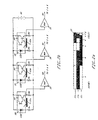
- Figure 3 illustrates the first and second mixing control circuits 5 and 6 .
- the first mixing control circuit 5 supplies a first control voltage Vc1 to the first voltage control amplifier 7 which controls the mixing level of the superdirectional sound pickup signal D .
- the second mixing control circuit 6 supplies a second control voltage Vc2 to the second and third voltage control amplifiers 8 and 9 which control the mixing levels of the stereo sound pickup signals L and R.
- a multiplexer 40 of the first mixing control circuit 5 and a multiplexer 41 of the second mixing control circuit 6 can control an eight-channel analog switch in accordance with 3-bit digital signals.
- a common terminal COM of the multiplexer 40 is connected to a DC power source from which a predetermined voltage B3 is supplied.
- resistors R1 - R7 are connected respectively.
- the other ends of the resistances R1 - R7 are bundled together and connected to a resistor R0 the other end of which is grounded.
- the multiplexer 40 receives the 3-bit zoom position signal (A0, A1, A2) from the zoom position sensor 4 , and selects one of the terminals X1 - X7 in accordance with the value of the zoom position signal.
- the multiplexer 40 is designed so as to select the terminal X1 when receiving the zoom position signal ( A0 , A1 , A2 ) corresponding to the zoom position a of the reflector 22 , and to select one of the terminals X2 - X7 when receiving the zoom position signal ( A0 , A1 , A2 ) corresponding to one of the zoom positions b - g .
- Figure 3 shows the state where the common terminal COM is connected to the terminal X2 corresponding to the zoom position b . In this state, the level of the first control signal Vc1 is given by ⁇ B3 ⁇ R2 /( R2 + R0 ) ⁇ where R2 and R0 are resistance values of the resistor R0 and R2 , respectively.
- one of the resistors R1 - R7 is selected in response to the detected one of the zoom positions a - g so that the level of the first control signal Vc1 can be selected. Therefore, it is possible to freely set the mixing level of the superdirectional sound pickup signal D .
- the common terminal COM of the multiplexer 41 is connected to the same DC power source which supplies the predetermined DC voltage B3 .
- resistors R11 - R17 are connected respectively.
- the other ends of the resistors R11 - R17 are bundled together and connected to a resistor R10 the other end of which is grounded.
- the multiplexer 41 is designed so as to select one of the terminals X1 - X7 when receiving the zoom position signal ( A0 , A1 , A2 ) corresponding to one of the zoom positions a - g .
- the second control signal Vc2 at each zoom positions which will be supplied to the second and third voltage control amplifiers 8 and 9 , is given by the division of the voltage B3 through a combination of the resistor R10 and one of the resistors R11 - R17 , so that the level of the second control signal Vc2 can be selected. Therefore, it is also possible to freely set the mixing level of the stereo sound pickup signals L and R .
- Figure 4 illustrates the relation between the control voltage and the attenuation in the first, second and third voltage control amplifiers 7 , 8 and 9 .
- a voltage control amplifier has a control terminal for controlling the amplification factor, and the amplification factor is controlled by applying a DC voltage to the control terminal.
- a curve 200 indicates the attenuation-control voltage characteristic of the amplifiers 7 , 8 and 9 .
- the axis of abscissas indicates the control voltage in the unit of volts.
- the axis of ordinates denotes the attenuation expressed in decibels. In these voltage control type amplifiers, when the control voltage is 0V, the attenuation is 0dB.
- the attenuation is increased with the increase of the control voltage, and the attenuation of 80dB can be achieved at the control voltage of about 2.5V.
- the gradient of the curve 200 in the straight line region is about -34dB/V.
- the amplifiers 7 , 8 and 9 having such characteristics can control the mixing ration of the superdirectional sound pickup signal D and the stereo sound pickup signals L and R , in accordance with the control signals Vc1 and Vc2 , which are DC voltages.
- Figure 5 shows a preferable example of the mixing ratio between the superdirectional sound pickup signal D and the stereo sound pickup signals L and R with regard to the current viewing angle of the zoom lens 1 .
- a curve 300 represents the mixing ratio-viewing angle relation, and the axis of abscissas denotes the viewing angle of the zoom lens 1 .
- the left ordinate indicates the mixing ratio ⁇ K1/(K1+K2) ⁇ of the superdirectional sound pickup signal D
- the right ordinates indicates the mixing ratio ⁇ K2/(K1+K2)] of the stereo sound pickup signals L and R .
- the mixing ratio of the stereo sound pickup signals L and R is 100%
- the mixing ratio of the superdirectional sound pickup signal D is 100%.
- the mixing ratios of the signals are varied from 0% to 100% in proportion to the variation in the viewing angle.
- the resistances of the resistors R1 - R7 and R11 - R17 of the first and second mixing control circuits 5 and 6 can be determined in the following manner: (1) the mixing ratio of the superdirectional sound pickup signal D to the signals R and L is selected from the mixing ratio-viewing angle curve 300 (Fig. 5); (2) the control voltages Vc1 and Vc2 of the first, second and third voltage control amplifiers 7 , 8 and 9 are determined from the attenuation-control voltage curve 200 (Fig. 4) so that they correspond to the selected mixing ratio; and (3) the resistances of the resistors R1 - R7 and R11 - R17 are set so that the control voltages Vc1 and Vc2 can be obtained at the zoom positions a - g .
- the microphone apparatus can realize, in the wide viewing angle mode, the spaciousness, perspective, localization, mobility, separation from background noises and others, which are the features of the stereo sound reproduction, and, in the telescopic mode, record clearly the sound from the object sound source. Therefore, the microphone apparatus can achieve acoustic zoom effects which match well with the images and have psychoacoustical effects.
- Figure 6 shows a preferable example of the relation between the current zooming magnification M of the zoom lens 1 and the magnitudes of sum signals (K1 ⁇ D+K2 ⁇ L) and (K1 ⁇ D+K2 ⁇ R) delivered from the first and second adders 10 and 11 .
- the axis of abscissas indicates zooming magnification M in logarithmic form.
- a curve 400 is an output level-zooming magnification relation curve obtained by varying the magnitudes of the sum signals in proportion to the 0.5th power of the current zooming magnification M.
- Curves 401 and 402 show similar relations obtained in the 0.4th power and 0.3th power of the magnification M , respectively.
- the output level is controlled by the first and second mixing control circuits 5 and 6 shown in Fig. 3. As apparent from the configuration of the first and second mixing control circuits 5 and 6 , the output level and the mixing ratio can be set independently.
- Figure 7 shows the relation between the viewing angle and the rotation angle of the zoom ring 21 of the zoom lens 1 .
- a curve 500 is a viewing angle-rotation angle curve.
- Figure 8 illustrates the relation between the zooming magnification M and the viewing angle of the zoom lens 1 .
- a curve 600 shown in Fig. 8 is a zooming magnification-viewing angle curve.
- the zoom lens 1 has a zooming magnification of ten times at maximum, and hence the viewing angle is about 4.2 degrees in the wide viewing angle mode and is about 42 degrees in the telescopic mode.
- Figure 9 is a diagram showing the mixing level of the superdirectional microphone signal D and the stereo microphone signals L and R , at the zoom positions a - g of the zoom lens 1 .
- the zoom lens 1 has characteristics shown in Figs. 7 and 8, the mixing of the superdirectional sound pickup signal D and the stereo sound pickup signals L and R is set so as to satisfy the relations shown by the mixing ratio-viewing angle curve 300 (Fig. 5) and by the output level-zooming magnification curve 401 (Fig. 6).
- a curve 700 is a reference curve for setting the mixing level of the superdirectional sound pickup signal D
- a curve 701 is a reference curve for setting the mixing level of the stereo sound pickup signals L and R .
- Figure 10 shows a preferable example of the mixing ratio of the superdirectional sound pickup signal D and the stereo sound pickup signals L and R to the current viewing angle of the zoom lens 1.
- a curve 800 shows the relation between the mixing ratio and the viewing angle.
- the mixing ratio of the stereo sound pickup signals L and R is set to 100%
- the mixing ratio of the superdirectional sound pickup signal D is set to 70% and that of the stereo sound pickup signals L and R is 30%.
- the mixing ratios of the signals are varied within the above-mentioned range in proportion to the variation in the viewing angle.
- the microphone apparatus can pick up the background sound even when the telescopic mode is set, resulting in that the presence property is enhanced when reproducing. This is very effective, in particular, in a so-called surround-reproducing system wherein two or three loudspeakers are arranged in the front and one or two speakers in the rear.
- the mixing ratio of the stereo sound pickup signals L and R at the telescopic zoom position may be set to 30%, but any level is acceptable as far as the stereo sound pickup signals L and R are included.
- FIG. 11a illustrates another microphone apparatus according to the invention.
- the microphone apparatus of Fig. 11a is a modification of the apparatus of Fig. 1 in which the zoom position sensor 4 is an analog sensor so that the first and second control signal Vc1 and Vc2 can be directly obtained (i.e., the mixing control circuits 5 and 6 are omitted). Only the portions different from the apparatus of Fig. 1 will be described below.
- the outer surface of a zoom ring 21 which is formed by a black or low-reflection index material is covered by a reflector 60 .
- the lateral direction in Fig. 11b corresponds to the rotation direction of the zoom ring 21
- the left end corresponds to the wide viewing angle zoom position and the right end to the telescopic zoom position.
- Fig. 11b The lateral direction in Fig. 11b corresponds to the rotation direction of the zoom ring 21
- the left end corresponds to the wide viewing angle zoom position and the right end to the telescopic zoom position.
- the reflector 60 comprises first and second reflector areas 60a and 60b which are made from aluminum and disposed in a substantially parallel manner.
- the reflector areas 60a and 60b have a shape of a long triangle elongated along the rotation direction, and are disposed in a reverse parallel manner.
- the widths W1 of the reflector area 60a is gradually decreased, while the widths W2 of the reflector area 60b is gradually increased.
- the zoom position sensor 4 is similar in structure to that used in the apparatus of Fig. 1, and comprises first and second reflection type photosen sors 30 and 31 .
- the first photosensor 30 is faced to the first reflector area 60a
- the second photosensor 31 is faced to the second reflector area 60b .
- the first photosensor 30 detects the amount of light reflected from the reflector area 60a to output the first control signal Vc1 .
- the second photosensor 31 detects the amount of light reflected from the reflector area 60b to output the second control signal Vc2 .
- the levels of the signals Vc1 and Vc2 respectively correspond to the width W1 of the first reflector area 60a and the width W2 of the second reflector area 60b .
- the widths W1 and W2 vary as the zoom ring 21 rotates, so that the level of each of the control signals Vc1 and Vc2 can be freely changed in accordance with the rotation angle of the zoom ring 21 .
- the width W1 of the first reflector area 60a is wide
- the width W2 of the second reflector area 60b is narrow, at the wide viewing zoom position, and vice versa at the telescopic position.
- the output signal Vc1 from the first photosensor 30 is greater than the output signal Vc2 from the second photosensor 31 .
- the attenuation-control voltage curve 200 (Fig. 4)
- the attenuation of the superdirectional sound pickup signal D which depends on the control signal Vc1 is greater than the attenuation of the stereo sound pickup signals L and R which depends on the control signal Vc2 , thereby causing the mixing ratio of the stereo sound pickup signal L and R to be large.
- the mixing ratio of superdirectional sound pickup signal D is large, since the width W1 of the first reflector area 60a is narrow and the width W2 of the second reflector area 60b is wide.
- the microphone apparatus of Fig. 11a has advantages that the simplified electric circuit can reduce the manufacturing cost, and that the apparatus can be continuously and finely controlled because the control signals Vc1 and Vc2 are not discrete ones.
Landscapes
- Health & Medical Sciences (AREA)
- General Health & Medical Sciences (AREA)
- Otolaryngology (AREA)
- Physics & Mathematics (AREA)
- Engineering & Computer Science (AREA)
- Acoustics & Sound (AREA)
- Signal Processing (AREA)
- Circuit For Audible Band Transducer (AREA)
- Stereophonic Arrangements (AREA)
- Details Of Audible-Bandwidth Transducers (AREA)
Claims (10)
- Mikrophoneinrichtung für eine Videokamera- mit zumindest zwei Schallaufnahmemitteln (2, 3), wobei eines von diesen ein Schall-Richtaufnahmemittel (2) ist, um ein Schall-Richtaufnahmesignal (D) zu erzeugen;- mit einem Zoomstellungserfassungsmittel (4), um zumindest ein Zoomstellungssignal (A0, A1, A2) zu erzeugen, das der Zoomstellung einer Zoomlinse (1) bzw. eines Zoomobjektivs entspricht;- mit zumindest zwei Verstärkungsmitteln (7, 8, 9);- wobei eines der zumindest zwei Verstärkungsmittel ein erstes Verstärkungsmittel (7) ist, um ein erstes verstärktes Signal (K1·D) zu erzeugen, wobei das erste verstärkte Signal ein Produkt des Schall-Richtaufnahmesignals (D) und eines ersten Wertes (K1) ist, der dem Zoomstellungssignal (A0, A1, A2) entspricht;- wobei eines der zumindest zwei Verstärkungsmittel ein zweites Verstärkungsmittel (8) ist, um ein zweites verstärktes Signal (K2·L) zu erzeugen, wobei das zweite verstärkte Signal ein Produkt eines ersten Signals von einem der Schallaufnahmemittel (L) und eines zweiten Wertes (K2) ist, der dem Zoomstellungssignal (A0, A1, A2) entspricht;- wobei ein Steuermittel ein erstes Addiermittel (18) enthält, um ein erstes Summensignal zu erzeugen;gekennzeichnet durch die folgenden Merkmale:- eines der zumindest zwei Schallaufnahmemittel ist ein Stereo-Schallaufnahmemittel, um Stereo-Schallaufnahmesignale (L, R) zu erzeugen;- das erste Signal (L) ist ein Stereo-Schallaufnahmesignal;- ein weiteres Verstärkungsmittel ist als ein drittes Verstärkungsmittel (9) vorgesehen, um ein drittes verstärktes Signal (K2·R) zu erzeugen, wobei das dritte verstärkte Signal ein Produkt eines anderen der Stereo-Schallaufnahmesignale (R) und des zweiten Wertes (K2) ist, der dem Zoomstellungssignal (A0, A1, A2) entspricht;- wobei das erste Summensignal die Summe des ersten verstärkten Signals und des zweiten verstärkten Signals ist;- wobei die Steuermittel ferner ein zweites Addiermittel (11) enthalten, um ein zweites Summensignal zu erzeugen, das die Summe des ersten verstärkten Signals und des dritten verstärkten Signals ist; und- das Zoomstellungserfassungsmittel (4) weist auf:- mehrere Reflektorbereiche (2a, 22b, 22c), die auf der äußeren Peripherie eines Zoomringes (21) der Zoomlinse bzw. des Zoomobjektivs (1) ausgebildet sind, wobei jeder der Reflektorbereiche aus einer Zeile von einem oder mehreren Abschnitten mit hohem Reflexionsindex und einem oder mehreren Abschnitten mit niedrigem Reflexionsindex zusammengesetzt ist;- ein lichtabstrahlendes Mittel (LED), um den Reflektorbereich mit Licht zu bestrahlen; und- ein lichtempfangendes Mittel (PT), um Licht zu erfassen, das von jedem Reflektorbereich reflektiert worden ist,- wobei das Zoomstellungssignal den Reflexionsindex der Reflektorbereiche darstellt.
- Mikrophoneinrichtung nach Anspruch 1, dadurch gekennzeichnet, daß die Zoomstellungserfassungsmittel die Zoomstellung der Zoomlinse bzw. des Zoomobjektivs erfassen, ohne einen mechanischen Kontakt zu der Zoomlinse zu haben.
- Mikrophoneinrichtung gemäß einem der Ansprüche 1 oder 2, dadurch gekennzeichnet, daß ein erster und ein zweiter Wert gemäß einem ersten Steuersignal (Vc1) und einem zweiten Steuersignal (Vc2) bestimmt werden, die jeweils durch erste und zweite Signalmittel (5, 6) erzeugt werden, wobei das erste und das zweite Signalmittel einen analogen Multiplexer aufweist, der einen der Kanäle gemäß einem digitalen Signal auswählt, und wobei jedes von dem ersten und dem zweiten Steuersignal ein DC-Signal ist, dessen Pegel dem ausgewählten Kanal entspricht.
- Mikrophoneinrichtung gemäß einem der Ansprüche 1 bis 3, dadurch gekennzeichnet, daß der erste und der zweite Wert gemäß einem ersten Steuersignal (Vc1) und einem zweiten Steuersignal (Vc2) bestimmt werden, die jeweils durch ein erstes und ein zweites Signalmittel (5, 6) erzeugt werden, wobei das erste und das zweite Signalmittel aufweisen:- einen analogen Multiplexer, der einen der Kanäle gemäß einem digitalen Signal auswählt;- eine Bezugsspannungsquelle, die an den gemeinsamen Anschluß des analogen Multiplexers angeschlossen ist;- Widerstände, von denen jeweils ein Ende an einen entsprechenden der Kanäle des analogen Multiplexers angeschlossen ist; und- ein Bezugswiderstand, wobei ein Ende des Bezugswiderstandes an das andere Ende von jedem der Widerstände angeschlossen ist und das andere Ende des Bezugswiderstandes geerdet ist bzw. auf Erdpotential gelegt ist.
- Mikrophoneinrichtung gemäß einem der Ansprüche 1 bis 4, dadurch gekennzeichnet, daß das Zoomstellungssignal ein digitales Signal von zwei oder mehr Bits ist, das aus binären Signalen erzeugt wird.
- Mikrophoneinrichtung gemäß einem der Ansprüche 1 oder 2, wobei die Zoomstellungserfassungsmittel aufweisen:- zwei Reflexionsbereiche, die auf der äußeren Peripherie eines Zoomringes der Zoomlinse bzw. des Zoomobjektivs ausgebildet sind, wobei jeder der Reflektorbereiche durch ein Material mit hohem Reflexionsindex ausgebildet ist, und eine dreieckige bzw. Triangelgestalt hat, die sich entlang der Rotationsrichtung des Zoomringes erstreckt;- ein Licht abstrahlendes Mittel, um die Reflexionsbereiche mit Licht zu bestrahlen; und- ein Licht empfangendes Mittel, um Licht zu erfassen, das von jedem der Reflektorbereiche reflektiert ist, wobei- der erste und der zweite Wert gemäß einem ersten Steuersignal (Vc1) und einem zweiten Steuersignal (Vc2) bestimmt werden, die unmittelbar von den Zoomstellungserfassungsmitteln (4) erhalten werden, wobei das erste und das zweite Steuersignal analoge Signale sind.
- Mikrophoneinrichtung gemäß einem der Ansprüche 1 bis 6, dadurch gekennzeichnet, daß die Weitwinkel-Zoomstellung der Zoomlinse bzw. des Zoomobjektivs, das Mischungsverhältnis der Stereo-Schallaufnahmesignale auf 100% eingestellt ist, und das Mischungsverhältnis des Richt-Schallaufnahmesignals auf 0% eingestellt ist, und bei der teleskopischen Zoomstellung der Zoomlinse bzw. des Zoomobjektivs das Mischungsverhältnis des Stereo-Schallaufnahmesignals auf 0% eingestellt ist, und das Mischungsverhältnis des Richt-Schallaufnahmesignals auf 100% eingestellt ist, wobei die Mischverhältnisse innerhalb der Bereiche im Verhältnis zu der Veränderung des Sichtwinkels der Zoomlinse bzw. des Zoomobjektivs verändert werden.
- Mikrophoneinrichtung gemäß einem der Ansprüche 1 bis 7, dadurch gekennzeichnet, daß das erste und das zweite Summensignal im Verhältnis zu einer Leistung bzw. Brennweite einer Zoomvergrößerung einer Zoomlinse bzw. eines Zoomobjektivs verändert werden.
- Mikrophoneinrichtung gemäß einem der Ansprüche 1 bis 8, dadurch gekennzeichnet, daß das erste und das zweite Summensignal im Verhältnis zu der Leistung bzw. Brennweite, die von 0,3 bis 0,5 reicht, einer Zoomvergrößerung der Zoomlinse bzw. des Zoomobjektivs verändert werden.
- Mikrophoneinrichtung gemäß einem der Ansprüche 1 bis 9, wobei bei der Weitwinkel-Zoomstellung der Zoomlinse bzw. des Zoomobjektivs das Mischungsverhältnis der Stereo-Schallaufnahmesignale auf 100% eingestellt ist, und das Mischungsverhältnis des Richt-Schallaufnahmesignals auf 0% eingestellt ist, und bei der teleskopischen Zoomstellung der Zoomlinse bzw. des Zoomobjektivs das Mischungsverhältnis des Richt-Schallaufnahmesignals eingestellt ist, um größer als die Mischungsverhältnisse der Stereo-Schallaufnahmesignale zu sein, wobei die Mischungsverhältnisse innerhalb der Bereiche im Verhältnis zu der Veränderung des Sichtwinkels der Zoomlinse bzw. des Zoomobjektivs verändert werden.
Applications Claiming Priority (6)
| Application Number | Priority Date | Filing Date | Title |
|---|---|---|---|
| JP63130675A JPH01300679A (ja) | 1988-05-27 | 1988-05-27 | マイクロホン装置 |
| JP130675/88 | 1988-05-27 | ||
| JP63160085A JPH0210971A (ja) | 1988-06-28 | 1988-06-28 | マイクロホン装置 |
| JP160085/88 | 1988-06-28 | ||
| JP227007/88 | 1988-09-09 | ||
| JP63227007A JPH0738694B2 (ja) | 1988-09-09 | 1988-09-09 | マイクロホン装置 |
Publications (3)
| Publication Number | Publication Date |
|---|---|
| EP0343675A2 EP0343675A2 (de) | 1989-11-29 |
| EP0343675A3 EP0343675A3 (de) | 1992-02-26 |
| EP0343675B1 true EP0343675B1 (de) | 1997-11-05 |
Family
ID=27316167
Family Applications (1)
| Application Number | Title | Priority Date | Filing Date |
|---|---|---|---|
| EP89109485A Expired - Lifetime EP0343675B1 (de) | 1988-05-27 | 1989-05-26 | Mikrophonapparat für eine Videokamera |
Country Status (2)
| Country | Link |
|---|---|
| EP (1) | EP0343675B1 (de) |
| DE (1) | DE68928423T2 (de) |
Families Citing this family (2)
| Publication number | Priority date | Publication date | Assignee | Title |
|---|---|---|---|---|
| KR940021467U (ko) * | 1993-02-08 | 1994-09-24 | 푸쉬-풀 사운드 캐취 마이크로폰 | |
| DE19854373B4 (de) * | 1998-11-25 | 2005-02-24 | Robert Bosch Gmbh | Verfahren zur Steuerung der Empfindlichkeit eines Mikrofons |
Family Cites Families (2)
| Publication number | Priority date | Publication date | Assignee | Title |
|---|---|---|---|---|
| AT248514B (de) * | 1964-10-01 | 1966-08-10 | Akg Akustische Kino Geraete | Schallempfänger mit veränderbarem Aufnahmewinkel |
| US4594610A (en) * | 1984-10-15 | 1986-06-10 | Rca Corporation | Camera zoom compensator for television stereo audio |
-
1989
- 1989-05-26 DE DE68928423T patent/DE68928423T2/de not_active Expired - Fee Related
- 1989-05-26 EP EP89109485A patent/EP0343675B1/de not_active Expired - Lifetime
Also Published As
| Publication number | Publication date |
|---|---|
| EP0343675A2 (de) | 1989-11-29 |
| DE68928423T2 (de) | 1998-06-04 |
| DE68928423D1 (de) | 1997-12-11 |
| EP0343675A3 (de) | 1992-02-26 |
Similar Documents
| Publication | Publication Date | Title |
|---|---|---|
| US4984087A (en) | Microphone apparatus for a video camera | |
| US5136650A (en) | Sound reproduction | |
| US6430353B1 (en) | Audio and video reproducing apparatus having independent control of selected signals | |
| US5477270A (en) | Distance-adaptive microphone for video camera | |
| KR100628569B1 (ko) | 복수의 음향취득장치가 결합 가능한 캠코더 | |
| US4594610A (en) | Camera zoom compensator for television stereo audio | |
| US4807051A (en) | Image pick-up apparatus with sound recording function | |
| JP2005124090A (ja) | マイクロホン装置、再生装置及び撮像装置 | |
| JP2006314078A (ja) | 撮像装置、音声記録装置および音声記録方法 | |
| EP0356995B1 (de) | Gerät zum Übermitteln von Steuercodes zu einem Schallfeldwiedergabegerät | |
| US5414774A (en) | Circuit and method for controlling an audio system | |
| WO2006129640A1 (ja) | マルチチャンネル収音装置、マルチチャンネル音声再生装置、およびマルチチャンネル収音再生装置 | |
| US6038324A (en) | Automotive surround sound circuit background of the invention | |
| EP0765084A2 (de) | Automatisches Videonachführungssystem | |
| JP2005159731A (ja) | 撮像装置 | |
| JP4850628B2 (ja) | 記録装置 | |
| EP0343675A2 (de) | Mikrophonapparat für eine Videokamera | |
| US20010037194A1 (en) | Audio signal processing device | |
| EP0500049B1 (de) | Aufzeichnungsgerät und Aufzeichnungs-/Wiedergabesystem | |
| JPH10262300A (ja) | 音声再生装置 | |
| KR100682492B1 (ko) | 오디오 재생장치 | |
| Matsumoto et al. | Stereo zoom microphone for consumer video cameras | |
| JPH07312712A (ja) | ビデオカメラ及び再生装置 | |
| US5742691A (en) | Surround sound converter | |
| JPH09307833A (ja) | 映像機器の音声制御装置および音声制御方法 |
Legal Events
| Date | Code | Title | Description |
|---|---|---|---|
| PUAI | Public reference made under article 153(3) epc to a published international application that has entered the european phase |
Free format text: ORIGINAL CODE: 0009012 |
|
| 17P | Request for examination filed |
Effective date: 19890728 |
|
| AK | Designated contracting states |
Kind code of ref document: A2 Designated state(s): DE FR GB NL |
|
| PUAL | Search report despatched |
Free format text: ORIGINAL CODE: 0009013 |
|
| AK | Designated contracting states |
Kind code of ref document: A3 Designated state(s): DE FR GB NL |
|
| 17Q | First examination report despatched |
Effective date: 19931012 |
|
| GRAG | Despatch of communication of intention to grant |
Free format text: ORIGINAL CODE: EPIDOS AGRA |
|
| GRAH | Despatch of communication of intention to grant a patent |
Free format text: ORIGINAL CODE: EPIDOS IGRA |
|
| GRAH | Despatch of communication of intention to grant a patent |
Free format text: ORIGINAL CODE: EPIDOS IGRA |
|
| GRAA | (expected) grant |
Free format text: ORIGINAL CODE: 0009210 |
|
| AK | Designated contracting states |
Kind code of ref document: B1 Designated state(s): DE FR GB NL |
|
| REF | Corresponds to: |
Ref document number: 68928423 Country of ref document: DE Date of ref document: 19971211 |
|
| ET | Fr: translation filed | ||
| PLBE | No opposition filed within time limit |
Free format text: ORIGINAL CODE: 0009261 |
|
| STAA | Information on the status of an ep patent application or granted ep patent |
Free format text: STATUS: NO OPPOSITION FILED WITHIN TIME LIMIT |
|
| 26N | No opposition filed | ||
| PGFP | Annual fee paid to national office [announced via postgrant information from national office to epo] |
Ref country code: FR Payment date: 20010518 Year of fee payment: 13 |
|
| PGFP | Annual fee paid to national office [announced via postgrant information from national office to epo] |
Ref country code: DE Payment date: 20010522 Year of fee payment: 13 |
|
| PGFP | Annual fee paid to national office [announced via postgrant information from national office to epo] |
Ref country code: GB Payment date: 20010523 Year of fee payment: 13 |
|
| REG | Reference to a national code |
Ref country code: GB Ref legal event code: IF02 |
|
| PG25 | Lapsed in a contracting state [announced via postgrant information from national office to epo] |
Ref country code: GB Free format text: LAPSE BECAUSE OF NON-PAYMENT OF DUE FEES Effective date: 20020526 |
|
| PG25 | Lapsed in a contracting state [announced via postgrant information from national office to epo] |
Ref country code: DE Free format text: LAPSE BECAUSE OF NON-PAYMENT OF DUE FEES Effective date: 20021203 |
|
| GBPC | Gb: european patent ceased through non-payment of renewal fee |
Effective date: 20020526 |
|
| PG25 | Lapsed in a contracting state [announced via postgrant information from national office to epo] |
Ref country code: FR Free format text: LAPSE BECAUSE OF NON-PAYMENT OF DUE FEES Effective date: 20030131 |
|
| REG | Reference to a national code |
Ref country code: FR Ref legal event code: ST |
|
| PGFP | Annual fee paid to national office [announced via postgrant information from national office to epo] |
Ref country code: NL Payment date: 20040505 Year of fee payment: 16 |
|
| PG25 | Lapsed in a contracting state [announced via postgrant information from national office to epo] |
Ref country code: NL Free format text: LAPSE BECAUSE OF NON-PAYMENT OF DUE FEES Effective date: 20051201 |
|
| NLV4 | Nl: lapsed or anulled due to non-payment of the annual fee |
Effective date: 20051201 |