EP0343210B1 - Electrochemical electrodes - Google Patents
Electrochemical electrodes Download PDFInfo
- Publication number
- EP0343210B1 EP0343210B1 EP88909793A EP88909793A EP0343210B1 EP 0343210 B1 EP0343210 B1 EP 0343210B1 EP 88909793 A EP88909793 A EP 88909793A EP 88909793 A EP88909793 A EP 88909793A EP 0343210 B1 EP0343210 B1 EP 0343210B1
- Authority
- EP
- European Patent Office
- Prior art keywords
- electrode
- element according
- group
- anion
- metal
- Prior art date
- Legal status (The legal status is an assumption and is not a legal conclusion. Google has not performed a legal analysis and makes no representation as to the accuracy of the status listed.)
- Expired - Lifetime
Links
Images

Classifications
-
- G—PHYSICS
- G01—MEASURING; TESTING
- G01N—INVESTIGATING OR ANALYSING MATERIALS BY DETERMINING THEIR CHEMICAL OR PHYSICAL PROPERTIES
- G01N27/00—Investigating or analysing materials by the use of electric, electrochemical, or magnetic means
- G01N27/26—Investigating or analysing materials by the use of electric, electrochemical, or magnetic means by investigating electrochemical variables; by using electrolysis or electrophoresis
- G01N27/28—Electrolytic cell components
- G01N27/30—Electrodes, e.g. test electrodes; Half-cells
- G01N27/301—Reference electrodes
-
- G—PHYSICS
- G01—MEASURING; TESTING
- G01N—INVESTIGATING OR ANALYSING MATERIALS BY DETERMINING THEIR CHEMICAL OR PHYSICAL PROPERTIES
- G01N27/00—Investigating or analysing materials by the use of electric, electrochemical, or magnetic means
- G01N27/26—Investigating or analysing materials by the use of electric, electrochemical, or magnetic means by investigating electrochemical variables; by using electrolysis or electrophoresis
- G01N27/28—Electrolytic cell components
- G01N27/30—Electrodes, e.g. test electrodes; Half-cells
- G01N27/333—Ion-selective electrodes or membranes
- G01N27/3335—Ion-selective electrodes or membranes the membrane containing at least one organic component
Definitions
- This invention relates to electrochemical electrodes and particularly to electrochemical reference elements for use in solvents other than water.
- ion selective electrodes which are based on organic ion exchangers or neutral carriers.
- the active material can be in liquid form held in an inert porous membrane but more conveniently the active material is incorporated within a suitably plasticised polymer substrate.
- the half cell was completed by immersing a silver wire in an internal reference solution of the appropriate chloride salt (potassium for a potassium ion selective electrode) forming a silver/silver chloride internal reference electrode.
- the potential of this half cell is usually measured against a reference electrode, with the silver/silver chloride reference electrode being usually employed. It will be understood that the ionic current/potential across the membrane is thereby converted into an electronic current/potential at the internal reference electrode, which can be measured.
- the advantages of using a thermodynamically-definable reversible electrode system as the internal reference electrode will be apparent.
- the aqueous internal reference solution is incorporated into a hydrophilic polymer layer such as polyvinyl alcohol (PVA)
- PVA polyvinyl alcohol
- the present invention consists in one aspect in an electrochemical reference element in combination with an organic liquid, comprising a metal electrode and a solid electrolyte in contact with the electrode, the electrolyte comprising a salt of an organic anion with a metal cation of the electrode, the salt being substantially insoluble in said organic liquid and the anion being soluble in said organic liquid to form an electrochemical couple.
- said anion has a hydrophobic aromatic group.
- anions comprises anions derived from aryloxyborates, i.e. anions of the general formula (ArO)4 ⁇ B+, wherein each ArO group, which may be the same or different, represents an aryloxy group having up to 20 carbon atoms, optionally substituted by one or more halogen atoms or nitro groups.
- the aryl group Ar may for example be a phenyl or naphthyl group which may be substituted by one or more hydrocarbyl groups having up to 6 carbon atoms.
- Ar is selected from phenyl and 4-halo phenyl.
- anions includes anions derived from hydroxy-substituted aromatic compounds, for example phenols and substituted phenols and naphthols and substituted naphthols.
- Such compounds include mono-hydroxy phenols and mono-hydroxy naphthols each of which may contain one or more electron-withdrawing groups, for example NO2 groups, as in picrate anions and picraminate anions.
- the metal is selected from the group consisting of silver, cadmium, cobalt, iron, lead and nickel.
- the reference element according to this invention may be used within an ion selective electrode with the solid electrolyte establishing contact with an ion selective membrane.
- the reference element of this invention can accordingly be used with advantage within a reference electrode for use in non-aqueous solutions.
- the skilled man will appreciate that there are a wide variety of further applications for the reference element according to this invention, including electrodes for sensing proteins, cells or viruses.
- a preferred form of reference element according to this invention is silver/silver tetraphenylborate and there will now be described by way of example two methods for producing an electrode in this form.
- the membrane can be coated directly onto the Ag/AgTPB electrode. This not only provides a reversible electrode (the electronic part) without an internal aqueous filling solution, but provides ionic buffering (as well as electronic buffering) within the device.
- TPB ⁇ itself can be used as an ion exchanger in ion selective electrodes. More commonly, it is also used as a counter ion with membranes using carrier-type sensing ligands (e.g. for K,NHC4, Na, Ca, Mg) In these cases the membrane compositions do not need to be significantly changed for use with the internal reference electrode according to this invention. This does not mean, however, that alternative neutral carrier membranes cannot be developed with the addition of TPB.
- carrier-type sensing ligands e.g. for K,NHC4, Na, Ca, Mg
- an AgTPB applied to an Ag wire 12 for example by Method 2 above.
- An ion selective membrane 14 is then applied over the AgTPB coating and the assembly suitably encapsulated as shown at 16.
- Figure 2 The arrangement of Figure 2 is similar but includes a silver plate 18 in place of the silver wire of the Figure 1 embodiment. Other components are shown with the same reference numerals, primed.
- the Ag electrode is formed by an Ag film 20 suitably deposited upon a plastics or ceramic substrate 22.
- the AgTPB coating 24 is then applied over the Ag film so as completely to cover the same.
- a permselective membrane 26 covers the AgTPB coating and a ring of encapsulation material 28 is applied so as to avoid edge effects.
- a plurality of ion selective electrodes may be formed on the same substrate using, for example, printing processes such as screen printing.
- a number of electrodes of the same selectivity may be incorporated to accommodate failure of any individual device or for the purpose of increasing accuracy by allowing simultaneous multiple measurement, with an appropriate statistical processing technique.
- one or more of the printed electrode devices may be a reference electrode against which the potential of the working ion selective half cells may be measured.
- the reference electrode may be of a conventional type or may preferably be constructed in the manner of an ion selective electrode with, for example, the neutral carrier of the membrane omitted so that the electrode does not respond to the ionic species of interest and serves as a reference. It will be understood that the location in this way of the reference electrode in close proximity to the selective electrode will improve, for example, common mode rejection.
- the reference electrode may be constructed as an ion selective electrode to act additionally to null electrochemical interference. For instance, in the case where the selective electrode responds both to the ionic species of interest and to an interfering species, the reference electrode may be arranged to respond to the or each interferent.
- a cyclic voltamogram is shown, produced by varying the potential applied to a Ag/Ag TPB electrode and measuring the current. This demonstrates the reversibility of the electrode.
- the compressed form of the plot is explained by the low conductivity of the non-aqueous solvent solution of the TPB used in making the measurements (10 ⁇ 3M tetrabutyl ammonium tetraphenyl borate in 1,2-dichloroethane).
- FIG. 5 a plot of the measured potential of an Ag/Ag TPB electrode against concentration. Measurements were taken against a saturated calomel electrode using the tetrabutyl ammonium (TBA) cation as a bridge between the aqueous and non-aqueous phases.
- TAA tetrabutyl ammonium
- the cell can be defined as:-
- ion selective electrodes according to this invention were prepared with selectivity to potassium.
- a batch of like electrodes was used to measure the concentration (activity) of a sample of potassium ion, the sample being subject to step-wise concentration changes.
- the experimental results are plotted in Figure 6. It will be seen that the electrodes generally exhibit fast response and reasonable stability.
- Figure 7 presents the response of the same batch of electrodes in a form in which the calibration points of the electrodes can be assessed in terms of sensitivity or slope expressed in change in potential in millivolts per decade change in concentration or activity and offset expressed in millivolts.
- Ammonium, sodium, hydrogen, lithium, calcium, magnesium, nitrate, chloride, phosphate and other inorganic cation and anion selective electrodes may be constructed by coating the appropriate permselective membrane on to the Ag/AgTPB electrodes.
- the Ag/AgTPB electrode may also be used for organic cation and anion selectivities.
- Electrodes based on the binding of proteins, DNA, RNA, viruses and cells to an affinity ligand incorporated into the appropriate membrane may also advantageously use the Ag/AgTPB electrode.
- TPB electrodes could be formed with other non-noble metals.
- TPB has the advantage of being an anion currently used within certain ion exchanger membranes
- electrodes according to the invention can usefully be constructed using other solvent soluble anions which form an insoluble salt of a metal.
- Preferred metal salts other than TPB are of tetrakis (4-fluorophenyl) borate, tetrakis (4-chlorophenyl) borate, dipicrylaminate, picrate and dicarbolyl cobalate.
- Preferred metals in addition to silver are cadmium, cobalt, iron, lead and nickel.
Landscapes
- Chemical & Material Sciences (AREA)
- Life Sciences & Earth Sciences (AREA)
- Health & Medical Sciences (AREA)
- General Physics & Mathematics (AREA)
- Pathology (AREA)
- Electrochemistry (AREA)
- Physics & Mathematics (AREA)
- Analytical Chemistry (AREA)
- Biochemistry (AREA)
- General Health & Medical Sciences (AREA)
- Molecular Biology (AREA)
- Immunology (AREA)
- Chemical Kinetics & Catalysis (AREA)
- Secondary Cells (AREA)
- Electrodes For Compound Or Non-Metal Manufacture (AREA)
- Battery Electrode And Active Subsutance (AREA)
- Hybrid Cells (AREA)
- Primary Cells (AREA)
- Pyridine Compounds (AREA)
- Inert Electrodes (AREA)
- Saccharide Compounds (AREA)
Abstract
Description
- This invention relates to electrochemical electrodes and particularly to electrochemical reference elements for use in solvents other than water.
- A good example of such usage is ion selective electrodes which are based on organic ion exchangers or neutral carriers. The active material can be in liquid form held in an inert porous membrane but more conveniently the active material is incorporated within a suitably plasticised polymer substrate. In the early designs, the half cell was completed by immersing a silver wire in an internal reference solution of the appropriate chloride salt (potassium for a potassium ion selective electrode) forming a silver/silver chloride internal reference electrode. The potential of this half cell is usually measured against a reference electrode, with the silver/silver chloride reference electrode being usually employed. It will be understood that the ionic current/potential across the membrane is thereby converted into an electronic current/potential at the internal reference electrode, which can be measured. The advantages of using a thermodynamically-definable reversible electrode system as the internal reference electrode will be apparent.
- There are clear advantages in developing solid state versions of these ion selective electrodes and considerable efforts have been made in developing so-called "coated wire" electrodes. Commonly, the aqueous internal reference solution is incorporated into a hydrophilic polymer layer such as polyvinyl alcohol (PVA) These devices must be very carefully constructed. For example, in order to prevent osmotic effects across the membrane, this must be introduced when the water content of the PVA layer is within a fixed range. Ideally, this requires coating to be carried out at fixed relative humidities.
- In some prior proposals, the use of a reversible electrode has been abandoned with, for example, the membrane being coated directly onto platinum. Even though potentials are measured using very high input impedance volt meters, the ionic to electronic currents are still likely to be high enough to cause problems of drift, noise and lack of reproducibility, in the absence of any thermodynamically reversible electrode. Surface oxides and contamination of the metal can also lead to systematic errors.
- A further approach that has been adopted in an attempt to solve this problem is the use of oxidation/reduction processes at noble metal electrodes (for example ferrocence/ferrocenium at a platinum electrode). However, whilst this proposal achieves buffering of the electronic part of the couple, this tends to be unstable.
- It is an object of one aspect of this invention to provide an improved ion selective electrode in which the above difficulties are to a significant extent overcome.
- Accordingly, the present invention consists in one aspect in an electrochemical reference element in combination with an organic liquid, comprising a metal electrode and a solid electrolyte in contact with the electrode, the electrolyte comprising a salt of an organic anion with a metal cation of the electrode, the salt being substantially insoluble in said organic liquid and the anion being soluble in said organic liquid to form an electrochemical couple.
- Preferably, said anion has a hydrophobic aromatic group.
- One class of anions comprises anions derived from aryloxyborates, i.e. anions of the general formula (ArO)₄⁻B⁺, wherein each ArO group, which may be the same or different, represents an aryloxy group having up to 20 carbon atoms, optionally substituted by one or more halogen atoms or nitro groups. The aryl group Ar may for example be a phenyl or naphthyl group which may be substituted by one or more hydrocarbyl groups having up to 6 carbon atoms. In a particularly preferred class of compounds, Ar is selected from phenyl and 4-halo phenyl.
- Another class of anions includes anions derived from hydroxy-substituted aromatic compounds, for example phenols and substituted phenols and naphthols and substituted naphthols. Such compounds include mono-hydroxy phenols and mono-hydroxy naphthols each of which may contain one or more electron-withdrawing groups, for example NO₂ groups, as in picrate anions and picraminate anions.
- Preferably the metal is selected from the group consisting of silver, cadmium, cobalt, iron, lead and nickel.
- The reference element according to this invention may be used within an ion selective electrode with the solid electrolyte establishing contact with an ion selective membrane.
- Problems occur with the silver/silver chloride electrode (and the other commonly used reference electrode - calomel), in applications where it is required to operate in non-aqueous solvents/solutions. Since these reference electrodes require an aqueous salt solution (e.g. KCl NaCl), it is necessary to provide an aqueous bridge solution from the electrode and a liquid junction to the non--aqueous solvent. This is a complicated arrangement which can lead to difficulties.
- The reference element of this invention can accordingly be used with advantage within a reference electrode for use in non-aqueous solutions. The skilled man will appreciate that there are a wide variety of further applications for the reference element according to this invention, including electrodes for sensing proteins, cells or viruses.
- A preferred form of reference element according to this invention is silver/silver tetraphenylborate and there will now be described by way of example two methods for producing an electrode in this form.
-
- Heat platinum gauze in a hydrogen/oxygen flame to clean the surface
- Dip the clean platinum gauze in silver oxide powder and flame gently until the oxygen has been removed and a greyish colour remains. Repeat this step until a sufficiently thick layer of porous silver has formed on the platinum gauze.
- Electrolyse the porous silver coated platinum gauze in a saturated solution of tetraphenylborate in 1, 2 dichlorethane (or other appropriate solvent) for 12 to 18 hours at low current (approx 1mA).
-
- Heat silver wire in a flame to clean (as above)
- Electrolyse the cleaned silver wire in a saturated TPB solution for 12 to 18 hours at low current (as above)
- In the case of ion selective electrodes, the membrane can be coated directly onto the Ag/AgTPB electrode. This not only provides a reversible electrode (the electronic part) without an internal aqueous filling solution, but provides ionic buffering (as well as electronic buffering) within the device.
- TPB⁻ itself can be used as an ion exchanger in ion selective electrodes. More commonly, it is also used as a counter ion with membranes using carrier-type sensing ligands (e.g. for K,NHC₄, Na, Ca, Mg) In these cases the membrane compositions do not need to be significantly changed for use with the internal reference electrode according to this invention. This does not mean, however, that alternative neutral carrier membranes cannot be developed with the addition of TPB.
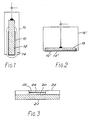
- The invention will further be described by way of example with reference to accompanying drawings in which:
- Figures 1, 2 and 3 are diagrams illustrating alternative forms of ion selective electrodes according to this invention:
- Figure 4 is a cyclic voltamogram of an Ag/Ag TPB electrode:
- Figure 5 is a plot of the response of an Ag/Ag TPB; electrode to changes in concentration of the anion;
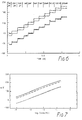
- Figure 6 shows plots of measured potential against time for respective like ion selective electrodes of the form shown in Figure 1 in samples subject to defined step changes in ion concentration, and
- Figure 7 is an electrode calibration plot.
- In the arrangement shown in Figure 1, an AgTPB applied to an
Ag wire 12, for example byMethod 2 above. An ionselective membrane 14 is then applied over the AgTPB coating and the assembly suitably encapsulated as shown at 16. - The arrangement of Figure 2 is similar but includes a
silver plate 18 in place of the silver wire of the Figure 1 embodiment. Other components are shown with the same reference numerals, primed. - In the arrangement shown in Figure 3, the Ag electrode is formed by an
Ag film 20 suitably deposited upon a plastics orceramic substrate 22. TheAgTPB coating 24 is then applied over the Ag film so as completely to cover the same. A permselective membrane 26 covers the AgTPB coating and a ring ofencapsulation material 28 is applied so as to avoid edge effects. - Utilising the structure of Figure 3, a plurality of ion selective electrodes may be formed on the same substrate using, for example, printing processes such as screen printing. A number of electrodes of the same selectivity may be incorporated to accommodate failure of any individual device or for the purpose of increasing accuracy by allowing simultaneous multiple measurement, with an appropriate statistical processing technique.
- Alternatively, one or more of the printed electrode devices may be a reference electrode against which the potential of the working ion selective half cells may be measured. The reference electrode may be of a conventional type or may preferably be constructed in the manner of an ion selective electrode with, for example, the neutral carrier of the membrane omitted so that the electrode does not respond to the ionic species of interest and serves as a reference. It will be understood that the location in this way of the reference electrode in close proximity to the selective electrode will improve, for example, common mode rejection. Alternatively, the reference electrode may be constructed as an ion selective electrode to act additionally to null electrochemical interference. For instance, in the case where the selective electrode responds both to the ionic species of interest and to an interfering species, the reference electrode may be arranged to respond to the or each interferent.
- Referring to Figure 4, a cyclic voltamogram, is shown, produced by varying the potential applied to a Ag/Ag TPB electrode and measuring the current. This demonstrates the reversibility of the electrode. The compressed form of the plot is explained by the low conductivity of the non-aqueous solvent solution of the TPB used in making the measurements (10⁻³M tetrabutyl ammonium tetraphenyl borate in 1,2-dichloroethane).
- There is shown in Figure 5 a plot of the measured potential of an Ag/Ag TPB electrode against concentration. Measurements were taken against a saturated calomel electrode using the tetrabutyl ammonium (TBA) cation as a bridge between the aqueous and non-aqueous phases. In particular, the cell can be defined as:-
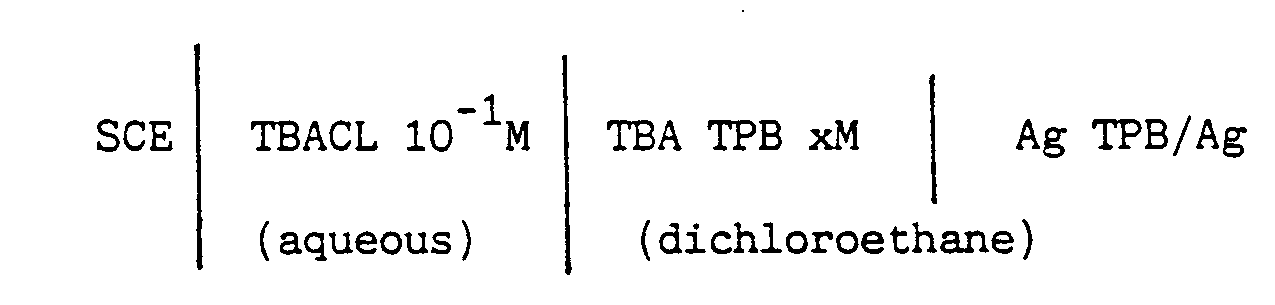
- The plot is "super-Nernstian" in that a slope of around -120mV is observed rather than -60mV as expected for a monovalent anion. This can be explained by the contribution from the activity of the TBA cation in the liquid junction equilibrium:-

- Using the structure illustrated in Figure 1 and conventional membranes, ion selective electrodes according to this invention were prepared with selectivity to potassium. A batch of like electrodes was used to measure the concentration (activity) of a sample of potassium ion, the sample being subject to step-wise concentration changes. The experimental results are plotted in Figure 6. It will be seen that the electrodes generally exhibit fast response and reasonable stability.
- Figure 7 presents the response of the same batch of electrodes in a form in which the calibration points of the electrodes can be assessed in terms of sensitivity or slope expressed in change in potential in millivolts per decade change in concentration or activity and offset expressed in millivolts.
- Ammonium, sodium, hydrogen, lithium, calcium, magnesium, nitrate, chloride, phosphate and other inorganic cation and anion selective electrodes may be constructed by coating the appropriate permselective membrane on to the Ag/AgTPB electrodes. In a similar fashion the Ag/AgTPB electrode may also be used for organic cation and anion selectivities. Electrodes based on the binding of proteins, DNA, RNA, viruses and cells to an affinity ligand incorporated into the appropriate membrane may also advantageously use the Ag/AgTPB electrode.
- This invention has been more particularly described with reference to the Ag/Ag TPB electrode and this is the preferred form. It is considered, however, that TPB electrodes could be formed with other non-noble metals. Moreover, whilst TPB has the advantage of being an anion currently used within certain ion exchanger membranes, it is considered that electrodes according to the invention can usefully be constructed using other solvent soluble anions which form an insoluble salt of a metal. Preferred metal salts other than TPB are of tetrakis (4-fluorophenyl) borate, tetrakis (4-chlorophenyl) borate, dipicrylaminate, picrate and dicarbolyl cobalate. Preferred metals in addition to silver are cadmium, cobalt, iron, lead and nickel.
Claims (10)
- An electrochemical reference element in combination with an organic liquid, comprising a metal electrode and a solid electrolyte in contact with the electrode, the electrolyte comprising a salt of an organic anion with a metal cation of the electrode, the salt being substantially insoluble in said organic liquid and the anion being soluble in said organic liquid to form an electrochemical couple.
- An element according to Claim 1, wherein said anion has a hydrophobic aromatic group.
- An element according to Claim 1, wherein said anion is selected ed from the group of aryloxyborates, i.e. anions of the general formula (ArO)₄⁻B⁺, wherein each ArO group, which may be the same or different, represents an aryloxy group having up to 20 carbon atoms, optionally substituted by one or more halogen atoms or nitro groups.
- An element according to Claim 3, wherein the aryl group Ar is phenyl or napthyl which may be substituted by one or more hydrocarbyl grops having up to 6 carbon atoms.
- An element according to Claim 4, wherein Ar is selected from phenyl and 4-halo phenyl.
- An element according to Claim 1, wherein said anion is selected from the group of hydroxy-substituted aromatic compounds.
- An element according to Claim 6, wherein said anion is selected from the group of phenols and substituted phenols and napthols and substituted napthols.
- An element according to any one of the preceding claims, wherein the metal of the electrode is selected from the group consisting of silver, cadmium, cobalt, iron, lead and nickel.
- An electrochemical reference element comprising a metal conductor coated with a tetraphenyl borate salt of said metal.
- An ion selective electrode comprising a reference element according to any one of the preceding claims with the solid electrolyte establishing contact with an ion selective membrane.
Priority Applications (1)
| Application Number | Priority Date | Filing Date | Title |
|---|---|---|---|
| AT88909793T ATE88812T1 (en) | 1987-11-24 | 1988-11-14 | ELECTROCHEMICAL ELECTRODES. |
Applications Claiming Priority (2)
| Application Number | Priority Date | Filing Date | Title |
|---|---|---|---|
| GB878727497A GB8727497D0 (en) | 1987-11-24 | 1987-11-24 | Electrochemical electrodes |
| GB8727497 | 1987-11-24 |
Publications (2)
| Publication Number | Publication Date |
|---|---|
| EP0343210A1 EP0343210A1 (en) | 1989-11-29 |
| EP0343210B1 true EP0343210B1 (en) | 1993-04-28 |
Family
ID=10627456
Family Applications (1)
| Application Number | Title | Priority Date | Filing Date |
|---|---|---|---|
| EP88909793A Expired - Lifetime EP0343210B1 (en) | 1987-11-24 | 1988-11-14 | Electrochemical electrodes |
Country Status (16)
| Country | Link |
|---|---|
| US (1) | US4995960A (en) |
| EP (1) | EP0343210B1 (en) |
| JP (1) | JPH03501519A (en) |
| AT (1) | ATE88812T1 (en) |
| AU (1) | AU613135B2 (en) |
| BR (1) | BR8807314A (en) |
| CA (1) | CA1297947C (en) |
| DE (1) | DE3880668T2 (en) |
| DK (1) | DK363189A (en) |
| FI (1) | FI893533L (en) |
| GB (1) | GB8727497D0 (en) |
| HU (1) | HU886699D0 (en) |
| NO (1) | NO892991L (en) |
| RU (1) | RU1773303C (en) |
| WO (1) | WO1989004958A1 (en) |
| ZA (1) | ZA888584B (en) |
Families Citing this family (11)
| Publication number | Priority date | Publication date | Assignee | Title |
|---|---|---|---|---|
| JPH06105236B2 (en) * | 1988-10-17 | 1994-12-21 | 株式会社堀場製作所 | Reference electrode |
| US5401377A (en) * | 1993-08-06 | 1995-03-28 | Biomedix, Inc. | Ion-selective sensor with polymeric membrane having phospholipid dispersed therein |
| JP2716361B2 (en) * | 1994-02-16 | 1998-02-18 | 株式会社アドバンス | Printed electrodes for living body |
| US5985117A (en) * | 1997-12-29 | 1999-11-16 | The Regents Of The University Of California | Ion-selective membrane sensors with mercuracarborand ionophore |
| AU4800099A (en) | 1998-07-28 | 2000-02-21 | Tokuyama Corporation | Film responsive to bicarbonate ion |
| RU2152609C1 (en) * | 1999-09-15 | 2000-07-10 | Казанский государственный технологический университет | Ion-selective electrode for heavy metal ion assessment |
| US6398931B1 (en) | 2000-01-31 | 2002-06-04 | Phoenix Electrode Company | Combination ion-selective electrode with a replaceable sensing membrane |
| US6824669B1 (en) * | 2000-02-17 | 2004-11-30 | Motorola, Inc. | Protein and peptide sensors using electrical detection methods |
| EP1469903A2 (en) | 2001-09-28 | 2004-10-27 | BioValve Technologies, Inc. | Microneedle with membrane |
| SG96665A1 (en) * | 2001-11-21 | 2003-06-16 | Environmental Technology Inst | An apparatus and method for cleaning glass substrates using a cool hydrogen flame |
| WO2005085826A1 (en) * | 2004-03-01 | 2005-09-15 | Hach Company | Reference electrode |
Family Cites Families (5)
| Publication number | Priority date | Publication date | Assignee | Title |
|---|---|---|---|---|
| US3598713A (en) * | 1969-06-03 | 1971-08-10 | Corning Glass Works | Potassium ion sensitive electrode |
| US4263343A (en) * | 1979-08-13 | 1981-04-21 | Eastman Kodak Company | Reference elements for ion-selective membrane electrodes |
| JPS5924242A (en) * | 1982-08-02 | 1984-02-07 | Terumo Corp | Reference electrode |
| US4431508A (en) * | 1982-12-10 | 1984-02-14 | Brown Jr Harold M | Solid state graphite electrode |
| EP0186210B1 (en) * | 1984-12-28 | 1992-04-22 | TERUMO KABUSHIKI KAISHA trading as TERUMO CORPORATION | Ion sensor |
-
1987
- 1987-11-24 GB GB878727497A patent/GB8727497D0/en active Pending
-
1988
- 1988-11-14 HU HU886699A patent/HU886699D0/hu unknown
- 1988-11-14 JP JP63509079A patent/JPH03501519A/en active Pending
- 1988-11-14 AU AU27860/89A patent/AU613135B2/en not_active Ceased
- 1988-11-14 EP EP88909793A patent/EP0343210B1/en not_active Expired - Lifetime
- 1988-11-14 US US07/381,665 patent/US4995960A/en not_active Expired - Fee Related
- 1988-11-14 WO PCT/GB1988/000992 patent/WO1989004958A1/en not_active Ceased
- 1988-11-14 DE DE8888909793T patent/DE3880668T2/en not_active Expired - Fee Related
- 1988-11-14 AT AT88909793T patent/ATE88812T1/en not_active IP Right Cessation
- 1988-11-14 FI FI893533A patent/FI893533L/en not_active Application Discontinuation
- 1988-11-14 BR BR888807314A patent/BR8807314A/en unknown
- 1988-11-17 ZA ZA888584A patent/ZA888584B/en unknown
- 1988-11-23 CA CA000583892A patent/CA1297947C/en not_active Expired - Lifetime
-
1989
- 1989-07-21 DK DK363189A patent/DK363189A/en not_active Application Discontinuation
- 1989-07-21 NO NO89892991A patent/NO892991L/en unknown
- 1989-07-21 RU SU894614626A patent/RU1773303C/en active
Also Published As
| Publication number | Publication date |
|---|---|
| AU613135B2 (en) | 1991-07-25 |
| FI893533A0 (en) | 1989-07-21 |
| AU2786089A (en) | 1989-06-14 |
| FI893533A7 (en) | 1989-07-21 |
| GB8727497D0 (en) | 1987-12-23 |
| CA1297947C (en) | 1992-03-24 |
| NO892991D0 (en) | 1989-07-21 |
| NO892991L (en) | 1989-07-21 |
| DE3880668T2 (en) | 1993-08-05 |
| US4995960A (en) | 1991-02-26 |
| RU1773303C (en) | 1992-10-30 |
| DK363189D0 (en) | 1989-07-21 |
| DE3880668D1 (en) | 1993-06-03 |
| EP0343210A1 (en) | 1989-11-29 |
| DK363189A (en) | 1989-07-21 |
| FI893533L (en) | 1989-07-21 |
| ZA888584B (en) | 1989-08-30 |
| JPH03501519A (en) | 1991-04-04 |
| HU886699D0 (en) | 1990-03-28 |
| WO1989004958A1 (en) | 1989-06-01 |
| BR8807314A (en) | 1990-03-01 |
| ATE88812T1 (en) | 1993-05-15 |
Similar Documents
| Publication | Publication Date | Title |
|---|---|---|
| EP2075574B1 (en) | Reference electrode coated with ionic liquid, and electrochemical measurement system using the reference electrode | |
| US6793789B2 (en) | Reference electrode with a polymeric reference electrode membrane | |
| EP0551769B1 (en) | Graphite base solid state polymeric membrane ion-selective electrodes | |
| US4995960A (en) | Electrochemical electrodes | |
| JP3751026B2 (en) | Analysis cell | |
| US3598713A (en) | Potassium ion sensitive electrode | |
| JP3135956B2 (en) | Solid contact, potential difference sensor device using the same, and method using sensor device | |
| Górski et al. | Fluoride-selective polymeric membrane electrodes based on Zr (IV)-and Al (III)-salen ionophores of various structures | |
| Knoll et al. | Microfibre matrix-supported ion-selective PVC membranes | |
| EP0024192A1 (en) | Silver/silver halide electrodes and process for preparing same | |
| US7083709B2 (en) | Potentiometric, ion-selective electrode | |
| Saleh | Iron (III) ionophores based on formylsalicylic acid derivatives as sensors for ion-selective electrodes | |
| US4083764A (en) | Ion-selective electrode | |
| Khaled et al. | Towards disposable sensors for drug quality control: Dextromethorphan screen‐printed electrodes | |
| Xu et al. | An all-solid-state screen-printed carbon paste reference electrode based on poly (3, 4-ethylenedioxythiophene) as solid contact transducer | |
| Rechnitz | MECHANISTIC ASPECTS OF ION-SELECTIVE MEMBRANE ELECTRODES. A SUBJECTIVE VIEW | |
| Nil et al. | EP-A-0 024 191" Carefree" Rivermead EP-A-0 186 210 Idmiston Salisbury (GB) | |
| JPH0410985B2 (en) | ||
| Issa et al. | Construction and analytical applications of plastic membrane electrodes for oxytetracycline hydrochloride | |
| Wuthier et al. | Electromotive behaviour of anion selective membranes with triorganotin acetates as ionophores and nucleophiles as additives | |
| Atkinson | An evaluation and comparison of cross-sensitivities of various different types of screen printed Ag/AgCl reference electrodes | |
| WO2025214327A1 (en) | Dry film self-calibration sensing device and method for measuring concentration of analyte by dry film self-calibration sensing device | |
| CA1093641A (en) | Ion-selective electrode | |
| KR0155038B1 (en) | Ion selective membrane and its manufacturing method | |
| JPH037263B2 (en) |
Legal Events
| Date | Code | Title | Description |
|---|---|---|---|
| PUAI | Public reference made under article 153(3) epc to a published international application that has entered the european phase |
Free format text: ORIGINAL CODE: 0009012 |
|
| AK | Designated contracting states |
Kind code of ref document: A1 Designated state(s): AT BE CH DE FR GB IT LI LU NL SE |
|
| 17P | Request for examination filed |
Effective date: 19890715 |
|
| 17Q | First examination report despatched |
Effective date: 19910808 |
|
| GRAA | (expected) grant |
Free format text: ORIGINAL CODE: 0009210 |
|
| AK | Designated contracting states |
Kind code of ref document: B1 Designated state(s): AT BE CH DE FR GB IT LI LU NL SE |
|
| REF | Corresponds to: |
Ref document number: 88812 Country of ref document: AT Date of ref document: 19930515 Kind code of ref document: T |
|
| ITF | It: translation for a ep patent filed | ||
| REF | Corresponds to: |
Ref document number: 3880668 Country of ref document: DE Date of ref document: 19930603 |
|
| ET | Fr: translation filed | ||
| PGFP | Annual fee paid to national office [announced via postgrant information from national office to epo] |
Ref country code: GB Payment date: 19931103 Year of fee payment: 6 |
|
| PGFP | Annual fee paid to national office [announced via postgrant information from national office to epo] |
Ref country code: SE Payment date: 19931108 Year of fee payment: 6 Ref country code: CH Payment date: 19931108 Year of fee payment: 6 |
|
| PGFP | Annual fee paid to national office [announced via postgrant information from national office to epo] |
Ref country code: BE Payment date: 19931112 Year of fee payment: 6 |
|
| PGFP | Annual fee paid to national office [announced via postgrant information from national office to epo] |
Ref country code: AT Payment date: 19931123 Year of fee payment: 6 |
|
| PGFP | Annual fee paid to national office [announced via postgrant information from national office to epo] |
Ref country code: FR Payment date: 19931125 Year of fee payment: 6 |
|
| PG25 | Lapsed in a contracting state [announced via postgrant information from national office to epo] |
Ref country code: LU Free format text: LAPSE BECAUSE OF NON-PAYMENT OF DUE FEES Effective date: 19931130 |
|
| PGFP | Annual fee paid to national office [announced via postgrant information from national office to epo] |
Ref country code: NL Payment date: 19931130 Year of fee payment: 6 |
|
| PGFP | Annual fee paid to national office [announced via postgrant information from national office to epo] |
Ref country code: DE Payment date: 19931230 Year of fee payment: 6 |
|
| PLBE | No opposition filed within time limit |
Free format text: ORIGINAL CODE: 0009261 |
|
| STAA | Information on the status of an ep patent application or granted ep patent |
Free format text: STATUS: NO OPPOSITION FILED WITHIN TIME LIMIT |
|
| 26N | No opposition filed | ||
| PG25 | Lapsed in a contracting state [announced via postgrant information from national office to epo] |
Ref country code: GB Effective date: 19941114 Ref country code: AT Effective date: 19941114 |
|
| PG25 | Lapsed in a contracting state [announced via postgrant information from national office to epo] |
Ref country code: SE Effective date: 19941115 |
|
| PG25 | Lapsed in a contracting state [announced via postgrant information from national office to epo] |
Ref country code: LI Effective date: 19941130 Ref country code: CH Effective date: 19941130 Ref country code: BE Effective date: 19941130 |
|
| EAL | Se: european patent in force in sweden |
Ref document number: 88909793.7 |
|
| BERE | Be: lapsed |
Owner name: THE PUBLIC HEALTH LABORATORY SERVICE BOARD Effective date: 19941130 |
|
| PG25 | Lapsed in a contracting state [announced via postgrant information from national office to epo] |
Ref country code: NL Effective date: 19950601 |
|
| GBPC | Gb: european patent ceased through non-payment of renewal fee |
Effective date: 19941114 |
|
| NLV4 | Nl: lapsed or anulled due to non-payment of the annual fee | ||
| PG25 | Lapsed in a contracting state [announced via postgrant information from national office to epo] |
Ref country code: FR Effective date: 19950731 |
|
| REG | Reference to a national code |
Ref country code: CH Ref legal event code: PL |
|
| PG25 | Lapsed in a contracting state [announced via postgrant information from national office to epo] |
Ref country code: DE Effective date: 19950801 |
|
| EUG | Se: european patent has lapsed |
Ref document number: 88909793.7 |
|
| REG | Reference to a national code |
Ref country code: FR Ref legal event code: ST |
|
| REG | Reference to a national code |
Ref country code: FR Ref legal event code: TP |
|
| PG25 | Lapsed in a contracting state [announced via postgrant information from national office to epo] |
Ref country code: IT Free format text: LAPSE BECAUSE OF NON-PAYMENT OF DUE FEES;WARNING: LAPSES OF ITALIAN PATENTS WITH EFFECTIVE DATE BEFORE 2007 MAY HAVE OCCURRED AT ANY TIME BEFORE 2007. THE CORRECT EFFECTIVE DATE MAY BE DIFFERENT FROM THE ONE RECORDED. Effective date: 20051114 |