EP0342764A1 - Systemnachrichtenverarbeiter in einem Datenverarbeitunssystem - Google Patents
Systemnachrichtenverarbeiter in einem Datenverarbeitunssystem Download PDFInfo
- Publication number
- EP0342764A1 EP0342764A1 EP89201282A EP89201282A EP0342764A1 EP 0342764 A1 EP0342764 A1 EP 0342764A1 EP 89201282 A EP89201282 A EP 89201282A EP 89201282 A EP89201282 A EP 89201282A EP 0342764 A1 EP0342764 A1 EP 0342764A1
- Authority
- EP
- European Patent Office
- Prior art keywords
- module
- message
- modules
- channel
- data processing
- Prior art date
- Legal status (The legal status is an assumption and is not a legal conclusion. Google has not performed a legal analysis and makes no representation as to the accuracy of the status listed.)
- Withdrawn
Links
Images

Classifications
-
- G—PHYSICS
- G06—COMPUTING OR CALCULATING; COUNTING
- G06F—ELECTRIC DIGITAL DATA PROCESSING
- G06F15/00—Digital computers in general; Data processing equipment in general
- G06F15/16—Combinations of two or more digital computers each having at least an arithmetic unit, a program unit and a register, e.g. for a simultaneous processing of several programs
- G06F15/177—Initialisation or configuration control
-
- G—PHYSICS
- G06—COMPUTING OR CALCULATING; COUNTING
- G06F—ELECTRIC DIGITAL DATA PROCESSING
- G06F15/00—Digital computers in general; Data processing equipment in general
- G06F15/16—Combinations of two or more digital computers each having at least an arithmetic unit, a program unit and a register, e.g. for a simultaneous processing of several programs
- G06F15/161—Computing infrastructure, e.g. computer clusters, blade chassis or hardware partitioning
Definitions
- the invention relates to a data processing system, comprising a number of modules communicating messages to each other with the help of a system message handler.
- the aim of the invention is now to provide a flexible system architecture for a data processing system comprising a number of mutually communicating modules.
- a data processing system comprising a number of modules, each having enough processing capabilities to perform a predetermined application task, which modules are able to communicate with each other through unidirectional channels using mailboxes, one in each module destined to receive message transmitted via said unidirectional channels, one of said modules functioning as system message handler the application task of which is to provide at request of each module the data necessary to enable the requesting module to open a channel to another module and to transfer a message via the opened channel to said other module, whereby each module incorporates at least communication functions for opening a channel to another module, transferring a message via the opened channel to said other module and closing the used channel.
- the functions of the centralized communications handling unit are distributed over the various modules of the system such, that each module has the capability of transferring a message directly to any other module
- the system message handler mainly functions as communication data source and module responding to error messages.
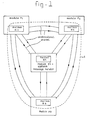
- FIG. 1 illustrates in a very schematical way a system in which the invention can be brought into practice.
- the system can be considered as a complete collection of hardware and software, the purpose of which will not be specified because specification thereof is irrelevant in view of the underlying invention.
- the system comprises a number of modules, four of which are shown in figure 1, referred to as module P1 ....P4.
- Each module can be considered as a complete software and/or hardware entity.
- each module is able to communicate with any other module in the system by means of a bus structure interconnecting all these modules.
- the actual configuration of this bus structure is irrelevant for the invention and therefore will not be explained in detail.
- Any prior art bus structure can be used as long as it provides the possibility for every module to communicate with any other module.
- the way in which the communication is established forms part of the invention and will be described in detail hereinafter.
- each of the modules P1 .... P4 of the system in figure 1 should have the possibility to communicate with any other module in the system.
- each module has a mailbox, indicated by the references M1 .... M4 in figure 1 and incorporated in the respective modules p1 .... P4.
- a communication channel for every module who wants to transfer a message to one of the other modules.
- a number of channels can be created running from one specific module to another specific module and destined for the transfer of one message between those two modules. In figure 1 these unidirectional channels are shown. The way in which these channels are temporarily created specifically for the transfer of one message, will be described in more detail in the following description.
- any module should have the possibility to create a channel directly to any other module. That would imply that any module should incorporate a memory with the complete system configuration data, because only than a module has the power to open a channel to any other module. Such a solution is considered very impracticable. Therefore one of the modules is given the specific task to coordinate the transfer of messages between the various other modules on the basis of the complete configuration data.
- This module, module P4 in figure 1 is named as the system message handler.
- the system message handler, module P4 provides at request of the other modules any information necessary to establish a direct connection between the requesting module and a specific other module. The way in which a message is transferred between a first module and a second module will be described the following.
- a mailbox is created in each of the modules P1 .... P4. These mailboxes are destined only to receive messages from other modules, i.e. they fulfil a buffer function between the channel, through wich a message is received and which channel is controlled by the sending module and the receiving module to which the mailbox belongs.
- a mailbox Once a mailbox is created, it can he opened by any other module.
- the name of the mailbox is not important. It is only important that all users of a mailbox (all other modules) know of the same name.
- the volume of a mailbox is a variable parameter providing the possibility to receive messages with variable length or to receive a number of messages in a row, which will be stacked in a predetermined order in the mailbox.
- a parameter can be given that will indicate the probable maximum number of messages at any one time. This said maximum number of messages is unaffected by the number of subsequent attempts to open the mailbox for writing a message.
- the ident_string will be of limited length in a practical embodiment. In many cases only the first 6 chars will be considered valid and all identstrings will have to be unique within the first 6 chars. Other embodiments, however, can use other numbers of characters depending onto the configuration of the system. If the channel or mailbox cannot be created or opened for any reason then an error indicator will be returned, otherwise an identifier to a channel will be returned.
- a buffer for writing a message may be assigned to the mailbox.
- the assigned buffer will be given a predetermined length and a priority.
- Write operations in the mailbox will be indivisible, i.e. when more than one module wishes to write to the same mailbox only one will succeed at any one time. The others will be suspended. If the length of the message is greater than the maximum system length than an error will be returned.
- the number of priority levels can be selected arbitrarily, but in practical embodiments a restriction depending onto the system configuration will be taken into account.
- an indicator will be returned indicating no error.
- the sending module does not wait until the receiving module has read the message. I.e. transfer into a memory in the receiving module is considered sufficient assurance of proper reception.
- the sending module will quarantee that the buffer in the receiving module is long enough for the mailbox to read the number of bytes indicated.
- any subsequent attempt to re-open the same channel will not necessarily return the same channel number, i.e. the channel number is only a temporary link between a token (ident_string) and the real channel.
- the sending module will be stopped. This will also be true should the sending module wishes to send a high-priority message. Therewith it is guaranteed that what is sent to a mailbox will be recieved therein. No internal congestion control will be necessary and no message will be lost.
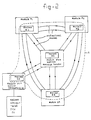
- Figure 2 illustrates the same system as in figure 1, however, expanded with another module P5 functioning as a system representative, having acces to a memory file F1 comprising all the necessary address information and further details of the configuration and necessary to specify and define all the various components of the system.
- module P5 starts to read the memory file F1. Thereafter, or simultaneous with the reading process all the data necessary to built up a communication path between any two modules is transferred from the system representative module P5 to the system message handler module P4. After completion of this procedure the system message handler is able to provide details on request to any of the other modules.
- module P1 like to transfer a message to module P2 then he first of all has to know the unique address of module P2. The only thing he knows, however, is the address of the system message handler and therefore he opens a channel to the system message handler and sends a data request to module P4. In response thereto the system message handler module P4 sends the necessary details to the mailbox of module P1 enabling module P1 thereby to open directly a channel to module P2 to transfer of this message.
- the configuration data necessary to reach module P2 will be stored within module P1 so that for any further attempt from module P1 to sent a message to module P2 no data request to the system message handler module P4 will be necessary.
- each module has sufficient memory available, gradually during the operation of the whole system each of the modules will obtain enough configuration information to be able to built up communication channels to any other module without the assistence of the system message handler. In that stage the system message handler only functions as a central module receiving eventual error codes and taking the necessary steps to respond to these error codes.
- any module of system 1 sends a message to any module in system 2 by opening a channel to his own system message handler, which in turn will open a channel to the system message handler of the other system and from there to the module of destination.
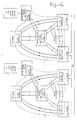
- FIG. 4 illustrates another way of coupling two systems according to the invention.
- the systems are again referred to as system 1 and system 2.
- One of the modules of system 1 is connected to a Local Area Network, abreviated in figure 4 as LAN.
- LAN Local Area Network
- one of the modules of system 2 is connected to the LAN. If it is assumed that the applications runnning in both LAN connected modules are able to transfer messages through the LAN then an effective coupling between both systems is created.
Landscapes
- Engineering & Computer Science (AREA)
- Computer Hardware Design (AREA)
- Theoretical Computer Science (AREA)
- Physics & Mathematics (AREA)
- General Engineering & Computer Science (AREA)
- Software Systems (AREA)
- General Physics & Mathematics (AREA)
- Mathematical Physics (AREA)
- Data Exchanges In Wide-Area Networks (AREA)
- Computer And Data Communications (AREA)
Applications Claiming Priority (2)
| Application Number | Priority Date | Filing Date | Title |
|---|---|---|---|
| NL8801320 | 1988-05-20 | ||
| NL8801320A NL8801320A (nl) | 1988-05-20 | 1988-05-20 | Systeemboodschapbehandelingseenheid in een dataverwerkend stelsel. |
Publications (1)
| Publication Number | Publication Date |
|---|---|
| EP0342764A1 true EP0342764A1 (de) | 1989-11-23 |
Family
ID=19852335
Family Applications (1)
| Application Number | Title | Priority Date | Filing Date |
|---|---|---|---|
| EP89201282A Withdrawn EP0342764A1 (de) | 1988-05-20 | 1989-05-19 | Systemnachrichtenverarbeiter in einem Datenverarbeitunssystem |
Country Status (2)
| Country | Link |
|---|---|
| EP (1) | EP0342764A1 (de) |
| NL (1) | NL8801320A (de) |
Citations (4)
| Publication number | Priority date | Publication date | Assignee | Title |
|---|---|---|---|---|
| EP0201063A2 (de) * | 1985-05-06 | 1986-11-12 | Computer X, Inc. | Methode zur Lokalisierung von Prozessen in einem verteilten Datenverarbeitungssystem |
| US4642758A (en) * | 1984-07-16 | 1987-02-10 | At&T Bell Laboratories | File transfer scheduling arrangement |
| EP0221360A2 (de) * | 1985-11-04 | 1987-05-13 | International Business Machines Corporation | Digitale Nachrichtenübertragungsnetzwerke und Aufbau von Übertragungswegen in diesen Netzwerken |
| EP0270680A1 (de) * | 1986-05-21 | 1988-06-15 | Fanuc Ltd. | Urladungssystem in einem mehrprozessorsystem |
-
1988
- 1988-05-20 NL NL8801320A patent/NL8801320A/nl not_active Application Discontinuation
-
1989
- 1989-05-19 EP EP89201282A patent/EP0342764A1/de not_active Withdrawn
Patent Citations (4)
| Publication number | Priority date | Publication date | Assignee | Title |
|---|---|---|---|---|
| US4642758A (en) * | 1984-07-16 | 1987-02-10 | At&T Bell Laboratories | File transfer scheduling arrangement |
| EP0201063A2 (de) * | 1985-05-06 | 1986-11-12 | Computer X, Inc. | Methode zur Lokalisierung von Prozessen in einem verteilten Datenverarbeitungssystem |
| EP0221360A2 (de) * | 1985-11-04 | 1987-05-13 | International Business Machines Corporation | Digitale Nachrichtenübertragungsnetzwerke und Aufbau von Übertragungswegen in diesen Netzwerken |
| EP0270680A1 (de) * | 1986-05-21 | 1988-06-15 | Fanuc Ltd. | Urladungssystem in einem mehrprozessorsystem |
Non-Patent Citations (2)
| Title |
|---|
| COLLOQUE INTERNATIONAL DE COMMUTATION, Paris, 7th - 11th May 1979, pages 834-839; C. DURET: "Réseau de connexion à structure nodale" * |
| ELEKTRONIK, vol. 33, no. 21, 19 october 1984, pages 229-232, Munich, DE; W. KESSEL et al.: "Multi-mikrocomputer-konzept mit mailbox-schnittstellen" * |
Also Published As
| Publication number | Publication date |
|---|---|
| NL8801320A (nl) | 1989-12-18 |
Similar Documents
| Publication | Publication Date | Title |
|---|---|---|
| US4354263A (en) | Computer-communications concentrator for transmission and switching of packetized data | |
| US4942552A (en) | Method and apparatus for saving and performing industrial control commands | |
| EP0062347B1 (de) | Verfahren und System zur Nachrichtenübertragung | |
| US4811009A (en) | Transmission control system | |
| EP0160263A2 (de) | Verteilte Steuerung der Verwendung von logischen Namen in Netzwerken | |
| EP0462542A2 (de) | Verfahren und Gerät zur Adressenverwaltung der Send- und Empfangsnachrichten | |
| US5031174A (en) | Node device | |
| US5408610A (en) | Communication control apparatus which communicates management information in a communication system | |
| US5915092A (en) | Communications control system for transferring commands/status data in batch between processors utilizing transmitting processor's command activation order and receiving processor's access control | |
| US5729755A (en) | Process for transmitting data in a data processing system with distributed computer nodes, communicating via a serial data bus, between which data messages are exchanged, tested for acceptance in a computer node, and stored temporarily | |
| US5168496A (en) | System for internetwork communication between local areas networks | |
| US5408468A (en) | Queueing system for switches having fast circuit properties | |
| US6012117A (en) | Methods and apparatus for arbitrating and controlling arbitration for access to a serial bus | |
| JP2002521942A (ja) | メモリ装置およびメモリ装置の作動方法 | |
| EP0342764A1 (de) | Systemnachrichtenverarbeiter in einem Datenverarbeitunssystem | |
| CA1270960A (en) | Non coded information and companion data switching mechanism | |
| JPS60149239A (ja) | 通信ネツトワ−クシステム | |
| US6359890B1 (en) | Re-connection method for communication network system | |
| US4251684A (en) | Data storage systems | |
| JP3044653B2 (ja) | ゲートウェイ装置 | |
| US4860250A (en) | Data packet shortening method and device | |
| CA1107401A (en) | Data storage systems | |
| JP3339442B2 (ja) | 通信処理システムネットワーク | |
| US6810430B1 (en) | Network communications coupler | |
| JPS62234441A (ja) | 通信情報中継方式 |
Legal Events
| Date | Code | Title | Description |
|---|---|---|---|
| PUAI | Public reference made under article 153(3) epc to a published international application that has entered the european phase |
Free format text: ORIGINAL CODE: 0009012 |
|
| AK | Designated contracting states |
Kind code of ref document: A1 Designated state(s): AT BE CH DE ES FR GB GR IT LI LU NL SE |
|
| 17P | Request for examination filed |
Effective date: 19900516 |
|
| STAA | Information on the status of an ep patent application or granted ep patent |
Free format text: STATUS: THE APPLICATION HAS BEEN WITHDRAWN |
|
| 18W | Application withdrawn |
Withdrawal date: 19910514 |
|
| R18W | Application withdrawn (corrected) |
Effective date: 19910514 |