EP0342630A2 - Spracherkennung mit Sprecheranpassung durch Lernprozess - Google Patents
Spracherkennung mit Sprecheranpassung durch Lernprozess Download PDFInfo
- Publication number
- EP0342630A2 EP0342630A2 EP89108844A EP89108844A EP0342630A2 EP 0342630 A2 EP0342630 A2 EP 0342630A2 EP 89108844 A EP89108844 A EP 89108844A EP 89108844 A EP89108844 A EP 89108844A EP 0342630 A2 EP0342630 A2 EP 0342630A2
- Authority
- EP
- European Patent Office
- Prior art keywords
- pattern
- speech
- neural network
- normalized
- reference pattern
- Prior art date
- Legal status (The legal status is an assumption and is not a legal conclusion. Google has not performed a legal analysis and makes no representation as to the accuracy of the status listed.)
- Granted
Links
- 230000006978 adaptation Effects 0.000 title abstract description 14
- 238000012549 training Methods 0.000 claims abstract description 50
- 238000013528 artificial neural network Methods 0.000 claims description 47
- 230000007935 neutral effect Effects 0.000 claims 1
- 238000006243 chemical reaction Methods 0.000 abstract description 6
- 239000013598 vector Substances 0.000 description 37
- 238000000034 method Methods 0.000 description 16
- 239000010410 layer Substances 0.000 description 12
- 241000894007 species Species 0.000 description 8
- 238000013139 quantization Methods 0.000 description 6
- 238000010586 diagram Methods 0.000 description 5
- 238000007796 conventional method Methods 0.000 description 2
- 238000012935 Averaging Methods 0.000 description 1
- 238000004458 analytical method Methods 0.000 description 1
- 238000004364 calculation method Methods 0.000 description 1
- 230000008859 change Effects 0.000 description 1
- 238000007906 compression Methods 0.000 description 1
- 238000002474 experimental method Methods 0.000 description 1
- 230000006870 function Effects 0.000 description 1
- 238000004519 manufacturing process Methods 0.000 description 1
- 238000012986 modification Methods 0.000 description 1
- 230000004048 modification Effects 0.000 description 1
- 230000008569 process Effects 0.000 description 1
- 238000012545 processing Methods 0.000 description 1
- 230000009467 reduction Effects 0.000 description 1
- 239000002356 single layer Substances 0.000 description 1
Images


Classifications
-
- G—PHYSICS
- G10—MUSICAL INSTRUMENTS; ACOUSTICS
- G10L—SPEECH ANALYSIS TECHNIQUES OR SPEECH SYNTHESIS; SPEECH RECOGNITION; SPEECH OR VOICE PROCESSING TECHNIQUES; SPEECH OR AUDIO CODING OR DECODING
- G10L15/00—Speech recognition
- G10L15/06—Creation of reference templates; Training of speech recognition systems, e.g. adaptation to the characteristics of the speaker's voice
- G10L15/065—Adaptation
- G10L15/07—Adaptation to the speaker
Definitions
- the present invention relates to speech recognition apparatus of the speaker adaptation type in which the speech recognition apparatus can be adaptable to different speakers and different circumstances.
- the reference pattern when recognizing speech of a particular person different than the speaker used to make the reference pattern (hereinafter, referred to as "particular speaker"), the reference pattern has to be adapted to voice of the particular speaker so as to obtain the high recognition performance, because the speech pattern depends on the particular speaker. Further, when recognizing speech produced in various magnitudes of background noise or transmitted through telephone line, the speech pattern may be considerably deformed to thereby necessitate modification of the reference pattern.
- the invention will be described mainly in connection with the case of recognizing the speech of particular speaker, but the invention can be applied to the recognition of speech produced in different circumstrances.
- the particular speaker when adapting the speech recognition apparatus to the particular speaker, the particular speaker is previously required to orally produce all of the words to be recognized, and the reference pattern is modified according to the orally produced words.
- the particular speaker when the vocabulary of words to be recognized is rather large, the particular speaker is needed laborious work to orally produce all of the words contained in the recog- nizeable vocabulary.
- a codebook for the vector quantization is generated from speech pattern of a reference speaker having standard voice (hereinafter, this codebook is called “the reference codebook”), and then the speech pattern is vector-quantized by using the reference codebook to generate the reference pattern.
- the reference codebook is normalized to generate a normalized codebook by using speech pattern of sample words provisionally produced by the particular speaker and selected from the vocabulary to be recognized (hereinafter, this speech pattern is called "training pattern").
- the speech of particular speaker can be recognized by using this normalized codebook in place of the reference codebook without modifying the vector-quantized reference pattern. Namely, even if the vocabulary to be recognized is extensive, the speech recognition apparatus can be adapted to the particular speaker by having the particular speaker to provisionally produce part of the vocabulary without producing all of the words belonging to the vocabulary.
- a training codebook is generated according to the training pattern, and then the training pattern is vector-quantized by using the training codebook. Subsequently, the reference pattern and the training pattern are compared to each other to find the correspondence with respect to the same word in terms of the time-coordinate by using the DP matching.
- the frequency of code vectors in the training codebook (hereinafter, this code vectors are called "training code vectors") made correspondence to a given code vector in the reference codebook (hereinafter, this code vector is called "reference code vector”) is stored in the form of histogram.
- the normalized codebook is obtained by weighting the training code vectors made correspondence to each reference code vector according to their frequencies in the histogram and by averaging the weighted training code vectors.
- the variation of speech pattern in different speakers and different circumstances depends on influences due to preceding and succeeding phoneme, that is phonetic environment. Therefore, the conventional conversion method based on one-by-one processing of an individual vector at a given point of the time-coordinate cannot evaluate the influences from the phonetic environment, and therefore cannot carry out the proper conversion.
- An object of the present invention is to, therefore, realize the speaker adaptation method of high performance which can eliminate the quantization error and can evaluate the influences of the phonetic environment.
- the speech recognition apparatus of the speaker adaptation type comprises: a reference pattern memory unit for storing reference pattern representative of typical or standard speech pattern; a neuron-like or neural network unit for converting the reference pattern into normalized pattern; a recognition unit for recognizing input pattern representative of inputted speech pattern by using the normalized pattern; a time-coordinate matching unit operative when learning the neural network unit for making correspondence between time-coordinate of inputted training pattern and time-coordinate of the reference pattern; and a learning control unit for controlling the learning of neural network unit by using the training pattern at time points made correspondence to the time-coordinate of reference pattern as a teaching signal effective to generate the normalized pattern when the reference pattern is inputted into the neural network unit.
- the speech recognition apparatus of speaker adaptation type comprises: a reference pattern memory unit for storing reference pattern representative of typical or standard speech pattern; a neural network unit for converting input pattern representative of inputted speech pattern into normalized speech pattern: a recognition unit for recognizing the normalized speech pattern by using the reference pattern; a time-coordinate matching unit operative when learning the neural network unit for making correspondence between time-coordinate of inputted training pattern and time-coordinate of the reference pattern; a learning control unit for controlling the learning of the neural network unit by utilizing the reference pattern at time points to which the time-coordinate of training pattern is made correspondence, as a teaching signal effective to generate normalized pattern when the training pattern is inputted into the neural network unit.
- the speech recognition apparatus of speaker adaptation further comprises, in addition to the components of first species, a normalized pattern memory unit for storing the normalized pattern.
- the speech recognition apparatus of speaker adaptation type further comprises, in addition to the components of first, second or third species, a read-out control unit for providing speech pattern at time points adjacent to the time point corresponding to the teaching signal for the input of neural network unit during the training thereof.
- the speech recognition apparatus of speaker adaptation type according to the first species of invention operates to convert the reference pattern generated according to the voice of standard speaker into the normalized pattern of particular speaker by means of the neural network unit, and to recognize the speech of particular speaker according to the normalized pattern.
- the speech recognition apparatus of speaker adaptation type according to the second species of the invention operates to convert speech inputted by a particular speaker into speech pattern of the standard speaker by means of the neural network unit, and to recognize the converted speech pattern according to the reference pattern of the standard speaker.
- the used neural network unit can be comprised of a neuron-like network of the pattern association type described, for example, in the report from Computer Science Department of Carnegie-Mellon University, "Experiments on Learning by Back Propagation” by David C. Plant etc., June 1986 (hereinafter, referred to as "reference 3").
- Fig. 1 of the drawing of the present application shows structure of the neural network.
- the neural network has multi-layer structure of an input layer, an intermediate layer and an output layer.
- the intermediate layer is composed of a single layer as shown in the figure, but may be composed of two or more layers.
- the intermediate layer may be eliminated.
- an output of an individual node is obtained by converting, through a nonlinear function, the total value of outputs fed from preceding nodes connected to the individual node and multiplied by weight W.
- the conversion characteristic of neural network is determined by the weight W.
- the value of weight W can be determined by learning.
- the speech pattern is obtained by analyzing inputted speech.
- Various known analyzing methods may be utilized such as Cepstram analysis.
- a feature ventor (i) represented in the formula (1) is converted into normalized or adapted feature vector (i) by using the neural network. Namely, when each element a (i,p) of the feature vector (i) is inputted into each node (total number is P) of the input layer, each node of the intermediate and output layers calculates its output and each node (total number is P) of the output layer outputs value of each element a (i,p) of the adapted feature vector (i).
- a single feature vector (i) is applied to the input layer in the above described embodiment; however, a plurality of feature vectors (k) (i-ei ⁇ k ⁇ i +e 2 , e 1 ,e 2 is a given integer) arranged in the vicinity of the time point i can be provided concurrently to the input layer.
- a plurality of feature vectors (k) i-ei ⁇ k ⁇ i +e 2 , e 1 ,e 2 is a given integer
- This speech pattern B represents, for example, the same word orally produced by a particular speaker different than the speaker who produces the speech pattern A.
- the first step is to find correspondence between the time-coordinate of speech pattern A and the time-coordinate of speech pattern B.
- a table j(i) which designates frame j of the speech pattern B corresponding to frame i of the speech pattern A is determined by DP matching in similar manner as described in the reference 2. Further, this matching of time-coordinate can be carried out by small amount of calculation according to the linear expansion and compression process. Namely, the correspondence of time-coordinate can be found according to the following relation:
- the neural network is provided at its input nodes with the speech pattern vector (i), and the neural network learns the internal parameter thereof so as to provide an optimum output similar to corresponding speech pattern vector
- This learning is carried out by using back propagation method detailedly described in the reference 3. At this time, a reasonable amount of training speech patterns are repeatedly provided so as to carry out the learning.
- FIG. 2 is a structural diagram showing the first embodiment of the invention.
- a neural network unit 10 learns its internal parameters.
- a reference pattern which is produced by the standard speaker is prestored in a reference pattern memory unit 11.
- sample speech pattern of a particular speaker or user is stored into a training pattern memory unit 12.
- This training pattern is representative of speech pattern which is composed of words constituting a part of (or whole of) the reference pattern.
- a time-coordinate matching unit 13 operates to find correspondence of the time-coordinate between reference pattern A read out from the reference pattern memory unit 11 and training pattern B read out from the training pattern memory unit 12 for the same word by means of the DP matching method so as to determine characteristic vector
- a learning control unit 14 operates when receiving the characteristic vector
- the learning or training control unit 14 controls the neural network unit 10 by using the characteristic vector
- This learning algorithm uses the back propagation described detailedly in the reference 3.
- the above described learning operation is carried out repeatedly for all of the training patterns B so as to continue the learning of internal parameter in the neural network unit 10.
- all of the reference patterns A stored in the reference pattern memory unit 11 are converted by the neural network unit 11 into adapted or normalized patterns A which are stored in a normalized pattern memory unit 16, to thereby complete the learning phase.
- inputted speech pattern X of the particular speaker is recognized by a recognition unit 17 based on the normalized pattern A stored in the normalized pattern memory unit 16 so as to output the result R.
- the recognition method may utilize, for example, the DP matching described in the reference 1. Since the normalized pattern A is already adapted to the particular speaker, no specific process is needed during the recognition of speech of the particular speaker.
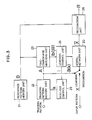
- Fig. 3 is a structural diagram showing the second embodiment.
- a neural network unit 20 learns its internal parameter.
- a reference pattern memory unit 21 is prestored with reference patterns produced according to speech of the standard speaker.
- a training pattern memory unit 22 is written with speech pattern of the particular speaker or user (training pattern). This training pattern is speech pattern composed of words which constitute a part of (or whole of) the reference pattern.
- a time-coordinate matching unit 23 operates to find correspondence of the time-coordinate between reference pattern B read out from the reference pattern memory unit 21 and training pattern A read out from the training pattern memory unit 22 for the same word by using the DP matching so as to determine characteristic vector
- a learning or training control unit 24 operates when the characteristic vector lb (j(i)) is inputted thereinto to output frame number data i to a read-out control unit 25.
- the read-out control unit 25 outputs a control signal representative of data k (i-e ⁇ k ⁇ i+e) effective to enable the training pattern memory unit 22 to output vectors (k) of the training pattern A in vicinity of the frame number i.
- this training pattern vectors (k) (i-e ⁇ k ⁇ + e) are inputted into the neural network unit 20, the training control unit 24 controls the neural network unit 20 to carry out the learning to update the internal parameter thereof by using the characteristic vector
- This learning algorithm utilizes the back propagation described detailedly in the reference 3.
- the above described learning operation is carried out repeatedly for all of the training patterns A to continue the learning of internal parameter in the neural network unit 20.
- the training or learning phase is finished.
- inputted speech pattern X of the particular speaker is fed to the neural network unit 20 and converted into normalized speech pattern X.
- the normalized speech pattern X is recognized by a recognition unit 26 based on the reference pattern B stored in the reference pattern memory unit 21 to thereby output the result R.
- the recognition method may utilize, for example, the DP matching described in the reference 1.
- the inputted speech pattern must be converted through the neural network unit during the recognition operation; however, it is not necessary to re-convert the reference pattern even when the reference pattern has been modified due to, for example, change of the vocabulary to be recognized. Accordingly, this embodiment is advantageous when the recognizable vocabulary is frequently changed.
- a high performance speech recognition apparatus of the speaker adaptation can be realized in which the apparatus can be adapted to a new speaker and new circumstance with a relatively small amount of sample speech for adaptation.
Landscapes
- Engineering & Computer Science (AREA)
- Artificial Intelligence (AREA)
- Computational Linguistics (AREA)
- Health & Medical Sciences (AREA)
- Audiology, Speech & Language Pathology (AREA)
- Human Computer Interaction (AREA)
- Physics & Mathematics (AREA)
- Acoustics & Sound (AREA)
- Multimedia (AREA)
- Image Analysis (AREA)
- Character Discrimination (AREA)
Applications Claiming Priority (2)
| Application Number | Priority Date | Filing Date | Title |
|---|---|---|---|
| JP63122559A JP2733955B2 (ja) | 1988-05-18 | 1988-05-18 | 適応型音声認識装置 |
| JP122559/88 | 1988-05-18 |
Publications (3)
| Publication Number | Publication Date |
|---|---|
| EP0342630A2 true EP0342630A2 (de) | 1989-11-23 |
| EP0342630A3 EP0342630A3 (en) | 1990-03-07 |
| EP0342630B1 EP0342630B1 (de) | 1994-01-19 |
Family
ID=14838890
Family Applications (1)
| Application Number | Title | Priority Date | Filing Date |
|---|---|---|---|
| EP89108844A Expired - Lifetime EP0342630B1 (de) | 1988-05-18 | 1989-05-17 | Spracherkennung mit Sprecheranpassung durch Lernprozess |
Country Status (4)
| Country | Link |
|---|---|
| US (1) | US5150449A (de) |
| EP (1) | EP0342630B1 (de) |
| JP (1) | JP2733955B2 (de) |
| DE (1) | DE68912397T2 (de) |
Cited By (9)
| Publication number | Priority date | Publication date | Assignee | Title |
|---|---|---|---|---|
| EP0392537A3 (de) * | 1989-04-13 | 1991-12-27 | Kabushiki Kaisha Toshiba | Einrichtung zur Mustererkennung |
| EP0724251A1 (de) * | 1995-01-26 | 1996-07-31 | Nec Corporation | Sprachanpassungsgerät |
| EP0701245A3 (de) * | 1994-09-08 | 1997-11-05 | Nec Corporation | Spracherkenner |
| DE19806941A1 (de) * | 1998-02-19 | 1999-08-26 | Univ Ilmenau Tech | Verfahren zur Sprecheradaption von Merkmalsreferenzen |
| US5960395A (en) * | 1996-02-09 | 1999-09-28 | Canon Kabushiki Kaisha | Pattern matching method, apparatus and computer readable memory medium for speech recognition using dynamic programming |
| WO2000054257A1 (en) * | 1999-03-11 | 2000-09-14 | British Telecommunications Public Limited Company | Speaker recognition |
| EP1172802A3 (de) * | 2000-07-14 | 2002-11-13 | Siemens Aktiengesellschaft | Adaptation zum Sprecher der phonetischen Transkriptionen eines Aussprache-Lexikons |
| US10013973B2 (en) | 2016-01-18 | 2018-07-03 | Kabushiki Kaisha Toshiba | Speaker-adaptive speech recognition |
| GB2558629A (en) * | 2017-01-11 | 2018-07-18 | Toshiba Kk | Speaker-adaptive speech recognition |
Families Citing this family (28)
| Publication number | Priority date | Publication date | Assignee | Title |
|---|---|---|---|---|
| JP2896799B2 (ja) * | 1990-04-18 | 1999-05-31 | 富士写真フイルム株式会社 | 放射線画像読取条件及び/又は画像処理条件決定装置 |
| JPH04233063A (ja) * | 1990-12-28 | 1992-08-21 | Matsushita Electric Ind Co Ltd | ニューロプロセッサ |
| JP3014177B2 (ja) * | 1991-08-08 | 2000-02-28 | 富士通株式会社 | 話者適応音声認識装置 |
| FR2704348B1 (fr) * | 1993-04-23 | 1995-07-07 | Matra Communication | Procede de reconnaissance de parole a apprentissage. |
| US5805771A (en) * | 1994-06-22 | 1998-09-08 | Texas Instruments Incorporated | Automatic language identification method and system |
| JP3399674B2 (ja) * | 1994-12-19 | 2003-04-21 | エヌイーシーインフロンティア株式会社 | 画面制御装置とその方法 |
| US6263309B1 (en) | 1998-04-30 | 2001-07-17 | Matsushita Electric Industrial Co., Ltd. | Maximum likelihood method for finding an adapted speaker model in eigenvoice space |
| US6343267B1 (en) | 1998-04-30 | 2002-01-29 | Matsushita Electric Industrial Co., Ltd. | Dimensionality reduction for speaker normalization and speaker and environment adaptation using eigenvoice techniques |
| US6418411B1 (en) * | 1999-03-12 | 2002-07-09 | Texas Instruments Incorporated | Method and system for adaptive speech recognition in a noisy environment |
| US6571208B1 (en) | 1999-11-29 | 2003-05-27 | Matsushita Electric Industrial Co., Ltd. | Context-dependent acoustic models for medium and large vocabulary speech recognition with eigenvoice training |
| US6526379B1 (en) | 1999-11-29 | 2003-02-25 | Matsushita Electric Industrial Co., Ltd. | Discriminative clustering methods for automatic speech recognition |
| US7003465B2 (en) * | 2000-10-12 | 2006-02-21 | Matsushita Electric Industrial Co., Ltd. | Method for speech recognition, apparatus for the same, and voice controller |
| US7369993B1 (en) | 2000-11-02 | 2008-05-06 | At&T Corp. | System and method of pattern recognition in very high-dimensional space |
| US7006969B2 (en) * | 2000-11-02 | 2006-02-28 | At&T Corp. | System and method of pattern recognition in very high-dimensional space |
| EP1215659A1 (de) * | 2000-12-14 | 2002-06-19 | Nokia Corporation | Örtlich verteiltes Spracherkennungssystem und entsprechendes Betriebsverfahren |
| JP3885523B2 (ja) * | 2001-06-20 | 2007-02-21 | 日本電気株式会社 | サーバ・クライアント型音声認識装置及び方法 |
| US7797158B2 (en) * | 2007-06-20 | 2010-09-14 | At&T Intellectual Property Ii, L.P. | System and method for improving robustness of speech recognition using vocal tract length normalization codebooks |
| US9235799B2 (en) | 2011-11-26 | 2016-01-12 | Microsoft Technology Licensing, Llc | Discriminative pretraining of deep neural networks |
| US9477925B2 (en) | 2012-11-20 | 2016-10-25 | Microsoft Technology Licensing, Llc | Deep neural networks training for speech and pattern recognition |
| US9401148B2 (en) | 2013-11-04 | 2016-07-26 | Google Inc. | Speaker verification using neural networks |
| US9620145B2 (en) | 2013-11-01 | 2017-04-11 | Google Inc. | Context-dependent state tying using a neural network |
| US9514753B2 (en) | 2013-11-04 | 2016-12-06 | Google Inc. | Speaker identification using hash-based indexing |
| US9786270B2 (en) | 2015-07-09 | 2017-10-10 | Google Inc. | Generating acoustic models |
| US9697824B1 (en) * | 2015-12-30 | 2017-07-04 | Thunder Power New Energy Vehicle Development Company Limited | Voice control system with dialect recognition |
| US10229672B1 (en) | 2015-12-31 | 2019-03-12 | Google Llc | Training acoustic models using connectionist temporal classification |
| US11264044B2 (en) * | 2016-02-02 | 2022-03-01 | Nippon Telegraph And Telephone Corporation | Acoustic model training method, speech recognition method, acoustic model training apparatus, speech recognition apparatus, acoustic model training program, and speech recognition program |
| US20180018973A1 (en) | 2016-07-15 | 2018-01-18 | Google Inc. | Speaker verification |
| US10706840B2 (en) | 2017-08-18 | 2020-07-07 | Google Llc | Encoder-decoder models for sequence to sequence mapping |
Family Cites Families (7)
| Publication number | Priority date | Publication date | Assignee | Title |
|---|---|---|---|---|
| US3191150A (en) * | 1962-10-30 | 1965-06-22 | Ibm | Specimen identification system with adaptive and non-adaptive storage comparators |
| US3287649A (en) * | 1963-09-09 | 1966-11-22 | Research Corp | Audio signal pattern perception device |
| US4618984A (en) * | 1983-06-08 | 1986-10-21 | International Business Machines Corporation | Adaptive automatic discrete utterance recognition |
| US4720802A (en) * | 1983-07-26 | 1988-01-19 | Lear Siegler | Noise compensation arrangement |
| JPS62231993A (ja) * | 1986-03-25 | 1987-10-12 | インタ−ナシヨナル ビジネス マシ−ンズ コ−ポレ−シヨン | 音声認識方法 |
| US4805225A (en) * | 1986-11-06 | 1989-02-14 | The Research Foundation Of The State University Of New York | Pattern recognition method and apparatus |
| US4876731A (en) * | 1988-02-19 | 1989-10-24 | Nynex Corporation | Neural network model in pattern recognition using probabilistic contextual information |
-
1988
- 1988-05-18 JP JP63122559A patent/JP2733955B2/ja not_active Expired - Fee Related
-
1989
- 1989-05-17 DE DE68912397T patent/DE68912397T2/de not_active Expired - Fee Related
- 1989-05-17 EP EP89108844A patent/EP0342630B1/de not_active Expired - Lifetime
-
1991
- 1991-04-23 US US07/688,715 patent/US5150449A/en not_active Expired - Fee Related
Cited By (14)
| Publication number | Priority date | Publication date | Assignee | Title |
|---|---|---|---|---|
| EP0392537A3 (de) * | 1989-04-13 | 1991-12-27 | Kabushiki Kaisha Toshiba | Einrichtung zur Mustererkennung |
| EP0701245A3 (de) * | 1994-09-08 | 1997-11-05 | Nec Corporation | Spracherkenner |
| US5778340A (en) * | 1994-09-08 | 1998-07-07 | Nec Corporation | Adapting input speech and reference patterns for changing speaker and environment |
| EP0724251A1 (de) * | 1995-01-26 | 1996-07-31 | Nec Corporation | Sprachanpassungsgerät |
| US5819223A (en) * | 1995-01-26 | 1998-10-06 | Nec Corporation | Speech adaptation device suitable for speech recognition device and word spotting device |
| US5960395A (en) * | 1996-02-09 | 1999-09-28 | Canon Kabushiki Kaisha | Pattern matching method, apparatus and computer readable memory medium for speech recognition using dynamic programming |
| US7062435B2 (en) | 1996-02-09 | 2006-06-13 | Canon Kabushiki Kaisha | Apparatus, method and computer readable memory medium for speech recognition using dynamic programming |
| DE19806941A1 (de) * | 1998-02-19 | 1999-08-26 | Univ Ilmenau Tech | Verfahren zur Sprecheradaption von Merkmalsreferenzen |
| WO2000054257A1 (en) * | 1999-03-11 | 2000-09-14 | British Telecommunications Public Limited Company | Speaker recognition |
| US6922668B1 (en) | 1999-03-11 | 2005-07-26 | British Telecommunications Public Limited Company | Speaker recognition |
| EP1172802A3 (de) * | 2000-07-14 | 2002-11-13 | Siemens Aktiengesellschaft | Adaptation zum Sprecher der phonetischen Transkriptionen eines Aussprache-Lexikons |
| US10013973B2 (en) | 2016-01-18 | 2018-07-03 | Kabushiki Kaisha Toshiba | Speaker-adaptive speech recognition |
| GB2558629A (en) * | 2017-01-11 | 2018-07-18 | Toshiba Kk | Speaker-adaptive speech recognition |
| GB2558629B (en) * | 2017-01-11 | 2019-08-07 | Toshiba Kk | Speaker-adaptive speech recognition |
Also Published As
| Publication number | Publication date |
|---|---|
| JP2733955B2 (ja) | 1998-03-30 |
| JPH01291298A (ja) | 1989-11-22 |
| DE68912397T2 (de) | 1994-06-01 |
| DE68912397D1 (de) | 1994-03-03 |
| EP0342630A3 (en) | 1990-03-07 |
| EP0342630B1 (de) | 1994-01-19 |
| US5150449A (en) | 1992-09-22 |
Similar Documents
| Publication | Publication Date | Title |
|---|---|---|
| EP0342630A2 (de) | Spracherkennung mit Sprecheranpassung durch Lernprozess | |
| US4783804A (en) | Hidden Markov model speech recognition arrangement | |
| US4624011A (en) | Speech recognition system | |
| US4400828A (en) | Word recognizer | |
| US6223159B1 (en) | Speaker adaptation device and speech recognition device | |
| EP0755046B1 (de) | Ein hierarchisch strukturiertes Wörterbuch verwendender Spracherkenner | |
| JP3168779B2 (ja) | 音声認識装置及び方法 | |
| EP0388067A2 (de) | Spracherkennungssystem | |
| CN112331216A (zh) | 基于复合声学特征和低秩分解tdnn的说话人识别系统及方法 | |
| US5890113A (en) | Speech adaptation system and speech recognizer | |
| US5181256A (en) | Pattern recognition device using a neural network | |
| JPH0422276B2 (de) | ||
| Katagiri et al. | A new hybrid algorithm for speech recognition based on HMM segmentation and learning vector quantization | |
| US5864809A (en) | Modification of sub-phoneme speech spectral models for lombard speech recognition | |
| US5758021A (en) | Speech recognition combining dynamic programming and neural network techniques | |
| US5144672A (en) | Speech recognition apparatus including speaker-independent dictionary and speaker-dependent | |
| JPH0876785A (ja) | 音声認識装置 | |
| US5704006A (en) | Method for processing speech signal using sub-converting functions and a weighting function to produce synthesized speech | |
| US6151592A (en) | Recognition apparatus using neural network, and learning method therefor | |
| JP3014177B2 (ja) | 話者適応音声認識装置 | |
| Matsuoka et al. | Syllable recognition using integrated neural networks | |
| JP2898568B2 (ja) | 声質変換音声合成装置 | |
| JP3403838B2 (ja) | 句境界確率計算装置および句境界確率利用連続音声認識装置 | |
| US5960396A (en) | Standard pattern production system employing information criterion | |
| US5581650A (en) | Learning dynamic programming |
Legal Events
| Date | Code | Title | Description |
|---|---|---|---|
| PUAI | Public reference made under article 153(3) epc to a published international application that has entered the european phase |
Free format text: ORIGINAL CODE: 0009012 |
|
| 17P | Request for examination filed |
Effective date: 19890614 |
|
| AK | Designated contracting states |
Kind code of ref document: A2 Designated state(s): DE FR GB |
|
| PUAL | Search report despatched |
Free format text: ORIGINAL CODE: 0009013 |
|
| AK | Designated contracting states |
Kind code of ref document: A3 Designated state(s): DE FR GB |
|
| 17Q | First examination report despatched |
Effective date: 19910627 |
|
| GRAA | (expected) grant |
Free format text: ORIGINAL CODE: 0009210 |
|
| AK | Designated contracting states |
Kind code of ref document: B1 Designated state(s): DE FR GB |
|
| PG25 | Lapsed in a contracting state [announced via postgrant information from national office to epo] |
Ref country code: FR Effective date: 19940119 |
|
| REF | Corresponds to: |
Ref document number: 68912397 Country of ref document: DE Date of ref document: 19940303 |
|
| EN | Fr: translation not filed | ||
| K2C3 | Correction of patent specification (complete document) published |
Effective date: 19940119 |
|
| PLBE | No opposition filed within time limit |
Free format text: ORIGINAL CODE: 0009261 |
|
| STAA | Information on the status of an ep patent application or granted ep patent |
Free format text: STATUS: NO OPPOSITION FILED WITHIN TIME LIMIT |
|
| 26N | No opposition filed | ||
| REG | Reference to a national code |
Ref country code: GB Ref legal event code: IF02 |
|
| PGFP | Annual fee paid to national office [announced via postgrant information from national office to epo] |
Ref country code: GB Payment date: 20030514 Year of fee payment: 15 |
|
| PGFP | Annual fee paid to national office [announced via postgrant information from national office to epo] |
Ref country code: DE Payment date: 20030529 Year of fee payment: 15 |
|
| PG25 | Lapsed in a contracting state [announced via postgrant information from national office to epo] |
Ref country code: GB Free format text: LAPSE BECAUSE OF NON-PAYMENT OF DUE FEES Effective date: 20040517 |
|
| PG25 | Lapsed in a contracting state [announced via postgrant information from national office to epo] |
Ref country code: DE Free format text: LAPSE BECAUSE OF NON-PAYMENT OF DUE FEES Effective date: 20041201 |
|
| GBPC | Gb: european patent ceased through non-payment of renewal fee |
Effective date: 20040517 |