EP0341754B1 - Use of carbamate or thiocarbamate derivatives for treatment of fungal infections - Google Patents
Use of carbamate or thiocarbamate derivatives for treatment of fungal infections Download PDFInfo
- Publication number
- EP0341754B1 EP0341754B1 EP89109926A EP89109926A EP0341754B1 EP 0341754 B1 EP0341754 B1 EP 0341754B1 EP 89109926 A EP89109926 A EP 89109926A EP 89109926 A EP89109926 A EP 89109926A EP 0341754 B1 EP0341754 B1 EP 0341754B1
- Authority
- EP
- European Patent Office
- Prior art keywords
- naphthyl
- group
- carbamate
- methyl
- pyridyl
- Prior art date
- Legal status (The legal status is an assumption and is not a legal conclusion. Google has not performed a legal analysis and makes no representation as to the accuracy of the status listed.)
- Expired - Lifetime
Links
Classifications
-
- C—CHEMISTRY; METALLURGY
- C07—ORGANIC CHEMISTRY
- C07D—HETEROCYCLIC COMPOUNDS
- C07D213/00—Heterocyclic compounds containing six-membered rings, not condensed with other rings, with one nitrogen atom as the only ring hetero atom and three or more double bonds between ring members or between ring members and non-ring members
- C07D213/02—Heterocyclic compounds containing six-membered rings, not condensed with other rings, with one nitrogen atom as the only ring hetero atom and three or more double bonds between ring members or between ring members and non-ring members having three double bonds between ring members or between ring members and non-ring members
- C07D213/04—Heterocyclic compounds containing six-membered rings, not condensed with other rings, with one nitrogen atom as the only ring hetero atom and three or more double bonds between ring members or between ring members and non-ring members having three double bonds between ring members or between ring members and non-ring members having no bond between the ring nitrogen atom and a non-ring member or having only hydrogen or carbon atoms directly attached to the ring nitrogen atom
- C07D213/60—Heterocyclic compounds containing six-membered rings, not condensed with other rings, with one nitrogen atom as the only ring hetero atom and three or more double bonds between ring members or between ring members and non-ring members having three double bonds between ring members or between ring members and non-ring members having no bond between the ring nitrogen atom and a non-ring member or having only hydrogen or carbon atoms directly attached to the ring nitrogen atom with hetero atoms or with carbon atoms having three bonds to hetero atoms with at the most one bond to halogen, e.g. ester or nitrile radicals, directly attached to ring carbon atoms
- C07D213/72—Nitrogen atoms
- C07D213/75—Amino or imino radicals, acylated by carboxylic or carbonic acids, or by sulfur or nitrogen analogues thereof, e.g. carbamates
-
- A—HUMAN NECESSITIES
- A01—AGRICULTURE; FORESTRY; ANIMAL HUSBANDRY; HUNTING; TRAPPING; FISHING
- A01N—PRESERVATION OF BODIES OF HUMANS OR ANIMALS OR PLANTS OR PARTS THEREOF; BIOCIDES, e.g. AS DISINFECTANTS, AS PESTICIDES OR AS HERBICIDES; PEST REPELLANTS OR ATTRACTANTS; PLANT GROWTH REGULATORS
- A01N47/00—Biocides, pest repellants or attractants, or plant growth regulators containing organic compounds containing a carbon atom not being member of a ring and having no bond to a carbon or hydrogen atom, e.g. derivatives of carbonic acid
- A01N47/08—Biocides, pest repellants or attractants, or plant growth regulators containing organic compounds containing a carbon atom not being member of a ring and having no bond to a carbon or hydrogen atom, e.g. derivatives of carbonic acid the carbon atom having one or more single bonds to nitrogen atoms
- A01N47/10—Carbamic acid derivatives, i.e. containing the group —O—CO—N<; Thio analogues thereof
- A01N47/18—Carbamic acid derivatives, i.e. containing the group —O—CO—N<; Thio analogues thereof containing a —O—CO—N< group, or a thio analogue thereof, directly attached to a heterocyclic or cycloaliphatic ring
-
- A—HUMAN NECESSITIES
- A01—AGRICULTURE; FORESTRY; ANIMAL HUSBANDRY; HUNTING; TRAPPING; FISHING
- A01N—PRESERVATION OF BODIES OF HUMANS OR ANIMALS OR PLANTS OR PARTS THEREOF; BIOCIDES, e.g. AS DISINFECTANTS, AS PESTICIDES OR AS HERBICIDES; PEST REPELLANTS OR ATTRACTANTS; PLANT GROWTH REGULATORS
- A01N47/00—Biocides, pest repellants or attractants, or plant growth regulators containing organic compounds containing a carbon atom not being member of a ring and having no bond to a carbon or hydrogen atom, e.g. derivatives of carbonic acid
- A01N47/08—Biocides, pest repellants or attractants, or plant growth regulators containing organic compounds containing a carbon atom not being member of a ring and having no bond to a carbon or hydrogen atom, e.g. derivatives of carbonic acid the carbon atom having one or more single bonds to nitrogen atoms
- A01N47/10—Carbamic acid derivatives, i.e. containing the group —O—CO—N<; Thio analogues thereof
- A01N47/22—O-Aryl or S-Aryl esters thereof
-
- A—HUMAN NECESSITIES
- A61—MEDICAL OR VETERINARY SCIENCE; HYGIENE
- A61P—SPECIFIC THERAPEUTIC ACTIVITY OF CHEMICAL COMPOUNDS OR MEDICINAL PREPARATIONS
- A61P31/00—Antiinfectives, i.e. antibiotics, antiseptics, chemotherapeutics
-
- A—HUMAN NECESSITIES
- A61—MEDICAL OR VETERINARY SCIENCE; HYGIENE
- A61P—SPECIFIC THERAPEUTIC ACTIVITY OF CHEMICAL COMPOUNDS OR MEDICINAL PREPARATIONS
- A61P31/00—Antiinfectives, i.e. antibiotics, antiseptics, chemotherapeutics
- A61P31/04—Antibacterial agents
-
- A—HUMAN NECESSITIES
- A61—MEDICAL OR VETERINARY SCIENCE; HYGIENE
- A61P—SPECIFIC THERAPEUTIC ACTIVITY OF CHEMICAL COMPOUNDS OR MEDICINAL PREPARATIONS
- A61P31/00—Antiinfectives, i.e. antibiotics, antiseptics, chemotherapeutics
- A61P31/10—Antimycotics
-
- C—CHEMISTRY; METALLURGY
- C07—ORGANIC CHEMISTRY
- C07D—HETEROCYCLIC COMPOUNDS
- C07D401/00—Heterocyclic compounds containing two or more hetero rings, having nitrogen atoms as the only ring hetero atoms, at least one ring being a six-membered ring with only one nitrogen atom
- C07D401/02—Heterocyclic compounds containing two or more hetero rings, having nitrogen atoms as the only ring hetero atoms, at least one ring being a six-membered ring with only one nitrogen atom containing two hetero rings
- C07D401/12—Heterocyclic compounds containing two or more hetero rings, having nitrogen atoms as the only ring hetero atoms, at least one ring being a six-membered ring with only one nitrogen atom containing two hetero rings linked by a chain containing hetero atoms as chain links
-
- C—CHEMISTRY; METALLURGY
- C07—ORGANIC CHEMISTRY
- C07D—HETEROCYCLIC COMPOUNDS
- C07D405/00—Heterocyclic compounds containing both one or more hetero rings having oxygen atoms as the only ring hetero atoms, and one or more rings having nitrogen as the only ring hetero atom
- C07D405/02—Heterocyclic compounds containing both one or more hetero rings having oxygen atoms as the only ring hetero atoms, and one or more rings having nitrogen as the only ring hetero atom containing two hetero rings
- C07D405/12—Heterocyclic compounds containing both one or more hetero rings having oxygen atoms as the only ring hetero atoms, and one or more rings having nitrogen as the only ring hetero atom containing two hetero rings linked by a chain containing hetero atoms as chain links
Definitions
- the present invention relates to the use of carbamate or thiocarbamate derivatives for the preparation of compositions for the treatment of fungal infections.
- EP-A-90 263 discloses herbicidal compositions containing 2-naphthyl N-methyl-N-(6-methoxy-2-pyridyl)-carbamate and 0-2-naphthyl N-methyl-N-(6-methoxy-2-pydridyl)-thiocarbamate.
- US-A-3 855 263 describes 5,6,7,8-tetrahydro-2-naphthyl thiocarbamates which do not contain an N-alkyl-N-pyridyl group. These compounds are said to be active against dermatophyte fungi.
- carbamate derivatives are known to exhibit antifungal activity.
- O-2-naphthyl N-methyl-N-3-methylphenylthiocarbamate tolnaftate
- O-1,4-methano-1,2,3,4-tetrahydro-6-naphthyl N-methyl-N-3-methylphenylthiocarbamate tolciclate
- the present invention relates to the use of carbamate or thiocarbamate derivatives having the general formula (I): where X is 2-naphthyl, 5-indanyl, 5,6,7,8-tetrahydro-2-naphthyl, 1,4-methano-1,2,3,4-tetrahydro-6-naphthyl, 1,4-ethano-1,2,3,4-tetrahydro-6-naphthyl, 2-quinolyl, or a phenyl group having one or two of the same or different substituents selected from the group of halogen atom, lower alkyl, lower alkenyl, lower alkoxy, lower alkenyloxy, halogenated lower alkyl, lower alkylthio, lower alkylsulfonyl, lower alkylamino, nitro, and methylenedioxy; Y is an oxygen atom or a sulfur atom; Z is lower alkyl group; W is pyr
- the carbamate and thiocarbamate derivatives of the general formula (I) can be produced according to the following reaction schemes (1) and (2): where X is 2-naphthyl, 5-indanyl, 5,6,7,8-tetrahydro-2-naphthyl, 1,4-methano-1,2,3,4-tetrahydro-6-naphthyl, 1,4-ethano-1,2,3,4-tetrahydro-6-naphthyl, 2-quinolyl, or a phenyl group having one or two of the same or different substituents selected from the group of halogen atom, lower alkyl, lower alkenyl, lower alkoxy, lower alkenyloxy, halogenated lower alkyl, lower alkylthio, lower alkylsulfonyl, lower alkylamino, nitro, and methylenedioxy; Y is an oxygen atom or a sulfur atom; Z is lower alkyl group; W is
- the above reactions proceed in the presence of a dehydrohalogenation agent , and further in the presence or absence of a reaction solvent, usually at a reaction temperature of 0 to 150°C and a reaction time from about several minutes to 48 hours.
- the dehydrohalogenation agents include alkali hydroxides such as sodium hydroxide, potassium hydroxide, and the like, alkaline earth hydroxide such as calcium hydroxide, and the like, alkali carbonates such as sodium carbonate, potassium carbonate, sodium hydrogen carbonate, potassium hydrogen carbonate, and the like, metal hydrides such as sodium hydride, and the like, tertiary amines such as triethylamine, dimethylaniline, pyridine, and the like.
- the starting aminopyridine derivative may be used as a dehydrohalogenation agent.
- Reaction solvents to be used in the reacticn represented by schemes (1) and (2) include alcohols such as methanol, ethanol, isopropanol, and the like, ketones such as acetone, methylethylketone, and the like, aromatic hydrocarbons such as benzene, toluene, xylene, and the like, ethers such as ethyl ether, tetrahydrofuran, dioxane, and the like, halogenated hydrocarbons such as chlorobenzene, chloroform, carbon tetrachloride, dichloroethane, and the like, polar solvents such as dimethylformamide, dimethylsulfoxide, and the like.
- alcohols such as methanol, ethanol, isopropanol, and the like
- ketones such as acetone, methylethylketone, and the like
- aromatic hydrocarbons such as benzene, toluene, xylene, and the like
- the compounds of the general formula (I) exhibit activity against various pathogenic fungi.
- the fungi referred to here include, for example, Trichophyton asteroides , Trichophyton cerebriformis , Trichophyton coccineum , Trichophyton crateriforme , Trichophyton ferrugineum , Trichophyton glabrum , Trichophyton interdigitale , Trichophyton mentagrophytes , Trichophyton pedis , Trichophyton quinckeanum , Trichophyton rosaceum , Trichophyton rubrum , Trichophyton schoenleini , Trichophyton violaceum , Microsporum audouinii , Microsporum canis , Microsporum gypseum , Microsporum sapporoensis , Epidermophyton floccosum , Sporothrix schenkii , Fonsecaea pedrosoi , Fonsecaea compactum , Phialophora verrucos
- the compounds of the general formula (I) may be used particularly against dermatophytes such as Trichophyton species, Microsporum species and Epidermophyton species, and show a strong supression toward Aspergillus and Fusarium species.
- the compounds of the general formula (I) When the compounds of the general formula (I) are applied against dermatophytes, they are either dissolved in an appropriate inert carrier (for example, solvent, diluent or filler) or dispersed or adsorbed, and then, if necessary, they are mixed with an emulsifier, disperser, suspender, developer, penetrant, wetting agent, viscosity liquifier, and stabilizer. They may be used in the form of a liquid, granule, emulsion, suspension, ointment, powder, spray, and cataplasm, and may be administered orally,parenterally or topically.
- an appropriate inert carrier for example, solvent, diluent or filler
- water As an inert carrier, water, alcohols, such as methanol, ethanol, glycol, glycerin, and the like, glycol ethers such as ethyleneglycol monomethyl ether, ethyleneglycol monoethyl ether, diethyleneglycol monomethyl ether, and the like, polar aprotic solvents such as DMF, DMSO, and the like, ointment bases such as yellow vaseline, white vaseline, and the like, waxes such as polyethyleneglycol 4000, whale wax, wood wax, and the like can be used.
- alcohols such as methanol, ethanol, glycol, glycerin, and the like
- glycol ethers such as ethyleneglycol monomethyl ether, ethyleneglycol monoethyl ether, diethyleneglycol monomethyl ether, and the like
- polar aprotic solvents such as DMF, DMSO, and the like
- ointment bases such as yellow vaseline, white vase
- the antifungal compositions of this invention are not restricted with respect to the content of effective components, but the content may be 0.01 to 70% by weight, preferably 0.1 to 5% by weight, to the total weight of the preparation. Further, the antifungal compositions of this invention may contain keratolytic agents, additional antifungal agents, and antibacterial agents such as undecylenic acid, gliseofulvin, fezatione, clotrimazole, siccanin, ciclopirox olamine, tolciclate, pyrrolnitrin, flucytosine, phenyl iodoundecynoate, lisium, hexachlorophene, tolnaftate, salicylic acid, methyl salicylate, penicillins, cephalosporins, thienamycins, streptomycin, fradiomycin, and tetracyclins.
- additional antifungal agents such as undecylenic acid, gliseofulvin,
- the activity was tested by the 10 time-step dilution test, using Sabouraud's dextrose agar culture medium (2% dextrose, 1% pepton and 1.5% agar; pH 6.5 ⁇ ).
- a platinum loopful (about 10 ⁇ l) spore suspension (prepared from a strain of Trichophyton mentagrophytes and containing 1 x 10⁶ cells/ml) was applied in the form of lines on a plate of a culture medium containing the active ingredients.
- the culture medium plate was kept at 27°C for a week and then visually observed to see if any colonies had formed.
- the minimum inhibitory concentration was defined as the minimum concentration with which formation of distinct colonies on the culture medium plate was not observed.
- Acute toxicity was tested by applying active ingredients of the antifungal compositions of this invention as shown in Table 4 to ICR mice (male, age-5 weeks, 25 g ⁇ weight, 5 mice in each group). The results obtained are shown in Table 4. Observation continued for 3 more weeks starting from the last administration. As seen in the Table, acute toxicity and irritation of the skin were not observed.
Landscapes
- Chemical & Material Sciences (AREA)
- Organic Chemistry (AREA)
- Life Sciences & Earth Sciences (AREA)
- Health & Medical Sciences (AREA)
- General Health & Medical Sciences (AREA)
- Engineering & Computer Science (AREA)
- Agronomy & Crop Science (AREA)
- Dentistry (AREA)
- Wood Science & Technology (AREA)
- Plant Pathology (AREA)
- Zoology (AREA)
- Pest Control & Pesticides (AREA)
- Environmental Sciences (AREA)
- Nuclear Medicine, Radiotherapy & Molecular Imaging (AREA)
- Chemical Kinetics & Catalysis (AREA)
- Public Health (AREA)
- Animal Behavior & Ethology (AREA)
- Pharmacology & Pharmacy (AREA)
- Medicinal Chemistry (AREA)
- General Chemical & Material Sciences (AREA)
- Veterinary Medicine (AREA)
- Oncology (AREA)
- Communicable Diseases (AREA)
- Pyridine Compounds (AREA)
- Pharmaceuticals Containing Other Organic And Inorganic Compounds (AREA)
- Agricultural Chemicals And Associated Chemicals (AREA)
- Acyclic And Carbocyclic Compounds In Medicinal Compositions (AREA)
- Quinoline Compounds (AREA)
Description
- The present invention relates to the use of carbamate or thiocarbamate derivatives for the preparation of compositions for the treatment of fungal infections.
- EP-A-90 263 discloses herbicidal compositions containing 2-naphthyl N-methyl-N-(6-methoxy-2-pyridyl)-carbamate and 0-2-naphthyl N-methyl-N-(6-methoxy-2-pydridyl)-thiocarbamate.
- In GB-A-967 897 2-naphthyl thiocarbamates are disclosed which contain an N-methyl-N-(2-pyridyl) group. These compounds are said to be useful agricultural fungicides for treating e.g. rice blast.
- In DE-A-16 43 797 2-naphthyl and 5-indanyl thiocarbamates are disclosed which, however, do not contain an N-alkyl-N-pyridyl group. The compounds are said to exhibit antimycotic activity against dermatophytes.
- US-A-3 855 263 describes 5,6,7,8-tetrahydro-2-naphthyl thiocarbamates which do not contain an N-alkyl-N-pyridyl group. These compounds are said to be active against dermatophyte fungi.
- Various carbamate derivatives are known to exhibit antifungal activity. Among them, especially known in the medical treatment against cutaneous fungal infections are, O-2-naphthyl N-methyl-N-3-methylphenylthiocarbamate (tolnaftate) and O-1,4-methano-1,2,3,4-tetrahydro-6-naphthyl N-methyl-N-3-methylphenylthiocarbamate (tolciclate).
- More specifically, the present invention relates to the use of carbamate or thiocarbamate derivatives having the general formula (I):

where X is 2-naphthyl, 5-indanyl, 5,6,7,8-tetrahydro-2-naphthyl, 1,4-methano-1,2,3,4-tetrahydro-6-naphthyl, 1,4-ethano-1,2,3,4-tetrahydro-6-naphthyl, 2-quinolyl, or a phenyl group having one or two of the same or different substituents selected from the group of halogen atom, lower alkyl, lower alkenyl, lower alkoxy, lower alkenyloxy, halogenated lower alkyl, lower alkylthio, lower alkylsulfonyl, lower alkylamino, nitro, and methylenedioxy;
Y is an oxygen atom or a sulfur atom;
Z is lower alkyl group;
W is pyridyl group having one or two of the same substituents selected from the group of lower alkyl, lower alkoxy, lower alkenyloxy, and lower alkylamino, and the term "lower" denotes a group containing up to 1 to 8 carbon atoms, preferably 1 to 5 carbon atoms, and more preferably 1 to 4 carbon atoms, for the preparation of compositions for the treatment of fungal infections. - The carbamate and thiocarbamate derivatives of the general formula (I) can be produced according to the following reaction schemes (1) and (2):

where X is 2-naphthyl, 5-indanyl, 5,6,7,8-tetrahydro-2-naphthyl, 1,4-methano-1,2,3,4-tetrahydro-6-naphthyl, 1,4-ethano-1,2,3,4-tetrahydro-6-naphthyl, 2-quinolyl, or a phenyl group having one or two of the same or different substituents selected from the group of halogen atom, lower alkyl, lower alkenyl, lower alkoxy, lower alkenyloxy, halogenated lower alkyl, lower alkylthio, lower alkylsulfonyl, lower alkylamino, nitro, and methylenedioxy;
Y is an oxygen atom or a sulfur atom;
Z is lower alkyl group;
W is pyridyl group having one or two of the same substituents selected from the group of lower alkyl, lower alkoxy, lower alkenyloxy, and lower alkylamino;
Hal is a halogen atom. - The above reactions proceed in the presence of a dehydrohalogenation agent , and further in the presence or absence of a reaction solvent, usually at a reaction temperature of 0 to 150°C and a reaction time from about several minutes to 48 hours.
- The dehydrohalogenation agents include alkali hydroxides such as sodium hydroxide, potassium hydroxide, and the like, alkaline earth hydroxide such as calcium hydroxide, and the like, alkali carbonates such as sodium carbonate, potassium carbonate, sodium hydrogen carbonate, potassium hydrogen carbonate, and the like, metal hydrides such as sodium hydride, and the like, tertiary amines such as triethylamine, dimethylaniline, pyridine, and the like. In the reaction scheme (2), the starting aminopyridine derivative may be used as a dehydrohalogenation agent.
- Reaction solvents to be used in the reacticn represented by schemes (1) and (2) include alcohols such as methanol, ethanol, isopropanol, and the like, ketones such as acetone, methylethylketone, and the like, aromatic hydrocarbons such as benzene, toluene, xylene, and the like, ethers such as ethyl ether, tetrahydrofuran, dioxane, and the like, halogenated hydrocarbons such as chlorobenzene, chloroform, carbon tetrachloride, dichloroethane, and the like, polar solvents such as dimethylformamide, dimethylsulfoxide, and the like.
- The process for producing the carbamate and thiocarbamate derivatives of the general formula (I) will be explained in the examples.
- A mixture of 1.85 g of N-methyl-N-(4-methyl-2-pyridyl)carbamoyl chloride, 1.44 g of 2-naphthol and 1.38 g of anhydrous potassium carbonate in methylethylketone was refluxed under heating for 48 hours. After the reaction mixture was cooled to room temperature, inorganic salts were removed by filtration and then methylethylketone was removed by distillation under reduced pressure. The residue was purified by column chromatography (silica gel, developed with ethyl acetate/benzene = 1/9 (V/V) ), to obtain 2.37 g of oily 2-naphthyl N-methyl-N-(4-methyl-2-pyridyl)carbamate (yield 81%, refraction index n

Elemental analysis: Found (%) C: 74.09 H: 5.60 N: 9.32 Calcd.(%) C: 73.95 H: 5.51 N: 9.58 - To a mixture of 1.22 g of 6-methyl-2-methylaminopyridine and 1.38 g of anhydrous potassium carbonate in 20 ml of acetone was added dropwise 2.23 g of 2-naphthylchlorothioformate in 20 ml of acetone under agitation at room temperature. The reaction mixture was stirred overnight at room temperature and inorganic salts were removed by filtration. After acetone was removed by distillation under reduced pressure, the residue was purified by column chromatography (silica gel, developed with ethyl acetate/benzene = 1/9 (V/V) ), to obtain 2.62 g of O-2-naphthyl N-methyl-N-(6-methyl-2-pyridyl)thiocarbamate as a solid in a yield of 85%. A portion of the product was recrystallized from ethanol to give colorless crystals having a melting point of 149.5°C - 150.5°C. Elemental analysis of the crystals is given below.
Elemental analysis: Found (%) C: 69.89 H: 5.19 N: 8.89 % Calcd.(%) C: 70.10 H: 5.22 N: 9.08 % - In a similar manner as that used in Examples 1 and 2, other carbamate and thiocarbamate derivatives of the general formula (I) are synthesized. Typical examples of these carbamates and thiocarbamates together with their physical properties are shown below.


- The compounds of the general formula (I) exhibit activity against various pathogenic fungi.
- The fungi referred to here include, for example, Trichophyton asteroides, Trichophyton cerebriformis, Trichophyton coccineum, Trichophyton crateriforme, Trichophyton ferrugineum, Trichophyton glabrum, Trichophyton interdigitale, Trichophyton mentagrophytes, Trichophyton pedis, Trichophyton quinckeanum, Trichophyton rosaceum, Trichophyton rubrum, Trichophyton schoenleini, Trichophyton violaceum, Microsporum audouinii, Microsporum canis, Microsporum gypseum, Microsporum sapporoensis, Epidermophyton floccosum, Sporothrix schenkii, Fonsecaea pedrosoi, Fonsecaea compactum, Phialophora verrucosa, Phialophora dermatitidis, Histoplasma capsulatum, Histoplasma duboisii, Blastmyces dermatitidis, Paracoccidioides brasiliensis, Aspergillus fumigatus, Aspergillus niger, Candida albicans, Candida tropicalis, Candida pseudotropicalis, Candida krusei, Candida parapsilosis, Candida guilliermondii, Cryptococcus neoformans, Mucor mucedo, Penicillium notatum, Rhizopus nigricans, Rhodotorula glutinis, Fusarium pedrosoi, Piricularia oryzae, and the like.
- The compounds of the general formula (I) may be used particularly against dermatophytes such as Trichophyton species, Microsporum species and Epidermophyton species, and show a strong supression toward Aspergillus and Fusarium species.
- When the compounds of the general formula (I) are applied against dermatophytes, they are either dissolved in an appropriate inert carrier (for example, solvent, diluent or filler) or dispersed or adsorbed, and then, if necessary, they are mixed with an emulsifier, disperser, suspender, developer, penetrant, wetting agent, viscosity liquifier, and stabilizer. They may be used in the form of a liquid, granule, emulsion, suspension, ointment, powder, spray, and cataplasm, and may be administered orally,parenterally or topically.
- As an inert carrier, water, alcohols,such as methanol, ethanol, glycol, glycerin, and the like, glycol ethers such as ethyleneglycol monomethyl ether, ethyleneglycol monoethyl ether, diethyleneglycol monomethyl ether, and the like, polar aprotic solvents such as DMF, DMSO, and the like, ointment bases such as yellow vaseline, white vaseline, and the like, waxes such as polyethyleneglycol 4000, whale wax, wood wax, and the like can be used.
- The antifungal compositions of this invention are not restricted with respect to the content of effective components, but the content may be 0.01 to 70% by weight, preferably 0.1 to 5% by weight, to the total weight of the preparation. Further, the antifungal compositions of this invention may contain keratolytic agents, additional antifungal agents, and antibacterial agents such as undecylenic acid, gliseofulvin, fezatione, clotrimazole, siccanin, ciclopirox olamine, tolciclate, pyrrolnitrin, flucytosine, phenyl iodoundecynoate, lisium, hexachlorophene, tolnaftate, salicylic acid, methyl salicylate, penicillins, cephalosporins, thienamycins, streptomycin, fradiomycin, and tetracyclins.
- The following examples demonstrate the effectiveness of the compounds of the general formula (I) towards fungi.
- The activity was tested by the 10 time-step dilution test, using Sabouraud's dextrose agar culture medium (2% dextrose, 1% pepton and 1.5% agar; pH 6.5±). A platinum loopful (about 10 µℓ) spore suspension (prepared from a strain of Trichophyton mentagrophytes and containing 1 x 10⁶ cells/ml) was applied in the form of lines on a plate of a culture medium containing the active ingredients. The culture medium plate was kept at 27°C for a week and then visually observed to see if any colonies had formed. The minimum inhibitory concentration was defined as the minimum concentration with which formation of distinct colonies on the culture medium plate was not observed.
- The results are shown in Table 1.
- According to the process in Example 4, minimum inhibitory concentrations were recorded after two days, a week and two weeks cultivation. The results are shown in Table 2.
Table 1 Compound No. Minimum inhibitory concentration (µg/mℓ) Compound No. Minimum inhibitory concentration (µg/mℓ) Tested strain Tested strain MTU-19024 MTU-19031 MTU-19024 MTU-19031 2 0.5 0.5 34 0.5 0.05 7 0.05 0.05 35 0.5 0.5 8 0.5 0.5 36 0.5 0.5 10 0.5 0.05 38 0.5 0.05 11 0.05 0.05 39 0.5 0.5 12 0.5 0.5 41 0.5 0.5 13 0.5 0.5 43 0.5 0.05 14 0.5 0.5 46 0.5 0.5 15 0.5 0.5 48 0.5 0.5 16 0.5 0.5 50 0.5 0.5 19 0.5 0.5 53 0.5 0.5 21 0.5 0.5 56 0.5 0.5 22 0.5 0.5 58 0.5 0.5 25 0.5 0.5 62 0.5 0.05 26 0.5 0.5 65 0.5 0.5 27 0.5 0.5 66 0.5 0.5 28 0.5 0.5 67 0.5 0.5 30 0.5 0.5 68 0.5 0.5 33 0.5 0.05 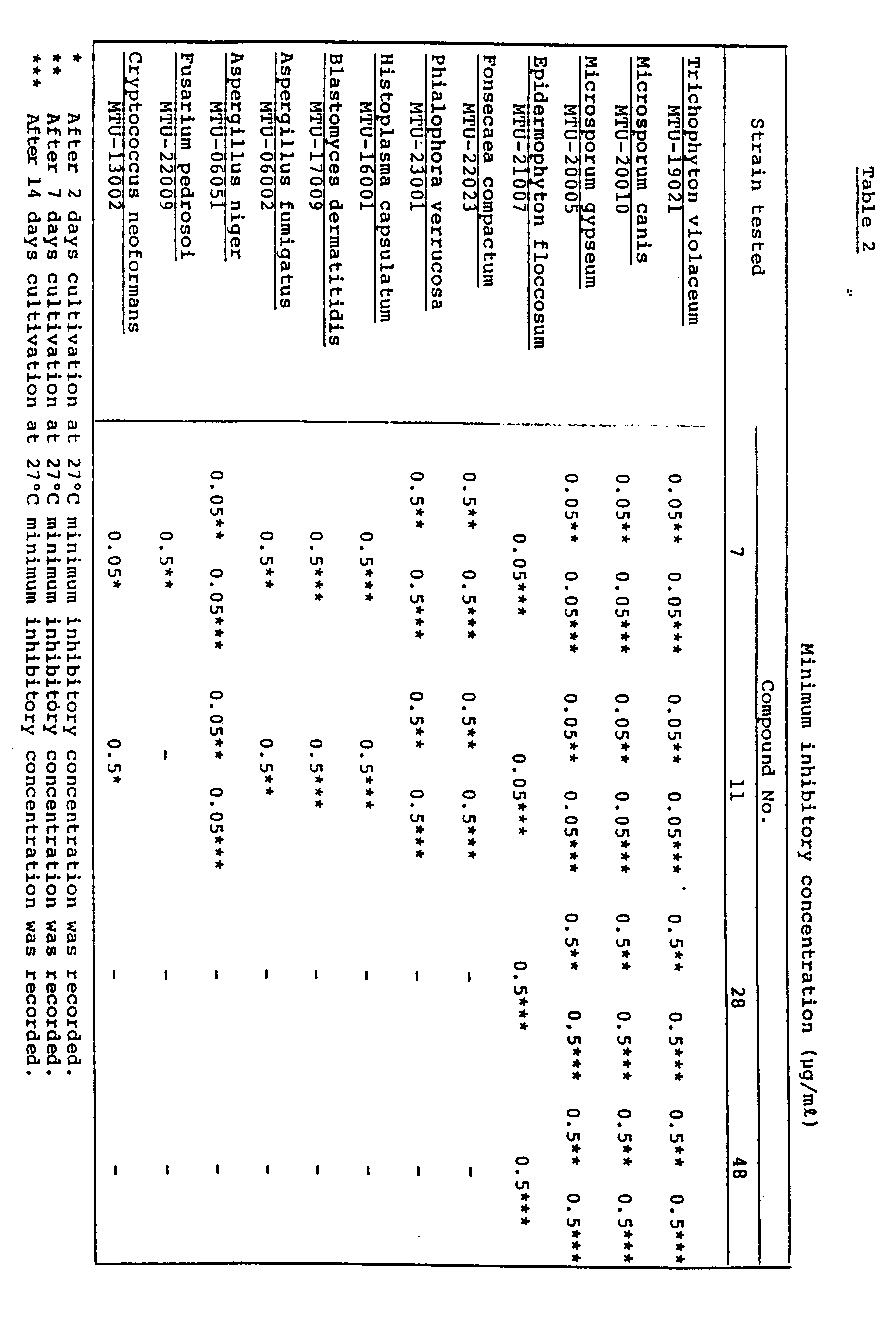
- Skin hair on the back of white guinea pigs of 400 - 500 g body weight was cut by a hair clipper and 0.1 ml of a spore suspension (containing 1 x 10⁷ cell/ml ) of Trichophyton mentagrophytes was inoculated. A polyethyleneglycol emulsion containing 1% of an active ingredient was applied once a day, every day, after the inoculation. The result was judged by the appearance of symptoms of the infected site and the reversed cultivation. Table 3 shows the results of the medical treatment as compared with those of control guinea pigs.
Table 3 Compound No. Scope of symptoms (0 - 4) Reversed cultivation Days after the infection 5 9 13 17 21 Not administered 0.16 1.5 2.5 1.5 0.83 29/60 7 0 1.33 1.66 0.66 0.33 1/60 11 0.66 2.0 2.0 0 0 1/60 - Each of the groups consisting of 6 guinea pigs were used in the test. Symptoms were expressed according to Weinsteins' expression (Antimicrobial Agents Chemotherapy, 1964, 595 (1965) ); a score of 0 was given when no symptoms were observed, and scores +1 to +4 for increasing strengths of symptoms. The results were expressed by the mean values. As a reversed cultivation, skin of the innoculated site was taken and then cut into 10 pieces which were then cultivated on Sabouraud's dextrose agar plates for 14 days at a temperature of 27°C.
- Acute toxicity was tested by applying active ingredients of the antifungal compositions of this invention as shown in Table 4 to ICR mice (male, age-5 weeks, 25 g ±weight, 5 mice in each group). The results obtained are shown in Table 4. Observation continued for 3 more weeks starting from the last administration. As seen in the Table, acute toxicity and irritation of the skin were not observed.

Claims (2)
- Use of a carbamate or thiocarbamate derivative having the general formula (I):

Y is an oxygen atom or a sulfur atom,
Z is lower alkyl group,
W is pyridyl group having one or two of the same substituents selected from the group of lower alkyl, lower alkoxy, lower alkenyloxy, and lower alkylamino,
and the term "lower" denotes a group containing up to 8 carbon atoms, for the preparation of compositions for the treatment of fungal infections. - Use of 2-naphthyl N-methyl-N-(6-methoxy-2-pyridyl)carbamate and O-2-naphthyl N-methyl-N-(6-methoxy-2-pyridyl)thiocarbamate for the preparation of compositions for the treatment of fungal infections.
Applications Claiming Priority (2)
| Application Number | Priority Date | Filing Date | Title |
|---|---|---|---|
| JP58167415A JPS6058916A (en) | 1983-09-13 | 1983-09-13 | Antimycotic agent |
| JP167415/83 | 1983-09-13 |
Related Parent Applications (1)
| Application Number | Title | Priority Date | Filing Date |
|---|---|---|---|
| EP84110901.0 Division | 1984-09-12 |
Publications (3)
| Publication Number | Publication Date |
|---|---|
| EP0341754A2 EP0341754A2 (en) | 1989-11-15 |
| EP0341754A3 EP0341754A3 (en) | 1990-07-11 |
| EP0341754B1 true EP0341754B1 (en) | 1992-12-09 |
Family
ID=15849269
Family Applications (2)
| Application Number | Title | Priority Date | Filing Date |
|---|---|---|---|
| EP89109926A Expired - Lifetime EP0341754B1 (en) | 1983-09-13 | 1984-09-12 | Use of carbamate or thiocarbamate derivatives for treatment of fungal infections |
| EP84110901A Expired - Lifetime EP0144570B1 (en) | 1983-09-13 | 1984-09-12 | Antifungal compositions containing carbamates |
Family Applications After (1)
| Application Number | Title | Priority Date | Filing Date |
|---|---|---|---|
| EP84110901A Expired - Lifetime EP0144570B1 (en) | 1983-09-13 | 1984-09-12 | Antifungal compositions containing carbamates |
Country Status (4)
| Country | Link |
|---|---|
| US (1) | US4621090A (en) |
| EP (2) | EP0341754B1 (en) |
| JP (1) | JPS6058916A (en) |
| DE (2) | DE3486005T2 (en) |
Families Citing this family (6)
| Publication number | Priority date | Publication date | Assignee | Title |
|---|---|---|---|---|
| JPS61207304A (en) * | 1985-03-11 | 1986-09-13 | Toyo Soda Mfg Co Ltd | Agricultural and horticultural fungicide |
| US4797407A (en) * | 1987-10-29 | 1989-01-10 | Ici Americas Inc. | Fungicidal pyridyl carbamates |
| EP0348507A4 (en) * | 1987-12-23 | 1990-12-27 | Poltav Med Stomatolog Inst | Pharmaceutical preparation for individual prophylaxis of venereal diseases and curing urogenital trichomoniasis |
| US4906454A (en) * | 1989-02-23 | 1990-03-06 | The Procter & Gamble Company | Deodorant compositions containing specific piroctone salts and perfumes |
| US6124275A (en) * | 1998-05-01 | 2000-09-26 | Summus Group, Ltd. | Methods and compositions for controlling a pest population |
| KR101362299B1 (en) * | 2004-05-12 | 2014-02-12 | 토소가부시키가이샤 | O-(5, 6, 7, 8-tetrahydro-2-naphthyl)-n-(6-methoxy-2-pyridyl)-n-methyl thiocarbomate and producing process |
Family Cites Families (6)
| Publication number | Priority date | Publication date | Assignee | Title |
|---|---|---|---|---|
| GB967897A (en) * | ||||
| DE1643797A1 (en) * | 1967-08-16 | 1971-02-18 | Heyden Chem Fab | New thionocarbamic acid esters and processes for their preparation |
| ZA731497B (en) * | 1972-03-20 | 1973-12-19 | Erba Carlo Spa | Thiocarbamic acid derivatives and process for their preparation |
| JPS5030694B2 (en) * | 1973-03-10 | 1975-10-03 | ||
| DE3360819D1 (en) * | 1982-03-17 | 1985-10-24 | Toyo Soda Mfg Co Ltd | Carbamate derivatives, process for producing the same and herbicides comprising the compounds as an effective component |
| US4554012A (en) * | 1982-06-10 | 1985-11-19 | Toyo Soda Manufacturing Co., Ltd. | Aryl N-alkyl-N-(pyridyl or pyrimidyl) carbamate |
-
1983
- 1983-09-13 JP JP58167415A patent/JPS6058916A/en active Granted
-
1984
- 1984-09-12 EP EP89109926A patent/EP0341754B1/en not_active Expired - Lifetime
- 1984-09-12 DE DE8989109926T patent/DE3486005T2/en not_active Expired - Lifetime
- 1984-09-12 EP EP84110901A patent/EP0144570B1/en not_active Expired - Lifetime
- 1984-09-12 DE DE8484110901T patent/DE3483245D1/en not_active Expired - Lifetime
- 1984-09-13 US US06/650,053 patent/US4621090A/en not_active Expired - Lifetime
Also Published As
| Publication number | Publication date |
|---|---|
| EP0144570A3 (en) | 1986-03-12 |
| JPH0145449B2 (en) | 1989-10-03 |
| US4621090A (en) | 1986-11-04 |
| DE3483245D1 (en) | 1990-10-25 |
| DE3486005D1 (en) | 1993-01-21 |
| EP0144570A2 (en) | 1985-06-19 |
| EP0341754A2 (en) | 1989-11-15 |
| JPS6058916A (en) | 1985-04-05 |
| EP0144570B1 (en) | 1990-09-19 |
| DE3486005T2 (en) | 1993-04-15 |
| EP0341754A3 (en) | 1990-07-11 |
Similar Documents
| Publication | Publication Date | Title |
|---|---|---|
| DE68927904T2 (en) | Fumagillol derivatives | |
| DE68915900T2 (en) | Angiogenesis inhibitor. | |
| EP0167451B1 (en) | A new process for preparing novel n-(acyloxy-alkoxy) carbonyl derivatives useful as bioreversible prodrug moieties for primary and secondary amine functions in drugs | |
| US5164410A (en) | Fumagillol derivatives and pharmaceutical compositions thereof | |
| US5166172A (en) | Fumagillol derivatives and pharmaceutical compositions thereof | |
| DE2363351C2 (en) | Substituted 5(6)-hydroxy-benzimidazole-2-carbamic acid methyl esters and medicinal products containing them | |
| EP1437346B9 (en) | Benzamide derivatives useful as cell differentiation inducers | |
| EP0726899B1 (en) | Novel pyrazine carboxamide derivatives, their production and their use in medicaments | |
| EP0418797B1 (en) | Pyrimidin-4,6-dicarboxilic acid diamides, process for their preparation also medicine based on those compounds | |
| DD148774A5 (en) | PROCESS FOR THE PREPARATION OF AMINOOPROPANOL DERIVATIVES | |
| JPH11510788A (en) | Pyridine fungicide | |
| EP1060175A2 (en) | Tryptase inhibitors | |
| EP0144570B1 (en) | Antifungal compositions containing carbamates | |
| EP0130119A2 (en) | (Acyloxyalkoxy) carbonyl derivatives as bioreversible prodrug moieties for primary and secondary amine functions in drugs, their preparation and pharmaceutical compositions containing said derivatives | |
| EP0559695B1 (en) | New pyridine derivatives, methods of preparing them and their use as drugs | |
| EP0278452B1 (en) | 2,4- and 2,5-Pyridine-dicarboxylic-acid derivatives, process for their preparation, their use and medicines based on these compounds | |
| DE1770595A1 (en) | Substituted tetrahydroquinolines | |
| US4067725A (en) | 3-Pyridyl-oxy-alkanecarboxylic acid amides | |
| EP1373234B1 (en) | Urokinase inhibitors | |
| DE3503846C2 (en) | Arginine derivatives and their use | |
| DE2131034A1 (en) | ACYLIC URNANE AND METHOD FOR MANUFACTURING IT | |
| KR870006041A (en) | Fungicides of triazole and oligoether groups and combinations thereof | |
| US4168311A (en) | Hydroxyquinoline carbamates and n-oxide hydroxyquinoline carbamates and their use as insecticides | |
| DE2253324A1 (en) | 1-ALKOXYCARBONYL-2-SQUARE BRACKETS ON UP- (ALKOXYCARBONYL) -AMINO SQUARE BRACKETS FOR -BENZIMIDAZOLE, THE PROCESS FOR THEIR PRODUCTION AND THEIR USE AS FUNGICIDES | |
| DE2759121A1 (en) | FUNGICIDAL AGENT, USE OF N-BENZOYLANTHRANIL ACID ESTERS TO COMBAT PLANT PATHOGENIC FUNGI, N-BENZOYLANTHRANIL ACID ESTERS AND METHOD FOR THEIR PRODUCTION |
Legal Events
| Date | Code | Title | Description |
|---|---|---|---|
| PUAI | Public reference made under article 153(3) epc to a published international application that has entered the european phase |
Free format text: ORIGINAL CODE: 0009012 |
|
| AC | Divisional application: reference to earlier application |
Ref document number: 144570 Country of ref document: EP |
|
| AK | Designated contracting states |
Kind code of ref document: A2 Designated state(s): BE CH DE FR GB LI |
|
| PUAL | Search report despatched |
Free format text: ORIGINAL CODE: 0009013 |
|
| AK | Designated contracting states |
Kind code of ref document: A3 Designated state(s): BE CH DE FR GB LI |
|
| 17P | Request for examination filed |
Effective date: 19900918 |
|
| RAP1 | Party data changed (applicant data changed or rights of an application transferred) |
Owner name: TOSOH CORPORATION |
|
| 17Q | First examination report despatched |
Effective date: 19920116 |
|
| GRAA | (expected) grant |
Free format text: ORIGINAL CODE: 0009210 |
|
| AC | Divisional application: reference to earlier application |
Ref document number: 144570 Country of ref document: EP |
|
| AK | Designated contracting states |
Kind code of ref document: B1 Designated state(s): BE CH DE FR GB LI |
|
| ET | Fr: translation filed | ||
| REF | Corresponds to: |
Ref document number: 3486005 Country of ref document: DE Date of ref document: 19930121 |
|
| PLBE | No opposition filed within time limit |
Free format text: ORIGINAL CODE: 0009261 |
|
| STAA | Information on the status of an ep patent application or granted ep patent |
Free format text: STATUS: NO OPPOSITION FILED WITHIN TIME LIMIT |
|
| 26N | No opposition filed | ||
| REG | Reference to a national code |
Ref country code: GB Ref legal event code: IF02 |
|
| PGFP | Annual fee paid to national office [announced via postgrant information from national office to epo] |
Ref country code: FR Payment date: 20030909 Year of fee payment: 20 |
|
| PGFP | Annual fee paid to national office [announced via postgrant information from national office to epo] |
Ref country code: GB Payment date: 20030910 Year of fee payment: 20 |
|
| PGFP | Annual fee paid to national office [announced via postgrant information from national office to epo] |
Ref country code: CH Payment date: 20030918 Year of fee payment: 20 |
|
| PGFP | Annual fee paid to national office [announced via postgrant information from national office to epo] |
Ref country code: DE Payment date: 20030925 Year of fee payment: 20 |
|
| PGFP | Annual fee paid to national office [announced via postgrant information from national office to epo] |
Ref country code: BE Payment date: 20031203 Year of fee payment: 20 |
|
| PG25 | Lapsed in a contracting state [announced via postgrant information from national office to epo] |
Ref country code: LI Free format text: LAPSE BECAUSE OF EXPIRATION OF PROTECTION Effective date: 20040911 Ref country code: GB Free format text: LAPSE BECAUSE OF EXPIRATION OF PROTECTION Effective date: 20040911 Ref country code: CH Free format text: LAPSE BECAUSE OF EXPIRATION OF PROTECTION Effective date: 20040911 |
|
| BE20 | Be: patent expired |
Owner name: *TOSOH CORP. Effective date: 20040912 |
|
| REG | Reference to a national code |
Ref country code: CH Ref legal event code: PL |
|
| REG | Reference to a national code |
Ref country code: GB Ref legal event code: PE20 |