EP0341602A2 - Renin-inhibiting functionalized peptidyl aminodiols and - triols - Google Patents
Renin-inhibiting functionalized peptidyl aminodiols and - triols Download PDFInfo
- Publication number
- EP0341602A2 EP0341602A2 EP89108139A EP89108139A EP0341602A2 EP 0341602 A2 EP0341602 A2 EP 0341602A2 EP 89108139 A EP89108139 A EP 89108139A EP 89108139 A EP89108139 A EP 89108139A EP 0341602 A2 EP0341602 A2 EP 0341602A2
- Authority
- EP
- European Patent Office
- Prior art keywords
- amino
- mmol
- benzyl
- compound
- methyl
- Prior art date
- Legal status (The legal status is an assumption and is not a legal conclusion. Google has not performed a legal analysis and makes no representation as to the accuracy of the status listed.)
- Withdrawn
Links
- 108090000783 Renin Proteins 0.000 title abstract description 18
- 102100028255 Renin Human genes 0.000 title abstract description 18
- 230000002401 inhibitory effect Effects 0.000 title abstract description 7
- 125000001151 peptidyl group Chemical group 0.000 title 1
- 150000001875 compounds Chemical class 0.000 claims abstract description 286
- 150000002148 esters Chemical class 0.000 claims abstract description 20
- 150000003839 salts Chemical class 0.000 claims abstract description 14
- 239000000651 prodrug Substances 0.000 claims abstract description 7
- 229940002612 prodrug Drugs 0.000 claims abstract description 7
- 238000000034 method Methods 0.000 claims description 194
- -1 (substituted phenyl)methyl Chemical group 0.000 claims description 134
- 125000000217 alkyl group Chemical group 0.000 claims description 78
- 238000005859 coupling reaction Methods 0.000 claims description 77
- 239000002253 acid Substances 0.000 claims description 74
- 230000008878 coupling Effects 0.000 claims description 73
- 238000010168 coupling process Methods 0.000 claims description 73
- 125000001997 phenyl group Chemical group [H]C1=C([H])C([H])=C(*)C([H])=C1[H] 0.000 claims description 64
- 125000002924 primary amino group Chemical group [H]N([H])* 0.000 claims description 61
- 125000001624 naphthyl group Chemical group 0.000 claims description 55
- 125000003545 alkoxy group Chemical group 0.000 claims description 47
- 125000000623 heterocyclic group Chemical group 0.000 claims description 39
- 125000004103 aminoalkyl group Chemical group 0.000 claims description 35
- 239000001257 hydrogen Substances 0.000 claims description 30
- 229910052739 hydrogen Inorganic materials 0.000 claims description 30
- UFHFLCQGNIYNRP-UHFFFAOYSA-N Hydrogen Chemical compound [H][H] UFHFLCQGNIYNRP-UHFFFAOYSA-N 0.000 claims description 24
- 125000001797 benzyl group Chemical group [H]C1=C([H])C([H])=C(C([H])=C1[H])C([H])([H])* 0.000 claims description 20
- 125000004181 carboxyalkyl group Chemical group 0.000 claims description 18
- 125000003178 carboxy group Chemical group [H]OC(*)=O 0.000 claims description 16
- 125000004183 alkoxy alkyl group Chemical group 0.000 claims description 14
- 125000004453 alkoxycarbonyl group Chemical group 0.000 claims description 13
- 125000004985 dialkyl amino alkyl group Chemical group 0.000 claims description 13
- 125000002915 carbonyl group Chemical group [*:2]C([*:1])=O 0.000 claims description 11
- 125000002768 hydroxyalkyl group Chemical group 0.000 claims description 11
- 125000001326 naphthylalkyl group Chemical group 0.000 claims description 11
- 125000003884 phenylalkyl group Chemical group 0.000 claims description 11
- 125000005309 thioalkoxy group Chemical group 0.000 claims description 10
- 125000001188 haloalkyl group Chemical group 0.000 claims description 9
- 230000004410 intraocular pressure Effects 0.000 claims description 9
- 125000002496 methyl group Chemical group [H]C([H])([H])* 0.000 claims description 9
- 206010020772 Hypertension Diseases 0.000 claims description 8
- 125000004435 hydrogen atom Chemical group [H]* 0.000 claims description 7
- 238000002360 preparation method Methods 0.000 claims description 7
- 208000010412 Glaucoma Diseases 0.000 claims description 6
- 150000004820 halides Chemical class 0.000 claims description 6
- 230000008569 process Effects 0.000 claims description 6
- 206010007559 Cardiac failure congestive Diseases 0.000 claims description 4
- 206010019280 Heart failures Diseases 0.000 claims description 4
- 125000002490 anilino group Chemical group [H]N(*)C1=C([H])C([H])=C([H])C([H])=C1[H] 0.000 claims description 4
- 239000003937 drug carrier Substances 0.000 claims description 4
- 125000000472 sulfonyl group Chemical group *S(*)(=O)=O 0.000 claims description 4
- 125000000094 2-phenylethyl group Chemical group [H]C1=C([H])C([H])=C(C([H])=C1[H])C([H])([H])C([H])([H])* 0.000 claims description 3
- 125000005335 azido alkyl group Chemical group 0.000 claims description 3
- 150000001735 carboxylic acids Chemical class 0.000 claims description 3
- 125000001316 cycloalkyl alkyl group Chemical group 0.000 claims description 3
- 239000008194 pharmaceutical composition Substances 0.000 claims description 3
- PHRABVHYUHIYGY-UHFFFAOYSA-N 1-methylnaphthalene Chemical group C1=CC=C2C([CH2])=CC=CC2=C1 PHRABVHYUHIYGY-UHFFFAOYSA-N 0.000 claims description 2
- 229910052770 Uranium Inorganic materials 0.000 claims description 2
- 125000004981 cycloalkylmethyl group Chemical group 0.000 claims description 2
- 125000004210 cyclohexylmethyl group Chemical group [H]C([H])(*)C1([H])C([H])([H])C([H])([H])C([H])([H])C([H])([H])C1([H])[H] 0.000 claims description 2
- 125000000951 phenoxy group Chemical group [H]C1=C([H])C([H])=C(O*)C([H])=C1[H] 0.000 claims description 2
- 238000011200 topical administration Methods 0.000 claims description 2
- 230000000699 topical effect Effects 0.000 claims description 2
- 125000004217 4-methoxybenzyl group Chemical group [H]C1=C([H])C(=C([H])C([H])=C1OC([H])([H])[H])C([H])([H])* 0.000 claims 1
- 238000007910 systemic administration Methods 0.000 claims 1
- XEKOWRVHYACXOJ-UHFFFAOYSA-N Ethyl acetate Chemical compound CCOC(C)=O XEKOWRVHYACXOJ-UHFFFAOYSA-N 0.000 description 228
- OKKJLVBELUTLKV-UHFFFAOYSA-N Methanol Chemical compound OC OKKJLVBELUTLKV-UHFFFAOYSA-N 0.000 description 144
- 239000000047 product Substances 0.000 description 141
- YMWUJEATGCHHMB-UHFFFAOYSA-N Dichloromethane Chemical compound ClCCl YMWUJEATGCHHMB-UHFFFAOYSA-N 0.000 description 126
- VLKZOEOYAKHREP-UHFFFAOYSA-N n-Hexane Chemical compound CCCCCC VLKZOEOYAKHREP-UHFFFAOYSA-N 0.000 description 122
- 238000005160 1H NMR spectroscopy Methods 0.000 description 100
- 239000000203 mixture Substances 0.000 description 100
- 239000000243 solution Substances 0.000 description 95
- XLYOFNOQVPJJNP-UHFFFAOYSA-N water Chemical compound O XLYOFNOQVPJJNP-UHFFFAOYSA-N 0.000 description 84
- RTZKZFJDLAIYFH-UHFFFAOYSA-N Diethyl ether Chemical class CCOCC RTZKZFJDLAIYFH-UHFFFAOYSA-N 0.000 description 81
- 235000019439 ethyl acetate Nutrition 0.000 description 77
- 229940093499 ethyl acetate Drugs 0.000 description 72
- HEDRZPFGACZZDS-UHFFFAOYSA-N Chloroform Chemical compound ClC(Cl)Cl HEDRZPFGACZZDS-UHFFFAOYSA-N 0.000 description 60
- VYPSYNLAJGMNEJ-UHFFFAOYSA-N Silicium dioxide Chemical compound O=[Si]=O VYPSYNLAJGMNEJ-UHFFFAOYSA-N 0.000 description 60
- WYURNTSHIVDZCO-UHFFFAOYSA-N Tetrahydrofuran Chemical compound C1CCOC1 WYURNTSHIVDZCO-UHFFFAOYSA-N 0.000 description 60
- UIIMBOGNXHQVGW-UHFFFAOYSA-M Sodium bicarbonate Chemical class [Na+].OC([O-])=O UIIMBOGNXHQVGW-UHFFFAOYSA-M 0.000 description 58
- GFEDKGWFWTUFKY-RWMBFGLXSA-N (2s,3r,4s)-4-amino-5-cyclohexyl-1-[methoxy(methyl)amino]pentane-2,3-diol Chemical compound CON(C)C[C@H](O)[C@H](O)[C@@H](N)CC1CCCCC1 GFEDKGWFWTUFKY-RWMBFGLXSA-N 0.000 description 56
- 239000000741 silica gel Substances 0.000 description 51
- 229910002027 silica gel Inorganic materials 0.000 description 51
- 150000003254 radicals Chemical class 0.000 description 50
- YXFVVABEGXRONW-UHFFFAOYSA-N Toluene Chemical compound CC1=CC=CC=C1 YXFVVABEGXRONW-UHFFFAOYSA-N 0.000 description 42
- 239000012267 brine Substances 0.000 description 42
- HPALAKNZSZLMCH-UHFFFAOYSA-M sodium;chloride;hydrate Chemical compound O.[Na+].[Cl-] HPALAKNZSZLMCH-UHFFFAOYSA-M 0.000 description 42
- 150000001408 amides Chemical class 0.000 description 41
- 239000007832 Na2SO4 Substances 0.000 description 40
- PMZURENOXWZQFD-UHFFFAOYSA-L Sodium Sulfate Chemical compound [Na+].[Na+].[O-]S([O-])(=O)=O PMZURENOXWZQFD-UHFFFAOYSA-L 0.000 description 40
- 239000003921 oil Substances 0.000 description 40
- 235000019198 oils Nutrition 0.000 description 40
- 229910052938 sodium sulfate Inorganic materials 0.000 description 40
- 235000011152 sodium sulphate Nutrition 0.000 description 40
- ZMXDDKWLCZADIW-UHFFFAOYSA-N N,N-Dimethylformamide Chemical compound CN(C)C=O ZMXDDKWLCZADIW-UHFFFAOYSA-N 0.000 description 39
- VEXZGXHMUGYJMC-UHFFFAOYSA-N Hydrochloric acid Chemical compound Cl VEXZGXHMUGYJMC-UHFFFAOYSA-N 0.000 description 38
- YNAVUWVOSKDBBP-UHFFFAOYSA-N Morpholine Chemical compound C1COCCN1 YNAVUWVOSKDBBP-UHFFFAOYSA-N 0.000 description 38
- 238000004587 chromatography analysis Methods 0.000 description 38
- 239000007787 solid Substances 0.000 description 38
- 125000003282 alkyl amino group Chemical group 0.000 description 34
- 239000002904 solvent Substances 0.000 description 34
- QTBSBXVTEAMEQO-UHFFFAOYSA-N Acetic acid Chemical class CC(O)=O QTBSBXVTEAMEQO-UHFFFAOYSA-N 0.000 description 33
- CSNNHWWHGAXBCP-UHFFFAOYSA-L Magnesium sulfate Chemical compound [Mg+2].[O-][S+2]([O-])([O-])[O-] CSNNHWWHGAXBCP-UHFFFAOYSA-L 0.000 description 33
- IXCSERBJSXMMFS-UHFFFAOYSA-N hydrogen chloride Substances Cl.Cl IXCSERBJSXMMFS-UHFFFAOYSA-N 0.000 description 33
- AYMLQYFMYHISQO-QMMMGPOBSA-N (2s)-3-(1h-imidazol-3-ium-5-yl)-2-[(2-methylpropan-2-yl)oxycarbonylamino]propanoate Chemical compound CC(C)(C)OC(=O)N[C@H](C(O)=O)CC1=CN=CN1 AYMLQYFMYHISQO-QMMMGPOBSA-N 0.000 description 32
- LFQSCWFLJHTTHZ-UHFFFAOYSA-N Ethanol Chemical compound CCO LFQSCWFLJHTTHZ-UHFFFAOYSA-N 0.000 description 32
- YLQBMQCUIZJEEH-UHFFFAOYSA-N tetrahydrofuran Natural products C=1C=COC=1 YLQBMQCUIZJEEH-UHFFFAOYSA-N 0.000 description 30
- 238000001819 mass spectrum Methods 0.000 description 29
- SJRJJKPEHAURKC-UHFFFAOYSA-N N-Methylmorpholine Chemical compound CN1CCOCC1 SJRJJKPEHAURKC-UHFFFAOYSA-N 0.000 description 28
- OKKJLVBELUTLKV-MZCSYVLQSA-N Deuterated methanol Chemical compound [2H]OC([2H])([2H])[2H] OKKJLVBELUTLKV-MZCSYVLQSA-N 0.000 description 24
- ZMANZCXQSJIPKH-UHFFFAOYSA-N Triethylamine Chemical compound CCN(CC)CC ZMANZCXQSJIPKH-UHFFFAOYSA-N 0.000 description 24
- 238000006243 chemical reaction Methods 0.000 description 23
- 125000004663 dialkyl amino group Chemical group 0.000 description 23
- 238000003756 stirring Methods 0.000 description 19
- UHOVQNZJYSORNB-UHFFFAOYSA-N Benzene Chemical compound C1=CC=CC=C1 UHOVQNZJYSORNB-UHFFFAOYSA-N 0.000 description 18
- OFBQJSOFQDEBGM-UHFFFAOYSA-N Pentane Chemical compound CCCCC OFBQJSOFQDEBGM-UHFFFAOYSA-N 0.000 description 18
- DOMQFIFVDIAOOT-ROUUACIJSA-N (2S,3R)-N-[4-(2,6-dimethoxyphenyl)-5-(5-methylpyridin-3-yl)-1,2,4-triazol-3-yl]-3-(5-methylpyrimidin-2-yl)butane-2-sulfonamide Chemical compound COC1=C(C(=CC=C1)OC)N1C(=NN=C1C=1C=NC=C(C=1)C)NS(=O)(=O)[C@@H](C)[C@H](C)C1=NC=C(C=N1)C DOMQFIFVDIAOOT-ROUUACIJSA-N 0.000 description 17
- 125000005078 alkoxycarbonylalkyl group Chemical group 0.000 description 17
- KDLHZDBZIXYQEI-UHFFFAOYSA-N Palladium Chemical compound [Pd] KDLHZDBZIXYQEI-UHFFFAOYSA-N 0.000 description 16
- 229910052943 magnesium sulfate Inorganic materials 0.000 description 16
- 235000019341 magnesium sulphate Nutrition 0.000 description 16
- AUDTZGJFDDCILK-RWMBFGLXSA-N (2s,3r,4s)-4-amino-5-cyclohexyl-1-[methyl(2,2,2-trifluoroethyl)amino]pentane-2,3-diol Chemical compound FC(F)(F)CN(C)C[C@H](O)[C@H](O)[C@@H](N)CC1CCCCC1 AUDTZGJFDDCILK-RWMBFGLXSA-N 0.000 description 15
- HEMHJVSKTPXQMS-UHFFFAOYSA-M Sodium hydroxide Chemical compound [OH-].[Na+] HEMHJVSKTPXQMS-UHFFFAOYSA-M 0.000 description 15
- 235000017557 sodium bicarbonate Nutrition 0.000 description 15
- 229910000030 sodium bicarbonate Inorganic materials 0.000 description 15
- 235000002639 sodium chloride Nutrition 0.000 description 15
- 238000004458 analytical method Methods 0.000 description 14
- 239000011541 reaction mixture Substances 0.000 description 14
- 239000000725 suspension Substances 0.000 description 14
- RYHBNJHYFVUHQT-UHFFFAOYSA-N 1,4-Dioxane Chemical compound C1COCCO1 RYHBNJHYFVUHQT-UHFFFAOYSA-N 0.000 description 13
- WMFOQBRAJBCJND-UHFFFAOYSA-M Lithium hydroxide Chemical compound [Li+].[OH-] WMFOQBRAJBCJND-UHFFFAOYSA-M 0.000 description 13
- MDFFNEOEWAXZRQ-UHFFFAOYSA-N aminyl Chemical compound [NH2] MDFFNEOEWAXZRQ-UHFFFAOYSA-N 0.000 description 13
- CUKWUWBLQQDQAC-VEQWQPCFSA-N (3s)-3-amino-4-[[(2s)-1-[[(2s)-1-[[(2s)-1-[[(2s,3s)-1-[[(2s)-1-[(2s)-2-[[(1s)-1-carboxyethyl]carbamoyl]pyrrolidin-1-yl]-3-(1h-imidazol-5-yl)-1-oxopropan-2-yl]amino]-3-methyl-1-oxopentan-2-yl]amino]-3-(4-hydroxyphenyl)-1-oxopropan-2-yl]amino]-3-methyl-1-ox Chemical compound C([C@@H](C(=O)N[C@@H]([C@@H](C)CC)C(=O)N[C@@H](CC=1NC=NC=1)C(=O)N1[C@@H](CCC1)C(=O)N[C@@H](C)C(O)=O)NC(=O)[C@@H](NC(=O)[C@H](CCCN=C(N)N)NC(=O)[C@@H](N)CC(O)=O)C(C)C)C1=CC=C(O)C=C1 CUKWUWBLQQDQAC-VEQWQPCFSA-N 0.000 description 12
- CSCPPACGZOOCGX-UHFFFAOYSA-N Acetone Chemical compound CC(C)=O CSCPPACGZOOCGX-UHFFFAOYSA-N 0.000 description 12
- 102000005862 Angiotensin II Human genes 0.000 description 12
- 101800000733 Angiotensin-2 Proteins 0.000 description 12
- 238000005481 NMR spectroscopy Methods 0.000 description 12
- 229950006323 angiotensin ii Drugs 0.000 description 12
- 239000012230 colorless oil Substances 0.000 description 12
- 230000000694 effects Effects 0.000 description 12
- 229920006395 saturated elastomer Polymers 0.000 description 12
- IJGRMHOSHXDMSA-UHFFFAOYSA-N Atomic nitrogen Chemical group N#N IJGRMHOSHXDMSA-UHFFFAOYSA-N 0.000 description 11
- 150000001413 amino acids Chemical class 0.000 description 11
- 238000001704 evaporation Methods 0.000 description 10
- 230000008020 evaporation Effects 0.000 description 10
- BWHMMNNQKKPAPP-UHFFFAOYSA-L potassium carbonate Chemical compound [K+].[K+].[O-]C([O-])=O BWHMMNNQKKPAPP-UHFFFAOYSA-L 0.000 description 10
- 238000010992 reflux Methods 0.000 description 10
- WVDDGKGOMKODPV-UHFFFAOYSA-N Benzyl alcohol Chemical compound OCC1=CC=CC=C1 WVDDGKGOMKODPV-UHFFFAOYSA-N 0.000 description 9
- NBIIXXVUZAFLBC-UHFFFAOYSA-N Phosphoric acid Chemical compound OP(O)(O)=O NBIIXXVUZAFLBC-UHFFFAOYSA-N 0.000 description 9
- KWYUFKZDYYNOTN-UHFFFAOYSA-M Potassium hydroxide Chemical compound [OH-].[K+] KWYUFKZDYYNOTN-UHFFFAOYSA-M 0.000 description 9
- 239000012298 atmosphere Substances 0.000 description 9
- 150000002118 epoxides Chemical class 0.000 description 9
- 235000019441 ethanol Nutrition 0.000 description 9
- 125000002887 hydroxy group Chemical group [H]O* 0.000 description 9
- 238000000746 purification Methods 0.000 description 9
- 101800000734 Angiotensin-1 Proteins 0.000 description 8
- 102400000344 Angiotensin-1 Human genes 0.000 description 8
- FAPWRFPIFSIZLT-UHFFFAOYSA-M Sodium chloride Chemical compound [Na+].[Cl-] FAPWRFPIFSIZLT-UHFFFAOYSA-M 0.000 description 8
- 150000001412 amines Chemical class 0.000 description 8
- 125000003277 amino group Chemical group 0.000 description 8
- ORWYRWWVDCYOMK-HBZPZAIKSA-N angiotensin I Chemical compound C([C@@H](C(=O)N[C@@H]([C@@H](C)CC)C(=O)N[C@@H](CC=1NC=NC=1)C(=O)N1[C@@H](CCC1)C(=O)N[C@@H](CC=1C=CC=CC=1)C(=O)N[C@@H](CC=1NC=NC=1)C(=O)N[C@@H](CC(C)C)C(O)=O)NC(=O)[C@@H](NC(=O)[C@H](CCCN=C(N)N)NC(=O)[C@@H](N)CC(O)=O)C(C)C)C1=CC=C(O)C=C1 ORWYRWWVDCYOMK-HBZPZAIKSA-N 0.000 description 8
- 239000005457 ice water Substances 0.000 description 8
- 239000012044 organic layer Substances 0.000 description 8
- 235000011007 phosphoric acid Nutrition 0.000 description 8
- HDNXGFGVFDEIJW-HOTGVXAUSA-N (2s)-3-(1h-imidazol-5-yl)-2-[[(2s)-2-[(2-methylpropan-2-yl)oxycarbonylamino]-3-phenylpropanoyl]amino]propanoic acid Chemical compound C([C@H](NC(=O)OC(C)(C)C)C(=O)N[C@@H](CC=1N=CNC=1)C(O)=O)C1=CC=CC=C1 HDNXGFGVFDEIJW-HOTGVXAUSA-N 0.000 description 7
- NLXLAEXVIDQMFP-UHFFFAOYSA-N Ammonia chloride Chemical compound [NH4+].[Cl-] NLXLAEXVIDQMFP-UHFFFAOYSA-N 0.000 description 7
- DGAQECJNVWCQMB-PUAWFVPOSA-M Ilexoside XXIX Chemical compound C[C@@H]1CC[C@@]2(CC[C@@]3(C(=CC[C@H]4[C@]3(CC[C@@H]5[C@@]4(CC[C@@H](C5(C)C)OS(=O)(=O)[O-])C)C)[C@@H]2[C@]1(C)O)C)C(=O)O[C@H]6[C@@H]([C@H]([C@@H]([C@H](O6)CO)O)O)O.[Na+] DGAQECJNVWCQMB-PUAWFVPOSA-M 0.000 description 7
- YGYAWVDWMABLBF-UHFFFAOYSA-N Phosgene Chemical compound ClC(Cl)=O YGYAWVDWMABLBF-UHFFFAOYSA-N 0.000 description 7
- 150000008064 anhydrides Chemical class 0.000 description 7
- 230000015572 biosynthetic process Effects 0.000 description 7
- 125000001495 ethyl group Chemical group [H]C([H])([H])C([H])([H])* 0.000 description 7
- 239000000706 filtrate Substances 0.000 description 7
- 238000003818 flash chromatography Methods 0.000 description 7
- 125000001475 halogen functional group Chemical group 0.000 description 7
- 239000000463 material Substances 0.000 description 7
- 125000000956 methoxy group Chemical group [H]C([H])([H])O* 0.000 description 7
- 239000012299 nitrogen atmosphere Substances 0.000 description 7
- 239000012074 organic phase Substances 0.000 description 7
- 108090000765 processed proteins & peptides Proteins 0.000 description 7
- 229910052708 sodium Inorganic materials 0.000 description 7
- 239000011734 sodium Substances 0.000 description 7
- 125000001424 substituent group Chemical group 0.000 description 7
- 238000003786 synthesis reaction Methods 0.000 description 7
- PVOAHINGSUIXLS-UHFFFAOYSA-N 1-Methylpiperazine Chemical compound CN1CCNCC1 PVOAHINGSUIXLS-UHFFFAOYSA-N 0.000 description 6
- BYHQTRFJOGIQAO-GOSISDBHSA-N 3-(4-bromophenyl)-8-[(2R)-2-hydroxypropyl]-1-[(3-methoxyphenyl)methyl]-1,3,8-triazaspiro[4.5]decan-2-one Chemical compound C[C@H](CN1CCC2(CC1)CN(C(=O)N2CC3=CC(=CC=C3)OC)C4=CC=C(C=C4)Br)O BYHQTRFJOGIQAO-GOSISDBHSA-N 0.000 description 6
- MBVFRSJFKMJRHA-UHFFFAOYSA-N 4-fluoro-1-benzofuran-7-carbaldehyde Chemical compound FC1=CC=C(C=O)C2=C1C=CO2 MBVFRSJFKMJRHA-UHFFFAOYSA-N 0.000 description 6
- WSFSSNUMVMOOMR-UHFFFAOYSA-N Formaldehyde Chemical compound O=C WSFSSNUMVMOOMR-UHFFFAOYSA-N 0.000 description 6
- OUYCCCASQSFEME-QMMMGPOBSA-N L-tyrosine Chemical compound OC(=O)[C@@H](N)CC1=CC=C(O)C=C1 OUYCCCASQSFEME-QMMMGPOBSA-N 0.000 description 6
- LRHPLDYGYMQRHN-UHFFFAOYSA-N N-Butanol Chemical compound CCCCO LRHPLDYGYMQRHN-UHFFFAOYSA-N 0.000 description 6
- XBDQKXXYIPTUBI-UHFFFAOYSA-M Propionate Chemical compound CCC([O-])=O XBDQKXXYIPTUBI-UHFFFAOYSA-M 0.000 description 6
- CDBYLPFSWZWCQE-UHFFFAOYSA-L Sodium Carbonate Chemical compound [Na+].[Na+].[O-]C([O-])=O CDBYLPFSWZWCQE-UHFFFAOYSA-L 0.000 description 6
- 125000000278 alkyl amino alkyl group Chemical group 0.000 description 6
- 229940024606 amino acid Drugs 0.000 description 6
- 235000001014 amino acid Nutrition 0.000 description 6
- 239000008346 aqueous phase Substances 0.000 description 6
- 150000003857 carboxamides Chemical class 0.000 description 6
- 239000012043 crude product Substances 0.000 description 6
- 125000004494 ethyl ester group Chemical group 0.000 description 6
- 238000000605 extraction Methods 0.000 description 6
- 239000006260 foam Substances 0.000 description 6
- RAXXELZNTBOGNW-UHFFFAOYSA-N imidazole Natural products C1=CNC=N1 RAXXELZNTBOGNW-UHFFFAOYSA-N 0.000 description 6
- VNWKTOKETHGBQD-UHFFFAOYSA-N methane Natural products C VNWKTOKETHGBQD-UHFFFAOYSA-N 0.000 description 6
- 125000000449 nitro group Chemical group [O-][N+](*)=O 0.000 description 6
- 229910052757 nitrogen Inorganic materials 0.000 description 6
- 229910052760 oxygen Inorganic materials 0.000 description 6
- 239000002461 renin inhibitor Substances 0.000 description 6
- PXQLVRUNWNTZOS-UHFFFAOYSA-N sulfanyl Chemical class [SH] PXQLVRUNWNTZOS-UHFFFAOYSA-N 0.000 description 6
- 125000004963 sulfonylalkyl group Chemical group 0.000 description 6
- 125000000999 tert-butyl group Chemical group [H]C([H])([H])C(*)(C([H])([H])[H])C([H])([H])[H] 0.000 description 6
- 125000004001 thioalkyl group Chemical group 0.000 description 6
- OUYCCCASQSFEME-UHFFFAOYSA-N tyrosine Natural products OC(=O)C(N)CC1=CC=C(O)C=C1 OUYCCCASQSFEME-UHFFFAOYSA-N 0.000 description 6
- GFPOCAYEKCWFPD-UHFFFAOYSA-N 1-(2,2,2-trifluoroethyl)piperazine Chemical compound FC(F)(F)CN1CCNCC1 GFPOCAYEKCWFPD-UHFFFAOYSA-N 0.000 description 5
- ASOKPJOREAFHNY-UHFFFAOYSA-N 1-Hydroxybenzotriazole Chemical compound C1=CC=C2N(O)N=NC2=C1 ASOKPJOREAFHNY-UHFFFAOYSA-N 0.000 description 5
- NHQDETIJWKXCTC-UHFFFAOYSA-N 3-chloroperbenzoic acid Chemical compound OOC(=O)C1=CC=CC(Cl)=C1 NHQDETIJWKXCTC-UHFFFAOYSA-N 0.000 description 5
- JGFZNNIVVJXRND-UHFFFAOYSA-N N,N-Diisopropylethylamine (DIPEA) Chemical compound CCN(C(C)C)C(C)C JGFZNNIVVJXRND-UHFFFAOYSA-N 0.000 description 5
- XBDQKXXYIPTUBI-UHFFFAOYSA-N Propionic acid Substances CCC(O)=O XBDQKXXYIPTUBI-UHFFFAOYSA-N 0.000 description 5
- HSDAJNMJOMSNEV-UHFFFAOYSA-N benzyl chloroformate Chemical compound ClC(=O)OCC1=CC=CC=C1 HSDAJNMJOMSNEV-UHFFFAOYSA-N 0.000 description 5
- 238000001816 cooling Methods 0.000 description 5
- 238000010511 deprotection reaction Methods 0.000 description 5
- 238000010438 heat treatment Methods 0.000 description 5
- FUZZWVXGSFPDMH-UHFFFAOYSA-N hexanoic acid Chemical compound CCCCCC(O)=O FUZZWVXGSFPDMH-UHFFFAOYSA-N 0.000 description 5
- 235000015320 potassium carbonate Nutrition 0.000 description 5
- 229910000027 potassium carbonate Inorganic materials 0.000 description 5
- 230000003389 potentiating effect Effects 0.000 description 5
- 102000004196 processed proteins & peptides Human genes 0.000 description 5
- 238000001953 recrystallisation Methods 0.000 description 5
- 229940086526 renin-inhibitors Drugs 0.000 description 5
- 235000010265 sodium sulphite Nutrition 0.000 description 5
- 229910052717 sulfur Chemical group 0.000 description 5
- DYHSDKLCOJIUFX-UHFFFAOYSA-N tert-butoxycarbonyl anhydride Chemical compound CC(C)(C)OC(=O)OC(=O)OC(C)(C)C DYHSDKLCOJIUFX-UHFFFAOYSA-N 0.000 description 5
- UUUHXMGGBIUAPW-UHFFFAOYSA-N 1-[1-[2-[[5-amino-2-[[1-[5-(diaminomethylideneamino)-2-[[1-[3-(1h-indol-3-yl)-2-[(5-oxopyrrolidine-2-carbonyl)amino]propanoyl]pyrrolidine-2-carbonyl]amino]pentanoyl]pyrrolidine-2-carbonyl]amino]-5-oxopentanoyl]amino]-3-methylpentanoyl]pyrrolidine-2-carbon Chemical compound C1CCC(C(=O)N2C(CCC2)C(O)=O)N1C(=O)C(C(C)CC)NC(=O)C(CCC(N)=O)NC(=O)C1CCCN1C(=O)C(CCCN=C(N)N)NC(=O)C1CCCN1C(=O)C(CC=1C2=CC=CC=C2NC=1)NC(=O)C1CCC(=O)N1 UUUHXMGGBIUAPW-UHFFFAOYSA-N 0.000 description 4
- LMDZBCPBFSXMTL-UHFFFAOYSA-N 1-ethyl-3-(3-dimethylaminopropyl)carbodiimide Chemical compound CCN=C=NCCCN(C)C LMDZBCPBFSXMTL-UHFFFAOYSA-N 0.000 description 4
- YOETUEMZNOLGDB-UHFFFAOYSA-N 2-methylpropyl carbonochloridate Chemical compound CC(C)COC(Cl)=O YOETUEMZNOLGDB-UHFFFAOYSA-N 0.000 description 4
- BAVYZALUXZFZLV-UHFFFAOYSA-N Methylamine Chemical compound NC BAVYZALUXZFZLV-UHFFFAOYSA-N 0.000 description 4
- MZRVEZGGRBJDDB-UHFFFAOYSA-N N-Butyllithium Chemical compound [Li]CCCC MZRVEZGGRBJDDB-UHFFFAOYSA-N 0.000 description 4
- MUBZPKHOEPUJKR-UHFFFAOYSA-N Oxalic acid Chemical compound OC(=O)C(O)=O MUBZPKHOEPUJKR-UHFFFAOYSA-N 0.000 description 4
- 108090000882 Peptidyl-Dipeptidase A Proteins 0.000 description 4
- 102000004270 Peptidyl-Dipeptidase A Human genes 0.000 description 4
- KEAYESYHFKHZAL-UHFFFAOYSA-N Sodium Chemical compound [Na] KEAYESYHFKHZAL-UHFFFAOYSA-N 0.000 description 4
- PXIPVTKHYLBLMZ-UHFFFAOYSA-N Sodium azide Chemical compound [Na+].[N-]=[N+]=[N-] PXIPVTKHYLBLMZ-UHFFFAOYSA-N 0.000 description 4
- 235000019270 ammonium chloride Nutrition 0.000 description 4
- 239000007864 aqueous solution Substances 0.000 description 4
- 125000000753 cycloalkyl group Chemical group 0.000 description 4
- 125000004177 diethyl group Chemical group [H]C([H])([H])C([H])([H])* 0.000 description 4
- 229940079593 drug Drugs 0.000 description 4
- 239000003814 drug Substances 0.000 description 4
- 125000005842 heteroatom Chemical group 0.000 description 4
- 239000000543 intermediate Substances 0.000 description 4
- 210000003734 kidney Anatomy 0.000 description 4
- MWZPENIJLUWBSY-VIFPVBQESA-N methyl L-tyrosinate Chemical compound COC(=O)[C@@H](N)CC1=CC=C(O)C=C1 MWZPENIJLUWBSY-VIFPVBQESA-N 0.000 description 4
- 125000004573 morpholin-4-yl group Chemical group N1(CCOCC1)* 0.000 description 4
- 125000002071 phenylalkoxy group Chemical group 0.000 description 4
- 238000000926 separation method Methods 0.000 description 4
- 238000010898 silica gel chromatography Methods 0.000 description 4
- 239000000377 silicon dioxide Substances 0.000 description 4
- GEHJYWRUCIMESM-UHFFFAOYSA-L sodium sulfite Chemical compound [Na+].[Na+].[O-]S([O-])=O GEHJYWRUCIMESM-UHFFFAOYSA-L 0.000 description 4
- 239000003039 volatile agent Substances 0.000 description 4
- ZIOCIQJXEKFHJO-QMMMGPOBSA-N (2s)-2-[(2-methylpropan-2-yl)oxycarbonylamino]hexanoic acid Chemical compound CCCC[C@@H](C(O)=O)NC(=O)OC(C)(C)C ZIOCIQJXEKFHJO-QMMMGPOBSA-N 0.000 description 3
- OBRVLHZGEFSJFO-GFCCVEGCSA-N (2s)-2-benzyl-3-tert-butylsulfonylpropanamide Chemical compound CC(C)(C)S(=O)(=O)C[C@H](C(N)=O)CC1=CC=CC=C1 OBRVLHZGEFSJFO-GFCCVEGCSA-N 0.000 description 3
- ZGYIXVSQHOKQRZ-COIATFDQSA-N (e)-n-[4-[3-chloro-4-(pyridin-2-ylmethoxy)anilino]-3-cyano-7-[(3s)-oxolan-3-yl]oxyquinolin-6-yl]-4-(dimethylamino)but-2-enamide Chemical compound N#CC1=CN=C2C=C(O[C@@H]3COCC3)C(NC(=O)/C=C/CN(C)C)=CC2=C1NC(C=C1Cl)=CC=C1OCC1=CC=CC=N1 ZGYIXVSQHOKQRZ-COIATFDQSA-N 0.000 description 3
- IRPVABHDSJVBNZ-RTHVDDQRSA-N 5-[1-(cyclopropylmethyl)-5-[(1R,5S)-3-(oxetan-3-yl)-3-azabicyclo[3.1.0]hexan-6-yl]pyrazol-3-yl]-3-(trifluoromethyl)pyridin-2-amine Chemical compound C1=C(C(F)(F)F)C(N)=NC=C1C1=NN(CC2CC2)C(C2[C@@H]3CN(C[C@@H]32)C2COC2)=C1 IRPVABHDSJVBNZ-RTHVDDQRSA-N 0.000 description 3
- WFDIJRYMOXRFFG-UHFFFAOYSA-N Acetic anhydride Chemical compound CC(=O)OC(C)=O WFDIJRYMOXRFFG-UHFFFAOYSA-N 0.000 description 3
- 229920002307 Dextran Polymers 0.000 description 3
- CPELXLSAUQHCOX-UHFFFAOYSA-N Hydrogen bromide Chemical compound Br CPELXLSAUQHCOX-UHFFFAOYSA-N 0.000 description 3
- IDRGFNPZDVBSSE-UHFFFAOYSA-N OCCN1CCN(CC1)c1ccc(Nc2ncc3cccc(-c4cccc(NC(=O)C=C)c4)c3n2)c(F)c1F Chemical compound OCCN1CCN(CC1)c1ccc(Nc2ncc3cccc(-c4cccc(NC(=O)C=C)c4)c3n2)c(F)c1F IDRGFNPZDVBSSE-UHFFFAOYSA-N 0.000 description 3
- 241000283973 Oryctolagus cuniculus Species 0.000 description 3
- DNIAPMSPPWPWGF-UHFFFAOYSA-N Propylene glycol Chemical compound CC(O)CO DNIAPMSPPWPWGF-UHFFFAOYSA-N 0.000 description 3
- WTKZEGDFNFYCGP-UHFFFAOYSA-N Pyrazole Chemical compound C=1C=NNC=1 WTKZEGDFNFYCGP-UHFFFAOYSA-N 0.000 description 3
- NINIDFKCEFEMDL-UHFFFAOYSA-N Sulfur Chemical group [S] NINIDFKCEFEMDL-UHFFFAOYSA-N 0.000 description 3
- DTQVDTLACAAQTR-UHFFFAOYSA-N Trifluoroacetic acid Chemical compound OC(=O)C(F)(F)F DTQVDTLACAAQTR-UHFFFAOYSA-N 0.000 description 3
- 239000002671 adjuvant Substances 0.000 description 3
- 125000005124 aminocycloalkyl group Chemical group 0.000 description 3
- AXIQMEOYYYWDKF-LBPRGKRZSA-N benzyl (2s)-2-amino-3-(1h-imidazol-5-yl)propanoate Chemical compound C([C@H](N)C(=O)OCC=1C=CC=CC=1)C1=CNC=N1 AXIQMEOYYYWDKF-LBPRGKRZSA-N 0.000 description 3
- 235000019445 benzyl alcohol Nutrition 0.000 description 3
- 229960004217 benzyl alcohol Drugs 0.000 description 3
- 125000000051 benzyloxy group Chemical group [H]C1=C([H])C([H])=C(C([H])=C1[H])C([H])([H])O* 0.000 description 3
- 239000008280 blood Substances 0.000 description 3
- 210000004369 blood Anatomy 0.000 description 3
- 239000006172 buffering agent Substances 0.000 description 3
- 125000004432 carbon atom Chemical group C* 0.000 description 3
- KRKNYBCHXYNGOX-UHFFFAOYSA-N citric acid Chemical compound OC(=O)CC(O)(C(O)=O)CC(O)=O KRKNYBCHXYNGOX-UHFFFAOYSA-N 0.000 description 3
- 229910052681 coesite Inorganic materials 0.000 description 3
- 238000004440 column chromatography Methods 0.000 description 3
- 229910052906 cristobalite Inorganic materials 0.000 description 3
- UAOMVDZJSHZZME-UHFFFAOYSA-N diisopropylamine Chemical compound CC(C)NC(C)C UAOMVDZJSHZZME-UHFFFAOYSA-N 0.000 description 3
- 150000002009 diols Chemical class 0.000 description 3
- MKRTXPORKIRPDG-UHFFFAOYSA-N diphenylphosphoryl azide Chemical compound C=1C=CC=CC=1P(=O)(N=[N+]=[N-])C1=CC=CC=C1 MKRTXPORKIRPDG-UHFFFAOYSA-N 0.000 description 3
- 239000002552 dosage form Substances 0.000 description 3
- 238000001035 drying Methods 0.000 description 3
- PQVSTLUFSYVLTO-UHFFFAOYSA-N ethyl n-ethoxycarbonylcarbamate Chemical compound CCOC(=O)NC(=O)OCC PQVSTLUFSYVLTO-UHFFFAOYSA-N 0.000 description 3
- 239000000284 extract Substances 0.000 description 3
- 238000001914 filtration Methods 0.000 description 3
- 125000005343 heterocyclic alkyl group Chemical group 0.000 description 3
- NPZTUJOABDZTLV-UHFFFAOYSA-N hydroxybenzotriazole Substances O=C1C=CC=C2NNN=C12 NPZTUJOABDZTLV-UHFFFAOYSA-N 0.000 description 3
- 239000003701 inert diluent Substances 0.000 description 3
- 239000003112 inhibitor Substances 0.000 description 3
- 230000005764 inhibitory process Effects 0.000 description 3
- LSACYLWPPQLVSM-UHFFFAOYSA-N isobutyric acid anhydride Chemical compound CC(C)C(=O)OC(=O)C(C)C LSACYLWPPQLVSM-UHFFFAOYSA-N 0.000 description 3
- 239000007788 liquid Substances 0.000 description 3
- 229940040692 lithium hydroxide monohydrate Drugs 0.000 description 3
- GLXDVVHUTZTUQK-UHFFFAOYSA-M lithium hydroxide monohydrate Substances [Li+].O.[OH-] GLXDVVHUTZTUQK-UHFFFAOYSA-M 0.000 description 3
- 229910003002 lithium salt Inorganic materials 0.000 description 3
- LULAYUGMBFYYEX-UHFFFAOYSA-N metachloroperbenzoic acid Natural products OC(=O)C1=CC=CC(Cl)=C1 LULAYUGMBFYYEX-UHFFFAOYSA-N 0.000 description 3
- SWVMLNPDTIFDDY-FVGYRXGTSA-N methyl (2s)-2-amino-3-phenylpropanoate;hydrochloride Chemical compound Cl.COC(=O)[C@@H](N)CC1=CC=CC=C1 SWVMLNPDTIFDDY-FVGYRXGTSA-N 0.000 description 3
- DQQJYBYIABSMFM-UHFFFAOYSA-N methyl 2-benzylprop-2-enoate Chemical compound COC(=O)C(=C)CC1=CC=CC=C1 DQQJYBYIABSMFM-UHFFFAOYSA-N 0.000 description 3
- 125000004458 methylaminocarbonyl group Chemical group [H]N(C(*)=O)C([H])([H])[H] 0.000 description 3
- QJGQUHMNIGDVPM-UHFFFAOYSA-N nitrogen group Chemical group [N] QJGQUHMNIGDVPM-UHFFFAOYSA-N 0.000 description 3
- 231100000252 nontoxic Toxicity 0.000 description 3
- 230000003000 nontoxic effect Effects 0.000 description 3
- 239000006187 pill Substances 0.000 description 3
- 229920000642 polymer Polymers 0.000 description 3
- 230000036454 renin-angiotensin system Effects 0.000 description 3
- XIIOFHFUYBLOLW-UHFFFAOYSA-N selpercatinib Chemical compound OC(COC=1C=C(C=2N(C=1)N=CC=2C#N)C=1C=NC(=CC=1)N1CC2N(C(C1)C2)CC=1C=NC(=CC=1)OC)(C)C XIIOFHFUYBLOLW-UHFFFAOYSA-N 0.000 description 3
- 235000012239 silicon dioxide Nutrition 0.000 description 3
- 229910000029 sodium carbonate Inorganic materials 0.000 description 3
- 235000017550 sodium carbonate Nutrition 0.000 description 3
- 239000011780 sodium chloride Substances 0.000 description 3
- 238000000935 solvent evaporation Methods 0.000 description 3
- 229910052682 stishovite Inorganic materials 0.000 description 3
- 239000000758 substrate Substances 0.000 description 3
- WMXCDAVJEZZYLT-UHFFFAOYSA-N tert-butylthiol Chemical compound CC(C)(C)S WMXCDAVJEZZYLT-UHFFFAOYSA-N 0.000 description 3
- VZCYOOQTPOCHFL-UHFFFAOYSA-N trans-butenedioic acid Natural products OC(=O)C=CC(O)=O VZCYOOQTPOCHFL-UHFFFAOYSA-N 0.000 description 3
- 229910052905 tridymite Inorganic materials 0.000 description 3
- 239000003981 vehicle Substances 0.000 description 3
- 239000000080 wetting agent Substances 0.000 description 3
- PUPZLCDOIYMWBV-UHFFFAOYSA-N (+/-)-1,3-Butanediol Chemical compound CC(O)CCO PUPZLCDOIYMWBV-UHFFFAOYSA-N 0.000 description 2
- IMUSLIHRIYOHEV-ZETCQYMHSA-N (2s)-2-[(2-methylpropan-2-yl)oxycarbonylamino]-4-methylsulfanylbutanoic acid Chemical compound CSCC[C@@H](C(O)=O)NC(=O)OC(C)(C)C IMUSLIHRIYOHEV-ZETCQYMHSA-N 0.000 description 2
- FKWRQIUBLRZGDO-GARJFASQSA-N (2s,3r,4s)-4-amino-1-azido-5-cyclohexylpentane-2,3-diol Chemical compound [N-]=[N+]=NC[C@H](O)[C@H](O)[C@@H](N)CC1CCCCC1 FKWRQIUBLRZGDO-GARJFASQSA-N 0.000 description 2
- OGHFTTARNJBUFY-MELADBBJSA-N (2s,3r,4s)-4-amino-5-cyclohexyl-1-imidazol-1-ylpentane-2,3-diol Chemical compound C([C@H](N)[C@@H](O)[C@@H](O)CN1C=NC=C1)C1CCCCC1 OGHFTTARNJBUFY-MELADBBJSA-N 0.000 description 2
- MAYZWDRUFKUGGP-VIFPVBQESA-N (3s)-1-[5-tert-butyl-3-[(1-methyltetrazol-5-yl)methyl]triazolo[4,5-d]pyrimidin-7-yl]pyrrolidin-3-ol Chemical compound CN1N=NN=C1CN1C2=NC(C(C)(C)C)=NC(N3C[C@@H](O)CC3)=C2N=N1 MAYZWDRUFKUGGP-VIFPVBQESA-N 0.000 description 2
- APWRZPQBPCAXFP-UHFFFAOYSA-N 1-(1-oxo-2H-isoquinolin-5-yl)-5-(trifluoromethyl)-N-[2-(trifluoromethyl)pyridin-4-yl]pyrazole-4-carboxamide Chemical compound O=C1NC=CC2=C(C=CC=C12)N1N=CC(=C1C(F)(F)F)C(=O)NC1=CC(=NC=C1)C(F)(F)F APWRZPQBPCAXFP-UHFFFAOYSA-N 0.000 description 2
- BIAAQBNMRITRDV-UHFFFAOYSA-N 1-(chloromethoxy)-2-methoxyethane Chemical compound COCCOCCl BIAAQBNMRITRDV-UHFFFAOYSA-N 0.000 description 2
- LTMRRSWNXVJMBA-UHFFFAOYSA-L 2,2-diethylpropanedioate Chemical compound CCC(CC)(C([O-])=O)C([O-])=O LTMRRSWNXVJMBA-UHFFFAOYSA-L 0.000 description 2
- ARGCQEVBJHPOGB-UHFFFAOYSA-N 2,5-dihydrofuran Chemical compound C1OCC=C1 ARGCQEVBJHPOGB-UHFFFAOYSA-N 0.000 description 2
- RYNDYESLUKWOEE-UHFFFAOYSA-N 2-benzylprop-2-enoic acid Chemical compound OC(=O)C(=C)CC1=CC=CC=C1 RYNDYESLUKWOEE-UHFFFAOYSA-N 0.000 description 2
- ALSXNNWMDHYSAH-UHFFFAOYSA-N 2-ethoxycarbonyl-3-methyl-3-phenylbutanoic acid Chemical compound CCOC(=O)C(C(O)=O)C(C)(C)C1=CC=CC=C1 ALSXNNWMDHYSAH-UHFFFAOYSA-N 0.000 description 2
- PMNLUUOXGOOLSP-UHFFFAOYSA-N 2-mercaptopropanoic acid Chemical compound CC(S)C(O)=O PMNLUUOXGOOLSP-UHFFFAOYSA-N 0.000 description 2
- WRMNZCZEMHIOCP-UHFFFAOYSA-N 2-phenylethanol Chemical compound OCCC1=CC=CC=C1 WRMNZCZEMHIOCP-UHFFFAOYSA-N 0.000 description 2
- FPQQSJJWHUJYPU-UHFFFAOYSA-N 3-(dimethylamino)propyliminomethylidene-ethylazanium;chloride Chemical compound Cl.CCN=C=NCCCN(C)C FPQQSJJWHUJYPU-UHFFFAOYSA-N 0.000 description 2
- SRVXSISGYBMIHR-UHFFFAOYSA-N 3-[3-[3-(2-amino-2-oxoethyl)phenyl]-5-chlorophenyl]-3-(5-methyl-1,3-thiazol-2-yl)propanoic acid Chemical compound S1C(C)=CN=C1C(CC(O)=O)C1=CC(Cl)=CC(C=2C=C(CC(N)=O)C=CC=2)=C1 SRVXSISGYBMIHR-UHFFFAOYSA-N 0.000 description 2
- LVFPDQUAUOUBPO-UHFFFAOYSA-N 3-methyl-3-(phenylmethoxycarbonylamino)butanoic acid Chemical compound OC(=O)CC(C)(C)NC(=O)OCC1=CC=CC=C1 LVFPDQUAUOUBPO-UHFFFAOYSA-N 0.000 description 2
- XMIIGOLPHOKFCH-UHFFFAOYSA-N 3-phenylpropionic acid Chemical compound OC(=O)CCC1=CC=CC=C1 XMIIGOLPHOKFCH-UHFFFAOYSA-N 0.000 description 2
- JVQIKJMSUIMUDI-UHFFFAOYSA-N 3-pyrroline Chemical compound C1NCC=C1 JVQIKJMSUIMUDI-UHFFFAOYSA-N 0.000 description 2
- QKWSLYINUYKIRF-UHFFFAOYSA-N 4-(chloromethyl)-1,3-thiazole Chemical compound ClCC1=CSC=N1 QKWSLYINUYKIRF-UHFFFAOYSA-N 0.000 description 2
- VHYFNPMBLIVWCW-UHFFFAOYSA-N 4-Dimethylaminopyridine Chemical compound CN(C)C1=CC=NC=C1 VHYFNPMBLIVWCW-UHFFFAOYSA-N 0.000 description 2
- YFCIFWOJYYFDQP-PTWZRHHISA-N 4-[3-amino-6-[(1S,3S,4S)-3-fluoro-4-hydroxycyclohexyl]pyrazin-2-yl]-N-[(1S)-1-(3-bromo-5-fluorophenyl)-2-(methylamino)ethyl]-2-fluorobenzamide Chemical compound CNC[C@@H](NC(=O)c1ccc(cc1F)-c1nc(cnc1N)[C@H]1CC[C@H](O)[C@@H](F)C1)c1cc(F)cc(Br)c1 YFCIFWOJYYFDQP-PTWZRHHISA-N 0.000 description 2
- KVCQTKNUUQOELD-UHFFFAOYSA-N 4-amino-n-[1-(3-chloro-2-fluoroanilino)-6-methylisoquinolin-5-yl]thieno[3,2-d]pyrimidine-7-carboxamide Chemical compound N=1C=CC2=C(NC(=O)C=3C4=NC=NC(N)=C4SC=3)C(C)=CC=C2C=1NC1=CC=CC(Cl)=C1F KVCQTKNUUQOELD-UHFFFAOYSA-N 0.000 description 2
- KCBWAFJCKVKYHO-UHFFFAOYSA-N 6-(4-cyclopropyl-6-methoxypyrimidin-5-yl)-1-[[4-[1-propan-2-yl-4-(trifluoromethyl)imidazol-2-yl]phenyl]methyl]pyrazolo[3,4-d]pyrimidine Chemical compound C1(CC1)C1=NC=NC(=C1C1=NC=C2C(=N1)N(N=C2)CC1=CC=C(C=C1)C=1N(C=C(N=1)C(F)(F)F)C(C)C)OC KCBWAFJCKVKYHO-UHFFFAOYSA-N 0.000 description 2
- QTBSBXVTEAMEQO-UHFFFAOYSA-M Acetate Chemical compound CC([O-])=O QTBSBXVTEAMEQO-UHFFFAOYSA-M 0.000 description 2
- PQSUYGKTWSAVDQ-ZVIOFETBSA-N Aldosterone Chemical compound C([C@@]1([C@@H](C(=O)CO)CC[C@H]1[C@@H]1CC2)C=O)[C@H](O)[C@@H]1[C@]1(C)C2=CC(=O)CC1 PQSUYGKTWSAVDQ-ZVIOFETBSA-N 0.000 description 2
- PQSUYGKTWSAVDQ-UHFFFAOYSA-N Aldosterone Natural products C1CC2C3CCC(C(=O)CO)C3(C=O)CC(O)C2C2(C)C1=CC(=O)CC2 PQSUYGKTWSAVDQ-UHFFFAOYSA-N 0.000 description 2
- 102000004881 Angiotensinogen Human genes 0.000 description 2
- 108090001067 Angiotensinogen Proteins 0.000 description 2
- ZTQSAGDEMFDKMZ-UHFFFAOYSA-N Butyraldehyde Chemical compound CCCC=O ZTQSAGDEMFDKMZ-UHFFFAOYSA-N 0.000 description 2
- 101150041968 CDC13 gene Proteins 0.000 description 2
- 229920002134 Carboxymethyl cellulose Polymers 0.000 description 2
- XJUZRXYOEPSWMB-UHFFFAOYSA-N Chloromethyl methyl ether Chemical compound COCCl XJUZRXYOEPSWMB-UHFFFAOYSA-N 0.000 description 2
- IAZDPXIOMUYVGZ-UHFFFAOYSA-N Dimethylsulphoxide Chemical compound CS(C)=O IAZDPXIOMUYVGZ-UHFFFAOYSA-N 0.000 description 2
- 102000004190 Enzymes Human genes 0.000 description 2
- 108090000790 Enzymes Proteins 0.000 description 2
- GISRWBROCYNDME-PELMWDNLSA-N F[C@H]1[C@H]([C@H](NC1=O)COC1=NC=CC2=CC(=C(C=C12)OC)C(=O)N)C Chemical compound F[C@H]1[C@H]([C@H](NC1=O)COC1=NC=CC2=CC(=C(C=C12)OC)C(=O)N)C GISRWBROCYNDME-PELMWDNLSA-N 0.000 description 2
- DHMQDGOQFOQNFH-UHFFFAOYSA-N Glycine Chemical compound NCC(O)=O DHMQDGOQFOQNFH-UHFFFAOYSA-N 0.000 description 2
- KFZMGEQAYNKOFK-UHFFFAOYSA-N Isopropanol Chemical compound CC(C)O KFZMGEQAYNKOFK-UHFFFAOYSA-N 0.000 description 2
- QNAYBMKLOCPYGJ-REOHCLBHSA-N L-alanine Chemical compound C[C@H](N)C(O)=O QNAYBMKLOCPYGJ-REOHCLBHSA-N 0.000 description 2
- HNDVDQJCIGZPNO-YFKPBYRVSA-N L-histidine Chemical compound OC(=O)[C@@H](N)CC1=CN=CN1 HNDVDQJCIGZPNO-YFKPBYRVSA-N 0.000 description 2
- ROHFNLRQFUQHCH-YFKPBYRVSA-N L-leucine Chemical compound CC(C)C[C@H](N)C(O)=O ROHFNLRQFUQHCH-YFKPBYRVSA-N 0.000 description 2
- COLNVLDHVKWLRT-QMMMGPOBSA-N L-phenylalanine Chemical compound OC(=O)[C@@H](N)CC1=CC=CC=C1 COLNVLDHVKWLRT-QMMMGPOBSA-N 0.000 description 2
- 238000003820 Medium-pressure liquid chromatography Methods 0.000 description 2
- AFVFQIVMOAPDHO-UHFFFAOYSA-N Methanesulfonic acid Chemical compound CS(O)(=O)=O AFVFQIVMOAPDHO-UHFFFAOYSA-N 0.000 description 2
- VLCDUOXHFNUCKK-UHFFFAOYSA-N N,N'-Dimethylthiourea Chemical compound CNC(=S)NC VLCDUOXHFNUCKK-UHFFFAOYSA-N 0.000 description 2
- OPKOKAMJFNKNAS-UHFFFAOYSA-N N-methylethanolamine Chemical compound CNCCO OPKOKAMJFNKNAS-UHFFFAOYSA-N 0.000 description 2
- GEYBMYRBIABFTA-VIFPVBQESA-N O-methyl-L-tyrosine Chemical compound COC1=CC=C(C[C@H](N)C(O)=O)C=C1 GEYBMYRBIABFTA-VIFPVBQESA-N 0.000 description 2
- CBENFWSGALASAD-UHFFFAOYSA-N Ozone Chemical compound [O-][O+]=O CBENFWSGALASAD-UHFFFAOYSA-N 0.000 description 2
- 239000004372 Polyvinyl alcohol Substances 0.000 description 2
- JUJWROOIHBZHMG-UHFFFAOYSA-N Pyridine Chemical compound C1=CC=NC=C1 JUJWROOIHBZHMG-UHFFFAOYSA-N 0.000 description 2
- WQDUMFSSJAZKTM-UHFFFAOYSA-N Sodium methoxide Chemical compound [Na+].[O-]C WQDUMFSSJAZKTM-UHFFFAOYSA-N 0.000 description 2
- 206010041277 Sodium retention Diseases 0.000 description 2
- 229920002125 Sokalan® Polymers 0.000 description 2
- 229920002472 Starch Polymers 0.000 description 2
- DKGAVHZHDRPRBM-UHFFFAOYSA-N Tert-Butanol Chemical compound CC(C)(C)O DKGAVHZHDRPRBM-UHFFFAOYSA-N 0.000 description 2
- HEDRZPFGACZZDS-MICDWDOJSA-N Trichloro(2H)methane Chemical compound [2H]C(Cl)(Cl)Cl HEDRZPFGACZZDS-MICDWDOJSA-N 0.000 description 2
- 206010047139 Vasoconstriction Diseases 0.000 description 2
- 125000002777 acetyl group Chemical group [H]C([H])([H])C(*)=O 0.000 description 2
- 235000004279 alanine Nutrition 0.000 description 2
- 229960002478 aldosterone Drugs 0.000 description 2
- 235000010443 alginic acid Nutrition 0.000 description 2
- 229920000615 alginic acid Polymers 0.000 description 2
- 125000003302 alkenyloxy group Chemical group 0.000 description 2
- 125000000539 amino acid group Chemical group 0.000 description 2
- 125000005122 aminoalkylamino group Chemical group 0.000 description 2
- QVGXLLKOCUKJST-UHFFFAOYSA-N atomic oxygen Chemical group [O] QVGXLLKOCUKJST-UHFFFAOYSA-N 0.000 description 2
- 125000002393 azetidinyl group Chemical group 0.000 description 2
- BVCTWRNVKLXEQC-HNNXBMFYSA-N benzyl (2s)-2-amino-3-(4-hydroxyphenyl)propanoate Chemical compound C([C@H](N)C(=O)OCC=1C=CC=CC=1)C1=CC=C(O)C=C1 BVCTWRNVKLXEQC-HNNXBMFYSA-N 0.000 description 2
- IAOMXXRLRFPZIK-NTISSMGPSA-N benzyl (2s)-2-amino-3-(4-methoxyphenyl)propanoate;hydrochloride Chemical compound Cl.C1=CC(OC)=CC=C1C[C@H](N)C(=O)OCC1=CC=CC=C1 IAOMXXRLRFPZIK-NTISSMGPSA-N 0.000 description 2
- 230000037396 body weight Effects 0.000 description 2
- 150000001649 bromium compounds Chemical class 0.000 description 2
- 230000005587 bubbling Effects 0.000 description 2
- 239000002775 capsule Substances 0.000 description 2
- 150000001718 carbodiimides Chemical class 0.000 description 2
- 239000001768 carboxy methyl cellulose Substances 0.000 description 2
- 235000010948 carboxy methyl cellulose Nutrition 0.000 description 2
- 239000008112 carboxymethyl-cellulose Substances 0.000 description 2
- 239000003054 catalyst Substances 0.000 description 2
- 239000001913 cellulose Substances 0.000 description 2
- 229920002678 cellulose Polymers 0.000 description 2
- 235000010980 cellulose Nutrition 0.000 description 2
- 239000003795 chemical substances by application Substances 0.000 description 2
- 239000000460 chlorine Substances 0.000 description 2
- 229910052801 chlorine Inorganic materials 0.000 description 2
- WORJEOGGNQDSOE-UHFFFAOYSA-N chloroform;methanol Chemical compound OC.ClC(Cl)Cl WORJEOGGNQDSOE-UHFFFAOYSA-N 0.000 description 2
- 229940061627 chloromethyl methyl ether Drugs 0.000 description 2
- 239000013078 crystal Substances 0.000 description 2
- 125000004966 cyanoalkyl group Chemical group 0.000 description 2
- 239000003995 emulsifying agent Substances 0.000 description 2
- 230000001804 emulsifying effect Effects 0.000 description 2
- 239000000839 emulsion Substances 0.000 description 2
- 238000010931 ester hydrolysis Methods 0.000 description 2
- ZKQFHRVKCYFVCN-UHFFFAOYSA-N ethoxyethane;hexane Chemical compound CCOCC.CCCCCC ZKQFHRVKCYFVCN-UHFFFAOYSA-N 0.000 description 2
- 239000007789 gas Substances 0.000 description 2
- 125000006277 halobenzyl group Chemical group 0.000 description 2
- 125000005059 halophenyl group Chemical group 0.000 description 2
- HNDVDQJCIGZPNO-UHFFFAOYSA-N histidine Natural products OC(=O)C(N)CC1=CN=CN1 HNDVDQJCIGZPNO-UHFFFAOYSA-N 0.000 description 2
- 150000002431 hydrogen Chemical class 0.000 description 2
- XNXVOSBNFZWHBV-UHFFFAOYSA-N hydron;o-methylhydroxylamine;chloride Chemical compound Cl.CON XNXVOSBNFZWHBV-UHFFFAOYSA-N 0.000 description 2
- 125000005113 hydroxyalkoxy group Chemical group 0.000 description 2
- 125000002883 imidazolyl group Chemical group 0.000 description 2
- 150000004694 iodide salts Chemical class 0.000 description 2
- 239000012948 isocyanate Substances 0.000 description 2
- 150000002513 isocyanates Chemical class 0.000 description 2
- 238000002955 isolation Methods 0.000 description 2
- 239000010410 layer Substances 0.000 description 2
- 159000000002 lithium salts Chemical class 0.000 description 2
- HQKMJHAJHXVSDF-UHFFFAOYSA-L magnesium stearate Chemical compound [Mg+2].CCCCCCCCCCCCCCCCCC([O-])=O.CCCCCCCCCCCCCCCCCC([O-])=O HQKMJHAJHXVSDF-UHFFFAOYSA-L 0.000 description 2
- VZCYOOQTPOCHFL-UPHRSURJSA-N maleic acid Chemical compound OC(=O)\C=C/C(O)=O VZCYOOQTPOCHFL-UPHRSURJSA-N 0.000 description 2
- BDAGIHXWWSANSR-UHFFFAOYSA-N methanoic acid Chemical class OC=O BDAGIHXWWSANSR-UHFFFAOYSA-N 0.000 description 2
- CDCIQNBPLQWUQS-PPHPATTJSA-N methyl (2s)-2-amino-3-(4-methoxyphenyl)propanoate;hydrochloride Chemical compound Cl.COC(=O)[C@@H](N)CC1=CC=C(OC)C=C1 CDCIQNBPLQWUQS-PPHPATTJSA-N 0.000 description 2
- 150000007522 mineralic acids Chemical class 0.000 description 2
- NNKPHNTWNILINE-UHFFFAOYSA-N n-cyclopropyl-3-fluoro-4-methyl-5-[3-[[1-[2-[2-(methylamino)ethoxy]phenyl]cyclopropyl]amino]-2-oxopyrazin-1-yl]benzamide Chemical compound CNCCOC1=CC=CC=C1C1(NC=2C(N(C=3C(=C(F)C=C(C=3)C(=O)NC3CC3)C)C=CN=2)=O)CC1 NNKPHNTWNILINE-UHFFFAOYSA-N 0.000 description 2
- SASNBVQSOZSTPD-UHFFFAOYSA-N n-methylphenethylamine Chemical compound CNCCC1=CC=CC=C1 SASNBVQSOZSTPD-UHFFFAOYSA-N 0.000 description 2
- 239000000346 nonvolatile oil Substances 0.000 description 2
- 150000007524 organic acids Chemical class 0.000 description 2
- 235000005985 organic acids Nutrition 0.000 description 2
- CTSLXHKWHWQRSH-UHFFFAOYSA-N oxalyl chloride Chemical compound ClC(=O)C(Cl)=O CTSLXHKWHWQRSH-UHFFFAOYSA-N 0.000 description 2
- 239000001301 oxygen Substances 0.000 description 2
- 229960005190 phenylalanine Drugs 0.000 description 2
- 239000008363 phosphate buffer Substances 0.000 description 2
- 125000004193 piperazinyl group Chemical group 0.000 description 2
- 229920002451 polyvinyl alcohol Polymers 0.000 description 2
- 229920000036 polyvinylpyrrolidone Polymers 0.000 description 2
- 239000001267 polyvinylpyrrolidone Substances 0.000 description 2
- 235000013855 polyvinylpyrrolidone Nutrition 0.000 description 2
- OKBMCNHOEMXPTM-UHFFFAOYSA-M potassium peroxymonosulfate Chemical compound [K+].OOS([O-])(=O)=O OKBMCNHOEMXPTM-UHFFFAOYSA-M 0.000 description 2
- 239000000843 powder Substances 0.000 description 2
- 239000003755 preservative agent Substances 0.000 description 2
- 150000003141 primary amines Chemical class 0.000 description 2
- 235000019260 propionic acid Nutrition 0.000 description 2
- 125000004076 pyridyl group Chemical group 0.000 description 2
- IUVKMZGDUIUOCP-BTNSXGMBSA-N quinbolone Chemical compound O([C@H]1CC[C@H]2[C@H]3[C@@H]([C@]4(C=CC(=O)C=C4CC3)C)CC[C@@]21C)C1=CCCC1 IUVKMZGDUIUOCP-BTNSXGMBSA-N 0.000 description 2
- 230000009467 reduction Effects 0.000 description 2
- 238000002390 rotary evaporation Methods 0.000 description 2
- 229910000104 sodium hydride Inorganic materials 0.000 description 2
- 239000007909 solid dosage form Substances 0.000 description 2
- 239000008107 starch Substances 0.000 description 2
- 235000019698 starch Nutrition 0.000 description 2
- 239000000126 substance Substances 0.000 description 2
- KDYFGRWQOYBRFD-UHFFFAOYSA-N succinic acid Chemical compound OC(=O)CCC(O)=O KDYFGRWQOYBRFD-UHFFFAOYSA-N 0.000 description 2
- 239000011593 sulfur Chemical group 0.000 description 2
- 239000000375 suspending agent Substances 0.000 description 2
- 239000003826 tablet Substances 0.000 description 2
- 125000000335 thiazolyl group Chemical group 0.000 description 2
- 125000001544 thienyl group Chemical group 0.000 description 2
- BRNULMACUQOKMR-UHFFFAOYSA-N thiomorpholine Chemical compound C1CSCCN1 BRNULMACUQOKMR-UHFFFAOYSA-N 0.000 description 2
- 125000001425 triazolyl group Chemical group 0.000 description 2
- QAEDZJGFFMLHHQ-UHFFFAOYSA-N trifluoroacetic anhydride Chemical compound FC(F)(F)C(=O)OC(=O)C(F)(F)F QAEDZJGFFMLHHQ-UHFFFAOYSA-N 0.000 description 2
- RIOQSEWOXXDEQQ-UHFFFAOYSA-N triphenylphosphine Chemical compound C1=CC=CC=C1P(C=1C=CC=CC=1)C1=CC=CC=C1 RIOQSEWOXXDEQQ-UHFFFAOYSA-N 0.000 description 2
- 238000001665 trituration Methods 0.000 description 2
- 230000025033 vasoconstriction Effects 0.000 description 2
- 239000005526 vasoconstrictor agent Substances 0.000 description 2
- LSPHULWDVZXLIL-UHFFFAOYSA-N (+/-)-Camphoric acid Chemical compound CC1(C)C(C(O)=O)CCC1(C)C(O)=O LSPHULWDVZXLIL-UHFFFAOYSA-N 0.000 description 1
- VCGRFBXVSFAGGA-UHFFFAOYSA-N (1,1-dioxo-1,4-thiazinan-4-yl)-[6-[[3-(4-fluorophenyl)-5-methyl-1,2-oxazol-4-yl]methoxy]pyridin-3-yl]methanone Chemical compound CC=1ON=C(C=2C=CC(F)=CC=2)C=1COC(N=C1)=CC=C1C(=O)N1CCS(=O)(=O)CC1 VCGRFBXVSFAGGA-UHFFFAOYSA-N 0.000 description 1
- ZFDISFCOVNPUHL-ZACQAIPSSA-N (2R)-2-benzyl-4-[(3S,4R)-3,4-bis(methoxymethoxy)pyrrolidin-1-yl]-4-oxobutanoic acid Chemical compound C(C1=CC=CC=C1)[C@@H](C(=O)O)CC(=O)N1C[C@H]([C@H](C1)OCOC)OCOC ZFDISFCOVNPUHL-ZACQAIPSSA-N 0.000 description 1
- LNKNHOCOMPPFKC-RWMBFGLXSA-N (2S,3R,4S)-4-amino-5-cyclohexyl-1-(3,3,3-trifluoropropylamino)pentane-2,3-diol Chemical compound FC(CCNC[C@@H]([C@@H]([C@H](CC1CCCCC1)N)O)O)(F)F LNKNHOCOMPPFKC-RWMBFGLXSA-N 0.000 description 1
- IOBQFOACIHPUEV-GRMSKOJTSA-N (2S,3R,4S)-4-amino-5-cyclohexyl-1-[methoxy(methyl)amino]pentane-2,3-diol 2,2,2-trifluoroacetic acid Chemical compound OC(=O)C(F)(F)F.CON(C)C[C@H](O)[C@H](O)[C@@H](N)CC1CCCCC1 IOBQFOACIHPUEV-GRMSKOJTSA-N 0.000 description 1
- IODJQNCYYNXJIT-LLVKDONJSA-N (2r)-2-benzyl-3-(1,3-thiazol-4-yl)propanoic acid Chemical compound C([C@H](C(=O)O)CC=1C=CC=CC=1)C1=CSC=N1 IODJQNCYYNXJIT-LLVKDONJSA-N 0.000 description 1
- GZGGGBQEPVSHRK-UTONKHPSSA-N (2r)-2-benzyl-3-(3-methyl-2-methylimino-1,3-thiazol-4-yl)propanoic acid;hydrobromide Chemical compound Br.CN1C(=NC)SC=C1C[C@H](C(O)=O)CC1=CC=CC=C1 GZGGGBQEPVSHRK-UTONKHPSSA-N 0.000 description 1
- GHACWGIZIDFSIM-GFCCVEGCSA-N (2r)-2-benzyl-3-[2-(dimethylamino)-1,3-thiazol-4-yl]propanoic acid Chemical compound S1C(N(C)C)=NC(C[C@@H](CC=2C=CC=CC=2)C(O)=O)=C1 GHACWGIZIDFSIM-GFCCVEGCSA-N 0.000 description 1
- QMWHFYFDYGKBRY-CQSZACIVSA-N (2r)-2-benzyl-4-(4-methylpiperazin-1-yl)-4-oxobutanoic acid Chemical compound C1CN(C)CCN1C(=O)C[C@H](C(O)=O)CC1=CC=CC=C1 QMWHFYFDYGKBRY-CQSZACIVSA-N 0.000 description 1
- NGTVOJWIGWITRL-LLVKDONJSA-N (2r)-2-benzyl-4-(ethoxyamino)-4-oxobutanoic acid Chemical compound CCONC(=O)C[C@H](C(O)=O)CC1=CC=CC=C1 NGTVOJWIGWITRL-LLVKDONJSA-N 0.000 description 1
- QTRCXQUROXWGGF-SNVBAGLBSA-N (2r)-2-benzyl-4-(methylamino)-4-oxobutanoic acid Chemical compound CNC(=O)C[C@H](C(O)=O)CC1=CC=CC=C1 QTRCXQUROXWGGF-SNVBAGLBSA-N 0.000 description 1
- JMCWPCJPNNAGBJ-CYBMUJFWSA-N (2r)-2-benzyl-4-(morpholin-4-ylamino)-4-oxobutanoic acid Chemical compound C([C@H](C(=O)O)CC=1C=CC=CC=1)C(=O)NN1CCOCC1 JMCWPCJPNNAGBJ-CYBMUJFWSA-N 0.000 description 1
- TWMRLCPQQCHIBH-GFCCVEGCSA-N (2r)-2-benzyl-4-[(2-methylpropan-2-yl)oxy]-4-oxobutanoic acid Chemical compound CC(C)(C)OC(=O)C[C@H](C(O)=O)CC1=CC=CC=C1 TWMRLCPQQCHIBH-GFCCVEGCSA-N 0.000 description 1
- JHKQSTAGRPRFMV-MRXNPFEDSA-N (2r)-2-benzyl-4-[2-(2-methoxyethoxymethoxy)ethyl-methylamino]-4-oxobutanoic acid Chemical compound COCCOCOCCN(C)C(=O)C[C@H](C(O)=O)CC1=CC=CC=C1 JHKQSTAGRPRFMV-MRXNPFEDSA-N 0.000 description 1
- GVYJYHREXKOWLZ-MRXNPFEDSA-N (2r)-2-benzyl-4-[2-(diethylamino)ethyl-methylamino]-4-oxobutanoic acid Chemical compound CCN(CC)CCN(C)C(=O)C[C@H](C(O)=O)CC1=CC=CC=C1 GVYJYHREXKOWLZ-MRXNPFEDSA-N 0.000 description 1
- CPLNBXGSUMZOMD-OAHLLOKOSA-N (2r)-2-benzyl-4-[2-imidazol-1-ylethyl(methyl)amino]-4-oxobutanoic acid Chemical compound C([C@@H](CC=1C=CC=CC=1)C(O)=O)C(=O)N(C)CCN1C=CN=C1 CPLNBXGSUMZOMD-OAHLLOKOSA-N 0.000 description 1
- BZQYFOLQRMDHNU-MRXNPFEDSA-N (2r)-2-benzyl-4-[methyl(2-morpholin-4-ylethyl)amino]-4-oxobutanoic acid Chemical compound C([C@@H](CC=1C=CC=CC=1)C(O)=O)C(=O)N(C)CCN1CCOCC1 BZQYFOLQRMDHNU-MRXNPFEDSA-N 0.000 description 1
- IBYPUDPJYNBDJX-OAHLLOKOSA-N (2r)-2-benzyl-4-[methyl(2-pyrazol-1-ylethyl)amino]-4-oxobutanoic acid Chemical compound C([C@@H](CC=1C=CC=CC=1)C(O)=O)C(=O)N(C)CCN1C=CC=N1 IBYPUDPJYNBDJX-OAHLLOKOSA-N 0.000 description 1
- BMKHUOQOGLQNBK-MRXNPFEDSA-N (2r)-2-benzyl-4-[methyl(2-pyridin-2-ylethyl)amino]-4-oxobutanoic acid Chemical compound C([C@@H](CC=1C=CC=CC=1)C(O)=O)C(=O)N(C)CCC1=CC=CC=N1 BMKHUOQOGLQNBK-MRXNPFEDSA-N 0.000 description 1
- OWRXCPCLQZZRJO-CYBMUJFWSA-N (2r)-2-benzyl-4-morpholin-4-yl-4-oxobutanoic acid Chemical compound C([C@H](C(=O)O)CC=1C=CC=CC=1)C(=O)N1CCOCC1 OWRXCPCLQZZRJO-CYBMUJFWSA-N 0.000 description 1
- JYCXACNUXYTAOD-CQSZACIVSA-N (2r)-2-benzyl-4-oxo-4-[4-(2,2,2-trifluoroethyl)piperazin-1-yl]butanoic acid Chemical compound C([C@H](C(=O)O)CC=1C=CC=CC=1)C(=O)N1CCN(CC(F)(F)F)CC1 JYCXACNUXYTAOD-CQSZACIVSA-N 0.000 description 1
- LCDBDETZABLPED-CQSZACIVSA-N (2r)-2-benzyl-5-morpholin-4-yl-4-oxopentanoic acid Chemical compound C([C@H](C(=O)O)CC=1C=CC=CC=1)C(=O)CN1CCOCC1 LCDBDETZABLPED-CQSZACIVSA-N 0.000 description 1
- CPZVYLZDJOLEKB-ILRUXTBWSA-N (2r)-2-benzyl-5-tert-butylsulfinyl-4-oxopentanoic acid Chemical compound CC(C)(C)S(=O)CC(=O)C[C@H](C(O)=O)CC1=CC=CC=C1 CPZVYLZDJOLEKB-ILRUXTBWSA-N 0.000 description 1
- LJYDIFXQXPKWKD-CYBMUJFWSA-N (2r)-2-benzyl-5-tert-butylsulfonyl-4-oxopentanoic acid Chemical compound CC(C)(C)S(=O)(=O)CC(=O)C[C@H](C(O)=O)CC1=CC=CC=C1 LJYDIFXQXPKWKD-CYBMUJFWSA-N 0.000 description 1
- VBEBFUCDEHUNSF-ZDUSSCGKSA-N (2s)-2-(4-methylpiperazine-1-carbonyl)oxy-3-phenylpropanoic acid Chemical compound C1CN(C)CCN1C(=O)O[C@H](C(O)=O)CC1=CC=CC=C1 VBEBFUCDEHUNSF-ZDUSSCGKSA-N 0.000 description 1
- RLIHXKPTGKETCC-QMMMGPOBSA-N (2s)-2-(benzylazaniumyl)propanoate Chemical compound OC(=O)[C@H](C)NCC1=CC=CC=C1 RLIHXKPTGKETCC-QMMMGPOBSA-N 0.000 description 1
- ZYJPUMXJBDHSIF-NSHDSACASA-N (2s)-2-[(2-methylpropan-2-yl)oxycarbonylamino]-3-phenylpropanoic acid Chemical compound CC(C)(C)OC(=O)N[C@H](C(O)=O)CC1=CC=CC=C1 ZYJPUMXJBDHSIF-NSHDSACASA-N 0.000 description 1
- RPGYFVQUQLWEIM-AWEZNQCLSA-N (2s)-2-[2-(methoxymethoxy)ethylcarbamoyl-methylamino]-3-(4-methoxyphenyl)propanoic acid Chemical compound COCOCCNC(=O)N(C)[C@H](C(O)=O)CC1=CC=C(OC)C=C1 RPGYFVQUQLWEIM-AWEZNQCLSA-N 0.000 description 1
- DUOZAVPTMGAINA-RWMBFGLXSA-N (2s)-2-[[(3s,4r)-3,4-dihydroxypyrrolidine-1-carbonyl]amino]-3-(4-methoxyphenyl)propanoic acid Chemical compound C1=CC(OC)=CC=C1C[C@@H](C(O)=O)NC(=O)N1C[C@@H](O)[C@@H](O)C1 DUOZAVPTMGAINA-RWMBFGLXSA-N 0.000 description 1
- GQQDDQTXLFNNOT-HNNXBMFYSA-N (2s)-2-[[3,3-dimethyl-5-[(2-methylpropan-2-yl)oxy]-5-oxopentanoyl]amino]-3-phenylpropanoic acid Chemical compound CC(C)(C)OC(=O)CC(C)(C)CC(=O)N[C@H](C(O)=O)CC1=CC=CC=C1 GQQDDQTXLFNNOT-HNNXBMFYSA-N 0.000 description 1
- BCISNOKDDQBIAL-NSHDSACASA-N (2s)-2-[benzyl(2-methylpropanoyl)amino]propanoic acid Chemical compound CC(C)C(=O)N([C@@H](C)C(O)=O)CC1=CC=CC=C1 BCISNOKDDQBIAL-NSHDSACASA-N 0.000 description 1
- DFBAHOFQHAZEID-AWEZNQCLSA-N (2s)-2-[di(propan-2-yl)carbamoylamino]-3-phenylpropanoic acid Chemical compound CC(C)N(C(C)C)C(=O)N[C@H](C(O)=O)CC1=CC=CC=C1 DFBAHOFQHAZEID-AWEZNQCLSA-N 0.000 description 1
- BTTLNLDCDUTMQI-LBPRGKRZSA-N (2s)-2-morpholin-4-yl-3-phenylpropanoic acid Chemical compound C([C@@H](C(=O)O)N1CCOCC1)C1=CC=CC=C1 BTTLNLDCDUTMQI-LBPRGKRZSA-N 0.000 description 1
- WRNBRMZAJBYCDN-LBPRGKRZSA-N (2s)-3-(4-methoxyphenyl)-2-(2-methylpropanoylamino)propanoic acid Chemical compound COC1=CC=C(C[C@H](NC(=O)C(C)C)C(O)=O)C=C1 WRNBRMZAJBYCDN-LBPRGKRZSA-N 0.000 description 1
- PNGIXSRQVVCHFN-SFHVURJKSA-N (2s)-3-(4-methoxyphenyl)-2-(3-phenylpropylcarbamoylamino)propanoic acid Chemical compound C1=CC(OC)=CC=C1C[C@@H](C(O)=O)NC(=O)NCCCC1=CC=CC=C1 PNGIXSRQVVCHFN-SFHVURJKSA-N 0.000 description 1
- CLEUXHVLBASOGE-ZDUSSCGKSA-N (2s)-3-(4-methoxyphenyl)-2-(morpholine-4-carbonylamino)propanoic acid Chemical compound C1=CC(OC)=CC=C1C[C@@H](C(O)=O)NC(=O)N1CCOCC1 CLEUXHVLBASOGE-ZDUSSCGKSA-N 0.000 description 1
- WAKZHGJFWGFILD-AWEZNQCLSA-N (2s)-3-(4-methoxyphenyl)-2-[(4-methylpiperazine-1-carbonyl)amino]propanoic acid Chemical compound C1=CC(OC)=CC=C1C[C@@H](C(O)=O)NC(=O)N1CCN(C)CC1 WAKZHGJFWGFILD-AWEZNQCLSA-N 0.000 description 1
- WTUOGGZPHJOAND-HOTGVXAUSA-N (2s)-4-methyl-2-[[(2s)-2-[(2-methylpropan-2-yl)oxycarbonylamino]-3-phenylpropanoyl]amino]pentanoic acid Chemical compound CC(C)C[C@@H](C(O)=O)NC(=O)[C@@H](NC(=O)OC(C)(C)C)CC1=CC=CC=C1 WTUOGGZPHJOAND-HOTGVXAUSA-N 0.000 description 1
- BLBQAONVMIHHMA-QQEJMDCYSA-N (2s)-n-[(2s,3r,4s)-1-cyclohexyl-3,4-dihydroxy-5-morpholin-4-ylpentan-2-yl]-2-[[(2s)-2-(ethylsulfonylmethyl)-3-naphthalen-1-ylpropanoyl]amino]hexanamide Chemical compound C([C@H](NC(=O)[C@@H](NC(=O)[C@H](CC=1C2=CC=CC=C2C=CC=1)CS(=O)(=O)CC)CCCC)[C@@H](O)[C@@H](O)CN1CCOCC1)C1CCCCC1 BLBQAONVMIHHMA-QQEJMDCYSA-N 0.000 description 1
- ZOAQELXQTATMKZ-YPMHNXCESA-N (2s,3r)-2-(2-methylpropanoylamino)-3-phenylmethoxybutanoic acid Chemical compound CC(C)C(=O)N[C@H](C(O)=O)[C@@H](C)OCC1=CC=CC=C1 ZOAQELXQTATMKZ-YPMHNXCESA-N 0.000 description 1
- ONOURAAVVKGJNM-SCZZXKLOSA-N (2s,3r)-2-azaniumyl-3-phenylmethoxybutanoate Chemical compound [O-]C(=O)[C@@H]([NH3+])[C@@H](C)OCC1=CC=CC=C1 ONOURAAVVKGJNM-SCZZXKLOSA-N 0.000 description 1
- WEFAERSORNJCNU-GARJFASQSA-N (2s,3r,4s)-1,4-diamino-5-cyclohexylpentane-2,3-diol Chemical compound NC[C@H](O)[C@H](O)[C@@H](N)CC1CCCCC1 WEFAERSORNJCNU-GARJFASQSA-N 0.000 description 1
- OVUPRKFJIRLEME-NJWZKDKTSA-N (2s,3r,4s)-2-amino-1-cyclohexyl-7-methyl-5-(methylamino)octane-3,4-diol Chemical compound CC(C)CC(NC)[C@H](O)[C@H](O)[C@@H](N)CC1CCCCC1 OVUPRKFJIRLEME-NJWZKDKTSA-N 0.000 description 1
- IRVBLBYUEKPZNZ-RWMBFGLXSA-N (2s,3r,4s)-4-amino-5-cyclohexyl-1-(dimethylamino)pentane-2,3-diol Chemical compound CN(C)C[C@H](O)[C@H](O)[C@@H](N)CC1CCCCC1 IRVBLBYUEKPZNZ-RWMBFGLXSA-N 0.000 description 1
- OBFDVKQETDUXIV-SDDRHHMPSA-N (2s,3r,4s)-4-amino-5-cyclohexyl-1-(methoxyamino)pentane-2,3-diol Chemical compound CONC[C@H](O)[C@H](O)[C@@H](N)CC1CCCCC1 OBFDVKQETDUXIV-SDDRHHMPSA-N 0.000 description 1
- ZXEOHROMGBZHPE-MRXNPFEDSA-N (3r)-3-benzyl-4-oxo-4-phenylmethoxybutanoic acid Chemical compound C([C@H](CC(=O)O)C(=O)OCC=1C=CC=CC=1)C1=CC=CC=C1 ZXEOHROMGBZHPE-MRXNPFEDSA-N 0.000 description 1
- ZOEIDLHSPUJXOJ-QWRGUYRKSA-N (3s,4s)-4-amino-5-cyclohexylpent-1-en-3-ol Chemical compound C=C[C@H](O)[C@@H](N)CC1CCCCC1 ZOEIDLHSPUJXOJ-QWRGUYRKSA-N 0.000 description 1
- FXFNSZINJMOGDV-ZDUSSCGKSA-N (4r)-3-(3-phenylpropanoyl)-4-propan-2-yl-1,3-oxazolidin-2-one Chemical compound CC(C)[C@@H]1COC(=O)N1C(=O)CCC1=CC=CC=C1 FXFNSZINJMOGDV-ZDUSSCGKSA-N 0.000 description 1
- CTHMOVCPUUIPBN-VUWPPUDQSA-N (4s)-4-(cyclohexylmethyl)-5-ethenyl-1,3-oxazolidin-2-one Chemical compound C=CC1OC(=O)N[C@H]1CC1CCCCC1 CTHMOVCPUUIPBN-VUWPPUDQSA-N 0.000 description 1
- HEVMDQBCAHEHDY-UHFFFAOYSA-N (Dimethoxymethyl)benzene Chemical compound COC(OC)C1=CC=CC=C1 HEVMDQBCAHEHDY-UHFFFAOYSA-N 0.000 description 1
- WRIDQFICGBMAFQ-UHFFFAOYSA-N (E)-8-Octadecenoic acid Natural products CCCCCCCCCC=CCCCCCCC(O)=O WRIDQFICGBMAFQ-UHFFFAOYSA-N 0.000 description 1
- UKGJZDSUJSPAJL-YPUOHESYSA-N (e)-n-[(1r)-1-[3,5-difluoro-4-(methanesulfonamido)phenyl]ethyl]-3-[2-propyl-6-(trifluoromethyl)pyridin-3-yl]prop-2-enamide Chemical compound CCCC1=NC(C(F)(F)F)=CC=C1\C=C\C(=O)N[C@H](C)C1=CC(F)=C(NS(C)(=O)=O)C(F)=C1 UKGJZDSUJSPAJL-YPUOHESYSA-N 0.000 description 1
- MOWXJLUYGFNTAL-DEOSSOPVSA-N (s)-[2-chloro-4-fluoro-5-(7-morpholin-4-ylquinazolin-4-yl)phenyl]-(6-methoxypyridazin-3-yl)methanol Chemical compound N1=NC(OC)=CC=C1[C@@H](O)C1=CC(C=2C3=CC=C(C=C3N=CN=2)N2CCOCC2)=C(F)C=C1Cl MOWXJLUYGFNTAL-DEOSSOPVSA-N 0.000 description 1
- 0 *C(*)*C*[U]C(*)C(NC(C(*)(C(C(*)*)O)O)*=C)=O Chemical compound *C(*)*C*[U]C(*)C(NC(C(*)(C(C(*)*)O)O)*=C)=O 0.000 description 1
- ZQGWBPQBZHMUFG-UHFFFAOYSA-N 1,1-dimethylthiourea Chemical compound CN(C)C(N)=S ZQGWBPQBZHMUFG-UHFFFAOYSA-N 0.000 description 1
- OZAYQHFUDXSAIE-UHFFFAOYSA-N 1-(ethoxymethoxy)-2-methoxy-n-methylethanamine Chemical compound CCOCOC(NC)COC OZAYQHFUDXSAIE-UHFFFAOYSA-N 0.000 description 1
- ABDDQTDRAHXHOC-QMMMGPOBSA-N 1-[(7s)-5,7-dihydro-4h-thieno[2,3-c]pyran-7-yl]-n-methylmethanamine Chemical compound CNC[C@@H]1OCCC2=C1SC=C2 ABDDQTDRAHXHOC-QMMMGPOBSA-N 0.000 description 1
- RWDNTMBCPGQGLL-UHFFFAOYSA-N 1-benzhydrylazetidin-2-ol Chemical compound OC1CCN1C(C=1C=CC=CC=1)C1=CC=CC=C1 RWDNTMBCPGQGLL-UHFFFAOYSA-N 0.000 description 1
- VFWCMGCRMGJXDK-UHFFFAOYSA-N 1-chlorobutane Chemical compound CCCCCl VFWCMGCRMGJXDK-UHFFFAOYSA-N 0.000 description 1
- VUQPJRPDRDVQMN-UHFFFAOYSA-N 1-chlorooctadecane Chemical class CCCCCCCCCCCCCCCCCCCl VUQPJRPDRDVQMN-UHFFFAOYSA-N 0.000 description 1
- SQAINHDHICKHLX-UHFFFAOYSA-N 1-naphthaldehyde Chemical compound C1=CC=C2C(C=O)=CC=CC2=C1 SQAINHDHICKHLX-UHFFFAOYSA-N 0.000 description 1
- YVLDUUHISXAVOO-LJQANCHMSA-N 1-o-benzyl 4-o-tert-butyl (2r)-2-benzylbutanedioate Chemical compound C([C@H](CC(=O)OC(C)(C)C)C(=O)OCC=1C=CC=CC=1)C1=CC=CC=C1 YVLDUUHISXAVOO-LJQANCHMSA-N 0.000 description 1
- 125000000453 2,2,2-trichloroethyl group Chemical group [H]C([H])(*)C(Cl)(Cl)Cl 0.000 description 1
- YQTCQNIPQMJNTI-UHFFFAOYSA-N 2,2-dimethylpropan-1-one Chemical group CC(C)(C)[C]=O YQTCQNIPQMJNTI-UHFFFAOYSA-N 0.000 description 1
- LHJGJYXLEPZJPM-UHFFFAOYSA-N 2,4,5-trichlorophenol Chemical compound OC1=CC(Cl)=C(Cl)C=C1Cl LHJGJYXLEPZJPM-UHFFFAOYSA-N 0.000 description 1
- MZMUICAIGPEULH-UHFFFAOYSA-N 2-(methoxymethoxy)-n-methylethanamine Chemical compound CNCCOCOC MZMUICAIGPEULH-UHFFFAOYSA-N 0.000 description 1
- HUHXLHLWASNVDB-UHFFFAOYSA-N 2-(oxan-2-yloxy)oxane Chemical class O1CCCCC1OC1OCCCC1 HUHXLHLWASNVDB-UHFFFAOYSA-N 0.000 description 1
- 125000003821 2-(trimethylsilyl)ethoxymethyl group Chemical group [H]C([H])([H])[Si](C([H])([H])[H])(C([H])([H])[H])C([H])([H])C(OC([H])([H])[*])([H])[H] 0.000 description 1
- SFYNETAQUZVWDL-UHFFFAOYSA-N 2-benzyl-3-(1-methylazetidin-3-yl)sulfonylpropanoic acid;hydrochloride Chemical compound Cl.C1N(C)CC1S(=O)(=O)CC(C(O)=O)CC1=CC=CC=C1 SFYNETAQUZVWDL-UHFFFAOYSA-N 0.000 description 1
- UGDDNGSTDNVOTP-UHFFFAOYSA-N 2-benzyl-3-(1-methylpiperidin-4-yl)sulfonylpropanoic acid Chemical compound C1CN(C)CCC1S(=O)(=O)CC(C(O)=O)CC1=CC=CC=C1 UGDDNGSTDNVOTP-UHFFFAOYSA-N 0.000 description 1
- PNTUGOCVTOWQLR-UHFFFAOYSA-N 2-benzyl-3-[methoxy(methyl)amino]propanoic acid Chemical compound CON(C)CC(C(O)=O)CC1=CC=CC=C1 PNTUGOCVTOWQLR-UHFFFAOYSA-N 0.000 description 1
- IUPLUFXIFKQKRF-UHFFFAOYSA-N 2-benzyl-3-morpholin-4-ylsulfonylpropanoic acid Chemical compound C1COCCN1S(=O)(=O)CC(C(=O)O)CC1=CC=CC=C1 IUPLUFXIFKQKRF-UHFFFAOYSA-N 0.000 description 1
- RBLAOGBEJPHFHW-UHFFFAOYSA-N 2-benzyl-3-phenylpropanoic acid Chemical compound C=1C=CC=CC=1CC(C(=O)O)CC1=CC=CC=C1 RBLAOGBEJPHFHW-UHFFFAOYSA-N 0.000 description 1
- CLGXCTYYJYVDBN-UHFFFAOYSA-N 2-benzyl-3-pyrazol-1-ylpropanoic acid Chemical compound C1=CC=NN1CC(C(=O)O)CC1=CC=CC=C1 CLGXCTYYJYVDBN-UHFFFAOYSA-N 0.000 description 1
- NVWAUJPSUAZNNS-UHFFFAOYSA-N 2-benzyl-3-tert-butylsulfonylpropanoic acid Chemical compound CC(C)(C)S(=O)(=O)CC(C(O)=O)CC1=CC=CC=C1 NVWAUJPSUAZNNS-UHFFFAOYSA-N 0.000 description 1
- 125000001340 2-chloroethyl group Chemical group [H]C([H])(Cl)C([H])([H])* 0.000 description 1
- XNAQEDQKXCHDIW-UHFFFAOYSA-N 2-ethyl-2-methylbutanoyl chloride Chemical compound CCC(C)(CC)C(Cl)=O XNAQEDQKXCHDIW-UHFFFAOYSA-N 0.000 description 1
- CFMZSMGAMPBRBE-UHFFFAOYSA-N 2-hydroxyisoindole-1,3-dione Chemical compound C1=CC=C2C(=O)N(O)C(=O)C2=C1 CFMZSMGAMPBRBE-UHFFFAOYSA-N 0.000 description 1
- 125000004493 2-methylbut-1-yl group Chemical group CC(C*)CC 0.000 description 1
- 125000005916 2-methylpentyl group Chemical group 0.000 description 1
- 229940080296 2-naphthalenesulfonate Drugs 0.000 description 1
- WMPPDTMATNBGJN-UHFFFAOYSA-N 2-phenylethylbromide Chemical class BrCCC1=CC=CC=C1 WMPPDTMATNBGJN-UHFFFAOYSA-N 0.000 description 1
- 125000003903 2-propenyl group Chemical group [H]C([*])([H])C([H])=C([H])[H] 0.000 description 1
- LQJBNNIYVWPHFW-UHFFFAOYSA-N 20:1omega9c fatty acid Natural products CCCCCCCCCCC=CCCCCCCCC(O)=O LQJBNNIYVWPHFW-UHFFFAOYSA-N 0.000 description 1
- SLRMQYXOBQWXCR-UHFFFAOYSA-N 2154-56-5 Chemical compound [CH2]C1=CC=CC=C1 SLRMQYXOBQWXCR-UHFFFAOYSA-N 0.000 description 1
- VZGKSQFJNXGNHH-UHFFFAOYSA-N 3,3-dimethyl-5-[(2-methylpropan-2-yl)oxy]-5-oxopentanoic acid Chemical compound CC(C)(C)OC(=O)CC(C)(C)CC(O)=O VZGKSQFJNXGNHH-UHFFFAOYSA-N 0.000 description 1
- HCDMJFOHIXMBOV-UHFFFAOYSA-N 3-(2,6-difluoro-3,5-dimethoxyphenyl)-1-ethyl-8-(morpholin-4-ylmethyl)-4,7-dihydropyrrolo[4,5]pyrido[1,2-d]pyrimidin-2-one Chemical compound C=1C2=C3N(CC)C(=O)N(C=4C(=C(OC)C=C(OC)C=4F)F)CC3=CN=C2NC=1CN1CCOCC1 HCDMJFOHIXMBOV-UHFFFAOYSA-N 0.000 description 1
- YGYGASJNJTYNOL-CQSZACIVSA-N 3-[(4r)-2,2-dimethyl-1,1-dioxothian-4-yl]-5-(4-fluorophenyl)-1h-indole-7-carboxamide Chemical compound C1CS(=O)(=O)C(C)(C)C[C@@H]1C1=CNC2=C(C(N)=O)C=C(C=3C=CC(F)=CC=3)C=C12 YGYGASJNJTYNOL-CQSZACIVSA-N 0.000 description 1
- ZSWXTNGZQGBTQX-UHFFFAOYSA-N 3-[2-(2-methoxyethoxy)ethoxy]-n-(4,7,7-trimethyl-3-bicyclo[2.2.1]heptanyl)propanamide Chemical compound C1CC2(C)C(NC(=O)CCOCCOCCOC)CC1C2(C)C ZSWXTNGZQGBTQX-UHFFFAOYSA-N 0.000 description 1
- WNEODWDFDXWOLU-QHCPKHFHSA-N 3-[3-(hydroxymethyl)-4-[1-methyl-5-[[5-[(2s)-2-methyl-4-(oxetan-3-yl)piperazin-1-yl]pyridin-2-yl]amino]-6-oxopyridin-3-yl]pyridin-2-yl]-7,7-dimethyl-1,2,6,8-tetrahydrocyclopenta[3,4]pyrrolo[3,5-b]pyrazin-4-one Chemical compound C([C@@H](N(CC1)C=2C=NC(NC=3C(N(C)C=C(C=3)C=3C(=C(N4C(C5=CC=6CC(C)(C)CC=6N5CC4)=O)N=CC=3)CO)=O)=CC=2)C)N1C1COC1 WNEODWDFDXWOLU-QHCPKHFHSA-N 0.000 description 1
- KQIGMPWTAHJUMN-UHFFFAOYSA-N 3-aminopropane-1,2-diol Chemical compound NCC(O)CO KQIGMPWTAHJUMN-UHFFFAOYSA-N 0.000 description 1
- ZRPLANDPDWYOMZ-UHFFFAOYSA-N 3-cyclopentylpropionic acid Chemical compound OC(=O)CCC1CCCC1 ZRPLANDPDWYOMZ-UHFFFAOYSA-N 0.000 description 1
- WOMTYMDHLQTCHY-UHFFFAOYSA-N 3-methylamino-1,2-propanediol Chemical compound CNCC(O)CO WOMTYMDHLQTCHY-UHFFFAOYSA-N 0.000 description 1
- QGXQKGLWWDUOEY-UHFFFAOYSA-N 3-n-hydroxybicyclo[2.2.1]hept-5-ene-2,3-dicarboxamide Chemical compound C1C2C=CC1C(C(=O)N)C2C(=O)NO QGXQKGLWWDUOEY-UHFFFAOYSA-N 0.000 description 1
- MFEILWXBDBCWKF-UHFFFAOYSA-N 3-phenylpropanoyl chloride Chemical compound ClC(=O)CCC1=CC=CC=C1 MFEILWXBDBCWKF-UHFFFAOYSA-N 0.000 description 1
- XMIIGOLPHOKFCH-UHFFFAOYSA-M 3-phenylpropionate Chemical compound [O-]C(=O)CCC1=CC=CC=C1 XMIIGOLPHOKFCH-UHFFFAOYSA-M 0.000 description 1
- HIJQFTSZBHDYKW-UHFFFAOYSA-N 4,4-dimethyloxane-2,6-dione Chemical compound CC1(C)CC(=O)OC(=O)C1 HIJQFTSZBHDYKW-UHFFFAOYSA-N 0.000 description 1
- OSWFIVFLDKOXQC-UHFFFAOYSA-N 4-(3-methoxyphenyl)aniline Chemical class COC1=CC=CC(C=2C=CC(N)=CC=2)=C1 OSWFIVFLDKOXQC-UHFFFAOYSA-N 0.000 description 1
- YEJRWHAVMIAJKC-UHFFFAOYSA-N 4-Butyrolactone Chemical compound O=C1CCCO1 YEJRWHAVMIAJKC-UHFFFAOYSA-N 0.000 description 1
- VJPPLCNBDLZIFG-ZDUSSCGKSA-N 4-[(3S)-3-(but-2-ynoylamino)piperidin-1-yl]-5-fluoro-2,3-dimethyl-1H-indole-7-carboxamide Chemical compound C(C#CC)(=O)N[C@@H]1CN(CCC1)C1=C2C(=C(NC2=C(C=C1F)C(=O)N)C)C VJPPLCNBDLZIFG-ZDUSSCGKSA-N 0.000 description 1
- XYWIPYBIIRTJMM-IBGZPJMESA-N 4-[[(2S)-2-[4-[5-chloro-2-[4-(trifluoromethyl)triazol-1-yl]phenyl]-5-methoxy-2-oxopyridin-1-yl]butanoyl]amino]-2-fluorobenzamide Chemical compound CC[C@H](N1C=C(OC)C(=CC1=O)C1=C(C=CC(Cl)=C1)N1C=C(N=N1)C(F)(F)F)C(=O)NC1=CC(F)=C(C=C1)C(N)=O XYWIPYBIIRTJMM-IBGZPJMESA-N 0.000 description 1
- QCQCHGYLTSGIGX-GHXANHINSA-N 4-[[(3ar,5ar,5br,7ar,9s,11ar,11br,13as)-5a,5b,8,8,11a-pentamethyl-3a-[(5-methylpyridine-3-carbonyl)amino]-2-oxo-1-propan-2-yl-4,5,6,7,7a,9,10,11,11b,12,13,13a-dodecahydro-3h-cyclopenta[a]chrysen-9-yl]oxy]-2,2-dimethyl-4-oxobutanoic acid Chemical compound N([C@@]12CC[C@@]3(C)[C@]4(C)CC[C@H]5C(C)(C)[C@@H](OC(=O)CC(C)(C)C(O)=O)CC[C@]5(C)[C@H]4CC[C@@H]3C1=C(C(C2)=O)C(C)C)C(=O)C1=CN=CC(C)=C1 QCQCHGYLTSGIGX-GHXANHINSA-N 0.000 description 1
- IRVBLBYUEKPZNZ-UHFFFAOYSA-N 4-amino-5-cyclohexyl-1-(dimethylamino)pentane-2,3-diol Chemical compound CN(C)CC(O)C(O)C(N)CC1CCCCC1 IRVBLBYUEKPZNZ-UHFFFAOYSA-N 0.000 description 1
- OBFDVKQETDUXIV-UHFFFAOYSA-N 4-amino-5-cyclohexyl-1-(methoxyamino)pentane-2,3-diol Chemical compound CONCC(O)C(O)C(N)CC1CCCCC1 OBFDVKQETDUXIV-UHFFFAOYSA-N 0.000 description 1
- YBUPWRYTXGAWJX-UHFFFAOYSA-N 4-propan-2-yl-1,3-oxazolidin-2-one Chemical compound CC(C)C1COC(=O)N1 YBUPWRYTXGAWJX-UHFFFAOYSA-N 0.000 description 1
- 125000002373 5 membered heterocyclic group Chemical group 0.000 description 1
- 125000004070 6 membered heterocyclic group Chemical group 0.000 description 1
- RUFDYIJGNPVTAY-UHFFFAOYSA-N 6-[(2-methylpropan-2-yl)oxycarbonylamino]hexanoic acid Chemical compound CC(C)(C)OC(=O)NCCCCCC(O)=O RUFDYIJGNPVTAY-UHFFFAOYSA-N 0.000 description 1
- SLXKOJJOQWFEFD-UHFFFAOYSA-N 6-aminohexanoic acid Chemical compound NCCCCCC(O)=O SLXKOJJOQWFEFD-UHFFFAOYSA-N 0.000 description 1
- FHVDTGUDJYJELY-UHFFFAOYSA-N 6-{[2-carboxy-4,5-dihydroxy-6-(phosphanyloxy)oxan-3-yl]oxy}-4,5-dihydroxy-3-phosphanyloxane-2-carboxylic acid Chemical compound O1C(C(O)=O)C(P)C(O)C(O)C1OC1C(C(O)=O)OC(OP)C(O)C1O FHVDTGUDJYJELY-UHFFFAOYSA-N 0.000 description 1
- CYJRNFFLTBEQSQ-UHFFFAOYSA-N 8-(3-methyl-1-benzothiophen-5-yl)-N-(4-methylsulfonylpyridin-3-yl)quinoxalin-6-amine Chemical compound CS(=O)(=O)C1=C(C=NC=C1)NC=1C=C2N=CC=NC2=C(C=1)C=1C=CC2=C(C(=CS2)C)C=1 CYJRNFFLTBEQSQ-UHFFFAOYSA-N 0.000 description 1
- QSBYPNXLFMSGKH-UHFFFAOYSA-N 9-Heptadecensaeure Natural products CCCCCCCC=CCCCCCCCC(O)=O QSBYPNXLFMSGKH-UHFFFAOYSA-N 0.000 description 1
- 239000005541 ACE inhibitor Substances 0.000 description 1
- ZRPZPNYZFSJUPA-UHFFFAOYSA-N ARS-1620 Chemical compound Oc1cccc(F)c1-c1c(Cl)cc2c(ncnc2c1F)N1CCN(CC1)C(=O)C=C ZRPZPNYZFSJUPA-UHFFFAOYSA-N 0.000 description 1
- WEVYAHXRMPXWCK-UHFFFAOYSA-N Acetonitrile Chemical compound CC#N WEVYAHXRMPXWCK-UHFFFAOYSA-N 0.000 description 1
- 229920001817 Agar Polymers 0.000 description 1
- 102000004400 Aminopeptidases Human genes 0.000 description 1
- 108090000915 Aminopeptidases Proteins 0.000 description 1
- 241000416162 Astragalus gummifer Species 0.000 description 1
- BTBUEUYNUDRHOZ-UHFFFAOYSA-N Borate Chemical compound [O-]B([O-])[O-] BTBUEUYNUDRHOZ-UHFFFAOYSA-N 0.000 description 1
- 239000004255 Butylated hydroxyanisole Substances 0.000 description 1
- 239000004322 Butylated hydroxytoluene Substances 0.000 description 1
- NLZUEZXRPGMBCV-UHFFFAOYSA-N Butylhydroxytoluene Chemical compound CC1=CC(C(C)(C)C)=C(O)C(C(C)(C)C)=C1 NLZUEZXRPGMBCV-UHFFFAOYSA-N 0.000 description 1
- FERIUCNNQQJTOY-UHFFFAOYSA-M Butyrate Chemical compound CCCC([O-])=O FERIUCNNQQJTOY-UHFFFAOYSA-M 0.000 description 1
- FERIUCNNQQJTOY-UHFFFAOYSA-N Butyric acid Natural products CCCC(O)=O FERIUCNNQQJTOY-UHFFFAOYSA-N 0.000 description 1
- QWOJMRHUQHTCJG-UHFFFAOYSA-N CC([CH2-])=O Chemical compound CC([CH2-])=O QWOJMRHUQHTCJG-UHFFFAOYSA-N 0.000 description 1
- OYPRJOBELJOOCE-UHFFFAOYSA-N Calcium Chemical compound [Ca] OYPRJOBELJOOCE-UHFFFAOYSA-N 0.000 description 1
- ZAMOUSCENKQFHK-UHFFFAOYSA-N Chlorine atom Chemical compound [Cl] ZAMOUSCENKQFHK-UHFFFAOYSA-N 0.000 description 1
- KRKNYBCHXYNGOX-UHFFFAOYSA-K Citrate Chemical compound [O-]C(=O)CC(O)(CC([O-])=O)C([O-])=O KRKNYBCHXYNGOX-UHFFFAOYSA-K 0.000 description 1
- RGHNJXZEOKUKBD-SQOUGZDYSA-M D-gluconate Chemical compound OC[C@@H](O)[C@@H](O)[C@H](O)[C@@H](O)C([O-])=O RGHNJXZEOKUKBD-SQOUGZDYSA-M 0.000 description 1
- 229920001353 Dextrin Polymers 0.000 description 1
- 239000004375 Dextrin Substances 0.000 description 1
- FEWJPZIEWOKRBE-JCYAYHJZSA-N Dextrotartaric acid Chemical compound OC(=O)[C@H](O)[C@@H](O)C(O)=O FEWJPZIEWOKRBE-JCYAYHJZSA-N 0.000 description 1
- QOSSAOTZNIDXMA-UHFFFAOYSA-N Dicylcohexylcarbodiimide Chemical compound C1CCCCC1N=C=NC1CCCCC1 QOSSAOTZNIDXMA-UHFFFAOYSA-N 0.000 description 1
- DKMROQRQHGEIOW-UHFFFAOYSA-N Diethyl succinate Chemical compound CCOC(=O)CCC(=O)OCC DKMROQRQHGEIOW-UHFFFAOYSA-N 0.000 description 1
- JIGUQPWFLRLWPJ-UHFFFAOYSA-N Ethyl acrylate Chemical class CCOC(=O)C=C JIGUQPWFLRLWPJ-UHFFFAOYSA-N 0.000 description 1
- PDQAZBWRQCGBEV-UHFFFAOYSA-N Ethylenethiourea Chemical compound S=C1NCCN1 PDQAZBWRQCGBEV-UHFFFAOYSA-N 0.000 description 1
- 102000018389 Exopeptidases Human genes 0.000 description 1
- 108010091443 Exopeptidases Proteins 0.000 description 1
- VZCYOOQTPOCHFL-OWOJBTEDSA-N Fumaric acid Chemical compound OC(=O)\C=C\C(O)=O VZCYOOQTPOCHFL-OWOJBTEDSA-N 0.000 description 1
- 108010010803 Gelatin Proteins 0.000 description 1
- 239000004471 Glycine Substances 0.000 description 1
- 101000732617 Homo sapiens Angiotensinogen Proteins 0.000 description 1
- 239000004354 Hydroxyethyl cellulose Substances 0.000 description 1
- 229920000663 Hydroxyethyl cellulose Polymers 0.000 description 1
- 229920001612 Hydroxyethyl starch Polymers 0.000 description 1
- 229920002153 Hydroxypropyl cellulose Polymers 0.000 description 1
- 102000002397 Kinins Human genes 0.000 description 1
- 108010093008 Kinins Proteins 0.000 description 1
- CKLJMWTZIZZHCS-REOHCLBHSA-N L-aspartic acid Chemical compound OC(=O)[C@@H](N)CC(O)=O CKLJMWTZIZZHCS-REOHCLBHSA-N 0.000 description 1
- FFEARJCKVFRZRR-BYPYZUCNSA-N L-methionine Chemical compound CSCC[C@H](N)C(O)=O FFEARJCKVFRZRR-BYPYZUCNSA-N 0.000 description 1
- LRQKBLKVPFOOQJ-YFKPBYRVSA-N L-norleucine Chemical compound CCCC[C@H]([NH3+])C([O-])=O LRQKBLKVPFOOQJ-YFKPBYRVSA-N 0.000 description 1
- JVTAAEKCZFNVCJ-UHFFFAOYSA-M Lactate Chemical compound CC(O)C([O-])=O JVTAAEKCZFNVCJ-UHFFFAOYSA-M 0.000 description 1
- GUBGYTABKSRVRQ-QKKXKWKRSA-N Lactose Natural products OC[C@H]1O[C@@H](O[C@H]2[C@H](O)[C@@H](O)C(O)O[C@@H]2CO)[C@H](O)[C@@H](O)[C@H]1O GUBGYTABKSRVRQ-QKKXKWKRSA-N 0.000 description 1
- 235000010643 Leucaena leucocephala Nutrition 0.000 description 1
- 240000007472 Leucaena leucocephala Species 0.000 description 1
- ROHFNLRQFUQHCH-UHFFFAOYSA-N Leucine Natural products CC(C)CC(N)C(O)=O ROHFNLRQFUQHCH-UHFFFAOYSA-N 0.000 description 1
- 238000005684 Liebig rearrangement reaction Methods 0.000 description 1
- KDXKERNSBIXSRK-UHFFFAOYSA-N Lysine Natural products NCCCCC(N)C(O)=O KDXKERNSBIXSRK-UHFFFAOYSA-N 0.000 description 1
- 239000004472 Lysine Substances 0.000 description 1
- 102220536072 Lysophospholipase_R61S_mutation Human genes 0.000 description 1
- FYYHWMGAXLPEAU-UHFFFAOYSA-N Magnesium Chemical compound [Mg] FYYHWMGAXLPEAU-UHFFFAOYSA-N 0.000 description 1
- OFOBLEOULBTSOW-UHFFFAOYSA-L Malonate Chemical compound [O-]C(=O)CC([O-])=O OFOBLEOULBTSOW-UHFFFAOYSA-L 0.000 description 1
- 239000012359 Methanesulfonyl chloride Substances 0.000 description 1
- 102220517591 Methyl-CpG-binding domain protein 3-like 2B_R11C_mutation Human genes 0.000 description 1
- 229920000881 Modified starch Polymers 0.000 description 1
- NQTADLQHYWFPDB-UHFFFAOYSA-N N-Hydroxysuccinimide Chemical compound ON1C(=O)CCC1=O NQTADLQHYWFPDB-UHFFFAOYSA-N 0.000 description 1
- AYCPARAPKDAOEN-LJQANCHMSA-N N-[(1S)-2-(dimethylamino)-1-phenylethyl]-6,6-dimethyl-3-[(2-methyl-4-thieno[3,2-d]pyrimidinyl)amino]-1,4-dihydropyrrolo[3,4-c]pyrazole-5-carboxamide Chemical compound C1([C@H](NC(=O)N2C(C=3NN=C(NC=4C=5SC=CC=5N=C(C)N=4)C=3C2)(C)C)CN(C)C)=CC=CC=C1 AYCPARAPKDAOEN-LJQANCHMSA-N 0.000 description 1
- MKYBYDHXWVHEJW-UHFFFAOYSA-N N-[1-oxo-1-(2,4,6,7-tetrahydrotriazolo[4,5-c]pyridin-5-yl)propan-2-yl]-2-[[3-(trifluoromethoxy)phenyl]methylamino]pyrimidine-5-carboxamide Chemical compound O=C(C(C)NC(=O)C=1C=NC(=NC=1)NCC1=CC(=CC=C1)OC(F)(F)F)N1CC2=C(CC1)NN=N2 MKYBYDHXWVHEJW-UHFFFAOYSA-N 0.000 description 1
- FEYNFHSRETUBEM-UHFFFAOYSA-N N-[3-(1,1-difluoroethyl)phenyl]-1-(4-methoxyphenyl)-3-methyl-5-oxo-4H-pyrazole-4-carboxamide Chemical compound COc1ccc(cc1)N1N=C(C)C(C(=O)Nc2cccc(c2)C(C)(F)F)C1=O FEYNFHSRETUBEM-UHFFFAOYSA-N 0.000 description 1
- LFTLOKWAGJYHHR-UHFFFAOYSA-N N-methylmorpholine N-oxide Chemical compound CN1(=O)CCOCC1 LFTLOKWAGJYHHR-UHFFFAOYSA-N 0.000 description 1
- PVNIIMVLHYAWGP-UHFFFAOYSA-N Niacin Chemical compound OC(=O)C1=CC=CN=C1 PVNIIMVLHYAWGP-UHFFFAOYSA-N 0.000 description 1
- 239000012425 OXONE® Substances 0.000 description 1
- 239000005642 Oleic acid Substances 0.000 description 1
- ZQPPMHVWECSIRJ-UHFFFAOYSA-N Oleic acid Natural products CCCCCCCCC=CCCCCCCCC(O)=O ZQPPMHVWECSIRJ-UHFFFAOYSA-N 0.000 description 1
- 241000283977 Oryctolagus Species 0.000 description 1
- 235000019483 Peanut oil Nutrition 0.000 description 1
- 108091005804 Peptidases Proteins 0.000 description 1
- 102000035195 Peptidases Human genes 0.000 description 1
- 229920003171 Poly (ethylene oxide) Polymers 0.000 description 1
- ZLMJMSJWJFRBEC-UHFFFAOYSA-N Potassium Chemical compound [K] ZLMJMSJWJFRBEC-UHFFFAOYSA-N 0.000 description 1
- OFOBLEOULBTSOW-UHFFFAOYSA-N Propanedioic acid Natural products OC(=O)CC(O)=O OFOBLEOULBTSOW-UHFFFAOYSA-N 0.000 description 1
- 102220527593 Prostaglandin E synthase_R70S_mutation Human genes 0.000 description 1
- 108010083387 Saralasin Proteins 0.000 description 1
- 244000000231 Sesamum indicum Species 0.000 description 1
- MKRNVBXERAPZOP-UHFFFAOYSA-N Starch acetate Chemical compound O1C(CO)C(OC)C(O)C(O)C1OCC1C(OC2C(C(O)C(OC)C(CO)O2)OC(C)=O)C(O)C(O)C(OC2C(OC(C)C(O)C2O)CO)O1 MKRNVBXERAPZOP-UHFFFAOYSA-N 0.000 description 1
- 235000015125 Sterculia urens Nutrition 0.000 description 1
- 240000001058 Sterculia urens Species 0.000 description 1
- 229930006000 Sucrose Natural products 0.000 description 1
- CZMRCDWAGMRECN-UGDNZRGBSA-N Sucrose Chemical compound O[C@H]1[C@H](O)[C@@H](CO)O[C@@]1(CO)O[C@@H]1[C@H](O)[C@@H](O)[C@H](O)[C@@H](CO)O1 CZMRCDWAGMRECN-UGDNZRGBSA-N 0.000 description 1
- QAOWNCQODCNURD-UHFFFAOYSA-N Sulfuric acid Chemical compound OS(O)(=O)=O QAOWNCQODCNURD-UHFFFAOYSA-N 0.000 description 1
- UCKMPCXJQFINFW-UHFFFAOYSA-N Sulphide Chemical compound [S-2] UCKMPCXJQFINFW-UHFFFAOYSA-N 0.000 description 1
- ZMZDMBWJUHKJPS-UHFFFAOYSA-M Thiocyanate anion Chemical compound [S-]C#N ZMZDMBWJUHKJPS-UHFFFAOYSA-M 0.000 description 1
- 229920001615 Tragacanth Polymers 0.000 description 1
- LXRZVMYMQHNYJB-UNXOBOICSA-N [(1R,2S,4R)-4-[[5-[4-[(1R)-7-chloro-1,2,3,4-tetrahydroisoquinolin-1-yl]-5-methylthiophene-2-carbonyl]pyrimidin-4-yl]amino]-2-hydroxycyclopentyl]methyl sulfamate Chemical compound CC1=C(C=C(S1)C(=O)C1=C(N[C@H]2C[C@H](O)[C@@H](COS(N)(=O)=O)C2)N=CN=C1)[C@@H]1NCCC2=C1C=C(Cl)C=C2 LXRZVMYMQHNYJB-UNXOBOICSA-N 0.000 description 1
- CAEPTYGDBTZFPZ-ZDUSSCGKSA-N [(2S)-1-methoxy-1-oxo-3-phenylpropan-2-yl] morpholine-4-carboxylate Chemical compound C([C@@H](C(=O)OC)OC(=O)N1CCOCC1)C1=CC=CC=C1 CAEPTYGDBTZFPZ-ZDUSSCGKSA-N 0.000 description 1
- WQCAYPYBEFDXTC-AWEZNQCLSA-N [(2s)-1-methoxy-1-oxo-3-phenylpropan-2-yl] 4-methylpiperazine-1-carboxylate Chemical compound C([C@@H](C(=O)OC)OC(=O)N1CCN(C)CC1)C1=CC=CC=C1 WQCAYPYBEFDXTC-AWEZNQCLSA-N 0.000 description 1
- CIUQDSCDWFSTQR-UHFFFAOYSA-N [C]1=CC=CC=C1 Chemical compound [C]1=CC=CC=C1 CIUQDSCDWFSTQR-UHFFFAOYSA-N 0.000 description 1
- 238000009825 accumulation Methods 0.000 description 1
- DHKHKXVYLBGOIT-UHFFFAOYSA-N acetaldehyde Diethyl Acetal Natural products CCOC(C)OCC DHKHKXVYLBGOIT-UHFFFAOYSA-N 0.000 description 1
- LMCYQNNAMZUSQQ-UEHWSTJSSA-N acetic acid (2S,3R,4S)-4-amino-5-cyclohexyl-1-(2-methylpropylamino)pentane-2,3-diol Chemical compound CC(O)=O.CC(C)CNC[C@H](O)[C@H](O)[C@@H](N)CC1CCCCC1 LMCYQNNAMZUSQQ-UEHWSTJSSA-N 0.000 description 1
- DPSDXMAEBRVSAP-PBDVDRNWSA-N acetic acid;(2s,3r,4s)-1,4-diamino-5-cyclohexylpentane-2,3-diol Chemical compound CC(O)=O.NC[C@H](O)[C@H](O)[C@@H](N)CC1CCCCC1 DPSDXMAEBRVSAP-PBDVDRNWSA-N 0.000 description 1
- WPNYYSCTPBLGJD-UHFFFAOYSA-N acetyl acetate;acetyl chloride Chemical compound CC(Cl)=O.CC(=O)OC(C)=O WPNYYSCTPBLGJD-UHFFFAOYSA-N 0.000 description 1
- WETWJCDKMRHUPV-UHFFFAOYSA-N acetyl chloride Chemical compound CC(Cl)=O WETWJCDKMRHUPV-UHFFFAOYSA-N 0.000 description 1
- 239000012346 acetyl chloride Substances 0.000 description 1
- 150000007513 acids Chemical class 0.000 description 1
- 150000001252 acrylic acid derivatives Chemical class 0.000 description 1
- 239000004480 active ingredient Substances 0.000 description 1
- 125000002252 acyl group Chemical group 0.000 description 1
- 230000010933 acylation Effects 0.000 description 1
- 238000005917 acylation reaction Methods 0.000 description 1
- WNLRTRBMVRJNCN-UHFFFAOYSA-L adipate(2-) Chemical compound [O-]C(=O)CCCCC([O-])=O WNLRTRBMVRJNCN-UHFFFAOYSA-L 0.000 description 1
- 210000004404 adrenal cortex Anatomy 0.000 description 1
- 239000008272 agar Substances 0.000 description 1
- 235000010419 agar Nutrition 0.000 description 1
- 150000001298 alcohols Chemical class 0.000 description 1
- 229940072056 alginate Drugs 0.000 description 1
- 125000002723 alicyclic group Chemical group 0.000 description 1
- 229910052783 alkali metal Inorganic materials 0.000 description 1
- 150000001340 alkali metals Chemical class 0.000 description 1
- 229910052784 alkaline earth metal Inorganic materials 0.000 description 1
- 150000001342 alkaline earth metals Chemical class 0.000 description 1
- 125000006307 alkoxy benzyl group Chemical group 0.000 description 1
- 125000005036 alkoxyphenyl group Chemical group 0.000 description 1
- 125000005277 alkyl imino group Chemical group 0.000 description 1
- 125000000266 alpha-aminoacyl group Chemical group 0.000 description 1
- AWUCVROLDVIAJX-UHFFFAOYSA-N alpha-glycerophosphate Natural products OCC(O)COP(O)(O)=O AWUCVROLDVIAJX-UHFFFAOYSA-N 0.000 description 1
- 229910000147 aluminium phosphate Inorganic materials 0.000 description 1
- 229960002684 aminocaproic acid Drugs 0.000 description 1
- 239000000538 analytical sample Substances 0.000 description 1
- 229940044094 angiotensin-converting-enzyme inhibitor Drugs 0.000 description 1
- 239000003242 anti bacterial agent Substances 0.000 description 1
- 230000001384 anti-glaucoma Effects 0.000 description 1
- 239000003963 antioxidant agent Substances 0.000 description 1
- 229940009098 aspartate Drugs 0.000 description 1
- ZUDYPQRUOYEARG-UHFFFAOYSA-L barium(2+);dihydroxide;octahydrate Chemical compound O.O.O.O.O.O.O.O.[OH-].[OH-].[Ba+2] ZUDYPQRUOYEARG-UHFFFAOYSA-L 0.000 description 1
- 229940077388 benzenesulfonate Drugs 0.000 description 1
- SRSXLGNVWSONIS-UHFFFAOYSA-M benzenesulfonate Chemical compound [O-]S(=O)(=O)C1=CC=CC=C1 SRSXLGNVWSONIS-UHFFFAOYSA-M 0.000 description 1
- 125000003785 benzimidazolyl group Chemical group N1=C(NC2=C1C=CC=C2)* 0.000 description 1
- 229940050390 benzoate Drugs 0.000 description 1
- WPYMKLBDIGXBTP-UHFFFAOYSA-N benzoic acid Chemical compound OC(=O)C1=CC=CC=C1 WPYMKLBDIGXBTP-UHFFFAOYSA-N 0.000 description 1
- 125000001164 benzothiazolyl group Chemical group S1C(=NC2=C1C=CC=C2)* 0.000 description 1
- 125000004196 benzothienyl group Chemical group S1C(=CC2=C1C=CC=C2)* 0.000 description 1
- 125000004541 benzoxazolyl group Chemical group O1C(=NC2=C1C=CC=C2)* 0.000 description 1
- 125000003236 benzoyl group Chemical group [H]C1=C([H])C([H])=C(C([H])=C1[H])C(*)=O 0.000 description 1
- ANNVHVXHGDWWTI-HSZRJFAPSA-N benzyl (2R)-2-benzyl-4-[2-(2-methoxyethoxymethoxy)ethyl-methylamino]-4-oxobutanoate Chemical compound C(C1=CC=CC=C1)[C@@H](C(=O)OCC1=CC=CC=C1)CC(=O)N(CCOCOCCOC)C ANNVHVXHGDWWTI-HSZRJFAPSA-N 0.000 description 1
- VIDPYWNZMOVXDA-GOSISDBHSA-N benzyl (2r)-2-benzyl-3-(1,3-thiazol-4-yl)propanoate Chemical compound O=C([C@@H](CC=1N=CSC=1)CC=1C=CC=CC=1)OCC1=CC=CC=C1 VIDPYWNZMOVXDA-GOSISDBHSA-N 0.000 description 1
- GULOPNRBROUSPV-LJQANCHMSA-N benzyl (2r)-2-benzyl-3-[2-(dimethylamino)-1,3-thiazol-4-yl]propanoate Chemical compound S1C(N(C)C)=NC(C[C@@H](CC=2C=CC=CC=2)C(=O)OCC=2C=CC=CC=2)=C1 GULOPNRBROUSPV-LJQANCHMSA-N 0.000 description 1
- XNTMSMIXLXWUSD-OAQYLSRUSA-N benzyl (2r)-2-benzyl-4-(4-methylpiperazin-1-yl)-4-oxobutanoate Chemical compound C1CN(C)CCN1C(=O)C[C@H](C(=O)OCC=1C=CC=CC=1)CC1=CC=CC=C1 XNTMSMIXLXWUSD-OAQYLSRUSA-N 0.000 description 1
- MTKFTOLYFWITJT-GOSISDBHSA-N benzyl (2r)-2-benzyl-4-(ethoxyamino)-4-oxobutanoate Chemical compound C([C@H](CC(=O)NOCC)C(=O)OCC=1C=CC=CC=1)C1=CC=CC=C1 MTKFTOLYFWITJT-GOSISDBHSA-N 0.000 description 1
- XUZLLYUUIHHEQE-QGZVFWFLSA-N benzyl (2r)-2-benzyl-4-(methylamino)-4-oxobutanoate Chemical compound C([C@H](CC(=O)NC)C(=O)OCC=1C=CC=CC=1)C1=CC=CC=C1 XUZLLYUUIHHEQE-QGZVFWFLSA-N 0.000 description 1
- BGIIRBJHCKEQCG-HXUWFJFHSA-N benzyl (2r)-2-benzyl-4-(morpholin-4-ylamino)-4-oxobutanoate Chemical compound C([C@H](CC(=O)NN1CCOCC1)C(=O)OCC=1C=CC=CC=1)C1=CC=CC=C1 BGIIRBJHCKEQCG-HXUWFJFHSA-N 0.000 description 1
- JRBRXUWLIJOROB-HSZRJFAPSA-N benzyl (2r)-2-benzyl-4-[2-(diethylamino)ethyl-methylamino]-4-oxobutanoate Chemical compound C([C@H](CC(=O)N(C)CCN(CC)CC)C(=O)OCC=1C=CC=CC=1)C1=CC=CC=C1 JRBRXUWLIJOROB-HSZRJFAPSA-N 0.000 description 1
- AOOQZRQQHKPSSL-JOCHJYFZSA-N benzyl (2r)-2-benzyl-4-[2-imidazol-1-ylethyl(methyl)amino]-4-oxobutanoate Chemical compound C([C@@H](CC=1C=CC=CC=1)C(=O)OCC=1C=CC=CC=1)C(=O)N(C)CCN1C=CN=C1 AOOQZRQQHKPSSL-JOCHJYFZSA-N 0.000 description 1
- BIWGISZSRZJHMY-HSZRJFAPSA-N benzyl (2r)-2-benzyl-4-[methyl(2-morpholin-4-ylethyl)amino]-4-oxobutanoate Chemical compound C([C@@H](CC=1C=CC=CC=1)C(=O)OCC=1C=CC=CC=1)C(=O)N(C)CCN1CCOCC1 BIWGISZSRZJHMY-HSZRJFAPSA-N 0.000 description 1
- ZSFWDNLQDNXBIQ-JOCHJYFZSA-N benzyl (2r)-2-benzyl-4-[methyl(2-pyrazol-1-ylethyl)amino]-4-oxobutanoate Chemical compound C([C@@H](CC=1C=CC=CC=1)C(=O)OCC=1C=CC=CC=1)C(=O)N(C)CCN1C=CC=N1 ZSFWDNLQDNXBIQ-JOCHJYFZSA-N 0.000 description 1
- DLWPBZVTKFICLS-HSZRJFAPSA-N benzyl (2r)-2-benzyl-4-[methyl(2-pyridin-2-ylethyl)amino]-4-oxobutanoate Chemical compound C([C@@H](CC=1C=CC=CC=1)C(=O)OCC=1C=CC=CC=1)C(=O)N(C)CCC1=CC=CC=N1 DLWPBZVTKFICLS-HSZRJFAPSA-N 0.000 description 1
- LIOBQBJHDBLVOX-HXUWFJFHSA-N benzyl (2r)-2-benzyl-4-morpholin-4-yl-4-oxobutanoate Chemical compound C([C@H](CC(=O)N1CCOCC1)C(=O)OCC=1C=CC=CC=1)C1=CC=CC=C1 LIOBQBJHDBLVOX-HXUWFJFHSA-N 0.000 description 1
- CHOLQGIKVNCQGD-OAQYLSRUSA-N benzyl (2r)-2-benzyl-4-oxo-4-[4-(2,2,2-trifluoroethyl)piperazin-1-yl]butanoate Chemical compound C1CN(CC(F)(F)F)CCN1C(=O)C[C@H](C(=O)OCC=1C=CC=CC=1)CC1=CC=CC=C1 CHOLQGIKVNCQGD-OAQYLSRUSA-N 0.000 description 1
- DGZTWCKNDYXMNF-OAQYLSRUSA-N benzyl (2r)-2-benzyl-5-morpholin-4-yl-4-oxopentanoate Chemical compound C([C@H](CC(=O)CN1CCOCC1)C(=O)OCC=1C=CC=CC=1)C1=CC=CC=C1 DGZTWCKNDYXMNF-OAQYLSRUSA-N 0.000 description 1
- PTKPHJCALRYWRS-HXUWFJFHSA-N benzyl (2r)-2-benzyl-5-tert-butylsulfanyl-4-oxopentanoate Chemical compound C([C@H](CC(=O)CSC(C)(C)C)C(=O)OCC=1C=CC=CC=1)C1=CC=CC=C1 PTKPHJCALRYWRS-HXUWFJFHSA-N 0.000 description 1
- XPNGLYLJSIBNAT-HFLPEKOISA-N benzyl (2r)-2-benzyl-5-tert-butylsulfinyl-4-oxopentanoate Chemical compound C([C@H](CC(=O)CS(=O)C(C)(C)C)C(=O)OCC=1C=CC=CC=1)C1=CC=CC=C1 XPNGLYLJSIBNAT-HFLPEKOISA-N 0.000 description 1
- JWBFRSQGIBSZPG-HXUWFJFHSA-N benzyl (2r)-2-benzyl-5-tert-butylsulfonyl-4-oxopentanoate Chemical compound C([C@H](CC(=O)CS(=O)(=O)C(C)(C)C)C(=O)OCC=1C=CC=CC=1)C1=CC=CC=C1 JWBFRSQGIBSZPG-HXUWFJFHSA-N 0.000 description 1
- ZLZGBBIPWXUQST-RSAXXLAASA-N benzyl (2s)-2-amino-3-phenylpropanoate;4-methylbenzenesulfonic acid Chemical compound CC1=CC=C(S(O)(=O)=O)C=C1.C([C@H](N)C(=O)OCC=1C=CC=CC=1)C1=CC=CC=C1 ZLZGBBIPWXUQST-RSAXXLAASA-N 0.000 description 1
- IPOHHCKWONFSMB-GASCZTMLSA-N benzyl (3R,4S)-3,4-bis(methoxymethoxy)pyrrolidine-1-carboxylate Chemical compound C(C1=CC=CC=C1)OC(=O)N1C[C@H]([C@H](C1)OCOC)OCOC IPOHHCKWONFSMB-GASCZTMLSA-N 0.000 description 1
- OSDPRBVIIIGHPO-PHIMTYICSA-N benzyl (3r,4s)-3,4-dihydroxypyrrolidine-1-carboxylate Chemical compound C1[C@@H](O)[C@@H](O)CN1C(=O)OCC1=CC=CC=C1 OSDPRBVIIIGHPO-PHIMTYICSA-N 0.000 description 1
- WVQWNWNBAOIGFM-UHFFFAOYSA-N benzyl 2-(acetylsulfanylmethyl)-3-phenylpropanoate Chemical compound C=1C=CC=CC=1COC(=O)C(CSC(=O)C)CC1=CC=CC=C1 WVQWNWNBAOIGFM-UHFFFAOYSA-N 0.000 description 1
- WPBVSWXUJOMDGX-XHCKQOELSA-N benzyl 2-[[(2s,3r,4s)-4-amino-5-cyclohexyl-2,3-dihydroxypentyl]amino]-3-methylbutanoate Chemical compound C([C@H](N)[C@@H](O)[C@@H](O)CNC(C(C)C)C(=O)OCC=1C=CC=CC=1)C1CCCCC1 WPBVSWXUJOMDGX-XHCKQOELSA-N 0.000 description 1
- WBRVLKGLGBVURI-GEJAZINTSA-N benzyl 2-[[(2s,3r,4s)-5-cyclohexyl-2-hydroxy-3-(methoxymethoxy)-4-[(2-methylpropan-2-yl)oxycarbonylamino]pentyl]amino]-3-methylbutanoate Chemical compound C([C@H](O)[C@H](OCOC)[C@H](CC1CCCCC1)NC(=O)OC(C)(C)C)NC(C(C)C)C(=O)OCC1=CC=CC=C1 WBRVLKGLGBVURI-GEJAZINTSA-N 0.000 description 1
- JCJVYWNZRGHWSJ-UHFFFAOYSA-N benzyl 2-benzyl-3-(4-methylpiperidin-1-yl)sulfonylpropanoate Chemical compound C1CC(C)CCN1S(=O)(=O)CC(C(=O)OCC=1C=CC=CC=1)CC1=CC=CC=C1 JCJVYWNZRGHWSJ-UHFFFAOYSA-N 0.000 description 1
- OWHSSAXHAVUEHX-UHFFFAOYSA-N benzyl 2-benzyl-3-chlorosulfonylpropanoate Chemical compound C=1C=CC=CC=1COC(=O)C(CS(=O)(=O)Cl)CC1=CC=CC=C1 OWHSSAXHAVUEHX-UHFFFAOYSA-N 0.000 description 1
- WDPCSHKACKUVGV-UHFFFAOYSA-N benzyl 2-benzyl-3-morpholin-4-ylsulfonylpropanoate Chemical compound C=1C=CC=CC=1CC(CS(=O)(=O)N1CCOCC1)C(=O)OCC1=CC=CC=C1 WDPCSHKACKUVGV-UHFFFAOYSA-N 0.000 description 1
- OONRJVUFLUPCPJ-UHFFFAOYSA-N benzyl 3-(2-benzyl-3-methoxy-3-oxopropyl)sulfanylazetidine-1-carboxylate Chemical compound C=1C=CC=CC=1CC(C(=O)OC)CSC(C1)CN1C(=O)OCC1=CC=CC=C1 OONRJVUFLUPCPJ-UHFFFAOYSA-N 0.000 description 1
- KFTBATUIXNTAHZ-UHFFFAOYSA-N benzyl 3-(2-benzyl-3-methoxy-3-oxopropyl)sulfonylazetidine-1-carboxylate Chemical compound C1N(C(=O)OCC=2C=CC=CC=2)CC1S(=O)(=O)CC(C(=O)OC)CC1=CC=CC=C1 KFTBATUIXNTAHZ-UHFFFAOYSA-N 0.000 description 1
- WYUFIWGROCLMOQ-UHFFFAOYSA-N benzyl 3-acetylsulfanylazetidine-1-carboxylate Chemical compound C1C(SC(=O)C)CN1C(=O)OCC1=CC=CC=C1 WYUFIWGROCLMOQ-UHFFFAOYSA-N 0.000 description 1
- XJWSNDGCJMGHSR-UHFFFAOYSA-N benzyl 3-hydroxyazetidine-1-carboxylate Chemical compound C1C(O)CN1C(=O)OCC1=CC=CC=C1 XJWSNDGCJMGHSR-UHFFFAOYSA-N 0.000 description 1
- DAMJAHUBTRVKPI-UHFFFAOYSA-N benzyl n-(2,3-dihydroxypropyl)carbamate Chemical compound OCC(O)CNC(=O)OCC1=CC=CC=C1 DAMJAHUBTRVKPI-UHFFFAOYSA-N 0.000 description 1
- JMLWKNDDJMUXOO-UHFFFAOYSA-N benzyl n-[2-(1-methoxyethoxymethoxy)ethyl]-n-methylcarbamate Chemical compound COC(C)OCOCCN(C)C(=O)OCC1=CC=CC=C1 JMLWKNDDJMUXOO-UHFFFAOYSA-N 0.000 description 1
- VMKGJEGQBBPGEB-UHFFFAOYSA-N benzyl n-[2-(methoxymethoxy)ethyl]-n-methylcarbamate Chemical compound COCOCCN(C)C(=O)OCC1=CC=CC=C1 VMKGJEGQBBPGEB-UHFFFAOYSA-N 0.000 description 1
- 125000000440 benzylamino group Chemical group [H]N(*)C([H])([H])C1=C([H])C([H])=C([H])C([H])=C1[H] 0.000 description 1
- UUQMNUMQCIQDMZ-UHFFFAOYSA-N betahistine Chemical compound CNCCC1=CC=CC=N1 UUQMNUMQCIQDMZ-UHFFFAOYSA-N 0.000 description 1
- 125000002619 bicyclic group Chemical group 0.000 description 1
- 230000033228 biological regulation Effects 0.000 description 1
- SIPUZPBQZHNSDW-UHFFFAOYSA-N bis(2-methylpropyl)aluminum Chemical compound CC(C)C[Al]CC(C)C SIPUZPBQZHNSDW-UHFFFAOYSA-N 0.000 description 1
- 230000036772 blood pressure Effects 0.000 description 1
- UWTDFICHZKXYAC-UHFFFAOYSA-N boron;oxolane Chemical compound [B].C1CCOC1 UWTDFICHZKXYAC-UHFFFAOYSA-N 0.000 description 1
- 229910052794 bromium Inorganic materials 0.000 description 1
- 230000003139 buffering effect Effects 0.000 description 1
- 244000309464 bull Species 0.000 description 1
- 235000019282 butylated hydroxyanisole Nutrition 0.000 description 1
- CZBZUDVBLSSABA-UHFFFAOYSA-N butylated hydroxyanisole Chemical compound COC1=CC=C(O)C(C(C)(C)C)=C1.COC1=CC=C(O)C=C1C(C)(C)C CZBZUDVBLSSABA-UHFFFAOYSA-N 0.000 description 1
- 229940043253 butylated hydroxyanisole Drugs 0.000 description 1
- 235000010354 butylated hydroxytoluene Nutrition 0.000 description 1
- 229940095259 butylated hydroxytoluene Drugs 0.000 description 1
- 102220389089 c.33G>T Human genes 0.000 description 1
- 229910052791 calcium Inorganic materials 0.000 description 1
- 239000011575 calcium Substances 0.000 description 1
- MIOPJNTWMNEORI-UHFFFAOYSA-N camphorsulfonic acid Chemical compound C1CC2(CS(O)(=O)=O)C(=O)CC1C2(C)C MIOPJNTWMNEORI-UHFFFAOYSA-N 0.000 description 1
- 229910052799 carbon Inorganic materials 0.000 description 1
- 150000001732 carboxylic acid derivatives Chemical class 0.000 description 1
- 125000002843 carboxylic acid group Chemical group 0.000 description 1
- 239000012876 carrier material Substances 0.000 description 1
- DGLFSNZWRYADFC-UHFFFAOYSA-N chembl2334586 Chemical compound C1CCC2=CN=C(N)N=C2C2=C1NC1=CC=C(C#CC(C)(O)C)C=C12 DGLFSNZWRYADFC-UHFFFAOYSA-N 0.000 description 1
- 150000001805 chlorine compounds Chemical class 0.000 description 1
- 239000002026 chloroform extract Substances 0.000 description 1
- 238000011097 chromatography purification Methods 0.000 description 1
- 229940001468 citrate Drugs 0.000 description 1
- 238000003776 cleavage reaction Methods 0.000 description 1
- 229940110456 cocoa butter Drugs 0.000 description 1
- 235000019868 cocoa butter Nutrition 0.000 description 1
- 239000006071 cream Substances 0.000 description 1
- 150000005676 cyclic carbonates Chemical class 0.000 description 1
- 125000004851 cyclopentylmethyl group Chemical group C1(CCCC1)C* 0.000 description 1
- 125000002704 decyl group Chemical group [H]C([H])([H])C([H])([H])C([H])([H])C([H])([H])C([H])([H])C([H])([H])C([H])([H])C([H])([H])C([H])([H])C([H])([H])* 0.000 description 1
- 235000019425 dextrin Nutrition 0.000 description 1
- 229940039227 diagnostic agent Drugs 0.000 description 1
- 239000000032 diagnostic agent Substances 0.000 description 1
- 150000008050 dialkyl sulfates Chemical class 0.000 description 1
- RAABOESOVLLHRU-UHFFFAOYSA-N diazene Chemical compound N=N RAABOESOVLLHRU-UHFFFAOYSA-N 0.000 description 1
- 229910000071 diazene Inorganic materials 0.000 description 1
- 150000005690 diesters Chemical class 0.000 description 1
- 235000005911 diet Nutrition 0.000 description 1
- 230000037213 diet Effects 0.000 description 1
- 235000014113 dietary fatty acids Nutrition 0.000 description 1
- ZWWWLCMDTZFSOO-UHFFFAOYSA-N diethoxyphosphorylformonitrile Chemical compound CCOP(=O)(C#N)OCC ZWWWLCMDTZFSOO-UHFFFAOYSA-N 0.000 description 1
- SRIDQAOHTPULGP-UHFFFAOYSA-N diethyl 2-(2-phenylpropan-2-yl)propanedioate Chemical compound CCOC(=O)C(C(=O)OCC)C(C)(C)C1=CC=CC=C1 SRIDQAOHTPULGP-UHFFFAOYSA-N 0.000 description 1
- GOWQBFVDZPZZFA-UHFFFAOYSA-N diethyl 2-fluoropropanedioate Chemical compound CCOC(=O)C(F)C(=O)OCC GOWQBFVDZPZZFA-UHFFFAOYSA-N 0.000 description 1
- WEISAZNMMVPNTH-UHFFFAOYSA-N diethyl 2-propan-2-ylidenepropanedioate Chemical compound CCOC(=O)C(=C(C)C)C(=O)OCC WEISAZNMMVPNTH-UHFFFAOYSA-N 0.000 description 1
- FAMRKDQNMBBFBR-BQYQJAHWSA-N diethyl azodicarboxylate Substances CCOC(=O)\N=N\C(=O)OCC FAMRKDQNMBBFBR-BQYQJAHWSA-N 0.000 description 1
- 125000004990 dihydroxyalkyl group Chemical group 0.000 description 1
- 229940043279 diisopropylamine Drugs 0.000 description 1
- 239000003085 diluting agent Substances 0.000 description 1
- 125000000118 dimethyl group Chemical group [H]C([H])([H])* 0.000 description 1
- GAFRWLVTHPVQGK-UHFFFAOYSA-N dipentyl sulfate Chemical class CCCCCOS(=O)(=O)OCCCCC GAFRWLVTHPVQGK-UHFFFAOYSA-N 0.000 description 1
- 201000010099 disease Diseases 0.000 description 1
- 208000037265 diseases, disorders, signs and symptoms Diseases 0.000 description 1
- KPUWHANPEXNPJT-UHFFFAOYSA-N disiloxane Chemical class [SiH3]O[SiH3] KPUWHANPEXNPJT-UHFFFAOYSA-N 0.000 description 1
- 239000002270 dispersing agent Substances 0.000 description 1
- 239000006185 dispersion Substances 0.000 description 1
- 238000004821 distillation Methods 0.000 description 1
- 125000003438 dodecyl group Chemical group [H]C([H])([H])C([H])([H])C([H])([H])C([H])([H])C([H])([H])C([H])([H])C([H])([H])C([H])([H])C([H])([H])C([H])([H])C([H])([H])C([H])([H])* 0.000 description 1
- MOTZDAYCYVMXPC-UHFFFAOYSA-N dodecyl hydrogen sulfate Chemical compound CCCCCCCCCCCCOS(O)(=O)=O MOTZDAYCYVMXPC-UHFFFAOYSA-N 0.000 description 1
- 229940043264 dodecyl sulfate Drugs 0.000 description 1
- 239000000890 drug combination Substances 0.000 description 1
- 230000004406 elevated intraocular pressure Effects 0.000 description 1
- 238000010828 elution Methods 0.000 description 1
- 239000002702 enteric coating Substances 0.000 description 1
- 238000009505 enteric coating Methods 0.000 description 1
- CCIVGXIOQKPBKL-UHFFFAOYSA-M ethanesulfonate Chemical compound CCS([O-])(=O)=O CCIVGXIOQKPBKL-UHFFFAOYSA-M 0.000 description 1
- DUYAAUVXQSMXQP-UHFFFAOYSA-N ethanethioic S-acid Chemical compound CC(S)=O DUYAAUVXQSMXQP-UHFFFAOYSA-N 0.000 description 1
- 150000002170 ethers Chemical class 0.000 description 1
- ZBZOPAFMJBVEOZ-UHFFFAOYSA-N ethyl 3-methyl-2-(morpholine-4-carbonylamino)-3-phenylbutanoate Chemical compound C=1C=CC=CC=1C(C)(C)C(C(=O)OCC)NC(=O)N1CCOCC1 ZBZOPAFMJBVEOZ-UHFFFAOYSA-N 0.000 description 1
- 239000002024 ethyl acetate extract Substances 0.000 description 1
- OAYLNYINCPYISS-UHFFFAOYSA-N ethyl acetate;hexane Chemical compound CCCCCC.CCOC(C)=O OAYLNYINCPYISS-UHFFFAOYSA-N 0.000 description 1
- FAMRKDQNMBBFBR-UHFFFAOYSA-N ethyl n-ethoxycarbonyliminocarbamate Chemical compound CCOC(=O)N=NC(=O)OCC FAMRKDQNMBBFBR-UHFFFAOYSA-N 0.000 description 1
- 230000029142 excretion Effects 0.000 description 1
- 239000000194 fatty acid Substances 0.000 description 1
- 229930195729 fatty acid Natural products 0.000 description 1
- 150000004665 fatty acids Chemical class 0.000 description 1
- 239000000796 flavoring agent Substances 0.000 description 1
- 229910052731 fluorine Inorganic materials 0.000 description 1
- 125000004216 fluoromethyl group Chemical group [H]C([H])(F)* 0.000 description 1
- 239000008098 formaldehyde solution Substances 0.000 description 1
- 235000019253 formic acid Nutrition 0.000 description 1
- 238000009472 formulation Methods 0.000 description 1
- 239000012634 fragment Substances 0.000 description 1
- 125000002541 furyl group Chemical group 0.000 description 1
- 210000001035 gastrointestinal tract Anatomy 0.000 description 1
- 229920000159 gelatin Polymers 0.000 description 1
- 239000008273 gelatin Substances 0.000 description 1
- 235000019322 gelatine Nutrition 0.000 description 1
- 235000011852 gelatine desserts Nutrition 0.000 description 1
- 229940050410 gluconate Drugs 0.000 description 1
- 239000008187 granular material Substances 0.000 description 1
- 229910052736 halogen Inorganic materials 0.000 description 1
- 150000002367 halogens Chemical class 0.000 description 1
- 230000036541 health Effects 0.000 description 1
- MNWFXJYAOYHMED-UHFFFAOYSA-N heptanoic acid Chemical compound CCCCCCC(O)=O MNWFXJYAOYHMED-UHFFFAOYSA-N 0.000 description 1
- 229940088597 hormone Drugs 0.000 description 1
- 239000005556 hormone Substances 0.000 description 1
- 235000011167 hydrochloric acid Nutrition 0.000 description 1
- XMBWDFGMSWQBCA-UHFFFAOYSA-N hydrogen iodide Chemical compound I XMBWDFGMSWQBCA-UHFFFAOYSA-N 0.000 description 1
- ZMZDMBWJUHKJPS-UHFFFAOYSA-N hydrogen thiocyanate Natural products SC#N ZMZDMBWJUHKJPS-UHFFFAOYSA-N 0.000 description 1
- QAOWNCQODCNURD-UHFFFAOYSA-M hydrogensulfate Chemical compound OS([O-])(=O)=O QAOWNCQODCNURD-UHFFFAOYSA-M 0.000 description 1
- 230000007062 hydrolysis Effects 0.000 description 1
- 238000006460 hydrolysis reaction Methods 0.000 description 1
- USZLCYNVCCDPLQ-UHFFFAOYSA-N hydron;n-methoxymethanamine;chloride Chemical compound Cl.CNOC USZLCYNVCCDPLQ-UHFFFAOYSA-N 0.000 description 1
- 239000001341 hydroxy propyl starch Substances 0.000 description 1
- 235000019447 hydroxyethyl cellulose Nutrition 0.000 description 1
- 229940050526 hydroxyethylstarch Drugs 0.000 description 1
- 239000001863 hydroxypropyl cellulose Substances 0.000 description 1
- 235000010977 hydroxypropyl cellulose Nutrition 0.000 description 1
- 235000013828 hydroxypropyl starch Nutrition 0.000 description 1
- 230000001631 hypertensive effect Effects 0.000 description 1
- 230000001077 hypotensive effect Effects 0.000 description 1
- 125000002632 imidazolidinyl group Chemical group 0.000 description 1
- 125000002636 imidazolinyl group Chemical group 0.000 description 1
- 238000000338 in vitro Methods 0.000 description 1
- 238000001727 in vivo Methods 0.000 description 1
- 238000011534 incubation Methods 0.000 description 1
- 125000001041 indolyl group Chemical group 0.000 description 1
- 239000000411 inducer Substances 0.000 description 1
- 238000001802 infusion Methods 0.000 description 1
- 229940102223 injectable solution Drugs 0.000 description 1
- 229940102213 injectable suspension Drugs 0.000 description 1
- 239000007924 injection Substances 0.000 description 1
- 238000002347 injection Methods 0.000 description 1
- 238000007918 intramuscular administration Methods 0.000 description 1
- 238000001990 intravenous administration Methods 0.000 description 1
- 229910052740 iodine Inorganic materials 0.000 description 1
- SUMDYPCJJOFFON-UHFFFAOYSA-N isethionic acid Chemical compound OCCS(O)(=O)=O SUMDYPCJJOFFON-UHFFFAOYSA-N 0.000 description 1
- 125000000959 isobutyl group Chemical group [H]C([H])([H])C([H])(C([H])([H])[H])C([H])([H])* 0.000 description 1
- QXJSBBXBKPUZAA-UHFFFAOYSA-N isooleic acid Natural products CCCCCCCC=CCCCCCCCCC(O)=O QXJSBBXBKPUZAA-UHFFFAOYSA-N 0.000 description 1
- 125000001449 isopropyl group Chemical group [H]C([H])([H])C([H])(*)C([H])([H])[H] 0.000 description 1
- JJWLVOIRVHMVIS-UHFFFAOYSA-N isopropylamine Chemical compound CC(C)N JJWLVOIRVHMVIS-UHFFFAOYSA-N 0.000 description 1
- 125000002183 isoquinolinyl group Chemical group C1(=NC=CC2=CC=CC=C12)* 0.000 description 1
- 125000004628 isothiazolidinyl group Chemical group S1N(CCC1)* 0.000 description 1
- 125000001786 isothiazolyl group Chemical group 0.000 description 1
- 125000003965 isoxazolidinyl group Chemical group 0.000 description 1
- 125000000842 isoxazolyl group Chemical group 0.000 description 1
- 210000002439 juxtaglomerular apparatus Anatomy 0.000 description 1
- 239000008101 lactose Substances 0.000 description 1
- 239000008297 liquid dosage form Substances 0.000 description 1
- 239000012263 liquid product Substances 0.000 description 1
- 239000012280 lithium aluminium hydride Substances 0.000 description 1
- 239000000314 lubricant Substances 0.000 description 1
- 229910052749 magnesium Inorganic materials 0.000 description 1
- 239000011777 magnesium Substances 0.000 description 1
- 235000019359 magnesium stearate Nutrition 0.000 description 1
- RMGJCSHZTFKPNO-UHFFFAOYSA-M magnesium;ethene;bromide Chemical compound [Mg+2].[Br-].[CH-]=C RMGJCSHZTFKPNO-UHFFFAOYSA-M 0.000 description 1
- 238000003760 magnetic stirring Methods 0.000 description 1
- 239000011976 maleic acid Substances 0.000 description 1
- 238000004519 manufacturing process Methods 0.000 description 1
- 239000000155 melt Substances 0.000 description 1
- 229910052751 metal Inorganic materials 0.000 description 1
- 239000002184 metal Substances 0.000 description 1
- QARBMVPHQWIHKH-UHFFFAOYSA-N methanesulfonyl chloride Chemical compound CS(Cl)(=O)=O QARBMVPHQWIHKH-UHFFFAOYSA-N 0.000 description 1
- CYEBJEDOHLIWNP-UHFFFAOYSA-N methanethioamide Chemical compound NC=S CYEBJEDOHLIWNP-UHFFFAOYSA-N 0.000 description 1
- 229930182817 methionine Natural products 0.000 description 1
- 125000004184 methoxymethyl group Chemical group [H]C([H])([H])OC([H])([H])* 0.000 description 1
- OEEVUCHDWFUZJF-HNNXBMFYSA-N methyl (2s)-2-[2-(methoxymethoxy)ethylcarbamoyl-methylamino]-3-(4-methoxyphenyl)propanoate Chemical compound COCOCCNC(=O)N(C)[C@H](C(=O)OC)CC1=CC=C(OC)C=C1 OEEVUCHDWFUZJF-HNNXBMFYSA-N 0.000 description 1
- WXIIUQXGKJAJBR-MELADBBJSA-N methyl (2s)-2-[[(3s,4r)-3,4-dihydroxypyrrolidine-1-carbonyl]amino]-3-(4-methoxyphenyl)propanoate Chemical compound C([C@@H](C(=O)OC)NC(=O)N1C[C@@H](O)[C@@H](O)C1)C1=CC=C(OC)C=C1 WXIIUQXGKJAJBR-MELADBBJSA-N 0.000 description 1
- CTMQWXHGILXONZ-NSHDSACASA-N methyl (2s)-2-[cyclohexyl-[(2-methylpropan-2-yl)oxycarbonyl]amino]propanoate Chemical compound COC(=O)[C@H](C)N(C(=O)OC(C)(C)C)C1CCCCC1 CTMQWXHGILXONZ-NSHDSACASA-N 0.000 description 1
- VXYFARNRGZWHTJ-FVGYRXGTSA-N methyl (2s)-2-amino-3-(4-hydroxyphenyl)propanoate;hydrochloride Chemical compound Cl.COC(=O)[C@@H](N)CC1=CC=C(O)C=C1 VXYFARNRGZWHTJ-FVGYRXGTSA-N 0.000 description 1
- USYGMXDJUAQNGU-JTQLQIEISA-N methyl (2s)-2-amino-3-(4-methoxyphenyl)propanoate Chemical compound COC(=O)[C@@H](N)CC1=CC=C(OC)C=C1 USYGMXDJUAQNGU-JTQLQIEISA-N 0.000 description 1
- NHWLAOSDFQSCTG-IBGZPJMESA-N methyl (2s)-3-(4-methoxyphenyl)-2-(3-phenylpropylcarbamoylamino)propanoate Chemical compound C([C@@H](C(=O)OC)NC(=O)NCCCC=1C=CC=CC=1)C1=CC=C(OC)C=C1 NHWLAOSDFQSCTG-IBGZPJMESA-N 0.000 description 1
- XFIPZBCEKDXXOR-AWEZNQCLSA-N methyl (2s)-3-(4-methoxyphenyl)-2-(morpholine-4-carbonylamino)propanoate Chemical compound C([C@@H](C(=O)OC)NC(=O)N1CCOCC1)C1=CC=C(OC)C=C1 XFIPZBCEKDXXOR-AWEZNQCLSA-N 0.000 description 1
- BUYZAHQORFXDPS-UHFFFAOYSA-N methyl 2-benzyl-3-(1-methylazetidin-3-yl)sulfonylpropanoate Chemical compound C1N(C)CC1S(=O)(=O)CC(C(=O)OC)CC1=CC=CC=C1 BUYZAHQORFXDPS-UHFFFAOYSA-N 0.000 description 1
- XGUYXJUKIGCLLA-UHFFFAOYSA-N methyl 2-benzyl-3-[methoxy(methyl)amino]propanoate Chemical compound CON(C)CC(C(=O)OC)CC1=CC=CC=C1 XGUYXJUKIGCLLA-UHFFFAOYSA-N 0.000 description 1
- VWEWQCUHWMQTNX-UHFFFAOYSA-N methyl 2-benzyl-3-pyrazol-1-ylpropanoate Chemical compound C1=CC=NN1CC(C(=O)OC)CC1=CC=CC=C1 VWEWQCUHWMQTNX-UHFFFAOYSA-N 0.000 description 1
- VIURCRPEEZOPEP-UHFFFAOYSA-N methyl 2-benzyl-3-tert-butylsulfanylpropanoate Chemical compound CC(C)(C)SCC(C(=O)OC)CC1=CC=CC=C1 VIURCRPEEZOPEP-UHFFFAOYSA-N 0.000 description 1
- PMLLXAMEFPFQHI-UHFFFAOYSA-N methyl 2-benzyl-3-tert-butylsulfonylpropanoate Chemical compound CC(C)(C)S(=O)(=O)CC(C(=O)OC)CC1=CC=CC=C1 PMLLXAMEFPFQHI-UHFFFAOYSA-N 0.000 description 1
- CDMFKOGXDUTORS-UHFFFAOYSA-N methyl 2-hydroxy-2-phenylpropanoate Chemical compound COC(=O)C(C)(O)C1=CC=CC=C1 CDMFKOGXDUTORS-UHFFFAOYSA-N 0.000 description 1
- GFQSSGHLDKMZOK-UHFFFAOYSA-N methyl 3-isocyanato-3-methylbutanoate Chemical compound COC(=O)CC(C)(C)N=C=O GFQSSGHLDKMZOK-UHFFFAOYSA-N 0.000 description 1
- 229920000609 methyl cellulose Polymers 0.000 description 1
- 150000005217 methyl ethers Chemical class 0.000 description 1
- 239000001923 methylcellulose Substances 0.000 description 1
- 235000010981 methylcellulose Nutrition 0.000 description 1
- UAEPNZWRGJTJPN-UHFFFAOYSA-N methylcyclohexane Chemical compound CC1CCCCC1 UAEPNZWRGJTJPN-UHFFFAOYSA-N 0.000 description 1
- 238000002156 mixing Methods 0.000 description 1
- 235000019426 modified starch Nutrition 0.000 description 1
- 125000002757 morpholinyl group Chemical group 0.000 description 1
- 125000001421 myristyl group Chemical group [H]C([*])([H])C([H])([H])C([H])([H])C([H])([H])C([H])([H])C([H])([H])C([H])([H])C([H])([H])C([H])([H])C([H])([H])C([H])([H])C([H])([H])C([H])([H])C([H])([H])[H] 0.000 description 1
- MKDYQLJYEBWUIG-UHFFFAOYSA-N n',n'-diethyl-n-methylethane-1,2-diamine Chemical compound CCN(CC)CCNC MKDYQLJYEBWUIG-UHFFFAOYSA-N 0.000 description 1
- HVOYZOQVDYHUPF-UHFFFAOYSA-N n,n',n'-trimethylethane-1,2-diamine Chemical compound CNCCN(C)C HVOYZOQVDYHUPF-UHFFFAOYSA-N 0.000 description 1
- FMASTMURQSHELY-UHFFFAOYSA-N n-(4-fluoro-2-methylphenyl)-3-methyl-n-[(2-methyl-1h-indol-4-yl)methyl]pyridine-4-carboxamide Chemical compound C1=CC=C2NC(C)=CC2=C1CN(C=1C(=CC(F)=CC=1)C)C(=O)C1=CC=NC=C1C FMASTMURQSHELY-UHFFFAOYSA-N 0.000 description 1
- 125000004108 n-butyl group Chemical group [H]C([H])([H])C([H])([H])C([H])([H])C([H])([H])* 0.000 description 1
- 125000003136 n-heptyl group Chemical group [H]C([H])([H])C([H])([H])C([H])([H])C([H])([H])C([H])([H])C([H])([H])C([H])([H])* 0.000 description 1
- 125000001280 n-hexyl group Chemical group C(CCCCC)* 0.000 description 1
- LSCYTCMNCWMCQE-UHFFFAOYSA-N n-methylpyridin-4-amine Chemical compound CNC1=CC=NC=C1 LSCYTCMNCWMCQE-UHFFFAOYSA-N 0.000 description 1
- 125000000740 n-pentyl group Chemical group [H]C([H])([H])C([H])([H])C([H])([H])C([H])([H])C([H])([H])* 0.000 description 1
- 125000004123 n-propyl group Chemical group [H]C([H])([H])C([H])([H])C([H])([H])* 0.000 description 1
- KVBGVZZKJNLNJU-UHFFFAOYSA-M naphthalene-2-sulfonate Chemical compound C1=CC=CC2=CC(S(=O)(=O)[O-])=CC=C21 KVBGVZZKJNLNJU-UHFFFAOYSA-M 0.000 description 1
- 229930014626 natural product Natural products 0.000 description 1
- 125000001971 neopentyl group Chemical group [H]C([*])([H])C(C([H])([H])[H])(C([H])([H])[H])C([H])([H])[H] 0.000 description 1
- 238000006386 neutralization reaction Methods 0.000 description 1
- 235000001968 nicotinic acid Nutrition 0.000 description 1
- 239000011664 nicotinic acid Substances 0.000 description 1
- 231100001078 no known side-effect Toxicity 0.000 description 1
- 231100000344 non-irritating Toxicity 0.000 description 1
- 239000012457 nonaqueous media Substances 0.000 description 1
- 238000000655 nuclear magnetic resonance spectrum Methods 0.000 description 1
- 239000002674 ointment Substances 0.000 description 1
- ZQPPMHVWECSIRJ-KTKRTIGZSA-N oleic acid Chemical compound CCCCCCCC\C=C/CCCCCCCC(O)=O ZQPPMHVWECSIRJ-KTKRTIGZSA-N 0.000 description 1
- 150000007530 organic bases Chemical class 0.000 description 1
- 229910000489 osmium tetroxide Inorganic materials 0.000 description 1
- 235000006408 oxalic acid Nutrition 0.000 description 1
- 125000000160 oxazolidinyl group Chemical group 0.000 description 1
- 125000002971 oxazolyl group Chemical group 0.000 description 1
- 239000000312 peanut oil Substances 0.000 description 1
- 239000001814 pectin Substances 0.000 description 1
- 235000010987 pectin Nutrition 0.000 description 1
- 229920001277 pectin Polymers 0.000 description 1
- 229950000964 pepstatin Drugs 0.000 description 1
- 108010091212 pepstatin Proteins 0.000 description 1
- FAXGPCHRFPCXOO-LXTPJMTPSA-N pepstatin A Chemical class OC(=O)C[C@H](O)[C@H](CC(C)C)NC(=O)[C@H](C)NC(=O)C[C@H](O)[C@H](CC(C)C)NC(=O)[C@H](C(C)C)NC(=O)[C@H](C(C)C)NC(=O)CC(C)C FAXGPCHRFPCXOO-LXTPJMTPSA-N 0.000 description 1
- 239000002304 perfume Substances 0.000 description 1
- JRKICGRDRMAZLK-UHFFFAOYSA-L peroxydisulfate Chemical compound [O-]S(=O)(=O)OOS([O-])(=O)=O JRKICGRDRMAZLK-UHFFFAOYSA-L 0.000 description 1
- 235000019271 petrolatum Nutrition 0.000 description 1
- 239000000546 pharmaceutical excipient Substances 0.000 description 1
- 230000000144 pharmacologic effect Effects 0.000 description 1
- WVDDGKGOMKODPV-ZQBYOMGUSA-N phenyl(114C)methanol Chemical compound O[14CH2]C1=CC=CC=C1 WVDDGKGOMKODPV-ZQBYOMGUSA-N 0.000 description 1
- COLNVLDHVKWLRT-UHFFFAOYSA-N phenylalanine Natural products OC(=O)C(N)CC1=CC=CC=C1 COLNVLDHVKWLRT-UHFFFAOYSA-N 0.000 description 1
- ANRQGKOBLBYXFM-UHFFFAOYSA-M phenylmagnesium bromide Chemical compound Br[Mg]C1=CC=CC=C1 ANRQGKOBLBYXFM-UHFFFAOYSA-M 0.000 description 1
- 125000002467 phosphate group Chemical group [H]OP(=O)(O[H])O[*] 0.000 description 1
- 150000003904 phospholipids Chemical class 0.000 description 1
- LFGREXWGYUGZLY-UHFFFAOYSA-N phosphoryl Chemical group [P]=O LFGREXWGYUGZLY-UHFFFAOYSA-N 0.000 description 1
- 229940075930 picrate Drugs 0.000 description 1
- OXNIZHLAWKMVMX-UHFFFAOYSA-M picrate anion Chemical compound [O-]C1=C([N+]([O-])=O)C=C([N+]([O-])=O)C=C1[N+]([O-])=O OXNIZHLAWKMVMX-UHFFFAOYSA-M 0.000 description 1
- 125000003386 piperidinyl group Chemical group 0.000 description 1
- 229950010765 pivalate Drugs 0.000 description 1
- IUGYQRQAERSCNH-UHFFFAOYSA-N pivalic acid Chemical compound CC(C)(C)C(O)=O IUGYQRQAERSCNH-UHFFFAOYSA-N 0.000 description 1
- 229920002432 poly(vinyl methyl ether) polymer Polymers 0.000 description 1
- 229920002401 polyacrylamide Polymers 0.000 description 1
- 239000004584 polyacrylic acid Substances 0.000 description 1
- 229920001515 polyalkylene glycol Polymers 0.000 description 1
- 229920001223 polyethylene glycol Polymers 0.000 description 1
- 229920001184 polypeptide Polymers 0.000 description 1
- 235000019422 polyvinyl alcohol Nutrition 0.000 description 1
- LZMJNVRJMFMYQS-UHFFFAOYSA-N poseltinib Chemical compound C1CN(C)CCN1C(C=C1)=CC=C1NC1=NC(OC=2C=C(NC(=O)C=C)C=CC=2)=C(OC=C2)C2=N1 LZMJNVRJMFMYQS-UHFFFAOYSA-N 0.000 description 1
- 229910052700 potassium Inorganic materials 0.000 description 1
- 239000011591 potassium Substances 0.000 description 1
- IUBQJLUDMLPAGT-UHFFFAOYSA-N potassium bis(trimethylsilyl)amide Chemical compound C[Si](C)(C)N([K])[Si](C)(C)C IUBQJLUDMLPAGT-UHFFFAOYSA-N 0.000 description 1
- CHKVPAROMQMJNQ-UHFFFAOYSA-M potassium bisulfate Chemical class [K+].OS([O-])(=O)=O CHKVPAROMQMJNQ-UHFFFAOYSA-M 0.000 description 1
- LJCNRYVRMXRIQR-OLXYHTOASA-L potassium sodium L-tartrate Chemical class [Na+].[K+].[O-]C(=O)[C@H](O)[C@@H](O)C([O-])=O LJCNRYVRMXRIQR-OLXYHTOASA-L 0.000 description 1
- LPNYRYFBWFDTMA-UHFFFAOYSA-N potassium tert-butoxide Chemical compound [K+].CC(C)(C)[O-] LPNYRYFBWFDTMA-UHFFFAOYSA-N 0.000 description 1
- ZJLMKPKYJBQJNH-UHFFFAOYSA-N propane-1,3-dithiol Chemical compound SCCCS ZJLMKPKYJBQJNH-UHFFFAOYSA-N 0.000 description 1
- XFSUFSQSUUMXLB-UHFFFAOYSA-N propanoic acid;hydrobromide Chemical compound Br.CCC(O)=O XFSUFSQSUUMXLB-UHFFFAOYSA-N 0.000 description 1
- 125000004368 propenyl group Chemical group C(=CC)* 0.000 description 1
- 125000001501 propionyl group Chemical group O=C([*])C([H])([H])C([H])([H])[H] 0.000 description 1
- 125000001436 propyl group Chemical group [H]C([*])([H])C([H])([H])C([H])([H])[H] 0.000 description 1
- 150000003180 prostaglandins Chemical class 0.000 description 1
- 235000018102 proteins Nutrition 0.000 description 1
- 102000004169 proteins and genes Human genes 0.000 description 1
- 108090000623 proteins and genes Proteins 0.000 description 1
- 230000002797 proteolythic effect Effects 0.000 description 1
- 239000012264 purified product Substances 0.000 description 1
- 125000003373 pyrazinyl group Chemical group 0.000 description 1
- 125000003072 pyrazolidinyl group Chemical group 0.000 description 1
- 125000002755 pyrazolinyl group Chemical group 0.000 description 1
- 125000003226 pyrazolyl group Chemical group 0.000 description 1
- 125000002098 pyridazinyl group Chemical group 0.000 description 1
- UMJSCPRVCHMLSP-UHFFFAOYSA-N pyridine Natural products COC1=CC=CN=C1 UMJSCPRVCHMLSP-UHFFFAOYSA-N 0.000 description 1
- 125000000714 pyrimidinyl group Chemical group 0.000 description 1
- 125000000719 pyrrolidinyl group Chemical group 0.000 description 1
- 125000001422 pyrrolinyl group Chemical group 0.000 description 1
- 150000003856 quaternary ammonium compounds Chemical class 0.000 description 1
- 125000002943 quinolinyl group Chemical group N1=C(C=CC2=CC=CC=C12)* 0.000 description 1
- 238000003127 radioimmunoassay Methods 0.000 description 1
- 238000011084 recovery Methods 0.000 description 1
- 210000000664 rectum Anatomy 0.000 description 1
- 230000011514 reflex Effects 0.000 description 1
- 230000000452 restraining effect Effects 0.000 description 1
- 239000011369 resultant mixture Substances 0.000 description 1
- 102200160087 rs1131692231 Human genes 0.000 description 1
- 102220275570 rs1555864037 Human genes 0.000 description 1
- 102200025788 rs179363875 Human genes 0.000 description 1
- 102220142212 rs181971625 Human genes 0.000 description 1
- 102200027764 rs76394784 Human genes 0.000 description 1
- 102220094204 rs876659508 Human genes 0.000 description 1
- 239000000523 sample Substances 0.000 description 1
- PFGWGEPQIUAZME-NXSMLHPHSA-N saralasin Chemical compound C([C@H](NC(=O)[C@H](C(C)C)NC(=O)[C@H](CCCN=C(N)N)NC(=O)CNC)C(=O)N[C@@H](C(C)C)C(=O)N[C@@H](CC=1NC=NC=1)C(=O)N1[C@@H](CCC1)C(=O)N[C@@H](C)C(O)=O)C1=CC=C(O)C=C1 PFGWGEPQIUAZME-NXSMLHPHSA-N 0.000 description 1
- 229960004785 saralasin Drugs 0.000 description 1
- 230000007017 scission Effects 0.000 description 1
- 125000002914 sec-butyl group Chemical group [H]C([H])([H])C([H])([H])C([H])(*)C([H])([H])[H] 0.000 description 1
- 125000000467 secondary amino group Chemical group [H]N([*:1])[*:2] 0.000 description 1
- 239000008159 sesame oil Substances 0.000 description 1
- 235000011803 sesame oil Nutrition 0.000 description 1
- XGVXKJKTISMIOW-ZDUSSCGKSA-N simurosertib Chemical compound N1N=CC(C=2SC=3C(=O)NC(=NC=3C=2)[C@H]2N3CCC(CC3)C2)=C1C XGVXKJKTISMIOW-ZDUSSCGKSA-N 0.000 description 1
- AWUCVROLDVIAJX-GSVOUGTGSA-N sn-glycerol 3-phosphate Chemical compound OC[C@@H](O)COP(O)(O)=O AWUCVROLDVIAJX-GSVOUGTGSA-N 0.000 description 1
- WRIKHQLVHPKCJU-UHFFFAOYSA-N sodium bis(trimethylsilyl)amide Chemical compound C[Si](C)(C)N([Na])[Si](C)(C)C WRIKHQLVHPKCJU-UHFFFAOYSA-N 0.000 description 1
- BEOOHQFXGBMRKU-UHFFFAOYSA-N sodium cyanoborohydride Chemical compound [Na+].[B-]C#N BEOOHQFXGBMRKU-UHFFFAOYSA-N 0.000 description 1
- HRZFUMHJMZEROT-UHFFFAOYSA-L sodium disulfite Chemical compound [Na+].[Na+].[O-]S(=O)S([O-])(=O)=O HRZFUMHJMZEROT-UHFFFAOYSA-L 0.000 description 1
- QDRKDTQENPPHOJ-UHFFFAOYSA-N sodium ethoxide Chemical compound [Na+].CC[O-] QDRKDTQENPPHOJ-UHFFFAOYSA-N 0.000 description 1
- 239000012312 sodium hydride Substances 0.000 description 1
- 229940001584 sodium metabisulfite Drugs 0.000 description 1
- 235000010262 sodium metabisulphite Nutrition 0.000 description 1
- 235000011006 sodium potassium tartrate Nutrition 0.000 description 1
- 239000007921 spray Substances 0.000 description 1
- 239000007858 starting material Substances 0.000 description 1
- 230000000638 stimulation Effects 0.000 description 1
- 239000007929 subcutaneous injection Substances 0.000 description 1
- 238000010254 subcutaneous injection Methods 0.000 description 1
- KDYFGRWQOYBRFD-UHFFFAOYSA-L succinate(2-) Chemical compound [O-]C(=O)CCC([O-])=O KDYFGRWQOYBRFD-UHFFFAOYSA-L 0.000 description 1
- 239000001384 succinic acid Substances 0.000 description 1
- 239000005720 sucrose Substances 0.000 description 1
- 150000003457 sulfones Chemical class 0.000 description 1
- RAHZWNYVWXNFOC-UHFFFAOYSA-N sulfur dioxide Inorganic materials O=S=O RAHZWNYVWXNFOC-UHFFFAOYSA-N 0.000 description 1
- 239000001117 sulphuric acid Substances 0.000 description 1
- 235000011149 sulphuric acid Nutrition 0.000 description 1
- 239000000829 suppository Substances 0.000 description 1
- 239000003765 sweetening agent Substances 0.000 description 1
- 239000006188 syrup Substances 0.000 description 1
- 235000020357 syrup Nutrition 0.000 description 1
- 230000009885 systemic effect Effects 0.000 description 1
- 229940095064 tartrate Drugs 0.000 description 1
- HDMFTJMBARXBCS-SJORKVTESA-N tert-butyl (3r)-3-benzyl-4-oxo-4-[(4r)-2-oxo-4-propan-2-yl-1,3-oxazolidin-3-yl]butanoate Chemical compound CC(C)[C@@H]1COC(=O)N1C(=O)[C@@H](CC(=O)OC(C)(C)C)CC1=CC=CC=C1 HDMFTJMBARXBCS-SJORKVTESA-N 0.000 description 1
- BNWCETAHAJSBFG-UHFFFAOYSA-N tert-butyl 2-bromoacetate Chemical compound CC(C)(C)OC(=O)CBr BNWCETAHAJSBFG-UHFFFAOYSA-N 0.000 description 1
- NBPHMIYLNQQSOE-QFIPXVFZSA-N tert-butyl 3,3-dimethyl-5-oxo-5-[[(2s)-1-oxo-3-phenyl-1-phenylmethoxypropan-2-yl]amino]pentanoate Chemical compound C([C@H](NC(=O)CC(C)(C)CC(=O)OC(C)(C)C)C(=O)OCC=1C=CC=CC=1)C1=CC=CC=C1 NBPHMIYLNQQSOE-QFIPXVFZSA-N 0.000 description 1
- KEVTXMGBHIIHBY-UHFFFAOYSA-N tert-butyl N-[1-cyclohexyl-4-hydroxy-3-(methoxymethoxy)-5-(methylamino)pentan-2-yl]carbamate Chemical compound CNCC(C(C(CC1CCCCC1)NC(=O)OC(C)(C)C)OCOC)O KEVTXMGBHIIHBY-UHFFFAOYSA-N 0.000 description 1
- ITYVUPIPSVENQS-SLFFLAALSA-N tert-butyl n-[(2s,3r,4s)-1-cyclohexyl-4-hydroxy-3-(2-methoxyethoxymethoxy)-5-[methoxy(methyl)amino]pentan-2-yl]carbamate Chemical compound COCCOCO[C@@H]([C@@H](O)CN(C)OC)[C@@H](NC(=O)OC(C)(C)C)CC1CCCCC1 ITYVUPIPSVENQS-SLFFLAALSA-N 0.000 description 1
- TZWFWWJVKQBNQD-FDFHNCONSA-N tert-butyl n-[(2s,3r,4s)-1-cyclohexyl-4-hydroxy-3-(2-methoxyethoxymethoxy)-5-morpholin-4-ylpentan-2-yl]carbamate Chemical compound C([C@H](O)[C@H](OCOCCOC)[C@H](CC1CCCCC1)NC(=O)OC(C)(C)C)N1CCOCC1 TZWFWWJVKQBNQD-FDFHNCONSA-N 0.000 description 1
- VEAYHULCQWQRQP-GBESFXJTSA-N tert-butyl n-[(2s,3r,4s)-1-cyclohexyl-4-hydroxy-3-(methoxymethoxy)-5-(2-methylpropanoylamino)pentan-2-yl]carbamate Chemical compound CC(C)C(=O)NC[C@H](O)[C@H](OCOC)[C@@H](NC(=O)OC(C)(C)C)CC1CCCCC1 VEAYHULCQWQRQP-GBESFXJTSA-N 0.000 description 1
- GKNNQHPWQZGJCW-OKZBNKHCSA-N tert-butyl n-[(2s,3r,4s)-1-cyclohexyl-5-(dimethylamino)-4-hydroxy-3-(methoxymethoxy)pentan-2-yl]carbamate Chemical compound COCO[C@@H]([C@@H](O)CN(C)C)[C@@H](NC(=O)OC(C)(C)C)CC1CCCCC1 GKNNQHPWQZGJCW-OKZBNKHCSA-N 0.000 description 1
- NIFYAHMURQULPU-HRCADAONSA-N tert-butyl n-[(2s,3r,4s)-5-amino-1-cyclohexyl-4-hydroxy-3-(methoxymethoxy)pentan-2-yl]carbamate Chemical compound COCO[C@@H]([C@@H](O)CN)[C@@H](NC(=O)OC(C)(C)C)CC1CCCCC1 NIFYAHMURQULPU-HRCADAONSA-N 0.000 description 1
- XMFABOWFPHBKKB-HRCADAONSA-N tert-butyl n-[(2s,3r,4s)-5-azido-1-cyclohexyl-4-hydroxy-3-(methoxymethoxy)pentan-2-yl]carbamate Chemical compound [N-]=[N+]=NC[C@H](O)[C@H](OCOC)[C@@H](NC(=O)OC(C)(C)C)CC1CCCCC1 XMFABOWFPHBKKB-HRCADAONSA-N 0.000 description 1
- GAERQEFKLMWCKM-CEXWTWQISA-N tert-butyl n-[(2s,3r,5r)-5-carbamoyl-3-hydroxy-1-phenyldec-9-en-2-yl]carbamate Chemical compound C=CCCC[C@@H](C(N)=O)C[C@@H](O)[C@@H](NC(=O)OC(C)(C)C)CC1=CC=CC=C1 GAERQEFKLMWCKM-CEXWTWQISA-N 0.000 description 1
- GGJIWZRBXHCRQV-FGTMMUONSA-N tert-butyl n-[(2s,3r,5r)-5-carbamoyl-3-hydroxy-7-methyl-1-phenyloctan-2-yl]carbamate Chemical compound CC(C)C[C@@H](C(N)=O)C[C@@H](O)[C@@H](NC(=O)OC(C)(C)C)CC1=CC=CC=C1 GGJIWZRBXHCRQV-FGTMMUONSA-N 0.000 description 1
- MOYDFECXCHVLON-ROUUACIJSA-N tert-butyl n-[(2s,3s)-1-cyclohexyl-3-(2-methoxyethoxymethoxy)pent-4-en-2-yl]carbamate Chemical compound COCCOCO[C@@H](C=C)[C@@H](NC(=O)OC(C)(C)C)CC1CCCCC1 MOYDFECXCHVLON-ROUUACIJSA-N 0.000 description 1
- XMNHAAOHWSXNON-HOTGVXAUSA-N tert-butyl n-[(2s,3s)-1-cyclohexyl-3-(methoxymethoxy)pent-4-en-2-yl]carbamate Chemical compound COCO[C@@H](C=C)[C@@H](NC(=O)OC(C)(C)C)CC1CCCCC1 XMNHAAOHWSXNON-HOTGVXAUSA-N 0.000 description 1
- DYHHHEIJKQGOIE-KBPBESRZSA-N tert-butyl n-[(2s,3s)-1-cyclohexyl-3-hydroxypent-4-en-2-yl]carbamate Chemical compound CC(C)(C)OC(=O)N[C@H]([C@@H](O)C=C)CC1CCCCC1 DYHHHEIJKQGOIE-KBPBESRZSA-N 0.000 description 1
- ILMRJRBKQSSXGY-UHFFFAOYSA-N tert-butyl(dimethyl)silicon Chemical group C[Si](C)C(C)(C)C ILMRJRBKQSSXGY-UHFFFAOYSA-N 0.000 description 1
- 238000002560 therapeutic procedure Methods 0.000 description 1
- 230000004797 therapeutic response Effects 0.000 description 1
- 125000001984 thiazolidinyl group Chemical group 0.000 description 1
- 125000005302 thiazolylmethyl group Chemical group [H]C1=C([H])N=C(S1)C([H])([H])* 0.000 description 1
- JOXIMZWYDAKGHI-UHFFFAOYSA-N toluene-4-sulfonic acid Chemical compound CC1=CC=C(S(O)(=O)=O)C=C1 JOXIMZWYDAKGHI-UHFFFAOYSA-N 0.000 description 1
- 239000012049 topical pharmaceutical composition Substances 0.000 description 1
- 235000010487 tragacanth Nutrition 0.000 description 1
- 239000000196 tragacanth Substances 0.000 description 1
- 229940116362 tragacanth Drugs 0.000 description 1
- 125000002023 trifluoromethyl group Chemical group FC(F)(F)* 0.000 description 1
- 125000000026 trimethylsilyl group Chemical group [H]C([H])([H])[Si]([*])(C([H])([H])[H])C([H])([H])[H] 0.000 description 1
- 125000002221 trityl group Chemical group [H]C1=C([H])C([H])=C([H])C([H])=C1C([*])(C1=C(C(=C(C(=C1[H])[H])[H])[H])[H])C1=C([H])C([H])=C([H])C([H])=C1[H] 0.000 description 1
- 210000005239 tubule Anatomy 0.000 description 1
- ZDPHROOEEOARMN-UHFFFAOYSA-N undecanoic acid Chemical compound CCCCCCCCCCC(O)=O ZDPHROOEEOARMN-UHFFFAOYSA-N 0.000 description 1
- HGBOYTHUEUWSSQ-UHFFFAOYSA-N valeric aldehyde Natural products CCCCC=O HGBOYTHUEUWSSQ-UHFFFAOYSA-N 0.000 description 1
- 238000005406 washing Methods 0.000 description 1
- 238000009736 wetting Methods 0.000 description 1
- 238000010626 work up procedure Methods 0.000 description 1
- 239000000230 xanthan gum Substances 0.000 description 1
- 235000010493 xanthan gum Nutrition 0.000 description 1
- 229920001285 xanthan gum Polymers 0.000 description 1
- 229940082509 xanthan gum Drugs 0.000 description 1
Classifications
-
- C—CHEMISTRY; METALLURGY
- C07—ORGANIC CHEMISTRY
- C07K—PEPTIDES
- C07K5/00—Peptides containing up to four amino acids in a fully defined sequence; Derivatives thereof
- C07K5/04—Peptides containing up to four amino acids in a fully defined sequence; Derivatives thereof containing only normal peptide links
- C07K5/06—Dipeptides
- C07K5/06191—Dipeptides containing heteroatoms different from O, S, or N
-
- C—CHEMISTRY; METALLURGY
- C07—ORGANIC CHEMISTRY
- C07K—PEPTIDES
- C07K5/00—Peptides containing up to four amino acids in a fully defined sequence; Derivatives thereof
- C07K5/02—Peptides containing up to four amino acids in a fully defined sequence; Derivatives thereof containing at least one abnormal peptide link
- C07K5/0227—Peptides containing up to four amino acids in a fully defined sequence; Derivatives thereof containing at least one abnormal peptide link containing the (partial) peptide sequence -Phe-His-NH-(X)2-C(=0)-, e.g. Renin-inhibitors with n = 2 - 6; for n > 6 see C07K5/06 - C07K5/10
-
- C—CHEMISTRY; METALLURGY
- C07—ORGANIC CHEMISTRY
- C07K—PEPTIDES
- C07K5/00—Peptides containing up to four amino acids in a fully defined sequence; Derivatives thereof
- C07K5/04—Peptides containing up to four amino acids in a fully defined sequence; Derivatives thereof containing only normal peptide links
- C07K5/06—Dipeptides
- C07K5/06008—Dipeptides with the first amino acid being neutral
- C07K5/06078—Dipeptides with the first amino acid being neutral and aromatic or cycloaliphatic
-
- A—HUMAN NECESSITIES
- A61—MEDICAL OR VETERINARY SCIENCE; HYGIENE
- A61K—PREPARATIONS FOR MEDICAL, DENTAL OR TOILETRY PURPOSES
- A61K38/00—Medicinal preparations containing peptides
Definitions
- the present invention relates to novel compounds and compositions which inhibit renin, processes for making such compounds, synthetic intermediates employed in these processes and a method of treating hypertension, congestive heart failure and glaucoma with such compounds.
- Renin is a proteolytic enzyme synthesized and stored principally in a specific part of the kidney called the juxtaglomerular apparatus. Any of three different physiologic circumstances may cause the release of renin into the circulation: (a) a decrease in the blood pressure entering or within the kidney itself; (b) a decrease in the blood volume in the body; or (c) a fall in the concentration of sodium in the distal tubules of the kidney.
- AI angiotensin I
- AII angiotensin II
- AII angiotensin II
- AIII angiotensin II
- Inhibitors of renin have been sought as agents for control of hypertension and as diagnostic agents for identification of cases of hypertension due to renin excess.
- ACE angiotensin I
- AI angiotensin I
- kinins which cause such undesirable side effects as pain, "leaky” capillaries, prostaglandin release and a variety of behavorial and neurologic effects.
- ACE inhibition leads to the accumulation of AI.
- AI has much less vasoconstrictor activity than AII, its presence may negate some of the hypotensive effects of the blockade of AII synthesis.
- Functionalized alkyl groups are selected from the group consisting of:
- Functionalized amino groups include -NR9R10 wherein R9 and R10 are independently selected from
- Functionalized carbonyl and functionalized sulfonyl groups include R11C(O)B- and R11S(O)2B-, respectively, wherein B is
- Functionalized hydroxyalkyl groups include R41CH(OH)CH2- and R41CH(OH)CH(OH)- wherein R41 is
- the chiral centers of the compounds of the invention may have either the "R” or "S” configuration.
- the terms "R” and “S” configuration are as defined by IUPAC 1974 Recommendations for Section E, Fundamental Stereochemistry, Pure Appl. Chem. (1976) 45, 13-30.
- loweralkyl refers to straight or branched chain alkyl radicals containing from 1 to 7 carbon atoms including but not limited to methyl, ethyl, n-propyl, iso-propyl, n-butyl, iso-butyl, sec-butyl, n-pentyl, 2-methylbutyl, 2,2-dimethylpropyl, n-hexyl, 2-methylpentyl, 2,2-dimethylbutyl, n-heptyl, and the like.
- cycloalkyl refers to an alicyclic ring having 3 to 7 carbon atoms.
- cycloalkylalkyl refers to a cycloalkyl residue appended to a loweralkyl radical and includes but is not limited to cyclohexylmethyl and cyclopentylmethyl.
- phenylalkyl refers to a phenyl group appended to a loweralkyl radical, including, but not limited to benzyl, phenethyl and the like.
- (substituted phenyl)alkyl refers to a substituted phenyl group appended to a loweralkyl radical wherein the phenyl ring is substituted with one, two or three substituents independently selected from the group loweralkoxy, loweralkyl, amino, loweralkylamino, dialkylamino, hydroxy, halo, mercapto, nitro, thioalkoxy, carboxaldehyde, carboxy, carboalkoxy and carboxamide, including, but not limited to halobenzyl, alkoxybenzyl and the like.
- naphthylalkyl refers to a naphthyl group appended to a loweralkyl radical, including, but not limited to 1-naphthylmethyl, 2-naphthylmethyl and the like.
- (substituted naphthyl)alkyl refers to a substituted naphthyl group appended to a loweralkyl radical wherein the naphthyl ring is substituted with one, two or three substituents independently selected from the group loweralkoxy, loweralkyl, amino, loweralkylamino, dialkylamino, hydroxy, halo, mercapto, nitro, thioalkoxy, carboxaldehyde, carboxy, carboalkoxy and carboxamide, including, but not limited to halonaphthylmethyl, alkoxynaphthylmethyl and the like.
- heterocyclicalkyl refers to an unsubstituted or substituted heterocyclic ring (as defined below) appended to a lower alkyl radical, including, but not limited to imidazolylmethyl, thiazolylmethyl and the like.
- hydroxyalkyl refers to -OH appended to a loweralkyl radical.
- alkoxyalkyl refers to an alkoxy group appended to a loweralkyl radical.
- thioalkoxyalkyl refers to a thioalkoxy group appended to a loweralkyl radical.
- phenylalkoxy refers to R100O- wherein R100 is a phenylalkyl groupincluding, but not limited to, benzyloxy and the like.
- phenylalkoxyalkyl refers to a phenylalkoxy group appended to a loweralkyl radical, including, but not limited to phenylmethoxymethyl and the like.
- (substituted phenyl)alkoxy refers to R101O- wherein R101 is a (substituted phenyl)alkyl group.
- (substituted phenyl)alkoxyalkyl refers to a (substituted phenyl)alkoxy group appended to a loweralkyl radical, including, but not limited to 4-chlorophenylmethoxymethyl.
- naphthylalkoxy refers to R102O- wherein R102 is a naphthylalkyl group.
- naphthylalkoxyalkyl refers to a naphthylalkoxy group appended to a loweralkyl radical, including, but not limited to 1-naphthylmethoxymethyl and the like.
- (substituted naphthyl)alkoxy refers to R103O- wherein R103 is a (substituted naphthyl)alkyl group.
- (substituted naphthyl)alkoxyalkyl refers to a (substituted naphthyl)alkoxy group appended to a loweralky radical, including, but not limited to halonaphthylmethoxymethyl and the like.
- ((alkoxy)alkoxy)alkyl refers to an alkoxy group appended to an alkoxy group which is appended to a loweralkyl radical including, but not limited to, methoxymethoxymethyl and the like.
- polyalkoxyalkyl refers to a polyalkoxy residue appended to a loweralkyl radical including, but not limited to, methoxyethoxymethoxymethyl and the like.
- aminoalkyl refers to -NH2 appended to a loweralkyl radical.
- alkylaminoalkyl refers to -NHR104 appended to a loweralkyl radical, wherein R104 is a loweralkyl radical.
- dialkylaminoalkyl refers to a dialkylamino group appended to a loweralkyl radical.
- aminocycloalkyl refers to an -NH2 appended to a cycloalkyl radical.
- (N-protected)aminoalkyl refers to -NHR13 appended to a loweralkyl group, wherein R13 is an N-protecting group.
- (N-protected)(alkyl)aminoalkyl refers to -NR13R14, which is appended to a loweralkyl radical, wherein R13 is defined as above and R14 is a loweralkyl group.
- alkoxycarbonylalkyl refers to R15C(O)R16-, wherein R15 is an alkoxy group and R16 is a loweralkyl radical.
- carboxyalkyl refers to a carboxylic acid group (-COOH) appended to a loweralkyl radical.
- cyanoalkyl refers to -CN appended to a loweralkyl radical.
- (alkoxy)aminoalkyl refers to an alkoxy group appended to an amino group which in turn is appended to a loweralkyl radical.
- (alkoxy) (alkyl)aminoalkyl refers to an -NR59R60 group appended to a loweralkyl radical wherein R59 is an alkoxy group and R60 is a loweralkyl group.
- haloalkyl refers to a loweralkyl radical in which one or more hydrogen atoms are replaced by halogen including, but not limited to, fluoromethyl, 2-chloroethyl, trifluoromethyl, 2,2-dichloroethyl and the like.
- azidoalkyl refers to a -N3 group appended to a loweralkyl radical.
- loweralkylsulfinylalkyl refers to a R61S(O)- group appended to a loweralkyl radical wherein R61 is a loweralkyl group.
- loweralkylsulfonylalkyl refers to a R62S(O)2- group appended to a loweralkyl radical wherein R62 is a loweralkyl group.
- phenylthioalkyl refers to a R63S- group appended to a loweralkyl radical wherein R63 is a phenyl group.
- (substituted phenyl)thioalkyl refers to a R64S- group appended to a loweralkyl radical wherein R64 is a substituted phenyl group.
- naphthyl thioalkyl refers to a R65S- group appended to a loweralkyl radical wherein R65 is a naphthyl group.
- (substituted naphthyl)thioalkyl refers to a R66S- group appended to a loweralkyl radical wherein R66 is a substituted naphthyl group.
- phenylsulfonylalkyl refers to a R67S(O)2- group appended to a loweralkyl radical wherein R67 is a phenyl group.
- (substituted phenyl)sulfonylalkyl refers to a R68S(O)2- group appended to a loweralkyl radical wherein R68 is a substituted phenyl group.
- naphthylsulfonylalkyl refers to a R69S(O)2- group appended to a loweralkyl group wherein R69 is a naphthyl group.
- (substituted naphthyl)sulfonylalkyl refers to a R70S(O)2- group appended to a loweralkyl group wherein R70 is a substituted naphthyl group.
- amino refers to an -NH2 substituent.
- alkylamino refers to -NHR17, wherein R17 is a loweralkyl group.
- dialkylamino refers to -NR18R19, wherein R18 and R19 are independently selected from loweralkyl groups.
- phenylalkylamino refers to a phenylalkyl group appended to an amino radical, including, but not limited to benzylamino and the like.
- (substituted phenyl)alkylamino refers to a (substituted phenyl)alkyl group appended to an amino radical, including, but not limited to 4-chlorobenzylamino and the like.
- naphylalkylamino refers to a naphthylalkyl group appended to an amino radical, including, but not limited to 1-naphthylmethylamino and the like.
- (substituted naphthyl)alkylamino refers to a (substituted naphthyl)alkyl group appended to an amino radical.
- (phenylalkyl) (alkyl)amino refers to R21R22N-, wherein R21 is a phenylalkyl residue and R22 is a loweralkyl residue.
- ((substituted phenyl)alkyl)(alkyl)amino refers to R53R54N- wherein R53 is a (substituted phenyl)alkyl group and R54 is a loweralkyl group.
- (naphthylalkyl) (alkyl)amino refers to R55R56N- wherein R55 is a naphthylalkyl group and R56 is a loweralkyl group.
- ((substituted naphthyl)alkyl)(alkyl)amino refers to R57R58N- wherein R57 is a (substituted naphthyl)alkyl group and R58 is a loweralky group.
- aminoalkylamino refers to R23NH-, where R23 is an aminoalkyl residue.
- dialkylaminoalkyl (alkyl)amino” refers to R24R25N-, wherein R24 is a dialkylamino residue appended to a loweralkyl group and R25 is a loweralkyl group.
- (hydroxyalkyl) (alkyl)amino refers to -NR26R27 wherein R26 is a hydroxyalkyl group and R27 is a loweralkyl group.
- (di-hydroxyalkyl) (alkyl)amino refers to a loweralkyl group which is disubstituted with -OH radicals appended to an amino group, which amino group also has appended another loweralkyl group.
- di-(hydroxyalkyl)amino refers to R28R29N-, wherein R28 and R29 are hydroxyalkyl residues.
- (alkoxyalkyl) (alkyl)amino refers to R30R31N-, wherein R30 is an alkoxyalkyl group and R31 is a loweralkyl group.
- di-(alkoxyalkyl)amino refers to R32R33N-, wherein R32 and R33 are alkoxy groups appended to a loweralkyl residue.
- di-(polyalkoxyalkyl)amino refers to R34R35N-, wherein R34 and R35 are polyalkoxy residues appended to loweralkyl residues.
- ((polyalkoxy)alkyl) (alkyl)amino) refers to R36R37N-, wherein R36 is a polyalkoxy residue appended to a loweralkyl radical and R37 is a loweralkyl residue.
- ((heterocyclic)alkyl) (alkyl)amino) refers to -NR71R72 wherein R71 is a heterocyclic alkyl group and R72 is a loweralkyl group.
- heterocyclic alkyl as used herein refers to -NHR73 wherein R73 is a heterocyclic alkyl group.
- (heterocyclic) (alkyl)amino refers to -NR74R75 wherein R74 is a heterocyclic group and R75 is a loweralkyl group.
- (alkylaminoalkyl) (alkyl)amino refers to -NR76R77 wherein R76 is an alkylaminoalkyl group and R77 is a loweralkyl group.
- dialkylaminoalkyl (alkyl)amino” refers to -NR78R79 wherein R78 is a dialkylaminoalkyl group and R79 is a loweralkyl group.
- ((alkoxy) (alkyl)aminoalkyl)(alkyl)amino) refers to -NR80R81 wherein R80 is -NR82R83 appended to a loweralkyl radical wherein R82 is an alkoxy group and R83 is a loweralkyl group and R81 is a loweralkyl group.
- ((alkoxy)aminoalkyl) (alkyl)amino refers to -NR84R85 wherein R84 is -NHR86 appended to a loweralkyl group and wherein R86 is an alkoxy group and R85 is a loweralkyl group.
- carboxyalkoxyalkyl refers to a carboxy (-COOH) group appended to an alkoxy group which is in turn appended to a loweralkyl radical.
- (alkoxycarbonyl)alkoxyalkyl refers to an alkoxycarbonyl group (-C(O)OR200 wherein R200 is loweralkyl) appended to an alkoxy group which in turn is appended to a loweralkyl radical.
- carboxyalkylamino refers to a carboxy group appended to the alkyl portion of an alkylamino radical.
- alkoxycarbonylalkylamino refers to an alkoxycarbonyl group appended to the alkyl portion of an alkylamino radical.
- (amino)carboxyalkyl refers to a loweralkyl radical to which is appended an amino group and a carboxy group.
- (amino)carboxyalkylamino refers to an alkylamino radical, the alkyl portion of which has appended an amino group and a carboxy group.
- ((N-protected)amino)carboxyalkyl refers to a loweralkyl radical to which is appended an N-protected amino group and a carboxy group.
- ((N-protected)amino)carboxyalkylamino refers to an amino radical to which is appended an ((N-protected)amino)carboxyalkyl group.
- (alkylamino)carboxyalkyl refers to a loweralkyl radical to which is appended an alkylamino group and a carboxy group.
- (alkylamino)carboxyalkylamino refers to an amino radical to which is appended an (alkylamino)carboxyalkyl group.
- ((N-protected)alkylamino)carboxyalkyl refers to a loweralkyl radical to which is appended an (N-protected)alkylamino group and a carboxy group.
- ((N-protected)alkylamino)carboxyalkylamino refers to an amino radical to which is appended an ((N-protected)alkylamino)carboxyalkyl group.
- dialkylamino)carboxyalkyl refers to a loweralkyl radical to which is appended a dialkylamino group and a carboxy group.
- (dialkylamino)carboxyalkylamino refers to an amino radical to which is appended an (dialkylamino)carboxyalkyl group.
- (amino)alkoxycarbonylalkyl refers to a loweralkyl radical to which is appended an amino group and an alkoxycarbonyl group.
- aminoalkoxycarbonylalkylamino refers to an amino radical to which is appended an (amino)alkoxycarbonylalkyl group.
- (N-protected)amino)alkoxycarbonylalkyl refers to a loweralkyl radical to which is appended an (N-protected)amino group and an alkoxycarbonyl group.
- (N-protected)amino)alkoxycarbonylalkylamino refers to an amino radical to which is appended an (N-protected)amino)alkoxycarbonylalkyl group.
- (alkylamino)alkoxycarbonylalkyl refers to a loweralkyl radical to which is appended an alkylamino group and an alkoxycarbonyl group.
- (alkylamino)alkoxycarbonylalkylamino refers to an amino radical to which is appended an (alkylamino)alkoxycarbonylalkyl group.
- ((N-protected)alkylamino)alkoxycarbonylalkyl refers to a loweralkyl radical to which is appended an (N-protected)alkylamino group and an alkoxycarbonyl group.
- ((N-protected)alkylamino)alkoxycarbonylalkylamino refers to an amino radical to which is appended an ((N-protected)alkylamino)alkoxycarbonylalkyl group.
- dialkylamino)alkoxycarbonylalkyl refers to a loweralkyl radical to which is appended a dialkylamino group and an alkoxycarbonyl group.
- dialkylamino)alkoxycarbonylalkylamino refers to an amino radical to which is appended a (dialkylamino)alkoxycarbonylalkyl group.
- loweralkylcarbonyl refers to R87C(O)- wherein R87 is a loweralkyl group, including, but not limited to acetyl, propionyl and the like.
- alkoxy and thioalkoxy refer to R38O- and R38S-, respectively, wherein R38 is a loweralkyl group.
- alkenyloxy refers to R39O-, wherein R39 is a straight or branched chain of 1 to 7 carbon atoms which contains at least one double bond including, but not limited to, allyl, propenyl and the like.
- hydroxyalkoxy refers to -OH appended to an alkoxy radical.
- dihydroxyalkoxy refers to an alkoxy radical which is disubstituted with -OH radicals.
- phenylalkoxy refers to a phenyl group appended to an alkoxy radical, including, but not limited to benzyloxy and the like.
- (substituted phenyl)alkoxy refers to a substituted phenyl group appended to an alkoxy radical, including, but not limited to 4-chlorobenzyloxy and the like.
- naphthylalkoxy refers to a naphthyl group appended to an alkoxy radical.
- (substituted naphthyl)alkoxy refers to a substituted naphthyl group appended to an alkoxy radical.
- polyalkoxy refers to R40O-, wherein R40 is a straight or branched chain containing 1-5, C n -O-C n , linkages wherein n and n′ are independently 1-3.
- halo refers to Cl, Br, F or I substituents.
- halobenzyl refers to a halo substituent appended to the phenyl ring of a benzyl radical.
- halophenyl refers to a halo substituent appended to a phenyl radical.
- substituted phenyl refers to a phenyl ring substituted with one, two or three substituents chosen from the group loweralkoxy, loweralkyl, amino, loweralkylamino, dialkylamino, hydroxy, halo, mercapto, nitro, thioalkoxy, carboxaldehyde, carboxy, carboalkoxy and carboxamide, including, but not limited to halophenyl, loweralkylphenyl, alkoxyphenyl and the like.
- substituted naphthyl refers to a naphthyl ring substituted with one, two or three substituents chosen from the group loweralkoxy, loweralkyl, amino, loweralkylamino, dialkylamino, hydroxy, halo, mercapto, nitro, thioalkoxy, carboxaldehyde, carboxy, carboalkoxy and carboxamide, including, but not limited to halonaphthyl, alkoxynaphthyl and the like.
- heterocyclic group refers to any 3- or 4-membered ring containing a heteroatom selected from oxygen, nitrogen, and sulfur, or a 5- or 6-membered ring containing from one to three heteroatoms selected from the group consisting of nitrogen, oxygen, and sulfur; wherein the 5-membered ring has 0-2 double bonds and the 6-membered ring has 0-3 double bonds; wherein the nitrogen and sulfur heteroatoms may optionally be oxidized; wherein the nitrogen heteroatom may optionally be quaternized; and including any bicyclic group in which any of the above heterocyclic rings is fused to a benzene ring or another 5- or 6-membered heterocyclic ring independently as defined above.
- heterocyclics in which nitrogen is the heteroatom are preferred. Fully saturated heterocyclics are also preferred.
- Preferred heterocyclics include: pyrryl, pyrrolinyl, pyrrolidinyl, pyrazolyl, pyrazolinyl, pyrazolidinyl, imidazolyl, imidazolinyl, imidazolidinyl, pyridyl, piperidinyl, pyrazinyl, piperazinyl, N-methyl piperazinyl, azetidinyl, N-methyl azetidinyl, pyrimidinyl, pyridazinyl, oxazolyl, oxazolidinyl, isoxazolyl, isoxazolidinyl, morpholinyl, thiazolyl, thiazolidinyl, isothiazolyl, isothiazolidinyl, indolyl, quinolinyl, isoquinolin
- heterocyclics include imidazolyl, pyridyl, piperazinyl, N-methyl piperazinyl, azetidinyl, N-methyl azetidinyl, thiazolyl, thienyl, triazolyl and the following: wherein b is 1 or 2 and Tis N, NH, O, S, provided that T is the point of connection only when T is N, wherein R35 is NH, N-loweralkyl, O, S, or SO2, or wherein the symbols (i), (ii) and (iii) represent 5-membered heterocycles containing one or more heteroatoms and containing 2 double bonds; wherein R36 is N, O, or S and not the point of connection and R37 is N when it is the point of connection or NH, O or S when it is not the point of connection.
- N-protecting group or “N-protected” as used herein refers to those groups intended to protect the N-terminus of an amino acid or peptide or to protect an amino group against undesirable reactions during synthetic procedures or to prevent the attack of exopeptidases on the compounds or to increase the solubility of the compounds and includes but is not limited to sulfonyl, acyl, acetyl, pivaloyl, t-butyloxycarbonyl (Boc), carbonylbenzyloxy (Cbz), benzoyl or an L- or D-aminoacyl residue, which may itself be N-protected similarly.
- O-protecting group refers to a substitutent which protects hydroxyl groups against undesirable reactions during synthetic procedures and includes but is not limited to substituted methyl ethers, for example methoxymethyl, benzyloxymethyl, 2-methoxyethoxymethyl, 2-(trimethylsilyl)ethoxymethyl, benzyl and triphenylmethyl; tetrahydropyranyl ethers; substituted ethyl ethers, for example, 2,2,2-trichloroethyl and t-butyl; silyl ethers, for example, trimethylsilyl, t-butyldimethylsilyl and t-butyldiphenylsilyl; cyclic acetals and ketals, for example, methyl acetal, acetonide and benzylidene acetal; cyclic ortho esters, for example, methoxymethylene; cyclic carbonates; and cyclic boronates
- Al “His”, “Leu”, “Phe”, “norLeu”, “Met” and “Tyr” as used herein refer to alanine, histidine, leucine, phenylalanine, norleucine, methionine and tyrosine, respectively.
- amino acid abbreviations used herein follow the IUPAC-IUB Joint Commission on Biochemical Nomenclature for amino acids and peptides (Eur. J. Biochem. 1984, 158 , 9-31).
- the process shown in Scheme 1 discloses the coupling of an N-functionalized amino acid (1) with a diamino diol (2) to provide (3).
- the coupling reaction is accomplished using the diimide method which employs N-ethyl-N′-(3-dimethylaminopropyl) carbodiimide, 1-hydroxybenzotriazole, and N-methylmorpholine.
- R12 is hydrogen
- the secondary amino group of (2) can be protected with an N-protecting group, which is removed after the coupling reaction.
- Scheme 2 discloses the coupling of N-protected amino acid (4) with diamino diol (2). Deprotection provides amine (5) which is coupled with carboxylic acid (6) to provide (3).
- epoxide (7) can be reacted with an amine (11) to give, after removal of P1 and P2, (2) directly.
- a final alternative involves reaction of epoxide (7) with a primary amine (13) to provide (14), which is then acylated to give (15) wherein R ⁇ is loweralkyl, monohaloloweralkyl or polyhaloloweralkyl. Amide (15) can then be reduced and P1 and P2 removed to provide (2).
- activated derivatives of the carboxylic acids can be used in the coupling reactions.
- Such activated derivatives include acid halides such as acid chlorides, and activated esters including, but not limited to, formic and acetic acid derived anhydrides, anhydrides derived from alkoxycarbonyl halides such as isobutyloxycarbonylchloride and the like, N-hydroxysuccinimide derived esters, N-hydroxyphthalimide derived esters, N-hydroxybenzotriazole derived esters, N-hydroxy-5-norbornene-2,3-dicarboxamide derived esters, 2,4,5-trichlorophenol derived esters and the like.
- Example 2 The resultant product of Example 1 (2.80 g, 9.88 mmol) in dry dimethylformamide (DMF) (50 ml) was added to a stirred suspension of NaH (593 mg of a 60% dispersion in oil, 14.8 mmol, hexane washed) in dry DMF (50 ml). After 3 hours, the mixture was quenched (750 ml water + 100 ml brine) and extracted with ether (5 x 100 ml). The combined organic phase was washed with brine (3 x 50 ml), dried (MgSO4), filtered and evaporated to an oil (2.23 g). The NMR spectrum of the crude product revealed an 82:18 mixture of 5 S:5 R diastereomers. Silica gel chromatography gave 80% recovery of pure diastereomers. 5 S:
- the resultant compound from Example 6 (4.01g, 11.7 mmol) was added to a premixed solution of methoxylamine hydrochloride salt (2.93 g, 35.0 mmol) and sodium carbonate (3.71 g, 35 mmol) in 45 mL of 10% H2O:isopropanol in a resealable tube fit with a magnetic stirring bar.
- the resulting solution was flushed with N2, tightly sealed, and heated at 115°C for 18 h. After cooling to room temperature, the reaction solution was filtered and the filtrate concentrated under vacuum.
- Example 6 The resultant epoxide from Example 6 was stirred in methylamine in a sealed tube for 72 h. After removing the solvent with ethanol chasers the material was acylated with trifluoroacetic anhydride according to the procedure of Example 11. After isomer separation by chromatography on silica gel the desired 2S isomer was reduced according to the procedure of Example 12 to provide the desired product.
- Example 16 Using the procedure of Example 16 with the resultant compound of Example 15 and dissolving the resultant compound in ethyl acetate and washing with sodium carbonate solution and then drying the organic solution
- Example 14 Using the procedure of Example 14 with the resultant compound from Example 12 provided the desired product, m.p. 100-105°C.
- Example 16 Using the procedure of Example 16 with the resultant compound from Example 20 provided the desired product, m.p. 110-113°C.
- Example 9 Using the procedure of Example 9 with the resultant compound from Example 20 provided the desired product, m.p. 103-107°C.
- Example 14 Using the procedure of Example 14 with the resultant compound from Example 13 provided the desired product, m.p. 113-115°C.
- Example 14 Using the procedure of Example 14 with the resultant compound from Example 8 provided the desired product and the bis-Boc-Phe-His (1-methoxylamino,4-amino)amide. The mixture was treated with excess K2CO3 in refluxing absolute methanol for 1h. cooled, and filtered. The filtrate was concentrated in vacuo and purified by silica gel chromatography as previously described to provide the desired product, m.p. softening at 117°C, melts 119-122°C.
- Example 14 Using the procedure of Example 14 with the resultant compound from Example 9 and replacing Boc-Phe-His-OH with Boc-His-OH provided the desired product, m.p. 95-99°C.
- Ethyl alpha-carboxymethylcinnamate was prepared as reported (Cohen, S.G. and Milovanovic, A. Biochemistry, 1968, 3495) and hydrogenated (1 atmosphere H2) with 10% Pd/C in methanol for 5 h.
- the resulting dihydrocinnamate was coupled to morpholine using the procedure of Example 20. Ester hydrolysis with LiOH in dioxane/water provided the desired compound.
- Mass spectrum: (M+H)+ 278.
- Example 14 Using the procedure of Example 14 with the resultant compound from Example 25 and using the resultant compound from Example 26 in place of Boc-Phe-His-OH provided the desired product, m.p. 90-95°C.
- Example 29 The resultant compound from Example 29 (454.7 mg, 1.17 mmol) in dioxane (4 mL) was treated with N-methyl-O-methylhroxylamine hydrochloride (1.14 g, 11.7 mmol) in water (4 mL). Solid NaHCO3 (1.00 g, 11.9 mmol) was added, the reaction was sealed and heated at 90°C for 60 h. The reaction was cooled, poured into saturated NaHCO3 solution and extracted into ethyl acetate which was dried over Na2SO4 and evaporated.
- Example 30 The resultant compund from Example 30 (1.00 mmol) was stirred for 1 h in 4 M HCl/ethanol. The mixture was evaporated and the residue was disolved in water which was made basic with solid K2CO3 and was then saturated with NaCl. The mixture was extracted with chloroform which was dried over Na2SO4 and evaporated to afford the desired product.
- the resultant compound from Example 13 was treated according to the procedure for Example 31 to provide the desired product.
- Boc-Nor-Leucine (Boc-Nle-OH, 1.00 mmol) in methylene chloride (10 mL) at -10°C was treated with N-methylmorpholine (1.10 mmol) and then with isobutylchloroformate (1.00 mmol). After 3 min. the resultant amine from Example 31 (1.00 mmol) was added and the reaction was stirred at -10°C for 10 min and at room temperature for 2 h. The mixture was evaporated, taken up in ethyl acetate, washed with water, saturated NaHCO3 solution, and brine, then dried and evaporated. Chromatography of the residue on silica gel followed by N-deprotection according to the procedure of Example 33 provided the desired product.
- Example 33 Using the procedure of Example 33 with the resultant compound from Example 32 and replacing Boc-His-OH with the resultant compound from Example 35 gave the desired product.
- Example 38 Using the procedure of Example 38 and replacing phenylalanine methyl ester hydrochloride with O-methyltyrosine methyl ester hydrochloride provided the desired material.
- Example 39 Using the procedure of Example 39 with the resultant compound from Example 40 gave the desired material.
- Lithium aluminum hydride (7.20 g, 189 mmol) in tetrahdyrofuran (THF, 300 ml) was heated to reflux and the resultant compound from Example 56 (17.0 g, 75.5 mmol) in THF (150 ml) was added dropwise over 10 min.
- the mixture was refluxed for 2 h, cooled, quenched sequentially with water (10 ml), 3 M NaOH (40 ml) and water (20 ml), then filtered and concentrated. The residue was dissolved in water which was washed with ether and evaporated. Bulb to bulb distillation of the residue afforded 2.0 g (25%) of the desired compound as an oil.
- Example 55 To the resultant compound from Example 55 (1.53 g, 6.5 mmol) in dioxane (5 ml) at 0°C was added the resultant compound from Example 57 (0.684 g, 6.5 mmol). The reaction was stirred at 0°C for 1 h then at room temperature for 1 h, evaporated and chromatographed on silica gel with 5% methanol in chloroform to afford 1.855 g (84%) of the desired product as an oil.
- Example 54 Using the procedure of Example 54 with the resultant compound of Example 61 gave the desired product as an oil. NMR (300 MHz, CDCl3, ppm), ⁇ 0.93 (s,3H), 0.99 (s,3H), 1.45 (s,9H), 1.77 (d,1H), 2.10 (d,1H), 2.19 (d,1H), 2.25 (d,1H), 3.02 (dd,1H), 3.33 (dd,1H), 4.72 (m,1H), 7.25 (m,5H).
- Example 39 Using the procedure described in Example 39, with the resultant compound from Example 65 gave the desired compound.
- Example 67 The resulting compound from Example 67 and the hydrochloride salt of O-methyltyrosine methyl ester were reacted according to the procedure of Example 34 to provide the desired product as an oil.
- Example 68 The resulting compound from Example 68 was hydrolized according to the procedure of Example 39 to provide the desired product.
- Example 39 Using the procedure of Example 39 with the resultant compound of Example 79 gave the desired product.
- 1H NMR (CDCl3,TMS) ⁇ 7.28 (m,5H), 4.48 (m,2H), 3.72 (s,3H), 3.69 (m,2H), 3.34 (dd,1H), 3.19 (dd,1H), 1.11 (d,6H), 1.05 (d,6H).
- Example 54 Using the procedure of Example 54 with the resultant compound from Example 87 gave the desired product, b.p. 60-80°C (60 mm).
- Example 54 Using the procedure of Example 54 with the resultant compound from Example 88 gave the desired product, b.p. 130-140°C (45 mm).
- Example 34 Using the procedure of Example 34 with the resultant compounds from Example 47 and Example 95 gave the desired product.
- 1H NMR (CDCl3,TMS) ⁇ 7.10-7.35 (m,10H), 5.10 (m,2H), 4.72 (m,4H), 4.18 (m,2H), 3.37 (m,6H), 3.05 (m,1H), 2.82 (m,1H), 2.62 (m,1H), 2.30 (m,1H).
- Example 39 Using the procedure of Example 39 with the resultant compound from Example 100 gave the desired product.
- 1H NMR (CDCl3,TMS) ⁇ 7.13 (m,2H), 6.84 (m,2H), 4.53 (d,1H), 4.51 (d,1H), 3.80 (s,3H), 3.60 (m,2H), 3.29 (s,3H), 2.89 (s,3H).
- Diethyl ( ⁇ , ⁇ -dimethylbenzyl)malonate was prepared by the conjugate addition of phenyl magnesium bromide to diethyl isopropylidenemalonate as described by C. Holmberg [ Liebigs Ann. Chem. , 748 (1981)].
- a solution of this diester (42.1 g, 0.15 mmol) in ethanol (100 ml) was treated by dropwise addition with a solution of potassium hydroxide (8.48 g, 0.13 mmol) in 100 ml of ethanol. After heating at 90°C for 1 h and at 50°C for 20 h, the reaction mixture was evaporated on the rotary evaporator to a residue.
- Example 33 Using the coupling procedure of Example 33 and replacing Boc-His-OH with the resultant acid from Example 63 gave the desired compound as a mixture of diasteriomers which could be separated by chromatography on silica gel.
- Example 33 Using the coupling procedure of Example 33 and replacing Boc-His-OH with the resultant acid from Example 105 gave the desired compound as a mixture of diasteriomers which could be separeted by chromatography on silica gel.
- Example 47 The resultant acid from Example 47 (0.500 g, 1.68 mmol) in CH2Cl2 (7 ml) at -10°C was treated with N-methylmorpholine (0.20 ml, 1.82 mmol) and then isobutyl chloroformate (0.22 ml, 1.68 mmol). After 5 min 1-trifluoroethylpiperazine (0.30 g, 1.78 mmol) was added and the mixture was stirred at -10°C for 15 min and then at room temperature for 2 h. The solvent was evaporated and the residue was taken up in ethyl acetate which was washed with saturated NaHCO3 solution, water and brine, and then dried over Na2SO4 and evaporated.
- Example 140 The resultant compound from Example 140 (610 mg), and 10% palladium on carbon (300 mg) in methanol were stirred under an H2 atmosphere for 2 h. Filtration and solvent evaporation afforded 470 mg (96%) of a solid, m.p. 96-98°C.
- Example 140 Using the procedure of Example 140 but replacing 1-trifluoroethylpiperazine with 1-methylpiperazine provided the desired product as an oil.
- 1H NMR (CDCl3 ⁇ 7.10-7.40 (m,10H), 5.16 (d,1H), 5.05 (d,1H), 3.25-3.70 (m,5H), 3.03 (dd,1H), 2.82 (dd,1H) 2.72 (dd,1H), 2.35 (m,5H), 2.28 (s,3H).
- Example 140 Using the procedure of Example 140 but replacing 1-trifluoroethylpiperazine with 4-methylaminopyridine provided the desired product 1 H NMR (CDCl3 ⁇ 8.6 (m,2H), 7.4-7.0 (m,12H), 5.1 (q,2H), 3.3 (m,1H), 3.2 (s,3H), 3.0 (dd,1H), 2.7 (dd,1H), 2.6 (dd,1H), 2.25
- Example 151 The resultant compound from Example 151 (364 mg) was stirred for 2h in 30% HBr in acetic acid (5 ml). The solvent was evaporated and the residue was dissolved in 1 M HCl and washed with ether. The aqueous phase was adjusted to pH 4 with solid NaHCO3 and extracted with chloroform which was dried over Na2SO4 and evaporated to afford 186.5 mg (70%) of an oil.
- 1H NMR (CDCl3) ⁇ 8.78 (d,1H), 7.15-7.35 (m,5H), 6.99 (d,1H), 3.00-3.30 (m,4H), 2.81 (dd,1H).
- Example 153 The resultant compound from Example 153 (171.9 mg, 0.447 mmol) in CH2Cl2 (5 ml) was treated with meta-chloroperbenzoic acid (290 mg, 1.34 mmol, 80% pure). After 75 min at room temperature the product was isolated as described in Example 154 to afford 184.0 mg (59%) of a colorless oil.
- 1H NMR (CDCl3) ⁇ 7.08-7.35 (m,10H), 5.07 (s,2H), 3.98 (d,1H), 3.88 (d,1H), 3.23-3.33 (m,1H), 3.18 (dd,1H), 3.03 (dd,1H), 2.88 (dd,1H), 2.82 (dd,1H), 1.38 (s,9H).
- Example 161 Using the procedure of Example 161 but replacing N-methyl, O-methylhydroxylamine hydrochloride and NaHCO3 with pyrazole provided the desired product as an oil.
- 1H NMR (CDCl3) ⁇ 7.52 (d,1H), 7.10-7.35 (m,6H), 6.10 (dd,1H), 4.38 (dd,1H), 4.24 (dd,1H), 3.57 (s,3H), 3.37 (m,1H), 2.98 (dd,1H), 2.82 (dd,1H).
- Example 163 Using the procedure of Example 163 with the resultant compound from Example 161 gave the desired product 1H NMR (CDCl3) ⁇ 7.10-7.35 (m,5H), 3.58 (s,3H), 2.62 (s,3H).
- Example 141 Using the procedure of Example 141 with the resultant product from Example 169 provided the desired product.
- 1H NMR (CDCl3) ⁇ 8.13 (d,1H), 7.58 (s,1H), 7.15-7.35 (m,5H), 6.47 (br,1H), 4.62 (m,1H), 3.69 (dd,1H), 3.00-3.27 (m,4H), 2.28-2.42 (m,2H), 1.60 (s,9H), 1.37 (s,9H).
- Example 141 Using the procedure of Example 141 with the resultant compound from Example 173 provided the desired product as a waxy solid.
- 1H NMR (CD3OD) ⁇ 7.12 (m,2H), 6.81 (m,2H), 4.55 (dd,1H), 3.74 (s,3H), 2.82 (s,3H).
- Example 141 Using the procedure of Example 141 with the resultant compound from Example 179 gave the desired product.
- 1H NMR (CDCl3) ⁇ 7.17-7.33 (m,5H), 3.60-3.70 (m,4H), 2.92, 2.86 (2s,total 3H).
- Example 179 Using the procedure of Example 179 and replacing morpholine with imidazole and changing stirring at room temperature for 5 h to heating at reflux for 4 h gave, after chromatography on silica gel with 0.5% methanol in chloroform, the desired product.
- 1H NMR (CDCl3) ⁇ 7.42 (s,1H), 7.00-7.40 (m,11H), 6.89 (s,1H), 5.18 (d,1H), 5.08 (s,1H), 4.05 (m,2H), 3.61 (m,1H), 3.50 (m,1H), 3.32 (m,1H), 3.08 (m,1H), 2.60-2.85 (m,2H), 2.59 (s,3H), 2.27 (dd,1H).
- Example 141 Using the procedure of Example 141 with the resultant compound from Example 181 gave the desired product 1H NMR (CDCl3) ⁇ 7.83 (s,1H), 7.15-7.32 (m,5H), 7.14 (s,1H), 6.93 (s,1H), 3.30 (m,2H), 3.09 (m,1H), 2.60-2.78 (m,2H, 2.60 (s,3H).
- Example 179 Using the procedure of Example 179 and replacing morpholine with 1-methylpiperazine and changing stirring at room temperature for 5 h to heating at reflux for 4 h gave, after chromatography on silica gel with 1-3% methanol in chloroform, the desired product.
- 1H NMR (CDCl3) ⁇ 7.10-7.35 (m,10H), 5.00-5.20 (m,2H), 2.93, 2.89 (2s,total 3H), 2.28 (2s,total 3H).
- Example 141 Using the procedure of Example 141 with the resultant compound from Example 231 gave the desired product 1H NMR (CDCl3) ⁇ 7.13-7.32 (m,5H), 2.92, 2.88 (2s,total 3H), 2.31, 2.33 (2s,total 3H).
- Example 140 Using the procedure of Example 140 but replacing 1-trifluoroethylpiperazine with N,N-diethyl-N′-methylethylene diamine gave, after chromatography on silica gel with 3% methanol in chloroform, the desired product.
- 1H NMR (CDCl3) ⁇ 7.09-7.37 (m,10H), 5.02-5.20 (m,2H), 2.94, 2.88 (2s,total 3H), 0.91-1.08 (m,6H).
- Example 179 Using the procedure of Example 179 and replacing morpholine with pyrazole and changing stirring at room temperature for 5 h to heating at reflux for 4 h gave, after chromatography on silica gel with 0.5% methanol in chloroform, the desired product.
- 1H NMR (CDCl3) ⁇ 7.51, 7.40(2d, total 1H), 7.18-7.38(m, 10H), 7.08-7.17(m, 1H), 6.21, 6.13(2dd, total 1H), 4.99-5.20(4d, total 2H), 2.78, 2.52(2s, total 3H).
- Example 141 Using the procedure of Example 141 with the resultant compound from Example 187 gave the desired product.
- 1H NMR (CDCl3) ⁇ 7.62(d, 1H), 7.51, 7.45(2d, total 1H), 7.15-7.37(m, 5H), 6.22, 6.19(2dd, total 1H), 2.82, 2.49(2s, total 3H).
- Example 205 Using the procedure of Example 205 with the resultant compound from Example 206 gave the desired product as a foam.
- tert-Butyl mercaptan (0.52 ml, 416 mg, 4.61 mmol) was added to a suspension of sodium hydride (111 mg, 4.62 mmol) in 8 ml of tetrahydrofuran (THF), cooled to 0°C under a nitrogen atmosphere. The resulting suspension was stirred at 0°C for 1 h, and for an additional 3 h at room temperature. To the resulting thick white suspension, cooled to 0°C, was added dropwise via cannula, a solution of 1-phenyl-3-trifluorosulfonyloxy-2-t-butyloxyamidopropane (1.63 g, 4.02 mmol) in 10 ml of THF.
- the resultant compound from Example 208 (863 mg, 2.67 mmol) was dissolved in 5 ml absolute ethanol and 5 ml THF, and 2.5 ml water and 5 ml pH 4.5 aqueous phosphate buffer was added. The mixture was cooled in ice and treated with OXONE (2.45 g, 8.00 mmol KHSO5). The mixture was stirred and allowed to warm to room temperature. After 60 h, the mixture was partitioned between 50 ml water and 50 ml CH2Cl2.
- 1-Hydroxybenzotriazole (0.38 g, 2.88 mmol) (0.38 g, 2.88 mmol), 4-methyl morpholine (0.28 g, 2.8 mmol), tert-butyl-(2(S)-2-amino-3- phenylpropyl)sulfone hydrochloride (0.55 g, 1.9 mmol), and (1-(3-dimethyl-aminopropyl)-3-ethylcarbodiimide hydrochloride (EDAC) (0.36 g, 1.9 mmol) were added.
- HOBT 1-Hydroxybenzotriazole
- 4-methyl morpholine (0.28 g, 2.8 mmol
- tert-butyl-(2(S)-2-amino-3- phenylpropyl)sulfone hydrochloride (0.55 g, 1.9 mmol)
- EDAC (1-(3-d
- the crude monoacid was dissolved into 2 ml methylene chloride and 0.15 ml of N-methylpiperazine, 0.2 ml ethyl diisopropylamine and 0.2 ml of diethyl phosphonocyanide.
- the reaction mixture was stirred for 18 h at room temperature, concentrated under high vacuum.
- the crude residue was sumitted to flash chromatography purification using 1:4 (methanol:ethyl acetate) as eluant. 150 mg of amide was obtained.
- Example 220 Using the procedure for the synthesis of the title compound in Example 220, but substituting the ethyl ester in Example 213 for the ethyl ester in Example 212 gives the product after chromatography purification.
- Example 220 Using the procedure for the synthesis of the title compound in Example 220 but substituting the ethyl ester in Example 215 gives the product.
- Example 220 Using the procedure for the synthesis of the compound in Example 220 but substituting the ethyl ester in Example 216 gives the product.
- Example 33 Using the coupling procedure of Example 33 and replacing Boc-His-OH with the resultant acid from Example 69 and then using the deprotection procedure of Example 33 gave the desired compound.
- Example 33 Using the coupling procedure of Example 33 with the resultant compound from Example 34 and replacing Boc-His-OH with the resultant acid from Example 163 gave the desired compound as a mixture of diastereomers which could be separated by chromatography on silica gel.
- Example 33 Using the coupling procedure of Example 33 with the resultant compound from Example 34 and replacing Boc-His-OH with the resultant acid from Example 164 gave the desired compound as a mixture of diastereomers which could be separated by chromatography on silica gel.
- Example 34 Using the coupling procedure of Example 34 with the resultant compound from Example 34 and replacing Boc-Nle-OH with the resultant acid from Example 170 and then deprotecting the resulting imidazole-Boc material by stirring in 4:1:1 acetic acid/tetrahydrofuran/water at 45-50 o C for 12h gave the desired compound after an extractive isolation.
- Boc-Met-OH 1.00 mmol
- methylene chloride (10 mL) at -10°C was treated with N-methylmorpholine (1.10 mmol) and then with isobutylchloroformate (1.00 mmol).
- the resultant amine from Example 31 (1.00 mmol) was added and the reaction was stirred at -10°C for 10 min and at room temperature for 2 h.
- the mixture was evaporated, taken up in ethyl acetate, washed with water, saturated NaHCO3 solution, and brine, then dried and evaporated. Chromatography of the residue on silica gel followed by N-deprotection according to the procedure of Example 33 provided the desired product.
- the desired compound was prepared according to the procedure of Example 30, but replacing N-methyl-O-methylhroxylamine hydrochloride and NaHCO3 with morpholine.
- the desired compound was prepared according to the procedure of Example 30, but replacing N-methyl-O-methylhroxylamine hydrochloride and NaHCO3 with imidazole.
- Example 258 The resultant compound from Example 258 was deprotected according to the procedure of Example 31 and then was treated according to the procedure of Example 34 to give the desired product.
- Example 259 The resultant compound from Example 259 was deprotected according to the procedure of Example 31 and then was treated according to the procedure of Example 36 to give the desired product.
- Example 33 Using the coupling procedure of Example 33 with the resultant compound from Example 260 and replacing Boc-His-OH with the resultant acid from Example 167 gave the desired compound as a mixture of diastereomers which could be separated by chromatography on silica gel.
- the compounds of the present invention can be used in the form of salts derived from inorganic or organic acids.
- These salts include but are not limited to the following: acetate, adipate, alginate, citrate, aspartate, benzoate, benzenesulfonate, bisulfate, butyrate, camphorate, camphorsulfonate, digluconate, cyclopentanepropionate, dodecylsulfate, ethanesulfonate, glucoheptanoate, glycerophosphate, hemisulfate, heptanoate, hexanoate, fumarate, hydrochloride, hydrobromide, hydroiodide, 2-hydroxy-ethanesulfonate, lactate, maleate, methanesulfonate, nicotinate, 2-naphthalenesulfonate, oxalate, pamoate, pectinate, persulfate
- the basic nitrogen-containing groups can be quaternized with such agents as loweralkyl halides, such as methyl, ethyl, propyl, and butyl chloride, bromides, and iodides; dialkyl sulfates like dimethyl, diethyl, dibutyl., and diamyl sulfates, long chain halides such as decyl, lauryl, myristyl and stearyl chlorides, bromides and iodides, aralkyl halides like benzyl and phenethyl bromides, and others. Water or oil-soluble or dispersible products are thereby obtained.
- loweralkyl halides such as methyl, ethyl, propyl, and butyl chloride, bromides, and iodides
- dialkyl sulfates like dimethyl, diethyl, dibutyl., and diamyl sulfates
- acids which may be employed to form pharmaceutically acceptable acid addition salts include such inorganic acids as hydrochloric acid, sulphuric acid and phosphoric acid and such organic acids as oxalic acid, maleic acid, succinic acid and citric acid.
- Other salts include salts with alkali metals or alkaline earth metals, such as sodium, potassium, calcium or magnesium or with organic bases.
- the compounds of the present invention can also be used in the form of esters.
- esters include a hydroxyl-substituted compound of formula I which has been acylated with a blocked or unblocked amino acid residue, a phosphate function, or a hemisuccinate residue.
- the amino acid esters of particular interest are glycine and lysine; however, other amino acid residues can also be used.
- These esters serve as pro-drugs of the compounds of the present invention and serve to increase the solubility of these substances in the gastrointestinal tract. These pro-drugs are metabolized in vivo to provide the hydroxyl-substituted compound of formula I.
Landscapes
- Chemical & Material Sciences (AREA)
- Organic Chemistry (AREA)
- Health & Medical Sciences (AREA)
- Life Sciences & Earth Sciences (AREA)
- Biochemistry (AREA)
- Biophysics (AREA)
- General Health & Medical Sciences (AREA)
- Genetics & Genomics (AREA)
- Medicinal Chemistry (AREA)
- Molecular Biology (AREA)
- Proteomics, Peptides & Aminoacids (AREA)
- Pharmaceuticals Containing Other Organic And Inorganic Compounds (AREA)
Abstract
A renin inhibiting compound of the formula:
or a pharmaceutically acceptable salt, ester or prodrug thereof.
Description
- This application is a continuation-in-part of U.S. patent application Serial No. 192,737, filed May 9, 1988 which is a continuation-in-part of U.S. patent application Serial No. 943,566, filed December 31, 1986, now abandoned, which is a continuation-in-part of U.S. patent application Serial No. 818,715, filed January 16, 1986, now abandoned, which is a continuation-in-part of U.S. patent application Serial No. 693,951, filed January 23, 1985, now abandoned.
- The present invention relates to novel compounds and compositions which inhibit renin, processes for making such compounds, synthetic intermediates employed in these processes and a method of treating hypertension, congestive heart failure and glaucoma with such compounds.
- Renin is a proteolytic enzyme synthesized and stored principally in a specific part of the kidney called the juxtaglomerular apparatus. Any of three different physiologic circumstances may cause the release of renin into the circulation: (a) a decrease in the blood pressure entering or within the kidney itself; (b) a decrease in the blood volume in the body; or (c) a fall in the concentration of sodium in the distal tubules of the kidney.
- When renin is released into the blood from the kidney, the renin-angiotensin system is activated, leading to vasoconstriction and conservation of sodium, both of which result in increased blood pressure. The renin acts on a circulating protein, angiotensinogen, to cleave out a fragment called angiotensin I (AI). AI itself has only slight pharamacologic activity but, after additional cleavage by a second enzyme, angiotensin converting enzyme (ACE), forms the potent molecule angiotensin II (AII). The major pharmacological effects of AII are vasoconstriction and stimulation of the adrenal cortex to release aldosterone, a hormone which causes sodium retention. Sodium retention causes blood volume to increase, which leads to hypertension. AII is cleaved by an aminopeptidase to form angiotensin II (AIII), which, compared to AII, is a less potent vasoconstrictor but a more potent inducer of aldosterone release.
- Inhibitors of renin have been sought as agents for control of hypertension and as diagnostic agents for identification of cases of hypertension due to renin excess.
- With these objectives in mind, the renin-angiotensin system has been modulated or manipulated, in the past, with ACE inhibitors. However, ACE acts on several substrates other than angiotensin I (AI), most notably the kinins which cause such undesirable side effects as pain, "leaky" capillaries, prostaglandin release and a variety of behavorial and neurologic effects. Further, ACE inhibition leads to the accumulation of AI. Although AI has much less vasoconstrictor activity than AII, its presence may negate some of the hypotensive effects of the blockade of AII synthesis.
- Inhibition of other targets in the renin-angiotensin system such as AII with compounds such as saralasin can block AII activity, but would leave unimpaired and perhaps enhance the hypertensive effects of AIII.
- On the other hand, there are no known side effects which result when renin is inhibited from acting on its substrate. Considerable research efforts have thus been carried out to develop useful inhibitors of renin. Past research efforts have been directed to renin antibodies, pepstatin, phospholipids and substrate analogs such as tetrapeptides and octapeptides to tridecapeptides. These inhibitors either demonstrate poor activity in inhibiting renin production or poor specificity for inhibiting renin only. However, Boger et al. have reported that statine-containing peptides possess potent and specific renin-inhibiting activity (Nature, Vol. 303, p. 81, 1983). In addition, Szelke and co-workers have described polypeptide analogs containing a non-peptide link (Nature, Vol. 299, p. 555, 1982) which also cause potent renin inhibition and show a high specificity for this enzyme.
- Copending U.S. patent application, USSN 191,714, filed May 9, 1988, which is hereby incorporated by reference, discloses carboxy-terminal -NH₂ and -NH(loweralkyl) substituted-diol peptides as renin inhibitors.
- Copending U.S. patent application, USSN 132,356, filed December 18, 1987, which is hereby incorporated by reference, discloses carboxy-terminal substituted-diol peptides as renin inhibitors.
- Morishima, Biochem. Biophys. Res. Commun. 159 999 (1989), discloses (2S, 3R, 4S)-4-(L-N-((2S)3-ethylsulfonyl-2-(1-naphthylmethyl)propionyl)norleucyl)amino-5-cyclohexyl-1-morpholino-2,3-pentanediol as a renin inhibitor.
- In addition, the following references disclose renin inhibitors incorporating a substituted-diol functional group:
Hanson, Biochem. Biophys. Res. Commun. 132155 (1985);
Matsueda, U.S. Patent No. 4,548,926, issued October 22, 1985;
Luly, European Patent Application No. EP0189203, published July 30, 1986;
Rosenberg, European Patent Application No. EP0230266, published July 29, 1987;
Luly, U.S. Patent No. 4,680,284, issued July 14, 1987; and
Fung, PCT Patent Application No. WO88/05050, published July 14, 1988. - Watkins, PCT Patent Application No. WO87/02581, published May 7,1987, discloses the use of renin inhibitors for the treatment of glaucoma.
- In accordance with the present invention, there are renin inhibiting compounds of the formula:

- A is
- (1) hydrogen,
- (2) loweralkyl,
- (3) carboxy,
- (4) alkoxycarbonyl,
- (5) -OR₈ or -SR₈
wherein R₈ is- (i) hydrogen,
- (ii) loweralkyl,
- (iii) aminoalkyl,
- (iv) (alkyl)aminoalkyl,
- (v) dialkylaminoalkyl,
- (vi) (alkoxy)aminoalkyl,
- (vii) (alkoxy) (alkyl)aminoalkyl,
- (viii) phenylalkyl,
- (ix) (substituted phenyl)alkyl wherein substituted phenyl is as defined above,
- (x) naphthylalkyl,
- (xi) (substituted naphthyl)alkyl wherein substituted naphthyl is as defined above,
- (xii) heterocyclic,
- (xiii) (heterocyclic)alkyl, or
- (xiv) (heterocyclic)C(O)-,
- (6) heterocyclic,
- (7) functionalized alkyl,
- (8) functionalized amino,
- (9) functionalized carbonyl,
- (10) functionalized sulfonyl or
- (11) functionalized hydroxyalkyl.
- Functionalized alkyl groups are selected from the group consisting of:
- (1) aminoalkyl,
- (2) (alkyl)aminoalkyl,
- (3) dialkylaminoalkyl,
- (4) (alkoxy)aminoalkyl,
- (5) (alkoxy) (alkyl)aminoalkyl,
- (6) phenylalkyl,
- (7) (substituted phenyl)alkyl wherein the phenyl ring is substituted with one, two or three substituents independently selected from loweralkoxy, loweralkyl, amino, alkylamino, dialkylamino, hydroxy, halo, mercapto, nitro, thioalkoxy, carboxaldehyde, carboxy, alkoxycarbonyl and carboxamide,
- (8) naphthylalkyl,
- (9) (substituted naphthyl)alkyl wherein the naphthyl ring is substituted with one, two or three substituents independently selected from loweralkoxy, loweralkyl, amino, alkylamino, dialkylamino, hydroxy, halo, mercapto, nitro, thioalkoxy, carboxaldehyde, carboxy, alkoxycarbonyl and carboxamide, and
- (10) (heterocyclic)alkyl.
- Functionalized amino groups include -NR₉R₁₀ wherein R₉ and R₁₀ are independently selected from
- (i) hydrogen,
- (ii) hydroxy,
- (iii) alkoxy,
- (iv) loweralkyl,
- (v) aminoalkyl,
- (vi) cyanoalkyl and
- (vii) hydroxyalkyl.
- Functionalized carbonyl and functionalized sulfonyl groups include R₁₁C(O)B- and R₁₁S(O)₂B-, respectively,
wherein B is - (i) NH,
- (ii) -N(alkyl)-,
- (iii) S,
- (iv) O,
- (v) -CH₂-,
- (vi) -NHCH₂- or
- (vii) -CH(OR₅₂)- wherein R₅₂ is hydrogen, loweralkyl or loweralkylcarbonyl, and
- (i) hydrogen,
- (ii) loweralkyl,
- (iii) haloalkyl,
- (iv) cycloalkyl,
- (v) phenyl,
- (vi) substituted phenyl independently as defined above,
- (vii) naphthyl,
- (viii) substituted naphthyl independently as defined above,
- (ix) phenylalkyl,
- (x) (substituted phenyl)alkyl wherein substituted phenyl is indepedently as defined above,
- (xi) naphthylalkyl,
- (xii) (substitutued naphthyl)alkyl wherein substituted naphthyl is independently as defined above,
- (xiii) alkoxy,
- (xiv) alkenyloxy,
- (xv) hydroxyalkoxy,
- (xvi) dihydroxyalkoxy,
- (xvii) phenylalkoxy,
- (xviii) (substituted phenyl)alkoxy wherein substituted phenyl is independently as defined above,
- (xix) naphthylalkoxy,
- (xx) (substituted naphthyl)alkoxy wherein substituted naphthyl is independently as defined above,
- (xxi) phenylalkoxyalkyl,
- (xxii) (substituted phenyl)alkoxyalkyl wherein substituted phenyl is independently as defined above,
- (xxiii) naphthylalkoxyalkyl,
- (xxiv) (substituted naphthyl)alkoxyalkyl wherein substituted naphthyl is independently as defined above,
- (xxv) thioalkoxyalkyl,
- (xxvi) loweralkylsulfinylalkyl,
- (xxvii) loweralkylsulfonylalkyl,
- (xxviii) phenylthioalkyl,
- (xxix) (substituted phenyl)thioalkyl wherein substituted phenyl is independently as defined above,
- (xxx) naphthylthioalkyl,
- (xxxi) (substituted naphthyl)thioalkyl wherein substituted naphthyl is independently as defined above,
- (xxxii) phenylsulfonylalkyl,
- (xxxiii) (substituted phenyl)sulfonylalkyl wherein substituted phenyl is independently as defined above,
- (xxxiv) naphthylsulfonylalkyl,
- (xxxv) (substituted naphthyl)sulfonylalkyl wherein substituted naphthyl is independently as defined above,
- (xxxvi) amino,
- (xxxvii) alkylamino,
- (xxxviii) dialkylamino,
- (xxxix) (hydroxyalkyl) (alkyl)amino,
- (xl) (dihydroxyalkyl) (alkyl)amino,
- (xli) aminoalkyl,
- (xlii) alkoxycarbonylalkyl,
- (xliii) carboxyalkyl,
- (xliv) (N-protected)aminoalkyl,
- (xlv) alkylaminoalkyl,
- xlvi) (N-protected) (alkyl)aminoalkyl,
- (xlvii) dialkylaminoalkyl,
- (xlviii) (heterocyclic)alkyl,
- (xlix) heterocyclic,
- (l) aminocycloalkyl,
- (li) aminoalkylamino,
- (lii) (dialkylaminoalkyl) (alkyl)amino,
- (liii) phenylalkylamino,
- (liv) (substituted phenyl)alkylamino wherein substituted phenyl is independently as defined above,
- (lv) naphthylalkylamino,
- (lvi) (substituted naphthyl)alkylamino wherein substituted naphthyl is independently as defined above,
- (lvii) (phenylalkyl) (alkyl)amino,
- (lviii) ((substituted phenyl)alkyl)(alkyl)amino wherein substituted phenyl is independently as defined above,
- (lix) (naphthylalkyl) (alkyl)amino,
- (lx) ((substituted naphthyl)alkyl)(alkyl)amino wherein substituted naphthyl is independently as defined above,
- (lxi) alkoxyalkyl(alkyl)amino,
- (lxii) (polyalkoxy)alkyl(alkyl)amino,
- (lxiii) di-(alkoxyalkyl)amino,
- (lxiv) di-(hydroxyalkyl)amino,
- (lxv) di-((polyalkoxy)alkyl)amino,
- (lxvi) ((heterocyclic)alkyl) (alkyl)amino,
- (lxvii) ((heterocyclic)alkyl)amino,
- (lxviii) (heterocyclic) (alkyl)amino,
- (lxix) (alkylaminoalkyl) (alkyl)amino,
- (lxx) dialkylaminoalkyl) (alkyl)amino,
- (lxxi) ((alkoxy) (alkyl)aminoalkyl)(alkyl)amino,
- (lxxii) ((alkoxy)aminoalkyl) (alkyl)amino,
- (lxxiii) polyalkoxy,
- (lxxiv) (polyalkoxy)alkyl,
- (lxxv) carboxyalkoxyalkyl,
- (lxxvi) (alkoxycarbonyl)alkoxyalkyl),
- (lxxvii) carboxyalkylamino,
- (lxxvii) alkoxycarbonylalkylamino,
- (lxxviii) (amino)carboxyalkyl,
- (lxxix) (amino)carboxyalkylamino,
- (lxxx) ((N-protected)amino)carboxyalkyl,
- (lxxxi) ((N-protected)amino)carboxyalkylamino,
- (lxxxii) (alkylamino)carboxyalkyl,
- (lxxxiii) (alkylamino)carboxyalkylamino,
- (lxxxiv) (((N-protected)alkylamino)carboxyalkyl,
- (lxxxv) ((N-protected)alkylamino)carboxyalkylamino,
- (lxxxvi) (dialkylamino)carboxyalkyl,
- (lxxxvii) (dialkylamino)carboxyalkylamino,
- (lxxxviii) (amino)alkoxycarbonylalkyl,
- (lxxxix) (amino)alkoxycarbonylalkylamino,
- (xc) ((N-protected)amino)alkoxycarbonylalkyl,
- (xci) ((N-protected)amino)alkoxycarbonylalkylamino,
- (xcii) (alkylamino)alkoxycarbonylalkyl,
- (xciii) (alkylamino)alkoxycarbonylalkyl,
- (xciv) (alkylamino)alkoxycarbonylalkylamino,
- (xcv) (((N-protected)alkylamino)alkoxycarbonylalkyl,
- (xcvi) ((N-protected)alkylamino)alkoxycarbonylalkylamino,
- (xcvii) (dialkylamino)alkoxycarbonylalkyl or
- (xcviii) ((dialkylamino)alkoxycarbonylalkylamino.
- Functionalized hydroxyalkyl groups include R₄₁CH(OH)CH₂- and R₄₁CH(OH)CH(OH)-
wherein R₄₁ is - (i) loweralkyl,
- (ii) cycloalkyl,
- (iii) phenyl,
- (iv) substituted phenyl independently as defined above,
- (v) naphthyl,
- (vi) substituted naphthyl independently as defined above,
- (vii) phenylalkyl,
- (viii) (substituted phenyl)alkyl wherein substituted phenyl is independently as defined above,
- (ix) naphthylalkyl,
- (x) (substituted naphthyl) alkyl wherein substituted naphthyl is independently as defined above,
- (xi) phenylalkoxyalkyl,
- (xii) (substituted phenyl)alkoxyalkyl wherein substituted phenyl is independently as defined above,
- (xiii) naphthylalkoxyalkyl,
- (xiv) (substituted naphthyl)alkoxyalkyl wherein substituted naphthyl is independently as defined above,
- (xv) thioalkoxyalkyl,
- (xvi) loweralkylsulfinylalkyl,
- (xvii) loweralkylsulfonylalkyl,
- (xviii) phenylthioalkyl,
- (xix) (substituted phenyl)thioalkyl wherein substituted phenyl is independently as defined above,
- (xx) naphthylthioalkyl,
- (xxi) (substituted naphthyl)thioalkyl wherein substituted naphthyl is independently as defined above,
- (xxii) phenylsulfonylalkyl,
- (xxiii) (substituted phenyl)sulfonylalkyl wherein substituted phenyl is independently as defined above,
- (xxiv) naphthylsulfonylalkyl,
- (xxv) (substituted naphthyl)sulfonylalkyl wherein substituted naphthyl is independently as defined above,
- (xxvi) aminoalkyl,
- (xxvii) alkoxycarbonylalkyl,
- (xxviii) carboxyalkyl,
- (xxix) (N-protected)aminoalkyl,
- (xxx) alkylaminoalkyl,
- (xxxi) (N-protected) (alkyl)aminoalkyl,
- (xxxii) dialkylaminoalkyl,
- (xxxiii) (heterocyclic)alkyl,
- (xxxiv) heterocyclic,
- (xxxv) aminocycloalkyl or
- (xxxvi) (polyalkoxy)alkyl.
- (1) -C(O)-,
- (2) -CH(OH)- or
- (3) -N(R₂)- wherein R₂ is hydrogen or loweralkyl.
- (1) -C(O)-,
- (2) -CH₂- or
- (3) -N(R₂)- wherein R₂ is hydrogen or loweralkyl, with the proviso that when W is -CH(OH)- then U is -CH₂- and with the proviso that U is -C(O)- or -CH₂- when W is -N(R₂)-.
- (1) loweralkyl,
- (2) cycloalkylalkyl,
- (3) benzyl,
- (4) (alpha, alpha)-dimethylbenzyl,
- (5) (susbstituted phenyl)methyl wherein substituted phenyl is independently as defined above,
- (6) (alpha, alpha)-dimethyl-(substituted phenyl)methyl wherein substituted phenyl is independently as defined above,
- (7) (1-naphthyl)methyl,
- (8) (2-naphthyl)methyl,
- (9) (heterocyclic)methyl,
- (10) phenethyl,
- (11) 1-benzyloxyethyl,
- (12) phenoxy,
- (13) thiophenoxy or
- (14) anilino, provided that B is -CH2- or -CH(OH)- or A is hydrogen when R₁ is phenoxy, thiophenoxy or anilino.
- (1) loweralkyl,
- (2) loweralkenyl,
- (3) hydroxyalkyl,
- (4) alkoxyalkyl,
- (5) ((alkoxy)alkoxy)alkyl,
- (6) carboxyalkyl,
- (7) (thioalkoxy)alkyl,
- (8) azidoalkyl,
- (9) aminoalkyl,
- (10) (alkyl)aminoalkyl,
- (11) dialkylaminoalkyl,
- (12) (alkoxy) (alkyl)aminoalkyl,
- (13) (alkoxy)aminoalkyl,
- (14) benzyl or
- (15) (heterocyclic)methyl.
- (1) loweralkyl,
- (2) cycloalkylmethyl or
- (3) benzyl.
- (1) hydrogen and
- (2) loweralkyl.
- (1) -N(R₇) (R₁₂) wherein
R₇ is
(1) loweralkyl,
(2) haloalkyl or
(3) alkoxy; and
R₁₂ is
(1) hydrogen,
(2) loweralkyl or
(3) haloalkyl; or - (2) heterocyclic.
- The chiral centers of the compounds of the invention may have either the "R" or "S" configuration. The terms "R" and "S" configuration are as defined by IUPAC 1974 Recommendations for Section E, Fundamental Stereochemistry, Pure Appl. Chem. (1976) 45, 13-30.
- The term "loweralkyl" as used herein refers to straight or branched chain alkyl radicals containing from 1 to 7 carbon atoms including but not limited to methyl, ethyl, n-propyl, iso-propyl, n-butyl, iso-butyl, sec-butyl, n-pentyl, 2-methylbutyl, 2,2-dimethylpropyl, n-hexyl, 2-methylpentyl, 2,2-dimethylbutyl, n-heptyl, and the like.
- The term "cycloalkyl" as used herein refers to an alicyclic ring having 3 to 7 carbon atoms.
- The term "cycloalkylalkyl" as used herein refers to a cycloalkyl residue appended to a loweralkyl radical and includes but is not limited to cyclohexylmethyl and cyclopentylmethyl.
- The term "phenylalkyl" as used herein refers to a phenyl group appended to a loweralkyl radical, including, but not limited to benzyl, phenethyl and the like.
- The term "(substituted phenyl)alkyl" as used herein refers to a substituted phenyl group appended to a loweralkyl radical wherein the phenyl ring is substituted with one, two or three substituents independently selected from the group loweralkoxy, loweralkyl, amino, loweralkylamino, dialkylamino, hydroxy, halo, mercapto, nitro, thioalkoxy, carboxaldehyde, carboxy, carboalkoxy and carboxamide, including, but not limited to halobenzyl, alkoxybenzyl and the like.
- The term "naphthylalkyl" as used herein refers to a naphthyl group appended to a loweralkyl radical, including, but not limited to 1-naphthylmethyl, 2-naphthylmethyl and the like.
- The term "(substituted naphthyl)alkyl" as used herein refers to a substituted naphthyl group appended to a loweralkyl radical wherein the naphthyl ring is substituted with one, two or three substituents independently selected from the group loweralkoxy, loweralkyl, amino, loweralkylamino, dialkylamino, hydroxy, halo, mercapto, nitro, thioalkoxy, carboxaldehyde, carboxy, carboalkoxy and carboxamide, including, but not limited to halonaphthylmethyl, alkoxynaphthylmethyl and the like.
- The term "(heterocyclic)alkyl" as used herein refers to an unsubstituted or substituted heterocyclic ring (as defined below) appended to a lower alkyl radical, including, but not limited to imidazolylmethyl, thiazolylmethyl and the like.
- The term "hydroxyalkyl" as used herein refers to -OH appended to a loweralkyl radical.
- The term "alkoxyalkyl" as used herein refers to an alkoxy group appended to a loweralkyl radical.
- The term "thioalkoxyalkyl" as used herein refers to a thioalkoxy group appended to a loweralkyl radical.
- The term "phenylalkoxy" as used herein refers to R₁₀₀O- wherein R₁₀₀ is a phenylalkyl groupincluding, but not limited to, benzyloxy and the like.
- The term "phenylalkoxyalkyl" as used herein refers to a phenylalkoxy group appended to a loweralkyl radical, including, but not limited to phenylmethoxymethyl and the like.
- The term "(substituted phenyl)alkoxy" as used herein refers to R₁₀₁O- wherein R₁₀₁ is a (substituted phenyl)alkyl group.
- The term "(substituted phenyl)alkoxyalkyl" as used herein refers to a (substituted phenyl)alkoxy group appended to a loweralkyl radical, including, but not limited to 4-chlorophenylmethoxymethyl.
- The term "naphthylalkoxy" as used herein refers to R₁₀₂O- wherein R₁₀₂ is a naphthylalkyl group.
- The term "naphthylalkoxyalkyl" as used herein refers to a naphthylalkoxy group appended to a loweralkyl radical, including, but not limited to 1-naphthylmethoxymethyl and the like.
- The term "(substituted naphthyl)alkoxy" as used herein refers to R₁₀₃O- wherein R₁₀₃ is a (substituted naphthyl)alkyl group.
- The term "(substituted naphthyl)alkoxyalkyl" as used herein refers to a (substituted naphthyl)alkoxy group appended to a loweralky radical, including, but not limited to halonaphthylmethoxymethyl and the like.
- The term "((alkoxy)alkoxy)alkyl" as used herein refers to an alkoxy group appended to an alkoxy group which is appended to a loweralkyl radical including, but not limited to, methoxymethoxymethyl and the like.
- The term "polyalkoxyalkyl" as used herein refers to a polyalkoxy residue appended to a loweralkyl radical including, but not limited to, methoxyethoxymethoxymethyl and the like.
- The term "aminoalkyl" as used herein refers to -NH₂ appended to a loweralkyl radical.
- The term "alkylaminoalkyl" as used herein refers to -NHR₁₀₄ appended to a loweralkyl radical, wherein R₁₀₄ is a loweralkyl radical.
- The term "dialkylaminoalkyl" as used herein refers to a dialkylamino group appended to a loweralkyl radical.
- The term "aminocycloalkyl" as used herein refers to an -NH₂ appended to a cycloalkyl radical.
- The term "(N-protected)aminoalkyl" as used herein refers to -NHR₁₃ appended to a loweralkyl group, wherein R₁₃ is an N-protecting group.
- The term "(N-protected)(alkyl)aminoalkyl" as used herein refers to -NR₁₃R₁₄, which is appended to a loweralkyl radical, wherein R₁₃ is defined as above and R₁₄ is a loweralkyl group.
- The term "alkoxycarbonylalkyl" as used herein refers to R₁₅C(O)R₁₆-, wherein R₁₅ is an alkoxy group and R₁₆ is a loweralkyl radical.
- The term "carboxyalkyl" as used herein refers to a carboxylic acid group (-COOH) appended to a loweralkyl radical.
- The term "cyanoalkyl" as used herein refers to -CN appended to a loweralkyl radical.
- The term "(alkoxy)aminoalkyl" as used herein refers to an alkoxy group appended to an amino group which in turn is appended to a loweralkyl radical.
- The term "(alkoxy) (alkyl)aminoalkyl" as used herein refers to an -NR₅₉R₆₀ group appended to a loweralkyl radical wherein R₅₉ is an alkoxy group and R₆₀ is a loweralkyl group.
- The term "haloalkyl" as used herein refers to a loweralkyl radical in which one or more hydrogen atoms are replaced by halogen including, but not limited to, fluoromethyl, 2-chloroethyl, trifluoromethyl, 2,2-dichloroethyl and the like.
- The term "azidoalkyl" as used herein refers to a -N₃ group appended to a loweralkyl radical.
- The term "loweralkylsulfinylalkyl" as used herein refers to a R₆₁S(O)- group appended to a loweralkyl radical wherein R₆₁ is a loweralkyl group.
- The term "loweralkylsulfonylalkyl" as used herein refers to a R₆₂S(O)₂- group appended to a loweralkyl radical wherein R₆₂ is a loweralkyl group.
- The term "phenylthioalkyl" as used herein refers to a R₆₃S- group appended to a loweralkyl radical wherein R₆₃ is a phenyl group.
- The term "(substituted phenyl)thioalkyl" as used herein refers to a R₆₄S- group appended to a loweralkyl radical wherein R₆₄ is a substituted phenyl group.
- The term "naphthyl thioalkyl" as used herein refers to a R₆₅S- group appended to a loweralkyl radical wherein R₆₅ is a naphthyl group.
- The term "(substituted naphthyl)thioalkyl" as used herein refers to a R₆₆S- group appended to a loweralkyl radical wherein R₆₆ is a substituted naphthyl group.
- The term "phenylsulfonylalkyl" as used herein refers to a R₆₇S(O)₂- group appended to a loweralkyl radical wherein R₆₇ is a phenyl group.
- The term "(substituted phenyl)sulfonylalkyl" as used herein refers to a R₆₈S(O)₂- group appended to a loweralkyl radical wherein R₆₈ is a substituted phenyl group.
- The term "naphthylsulfonylalkyl" as used herein refers to a R₆₉S(O)₂- group appended to a loweralkyl group wherein R₆₉ is a naphthyl group.
- The term "(substituted naphthyl)sulfonylalkyl" as used herein refers to a R₇₀S(O)₂- group appended to a loweralkyl group wherein R₇₀ is a substituted naphthyl group.
- The term "amino" as used herein refers to an -NH₂ substituent.
- The term "alkylamino" as used herein refers to -NHR₁₇, wherein R₁₇ is a loweralkyl group.
- The term "dialkylamino" as used herein refers to -NR₁₈R₁₉, wherein R₁₈ and R₁₉ are independently selected from loweralkyl groups.
- The term "phenylalkylamino" as used herein refers to a phenylalkyl group appended to an amino radical, including, but not limited to benzylamino and the like.
- The term "(substituted phenyl)alkylamino" as used herein refers to a (substituted phenyl)alkyl group appended to an amino radical, including, but not limited to 4-chlorobenzylamino and the like.
- The term "napthylalkylamino" as used herein refers to a naphthylalkyl group appended to an amino radical, including, but not limited to 1-naphthylmethylamino and the like.
- The term "(substituted naphthyl)alkylamino" as used herein refers to a (substituted naphthyl)alkyl group appended to an amino radical.
- The term "(phenylalkyl) (alkyl)amino" as used herein refers to R₂₁R₂₂N-, wherein R₂₁ is a phenylalkyl residue and R₂₂ is a loweralkyl residue.
- The term "((substituted phenyl)alkyl)(alkyl)amino" as used herein refers to R₅₃R₅₄N- wherein R₅₃ is a (substituted phenyl)alkyl group and R₅₄ is a loweralkyl group.
- The term "(naphthylalkyl) (alkyl)amino" as used herein refers to R₅₅R₅₆N- wherein R₅₅ is a naphthylalkyl group and R₅₆ is a loweralkyl group.
- The term "((substituted naphthyl)alkyl)(alkyl)amino" as used herein refers to R₅₇R₅₈N- wherein R₅₇ is a (substituted naphthyl)alkyl group and R₅₈ is a loweralky group.
- The term "aminoalkylamino" as used herein refers to R₂₃NH-, where R₂₃ is an aminoalkyl residue.
- The term "(dialkylaminoalkyl) (alkyl)amino" as used herein refers to R₂₄R₂₅N-, wherein R₂₄ is a dialkylamino residue appended to a loweralkyl group and R₂₅ is a loweralkyl group.
- The term "(hydroxyalkyl) (alkyl)amino" as used herein refers to -NR₂₆R₂₇ wherein R₂₆ is a hydroxyalkyl group and R₂₇ is a loweralkyl group.
- The term "(di-hydroxyalkyl) (alkyl)amino" as used herein refers to a loweralkyl group which is disubstituted with -OH radicals appended to an amino group, which amino group also has appended another loweralkyl group.
- The term "di-(hydroxyalkyl)amino" as used herein refers to R₂₈R₂₉N-, wherein R₂₈ and R₂₉ are hydroxyalkyl residues.
- The term "(alkoxyalkyl) (alkyl)amino" as used herein refers to R₃₀R₃₁N-, wherein R₃₀ is an alkoxyalkyl group and R₃₁ is a loweralkyl group.
- The term "di-(alkoxyalkyl)amino" as used herein refers to R₃₂R₃₃N-, wherein R₃₂ and R₃₃ are alkoxy groups appended to a loweralkyl residue.
- The term "di-(polyalkoxyalkyl)amino" as used herein refers to R₃₄R₃₅N-, wherein R₃₄ and R₃₅ are polyalkoxy residues appended to loweralkyl residues.
- The term "((polyalkoxy)alkyl) (alkyl)amino" as used herein refers to R₃₆R₃₇N-, wherein R₃₆ is a polyalkoxy residue appended to a loweralkyl radical and R₃₇ is a loweralkyl residue.
- The term "((heterocyclic)alkyl) (alkyl)amino" as used herein refers to -NR₇₁R₇₂ wherein R₇₁ is a heterocyclic alkyl group and R₇₂ is a loweralkyl group.
- The term "(heterocyclic alkyl)amino" as used herein refers to -NHR₇₃ wherein R₇₃ is a heterocyclic alkyl group.
- The term "(heterocyclic) (alkyl)amino" as used herein refers to -NR₇₄R₇₅ wherein R₇₄ is a heterocyclic group and R₇₅ is a loweralkyl group.
- The term "(alkylaminoalkyl) (alkyl)amino" as used herein refers to -NR₇₆R₇₇ wherein R₇₆ is an alkylaminoalkyl group and R₇₇ is a loweralkyl group.
- The term "(dialkylaminoalkyl) (alkyl)amino" as used herein refers to -NR₇₈R₇₉ wherein R₇₈ is a dialkylaminoalkyl group and R₇₉ is a loweralkyl group.
- The term "((alkoxy) (alkyl)aminoalkyl)(alkyl)amino" as used herein refers to -NR₈₀R₈₁ wherein R₈₀ is -NR₈₂R₈₃ appended to a loweralkyl radical wherein R₈₂ is an alkoxy group and R₈₃ is a loweralkyl group and R₈₁ is a loweralkyl group.
- The term "((alkoxy)aminoalkyl) (alkyl)amino" as used herein refers to -NR₈₄R₈₅ wherein R₈₄ is -NHR₈₆ appended to a loweralkyl group and wherein R₈₆ is an alkoxy group and R₈₅ is a loweralkyl group.
- The term "carboxyalkoxyalkyl" as used herein refers to a carboxy (-COOH) group appended to an alkoxy group which is in turn appended to a loweralkyl radical.
- The term "(alkoxycarbonyl)alkoxyalkyl" as used herein refers to an alkoxycarbonyl group (-C(O)OR200 wherein R200 is loweralkyl) appended to an alkoxy group which in turn is appended to a loweralkyl radical.
- The term "carboxyalkylamino" as used herein refers to a carboxy group appended to the alkyl portion of an alkylamino radical.
- The term "alkoxycarbonylalkylamino" as used herein refers to an alkoxycarbonyl group appended to the alkyl portion of an alkylamino radical.
- The term "(amino)carboxyalkyl" as used herein refers to a loweralkyl radical to which is appended an amino group and a carboxy group.
- The term "(amino)carboxyalkylamino" as used herein refers to an alkylamino radical, the alkyl portion of which has appended an amino group and a carboxy group.
- The term "((N-protected)amino)carboxyalkyl" as used herein refers to a loweralkyl radical to which is appended an N-protected amino group and a carboxy group.
- The term "((N-protected)amino)carboxyalkylamino" as used herein refers to an amino radical to which is appended an ((N-protected)amino)carboxyalkyl group.
- The term "(alkylamino)carboxyalkyl" as used herein refers to a loweralkyl radical to which is appended an alkylamino group and a carboxy group.
- The term "(alkylamino)carboxyalkylamino" as used herein refers to an amino radical to which is appended an (alkylamino)carboxyalkyl group.
- The term "((N-protected)alkylamino)carboxyalkyl" as used herein refers to a loweralkyl radical to which is appended an (N-protected)alkylamino group and a carboxy group.
- The term "((N-protected)alkylamino)carboxyalkylamino" as used herein refers to an amino radical to which is appended an ((N-protected)alkylamino)carboxyalkyl group.
- The term "(dialkylamino)carboxyalkyl" as used herein refers to a loweralkyl radical to which is appended a dialkylamino group and a carboxy group.
- The term "(dialkylamino)carboxyalkylamino" as used herein refers to an amino radical to which is appended an (dialkylamino)carboxyalkyl group.
- The term "(amino)alkoxycarbonylalkyl" as used herein refers to a loweralkyl radical to which is appended an amino group and an alkoxycarbonyl group.
- The term "(amino)alkoxycarbonylalkylamino" as used herein refers to an amino radical to which is appended an (amino)alkoxycarbonylalkyl group.
- The term "(N-protected)amino)alkoxycarbonylalkyl" as used herein refers to a loweralkyl radical to which is appended an (N-protected)amino group and an alkoxycarbonyl group.
- The term "(N-protected)amino)alkoxycarbonylalkylamino" as used herein refers to an amino radical to which is appended an (N-protected)amino)alkoxycarbonylalkyl group.
- The term "(alkylamino)alkoxycarbonylalkyl" as used herein refers to a loweralkyl radical to which is appended an alkylamino group and an alkoxycarbonyl group.
- The term "(alkylamino)alkoxycarbonylalkylamino" as used herein refers to an amino radical to which is appended an (alkylamino)alkoxycarbonylalkyl group.
- The term "((N-protected)alkylamino)alkoxycarbonylalkyl" as used herein refers to a loweralkyl radical to which is appended an (N-protected)alkylamino group and an alkoxycarbonyl group.
- The term "((N-protected)alkylamino)alkoxycarbonylalkylamino" as used herein refers to an amino radical to which is appended an ((N-protected)alkylamino)alkoxycarbonylalkyl group.
- The term "(dialkylamino)alkoxycarbonylalkyl" as used herein refers to a loweralkyl radical to which is appended a dialkylamino group and an alkoxycarbonyl group.
- The term "(dialkylamino)alkoxycarbonylalkylamino" as used herein refers to an amino radical to which is appended a (dialkylamino)alkoxycarbonylalkyl group.
- The term "loweralkylcarbonyl" as used herein refers to R₈₇C(O)- wherein R₈₇ is a loweralkyl group, including, but not limited to acetyl, propionyl and the like.
- The terms "alkoxy" and "thioalkoxy" as used herein refer to R₃₈O- and R₃₈S-, respectively, wherein R₃₈ is a loweralkyl group.
- The term "alkenyloxy" as used herein refers to R₃₉O-, wherein R₃₉ is a straight or branched chain of 1 to 7 carbon atoms which contains at least one double bond including, but not limited to, allyl, propenyl and the like.
- The term "hydroxyalkoxy" as used herein refers to -OH appended to an alkoxy radical.
- The term "dihydroxyalkoxy" as used herein refers to an alkoxy radical which is disubstituted with -OH radicals.
- The term "phenylalkoxy" as used herein refers to a phenyl group appended to an alkoxy radical, including, but not limited to benzyloxy and the like.
- The term "(substituted phenyl)alkoxy" as used herein refers to a substituted phenyl group appended to an alkoxy radical, including, but not limited to 4-chlorobenzyloxy and the like.
- The term "naphthylalkoxy" as used herein refers to a naphthyl group appended to an alkoxy radical.
- The term "(substituted naphthyl)alkoxy" as used herein refers to a substituted naphthyl group appended to an alkoxy radical.
- The term "polyalkoxy" as used herein refers to R₄₀O-, wherein R₄₀ is a straight or branched chain containing 1-5, Cn-O-Cn, linkages wherein n and n′ are independently 1-3.
- The term "halo" as used herein refers to Cl, Br, F or I substituents.
- The term "halobenzyl" as used herein refers to a halo substituent appended to the phenyl ring of a benzyl radical.
- The term "halophenyl" as used herein refers to a halo substituent appended to a phenyl radical.
- The term "substituted phenyl" as used herein refers to a phenyl ring substituted with one, two or three substituents chosen from the group loweralkoxy, loweralkyl, amino, loweralkylamino, dialkylamino, hydroxy, halo, mercapto, nitro, thioalkoxy, carboxaldehyde, carboxy, carboalkoxy and carboxamide, including, but not limited to halophenyl, loweralkylphenyl, alkoxyphenyl and the like.
- The term "substituted naphthyl" as used herein refers to a naphthyl ring substituted with one, two or three substituents chosen from the group loweralkoxy, loweralkyl, amino, loweralkylamino, dialkylamino, hydroxy, halo, mercapto, nitro, thioalkoxy, carboxaldehyde, carboxy, carboalkoxy and carboxamide, including, but not limited to halonaphthyl, alkoxynaphthyl and the like.
- The term "heterocyclic group" or "heterocyclic" as used herein refers to any 3- or 4-membered ring containing a heteroatom selected from oxygen, nitrogen, and sulfur, or a 5- or 6-membered ring containing from one to three heteroatoms selected from the group consisting of nitrogen, oxygen, and sulfur; wherein the 5-membered ring has 0-2 double bonds and the 6-membered ring has 0-3 double bonds; wherein the nitrogen and sulfur heteroatoms may optionally be oxidized; wherein the nitrogen heteroatom may optionally be quaternized; and including any bicyclic group in which any of the above heterocyclic rings is fused to a benzene ring or another 5- or 6-membered heterocyclic ring independently as defined above. Heterocyclics in which nitrogen is the heteroatom are preferred. Fully saturated heterocyclics are also preferred. Preferred heterocyclics include: pyrryl, pyrrolinyl, pyrrolidinyl, pyrazolyl, pyrazolinyl, pyrazolidinyl, imidazolyl, imidazolinyl, imidazolidinyl, pyridyl, piperidinyl, pyrazinyl, piperazinyl, N-methyl piperazinyl, azetidinyl, N-methyl azetidinyl, pyrimidinyl, pyridazinyl, oxazolyl, oxazolidinyl, isoxazolyl, isoxazolidinyl, morpholinyl, thiazolyl, thiazolidinyl, isothiazolyl, isothiazolidinyl, indolyl, quinolinyl, isoquinolinyl, benzimidazolyl, benzothiazolyl, benzoxazolyl, furyl, thienyl, triazolyl and benzothienyl.
- Heterocyclics can be unsubstituted or monosubstituted or disubstituted with substitutents independently selected from hydroxy, oxo (=O), alkylimino (R*N= wherein R* is a loweralkyl group), amino, alkylamino, dialkylamino, alkoxy, polyalkoxy, loweralkyl or haloalkyl.
- The most preferred heterocyclics include imidazolyl, pyridyl, piperazinyl, N-methyl piperazinyl, azetidinyl, N-methyl azetidinyl, thiazolyl, thienyl, triazolyl and the following:


- The term "N-protecting group" or "N-protected" as used herein refers to those groups intended to protect the N-terminus of an amino acid or peptide or to protect an amino group against undesirable reactions during synthetic procedures or to prevent the attack of exopeptidases on the compounds or to increase the solubility of the compounds and includes but is not limited to sulfonyl, acyl, acetyl, pivaloyl, t-butyloxycarbonyl (Boc), carbonylbenzyloxy (Cbz), benzoyl or an L- or D-aminoacyl residue, which may itself be N-protected similarly.
- The term "O-protecting group" as used herein refers to a substitutent which protects hydroxyl groups against undesirable reactions during synthetic procedures and includes but is not limited to substituted methyl ethers, for example methoxymethyl, benzyloxymethyl, 2-methoxyethoxymethyl, 2-(trimethylsilyl)ethoxymethyl, benzyl and triphenylmethyl; tetrahydropyranyl ethers; substituted ethyl ethers, for example, 2,2,2-trichloroethyl and t-butyl; silyl ethers, for example, trimethylsilyl, t-butyldimethylsilyl and t-butyldiphenylsilyl; cyclic acetals and ketals, for example, methyl acetal, acetonide and benzylidene acetal; cyclic ortho esters, for example, methoxymethylene; cyclic carbonates; and cyclic boronates.
- The terms "Ala", "His", "Leu", "Phe", "norLeu", "Met" and "Tyr" as used herein refer to alanine, histidine, leucine, phenylalanine, norleucine, methionine and tyrosine, respectively. In general, the amino acid abbreviations used herein follow the IUPAC-IUB Joint Commission on Biochemical Nomenclature for amino acids and peptides (Eur. J. Biochem. 1984, 158, 9-31).
- The compounds of the invention can be made as shown in Schemes 1-3. Intermediates (1) and (7) can be prepared according to methods described in copending U.S. patent application, USSN 191,714, filed May 9, 1988, which is hereby incorporated by reference. Other intermediates (1) can be prepared as disclosed in PCT Patent Application No. WO88/05050, published July 14, 1988. In the schemes A, R₁, R₂, R₃, R₄, R₅, R₆, R₇, R₁₂, W, U and Z are as defined above.
- In particular, the process shown in Scheme 1 discloses the coupling of an N-functionalized amino acid (1) with a diamino diol (2) to provide (3). The coupling reaction is accomplished using the diimide method which employs N-ethyl-N′-(3-dimethylaminopropyl) carbodiimide, 1-hydroxybenzotriazole, and N-methylmorpholine. When R₁₂ is hydrogen, the secondary amino group of (2) can be protected with an N-protecting group, which is removed after the coupling reaction.
- Alternatively, Scheme 2 discloses the coupling of N-protected amino acid (4) with diamino diol (2). Deprotection provides amine (5) which is coupled with carboxylic acid (6) to provide (3).
- The process shown in Scheme 3 discloses methods for preparing diamino diols (2). Epoxide (7), wherein P₁ is an N-protecting group and P₂ is an O-protecting group, can be treated with sodium azide, followed by reduction, to give the primary amine (9). Acylation of (9) provides amide (10) wherein R′ is loweralkyl, monohaloloweralkyl or polyhaloloweralkyl. Reduction of (10) with BH₃/THF, followed by removal of P₁ and P₂, provides (2) wherein R₁₂ is hydrogen and R₇ is loweralkyl or haloalkyl.
- Alternatively, epoxide (7) can be reacted with an amine (11) to give, after removal of P₁ and P₂, (2) directly. A final alternative involves reaction of epoxide (7) with a primary amine (13) to provide (14), which is then acylated to give (15) wherein R˝ is loweralkyl, monohaloloweralkyl or polyhaloloweralkyl. Amide (15) can then be reduced and P₁ and P₂ removed to provide (2).
- In the schemes -NR7R12 can be replaced by a heterocyclic group to provide the compounds of the invention wherein Z is heterocyclic.
- Other methods known in the art can be used to accomplish the amide bond forming coupling reactions. In particular, activated derivatives of the carboxylic acids can be used in the coupling reactions. Such activated derivatives include acid halides such as acid chlorides, and activated esters including, but not limited to, formic and acetic acid derived anhydrides, anhydrides derived from alkoxycarbonyl halides such as isobutyloxycarbonylchloride and the like, N-hydroxysuccinimide derived esters, N-hydroxyphthalimide derived esters, N-hydroxybenzotriazole derived esters, N-hydroxy-5-norbornene-2,3-dicarboxamide derived esters, 2,4,5-trichlorophenol derived esters and the like.


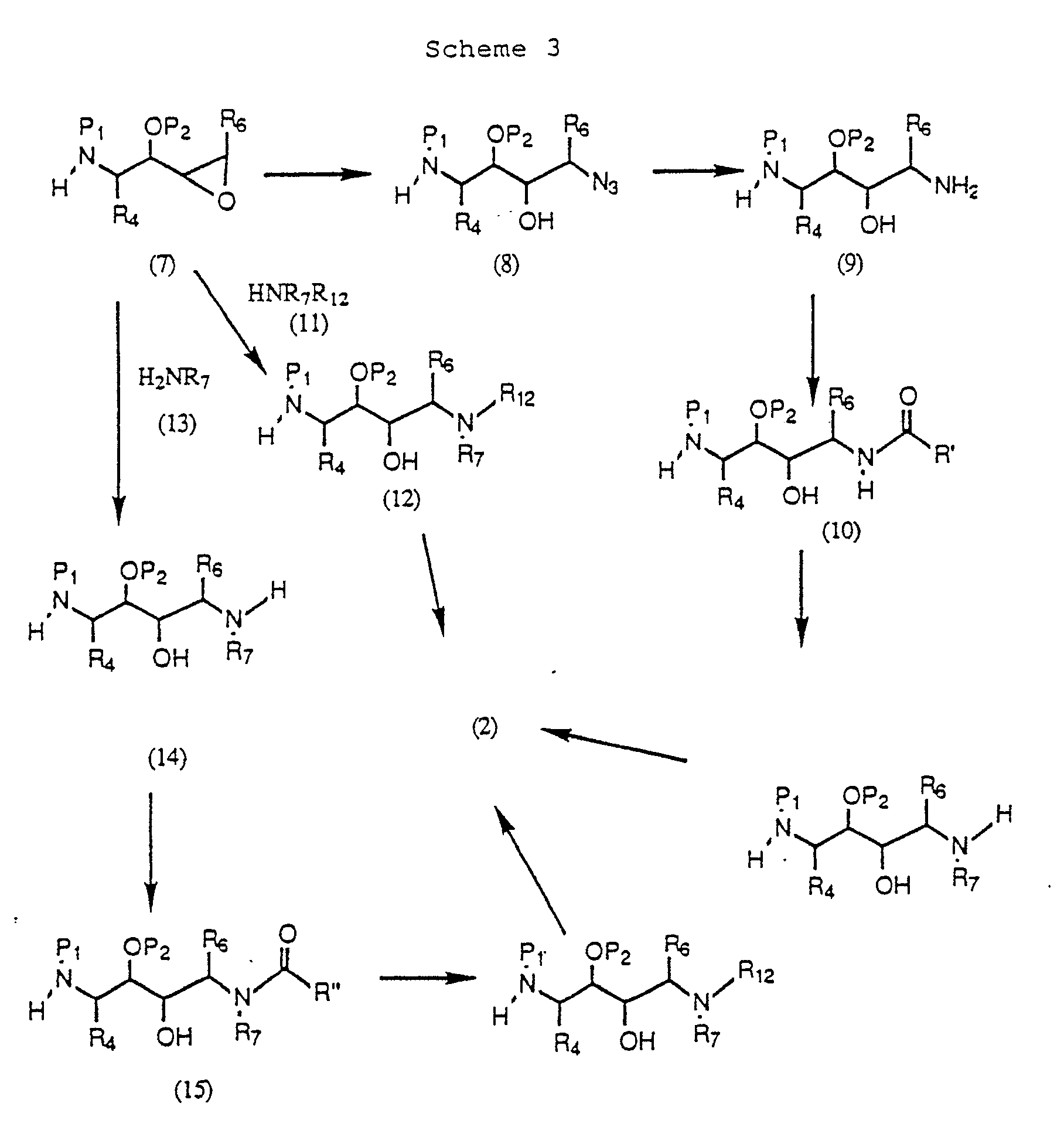
- The following Examples will serve to further illustrate preparation of the novel compounds of the invention.
- To a stirred -78°C solution of Boc-cyclohexylalanine methyl ester (10.2 g. 35.8 mmol) in dry toluene (60 ml) was added diisobutylaluminum hydride (34 ml of a 1.5 M solution in toluene). After 30 min., vinyl magnesium bromide (108 ml of 1 M solution in tetrahydrofuran (THF)) was added. After stirring for 15 hours at 0°C, the mixture was carefully quenched with methanol, treated with Rochelle salts (22 ml of saturated aqueous solution in 140 ml H2O), and filtered. After extracting the solids 5 times with ethyl acetate, the extracts and filtrate were combined and the organic phase was washed with brine, dried, filtered and evaporated to an oil (10.2g). Chromatography on silica gel eluting with hexane/ethyl acetate mixtures provided 6.1 g (60%) of the desired product.
- Analysis calculated for C16H29NO3 1/4H2O: C, 66.8; H, 10.3; N, 4.9. Found: C,66.9; H, 10.2; N, 4.7.
- The resultant product of Example 1 (2.80 g, 9.88 mmol) in dry dimethylformamide (DMF) (50 ml) was added to a stirred suspension of NaH (593 mg of a 60% dispersion in oil, 14.8 mmol, hexane washed) in dry DMF (50 ml). After 3 hours, the mixture was quenched (750 ml water + 100 ml brine) and extracted with ether (5 x 100 ml). The combined organic phase was washed with brine (3 x 50 ml), dried (MgSO4), filtered and evaporated to an oil (2.23 g). The NMR spectrum of the crude product revealed an 82:18 mixture of 5 S:5 R diastereomers. Silica gel chromatography gave 80% recovery of pure diastereomers. 5 S:
- Analysis calculated for C12H19NO2: C, 68.9; H, 9.1; N, 6.7. Found: C, 68.4; H, 9.2; N, 6.5. Mass spectrum: (M+1)+ = 210. 5 R: Mass spectrum: (M+1)+ = 210.
- To the resultant 5S-diasteriomer from Example 2 (2.06 g, 9.84 mmol) in dioxane (180 mL) and water (120 mL) was added barium hydroxide octahydrate (6.24 g, 19.8 mmol). The mixture was refluxed for 18 hours, cooled, filtered, concentrated, taken up in water and extracted with ethyl acetate which was dried over Na2SO4 and evaporated to afford 1.64 g (91%) of the desired product, m.p. 59-61°C.
- Analysis calculated for C11H21NO: C, 72.08; H, 11.55; N, 7.64. Found: C, 71.67; H, 11.68; N, 7.36.
- To the resultant compound from Example 3 (1.62 g, 8.84 mmol) in methylene chloride (20 mL) was added di-tert-butyldicarbonate (1.93 g, 8.84 mmol). The mixture was stirred for 14 hours, diluted with ethyl acetate, washed sequentially with 0.5 M H3PO4, saturated NaHCO3 solution and brine, then dried over Na2SO4 and evaporated to afford 2.51 g (100%) of the desired compound.
- To the resultant compound from Example 4 (1.60 g, 56.5 mmol) in methylene chloride (30 mL) was added diisopropylethylamine (9.8 mL, 56 mmol) and chloromethylmethyl ether (4.3 mL, 56 mmol). After 12 h, the mixture was concentrated, taken up in ethyl acetate, washed sequentially with 0.5 M H3PO4, saturated NaHCO3 solution and brine, then dried over Na2SO4 and evaporated to afford 1.82 g (98%) of the desired product as an oil.
- Analysis calculated for C18H33NO4: C, 66.02; H, 10.16; N, 4.28. Found: C, 65.96; H, 10.36; N, 4.26.
- The resultant compound from Example 5 (1.82 g.) and 3-chloroperbenzoic acid (3.60g) in methylene chloride (30 mL) were stirred for 40 h. The solvent was evaporated, and the residue dissolved in ethyl acetate and washed sequentially with cold 10% Na2SO4 solution, saturated NaHCO3 solution, then brine. After drying over Na2SO4 the solvent was evaporated to provide 1.81 g (95%) of the desired product as an oil.
- Analysis calculated for C18H33NO5: C, 62.95; H, 9.68; N, 4.08. Found: C, 63.08; H, 10.16; N, 4.07.
- The resultant compound from Example 6 (1.68 g., 4.89 mmol), sodium azide (0.82 g, 12.6 mmol) and NH4Cl (0.51 g, 9.53 mmol) in methanol (40 mL) were heated at reflux for 36 h. The mixture was concentrated, taken up in ethyl acetate, washed with water and brine then dried over Na2SO4 and evaporated. Chromatography on silica gel with ether-hexane mixtures afforded 0.73 g (38%) of the desired 2-S isomer followed by 0.36 g (19%) of the 2-R isomer.
- 2-S isomer: 1H-NMR (CDCl3, TMS) 4.66 (d,1H), 4.08 (m,1H), 3.39 (s,3H), 1.45 (s,9H) 2-R isomer: 1H-NMR (CDCl3, TMS) 4.78 (d,1H), 4.66 (d,1H), 3.45, (s,3H).
- The resultant compound from Example 6 (4.01g, 11.7 mmol) was added to a premixed solution of methoxylamine hydrochloride salt (2.93 g, 35.0 mmol) and sodium carbonate (3.71 g, 35 mmol) in 45 mL of 10% H2O:isopropanol in a resealable tube fit with a magnetic stirring bar. The resulting solution was flushed with N2, tightly sealed, and heated at 115°C for 18 h. After cooling to room temperature, the reaction solution was filtered and the filtrate concentrated under vacuum. MPLC (200 g silica gel; 20 ml fractions; 30% ethyl acetate/chloroform) provided, in order of elution: the (2S, 3R, 4S)-isomer (1.51 g, 3.87 mmol, 33%), mixed fractions (0.35 g, 0.90 mmol, 8%), and the (2R, 3R, 4S)-isomer (0.75 g, 1.92 mmol, 16%). Recrystalization of the (2S, 3R, 4S)-isomer from ether/hexanes provided an analytical sample; m.p. 68.5-69.5°C. Analysis calculated for C19H38N2O6.0.25 H2O: C, 57.77; H, 9.82; N, 7.09. Found: C, 58.07; H, 9.58; N, 6.74.
- The resultant compound from example 7 (167.0 mg, 0.432 mmol), 10% palladium on carbon (83 mg) and 37% aqueous formaldehyde solution (1 mL) in methanol (5 mL) were stirred under a hydrogen atmosphere for 24 h. After filtration and solvent evaporation the residue was chromatographed on silica gel with methanol-chloroform mixtures to provide 51.7 mg (31%) of the desired product as an oil.
- 1H-NMR (CDCl3, TMS) 4.95 (d, 1H), 4.68 (s, 2H), 3.67 (m, 1H), 3.40 (s, 3H), 2.34 (s, 6H), 1.45 (s, 9H).
- The resultant compound from Example 7 (508.3 mg, 1.32 mmol) in methanol (7 mL) was treated with triethylamine (0.55 mL, 3.9 mmol) and propane 1,3-dithiol (0.40 mL, 4.0 mmol). After 36 h the mixture was poured into 0.5 M H3PO4, washed with ether, made basic with K2CO3 and extracted into ethyl acetate which was dried over Na2SO4 and evaporated to afford 397.6 mg (84%) of the desired product as a white solid.
- Analysis calculated for C18H36N2O5: C, 59.97; H, 10.07; N, 7.7 Found: C, 59.91; H, 10.14; N, 7.68.
- The resultant compound from example 10 (193.2 mg, 0.536 mmol) in methylene chloride (3 mL) at 0°C was treated with triethylamine (115 ul, 0. 21 mmol) and isobutyric anhydride (100 ul, 0.603 mmol). After 30 min. at 0°C and 45 min. at ambient temperature the mixture was poured into ethyl acetate and washed sequentially with 0.5 M H3PO4, satured NaHCO3 solution and brine, then dried over Na2SO4 and evaporated. Chromatography of the residue on silica gel with hexane-ethyl acetate mixtures afforded 206.3 mg (89%) of the desired product as an oil.
- 1H-NMR (CDCl3, TMS) 4.69 (d, 1H), 4.62 (d, 1H), 4.04 (m, 1H), 3.34 (ddd, 1H), 3.46 (s, 3H), 2.38 (m, 1H), 1.44 (s, 9H), 1.17 (d, 3H), 1.14 (d, 3H)
- The resultant compound from Example 11 (196.0 mg, 0.455 mmol) in tetrahydrofuran (5 mL,THF) at -23°C was treated with BH3 in THF (1.4 mL, 1.0 M). The mixture was stirred at 0°C and then quenched with methanol (10 mL). After solvent evaporation the residue was dissolved in methylene chloride (5 mL), cooled to 0°C, and treated with triethylamine (100 ul, 0.71 mmol) and benzyl chloroformate (65 ul, 0.46 mmol). After 45 min. at 0°C and 1 h at room temperature the product was isolated and chromatographed as described in Example 11 to provide 83.1 mg (33%) of the desired product as an oil.
- Analysis calculated for C30H50N2O7.0.5H2O: C. 64.37; H, 9.18; N, 5.00. Found: C, 64.18; H, 9.30; N, 5.11.
- The resultant epoxide from Example 6 was stirred in methylamine in a sealed tube for 72 h. After removing the solvent with ethanol chasers the material was acylated with trifluoroacetic anhydride according to the procedure of Example 11. After isomer separation by chromatography on silica gel the desired 2S isomer was reduced according to the procedure of Example 12 to provide the desired product.
- The resultant compound from Example 6 (0.20 mmol) was stirred for 1 h in 4 M HCl in ethanol and the solvent was evaporated with ether chasers. This residue, Boc-Phe-His-OH (0.21 mmol), and 1-hydroxybenztriazole (0.54 mmol) were dissolved in DMF (2 mL), treated with N-methylmorpholine (0.44 mmol), cooled to -23°C, and treated with 1-(3-dimethylaminopropyl)-3-ethylcarbodiimide hydrochloride (0.28 mmol). After 2 h the cooling bath is removed and after 16 h the mixture is poured into saturated NaHCO3 solution and extracted into ethyl acetate which was washed with water and then brine, dried over Na2SO4 and evaporated. Chromatography of the residue on silica gel with methanol-chloroform mixtures afforded the desired product, m.p. 158-163°C.
- Exact Mass calculated for C31H47N8O6 (M+H) : 627.3618. Found: 627.3605.
- Using the procedure of Example 14 but using isobutyryl-Phe-Leu-OH in place of Boc-Phe-His-OH provided the desired produce, m.p. 193-194°C.
- Exact Mass calculated for C30H49N6O5 (M+H) : 573.3764. Found: 573.3757.
- The resultant compound from Example 14 (35.1 mg, 0.0478 mmol) and 10% palladium on carbon (21 mg) in acetic acid (3 mL) were stirred under a hydrogen atmosphere for 90 min. and then filtered and evaporated to provide 27.6 mg (96%) of the desired produced as a white solid, m.p. 145-148°C.
- Analysis calculated for C33H52N6O8: C, 57.98; H, 7.93; N, 12.72. Found: C, 59.92; H, 7.89; N, 12.75.
- Using the procedure of Example 16 with the resultant compound of Example 15 and dissolving the resultant compound in ethyl acetate and washing with sodium carbonate solution and then drying the organic solution
- Using the procedure of Example 14 with the resultant compound from Example 12 provided the desired product, m.p. 100-105°C.
- Analysis calculated for C43H62N6O8.0.25 H2O: C, 64.92; H, 7.92; N, 10.56. Found: C, 64.78; H, 7.82; N, 10.36.
- Using the procedure of Example 16 with the resultant compound from Example 20 provided the desired product, m.p. 110-113°C.
- Analysis calculated for C37H60N6O8: C, 61.99; H, 8.44; N, 11.72. Found: C, 61.62; H, 8.24; N, 11.78.
- Using the procedure of Example 9 with the resultant compound from Example 20 provided the desired product, m.p. 103-107°C.
- Exact mass calculated for C36H59N6O6(M+H); 671.4496. Found: 671.4496.
- Using the procedure of Example 14 with the resultant compound from Example 13 provided the desired product, m.p. 113-115°C.
- Analysis calculated for C34H51N6O6F3. H2O; C, 57.13; H, 7.47; N, 11.76. Found: C, 57.43; H, 7.24; N, 11.40.
- Using the procedure of Example 14 with the resultant compound from Example 8 provided the desired product and the bis-Boc-Phe-His (1-methoxylamino,4-amino)amide. The mixture was treated with excess K2CO3 in refluxing absolute methanol for 1h. cooled, and filtered. The filtrate was concentrated in vacuo and purified by silica gel chromatography as previously described to provide the desired product, m.p. softening at 117°C, melts 119-122°C.
- Using the procedure of Example 14 with the resultant compound from Example 9 and replacing Boc-Phe-His-OH with Boc-His-OH provided the desired product, m.p. 95-99°C.
- Mass Spectrum: (M+H)=482.
- Ethyl alpha-carboxymethylcinnamate was prepared as reported (Cohen, S.G. and Milovanovic, A. Biochemistry, 1968, 3495) and hydrogenated (1 atmosphere H2) with 10% Pd/C in methanol for 5 h. The resulting dihydrocinnamate was coupled to morpholine using the procedure of Example 20. Ester hydrolysis with LiOH in dioxane/water provided the desired compound. Mass spectrum: (M+H)+=278.
- Analysis calculated for C15H19NO4.1/8 H2O: C, 64.4; H, 6.9; N, 5.0. Found: C, 64.4; H, 6.8; N, 4.9.
- Using the procedure of Example 14 with the resultant compound from Example 25 and using the resultant compound from Example 26 in place of Boc-Phe-His-OH provided the desired product, m.p. 90-95°C.
- Exact Mass calculated for C34H53N6O6 (M+H) : 641.4026. Found: 641.4008.
- To the resultant compound from Example 4 (2.51 g, 8.84 mmol) in methylene chloride (20 ml) was added diisopropyl ethylamine (4.60 ml, 26.4 mmol) and methoxyethoxy chloromethane (3.00 ml, 26.3 mmol). After stirring at room temperature for 24 h the mixture was concentrated, diluted with ethyl acetate, washed with 0.5 M H₃PO₄, saturated NaHCO₃ solution, then brine, dried over Na₂SO₄, and evaporated. Chromatography on silica gel with ethyl acetate/hexane mixtures afforded 2.63 g (80%) of the desired product as an oil. El-MS: M⁺ = 371.
Anal. (C₂₀H₃₇NO₅)
Calcd: C, 64.66; H, 10.04; N, 3.77.
Found: C, 64.94; H, 9.97; N, 3.74. - To the resultant compound from Example 5 (5.41 g, 14.56 mmol) in methylene chloride (50 ml) was added 3-chloroperbenzoic acid (6.28 g). After stirring at room temperature for 60 h the mixture was concentrated, diluted with ethyl acetate, washed with cold 1:1 15% aqueous Na₂SO₃ solution/saturated NaHCO₃ solution (2 x 200 ml), saturated NaHCO₃ solution (3 x 100 ml) then brine (1 x 100 ml), dried over Na₂SO₄, and evaporated to afford 4.57 g (81%) product as an oil. El-MS: M⁺ = 387.
Anal. (C₂₀H₃₇NO₆)
Calcd: C, 61.99; H, 9.62; N, 3.61.
Found: C, 61.84; H, 9.56; N, 3.55. - The resultant compound from Example 29 (454.7 mg, 1.17 mmol) in dioxane (4 mL) was treated with N-methyl-O-methylhroxylamine hydrochloride (1.14 g, 11.7 mmol) in water (4 mL). Solid NaHCO₃ (1.00 g, 11.9 mmol) was added, the reaction was sealed and heated at 90°C for 60 h. The reaction was cooled, poured into saturated NaHCO₃ solution and extracted into ethyl acetate which was dried over Na₂SO₄ and evaporated. Chromatography of the residue on silica gel (60 g) with 60% ethyl acetate in hexane afforded 306.0 mg (58%) of the 2S-isomer (followed by the 2R-isomer). TLC (5% methanol/95% chloroform) Rf = 0.53; ¹H NMR (CDCl₃) δ 4.89 (1H,d), 4.77 (2H,s), 4.02-4.12 (1H,m), 3.02 (3H,s), 3.39 (3H,s), 2.91 (1H,dd), 2.63 (3H,s), 1.45 (9H,s).
- The resultant compund from Example 30 (1.00 mmol) was stirred for 1 h in 4M HCl/ethanol. The mixture was evaporated and the residue was disolved in water which was made basic with solid K₂CO₃ and was then saturated with NaCl. The mixture was extracted with chloroform which was dried over Na₂SO₄ and evaporated to afford the desired product.
- The resultant compound from Example 13 was treated according to the procedure for Example 31 to provide the desired product.
- To the resultant compound from Example 31 (1.00 mmol), Boc-His-OH (1.10 mmol) and 1-hydroxybenzotriazole (2.70 mmol) in DMF (5 mL) was added N-methylmorpholine (1.20 mmol). The mixture was cooled to -23°C and treated with 1-(3-dimethylaminopropyl)-3-ethylcarbodiimide hydrochloride (1.43 mmol). After 2 h at -23°C and 12-16 h at room temperature the mixture was poured into saturated NaHCO₃ solution and extracted with ethyl acetate which was washed with water and brine, then dried over Na₂SO₄ and evaporated. Chromatography of the residue on silica gel with methanol/chloroform mixtures afforded the intermediate Boc-protected compound. This material was dissolved in methylene chloride (5 mL), cooled to 0°C, treated with trifluoroacetic acid (5 mL), stirred at 0°C for 3 h, and evaporated. The residue was dissolved in water, made basic with solid K₂CO₃, saturated with NaCl and extracted with chloroform which was dried over Na₂SO₄ and evaporated to afford the desired product.
- Boc-Nor-Leucine (Boc-Nle-OH, 1.00 mmol) in methylene chloride (10 mL) at -10°C was treated with N-methylmorpholine (1.10 mmol) and then with isobutylchloroformate (1.00 mmol). After 3 min. the resultant amine from Example 31 (1.00 mmol) was added and the reaction was stirred at -10°C for 10 min and at room temperature for 2 h. The mixture was evaporated, taken up in ethyl acetate, washed with water, saturated NaHCO₃ solution, and brine, then dried and evaporated. Chromatography of the residue on silica gel followed by N-deprotection according to the procedure of Example 33 provided the desired product.
- Pyrazole (700 mg, 10.3 mmol) and N-(tert-Butyloxycarbonyl)-L-serine-β-lactone (1.707 g, 9.117 mmol, Arnold et al., J. Am. Chem. Soc. 1985, 107, 7105) in CH₃CN (75 ml) were heated at 52°C for 72 h. The solvent was evaporated and the residue was dissolved in hot methanol (8 ml) and then water (24 ml) was added with heating until the mixture became turbid. The mixture was cooled to room temperature with rapid stirring, and after stirring overnight 745 mg (32%) of the desired product was collected as a white solid. ¹H NMR (CDCl₃) δ 7.65 (d,1H), 7.41 (d,1H), 6.30 (dd,1H), 5.48 (br,1H), 4.82 (dd,1H), 4.67 (dd,1H), 4.48 (m,1H), 1.47 (s,9H).
- Using the procedure of Example 33 with the resultant compound from Example 32 and replacing Boc-His-OH with the resultant compound from Example 35 gave the desired product.
- A solution of 2,2-dimethyl-3-carbomethyoxypropionic acid [LeMaul, Bull. Soc. Chim. Fr., 828 (1965), 20 g, 0.125 mol], diphenylphosphorylazide (34.3 g, 0.125 mol) and triethylamine was heated in toluene (150 ml) at 100oC for 2 h. After cooling to 5°C, the toluene solution was washed successively with 0.5 M HCl, aqueous NaHCO₃ and brine. Evaporation of the dried solution gave a residue which was chromatographed on silica gel eluting with 60/40 hexane-ether. There was obtained 13 g of methyl 3-isocyanato-3-methyl-butanoate as a mobile liquid. A solution of this material in toluene (20 ml) was treated with benzyl alcohol (13 ml) and the resulting mixture heated at reflux for 40 h. Evaporation of the toluene left a residue which was dissolved in methanol (125 ml) and then treated with a solution of NaOH (6.6 g, 0.165 mmol) in 22 ml of water. After 5 h, the reaction mixture was partially evaporated, washed with ether and acidified with 6N HCl. Extraction with methylene chloride and evaporation gave 21 g of the desired product. NMR (300 MHz, CDC1₃): δ 1.42 (s,6H), 2.78 (s,2H), 5.08 (s,2H).
- A 4.0 g sample of 3-benzyloxycarbonylamino-3-methylbutanoic acid was coupled to phenylalanine methyl ester hydrochloride (3.43 g) using the mixed anhydride procedure described in Example 34. Purification of the crude product by flash chromatography eluting with 65/35 ether/hexane gave an 86% yield of product. NMR (300 MHz, CDC1₃): δ 1.32 (s,3H), 1.34 (s,3H), 2.46 (d,1H), 2.63 (d,1H), 2.98 (dd,1H), 3.09 (dd,1H), 3.70 (s,3H), 4.86 (dd,1H), 4.97 (d,1H), 5.2 (d,1H), 5.3 (s,1H), 6.13 (d,1H).
- To a 0°C solution of Cbz-[(β,β-di-Me)-β-Ala]-Phe-OMe (1.5 g, 3.63 mmol) in dioxane (15 ml) was added a solution of lithium hydroxide (0.174 g, 4.15 mmol) in water 7.5 ml). After stirring for 1 h at 0-5°C, the reaction mixture was diluted with cold water and extracted two times with ether. The aqueous portion was acidified with 6N HCl and extracted with ether. The organic extract was washed with brine and evaporated to give an 87% yield of product as a viscous liquid.
- Using the procedure of Example 38 and replacing phenylalanine methyl ester hydrochloride with O-methyltyrosine methyl ester hydrochloride provided the desired material.
- Using the procedure of Example 39 with the resultant compound from Example 40 gave the desired material.
- To L-phenyllactic acid methyl ester (3.2 g) was added 150 ml of 12.5% phosgene in toluene and 25 drops of dimethylformamide. After stirring for 16 h at room temperature, the solvent was evaporated and the residue chased several times with benzene. The resulting product was dissolved in methylene chloride (50 ml), cooled to 0°C and treated by dropwise addition with 3.86 g (0.044 mmol) of morpholine. The reaction mixture was stirred for 2 h at 0-5°C and then distributed between 0.5 N HCl and methylene chloride. The organic phase was washed with aqueous NaHCO₃ and brine and evaporated to a residue. Flash chromatography on silica gel eluting with 2:1 ether/hexane gave a 65% yield of product. NMR (300 MHz): δ 3.08 (dd,1H), 3.20 (dd,1H), 3.8 (s,3H), 5.19 (dd,1H).
- Using the hydrolysis procedure of Example 39, the title compound was obtained in 90% yield.
- To a stirred solution of 4-(2-propyl)-oxazolidine-2-one in anhydrous tetrahydrofuran (250 ml) under a nitrogen atmosphere at - 78°C were added in a dropwise fashion a solution of n-butyllithium in hexane (50 ml, 77.4 mmol) over 5 to 10 min. After stirring an additional 20 min at -78°C 3-phenylpropionyl chloride (12.7 ml, 85.2 mmol) was added neat. The reaction was warmed to room temperature and stirred 1 to 2 h. The reaction was quenched by adding 100 ml of saturated aqueous ammonium chloride and the volatiles removed by rotary evaporation. The resulting aqueous residue was extracted three times with ether and the combined organic phases were washed with brine, dried (Na₂SO₄), filtered and concentrated in vacuo. Recrystallization from hexanes/ethyl acetate provided the title compound (16.6 g, 82%). m.p. = 86.5 to 87.5°C. Mass spectrum: (M+NH₄)⁺ = 279, (M+H)⁺ = 262.
- To a stirred solution of the product resulting from Example 44 (2.28 g, 8.72 mmol), in anhydrous tetrahydrofuran (30 ml) under a nitrogen atmosphere at -78°C was added a solution of sodium hexamethyldisilylamide (9.6 ml, 9.59 mmol) in tetrahydrofuran. After stirring for 30 min at -78°C, t-butyl bromoacetate (2.21 g, 11.34 mmol) was added in anhydrous tetrahydrofuran and the resulting solution stirred 1 h at -78°C. The reaction was quenched by adding 20 ml of saturated aqueous ammonium chloride and partitioned between water and ether. The aqueous layer was drawn off and extracted with ether. The combined organic phases were washed with 10% aqueous HCl, saturated aqueous NaHCO₃, and brine, dried (Na₂SO₄), filtered, and concentrated in vacuo. Recrystallization from acetone/hexanes provided the desired purified product (2.59 g, 79%). m.p. = 167-168°C. Mass spectrum: (M + NH₄)⁺ = 393, (M+H)⁺ = 376.
- To a stirred solution of dry benzyl alcohol (0.55 ml, 5.33 mmol) in anhydrous tetrahydrofuran (18 ml) under a nitrogen atmosphere at 0°C was added a hexane solution of N-butyllithium (2.58 ml; 4.00 mmol). To this solution was added the product from Example 45 in anhydrous tetrahydrofuran (10 ml). After stirring 1 h at 0°C the reaction was quenched by adding excess saturated aqueous ammonium chloride. The volatiles were removed by rotary evaporation and the resulting aqueous residue extracted two times with ether. The combined organic layers were washed with brine, dried (Na₂SO₄), filtered, and concentrated in vacuo provided an oil which was purified by chromatography on SiO₂ (15% ethyl acetate/hexanes) to provide the desired product (0.89 g, 94%) as a colorless oil. Mass spectrum: (M)⁺ = 354.
- The product from Example 46 (0.52 g, 1.47 mmol) was dissolved in a 1:1 (v:v) solution (6 ml) of trifluoracetic acid and dichloromethane and stirred at room temperature for 1 h. The volatiles were removed in vacuo to provide the title compound (0.437 g, 100%) as an oil which crystallized on standing. The unpurified material was of sufficient purity to employ in subsequent steps. Mass spectrum: (M)⁺ = 298.
- The product from Example 47 (0.438 g, 1.47 mmol), diphenylphosphoryl azide (317 µl, 1.47 mmol), and triethylamine (205 µl, 1.47 mmol) in dry benzene (6 ml) were refluxed for 3 to 5 h to provide a solution of the derived isocyanate which was cooled to 0oC and treated with morpholine (141 µl, 1.62 ml). The cooling bath was removed and the reaction stirred for 1 h. The reaction mixture was poured into 10% aqueous HCl and extracted two times with ether. The combined organic layers were washed successively with saturated aqueous NaHCO₃ and brine, dried (Na₂SO₄), filtered and concentrated in vacuo to provide the unpurified product. The desired product (0.403 g, 72%) was obtained in pure form after chromatography on SiO₂ (3% methanol/chloroform) as a thick oil which formed an amorphous solid on standing. Mass spectrum: (M)⁺ = 382. NMR (300 MHz, CDCl₃, ppm, TMS as internal standard) δ 7.12-7.40 (m,10H), 5.18 (AB; J=12.6 Hz; 2H), 4.8 (dd; J=5.7 Hz; 1H), 3.59 (dd; J=6.0, 6.0 Hz; 4H), 3.55 (d,d,d; J=3.0, 6.0, 14.4 Hz; 1H), 3.37 (d,d,d; J=5.4, 8.4, 14.4 Hz; 1H), 3.13 (d,d; J=6.0, 6.0 Hz; 4H), 2.8-3.10 (m,3H).
- The procedure as described in Example 48 was followed except absolute ethanol was employed in lieu of morpholine. Mass spectrum: (M)⁺ = 341. NMR (300 MHz, CDCl₃, ppm, TMS as internal standard) δ 7.1-7.4 (m,10H), 5.17 (s,2H), 4.96 (br s,1H), 4.07 (d,d,d; J=6.6, 6.6, 6.6 (Hz,2H), 3.25-3.5 (2 br ABX,2H), 2.9-3.05 (m,2H), 2.75-2.88 (br m,1H), 1.23 (d,d; J=6.6, 6.6 Hz; 3H).
- The product from Example 49 (0.315 g, 0.86 mmol) was dissolved in ethyl acetate (5 ml) and syringed into a flask charged with 10% Pd/C (∼0.3 g). The resulting suspension was exposed to 1 atm of gaseous hydrogen for 2 to 4 h. The catalyst was removed by filtration through a celite pad. The filtrate was concentrated in vacuo to provide the desired compound (0.21 g, 88%) as a cream colored foam which was employed without further purification. Mass spectrum: (M+H)⁺ = 278.
- The procedure as described in Example 50 was followed employing the product from Example 49 in lieu of that from Example 48. Mass spectrum: (M+H)⁺ = 252.
- The product of Example 47 and morpholine were converted to the title compound using the mixed anhydride method of coupling as described in Example 34. Mass spectrum: (M)⁺ = 367.
- The product from Example 52 was converted to the title compound following the procedure described in Example 50. Mass spectrum: (M)⁺ = 277.
- The resultant compound from Example 46 and an equal weight of 10% palladium on carbon in methanol were stirred under a hydrogen atmosphere for 1 h. The mixture was filtered and evaporated to provide the desired product. ¹H NMR (CDCl₃, TMS) δ 7.25 (m,5H), 3.07 (m,2H), 2.73 (dd,1H), 2.56 (dd,1H), 2.33 (dd,1H), 1.40 (s,9H).
- A suspension of (O-methyl)tyrosine methyl ester hydrochloride (6 g) in toluene (125 ml) was heated at 100oC while phosgene was bubbled into the reaction mixture. After 2 h the mixture became homogeneous and the phosgene was continued for an additional 15 min. The mixture was cooled and evaporated with several benzene chasers to provide the desired product.
- 1-Amino-2,3-propanediol (15.2 g, 167 mmol) and NaOH (8.1 g, 204 mmol) in water (70 ml) at -10°C was treated dropwise with benzyl chloroformate (28.5 ml, 200 mmol) in ether (30 ml) over 20 min. The reaction was stirred at 0°C for 30 min then at room temperature for 2 h. The mixture was acidified with 2 M HCl and extracted with ethyl acetate which was washed with 0.5 M H₃PO₄ and brine, then dried over Na₂SO₄ and evaporated. Recrystallization of the residue from benzene afforded 16.59 g (44%) of the desired product as a white powder. NMR (300 MHz, CD₃OD, ppm): δ 3.12 (dd,1H), 3.28 (dd,1H), 3.50 (m,2H), 3.68(m,1H), 5.08 (s,2H), 7.35 (m,5H).
- Lithium aluminum hydride (7.20 g, 189 mmol) in tetrahdyrofuran (THF, 300 ml) was heated to reflux and the resultant compound from Example 56 (17.0 g, 75.5 mmol) in THF (150 ml) was added dropwise over 10 min. The mixture was refluxed for 2 h, cooled, quenched sequentially with water (10 ml), 3 M NaOH (40 ml) and water (20 ml), then filtered and concentrated. The residue was dissolved in water which was washed with ether and evaporated. Bulb to bulb distillation of the residue afforded 2.0 g (25%) of the desired compound as an oil. NMR (300 MHz, CDCl₃, ppm): δ 2.45 (s,3H), 2.68 (dd,1H), 2.77 (dd,1H), 3.61 (dd,1H), 3.72 (dd,1H), 3.78 (m,1H).
- To the resultant compound from Example 55 (1.53 g, 6.5 mmol) in dioxane (5 ml) at 0°C was added the resultant compound from Example 57 (0.684 g, 6.5 mmol). The reaction was stirred at 0°C for 1 h then at room temperature for 1 h, evaporated and chromatographed on silica gel with 5% methanol in chloroform to afford 1.855 g (84%) of the desired product as an oil. NMR (300 MHz, CDCl₃, ppm), δ 2.88, 2.89 (s,3H total), 3.05 (m,2H), 3.26-3.60 (m,5H), 3.73 (s,3H), 3.80 (s,3H), 4.70 (m,1H), 5.07 (broad t,1H), 6.83 (dd,1H), 7.02 (dd,1H).
- The resultant compound from Example 58 (114 mg, 0.355 mmol) in dioxane (4 ml) and water (2 ml) at 0°C was treated with LiOH monohydrate (42.0 mg, 1 mmol). After 90 min, 2M HCl (0.6 ml, 1.2 mmol) was added and the mixture was evaporated to a foam which was used without further purification; DCl-MS: (M+H)⁺ = 327.
- 3,3-Dimethylglutaric anhydride (455 mg, 3.2 mmol) in tetrahydrofuran (THF, 5 ml) was treated with sublimed potassium t- butoxide (395 mg, 3.5 mmol). After 30 min the solution was concentrated, poured into saturated NaHCO₃ solution and washed with ether. The aqueous phase was acidified to pH 4 with 0.5 M H₃PO₄ and extracted with chloroform which was dried over Na₂SO₄ and evaporated to afford 179 mg (26%) of the desired product as an oil. NMR (300 MHz, CDCl₃, ppm) δ 1.13 (s,6H), 1.47 (s,9H), 2.33 (s, 2H), 2.45 (s,2H).
- Prepared according to the procedure from Example 34 from the resultant compound from Example 60 and phenylalanine benzyl ester p-toluenesulfonic acid salt. NMR (300 MHz, CDCl₃, ppm) δ 0.96 (s,3H), 1.00 (s,3H), 1.44 (s,9H), 1.90 (d,1H), 2.16 (d,1H), 2.25 (d,1H), 2.29 (d,1H), 3.03 (dd,1H), 3.17 (dd,1H), 4.92 (m,1H), 5.12 (d,1H), 5.16 (d,1H), 7.10-7.40 (m,10H).
- Using the procedure of Example 54 with the resultant compound of Example 61 gave the desired product as an oil. NMR (300 MHz, CDCl₃, ppm), δ 0.93 (s,3H), 0.99 (s,3H), 1.45 (s,9H), 1.77 (d,1H), 2.10 (d,1H), 2.19 (d,1H), 2.25 (d,1H), 3.02 (dd,1H), 3.33 (dd,1H), 4.72 (m,1H), 7.25 (m,5H).
- To 50 ml of absolute ethanol was added 2 g of sodium metal. The suspension was stirred vigorously until all the sodium dissolved and the evolution of hydrogen ceased. To this solution of sodium ethoxide was added a solution of 11.6 g of diethylsuccinate in 10.4 g of 1-naphthaldehyde. The solution was heated to reflux for 3 h, at which time it was cooled to room temperature and concentrated. The residue was dissolved in 320 ml of water and extracted 6 times with 100 ml portions of ether. The aqueous layer was acidified with 2N HCl and extracted with 2 x 300 ml of ether and dried with anhydrous magnesium sulfate. Evaporation of the solvent gave a yellow gummy solid which was hydrogenated to the saturated acid using Pd/C as catalyst. Coupling of the resulting saturated acid to morpholine using the mixed anhydride method described in Example 34 followed by ester hydrolysis using the procedure of Example 39 gave the desired acid. Mass spectrum: (M+H)⁺ = 328.
- A suspension of L-phenylalanine methyl ester hydrochloride (6 g) in toluene (125 ml) was heated to 100°C and phosgene gas was bubbled into the reaction mixture. After approximately 1.5 h, the mixture became homogeneous. The bubbling of phosgene was continued for 10 more min. The solvent was then evaporated and the residue chased with benzene several times. The residue was then dissolved in ∼100 ml of methylene chloride and cooled to ∼0°C, and 1.1 equivalent of thiomorpholine was added dropwise. After 10 min the solution was washed with 1N HCl and the organic layer was dried with MgSO₄. Evaporation of solvent gave 5.5 g of product. Mass spectrum: M⁺ = 308.
- To 2 g of the product from Example 64 in 100 ml of methylene chloride was added 2.94 g of meta-chloroperbenzoic acid at 0oC. After 30 min the solvent was evaporated, dissolved in ether, and the ether solution was washed with 10% sodium sulfite solution and then with saturated sodium bicarbonate several times. The organic layer was dried with MgSO₄ and evaporation of the solvent gave a white solid which was purified by silica gel column chromatography (20% EtOAc/80%/CH₂Cl₂) to give 2.10 g (95%) of pure product. Mass spectrum: M⁺ = 340.
- Using the procedure described in Example 39, with the resultant compound from Example 65 gave the desired compound.
- A mixture of 3.0 g (0.02 mol) of 6-aminohexanoic acid, 5.04 g (0.02 mol) of di-t-butyldicarbonate and 3.84 g (0.05 mol) of NaHCO₃ in 160 ml of 1:1 H₂O/tetrahydrofuran was stirred vigorously for 24 h. After concentration of the solvent, the mixture was acidified with HCl, saturated with NaCl, extracted with ethyl acetate, dried over MgSO₄ and concentrated in vacuo to give the desired product (Rf 0.48, 9:1 chloroform/methanol).
- The resulting compound from Example 67 and the hydrochloride salt of O-methyltyrosine methyl ester were reacted according to the procedure of Example 34 to provide the desired product as an oil.
- The resulting compound from Example 68 was hydrolized according to the procedure of Example 39 to provide the desired product.
- A solution of 0.5 g (2.1 mmol) of the resultant compound of Example 55 in 50 ml of dichloromethane was cooled to 0°C and treated with 0.3 ml (2.3 mmol) of N,N,N′-trimethylethylenediamine. After being allowed to stir for 16 h, the solution was concentrated and the desired compound was isolated by flash column chromatography using 1% methanol/2% isopropylamine in chloroform.
- A solution of the resultant compound of Example 70 in dioxane was cooled to 0°C, treated with 1.05 equivalent of aqueous lithium hydroxide (0.5 M) and stirred for 1.5 h. The resulting solution was concentrated in vacuo to give the desired compound as a white solid.
- To (O-methyl)tyrosine (126 mg, 0.647 mmol) in dioxane (3 ml) was added NaOH (52 mg, 1.3 mmol) in water (3 ml). Isobutyric anhydride (0.11 ml, 0.66 mmol) was added and the mixture was stirred at 0°C for 2 h, poured into saturated NaHCO₃ solution and extracted with ether.
- The aqueous phase was acidified with concentrated HCl then extracted with ethyl acetate which was dried over Na₂SO₄ and evaporated. Trituration with hot ethyl acetate afforded 132 mg (77%) of the desired product as a solid.
Anal. Calcd. for C₁₄H₁₉NO₄.0.25 H₂O: C, 62.32; H, 7.28; N, 5.19.
Found: C, 62.68; H, 7.29; N, 5.18. - Prepared from phenylmethylalanine according to the procedure of Example 72 to give the desired product as an oil.
- Prepared according to the procedure of Example 72 from (O-benzyl)threonine to give the desired product as a solid.
Anal. Calcd. for C₁₅H₂₁NO₄: C, 64.50; H, 7.58; N, 5.01.
Found: C, 64.65; H, 7.51; N, 4.75. - To the resultant compound from Example 55 in methylene chloride at 0°C was added one equivalent of morpholine. After 1 h the solvent was evaporated and the residue was chromatographed on silica gel with ethyl acetate/hexane mixtures to provide the desired produce.
- Using the procedure from Example 39 with the resultant compound from Example 75 gave the desired product.
Anal. Calcd. for C₁₅H₂₀N₂O₅.0.25 H₂O: C, 57.59; H, 6.66; N, 8.95.
Found: C, 57.79; H, 6.57; N, 8.93. - Prepared according to the procedure of Example 75 replacing morpholine with N-methyl-2-phenylethylamine. ¹H NMR (CDCl₃,TMS) δ 7.25 (m,5H), 7.02 (m,2H), 6.82 (m,2H), 4.73 (m,2H), 3.78 (s,3H), 3.73 (s,3H), 3.45 (m,2H), 3.03 (d,2H), 2.81 (d,2H), 2.77 (s,3H).
- Using the procedure from Example 39 with the resultant compound from Example 77 gave the desired product. ¹H NMR (CDCl₃,TMS) δ 7.28 (m,3H), 7.10 (m,4H), 6.82 (m,2H), 4.40 (m,2H), 3.78 (s,3H), 3.38 (m,2H), 2.70 (s,3H).
- Using the procedure of Example 64 but replacing the thiomorpholine with diisopropylamine provided the desired product. ¹H NMR (CDCl₃,TMS) δ 7.10-7.40 (m,5H), 4.83 (m,1H), 4.66 (d,2H), 3.88 (m,2H), 3.74 (s,3H), 3.20 (dd,1H), 3.12 (dd,1H), 1.19 (d,6H), 1.15 (d,6H).
- Using the procedure of Example 39 with the resultant compound of Example 79 gave the desired product. ¹H NMR (CDCl₃,TMS) δ 7.28 (m,5H), 4.48 (m,2H), 3.72 (s,3H), 3.69 (m,2H), 3.34 (dd,1H), 3.19 (dd,1H), 1.11 (d,6H), 1.05 (d,6H).
- Using the procedure of Example 72 and replacing isobutyric anhydride with 2-ethyl-2-methylbutanoyl chloride gave the desired compound. ¹H NMR (CDCl₃,TMS) δ 7.15-7.35 (m,5H), 6.00 (d,1H), 4.78 (m, 1H), 3.27 (dd,1H), 3.08 (dd,1H), 1.55 (m,2H), 1.35 (m,2H), 1.00 (s,3H), 0.70 (m,6H).
- Using the mixed anhydride coupling procedure of Example 34 with the resultant compound from Example 47 and N-methylethanolamine gave the desired compound. ¹H NMR (CDCl₃,TMS) δ 7.10-7.40 (m,10H), 5.10 (m,2H), 3.00, 2.92 (s,total 3H).
- Using the procedure of Example 54 with the resultant compound of Example 82 gave the desired compound. ¹H NMR (CDCl₃,TMS) δ 7.25 (m,5H), 2.96,2.93 (s, total 3H).
- Using the mixed anhydride coupling procedure of Example 34 with the resultant compound from Example 47 and methylamine gave the desired product. ¹H NMR (CDCl₃,TMS) δ 7.05-7.40 (m,10H), 5.42 (broad s,1H), 5.12 (d,1H), 5.06 (d,1H), 3.29 (m,1H), 3.02 (dd,1H), 2.83 (dd,1H), 2.72 (d,3H), 2.48 (dd,1H), 2.27 (dd,1H).
- Using the procedure of Example 54 with the resultant compound of Example 84 gave the desired product. ¹H NMR (CDCl₃,TMS) δ 7.15-7.35 (m,5H), 5.83 (m,1H), 2.72 (d,3H).
- To N-methylethanolamine (149 mmol) in methylene chloride (100 ml) at 0°C was added benzyl chloroformate (10.0 ml, 70 mmol). The mixture was stirred at 0°C for 30 min, then at room temperature for 1 h, poured into ethyl acetate, washed with 2 M HCl, saturated NaHCO₃ solution, and brine, then dried over Na₂SO₄ and evaporated to provide 12.91 g (94%) of the desired compound. ¹H NMR (CDCl₃,TMS) δ 7.36 (m,5H), 5.14 (s,2H), 3.78 (m,2H), 3.47 (m,2H), 3.01(s, 3H).
- Using the procedure of Example 5 with the resultant compound from Example 86 gave the desired product. ¹H NMR (CDCl₃,TMS) δ 7.37 (m,5H), 5.14 (s,2H), 4.09 (m,2H), 3.67 (m,2H), 3.50 (m,2H), 3.33 (m,3H), 3.02 (s,3H).
- Using the procedure of Example 5 with the resultant compound from Example 86 and replacing chloromethyl methyl ether with 2-methoxyethoxy methylchloride gave the desired compound, b.p. 150-170°C (0.3 mm).
- A suspension of L-(O-methyl)tyrosine methyl ester hydrochloride (10 g) in toluene (f200 ml) was heated to 100°C while phosgene gas was bubbled into the reaction mixture. After approximately 2 h the mixture became homogeneous. The bubbling of phosgene was continued for 15 more minutes keeping the temperature at ∼100°C. The toluene was then evaporated and the residue chased with benzene several times. The isocyanate from L-(Me)Tyr-OCH₃ was then dissolved in ∼100 ml of methylene chloride and 1.1 equivalent of 3-pyrroline (75% pure) was added dropwise at 0°C. After 15 min, the reaction mixture was washed with 0.5 N HCl and methylene chloride. The organic layer was washed with aqueous NaHCO₃ and dried over MgSO₄. Evaporation of the solvent gave 3-pyrrolinylcarbonyl-(Me)Tyr-methyl ester which was cis-hydroxylated under the following conditions: 2.5 g of the 3-pyrrolinylcarbonyl-(Me)Tyr-methyl ester was dissolved in 50 ml of THF and 1 ml of a 2.5% solution of OsO₄ in t-butanol was added, followed by 1.15 g of N-methylmorpholine-N-oxide. After 1 h, the solvent was evaporated and the residue dissolved in 150 ml of ethyl acetate and washed with dilute Na₂SO₃ solution, saturated NaHCO₃ solution and then dried with MgSO₄. Evaporation of the solvent gave a gummy solid which was purified by SiO₂ column chromatography (5% MeOH/CH₂Cl₂) to give the desired compound (65% yield). Mass spectrum: M⁺ = 338.
- Using the procedure from Example 39 with the resultant compound from Example 89 and replacing ether extractions with chloroform extractions gave the desired product. Mass spectrum: M⁺ = 324.
- 3-Pyrroline (75% pure) was reacted with benzyl chloroformate according to the procedure of Example 86 and the resulting product was cis-hydroxylated according to the procedure of Example 89 to give the desired product.
- Using the procedure of Example 5 with the resultant compound from Example 91 gave the desired product. ¹H NMR (CDCl₃,TMS) δ 7.35 (m,5H), 5.16 (d,1H), 5.13 (d,1H), 4.73 (m,4H), 4.21 (m,2H), 3.60 (m,4H), 3.40 (s,3H), 3.38 (s,3H).
- Using the procedure of Example 54 with the resultant compound from Example 87 gave the desired product, b.p. 60-80°C (60 mm).
- Using the procedure of Example 54 with the resultant compound from Example 88 gave the desired product, b.p. 130-140°C (45 mm).
- Using the procedure of Example 54 with the resultant compound from Example 92 gave the desired product. ¹H NMR (CDCl₃,TMS) δ 4.71 (m,4H), 4.12 (m,2H), 3.38 (s,6H), 3.09 (m,2H), 2.90 (m,2H).
- Using the procedure of Example 34 with the resultant compounds from Example 47 and Example 95 gave the desired product. ¹H NMR (CDCl₃,TMS) δ 7.10-7.35 (m,10H), 5.10 (m,2H), 4.72 (m,4H), 4.18 (m,2H), 3.37 (m,6H), 3.05 (m,1H), 2.82 (m,1H), 2.62 (m,1H), 2.30 (m,1H).
- Using the procedure of Example 34 with the resultant compounds from Example 47 and Example 94 gave the desired product.
Anal. Calcd. for C₂₅H₃₃NO₆: C, 67.70; H, 7.50; N, 3.16.
Found: C, 67.79; H, 7.12; N, 3.15. - Using the procedure of Example 54 with the resultant compound from Example 96 gave the desired product. ¹H NMR (CDCl₃,TMS) δ 7.26 (m,5H), 4.70 (m,4H), 4.20 (m,2H), 2.75 (dd,1H).
- Using the procedure of Example 54 with the resultant compound from Example 97 gave the desired product. ¹H NMR (CDCl₃,TMS) δ 7.27 (m,5H), 4.70,4.55 (m, total 2H), 3.40,3.41 (s, total 3H), 2.97,2.93 (s, total 3H).
- Using the procedure of Example 75 and replacing morpholine with the resultant compound from Example 93 gave the desired product. ¹H NMR (CDCl₃,TMS) δ 7.06 (m,2H), 6.82 (m,2H), 5.52 (broad d,1H), 4.70 (m,1H), 4.53 (s,2H), 3.89 (s,3H), 3.82 (s,3H), 3.29 (s,3H), 2.92 (s,3H).
- Using the procedure of Example 39 with the resultant compound from Example 100 gave the desired product. ¹H NMR (CDCl₃,TMS) δ 7.13 (m,2H), 6.84 (m,2H), 4.53 (d,1H), 4.51 (d,1H), 3.80 (s,3H), 3.60 (m,2H), 3.29 (s,3H), 2.89 (s,3H).
-
- To a stirred O°C suspension of (4-OCH₃)-phenylalanine (1.00 g, 5.12 mmol) and butyraldehyde (0.406 g, 110 M%) in methanol (10 ml) was added sodium cyanoborohydride (241 mg, 75 M%). The mixture was warmed to room temperature for 23 h and filtered. The solid was washed with methanol and suction dried to give 1.07 g (83%) of the desired product. Mass spectrum: M⁺ = 251.
Anal. Calcd. for C₁₄H₂₁NO₃.1/3 H₂O: C, 65.3; H, 8.5; N, 5.4.
Found: C, 65.1; H, 8.3; N, 5.6. - Diethyl (α,α-dimethylbenzyl)malonate was prepared by the conjugate addition of phenyl magnesium bromide to diethyl isopropylidenemalonate as described by C. Holmberg [Liebigs Ann. Chem., 748 (1981)]. A solution of this diester (42.1 g, 0.15 mmol) in ethanol (100 ml) was treated by dropwise addition with a solution of potassium hydroxide (8.48 g, 0.13 mmol) in 100 ml of ethanol. After heating at 90°C for 1 h and at 50°C for 20 h, the reaction mixture was evaporated on the rotary evaporator to a residue. The residue was diluted with water and extracted with ether to remove unreacted starting material. The aqueous phase was cooled to 5°C, acidified to pH 3 with 6N HCl, and extracted with methylene chloride. The organic layer was washed with brine solution and dried over magnesium sulfate. Evaporation of the solvent gave 27.3 g (84%) of liquid product. ¹HMR (CDCl₃): δ 1.05 (t,3H), 1.6 (s,6H), 3.78 (s,1H), 3.96 (m,2H), 7.2-7.4 (m,5H).
- To a solution of ethyl hydrogen (α,α-dimethylbenzyl)malonate (4 g, 0.016 mmol) in toluene was added triethylamine (2.33 ml, 0.016 mmol) and diphenylphosphoryl azide (4.4 g, 0.016 mmol). The reaction mixture was heated at 100°C for 2.5 h, cooled to 5°C, and treated with 1.4 ml (0.016 mmol) of morpholine. After stirring overnight at room temperature, the toluene solution was washed successively with 1N HCl and aqueous sodium bicarbonate solution. The dried organic solution was evaporated to a residue which was purified by column chromatography on silica gel. There was obtained 3.7 g (69%) of product after trituration with hexane, m.p. 93-94°C.
Anal. Calcd. for C₁₈H₂₆N₂O₄: C, 64.55; H, 7.84; N, 8.38.
Found: C, 64.72; H, 7.95; N, 8.33. - A solution of the product from Example 104 (2 g, 5.99 mmol) in dioxane (10 ml) was treated with 0.26 g (6.5 mmol) of sodium hydroxide in 5 ml of water. After stirring for 16 h at 35°C, the reaction was worked up as described in Example 39 to give a 93% yield of product.
- Using the coupling procedure of Example 33 and replacing Boc-His-OH with the resultant acid from Example 39 gave the desired compound.
- Using the procedure of Example 54 with the resultant compound of Example 106 gave the desired product.
- Using the coupling procedure of Example 33 and replacing Boc-His-OH with the resultant acid from Example 41 gave the desired compound.
- Using the procedure of Example 54 with the resultant compound of Example 107 gave the desired product.
- Using the coupling procedure of Example 33 and replacing Boc-His-OH with the resultant acid from Example 43 gave the desired compound.
- Using the coupling procedure of Example 33 and replacing Boc-His-OH with the resultant acid from Example 50 gave the desired compound.
- Using the coupling procedure of Example 33 and replacing Boc-His-OH with the resultant acid from Example 51 gave the desired compound.
- Using the coupling procedure of Example 33 and replacing Boc-His-OH with the resultant acid from Example 53 gave the desired compound.
- Using the coupling procedure of Example 33 and replacing Boc-His-OH with the resultant acid from Example 54 gave the desired compound.
- Using the coupling procedure of Example 33 and replacing Boc-His-OH with the resultant acid from Example 59 gave the desired compound.
- Using the coupling procedure of Example 33 and replacing Boc-His-OH with the resultant acid from Example 62 gave the desired compound.
- Using the procedure of Example 47 with the resultant compound from Example 116 gave the title product.
- Using the coupling procedure of Example 33 and replacing Boc-His-OH with the resultant acid from Example 63 gave the desired compound as a mixture of diasteriomers which could be separated by chromatography on silica gel.
- Using the coupling procedure of Example 33 and replacing Boc-His-OH with the resultant acid from Example 66 gave the desired compound.
- Using the coupling procedure of Example 33 and replacing Boc-His-OH with the resultant acid from Example 71 gave the desired compound.
- Using the coupling procedure of Example 33 and replacing Boc-His-OH with the resultant acid from Example 72 gave the desired compound.
- Using the coupling procedure of Example 33 and replacing Boc-His-OH with the resultant acid from Example 73 gave the desired compound.
- Using the coupling procedure of Example 33 and replacing Boc-His-OH with the resultant acid from Example 74 gave the desired compound.
- Using the coupling procedure of Example 33 and replacing Boc-His-OH with the resultant acid from Example 76 gave the desired compound.
- Using the coupling procedure of Example 33 and replacing Boc-His-OH with the resultant acid from Example 78 gave the desired compound.
- Using the coupling procedure of Example 33 and replacing Boc-His-OH with the resultant acid from Example 80 gave the desired compound.
- Using the coupling procedure of Example 33 and replacing Boc-His-OH with the resultant acid from Example 81 gave the desired compound.
- Using the coupling procedure of Example 33 and replacing Boc-His-OH with the resultant acid from Example 83 gave the desired compound.
- Using the coupling procedure of Example 33 and replacing Boc-His- OH with the resultant acid from Example 85 gave the desired compound.
- Using the coupling procedure of Example 33 and replacing Boc-His-OH with the resultant acid from Example 90 gave the desired compound.
- Using the coupling procedure of Example 33 and replacing Boc-His-OH with the resultant acid from Example 98 gave the desired compound.
- Using the coupling procedure of Example 33 and replacing Boc-His-OH with the resultant acid from Example 99 gave the desired compound.
- Using the coupling procedure of Example 33 and replacing Boc-His-OH with the resultant acid from Example 101 gave the desired compound.
- Using the coupling procedure of Example 33 and replacing Boc-His-OH with the resultant acid from Example 102 gave the desired compound.
- Using the coupling procedure of Example 33 and replacing Boc-His-OH with the resultant acid from Example 103 gave the desired compound.
- Using the coupling procedure of Example 33 and replacing Boc-His-OH with the resultant acid from Example 105 gave the desired compound as a mixture of diasteriomers which could be separeted by chromatography on silica gel.
- Using the coupling procedure of Example 33 and replacing Boc-His-OH with dibenzylacetic acid gave the desired compound.
- Using the procedure of Evans, et al. (J. Org. Chem. 1985, 50, 4615) with the resultant compound of Example 31 and (3R,5R,1′S)-5-(1-(t-butyloxycarbonylamino)-2-phenylethyl)-3-isobutyldihydrofuran-2-(3H-one (D.J. Kempf, J. Org. Chem. 1986, 51 3921) gave the desired compound after purification by column chromatography.
- Using the procedure of Evans, et al. (J. Org. Chem. 1985, 50, 4615) with the resultant compound of Example 31 and (3R,5R,1′S)-5-(1-(t-butyloxycarbonylamino)-2-phenylethyl)-3-(4-pentenyl)dihydrofuran-2-(3H)-one (D.J. Kempf, J. Org. Chem. 1986, 51, 3921) gave the desired compound after purification by MPLC.
- The resultant acid from Example 47 (0.500 g, 1.68 mmol) in CH₂Cl₂ (7 ml) at -10°C was treated with N-methylmorpholine (0.20 ml, 1.82 mmol) and then isobutyl chloroformate (0.22 ml, 1.68 mmol). After 5 min 1-trifluoroethylpiperazine (0.30 g, 1.78 mmol) was added and the mixture was stirred at -10°C for 15 min and then at room temperature for 2 h. The solvent was evaporated and the residue was taken up in ethyl acetate which was washed with saturated NaHCO₃ solution, water and brine, and then dried over Na₂SO₄ and evaporated. Chromatography of the residue on silica gel with 20-33% ethyl acetate in hexane provided 0.61 g (81%) of an oil. ¹H NMR (CDCl₃) δ 7.10-7.40 (m,10H), 5.15 (d,1H), 5.05 (d,1H), 3.25-3.70 (m,5H), 3.04 (dd,1H), 2.97 (q,2H), 2.81 (dd,1H), 2.72 (dd,1H), 2.60 (m,4H), 2.32 (dd,1H).
- The resultant compound from Example 140 (610 mg), and 10% palladium on carbon (300 mg) in methanol were stirred under an H₂ atmosphere for 2 h. Filtration and solvent evaporation afforded 470 mg (96%) of a solid, m.p. 96-98°C.
- Using the procedure of Example 140 but replacing 1-trifluoroethylpiperazine with 1-methylpiperazine provided the desired product as an oil. ¹H NMR (CDCl₃ δ 7.10-7.40 (m,10H), 5.16 (d,1H), 5.05 (d,1H), 3.25-3.70 (m,5H), 3.03 (dd,1H), 2.82 (dd,1H) 2.72 (dd,1H), 2.35 (m,5H), 2.28 (s,3H).
- Prepared from the resultant compound of Example 142 according to the procedure of Example 141. ¹H NMR (CDCl₃) δ 7.15-7.35 (m,6H), 2.50-2.80 (m,4H), 2.47 (s,3H), 2.30 (dd,1H).
- Using the procedure of Example 140 but replacing 1-trifluoroethylpiperazine with 2-(2-methylaminoethyl)pyridine provided the desired product as an oil. ¹H NMR (CDCl₃ δ 8.48 (m,1H), 7.57 (m,1H), 6.95-7.40 (m,12H), 5.00-5.20 (m,2H), 2.87, 2.82 (2s,total 3H), 2.31, 2.18 (2dd,total 1H).
- Prepared from the resultant compound of Example 144 according to the procedure of Example 141. ¹H NMR (CDCl₃) δ 8.49 (m,1H), 7.58 (m,1H), 6.95-7.32 (m,7H), 2.87, 2.72 (2s,total 3H).
- Using the procedure of Example 140 but replacing 1-trifluoroethylpiperazine with 4-methylaminopyridine provided the desired product ¹ H NMR (CDCl₃ δ 8.6 (m,2H), 7.4-7.0 (m,12H), 5.1 (q,2H), 3.3 (m,1H), 3.2 (s,3H), 3.0 (dd,1H), 2.7 (dd,1H), 2.6 (dd,1H), 2.25
- Prepared from the resultant compound of Example 146 according to the procedure of Example 141, m.p. 88-92°C.
- 2,5-Dihydrofuran (0.78 ml, 10.3 mmol) in methanol (4 ml) and CH₂Cl₂ (16 ml) at -60°C was treated with ozone until a blue color persisted, and the excess ozone was removed under a stream of N₂. To this solution was added NaCNBH₃ (456 mg, 7.26 mmol). After 15 min at - 60°C, H-Phe-OBn p-toluenesulfonic acid salt (2.22 g, 5.19 mmol) in methanol (20 ml) was added over 5 min, and the mixture was stirred at - 60°C for 15 min and at 0°C for 20 h. The mixture was quenched with acetic acid (0.30 ml, 5.2 mmol), stirred at 0°C for 30 min and the solvent was evaporated. The residue was taken up in saturated NaHCO₃ solution and extracted into CH₂Cl₂ which was dried over Na₂SO₄ and evaporated. Chromatography of the residue on silica gel with 20% ethyl acetate in hexane afforded 1.374 g (81%) of an oil. ¹H NMR (CDCl₃) δ 7.10-7.35 (m,10H), 5.03 (s,2H), 3.62-3.75 (m,4H), 3.48 (dd,1H), 3.08 (dd,1H), 2.97 (dd,1H), 2.58-2.80 (m,4H).
- Prepared from the resultant compound of Example 148 according to the procedure of Example 141. ¹H NMR (CD₃OD) δ 7.15-7.35 (m,5H), 3.78 (m,4H), 3.57 (m,1H), 3.12 (m,2H), 3.03 (m,4H).
- The resultant acid from Example 47 (500 mg, 1.68 mmol) in CH₂Cl₂ (8 ml) at 0°C was treated with oxalyl chloride (0.160 ml, 1.83 mmol) and dimethylformamide (0.0065 ml). After 2 h at 0°C, the solvent was evaporated and the residue was dissolved in ether (6 ml), cooled to 0oC and treated with an ether solution of CH₂N₂. After 2 h at 0°C the solvent was evaporated and the residue was dissolved in ether (6 ml), cooled to -10°C, and treated with 4.0 M HCl/ dioxane (0.6 ml, 2.4 mmol). After 1 h the solvent was evaporated and the residue was chromatographed on silica gel with 10% ethyl acetate in hexane to afford 476.8 mg (83%) of a colorless oil. ¹H NMR (CDCl₃) δ 7.08-7.40 (m,10H), 5.12 (d,1H), 5.08 (d,1H), 4.02 (s,2H), 3.30 (m,1H), 3.10 (dd,1H), 2.97 (dd,1H), 2.78 (dd,1H), 2.55 (dd,1H).
- The resultant compound from Example 150 (476.8 mg, 1.44 mmol) and thioformamide (176 mg, 2.88 mmol) in acetone (6 ml) were stirred at room temperature for 108 h. N-methylmorpholine (0.16 ml, 1.40 mmol) was added and after 20 min the mixture was diluted with ether, filtered, evaporated, and chromatographed on silica gel with 20% ethyl acetate in hexane to afford 369 mg (76%) of an oil ¹H NMR (CDCl₃) δ 9.70 (d,1H), 7.05-7.35 (m,10H), 6.90 (d,1H), 5.00 (d,1H), 4.95 (d,1H), 3.28-3.35 (m,1H), 3.19 (dd,1H), 2.95-3.10 m,2H), 2.88 (dd,1H).
- The resultant compound from Example 151 (364 mg) was stirred for 2h in 30% HBr in acetic acid (5 ml). The solvent was evaporated and the residue was dissolved in 1 M HCl and washed with ether. The aqueous phase was adjusted to pH 4 with solid NaHCO₃ and extracted with chloroform which was dried over Na₂SO₄ and evaporated to afford 186.5 mg (70%) of an oil. ¹H NMR (CDCl₃) δ 8.78 (d,1H), 7.15-7.35 (m,5H), 6.99 (d,1H), 3.00-3.30 (m,4H), 2.81 (dd,1H).
- To tert-butylmercaptan (0.11 ml) in dimethylformamide (5 ml) at 0°C was added potassium bis(trimethylsilyl)amide in toluene (1.80 ml, 0.90 mmol, 0.5 M) followed by the resultant compound from Example 150 (259.6 mg, 0.785 mmol) in dimethylformamide (3 ml). After 16 h at room temperature the mixture was diluted with ethyl acetate, washed with water and brine, then dried over Na₂SO₄ and evaporated. Chromatography of the residue on silica gel with 10% ethyl acetate in hexane afforded 219.6 mg (73%) of a colorless oil. ¹H NMR (CDCl₃ δ 7.10-7.40 (m,10H), 5.07 (s,2H), 3.25 (s,2H), 3.18-3.29 (m,1H), 2.97-3.07 (m,2H), 2.78 (dd,1H), 2.71 (dd,1H), 1.25 (s,9H).
- The resultant compound from Example 153 (44.4 mg, 0.115 mmol) in CH₂Cl₂ (2 ml) at -10°C was treated with meta-chloroperbenzoic acid (25.0 mg, 0.116 mmol, 80% pure). After 2 h at -10-0°C the solvent was evaporated and the residue was dissolved in ethyl acetate which was washed with 1:1 10% Na₂SO₃ solution/saturated NaHCO₃ solution, saturated NaHCO₃ solution and brine, and then dried over Na₂SO₄ and evaporated to afford 46.0 mg (99%) of a colorless oil. ¹H NMR (CDCl₃) δ 7.05-7.40 (m,10H), 5.08 (m,2H), 3.36-3.53 (m,2H), 3.30 (m,1H), 2.95-3.18 (m,2H), 2.80 (2dd,total 1H), 2.69 (2dd,total 1H), 1.24 (s,9H).
- The resultant compound from Example 153 (171.9 mg, 0.447 mmol) in CH₂Cl₂ (5 ml) was treated with meta-chloroperbenzoic acid (290 mg, 1.34 mmol, 80% pure). After 75 min at room temperature the product was isolated as described in Example 154 to afford 184.0 mg (59%) of a colorless oil. ¹H NMR (CDCl₃) δ 7.08-7.35 (m,10H), 5.07 (s,2H), 3.98 (d,1H), 3.88 (d,1H), 3.23-3.33 (m,1H), 3.18 (dd,1H), 3.03 (dd,1H), 2.88 (dd,1H), 2.82 (dd,1H), 1.38 (s,9H).
- Prepared from the resultant compound from Example 154 according to the procedure of Example 141. ¹H NMR (CDCl₃) δ 7.15-7.35 (m,5H), 1.23 (s,9H).
- Prepared from the resultant compound from Example 155 according to the procedure of Example 141. ¹H NMR (CDCl₃) δ 7.15-7.35 (m,5H), 3.94 (d,1H), 3.88 (d,1H), 2.90-3.30 (m,3H), 2.70-2.85 (m,2H), 1.39 (s,9H).
- The resultant compound from Example 150 (610 mg, 1.84 mmol) in dimethylformamide (10 ml) was treated with Nal (33 mg, 0.22 mmol) and morpholine (0.60 ml, 6.88 mmol). After 2 h the mixture was diluted with ethyl acetate, washed with water and brine, and then dried over Na₂SO₄, and evaporated. Chromatography of the residue on silica gel with 60% ethyl acetate/40% hexane afforded 460 mg (65%) of an oil. ¹H NMR (CDCl₃) δ 7.05-7.40 (m,10H), 5.11 (d,1H), 5.06 (d,1H), 3.68 (m,4H), 3.22-3.32 (m,1H), 3.15 (d,1H), 3.08 (d,1H), 3.05 (m,1H), 2.87 (dd,1H), 2.77 (dd,1H), 2.35-2.50 (m,5H).
- Prepared from the resultant compound from Example 158 according to the procedure of Example 141. ¹H NMR (CDCl₃) δ 7.15-7.35 (m,5H), 3.60-3.75 (m,4H).
- α-Benzylacrylic acid (1.00 g, 6.17 mmol) in methanol (20 ml) was treated with BF₃·Et₂O (2 ml). The mixture was heated to reflux for 14 h, cooled, and poured into saturated NaHCO₃ solution. Extraction with ether followed by drying over Na₂SO₄ and evaporation afforded 1.03 g (95%) of a mobile oil. ¹H NMR (CDCl₃)δ 7.17-7.35 (m,5H), 6.23 (m,1H), 5.47 (m,1H), 3.74 (s,3H), 3.63 (s,2H).
- The resultant compound from Example 160 (800 mg, 4.54 mmol), N-methyl,O-methylhydroxylamine hydrochloride (0.57 g, 5.4 mmol), and NaHCO₃ (0.46 g, 5.48 mmol) in dimethylsulfoxide (5 ml) were heated at 130°C for 20 h. The mixture was diluted with ethyl acetate, washed with water, saturated NaHCO₃ solution and brine, and then was dried over Na₂SO₃ and evaporated. Chromatography of the residue on silica gel with 10% ethyl acetate in hexane afforded 226 mg (21%) of a mobile oil. ¹H NMR (CDCl₃) δ 7.10-7.30 (m,5H), 3.60 (s,3H), 3.47 (s,3H), 2.80-3.10 (m,4H), 2.60 (dd,1H), 2.55 (s,3H).
- Using the procedure of Example 161 but replacing N-methyl, O-methylhydroxylamine hydrochloride and NaHCO₃ with pyrazole provided the desired product as an oil. ¹H NMR (CDCl₃) δ 7.52 (d,1H), 7.10-7.35 (m,6H), 6.10 (dd,1H), 4.38 (dd,1H), 4.24 (dd,1H), 3.57 (s,3H), 3.37 (m,1H), 2.98 (dd,1H), 2.82 (dd,1H).
- The resultant compound from Example 162 (100.0 mg, 0.409 mmol) in dioxane (2 ml) at 0°C was treated with LiOH·H₂O (22.0 mg, 0.524 mmol) in water (1 ml). After 1 h at 0°C and 30 min at room temperature the solvent was evaporated and the residue was taken up in water, the pH was adjusted to pH 3-4, and the mixture was extracted with CHCl₃ which was dried over Na₂SO₄ and evaporated to afford 96 mg (100%) of a solid. ¹H NMR (CDCl₃) δ 7.56 (d,1H), 7.10-7.35 (m,6H), 6.26 (dd,1H), 4.30 (m,2H), 3.34 (m,1H), 3.12 (dd,1H), 2.72 (dd,1H).
- Using the procedure of Example 163 with the resultant compound from Example 161 gave the desired product ¹H NMR (CDCl₃) δ 7.10-7.35 (m,5H), 3.58 (s,3H), 2.62 (s,3H).
- To sodium (3.05 g, 133 mmol) in methanol (135 ml) was added tert-butylmercaptan (17.0 ml, 151 mmol). After 20 min methyl α-benzylacrylate (17.05 g, 96.8 mmol) in methanol (100 ml) was added and after 1 h at room temperature the mixture was heated at reflex for 17 h. After cooling, the mixture was acidified with 2 M HCl (70 ml), concentrated, taken up in ether, washed with water and brine, then dried over MgSO₄ and evaporated to 23.59 g (92%) of an oil. ¹H NMR (CDCl₃) δ 7.15-7.35 (m,5H), 3.63 (s,3H), 2.60-3.05 (m,5H), 1.28 (s,9H).
- To the resultant compound from Example 165 (270 mg, 1.01 mmol) in methanol (6 ml) and water (5 ml) at 0°C was added potassium peroxymonosulfate (1.845 g, 6 mmol) in portions. After 15 min at 0°C and 24 h at room temperature the mixture was filtered, diluted with water, and extracted with CH₂Cl₂ which was washed with brine, dried over MgSO₄, and evaporated to 300 mg (99%) of an oil. ¹H NMR δ 7.15-7.35 (m,5H), 3.68 (s,3H), 3.45 (m,2H), 3.12 (dd,1H), 2.98 (m,2H), 1.37 (s,9H).
- The resultant compound from Example 166 (282 mg, 0.95 mmol) in 6 M HCl (2 ml) and acetic acid (0.4 ml) was heated at reflux for 16 h. The mixture was cooled and filtered and the resulting solid was recrystallized from methycyclohexane/ethyl acetate to afford 152 mg (56%) of the desired product, m.p. 147-148°C.
- Using the carbodiimide coupling procedure of Example 33 with the resultant acid from Example 167 and histidine benzyl ester di-p-toluene sulfonic acid salt gave after workup the crude (2RS) amides. Chromatography on silica gel with 1.5-2% CH₃OH in CHCl₃ afforded 704 mg of the (2S)-isomer followed by 1.07 g of the (2R)-isomer.
- (2S)-isomer: ¹H NMR (CDCl₃) δ 7.48 (d,1H), 7.10-7.45 (m,11H), 6.52 (s,1H), 6.40 (br,1H), 5.12 (d,1H), 5.07 (d,1H), 4.70 (m,1H), 3.78 (dd,1H), 3.10-3.25 (m,3H), 3.02 (dd,1H), 2.91 (dd,1H), 2.82 (dd,1H), 1.40 (s,9H).
- (2R)-isomer: ¹H NMR (CDCl₃) δ 7.37 (s,1H), 7.20-7.40 (m,11H), 7.04 (br,1H), 6.43 (s,1H), 5.15 (d,1H), 5.07 (d,1H), 4.59 (m,1H), 3.48 (dd,1H), 3.23 (m,1H), 2.98-3.10 (m,4H), 2.83 (dd,1H), 1.38 (s,9H).
- To the resultant (2S)-isomer from Example 168 (700 mg, 1.37 mmol) in CH₂Cl₂ (4.6 ml) was added di-tert-butyldicarbonate (314 mg, 1.44 mmol). After 14 h the solvent was evaporated to afford the desired product. ¹H NMR (CDCl₃) δ 7.92 (d,1H), 7.15-7.40 (m,10H), 7.10 (d,1H), 7.06 (br,1H), 5.12 (d,1H), 5.08 (d,1H), 4.83 (m,1H), 3.58 (dd,1H), 3.22 (m,1H), 2.85-3.15 (m,5H), 1.60 (s,9H), 1.34 (s,9H).
- Using the procedure of Example 141 with the resultant product from Example 169 provided the desired product. ¹H NMR (CDCl₃) δ 8.13 (d,1H), 7.58 (s,1H), 7.15-7.35 (m,5H), 6.47 (br,1H), 4.62 (m,1H), 3.69 (dd,1H), 3.00-3.27 (m,4H), 2.28-2.42 (m,2H), 1.60 (s,9H), 1.37 (s,9H).
- To (O-methyl)tyrosine benzyl ester hydrochloride salt (1.07 mmol) in CH₂Cl₂ (10 ml) was added isonicitonyl chloride hydrochloride (200 mg, 1.12 mmol) and N-methylmorpholine (0.42 ml, 3.82 mmol). After 3 h the mixture was concentrated, taken up in ethyl acetate, washed with saturated NaHCO₃ solution, water and brine, and then dried over Na₂SO₄ and evaporated. Chromatography of the residue on silica gel with 1:1 ethyl acetate/hexane afforded 132.5 mg (32%) of a solid. ¹H NMR (CDCl₃) δ 8.73 (m,2H), 7.54 (m,2H), 7.33-7.43 (m,5H), 6.89 (m,2H), 6.74 (m,2H), 6.61 (d,1H), 5.26 (d,1H), 5.17 (d,1H), 5.07 (m,1H), 3.77 (s,3H), 3.20 (m,2H).
- Using the procedure of Example 141 with the resultant compound from Example 171 gave the desired product. ¹H NMR (CD₃OD) δ 8.65 (d,2H), 7.68 (dd,2H), 7.18 (m,2H), 6.82 (m,2H), 4.77 (dd,1H), 3.73 (s,3H), 3.32 (m,2H).
- Using the carbodiimide coupling procedure of Example 33 with 1-methylisonipicotic acid and (O-methyl)tyrosine benzyl ester hydrochloride salt gave the desired product after chromatography on silica gel with 4-6% methanol in chloroform. ¹H NMR (CDCl₃) δ 7.30-7.43 (m,5H), 6.87 (m,2H), 6.73 (m,2H), 5.89 (d,1H), 5.20 (d,1H), 5.12 (d,1H), 4.89 (m,1H), 3.77 (s,3H), 3.07 (m,2H), 2.87 (m,2H), 2.28 (s,3H), 1.65-2.15 (m,7H).
- Using the procedure of Example 141 with the resultant compound from Example 173 provided the desired product as a waxy solid. ¹H NMR (CD₃OD) δ 7.12 (m,2H), 6.81 (m,2H), 4.55 (dd,1H), 3.74 (s,3H), 2.82 (s,3H).
- To a-isocyanato-L-(O-methyl)tyrosine methyl ester (0.250 g) in CH₂Cl₂ (5 ml) was added 1-methylpiperazine (0.12 ml, 1.08 mmol). After 2 h the solvent was evaporated and the residue was chromatographed on silica gel with 2% methanol in chloroform to afford the desired product as a solid ¹H NMR (CDCl₃) δ 7.02 (m,2H), 6.83 (m,2H), 4.84 (d,1H), 4.76 (m,1H), 3.79 (s,3H), 3.73 (s,3H), 3.37 (m,4H), 3.07 (m,2H), 2.37 (m,4H), 2.31 (s,3H).
- To the resultant compound from Example 175 (375.0 mg, 1.12 mmol) in dioxane (6 ml) at 0°C was added LiOH·H₂O (56.3 mg, 1.34 mmol) in H₂O (3 ml). After 70 min the reaction was quenched with 2 M HCl (0.67 ml, 1.34 mmol), concentrated diluted with brine, and extracted into chloroform which was dried over Na₂SO₄ and evaporated. The residue was suspended in ethanol, filtered, and the filtrate was evaporated to afford 344.8 mg (96%) of a white solid. ¹H NMR (CD₃OD) δ 7.13 (m,2H), 6.81 (m,2H), 4.42 (m,1H), 3.75 (s,3H), 3.50 (m,4H), 3.33 (m,1H), 2.93 (m,1H), 2.82 (m,4H), 2.61 (s,3H).
- Using the procedure of Example 42 but replacing morpholine with 1-methylpiperazine and modifying the isolation procedure to omit the HCl washes afforded, after chromatography on silica gel with 2% methanol in chloroform, the desired product as a colorless oil. ¹H NMR (CDCl₃) δ 7.17-7.33 (m,5H), 5.18 (dd,1H), 3.73 (s,3H), 3.46 (m,4H), 3.18 (dd,1H), 3.09 (dd,1H), 2.34 (m,4H), 2.28 (s,3H).
- Using the procedure of Example 39 but replacing ether extractions with chloroform extractions, with the resultant compound from Example 177 afforded the desired product.
¹H NMR (CD₃OD) δ 7.15-7.30 (m,5H), 4.98 (m,1H), 2.78 (s,3H). - To benzyl (2R)-2-benzyl-3-(N-(2-hydroxyethyl)-N-methyl)aminocarbonylpropionate (110 mg, 0.31 mmol) in CH₂Cl₂ (2 ml) at -78°C was added triethylamine (0.070 ml, 0.50 mmol) and methanesulfonyl chloride (0.036 ml, 0.047 mmol). After 1 h morpholine (0.085 ml, 0.97 mmol) was added and the mixture was stirred at room temperature for 5 h. The solvent was evaporated and the residue was suspended in ethyl acetate, washed with saturated NaHCO₃ solution, water and brine, then dried over Na₂SO₄ and evaporated. Chromatography of the residue on silica gel with 2:1 ethyl acetate in hexane afforded 90.0 mg (68%) of the desired produce. ¹H NMR (CDCl₃) δ 7.10-7.37 (m,10H), 5.00-5.20 (m,2H), 3.60-3.73 (m,4H), 2.94, 2.90 2s,total 3H).
- Using the procedure of Example 141 with the resultant compound from Example 179 gave the desired product. ¹H NMR (CDCl₃) δ 7.17-7.33 (m,5H), 3.60-3.70 (m,4H), 2.92, 2.86 (2s,total 3H).
- Using the procedure of Example 179 and replacing morpholine with imidazole and changing stirring at room temperature for 5 h to heating at reflux for 4 h gave, after chromatography on silica gel with 0.5% methanol in chloroform, the desired product.
¹H NMR (CDCl₃) δ 7.42 (s,1H), 7.00-7.40 (m,11H), 6.89 (s,1H), 5.18 (d,1H), 5.08 (s,1H), 4.05 (m,2H), 3.61 (m,1H), 3.50 (m,1H), 3.32 (m,1H), 3.08 (m,1H), 2.60-2.85 (m,2H), 2.59 (s,3H), 2.27 (dd,1H). - Using the procedure of Example 141 with the resultant compound from Example 181 gave the desired product ¹H NMR (CDCl₃) δ 7.83 (s,1H), 7.15-7.32 (m,5H), 7.14 (s,1H), 6.93 (s,1H), 3.30 (m,2H), 3.09 (m,1H), 2.60-2.78 (m,2H, 2.60 (s,3H).
- Using the procedure of Example 179 and replacing morpholine with 1-methylpiperazine and changing stirring at room temperature for 5 h to heating at reflux for 4 h gave, after chromatography on silica gel with 1-3% methanol in chloroform, the desired product.
¹H NMR (CDCl₃) δ 7.10-7.35 (m,10H), 5.00-5.20 (m,2H), 2.93, 2.89 (2s,total 3H), 2.28 (2s,total 3H). - Using the procedure of Example 141 with the resultant compound from Example 231 gave the desired product ¹H NMR (CDCl₃) δ 7.13-7.32 (m,5H), 2.92, 2.88 (2s,total 3H), 2.31, 2.33 (2s,total 3H).
- Using the procedure of Example 140 but replacing 1-trifluoroethylpiperazine with N,N-diethyl-N′-methylethylene diamine gave, after chromatography on silica gel with 3% methanol in chloroform, the desired product. ¹H NMR (CDCl₃) δ 7.09-7.37 (m,10H), 5.02-5.20 (m,2H), 2.94, 2.88 (2s,total 3H), 0.91-1.08 (m,6H).
- Using the procedure of Example 141 with the resultant product from Example 233 gave the desired product. ¹H NMR (CDCl₃ δ 7.12-7.30 (m,5H), 3.00 (s,3H), 1.17 (t,6H).
- Using the procedure of Example 179 and replacing morpholine with pyrazole and changing stirring at room temperature for 5 h to heating at reflux for 4 h gave, after chromatography on silica gel with 0.5% methanol in chloroform, the desired product.
¹H NMR (CDCl₃) δ 7.51, 7.40(2d, total 1H), 7.18-7.38(m, 10H), 7.08-7.17(m, 1H), 6.21, 6.13(2dd, total 1H), 4.99-5.20(4d, total 2H), 2.78, 2.52(2s, total 3H). - Using the procedure of Example 141 with the resultant compound from Example 187 gave the desired product. ¹H NMR (CDCl₃) δ 7.62(d, 1H), 7.51, 7.45(2d, total 1H), 7.15-7.37(m, 5H), 6.22, 6.19(2dd, total 1H), 2.82, 2.49(2s, total 3H).
- α-Benzylacrylic acid (2.20 g, 13.6 mmol) in dry ether (40 mL) was treated with dicyclohexylcarbodiimide (2.60 g, 12.6 mmol), benzyl alcohol (1.30 mL, 12.6 mmol) and 4-dimethylaminopyridine (0.310 g, 2.54 mmol). After stirring at room temperature for 44 h, the mixture was filtered and evaporated. Chromatography of the residue on silica with 5% ethyl acetate in hexane afforded 2.70 g (85%) of a colorless oil. TLC (20% ethyl acetate/80% hexane) Rf = 0.59; ¹H NMR (CDCl₃) δ 7.15-7.40 (10H,m), 6.28 (1H,m), 5.49 (1H,m), 5.17 (2H,s), 3.67 (2H,s).
- The resulting compound from Example 189 (7.00 g, 27.7 mmol) in dry ether (10 mL) was treated with thiolacetic acid (3.00 mL, 42.0 mmol) and pyridine (2.30 mL, 28.4 mmol). After 114 h at room temperature the mixture was evaporated and chromatographed on silica gel (500 g) with 5-10% ethyl acetate in hexanes to afford 8.34 g (92%) of a mobile oil. TLC (20% ethyl acetate/80% hexane) Rf = 0.40; ¹H NMR (CDCl₃) δ 7.05-7.40 (10H,m), 5.05 (2H,s), 2.87-3.20 (5H,m), 2.31 (3H,s).
Anal. (C₁₉H₂₀O₃S·0.5 H₂O), calcd: C, 67.63; H, 6.27.
Found: C, 67.98; H, 6.04. - Chlorine was bubbled into a mixture of the resultant compound from Example 190 (8.34 g, 25.4 mmol) in water (250 mL) for 30 min at room temperature followed by nitrogen which was bubbled through the mixture for 15 min. The mixture was extracted with methylene chloride which was dried over MgSO₄ to afford 8.55 g (95%) of an oil which was used without further purification. ¹H NMR (CDCl₃) δ 7.05-7.45 (10H,m), 5.13 (2H,s), 4.21 (1H,dd), 3.67 (1H,dd), 3.46-3.57 (1H,m), 3.16 (1H,dd), 2.94 (1H,dd).
- The resultant compound from Example 191 (1.01 g) in methylene chloride (10 mL) at -10°C was treated with 1-methylpiperazine (0.95 mL, 8.56 mmol). After 30 min at -10-0°C, the mixture was evaporated, taken up in ethyl acetate, washed with saturated NaHCO₃ solution and brine, and was then dried over Na₂SO₄ and evaporated. Chromatography of the residue on silica gel (110 g) afforded 1.01 g (85%) of a white solid, m.p. 70-71°C. TLC (5% CH₃OH/95% CHCl₃) Rf=0.36, ¹H NMR (CDCl₃) δ 7.07-7.43 (10H,m), 5.10 (2H,dd), 3.44 (1H,dd), 3.12-3.35 (5H,m), 3.06 (1H,dd), 2.86-2.98 (2H,m), 2.35-2.50 (4H,m), 2.30 (3H,s).
- To the resultant compound from Example 191 (0.99 g, 2.81 mmol) in methylene chloride (15 mL) at -10°C was added morpholine (0.98 mL, 11.3 mmol). After 30 min at -10°C the mixture was evaporated, taken up in ethyl acetate, washed with 2M HCl, saturated NaHCO₃ solution and brine, and then was dried over Na₂SO₄ and evaporated. Chromatography of the residue on silica gel (110 g) with 25-33% ethyl acetate in hexane afforded 1.02 g (90%) of a white solid, m.p. 83-85°C. TLC (50% ethyl acetate/50% hexane) Rf = 0.38; ¹H NMR (CDCl₃) δ 7.10-7.40 (10H,m), 5.10 (2H,s), 3.59-3.71 (4H,m), 3.46 (1H,dd), 3.23-3.33 (1H,m), 3.03-3.20 (5H,m), 3.85-3.98 (2H,m).
- The resultant compound from Example 192 (2.08 g, 4.99 mmol) and 10% Pd/C (0.850 g) in methanol (70 mL) and water (10 mL) were stirred under a hydrogen atmosphere for 2 1/2 h. The mixture was filtered with 7:1 methanol/water washes and evaporated to afford 1.52 g (93%) of a white solid, m.p. 190-194°C. TLC (25% ethyl acetate/25% water/25% acetic acid/25% n-butanol) Rf = 0.43;
Anal. (C₁₅H₂₂N₂O₄S·0.25 H₂O).
Calcd: C, 54.44; H, 6.85; N, 8.47.
Found: C, 54.77; H,6.53; N, 8.39. - The resultant compound from Example 193 (1.02 g, 2.53 mmol) and 10% Pd/C (0.50 g) in methanol (15 mL) were stirred under a hydrogen atmosphere for 3 h. The mixture was filtered and evaporated to afford 0.710 g (90%) of a white foam. ¹H NMR (CDCl₃) δ 7.12-7.38 (5H,m), 3.63-3.77 (4H,m), 3.44 (1H,dd), 3.08-3.33 (6H,m), 2.97 (1H,dd), 2.92 (1H,dd).
- 1-Diphenylmethyl-4-hydroxyazetidine (1.00 g, 4.18 mmol) and 10% Pd/C in methanol (10 mL) were stirred under a hydrogen atmosphere for 20 h. The mixture was filtered and evaporated, and the residue was dissolved in methylene chloride and cooled to 0°C. After addition of triethylamine (0.64 mL, 4.57 mmol) and benzyl chloroformate (0.60 mL, 4.20 mmol), the mixture was stirred at room temperature for 90 min. The mixture was evaporated, taken up in ethyl acetate, washed with 2M HCl, saturated NaHCO₃ solution and brine, and then dried over Na₂SO₄ and evaporated. Chromatography of the residue on silica gel (120 g) with 50-60% ethyl acetate in hexane afforded 0.376 g (43%) of a colorless oil. TLC (50% ethyl acetate/50% hexane) Rf = 0.13; ¹H NMR (CDCl₃) δ 7.29-7.39 (5H,m), 5.10 (2H,s), 4.59-4.70 (1H,m), 4.26 (1H,dd), 4.23 (1H,dd), 3.91 (1H,dd), 3.88 (1H,dd), 2.15 (1H,d).
- To triphenylphosphine (4.40 g, 16.8 mmol) in tetrahydrofuran (25 mL, THF) at -78°C was added diethylazodicarboxylate (2.60 mL, 16.5 mmol) in THF (15 mL). After 7 min thiolactic acid (1.25 mL, 17.5 mmol) in THF (15 mL) was added followed by, after 7 min, the resultant compound from Example 196 (2.789 g, 13.46 mmol). The mixture was stirred at -78°C for 1 h and then at room temperature for 20 h, and was then evaporated and chromatographed on silica gel (300 g) with 20% ethyl acetate in hexane afforded 3.250 g (91%) of a white solid, m.p. 94.5-95.5°C. TLC (20% ethyl acetate/80% hexane) Rf = 0.17; ¹H NMR (CDCl₃) δ 7.28-7.41 (5H,m), 5.09 (2H,s), 4.48 (1H,d), 4.44 (1H,d), 4.15-4.26 (1H,m), 3.92 (1H,d), 3.89 (1H,d), 2.34 (3H,s).
Anal. (C₁₃H₁₅NO₃S).
Calcd: C, 58.85; H, 5.70, N, 5.28.
Found: C, 58.81; H, 5.70; N, 5.26. - A solution of sodium methoxide in methanol (3 mL) prepared with sodium bis(trimethylsilyl)amide (0.75 mL, 0.75 mmol, 1.0 M in THF) was added to the resultant compound from Example 197 (205.0 mg, 0.773 mmol) in methanol (3 mL). After 45 min, methyl α-benzylacrylate (150.0 mg, 0.851 mmol) in methanol (2 mL) was added. After 45 min the reaction was quenched with 2M HCl(0.38 mL, 0.76 mmol), evaporated, chromatographed on silica gel (30 g) with 20% ethyl acetate in hexane, to afford 280.6 mg (91%) of a colorless oil. TLC (20% ethyl acetate/80% hexane) Rf = 0.13; ¹H NMR (CDCl₃) δ 7.10-7.40 (10H,m), 5.08 (2H,s), 4.21-4.33 (2H,m), 3.77-3.90 (2H,m), 3.66 (3H,s), 3.53-3.63 (1H,m), 3.00 (1H,dd), 2.72-2.90 (3H,m), 2.63 (1H,dd).
- The resultant compound from Example 198 (276.0 mg, 0.691 mmol) in methanol. (6 mL) and water (5 mL) was treated with OXONE (1.27 g, 2.07 mmol). After 14 h the mixture was diluted with methanol, filtered and concentrated to ca. 5 mL. After neutralization with solid K₂CO₃ the mixture was extracted into ethyl acetate which was washed with saturated NaHCO₃ solution, water, and brine, and then was dried over Na₂SO₄ and evaporated to afford 295.9 mg (99%) of a colorless oil. TLC (50% ethyl acetate/50% hexane) Rf = 0.18; ¹H NMR (CDCl₃) δ 7.10-7.40 (10H,m), 5.09 (2H,s), 4.22-4.35 (2H,m), 4.25 (1H,dd), 4.12 (1H,dd), 3.80-3.92 (1H,m), 3.73 (3H,s), 3.44 (1H,dd), 3.27-3.38 (1H,m), 3.14 (1H,dd), 2.92 (1H,dd), 2.87 (1H,dd).
- The resultant compound from Example 199 (270.8 mg) and 10% Pd/C (150 mg) in methanol (6 mL) was treated with formaldehyde in water (0.25 mL, 37% formalin) and stirred under a hydrogen atmosphere for 3h. The mixture was filtered and evaporated to afford 194.3 mg (99%) of a colorless oil. TLC (15% CH₃OH/85% CHCl₃) Rf - 0.60; ¹H NMR (CDCl₃) δ 7.12-7.37 (5H,m), 3.77 (1H,dd), 3.71 (3H,s), 3.56 (1H,dd), 3.38-3.50 (4H,m), 3.26-3.36 (1H,m), 3.12 (1H,dd), 2.96 (1H,dd), 2.88 (1H,dd), 2.32 (3H,s).
- The resultant compound from Example 200 (2.120 g, 6.81 mmol) in 2M HCl was stirred at 75°C for 20 h. The mixture was washed with ether, evaporated with water chasers, and lyophillized to afford 2.075 g (91%) of a white foam. TLC (25% ethyl acetate/25% water/25% acetic acid/25% n-butanol) Rf = 0.50; ¹H NMR (CD₃OD) δ 7.17-7.35 (5H,m), 3.58-3.68 (2H,m), 2.95 (3H,s).
- The resultant compound from Example 150 (182.0 mg, 0.55 mmol) and N,N-dimethylthiourea (86 mg, 0.83 mmol) in acetone (4 ml) were stirred at room temperature for 48 h. The mixture was evaporated, taken up in ethyl acetate, washed with saturated NaHCO₃ solution and brine, then dried over Na₂SO₄ and evaported. Chromatography on silica gel (18g) with 20% ethyl acetate in hexane afforded 194 mg (93%) of an oil. TLC (50% ethyl acetate/50% hexane) Rf = 0.66 ¹H NMR (CDCl₃) δ 7.10-7.30 (m,10H), 6.06 (s,1H), 5.01 (d,1H), 4.97 (d,1H), 3.15-3.30 (m,2H), 3.04 (s,6H), 2.88-3.00 (m,1H), 2.87 (dd,1H), 2.77(dd.1H).
- Using the procedure of Example 152 with the resultant compound from Example 202 gave the desired product as an oil. TLC (10% CH₃OH/90% CHCl₃) Rf = 0.47; ¹H NMR (CDCl₃) δ 7.15-7.35 (m,5H), 5.95 (s,1H), 3.15(dd,1H), 3.12(s,6H), 3.00-3.15 (m,1H), 2.60-2.90 (m,3H).
- The resultant compound from Example 150 (355.0 mg, 1.07 mmol) and N,N′-dimethylthiourea (98 mg, 0.94 mmol) in acetone (6 ml) were stirred at room temperature for 162 h. The mixture was evaporated, taken up in ethyl acetate, washed with 1.0 M Na₂CO₃ solution and brine, then dried over Na₂SO₄ and evaporated. Chromatography on silica gel (19g) with 3% methanol in chloroform afforded 319 mg (89%) of an oil. TLC (10% CH₃OH/90% CHCl₃) Rf = 0.40; ¹H NMR (CDCl₃) δ 7.10-7.35 (m,10H), 5.51 (s,1H), 5.05 (d,1H), 5.00 (d,1H), 3.12(s,3H), 2.93-3.08 (m,2H), 2.97 (s,36H), 2.73-2.88 (m,2H), 2.51 (ddd,1H).
- The resultant compound from example from Example 204 (315mg, 0.828mmol) was stirred for 2h in 30% HBr in acetic acid (5 ml). The solvent was evaporated and the residue was dissolved in water which was washed with ether and lyophillized to afford 310mg (100%) of the desired product as a foam. ¹H NMR (CD₃OD) δ 7.20-7.35(m, 5H), 6.72(s, 1H), 3.44(s, 3H), 3.08(s, 3H), 2.70-3.20(m, 5H).
- Using the procedure of Example 204 but replacing N,N′-dimethylthiourea with 2-imidazolidinethione gave the desired product as an oil. TLC (10% CH₃OH/90% CHCl₃) Rf = 0.32; ¹H NMR (CD₃OD) δ 7.15-7.35 (m,10H), 6.42 (s,1H), 5.06 (d,1H), 5.01 (d,1H), 4.15-4.32(m,4H), 2.70-3.20 (m,4H), 2.77 (ddd,1H).
- Using the procedure of Example 205 with the resultant compound from Example 206 gave the desired product as a foam. TLC (25% ethyl acetate/25% water/25% acetic acid/25% n-butanol) Rf = 0.51; ¹H NMR (CD₃OD) δ 7.20-7.35(m, 5H), 6.51(s, 1H), 4.32(s, 4H), 3.00-3.15(m, 2H), 2.83-2.95(m, 2H), 2,72(ddd, 1H).
- tert-Butyl mercaptan (0.52 ml, 416 mg, 4.61 mmol) was added to a suspension of sodium hydride (111 mg, 4.62 mmol) in 8 ml of tetrahydrofuran (THF), cooled to 0°C under a nitrogen atmosphere. The resulting suspension was stirred at 0°C for 1 h, and for an additional 3 h at room temperature. To the resulting thick white suspension, cooled to 0°C, was added dropwise via cannula, a solution of 1-phenyl-3-trifluorosulfonyloxy-2-t-butyloxyamidopropane (1.63 g, 4.02 mmol) in 10 ml of THF. The resultant mixture was allowed to stir and slowly warm to room temperature over 18 h. The mixture was partitioned between 75 ml Et₂O and 50 ml water. The organic phase was extracted with 50 ml saturated NaHCO₃, then the combined aqueous phases were extracted with 2 x 50 ml Et₂O. All organic phases were combined, washed with 50 ml brine, dried (MgSO₄), and the filtrate concentrated under reduced pressured to afford 1.40 g of orangish solid. Purification by recrystallization (hexanes, three crops) gave 1.16 g (89%) of white crystals; m.p. 67-69oC. ¹H NMR (CDCl₃) δ 1.31 (s,9H), 1.43 (s,9H), 2.57 (dd,1H), 2.66 (dd,1H), 2.84 (m,2H), 4.04 (bm,1H), 4.79 (bm,1H), 7.16-7.4 (m,5H).
- The resultant compound from Example 208 (863 mg, 2.67 mmol) was dissolved in 5 ml absolute ethanol and 5 ml THF, and 2.5 ml water and 5 ml pH 4.5 aqueous phosphate buffer was added. The mixture was cooled in ice and treated with OXONE (2.45 g, 8.00 mmol KHSO₅). The mixture was stirred and allowed to warm to room temperature. After 60 h, the mixture was partitioned between 50 ml water and 50 ml CH₂Cl₂. The aqueous phase was further extracted with 3 x 50 ml CH₂Cl₂, and the combined organic extracts were washed with brine, dried (MgSO₄), filtered, and the filtrate concentrated under reduced pressure to give 942 mg of white solid. Recrystallization from CH₂Cl₂/Et₂O (three crops) afforded 839 mg (88%) of white crystals; m.p, 169-170.5°C. ¹H NMR (CDCl₃) δ 1.38 (s,9H), 1.42 (s,9H), 3.1-3.3 (m,4H), 4.30 (bm,1H), 5.26 (bs,1H), 7.21-7.42 (m,5H). High resolution mass spectrum; calcd. for C₁₃H₃₀NO₄S (M+H)⁺:356.1895. Found: 356.1894.
- The resultant compound from Example 209 (741 mg, 2.09 mmol) was treated with 2.5 ml of 4.5 M HCl in dioxane at room temperature. After 24 h the volatiles were removed under reduced pressure, and the residue placed under high vacuum overnight, to afford 614 mg (100%) of the desired compound; m.p. >220°C. ¹H NMR (CDCl₃) δ 1.34 (s,9H), 3.20 (dd,1H), 3.26 (dd,1H), 3.70 (dd,1H), 3.89 (dd,1H), 4.25 (bm,1H), 7.25-7.35 (m,5H), 8.37 (bs,1H + H₂O).
- Sodium metal (4.14 g, 180 mmol) was added to 150 ml of absolute ethanol and cooled in an ice-water bath under a nitrogen atmosphere. After the sodium dissolved diethyl malonate (28.83 g, 180 mmol) was added and the solution warmed to room temperature and stirred for 2 h. The reaction mixture was recooled in an ice-water bath and 4-chloromethylthiazole (2.4 g, 18.0 mmol) in 5 ml of ethanol was added dropwise over 10 min and stirred for 20 h at room temperature. The crude reaction mixture was concentrated then partitioned between 50 ml H₂O and 50 ml CH₂Cl₂ the organic layer was filtered through MgSO₄ and concentrated. The crude product was chromatographed on silica gel with 10% ethylacetate in hexane (EtOAc/hex) to give 3.1 g (67%) of a clear oil. ¹H NMR (CDCl₃, TMS) δ (t,6H), 3.4 (d,2H), 3.9 (t,1H), 4.15 (qd,4H), 7.0 (d,1H), 8.7 (d,1H); IR (CDCl₃) 2900, 2250, 1740, 1290, 1050 cm⁻¹. Mass spectrum: (M+H)⁺ = 258.
Anal. Calcd for C₁₁H₁₅NO₄S: C, 51.34; H, 5.88; N, 5.44.
Found: C, 50.84; H, 5.82; N, 5.39. - To a solution of 0.5 g (1.9 mmol) of the diethyl malonate (Example 214) in 25 ml of absolute ethanol cooled in an ice-water bath and stirred under a nitrogen atmosphere was added a solution of potassium hydroxide (0.11 g, 1.9 mmol) in 25 ml of absolute ethanol. Upon complete addition, the reaction was stirred for 72 h at room temperature and concentrated to afford the crude acid salt. The acid salt was redissolved into 30 ml of dimethylformamide (DMF), cooled in an ice-water bath. 1-Hydroxybenzotriazole (HOBT) (0.38 g, 2.88 mmol), 4-methyl morpholine (0.28 g, 2.8 mmol), tert-butyl-(2(S)-2-amino-3- phenylpropyl)sulfone hydrochloride (0.55 g, 1.9 mmol), and (1-(3-dimethyl-aminopropyl)-3-ethylcarbodiimide hydrochloride (EDAC) (0.36 g, 1.9 mmol) were added. After 18 h, the solution was diluted with 50 ml saturated aqueous NaHCO₃ and extracted with 30 ml ethylacetate (EtOAc) (3X). The combined ethyl acetate extracts were washed with 25 ml 0.5 N HCl (2X), filtered through MgSO₄, and evaporated. The crude product was chromatographed on silica gel with 1:1 EtOAc/hex to give 0.78 g (88%) of a white solid. ¹H NMR (CDCl₃, TMS) δ 1.2 (td,6H), 1.4 (d,9H), 1.7 (s,2H(H₂O)), 3.0-3.3 (m,4H), 3.35 (dd,2H), 3.74 (2dd,1H), 4.12 (m,4H), 4.54 (m,1H), 7.0 (dd,1H), &.1 (bd,1H), 7.25 (m,5H), 8.65 (dd,1H); IR (CDCl₃) 3420, 2900, 2250, 1740, 1670, 1520, 1290 1140 cm⁻¹. Mass spectrum: (M+H)⁺ = 467.
Anal. Calcd. for C₂₂H₃₀N₂O₅S₂: C, 56.63; H, 6.48; N, 6.01.
Found: C, 56.79; H, 6.56; N, 6.01. - Using the procedure for the synthesis of the ester in Example 212, but replacing tert-butyl-(2(S)-2-amino-3-phenylpropyl)sulfone hydrochloride with tert-butyl (2(R)-2-amino-3-phenylpropyl)sulfone hydrochloride gave 0.74 g (83%) of a white solid. ¹H NMR (CDCl₃, TMS) d 1.2 (td,3H), 1.35 (d,9H), 1.8 (bs,2H(H₂O)), 3.0-3.3 (m,4H), 3.35 (dd,2H), 3.75 (t,1H), 4.15 (m,4H), 4.55 (bm,1H), 7.0 (dd,1H), 7.25 (m,5H), 8.7 (dd,1H); IR (CDCl₃) 3420, 2900, 2250, 1740, 1670, 1520, 1290, 1140 cm⁻¹. Mass spectrum: (M+H)⁺ = 467.
Anal. Calcd. for C₂₂H₃₀N₂O₅S₂: C, 56.63; H, 6.48; N, 6.01.
Found: C, 56.64; H, 6.54; N, 5.99. - Sodium metal (0.15 g, 6.34 mmol) was added to 25 ml of absolute ethanol, cooled in an ice-water bath, and stirred under nitrogen until the metal had completely dissolved. Diethyl 2-fluoromalonate (1,13 g, 6.34 mmol) was added, and the solution was warmed to room temperature and stirred for 2 h. The ice bath was reapplied, and 4-chloromethylthiazole (0.85 g, 6.34 mmol) in 5 ml of ethanol was added. The solution was stirred for 18 h at room temperature, concentrated, and partitioned between 25 ml H₂O and 25 ml CH₂Cl₂. The organic layer was filtered through MgSO₄ and evaporated. The crude product was chromatographed on silica gel with 10% EtOAc/hex to give 1.52 g (87%) of a colorless oil
¹H NMR (CDCl₃, TMS) w 1.3 (t,6H), 3.75 (d,2H), 4.3 (q,4H), 7.22 (t,1H), 8.72 (d,1H); IR (CDCl₃) 1750 cm⁻¹. Mass spectrum: (M+H)⁺ = 276.
Anal. Calcd. for C₁₁H₁₄NO₄SF: C, 47.99; H, 5.13; N, 5.09.
Found: C, 47.84; H, 5.19; N, 4.80. - Using the procedure for the synthesis of the ethyl ester in Example 212 and substituting the product from Example 214, the title compound was obtained in 92% yield. ¹H NMR (CDCl₃, TMS) δ 1.25 (m,3H), 1.35 (d,9H), 3.0-3.3 (m,5H), 3.75 (dt,2H), 4.25 (m,2H), 4.65 (m,1H), 7.1-7.35 (m,6H), 8.65 (t,1H); IR (CDCl₃) 3420, 2900, 2250, 1740, 1670, 1520, 1120, 1060 cm⁻¹. Mass spectrum: (M+H)⁺ = 485.
Anal. Calcd. for C₂₂H₂₉N₂O₅S₂F: C, 54.52; H, 6.03; N, 5.78.
Found: C, 54.72; H, 6.10; N, 5.76. - Using the procedure for the synthesis of the ester in Example 215 but substituting tert-butyl (2(S)-2-amino-3-phenylpropyl)sulfone hydrochloride with tert-butyl (2(R)-2-amino-3-phenylpropyl)sulfone hydrochloride gave a 90% yield of the title compound. ¹H NMR (CDCl₃, TMS) δ 1.25 (dt,3H), 1.4 (d,9H), 2.9-3.3 (m,5H), 3.75 (dt,2H), 4.25 (m,2H), 4.65 (m,1H), 7.1-7.35 (m,6H), 8.68 (t,1H); IR (CDCl₃) 3420, 2900, 2250, 1740, 1670, 1520, 1120, 1060 cm⁻¹. Mass spectrum: (MM+H)⁺ = 485.
Anal. Calcd. for C₂₂H₂₉H₂O₅S₂F: C, 54.52; H, 6.03; N, 5.78.
Found: C, 54.68; H, 6.10; N, 5.79. - To a solution of 0.55 g (1.9 mmol) of diethyl (2S,3R,S)-3-benzyl-2-hydroxysuccinate, prepared according to the procedure of D. Seebach, Org. Syn, 63, 109, in 8 ml of tetrahydrofuran, cooled in an ice-water bath was added 220 mg (5.2 mmol) of lithium hydroxide mono hydrate in 8 ml of water. The bath was removed and the reaction stirred for 18 h. The reaction mixture was acidified with concentrated HCl until pH 4 and the solvents removed under high vacuum to give a white solid. The crude diacid was warmed to 50oC in 4 ml of 1:1 acetic anhydride:acetyl chloride for 3 h. The excess acetic anhydride-acetyl chloride was removed under high vacuum. The residue was dissolved in dichloromethane, cooled in an ice-water bath, and 2 ml of morpholine was added. The reaction was stirred for 1 h, diluted with 1 N HCl, and the crude product extracted with chloroform. The combined chloroform extracts were dried (MgSO₄), filtered, and concentrated to give a brown oil. The product was purified by silica gel chromatography using 5:95:0.02 methanol:dichloromethane:acetic acid as eluant. Mass spectrum: (M+H)⁺ = 336.
- To a solution of 360 mg (1.28 mmol) of diethyl (2S,3R)-3-benzyl-2-hydroxypropionate, prepared according to the procedure of D. Seebach (example 217) in 1 ml tetrahydrofuran cooled in an ice-water bath was added a 1 ml solution of 50 mg (1.28 mmol) of lithium hydroxide monohydrate. The bath was removed and the reaction stirred for one hour. Aqueous saturated potassium hydrogen sulfate was added and the product acid was extracted with methylene chloride. The crude monoacid was dissolved into 2 ml methylene chloride and 0.15 ml of N-methylpiperazine, 0.2 ml ethyl diisopropylamine and 0.2 ml of diethyl phosphonocyanide. The reaction mixture was stirred for 18 h at room temperature, concentrated under high vacuum. The crude residue was sumitted to flash chromatography purification using 1:4 (methanol:ethyl acetate) as eluant. 150 mg of amide was obtained. ¹H NMR (CDCl₃, TMS) 1.2 (t,3H), 2.3 (s,3H), 4.15 (q,2H), 7.2-7.35 (m,5H); IR 3400, 1735, 1640 cm⁻¹ Mass Spectrum; M+H (high resolution) Calcd. for C₁₈H₂₆N₂O₄: 334.1893: Observed: 334.1908.
- A solution of 0.15 g (0.449 mmol) of ester from Example 218 in 3 ml tetrahydrofuran was treated with 21 mg (0.5 mmol) of lithium hydroxide mono hydrate dissolved in 3 ml water. The reaction was stirred at room temperature for 18 h. The solvents were removed under high vacuum to yield 142 mg of a white solid lithium salt which was used without further purification.
- The ethyl ester (0.20 g, 0.4 mmol) obtained from Example 212 and potassium hydroxide (0.024 g, 0.4 mmol) in 2 ml of absolute ethanol is stirred at room temperature under nitrogen atmosphere for 18 h and concentrated. The resulting acid salt, 1-HOBT (0.043 g, 0.4 mmol), 4-methylmorpholine (0.12 g, 0.40 mmol), and the resultant compound from Example 32 are dissolved in 5 ml DMF, using the procedure of Example 33, to give the the title compound.
- Using the procedure for the synthesis of the title compound in Example 220, but substituting the ethyl ester in Example 213 for the ethyl ester in Example 212 gives the product after chromatography purification.
- Using the procedure for the synthesis of the title compound in Example 220 but substituting the ethyl ester in Example 215 gives the product.
- Using the procedure for the synthesis of the compound in Example 220 but substituting the ethyl ester in Example 216 gives the product.
- Using the coupling procedure of Example 33 with the resultant compound from Example 36 and replacing Boc-His-OH with the resultant compound from Example 217 gave the desired product.
- Using the procedure of Example 39 with the resultant compound from Example 224 gave the desired product.
- Using the coupling procedure of Example 33 with the resultant compound from Example 36 and replacing Boc-His-OH with the resultant compound from Example 219 gave the desired product.
- Using the coupling procedure of Example 33 and replacing Boc-His-OH with the resultant acid from Example 69 and then using the deprotection procedure of Example 33 gave the desired compound.
- Using the coupling procedure of Example 33 with the resultant compound from Example 34 and replacing Boc-His-OH with the resultant acid from Example 141 gave the desired compound.
- Using the coupling procedure of Example 33 with the resultant compound from Example 34 and replacing Boc-His-OH with the resultant acid from Example 143 gave the desired compound.
- Using the coupling procedure of Example 33 with the resultant compound from Example 34 and replacing Boc-His-OH with the resultant acid from Example 145 gave the desired compound.
- Using the coupling procedure of Example 33 with the resultant compound from Example 34 and replacing Boc-His-OH with the resultant acid from Example 147 gave the desired compound.
- Using the coupling procedure of Example 33 with the resultant compound from Example 34 and replacing Boc-His-OH with the resultant acid from Example 149 gave the desired compound.
- Using the coupling procedure of Example 33 with the resultant compound from Example 34 and replacing Boc-His-OH with the resultant acid from Example 152 gave the desired compound.
- Using the coupling procedure of Example 33 with the resultant compound from Example 34 and replacing Boc-His-OH with the resultant acid from Example 156 gave the desired compound.
- Using the coupling procedure of Example 33 with the resultant compound from Example 34 and replacing Boc-His-OH with the resultant acid from Example 157 gave the desired compound.
- Using the coupling procedure of Example 33 with the resultant compound from Example 34 and replacing Boc-His-OH with the resultant acid from Example 159 gave the desired compound.
- Using the coupling procedure of Example 33 with the resultant compound from Example 34 and replacing Boc-His-OH with the resultant acid from Example 163 gave the desired compound as a mixture of diastereomers which could be separated by chromatography on silica gel.
- Using the coupling procedure of Example 33 with the resultant compound from Example 34 and replacing Boc-His-OH with the resultant acid from Example 164 gave the desired compound as a mixture of diastereomers which could be separated by chromatography on silica gel.
- Using the coupling procedure of Example 34 with the resultant compound from Example 34 and replacing Boc-Nle-OH with the resultant acid from Example 170 and then deprotecting the resulting imidazole-Boc material by stirring in 4:1:1 acetic acid/tetrahydrofuran/water at 45-50oC for 12h gave the desired compound after an extractive isolation.
- Using the coupling procedure of Example 33 with the resultant compound from Example 34 and replacing Boc-His-OH with the resultant acid from Example 172 gave the desired compound.
- Using the coupling procedure of Example 33 with the resultant compound from Example 34 and replacing Boc-His-OH with the resultant acid from Example 174 gave the desired compound.
- Using the coupling procedure of Example 33 with the resultant compound from Example 34 and replacing Boc-His-OH with the resultant acid from Example 176 gave the desired compound.
- Using the coupling procedure of Example 33 with the resultant compound from Example 34 and replacing Boc-His-OH with the resultant acid from Example 178 gave the desired compound.
- Using the coupling procedure of Example 33 with the resultant compound from Example 34 and replacing Boc-His-OH with the resultant acid from Example 180 gave the desired compound.
- Using the coupling procedure of Example 33 with the resultant compound from Example 34 and replacing Boc-His-OH with the resultant acid from Example 182 gave the desired compound.
- Using the coupling procedure of Example 33 with the resultant compound from Example 34 and replacing Boc-His-OH with the resultant acid from Example 184 gave the desired compound.
- Using the coupling procedure of Example 33 with the resultant compound from Example 34 and replacing Boc-His-OH with the resultant acid from Example 186 gave the desired compound.
- Using the coupling procedure of Example 33 with the resultant compound from Example 34 and replacing Boc-His-OH with the resultant acid from Example 188 gave the desired compound.
- Using the coupling procedure of Example 33 with the resultant compound from Example 36 and replacing Boc-His-OH with the resultant compound from Example 194 gave the desired product after diasteriomer separation by flash chromatography.
- Using the coupling procedure of Example 33 with the resultant compound from Example 36 and replacing Boc-His-OH with the resultant compound from Example 195 gave the desired product after diasteriomer separation by flash chromatography.
- Using the coupling procedure of Example 33 with the resultant compound from Example 36 and replacing Boc-His-OH with the resultant compound from Example 201 gave the desired product after diasteriomer separation by flash chromatography.
- Using the coupling procedure of Example 33 with the resultant compound from Example 36 and replacing Boc-His-OH with the resultant compound from Example 203 gave the desired product.
- Using the coupling procedure of Example 33 with the resultant compound from Example 36 and replacing Boc-His-OH with the resultant compound from Example 205 gave the desired product.
- Using the coupling procedure of Example 33 with the resultant compound from Example 36 and replacing Boc-His-OH with the resultant compound from Example 207 gave the desired product.
- Boc-Met-OH ( 1.00 mmol) in methylene chloride (10 mL) at -10°C was treated with N-methylmorpholine (1.10 mmol) and then with isobutylchloroformate (1.00 mmol). After 3 min. the resultant amine from Example 31 (1.00 mmol) was added and the reaction was stirred at -10°C for 10 min and at room temperature for 2 h. The mixture was evaporated, taken up in ethyl acetate, washed with water, saturated NaHCO₃ solution, and brine, then dried and evaporated. Chromatography of the residue on silica gel followed by N-deprotection according to the procedure of Example 33 provided the desired product.
- Using the coupling procedure of Example 255 with the resultant compound from Example 255 and replacing Boc-Met-OH with Boc-Phe-OH gave the desired product.
- Using the deprotection procerure of Example 33 with the resultant compound from Example 256 gave the desired product.
- The desired compound was prepared according to the procedure of Example 30, but replacing N-methyl-O-methylhroxylamine hydrochloride and NaHCO₃ with morpholine.
- The desired compound was prepared according to the procedure of Example 30, but replacing N-methyl-O-methylhroxylamine hydrochloride and NaHCO₃ with imidazole.
- The resultant compound from Example 258 was deprotected according to the procedure of Example 31 and then was treated according to the procedure of Example 34 to give the desired product.
- The resultant compound from Example 259 was deprotected according to the procedure of Example 31 and then was treated according to the procedure of Example 36 to give the desired product.
- Using the coupling procedure of Example 33 with the resultant compound from Example 260 and replacing Boc-His-OH with the resultant acid from Example 167 gave the desired compound as a mixture of diastereomers which could be separated by chromatography on silica gel.
- Using the coupling procedure of Example 33 with the resultant compound from Example 261 and replacing Boc-His-OH with the resultant acid from Example 194 gave the desired compound as a mixture of diastereomers which could be separated by chromatography on silica gel.
- Using the proccedure of Example 24, but replacing Boc-Phe-His-OH with Boc-Phe-Leu-OH, with the resultant compound from Example 8 provided the desired product. Analysis calculated for C₃₂H₅₄N₄O₇.0.5 H₂O: C, 62.41; H, 9.00; N, 9.09. Found: C, 62.17; H, 8,72; N, 8.69.
¹H NMR (CD₃OD) 7.17-7.30 (m, 5H), 4.45 (t, J=6.0, 6.0 Hz, 1H), 4.32 (dd, J=4.5 Hz, 9.5 Hz, 1H), 4.24 (br d, J=9.5 Hz, 1H), 3.49 (s, 3H), 3.2-3.4 (m obscured by CD₃OD), 3.16 (dd, J=14.0 Hz, 5.5 Hz, 1H), 2.82 (dd, J=15.0, 9.5 Hz, 1H), 2.77 (dd, J=14.0, 8.5 Hz, 1H), 1.55-1.87 (m, 8H), 3.36 (s, 9H), 1.13-1.45 (m, 4H), 0.75-1.03 (m, 7H). - Using the procedure of Example 33, (5-(t-butyloxycarbonyl)amino-5-(methoxycarbonyl)pentyl)carbamoyl-(Me)Tyr-OH is coupled to the product of Example 33 and deprotected to provide the desired product.
- The compounds of the present invention can be used in the form of salts derived from inorganic or organic acids. These salts include but are not limited to the following: acetate, adipate, alginate, citrate, aspartate, benzoate, benzenesulfonate, bisulfate, butyrate, camphorate, camphorsulfonate, digluconate, cyclopentanepropionate, dodecylsulfate, ethanesulfonate, glucoheptanoate, glycerophosphate, hemisulfate, heptanoate, hexanoate, fumarate, hydrochloride, hydrobromide, hydroiodide, 2-hydroxy-ethanesulfonate, lactate, maleate, methanesulfonate, nicotinate, 2-naphthalenesulfonate, oxalate, pamoate, pectinate, persulfate, 3-phenylpropionate, picrate, pivalate, propionate, succinate, tartrate, thiocyanate, tosylate, mesylate and undecanoate. Also, the basic nitrogen-containing groups can be quaternized with such agents as loweralkyl halides, such as methyl, ethyl, propyl, and butyl chloride, bromides, and iodides; dialkyl sulfates like dimethyl, diethyl, dibutyl., and diamyl sulfates, long chain halides such as decyl, lauryl, myristyl and stearyl chlorides, bromides and iodides, aralkyl halides like benzyl and phenethyl bromides, and others. Water or oil-soluble or dispersible products are thereby obtained.
- Examples of acids which may be employed to form pharmaceutically acceptable acid addition salts include such inorganic acids as hydrochloric acid, sulphuric acid and phosphoric acid and such organic acids as oxalic acid, maleic acid, succinic acid and citric acid. Other salts include salts with alkali metals or alkaline earth metals, such as sodium, potassium, calcium or magnesium or with organic bases.
- The compounds of the present invention can also be used in the form of esters. Examples of such esters include a hydroxyl-substituted compound of formula I which has been acylated with a blocked or unblocked amino acid residue, a phosphate function, or a hemisuccinate residue. The amino acid esters of particular interest are glycine and lysine; however, other amino acid residues can also be used. These esters serve as pro-drugs of the compounds of the present invention and serve to increase the solubility of these substances in the gastrointestinal tract. These pro-drugs are metabolized in vivo to provide the hydroxyl-substituted compound of formula I. The preparation of the pro-drug esters is carried out by reacting a hydroxyl-substituted compound of formula I with an activated amino acyl, phosphoryl or hemisuccinyl derivative. The resulting product is then deprotected to provide the desired pro-drug ester.
- The novel compounds of the present invention possess an excellent degree of activity and specificity in treating hypertension in a host. The compounds of the invention are also useful for treating congestive heart failure. The ability of the compounds of the invention to inhibit human renal renin can be demonstrated in vitro by reacting a selected compound at varied concentrations with human renal renin, free from acid proteolytic activity, and with renin substrate (human angiotensinogen) at 37 degress C and pH of 6.0. At the end of the incubation, the amount of angiotensin I formed is measured by radioimmunoassay and the molar concentration required to cause 50% inhibition, expressed as the IC₅₀, is calculated. When tested in accordance with the foregoing procedure, the compounds of the invention demonstrated IC₅₀'s in the range of 10⁻⁶ to 10⁻¹⁰ M.
- Total daily dose administered to a host in single or divided doses may be in amounts, for example, from 0.001 to 10 mg/kg body weight daily and more usually 0.01 to 1 mg. Dosage unit compositions may contain such amounts of submultiples thereof to make up the daily dose.
- The amount of active ingredient that may be combined with the carrier materials to produce a single dosage form will vary depending upon the host treated and the particular mode of administration.
- It will be understood, however, that the specific dose level for any particular patient will depend upon a variety of factors including the activity of the specific compound employed, the age, body weight, general health, sex, diet, time of administration, route of administration, rate of excretion, drug combination, and the severity of the particular disease undergoing therapy.
- The compounds of the present invention may be administered orally, parenterally, by inhalation spray, rectally, or topically in dosage unit formulations containing conventional nontoxic pharmaceutically acceptable carriers, adjuvants, and vehicles as desired. Topical administration may also involve the use of transdermal administration such as transdermal patches or iontophoresis devices. The term parenteral as used herein includes subcutaneous injections, intravenous, intramuscular, intrasternal injection, or infusion techniques.
- Injectable preparations, for example, sterile injectable aqueous or oleagenous suspensions may be formulated according to the known art using suitable dispersing of wetting agents and suspending agents. The sterile injectable preparation may also be a sterile injectable solution or suspension in a nontoxic parenterally acceptable diluent or solvent, for example, as a solution in 1,3-butanediol. Among the acceptable vehicles and solvents that may be employed are water, Ringer's solution, and isotonic sodium chloride solution. In addition, sterile, fixed oils are conventionally employed as a solvent or suspending medium. For this purpose any bland fixed oil may be employed including synthetic mono- or diglycerides. In addition, fatty acids such as oleic acid find use in the preparation of injectables.
- Suppositories for rectal administration of the drug can be prepared by mixing the drug with a suitable nonirritating excipient such as cocoa butter and polyethylene glycols which are solid at ordinary temperatures but liquid at the rectal temperature and will therefore melt in the rectum and release the drug.
- Solid dosage forms for oral administration may include capsules, tablets, pills, powders, and granules. In such solid dosage forms, the active compound may be admixed with at least one inert diluent such as sucrose lactose or starch. Such dosage forms may also comprise, as is normal practice, additional substances other than inert diluents, e.g., lubricating agents such as magnesium stearate. In the case of capsules, tables, and pills, the dosage forms may also comprise buffering agents. Tablets and pills can additionally be prepared with enteric coatings.
- Liquid dosage forms for oral administration may include pharmaceutically acceptable emulsions, solutions, suspensions, syrups, and elixirs containing inert diluents commonly used in the art, such as water. Such compositions may also comprise adjuvants, such as wetting agents, emulsifying and suspending agents, and sweetening, flavoring, and perfuming agents.
- The compounds of the present invention are also useful for treating glaucoma or reducing and/or controlling intraocular presure. Compositions for this purpose are administered as topical or systemic pharmaceutical compositions. These compositions are preferably administered as topical pharmaceutical compositions suitable for opthalmic administration, in a pharmaceutical vehicle such as pharmaceutically acceptable sterile aqueous or nonaqueous solutions, suspensions, emulsions, ointments and solid insersts.
- Examples of suitable pharmaceutically acceptable vehicles for opthalmic administration are water, propylene glycol and other pharmaceutically acceptable alcohols, sesame or peanut oil and other pharmaceutically acceptable oils, petroleum jelly, water soluble opthalmically acceptable non-toxic polymers such as methyl cellulose, carboxymethyl cellulose salts, hydroxyethyl cellulose, hydroxypropyl cellulose; acrylates such as polyacrylic acid salts; ethylacrylates; polyacrylamides; natural products such as gelatin, alginates, pectins, tragacanth, karaya, agar, acacia; starch derivatives such as starch acetate, hydroxyethyl starch ethers, hydroxypropyl starch; as well as other synthetic derivatives such as polyvinyl alcohol, polyvinyl pyrrolidone, polyvinyl methyl ether, polyethylene oxide, carbopol and xanthan gum; and mixtures of these polymers. Such compositions may also contain adjuvants such as buffering, preserving, wetting, emulsifying and dispersing agents. Suitable preserving agents include antibacterial agents such as quaternary ammonium compounds, phenylmercuric salts, benzyl alcohol, phenyl ethanol; and antioxidants such as sodium metabisulfite, butylated hydroxyanisole and butylated hydroxytoluene. Suitable buffering agents include borate, acetate, gluconate and phosphate buffers.
- The pharmaceutical opthalmic compositions of the invention amy also be in the form of a solid insert. A solid water soluble or water swellable polymer such as dextran, hydroxyloweralkyl dextran, carboxymethyl dextran, hydroxyloweralkyl cellulose, loweralkyl cellulose, carboxymethyl cellulose, polyvinyl alcohol, dextrin, starch, polyvinyl pyrrolidone and polyalkylene glycols may be used as the carrier for the drug.
- Dosage levels of the active compound in the compositons for treating glaucoma or reducing and/or controlling intraocular pressure may be varied so as to obtain a desired therapeutic response to a particular composition. Generally, the active compound will be administered as an isotonic aqueous solution of from 0.00001 to 1.0 (w/v) percent concentration. More preferably, the active compound will be administered as an isotonic aqueous solution of from 0.00001 to 0.1 (w.v) percent concentration.
- The term "controlling intraocular pressure" as used herein means the regulation, atenuation and modulation of increased intraocular tension. The term also means that the decrease, in the otherwise elevated intraocular pressure, obtained by the methods and compositions of the invention is maintained for a significant period of time as, for example, between consecutive doses of the composition of the invention.
- The effect on intraocular pressure of the compounds of the invention can be determined in rabbits by using the following method.
- a. Method The antiglaucoma activity of the compounds is tested by measuring the effect on intraocular pressure in rabbits as described by Tinjum, Acta Opthalmologica, 50 677 (1972). Male albino, New Zealand rabbits are placed in restraining devices and the intraocular pressure is measured with an applamatic tonometer. Exactly 0.1 ml of an isotonic saline solution containing a test compound is instilled into the conjunctival sac and the intraocular pressure is measured at 5, 15, 30, 60, 90, 120 and 180 minutes afterwards.
- The foregoing is merely illustrative of the invention and is not intended to limit the invention to the disclosed compounds. Variations and changes which are obvious to one skilled in the art are intended to be within the scope and nature of the invention which are defined in the appended claims.
Claims (8)
1. A compound of the formula:

or a pharmaceutically acceptable salt, ester or prodrug thereof, wherein:
A is
(1) hydrogen,
(2) loweralkyl,
(3) carboxy,
(4) alkoxycarbonyl,
(5) -OR₈ or -SR₈
wherein R₈ is
(i) hydrogen,
(ii) loweralkyl,
(iii) aminoalkyl,
(iv) (alkyl)aminoalkyl,
(v) dialkylaminoalkyl,
(vi) (alkoxy)aminoalkyl,
(vii) (alkoxy) (alkyl)aminoalkyl,
(viii) phenylalkyl,
(ix) (substituted phenyl)alkyl wherein substituted phenyl is as defined above,
(x) naphthylalkyl,
(xi) (substituted naphthyl)alkyl wherein substituted naphthyl is as defined above,
(xii) heterocyclic,
(xiii) (heterocyclic)alkyl, or
(xiv) (heterocyclic)C(O)-,
(6) heterocyclic,
(7) functionalized alkyl,
(8) functionalized amino,
(9) functionalized carbonyl,
(10) functionalized sulfonyl or
(11) functionalized hydroxyalkyl;
W is
(1) -C(O)-,
(2) -CH(OH)- or
(3) -N(R₂)- wherein R₂ is hydrogen or loweralkyl;
U is
(1) -C(O)-,
(2)-CH₂- or
(3) -N(R₂)- wherein R₂ is hydrogen or loweralkyl, with the proviso that when W is -CH(OH)- then U is -CH₂- and with the proviso that U is -C(O)- or -CH₂- when W is -N(R₂)-;
R₁ is
(1) loweralkyl,
(2) cycloalkylalkyl,
(3) benzyl,
(4) (alpha, alpha)-dimethylbenzyl,
(5) (substituted phenyl)methyl wherein substituted phenyl is independently as defined above,
(6) (alpha, alpha)-dimethyl-(substituted phenyl)methyl wherein substituted phenyl is independently as defined above,
(7) (1-naphthyl)methyl,
(8) (2-naphthyl)methyl,
(9) (heterocyclic)methyl,
(10) phenethyl,
(11) 1-benzyloxyethyl,
(12) phenoxy,
(13) thiophenoxy or
(14) anilino, provided that B is -CH2- or -CH(OH)- or A is hydrogen when R₁ is phenoxy, thiophenoxy or anilino;
R₃ is
(1) loweralkyl,
(2) loweralkenyl,
(3) hydroxyalkyl,
(4) alkoxyalkyl,
(5) ((alkoxy)alkoxy)alkyl,
(6) carboxyalkyl,
(7) (thioalkoxy)alkyl,
(8) azidoalkyl,
(9) aminoalkyl,
(10) (alkyl)aminoalkyl,
(11) dialkylaminoalkyl,
(12) (alkoxy)(alkyl)aminoalkyl,
(13) (alkoxy)aminoalkyl,
(14) benzyl or
(15) (heterocyclic)methyl;
R₄ is
(1) loweralkyl,
(2) cycloalkylmethyl or
(3) benzyl;
R₅ and R₆ are independently selected from
(1) hydrogen and
(2) loweralkyl; and
Z is
(1) -N(R₇) (R₁₂) wherein
R₇ is
(1) loweralkyl,
(2) haloalkyl or
(3) alkoxy; and
R₁₂ is
(1) hydrogen,
(2) loweralkyl or
(3) haloalkyl; or
(2) heterocyclic.
A is
(1) hydrogen,
(2) loweralkyl,
(3) carboxy,
(4) alkoxycarbonyl,
(5) -OR₈ or -SR₈
wherein R₈ is
(i) hydrogen,
(ii) loweralkyl,
(iii) aminoalkyl,
(iv) (alkyl)aminoalkyl,
(v) dialkylaminoalkyl,
(vi) (alkoxy)aminoalkyl,
(vii) (alkoxy) (alkyl)aminoalkyl,
(viii) phenylalkyl,
(ix) (substituted phenyl)alkyl wherein substituted phenyl is as defined above,
(x) naphthylalkyl,
(xi) (substituted naphthyl)alkyl wherein substituted naphthyl is as defined above,
(xii) heterocyclic,
(xiii) (heterocyclic)alkyl, or
(xiv) (heterocyclic)C(O)-,
(6) heterocyclic,
(7) functionalized alkyl,
(8) functionalized amino,
(9) functionalized carbonyl,
(10) functionalized sulfonyl or
(11) functionalized hydroxyalkyl;
W is
(1) -C(O)-,
(2) -CH(OH)- or
(3) -N(R₂)- wherein R₂ is hydrogen or loweralkyl;
U is
(1) -C(O)-,
(2)-CH₂- or
(3) -N(R₂)- wherein R₂ is hydrogen or loweralkyl, with the proviso that when W is -CH(OH)- then U is -CH₂- and with the proviso that U is -C(O)- or -CH₂- when W is -N(R₂)-;
R₁ is
(1) loweralkyl,
(2) cycloalkylalkyl,
(3) benzyl,
(4) (alpha, alpha)-dimethylbenzyl,
(5) (substituted phenyl)methyl wherein substituted phenyl is independently as defined above,
(6) (alpha, alpha)-dimethyl-(substituted phenyl)methyl wherein substituted phenyl is independently as defined above,
(7) (1-naphthyl)methyl,
(8) (2-naphthyl)methyl,
(9) (heterocyclic)methyl,
(10) phenethyl,
(11) 1-benzyloxyethyl,
(12) phenoxy,
(13) thiophenoxy or
(14) anilino, provided that B is -CH2- or -CH(OH)- or A is hydrogen when R₁ is phenoxy, thiophenoxy or anilino;
R₃ is
(1) loweralkyl,
(2) loweralkenyl,
(3) hydroxyalkyl,
(4) alkoxyalkyl,
(5) ((alkoxy)alkoxy)alkyl,
(6) carboxyalkyl,
(7) (thioalkoxy)alkyl,
(8) azidoalkyl,
(9) aminoalkyl,
(10) (alkyl)aminoalkyl,
(11) dialkylaminoalkyl,
(12) (alkoxy)(alkyl)aminoalkyl,
(13) (alkoxy)aminoalkyl,
(14) benzyl or
(15) (heterocyclic)methyl;
R₄ is
(1) loweralkyl,
(2) cycloalkylmethyl or
(3) benzyl;
R₅ and R₆ are independently selected from
(1) hydrogen and
(2) loweralkyl; and
Z is
(1) -N(R₇) (R₁₂) wherein
R₇ is
(1) loweralkyl,
(2) haloalkyl or
(3) alkoxy; and
R₁₂ is
(1) hydrogen,
(2) loweralkyl or
(3) haloalkyl; or
(2) heterocyclic.
2. The compound of Claim 1 wherein B is -NH-, W is -C(O)-, U is -NH-, R₁ is benzyl or 4-methoxybenzyl, R₃ is (4-imidazolyl)methyl, (pyrazolyl)methyl or (4-thiazolyl)methyl, R4 is cyclohexylmethyl, and Z is -NR₇R₁₂ wherein R₇ is alkoxy of haloalkyl and R₁₂ is hydrogen or loweralkyl, or Z is heterocyclic..
3. A pharmaceutical composition for treating hypertension or congestive heart failure, comprising a pharmaceutical carrier and a therapeutically effective amount of a compound of Claim 1.
4. A method of treating hypertension or congestive heart failure comprising administering to a host in need of such treatment a therapeutically effective amount of a compound of Claim 1.
5. A pharmaceutical composition for treating glaucoma or reducing and/or controlling intraocular pressure comprising a pharmaceutical vehicle suitable for topical or systemic administration and a therapeutically effective amount of a compound of Claim 1.
6. A method for treating glaucoma or reducing and/or controlling intraocular pressure comprising administering to a patient in need a therapeutically effective amount of a compound of Claim 1.
7. A process for the preparation of the compound of Claim 1 comprising coupling a carboxylic acid of the formula

or an acid halide or activated ester derivative thereof wherein A, R₁, W, U and R₃ are as defined herein with a compound of the formula

wherein R₄, R₅, R₆, R₇ and R₁₂ are as defined herein.
8. A process for the preparation of the compound of Claim 1 wherein W is -C(O)- and U is -N(R₂)- comprising coupling an N-protected amino acid of the formula

or an acid halide or an activated ester derivative thereof wherein P₁ is an N-protecting group and R₂ and R₃ are as defined above with a compound of the formula

wherein R₄, R₅, R₆, R₇ and R₁₂ are as defined herein, followed by removal of the N-protecting group and coupling with a carboxylic acid of the formula

or an acid halide or activated ester derivative thereof wherein A and R₁ are as defined herein.
Applications Claiming Priority (2)
| Application Number | Priority Date | Filing Date | Title |
|---|---|---|---|
| US19273788A | 1988-05-09 | 1988-05-09 | |
| US192737 | 1988-05-09 |
Publications (1)
| Publication Number | Publication Date |
|---|---|
| EP0341602A2 true EP0341602A2 (en) | 1989-11-15 |
Family
ID=22710858
Family Applications (1)
| Application Number | Title | Priority Date | Filing Date |
|---|---|---|---|
| EP89108139A Withdrawn EP0341602A2 (en) | 1988-05-09 | 1989-05-05 | Renin-inhibiting functionalized peptidyl aminodiols and - triols |
Country Status (4)
| Country | Link |
|---|---|
| EP (1) | EP0341602A2 (en) |
| AU (1) | AU3737889A (en) |
| IL (1) | IL90184A0 (en) |
| WO (1) | WO1989010751A1 (en) |
Cited By (4)
| Publication number | Priority date | Publication date | Assignee | Title |
|---|---|---|---|---|
| EP0440102A1 (en) * | 1990-01-31 | 1991-08-07 | Abbott Laboratories | Method for treating renal disease |
| US5182266A (en) * | 1990-01-31 | 1993-01-26 | Abbott Laboratories | Method for treating renal disease |
| EP0528242A3 (en) * | 1991-08-10 | 1993-06-02 | Bayer Ag | Trifluoromethyl containing pseudopeptides |
| WO1994021256A1 (en) * | 1993-03-19 | 1994-09-29 | Ciba Vision Ag | Compositions for the treatment of eye diseases |
Families Citing this family (2)
| Publication number | Priority date | Publication date | Assignee | Title |
|---|---|---|---|---|
| DE3839559A1 (en) * | 1988-11-24 | 1990-05-31 | Hoechst Ag | RENIN-INHIBITING AMINODIOL DERIVATIVES |
| EP0391180A3 (en) * | 1989-04-04 | 1991-04-03 | F. Hoffmann-La Roche Ag | Peptide derivatives of amino acids having a renin-inhibiting effect |
Family Cites Families (7)
| Publication number | Priority date | Publication date | Assignee | Title |
|---|---|---|---|---|
| US4652551A (en) * | 1984-06-22 | 1987-03-24 | Abbott Laboratories | Renin inhibiting compounds |
| US4645759A (en) * | 1984-06-22 | 1987-02-24 | Abbott Laboratories | Renin inhibiting compounds |
| US4837204A (en) * | 1985-01-23 | 1989-06-06 | Abbott Laboratories | Functionalized peptidyl aminodiols and -triols |
| US4725583A (en) * | 1985-01-23 | 1988-02-16 | Abbott Laboratories | Functionalized peptidylaminoalcohols |
| US4680284A (en) * | 1985-01-23 | 1987-07-14 | Abbott Laboratories | Modified phenylalanine peptidylaminodiols |
| US4826815A (en) * | 1985-05-17 | 1989-05-02 | Abbott Laboratories | Renin inhibiting compounds |
| US4725584A (en) * | 1986-02-19 | 1988-02-16 | Abbott Laboratories | Peptidyl-1-amino-2,4-diols |
-
1989
- 1989-05-04 IL IL90184A patent/IL90184A0/en unknown
- 1989-05-05 EP EP89108139A patent/EP0341602A2/en not_active Withdrawn
- 1989-05-05 AU AU37378/89A patent/AU3737889A/en not_active Abandoned
- 1989-05-05 WO PCT/US1989/001931 patent/WO1989010751A1/en not_active Ceased
Cited By (4)
| Publication number | Priority date | Publication date | Assignee | Title |
|---|---|---|---|---|
| EP0440102A1 (en) * | 1990-01-31 | 1991-08-07 | Abbott Laboratories | Method for treating renal disease |
| US5182266A (en) * | 1990-01-31 | 1993-01-26 | Abbott Laboratories | Method for treating renal disease |
| EP0528242A3 (en) * | 1991-08-10 | 1993-06-02 | Bayer Ag | Trifluoromethyl containing pseudopeptides |
| WO1994021256A1 (en) * | 1993-03-19 | 1994-09-29 | Ciba Vision Ag | Compositions for the treatment of eye diseases |
Also Published As
| Publication number | Publication date |
|---|---|
| IL90184A0 (en) | 1989-12-15 |
| WO1989010751A1 (en) | 1989-11-16 |
| AU3737889A (en) | 1989-11-29 |
Similar Documents
| Publication | Publication Date | Title |
|---|---|---|
| US4826815A (en) | Renin inhibiting compounds | |
| US4977277A (en) | Functionalized peptidyl aminodiols and -triols 4-amino-5-cyclohexyl-3-hydroxy-1,2-oxopentane and derivatives thereof | |
| AU639212B2 (en) | Non-peptide renin inhibitors | |
| US5063208A (en) | Peptidyl aminodiol renin inhibitors | |
| US5032577A (en) | Peptidylaminodiols | |
| US5095006A (en) | Renin inhibitors having all retro-inverted peptide bonds | |
| US4845079A (en) | Peptidylaminodiols | |
| EP0307837A2 (en) | Renin-inhibiting peptidyl heterocycles | |
| WO1987004349A1 (en) | Peptide analogs | |
| US5164388A (en) | Heterocyclic peptide renin inhibitors | |
| EP0229667A2 (en) | Peptidylaminodiols | |
| EP0230266A2 (en) | Functionalized peptidyl aminodiols and -triols | |
| EP0311012A2 (en) | Glaucoma treatment | |
| US4857507A (en) | Angiotensinogen analogs | |
| AU624010B2 (en) | Peptidyl aminodiol renin inhibitors | |
| US4837204A (en) | Functionalized peptidyl aminodiols and -triols | |
| US5140011A (en) | Amino acid derivatives which have renin inhibiting activity | |
| US4512988A (en) | Acylamino oxo or hydroxy substituted alkylamino thiazines and thiazepines | |
| WO1989010751A1 (en) | Functionalized peptidyl aminodiols and -triols | |
| US5242903A (en) | Renin inhibitors | |
| EP0416393A1 (en) | Peptidyl difluorodiol renin inhibitors | |
| US5214129A (en) | Peptidylaminodiols | |
| US5268374A (en) | Non-peptide renin inhibitors | |
| US5258362A (en) | Renin inhibiting compounds | |
| EP0444156A1 (en) | Method for treating vascular diseases |
Legal Events
| Date | Code | Title | Description |
|---|---|---|---|
| PUAI | Public reference made under article 153(3) epc to a published international application that has entered the european phase |
Free format text: ORIGINAL CODE: 0009012 |
|
| AK | Designated contracting states |
Kind code of ref document: A2 Designated state(s): ES GR |
|
| 18W | Application withdrawn |
Withdrawal date: 19900525 |
|
| STAA | Information on the status of an ep patent application or granted ep patent |
Free format text: STATUS: THE APPLICATION HAS BEEN WITHDRAWN |
|
| R18W | Application withdrawn (corrected) |
Effective date: 19900525 |