EP0341262B1 - Systeme de codage - Google Patents
Systeme de codage Download PDFInfo
- Publication number
- EP0341262B1 EP0341262B1 EP88901683A EP88901683A EP0341262B1 EP 0341262 B1 EP0341262 B1 EP 0341262B1 EP 88901683 A EP88901683 A EP 88901683A EP 88901683 A EP88901683 A EP 88901683A EP 0341262 B1 EP0341262 B1 EP 0341262B1
- Authority
- EP
- European Patent Office
- Prior art keywords
- readable
- code
- bar code
- message
- column
- Prior art date
- Legal status (The legal status is an assumption and is not a legal conclusion. Google has not performed a legal analysis and makes no representation as to the accuracy of the status listed.)
- Expired
Links
Images
Classifications
-
- G—PHYSICS
- G06—COMPUTING OR CALCULATING; COUNTING
- G06K—GRAPHICAL DATA READING; PRESENTATION OF DATA; RECORD CARRIERS; HANDLING RECORD CARRIERS
- G06K19/00—Record carriers for use with machines and with at least a part designed to carry digital markings
- G06K19/06—Record carriers for use with machines and with at least a part designed to carry digital markings characterised by the kind of the digital marking, e.g. shape, nature, code
- G06K19/08—Record carriers for use with machines and with at least a part designed to carry digital markings characterised by the kind of the digital marking, e.g. shape, nature, code using markings of different kinds or more than one marking of the same kind in the same record carrier, e.g. one marking being sensed by optical and the other by magnetic means
-
- G—PHYSICS
- G06—COMPUTING OR CALCULATING; COUNTING
- G06K—GRAPHICAL DATA READING; PRESENTATION OF DATA; RECORD CARRIERS; HANDLING RECORD CARRIERS
- G06K19/00—Record carriers for use with machines and with at least a part designed to carry digital markings
- G06K19/06—Record carriers for use with machines and with at least a part designed to carry digital markings characterised by the kind of the digital marking, e.g. shape, nature, code
- G06K2019/06215—Aspects not covered by other subgroups
- G06K2019/06225—Aspects not covered by other subgroups using wavelength selection, e.g. colour code
Definitions
- This invention relates to coding systems in general and more particularly to a coded label that is both machine-readable and human-readable.
- Machine-readable bar codes have become commonplace today, virtually every pre-packaged food product or household product sold in supermarkets having a bar code printed on its parkage.
- the bar codes are read by electronic readers at the check out counters. This not only speeds the process of customer check out, but has become a valuable asset in inventory control.
- OCR's Optical character recognition codes
- OCR's are also in wide common usage today. They have the additional advantage of being both machine-readable and human-readable. These types of codes are ideally suitable in the process of automatically locating an article which is one of many similar articles contained in storage files, as for example library stacks.
- STORAGETEK Storage Technology Corp. (a.k.a. STORAGETEK) of Louisville, Colorado has developed an automated system for storing, retrieving, driving and then returning cartridges of this type to library stacks.
- STORAGETEK has very successfully embodied such a system in the 4400 18 Track Cartridge System.
- the (Cimmarron) 4400 System employs a scanning robotic pickup system centrally located within a generally circular library stack where the cartridges are stored when not in use.
- a coding label is located on each cartridge and a camera, for example, a charged couple device, scans the label and feeds the information to a computer.
- the computer software reads the label prior to instructing the robot to remove the cartridge and mount it on the drive mechanism. After the cartridge is no longer needed, the robot is instructed by the softwear to dismount the cartridge from the drive and return it to its appropriate position in the library stack.
- DE-A-3 205 420 (Werner) at page 5, lines 7 - 25, discloses a one piece, pre-printed coded label having three identical messages encoded respectively in OCR, bar-code and magnetic strip form, the first code being both machine-readable and human-readable and the latter two codes being machine-readable.
- US-A-4 204 639 (Barber et al) at column 1, lines 55 - 59 and column 4, lines 46 - 64, discloses a one piece, pre-printed coded label having three identical messages encoded respectively in visual numerals, background colour-code and one of either OCR or bar-code or magnetic ink code, the first and second codes being human-readable and the second being at least machine-readable.
- the redundancy of two idential machine-readable codes offers the protection of a backup system within the total automatic system for assuring that the proper cartridge has been selected.
- a label having one or more human-readable messages which are identical to the machine-readable messages assures total back-up if the automated system is "down".
- the present invention is a machine-readable, human-readable coding system comprising a one piece, pre-printed coded label having at least two identical messages, a first column on the label, a series of data characters of an optical character recognition code being located in the first column, the data characters forming a message in a first code which is both machine-readable and human-readable, and a second column containing a single machine-readable bar code symbol, the bar code symbol comprising a message in a second code which is machine-readable and which corresponds to the first message, the messages in the first and second columns being printed to be read in opposite directions.
- the label has at least three identical messages.
- the first column on the label also has a series of aligned rectangular segments.
- One data character of the optical character recognition code is located in each segment.
- the backgroung of each segment is color coded to correspond to the data character in the segment.
- the colors form a message in a code whcih is human-readable and which message correspond to the other two messages.
- the characters of the first code are a subset of the FIPS PUB 32 OCR-A character set and the characters themselves are a subset comprising A to Z, in upper case, 0 to 9 and spaces.
- the bar code is the 3 of 9 bar code of the ANSI MH10.8M-1983, and having the same subset as the OCR code.
- the bar code format is comprised of at least six data characters with an asterisk character above an below the data characters.
- the data character set of the bar code is the same as the OCR-A subset but in inverse alignment.
- the bar code format is comprised of six data characters with a quiet zone above and below the characters.
- Each rectangular segment in the first column is separated from each contiguous segment by a printing trap comprising a solid line.
- the segments are also separated from the bar code in the second column by a printing trap comprising a solid line.
- the label itself has pressure sensitive adhesive on the back for securing it to an object such as a magnetic tape cassette.
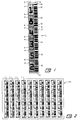
- Figure 1 is a plan view of a machine-readable, human-readable coding label embodying the invention.
- Figure 2 is a plan view of a sheet containing a plurality of labels of the type shown in Figure 1 but on a reduced scale.
- the invention is illustrated as being embodied in a machine-readable, human-readable coding system comprising a one piece, pre-printed coded label, generally indicated L. It has at least two, and as shown in Figure 1, three identical messages.
- a first vertical column, generally designated 2 is divided into a series of vertically aligned, rectangular, segments 4. Each segment is separated from each contiguous segment by a printing trap comprising a solid line 6. The segments are also separated from a second, vertically aligned column 8 adjacent the column 2 which is coextensive therewith, by a printing trap comprising a solid line.
- One character 10 of an optical recognition code is located in each segment 4.
- the data characters 10 form a message in a first code which is both machine-readable and human-readable.
- the data characters 10 are a subset of the Federal Information Processing Standards Publication No. 32 Optical Character Recognition, style A. This designation is also referred to as the FIPS PUB 32 OCR-A character set.
- the data characters 10 of the first code are a subset of the OCR-A character set and comprise A to Z in upper case, 0 to 9 and spaces. As herein illustrated, only numeral characters are shown.
- the message says 184352 when read downwardly.
- the characters are arranged to be read downwardly from top to bottom by both humans and machine readers.
- each segmuent 4 is color coded to correspond to the data character 10 in the segment.
- the colors in the segments thus form a message in a second code which is human-readable only.
- the message is intentionally redundant, that is, identical with the first message, which
- the second column 8 which is contiguous with the first column 2, contains a single machine-readable bar code symbol, generally designated 12, which is coextensive with the segments 6 in the first column.
- the bar code symbol comprises a message in a third code which is identical to the first and second messages i.e., the message of the OCR-A characters and the background colors of the segments 6.
- the bar code symbol is printed to be machine-readable upwardly.
- the bar code 12 is only machine-readable whereas the OCR-A characters are both machine-readable and human-readable and the color code is human-readable only.
- the bar code symbol 12 in the column 8 is the 3 of 9 bar code of the American National Standards Institute Inc., Publication MH10.8M-1983, this is often abbreviated to read ANSI HM10.8M-1983.
- the bar code format is comprised of six data characters with an asterisk character above and below the data characters and the data character set of the bar code is the same as the OCR-A subset in inverse vertical alignment. There is a quiet zone 14 above and below the six data characters of the bar code.
- ten labels L are arranged in side-by-side relationship on a sheet 20.
- the labels may either be printed directly onto the sheet 20, in which case, they would be cut from the sheet for application to the intended object. They also may be precut and positioned on the sheet, in which case, the sheet would essentially be release paper. In either case, the labels have pressure sensitive adhesive on their back sides.
- the labels L arranged on the sheet 20 represent the numbers 123460 through 123469. Thus, if desired, ten consecutive numbers may be positioned on the sheet consecutively. Sheets containing more or less labels may be employed and the six digit labels may be supplied to cover the range of numbers 0 to 999999.
- One intended use for the labels is for attachment to the edges of computer tape cartridges of the type known as the IBM 3480, or equivalents, to identify them for automatic handling.
- the cartridges are placed in storage shelves accessible by a robotic mechanism which reads the labels, removes a desired cartridge from its storage position and locates it where it can be utilized for its intended purpose.
- the OCR code and the bar code combination are both machine-readable and supply the same message, they have a built in redundancy to make certain that the correct cartridge is mounted or dismounted by the automatic mechanism.
- the cameras used in such automatic systems generally employ charged couple devices. With the labels in position on all the cartridges in the stack, the camera scans the labels and feeds information to the computer. It first reads the bar code from bottom to top at least twice. If for some reason it can not read the bar code, it then reads the OCR-A code from top to bottom.
- the reason that the machine-readable codes are printed to be read in reverse directions, is that if a label should be damaged or partially torn away for some reason it can be read, partially from the bar code and partially from the OCR code. For example, if as much as the top half or the bottom half of the label is missing, it can still be accurately read.
- the automatic mechanism dismounts the cartridge from the shelf and mounts it in the drive position. When the cartridge is no longer needed the mechanism dismounts the cartridge and returns it to its shelf.
- cartridges may be selected manually by a person reading either the characters of the OCR code or the color backgrounds of the segments in which the OCR characters are printed.
Landscapes
- Physics & Mathematics (AREA)
- General Physics & Mathematics (AREA)
- Engineering & Computer Science (AREA)
- Theoretical Computer Science (AREA)
- Labeling Devices (AREA)
- Credit Cards Or The Like (AREA)
- Character Discrimination (AREA)
- Warehouses Or Storage Devices (AREA)
Abstract
Claims (8)
Applications Claiming Priority (2)
| Application Number | Priority Date | Filing Date | Title |
|---|---|---|---|
| US5922 | 1987-01-21 | ||
| US07/005,922 US4856820A (en) | 1987-01-21 | 1987-01-21 | Coding system |
Publications (2)
| Publication Number | Publication Date |
|---|---|
| EP0341262A1 EP0341262A1 (fr) | 1989-11-15 |
| EP0341262B1 true EP0341262B1 (fr) | 1992-04-29 |
Family
ID=21718376
Family Applications (1)
| Application Number | Title | Priority Date | Filing Date |
|---|---|---|---|
| EP88901683A Expired EP0341262B1 (fr) | 1987-01-21 | 1988-01-20 | Systeme de codage |
Country Status (5)
| Country | Link |
|---|---|
| US (1) | US4856820A (fr) |
| EP (1) | EP0341262B1 (fr) |
| JP (1) | JPH02502317A (fr) |
| DE (1) | DE3870609D1 (fr) |
| WO (1) | WO1988005575A1 (fr) |
Families Citing this family (27)
| Publication number | Priority date | Publication date | Assignee | Title |
|---|---|---|---|---|
| FR2656444B1 (fr) * | 1989-12-27 | 1992-04-17 | Sagem | Appareil d'edition de facturettes. |
| US5078828A (en) * | 1990-01-09 | 1992-01-07 | Kelmar Systems, Inc. | Film patch, jig and method of using same |
| US6145883A (en) * | 1992-01-22 | 2000-11-14 | Jeter Systems Corporation | Filing system |
| US5304066A (en) * | 1992-10-13 | 1994-04-19 | Sontag Walter A | Machine shop management system |
| US5330230A (en) * | 1993-01-19 | 1994-07-19 | Peter A. Norton | Kit for identifying individualy sized implements |
| WO1995016576A1 (fr) * | 1993-12-13 | 1995-06-22 | Whittington, Ruth | Configurations de codes exploitables par machine |
| US5484055A (en) * | 1994-04-15 | 1996-01-16 | International Business Machines Corporation | Machine and human readable label for data cartridge |
| USD374892S (en) | 1994-06-24 | 1996-10-22 | Nalepka Michael D | Set of color coded labels for organizing books |
| US5449202A (en) * | 1994-06-24 | 1995-09-12 | Nalepka; Michael D. | Method and apparatus for color coded library and shelved media system |
| DE69533479T2 (de) | 1994-07-01 | 2005-09-22 | Palm Computing, Inc., Los Altos | Zeichensatz mit zeichen aus mehreren strichen und handschrifterkennungssystem |
| US5576528A (en) * | 1994-12-23 | 1996-11-19 | Symbol Technologies, Inc. | Color processing for bar code symbol compaction |
| US5889888A (en) | 1996-12-05 | 1999-03-30 | 3Com Corporation | Method and apparatus for immediate response handwriting recognition system that handles multiple character sets |
| DE69830597D1 (de) * | 1997-04-08 | 2005-07-21 | Zih Corp | Verformungsfeste, doppeldaten korrigierende, farbübergangsstreifenkode und ihres erzeugungs- und benutzungsverfahren |
| US5880451A (en) * | 1997-04-24 | 1999-03-09 | United Parcel Service Of America, Inc. | System and method for OCR assisted bar code decoding |
| JP3045757U (ja) * | 1997-07-29 | 1998-02-13 | アテンションシステム株式会社 | 封鎖シール |
| US6095417A (en) * | 1998-04-07 | 2000-08-01 | Eastman Kodak Company | Apparatus and method for reading bar codes on a moving web |
| AU5886801A (en) * | 2000-05-09 | 2001-11-20 | Colorzip Media Inc | Machine readable code and method and device of encoding and decoding the same |
| JP2003242469A (ja) * | 2002-02-21 | 2003-08-29 | Daishowa Seiki Co Ltd | 情報保持体 |
| JP2004013501A (ja) * | 2002-06-06 | 2004-01-15 | Daishowa Seiki Co Ltd | 情報システム及び情報保持体 |
| US7710598B2 (en) * | 2004-08-23 | 2010-05-04 | Harrison Jr Shelton E | Polychromatic encoding system, method and device |
| US7455013B2 (en) * | 2005-03-08 | 2008-11-25 | Hewlett-Packard Development Company, L.P. | Secure printing method to thwart counterfeiting |
| US7676038B2 (en) * | 2005-03-08 | 2010-03-09 | Hewlett-Packard Development Company, L.P. | Secure printing method to thwart counterfeiting |
| WO2006119138A2 (fr) * | 2005-04-29 | 2006-11-09 | Netc, L.L.C. | Matrices codees, etiquettes pour cartouches de bande magnetique et procede de fabrication |
| GB0702012D0 (en) * | 2007-02-02 | 2007-03-14 | Wesby Philip B | System and method for encoding and authentication |
| US20090266888A1 (en) * | 2008-04-23 | 2009-10-29 | Mccarthy Mary | Method for organizing and inventorying library materials |
| DE102011087637A1 (de) * | 2011-12-02 | 2013-06-06 | Bundesdruckerei Gmbh | Identifikationsdokument mit einer maschinenlesbaren Zone und Dokumentenlesegerät |
| DE102021206887A1 (de) * | 2021-06-30 | 2023-01-05 | Pepperl+Fuchs Se | Vorrichtung zur Präsentation eines Codes |
Family Cites Families (16)
| Publication number | Priority date | Publication date | Assignee | Title |
|---|---|---|---|---|
| US27770A (en) * | 1860-04-10 | Improvement in compounds for insulating telegraph-wires | ||
| US2272366A (en) * | 1939-07-25 | 1942-02-10 | Ibm | Control element for statistical machines |
| US3617707A (en) * | 1967-08-17 | 1971-11-02 | Westinghouse Air Brake Co | Automatic car identification system |
| US3588457A (en) * | 1968-06-11 | 1971-06-28 | Willem Jan Bijleveld | Bearer with logically coded digits |
| US3711683A (en) * | 1971-01-08 | 1973-01-16 | Monarch Marking Systems Inc | Re-price marking method and record member |
| US3760161A (en) * | 1971-05-19 | 1973-09-18 | American Cyanamid Co | Method and apparatus for automatically retrieving information from a succession of luminescent coded documents with means for segregating documents according to their characteristics |
| US4204639A (en) * | 1977-03-09 | 1980-05-27 | Datafile Limited | Coded label |
| US4329191A (en) * | 1978-07-05 | 1982-05-11 | Datafile Limited | System for alphabetically labelling articles |
| US4260656A (en) * | 1978-09-11 | 1981-04-07 | Vidac | Pin-feed label stock for drive transport systems and method of forming same |
| US4283622A (en) * | 1979-05-14 | 1981-08-11 | Ncr Corporation | Bar code reader |
| US4372681A (en) * | 1980-08-18 | 1983-02-08 | Avery International Corp. | Streamlined label verification technique |
| US4523776A (en) * | 1981-06-24 | 1985-06-18 | Datafile Limited | Method of adding color coded labels to files |
| US4580815A (en) * | 1981-06-24 | 1986-04-08 | Datafile Limited | Composite strip for add-on tab for file folder |
| DE3205420A1 (de) * | 1982-02-16 | 1983-08-25 | Metallgesellschaft Ag, 6000 Frankfurt | Waren-markierungsfeld |
| GB2120632B (en) * | 1982-05-14 | 1985-07-31 | Utsch Kg Erich | Code bar for identifying mass produced articles |
| US4544182A (en) * | 1983-11-10 | 1985-10-01 | Spring Robert P | Reversible numeric color-coded labels |
-
1987
- 1987-01-21 US US07/005,922 patent/US4856820A/en not_active Expired - Lifetime
-
1988
- 1988-01-20 EP EP88901683A patent/EP0341262B1/fr not_active Expired
- 1988-01-20 WO PCT/US1988/000122 patent/WO1988005575A1/fr not_active Ceased
- 1988-01-20 DE DE8888901683T patent/DE3870609D1/de not_active Expired - Fee Related
- 1988-01-20 JP JP63501559A patent/JPH02502317A/ja active Pending
Also Published As
| Publication number | Publication date |
|---|---|
| WO1988005575A1 (fr) | 1988-07-28 |
| DE3870609D1 (de) | 1992-06-04 |
| JPH02502317A (ja) | 1990-07-26 |
| EP0341262A1 (fr) | 1989-11-15 |
| US4856820A (en) | 1989-08-15 |
Similar Documents
| Publication | Publication Date | Title |
|---|---|---|
| EP0341262B1 (fr) | Systeme de codage | |
| US4844509A (en) | Coding system | |
| US5083816A (en) | Machine and human readable label | |
| CA2071775C (fr) | Dispositif de location de dossiers codes | |
| US4240848A (en) | System for alphabetically labelling articles | |
| CA1093694A (fr) | Systeme portatif roc (reconnaissance optique de caracteres) | |
| US8463994B2 (en) | System and method for improved media identification in a storage device | |
| US5468945A (en) | Method and apparatus for locating and decoding a postnet forwarding bar code in a field of postnet bar codes | |
| US4204639A (en) | Coded label | |
| US5485000A (en) | Filing system scanner and bar code with identification marker bars | |
| US5412194A (en) | Robust coding system | |
| US5489767A (en) | Media labeling system for data storage elements having a common form factor | |
| US5288107A (en) | Multiple information field label | |
| EP1207490B1 (fr) | Système de lecture de code à barres double pour un système de stockage de données | |
| CA2189177A1 (fr) | Dispositif de traitement de cartes | |
| US5990915A (en) | Time recorder with code reader and data storage | |
| EP1675035B1 (fr) | Bibliothèque de stockage de données et procédé et programme de commande pour contrôler le même | |
| EP1081640A2 (fr) | Code de reconnaissance pour support de stockage en forme de disque | |
| US3806166A (en) | Data entry system and apparatus | |
| US5593185A (en) | System for machine reading/index marking publications | |
| JPS5812072A (ja) | 多種デ−タ形式の読取装置 | |
| JPH0821220B2 (ja) | 記憶媒体へのコピー方法 | |
| WO1993004440A1 (fr) | Systeme de carte de visite a codage magnetique | |
| JP2543626B2 (ja) | フレキシブルディスクのコピ―方法 | |
| JP2781006B2 (ja) | 券発行装置 |
Legal Events
| Date | Code | Title | Description |
|---|---|---|---|
| PUAI | Public reference made under article 153(3) epc to a published international application that has entered the european phase |
Free format text: ORIGINAL CODE: 0009012 |
|
| 17P | Request for examination filed |
Effective date: 19890719 |
|
| AK | Designated contracting states |
Kind code of ref document: A1 Designated state(s): AT BE CH DE FR GB IT LI LU NL SE |
|
| 17Q | First examination report despatched |
Effective date: 19900824 |
|
| GRAA | (expected) grant |
Free format text: ORIGINAL CODE: 0009210 |
|
| AK | Designated contracting states |
Kind code of ref document: B1 Designated state(s): CH DE FR GB IT LI NL |
|
| PG25 | Lapsed in a contracting state [announced via postgrant information from national office to epo] |
Ref country code: IT Free format text: LAPSE BECAUSE OF FAILURE TO SUBMIT A TRANSLATION OF THE DESCRIPTION OR TO PAY THE FEE WITHIN THE PRE;WARNING: LAPSES OF ITALIAN PATENTS WITH EFFECTIVE DATE BEFORE 2007 MAY HAVE OCCURRED AT ANY TIME BEFORE 2007. THE CORRECT EFFECTIVE DATE MAY BE DIFFERENT FROM THE ONE RECORDED.SCRIBED TIME-LIMIT Effective date: 19920429 Ref country code: FR Effective date: 19920429 Ref country code: NL Effective date: 19920429 |
|
| REF | Corresponds to: |
Ref document number: 3870609 Country of ref document: DE Date of ref document: 19920604 |
|
| ET | Fr: translation filed | ||
| NLV1 | Nl: lapsed or annulled due to failure to fulfill the requirements of art. 29p and 29m of the patents act | ||
| PG25 | Lapsed in a contracting state [announced via postgrant information from national office to epo] |
Ref country code: GB Effective date: 19930120 |
|
| PG25 | Lapsed in a contracting state [announced via postgrant information from national office to epo] |
Ref country code: LI Free format text: LAPSE BECAUSE OF NON-PAYMENT OF DUE FEES Effective date: 19930131 Ref country code: CH Free format text: LAPSE BECAUSE OF NON-PAYMENT OF DUE FEES Effective date: 19930131 |
|
| PLBI | Opposition filed |
Free format text: ORIGINAL CODE: 0009260 |
|
| 26 | Opposition filed |
Opponent name: SCHREINER DATENTRAEGER UND CODEDRUCK GMBH & CO. Effective date: 19930129 |
|
| GBPC | Gb: european patent ceased through non-payment of renewal fee |
Effective date: 19930120 |
|
| REG | Reference to a national code |
Ref country code: CH Ref legal event code: PL |
|
| PG25 | Lapsed in a contracting state [announced via postgrant information from national office to epo] |
Ref country code: DE Effective date: 19931001 |
|
| RDAC | Information related to revocation of patent modified |
Free format text: ORIGINAL CODE: 0009299REVO |
|
| RDAG | Patent revoked |
Free format text: ORIGINAL CODE: 0009271 |
|
| STAA | Information on the status of an ep patent application or granted ep patent |
Free format text: STATUS: PATENT REVOKED |
|
| 27W | Patent revoked |
Effective date: 19940320 |
|
| R27W | Patent revoked (corrected) |
Effective date: 19940320 |