EP0341109B1 - Verfahren zum Berechnen des organischen Gehalts in Sedimenten aus aufgezeichneten Daten, welche durch Bohrlochmessgeräte erzeugt wurden - Google Patents
Verfahren zum Berechnen des organischen Gehalts in Sedimenten aus aufgezeichneten Daten, welche durch Bohrlochmessgeräte erzeugt wurden Download PDFInfo
- Publication number
- EP0341109B1 EP0341109B1 EP89401069A EP89401069A EP0341109B1 EP 0341109 B1 EP0341109 B1 EP 0341109B1 EP 89401069 A EP89401069 A EP 89401069A EP 89401069 A EP89401069 A EP 89401069A EP 0341109 B1 EP0341109 B1 EP 0341109B1
- Authority
- EP
- European Patent Office
- Prior art keywords
- organic matter
- content
- values
- well
- pairs
- Prior art date
- Legal status (The legal status is an assumption and is not a legal conclusion. Google has not performed a legal analysis and makes no representation as to the accuracy of the status listed.)
- Expired - Lifetime
Links
Images


Classifications
-
- G—PHYSICS
- G01—MEASURING; TESTING
- G01V—GEOPHYSICS; GRAVITATIONAL MEASUREMENTS; DETECTING MASSES OR OBJECTS; TAGS
- G01V3/00—Electric or magnetic prospecting or detecting; Measuring magnetic field characteristics of the earth, e.g. declination, deviation
- G01V3/38—Processing data, e.g. for analysis, for interpretation, for correction
-
- G—PHYSICS
- G01—MEASURING; TESTING
- G01V—GEOPHYSICS; GRAVITATIONAL MEASUREMENTS; DETECTING MASSES OR OBJECTS; TAGS
- G01V11/00—Prospecting or detecting by methods combining techniques covered by two or more of main groups G01V1/00 - G01V9/00
-
- Y—GENERAL TAGGING OF NEW TECHNOLOGICAL DEVELOPMENTS; GENERAL TAGGING OF CROSS-SECTIONAL TECHNOLOGIES SPANNING OVER SEVERAL SECTIONS OF THE IPC; TECHNICAL SUBJECTS COVERED BY FORMER USPC CROSS-REFERENCE ART COLLECTIONS [XRACs] AND DIGESTS
- Y02—TECHNOLOGIES OR APPLICATIONS FOR MITIGATION OR ADAPTATION AGAINST CLIMATE CHANGE
- Y02A—TECHNOLOGIES FOR ADAPTATION TO CLIMATE CHANGE
- Y02A90/00—Technologies having an indirect contribution to adaptation to climate change
- Y02A90/30—Assessment of water resources
Definitions
- the subject of the invention is a new method for evaluating the organic matter content of sedimentary rocks and mainly parent rocks from data recorded in wells or boreholes by logging probes.
- the method according to the invention relates more particularly to the determination of the organic matter content of the parent rocks by using the data obtained by carrying out at least two logs of different natures such as for example a sonic log and a resistivity log.
- a probe fitted with transducers emitting and receiving acoustic waves is lowered into a borehole and the speed of propagation of these waves is measured in the formations crossed by the borehole and in the vicinity of that -this.
- the electrical resistivity of the land surrounding the well is measured.
- organic geochemistry The methods usually used to estimate the content of organic matter in sedimentary rocks are organic geochemistry. They essentially consist in quantifying and characterize the organic matter contained in samples taken from drill cuttings or possibly in geological cores, when available. the geochemical data obtained are generally scarce and fragmented due to the lack of available samples.
- the organic matter content of geological formations is therefore most often known only in a limited number of depths and its evaluation is linked to the representativeness of the cuttings removed from the wells.
- each sample taken in cuttings is often representative of a certain thickness of ground (of the order of several meters) and in formations presenting rapid variations of facies, it does not give a sufficiently fine account of their heterogeneity .
- the method according to the invention is defined by the main claim and according to its specific methods by dependent claims 2 to 9. It makes it possible to evaluate the content of rocks in organic matter from measurements made by two log probes chosen according to specific criteria defined in points a), b), c) of the main claim. With this particular selection of probes, we can reduce our to a graphical representation system with only three poles, due to the at least partial identity of iso-content curves, as will be explained in the course of the description which will follow and by a particular application of the technique of comparative points, to determine the rate of organic matter contained in the sedimentary rocks.
- the method according to the invention involves the use of data recorded by logging tools which make it possible to isolate the effects specific to organic matter and thereby to estimate its percentage within sedimentary rocks.
- OM organic matter
- clays in the sense of phyllosilicates with their water of constitution and that which they retain by porosity, water not included in clays and all minerals, excluding clays, which will be referred to as matrix in the rest of the text.
- the method according to the invention firstly involves the selection of two logging tools suitable for evaluating organic matter.
- the tool measuring the transit time of sound in formations is sensitive to the contents of water, organic matter and clay and much less to variations in the composition of the matrix.
- the density measuring tool is sensitive to water and organic matter but little to clay.
- a neutron probe measuring the number of hydrogen atoms in the formations is sensitive to their water, organic matter or clay content.
- the tool measuring the electrical resistivity of rocks will do little difference between clay and water if it is conductive, and none for variations in the composition of the matrix if the conductive minerals are not in the continuous phase therein. It turns out that a gamma ray probe does not provide a response directly related to the physical parameters of organic matter.
- the first tool one can choose for example a probe measuring the resistivity of the land crossed.
- the other series of necessary measurements can be obtained for example by means of a tool measuring the transit time ⁇ T of the sound in the rock or the density or else the content of hydrogen atoms which all react in the same direction. for water, clay and organic matter.
- the two logging tools are also chosen so that at least part of the sets of pairs of values of the measured parameters (in this case the resistivity on the one hand and the transit time ⁇ T, the density or the content of atoms hydrogen on the other hand) which correspond to the same organic matter content for sedimentary rocks comprising a determined proportion of clay or water, are substantially identical.
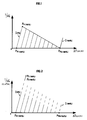
- a similar diagram can be drawn by replacing the clay pole P A with a pole 100% water P E and in the same way the lines of iso-organic matter content are parallel to that which joins it to the pole P M of matrix.
- the estimation of the organic matter content of the rock requires only the positioning of line I (0%) joining the matrix pole to the clay or water pole (and corresponding to a zero content) and the selection of a value ⁇ T MO on the ⁇ T axis which corresponds to the transit time of sound in a rock which contains only organic matter.
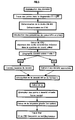
- This value ⁇ T MO can be chosen by geologists who consider it as well representative of the sedimentary basin where the studies are carried out or even be calculated according to the log data obtained as will be seen below in relation to FIG. 6.
- the set of pairs of values of the parameters serving as a reference - translated by the iso-content line corresponding to a rock containing a determined organic percentage - is obtained experimentally from the values of the two chosen parameters measured along each well. or portion of well.
- this reference line is either the straight line I (0%) (fig. 2) starting from the matrix pole P M , or a line I passing through at least one point (associated with a pair of measured values) to which we know how to assign a content particular.
- the reference line I (0%) is a straight line of greatest slope coming from the matrix pole and passing among all the points representative of the pairs of values.
- the slope of this line is defined by a numerical value ⁇ T A associated with one of its points, for which the value of 1 / R t is equal to 0.6 for example.
- This method of determining the reference line at 0% organic matter implies that among the layers crossed by the well, there are some which are devoid of organic matter. It is possible if we have been able to verify experimentally the existence of such layers by comparison with the results of geochemical analyzes.
- D MO d . 1 k where D MO represents the density of organic matter, d, the density of rock and k a factor of proportionality between organic carbon and organic matter.
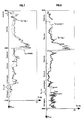
- the value d used in relation (2) can either be a data obtained by means of a density measurement probe, if one has such a log, or else a value estimated from data known elsewhere and in particular d 'after density logs which could be carried out in other wells.
Landscapes
- Life Sciences & Earth Sciences (AREA)
- Physics & Mathematics (AREA)
- General Life Sciences & Earth Sciences (AREA)
- General Physics & Mathematics (AREA)
- Geophysics (AREA)
- Engineering & Computer Science (AREA)
- Environmental & Geological Engineering (AREA)
- Geology (AREA)
- Remote Sensing (AREA)
- Geophysics And Detection Of Objects (AREA)
- Investigation Of Foundation Soil And Reinforcement Of Foundation Soil By Compacting Or Drainage (AREA)
- Investigating Or Analyzing Non-Biological Materials By The Use Of Chemical Means (AREA)
Claims (9)
- Verfahren zum Bewerten des Gehalts an organischem Material von Sedimentgesteinen unter Verwendung der in einem Bohrloch quer durch Formationen eines sedimentären Beckens gemessenen Diagraphiedaten durch wenigstens zwei Diagraphiesonden, die zwei unterschiedliche Parameter messen und unter Ausnutzung einer Technik vergleichender Einzeichnungen,
dadurch gekennzeichnet, daß es die Wahl von zwei Sonden derart umfaßt, daßa) eine der Sonden Meßsignale erzeugt, die sich in der gleichen Richtung abhängig von einer Veränderung des Gehalts an Wasser, Ton und organischem Material (MO) in diesen Sedimentgesteinen entwickeln,b) die andere Sonde Meßsignale erzeugt, die sich in entgegengesetzter Richtung zueinander abhängig von einer Veränderung des Gehalts an organischem Material einerseits und von Wasser oder Ton andererseits in den gleichen Sedimentgesteinen entwickeln, undc) die beiden Sonden, die im übrigen derart gewählt sind, daß wenigstens ein Teil der Gruppenpaare (I) von gemessenen Parameterwerten einem gleichen Gehalt an organischem Material entsprechen, jeweils zugeordnet zu sedimentären Gesteinen, mit einem bestimmten Anteil an Ton oder Wasser, im wesentlichen gleich sind,
und daß man diese Technik vergleichender Einzeichnungen anwendet durch- eine Auswahl wenigstens eines Paares von charakteristischen Parameterwerten dieses reinen organischen Material (PMO);- Aufstellen eines Netzes von Gruppen (I) von Wertepaaren der gemessenen Parameter, wobei jede der Gruppen dieses Netzes einem gleichen Gehalt an organischem Material entspricht, indem man als Bezug eine Anordnung von Wertepaaren entsprechend den Sedimentgesteinen nimmt, die einen bestimmten Gehalt an organischem Material enthalten;- aufeinanderfolgende Bestimmung der Gruppe (I) von Paaren des Netzes entsprechend ein und dem gleichen Gehalt t(%), zu dem jedes der Wertepaare der beiden durch die gewählten Sonden gemessenen Parameter gehört, an einer Vielzahl von Meßpunkten auf unterschiedlichen Tiefen ein und des gleichen Bohrlochs, und- Realisierung einer Aufzeichnung der Werte der volumetrischen Gehalte Δt(%) an organischem Material, die jeweils diesen Paargruppen derart zugeordnet sind, daß eine im wesentlichen kontinuierliche Darstellung des volumetrischen Gehalts an organischem Material der durch das Bohrloch durchsetzten Formationen realisiert wird. - Verfahren nach Anspruch 1, dadurch gekennzeichnet, daß man die durch wenigstens zwei Bohrlochsonden durchgeführten Messungen nutzt, die ausgelegt sind zur Messung des spezifischen elektrischen Widerstands (Rt) der durchsetzten Böden, der Schalldurchgangszeit (ΔT) in ebendiesen Böden, ihrem Gehalt an Wasserstoffatomen oder ihrer Dichte.
- Verfahren nach Anspruch 2, dadurch gekennzeichnet, daß man die durch eine Bohrlochsonde, die den spezifischen elektrischen Widerstand der Böden mißt, ausgeführten Messungen benutzt und wenigstens eine andere Bohrlochsonde, die die Schalldurchgangszeit in ebendiesen Böden mißt, daß man ein Diagramm der graphischen Darstellung als Funktion des spezifischen Widerstands (Rt) und der Durchgangszeit (ΔT) wählt, wo dieses Netz von Gruppen von Wertepaaren der gemessenen Parameter, in Zuordnung zu ein und dem gleichen Gehalt, an eine Familie im wesentlichen paralleler Linien gleichen Gehalts angeglichen werden kann, wobei der Gehalt an organischem Material in Zuordnung zu jedem Paar der Werte des spezifischen Widerstands und der Durchgangszeit, gemessen im Bohrloch, dann bestimmt wird, indem man die Linie gleichen Gehalts, die durch den repräsentativen Punkt dieses Paares im gewählten Darstellungsdiagramm geht, identifiziert.
- Verfahren nach Anspruch 2, dadurch gekennzeichnet, daß man die durch eine Bohrlochsonde ausgeführten Messungen benutzt, welche den spezifischen elektrischen Widerstand (Rt) der Böden mißt, und wenigstens eine andere Bohrlochsonde deren Dichte mißt.
- Verfahren nach Anspruch 1, dadurch gekennzeichnet, daß man im übrigen die Gewichtsgehalte an organischem Material, jeweils in Zuordnung zu den verschiedenen Werten der erhaltenen volumetrischen Gehalte, mißt.
- Verfahren nach Anspruch 1, dadurch gekennzeichnet, daß man die Bezugsgruppe bestimmt, indem man aus allen im Bohrloch gemessenen Wertepaaren wenigstens ein Paar besonderer Werte wählt, dem man einen bestimmten Gehalt an organischem Material zuordnen kann.
- Verfahren nach Anspruch 1, dadurch gekennzeichnet, daß jedes Wertepaar der im Bohrloch gemessenen Parameter dargestellt wird in einem Diagramm als Funktion der Koordinaten
 wobei eine die Schalldurchgangszeit ΔT im Gestein und die andere die umgekehrte Quadratwurzel des spezifischen elektrischen Widerstands mißt, wobei die Gruppen von Wertepaaren, die einem gleichen Gehalt entsprechen, dargestellt sind durch eine Familie von Geraden (I), die zu einer Bezugsgeraden parallel sind, der man einen bestimmten Gehalt an organischem Material zuordnen kann, wobei die Position hiervon bestimmt wird durch wenigstens zwei repräsentative Punkte, von denen der eine einem Gestein zugeordnet ist, das nur die Matrix sowie den bestimmten Gehalt an organischem Material enthält, und der andere einem Paar von im Bohrloch gemessenen Werten entspricht, dem man diesen Wert an organischem Material zuordnen kann.
- Verfahren nach Anspruch 7, dadurch gekennzeichnet, daß man die Position der Geraden gleichen Gehalts zwischen einer Geraden entsprechend dem von organischem Material freien Gestein und einem Pol (PMO) entsprechend den Werten bestimmt, die von den beiden Parametern für den Fall angenommen wurden, wo das Gestein nur das organische Material enthält.
- Verfahren nach Anspruch 1, dadurch gekennzeichnet, daß das charakteristische Wertepaar des reinen organischen Materials erhalten wird durch Vergleich mit Daten, die durch eine Analyse von Proben, die von unterschiedlichen Orten längs des Bohrlochs stammen, erhalten wird.
Applications Claiming Priority (2)
| Application Number | Priority Date | Filing Date | Title |
|---|---|---|---|
| FR8805846 | 1988-04-28 | ||
| FR8805846A FR2630826B1 (fr) | 1988-04-28 | 1988-04-28 | Methode pour evaluer la teneur des roches sedimentaires en matiere organique a partir de donnees enregistrees dans des puits par des sondes de diagraphie |
Publications (2)
| Publication Number | Publication Date |
|---|---|
| EP0341109A1 EP0341109A1 (de) | 1989-11-08 |
| EP0341109B1 true EP0341109B1 (de) | 1992-09-23 |
Family
ID=9365887
Family Applications (1)
| Application Number | Title | Priority Date | Filing Date |
|---|---|---|---|
| EP89401069A Expired - Lifetime EP0341109B1 (de) | 1988-04-28 | 1989-04-18 | Verfahren zum Berechnen des organischen Gehalts in Sedimenten aus aufgezeichneten Daten, welche durch Bohrlochmessgeräte erzeugt wurden |
Country Status (9)
| Country | Link |
|---|---|
| US (1) | US5126939A (de) |
| EP (1) | EP0341109B1 (de) |
| JP (1) | JPH0213879A (de) |
| BR (1) | BR8901999A (de) |
| CA (1) | CA1313897C (de) |
| DE (1) | DE68902950T2 (de) |
| DK (1) | DK202289A (de) |
| FR (1) | FR2630826B1 (de) |
| NO (1) | NO175555C (de) |
Families Citing this family (16)
| Publication number | Priority date | Publication date | Assignee | Title |
|---|---|---|---|---|
| FR2674961B1 (fr) * | 1991-04-08 | 1994-05-20 | Institut Francais Petrole | Methode pour evaluer a partir de diagraphies, la teneur en matiere organique des roches le long d'un puits. |
| US5355088A (en) * | 1991-04-16 | 1994-10-11 | Schlumberger Technology Corporation | Method and apparatus for determining parameters of a transition zone of a formation traversed by a wellbore and generating a more accurate output record medium |
| AUPN497195A0 (en) * | 1995-08-23 | 1995-09-14 | Commonwealth Scientific And Industrial Research Organisation | Methods for determining irreducible water resistivity and estimating oil well reserves |
| US5878403A (en) * | 1995-09-12 | 1999-03-02 | Cmsi | Computer implemented automated credit application analysis and decision routing system |
| US7181427B1 (en) | 1995-09-12 | 2007-02-20 | Jp Morgan Chase Bank, N.A. | Automated credit application system |
| US7407175B2 (en) * | 2000-03-01 | 2008-08-05 | Deka Products Limited Partnership | Multiple-passenger transporter |
| US20060277123A1 (en) * | 2003-07-31 | 2006-12-07 | William Kennedy | Integrated electronic credit application, contracting and securitization system and method |
| US7743006B2 (en) * | 2004-07-07 | 2010-06-22 | Exxonmobil Upstream Research Co. | Bayesian network triads for geologic and geophysical applications |
| CA2579011C (en) * | 2004-07-07 | 2014-04-08 | Exxonmobil Upstream Research Company | Predicting sand-grain composition and sand texture |
| JP2010047938A (ja) * | 2008-08-20 | 2010-03-04 | Kansai Electric Power Co Inc:The | 地盤評価方法および地盤評価装置 |
| US8729903B2 (en) | 2009-11-09 | 2014-05-20 | Exxonmobil Upstream Research Company | Method for remote identification and characterization of hydrocarbon source rocks using seismic and electromagnetic geophysical data |
| US8219319B2 (en) * | 2009-12-18 | 2012-07-10 | Chevron U.S.A. Inc. | Workflow for petrophysical and geophysical formation evaluation of wireline and LWD log data |
| US10386529B2 (en) * | 2014-11-19 | 2019-08-20 | Schlumberger Technology Corporation | Subsurface estimation of level of organic maturity |
| CN105626057A (zh) * | 2015-12-30 | 2016-06-01 | 陕西延长石油(集团)有限责任公司研究院 | 一种确定陆相页岩气有机碳含量的测井优化方法 |
| NO345797B1 (en) * | 2019-12-03 | 2021-08-09 | Manzar Fawad | Method for estimating the subsurface total organic carbon (TOC) from well-log data |
| CN113027432B (zh) * | 2021-03-23 | 2022-09-06 | 中海石油(中国)有限公司深圳分公司 | 一种总有机碳含量的确定方法、装置、设备及存储介质 |
Family Cites Families (10)
| Publication number | Priority date | Publication date | Assignee | Title |
|---|---|---|---|---|
| US3180141A (en) * | 1960-09-09 | 1965-04-27 | Schlumberger Well Surv Corp | Methods of investigating earth formations utilizing resistivity and porosity indications |
| FR2102380A5 (de) * | 1970-02-02 | 1972-04-07 | Schlumberger Prospection | |
| US4495604A (en) * | 1970-02-02 | 1985-01-22 | Schlumberger Technology Corp. | Machine method for determining the presence and location of hydrocarbon deposits within a subsurface earth formation |
| US3820390A (en) * | 1970-07-27 | 1974-06-28 | J Forgotson | Method of recognizing the presence of hydrocarbons and associated fluids in reservoir rocks below the surface of the earth |
| US4502121A (en) * | 1971-02-02 | 1985-02-26 | Schlumberger Technology Corporation | Machine method for determining the presence and location of hydrocarbon deposits within a subsurface earth formation |
| US4531188A (en) * | 1972-11-29 | 1985-07-23 | Schlumberger Technology Corporation | Methods for automatic processing of information obtained by well logging |
| US4548071A (en) * | 1983-09-01 | 1985-10-22 | Phillips Petroleum Company | Determination of oil shale yield from well log data |
| US4517836A (en) * | 1983-10-25 | 1985-05-21 | Mobil Oil Corporation | Method for determining oil saturation in a subsurface formation |
| US4742459A (en) * | 1986-09-29 | 1988-05-03 | Schlumber Technology Corp. | Method and apparatus for determining hydraulic properties of formations surrounding a borehole |
| US4916616A (en) * | 1986-12-08 | 1990-04-10 | Bp Exploration, Inc. | Self-consistent log interpretation method |
-
1988
- 1988-04-28 FR FR8805846A patent/FR2630826B1/fr not_active Expired - Fee Related
-
1989
- 1989-04-18 EP EP89401069A patent/EP0341109B1/de not_active Expired - Lifetime
- 1989-04-18 DE DE8989401069T patent/DE68902950T2/de not_active Expired - Fee Related
- 1989-04-26 NO NO891725A patent/NO175555C/no unknown
- 1989-04-26 DK DK202289A patent/DK202289A/da unknown
- 1989-04-27 BR BR898901999A patent/BR8901999A/pt not_active Application Discontinuation
- 1989-04-28 CA CA000598199A patent/CA1313897C/fr not_active Expired - Fee Related
- 1989-04-28 US US07/344,399 patent/US5126939A/en not_active Expired - Fee Related
- 1989-04-28 JP JP1111950A patent/JPH0213879A/ja active Pending
Non-Patent Citations (1)
| Title |
|---|
| "Encyclopedia of Well Logging", R. Desbrandes, Institut Français du Pétrole Publications, Publ. 1985 * |
Also Published As
| Publication number | Publication date |
|---|---|
| BR8901999A (pt) | 1989-12-05 |
| CA1313897C (fr) | 1993-02-23 |
| DK202289A (da) | 1989-10-29 |
| FR2630826A1 (fr) | 1989-11-03 |
| FR2630826B1 (fr) | 1994-03-25 |
| DE68902950T2 (de) | 1993-01-07 |
| JPH0213879A (ja) | 1990-01-18 |
| US5126939A (en) | 1992-06-30 |
| NO175555C (no) | 1994-10-26 |
| DK202289D0 (da) | 1989-04-26 |
| NO175555B (no) | 1994-07-18 |
| DE68902950D1 (de) | 1992-10-29 |
| EP0341109A1 (de) | 1989-11-08 |
| NO891725L (no) | 1989-10-30 |
| NO891725D0 (no) | 1989-04-26 |
Similar Documents
| Publication | Publication Date | Title |
|---|---|---|
| CA1313897C (fr) | Methode pour evaluer la teneur des roches sedimentaires en matiere organique | |
| Das et al. | Post-stack seismic inversion and attribute analysis in shallow offshore of Krishna-Godavari basin, India | |
| Bassetti et al. | The 100‐ka and rapid sea level changes recorded by prograding shelf sand bodies in the Gulf of Lions (western Mediterranean Sea) | |
| Ghose et al. | Integrating S-wave seismic-reflection data and cone-penetration-test data using a multiangle multiscale approach | |
| Jerram et al. | Understanding volcanic facies in the subsurface: a combined core, wireline logging and image log data set from the PTA2 and KMA1 boreholes, Big Island, Hawaii | |
| EP1963886B1 (de) | Quantitative evaluierungsmethode von flüssigkeitsdrücken und zur entdeckung von überdrücken im untergrund | |
| CN113311502A (zh) | 一种识别泥页岩层系中常规油层与页岩油层的方法及装置 | |
| Osli et al. | Hydrocarbon generation modeling and source rock characterization of the cretaceous–paleocene taratu formation, great south basin, New Zealand | |
| CA2814277A1 (fr) | Procede de construction d'une diagraphie d'une propriete quantitative a partir de mesures sur echantillons et de mesures diagraphiques | |
| Sahoo et al. | Delineation of coaly source rock distribution and prediction of organic richness from integrated analysis of seismic and well data | |
| CN116400409A (zh) | 一种利用钻井岩心弹性参数约束的声波曲线计算方法 | |
| Ardebili et al. | Estimation of porosity and volume of shale using artificial intelligence, case study of Kashafrud Gas Reservoir, NE Iran | |
| Shalaby et al. | Geochemical characteristics and depositional environments of the Narimba Formation source rock, Bass Basin, Australia | |
| Abed et al. | A comprehensive geotechnical and geophysical assessment of the foundation sublayers in Egypt’s new administrative capital | |
| CN114428049B (zh) | 一种计算古老碳酸盐岩储层沥青含量的方法 | |
| Alege et al. | Foraminifera bio-sequence stratigraphy and hydrocarbon potential of shale-dominated successions in the coastal swamp-offshore depobelt, niger delta | |
| FR2932574A1 (fr) | Methode pour evaluer des pressions de fluides et detecter des surpressions dans un milieu souterrain. | |
| Boaga et al. | Brief communication: On the potential of seismic polarity reversal to identify a thin low-velocity layer above a high-velocity layer in ice-rich rock glaciers | |
| Niessen et al. | Log-based physical properties of the CRP-1 core, Ross Sea, Antarctica | |
| Burcaw et al. | Improved methods for estimating the viscosity of heavy oils from magnetic resonance data | |
| CN113187470B (zh) | 一种井剖面上识别页岩油层和常规油层的方法及装置 | |
| EP0422985B1 (de) | Verfahren und Anlage zur Detektierung von Umkehrungen des erdmagnetischen Feldes durch Messungen in einem Bohrloch | |
| Nandi et al. | Core-Independent saturation height function from NMR logs in carbonates-A must in current oil price environment | |
| Ramu et al. | Characterization of gas hydrates reservoirs in Krishna-Godavari basin, eastern Indian margin | |
| FR2674961A1 (fr) | Methode pour evaluer a partir de diagraphies, la teneur en matiere organique des roches le long d'un puits. |
Legal Events
| Date | Code | Title | Description |
|---|---|---|---|
| PUAI | Public reference made under article 153(3) epc to a published international application that has entered the european phase |
Free format text: ORIGINAL CODE: 0009012 |
|
| 17P | Request for examination filed |
Effective date: 19890517 |
|
| AK | Designated contracting states |
Kind code of ref document: A1 Designated state(s): BE DE GB IT NL |
|
| 17Q | First examination report despatched |
Effective date: 19910730 |
|
| ITF | It: translation for a ep patent filed | ||
| GRAA | (expected) grant |
Free format text: ORIGINAL CODE: 0009210 |
|
| AK | Designated contracting states |
Kind code of ref document: B1 Designated state(s): BE DE GB IT NL |
|
| GBT | Gb: translation of ep patent filed (gb section 77(6)(a)/1977) | ||
| REF | Corresponds to: |
Ref document number: 68902950 Country of ref document: DE Date of ref document: 19921029 |
|
| PLBE | No opposition filed within time limit |
Free format text: ORIGINAL CODE: 0009261 |
|
| STAA | Information on the status of an ep patent application or granted ep patent |
Free format text: STATUS: NO OPPOSITION FILED WITHIN TIME LIMIT |
|
| 26N | No opposition filed | ||
| PGFP | Annual fee paid to national office [announced via postgrant information from national office to epo] |
Ref country code: GB Payment date: 19960325 Year of fee payment: 8 |
|
| PGFP | Annual fee paid to national office [announced via postgrant information from national office to epo] |
Ref country code: BE Payment date: 19960411 Year of fee payment: 8 |
|
| PGFP | Annual fee paid to national office [announced via postgrant information from national office to epo] |
Ref country code: NL Payment date: 19960430 Year of fee payment: 8 |
|
| PGFP | Annual fee paid to national office [announced via postgrant information from national office to epo] |
Ref country code: DE Payment date: 19960520 Year of fee payment: 8 |
|
| PG25 | Lapsed in a contracting state [announced via postgrant information from national office to epo] |
Ref country code: GB Effective date: 19970418 |
|
| PG25 | Lapsed in a contracting state [announced via postgrant information from national office to epo] |
Ref country code: BE Effective date: 19970430 |
|
| BERE | Be: lapsed |
Owner name: INSTITUT FRANCAIS DU PETROLE Effective date: 19970430 |
|
| PG25 | Lapsed in a contracting state [announced via postgrant information from national office to epo] |
Ref country code: NL Effective date: 19971101 |
|
| GBPC | Gb: european patent ceased through non-payment of renewal fee |
Effective date: 19970418 |
|
| PG25 | Lapsed in a contracting state [announced via postgrant information from national office to epo] |
Ref country code: DE Free format text: LAPSE BECAUSE OF NON-PAYMENT OF DUE FEES Effective date: 19980101 |
|
| NLV4 | Nl: lapsed or anulled due to non-payment of the annual fee |
Effective date: 19971101 |
|
| PG25 | Lapsed in a contracting state [announced via postgrant information from national office to epo] |
Ref country code: IT Free format text: LAPSE BECAUSE OF NON-PAYMENT OF DUE FEES Effective date: 20050418 |