EP0341067A2 - Universalzünder für Artilleriegeschosse - Google Patents
Universalzünder für Artilleriegeschosse Download PDFInfo
- Publication number
- EP0341067A2 EP0341067A2 EP19890304513 EP89304513A EP0341067A2 EP 0341067 A2 EP0341067 A2 EP 0341067A2 EP 19890304513 EP19890304513 EP 19890304513 EP 89304513 A EP89304513 A EP 89304513A EP 0341067 A2 EP0341067 A2 EP 0341067A2
- Authority
- EP
- European Patent Office
- Prior art keywords
- fuze
- shell
- battery
- detonator
- flywheel
- Prior art date
- Legal status (The legal status is an assumption and is not a legal conclusion. Google has not performed a legal analysis and makes no representation as to the accuracy of the status listed.)
- Withdrawn
Links
- 238000010304 firing Methods 0.000 claims abstract description 14
- 238000004519 manufacturing process Methods 0.000 claims description 2
- 239000000523 sample Substances 0.000 description 9
- 230000007246 mechanism Effects 0.000 description 5
- 230000006870 function Effects 0.000 description 4
- 230000000977 initiatory effect Effects 0.000 description 4
- 229910000831 Steel Inorganic materials 0.000 description 3
- 239000002775 capsule Substances 0.000 description 3
- 210000004027 cell Anatomy 0.000 description 3
- 238000005474 detonation Methods 0.000 description 3
- 239000002360 explosive Substances 0.000 description 3
- 239000010959 steel Substances 0.000 description 3
- 230000006835 compression Effects 0.000 description 2
- 238000007906 compression Methods 0.000 description 2
- 230000001934 delay Effects 0.000 description 2
- 239000000463 material Substances 0.000 description 2
- 230000004048 modification Effects 0.000 description 2
- 238000012986 modification Methods 0.000 description 2
- 239000004677 Nylon Substances 0.000 description 1
- 230000001133 acceleration Effects 0.000 description 1
- 230000003111 delayed effect Effects 0.000 description 1
- 238000001514 detection method Methods 0.000 description 1
- 238000010586 diagram Methods 0.000 description 1
- 238000006073 displacement reaction Methods 0.000 description 1
- 239000003792 electrolyte Substances 0.000 description 1
- 230000007613 environmental effect Effects 0.000 description 1
- 230000004907 flux Effects 0.000 description 1
- FUJCRWPEOMXPAD-UHFFFAOYSA-N lithium oxide Chemical compound [Li+].[Li+].[O-2] FUJCRWPEOMXPAD-UHFFFAOYSA-N 0.000 description 1
- 229910001947 lithium oxide Inorganic materials 0.000 description 1
- 229920001778 nylon Polymers 0.000 description 1
- 230000002093 peripheral effect Effects 0.000 description 1
- 239000004033 plastic Substances 0.000 description 1
- 229920003023 plastic Polymers 0.000 description 1
- 230000004044 response Effects 0.000 description 1
- 238000007789 sealing Methods 0.000 description 1
- 125000006850 spacer group Chemical group 0.000 description 1
- 210000000352 storage cell Anatomy 0.000 description 1
Images
Classifications
-
- F—MECHANICAL ENGINEERING; LIGHTING; HEATING; WEAPONS; BLASTING
- F42—AMMUNITION; BLASTING
- F42C—AMMUNITION FUZES; ARMING OR SAFETY MEANS THEREFOR
- F42C11/00—Electric fuzes
- F42C11/06—Electric fuzes with time delay by electric circuitry
- F42C11/065—Programmable electronic delay initiators in projectiles
-
- F—MECHANICAL ENGINEERING; LIGHTING; HEATING; WEAPONS; BLASTING
- F42—AMMUNITION; BLASTING
- F42C—AMMUNITION FUZES; ARMING OR SAFETY MEANS THEREFOR
- F42C19/00—Details of fuzes
- F42C19/06—Electric contact parts specially adapted for use with electric fuzes
Definitions
- This invention relates to a fuze for an artillery shell.
- a shell comprises a main body with its explosive charge.
- a safety and arming unit including a detonator and mechanism (called clutter mechanism) for maintaining the detonator safe until the shell has been properly fired, is included into a fuze which actually initiates the detonator and may be selected from a series of types having respective different functions. For example, one type of fuze may be actuated by proximity with a target, another may be activated on impact, and yet another might be a timer fuze for giving a delayed detonation (the delay being quite short - perhaps a couple of minutes at the most).
- Fuzes have to comply with a series of safety and shelf- life controlling rules. For example, it has hitherto been unusual for the drive power to come from the kind of complete-in-itself storage battery which is commonly known. Instead the battery plates and the electrolyte are maintained separate and are only brought together after firing of the shell. This however precludes some options which could otherwise be allowed for.
- One object of the invention is to provide a fuze which incorporates a long life, complete-in-itself battery and additional safety features to compensate therefor.
- a further object is to provide a fuze capable of being programmed to give a very long firing delay, say days, weeks or even months, so as to provide an area denial capability.
- a fuze for an artillery shell comprising electronic timer means for being programmed to give a selectable delay in production of a detonator initiation signal, an electrical storage battery for powering the timer means, first switch means for isolating the battery from the timer means until after proper firing of the shell, and second switch means for isolating the timer means from a detonator of the fuze until after said proper firing of the shell.
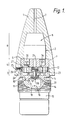
- the illustrated fuze comprises a nose cap 1 having an internal chamber 2 which is open to the rear of the nose cap. From this point, the chamber comprises an internally screw-threaded portion 3, then an unthreaded portion 4 of substantially the same diameter as the portion 3, and then a shoulder 5 leading to a narrower diameter portion 6 which, from a little more than half-way along it, starts to taper inwards slightly so as to conform with the outer shape of the cap.
- a narrow diameter hole 7 leads forward from chamber 2 out to the tip of the nose cap.
- a solidly encapsulated electronic control unit 8 is mounted in chamber portion 6, with which portion the shape of unit 8 conforms and behind this an electrical storage battery and switch carrier module 9 is fitted into chamber portion 6 up against shoulder 5 and the rear face of unit 8.
- the module 9 supports a number, say four, lithium-oxide electrical storage cells 36 (only two of which can be seen), which are interconnected to form two independent batteries, each battery comprising two of the cells in series, and in addition, for each battery, a two-pole isolating switch 501.
- Each switch is connected to the associated battery, one pole to each side thereof, and to the electronic control unit 8 and is operable to remain open, i.e.
- An externally screw-threaded portion 10 of a sealing and interface member 11 is engaged with the threaded portion 3 of chamber 2 so that, via a castellated spacer ring 12 positioned between the member 11 and module 9, the module 9 and consequently also the unit 8 are clamped in position in the chamber.
- An O-ring seal (not shown) may be positioned between the rear face of cap 1 and an outwardly extending flange 13 of the member 11 so as to environ- mentally seal the chamber 2.
- the member 11 also comprises a rearwardly extending, externally screw-threaded portion 14 by which there is connected to the fuze a Gaine-type safety and arming unit (SAU) incorporating 'clutter mechanism' 15.
- Unit 15 has a forward facing recess 16 matching a shallow rear-facing recess 17 formed in the member 11 and, in the chamber 18 formed by the two recesses, there is a detonator capsule holder (not shown).
- the unit 15 itself is a well-known and readily available item of military equipment. Basically, it contains means defining a firing path leading, when in position in an artillery shell (not shown), from an electrically ignitable detonator to the main explosive charge of the shell and also a mechanism in which maintains the detonator holder in a safe position with the capsule isolated from the fuze unless and until predetermined safety-related conditions have been met, for example the achievement of pre-set values of linear and angular acceleration of the shell.
- any other suitable type of safety and arming unit may be used.
- a disc 19 made of plastics material such as Melinex (trade name) is positioned in the wider part of the hole 18 and held there by a ring-shaped bush 20, engaged with the screw-thread in this wider part of the hole. The disc 19 thus seals chamber 2 from chamber 18.
- a spigot 21 Fixed into an axially extending hole in the module 9 is a spigot 21 having an externally screw-threaded portion 22 extending from the rear face of module 9 back towards the member 11 and, screwed onto this portion 22 so that it lies up against the rear face of module 9, there is a flywheel 23.
- a radially-extending hole 24 is provided in the nose cap 1 leading into the chamber 3 adjacent the periphery of flywheel 23 and, in this hole 24, there is mounted a detent peg 25, a compression spring 26, and a set-screw 27, the spring being between the set-screw and the detent peg and being operable to urge the peg inwardly into engagement with a depression formed in the periphery of the flywheel.
- the detent peg 25 On firing of a shell to which the illustrated fuze and SAU are fitted, the detent peg 25 becomes disengaged from flywheel 23 in response to the centrifugal force generated by the spin of the shell whereupon, because the rotation of the flywheel 23 tends to lag that of the shell, the flywheel screws itself along screw-threaded portion 22 of spigot 21 so that the pointed end 29 of probe 28 pierces disc 19 and enters chamber 18.
- the switches 501 could comprise magnetically operable switches influenced by a permanent magnet arrangement (not shown) having a flux circuit partly within fly wheel 23 so that, as fly wheel and unit 9 move relative to one another, the switches operate.
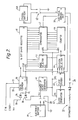
- control unit "a” comprises an electrically eraseable and programmable read-only memory (EEPROM) 30 having a 16x16 bit capacity and incorporating address logic (not shown per se) so that a serial data stream can be entered into it via connector line 31 and also so that the stored data can be read out in series via connector line 32.
- a connector line 33 leads via a diode 34 to the drive voltage terminal 35 of the memory. The free ends of lines 31, 32 and 33 are terminated so as to be accessible to a connector probe (not shown) entered into the fuze via the hole 7 shown in Figure 1.
- the negative side of one of the two batteries formed by cells 36, the battery 37 in Figure 2 is connected via one pole of its associated isolating switch 38 to a common ground line of the unit "a" while the positive side of the battery is connected via the other pole of the switch 38 and a diode 39 to the drive voltage terminal 35.
- This side of the battery 37 is also connected, via switch 38 but not diode 39, to the respective power drive terminals of each of a reset signal generator 40 and of control unit items 41 to 47, which items will be introduced in the following description. For simplicity, the actual power connections to the items 41 to 47 are not shown.
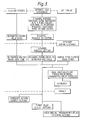
- the electronic control unit "a” consists of a programmable timer with the EEPROM 30 used as a non-volatile memory which can be programmed using a separate programming station (not shown) coupled to the aforementioned connector probe (not shown). Using the programming station and probe, programme data previously entered into the EEPROM 30 can also be verified or replaced by new programme data.
- the reset signal generator 40 generates a reset pulse which is applied to the reset inputs of the items 41 to 47 when it starts to receive power from battery 37 via switch 38, i.e. it applies a power-up reset to each of the items 41 to 47.
- Those items comprise:-
- the battery 48 formed by the other cells in module 9 is connected via its associated switch 49 to an electrical arming unit 50 which, for an initial time period following the application of power thereto from battery 48 is inhibited, i.e. it ignores all stimuli, but then becomes responsive to a signal when supplied from comparator 47 to generate a detonation signal for initiating the detonator 51 via the by then extended probe 28.
- the electronic control unit will also comprise some form of impact detector, for example an accelerometer or wire-break circuit coupled say to the mode selector for enabling the shell to be detonated on impact or after a delay following impact.
- impact detector for example an accelerometer or wire-break circuit coupled say to the mode selector for enabling the shell to be detonated on impact or after a delay following impact.
- a tamper detection device (not shown) could also be provided to set the shell off if it is tampered with after firing, say if the timer has been programmed to give a long delay (days or weeks) before detonation.
- a magnetometer could also be provided to set the shell off say at the approach of a vehicle.
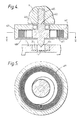
- the flywheel 23 and spigot 21 in Figure 1 could be replaced by the modified elements shown in Figures 4 and 5.
- a hollow flywheel 401 rotatably mounted on a hub shaft 402 by way of a ball bearing 403.
- the hub shaft 402 has a pointed end 404 and a screw-threaded end 405, the screw-threaded end 405 being engaged in a matching threaded hole in switch carrier unit 9 (only partly shown in Figure 4).
- the hollow flywheel 401 which is closed by a welded on or otherwise fixed lid 406, contains a coil of steel tape 407. The coil lies against the inner surface of the peripheral wall of the flywheel 401 and has its outermost end fixed to the fly wheel and its inner end fixed to the hub-shaft 402.
- the flywheel is initially held fixed with respect to the fuze body by centrifugal latch members (not shown in Figures 4 and 5) which could comprise compression spring/detent peg arrangements as in Figure 1.
- centrifugal latch members (not shown in Figures 4 and 5) which could comprise compression spring/detent peg arrangements as in Figure 1.
- the centrifugal latches release the flywheel which thereby tends to remain still while the shell and the fuze including hub-shaft 402 rotates with respect to it. This causes the coil of steel tape 407 to be wound off the wall of flywheel 401 and onto the hub-shaft 402.
- tape 407 need not necessarily be of steel, but may be of any suitable material, for example nylon.
Landscapes
- Engineering & Computer Science (AREA)
- General Engineering & Computer Science (AREA)
- Primary Cells (AREA)
- Compositions Of Oxide Ceramics (AREA)
Applications Claiming Priority (2)
| Application Number | Priority Date | Filing Date | Title |
|---|---|---|---|
| GB888810504A GB8810504D0 (en) | 1988-05-04 | 1988-05-04 | Fuze for artillery shell |
| GB8810504 | 1988-05-04 |
Publications (2)
| Publication Number | Publication Date |
|---|---|
| EP0341067A2 true EP0341067A2 (de) | 1989-11-08 |
| EP0341067A3 EP0341067A3 (de) | 1990-08-29 |
Family
ID=10636319
Family Applications (1)
| Application Number | Title | Priority Date | Filing Date |
|---|---|---|---|
| EP89304513A Withdrawn EP0341067A3 (de) | 1988-05-04 | 1989-05-04 | Universalzünder für Artilleriegeschosse |
Country Status (3)
| Country | Link |
|---|---|
| US (1) | US4962706A (de) |
| EP (1) | EP0341067A3 (de) |
| GB (1) | GB8810504D0 (de) |
Cited By (1)
| Publication number | Priority date | Publication date | Assignee | Title |
|---|---|---|---|---|
| RU2767827C2 (ru) * | 2019-12-19 | 2022-03-22 | Акционерное общество "ПКК МИЛАНДР" | Универсальный электронный взрыватель для мелкокалиберных боеприпасов |
Families Citing this family (12)
| Publication number | Priority date | Publication date | Assignee | Title |
|---|---|---|---|---|
| US20060086277A1 (en) * | 1998-03-30 | 2006-04-27 | George Bossarte | Precision pyrotechnic display system and method having increased safety and timing accuracy |
| US6490977B1 (en) * | 1998-03-30 | 2002-12-10 | Magicfire, Inc. | Precision pyrotechnic display system and method having increased safety and timing accuracy |
| SE513820C2 (sv) * | 1999-01-28 | 2000-11-06 | Bofors Missiles Ab | Anordning för uppladdning av energi i en energilagrande anordning |
| US7121210B2 (en) * | 2003-02-18 | 2006-10-17 | Kdi Precision Products, Inc. | Accuracy fuze for airburst cargo delivery projectiles |
| US8079307B2 (en) | 2005-10-05 | 2011-12-20 | Mckinley Paul | Electric match assembly with isolated lift and burst function for a pyrotechnic device |
| US7819061B2 (en) * | 2008-09-08 | 2010-10-26 | Raytheon Company | Smart fuze guidance system with replaceable fuze module |
| US8477049B2 (en) * | 2009-06-05 | 2013-07-02 | Apple Inc. | Efficiently embedding information onto a keyboard membrane |
| US8443726B2 (en) * | 2010-02-10 | 2013-05-21 | Omnitek Partners, Llc | Miniature safe and arm (S and A) mechanisms for fuzing of gravity dropped small weapons |
| RU2495368C9 (ru) * | 2011-12-29 | 2014-02-20 | Российская Федерация, от имени которой выступает Государственная корпорация по атомной энергии "Росатом" (Госкорпорация "Росатом") | Контактный датчик |
| CN109269363B (zh) * | 2018-11-16 | 2024-05-10 | 湖南省军合科技有限公司 | 一种飞翼布局单兵手掷式巡飞弹 |
| FR3114643B1 (fr) * | 2020-09-25 | 2022-09-09 | Nexter Munitions | Fusee electronique pour projectile |
| US11650034B1 (en) * | 2021-03-25 | 2023-05-16 | The United States Of America As Represented By The Secretary Of The Army | Internal captive collar joint for projectile |
Family Cites Families (12)
| Publication number | Priority date | Publication date | Assignee | Title |
|---|---|---|---|---|
| US3167018A (en) * | 1962-03-19 | 1965-01-26 | Aeronca Mfg Corp | Missile safety and arming circuit |
| US3570404A (en) * | 1968-06-21 | 1971-03-16 | Unidynamics Phoenix | Electrical pyrotechnic programming system |
| US3713391A (en) * | 1969-12-11 | 1973-01-30 | Us Navy | Electronic ignition delay for 5 38 and 5 54 rocket assisted projectiles |
| US3851531A (en) * | 1971-03-04 | 1974-12-03 | Westinghouse Electric Corp | Electronic fuze system |
| US4015531A (en) * | 1975-01-31 | 1977-04-05 | General Electric Company | Electrical fuze with selectable modes of operation |
| CH608604A5 (de) * | 1977-09-16 | 1979-01-15 | Oerlikon Buehrle Ag | |
| US4580498A (en) * | 1982-07-27 | 1986-04-08 | Motorola, Inc. | Fuze actuating system having a variable impact delay |
| CA1233896A (en) * | 1983-04-11 | 1988-03-08 | Kenneth N. Jarrott | Programmable electronic delay fuse |
| GB2153495B (en) * | 1984-01-25 | 1987-10-21 | Plessey Co Plc | Improvements relating to variable timing and power storage arrangements |
| US4799429A (en) * | 1984-03-30 | 1989-01-24 | Isc Technologies, Inc. | Programming circuit for individual bomblets in a cluster bomb |
| US4603635A (en) * | 1984-12-17 | 1986-08-05 | Avco Corporation | Dual safing for base element fuze |
| US4739705A (en) * | 1985-10-29 | 1988-04-26 | British Aerospace Plc | Arming and motor ignition device |
-
1988
- 1988-05-04 GB GB888810504A patent/GB8810504D0/en active Pending
-
1989
- 1989-05-04 EP EP89304513A patent/EP0341067A3/de not_active Withdrawn
- 1989-05-04 US US07/347,138 patent/US4962706A/en not_active Expired - Fee Related
Cited By (1)
| Publication number | Priority date | Publication date | Assignee | Title |
|---|---|---|---|---|
| RU2767827C2 (ru) * | 2019-12-19 | 2022-03-22 | Акционерное общество "ПКК МИЛАНДР" | Универсальный электронный взрыватель для мелкокалиберных боеприпасов |
Also Published As
| Publication number | Publication date |
|---|---|
| US4962706A (en) | 1990-10-16 |
| EP0341067A3 (de) | 1990-08-29 |
| GB8810504D0 (en) | 1988-11-16 |
Similar Documents
| Publication | Publication Date | Title |
|---|---|---|
| US4962706A (en) | Fuze for artillery shell | |
| EP0677164B1 (de) | Digitale verzögerungseinheit | |
| US8286554B2 (en) | Electrically initiated inertial igniters for thermal batteries and the like | |
| US5343795A (en) | Settable electronic fuzing system for cannon ammunition | |
| EP2694913B1 (de) | Elektromechanischer zünder für ein geschoss | |
| US5440990A (en) | Electronic time fuze | |
| US4145971A (en) | Electronic time delay safety and arming mechanism | |
| US5271327A (en) | Elecro-mechanical base element fuze | |
| US4603635A (en) | Dual safing for base element fuze | |
| US6401621B1 (en) | Electronic safe and arm apparatus for initiating a pyrotechnic | |
| US4237789A (en) | Programmable fuze for projectiles | |
| US4320704A (en) | Electronic projectile fuse | |
| US20120180682A1 (en) | Inertially Operated Electrical Initiation Devices | |
| US6082267A (en) | Electronic, out-of-line safety fuze for munitions such as hand grenades | |
| US2834292A (en) | Intermittent action ball cam rotor | |
| US4796532A (en) | Safe and arm device for spinning munitions | |
| US8776688B2 (en) | Electrically initiated inertial igniters for thermal batteries and the like | |
| US8596198B2 (en) | Inertially operated electrical initiation methods | |
| US8601949B2 (en) | Inertially operated electrical initiation devices | |
| US6142080A (en) | Spin-decay self-destruct fuze | |
| US2626568A (en) | Fuse | |
| US7926402B2 (en) | Method and apparatus for munition timing and munitions incorporating same | |
| IL148141A (en) | Electronic time-fuse for a projectile | |
| KR0114569Y1 (ko) | 시한신관의 수동 및 비접촉식 셋팅형 액티브배터리장착에 따른 전기적안전장전장치 | |
| JPH11325799A (ja) | 電子式遅延雷管 |
Legal Events
| Date | Code | Title | Description |
|---|---|---|---|
| PUAI | Public reference made under article 153(3) epc to a published international application that has entered the european phase |
Free format text: ORIGINAL CODE: 0009012 |
|
| AK | Designated contracting states |
Kind code of ref document: A2 Designated state(s): AT BE CH DE ES FR GB IT LI NL SE |
|
| PUAL | Search report despatched |
Free format text: ORIGINAL CODE: 0009013 |
|
| AK | Designated contracting states |
Kind code of ref document: A3 Designated state(s): AT BE CH DE ES FR GB IT LI NL SE |
|
| 17P | Request for examination filed |
Effective date: 19901011 |
|
| 17Q | First examination report despatched |
Effective date: 19920304 |
|
| RAP3 | Party data changed (applicant data changed or rights of an application transferred) |
Owner name: BRITISH AEROSPACE PUBLIC LIMITED COMPANY |
|
| STAA | Information on the status of an ep patent application or granted ep patent |
Free format text: STATUS: THE APPLICATION IS DEEMED TO BE WITHDRAWN |
|
| 18D | Application deemed to be withdrawn |
Effective date: 19930921 |