EP0340887B1 - A non-linear resistor having a polymeric membrane - Google Patents
A non-linear resistor having a polymeric membrane Download PDFInfo
- Publication number
- EP0340887B1 EP0340887B1 EP89301656A EP89301656A EP0340887B1 EP 0340887 B1 EP0340887 B1 EP 0340887B1 EP 89301656 A EP89301656 A EP 89301656A EP 89301656 A EP89301656 A EP 89301656A EP 0340887 B1 EP0340887 B1 EP 0340887B1
- Authority
- EP
- European Patent Office
- Prior art keywords
- linear resistor
- amino acid
- membrane
- current
- electrolyte
- Prior art date
- Legal status (The legal status is an assumption and is not a legal conclusion. Google has not performed a legal analysis and makes no representation as to the accuracy of the status listed.)
- Expired - Lifetime
Links
Images


Classifications
-
- B—PERFORMING OPERATIONS; TRANSPORTING
- B82—NANOTECHNOLOGY
- B82Y—SPECIFIC USES OR APPLICATIONS OF NANOSTRUCTURES; MEASUREMENT OR ANALYSIS OF NANOSTRUCTURES; MANUFACTURE OR TREATMENT OF NANOSTRUCTURES
- B82Y10/00—Nanotechnology for information processing, storage or transmission, e.g. quantum computing or single electron logic
-
- G—PHYSICS
- G06—COMPUTING OR CALCULATING; COUNTING
- G06N—COMPUTING ARRANGEMENTS BASED ON SPECIFIC COMPUTATIONAL MODELS
- G06N3/00—Computing arrangements based on biological models
- G06N3/002—Biomolecular computers, i.e. using biomolecules, proteins, cells
-
- H—ELECTRICITY
- H01—ELECTRIC ELEMENTS
- H01B—CABLES; CONDUCTORS; INSULATORS; SELECTION OF MATERIALS FOR THEIR CONDUCTIVE, INSULATING OR DIELECTRIC PROPERTIES
- H01B1/00—Conductors or conductive bodies characterised by the conductive materials; Selection of materials as conductors
- H01B1/06—Conductors or conductive bodies characterised by the conductive materials; Selection of materials as conductors mainly consisting of other non-metallic substances
- H01B1/12—Conductors or conductive bodies characterised by the conductive materials; Selection of materials as conductors mainly consisting of other non-metallic substances organic substances
- H01B1/122—Ionic conductors
-
- H—ELECTRICITY
- H01—ELECTRIC ELEMENTS
- H01C—RESISTORS
- H01C10/00—Adjustable resistors
- H01C10/02—Liquid resistors
- H01C10/025—Electrochemical variable resistors
-
- H—ELECTRICITY
- H01—ELECTRIC ELEMENTS
- H01C—RESISTORS
- H01C7/00—Non-adjustable resistors formed as one or more layers or coatings; Non-adjustable resistors made from powdered conducting material or powdered semi-conducting material with or without insulating material
- H01C7/10—Non-adjustable resistors formed as one or more layers or coatings; Non-adjustable resistors made from powdered conducting material or powdered semi-conducting material with or without insulating material voltage responsive, i.e. varistors
-
- H—ELECTRICITY
- H01—ELECTRIC ELEMENTS
- H01C—RESISTORS
- H01C7/00—Non-adjustable resistors formed as one or more layers or coatings; Non-adjustable resistors made from powdered conducting material or powdered semi-conducting material with or without insulating material
- H01C7/13—Non-adjustable resistors formed as one or more layers or coatings; Non-adjustable resistors made from powdered conducting material or powdered semi-conducting material with or without insulating material current-responsive
Definitions
- the present invention relates to a novel electronic device and more particularly, to an electronic device having a membrane of a specific polymeric material as the functional element which behaves as a non-linear resistor.
- the present invention provides an electronic device which comprises, as a functional element, a polymeric membrane which is insoluble in water formed from a poly(amino acid) having pendant ionic groups.
- the above defined electronic device serves as a non-linear resistor comprising the polymeric membrane, two electrolyte-containing media each contacting one of the surfaces of the polymeric membrane and at least two electrodes each in contact with one of the electrolyte-containing media.
- the poly(amino acid) as the material of the membrane working as a functional element of the electronic device of the invention has ionic groups pendant to the main chain of the molecule.
- the poly(amino acid) is insoluble in water as a whole.
- the ionic group may be, for example, a carboxyl group -COOH or an amino group -NH2.
- Examples of the amino acids from which the poly(amino acid) useful in the invention may be prepared include glutamic acid, aspartic acid, lysine or ornithine characterized by ionic groups pendant to the amino acid molecule.
- the pendant group of an amino acid is defined by the symbol R in the general formula H2N-CHR-COOH representing an amino acid.
- poly(amino acids) prepared from these ionic pendant-containing amino acids alone are generally soluble in water, whilst it is essential in the invention that the membrane of the poly(amino acid) is insoluble in water.
- the water-insolubility as a whole here implied means that the polymer is composed of an inherently water-soluble moiety and an inherently water-insoluble moiety, but the polymer per se is insoluble in water.
- such a poly(amino acid) insoluble in water as a whole can be prepared by the copolymerization of the above named ionic pendant-containing amino acid with another amino acid having no pendant ionic group such as leucine, alanine or methionine.
- the poly(amino acid) is insoluble in water as a whole, the polymer is preferably composed of 5 to 45% by moles of the inherently water-soluble moiety and 95 to 55% by moles of the inherently water-insoluble moiety.
- the copolymer may be a random copolymer or block copolymer.
- Random copolymerization of amino acids is performed by dissolving the N-carboxyanhydrides of a first and second amino acids in an organic solvent together with an amine compound of a similar catalytically active compound as the polymerization initiator.
- Membranes of a poly(amino acid) can be prepared according to a known method such as casting a solution of the polymer onto a glass plate, followed by drying and peeling the dried film off the glass plate. Membranes having a thickness of 1 to 100 ⁇ m are suitable for the purpose of the invention.
- an electronic device such as a non-linear resistor of the invention is constructed using the specific poly(amino acid) membrane
- the membrane is contacted with an electrolyte-containing medium on each of the surfaces.
- the electrolyte-containing medium is typically an aqueous solution of a salt of an organic or inorganic acid such as potassium chloride, sodium chloride, lithium chloride, calcium chloride, sodium acetate and the like in a concentration of, for example, 10 ⁇ 4 to 10 ⁇ 1 mole/liter.
- the electrolyte-containing medium can also be a hydrous gelled material containing these salts dissolved therein.
- FIG. 1 A typical model of such a device is illustrated schematically in Figure 1 in which the vessel 8 is partitioned with the membrane 5 of the poly(amino acid) into two compartments 6 and 7 and each compartment is filled with an aqueous salt solution.
- Two sets of electrodes 1,2 and 3,4 are inserted each into the salt solution in the compartments 6, 7, respectively, to form two electrode pairs of the electrodes 1,3 and 2,4.
- Various types of electrodes can be used for this purpose and any of the electrodes conventionally used in the electrochemical measurements is suitable including, for example, Ag/AgCl electrodes and calomel electrodes though not particularly limited thereto provided that the material of the electrode is inert to the salt solution.
- the electrodes forming a pair are of the same type.
- the electrode pair 1,3 serves for passing electric current through the salt solutions in the compartments 6,7 partitioned by the membrane 5 while the other electrode pair 2,4 serves for voltage measurement between the salt solutions in the compartments 6,7.
- Figure 2 is a graph showing the relationship between the electric current and voltage obtained in the above described manner by scanning the current from -3 ⁇ A/cm2 to +3 ⁇ A/cm2.
- the current vs. voltage curve has a hysteresis loop in each direction of the current indicating that the resistance of the membrane depends on the electric current passing therethrough. This is the reason that a non-linear resistor is obtained with a membrane of the specific poly(amino acid) as a functional element.
- a tri-block copolymer of benzyl glutamate-leucine-benzyl glutamate was prepared in the following manner.
- N-carboxyanhydride of L-leucine was dissolved in a 19:1 mixture of benzene and dioxane together with 1,6-hexamethylene diamine as a polymerization initiator.
- the amount of the 1,6-hexamethylene diamine was 1/66 by moles based on the N-carboxyanhydride of L-leucine to effect the polymerization reaction at 20 °C.
- Carbon dioxide gas was evolved as the reaction proceeded so that the reaction could be monitored by measuring the volume of the evolved carbon dioxide gas.
- N-carboxyanhydride of ⁇ -benzyl L-glutamate dissolved in the same solvent mixture as above was added to the reaction mixture to further continue the polymerization reaction for 15 days.
- the overall concentration of the N-carboxyanhydrides of amino acids was 20 g/liter.
- the reaction mixture was poured into a large volume of methyl alcohol and the precipitates were collected by filtration, thoroughly washed with methyl alcohol and dried under reduced pressure.
- the precipitates were dissolved in a 9:1 mixture of chloroform and trifluoroacetic acid and reprecipitated by pouring the solution into a large volume of a 9:1 mixture of chloroform and ether so as to be freed from homopolymers of the amino acids.
- the block copolymer after purification in the above described manner was dissolved in benzene and the solution was cast and spread over a glass plate followed by drying by evaporation of benzene to give a film of the block copolymer of benzyl glutamate-leucine-benzyl glutamate having a thickness of 0.02 mm.
- the copolymer was composed of 36% by moles of the benzyl glutamate moiety and 64% by moles of the leucine moiety.
- the above prepared film was then subjected to a reaction of hydrolysis in order to convert the benzyl ester groups into free carboxyl groups according to the disclosure in Journal of Applied Polymer Science, volume 31, pages 1935-1942 (1986) by dipping the film in a 2:2:1 by volume mixture of isopropyl alcohol, methyl alcohol and 5N aqueous solution of sodium hydroxide for 20 days at 18 °C followed by thorough rinsing first in ethyl alcohol and then in water.
- the resultant film could be identified to be a film of a block copolymer of glutamic acid-leucine-glutamic acid from the disappearance of the absorption band assignable to the ester linkages at a wave number of 1730 cm ⁇ 1 in the infrared absorption spectrum.
- the above prepared film of a poly(amino acid) block copolymer was set as a partitioning membrane between two compartments of an acrylic resin-made vessel and each compartment was filled with 250 ml of a 1 mM aqueous solution of potassium chloride having a pH of 5.8.
- a combination of an Ag/AgCl electrode and a caromel electrode was inserted into the salt solution in each of the compartments.
- the two Ag/AgCl electrodes were connected through a power source and an ammeter and the two caromel electrodes were connected through a voltmeter.
- the current was repeatedly increased and decreased between -3 ⁇ A/cm2 and +3 ⁇ A/cm2 at such a rate that the scanning velocity of the impressed voltage was 0.1 V/second in the power source shown in Figure 1 to record the current vs. voltage relationship graphically shown in Figure 2 from which it is clear that the current vs. voltage curve exhibited a phenomenon of hysteresis and that the resistance of the membrane was variable depending on the current.
- the experimental procedure was substantially the same as in Example 1 except that the concentration of the aqueous solution of potassium chloride filling the compartments of the cell was increased from 1 mM to 10 mM.
- the current vs. voltage relationship obtained by the measurement is graphically shown in Figure 3 from which it is clear that the current vs. voltage curve exhibited a phenomenon of hysteresis and that the resistance of the membrane was variable depending on the current.
- the experimental procedure was substantially the same as in Example 2 except that the scanning velocity of the impressed voltage in the power source was decreased from 0.1 V/second to 0.002 V/second.
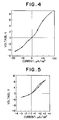
- the current vs. voltage relationship obtained by the measurement is graphically shown in Figure 4 from which it is clear that the resistance of the membrane was variable depending on the current although the phenomenon of hysteresis was not noted in this case.
- the experimental procedure was substantially the same as in Example 1 except that the pH of the aqueous solution of potassium chloride was 4.0 instead of 5.8.
- the current vs. voltage relationship obtained by the measurement is graphically shown in Figure 5 from which it is clear that a phenomenon of hysteresis was noted in the current vs. voltage curve and the resistance of the membrane was variable depending on the current only when the surface of the membrane positive to the other surface was the surface which was in contact with the glass surface in the preparation of the film by casting of a solution on a glass plate. It was noted that, when the pH of the electrolyte solution was further decreased to a value substantially lower than 4, the phenomenon of hysteresis in the voltage vs. curve disappeared irrespective of the direction of the voltage impression.
Landscapes
- Engineering & Computer Science (AREA)
- Physics & Mathematics (AREA)
- Microelectronics & Electronic Packaging (AREA)
- Chemical & Material Sciences (AREA)
- Theoretical Computer Science (AREA)
- Electromagnetism (AREA)
- Nanotechnology (AREA)
- Spectroscopy & Molecular Physics (AREA)
- Life Sciences & Earth Sciences (AREA)
- Biophysics (AREA)
- Mathematical Physics (AREA)
- Software Systems (AREA)
- Biomedical Technology (AREA)
- General Health & Medical Sciences (AREA)
- Organic Chemistry (AREA)
- Computing Systems (AREA)
- General Engineering & Computer Science (AREA)
- General Physics & Mathematics (AREA)
- Computational Linguistics (AREA)
- Evolutionary Computation (AREA)
- Data Mining & Analysis (AREA)
- Molecular Biology (AREA)
- Artificial Intelligence (AREA)
- Crystallography & Structural Chemistry (AREA)
- Health & Medical Sciences (AREA)
- Chemical Kinetics & Catalysis (AREA)
- Electrochemistry (AREA)
- Polyamides (AREA)
- Thermistors And Varistors (AREA)
- Manufacture Of Macromolecular Shaped Articles (AREA)
Description
- The present invention relates to a novel electronic device and more particularly, to an electronic device having a membrane of a specific polymeric material as the functional element which behaves as a non-linear resistor.
- Most conventional electronic devices are built using an inorganic material as the functional element which is unavoidably affected by water or moisture so that the devices fail to work in water. Further, most conventional resistors behave as linear resistance elements in which the electric current passing therethrough is proportional to the voltage applied between the electrodes. On the other hand, it has been desired in the art to develop a non-linear resistance element in which the resistance depends on the electric current or applied voltage, or depends on the scanning velocity of the electric current or applied voltage, and the current-voltage curve exhibits a phenomenon of hysteresis. In recent years, furthermore, it has been desired to develop biocomputers and biosensors on the basis of the rapidly progressing research for molecular devices and biochemical devices working in a mechanism quite different from that of conventional electronic devices.
- We have now developed an electronic device with a functional element formed from a unique organic polymeric material which meets the above mentioned requirements in the art of electronics.
- Accordingly, the present invention provides an electronic device which comprises, as a functional element, a polymeric membrane which is insoluble in water formed from a poly(amino acid) having pendant ionic groups.
- The above defined electronic device serves as a non-linear resistor comprising the polymeric membrane, two electrolyte-containing media each contacting one of the surfaces of the polymeric membrane and at least two electrodes each in contact with one of the electrolyte-containing media.
- The poly(amino acid) as the material of the membrane working as a functional element of the electronic device of the invention has ionic groups pendant to the main chain of the molecule. The poly(amino acid) is insoluble in water as a whole. The ionic group may be, for example, a carboxyl group -COOH or an amino group -NH₂. Examples of the amino acids from which the poly(amino acid) useful in the invention may be prepared include glutamic acid, aspartic acid, lysine or ornithine characterized by ionic groups pendant to the amino acid molecule. The pendant group of an amino acid is defined by the symbol R in the general formula H₂N-CHR-COOH representing an amino acid. It should be noted that poly(amino acids) prepared from these ionic pendant-containing amino acids alone are generally soluble in water, whilst it is essential in the invention that the membrane of the poly(amino acid) is insoluble in water. The water-insolubility as a whole here implied means that the polymer is composed of an inherently water-soluble moiety and an inherently water-insoluble moiety, but the polymer per se is insoluble in water. In view of the fact that the above named ionic pendant-containing amino acid forms an inherently water-soluble moiety in the polymer, such a poly(amino acid) insoluble in water as a whole can be prepared by the copolymerization of the above named ionic pendant-containing amino acid with another amino acid having no pendant ionic group such as leucine, alanine or methionine. In order that the poly(amino acid) is insoluble in water as a whole, the polymer is preferably composed of 5 to 45% by moles of the inherently water-soluble moiety and 95 to 55% by moles of the inherently water-insoluble moiety. The copolymer may be a random copolymer or block copolymer. Random copolymerization of amino acids is performed by dissolving the N-carboxyanhydrides of a first and second amino acids in an organic solvent together with an amine compound of a similar catalytically active compound as the polymerization initiator. Membranes of a poly(amino acid) can be prepared according to a known method such as casting a solution of the polymer onto a glass plate, followed by drying and peeling the dried film off the glass plate. Membranes having a thickness of 1 to 100 µm are suitable for the purpose of the invention.
- When an electronic device such as a non-linear resistor of the invention is constructed using the specific poly(amino acid) membrane, the membrane is contacted with an electrolyte-containing medium on each of the surfaces. The electrolyte-containing medium is typically an aqueous solution of a salt of an organic or inorganic acid such as potassium chloride, sodium chloride, lithium chloride, calcium chloride, sodium acetate and the like in a concentration of, for example, 10⁻⁴ to 10⁻¹ mole/liter. The electrolyte-containing medium can also be a hydrous gelled material containing these salts dissolved therein.
- The present invention will be further described with reference to the following drawings, in which:-
- Figure 1 is a schematic cross-sectional illustration of a non-linear resistor device according to the invention; and
- Figures 2 to 5 are each graphs showing the current vs. voltage relationship obtained with the device shown in Figure 1.
- A typical model of such a device is illustrated schematically in Figure 1 in which the
vessel 8 is partitioned with themembrane 5 of the poly(amino acid) into twocompartments electrodes compartments electrodes electrodes electrode pair compartments membrane 5 while theother electrode pair compartments - Figure 2 is a graph showing the relationship between the electric current and voltage obtained in the above described manner by scanning the current from -3 µA/cm² to +3 µA/cm². As is shown in this graph, the current vs. voltage curve has a hysteresis loop in each direction of the current indicating that the resistance of the membrane depends on the electric current passing therethrough. This is the reason that a non-linear resistor is obtained with a membrane of the specific poly(amino acid) as a functional element.
- In the following, the present invention is described in more detail by way of examples.
- According to the disclosure in Macromolecules,
volume 10, No. 2, pages 346-351 (1977), a tri-block copolymer of benzyl glutamate-leucine-benzyl glutamate was prepared in the following manner. Thus, N-carboxyanhydride of L-leucine was dissolved in a 19:1 mixture of benzene and dioxane together with 1,6-hexamethylene diamine as a polymerization initiator. The amount of the 1,6-hexamethylene diamine was 1/66 by moles based on the N-carboxyanhydride of L-leucine to effect the polymerization reaction at 20 °C. Carbon dioxide gas was evolved as the reaction proceeded so that the reaction could be monitored by measuring the volume of the evolved carbon dioxide gas. When evolution of carbon dioxide gas had ceased after 5 days indicating completion of the reaction, N-carboxyanhydride of γ-benzyl L-glutamate dissolved in the same solvent mixture as above was added to the reaction mixture to further continue the polymerization reaction for 15 days. The overall concentration of the N-carboxyanhydrides of amino acids was 20 g/liter. After completion of the reaction, the reaction mixture was poured into a large volume of methyl alcohol and the precipitates were collected by filtration, thoroughly washed with methyl alcohol and dried under reduced pressure. The precipitates were dissolved in a 9:1 mixture of chloroform and trifluoroacetic acid and reprecipitated by pouring the solution into a large volume of a 9:1 mixture of chloroform and ether so as to be freed from homopolymers of the amino acids. - The block copolymer after purification in the above described manner was dissolved in benzene and the solution was cast and spread over a glass plate followed by drying by evaporation of benzene to give a film of the block copolymer of benzyl glutamate-leucine-benzyl glutamate having a thickness of 0.02 mm. The copolymer was composed of 36% by moles of the benzyl glutamate moiety and 64% by moles of the leucine moiety.
- The above prepared film was then subjected to a reaction of hydrolysis in order to convert the benzyl ester groups into free carboxyl groups according to the disclosure in Journal of Applied Polymer Science, volume 31, pages 1935-1942 (1986) by dipping the film in a 2:2:1 by volume mixture of isopropyl alcohol, methyl alcohol and 5N aqueous solution of sodium hydroxide for 20 days at 18 °C followed by thorough rinsing first in ethyl alcohol and then in water. The resultant film could be identified to be a film of a block copolymer of glutamic acid-leucine-glutamic acid from the disappearance of the absorption band assignable to the ester linkages at a wave number of 1730 cm⁻¹ in the infrared absorption spectrum.
- The above prepared film of a poly(amino acid) block copolymer was set as a partitioning membrane between two compartments of an acrylic resin-made vessel and each compartment was filled with 250 ml of a 1 mM aqueous solution of potassium chloride having a pH of 5.8. A combination of an Ag/AgCl electrode and a caromel electrode was inserted into the salt solution in each of the compartments. The two Ag/AgCl electrodes were connected through a power source and an ammeter and the two caromel electrodes were connected through a voltmeter. The current was repeatedly increased and decreased between -3 µA/cm² and +3 µA/cm² at such a rate that the scanning velocity of the impressed voltage was 0.1 V/second in the power source shown in Figure 1 to record the current vs. voltage relationship graphically shown in Figure 2 from which it is clear that the current vs. voltage curve exhibited a phenomenon of hysteresis and that the resistance of the membrane was variable depending on the current.
- The experimental procedure was substantially the same as in Example 1 except that the concentration of the aqueous solution of potassium chloride filling the compartments of the cell was increased from 1 mM to 10 mM. The current vs. voltage relationship obtained by the measurement is graphically shown in Figure 3 from which it is clear that the current vs. voltage curve exhibited a phenomenon of hysteresis and that the resistance of the membrane was variable depending on the current.
- The experimental procedure was substantially the same as in Example 2 except that the scanning velocity of the impressed voltage in the power source was decreased from 0.1 V/second to 0.002 V/second. The current vs. voltage relationship obtained by the measurement is graphically shown in Figure 4 from which it is clear that the resistance of the membrane was variable depending on the current although the phenomenon of hysteresis was not noted in this case.
- The experimental procedure was substantially the same as in Example 1 except that the pH of the aqueous solution of potassium chloride was 4.0 instead of 5.8. The current vs. voltage relationship obtained by the measurement is graphically shown in Figure 5 from which it is clear that a phenomenon of hysteresis was noted in the current vs. voltage curve and the resistance of the membrane was variable depending on the current only when the surface of the membrane positive to the other surface was the surface which was in contact with the glass surface in the preparation of the film by casting of a solution on a glass plate. It was noted that, when the pH of the electrolyte solution was further decreased to a value substantially lower than 4, the phenomenon of hysteresis in the voltage vs. curve disappeared irrespective of the direction of the voltage impression.
Claims (4)
- A non-linear resistor which comprises:(a) a polymeric membrane having a thickness in the range of from 1 to 100 µm which is insoluble in water formed from a poly(amino acid) having pendant ionic groups;(b) two electrolyte-containing media each contacting one of the surfaces of the polymeric membrane; and(c) at least two electrodes each in contact with one of the electrolyte-containing media.
- A non-linear resistor as claimed in claim 1 wherein the electrolyte-containing medium is an aqueous salt solution of lithium chloride, sodium chloride, potassium chloride, calcium chloride or sodium acetate.
- A non-linear resistor as claimed in claim 2 wherein the concentration of the aqueous salt solution is in the range of from 10⁻⁴ to 10⁻¹ mole/liter.
- A non-linear resistor as claimed in any one of claims 1 to 3 wherein the electrode is an Ag/AgCl electrode or a calomel electrode.
Applications Claiming Priority (2)
| Application Number | Priority Date | Filing Date | Title |
|---|---|---|---|
| JP109749/88 | 1988-05-02 | ||
| JP63109749A JPH01278701A (en) | 1988-05-02 | 1988-05-02 | Electron element material |
Publications (3)
| Publication Number | Publication Date |
|---|---|
| EP0340887A2 EP0340887A2 (en) | 1989-11-08 |
| EP0340887A3 EP0340887A3 (en) | 1990-03-14 |
| EP0340887B1 true EP0340887B1 (en) | 1995-09-20 |
Family
ID=14518278
Family Applications (1)
| Application Number | Title | Priority Date | Filing Date |
|---|---|---|---|
| EP89301656A Expired - Lifetime EP0340887B1 (en) | 1988-05-02 | 1989-02-21 | A non-linear resistor having a polymeric membrane |
Country Status (5)
| Country | Link |
|---|---|
| US (1) | US4949064A (en) |
| EP (1) | EP0340887B1 (en) |
| JP (1) | JPH01278701A (en) |
| CA (1) | CA1312427C (en) |
| DE (1) | DE68924300T2 (en) |
Families Citing this family (2)
| Publication number | Priority date | Publication date | Assignee | Title |
|---|---|---|---|---|
| US5315162A (en) * | 1991-10-04 | 1994-05-24 | Hughes Aircraft Company | Electrochemical synapses for artificial neural networks |
| JP2671948B2 (en) * | 1995-04-27 | 1997-11-05 | 工業技術院長 | Non-linear resistance element |
Family Cites Families (1)
| Publication number | Priority date | Publication date | Assignee | Title |
|---|---|---|---|---|
| US4391841A (en) * | 1980-03-28 | 1983-07-05 | Kollmorgen Technologies Corporation | Passivation of metallic equipment surfaces in electroless copper deposition processes |
-
1988
- 1988-05-02 JP JP63109749A patent/JPH01278701A/en active Granted
-
1989
- 1989-02-20 CA CA000591505A patent/CA1312427C/en not_active Expired - Fee Related
- 1989-02-21 US US07/313,079 patent/US4949064A/en not_active Expired - Fee Related
- 1989-02-21 DE DE68924300T patent/DE68924300T2/en not_active Expired - Fee Related
- 1989-02-21 EP EP89301656A patent/EP0340887B1/en not_active Expired - Lifetime
Also Published As
| Publication number | Publication date |
|---|---|
| DE68924300T2 (en) | 1996-02-29 |
| US4949064A (en) | 1990-08-14 |
| JPH0514362B2 (en) | 1993-02-24 |
| JPH01278701A (en) | 1989-11-09 |
| DE68924300D1 (en) | 1995-10-26 |
| EP0340887A2 (en) | 1989-11-08 |
| CA1312427C (en) | 1993-01-12 |
| EP0340887A3 (en) | 1990-03-14 |
Similar Documents
| Publication | Publication Date | Title |
|---|---|---|
| Oyama et al. | Electrochemical responses of multiply-charged transition metal complexes bound electrostatically to graphite electrode surfaces coated with polyelectrolytes | |
| US5028394A (en) | Chemical sensors | |
| Brahim et al. | Electroconductive hydrogels: Electrical and electrochemical properties of polypyrrole‐poly (HEMA) composites | |
| JP7250830B2 (en) | Solid electrodes and sensors | |
| CN1846132B (en) | Reversible electrochemical sensors of polyions | |
| Kumar et al. | Determination of uric acid in the presence of ascorbic acid using poly (3, 4‐ethylenedioxythiophene)‐modified electrodes | |
| WO1992019961A1 (en) | Two-terminal voltammetric microsensors | |
| Ohsaka et al. | Anion-exchange properties of polymer films prepared by electrochemically initiated polymerization of N, N-dialkyl substituted aniline derivatives | |
| Ekinci et al. | Electrochemical synthesis and sensor application of poly (1, 4-diaminobenzene) | |
| US4659665A (en) | Enzyme membranes for electrodes | |
| WO1988009981A2 (en) | Polymers, and their use as gels for electrophoresis | |
| CA1312427C (en) | Electronic device | |
| Guiseppi-Elie et al. | Specific immobilization of electropolymerized polypyrrole thin films onto interdigitated microsensor electrode arrays | |
| Teng et al. | Polymer film coatings on metal electrodes through electroinitiated polymerization and their evaluation | |
| Palmqvist et al. | Development of a simple detector for microbial metabolism, based on a polypyrrole dc resistometric device | |
| Shan et al. | Detection of intermediate during the electrochemical polymerization of azure B and growth of poly (azure B) film | |
| Enkelmann et al. | Transport properties of asymmetric polyamide membranes | |
| Palmqvist et al. | DC-resistometric urea sensitive device utilizing a conducting polymer film for the gas-phase detection of ammonia | |
| GB2176901A (en) | Gas sensor | |
| JP2671948B2 (en) | Non-linear resistance element | |
| Sezer et al. | N‐Vinylcarbazole‐Acrylamide Copolymer Electrodes Electrochemical Response to Dopamine | |
| Ramanaviciene et al. | Molecularly imprinted polypyrrole for sensor design | |
| Miyasaka et al. | Amperometric glucose sensor with glucose oxidase immobilized on SnO2 electrode via a monolayer of a photoreactive nitrophenylazide derivative. | |
| CN108267490A (en) | Organotin molecular imprinting electrochemical sensor and preparation method thereof | |
| Davis et al. | The electrochemical oxidation of poly (N-vinylcarbazole) films |
Legal Events
| Date | Code | Title | Description |
|---|---|---|---|
| PUAI | Public reference made under article 153(3) epc to a published international application that has entered the european phase |
Free format text: ORIGINAL CODE: 0009012 |
|
| AK | Designated contracting states |
Kind code of ref document: A2 Designated state(s): DE FR GB |
|
| 17P | Request for examination filed |
Effective date: 19891108 |
|
| PUAL | Search report despatched |
Free format text: ORIGINAL CODE: 0009013 |
|
| AK | Designated contracting states |
Kind code of ref document: A3 Designated state(s): DE FR GB |
|
| 17Q | First examination report despatched |
Effective date: 19920702 |
|
| GRAA | (expected) grant |
Free format text: ORIGINAL CODE: 0009210 |
|
| AK | Designated contracting states |
Kind code of ref document: B1 Designated state(s): DE FR GB |
|
| REF | Corresponds to: |
Ref document number: 68924300 Country of ref document: DE Date of ref document: 19951026 |
|
| ET | Fr: translation filed | ||
| RAP2 | Party data changed (patent owner data changed or rights of a patent transferred) |
Owner name: JAPAN AS REPRESENTED BY DIRECTOR GENERAL OF AGENCY |
|
| RAP4 | Party data changed (patent owner data changed or rights of a patent transferred) |
Owner name: JAPAN AS REPRESENTED BY DIRECTOR GENERAL OF AGENCY |
|
| PLBE | No opposition filed within time limit |
Free format text: ORIGINAL CODE: 0009261 |
|
| STAA | Information on the status of an ep patent application or granted ep patent |
Free format text: STATUS: NO OPPOSITION FILED WITHIN TIME LIMIT |
|
| 26N | No opposition filed | ||
| PGFP | Annual fee paid to national office [announced via postgrant information from national office to epo] |
Ref country code: GB Payment date: 19980213 Year of fee payment: 10 |
|
| PGFP | Annual fee paid to national office [announced via postgrant information from national office to epo] |
Ref country code: FR Payment date: 19980224 Year of fee payment: 10 |
|
| PGFP | Annual fee paid to national office [announced via postgrant information from national office to epo] |
Ref country code: DE Payment date: 19980424 Year of fee payment: 10 |
|
| PG25 | Lapsed in a contracting state [announced via postgrant information from national office to epo] |
Ref country code: GB Free format text: LAPSE BECAUSE OF NON-PAYMENT OF DUE FEES Effective date: 19990221 |
|
| GBPC | Gb: european patent ceased through non-payment of renewal fee |
Effective date: 19990221 |
|
| PG25 | Lapsed in a contracting state [announced via postgrant information from national office to epo] |
Ref country code: FR Free format text: LAPSE BECAUSE OF NON-PAYMENT OF DUE FEES Effective date: 19991029 |
|
| PG25 | Lapsed in a contracting state [announced via postgrant information from national office to epo] |
Ref country code: DE Free format text: LAPSE BECAUSE OF NON-PAYMENT OF DUE FEES Effective date: 19991201 |
|
| REG | Reference to a national code |
Ref country code: FR Ref legal event code: ST |