EP0339683A2 - Process for desulphurisation of a sulphur dioxide-containing gas stream - Google Patents
Process for desulphurisation of a sulphur dioxide-containing gas stream Download PDFInfo
- Publication number
- EP0339683A2 EP0339683A2 EP89107811A EP89107811A EP0339683A2 EP 0339683 A2 EP0339683 A2 EP 0339683A2 EP 89107811 A EP89107811 A EP 89107811A EP 89107811 A EP89107811 A EP 89107811A EP 0339683 A2 EP0339683 A2 EP 0339683A2
- Authority
- EP
- European Patent Office
- Prior art keywords
- magnesium
- scrubber
- mag
- nesium
- sulphur dioxide
- Prior art date
- Legal status (The legal status is an assumption and is not a legal conclusion. Google has not performed a legal analysis and makes no representation as to the accuracy of the status listed.)
- Granted
Links
Images


Classifications
-
- B—PERFORMING OPERATIONS; TRANSPORTING
- B01—PHYSICAL OR CHEMICAL PROCESSES OR APPARATUS IN GENERAL
- B01D—SEPARATION
- B01D53/00—Separation of gases or vapours; Recovering vapours of volatile solvents from gases; Chemical or biological purification of waste gases, e.g. engine exhaust gases, smoke, fumes, flue gases, aerosols
- B01D53/34—Chemical or biological purification of waste gases
- B01D53/46—Removing components of defined structure
- B01D53/48—Sulfur compounds
- B01D53/50—Sulfur oxides
- B01D53/501—Sulfur oxides by treating the gases with a solution or a suspension of an alkali or earth-alkali or ammonium compound
Definitions
- THE PRESENT INVENTION relates to a process for the desulphurisation of a sulphur dioxide-containing gas stream.
- U.S.-A-3919393 and U.S.-A-3919394 disclose processes for the removal of sulphur dioxide from flue gas.
- a lime slurry scrubbing system is utilised, with specific amounts of magnesium compounds being included in the slurry. This resulted in an improved removal of the sulphur oxides, as compared with prior lime slurry scrubbing systems.
- the prior Specifications disclose processes in which a calcium oxide aqueous slurry containing a specified amount of magnesium compounds was used as the srubbing medium in a wet scrubbing unit. Whilst the processes described in the prior Specifications work well, and are utilised commercially, problems can be associated with the use of aqueous slurries in wet scrubbing units.
- U.S.-A-4014978 discloses a method for removing sulphur dioxide from the flue gases in which a solution is utilised which contains an excess of calcium bicarbonate or magnesium bicarbonate. Reaction of the sulphur dioxide with the bicarbonate produces a soluble bisulphite. Oxidation of the resultant solution is effected. The oxidised solution is then contacted with an alkaline earth metal carbonate to generate a bicarbonate that is recycled to the scrubbing unit. Precipitated sulphate and other solids are separated from the regenerated bicarbonate solution.
- U.S.-A-4193971 discloses a process in which an aqueous slurry containing magnesium hydroxide and gypsum is contacted with a sulphur dioxide-containing gas to fix the sulphur dioxide as magnesium sulphite.
- the resultant slurry is contacted with an oxidising agent to convert the magnesium sulphite into magnesium sulphate.
- the aqueous slurry thus obtained is then filtered, and the magnesium sulphate is treated with calcium hydroxide, in the presence of gypsum crystals, which act as seed crystals, to obtain magnesium hydroxide and gypsum.
- the slurry may then be recycled to the initial step.
- U.S.-A-4046856 discloses a method in which a slurry of a calcium compound, such as calcium hydroxide or calcium carbonate, has a soluble magnesium compound added thereto, for reaction with sulphur dioxide in a scrubbing unit, with the effluent from the scrubbing unit being oxidised to form sulphates. Sulphuric acid is also added to the oxidising medium for pH control.
- the discharge from the oxidiser is passed to a thickener in which gypsum is separated, and the magnesium compounds are returned to the tanks wherein a calcium slurry is formed for passage through the scrubbing unit.
- the slurry is composed mainly of calcium hydroxide, calcium sulphate and magnesium hydroxide in water.
- U.S.-A-4246245 discloses a method in which a gas containing sulphur dioxide is contacted with hydrated lime to remove the sulphur dioxide from the gas.
- type S hydrated dolomitic lime is used as a source of magnesium sulphite. This results in the formation of magnesium sulphite-bisulphite.
- a side stream of the latter is oxidised to magnesium sulphate, and the magnesium sulphate is converted to magnesium hydroxide, which is combined with the wet scrubber effluent to provide magnesium sulphite.
- the present invention seeks to provide an improved process for the de-sulphurisation of a sulphur dioxide-containing gas.
- a process for the de-sulphurisation of a sulphur dioxide-containing gas which comprises contacting a sul phur dioxide-containing gas stream with an aqueous solution of magnesium hydroxide in a wet scrubber to remove sulphur dioxide therefrom, subjecting a portion of the spent scrubbing medium to oxidation, and then treating the oxidised product with a magnesium-containing lime slurry to obtain magnesium hydroxide and calcium sulphate, separating calcium sulphate from the treated product and recycling the magnesium hydroxide to the scrubber.
- the aqueous solution of magnesium hydroxide in the scrubber has a magnesium ion content of between about 5,000 and about 15,000 parts per million.
- the aqueous solution of magnesium hydroxide in the scrubber may have a pH of between about 4.5 to about 7.5, the preferred pH being about 6.5.
- the spent scrubbing medium may contain magnesium sulphite and magnesium bisulphite, and preferively the magnesuium sulphite and magnesium bisulphite are converted by oxidation to magnesium sulphate.
- said spent scrubbing medium has, after oxidation, a pH of between about 3.5 to about 5.5.
- said magnesium-containing lime slurry which forms the said magnesium-containing lime slurry, contains about 1.5 to about 7 percent by weight of magnesium oxide.
- said magnesium-containing lime contains about 3 percent by weight of magnesium oxide.
- the said magnesium-containing lime is contacted with water prior to addition to said oxidised product to obtain the corresponding hydroxides.
- a preferred process in accordance with the present invention is a process for the de-sulphurisation of a sulphur dioxide-containing gas, which process comprises contacting a sulphur dioxide-containing gas stream with an aqueous solution of magnesium hydroxide in a wet scrubber, wherein said aqueous solution of magnesium hydroxide has a magnesium ion content of between about 5,000 to about 15,000 parts per million and a pH of about 4.5 to about 7.5, subjecting a portion of the spent scrubbing medium containing magnesium sulphite and magnesium bisulphite to oxidation to convert said magnesium sulphite and said magnesium bisulphite to magnesium sulphate, the oxidation product obtained having a pH between about 3.5 to about 5.5, contacting said oxidation product with a magnesium-containing lime slurry, said magnesium-containing lime slurry containing from about 1.5 to about 7 percent by weight of magnesium oxide, resulting in the regeneration of
- the present invention proposes the use of an aqueous solution of magnesium hydroxide to remove sulphur dioxide from a flue gas stream, in a wet scrubber, with spent solution subsequently being regenerated by the addition of a magnesium-containing lime slurry, after prior oxidation of the spent solution, such that calcium sulphate is formed, which is separated from the slurry, magnesium hydroxide being regenerated in an aqueous solution which is returned to the scrubber.
- wet scrubbing units for the removal of sulphur dioxide from flue gases are known, in which the flue gases contacted with a counter current flow of a scrubbing liquid, and such a wet scrubbing unit is utilised in the present process.
- the liquid charged to the wet scrubbing unit is an aqueous solution of magnesium hydroxide.
- the scrubbing solution should have a magnesium ion content of between about 5,000 to about 15,000 parts per million, with fresh or recycled magnesium hydroxide solution being added to the scrubber to replenish that which is removed for oxidation and regeneration.
- the solution of the scrubbing fluid should be at a pH of between about 4.5 to about 7.5 and preferably should have a pH of about 6.5.
- the scrubbing fluid is collected in the bottom of the scrubbing unit. A major portion thereof is recycled within the scrubbing unit for contact with further sulphite dioxide-containing gas, and a portion may go for washing of the de-misters, and the remainder of the scrubbing fluid may be withdrawn, as effluent, from the scrubbing unit, so as to remove the sulphur components of magnesium sulphite and bisulphite therefrom, and regenerate magnesium hydroxide for return to the scrubbing unit.
- the portion of scrubber effluent that is not recycled or used to wash de-misters is first contacted with an oxidising gas, such as air, for example, at a temperature of about 25 o to about 60 o C, with an average contact time of about one to about four hours to convert soluble magnesium sulphite and magnesium bisulphite to magnesium sulphate.
- an oxidising gas such as air, for example, at a temperature of about 25 o to about 60 o C, with an average contact time of about one to about four hours to convert soluble magnesium sulphite and magnesium bisulphite to magnesium sulphate.
- the oxidation decreases the pH of the effluent from the initial pH value of the slurry, to a value within the range of about 3.5 to about 5.5.
- the oxidised solution which is now a sulphate-containing solution, is then passed to a reagent addition tank for contact with an aqueous slurry containing from about 15 to about 30 weight percent, preferably about 20 to about 25 weight percent of fresh magnesium-containing lime.
- the magnesium-containing lime used to prepare the aqueous slurry for treatment of the oxidised scrubber effluent should contain about 1.5 to about 7 percent by weight of magnesium oxide, with the balance being calcium oxide.
- a magnesium-containing lime having about 3 percent by weight of magnesium oxide is used.
- the amount of magnesium-containing lime required is that amount containing the quantity of calcium stoichiometrically required to react with the magnesium sulphate.
- the magnesium-containing lime and the oxidised effluent are contacted for a period of time, for example about 3 minutes to about 60 minutes, and at a temperature of about 25 o to about 60 o C, sufficient to convert the magnesium sulphate to insoluble calcium sulphate and magnesium hydroxide.
- a major portion of the magnesium hydroxide is separated from the precipitated calcium sulphate, such as by a cyclone separator, and the magnesium hydroxide is passed to a return tank for recyle to the scrubbing unit.
- the separated calcium sulphate may be further dewatered by a centrifuge or other separating means prior to discharge as calcium sulphate, while reclaimed magnesium hydroxide suspension therefrom is also passed to a return tank.
- the reclaimed magnesium hydroxide suspension is then returned to the scrubbing unit for reuse in further scrubbing of sulphur dioxide-containing gas.
- a scrubbing unit 1 has sulphur-containing gases charged thereto through line 3, and cleaned gases, after removal of sulphur-containing components, are discharged at exhaust means 5.
- a plurality of scrubbing unit sprayers 7 are provided within the scrubber 1, with a demister 9 between the scrubbing unit sprayers 7 and the exhaust means 5.
- the scrubbing unit 1 collects a supply of scrubbing fluid 11 in the lower portion thereof.
- a pump 13, in line 15, directs a portion of the supply of scrubbing fluid 11, through line 15 to offtake lines 17 to the scrubbing unit sprayers 7, and offtake lines 19 to the demister 9.
- Such a scrubbing system for sulphur dioxide-containing combustion gases is conventional and known in the art.
- a portion of the scrubbing fluid from the scrubbing unit is treated so as to form and remove calcium components while recycling magnesium components back to the scrubbing unit.
- Scrubbing fluid is withdrawn from the scrubbing unit 1 through line 21 to an oxidiser 23, wherein the scrubbing fluid is contacted with an oxygen-containing gas, such as air, injected from a source, not shown, through line 25 and a plurality of discharge nozzles 27. Spent gas is removed overhead from oxidiser 23.
- an oxygen-containing gas such as air
- the treated scrubbing fluid is discharged through line 29 to a reagent addition and regeneration tank 31, where the scrubbing liquor, which now comprises mainly magnesium sulphate and a minor amount of calcium sulphate is contacted with an aqueous slurry of magnesium-containing lime.
- a magnesium-containing lime slurry charged to the regeneration tank 31 through line 33, is formed in slaker 35 by the addition of magnesium-containing lime thereto through line 37, and water through line 39.
- the amount of water needed is only that sufficient to convert the magnesium and calcium compounds to their corresponding hydroxides and to form the desired aqueous slurry therewith.
- the soluble magnesium sulphate is reacted with calcium hydroxide, which results in precipitation of calcium sulphate and magnesium hydroxide.
- the regenerated aqueous medium is passed from the regeneration tank 31, through line 41, by means of a pump 43, to a solids separator 45, such as cyclone separator. Solids are discharged from the solids separator through line 47, while the aqueous suspension of magnesium hydroxide is discharged through line 49 to a return tank 51.
- the solids from line 47 may be further dewatered in a dewatering unit 53, such as a filter, with dewatered solids discharged from the system at line 55, while aqueous solution, or filtrate, from the filter 53 is returned to the clear feed return tank 51 through line 57. From the return tank 51, which contains magnesium hydroxide, scrubbing solution is returned to the scrubber 1, by means of a pump 59, through line 61.
- a dewatering unit 53 such as a filter
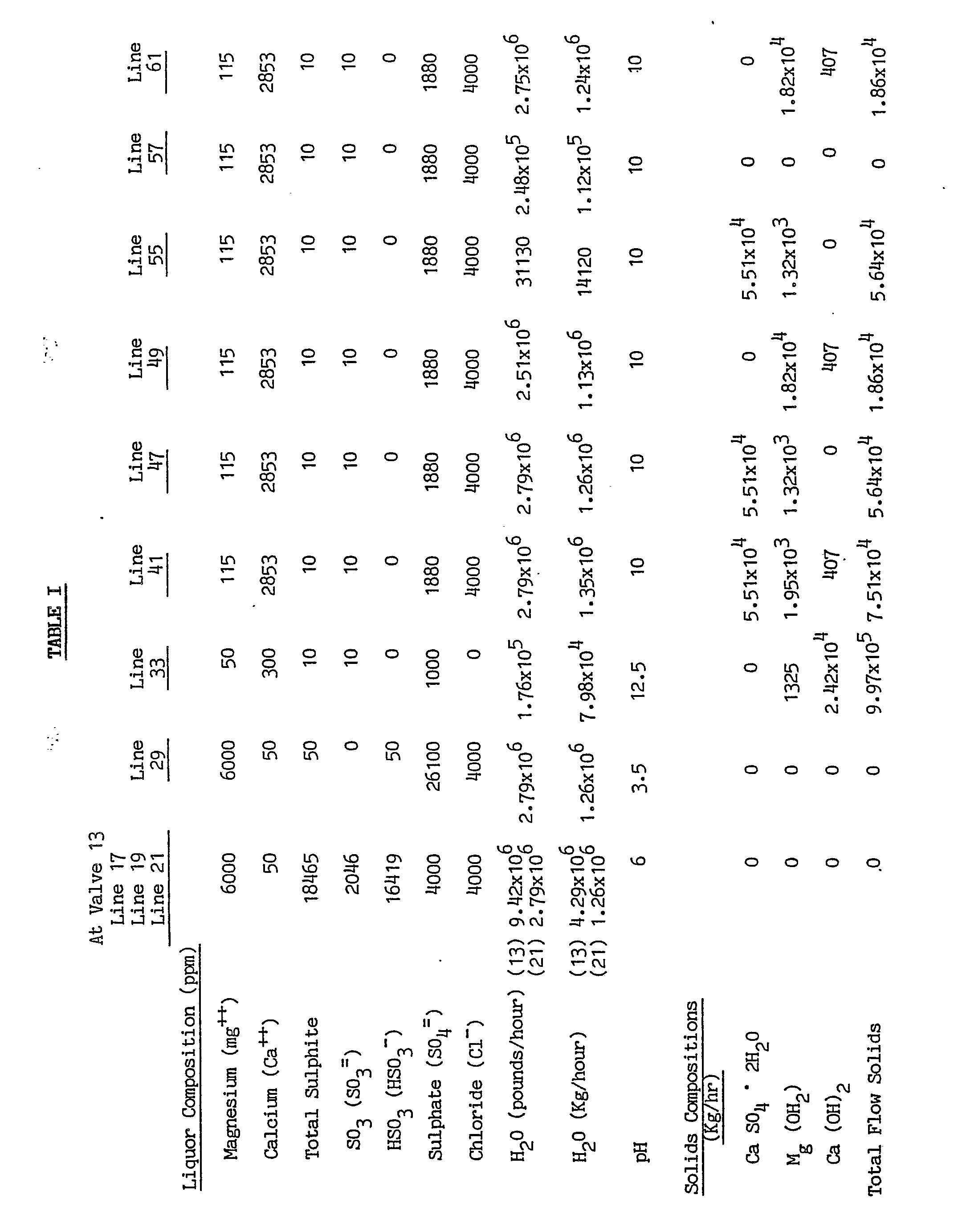
- Table I the gas entering the scrubbing unit is assumed to be at a flow rate of 2.832 x 10⁴M3 per minute (1 x 10⁶ ACFM,) and 149 o C, and containing the following:- H2O - 1.64 x 10⁵ Kg per hour (3.623 x 10⁵ lbs per hour) SO2 - 2.07 x 10⁴ Kg per hour (4.57 x 10⁴ lbs per hour) O2 1.14 x 10⁵ Kg per hour (2.515 x 10⁵ lbs per hour) N2 - 2.28 x 10⁶ Kg per hour (5.024 x 10⁶ lbs per hour) HC1 - 84 Kg per hour (1.857 x 10² lbs per hour) CO2 - 6.50 x 10⁵ Kg per hour (1.434 x 10⁶
- the SO2 content is 2965 ppm.
- the clean gas discharged from the srubbing unit contains the following:- H2O - 2.99 x 10⁵ Kg per hour (6.59 x 10⁵ lbs per hour) SO2 - 2.07 x 10² Kg per hour (4.57 x 10² lbs per hour) O2 - 1.13 x 10⁵ Kg per hour (2.50 x 10⁵ lbs per hour) N2 - 2.27 x 10⁶ Kg per hour (5.02 x 10⁶ lbs per hour) HC1 - 4.2 Kg per hour (9.3 lbs per hour) CO2 - 6.49 x 10⁵ Kg per hour (1.432 x 10⁶ lbs per hour)
- the SO2 content is 28 ppm.
- FIG. 2 Another embodiment of the present invention is schematically illustrated in Figure 2 wherein a bleed stream of spent scrubbing effluent is oxidised and a second portion used in a regeneration step.
- a scrubbing unit 101 has sulphur-containing gases charges thereto through line 103, and cleaned gases discharged at exhaust means 105.
- a plurality of scrubbing unit sprayers 107 are provided, along with a de-mister 109, in the scrubber unit 101.
- a supply of scrubbing fluid 111 collects in the lower portion of the scrubber unit 101, with a pump 113, in line 115 to offtake lines 117 to the sprayers 107, and offtake lines 119 to the demister 109.
- a valve 121 is provided in line 115 to direct a second portion of the flow therein through line 123, as hereinafter described.
- a further valve 125 is provided in line 115 which directs a bleed stream of the flow therefrom, through line 127 to an oxidiser 129.
- the bleed stream of scrubber effluent is contacted with an oxygen-containing gas, from a source not shown, through line 131, by means of nozzles or spargers 133. Spent gas is removed overhead from oxidiser 129. After the desired contact time in the oxidiser 129, the bleed stream of scrubber effluent is discharged through line 135 to a reagent addition vessel 137.
- a magnesium-containing lime slurry through line 139, the magnesium-containing lime slurry being formed in a slaker 141, by addition thereto of magnesium-containing lime through line 143 and aqueous recycle solution through line 145.
- Gritty material or unslurried magnesium-containing lime may be withdrawn from the slaker 141 through line 147.
- the aqueous mixture passes through line 149 to a regeneration tank 151.
- the second portion of the flow of scrubber effluent, from line 123, is also directed to the regeneration tank 151.
- the mixture is passed through line 153, to a solids separator such as a settling tank 155 for separation of solids therefrom.
- the clean magnesium hydroxide solution is then returned to the scrubber unit 102 through line 157.
- a portion of the clean magnesium hydroxide solution may be directed through branch line 159 to line 145 for use in slaking additional magnesium-containing lime.
- the wet solids from the settling tank 155 are fed through line 161 to a filter 163. Solids are then discharged from the system through line 165. Filtrate, aqueous magnesium bydroxide solution, from the filter 163 is returned by line 167 to line 145 for use in slaking additional magnesium-containing lime.
Landscapes
- Engineering & Computer Science (AREA)
- Chemical & Material Sciences (AREA)
- Health & Medical Sciences (AREA)
- Biomedical Technology (AREA)
- Environmental & Geological Engineering (AREA)
- Analytical Chemistry (AREA)
- General Chemical & Material Sciences (AREA)
- Oil, Petroleum & Natural Gas (AREA)
- Chemical Kinetics & Catalysis (AREA)
- Treating Waste Gases (AREA)
- Gas Separation By Absorption (AREA)
Abstract
Description
- THE PRESENT INVENTION relates to a process for the desulphurisation of a sulphur dioxide-containing gas stream.
- U.S.-A-3919393 and U.S.-A-3919394 disclose processes for the removal of sulphur dioxide from flue gas. In the described processes a lime slurry scrubbing system is utilised, with specific amounts of magnesium compounds being included in the slurry. This resulted in an improved removal of the sulphur oxides, as compared with prior lime slurry scrubbing systems.
- In a lime slurry scrubbing system for a sulphur dioxide-containing gas stream, the gas stream is contacted with an aqueous solution of magnesium oxide in a wet scrubber to move sulphur dioxide therefrom.
- As mentioned, the prior Specifications disclose processes in which a calcium oxide aqueous slurry containing a specified amount of magnesium compounds was used as the srubbing medium in a wet scrubbing unit. Whilst the processes described in the prior Specifications work well, and are utilised commercially, problems can be associated with the use of aqueous slurries in wet scrubbing units.
- In such slurries, suspended solids are present which have a tendency to accumulate not only in the holding tanks for the slurry, but also in pipelines and nozzles, and this can result in undesired plugging of the pipelines and nozzles. In addition, the prior art processes tend to produce a sludge for disposal and has relatively poor de-watering characteristics, and sufficient de-watering capacity has to be provided in the design of a system using those processes to accommodate the poor de-watering characteristics of the sludge produced.
- U.S.-A-4014978 discloses a method for removing sulphur dioxide from the flue gases in which a solution is utilised which contains an excess of calcium bicarbonate or magnesium bicarbonate. Reaction of the sulphur dioxide with the bicarbonate produces a soluble bisulphite. Oxidation of the resultant solution is effected. The oxidised solution is then contacted with an alkaline earth metal carbonate to generate a bicarbonate that is recycled to the scrubbing unit. Precipitated sulphate and other solids are separated from the regenerated bicarbonate solution.
- U.S.-A-4193971 discloses a process in which an aqueous slurry containing magnesium hydroxide and gypsum is contacted with a sulphur dioxide-containing gas to fix the sulphur dioxide as magnesium sulphite. The resultant slurry is contacted with an oxidising agent to convert the magnesium sulphite into magnesium sulphate. The aqueous slurry thus obtained is then filtered, and the magnesium sulphate is treated with calcium hydroxide, in the presence of gypsum crystals, which act as seed crystals, to obtain magnesium hydroxide and gypsum. The slurry may then be recycled to the initial step.
- The oxidation of effluent from a lime scrubbing process to convert sulphites and bisulphites for the purpose of easy separation from the aqueous medium as precipitated sulphates is a known procedure. U.S.-A-4046856, for example, discloses a method in which a slurry of a calcium compound, such as calcium hydroxide or calcium carbonate, has a soluble magnesium compound added thereto, for reaction with sulphur dioxide in a scrubbing unit, with the effluent from the scrubbing unit being oxidised to form sulphates. Sulphuric acid is also added to the oxidising medium for pH control. The discharge from the oxidiser is passed to a thickener in which gypsum is separated, and the magnesium compounds are returned to the tanks wherein a calcium slurry is formed for passage through the scrubbing unit. The slurry is composed mainly of calcium hydroxide, calcium sulphate and magnesium hydroxide in water.
- U.S.-A-4246245 discloses a method in which a gas containing sulphur dioxide is contacted with hydrated lime to remove the sulphur dioxide from the gas. In one embodiment of type S hydrated dolomitic lime is used as a source of magnesium sulphite. This results in the formation of magnesium sulphite-bisulphite. A side stream of the latter is oxidised to magnesium sulphate, and the magnesium sulphate is converted to magnesium hydroxide, which is combined with the wet scrubber effluent to provide magnesium sulphite.
- The present invention seeks to provide an improved process for the de-sulphurisation of a sulphur dioxide-containing gas.
- According to this invention there is provided a process for the de-sulphurisation of a sulphur dioxide-containing gas, which comprises contacting a sul phur dioxide-containing gas stream with an aqueous solution of magnesium hydroxide in a wet scrubber to remove sulphur dioxide therefrom, subjecting a portion of the spent scrubbing medium to oxidation, and then treating the oxidised product with a magnesium-containing lime slurry to obtain magnesium hydroxide and calcium sulphate, separating calcium sulphate from the treated product and recycling the magnesium hydroxide to the scrubber.
- Preferably the aqueous solution of magnesium hydroxide in the scrubber has a magnesium ion content of between about 5,000 and about 15,000 parts per million. The aqueous solution of magnesium hydroxide in the scrubber may have a pH of between about 4.5 to about 7.5, the preferred pH being about 6.5.
- The spent scrubbing medium may contain magnesium sulphite and magnesium bisulphite, and preferably the magnesuium sulphite and magnesium bisulphite are converted by oxidation to magnesium sulphate. Preferably, said spent scrubbing medium has, after oxidation, a pH of between about 3.5 to about 5.5.
- Preferably said magnesium-containing lime slurry, which forms the said magnesium-containing lime slurry, contains about 1.5 to about 7 percent by weight of magnesium oxide.
- Preferably said magnesium-containing lime contains about 3 percent by weight of magnesium oxide.
- Advantageously the said magnesium-containing lime is contacted with water prior to addition to said oxidised product to obtain the corresponding hydroxides.
- It will thus be appreciated that a preferred process in accordance with the present invention is a process for the de-sulphurisation of a sulphur dioxide-containing gas, which process comprises contacting a sulphur dioxide-containing gas stream with an aqueous solution of magnesium hydroxide in a wet scrubber, wherein said aqueous solution of magnesium hydroxide has a magnesium ion content of between about 5,000 to about 15,000 parts per million and a pH of about 4.5 to about 7.5, subjecting a portion of the spent scrubbing medium containing magnesium sulphite and magnesium bisulphite to oxidation to convert said magnesium sulphite and said magnesium bisulphite to magnesium sulphate, the oxidation product obtained having a pH between about 3.5 to about 5.5, contacting said oxidation product with a magnesium-containing lime slurry, said magnesium-containing lime slurry containing from about 1.5 to about 7 percent by weight of magnesium oxide, resulting in the regeneration of magnesium hydroxide and the formation of insoluble calcium sulphate, separating the calcium sulphate from the regenerated magnesium hydroxide and then recycling the regenerated magnesium hydroxide to the srubber.
- In order that the invention may be more readily understood, and so that further features thereof may be appreciated, the invention will now be described, by way of example, with reference to the accompanying drawings in which
- FIGURE 1 is a schematic illustration of one embodiment of the present invention, and
- FIGURE 2 is a schematic illustration of another embodiment of the present invention.
- The present invention proposes the use of an aqueous solution of magnesium hydroxide to remove sulphur dioxide from a flue gas stream, in a wet scrubber, with spent solution subsequently being regenerated by the addition of a magnesium-containing lime slurry, after prior oxidation of the spent solution, such that calcium sulphate is formed, which is separated from the slurry, magnesium hydroxide being regenerated in an aqueous solution which is returned to the scrubber.
- Wet scrubbing units for the removal of sulphur dioxide from flue gases are known, in which the flue gases contacted with a counter current flow of a scrubbing liquid, and such a wet scrubbing unit is utilised in the present process. The liquid charged to the wet scrubbing unit is an aqueous solution of magnesium hydroxide. The magnesium hydroxide, in the scrubbing unit, is converted to magnesium sulphite and the magnesium sulphite so formed is further converted, by contact with sulphur dioxide, under the prevailing acidic conditions, to magnesium bisulphite by the general formula
MgSO₃ + SO₂ + H₂O = Mg (HSO₃)₂ - The scrubbing solution should have a magnesium ion content of between about 5,000 to about 15,000 parts per million, with fresh or recycled magnesium hydroxide solution being added to the scrubber to replenish that which is removed for oxidation and regeneration. In the scrubbing unit, the solution of the scrubbing fluid should be at a pH of between about 4.5 to about 7.5 and preferably should have a pH of about 6.5.
- The scrubbing fluid is collected in the bottom of the scrubbing unit. A major portion thereof is recycled within the scrubbing unit for contact with further sulphite dioxide-containing gas, and a portion may go for washing of the de-misters, and the remainder of the scrubbing fluid may be withdrawn, as effluent, from the scrubbing unit, so as to remove the sulphur components of magnesium sulphite and bisulphite therefrom, and regenerate magnesium hydroxide for return to the scrubbing unit.
- The portion of scrubber effluent that is not recycled or used to wash de-misters is first contacted with an oxidising gas, such as air, for example, at a temperature of about 25o to about 60oC, with an average contact time of about one to about four hours to convert soluble magnesium sulphite and magnesium bisulphite to magnesium sulphate. Such oxidation is characterised by the following equations:-
Mg (HSO₃)₂ + ½ O₂ = MgSO₄ + 2H⁺
Mg (SO₃) + ½ O₂= MgSO₄ - The oxidation decreases the pH of the effluent from the initial pH value of the slurry, to a value within the range of about 3.5 to about 5.5. The oxidised solution, which is now a sulphate-containing solution, is then passed to a reagent addition tank for contact with an aqueous slurry containing from about 15 to about 30 weight percent, preferably about 20 to about 25 weight percent of fresh magnesium-containing lime. The magnesium-containing lime used to prepare the aqueous slurry for treatment of the oxidised scrubber effluent should contain about 1.5 to about 7 percent by weight of magnesium oxide, with the balance being calcium oxide. Preferably a magnesium-containing lime having about 3 percent by weight of magnesium oxide is used.
- When the magnesium-containing lime is added to the oxidised effluent, the calcium and magnesium species in the lime convert to hydroxide. The hydroxides will basify the oxidised effluent, which initially has a pH of between 3.5 to 5.5, and this results in the formation of insoluble calcium sulphate and magnesium hydroxide. The pH is thus increased to a value of between about 9.0 to about 11.0, and the magnesium sulphate is reactive with calcium hydroxide, which results in the precipitation of calcium sulphate and magnesium hydroxide by the general equation:-
MgSO₄ + Ca(OH)₂ = Mg(OH)₂ + CaSO₄ . 2H₂O - The amount of magnesium-containing lime required is that amount containing the quantity of calcium stoichiometrically required to react with the magnesium sulphate. The magnesium-containing lime and the oxidised effluent are contacted for a period of time, for example about 3 minutes to about 60 minutes, and at a temperature of about 25o to about 60oC, sufficient to convert the magnesium sulphate to insoluble calcium sulphate and magnesium hydroxide.
- A major portion of the magnesium hydroxide is separated from the precipitated calcium sulphate, such as by a cyclone separator, and the magnesium hydroxide is passed to a return tank for recyle to the scrubbing unit. The separated calcium sulphate may be further dewatered by a centrifuge or other separating means prior to discharge as calcium sulphate, while reclaimed magnesium hydroxide suspension therefrom is also passed to a return tank. The reclaimed magnesium hydroxide suspension is then returned to the scrubbing unit for reuse in further scrubbing of sulphur dioxide-containing gas.
- Referring now to Figure 1, an embodiment of the present invention is schematically illustrated. A scrubbing unit 1 has sulphur-containing gases charged thereto through line 3, and cleaned gases, after removal of sulphur-containing components, are discharged at exhaust means 5. A plurality of scrubbing unit sprayers 7 are provided within the scrubber 1, with a
demister 9 between the scrubbing unit sprayers 7 and the exhaust means 5. The scrubbing unit 1 collects a supply of scrubbing fluid 11 in the lower portion thereof. Apump 13, in line 15, directs a portion of the supply of scrubbing fluid 11, through line 15 to offtakelines 17 to the scrubbing unit sprayers 7, and offtake lines 19 to thedemister 9. Such a scrubbing system for sulphur dioxide-containing combustion gases is conventional and known in the art. - A portion of the scrubbing fluid from the scrubbing unit is treated so as to form and remove calcium components while recycling magnesium components back to the scrubbing unit. Scrubbing fluid is withdrawn from the scrubbing unit 1 through line 21 to an
oxidiser 23, wherein the scrubbing fluid is contacted with an oxygen-containing gas, such as air, injected from a source, not shown, throughline 25 and a plurality ofdischarge nozzles 27. Spent gas is removed overhead fromoxidiser 23. After the desired contact time in theoxidiser 23, to convert sulphites and bisulphites of magnesium to magnesium sulphate, in a soluble form, the treated scrubbing fluid is discharged throughline 29 to a reagent addition andregeneration tank 31, where the scrubbing liquor, which now comprises mainly magnesium sulphate and a minor amount of calcium sulphate is contacted with an aqueous slurry of magnesium-containing lime. A magnesium-containing lime slurry charged to theregeneration tank 31 throughline 33, is formed inslaker 35 by the addition of magnesium-containing lime thereto throughline 37, and water throughline 39. The amount of water needed is only that sufficient to convert the magnesium and calcium compounds to their corresponding hydroxides and to form the desired aqueous slurry therewith. In theregeneration tank 31, the soluble magnesium sulphate is reacted with calcium hydroxide, which results in precipitation of calcium sulphate and magnesium hydroxide. The regenerated aqueous medium is passed from theregeneration tank 31, throughline 41, by means of apump 43, to asolids separator 45, such as cyclone separator. Solids are discharged from the solids separator throughline 47, while the aqueous suspension of magnesium hydroxide is discharged throughline 49 to areturn tank 51. The solids fromline 47 may be further dewatered in adewatering unit 53, such as a filter, with dewatered solids discharged from the system atline 55, while aqueous solution, or filtrate, from thefilter 53 is returned to the clearfeed return tank 51 throughline 57. From thereturn tank 51, which contains magnesium hydroxide, scrubbing solution is returned to the scrubber 1, by means of apump 59, through line 61. - Exemplary of the contents of the process streams in carrying out the process, as illustrated in Figure 1, where gaseous emissions from a 650 Mw boiler are treated to remove sulphur dioxide, are as listed in Table I. In Table I, the gas entering the scrubbing unit is assumed to be at a flow rate of 2.832 x 10⁴M³ per minute (1 x 10⁶ ACFM,) and 149oC, and containing the following:-
H₂O - 1.64 x 10⁵ Kg per hour (3.623 x 10⁵ lbs per hour)
SO₂ - 2.07 x 10⁴ Kg per hour (4.57 x 10⁴ lbs per hour)
O₂ 1.14 x 10⁵ Kg per hour (2.515 x 10⁵ lbs per hour)
N₂ - 2.28 x 10⁶ Kg per hour (5.024 x 10⁶ lbs per hour)
HC1 - 84 Kg per hour (1.857 x 10² lbs per hour)
CO₂ - 6.50 x 10⁵ Kg per hour (1.434 x 10⁶ lbs per hour) - The SO₂ content is 2965 ppm.
- The clean gas discharged from the srubbing unit contains the following:-
H₂O - 2.99 x 10⁵ Kg per hour (6.59 x 10⁵ lbs per hour)
SO₂ - 2.07 x 10² Kg per hour (4.57 x 10² lbs per hour)
O₂ - 1.13 x 10⁵ Kg per hour (2.50 x 10⁵ lbs per hour)
N₂ - 2.27 x 10⁶ Kg per hour (5.02 x 10⁶ lbs per hour)
HC1 - 4.2 Kg per hour (9.3 lbs per hour)
CO₂ - 6.49 x 10⁵ Kg per hour (1.432 x 10⁶ lbs per hour) - The SO₂ content is 28 ppm.
- Another embodiment of the present invention is schematically illustrated in Figure 2 wherein a bleed stream of spent scrubbing effluent is oxidised and a second portion used in a regeneration step. A
scrubbing unit 101 has sulphur-containing gases charges thereto throughline 103, and cleaned gases discharged at exhaust means 105. A plurality of scrubbingunit sprayers 107 are provided, along with a de-mister 109, in thescrubber unit 101. A supply of scrubbing fluid 111 collects in the lower portion of thescrubber unit 101, with apump 113, inline 115 to offtakelines 117 to thesprayers 107, andofftake lines 119 to the demister 109. Avalve 121 is provided inline 115 to direct a second portion of the flow therein throughline 123, as hereinafter described. Afurther valve 125 is provided inline 115 which directs a bleed stream of the flow therefrom, throughline 127 to anoxidiser 129. In theoxidiser 129, the bleed stream of scrubber effluent is contacted with an oxygen-containing gas, from a source not shown, throughline 131, by means of nozzles orspargers 133. Spent gas is removed overhead fromoxidiser 129. After the desired contact time in theoxidiser 129, the bleed stream of scrubber effluent is discharged throughline 135 to a reagent addition vessel 137. To the reagent addition vessel there is also charged a magnesium-containing lime slurry throughline 139, the magnesium-containing lime slurry being formed in aslaker 141, by addition thereto of magnesium-containing lime through line 143 and aqueous recycle solution throughline 145. Gritty material or unslurried magnesium-containing lime may be withdrawn from theslaker 141 throughline 147. From the reagent addition vessel 137, the aqueous mixture passes throughline 149 to aregeneration tank 151. The second portion of the flow of scrubber effluent, fromline 123, is also directed to theregeneration tank 151. After sufficient contact in theregeneration tank 151 to convert sulphites and bisulphites in the aqueous medium to sulphates, with production of calcium sulphate solids as a slurry in an aqueous solution of magnesium bydroxide, the mixture is passed throughline 153, to a solids separator such as asettling tank 155 for separation of solids therefrom. The clean magnesium hydroxide solution is then returned to the scrubber unit 102 throughline 157. A portion of the clean magnesium hydroxide solution may be directed throughbranch line 159 toline 145 for use in slaking additional magnesium-containing lime. The wet solids from thesettling tank 155 are fed throughline 161 to afilter 163. Solids are then discharged from the system throughline 165. Filtrate, aqueous magnesium bydroxide solution, from thefilter 163 is returned byline 167 toline 145 for use in slaking additional magnesium-containing lime. - Exemplary of the contents of the process streams in carrying out this alternative embodiment of the process, as illustrated in Figure 2, where the gaseous emissions from a 65 Mw boiler are treated to remove sulphur dioxide, are listed in Table II. In Table II, the gas entering the scrubbing unit is that described relative to Table I.


Claims (10)
Applications Claiming Priority (2)
| Application Number | Priority Date | Filing Date | Title |
|---|---|---|---|
| US07/188,254 US5039499A (en) | 1988-04-29 | 1988-04-29 | Process for desulfurization of sulfur dioxide-containing gas streams |
| US188254 | 1988-04-29 |
Publications (3)
| Publication Number | Publication Date |
|---|---|
| EP0339683A2 true EP0339683A2 (en) | 1989-11-02 |
| EP0339683A3 EP0339683A3 (en) | 1990-11-22 |
| EP0339683B1 EP0339683B1 (en) | 1994-06-15 |
Family
ID=22692393
Family Applications (1)
| Application Number | Title | Priority Date | Filing Date |
|---|---|---|---|
| EP89107811A Expired - Lifetime EP0339683B1 (en) | 1988-04-29 | 1989-04-28 | Process for desulphurisation of a sulphur dioxide-containing gas stream |
Country Status (6)
| Country | Link |
|---|---|
| US (1) | US5039499A (en) |
| EP (1) | EP0339683B1 (en) |
| AT (1) | ATE107186T1 (en) |
| CA (1) | CA1309840C (en) |
| DE (1) | DE68916104T2 (en) |
| ES (1) | ES2057009T3 (en) |
Cited By (11)
| Publication number | Priority date | Publication date | Assignee | Title |
|---|---|---|---|---|
| EP0434019A3 (en) * | 1989-12-21 | 1991-10-09 | Dravo Lime Company | Process for removing sulfur dioxide from flue gases |
| EP0505607A1 (en) * | 1991-03-26 | 1992-09-30 | Dravo Lime Company | Sulfur dioxide removal process with gypsum and magnesium hydroxide production |
| EP0583197A1 (en) * | 1992-08-13 | 1994-02-16 | Aquafrance | Process for cleaning fumes from liquid fuel heaters by cooling and washing of the fumes and neutralisation of the effluents |
| EP0601271A1 (en) * | 1992-12-11 | 1994-06-15 | Dravo Lime Company | Sulfur dioxide scrubbing process producing purified magnesium hydroxide |
| DE19502632A1 (en) * | 1994-02-10 | 1995-08-17 | Ver Energiewerke Ag | Operating method for brown coal-fired power station flue gas desulphurisation |
| EP0679426A1 (en) * | 1994-04-28 | 1995-11-02 | Dravo Lime Company | Magnesium-enhanced sulfur dioxide scrubbing with gypsum formation |
| US5676915A (en) * | 1994-10-07 | 1997-10-14 | Toyo Engineering Corporation | Method for desulfurizing exhaust gas |
| US6041272A (en) * | 1997-06-24 | 2000-03-21 | Toyo Engineering Corporation | Desulfurization process for flue gases |
| WO2009052775A1 (en) | 2007-10-23 | 2009-04-30 | Babcock Noell Gmbh | Installation and method for cleaning flue gases |
| CN103785285A (en) * | 2014-02-27 | 2014-05-14 | 大连海事大学 | A high-efficiency oxidation device and method for by-products of magnesium desulfurization |
| US10040024B2 (en) | 2015-03-20 | 2018-08-07 | General Electric Technology Gmbh | System for sulphur removal from a flue gas |
Families Citing this family (27)
| Publication number | Priority date | Publication date | Assignee | Title |
|---|---|---|---|---|
| US5260045A (en) * | 1991-11-22 | 1993-11-09 | Electric Power Research Institute | Modification of magnesium-enhanced lime flue gas desulfurization process to improve solids dewatering |
| US5558848A (en) * | 1993-08-20 | 1996-09-24 | Moser; Robert E. | Clear liquid acid flue gas desulfurization system |
| US5628811A (en) * | 1994-08-23 | 1997-05-13 | Dravo Lime Company | Method of ameliorating acid soil to enhance plant growth |
| JPH09122440A (en) * | 1995-10-20 | 1997-05-13 | Dravo Lime Co | Method for scrubbing sulfur dioxide being accompanied with formation of pure product of magnesium sulfite |
| US5614158A (en) * | 1995-10-20 | 1997-03-25 | Dravo Lime Company | Process for removing sulfur dioxide from gases and producing gypsum and purified magnesium hydroxide |
| AT403015B (en) * | 1996-06-14 | 1997-10-27 | Austrian Energy & Environment | Process for desulphurization of flue gases |
| US6099816A (en) * | 1996-07-24 | 2000-08-08 | Dravo Lime, Inc. | Process for desulfurizing a sulfur-dioxide containing gas |
| US5827488A (en) * | 1996-09-06 | 1998-10-27 | Dravo Lime Company | Process for removing SO2 and NOx from a gaseous stream |
| US5719099A (en) * | 1996-10-22 | 1998-02-17 | Bhat Industries, Inc. | Method and compositions for stabilization of heavy metals, acid gas removal and ph control in contaminated matrices |
| US5846286A (en) * | 1997-03-07 | 1998-12-08 | Dravo Lime Company | Method for removing NOx from a gas stream while producing an alkaline earth nitrate fertilizer composition |
| US6033577A (en) * | 1998-05-18 | 2000-03-07 | Dravo Lime Company | Coordination of liquid-solid separators and fluid tanks |
| US6428760B1 (en) * | 1999-06-22 | 2002-08-06 | Toyo Engineering Corporation | Method for desulfurizing exhaust gas |
| EP1110595A1 (en) * | 1999-12-23 | 2001-06-27 | Dravo Lime, Inc. | Reduction of calcium and chloride in the flue gas desulfurization process |
| KR20010097371A (en) * | 2000-04-21 | 2001-11-08 | 우명우 | Manufacturing magnesium sulfate by waste sulfuric acid. |
| US6572832B2 (en) * | 2001-03-27 | 2003-06-03 | Carmeuse North America Services, Inc. | Method of removing sulfur dioxide from a gaseous stream in a wet scrubbing unit |
| KR20030004434A (en) * | 2001-03-29 | 2003-01-14 | 미츠비시 쥬고교 가부시키가이샤 | Gas hydrate production device and gas hydrate dehydrating device |
| JP5019683B2 (en) * | 2001-08-31 | 2012-09-05 | 三菱重工業株式会社 | Gas hydrate slurry dewatering apparatus and method |
| US6997119B2 (en) * | 2002-07-23 | 2006-02-14 | Radway Jerrold E | Combustion emissions control and utilization of byproducts |
| BRPI0607004A2 (en) * | 2005-02-04 | 2009-07-28 | Fuel Tech Inc | targeted duct injection for so3 control |
| WO2010115871A1 (en) * | 2009-04-08 | 2010-10-14 | Shell Internationale Research Maatschappij B.V. | Method of treating an off-gas stream and an apparatus therefor |
| CN101574619B (en) * | 2009-06-09 | 2012-07-04 | 陆泳凯 | Flue gas desulfurization process through calc-alkaline regeneration magnesium sulfite cycle absorption method |
| RU2529524C2 (en) * | 2010-02-25 | 2014-09-27 | Альфа Лаваль Корпорейт Аб | Device and method for exhaust gas cleaning and fluid for gas flushing |
| CN101920159A (en) * | 2010-09-10 | 2010-12-22 | 北京金源化学集团有限公司 | Method for removing and reclaiming sulfur dioxide from gas by low power consumption renewable absorbent |
| US8518353B1 (en) | 2012-10-09 | 2013-08-27 | Babcock Power Development LLC | Reduced sorbent utilization for circulating dry scrubbers |
| CN104959012A (en) * | 2015-04-17 | 2015-10-07 | 熊天渝 | Magnesium-calcium based wet method desulphurization system and method for removing sulfur dioxide in flue gas and producing gypsum |
| JP7196575B2 (en) * | 2018-12-03 | 2022-12-27 | 住友金属鉱山株式会社 | Method for detoxifying exhaust gas containing sulfur dioxide |
| CN110482578A (en) * | 2019-09-17 | 2019-11-22 | 大连海洋大学 | A kind of wet-type magnesium method flue gas desulfurization byproduct oxidation unit and its method for oxidation |
Family Cites Families (7)
| Publication number | Priority date | Publication date | Assignee | Title |
|---|---|---|---|---|
| US3919393A (en) * | 1973-03-08 | 1975-11-11 | Dravo Corp | Process for sulfur dioxide removal from combustion gases |
| US3919394A (en) * | 1973-05-14 | 1975-11-11 | Dravo Corp | Process for the removal of oxides of sulfur from a gaseous stream |
| US4046856A (en) * | 1974-03-15 | 1977-09-06 | Kawasaki Jukogyo Kabushiki Kaisha | Method for removing sulfur oxide from stack gas |
| CH608718A5 (en) * | 1975-01-20 | 1979-01-31 | Scubapro Eu | |
| JPS53117683A (en) * | 1977-03-23 | 1978-10-14 | Kawasaki Heavy Ind Ltd | Removing method for sulfure oxides contained in exhayst gas |
| US4246245A (en) * | 1979-01-02 | 1981-01-20 | Bechtel International Corporation | SO2 Removal |
| US4804523A (en) * | 1987-06-17 | 1989-02-14 | Bechtel Group, Incorporated | Use of seawater in flue gas desulfurization |
-
1988
- 1988-04-29 US US07/188,254 patent/US5039499A/en not_active Expired - Lifetime
-
1989
- 1989-04-27 CA CA000597928A patent/CA1309840C/en not_active Expired - Lifetime
- 1989-04-28 ES ES89107811T patent/ES2057009T3/en not_active Expired - Lifetime
- 1989-04-28 DE DE68916104T patent/DE68916104T2/en not_active Expired - Fee Related
- 1989-04-28 AT AT89107811T patent/ATE107186T1/en active
- 1989-04-28 EP EP89107811A patent/EP0339683B1/en not_active Expired - Lifetime
Cited By (16)
| Publication number | Priority date | Publication date | Assignee | Title |
|---|---|---|---|---|
| EP0434019A3 (en) * | 1989-12-21 | 1991-10-09 | Dravo Lime Company | Process for removing sulfur dioxide from flue gases |
| EP0505607A1 (en) * | 1991-03-26 | 1992-09-30 | Dravo Lime Company | Sulfur dioxide removal process with gypsum and magnesium hydroxide production |
| EP0583197A1 (en) * | 1992-08-13 | 1994-02-16 | Aquafrance | Process for cleaning fumes from liquid fuel heaters by cooling and washing of the fumes and neutralisation of the effluents |
| FR2694707A1 (en) * | 1992-08-13 | 1994-02-18 | Aquafrance | Process for decontaminating smoke from liquid fuel boilers by cooling and washing the smoke, and neutralization of effluents. |
| US5352366A (en) * | 1992-08-13 | 1994-10-04 | Aquafrance | Method for purifying liquid fuel boiler smoke by cooling and washing the smoke and neutralizing the effluents |
| EP0601271A1 (en) * | 1992-12-11 | 1994-06-15 | Dravo Lime Company | Sulfur dioxide scrubbing process producing purified magnesium hydroxide |
| DE19502632A1 (en) * | 1994-02-10 | 1995-08-17 | Ver Energiewerke Ag | Operating method for brown coal-fired power station flue gas desulphurisation |
| DE19502632C2 (en) * | 1994-02-10 | 2002-06-20 | Ver Energiewerke Ag | Method for operating a flue gas desulfurization system for a lignite-dust-fired power plant |
| US5645807A (en) * | 1994-04-28 | 1997-07-08 | Dravo Lime Company | Magnesium-enhanced sulfur dioxide scrubbing with gypsum formation |
| EP0679426A1 (en) * | 1994-04-28 | 1995-11-02 | Dravo Lime Company | Magnesium-enhanced sulfur dioxide scrubbing with gypsum formation |
| US5676915A (en) * | 1994-10-07 | 1997-10-14 | Toyo Engineering Corporation | Method for desulfurizing exhaust gas |
| US6041272A (en) * | 1997-06-24 | 2000-03-21 | Toyo Engineering Corporation | Desulfurization process for flue gases |
| WO2009052775A1 (en) | 2007-10-23 | 2009-04-30 | Babcock Noell Gmbh | Installation and method for cleaning flue gases |
| US8337790B2 (en) | 2007-10-23 | 2012-12-25 | Babcock Noell Gmbh | System and method for purification of flue gases |
| CN103785285A (en) * | 2014-02-27 | 2014-05-14 | 大连海事大学 | A high-efficiency oxidation device and method for by-products of magnesium desulfurization |
| US10040024B2 (en) | 2015-03-20 | 2018-08-07 | General Electric Technology Gmbh | System for sulphur removal from a flue gas |
Also Published As
| Publication number | Publication date |
|---|---|
| US5039499A (en) | 1991-08-13 |
| EP0339683B1 (en) | 1994-06-15 |
| EP0339683A3 (en) | 1990-11-22 |
| ES2057009T3 (en) | 1994-10-16 |
| CA1309840C (en) | 1992-11-10 |
| DE68916104T2 (en) | 1994-09-22 |
| ATE107186T1 (en) | 1994-07-15 |
| DE68916104D1 (en) | 1994-07-21 |
Similar Documents
| Publication | Publication Date | Title |
|---|---|---|
| EP0339683B1 (en) | Process for desulphurisation of a sulphur dioxide-containing gas stream | |
| US3873532A (en) | Sulfur dioxide scrubbing process | |
| US3914378A (en) | Process for wet scrubbing of sulfur dioxide from flue gas | |
| EP0434019B1 (en) | Process for removing sulfur dioxide from flue gases | |
| US4147756A (en) | Combustion gas scrubbing system | |
| CA2050974C (en) | Sulfur dioxide removal process with gypsum and magnesium hydroxide production | |
| US4452766A (en) | Double alkali process for removal of sulfur dioxide from gas streams | |
| US4000991A (en) | Method of removing fly ash particulates from flue gases in a closed-loop wet scrubbing system | |
| US3944649A (en) | Multistage process for removing sulfur dioxide from stack gases | |
| US5200160A (en) | Process for removing sulfur dioxide and nitrogen oxides from flue gases | |
| US5645807A (en) | Magnesium-enhanced sulfur dioxide scrubbing with gypsum formation | |
| US5266285A (en) | Sodium-enhanced lime scrubbing method for removing sulfur dioxide from gaseous streams | |
| US5270026A (en) | Sulfur dioxide scrubbing process producing purified magnesium hydroxide | |
| US3989464A (en) | Sulfur dioxide scrubbing system | |
| US4021202A (en) | Apparatus for removing sulfur dioxide from stack gases | |
| JPH0141376B2 (en) | ||
| US5614158A (en) | Process for removing sulfur dioxide from gases and producing gypsum and purified magnesium hydroxide | |
| KR100304323B1 (en) | Gas cleaning method and apparatus containing sulfur dioxide | |
| US4313924A (en) | Process for removal of sulfur dioxide from gas streams | |
| US4255402A (en) | Sulphur dioxide gas scrubbing process | |
| US5695727A (en) | Process for removing sulfur dioxide and nitrogen oxides from a hot gaseous stream with ferrous chelate regeneration | |
| EP0775515A1 (en) | Sulphur dioxide scrubbing | |
| JP3902861B2 (en) | Exhaust gas desulfurization method | |
| EP1110595A1 (en) | Reduction of calcium and chloride in the flue gas desulfurization process | |
| RU2054307C1 (en) | Method of furnace gas scrubbing in sodium sulfide production from hydrogen sulfide and sulfur dioxide |
Legal Events
| Date | Code | Title | Description |
|---|---|---|---|
| PUAI | Public reference made under article 153(3) epc to a published international application that has entered the european phase |
Free format text: ORIGINAL CODE: 0009012 |
|
| AK | Designated contracting states |
Kind code of ref document: A2 Designated state(s): AT BE DE ES FR GB IT NL SE |
|
| PUAL | Search report despatched |
Free format text: ORIGINAL CODE: 0009013 |
|
| AK | Designated contracting states |
Kind code of ref document: A3 Designated state(s): AT BE DE ES FR GB IT NL SE |
|
| 17P | Request for examination filed |
Effective date: 19910204 |
|
| 17Q | First examination report despatched |
Effective date: 19920117 |
|
| GRAA | (expected) grant |
Free format text: ORIGINAL CODE: 0009210 |
|
| AK | Designated contracting states |
Kind code of ref document: B1 Designated state(s): AT BE DE ES FR GB IT NL SE |
|
| REF | Corresponds to: |
Ref document number: 107186 Country of ref document: AT Date of ref document: 19940715 Kind code of ref document: T |
|
| ITF | It: translation for a ep patent filed | ||
| REF | Corresponds to: |
Ref document number: 68916104 Country of ref document: DE Date of ref document: 19940721 |
|
| ET | Fr: translation filed | ||
| REG | Reference to a national code |
Ref country code: ES Ref legal event code: FG2A Ref document number: 2057009 Country of ref document: ES Kind code of ref document: T3 |
|
| EAL | Se: european patent in force in sweden |
Ref document number: 89107811.5 |
|
| PLBE | No opposition filed within time limit |
Free format text: ORIGINAL CODE: 0009261 |
|
| STAA | Information on the status of an ep patent application or granted ep patent |
Free format text: STATUS: NO OPPOSITION FILED WITHIN TIME LIMIT |
|
| 26N | No opposition filed | ||
| PGFP | Annual fee paid to national office [announced via postgrant information from national office to epo] |
Ref country code: SE Payment date: 19990414 Year of fee payment: 11 |
|
| PGFP | Annual fee paid to national office [announced via postgrant information from national office to epo] |
Ref country code: FR Payment date: 19990426 Year of fee payment: 11 |
|
| PGFP | Annual fee paid to national office [announced via postgrant information from national office to epo] |
Ref country code: AT Payment date: 19990427 Year of fee payment: 11 |
|
| PGFP | Annual fee paid to national office [announced via postgrant information from national office to epo] |
Ref country code: NL Payment date: 19990429 Year of fee payment: 11 |
|
| PGFP | Annual fee paid to national office [announced via postgrant information from national office to epo] |
Ref country code: ES Payment date: 19990430 Year of fee payment: 11 |
|
| PGFP | Annual fee paid to national office [announced via postgrant information from national office to epo] |
Ref country code: BE Payment date: 19990614 Year of fee payment: 11 |
|
| PG25 | Lapsed in a contracting state [announced via postgrant information from national office to epo] |
Ref country code: AT Free format text: LAPSE BECAUSE OF NON-PAYMENT OF DUE FEES Effective date: 20000428 |
|
| PG25 | Lapsed in a contracting state [announced via postgrant information from national office to epo] |
Ref country code: SE Free format text: LAPSE BECAUSE OF NON-PAYMENT OF DUE FEES Effective date: 20000429 Ref country code: ES Free format text: THE PATENT HAS BEEN ANNULLED BY A DECISION OF A NATIONAL AUTHORITY Effective date: 20000429 |
|
| PG25 | Lapsed in a contracting state [announced via postgrant information from national office to epo] |
Ref country code: BE Free format text: LAPSE BECAUSE OF NON-PAYMENT OF DUE FEES Effective date: 20000430 |
|
| BERE | Be: lapsed |
Owner name: DRAVO LIME CY Effective date: 20000430 |
|
| PG25 | Lapsed in a contracting state [announced via postgrant information from national office to epo] |
Ref country code: NL Free format text: LAPSE BECAUSE OF NON-PAYMENT OF DUE FEES Effective date: 20001101 |
|
| EUG | Se: european patent has lapsed |
Ref document number: 89107811.5 |
|
| PG25 | Lapsed in a contracting state [announced via postgrant information from national office to epo] |
Ref country code: FR Free format text: LAPSE BECAUSE OF NON-PAYMENT OF DUE FEES Effective date: 20001229 |
|
| NLV4 | Nl: lapsed or anulled due to non-payment of the annual fee |
Effective date: 20001101 |
|
| REG | Reference to a national code |
Ref country code: FR Ref legal event code: ST |
|
| REG | Reference to a national code |
Ref country code: GB Ref legal event code: IF02 |
|
| REG | Reference to a national code |
Ref country code: ES Ref legal event code: FD2A Effective date: 20020204 |
|
| PGFP | Annual fee paid to national office [announced via postgrant information from national office to epo] |
Ref country code: GB Payment date: 20020424 Year of fee payment: 14 |
|
| PGFP | Annual fee paid to national office [announced via postgrant information from national office to epo] |
Ref country code: DE Payment date: 20020502 Year of fee payment: 14 |
|
| PG25 | Lapsed in a contracting state [announced via postgrant information from national office to epo] |
Ref country code: GB Free format text: LAPSE BECAUSE OF NON-PAYMENT OF DUE FEES Effective date: 20030428 |
|
| PG25 | Lapsed in a contracting state [announced via postgrant information from national office to epo] |
Ref country code: DE Free format text: LAPSE BECAUSE OF NON-PAYMENT OF DUE FEES Effective date: 20031101 |
|
| GBPC | Gb: european patent ceased through non-payment of renewal fee | ||
| PG25 | Lapsed in a contracting state [announced via postgrant information from national office to epo] |
Ref country code: IT Free format text: LAPSE BECAUSE OF NON-PAYMENT OF DUE FEES;WARNING: LAPSES OF ITALIAN PATENTS WITH EFFECTIVE DATE BEFORE 2007 MAY HAVE OCCURRED AT ANY TIME BEFORE 2007. THE CORRECT EFFECTIVE DATE MAY BE DIFFERENT FROM THE ONE RECORDED. Effective date: 20050428 |