EP0335489A2 - Einrichtung und Verfahren zur konkurrierenden Sortierung - Google Patents
Einrichtung und Verfahren zur konkurrierenden Sortierung Download PDFInfo
- Publication number
- EP0335489A2 EP0335489A2 EP89301417A EP89301417A EP0335489A2 EP 0335489 A2 EP0335489 A2 EP 0335489A2 EP 89301417 A EP89301417 A EP 89301417A EP 89301417 A EP89301417 A EP 89301417A EP 0335489 A2 EP0335489 A2 EP 0335489A2
- Authority
- EP
- European Patent Office
- Prior art keywords
- stack
- stage
- storage
- elements
- data
- Prior art date
- Legal status (The legal status is an assumption and is not a legal conclusion. Google has not performed a legal analysis and makes no representation as to the accuracy of the status listed.)
- Granted
Links
Images


Classifications
-
- G—PHYSICS
- G06—COMPUTING OR CALCULATING; COUNTING
- G06F—ELECTRIC DIGITAL DATA PROCESSING
- G06F7/00—Methods or arrangements for processing data by operating upon the order or content of the data handled
- G06F7/22—Arrangements for sorting or merging computer data on continuous record carriers, e.g. tape, drum, disc
- G06F7/24—Sorting, i.e. extracting data from one or more carriers, rearranging the data in numerical or other ordered sequence, and rerecording the sorted data on the original carrier or on a different carrier or set of carriers sorting methods in general
Definitions
- This invention relates to concurrent sorting apparatus and methods handling serial data inputs.
- Data sorting is a process where starting with "N" random elements, an order is created such that E1 ⁇ E2 ⁇ E3 ⁇ ... E N known as ascending order, or, also E N £ E N-1 £ E N-2 £... E1 known as descending order.
- the elements can be ordered numerically or logically.
- the sorting apparatus or engine has pipelining, concurrency, use the host's memory, and has a comparator count that does not limit the sorting capacity.
- Pipelining is the ability to accept and supply data continuously - one unit of data per fastest machine cycle.
- Concurrency (sometimes also referred to as parallelism or chaining) is the processing of two or more arithmetic/logical operations at a time.
- a plurality of dedicated memory modules is used. This, in turn, is costly in terms of product cost, package bulk, power consumption and, above all, limits the sort capacity to that of the dedicated memory. It is therefore highly desirable that the sorting apparatus use the host's memory. Many sorting apparatus or engines call for a plurality of comparators.
- a concurrent sorting method for sorting a string of data elements which have or can be taken to have numerical significance, into numerical order in data processing apparatus comprising defining a plurality of stacks in stack order, inputting the data elements in random order, one at a time, and comparing each input element with the tails of the stacks in stack order and adding the element to the first stack encountered to which it can be added preserving the numerical order within the stack, simultaneously comparing the heads of the stacks to advance towards the output any stack head data element that precedes in numerical order the stack head that follows in stack order, and recycling the output once the input is complete.
- This invention equally provides both special purpose and adapted general purpose data processing apparatus for performing such a method.
- sorting converges toward completion in proportion to N*Log(N)/Log(S) where 'S' is the number of stages and having a minimum of two stages. Also, when source data is sorted and contains some random elements as is the case when updating an existing sorted file, the concurrent sorting engine converges toward completion in proportion to N. All logarithms are base 2.
- the first comparator of the first stage is responsive to the incoming random data elements for comparing the incoming data element with the last stored data element of that stage and for if the incoming data is respectively greater than or less than the last stored data element value, storing that number in the storage means and if the incoming data element value is respectively less than or greater than the last stored data value passing that data element to be compared with the stored element in the next succeeding stage.
- the apparatus further includes means for comparing the stored data elements from the storage means of the comparator stages and for if the stored data elements is respectively less than or greater than the stored number in the compared storage means passing the lesser or higher data element to be compared with the stored element in the next succeeding stage.
- the method pursued by either embodiment comprises sorting a string of data elements which have or can be taken to have numerical significance, into numerical order in data processing apparatus by defining a plurality of stacks in stack order, inputting the data elements in random order, one at a time, and comparing each input element with the tails of the stacks in stack order and adding the element to the first stack encountered to which it can be added preserving the numerical order within the stack, simultaneously comparing the heads of the stacks to advance towards the output any stack head data element that precedes in numerical order the stack head that follows in stack order, and recycling the output once the input is complete.
- a capacity is defined for each stack and a FIFO buffer is defined between the stack output and input, and, when the addition of a new data element to the tail of a full stack causes an output overflow from that stack, pushing and or replacing the stack heads of all stacks that are lower in stack order and include data elements, progressively and adding the ultimately displaced head into either the first encountered empty stack or into the FIFO buffer.
- the tails of each stack are reset to an initial default value which precedes or is equal to any potential value in the numerical order and the new data element is added to the first stack in the stack order.
- each stage comprises a comparator, a last element storage for storing and presenting to the comparator the last element stored in the stage, and a FIFO (first in, first out) stack or shift register.
- Each stage will produce one sorted string with the last input to the FIFO stack being at the bottom and the oldest lowest valued input closest to the output at the top.
- All of the S stages except the first stage include a comparator for comparing and merging the output from the FIFO stacks or registers for presenting and comparing the lowest valued element of the string at each stage with the corresponding lowest valued element from the previous higher level stage.
- the comparator passes to the lower level stages those elements which are of a lower number.
- binary signals are used to represent elements to be sorted and the comparing and passing activities are synchronised such that all stages undergo operations concurrently. If an output buffering function is not available in the source storage, a further FIFO buffer at the output of the last stage is required and the practical limit to the source string is the total capacity of the system.
- the number of FIFO stack store locations or shift registers can be any set number such as, for example, six, and this would be represented by six storage locations or FIFO stacks or shift registers.
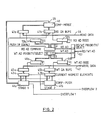
- the comparator 15d compares the output from comparator 13d which represents the lowest element from stacks 13b and 11b and the output from stack 15b. This comparison and merge continues concurrently through stages 11, 13, 15 through S at comparators 13d, 15d through 20 and 30 respectively. If the element from the left stage is lower than the element from the neighbour (right) stage, then that element is merged and passed on to the next lower stage until finally the lowest value is passed out of the lowest stage at comparator 30 after comparing the output from the FIFO stack or register 31 of stage S with the output from comparator 20 of stage S-1.
- An overflow condition occurs when there is an element present in the compare-push stream to the comparator 34 of the lowest stage S and this element was not extracted by any stage and is lower than the current highest at storage 34c and is "out of order.”
- all of the elements and all the current highest elements are pushed up the stack and all the current highest are set to zero to allow the input elements to become the current highest elements at storage 34c through 11c, and a flag is set to indicate incomplete condition.
- all elements are passed through the engine and incomplete flag is set, then all elements are fed back into the highest stage at comparator 11a for another sorting pass through.
- the elements are sorted in ascending order with the lowest valued element at the output and the highest valued element at the input.
- the output could also be read out in reverse order.
- the operation of the stages could be reversed to provide the highest valued element at the output and in descending order such that if the incoming element was less than the last stored element in the stage, such as at comparator 11a, that element would become the last stored element in the stage (at 11c) and if the element was of a higher value it would be passed to the next stage 13 and the greater valued element at comparator 13d, etc. would be passed toward the output from comparator 30.
- stages are empty. Thus, a stage will accept at least one element that will become the current highest element. The second or subsequent element that a stage can accept will be greater than or equal the current highest element. For random data, therefore, every time a stage accepts an element the opportunity to accept another element is, on the average, halved.
- each stage extracts 'e' elements and sorting engine produces strings with an average sorted string length of 'eS' elements.
- each stage extracts at least eS elements, and sorting engine sorts at least eS**2 (eS**P) elements per string.
- dedicated storage for a given sorting apparatus facilitates independent sorting activity after the sorting apparatus is loaded with data.
- dedicated storage capability namely sorting capacity
- the sorting apparatus would no longer be independent yet can benefit in several ways.
- the sorting apparatus capacity namely the maximum number of elements that can be sorted, increases in proportion with the RAS size.
- the sorting can take advantage of system features such as virtual storage and cache.
- the sorting apparatus need not be loaded, under program control, with data prior to the commencement of the sorting operations.
- the addresses within the sorting apparatus are initialised to the value that access, directly, the block of data to be sorted. Referring to Figure 2, there is illustrated a sorting apparatus according to one preferred embodiment of the present invention.
- RAS Random Access Storage
- host storage 40 that has a storage capacity equal to 2N where N is the maximum number of elements that can be sorted.
- Each of the S stages includes comparators 41 and 49, a current or a last highest element storage 43, write data buffer 45, and read data buffer 47.
- the incoming random elements come from RAS into read data buffers 47, compared at comparators 49 and the lowest is passed via 55.
- the element is compared to the current highest element in storage 43 and if the input element exceeds that in the current highest storage 43, the new data becomes the current highest element and pushes the previous current highest element to the write data buffer 45 for being written into the host storage 40 via bus 42.
- the write address registers 46 will send a separate and different address for each stage and each element put on the bus 42 for storing the write data from write data buffer 45 at the host storage 40.
- the read address registers 53 generate the appropriate addresses for the stages 1 through S to retrieve the elements and sequentially put the stored elements on the corresponding comparator storage 47 for each of the respective stages 1 through S via bus 44.
- the element values at the comparator storage locations 47 are then compared at output comparators 49 in the same manner as done previously such that if the output from either stage is for the example of lower value than the previous stage, it is pushed forward to the output at 55.
- one of the read data buffers 47 becomes empty and this one will be refilled via 44 using an address from 53 that is separate and different for each stage. In this manner the system operates as in the previous case but is using the host storage.
- a more detailed embodiment of the two-stage system is described below in connection with Figure 3.
- Single-ported storage accepts only one address at a time.
- the selector 46b multiplexer forwards one address to host storage with write address having higher priority.
- Double-ported storage can service two address ports simultaneously. In this case, the selector 46b is not required. Read and write requests will occur simultaneously and an additional sorting speed-up is accomplished.
- the Random Access Storage management will be described in connection with Figure 4. Four addresses will be loaded to the address register represented in Figure 4.
- the total Random Access Storage (RAS) allocation will be 2N (N is the number of elements to be stored).
- the elements in RAS are initially stored in consecutive locations.
- the read address register 53a will point to the first element at location A and read address register 53b will point to element N at location A + N - 1.
- the write address register 46a will point to a working storage location B and the write address register 46b to location B + N - 1.
- the write address register 46a can be incremented by one and the write address register 46b can be decremented by one.
- the prioritising is done at priority select 63 such as the selecting for priority stage 101 over stage 102.
- the write data is sent over bus 42 with the write address via the output address lead 57.
- the read data enters along bus 44 to the read data buffers 47a and 47b corresponding to stages 101 and 102 respectively.
- the read addresses are generated by the read address registers 53a and 53b with read address generator 53a starting at address A for example and read address 53b starts at address A + N - 1.
- the read address register 53a is incremented by one address location after each read request and the read address register 53b is decremented by one address location after each read request starting at the A + N - 1 address.
- These read addresses are compared at comparator 65 and, if equal, all elements are read from storage.
- Incoming data at the read address buffers 47a and 47b are compared at comparator 49 and the lower of the two comparisons is gated out to output 55 and back to the inputs of the first stage 41a.
- the read address register 53a and 53b will be initialised for locations B and B+N -1, respectively.
- the write address registers 46a and 46b will be initialised for locations A and A+N -1, respectively.
- Overflow 101 will be reset.
- the address registers will be initialised as for the first sorting pass. The address swapping will continue until there is no overflow from stage 101. At this point the sorting process is completed. Note that, in general, the sorted elements can occupy either locations A through A+ N-1 or B through B+ N-1.
- an overflow 2 flag is set and the current highest elements will be loaded into the write data buffers and the elements in compare-push circuits reference 41a and 41b will be loaded in (and become) the current highest elements.
- Figure 5 illustrates the Random Access Storage management for an S-stage sorting apparatus.
- the read and write address registers are initialised as shown in Figure 5.
- the block of RAS that each read and write address register will span is calculated as N divide by S, truncated.
- the last block will be increased to accommodate all N elements to be sorted. For example, let N equal 103 and S equal 9.
- No read or write address pointer can advance pass the initial value of the next pointer. Namely, read 1 pass initial read 2 or write 2 pass initial write 3. Two times S comparators (S for read and S for write) will be required. Once the limit for a write stage is reached, the writing to RAS will cease for this particular stage during the sorting pass. A stage thus inhibited will pass all elements through to the next stage. Note that a provision must be made to also store the current highest element. Thus, a stage will be considered full when, say, write address N is equal to the initial write address N + 1 less one.
- compare-merge process pauses when an element is not present as it is not known which element should be merged.
- an indication will be given allowing the compare-merge circuit to continue merging elements from other RAS blocks, namely stages, until all elements are read.
Landscapes
- Engineering & Computer Science (AREA)
- General Engineering & Computer Science (AREA)
- Theoretical Computer Science (AREA)
- Computer Hardware Design (AREA)
- Physics & Mathematics (AREA)
- General Physics & Mathematics (AREA)
- Information Retrieval, Db Structures And Fs Structures Therefor (AREA)
- Complex Calculations (AREA)
- Memory System Of A Hierarchy Structure (AREA)
Applications Claiming Priority (2)
| Application Number | Priority Date | Filing Date | Title |
|---|---|---|---|
| US175077 | 1980-08-04 | ||
| US17507788A | 1988-03-30 | 1988-03-30 |
Publications (3)
| Publication Number | Publication Date |
|---|---|
| EP0335489A2 true EP0335489A2 (de) | 1989-10-04 |
| EP0335489A3 EP0335489A3 (en) | 1990-12-19 |
| EP0335489B1 EP0335489B1 (de) | 1994-11-30 |
Family
ID=22638778
Family Applications (1)
| Application Number | Title | Priority Date | Filing Date |
|---|---|---|---|
| EP19890301417 Expired - Lifetime EP0335489B1 (de) | 1988-03-30 | 1989-02-15 | Einrichtung und Verfahren zur konkurrierenden Sortierung |
Country Status (3)
| Country | Link |
|---|---|
| EP (1) | EP0335489B1 (de) |
| JP (1) | JPH0792742B2 (de) |
| DE (1) | DE68919499T2 (de) |
Family Cites Families (4)
| Publication number | Priority date | Publication date | Assignee | Title |
|---|---|---|---|---|
| US3713107A (en) * | 1972-04-03 | 1973-01-23 | Ncr | Firmware sort processor system |
| US4031520A (en) * | 1975-12-22 | 1977-06-21 | The Singer Company | Multistage sorter having pushdown stacks with concurrent access to interstage buffer memories for arranging an input list into numerical order |
| US4595995A (en) * | 1983-02-17 | 1986-06-17 | At&T Bell Laboratories | Sort circuit and method using multiple parallel sorts of the sorted items |
| US4567572A (en) * | 1983-02-22 | 1986-01-28 | The United States Of America As Represented By The Director Of The National Security Agency | Fast parallel sorting processor |
-
1989
- 1989-01-20 JP JP1009889A patent/JPH0792742B2/ja not_active Expired - Lifetime
- 1989-02-15 DE DE1989619499 patent/DE68919499T2/de not_active Expired - Fee Related
- 1989-02-15 EP EP19890301417 patent/EP0335489B1/de not_active Expired - Lifetime
Also Published As
| Publication number | Publication date |
|---|---|
| EP0335489A3 (en) | 1990-12-19 |
| JPH0212328A (ja) | 1990-01-17 |
| DE68919499T2 (de) | 1995-05-24 |
| JPH0792742B2 (ja) | 1995-10-09 |
| EP0335489B1 (de) | 1994-11-30 |
| DE68919499D1 (de) | 1995-01-12 |
Similar Documents
| Publication | Publication Date | Title |
|---|---|---|
| US4991134A (en) | Concurrent sorting apparatus and method using FIFO stacks | |
| US4320455A (en) | Queue structure for a data processing system | |
| US4210961A (en) | Sorting system | |
| US5371864A (en) | Apparatus for concurrent multiple instruction decode in variable length instruction set computer | |
| US5487164A (en) | Distribution-based replacement selection sorting system | |
| CA1085056A (en) | Multipass sorter for arranging an input list into numerical order | |
| US4575798A (en) | External sorting using key value distribution and range formation | |
| EP0516266A2 (de) | Mischungsgeordnete Listen | |
| US5408626A (en) | One clock address pipelining in segmentation unit | |
| US5349684A (en) | Sort and merge system using tags associated with the current records being sorted to lookahead and determine the next record to be sorted | |
| GB1563620A (en) | Multistage sorter with concurrent access to interstage buffer memories | |
| EP0214313B1 (de) | Verfahren und Einrichtung zum Mischen/Sortieren von Daten | |
| US5319651A (en) | Data integrity features for a sort accelerator | |
| EP0221358A2 (de) | Sortierverfahren in einem hierarchisch geordneten Speichersystem | |
| EP0961966B1 (de) | N-weg verarbeitung von bitketten in einer datenflussarchitektur | |
| CA2017900A1 (en) | Sort accelerator using rebound sorter as merger | |
| US5185886A (en) | Multiple record group rebound sorter | |
| EP0568374B1 (de) | Parallelisierter Grössevergleicher zum Vergleichen einer Binärzahl mit einer bestimmten Zahl | |
| EP0149900A2 (de) | Datenspeichergerät | |
| US5727200A (en) | Parallel merge sorting apparatus with an accelerated section | |
| EP0335489B1 (de) | Einrichtung und Verfahren zur konkurrierenden Sortierung | |
| US5206947A (en) | Stable sorting for a sort accelerator | |
| EP0244958A2 (de) | Sortierverfahren und -gerät mit Multispaltenmischer | |
| EP0468402B1 (de) | System und Verfahren zum Abruf von Zeichenreihen | |
| US5161217A (en) | Buffered address stack register with parallel input registers and overflow protection |
Legal Events
| Date | Code | Title | Description |
|---|---|---|---|
| PUAI | Public reference made under article 153(3) epc to a published international application that has entered the european phase |
Free format text: ORIGINAL CODE: 0009012 |
|
| AK | Designated contracting states |
Kind code of ref document: A2 Designated state(s): DE FR GB |
|
| 17P | Request for examination filed |
Effective date: 19900120 |
|
| PUAL | Search report despatched |
Free format text: ORIGINAL CODE: 0009013 |
|
| AK | Designated contracting states |
Kind code of ref document: A3 Designated state(s): DE FR GB |
|
| 17Q | First examination report despatched |
Effective date: 19930729 |
|
| GRAA | (expected) grant |
Free format text: ORIGINAL CODE: 0009210 |
|
| AK | Designated contracting states |
Kind code of ref document: B1 Designated state(s): DE FR GB |
|
| REF | Corresponds to: |
Ref document number: 68919499 Country of ref document: DE Date of ref document: 19950112 |
|
| PGFP | Annual fee paid to national office [announced via postgrant information from national office to epo] |
Ref country code: GB Payment date: 19950125 Year of fee payment: 7 |
|
| PGFP | Annual fee paid to national office [announced via postgrant information from national office to epo] |
Ref country code: FR Payment date: 19950128 Year of fee payment: 7 |
|
| ET | Fr: translation filed | ||
| PGFP | Annual fee paid to national office [announced via postgrant information from national office to epo] |
Ref country code: DE Payment date: 19950223 Year of fee payment: 7 |
|
| PLBE | No opposition filed within time limit |
Free format text: ORIGINAL CODE: 0009261 |
|
| STAA | Information on the status of an ep patent application or granted ep patent |
Free format text: STATUS: NO OPPOSITION FILED WITHIN TIME LIMIT |
|
| 26N | No opposition filed | ||
| PG25 | Lapsed in a contracting state [announced via postgrant information from national office to epo] |
Ref country code: GB Effective date: 19960215 |
|
| GBPC | Gb: european patent ceased through non-payment of renewal fee |
Effective date: 19960215 |
|
| PG25 | Lapsed in a contracting state [announced via postgrant information from national office to epo] |
Ref country code: FR Effective date: 19961031 |
|
| PG25 | Lapsed in a contracting state [announced via postgrant information from national office to epo] |
Ref country code: DE Effective date: 19961101 |
|
| REG | Reference to a national code |
Ref country code: FR Ref legal event code: ST |