EP0332270B1 - Fabric conditioning composition - Google Patents
Fabric conditioning composition Download PDFInfo
- Publication number
- EP0332270B1 EP0332270B1 EP89200545A EP89200545A EP0332270B1 EP 0332270 B1 EP0332270 B1 EP 0332270B1 EP 89200545 A EP89200545 A EP 89200545A EP 89200545 A EP89200545 A EP 89200545A EP 0332270 B1 EP0332270 B1 EP 0332270B1
- Authority
- EP
- European Patent Office
- Prior art keywords
- fabric conditioning
- fabric
- weight
- amine
- amphoteric
- Prior art date
- Legal status (The legal status is an assumption and is not a legal conclusion. Google has not performed a legal analysis and makes no representation as to the accuracy of the status listed.)
- Expired - Lifetime
Links
- 239000004744 fabric Substances 0.000 title claims description 107
- 239000000203 mixture Substances 0.000 title claims description 92
- 230000003750 conditioning effect Effects 0.000 title claims description 55
- 239000000463 material Substances 0.000 claims description 72
- 150000001412 amines Chemical class 0.000 claims description 58
- 125000001183 hydrocarbyl group Chemical group 0.000 claims description 34
- 125000004432 carbon atom Chemical group C* 0.000 claims description 29
- 239000000758 substrate Substances 0.000 claims description 27
- 239000004902 Softening Agent Substances 0.000 claims description 24
- 125000002091 cationic group Chemical group 0.000 claims description 21
- XLYOFNOQVPJJNP-UHFFFAOYSA-N water Substances O XLYOFNOQVPJJNP-UHFFFAOYSA-N 0.000 claims description 20
- 238000000034 method Methods 0.000 claims description 17
- 239000002979 fabric softener Substances 0.000 claims description 13
- 239000011149 active material Substances 0.000 claims description 11
- 239000007787 solid Substances 0.000 claims description 11
- 239000007788 liquid Substances 0.000 claims description 10
- 150000003856 quaternary ammonium compounds Chemical class 0.000 claims description 9
- 239000003795 chemical substances by application Substances 0.000 description 18
- NBIIXXVUZAFLBC-UHFFFAOYSA-N Phosphoric acid Chemical compound OP(O)(O)=O NBIIXXVUZAFLBC-UHFFFAOYSA-N 0.000 description 15
- 239000003760 tallow Substances 0.000 description 14
- 125000000129 anionic group Chemical group 0.000 description 13
- 125000000217 alkyl group Chemical group 0.000 description 9
- IQDGSYLLQPDQDV-UHFFFAOYSA-N dimethylazanium;chloride Chemical compound Cl.CNC IQDGSYLLQPDQDV-UHFFFAOYSA-N 0.000 description 9
- 235000011007 phosphoric acid Nutrition 0.000 description 9
- QLAJNZSPVITUCQ-UHFFFAOYSA-N 1,3,2-dioxathietane 2,2-dioxide Chemical compound O=S1(=O)OCO1 QLAJNZSPVITUCQ-UHFFFAOYSA-N 0.000 description 8
- -1 phosphate ester Chemical class 0.000 description 7
- 239000000047 product Substances 0.000 description 7
- BAVYZALUXZFZLV-UHFFFAOYSA-N Methylamine Chemical compound NC BAVYZALUXZFZLV-UHFFFAOYSA-N 0.000 description 6
- 238000001035 drying Methods 0.000 description 6
- MTNDZQHUAFNZQY-UHFFFAOYSA-N imidazoline Chemical class C1CN=CN1 MTNDZQHUAFNZQY-UHFFFAOYSA-N 0.000 description 6
- 239000004615 ingredient Substances 0.000 description 6
- 244000060011 Cocos nucifera Species 0.000 description 5
- 235000013162 Cocos nucifera Nutrition 0.000 description 5
- 235000014113 dietary fatty acids Nutrition 0.000 description 5
- 239000000194 fatty acid Substances 0.000 description 5
- 229930195729 fatty acid Natural products 0.000 description 5
- 238000005406 washing Methods 0.000 description 5
- HEDRZPFGACZZDS-UHFFFAOYSA-N Chloroform Chemical compound ClC(Cl)Cl HEDRZPFGACZZDS-UHFFFAOYSA-N 0.000 description 4
- ROSDSFDQCJNGOL-UHFFFAOYSA-N Dimethylamine Chemical compound CNC ROSDSFDQCJNGOL-UHFFFAOYSA-N 0.000 description 4
- 125000003342 alkenyl group Chemical group 0.000 description 4
- 150000004665 fatty acids Chemical class 0.000 description 4
- 150000003512 tertiary amines Chemical class 0.000 description 4
- VEXZGXHMUGYJMC-UHFFFAOYSA-N Hydrochloric acid Chemical compound Cl VEXZGXHMUGYJMC-UHFFFAOYSA-N 0.000 description 3
- 239000002253 acid Substances 0.000 description 3
- 239000004480 active ingredient Substances 0.000 description 3
- 150000001450 anions Chemical group 0.000 description 3
- 239000004665 cationic fabric softener Substances 0.000 description 3
- 239000003599 detergent Substances 0.000 description 3
- 238000009472 formulation Methods 0.000 description 3
- 229920001296 polysiloxane Polymers 0.000 description 3
- 239000000843 powder Substances 0.000 description 3
- 125000006273 (C1-C3) alkyl group Chemical group 0.000 description 2
- VBICKXHEKHSIBG-UHFFFAOYSA-N 1-monostearoylglycerol Chemical compound CCCCCCCCCCCCCCCCCC(=O)OCC(O)CO VBICKXHEKHSIBG-UHFFFAOYSA-N 0.000 description 2
- MPNXSZJPSVBLHP-UHFFFAOYSA-N 2-chloro-n-phenylpyridine-3-carboxamide Chemical compound ClC1=NC=CC=C1C(=O)NC1=CC=CC=C1 MPNXSZJPSVBLHP-UHFFFAOYSA-N 0.000 description 2
- NLXLAEXVIDQMFP-UHFFFAOYSA-N Ammonia chloride Chemical compound [NH4+].[Cl-] NLXLAEXVIDQMFP-UHFFFAOYSA-N 0.000 description 2
- LVDKZNITIUWNER-UHFFFAOYSA-N Bronopol Chemical compound OCC(Br)(CO)[N+]([O-])=O LVDKZNITIUWNER-UHFFFAOYSA-N 0.000 description 2
- CDBYLPFSWZWCQE-UHFFFAOYSA-L Sodium Carbonate Chemical compound [Na+].[Na+].[O-]C([O-])=O CDBYLPFSWZWCQE-UHFFFAOYSA-L 0.000 description 2
- VBIIFPGSPJYLRR-UHFFFAOYSA-M Stearyltrimethylammonium chloride Chemical compound [Cl-].CCCCCCCCCCCCCCCCCC[N+](C)(C)C VBIIFPGSPJYLRR-UHFFFAOYSA-M 0.000 description 2
- 150000007513 acids Chemical class 0.000 description 2
- 125000003277 amino group Chemical group 0.000 description 2
- 150000003868 ammonium compounds Chemical class 0.000 description 2
- 239000004670 amphoteric softener Substances 0.000 description 2
- 239000002518 antifoaming agent Substances 0.000 description 2
- 150000001767 cationic compounds Chemical class 0.000 description 2
- 150000001875 compounds Chemical class 0.000 description 2
- PGZPBNJYTNQMAX-UHFFFAOYSA-N dimethylazanium;methyl sulfate Chemical compound C[NH2+]C.COS([O-])(=O)=O PGZPBNJYTNQMAX-UHFFFAOYSA-N 0.000 description 2
- 239000006185 dispersion Substances 0.000 description 2
- 239000000975 dye Substances 0.000 description 2
- 230000000694 effects Effects 0.000 description 2
- XXUJMEYKYHETBZ-UHFFFAOYSA-N ethyl 4-nitrophenyl ethylphosphonate Chemical compound CCOP(=O)(CC)OC1=CC=C([N+]([O-])=O)C=C1 XXUJMEYKYHETBZ-UHFFFAOYSA-N 0.000 description 2
- 125000001495 ethyl group Chemical group [H]C([H])([H])C([H])([H])* 0.000 description 2
- 150000002191 fatty alcohols Chemical class 0.000 description 2
- 150000004820 halides Chemical class 0.000 description 2
- 238000010409 ironing Methods 0.000 description 2
- 125000002496 methyl group Chemical group [H]C([H])([H])* 0.000 description 2
- LUKNLVTZDZMBOU-UHFFFAOYSA-N n-ethoxymethanamine Chemical compound CCONC LUKNLVTZDZMBOU-UHFFFAOYSA-N 0.000 description 2
- GLDOVTGHNKAZLK-UHFFFAOYSA-N octadecan-1-ol Chemical compound CCCCCCCCCCCCCCCCCCO GLDOVTGHNKAZLK-UHFFFAOYSA-N 0.000 description 2
- 239000002304 perfume Substances 0.000 description 2
- 229920000642 polymer Polymers 0.000 description 2
- 239000012254 powdered material Substances 0.000 description 2
- 239000002904 solvent Substances 0.000 description 2
- ZPFAVCIQZKRBGF-UHFFFAOYSA-N 1,3,2-dioxathiolane 2,2-dioxide Chemical compound O=S1(=O)OCCO1 ZPFAVCIQZKRBGF-UHFFFAOYSA-N 0.000 description 1
- JLJNZJNPAYILPJ-XYJRJTJESA-M 1-[1-[(z)-octadec-9-enyl]-4,5-dihydroimidazol-1-ium-1-yl]tetradecan-1-ol;chloride Chemical compound [Cl-].CCCCCCCC\C=C/CCCCCCCC[N+]1(C(O)CCCCCCCCCCCCC)CCN=C1 JLJNZJNPAYILPJ-XYJRJTJESA-M 0.000 description 1
- ANFXTILBDGTSEG-UHFFFAOYSA-N 1-methyl-4,5-dihydroimidazole Chemical class CN1CCN=C1 ANFXTILBDGTSEG-UHFFFAOYSA-N 0.000 description 1
- UXVMQQNJUSDDNG-UHFFFAOYSA-L Calcium chloride Chemical compound [Cl-].[Cl-].[Ca+2] UXVMQQNJUSDDNG-UHFFFAOYSA-L 0.000 description 1
- VEXZGXHMUGYJMC-UHFFFAOYSA-M Chloride anion Chemical compound [Cl-] VEXZGXHMUGYJMC-UHFFFAOYSA-M 0.000 description 1
- 229920000742 Cotton Polymers 0.000 description 1
- 108090000790 Enzymes Proteins 0.000 description 1
- 102000004190 Enzymes Human genes 0.000 description 1
- WSFSSNUMVMOOMR-UHFFFAOYSA-N Formaldehyde Chemical compound O=C WSFSSNUMVMOOMR-UHFFFAOYSA-N 0.000 description 1
- 229920002907 Guar gum Polymers 0.000 description 1
- 239000004166 Lanolin Substances 0.000 description 1
- 229910019142 PO4 Inorganic materials 0.000 description 1
- 239000002202 Polyethylene glycol Substances 0.000 description 1
- XBDQKXXYIPTUBI-UHFFFAOYSA-N Propionic acid Chemical class CCC(O)=O XBDQKXXYIPTUBI-UHFFFAOYSA-N 0.000 description 1
- 239000004990 Smectic liquid crystal Substances 0.000 description 1
- QAOWNCQODCNURD-UHFFFAOYSA-N Sulfuric acid Chemical compound OS(O)(=O)=O QAOWNCQODCNURD-UHFFFAOYSA-N 0.000 description 1
- 150000008431 aliphatic amides Chemical class 0.000 description 1
- 229960001422 aluminium chlorohydrate Drugs 0.000 description 1
- MJWPFSQVORELDX-UHFFFAOYSA-K aluminium formate Chemical compound [Al+3].[O-]C=O.[O-]C=O.[O-]C=O MJWPFSQVORELDX-UHFFFAOYSA-K 0.000 description 1
- 125000003368 amide group Chemical group 0.000 description 1
- 235000019270 ammonium chloride Nutrition 0.000 description 1
- 239000002280 amphoteric surfactant Substances 0.000 description 1
- 239000003945 anionic surfactant Substances 0.000 description 1
- 230000001153 anti-wrinkle effect Effects 0.000 description 1
- 239000003963 antioxidant agent Substances 0.000 description 1
- 235000006708 antioxidants Nutrition 0.000 description 1
- 239000002216 antistatic agent Substances 0.000 description 1
- 239000003125 aqueous solvent Substances 0.000 description 1
- 125000004429 atom Chemical group 0.000 description 1
- 235000010233 benzoic acid Nutrition 0.000 description 1
- WPYMKLBDIGXBTP-UHFFFAOYSA-N benzoic acid group Chemical group C(C1=CC=CC=C1)(=O)O WPYMKLBDIGXBTP-UHFFFAOYSA-N 0.000 description 1
- 125000001797 benzyl group Chemical group [H]C1=C([H])C([H])=C(C([H])=C1[H])C([H])([H])* 0.000 description 1
- 239000007844 bleaching agent Substances 0.000 description 1
- 238000005282 brightening Methods 0.000 description 1
- 229960003168 bronopol Drugs 0.000 description 1
- 239000000872 buffer Substances 0.000 description 1
- 239000001110 calcium chloride Substances 0.000 description 1
- 229910001628 calcium chloride Inorganic materials 0.000 description 1
- 150000001735 carboxylic acids Chemical class 0.000 description 1
- 239000000969 carrier Substances 0.000 description 1
- 239000002752 cationic softener Substances 0.000 description 1
- 239000003093 cationic surfactant Substances 0.000 description 1
- 229920003086 cellulose ether Polymers 0.000 description 1
- 239000007795 chemical reaction product Substances 0.000 description 1
- 235000015165 citric acid Nutrition 0.000 description 1
- KRKNYBCHXYNGOX-UHFFFAOYSA-N citric acid group Chemical class C(CC(O)(C(=O)O)CC(=O)O)(=O)O KRKNYBCHXYNGOX-UHFFFAOYSA-N 0.000 description 1
- 239000004927 clay Substances 0.000 description 1
- 239000011248 coating agent Substances 0.000 description 1
- 238000000576 coating method Methods 0.000 description 1
- 239000007859 condensation product Substances 0.000 description 1
- 238000005260 corrosion Methods 0.000 description 1
- 230000001627 detrimental effect Effects 0.000 description 1
- LVYZJEPLMYTTGH-UHFFFAOYSA-H dialuminum chloride pentahydroxide dihydrate Chemical compound [Cl-].[Al+3].[OH-].[OH-].[Al+3].[OH-].[OH-].[OH-].O.O LVYZJEPLMYTTGH-UHFFFAOYSA-H 0.000 description 1
- HPDYVEVTJANPRA-UHFFFAOYSA-M diethyl(dihexadecyl)azanium;chloride Chemical compound [Cl-].CCCCCCCCCCCCCCCC[N+](CC)(CC)CCCCCCCCCCCCCCCC HPDYVEVTJANPRA-UHFFFAOYSA-M 0.000 description 1
- ZCPCLAPUXMZUCD-UHFFFAOYSA-M dihexadecyl(dimethyl)azanium;chloride Chemical compound [Cl-].CCCCCCCCCCCCCCCC[N+](C)(C)CCCCCCCCCCCCCCCC ZCPCLAPUXMZUCD-UHFFFAOYSA-M 0.000 description 1
- KPUWHANPEXNPJT-UHFFFAOYSA-N disiloxane Chemical class [SiH3]O[SiH3] KPUWHANPEXNPJT-UHFFFAOYSA-N 0.000 description 1
- 239000003792 electrolyte Substances 0.000 description 1
- 239000003995 emulsifying agent Substances 0.000 description 1
- 238000001704 evaporation Methods 0.000 description 1
- 125000000524 functional group Chemical group 0.000 description 1
- 239000000417 fungicide Substances 0.000 description 1
- 230000002070 germicidal effect Effects 0.000 description 1
- YQEMORVAKMFKLG-UHFFFAOYSA-N glycerine monostearate Natural products CCCCCCCCCCCCCCCCCC(=O)OC(CO)CO YQEMORVAKMFKLG-UHFFFAOYSA-N 0.000 description 1
- SVUQHVRAGMNPLW-UHFFFAOYSA-N glycerol monostearate Natural products CCCCCCCCCCCCCCCCC(=O)OCC(O)CO SVUQHVRAGMNPLW-UHFFFAOYSA-N 0.000 description 1
- 150000002314 glycerols Chemical class 0.000 description 1
- 238000000227 grinding Methods 0.000 description 1
- 239000000665 guar gum Substances 0.000 description 1
- 235000010417 guar gum Nutrition 0.000 description 1
- 229960002154 guar gum Drugs 0.000 description 1
- 229910052739 hydrogen Inorganic materials 0.000 description 1
- 239000001257 hydrogen Substances 0.000 description 1
- 125000004435 hydrogen atom Chemical group [H]* 0.000 description 1
- 239000003752 hydrotrope Substances 0.000 description 1
- 125000004356 hydroxy functional group Chemical group O* 0.000 description 1
- 125000002768 hydroxyalkyl group Chemical group 0.000 description 1
- 150000002462 imidazolines Chemical class 0.000 description 1
- 238000005470 impregnation Methods 0.000 description 1
- 239000003112 inhibitor Substances 0.000 description 1
- 229940039717 lanolin Drugs 0.000 description 1
- 235000019388 lanolin Nutrition 0.000 description 1
- 238000011068 loading method Methods 0.000 description 1
- 238000004519 manufacturing process Methods 0.000 description 1
- 229920000609 methyl cellulose Polymers 0.000 description 1
- JZMJDSHXVKJFKW-UHFFFAOYSA-M methyl sulfate(1-) Chemical compound COS([O-])(=O)=O JZMJDSHXVKJFKW-UHFFFAOYSA-M 0.000 description 1
- 239000001923 methylcellulose Substances 0.000 description 1
- 235000010981 methylcellulose Nutrition 0.000 description 1
- GOQYKNQRPGWPLP-UHFFFAOYSA-N n-heptadecyl alcohol Natural products CCCCCCCCCCCCCCCCCO GOQYKNQRPGWPLP-UHFFFAOYSA-N 0.000 description 1
- 239000003605 opacifier Substances 0.000 description 1
- 230000003287 optical effect Effects 0.000 description 1
- 239000006179 pH buffering agent Substances 0.000 description 1
- 239000010452 phosphate Substances 0.000 description 1
- 229920000768 polyamine Polymers 0.000 description 1
- 229920000728 polyester Polymers 0.000 description 1
- 229920001223 polyethylene glycol Polymers 0.000 description 1
- 239000001267 polyvinylpyrrolidone Substances 0.000 description 1
- 229920000036 polyvinylpyrrolidone Polymers 0.000 description 1
- 235000013855 polyvinylpyrrolidone Nutrition 0.000 description 1
- 239000002243 precursor Substances 0.000 description 1
- 238000002360 preparation method Methods 0.000 description 1
- 239000003755 preservative agent Substances 0.000 description 1
- 125000001453 quaternary ammonium group Chemical group 0.000 description 1
- 150000003242 quaternary ammonium salts Chemical class 0.000 description 1
- 150000003839 salts Chemical class 0.000 description 1
- 229910000029 sodium carbonate Inorganic materials 0.000 description 1
- 239000002689 soil Substances 0.000 description 1
- 239000013042 solid detergent Substances 0.000 description 1
- 241000894007 species Species 0.000 description 1
- 239000003381 stabilizer Substances 0.000 description 1
- 125000004079 stearyl group Chemical group [H]C([*])([H])C([H])([H])C([H])([H])C([H])([H])C([H])([H])C([H])([H])C([H])([H])C([H])([H])C([H])([H])C([H])([H])C([H])([H])C([H])([H])C([H])([H])C([H])([H])C([H])([H])C([H])([H])C([H])([H])C([H])([H])[H] 0.000 description 1
- 238000003756 stirring Methods 0.000 description 1
- 150000005846 sugar alcohols Polymers 0.000 description 1
- 239000004094 surface-active agent Substances 0.000 description 1
- 239000000454 talc Substances 0.000 description 1
- 229910052623 talc Inorganic materials 0.000 description 1
- 239000004034 viscosity adjusting agent Substances 0.000 description 1
- 239000002888 zwitterionic surfactant Substances 0.000 description 1
Classifications
-
- C—CHEMISTRY; METALLURGY
- C11—ANIMAL OR VEGETABLE OILS, FATS, FATTY SUBSTANCES OR WAXES; FATTY ACIDS THEREFROM; DETERGENTS; CANDLES
- C11D—DETERGENT COMPOSITIONS; USE OF SINGLE SUBSTANCES AS DETERGENTS; SOAP OR SOAP-MAKING; RESIN SOAPS; RECOVERY OF GLYCEROL
- C11D1/00—Detergent compositions based essentially on surface-active compounds; Use of these compounds as a detergent
- C11D1/88—Ampholytes; Electroneutral compounds
- C11D1/94—Mixtures with anionic, cationic or non-ionic compounds
-
- C—CHEMISTRY; METALLURGY
- C11—ANIMAL OR VEGETABLE OILS, FATS, FATTY SUBSTANCES OR WAXES; FATTY ACIDS THEREFROM; DETERGENTS; CANDLES
- C11D—DETERGENT COMPOSITIONS; USE OF SINGLE SUBSTANCES AS DETERGENTS; SOAP OR SOAP-MAKING; RESIN SOAPS; RECOVERY OF GLYCEROL
- C11D1/00—Detergent compositions based essentially on surface-active compounds; Use of these compounds as a detergent
- C11D1/66—Non-ionic compounds
- C11D1/75—Amino oxides
-
- C—CHEMISTRY; METALLURGY
- C11—ANIMAL OR VEGETABLE OILS, FATS, FATTY SUBSTANCES OR WAXES; FATTY ACIDS THEREFROM; DETERGENTS; CANDLES
- C11D—DETERGENT COMPOSITIONS; USE OF SINGLE SUBSTANCES AS DETERGENTS; SOAP OR SOAP-MAKING; RESIN SOAPS; RECOVERY OF GLYCEROL
- C11D3/00—Other compounding ingredients of detergent compositions covered in group C11D1/00
- C11D3/0005—Other compounding ingredients characterised by their effect
- C11D3/001—Softening compositions
- C11D3/0015—Softening compositions liquid
-
- C—CHEMISTRY; METALLURGY
- C11—ANIMAL OR VEGETABLE OILS, FATS, FATTY SUBSTANCES OR WAXES; FATTY ACIDS THEREFROM; DETERGENTS; CANDLES
- C11D—DETERGENT COMPOSITIONS; USE OF SINGLE SUBSTANCES AS DETERGENTS; SOAP OR SOAP-MAKING; RESIN SOAPS; RECOVERY OF GLYCEROL
- C11D1/00—Detergent compositions based essentially on surface-active compounds; Use of these compounds as a detergent
- C11D1/38—Cationic compounds
- C11D1/40—Monoamines or polyamines; Salts thereof
-
- C—CHEMISTRY; METALLURGY
- C11—ANIMAL OR VEGETABLE OILS, FATS, FATTY SUBSTANCES OR WAXES; FATTY ACIDS THEREFROM; DETERGENTS; CANDLES
- C11D—DETERGENT COMPOSITIONS; USE OF SINGLE SUBSTANCES AS DETERGENTS; SOAP OR SOAP-MAKING; RESIN SOAPS; RECOVERY OF GLYCEROL
- C11D1/00—Detergent compositions based essentially on surface-active compounds; Use of these compounds as a detergent
- C11D1/38—Cationic compounds
- C11D1/62—Quaternary ammonium compounds
Definitions
- This invention relates to a fabric conditioning composition suitable for conditioning fabrics during the rinse step of a fabric laundry process or during the drying stage in a tumble dryer device.
- anionic surface active materials carried over from the wash cycle of the fabric laundry process can have a detrimental effect on the effectiveness of fabric conditioning compositions containing fabric softening agents which are used in the rinse step or the drying step of the fabric laundry process.
- This problem can be alleviated if the fabrics are thoroughly rinsed before they are treated with a fabric conditioner, alternatively this problem can possibly be overcome by using fabric conditioning compositions which are not as sensitive to the presence of anionic surface active agents.
- European patent 63 899 (UNILEVER), to overcome the problem of anionic carry-over by the use of anionic scavengers, such as aluminium chlorohydrate.
- EP-A-0,210,704 discloses a water-insoluble, water-dispersible fabric softening composition comprising an amine, a phosphate ester and an amine oxide.
- the softening composition is intended for use with detergents, to provide a softening-through-the-wash effect.
- GB-A-2,160,886 discloses a solid detergent bar which is also capable of softening fabrics during washing.
- the bar comprises an anionic, nonanionic, amphoteric, cationic or zwitterionic surfactant; a builder; a long chain aliphatic amide or amine oxide; a cellulosic derivative; a softening agent and talc, aluminium formate or calcined sodium carbonate.
- the softening agent may be a quaternary ammonium salt having at least one C 16 -C 22 aliphatic radical, an imidazolinium salt, a tertiary amine or a smectic clay. The combination of an amine and a quaternary ammonium softening agent is not, however, specifically disclosed.
- FR-A-2,593,517 describes a detergent composition which is also capable of softening fabrics.
- the composition includes, inter alia, an anionic surfactant; a cationic softener, which may be a di-lower-di-higher alkyl quaternary ammonium compound; and an ethoxylated tertiary amine.
- an aqueous liquid fabric conditioning composition comprising from 1 to 60% by weight of a combination of:
- the invention also provides a fabric conditioner composition for application to a substrate of a fabric conditioning article or for use in solid form and comprising:
- the fabric conditioning article according to the invention can be liquid, semi-solid or solid.
- Preferred embodiments of a fabric conditioning composition are aqueous liquid detergent compositions, fabric conditioning compositions, which are applied to a substrate for use in the tumble dryer, and solid powdered compositions for use in a tumble dryer.
- Fabric conditioning compositions according to the present invention comprise at least the following three active ingredients:
- the cationic fabric softening agent The cationic fabric softening agent
- the cationic fabric softener material is a cationic material which is water-insoluble in that these materials have a solubility in water at pH 2.5 and 20°C of less than 10 g/l.
- the materials are cationic quaternary ammonium salts having two C12-24 hydrocarbyl chains.
- R 1 and R 2 represent hydrocarbyl groups from about 12 to about 24 carbon atoms
- R 3 and R 4 represent hydrocarbyl groups containing from 1 to about 4 carbon atoms
- X is an anion, preferably selected from halide, methyl sulfate and ethyl sulfate radicals.
- quaternary softeners include ditallow dimethyl ammonium chloride; ditallow dimethyl ammonium methyl sulfate; dihexadecyl dimethyl ammonium chloride; di(hydrogenated tallow) dimethyl ammonium methyl sulfate; dihexadecyl diethyl ammonium chloride; di(coconut) dimethyl ammonium chloride.
- ditallow dimethyl ammonium chloride, di(hydrogenated tallow) dimethyl ammonium chloride, di(coconut) dimethyl ammonium chloride and di(coconut) dimethyl ammonium methosulfate are preferred.
- Suitable materials also include dialkyl ethoxyl methyl ammonium methosulphate based on soft fatty acid, dialkyl ethoxyl methyl ammonium methosulphate based on hard fatty acid, and a material in which R 3 and R 4 represent methyl, R 1 is C 13-15 , R 2 is CH 2 CH 2 OCOR, where R is stearyl, and X is methosulphate.
- R 2 , R 3 and R 4 each represent methyl, R 1 is the group where R is hardened tallow and X is methosulphate are also suitable.
- Ditallow dimethyl ammonium chloride, di(hydrogenated tallow alkyl) dimethyl ammonium chloride, di(coconut alkyl) dimethyl ammonium chloride and di(coconut alkyl) dimethyl ammonium methosulfate are preferred.
- hydrocarbyl group refers to alkyl or alkenyl groups optionally substituted or interrupted by functional groups such as -OH, -O-, -CONH-, -COO-, etc.
- R 5 being partially hardened tallow, which is available from Stepan under the tradename Stepantex VRH 90 and where R 8 , R 9 and R 10 are each alkyl or hydroxyalkyl groups containing from 1 to 4 carbon atoms, or a benzyl group.
- R 6 and R 7 are each an alkyl or alkenyl chain containing from 11 to 23 carbon atoms, and X - is a water soluble anion, substantially free of the corresponding monoester.
- Another class of preferred water-insoluble cationic materials are selected from the hydrocarbylimidazolinium salts believed to have the formula: wherein R 13 is a hydrocarbyl group containing from 1 to 4, preferably 1 or 2 carbon atoms, R 11 is a hydrocarbyl group containing from 8 to 25 carbon atoms, R 14 is an hydrocarbyl group containing from 8 to 25 carbon atoms and R 12 is hydrogen or an hydrocarbyl containing from 1 to 4 carbon atoms and A - is an anion, preferably a halide, methosulfate or ethosulfate.
- Preferred imidazolinium salts include 1-methyl-1-(tallowylamido-) ethyl -2-tallowyl- 4,5-dihydro imidazolinium methosulfate and 1-methyl-1-(palmitoylamido)ethyl -2-octadecyl-4,5- dihydroimidazolinium chloride.
- Other useful imidazolinium materials are 2-heptadecyl-1-methyl-1- (2-stearylamido)ethyl-imidazolinium chloride and 2-lauryl-1-hydroxyethyl-1-oleyl-imidazolinium chloride.
- Also suitable herein are the imidazolinium fabric softening components of US patent No 4 127 489, incorporated by reference.
- Representative commercially available materials of the above classes are the quaternary ammonium compounds Arquad 2HT (ex AKZO); Noramium M2SH (ex CEKA); Aliquat-2HT (Trade Mark of General Mills Inc), Stepantex Q185 (ex Stepan); Stepantex VP85 (ex Stepan); Stepantex VRH90 (ex Stepan); Synprolam FS (ex ICI) and the imidazolinium compounds Varisoft 475 (Trade Mark of Sherex Company, Columbus Ohio) and Rewoquat W7500 (Trade Mark of REWO).
- compositions according to the invention also contain in addition to cationic fabric softening agents, one or more amines.
- R 15 is a C 6 to C 24 , hydrocarbyl group
- R 16 is a C 1 to C 24 hydrocarbyl group
- R 17 is a C 1 to C 10 hydrocarbyl group.
- Suitable amines include those materials from which the quaternary ammonium compounds disclosed above are derived, in which R 15 is R 1 , R 16 is R 2 and R 17 is R 3 .
- the amine is such that both R 15 and R 16 are C 6 -C 20 alkyl with C 16 -C 18 being most preferred and with R 17 as C 1-3 alkyl, or R 15 is an alkyl or alkenyl group with at least 22 carbon atoms and R 16 and R 12 are C 1-3 alkyl.
- thee amines are protonated with hydrochloric acid, orthophosphoric acid (OPA), C 1-5 carboxylic acids or any other similar acids, for use in the fabric conditioning compositions of the invention.
- R 18 is a C 6 to C 24 hydrocarbyl group
- R 19 is an alkoxylated group of formula -(CH 2 CH 2 O) y H, where y is within the range from 0 to 6
- R 20 is an alkoxylated group of formula -(CH 2 CH 2 O) z H where z is within the range from 0 to 6 and m is an integer within the range from 0 to 6, and is preferably 3.
- m it is preferred that R 18 is a C 16 to C 22 alkyl and that the sum total of z and y is within the range from 1 to 6, more preferably 1 to 3.
- m is 1, it is preferred that R 18 is a C 16 to C 22 alkyl and that the sum total of x and y and z is within the range from 3 to 10.
- Representative commercially available materials of this class include Ethomeen (ex Armour) and Ethoduomeen (ex Armour).
- the amines of type (ii) or (iii) are also protonated for use in the fabric conditioning compositions of the invention.
- R 22 and R 23 are divalent alkenyl chains having from 1 to 3 carbons atoms
- R 24 is an acyclic aliphatic hydrocarbon chain having from 15 to 21 carbon atoms.
- a commercially available material of this class is Ceranine HC39 (ex Sandoz).
- the amphoteric fabric conditioning material is amphoteric fabric conditioning material
- the amphoteric fabric conditioning material for use in a composition according to the invention should be a fabric substantive amphotheric material. Suitable amphoteric materials form a particulate dispersion at a concentration of less than 1 g/l at at least one temperature between 0 and 100°C.
- a fabric substantive amphoteric material is an amphoteric or zwitterionic tertiary or quaternary ammonium compound having either one single very long hydrocarbyl side chain or two long hydrocarbyl chains. From these compounds the use of amphoteric or zwitterionic ammonium compounds having two long hydrocarbyl chains is particularly preferred for many reasons including costs, ease of processing and better stability and performance.
- amphoteric or zwitterionic ammonium compounds may have two long hydrocarbyl chains, each chain having 8-24 C-atoms, preferably 10-20 C-atoms, most preferred around 16 C-atoms.
- the amphoteric fabric conditioning material is an amine oxide.
- Suitable amphoteric fabric substantive materials for use in a fabric treatment composition according to the invention are for instance selected from:
- amphoteric fabric substantive materials are water insoluble and have a solubility in water at pH 2.5 at 20°C of less than 10 g/l.
- the HLB of the amphoteric fabric substantive material is preferably less than 10.0.
- amphoteric materials of the above groups and their method of preparation are given in our co-pending European patent application EP-A-0 326 213.
- group V materials are preferred, especially those amine oxides containing two hydrocarbyl groups with at least 14 C-atoms, such as dihardened tallow methyl amine oxide, or one hydrocarbyl group with at least 22 carbon atoms.
- Amine oxides have been found to provide particularly advantageous softening effects, furthermore compositions comprising amine oxides are clearly preferred because they are generally easy to prepare, are stable and have an interesting creamy appearance.
- compositions of the present invention contain substantially no anionic material, in particular no anionic surface active material. If such materials are present, the weight ratio of the cationic fabric softening agent to the anionic material should preferably be more than 5:1.
- the composition can also contain one or more optional ingredients selected from non-aqueous solvents such as C 1 -C 4 alkanols and polyhydric alcohols, pH buffering agents such as strong or weak acids eg. HCl, H 2 SO 4 , phosphoric, benzoic or citric acids (the pH of the liquid compositions ie preferably less than 5.0), rewetting agents, viscosity modifiers such as electrolytes, for example calcium chloride, antigelling agents, perfumes, perfume carriers, fluorescers, colourants, hydrotropes, antifoaming agents, antiredeposition agents, enzymes, optical brightening agents, opacifiers, stabilisers such as guar gum and polyethylene glycol, emulsifiers, anti-shrinking agents, anti-wrinkle agents, fabric crisping agents, anti-spotting agents, soil-release agents, germicides, linear or branched silicones, fungicides, anti-oxidants, anti-corrosion agents, preservatives such as
- compositions are each present at levels up to 5% by weight of the composition.
- the pH of the composition is preferably 5 or below, or adjusted thereto.
- Anti-redeposition agents particularly preferred in the compositions according to the invention are polymers.
- Suitable polymers include alkyl and hydroxoyalkyl cellulose ethers, such as methyl cellulose, and polyvinylpyrrolidone.
- Silicones can be included in the compositions as the ironing aid, rewetting agent or the antifoaming agent.
- Suitable silicones for use in the compositions according to the invention include predominantly linear polydialkyl or alkylaryl siloxanes in which the alkyl groups contain one to five carbon atoms.
- the siloxanes can be amido or amino substituted. When the siloxane is amine substituted the amine group may be quaternised.
- compositions may also contain, in addition to the cationic fabric softening agent, other non-cationic fabric softening agents, such as nonionic fabric softening agents.
- Suitable nonionic fabric softening agents include glycerol esters, such as glycerol monostearate, fatty alcohols, such as stearyl alcohol, alkoxylated fatty alcohols C 9 -C 24 fatty acids and lanolin and derivatives thereof.
- Suitable materials are disclosed in European Patent Application 88 520 (Unilever PLC/NV case C 1325), 122 141 (Unilever PLC/NV case C 1363) and 79 746 (Procter and Gamble). Typically such materials are included at a level within the range of from 0.5% to 10% by weight of the composition.
- compositions according to the present invention are an aqueous liquid fabric conditioning composition comprising cationic fabric softener, the amine and the amphoteric softener material.
- the amphoteric softener material is preferably an amine oxide.
- the total level of the three ingredients in a liquid composition is from 1 to 60% more preferred from 3 to 30% by weight of the composition.
- the weight of the cationic softening agent is not more than 90%, preferably between 25 and 75 %, more preferred from 40 to 60 %. especially preferred about 50 %.
- the weight of the amine is not more than 70%, preferably between 10 and 60%, more preferred between 15 and 40 %, especially preferred about 25 %.
- the weight of the amphoteric material is not more than 60 %. If the amphoteric material is an amine oxide then this constitutes preferably less than 60 %, more preferred between 10 and 50 %, especially preferred between 15 and 40 %, most preferred about 25 % based on the weight of the three actives.
- the optimum weight ratio of the three active components in the fabric conditioning composition depends on the level of anionic carried over from the wash cycle. We have found that a weight ratio of cationic fabric softener to amine to amine oxide of about 2:1:1 provides good results under most conditions of use.
- liquid compositions according to the inventions may be prepared by a variety of methods.
- One suitable method is to form a molten mixture of the cationic fabric softening agent, amine and amphoteric material, which is then added to water with stirring to form a dispersion and thereafter adding any optional ingredients.
- the fabric conditioning composition of the invention may be added to a large volume of water to form a liquor with which the fabrics to be treated are contacted.
- the total concentration of the cationic fabric softening agent, the amine and the amine oxide in this liquor will be between about 30 ppm and 500 ppm.
- the weight ratio of the fabrics to liquor will generally be between 40:1 and 4:1.
- compositions of the invention are added to water which contains high levels of anionic surface active materials, a further improvement can be obtained if the compositions contain anionic scavengers such as low molecular weight cationics.
- Suitable materials include cationic compounds which have a solubility in water at pH 2.5 and 20°C of more than 5 g/l, preferably more than 10 g/l.
- Arquad 18 is a particularly preferred material. (Arquad 18 is a commercially available form of hardened tallow trimethyl ammonium chloride).
- Another preferred embodiment of the present invention involves the combination of a substrate and a mixture of active ingredients comprising a cationic fabric conditioner, an amine and an amphoteric material. Also in these compositions the amphoteric material is preferably an amine oxide.
- the substrate for use in a fabric conditioning article according to the present invention may take any one of a variety of shapes such as blocks, rods, flakes, balls or sheets.
- the conditioning article comprises one or more flexible sheet substrates.
- Such substrates are well-known in the art and include woven and non-woven fibrous substrates, polymeric substrates, extruded substrates etc. Suitable substrates are for instance disclosed in CA 1 005 204 (Procter and Gamble).
- Combinations of a substrate and a fabric conditioner according to the invention may be prepared by any suitable method for the application of active materials onto a substrate. Such a method may for instance include the coating or impregnation of the substrate with the fabric conditioner. When using such a method, it may be preferred to combine the active materials with a solvent for these, followed by applying the solution to the substrate and evaporating said solvent, for instance under low pressure conditions.
- the add-on ratio of the fabric conditioning material to the substrate is between 20:1 and 1:20, more preferred between 1:1 and 10:1.
- a combination of a substrate and a fabric conditioner material in which the total amount of conditioner material is 0.5 and 10 g, more preferred between 0.75 and 7.5 g, especially preferred between 1 and 5 g.
- a fabric conditioning composition according to the present invention is a composition which is solid, preferably in the form of a powdered material. These materials are preferably used during the treatment of the fabrics in a tumble dryer. In this use they may for instance be contained in a sachet or another dispensing container. Suitable containers for use in the tumble dryer are for instance disclosed in EP 194 813 (Unilever N.V.).
- the solid fabric conditioner composition according to the present invention are preferably used in amounts of between 0.5 and 10 g, preferably from 1 to 5 g, especially preferred from 1.5 to 3 g active material.
- the fabric conditioner compositions for application to the substrate or for use in solid form comprise, based on the weight of the three active materials, more than 5 % fabric softener material, more than 5 % amine and more than 5 % amphoteric material.
- the amount of fabric softener material is from 5 to 90 %, more preferred from 20 to 85%, especially preferred about 80 %.
- the weight of the amine is from 5 to 50 %, more preferred from 5 to 40 %, especially preferred from 5 to 35 %, most preferred about 10 %.
- the weight of the amphoteric material is from 5 to 90%, if the amphoteric material is an amine oxide, the weight of this material is preferably from 5 to 50%, more preferred from 5 to 35 %, especially preferred from 5 to 25 %, typically about 10%.
- compositions were prepared according to the formulations in the following tables.
- the compositions were prepared by comelting the cationic fabric softening agent, amine and amine oxide at 80°C. (When the amine was Armeen M2HT, the ortho phosphoric acid was added to the water prior to forming the co-melt. In contrast when ceranine HC39 was used, the acid was added after the components were dispersed). The comelt thus formed was added to water at 80°C and then soniprobed for a few minutes to form a disperion which was then cooled to room temperature.
- compositions were tested as follows - 40 grams of cotton terry toweling were washed for 5 minutes at 50°C with a commercially available washing powder product, UK Persil Automatic, in a litre of Wirral water (10°FH) in a tergotometer. 5 grams of the washing powder product was used. After separating the wash liquor, the fabric load was rinsed twice at 25°C with Wirral water. 4ml of a test composition was added to the second rinse. After line drying, the fabric load was assessed for softness by a panel of experts using a paired comparison test. EXAMPLE NO.
- compositions 1A and 1B ie. the ternary system, containing the cationic, amine and amine oxide, gave the best softening.
- compositions 2, 2A and 2B were compared.
- compositions 1 and 2 were also compared. The results showed a preference for the product containing Ceranine HC39.
- compositions were prepared according to the formulations in the table by the method described above.
- Example 3 4 5 6 Arquad 2HT 2.5 2.5 2.5 2.5 2.5 Armeen M2HT (i) protonated with OPA 1.25 - - - (ii) not protonated - 1.25 - - DHTMAO 1.25 1.25 1.25 1.25 Ceranine HC39 (i) protonated with OPA - - 1.25 - (ii) not protonated - - - 1.25 OPA 0.25 - 0.25 - Water -------------balance---------------------------------------------------------------------------------------------------------------------------------------------------------------------------------------------------------------------------------------------------------------------------------------------------------------------------------------------
- compositions were tested according to the method described in Examples 1 and 2.
- composition 3 which contained a protonated amine
- Tumble dryer sheet product were prepared as follows. Arquad 2HT, Ceranine HC39 and DHTMAO were used as the active materials. The active materials were melted together and about 3g of the mix was blended with 10 ml of chloroform. The active was absorbed on an apertured non-woven polyester substrate of 11 cm x 9 cm ex J.R. Crompton plc, the substrate was subsequently dried.
- Example Weight of active on sheet (g) % active removed in drying ratio AO:HC39:2HT -score 22 2.44 22 8 : 1 : 1 2.99 23 2.49 27 6 : 2 : 2 3.79 24 2.22 37 1 : 1 : 1 3.90 25 2.52 42 1 :4.5:4.5 4.13 26 2.41 34 1 : 1 : 8 5.19 27 2.40 47 4.5:4.5:1 4.21 28 2.10 77 BOUNCE 2.87 29 - - - 1.96
- Ternary active mixtures according to examples 22 - 29 were melted cooled and ground to obtain powdered softening compositions.
- the powders were introduced in an apertured cup comprising a bottom compartment such as disclosed in Fig. 1 of EP 204 484 (Unilever N.V.).
- the actives were extracted from a BOUNCE sheet using chloroform, followed by drying and grinding.
Landscapes
- Chemical & Material Sciences (AREA)
- Life Sciences & Earth Sciences (AREA)
- Engineering & Computer Science (AREA)
- Chemical Kinetics & Catalysis (AREA)
- Oil, Petroleum & Natural Gas (AREA)
- Wood Science & Technology (AREA)
- Organic Chemistry (AREA)
- Treatments For Attaching Organic Compounds To Fibrous Goods (AREA)
- Treatment Of Fiber Materials (AREA)
- Chemical Or Physical Treatment Of Fibers (AREA)
- Detergent Compositions (AREA)
Description
- This invention relates to a fabric conditioning composition suitable for conditioning fabrics during the rinse step of a fabric laundry process or during the drying stage in a tumble dryer device.
- It is known to treat fabrics with a fabric conditioning composition following a fabric washing process which often involves the use of anionic surface active materials.
- In the treatment of fabrics in a tumble dryer it is known in the art to add one or more conditioning agents. For instance, for imparting a softening benefit to fabrics, it is known from CA 1 005 204 ( Procter and Gamble) to co-mingle fabrics in a tumble dryer with a flexible substrate carrying a normally solid fabric conditioning agent. It is also known from EP 95 335, EP 144 186 and EP 204 484, to add powdered conditioning agents during the tumble drying of fabrics.
- In the treatment of fabrics in the rinse cycle of a fabric laundry process it is known in the art to add one or more conditioning agents. For instance it is known from British Patent Specification GB-A-1 260 584 (ARMOUR) to soften fabrics in the rinse cycle by the use of a composition containing a quaternary ammonium compound and a tertiary amine oxide.
- It is known that anionic surface active materials carried over from the wash cycle of the fabric laundry process can have a detrimental effect on the effectiveness of fabric conditioning compositions containing fabric softening agents which are used in the rinse step or the drying step of the fabric laundry process. This problem can be alleviated if the fabrics are thoroughly rinsed before they are treated with a fabric conditioner, alternatively this problem can possibly be overcome by using fabric conditioning compositions which are not as sensitive to the presence of anionic surface active agents. Furthermore, it is known from European patent 63 899 (UNILEVER), to overcome the problem of anionic carry-over by the use of anionic scavengers, such as aluminium chlorohydrate.
- EP-A-0,210,704 discloses a water-insoluble, water-dispersible fabric softening composition comprising an amine, a phosphate ester and an amine oxide. The softening composition is intended for use with detergents, to provide a softening-through-the-wash effect.
- GB-A-2,160,886 discloses a solid detergent bar which is also capable of softening fabrics during washing. The bar comprises an anionic, nonanionic, amphoteric, cationic or zwitterionic surfactant; a builder; a long chain aliphatic amide or amine oxide; a cellulosic derivative; a softening agent and talc, aluminium formate or calcined sodium carbonate. The softening agent may be a quaternary ammonium salt having at least one C16-C22 aliphatic radical, an imidazolinium salt, a tertiary amine or a smectic clay. The combination of an amine and a quaternary ammonium softening agent is not, however, specifically disclosed.
- FR-A-2,593,517 describes a detergent composition which is also capable of softening fabrics. The composition includes, inter alia, an anionic surfactant; a cationic softener, which may be a di-lower-di-higher alkyl quaternary ammonium compound; and an ethoxylated tertiary amine.
- It is an object of the present invention to provide fabric conditioning compositions which provide improved softening benefits to fabrics, in the absence, but also in the presence of anionic carry-over.
- It is a further object of the present invention to provide fabric conditioning compositions which are stable, easy to prepare especially when manufacturing a product with a viscosity above 100 mPas, and which have an attractive creamy appearance.
- We have now surprisingly discovered that one or more of the above mentioned objects can be fulfilled if in the fabric conditioning composition a cationic fabric softening agent is combined with certain other components.
- Thus, accordingly there is provided an aqueous liquid fabric conditioning composition comprising from 1 to 60% by weight of a combination of:
- (i) 20% to 90% by weight of a cationic quaternary ammonium fabric softening agent having two C12-24 hydrocarbyl chains and a solubility in water at pH 2.5 and 20°C of less than 10g/l;
- (ii) 5% to 70% by weight of an amine; and
- (iii) 5% to 60% by weight of an amphoteric fabric conditioning material wherein said amphoteric fabric conditioning material is an amphoteric or zwitterionic tertiary or quaternary ammonium compound having a single long hydrocarbyl chain of from 22 to 50 carbon atoms, or two long hydrocarbyl chains of from 8 to 24 carbon atoms;
- The invention also provides a fabric conditioner composition for application to a substrate of a fabric conditioning article or for use in solid form and comprising:
- (i) 5% to 90% by weight of a cationic quaternary ammonium fabric softening agent having two C12 to C24 hydrocarbyl chains and a solubility in water at pH 2.5 and 20°C of less than 10g/l;
- (ii) 5% to 50% by weight of an amine; and
- (iii) 5% to 90% by weight of an amphoteric fabric conditioning material, wherein said amphoteric fabric conditioning material is an amphoteric or zwitterionic tertiary or quaternary ammonium compound having a single long hydrocarbyl chain of from 22 to 50 carbon atoms, or two long hydrocarbyl chains of from 8 to 24 carbon atoms;
- The fabric conditioning article according to the invention can be liquid, semi-solid or solid. Preferred embodiments of a fabric conditioning composition are aqueous liquid detergent compositions, fabric conditioning compositions, which are applied to a substrate for use in the tumble dryer, and solid powdered compositions for use in a tumble dryer.
- Fabric conditioning compositions according to the present invention comprise at least the following three active ingredients:
- (i) a cationic fabric softening agent
- (ii) an amine
- (iii) an amphoteric fabric conditioning material
- The cationic fabric softener material is a cationic material which is water-insoluble in that these materials have a solubility in water at pH 2.5 and 20°C of less than 10 g/l. The materials are cationic quaternary ammonium salts having two C12-24 hydrocarbyl chains.
- Well-known species of substantially water-insoluble quaternary ammonium compounds have the formula

- Representative examples of these quaternary softeners include ditallow dimethyl ammonium chloride; ditallow dimethyl ammonium methyl sulfate; dihexadecyl dimethyl ammonium chloride; di(hydrogenated tallow) dimethyl ammonium methyl sulfate; dihexadecyl diethyl ammonium chloride; di(coconut) dimethyl ammonium chloride. Ditallow dimethyl ammonium chloride, di(hydrogenated tallow) dimethyl ammonium chloride, di(coconut) dimethyl ammonium chloride and di(coconut) dimethyl ammonium methosulfate are preferred.
- Suitable materials also include dialkyl ethoxyl methyl ammonium methosulphate based on soft fatty acid, dialkyl ethoxyl methyl ammonium methosulphate based on hard fatty acid, and a material in which R3 and R4 represent methyl, R1 is C13-15, R2 is CH2CH2OCOR, where R is stearyl, and X is methosulphate. Materials in which R2, R3 and R4 each represent methyl, R1 is the group

- Other preferred cationic compounds include those materials as disclosed in EP 239,910 (P&G).
- In this specification the expression hydrocarbyl group refers to alkyl or alkenyl groups optionally substituted or interrupted by functional groups such as -OH, -O-, -CONH-, -COO-, etc.
- Other preferred materials are the materials of formula

and
- Another class of preferred water-insoluble cationic materials are selected from the hydrocarbylimidazolinium salts believed to have the formula:

- Preferred imidazolinium salts include 1-methyl-1-(tallowylamido-) ethyl -2-tallowyl- 4,5-dihydro imidazolinium methosulfate and 1-methyl-1-(palmitoylamido)ethyl -2-octadecyl-4,5- dihydroimidazolinium chloride. Other useful imidazolinium materials are 2-heptadecyl-1-methyl-1- (2-stearylamido)ethyl-imidazolinium chloride and 2-lauryl-1-hydroxyethyl-1-oleyl-imidazolinium chloride. Also suitable herein are the imidazolinium fabric softening components of US patent No 4 127 489, incorporated by reference.
- Representative commercially available materials of the above classes are the quaternary ammonium compounds Arquad 2HT (ex AKZO); Noramium M2SH (ex CEKA); Aliquat-2HT (Trade Mark of General Mills Inc), Stepantex Q185 (ex Stepan); Stepantex VP85 (ex Stepan); Stepantex VRH90 (ex Stepan); Synprolam FS (ex ICI) and the imidazolinium compounds Varisoft 475 (Trade Mark of Sherex Company, Columbus Ohio) and Rewoquat W7500 (Trade Mark of REWO).
- The compositions according to the invention also contain in addition to cationic fabric softening agents, one or more amines.
- The term "amine" as used herein can refer to
- (i) amines of formula

- (ii) amines of formula
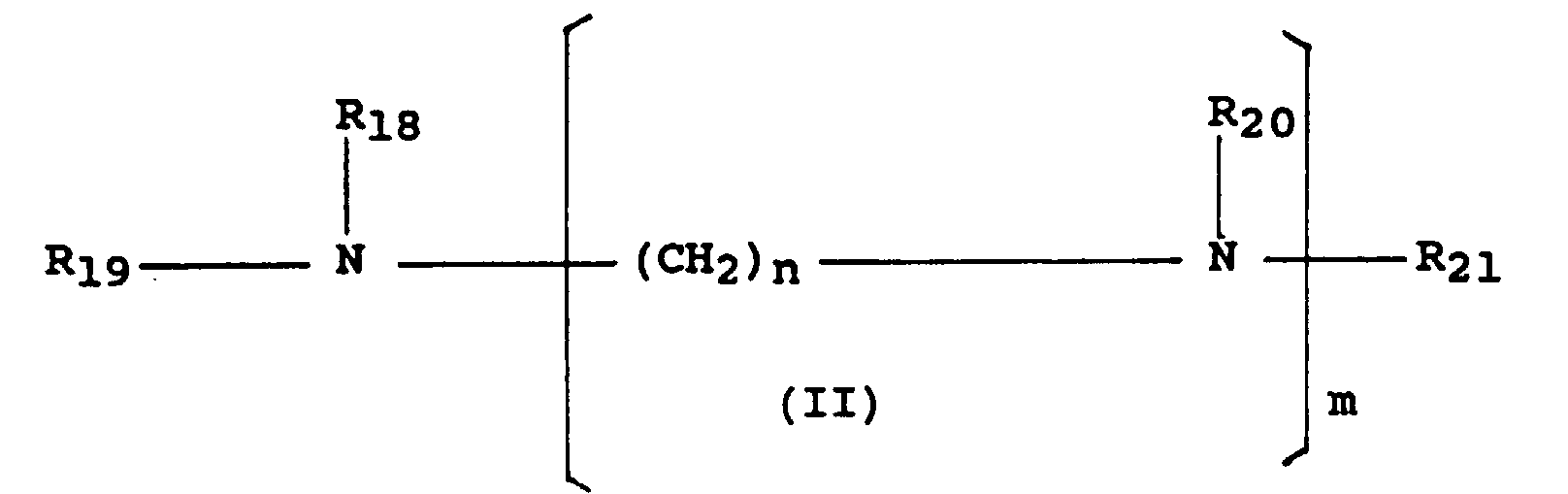
- (iii) imidazolines of formula

- (iv) condensation products formed from the reaction of fatty acids with a polyamine selected from the group consisting of hydroxy alkylalkylenediamines and dialkylenetriamines and mixtures thereof. Suitable materials are disclosed in European Patent Application 199 382 (Procter and Gamble).
- When the amine is of the formula I above, R15 is a C6 to C24, hydrocarbyl group, R16 is a C1 to C24 hydrocarbyl group and R17 is a C1 to C10 hydrocarbyl group. Suitable amines include those materials from which the quaternary ammonium compounds disclosed above are derived, in which R15 is R1, R16 is R2 and R17 is R3. Preferably, the amine is such that both R15 and R16 are C6-C20 alkyl with C16-C18 being most preferred and with R17 as C1-3 alkyl, or R15 is an alkyl or alkenyl group with at least 22 carbon atoms and R16 and R12 are C1-3 alkyl. preferably thee amines are protonated with hydrochloric acid, orthophosphoric acid (OPA), C1-5 carboxylic acids or any other similar acids, for use in the fabric conditioning compositions of the invention.
- When the amine is of formula II above, R18 is a C6 to C24 hydrocarbyl group, R19 is an alkoxylated group of formula -(CH2CH2O)yH, where y is within the range from 0 to 6, R20 is an alkoxylated group of formula -(CH2CH2O)zH where z is within the range from 0 to 6 and m is an integer within the range from 0 to 6, and is preferably 3. When m is 0, it is preferred that R18 is a C16 to C22 alkyl and that the sum total of z and y is within the range from 1 to 6, more preferably 1 to 3. When m is 1, it is preferred that R18 is a C16 to C22 alkyl and that the sum total of x and y and z is within the range from 3 to 10.
- Representative commercially available materials of this class include Ethomeen (ex Armour) and Ethoduomeen (ex Armour).
- Preferably the amines of type (ii) or (iii) are also protonated for use in the fabric conditioning compositions of the invention.
- When the amine is of type (iv) given above, a particularly preferred material is

- The amphoteric fabric conditioning material for use in a composition according to the invention should be a fabric substantive amphotheric material. Suitable amphoteric materials form a particulate dispersion at a concentration of less than 1 g/l at at least one temperature between 0 and 100°C. For the purpose of this invention a fabric substantive amphoteric material is an amphoteric or zwitterionic tertiary or quaternary ammonium compound having either one single very long hydrocarbyl side chain or two long hydrocarbyl chains. From these compounds the use of amphoteric or zwitterionic ammonium compounds having two long hydrocarbyl chains is particularly preferred for many reasons including costs, ease of processing and better stability and performance.
- It is already known, for instance from US 3,984,335 (BASF company) to use a fatty amphoteric compound having one long hydrocarbyl chain in liquid fabric softening components. Single very long chain amphoteric or zwitterionic materials as used in compositions according to the invention are distinctive over these materials in that the very long hydrocarbyl chain contains a substantial higher amount of C-atoms. For the purpose of the invention this single very long hydrocarbyl chain contains from 22-50 C-atoms, particularly preferred from 24 to 40 C-atoms.
- The amphoteric or zwitterionic ammonium compounds may have two long hydrocarbyl chains, each chain having 8-24 C-atoms, preferably 10-20 C-atoms, most preferred around 16 C-atoms. Preferably, the amphoteric fabric conditioning material is an amine oxide. Suitable amphoteric fabric substantive materials for use in a fabric treatment composition according to the invention are for instance selected from:
- I) Ampholytes of the following formula:
- II) Hydrocarbyl betaines of the following formula:

- III) Hydrocarbylamido betaines of the following formula:

- IV) Glycinates or propionates of the following formula:


- V) tertiary amine oxides of the following formula

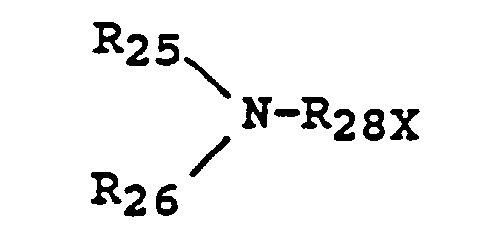
- a) R25 and R26 are C8-25 hydrocarbyl chains, R27 is an hydrocarbylgroup containing 1-4 carbon atoms or a group -(CH2,CH2O)nH, R28, R29, R30 are -(CH2)-, which can be interrupted with -O-,CONH-,-COO- etc, R31 is R27, r is 0 or 1, n is an integer from 1-6, X, Y are SO3, SO2- or COO-;
or - b) R25 is a C16-50 hydrocarbyl chain, R26, R27 are hydrocarbyl groups containing 1-4 carbon atoms or a group -(CH2CH2O)nH-, R28, R29, R30 are -(CH2)n- which can be interrupted by -O-, -COHN-, -COO- etc, R31 is R27, r is 0 or 1, n is an integer from 1-6, X, Y are SO3, SO2- or COO-.
- a) R25 and R26 are C8-25 hydrocarbyl chains, R27 is an hydrocarbylgroup containing 1-4 carbon atoms or a group -(CH2,CH2O)nH, R28, R29, R30 are -(CH2)-, which can be interrupted with -O-,CONH-,-COO- etc, R31 is R27, r is 0 or 1, n is an integer from 1-6, X, Y are SO3, SO2- or COO-;
- Preferably the amphoteric fabric substantive materials are water insoluble and have a solubility in water at pH 2.5 at 20°C of less than 10 g/l.
The HLB of the amphoteric fabric substantive material is preferably less than 10.0. - Examples of amphoteric materials of the above groups and their method of preparation are given in our co-pending European patent application EP-A-0 326 213.
- From the above listed materials, particularly the group V materials are preferred, especially those amine oxides containing two hydrocarbyl groups with at least 14 C-atoms, such as dihardened tallow methyl amine oxide, or one hydrocarbyl group with at least 22 carbon atoms. Amine oxides have been found to provide particularly advantageous softening effects, furthermore compositions comprising amine oxides are clearly preferred because they are generally easy to prepare, are stable and have an interesting creamy appearance.
- Preferably, the compositions of the present invention contain substantially no anionic material, in particular no anionic surface active material. If such materials are present, the weight ratio of the cationic fabric softening agent to the anionic material should preferably be more than 5:1.
- The composition can also contain one or more optional ingredients selected from non-aqueous solvents such as C1-C4 alkanols and polyhydric alcohols, pH buffering agents such as strong or weak acids eg. HCl, H2SO4, phosphoric, benzoic or citric acids (the pH of the liquid compositions ie preferably less than 5.0), rewetting agents, viscosity modifiers such as electrolytes, for example calcium chloride, antigelling agents, perfumes, perfume carriers, fluorescers, colourants, hydrotropes, antifoaming agents, antiredeposition agents, enzymes, optical brightening agents, opacifiers, stabilisers such as guar gum and polyethylene glycol, emulsifiers, anti-shrinking agents, anti-wrinkle agents, fabric crisping agents, anti-spotting agents, soil-release agents, germicides, linear or branched silicones, fungicides, anti-oxidants, anti-corrosion agents, preservatives such as Bronopol (Trade Mark), a commercially available form of 2-bromo-2-nitropropane-1,3-diol, dyes, bleaches and bleach precursors, drape imparting agents, antistatic agents, anti-redeposition agents, dye transfer inhibitors and ironing aids.
- These optional ingredients, if added, are each present at levels up to 5% by weight of the composition. The pH of the composition is preferably 5 or below, or adjusted thereto.
- Anti-redeposition agents particularly preferred in the compositions according to the invention are polymers. Suitable polymers include alkyl and hydroxoyalkyl cellulose ethers, such as methyl cellulose, and polyvinylpyrrolidone.
- Silicones can be included in the compositions as the ironing aid, rewetting agent or the antifoaming agent. Suitable silicones for use in the compositions according to the invention include predominantly linear polydialkyl or alkylaryl siloxanes in which the alkyl groups contain one to five carbon atoms. The siloxanes can be amido or amino substituted. When the siloxane is amine substituted the amine group may be quaternised.
- The compositions may also contain, in addition to the cationic fabric softening agent, other non-cationic fabric softening agents, such as nonionic fabric softening agents. Suitable nonionic fabric softening agents include glycerol esters, such as glycerol monostearate, fatty alcohols, such as stearyl alcohol, alkoxylated fatty alcohols C9-C24 fatty acids and lanolin and derivatives thereof. Suitable materials are disclosed in European Patent Application 88 520 (Unilever PLC/NV case C 1325), 122 141 (Unilever PLC/NV case C 1363) and 79 746 (Procter and Gamble). Typically such materials are included at a level within the range of from 0.5% to 10% by weight of the composition.
- One preferred embodiment of a composition according to the present invention is an aqueous liquid fabric conditioning composition comprising cationic fabric softener, the amine and the amphoteric softener material. The amphoteric softener material is preferably an amine oxide.
- The total level of the three ingredients in a liquid composition is from 1 to 60% more preferred from 3 to 30% by weight of the composition. Based on the total weight of the three actives, the weight of the cationic softening agent is not more than 90%, preferably between 25 and 75 %, more preferred from 40 to 60 %. especially preferred about 50 %. The weight of the amine is not more than 70%, preferably between 10 and 60%, more preferred between 15 and 40 %, especially preferred about 25 %. The weight of the amphoteric material is not more than 60 %. If the amphoteric material is an amine oxide then this constitutes preferably less than 60 %, more preferred between 10 and 50 %, especially preferred between 15 and 40 %, most preferred about 25 % based on the weight of the three actives.
- The optimum weight ratio of the three active components in the fabric conditioning composition depends on the level of anionic carried over from the wash cycle. We have found that a weight ratio of cationic fabric softener to amine to amine oxide of about 2:1:1 provides good results under most conditions of use.
- The liquid compositions according to the inventions may be prepared by a variety of methods. One suitable method is to form a molten mixture of the cationic fabric softening agent, amine and amphoteric material, which is then added to water with stirring to form a dispersion and thereafter adding any optional ingredients.
- In use, the fabric conditioning composition of the invention may be added to a large volume of water to form a liquor with which the fabrics to be treated are contacted. Generally, the total concentration of the cationic fabric softening agent, the amine and the amine oxide in this liquor will be between about 30 ppm and 500 ppm. The weight ratio of the fabrics to liquor will generally be between 40:1 and 4:1.
- If the compositions of the invention are added to water which contains high levels of anionic surface active materials, a further improvement can be obtained if the compositions contain anionic scavengers such as low molecular weight cationics. Suitable materials include cationic compounds which have a solubility in water at pH 2.5 and 20°C of more than 5 g/l, preferably more than 10 g/l. Arquad 18 is a particularly preferred material. (Arquad 18 is a commercially available form of hardened tallow trimethyl ammonium chloride).
- Another preferred embodiment of the present invention involves the combination of a substrate and a mixture of active ingredients comprising a cationic fabric conditioner, an amine and an amphoteric material. Also in these compositions the amphoteric material is preferably an amine oxide.
- The substrate for use in a fabric conditioning article according to the present invention may take any one of a variety of shapes such as blocks, rods, flakes, balls or sheets. Preferably the conditioning article comprises one or more flexible sheet substrates.
- Such substrates are well-known in the art and include woven and non-woven fibrous substrates, polymeric substrates, extruded substrates etc. Suitable substrates are for instance disclosed in CA 1 005 204 (Procter and Gamble).
- Combinations of a substrate and a fabric conditioner according to the invention may be prepared by any suitable method for the application of active materials onto a substrate. Such a method may for instance include the coating or impregnation of the substrate with the fabric conditioner. When using such a method, it may be preferred to combine the active materials with a solvent for these, followed by applying the solution to the substrate and evaporating said solvent, for instance under low pressure conditions.
- Others suitable methods for combining the substrate with the fabric conditioner material include the sprinkling of the materials in solid form onto the substrate and the application of the materials in melted form onto the substrate.
- Preferably the add-on ratio of the fabric conditioning material to the substrate is between 20:1 and 1:20, more preferred between 1:1 and 10:1. Especially preferred is a combination of a substrate and a fabric conditioner material, in which the total amount of conditioner material is 0.5 and 10 g, more preferred between 0.75 and 7.5 g, especially preferred between 1 and 5 g.
- Another preferred embodiment of a fabric conditioning composition according to the present invention is a composition which is solid, preferably in the form of a powdered material. These materials are preferably used during the treatment of the fabrics in a tumble dryer. In this use they may for instance be contained in a sachet or another dispensing container. Suitable containers for use in the tumble dryer are for instance disclosed in EP 194 813 (Unilever N.V.).
- In use the solid fabric conditioner composition according to the present invention are preferably used in amounts of between 0.5 and 10 g, preferably from 1 to 5 g, especially preferred from 1.5 to 3 g active material.
- The fabric conditioner compositions for application to the substrate or for use in solid form comprise, based on the weight of the three active materials, more than 5 % fabric softener material, more than 5 % amine and more than 5 % amphoteric material. The amount of fabric softener material is from 5 to 90 %, more preferred from 20 to 85%, especially preferred about 80 %. The weight of the amine is from 5 to 50 %, more preferred from 5 to 40 %, especially preferred from 5 to 35 %, most preferred about 10 %. The weight of the amphoteric material is from 5 to 90%, if the amphoteric material is an amine oxide, the weight of this material is preferably from 5 to 50%, more preferred from 5 to 35 %, especially preferred from 5 to 25 %, typically about 10%.
- The optimum weight ratio of the three active components in the fabric conditioning composition containing amine oxide is cationic: amine to amine oxide = 8 : 1 : 1.
- The invention will now be illustrated by the following non limiting Examples, where Examples 1A, 1B, 2A and 2B are included for comparison purposes only. In all of the Examples, all parts and percentages are by weight. Where commercially available materials are referred to, the percentages quoted are those of the active ingredient therein.
- Compositions were prepared according to the formulations in the following tables. The compositions were prepared by comelting the cationic fabric softening agent, amine and amine oxide at 80°C. (When the amine was Armeen M2HT, the ortho phosphoric acid was added to the water prior to forming the co-melt. In contrast when ceranine HC39 was used, the acid was added after the components were dispersed). The comelt thus formed was added to water at 80°C and then soniprobed for a few minutes to form a disperion which was then cooled to room temperature.
- The compositions were tested as follows -
40 grams of cotton terry toweling were washed for 5 minutes at 50°C with a commercially available washing powder product, UK Persil Automatic, in a litre of Wirral water (10°FH) in a tergotometer. 5 grams of the washing powder product was used. After separating the wash liquor, the fabric load was rinsed twice at 25°C with Wirral water. 4ml of a test composition was added to the second rinse. After line drying, the fabric load was assessed for softness by a panel of experts using a paired comparison test.EXAMPLE NO. 1 1A 1B 2 2A 2B Ingredient % Arquad 2HT1 2.5 2.5 - 2.5 2.5 - Armeen M2HT2 1.25 - 2.5 - - - DHTMAO3 1.25 2.5 2.5 1.25 2.5 2.5 Ceranine HC394 - - - 1,25 - 2.5 OPA 0.25 - 0.50 0.25 - 0.50 Water -----------balance----------- 1 - Dihardened tallow dimethyl ammonium chloride (ex Akzo) 2 - Dihardened tallow methylamine (ex Akzo) 3 - Dihardened tallow methyl amine oxide (ex (Kenobel) 4 - Reaction product of two moles of hardened tallow fatty acid with one mole of N-2-hydroxyethyl ethylene diamine (ex Sandoz). - The results of the softness showed a preference for composition 1 over compositions 1A and 1B ie. the ternary system, containing the cationic, amine and amine oxide, gave the best softening. The same result was obtained when compositions 2, 2A and 2B were compared.
- Compositions 1 and 2 were also compared. The results showed a preference for the product containing Ceranine HC39.
- In these Examples, a comparison was made between ternary compositions in which the amine was either protonated or unprotonated. Compositions were prepared according to the formulations in the table by the method described above.
Example 3 4 5 6 Arquad 2HT 2.5 2.5 2.5 2.5 Armeen M2HT (i) protonated with OPA 1.25 - - - (ii) not protonated - 1.25 - - DHTMAO 1.25 1.25 1.25 1.25 Ceranine HC39 (i) protonated with OPA - - 1.25 - (ii) not protonated - - - 1.25 OPA 0.25 - 0.25 - Water -------------balance--------------- - The compositions were tested according to the method described in Examples 1 and 2.
- The results show a preference for composition 3 which contained a protonated amine, over composition 4.
- When Ceranine HC39 was the amine used, Examples 5 and 6, compositions containing the protonated and unprotonated material, gave similar results.

- 5 - A dihardened tallow methyl imidazolinium salt

- 7 - Hardened tallow trimethyl ammonium chloride
- 8 - Dicocodimethyl ammonium chloride
- 9 - Dihardened tallow imidazoline amine.
- The following compositions according to the invention were prepared by the method described above
Example 16 17 18 19 20 21 Arquad 2HT 7.5 6.75 7.50 8.5 7.5 5.1 Ceranine HC39 3.75 3.375 3.75 - - 8.5 Ceranine HCA - - - 4.25 3.75 - DHTMAO 3.75 3.375 3.75 4.25 3.75 3.4 Dobanol 25-9 - - 1.00 - - - OPA 0.75 0.22 0.75 0.85 0.75 0.70 Water -----------------balance------------------- - Tumble dryer sheet product were prepared as follows. Arquad 2HT, Ceranine HC39 and DHTMAO were used as the active materials. The active materials were melted together and about 3g of the mix was blended with 10 ml of chloroform. The active was absorbed on an apertured non-woven polyester substrate of 11 cm x 9 cm ex J.R. Crompton plc, the substrate was subsequently dried.
- In example 28 a commercially available tumble dryer product BOUNCE (Procter & Gamble) was used for comparison.
- In example 29 no fabric conditioner was added to the tumble dryer.
- A one metre length of terry towelling previously harshened by washing 8 times at 60°C in 24 FH water using a Miele front loading automatic, the cloths were line dried and 2 kg of ballast load were used in the tumble dryer. The dryer was operated for 90 min on high setting. The softener score was determined by using a panel, a higher score indicates a better softening.
Example Weight of active on sheet (g) % active removed in drying ratio AO:HC39:2HT -score 22 2.44 22 8 : 1 : 1 2.99 23 2.49 27 6 : 2 : 2 3.79 24 2.22 37 1 : 1 : 1 3.90 25 2.52 42 1 :4.5:4.5 4.13 26 2.41 34 1 : 1 : 8 5.19 27 2.40 47 4.5:4.5:1 4.21 28 2.10 77 BOUNCE 2.87 29 - - - 1.96 - From this it follows that even though delivery of the active to the cloth was inferior for examples 22 - 27, all formulations were better than the BOUNCE sheets for softener preference.
- Ternary active mixtures according to examples 22 - 29 were melted cooled and ground to obtain powdered softening compositions. The powders were introduced in an apertured cup comprising a bottom compartment such as disclosed in Fig. 1 of EP 204 484 (Unilever N.V.).
- For comparison the actives were extracted from a BOUNCE sheet using chloroform, followed by drying and grinding.
- Two grams of powdered material were added to the cup. The dryer conditions were as in examples 22 - 29. In example 37 no softener material was used for control purposes. The following results were obtained.
Ratio Example AO : HC39 : 2 HT Softener score 30 8 : 1 : 1 5.82 31 6 : 2 : 2 5.82 32 1 : 1 : 1 5.68 33 1 :4.5:4.5 6.18 34 1 : 1 : 8 7.71 35 4.5:4.5:1 4.40 36 BOUNCE 3.70 37 Control 1.85
Claims (12)
- An aqueous liquid fabric conditioning composition comprising from 1 to 60% by weight of a combination of:(i) 20% to 90% by weight of a cationic quaternary ammonium fabric softening agent having two C12-24 hydrocarbyl chains and a solubility in water at pH2.5 and 20°C of less than 10g/l;(ii) 5% to 70% by weight of an amine; and(iii) 5% to 60% by weight of an amphoteric fabric conditioning material wherein said amphoteric fabric conditioning material is an amphoteric or zwitterionic tertiary or quaternary ammonium compound having a single long hydrocarbyl chain of from 22 to 50 carbon atoms, or two long hydrocarbyl chains of from 8 to 24 carbon atoms;the percentage by weight of (i), (ii) and (iii) being based on the total weight of components (i), (ii) and (iii) in the composition.
- A fabric conditioning composition according to claim 1, wherein the amphoteric fabric conditioning material is an amine oxide.
- A fabric conditioning composition according to claim 1 or claim 2, comprising based on the total weight of the three components (i) to (iii),(i) 40 - 60% of cationic softening agent(ii) 15 - 40% of amine(iii) 15 - 40% of amine oxide.
- A fabric conditioning composition according to any one of claims 1 to 3, comprising 3 - 30% by weight of active material.
- A fabric conditioner composition for application to a substrate of a fabric conditioning article or for use in solid form and comprising:(i) 5% to 90% by weight of a cationic quaternary ammonium fabric softening agent having two C12 to C24 hydrocarbyl chains and a solubility in water at pH 2.5 and 20°C of less than 10g/l;(ii) 5% to 50% by weight of an amine; and(iii) 5% to 90% by weight of an amphoteric fabric conditioning material, wherein said amphoteric fabric conditioning material is an amphoteric or zwitterionic tertiary or quaternary ammonium compound having a single long hydrocarbyl chain of from 22 to 50 carbon atoms, or two long hydrocarbyl chains of from 8 to 24 carbon atoms;the percentages by weight of (i), (ii) and (iii) being based on the total weight of components (i), (ii) and (iii) in the composition.
- A fabric conditioning product comprising: a solid substrate having an application of a fabric conditioning composition according to claim 5.
- A fabric conditioning product according to claim 6 wherein the substrate is a flexible sheet.
- A fabric conditioning composition according to claim 5 in powdered form.
- A fabric conditioning composition according to any one of claims 5 to 8 comprising(i) 20 - 85% of cationic softening agent(ii) 5 - 35% of an amine(iii) 5 - 35% of an amine oxide.
- Method for treating fabrics comprising the step of contacting fabrics with an aqueous bath comprising a fabric conditioning composition according to any one of claims 1 to 4, the total concentration of the cationic fabric softening agent, the amine and the amine oxide being between 30 and 500 ppm.
- Method for treating fabrics comprising the step of contacting fabrics in a tumble dryer with a substrate comprising 1 to 5 gr of a fabric conditioning composition according to any one of claims 5 or 9.
- Method for treating fabrics comprising the step of contacting fabrics in a tumble dryer with a powdered fabric conditioning composition according to claim 8 or 9.
Applications Claiming Priority (2)
| Application Number | Priority Date | Filing Date | Title |
|---|---|---|---|
| GB888805837A GB8805837D0 (en) | 1988-03-11 | 1988-03-11 | Fabric conditioning composition |
| GB8805837 | 1988-03-11 |
Publications (4)
| Publication Number | Publication Date |
|---|---|
| EP0332270A2 EP0332270A2 (en) | 1989-09-13 |
| EP0332270A3 EP0332270A3 (en) | 1990-05-16 |
| EP0332270B1 true EP0332270B1 (en) | 1996-06-05 |
| EP0332270B2 EP0332270B2 (en) | 2001-07-04 |
Family
ID=10633270
Family Applications (1)
| Application Number | Title | Priority Date | Filing Date |
|---|---|---|---|
| EP89200545A Expired - Lifetime EP0332270B2 (en) | 1988-03-11 | 1989-03-06 | Fabric conditioning composition |
Country Status (9)
| Country | Link |
|---|---|
| EP (1) | EP0332270B2 (en) |
| JP (1) | JP2551479B2 (en) |
| AU (1) | AU620082B2 (en) |
| BR (1) | BR8901135A (en) |
| CA (1) | CA1341483C (en) |
| DE (1) | DE68926584T3 (en) |
| ES (1) | ES2087861T5 (en) |
| GB (1) | GB8805837D0 (en) |
| ZA (1) | ZA891845B (en) |
Cited By (1)
| Publication number | Priority date | Publication date | Assignee | Title |
|---|---|---|---|---|
| US6046154A (en) * | 1997-09-25 | 2000-04-04 | The Procter & Gamble Company | Dryer-added fabric softener composition comprising chlorine scavenger to provide color and other fabric benefits |
Families Citing this family (13)
| Publication number | Priority date | Publication date | Assignee | Title |
|---|---|---|---|---|
| EP0368383A3 (en) * | 1988-11-09 | 1991-07-03 | Unilever N.V. | Fabric conditioner |
| ZA907746B (en) * | 1989-10-16 | 1992-05-27 | Colgate Palmolive Co | New softening compositions and methods for making and using same |
| EP0443313B1 (en) * | 1990-01-19 | 1994-03-23 | Kao Corporation | Liquid softener composition for fabric |
| CA2097503C (en) * | 1991-02-08 | 1997-04-08 | Albemarle Corporation | Laundry rinses and dryer sheets |
| JP3560989B2 (en) * | 1991-11-08 | 2004-09-02 | クウエスト・インターナシヨナル・ベー・ベー | Fragrance composition |
| GB9323268D0 (en) * | 1993-11-11 | 1994-01-05 | Unilever Plc | Fabric comditioning composition |
| BR9509483A (en) * | 1994-10-28 | 1997-10-14 | Procter & Gamble | Compositions for cleaning hard surfaces including protonated amines and amine oxide surfactants |
| GB9810656D0 (en) * | 1998-05-18 | 1998-07-15 | Unilever Plc | Stable ammonium compositions |
| EP0990695A1 (en) * | 1998-09-30 | 2000-04-05 | Witco Surfactants GmbH | Fabric softener with dye transfer inhibiting properties |
| US6660710B1 (en) * | 1999-11-12 | 2003-12-09 | Kao Corporation | Softener composition |
| GB2375356A (en) * | 2001-05-11 | 2002-11-13 | Reckitt Benckiser Nv | Cationic fabric softening compositions |
| US6887542B2 (en) * | 2002-12-11 | 2005-05-03 | Kimberly-Clark Worldwide, Inc. | Method for treating an elastomeric article |
| US20230147510A1 (en) | 2021-11-05 | 2023-05-11 | Nouryon Chemicals International B.V. | Liquid fabric softener compositions comprising hydroxypropyl starch phosphate |
Family Cites Families (16)
| Publication number | Priority date | Publication date | Assignee | Title |
|---|---|---|---|---|
| GB1596791A (en) * | 1977-02-15 | 1981-08-26 | Unilever Ltd | Deodorant detergent composition |
| US4238531A (en) † | 1977-11-21 | 1980-12-09 | Lever Brothers Company | Additives for clothes dryers |
| DE3069767D1 (en) * | 1979-09-29 | 1985-01-17 | Procter & Gamble | Detergent compositions |
| JPS56148970A (en) * | 1980-01-11 | 1981-11-18 | Procter & Gamble | Composition for treating thick clothes |
| DE3263800D1 (en) * | 1981-01-16 | 1985-07-04 | Procter & Gamble | Textile treatment compositions |
| DE3271167D1 (en) * | 1981-09-11 | 1986-06-19 | Procter & Gamble | Fabric softening detergent additive products and use thereof in detergent compositions |
| US4556502A (en) † | 1983-04-08 | 1985-12-03 | Lever Brothers Company | Liquid fabric-softening composition |
| JPS6024223A (en) * | 1983-07-19 | 1985-02-06 | Amada Co Ltd | Method for controlling bending angle with press brake |
| JPS6044428A (en) * | 1983-08-18 | 1985-03-09 | Sekisui Chem Co Ltd | Continuous fixed-quantity transport device of batch mixture |
| JPS60115511A (en) * | 1983-11-29 | 1985-06-22 | Lion Corp | Two-component hair and fiber treatment composition |
| CH661524A5 (en) * | 1984-06-20 | 1987-07-31 | Firmenich & Cie | DETERGENT ARTICLE WITH REVITALIZING ACTION AND PROCESS FOR ITS PREPARATION. |
| US4661269A (en) * | 1985-03-28 | 1987-04-28 | The Procter & Gamble Company | Liquid fabric softener |
| GB8519363D0 (en) * | 1985-08-01 | 1985-09-04 | Procter & Gamble | Dispersible fabric softeners |
| IL81352A (en) * | 1986-01-27 | 1990-11-05 | Colgate Palmolive Co | Detergent softener compositions |
| GB2188653A (en) * | 1986-04-02 | 1987-10-07 | Procter & Gamble | Biodegradable fabric softeners |
| DD251784A1 (en) † | 1986-08-01 | 1987-11-25 | Bitterfeld Chemie | SOFT SPOOLS FOR TEXTILE FLOOR FIBER PICTURES |
-
1988
- 1988-03-11 GB GB888805837A patent/GB8805837D0/en active Pending
-
1989
- 1989-03-06 ES ES89200545T patent/ES2087861T5/en not_active Expired - Lifetime
- 1989-03-06 DE DE68926584T patent/DE68926584T3/en not_active Expired - Lifetime
- 1989-03-06 EP EP89200545A patent/EP0332270B2/en not_active Expired - Lifetime
- 1989-03-10 CA CA000593398A patent/CA1341483C/en not_active Expired - Fee Related
- 1989-03-10 AU AU31243/89A patent/AU620082B2/en not_active Expired
- 1989-03-10 ZA ZA891845A patent/ZA891845B/en unknown
- 1989-03-10 JP JP1059482A patent/JP2551479B2/en not_active Expired - Fee Related
- 1989-03-10 BR BR898901135A patent/BR8901135A/en not_active IP Right Cessation
Cited By (2)
| Publication number | Priority date | Publication date | Assignee | Title |
|---|---|---|---|---|
| US6046154A (en) * | 1997-09-25 | 2000-04-04 | The Procter & Gamble Company | Dryer-added fabric softener composition comprising chlorine scavenger to provide color and other fabric benefits |
| US6046155A (en) * | 1997-09-25 | 2000-04-04 | The Procter & Gamble Company | Dryer-added fabric softner composition comprising chlorine scavenger to provide color and other fabric benefits |
Also Published As
| Publication number | Publication date |
|---|---|
| AU3124389A (en) | 1989-09-14 |
| JP2551479B2 (en) | 1996-11-06 |
| DE68926584T3 (en) | 2001-09-27 |
| BR8901135A (en) | 1989-10-31 |
| DE68926584T2 (en) | 1996-10-02 |
| ES2087861T5 (en) | 2001-10-16 |
| EP0332270B2 (en) | 2001-07-04 |
| EP0332270A3 (en) | 1990-05-16 |
| GB8805837D0 (en) | 1988-04-13 |
| AU620082B2 (en) | 1992-02-13 |
| JPH026662A (en) | 1990-01-10 |
| ES2087861T3 (en) | 1996-08-01 |
| CA1341483C (en) | 2005-05-17 |
| EP0332270A2 (en) | 1989-09-13 |
| DE68926584D1 (en) | 1996-07-11 |
| ZA891845B (en) | 1990-11-28 |
Similar Documents
| Publication | Publication Date | Title |
|---|---|---|
| EP0326213B1 (en) | A fabric treatment composition and the preparation thereof | |
| EP0409502B1 (en) | Fabric softening composition | |
| JP3478828B2 (en) | Fabric softening compositions having improved dye appearance inhibitors for fabric appearance | |
| EP0060003B1 (en) | Textile treatment compositions and preparation thereof | |
| EP0404471B1 (en) | Fabric softening composition | |
| US5407588A (en) | Fabric softening composition | |
| EP0332270B1 (en) | Fabric conditioning composition | |
| JPH10508622A (en) | Concentrated biodegradable quaternary ammonium fabric softener composition containing intermediate iodine value fatty acid chains | |
| US3756950A (en) | Fabric softening compositions | |
| EP0392764B1 (en) | Fabric conditioning article | |
| US4622154A (en) | Aqueous fabric softening composition | |
| CA1204561A (en) | Fabric conditioning composition | |
| EP0387064A2 (en) | Fabric conditioning | |
| EP0409503B1 (en) | Fabric softening composition | |
| IE860831L (en) | Fabric conditioner | |
| JP2551479C (en) | ||
| CA2020948A1 (en) | Fabric softening composition | |
| JP2566177C (en) |
Legal Events
| Date | Code | Title | Description |
|---|---|---|---|
| PUAI | Public reference made under article 153(3) epc to a published international application that has entered the european phase |
Free format text: ORIGINAL CODE: 0009012 |
|
| AK | Designated contracting states |
Kind code of ref document: A2 Designated state(s): CH DE ES FR GB IT LI NL SE |
|
| PUAL | Search report despatched |
Free format text: ORIGINAL CODE: 0009013 |
|
| AK | Designated contracting states |
Kind code of ref document: A3 Designated state(s): CH DE ES FR GB IT LI NL SE |
|
| 17P | Request for examination filed |
Effective date: 19900430 |
|
| RAP3 | Party data changed (applicant data changed or rights of an application transferred) |
Owner name: UNILEVER PLC Owner name: UNILEVER N.V. |
|
| 17Q | First examination report despatched |
Effective date: 19930602 |
|
| GRAA | (expected) grant |
Free format text: ORIGINAL CODE: 0009210 |
|
| AK | Designated contracting states |
Kind code of ref document: B1 Designated state(s): CH DE ES FR GB IT LI NL SE |
|
| PG25 | Lapsed in a contracting state [announced via postgrant information from national office to epo] |
Ref country code: LI Effective date: 19960605 Ref country code: NL Free format text: LAPSE BECAUSE OF FAILURE TO SUBMIT A TRANSLATION OF THE DESCRIPTION OR TO PAY THE FEE WITHIN THE PRESCRIBED TIME-LIMIT Effective date: 19960605 Ref country code: CH Effective date: 19960605 |
|
| REG | Reference to a national code |
Ref country code: ES Ref legal event code: BA2A Ref document number: 2087861 Country of ref document: ES Kind code of ref document: T3 |
|
| REF | Corresponds to: |
Ref document number: 68926584 Country of ref document: DE Date of ref document: 19960711 |
|
| REG | Reference to a national code |
Ref country code: ES Ref legal event code: FG2A Ref document number: 2087861 Country of ref document: ES Kind code of ref document: T3 |
|
| ITF | It: translation for a ep patent filed | ||
| ET | Fr: translation filed | ||
| PG25 | Lapsed in a contracting state [announced via postgrant information from national office to epo] |
Ref country code: SE Effective date: 19960905 |
|
| NLV1 | Nl: lapsed or annulled due to failure to fulfill the requirements of art. 29p and 29m of the patents act | ||
| REG | Reference to a national code |
Ref country code: CH Ref legal event code: PL |
|
| PLBQ | Unpublished change to opponent data |
Free format text: ORIGINAL CODE: EPIDOS OPPO |
|
| PLBI | Opposition filed |
Free format text: ORIGINAL CODE: 0009260 |
|
| PLBF | Reply of patent proprietor to notice(s) of opposition |
Free format text: ORIGINAL CODE: EPIDOS OBSO |
|
| 26 | Opposition filed |
Opponent name: PROCTER & GAMBLE EUROPEAN TECHNICAL CENTER N.V. Effective date: 19970304 |
|
| PLBF | Reply of patent proprietor to notice(s) of opposition |
Free format text: ORIGINAL CODE: EPIDOS OBSO |
|
| PLBF | Reply of patent proprietor to notice(s) of opposition |
Free format text: ORIGINAL CODE: EPIDOS OBSO |
|
| PLAW | Interlocutory decision in opposition |
Free format text: ORIGINAL CODE: EPIDOS IDOP |
|
| PLAW | Interlocutory decision in opposition |
Free format text: ORIGINAL CODE: EPIDOS IDOP |
|
| PUAH | Patent maintained in amended form |
Free format text: ORIGINAL CODE: 0009272 |
|
| STAA | Information on the status of an ep patent application or granted ep patent |
Free format text: STATUS: PATENT MAINTAINED AS AMENDED |
|
| 27A | Patent maintained in amended form |
Effective date: 20010704 |
|
| AK | Designated contracting states |
Kind code of ref document: B2 Designated state(s): CH DE ES FR GB IT LI NL SE |
|
| ITF | It: translation for a ep patent filed | ||
| REG | Reference to a national code |
Ref country code: ES Ref legal event code: DC2A Kind code of ref document: T5 Effective date: 20010904 |
|
| REG | Reference to a national code |
Ref country code: GB Ref legal event code: IF02 |
|
| ET3 | Fr: translation filed ** decision concerning opposition | ||
| PGFP | Annual fee paid to national office [announced via postgrant information from national office to epo] |
Ref country code: ES Payment date: 20080326 Year of fee payment: 20 |
|
| PGFP | Annual fee paid to national office [announced via postgrant information from national office to epo] |
Ref country code: GB Payment date: 20080327 Year of fee payment: 20 |
|
| PGFP | Annual fee paid to national office [announced via postgrant information from national office to epo] |
Ref country code: FR Payment date: 20080317 Year of fee payment: 20 Ref country code: DE Payment date: 20080430 Year of fee payment: 20 |
|
| PGFP | Annual fee paid to national office [announced via postgrant information from national office to epo] |
Ref country code: IT Payment date: 20080329 Year of fee payment: 20 |
|
| REG | Reference to a national code |
Ref country code: GB Ref legal event code: PE20 Expiry date: 20090305 |
|
| REG | Reference to a national code |
Ref country code: ES Ref legal event code: FD2A Effective date: 20090307 |
|
| PG25 | Lapsed in a contracting state [announced via postgrant information from national office to epo] |
Ref country code: GB Free format text: LAPSE BECAUSE OF EXPIRATION OF PROTECTION Effective date: 20090305 |
|
| PG25 | Lapsed in a contracting state [announced via postgrant information from national office to epo] |
Ref country code: ES Free format text: LAPSE BECAUSE OF EXPIRATION OF PROTECTION Effective date: 20090307 |