EP0331423A2 - Auf Wärme ansprechendes Element für Feuerulöschdüsen oder dergleichen - Google Patents
Auf Wärme ansprechendes Element für Feuerulöschdüsen oder dergleichen Download PDFInfo
- Publication number
- EP0331423A2 EP0331423A2 EP89301964A EP89301964A EP0331423A2 EP 0331423 A2 EP0331423 A2 EP 0331423A2 EP 89301964 A EP89301964 A EP 89301964A EP 89301964 A EP89301964 A EP 89301964A EP 0331423 A2 EP0331423 A2 EP 0331423A2
- Authority
- EP
- European Patent Office
- Prior art keywords
- heat
- alloy
- solder layer
- nickel
- responsive element
- Prior art date
- Legal status (The legal status is an assumption and is not a legal conclusion. Google has not performed a legal analysis and makes no representation as to the accuracy of the status listed.)
- Withdrawn
Links
- 229910000679 solder Inorganic materials 0.000 claims abstract description 58
- PXHVJJICTQNCMI-UHFFFAOYSA-N Nickel Chemical compound [Ni] PXHVJJICTQNCMI-UHFFFAOYSA-N 0.000 claims abstract description 40
- 229910045601 alloy Inorganic materials 0.000 claims abstract description 24
- 239000000956 alloy Substances 0.000 claims abstract description 24
- XEEYBQQBJWHFJM-UHFFFAOYSA-N Iron Chemical compound [Fe] XEEYBQQBJWHFJM-UHFFFAOYSA-N 0.000 claims abstract description 20
- 229910052759 nickel Inorganic materials 0.000 claims abstract description 20
- 239000010941 cobalt Substances 0.000 claims abstract description 11
- GUTLYIVDDKVIGB-UHFFFAOYSA-N cobalt atom Chemical compound [Co] GUTLYIVDDKVIGB-UHFFFAOYSA-N 0.000 claims abstract description 11
- VYZAMTAEIAYCRO-UHFFFAOYSA-N Chromium Chemical compound [Cr] VYZAMTAEIAYCRO-UHFFFAOYSA-N 0.000 claims abstract description 10
- 239000011651 chromium Substances 0.000 claims abstract description 10
- 229910017052 cobalt Inorganic materials 0.000 claims abstract description 9
- 229910052804 chromium Inorganic materials 0.000 claims abstract description 8
- 229910052742 iron Inorganic materials 0.000 claims abstract description 8
- 229910000990 Ni alloy Inorganic materials 0.000 claims abstract 3
- 238000009792 diffusion process Methods 0.000 claims description 25
- 238000012360 testing method Methods 0.000 claims description 24
- 230000004044 response Effects 0.000 claims description 9
- 239000012530 fluid Substances 0.000 claims description 6
- 229910052738 indium Inorganic materials 0.000 claims description 5
- APFVFJFRJDLVQX-UHFFFAOYSA-N indium atom Chemical compound [In] APFVFJFRJDLVQX-UHFFFAOYSA-N 0.000 claims description 5
- ATJFFYVFTNAWJD-UHFFFAOYSA-N Tin Chemical compound [Sn] ATJFFYVFTNAWJD-UHFFFAOYSA-N 0.000 claims description 4
- 239000003063 flame retardant Substances 0.000 claims description 4
- 238000000034 method Methods 0.000 claims description 4
- 229910052718 tin Inorganic materials 0.000 claims description 4
- 229910052793 cadmium Inorganic materials 0.000 claims description 3
- BDOSMKKIYDKNTQ-UHFFFAOYSA-N cadmium atom Chemical compound [Cd] BDOSMKKIYDKNTQ-UHFFFAOYSA-N 0.000 claims description 3
- 229910000925 Cd alloy Inorganic materials 0.000 claims description 2
- 229910000846 In alloy Inorganic materials 0.000 claims description 2
- 229910001128 Sn alloy Inorganic materials 0.000 claims description 2
- 230000004888 barrier function Effects 0.000 claims description 2
- OJIJEKBXJYRIBZ-UHFFFAOYSA-N cadmium nickel Chemical compound [Ni].[Cd] OJIJEKBXJYRIBZ-UHFFFAOYSA-N 0.000 claims description 2
- YLZGECKKLOSBPL-UHFFFAOYSA-N indium nickel Chemical compound [Ni].[In] YLZGECKKLOSBPL-UHFFFAOYSA-N 0.000 claims description 2
- CLDVQCMGOSGNIW-UHFFFAOYSA-N nickel tin Chemical compound [Ni].[Sn] CLDVQCMGOSGNIW-UHFFFAOYSA-N 0.000 claims description 2
- 230000008569 process Effects 0.000 claims description 2
- 229910000531 Co alloy Inorganic materials 0.000 claims 2
- 229910000599 Cr alloy Inorganic materials 0.000 claims 2
- 229910000640 Fe alloy Inorganic materials 0.000 claims 2
- 238000004519 manufacturing process Methods 0.000 claims 1
- -1 chormium Chemical compound 0.000 abstract description 2
- 239000000463 material Substances 0.000 description 11
- 238000002844 melting Methods 0.000 description 10
- 230000008018 melting Effects 0.000 description 9
- 229910052751 metal Inorganic materials 0.000 description 7
- 239000002184 metal Substances 0.000 description 7
- 230000000694 effects Effects 0.000 description 5
- 239000007788 liquid Substances 0.000 description 4
- RYGMFSIKBFXOCR-UHFFFAOYSA-N Copper Chemical compound [Cu] RYGMFSIKBFXOCR-UHFFFAOYSA-N 0.000 description 3
- 230000004913 activation Effects 0.000 description 3
- 230000015572 biosynthetic process Effects 0.000 description 3
- 230000008859 change Effects 0.000 description 3
- 229910052802 copper Inorganic materials 0.000 description 3
- 239000010949 copper Substances 0.000 description 3
- 230000001419 dependent effect Effects 0.000 description 3
- 239000000203 mixture Substances 0.000 description 3
- 238000001953 recrystallisation Methods 0.000 description 3
- 238000005275 alloying Methods 0.000 description 2
- 229910002056 binary alloy Inorganic materials 0.000 description 2
- 238000010587 phase diagram Methods 0.000 description 2
- 238000005476 soldering Methods 0.000 description 2
- 230000001629 suppression Effects 0.000 description 2
- 230000007704 transition Effects 0.000 description 2
- XLYOFNOQVPJJNP-UHFFFAOYSA-N water Substances O XLYOFNOQVPJJNP-UHFFFAOYSA-N 0.000 description 2
- 230000003213 activating effect Effects 0.000 description 1
- 230000003466 anti-cipated effect Effects 0.000 description 1
- 238000009835 boiling Methods 0.000 description 1
- 238000000576 coating method Methods 0.000 description 1
- 230000003750 conditioning effect Effects 0.000 description 1
- 230000003247 decreasing effect Effects 0.000 description 1
- 230000005684 electric field Effects 0.000 description 1
- 230000005496 eutectics Effects 0.000 description 1
- 238000010438 heat treatment Methods 0.000 description 1
- LQBJWKCYZGMFEV-UHFFFAOYSA-N lead tin Chemical group [Sn].[Pb] LQBJWKCYZGMFEV-UHFFFAOYSA-N 0.000 description 1
- 230000007246 mechanism Effects 0.000 description 1
- 239000000155 melt Substances 0.000 description 1
- QSHDDOUJBYECFT-UHFFFAOYSA-N mercury Chemical compound [Hg] QSHDDOUJBYECFT-UHFFFAOYSA-N 0.000 description 1
- 229910052753 mercury Inorganic materials 0.000 description 1
- 230000005012 migration Effects 0.000 description 1
- 238000013508 migration Methods 0.000 description 1
- 230000000737 periodic effect Effects 0.000 description 1
- 238000004544 sputter deposition Methods 0.000 description 1
- 239000010935 stainless steel Substances 0.000 description 1
- 229910001220 stainless steel Inorganic materials 0.000 description 1
- 238000011144 upstream manufacturing Methods 0.000 description 1
- 235000015112 vegetable and seed oil Nutrition 0.000 description 1
- 239000008158 vegetable oil Substances 0.000 description 1
Images
Classifications
-
- G—PHYSICS
- G05—CONTROLLING; REGULATING
- G05D—SYSTEMS FOR CONTROLLING OR REGULATING NON-ELECTRIC VARIABLES
- G05D23/00—Control of temperature
- G05D23/01—Control of temperature without auxiliary power
- G05D23/02—Control of temperature without auxiliary power with sensing element expanding and contracting in response to changes of temperature
- G05D23/024—Control of temperature without auxiliary power with sensing element expanding and contracting in response to changes of temperature the sensing element being of the rod type, tube type, or of a similar type
- G05D23/026—Control of temperature without auxiliary power with sensing element expanding and contracting in response to changes of temperature the sensing element being of the rod type, tube type, or of a similar type the sensing element being placed outside a regulating fluid flow
-
- A—HUMAN NECESSITIES
- A62—LIFE-SAVING; FIRE-FIGHTING
- A62C—FIRE-FIGHTING
- A62C37/00—Control of fire-fighting equipment
- A62C37/08—Control of fire-fighting equipment comprising an outlet device containing a sensor, or itself being the sensor, i.e. self-contained sprinklers
- A62C37/10—Releasing means, e.g. electrically released
- A62C37/11—Releasing means, e.g. electrically released heat-sensitive
- A62C37/12—Releasing means, e.g. electrically released heat-sensitive with fusible links
Definitions
- This invention relates to heat-responsive elements.
- Heat-responsive elements formed from two pieces of metal attached with a layer of fusible solder have been used in fire protection devices, alarm devices, and the like to permit these devices to be operated automatically at some predetermined critical temperature. When this temperature is reached, the solder joint ruptures, thereby activating the device, e.g., to release fire suppressant material, or to sound an alarm.
- Pappas et al., U.S. 4,170,189 describes a heat-responsive element specifically for use with an alarm.
- Two thin link plates, at least one made of a material, e.g., stainless steel, which does not alloy significantly with solder, are joined face-to-face with a thin solder layer. The bond between the link plate and solder is weaker than the solder layer itself, and the metal/solder bond ruptures as the critical temperature is neared.
- the invention features a heat-responsive element that includes two link members joined with a thin fusible solder layer in a face-to-face relationship over an extended surface area, the components of the opposed surfaces of the link members in contact with the solder layer and the solder layer being adapted to alloy with each other in the regions immediately adjacent each of the opposed surfaces to form alloy bonds between these surfaces and the solder layer whose strength is greater than the strength of the solder layer.
- the fuse temperature of the element i.e., the temperature at which the solder melts, thereby disengaging the link members
- the solder joint is broken through the solder layer, rather than at the metal/solder interface.
- the opposed surfaces of the link members include an alloy-forming amount of nickel, cobalt, chromium, iron, or an alloy of one or more thereof, with nickel and its alloys being the most preferred.
- the solder layer when the surfaces of the link are nickel, the solder layer preferably includes tin, cadmium, indium, or a combination thereof, and the alloy bonds include a nickel-tin alloy, nickel-indium alloy, nickel-cadmium alloy, or a combination thereof.
- the solder layer may also include an alloy-forming amount of nickel, chromium, cobalt, iron, or an alloy thereof.
- the fuse temperature of the element does not vary from a pre-determined value (based on the composition of the solder layer) by more than 3.5% over the lifetime of the element (as measured by Factory Mutual Research Corp. Approval Standard for Early Suppression, Fast Response, Automatic Sprinklers, page 26, paragraph 5.11 (June 18, 1986), described in more detail below.
- the Response Time Index of the element preferably is less than 65 s 1/2 ft 1/2 (e.g., between 40 and 65 s 1/2 ft 1/2 ) as measured by Factory Mutual Research Corp. Approval Standard for Early Suppression, Fast Response, Automatic Sprinklers, pages 39-41, paragraph 5.24 (June 18, 1986), described in more detail below.
- the invention also features a method of preparing such heat-responsive elements.
- the heat-responsive element is used in combination with a fire protection sprinkler head of the type including a base having a throat of predetermined cross-section through which a stream of fire retardant fluid can flow.
- the invention provides a heat-responsive element useful in a variety of applications e.g., fire sprinklers, fire alarms and heat detectors.
- the fuse temperature of the element remains essentially constant over the lifetime of the device due to limited diffusion to and from the link members and the ability to restrict the alloy bonds to the area immediately adjacent the opposed surfaces (rather than allowing alloying to extend through the solder layer thickness as a result of diffusion occurring over time).
- the element performs reproducibly and reliably over time.
- failure is limited by the load-carrying ability of the solder-layer, thereby minimizing the chances that the actual operating temperature at which the element is activated will be different from the pre-determined fuse temperature.
- a thin solder layer e.g., approximately 0.001 inch or less, where this figure includes the thickness of both the unalloyed solder and the alloyed interfacial metal/solder regions
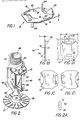
- a heat-responsive element 10 of the invention features two thin link members 12 (Fig. 1C), 14 (Fig. 1D), e.g., of metal or having a metal surface, having a length, L, approximately 7/8 inch, and width, W, approximately 3/4 inch, each with a thickness, t, about 0.006 inch, separated by a thin layer of solder 16, of thickness, S, approximately 0.001 inch.
- Link member 14 defines a pair of alignment dimples 20 that are received in corresponding apertures 22 of link member 12. The ends of each link are deformed into fins 24 for affecting air flow about the link.
- Thin link plates having a large surface-area-to-thickness ratio are desirable because they conduct heat to the solder faster, thereby decreasing the time it takes for the element to reach its fuse temperature to cause operation of the device into which the element is incorporated.
- a portion of the solder layer is alloyed with the surfaces of the two plates to form an interfacial alloyed region that bonds the solder layer on both sides to the plates.
- Preferred materials for the entire plate or just the surface are nickel, cobalt, chromium, and iron (or alloys having a high, e.g., greater than 40%, content of one of these elements) for the reasons given below.
- Surface coatings are preferably formed by sputtering.
- the solder may also contain one or more of these elements.
- phase diagrams Materials that alloy with each other to form an alloy that is stable over the temperature range to which the element will be subjected in actual use are selected by referring to temperature-composition phase diagrams.
- phase diagrams may be found in references such as Staudhammer and Murr, Atlas of Binary Alloys, A Periodic Index , Marcel Dekker, Inc. (1973) and Hansen, Constitution of Binary Alloys , McGraw-Hill (1958).
- the most stable alloys will be those having the most negative Gibbs free energy of formation.
- the link plate is nickel and the solder is a tin-lead eutectic
- a stable alloy will form between the nickel and tin but not nickel and lead.
- Nickel also forms suitable alloys with cadmium and indium.
- Cobalt plates may be used with solders containing indium or tin, while chromium may be used with indium-containing solders.
- the intermetallic boundary layer alloy be stronger than the unalloyed portion of the solder layer so that when the fuse temperature is reached, the element fails within the solder layer, rather than at the metal/solder interface.
- the problem with elements that fail at the interface is that the actual temperature at which the alloy bond in the interfacial region fails may be different from the intended predetermined fuse temperature. By restricting failure to the solder layer by making it weaker than the alloy bond, the actual operating temperature is the same as the predetermined fuse temperature because this latter temperature is dependent upon the properties of the solder.
- the fuse temperature changes over time because of atomic diffusion between the solder and link plates. Diffusion changes the composition of the solder, which in turn changes the fuse temperature of the element. Because diffusion is a thermally activated process, the rate of diffusion (and thus the change in fuse temperature) increases significantly at elevated temperatures.
- Self-diffusion involves the thermally activated motion of atoms within a volume of the same type of atoms.
- the activation energy required for self-diffusion is equivalent to the energy necessary to form a vacancy into which an atom can migrate.
- the rate of diffusion is dependent on the concentration of vacancies at any given temperature.
- the concentration of vacancies at any driven temperature is dependent on the melting point of a particular material. Increasing the melting point results in the formation of fewer vacancies at any given temperature and thus a lower rate of self-diffusion. Therefore, it is desirable to choose materials for the link plates that have relatively high melting points (such materials may also be incorporated into the solder).
- the activation energy for self-diffusion for nickel accordingly, is on the order of 1.5 times that of copper.
- the second type of diffusion is inter-diffusion, which involves the migration of one atomic species in one direction and a second atomic species in the opposite direction, each down a concentration or activity gradient.
- inter-diffusion involves the migration of one atomic species in one direction and a second atomic species in the opposite direction, each down a concentration or activity gradient.
- the rate of inter-diffusion is also influenced by the rate of vacancy formation. The more vacancies there are in a material, the more places there are into which a second atomic species can migrate. Therefore, the use of relatively high melting point materials also minimizes the rate of inter-diffusion (and therefore the rate of change in fuse temperature).
- Diffusion can also be influenced by mechanisms such as electric fields and local states of stress. Residual stresses can be caused by the forming operations used to fabricate the link plates. As temperature increases and recrystallization occurs, the boundaries separating stressed and unstressed areas move; the net effect is a change in the vacancy concentration and rate of diffusion. Such effects are also minimized by using high-melting point elements such as nickel because these elements also have relatively high recrystallization temperatures. For example, the recrystallization temperature of nickel is about 399°C, whereas the value for copper is only about 121°C.
- the link plates can be provided with a diffusion barrier, e.g., a material that is solderable with proper fluxing.
- the heat responsive element of the invention may be used in conjunction with a typical sprinkler head, e.g., by way of example only, a pendant sprinkler head 40 (Fig. 2), as described in Pounder U.S. Patent No. 4,580,729, the disclosure of which is incorporated herein by reference.
- the sprinkler 40 has a base 42 threaded at 44 for connection to the outlet of a fire retardant fluid piping system.
- the base has a circular inlet and passage 46 which terminates in a circular discharge throat of predetermined cross-section.
- Extending from the base at opposite sides of the throat are frame arms 50, 52 that join to generally conical central boss 54 to form an arch. The boss is supported by the arms in axial alignment with the throat.
- each of the frame arms has a streamline shape, with a narrow leading edge 31 and a smooth, gradual transition to the region of maximum width and a smooth, gradual transition to the narrow trailing edge 32.
- the fuse temperature of actuation preferably does not vary by more than 3.5% over the lifetime of the device, as measured by the Accelerated Time Test described in Paragraph 5.11 of the Factory Mutual Approval Standard noted in the Summary of the Invention, above.
- at least 10 sprinklers incorporating the heat element are subjected to the high test temperature selected according to Table 1, below, for a period of 90 days.
- Table 1 Sprinkler Nominal Fuse Temperature Rating Nominal Test Temperature 68-74°C 52°C 93-104°C 79°C An automatically controlled, circulating constant-temperature oven is used for the test.
- the fuse temperature of each sprinkler is measured according to Factory Mutual Research Corp. Approval Standard, page 24, paragraph 5.7 (June 18, 1986) as follows.
- At least 10 sprinklers incorporating the heat-responsive element are immersed in a vessel containing water or vegetable oil (when fuse temperatures greater than the boiling point of water are anticipated).
- the vessel is equipped with a source for heating the liquid and means for agitating the liquid.
- the temperature of the bath is measured with a thermometer calibrated in accordance with ASTM standard E-1-80.
- the liquid temperature is raised until it is within 20°F (11.1°C) of the nominal fuse temperature of the sprinkler.
- the temperature rise is then controlled at a rate not exceeding 1°F (0.56°C) per minute until operation of the sprinkler occurs or a temperature 10 percent above the rated temperature is reached.
- the temperature of the liquid at the time of operation of each sprinkler is recorded as the fuse temperature.
- the fuse temperatures of sprinklers incorporating a heat element prepared from nickel-containing base plates varied by no more than 3.5% from their original fuse temperature ratings.
- the Response Time Index is a measure of the ability of an element to respond when the fuse temperature is reached by rupturing the solder joint. It is measured according to the plunge test described in Paragraph 5.24 of the Factory Mutual Approval Standard noted in the Summary of the Invention, above. According to this test, at least 12 sprinklers incorporating the heat-responsive element at each nominal fuse temperature rating are plunged into the test section of a tunnel equipped with a mercury plunge switch to start the test and a pressure switch to stop the test. The air flow and temperature conditions in the test section of the tunnel are established as follows. Nominal Fuse Temperature Rating of Sprinkler (°C) Tunnel Temperature (°C) Air Velocity (m/s) 68-74 197 2.56 93-104 197 2.56
- each sprinkler Prior to plunging into the test section of the tunnel, each sprinkler is mounted on a tunnel test section cover and maintained in a conditioning chamber to allow the sprinkler and cover to reach approximately room temperature for a period of not less than 30 minutes.
- six tests are conducted with the frame arms in a plane perpendicular to the flow of heated air.
- the tests are conducted to evaluate the effect of sprinkler position relative to the flow of air (e.g., for a link and lever type sprinkler, six tests are conducted with the link assembly facing upstream and six tests with it facing downstream).
- RTI values of sprinklers incorporating a heat element prepared from nickel-containing base plates were less than 65 s 1/2 ft 1/2 .
- the heat-responsive elements are prepared using conventional soldering techniques, temperatures, and times, such as those described in H. Manko, Solders and Soldering (2nd ed. - 1979).
Landscapes
- Physics & Mathematics (AREA)
- Fluid Mechanics (AREA)
- General Physics & Mathematics (AREA)
- Engineering & Computer Science (AREA)
- Automation & Control Theory (AREA)
- Health & Medical Sciences (AREA)
- Public Health (AREA)
- Business, Economics & Management (AREA)
- Emergency Management (AREA)
- Fire-Extinguishing By Fire Departments, And Fire-Extinguishing Equipment And Control Thereof (AREA)
- Coating By Spraying Or Casting (AREA)
Applications Claiming Priority (2)
| Application Number | Priority Date | Filing Date | Title |
|---|---|---|---|
| US07/162,479 US4893679A (en) | 1988-03-01 | 1988-03-01 | Heat-responsive element for fire protection sprinklers or the like |
| US162479 | 2002-06-04 |
Publications (2)
| Publication Number | Publication Date |
|---|---|
| EP0331423A2 true EP0331423A2 (de) | 1989-09-06 |
| EP0331423A3 EP0331423A3 (de) | 1990-03-28 |
Family
ID=22585789
Family Applications (1)
| Application Number | Title | Priority Date | Filing Date |
|---|---|---|---|
| EP89301964A Withdrawn EP0331423A3 (de) | 1988-03-01 | 1989-02-28 | Auf Wärme ansprechendes Element für Feuerulöschdüsen oder dergleichen |
Country Status (5)
| Country | Link |
|---|---|
| US (1) | US4893679A (de) |
| EP (1) | EP0331423A3 (de) |
| JP (1) | JPH01270877A (de) |
| AU (1) | AU3071989A (de) |
| DK (1) | DK94889A (de) |
Cited By (2)
| Publication number | Priority date | Publication date | Assignee | Title |
|---|---|---|---|---|
| US6502643B1 (en) | 1997-03-07 | 2003-01-07 | Central Sprinkler Company | Low pressure, early suppression fast response sprinklers |
| EP2432565A4 (de) * | 2009-05-22 | 2014-12-10 | Viking Corp | Brandschutzsprinkler mit hochempfindlichem auslöser |
Families Citing this family (25)
| Publication number | Priority date | Publication date | Assignee | Title |
|---|---|---|---|---|
| US5120152A (en) * | 1990-06-25 | 1992-06-09 | Carmen Gueli | Fusible link |
| US5494113A (en) * | 1994-02-01 | 1996-02-27 | Central Sprinkler Corporation | Sprinklers with shape-memory alloy actuators |
| US6336509B1 (en) | 1997-03-07 | 2002-01-08 | Central Sprinkler Corporation | Low pressure fast response bulb sprinklers |
| US7165624B1 (en) * | 1998-05-15 | 2007-01-23 | Grinnell Corporation | Early suppression fast response fire protection sprinkler |
| KR100317058B1 (ko) * | 2000-02-08 | 2001-12-24 | 김상욱 | 화재감지기형 자동스프링클러 및 이를 포함하는스프링클러시스템 |
| US6976543B1 (en) | 2000-11-22 | 2005-12-20 | Grinnell Corporation | Low pressure, extended coverage, upright fire protection sprinkler |
| US8327946B1 (en) | 2002-07-19 | 2012-12-11 | Tyco Fire Products Lp | Dry sprinkler |
| US7516800B1 (en) | 2002-07-19 | 2009-04-14 | Tyco Fire Products Lp | Dry sprinkler |
| CA2458421C (en) * | 2004-02-12 | 2009-06-30 | The Viking Corporation | Fast response sprinkler assembly for a fire extinguishing system |
| EP1986787A2 (de) * | 2006-02-15 | 2008-11-05 | Victaulic Company | Spezialsprinkler für brandschutz |
| US7766252B2 (en) * | 2006-02-15 | 2010-08-03 | The Viking Corporation | Dry sprinkler assembly |
| US7584803B2 (en) * | 2006-03-21 | 2009-09-08 | Victaulic Company | Sprinkler with motion limited lever |
| CA3177996A1 (en) | 2010-06-16 | 2011-12-22 | Mueller International, Llc | Infrastructure monitoring devices, systems, and methods |
| US9772250B2 (en) * | 2011-08-12 | 2017-09-26 | Mueller International, Llc | Leak detector and sensor |
| US9505532B2 (en) | 2014-04-23 | 2016-11-29 | Aerojet Rocketdyne, Inc. | Pressure-relief vent |
| JP1549172S (de) | 2015-10-08 | 2019-04-22 | ||
| US10305178B2 (en) | 2016-02-12 | 2019-05-28 | Mueller International, Llc | Nozzle cap multi-band antenna assembly |
| US10283857B2 (en) | 2016-02-12 | 2019-05-07 | Mueller International, Llc | Nozzle cap multi-band antenna assembly |
| US9539451B1 (en) | 2016-05-06 | 2017-01-10 | Bulb Link, LLC | Heat-sensitive trigger for a fire sprinkler valve |
| US10859462B2 (en) | 2018-09-04 | 2020-12-08 | Mueller International, Llc | Hydrant cap leak detector with oriented sensor |
| US11342656B2 (en) | 2018-12-28 | 2022-05-24 | Mueller International, Llc | Nozzle cap encapsulated antenna system |
| US11473993B2 (en) | 2019-05-31 | 2022-10-18 | Mueller International, Llc | Hydrant nozzle cap |
| US11602654B2 (en) * | 2019-10-01 | 2023-03-14 | Tyco Fire Products Lp | Ultra-high temperature fusible link |
| US11542690B2 (en) | 2020-05-14 | 2023-01-03 | Mueller International, Llc | Hydrant nozzle cap adapter |
| US12578245B2 (en) | 2022-10-28 | 2026-03-17 | Mueller International, Llc | Self-leveling sensor assembly |
Family Cites Families (21)
| Publication number | Priority date | Publication date | Assignee | Title |
|---|---|---|---|---|
| AU2485767A (en) * | 1968-06-24 | 1970-01-08 | Fusible links | |
| US3880234A (en) * | 1973-05-02 | 1975-04-29 | Union Oil Co | Apparatus for detecting high temperature in wells |
| US3884307A (en) * | 1973-11-12 | 1975-05-20 | Robert A Williams | Fire extinguisher |
| US3897828A (en) * | 1974-05-31 | 1975-08-05 | John A Glover | Method and apparatus for actuating an operating means for an automatic fire extinguishing apparatus |
| US3866686A (en) * | 1974-06-10 | 1975-02-18 | American La France Inc | Fusible link for fire sprinklers |
| US4055829A (en) * | 1975-03-03 | 1977-10-25 | Elsie Manufacturing Company | Fusible links and process for producing same |
| GB1509342A (en) * | 1976-03-12 | 1978-05-04 | Mather & Platt Ltd | Heat sensitive release devices |
| US4176719A (en) * | 1976-03-12 | 1979-12-04 | Mather & Platt Limited | Heat sensitive release devices |
| US4170189A (en) * | 1976-12-27 | 1979-10-09 | Falcon Safety Products, Inc. | Sensor element and assembly for thermally responsive apparatus |
| US4121533A (en) * | 1976-12-27 | 1978-10-24 | Falcon Safety Products, Inc. | Thermally responsive acoustic fire alarm assembly |
| US4147938A (en) * | 1978-02-07 | 1979-04-03 | The United States Of America As Represented By The United States Department Of Energy | Fire resistant nuclear fuel cask |
| NO793292L (no) * | 1978-11-02 | 1980-05-05 | Expanded Metal Company Ltd The | Hetevernbarriere. |
| GB2049415B (en) * | 1979-04-30 | 1983-08-24 | Grinnell Fire Protection | Fire-protection sprinkler head |
| US4273195A (en) * | 1979-04-30 | 1981-06-16 | Grinnell Fire Protection Systems Company, Inc. | Fire protection sprinkler head with air-current diverting fins |
| US4343364A (en) * | 1979-07-06 | 1982-08-10 | Globe Fire Equipment Company | Sprinkler head construction |
| US4257485A (en) * | 1979-10-19 | 1981-03-24 | Pullman Incorporated | Sponge iron storage hopper having a sensor and an inert gas supply |
| US4282931A (en) * | 1980-01-23 | 1981-08-11 | The United States Of America As Represented By The Secretary Of The Interior | Metal hydride actuation device |
| FR2571826A1 (fr) * | 1984-10-12 | 1986-04-18 | Roche Kerandraon Oliver | Dispositifs de liaison par alliage fusible a tres grande tenue mecanique |
| US4580729A (en) * | 1985-01-22 | 1986-04-08 | Grinnell Fire Protection Systems Co., Inc. | Sprinkler head with improved spray uniformity |
| US4757865A (en) * | 1986-11-19 | 1988-07-19 | Star Sprinkler Corporation | Fast response sprinkler head |
| US4771270A (en) * | 1987-04-23 | 1988-09-13 | Nathelle Victoria Woodward | Temperature sensitive fire alarm unit |
-
1988
- 1988-03-01 US US07/162,479 patent/US4893679A/en not_active Expired - Fee Related
-
1989
- 1989-02-24 AU AU30719/89A patent/AU3071989A/en not_active Abandoned
- 1989-02-28 DK DK094889A patent/DK94889A/da not_active Application Discontinuation
- 1989-02-28 EP EP89301964A patent/EP0331423A3/de not_active Withdrawn
- 1989-03-01 JP JP1049754A patent/JPH01270877A/ja active Pending
Cited By (3)
| Publication number | Priority date | Publication date | Assignee | Title |
|---|---|---|---|---|
| US6502643B1 (en) | 1997-03-07 | 2003-01-07 | Central Sprinkler Company | Low pressure, early suppression fast response sprinklers |
| US6868917B2 (en) | 1997-03-07 | 2005-03-22 | Central Sprinkler Company | Low pressure, early suppression fast response sprinklers |
| EP2432565A4 (de) * | 2009-05-22 | 2014-12-10 | Viking Corp | Brandschutzsprinkler mit hochempfindlichem auslöser |
Also Published As
| Publication number | Publication date |
|---|---|
| US4893679A (en) | 1990-01-16 |
| EP0331423A3 (de) | 1990-03-28 |
| JPH01270877A (ja) | 1989-10-30 |
| DK94889D0 (da) | 1989-02-28 |
| DK94889A (da) | 1989-09-02 |
| AU3071989A (en) | 1989-09-07 |
Similar Documents
| Publication | Publication Date | Title |
|---|---|---|
| US4893679A (en) | Heat-responsive element for fire protection sprinklers or the like | |
| Glazer | Microstructure and mechanical properties of Pb-free solder alloys for low-cost electronic assembly: a review | |
| US5378294A (en) | Copper alloys to be used as brazing filler metals | |
| US6439315B2 (en) | Automatic sprinkler head | |
| BR0307719B1 (pt) | Método para formar uma composição de solda de liga de Estanho-Prata-Cobre livre de chumbo, e, método para formar uma estrutura elétrica | |
| TWI771903B (zh) | 無鉛且無銻之焊料合金、焊球、及焊料接頭 | |
| US20230149757A1 (en) | Ultra-high temperature fusible link | |
| US3496630A (en) | Method and means for joining parts | |
| US20230118207A1 (en) | Non-Frangible Thermally Responsive Fluid Control Assemblies for Automatic Corrosion Resistant Sprinklers | |
| Hosking et al. | Intermediate temperature joining of dissimilar metals | |
| JP4124376B2 (ja) | スプリンクラーヘッド | |
| CA2173013A1 (en) | Fusible link | |
| US3217404A (en) | Platinum metal fabrication | |
| US3617396A (en) | Brazing mixture for joining parts | |
| US2805155A (en) | High temperature brazing alloys | |
| JP4198185B2 (ja) | スプリンクラーヘッド | |
| CN101824573B (zh) | 热敏材料以及使用该热敏材料的洒水喷头 | |
| Frear et al. | Analysis of the reaction between 60Sn-40Pb solder with a Pd-Pt-Ag-Cu-Au alloy | |
| HK1117572B (en) | Sprinkler head | |
| JP2781615B2 (ja) | 過負荷保護装置 | |
| US277479A (en) | Eichaed w | |
| JPH0787065B2 (ja) | 温度ヒユ−ズ機構 | |
| Elhady et al. | The Influence of Cu on the Thermal and Mechanical Properties and Microstructure of Lead-Free Sn–5sb Solder Alloy | |
| JPS6347554B2 (de) | ||
| Susan et al. | Laser Welding of Dissimilar Precious Metal Electrical Contact Alloys. |
Legal Events
| Date | Code | Title | Description |
|---|---|---|---|
| PUAI | Public reference made under article 153(3) epc to a published international application that has entered the european phase |
Free format text: ORIGINAL CODE: 0009012 |
|
| AK | Designated contracting states |
Kind code of ref document: A2 Designated state(s): CH DE FR GB LI NL |
|
| PUAL | Search report despatched |
Free format text: ORIGINAL CODE: 0009013 |
|
| AK | Designated contracting states |
Kind code of ref document: A3 Designated state(s): CH DE FR GB LI NL |
|
| STAA | Information on the status of an ep patent application or granted ep patent |
Free format text: STATUS: THE APPLICATION IS DEEMED TO BE WITHDRAWN |
|
| 18D | Application deemed to be withdrawn |
Effective date: 19901001 |