EP0331232A2 - 5-lipoxygenase inhibiting 4-(4-phenyl-1-piperazinyl)phenols - Google Patents
5-lipoxygenase inhibiting 4-(4-phenyl-1-piperazinyl)phenols Download PDFInfo
- Publication number
- EP0331232A2 EP0331232A2 EP89200424A EP89200424A EP0331232A2 EP 0331232 A2 EP0331232 A2 EP 0331232A2 EP 89200424 A EP89200424 A EP 89200424A EP 89200424 A EP89200424 A EP 89200424A EP 0331232 A2 EP0331232 A2 EP 0331232A2
- Authority
- EP
- European Patent Office
- Prior art keywords
- alkyl
- formula
- parts
- cycloalkyl
- hydroxy
- Prior art date
- Legal status (The legal status is an assumption and is not a legal conclusion. Google has not performed a legal analysis and makes no representation as to the accuracy of the status listed.)
- Granted
Links
- 0 CN(C(*)=NN1*)C1=S Chemical compound CN(C(*)=NN1*)C1=S 0.000 description 7
- RYDSYRWWKUPSCB-UHFFFAOYSA-N Cc(cc(cc1I)N2CCNCC2)c1O Chemical compound Cc(cc(cc1I)N2CCNCC2)c1O RYDSYRWWKUPSCB-UHFFFAOYSA-N 0.000 description 1
Classifications
-
- A—HUMAN NECESSITIES
- A61—MEDICAL OR VETERINARY SCIENCE; HYGIENE
- A61K—PREPARATIONS FOR MEDICAL, DENTAL OR TOILETRY PURPOSES
- A61K31/00—Medicinal preparations containing organic active ingredients
- A61K31/33—Heterocyclic compounds
- A61K31/395—Heterocyclic compounds having nitrogen as a ring hetero atom, e.g. guanethidine or rifamycins
- A61K31/495—Heterocyclic compounds having nitrogen as a ring hetero atom, e.g. guanethidine or rifamycins having six-membered rings with two or more nitrogen atoms as the only ring heteroatoms, e.g. piperazine or tetrazines
-
- C—CHEMISTRY; METALLURGY
- C07—ORGANIC CHEMISTRY
- C07D—HETEROCYCLIC COMPOUNDS
- C07D235/00—Heterocyclic compounds containing 1,3-diazole or hydrogenated 1,3-diazole rings, condensed with other rings
- C07D235/02—Heterocyclic compounds containing 1,3-diazole or hydrogenated 1,3-diazole rings, condensed with other rings condensed with carbocyclic rings or ring systems
-
- A—HUMAN NECESSITIES
- A61—MEDICAL OR VETERINARY SCIENCE; HYGIENE
- A61P—SPECIFIC THERAPEUTIC ACTIVITY OF CHEMICAL COMPOUNDS OR MEDICINAL PREPARATIONS
- A61P11/00—Drugs for disorders of the respiratory system
-
- A—HUMAN NECESSITIES
- A61—MEDICAL OR VETERINARY SCIENCE; HYGIENE
- A61P—SPECIFIC THERAPEUTIC ACTIVITY OF CHEMICAL COMPOUNDS OR MEDICINAL PREPARATIONS
- A61P11/00—Drugs for disorders of the respiratory system
- A61P11/08—Bronchodilators
-
- A—HUMAN NECESSITIES
- A61—MEDICAL OR VETERINARY SCIENCE; HYGIENE
- A61P—SPECIFIC THERAPEUTIC ACTIVITY OF CHEMICAL COMPOUNDS OR MEDICINAL PREPARATIONS
- A61P29/00—Non-central analgesic, antipyretic or antiinflammatory agents, e.g. antirheumatic agents; Non-steroidal antiinflammatory drugs [NSAID]
-
- A—HUMAN NECESSITIES
- A61—MEDICAL OR VETERINARY SCIENCE; HYGIENE
- A61P—SPECIFIC THERAPEUTIC ACTIVITY OF CHEMICAL COMPOUNDS OR MEDICINAL PREPARATIONS
- A61P3/00—Drugs for disorders of the metabolism
- A61P3/06—Antihyperlipidemics
-
- A—HUMAN NECESSITIES
- A61—MEDICAL OR VETERINARY SCIENCE; HYGIENE
- A61P—SPECIFIC THERAPEUTIC ACTIVITY OF CHEMICAL COMPOUNDS OR MEDICINAL PREPARATIONS
- A61P37/00—Drugs for immunological or allergic disorders
- A61P37/08—Antiallergic agents
-
- A—HUMAN NECESSITIES
- A61—MEDICAL OR VETERINARY SCIENCE; HYGIENE
- A61P—SPECIFIC THERAPEUTIC ACTIVITY OF CHEMICAL COMPOUNDS OR MEDICINAL PREPARATIONS
- A61P43/00—Drugs for specific purposes, not provided for in groups A61P1/00-A61P41/00
-
- A—HUMAN NECESSITIES
- A61—MEDICAL OR VETERINARY SCIENCE; HYGIENE
- A61P—SPECIFIC THERAPEUTIC ACTIVITY OF CHEMICAL COMPOUNDS OR MEDICINAL PREPARATIONS
- A61P7/00—Drugs for disorders of the blood or the extracellular fluid
- A61P7/10—Antioedematous agents; Diuretics
-
- C—CHEMISTRY; METALLURGY
- C07—ORGANIC CHEMISTRY
- C07D—HETEROCYCLIC COMPOUNDS
- C07D231/00—Heterocyclic compounds containing 1,2-diazole or hydrogenated 1,2-diazole rings
- C07D231/02—Heterocyclic compounds containing 1,2-diazole or hydrogenated 1,2-diazole rings not condensed with other rings
- C07D231/10—Heterocyclic compounds containing 1,2-diazole or hydrogenated 1,2-diazole rings not condensed with other rings having two or three double bonds between ring members or between ring members and non-ring members
- C07D231/12—Heterocyclic compounds containing 1,2-diazole or hydrogenated 1,2-diazole rings not condensed with other rings having two or three double bonds between ring members or between ring members and non-ring members with only hydrogen atoms, hydrocarbon or substituted hydrocarbon radicals, directly attached to ring carbon atoms
-
- C—CHEMISTRY; METALLURGY
- C07—ORGANIC CHEMISTRY
- C07D—HETEROCYCLIC COMPOUNDS
- C07D233/00—Heterocyclic compounds containing 1,3-diazole or hydrogenated 1,3-diazole rings, not condensed with other rings
- C07D233/04—Heterocyclic compounds containing 1,3-diazole or hydrogenated 1,3-diazole rings, not condensed with other rings having one double bond between ring members or between a ring member and a non-ring member
- C07D233/28—Heterocyclic compounds containing 1,3-diazole or hydrogenated 1,3-diazole rings, not condensed with other rings having one double bond between ring members or between a ring member and a non-ring member with hetero atoms or with carbon atoms having three bonds to hetero atoms with at the most one bond to halogen, e.g. ester or nitrile radicals, directly attached to ring carbon atoms
- C07D233/30—Oxygen or sulfur atoms
- C07D233/32—One oxygen atom
- C07D233/36—One oxygen atom with hydrocarbon radicals, substituted by nitrogen atoms, attached to ring nitrogen atoms
-
- C—CHEMISTRY; METALLURGY
- C07—ORGANIC CHEMISTRY
- C07D—HETEROCYCLIC COMPOUNDS
- C07D233/00—Heterocyclic compounds containing 1,3-diazole or hydrogenated 1,3-diazole rings, not condensed with other rings
- C07D233/54—Heterocyclic compounds containing 1,3-diazole or hydrogenated 1,3-diazole rings, not condensed with other rings having two double bonds between ring members or between ring members and non-ring members
- C07D233/56—Heterocyclic compounds containing 1,3-diazole or hydrogenated 1,3-diazole rings, not condensed with other rings having two double bonds between ring members or between ring members and non-ring members with only hydrogen atoms or radicals containing only hydrogen and carbon atoms, attached to ring carbon atoms
-
- C—CHEMISTRY; METALLURGY
- C07—ORGANIC CHEMISTRY
- C07D—HETEROCYCLIC COMPOUNDS
- C07D233/00—Heterocyclic compounds containing 1,3-diazole or hydrogenated 1,3-diazole rings, not condensed with other rings
- C07D233/54—Heterocyclic compounds containing 1,3-diazole or hydrogenated 1,3-diazole rings, not condensed with other rings having two double bonds between ring members or between ring members and non-ring members
- C07D233/66—Heterocyclic compounds containing 1,3-diazole or hydrogenated 1,3-diazole rings, not condensed with other rings having two double bonds between ring members or between ring members and non-ring members with hetero atoms or with carbon atoms having three bonds to hetero atoms with at the most one bond to halogen, e.g. ester or nitrile radicals, directly attached to ring carbon atoms
- C07D233/72—Two oxygen atoms, e.g. hydantoin
- C07D233/76—Two oxygen atoms, e.g. hydantoin with substituted hydrocarbon radicals attached to the third ring carbon atom
-
- C—CHEMISTRY; METALLURGY
- C07—ORGANIC CHEMISTRY
- C07D—HETEROCYCLIC COMPOUNDS
- C07D233/00—Heterocyclic compounds containing 1,3-diazole or hydrogenated 1,3-diazole rings, not condensed with other rings
- C07D233/54—Heterocyclic compounds containing 1,3-diazole or hydrogenated 1,3-diazole rings, not condensed with other rings having two double bonds between ring members or between ring members and non-ring members
- C07D233/66—Heterocyclic compounds containing 1,3-diazole or hydrogenated 1,3-diazole rings, not condensed with other rings having two double bonds between ring members or between ring members and non-ring members with hetero atoms or with carbon atoms having three bonds to hetero atoms with at the most one bond to halogen, e.g. ester or nitrile radicals, directly attached to ring carbon atoms
- C07D233/86—Oxygen and sulfur atoms, e.g. thiohydantoin
-
- C—CHEMISTRY; METALLURGY
- C07—ORGANIC CHEMISTRY
- C07D—HETEROCYCLIC COMPOUNDS
- C07D239/00—Heterocyclic compounds containing 1,3-diazine or hydrogenated 1,3-diazine rings
- C07D239/02—Heterocyclic compounds containing 1,3-diazine or hydrogenated 1,3-diazine rings not condensed with other rings
- C07D239/24—Heterocyclic compounds containing 1,3-diazine or hydrogenated 1,3-diazine rings not condensed with other rings having three or more double bonds between ring members or between ring members and non-ring members
- C07D239/28—Heterocyclic compounds containing 1,3-diazine or hydrogenated 1,3-diazine rings not condensed with other rings having three or more double bonds between ring members or between ring members and non-ring members with hetero atoms or with carbon atoms having three bonds to hetero atoms with at the most one bond to halogen, directly attached to ring carbon atoms
- C07D239/46—Two or more oxygen, sulphur or nitrogen atoms
- C07D239/52—Two oxygen atoms
- C07D239/54—Two oxygen atoms as doubly bound oxygen atoms or as unsubstituted hydroxy radicals
-
- C—CHEMISTRY; METALLURGY
- C07—ORGANIC CHEMISTRY
- C07D—HETEROCYCLIC COMPOUNDS
- C07D249/00—Heterocyclic compounds containing five-membered rings having three nitrogen atoms as the only ring hetero atoms
- C07D249/02—Heterocyclic compounds containing five-membered rings having three nitrogen atoms as the only ring hetero atoms not condensed with other rings
- C07D249/08—1,2,4-Triazoles; Hydrogenated 1,2,4-triazoles
-
- C—CHEMISTRY; METALLURGY
- C07—ORGANIC CHEMISTRY
- C07D—HETEROCYCLIC COMPOUNDS
- C07D249/00—Heterocyclic compounds containing five-membered rings having three nitrogen atoms as the only ring hetero atoms
- C07D249/02—Heterocyclic compounds containing five-membered rings having three nitrogen atoms as the only ring hetero atoms not condensed with other rings
- C07D249/08—1,2,4-Triazoles; Hydrogenated 1,2,4-triazoles
- C07D249/10—1,2,4-Triazoles; Hydrogenated 1,2,4-triazoles with hetero atoms or with carbon atoms having three bonds to hetero atoms with at the most one bond to halogen, e.g. ester or nitrile radicals, directly attached to ring carbon atoms
- C07D249/12—Oxygen or sulfur atoms
-
- C—CHEMISTRY; METALLURGY
- C07—ORGANIC CHEMISTRY
- C07D—HETEROCYCLIC COMPOUNDS
- C07D251/00—Heterocyclic compounds containing 1,3,5-triazine rings
- C07D251/02—Heterocyclic compounds containing 1,3,5-triazine rings not condensed with other rings
- C07D251/12—Heterocyclic compounds containing 1,3,5-triazine rings not condensed with other rings having three double bonds between ring members or between ring members and non-ring members
- C07D251/26—Heterocyclic compounds containing 1,3,5-triazine rings not condensed with other rings having three double bonds between ring members or between ring members and non-ring members with only hetero atoms directly attached to ring carbon atoms
- C07D251/30—Only oxygen atoms
- C07D251/34—Cyanuric or isocyanuric esters
-
- C—CHEMISTRY; METALLURGY
- C07—ORGANIC CHEMISTRY
- C07D—HETEROCYCLIC COMPOUNDS
- C07D253/00—Heterocyclic compounds containing six-membered rings having three nitrogen atoms as the only ring hetero atoms, not provided for by group C07D251/00
- C07D253/02—Heterocyclic compounds containing six-membered rings having three nitrogen atoms as the only ring hetero atoms, not provided for by group C07D251/00 not condensed with other rings
- C07D253/06—1,2,4-Triazines
- C07D253/065—1,2,4-Triazines having three double bonds between ring members or between ring members and non-ring members
- C07D253/07—1,2,4-Triazines having three double bonds between ring members or between ring members and non-ring members with hetero atoms, or with carbon atoms having three bonds to hetero atoms with at the most one bond to halogen, e.g. ester or nitrile radicals, directly attached to ring carbon atoms
- C07D253/075—Two hetero atoms, in positions 3 and 5
-
- C—CHEMISTRY; METALLURGY
- C07—ORGANIC CHEMISTRY
- C07D—HETEROCYCLIC COMPOUNDS
- C07D257/00—Heterocyclic compounds containing rings having four nitrogen atoms as the only ring hetero atoms
- C07D257/02—Heterocyclic compounds containing rings having four nitrogen atoms as the only ring hetero atoms not condensed with other rings
- C07D257/04—Five-membered rings
-
- C—CHEMISTRY; METALLURGY
- C07—ORGANIC CHEMISTRY
- C07D—HETEROCYCLIC COMPOUNDS
- C07D263/00—Heterocyclic compounds containing 1,3-oxazole or hydrogenated 1,3-oxazole rings
- C07D263/02—Heterocyclic compounds containing 1,3-oxazole or hydrogenated 1,3-oxazole rings not condensed with other rings
- C07D263/08—Heterocyclic compounds containing 1,3-oxazole or hydrogenated 1,3-oxazole rings not condensed with other rings having one double bond between ring members or between a ring member and a non-ring member
- C07D263/16—Heterocyclic compounds containing 1,3-oxazole or hydrogenated 1,3-oxazole rings not condensed with other rings having one double bond between ring members or between a ring member and a non-ring member with hetero atoms or with carbon atoms having three bonds to hetero atoms with at the most one bond to halogen, e.g. ester or nitrile radicals, directly attached to ring carbon atoms
- C07D263/28—Nitrogen atoms not forming part of a nitro radical
-
- C—CHEMISTRY; METALLURGY
- C07—ORGANIC CHEMISTRY
- C07D—HETEROCYCLIC COMPOUNDS
- C07D277/00—Heterocyclic compounds containing 1,3-thiazole or hydrogenated 1,3-thiazole rings
- C07D277/02—Heterocyclic compounds containing 1,3-thiazole or hydrogenated 1,3-thiazole rings not condensed with other rings
- C07D277/08—Heterocyclic compounds containing 1,3-thiazole or hydrogenated 1,3-thiazole rings not condensed with other rings having one double bond between ring members or between a ring member and a non-ring member
- C07D277/12—Heterocyclic compounds containing 1,3-thiazole or hydrogenated 1,3-thiazole rings not condensed with other rings having one double bond between ring members or between a ring member and a non-ring member with hetero atoms or with carbon atoms having three bonds to hetero atoms with at the most one bond to halogen, e.g. ester or nitrile radicals, directly attached to ring carbon atoms
- C07D277/18—Nitrogen atoms
-
- C—CHEMISTRY; METALLURGY
- C07—ORGANIC CHEMISTRY
- C07D—HETEROCYCLIC COMPOUNDS
- C07D277/00—Heterocyclic compounds containing 1,3-thiazole or hydrogenated 1,3-thiazole rings
- C07D277/02—Heterocyclic compounds containing 1,3-thiazole or hydrogenated 1,3-thiazole rings not condensed with other rings
- C07D277/20—Heterocyclic compounds containing 1,3-thiazole or hydrogenated 1,3-thiazole rings not condensed with other rings having two or three double bonds between ring members or between ring members and non-ring members
- C07D277/32—Heterocyclic compounds containing 1,3-thiazole or hydrogenated 1,3-thiazole rings not condensed with other rings having two or three double bonds between ring members or between ring members and non-ring members with hetero atoms or with carbon atoms having three bonds to hetero atoms with at the most one bond to halogen, e.g. ester or nitrile radicals, directly attached to ring carbon atoms
- C07D277/38—Nitrogen atoms
- C07D277/42—Amino or imino radicals substituted by hydrocarbon or substituted hydrocarbon radicals
-
- C—CHEMISTRY; METALLURGY
- C07—ORGANIC CHEMISTRY
- C07D—HETEROCYCLIC COMPOUNDS
- C07D279/00—Heterocyclic compounds containing six-membered rings having one nitrogen atom and one sulfur atom as the only ring hetero atoms
- C07D279/04—1,3-Thiazines; Hydrogenated 1,3-thiazines
- C07D279/06—1,3-Thiazines; Hydrogenated 1,3-thiazines not condensed with other rings
-
- C—CHEMISTRY; METALLURGY
- C07—ORGANIC CHEMISTRY
- C07D—HETEROCYCLIC COMPOUNDS
- C07D285/00—Heterocyclic compounds containing rings having nitrogen and sulfur atoms as the only ring hetero atoms, not provided for by groups C07D275/00 - C07D283/00
- C07D285/01—Five-membered rings
- C07D285/02—Thiadiazoles; Hydrogenated thiadiazoles
- C07D285/04—Thiadiazoles; Hydrogenated thiadiazoles not condensed with other rings
- C07D285/12—1,3,4-Thiadiazoles; Hydrogenated 1,3,4-thiadiazoles
- C07D285/125—1,3,4-Thiadiazoles; Hydrogenated 1,3,4-thiadiazoles with oxygen, sulfur or nitrogen atoms, directly attached to ring carbon atoms, the nitrogen atoms not forming part of a nitro radical
- C07D285/135—Nitrogen atoms
-
- C—CHEMISTRY; METALLURGY
- C07—ORGANIC CHEMISTRY
- C07D—HETEROCYCLIC COMPOUNDS
- C07D295/00—Heterocyclic compounds containing polymethylene-imine rings with at least five ring members, 3-azabicyclo [3.2.2] nonane, piperazine, morpholine or thiomorpholine rings, having only hydrogen atoms directly attached to the ring carbon atoms
- C07D295/04—Heterocyclic compounds containing polymethylene-imine rings with at least five ring members, 3-azabicyclo [3.2.2] nonane, piperazine, morpholine or thiomorpholine rings, having only hydrogen atoms directly attached to the ring carbon atoms with substituted hydrocarbon radicals attached to ring nitrogen atoms
-
- C—CHEMISTRY; METALLURGY
- C07—ORGANIC CHEMISTRY
- C07D—HETEROCYCLIC COMPOUNDS
- C07D295/00—Heterocyclic compounds containing polymethylene-imine rings with at least five ring members, 3-azabicyclo [3.2.2] nonane, piperazine, morpholine or thiomorpholine rings, having only hydrogen atoms directly attached to the ring carbon atoms
- C07D295/04—Heterocyclic compounds containing polymethylene-imine rings with at least five ring members, 3-azabicyclo [3.2.2] nonane, piperazine, morpholine or thiomorpholine rings, having only hydrogen atoms directly attached to the ring carbon atoms with substituted hydrocarbon radicals attached to ring nitrogen atoms
- C07D295/08—Heterocyclic compounds containing polymethylene-imine rings with at least five ring members, 3-azabicyclo [3.2.2] nonane, piperazine, morpholine or thiomorpholine rings, having only hydrogen atoms directly attached to the ring carbon atoms with substituted hydrocarbon radicals attached to ring nitrogen atoms substituted by singly bound oxygen or sulfur atoms
- C07D295/096—Heterocyclic compounds containing polymethylene-imine rings with at least five ring members, 3-azabicyclo [3.2.2] nonane, piperazine, morpholine or thiomorpholine rings, having only hydrogen atoms directly attached to the ring carbon atoms with substituted hydrocarbon radicals attached to ring nitrogen atoms substituted by singly bound oxygen or sulfur atoms with the ring nitrogen atoms and the oxygen or sulfur atoms separated by carbocyclic rings or by carbon chains interrupted by carbocyclic rings
-
- C—CHEMISTRY; METALLURGY
- C07—ORGANIC CHEMISTRY
- C07D—HETEROCYCLIC COMPOUNDS
- C07D295/00—Heterocyclic compounds containing polymethylene-imine rings with at least five ring members, 3-azabicyclo [3.2.2] nonane, piperazine, morpholine or thiomorpholine rings, having only hydrogen atoms directly attached to the ring carbon atoms
- C07D295/04—Heterocyclic compounds containing polymethylene-imine rings with at least five ring members, 3-azabicyclo [3.2.2] nonane, piperazine, morpholine or thiomorpholine rings, having only hydrogen atoms directly attached to the ring carbon atoms with substituted hydrocarbon radicals attached to ring nitrogen atoms
- C07D295/10—Heterocyclic compounds containing polymethylene-imine rings with at least five ring members, 3-azabicyclo [3.2.2] nonane, piperazine, morpholine or thiomorpholine rings, having only hydrogen atoms directly attached to the ring carbon atoms with substituted hydrocarbon radicals attached to ring nitrogen atoms substituted by doubly bound oxygen or sulphur atoms
- C07D295/112—Heterocyclic compounds containing polymethylene-imine rings with at least five ring members, 3-azabicyclo [3.2.2] nonane, piperazine, morpholine or thiomorpholine rings, having only hydrogen atoms directly attached to the ring carbon atoms with substituted hydrocarbon radicals attached to ring nitrogen atoms substituted by doubly bound oxygen or sulphur atoms with the ring nitrogen atoms and the doubly bound oxygen or sulfur atoms separated by carbocyclic rings or by carbon chains interrupted by carbocyclic rings
-
- C—CHEMISTRY; METALLURGY
- C07—ORGANIC CHEMISTRY
- C07D—HETEROCYCLIC COMPOUNDS
- C07D295/00—Heterocyclic compounds containing polymethylene-imine rings with at least five ring members, 3-azabicyclo [3.2.2] nonane, piperazine, morpholine or thiomorpholine rings, having only hydrogen atoms directly attached to the ring carbon atoms
- C07D295/04—Heterocyclic compounds containing polymethylene-imine rings with at least five ring members, 3-azabicyclo [3.2.2] nonane, piperazine, morpholine or thiomorpholine rings, having only hydrogen atoms directly attached to the ring carbon atoms with substituted hydrocarbon radicals attached to ring nitrogen atoms
- C07D295/12—Heterocyclic compounds containing polymethylene-imine rings with at least five ring members, 3-azabicyclo [3.2.2] nonane, piperazine, morpholine or thiomorpholine rings, having only hydrogen atoms directly attached to the ring carbon atoms with substituted hydrocarbon radicals attached to ring nitrogen atoms substituted by singly or doubly bound nitrogen atoms
- C07D295/135—Heterocyclic compounds containing polymethylene-imine rings with at least five ring members, 3-azabicyclo [3.2.2] nonane, piperazine, morpholine or thiomorpholine rings, having only hydrogen atoms directly attached to the ring carbon atoms with substituted hydrocarbon radicals attached to ring nitrogen atoms substituted by singly or doubly bound nitrogen atoms with the ring nitrogen atoms and the substituent nitrogen atoms separated by carbocyclic rings or by carbon chains interrupted by carbocyclic rings
-
- C—CHEMISTRY; METALLURGY
- C07—ORGANIC CHEMISTRY
- C07D—HETEROCYCLIC COMPOUNDS
- C07D471/00—Heterocyclic compounds containing nitrogen atoms as the only ring hetero atoms in the condensed system, at least one ring being a six-membered ring with one nitrogen atom, not provided for by groups C07D451/00 - C07D463/00
- C07D471/02—Heterocyclic compounds containing nitrogen atoms as the only ring hetero atoms in the condensed system, at least one ring being a six-membered ring with one nitrogen atom, not provided for by groups C07D451/00 - C07D463/00 in which the condensed system contains two hetero rings
- C07D471/04—Ortho-condensed systems
-
- C—CHEMISTRY; METALLURGY
- C07—ORGANIC CHEMISTRY
- C07D—HETEROCYCLIC COMPOUNDS
- C07D487/00—Heterocyclic compounds containing nitrogen atoms as the only ring hetero atoms in the condensed system, not provided for by groups C07D451/00 - C07D477/00
- C07D487/02—Heterocyclic compounds containing nitrogen atoms as the only ring hetero atoms in the condensed system, not provided for by groups C07D451/00 - C07D477/00 in which the condensed system contains two hetero rings
- C07D487/04—Ortho-condensed systems
Definitions
- the compounds of formula (I) are potent and selective inhibitors of the 5-lipoxygenase enzyme both in vitro and in vivo. Inhibition of the 5-lipoxygenase enzyme effectively blocks the metabolic pathway leading from arachidonic acid to leukotrienes, which substances are known to possess a range of potent physiological effects and are presumed to be involved in a variety of allergic, anaphylactic and inflammatory reactions (Science, 220, 568-575, 1983).
- Example 22 Arachidonate 5-lipoxygenase inhibition in Rat Basophilic Leukemia Cells Supernatant.
- Example 23 Inhibition of Dextran-induced edema formation in the ears of mice.
Landscapes
- Chemical & Material Sciences (AREA)
- Organic Chemistry (AREA)
- Health & Medical Sciences (AREA)
- Life Sciences & Earth Sciences (AREA)
- Veterinary Medicine (AREA)
- Public Health (AREA)
- General Health & Medical Sciences (AREA)
- Medicinal Chemistry (AREA)
- Animal Behavior & Ethology (AREA)
- Pharmacology & Pharmacy (AREA)
- Nuclear Medicine, Radiotherapy & Molecular Imaging (AREA)
- General Chemical & Material Sciences (AREA)
- Chemical Kinetics & Catalysis (AREA)
- Bioinformatics & Cheminformatics (AREA)
- Engineering & Computer Science (AREA)
- Pulmonology (AREA)
- Hematology (AREA)
- Diabetes (AREA)
- Obesity (AREA)
- Immunology (AREA)
- Pain & Pain Management (AREA)
- Rheumatology (AREA)
- Epidemiology (AREA)
- Pharmaceuticals Containing Other Organic And Inorganic Compounds (AREA)
- Nitrogen Condensed Heterocyclic Rings (AREA)
- Thiazole And Isothizaole Compounds (AREA)
- Nitrogen- Or Sulfur-Containing Heterocyclic Ring Compounds With Rings Of Six Or More Members (AREA)
- Heterocyclic Carbon Compounds Containing A Hetero Ring Having Nitrogen And Oxygen As The Only Ring Hetero Atoms (AREA)
- Pyrrole Compounds (AREA)
- Hydrogenated Pyridines (AREA)
Abstract


Description
- A number of 4-(4-phenyl-1-piperazinyl)phenyl derivatives are known from US-4,267,179 and 4,619,931 and from EP-A-0,228,125 as intermediates for the preparation of compounds having antifungal and antibacterial properties. Additionally, the compound N,N'-bis(4-hydroxyphenyl)piperazine is known from U.S. 3,720,690, as an intermediate for the preparation
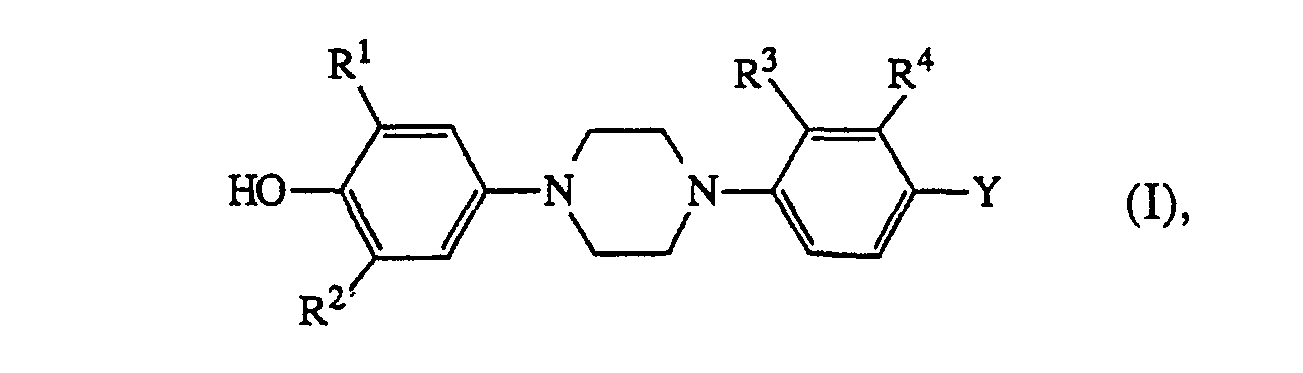
of a compound useful in the treatment of allergic and autoimmune diseases. - The present invention is concerned with 5-lipoxygenase inhibiting 4-(4-phenyl-1-piperazinyl)phenyl derivatives having the formula

- RI and R2 each independently are hydrogen, C1-6alkyl or halo;
- R3 and R4- each independently are hydrogen, halo, amino, nitro or trifluoromethyl;
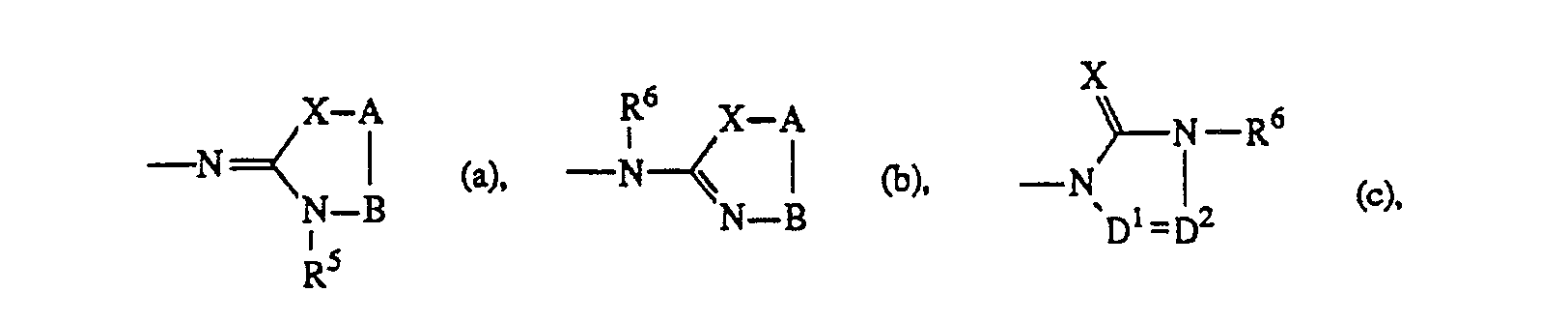
- Y is hydrogen, nitro, amino, mono- or di(C1-6alkyl)amino, C1-6alkylcarbonylamino, C1-6alkyl, C1-6alky-Icarbonyl, hydroxy, halo, mono- or di(C1-6alkyl)aminosulfonyl or a heterocyclic radical of formula


- X is oxygen or sulfur;
- R5 and R6 each independently are C1-6alkyl, C3-6alkenyl, C3-salkynyl, aryl, (aryl)C1-6alkyl, C3-7CYC- loalkyl, (C3-7cycloalkyl)C1-6alkyl, C1-6alkyloxyC1-6alkyl, mono-, di- or trihaloC1-6alkyl; said C1-6alkyl, C3-7cycloalkyl, (C3-7cycloalkyl)C1-6alkyl and (aryl)C1-6alkyl being optionally substituted with oxo or hydroxy on any carbon atom of the C1-6alkyl or C3-7cycloalkyl moiety, provided that said carbon atom is not adjacent to the nitrogen atom bearing said R5 or R6 radical; and R6 may also be hydrogen;
- A is -C(R7)(R8)- and B is -CH2- or -CH2-CH2-, or A and B taken together form a bivalent radical of formula -CH = CH- (1) or -CH = N- (m), wherein the carbon atom of said radical is connected to X;
- R7 and R8 each independently are hydrogen or C1-6 alkyl and R7 may also be C, -s alkyloxy; and in each of the bivalent radicals -B-, -CH = CH- (1) and -CH = N- (m) one or where possible two hydrogen atoms may be replaced by C1-6alkyl or aryl; and in the bivalent radical B, two geminal hydrogen atoms may also be replaced by C4-salkanediyl optionally substituted with one or two C1-6alkyl radicals;
- D' is -N = or -CH = ; and
- D2 is = N-, = CH- or = CH-C( = 0)-;
- E' is -CH2-, -CH2-CH2- or -C( = 0)-;
- E2 is -C(R9)(R'O)- or -NR"-C(=0)- wherein the carbonyl of said radical is connected to NRs;
- R9 and R10 are each independently hydrogen or C1-6alkyl; or R9 and R10 taken together may form a bivalent C4-6alkanediyl radical optionally substituted with one or two C1-6alkyl radicals; or R6 and R9 taken together may form a bivalent C3-salkanediyl radical optionally substituted with one or two C1-6alkyl radicals; and in each of the bivalent radicals D1,D2 and E1, one or where possible two hydrogen atoms may be replaced by C1-6alkyl;
- each R" independently is hydrogen or C1-6alkyl;
- R'2 is hydrogen, C1-6alkyl or C1-6alkylthio;
- R'3 is hydrogen or C1-6alkylthio; and
- aryl is phenyl optionally substituted with one to three radicals independently selected from halo, C1-6alkyl, C. -5alkyloxy, hydroxy or mono-, di- or trihaloC1-6alkyl.
- The radicals of formula (b), (c), (d) and (e), wherein R6 is hydrogen may also exist in their tautomeric forms. Such forms, although not explicitly indicated in the above radicals (b), (c), (d) and (e), are intended to be included within the scope of formula (I).
- As used in the foregoing definitions C1-6alkyl denotes straight or branch chained saturated hydrocarbon radicals having from 1 to 6 carbon atoms, e.g. methyl, ethyl, propyl, 1-methylethyl, the four butyl isomers, the pentyl and hexyl isomers; C3-Galkenyl defines straight and branch chained hydrocarbon radicals containing one double bond and having from 3 to 6 carbon atoms such as, for example, 2-propenyl, 2-butenyl, 3-butenyl, 2-methyl-2-propenyl, 2-pentenyl, 3-pentenyl, 4-pentenyl, 3-methyl-2-butenyl and the hexenyl isomers; C3-6alkynyl defines straight and branch chained hydrocarbon radicals containing one triple bond and having from 3 to 6 carbon atoms such as, for example, 2-propynyl, 2-butynyl, 3-butynyl, 2-pentynyl, 3-pentynyl or 4-pentynyl and the hexynyl isomers; and when said C3-salkenyl or C3-salkynyl are substituted on a nitrogen atom, then the carbon atom of said C3-salkenyl or C3-salkynyl connected to said heteroatom preferably is saturated; C3-7cycloalkyl defines cyclopropyl, cyclobutyl, cyclopentyl, cyclohexyl and cycloheptyl; Cs-salkanediyl and C4-6alkanediyl define bivalent saturated hydrocarbon radicals having from 3 to 5, respectively from 4 to 6 carbon atoms, e.g., 1,3-propanediyl, 1,4-butanediyl, 1,5-pentanediyl and 1,6-hexanediyl; halo is fluoro, chloro, bromo or iodo; the term mono-, di- and trihaloC1-6alkyl as used hereinabove defines C1-6alkyl radicals wherein one, two or three hydrogen atoms are replaced by halo atoms. Examples of such radicals are fluoromethyl, difluoromethyl, trifluoromethyl, trichloromethyl, 2-chloroethyl, 2,2,2-trifluoroethyl and the like.
- Depending on the nature of the various substituents the compounds of formula (I) may contain asymmetrical carbon atoms. Unless otherwise mentioned or indicated, the chemical designation of compounds denotes the mixture of all possible stereochemically isomeric forms, said mixtures containing all diastereoisomers and enantiomers of the basic molecular structure. The absolute configuration of each chiral center may be indicated by the stereochemical descriptors R and S, this R and S notation corresponding to the rules described in Pure Appl. Chem. 1976, 45, 11-30.
- In some compounds the stereochemical configuration is not experimentally determined. In those cases it is conventionally agreed to designate the stereochemically isomeric form which is first isolated as "A" and the second as "B", without further reference to the actual stereochemical configuration.
- Pure isomeric forms of the compounds of formula (I) can be separated from the mixture by conventional separation methods. Preferably, if a specific stereoisomer is desired, said compound will be synthesized by stereoselective methods of preparation. These methods will advantageously employ enantiomerically pure starting materials.
- The compounds of formula (I) have basic properties and, consequently, they may be converted to their therapeutically active non-toxic acid addition salt forms by treatment with appropriate acids such as, for example, inorganic acids, e.g. hydrochloric, hydrobromic and the like acids, sulfuric acid, nitric acid, phosphoric acid and the like; or organic acids, such as, for example, acetic, propanoic, hydroxyacetic, 2-hydroxypropanoic, 2-oxo-propanoic, ethanedioic, propanedioic, butanedioic, (Z)-2-butenedioic, (E)-2-butenedioic, 2-hydroxybutanedioic, 2,3-dihydroxybutanedioic, 2-hydroxy-1,2,3-propanetricarboxylic, methanesulfonic, ethanesulfonic, benzenesulfonic, 4-methylbenzenesulfonic, cyclohexanesulfamic, 2-hydroxybenzoic, 4-amino-2-hydroxybenzoic and the like acids. Conversely the salt form can be converted by treatment with alkali into the free base form.
- The term acid addition salt as used hereinabove also comprises the solvates which the compounds of formula (1) are able to form and said solvates are meant to be included within the scope of the present invention. Examples of such solvates are e.g., the hydrates, alcoholates and the like.
- A particular group among the compounds of formula (I) comprises those compounds of formula (I) wherein Y is a radical of formula (a), (b), (c), (d) or (e); R5 and R6 are C1-6alkyl, C3-7cycloalkyl or (aryl)-C,-salkyl all being optionally substituted with oxo or hydroxy on the C1-6alkyl or C3-7cycloalkyl moiety; or Rs and R6 are C1-6alkyloxy-C1-6alkyl, mono-, di- or trihaloC1-6alkyl.
- A more particular group of compounds of formula (I) comprises those compounds of formula (I) wherein Y is a radical of formula (a), R5 is C1-6alkyl and A-B is CH = CH, (CH2)3 or C(CH3)2-CH2; Y is a radical of formula (b), RS is C1-6alkyl and A-B is CH2-CH2 wherein one or two hydrogen atoms may be replaced by C,-salkyl or two geminal hydrogen atoms may be replaced by C4-6alkanediyl; Y is a radical of formula (c), X is 0, R6 is Ci-salkyl, (aryl)C1-6alkyl, C3-7cycloalkyl, mono-,di- or trihaloC1-6alkyl; said C1-salkyl, (aryl)C1-6alkyl and C3-7cycloalkyl being optionally substituted with oxo or hydroxy on the C1-6alkyl or C3-7cycloalkyl moiety; and D1 = D2 is CH = N wherein hydrogen may be replaced by C1-6alkyl;
- Y is a radical of formula (d), X is 0, R6 is C1-6alkyl or (aryl)C1-6alkyl both being optionally substituted with oxo or hydroxy on the C1-6alkyl moiety; or
- Y is a radical of formula (e) and R6 is C,-salkyl or (aryl)C1-6alkyl both being optionally substituted with oxo or hydroxy on the C1-6alkyl moiety.
- The most interesting compounds are 2,4-dihydro-4-[4-[4(4-hydroxy-3,5-dimethylphenyi)-1-piperazinyl]-phenyl]-5-methyl-2-(1-methylpropyl)-3H-1,2,4-triazol-3-one, 2,4-dihydro-4-[4-(4-(4-hydroxyphenyl)-1-piperazinyl]phenyl]-5-methyl-2-(1-methylpropyl)-3H-1,2,4-triazol-3- one,
- 2-[2-(4-bromophenyl)-1-methyl-2-oxoethyl]-2,4-dihydro-4-[4-[4-(4-hydroxy-3,5-dimethylphenyl)-1-piperazinyl]phenyl]-5-methyl-3H-1,2,4-triazol-3-one,
- 2-[2-(4-bromophenyl)-1-methyl-2-oxoethyl]-2,4-dihydro-4-[4-[4-(4-hydroxyphenyl)-1-piperazinyl]phenyl]-5-methyl-3H-1,2,4-triazol-3-one,
- 2-[2-(4-bromophenyl)-2-hydroxy-1-methylethyl]-2,4-dihydro-4-[4-[4-(4-hydroxyphenyl)-1-piperazinyl]phenyl]-5-methyl-3H-1,2,4-triazol-3-one, and
- 2-[2-(4-bromophenyl)-2-hydroxy-1-methylethyl]-2,4-dihydro-4-[4-[4(4-hydroxy-3,5-dimethylphenyl)-1-piperazinyl]phenyl]-5-methyl-3H-1,2,4-triazol-3-one.
- An additional feature of the present invention comprises the fact that a number of the compounds of formula (I) are novel and have especially been developed to be used as 5-lipoxygenase inhibitors in the method according to the present invention.
- Novel compounds of formula (I), which hereinafter and in the claims will be referred to as compounds of formula (I-a), are those compounds of formula (I) wherein Y and R1 to R13 are as defined hereinabove and wherein
- at least one of R' or R2 is C1-6alkyl or halo; and/or
- at least one of R3 or R4 is halo, amino, nitro or trifluoromethyl; and/or
- Y is mono- or di(C1-6alkyl)amino, (C1-6alkyl)carbonylamino, C1-6alkyl, C1-6alkylcarbonyl, halo, mono- or di(C1-6alkyl)aminosulfonyl, or a radical of formula
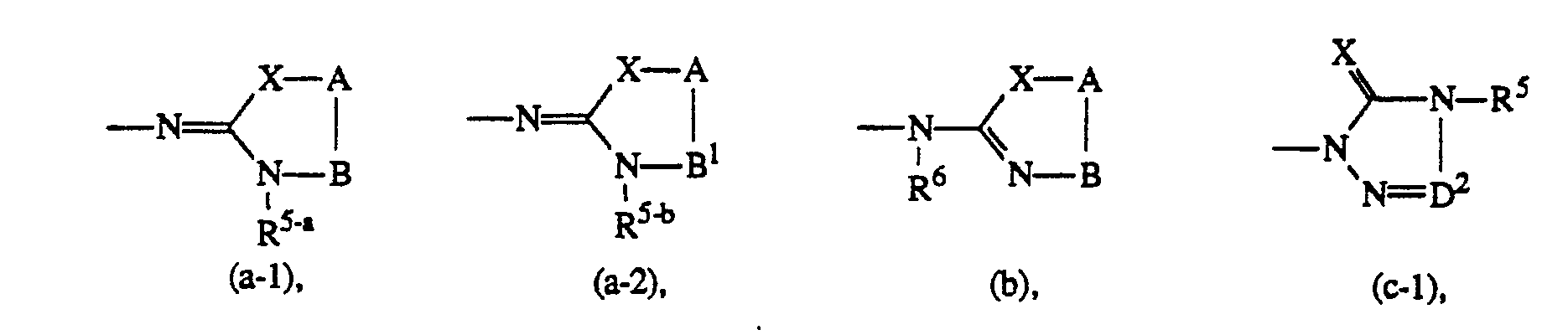

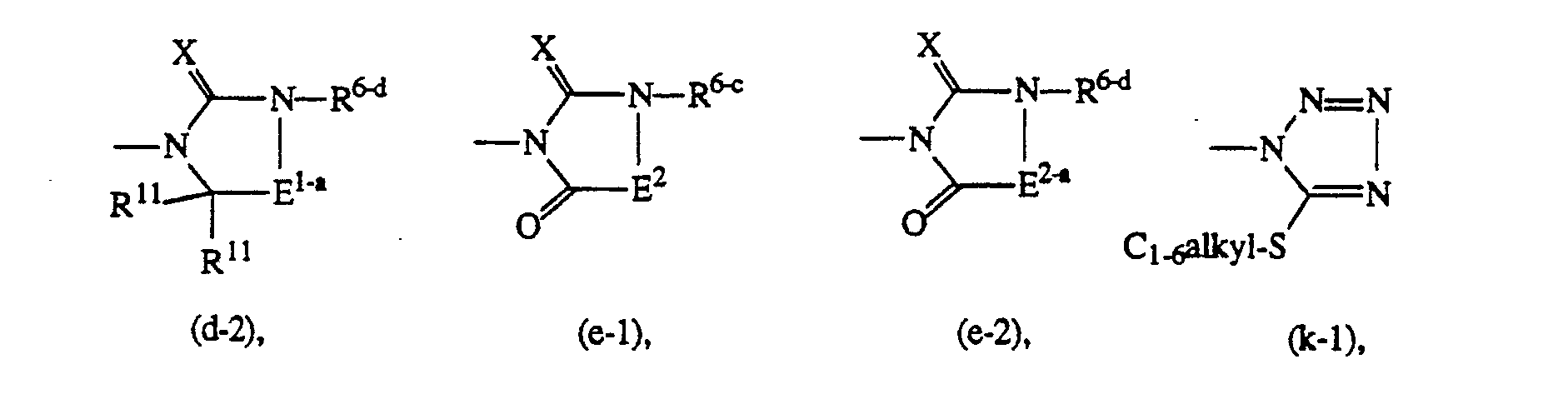
- wherein X, R5, R6, A, B, D2, E1, E2,R" and aryl are as defined under formula (I) and
- R5-a is mono-, di- or trihaloC1-6alkyl; C7cycloalkyl or (C7cycloalkyl)C1-6alkyl, both being optionally substituted with oxo or hydroxy on the C1-6alkyl or C7cycloalkyl moiety;
- R5-b is C1-6alkyl, C3-scycloalkyl or (C3-6cycloalkyl)C1-6alkyl or (aryl)C1-6alkyl, all being substituted with oxo or hydroxy on the C1-salkyl or C3-scycloalkyl moiety;
- B' is -CH2-CH2- wherein one or two hydrogen atoms may be replaced by C1-6alkyl or aryl, or two geminal hydrogen atoms may be replaced by a C4-6alkanediyl radical optionally substituted with one or two C1-6alkyl radicals;
- D2-a is = CH- or = CH-C( = 0)- wherein the hydrogen atom may be replaced by C1-6 alkyl;
- R14 is hydrogen or C1-6alkyl;
- R6-a is C3-salkenyl, C3-salkynyl, aryl C3-7cycloalkyl, (C3-7cycloalkyl)C1-6alkyl, C1-6alkyloxyC1-6alkyl, mono-, di- or trihaloC1-6alkyl; C7cycloalkyl or (C7cycloalkyl)C1-6alkyl, both being substituted with oxo or hydroxy on the C1-6alkyl or C7cycloalkyl moiety;
- R6-b is C1-6alkyl, (aryl)C1-6alkyl; or C1-6alkyl, C3-6cycloalkyl,(C3-6cycloalkyl)C1-6alkyl and (aryl)C1-6alkyl being substituted with oxo or hydroxy on the C1-6alkyl or C3-6cycloalkyl moiety;
- R6-c is mono-, di- or trihaloC,-salkyl; C7cycloalkyl or (C7cycloalkyl)C1-6alkyl, both being optionally substituted with oxo or hydroxy on the C1-6alkyl or C7cycloalkyl moiety; or R6-c and R9 taken together may form a bivalent C3-salkanediyl radical optionally substituted with one or two C1-6alkyl radicals; E1-a is -CH2-CH2- wherein one or two hydrogen atoms may be replaced by C, -salkyl;
- R6-d is hydrogen, C3-6alkenyl, C3-6alkynyl, aryl, C3-scycloalkyl, (C3-6cycloalkyl)C1-6alkyl, C1-6alkyloxyC1-6alkyl; or C1-6alkyl, Cs-scycloalkyl, (C3-6cycloalkyl)C1-6alkyl or (aryl)C1-6alkyl being optionally substituted with oxo or hydroxy on the C1-6alkyl or C3-scycloalkyl moiety; and E2-a is -NR11-C(=O)-.
- Particular novel compounds are those novel compounds as defined hereinabove wherein at least one of R1 or R2 is C1-4alkyl or halo; and/or at least one of R3 or R4 is halo, amino, nitro or trifluoromethyl; and/or Y is a radical of formula


- R15 is C1-6alkyl;
- R16 is mono-, di- or trihaloC1-6alkyl; C3-6cycloalkyl; or C7cycloalkyl optionally substituted with oxo;
- E3 is C3-5alkanediyl;
- E4 is C4-6alkanediyl;
- R17 is (aryl)Ci -6alkyl substituted with oxo or hydroxy on the C1-6alkyl moiety.
- More particular novel compounds are those particular novel compounds as defined hereinabove wherein at least one of R1 or R2 is methyl and/or Y is a radical of formula (c-3a), (e-1 a) or (e-2a).
- The most interesting novel compounds are 2,4-dihydro-4-[4-[4-(4-hydroxy-3,5-dimethylphenyl)-1-piperazinyl]phenyl]-5-methyl-2-(1-methyipropyl)-3H-1,2,4-triazol-3-one,
- 2-[2-(4-bromophenyl)-1-methyl-2-oxoethyl]-2,4-dihydro-4-[4-[4-(4-hydroxy-3,5-dimethylphenyl)-1-piperazinyl]phenyl]-5-methyl-3H-1,2,4-triazol-3-one and
- 2-[2-(4-bromophenyl)-2-hydrox
y -1-methylethyl]-2,4-dihydro-4-[4-[4-(4-hydroxy-3,5-dimethylphenyl)-1-piperazinyl]phenyl]-5-methyl-3H-1,2,4-triazol-3-one. - Procedures for the preparation of a number of the compounds of formula (I) have been described in US-4,267,179 and 4,619,931 and in EP-A-0,228,125.
- Novel compounds of formula (I-a) as defined hereinabove can generally be prepared following said or alternative procedures or, in some instances, following optimized modifications thereof. A number of such procedures will be described hereinafter in some more detail. The compounds of formula (I) can generally be obtained from alkyloxy-derivatives of formula (II) by an appropriate dealkylation reaction, e.g. in an acidic medium using a strong non-oxidizing acid, e.g. trifluoroacetic acid, boron tribromide or a mineral acid such as concentrated hydrohalic acid e.g. hydrobromic acid, hydroiodic acid, optionally in admixture with a saturated solution of hydrobromic acid in glacial acetic acid; or with a strong nucleophile such as an alcoholate or a thiolate, e.g. lithium isopropylthiolate.

- In (II) R18 represents an alkyl, in particular a Ci-Galkyl group and preferably a methyl group. In the instance where hydrobromic acid is used it may be advantageous to conduct said dealkylation reaction in the presence of a bromine scavenger such as, for example sodium sulfite or hydrogen sulfite.
- The compounds of formula (I) can also be prepared by N-arylating a piperazine of formula (III) with a substituted benzene of formula (IV) wherein W is an appropriate leaving group, in particular halo, and preferably is fluoro or chloro.

- Said N-arylation reaction can be carried out according to art-known procedures, e.g. by stirring the reactants, preferably at a somewhat elevated temperature in an appropriate solvent such as a dipolar aprotic solvent, for example, dimethylsulfoxide, N,N-dimethylformamide, N,N-dimethylacetamide; an alcohol, e.g. 1-butanol, an ether, e.g. tetrahydrofuran and the like solvents. In particular, the reaction may be conducted in the presence of an appropriate base such as, for example, an alkali metal hydride or carbonate.
- The compounds of formula (I) can also be converted into each other following art-known procedures of functional group transformation. Some examples will be cited hereinafter.
- The compounds of formula (I) having a nitro substituent can be converted into the corresponding amines by stirring and, if desired, heating the starting nitro-compounds in a hydrogen-containing medium in the presence of a suitable amount of an appropriate catalyst such as, for example, platinum-on-charcoal, palladium-on-charcoal, Raney-nickel and the like catalysts. Suitable solvents are, for example, alcohols, e.g. methanol, ethanol and the like.
- Halo atoms substituted on aryl groups may be replaced by hydrogen following art-known hydrogenolysis procedures, i.e. by stirring and, if desired, heating the starting compounds in a suitable solvent under hydrogen atmosphere in the presence of an appropriate catalyst, e.g. palladium-on-charcoal and the like catalysts.
- The compounds of formula (I) wherein Y is amino can also be converted into other compounds encompassed by formula (I); e.g. the compounds wherein Y is (C1-6alkyl)carbonylamino can be obtained by a selective N-acylation reaction with an carboxylic acid halogenide or anhydride in a suitable solvent such as, for example an aromatic hydrocarbon, e.g. benzene, methylbenzene and the like, a dipolar aprotic solvent, e.g. N,N,dimethylformamide, dimethyl sulfoxide and the like, or a mixture of such solvents, and in the presence of an appropriate base, e.g. N,N-diethylethanamine, pyridine and the like bases.
- A number of intermediates and starting materials in the foregoing preparations are known compounds which may be prepared according to art-known methodologies of preparing said or similar compounds and some intermediates are new. A number of such preparation methods will be described hereinafter in more detail.
- In order to simplify the structural representations of some of the intermediates in the following preparations, the 4-(4-phenyl-1-piperazinyl)alkyloxyphenyl group wherein R', R2, R3 and R4- are as defined under formula (I), will hereinafter be represented by the symbol T.

- For example, the intermediates of formula (II), wherein Y is a heterocycle of formula (b) and -A-B- is a radical of formula -C(R19)=C(R20)-, said R19 and R20 independently being hydrogen, C1-6alkyl or aryl, and said intermediates being represented by formula (II-a), may be prepared by condensing a thiourea (X = S) or urea (X=0) of formula (V) with an appropriate a-halo-ketone of formula (VI), in an acidic buffer such as a carboxylic acid, e.g. acetic acid and the like, in the presence of an alkali metal salt of said carboxylic acid, at an elevated temperature. In formula (VI), W' represents halo, preferably chloro or bromo. The intermediates of formula (II-a) may be alkylated with a reagent R6-a-W, wherein R6-a is as R6, provided it is not hydrogen, and W is a reactive leaving group.

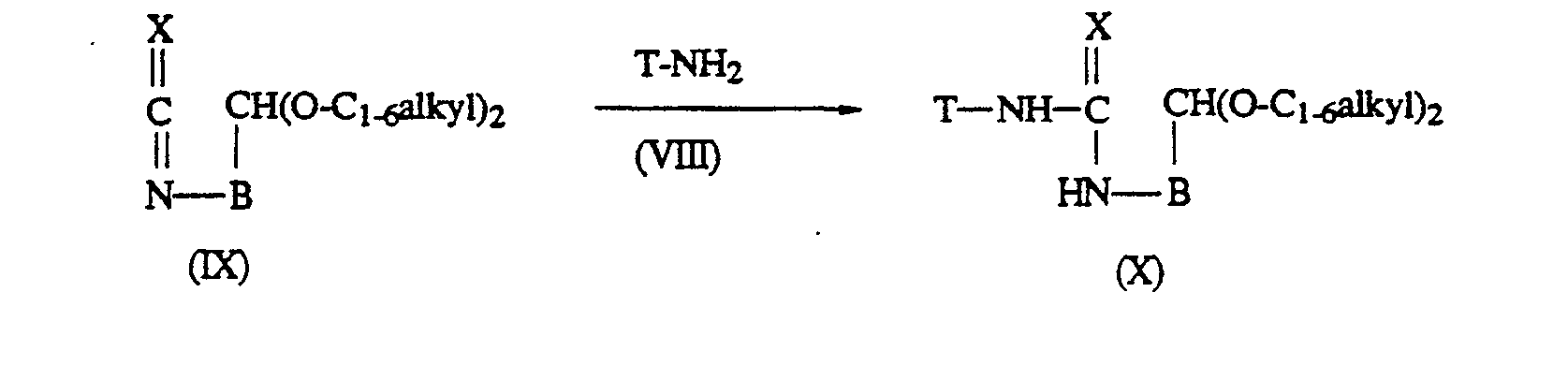
- The intermediates of formula (II), wherein Y is a heterocycle of formula (b) wherein -A- is a radical -CH-(OC1-6alkyl)-; and R6 is other than hydrogen, said intermediates being represented by formula (II-c), can be obtained by reacting an amine of formula (VIII) with an isothiocyanate (X=S) or isocyanate (X=O) of formula (IX)

- The intermediates of formula (II) wherein A-B is C(R21) = N, said R21 being bydrogen or C1-6 alkyl and said intermediates being represented by formula (II-e), can be prepared by reacting a hydrazine car- bothiamide (X=S) or hydrazine carboxamide (X=O) of formula (XI) with an appropriate acylating reagent, e.g. an acyl halide (Z=halo) or anhydride (Z=RCOO) of formula (XII) in a reaction-inert solvent at an elevated temperature; and then treating the thus obtained intermediate (XIII) with a suitable acid such as sulfonic acid, e.g. methanesulfonic acid, optionally in a reaction-inert solvent.

- The intermediate of formula (II-f) further may be alkylated to an intermediate (II-e) with an alkylating reagent R6-a-W (VII) following the same procedure as described above for the preparation of (II-b).
- The intermediates of formula (II) wherein Y is a heterocycle of formula (c) and D1 = D2 is N=CR24, said R24 being hydrogen or C1-6alkyl and said intermediates being represented by formula (II-g), may be obtained as follows. An appropriate 4-nitrophenyl-hydrazine (XIV) is reacted with an iminoether of formula (XV), followed by a substitution reaction with a secondary amine R22R23NH(XVI), wherein R22 and R23 are C1-5alkyl or R22 and R23 complete a pyrrolidinyl, piperidinyl or morpholinyl ring. The thus obtained hydrazine derivative (XVII) is subsequently cyclized with an isocyanate (XVIII) to yield a 4-nitrophenyl- triazolone (XIX), which in turn is reduced to a 4-aminophenyl-triazolone (XX). The latter is subsequently condensed with a 4-methoxyaniline of formula (XXI) thus yielding the desired intermediates of formula (II-g).

- The intermediates of formula (II), wherein Y is a heterocycle of formula (c) and D' = D2 is CR24 = N, said R24 being hydrogen or C1-6alkyl and said intermediates being represented by formula (II-h), may also be obtained by cyclizing an amine (VIII) with aminomethylene hydrazine carboxylate derivative (XXII) preferably in a high-boiling aprotic solvent such as tetrahydrothiophene 1,1-dioxide and N-alkylating the thus obtained intermediate (XXV) with a reagent R6-a-W (VII), following the same procedure as described above for the preparation of (II-b).

- Alternatively, treatment of the amine (VIII) with a carbonochloridate, e.g. phenyl carbonochloridate, followed by a substitution reaction with hydrazine, yields the hydrazine carboxamide (XXIII), which can easily be cyclized to an intermediate of formula (XXV) upon treatment with an amidine (XXIV) or a corresponding salt form thereof.
- Pure stereochemically isomeric forms of the compounds of formula (I) may be obtained by the application of art-known procedures. Diastereoisomers may be separated by physical separation methods such as selective crystallization and chromatographic techniques, e.g. counter current distribution, column chromatography or high performance liquid chromatography, and enantiomers may be separated according to art-known resolution methods, e.g. by the selective crystallization of the diastereomeric salts obtained with optically active acids. Pure stereochemically isomeric forms may also be prepared from the corresponding pure stereochemically isomeric forms of the appropriate starting materials by stereospecific reactions.
- The compounds of formula (I) are potent and selective inhibitors of the 5-lipoxygenase enzyme both in vitro and in vivo. Inhibition of the 5-lipoxygenase enzyme effectively blocks the metabolic pathway leading from arachidonic acid to leukotrienes, which substances are known to possess a range of potent physiological effects and are presumed to be involved in a variety of allergic, anaphylactic and inflammatory reactions (Science, 220, 568-575, 1983).
- Leukotrienes C4, D4- and E4 (LTCa., LTD4 and LTEa) strongly induce the contraction of smooth muscles and in particular exhibit powerful bronchoconstricting properties. Further, said leukotrienes increase the vascular permeability, thus resulting in the leakage of intravascular fluid and proteins into the tissues and the formation of edema. Leukotriene B4, a potent chemokinetic and chemotactic agent towards leukocytes, has been proposed as an important mediator in immediate and subacute hypersensitivity reactions and inflammatory processes (The New England Journal of Medicine, 303, 822-825, 1980; "The Leukotrienes: Chemistry and Biology", ed. L.W. Chakrin, D.M. Bailey, Academic Press, Orlando, 195-214, 1984). The above-mentioned leukotrienes are all derived from a common intermediate, 5-hydroperoxyeicosatetraenoic acid (5-HPETE) which is formed from arachidonic acid through the activity of a 5-lipoxygenase. Other lipoxygenases, e.g. 12- and 15-lipoxygenase, transform arachidonic acid into several other mono- and dihydroxy derivatives with opposite or synergistic biological activities. Additionally, an increased release of the products of 5-lipoxygenase and 12-lipoxygenase enzymatic activity from the lesioned skin of patients with psoriasis as well as with atopical dermatitis has been reported (Prostaglandins 29, 611-619, 1985; J. Invest. Dermatol.83, 70-73, 1983; Lancet, i, 222-223, 1984).
- Consequently, inhibitors of the lipoxygenase-mediated metabolic pathways of arachidonic acid, and in particular of the 5-lipoxygenase enzyme, are considered to be valuable therapeutical drugs for suppressing the abovementioned adverse effects of leukotrienes. Associated diseases and/or disorders are, for instance, asthma, allergy, anaphylaxis, psoriasis and inflammatory reactions, e.g. arthritis and dermatitis. The invention gains importance by the fact that the compounds of formula (I) to be used in the present method are both potent and selective inhibitors towards the 5-lipoxygenase enzyme. Most other inhibitors reported lack selectivity and concomitantly inhibit other lipoxygenases and/or cyclooxygenase, the enzyme which mediates the metabolism of arachidonic acid towards the prostaglandines. The compounds of formula (I) do not significantly inhibit soy bean 15-lipoxygenase, human platelet 12-lipoxygenase, human platelet cyclooxygenase nor thromboxane A2 synthetase. Furthermore, the compounds of formula (I) generally show only moderate non-specific and anti-oxidant properties.
- Another important feature of the present invention is the fact that the compounds of formula (I) are orally active as is shown in the "Inhibition of Dextran-induced edema formation in the ears of mice" test (Example 23).
- The present invention also relates to a method of treating warm-blooded animals suffering from leukotriene-mediated diseases and/or disorders, by administering an effective 5-lipoxygenase inhibiting amount of a compound of formula (I) or a pharmaceutically acceptable acid addition salt thereof. Those of skill in the relevant art could easily determine the effective amount of 5-lipoxygenase inhibitor from the results presented hereinafter. In genera; it is contemplated that a suitable dose administered daily to subjects would be from about 0.1 mg/kg to about 50 mg/kg body weight, and more preferably from about 1 mg kg to about 10 mg/kg body weight.
- In view of their 5-lipoxygenase inhibiting activity, the subject compounds may be formulated into various pharmaceutical forms for administration purposes. To prepare the pharmaceutical compositions of this invention, an effective amount of the particular compound or an acid addition salt thereof, as the active ingredient is combined in intimate admixture with a pharmaceutically acceptable carrier, which carrier may take a wide variety of forms depending on the form of preparation desired for administration. These pharmaceutical compositions are desirably in unitary dosage form suitable, preferably, for administration orally, rectally, percutaneously, or by parenteral injection. For example, in preparing the compositions in oral dosage form, any of the usual pharmaceutical media may be employed, such as, for example, water, glycols, oils, alcohols and the like in the case of oral liquid preparations such as suspensions, syrups, elixirs and solutions: or solid carriers such as starches, sugars, kaolin, lubricants, binders, disintegrating agents and the like in the case of powders, pills, capsules and tablets. Because of their ease in administration, tablets and capsules represent the most advantageous oral dosage unit form, in which case solid pharmaceutical carriers are obviously employed. For parenteral compositions, the carrier will usually comprise sterile water, at least in large part, though other ingredients, for example, to aid solubility, may be included. Injectable solutions, for example, may be prepared in which the carrier comprises saline solution, glucose solution or a mixture of saline and glucose solution. Injectable suspensions may also be prepared in which case appropriate liquid carriers, suspending agents and the like may be employed.ln the compositions suitable for percutaneous administration, the carrier optionally comprises a penetration enhancing agent and/or a suitable wetting agent, optionally combined with suitable additives of any nature in minor proportions, which additives do not cause a significant deleterious effect to the skin. Said additives may facilitate the administration to the skin and/or may be helpful for preparing the desired compositions. These compositions may be administered in various ways, e.g., as a transdermal patch, as a spot-on, as an ointment. Acid addition salts of (I) due to their increased water solubility over the corresponding base form, are obviously more suitable in the preparation of aqueous compositions. It is especially advantageous to formulate the aforementioned pharmaceutical compositions in dosage unit form for ease of administration and uniformity of dosage. Dosage unit form as used in the specification and claims herein refers to physically discrete units suitable as unitary dosages, each unit containing a predetermined quantity of active ingredient calculated to produce the desired therapeutic effect in association with the required pharmaceutical carrier. Examples of such dosage unit forms are tablets (including scored or coated tablets), capsules, pills, powder packets, wafers, injectable solutions or suspensions, teaspoonfuls, tablespoon-fuls and the like, and segregated multiples thereof.
- The following examples are intended to illustrate and not to limit the scope of the present invention in all its aspects. Unless otherwise stated all parts therein are by weight.
-
- a) To a stirred solution of 20 parts of 1-(4-isothiocyanatophenyl)-4-(4-methoxyphenyl)-piperazine in 325 parts of dichloromethane were added 40 parts of methanol, saturated with ammonia. The reaction mixture was stirred for 5 days at room temperature. The precipitated product was filtered off, washed with dichloromethane and dried, yielding 20.5 parts (98.1 %) of N-[4-[4-(4-methoxyphenyl)-1-piperazinyl]phenyl]-thiourea; mp. 265.2 C (int. 1).
- b) A mixture of 5 parts of N-[4-[4-(4-methoxyphenyl)-1-piperazinyl]phenyl]thiourea, 3 parts of 2-chloro-1-phenylethanone, 1.7 parts of sodium acetate and 100 parts of acetic acid was stirred for 4 hours at 80 C. After cooling, the reaction mixture was evaporated and the residue was stirred in 130 parts of dichloromethane. The whole was neutralised with a sodium hydrogen carbonate solution. The precipitated product was filtered off, washed with water and dichloromethane and crystallized from 1,4-dioxane. The product was filtered off and dried, yielding 4.5 parts (69.6%) of N-[4-[4-(4-methoxyphenyl)-1-piperazinyl]-phenyl]-4-phenyl-2-thiazolamine; mp. 269.7 C (int. 2).
- c) A mixture of 4.6 parts of N-[4-[4-(4-methoxyphenyl)-1-piperazinyl]phenyl]-4-phenyl-2-thiazolamine, 2 parts of bromoethane, 1 part of sodium hydroxide and 94 parts of N,N-dimethylformamide was stirred for 16 hours at room temperature. Another portion of 2 parts of bromoethane and 1 part of sodium hydroxide was added and stirring was continued for 4 hours at 50 ° C. The reaction mixture was diluted with water. The precipitated product was filtered off and purified by column chromatography over silica gel using trichloromethane as eluent. The pure fractions were collected and the eluent was evaporated. The residue was crystallized from 4-methyl-2-pentanone. The product was filtered off and dried, yielding 4.0 parts (81.7%) of N-ethyl-N-[4-[4-(4-methoxyphenyl)-1-piperazinyl]phenyl]-4-phenyl-2-thiazolamine; mp. 223.6 C(int. 3).
-
- a) A mixture of 5.7 parts of 4-[4-(4-methoxyphenyl)-1-piperazinyl] benzenamine, 3 parts of 2-isothiocyanato-1,1-methoxyethane and 100 parts of 1,4-dioxane was stirred and refluxed for 1 hour. The reaction mixture was evaporated. The residue was purified by column chromatography over silica gel using a mixture of trichloromethane and methanol (98:2 by volume) as eluent. The pure fractions were collected and the eluent was evaporated. The residue was crystallized from 4-methyl-2-pentanone, yielding 3.1 parts (36%) of N-(2,2-dimethoxyethyl)-N'-[4- [4-(4-methoxyphenyl)-1-piperazinyl]phenyl]thiourea (int. 4).
- b) A mixture of 17.6 parts of N-(2,2-dimethoxyethyl)-N'-[4-[4-(4-methoxyphenyl)-1-piperazinyl]phenyl]-thiourea and 120 parts of formic acid was stirred for 1 hour at room temperature. The reaction mixture was evaporated in vacuo and the residue was dissolved in 133 parts of dichloromethane. The mixture was neutralized with a sodium hydrogen carbonate solution. The precipitated product was filtered off, washed with water and dichloromethane and crystallized from 4-methyl-2-pentanone. The product was filtered off and dried, yielding 8.5 parts (52.0%) of 4,5-dihydro-5-methoxy-N-[4-[4-(4-methoxyphenyl)-1-piperazinyl]-phenyl]-2-thiazolamine; mp. 177.5 C (int. 5).
- c) A mixture of 15 parts of 4,5-dihydro-5-methoxy-N-[4-[4-(4-methoxyphenyl)-1-piperazinyl]phenyl]-2-thiazolamine, 5.8 parts of bromoethane, 3 parts of sodium hydroxide pellets and 207 parts of N,N-dimethylformamide was stirred for 16 hours at room temperature. The reaction mixture was diluted with water. The precipitated product was filtered off and purified by column chromatography over silica gel using a mixture of trichloromethane, ethyl acetate, hexane and methanol (49:30:20:1 by volume) as eluent. The second fraction was collected and the eluent was evaporated. The residue was crystallized from 4-methyl-2-pentanone. The product was filtered off and dried, yielding 7.3 parts (44.4%) of N-ethyl-4,5-dihydro-5-methoxy-N-[4-[4-(4-methoxyphenyl)-1-piperazinyl]phenyl]-2-thiazolamine hemihydrate; mp. 131.5°C (int. 6).
-
- a) A mixture of 10 parts of 1-(4-isothiocyanatophenyl)-4-(4-methoxyphenyl)piperazine, 3 parts of 2-amino-2-methyl-1-propanol and 260 parts of dichloromethane was stirred overnight at room temperature. The precipitated product was filtered off, washed with dichloromethane and 2-propanone and dried, yielding 11.7 parts (91.9%) of N-(2-hydroxy-1,1-dimethylethyl)-N'-[4-[4-(4-methoxyphenyl)-1-piperazinyl]phenyl]-thiourea; mp. 221.6* C (int. 7).
- b) A mixture of 74 parts of N-(2-hydroxy-1,1-dimethylethyl)-N'-[4-[4-(4-methoxyphenyl)-1-piperazinyl]-phenyl]thiourea and 360 parts of formic acid was stirred for 4 hours at 70 C. The reaction mixture was evaporated and the residue was dissolved in 260 parts of dichloromethane. The whole was neutralized with a sodium hydrogen carbonate solution. The precipitated product was filtered off, washed with water and dichloromethane and purified by column chromatography over silica gel using a mixture of trichloromethane and methanol, saturated with ammonia, (99:1 by volume) as eluent. The pure fractions were collected and the eluent was evaporated. The residue was crystallized from 4-methyl-2-pentanone. The product was filtered off and dried, yielding 44.1 parts (62.4%) of 4,5-dihydro-N-[4-[4-(4-methoxyphenyl)-1-piperazinyl]-phenyl]-4,4-dimethyl-2-thiazolamine; mp. 232.0 C (int. 8).
- c) A mixture of 37 parts of 4,5-dihydro-N-[4-[4-(4-methoxyphenyl)-1-piperazinyl]phenyl]-4,4-dimethyl-2-thiazolamine, 5 parts of a sodium hydride dispersion 50% and 376 parts of N,N-dimethylformamide was stirred for 2 hours at 70 C. After cooling to room temperature, 14.1 parts of iodomethane were added slowly to the reaction mixture. The whole was stirred for 1 hour at room temperature. The reaction mixture was diluted with water. The precipitated product was filtered off, washed with water and 2-propanol and purified by column chromatography (HPLC) over silica gel using a mixture of dichloromethane and methanol (96:4 by volume) as eluent.
- The first fraction was collected and the eluent was evaporated. The residue was further purified by column chromatography over silica gel using a mixture of dichloromethane and methanol (98:2 by volume). The pure fractions were collected and the eluent was evaporated. The residue was crystallized from 4-methyl-2-pentanone, yielding 4-[4-(4-methoxyphenyl)-1-piperazinyl]-
N -(3,4,4-trimethyl-2-thiazolidinylidene)-benzenamine (int. 9). - The second fraction was collected and boiled in 2-propanol. After cooling, the product was filtered off and dried, yielding 19.5 parts (51.0%) of 4,5-dihydro-N-[4-[4-(4-methoxyphenyl)-1-piperazinyl]phenyl]-N,4,4-trimethyl-2-thiazolamine; mp. 166.6°C (int. 10)
-
- a) A mixture of 47.8 parts of 1-(4-isothiocyanatophenyl)-4-(4-methoxyphenyl)piperazine, 100 parts of hydrazine hydrate and 400 parts of 1,4-dioxane was stirred and refluxed for 1 hour. The reaction mixture was cooled and poured into water. The precipitated product was filtered off, washed with water and methanol and dried, yielding 46 parts (89%) of N-[4-[4-(4-methoxyphenyl)-1-piperazinyl]phenyl]-hydrazinecarbothioamide (int. 11).
- b) A mixture of 3.6 parts of N-[4-[4-(4-methoxyphenyl)-1-piperazinyl]phenyl]hydrazinecarbothioamide, 1 part of acetic acid anhydride and 150 parts of trichloromethane was stirred for 1 hour at reflux temperature. After cooling, the precipitated product was filtered off and dried, yielding 3.6 parts (90.1 %) of acetic acid, 2-[[[4-[4-(4-methoxyphenyl)-1-piperazinyl]phenyl]amino]thioxomethylhydrazide; mp 229.8 C (int. 12).
- c) A mixture of 2.6 parts of acetic acid, 2-[[[4-[4-(4-methoxyphenyl)-1-piperazinyl]-phenyl]amino]-thioxomethylhydrazide and 74 parts of methanesulfonic acid was stirred for 2 hours at room temperature. The reaction mixture was poured into a mixture of ammonium hydroxide in crushed ice while stirring. The precipitated product was filtered off, washed with water and crystallized from N,N-dimethylformamide. The product was filtered off and dried, yielding 2.1 parts (84.7%) of N-[4-[4-(4-methoxyphenyl)-1-piperazinyl]-phenyl]-5-methyl-1,3,4-thiadiazol-2-amine; mp. 276.7° C (int. 13). -
- d) A mixture of 10.6 parts of N-[4-[4-(4-methoxyphenyl)-1-piperazinyl]phenyl]-5-methyl-1,3,4-thiad iazol-2-amine, 0.5 parts of bromoethane, 4 parts of sodium hydroxide pellets and 188 parts of N,N-dimethylformamide was stirred for 4 hours at 40-50 C. After the addition of water, the crystallized product was filtered off and purified by column chromatography over silica gel using a mixture of trichloromethane, methanol, ethyl acetate and hexane (48:2:30:20 by volume) as eluent.
- The first fraction was collected and the eluent was evaporated. The residue was crystallized from 4-methyl-2-pentanone. The product was filtered off and dired, yielding 2.9 parts (25.3%) of N-(3-ethyl-5-methyl-1,3,4-thiadiazol-2(3H)-ylidene)-4-[4-(-methoxyphenyl)-1-piperazinyl]benzenamine; mp. 17
5 .4° C (int. 14). The second fraction was collected and the eluent was evaporated. The residue was crystallized from 4-methyl-2-pentanone. The product was filtered off and dried, yielding 6.5 parts (56.7%) of N-ethyl-N-[4-[4-(4-methoxyphenyl)-1-piperazinyl]phenyl]-5-methyl-1 ,3,4-thiadiazol-2-amine; mp. 186.8°C (int. 15). - To a stirred mixture of 17.2 parts of phenyl [4-[4-(4-methoxy-3,5-dimethylphenyl)-1-piperazinyl]phenyl]-carbamate, 225 parts of N,N-dimethylformamide and 9.1 parts of N,N-diethylethanamine were added 9.6 parts of chlorotrimethylsilane. The whole was stirred first for 2 hours at room temperature and further for 2 hours at 80° C. After cooling, 10.1 parts of 2-bromoethanamine hydrobromide were added and stirring was continued for 1 hour. The resulting solution was added to a stirred mixture of9.2 parts of a sodium hydride dispersion 50% and 45 parts of N,Ndimethylformamide. After stirring for 2 hours at room temperature, 6.15 parts of 1-bromopropane were added dropwise. Upon completion, stirring was continued overnight at room temperature. The reaction mixture was poured into water. The precipitated product was filtered off and crystallized from 2-propanol, yielding 5.6 parts (33.1%) of 1-[4-[4-(4-methoxy-3,5-dimethylphenyl)-1-piperazinyl]phenyl]-3-propyl-2-imidazolidinone (int. 16).
- A mixture of 50 parts of phenyl [4-[4-(4-methoxyphenyl)-1-piperazinyl]phenyl]carbamate, 22.7 parts of ethyl 2-piperidinecarboxylate, 4 parts of N,N-dimethyl-4-pyridinamine and 300 parts of 1,4-dioxane was stirred for 5 hours at reflux temperature. After saturation with water, the reaction mixture was heated for 30 minutes. After cooling, the precipitated product was filtered off, washed with 2-propanol and purified by column chromatography over silica gel using a mixture of trichloromethane and methanol (99:1 by volume) as eluent. The pure fractions were collected and the eluent was evaporated. The residue was crystallized from 1-butanol. The product was filtered off and dried, yielding 24.8 parts (47.5%) of 5,6,7,8-tetrahydro-2-[4-[4-(4-methoxyphenyl)-1-piperazinyl]phenyl]imidazo[1,5-a]pyridine-1,3(2H,8aH)-dione; mp. 223.4° C (int. 17).
-
- a) To a stirred and cooled (ice-bath) mixture of 15 parts of 1-(4-nitrophenyl)hydrazine and 160 parts of absolute ethanol were added 13.5 parts of ethyl ethanimidate hydrochloride. After stirring for 3 hours while cooling, the reaction mixture was poured into water. The precipitated product was filtered off, washed with water and dried, yielding 19 parts (85%) of 1-(1-ethoxyethylidene)-2-(4-nitrophenyl)hydrazine; mp. 101.8°C (int. 18).
- b) A mixture of 10 parts of 1-(1-ethoxyethylidene)-2-(4-nitrophenyl)hydrazine, 13 parts of morpholine and 135 parts of methylbenzene was stirred and refluxed for 72 hours. The reaction mixture was cooled. The precipitated product was filtered off, washed with methylbenzene and dried, yielding 8 parts (67%) of 1-[1-(4-morpholinyl)ethylidene]-2-(4-nitrophenyl)hydrazine; mp. 175.9°C. (int. 19)
- c) A mixture of 13 parts of 1-[1-(4-morpholinyl)ethylidene]-2-(4-nitrophenyl)hydrazine, 8.5 parts of 1-isocyanatopropane, 1 part of N,N-dimethyl-4-pyridinamine and 39 parts of dichloromethane was stirred and refluxed for 2 hours. The whole was evaporated and 90 parts of dimethylbenzene were added to the residue. Stirring at reflux was continued for 3 hours. The reaction mixture was cooled and filtered over diatomaceous earth. The filtrate was saturated with petroleum either. The precipitated product was filtered off and crystallized from 2-propanol, yielding 8.5 parts (65%) of 2,4-dihydro-5-methyl-2-(4-nitrophenyl)-4-propyl-3H-1,2,4-triazol-3-one; mp. 125.4°C (int. 20).
- d) A mixture of 57 parts of 2,4-dihydro-5-methyl-2-(4-nitrophenyl)-4-propyl-3H-1,2,4-triazol-3-one and 400 parts of methanol was hydrogenated at normal pressure and at room temperature with 5 parts of palladium-on-charcoal catalyst 20%. After the calculated amount of hydrogen was taken up, the catalyst was filtered off and the filtrate was evaporated. The residue was crystallized from a mixture of 4-methyl-2-pentanone and 2,2'-oxybispropane. The product was filtered off and dried, yielding 46 parts (91 %) of 2-(4-aminophenyl)-2,4-dihydro-5-methyl-4-propyl-3H-1 ,2,4-triazol-3-one; mp. 138.8°C (int. 21).
- e) A mixture of 25 parts of N,N-bis(2-chloroethyl)-4-methoxybenzenamine, 23.2 parts of 2-(4-aminophenyl)-2,4-dihydro-5-methyl-4-propyl-3H-1,2,4- triazol-3-one, 2 parts of potassium iodide and 200 parts of cyclohexanol was stirred and refluxed for 5 hours using a water-separator. The reaction mixture was cooled and neutralized with a sodium hydrogen carbonate solution. The product was filtered off and dissolved in trichloromethane. The solution was filtered over silica gel and the solvent was evaporated. The residue was crystallized from 1-butanol, yielding 18 parts (44%) of 2,4-dihydro-2-(4-[4-(4-methoxyphenyl)-1-piperazinyl]phenyl]-5-methyl-4-propyl-3H-1,2,4-triazol-3-one; mp. 202.2 C (int. 22).
-
- a) To a stirred solution of 42.8 parts of a sodium hydride dispersion 50% in 200 parts of dimethyl sulfoxide was added dropwise slowly a solution of 50 parts of 2,4(1 H,3H)-pyrimidinedione in 800 parts of dimethyl sulfoxide while the temperature was kept constant (20 C) by cooling in an ice/water bath. 62.9 Parts of 1-fluoro-4-nitrobenzene were added and whole was stirred overnight at 50°C. After cooling, the reaction mixture was poured into 2500 parts of water. The whole was washed with dichloromethane. The aqueous phase was brought to pH 5-6. The product was filtered off and stirred in 2-propanone. The product was filtered off and dried in vacuo at 60°C. yielding 60 parts (57.6%) of 1-(4-nitrophenyl)-2,4(1H,3H)-pyrimidinedione; mp.>300°C (int. 23).
- b) A mixture of 3 parts of 1-(4-nitrophenyl)-2,4(1H,3H)-pyrimidinedione, 1.4 parts of potassium hydroxide and 67.5 parts of N,N-dimethylacetamide was stirred for 1 hour at room temperature under nitrogen atmosphere. 1.52 Parts of bromoethane were added and stirring was continued overnight at room temperature. The reaction mixture was poured into 100 parts of ice water. The product was filtered off and stirred in methanol. The product was filtered off and dried in vacuo at 60 C, yielding 2.4 parts (65.6%) of 3-ethyl-1-(4-nitro-phenyl)-2,4(1 H,3H)-pyrimidinedione; mp. 182.5 C (int. 24).
- c) A mixture of 28.4 parts of 3-ethyl-1-(4-nitrophenyl)-2,4(1H,3H)-pyrimidinedione, 5 parts of a solution of thiophene in methanol 4% and 500 parts of 2-methoxyethanol was hydrogenated at normal pressure and at 50 C with 3 parts of platinum-on-charcoal catalyst 5%. After the calculated amount of hydrogen was taken up, the catalyst was filtered off and the filtrate was concentrated to a volume of about 150 parts. After cooling, the product was filtered off (the filtrate was set aside) and dried in vacuo at 60°C, yielding a first fraction of 16.5 parts of 1-(4-aminophenyl)- 3-ethyl-2,4(1 H,3H)-pyrimidinedione (int. 25). The filtrate, which was set aside (see above), was evaporated. The residue was stirred in methanol. The product was filtered off and dried in vacuo at 60°C, yielding a second fraction of 5.7 parts of int. 20. Total yield : 22.2 parts (88.3%) of int. 25; mp. 190.8°C.
- d) A mixture of 17.47 parts of N,N-bis(2-chloroethyl)-4-methoxybenzenamine, 16.3 parts of 1-(4-aminophenyl)-3-ethyl-2,4(1 H,3H)-pyrimidinedione, 11.83 parts of sodium hydrogen carbonate and 240 parts of 1-butanol was stirred for 24 hours at reflux temperature. After cooling, 150 parts of water were added. The product was filtered off and crystallized from methylbenzene. The product was filtered off and dried in vacuo at 60°C, yielding 10.6 parts (37.0%) of 3-ethyl-1-[4-[4-(4-methoxyphenyl)-1-piperazinyl]phenyl]-2,4-(1H,3H)-pyrimidinedione; mp. 210.2°C (int. 26).
-
- a) A mixture of 40 parts of 2-(4-nitrophenyl)-1,2,4-triazine-3,5-(2H,4H)-dione, 25.7 parts of 1-bromobutane, 26.25 parts of potassium carbonate and 720 parts of N,N-dimethylformamide was stirred overnight at 45. C. The reaction mixture was poured into 2000 parts of ice water. The precipitated product was filtered off, washed with water and 2,2 -oxybispropane and stirred in methanol. The product was filtered off and dried in vacuo at 70 C, yielding 33.9 parts (68.6%) of 4-butyl-2-(4-nitrophenyl)-1,2,4-triazine-3,5-(2H,4H)-dione (int. 27).
- b) A mixture of 33.9 parts of 4-butyl-2-(4-nitrophenyl)-1,2,4-triazine-3,5(2H,4H)-dione, 2 parts of a solution of thiophene in methanol 4% and 400 parts of 2-methoxyethanol was hydrogenated at normal pressure and at room temperature with 3 parts of palladium-on-charcoal catalyst 10%. After the calculated amount of hydrogen was taken up, the catalyst was filtered off and the filtrate was evaporated, yielding 29 parts (92.8°) of 2-(4-aminophenyl)-4-butyl-1,2,4-triazine-3,5(2H,4H)-dione as a residue (int. 28).
- c) A mixture of 27.1 parts of N,N-bis(2-chloroethyl)-4-methoxybenzenamine, 29 parts of 2-(4-aminophenyl)-4-butyl-1,2,4-triazine-3,5(2H,4H)-dione, 18.4 parts of sodium hydrogen carbonate and 350 parts of 2-methyl-2-propanol was stirred overnight at reflux temperature. After cooling, 200 parts of water were added. The precipitated product was filtered off and crystallized from 4-methyl-2-pentanone. The product was filtered off and dired in vacuo at 75°C, yielding 19.8 parts (41.3%) of 4-butyl-2-[4-[4-(4-methoxyphenyl)-1-piperazinyl]phenyl]-1,2,4-triazine-3,5(2H,4H)-dione; mp. 181.3°C (int. 29).
-
- a) To 990 parts of tetrahydrofuran, cooled in an ice-bath, were added portionwise 156 parts of aluminum chloride and the whole was stirred vigorously till all solid entered solution. This solution was added quickly to a stirred suspension of 208 parts of sodium azide in 225 parts of tetrahydrofuran and stirring was continued for 1 hour at reflux temperature. After cooling to room temperature, there was added dropwise a solution of 54 parts of butanoyl chloride, 225 parts of tetrahydrofuran at a temperature below 30. C. The whole was heated slowly to reflux and stirring was continued overnight at reflux temperature. While cooling, the reaction mixture was acidified with 800 parts of a hydrochloric acid solution 6 N and the whole was evaporated. The residue was stirred in a sodium hydrogen carbonate solution and washed with trichloromethane. The aqueous layer was acidified with concentrated hydrochloric acid and the whole was evaporated. The residue was stirred in 2-propanone. The precipitate was filtered off and the filtrate was evaporated, yielding 32 parts of 1,4-dihydro-1-propyl-5H-tetrazol-5-one as a residue (int. 30).
- b) A mixture of 38 parts of 1-fluoro-4-nitrobenzene, 32 parts of 1,4-dihydro-1-propyl-5H-tetrazol-5-one, 14 parts of sodium carbonate and 200 parts of dimethyl sulfoxide was stirred and heated for 4 hours at 120°C. The reaction mixture was cooled and poured into water. The precipitated product was filtered off and crystallized from 2-propanol, yielding 46 parts (74%) of 1,4-dihydro-1-(4-nitrophenyl)-4-propyl-5H-tetrazol-5-one; mp. 91.1 ° C (int. 31).
- c) A mixture of 43 parts of 1,4-dihydro-1-(4-nitrophenyl)-4-propyl-5H-tetrazol-5-one and 400 parts of methanol was hydrogenated at normal pressure and at room temperature with 4 parts of palladium-on-charcoal catalyst 10%. After the calculated amount of hydrogen was taken up, the catalyst was filtered off and the filtrate was evaporated. The residue was converted into the hydrochloride salt in 2-propanol. The salt was filtered off and dried, yielding 39 parts (90%) of 1-(4-aminophenyl)-1,4-dihydro-4-propyl-5H-tetrazol-5-one monohydrochloride; mp. 203.6 C (int. 32).
- d) A mixture of 25 parts of N,N-bis(2-chloroethyl)-4-methoxybenzenamine, 25.5 parts of 1-(4-aminophenyl)-1,4-dihydro-4-propyl-5H-tetrazol-5-one monohydrochloride, 2 parts of potassium iodide and 200 parts of cyclohexanol was stirred and refluxed for 5 hours using a water-separator. The reaction mixture was cooled and neutralized with a sodium hydrogen carbonate solution. The product was filtered off and crystallized from 1-butanol, yielding 15.5 parts (39%) of 1,4-dihydro-1-[4-[4-(4-methoxyphenyl)-1-piperazinyl]phenyl]-4-propyl-5H-tetrazol-5-one; mp. 189.7 C (int. 33).
-
- a) To a stirred mixture of 54.3 parts of 3-bromo-4-[4-(4-methoxyphenyl)-1-piperazinyl]benzenamine and 189 parts of tetrahydrothiophene 1,1-dioxide was added portionwise, during a 30 minutes-period, 28.6 parts of ethyl [(dimethylamino)methylene]hydrazine-carboxylate at 160°C. Upon completion, stirring and heating were continued at 170° C till all ethanol was distilled off. After cooling to room temperature, 120 parts of 4-methyl-2-pentanone were added to dissolve the sticky residue. The whole was heated till a solution was obtained. After cooling, the supernatant phase was decanted and the residue was stirred in 2,2 -oxybispropane. The product was filtered off and dried, yielding 44.6 parts of 4-[3-bromo-4-[4-(4-methoxyphenyl)-1-piperazinyl]phenyl]-2,4-dihydro-3H-1,2,4-triazol-3-one (int. 34).
- b) To a stirred mixture of 45 parts of 4-[3-bromo-4-[4-(4-methoxyphenyl)-1-piperazinyl] phenyl]-2,4-dihydro-3H-1,2,4-triazol-3-one and 90 parts of dimethyl sulfoxide were added 15 parts of potassium hydroxide(pulverized). Then there were added 6.2 parts of 2-bromobutane and the whole was stirred for 20 hours at room temperature. The reaction mixture was poured into water. The product was extracted with trichloromethane. The extract was dried, filtered and evaporated. The residue was purified by column chromatography over silica gel using a mixture of trichloromethane and methanol (99:1 by volume) as eluent. The pure fractions were collected and the eluent was evaporated. The residue was crystallized from a mixture of methylbenzene and hexane (1:2 by volume). The precipitated product was filtered off and recrystallized from 80 parts of methanol. The product was filtered off and dried in vacuo at 60 C. yielding a first fraction of 14.7 parts (29.8%) of 4-[3-bromo-4-[4-(4-methoxyphenyl)-1-piperazinyl]phenyl]-2,4-dihydro-2-(1-methylpropyl)-3H-1,2,4-triazol-3-one; mp. 144.6°C. The less pure fractions were collected and the eluent was evaporated. The residue was further purified by column chromatography (HPLC) over silica gel using a mixture of ethyl acetate and methanol (97:3 by volume) as eluent. The pure fractions were collected and the eluent was evaporated. The residue was crystallized from methanol, yielding a second fraction of 4-[3-bromo-4-[4-(4-methoxyphenyl)-1-piperazinyl]-phenyl]-2,4-dihydro-2-(1-methylpropyl)-3H-1,2,4-triazol-3-one; mp. 144.7" C (int. 35).
-
- a) To a stirred solution of 25.0 parts of 2,2,2-trifluoroethanol in 175 parts of N,N-diethylethanamine were added portionwise 62.2 parts of 2-naphthalenesulfonyl chloride. Upon completion, a mixture of 1.5 parts of N,N-dimethyl-4-pyridinamine and 25 parts of ethyl acetate was added during a period of 20 minutes. Upon complete addition, stirring was continued overnight at room temperature. The reaction mixture was filtered and the filtrate was evaporated in vacuo. The residue was stirred in water and the solidified product was filtered off under reduced pressure. The precipitated product was dissolved in dichloromethane. The organic layer was dried, filtered and evaporated in vacuo. The residue was treated with petroleum ether. After filtration, the precipitated product was crystallized from 2-propanol. The product was filtered off and dried, yielding 65.3 parts (89%) of 2,2,2-trifluoroethyl 2-naphthalenesulfonate; mp. 72.7 C (int. 36).
- b) A mixture of 17.5 parts of 2,4-dihydro-4-[4-[4-(4-methoxyphenyl)-1-piperazinyl]phenyl]-3H-1 ,2,4-triazol-3-one prepared as described in example XVII of US 4,267,179, 19.5 parts of 2,2,2-trifluoroethyl 2-naphthalenesulfonate, 10.0 parts of potassium carbonate and 135 parts of N,N-dimethylformamide was stirred overnight at 145°C. After cooling, water was added. The crystallized product was filtered off under reduced pressure and dissolved in dichloromethane. The organic layer was dried, filtered and evaporated in vacuo. The residue was purified by column chromatography over silica gel using trichloromethane as eluent. The pure fractions were collected and the eluent was evaporated. The residue was crystallized from 2-butanone. The product was filtered off and dried, yielding 9.2 parts (42.4%) of 2,4-dihydro-4-[4-[4-(4-methoxyphenyl)-1-piperazinyl]phenyl]-2-(2,2,2-trifluoroethyl)-3H-1,2,4-triazol-3-one; mp. 208.0 C (int. 37).
- A mixture of 16 parts of 4,5-dihydro-2-[4-[4-(4-methoxyphenyl)-1-piperazinyl]phenyl]-5-methyl-4-propyl-3H-1,2,4-triazol-3-one and 375 parts of a hydrobromic acid solution 48% in water was stirred and refluxed for 4 hours. After cooling, the precipitated product was filtered off and dissolved in a mixture of methanol and water. The whole was neutralised with a sodium hydrogen carbonate solution. The precipitated product was filtered off and crystallized from 1,4-dioxane, yielding 13 parts (85%) of 4,5-dihydro-2-[4-[4-(4-hydroxphenyl)-1-piperazinyl]phenyl]-5-methyl-4-propyl-3H-1,2,4-triazol-3-one; mp. 252.9°C (compound 8.10).
- A mixture of 31 parts of 5,6,7,8-tetrahydro-2-[4-[4-(4-methoxyphenyl)-1-piperazinyl]phenyl]imidazo[1,5-a]pyridine-1,3(2H,8aH)-dione, 300 parts of a hydrobromic acid solution 48% in water and 100 parts of acetic acid, saturated with hydrogen bromide was stirred for 4 hours at reflux temperature. On the addition of 300 parts of water, the product was allowed to crystallize. After cooling, the product was filtered off, washed with water, dissolved in a mixture of methanol and water and then the solution was neutralized with a sodium hydrogen carbonate solution. The product was filtered off, washed with water and 2-propanol and dried, yielding 24.5 parts (81%) of 5,6,7,8-tetrahydro-2-[4-[4-(4-hydroxyphenyl)-1-piperazinyl]phenyl]imidazo[1,5- ]pyridine-1,3(2H,8aH)-dione (compound 5.09).
- A mixture of 6.3 parts of N-ethyl-4,5-dihydro-5-methoxy-N-[4-[4-(4-methoxyphenyl-1-piperazinyl]phenyl]-2-thiazolamine hemihydrate, T part of sodium sulfite and 150 parts of a hydrobromic acid solution 48% in water was stirred for 12 hours at reflux temperature. The reaction mixture was evaporated in vacuo and the residue was dissolved in a mixture of trichloromethane and water. The solution was neutralized with a sodium hydrogen carbonate solution and the product was extracted with 1500 parts of trichloromethane. The extract was dried, filtered and evaporated in vacuo. The residue was crystallized from 2-propanol. The product was filtered off and dried, yielding 4.5 parts (81.5%) of 4-[4-[4-[ethyl(2-thiazolyl)-amino]phenyl]-1-piperzinyl]phenol; mp. 214.6°C (compound 3.08).
- To a stirred mixture of 300 parts of a hydrobromic acid solution 48% in water, 100 parts of a hydrobromic acid solution in acetic acid and 2 parts of sodium hydrogen sulfite were added 18.9 part of 4-butyl-2-[4-[4-(4-methoxyphenyl)-1-piperazinyl]phenyl]-1,2,4-triazine-3,5(2H, 4H)-dione. Stirring was continued for 5 hours at reflux temperature. After cooling, the precipitated product was filtered off and dissolved in a mixture of water and methanol. The mixture was neutralized with a saturated sodium hydrogen carbonate solution. The precipitated product was filtered off and crystallized twice: first from 4-methyl-2-pentanone and then from 1-propanol. The product was filtered off and dried in vacuo at 75 C, yielding 9.1 parts (50.2%) of 4-butyl-2-[4-[4-(4-hydroxyphenyl)-1-piperazinyl]phenyl]-1,2,4-triazine-3,5(2H,4H)-dione; mp. 202.3 C (compound 10.05).
- A mixture of 4.5 parts of 4-(1-piperazinyl)phenol, 5.5 parts of 1-chloro-2,4-dinitrobenzene, 2.6 parts of sodium carbonate and 90 parts of N, N-dimethylacetamide was stirred overnight at 50° C. After cooling, the mixture was poured into ice water and the product was extracted twice with 4-methyl-2-pentanone. The undissolved product was dissolved in 2-propanol. This solution and the combined organic layers were washed with water, dried, filtered and evaporated. The residue was converted into the hydrochloride salt in 2-propanol. The salt was filtered off and crystallized twice: first from a mixture of 2-propanol and water (10:1 by volume) and then from a mixture of methanol and water (10:1 by volume). The product was filtered off and dried, yielding 3.9 parts (37.7%) of 4-[4-(2,4-dinitrophenyl)-1-piperazinyl]-phenol monohydrochloride,methanol(1:1) mp. 178.0 C (compound 1.13).
- A mixture of 123.8 parts of 2-methyl-4-(1-piperazinyl)phenol dihydrobromide, 49.4 parts of 1-fluoro-4-nitrobenzene, 58.2 parts of sodium carbonate and 300 parts of dimethyl sulfoxide was stirred over weekend at room temperature. The reaction mixture was poured into water. The product was filtered off, washed with 2-propanol and dried, yielding 101.2 parts (92.3%) of 2-methyl-4-[4-(4-nitrophenyl)-1-piperazinyl]phenol as a solid residue (compound 1.12).
- A mixture of 5.4 parts of 4-(1-piperazinyl)phenol, 4.77 parts of 1,4-difluoro-2-nitrobenzene and 160 parts of 1-butanol was stirred and refluxed overnight. The reaction mixture was cooled and poured into alkaline water. The product was extracted with dichloromethane. The extract was dried, filtered and evaporated. The residue was purified by column chromatography over silica gel using a mixture of trichloromethane and methanol (98:2 by volume) as eluent. The pure fractions were collected and the eluent was evaporated. The residue was converted into the hydrochloride salt in 2-propanol. The salt was filtered off and dried, yielding 8.3 parts (78.2%) of 4-[4-(4-fluoro-2-nitrophenyl)-1-piperazinyl]phenol monohydrochloride; mp. 197.0-210 C-(dec.) (compound 1.16).
- To a stirred solution of 10.8 parts of 4-[4-(4-aminophenyl)-1-piperazinyl]phenol in 3.2 parts of pyridine and 90 parts of N,N-dimethylformamide was added dropwise a solution of 3.1 parts of acetyl chloride in 27 parts of methylbenzene at 20 C(exothermic reaction). Upon completion, stirring was continued for 1 hour at 20 C. The reaction mixture was poured into water while stirring. The product was filtered off, washed with water and dissolved in a mixture of trichloromethane and methanol (3:1 by volume). The whole was purified by column chromatography over silica gel using a mixture of trichloromethane and methanol (95:5 by volume) as eluent. The second fraction was collected and the eluent was evaporated. The residue was crystallized from a mixture of ethanol and methylbenzene (1:1 by volume) + (activated charcoal). The product was filtered off and dried, yielding 5.3 parts (42.5%)of N-[4-[4-(4-hydroxyphenyl)-1-piperazinyl]-phenyl]acetamide; mp. 256.2 C (compound 1.03).
- A mixture of 6 parts of 2-[1-(4-chlorobenzoyl)propyl]-2,4-dihydro-4-[4-[4-[(4-hydroxyphenyl)-1-piperazinyl]phenyl]-3H-1,2,4-triazol-3-one, 103 parts of 1,4-dioxane and 40 parts of methanol was stirred at room temperature, while a solution of 1.5 parts of sodium tetrahydroborate in 25 parts of water was slowly added dropwise. Upon completion, stirring was continued for 1 hour at room temperature. The reaction mixture was poured into 1500 parts of water, to which a few parts of acetic acid were added. After stirring for 30 minutes, the precipitated product was filtered off, washed with water and methanol and dried, yielding 5.7 parts (95.3%) of 2-[1-[4-chlorophenyl)-hydroxymethyl]propyl]-2,4-dihydro-4-[4-[4-(4-hydroxyphenyl)-1-piperazinyl]phenyl]-3H-1,2,4-triazol-3-one; mp. 269.9 C (compound 7.43).
- All compound listed in Tables 1 to 11 were obtained following the procedure of the example referred to in the column Ex. No..
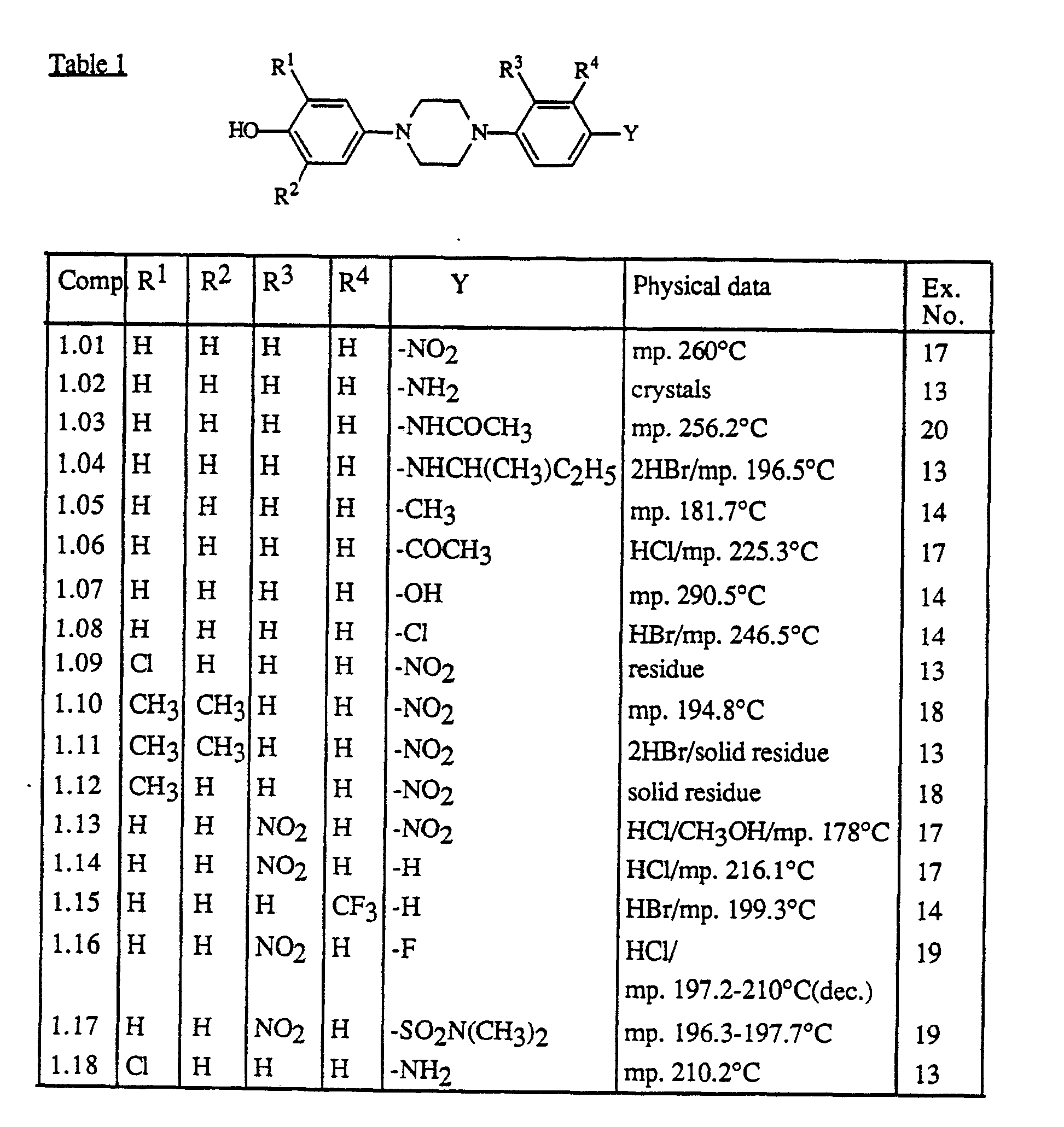


- The useful lipoxygenase inhibiting properties of the compounds of formula (I) are clearly demonstrated in the following test procedures.
- Example 22: Arachidonate 5-lipoxygenase inhibition in Rat Basophilic Leukemia Cells Supernatant.
- Rat basophilic leukemia (RBL) cells were grown as described (Adv. Prostaglandin Thromb. Leuk. Res., 11, 141-145). They were washed and suspended at 5x10⁷ cells/ml in a 50 mM sodium phophate buffer (pH7.4) containing 1 mM EDTA and 0.1% gelatin. The cells then were homogenized by sonification; the sonicate was centrifuged at 10,000 x g for 60 min. The supernatant, aliquoted and stored at -70-C, was used as the source of 5-lipoxygenase activity.
- The enzyme activity was assayed at 37. C in a reaction mixture (total volume of 0.4 ml) containing 50 mM sodium phosphate buffer (pH7.4), 2mM ATP, 2mM CaC12, 2mM glutathion, the test compound (10-5 to 10-8M) and the enzyme (60 mg protein). After a 5-min preincubation period, the reaction was started by the addition of 0.1 mCi of 14C-arachidonic acid and terminated 15 min later by the supplementation of 0.3 ml of an ice-cold mixture of ethyl ether : methanol : 0.2M citric acid (30:4:1). After shaking and centrifugation (3000 x g, 5 min), the organic layer (N 150 ml) was removed, dried over anhydrous sodium sulfate and extracted with 1 ml ethyl acetate. The extract was then evaporated in vacuo and the residue dissolved in 20 ml of ethanol. Aliquots (20-30,000 cpm) were spotted on0.25 mm silica coated plastic TLC sheets (Merck) and developed with chloroform : methanol : water : acetic acid (90:9:0.05:1). Radioactivity spots were located by autoradiography, cut out and their radioactivity determined by liquid scintillation counting. The counts present in the spots corresponding to arachidonic acid and the lipoxygenase products, 5-HPETE and LTB4, were summed and the percentage of lipoxygenase products formation was calculated. For inhibition studies, concentration response curves and ICso-values were obtained by determining the percentage of inhibition of lipoxygenase products formation in the presence of test compound compared with the uninhibited control. The first column of table 12 contains the percentage of inhibition of 5-lipoxygenase products formation (i.e. 5-HPETE and LTB4) in the presence of 2.5 mM of a compound of formula (I).
- Intravenous injection of Dextran T500@ (Pharmacia) and pontamine sky-blue dye into mice results in increased vascular permeability and edema formation, characterized by an intense blueing of the ears. Determination of the amount of extravasated dye is presumed to yield a quantitative measure of the 5- lipoxygenase inhibiting activity of test compounds (Drug. Dev. Res. 8, 213-218, 1986). Unfasted male Swiss mice weighing 24-26 g were used in the experiments which were performed between 13.00 pm and 17.00 pm at an ambient temperature of 22±1 ° C. The mice were treated orally with a test compound of formula (I) dissolved in a volume of 150 ml of either polyethyleneglycol (PEG 200) of hydroxypropyl cyclodextrine at doses varying between 1.25 and 40 mg per kg bodyweight. In control experiments the mice were administered an indentical amount of solvent alone. One hour after treatment there was injected intravenously an isotonic saline solution containing 60 mg/ml Dextran T5000 and 13 mg/ml pontamine sky-blue dye in a volume of 0.1 ml per 10 bodyweight. One hour and forty-five minutes later the animals were sacrificed by ether and their ears were removed. Extraction and quantification of the extravasated dye were performed as described (Drug Dev. Res. 8, 213-218, 1986). The calculated percentage of inhibition of ear blueing upon administration of a compound of formula (I) at a dose of 10 mg/kg bodyweight is shown in the second column of table 12.


- The following formulations exemplify typical pharmaceutical compositions in dosage unit form suitable for systemic administration to animal and human subjects in accordance with the present invention. "Active ingredient" (A.I.) as used throughout these examples relates to a compound of formula (I) or a pharmaceutically acceptable acid addition salt thereof.
- 500 Parts of the A.I. was dissolved in 0.5 I of 2-hydroxypropanoic acid 1.5 I of the polyethylene glycol at 60-80 C. After cooling to 30-40 C there were added 35 I of polyethylene glycol and the mixture was stirred well. Then there was added a solution of 1750 parts of sodium saccharin in 2.5 I of purified water and while stirring there were added 2.5 I of cocoa flavor and polyethylene glycol q.s. to a volume of 50 I, providing an oral drop solution comprising 10 mg/ml of A.!.. The resulting solution was filled into suitable containers.
- 9 Parts of methyl 4-hydroxybenzoate and 1 part of propyl 4-hydroxybenzoate were dissolved in 4 I of boiling purified water. In 3 I of this solution were dissolved first 10 parts of 2,3-dihydroxybutanedioic acid and thereafter 20 parts of the A.I. The latter solution was combined with the remaining part of the former solution and 12 I 1,2,3-propanetriol and 3 I of sorbitol 70% solution were added thereto. 40 Parts of sodium saccharin were dissolved in 0.5 I of water and 2 ml of raspberry and 2 ml of gooseberry essence were added. The latter solution was combined with the former, water was added q.s. to a volume of 20 I providing an oral solution comprising 5 mg of the active ingredient per teaspoonful (5 ml). The resulting solution was filled in suitable containers.
- 20 Parts of the A.I., 6 parts sodium lauryl sulfate, 56 parts starch, 56 parts lactose, 0.8 parts colloidal silicon dioxide, and 1.2 parts magnesium stearate were vigorously stirred together. The resulting mixture was subsequently filled into 1000 suitable hardened gelatin capsules, comprising each 20 mg of the active ingredient.
- A mixture of 100 parts of the A.I., 570 parts lactose and 200 parts starch was mixed well and thereafter humidified with a solution of 5 parts sodium dodecyl sulfate and 10 parts polyvinylpyrrolidone (Kollidon-K90 ®) in about 200 ml of water. The wet powder mixture was sieved, dried and sieved again. Then there was added 100 parts microcrystalline cellulose (Avicel @) and 15 parts hydrogenated vegetable oil (Sterotex ®). The whole was mixed well and compressed into tablets, giving 10.000 tablets, each containing 10 mg of the active ingredient.
- To a solution of 10 parts methyl cellulose (Methocel 60 HG@) in 75 ml of denatured ethanol there was added a solution of 5 parts of ethyl cellulose (Ethocel 22 cps @) in 150 ml of dichloromethane. Then there were added 75 ml of dichloromethane and 2.5 ml 1,2,3-propanetriol. 10 Parts of polyethylene glycol was molten and dissolved in 75 ml of dichloromethane. The latter solution was added to the former and then there were added 2.5 parts of magnesium octadecanoate, 5 parts of polyvinylpyrrolidone and 30 ml of concentrated colour suspension (Opaspray K-1-2109@) and the whole was homogenated. The tablet cores were coated with the thus obtained mixture in a coating apparatus.
- 1.8 Parts methyl 4-hydroxybenzoate and 0.2 parts propyl 4-hydroxybenzoate were dissolved in about 0.5 I of boiling water for injection. After cooling to about 50° C there were added while stirring 4 parts lactic acid, 0.05 parts propylene glycol and 4 parts of the A.I.. The solution was cooled to room temperature and supplemented with water for injection q.s. ad 1 I, giving a solution comprising 4 mg/ml of A.I.. The solution was sterilized by filtration (U.S.P. XVII p. 811) and filled in sterile containers.
- 3 Parts A.I. was dissolved in a solution of 3 parts 2,3-dihydroxybutanedioic acid in 25 ml polyethylene glycol 400. 12 Parts surfactant (SPAN@) and triglycerides (Witepsol 555 ®) q.s. ad 300 parts were molten together. The latter mixture was mixed well with the former solution. The thus obtained mixture was poured into moulds at a temperature of 37-38° C to form 100 suppositories each containing 30 mg/ml of the A.I..
Claims (12)


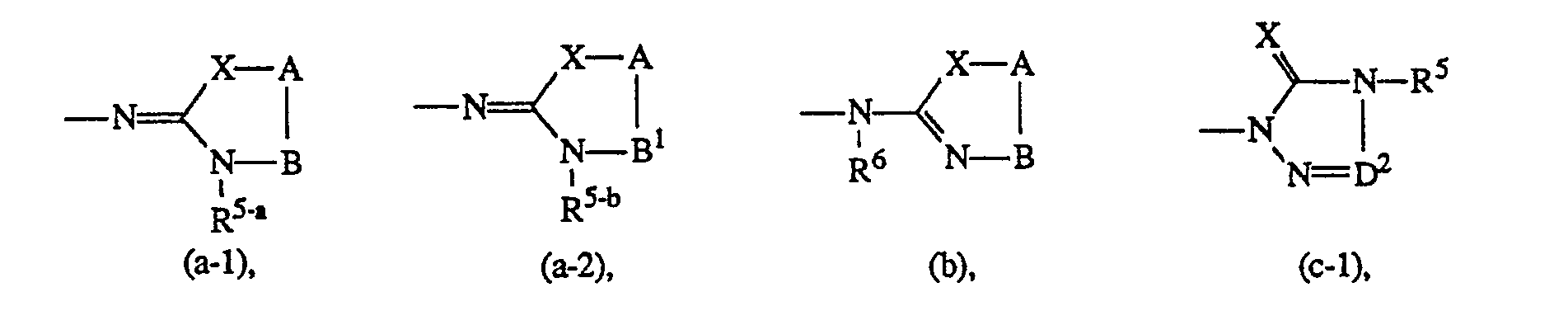


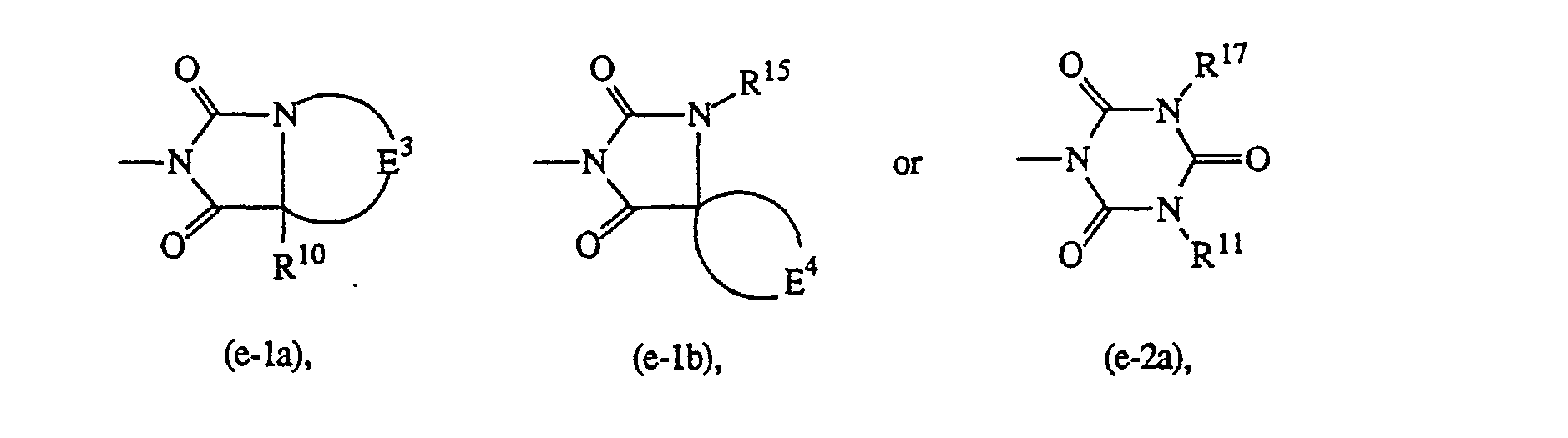


Applications Claiming Priority (2)
| Application Number | Priority Date | Filing Date | Title |
|---|---|---|---|
| US16182588A | 1988-02-29 | 1988-02-29 | |
| US161825 | 1988-02-29 |
Publications (3)
| Publication Number | Publication Date |
|---|---|
| EP0331232A2 true EP0331232A2 (en) | 1989-09-06 |
| EP0331232A3 EP0331232A3 (en) | 1991-04-24 |
| EP0331232B1 EP0331232B1 (en) | 1994-05-18 |
Family
ID=22582912
Family Applications (1)
| Application Number | Title | Priority Date | Filing Date |
|---|---|---|---|
| EP89200424A Expired - Lifetime EP0331232B1 (en) | 1988-02-29 | 1989-02-21 | 5-lipoxygenase inhibiting 4-(4-phenyl-1-piperazinyl)phenols |
Country Status (26)
| Country | Link |
|---|---|
| US (1) | US4931444A (en) |
| EP (1) | EP0331232B1 (en) |
| JP (1) | JPH075564B2 (en) |
| KR (1) | KR0133074B1 (en) |
| CN (1) | CN1021223C (en) |
| AT (1) | ATE105711T1 (en) |
| AU (1) | AU615519B2 (en) |
| BG (1) | BG49940A3 (en) |
| CA (1) | CA1331757C (en) |
| DE (1) | DE68915308T2 (en) |
| DK (1) | DK91889A (en) |
| ES (1) | ES2056190T3 (en) |
| FI (1) | FI97383C (en) |
| HU (2) | HUT52080A (en) |
| IE (1) | IE63150B1 (en) |
| IL (1) | IL89426A (en) |
| JO (1) | JO1559B1 (en) |
| MA (1) | MA21502A1 (en) |
| MY (1) | MY103802A (en) |
| NO (1) | NO174049C (en) |
| NZ (1) | NZ228016A (en) |
| PH (1) | PH26574A (en) |
| PT (1) | PT89875B (en) |
| RU (1) | RU2107064C1 (en) |
| TN (1) | TNSN89019A1 (en) |
| ZA (1) | ZA891547B (en) |
Cited By (27)
| Publication number | Priority date | Publication date | Assignee | Title |
|---|---|---|---|---|
| EP0532091A1 (en) * | 1991-09-13 | 1993-03-17 | Janssen Pharmaceutica N.V. | 4-(4-(4-(4-hydroxyphenyl)-1-piperazinyl)-phenyl)-5-methyl-3H-1,2,4-triazol-3-one derivatives as 5-lipoxygenase inhibitors |
| EP0539938A1 (en) * | 1991-10-30 | 1993-05-05 | Schering Corporation | Tri-substituted tetrahydrofuran antifungals |
| GR1001394B (en) * | 1992-10-12 | 1993-10-29 | Janssen Pharmaceutica Nv | 4-Ä4-Ä4-(4-hydroxyphenyl)-1-piperazinylÜphenyl-5-methyl-3h-1,2,4-triazol-3-one derivatives. |
| WO1994018978A1 (en) * | 1993-02-19 | 1994-09-01 | Janssen Pharmaceutica N.V. | Substituted azolone derivatives for treating diseases caused by helicobacter |
| WO1995017472A1 (en) * | 1993-12-23 | 1995-06-29 | Zeneca Limited | Disazo compound |
| WO1995017471A1 (en) * | 1993-12-23 | 1995-06-29 | Zeneca Limited | Disazo compound |
| WO1995027704A1 (en) * | 1994-04-06 | 1995-10-19 | Janssen Pharmaceutica N.V. | Anti-helicobacter ester and carbamate derivatives of azolones |
| WO1996001821A1 (en) * | 1994-07-12 | 1996-01-25 | Janssen Pharmaceutica N.V. | Anti-helicobacter heterocyclic derivatives of azolones |
| WO1996001820A1 (en) * | 1994-07-12 | 1996-01-25 | Janssen Pharmaceutica N.V. | Anti-helicobacter urea and thiourea derivatives of azolones |
| WO1996001822A1 (en) * | 1994-07-12 | 1996-01-25 | Janssen Pharmaceutica N.V. | Anti-helicobacter acyl derivatives of azolones |
| WO1999059977A1 (en) * | 1998-05-20 | 1999-11-25 | Bayer Aktiengesellschaft | Substituted 1,3-diaza-2-(thi)oxo-cycloalkanes |
| US6355801B1 (en) | 1999-11-08 | 2002-03-12 | Schering Corporation | Process for preparing N-(4-hydroxyphenyl)-N′-(4′-aminophenyl)-piperazine |
| WO2001034587A3 (en) * | 1999-11-08 | 2002-03-21 | Schering Corp | Process for preparing n-(4-hydroxy-phenyl)-n'-(4'-aminophenyl)-piperazine |
| WO2002092585A1 (en) * | 2001-05-11 | 2002-11-21 | Biovitrum Ab | Novel, arylsusfonamide compounds for the treatment of obesity, type ii diabetes and cns-disorders |
| US7718684B2 (en) | 2004-02-24 | 2010-05-18 | The Regents Of The University Of California | Methods and materials for assessing prostate cancer therapies and compounds |
| US7718650B2 (en) | 2001-05-11 | 2010-05-18 | Biovitrum Ab | Aryl sulfonamide compounds for treating obesity |
| US8034548B2 (en) | 2003-12-19 | 2011-10-11 | The Regents Of The University Of California | Methods and materials for assessing prostate cancer therapies |
| US8110594B2 (en) | 2006-03-29 | 2012-02-07 | The Regents Of The University Of California | Diarylthiohydantoin compounds |
| US8183274B2 (en) | 2005-05-13 | 2012-05-22 | The Regents Of The University Of California | Treatment of hyperproliferative disorders with diarylhydantoin compounds |
| US8445507B2 (en) | 2006-03-27 | 2013-05-21 | The Regents Of The University Of California | Androgen receptor modulator for the treatment of prostate cancer and androgen receptor-associated diseases |
| US8680291B2 (en) | 2007-10-26 | 2014-03-25 | The Regents Of The University Of California | Diarylhydantoin compounds |
| US9108944B2 (en) | 2010-02-16 | 2015-08-18 | Aragon Pharmaceuticals, Inc. | Androgen receptor modulators and uses thereof |
| US9340524B2 (en) | 2013-01-15 | 2016-05-17 | Aragon Pharmaceuticals, Inc. | Androgen receptor modulator and uses thereof |
| EP2998298A4 (en) * | 2013-07-04 | 2016-11-02 | Nippon Soda Co | Phenylimidazole derivative, and therapeutic medicine or preventive medicine for inflammatory disease, etc. |
| US9884054B2 (en) | 2012-09-26 | 2018-02-06 | Aragon Pharmaceuticals, Inc. | Anti-androgens for the treatment of non-metastatic castrate-resistant prostate cancer |
| US10501469B2 (en) | 2016-01-11 | 2019-12-10 | Janssen Pharmaceutica Nv | Substituted thiohydantoin derivatives as androgen receptor antagonists |
| US10702508B2 (en) | 2017-10-16 | 2020-07-07 | Aragon Pharmaceuticals, Inc. | Anti-androgens for the treatment of non-metastatic castration-resistant prostate cancer |
Families Citing this family (36)
| Publication number | Priority date | Publication date | Assignee | Title |
|---|---|---|---|---|
| FR2631625B1 (en) * | 1988-05-17 | 1992-10-16 | Synthelabo | PHENYL-6 DERIVATIVES PIPERAZINYLALKYL-3 1H, 3H-PYRIMIDINEDIONE-2,4, THEIR PREPARATION AND THEIR THERAPEUTIC APPLICATION |
| JP3075451B2 (en) * | 1993-05-19 | 2000-08-14 | 矢崎総業株式会社 | Lever connector |
| FR2705959B1 (en) * | 1993-06-01 | 1995-08-11 | Oreal | Process for stereospecific synthesis of leukotriene B4 in its 6Z, 8E, 10E configuration and intermediate products. |
| FR2707294B1 (en) * | 1993-07-06 | 1995-09-29 | Pf Medicament | New derivatives of 3,5-dioxo- (2H, 4H) -1,2,4-triazine, their preparation and their application in human therapy. |
| US5571811A (en) * | 1994-07-12 | 1996-11-05 | Janssen Pharmaceutica N.V. | Sulfonamide derivatives of azolones |
| US5635514A (en) * | 1994-10-25 | 1997-06-03 | G. D. Searle & Company | Heteroaralkyl and heteroarylthioalkyl thiophenolic compounds as 5-lipoxgenase inhibitors |
| AU697744C (en) * | 1994-10-27 | 2002-08-22 | Elanco Animal Health Ireland Limited | Apolipoprotein-B synthesis inhibitors |
| US5521186A (en) * | 1994-10-27 | 1996-05-28 | Janssen Pharmaceutica N.V. | Apolipoprotein-β synthesis inhibitors |
| US5859014A (en) * | 1995-06-09 | 1999-01-12 | Syntex (U.S.A.) Inc. | Pyrimidinedione, pyrimidinetrione, triazinedione and tetrahydroquinazolinedione derivatives as α1 -adrenergic receptor antagonists |
| JP2001504465A (en) | 1996-11-12 | 2001-04-03 | セプラコール,インク. | 2R, 4S, S, S- and 2S, 4R, S, S-hydroxyitraconazole |
| CA2269617A1 (en) * | 1996-11-12 | 1998-05-22 | Chris H. Senanayake | 2r,4s,r,s- and 2s,4r,r,s-hydroxyitraconazole- and hydroxysaperconazole derivatives |
| CN1238353C (en) | 1997-02-11 | 2006-01-25 | 詹森药业有限公司 | Azole antifungal agents containing amino acid esters |
| BR9811499A (en) * | 1997-07-10 | 2000-09-19 | Janssen Pharmaceutica Nv | "6-azauracil derivatives as inhibitors of il-5" |
| TR200101729T2 (en) | 1998-12-18 | 2001-10-22 | Janssen Pharmaceutica N.V. | IL-5 blocker 6-azauracil derivatives |
| US6353006B1 (en) | 1999-01-14 | 2002-03-05 | Bayer Corporation | Substituted 2-arylimino heterocycles and compositions containing them, for use as progesterone receptor binding agents |
| US6147077A (en) * | 1999-04-29 | 2000-11-14 | Sepracor Inc. | 2R,4S-hydroxyitraconazole isomers |
| BR0010279A (en) | 1999-05-04 | 2002-05-14 | Janssen Phamaceutica N V | antifungal ethers |
| EP1219612B1 (en) | 1999-09-14 | 2008-04-23 | Shionogi & Co., Ltd. | 2-imino-1,3-thiazine derivatives |
| SE0003980D0 (en) * | 2000-10-31 | 2000-10-31 | Astrazeneca Ab | Novel compounds |
| FR2815032B1 (en) * | 2000-10-10 | 2003-08-08 | Pf Medicament | NOVEL AMINOPHENYL PIPERAZINE OR AMINO PHENYL PIPERIDE DERIVATIVES PRENYL TRANSFERASE PROTEIN INHIBITORS AND PREPARATIONS THEREOF |
| MXPA03008033A (en) * | 2001-03-08 | 2003-12-04 | Shionogi & Co | Medicinal composition containing 1,3-thiazine derivative. |
| DE60234264D1 (en) * | 2001-10-01 | 2009-12-17 | Bristol Myers Squibb Co | SPIRO-HYDANTOIN COMPOUNDS SUITED AS ANTI-INFLAMMATORY AGENTS |
| AU2003299750A1 (en) * | 2002-12-20 | 2004-07-22 | Irm Llc | Differential tumor cytotoxocity compounds and compositions |
| TW200616634A (en) * | 2004-10-01 | 2006-06-01 | Bristol Myers Squibb Co | Crystalline forms and process for preparing spiro-hydantoin compounds |
| US20060142319A1 (en) * | 2004-12-14 | 2006-06-29 | Bang-Chi Chen | Pyridyl-substituted spiro-hydantoin crystalline forms and process |
| US7186727B2 (en) * | 2004-12-14 | 2007-03-06 | Bristol-Myers Squibb Company | Pyridyl-substituted spiro-hydantoin compounds and use thereof |
| CN107233337A (en) | 2009-04-29 | 2017-10-10 | 阿马里纳药物爱尔兰有限公司 | Pharmaceutical composition containing EPA and cardiovascular agents and use its method |
| WO2011016559A1 (en) * | 2009-08-07 | 2011-02-10 | 武田薬品工業株式会社 | Heterocyclic compound and use thereof |
| AU2011254654B2 (en) * | 2010-05-19 | 2016-01-07 | Sandoz Ag | Process for the preparation of chiral triazolones |
| CN101824009A (en) * | 2010-05-27 | 2010-09-08 | 北京德众万全药物技术开发有限公司 | Simple preparation method for posaconazole and piperazine intermediate thereof |
| RU2448962C1 (en) * | 2011-02-08 | 2012-04-27 | Государственное образовательное учреждение высшего профессионального образования "Ярославский государственный университет им. П.Г. Демидова" | Method of producing 1,4-bis(2-amino-4-(trifluoromethyl)phenyl)piperazine |
| KR101715448B1 (en) * | 2014-07-16 | 2017-03-20 | 주식회사 큐리언트 | Compounds for treatment of inflammatory diseases |
| US12479816B2 (en) | 2019-02-08 | 2025-11-25 | University of Pittsburgh—of the Commonwealth System of Higher Education | 20-HETE formation inhibitors |
| CN111362886B (en) * | 2020-04-23 | 2023-05-16 | 四川澄华生物科技有限公司 | Preparation method of posaconazole intermediate 1- (4-aminophenyl) -4- (4-hydroxyphenyl) piperazine |
| CN114516849B (en) * | 2020-11-18 | 2025-04-29 | 江苏恒盛药业有限公司 | A method for synthesizing 1-(4-aminophenyl)-4-(4-hydroxyphenyl)piperazine |
| JP2023088282A (en) * | 2021-12-14 | 2023-06-26 | Dic株式会社 | Compound and liquid crystal composition using the same, liquid crystal display element, sensor, liquid crystal lens, optical communication device and antenna |
Citations (4)
| Publication number | Priority date | Publication date | Assignee | Title |
|---|---|---|---|---|
| US3720690A (en) | 1970-04-10 | 1973-03-13 | Fisons Pharmaceuticals Ltd | Pharmaceutically active bis-carboxychromone compounds |
| US4267179A (en) | 1978-06-23 | 1981-05-12 | Janssen Pharmaceutica, N.V. | Heterocyclic derivatives of (4-phenylpiperazin-1-yl-aryloxymethyl-1,3-dioxolan-2-yl)methyl-1H-imidazoles and 1H-1,2,4-triazoles |
| US4619931A (en) | 1983-02-28 | 1986-10-28 | Janssen Pharmaceutica, N.V. | [[4-[4-(4-phenyl-1-piperazinyl)phenoxymethyl]-1,3-dioxolan-2-yl]methyl]-1H-imidazoles and 1H-1,2,4-triazoles |
| EP0228125A1 (en) | 1985-12-23 | 1987-07-08 | Janssen Pharmaceutica N.V. | Novel derivatives of [[4-[4-(4-phenyl-1-piperazinyl)phenoxymethyl]-1,3-dioxolan-2-yl]methyl]-1H-imidazoles and 1H-1,2,4-triazoles |
Family Cites Families (7)
| Publication number | Priority date | Publication date | Assignee | Title |
|---|---|---|---|---|
| DE65347C (en) * | Chemische fabrik auf Aktien (vorm. e. schering) in Berlin N., MüUerstr. 170/171 | Process for the preparation of piperazine. (2 | ||
| DE2149645A1 (en) * | 1970-10-07 | 1972-09-14 | Pfizer | 2-Phenyl-as-triazine-3.5- (2H, 4H) -diones and the use of these compounds for combating coccidiosis |
| US4144346A (en) * | 1977-01-31 | 1979-03-13 | Janssen Pharmaceutica N.V. | Novel 1-(1,3-dioxolan-2-ylmethyl)-1H-imidazoles |
| US4368200A (en) * | 1978-06-23 | 1983-01-11 | Janssen Pharmaceutica N.V. | Heterocyclic derivatives of (4-phenyl-piperazine-1-yl-aryloxymethyl-1,3-dioxolan-2-yl)-methyl-1H-imidazoles and 1H-1,2,4-triazoles |
| US4503055A (en) * | 1979-03-26 | 1985-03-05 | Janssen Pharmaceutica, N.V. | Derivatives of [4-(piperazin-1-yl-phenyloxymethyl)-1,3-dioxolan-2-ylmethyl]-1H-imidazoles and 1H-1,2,4-triazoles |
| US4613600A (en) * | 1983-09-30 | 1986-09-23 | Mead Johnson & Company | Antidepressant 1,2,4-triazolone compounds |
| NZ223799A (en) * | 1987-03-25 | 1989-12-21 | Janssen Pharmaceutica Nv | Azolylmethyl-dioxolanylmethoxyphenyl-piperazinyl-phenyl-triazolones and antimicrobial compositions |
-
1989
- 1989-01-10 CA CA000587830A patent/CA1331757C/en not_active Expired - Fee Related
- 1989-01-12 US US07/297,010 patent/US4931444A/en not_active Expired - Fee Related
- 1989-01-20 MY MYPI89000066A patent/MY103802A/en unknown
- 1989-02-16 NZ NZ228016A patent/NZ228016A/en unknown
- 1989-02-20 JP JP1038486A patent/JPH075564B2/en not_active Expired - Lifetime
- 1989-02-20 JO JO19891559A patent/JO1559B1/en active
- 1989-02-21 DE DE68915308T patent/DE68915308T2/en not_active Expired - Fee Related
- 1989-02-21 EP EP89200424A patent/EP0331232B1/en not_active Expired - Lifetime
- 1989-02-21 ES ES89200424T patent/ES2056190T3/en not_active Expired - Lifetime
- 1989-02-21 AT AT89200424T patent/ATE105711T1/en not_active IP Right Cessation
- 1989-02-24 AU AU30739/89A patent/AU615519B2/en not_active Ceased
- 1989-02-24 BG BG087409A patent/BG49940A3/en unknown
- 1989-02-27 DK DK091889A patent/DK91889A/en not_active Application Discontinuation
- 1989-02-27 IL IL89426A patent/IL89426A/en not_active IP Right Cessation
- 1989-02-27 TN TNTNSN89019A patent/TNSN89019A1/en unknown
- 1989-02-27 FI FI890931A patent/FI97383C/en not_active IP Right Cessation
- 1989-02-27 MA MA21746A patent/MA21502A1/en unknown
- 1989-02-27 NO NO890813A patent/NO174049C/en unknown
- 1989-02-28 ZA ZA891547A patent/ZA891547B/en unknown
- 1989-02-28 IE IE64189A patent/IE63150B1/en not_active IP Right Cessation
- 1989-02-28 KR KR1019890002435A patent/KR0133074B1/en not_active Expired - Fee Related
- 1989-02-28 HU HU89927A patent/HUT52080A/en unknown
- 1989-02-28 PH PH38255A patent/PH26574A/en unknown
- 1989-02-28 RU SU4613548A patent/RU2107064C1/en active
- 1989-02-28 HU HU9303071A patent/HU9303071D0/en unknown
- 1989-02-28 PT PT89875A patent/PT89875B/en not_active IP Right Cessation
- 1989-02-28 CN CN89100931A patent/CN1021223C/en not_active Expired - Fee Related
Patent Citations (4)
| Publication number | Priority date | Publication date | Assignee | Title |
|---|---|---|---|---|
| US3720690A (en) | 1970-04-10 | 1973-03-13 | Fisons Pharmaceuticals Ltd | Pharmaceutically active bis-carboxychromone compounds |
| US4267179A (en) | 1978-06-23 | 1981-05-12 | Janssen Pharmaceutica, N.V. | Heterocyclic derivatives of (4-phenylpiperazin-1-yl-aryloxymethyl-1,3-dioxolan-2-yl)methyl-1H-imidazoles and 1H-1,2,4-triazoles |
| US4619931A (en) | 1983-02-28 | 1986-10-28 | Janssen Pharmaceutica, N.V. | [[4-[4-(4-phenyl-1-piperazinyl)phenoxymethyl]-1,3-dioxolan-2-yl]methyl]-1H-imidazoles and 1H-1,2,4-triazoles |
| EP0228125A1 (en) | 1985-12-23 | 1987-07-08 | Janssen Pharmaceutica N.V. | Novel derivatives of [[4-[4-(4-phenyl-1-piperazinyl)phenoxymethyl]-1,3-dioxolan-2-yl]methyl]-1H-imidazoles and 1H-1,2,4-triazoles |
Non-Patent Citations (10)
| Title |
|---|
| "The Leukotrienes: Chemistry and Biology", 1984, ACADEMIC PRESS, pages: 195 - 214 |
| ADV. PROSTAGLANDIN THROMB. LEUK. RES., vol. 11, pages 141 - 145 |
| DRUG DEV. RES., vol. 1, 1986, pages 213 - 218 |
| DRUG. DEV. RES., vol. 8, 1986, pages 213 - 218 |
| J. INVEST. DERMATOL., vol. 83, 1983, pages 70 - 73 |
| LANCET, 1984, pages 222 - 223 |
| PROSTAGLANDINS, vol. 29, 1985, pages 611 - 619 |
| PURE APPL. CHEM., vol. 45, 1976, pages 11 - 30 |
| SCIENCE, vol. 220, 1983, pages 568 - 575 |
| THE NEW ENGLAND JOURNAL OF MEDICINE, M, 1980, pages 822 - 825 |
Cited By (58)
| Publication number | Priority date | Publication date | Assignee | Title |
|---|---|---|---|---|
| EP0532091A1 (en) * | 1991-09-13 | 1993-03-17 | Janssen Pharmaceutica N.V. | 4-(4-(4-(4-hydroxyphenyl)-1-piperazinyl)-phenyl)-5-methyl-3H-1,2,4-triazol-3-one derivatives as 5-lipoxygenase inhibitors |
| EP0539938A1 (en) * | 1991-10-30 | 1993-05-05 | Schering Corporation | Tri-substituted tetrahydrofuran antifungals |
| WO1993009114A1 (en) * | 1991-10-30 | 1993-05-13 | Schering Corporation | Tri-substituted tetrahydrofuran antifungals |
| AU665218B2 (en) * | 1991-10-30 | 1995-12-21 | Schering Corporation | Trisubstituted tetrahydrofuran antifungals |
| GR1001394B (en) * | 1992-10-12 | 1993-10-29 | Janssen Pharmaceutica Nv | 4-Ä4-Ä4-(4-hydroxyphenyl)-1-piperazinylÜphenyl-5-methyl-3h-1,2,4-triazol-3-one derivatives. |
| AU675508B2 (en) * | 1993-02-19 | 1997-02-06 | Janssen Pharmaceutica N.V. | Substituted azolone derivatives for treating diseases caused by helicobacter |
| WO1994018978A1 (en) * | 1993-02-19 | 1994-09-01 | Janssen Pharmaceutica N.V. | Substituted azolone derivatives for treating diseases caused by helicobacter |
| AP435A (en) * | 1993-02-19 | 1995-11-17 | Janssen Pharmaceutica Nv | Substituted azolone derivatives. |
| WO1995017472A1 (en) * | 1993-12-23 | 1995-06-29 | Zeneca Limited | Disazo compound |
| WO1995017471A1 (en) * | 1993-12-23 | 1995-06-29 | Zeneca Limited | Disazo compound |
| WO1995027704A1 (en) * | 1994-04-06 | 1995-10-19 | Janssen Pharmaceutica N.V. | Anti-helicobacter ester and carbamate derivatives of azolones |
| WO1996001822A1 (en) * | 1994-07-12 | 1996-01-25 | Janssen Pharmaceutica N.V. | Anti-helicobacter acyl derivatives of azolones |
| WO1996001821A1 (en) * | 1994-07-12 | 1996-01-25 | Janssen Pharmaceutica N.V. | Anti-helicobacter heterocyclic derivatives of azolones |
| WO1996001820A1 (en) * | 1994-07-12 | 1996-01-25 | Janssen Pharmaceutica N.V. | Anti-helicobacter urea and thiourea derivatives of azolones |
| CN1067999C (en) * | 1994-07-12 | 2001-07-04 | 詹森药业有限公司 | Anti-helicobacter heterocyclic derivatives of azolines |
| CN1071331C (en) * | 1994-07-12 | 2001-09-19 | 詹森药业有限公司 | Anti-helicobacter azolone acyl derivatives |
| CN1071330C (en) * | 1994-07-12 | 2001-09-19 | 詹森药业有限公司 | Anti-helicobacter urea and thiourea derivatives of azolones |
| WO1999059977A1 (en) * | 1998-05-20 | 1999-11-25 | Bayer Aktiengesellschaft | Substituted 1,3-diaza-2-(thi)oxo-cycloalkanes |
| US6355801B1 (en) | 1999-11-08 | 2002-03-12 | Schering Corporation | Process for preparing N-(4-hydroxyphenyl)-N′-(4′-aminophenyl)-piperazine |
| WO2001034587A3 (en) * | 1999-11-08 | 2002-03-21 | Schering Corp | Process for preparing n-(4-hydroxy-phenyl)-n'-(4'-aminophenyl)-piperazine |
| WO2002092585A1 (en) * | 2001-05-11 | 2002-11-21 | Biovitrum Ab | Novel, arylsusfonamide compounds for the treatment of obesity, type ii diabetes and cns-disorders |
| US6969710B2 (en) | 2001-05-11 | 2005-11-29 | Biovitrum Ab | Compounds |
| US7173035B2 (en) | 2001-05-11 | 2007-02-06 | Biovitrum Ab | Arylsulfonamide compounds |
| US7319097B2 (en) | 2001-05-11 | 2008-01-15 | Biovitrum Ab | Compounds |
| EA009647B1 (en) * | 2001-05-11 | 2008-02-28 | Биовитрум Аб | Arylsylfonamide compounds and use thereof for the treatment of obesity and type ii diabetes |
| US7566715B2 (en) | 2001-05-11 | 2009-07-28 | Biovitrum Ab | Substituted sulfonamide compounds useful for the prophylaxis and treatment of conditions relating to obesity, type II diabetes and/or disorders of the central nervous system |
| US7718650B2 (en) | 2001-05-11 | 2010-05-18 | Biovitrum Ab | Aryl sulfonamide compounds for treating obesity |
| US8034548B2 (en) | 2003-12-19 | 2011-10-11 | The Regents Of The University Of California | Methods and materials for assessing prostate cancer therapies |
| US7718684B2 (en) | 2004-02-24 | 2010-05-18 | The Regents Of The University Of California | Methods and materials for assessing prostate cancer therapies and compounds |
| US9126941B2 (en) | 2005-05-13 | 2015-09-08 | The Regents Of The University Of California | Treatment of hyperproliferative disorders with diarylhydantoin compounds |
| US8183274B2 (en) | 2005-05-13 | 2012-05-22 | The Regents Of The University Of California | Treatment of hyperproliferative disorders with diarylhydantoin compounds |
| US8802689B2 (en) | 2006-03-27 | 2014-08-12 | The Regents Of The University Of California | Androgen receptor modulator for the treatment of prostate cancer and androgen receptor-associated diseases |
| US8445507B2 (en) | 2006-03-27 | 2013-05-21 | The Regents Of The University Of California | Androgen receptor modulator for the treatment of prostate cancer and androgen receptor-associated diseases |
| US11771687B2 (en) | 2006-03-27 | 2023-10-03 | The Regents Of The University Of California | Substituted diazaspiroalkanes as androgen receptor modulators |
| US9388159B2 (en) | 2006-03-27 | 2016-07-12 | The Regents Of The University Of California | Substituted diazaspiroalkanes as androgen receptor modulators |
| US10857139B2 (en) | 2006-03-27 | 2020-12-08 | The Regents Of The University Of California | Substituted diazaspiroalkanes as androgen receptor modulators |
| US9987261B2 (en) | 2006-03-27 | 2018-06-05 | The Regents Of The University Of California | Substituted diazaspiroalkanes as androgen receptor modulators |
| US8648105B2 (en) | 2006-03-29 | 2014-02-11 | The Regents Of The University Of California | Diarylthiohydantoin compounds |
| US8110594B2 (en) | 2006-03-29 | 2012-02-07 | The Regents Of The University Of California | Diarylthiohydantoin compounds |
| US8680291B2 (en) | 2007-10-26 | 2014-03-25 | The Regents Of The University Of California | Diarylhydantoin compounds |
| US9896437B2 (en) | 2007-10-26 | 2018-02-20 | The Regents Of The University Of California | Diarylhydantoin compounds |
| US9108944B2 (en) | 2010-02-16 | 2015-08-18 | Aragon Pharmaceuticals, Inc. | Androgen receptor modulators and uses thereof |
| US10023556B2 (en) | 2010-02-16 | 2018-07-17 | Aragon Pharmaceuticals, Inc. | Androgen receptor modulators and uses thereof |
| US9481664B2 (en) | 2010-02-16 | 2016-11-01 | Aragon Pharmaceuticals, Inc. | Androgen receptor modulators and uses thereof |
| USRE49353E1 (en) | 2012-09-26 | 2023-01-03 | Aragon Pharmaceuticals, Inc. | Anti-androgens for the treatment of non-metastatic castrate-resistant prostate cancer |
| US10052314B2 (en) | 2012-09-26 | 2018-08-21 | Aragon Pharmaceuticals, Inc. | Anti-androgens for the treatment of non-metastatic castrate-resistant prostate cancer |
| US9884054B2 (en) | 2012-09-26 | 2018-02-06 | Aragon Pharmaceuticals, Inc. | Anti-androgens for the treatment of non-metastatic castrate-resistant prostate cancer |
| USRE50642E1 (en) | 2012-09-26 | 2025-10-21 | Aragon Pharmaceuticals, Inc. | Anti-androgens for the treatment of non-metastatic castrate-resistant prostate cancer |
| US10799489B2 (en) | 2012-09-26 | 2020-10-13 | Aragon Pharmaceuticals, Inc. | Anti-androgens for the treatment of non-metastatic castrate-resistant prostate cancer |
| US10799488B2 (en) | 2012-09-26 | 2020-10-13 | Aragon Pharmaceuticals, Inc. | Anti-androgens for the treatment of non-metastatic castrate-resistant prostate cancer |
| US10849888B2 (en) | 2012-09-26 | 2020-12-01 | Aragon Pharmaceuticals, Inc. | Anti-androgens for the treatment of non-metastatic castrate-resistant prostate cancer |
| US9340524B2 (en) | 2013-01-15 | 2016-05-17 | Aragon Pharmaceuticals, Inc. | Androgen receptor modulator and uses thereof |
| EP2998298A4 (en) * | 2013-07-04 | 2016-11-02 | Nippon Soda Co | Phenylimidazole derivative, and therapeutic medicine or preventive medicine for inflammatory disease, etc. |
| US10501469B2 (en) | 2016-01-11 | 2019-12-10 | Janssen Pharmaceutica Nv | Substituted thiohydantoin derivatives as androgen receptor antagonists |
| US10981926B2 (en) | 2016-01-11 | 2021-04-20 | Janssen Pharmaceutica Nv | Substituted thiohydantoin derivatives as androgen receptor antagonists |
| US11491149B2 (en) | 2017-10-16 | 2022-11-08 | Aragon Pharmaceuticals, Inc. | Anti-androgens for the treatment of non-metastatic castration-resistant prostate cancer |
| US11160796B2 (en) | 2017-10-16 | 2021-11-02 | Aragon Pharmaceuticals, Inc. | Anti-androgens for the treatment of non-metastatic castration-resistant prostate cancer |
| US10702508B2 (en) | 2017-10-16 | 2020-07-07 | Aragon Pharmaceuticals, Inc. | Anti-androgens for the treatment of non-metastatic castration-resistant prostate cancer |
Also Published As
Similar Documents
| Publication | Publication Date | Title |
|---|---|---|
| EP0331232B1 (en) | 5-lipoxygenase inhibiting 4-(4-phenyl-1-piperazinyl)phenols | |
| US4151288A (en) | Pharmacologically active thiourea and urea compounds | |
| EP0118138B1 (en) | ((4-(4-(4-phenyl-1-piperazinyl)phenoxymethyl)-1,3-dioxolan-2-yl)methyl)-1h-imidazoles and 1h-1,2,4-triazoles | |
| US20090018150A1 (en) | 5-Ht2b Receptor Antagonists | |
| US20050113378A1 (en) | N-[4-(heteroarylmethyl)phenyl]-heteroarylamines | |
| EP0050458A2 (en) | 2-Guanidino-4-heteroarylthiazoles and pharmaceutical compositions containing them | |
| CZ300937B6 (en) | Novel aminothiazole derivatives, process of their preparation and pharmaceutical compositions in which the derivatives are comprised | |
| EP0430334B1 (en) | Immunostimulating 6-aryl-5,6-dihydroimidazo[2,1-b]thiazole derivatives | |
| EP0328203A2 (en) | [5(6) (1H-azole-1-ylmethyl)benzimidazole] carbamates | |
| US4053473A (en) | Pharmacologically active thiourea and urea compounds | |
| US5254553A (en) | 4-[4- [4-(4-hydroxyphenyl)-1-piperazinyl]phenyl]-5-methyl-3H-1,2,4-triazol-3-one derivatives | |
| US20060135573A1 (en) | Benzothiazole-4,7-diones and benzoxazole-4,7-diones with substituents in position 5 or 6 and method for production thereof | |
| US5212192A (en) | Immunostimulating 6-aryl-5,6-dihydroimidazo[2,1-b]thiazole derivatives | |
| US4137234A (en) | Thiazole, isothiazole, oxazole and isoxazole substituted thiourea and urea compounds | |
| US4230865A (en) | Pharmacologically active triazole and thiadiazole thiourea and urea compounds | |
| US4307101A (en) | Inhibitors of H-2 histamine receptors | |
| US6031109A (en) | Phenoxy-, phenylthio-, benzoyl-alkyleneaminoalkylene-imidazole derivatives as therapeutic agents | |
| US4069327A (en) | Pharmacologically active thiourea and urea compounds as inhibitors of H-2 histamine receptors | |
| US5527915A (en) | Immunostimulating 6-aryl-5,6-dihydroimidazo[2,1-beta]thiazole derivatives | |
| HK1018458B (en) | N-4-(heteroarylmethyl)phenyl]-heteroarylamines |
Legal Events
| Date | Code | Title | Description |
|---|---|---|---|
| PUAI | Public reference made under article 153(3) epc to a published international application that has entered the european phase |
Free format text: ORIGINAL CODE: 0009012 |
|
| AK | Designated contracting states |
Kind code of ref document: A2 Designated state(s): AT BE CH DE ES FR GB GR IT LI LU NL SE |
|
| PUAL | Search report despatched |
Free format text: ORIGINAL CODE: 0009013 |
|
| AK | Designated contracting states |
Kind code of ref document: A3 Designated state(s): AT BE CH DE ES FR GB GR IT LI LU NL SE |
|
| 17P | Request for examination filed |
Effective date: 19911009 |
|
| 17Q | First examination report despatched |
Effective date: 19920603 |
|
| ITF | It: translation for a ep patent filed | ||
| GRAA | (expected) grant |
Free format text: ORIGINAL CODE: 0009210 |
|
| AK | Designated contracting states |
Kind code of ref document: B1 Designated state(s): AT BE CH DE ES FR GB GR IT LI LU NL SE |
|
| REF | Corresponds to: |
Ref document number: 105711 Country of ref document: AT Date of ref document: 19940615 Kind code of ref document: T |
|
| REF | Corresponds to: |
Ref document number: 68915308 Country of ref document: DE Date of ref document: 19940623 |
|
| ET | Fr: translation filed | ||
| REG | Reference to a national code |
Ref country code: ES Ref legal event code: FG2A Ref document number: 2056190 Country of ref document: ES Kind code of ref document: T3 |
|
| REG | Reference to a national code |
Ref country code: GR Ref legal event code: FG4A Free format text: 3012961 |
|
| EAL | Se: european patent in force in sweden |
Ref document number: 89200424.3 |
|
| PLBE | No opposition filed within time limit |
Free format text: ORIGINAL CODE: 0009261 |
|
| STAA | Information on the status of an ep patent application or granted ep patent |
Free format text: STATUS: NO OPPOSITION FILED WITHIN TIME LIMIT |
|
| 26N | No opposition filed | ||
| PGFP | Annual fee paid to national office [announced via postgrant information from national office to epo] |
Ref country code: BE Payment date: 19971216 Year of fee payment: 10 |
|
| PGFP | Annual fee paid to national office [announced via postgrant information from national office to epo] |
Ref country code: LU Payment date: 19980112 Year of fee payment: 10 |
|
| PGFP | Annual fee paid to national office [announced via postgrant information from national office to epo] |
Ref country code: AT Payment date: 19980211 Year of fee payment: 10 |
|
| PGFP | Annual fee paid to national office [announced via postgrant information from national office to epo] |
Ref country code: GB Payment date: 19980212 Year of fee payment: 10 |
|
| PGFP | Annual fee paid to national office [announced via postgrant information from national office to epo] |
Ref country code: SE Payment date: 19980218 Year of fee payment: 10 |
|
| PGFP | Annual fee paid to national office [announced via postgrant information from national office to epo] |
Ref country code: GR Payment date: 19980220 Year of fee payment: 10 |
|
| PGFP | Annual fee paid to national office [announced via postgrant information from national office to epo] |
Ref country code: NL Payment date: 19980226 Year of fee payment: 10 Ref country code: ES Payment date: 19980226 Year of fee payment: 10 |
|
| PGFP | Annual fee paid to national office [announced via postgrant information from national office to epo] |
Ref country code: DE Payment date: 19980302 Year of fee payment: 10 |
|
| PGFP | Annual fee paid to national office [announced via postgrant information from national office to epo] |
Ref country code: CH Payment date: 19980310 Year of fee payment: 10 |
|
| PGFP | Annual fee paid to national office [announced via postgrant information from national office to epo] |
Ref country code: FR Payment date: 19990209 Year of fee payment: 11 |
|
| PG25 | Lapsed in a contracting state [announced via postgrant information from national office to epo] |
Ref country code: LU Free format text: LAPSE BECAUSE OF NON-PAYMENT OF DUE FEES Effective date: 19990221 Ref country code: GB Free format text: LAPSE BECAUSE OF NON-PAYMENT OF DUE FEES Effective date: 19990221 Ref country code: AT Free format text: LAPSE BECAUSE OF NON-PAYMENT OF DUE FEES Effective date: 19990221 |
|
| PG25 | Lapsed in a contracting state [announced via postgrant information from national office to epo] |
Ref country code: SE Free format text: LAPSE BECAUSE OF NON-PAYMENT OF DUE FEES Effective date: 19990222 Ref country code: ES Free format text: LAPSE BECAUSE OF NON-PAYMENT OF DUE FEES Effective date: 19990222 |
|
| PG25 | Lapsed in a contracting state [announced via postgrant information from national office to epo] |
Ref country code: LI Free format text: LAPSE BECAUSE OF NON-PAYMENT OF DUE FEES Effective date: 19990228 Ref country code: GR Free format text: LAPSE BECAUSE OF NON-PAYMENT OF DUE FEES Effective date: 19990228 Ref country code: CH Free format text: LAPSE BECAUSE OF NON-PAYMENT OF DUE FEES Effective date: 19990228 Ref country code: BE Free format text: LAPSE BECAUSE OF NON-PAYMENT OF DUE FEES Effective date: 19990228 |
|
| BERE | Be: lapsed |
Owner name: JANSSEN PHARMACEUTICA N.V. Effective date: 19990228 |
|
| PG25 | Lapsed in a contracting state [announced via postgrant information from national office to epo] |
Ref country code: NL Free format text: LAPSE BECAUSE OF NON-PAYMENT OF DUE FEES Effective date: 19990901 |
|
| GBPC | Gb: european patent ceased through non-payment of renewal fee |
Effective date: 19990221 |
|
| REG | Reference to a national code |
Ref country code: CH Ref legal event code: PL |
|
| EUG | Se: european patent has lapsed |
Ref document number: 89200424.3 |
|
| PG25 | Lapsed in a contracting state [announced via postgrant information from national office to epo] |
Ref country code: DE Free format text: LAPSE BECAUSE OF NON-PAYMENT OF DUE FEES Effective date: 19991201 |
|
| PG25 | Lapsed in a contracting state [announced via postgrant information from national office to epo] |
Ref country code: FR Free format text: LAPSE BECAUSE OF NON-PAYMENT OF DUE FEES Effective date: 20001031 |
|
| REG | Reference to a national code |
Ref country code: FR Ref legal event code: ST |
|
| REG | Reference to a national code |
Ref country code: ES Ref legal event code: FD2A Effective date: 20010503 |
|
| PG25 | Lapsed in a contracting state [announced via postgrant information from national office to epo] |
Ref country code: IT Free format text: LAPSE BECAUSE OF NON-PAYMENT OF DUE FEES;WARNING: LAPSES OF ITALIAN PATENTS WITH EFFECTIVE DATE BEFORE 2007 MAY HAVE OCCURRED AT ANY TIME BEFORE 2007. THE CORRECT EFFECTIVE DATE MAY BE DIFFERENT FROM THE ONE RECORDED. Effective date: 20050221 |