EP0330482B1 - Method for producing chromium containing molten iron with low sulphur concentration - Google Patents
Method for producing chromium containing molten iron with low sulphur concentration Download PDFInfo
- Publication number
- EP0330482B1 EP0330482B1 EP89301795A EP89301795A EP0330482B1 EP 0330482 B1 EP0330482 B1 EP 0330482B1 EP 89301795 A EP89301795 A EP 89301795A EP 89301795 A EP89301795 A EP 89301795A EP 0330482 B1 EP0330482 B1 EP 0330482B1
- Authority
- EP
- European Patent Office
- Prior art keywords
- molten iron
- chromium
- scrap
- melting
- reduction
- Prior art date
- Legal status (The legal status is an assumption and is not a legal conclusion. Google has not performed a legal analysis and makes no representation as to the accuracy of the status listed.)
- Expired - Lifetime
Links
Images


Classifications
-
- C—CHEMISTRY; METALLURGY
- C21—METALLURGY OF IRON
- C21C—PROCESSING OF PIG-IRON, e.g. REFINING, MANUFACTURE OF WROUGHT-IRON OR STEEL; TREATMENT IN MOLTEN STATE OF FERROUS ALLOYS
- C21C5/00—Manufacture of carbon-steel, e.g. plain mild steel, medium carbon steel or cast steel or stainless steel
- C21C5/28—Manufacture of steel in the converter
-
- C—CHEMISTRY; METALLURGY
- C21—METALLURGY OF IRON
- C21C—PROCESSING OF PIG-IRON, e.g. REFINING, MANUFACTURE OF WROUGHT-IRON OR STEEL; TREATMENT IN MOLTEN STATE OF FERROUS ALLOYS
- C21C5/00—Manufacture of carbon-steel, e.g. plain mild steel, medium carbon steel or cast steel or stainless steel
- C21C5/28—Manufacture of steel in the converter
- C21C5/30—Regulating or controlling the blowing
- C21C5/35—Blowing from above and through the bath
-
- C—CHEMISTRY; METALLURGY
- C21—METALLURGY OF IRON
- C21C—PROCESSING OF PIG-IRON, e.g. REFINING, MANUFACTURE OF WROUGHT-IRON OR STEEL; TREATMENT IN MOLTEN STATE OF FERROUS ALLOYS
- C21C5/00—Manufacture of carbon-steel, e.g. plain mild steel, medium carbon steel or cast steel or stainless steel
- C21C5/005—Manufacture of stainless steel
Definitions
- the present invention relates generally to a method for producing chromium containing molten iron. More specifically, the invention relates to the reduction of chromium containing molten iron produced from chromium oxide, such as chromium ore, for desulphurization.
- Japanese Patent First (unexamined) Publication (Tokkai) Showa 60-9815 and Japanese Patent Second (allowed) Publication (Tokko) Showa 62-49346 disclose technologies for the melting reduction of chromium oxide, such as chromium ore utilizing top and bottom-blown converter.
- chromium oxide and carbon containing reducing agent which also serves as heat source, are charged in molten pig iron in a melting bath.
- An oxygen jet is injected into the molten melting bath for combustion of the carbon to perform reduction of the chromium oxide by the heal generated by combustion of the carbon.
- a large amount of carbon containing material such as coal
- carbon containing material generally contains sulphur in a content of 0.5 wt%. Therefore, the concentration of sulphur in the molten iron increases according to the increasing amount of carbon material.
- a desulphurization process is generally performed in the converter during the reduction period after decarbonization.
- a large amount of ferrosilicon which is known as an inexpensive reduction agent, is used for reduction. Therefore, in order to promote desulphurization, it is required to maintain the basicity at high level. Therefore, the required amount of calcium hydroxide is increased.
- increasing of amount of calcium hydroxide temperature of melting bath is raised for compensation of heat and for promoting desulphurization. This accelerates the damaging of the refractory in the converter wall.
- reduction of chromium oxide is performed by utilizing a refinement or reduction container having top and bottom blowing capability. Chromium oxide is charged in the molten iron bath in the aforementioned container. The content of slag is adjusted to maintain the following condition: CaO/SiO2 : 2.1 to 3.5 MgO/Al2O3 : 0.6 to 0.8 In order to implement the reduction process according to the present invention, it is required to provide strong stirring ability for promoting reaction between the charge and molten iron bath. Therefore, the container to be used for the process according to the invention should have the capability of top and bottom blowing.
- the container should associate with a facility which can perform an intermittent or continuous charge of chromium containing oxide, such as chromium ore, semi-reduced chromium pellet, carbon containing material, dolomite, calcium hydroxide and other charges.
- chromium containing oxide such as chromium ore, semi-reduced chromium pellet, carbon containing material, dolomite, calcium hydroxide and other charges.
- a process for producing chromium containing molten iron with low sulphur content comprising the steps of: providing a container which has a top and bottom blowing injection capability; forming molten iron bath in the container with molten pig iron; preparing slag to provide CaO/SiO2 in a range of 2.1 to 3.5 and MgO/Al2O3 in a range of 0.6 to 0.8; and charging chromium oxide containing material and reduction agent containing material to the molten iron bath in the container, and bottom blowing the molten iron bath.
- the process according to the invention controls the content of sulphur in the final product of molten iron to less than or equal to 0.015 wt%. Also, the process according to the present invention is designed for producing molten iron containing chromium in a range of about 5 wt% to 35 wt%.
- the process comprises a step of continuously charging flux at a controlled amount so as to maintain CaO/SiO2 in the range of 2.3 to 3.5 in order to control content of sulphur in the final product of molten iron to less than or equal to 0.008%.
- the container comprises a top and bottom-blown converter.
- the process may further comprises a step of continuously charging a melting promotion additive at a controlled amount so as to maintain CaO/SiO2 in the range of 2.1 to 3.5 and MgO/Al2O3 in the range of 0.6 to 0.8.
- the melting promoting agent is lime, dolomite.
- the amount of the melting promoting agent may be determined according to the charge amount of the chromium containing material and the reduction agent containing material.
- the process comprises the steps of: charging a chromium containing scrap and molten pig iron to a top and bottom-blown converter for forming molten iron bath; performing a scrap melting and heating stage operation in which top blowing of oxygen with charging of a carbon containing material and a slag forming agent through the top of the converter is performed for melting the chromium containing scrap and heating the molten iron bath to a predetermined temperature; and performing a reduction stage operation subsequent to the scrap melting and heating stage operation, in which top blowing of oxygen with charging of a carbon containing material and chromium oxide through the top of the converter is performed for reducing chromium and thus forming chromium containing molten iron.
- the scrap melting and heating stage operation is performed for heating the molten iron bath at a temperature higher than or equal to 1500 °C.
- the scrap melting and heating stage operation is performed to establish a relationship between carbon concentration [C] and chromium concentration [Cr] satisfying the following formula: [C] ⁇ 4.03 + 0.084 x [Cr]
- the scrap melting and heating stage may be separated into two series steps, in which a first scrap melting step is performed in advance of a second heating step, for melting the scrap and the second heating step is performed subsequent to the first scrap melting step for rising the temperature of the molten iron bath to a temperature higher than or equal to 1500 °C and adjusting carbon concentration [C] versus chromium concentration [Cr] to satisfy the following formula: [C] ⁇ 4.03 + 0.084 x [Cr]
- a process may further comprises a step of monitoring a condition of molten iron bath and detecting a time of transition between the first scrap melting step and the heating step on the basis of the monitored condition.
- the present invention reduction of chromium oxide is performed by utilizing a refinement or reduction container having a top and bottom blowing capability. Chromium oxide is charged into the molten iron bath in the aforementioned container. The content of slag is adjusted to maintain the following condition: CaO/SiO2 : 2.1 to 3.5 MgO/Al2O3 : 0.6 to 0.8
- the container to be used for the process according to the invention should have the capability of top and bottom blowing.
- the container should be associated with a facility which can perform intermittent or continuous charge of chromium containing oxide, such as chromium ore, semi-reduced chromium pellet, carbon containing material, dolomite, lime and other charges.
- molten pig iron of 85 tons was filled in a top and bottom blown converter.
- the molten pig iron contains more than or equal to 3.5 wt% of C for forming the molten metal bath.
- the temperature of the molten pig iron was in a range of 1500 °C to 1600 °C.
- Semi-reduced Cr pellet of 250 kg/t to 400 kg/t and coke of 200 kg/t to 300 kg/t were charged. Melting reduction was performed for obtaining molten iron containing 10 wt% to 20 wt% of Cr .
- the relationship between CaO/SiO2 and sulphur content in the molten iron was checked. The result is shown in Fig.
- MgO and Al2O3 are contained in Cr ore. Accordingly, when the amount of Cr ore charged in the molten iron bath is increased, concentrations of MgO and Al2O3 are naturally increased. This causes an increase of the total amount of Cr ( T.Cr ) contained in the slag to lower the Cr reduction yield. In the preferred process, since the CaO/SiO2 is adjusted in the range of 2.1 to 3.5 in the slag, CaO is effective to dilute MgO and Al2O3.
- the MgO melting index is derived by calculating the slag amount on the basis of Al2O3 concentration and performing a balance calculation.
- the melting index in positive value (+) shows that MgO in the refractory is melting out and in negative value (-) shows that MgO is adhering on the refractory.
- MgO/Al2O3 is to be adjusted in a ratio greater than or equal to 0.60.
- Fig. 5 shows the relationship between the T.Cr amount (wt%) and MgO/Al2O3.
- MgO/Al2O3 is required to be set less than or equal to 0.8 for improving the Cr reduction yield. If MgO/Al2O3 is greater than 0.8, the reduction speed is lowered causing lowering of the Cr reduction yield.
- MgO/Al2O3 can be adjusted by adjusting the charge amount of dolomite and Al2O3 depending upon the MgO/Al2O3 amount contained in the Cr ore.
- the preferred range of MgO/Al2O3 is 0.6 to 0.8.
- MgO/Al2O3 in the range set forth above and setting CaO/SiO2 in the range of 2.1 to 3.5, Cr containing molten iron with satisfactorily low sulphur concentration, i.e. less than or equal to 0.015 wt%, can be stably produced without causing substantial damage of the refractory.
- the reduction process according to the present invention was performed to produce 14% chromium containing molten iron.
- Molten pig iron filled in the converter had a composition as set out in the following table I .
- TABLE I (wt%) C Si Mn P S 4.15 Tr 0.07 0.011 0.032
- the temperature of the molten iron was 1190 °C.
- the molten iron was filled in the converter in amount of 63.8 tons.
- Coke and semi-reduced Cr pellet are continuously charged.
- the semi-reduced Cr pellet had a content as shown in table II .
- TABLE II (wt%) T.Cr T.Fe SiO2 Al2O3 CaO MgO P S 32.18 22.23 4.72 17.28 0.45 9.10 0.024 0.128
- the amounts of lime, dolomite were adjusted according to the charge amount of coke and semi-reduced Cr pellet so that the composition of the slag can be adjusted to be suitable for implementing the preferred reduction process according to the present invention.
- CaO/SiO2 was set at 2.5 and MgO/Al2O3 was set at 0.65.
- the amounts of lime, coke, semi-reduced Cr pellet and top-blown oxygen were as shown in the following table III. TABLE III Cr Pellet Coke Lime Dolomite O2 36.09t 33.24t 6.55t 2.61t 23346 Nm3
- composition of the molten iron after the preferred reduction process according to the invention is shown in the following table IV and the composition of the slag is shown in the following table V.
- the results shown in the tables IV and V were obtained after the reduction process for a period of 87.6 minutes; the amount of tapped molten iron was 75.1 tons and Cr reduction ratio was 91.82%.
- a reduction process according to the present invention was performed to produce 14% chromium containing molten iron.
- the molten pig iron filled in the converter had a composition as set out in the following table VI. TABLE VI (wt%) C Si Mn P S 4.07 0.02 0.04 0.014 0.051
- the temperature of the molten iron was 1235 °C.
- the molten iron was filled in the converter in amount of 65.3 tons.
- Coke and semi-reduced Cr pellet are continuously charged.
- the semi-reduced Cr pellet had content as shown in foregoing table II .
- the amounts of lime, dolomite were adjusted according to the charge amount of coke and semi-reduced Cr pellet so that the composition of the slag can be adjusted to be suitable for implementing the preferred reduction process according to the present invention.
- CaO/SiO2 was set at 2.5 and MgO/Al2O3 was set at 0.65.
- the amounts of lime, coke, semi-reduced Cr pellet and top-blown oxygen were as shown in the following table VII. TABLE VII Cr Pellet Coke Lime Dolomite O2 37.38t 29.74t 5.28t 3.65t 21351 Nm3
- composition of the molten iron after the preferred reduction process according to the invention is shown in the following table VIII and the composition of the slag is shown in the following table IX.
- the results shown in the tables VIII and IX were obtained after the reduction process for a period of 75.5 minutes; the amount of tapped molten iron was 72.4 tons and the Cr reduction ratio was 91.14%. In this experiment, the MgO melting index was -0.36. TABLE VIII (wt%) Tapping Temp.
- a reduction process according to the present invention was performed to produce 14% chromium containing molten iron.
- the molten pig iron filled in the converter had a composition as set out in the following table X. TABLE X (wt%) C Si Mn P S 4.09 0.02 0.05 0.016 0.049 The temperature of the molten iron was 1230 °C. The molten iron was filled in the converter in amount of 71.1 tons. Coke and semi-reduced Cr pellet are continuously charged. The semi-reduced Cr pellet had a content as shown in foregoing table II.
- the amounts of lime, dolomite were adjusted according to the charge amount of the coke and the semi-reduced Cr pellet so that the composition of the slag can be adjusted to be suitable for implementing the preferred reduction process according to the present invention.
- CaO/SiO2 was set at 3.2 and MgO/Al2O3 was set at 0.75.
- the amounts of lime, coke, semi-reduced Cr pellet and top-blown oxygen were as shown in the following table XI. TABLE XI Cr Pellet Coke Lime Dolomite O2 38.90t 34.17t 5.87t 4.88t 24078 Nm3
- composition of molten iron after the preferred reduction process according to the invention is shown in the following table XII and composition of slag is shown in the following table XIII.
- the results shown in the tables XII and XIII were obtained after the reduction process for a period of 82.5 minutes; the amount of tapped molten iron was 85.5 tons and Cr reduction ratio was 96.2%. In this experiment, the MgO melting index was -0.17. TABLE XII (wt%) Tapping Temp.
- the reduction process according to the present invention was performed to produce 14% chromium containing molten iron.
- the molten pig iron filled in the converter had a composition as set out in the following table XIV. TABLE XIV (wt%) C Si Mn P S 4.15 0.01 0.05 0.009 0.034 The temperature of the molten iron was 1190 °C. The molten iron was filled in the converter in amount of 60.8 tons. Coke and semi-reduced Cr pellet are continuously charged. The semi-reduced Cr pellet had a content as shown in foregoing table II.
- the amounts of lime, dolomite were adjusted according to the charge amount of the coke and semi-reduced Cr pellet so that the composition of the slag can be adjusted to be suitable for implementing the preferred reduction process according to the present invention.
- CaO/SiO2 was set at 2.5 and MgO/Al2O3 was set at 0.7.
- the amounts of lime, coke, semi-reduced Cr pellet and top-blown oxygen were as shown in the following table XV. TABLE XV Cr Pellet Coke Lime Dolomite O2 38.07t 29.88t 5.82t 3.74t 21778 Nm3
- composition of the molten iron after the preferred reduction process according to the invention is shown in the following table XVI and composition of the slag is shown in the following table XVII.
- the results shown in the tables XVI and XVII were obtained after the reduction process for a period of 79.3 minutes; the amount of tapped molten iron was 79.0 tons and the Cr reduction ratio was 92.73%.
- the MgO melting index was -0.15.
- the scrap melting and heating stage operation is performed for heating said molten iron bath at a temperature higher than or equal to 1500 °C.
- the scrap melting and heating stage operation is performed to establish a relationship between the carbon concentration [C] and the chromium concentration [Cr] satisfying the following formula: [C] ⁇ 4.03 + 0.084 x [Cr]
- stainless steel scrap in amount of 22.9 tons was charged by means of scrap shoot.
- dephosphorized molten pig iron in amount of 41.3 tons was charged.
- the converter is set at the vertical position and blowing was performed.
- the composition of the stainless steel scrap and amount of scraps are shown in the following table XVIII. TABLE XVIII C Si P S Cr Ni Weight (ton) Total Weight (ton) SUS304 Heavy Scrap 0.07 0.45 0.040 0.010 18.15 8.50 6.4 22.9 SUS304 Light Scrap 0.07 0.45 0.040 0.010 18.15 8.50 16.5
- the composition of dephosphorized molten pig iron is shown in the following table XIX. TABLE XIX Temp. °C C Si Mn P S Cr Ni 1170 4.41 tr 0.03 0.010 0.024 --- ---
- the molten iron temperature was again measured after blowing oxygen in an amount of 6200 Nm3.
- the measured molten iron temperature was 1565 °C.
- a target temperature for performing Cr reducing process was set at 1575 °C. Therefore, in the heating step, a temperature increase of 10 ° was required.
- the carbon containing material i.e. coke was charged in a ratio of 1.8 kg/Nm3 O2.
- the process time from the beginning of the process to the beginning of the Cr reduction process was 28.6 min.
- the %C derived from the analysis of measured data by means of the sub lance was 4.60 which satisfies the formula of: [%C] ⁇ 4.03 + 0.084 x [%Cr]
- the process moves to a finishing reduction stage.
- the oxygen blowing speed is reduced to perform top-blow in a ratio of 60 Nm3/min, and to perform bottom-blow in a ratio of 60 Nm3/min.
- the resultant molten iron was tapped.
- the overall process period was 69.95 min.
- the temperature of molten iron bath was measured by means of a sub lance. The measured temperature was 1570 °C. This proves that the temperature of the molten iron bath was maintained substantially in constant.
- composition of the slag at tapping is shown in the following table XXII.
- TABLE XXII T.Fe T.C SiO2 MnO P2O5 S Al2O3 CaO MgO T.Cr 0.7 2.31 14.7 0.1 0.01 0.569 23.71 37.5 16.34 0.6
- the Cr reduction yield was 95.21%
- the molten iron production yield was 92.72%
- the Ni reduction yield was 100%.
- example 1 is the result obtained from the preferred process but without performing the finishing reduction
- example 2 is the result obtained from the preferred process with the finishing reduction
- comp. 1 is comparative example performed according to the conventional process and without performing a finishing reduction
- comp. 2 is comparative example performed according to the conventional process with a finishing reduction.
- the present invention enables production of the chromium containing molten iron to be performed with the converter with satisfactorily high yield. Furthermore, according to the present invention, damage on the refractory wall of the converter can be minimized.
Landscapes
- Engineering & Computer Science (AREA)
- Chemical & Material Sciences (AREA)
- Manufacturing & Machinery (AREA)
- Materials Engineering (AREA)
- Metallurgy (AREA)
- Organic Chemistry (AREA)
- Carbon Steel Or Casting Steel Manufacturing (AREA)
- Manufacture Of Iron (AREA)
Description
- The present invention relates generally to a method for producing chromium containing molten iron. More specifically, the invention relates to the reduction of chromium containing molten iron produced from chromium oxide, such as chromium ore, for desulphurization.
- Japanese Patent First (unexamined) Publication (Tokkai) Showa 60-9815 and Japanese Patent Second (allowed) Publication (Tokko) Showa 62-49346 disclose technologies for the melting reduction of chromium oxide, such as chromium ore utilizing top and bottom-blown converter. In the disclosed technology, chromium oxide and carbon containing reducing agent, which also serves as heat source, are charged in molten pig iron in a melting bath. An oxygen jet is injected into the molten melting bath for combustion of the carbon to perform reduction of the chromium oxide by the heal generated by combustion of the carbon.
- In such a melting reduction process, a large amount of carbon containing material, such as coal, is used as the heat source and reducing agent. Such carbon containing material generally contains sulphur in a content of 0.5 wt%. Therefore, the concentration of sulphur in the molten iron increases according to the increasing amount of carbon material. The relationship between the amount of carbon material and the concentration of sulphur (ratio versus overall molten iron amount = %S) is shown in Fig. 6 in the accompanying drawings. Therefore, desulphurization treatment has been required after the reduction process. For example, desulphurization treatment can be performed by flux injection after tapping the molten iron from the converter. This requires additional processes for desulphurization and thus clearly lowers production efficiency.
- In order to avoid the additional desulphurization processes after tapping, a desulphurization process is generally performed in the converter during the reduction period after decarbonization. However, such a process increases the load in the reduction process, creating the following problems:
First of all, during the reduction period after the decarbonization process, a large amount of ferrosilicon which is known as an inexpensive reduction agent, is used for reduction. Therefore, in order to promote desulphurization, it is required to maintain the basicity at high level. Therefore, the required amount of calcium hydroxide is increased. Secondly, increasing of amount of calcium hydroxide, temperature of melting bath is raised for compensation of heat and for promoting desulphurization. This accelerates the damaging of the refractory in the converter wall. Furthermore, in order to maintain the oxygen potential in the melting bath during the desulphurization process, an additional amount of ferrosilicon as deoxidation agent becomes necessary. In addition, performing desulphurization in the converter necessarily expands the process period in the converter, causing shortening of the life of the refractory. Expansion of the process period in the converter also increases the amount of bottom-blown inert gas, such as Ar gas, which is expensive. - Therefore, it is desirable to produce low sulphur concentration molten iron through a reduction process.
- Therefore, it is an object of the present invention to provide a novel reduction process for producing chromium containing molten iron which has a low sulphur concentration so as not to require an additional desulphurization process.
- It comes to the inventors' attention that effective melting reduction of chromium ore and semi-reduced pellet can be performed in a melting reduction furnace. Effective reduction which can be performed in the melting reduction furnace results in a low oxygen potential in the slag and molten iron to effectively promote a desulphurizing reaction.
- As is well known, in order to promote a desulphurizing reaction, it is necessary to raise the basicity level, to raise the temperature of the molten iron and to lower the oxygen concentration in the molten iron. In the case of the reduction of chromium oxide, an improvement of the yield and a minimizing of the damage caused on the refractory has to be achieved. After various experiments, the inventors have reached the idea of effective reduction of chromium oxide with satisfactorily high yield and with minimizing melting of the retractory under the following condition.
- According to the present invention, reduction of chromium oxide is performed by utilizing a refinement or reduction container having top and bottom blowing capability. Chromium oxide is charged in the molten iron bath in the aforementioned container. The content of slag is adjusted to maintain the following condition:
CaO/SiO₂ : 2.1 to 3.5
MgO/Al₂O₃ : 0.6 to 0.8
In order to implement the reduction process according to the present invention, it is required to provide strong stirring ability for promoting reaction between the charge and molten iron bath. Therefore, the container to be used for the process according to the invention should have the capability of top and bottom blowing. Furthermore, the container should associate with a facility which can perform an intermittent or continuous charge of chromium containing oxide, such as chromium ore, semi-reduced chromium pellet, carbon containing material, dolomite, calcium hydroxide and other charges. - According to one aspect of the invention, a process for producing chromium containing molten iron with low sulphur content, comprising the steps of:
providing a container which has a top and bottom blowing injection capability;
forming molten iron bath in the container with molten pig iron;
preparing slag to provide CaO/SiO₂ in a range of 2.1 to 3.5 and MgO/Al₂O₃ in a range of 0.6 to 0.8; and
charging chromium oxide containing material and reduction agent containing material to the molten iron bath in the container, and bottom blowing the molten iron bath. - The process according to the invention, controls the content of sulphur in the final product of molten iron to less than or equal to 0.015 wt%. Also, the process according to the present invention is designed for producing molten iron containing chromium in a range of about 5 wt% to 35 wt%.
- Further preferably, the process comprises a step of continuously charging flux at a controlled amount so as to maintain CaO/SiO₂ in the range of 2.3 to 3.5 in order to control content of sulphur in the final product of molten iron to less than or equal to 0.008%.
- In the preferred process, the container comprises a top and bottom-blown converter. The chromium containing material and the reduction agent containing material from the top of the converter. The process may further comprises a step of continuously charging a melting promotion additive at a controlled amount so as to maintain CaO/SiO₂ in the range of 2.1 to 3.5 and MgO/Al₂O₃ in the range of 0.6 to 0.8.
The melting promoting agent is lime, dolomite. The amount of the melting promoting agent may be determined according to the charge amount of the chromium containing material and the reduction agent containing material. - In the practical implementation of the chromium reducing process, according to the present invention, set forth above, the process comprises the steps of:
charging a chromium containing scrap and molten pig iron to a top and bottom-blown converter for forming molten iron bath;
performing a scrap melting and heating stage operation in which top blowing of oxygen with charging of a carbon containing material and a slag forming agent through the top of the converter is performed for melting the chromium containing scrap and heating the molten iron bath to a predetermined temperature; and
performing a reduction stage operation subsequent to the scrap melting and heating stage operation, in which top blowing of oxygen with charging of a carbon containing material and chromium oxide through the top of the converter is performed for reducing chromium and thus forming chromium containing molten iron. - Further practically, the scrap melting and heating stage operation is performed for heating the molten iron bath at a temperature higher than or equal to 1500 °C. In addition, it is preferable that the scrap melting and heating stage operation is performed to establish a relationship between carbon concentration [C] and chromium concentration [Cr] satisfying the following formula:

- In addition, the scrap melting and heating stage may be separated into two series steps, in which a first scrap melting step is performed in advance of a second heating step, for melting the scrap and the second heating step is performed subsequent to the first scrap melting step for rising the temperature of the molten iron bath to a temperature higher than or equal to 1500 °C and adjusting carbon concentration [C] versus chromium concentration [Cr] to satisfy the following formula:

- A process may further comprises a step of monitoring a condition of molten iron bath and detecting a time of transition between the first scrap melting step and the heating step on the basis of the monitored condition.
- The present invention will be understood more fully from the detailed description given herebelow and from the accompanying drawings which illustrate results of experiments, which, however, should not be taken to limit the invention but are for explanation and understanding only.
- In the drawings:
- Fig. 1 is a graph showing the relationship between CaO/SiO₂ in the slag and the sulphur concentration (%S) in the molten iron;
- Fig 2 is graph showing the relationship between CaO/SiO₂ and the chromium reduction yield;
- Fig. 3 is a graph showing the relationship between MgO/Al₂O₃ in the slag and the sulphur concentration (%S) in the molten iron;
- Fig. 4 is a graph showing the relationship between MgO/Al₂O₃ in the slag and the melting index of MgO;
- Fig. 5 is a graph showing the relationship between MgO/Al₂O₃ and the T.Cr amount; and
- Fig. 6 is a graph showing the relationship between the carbon material amount and the sulphur concentration (%S) in the molten iron bath.
- As set forth above, according to the present invention, reduction of chromium oxide is performed by utilizing a refinement or reduction container having a top and bottom blowing capability. Chromium oxide is charged into the molten iron bath in the aforementioned container. The content of slag is adjusted to maintain the following condition:
CaO/SiO₂ : 2.1 to 3.5
MgO/Al₂O₃ : 0.6 to 0.8
In order to implement the reduction process according to the present invention, it is necessary to provide strong stirring ability for promoting reaction between the charge and molten iron bath. Therefore, the container to be used for the process according to the invention should have the capability of top and bottom blowing. Furthermore, the container should be associated with a facility which can perform intermittent or continuous charge of chromium containing oxide, such as chromium ore, semi-reduced chromium pellet, carbon containing material, dolomite, lime and other charges. - In order to implement that process according to the present invention, molten pig iron of 85 tons was filled in a top and bottom blown converter. The molten pig iron contains more than or equal to 3.5 wt% of C for forming the molten metal bath. The temperature of the molten pig iron was in a range of 1500 °C to 1600 °C. Semi-reduced Cr pellet of 250 kg/t to 400 kg/t and coke of 200 kg/t to 300 kg/t were charged. Melting reduction was performed for obtaining molten iron containing 10 wt% to 20 wt% of Cr. During the process, the relationship between CaO/SiO₂ and sulphur content in the molten iron was checked. The result is shown in Fig. 1. As will be seen from Fig. 1, by increasing CaO/SiO₂, desulphurizing efficiency is increased. When CaO/SiO₂ is smaller than 2.1, the sulphur content in the molten iron fluctuates at significant level and one cannot stably obtain a low sulphur concentration in the molten iron.
- In the same condition, the relationship between CaO/SiO₂ and Cr reduction yield was checked. The result is shown in Fig. 2. Cr reduction yield was obtained from the following equation:

As will be clear from Fig. 2, the yield is lowered through increasing CaO/SiO₂. Lowering of the yield is considered to be caused by an increase of the slag volume, by splashing of the molten iron, by granulating loss and by a slow-down in the solidification of the slag, causing lowering of the reduction speed of Cr oxide. As seen from Fig. 2, the yield drops substantially when CaO/SiO₂ becomes greater than 3.5. Therefore, the preferred range of CaO/SiO₂ is in a range of 2.1 to 3.5. - When reduction of Cr oxide is performed by adjusting CaO/Sio₂ in the slag in the range set forth above, the sulphur concentration in the molten iron bath still fluctuated in a range of 0.005 wt% to 0.020 wt%. In order more stably and more effectively to perform desulphurization, various attempts were performed. After various experiments, the inventors have found that MgO/Al₂O₃ was an effective parameter for stably obtaining chromium containing molten iron with low sulphur content.
- As is well known, MgO and Al₂O₃ are contained in Cr ore. Accordingly, when the amount of Cr ore charged in the molten iron bath is increased, concentrations of MgO and Al₂O₃ are naturally increased. This causes an increase of the total amount of Cr (T.Cr) contained in the slag to lower the Cr reduction yield. In the preferred process, since the CaO/SiO₂ is adjusted in the range of 2.1 to 3.5 in the slag, CaO is effective to dilute MgO and Al₂O₃.
- By maintaining CaO/SiO₂ in the range of 2.1 to 3.5, the relationship between MgO/Al₂O₃ was checked and result is shown in Fig. 3. As seen from Fig. 3, by adjusting MgO/Al₂O₃ in the range of 0.5 to 1.0, Cr containing molten iron with a low sulphur content of less than or equal to 0.015 wt% can be stably produced. On the other hand, when adjusting MgO/Al₂O₃ in the range of 0.5 to 1.0, charge to cause substantial melting of refractory can be created. Fig. 4 shows the relationship between the MgO melting amount as represented by melting the index and MgO/Al₂O₃. The MgO melting index is derived by calculating the slag amount on the basis of Al₂O₃ concentration and performing a balance calculation. The melting index in positive value (+) shows that MgO in the refractory is melting out and in negative value (-) shows that MgO is adhering on the refractory. As seen from Fig. 4, in order to maintain the MgO melting index less than or equal to 0.5, MgO/Al₂O₃ is to be adjusted in a ratio greater than or equal to 0.60.
- Fig. 5 shows the relationship between the T.Cr amount (wt%) and MgO/Al₂O₃. As seen from Fig. 5, MgO/Al₂O₃ is required to be set less than or equal to 0.8 for improving the Cr reduction yield. If MgO/Al₂O₃ is greater than 0.8, the reduction speed is lowered causing lowering of the Cr reduction yield.
- MgO/Al₂O₃ can be adjusted by adjusting the charge amount of dolomite and Al₂O₃ depending upon the MgO/Al₂O₃ amount contained in the Cr ore.
- In view of various factors set out above, the preferred range of MgO/Al₂O₃ is 0.6 to 0.8. By setting MgO/Al₂O₃ in the range set forth above and setting CaO/SiO₂ in the range of 2.1 to 3.5, Cr containing molten iron with satisfactorily low sulphur concentration, i.e. less than or equal to 0.015 wt%, can be stably produced without causing substantial damage of the refractory.
- Utilizing a top and bottom-blown converter having capacity of 85 tons, the reduction process according to the present invention was performed to produce 14% chromium containing molten iron. Molten pig iron filled in the converter had a composition as set out in the following table I.
TABLE I (wt%) C Si Mn P S 4.15 Tr 0.07 0.011 0.032
The temperature of the molten iron was 1190 °C. The molten iron was filled in the converter in amount of 63.8 tons. Coke and semi-reduced Cr pellet are continuously charged. The semi-reduced Cr pellet had a content as shown in table II.TABLE II (wt%) T.Cr T.Fe SiO₂ Al₂O₃ CaO MgO P S 32.18 22.23 4.72 17.28 0.45 9.10 0.024 0.128 - The amounts of lime, dolomite were adjusted according to the charge amount of coke and semi-reduced Cr pellet so that the composition of the slag can be adjusted to be suitable for implementing the preferred reduction process according to the present invention. In the shown implementation CaO/SiO₂ was set at 2.5 and MgO/Al₂O₃ was set at 0.65. The amounts of lime, coke, semi-reduced Cr pellet and top-blown oxygen were as shown in the following table III.
TABLE III Cr Pellet Coke Lime Dolomite O₂ 36.09t 33.24t 6.55t 2.61t 23346 Nm³ - The composition of the molten iron after the preferred reduction process according to the invention is shown in the following table IV and the composition of the slag is shown in the following table V. The results shown in the tables IV and V were obtained after the reduction process for a period of 87.6 minutes; the amount of tapped molten iron was 75.1 tons and Cr reduction ratio was 91.82%.
TABLE IV (wt%) Tapping Temp. C Si Mn P S Cr Cr Yield 1556 °C 6.02 Tr 0.21 0.29 0.003 14.20 91.82 TABLE V (wt%) T.Fe T.C SiO₂ MnO P₂O₅ S Al₂O₃ 0.7 0.23 14.5 0.1 0.01 0.50 25.97 CaO MgO T.Cr CaO/SiO₂ MgO/Al₂O₃ 35.0 16.65 0.6 2.41 0.64 - As will be appreciated from the tables IV and V, by adjusting CaO/SiO₂ and MgO/Al₂O₃ in the ranges set forth above, chromium containing molten iron with satisfactorily low sulphur content can be effectively produced without causing damage on the refractory.
- Utilizing a top and bottom-blown converter having capacity of 85 tons, a reduction process according to the present invention was performed to produce 14% chromium containing molten iron. The molten pig iron filled in the converter had a composition as set out in the following table VI.
TABLE VI (wt%) C Si Mn P S 4.07 0.02 0.04 0.014 0.051
The temperature of the molten iron was 1235 °C. The molten iron was filled in the converter in amount of 65.3 tons. Coke and semi-reduced Cr pellet are continuously charged. The semi-reduced Cr pellet had content as shown in foregoing table II. - The amounts of lime, dolomite were adjusted according to the charge amount of coke and semi-reduced Cr pellet so that the composition of the slag can be adjusted to be suitable for implementing the preferred reduction process according to the present invention. In the shown implementation, CaO/SiO₂ was set at 2.5 and MgO/Al₂O₃ was set at 0.65. The amounts of lime, coke, semi-reduced Cr pellet and top-blown oxygen were as shown in the following table VII.
TABLE VII Cr Pellet Coke Lime Dolomite O₂ 37.38t 29.74t 5.28t 3.65t 21351 Nm³ - The composition of the molten iron after the preferred reduction process according to the invention is shown in the following table VIII and the composition of the slag is shown in the following table IX. The results shown in the tables VIII and IX were obtained after the reduction process for a period of 75.5 minutes; the amount of tapped molten iron was 72.4 tons and the Cr reduction ratio was 91.14%. In this experiment, the MgO melting index was -0.36.
TABLE VIII (wt%) Tapping Temp. C Si Mn P S Cr Cr Yield 1562 °C 6.02 0.01 0.16 0.29 0.012 13.91 91.14 TABLE IX (wt%) T.Fe T.C SiO₂ MnO P₂O₅ S Al₂O₃ 0.5 0.04 13.7 0.1 0.01 0.531 28.64 CaO MgO T.Cr CaO/SiO₂ MgO/Al₂O₃ 29.2 19.96 0.5 2.13 0.696 - Utilizing a top and bottom-blown converter having capacity of 85 tons, a reduction process according to the present invention was performed to produce 14% chromium containing molten iron. The molten pig iron filled in the converter had a composition as set out in the following table X.
TABLE X (wt%) C Si Mn P S 4.09 0.02 0.05 0.016 0.049
The temperature of the molten iron was 1230 °C. The molten iron was filled in the converter in amount of 71.1 tons. Coke and semi-reduced Cr pellet are continuously charged. The semi-reduced Cr pellet had a content as shown in foregoing table II. - The amounts of lime, dolomite were adjusted according to the charge amount of the coke and the semi-reduced Cr pellet so that the composition of the slag can be adjusted to be suitable for implementing the preferred reduction process according to the present invention. In the shown experiment, CaO/SiO₂ was set at 3.2 and MgO/Al₂O₃ was set at 0.75. The amounts of lime, coke, semi-reduced Cr pellet and top-blown oxygen were as shown in the following table XI.
TABLE XI Cr Pellet Coke Lime Dolomite O₂ 38.90t 34.17t 5.87t 4.88t 24078 Nm³ - The composition of molten iron after the preferred reduction process according to the invention is shown in the following table XII and composition of slag is shown in the following table XIII. The results shown in the tables XII and XIII were obtained after the reduction process for a period of 82.5 minutes; the amount of tapped molten iron was 85.5 tons and Cr reduction ratio was 96.2%. In this experiment, the MgO melting index was -0.17.
TABLE XII (wt%) Tapping Temp. C Si Mn P S Cr Cr Yield 1574 °C 6.20 0.03 0.17 0.30 0.001 15.14 96.2 TABLE XIII (wt%) T.Fe T.C SiO₂ MnO P₂O₅ S Al₂O₃ 0.6 1.69 12.2 0.1 0.01 0.606 25.44 CaO MgO T.Cr CaO/SiO₂ MgO/Al₂O₃ 39.0 19.29 0.6 3.20 0.76 - Utilizing a top and bottom-blown converter having capacity of 85 tons, the reduction process according to the present invention was performed to produce 14% chromium containing molten iron. The molten pig iron filled in the converter had a composition as set out in the following table XIV.
TABLE XIV (wt%) C Si Mn P S 4.15 0.01 0.05 0.009 0.034
The temperature of the molten iron was 1190 °C. The molten iron was filled in the converter in amount of 60.8 tons. Coke and semi-reduced Cr pellet are continuously charged. The semi-reduced Cr pellet had a content as shown in foregoing table II. - The amounts of lime, dolomite were adjusted according to the charge amount of the coke and semi-reduced Cr pellet so that the composition of the slag can be adjusted to be suitable for implementing the preferred reduction process according to the present invention. In the shown experiment, CaO/SiO₂ was set at 2.5 and MgO/Al₂O₃ was set at 0.7. The amounts of lime, coke, semi-reduced Cr pellet and top-blown oxygen were as shown in the following table XV.
TABLE XV Cr Pellet Coke Lime Dolomite O₂ 38.07t 29.88t 5.82t 3.74t 21778 Nm³ - The composition of the molten iron after the preferred reduction process according to the invention is shown in the following table XVI and composition of the slag is shown in the following table XVII. The results shown in the tables XVI and XVII were obtained after the reduction process for a period of 79.3 minutes; the amount of tapped molten iron was 79.0 tons and the Cr reduction ratio was 92.73%. In this experiment, the MgO melting index was -0.15.
TABLE XVI (wt%) Tapping Temp. C Si Mn P S Cr Cr Yield 1556 °C 6.03 0.01 0.15 0.30 0.003 14.81 95.50 TABLE XVII (wt%) T.Fe T.C SiO₂ MnO P₂O₅ S Al₂O₃ 0.5 0.18 13.4 0.1 0.01 0.583 28.45 CaO MgO T.Cr CaO/SiO₂ MgO/Al₂O₃ 32.40 20.75 0.6 2.42 0.73 - In order to practically implement the chromium reducing process according to the present invention, another experiment was carried out through the following process which comprises the steps of:
charging a chromium containing scrap and molten pig iron to a top and bottom-blown converter for forming a molten iron bath;
performing a scrap melting and heating stage operation in which top blowing of oxygen with charging carbon containing material and slag forming agent through the top of said converter is performed for melting said chromium containing scrap and heating said molten iron bath to a predetermined temperature; and
performing a reduction stage operation subsequent to said scrap melting and heating stage operation, in which top blowing of oxygen with charging of carbon containing material and chromium oxide through the top of said converter is performed for reducing chromium and thus forming chromium containing molten iron. - Further practically, the scrap melting and heating stage operation is performed for heating said molten iron bath at a temperature higher than or equal to 1500 °C. In addition, it is preferable that the scrap melting and heating stage operation is performed to establish a relationship between the carbon concentration [C] and the chromium concentration [Cr] satisfying the following formula:

In the experiment, for the converter, stainless steel scrap in amount of 22.9 tons was charged by means of scrap shoot. After charging the stainless steel scrap, dephosphorized molten pig iron in amount of 41.3 tons was charged. Immediately after charging the molten pig iron, the converter is set at the vertical position and blowing was performed. The composition of the stainless steel scrap and amount of scraps are shown in the following table XVIII.TABLE XVIII C Si P S Cr Ni Weight (ton) Total Weight (ton) SUS304 Heavy Scrap 0.07 0.45 0.040 0.010 18.15 8.50 6.4 22.9 SUS304 Light Scrap 0.07 0.45 0.040 0.010 18.15 8.50 16.5
On the other hand, the composition of dephosphorized molten pig iron is shown in the following table XIX.TABLE XIX Temp. °C C Si Mn P S Cr Ni 1170 4.41 tr 0.03 0.010 0.024 --- --- - After blowing oxygen in an amount of 5500 Nm³, a sub lance was inserted into the molten iron bath for measuring the temperature thereof. The temperature was 1525 °C. In the scrap melting process and before measuring the temperature of the molten iron bath, 280 kg of lime was charged for compensating basicity for Si contained in the scrap. At the blowing of oxygen in amount of 5500 Nm³, the temperature rising coefficient k can be obtained from the following condition:
- molten pig iron temperature :
- 1170 °C
- measured molten iron temperature :
- 1525 °C
- amount of molten pig iron :
- 41.3 tons
- amount of scrap :
- 22.9 tons
- The molten iron temperature was again measured after blowing oxygen in an amount of 6200 Nm³. The measured molten iron temperature was 1565 °C. From this, the temperature rising coefficient k is derived from:

Judgement could be made that the scrap was melted at this time. - In the shown experiment, a target temperature for performing Cr reducing process was set at 1575 °C. Therefore, in the heating step, a temperature increase of 10 ° was required. For raising the molten iron temperature by 5 °C, the required oxygen amount to be blown can be derived from:

Therefore, after blowing 180 Nm³ of oxygen in the heating step, the process moves to the second Cr reduction step. - Through the scrap melting step and the heating step, the carbon containing material, i.e. coke was charged in a ratio of 1.8 kg/Nm³ O₂. The process time from the beginning of the process to the beginning of the Cr reduction process was 28.6 min.
- Here, %Cr of the scrap and charged weight of scrap, %Cr in the molten iron bath can be derived by:

From this, it is appreciated that %C has to be greater than or equal to 4.57. After blowing 6200 Nm³ of oxygen, the %C derived from the analysis of measured data by means of the sub lance was 4.60 which satisfies the formula of:

- In the reduction process, in order to maintain the molten iron bath temperature constant and in order to maintain heat balance, semi-reduced Cr pellet of 2.4 kg/Nm³ O₂ and carbon containing material of 1.3 kg Nm³ O₂ were charged. The composition of the semi-reduced Cr pellet is shown in the following table XX.

- After completing charging of semi-reduced Cr pellet set forth above and after blowing oxygen in an amount of 18000 Nm³, the process moves to a finishing reduction stage. In the finishing reduction stage, the oxygen blowing speed is reduced to perform top-blow in a ratio of 60 Nm³/min, and to perform bottom-blow in a ratio of 60 Nm³/min. After 10 min of the finishing reduction process, the resultant molten iron was tapped. The overall process period was 69.95 min.
- Immediately before entering into the finishing reduction process, the temperature of molten iron bath was measured by means of a sub lance. The measured temperature was 1570 °C. This proves that the temperature of the molten iron bath was maintained substantially in constant.
- The molten iron bath temperature and the composition of tapped molten iron are shown in the following table XXI.
TABLE XXI Temp °C C Si Mn P S Cr Ni 1554 6.06 --- 0.39 0.032 0.009 2.73 - On the other hand, the composition of the slag at tapping is shown in the following table XXII.
TABLE XXII T.Fe T.C SiO₂ MnO P₂O₅ S Al₂O₃ CaO MgO T.Cr 0.7 2.31 14.7 0.1 0.01 0.569 23.71 37.5 16.34 0.6 - The charge charged in the converter is shown in the following table XXIII
TABLE XXIII Pig Iron Scrap Cr Pellet Coke Lime Dolomite O2 Pr N2 41.3t 22.9t 23.35t 29.02t 5.74t 2.28t 19575 245 1764 - In the experiment set out above, the Cr reduction yield was 95.21%, the molten iron production yield was 92.72% and the Ni reduction yield was 100%.
- Other experiments were performed for checking the efficiencies of production of chromium containing molten iron when the finishing reduction stage is performed and is not performed. In addition, conventional processes with a final reduction process and without finishing reduction process were performed in order to obtain comparative data. The results are shown in the following table XIV.
TABLE XIV Example 1 Example 2 Comp. 1 Comp. 2 Pig Iron (t) 41.3 40.7 38.7 39.7 Scrap (t) 23.4 22.9 23.0 23.0 Cr Pellet (t) 26.78 21.95 25.84 24.54 Coke (t) 29.74 27.42 26.19 26.60 Oxygen (Nm³) 21120 19440 21707 21087 Lime (t) 6.25 5.39 6.46 5.99 Dolomite t 2.34 2.31 2.15 2.14 Tap C (%) 5.46 5.57 5.54 5.21 Tap Cr (%) 16.43 15.26 14.90 14.77 Tap Temp. (oC) 1557 1562 1565 1576 Cr Yield (%) 93.5 96.0 80.4 84.2 Iron Production Yield (%) 92.3 93.5 88.9 90.5 Tapping Amount (t ) 73.2 70.6 67.4 68.8 Blowing Time (min ) 72 69 74 78 Finishing Reduction (min) -- 10 -- 10 Scrap Melting Step (min) 26.9 26.9 -- -- Reduction Step (min) 45.1 32.1 -- -- - In the foregoing table VII, example 1 is the result obtained from the preferred process but without performing the finishing reduction, example 2 is the result obtained from the preferred process with the finishing reduction, comp. 1 is comparative example performed according to the conventional process and without performing a finishing reduction, and comp. 2 is comparative example performed according to the conventional process with a finishing reduction.
- As will be appreciated herefrom, the present invention enables production of the chromium containing molten iron to be performed with the converter with satisfactorily high yield. Furthermore, according to the present invention, damage on the refractory wall of the converter can be minimized.

Claims (12)
- A process for producing chromium containing molten iron with low sulphur content, comprising the steps of:
providing a container which has a top and bottom-blowing capability;
forming a molten iron bath in the container with molten pig iron; characterised by the further steps of
adjusting slag to provide CaO/SiO₂ in a range of 2.1 to 3.5 and MgO/Al₂O₃ in a range of 0.6 to 0.8;
charging chromium oxide containing material and carbon containing material to the molten iron bath in said container; and
bottom blowing the molten iron bath. - A process as claimed in claim 1 whereby the content of sulphur in the final product of molten iron is less than or equal to 0.015 wt%.
- A process as claimed in claim 1 or 2, which produces molten iron containing chromium in a range of about 5 wt% to 35 wt%.
- A process as claimed in claim 1, 2 or 3 which further comprises a step of continuously charging flux at a controlled amount so as to maintain CaO/SiO₂ in the range of 2.1 to 3.5 and MgO/Al₂O₃ in the range of 0.6 to 0.8.
- A process as claimed in claim 4, wherein said flux is lime and dolomite.
- A process as claimed in claim 4 or 5, which further comprises a step of continuously charging flux at a controlled amount so as to maintain CaO/SiO₂ in the range of 2.3 to 3.5 in order to control the content of sulphur in the final product of molten iron to less than or equal to 0.008%.
- A process as claimed in any preceding claim, which further comprises a step of charging a chromium containing scrap during formation of said molten iron bath.
- A process as claimed in claim 7, wherein the process for producing chromium containing molten iron, comprises the steps of:
charging a chromium containing scrap and molten pig iron to a top and bottom-blown converter for forming molten iron bath;
performing a scrap melting and heating stage operation in which top blowing of oxygen with charging carbon containing material and slag forming agent through the top of said converter is performed for melting the chromium containing scrap and heating the molten iron bath to a predetermined temperature; and
performing a reduction stage operation subsequent to the said scrap melting and heating stage operation, in which top blowing of oxygen with charging of carbon containing material and chromium oxide through the top of said converter is performed for reducing chromium and thus forming chromium containing molten iron. - A process as claimed in claim 8, wherein the scrap melting and heating stage operation is performed for heating the molten iron bath to a temperature greater than or equal to 1500 °C.
- A process as claimed in claim 8 or 9, wherein the scrap melting and heating stage operation is performed to establish a relationship between carbon concentration [C] and chromium concentration [Cr] satisfying the following formula:

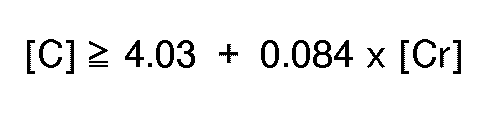
- A process as claimed in claim 8, wherein the scrap melting and heating stage is separated into two series steps, in which a first scrap melting step is performed in advance of a second heating step, for melting the scrap and the second heating step is performed subsequent to the first scrap melting step for raising the temperature of the molten iron bath to a temperature greater than or equal to 1500°C and adjusting carbon concentration [C] versus chromium concentration [Cr] to satisfy the following formula:
- A process as claimed in claim 11, which further comprises a step of monitoring a condition of the molten iron bath and detecting a time of transition between the first scrap melting step and the heating step on the basis of the monitored condition.
Applications Claiming Priority (2)
| Application Number | Priority Date | Filing Date | Title |
|---|---|---|---|
| JP63039722A JPH07100807B2 (en) | 1988-02-24 | 1988-02-24 | Method for producing molten iron containing low S chromium |
| JP39722/88 | 1988-02-24 |
Publications (3)
| Publication Number | Publication Date |
|---|---|
| EP0330482A2 EP0330482A2 (en) | 1989-08-30 |
| EP0330482A3 EP0330482A3 (en) | 1990-03-07 |
| EP0330482B1 true EP0330482B1 (en) | 1993-06-09 |
Family
ID=12560878
Family Applications (1)
| Application Number | Title | Priority Date | Filing Date |
|---|---|---|---|
| EP89301795A Expired - Lifetime EP0330482B1 (en) | 1988-02-24 | 1989-02-23 | Method for producing chromium containing molten iron with low sulphur concentration |
Country Status (9)
| Country | Link |
|---|---|
| US (1) | US5028388A (en) |
| EP (1) | EP0330482B1 (en) |
| JP (1) | JPH07100807B2 (en) |
| KR (1) | KR910009962B1 (en) |
| CN (1) | CN1020115C (en) |
| CA (1) | CA1336745C (en) |
| DE (1) | DE68906920T2 (en) |
| IN (1) | IN171215B (en) |
| ZA (1) | ZA891412B (en) |
Families Citing this family (5)
| Publication number | Priority date | Publication date | Assignee | Title |
|---|---|---|---|---|
| CA2046928C (en) * | 1989-06-02 | 2001-05-01 | Robin John Batterham | Manufacture of ferroalloys using a molten bath reactor |
| CN1040553C (en) * | 1994-08-10 | 1998-11-04 | 中国核动力研究设计院 | Method for treating blast furnace slag by dilute hydrochloric acid |
| JP4798073B2 (en) * | 2007-06-25 | 2011-10-19 | Jfeスチール株式会社 | Smelting reduction furnace slag reforming method |
| EP3957756B1 (en) * | 2019-04-19 | 2024-02-07 | Nippon Steel Corporation | Method for producing chromium-containing molten iron |
| CN114855003B (en) * | 2021-07-06 | 2023-05-12 | 丰镇市华兴化工有限公司 | Low-titanium low-sulfur ferrochrome and production method thereof |
Family Cites Families (5)
| Publication number | Priority date | Publication date | Assignee | Title |
|---|---|---|---|---|
| AT237000B (en) * | 1962-09-18 | 1964-11-25 | Guszstahlwerk Witten Ag | Process for the production of alloy steel |
| JPS6023182B2 (en) * | 1979-12-01 | 1985-06-06 | 新日本製鐵株式会社 | Melting method for medium carbon high chromium molten metal |
| JPS5770219A (en) * | 1980-10-21 | 1982-04-30 | Nisshin Steel Co Ltd | Method for dephosphorizing, desulfurizing and denitrifying iron alloy |
| JPS609815A (en) * | 1983-06-29 | 1985-01-18 | Nippon Steel Corp | Production of high chromium alloy by melt production |
| DE3518555C1 (en) * | 1985-05-23 | 1986-01-09 | Fried. Krupp Gmbh, 4300 Essen | Process for the reduction of iron-containing chrome ores |
-
1988
- 1988-02-24 JP JP63039722A patent/JPH07100807B2/en not_active Expired - Fee Related
-
1989
- 1989-02-23 ZA ZA891412A patent/ZA891412B/en unknown
- 1989-02-23 DE DE8989301795T patent/DE68906920T2/en not_active Expired - Fee Related
- 1989-02-23 CA CA000591872A patent/CA1336745C/en not_active Expired - Fee Related
- 1989-02-23 EP EP89301795A patent/EP0330482B1/en not_active Expired - Lifetime
- 1989-02-24 IN IN158/CAL/89A patent/IN171215B/en unknown
- 1989-02-24 CN CN89101847A patent/CN1020115C/en not_active Expired - Lifetime
- 1989-02-24 KR KR1019890002213A patent/KR910009962B1/en not_active Expired
-
1990
- 1990-11-19 US US07/617,424 patent/US5028388A/en not_active Expired - Lifetime
Non-Patent Citations (3)
| Title |
|---|
| PATENT ABSTRACTS OF JAPAN, vol. 11, no. 200 (C-431)(2647), 27 June 1987; & JP-A-62 20812 (Kobe Steel Ltd.) 29-01-1987 * |
| PATENT ABSTRACTS OF JAPAN, vol. 7, no. 3 (C-143)(1148), 07 January 1983; & JP-A-57 161016 (Shin Nippon Seitetsu K.K.) 04-10-1982 * |
| PATENT ABSTRACTS OF JAPAN, vol. 9, no. 119 (C-282)(1842), 23 May 1985; & JP-A-60 9815 (Shin Nippon Seitetsu K.K.) 18-01-1985 * |
Also Published As
| Publication number | Publication date |
|---|---|
| KR910009962B1 (en) | 1991-12-07 |
| IN171215B (en) | 1992-08-15 |
| DE68906920T2 (en) | 1993-09-23 |
| CA1336745C (en) | 1995-08-22 |
| US5028388A (en) | 1991-07-02 |
| EP0330482A2 (en) | 1989-08-30 |
| DE68906920D1 (en) | 1993-07-15 |
| EP0330482A3 (en) | 1990-03-07 |
| ZA891412B (en) | 1989-10-25 |
| JPH01215914A (en) | 1989-08-29 |
| CN1020115C (en) | 1993-03-17 |
| CN1036797A (en) | 1989-11-01 |
| KR890013198A (en) | 1989-09-22 |
| JPH07100807B2 (en) | 1995-11-01 |
Similar Documents
| Publication | Publication Date | Title |
|---|---|---|
| US5017220A (en) | Method for smelting reduction of Ni ore | |
| CA1136421A (en) | Steelmaking process | |
| EP0331751B1 (en) | PROCESS FOR DECARBURIZING HIGH-Cr MOLTEN PIG IRON | |
| EP0330482A2 (en) | Method for producing chromium containing molten iron with low sulphur concentration | |
| EP0355163B1 (en) | Process for producing molten stainless steel | |
| JP2958848B2 (en) | Hot metal dephosphorization method | |
| EP0330483B1 (en) | Process for producing chromium containing molten iron | |
| US4643766A (en) | Process for refining phosphoric pig iron | |
| EP0290650A1 (en) | Method for manufacturing steel through smelting reduction | |
| KR100946128B1 (en) | Method of refining molten steel | |
| US6740138B2 (en) | Molten steel producing method | |
| US2893861A (en) | Method of refining crude iron | |
| JPS6063307A (en) | Converter steel making method of dead soft steel | |
| JPH10102119A (en) | Manufacturing method of sulfur free-cutting steel | |
| JPH08311519A (en) | Converter steelmaking | |
| JPS6358203B2 (en) | ||
| KR100890807B1 (en) | Reduction of dissolved oxygen concentration in converter | |
| JPH0762413A (en) | Stainless steel manufacturing method | |
| KR102396819B1 (en) | Method for dephosphorizing of molten steel | |
| SU1046294A1 (en) | Method for smelting vanadium steels | |
| CA1075012A (en) | Process for dephosphorizing molten pig iron | |
| JPH01252715A (en) | Method for operating iron bath type smelting reduction furnace | |
| SU691497A1 (en) | Method of steel smelting | |
| JPH05186814A (en) | Production of extremely low carbon and extremely low sulfur steel | |
| JPH06104843B2 (en) | High alloy steel melting method |
Legal Events
| Date | Code | Title | Description |
|---|---|---|---|
| PUAI | Public reference made under article 153(3) epc to a published international application that has entered the european phase |
Free format text: ORIGINAL CODE: 0009012 |
|
| AK | Designated contracting states |
Kind code of ref document: A2 Designated state(s): DE FR GB IT SE |
|
| PUAL | Search report despatched |
Free format text: ORIGINAL CODE: 0009013 |
|
| AK | Designated contracting states |
Kind code of ref document: A3 Designated state(s): DE FR GB IT SE |
|
| 17P | Request for examination filed |
Effective date: 19900903 |
|
| 17Q | First examination report despatched |
Effective date: 19920331 |
|
| GRAA | (expected) grant |
Free format text: ORIGINAL CODE: 0009210 |
|
| AK | Designated contracting states |
Kind code of ref document: B1 Designated state(s): DE FR GB IT SE |
|
| ITF | It: translation for a ep patent filed | ||
| REF | Corresponds to: |
Ref document number: 68906920 Country of ref document: DE Date of ref document: 19930715 |
|
| ET | Fr: translation filed | ||
| PLBE | No opposition filed within time limit |
Free format text: ORIGINAL CODE: 0009261 |
|
| STAA | Information on the status of an ep patent application or granted ep patent |
Free format text: STATUS: NO OPPOSITION FILED WITHIN TIME LIMIT |
|
| 26N | No opposition filed | ||
| EAL | Se: european patent in force in sweden |
Ref document number: 89301795.4 |
|
| REG | Reference to a national code |
Ref country code: GB Ref legal event code: IF02 |
|
| PGFP | Annual fee paid to national office [announced via postgrant information from national office to epo] |
Ref country code: SE Payment date: 20060207 Year of fee payment: 18 |
|
| PGFP | Annual fee paid to national office [announced via postgrant information from national office to epo] |
Ref country code: DE Payment date: 20060216 Year of fee payment: 18 |
|
| PGFP | Annual fee paid to national office [announced via postgrant information from national office to epo] |
Ref country code: FR Payment date: 20060220 Year of fee payment: 18 |
|
| PGFP | Annual fee paid to national office [announced via postgrant information from national office to epo] |
Ref country code: GB Payment date: 20060222 Year of fee payment: 18 |
|
| PGFP | Annual fee paid to national office [announced via postgrant information from national office to epo] |
Ref country code: IT Payment date: 20060228 Year of fee payment: 18 |
|
| PG25 | Lapsed in a contracting state [announced via postgrant information from national office to epo] |
Ref country code: SE Free format text: LAPSE BECAUSE OF NON-PAYMENT OF DUE FEES Effective date: 20070224 |
|
| EUG | Se: european patent has lapsed | ||
| GBPC | Gb: european patent ceased through non-payment of renewal fee |
Effective date: 20070223 |
|
| REG | Reference to a national code |
Ref country code: FR Ref legal event code: ST Effective date: 20071030 |
|
| PG25 | Lapsed in a contracting state [announced via postgrant information from national office to epo] |
Ref country code: DE Free format text: LAPSE BECAUSE OF NON-PAYMENT OF DUE FEES Effective date: 20070901 |
|
| PG25 | Lapsed in a contracting state [announced via postgrant information from national office to epo] |
Ref country code: FR Free format text: LAPSE BECAUSE OF NON-PAYMENT OF DUE FEES Effective date: 20070228 Ref country code: GB Free format text: LAPSE BECAUSE OF NON-PAYMENT OF DUE FEES Effective date: 20070223 |
|
| PG25 | Lapsed in a contracting state [announced via postgrant information from national office to epo] |
Ref country code: IT Free format text: LAPSE BECAUSE OF NON-PAYMENT OF DUE FEES Effective date: 20070223 |