EP0330331B1 - Coated granular fertilizers - Google Patents
Coated granular fertilizers Download PDFInfo
- Publication number
- EP0330331B1 EP0330331B1 EP89301136A EP89301136A EP0330331B1 EP 0330331 B1 EP0330331 B1 EP 0330331B1 EP 89301136 A EP89301136 A EP 89301136A EP 89301136 A EP89301136 A EP 89301136A EP 0330331 B1 EP0330331 B1 EP 0330331B1
- Authority
- EP
- European Patent Office
- Prior art keywords
- olefin
- granular fertilizer
- coated granular
- ethylene
- copolymer
- Prior art date
- Legal status (The legal status is an assumption and is not a legal conclusion. Google has not performed a legal analysis and makes no representation as to the accuracy of the status listed.)
- Expired - Lifetime
Links
Images


Classifications
-
- C—CHEMISTRY; METALLURGY
- C05—FERTILISERS; MANUFACTURE THEREOF
- C05G—MIXTURES OF FERTILISERS COVERED INDIVIDUALLY BY DIFFERENT SUBCLASSES OF CLASS C05; MIXTURES OF ONE OR MORE FERTILISERS WITH MATERIALS NOT HAVING A SPECIFIC FERTILISING ACTIVITY, e.g. PESTICIDES, SOIL-CONDITIONERS, WETTING AGENTS; FERTILISERS CHARACTERISED BY THEIR FORM
- C05G3/00—Mixtures of one or more fertilisers with additives not having a specially fertilising activity
-
- C—CHEMISTRY; METALLURGY
- C05—FERTILISERS; MANUFACTURE THEREOF
- C05G—MIXTURES OF FERTILISERS COVERED INDIVIDUALLY BY DIFFERENT SUBCLASSES OF CLASS C05; MIXTURES OF ONE OR MORE FERTILISERS WITH MATERIALS NOT HAVING A SPECIFIC FERTILISING ACTIVITY, e.g. PESTICIDES, SOIL-CONDITIONERS, WETTING AGENTS; FERTILISERS CHARACTERISED BY THEIR FORM
- C05G5/00—Fertilisers characterised by their form
- C05G5/30—Layered or coated, e.g. dust-preventing coatings
- C05G5/37—Layered or coated, e.g. dust-preventing coatings layered or coated with a polymer
Definitions
- This invention relates to fertilizers and, more particularly, to coated granular fertilizers in which the dissolution rates of water-soluble fertilizer components are controlled by coating or encapsulating a quick-acting granular fertiziler with a water-resistant film.
- olefin polymers olefin polymers and copolymers
- olefin polymers olefin polymers
- Japanese Patent Publications Nos. 50-99,858 and 60-3,040 disclose coating methods and coated fertilizers wherein olefin polymers with or without inorganic fillers are used as an encapsulating material.
- Japanese Patent Publications Nos. 50-99,858 and 54-3,104 suggest the use of nonionic surface active agents.
- Japanese Patent Publication No. 60-37,074 describes the control of the dissolution rate by using a mixture of an ethylene-vinyl acetate copolymer and an olefin polymer in a suitable ratio.
- a coated granular fertilizer which comprises granules of a fertilizer, and a film of a resin composition covering the individual granules, the resin composition comprising an olefin polymer and a polyether polyol, used in an amount of from 0.01 to 10 wt.% of the resin composition, the dissolution rate of the granular fertilizer being arbitrarily controlled by controlling the amount of the polyether polyol within the above range.
- the physical properties of the film depend almost solely on the constitution of the olefin polymer component and the dissolution rate can be arbitrarily controlled by controlling the amount of the polyether polyol.
- the coated granular fertilizer according to the invention should comprise a granular fertilizer to be covered with a resin composition.
- the granular fertilizer used in the present invention is not critical with respect to type and may be any known chemical fertilizers.
- the fertilizer include ammonium sulphate, ammonium chloride, ammonium nitrate, urea, potassium chloride, potassium sulphate, potassium nitrate, sodium nitrate, ammonium phosphate, potassium phosphate, calcium phosphate, and composite fertilizers thereof.
- the granular fertilizer is coated with a water-resistant film-forming resin composition.
- the composition should essentially comprise an olefin polymer and optionally, other polymers, waxes, inorganic and organic powders and surface active agents.
- a polyether polyol should be contained in the resin composition as will be described hereinafter.
- the olefin polymer essentially used in the practice of the invention may be a homopolymer or copolymer.
- the olefin homopolymer includes an ethylene polymer and a propylene polymer.
- the olefin copolymers include copolymers mainly composed of ethylene and/or propylene such as ethylene-propylene copolymers, ethylene-propylene-butene copolymers, ethylene-vinyl acetate copolymers which have a content of vinyl acetate of not larger than 5 wt%, ethylene-carbon monoxide copolymers and the like. These polymers may be used singly or in combination.
- an olefin homopolymer and an olefin copolymer are preferably used.
- the olefin homopolymer and copolymer may be used at an arbitrary ratio and is generally at a ratio of 9 to 1 : 1 to 9 on the weight basis.
- Polymers other than those essentially used in the present invention may be added without limitation provided that they can be dissolved or dispersed in a coating solution containing the essential olefin polymer.
- the olefin polymer is usually dissolved in weakly polar organic solvents. Accordingly, the additive polymers should preferably be dissolved in such weakly polar organic solvents.
- the additive polymers include rubbers such as styrene-butadiene rubbers, butadiene rubber, isoprene rubber, chloroprene rubber, butyl rubber and the like, elastomers such as styrene-butadiene elastomers, styrene-isoprene elastomers, 1,2-polybutadiene elastomer, ethylene-vinyl acetate copolymer elastomers, and thermoplastic resins such as styrene polymer, vinylidene chloride polymer, vinylidene chloride-vinyl chloride copolymers, methyl methacrylate resin and the like.
- rubbers such as styrene-butadiene rubbers, butadiene rubber, isoprene rubber, chloroprene rubber, butyl rubber and the like
- elastomers such as styrene-butadiene elastomers, s
- the waxes used in the present invention may be any waxes provided that they are soluble in solvents for the essential polymers.
- examples of such waxes include paraffin wax, hardened oils, bee wax, Japan wax, rosin, petroleum resins and the like.
- Inorganic and organic powders useful in the present invention are not critical so far as they are dispersable in the coating solution.
- powders having a large size are not suitable for the purpose of coating and should have a size smaller than a thickness of the film of the coated granular fertilizer.
- the size is not larger than the half the thickness, preferably 1/4 of the thickness.
- the thickness of the coated film is generally in the range of from 10 to 200 micrometers.
- the dispersability in the coating solution becomes better when a powder has better affinity for the solvent. If the affinity is poor, this can be improved, for example, by coating the powder on the surface thereof with a silicone.
- a surface treatment enables one to use any powders.
- Preferable inorganic powders include talc, calcium carbonate, diatomaceous earth, kaolin, bentonite, silica, metal oxides, and the like, of which talc is most preferable.
- the other powders should preferably be used after treatment with silicones.
- Preferable organic powders are those of starch, crotylidene diurea and the like. These powders should also be favorably treated with silicones.
- additives may be used in amounts which depend upon the purpose of a final coated granular fertilizer.
- surface active agents may be added to the coating solution.
- the coating compositions comprising the ingredients described above are known.
- the granular fertilizer according to the invention is characterized in that the fertilizer is covered or coated with coating compositions in which polyether polyols are added to the known coating compositions.
- polyether polyols used in the practice of the invention are compounds which have an ether bond in the molecule and an OH group at an end of the molecule.
- Typical examples of the compound are polyethylene oxide and polypropylene oxide of the following general formula [I].
- each R represents a hydrogen atom or an alkyl group having from 1 to 3 carbon atoms and n is an integer of from 1 to 100, preferably from 1 to 50.
- useful polyether polyols include polyethylene oxide, polypropylene oxide, ethylene oxide-propylene oxide copolymers, ether products between the above oxides and polyhydric alcohols, and mixtures thereof.
- the polyhydric alcohols include ethylene glycol, propylene glycol and butylene glycol. Further example is polyethylenepropylene glycol derived from said glycols.
- polyether polyols may be used singly or in combination in an amount of from 0.01 to 10 wt% of the coating composition.
- the coated fertilizer where a granular fertilizer is covered or encapsulated with a water-resistant film may be produced by various known methods.
- a jet coating method as disclosed in Japanese Patent Publication No. 60-3,040 is most preferred.
- starting materials including the olefin polymer and copolymer are dissolved or dispersed in organic solvents.
- the resultant solution or dispersion is sprayed over a granular fertilizer in a jet flow state, thereby covering the fertilizer with the solution.
- the polyether polyol is used after uniform dissolution or dispersion in the solvent and is thus uniformly dispersed in the film formed by the method.
- the film coated on a granular fertilizer has a polyether polyol dispersed therein, and when the amount of the polyether polyol increases, the dissolution rate increases.
- the dissolution rate can be controlled by changing the amount of polyether polyol.
- the incorporation of a polyether polyol within the above-defined range rarely influences the physical properties of the film.
- the control of the dissolution rate can be realized without a sacrifice of physical properties of the film.
- the polyether polyol is advantageous over surface active agents in that stress cracking on olefin polymers and an undesirable effect of facilitating the dissolution of fertilizer components as will occur with use of surface active agents are not involved. Accordingly, the dissolution of effective components can be stabilized. The dissolution is more facilitated when using a larger amount of a polyether polyol with a higher degree of polymerization.
- alkyl group as a substituent of polyalkylene oxides, a lower alkyl group gives a better effect of the dissolution if miscibility with olefin polymer and copolymer is not taken into account. In this sense, polyethylene oxide exhibits the highest effect of facilitating the dissolution.
- coated or encapsulated granular fertilizers of the invention and for comparison and a method for producing the same are described, wherein a jet flow coating apparatus is used to make instantaneous drying conditions.
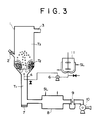
- Fig. 3 shows a jet flow encapsulating apparatus used in the example.
- the apparatus includes a jet flow column 1 having a diameter of 250 mm, a height of 200 mm, an air jetting diameter of 50 mm and an angle of the cone of 50°, a fertilizer charging port 2 and an exhaust port 3.
- An air jet is passed from a blower 10 through an orifice flow meter 9 and a heat exchanger 8 into the jet flow column 1.
- the flow rate and the temperature of the air are controlled by means of the flow meter 9 and the heat exchanger 8, respectively, and an exhaust is discharged from the port 3 to outside.
- a granular fertilizer to be used for encapsulation is charged from the fertilizer charging port 2 while passing hot air with a given temperature so that it forms a granular fertilizer flow.
- the hot air temperature, temperature of the granules being encapsulated and exhaust temperature are detected by means of thermometers T1, T2 and T3, respectively.
- T3 reaches a predetermined temperature, an encapsulating solution is sprayed against the fertilizer flow through a one fluid nozzle 4.
- the encapsulating solution is agitated in a solution tank 11 so that when a powder is used, it is uniformly dispersed and is passed by the use of a pump 6.
- a double tube is used through which steam is passed.
- the blower is stopped and a coated or encapsulated fertilizer is withdrawn from a withdrawal port.
- encapsulation was performed under the following fundamental conditions.
- One fluid nozzle opening 0.8mm, full con type Amount of hot air: 4 m2/minute Temperature of hot air: 100°C ⁇ 2°C
- Type of fertilizer 5-8 mesh granular urea
- Charge of the fertilizer 10 kg
- Type of test solvent tetrachloroethylene
- Feed of encapsulating solution 0.5 kg/minute
- Encapsulating time 40 minutes
- Coated granular fertilizers of the invention and for comparison were prepared using compositions indicated in Table 1 below.
- Fig. 1 shows a dissolution rate in water at 25°C for different molecular weights of polyethylene oxide used in the fertilizers prepared in Examples-I. From the results, it will be seen that the effect of facilitating the dissolution is better for a higher degree of polymerization of polyethylene oxide.
- Fig. 2 shows a cumulative dissolution rate for different amounts of polypropylene oxide. The results reveal that the dissolution rate varies depending upon the amount.
- Example 13 the flowability of the granules in the jet flow was good and the granules can flow mechanically.
- Comparative Example 5 the flowability was poor with a need of shaking.
- the flowability in Comparative Example 6 was similar to that of the example, but when the fertilizer was stored in open air, the dissolution was accelerated at 6th month, with a problem of stability.
- fertilizers of the following compositions were prepared. These coatings of the fertilizers were subjected to measurement of a degree of degradation according to the method set forth below.
- Coated granules of fertilizer were cut with a sharp knife at opposite ends thereof and the fertilizer in the granules was dissolved in water to obtain a fine ring with a width of 1.5 mm for use as a sample.
- the samples were each allowed to stand outdoors and subjected to measurement of tensile strength in relation to days of outdoor exposure. The degree of degradation was determined as the days at which the tensile strength was reduced to about 1/3 of an initial strength.
Landscapes
- Life Sciences & Earth Sciences (AREA)
- Pest Control & Pesticides (AREA)
- Chemical & Material Sciences (AREA)
- Organic Chemistry (AREA)
- Fertilizers (AREA)
- Compositions Of Macromolecular Compounds (AREA)
Description
- This invention relates to fertilizers and, more particularly, to coated granular fertilizers in which the dissolution rates of water-soluble fertilizer components are controlled by coating or encapsulating a quick-acting granular fertiziler with a water-resistant film.
- In recent years, there have been used encapsulated or coated granular fertilizers in which the granular fertilizer is encapsulated so that the dissolution rate of the effective fertilizer components is controlled.
- We have proposed a series of techniques for coated fertilizers using olefin polymers and copolymers (hereinafter often referred to simply as "olefin polymers") as essential ingredients for a coating film. Thus, for example, Japanese Patent Publications Nos. 50-99,858 and 60-3,040, disclose coating methods and coated fertilizers wherein olefin polymers with or without inorganic fillers are used as an encapsulating material.
- In order to facilitate dissolution of the coated fertilizers, Japanese Patent Publications Nos. 50-99,858 and 54-3,104 suggest the use of nonionic surface active agents. Moreover, Japanese Patent Publication No. 60-37,074 describes the control of the dissolution rate by using a mixture of an ethylene-vinyl acetate copolymer and an olefin polymer in a suitable ratio.
- According to these patent publications, in order to properly control the dissolution rates using polymer compositions comprised primarily of olefin polymer and copolymer and an inorganic filler, it is necessary to balance the following requirements: (1) the ratio between olefin polymer and ethylene-vinyl acetate copolymer; (2) the content of surface active agent; and (3) the content of inorganic filler.
- However, the control of the dissolution rates by varying the proportions or contents of the ingredients in the above compositions places limitations on the maintenance of the properties of the coating film. For instance, if the inorganic filler content is increased, the dissolution rate increases with a reduction in film strength, thus presenting a problem of breakage during handling. Therefore, it is not convenient to increase the filler to a substantial extent.
- Although it is ordinarily preferable to control the dissolution rates by varying the ratio between the olefin polymer and the ethylene-vinyl acetate copolymer, this ratio is eventually determined by setting a dissolution rate of an effective fertilizer component. The attendant problem is that the physical and mechanical properties of the resultant film are also disadvantageously determined.
- For instance, it is necessary to increase the amount of ethylene-vinyl acetate copolymer in order to increase the dissolution rate. The resultant film becomes soft. In coated fertilizers having different dissolution rates of the respective effective fertilizer components, it is not favourable, from the standpoint of quality control, that the coating films for the respective components have different physical properties. This may be overcome by controlling the amount of surface active agent used. However, if surface agents are used in large amounts in the olefin polymer film, the problem will arise that the film is cracked owing to stress cracking with a loss of coating performance.
- These problems may be solved when using in combination a soft polymer such as an ethylene-vinyl acetate copolymer, but if a surface active agent used is present around coated fertilizer granules in large amounts, the dissolution rate is facilitated. In commercial fertilizer products, the surface active agent is added in amounts within a range not presenting any problem with regard to dissolution rate. The control of the dissolution rate by incorporation of surface active agents in large amounts thus involves a problem with regard to stability.
- It is an object of the invention to provide a coated or encapsulated granular fertilizer in which granules of a fertilizer are individually covered with a resin composition whereby problems of stress cracking and dissolution stability involved in the prior art coated granular fertilizers can be appropriately solved.
- It is another object of the invention to provide a coated granular fertilizer in which granules of a fertilizer are individually covered with a film of a resin composition comprised of an olefin polymer and an olefin copolymer such as an ethylene-vinyl acetate copolymer together with a polyether polyol.
- According to the invention there is provided a coated granular fertilizer which comprises granules of a fertilizer, and a film of a resin composition covering the individual granules, the resin composition comprising an olefin polymer and a polyether polyol, used in an amount of from 0.01 to 10 wt.% of the resin composition, the dissolution rate of the granular fertilizer being arbitrarily controlled by controlling the amount of the polyether polyol within the above range. The physical properties of the film depend almost solely on the constitution of the olefin polymer component and the dissolution rate can be arbitrarily controlled by controlling the amount of the polyether polyol.
- In the following description, reference will be made to the accompanying drawings, in which:-
- Fig. 1 is a graph showing cumulative dissolution rate in relation to the variation in days for the dissolution for different coated granular fertilizers;
- Fig. 2 is a graph showing cumulative dissolution rate in relation to the variation in days for the dissolution for different coated granular fertilizers; and
- Fig. 3 is a flow chart of a jet coating apparatus as used in the Examples and Comparative Examples.
- The coated granular fertilizer according to the invention should comprise a granular fertilizer to be covered with a resin composition. The granular fertilizer used in the present invention is not critical with respect to type and may be any known chemical fertilizers. Examples of the fertilizer include ammonium sulphate, ammonium chloride, ammonium nitrate, urea, potassium chloride, potassium sulphate, potassium nitrate, sodium nitrate, ammonium phosphate, potassium phosphate, calcium phosphate, and composite fertilizers thereof.
- The granular fertilizer is coated with a water-resistant film-forming resin composition. The composition should essentially comprise an olefin polymer and optionally, other polymers, waxes, inorganic and organic powders and surface active agents. In addition, a polyether polyol should be contained in the resin composition as will be described hereinafter.
- The olefin polymer essentially used in the practice of the invention may be a homopolymer or copolymer. The olefin homopolymer includes an ethylene polymer and a propylene polymer. The olefin copolymers include copolymers mainly composed of ethylene and/or propylene such as ethylene-propylene copolymers, ethylene-propylene-butene copolymers, ethylene-vinyl acetate copolymers which have a content of vinyl acetate of not larger than 5 wt%, ethylene-carbon monoxide copolymers and the like. These polymers may be used singly or in combination. If these polymers are used in combination, an olefin homopolymer and an olefin copolymer are preferably used. In this case, the olefin homopolymer and copolymer may be used at an arbitrary ratio and is generally at a ratio of 9 to 1 : 1 to 9 on the weight basis.
- Optional ingredients are described.
- Polymers other than those essentially used in the present invention may be added without limitation provided that they can be dissolved or dispersed in a coating solution containing the essential olefin polymer. The olefin polymer is usually dissolved in weakly polar organic solvents. Accordingly, the additive polymers should preferably be dissolved in such weakly polar organic solvents.
- Examples of the additive polymers include rubbers such as styrene-butadiene rubbers, butadiene rubber, isoprene rubber, chloroprene rubber, butyl rubber and the like, elastomers such as styrene-butadiene elastomers, styrene-isoprene elastomers, 1,2-polybutadiene elastomer, ethylene-vinyl acetate copolymer elastomers, and thermoplastic resins such as styrene polymer, vinylidene chloride polymer, vinylidene chloride-vinyl chloride copolymers, methyl methacrylate resin and the like.
- The waxes used in the present invention may be any waxes provided that they are soluble in solvents for the essential polymers. Examples of such waxes include paraffin wax, hardened oils, bee wax, Japan wax, rosin, petroleum resins and the like.
- Inorganic and organic powders useful in the present invention are not critical so far as they are dispersable in the coating solution. In this connection, however, powders having a large size are not suitable for the purpose of coating and should have a size smaller than a thickness of the film of the coated granular fertilizer. In general, the size is not larger than the half the thickness, preferably 1/4 of the thickness. The thickness of the coated film is generally in the range of from 10 to 200 micrometers.
- The dispersability in the coating solution becomes better when a powder has better affinity for the solvent. If the affinity is poor, this can be improved, for example, by coating the powder on the surface thereof with a silicone. Such a surface treatment enables one to use any powders. Preferable inorganic powders include talc, calcium carbonate, diatomaceous earth, kaolin, bentonite, silica, metal oxides, and the like, of which talc is most preferable. The other powders should preferably be used after treatment with silicones.
- Preferable organic powders are those of starch, crotylidene diurea and the like. These powders should also be favorably treated with silicones.
- These additives may be used in amounts which depend upon the purpose of a final coated granular fertilizer. Moreover, in order to control the dissolution rate or impart hydrophilic properties, surface active agents may be added to the coating solution.
- The coating compositions comprising the ingredients described above are known. The granular fertilizer according to the invention is characterized in that the fertilizer is covered or coated with coating compositions in which polyether polyols are added to the known coating compositions.
- The polyether polyols used in the practice of the invention are compounds which have an ether bond in the molecule and an OH group at an end of the molecule. Typical examples of the compound are polyethylene oxide and polypropylene oxide of the following general formula [I].

- More complicated compounds of the following formula [II] wherein the terminal group of a polyalkylene oxide combines with other functional groups may also be included within the scope of the invention.

- In the formulae [I] and [II], each R represents a hydrogen atom or an alkyl group having from 1 to 3 carbon atoms and n is an integer of from 1 to 100, preferably from 1 to 50. In the practice of the invention, useful polyether polyols include polyethylene oxide, polypropylene oxide, ethylene oxide-propylene oxide copolymers, ether products between the above oxides and polyhydric alcohols, and mixtures thereof. Examples of the polyhydric alcohols include ethylene glycol, propylene glycol and butylene glycol. Further example is polyethylenepropylene glycol derived from said glycols.
- These polyether polyols may be used singly or in combination in an amount of from 0.01 to 10 wt% of the coating composition.
- The coated fertilizer where a granular fertilizer is covered or encapsulated with a water-resistant film may be produced by various known methods. In the case where a preferable combination of olefin homopolymer and copolymer are used in the coating composition, a jet coating method as disclosed in Japanese Patent Publication No. 60-3,040 is most preferred.
- In this method, starting materials including the olefin polymer and copolymer are dissolved or dispersed in organic solvents. The resultant solution or dispersion is sprayed over a granular fertilizer in a jet flow state, thereby covering the fertilizer with the solution. The polyether polyol is used after uniform dissolution or dispersion in the solvent and is thus uniformly dispersed in the film formed by the method.
- Although an appropriate combination of a polyether polyol with a solvent may be considered with respect to the solubility, little problem is involved in the solubility and dispersability of the polyether polyol unless the polyether polyol used has a very high molecular weight. This is because the amount of the polyether polyol is relatively small.
- The film coated on a granular fertilizer has a polyether polyol dispersed therein, and when the amount of the polyether polyol increases, the dissolution rate increases. Thus, the dissolution rate can be controlled by changing the amount of polyether polyol. In addition, the incorporation of a polyether polyol within the above-defined range rarely influences the physical properties of the film. Thus, the control of the dissolution rate can be realized without a sacrifice of physical properties of the film.
- The polyether polyol is advantageous over surface active agents in that stress cracking on olefin polymers and an undesirable effect of facilitating the dissolution of fertilizer components as will occur with use of surface active agents are not involved. Accordingly, the dissolution of effective components can be stabilized. The dissolution is more facilitated when using a larger amount of a polyether polyol with a higher degree of polymerization.
- With regard to the type of alkyl group as a substituent of polyalkylene oxides, a lower alkyl group gives a better effect of the dissolution if miscibility with olefin polymer and copolymer is not taken into account. In this sense, polyethylene oxide exhibits the highest effect of facilitating the dissolution.
- The present invention is described in more detail by way of examples.
- In the examples-I, coated or encapsulated granular fertilizers of the invention and for comparison and a method for producing the same are described, wherein a jet flow coating apparatus is used to make instantaneous drying conditions.
- Fig. 3 shows a jet flow encapsulating apparatus used in the example. The apparatus includes a
jet flow column 1 having a diameter of 250 mm, a height of 200 mm, an air jetting diameter of 50 mm and an angle of the cone of 50°, afertilizer charging port 2 and anexhaust port 3. An air jet is passed from ablower 10 through anorifice flow meter 9 and aheat exchanger 8 into thejet flow column 1. The flow rate and the temperature of the air are controlled by means of theflow meter 9 and theheat exchanger 8, respectively, and an exhaust is discharged from theport 3 to outside. A granular fertilizer to be used for encapsulation is charged from thefertilizer charging port 2 while passing hot air with a given temperature so that it forms a granular fertilizer flow. The hot air temperature, temperature of the granules being encapsulated and exhaust temperature are detected by means of thermometers T₁, T₂ and T₃, respectively. When T₃ reaches a predetermined temperature, an encapsulating solution is sprayed against the fertilizer flow through a onefluid nozzle 4. The encapsulating solution is agitated in a solution tank 11 so that when a powder is used, it is uniformly dispersed and is passed by the use of apump 6. In order to keep the temperature of the solution at not lower than 100°C until the solution reaches the nozzle, a double tube is used through which steam is passed. When a predetermined encapsulation rate is accomplished, the blower is stopped and a coated or encapsulated fertilizer is withdrawn from a withdrawal port. - In the examples, encapsulation was performed under the following fundamental conditions.
One fluid nozzle: opening 0.8mm, full con type
Amount of hot air: 4 m²/minute
Temperature of hot air: 100°C ± 2°C
Type of fertilizer: 5-8 mesh granular urea
Charge of the fertilizer: 10 kg
Concentration of encapsulating solution: solid content 2.5 wt%
Type of test solvent: tetrachloroethylene
Feed of encapsulating solution: 0.5 kg/minute
Encapsulating time: 40 minutes
Encapsulating rate (relative to the fertilizer): 5.0% - Coated granular fertilizers of the invention and for comparison were prepared using compositions indicated in Table 1 below.


- 10g of each of the fertilizers of the invention prepared in Examples-I was immersed in 200 ml of water and allowed to stand at 25°C. After a certain time, the fertilizer and the water were separated from each other to determine dissolve urea by a quantitative analysis. The separated fertilizer was again immersed in 200 ml of fresh water and allowed to stand at 25°C. After a certain time, a similar analysis was effected. The above procedure was repeated and the relation between a cumulative dissolution rate of the urea dissolved in water and the days is plotted to obtain a dissolution rate curve.
- Fig. 1 shows a dissolution rate in water at 25°C for different molecular weights of polyethylene oxide used in the fertilizers prepared in Examples-I. From the results, it will be seen that the effect of facilitating the dissolution is better for a higher degree of polymerization of polyethylene oxide.
- Fig. 2 shows a cumulative dissolution rate for different amounts of polypropylene oxide. The results reveal that the dissolution rate varies depending upon the amount.
- In the same manner as in Examples-I, the following fertilizers were prepared. The dissolution rates in water for these fertilizers were found to be almost at the same level.

- In Example 13, the flowability of the granules in the jet flow was good and the granules can flow mechanically. In Comparative Example 5, the flowability was poor with a need of shaking. The flowability in Comparative Example 6 was similar to that of the example, but when the fertilizer was stored in open air, the dissolution was accelerated at 6th month, with a problem of stability.
- In the same manner as in Examples-I, fertilizers of the following compositions were prepared. These coatings of the fertilizers were subjected to measurement of a degree of degradation according to the method set forth below.
- Measurement of a degree of degradation:
- Coated granules of fertilizer were cut with a sharp knife at opposite ends thereof and the fertilizer in the granules was dissolved in water to obtain a fine ring with a width of 1.5 mm for use as a sample. The samples were each allowed to stand outdoors and subjected to measurement of tensile strength in relation to days of outdoor exposure. The degree of degradation was determined as the days at which the tensile strength was reduced to about 1/3 of an initial strength.
- The results are shown in Table 3, in which the days of dissolution and the degree of degradation are shown relative to concentration of polyethylene oxide and a polypropylene oxide derivative. From the results, it will be seen that the polyethylene oxide facilitates the dissolution and the derivative of polypropylene oxide has an effect of promoting photo-degradation.

Claims (10)
Applications Claiming Priority (2)
| Application Number | Priority Date | Filing Date | Title |
|---|---|---|---|
| JP40394/88 | 1988-02-23 | ||
| JP63040394A JPH01215783A (en) | 1988-02-23 | 1988-02-23 | Coated granular fertilizer |
Publications (2)
| Publication Number | Publication Date |
|---|---|
| EP0330331A1 EP0330331A1 (en) | 1989-08-30 |
| EP0330331B1 true EP0330331B1 (en) | 1992-05-20 |
Family
ID=12579449
Family Applications (1)
| Application Number | Title | Priority Date | Filing Date |
|---|---|---|---|
| EP89301136A Expired - Lifetime EP0330331B1 (en) | 1988-02-23 | 1989-02-06 | Coated granular fertilizers |
Country Status (10)
| Country | Link |
|---|---|
| US (1) | US5147442A (en) |
| EP (1) | EP0330331B1 (en) |
| JP (1) | JPH01215783A (en) |
| KR (1) | KR960015151B1 (en) |
| CN (1) | CN1036553A (en) |
| AU (1) | AU609944B2 (en) |
| CA (1) | CA1329491C (en) |
| DE (1) | DE68901548D1 (en) |
| MY (1) | MY104404A (en) |
| NZ (1) | NZ227909A (en) |
Families Citing this family (27)
| Publication number | Priority date | Publication date | Assignee | Title |
|---|---|---|---|---|
| JPH02275792A (en) * | 1989-01-23 | 1990-11-09 | Asahi Chem Ind Co Ltd | Coated granular fertilizer |
| DK0571532T3 (en) * | 1991-02-14 | 1997-10-20 | Oms Investments Inc | Wear resistant coatings for fertilizers |
| US5466274A (en) * | 1991-02-14 | 1995-11-14 | Oms Investments, Inc. | Abrasion resistant coatings for fertilizers |
| US5264019A (en) * | 1991-03-05 | 1993-11-23 | Eastman Kodak Company | Coating compositions for slow release fertilizer formulations |
| SE9201349D0 (en) * | 1992-04-29 | 1992-04-29 | Berne F Ellers | ABSORBING MATERIAL |
| JPH0687684A (en) * | 1992-08-13 | 1994-03-29 | Chisso Corp | Coated-granular fertilizer |
| CN1034657C (en) * | 1993-01-14 | 1997-04-23 | 北京化工学院 | Slowly-releasing coated fertilizer and production thereof |
| CA2227536A1 (en) * | 1995-07-28 | 1997-02-13 | Chisso Corporation | Coated granular pesticide, methods for producing the same and applications thereof |
| JP4003236B2 (en) * | 1995-09-28 | 2007-11-07 | 住友化学株式会社 | Agrochemical-containing granular fertilizer composition and method for producing the same |
| US5772721A (en) * | 1995-11-21 | 1998-06-30 | Kazemzadeh; Massoud | Process for producing odorless organic and semi-organic fertilizer |
| DE19603739A1 (en) * | 1996-02-02 | 1997-08-07 | Basf Ag | Granulate mixtures consisting of coated and non-coated fertilizer granules |
| US6458179B1 (en) | 1999-10-07 | 2002-10-01 | Nick Puskarich | Soil activator |
| US6319156B1 (en) * | 1999-12-13 | 2001-11-20 | John Marshall | Biodegradable golf tee |
| US6663686B1 (en) * | 2000-06-27 | 2003-12-16 | Agrium, Inc. | Controlled release fertilizer and method for production thereof |
| JP2002037689A (en) * | 2000-07-24 | 2002-02-06 | Chisso Corp | Coated granular fertilizer |
| US20040016276A1 (en) * | 2002-07-26 | 2004-01-29 | Wynnyk Nick P. | Controlled release fertilizer having improved mechanical handling durability and method for production thereof |
| US7320724B2 (en) * | 2004-08-06 | 2008-01-22 | Florikan E.S.A. Corporation | Compositions for the staged release of nutrients to plants |
| CN100546949C (en) * | 2005-03-08 | 2009-10-07 | 上海汉枫缓释肥料有限公司 | A kind of resin-coated fertilizer and its manufacturing method |
| US7267707B2 (en) * | 2005-03-30 | 2007-09-11 | Florikan E.S.A. Corp. | Polyurethane encapsulated fertilizer |
| US8303680B2 (en) * | 2009-06-24 | 2012-11-06 | Basf Se | Encapsulated particle |
| US9321699B2 (en) * | 2012-11-21 | 2016-04-26 | The Mosaic Company | Granular fertilizers having improved dust control |
| KR20180101406A (en) | 2015-12-28 | 2018-09-12 | 아다마 마켓심 리미티드 | Release control pesticide delivery unit, its manufacture and use |
| AR112041A1 (en) | 2017-06-28 | 2019-09-11 | Adama Makhteshim Ltd | CONTROLLED RELEASE AGROCHEMICAL DELIVERY UNITS, MANUFACTURING AND USE OF THE SAME |
| CN111094215B (en) * | 2017-09-13 | 2022-05-03 | 株式会社Lg化学 | Controlled release fertilizer with reduced floatability comprising triblock copolymer and method for making same |
| TWI675816B (en) | 2017-09-13 | 2019-11-01 | 南韓商Lg化學股份有限公司 | Controlled-release type fertilizer with decreased floating property comprising polyoxyethylene alkyl(-aryl) ether and method for preparing the same |
| US11339102B2 (en) | 2019-08-08 | 2022-05-24 | Profile Products Llc | Biodegradable polymers on fertilizer nutrients |
| CN116535258B (en) * | 2023-04-23 | 2024-07-26 | 湖北富邦新材料有限公司 | Anti-caking agent for granular water-soluble fertilizer and preparation method thereof |
Family Cites Families (5)
| Publication number | Priority date | Publication date | Assignee | Title |
|---|---|---|---|---|
| NL261149A (en) * | 1960-02-15 | |||
| GB1201817A (en) * | 1967-09-18 | 1970-08-12 | Ici Ltd | Improvements in and relating to urea and urea compositions |
| JPS6037074B2 (en) * | 1978-12-27 | 1985-08-23 | チツソ旭肥料株式会社 | Coated fertilizer and its manufacturing method |
| DE3544451C1 (en) * | 1985-12-16 | 1987-01-15 | Ashland Suedchemie Kernfest | Process for producing a water-permeable coating on granular, water-soluble substances and its application |
| NZ220762A (en) * | 1986-07-07 | 1989-05-29 | Chisso Corp | Coated fertiliser with polyolefinic coating |
-
1988
- 1988-02-23 JP JP63040394A patent/JPH01215783A/en active Granted
-
1989
- 1989-02-06 EP EP89301136A patent/EP0330331B1/en not_active Expired - Lifetime
- 1989-02-06 DE DE8989301136T patent/DE68901548D1/en not_active Expired - Lifetime
- 1989-02-07 US US07/306,897 patent/US5147442A/en not_active Expired - Lifetime
- 1989-02-09 NZ NZ227909A patent/NZ227909A/en unknown
- 1989-02-15 CA CA000591123A patent/CA1329491C/en not_active Expired - Fee Related
- 1989-02-16 AU AU30008/89A patent/AU609944B2/en not_active Ceased
- 1989-02-22 MY MYPI89000215A patent/MY104404A/en unknown
- 1989-02-22 KR KR1019890002068A patent/KR960015151B1/en not_active Expired - Fee Related
- 1989-02-23 CN CN89101193A patent/CN1036553A/en active Pending
Also Published As
| Publication number | Publication date |
|---|---|
| KR890012916A (en) | 1989-09-20 |
| US5147442A (en) | 1992-09-15 |
| MY104404A (en) | 1994-03-31 |
| KR960015151B1 (en) | 1996-11-01 |
| AU609944B2 (en) | 1991-05-09 |
| AU3000889A (en) | 1989-08-24 |
| CN1036553A (en) | 1989-10-25 |
| DE68901548D1 (en) | 1992-06-25 |
| CA1329491C (en) | 1994-05-17 |
| NZ227909A (en) | 1991-07-26 |
| JPH01215783A (en) | 1989-08-29 |
| EP0330331A1 (en) | 1989-08-30 |
| JPH0469598B2 (en) | 1992-11-06 |
Similar Documents
| Publication | Publication Date | Title |
|---|---|---|
| EP0330331B1 (en) | Coated granular fertilizers | |
| KR910007178B1 (en) | Fertilizer with a degradative coating | |
| EP0255752B1 (en) | Granular fertilizer with a decomposable coating and process for producing the same | |
| US4598019A (en) | Method for surface treatment of powdery and granular material stored in open air | |
| JPS608057B2 (en) | Water-dispersible metal powder composition | |
| JPH06256592A (en) | Aqueous polyolefin resin composition | |
| EP3298094A1 (en) | Wax-based fertilizer coatings with polyethylene- or polypropylene-based polymers | |
| AU662810B2 (en) | Hardened porous ammonium nitrate | |
| US3950302A (en) | Dispersible copolymer powder | |
| US5837048A (en) | Flowable powder for high temperature plasma spray coating applications | |
| JP3826457B2 (en) | Coated granular material with improved hydrophilicity and method for producing the same | |
| US4367097A (en) | Method for manufacturing granular organic rubber chemical composition | |
| EP0255160B1 (en) | Granular fertilizer with a degradative coating | |
| US3143460A (en) | Method for making pesticide composition of a pesticide-resin mixture coated on granules | |
| KR20000031781A (en) | Blowing agent composition | |
| GB1562390A (en) | Method of treating fertilizers using anticaking compositions | |
| JPH10203886A (en) | Coated granular fertilizer | |
| KR910008475B1 (en) | Fertilizer with a degrative coating | |
| JPH089516B2 (en) | Coated granular fertilizer and its manufacturing method | |
| KR920004713B1 (en) | Collapsible capsule fertilizer | |
| JPH11347477A (en) | Coating method | |
| SU1219602A1 (en) | Compound for dyeing polystyrene-containing polymers in bulk | |
| SU1035038A1 (en) | Method for producing pulverulent polymeric material | |
| JPH0139995B2 (en) | ||
| JPH0223517B2 (en) |
Legal Events
| Date | Code | Title | Description |
|---|---|---|---|
| PUAI | Public reference made under article 153(3) epc to a published international application that has entered the european phase |
Free format text: ORIGINAL CODE: 0009012 |
|
| AK | Designated contracting states |
Kind code of ref document: A1 Designated state(s): BE DE FR GB IT NL |
|
| 17P | Request for examination filed |
Effective date: 19900219 |
|
| 17Q | First examination report despatched |
Effective date: 19910905 |
|
| GRAA | (expected) grant |
Free format text: ORIGINAL CODE: 0009210 |
|
| AK | Designated contracting states |
Kind code of ref document: B1 Designated state(s): BE DE FR GB IT NL |
|
| REF | Corresponds to: |
Ref document number: 68901548 Country of ref document: DE Date of ref document: 19920625 |
|
| ET | Fr: translation filed | ||
| ITF | It: translation for a ep patent filed | ||
| PLBE | No opposition filed within time limit |
Free format text: ORIGINAL CODE: 0009261 |
|
| STAA | Information on the status of an ep patent application or granted ep patent |
Free format text: STATUS: NO OPPOSITION FILED WITHIN TIME LIMIT |
|
| 26N | No opposition filed | ||
| PGFP | Annual fee paid to national office [announced via postgrant information from national office to epo] |
Ref country code: GB Payment date: 20010131 Year of fee payment: 13 |
|
| PGFP | Annual fee paid to national office [announced via postgrant information from national office to epo] |
Ref country code: FR Payment date: 20010213 Year of fee payment: 13 |
|
| PGFP | Annual fee paid to national office [announced via postgrant information from national office to epo] |
Ref country code: BE Payment date: 20010427 Year of fee payment: 13 |
|
| REG | Reference to a national code |
Ref country code: GB Ref legal event code: IF02 |
|
| PG25 | Lapsed in a contracting state [announced via postgrant information from national office to epo] |
Ref country code: GB Free format text: LAPSE BECAUSE OF NON-PAYMENT OF DUE FEES Effective date: 20020206 |
|
| PGFP | Annual fee paid to national office [announced via postgrant information from national office to epo] |
Ref country code: DE Payment date: 20020227 Year of fee payment: 14 |
|
| PG25 | Lapsed in a contracting state [announced via postgrant information from national office to epo] |
Ref country code: BE Free format text: LAPSE BECAUSE OF NON-PAYMENT OF DUE FEES Effective date: 20020228 |
|
| PGFP | Annual fee paid to national office [announced via postgrant information from national office to epo] |
Ref country code: NL Payment date: 20020228 Year of fee payment: 14 |
|
| BERE | Be: lapsed |
Owner name: CHISSO CORP. Effective date: 20020228 |
|
| GBPC | Gb: european patent ceased through non-payment of renewal fee |
Effective date: 20020206 |
|
| PG25 | Lapsed in a contracting state [announced via postgrant information from national office to epo] |
Ref country code: FR Free format text: LAPSE BECAUSE OF NON-PAYMENT OF DUE FEES Effective date: 20021031 |
|
| REG | Reference to a national code |
Ref country code: FR Ref legal event code: ST |
|
| PG25 | Lapsed in a contracting state [announced via postgrant information from national office to epo] |
Ref country code: NL Free format text: LAPSE BECAUSE OF NON-PAYMENT OF DUE FEES Effective date: 20030901 |
|
| PG25 | Lapsed in a contracting state [announced via postgrant information from national office to epo] |
Ref country code: DE Free format text: LAPSE BECAUSE OF NON-PAYMENT OF DUE FEES Effective date: 20030902 |
|
| NLV4 | Nl: lapsed or anulled due to non-payment of the annual fee |
Effective date: 20030901 |
|
| PG25 | Lapsed in a contracting state [announced via postgrant information from national office to epo] |
Ref country code: IT Free format text: LAPSE BECAUSE OF NON-PAYMENT OF DUE FEES;WARNING: LAPSES OF ITALIAN PATENTS WITH EFFECTIVE DATE BEFORE 2007 MAY HAVE OCCURRED AT ANY TIME BEFORE 2007. THE CORRECT EFFECTIVE DATE MAY BE DIFFERENT FROM THE ONE RECORDED. Effective date: 20050206 |