EP0330092B1 - Test strip for measuring tear production - Google Patents
Test strip for measuring tear production Download PDFInfo
- Publication number
- EP0330092B1 EP0330092B1 EP89102787A EP89102787A EP0330092B1 EP 0330092 B1 EP0330092 B1 EP 0330092B1 EP 89102787 A EP89102787 A EP 89102787A EP 89102787 A EP89102787 A EP 89102787A EP 0330092 B1 EP0330092 B1 EP 0330092B1
- Authority
- EP
- European Patent Office
- Prior art keywords
- test strip
- test
- sheet material
- strip
- folding line
- Prior art date
- Legal status (The legal status is an assumption and is not a legal conclusion. Google has not performed a legal analysis and makes no representation as to the accuracy of the status listed.)
- Expired - Lifetime
Links
- 238000012360 testing method Methods 0.000 title claims description 58
- 230000004489 tear production Effects 0.000 title claims description 7
- 239000000463 material Substances 0.000 claims description 16
- 239000012530 fluid Substances 0.000 claims description 9
- 238000005259 measurement Methods 0.000 claims description 5
- 239000004744 fabric Substances 0.000 claims description 2
- 239000000843 powder Substances 0.000 claims description 2
- 150000001875 compounds Chemical class 0.000 claims 2
- 238000004040 coloring Methods 0.000 claims 1
- 210000001508 eye Anatomy 0.000 description 10
- 238000003745 diagnosis Methods 0.000 description 5
- 210000000744 eyelid Anatomy 0.000 description 5
- 238000007639 printing Methods 0.000 description 5
- 239000003795 chemical substances by application Substances 0.000 description 3
- 230000000007 visual effect Effects 0.000 description 3
- 230000003247 decreasing effect Effects 0.000 description 2
- 208000024813 Abnormality of the eye Diseases 0.000 description 1
- IYLLULUTZPKQBW-UHFFFAOYSA-N Acrinol Chemical compound CC(O)C(O)=O.C1=C(N)C=CC2=C(N)C3=CC(OCC)=CC=C3N=C21 IYLLULUTZPKQBW-UHFFFAOYSA-N 0.000 description 1
- SGHZXLIDFTYFHQ-UHFFFAOYSA-L Brilliant Blue Chemical compound [Na+].[Na+].C=1C=C(C(=C2C=CC(C=C2)=[N+](CC)CC=2C=C(C=CC=2)S([O-])(=O)=O)C=2C(=CC=CC=2)S([O-])(=O)=O)C=CC=1N(CC)CC1=CC=CC(S([O-])(=O)=O)=C1 SGHZXLIDFTYFHQ-UHFFFAOYSA-L 0.000 description 1
- 101100313377 Caenorhabditis elegans stip-1 gene Proteins 0.000 description 1
- 101100313382 Dictyostelium discoideum stip-2 gene Proteins 0.000 description 1
- DGAQECJNVWCQMB-PUAWFVPOSA-M Ilexoside XXIX Chemical compound C[C@@H]1CC[C@@]2(CC[C@@]3(C(=CC[C@H]4[C@]3(CC[C@@H]5[C@@]4(CC[C@@H](C5(C)C)OS(=O)(=O)[O-])C)C)[C@@H]2[C@]1(C)O)C)C(=O)O[C@H]6[C@@H]([C@H]([C@@H]([C@H](O6)CO)O)O)O.[Na+] DGAQECJNVWCQMB-PUAWFVPOSA-M 0.000 description 1
- BELBBZDIHDAJOR-UHFFFAOYSA-N Phenolsulfonephthalein Chemical compound C1=CC(O)=CC=C1C1(C=2C=CC(O)=CC=2)C2=CC=CC=C2S(=O)(=O)O1 BELBBZDIHDAJOR-UHFFFAOYSA-N 0.000 description 1
- 101100516335 Rattus norvegicus Necab1 gene Proteins 0.000 description 1
- QAOWNCQODCNURD-UHFFFAOYSA-L Sulfate Chemical compound [O-]S([O-])(=O)=O QAOWNCQODCNURD-UHFFFAOYSA-L 0.000 description 1
- 101150059016 TFIP11 gene Proteins 0.000 description 1
- 230000002159 abnormal effect Effects 0.000 description 1
- 239000004599 antimicrobial Substances 0.000 description 1
- 235000012745 brilliant blue FCF Nutrition 0.000 description 1
- 239000004161 brilliant blue FCF Substances 0.000 description 1
- NUHCTOLBWMJMLX-UHFFFAOYSA-N bromothymol blue Chemical compound BrC1=C(O)C(C(C)C)=CC(C2(C3=CC=CC=C3S(=O)(=O)O2)C=2C(=C(Br)C(O)=C(C(C)C)C=2)C)=C1C NUHCTOLBWMJMLX-UHFFFAOYSA-N 0.000 description 1
- 210000005252 bulbus oculi Anatomy 0.000 description 1
- GVPFVAHMJGGAJG-UHFFFAOYSA-L cobalt dichloride Chemical compound [Cl-].[Cl-].[Co+2] GVPFVAHMJGGAJG-UHFFFAOYSA-L 0.000 description 1
- 239000003086 colorant Substances 0.000 description 1
- ZXJXZNDDNMQXFV-UHFFFAOYSA-M crystal violet Chemical compound [Cl-].C1=CC(N(C)C)=CC=C1[C+](C=1C=CC(=CC=1)N(C)C)C1=CC=C(N(C)C)C=C1 ZXJXZNDDNMQXFV-UHFFFAOYSA-M 0.000 description 1
- 201000010099 disease Diseases 0.000 description 1
- 208000037265 diseases, disorders, signs and symptoms Diseases 0.000 description 1
- 239000003814 drug Substances 0.000 description 1
- GNBHRKFJIUUOQI-UHFFFAOYSA-N fluorescein Chemical compound O1C(=O)C2=CC=CC=C2C21C1=CC=C(O)C=C1OC1=CC(O)=CC=C21 GNBHRKFJIUUOQI-UHFFFAOYSA-N 0.000 description 1
- 229940020947 fluorescein sodium Drugs 0.000 description 1
- 239000007924 injection Substances 0.000 description 1
- 238000002347 injection Methods 0.000 description 1
- 238000007641 inkjet printing Methods 0.000 description 1
- 229910010272 inorganic material Inorganic materials 0.000 description 1
- 239000011147 inorganic material Substances 0.000 description 1
- 230000007794 irritation Effects 0.000 description 1
- 229950008532 methylrosanilinium chloride Drugs 0.000 description 1
- 238000012986 modification Methods 0.000 description 1
- 230000004048 modification Effects 0.000 description 1
- 229960003531 phenolsulfonphthalein Drugs 0.000 description 1
- 239000000049 pigment Substances 0.000 description 1
- PYWVYCXTNDRMGF-UHFFFAOYSA-N rhodamine B Chemical compound [Cl-].C=12C=CC(=[N+](CC)CC)C=C2OC2=CC(N(CC)CC)=CC=C2C=1C1=CC=CC=C1C(O)=O PYWVYCXTNDRMGF-UHFFFAOYSA-N 0.000 description 1
- 229940043267 rhodamine b Drugs 0.000 description 1
- 229910052708 sodium Inorganic materials 0.000 description 1
- 239000011734 sodium Substances 0.000 description 1
- 239000002195 soluble material Substances 0.000 description 1
- 229910021653 sulphate ion Inorganic materials 0.000 description 1
- XLYOFNOQVPJJNP-UHFFFAOYSA-N water Substances O XLYOFNOQVPJJNP-UHFFFAOYSA-N 0.000 description 1
Images

Classifications
-
- A—HUMAN NECESSITIES
- A61—MEDICAL OR VETERINARY SCIENCE; HYGIENE
- A61B—DIAGNOSIS; SURGERY; IDENTIFICATION
- A61B3/00—Apparatus for testing the eyes; Instruments for examining the eyes
-
- A—HUMAN NECESSITIES
- A61—MEDICAL OR VETERINARY SCIENCE; HYGIENE
- A61B—DIAGNOSIS; SURGERY; IDENTIFICATION
- A61B5/00—Measuring for diagnostic purposes; Identification of persons
- A61B5/42—Detecting, measuring or recording for evaluating the gastrointestinal, the endocrine or the exocrine systems
- A61B5/4261—Evaluating exocrine secretion production
-
- A—HUMAN NECESSITIES
- A61—MEDICAL OR VETERINARY SCIENCE; HYGIENE
- A61B—DIAGNOSIS; SURGERY; IDENTIFICATION
- A61B3/00—Apparatus for testing the eyes; Instruments for examining the eyes
- A61B3/10—Objective types, i.e. instruments for examining the eyes independent of the patients' perceptions or reactions
- A61B3/101—Objective types, i.e. instruments for examining the eyes independent of the patients' perceptions or reactions for examining the tear film
Definitions
- the present invention relates to a test strip for measuring tear production, which is used by an ophthalmologist to measure the tear production of a patient to diagnose a disease or any other abnormality of the eye.
- the present invention relates to a test strip for measuring tear production, comprising an elongated, generally flat sheet material having one end rounded to be semi-circular shaped.
- a test strip for measuring tear production of this kind is known as the Schirmer tear test strip which has a width of about 5 mm and a length of 42 mm, with its one end rounded to be semi-circular shaped, and having a triangular notch at one side of the strip spaced by about 5 mm from the rounded end.
- the Schirmer tear test strip is used by inserting the rounded end internally into the lower eye-lid of a patient with the rounded end bent at the notched portion, and the test result is evaluated by visually determining the length of the moistened filter paper wetted within a unit measurement of time.
- the prior art Schirmer tear test strip has a disadvantage in that the notched portion tends to contact the eyeball or interior surface of the lower eye-lid which causes cause irritation or complaint, since the strip is bent at the notched portion and then inserted internally into the lower eye-lid.
- the prior art Schirmer tear test strip has another disadvantage in that the moistened strip tends to break during the measurement operation since the width of the strip is narrowed by the notch.
- a further disadvantage of the prior art Schirmer tear test strip is confusion in determining whether a particular strip is used for the testing of the right or left eye of the patient, this being caused by difficulty in determination of obverse or reverse side of the filter paper. In addition, visual determination often leads to an inaccurate diagnosis, or a separate scale must be used for precise determination which incurs delicate operation and inconvenience in practical application.
- an object of this invention is to provide a test strip which is free from the disadvantages of the conventional Schirmer tear test strip.
- a more specific object of this invention is to provide a test strip having no notched portion which would weaken the strip to often causing breakage at that portion, by being printed with a folding line along which the strip is bent or folded and further printed with graduation marks and scales for facilitating the measurement operation.
- the present invention provides a test strip measuring tear production, characterized in that said test strip has no notched portion where it is to be bent prior to the measurement operation, but is printed with a folding line which is perpendicular to the length of said test strip; and said test strip is printed with graduation marks and a scale for indicating the amount of absorbed tear fluid.
- a mark is provided at either one or both corners of the end opposite to the rounded end for indicating that the particular strip is used for measuring one of either the left or right eye.
- the sheet material is bent along the folding line so that the rounded end comes below the unprinted surface of the sheet material, that is, the surface printed with the graduation marks and scales is held upside down. Thereafter, the folded semi-circular end is inserted internally into the lower eye-lid and held at that position for a predetermined time period, for example 5 minutes, to allow the strip to be wetted by tear fluid.
- the length of the wetted portion of the test strip is measured.
- the length of the wetted portion of the strip ranges from 10 to 30 mm, generally about 15 mm, the length decreasing as the age of the patient increases to a considerably decreased level when the age of the patient is 60 years or more.
- the tested eye is diseased or in abnormal condition when the length of the wetted portion of the test stip is less than 5 mm.
- the wetted length of the test strip can be readily confirmed visually by making use of the graduation marks and scales printed thereon.
- the sheet material of the test strip which is wettable by tear fluid, preferably lacks paper powder, is not susceptible to breaking or tearing even when it absorbs tear fluid, and does not impair the eye when in contact with it.
- the sheet material of the test strip is selected from the group consisting of filter paper, ordinary paper and non-woven cloth.
- a test strip 1 is made of a generally flat sheet material, for example elongated sheet-form filter paper.
- One end of the filter paper is rounded to be semi-circular, and a folding line 2 is marked by dots or dashes.
- Graduation marks 3 and scales 4 are printed while setting the folding line as the starting line.
- Further marks 5, which indicate that the particular test strip is used for the examination of one of either the left or right eye, are provided at the corner of the test strip opposite to the rounded end.
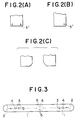
- Each of the marks 5 may be defined by a row of small perforations or roulettes, as shown in Fig.
- FIG. 1(A) so that it may be cut off or the area defined thereby may be shaded or hatched to indicate that the particular test strip has been used for diagnosis of the left or right eye.
- marks 5' are printed at both corners so that either one of the marks 5' is shaded; or as shown in Fig. 2(B), either one of the corners is perforated as denoted by 5'.
- a futher modification is shown in Fig 2(C) wherein one of either the left or right corner is preliminarily cut away.
- FIG. 3 A still further embodiment of the invention is shown in Fig. 3, wherein two test strips 1, 1 are arranged in tandem fashion with their ends (the ends opposite to the rounded ends) contiguous with each other and delineated by a cutting or delineation line 6 which may be a printed line or a row of perforations or roulettes.
- the tandem set of test strips may be used such that one for the diagnosis of the left eye and the other for the diagnosis of the right eye.
- the graduation marks 3 and scales 4 are arranged in a somewhat different manner.
- All of the marks depicted on the test strip 1, including the graduation marks 3 and scales 4, should be preferably printed by a printing ink which would not affect the wettability of the sheet material so that the amount of tear absorbed by the test strip 1 is not affected by the printing ink.
- printing is effected by an ink jet printing system. Black, red, blue or other desired pigments may be used in the printing ink as long as they are not blurred by water or tear fluid. Any one or more color-developing agents or color-modifying agents may be contained in the sheet material, or may be added to the printing ink in order that the marks and scales can be clearly visual even when the sheet material is wetted by tear fluid.
- Such agents include fluorescent materials, such as fluorescein sodium, rhodamine B and acrinol; water-soluble materials, such as FD & C Blue No. 1 which has been used as a medical coloring agent; material which are medicaments per se and used as injections or antimicrobial agents, such as phenol red and methylrosanilinium chloride; indicators used in the clinical test, such as sodium resazulin, litmus and bromthymol blue; and inorganic materials, such as cupric sulphate and cobalt chloride.
- the test strip of the invention has no notched portion which would weaken the sheet material and yet may be folded precisely along the folding line prior to use. Since the graduation marks and scales are printed while setting the folding line as the starting line or zero point, the length of the wetted portion of the test strip can be precisely determined by simple visual observation. It can be judged, without confusion, whether a particular test strip has been used for the diagnosis of left or right eye, since a mark for such purpose is provided at the end opposite to the rounded end which has been inserted into the lower eye-lid of a patient.
Landscapes
- Health & Medical Sciences (AREA)
- Life Sciences & Earth Sciences (AREA)
- Surgery (AREA)
- Public Health (AREA)
- Veterinary Medicine (AREA)
- Engineering & Computer Science (AREA)
- Biomedical Technology (AREA)
- Heart & Thoracic Surgery (AREA)
- Medical Informatics (AREA)
- Molecular Biology (AREA)
- Physics & Mathematics (AREA)
- Animal Behavior & Ethology (AREA)
- General Health & Medical Sciences (AREA)
- Biophysics (AREA)
- Ophthalmology & Optometry (AREA)
- Endocrinology (AREA)
- Gastroenterology & Hepatology (AREA)
- Physiology (AREA)
- Pathology (AREA)
- Eye Examination Apparatus (AREA)
- Investigating Or Analysing Materials By The Use Of Chemical Reactions (AREA)
- Investigating Or Analysing Biological Materials (AREA)
- Length-Measuring Instruments Using Mechanical Means (AREA)
Description
- The present invention relates to a test strip for measuring tear production, which is used by an ophthalmologist to measure the tear production of a patient to diagnose a disease or any other abnormality of the eye.
- More particularly, the present invention relates to a test strip for measuring tear production, comprising an elongated, generally flat sheet material having one end rounded to be semi-circular shaped.
- A test strip for measuring tear production of this kind is known as the Schirmer tear test strip which has a width of about 5 mm and a length of 42 mm, with its one end rounded to be semi-circular shaped, and having a triangular notch at one side of the strip spaced by about 5 mm from the rounded end. The Schirmer tear test strip is used by inserting the rounded end internally into the lower eye-lid of a patient with the rounded end bent at the notched portion, and the test result is evaluated by visually determining the length of the moistened filter paper wetted within a unit measurement of time.
- However, the prior art Schirmer tear test strip has a disadvantage in that the notched portion tends to contact the eyeball or interior surface of the lower eye-lid which causes cause irritation or complaint, since the strip is bent at the notched portion and then inserted internally into the lower eye-lid. The prior art Schirmer tear test strip has another disadvantage in that the moistened strip tends to break during the measurement operation since the width of the strip is narrowed by the notch. A further disadvantage of the prior art Schirmer tear test strip is confusion in determining whether a particular strip is used for the testing of the right or left eye of the patient, this being caused by difficulty in determination of obverse or reverse side of the filter paper. In addition, visual determination often leads to an inaccurate diagnosis, or a separate scale must be used for precise determination which incurs delicate operation and inconvenience in practical application.
- Accordingly, an object of this invention is to provide a test strip which is free from the disadvantages of the conventional Schirmer tear test strip.
- A more specific object of this invention is to provide a test strip having no notched portion which would weaken the strip to often causing breakage at that portion, by being printed with a folding line along which the strip is bent or folded and further printed with graduation marks and scales for facilitating the measurement operation.
- With the aforementioned object in view, the present invention provides a test strip measuring tear production, characterized in that said test strip has no notched portion where it is to be bent prior to the measurement operation, but is printed with a folding line which is perpendicular to the length of said test strip; and said test strip is printed with graduation marks and a scale for indicating the amount of absorbed tear fluid.
- In a preferred embodiment, a mark is provided at either one or both corners of the end opposite to the rounded end for indicating that the particular strip is used for measuring one of either the left or right eye.
- In use of the test strip of this invention, the sheet material is bent along the folding line so that the rounded end comes below the unprinted surface of the sheet material, that is, the surface printed with the graduation marks and scales is held upside down. Thereafter, the folded semi-circular end is inserted internally into the lower eye-lid and held at that position for a predetermined time period, for example 5 minutes, to allow the strip to be wetted by tear fluid. The length of the wetted portion of the test strip is measured. When the test strip is inserted into a normal or healthy eye, the length of the wetted portion of the strip ranges from 10 to 30 mm, generally about 15 mm, the length decreasing as the age of the patient increases to a considerably decreased level when the age of the patient is 60 years or more. However, it is considered that the tested eye is diseased or in abnormal condition when the length of the wetted portion of the test stip is less than 5 mm. By the use of the test strip according to this invention, the wetted length of the test strip can be readily confirmed visually by making use of the graduation marks and scales printed thereon.
- The sheet material of the test strip, which is wettable by tear fluid, preferably lacks paper powder, is not susceptible to breaking or tearing even when it absorbs tear fluid, and does not impair the eye when in contact with it.
- Preferably the sheet material of the test strip is selected from the group consisting of filter paper, ordinary paper and non-woven cloth.
- In order that the invention can be more clearly understood, convenient embodiments thereof will now be described with reference to the accompanying drawings, in which:
- Fig. 1(A) is a plan view of one embodiment of the invention;
- Fig. 1(B) is a plan view showing a portion of another embodiment of the invention;
- Fig. 1(C) is a plan view showing a portion of a further embodiment of the invention;
- Figs. 2(A) to 2(C) are plan views showing portions of different embodiments; and
- Fig. 3 is a plan view showing a still further embodiment which includes two test strips arranged in tandem fashion.
- Preferred embodiments of the invention will now be described in detail with reference to the accompanying drawings.
- Initially referring to Fig. 1(A), a test strip 1 is made of a generally flat sheet material, for example elongated sheet-form filter paper. One end of the filter paper is rounded to be semi-circular, and a
folding line 2 is marked by dots or dashes.Graduation marks 3 andscales 4 are printed while setting the folding line as the starting line.Further marks 5, which indicate that the particular test strip is used for the examination of one of either the left or right eye, are provided at the corner of the test strip opposite to the rounded end. Each of themarks 5 may be defined by a row of small perforations or roulettes, as shown in Fig. 1(A), so that it may be cut off or the area defined thereby may be shaded or hatched to indicate that the particular test strip has been used for diagnosis of the left or right eye. Otherwise, as shown in Fig. 2(A), marks 5' are printed at both corners so that either one of the marks 5' is shaded; or as shown in Fig. 2(B), either one of the corners is perforated as denoted by 5'. A futher modification is shown in Fig 2(C) wherein one of either the left or right corner is preliminarily cut away. - A still further embodiment of the invention is shown in Fig. 3, wherein two test strips 1, 1 are arranged in tandem fashion with their ends (the ends opposite to the rounded ends) contiguous with each other and delineated by a cutting or
delineation line 6 which may be a printed line or a row of perforations or roulettes. The tandem set of test strips may be used such that one for the diagnosis of the left eye and the other for the diagnosis of the right eye. As seen by comparing Fig. 3 with Fig. 1, thegraduation marks 3 andscales 4 are arranged in a somewhat different manner. - All of the marks depicted on the test strip 1, including the
graduation marks 3 andscales 4, should be preferably printed by a printing ink which would not affect the wettability of the sheet material so that the amount of tear absorbed by the test strip 1 is not affected by the printing ink. Preferably, printing is effected by an ink jet printing system. Black, red, blue or other desired pigments may be used in the printing ink as long as they are not blurred by water or tear fluid. Any one or more color-developing agents or color-modifying agents may be contained in the sheet material, or may be added to the printing ink in order that the marks and scales can be clearly visual even when the sheet material is wetted by tear fluid. Examples of such agents include fluorescent materials, such as fluorescein sodium, rhodamine B and acrinol; water-soluble materials, such as FD & C Blue No. 1 which has been used as a medical coloring agent; material which are medicaments per se and used as injections or antimicrobial agents, such as phenol red and methylrosanilinium chloride; indicators used in the clinical test, such as sodium resazulin, litmus and bromthymol blue; and inorganic materials, such as cupric sulphate and cobalt chloride. - As will be apparent from the foregoing, the test strip of the invention has no notched portion which would weaken the sheet material and yet may be folded precisely along the folding line prior to use. Since the graduation marks and scales are printed while setting the folding line as the starting line or zero point, the length of the wetted portion of the test strip can be precisely determined by simple visual observation. It can be judged, without confusion, whether a particular test strip has been used for the diagnosis of left or right eye, since a mark for such purpose is provided at the end opposite to the rounded end which has been inserted into the lower eye-lid of a patient.
Claims (8)
- A test strip (1) for measuring tear production, comprising an elongated, generally flat sheet material having one end rounded to be semi-circular shaped,
characterized in that
said test strip (1) has no notched portion where it is to be bent prior to the measurement operation, but is printed with a folding line (2) which is perpendicular to the length of said test strip (1);
and said test strip (1) is printed with graduation marks (3) and a scale (4) for indicating the amount of absorbed tear fluid. - The test strip (1) according to claim 1, wherein a mark (5, 5') indicating that the particular test strip (1) is used for measuring one of either the left or right eye is provided at either one or both corners of the end opposite to said rounded end.
- The test strip (1) according to claim 1 or 2, wherein said sheet material is wettable by tear fluid, lacking paper powder, not susceptible to breaking or tearing even when it absorbs tear fluid, and does not impair the eye when in contact with it.
- The test strip (1) according to claim 3, wherein said sheet material is selected from the group consisting of filter paper, ordinary paper and non-woven cloth.
- The test strip (1) according to any one of claims 1 to 4, wherein said test strip (1) is composed of a single sheet of material.
- The test strip (1) according to any one of claims 1 to 5, wherein any one or more of said test strip (1), said graduation marks (3), said scales (4) and the mark indicating said folding line (2) of said test strip (1) is colored.
- The test strip (1) according to any one of claims 1 to 6, wherein any one or more of said test strip (1), said graduation marks (3), said scales (4) and the mark indicating said folding line (2) of said test strip (1) contains a coloring compound or a color-developing compound.
- A test strip arrangement composed of two test strips (1) according to any one of claims 1 to 7, wherein said two test strips (1) are contiguous with each other at their ends opposite to said rounded ends and are delineated by a cutting or delineation line (6).
Applications Claiming Priority (2)
| Application Number | Priority Date | Filing Date | Title |
|---|---|---|---|
| JP2134788 | 1988-02-20 | ||
| JP21347/88U | 1988-02-20 |
Publications (2)
| Publication Number | Publication Date |
|---|---|
| EP0330092A1 EP0330092A1 (en) | 1989-08-30 |
| EP0330092B1 true EP0330092B1 (en) | 1994-06-08 |
Family
ID=12052558
Family Applications (1)
| Application Number | Title | Priority Date | Filing Date |
|---|---|---|---|
| EP89102787A Expired - Lifetime EP0330092B1 (en) | 1988-02-20 | 1989-02-17 | Test strip for measuring tear production |
Country Status (5)
| Country | Link |
|---|---|
| US (1) | US5135005A (en) |
| EP (1) | EP0330092B1 (en) |
| KR (1) | KR960006646B1 (en) |
| CA (1) | CA1338048C (en) |
| DE (1) | DE68915809T2 (en) |
Families Citing this family (7)
| Publication number | Priority date | Publication date | Assignee | Title |
|---|---|---|---|---|
| JPH0714891Y2 (en) * | 1989-03-20 | 1995-04-10 | 昭和薬品化工株式会社 | Paper for measuring tear secretion and its packaging |
| US5006310A (en) * | 1989-11-03 | 1991-04-09 | Visionex | Schirmer tear test |
| ATE536808T1 (en) * | 2009-03-06 | 2011-12-15 | Christophe Baudouin | EYE SAMPLING DEVICE |
| US10058307B2 (en) * | 2016-02-23 | 2018-08-28 | Fishburne May, LLC | Bodily fluid indicator devices and methods |
| KR101838930B1 (en) | 2017-02-20 | 2018-03-15 | 을지대학교 산학협력단 | A Test Sheet for Measuring an Amount of Lacrimal Secretion |
| KR102010137B1 (en) | 2017-09-04 | 2019-08-12 | 송인창 | A Measuring Kit for an Amount of a Liquid Secretion |
| KR20210140941A (en) | 2020-05-14 | 2021-11-23 | 주식회사 바이오옵틱스 | Strip for Measuring an Amount of Lacrimal Secretion |
Family Cites Families (3)
| Publication number | Priority date | Publication date | Assignee | Title |
|---|---|---|---|---|
| SE388280B (en) * | 1972-04-28 | 1976-09-27 | Harco Electr Ltd | APPLIANCE FOR QUANTITY SATURATION OF FLUID IN PROVREMSOR |
| US4269197A (en) * | 1979-04-05 | 1981-05-26 | Gilbard Jeffrey P | Method of measuring tear osmolarity and apparatus therefor |
| GB8306353D0 (en) * | 1983-03-08 | 1983-04-13 | Stuart J F B | Monitoring of drug levels |
-
1989
- 1989-02-17 EP EP89102787A patent/EP0330092B1/en not_active Expired - Lifetime
- 1989-02-17 CA CA000591370A patent/CA1338048C/en not_active Expired - Fee Related
- 1989-02-17 DE DE68915809T patent/DE68915809T2/en not_active Expired - Lifetime
- 1989-02-18 KR KR1019890001887A patent/KR960006646B1/en not_active Expired - Lifetime
-
1991
- 1991-12-26 US US07/816,100 patent/US5135005A/en not_active Expired - Lifetime
Also Published As
| Publication number | Publication date |
|---|---|
| EP0330092A1 (en) | 1989-08-30 |
| DE68915809T2 (en) | 1995-02-16 |
| CA1338048C (en) | 1996-02-13 |
| KR890012613A (en) | 1989-09-18 |
| KR960006646B1 (en) | 1996-05-22 |
| DE68915809D1 (en) | 1994-07-14 |
| US5135005A (en) | 1992-08-04 |
Similar Documents
| Publication | Publication Date | Title |
|---|---|---|
| US5170799A (en) | Test strip for measuring tear production | |
| DE69936130T2 (en) | WINDEL WITH INDICATORS RESPONSE TO THE ADDITION OF IMPREGNATED URINE AND OUTER VISIBLE INDICATORS | |
| DE69524108T2 (en) | ANALYTIC DETECTION STRIP WITH A STANDARD ON THE STRIP | |
| JP2994420B2 (en) | Detection sheet for peroxidase-like active substance and method for producing the same | |
| US8933291B2 (en) | Dehydration sensors having buffered inks | |
| US5135005A (en) | Process for measuring tear production | |
| EP1980198B1 (en) | Tear meniscus test device and its manufacturing method | |
| BR112013011296B1 (en) | dehydration sensor | |
| US20210161513A1 (en) | Bodily Fluid Indicator Devices and Methods | |
| WO2003089938A1 (en) | Method and device for measurement of hematocrit | |
| JP3058340B2 (en) | Modified Schirmer I tear test | |
| CA2454338C (en) | Secretion-monitoring article | |
| US4357945A (en) | Device for testing and rupturing amniotic membrane | |
| AU718050B2 (en) | Device for measuring the properties of an endogenous fluid | |
| GB2099152A (en) | Measuring tape | |
| EP0391109B1 (en) | Tear production measuring sheet and package therefor | |
| JPH0710252B2 (en) | Tear secretion measuring paper | |
| US6123676A (en) | Method and apparatus for detecting an increased risk of a premature birth | |
| JPH07108292B2 (en) | Amniotic fluid rupture identification pad | |
| KR200258335Y1 (en) | through-away cup for easier urinalysis | |
| JP3254311B2 (en) | Tear test kit | |
| JPS63180856A (en) | Improved continuous strip used for occult blood inspection, etc. of fecal matter | |
| DE29620452U1 (en) | Test strips for examining a body's own fluid | |
| JP2002005930A (en) | Saliva flow measurement test paper |
Legal Events
| Date | Code | Title | Description |
|---|---|---|---|
| PUAI | Public reference made under article 153(3) epc to a published international application that has entered the european phase |
Free format text: ORIGINAL CODE: 0009012 |
|
| AK | Designated contracting states |
Kind code of ref document: A1 Designated state(s): DE FR GB |
|
| 17P | Request for examination filed |
Effective date: 19900226 |
|
| 17Q | First examination report despatched |
Effective date: 19920602 |
|
| GRAA | (expected) grant |
Free format text: ORIGINAL CODE: 0009210 |
|
| AK | Designated contracting states |
Kind code of ref document: B1 Designated state(s): DE FR GB |
|
| REF | Corresponds to: |
Ref document number: 68915809 Country of ref document: DE Date of ref document: 19940714 |
|
| ET | Fr: translation filed | ||
| PLBE | No opposition filed within time limit |
Free format text: ORIGINAL CODE: 0009261 |
|
| STAA | Information on the status of an ep patent application or granted ep patent |
Free format text: STATUS: NO OPPOSITION FILED WITHIN TIME LIMIT |
|
| 26N | No opposition filed | ||
| REG | Reference to a national code |
Ref country code: GB Ref legal event code: IF02 |
|
| PGFP | Annual fee paid to national office [announced via postgrant information from national office to epo] |
Ref country code: GB Payment date: 20080227 Year of fee payment: 20 |
|
| PGFP | Annual fee paid to national office [announced via postgrant information from national office to epo] |
Ref country code: DE Payment date: 20080429 Year of fee payment: 20 Ref country code: FR Payment date: 20080130 Year of fee payment: 20 |
|
| REG | Reference to a national code |
Ref country code: GB Ref legal event code: PE20 Expiry date: 20090216 |
|
| PG25 | Lapsed in a contracting state [announced via postgrant information from national office to epo] |
Ref country code: GB Free format text: LAPSE BECAUSE OF EXPIRATION OF PROTECTION Effective date: 20090216 |