EP0325000B1 - Process for the preparation of dihydropyrans - Google Patents
Process for the preparation of dihydropyrans Download PDFInfo
- Publication number
- EP0325000B1 EP0325000B1 EP88202972A EP88202972A EP0325000B1 EP 0325000 B1 EP0325000 B1 EP 0325000B1 EP 88202972 A EP88202972 A EP 88202972A EP 88202972 A EP88202972 A EP 88202972A EP 0325000 B1 EP0325000 B1 EP 0325000B1
- Authority
- EP
- European Patent Office
- Prior art keywords
- mol
- formula
- catalyst
- process according
- carbon atoms
- Prior art date
- Legal status (The legal status is an assumption and is not a legal conclusion. Google has not performed a legal analysis and makes no representation as to the accuracy of the status listed.)
- Expired - Lifetime
Links
- 238000000034 method Methods 0.000 title claims abstract description 16
- 238000002360 preparation method Methods 0.000 title claims abstract description 5
- VSCWAEJMTAWNJL-UHFFFAOYSA-K aluminium trichloride Chemical group Cl[Al](Cl)Cl VSCWAEJMTAWNJL-UHFFFAOYSA-K 0.000 claims abstract description 24
- RRHGJUQNOFWUDK-UHFFFAOYSA-N Isoprene Chemical compound CC(=C)C=C RRHGJUQNOFWUDK-UHFFFAOYSA-N 0.000 claims abstract description 22
- 150000001993 dienes Chemical class 0.000 claims abstract description 13
- 125000000217 alkyl group Chemical group 0.000 claims abstract description 11
- 239000003054 catalyst Substances 0.000 claims abstract description 11
- 125000004432 carbon atom Chemical group C* 0.000 claims abstract description 10
- RCJMVGJKROQDCB-UHFFFAOYSA-N 2-methylpenta-1,3-diene Chemical compound CC=CC(C)=C RCJMVGJKROQDCB-UHFFFAOYSA-N 0.000 claims abstract description 9
- 239000003426 co-catalyst Substances 0.000 claims abstract description 9
- 125000002877 alkyl aryl group Chemical group 0.000 claims abstract description 5
- 125000003710 aryl alkyl group Chemical group 0.000 claims abstract description 5
- 125000003118 aryl group Chemical group 0.000 claims abstract description 5
- HPGGPRDJHPYFRM-UHFFFAOYSA-J tin(iv) chloride Chemical compound Cl[Sn](Cl)(Cl)Cl HPGGPRDJHPYFRM-UHFFFAOYSA-J 0.000 claims abstract description 4
- 229910021627 Tin(IV) chloride Inorganic materials 0.000 claims abstract description 3
- 150000001875 compounds Chemical class 0.000 claims abstract description 3
- 125000000753 cycloalkyl group Chemical group 0.000 claims abstract description 3
- 125000004435 hydrogen atom Chemical group [H]* 0.000 claims abstract description 3
- 125000001997 phenyl group Chemical group [H]C1=C([H])C([H])=C(*)C([H])=C1[H] 0.000 claims abstract description 3
- 125000002485 formyl group Chemical class [H]C(*)=O 0.000 claims abstract 4
- MUGSKSNNEORSJG-UHFFFAOYSA-N 3174-74-1 Chemical class C1CC=CCO1 MUGSKSNNEORSJG-UHFFFAOYSA-N 0.000 claims abstract 2
- 239000002841 Lewis acid Substances 0.000 claims description 6
- 150000007517 lewis acids Chemical class 0.000 claims description 6
- 125000001931 aliphatic group Chemical group 0.000 claims description 4
- -1 aromatic nitro compound Chemical class 0.000 claims description 3
- 125000000040 m-tolyl group Chemical group [H]C1=C([H])C(*)=C([H])C(=C1[H])C([H])([H])[H] 0.000 claims description 2
- 125000003261 o-tolyl group Chemical group [H]C1=C([H])C(*)=C(C([H])=C1[H])C([H])([H])[H] 0.000 claims description 2
- 125000001037 p-tolyl group Chemical group [H]C1=C([H])C(=C([H])C([H])=C1*)C([H])([H])[H] 0.000 claims description 2
- 238000006243 chemical reaction Methods 0.000 abstract description 12
- 239000011968 lewis acid catalyst Substances 0.000 abstract description 2
- 229910052799 carbon Inorganic materials 0.000 abstract 1
- 150000002828 nitro derivatives Chemical class 0.000 abstract 1
- YXFVVABEGXRONW-UHFFFAOYSA-N Toluene Chemical compound CC1=CC=CC=C1 YXFVVABEGXRONW-UHFFFAOYSA-N 0.000 description 30
- 239000000203 mixture Substances 0.000 description 27
- HUMNYLRZRPPJDN-UHFFFAOYSA-N benzaldehyde Chemical compound O=CC1=CC=CC=C1 HUMNYLRZRPPJDN-UHFFFAOYSA-N 0.000 description 14
- BUDQDWGNQVEFAC-UHFFFAOYSA-N Dihydropyran Chemical compound C1COC=CC1 BUDQDWGNQVEFAC-UHFFFAOYSA-N 0.000 description 8
- 239000002904 solvent Substances 0.000 description 8
- VLKZOEOYAKHREP-UHFFFAOYSA-N n-Hexane Chemical compound CCCCCC VLKZOEOYAKHREP-UHFFFAOYSA-N 0.000 description 7
- QNGNSVIICDLXHT-UHFFFAOYSA-N para-ethylbenzaldehyde Natural products CCC1=CC=C(C=O)C=C1 QNGNSVIICDLXHT-UHFFFAOYSA-N 0.000 description 7
- 238000009835 boiling Methods 0.000 description 6
- 239000005457 ice water Substances 0.000 description 6
- 239000011541 reaction mixture Substances 0.000 description 6
- SWOPLXXJAVYFPY-UHFFFAOYSA-N 4-methyl-2-phenyl-3,6-dihydro-2h-pyran Chemical compound C1C(C)=CCOC1C1=CC=CC=C1 SWOPLXXJAVYFPY-UHFFFAOYSA-N 0.000 description 5
- FGLBSLMDCBOPQK-UHFFFAOYSA-N 2-nitropropane Chemical compound CC(C)[N+]([O-])=O FGLBSLMDCBOPQK-UHFFFAOYSA-N 0.000 description 4
- XDTMQSROBMDMFD-UHFFFAOYSA-N Cyclohexane Chemical compound C1CCCCC1 XDTMQSROBMDMFD-UHFFFAOYSA-N 0.000 description 4
- OFBQJSOFQDEBGM-UHFFFAOYSA-N Pentane Chemical compound CCCCC OFBQJSOFQDEBGM-UHFFFAOYSA-N 0.000 description 4
- UHOVQNZJYSORNB-UHFFFAOYSA-N Benzene Chemical compound C1=CC=CC=C1 UHOVQNZJYSORNB-UHFFFAOYSA-N 0.000 description 3
- 238000005698 Diels-Alder reaction Methods 0.000 description 3
- 150000001299 aldehydes Chemical class 0.000 description 3
- RTZKZFJDLAIYFH-UHFFFAOYSA-N ether Substances CCOCC RTZKZFJDLAIYFH-UHFFFAOYSA-N 0.000 description 3
- 238000003756 stirring Methods 0.000 description 3
- DYLIWHYUXAJDOJ-OWOJBTEDSA-N (e)-4-(6-aminopurin-9-yl)but-2-en-1-ol Chemical compound NC1=NC=NC2=C1N=CN2C\C=C\CO DYLIWHYUXAJDOJ-OWOJBTEDSA-N 0.000 description 2
- YGHRJJRRZDOVPD-UHFFFAOYSA-N 3-methylbutanal Chemical compound CC(C)CC=O YGHRJJRRZDOVPD-UHFFFAOYSA-N 0.000 description 2
- SQVJYNSGAXORSQ-UHFFFAOYSA-N 4,6-dimethyl-2-phenyl-3,6-dihydro-2h-pyran Chemical compound C1C(C)=CC(C)OC1C1=CC=CC=C1 SQVJYNSGAXORSQ-UHFFFAOYSA-N 0.000 description 2
- UIIMBOGNXHQVGW-UHFFFAOYSA-M Sodium bicarbonate Chemical compound [Na+].OC([O-])=O UIIMBOGNXHQVGW-UHFFFAOYSA-M 0.000 description 2
- 238000001816 cooling Methods 0.000 description 2
- FXHGMKSSBGDXIY-UHFFFAOYSA-N heptanal Chemical compound CCCCCCC=O FXHGMKSSBGDXIY-UHFFFAOYSA-N 0.000 description 2
- 229930195733 hydrocarbon Natural products 0.000 description 2
- 239000010410 layer Substances 0.000 description 2
- OVWYEQOVUDKZNU-UHFFFAOYSA-N m-tolualdehyde Chemical compound CC1=CC=CC(C=O)=C1 OVWYEQOVUDKZNU-UHFFFAOYSA-N 0.000 description 2
- LQNUZADURLCDLV-UHFFFAOYSA-N nitrobenzene Chemical compound [O-][N+](=O)C1=CC=CC=C1 LQNUZADURLCDLV-UHFFFAOYSA-N 0.000 description 2
- LYGJENNIWJXYER-UHFFFAOYSA-N nitromethane Chemical compound C[N+]([O-])=O LYGJENNIWJXYER-UHFFFAOYSA-N 0.000 description 2
- HGBOYTHUEUWSSQ-UHFFFAOYSA-N pentanal Chemical compound CCCCC=O HGBOYTHUEUWSSQ-UHFFFAOYSA-N 0.000 description 2
- 239000002304 perfume Substances 0.000 description 2
- 239000002994 raw material Substances 0.000 description 2
- 230000002829 reductive effect Effects 0.000 description 2
- 239000000243 solution Substances 0.000 description 2
- VZGDMQKNWNREIO-UHFFFAOYSA-N tetrachloromethane Chemical compound ClC(Cl)(Cl)Cl VZGDMQKNWNREIO-UHFFFAOYSA-N 0.000 description 2
- XLYOFNOQVPJJNP-UHFFFAOYSA-N water Substances O XLYOFNOQVPJJNP-UHFFFAOYSA-N 0.000 description 2
- JSZOAYXJRCEYSX-UHFFFAOYSA-N 1-nitropropane Chemical compound CCC[N+]([O-])=O JSZOAYXJRCEYSX-UHFFFAOYSA-N 0.000 description 1
- KBFFVAYZFNJXAW-UHFFFAOYSA-N 2-butyl-4,6-dimethyl-3,6-dihydro-2h-pyran Chemical compound CCCCC1CC(C)=CC(C)O1 KBFFVAYZFNJXAW-UHFFFAOYSA-N 0.000 description 1
- AUUNKPMHOCPPST-UHFFFAOYSA-N 2-hexyl-4-methyl-3,6-dihydro-2h-pyran Chemical compound CCCCCCC1CC(C)=CCO1 AUUNKPMHOCPPST-UHFFFAOYSA-N 0.000 description 1
- ZSPTYLOMNJNZNG-UHFFFAOYSA-N 3-Buten-1-ol Chemical class OCCC=C ZSPTYLOMNJNZNG-UHFFFAOYSA-N 0.000 description 1
- RDCAUAKZLSTASF-UHFFFAOYSA-N 4-methyl-2-(3-methylphenyl)-3,6-dihydro-2h-pyran Chemical compound C1C(C)=CCOC1C1=CC=CC(C)=C1 RDCAUAKZLSTASF-UHFFFAOYSA-N 0.000 description 1
- DPZMVZIQRMVBBW-UHFFFAOYSA-N 5-Phenyl-1-pentanol Chemical class OCCCCCC1=CC=CC=C1 DPZMVZIQRMVBBW-UHFFFAOYSA-N 0.000 description 1
- 239000004215 Carbon black (E152) Substances 0.000 description 1
- CTQNGGLPUBDAKN-UHFFFAOYSA-N O-Xylene Chemical compound CC1=CC=CC=C1C CTQNGGLPUBDAKN-UHFFFAOYSA-N 0.000 description 1
- VYPSYNLAJGMNEJ-UHFFFAOYSA-N Silicium dioxide Chemical compound O=[Si]=O VYPSYNLAJGMNEJ-UHFFFAOYSA-N 0.000 description 1
- 239000002253 acid Substances 0.000 description 1
- 230000002378 acidificating effect Effects 0.000 description 1
- 150000003934 aromatic aldehydes Chemical class 0.000 description 1
- QVGXLLKOCUKJST-UHFFFAOYSA-N atomic oxygen Chemical compound [O] QVGXLLKOCUKJST-UHFFFAOYSA-N 0.000 description 1
- 230000015572 biosynthetic process Effects 0.000 description 1
- 230000003197 catalytic effect Effects 0.000 description 1
- 238000009903 catalytic hydrogenation reaction Methods 0.000 description 1
- 238000004440 column chromatography Methods 0.000 description 1
- 230000001419 dependent effect Effects 0.000 description 1
- 125000002897 diene group Chemical group 0.000 description 1
- 150000002430 hydrocarbons Chemical class 0.000 description 1
- CPJRRXSHAYUTGL-UHFFFAOYSA-N isopentenyl alcohol Chemical compound CC(=C)CCO CPJRRXSHAYUTGL-UHFFFAOYSA-N 0.000 description 1
- 125000004971 nitroalkyl group Chemical group 0.000 description 1
- NJNQUTDUIPVROZ-UHFFFAOYSA-N nitrocyclohexane Chemical compound [O-][N+](=O)C1CCCCC1 NJNQUTDUIPVROZ-UHFFFAOYSA-N 0.000 description 1
- MCSAJNNLRCFZED-UHFFFAOYSA-N nitroethane Chemical compound CC[N+]([O-])=O MCSAJNNLRCFZED-UHFFFAOYSA-N 0.000 description 1
- 239000012044 organic layer Substances 0.000 description 1
- 239000001301 oxygen Substances 0.000 description 1
- 229910052760 oxygen Inorganic materials 0.000 description 1
- 239000002244 precipitate Substances 0.000 description 1
- 239000000376 reactant Substances 0.000 description 1
- 230000009257 reactivity Effects 0.000 description 1
- 238000007142 ring opening reaction Methods 0.000 description 1
- 150000003839 salts Chemical class 0.000 description 1
- 239000012047 saturated solution Substances 0.000 description 1
- 239000000741 silica gel Substances 0.000 description 1
- 229910002027 silica gel Inorganic materials 0.000 description 1
- 229910000030 sodium bicarbonate Inorganic materials 0.000 description 1
- 235000017557 sodium bicarbonate Nutrition 0.000 description 1
- 239000008096 xylene Substances 0.000 description 1
Classifications
-
- C—CHEMISTRY; METALLURGY
- C07—ORGANIC CHEMISTRY
- C07D—HETEROCYCLIC COMPOUNDS
- C07D309/00—Heterocyclic compounds containing six-membered rings having one oxygen atom as the only ring hetero atom, not condensed with other rings
- C07D309/16—Heterocyclic compounds containing six-membered rings having one oxygen atom as the only ring hetero atom, not condensed with other rings having one double bond between ring members or between a ring member and a non-ring member
- C07D309/18—Heterocyclic compounds containing six-membered rings having one oxygen atom as the only ring hetero atom, not condensed with other rings having one double bond between ring members or between a ring member and a non-ring member containing only hydrogen and carbon atoms in addition to the ring hetero atom
Definitions
- the invention relates to a new process for the preparation of dihydropyrans. More particularly, the invention relates to a process for the preparation of substituted 5,6-dihydro-2H-pyrans.
- Substituted dihydropyrans are important industrial raw materials. ⁇ -Phenyl-dihydropyrans can be converted by reductive ring opening in acidic medium, as described in M. Freifelder, Practical Catalytic Hydrogenation, Wiley-Interscience, New York (1971), page 412, into 5-phenylpentanols, which can be of importance inter alia as perfumes.
- dihydropyrans such as 6-phenyl-4-methyl-5,6-dihydro-2H-pyran, 6-phenyl-2,4-dimethyl-5,6-dihydro-2H-pyran and 6-butyl-2,4-dimethyl-5,6-dihydro-2H-pyran are themselves also valuable perfumes, see e.g. U.S. patent nr. 3,681,263 and A.A. Gevorkyan et al., Arm. Khim. Zh. 1976 29(3), pages 276-7, Chem. Abstr. 85 (1976), 10848e.
- Such compounds could be synthesized by a Diels-Alder-type reaction between aldehydes functioning as dienophiles and dienes substituted in the desired manner.
- Dienes of this kind such as isoprene and 2-methylpentadiene, are available on a large scale.
- R1 is preferably an alkyl, aralkyl, alkaryl or aryl group having a maximum of 12 carbon atoms. Particularly suitable are straight or branched alkyl groups, the phenyl group and the ortho-, meta- and para-tolyl group. Isoprene and 2-methyl-1,3-pentadiene are particularly suitable as dienes.
- reaction can, in principle, be carried out with equimolar amounts of dienes and dienophiles, or even with an excess of dienophile, is has proved that it is preferable to use an excess of diene.
- a molar ratio of dienes/dienophiles between 1:1 and 10:1 is very suitable. Particularly suitable is a molar ratio between 1.5:1 and 2.5:1.
- the reaction according to the invention is carried out under the influence of an inorganic Lewis acid catalyst, preferably AlCl3 or SnCl4. Particularly suitable is AlCl3.
- the catalyst is used in an amount of at least 0.01 mol and preferably between 0.03 and 0.6 mol per mol of dienophile.
- an aliphatic or aromatic nitro compound can be added advantageously in an amount of a maximum of 10 mol per mol of catalyst.
- amounts of 3 mol or less per mol of catalyst are used.
- nitromethane, nitroethane, nitropropane and higher nitroalkanes, nitrobenzene and nitrocyclohexane are especially suitable for this purpose.
- the usual solvents for catalysed Diels-Alder reactions are suitable for the reaction to be carried out in.
- solvents are benzene, toluene, xylene, pentane, hexane, cyclohexane, petroleum-ether and the like.
- These solvents are preferably used in an amount of at least 50 mol% (with respect to dienophile), particularly in an amount of 150 mol% or more.
- the most suitable reaction temperature is dependent on the reactivity of the diene and dienophile, the catalyst and co-catalyst used and the amount thereof, as well as on the properties of the solvent. Generally, temperatures between -30°C and +100°C can be used.
- temperatures between -20°C and +70°C are temperatures between -20°C and +70°C.
- a co-catalyst When a co-catalyst is used, generally a sufficiently high reaction rate is already obtained at a temperature below about 30°C.
- an aliphatic or alicyclic hydrocarbon is used as solvent, it is recommended, in connection with the stability and solubility of the catalyst/co-catalyst complex, that the reaction be carried out below 5°C, particularly below 0°C.
- the manner in which the reactants are mixed with each other and with the catalyst and, if present, the co-catalyst is not critical.
- a customary method, which can also be advantageously used here, is to add the mixture of diene and dienophile, possibly mixed with some solvent, in doses to the mixture of catalyst, possible co-catalyst and solvent, while the reaction mixture is kept at the desired temperature. It is recommended that the reactions be carried out in the absence of water and oxygen.
- the desired dihydropyran was obtained in a yield of 4.7 g; boiling point 87°C / 80 Pa; NMR (100 MHz, solution in CCl4, delta in ppm relative to TMS); 1.70 (3H, broad s); 1.8-2.4 (2H); 4.20 (2H,m); 4.40 (1H, d.d.); 5.41 (1H, broad s); 7.24 (5H).
- the desired dihydropyran was obtained as a mixture of 12.4 g cis-isomer and 2.0 g trans-isomer.
- the two isomers were separated by column chromatography over silica gel with ether/pentane as eluant.
- the desired dihydropyran was obtained in a yield of 60.7 g; boiling point 93°C / 80 Pa; NMR: 1.71 (3H, broad s); 1.8-2.4 (2H); 2.32 (3H,s); 4.20 (2H,m); 4.38 (1H,d.d); 5.41 (1H, broad s); 6.9-7.2 (4H).
- the desired dihydropyran was obtained in a yield of 5.4 g; boiling point 68°C / 90 Pa; NMR: 0.89 (3H,t); 1.0-1.5 (10H); 1.66 (3H, broad s); 1.5-2.1 (2H); 3.32 (1H,m); 4.00 (2H,m); 5.32 (1H, broad s).
Landscapes
- Chemical & Material Sciences (AREA)
- Organic Chemistry (AREA)
- Low-Molecular Organic Synthesis Reactions Using Catalysts (AREA)
- Pyrane Compounds (AREA)
- Catalysts (AREA)
- Nitrogen Condensed Heterocyclic Rings (AREA)
- Compounds Of Unknown Constitution (AREA)
- Heterocyclic Carbon Compounds Containing A Hetero Ring Having Oxygen Or Sulfur (AREA)
Abstract
Description
- The invention relates to a new process for the preparation of dihydropyrans. More particularly, the invention relates to a process for the preparation of substituted 5,6-dihydro-2H-pyrans.
- Substituted dihydropyrans are important industrial raw materials. α-Phenyl-dihydropyrans can be converted by reductive ring opening in acidic medium, as described in M. Freifelder, Practical Catalytic Hydrogenation, Wiley-Interscience, New York (1971), page 412, into 5-phenylpentanols, which can be of importance inter alia as perfumes. On the other hand, some dihydropyrans, such as 6-phenyl-4-methyl-5,6-dihydro-2H-pyran, 6-phenyl-2,4-dimethyl-5,6-dihydro-2H-pyran and 6-butyl-2,4-dimethyl-5,6-dihydro-2H-pyran are themselves also valuable perfumes, see e.g. U.S. patent nr. 3,681,263 and A.A. Gevorkyan et al., Arm. Khim. Zh. 1976 29(3), pages 276-7, Chem. Abstr. 85 (1976), 10848e.
- As described in the above-mentioned literature and in Swiss patent nr. 655,932, these and similar 5,6-dihydro-2H-pyrans are usually prepared by reaction of an aldehyde such as benzaldehyde or pentanal with a 3-butenol-1 substituted in the desired manner, such as isoprenol, under the influence of a catalytic amount of acid, resulting in a mixture of double bond isomers. The desired 3-butenols, however, are expensive or not commercially available at all. Therefore, there is a need for a method of preparing these dihydropyrans starting from readily available and inexpensive raw materials.
- In theory such compounds could be synthesized by a Diels-Alder-type reaction between aldehydes functioning as dienophiles and dienes substituted in the desired manner. Dienes of this kind, such as isoprene and 2-methylpentadiene, are available on a large scale.
- Studying the literature, however, forces one to the conclusion that Diels-Alder reactions between simple aliphatic or aromatic aldehydes and simple dienes are not possible, or only under extreme reaction conditions or with exotic and thus expensive catalysts; see e.g. S.M. Weinreb et al., Tetrahedron 1982, pages 3100-3104 and B.B. Snider et al., J. Org. Chem. 48 (1983), pages 3003-3010.
- Surprisingly, it has now been found that 5,6-dihydro-2H-pyrans according to formula III:

wherein R₁ is an alkyl, cycloalkyl, aralkyl, alkaryl or aryl group having a maximum of 15 carbon atoms, and R₂ and R₃ represent a hydrogen atom or an alkyl group having 1-6 carbon atoms, can be prepared in a simple manner by a Diels-Alder reaction between an aldehyde according to formula I: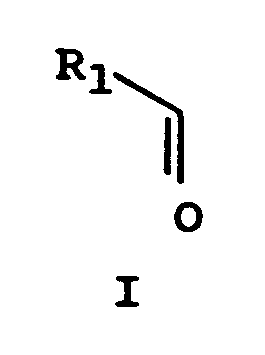
and a diene according to formula II:
in which formulae R₁, R₂ and R₃ have the meaning given above, under the influence of an inorganic Lewis acid as the catalyst. - R₁ is preferably an alkyl, aralkyl, alkaryl or aryl group having a maximum of 12 carbon atoms. Particularly suitable are straight or branched alkyl groups, the phenyl group and the ortho-, meta- and para-tolyl group. Isoprene and 2-methyl-1,3-pentadiene are particularly suitable as dienes.
- Although the reaction can, in principle, be carried out with equimolar amounts of dienes and dienophiles, or even with an excess of dienophile, is has proved that it is preferable to use an excess of diene. A molar ratio of dienes/dienophiles between 1:1 and 10:1 is very suitable. Particularly suitable is a molar ratio between 1.5:1 and 2.5:1.
- The reaction according to the invention is carried out under the influence of an inorganic Lewis acid catalyst, preferably AlCl₃ or SnCl₄. Particularly suitable is AlCl₃. The catalyst is used in an amount of at least 0.01 mol and preferably between 0.03 and 0.6 mol per mol of dienophile. As co-catalyst, an aliphatic or aromatic nitro compound can be added advantageously in an amount of a maximum of 10 mol per mol of catalyst. Preferably, amounts of 3 mol or less per mol of catalyst are used. Especially suitable for this purpose are: nitromethane, nitroethane, nitropropane and higher nitroalkanes, nitrobenzene and nitrocyclohexane.
- The usual solvents for catalysed Diels-Alder reactions, particularly hydrocarbons, are suitable for the reaction to be carried out in. Examples of such solvents are benzene, toluene, xylene, pentane, hexane, cyclohexane, petroleum-ether and the like. These solvents are preferably used in an amount of at least 50 mol% (with respect to dienophile), particularly in an amount of 150 mol% or more.
The most suitable reaction temperature is dependent on the reactivity of the diene and dienophile, the catalyst and co-catalyst used and the amount thereof, as well as on the properties of the solvent. Generally, temperatures between -30°C and +100°C can be used. Especially suitable are temperatures between -20°C and +70°C. When a co-catalyst is used, generally a sufficiently high reaction rate is already obtained at a temperature below about 30°C. When an aliphatic or alicyclic hydrocarbon is used as solvent, it is recommended, in connection with the stability and solubility of the catalyst/co-catalyst complex, that the reaction be carried out below 5°C, particularly below 0°C. - The manner in which the reactants are mixed with each other and with the catalyst and, if present, the co-catalyst is not critical. A customary method, which can also be advantageously used here, is to add the mixture of diene and dienophile, possibly mixed with some solvent, in doses to the mixture of catalyst, possible co-catalyst and solvent, while the reaction mixture is kept at the desired temperature. It is recommended that the reactions be carried out in the absence of water and oxygen.
- The following examples illustrate how to perform the process according to the invention. However, the invention is not limited thereto.
-
- A mixture of 12.7 g (0.12 mol) benzaldehyde and 16.3 g (0.24 mol) isoprene in 80 ml cyclohexane was heated to 60°C. With constant and thorough stirring, 6.2 g stannic tetrachloride was added to this mixture in 30 minutes, resulting in the formation of a white precipitate. The mixture was stirred for a further 8 hours at 60°C and subsequently, after cooling, poured out into ice water. The layers were separated, the water layer was washed with some cyclohexane and the collected organic layers with a solution of sodium bicarbonate and with a saturated solution of kitchen salt. The solvent was evaporated off and the residue distilled under reduced pressure. The desired dihydropyran was obtained in a yield of 4.7 g; boiling point 87°C / 80 Pa; NMR (100 MHz, solution in CCl₄, delta in ppm relative to TMS); 1.70 (3H, broad s); 1.8-2.4 (2H); 4.20 (2H,m); 4.40 (1H, d.d.); 5.41 (1H, broad s); 7.24 (5H).
- 12.7 g benzaldehyde was dosed to a mixture of 1.4 g (0.01 mol) aluminium chloride in 100 ml cyclohexane, heated to 65°C. Subsequently 16.3 g isoprene was added in 30 minutes, followed by a further 1.4 g of aluminium chloride. The mixture was stirred a further 30 minutes at 65°C and thereafter processed as indicated in Example I. The desired dihydropyran was obtained in a yield of 4.9 g.
- With thorough stirring, 3.8 g benzaldehyde was added in 5 minutes to a mixture of 6.4 g aluminium chloride and 60 g toluene, cooled to about 5°C. Subsequently, in 30 minutes, a mixture consisting of 8.9 g benzaldehyde, 17.6 g isoprene and 25 g toluene was added, with continuous cooling and thorough stirring. The mixture was stirred for a further 10 minutes at 15°C and then processed as indicated in Example I. The desired dihydropyran was obtained in a yield of 10.1 g.
- A mixture of 400 ml n-hexane and 53.3 g (0.40 mol) aluminium chloride was cooled to -5°C while being stirred, whereafter 35.6 g (0.40 mol) 2-nitropropane was added at this temperature in 10 minutes. Subsequently, in 30 minutes, a mixture consisting of 106 g (1.9 mol) benzaldehyde, 149 g (2.2 mol) isoprene and 300 ml n-hexane was added. As the reaction is very exothermic, the mixture was continuously cooled and stirred well. The reaction mixture was subsequently stirred a further 10 minutes at -5°C, then poured into ice water and processed as described in Example I. The desired dihydropyran was obtained in a yield of 93.8 g.
- A mixture of 40 ml toluene and 3.2 g (0.024 mol) aluminium chloride was cooled to 5°C while being stirred, whereafter 2.1 g (0.024 mol) 2-nitropropane was added at this temperature in 5 minutes. Subsequently, in 20 minutes, a mixture consisting of 12.7 g benzaldehyde, 23 g (0.28 mol) 2-methyl-1,3-pentadiene and 50 ml toluene was added, the mixture being continuously well stirred and cooled. The reaction mixture was stirred a further 10 minutes at 5°C, subsequently poured into ice water and processed as described in Example I. The desired dihydropyran was obtained as a mixture of 12.4 g cis-isomer and 2.0 g trans-isomer. The two isomers were separated by column chromatography over silica gel with ether/pentane as eluant.
Cis-isomer: boiling point 90°C / 90 Pa; NMR: 1.24 (3H,d.J = 7Hz); 1.70 (3H, broad s); 1.8-2.4 (2H); 4.25 (1H,m); 4.47 (1H,d.d); 5.32 (1H, broad s); 7.2 (5H).
Trans-isomer: boiling point 92°C / 90 Pa; NMR: 1.23 (3H,d.J = 7Hz); 1.72 (3H, broad s); 1.8-2.4 (2H); 4.32 (1H,m); 4.63 (1H,d.d); 5.37 (1H, broad s); 7.2 (5H). - A mixture of 240 ml toluene and 10.7 g (0.08 mol) aluminium chloride was cooled to 5°C while being stirred, whereafter at this temperature in 10 minutes 7.1 g (0.08 mol) 2-nitropropane was added, followed by 7.3 g (0.06 mol) m-tolualdehyde. Subsequently, in 1 hour, a mixture consisting of 89.5 g (0.75 mol) m-tolualdehyde and 121.2 g (1.78 mol) isoprene was added, the mixture being continuously well stirred and cooled. The reaction mixture was stirred a further 10 minutes at 5°C, subsequently poured into ice water and processed as described in Example I. The desired dihydropyran was obtained in a yield of 60.7 g; boiling point 93°C / 80 Pa; NMR: 1.71 (3H, broad s); 1.8-2.4 (2H); 2.32 (3H,s); 4.20 (2H,m); 4.38 (1H,d.d); 5.41 (1H, broad s); 6.9-7.2 (4H).
-
- A mixture of 45 ml toluene and 4.4 g (0.032 mol) aluminium chloride was cooled to 5°C while being stirred, whereafter at this temperature in 5 minutes 2.0 g (0.032 mol) nitromethane was added. Subsequently, in 20 minutes a mixture consisting of 14.0 g (0.16 mol) isovaleraldehyde, 24.0 g (0.35 mol) isoprene and 30 ml toluene was added, the mixture being continuously well stirred and cooled. The reaction mixture was stirred a further 20 minutes at 5°C, subsequently poured into ice water and processed as described in Example I. The desired dihydropyran was obtained in a yield of 5.9 g; boiling point 30°C / 80 Pa; NMR: 0.89 (3H,d.J = 7Hz); 0.91 (3H,d,J = 7Hz); 0.9-2.1 (5H); 1.66 (3H,s); 3.40 (1H,m); 4.00 (2H,m); 5.32 (1H, broad s).
- A mixture of 40 ml toluene and 3.2 g (0.024 mol) aluminium chloride was cooled to 5°C while being stirred, whereafter, at this temperature, in 5 minutes, 2.1 g (0.024 mol) 2-nitropropane was added. Subsequently, in 20 minutes a mixture consisting of 13.4 g (0.12 mol) heptanal, 20.4 g (0.30 mol) isoprene and 30 ml toluene was added, the mixture being continuously well stirred and cooled. The reaction mixture was stirred a further 20 minutes at 5°C, subsequently poured into ice water and processed as described in Example I. The desired dihydropyran was obtained in a yield of 5.4 g; boiling point 68°C / 90 Pa; NMR: 0.89 (3H,t); 1.0-1.5 (10H); 1.66 (3H, broad s); 1.5-2.1 (2H); 3.32 (1H,m); 4.00 (2H,m); 5.32 (1H, broad s).
Claims (9)
- Process for the preparation of 5,6-dihydro-2H-pyran derivatives, characterized in that an aldehyde having the formula I:


- Process according to claim 1, characterized in that therein an aldehyde is used having the formula I, wherein R₁ represents an alkyl, aralkyl, alkaryl or aryl group having at most 12 carbon atoms.
- Process according to claim 2, characterized in that therein an aldehyde is used having the formula I, in which R₁ represents an alkyl group having 1-6 carbon atoms, a phenyl group or an o-, m- or p-tolyl group.
- Process according to one or more of the claims 1-3, characterized in that isoprene or 2-methyl-1,3-pentadiene is used as diene having the formula II.
- Process according to one or more of the claims 1-4, characterized in that AlCl₃ or SnCl₄ is used as Lewis acid.
- Process according to one or more of the claims 1-5, characterized in that the Lewis acid is used in an amount of at least 0.01 mol per mol of dienophile.
- Process according to claim 6, characterized in that the Lewis acid is used in an amount of 0.03-0.6 mol per mol of dienophile.
- Process according to one or more of the claims 1-7, characterized in that an aliphatic or aromatic nitro compound is used as co-catalyst.
- Process according to claim 8, characterized in that no more than 10 mol of co-catalyst is present per mol of Lewis acid.
Priority Applications (1)
| Application Number | Priority Date | Filing Date | Title |
|---|---|---|---|
| AT88202972T ATE76072T1 (en) | 1988-01-05 | 1988-12-20 | PROCESS FOR THE PRODUCTION OF DIHYDROPYRANES. |
Applications Claiming Priority (2)
| Application Number | Priority Date | Filing Date | Title |
|---|---|---|---|
| NL8800009 | 1988-01-05 | ||
| NL8800009A NL8800009A (en) | 1988-01-05 | 1988-01-05 | PROCESS FOR THE PREPARATION OF DIHYDRO-PYRANES. |
Publications (2)
| Publication Number | Publication Date |
|---|---|
| EP0325000A1 EP0325000A1 (en) | 1989-07-26 |
| EP0325000B1 true EP0325000B1 (en) | 1992-05-13 |
Family
ID=19851542
Family Applications (1)
| Application Number | Title | Priority Date | Filing Date |
|---|---|---|---|
| EP88202972A Expired - Lifetime EP0325000B1 (en) | 1988-01-05 | 1988-12-20 | Process for the preparation of dihydropyrans |
Country Status (9)
| Country | Link |
|---|---|
| US (1) | US5162551A (en) |
| EP (1) | EP0325000B1 (en) |
| JP (1) | JPH0699419B2 (en) |
| AT (1) | ATE76072T1 (en) |
| CA (1) | CA1335205C (en) |
| DE (1) | DE3871123D1 (en) |
| ES (1) | ES2093604T3 (en) |
| MX (1) | MX170128B (en) |
| NL (1) | NL8800009A (en) |
Families Citing this family (13)
| Publication number | Priority date | Publication date | Assignee | Title |
|---|---|---|---|---|
| US5378685A (en) * | 1994-03-17 | 1995-01-03 | International Flavors & Fragrances Inc. | Process for preparing mixture of trimethyl and dimethylmethylene propyl polyhydropyrans, products produced thereby perfumery uses of such product |
| ES2241019T3 (en) * | 1996-10-03 | 2005-10-16 | Kao Corporation | PROCEDURE FOR THE PREPARATION OF DIHYDROPIRANE COMPOUND. |
| EP0854143B1 (en) * | 1997-01-21 | 2001-11-07 | Quest International B.V. | Diels-Alder reaction of aldehydes with simple dienes |
| DE69802311T2 (en) * | 1997-01-21 | 2002-07-11 | Quest International B.V., Naarden | Diels-Alder Reaction of aldehydes with simple dienes |
| US6596686B2 (en) * | 2001-03-12 | 2003-07-22 | International Flavors & Fragrances Inc. | Use of dihydropyrans as fragrance Material |
| JP3881288B2 (en) * | 2001-09-27 | 2007-02-14 | 花王株式会社 | Process for producing 5-arylpentanol |
| US20050004210A1 (en) * | 2003-07-04 | 2005-01-06 | Kao Corporation | Process for producing a pyran compound |
| CN100540545C (en) * | 2006-09-13 | 2009-09-16 | 浙江新和成股份有限公司 | 5, the preparation method of 6-dihydro-pyrans and derivative thereof |
| JP5276339B2 (en) * | 2008-03-11 | 2013-08-28 | 東ソー・ファインケム株式会社 | Method for producing dihydropyran compound |
| JP5269444B2 (en) * | 2008-03-11 | 2013-08-21 | 東ソー・ファインケム株式会社 | Solid Lewis acid catalyst and method for producing Diels-Alder adduct using the same |
| JP5603041B2 (en) * | 2009-09-09 | 2014-10-08 | 東ソー・ファインケム株式会社 | (Hetero) Diels-Alder Reaction Catalyst, Method for Producing Dihydropyran Compound and Diels-Alder Reaction Adduct Using the Same |
| US9850191B2 (en) | 2015-03-27 | 2017-12-26 | International Flavors & Fragrances Inc. | Aldehyde compounds and their use in perfume compositions |
| WO2024260772A1 (en) * | 2023-06-20 | 2024-12-26 | Basf Se | Use of dihydropyran derivatives as aroma chemicals |
Family Cites Families (5)
| Publication number | Priority date | Publication date | Assignee | Title |
|---|---|---|---|---|
| AU1382270A (en) * | 1970-04-14 | 1971-10-21 | Imperial Chemical Industries Limited | Prins type reactions |
| US3997529A (en) * | 1975-07-09 | 1976-12-14 | Hoffmann-La Roche Inc. | Intermediate compounds for the preparation of polyene aldehydes |
| US4163758A (en) * | 1977-09-09 | 1979-08-07 | Sagami Chemical Research Center | 2-Nitroethylcyclopentane compounds and process for preparing the same |
| SU883039A1 (en) * | 1979-07-13 | 1981-11-23 | Уфимский Нефтяной Институт | Method of preparing 5,6-dihydro-(2h)-pyrans |
| EP0249953A1 (en) * | 1986-06-19 | 1987-12-23 | Nissan Chemical Industries Ltd. | Optically active bicyclo carboxylic acids and their derivatives |
-
1988
- 1988-01-05 NL NL8800009A patent/NL8800009A/en not_active Application Discontinuation
- 1988-12-20 DE DE8888202972T patent/DE3871123D1/en not_active Expired - Lifetime
- 1988-12-20 ES ES88202972T patent/ES2093604T3/en not_active Expired - Lifetime
- 1988-12-20 AT AT88202972T patent/ATE76072T1/en active
- 1988-12-20 EP EP88202972A patent/EP0325000B1/en not_active Expired - Lifetime
- 1988-12-28 CA CA000587117A patent/CA1335205C/en not_active Expired - Fee Related
- 1988-12-28 JP JP63335701A patent/JPH0699419B2/en not_active Expired - Lifetime
-
1989
- 1989-01-04 MX MX014437A patent/MX170128B/en unknown
- 1989-01-05 US US07/293,519 patent/US5162551A/en not_active Expired - Lifetime
Also Published As
| Publication number | Publication date |
|---|---|
| NL8800009A (en) | 1989-08-01 |
| EP0325000A1 (en) | 1989-07-26 |
| JPH01238578A (en) | 1989-09-22 |
| JPH0699419B2 (en) | 1994-12-07 |
| ATE76072T1 (en) | 1992-05-15 |
| US5162551A (en) | 1992-11-10 |
| ES2093604T3 (en) | 1997-01-01 |
| DE3871123D1 (en) | 1992-06-17 |
| CA1335205C (en) | 1995-04-11 |
| MX170128B (en) | 1992-08-09 |
Similar Documents
| Publication | Publication Date | Title |
|---|---|---|
| US5162551A (en) | Process for the preparation of dihydropyrans | |
| US6072094A (en) | Efficient synthesis of cyclopropylacetylene | |
| La Rochelle et al. | Preparation and chemistry of vinyl sulfonium ylides. New synthetic intermediates | |
| Crawford et al. | The synthesis and reactions of N, N'-dicarbalkoxy-N, N'-dialkoxyhydrazines and some observations on carbalkoxylium ions | |
| Macdonald et al. | A highly stereoselective synthesis of podophyllotoxin and analogues based on an intramolecular Diels-Alder reaction | |
| US4153614A (en) | Synthesis of (S)-(+)-6-hydroxy-2,5,7,8-tetramethylchroman-2-methanol and intermediates therein | |
| FI90657B (en) | Process for the preparation of 4- (3,4-dichlorophenyl) -4-phenylbutanoic acid and intermediates | |
| JPS6364410B2 (en) | ||
| Erman et al. | General approach to the synthesis of. alpha.-patchoulane sesquiterpenes. Intramolecular Lewis acid catalyzed addition of diazo ketones to olefins | |
| US4054583A (en) | Process for converting 2,7-dihydroxy-5-isopropylidene-9-substituted-2,6-methano-3,4,5,6-tetrahydro-2H-1-benzoxocin to trans-1-hydroxy-3-substituted-6,6-dimethyl-6,6a,7,8,10,10a-hexahydro-9H-dibenzo(b,d)pyran-9-one | |
| US5907048A (en) | Process for preparing dihydropyrane compound | |
| US4234490A (en) | Intermediates in the synthesis of vitamin E | |
| US4201879A (en) | Hydroquinones | |
| IDE et al. | Sulfoxonium Ylide Chemistry. II. Reaction of Stable Sulfoxonium Ylides with Base | |
| US3591642A (en) | Adamantane compounds | |
| US3057929A (en) | Preparation of indanols | |
| Johnson et al. | The Stobbe Condensation with Methyl p-Tolyl Ketone. A Synthesis of Cadalene | |
| US4045422A (en) | Synthesis of α-nitrosoketal dimers | |
| HU196781B (en) | Process for production of intermediers of prostaglandine | |
| US4622427A (en) | Process for the preparation of partially hydrogenated derivatives of 2-nitro-1,1,1-trifluoroalkanes | |
| US3712911A (en) | Metallized isocyanides | |
| US4533754A (en) | Preparation of aldehydes from aryl acid halides and organozinc compounds with complex palladium catalysts | |
| HU204265B (en) | Process for producing thienyl-chloro-acetamide | |
| JP3022406B2 (en) | Method for producing dihydropyran derivative | |
| US3363016A (en) | Isomerization of cyclooctadiene compounds |
Legal Events
| Date | Code | Title | Description |
|---|---|---|---|
| PUAI | Public reference made under article 153(3) epc to a published international application that has entered the european phase |
Free format text: ORIGINAL CODE: 0009012 |
|
| AK | Designated contracting states |
Kind code of ref document: A1 Designated state(s): AT BE CH DE ES FR GB GR IT LI NL SE |
|
| 17P | Request for examination filed |
Effective date: 19890621 |
|
| 17Q | First examination report despatched |
Effective date: 19900809 |
|
| GRAA | (expected) grant |
Free format text: ORIGINAL CODE: 0009210 |
|
| AK | Designated contracting states |
Kind code of ref document: B1 Designated state(s): AT BE CH DE ES FR GB GR IT LI NL SE |
|
| PG25 | Lapsed in a contracting state [announced via postgrant information from national office to epo] |
Ref country code: IT Free format text: LAPSE BECAUSE OF FAILURE TO SUBMIT A TRANSLATION OF THE DESCRIPTION OR TO PAY THE FEE WITHIN THE PRESCRIBED TIME-LIMIT;WARNING: LAPSES OF ITALIAN PATENTS WITH EFFECTIVE DATE BEFORE 2007 MAY HAVE OCCURRED AT ANY TIME BEFORE 2007. THE CORRECT EFFECTIVE DATE MAY BE DIFFERENT FROM THE ONE RECORDED. Effective date: 19920513 Ref country code: AT Effective date: 19920513 Ref country code: GR Free format text: LAPSE BECAUSE OF FAILURE TO SUBMIT A TRANSLATION OF THE DESCRIPTION OR TO PAY THE FEE WITHIN THE PRESCRIBED TIME-LIMIT Effective date: 19920513 Ref country code: BE Effective date: 19920513 Ref country code: SE Effective date: 19920513 |
|
| REF | Corresponds to: |
Ref document number: 76072 Country of ref document: AT Date of ref document: 19920515 Kind code of ref document: T |
|
| REF | Corresponds to: |
Ref document number: 3871123 Country of ref document: DE Date of ref document: 19920617 |
|
| ET | Fr: translation filed | ||
| REG | Reference to a national code |
Ref country code: ES Ref legal event code: BA2A Ref document number: 2093604 Country of ref document: ES Kind code of ref document: T3 |
|
| PLBE | No opposition filed within time limit |
Free format text: ORIGINAL CODE: 0009261 |
|
| STAA | Information on the status of an ep patent application or granted ep patent |
Free format text: STATUS: NO OPPOSITION FILED WITHIN TIME LIMIT |
|
| 26N | No opposition filed | ||
| REG | Reference to a national code |
Ref country code: ES Ref legal event code: FG2A Ref document number: 2093604 Country of ref document: ES Kind code of ref document: T3 |
|
| PGFP | Annual fee paid to national office [announced via postgrant information from national office to epo] |
Ref country code: FR Payment date: 20001113 Year of fee payment: 13 |
|
| PGFP | Annual fee paid to national office [announced via postgrant information from national office to epo] |
Ref country code: CH Payment date: 20001117 Year of fee payment: 13 |
|
| PGFP | Annual fee paid to national office [announced via postgrant information from national office to epo] |
Ref country code: GB Payment date: 20001120 Year of fee payment: 13 |
|
| PGFP | Annual fee paid to national office [announced via postgrant information from national office to epo] |
Ref country code: DE Payment date: 20001122 Year of fee payment: 13 |
|
| PGFP | Annual fee paid to national office [announced via postgrant information from national office to epo] |
Ref country code: NL Payment date: 20001123 Year of fee payment: 13 |
|
| PGFP | Annual fee paid to national office [announced via postgrant information from national office to epo] |
Ref country code: ES Payment date: 20001211 Year of fee payment: 13 |
|
| PG25 | Lapsed in a contracting state [announced via postgrant information from national office to epo] |
Ref country code: GB Free format text: LAPSE BECAUSE OF NON-PAYMENT OF DUE FEES Effective date: 20011220 |
|
| PG25 | Lapsed in a contracting state [announced via postgrant information from national office to epo] |
Ref country code: LI Free format text: LAPSE BECAUSE OF NON-PAYMENT OF DUE FEES Effective date: 20011231 Ref country code: CH Free format text: LAPSE BECAUSE OF NON-PAYMENT OF DUE FEES Effective date: 20011231 |
|
| REG | Reference to a national code |
Ref country code: GB Ref legal event code: IF02 |
|
| PG25 | Lapsed in a contracting state [announced via postgrant information from national office to epo] |
Ref country code: NL Free format text: LAPSE BECAUSE OF NON-PAYMENT OF DUE FEES Effective date: 20020701 |
|
| PG25 | Lapsed in a contracting state [announced via postgrant information from national office to epo] |
Ref country code: DE Free format text: LAPSE BECAUSE OF NON-PAYMENT OF DUE FEES Effective date: 20020702 |
|
| GBPC | Gb: european patent ceased through non-payment of renewal fee |
Effective date: 20011220 |
|
| REG | Reference to a national code |
Ref country code: CH Ref legal event code: PL |
|
| PG25 | Lapsed in a contracting state [announced via postgrant information from national office to epo] |
Ref country code: FR Free format text: LAPSE BECAUSE OF NON-PAYMENT OF DUE FEES Effective date: 20020830 |
|
| NLV4 | Nl: lapsed or anulled due to non-payment of the annual fee |
Effective date: 20020701 |
|
| REG | Reference to a national code |
Ref country code: FR Ref legal event code: ST |
|
| PG25 | Lapsed in a contracting state [announced via postgrant information from national office to epo] |
Ref country code: ES Free format text: LAPSE BECAUSE OF NON-PAYMENT OF DUE FEES Effective date: 20021221 |
|
| REG | Reference to a national code |
Ref country code: ES Ref legal event code: FD2A Effective date: 20030113 |