EP0322953B1 - Dinonylnaphtalene sulfonic acid and derivatives thereof as dispersants in high solids coatings - Google Patents
Dinonylnaphtalene sulfonic acid and derivatives thereof as dispersants in high solids coatings Download PDFInfo
- Publication number
- EP0322953B1 EP0322953B1 EP88202876A EP88202876A EP0322953B1 EP 0322953 B1 EP0322953 B1 EP 0322953B1 EP 88202876 A EP88202876 A EP 88202876A EP 88202876 A EP88202876 A EP 88202876A EP 0322953 B1 EP0322953 B1 EP 0322953B1
- Authority
- EP
- European Patent Office
- Prior art keywords
- acid
- dispersant
- disulphonic
- free
- dinonylnaphthalenesulphonic
- Prior art date
- Legal status (The legal status is an assumption and is not a legal conclusion. Google has not performed a legal analysis and makes no representation as to the accuracy of the status listed.)
- Expired - Lifetime
Links
Images

Classifications
-
- C—CHEMISTRY; METALLURGY
- C09—DYES; PAINTS; POLISHES; NATURAL RESINS; ADHESIVES; COMPOSITIONS NOT OTHERWISE PROVIDED FOR; APPLICATIONS OF MATERIALS NOT OTHERWISE PROVIDED FOR
- C09K—MATERIALS FOR MISCELLANEOUS APPLICATIONS, NOT PROVIDED FOR ELSEWHERE
- C09K23/00—Use of substances as emulsifying, wetting, dispersing, or foam-producing agents
- C09K23/12—Sulfonates of aromatic or alkylated aromatic compounds
-
- C—CHEMISTRY; METALLURGY
- C09—DYES; PAINTS; POLISHES; NATURAL RESINS; ADHESIVES; COMPOSITIONS NOT OTHERWISE PROVIDED FOR; APPLICATIONS OF MATERIALS NOT OTHERWISE PROVIDED FOR
- C09D—COATING COMPOSITIONS, e.g. PAINTS, VARNISHES OR LACQUERS; FILLING PASTES; CHEMICAL PAINT OR INK REMOVERS; INKS; CORRECTING FLUIDS; WOODSTAINS; PASTES OR SOLIDS FOR COLOURING OR PRINTING; USE OF MATERIALS THEREFOR
- C09D7/00—Features of coating compositions, not provided for in group C09D5/00; Processes for incorporating ingredients in coating compositions
- C09D7/40—Additives
- C09D7/45—Anti-settling agents
-
- C—CHEMISTRY; METALLURGY
- C09—DYES; PAINTS; POLISHES; NATURAL RESINS; ADHESIVES; COMPOSITIONS NOT OTHERWISE PROVIDED FOR; APPLICATIONS OF MATERIALS NOT OTHERWISE PROVIDED FOR
- C09K—MATERIALS FOR MISCELLANEOUS APPLICATIONS, NOT PROVIDED FOR ELSEWHERE
- C09K23/00—Use of substances as emulsifying, wetting, dispersing, or foam-producing agents
Definitions
- the present invention relates to the use of dinonylnaphthalene sulfonic acid and derivatives thereof as pigment dispersants in mill grinds and high solids coating compositions made therefrom.
- Pigment wetting may be influenced by the viscosity of the mill base, the spatial nature of the pigment particles and the surface treatment characteristics of the pigment. Surface treatments create more hydrophilic particles and lower interfacial energy between them. In an efficient grinding procedure, pigment particles formed have increased interfacial energy between them. Particles of very fine size will tend to reagglomerate and are more difficult to keep in a well dispersed state due to London/van der Waal's forces by which the solids are attracted to each other.
- Low viscosity dispersing resins are used to achieve low viscosity and high solids coatings.
- K-CRYL® 200-6 acrylic oligomer (75% solids) commercially available from King Industries, Inc.
- K-CRYL® 200-6 acrylic oligomer (75% solids) can dramatically reduce pigment association by improving the wetting of the pigments. End groups of the polymer are oriented away from pigment particles and are compatible with binder constituents. The improved wetting results in production of more primary pigment particles and a higher pigment-to-binder concentration. Grinding time is reduced and nonvolatile content increased by the acrylic modification.
- resins can often present problems in pigment dispersion, particularly in low molecular weight resins where pigments have a tendency to associate, leading to higher viscosity. Such association also increases with the addition of solvents.
- Dispersing resins of higher molecular weight and having less functionality than dispersants must be used at higher levels than the dispersants. Because of their lower functionality and higher molecular weight, they have less adverse effect than dispersants. However, unexpected increases or decreases in viscosity can be caused by chemical/physical interactions between combinations of certain resins and pigments.
- Dispersing agents are also often used in attempting to solve this problem.
- Dispersants are surface active agents, and therefore, affect the interfacial energies between pigment particles. Proper amounts of absorbed dispersants and wetting agents prevent the reagglomeration of particles formed in the grinding of mill base.
- Typical dispersants are bifunctional molecules with an ionic end and an organophilic end. In order to optimize the use of dispersants, enough must be used to provide a layer around the pigment particles, thereby preventing reassociation. However, excessive amounts of dispersants reduces their effectiveness.
- US-A-3,937,678 discloses a method for improving the rheological and suspension properties of a paint or other nonaqueous fluid system containing pigments or other solids by adding certain amide waxes and certain emulsifiable polyethylene waxes to the same. It is stated therein that the amide and polyethyene waxes used together provide a synergistic effect.
- Dispersants are well-known in the art as being useful for reducing the viscosity of nonaqueous fluid systems.
- Such dispersants include Dislon®-type additives, commercially available from Kusumoto Chemicals, Ltd.
- Dislon® 1860 is an anionic salt of a long chain polyaminoamide with a high weight polyester acid
- Dislon® KS-873N is an amine salt of a polyether ester acid.
- These additives may be added at about 0.2-1.5% by weight of paint.
- Both of the aforementioned Kusumoto additives improve paint gloss and enhance and stabilize pigment dispersion, although they are preferentially used for different applications based upon their particular properties.
- additives which have been found to be useful as dispersants include the Anti-Terra®-U type additives, commercially available from BYK-Chemie. These additives are salts of unsaturated polyamineamides and higher molecular weight acidic esters. The Anti-Terra-U additives also provide improved gloss and improve the stabilization of the dispersion.
- NUOSPERSE® Yet another class of additives comprising modified alkyds and commercially available from NUODEX, Inc. as NUOSPERSE®, have been useful as pigment dispersing agents. When added in amounts of 2-4% based on the weight of pigment, the NUOSPERSE-type dispersants also improve product quality and improve dispersion stability.
- Still another class of additives comprising calcium petroleum sulfonates are offered by the Lubrizol Corporation as pigment dispersing agents.
- Dinonylnaphthalene sulfonic acids commercially available from King Industries as HDNNS® acid, and a process for their manufacture are taught in US-A-2,764,548 (King et al.). King et al. disclose the fact that these compounds and salts thereof are very effective rust and corrosion inhibitors in motor fuels and lubricating oils.
- Dinonylnaphthalene acids and sulfonates are also well known in the art to be effective as catalysts for organic binder resins in nonaqueous fluid compositions and in coating systems comprising the nonaqueous fluid composition. When used as such catalysts, the dinonylnaphthalene acids and sulfonates are provided in amounts of about 0.5-5 percent by weight based on the weight of total resin solids.
- dinonylnaphthalene sulfonic acids and sulfonates function as very efficient dispersants in high solids coatings when used in amounts about one-tenth as great as when used as catalysts. Furthermore, it has been found that when used in optimal quantities, the dinonylnaphthalene sulfonic acids and sulfonates provide similar physical properties to nonaqueous fluid systems such as paints, etc., but provide surprisingly improved viscosity reduction over prior art dispersants.
- nonaqueous fluid compositions containing finely divided solid particles, a vehicle and a dispersant, characterized in that said dispersant is selected from disulphonic-acid free dinonylnaphthalenesulphonic acid, a salt thereof, an ester of said acid, or a mixture of any of them, and is present in an amount from 0.05 percent to 0.5 percent by weight based on the weight of total resin solids.
- the dispersant comprises disulphonic-acid free dinonylnaphthalenesulphonic acid, a metal salt of disulphonic-acid free dinonylnaphthalenesulphonic acid, an ester of disulphonic-acid free dinonylnaphthalenesulphonic acid or a mixture of any of the foregoing.
- the present invention provides a mill grind comprising (i) a pigment; (ii) a vehicle; and (iii) a dispersant as above defined in an amount of from about 0.07 to about 0.7 percent, preferably about 0.4, by weight based on the weight of the pigment.
- a mill grind comprising (i) a pigment; (ii) a vehicle; and (iii) a dispersant as above defined in an amount of from about 0.07 to about 0.7 percent, preferably about 0.4, by weight based on the weight of the pigment.
- enamels made from the mill grind and a letdown vehicle, the dispersant comprising 0.02 to 0.2, preferably 0.10 to 0.15, percent by weight based on the enamel.
- the present invention provides a method for improving the rheological and suspension properties of a mill grind comprising (i) finely divided solid particles, and (ii) a non-aqueous fluid system, said method comprising adding to said mill grind, (iii) a dispersant as defined above in an amount of from about 0.07 to about 0.7 preferably about 0.4 percent by weight based on the weight of said pigment.
- a dispersant as defined above in an amount of from about 0.07 to about 0.7 preferably about 0.4 percent by weight based on the weight of said pigment.
- the invention also contemplates improving such properties in enamels by adding 0.02 to 0.2, preferably 0.10 to 0.15 percent by weight based on the enamel of the dispersant.
- the dispersant will comprise dinonylnaphthalene sulfonic acid, a metal salt of dinonylnaphthalene sulfonic acid, an amine salt of dinononylnaphthalene sulfonic acid or an ester of dinonylnaphthalene sulfonic acid.
- the dispersant comprises zinc dinonylnaphthalene sulfonate.
- the dinonylnapthalene sulfonic acids of the present invention may be prepared in accordance with the process disclosed in US-A-2,764,548 (King et al), or by other methods which are well known in the art.
- dinonylnaphthalene sulfonic acids may be prepared by alkylating naphthalene with highly branched nonenes, for example, tripropylene, with a suitable catalyst such as hydrogen fluoride or anhydrous aluminum chloride in a suitable anhydrous solvent containing the naphthalene.
- a suitable catalyst such as hydrogen fluoride or anhydrous aluminum chloride
- suitable solvents such as naphtha, sulfur dioxide, nitrobenzene or a mixture of benzene and nitrobenzene in the alkylation result in a high yield of dinonylnapthalene and relative ease of recovery of the solvent.
- the dinonylnaphthalene is dissolved in a solvent which is free of aromatics or olefins which under the condition of the reaction would disadvantageously react with sulfonic acid.
- the aforementioned solvents are suitable for the sulfonation reaction.
- the sulfonic acid preferably oleum, is introduced into the solution of dinonylnaphthalene at the desired temperature and agitation. After the reaction is complete, the product is subjected to successive water washings and stratifications in each of which the water-insoluble, but oil soluble, dinonylnaphthalene sulfonic acid accumulates in an upper layer.
- the commercially available nonenes may be obtained as by-products of the petroleum refining operations and include small amounts of other olefins and other hydrocarbons. Suitable products containing from about 70 to about 90 percent of nonene produced by polymerization are available from the petroleum refiners.
- the nonenes which are used are olefins, the major portion of which are tertiary olefins. They may be further characterized as polymers of propylene or propene, especially polymeric tripropylene which is a mixture of isomers having from 1/3 to 1/2 terminal methyl groups, the double bond being distributed along the chain.
- Especially effective nonenes are made commercially by the trimerization of propylene by an acid catalyst such as phosphoric acid.
- the inorganic salts of the dinonylnaphthalene sulfonates such as sodium, potassium, magnesium, calcium, zinc, or barium, may be advantageously prepared after the water washes have been made and the sulfonic acid containing product is free of sulfuric and disulfonic acid. It is also advantageous to determine the neutralization equivalent of the sulfonic acid layer and calculate the weight of metal, etc. to be added in forming the salt in the neutralization of the sulfonic acid.
- the ammonium and amine salts of the sulfonic acids may be produced in a similar manner.
- sulfonate esters can be made in conventional ways, for example, by addition of epoxy functional compounds to the sulfonic acid in non aqueous systems.
- the zinc salt may be produced for example, by adding 3 parts by weight of zinc oxide to 42 parts by weight of a 40 percent solution of dinonylnapthalene sulfonic acid in mineral seal oil, and heating the mixture to 50-60°C.
- the dispersant comprises 42 percent epoxy ester of dinonylnaphthalene sulfonic acid in xylene/MIBK, commercially available from King Industries as NACURE® 1419; 50 percent zinc dinonylnaphthalene sulfonate in butyl cellosolve, commercially available as NACORR® 1552; 45 percent basic barium dinonylnaphthalene sulfonate in 8.1 percent BaOH (H2O) and 46.9 percent mineral spirits, commercially available as NA-SUL® BSB/MS, 50 percent barium dinonylnaphthalene sulfonate in mineral spirits, commercially available as NACORR® 1151, 50 percent HDNNS® dinonylnaphthalene sulfonic acid in butyl cellosolve, commercially available as NACURE® 1051; and 25 percent amine blocked dinonylnaphthalene sulfonate in 75 percent xylene and
- the viscosity stability of a control blend having no dinonylnaphthalene sulfonic acid catalyst is determined for the purpose of comparison.
- the grind is predispersed with a Cowles disperser and then ground overnight in a pebble mill to 9-10 on a PC Hegman gauge. Thereafter, 686.3g of the grind is hand-stirred into the preblend letdown.
- the components of the grind, the preblend letdown, and the final composition are provided in Table 1.
- the viscosity reduction for a 200g sample of the composition which has a solvent blend of methoxypropyl acetate (PM acetate®): methylethyl ketone (MEK): (80:20) is determined.
- compositions which include dinonylnaphthathalene sulfonic acid catalysts are compared to control samples which are not provided with the catalysts.
- Example 2 does not have a catalyst included
- Example 3 uses NACURE® 1419
- Examples 4 and 5 use NACURE® 1051 and NACURE® 1323, respectively.
- Table 3 provides variables for viscosity/percent solids adjustment. In each of these Examples, 200g of paint and 94.4g total resin solids (TRS) (or 47.2% TRS) are used. This table demonstrates levels of dinonylnaphthalene sulfonic acids and derivatives typically used for catalyzed high solids coatings.
- a control composition is prepared using the ingredients shown in Table 6. Thereafter, three different DNNS® derivatives were added at 1.7 percent, based on the total resin solids.
- Example 18 includes NASUL® BSB/MS,
- Example 19 includes NACORR® 1151, and
- Example 20 includes NACORR® 1552.
- the viscosity of these samples is compared to that of the control (Example 17) at varying shear rates.
- the results are shown in Table 7.
- the compositions containing the DNNS catalysts provided similar behavior to the DNNS derivatives previously tested.
- a composition is prepared using a commercial dispersant, DISLON® KS-873N, using a standard industry dispersant demand test.
- the composition comprised 63% TiPure®-960 titanium dioxide pigment concentrate, 23% resin solids K-FLEX® 188 resin, and 14% methyl isobutyl ketone solvent.
- the dispersant was added incrementally and the viscosity was measured to determine the optimum level.
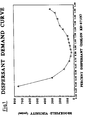
- the results are set forth graphically in Figure 1. The optimum is seen to be at 0.8% by weight based on the pigment. This is not unexpected for commercial dispersants.
- a composition is prepared which includes 65.5 percent TiPure® R-960 concentrate, a commercial TiO2 pigment available from E.I. du Pont & Company; 0.8 percent DISLON® KS-873N dispersant (based on pigment); 8 percent MIBK solvent; and 25 percent resin solids.
- 25 percent resin solids is K-FLEX® 188 resin, a 100% solids polyester polyol commercially available from King Industries, Inc., the Brookfield viscosity is 520 poise. This is also not unexpected for a commercial dispersant.
- the K-FLEX® 188 resin is incrementally replaced with K-CRYL® 200-6 resin, an acrylic polyol commerically available from King Industries, Inc. The results of this are graphically displayed in Figure 2. It is seen that the Brookfield viscosity decreases to a minimum viscosity of 35 poise. At this minimum point, the total resin solids are 85 percent K-FLEX® 188 resin and 15 percent K-CRYL® 200-6 resin. The optimum dispersing K-FLEX® 148 resin concentration that was achieved for this system then is used to compare dispersant efficiency by running dispersant demand curves as set forth above.
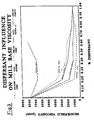
- Figure 3 shows a 70 percent TiPure R-960 concentrate in 28.6 percent combined K-FLEX®-148: K-CRYL® 200-6 85:15 w/w resin solids and 1.4 percent MIBK solvent. Without dispersants it has a Brookfield viscosity of 7800 poise.
- the dispersant demand curves illustrated in Figure 3 show compositions containing DISLON® KS873N (Example 21), ANTI-TERRA U® (Example 22), DISLON® 1860 (Example 23), NUOSPERSE® 657 (Example 24), and NACORR® 1552 (Example 25), as the dispersing agents, respectively.
- the dinonylnaphthalene sulfonate is most effective as a dispersant. Moreover, although four of the five dispersants affected viscosity equally at 1 percent concentration, there were marked differences at smaller concentrations. NACORR® 1552, a 50 percent active solution of zinc DNNS in butyl cellosolve, was the most efficient dispersant.
- Catalysts such as DNNS® sulfonates
- DNNS® sulfonates are usually added at much higher concentrations than those levels common for dispersants. This can negate the effect of any other dispersant present by creating a dispersant excess as shown in Figure 1.
- the use of a nonionic catalyst reduces this effect.
- NACURE® 1419 a partially ionic, epoxy blocked DNN sulfonate with a nonionic, covalent bond is used to prepare Examples 26 - 29 which to lead low volatile organic content (VOC) coatings.
- Table 8 shows two different low VOC formulations.
- the first coating, Example 26 utilizes DISLON® KS-873N as the dispersant.
- the second coating corresponding to Example 27, uses NACORR® 1552 as the dispersant. These coatings utilize mill bases from Examples 21 - 35.
Landscapes
- Chemical & Material Sciences (AREA)
- Engineering & Computer Science (AREA)
- Materials Engineering (AREA)
- Organic Chemistry (AREA)
- Life Sciences & Earth Sciences (AREA)
- Wood Science & Technology (AREA)
- Paints Or Removers (AREA)
- Emulsifying, Dispersing, Foam-Producing Or Wetting Agents (AREA)
- Pigments, Carbon Blacks, Or Wood Stains (AREA)
- Catalysts (AREA)
Abstract
Description
- The present invention relates to the use of dinonylnaphthalene sulfonic acid and derivatives thereof as pigment dispersants in mill grinds and high solids coating compositions made therefrom.
- In order to obtain high solids (pigment, etc.) coatings in nonaqueous fluid systems such as paints, enamels and the like, it is necessary to reduce the level of powerful mechanical forces in order to provide acceptable application viscosities. In other words, reducing the viscosity of mill base is an effective procedure in raising the solids content in a coating. Various additives have been developed which are aimed at achieving a low viscosity. For instance, it is well known in the art that the proper choice and amount of dispersant, dispersing resin and/or catalyst reduces the viscosity of coatings. Higher solids and lower VOC can be achieved by such modification, as well as improvements in film properties.
- Pigment wetting may be influenced by the viscosity of the mill base, the spatial nature of the pigment particles and the surface treatment characteristics of the pigment. Surface treatments create more hydrophilic particles and lower interfacial energy between them. In an efficient grinding procedure, pigment particles formed have increased interfacial energy between them. Particles of very fine size will tend to reagglomerate and are more difficult to keep in a well dispersed state due to London/van der Waal's forces by which the solids are attracted to each other.
- Low viscosity dispersing resins are used to achieve low viscosity and high solids coatings. For example, K-CRYL® 200-6 acrylic oligomer (75% solids), commercially available from King Industries, Inc., can dramatically reduce pigment association by improving the wetting of the pigments. End groups of the polymer are oriented away from pigment particles and are compatible with binder constituents. The improved wetting results in production of more primary pigment particles and a higher pigment-to-binder concentration. Grinding time is reduced and nonvolatile content increased by the acrylic modification. However, resins can often present problems in pigment dispersion, particularly in low molecular weight resins where pigments have a tendency to associate, leading to higher viscosity. Such association also increases with the addition of solvents.
- Dispersing resins of higher molecular weight and having less functionality than dispersants must be used at higher levels than the dispersants. Because of their lower functionality and higher molecular weight, they have less adverse effect than dispersants. However, unexpected increases or decreases in viscosity can be caused by chemical/physical interactions between combinations of certain resins and pigments.
- Dispersing agents are also often used in attempting to solve this problem. Dispersants are surface active agents, and therefore, affect the interfacial energies between pigment particles. Proper amounts of absorbed dispersants and wetting agents prevent the reagglomeration of particles formed in the grinding of mill base. Typical dispersants are bifunctional molecules with an ionic end and an organophilic end. In order to optimize the use of dispersants, enough must be used to provide a layer around the pigment particles, thereby preventing reassociation. However, excessive amounts of dispersants reduces their effectiveness.
- Many different dispersing agents are known in the art. For example, US-A-3,937,678 (Yasuda et al.) discloses a method for improving the rheological and suspension properties of a paint or other nonaqueous fluid system containing pigments or other solids by adding certain amide waxes and certain emulsifiable polyethylene waxes to the same. It is stated therein that the amide and polyethyene waxes used together provide a synergistic effect.
- More recently, US-A-4,647,647 (Haubennestal et al.) discloses the use of addition compounds obtained from the reaction of polyisocyanates, hydroxyl compounds, compounds having Zerewitinoff-active hydrogen and at least one basic group containing nitrogen, optionally in the presence of solvents and/or reaction catalysts as suitable dispersing agents.
- Other dispersants are well-known in the art as being useful for reducing the viscosity of nonaqueous fluid systems. Such dispersants include Dislon®-type additives, commercially available from Kusumoto Chemicals, Ltd. In particular, Dislon® 1860 is an anionic salt of a long chain polyaminoamide with a high weight polyester acid, and Dislon® KS-873N is an amine salt of a polyether ester acid. These additives may be added at about 0.2-1.5% by weight of paint. Both of the aforementioned Kusumoto additives improve paint gloss and enhance and stabilize pigment dispersion, although they are preferentially used for different applications based upon their particular properties.
- Other additives which have been found to be useful as dispersants include the Anti-Terra®-U type additives, commercially available from BYK-Chemie. These additives are salts of unsaturated polyamineamides and higher molecular weight acidic esters. The Anti-Terra-U additives also provide improved gloss and improve the stabilization of the dispersion.
- Yet another class of additives comprising modified alkyds and commercially available from NUODEX, Inc. as NUOSPERSE®, have been useful as pigment dispersing agents. When added in amounts of 2-4% based on the weight of pigment, the NUOSPERSE-type dispersants also improve product quality and improve dispersion stability.
- Still another class of additives comprising calcium petroleum sulfonates are offered by the Lubrizol Corporation as pigment dispersing agents.
- Dinonylnaphthalene sulfonic acids, commercially available from King Industries as HDNNS® acid, and a process for their manufacture are taught in US-A-2,764,548 (King et al.). King et al. disclose the fact that these compounds and salts thereof are very effective rust and corrosion inhibitors in motor fuels and lubricating oils. Dinonylnaphthalene acids and sulfonates are also well known in the art to be effective as catalysts for organic binder resins in nonaqueous fluid compositions and in coating systems comprising the nonaqueous fluid composition. When used as such catalysts, the dinonylnaphthalene acids and sulfonates are provided in amounts of about 0.5-5 percent by weight based on the weight of total resin solids.
- It has now surprisingly been discovered that certain dinonylnaphthalene sulfonic acids and sulfonates function as very efficient dispersants in high solids coatings when used in amounts about one-tenth as great as when used as catalysts. Furthermore, it has been found that when used in optimal quantities, the dinonylnaphthalene sulfonic acids and sulfonates provide similar physical properties to nonaqueous fluid systems such as paints, etc., but provide surprisingly improved viscosity reduction over prior art dispersants.
- In the drawings,
- Figure 1 is a graphical representation of viscosity versus concentration in a nonaqueous fluid compositions containing finely divided solid particles to which a prior art dispersant is incrementally added.
- Figure 2 is a graphical representation of viscosity versus resin blend composition in a composition employing the optimum dispersant content taken from Figure 1.
- Figure 3 is a graphical representation of viscosity versus concentration in a composition of optimum blend content taken from Figure 2, the different curves representing commercially available dispersants of the prior art and a dispersant in accordance with the present invention.
- In accordance with the present invention there are provided nonaqueous fluid compositions containing finely divided solid particles, a vehicle and a dispersant, characterized in that said dispersant is selected from disulphonic-acid free dinonylnaphthalenesulphonic acid, a salt thereof, an ester of said acid, or a mixture of any of them, and is present in an amount from 0.05 percent to 0.5 percent by weight based on the weight of total resin solids.
- Preferably the dispersant comprises disulphonic-acid free dinonylnaphthalenesulphonic acid, a metal salt of disulphonic-acid free dinonylnaphthalenesulphonic acid, an ester of disulphonic-acid free dinonylnaphthalenesulphonic acid or a mixture of any of the foregoing.
- As one embodiment, the present invention provides a mill grind comprising (i) a pigment; (ii) a vehicle; and (iii) a dispersant as above defined in an amount of from about 0.07 to about 0.7 percent, preferably about 0.4, by weight based on the weight of the pigment. Also features of the invention are enamels made from the mill grind and a letdown vehicle, the dispersant comprising 0.02 to 0.2, preferably 0.10 to 0.15, percent by weight based on the enamel.
- In addition to the above embodiments, the present invention provides a method for improving the rheological and suspension properties of a mill grind comprising (i) finely divided solid particles, and (ii) a non-aqueous fluid system, said method comprising adding to said mill grind, (iii) a dispersant as defined above in an amount of from about 0.07 to about 0.7 preferably about 0.4 percent by weight based on the weight of said pigment. The invention also contemplates improving such properties in enamels by adding 0.02 to 0.2, preferably 0.10 to 0.15 percent by weight based on the enamel of the dispersant.
- More preferably, the dispersant will comprise dinonylnaphthalene sulfonic acid, a metal salt of dinonylnaphthalene sulfonic acid, an amine salt of dinononylnaphthalene sulfonic acid or an ester of dinonylnaphthalene sulfonic acid. Special mention is made of compositions and methods in which the dispersant comprises zinc dinonylnaphthalene sulfonate.
- The dinonylnapthalene sulfonic acids of the present invention may be prepared in accordance with the process disclosed in US-A-2,764,548 (King et al), or by other methods which are well known in the art.
- In general, dinonylnaphthalene sulfonic acids may be prepared by alkylating naphthalene with highly branched nonenes, for example, tripropylene, with a suitable catalyst such as hydrogen fluoride or anhydrous aluminum chloride in a suitable anhydrous solvent containing the naphthalene. The use of suitable solvents such as naphtha, sulfur dioxide, nitrobenzene or a mixture of benzene and nitrobenzene in the alkylation result in a high yield of dinonylnapthalene and relative ease of recovery of the solvent.
- In the process of forming sulfonic acids and salts from dinonylnapthalene, the dinonylnaphthalene is dissolved in a solvent which is free of aromatics or olefins which under the condition of the reaction would disadvantageously react with sulfonic acid. The aforementioned solvents are suitable for the sulfonation reaction. The sulfonic acid, preferably oleum, is introduced into the solution of dinonylnaphthalene at the desired temperature and agitation. After the reaction is complete, the product is subjected to successive water washings and stratifications in each of which the water-insoluble, but oil soluble, dinonylnaphthalene sulfonic acid accumulates in an upper layer.
- The commercially available nonenes may be obtained as by-products of the petroleum refining operations and include small amounts of other olefins and other hydrocarbons. Suitable products containing from about 70 to about 90 percent of nonene produced by polymerization are available from the petroleum refiners. Preferably, the nonenes which are used are olefins, the major portion of which are tertiary olefins. They may be further characterized as polymers of propylene or propene, especially polymeric tripropylene which is a mixture of isomers having from 1/3 to 1/2 terminal methyl groups, the double bond being distributed along the chain. Especially effective nonenes are made commercially by the trimerization of propylene by an acid catalyst such as phosphoric acid.
- The inorganic salts of the dinonylnaphthalene sulfonates, such as sodium, potassium, magnesium, calcium, zinc, or barium, may be advantageously prepared after the water washes have been made and the sulfonic acid containing product is free of sulfuric and disulfonic acid. It is also advantageous to determine the neutralization equivalent of the sulfonic acid layer and calculate the weight of metal, etc. to be added in forming the salt in the neutralization of the sulfonic acid. The ammonium and amine salts of the sulfonic acids may be produced in a similar manner. Other derivatives such as the sulfonate esters can be made in conventional ways, for example, by addition of epoxy functional compounds to the sulfonic acid in non aqueous systems. The zinc salt may be produced for example, by adding 3 parts by weight of zinc oxide to 42 parts by weight of a 40 percent solution of dinonylnapthalene sulfonic acid in mineral seal oil, and heating the mixture to 50-60°C.
- In preferred embodiments of the present invention, the dispersant comprises 42 percent epoxy ester of dinonylnaphthalene sulfonic acid in xylene/MIBK, commercially available from King Industries as NACURE® 1419; 50 percent zinc dinonylnaphthalene sulfonate in butyl cellosolve, commercially available as
NACORR® 1552; 45 percent basic barium dinonylnaphthalene sulfonate in 8.1 percent BaOH (H₂O) and 46.9 percent mineral spirits, commercially available as NA-SUL® BSB/MS, 50 percent barium dinonylnaphthalene sulfonate in mineral spirits, commercially available asNACORR® 1151, 50 percent HDNNS® dinonylnaphthalene sulfonic acid in butyl cellosolve, commercially available as NACURE® 1051; and 25 percent amine blocked dinonylnaphthalene sulfonate in 75 percent xylene and 5 percent heptane, commercially available as NACURE® 1323 from King Industries. - The following examples illustrate the present invention.
- The viscosity stability of a control blend having no dinonylnaphthalene sulfonic acid catalyst is determined for the purpose of comparison. First, the grind is predispersed with a Cowles disperser and then ground overnight in a pebble mill to 9-10 on a PC Hegman gauge. Thereafter, 686.3g of the grind is hand-stirred into the preblend letdown. The components of the grind, the preblend letdown, and the final composition are provided in Table 1. Next, the viscosity reduction for a 200g sample of the composition which has a solvent blend of methoxypropyl acetate (PM acetate®): methylethyl ketone (MEK): (80:20) is determined. Then, according to this invention, at a 73.2% solids content, 1.7% of NACURE® 1419 is included and the viscosity measurement is repeated. The results in Table 2 show a significant decrease in viscosity caused by the dispersing effect of the dinononylnaphthalene sulfonate ester.
- The variables for viscosity/percentage solids adjustment of compositions which include dinonylnaphthathalene sulfonic acid catalysts are compared to control samples which are not provided with the catalysts. Example 2 does not have a catalyst included, while Example 3 uses NACURE® 1419, and Examples 4 and 5 use NACURE® 1051 and NACURE® 1323, respectively. Table 3 provides variables for viscosity/percent solids adjustment. In each of these Examples, 200g of paint and 94.4g total resin solids (TRS) (or 47.2% TRS) are used. This table demonstrates levels of dinonylnaphthalene sulfonic acids and derivatives typically used for catalyzed high solids coatings.
- The viscosity of compositions with and without Table 3 dinonylnaphthylene sulfonate catalysts are taken at 25°C with a #4 Ford Cup. The results are shown in Table 4. The compositions provided with the dinonylnaphthlene catalysts (Examples 6 - 8) showed surprising viscosity reduction as compared to the compositions without the catalyst (Examples 9 - 12). At catalytic levels some dispersant acitivity is thus seen to occur.
- The viscosity stability at 50°C of three compositions including catalytic amounts of dinonylnaphthalene sulfonic acid (DNNS®) and its derivatives (Table 3) are compared to a control composition without any DNNS® for 12 week period. The results are shown in Table 5. Low initial viscosity of Examples 14, 15 and 16 demonstrates some dispersant activity, while their 12 week higher viscosity indicates their catalytic activity.
- A control composition is prepared using the ingredients shown in Table 6. Thereafter, three different DNNS® derivatives were added at 1.7 percent, based on the total resin solids. Example 18 includes NASUL® BSB/MS, Example 19 includes NACORR® 1151, and Example 20 includes
NACORR® 1552. The viscosity of these samples is compared to that of the control (Example 17) at varying shear rates. The results are shown in Table 7. The compositions containing the DNNS catalysts provided similar behavior to the DNNS derivatives previously tested. - The foregoing data demonstrate some dispersant activity at catalytic levels. Experiments were then carried out to determine optimum levels for dispersant activity.
- A composition is prepared using a commercial dispersant, DISLON® KS-873N, using a standard industry dispersant demand test. The composition comprised 63% TiPure®-960 titanium dioxide pigment concentrate, 23% resin solids K-FLEX® 188 resin, and 14% methyl isobutyl ketone solvent. The dispersant was added incrementally and the viscosity was measured to determine the optimum level. The results are set forth graphically in Figure 1. The optimum is seen to be at 0.8% by weight based on the pigment. This is not unexpected for commercial dispersants.
- A composition is prepared which includes 65.5 percent TiPure® R-960 concentrate, a commercial TiO₂ pigment available from E.I. du Pont & Company; 0.8 percent DISLON® KS-873N dispersant (based on pigment); 8 percent MIBK solvent; and 25 percent resin solids. When the 25 percent resin solids is K-FLEX® 188 resin, a 100% solids polyester polyol commercially available from King Industries, Inc., the Brookfield viscosity is 520 poise. This is also not unexpected for a commercial dispersant.
- The K-FLEX® 188 resin is incrementally replaced with K-CRYL® 200-6 resin, an acrylic polyol commerically available from King Industries, Inc. The results of this are graphically displayed in Figure 2. It is seen that the Brookfield viscosity decreases to a minimum viscosity of 35 poise. At this minimum point, the total resin solids are 85 percent K-FLEX® 188 resin and 15 percent K-CRYL® 200-6 resin. The optimum dispersing K-FLEX® 148 resin concentration that was achieved for this system then is used to compare dispersant efficiency by running dispersant demand curves as set forth above.
- Figure 3 shows a 70 percent TiPure R-960 concentrate in 28.6 percent combined K-FLEX®-148: K-CRYL® 200-6 85:15 w/w resin solids and 1.4 percent MIBK solvent. Without dispersants it has a Brookfield viscosity of 7800 poise.
- The dispersant demand curves illustrated in Figure 3 show compositions containing DISLON® KS873N (Example 21), ANTI-TERRA U® (Example 22), DISLON® 1860 (Example 23), NUOSPERSE® 657 (Example 24), and NACORR® 1552 (Example 25), as the dispersing agents, respectively.
- As can be seen by the results provided in Figure 3, the dinonylnaphthalene sulfonate is most effective as a dispersant. Moreover, although four of the five dispersants affected viscosity equally at 1 percent concentration, there were marked differences at smaller concentrations.
NACORR® 1552, a 50 percent active solution of zinc DNNS in butyl cellosolve, was the most efficient dispersant. - Catalysts, such as DNNS® sulfonates, are usually added at much higher concentrations than those levels common for dispersants. This can negate the effect of any other dispersant present by creating a dispersant excess as shown in Figure 1. The use of a nonionic catalyst reduces this effect.
- NACURE® 1419, a partially ionic, epoxy blocked DNN sulfonate with a nonionic, covalent bond is used to prepare Examples 26 - 29 which to lead low volatile organic content (VOC) coatings.
- Table 8 shows two different low VOC formulations. The first coating, Example 26, utilizes DISLON® KS-873N as the dispersant.
- The second coating, corresponding to Example 27, uses
NACORR® 1552 as the dispersant. These coatings utilize mill bases from Examples 21 - 35. - The resultant physical properties of these compositions (Table 8)show that the dinonylnaphthalene sulfonates, when used in concentrations about one-tenth as great as when used as catalysts, are effective dispersants which provide comparable physical properties to those compositions provided with prior art dispersants, even at one-half of the concentration.
TABLE 1 CONTROL FORMULATION Grind Amount Cargill 5770(1) 163.1g Tronox® CR-800(2) 693.7g PM Acetate(3) 76.0g MEK 67.2g Preblend letdown Cargill 5770 413.2g Hexamethoxymethylmelamine (4) 148.7g Dislon® L-1980 (5) 2.5g PM Acetate 12.9g PE/Melamine 75/25 Pigment/Binder 0.8/1.0 Enamel/Solids 85.0% Binder Solids-Total Resin Solids 47.2% VOC, Calc. (lbs/gal.) 1.90 #4 Ford Cup Viscosity 360" (1) Polyester resin, Cargill, Inc. (2) Titanium dioxide pigment, Kerr-McGee Chemical Corp. (3) Methoxypropyl acetate, Arco Chemical Company (4) Cymel® 303resin, American Cyanamid Co. or Resimene® 747, Monsanto Co. (5) Kusumoto Chemicals, Ltd. -
TABLE 2 Evaluation of Viscosity Reduction for a 200g Sample with PM Acetate: MEK blend (80:20) Enamel % Total Solids #4 Ford Cup Viscosity 78% 75" 75% 46" 73.5% 38" 73.2%*(73.3%) 29" Catalyzed with 1.7% NACURE® 1419 *73.5% Sample with 1.7% NACURE® 1419 on TRS calculates to be a 73.2% total solids excluding unsulfonated residue (USR) & epoxy. Actual solids including acid, USR & epoxy are 73.3% -
TABLE 3 Variables for Viscosity/% Solids adjustment Example Component % Active* % Solids % Catalyst** 2*** Paint -- 85 -- 3 NACURE® 1419 30 50 1.7 4 NACURE® 1051 50 57 1.1 5 NACURE® 1323 21 24 2.5 * Based on dinonylnaphthalene sulfonic acid ** Based on total Resin Solids (47.2%) *** Control 

-
TABLE 6 FORMULATION:* CONTROL (gms) Grind: Cargill 5770* 111.9 Tronox® CR-800 76.1 Methyl Ethyl Ketone 46.1 PM Acetate® 52.2 686.3 Grind overnight in pebble mill, 8+ on Hegman LETDOWN: Cargill 5770 413.2 Hexamethoxymethylmelamine 148.7 DISLON® L-1980 2.5 PM Acetate 390.2 1640.9 Polyester/Melamine 75/25 Pigment/Binder 0.8/1.0 Enamel Solids, Wt. % 74 See Footnotes to Table 1 

Claims (24)
- A nonaqueous fluid composition containing finely divided solid particles, a vehicle and a dispersant, characterized in that said dispersant is selected from disulphonic-acid-free dinonylnaphthalenesulphonic acid, a salt thereof, an ester of said acid, or a mixture of any of them, and is present in an amount from 0.05 percent to 0.5 percent by weight based on the weight of total resin solids.
- A composition as defined in Claim 1, wherein said dispersant comprises disulphonic-acid-free dinonylnaphthalenesulphonic acid, a metal salt of disulphonic-acid-free dinonylnaphthalenesulphonic acid, an ester of disulphonic-acid-free dinonylnaphthalenesulphonic acid, or a mixture of any of the foregoing.
- A composition according to Claim 1, wherein said dispersant is disulphonic-acid-free dinonylnaphthalenesulphonic acid .
- A composition according to Claim 1, wherein said dispersant is a metal salt of disulphonic-acid-free dinonylnaphthalenesulphonic acid.
- A composition according to Claim 1, wherein said dispersant is an amine salt of disulphonic-acid-free dinonylnaphthalenesulphonic acid.
- A composition according to Claim 1, wherein said dispersant is an ester of disulphonic-acid-free dinonylnaphthalenesulphonic acid.
- A composition according to Claim 1, which is a mill grind comprising:(i) a pigment;(ii a vehicle comprising a binder and a solvent, and(iii) a dispersant comprising a disulphonic-acid-free dinonylnaphthalenesulphonic acid, a salt of said acid, an ester of said acid, or a mixture of any of them, in an amount of from 0,07% to 0,7% by weight based on the weight of said pigment (i).
- A mill grind as defined in Claim 7, wherein said dispersant (iii) is present in an amount of 0,4% by weight based on the weight of said pigment (i).
- A mill grind as defined in Claim 7, wherein said dispersant comprises a 50% by weight solution of zinc dinonylnaphthalenesulphonate in butyl cellosolve.
- A composition as defined in Claim 1, which is an enamel, comprising:A. A mill grind comprising:(i) a pigment;(ii a vehicle comprising a binder and a solvent, and(iii) a dispersant comprising a disulphonic-acid-free dinonylnaphthalenesulphonic acid, a salt of said acid, an ester of said acid, or a mixture of any of them, andB. A letdown vehicle comprising a binder and a solvent, the amount of said dispersant (A)(iii) in said mill grind being from 0,02% to 0,2% by weight based on said enamel.
- An enamel as defined in Claim 10, wherein the amount of said dispersant (A)(iii) in said mill grind is from 0,10% to 0,15% by weight based on said enamel.
- An enamel as defined in Claim 10, wherein said dispersant (A)(iii) in said mill grind comprises a 50% by weight solution of zinc dinonylnaphthalenesulphonate in butyl cellosolve.
- A method for improving the rheological and suspension properties of a nonaqueous fluid mill grind composition or enamel composition made therefrom containing finely divided solid particles, said method comprising the step of adding to said composition a dispersant selected from disulphonic-acid-free dinonylnaphthalenesulphonic acid, a salt thereof, an ester of said acid, or a mixture of any of them, in a an amount from 0.05 percent to 0.5 percent by weight based on the weight of total resin solids.
- A method as defined in Claim 13, wherein said dispersant comprises disulphonic-acid-free dinonylnaphthalenesulphonic acid, a metal salt of disulphonic-acid-free dinonylnaphthalenesulphonic acid, an ester of disulphonic-acid-free dinonylnaphthalenesulphonic acid, or a mixture of any of the foregoing.
- A method according to Claim 13, wherein said dispersant is disulphonic-acid-free dinonylnaphthalenesulphonic acid.
- A method according to Claim 13, wherein said dispesant is a metal salt of disulphonic-acid-free dinonylnaphthalenesulphonic acid.
- A method according to Claim 13, wherein said dispersant is an amine salt of disulphonic-acid-free dinonylnaphthalenesulphonic acid.
- A method according to Claim 13, wherein said dispersant is an ester of disulphonic-acid-free dinonylnaphthalenesulphonic acid.
- A method according to Claim 13, for improving the rheological and suspension properties of a mill grind comprising:(i) finely divided solid pigment particles, and(ii) a nonaqueous fluid system said method comprising the step of adding to said mill grind:(iii) a dispersant comprising a disulphonic-acid-free dinonylnaphthalenesulphonic acid, a salt of said acid, an ester of said acid, or a mixture of any of them, in an amount of from 0,07% to 0,7% by weight based on the weight of said solid pigment particles (i).
- A method for improving the rheological and suspension properties of a mill grind as defined in Claim 19, wherein said dispersant (iii) is present in an amount of 0,4% by weight based on the weight of said solid pigment particles (i).
- A method for improving the rheological and suspension properties of a mill grind as defined in Claim 19, wherein said dispersant (iii) comprises a 50% by weight solution of zinc dinonylnaphthalenesulphonate in butyl cellosolve.
- A method according to Claim 13, for improving the rheological and suspension properties of an enamel comprising:A. A mill grind comprising:(i) a pigment;(ii a vehicle comprising a binder and a solvent, and(iii) a dispersant comprising a disulphonic-acid-free dinonylnaphthalenesulphonic acid, a salt of said acid, an ester of said acid, or a mixture of any of them, andB. A letdown vehicle,
said method comprising the step of adding to said mill grind an amount of said dispersant (A)(iii) of from 0,02% to 0,2% by weight based on said enamel. - A method according to Claim 22, wherein the amount of said dispersant (A)(iii) is of from 0,02% to 0,2% by weight based on said enamel.
- A method according to Claim 22, wherein said dispersant (A)(iii) comprises a 5% by weight solution of zinc dinonylnaphthalenesulphonate in butyl cellosolve.
Priority Applications (1)
| Application Number | Priority Date | Filing Date | Title |
|---|---|---|---|
| AT8888202876T ATE105007T1 (en) | 1987-12-23 | 1988-12-14 | DINONYLNAPHTALENE SULFONIC ACIDS AND THEIR DERIVATIVES AS DISPERSING AGENTS IN HIGH SOLIDS COATINGS. |
Applications Claiming Priority (2)
| Application Number | Priority Date | Filing Date | Title |
|---|---|---|---|
| US137483 | 1987-12-23 | ||
| US07/137,483 US4910243A (en) | 1987-12-23 | 1987-12-23 | Dinonylnaphthalene sulfonic acid and derivatives thereof as dispersants in high solids coatings |
Publications (3)
| Publication Number | Publication Date |
|---|---|
| EP0322953A2 EP0322953A2 (en) | 1989-07-05 |
| EP0322953A3 EP0322953A3 (en) | 1991-06-12 |
| EP0322953B1 true EP0322953B1 (en) | 1994-04-27 |
Family
ID=22477638
Family Applications (1)
| Application Number | Title | Priority Date | Filing Date |
|---|---|---|---|
| EP88202876A Expired - Lifetime EP0322953B1 (en) | 1987-12-23 | 1988-12-14 | Dinonylnaphtalene sulfonic acid and derivatives thereof as dispersants in high solids coatings |
Country Status (6)
| Country | Link |
|---|---|
| US (1) | US4910243A (en) |
| EP (1) | EP0322953B1 (en) |
| JP (1) | JPH0830163B2 (en) |
| AT (1) | ATE105007T1 (en) |
| CA (1) | CA1324854C (en) |
| DE (1) | DE3889313T2 (en) |
Families Citing this family (4)
| Publication number | Priority date | Publication date | Assignee | Title |
|---|---|---|---|---|
| JPH06264004A (en) * | 1993-03-11 | 1994-09-20 | Atom Chem Paint Co Ltd | Lowly odoriferous aerosol coating material composition |
| EP0667389B1 (en) * | 1994-02-11 | 2000-12-27 | The Lubrizol Corporation | Metal free hydraulic fluid with amine salt |
| KR101019596B1 (en) | 2009-04-24 | 2011-03-07 | 티엔씨 주식회사 | Zinc salt derivative microcapsules for rust preventive pigments and preparation method thereof |
| JP7130835B1 (en) * | 2021-12-16 | 2022-09-05 | マツイカガク株式会社 | Method for manufacturing printed seamless cans |
Family Cites Families (14)
| Publication number | Priority date | Publication date | Assignee | Title |
|---|---|---|---|---|
| CA549541A (en) * | 1957-12-03 | R. Davis Arnold | Compositions containing diacylaminodiphenyldisulfide plasticizers, clay and dispersing agent | |
| CA619721A (en) * | 1961-05-09 | J. R. Geigy S.A. | Pigment dispersions in water | |
| US2764548A (en) * | 1955-01-25 | 1956-09-25 | King Organic Chemicals Inc | Dinonylnaphthalene sulfonates and process of producing same |
| US3627723A (en) * | 1968-12-26 | 1971-12-14 | Du Pont | Filler loaded elastomeric compositions having improved extrudability and physical properties |
| US4120817A (en) * | 1972-07-03 | 1978-10-17 | Outokumpu Oy | Extraction agent composition |
| JPS5148464B2 (en) * | 1973-07-16 | 1976-12-21 | ||
| US4205865A (en) * | 1975-07-15 | 1980-06-03 | Minnesota Mining And Manufacturing Company | Latent sensitizing ink |
| DD130942A1 (en) * | 1977-05-03 | 1978-05-17 | Gerhard Rutz | STABLE LATEX MIXTURE FOR THE MANUFACTURE OF AGING AND AGING-RESISTANT RUBBER PRODUCTS |
| US4157991A (en) * | 1978-04-10 | 1979-06-12 | The United States Of America As Represented By The Secretary Of The Navy | Corrosion preventive composition |
| US4238387A (en) * | 1978-11-20 | 1980-12-09 | E. I. Du Pont De Nemours And Company | Rheology control additive for paints |
| US4360612A (en) * | 1981-01-16 | 1982-11-23 | The Dow Chemical Company | Agglomerate-free, bubble-free, high barrier vinylidene chloride polymer films and process of preparation |
| US4477617A (en) * | 1982-07-21 | 1984-10-16 | E. I. Dupont De Nemours And Company | Molding resins based on blends of acid copolymer/hydrocarbon polyolefin/reinforcing fiber/wetting agent |
| EP0154678B2 (en) * | 1984-01-27 | 1998-12-09 | Byk-Chemie GmbH | Addition compounds suited as dispersing agents, process for their preparation, their use and solid materials coated with them |
| DD224042A1 (en) * | 1984-03-07 | 1985-06-26 | Inst Bauelemente Und Faserbaus | ADHESIVE COMBINATION FOR ONE-SIDED DIFFUSION-SHAPED ADHESIVE SURFACES |
-
1987
- 1987-12-23 US US07/137,483 patent/US4910243A/en not_active Expired - Lifetime
-
1988
- 1988-12-14 DE DE3889313T patent/DE3889313T2/en not_active Expired - Fee Related
- 1988-12-14 AT AT8888202876T patent/ATE105007T1/en not_active IP Right Cessation
- 1988-12-14 EP EP88202876A patent/EP0322953B1/en not_active Expired - Lifetime
- 1988-12-22 CA CA000586762A patent/CA1324854C/en not_active Expired - Lifetime
- 1988-12-23 JP JP63325708A patent/JPH0830163B2/en not_active Expired - Fee Related
Also Published As
| Publication number | Publication date |
|---|---|
| US4910243A (en) | 1990-03-20 |
| ATE105007T1 (en) | 1994-05-15 |
| EP0322953A2 (en) | 1989-07-05 |
| JPH02110169A (en) | 1990-04-23 |
| CA1324854C (en) | 1993-11-30 |
| JPH0830163B2 (en) | 1996-03-27 |
| DE3889313T2 (en) | 1994-09-22 |
| EP0322953A3 (en) | 1991-06-12 |
| DE3889313D1 (en) | 1994-06-01 |
Similar Documents
| Publication | Publication Date | Title |
|---|---|---|
| EP0359034B1 (en) | Dispersant for nonaqueous systems | |
| DE3817251C2 (en) | ||
| DE69533671T2 (en) | Anticorrosive pigments and compositions containing them | |
| DE2613099B2 (en) | Aqueous dispersion coating compositions | |
| DE69421317T2 (en) | Pigment compositions containing dispersants | |
| EP0340583B1 (en) | Aqueous dispersions with a synergistic combination of dispersing agents | |
| US4910243A (en) | Dinonylnaphthalene sulfonic acid and derivatives thereof as dispersants in high solids coatings | |
| EP1109867A1 (en) | Inorganic anti-corrosive pigments and method for the production thereof | |
| DE19811791A1 (en) | Aqueous dispersions with a special combination of dispersants | |
| TWI381030B (en) | Aqueous coating composition | |
| EP0492501A1 (en) | Surface-active triazine compounds, process for their preparation and their use | |
| DE3223411C2 (en) | Zinc-rich lacquer using manganese (II, III) oxide as a pigment | |
| EP0258343A1 (en) | New anticorrosive pigments, preparation and utilization thereof | |
| EP0436135B1 (en) | Method of making dibutyltinoxide containing catalyst pastes and use thereof | |
| EP0543849B1 (en) | Use of molybdenum compounds for paint coagulation | |
| AU623938B2 (en) | Surface treatment | |
| DE4018876A1 (en) | CATHODICALLY DEPOSIBLE ELECTRODESERDER PAINT BATHS WITH ADDITIVES FOR IMPROVING THE SURFACE, AND THE USE OF LATER FOR COATING METHODS | |
| JPH11256067A (en) | Surface-treated carbon black, method for producing the same, and dispersion using the same | |
| EP0054266B1 (en) | Corrosion-inhibiting pigments and their use in coating products | |
| DE2754576A1 (en) | DISPERSING PIGMENTS | |
| DE69816817T2 (en) | IMPROVED KAOLINE COMPOSITION FOR USE IN ELECTRIC DIVERS | |
| EP0581235B1 (en) | Process for stabilizing aluminium pigments | |
| EP0705892A2 (en) | Dispersion of solid particles in water | |
| DE69324469T2 (en) | Dispersing agent for soot | |
| US3960590A (en) | Modified chromium oxide pigment |
Legal Events
| Date | Code | Title | Description |
|---|---|---|---|
| PUAI | Public reference made under article 153(3) epc to a published international application that has entered the european phase |
Free format text: ORIGINAL CODE: 0009012 |
|
| AK | Designated contracting states |
Kind code of ref document: A2 Designated state(s): AT BE CH DE ES FR GB IT LI NL SE |
|
| PUAL | Search report despatched |
Free format text: ORIGINAL CODE: 0009013 |
|
| AK | Designated contracting states |
Kind code of ref document: A3 Designated state(s): AT BE CH DE ES FR GB IT LI NL SE |
|
| 17P | Request for examination filed |
Effective date: 19910928 |
|
| 17Q | First examination report despatched |
Effective date: 19920626 |
|
| GRAA | (expected) grant |
Free format text: ORIGINAL CODE: 0009210 |
|
| AK | Designated contracting states |
Kind code of ref document: B1 Designated state(s): AT BE CH DE ES FR GB IT LI NL SE |
|
| PG25 | Lapsed in a contracting state [announced via postgrant information from national office to epo] |
Ref country code: SE Free format text: THE PATENT HAS BEEN ANNULLED BY A DECISION OF A NATIONAL AUTHORITY Effective date: 19940427 Ref country code: NL Effective date: 19940427 Ref country code: LI Effective date: 19940427 Ref country code: ES Free format text: THE PATENT HAS BEEN ANNULLED BY A DECISION OF A NATIONAL AUTHORITY Effective date: 19940427 Ref country code: CH Effective date: 19940427 Ref country code: AT Effective date: 19940427 |
|
| REF | Corresponds to: |
Ref document number: 105007 Country of ref document: AT Date of ref document: 19940515 Kind code of ref document: T |
|
| REF | Corresponds to: |
Ref document number: 3889313 Country of ref document: DE Date of ref document: 19940601 |
|
| ITF | It: translation for a ep patent filed | ||
| ET | Fr: translation filed | ||
| REG | Reference to a national code |
Ref country code: CH Ref legal event code: PL |
|
| NLV1 | Nl: lapsed or annulled due to failure to fulfill the requirements of art. 29p and 29m of the patents act | ||
| PLBE | No opposition filed within time limit |
Free format text: ORIGINAL CODE: 0009261 |
|
| STAA | Information on the status of an ep patent application or granted ep patent |
Free format text: STATUS: NO OPPOSITION FILED WITHIN TIME LIMIT |
|
| 26N | No opposition filed | ||
| PGFP | Annual fee paid to national office [announced via postgrant information from national office to epo] |
Ref country code: DE Payment date: 20001204 Year of fee payment: 13 |
|
| PGFP | Annual fee paid to national office [announced via postgrant information from national office to epo] |
Ref country code: FR Payment date: 20001212 Year of fee payment: 13 |
|
| PGFP | Annual fee paid to national office [announced via postgrant information from national office to epo] |
Ref country code: GB Payment date: 20001213 Year of fee payment: 13 |
|
| PGFP | Annual fee paid to national office [announced via postgrant information from national office to epo] |
Ref country code: BE Payment date: 20010315 Year of fee payment: 13 |
|
| PG25 | Lapsed in a contracting state [announced via postgrant information from national office to epo] |
Ref country code: GB Free format text: LAPSE BECAUSE OF NON-PAYMENT OF DUE FEES Effective date: 20011214 |
|
| PG25 | Lapsed in a contracting state [announced via postgrant information from national office to epo] |
Ref country code: BE Free format text: LAPSE BECAUSE OF NON-PAYMENT OF DUE FEES Effective date: 20011231 |
|
| REG | Reference to a national code |
Ref country code: GB Ref legal event code: IF02 |
|
| BERE | Be: lapsed |
Owner name: KING INDUSTRIES INC. Effective date: 20011231 |
|
| PG25 | Lapsed in a contracting state [announced via postgrant information from national office to epo] |
Ref country code: DE Free format text: LAPSE BECAUSE OF NON-PAYMENT OF DUE FEES Effective date: 20020702 |
|
| GBPC | Gb: european patent ceased through non-payment of renewal fee |
Effective date: 20011214 |
|
| PG25 | Lapsed in a contracting state [announced via postgrant information from national office to epo] |
Ref country code: FR Free format text: LAPSE BECAUSE OF NON-PAYMENT OF DUE FEES Effective date: 20020830 |
|
| REG | Reference to a national code |
Ref country code: FR Ref legal event code: ST |
|
| PG25 | Lapsed in a contracting state [announced via postgrant information from national office to epo] |
Ref country code: IT Free format text: LAPSE BECAUSE OF NON-PAYMENT OF DUE FEES;WARNING: LAPSES OF ITALIAN PATENTS WITH EFFECTIVE DATE BEFORE 2007 MAY HAVE OCCURRED AT ANY TIME BEFORE 2007. THE CORRECT EFFECTIVE DATE MAY BE DIFFERENT FROM THE ONE RECORDED. Effective date: 20051214 |