EP0322384B1 - Nucleosides for use in therapy - Google Patents
Nucleosides for use in therapy Download PDFInfo
- Publication number
- EP0322384B1 EP0322384B1 EP88850370A EP88850370A EP0322384B1 EP 0322384 B1 EP0322384 B1 EP 0322384B1 EP 88850370 A EP88850370 A EP 88850370A EP 88850370 A EP88850370 A EP 88850370A EP 0322384 B1 EP0322384 B1 EP 0322384B1
- Authority
- EP
- European Patent Office
- Prior art keywords
- compounds
- virus
- formula
- hiv
- vsb
- Prior art date
- Legal status (The legal status is an assumption and is not a legal conclusion. Google has not performed a legal analysis and makes no representation as to the accuracy of the status listed.)
- Expired - Lifetime
Links
- 238000002560 therapeutic procedure Methods 0.000 title abstract description 3
- 239000002777 nucleoside Substances 0.000 title description 9
- 125000003835 nucleoside group Chemical group 0.000 title description 8
- 150000001875 compounds Chemical class 0.000 claims abstract description 45
- 241001430294 unidentified retrovirus Species 0.000 claims abstract description 12
- 239000003814 drug Substances 0.000 claims abstract description 9
- 208000015181 infectious disease Diseases 0.000 claims abstract description 8
- 230000001225 therapeutic effect Effects 0.000 claims abstract description 8
- 238000004519 manufacturing process Methods 0.000 claims abstract description 5
- 238000011321 prophylaxis Methods 0.000 claims abstract description 4
- 150000003839 salts Chemical class 0.000 claims description 11
- 241000124008 Mammalia Species 0.000 claims description 4
- 125000004092 methylthiomethyl group Chemical group [H]C([H])([H])SC([H])([H])* 0.000 claims description 2
- 125000004055 thiomethyl group Chemical group [H]SC([H])([H])* 0.000 claims description 2
- 241000700721 Hepatitis B virus Species 0.000 abstract description 8
- XEKOWRVHYACXOJ-UHFFFAOYSA-N Ethyl acetate Chemical compound CCOC(C)=O XEKOWRVHYACXOJ-UHFFFAOYSA-N 0.000 description 24
- RWQNBRDOKXIBIV-UHFFFAOYSA-N thymine Chemical compound CC1=CNC(=O)NC1=O RWQNBRDOKXIBIV-UHFFFAOYSA-N 0.000 description 22
- 241000725303 Human immunodeficiency virus Species 0.000 description 18
- LFQSCWFLJHTTHZ-UHFFFAOYSA-N Ethanol Chemical compound CCO LFQSCWFLJHTTHZ-UHFFFAOYSA-N 0.000 description 16
- 229940113082 thymine Drugs 0.000 description 16
- 230000000694 effects Effects 0.000 description 13
- -1 sulphonamido groups Chemical group 0.000 description 13
- VYPSYNLAJGMNEJ-UHFFFAOYSA-N Silicium dioxide Chemical compound O=[Si]=O VYPSYNLAJGMNEJ-UHFFFAOYSA-N 0.000 description 11
- 208000030507 AIDS Diseases 0.000 description 10
- HEDRZPFGACZZDS-UHFFFAOYSA-N Chloroform Chemical compound ClC(Cl)Cl HEDRZPFGACZZDS-UHFFFAOYSA-N 0.000 description 10
- IAZDPXIOMUYVGZ-WFGJKAKNSA-N Dimethyl sulfoxide Chemical compound [2H]C([2H])([2H])S(=O)C([2H])([2H])[2H] IAZDPXIOMUYVGZ-WFGJKAKNSA-N 0.000 description 10
- IAZDPXIOMUYVGZ-UHFFFAOYSA-N Dimethylsulphoxide Chemical compound CS(C)=O IAZDPXIOMUYVGZ-UHFFFAOYSA-N 0.000 description 10
- QTBSBXVTEAMEQO-UHFFFAOYSA-N Acetic acid Chemical compound CC(O)=O QTBSBXVTEAMEQO-UHFFFAOYSA-N 0.000 description 9
- VLKZOEOYAKHREP-UHFFFAOYSA-N n-Hexane Chemical compound CCCCCC VLKZOEOYAKHREP-UHFFFAOYSA-N 0.000 description 9
- 239000000243 solution Substances 0.000 description 9
- 125000000217 alkyl group Chemical group 0.000 description 8
- 229940093499 ethyl acetate Drugs 0.000 description 8
- 235000019439 ethyl acetate Nutrition 0.000 description 8
- 125000002496 methyl group Chemical group [H]C([H])([H])* 0.000 description 8
- 238000002360 preparation method Methods 0.000 description 8
- 150000002148 esters Chemical class 0.000 description 7
- 238000011282 treatment Methods 0.000 description 7
- 241000282414 Homo sapiens Species 0.000 description 6
- YXFVVABEGXRONW-UHFFFAOYSA-N Toluene Chemical compound CC1=CC=CC=C1 YXFVVABEGXRONW-UHFFFAOYSA-N 0.000 description 6
- 125000003710 aryl alkyl group Chemical group 0.000 description 6
- 125000003118 aryl group Chemical group 0.000 description 6
- 239000003795 chemical substances by application Substances 0.000 description 6
- OPTASPLRGRRNAP-UHFFFAOYSA-N cytosine Chemical group NC=1C=CNC(=O)N=1 OPTASPLRGRRNAP-UHFFFAOYSA-N 0.000 description 6
- 238000000034 method Methods 0.000 description 6
- 238000005160 1H NMR spectroscopy Methods 0.000 description 5
- 239000003480 eluent Substances 0.000 description 5
- 125000002887 hydroxy group Chemical group [H]O* 0.000 description 5
- 229940127073 nucleoside analogue Drugs 0.000 description 5
- 239000011541 reaction mixture Substances 0.000 description 5
- 239000000741 silica gel Substances 0.000 description 5
- 229910002027 silica gel Inorganic materials 0.000 description 5
- 239000002904 solvent Substances 0.000 description 5
- NLXLAEXVIDQMFP-UHFFFAOYSA-N Ammonia chloride Chemical class [NH4+].[Cl-] NLXLAEXVIDQMFP-UHFFFAOYSA-N 0.000 description 4
- 0 CC(C)*=C(C)C(N=CC)=C(C=CCOC(CO)C(*)C(C)O)N Chemical compound CC(C)*=C(C)C(N=CC)=C(C=CCOC(CO)C(*)C(C)O)N 0.000 description 4
- 108020004414 DNA Proteins 0.000 description 4
- 102100034343 Integrase Human genes 0.000 description 4
- 108010092799 RNA-directed DNA polymerase Proteins 0.000 description 4
- ISAKRJDGNUQOIC-UHFFFAOYSA-N Uracil Chemical group O=C1C=CNC(=O)N1 ISAKRJDGNUQOIC-UHFFFAOYSA-N 0.000 description 4
- 241000700605 Viruses Species 0.000 description 4
- 230000036436 anti-hiv Effects 0.000 description 4
- 230000023611 glucuronidation Effects 0.000 description 4
- 208000006454 hepatitis Diseases 0.000 description 4
- 208000002672 hepatitis B Diseases 0.000 description 4
- ZJAOAACCNHFJAH-UHFFFAOYSA-N phosphonoformic acid Chemical compound OC(=O)P(O)(O)=O ZJAOAACCNHFJAH-UHFFFAOYSA-N 0.000 description 4
- 125000002924 primary amino group Chemical group [H]N([H])* 0.000 description 4
- 125000004169 (C1-C6) alkyl group Chemical group 0.000 description 3
- HEMHJVSKTPXQMS-UHFFFAOYSA-M Sodium hydroxide Chemical compound [OH-].[Na+] HEMHJVSKTPXQMS-UHFFFAOYSA-M 0.000 description 3
- 125000003545 alkoxy group Chemical group 0.000 description 3
- 239000002585 base Substances 0.000 description 3
- 125000004432 carbon atom Chemical group C* 0.000 description 3
- 229940104302 cytosine Drugs 0.000 description 3
- 201000010099 disease Diseases 0.000 description 3
- 208000037265 diseases, disorders, signs and symptoms Diseases 0.000 description 3
- 229940079593 drug Drugs 0.000 description 3
- 125000005843 halogen group Chemical group 0.000 description 3
- CBOIHMRHGLHBPB-UHFFFAOYSA-N hydroxymethyl Chemical compound O[CH2] CBOIHMRHGLHBPB-UHFFFAOYSA-N 0.000 description 3
- 239000003112 inhibitor Substances 0.000 description 3
- 238000002347 injection Methods 0.000 description 3
- 239000007924 injection Substances 0.000 description 3
- 150000002825 nitriles Chemical class 0.000 description 3
- 230000000069 prophylactic effect Effects 0.000 description 3
- 230000010076 replication Effects 0.000 description 3
- 239000000377 silicon dioxide Substances 0.000 description 3
- 239000000725 suspension Substances 0.000 description 3
- 231100001274 therapeutic index Toxicity 0.000 description 3
- 230000009385 viral infection Effects 0.000 description 3
- 230000003612 virological effect Effects 0.000 description 3
- XLYOFNOQVPJJNP-UHFFFAOYSA-N water Substances O XLYOFNOQVPJJNP-UHFFFAOYSA-N 0.000 description 3
- 125000004178 (C1-C4) alkyl group Chemical group 0.000 description 2
- HBYORZQNJPQOQI-UHFFFAOYSA-N 5-[[3-[(3,4-dichlorophenyl)methylsulfanyl]thiophene-2-carbonyl]sulfamoyl]-2-methoxybenzoic acid Chemical compound C1=C(C(O)=O)C(OC)=CC=C1S(=O)(=O)NC(=O)C1=C(SCC=2C=C(Cl)C(Cl)=CC=2)C=CS1 HBYORZQNJPQOQI-UHFFFAOYSA-N 0.000 description 2
- 206010001513 AIDS related complex Diseases 0.000 description 2
- RZVAJINKPMORJF-UHFFFAOYSA-N Acetaminophen Chemical compound CC(=O)NC1=CC=C(O)C=C1 RZVAJINKPMORJF-UHFFFAOYSA-N 0.000 description 2
- IJGRMHOSHXDMSA-UHFFFAOYSA-N Atomic nitrogen Chemical compound N#N IJGRMHOSHXDMSA-UHFFFAOYSA-N 0.000 description 2
- DWRXFEITVBNRMK-UHFFFAOYSA-N Beta-D-1-Arabinofuranosylthymine Natural products O=C1NC(=O)C(C)=CN1C1C(O)C(O)C(CO)O1 DWRXFEITVBNRMK-UHFFFAOYSA-N 0.000 description 2
- 241000701022 Cytomegalovirus Species 0.000 description 2
- 108010014303 DNA-directed DNA polymerase Proteins 0.000 description 2
- 102000016928 DNA-directed DNA polymerase Human genes 0.000 description 2
- LYCAIKOWRPUZTN-UHFFFAOYSA-N Ethylene glycol Chemical compound OCCO LYCAIKOWRPUZTN-UHFFFAOYSA-N 0.000 description 2
- 208000031886 HIV Infections Diseases 0.000 description 2
- 241000598436 Human T-cell lymphotropic virus Species 0.000 description 2
- 241000701085 Human alphaherpesvirus 3 Species 0.000 description 2
- 241000701044 Human gammaherpesvirus 4 Species 0.000 description 2
- 206010061598 Immunodeficiency Diseases 0.000 description 2
- 208000029462 Immunodeficiency disease Diseases 0.000 description 2
- 102000014150 Interferons Human genes 0.000 description 2
- 108010050904 Interferons Proteins 0.000 description 2
- 208000001388 Opportunistic Infections Diseases 0.000 description 2
- NBIIXXVUZAFLBC-UHFFFAOYSA-N Phosphoric acid Chemical compound OP(O)(O)=O NBIIXXVUZAFLBC-UHFFFAOYSA-N 0.000 description 2
- 208000005074 Retroviridae Infections Diseases 0.000 description 2
- 241000700584 Simplexvirus Species 0.000 description 2
- PMZURENOXWZQFD-UHFFFAOYSA-L Sodium Sulfate Chemical compound [Na+].[Na+].[O-]S([O-])(=O)=O PMZURENOXWZQFD-UHFFFAOYSA-L 0.000 description 2
- WQDUMFSSJAZKTM-UHFFFAOYSA-N Sodium methoxide Chemical compound [Na+].[O-]C WQDUMFSSJAZKTM-UHFFFAOYSA-N 0.000 description 2
- IQFYYKKMVGJFEH-XLPZGREQSA-N Thymidine Natural products O=C1NC(=O)C(C)=CN1[C@@H]1O[C@H](CO)[C@@H](O)C1 IQFYYKKMVGJFEH-XLPZGREQSA-N 0.000 description 2
- 239000004480 active ingredient Substances 0.000 description 2
- 239000013543 active substance Substances 0.000 description 2
- 239000012267 brine Substances 0.000 description 2
- 239000002775 capsule Substances 0.000 description 2
- 210000004027 cell Anatomy 0.000 description 2
- 238000006243 chemical reaction Methods 0.000 description 2
- 238000002648 combination therapy Methods 0.000 description 2
- 238000009833 condensation Methods 0.000 description 2
- 230000005494 condensation Effects 0.000 description 2
- 238000007796 conventional method Methods 0.000 description 2
- 125000000118 dimethyl group Chemical group [H]C([H])([H])* 0.000 description 2
- 238000001704 evaporation Methods 0.000 description 2
- 230000008020 evaporation Effects 0.000 description 2
- 230000029142 excretion Effects 0.000 description 2
- 230000001747 exhibiting effect Effects 0.000 description 2
- 229910052731 fluorine Inorganic materials 0.000 description 2
- 229960005102 foscarnet Drugs 0.000 description 2
- 229930182470 glycoside Natural products 0.000 description 2
- 150000002338 glycosides Chemical class 0.000 description 2
- 231100000283 hepatitis Toxicity 0.000 description 2
- FFUAGWLWBBFQJT-UHFFFAOYSA-N hexamethyldisilazane Chemical compound C[Si](C)(C)N[Si](C)(C)C FFUAGWLWBBFQJT-UHFFFAOYSA-N 0.000 description 2
- 230000007813 immunodeficiency Effects 0.000 description 2
- CGIGDMFJXJATDK-UHFFFAOYSA-N indomethacin Chemical compound CC1=C(CC(O)=O)C2=CC(OC)=CC=C2N1C(=O)C1=CC=C(Cl)C=C1 CGIGDMFJXJATDK-UHFFFAOYSA-N 0.000 description 2
- 230000002401 inhibitory effect Effects 0.000 description 2
- 239000002799 interferon inducing agent Substances 0.000 description 2
- 238000001990 intravenous administration Methods 0.000 description 2
- 229910052740 iodine Inorganic materials 0.000 description 2
- 125000000956 methoxy group Chemical group [H]C([H])([H])O* 0.000 description 2
- 239000000203 mixture Substances 0.000 description 2
- 239000000825 pharmaceutical preparation Substances 0.000 description 2
- 150000003254 radicals Chemical class 0.000 description 2
- HPALAKNZSZLMCH-UHFFFAOYSA-M sodium;chloride;hydrate Chemical compound O.[Na+].[Cl-] HPALAKNZSZLMCH-UHFFFAOYSA-M 0.000 description 2
- 239000007787 solid Substances 0.000 description 2
- 239000000126 substance Substances 0.000 description 2
- 238000006467 substitution reaction Methods 0.000 description 2
- 230000002195 synergetic effect Effects 0.000 description 2
- 230000000699 topical effect Effects 0.000 description 2
- 125000002221 trityl group Chemical group [H]C1=C([H])C([H])=C([H])C([H])=C1C([*])(C1=C(C(=C(C(=C1[H])[H])[H])[H])[H])C1=C([H])C([H])=C([H])C([H])=C1[H] 0.000 description 2
- 229940035893 uracil Drugs 0.000 description 2
- HBOMLICNUCNMMY-XLPZGREQSA-N zidovudine Chemical compound O=C1NC(=O)C(C)=CN1[C@@H]1O[C@H](CO)[C@@H](N=[N+]=[N-])C1 HBOMLICNUCNMMY-XLPZGREQSA-N 0.000 description 2
- 229960002555 zidovudine Drugs 0.000 description 2
- DIWRORZWFLOCLC-HNNXBMFYSA-N (3s)-7-chloro-5-(2-chlorophenyl)-3-hydroxy-1,3-dihydro-1,4-benzodiazepin-2-one Chemical compound N([C@H](C(NC1=CC=C(Cl)C=C11)=O)O)=C1C1=CC=CC=C1Cl DIWRORZWFLOCLC-HNNXBMFYSA-N 0.000 description 1
- RMZNXRYIFGTWPF-UHFFFAOYSA-N 2-nitrosoacetic acid Chemical group OC(=O)CN=O RMZNXRYIFGTWPF-UHFFFAOYSA-N 0.000 description 1
- 125000003903 2-propenyl group Chemical group [H]C([*])([H])C([H])=C([H])[H] 0.000 description 1
- ASZZHBXPMOVHCU-UHFFFAOYSA-N 3,9-diazaspiro[5.5]undecane-2,4-dione Chemical compound C1C(=O)NC(=O)CC11CCNCC1 ASZZHBXPMOVHCU-UHFFFAOYSA-N 0.000 description 1
- 229940124321 AIDS medicine Drugs 0.000 description 1
- QGZKDVFQNNGYKY-UHFFFAOYSA-N Ammonia Chemical compound N QGZKDVFQNNGYKY-UHFFFAOYSA-N 0.000 description 1
- QGZKDVFQNNGYKY-UHFFFAOYSA-O Ammonium Chemical compound [NH4+] QGZKDVFQNNGYKY-UHFFFAOYSA-O 0.000 description 1
- BSYNRYMUTXBXSQ-UHFFFAOYSA-N Aspirin Chemical compound CC(=O)OC1=CC=CC=C1C(O)=O BSYNRYMUTXBXSQ-UHFFFAOYSA-N 0.000 description 1
- COVZYZSDYWQREU-UHFFFAOYSA-N Busulfan Chemical compound CS(=O)(=O)OCCCCOS(C)(=O)=O COVZYZSDYWQREU-UHFFFAOYSA-N 0.000 description 1
- DCERHCFNWRGHLK-UHFFFAOYSA-N C[Si](C)C Chemical group C[Si](C)C DCERHCFNWRGHLK-UHFFFAOYSA-N 0.000 description 1
- 206010008909 Chronic Hepatitis Diseases 0.000 description 1
- 102000053602 DNA Human genes 0.000 description 1
- 102000004163 DNA-directed RNA polymerases Human genes 0.000 description 1
- 108090000626 DNA-directed RNA polymerases Proteins 0.000 description 1
- 241000283073 Equus caballus Species 0.000 description 1
- PIICEJLVQHRZGT-UHFFFAOYSA-N Ethylenediamine Chemical compound NCCN PIICEJLVQHRZGT-UHFFFAOYSA-N 0.000 description 1
- 241000714165 Feline leukemia virus Species 0.000 description 1
- PXGOKWXKJXAPGV-UHFFFAOYSA-N Fluorine Chemical compound FF PXGOKWXKJXAPGV-UHFFFAOYSA-N 0.000 description 1
- 102000004457 Granulocyte-Macrophage Colony-Stimulating Factor Human genes 0.000 description 1
- 108010017213 Granulocyte-Macrophage Colony-Stimulating Factor Proteins 0.000 description 1
- 108010010369 HIV Protease Proteins 0.000 description 1
- 208000037357 HIV infectious disease Diseases 0.000 description 1
- 206010019695 Hepatic neoplasm Diseases 0.000 description 1
- 241000282412 Homo Species 0.000 description 1
- 206010020460 Human T-cell lymphotropic virus type I infection Diseases 0.000 description 1
- 241000714260 Human T-lymphotropic virus 1 Species 0.000 description 1
- 241000714259 Human T-lymphotropic virus 2 Species 0.000 description 1
- 241000713772 Human immunodeficiency virus 1 Species 0.000 description 1
- 241000713340 Human immunodeficiency virus 2 Species 0.000 description 1
- DGAQECJNVWCQMB-PUAWFVPOSA-M Ilexoside XXIX Chemical compound C[C@@H]1CC[C@@]2(CC[C@@]3(C(=CC[C@H]4[C@]3(CC[C@@H]5[C@@]4(CC[C@@H](C5(C)C)OS(=O)(=O)[O-])C)C)[C@@H]2[C@]1(C)O)C)C(=O)O[C@H]6[C@@H]([C@H]([C@@H]([C@H](O6)CO)O)O)O.[Na+] DGAQECJNVWCQMB-PUAWFVPOSA-M 0.000 description 1
- 102000000588 Interleukin-2 Human genes 0.000 description 1
- 108010002350 Interleukin-2 Proteins 0.000 description 1
- 208000011200 Kawasaki disease Diseases 0.000 description 1
- HLFSDGLLUJUHTE-SNVBAGLBSA-N Levamisole Chemical compound C1([C@H]2CN3CCSC3=N2)=CC=CC=C1 HLFSDGLLUJUHTE-SNVBAGLBSA-N 0.000 description 1
- 208000008771 Lymphadenopathy Diseases 0.000 description 1
- 208000001940 Massive Hepatic Necrosis Diseases 0.000 description 1
- 241001465754 Metazoa Species 0.000 description 1
- CMWTZPSULFXXJA-UHFFFAOYSA-N Naproxen Natural products C1=C(C(C)C(O)=O)C=CC2=CC(OC)=CC=C21 CMWTZPSULFXXJA-UHFFFAOYSA-N 0.000 description 1
- 201000004681 Psoriasis Diseases 0.000 description 1
- 229910007161 Si(CH3)3 Inorganic materials 0.000 description 1
- 102000007501 Thymosin Human genes 0.000 description 1
- 108010046075 Thymosin Proteins 0.000 description 1
- 208000036142 Viral infection Diseases 0.000 description 1
- BJGXIHNHRIWKHA-DLGLWYJGSA-N [(2r,3r,4r,5r)-3,4-dibenzoyloxy-5-(5-methyl-2,4-dioxopyrimidin-1-yl)oxolan-2-yl]methyl benzoate Chemical compound O=C1NC(=O)C(C)=CN1[C@H]1[C@H](OC(=O)C=2C=CC=CC=2)[C@H](OC(=O)C=2C=CC=CC=2)[C@@H](COC(=O)C=2C=CC=CC=2)O1 BJGXIHNHRIWKHA-DLGLWYJGSA-N 0.000 description 1
- GCZABPLTDYVJMP-CBUXHAPBSA-N [(2r,3r,4r,5s)-5-acetyloxy-3,4-dibenzoyloxyoxolan-2-yl]methyl benzoate Chemical compound C([C@H]1O[C@H]([C@@H]([C@@H]1OC(=O)C=1C=CC=CC=1)OC(=O)C=1C=CC=CC=1)OC(=O)C)OC(=O)C1=CC=CC=C1 GCZABPLTDYVJMP-CBUXHAPBSA-N 0.000 description 1
- OFDLZVHLWRJPSV-RKEPMNIXSA-N [(3r,4s,5r)-3,4-dihydroxy-5-(hydroxymethyl)oxolan-2-yl] acetate Chemical compound CC(=O)OC1O[C@H](CO)[C@@H](O)[C@H]1O OFDLZVHLWRJPSV-RKEPMNIXSA-N 0.000 description 1
- 229960001138 acetylsalicylic acid Drugs 0.000 description 1
- 239000002253 acid Substances 0.000 description 1
- 231100000354 acute hepatitis Toxicity 0.000 description 1
- 239000000654 additive Substances 0.000 description 1
- 230000000996 additive effect Effects 0.000 description 1
- 229910052783 alkali metal Inorganic materials 0.000 description 1
- 150000001340 alkali metals Chemical class 0.000 description 1
- 229910052784 alkaline earth metal Inorganic materials 0.000 description 1
- 150000001342 alkaline earth metals Chemical class 0.000 description 1
- 229910000147 aluminium phosphate Inorganic materials 0.000 description 1
- 125000003277 amino group Chemical group 0.000 description 1
- 208000007502 anemia Diseases 0.000 description 1
- 150000001450 anions Chemical class 0.000 description 1
- 239000002259 anti human immunodeficiency virus agent Substances 0.000 description 1
- 230000001399 anti-metabolic effect Effects 0.000 description 1
- 230000000798 anti-retroviral effect Effects 0.000 description 1
- 230000000840 anti-viral effect Effects 0.000 description 1
- 239000002246 antineoplastic agent Substances 0.000 description 1
- 239000003443 antiviral agent Substances 0.000 description 1
- 230000001580 bacterial effect Effects 0.000 description 1
- 125000001797 benzyl group Chemical group [H]C1=C([H])C([H])=C(C([H])=C1[H])C([H])([H])* 0.000 description 1
- IQFYYKKMVGJFEH-UHFFFAOYSA-N beta-L-thymidine Natural products O=C1NC(=O)C(C)=CN1C1OC(CO)C(O)C1 IQFYYKKMVGJFEH-UHFFFAOYSA-N 0.000 description 1
- 230000015572 biosynthetic process Effects 0.000 description 1
- 230000000903 blocking effect Effects 0.000 description 1
- 229910052794 bromium Inorganic materials 0.000 description 1
- 150000001720 carbohydrates Chemical class 0.000 description 1
- 235000014633 carbohydrates Nutrition 0.000 description 1
- 229910052799 carbon Inorganic materials 0.000 description 1
- BVKZGUZCCUSVTD-UHFFFAOYSA-N carbonic acid Chemical compound OC(O)=O BVKZGUZCCUSVTD-UHFFFAOYSA-N 0.000 description 1
- 150000004649 carbonic acid derivatives Chemical class 0.000 description 1
- 150000001732 carboxylic acid derivatives Chemical class 0.000 description 1
- 150000001733 carboxylic acid esters Chemical class 0.000 description 1
- 150000001735 carboxylic acids Chemical class 0.000 description 1
- 239000012876 carrier material Substances 0.000 description 1
- 150000001768 cations Chemical class 0.000 description 1
- 238000004113 cell culture Methods 0.000 description 1
- 230000003915 cell function Effects 0.000 description 1
- KXZJHVJKXJLBKO-UHFFFAOYSA-N chembl1408157 Chemical compound N=1C2=CC=CC=C2C(C(=O)O)=CC=1C1=CC=C(O)C=C1 KXZJHVJKXJLBKO-UHFFFAOYSA-N 0.000 description 1
- 230000001684 chronic effect Effects 0.000 description 1
- 208000016350 chronic hepatitis B virus infection Diseases 0.000 description 1
- CCGSUNCLSOWKJO-UHFFFAOYSA-N cimetidine Chemical compound N#CNC(=N/C)\NCCSCC1=NC=N[C]1C CCGSUNCLSOWKJO-UHFFFAOYSA-N 0.000 description 1
- 229960001380 cimetidine Drugs 0.000 description 1
- KNHUKKLJHYUCFP-UHFFFAOYSA-N clofibrate Chemical compound CCOC(=O)C(C)(C)OC1=CC=C(Cl)C=C1 KNHUKKLJHYUCFP-UHFFFAOYSA-N 0.000 description 1
- 229960001214 clofibrate Drugs 0.000 description 1
- 238000001816 cooling Methods 0.000 description 1
- 125000001559 cyclopropyl group Chemical group [H]C1([H])C([H])([H])C1([H])* 0.000 description 1
- 239000003085 diluting agent Substances 0.000 description 1
- 231100000676 disease causative agent Toxicity 0.000 description 1
- 239000008298 dragée Substances 0.000 description 1
- 239000003937 drug carrier Substances 0.000 description 1
- 230000002708 enhancing effect Effects 0.000 description 1
- 150000002118 epoxides Chemical class 0.000 description 1
- 125000001033 ether group Chemical group 0.000 description 1
- 150000002170 ethers Chemical class 0.000 description 1
- 125000002534 ethynyl group Chemical group [H]C#C* 0.000 description 1
- AGUDKYVAXRDJLV-UHFFFAOYSA-N ethynyllithium Chemical compound [Li]C#C AGUDKYVAXRDJLV-UHFFFAOYSA-N 0.000 description 1
- 239000011737 fluorine Substances 0.000 description 1
- 230000006870 function Effects 0.000 description 1
- 230000002538 fungal effect Effects 0.000 description 1
- 238000007429 general method Methods 0.000 description 1
- 239000008187 granular material Substances 0.000 description 1
- 239000003102 growth factor Substances 0.000 description 1
- 239000004030 hiv protease inhibitor Substances 0.000 description 1
- 208000033519 human immunodeficiency virus infectious disease Diseases 0.000 description 1
- 125000004435 hydrogen atom Chemical group [H]* 0.000 description 1
- 239000002955 immunomodulating agent Substances 0.000 description 1
- 229940121354 immunomodulator Drugs 0.000 description 1
- 229960000905 indomethacin Drugs 0.000 description 1
- 230000002458 infectious effect Effects 0.000 description 1
- 238000001802 infusion Methods 0.000 description 1
- 230000005764 inhibitory process Effects 0.000 description 1
- 229940079322 interferon Drugs 0.000 description 1
- 229940047124 interferons Drugs 0.000 description 1
- 238000007918 intramuscular administration Methods 0.000 description 1
- DKYWVDODHFEZIM-UHFFFAOYSA-N ketoprofen Chemical compound OC(=O)C(C)C1=CC=CC(C(=O)C=2C=CC=CC=2)=C1 DKYWVDODHFEZIM-UHFFFAOYSA-N 0.000 description 1
- 229960000991 ketoprofen Drugs 0.000 description 1
- 229960001614 levamisole Drugs 0.000 description 1
- 239000002502 liposome Substances 0.000 description 1
- 239000007788 liquid Substances 0.000 description 1
- 210000004185 liver Anatomy 0.000 description 1
- 229960004391 lorazepam Drugs 0.000 description 1
- 208000018555 lymphatic system disease Diseases 0.000 description 1
- 210000004698 lymphocyte Anatomy 0.000 description 1
- 150000002680 magnesium Chemical class 0.000 description 1
- 238000002483 medication Methods 0.000 description 1
- QARBMVPHQWIHKH-UHFFFAOYSA-N methanesulfonyl chloride Chemical compound CS(Cl)(=O)=O QARBMVPHQWIHKH-UHFFFAOYSA-N 0.000 description 1
- 150000007522 mineralic acids Chemical class 0.000 description 1
- 208000001725 mucocutaneous lymph node syndrome Diseases 0.000 description 1
- 201000006417 multiple sclerosis Diseases 0.000 description 1
- 229960002009 naproxen Drugs 0.000 description 1
- CMWTZPSULFXXJA-VIFPVBQESA-N naproxen Chemical compound C1=C([C@H](C)C(O)=O)C=CC2=CC(OC)=CC=C21 CMWTZPSULFXXJA-VIFPVBQESA-N 0.000 description 1
- 229910052757 nitrogen Inorganic materials 0.000 description 1
- 108020004707 nucleic acids Proteins 0.000 description 1
- 150000007523 nucleic acids Chemical class 0.000 description 1
- 102000039446 nucleic acids Human genes 0.000 description 1
- 150000003833 nucleoside derivatives Chemical class 0.000 description 1
- 239000002773 nucleotide Substances 0.000 description 1
- 125000003729 nucleotide group Chemical group 0.000 description 1
- 239000012044 organic layer Substances 0.000 description 1
- 239000012074 organic phase Substances 0.000 description 1
- 125000001181 organosilyl group Chemical group [SiH3]* 0.000 description 1
- 125000004430 oxygen atom Chemical group O* 0.000 description 1
- 125000005489 p-toluenesulfonic acid group Chemical class 0.000 description 1
- 229960005489 paracetamol Drugs 0.000 description 1
- 229950000964 pepstatin Drugs 0.000 description 1
- 108010091212 pepstatin Proteins 0.000 description 1
- FAXGPCHRFPCXOO-LXTPJMTPSA-N pepstatin A Chemical compound OC(=O)C[C@H](O)[C@H](CC(C)C)NC(=O)[C@H](C)NC(=O)C[C@H](O)[C@H](CC(C)C)NC(=O)[C@H](C(C)C)NC(=O)[C@H](C(C)C)NC(=O)CC(C)C FAXGPCHRFPCXOO-LXTPJMTPSA-N 0.000 description 1
- 239000008194 pharmaceutical composition Substances 0.000 description 1
- 150000003014 phosphoric acid esters Chemical class 0.000 description 1
- DBABZHXKTCFAPX-UHFFFAOYSA-N probenecid Chemical compound CCCN(CCC)S(=O)(=O)C1=CC=C(C(O)=O)C=C1 DBABZHXKTCFAPX-UHFFFAOYSA-N 0.000 description 1
- 229960003081 probenecid Drugs 0.000 description 1
- 125000006238 prop-1-en-1-yl group Chemical group [H]\C(*)=C(/[H])C([H])([H])[H] 0.000 description 1
- 125000006239 protecting group Chemical group 0.000 description 1
- 238000000746 purification Methods 0.000 description 1
- 150000003230 pyrimidines Chemical class 0.000 description 1
- VMXUWOKSQNHOCA-LCYFTJDESA-N ranitidine Chemical compound [O-][N+](=O)/C=C(/NC)NCCSCC1=CC=C(CN(C)C)O1 VMXUWOKSQNHOCA-LCYFTJDESA-N 0.000 description 1
- 229960000620 ranitidine Drugs 0.000 description 1
- 230000001105 regulatory effect Effects 0.000 description 1
- 238000011160 research Methods 0.000 description 1
- 125000000548 ribosyl group Chemical group C1([C@H](O)[C@H](O)[C@H](O1)CO)* 0.000 description 1
- DWRXFEITVBNRMK-JXOAFFINSA-N ribothymidine Chemical compound O=C1NC(=O)C(C)=CN1[C@H]1[C@H](O)[C@H](O)[C@@H](CO)O1 DWRXFEITVBNRMK-JXOAFFINSA-N 0.000 description 1
- 239000003419 rna directed dna polymerase inhibitor Substances 0.000 description 1
- 239000011734 sodium Substances 0.000 description 1
- 229910052708 sodium Inorganic materials 0.000 description 1
- 241000894007 species Species 0.000 description 1
- 150000003431 steroids Chemical class 0.000 description 1
- 238000007920 subcutaneous administration Methods 0.000 description 1
- 235000011044 succinic acid Nutrition 0.000 description 1
- 150000003444 succinic acids Chemical class 0.000 description 1
- IIACRCGMVDHOTQ-UHFFFAOYSA-N sulfamic acid group Chemical class S(N)(O)(=O)=O IIACRCGMVDHOTQ-UHFFFAOYSA-N 0.000 description 1
- BDHFUVZGWQCTTF-UHFFFAOYSA-N sulfonic acid Chemical compound OS(=O)=O BDHFUVZGWQCTTF-UHFFFAOYSA-N 0.000 description 1
- 150000003460 sulfonic acids Chemical class 0.000 description 1
- FIAFUQMPZJWCLV-UHFFFAOYSA-N suramin Chemical compound OS(=O)(=O)C1=CC(S(O)(=O)=O)=C2C(NC(=O)C3=CC=C(C(=C3)NC(=O)C=3C=C(NC(=O)NC=4C=C(C=CC=4)C(=O)NC=4C(=CC=C(C=4)C(=O)NC=4C5=C(C=C(C=C5C(=CC=4)S(O)(=O)=O)S(O)(=O)=O)S(O)(=O)=O)C)C=CC=3)C)=CC=C(S(O)(=O)=O)C2=C1 FIAFUQMPZJWCLV-UHFFFAOYSA-N 0.000 description 1
- 229960005314 suramin Drugs 0.000 description 1
- 238000003786 synthesis reaction Methods 0.000 description 1
- 239000006188 syrup Substances 0.000 description 1
- 235000020357 syrup Nutrition 0.000 description 1
- 239000003826 tablet Substances 0.000 description 1
- 229940124597 therapeutic agent Drugs 0.000 description 1
- 229940104230 thymidine Drugs 0.000 description 1
- LCJVIYPJPCBWKS-NXPQJCNCSA-N thymosin Chemical compound SC[C@@H](N)C(=O)N[C@H](CO)C(=O)N[C@H](CC(O)=O)C(=O)N[C@@H](C)C(=O)N[C@@H](C)C(=O)N[C@H](C(C)C)C(=O)N[C@H](CC(O)=O)C(=O)N[C@H](C(C)C)C(=O)N[C@H](CO)C(=O)N[C@H](CO)C(=O)N[C@H](CCC(O)=O)C(=O)N[C@H]([C@@H](C)CC)C(=O)N[C@H]([C@H](C)O)C(=O)N[C@H](C(C)C)C(=O)N[C@H](CCCCN)C(=O)N[C@H](CC(O)=O)C(=O)N[C@H](CC(C)C)C(=O)N[C@H](CCCCN)C(=O)N[C@H](CCC(O)=O)C(=O)N[C@H](CCCCN)C(=O)N[C@H](CCCCN)C(=O)N[C@H](CCC(O)=O)C(=O)N[C@H](C(C)C)C(=O)N[C@H](C(C)C)C(=O)N[C@H](CCC(O)=O)C(=O)N[C@H](CCC(O)=O)C(=O)N[C@@H](C)C(=O)N[C@H](CCC(O)=O)C(O)=O LCJVIYPJPCBWKS-NXPQJCNCSA-N 0.000 description 1
- 231100000331 toxic Toxicity 0.000 description 1
- 230000002588 toxic effect Effects 0.000 description 1
- 231100000419 toxicity Toxicity 0.000 description 1
- 230000001988 toxicity Effects 0.000 description 1
- 230000009466 transformation Effects 0.000 description 1
- JBWKIWSBJXDJDT-UHFFFAOYSA-N triphenylmethyl chloride Chemical compound C=1C=CC=CC=1C(C=1C=CC=CC=1)(Cl)C1=CC=CC=C1 JBWKIWSBJXDJDT-UHFFFAOYSA-N 0.000 description 1
- 238000001665 trituration Methods 0.000 description 1
- 241001529453 unidentified herpesvirus Species 0.000 description 1
- 125000000391 vinyl group Chemical group [H]C([*])=C([H])[H] 0.000 description 1
- 230000029812 viral genome replication Effects 0.000 description 1
- ZXVNMYWKKDOREA-UHFFFAOYSA-N zomepirac Chemical compound C1=C(CC(O)=O)N(C)C(C(=O)C=2C=CC(Cl)=CC=2)=C1C ZXVNMYWKKDOREA-UHFFFAOYSA-N 0.000 description 1
- 229960003414 zomepirac Drugs 0.000 description 1
Classifications
-
- C—CHEMISTRY; METALLURGY
- C07—ORGANIC CHEMISTRY
- C07H—SUGARS; DERIVATIVES THEREOF; NUCLEOSIDES; NUCLEOTIDES; NUCLEIC ACIDS
- C07H19/00—Compounds containing a hetero ring sharing one ring hetero atom with a saccharide radical; Nucleosides; Mononucleotides; Anhydro-derivatives thereof
- C07H19/02—Compounds containing a hetero ring sharing one ring hetero atom with a saccharide radical; Nucleosides; Mononucleotides; Anhydro-derivatives thereof sharing nitrogen
- C07H19/04—Heterocyclic radicals containing only nitrogen atoms as ring hetero atom
- C07H19/06—Pyrimidine radicals
-
- A—HUMAN NECESSITIES
- A61—MEDICAL OR VETERINARY SCIENCE; HYGIENE
- A61P—SPECIFIC THERAPEUTIC ACTIVITY OF CHEMICAL COMPOUNDS OR MEDICINAL PREPARATIONS
- A61P31/00—Antiinfectives, i.e. antibiotics, antiseptics, chemotherapeutics
- A61P31/12—Antivirals
-
- A—HUMAN NECESSITIES
- A61—MEDICAL OR VETERINARY SCIENCE; HYGIENE
- A61P—SPECIFIC THERAPEUTIC ACTIVITY OF CHEMICAL COMPOUNDS OR MEDICINAL PREPARATIONS
- A61P31/00—Antiinfectives, i.e. antibiotics, antiseptics, chemotherapeutics
- A61P31/12—Antivirals
- A61P31/14—Antivirals for RNA viruses
- A61P31/18—Antivirals for RNA viruses for HIV
-
- C—CHEMISTRY; METALLURGY
- C07—ORGANIC CHEMISTRY
- C07H—SUGARS; DERIVATIVES THEREOF; NUCLEOSIDES; NUCLEOTIDES; NUCLEIC ACIDS
- C07H19/00—Compounds containing a hetero ring sharing one ring hetero atom with a saccharide radical; Nucleosides; Mononucleotides; Anhydro-derivatives thereof
- C07H19/02—Compounds containing a hetero ring sharing one ring hetero atom with a saccharide radical; Nucleosides; Mononucleotides; Anhydro-derivatives thereof sharing nitrogen
- C07H19/04—Heterocyclic radicals containing only nitrogen atoms as ring hetero atom
- C07H19/16—Purine radicals
Definitions
- the present invention relates to the use of known chemical compounds and pharmaceutically acceptable salts thereof in the manufacture of a medicament in therapy for therapheutic and prophylactic control and treatment of the Acquired Immuno Deficiency Syndrome (AIDS), infections by Human Immunodeficiency Virus, hepatitis B virus infections and other retrovirus infections and method for such control and treatment in mammals and man.
- AIDS Acquired Immuno Deficiency Syndrome
- HIV Human Immunodeficiency Virus
- HTLV-III Human T-cell Lymphotropic Virus
- LAV Lymphadenopathy Associated Virus
- AIDS is characterized by a profound immunodeficiency due to low numbers of a subset of lymphocyte-T-helper cells, which are one target for HIV infection.
- the profound immunodeficiency in AIDS patients makes these patients highly susceptible to a variety of opportunistic infections of bacterial, fungal, protozoal or viral etiology.
- the etiological agents among viral opportunistic infections are often found in the herpes virus group, i.e. Herpes simplex virus (HSV), Varicella Zoster virus (VZV), Epstein-Barr virus (EBV) and, especially, cytomegalovirus (CMV).
- HSV Herpes simplex virus
- VZV Varicella Zoster virus
- EBV Epstein-Barr virus
- CMV cytomegalovirus
- retroviruses affecting humans are HTLV-I and II and examples of retroviruses affecting animals are feline leukemia virus and equine infectious anaemia virus.
- Human diseases such as multiple sclerosis, psoriasis and Kawasaki disease have also been reported to be associated with retrovirus infections.
- Hepatitis B virus infections cause severe disease such as acute hepatitis, chronic hepatitis, fulminant hepatitis in a considerable number of persons. It is estimated that there are 200 million patients with chronic hepatitis B infection in the world. A considerable number of the chronic cases progress to liver cirrosis and liver tumours. In some cases the hepatitis infections also take a rapid and severe course as in fulminant B hepatitis with about 90% mortality. At present there is no known effective treatment against hepatitis B infections. The replication of hepatitis B virus is similar to that of retroviruses and it contains the same essential viral reverse transcriptase activity.
- nucleoside analogues exhibit several antimetabolic activities. They do so by substituting for or competing with the naturally occuring nucleosides. Recently some nucleoside analogues have been described, which inhibit in cell culture the multiplication of human immunodeficiency virus (HIV, also called HTLV-III, LAV), the causative agent of AIDS and AIDS-related complex (ARC).
- HIV human immunodeficiency virus
- LAV human immunodeficiency virus
- ARC AIDS-related complex
- nucleoside analogues in which the nucleoside bases are both natural and modified and the sugar moieties have the 2′-deoxyribofuranosyl structure with the 3'-substituent being an electronegative, non hydroxylic functionality.
- Nucleoside analogues which have an inhibitory effect on the multiplication of HIV are described in EP-A 0-199 451, EP-A 0 196 185, DE-A 3 608 606 and EP-A 0-217 580, referring to 3′-azidonucleosides, such as azidothymidine, of the general formula Lin et al. (J. Med. Chem. 30 , 440-444 (1987)) disclose two 3'-azido analogues of thymidine exhibiting an activity against retroviruses, in particular the socalled HTLV-III/LAV/AAV ("AIDS"-virus). The compounds are wherein R it either Br or I.
- EP-A 0-206 497 2′,3′-dideoxynucleosides are described to have good activity against different human viruses such as HTLV and hepatitis B virus.
- Said compounds are of the general formula
- a compound of the formula wherein A is and the radical R is defined as follows: R : F, CF3, Cl, CH2OCH3, CH2SCH3, CH2SH and pharmaceutically acceptable salts thereof, inhibit the multiplication of human immunodeficiency virus (HIV).
- R F, CF3, Cl, CH2OCH3, CH2SCH3, CH2SH and pharmaceutically acceptable salts thereof, inhibit the multiplication of human immunodeficiency virus (HIV).
- the compounds of the formula I are useful as therapeutic and/or prophylactic agents in the control and treatment of HIV virus infections in mammals and man.
- the compounds of the formula I are useful as therapeutic and/or prophylactic agents in the control and treatment of infections caused by retroviruses and hepatitis B virus in mammals and man.
- Hepatitis B virus is a DNA virus with a unique circular double-stranded DNA genome which is partly single-stranded. It contains a specific DNA polymerase required for viral replication. This DNA polymerase also acts as a reverse transcriptase during the replication of HBV DNA via an RNA intermedidate.
- the compounds of the formula I inhibit the activity of reverse transcriptase of retroviruses including HIV as well as the activity of DNA polymerase-reverse transcriptase of hepatitis B virus.
- the present invention has the following aspect: use of a compound of the formula I in the manufacture of a medicament for therapeutic and/or prophylactic treatment of infections caused by a retrovirus, including HIV, or by hepatitis B virus.
- the invention comprises ⁇ -anomers as well as ⁇ -anomers of the compounds of formula I.
- ⁇ -anomers the -CH2 OH residue at the 5'position and A are in trans-configuration and in ⁇ -anomers in cis-configuration.
- Preferred compounds of the formula I are those wherein
- Esters and ethers can be formed by the nucleosides of the invention.
- esters are phosphate esters, carboxylic esters, carbonate esters or sulphonic esters.
- the acid part of the esters may have alkyl, aryl or arylalkyl chains, where the aryl functionalities are optionally substituted for example by alkoxy, amino, nitrile, alkyl or sulphonamido groups or by one or more halogen atoms.
- Examples of other types of derivatives of the nucleosides are alkyl or arylalkyl derivatives of the 5' hydroxyl group.
- arylalkyl ether derivatives may be for example benzyl or triphenyl methyl and the aryl moiety may be optionally substituted.
- examples of the pharmaceutically acceptable salts cited below also apply to the various esters or derivatives of the nucleosides of the invention.
- CH2OH as an ether residue can be defined as CH2OR4, wherein R4 is C1 ⁇ 6 alkyl, arylalkyl optionally substituted with one or more alkoxy, amino, nitrile or sulphonamido groups or one or more halogen atoms.
- CH2OH as an ester residue can be derived from a carboxylic acid R9COOH, a carbonic acid R10 ⁇ O ⁇ COOH, a sulphonic acid R10SO2 ⁇ OH or a phosphoric acid, wherein R9 is H, C1 ⁇ 17 alkyl, preferably C1 ⁇ 6 alkyl, arylalkyl or aryl and R10 is C1 ⁇ 17 alkyl, preferably C1 ⁇ 6 alkyl, arylalkyl or aryl, and said aryl and arylalkyl groups optionally can be substituted with one or more alkyl, alkoxy, amino, nitrile, sulphonamido groups or one or more halogen atoms.
- Examples of pharmaceutically acceptable salts of the compounds of formula I include base salts, e.g. derived from an appropriate base, such as alkali metal (e.g. sodium), alkaline earth metal (e.g. magnesium) salts, ammonium and NX 4 + (wherein X is C1 ⁇ 4 alkyl).
- base salts e.g. derived from an appropriate base, such as alkali metal (e.g. sodium), alkaline earth metal (e.g. magnesium) salts, ammonium and NX 4 + (wherein X is C1 ⁇ 4 alkyl).
- Physiologically acceptable salts of a hydrogen atom or an amino group include salts of organic carboxylic acids such as acetic, lactic, gluconic, citric, tartaric, maleic, malic, pantothenic, isethionic, succinic, oxalic, lactobionic and succinic acids; organic sulfonic acids such as methanesulfonic, ethanesulfonic, benzenesulfonic, p-chlorobenzenesulphonic and p-toluenesulfonic acids and inorganic acids such as hydrochloric, hydroiodic, sulfuric, phosphoric and sulfamic acids.
- organic carboxylic acids such as acetic, lactic, gluconic, citric, tartaric, maleic, malic, pantothenic, isethionic, succinic, oxalic, lactobionic and succinic acids
- organic sulfonic acids such as methanes
- Physiologically acceptable salts of a compound of an hydroxy group include the anion of said compound in combination with a suitable cation such as Na+, NH 4 + , and NX 4 + (wherein X is a C1 ⁇ 4 alkyl group).
- nucleosides of the formula I will normally be administered orally, by injection or by infusion in the form of a pharmaceutical preparation comprising the active ingredient in the form of the original compound or optionally in the form of a pharmaceutically acceptable salt thereof, in association with a pharmaceutically acceptable carrier which may be a solid, semi-solid or liquid diluent or an ingestible capsule.
- a pharmaceutically acceptable carrier which may be a solid, semi-solid or liquid diluent or an ingestible capsule.
- the compound may also be used without carrier material.
- pharmaceutical preparations may be mentioned tablets, dragées, capsules, granulates, suspensions, elixirs, syrups, solutions, liposomes etc.
- the active substance will comprise between 0.05 and 20% for preparations intended for injection and between 10 and 90% for preparations intended for oral administration.
- the compounds in the treatment of patients suffering from retrovirus, especially HIV, or hepatitis B virus infections, it will be preferred to administer the compounds by any suitable route including the oral, parenteral, rectal, nasal, topical and vaginal route.
- the parenteral route includes subcutaneous, intramuscular, intravenous and sublingual administration.
- the topical route includes buccal and sublingual administration.
- the dosage at which the active ingredients are administered may vary within a wide range and will depend on various factors such as the severity of the infection, the age of patient etc., and may have to be individually adjusted.
- the amount of the compounds of the invention or a physiologically acceptable salt thereof to be administered per day may be mentioned from about 10 mg to about 10 000 mg, preferentially 100-500 mg for intravenous administration and preferentially 100-3000 mg for oral administration.
- a compound of formula I or a pharmaceutically acceptable derivative thereof can be used in combination therapy, wherein the two active agents are present in a ratio resulting in an optimal therapeutic ratio.
- This can be provided either by a synergistic effect against the viral infection and/or by a decrease in toxicity while maintaining a therapeutic effect which is additive or synergistic.
- a combination therapy can also be of use to obtain effects on different types of cells infected with HIV and requiring different drugs for effect.
- the optimal therapeutic ratio is observed when the two agents are present in a ratio of 500:1 to 1:500, preferably 100:1 to 1:100, particularly 20:1 to 1:20 and especially 10:1 to 1:10.
- Said combinations may conveniently be administered together, for example, in a unitary pharmaceutical formulation, or separately, for example as a combination of tablets and injections administered at the same time or different times, in order to achieve the required therapeutic effect.
- the compounds of the formula I are potentiated by interferons, reverse transcriptase inhibitors, such as foscarnet, AZT, glucuronidation inhibitors, renal excretion inhibitors, HIV protease inhibitors, immunomodulators, interferon inducers and growth factors.
- interferons such as foscarnet, AZT, glucuronidation inhibitors, renal excretion inhibitors, HIV protease inhibitors, immunomodulators, interferon inducers and growth factors.
- interferon ⁇ , ⁇ and ⁇ and interferon inducers such as "Ampligen” (Hem Research).
- Probenecid is particularly useful in combination with compounds of the formula I, as it possesses both renal excretion inhibiting activity and glucuronidation blocking activity.
- examples of other compounds useful in this aspect include acetaminophen, aspirin, lorazepam, cimetidine, ranitidine.
- the second agent is, for example, interleukin II, suramin, foscarnet or an ester thereof, HPA 23, inhibitors of HIV protease such as pepstatin, steroids, medications such as levamisol or thymosin to increase lymphocyte numbers and/or function as appropriate, or GM-CSF and other factors regulating cell functions.
- the second agent is, for example, interleukin II, suramin, foscarnet or an ester thereof, HPA 23, inhibitors of HIV protease such as pepstatin, steroids, medications such as levamisol or thymosin to increase lymphocyte numbers and/or function as appropriate, or GM-CSF and other factors regulating cell functions.
- the compounds useful for the manufacture of a medicament according to the invention may be prepared by one of the following general methods:
- the epoxide opening may be performed by conventional methods described in the literature and known to those skilled in the art.
- the epoxide compound may be prepared from condensation of the nucleobase or nucleobase analogue with 1-O-acetyl-D-ribofuranose or -xylofuranose with protecting groups on the oxygen atoms, followed by transformation of the ribofuranosyl or the xylofuranosyl ring into a 2',3'-anhydro-lyxofuranosyl moiety by known methods.
- the title compound was prepared by a 5-step sequence reaction. Thymine (12,6 g) was treated with hexamethyldisilazane and 1-O-acetyl-2,3,5-tri-O-benzoyl- ⁇ -D-ribofuranose (50 g) was added. The 1-(2',3',5'-tri-O-benzoyl- ⁇ -D-ribofuranosyl)thymine obtained was treated with sodium methoxide and gave 1-( ⁇ -D-ribofuranosyl)thymine (23 g).
Landscapes
- Health & Medical Sciences (AREA)
- Chemical & Material Sciences (AREA)
- Life Sciences & Earth Sciences (AREA)
- Organic Chemistry (AREA)
- General Health & Medical Sciences (AREA)
- Virology (AREA)
- Molecular Biology (AREA)
- Public Health (AREA)
- Medicinal Chemistry (AREA)
- Biochemistry (AREA)
- General Chemical & Material Sciences (AREA)
- Veterinary Medicine (AREA)
- Engineering & Computer Science (AREA)
- Communicable Diseases (AREA)
- Oncology (AREA)
- Genetics & Genomics (AREA)
- Chemical Kinetics & Catalysis (AREA)
- Biotechnology (AREA)
- Nuclear Medicine, Radiotherapy & Molecular Imaging (AREA)
- Pharmacology & Pharmacy (AREA)
- Animal Behavior & Ethology (AREA)
- AIDS & HIV (AREA)
- Tropical Medicine & Parasitology (AREA)
- Pharmaceuticals Containing Other Organic And Inorganic Compounds (AREA)
- Saccharide Compounds (AREA)
- Organic Low-Molecular-Weight Compounds And Preparation Thereof (AREA)
Abstract
Description
- The present invention relates to the use of known chemical compounds and pharmaceutically acceptable salts thereof in the manufacture of a medicament in therapy for therapheutic and prophylactic control and treatment of the Acquired Immuno Deficiency Syndrome (AIDS), infections by Human Immunodeficiency Virus, hepatitis B virus infections and other retrovirus infections and method for such control and treatment in mammals and man.
- In the late seventies a new disease was reported, which subsequently was referred to as Acquired Immuno Deficiency Syndrome (AIDS). It is now generally accepted that a retrovirus referred to as HIV (Human Immunodeficiency Virus), formerly known as Human T-cell Lymphotropic Virus (HTLV-III) or Lymphadenopathy Associated Virus (LAV) plays an essential role in the etiology of AIDS. Different types of HIV have been found, such as HIV-1 and HIV-2 and more are likely to be isolated.
- AIDS is characterized by a profound immunodeficiency due to low numbers of a subset of lymphocyte-T-helper cells, which are one target for HIV infection. The profound immunodeficiency in AIDS patients makes these patients highly susceptible to a variety of opportunistic infections of bacterial, fungal, protozoal or viral etiology. The etiological agents among viral opportunistic infections are often found in the herpes virus group, i.e. Herpes simplex virus (HSV), Varicella Zoster virus (VZV), Epstein-Barr virus (EBV) and, especially, cytomegalovirus (CMV). Other retroviruses affecting humans are HTLV-I and II and examples of retroviruses affecting animals are feline leukemia virus and equine infectious anaemia virus. Human diseases such as multiple sclerosis, psoriasis and Kawasaki disease have also been reported to be associated with retrovirus infections.
- Hepatitis B virus infections cause severe disease such as acute hepatitis, chronic hepatitis, fulminant hepatitis in a considerable number of persons. It is estimated that there are 200 million patients with chronic hepatitis B infection in the world. A considerable number of the chronic cases progress to liver cirrosis and liver tumours. In some cases the hepatitis infections also take a rapid and severe course as in fulminant B hepatitis with about 90% mortality. At present there is no known effective treatment against hepatitis B infections. The replication of hepatitis B virus is similar to that of retroviruses and it contains the same essential viral reverse transcriptase activity.
- A great number of nucleoside analogues exhibit several antimetabolic activities. They do so by substituting for or competing with the naturally occuring nucleosides. Recently some nucleoside analogues have been described, which inhibit in cell culture the multiplication of human immunodeficiency virus (HIV, also called HTLV-III, LAV), the causative agent of AIDS and AIDS-related complex (ARC).
- We have now found that activities for inhibition of HIV multiplication are exhibited by nucleoside analogues, in which the nucleoside bases are both natural and modified and the sugar moieties have the 2′-deoxyribofuranosyl structure with the 3'-substituent being an electronegative, non hydroxylic functionality.
- Nucleoside analogues which have an inhibitory effect on the multiplication of HIV are described in EP-A 0-199 451, EP-A 0 196 185, DE-A 3 608 606 and EP-A 0-217 580, referring to 3′-azidonucleosides, such as azidothymidine, of the general formula


- In EP-A 0-206 497 2′,3′-dideoxynucleosides are described to have good activity against different human viruses such as HTLV and hepatitis B virus. Said compounds are of the general formula

- The following compounds are known:
-
- 1. The compounds of the formula

R¹ = OH or NH₂, R = H or CH₃ (with the provisos that R is H, if R¹ is NH₂ and that R = CH₃, if R¹ = OH),
and R³ = F are described by P. Herdewijn et al, J. Med. Chem. 30 (1987) 1270-1278 to have an anti-HIV activity. Such anti-AIDS agents are also known from EP 0 277 151 (published on January 14, 1988). - 2. The compound of the formula

- 3. The compound of the formula

- R³ = F is described by K. Miyai, R. K. Robins, R. L. Tolman, J. Med. Chem. 15 (1972) 1092;
- R³ = Cl, Br, I by R. Mengel, H. Wiedner, Chem. Ber 109 (1976) 1395;
- R³ = OCH₃ by E. Darzynkiewicz, Z. Kazimierczuk, D. Shugar, Cancer, Biochem., Biophys. 1 (1976) 203.
- Again, none of these references mentions an anti-HIV activity of the disclosed nucleosides.
- 4. Compounds of the general formula,

- 5. From E. Darzynkiewicz and D. shugar, Acta Bioch Pol. 21 (1974) 305-322 the following compounds are known

- 6. EP 254 268, which was published on January 27, 1988, and EP 277 150) refer to compounds of the formula

- 7. EP 88903972.3, published on April 6, 1988 as WO88/08001, refers to compounds of the formula


- 8. Other compounds known from the art which have some anti-HIV activity are those having a double bond between carbon atoms 2 and 3 in the sugarring and a glycosidically bonded cytosine (EP 0261 595) or thymidine residue (EP 0 273 277) attached thereto.
- 9. Finally, from DeClercq et al., J. Carbohydrates, Nucleosides, Nucleotides 5, 187 (1978) compounds of the formula

- It has been found according to the present invention that a compound of the formula


R : F, CF₃, Cl, CH₂OCH₃, CH₂SCH₃, CH₂SH
and pharmaceutically acceptable salts thereof, inhibit the multiplication of human immunodeficiency virus (HIV). The compounds of the formula I are useful as therapeutic and/or prophylactic agents in the control and treatment of HIV virus infections in mammals and man. - In a more general aspect, the compounds of the formula I are useful as therapeutic and/or prophylactic agents in the control and treatment of infections caused by retroviruses and hepatitis B virus in mammals and man.
- All retroviruses, including HIV, require the enzyme reverse transcriptase in their natural cycle of replication.
- Hepatitis B virus (HBV) is a DNA virus with a unique circular double-stranded DNA genome which is partly single-stranded. It contains a specific DNA polymerase required for viral replication. This DNA polymerase also acts as a reverse transcriptase during the replication of HBV DNA via an RNA intermedidate.
- The compounds of the formula I inhibit the activity of reverse transcriptase of retroviruses including HIV as well as the activity of DNA polymerase-reverse transcriptase of hepatitis B virus.
- The present invention has the following aspect:
use of a compound of the formula I in the manufacture of a medicament for therapeutic and/or prophylactic treatment of infections caused by a retrovirus, including HIV, or by hepatitis B virus. - It is a preferred aspect of the invention to combat HIV virus infections in man.
- The invention comprises α-anomers as well as β-anomers of the compounds of formula I. In α-anomers the -CH₂ OH residue at the 5'position and A are in trans-configuration and in β-anomers in cis-configuration.
- Preferred compounds of the formula I are those wherein
- A is
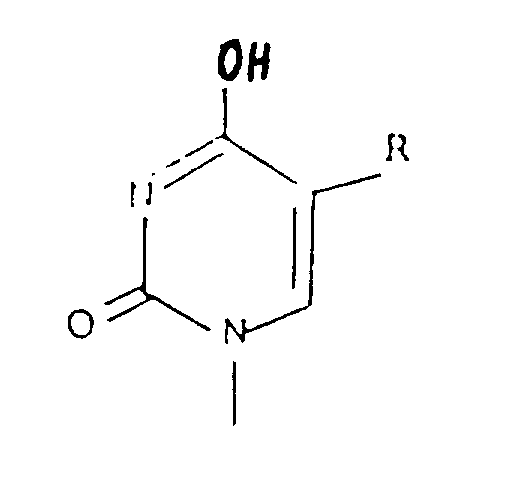
- Esters and ethers can be formed by the nucleosides of the invention. Examples of esters are phosphate esters, carboxylic esters, carbonate esters or sulphonic esters. The acid part of the esters may have alkyl, aryl or arylalkyl chains, where the aryl functionalities are optionally substituted for example by alkoxy, amino, nitrile, alkyl or sulphonamido groups or by one or more halogen atoms. Examples of other types of derivatives of the nucleosides are alkyl or arylalkyl derivatives of the 5' hydroxyl group. The arylalkyl ether derivatives may be for example benzyl or triphenyl methyl and the aryl moiety may be optionally substituted. Furthermore, it is understood that the examples of the pharmaceutically acceptable salts cited below also apply to the various esters or derivatives of the nucleosides of the invention.
- In a compound of the formula I CH₂OH as an ether residue can be defined as CH₂OR⁴, wherein R⁴ is C₁₋₆ alkyl, arylalkyl optionally substituted with one or more alkoxy, amino, nitrile or sulphonamido groups or one or more halogen atoms.
- CH₂OH as an ester residue can be derived from a carboxylic acid R⁹COOH, a carbonic acid R¹⁰˙O˙COOH, a sulphonic acid R¹⁰SO₂˙OH or a phosphoric acid, wherein R⁹ is H, C₁₋₁₇ alkyl, preferably C₁₋₆ alkyl, arylalkyl or aryl and R¹⁰ is C₁₋₁₇ alkyl, preferably C₁₋₆ alkyl, arylalkyl or aryl, and said aryl and arylalkyl groups optionally can be substituted with one or more alkyl, alkoxy, amino, nitrile, sulphonamido groups or one or more halogen atoms.
Examples of pharmaceutically acceptable salts of the compounds of formula I include base salts, e.g. derived from an appropriate base, such as alkali metal (e.g. sodium), alkaline earth metal (e.g. magnesium) salts, ammonium and NX4 + (wherein X is C₁₋₄ alkyl). Physiologically acceptable salts of a hydrogen atom or an amino group include salts of organic carboxylic acids such as acetic, lactic, gluconic, citric, tartaric, maleic, malic, pantothenic, isethionic, succinic, oxalic, lactobionic and succinic acids; organic sulfonic acids such as methanesulfonic, ethanesulfonic, benzenesulfonic, p-chlorobenzenesulphonic and p-toluenesulfonic acids and inorganic acids such as hydrochloric, hydroiodic, sulfuric, phosphoric and sulfamic acids. Physiologically acceptable salts of a compound of an hydroxy group include the anion of said compound in combination with a suitable cation such as Na⁺, NH4 +, and NX4 + (wherein X is a C₁₋₄ alkyl group). - In clinical practice the nucleosides of the formula I will normally be administered orally, by injection or by infusion in the form of a pharmaceutical preparation comprising the active ingredient in the form of the original compound or optionally in the form of a pharmaceutically acceptable salt thereof, in association with a pharmaceutically acceptable carrier which may be a solid, semi-solid or liquid diluent or an ingestible capsule. The compound may also be used without carrier material. As examples of pharmaceutical preparations may be mentioned tablets, dragées, capsules, granulates, suspensions, elixirs, syrups, solutions, liposomes etc. Usually the active substance will comprise between 0.05 and 20% for preparations intended for injection and between 10 and 90% for preparations intended for oral administration.
- In the treatment of patients suffering from retrovirus, especially HIV, or hepatitis B virus infections, it will be preferred to administer the compounds by any suitable route including the oral, parenteral, rectal, nasal, topical and vaginal route. The parenteral route includes subcutaneous, intramuscular, intravenous and sublingual administration. The topical route includes buccal and sublingual administration. The dosage at which the active ingredients are administered may vary within a wide range and will depend on various factors such as the severity of the infection, the age of patient etc., and may have to be individually adjusted. As a possible range for the amount of the compounds of the invention or a physiologically acceptable salt thereof to be administered per day may be mentioned from about 10 mg to about 10 000 mg, preferentially 100-500 mg for intravenous administration and preferentially 100-3000 mg for oral administration.
- Compounds of the formula I cooperate synergistically or additively with a wide range of other therapeutic agents, thereby enhancing the therapeutic potential of both agents without adding the toxic effects, thus increasing the therapeutic ratio.
- Therefore, a compound of formula I or a pharmaceutically acceptable derivative thereof can be used in combination therapy, wherein the two active agents are present in a ratio resulting in an optimal therapeutic ratio. This can be provided either by a synergistic effect against the viral infection and/or by a decrease in toxicity while maintaining a therapeutic effect which is additive or synergistic. A combination therapy can also be of use to obtain effects on different types of cells infected with HIV and requiring different drugs for effect.
- The optimal therapeutic ratio is observed when the two agents are present in a ratio of 500:1 to 1:500, preferably 100:1 to 1:100, particularly 20:1 to 1:20 and especially 10:1 to 1:10.
- Said combinations may conveniently be administered together, for example, in a unitary pharmaceutical formulation, or separately, for example as a combination of tablets and injections administered at the same time or different times, in order to achieve the required therapeutic effect.
- The compounds of the formula I are potentiated by interferons, reverse transcriptase inhibitors, such as foscarnet, AZT, glucuronidation inhibitors, renal excretion inhibitors, HIV protease inhibitors, immunomodulators, interferon inducers and growth factors.
- Particularly preferred types of interferon are α, β and γ and interferon inducers such as "Ampligen" (Hem Research).
- Probenecid is particularly useful in combination with compounds of the formula I, as it possesses both renal excretion inhibiting activity and glucuronidation blocking activity. Examples of other compounds useful in this aspect include acetaminophen, aspirin, lorazepam, cimetidine, ranitidine. zomepirac, clofibrate, indomethacin, ketoprofen, naproxen and other compounds which compete for glucuronidation or otherwise undergo significant glucuronidation.
- Other combinations suitable for use according to the present invention include those wherein the second agent is, for example, interleukin II, suramin, foscarnet or an ester thereof, HPA 23, inhibitors of HIV protease such as pepstatin, steroids, medications such as levamisol or thymosin to increase lymphocyte numbers and/or function as appropriate, or GM-CSF and other factors regulating cell functions.
- The compounds useful for the manufacture of a medicament according to the invention may be prepared by one of the following general methods:
- A. Condensing a glycoside as comprised in formule I where the hydroxyl groups may be optionally protected, to the N-1 position of a pyrimidine derivative according to known methods described in the literature. Such methods are described for example in "Basic Principles in Nucleic Acid Chemistry", Vol. 1 (Academic Press, 1974, Ed. P.O.P.Ts'o), in "Nucleoside Analogues, Chemistry, Biology and Medical Applications" (Pharma Press, 1979, Eds. R I Walker, E. De Clercq and F. Eckstein).

Examples of suitable derivatives of the reacting species are those wherein R′ is C₂H₅ or (CH₃)₃Si; R1' is OC₂H₅, (CH₃)₃SiO, or N(COCH₃)Si(CH₃)₃; dimethyl, tert-butylsilyl); R" is OR⁴ wherein R⁴ is silyl (e.g. dimethyl, tert-butylsilyl), except that now it must not be H; R is are as defined above.
After condensation the products may be hydrolyzed or converted by conventional methods, known to those skilled in the art, into compounds of the formula I. The glycosides are known or may be prepared by suitable adaptions of known methods. The synthesis of a 2,3-dideoxy-3-fluoro-erythro-pentofuranoside for example, has been described by G.W.J. Fleet and J.C. Son in Tetrahedron Letters 40 (1987) pp 3615-3618. - B. The fluorine in the 3' position of the glycon moiety may be introduced by substitution of a hydroxyl group or a suitably derivatized hydroxyl group


- The epoxide opening may be performed by conventional methods described in the literature and known to those skilled in the art.
- The epoxide compound may be prepared from condensation of the nucleobase or nucleobase analogue with 1-O-acetyl-D-ribofuranose or -xylofuranose with protecting groups on the oxygen atoms, followed by transformation of the ribofuranosyl or the xylofuranosyl ring into a 2',3'-anhydro-lyxofuranosyl moiety by known methods.
- The following examples will further illustrate the invention.
- The title compound was prepared by a 5-step sequence reaction. Thymine (12,6 g) was treated with hexamethyldisilazane and 1-O-acetyl-2,3,5-tri-O-benzoyl-β-D-ribofuranose (50 g) was added. The 1-(2',3',5'-tri-O-benzoyl-β-D-ribofuranosyl)thymine obtained was treated with sodium methoxide and gave 1-(β-D-ribofuranosyl)thymine (23 g). Then said substance was treated with tritylchloride and methylsulfonylchloride and 1-(2',3'--di-O-methyleulfonyl-5'-O-trityl-β-D-ribofuranoeyl)thymine (39 g) was obtained. Said substance was treated with sodium hydroxide and gave the title compound 1-(2'-3'-anhydro-5'-O-trityl-β-D-lyxofuranosyl)thymine (VSB-020) 19.2 g. Yield 43%. ¹H-NMR (DMSO-d₆) δ: 1.66 (s, 3H, 5-CH₃), 3.24-3.34 (m, 2H, 5'-H), 4.08 (s, 2H, 2'-H and 3'-H), 4.25 (t, 1H, 4'-H), 6.13 (s, 1H, 1'-H), 7.30-7.45 (m, 16H, trityl H and 6-H), 14.46 (s, 1H, N-H).
-
- a) A suspension of an ethylene diamine complex of ethynyl lithium (275 mg, 3 mmol) in dry DMSO (5 ml) was stirred under nitrogen for 1 h at 20°C. A solution of 1-(2',3'-anhydro-5'-O-trityl-β--D-lyxofuranosyl)thymine (VSB-020; 482 mg) in dimethylsulfoxide (DMSO; 2 ml) was added with a syringe to the reaction suspension. The reaction mixture was kept at 20°C for 48 h. The reaction mixture was then poured into a saturated ammonium chloride solution (100 ml) and extraced with ethyl acetate (2 x 100 ml). The organic phase was washed with a saturated ammonium chloride solution (100 ml), brine (100 ml) and water (100 ml) and dried over disodium sulfate. The solvent was evaporated and the residue purified on a silica gel column using toluene:ethyl acetate (7:4 v/v) as eluent. The appropriate fractions were collected and evaporation of the solvent gave 300 mg of 1-(3'-deoxy-3'-ethynyl-5'-O-trityl-β-D-arabinofuranosyl)thymine (VSB-028). Yield 59%. Rf 0.45 (silica, ethyl acetate).
- b) A solution of 1-(3'-deoxy-3'-ethynyl-5'-O-trityl-β-D-arabinofuranosyl)thymine (VSB-028; 280 mg) in acetic acid (8 ml) and water (2 ml) was heated at 80°C for 15 min. Then, the solvent was evaporated and the residue purified on a silica gel column, using first chloroform as the eluent followed by chloroform:ethanol (9:1 v/v). The combined fractions were evaporated and the residue was triturated with hexane:ethanol (9:1 v/v) to give 110 mg of the title compound (VSB-029). Yield 75%. M.p. 198-199°C.
-
- a) To a solution of VSB-020, 1-(2',3'-anhydro-5'-O-trityl-β-D-lyxofuranosyl)thymine (480 mg) in dry dimethylsulfoxide (DM S0) (10 ml) was added sodium cyanide (245 mg). The reaction mixture was heated at +45°C for 15 h, whereafter a saturated ammonium chloride solution (50 ml) was added to the reaction mixture. The mixture was extracted with ethyl acetate (3 x 50 ml) and the combined organic layers were washed with a saturated ammonium chloride solution (50 ml); brine (50 ml) and H₂O (50 ml), dried over disodium sulfate and purified on a silica gel column using toluene:ethyl acetate (7:4 v/v) as eluent to give 160 mg of 1-(3'-cyano-3'-deoxy-5'-O-trityl-β-D-arabinofuranosyl)-thymine (VSB-025). Yield 31%. Rf O.47 (silica, ethylacetate).
- b) A solution of 1-(3'-cyano-3'-deoxy-5'-O-trityl-β-D-arabinofuranosyl)-thymine (VSB-025; 200 mg) in acetic acid (8 ml) and water (2 ml) was heated at 80°C for 15 min. Then, the solvent was evaporated and the residue purified on a silica gel column, using first chloroform as the eluent followed by chloroform:- ethanol (9:1 v/v). The combined fractions were evaporated and the residue was triturated with hexane:ethanol (9:1 v/v) and gave 49 mg of the title compound VSB-026. Yield 60%. M.p. 219-221°C dec.
- 1.5 g of 1-(2′,3′-anhydro-5′-O-trityl-β-D-lyxofuranosyl)thymine (VSB-020) was treated with 80% acetic acid (10 ml) at +95°C for 15 min. The solvent was then removed by evaporation and the residue was purified on a silica gelcolumn using ethyl acetate as the eluent and 790 mg of the title compound VSB-024 was obtained. Yield 93%. M.p. 144-146°C.
¹H-NMR (DMSO-d₆) δ: 1.80 (s, 3H, 5-CH₃), 3.60 (s, 1H, 5'-CH), 3.61 (d, 2H, 5′-H), 3.96-4.06 (m, 3H, 2'-H, 3′-H and 4′-H), 6.03 (s, 1H, 1'-H), 7.45 (s, 1H, 6-H), 11.20 (broad s, 1H, N-H). - A mixture of 1'-(2',3'-anhydro-5'-O-trityl-β-D-lyxofuranosyl)thymine (VSB-024; 367 mg), potassium hydrogenfluoride (586 mg) in dry ethane-1,2-diol (10 ml) was heated at +200°C for 30 min. After cooling, the reaction mixture was directly applied to a silica gel column. The column was eluted with chloroform:ethanol (9:1 v/v), and 210 mg of the title compound (VSB-027) was obtained. Further purification by trituration with hexane : ethyl acetate gave 190 mg of VSB-027. Yield 48%. M.p, 162-164°C (EtOH).
¹H-NMR (DMSO-d₆) δ: 1.76 (s, 3H, 5-CH₃), 3.65 (t (d on D₂O shake), 2H, 5'-H), 4.04 (d, J 3'F, 4' = 23 Hz, 1H, 4'-H), 4.34 (d, J 3'F, 2' = 16Hz, 1H, 2'-H), 4.97 (d, J3'F, 3' = 53 Hz, 1H, 3'-H), 5.24 (t, 1H, 2'-OH), 6.00 (d, J4Hz, 1H, 1'H), 7,43 (s, 1H, 6-H), 11.35 (s, 1H, N-H).
¹H-NMR (DMSO-d₆) δ: 1.75 (s, 3H, 5-CH₃), 2.89 (t, 1H, 3'-H), 3.18 (d, 1H, -C≡C-H), 3.55-3.79 (m, 3H, 4'-H and 5′-H), 4.41 (q (t on D₂O shake), 1H, 2′-H), 5.29 (t, 1H, 5′-OH), 5.97 (d, 1H, 2′-OH), 6.03 (d, J=6.22 Hz, 1H, 1′-H), 7.65 (s, 1H, 6-H), 11.25 (s, 1H, N-H).
¹H-NMR (DMSO-d₆) δ: 1.75 (s, 3H, 5-CH₃), 3.23 (t, 1H, 3'-H), 3.50-3.80 (m, 2H, 5′-H), 4.09 (d, 1H, 4′-H), 4.72-4.86 (m (t on D₂O shake), 1H, 2′-H), 5.38 (t, 1H, 2′-OH), 6.10 (d, J = 6.22 Hz, 1H, 1′-H), 6.34 (d, 1H, 5′-OH), 7.54 (s, 1H, 6-H), 11.30 (s, 1H, N-H).
Claims (2)
- Use of a compound of the formula


R: F, CF₃, Cl, CH₂OCH₃, CH₂SCH₃, CH₂SH
and pharmaceutically acceptable salts thereof, for the manufacture of a medicament for the therapeutic and/or prophylactic treatment of infections in mammals and man caused by a retrovirus, including HIV, or HBV. - The use according to claim 1, wherein R = F or CF₃.
Applications Claiming Priority (2)
| Application Number | Priority Date | Filing Date | Title |
|---|---|---|---|
| SE8704298 | 1987-11-03 | ||
| SE8704298A SE8704298D0 (en) | 1987-11-03 | 1987-11-03 | COMPOUNDS FOR USE IN THERAPY |
Publications (2)
| Publication Number | Publication Date |
|---|---|
| EP0322384A1 EP0322384A1 (en) | 1989-06-28 |
| EP0322384B1 true EP0322384B1 (en) | 1996-03-13 |
Family
ID=20370102
Family Applications (1)
| Application Number | Title | Priority Date | Filing Date |
|---|---|---|---|
| EP88850370A Expired - Lifetime EP0322384B1 (en) | 1987-11-03 | 1988-10-27 | Nucleosides for use in therapy |
Country Status (9)
| Country | Link |
|---|---|
| EP (1) | EP0322384B1 (en) |
| JP (1) | JPH01151595A (en) |
| AT (1) | ATE135363T1 (en) |
| AU (1) | AU615681B2 (en) |
| DE (1) | DE3855099D1 (en) |
| DK (1) | DK602988A (en) |
| HU (1) | HU211132A9 (en) |
| PT (1) | PT88930B (en) |
| SE (1) | SE8704298D0 (en) |
Families Citing this family (36)
| Publication number | Priority date | Publication date | Assignee | Title |
|---|---|---|---|---|
| US4978655A (en) * | 1986-12-17 | 1990-12-18 | Yale University | Use of 3'-deoxythymidin-2'-ene (3'deoxy-2',3'-didehydrothymidine) in treating patients infected with retroviruses |
| US5506215A (en) * | 1987-11-03 | 1996-04-09 | Medivir Ab | 1-(3'-fluoro-2',3'-dideoxy-β-D-ribofuranosyl)-5-substituted pyrimidine nucleosides |
| GB8726136D0 (en) * | 1987-11-07 | 1987-12-09 | Wellcome Found | Therapeutic nucleosides |
| EP0346108A3 (en) * | 1988-06-09 | 1991-04-24 | The Wellcome Foundation Limited | Anti-infective nucleosides |
| US5157114A (en) * | 1988-08-19 | 1992-10-20 | Burroughs Wellcome Co. | 2',3'-dideoxy-3'-fluoro-5-ethyngluridine |
| GB8823319D0 (en) * | 1988-10-05 | 1988-11-09 | Nycomed As | Chemical compounds |
| GR1000522B (en) * | 1988-10-11 | 1992-08-25 | Medivir Ab | Preparation method of new analogue nucleozites |
| DD293498A5 (en) * | 1989-07-20 | 1991-09-05 | Zi Fuer Molekularbiologie Der Adw,De | METHOD FOR PRODUCING A MEDIUM FOR THE TREATMENT OR PROPHYLAXIS OF HEPATITE INFECTIONS IN HUMANS AND ANIMALS |
| FR2654106B1 (en) * | 1989-11-03 | 1992-01-10 | Synthelabo | PHOSPHORUS DERIVATIVES OF CYTOSINE, THEIR PREPARATION AND THEIR THERAPEUTIC APPLICATION. |
| EP0500610A1 (en) * | 1989-11-06 | 1992-09-02 | Nycomed Imaging As | Nucleoside derivatives |
| GB9012899D0 (en) * | 1990-06-09 | 1990-08-01 | Wellcome Found | Anti-hbv pyrimidine nucleoside |
| SE9003151D0 (en) * | 1990-10-02 | 1990-10-02 | Medivir Ab | NUCLEOSIDE DERIVATIVES |
| DE4110977A1 (en) * | 1991-04-05 | 1992-10-08 | Bayer Ag | SUBSTITUTED 2 ', 3'-DIDESOXY-5-TRIFLUOROMETHYLURIDINES, METHOD OF THEIR PREPARATION AND THEIR USE IN MEDICINAL PRODUCTS |
| ZA923641B (en) * | 1991-05-21 | 1993-02-24 | Iaf Biochem Int | Processes for the diastereoselective synthesis of nucleosides |
| GB9125271D0 (en) * | 1991-11-27 | 1992-01-29 | Wellcome Found | Anti-hbv pyrimidine nucleoside |
| FR2684997A1 (en) * | 1991-12-12 | 1993-06-18 | Centre Nat Rech Scient | DERIVATIVES OF 9- (BETA-D-XYLOFURANNOSYL) ADENINE AND 1- (BETA-D-XYLOFURANNOSYL) CYTOSINE, THEIR PREPARATION AND THEIR THERAPEUTIC USE. |
| DE4207363A1 (en) * | 1992-03-04 | 1993-09-09 | Max Delbrueck Centrum | ANTIVIRAL NUCLEOSIDE ANALOGS, THEIR PRODUCTION AND THEIR PHARMACEUTICAL USE |
| US5849905A (en) * | 1994-11-23 | 1998-12-15 | Centre National De La Recherche Scientifique | Biologically active phosphotriester-type nucleosides and methods for preparing same |
| FR2691463A1 (en) * | 1992-05-25 | 1993-11-26 | Centre Nat Rech Scient | Phospho:tri:ester derivs. of nucleoside(s) |
| US6020482A (en) * | 1992-05-25 | 2000-02-01 | Gosselin; Gilles | Phosphotriester type biologically active compounds |
| US5770725A (en) * | 1992-05-25 | 1998-06-23 | Gosselin; Gilles | Phosphotriester type biologically active compounds |
| FR2692265B1 (en) * | 1992-05-25 | 1996-11-08 | Centre Nat Rech Scient | BIOLOGICALLY ACTIVE COMPOUNDS OF THE PHOSPHOTRIESTER TYPE. |
| JPH08508489A (en) * | 1993-03-31 | 1996-09-10 | スターリング ウィンスロップ インコーポレイティド | Bifunctional nucleosides, oligomers thereof and methods for their production and use |
| US5955591A (en) * | 1993-05-12 | 1999-09-21 | Imbach; Jean-Louis | Phosphotriester oligonucleotides, amidites and method of preparation |
| US5627160A (en) * | 1993-05-25 | 1997-05-06 | Yale University | L-2',3'-dideoxy nucleoside analogs as anti-hepatitis B (HBV) and anti-HIV agents |
| TW374087B (en) * | 1993-05-25 | 1999-11-11 | Univ Yale | L-2',3'-dideoxy nucleotide analogs as anti-hepatitis B(HBV) and anti-HIV agents |
| CA2637774C (en) * | 1993-09-10 | 2011-07-19 | Emory University | Nucleosides with anti-hepatitis b virus activity |
| US5559101A (en) * | 1994-10-24 | 1996-09-24 | Genencor International, Inc. | L-ribofuranosyl nucleosides |
| JPH10507763A (en) * | 1994-10-24 | 1998-07-28 | ジェネンコア インターナショナル インコーポレーテッド | L-pyranosyl nucleoside |
| US5627185A (en) * | 1994-11-23 | 1997-05-06 | Gosselin; Gilles | Acyclovir derivatives as antiviral agents |
| US5869461A (en) * | 1995-03-16 | 1999-02-09 | Yale University | Reducing toxicity of L-nucleosides with D-nucleosides |
| US5869493A (en) | 1996-02-16 | 1999-02-09 | Medivir Ab | Acyclic nucleoside derivatives |
| JP2008110983A (en) * | 1999-05-12 | 2008-05-15 | Yamasa Shoyu Co Ltd | 4'-C-ethynyl nucleoside compounds |
| CN1427722A (en) | 2000-02-18 | 2003-07-02 | 希拉生物化学股份有限公司 | Method for treatment or prevention of flavivirus infections using nucleoside analogues |
| US7244717B2 (en) | 2001-08-24 | 2007-07-17 | Koronis Pharmaceuticals, Incorporated | Mutagenic nucleoside analogs for the treatment of viral disease |
| CN104072558B (en) * | 2013-03-26 | 2016-09-28 | 河南师范大学 | 5-substituted pyrimidines nucleoside-tetrahydro-thiazoles hybrid with HIV (human immunodeficiency virus)-resistant activity and preparation method thereof |
Family Cites Families (5)
| Publication number | Priority date | Publication date | Assignee | Title |
|---|---|---|---|---|
| US3282921A (en) * | 1964-06-04 | 1966-11-01 | Syntex Corp | Halo-deoxynucleosides and processes for the preparation thereof |
| US3687931A (en) * | 1970-03-19 | 1972-08-29 | Syntex Corp | Halogenated purine and pyrimidine nucleosides and process therefor |
| DE3045375A1 (en) * | 1980-12-02 | 1982-07-01 | Robugen Gmbh Pharmazeutische Fabrik Esslingen A.N., 7300 Esslingen | 5-Substd. pyrimidine nucleoside derivs. - useful as antiviral agents |
| DE3650741T2 (en) * | 1985-09-17 | 2000-10-12 | The Wellcome Foundation Ltd., Greenford | Combination of therapeutic nucleosides with other therapeutically active components. |
| DD279407A1 (en) * | 1986-07-24 | 1990-06-06 | Akad Wissenschaften Ddr | METHOD FOR PRODUCING AN AGENT AGAINST AIDS |
-
1987
- 1987-11-03 SE SE8704298A patent/SE8704298D0/en unknown
-
1988
- 1988-10-27 AT AT88850370T patent/ATE135363T1/en not_active IP Right Cessation
- 1988-10-27 DE DE3855099T patent/DE3855099D1/en not_active Expired - Lifetime
- 1988-10-27 EP EP88850370A patent/EP0322384B1/en not_active Expired - Lifetime
- 1988-10-28 DK DK602988A patent/DK602988A/en not_active Application Discontinuation
- 1988-10-31 AU AU24522/88A patent/AU615681B2/en not_active Ceased
- 1988-11-02 JP JP63276363A patent/JPH01151595A/en active Pending
- 1988-11-03 PT PT88930A patent/PT88930B/en not_active IP Right Cessation
-
1995
- 1995-06-22 HU HU95P/P00382P patent/HU211132A9/en unknown
Non-Patent Citations (5)
| Title |
|---|
| Antimicrob. Agents Chemother 38 (1994) 1590-1603 * |
| Chemical Abstracts, vol. 102, no. 23, 10 June 1985, (Columbus, Ohio, US), page 629, abstract 204245t * |
| J Med Chem 30 (1987) 440-4 * |
| J Med Chem 32 (1989) 1743-9 * |
| Patent Abstract of Japan. vol. 9, no. 192, (C-296), abstract of JP 60-61591, published 9 April 1985 (TAIHOU YAKUHIN KOGYO K.K.) * |
Also Published As
| Publication number | Publication date |
|---|---|
| EP0322384A1 (en) | 1989-06-28 |
| DE3855099D1 (en) | 1996-04-18 |
| DK602988A (en) | 1989-05-04 |
| JPH01151595A (en) | 1989-06-14 |
| AU2452288A (en) | 1989-05-04 |
| SE8704298D0 (en) | 1987-11-03 |
| PT88930A (en) | 1988-12-01 |
| ATE135363T1 (en) | 1996-03-15 |
| PT88930B (en) | 1993-01-29 |
| AU615681B2 (en) | 1991-10-10 |
| DK602988D0 (en) | 1988-10-28 |
| HU211132A9 (en) | 1995-10-30 |
Similar Documents
| Publication | Publication Date | Title |
|---|---|---|
| EP0322384A1 (en) | Nucleosides for use in therapy | |
| JP2851094B2 (en) | Pyrimidine derivatives | |
| CA1336088C (en) | 1-(3'-substitued-2', 3'-dideoxy-d-ribofuranosyl) thymine and uracil | |
| US4963662A (en) | Fluorinated nucleosides and method for treating retrovirus infections therewith | |
| EP0707481B1 (en) | L-2',3'-dideoxy nucleoside analogs as anti-hepatitis b (hbv) and anti-hiv agents | |
| US5952500A (en) | Nucleoside derivatives | |
| EP1937825B1 (en) | Modified 4'-nucleosides as antiviral agents | |
| AU780879B2 (en) | Anti-viral pyrimidine nucleoside analogues | |
| PT91213A (en) | PROCESS FOR PREPARING NEW L-RIBOFURANOSIL NUCLEOSIDIC ANALOGS WITH THERAPEUTIC ACTIVITY | |
| KR20000049224A (en) | Monocyclic l-nucleosides, analogs and uses thereof | |
| AU5040790A (en) | Antivirals and methods for increasing the antiviral activity of azt | |
| US5215971A (en) | Antiviral pharmaceutical composition comprising 5-substituted pyrimidine nucleosides | |
| US5215970A (en) | Nucleosides and nucleotide analogues, pharmaceutical composition and processes for the preparation of the compounds | |
| WO2003053989A1 (en) | Masked phosphate containing nucleoside derivatives and their use as antivirals | |
| US5153180A (en) | Fluorinated nucleosides and process for treating retrovirus infections therewith | |
| US5506215A (en) | 1-(3'-fluoro-2',3'-dideoxy-β-D-ribofuranosyl)-5-substituted pyrimidine nucleosides | |
| EP0309560B1 (en) | Nucleosides and nucleoside analogues, pharmaceutical composition and processes for the preparation of the compounds | |
| EP0516186A2 (en) | Nucleosides and nucleoside analogues, pharmaceutical composition and processes for the preparation of the compounds | |
| IE67037B1 (en) | Novel medicinal compounds | |
| MX2008004079A (en) | Modified 4'-nucleosides as antiviral agents | |
| HK1013257B (en) | L-2',3'-dideoxy nucleoside analogs as anti-hepatitis b (hbv) and anti-hiv agents | |
| HK1124092A (en) | Modified 4'-nucleosides as antivral agents | |
| WO1993017035A1 (en) | 2'ISODIDEOXY-β-D-NUCLEOSIDES AS STABLE ANTIVIRAL AGENTS |
Legal Events
| Date | Code | Title | Description |
|---|---|---|---|
| PUAI | Public reference made under article 153(3) epc to a published international application that has entered the european phase |
Free format text: ORIGINAL CODE: 0009012 |
|
| 17P | Request for examination filed |
Effective date: 19881116 |
|
| AK | Designated contracting states |
Kind code of ref document: A1 Designated state(s): AT BE CH DE ES FR GB GR IT LI LU NL SE |
|
| RAP3 | Party data changed (applicant data changed or rights of an application transferred) |
Owner name: MEDIVIR AKTIEBOLAG |
|
| 17Q | First examination report despatched |
Effective date: 19910524 |
|
| GRAA | (expected) grant |
Free format text: ORIGINAL CODE: 0009210 |
|
| AK | Designated contracting states |
Kind code of ref document: B1 Designated state(s): AT BE CH DE ES FR GB GR IT LI LU NL SE |
|
| PG25 | Lapsed in a contracting state [announced via postgrant information from national office to epo] |
Ref country code: IT Free format text: LAPSE BECAUSE OF FAILURE TO SUBMIT A TRANSLATION OF THE DESCRIPTION OR TO PAY THE FEE WITHIN THE PRESCRIBED TIME-LIMIT;WARNING: LAPSES OF ITALIAN PATENTS WITH EFFECTIVE DATE BEFORE 2007 MAY HAVE OCCURRED AT ANY TIME BEFORE 2007. THE CORRECT EFFECTIVE DATE MAY BE DIFFERENT FROM THE ONE RECORDED. Effective date: 19960313 Ref country code: ES Free format text: THE PATENT HAS BEEN ANNULLED BY A DECISION OF A NATIONAL AUTHORITY Effective date: 19960313 Ref country code: GR Free format text: LAPSE BECAUSE OF FAILURE TO SUBMIT A TRANSLATION OF THE DESCRIPTION OR TO PAY THE FEE WITHIN THE PRESCRIBED TIME-LIMIT Effective date: 19960313 Ref country code: AT Effective date: 19960313 Ref country code: CH Effective date: 19960313 Ref country code: BE Effective date: 19960313 Ref country code: NL Free format text: LAPSE BECAUSE OF FAILURE TO SUBMIT A TRANSLATION OF THE DESCRIPTION OR TO PAY THE FEE WITHIN THE PRESCRIBED TIME-LIMIT Effective date: 19960313 Ref country code: LI Effective date: 19960313 Ref country code: FR Effective date: 19960313 |
|
| REF | Corresponds to: |
Ref document number: 135363 Country of ref document: AT Date of ref document: 19960315 Kind code of ref document: T |
|
| REF | Corresponds to: |
Ref document number: 3855099 Country of ref document: DE Date of ref document: 19960418 |
|
| PG25 | Lapsed in a contracting state [announced via postgrant information from national office to epo] |
Ref country code: SE Effective date: 19960613 |
|
| PG25 | Lapsed in a contracting state [announced via postgrant information from national office to epo] |
Ref country code: DE Effective date: 19960614 |
|
| NLV1 | Nl: lapsed or annulled due to failure to fulfill the requirements of art. 29p and 29m of the patents act | ||
| EN | Fr: translation not filed | ||
| PG25 | Lapsed in a contracting state [announced via postgrant information from national office to epo] |
Ref country code: GB Effective date: 19961027 |
|
| PG25 | Lapsed in a contracting state [announced via postgrant information from national office to epo] |
Ref country code: LU Free format text: LAPSE BECAUSE OF NON-PAYMENT OF DUE FEES Effective date: 19961031 |
|
| PLBE | No opposition filed within time limit |
Free format text: ORIGINAL CODE: 0009261 |
|
| STAA | Information on the status of an ep patent application or granted ep patent |
Free format text: STATUS: NO OPPOSITION FILED WITHIN TIME LIMIT |
|
| 26N | No opposition filed | ||
| GBPC | Gb: european patent ceased through non-payment of renewal fee |
Effective date: 19961027 |