EP0321400A2 - Polymeric colour couplers - Google Patents
Polymeric colour couplers Download PDFInfo
- Publication number
- EP0321400A2 EP0321400A2 EP88810834A EP88810834A EP0321400A2 EP 0321400 A2 EP0321400 A2 EP 0321400A2 EP 88810834 A EP88810834 A EP 88810834A EP 88810834 A EP88810834 A EP 88810834A EP 0321400 A2 EP0321400 A2 EP 0321400A2
- Authority
- EP
- European Patent Office
- Prior art keywords
- polymer
- residue
- colour
- colour coupler
- polymer according
- Prior art date
- Legal status (The legal status is an assumption and is not a legal conclusion. Google has not performed a legal analysis and makes no representation as to the accuracy of the status listed.)
- Withdrawn
Links
- 229920000642 polymer Polymers 0.000 claims abstract description 57
- 239000000178 monomer Substances 0.000 claims abstract description 41
- 239000001257 hydrogen Chemical group 0.000 claims abstract description 23
- 229910052739 hydrogen Inorganic materials 0.000 claims abstract description 23
- 125000004435 hydrogen atom Chemical group [H]* 0.000 claims abstract description 21
- XLYOFNOQVPJJNP-UHFFFAOYSA-N water Substances O XLYOFNOQVPJJNP-UHFFFAOYSA-N 0.000 claims abstract description 17
- 125000000217 alkyl group Chemical group 0.000 claims abstract description 14
- 125000004432 carbon atom Chemical group C* 0.000 claims abstract description 14
- 125000002947 alkylene group Chemical group 0.000 claims abstract description 13
- 125000002496 methyl group Chemical group [H]C([H])([H])* 0.000 claims abstract description 13
- 230000008878 coupling Effects 0.000 claims abstract description 5
- 238000010168 coupling process Methods 0.000 claims abstract description 5
- 238000005859 coupling reaction Methods 0.000 claims abstract description 5
- 150000001450 anions Chemical group 0.000 claims abstract description 4
- 229910052794 bromium Chemical group 0.000 claims abstract description 4
- 239000000460 chlorine Chemical group 0.000 claims abstract description 4
- 229910052801 chlorine Inorganic materials 0.000 claims abstract description 4
- WKBOTKDWSSQWDR-UHFFFAOYSA-N Bromine atom Chemical group [Br] WKBOTKDWSSQWDR-UHFFFAOYSA-N 0.000 claims abstract description 3
- ZAMOUSCENKQFHK-UHFFFAOYSA-N Chlorine atom Chemical group [Cl] ZAMOUSCENKQFHK-UHFFFAOYSA-N 0.000 claims abstract description 3
- 125000004429 atom Chemical group 0.000 claims abstract description 3
- GDTBXPJZTBHREO-UHFFFAOYSA-N bromine Chemical group BrBr GDTBXPJZTBHREO-UHFFFAOYSA-N 0.000 claims abstract description 3
- 125000000623 heterocyclic group Chemical group 0.000 claims abstract description 3
- -1 sulphoxy Chemical group 0.000 claims description 27
- 229910052709 silver Inorganic materials 0.000 claims description 25
- 239000004332 silver Substances 0.000 claims description 25
- 239000000463 material Substances 0.000 claims description 22
- 239000000839 emulsion Substances 0.000 claims description 19
- 239000000975 dye Substances 0.000 claims description 15
- RTZKZFJDLAIYFH-UHFFFAOYSA-N Diethyl ether Chemical compound CCOCC RTZKZFJDLAIYFH-UHFFFAOYSA-N 0.000 claims description 10
- 238000000576 coating method Methods 0.000 claims description 10
- 125000003545 alkoxy group Chemical group 0.000 claims description 9
- 239000011248 coating agent Substances 0.000 claims description 9
- 150000003254 radicals Chemical class 0.000 claims description 9
- 125000001453 quaternary ammonium group Chemical group 0.000 claims description 8
- 229910052736 halogen Inorganic materials 0.000 claims description 6
- 150000002367 halogens Chemical class 0.000 claims description 6
- 238000000034 method Methods 0.000 claims description 6
- JKNCOURZONDCGV-UHFFFAOYSA-N 2-(dimethylamino)ethyl 2-methylprop-2-enoate Chemical compound CN(C)CCOC(=O)C(C)=C JKNCOURZONDCGV-UHFFFAOYSA-N 0.000 claims description 5
- 125000005647 linker group Chemical group 0.000 claims description 5
- AJDUTMFFZHIJEM-UHFFFAOYSA-N n-(9,10-dioxoanthracen-1-yl)-4-[4-[[4-[4-[(9,10-dioxoanthracen-1-yl)carbamoyl]phenyl]phenyl]diazenyl]phenyl]benzamide Chemical compound O=C1C2=CC=CC=C2C(=O)C2=C1C=CC=C2NC(=O)C(C=C1)=CC=C1C(C=C1)=CC=C1N=NC(C=C1)=CC=C1C(C=C1)=CC=C1C(=O)NC1=CC=CC2=C1C(=O)C1=CC=CC=C1C2=O AJDUTMFFZHIJEM-UHFFFAOYSA-N 0.000 claims description 5
- BAPJBEWLBFYGME-UHFFFAOYSA-N Methyl acrylate Chemical group COC(=O)C=C BAPJBEWLBFYGME-UHFFFAOYSA-N 0.000 claims description 4
- PPBRXRYQALVLMV-UHFFFAOYSA-N Styrene Chemical compound C=CC1=CC=CC=C1 PPBRXRYQALVLMV-UHFFFAOYSA-N 0.000 claims description 4
- 239000003795 chemical substances by application Substances 0.000 claims description 4
- 230000000977 initiatory effect Effects 0.000 claims description 4
- 150000003839 salts Chemical class 0.000 claims description 4
- 239000001043 yellow dye Substances 0.000 claims description 4
- OSSNTDFYBPYIEC-UHFFFAOYSA-N 1-ethenylimidazole Chemical compound C=CN1C=CN=C1 OSSNTDFYBPYIEC-UHFFFAOYSA-N 0.000 claims description 3
- HRPVXLWXLXDGHG-UHFFFAOYSA-N Acrylamide Chemical compound NC(=O)C=C HRPVXLWXLXDGHG-UHFFFAOYSA-N 0.000 claims description 3
- UFHFLCQGNIYNRP-UHFFFAOYSA-N Hydrogen Chemical group [H][H] UFHFLCQGNIYNRP-UHFFFAOYSA-N 0.000 claims description 3
- WHNWPMSKXPGLAX-UHFFFAOYSA-N N-Vinyl-2-pyrrolidone Chemical compound C=CN1CCCC1=O WHNWPMSKXPGLAX-UHFFFAOYSA-N 0.000 claims description 3
- ISWSIDIOOBJBQZ-UHFFFAOYSA-N Phenol Chemical compound OC1=CC=CC=C1 ISWSIDIOOBJBQZ-UHFFFAOYSA-N 0.000 claims description 3
- 125000004442 acylamino group Chemical group 0.000 claims description 3
- 238000004519 manufacturing process Methods 0.000 claims description 3
- 239000003960 organic solvent Substances 0.000 claims description 3
- JOXIMZWYDAKGHI-UHFFFAOYSA-M toluene-4-sulfonate Chemical group CC1=CC=C(S([O-])(=O)=O)C=C1 JOXIMZWYDAKGHI-UHFFFAOYSA-M 0.000 claims description 3
- NLVXSWCKKBEXTG-UHFFFAOYSA-N vinylsulfonic acid Chemical compound OS(=O)(=O)C=C NLVXSWCKKBEXTG-UHFFFAOYSA-N 0.000 claims description 3
- KJCVRFUGPWSIIH-UHFFFAOYSA-N 1-naphthol Chemical group C1=CC=C2C(O)=CC=CC2=C1 KJCVRFUGPWSIIH-UHFFFAOYSA-N 0.000 claims description 2
- SMZOUWXMTYCWNB-UHFFFAOYSA-N 2-(2-methoxy-5-methylphenyl)ethanamine Chemical compound COC1=CC=C(C)C=C1CCN SMZOUWXMTYCWNB-UHFFFAOYSA-N 0.000 claims description 2
- OEPOKWHJYJXUGD-UHFFFAOYSA-N 2-(3-phenylmethoxyphenyl)-1,3-thiazole-4-carbaldehyde Chemical compound O=CC1=CSC(C=2C=C(OCC=3C=CC=CC=3)C=CC=2)=N1 OEPOKWHJYJXUGD-UHFFFAOYSA-N 0.000 claims description 2
- GOXQRTZXKQZDDN-UHFFFAOYSA-N 2-Ethylhexyl acrylate Chemical compound CCCCC(CC)COC(=O)C=C GOXQRTZXKQZDDN-UHFFFAOYSA-N 0.000 claims description 2
- NIXOWILDQLNWCW-UHFFFAOYSA-N 2-Propenoic acid Natural products OC(=O)C=C NIXOWILDQLNWCW-UHFFFAOYSA-N 0.000 claims description 2
- CCJAYIGMMRQRAO-UHFFFAOYSA-N 2-[4-[(2-hydroxyphenyl)methylideneamino]butyliminomethyl]phenol Chemical compound OC1=CC=CC=C1C=NCCCCN=CC1=CC=CC=C1O CCJAYIGMMRQRAO-UHFFFAOYSA-N 0.000 claims description 2
- GNSFRPWPOGYVLO-UHFFFAOYSA-N 3-hydroxypropyl 2-methylprop-2-enoate Chemical compound CC(=C)C(=O)OCCCO GNSFRPWPOGYVLO-UHFFFAOYSA-N 0.000 claims description 2
- CYUZOYPRAQASLN-UHFFFAOYSA-N 3-prop-2-enoyloxypropanoic acid Chemical compound OC(=O)CCOC(=O)C=C CYUZOYPRAQASLN-UHFFFAOYSA-N 0.000 claims description 2
- KFDVPJUYSDEJTH-UHFFFAOYSA-N 4-ethenylpyridine Chemical compound C=CC1=CC=NC=C1 KFDVPJUYSDEJTH-UHFFFAOYSA-N 0.000 claims description 2
- NLHHRLWOUZZQLW-UHFFFAOYSA-N Acrylonitrile Chemical compound C=CC#N NLHHRLWOUZZQLW-UHFFFAOYSA-N 0.000 claims description 2
- BVKZGUZCCUSVTD-UHFFFAOYSA-L Carbonate Chemical compound [O-]C([O-])=O BVKZGUZCCUSVTD-UHFFFAOYSA-L 0.000 claims description 2
- JIGUQPWFLRLWPJ-UHFFFAOYSA-N Ethyl acrylate Chemical compound CCOC(=O)C=C JIGUQPWFLRLWPJ-UHFFFAOYSA-N 0.000 claims description 2
- JOYRKODLDBILNP-UHFFFAOYSA-N Ethyl urethane Chemical compound CCOC(N)=O JOYRKODLDBILNP-UHFFFAOYSA-N 0.000 claims description 2
- CERQOIWHTDAKMF-UHFFFAOYSA-N Methacrylic acid Chemical compound CC(=C)C(O)=O CERQOIWHTDAKMF-UHFFFAOYSA-N 0.000 claims description 2
- LCXXNKZQVOXMEH-UHFFFAOYSA-N Tetrahydrofurfuryl methacrylate Chemical compound CC(=C)C(=O)OCC1CCCO1 LCXXNKZQVOXMEH-UHFFFAOYSA-N 0.000 claims description 2
- XSQUKJJJFZCRTK-UHFFFAOYSA-N Urea Chemical compound NC(N)=O XSQUKJJJFZCRTK-UHFFFAOYSA-N 0.000 claims description 2
- XTXRWKRVRITETP-UHFFFAOYSA-N Vinyl acetate Chemical compound CC(=O)OC=C XTXRWKRVRITETP-UHFFFAOYSA-N 0.000 claims description 2
- 150000001408 amides Chemical class 0.000 claims description 2
- CQEYYJKEWSMYFG-UHFFFAOYSA-N butyl acrylate Chemical compound CCCCOC(=O)C=C CQEYYJKEWSMYFG-UHFFFAOYSA-N 0.000 claims description 2
- 239000004202 carbamide Substances 0.000 claims description 2
- 125000004663 dialkyl amino group Chemical group 0.000 claims description 2
- 150000002148 esters Chemical class 0.000 claims description 2
- 125000005843 halogen group Chemical group 0.000 claims description 2
- 238000010438 heat treatment Methods 0.000 claims description 2
- 150000002576 ketones Chemical class 0.000 claims description 2
- FQPSGWSUVKBHSU-UHFFFAOYSA-N methacrylamide Chemical compound CC(=C)C(N)=O FQPSGWSUVKBHSU-UHFFFAOYSA-N 0.000 claims description 2
- 238000002156 mixing Methods 0.000 claims description 2
- PNJWIWWMYCMZRO-UHFFFAOYSA-N pent‐4‐en‐2‐one Natural products CC(=O)CC=C PNJWIWWMYCMZRO-UHFFFAOYSA-N 0.000 claims description 2
- 230000001376 precipitating effect Effects 0.000 claims description 2
- 125000005415 substituted alkoxy group Chemical group 0.000 claims description 2
- 229920002818 (Hydroxyethyl)methacrylate Polymers 0.000 claims 1
- PRAMZQXXPOLCIY-UHFFFAOYSA-N 2-(2-methylprop-2-enoyloxy)ethanesulfonic acid Chemical compound CC(=C)C(=O)OCCS(O)(=O)=O PRAMZQXXPOLCIY-UHFFFAOYSA-N 0.000 claims 1
- WOBHKFSMXKNTIM-UHFFFAOYSA-N Hydroxyethyl methacrylate Chemical compound CC(=C)C(=O)OCCO WOBHKFSMXKNTIM-UHFFFAOYSA-N 0.000 claims 1
- 239000002253 acid Substances 0.000 claims 1
- 125000003107 substituted aryl group Chemical group 0.000 claims 1
- 125000000565 sulfonamide group Chemical group 0.000 claims 1
- 239000000243 solution Substances 0.000 description 16
- IJGRMHOSHXDMSA-UHFFFAOYSA-N Atomic nitrogen Chemical compound N#N IJGRMHOSHXDMSA-UHFFFAOYSA-N 0.000 description 8
- BQCADISMDOOEFD-UHFFFAOYSA-N Silver Chemical compound [Ag] BQCADISMDOOEFD-UHFFFAOYSA-N 0.000 description 7
- 239000007787 solid Substances 0.000 description 7
- LFQSCWFLJHTTHZ-UHFFFAOYSA-N Ethanol Chemical compound CCO LFQSCWFLJHTTHZ-UHFFFAOYSA-N 0.000 description 5
- 239000003999 initiator Substances 0.000 description 5
- 229910052757 nitrogen Inorganic materials 0.000 description 4
- OZAIFHULBGXAKX-UHFFFAOYSA-N 2-(2-cyanopropan-2-yldiazenyl)-2-methylpropanenitrile Chemical compound N#CC(C)(C)N=NC(C)(C)C#N OZAIFHULBGXAKX-UHFFFAOYSA-N 0.000 description 3
- 108010010803 Gelatin Proteins 0.000 description 3
- 239000007844 bleaching agent Substances 0.000 description 3
- 229920000159 gelatin Polymers 0.000 description 3
- 239000008273 gelatin Substances 0.000 description 3
- 235000019322 gelatine Nutrition 0.000 description 3
- 235000011852 gelatine desserts Nutrition 0.000 description 3
- 125000001997 phenyl group Chemical group [H]C1=C([H])C([H])=C(*)C([H])=C1[H] 0.000 description 3
- 229920002284 Cellulose triacetate Polymers 0.000 description 2
- YNAVUWVOSKDBBP-UHFFFAOYSA-N Morpholine Chemical compound C1COCCN1 YNAVUWVOSKDBBP-UHFFFAOYSA-N 0.000 description 2
- NQRYJNQNLNOLGT-UHFFFAOYSA-N Piperidine Chemical compound C1CCNCC1 NQRYJNQNLNOLGT-UHFFFAOYSA-N 0.000 description 2
- NNLVGZFZQQXQNW-ADJNRHBOSA-N [(2r,3r,4s,5r,6s)-4,5-diacetyloxy-3-[(2s,3r,4s,5r,6r)-3,4,5-triacetyloxy-6-(acetyloxymethyl)oxan-2-yl]oxy-6-[(2r,3r,4s,5r,6s)-4,5,6-triacetyloxy-2-(acetyloxymethyl)oxan-3-yl]oxyoxan-2-yl]methyl acetate Chemical compound O([C@@H]1O[C@@H]([C@H]([C@H](OC(C)=O)[C@H]1OC(C)=O)O[C@H]1[C@@H]([C@@H](OC(C)=O)[C@H](OC(C)=O)[C@@H](COC(C)=O)O1)OC(C)=O)COC(=O)C)[C@@H]1[C@@H](COC(C)=O)O[C@@H](OC(C)=O)[C@H](OC(C)=O)[C@H]1OC(C)=O NNLVGZFZQQXQNW-ADJNRHBOSA-N 0.000 description 2
- 125000003368 amide group Chemical group 0.000 description 2
- 238000006243 chemical reaction Methods 0.000 description 2
- 125000001309 chloro group Chemical group Cl* 0.000 description 2
- 238000007323 disproportionation reaction Methods 0.000 description 2
- 239000000843 powder Substances 0.000 description 2
- 230000035484 reaction time Effects 0.000 description 2
- VWDWKYIASSYTQR-UHFFFAOYSA-N sodium nitrate Chemical compound [Na+].[O-][N+]([O-])=O VWDWKYIASSYTQR-UHFFFAOYSA-N 0.000 description 2
- GEHJYWRUCIMESM-UHFFFAOYSA-L sodium sulfite Chemical compound [Na+].[Na+].[O-]S([O-])=O GEHJYWRUCIMESM-UHFFFAOYSA-L 0.000 description 2
- 238000003756 stirring Methods 0.000 description 2
- 125000001424 substituent group Chemical group 0.000 description 2
- JOXIMZWYDAKGHI-UHFFFAOYSA-N toluene-4-sulfonic acid Chemical compound CC1=CC=C(S(O)(=O)=O)C=C1 JOXIMZWYDAKGHI-UHFFFAOYSA-N 0.000 description 2
- JYEUMXHLPRZUAT-UHFFFAOYSA-N 1,2,3-triazine Chemical compound C1=CN=NN=C1 JYEUMXHLPRZUAT-UHFFFAOYSA-N 0.000 description 1
- CBCKQZAAMUWICA-UHFFFAOYSA-N 1,4-phenylenediamine Chemical compound NC1=CC=C(N)C=C1 CBCKQZAAMUWICA-UHFFFAOYSA-N 0.000 description 1
- IAUGBVWVWDTCJV-UHFFFAOYSA-N 1-(prop-2-enoylamino)propane-1-sulfonic acid Chemical compound CCC(S(O)(=O)=O)NC(=O)C=C IAUGBVWVWDTCJV-UHFFFAOYSA-N 0.000 description 1
- YQTCQNIPQMJNTI-UHFFFAOYSA-N 2,2-dimethylpropan-1-one Chemical group CC(C)(C)[C]=O YQTCQNIPQMJNTI-UHFFFAOYSA-N 0.000 description 1
- JAHNSTQSQJOJLO-UHFFFAOYSA-N 2-(3-fluorophenyl)-1h-imidazole Chemical compound FC1=CC=CC(C=2NC=CN=2)=C1 JAHNSTQSQJOJLO-UHFFFAOYSA-N 0.000 description 1
- UOMQUZPKALKDCA-UHFFFAOYSA-K 2-[2-[bis(carboxylatomethyl)amino]ethyl-(carboxymethyl)amino]acetate;iron(3+) Chemical compound [Fe+3].OC(=O)CN(CC([O-])=O)CCN(CC([O-])=O)CC([O-])=O UOMQUZPKALKDCA-UHFFFAOYSA-K 0.000 description 1
- AERXNFNUHOISLE-UHFFFAOYSA-N 2-ethenyl-1h-imidazole;4-methylbenzenesulfonic acid Chemical compound C=CC1=NC=CN1.CC1=CC=C(S(O)(=O)=O)C=C1 AERXNFNUHOISLE-UHFFFAOYSA-N 0.000 description 1
- JHUFGBSGINLPOW-UHFFFAOYSA-N 3-chloro-4-(trifluoromethoxy)benzoyl cyanide Chemical compound FC(F)(F)OC1=CC=C(C(=O)C#N)C=C1Cl JHUFGBSGINLPOW-UHFFFAOYSA-N 0.000 description 1
- 239000004698 Polyethylene Substances 0.000 description 1
- 239000004793 Polystyrene Substances 0.000 description 1
- RWRDLPDLKQPQOW-UHFFFAOYSA-N Pyrrolidine Chemical compound C1CCNC1 RWRDLPDLKQPQOW-UHFFFAOYSA-N 0.000 description 1
- 229910021607 Silver chloride Inorganic materials 0.000 description 1
- SJOOOZPMQAWAOP-UHFFFAOYSA-N [Ag].BrCl Chemical compound [Ag].BrCl SJOOOZPMQAWAOP-UHFFFAOYSA-N 0.000 description 1
- 238000010521 absorption reaction Methods 0.000 description 1
- 125000003647 acryloyl group Chemical group O=C([*])C([H])=C([H])[H] 0.000 description 1
- 239000000654 additive Substances 0.000 description 1
- 125000004390 alkyl sulfonyl group Chemical group 0.000 description 1
- 125000004414 alkyl thio group Chemical group 0.000 description 1
- 230000000844 anti-bacterial effect Effects 0.000 description 1
- 125000001769 aryl amino group Chemical group 0.000 description 1
- 239000003899 bactericide agent Substances 0.000 description 1
- QVQLCTNNEUAWMS-UHFFFAOYSA-N barium oxide Chemical compound [Ba]=O QVQLCTNNEUAWMS-UHFFFAOYSA-N 0.000 description 1
- 229910001864 baryta Inorganic materials 0.000 description 1
- 125000003236 benzoyl group Chemical group [H]C1=C([H])C([H])=C(C([H])=C1[H])C(*)=O 0.000 description 1
- 239000011230 binding agent Substances 0.000 description 1
- 239000008364 bulk solution Substances 0.000 description 1
- 229920006217 cellulose acetate butyrate Polymers 0.000 description 1
- 239000013078 crystal Substances 0.000 description 1
- 238000002425 crystallisation Methods 0.000 description 1
- 150000004820 halides Chemical class 0.000 description 1
- UACSZOWTRIJIFU-UHFFFAOYSA-N hydroxymethyl 2-methylprop-2-enoate Chemical compound CC(=C)C(=O)OCO UACSZOWTRIJIFU-UHFFFAOYSA-N 0.000 description 1
- 239000012442 inert solvent Substances 0.000 description 1
- 238000007689 inspection Methods 0.000 description 1
- CBEQRNSPHCCXSH-UHFFFAOYSA-N iodine monobromide Chemical compound IBr CBEQRNSPHCCXSH-UHFFFAOYSA-N 0.000 description 1
- 239000004816 latex Substances 0.000 description 1
- 229920000126 latex Polymers 0.000 description 1
- FPYJFEHAWHCUMM-UHFFFAOYSA-N maleic anhydride Chemical compound O=C1OC(=O)C=C1 FPYJFEHAWHCUMM-UHFFFAOYSA-N 0.000 description 1
- VHRYZQNGTZXDNX-UHFFFAOYSA-N methacryloyl chloride Chemical compound CC(=C)C(Cl)=O VHRYZQNGTZXDNX-UHFFFAOYSA-N 0.000 description 1
- LVHBHZANLOWSRM-UHFFFAOYSA-N methylenebutanedioic acid Natural products OC(=O)CC(=C)C(O)=O LVHBHZANLOWSRM-UHFFFAOYSA-N 0.000 description 1
- 239000000203 mixture Substances 0.000 description 1
- RTXGMZRJRSWDRN-UHFFFAOYSA-N n-ethenyl-n-(hydroxymethyl)acetamide Chemical compound CC(=O)N(CO)C=C RTXGMZRJRSWDRN-UHFFFAOYSA-N 0.000 description 1
- RQAKESSLMFZVMC-UHFFFAOYSA-N n-ethenylacetamide Chemical compound CC(=O)NC=C RQAKESSLMFZVMC-UHFFFAOYSA-N 0.000 description 1
- 150000002891 organic anions Chemical class 0.000 description 1
- 125000004430 oxygen atom Chemical group O* 0.000 description 1
- 150000002976 peresters Chemical class 0.000 description 1
- 150000004978 peroxycarbonates Chemical class 0.000 description 1
- 125000000843 phenylene group Chemical group C1(=C(C=CC=C1)*)* 0.000 description 1
- 229920000515 polycarbonate Polymers 0.000 description 1
- 239000004417 polycarbonate Substances 0.000 description 1
- 229920000728 polyester Polymers 0.000 description 1
- 229920000573 polyethylene Polymers 0.000 description 1
- 239000004848 polyfunctional curative Substances 0.000 description 1
- 229920002223 polystyrene Polymers 0.000 description 1
- 238000002360 preparation method Methods 0.000 description 1
- 125000002924 primary amino group Chemical group [H]N([H])* 0.000 description 1
- 230000000135 prohibitive effect Effects 0.000 description 1
- 238000009877 rendering Methods 0.000 description 1
- 229920006395 saturated elastomer Polymers 0.000 description 1
- ADZWSOLPGZMUMY-UHFFFAOYSA-M silver bromide Chemical compound [Ag]Br ADZWSOLPGZMUMY-UHFFFAOYSA-M 0.000 description 1
- ZUNKMNLKJXRCDM-UHFFFAOYSA-N silver bromoiodide Chemical compound [Ag].IBr ZUNKMNLKJXRCDM-UHFFFAOYSA-N 0.000 description 1
- HKZLPVFGJNLROG-UHFFFAOYSA-M silver monochloride Chemical compound [Cl-].[Ag+] HKZLPVFGJNLROG-UHFFFAOYSA-M 0.000 description 1
- 235000010344 sodium nitrate Nutrition 0.000 description 1
- 239000004317 sodium nitrate Substances 0.000 description 1
- 235000010265 sodium sulphite Nutrition 0.000 description 1
- 230000002269 spontaneous effect Effects 0.000 description 1
- 239000003381 stabilizer Substances 0.000 description 1
- 238000006467 substitution reaction Methods 0.000 description 1
- UEUXEKPTXMALOB-UHFFFAOYSA-J tetrasodium;2-[2-[bis(carboxylatomethyl)amino]ethyl-(carboxylatomethyl)amino]acetate Chemical compound [Na+].[Na+].[Na+].[Na+].[O-]C(=O)CN(CC([O-])=O)CCN(CC([O-])=O)CC([O-])=O UEUXEKPTXMALOB-UHFFFAOYSA-J 0.000 description 1
- 238000006276 transfer reaction Methods 0.000 description 1
- 229920003169 water-soluble polymer Polymers 0.000 description 1
Images
Classifications
-
- G—PHYSICS
- G03—PHOTOGRAPHY; CINEMATOGRAPHY; ANALOGOUS TECHNIQUES USING WAVES OTHER THAN OPTICAL WAVES; ELECTROGRAPHY; HOLOGRAPHY
- G03C—PHOTOSENSITIVE MATERIALS FOR PHOTOGRAPHIC PURPOSES; PHOTOGRAPHIC PROCESSES, e.g. CINE, X-RAY, COLOUR, STEREO-PHOTOGRAPHIC PROCESSES; AUXILIARY PROCESSES IN PHOTOGRAPHY
- G03C7/00—Multicolour photographic processes or agents therefor; Regeneration of such processing agents; Photosensitive materials for multicolour processes
- G03C7/30—Colour processes using colour-coupling substances; Materials therefor; Preparing or processing such materials
- G03C7/32—Colour coupling substances
- G03C7/327—Macromolecular coupling substances
- G03C7/3275—Polymers obtained by reactions involving only carbon-to-carbon unsaturated bonds, e.g. vinyl polymers
Definitions
- This invention relates to new polymeric colour couplers and to a process for their production.
- Polymeric colour couplers are finding increasing use in photographic material instead of colour couplers which require to be incorporated in photographic layers dissolved in an oil.
- the presence of the oil leads to several disadvantages including rendering the layer which comprises it soft and thus liable to mechanical deformation.
- photographic material in which the colour couplers are present as a polymer latex can be much thinner than material in which the colour couplers are dissolved in oil. This decrease in thickness leads to sharper images being obtained.
- the end-groups of polymer molecules formed by free radical initiation are generally incapable of determination with any degree of certainty, however it may be expected that at least one of the end-groups may either be an initiator residue or a group formed by disproportionation or chain transfer reactions during the preparation of the polymer of the claimed structure.
- Initiator residues may generally include those from alkyl or aryl peroxides, azo compounds, peroxydisulphates, peresters and peroxy carbonates, and specific examples may include the following radicals:
- End-groups formed by disproportionations reactions may be saturated or unsaturated units from M or the initiating agent. Examples of such units may be found in Principles of Polymer Chemistry, Cornell U.p., P.J. Flay, p. 111.
- R1 is preferably an alkylene chain having from 2 to 6 carbon atoms or is an interupted alkylene chain having from 2 to 6 carbon atoms there being an oxygen atom or an -NH- group in the chain.
- Suitable five or six membered rings include pyrolidine, piperidine, or morpholine.
- R1 is hydrogen or methyl.
- R2 the divalent organic radical may be the residue of a urethane, a urea, a carbonate, an ester, an ether, a ketone or an amide. Preferably however it is a simple amido linkage -C (O) - NH -.
- R1 is methyl or hydrogen and R2 is -CO-O-, R1 is an alkylene group and R11 and R111 are each methyl groups.
- R1 is -CH2-CH2-CH2- or-CH2CH2CH2CH2-.
- anion X is paratoluene sulphonate.
- the colour coupler portion W of the monomer may comprise ballasting groups or leaving groups for example so that the colour coupler may act as a two equivalent coupler.
- the residue of a single colour coupler may be present in the polymer or the residue of more colour couplers may be present.
- residues of a yellow, a cyan and a magenta colour coupler are present a black or blackish dye is formed on colour development.
- yellow dye forming monomeric colour couplers include couplers of the general formula II:- wherein each of R3, R4, R5 and R6 are hydrogen, halogen, alkoxy, sulphoxy or sulphonamido, R1 and R2 are as defined above, R7 is hydrogen or a leaving group and L1 and L2 are direct linkages or -NH-.
- linking groups R2 are -CO-NH- and -O-CH2-CH2-NHSO2-
- one of L1 and L2 is a direct linkage.
- An example of such a monomer is Monomer B which is used in the Examples which follow.
- This monomer has the formula III :
- a further example of a monomer of general formula II which has a leaving group is the monomer of the formula V :-
- Another class of yellow dye forming monomeric colour couplers have a pivaloyl end group rather than a benzoyl end group.
- Such colour couplers have the general formulae VI:- where R1, R6 and R7 have the meanings assigned to the above.
- magenta dye forming monomeric colour couplers examples include couplers of the general formula VIII:- where R1 and R2 are as defined above, R8 is hydrogen or a leaving group and R10, R11 and R12 are each hydrogen, halogen or alkoxy having 1 to 6 carbon atoms.
- R1 is hydrogen or -CH3
- R2 is -CO NH-
- R2 is -CO NH-
- R2 include -CO NH (CH2) -O-CO-NH where x 2 - 6, where in the above two formulae the phenylene group is optionally substituted.
- substitution examples include halogen, alkyl and alkoxy.
- Particularly useful monomers of formula V are those wherein at least two of R10, R11 and R12 are chlorine atoms.
- R7 and R8 examples include the group -S- R9 where R9 is a long chain alkyl group having over 10 carbon atoms or is a substituted phenyl group having at least one alkyl or alkoxy group. Preferably R9 has from 12 to 20 carbon atoms in the chain.
- Monomeric magenta colour couplers of formula VIII are described in E.P. 133262.
- magenta dye forming monomeric colour couplers are those of general formula XII:- wherein R1, R8 and R10 are as defined above and R10 is alkyl, dialkyl amino, optionally substituted phenyl and optionally substituted acylamino.
- Substituents in the phenyl or acylamino group include alkyl groups having from 2 to 6 carbon atoms and chlorine atoms.
- couplers may be prepared by reacting magenta colour couplers of the formula XIII : with acryloyl or methacryloyl chloride.
- Examples of cyan forming monomeric colour couplers include phenol couplers of the general formula XVI :- and of general formula X V : and a naphthol coupler of the general formula XVI : where in the above three formulae R1 is as defined above, R12 is hydrogen or halogen, R14 is hydrogen or a leaving group such as a halogen atom or substituted alkoxy, R13 is hydrogen or alkyl having 1 to 5 carbon atoms, R15 is an alkyl group having 1 to 6 carbon atoms or ac ylamino or arylamino, and R17 is a linking group and y is 0 or 1, and R16 is hydrogen, alkoxy having 1 to 4 carbon atoms or an amino, amido or sulphonamido group.
- Suitable substituents in the alkoxy group R14 include alkyl sulphonyl and alkylthio.
- R1 is hydrogen or methyl.
- linking groups R17 include alkylene chains of 2 to 6 carbon atoms including interrupted alkylene chains and as mentioned above alkyl groups for example
- Monomeric colour couplers of general formula XVI are described in B.P. 2,133,170.
- R1 is preferably methyl or hydrogen and R2 is preferably - CO - O - R1 is preferably an alkylene group and most preferably -CH2-CH2- or -CH2-CH2-CH2- R11 and R111 preferably are each methyl groups, X is Cl or Br or preferably is an organic anion such as para-toluene-sulphonate.
- a particular useful quaternary ammonium residue is derived from dimethylaminoethyl methacrylate and has the formula :-
- Suitable for component B comonomers include methyl acrylate, ethyl acrylate, butyl acrylate, ethyl hexyl acrylate, vinyl acetate; hydroxymethyl methacrylate, hydroxypropylmethacrylate; methacrylic acid, acrylic acid, itaconic acid, 2-carboxyethyl acrylate and the salt thereof, acrylamide, methacrylamide, N-hydroxymethyl acrylamide, styrene, N-vinyl pyrrolidone, 1-vinyl imidazole; 4-vinylpyridine, dimethylaminoethyl methacrylate, vinyl sulphonic acid and the salts thereof, acrylonitrile and vinylidene chloride.
- a process for the production of a polymer of formula I which comprises dissolving in a water-miscible organic solvent a monomeric colour coupler, a monomer which comprises the quaternary ammonium group and optionally another monomer in the ratio a, b and c as hereinbefore set forth, heating the solution and adding a solution of free radical polymerisation initiating agent and precipitating the polymer by addition of a water immiscible organic solvent.
- the resultant polymer is water soluble. It is compatible with gelatin and when added to a silver halide emulsion yields a clear dry coating.
- the polymer is layer substantive and thus when the polymer is incorporated in a gelatino silver halide emulsion and after exposure and colour development a coloured dye image is obtained in the layer in which the polymer is coated.
- a method of preparing colour photographic material which comprises forming a colour coupler polymer as just described, mixing this polymer with an aqueous gelatino silver halide emulsion and coating the emulsion on a photographic base.
- Such photographic material may comprise one gelatino silver halide emulsion layer comprising a colour coupler polymer of the present invention, two such silver halide emulsion layers or three such layers.
- the three layers will most likely be a silver halide layer in which the polymeric colour coupler yields a yellow dye, a layer in which the polymeric colour coupler yields a cyan dye and a layer in which the polymeric colour coupler yields a magenta dye.
- the colour coupler polymer of the present invention may comprise the residue of a monomeric yellow colour coupler, the residue of a monomeric magenta colour coupler and the residue of a monomeric cyan colour coupler.
- Polymeric colour couplers of this type are of particular use in monochrome camera speed silver halide material.
- the photographic material after imagewise exposure is developed in a colour developing bath by use of a para - phenylene diamine developing agent to yield a developed silver image and black dye image.
- the material is then subjected to a bleach fix treatment which removes the developed silver image and the unexposed silver halide leaving the black dye negative image which can be used to print all types of black and white paper including variable contrast paper.
- the colour former of this type can also be used to prepare monochrome paper. That is to say paper which can be processed using colour processing chemistry to yield a black dye image instead of a silver image. Paper of this type is of particular use from which to prepare proof prints.
- the colour former of this type can also be used to reinforce silver halide images at such time that, as occurred some years ago, the price of silver becomes too prohibitive to use in photography when a very dense silver image is required.
- the photographic material of the present invention preferably comprises gelatin as the binder in the silver halide emulsion layer.
- the halide used can be any of the silver halides normally used in photography e.g. silver bromide, silver iodobromide, silver chloride, silver chlorobromide and silver iodochlorobromide.
- the silver halide grains may be both optically and chemically sensitised.
- the silver halide emulsion may contain stabilisers bactericides and any of the other additives commonly found in photographic silver halide emulsions.
- the gelatin may have been hardened and may contain coating aids as usual when preparing coated silver halide emulsions.
- the base can be any of the usual transparent bases used in photography for example subbed polyester, polycarbonate or polystyrene base, or may be a cellulose triacetate or cellulose acetate - butyrate base. If the material is to be used for proof prints the base may be any opaque base in common use for photographic print material for example baryta coated paper base or polyethylene laminated paper base.
- Para-toluene sulphonic acid (1g) was dissolved in 5cm3 of industrial alcohol. Sufficient of the monomer dimethyl aminoethyl methacrylate was added with stirring to raise the pH to 7. This required 1.3 g.
- This solution was placed in a 25 cc round bottom flask to which 0.5 g of a monomeric colour coupler was added. The flask was fitted with a magnetic stirrer, condenser and nitrogen inlet. The flask was immersed in an oil bath at 75°C and nitrogen was bubbled through. A solution of azobisisobutyronitrile in industrial alcohol (1.2 cm3 of a 1% solution) was added.
- This photographic material was then exposed to a white light source for 10 seconds and processed in a colour developing solution for 3.25 minutes at 38°C.
- the photographic material was then passed to a bleach bath for 6.5 minutes at 35°C.
- the formula of the bleach bath used is as follows :- ammonium bromide 150 g ferric EDTA 1.8 M 150 ml sodium nitrate 20 g water to 1 litre
- the material was then washed for 3 minutes in water at 30°C and then dried.
- p-Toluene sulphonic acid (4 g) was dissolved in industrial alcohol (30 cm3). Sufficient of the monomer dimethyl-aminoethyl methacrylate was added with stirring to raise the pH to 7. This required 5.2 g.
- This solution was placed in a 50 cm3 flask to which were added 1 g of Monomer A (the magenta monomer), 0.5 g Monomer B (the yellow monomer) and 0.5 g of Monomer C (the cyan monomer).
- the flask was equipped with a condenser, nitrogen inlet, oil bath and magnetic stirrer. Nitrogen was bubbled through the solution for 10 minutes at room temperature. The flask was then heated at 70°C and maintained at that temperature.
- a free radical initiator solution was prepared which comprised 0.5 g azobis(isobutyronitrile) in 50 cm3 of industrial alcohol. 4.8 cm3 of this solution was added to the flask. After 2 hours a further 1.2 cm3 of the initiator solution was added and this was repeated after a further 2 hours. After 7 hours reaction time the contents of the flask were added to ether (500 cm3) and a tacky brown solid precipitated. This solid was dissolved in industrial alcohol and reprecipitated in ether to give a free flowing white powder. Yield 7.13 g (67.3 %). The powder was found to be completely water soluble.
- Example 1 0.1 g of this solid was then added to a similar emulsion as used in Example 1, and the emulsion was coated as in Example 1. A clear glossy coating was found on inspection in green light. As in Example 1 the coating was exposed to white light for 10 seconds and then was processed as set forth in Example 1.
Landscapes
- Physics & Mathematics (AREA)
- Chemical & Material Sciences (AREA)
- Chemical Kinetics & Catalysis (AREA)
- Spectroscopy & Molecular Physics (AREA)
- General Physics & Mathematics (AREA)
- Addition Polymer Or Copolymer, Post-Treatments, Or Chemical Modifications (AREA)
- Silver Salt Photography Or Processing Solution Therefor (AREA)
Abstract
A polymeric colour coupler of the formula I :-
wherein E′ and E˝ represent the end groups of the polymer chain, R₁ is methyl, hydrogen, chlorine or bromine, R₂ is a divalent organic radical, R¹¹ and R¹¹¹ are each lower alkyl groups having 1 to 6 carbon atoms, or together represent the atoms required to form a five or size-membered heterocyclic ring, R¹ is an alkylene chain or an interrupted alkylene chain, W is the residue of a colour coupler which can react with an oxidised colour developer to yield a dye and B is the residue of an ethylenically unsaturated monomer which comprises no colour coupling residue nor a water solubilising group, a is from 10 to 60% by weight of the polymer, b is from 40 to 90% by weight of the polymer and c is from 0 to 20% by weight of the polymer, at least 10% by weight of the polymer being derived from the monomer which comprises the colour coupler residue and X is an anion.
Description
- This invention relates to new polymeric colour couplers and to a process for their production. Polymeric colour couplers are finding increasing use in photographic material instead of colour couplers which require to be incorporated in photographic layers dissolved in an oil. The presence of the oil leads to several disadvantages including rendering the layer which comprises it soft and thus liable to mechanical deformation. Furthermore photographic material in which the colour couplers are present as a polymer latex can be much thinner than material in which the colour couplers are dissolved in oil. This decrease in thickness leads to sharper images being obtained.
- However it has been found to be difficult to produce latexes of polymeric colour couplers easily and economically. One reason is that owing to the high melt point of most monomeric colour couplers and their limited solubility in most of the suitable comonomers and/or inert solvents, there is a marked tendency for the couplers to crystallise out of the monomer feed during the time over which the monomer feed is introduced to the reaction vessel. This necessitates keeping the monomer solution hot to prevent crystallisation. However it is known that it is inadvisable to maintain bulk solutions of monomers at elevated temperatures for prolonged periods of time owing to the serious risk of spontaneous thermally-induced polymerisation of the monomer mixture occurring rapidly and exothermically.
- Because of the difficulties in preparing polymeric colour couplers as polymer latexes some effort has been made in trying to prepare colour couplers which are water-soluble polymers. However the difficulty is to find a polymeric colour coupler which whilst being water soluble is also layer substantive when coated in photographic material.
- We have found a polymeric colour coupler which is readily water soluble but which when incorporated in a gelatino silver halide emulsion layer remains substantive to this layer.
- Therefore according to the present invention there is provided a polymeric colour coupler of the general formula I:-

- With reference to the E′ and E˝ end-groups, as is well-known to anyone experienced in the art, the end-groups of polymer molecules formed by free radical initiation are generally incapable of determination with any degree of certainty, however it may be expected that at least one of the end-groups may either be an initiator residue or a group formed by disproportionation or chain transfer reactions during the preparation of the polymer of the claimed structure. Initiator residues may generally include those from alkyl or aryl peroxides, azo compounds, peroxydisulphates, peresters and peroxy carbonates, and specific examples may include the following radicals:

- Further examples of commonly used initiators may be found in Polymer Handbook, Second Edition, John Wiley Publishers N.Y., 1975. Editors E.H. Immergut and J. Brandrup, Chapter II.1.
- End-groups formed by disproportionations reactions may be saturated or unsaturated units from M or the initiating agent. Examples of such units may be found in Principles of Polymer Chemistry, Cornell U.p., P.J. Flay, p. 111.
- It is not believed that the end-groups play any significant part in the photopolymerisation process described hereinafter.
- R¹ is preferably an alkylene chain having from 2 to 6 carbon atoms or is an interupted alkylene chain having from 2 to 6 carbon atoms there being an oxygen atom or an -NH- group in the chain.
- Suitable five or six membered rings include pyrolidine, piperidine, or morpholine.
- Preferably R₁ is hydrogen or methyl. R₂ the divalent organic radical may be the residue of a urethane, a urea, a carbonate, an ester, an ether, a ketone or an amide. Preferably however it is a simple amido linkage -C (O) - NH -.
- Preferably in the quaternary ammonium residue in the polymer colour coupler R₁ is methyl or hydrogen and R₂ is -CO-O-, R¹ is an alkylene group and R¹¹ and R¹¹¹ are each methyl groups.
- Most preferably R¹ is -CH₂-CH₂-CH₂- or-CH₂CH₂CH₂CH₂-.
- Most preferably the anion X is paratoluene sulphonate.
- Any of the monomeric colour couplers described in the prior art may be used in the polymeric colour coupler of the present invention. The colour coupler portion W of the monomer may comprise ballasting groups or leaving groups for example so that the colour coupler may act as a two equivalent coupler.
- The residue of a single colour coupler may be present in the polymer or the residue of more colour couplers may be present. When the residues of a yellow, a cyan and a magenta colour coupler are present a black or blackish dye is formed on colour development.
- Examples of yellow dye forming monomeric colour couplers include couplers of the general formula II:-

- Particularly useful linking groups R₂ are -CO-NH-
and -O-CH₂-CH₂-NHSO₂-
Preferably one of L₁ and L₂ is a direct linkage. An example of such a monomer is Monomer B which is used in the Examples which follow. - This monomer has the formula III :

- Another example of a monomer of general formula II has the formula IV

- A further example of a monomer of general formula II which has a leaving group is the monomer of the formula V :-

- Monomeric yellow colour couplers of formula II are described in U.S. 4,080,211.
- Another class of yellow dye forming monomeric colour couplers have a pivaloyl end group rather than a benzoyl end group.
- Such colour couplers have the general formulae VI:-

- An example of such a coupler has the formula VII:-

- Examples of magenta dye forming monomeric colour couplers include couplers of the general formula VIII:-

- Preferably R₁ is hydrogen or -CH₃
Preferably R₂ is -CO NH-
However other useful linking groups R₂ include
-CO NH (CH₂) -O-CO-NH
where x 2 - 6,
- Examples of such substitution include halogen, alkyl and alkoxy.
- Particularly useful monomers of formula V are those wherein at least two of R₁₀, R₁₁ and R₁₂ are chlorine atoms.
- Examples of leaving groups R₇ and R₈ include the group -S- R₉ where R₉ is a long chain alkyl group having over 10 carbon atoms or is a substituted phenyl group having at least one alkyl or alkoxy group. Preferably R₉ has from 12 to 20 carbon atoms in the chain.
- Other examples of the leaving group R₈ include

- Examples of monomers of formula VIII are :-


- Monomeric magenta colour couplers of formula VIII are described in E.P. 133262.
- Another type of magenta dye forming monomeric colour couplers are those of general formula XII:-

- Substituents in the phenyl or acylamino group include alkyl groups having from 2 to 6 carbon atoms and chlorine atoms.
- These couplers may be prepared by reacting magenta colour couplers of the formula XIII :

- Examples of cyan forming monomeric colour couplers include phenol couplers of the general formula XVI :-


- Suitable substituents in the alkoxy group R₁₄ include alkyl sulphonyl and alkylthio.
- Preferably R₁ is hydrogen or methyl.
- Examples of the linking groups R₁₇ include alkylene chains of 2 to 6 carbon atoms including interrupted alkylene chains and as mentioned above alkyl groups for example

- Examples of monomers of formula XIV are


- Examples of monomers for formula X V are :

- Examples of monomers of formula XVI are :-

- Monomeric colour couplers of general formula XVI are described in B.P. 2,133,170.
- In the quaternary ammonium residue of the polymeric colour coupler of formula I,

R¹ is preferably an alkylene group and most preferably -CH₂-CH₂- or -CH₂-CH₂-CH₂- R¹¹ and R¹¹¹ preferably are each methyl groups, X is Cl or Br or preferably is an organic anion such as para-toluene-sulphonate. - A particular useful quaternary ammonium residue is derived from dimethylaminoethyl methacrylate and has the formula :-

- In order to improve the physical characteristics of the polymer of formula I it is sometimes advantageous to include up to 20% by weight of a non-coupling, non-water solubilising monomer in the coupler.
- Suitable for component B comonomers include methyl acrylate, ethyl acrylate, butyl acrylate, ethyl hexyl acrylate, vinyl acetate; hydroxymethyl methacrylate, hydroxypropylmethacrylate; methacrylic acid, acrylic acid, itaconic acid, 2-carboxyethyl acrylate and the salt thereof, acrylamide, methacrylamide, N-hydroxymethyl acrylamide, styrene, N-vinyl pyrrolidone, 1-vinyl imidazole; 4-vinylpyridine, dimethylaminoethyl methacrylate, vinyl sulphonic acid and the salts thereof, acrylonitrile and vinylidene chloride.
- According to another aspect of the present invention there is provided a process for the production of a polymer of formula I which comprises dissolving in a water-miscible organic solvent a monomeric colour coupler, a monomer which comprises the quaternary ammonium group and optionally another monomer in the ratio a, b and c as hereinbefore set forth, heating the solution and adding a solution of free radical polymerisation initiating agent and precipitating the polymer by addition of a water immiscible organic solvent.
- The resultant polymer is water soluble. It is compatible with gelatin and when added to a silver halide emulsion yields a clear dry coating.
- The polymer is layer substantive and thus when the polymer is incorporated in a gelatino silver halide emulsion and after exposure and colour development a coloured dye image is obtained in the layer in which the polymer is coated.
- It is surprising that the quaternary ammonium residue when incorporated into the polymer provides water-soluble colour couplers because when various other water-soluble monomers were tried either they did not copolymerise at all with the monomeric colour couplers or they yielded a polymer which was water insoluble.
- Examples of comonomers that did not copolymerise included :-
- 1. Vinyl sulfonic acid
- 2. Maleic anhydride
- 3. Sodium allyl sulfonate
- 4. acrylamido propane sulfonic acid.
- Monomers that did copolymerise but did not provide water soluble colour coupler polymers included :-
- 1. N-vinyl pyrrolidone
- 2. Acrylamide
- 3. hydroxymethyl N-vinyl acetamide
- 4. tetrahydrofurfuryl methacrylate
- 5. N-vinyl acetamide
- 6. vinyl imidazole
- 7. vinyl imidazole-p-toluene sulfonic acid salt
- According to a further feature of the present invention there is provided a method of preparing colour photographic material which comprises forming a colour coupler polymer as just described, mixing this polymer with an aqueous gelatino silver halide emulsion and coating the emulsion on a photographic base.
- Such photographic material may comprise one gelatino silver halide emulsion layer comprising a colour coupler polymer of the present invention, two such silver halide emulsion layers or three such layers. In the last case the three layers will most likely be a silver halide layer in which the polymeric colour coupler yields a yellow dye, a layer in which the polymeric colour coupler yields a cyan dye and a layer in which the polymeric colour coupler yields a magenta dye.
- In another embodiment the colour coupler polymer of the present invention may comprise the residue of a monomeric yellow colour coupler, the residue of a monomeric magenta colour coupler and the residue of a monomeric cyan colour coupler.
- Polymeric colour couplers of this type are of particular use in monochrome camera speed silver halide material. The photographic material after imagewise exposure is developed in a colour developing bath by use of a para - phenylene diamine developing agent to yield a developed silver image and black dye image.
- The material is then subjected to a bleach fix treatment which removes the developed silver image and the unexposed silver halide leaving the black dye negative image which can be used to print all types of black and white paper including variable contrast paper.
- The colour former of this type can also be used to prepare monochrome paper. That is to say paper which can be processed using colour processing chemistry to yield a black dye image instead of a silver image. Paper of this type is of particular use from which to prepare proof prints.
- The colour former of this type can also be used to reinforce silver halide images at such time that, as occurred some years ago, the price of silver becomes too prohibitive to use in photography when a very dense silver image is required.
- The photographic material of the present invention preferably comprises gelatin as the binder in the silver halide emulsion layer.
- The halide used can be any of the silver halides normally used in photography e.g. silver bromide, silver iodobromide, silver chloride, silver chlorobromide and silver iodochlorobromide. The silver halide grains may be both optically and chemically sensitised. The silver halide emulsion may contain stabilisers bactericides and any of the other additives commonly found in photographic silver halide emulsions. The gelatin may have been hardened and may contain coating aids as usual when preparing coated silver halide emulsions.
- For camera speed film material the base can be any of the usual transparent bases used in photography for example subbed polyester, polycarbonate or polystyrene base, or may be a cellulose triacetate or cellulose acetate - butyrate base. If the material is to be used for proof prints the base may be any opaque base in common use for photographic print material for example baryta coated paper base or polyethylene laminated paper base.
- The accompanying Examples will serve to illustrate the invention.
- Para-toluene sulphonic acid (1g) was dissolved in 5cm³ of industrial alcohol. Sufficient of the monomer dimethyl aminoethyl methacrylate was added with stirring to raise the pH to 7. This required 1.3 g. This solution was placed in a 25 cc round bottom flask to which 0.5 g of a monomeric colour coupler was added. The flask was fitted with a magnetic stirrer, condenser and nitrogen inlet. The flask was immersed in an oil bath at 75°C and nitrogen was bubbled through. A solution of azobisisobutyronitrile in industrial alcohol (1.2 cm³ of a 1% solution) was added. After 2 hour a further 0.3 cm³ of the same solution was added, then left for a further two hours when a further 0.3 cm³ of the solution was added. After hours reaction time the contents of the flask were poured into 200 cm³ of ether whereupon the polymer precipitated as a solid. Yield = 2.30 g (82.1%) when the polymeric colour coupler used was yellow colour coupler Monomer B.
- Yield = 1.97g (70.3%) when the monomeric colour coupler used was the magenta colour coupler Monomer A.
- Both solids were found to be completely water soluble.
- These solids were used to prepare colour photographic material. To 2.2 cm³ of an undyed twinned crystal iodobromide gelatino emulsion there was added 0.1 g of the solid and 7 cm₃ of water. To this emulsion there was added 0.4 cc of a 3% solution of a triazine hardener. The emulsion was then coated on clear cellulose triacetate base to provide a silver coating weight of 12 mg/dm². The coating was dried and inspected in green light to show a clear, glossy coating.
- This photographic material was then exposed to a white light source for 10 seconds and processed in a colour developing solution for 3.25 minutes at 38°C.
- The formula of the developing solution used is as follows :-


- The photographic material was then passed to a bleach bath for 6.5 minutes at 35°C.
- The formula of the bleach bath used is as follows :-
ammonium bromide 150 g ferric EDTA 1.8 M 150 ml sodium nitrate 20 g water to 1 litre - The material was then passed to a fixing bath at 35°C for 6½ minutes of the formula :-
ammonium thiosulphate (80% w/v) 190 ml sodium sulphite 19 g sodium EDTA 1.5 g water to 1 litre - The material was then washed for 3 minutes in water at 30°C and then dried.
- The results obtained were as follows :-
COLOUR λ MAX D MAX D MIN A Magenta 556 0.47 0.18 B Yellow 452 0.71 0.46 - These results show that the coatings yield dye images of sufficiently good quality for the polymer to be used in colour photographic material.
- p-Toluene sulphonic acid (4 g) was dissolved in industrial alcohol (30 cm³). Sufficient of the monomer dimethyl-aminoethyl methacrylate was added with stirring to raise the pH to 7. This required 5.2 g. This solution was placed in a 50 cm³ flask to which were added 1 g of Monomer A (the magenta monomer), 0.5 g Monomer B (the yellow monomer) and 0.5 g of Monomer C (the cyan monomer). The flask was equipped with a condenser, nitrogen inlet, oil bath and magnetic stirrer. Nitrogen was bubbled through the solution for 10 minutes at room temperature. The flask was then heated at 70°C and maintained at that temperature.
- A free radical initiator solution was prepared which comprised 0.5 g azobis(isobutyronitrile) in 50 cm³ of industrial alcohol. 4.8 cm³ of this solution was added to the flask. After 2 hours a further 1.2 cm³ of the initiator solution was added and this was repeated after a further 2 hours. After 7 hours reaction time the contents of the flask were added to ether (500 cm³) and a tacky brown solid precipitated. This solid was dissolved in industrial alcohol and reprecipitated in ether to give a free flowing white powder. Yield 7.13 g (67.3 %). The powder was found to be completely water soluble.
- 0.1 g of this solid was then added to a similar emulsion as used in Example 1, and the emulsion was coated as in Example 1. A clear glossy coating was found on inspection in green light. As in Example 1 the coating was exposed to white light for 10 seconds and then was processed as set forth in Example 1.
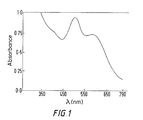
- A greyish image was obtained which was sufficiently dense and had sufficient absorption throughout the visible region to be used as a negative from which to print black and white photographic material as shown in Figure 1.
Claims (18)
1. A polymeric colour coupler of the general formula I :-

wherein E′ and E˝ represent the end groups of the polymer chain, R₁ is methyl, hydrogen, chlorine or bromine, R₂ is a divalent organic radical, R¹¹ and R¹¹¹ are each lower alkyl groups having 1 to 6 carbon atoms, or together represent the atoms required to form a five or size-membered heterocyclic ring, R¹ is an alkylene chain or an interrupted alkylene chain, W is the residue of a colour coupler which can react with an oxidised colour developer to yield a dye and B is the residue of an ethylenically unsaturated monomer which comprises no colour coupling residue nor a water solubilising group, a is from 10 to 60% by weight of the polymer, b is from 40 to 90% by weight of the polymer and c is from 0 to 20% by weight of the polymer, at least 10% by weight of the polymer being derived from the monomer which comprises the colour coupler residue and X is an anion.
2. A polymer according to claim 1 wherein R₁ is hydrogen or methyl.
3. A polymer according to claim 1 wherein R₂ the divalent organic radical is the residue of urethane, a urea, a carbonate, an ester, an ether, a ketone or an amide.
4. A polymer according to claim 3 wherein R₂ is the linkage - C - (O) - NH -.
5. A polymer according to claim 1 where in the quaternary ammonium residue in the polymer colour coupler formulated in claim 1 R₁ is methyl or hydrogen and R₂ is -CO - O -, R¹ is an alkylene group and R¹¹ and R¹¹¹ are each methyl groups.
6. A polymer according to claim 5 wherein R¹ is -CH₂ CH₂ CH₂ - or-CH₂ CH₂ CH₂ CH₂ -.
7. A polymer according to claim 5 wherein X is para-toluene sulphonate.
8. A polymer according to claim 1 wherein the quaternary ammonium residue in the polymeric colour coupler formulated in claim 1 has the formula :-

9. A polymer according to claim 1 which comprises the residue of a yellow dye forming monomeric colour coupler of the general formula :-

wherein each of R₃, R₄, R₅ and R₆ are hydrogen, halogen, alkoxy, sulphoxy or sulphonamido, R₁ and R₂ are as defined in claim 1, R₇ is hydrogen or a leaving group and L₁ and L₂ are direct linkages or -NH-.
10. A polymer according to claim 1 which comprise the residue of a yellow dye forming monomeric colour coupler of the general formula :-

wherein R₁ and R₂ and R₆ and R₇ are as defined in claim 9.
11. A polymer according to claim 1 which comprises the residue of a magenta dye forming monomeric colour coupler of the general formula :-

where R₁ and R₂ are as defined in claim 1, R₈ is hydrogen or a leaving group and R₁₀, R₁₁ and R₁₂ are each hydrogen, halogen or alkoxy.
12. A polymer according to claim 1 which comprises the residue of a magenta dye forming monomeric colour coupler of the general formula :-

wherein R₁, R₈ and R₁₀ are as defined in claim 11 and R₉ is alkyl, dialkylamino, optionally substituted aryl and optionally substituted acylamino.
13. A polymer according to claim 1 which comprises the residue of a cyan dye forming monomeric colour coupler which is a phenol coupler of the general formula :-

or is a phenol coupler of the general formula :-

or is a naphthol coupler of the general formula

where in the above three formula R₁ and R₁₂ are as defined, R₁₄ is hydrogen or a leaving group such as a halogen atom or a substituted alkoxy group, R₁₃ is a hydrogen atom or an alkyl group having 1 to 5 carbon atoms, R₁₅ is a linking group and y is 0 or 1, and R₁₆ is an alkoxy, amino amido, or sulphonamide group.
14. A polymer according to claim 1 wherein the polymer comprises units derived from simple, non-colour coupling, photographically inert comonomers.
15. A polymer according to claim 14 wherein the photographically inert comonomer is methyl acrylate, ethyl acrylate, butyl acrylate, ethyl hexyl acrylate, vinyl acetate; hydroxyethyl methacrylate, hydroxypropylmethacrylate; methacrylic acid, acrylic acid, itoconic acid, 2-carboxyethyl acrylate, and the salts thereof, acrylamide, methacrylamide, N-hydroxymethyl acrylamide, styrene, N-vinyl pyrrolidone, 1-vinyl imidazole; 4-vinylpyridine, dimethylaminoethyl methacrylate, tetrahydrofurfuryl methacrylate; sulphoethyl methacrylate, vinyl sulphonic acid and salts thereof, acrylonitrile and vinylidene chloride.
16. Photographic material having at least one gelatino silver halide emulsion layer which comprises a polymeric colour coupler as claimed in claim 1.
17. A process for the production of a polymer of formula I which comprises dissolving in a water-miscible organic solvent a monomeric colour coupler, a monomer which comprises a quaternary ammonium group of the formula :-

wherein R₁, R₂, R¹, R¹¹ and R¹¹¹ are as defined in claim 1 and optionally another monomer in the ratio as defined in claim 1, heating the solution and adding a solution of free radical polymerisation initiating agent and precipitating the polymer by addition of a water immiscible organic sovlent.
18. A method of preparing colour photographic material which comprises forming a polymeric colour coupler as claimed in claim 1, mixing this polymer with an aqueous gelatino silver halide emulsion and coating the emulsion on a photographic base.
Applications Claiming Priority (2)
| Application Number | Priority Date | Filing Date | Title |
|---|---|---|---|
| GB8729198 | 1987-12-15 | ||
| GB878729198A GB8729198D0 (en) | 1987-12-15 | 1987-12-15 | Polymeric colour couplers |
Publications (1)
| Publication Number | Publication Date |
|---|---|
| EP0321400A2 true EP0321400A2 (en) | 1989-06-21 |
Family
ID=10628501
Family Applications (1)
| Application Number | Title | Priority Date | Filing Date |
|---|---|---|---|
| EP88810834A Withdrawn EP0321400A2 (en) | 1987-12-15 | 1988-12-06 | Polymeric colour couplers |
Country Status (2)
| Country | Link |
|---|---|
| EP (1) | EP0321400A2 (en) |
| GB (1) | GB8729198D0 (en) |
Cited By (1)
| Publication number | Priority date | Publication date | Assignee | Title |
|---|---|---|---|---|
| CN112708019A (en) * | 2019-10-25 | 2021-04-27 | 乐凯化学材料有限公司 | Water-soluble color stabilizer for color photographic paper and preparation method thereof |
-
1987
- 1987-12-15 GB GB878729198A patent/GB8729198D0/en active Pending
-
1988
- 1988-12-06 EP EP88810834A patent/EP0321400A2/en not_active Withdrawn
Cited By (2)
| Publication number | Priority date | Publication date | Assignee | Title |
|---|---|---|---|---|
| CN112708019A (en) * | 2019-10-25 | 2021-04-27 | 乐凯化学材料有限公司 | Water-soluble color stabilizer for color photographic paper and preparation method thereof |
| CN112708019B (en) * | 2019-10-25 | 2024-04-30 | 乐凯化学材料有限公司 | A water-soluble color stabilizer for color photographic paper and preparation method thereof |
Also Published As
| Publication number | Publication date |
|---|---|
| GB8729198D0 (en) | 1988-01-27 |
Similar Documents
| Publication | Publication Date | Title |
|---|---|---|
| US3926436A (en) | Silver halide element containing polymeric colour forming couplers | |
| US4215195A (en) | Polymers of amide compounds useful in photographic materials | |
| US4340664A (en) | Copolymer latex and photographic silver halide materials containing such latex | |
| US4435503A (en) | Silver halide color photographic light-sensitive material | |
| US4409320A (en) | Silver halide color photographic light-sensitive material | |
| US4128427A (en) | Silver halide emulsions containing polymeric color couplers | |
| US3163625A (en) | Color-forming monomers and polymers of acrylic acid amides of 3-aminopyrazolone | |
| EP0209009B1 (en) | Photographic materials and process comprising polymeric couplers | |
| US4388404A (en) | Silver halide color photographic light-sensitive material | |
| US3767412A (en) | Polymeric colour couplers and their use in colour photography | |
| US4474870A (en) | Silver halide color photographic light-sensitive material | |
| US4346231A (en) | Polymerizable ethylenically unsaturated amide compounds | |
| US4444870A (en) | Silver halide color photographic light-sensitive material | |
| EP0321399A2 (en) | Preparation of latexes of colour coupler polymers | |
| US4436808A (en) | Silver halide color photographic light-sensitive material | |
| GB2125571A (en) | Polymeric cyan-forming coupler | |
| US4247673A (en) | Crosslinkable polymers derived from amide compounds | |
| JPS5965844A (en) | Color photographic sensitive silver halide material | |
| US3904418A (en) | Hardenable vehicles for silver halide emulsions | |
| US4416978A (en) | Silver halide color photographic light-sensitive material | |
| EP0321400A2 (en) | Polymeric colour couplers | |
| EP0321401B1 (en) | Polymeric colour couplers | |
| US4421915A (en) | Polymerizable ethylenically unsaturated amide compounds | |
| US4438278A (en) | Polymerizable ethylenically unsaturated amide compounds | |
| US3912513A (en) | Polymeric competing couplers and their use in photographic silver halide colour materials |
Legal Events
| Date | Code | Title | Description |
|---|---|---|---|
| PUAI | Public reference made under article 153(3) epc to a published international application that has entered the european phase |
Free format text: ORIGINAL CODE: 0009012 |
|
| 17P | Request for examination filed |
Effective date: 19881206 |
|
| AK | Designated contracting states |
Kind code of ref document: A2 Designated state(s): BE CH DE FR GB IT LI NL |
|
| STAA | Information on the status of an ep patent application or granted ep patent |
Free format text: STATUS: THE APPLICATION HAS BEEN WITHDRAWN |
|
| 18W | Application withdrawn |
Withdrawal date: 19891011 |
|
| RAP1 | Party data changed (applicant data changed or rights of an application transferred) |
Owner name: ILFORD LIMITED |