EP0319703B1 - Verfahren zur Herstellung kathodisch abscheidbarer Bindemitteldispersionen mit Vernetzern auf der Basis von mit Aminogruppen verkappten Polyisocyanaten - Google Patents
Verfahren zur Herstellung kathodisch abscheidbarer Bindemitteldispersionen mit Vernetzern auf der Basis von mit Aminogruppen verkappten Polyisocyanaten Download PDFInfo
- Publication number
- EP0319703B1 EP0319703B1 EP19880118215 EP88118215A EP0319703B1 EP 0319703 B1 EP0319703 B1 EP 0319703B1 EP 19880118215 EP19880118215 EP 19880118215 EP 88118215 A EP88118215 A EP 88118215A EP 0319703 B1 EP0319703 B1 EP 0319703B1
- Authority
- EP
- European Patent Office
- Prior art keywords
- polyisocyanates
- epoxide
- added
- mixture
- solvent
- Prior art date
- Legal status (The legal status is an assumption and is not a legal conclusion. Google has not performed a legal analysis and makes no representation as to the accuracy of the status listed.)
- Expired - Lifetime
Links
- 229920001228 polyisocyanate Polymers 0.000 title claims abstract description 24
- 239000005056 polyisocyanate Substances 0.000 title claims abstract description 24
- 239000006185 dispersion Substances 0.000 title claims abstract description 20
- 150000001412 amines Chemical group 0.000 title claims abstract description 19
- 239000011230 binding agent Substances 0.000 title claims abstract description 13
- 239000004971 Cross linker Substances 0.000 title description 17
- 238000000151 deposition Methods 0.000 title description 4
- 238000004519 manufacturing process Methods 0.000 title description 3
- 239000000203 mixture Substances 0.000 claims abstract description 28
- 239000002904 solvent Substances 0.000 claims abstract description 21
- 239000003431 cross linking reagent Substances 0.000 claims abstract description 20
- 238000000034 method Methods 0.000 claims abstract description 18
- 239000002253 acid Substances 0.000 claims abstract description 17
- 125000003277 amino group Chemical group 0.000 claims abstract description 13
- 150000001875 compounds Chemical class 0.000 claims abstract description 13
- 229920000647 polyepoxide Polymers 0.000 claims abstract description 12
- 238000001816 cooling Methods 0.000 claims abstract description 9
- 125000002887 hydroxy group Chemical group [H]O* 0.000 claims abstract description 8
- 238000010992 reflux Methods 0.000 claims abstract description 7
- 239000011877 solvent mixture Substances 0.000 claims abstract description 5
- 150000002118 epoxides Chemical class 0.000 claims abstract 4
- 229920005989 resin Polymers 0.000 claims description 16
- 239000011347 resin Substances 0.000 claims description 16
- 125000003700 epoxy group Chemical group 0.000 claims description 14
- 125000001931 aliphatic group Chemical group 0.000 claims description 12
- 239000007795 chemical reaction product Substances 0.000 claims description 11
- 125000003118 aryl group Chemical group 0.000 claims description 9
- 239000000543 intermediate Substances 0.000 claims description 8
- 238000002360 preparation method Methods 0.000 claims description 7
- 239000003054 catalyst Substances 0.000 claims description 5
- 238000004070 electrodeposition Methods 0.000 claims description 4
- 239000012634 fragment Substances 0.000 claims description 4
- 239000003973 paint Substances 0.000 claims description 4
- 239000000126 substance Substances 0.000 claims 1
- 239000003822 epoxy resin Substances 0.000 abstract description 5
- 239000013067 intermediate product Substances 0.000 abstract description 4
- 238000006555 catalytic reaction Methods 0.000 abstract description 2
- 210000003298 dental enamel Anatomy 0.000 abstract 1
- -1 Hydantoine epoxides Chemical class 0.000 description 23
- XLYOFNOQVPJJNP-UHFFFAOYSA-N water Substances O XLYOFNOQVPJJNP-UHFFFAOYSA-N 0.000 description 22
- 238000006243 chemical reaction Methods 0.000 description 17
- 239000000243 solution Substances 0.000 description 14
- QTBSBXVTEAMEQO-UHFFFAOYSA-N Acetic acid Chemical compound CC(O)=O QTBSBXVTEAMEQO-UHFFFAOYSA-N 0.000 description 12
- 239000007787 solid Substances 0.000 description 10
- NTIZESTWPVYFNL-UHFFFAOYSA-N Methyl isobutyl ketone Chemical compound CC(C)CC(C)=O NTIZESTWPVYFNL-UHFFFAOYSA-N 0.000 description 9
- UIHCLUNTQKBZGK-UHFFFAOYSA-N Methyl isobutyl ketone Natural products CCC(C)C(C)=O UIHCLUNTQKBZGK-UHFFFAOYSA-N 0.000 description 9
- 239000012948 isocyanate Substances 0.000 description 9
- IISBACLAFKSPIT-UHFFFAOYSA-N bisphenol A Chemical compound C=1C=C(O)C=CC=1C(C)(C)C1=CC=C(O)C=C1 IISBACLAFKSPIT-UHFFFAOYSA-N 0.000 description 8
- 229920005862 polyol Polymers 0.000 description 8
- 239000004593 Epoxy Substances 0.000 description 7
- LYCAIKOWRPUZTN-UHFFFAOYSA-N Ethylene glycol Chemical compound OCCO LYCAIKOWRPUZTN-UHFFFAOYSA-N 0.000 description 6
- 150000007513 acids Chemical class 0.000 description 6
- JQVDAXLFBXTEQA-UHFFFAOYSA-N dibutylamine Chemical compound CCCCNCCCC JQVDAXLFBXTEQA-UHFFFAOYSA-N 0.000 description 6
- 150000003077 polyols Chemical class 0.000 description 6
- 229960000583 acetic acid Drugs 0.000 description 5
- 150000002513 isocyanates Chemical class 0.000 description 5
- 239000000047 product Substances 0.000 description 5
- IJGRMHOSHXDMSA-UHFFFAOYSA-N Atomic nitrogen Chemical compound N#N IJGRMHOSHXDMSA-UHFFFAOYSA-N 0.000 description 4
- ROSDSFDQCJNGOL-UHFFFAOYSA-N Dimethylamine Chemical compound CNC ROSDSFDQCJNGOL-UHFFFAOYSA-N 0.000 description 4
- YXFVVABEGXRONW-UHFFFAOYSA-N Toluene Chemical compound CC1=CC=CC=C1 YXFVVABEGXRONW-UHFFFAOYSA-N 0.000 description 4
- 230000000052 comparative effect Effects 0.000 description 4
- 150000002009 diols Chemical class 0.000 description 4
- 238000004821 distillation Methods 0.000 description 4
- RTZKZFJDLAIYFH-UHFFFAOYSA-N ether Substances CCOCC RTZKZFJDLAIYFH-UHFFFAOYSA-N 0.000 description 4
- 150000002334 glycols Chemical class 0.000 description 4
- IQPQWNKOIGAROB-UHFFFAOYSA-N isocyanate group Chemical group [N-]=C=O IQPQWNKOIGAROB-UHFFFAOYSA-N 0.000 description 4
- JVTAAEKCZFNVCJ-UHFFFAOYSA-N lactic acid Chemical compound CC(O)C(O)=O JVTAAEKCZFNVCJ-UHFFFAOYSA-N 0.000 description 4
- 239000000463 material Substances 0.000 description 4
- 229920005906 polyester polyol Polymers 0.000 description 4
- 235000013824 polyphenols Nutrition 0.000 description 4
- 150000003335 secondary amines Chemical class 0.000 description 4
- ZWEHNKRNPOVVGH-UHFFFAOYSA-N 2-Butanone Chemical compound CCC(C)=O ZWEHNKRNPOVVGH-UHFFFAOYSA-N 0.000 description 3
- CSCPPACGZOOCGX-UHFFFAOYSA-N Acetone Chemical compound CC(C)=O CSCPPACGZOOCGX-UHFFFAOYSA-N 0.000 description 3
- CTQNGGLPUBDAKN-UHFFFAOYSA-N O-Xylene Chemical compound CC1=CC=CC=C1C CTQNGGLPUBDAKN-UHFFFAOYSA-N 0.000 description 3
- 150000008064 anhydrides Chemical class 0.000 description 3
- 238000009835 boiling Methods 0.000 description 3
- 239000008367 deionised water Substances 0.000 description 3
- 229910021641 deionized water Inorganic materials 0.000 description 3
- 230000008021 deposition Effects 0.000 description 3
- UAOMVDZJSHZZME-UHFFFAOYSA-N diisopropylamine Chemical compound CC(C)NC(C)C UAOMVDZJSHZZME-UHFFFAOYSA-N 0.000 description 3
- 239000012362 glacial acetic acid Substances 0.000 description 3
- 239000004922 lacquer Substances 0.000 description 3
- SLCVBVWXLSEKPL-UHFFFAOYSA-N neopentyl glycol Chemical compound OCC(C)(C)CO SLCVBVWXLSEKPL-UHFFFAOYSA-N 0.000 description 3
- 239000000049 pigment Substances 0.000 description 3
- 229920000728 polyester Polymers 0.000 description 3
- 150000008442 polyphenolic compounds Chemical class 0.000 description 3
- 125000000467 secondary amino group Chemical group [H]N([*:1])[*:2] 0.000 description 3
- 238000005292 vacuum distillation Methods 0.000 description 3
- 239000008096 xylene Substances 0.000 description 3
- POAOYUHQDCAZBD-UHFFFAOYSA-N 2-butoxyethanol Chemical compound CCCCOCCO POAOYUHQDCAZBD-UHFFFAOYSA-N 0.000 description 2
- SXFJDZNJHVPHPH-UHFFFAOYSA-N 3-methylpentane-1,5-diol Chemical compound OCCC(C)CCO SXFJDZNJHVPHPH-UHFFFAOYSA-N 0.000 description 2
- RPNUMPOLZDHAAY-UHFFFAOYSA-N Diethylenetriamine Chemical compound NCCNCCN RPNUMPOLZDHAAY-UHFFFAOYSA-N 0.000 description 2
- QUSNBJAOOMFDIB-UHFFFAOYSA-N Ethylamine Chemical compound CCN QUSNBJAOOMFDIB-UHFFFAOYSA-N 0.000 description 2
- YNQLUTRBYVCPMQ-UHFFFAOYSA-N Ethylbenzene Chemical compound CCC1=CC=CC=C1 YNQLUTRBYVCPMQ-UHFFFAOYSA-N 0.000 description 2
- BAVYZALUXZFZLV-UHFFFAOYSA-N Methylamine Chemical compound NC BAVYZALUXZFZLV-UHFFFAOYSA-N 0.000 description 2
- LRHPLDYGYMQRHN-UHFFFAOYSA-N N-Butanol Chemical compound CCCCO LRHPLDYGYMQRHN-UHFFFAOYSA-N 0.000 description 2
- AFBPFSWMIHJQDM-UHFFFAOYSA-N N-methylaniline Chemical compound CNC1=CC=CC=C1 AFBPFSWMIHJQDM-UHFFFAOYSA-N 0.000 description 2
- QCOGKXLOEWLIDC-UHFFFAOYSA-N N-methylbutylamine Chemical compound CCCCNC QCOGKXLOEWLIDC-UHFFFAOYSA-N 0.000 description 2
- KKEYFWRCBNTPAC-UHFFFAOYSA-N Terephthalic acid Chemical compound OC(=O)C1=CC=C(C(O)=O)C=C1 KKEYFWRCBNTPAC-UHFFFAOYSA-N 0.000 description 2
- GWEVSGVZZGPLCZ-UHFFFAOYSA-N Titan oxide Chemical compound O=[Ti]=O GWEVSGVZZGPLCZ-UHFFFAOYSA-N 0.000 description 2
- 235000011054 acetic acid Nutrition 0.000 description 2
- WNLRTRBMVRJNCN-UHFFFAOYSA-N adipic acid Chemical compound OC(=O)CCCCC(O)=O WNLRTRBMVRJNCN-UHFFFAOYSA-N 0.000 description 2
- HQABUPZFAYXKJW-UHFFFAOYSA-N butan-1-amine Chemical compound CCCCN HQABUPZFAYXKJW-UHFFFAOYSA-N 0.000 description 2
- WERYXYBDKMZEQL-UHFFFAOYSA-N butane-1,4-diol Chemical compound OCCCCO WERYXYBDKMZEQL-UHFFFAOYSA-N 0.000 description 2
- 125000004432 carbon atom Chemical group C* 0.000 description 2
- 238000004132 cross linking Methods 0.000 description 2
- 125000005265 dialkylamine group Chemical group 0.000 description 2
- ZBCBWPMODOFKDW-UHFFFAOYSA-N diethanolamine Chemical compound OCCNCCO ZBCBWPMODOFKDW-UHFFFAOYSA-N 0.000 description 2
- HPNMFZURTQLUMO-UHFFFAOYSA-N diethylamine Chemical compound CCNCC HPNMFZURTQLUMO-UHFFFAOYSA-N 0.000 description 2
- 125000005442 diisocyanate group Chemical group 0.000 description 2
- XXBDWLFCJWSEKW-UHFFFAOYSA-N dimethylbenzylamine Chemical compound CN(C)CC1=CC=CC=C1 XXBDWLFCJWSEKW-UHFFFAOYSA-N 0.000 description 2
- WEHWNAOGRSTTBQ-UHFFFAOYSA-N dipropylamine Chemical compound CCCNCCC WEHWNAOGRSTTBQ-UHFFFAOYSA-N 0.000 description 2
- 150000002148 esters Chemical class 0.000 description 2
- 150000002170 ethers Chemical class 0.000 description 2
- 238000005187 foaming Methods 0.000 description 2
- 239000001257 hydrogen Substances 0.000 description 2
- 229910052739 hydrogen Inorganic materials 0.000 description 2
- 125000004435 hydrogen atom Chemical group [H]* 0.000 description 2
- QQVIHTHCMHWDBS-UHFFFAOYSA-N isophthalic acid Chemical compound OC(=O)C1=CC=CC(C(O)=O)=C1 QQVIHTHCMHWDBS-UHFFFAOYSA-N 0.000 description 2
- 150000004658 ketimines Chemical class 0.000 description 2
- 150000002576 ketones Chemical class 0.000 description 2
- 239000004310 lactic acid Substances 0.000 description 2
- 235000014655 lactic acid Nutrition 0.000 description 2
- 150000002596 lactones Chemical class 0.000 description 2
- BDAGIHXWWSANSR-UHFFFAOYSA-N methanoic acid Natural products OC=O BDAGIHXWWSANSR-UHFFFAOYSA-N 0.000 description 2
- 229910052757 nitrogen Inorganic materials 0.000 description 2
- BDJRBEYXGGNYIS-UHFFFAOYSA-N nonanedioic acid Chemical compound OC(=O)CCCCCCCC(O)=O BDJRBEYXGGNYIS-UHFFFAOYSA-N 0.000 description 2
- XNGIFLGASWRNHJ-UHFFFAOYSA-N phthalic acid Chemical compound OC(=O)C1=CC=CC=C1C(O)=O XNGIFLGASWRNHJ-UHFFFAOYSA-N 0.000 description 2
- 229920001281 polyalkylene Polymers 0.000 description 2
- 229920000768 polyamine Polymers 0.000 description 2
- 125000002924 primary amino group Chemical group [H]N([H])* 0.000 description 2
- WGYKZJWCGVVSQN-UHFFFAOYSA-N propylamine Chemical compound CCCN WGYKZJWCGVVSQN-UHFFFAOYSA-N 0.000 description 2
- 239000011541 reaction mixture Substances 0.000 description 2
- CXMXRPHRNRROMY-UHFFFAOYSA-N sebacic acid Chemical compound OC(=O)CCCCCCCCC(O)=O CXMXRPHRNRROMY-UHFFFAOYSA-N 0.000 description 2
- 238000000926 separation method Methods 0.000 description 2
- 125000001424 substituent group Chemical group 0.000 description 2
- DNIAPMSPPWPWGF-VKHMYHEASA-N (+)-propylene glycol Chemical compound C[C@H](O)CO DNIAPMSPPWPWGF-VKHMYHEASA-N 0.000 description 1
- PUPZLCDOIYMWBV-UHFFFAOYSA-N (+/-)-1,3-Butanediol Chemical compound CC(O)CCO PUPZLCDOIYMWBV-UHFFFAOYSA-N 0.000 description 1
- CYVMBANVYOZFIG-ZCFIWIBFSA-N (2r)-2-ethylbutane-1,4-diol Chemical compound CC[C@@H](CO)CCO CYVMBANVYOZFIG-ZCFIWIBFSA-N 0.000 description 1
- DNIAPMSPPWPWGF-GSVOUGTGSA-N (R)-(-)-Propylene glycol Chemical compound C[C@@H](O)CO DNIAPMSPPWPWGF-GSVOUGTGSA-N 0.000 description 1
- FDYWJVHETVDSRA-UHFFFAOYSA-N 1,1-diisocyanatobutane Chemical compound CCCC(N=C=O)N=C=O FDYWJVHETVDSRA-UHFFFAOYSA-N 0.000 description 1
- 229940083957 1,2-butanediol Drugs 0.000 description 1
- PFUKECZPRROVOD-UHFFFAOYSA-N 1,3,5-triisocyanato-2-methylbenzene Chemical compound CC1=C(N=C=O)C=C(N=C=O)C=C1N=C=O PFUKECZPRROVOD-UHFFFAOYSA-N 0.000 description 1
- PQDIQKXGPYOGDI-UHFFFAOYSA-N 1,3,5-triisocyanatobenzene Chemical compound O=C=NC1=CC(N=C=O)=CC(N=C=O)=C1 PQDIQKXGPYOGDI-UHFFFAOYSA-N 0.000 description 1
- OZXIZRZFGJZWBF-UHFFFAOYSA-N 1,3,5-trimethyl-2-(2,4,6-trimethylphenoxy)benzene Chemical compound CC1=CC(C)=CC(C)=C1OC1=C(C)C=C(C)C=C1C OZXIZRZFGJZWBF-UHFFFAOYSA-N 0.000 description 1
- YPFDHNVEDLHUCE-UHFFFAOYSA-N 1,3-propanediol Substances OCCCO YPFDHNVEDLHUCE-UHFFFAOYSA-N 0.000 description 1
- RYHBNJHYFVUHQT-UHFFFAOYSA-N 1,4-Dioxane Chemical compound C1COCCO1 RYHBNJHYFVUHQT-UHFFFAOYSA-N 0.000 description 1
- OHLKMGYGBHFODF-UHFFFAOYSA-N 1,4-bis(isocyanatomethyl)benzene Chemical compound O=C=NCC1=CC=C(CN=C=O)C=C1 OHLKMGYGBHFODF-UHFFFAOYSA-N 0.000 description 1
- DURPTKYDGMDSBL-UHFFFAOYSA-N 1-butoxybutane Chemical compound CCCCOCCCC DURPTKYDGMDSBL-UHFFFAOYSA-N 0.000 description 1
- RTBFRGCFXZNCOE-UHFFFAOYSA-N 1-methylsulfonylpiperidin-4-one Chemical compound CS(=O)(=O)N1CCC(=O)CC1 RTBFRGCFXZNCOE-UHFFFAOYSA-N 0.000 description 1
- BZUILZIKDIMXBK-UHFFFAOYSA-N 2-(oxiran-2-ylmethoxycarbonyl)benzoic acid Chemical compound OC(=O)C1=CC=CC=C1C(=O)OCC1OC1 BZUILZIKDIMXBK-UHFFFAOYSA-N 0.000 description 1
- CYEJMVLDXAUOPN-UHFFFAOYSA-N 2-dodecylphenol Chemical compound CCCCCCCCCCCCC1=CC=CC=C1O CYEJMVLDXAUOPN-UHFFFAOYSA-N 0.000 description 1
- WBVXRNIPAILLQM-UHFFFAOYSA-N 2-hydroxyethyl 2-hydroxyacetate Chemical compound OCCOC(=O)CO WBVXRNIPAILLQM-UHFFFAOYSA-N 0.000 description 1
- JVZZUPJFERSVRN-UHFFFAOYSA-N 2-methyl-2-propylpropane-1,3-diol Chemical compound CCCC(C)(CO)CO JVZZUPJFERSVRN-UHFFFAOYSA-N 0.000 description 1
- JHNGQEIVWBCYHQ-UHFFFAOYSA-N 3,6-dihydroxy-2,2,5,5-tetramethylhexanoic acid Chemical compound OCC(C)(C)CC(O)C(C)(C)C(O)=O JHNGQEIVWBCYHQ-UHFFFAOYSA-N 0.000 description 1
- OSWFIVFLDKOXQC-UHFFFAOYSA-N 4-(3-methoxyphenyl)aniline Chemical compound COC1=CC=CC(C=2C=CC(N)=CC=2)=C1 OSWFIVFLDKOXQC-UHFFFAOYSA-N 0.000 description 1
- WXQZLPFNTPKVJM-UHFFFAOYSA-N 4-[(4-hydroxycyclohexyl)methyl]cyclohexan-1-ol Chemical compound C1CC(O)CCC1CC1CCC(O)CC1 WXQZLPFNTPKVJM-UHFFFAOYSA-N 0.000 description 1
- CDBAMNGURPMUTG-UHFFFAOYSA-N 4-[2-(4-hydroxycyclohexyl)propan-2-yl]cyclohexan-1-ol Chemical compound C1CC(O)CCC1C(C)(C)C1CCC(O)CC1 CDBAMNGURPMUTG-UHFFFAOYSA-N 0.000 description 1
- ACVCIJWFRHNPBF-UHFFFAOYSA-N 6-(oxiran-2-ylmethoxy)-6-oxohexanoic acid Chemical compound OC(=O)CCCCC(=O)OCC1CO1 ACVCIJWFRHNPBF-UHFFFAOYSA-N 0.000 description 1
- DKPFZGUDAPQIHT-UHFFFAOYSA-N Butyl acetate Natural products CCCCOC(C)=O DKPFZGUDAPQIHT-UHFFFAOYSA-N 0.000 description 1
- 239000004215 Carbon black (E152) Substances 0.000 description 1
- XBPCUCUWBYBCDP-UHFFFAOYSA-N Dicyclohexylamine Chemical compound C1CCCCC1NC1CCCCC1 XBPCUCUWBYBCDP-UHFFFAOYSA-N 0.000 description 1
- 239000004606 Fillers/Extenders Substances 0.000 description 1
- 239000005057 Hexamethylene diisocyanate Substances 0.000 description 1
- 239000005058 Isophorone diisocyanate Substances 0.000 description 1
- SVYKKECYCPFKGB-UHFFFAOYSA-N N,N-dimethylcyclohexylamine Chemical compound CN(C)C1CCCCC1 SVYKKECYCPFKGB-UHFFFAOYSA-N 0.000 description 1
- OPKOKAMJFNKNAS-UHFFFAOYSA-N N-methylethanolamine Chemical compound CNCCO OPKOKAMJFNKNAS-UHFFFAOYSA-N 0.000 description 1
- BPQQTUXANYXVAA-UHFFFAOYSA-N Orthosilicate Chemical compound [O-][Si]([O-])([O-])[O-] BPQQTUXANYXVAA-UHFFFAOYSA-N 0.000 description 1
- ALQSHHUCVQOPAS-UHFFFAOYSA-N Pentane-1,5-diol Chemical compound OCCCCCO ALQSHHUCVQOPAS-UHFFFAOYSA-N 0.000 description 1
- 239000005062 Polybutadiene Substances 0.000 description 1
- 239000004721 Polyphenylene oxide Substances 0.000 description 1
- ZJCCRDAZUWHFQH-UHFFFAOYSA-N Trimethylolpropane Chemical compound CCC(CO)(CO)CO ZJCCRDAZUWHFQH-UHFFFAOYSA-N 0.000 description 1
- YKTSYUJCYHOUJP-UHFFFAOYSA-N [O--].[Al+3].[Al+3].[O-][Si]([O-])([O-])[O-] Chemical compound [O--].[Al+3].[Al+3].[O-][Si]([O-])([O-])[O-] YKTSYUJCYHOUJP-UHFFFAOYSA-N 0.000 description 1
- 150000001242 acetic acid derivatives Chemical class 0.000 description 1
- 239000000654 additive Substances 0.000 description 1
- 239000001361 adipic acid Substances 0.000 description 1
- 235000011037 adipic acid Nutrition 0.000 description 1
- 150000001298 alcohols Chemical class 0.000 description 1
- 150000001334 alicyclic compounds Chemical class 0.000 description 1
- 125000002723 alicyclic group Chemical group 0.000 description 1
- JFCQEDHGNNZCLN-UHFFFAOYSA-N anhydrous glutaric acid Natural products OC(=O)CCCC(O)=O JFCQEDHGNNZCLN-UHFFFAOYSA-N 0.000 description 1
- 238000005452 bending Methods 0.000 description 1
- 239000004305 biphenyl Substances 0.000 description 1
- BMRWNKZVCUKKSR-UHFFFAOYSA-N butane-1,2-diol Chemical compound CCC(O)CO BMRWNKZVCUKKSR-UHFFFAOYSA-N 0.000 description 1
- 239000006229 carbon black Substances 0.000 description 1
- 150000001735 carboxylic acids Chemical class 0.000 description 1
- 125000002091 cationic group Chemical group 0.000 description 1
- 238000000576 coating method Methods 0.000 description 1
- 238000010276 construction Methods 0.000 description 1
- IFDVQVHZEKPUSC-UHFFFAOYSA-N cyclohex-3-ene-1,2-dicarboxylic acid Chemical compound OC(=O)C1CCC=CC1C(O)=O IFDVQVHZEKPUSC-UHFFFAOYSA-N 0.000 description 1
- QSAWQNUELGIYBC-UHFFFAOYSA-N cyclohexane-1,2-dicarboxylic acid Chemical compound OC(=O)C1CCCCC1C(O)=O QSAWQNUELGIYBC-UHFFFAOYSA-N 0.000 description 1
- VEIOBOXBGYWJIT-UHFFFAOYSA-N cyclohexane;methanol Chemical compound OC.OC.C1CCCCC1 VEIOBOXBGYWJIT-UHFFFAOYSA-N 0.000 description 1
- 229940043279 diisopropylamine Drugs 0.000 description 1
- IUNMPGNGSSIWFP-UHFFFAOYSA-N dimethylaminopropylamine Chemical compound CN(C)CCCN IUNMPGNGSSIWFP-UHFFFAOYSA-N 0.000 description 1
- USIUVYZYUHIAEV-UHFFFAOYSA-N diphenyl ether Natural products C=1C=CC=CC=1OC1=CC=CC=C1 USIUVYZYUHIAEV-UHFFFAOYSA-N 0.000 description 1
- SZXQTJUDPRGNJN-UHFFFAOYSA-N dipropylene glycol Chemical compound OCCCOCCCO SZXQTJUDPRGNJN-UHFFFAOYSA-N 0.000 description 1
- 238000006735 epoxidation reaction Methods 0.000 description 1
- 235000019253 formic acid Nutrition 0.000 description 1
- 238000001879 gelation Methods 0.000 description 1
- 238000000227 grinding Methods 0.000 description 1
- 229940093915 gynecological organic acid Drugs 0.000 description 1
- LNEPOXFFQSENCJ-UHFFFAOYSA-N haloperidol Chemical class C1CC(O)(C=2C=CC(Cl)=CC=2)CCN1CCCC(=O)C1=CC=C(F)C=C1 LNEPOXFFQSENCJ-UHFFFAOYSA-N 0.000 description 1
- RRAMGCGOFNQTLD-UHFFFAOYSA-N hexamethylene diisocyanate Chemical compound O=C=NCCCCCCN=C=O RRAMGCGOFNQTLD-UHFFFAOYSA-N 0.000 description 1
- XXMIOPMDWAUFGU-UHFFFAOYSA-N hexane-1,6-diol Chemical compound OCCCCCCO XXMIOPMDWAUFGU-UHFFFAOYSA-N 0.000 description 1
- FUZZWVXGSFPDMH-UHFFFAOYSA-N hexanoic acid Chemical compound CCCCCC(O)=O FUZZWVXGSFPDMH-UHFFFAOYSA-N 0.000 description 1
- 229930195733 hydrocarbon Natural products 0.000 description 1
- 150000002430 hydrocarbons Chemical class 0.000 description 1
- 238000009863 impact test Methods 0.000 description 1
- 239000011261 inert gas Substances 0.000 description 1
- 239000012442 inert solvent Substances 0.000 description 1
- NIMLQBUJDJZYEJ-UHFFFAOYSA-N isophorone diisocyanate Chemical compound CC1(C)CC(N=C=O)CC(C)(CN=C=O)C1 NIMLQBUJDJZYEJ-UHFFFAOYSA-N 0.000 description 1
- 150000002605 large molecules Chemical class 0.000 description 1
- 239000007788 liquid Substances 0.000 description 1
- SHOJXDKTYKFBRD-UHFFFAOYSA-N mesityl oxide Natural products CC(C)=CC(C)=O SHOJXDKTYKFBRD-UHFFFAOYSA-N 0.000 description 1
- 238000002156 mixing Methods 0.000 description 1
- DNIAPMSPPWPWGF-UHFFFAOYSA-N monopropylene glycol Natural products CC(O)CO DNIAPMSPPWPWGF-UHFFFAOYSA-N 0.000 description 1
- QOHMWDJIBGVPIF-UHFFFAOYSA-N n',n'-diethylpropane-1,3-diamine Chemical compound CCN(CC)CCCN QOHMWDJIBGVPIF-UHFFFAOYSA-N 0.000 description 1
- DILRJUIACXKSQE-UHFFFAOYSA-N n',n'-dimethylethane-1,2-diamine Chemical compound CN(C)CCN DILRJUIACXKSQE-UHFFFAOYSA-N 0.000 description 1
- YKYONYBAUNKHLG-UHFFFAOYSA-N n-Propyl acetate Natural products CCCOC(C)=O YKYONYBAUNKHLG-UHFFFAOYSA-N 0.000 description 1
- XCVNDBIXFPGMIW-UHFFFAOYSA-N n-ethylpropan-1-amine Chemical compound CCCNCC XCVNDBIXFPGMIW-UHFFFAOYSA-N 0.000 description 1
- PXSXRABJBXYMFT-UHFFFAOYSA-N n-hexylhexan-1-amine Chemical compound CCCCCCNCCCCCC PXSXRABJBXYMFT-UHFFFAOYSA-N 0.000 description 1
- JACMPVXHEARCBO-UHFFFAOYSA-N n-pentylpentan-1-amine Chemical compound CCCCCNCCCCC JACMPVXHEARCBO-UHFFFAOYSA-N 0.000 description 1
- 125000004433 nitrogen atom Chemical group N* 0.000 description 1
- 150000007524 organic acids Chemical class 0.000 description 1
- 235000005985 organic acids Nutrition 0.000 description 1
- 150000002924 oxiranes Chemical group 0.000 description 1
- WCVRQHFDJLLWFE-UHFFFAOYSA-N pentane-1,2-diol Chemical compound CCCC(O)CO WCVRQHFDJLLWFE-UHFFFAOYSA-N 0.000 description 1
- ISWSIDIOOBJBQZ-UHFFFAOYSA-N phenol group Chemical group C1(=CC=CC=C1)O ISWSIDIOOBJBQZ-UHFFFAOYSA-N 0.000 description 1
- 239000004033 plastic Substances 0.000 description 1
- 229920003023 plastic Polymers 0.000 description 1
- 229920002857 polybutadiene Polymers 0.000 description 1
- 229920001610 polycaprolactone Polymers 0.000 description 1
- 239000004632 polycaprolactone Substances 0.000 description 1
- 229920000570 polyether Polymers 0.000 description 1
- 229920000166 polytrimethylene carbonate Polymers 0.000 description 1
- 150000003141 primary amines Chemical class 0.000 description 1
- 230000037452 priming Effects 0.000 description 1
- 229940090181 propyl acetate Drugs 0.000 description 1
- 235000013772 propylene glycol Nutrition 0.000 description 1
- 239000000376 reactant Substances 0.000 description 1
- 230000000630 rising effect Effects 0.000 description 1
- 150000005619 secondary aliphatic amines Chemical class 0.000 description 1
- 150000003384 small molecules Chemical class 0.000 description 1
- 229920003002 synthetic resin Polymers 0.000 description 1
- 239000000057 synthetic resin Substances 0.000 description 1
- 150000003512 tertiary amines Chemical class 0.000 description 1
- 238000010998 test method Methods 0.000 description 1
- UFDHBDMSHIXOKF-UHFFFAOYSA-N tetrahydrophthalic acid Natural products OC(=O)C1=C(C(O)=O)CCCC1 UFDHBDMSHIXOKF-UHFFFAOYSA-N 0.000 description 1
- DVKJHBMWWAPEIU-UHFFFAOYSA-N toluene 2,4-diisocyanate Chemical compound CC1=CC=C(N=C=O)C=C1N=C=O DVKJHBMWWAPEIU-UHFFFAOYSA-N 0.000 description 1
- IMFACGCPASFAPR-UHFFFAOYSA-N tributylamine Chemical compound CCCCN(CCCC)CCCC IMFACGCPASFAPR-UHFFFAOYSA-N 0.000 description 1
- ZIBGPFATKBEMQZ-UHFFFAOYSA-N triethylene glycol Chemical compound OCCOCCOCCO ZIBGPFATKBEMQZ-UHFFFAOYSA-N 0.000 description 1
- XSQUKJJJFZCRTK-UHFFFAOYSA-N urea group Chemical group NC(=O)N XSQUKJJJFZCRTK-UHFFFAOYSA-N 0.000 description 1
- NQPDZGIKBAWPEJ-UHFFFAOYSA-N valeric acid Chemical compound CCCCC(O)=O NQPDZGIKBAWPEJ-UHFFFAOYSA-N 0.000 description 1
- PAPBSGBWRJIAAV-UHFFFAOYSA-N ε-Caprolactone Chemical compound O=C1CCCCCO1 PAPBSGBWRJIAAV-UHFFFAOYSA-N 0.000 description 1
Classifications
-
- C—CHEMISTRY; METALLURGY
- C08—ORGANIC MACROMOLECULAR COMPOUNDS; THEIR PREPARATION OR CHEMICAL WORKING-UP; COMPOSITIONS BASED THEREON
- C08J—WORKING-UP; GENERAL PROCESSES OF COMPOUNDING; AFTER-TREATMENT NOT COVERED BY SUBCLASSES C08B, C08C, C08F, C08G or C08H
- C08J3/00—Processes of treating or compounding macromolecular substances
- C08J3/02—Making solutions, dispersions, lattices or gels by other methods than by solution, emulsion or suspension polymerisation techniques
- C08J3/03—Making solutions, dispersions, lattices or gels by other methods than by solution, emulsion or suspension polymerisation techniques in aqueous media
- C08J3/07—Making solutions, dispersions, lattices or gels by other methods than by solution, emulsion or suspension polymerisation techniques in aqueous media from polymer solutions
-
- C—CHEMISTRY; METALLURGY
- C08—ORGANIC MACROMOLECULAR COMPOUNDS; THEIR PREPARATION OR CHEMICAL WORKING-UP; COMPOSITIONS BASED THEREON
- C08G—MACROMOLECULAR COMPOUNDS OBTAINED OTHERWISE THAN BY REACTIONS ONLY INVOLVING UNSATURATED CARBON-TO-CARBON BONDS
- C08G18/00—Polymeric products of isocyanates or isothiocyanates
- C08G18/06—Polymeric products of isocyanates or isothiocyanates with compounds having active hydrogen
- C08G18/28—Polymeric products of isocyanates or isothiocyanates with compounds having active hydrogen characterised by the compounds used containing active hydrogen
- C08G18/40—High-molecular-weight compounds
- C08G18/64—Macromolecular compounds not provided for by groups C08G18/42 - C08G18/63
- C08G18/6407—Reaction products of epoxy resins with at least equivalent amounts of compounds containing active hydrogen
-
- C—CHEMISTRY; METALLURGY
- C08—ORGANIC MACROMOLECULAR COMPOUNDS; THEIR PREPARATION OR CHEMICAL WORKING-UP; COMPOSITIONS BASED THEREON
- C08G—MACROMOLECULAR COMPOUNDS OBTAINED OTHERWISE THAN BY REACTIONS ONLY INVOLVING UNSATURATED CARBON-TO-CARBON BONDS
- C08G18/00—Polymeric products of isocyanates or isothiocyanates
- C08G18/06—Polymeric products of isocyanates or isothiocyanates with compounds having active hydrogen
- C08G18/70—Polymeric products of isocyanates or isothiocyanates with compounds having active hydrogen characterised by the isocyanates or isothiocyanates used
- C08G18/72—Polyisocyanates or polyisothiocyanates
- C08G18/80—Masked polyisocyanates
- C08G18/8061—Masked polyisocyanates masked with compounds having only one group containing active hydrogen
- C08G18/807—Masked polyisocyanates masked with compounds having only one group containing active hydrogen with nitrogen containing compounds
- C08G18/808—Monoamines
-
- C—CHEMISTRY; METALLURGY
- C09—DYES; PAINTS; POLISHES; NATURAL RESINS; ADHESIVES; COMPOSITIONS NOT OTHERWISE PROVIDED FOR; APPLICATIONS OF MATERIALS NOT OTHERWISE PROVIDED FOR
- C09D—COATING COMPOSITIONS, e.g. PAINTS, VARNISHES OR LACQUERS; FILLING PASTES; CHEMICAL PAINT OR INK REMOVERS; INKS; CORRECTING FLUIDS; WOODSTAINS; PASTES OR SOLIDS FOR COLOURING OR PRINTING; USE OF MATERIALS THEREFOR
- C09D5/00—Coating compositions, e.g. paints, varnishes or lacquers, characterised by their physical nature or the effects produced; Filling pastes
- C09D5/44—Coating compositions, e.g. paints, varnishes or lacquers, characterised by their physical nature or the effects produced; Filling pastes for electrophoretic applications
- C09D5/4419—Coating compositions, e.g. paints, varnishes or lacquers, characterised by their physical nature or the effects produced; Filling pastes for electrophoretic applications with polymers obtained otherwise than by polymerisation reactions only involving carbon-to-carbon unsaturated bonds
- C09D5/443—Polyepoxides
-
- C—CHEMISTRY; METALLURGY
- C09—DYES; PAINTS; POLISHES; NATURAL RESINS; ADHESIVES; COMPOSITIONS NOT OTHERWISE PROVIDED FOR; APPLICATIONS OF MATERIALS NOT OTHERWISE PROVIDED FOR
- C09D—COATING COMPOSITIONS, e.g. PAINTS, VARNISHES OR LACQUERS; FILLING PASTES; CHEMICAL PAINT OR INK REMOVERS; INKS; CORRECTING FLUIDS; WOODSTAINS; PASTES OR SOLIDS FOR COLOURING OR PRINTING; USE OF MATERIALS THEREFOR
- C09D5/00—Coating compositions, e.g. paints, varnishes or lacquers, characterised by their physical nature or the effects produced; Filling pastes
- C09D5/44—Coating compositions, e.g. paints, varnishes or lacquers, characterised by their physical nature or the effects produced; Filling pastes for electrophoretic applications
- C09D5/4419—Coating compositions, e.g. paints, varnishes or lacquers, characterised by their physical nature or the effects produced; Filling pastes for electrophoretic applications with polymers obtained otherwise than by polymerisation reactions only involving carbon-to-carbon unsaturated bonds
- C09D5/443—Polyepoxides
- C09D5/4434—Polyepoxides characterised by the nature of the epoxy binder
-
- C—CHEMISTRY; METALLURGY
- C08—ORGANIC MACROMOLECULAR COMPOUNDS; THEIR PREPARATION OR CHEMICAL WORKING-UP; COMPOSITIONS BASED THEREON
- C08J—WORKING-UP; GENERAL PROCESSES OF COMPOUNDING; AFTER-TREATMENT NOT COVERED BY SUBCLASSES C08B, C08C, C08F, C08G or C08H
- C08J2363/00—Characterised by the use of epoxy resins; Derivatives of epoxy resins
Definitions
- Cathodic electrocoating is a coating process that is frequently used primarily for priming, in which water-thinnable synthetic resins bearing cationic groups are applied to electrically conductive bodies with the aid of direct current.
- the binders suitable for cathodic deposition predominantly contain amino groups which are neutralized with acids to make them water soluble.
- a particularly preferred group of binders is the group of binders which are based on modified epoxy resins. Binders of this type are e.g. B. disclosed in the following patent documents: US-A-4,031,050; US-A-3,799,854; US-A-3,984,299; US-A-4,252,703; US-A-4,332,711; DE-A-3,108,073.
- Such crosslinking binder systems are currently state of the art. Their structure and their preparation are described, for example, in DE-A-31 08073, in particular in Examples 1 to 5, or in EP-A2-74 634, Example A.
- crosslinkers used there only react at temperatures above 160 ° C due to the structure of their capping components.
- the manufacturing route described in the examples can be adhered to without problems.
- a particularly suitable capping component is the secondary amino group.
- Such crosslinkers based on aliphatic and aromatic polyisocyanates with secondary dialkylamines as capping components are e.g. described in DE-A-33 11 516. However, if these crosslinkers are used instead of the crosslinkers described above, then no reproducible properties of the lacquer surface are obtained, and there are signs of tearing and poorly running surfaces.
- epoxy-containing intermediates are first produced from components (A) and (B) with catalysis.
- component (A) All compounds whose molecules contain more than 1 epoxy group on average can be used as component (A).
- Preferred compounds are those which contain 2 epoxy groups in the molecule and have a relatively low molecular weight of at most 750, preferably 350 to 500.
- Particularly preferred epoxy compounds are polyglycidyl ethers of polyphenols made from polyphenols and epihalohydrins.
- Bisphenol A can preferably be used as the polyphenol.
- Polyglycidyl esters of polycarboxylic acids can also be used. Typical examples are glycidyl adipate and glycidyl phthalate.
- Hydantoine epoxides epoxidized polybutadiene and polyepoxide compounds which are obtained by epoxidation of an olefinically unsaturated alicyclic compound are also suitable.
- component (B) which contain one or more, preferably 2, hydroxyl groups per molecule bound to aromatic and / or (cyclo) aliphatic molecular fragments.
- the compounds which can be considered as component (B) include both low and high molecular weight compounds.
- Suitable low molecular weight (B) components consist of phenolic, aliphatic and / or alicyclic polyfunctional alcohols with a molecular weight below 350.
- Diols such as ethylene glycol, dipropylene glycol, triglycol, 1,2-propanediol, 1,3-propanediol, 2,2-dimethyl-1,3-propanediol, 2-methyl-2-propyl-1,3-propanediol, 1,2 -Butanediol, 1,4-butanediol, 2-ethyl-1,4-butanediol, butene-2-diol-1,4, 1,2-pentanediol, 1,5-pentanediol, 3-methyl-1,5-pentanediol , 1,6-hexanediol, 2-hydroxyethyl hydroxyacetate, 2,2-dimethyl-3-hydroxypropyl-2,2-dimethylhydroxypropionate, 4,4'-methylene-biscyclohexanol and 4,4'-isopropylidene biscyclohexanol.
- Examples of higher molecular weight (B) components are polyester polyols, polyether polyols or polycaprolactone polyols of different functionality and molecular weights.
- the preferred polyalkylene ether polyols are poly (oxytetramethylene) glycols with a molecular weight in the range from 350 to 1000.
- Polyester polyols can also be used as (B) components.
- the polyester polyols can be prepared by polyesterification of organic polycarboxylic acids or their anhydrides with organic polyols which contain primary hydroxyl groups.
- the polycarboxylic acids and the polyols are usually aliphatic or aromatic dicarboxylic acids and diols.
- the diols used to make the polyesters include alkylene glycols such as ethylene glycol, butylene glycol, neopentyl glycol and other glycols such as cyclohexane dimethanol.
- the acid component of the polyester consists primarily of low molecular weight carboxylic acids or their anhydrides with 2 to 18 carbon atoms in the molecule.
- Suitable acids are, for example, phthalic acid, isophthalic acid, terephthalic acid, tetrahydrophthalic acid, hexahydrophthalic acid, adipic acid, azelaic acid, sebacic acid and glutaric acid.
- their anhydrides if they exist, can also be used.
- Polyester polyols derived from lactones can also be used as component (B). These products are obtained by reacting an ⁇ -caprolactone with a polyol. Such products are described in US-A-3,169,945.
- the polylactone polyols which are obtained by this reaction are distinguished by the presence of a terminal hydroxyl group and by recurring polyester fractions which are derived from the lactone.
- These recurring molecular parts can be of the formula correspond in which n is at least 4, preferably 4 to 6, and the substituent is hydrogen, an alkyl radical, a cycloalkyl radical or an alkoxy radical.
- compounds containing one or more basic nitrogen atoms can be used as catalysts.
- tertiary amines such as e.g. N, N-dimethylbenzylamine, tributylamine, dimethylcyclohexylamine and dimethyl-C12 / C14-amine (C12 / C14 represents an aliphatic chain containing 12 to 14 carbon atoms).
- the catalyst is generally used in an amount of 0.1 to 2% by weight, based on the intermediate product formed from components (A) and (B).
- reaction between components (A) and (B) is carried out at temperatures between 100 and 190 ° C., preferably between 100 and 180 ° C.
- a solvent or solvent mixture is added to the resin solution while cooling by means of a secondary circuit (e.g. cooling via cooling coils filled with heat transfer oil or water).
- Suitable additives are preferably solvents which cannot react with the epoxy groups still present and / or which would later be added to the electrocoat as a solvent anyway.
- Ketones such as e.g.
- the resin solution is brought to reflux by carefully applying a vacuum. Occasional foaming is controlled by reducing the negative pressure accordingly. As the temperature drops, the pressure is gradually lowered further in order to achieve an even boiling point. Possibly. further solvent can also be added continuously or in portions while cooling.
- Primary and / or secondary amines can be used as component (E) in step (3) of the process according to the invention, the secondary amines being particularly preferred components (E).
- the amine should preferably be a water-soluble compound.
- examples of such amines are mono- and dialkylamines such as methylamine, ethylamine, propylamine, butylamine, dimethylamine, diethylamine, dipropylamine, methylbutylamine and the like.
- Alkanolamines such as e.g. Methylethanolamine, diethanolamine and the like.
- Dialkylaminoalkylamines such as e.g. Dimethylaminoethylamine, diethylaminopropylamine, dimethylaminopropylamine and the like are suitable.
- Low molecular weight amines are used in most cases, but it is also possible to use high molecular weight monoamines.
- Polyamines with primary and secondary amino groups can be reacted with the epoxy groups in the form of their ketimines.
- the ketimines are produced from the polyamines in a known manner.
- the amines can also contain other groups, but these should not interfere with the reaction of the amine with the epoxy group and should not lead to gelation of the reaction mixture.
- reaction between amines and compounds containing epoxide groups often starts when the reactants are mixed.
- reaction temperature it is advisable to increase the reaction temperature to 50 to 150 ° C. in the course of the reaction.
- the crosslinker (F) added in the last step of the process according to the invention for reduced stoving temperatures is a polyisocyanate blocked with amino groups. These crosslinkers are produced by reacting polyisocyanate with the corresponding secondary amine.
- the isocyanates can be aliphatic or aromatic, and aromatic isocyanates are preferably used for crosslinkers for reduced stoving temperatures.
- aliphatic polyisocyanates are alkylene isocyanates such as e.g. Trimethylene, tetramethylene, pentamethylene, hexamethylene, 1,2-propylene, 1,2-butylene, 2,3-butylene, 1,3-butylene, ethylidene and butylidene diisocyanate as well as cycloalkylene isocyanates such as e.g. 1,3-cyclopentane, 1,4-cyclohexane, 1,2-cyclohexane and isophorone diisocyanate.
- alkylene isocyanates such as e.g. Trimethylene, tetramethylene, pentamethylene, hexamethylene, 1,2-propylene, 1,2-butylene, 2,3-butylene, 1,3-butylene, ethylidene and butylidene diisocyanate
- cycloalkylene isocyanates such as e.g. 1,3-cyclopentan
- aromatic polyisocyanates are arylene isocyanates such as e.g. m-phenylene, p-phenylene, 4,4'-diphenyl, 1,5-naphthalene and 1,4-naphthalene diisocyanate and alkarylene isocyanates such as e.g.
- secondary amines are preferably used for crosslinkers for reduced stoving temperatures.
- Secondary monoamines are primarily secondary aliphatic, cycloaliphatic or araliphatic amines with a boiling point below 200 ° C., preference is given to those with a boiling point between 100 and 200 ° C.
- suitable secondary aliphatic amines are dimethylamine, diethylamine, dipropylamine, dibutylamine, dipentylamine, dihexylamine and isomers thereof, e.g. Diisopropylamine, also asymmetrical, such as N-ethyl-1-propanamine.
- suitable cycloaliphatic or araliphatic amines are dicyclohexylamine and N-methylaniline.
- the reaction takes place under the conditions customary for isocyanate reactions; the reaction temperature can be from room temperature to about 150 ° C. Are the input materials and the reaction product is liquid at the reaction temperature, it is possible to work without a solvent, but in general the reaction will be carried out in an inert solvent such as an ether, ester, ketone or hydrocarbon.
- an inert solvent such as an ether, ester, ketone or hydrocarbon.
- crosslinker described above can be added directly after step (3) of the process according to the invention and the resulting mixture can be dispersed in a water / acid mixture; however, the reaction products from step (3) are preferred first in a water / acid mixture. Dispersed mixture and only then added the crosslinker.
- Organic acids such as e.g. Formic acid, acetic acid or lactic acid are used.
- the following example describes the structure of an epoxy-amine resin modified with a monophenol compound, the addition of a crosslinking agent and the preparation of an aqueous dispersion of this mixture.
- the crosslinker (I) is produced as follows: 2440 g of triisocyanurated hexamethylene diisocyanate are placed in a suitable reaction vessel under nitrogen. 850 g of methyl isobutyl ketone (MIBK) are added and the mixture is warmed to 50 ° C. Then 1560 g of di-n-butylamine are added. The feed rate is controlled so that the temperature should be kept at 60-70 ° C. After the end of the feed, the temperature is raised to 75 ° C., held for one hour and 150 g of n-butanol are added. The product has a solids content of 80% (130 ° C, 1 h). The NCO and amine equivalent are each over 20,000.
- MIBK methyl isobutyl ketone
- the following example describes the structure of an epoxy-amine resin modified with a monophenol compound, the addition of a crosslinking agent and the preparation of an aqueous dispersion of this mixture.
- the crosslinker (II) is produced as follows: 2088 g of tolylene diisocyanate and 1746 g of MIBK are placed in a reaction vessel under nitrogen and heated to 50.degree. Then 536 g of trimethylolpropane are added in portions. The temperature is kept at 55-60 ° C. At the end of the addition, the mixture is kept at this temperature for 1 hour, then it is cooled to 60 ° C. and 1450 g of di-n-butylamine are added so that the temperature is kept at 70-75 ° C. After the end of the feed, the mixture is left to react for 1 hour. The product has a solids content of 70%. The amine equivalent and the isocyanate equivalent are each over 20,000.
- the dispersions are freed from volatile solvents, the amount of solvent removed by distillation being replaced by water becomes.
- the dispersion is then filtered (33.4% solids (1 h, 130 ° C.)).
- the dispersion is freed from volatile solvents, the amount of solvent removed by distillation being replaced in quantity by water.
- the dispersion is then filtered (35.1% solids (1 h, 130 ° C.)).
- Lacquer baths are prepared from the binder dispersions described in Examples 1 and 2 and in the comparative example using a gray pigment paste.
- a gray pigment paste 800 parts of butylglycol are added to 953 parts of a commercial epoxy resin based on bisphenol A (epoxy equivalent weight of 890). the mixture is heated to 80 ° C. 221 parts of a reaction product of 101 parts of diethanolamine and 120 parts of 80% strength aqueous lactic acid are then added to the resin solution. The reaction is carried out at 80 ° until the acid number has dropped below 1.
- the paint baths are obtained by mixing: 2280 parts of deionized water 25 parts of 10% acetic acid 1920 parts aqueous crosslinker / epoxyamine adduct dispersion 775 parts of pigment paste
- the paint films are deposited at a bath temperature of 26 ° C for 120 seconds. For this purpose, zinc-phosphated sheets are switched and coated as the cathode. The deposited films are cured for 20 minutes at the temperature specified in the table with the deposition data in a forced air oven.
- Deposition data Separation data example 1
- Example 2 Comparative example Separation voltage (V) 300 320 330 Film thickness ( ⁇ m) 23 21st 19th Baking temperature (° C) 145 130 145 FORD wrap (cm) 20.5 22 20th
- Test method example 1 Example 2 Comparative example Erichsen cupping (mm) 8th 4th 6 Cross cut (0 best, 5 worst value) 0 0 1 Bending test Okay Okay Okay Ball impact test (m kg) 0.92 0.69 0.69 History (0 best, 5 worst value) 0.5 1.5 4.5
Landscapes
- Chemical & Material Sciences (AREA)
- Organic Chemistry (AREA)
- Chemical Kinetics & Catalysis (AREA)
- Health & Medical Sciences (AREA)
- Life Sciences & Earth Sciences (AREA)
- Polymers & Plastics (AREA)
- Medicinal Chemistry (AREA)
- Molecular Biology (AREA)
- Wood Science & Technology (AREA)
- Materials Engineering (AREA)
- Engineering & Computer Science (AREA)
- Dispersion Chemistry (AREA)
- Paints Or Removers (AREA)
- Polyurethanes Or Polyureas (AREA)
- Epoxy Resins (AREA)
- Medicinal Preparation (AREA)
- Pharmaceuticals Containing Other Organic And Inorganic Compounds (AREA)
Description
- Die Erfindung betrifft ein Verfahren zur Herstellung wäßriger, kathodisch abscheidbarer und thermisch bei Temperaturen unter 160° C und Einbrennzeiten ≦ 30 min durch zugemischte Vernetzer härtbarer Elektrotauchlacke, die als kathodisch abscheidbare Bindemittel modifizierte Epoxid-Aminaddukte und als Vernezter mit Aminogruppen blockierte Polyisocyanate enthalten, bei dem
- (1)
- (A) Polyepoxide, die im Durchschnitt mehr als 1 Epoxidgruppe pro Molekül enthalten und
- (B) Verbindungen, die eine oder mehrere, bevorzugt 2, an aromatische und/oder (cyclo)aliphatische Molekülfragmente gebundene Hydroxylgruppen pro Molekül enthalten, in Anwesenheit von Katalysatoren bei höheren Temperaturen, bevorzugt zwischen 100 und 180° C zu
- (C) epoxidhaltigen Zwischenprodukten umgesetzt werden,
- (3)
- (E) Amine
an die im Zwischenprodukt noch vorhandenen freien Epoxidgruppen angelagert werden und entweder
- (E) Amine
- (4a) diese Reaktionsprodukte in einer Wasser-Säure-Mischung dispergiert und
- (F) mit Aminogruppen blockierte Polyisocyanate als Vernetzer zugemischt werden oder
- (4b) diesen Reaktionsprodukten
- (F) mit Aminogruppen blockierte Polyisocyanate als Vernetzer zugemischt werden und diese Mischung in einer Wasser-Säure-Mischung dispergiert wird.
- (2) den in Stufe (1) erhaltenen epoxidgruppenhaltigen Zwischenprodukten zunächst ein Lösemittel (D) oder Lösemittelgemisch (D) unter äußerer Kühlung zugegeben wird und die entstandene Harzlösung, ggf. unter Anlegen eines Vakuums, so lange zum Rückflußsieden gebracht wird, bis die Temperatur der Lösung auf 95° C bis 20° C abgesunken ist.
- Die kathodische Elektrotauchlackierung ist ein vor allem zum Grundieren häufig angewandtes Lackierverfahren, bei dem wasserverdünnbare, kationische Gruppen tragende Kunstharze mit Hilfe von Gleichstrom auf elektrisch leitende Körper aufgebracht werden. Die für die kathodische Abscheidung geeigneten Bindemittel enthalten überwiegend Aminogruppen, die zur Wasserlöslichmachung mit Säuren neutralisiert werden.
- Eine besonders bevorzugte Bindemittelgruppe stellt die Gruppe der Bindemittel dar, die auf Basis modifizierter Epoxidharze aufgebaut sind. Bindemittel dieses Typs sind z. B. in folgenden Patentdokumenten offenbart: US-A-4,031,050; US-A-3,799,854; US-A-3,984,299; US-A-4,252,703; US-A-4,332,711; DE-A-3,108,073.
- Vernetzbar sind sie durch zugemischte, mit Aminogruppen blockierte polyisocyanate. Diese Vernetzer weisen daher bei Raumtemperatur Harnstoffgruppen (= verkappte Isocyanatgruppen) auf. Bei erhöhten Temperaturen werden dann die Verkappungskomponenten abgespalten und die Isocyanatgruppen zurückgebildet. Diese Isocyanatgruppen können anschließend die Vernetzung des Bindemittels über die darin enthaltenen Hydroxyl- und/oder primären und/oder sekundären Aminogruppen bewirken. Solche fremdvernetzenden Bindemittelsysteme sind derzeit Stand der Technik. Ihr Aufbau und ihre Herstellung sind z.B. in der DE-A-31 08073, insbesondere in den Beispielen 1 bis 5, oder in der EP-A2-74 634, Beispiel A, beschrieben.
- Die dort eingesetzten Vernetzer reagieren aufgrund der Struktur ihrer Verkappungskomponenten erst bei Temperaturen über 160°C. Somit kann ohne Probleme der in den Beispielen beschriebene Herstellungsweg eingehalten werden.
- In den letzten Jahren wächst jedoch ständig das Bedürfnis nach Vernetzern, die bei wesentlich tieferen Einbrenntemperaturen wirksam werden. Dies hat z.B. in der Automobilindustrie die Ursache in der Mitverwendung von Kunststoffteilen beim Zusammenbau der Rohkarosserien.
- Man hat daher versucht, geeignete verkappte Polyisocyanate als Vernetzer für gesenkte Einbrenntemperaturen bereitzustellen. Eine hierfür besonders geeignete Verkappungskomponente ist die sekundäre Aminogruppe. Solche Vernetzer auf der Basis aliphatischer und aromatischer Polyisocyanate mit sekundären Dialkylaminen als Verkappungskomponente sind z.B. in der DE-A-33 11 516 beschrieben. Werden diese Vernetzer jedoch anstelle der oben beschriebenen Vernetzer eingesetzt, so erhält man keine reproduzierbaren Eigenschaften der Lackoberfläche, und es kommt zu Abrißerscheinungen sowie zu schlecht verlaufenden Oberflächen.
- Es ist daher die Aufgabe der Erfindung, ein Verfahren zu schaffen, mit dem auch bei der Verwendung von Vernetzern mit niedrigen Einbrenntemperaturen und von modifizierten Epoxid-Aminaddukten als Bindemittel wäßrige Dispersionen erhalten werden, die nach der Weiterverarbeitung zu Elektrotauchlacken zu reproduzierbaren Oberflächen mit sehr guten mechanischen Eigenschaften bei der kathodischen Elektrotauchlackierung führen.
- Diese Aufgabe wird erfindungsgemäß durch ein Verfahren zur Herstellung wäßriger, kathodisch abscheidbarer und thermisch bei Temperaturen unter 160° C und Einbrennzeiten ≦ 30 min durch zugemischte Vernetzer härtbarer Elektrotauchlacke gelöst, die als kathodisch abscheidbare Bindemittel modifizierte Epoxid-Aminaddukte und als Vernetzer mit Aminogruppen blockierte Polyisocyanate enthalten, bei dem
- (1)
- (A) Polyepoxide, die im Durchschnitt mehr als 1 Epoxidgruppe pro Molekül enthalten und
- (B) Verbindungen, die eine oder mehrere, bevorzugt 2, an aromatische und/oder (cyclo)aliphatische Molekülfragmente gebundene Hydroxylgruppen pro Molekül enthalten,
in Anwesenheit von Katalysatoren bei höheren Temperaturen, bevorzugt zwischen 100 und 180° C zu - (C) epoxidhaltigen Zwischenprodukten umgesetzt werden,
- (3)
- (E) Amine
an die im Zwischenprodukt noch vorhandenen freien Epoxidgruppen angelagert werden und entweder
- (E) Amine
- (4a) diese Reaktionsprodukte in einer Wasser-Säure-Mischung dispergiert und
- (F) mit Aminogruppen blockierte Polyisocyanate als Vernetzer zugemischt werden oder
- (4b) diesen Reaktionsprodukten
- (F) mit Aminogruppen blockierte Polyisocyanate als Vernetzer zugemischt werden und diese Mischung in einer Wasser-Säure-Mischung dispergiert wird,
- (2) den in Stufe (1) erhaltenen epoxidgruppenhaltigen Zwischenprodukten zunächst ein Lösemittel (D) oder Lösemittelgemisch (D) unter äußerer Kühlung zugegeben wird und die entstandene Harzlösung, ggf. unter Anlegen eines Vakuums, so lange zum Rückflußsieden gebracht wird, bis die Temperatur der Lösung auf 95° C bis 20° C abgesunken ist.
- Im ersten Schritt des erfindungsgemäßen Verfahrens werden zunächst einmal aus den Komponenten (A) und (B) unter Katalyse epoxidhaltige Zwischenprodukte hergestellt.
- Als Komponente (A) können alle Verbindungen eingesetzt werden, deren Moleküle im Durchschnitt mehr als 1 Epoxidgruppe enthalten. Bevorzugt sind solche Verbindungen, die 2 Epoxidgruppen im Molekül enthalten und ein relativ niedriges Molekulargewicht von höchstens 750, bevorzugt 350 bis 500, haben.
- Besonders bevorzugte Epoxidverbindungen sind aus Polyphenolen und Epihalohydrinen hergestellte Polyglycidylether von Polyphenolen. Als Polyphenol kann bevorzugt Bisphenol A eingesetzt werden.
- Es können auch Polyglycidylester von Polycarbonsäuren eingesetzt werden. Typische Beispiele sind Glycidyladipat und Glycidylphthalat.
- Ferner sind Hydantoinepoxide, epoxidiertes Polybutadien und Polyepoxidverbindungen geeignet, die man durch Epoxidierung einer olefinisch ungesättigten alicyclischen Verbindung erhält.
- Als Komponente (B) werden Verbindungen eingesetzt, die eine oder mehrere, bevorzugt 2, an aromatische und/oder (cyclo)aliphatische Molekülfragmente gebundene Hydroxylgruppen pro Molekül enthalten.
- Die als Komponente (B) in Betracht kommenden Verbindungen schließen sowohl nieder- als auch hochmolekulare Verbindungen ein.
- Geeignete niedermolekulare (B)-Komponenten bestehen aus phenolischen, aliphatischen und/oder alicyclischen polyfunktionellen Alkoholen mit einem Molekulargewicht unter 350.
- Als Beispiele seien genannt:
Diole, wie Ethylenglykol, Dipropylenglykol, Triglykol, 1,2-Propandiol, 1,3-Propandiol, 2,2-Dimethyl-1,3-propandiol, 2-Methyl-2-propyl-1,3-propandiol, 1,2-Butandiol, 1,4-Butandiol, 2-Ethyl-1,4-butandiol, Buten-2-diol-1,4, 1,2-Pentandiol, 1,5-Pentandiol, 3-Methyl-1,5-pentandiol, 1,6-Hexandiol, 2-Hydroxyethylhydroxyacetat, 2,2-Dimethyl-3-hydroxypropyl-2,2-dimethylhydroxypropionat, 4,4′-Methylen-biscyclohexanol und 4,4′-Isopropylidenbiscyclohexanol. Einige bevorzugte Diole sind 2,2-Dimethyl-1,3-propandiol und 3-Methyl-1,5-pentandiol. - Beispiele für höhermolekulare (B)-Komponenten sind Polyesterpolyole, Polyetherpolyole oder Polycaprolactonpolyole verschiedener Funktionalität und Molekulargewichte.
- Für die Komponente (B) geeignete Polyalkylenetherpolyole entsprechen der allgemeinen Formel:

in der R = Wasserstoff oder ein niedriger Alkylrest, ggf. mit verschiedenen Substituenten, ist, n = 2 bis 6 und m = 3 bis 50 oder noch höher ist. Beispiele sind Poly(oxytetramethylen)glykole und Poly(oxyethylen)glykole. - Die bevorzugten Polyalkylenetherpolyole sind Poly(oxytetramethylen)glykole mit einem Molekulargewicht im Bereich von 350 bis 1000.
- Polyesterpolyole können ebenfalls als (B)-Komponenten verwendet werden. Man kann die Polyesterpolyole durch Polyveresterung von organischen Polycarbonsäuren oder ihren Anhydriden mit organischen Polyolen, die primäre Hydroxylgruppen enthalten, herstellen. Üblicherweise sind die Polycarbonsäuren und die Polyole aliphatische oder aromatische Dicarbonsäuren und Diole.
- Die zur Herstellung der Polyester verwendeten Diole schließen Alkylenglykole wie Ethylenglykol, Butylenglykol, Neopentylglykol und andere Glykole wie Cyclohexandimethanol ein.
- Die Säurekomponente des Polyesters besteht in erster Linie aus niedermolekularen Carbonsäuren oder ihren Anhydriden mit 2 bis 18 Kohlenstoffatomen im Molekül. Geeignete Säuren sind beispielsweise Phthalsäure, Isophthalsäure, Terephthalsäure, Tetrahydrophthalsäure, Hexahydrophthalsäure, Adipinsäure, Azelainsäure, Sebazinsäure und Glutarsäure. Anstelle dieser Säuren können auch ihre Anhydride, soweit diese existieren, verwendet werden.
- Ferner lassen sich auch Polyesterpolyole, die sich von Lactonen ableiten, als Komponente (B) benutzen. Diese Produkte erhält man durch die Umsetzung eines ε-Caprolactons mit einem Polyol. Solche Produkte sind in der US-A-3,169,945 beschrieben.
- Die Polylactonpolyole, die man durch diese Umsetzung erhält, zeichnen sich durch die Gegenwart einer endständigen Hydroxylgruppe und durch wiederkehrende Polyesteranteile, die sich von dem Lacton ableiten, aus. Diese wiederkehrenden Molekülanteile können der Formel
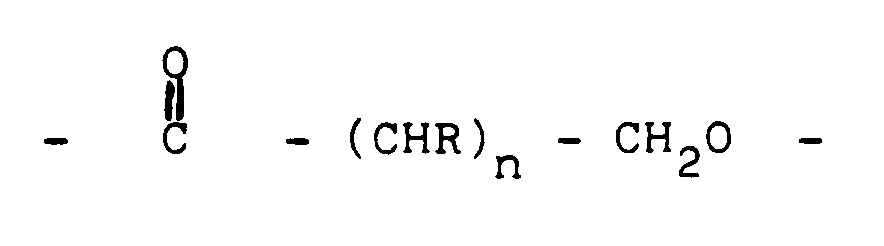
entsprechen, in der n mindestens 4, bevorzugt 4 bis 6, ist und der Substituent Wasserstoff, ein Alkylrest, ein Cycloalkylrest oder ein Alkoxyrest ist. - Als Katalysatoren können z.B. ein oder mehrere basische Stickstoffatome enthaltende Verbindungen eingesetzt werden.
- Bevorzugterweise werden tertiäre Amine, wie z.B. N,N-Dimethylbenzylamin, Tributylamin, Dimethylcyclohexylamin und Dimethyl-C₁₂/C₁₄-amin (C₁₂/C₁₄ steht für eine 12 bis 14 C-Atome enthaltende aliphatische Kette) verwendet.
- Der Katalysator wird in der Regel in einer Menge von 0,1 bis 2 Gew.-%, bezogen auf das aus den Komponenten (A) und (B) entstehende Zwischenprodukt, eingesetzt.
- Die Reaktion zwischen den Komponenten (A) und (B) wird bei Temperaturen zwischen 100 und 190°C, vorzugsweise zwischen 100 und 180°C, durchgeführt.
- Im zweiten Schritt des erfindungsgemäßen Verfahrens wird ein Lösemittel oder Lösemittelgemisch unter Kühlen mittels eines Sekundärkreislaufs (z.B. Kühlen über mit Wärmeträgeröl oder Wasser gefüllte Kühlschlangen) zu der Harzlösung gegeben. Als Zusatz eignen sich bevorzugt Lösemittel, die nicht mit den noch vorhandenen Epoxidgruppen reagieren können und/oder als Lösemittel dem Elektrotauchlack später ohnehin zugesetzt würden. Besonders bevorzugt sind Ketone wie z.B. Aceton, Methylethylketon, Methylisobutylketon, Mesityloxid; Acetate wie z.B. Propylacetat, Butylacetat; Ether wie z.B. Dioxan, Dibutylether; Aromaten wie z.B. Toluol, Xylol, Ethylbenzol und die Mischungen der Lösemittel. Durch vorsichtiges Anlegen eines Vakuums wird die Harzlösung zum Rückflußsieden gebracht. Ein gelegentliches Aufschäumen wird durch entsprechende Minderung des Unterdrucks unter Kontrolle gebracht. Mit sinkender Temperatur wird der Druck allmählich weiter erniedrigt, um ein gleichmäßiges Sieden zu erreichen. Ggf. kann auch kontinuierlich oder portionsweise während des Abkühlens weiteres Lösemittel zugesetzt werden.
- Als Komponente (E) in Schritt (3) des erfindungsgemäßen Verfahrens können primäre und/oder sekundäre Amine verwendet werden, wobei die sekundären Amine besonders bevorzugte Komponenten (E) sind.
- Bevorzugt sollte das Amin eine in Wasser lösliche Verbindung sein. Beispiele solcher Amine sind Mono- und Dialkylamine wie Methylamin, Ethylamin, Propylamin, Butylamin, Dimethylamin, Diethylamin, Dipropylamin, Methylbutylamin und dergleichen. Geeignet sind ebenfalls Alkanolamine, wie z.B. Methylethanolamin, Diethanolamin und dergleichen. Ferner sind Dialkylaminoalkylamine wie z.B. Dimethylaminoethylamin, Diethylaminopropylamin, Dimethylaminopropylamin und dergleichen geeignet. In den meisten Fällen werden niedermolekulare Amine verwendet, doch ist es auch möglich, höhermolekulare Monoamine anzuwenden.
- Polyamine mit primären und sekundären Aminogruppen können in Form ihrer Ketimine mit den Epoxidgruppen umgesetzt werden. Die Ketimine werden aus den Polyaminen in bekannter Weise hergestellt.
- Die Amine können auch noch andere Gruppen enthalten, doch sollen diese die Umsetzung des Amins mit der Epoxygruppe nicht stören und auch nicht zu einer Gelierung der Reaktionsmischung führen.
- Die Reaktion zwischen Aminen und epoxidgruppenhaltigen Verbindungen springt häufig schon bei Vermischen der Reaktionspartner an. Je nach gewünschtem Reaktionsverlauf - vor allem zur Vervollständigung der Umsetzung - ist es empfehlenswert, im Verlauf der Reaktion die Reaktionstemperatur auf 50 bis 150°C zu erhöhen.
- Der im letzten Schritt des erfindungsgemäßen Verfahrens zugesetzte Vernetzer (F) für gesenkte Einbrenntemperaturen ist ein mit Aminogruppen blockiertes Polyisocyanat. Hergestellt werden diese Vernetzer durch Umsetzung von Polyisocyanat mit dem entsprechenden sekundären Amin. Die Isocyanate können aliphatisch oder aromatisch sein, für Vernetzer für gesenkte Einbrenntemperaturen werden bevorzugt aromatische Isocyanate eingesetzt.
- Typische Beispiele für aliphatische Polyisocyanate sind Alkylenisocyanate wie z.B. Trimethylen-, Tetramethylen-, Pentamethylen-, Hexamethylen-, 1,2-Propylen-, 1,2-Butylen-, 2,3-Butylen-, 1,3-Butylen-, Ethyliden- und Butylidendiisocyanat sowie Cycloalkylenisocyanate wie z.B. 1,3-Cyclopentan-, 1,4-Cyclohexan-, 1,2-Cyclohexan- und Isophorondiisocyanat.
- Typische Beispiele für aromatische Polyisocyanate sind Arylenisocyanate wie z.B. m-Phenylen-, p-Phenylen-, 4,4′-Diphenyl-, 1,5-Naphthalin- und 1,4-Naphthalindiisocyanat sowie Alkarylenisocyanate wie z.B. 4,4′-Diphenylenmethan-, 2,4- oder 2,6-Toluylen- oder 2,4-/2,6-Toluylen-Gemische, 4,4′-Toluidin- und 1,4-Xylylendiisocyanat sowie substituierte aromatische Systeme wie z.B. Dianisidindiisocyanate, 4,4′-Diphenyletherdiisocyanate oder Chlorodiphenylendiisocyanate, 1,3,5-Triisocyanatobenzol, 2,4,6-Triisocyanatotoluol und 4,4′-Diphenyldimethylmethan-2,2′,5,5′-Tetraisocyanat sowie polymerisierte Isocyanate.
- Zum Blockieren der Isocyanatgruppe werden für Vernetzer für gesenkte Einbrenntemperaturen bevorzugt sekundäre Amine eingesetzt.
- Als sekundäre Monoamine kommen vor allem sekundäre aliphatische, cycloaliphatische oder araliphatische Amine mit einem Siedepunkt unter 200°C in Betracht, bevorzugt sind solche mit einem Siedepunkt zwischen 100 und 200°C. Beispiele geeigneter sekundärer aliphatischer Amine sind Dimethylamin, Diethylamin, Dipropylamin, Dibutylamin, Dipentylamin, Dihexylamin und Isomere davon, wie z.B. Diisopropylamin, auch asymmetrische, wie N-Ethyl-1-propanamin. Beispiele geeigneter cycloaliphatischer bzw. araliphatischer Amine sind Dicyclohexylamin und N-Methylanilin.
- Die Umsetzung erfolgt bei den für Isocyanatreaktionen üblichen Bedingungen, die Reaktionstemperatur kann von Raumtemperatur bis etwa 150°C betragen. Sind die Einsatzstoffe und das Reaktionsprodukt bei Reaktionstemperatur flüssig, so kann ohne Lösungsmittel gearbeitet werden, im allgemeinen wird man die Reaktion jedoch in einem inerten Lösungsmittel wie einem Ether, Ester, Keton oder Kohlenwasserstoff durchführen.
- Die Zugabe des oben beschriebenen Vernetzers kann direkt im Anschluß an Schritt (3) des erfindungsgemäßen Verfahrens erfolgen und die resultierende Mischung in einer Wasser/Säure-Mischung dispergiert werden, bevorzugt werden jedoch erst die Reaktionsprodukte aus Schritt (3) in einer Wasser/Säure-Mischung dispergiert und dann erst der Vernetzer zugefügt.
- Zur Herstellung der Wasser/Säure-Mischungen werden organische Säuren wie z.B. Ameisensäure, Essigsäure oder Milchsäure verwendet.
- Die Durchführung des erfindungsgemäßen Verfahrens zur Herstellung wäßriger Dispersionen für die Weiterverarbeitung zu Elektrotauchlacken mit niedrigen Einbrenntemperaturen wird im folgenden anhand von Beispielen erläutert. Sofern nicht anders angegeben, sind %-Angaben Gewichtsprozentangaben.
- Das nachfolgende Beispiel beschreibt den Aufbau eines mit einer Monophenolverbindung modifizierten Epoxid-Amin-Harzes, die Zugabe eines Vernetzers und die Herstellung einer wäßrigen Dispersion dieser Mischung.
- Zunächst wird der Vernetzer (I) folgendermaßen hergestellt:
In einem geeigneten Reaktionsgefäß werden unter Stickstoff 2440 g triisocyanuratisiertes Hexamethylendiisocyanat vorgelegt. Hierzu gibt man 850 g Methylisobutylketon (MIBK) und erwärmt auf 50°C. Danach gibt man 1560 g Di-n-butylamin zu. Man regelt die Zulaufgeschwindigkeit so, daß die Temperatur bei 60-70°C zu halten ist. Nach Ende des Zulaufs erhöht man die Temperatur auf 75°C, hält sie eine Stunde und fügt 150 g n-Butanol zu. Das Produkt weist einen Festkörper von 80 % auf (130°C, 1 h). Das NCO- und Aminäquivalent liegt jeweils über 20 000. - Zum Aufbau des Epoxidharzes werden in einem doppelwandigen, wärmeträgerölbeheizbaren Reaktor mit Rührer, Rückflußkühler, Wasserabscheider, Inertgaszuleitung und Vakuumverbindung 1884 g eines Epoxidharzes auf Basis Bisphenol A mit einem Epoxidäquivalentgewicht (EEW) von 188, 286 g Bisphenol A und 623 g Dodecylphenol zusammen mit 147 g Xylol vorgelegt und auf 110°C erwärmt. Durch Anlegen eines leichten Vakuums werden über einen Wasserabscheider Wasserspuren im Kreislaufverfahren destillativ entfernt. Sodann erwärmt man auf 130°C und gibt 11 g N,N-Dimethylbenzylamin zu, wobei die Temperatur kurzzeitig auf 150°C ansteigt. Man läßt anschließend auf 130°C kühlen und hält diese Temperatur, bis das Reaktionsgemisch ein EEW von 1240 aufweist (ca. 5 Std.). Zum Abbruch der Reaktion wird nun über einen Sekundärkreislauf gekühlt und in rascher Abfolge 225 g Xylol und 52 g Butylglykol zugegeben. Durch vorsichtiges Anlegen von Vakuum wird die Harzlösung zum Rückflußsieden gebracht; ein gelegentliches Aufschäumen wird durch entsprechende Minderung des Unterdrucks unter Kontrolle gebracht. Wenn kurze Zeit später 95°C erreicht sind, hebt man das Vakuum auf und gibt 783 g einer 70%igen Lösung eines Umsetzungsproduktes aus 1 Mol Diethylentriamin und 2 Mol Methylisobutylketon (MIBK) in MIBK zu. Nach Abklingen der Exothermie heizt man innerhalb 30 min auf 120°C und hält diese Temperatur weitere 2 Stunden. Eine Probe dieses Harzes weist nun folgende Kennzahlen auf:
- Festkörper (30 min, 180°C):
- 80 %
- Basengehalt:
- 1,47 meq/g Festharz
- Das nachfolgende Beispiel beschreibt den Aufbau eines mit einer Monophenolverbindung modifizierten Epoxid-Amin-Harzes, die Zugabe eines Vernetzers und die Herstellung einer wäßrigen Dispersion dieser Mischung.
- Zunächst wird der Vernetzer (II) folgendermaßen hergestellt:
In einem Reaktionsgefäß werden unter Stickstoff 2088 g Toluylendiisocyanat und 1746 g MIBK vorgelegt und auf 50°C erwärmt. Danach werden 536 g Trimethylolpropan portionsweise zugegeben. Die Temperatur wird bei 55-60°C gehalten. Nach Ende der Zugabe hält man 1 Stunde auf dieser Temperatur, danach kühlt man auf 60°C und gibt 1450 g Di-n-butylamin so zu, daß die Temperatur bei 70-75°C zu halten ist. Nach Ende des Zulaufs läßt man noch 1 Stunde nachreagieren. Das Produkt hat einen Festkörper von 70 %. Das Aminäquivalent und das Isocyanatäquivalent liegen jeweils über 20 000. - Zum Aufbau des Epoxidharzes verfährt man analog zu Beispiel 1.
- 910 g der Harzlösung und 390 g des Vernetzers (II) werden gemischt und mit 21 g Eisessig versetzt. Anschließend werden 850 g Wasser portionsweise eingerührt. Man homogenisiert kurze Zeit und verdünnt mit 960 g Wasser in kleinen Portionen auf den Endfestkörper.
- Die Dispersionen werden in einer anschließenden Vakuumdestillation von flüchtigen Lösemitteln befreit, wobei das destillativ entfernte Lösemittel mengenmäßig durch Wasser ersetzt wird. Danach wird die Dispersion filtriert (33,4 % Festkörper (1 h, 130°C)).
- Man verfährt analog Beispiel 1, bis das EEW von 1240 erreicht ist. Danach fügt man 1785 g des Vernetzers (I) sowie 783 g eines Umsetzungsproduktes aus Diethylentriamin und Methylisobutylketon 70%ig in Methylisobutylketon zu. Es stellt sich eine Temperatur von 112°C ein. Diese Temperatur wird 1 Std. gehalten.
- 1200 g dieser Harzlösung werden mit 19 g Eisessig versetzt und 850 g Wasser portionsweise eingerührt. Man homogenisiert kurze Zeit und verdünnt mit 960 g Wasser in kleinen Portionen auf den Endfestkörper.
- Die Dispersion wird in einer anschließenden Vakuumdestillation von flüchtigen Lösemitteln befreit, wobei das destillativ entfernte Lösemittel mengenmäßig durch Wasser ersetzt wird. Danach wird die Dispersion filtriert (35,1 % Festkörper (1 h, 130°C)).
- Aus den in Beispiel 1 und 2 sowie im Vergleichsbeispiel beschriebenen Bindemitteldispersionen werden mit einer grauen Pigmentpaste Lackbäder angesetzt.
- Zur Darstellung einer grauen Pigmentpaste werden zu 953 Teilen eines handelsüblichen Epoxidharzes auf Basis Bisphenol A (Epoxidäquivalentgewicht von 890) 800 Teile Butylglykol gegeben. die Mischung wird auf 80°C erhitzt. In die Harzlösung werden dann 221 Teile eines Umsetzungsproduktes aus 101 Teilen Diethanolamin und 120 Teilen 80%iger, wäßriger Milchsäure gegeben. Man führt die Reaktion bei 80° durch, bis die Säurezahl unter 1 gefallen ist.
- 1800 Teile dieses Produktes werden mit 2447 Teilen entionisiertem Wasser vorgelegt und mit 2460 Teilen TiO₂, 590 Teilen eines Extenders auf Basis Aluminiumsilikat, 135 Teilen Bleisilikat und 37 Teilen Ruß vermengt. Diese Mischung wird in einem Mahlaggregat auf eine Hegman-Feinheit von 5 bis 7 zerkleinert. Danach gibt man 1255 Teile entionisiertes Wasser zu, um die gewünschte Pastenkonsistenz zu erreichen.
- Die Lackbäder erhält man durch Mischen von:
2280 Teilen entionisiertem Wasser
25 Teilen l0%iger Essigsäure
1920 Teilen wäßriger Vernetzer/Epoxidaminaddukt-Dispersion
775 Teilen Pigmentpaste - Die Abscheidung der Lackfilme erfolgt bei 26°C Badtemperatur während 120 Sekunden. Hierzu werden zinkphosphatierte Bleche als Kathode geschaltet und beschichtet. Die Härtung der abgeschiedenen Filme erfolgt während 20 Minuten bei der in der Tabelle mit den Abscheidedaten angegebenen Temperatur im Umluftofen.
- Die Ergebnisse der Abscheidungen sind in den folgenden Tabellen zusammengefaßt:
Abscheidedaten: Abscheidedaten Beispiel 1 Beispiel 2 Vergleichsbeispiel Abscheidespannung (V) 300 320 330 Filmdicke (µm) 23 21 19 Einbrenntemperatur (°C) 145 130 145 FORD-Umgriff (cm) 20,5 22 20 Mechanische Eigenschaften: Prüfverfahren Beispiel 1 Beispiel 2 Vergleichsbeispiel Erichsen-Tiefung (mm) 8 4 6 Gitterschnitt (0 bester, 5 schlechtester Wert) 0 0 1 Biegeprobe In Ordnung In Ordnung In Ordnung Kugelschlagtest (Impact-Test) (m kg) 0,92 0,69 0,69 Verlauf (0 bester, 5 schlechtester Wert) 0,5 1,5 4,5
Die Dispersion wird in einer anschließenden Vakuumdestillation von flüchtigen Lösemitteln befreit, wobei das destillativ entfernte Lösemittel mengenmäßig durch Wasser ersetzt wird. Danach wird die Dispersion filtriert (33,2 % Festkörper (1 h, 130°C)).
Claims (6)
- Verfahren zur Herstellung wäßriger, kathodisch abscheidbarer und thermisch bei Temperaturen unter 160° C und Einbrennzeiten ≦ 30 min durch zugemischte Vernetzer härtbarer Elektrotauchlacke, die als kathodisch abscheidbare Bindemittel modifizierte Epoxid-Aminaddukte und als Vernetzer mit Aminogruppen blockierte Polyisocyanate enthalten, bei dem(1)(A) Polyepoxide, die im Durchschnitt mehr als 1 Epoxidgruppe pro Molekül enthalten und(B) Verbindungen, die eine oder mehrere, bevorzugt 2, an aromatische und/oder (cyclo)aliphatische Molekülfragmente gebundene Hydroxylgruppen pro Molekül enthalten,
in Anwesenheit von Katalysatoren bei höheren Temperaturen, bevorzugt zwischen 100 und 180° C, zu(C) epoxidhaltigen Zwischenprodukten umgesetzt werden,(3)(E) Amine
an die im Zwischenprodukt noch vorhandenen freien Epoxidgruppen angelagert werden und entweder(4a) diese Reaktionsprodukte in einer Wasser-Säure-Mischung dispergiert und(F) mit Aminogruppen blockierte Polyisocyanate als Vernetzer zugemischt werden oder(4b) diesen Reaktionsprodukten(F) mit Aminogruppen blockierte Polyisocyanate als Vernetzer zugemischt werden und diese Mischung in einer Wasser-Säure-Mischung dispergiert wird,dadurch gekennzeichnet, daß(2) den in Stufe (1) erhaltenen epoxidgruppenhaltigen Zwischenprodukten zunächst ein Lösemittel (D) oder Lösemittelgemisch (D) unter äußerer Kühlung zugegeben wird und die entstandene Harzlösung, ggf. unter Anlegen eines Vakuums, so lange zum Rückflußsieden gebracht wird, bis die Temperatur der Lösung auf 95° C bis 20° C abgesunken ist. - Verfahren nach Anspruch 1, dadurch gekennzeichnet, daß die Polyisocyanate aliphatische Polyisocyanate sind.
- Verfahren nach Anspruch 1, dadurch gekennzeichnet, daß die Polyisocyanate aromatische Polyisocyanate sind.
- Verfahren nach einem der Ansprüche 1 bis 3, dadurch gekennzeichnet, daß als Lösemittel in Schritt (2) Stoffe eingesetzt werden, die nicht mit den noch vorhandenen Epoxidgruppen im Harz reagieren können.
- Verfahren nach einem der Ansprüche 1 bis 4, dadurch gekennzeichnet, daß die Harzlösung in Schritt (2) auf Temperaturen ≧ 50°C abgekühlt wird.
- Verfahren nach einem der Ansprüche 1 bis 5, dadurch gekennzeichnet, daß das Lösemittel nach Herstellung der wäßrigen Dispersion im Vakuum bei Temperaturen unter 65°C abgezogen wird.
Priority Applications (1)
| Application Number | Priority Date | Filing Date | Title |
|---|---|---|---|
| AT88118215T ATE76423T1 (de) | 1987-11-11 | 1988-11-02 | Verfahren zur herstellung kathodisch abscheidbarer bindemitteldispersionen mit vernetzern auf der basis von mit aminogruppen verkappten polyisocyanaten. |
Applications Claiming Priority (2)
| Application Number | Priority Date | Filing Date | Title |
|---|---|---|---|
| DE3738220 | 1987-11-11 | ||
| DE19873738220 DE3738220A1 (de) | 1987-11-11 | 1987-11-11 | Verfahren zur herstellung kathodisch abscheidbarer bindemitteldispersionen mit vernetzern auf der basis von mit aminogruppen verkappten polyisocyanaten |
Publications (2)
| Publication Number | Publication Date |
|---|---|
| EP0319703A1 EP0319703A1 (de) | 1989-06-14 |
| EP0319703B1 true EP0319703B1 (de) | 1992-05-20 |
Family
ID=6340237
Family Applications (2)
| Application Number | Title | Priority Date | Filing Date |
|---|---|---|---|
| EP19890900806 Pending EP0386150A1 (de) | 1987-11-11 | 1988-11-02 | Verfahren zur herstellung kathodisch abscheidbarer bindemitteldispersionen mit vernetzern auf der basis von mit aminogruppen verkappten polyisocyanaten |
| EP19880118215 Expired - Lifetime EP0319703B1 (de) | 1987-11-11 | 1988-11-02 | Verfahren zur Herstellung kathodisch abscheidbarer Bindemitteldispersionen mit Vernetzern auf der Basis von mit Aminogruppen verkappten Polyisocyanaten |
Family Applications Before (1)
| Application Number | Title | Priority Date | Filing Date |
|---|---|---|---|
| EP19890900806 Pending EP0386150A1 (de) | 1987-11-11 | 1988-11-02 | Verfahren zur herstellung kathodisch abscheidbarer bindemitteldispersionen mit vernetzern auf der basis von mit aminogruppen verkappten polyisocyanaten |
Country Status (8)
| Country | Link |
|---|---|
| EP (2) | EP0386150A1 (de) |
| JP (1) | JPH0710961B2 (de) |
| AT (1) | ATE76423T1 (de) |
| BR (1) | BR8807784A (de) |
| CA (1) | CA1329291C (de) |
| DE (2) | DE3738220A1 (de) |
| ES (1) | ES2031571T3 (de) |
| WO (1) | WO1989004352A1 (de) |
Families Citing this family (12)
| Publication number | Priority date | Publication date | Assignee | Title |
|---|---|---|---|---|
| CA2128843C (en) * | 1993-07-30 | 1997-10-07 | Susumu Midogohchi | Electrodepositable coating composition |
| DE19703869A1 (de) | 1997-02-03 | 1998-08-06 | Basf Coatings Ag | Wäßrige Bindemitteldispersion für kationische Elektrotauchlacke |
| US6248225B1 (en) | 1998-05-26 | 2001-06-19 | Ppg Industries Ohio, Inc. | Process for forming a two-coat electrodeposited composite coating the composite coating and chip resistant electrodeposited coating composition |
| US6423425B1 (en) | 1998-05-26 | 2002-07-23 | Ppg Industries Ohio, Inc. | Article having a chip-resistant electrodeposited coating and a process for forming an electrodeposited coating |
| DE19835703C1 (de) * | 1998-08-07 | 1999-05-20 | Bayer Ag | N,N'-disubstituierte N-(2-hydroxyalkyl)-Harnstoffe |
| DE10236350A1 (de) | 2002-08-08 | 2004-02-19 | Basf Coatings Ag | Bismutverbindungen enthaltende Elektrotauchlacke (ETL) |
| US20060106188A1 (en) * | 2004-11-15 | 2006-05-18 | Ulrich Hermann | Thermally curable coating compositions |
| DE102007038824A1 (de) | 2007-08-16 | 2009-02-19 | Basf Coatings Ag | Einsatz von Bismutsubnitrat in Elektrotauchlacken |
| DE102008016220A1 (de) | 2008-03-27 | 2009-10-01 | Basf Coatings Ag | Elektrotauchlacke enthaltend Polymethylenharnstoff |
| JP2010254976A (ja) * | 2009-03-30 | 2010-11-11 | Sanyo Chem Ind Ltd | カチオン電着塗料組成物 |
| WO2015090444A1 (de) | 2013-12-20 | 2015-06-25 | Basf Coatings Gmbh | Pigment und füllstoff enthaltende formulierungen |
| EP3854831A1 (de) | 2020-01-24 | 2021-07-28 | BASF Coatings GmbH | Verbindung enthaltend vollständig blockierte isocyanat- und silangruppen und deren verwendung als vernetzer in elektrotauchlackierungsmaterialien |
Family Cites Families (6)
| Publication number | Priority date | Publication date | Assignee | Title |
|---|---|---|---|---|
| SU691787A1 (ru) * | 1976-06-14 | 1979-10-15 | Украинское Отделение Всесоюзного Государственного Проектно-Изыскательского И Научно-Исследовательского Института Сельэнергопроект | Устройство дл измерени износа силовых трансформаторов |
| US4115328A (en) * | 1977-01-07 | 1978-09-19 | Ciba-Geigy Corporation | Process for making stable solvent-free, aqueous epoxy resin dispersions |
| DE3108073C2 (de) * | 1981-03-04 | 1983-10-06 | Basf Farben + Fasern Ag, 2000 Hamburg | Wasserdispergierbare Bindemittel für kationische Elektrotauchlacke |
| JPS5840412A (ja) * | 1981-09-04 | 1983-03-09 | Matsushita Electric Ind Co Ltd | 石油燃焼器 |
| DE3311516A1 (de) * | 1983-03-30 | 1984-10-04 | Basf Farben + Fasern Ag, 2000 Hamburg | Hitzehaertbare ueberzugsmittel und deren verwendung |
| DE3331903A1 (de) * | 1983-09-03 | 1985-03-21 | Basf Farben + Fasern Ag, 2000 Hamburg | Wasserdispergierbare bindemittel fuer kationische elektrotauchlacke und verfahren zu ihrer herstellung |
-
1987
- 1987-11-11 DE DE19873738220 patent/DE3738220A1/de not_active Withdrawn
-
1988
- 1988-11-02 DE DE8888118215T patent/DE3871349D1/de not_active Expired - Lifetime
- 1988-11-02 WO PCT/EP1988/000994 patent/WO1989004352A1/de not_active Ceased
- 1988-11-02 BR BR888807784A patent/BR8807784A/pt not_active IP Right Cessation
- 1988-11-02 JP JP1500715A patent/JPH0710961B2/ja not_active Expired - Lifetime
- 1988-11-02 ES ES198888118215T patent/ES2031571T3/es not_active Expired - Lifetime
- 1988-11-02 EP EP19890900806 patent/EP0386150A1/de active Pending
- 1988-11-02 AT AT88118215T patent/ATE76423T1/de not_active IP Right Cessation
- 1988-11-02 EP EP19880118215 patent/EP0319703B1/de not_active Expired - Lifetime
- 1988-11-10 CA CA000582703A patent/CA1329291C/en not_active Expired - Lifetime
Also Published As
| Publication number | Publication date |
|---|---|
| JPH0710961B2 (ja) | 1995-02-08 |
| WO1989004352A1 (fr) | 1989-05-18 |
| CA1329291C (en) | 1994-05-03 |
| JPH03500057A (ja) | 1991-01-10 |
| ATE76423T1 (de) | 1992-06-15 |
| ES2031571T3 (es) | 1992-12-16 |
| BR8807784A (pt) | 1990-10-16 |
| EP0319703A1 (de) | 1989-06-14 |
| DE3738220A1 (de) | 1989-05-24 |
| EP0386150A1 (de) | 1990-09-12 |
| DE3871349D1 (de) | 1992-06-25 |
Similar Documents
| Publication | Publication Date | Title |
|---|---|---|
| EP0961797B1 (de) | Wässrige bindemitteldispersion für kationische elektrotauchlacke | |
| DE2701002C2 (de) | Verfahren zur Herstellung einer wässrigen Dispersion eines kationischen Kunstharzes | |
| EP0385293B1 (de) | Hitzehärtbares Überzugsmittel für die kathodische Elektrotauchlackierung | |
| DE3103642A1 (de) | Hitzehaertbare bindemittelmischung | |
| EP0134983B1 (de) | Stickstoffbasische Gruppen tragendes Kunstharz, dessen Herstellung und Verwendung | |
| EP0319703A1 (de) | Verfahren zur Herstellung kathodisch abscheidbarer Bindemitteldispersionen mit Vernetzern auf der Basis von mit Aminogruppen verkappten Polyisocyanaten | |
| EP0138922A1 (de) | Hitzehärtbare bindemittelmischung. | |
| DE3825584A1 (de) | Traegerharz fuer pigmentpasten, seine herstellung und verwendung | |
| EP0350618B1 (de) | Trägerharz für Pigmentpasten, seine Herstellung und Verwendung | |
| EP0643111A1 (de) | Lösemittelfreie, wässrige Kunstharzdispersion | |
| EP0249850A2 (de) | Selbstvernetzende kationische Lackbindemittel | |
| EP0319709B1 (de) | Verfahren zur Herstellung abscheidbarer Bindemitteldispersionen mit Vernetzern auf der Basis von mit Hydroxylgruppen verkappten Polyisocyanaten | |
| EP0154775B1 (de) | Wasserdispergierbare Bindemittel auf der Basis von modifizierten Epoxid-Amin-Addukten, deren Herstellung und Verwendung | |
| WO1984002713A1 (fr) | Liants pouvant etre disperses dand l'eau pour laques electro-phoretiques cationiques et leur procede de fabrication | |
| EP0334284B1 (de) | Härter für Kunstharze, diesen enthaltende härtbare Mischungen sowie dessen Verwendung | |
| EP0184152B1 (de) | Stickstoffbasische Gruppen tragendes Kunstharz, dessen Herstellung und Verwendung | |
| US20050209372A1 (en) | Process for the preparation of binder dispersions capable of being cathodically deposited using crosslinking agents based on polyisocyanates blocked by amino groups | |
| DE3738218C2 (de) | ||
| DE4331780A1 (de) | Lösemittelarme wäßrige Dispersionen, deren Herstellung und Verwendung in Überzugsmitteln zur kathodischen Tauchlackierung | |
| EP0352457B1 (de) | Wasserdispergierbare Bindemittel für kationische Elektrotauchlacke, Verfahren zu ihrer Herstellung sowie Verfahren zur Beschichtung elektrisch leitfähiger Substrate | |
| DE3735603A1 (de) | Waessrige elektrotauchlacke und verfahren zur beschichtung elektrisch leitfaehiger substrate | |
| EP0581175A2 (de) | Epoxidharze und ihre Verwendung für die Elektrotauchlackierung | |
| DE3736995A1 (de) | Stickstoffbasische gruppen tragendes kunstharz und dessen verwendung |
Legal Events
| Date | Code | Title | Description |
|---|---|---|---|
| PUAI | Public reference made under article 153(3) epc to a published international application that has entered the european phase |
Free format text: ORIGINAL CODE: 0009012 |
|
| AK | Designated contracting states |
Kind code of ref document: A1 Designated state(s): ES |
|
| 17P | Request for examination filed |
Effective date: 19891116 |
|
| 17Q | First examination report despatched |
Effective date: 19910402 |
|
| XX | Miscellaneous (additional remarks) |
Free format text: VERBUNDEN MIT 89900806.4/0386150 (EUROPAEISCHE ANMELDENUMMER/VEROEFFENTLICHUNGSNUMMER) DURCH ENTSCHEIDUNG VOM 17.09.91. |
|
| GRAA | (expected) grant |
Free format text: ORIGINAL CODE: 0009210 |
|
| AK | Designated contracting states |
Kind code of ref document: B1 Designated state(s): AT BE CH DE ES FR GB IT LI NL SE |
|
| REF | Corresponds to: |
Ref document number: 76423 Country of ref document: AT Date of ref document: 19920615 Kind code of ref document: T |
|
| XX | Miscellaneous (additional remarks) |
Free format text: VERBUNDEN MIT 89900806.4/0386150 (EUROPAEISCHE ANMELDENUMMER/VEROEFFENTLICHUNGSNUMMER) DURCH ENTSCHEIDUNG VOM 17.09.91. |
|
| REF | Corresponds to: |
Ref document number: 3871349 Country of ref document: DE Date of ref document: 19920625 |
|
| ET | Fr: translation filed | ||
| GBT | Gb: translation of ep patent filed (gb section 77(6)(a)/1977) | ||
| ITF | It: translation for a ep patent filed | ||
| RAP4 | Party data changed (patent owner data changed or rights of a patent transferred) |
Owner name: BASF LACKE + FARBEN AG |
|
| REG | Reference to a national code |
Ref country code: ES Ref legal event code: FG2A Ref document number: 2031571 Country of ref document: ES Kind code of ref document: T3 |
|
| PLBE | No opposition filed within time limit |
Free format text: ORIGINAL CODE: 0009261 |
|
| STAA | Information on the status of an ep patent application or granted ep patent |
Free format text: STATUS: NO OPPOSITION FILED WITHIN TIME LIMIT |
|
| 26N | No opposition filed | ||
| EAL | Se: european patent in force in sweden |
Ref document number: 88118215.8 |
|
| REG | Reference to a national code |
Ref country code: ES Ref legal event code: PC2A |
|
| PGFP | Annual fee paid to national office [announced via postgrant information from national office to epo] |
Ref country code: GB Payment date: 20011022 Year of fee payment: 14 |
|
| PGFP | Annual fee paid to national office [announced via postgrant information from national office to epo] |
Ref country code: ES Payment date: 20011114 Year of fee payment: 14 |
|
| PGFP | Annual fee paid to national office [announced via postgrant information from national office to epo] |
Ref country code: SE Payment date: 20011121 Year of fee payment: 14 |
|
| PGFP | Annual fee paid to national office [announced via postgrant information from national office to epo] |
Ref country code: FR Payment date: 20011122 Year of fee payment: 14 |
|
| PGFP | Annual fee paid to national office [announced via postgrant information from national office to epo] |
Ref country code: AT Payment date: 20011123 Year of fee payment: 14 |
|
| PGFP | Annual fee paid to national office [announced via postgrant information from national office to epo] |
Ref country code: NL Payment date: 20011127 Year of fee payment: 14 Ref country code: BE Payment date: 20011127 Year of fee payment: 14 |
|
| PGFP | Annual fee paid to national office [announced via postgrant information from national office to epo] |
Ref country code: CH Payment date: 20011207 Year of fee payment: 14 |
|
| PGFP | Annual fee paid to national office [announced via postgrant information from national office to epo] |
Ref country code: DE Payment date: 20011211 Year of fee payment: 14 |
|
| REG | Reference to a national code |
Ref country code: GB Ref legal event code: IF02 |
|
| PG25 | Lapsed in a contracting state [announced via postgrant information from national office to epo] |
Ref country code: GB Free format text: LAPSE BECAUSE OF NON-PAYMENT OF DUE FEES Effective date: 20021102 Ref country code: AT Free format text: LAPSE BECAUSE OF NON-PAYMENT OF DUE FEES Effective date: 20021102 |
|
| PG25 | Lapsed in a contracting state [announced via postgrant information from national office to epo] |
Ref country code: SE Free format text: LAPSE BECAUSE OF NON-PAYMENT OF DUE FEES Effective date: 20021103 Ref country code: ES Free format text: LAPSE BECAUSE OF NON-PAYMENT OF DUE FEES Effective date: 20021103 |
|
| PG25 | Lapsed in a contracting state [announced via postgrant information from national office to epo] |
Ref country code: LI Free format text: LAPSE BECAUSE OF NON-PAYMENT OF DUE FEES Effective date: 20021130 Ref country code: CH Free format text: LAPSE BECAUSE OF NON-PAYMENT OF DUE FEES Effective date: 20021130 Ref country code: BE Free format text: LAPSE BECAUSE OF NON-PAYMENT OF DUE FEES Effective date: 20021130 |
|
| BERE | Be: lapsed |
Owner name: *BASF LACKE + FARBEN A.G. Effective date: 20021130 |
|
| PG25 | Lapsed in a contracting state [announced via postgrant information from national office to epo] |
Ref country code: NL Free format text: LAPSE BECAUSE OF NON-PAYMENT OF DUE FEES Effective date: 20030601 |
|
| PG25 | Lapsed in a contracting state [announced via postgrant information from national office to epo] |
Ref country code: DE Free format text: LAPSE BECAUSE OF NON-PAYMENT OF DUE FEES Effective date: 20030603 |
|
| GBPC | Gb: european patent ceased through non-payment of renewal fee | ||
| EUG | Se: european patent has lapsed | ||
| REG | Reference to a national code |
Ref country code: CH Ref legal event code: PL |
|
| PG25 | Lapsed in a contracting state [announced via postgrant information from national office to epo] |
Ref country code: FR Free format text: LAPSE BECAUSE OF NON-PAYMENT OF DUE FEES Effective date: 20030731 |
|
| NLV4 | Nl: lapsed or anulled due to non-payment of the annual fee |
Effective date: 20030601 |
|
| REG | Reference to a national code |
Ref country code: FR Ref legal event code: ST |
|
| REG | Reference to a national code |
Ref country code: ES Ref legal event code: FD2A Effective date: 20031213 |
|
| PG25 | Lapsed in a contracting state [announced via postgrant information from national office to epo] |
Ref country code: IT Free format text: LAPSE BECAUSE OF NON-PAYMENT OF DUE FEES;WARNING: LAPSES OF ITALIAN PATENTS WITH EFFECTIVE DATE BEFORE 2007 MAY HAVE OCCURRED AT ANY TIME BEFORE 2007. THE CORRECT EFFECTIVE DATE MAY BE DIFFERENT FROM THE ONE RECORDED. Effective date: 20051102 |