EP0319244A2 - Air cooled metal ceramic x-ray tube construction - Google Patents
Air cooled metal ceramic x-ray tube construction Download PDFInfo
- Publication number
- EP0319244A2 EP0319244A2 EP19880311291 EP88311291A EP0319244A2 EP 0319244 A2 EP0319244 A2 EP 0319244A2 EP 19880311291 EP19880311291 EP 19880311291 EP 88311291 A EP88311291 A EP 88311291A EP 0319244 A2 EP0319244 A2 EP 0319244A2
- Authority
- EP
- European Patent Office
- Prior art keywords
- ray tube
- shaft
- tube construction
- heat
- sleeve
- Prior art date
- Legal status (The legal status is an assumption and is not a legal conclusion. Google has not performed a legal analysis and makes no representation as to the accuracy of the status listed.)
- Granted
Links
- 238000010276 construction Methods 0.000 title claims abstract description 161
- 229910052751 metal Inorganic materials 0.000 title claims abstract description 35
- 239000002184 metal Substances 0.000 title claims abstract description 35
- 239000000919 ceramic Substances 0.000 title claims description 34
- 239000000463 material Substances 0.000 claims description 41
- 239000010935 stainless steel Substances 0.000 claims description 35
- 229910001220 stainless steel Inorganic materials 0.000 claims description 35
- 229910052802 copper Inorganic materials 0.000 claims description 30
- 239000010949 copper Substances 0.000 claims description 30
- RYGMFSIKBFXOCR-UHFFFAOYSA-N Copper Chemical compound [Cu] RYGMFSIKBFXOCR-UHFFFAOYSA-N 0.000 claims description 29
- 239000004020 conductor Substances 0.000 claims description 28
- 230000008878 coupling Effects 0.000 claims description 27
- 238000010168 coupling process Methods 0.000 claims description 27
- 238000005859 coupling reaction Methods 0.000 claims description 27
- PXHVJJICTQNCMI-UHFFFAOYSA-N Nickel Chemical compound [Ni] PXHVJJICTQNCMI-UHFFFAOYSA-N 0.000 claims description 22
- 239000011810 insulating material Substances 0.000 claims description 21
- 238000012546 transfer Methods 0.000 claims description 18
- 229910052790 beryllium Inorganic materials 0.000 claims description 15
- ATBAMAFKBVZNFJ-UHFFFAOYSA-N beryllium atom Chemical compound [Be] ATBAMAFKBVZNFJ-UHFFFAOYSA-N 0.000 claims description 15
- 241000555745 Sciuridae Species 0.000 claims description 13
- 229910052782 aluminium Inorganic materials 0.000 claims description 12
- XAGFODPZIPBFFR-UHFFFAOYSA-N aluminium Chemical compound [Al] XAGFODPZIPBFFR-UHFFFAOYSA-N 0.000 claims description 12
- 229910052759 nickel Inorganic materials 0.000 claims description 11
- 238000010894 electron beam technology Methods 0.000 claims description 10
- 229910000831 Steel Inorganic materials 0.000 claims description 9
- 238000000576 coating method Methods 0.000 claims description 9
- 239000010959 steel Substances 0.000 claims description 9
- 239000011248 coating agent Substances 0.000 claims description 8
- 229920002631 room-temperature vulcanizate silicone Polymers 0.000 claims description 8
- VYZAMTAEIAYCRO-UHFFFAOYSA-N Chromium Chemical compound [Cr] VYZAMTAEIAYCRO-UHFFFAOYSA-N 0.000 claims description 7
- 229910052804 chromium Inorganic materials 0.000 claims description 7
- 239000011651 chromium Substances 0.000 claims description 7
- 230000000694 effects Effects 0.000 claims description 7
- 229910000856 hastalloy Inorganic materials 0.000 claims description 6
- 239000010955 niobium Substances 0.000 claims description 5
- GUCVJGMIXFAOAE-UHFFFAOYSA-N niobium atom Chemical compound [Nb] GUCVJGMIXFAOAE-UHFFFAOYSA-N 0.000 claims description 5
- WGLPBDUCMAPZCE-UHFFFAOYSA-N Trioxochromium Chemical compound O=[Cr](=O)=O WGLPBDUCMAPZCE-UHFFFAOYSA-N 0.000 claims description 4
- 229910000423 chromium oxide Inorganic materials 0.000 claims description 4
- 239000004945 silicone rubber Substances 0.000 claims description 4
- 230000006378 damage Effects 0.000 claims description 3
- 239000004636 vulcanized rubber Substances 0.000 claims description 3
- 150000001875 compounds Chemical class 0.000 claims 1
- 210000003414 extremity Anatomy 0.000 description 21
- 238000005219 brazing Methods 0.000 description 19
- 238000001816 cooling Methods 0.000 description 17
- 239000003570 air Substances 0.000 description 16
- 230000008439 repair process Effects 0.000 description 10
- 229910000833 kovar Inorganic materials 0.000 description 8
- 230000005855 radiation Effects 0.000 description 8
- 229920001971 elastomer Polymers 0.000 description 7
- 238000003754 machining Methods 0.000 description 7
- 230000000717 retained effect Effects 0.000 description 7
- 210000003141 lower extremity Anatomy 0.000 description 6
- 239000003921 oil Substances 0.000 description 6
- 239000010453 quartz Substances 0.000 description 6
- VYPSYNLAJGMNEJ-UHFFFAOYSA-N silicon dioxide Inorganic materials O=[Si]=O VYPSYNLAJGMNEJ-UHFFFAOYSA-N 0.000 description 6
- 241000234295 Musa Species 0.000 description 5
- 235000018290 Musa x paradisiaca Nutrition 0.000 description 5
- 229920002379 silicone rubber Polymers 0.000 description 5
- UFHFLCQGNIYNRP-UHFFFAOYSA-N Hydrogen Chemical compound [H][H] UFHFLCQGNIYNRP-UHFFFAOYSA-N 0.000 description 4
- 239000011521 glass Substances 0.000 description 4
- 238000010438 heat treatment Methods 0.000 description 4
- 229910052739 hydrogen Inorganic materials 0.000 description 4
- 239000001257 hydrogen Substances 0.000 description 4
- 238000003466 welding Methods 0.000 description 4
- OKTJSMMVPCPJKN-UHFFFAOYSA-N Carbon Chemical compound [C] OKTJSMMVPCPJKN-UHFFFAOYSA-N 0.000 description 3
- 229910002804 graphite Inorganic materials 0.000 description 3
- 239000010439 graphite Substances 0.000 description 3
- 238000005338 heat storage Methods 0.000 description 3
- 238000009413 insulation Methods 0.000 description 3
- 238000000034 method Methods 0.000 description 3
- 238000007747 plating Methods 0.000 description 3
- DMFGNRRURHSENX-UHFFFAOYSA-N beryllium copper Chemical compound [Be].[Cu] DMFGNRRURHSENX-UHFFFAOYSA-N 0.000 description 2
- 238000005266 casting Methods 0.000 description 2
- 238000013461 design Methods 0.000 description 2
- QDOXWKRWXJOMAK-UHFFFAOYSA-N dichromium trioxide Chemical compound O=[Cr]O[Cr]=O QDOXWKRWXJOMAK-UHFFFAOYSA-N 0.000 description 2
- 238000007667 floating Methods 0.000 description 2
- 230000017525 heat dissipation Effects 0.000 description 2
- 238000003384 imaging method Methods 0.000 description 2
- 238000009607 mammography Methods 0.000 description 2
- 238000004519 manufacturing process Methods 0.000 description 2
- DECCZIUVGMLHKQ-UHFFFAOYSA-N rhenium tungsten Chemical compound [W].[Re] DECCZIUVGMLHKQ-UHFFFAOYSA-N 0.000 description 2
- 239000007787 solid Substances 0.000 description 2
- 210000001364 upper extremity Anatomy 0.000 description 2
- 229910000881 Cu alloy Inorganic materials 0.000 description 1
- ZOKXTWBITQBERF-UHFFFAOYSA-N Molybdenum Chemical compound [Mo] ZOKXTWBITQBERF-UHFFFAOYSA-N 0.000 description 1
- 229910052581 Si3N4 Inorganic materials 0.000 description 1
- 238000010521 absorption reaction Methods 0.000 description 1
- 230000001133 acceleration Effects 0.000 description 1
- 239000012080 ambient air Substances 0.000 description 1
- 230000004888 barrier function Effects 0.000 description 1
- 238000005452 bending Methods 0.000 description 1
- 230000015572 biosynthetic process Effects 0.000 description 1
- 230000008859 change Effects 0.000 description 1
- ZTXONRUJVYXVTJ-UHFFFAOYSA-N chromium copper Chemical compound [Cr][Cu][Cr] ZTXONRUJVYXVTJ-UHFFFAOYSA-N 0.000 description 1
- 239000012459 cleaning agent Substances 0.000 description 1
- 238000004891 communication Methods 0.000 description 1
- 238000002591 computed tomography Methods 0.000 description 1
- 230000008602 contraction Effects 0.000 description 1
- 150000001879 copper Chemical class 0.000 description 1
- 238000005520 cutting process Methods 0.000 description 1
- 238000010292 electrical insulation Methods 0.000 description 1
- 229910001026 inconel Inorganic materials 0.000 description 1
- 238000010348 incorporation Methods 0.000 description 1
- 238000003780 insertion Methods 0.000 description 1
- 230000037431 insertion Effects 0.000 description 1
- 230000002452 interceptive effect Effects 0.000 description 1
- 238000005495 investment casting Methods 0.000 description 1
- 239000005355 lead glass Substances 0.000 description 1
- 239000000696 magnetic material Substances 0.000 description 1
- 229910052750 molybdenum Inorganic materials 0.000 description 1
- 239000011733 molybdenum Substances 0.000 description 1
- 230000003647 oxidation Effects 0.000 description 1
- 238000007254 oxidation reaction Methods 0.000 description 1
- 239000004033 plastic Substances 0.000 description 1
- 229920003023 plastic Polymers 0.000 description 1
- 238000002360 preparation method Methods 0.000 description 1
- 230000008569 process Effects 0.000 description 1
- 230000000644 propagated effect Effects 0.000 description 1
- 230000009467 reduction Effects 0.000 description 1
- 229910052702 rhenium Inorganic materials 0.000 description 1
- WUAPFZMCVAUBPE-UHFFFAOYSA-N rhenium atom Chemical compound [Re] WUAPFZMCVAUBPE-UHFFFAOYSA-N 0.000 description 1
- HQVNEWCFYHHQES-UHFFFAOYSA-N silicon nitride Chemical compound N12[Si]34N5[Si]62N3[Si]51N64 HQVNEWCFYHHQES-UHFFFAOYSA-N 0.000 description 1
- 229910052709 silver Inorganic materials 0.000 description 1
- 239000004332 silver Substances 0.000 description 1
- 238000005476 soldering Methods 0.000 description 1
- 125000006850 spacer group Chemical group 0.000 description 1
- 230000001629 suppression Effects 0.000 description 1
- 238000002207 thermal evaporation Methods 0.000 description 1
- WFKWXMTUELFFGS-UHFFFAOYSA-N tungsten Chemical compound [W] WFKWXMTUELFFGS-UHFFFAOYSA-N 0.000 description 1
- 229910052721 tungsten Inorganic materials 0.000 description 1
- 239000010937 tungsten Substances 0.000 description 1
- 125000000391 vinyl group Chemical group [H]C([*])=C([H])[H] 0.000 description 1
- 229920002554 vinyl polymer Polymers 0.000 description 1
- 238000004073 vulcanization Methods 0.000 description 1
- 238000004804 winding Methods 0.000 description 1
Images





Classifications
-
- H—ELECTRICITY
- H01—ELECTRIC ELEMENTS
- H01J—ELECTRIC DISCHARGE TUBES OR DISCHARGE LAMPS
- H01J35/00—X-ray tubes
- H01J35/02—Details
- H01J35/16—Vessels; Containers; Shields associated therewith
-
- H—ELECTRICITY
- H01—ELECTRIC ELEMENTS
- H01J—ELECTRIC DISCHARGE TUBES OR DISCHARGE LAMPS
- H01J35/00—X-ray tubes
- H01J35/02—Details
- H01J35/04—Electrodes ; Mutual position thereof; Constructional adaptations therefor
- H01J35/08—Anodes; Anti cathodes
- H01J35/10—Rotary anodes; Arrangements for rotating anodes; Cooling rotary anodes
- H01J35/105—Cooling of rotating anodes, e.g. heat emitting layers or structures
- H01J35/107—Cooling of the bearing assemblies
-
- H—ELECTRICITY
- H05—ELECTRIC TECHNIQUES NOT OTHERWISE PROVIDED FOR
- H05G—X-RAY TECHNIQUE
- H05G1/00—X-ray apparatus involving X-ray tubes; Circuits therefor
- H05G1/02—Constructional details
- H05G1/025—Means for cooling the X-ray tube or the generator
-
- H—ELECTRICITY
- H01—ELECTRIC ELEMENTS
- H01J—ELECTRIC DISCHARGE TUBES OR DISCHARGE LAMPS
- H01J2235/00—X-ray tubes
- H01J2235/16—Vessels
- H01J2235/165—Shielding arrangements
- H01J2235/168—Shielding arrangements against charged particles
Definitions
- This invention relates to x-ray tubes and more particularly to air cooled metal ceramic x-ray tubes.
- both the anode and the cathode are vacuum sealed in a glass envelope. Electrons released by the hot cathode filament are accelerated toward the anode by a high voltage. These high energy electrons generate x-rays upon impact on the solid anode and at the same time generate copious amounts of heat.
- the tube is mounted in a housing to protect the environment from unwanted x-rays.
- the housing typically of a rotating anode x-ray tube is filled with oil to provide electrical insulation and also to absorb heat generated by the anode.
- Such conventional x-ray tubes have numerous disadvantages including high cost and relatively short lifetimes. The oil cooling utilized greatly increases the cost of insulation and also inhibits repair of the same. There is therefore a need for a new and improved x-ray tube construction which overcomes these disadvantages.
- Another object of the invention is to provide a construction of the above character which can be manufactured to high precision allowing the incorporation of double-ended bearings.
- Another object of the invention is to provide an x-ray tube construction of the above character in which a precise focal spot alignment can be obtained.
- Another object of the invention is to provide an x-ray tube construction of the above character in which arcing created by filament evaporation onto glass is eliminated.
- Another object of the invention is to provide an x-ray tube construction of the above character in which the back scattered electrons are absorbed by surrounding metal resulting in less off focus radiation and improved image contrast.
- Another object of the invention is to provide an x-ray tube construction of the above character in which the bearings are protected from heat dissipated from the anode.
- Another object of the invention is to provide an x-ray tube construction of the above character in which the feedthroughs and in particular the cathode feedthrough is protected from the anode heat.
- Another object of the invention is to provide an x-ray tube construction of the above character which can withstand higher temperatures than can be accommodated with glass tubes.
- Another object of the invention is to provide an x-ray tube construction of the above character in which greatly improved heat dissipating qualities have been incorporated into the tube.
- Another object of the invention is to provide an x-ray tube construction of the above character having an improved x-ray window construction.
- Another object of the invention is to provide an x-ray tube construction of the above character which includes improved cable terminations.
- Another object of the invention is to provide an x-ray tube construction of the above character in which the high voltage receptacles provided can accommodate various types of federal standard terminals.
- Another object of the invention is to provide an x-ray tube construction of the above character in which different types of high temperature shafts can be accommodated.
- Another object of the invention is to provide an x-ray tube construction of the above character which makes possible the use of heavier anodes with resulting higher heat storage capacity.
- Another object of the invention is to provide an x-ray tube construction of the above character in which a heat cage is provided which is thermally extended to the rear end of the tube to provide an efficient heat exchange with forced air cooling.
- Another object of the invention is to provide an x-ray tube construction of the above character in which heat dissipated from the anode is diverted to the exterior before reaching the extremities of the shaft.
- Another object of the invention is to provide an x-ray tube construction of the above character in which the shielding is in intimate contact with the aluminum housing and the stainless steel envelope to provide excellent heat transfer characteristics.
- Another object of the invention is to provide an x-ray tube construction of the above character in which replacement of the tube in the field can be readily accomplished.
- Another object of the invention is to provide an x-ray tube construction of the above character in which a ceramic coupling is provided between the shaft and the rotor permitting the rotor to operate at the same ground potential as the stator.
- Another object of the invention is to provide an x-ray tube construction of the above character in which intimate electromagnetic coupling is achieved between the rotor and the stator.
- Another object of the invention is to provide an x-ray tube construction of the above character in which the anode can be rapidly accelerated and decelerated.
- Another object of the invention is to provide an x-ray tube construction of the above character which can lend itself to compact lightweight applications such as for mobile systems, C-ARM and mammography.
- Another object of the invention is to provide an x-ray tube construction of the above character which permits a higher anode speed making possible reduced anode diameter without losing power capability and the requirements needed for mammography and other similar applications.
- Another object of the invention is to provide an x-ray tube construction of the above character which can provide multiple focal spots with three or four-pole federal standard terminals.
- Another object of the invention is to provide an x-ray tube construction of the above character in which high voltage receptacles are provided with inserts having pins therein which can be readily adjusted to accommodate either the three pole or four pole federal standard terminations.
- Another object of the invention is to provide an x-ray tube construction of the above character which is provided with a heat cage which has been formed utilizing an electron beam weld to establish good mechanical contact to facilitate the transfer of heat.
- Another object of the invention is to provide an x-ray tube of the above construction which has been assembled in such a manner so that there are compensating movements of the rotor shaft during operation of the x-ray tube so that the anode remains in a relatively stationary position with respect to the movement longitudinally of the axis of the shaft.
- Another object of the invention is to provide an x-ray tube construction of the above character in which the cooling fins are brazed directly to the heat cage.
- Another object of the invention is to provide an x-ray tube construction of the above character in which a heat choke is provided for protecting the rear bearing.
- Another object of the invention is to provide an x-ray tube construction of the above character in which a split squirrel cage motor is utilized.
- Another object of the invention is to provide an x-ray tube construction of the above character in which the squirrel cage rotor is comprised of magnetic steel segments encased in copper.
- Another object of the invention is to provide an x-ray tube construction of the above character in which the cathode feed through is offset from the high voltage terminals to minimize heating of the insulating material provided in and around the high voltage terminals.
- Another object of the invention is to provide an x-ray tube construction of the above character which can be readily repaired.
- the x-ray tube construction of the present invention is comprised of a housing with a metal tube envelope therein and a shaft.
- An anode plate is carried by the shaft.
- Bearings are disposed on opposite sides of the anode plate and rotatably mount the shaft in the envelope.
- a motor drive is coupled to the shaft for rotating the shaft and the anode plate carried thereby.
- a cathode is provided for supplying electrons which are accelerated by a high voltage to the anode plate for creating x-rays upon impingement with the anode plate.
- a heat cage is disposed in the housing and the envelope and surrounds the anode plate.
- X-ray shielding means is disposed within the housing between the envelope and the housing.
- Windows are provided in the shielding means, the metal envelope and in the heat cage to permit x-rays to pass therethrough.
- Particularly novel means is provided for dissipating the heat generated in the anode and for dissipating the same exterior of the housing prior to the heat passing to the opposite extremities of the shaft.
- Shaft constructions have been utilized which inhibit the travel of heat to the opposite ends of the shafts and thereby serving to protect the bearings rotatably supporting the shaft.
- the air cooled metal ceramic x-ray tube construction 21 consists of a cylindrical housing 22 formed of a suitable material such as aluminum.
- the cylindrical housing 22 can be formed as an investment casting.
- the housing 22 is closed at one end and open at the other end to provide a cylindrical interior recess 23 which is coated to facilitate the adherence of lead thereto.
- an electroless nickel plating is provided.
- the exterior of the cylindrical housing 22 is provided with a flat 24 on one side thereof which serves as a collimator support base.
- the opening 28 is basically in the fob of a rectangle which can be utilized for conventional x-ray imaging. It is also provided with sidewardly extending slots 29 disposed on two sides of the rectangular opening 28 to facilitate use with a 60° fan beam for CT scanning.
- the exterior surface of the cylindrical housing with the exception of the flat 24 is provided with longitudinally and radially extending fins 31 which are spaced circumferentially exterior of the cylindrical housing 22.
- the fins 31 serve as heat radiating fins.
- 36 of such fins can be provided around the outer circumference of the housing 22.
- the housing 22 on its extremities is provided with trunnion interfaces 32 and 33 which as is well known to those skilled in the art are utilized for mounting the x-ray tube in the apparatus in which the tube is to be utilized.
- the closed end portion 22a of the cylindrical housing is provided with a centrally disposed hole 34 extending through the same.
- the thinned wall portion can be provided by machining a rectangular recess on the exterior surface of the sleeve 43 to provide a thinned wall portion 43a of a suitable thickness such as approximately .005 inches.
- the base 42 closes the other end and is provided with a hole 44 which is in registration with the hole 34.
- a lead liner 46 is provided between the vacuum envelope 41 and the interior of the cylindrical housing 22. This lead envelope can be formed in a suitable manner such as by pouring molten lead into the space between the vacuum envelope 41 and the interior of the cylindrical housing 22.
- the lead liner 46 serves two purposes, first as a massive heat sink for the x-ray tube construction and second as a shield against stray radiation which may attempt to pass from within the tube. Because of the excellent bond formed between the lead liner and the aluminum housing 22, there is good heat transfer from the lead to the housing and the fins 31 carried by the housing. A window 47 is provided in the lead liner 46 which is in registration with the opening 28.
- a cylindrical heat cage 48 is provided within the interior of the vacuum envelope 41.
- This heat cage has one end seated in an annular recess 49 provided in the base 42 of the vacuum envelope 41 and is bonded therein by suitable means such as soldering or brazing.
- the lower extremity of the heat cage 48 is provided with a plurality of holes or openings 51 which are spaced circumferentially around the heat cage 48 and are provided to permit the escape of any cleaning agent which may be used during assembly and becomes entrapped between the cage 48 and the sleeve 43.
- the heat cage 48 is formed of a suitable material such as a chromium copper in which the chromium content is approximately 1% by weight.
- the copper is provided with a chromium content so that it is possible to cause an oxide of chromium to be formed on the exterior surface of the same during heating of the same in an atmosphere of wet hydrogen. It has been found that this oxidation process provides a greening of the exterior surface caused by the formation of a chromium oxide coating on the exterior surface of the heat cage. This coating provides an excellent heat emission surface which substantially enhances the heat dissipating capabilities of the heat cage 48.
- the heat cage 48 can be formed in a suitable manner such as by casting. Alternatively it can be formed from machined copper and chromium plated to provide a chromium oxide emissive coating.
- the heat cage 48 is provided with a window 53 which is in registration with the opening 28 provided in the cylindrical housing 22 through which the x-rays which are generated within the tube 21 can pass as hereinafter described.
- a curved plate 56 which is curved in one direction is formed of a suitable material such as beryllium.
- Beryllium is desirable because it has a low absorption coefficient for x-rays but provides protection for the stainless steel window portion 43a from damage by secondary electrons being emitted from within the tube 21.
- the plate 56 which serves as an x-ray window is held in place over the openings 28 and 53 by suitable means such as brazing it to the heat cage 48.
- the plate can be loosely held in a frame (not shown) secured between the sleeve 43 and the heat cage 48.
- the beryllium window can have a thickness of approximately 4 mils to protect a stainless steel wall 5 mils thick.
- a shaft assembly 61 is rotatably mounted within the cylindrical housing 22 and the envelope 41 and extends through the holes 44 and 34.
- the shaft assembly 61 consists of a shaft 62 formed of a suitable material which is capable of withstanding high temperatures. For example a material called Hastalloy or also identified as Haynes No. 230 can be used.
- the shaft 62 is hollow as shown and can be formed in a suitable manner such as by machining. It is provided with a thickened portion 62a which is intermediate the ends of the shaft. The thickened portion is provided with an annular seat 63 which abuts a shoulder 64.
- the shaft 62 is provided with relatively long thin-walled portions 62b and 62c on opposite ends of the thicker portion 62a.
- the portions 62b and 62c can have a suitable wall thickness as for example .020 to .025 inches. These thin-walled portions are provided to inhibit the travel of heat towards both extremities of the shaft.
- the Hastalloy material from which the shaft 62 is formed has a high percentage of chromium in it as for example in the range of approximately 32% by weight.
- the shaft is heated up to a suitable temperature as for example approximately 1,100°C in a wet hydrogen atmosphere to cause a chrome oxide coating to form on the shaft which has the greenish appearance. This oxide coating on the exterior of the shaft 62 provides excellent heat emission from the shaft.
- a solid ceramic coupling 66 is mounted on one end of the shaft 62. It is provided with metal Kovar collars 67 and 68 on opposite ends thereof.
- the metal collar 67 is secured to one end of the Hastalloy shaft 62 by suitable means such as brazing.
- the coupling 66 has a skirt portion 68 to enhance the voltage insulating capabilities of the part.
- the metal collar 68 at the other end of the coupling 66 is also secured by suitable means such as brazing to a cylindrical sleeve 71 of a suitable material such as stainless steel.
- the sleeve 71 serves as a rotor support and has a cylindrical squirrel cage rotor 72 mounted thereon and held in place by a circular plate or washer 73 formed of suitable material such as stainless steel.
- the plate 73 is secured to the rotor support sleeve 71 by suitable means such as screws 74.
- a drive pin 76 is carried by the outer extremity of the plate 73 and extends upwardly into the squirrel cage rotor 72.
- the squirrel cage rotor 72 is formed in a conventional manner as for example of alternating strips of copper and magnetic steel.
- the washer 73 can be utilized for balancing purposes for balancing one end of the shaft 62. This can be accomplished by removing the plate or washer 73 and shaving material from the same in appropriate locations to achieve the desired balance for the shaft assembly 61.
- Means is provided within the envelope 41 for mounting the shaft assembly 61 for rotatable movement within the envelope in a direction in which the axis of rotation extends longitudinally of the envelope 41.
- Such means is provided for mounting one end of the shaft carrying the rotor 72 and consists of a rear ball bearing assembly 81 (see Figure 5) having an outer race 82 which is mounted within and secured to the rotor support sleeve 71.
- the outer race 82 is adapted to rotate with the rotor support sleeve 71.
- the inner race 83 of the ball bearing assembly is held in a stationary position with respect to the envelope and is supported in such a manner so as to accommodate the expansion and retraction of the ball bearing assembly 81 during operation of the x-ray tube 21.
- a rotor housing 96 is provided for enclosing the rotor 72 within a vacuum-tight enclosure and also for providing support for the support plate 93 to prevent rotation of the same.
- This rotor housing 96 consists of a rotor sleeve 97 which has one end bonded in the hole 44 of the plate 42 by a suitable means such as brazing. The other end of the rotor sleeve 97 is closed off by rotor end plate 98 that is secured to the rotor sleeve 97 by suitable means such as brazing.
- the rotor sleeve 97 is provided with a thin wall portion 97a intermediate the ends of the same as for example having a thickness of approximately 12 mils to provide good magnetic coupling between the rotor and the stator.
- the support plate 93 is mounted in a fixed position within the rotor housing 96 by a suitable means such as a C-ring 98 seated in an annular recess 99 provided on the interior surface of the rotor sleeve 97. From the foregoing construction it can be seen that the interior of the rotor sleeve is in communication with the interior of the vacuum envelope 41.
- Front bearing support means 101 (see Figure 8) is provided for mounting the other end of the shaft 62 and consists of a cylindrical cup-shaped front bearing housing 102 which is seated within the front extremity of the shaft 62.
- the outer race 103 of a front ball bearing assembly 104 is seated within the front bearing housing 102 for rotation therewith.
- the outer race 103 of the ball bearing assembly 104 is retained within the cup-shaped front bearing housing 102 by suitable means such as a C-ring 106.
- Yieldable spring means is provided in the form of a helical coil spring 107 formed of a suitable high temperature material such as stainless steel or Inconel which has one end engaging the front bearing housing 102 and has the other end engaging a washer 108.
- the washer 108 engages a push-rod pin 109 which is mounted in a push-rod 111.
- the push-rod 111 is slidably mounted in the front bearing housing 102 and has its rear distal extremity adapted to engage a push disc 112 slidably mounted within the shaft 62.
- the push disc 112 (see Figure 6) is provided with a dished recess 113 which is adapted to receive the rear end of the push-rod 111.
- the push disc 112 engages a clamping pin 116 which extends through elongated slots 117 provided in the shaft 62. The longer axes of the slots 117 extend in a direction axially of the shaft 62.
- the front ball bearing assembly 104 is provided with an inner race 131 (see Figure 8).
- a front bearing support member 132 is mounted in the inner race.
- a spacer 133 is mounted on the bearing support member 132 and engages the inner race 131.
- the bearing support member 132 also extends through a hole 134 provided in a bearing support bracket 136 and is retained in the hole 134 by a nut 137 threaded onto the front bearing support member 132 to retain the inner race of the ball bearing assembly in a stationary or non-rotatable position while retaining it in a fixed position within the tube envelope 41.
- the L-shaped bracket 136 is mounted upon a crossbar 139 formed of a suitable high temperature non-conducting insulating material such as silicon nitride.
- the bracket 136 is retained on the bar 139 by a spring clamp 141 secured to the bracket 136 by a suitable means such as a bolt 142.
- the bar 139 extends across the vacuum envelope 41 and is mounted upon a pair of support brackets (not shown) on opposite ends of the same which support the same on a circular cross plate 146.
- the brackets (not shown) which carry the bar 139 and the plate 146 are formed of a suitable metal such as stainless steel.
- the cross plate 146 overlies a cage cover plate 147 formed of the same copper material as the copper heat cage 48.
- the cover plate 147 overlies an annular flange 148 provided on the cage 48.
- Means is provided for establishing intimate contact between the cover plate 147 and the flange 148 of the cage 48 and includes a C-ring 151 seated in annular recess 152 in the cage 48.
- the C-ring 151 captures the outer circumferential surface of the cross plate 146.
- the cross plate 146 carries a plurality of screws 153 near its outer margin which are adapted to engage the cover plate 147. It can be seen by adjusting the screws 153 large forces can be provided on the cover plate 147 to form a n intimate contact with the flange 148 when the cross plate 146 is in engagement with the C-ring 151.
- the cover plate 147 and the cross plate 146 are provided with aligned openings 154 and 156 through which the shaft assembly 61 extends and on which the anode plate 121 is mounted. A major amount of the heat given off by the anode plate 121 is absorbed by the cross plates 146 and 147 to protect the front bearing assembly 104 from high heat. The heat from the cross plates 146 and 147 enters the heat cage 48 which dissipates the heat through the lead liner 46 and the finned cylindrical housing 22.
- a circular mounting ring 161 is mounted on the end of the sleeve 43 and is of greater thickness than sleeve 43.
- the mounting ring 161 is secured to the sleeve 43 by suitable means such as brazing.
- a circular terminal or top mounting plate 162 is mounted upon the mounting ring 161.
- the mounting ring 161 is formed of a suitable material such as stainless steel material hereinbefore described.
- the plate 162 is formed of a suitable material such as stainless steel also.
- a strip 163 of a suitable material such as stainless steel is welded to the plate 162 and to the mounting ring 163. When it is desired to remove this seal, this stainless steel ring 163 can be removed by machining and then the top cover plate 162 can be removed to facilitate the repair of the tube when necessary.
- a cup-shaped ceramic anode feedthrough 166 and a cup-shaped ceramic cathode feedthrough 167 are mounted in holes 168 and 169 provided in the cover plate 162.
- the feedthroughs 166 and 167 are of conventional construction and are provided with Kovar metal skirts 171 which are welded to the stainless steel cover plate 162 to provide vacuum-tight seals.
- the anode feedthrough 166 is provided with a single external female terminal 174 which receives an internal male banana-type plug 176 mounted within the feedthrough 166.
- the terminal 174 engages the metal spring clamp 141.
- the clamp 141 carries a coil spring 177 through which the terminal 174 extends.
- the spring 177 makes electrical contact with the plate 178 which is electrically connected to the terminal 174.
- the clamp 141 makes electrical contact to the anode shaft 62 through the bracket 196 and through the front ball bearing assembly 104.
- the cathode feedthrough 167 is provided with five female terminals with one central grid terminal 181 and one common terminal 182 and three filament terminals 183 disposed around the central terminal 181.
- Corresponding male banana-type plugs 184 are mounted internally of the feedthrough 167 in the female terminals 181, 182 and 183.
- a conventional cathode assembly 186 is provided which has three filaments 187. One end of each of the filaments 187 is connected to one of the filament terminals 183 and the other end is connected to the common terminal 182. One of the filaments 187 is shown in Figure 9.
- the cathode assembly 186 is carried by a pair of screws 188 (see Figure 10) which are threaded into the cathode assembly 186.
- the screws 188 are carried by a quartz disc 191 which is provided as a subassembly 192 and is mounted upon the terminals 181, 182 and 183 of the cathode feedthrough 167.
- Lock nuts 189 are provided on the screws 188 and serve to clamp the cathode assembly 186 onto the screws.
- Lock nuts 190 are also provided on these screws and serve to secure the screws to the quartz disc 191.
- This subassembly 192 can be supported in a suitable manner.
- a second quartz disc 193 is provided which is also mounted upon the terminals 181, 182 and 183 and engages a metal washer 194 mounted on the terminals and disposed between the disc 193 and the lower extremity of the cathode feedthrough 167.
- Additional washers 196 are mounted on the same terminals and serve to space the quartz disc 191 from disc 193.
- Spring-like contact elements 197 in the form of metallic strips of a suitable material such as nickel are provided.
- These strips 197 are provided with U-shaped extremities 197a which are secured to the outer extremities of the terminals 181, 182 and 183 by C-rings 198.
- Coil springs 199 are also mounted on the terminals 181, 182 and 183 between the U-shaped extremities 197a.
- Additional means is provided for insulating the cathode assembly from heat and consists of an outer sleeve 202 of stainless steel surrounding a quartz tube 203.
- the upper extremity of the stainless steel sleeve 202 is secured to the cover plate 162 by bringing it to the lower extremity of the skirt 171 of the cathode feedthrough 167.
- the sleeve 202 can be of suitable thickness such as .005 inch.
- the cathode assembly 186 extends through holes 206 and 207 provided in the plates 147 and 151. Electrons emitted from the filament 27 are directed onto the rhenium tungsten surface 132 to create x-rays which travel through the window 28.
- the cover plate 162 is provided with a pinch-off tube 211 which can be pinched off after the vacuum envelope 41 has been evacuated.
- a cover 212 is provided for covering the pinch-off tube 211.
- a viewing window (not shown) is also provided in the cover plate 212.
- a termination is provided for the x-ray tube which conforms to present federal termination standards for x-ray tubes.
- an end cap 216 formed of a suitable material such as lead which seats over one extremity of the cylindrical housing 22.
- the end cap 216 is provided with a planar surface 217 in which two receptacles 218 and 219 are provided of a conventional type.
- the space within end cap 216 not required for the receptacles 218 and 219 and the space within the anode and cathode feedthroughs 166 and 167 can be filled with a suitable insulating material 221 such as an RTV silicon rubber.
- Cables 222 and 223 with appropriate terminations are mounted in the receptacles 218 and 219.
- the cables 222 and 223 are adapted to be connected to a suitable high voltage source.
- Suitable means is provided for securing the end cap 216 to the cylindrical housing 22 to ensure that there is no leakage of x-rays from within the tube.
- Such means consists of hook-like elements 226 formed of stainless steel having one hooklike portion 226a secured to the plate 162 and which extend outwardly between the interior of the lower extremity of the end cap 216 and the exterior of the cylindrical housing 22.
- the hook-like elements 226 also have hook-like portions 226b which are connected to hook-like portions 227a of yieldable means in the form of springs 227 which extend longitudinally of the cylindrical housing between the fins 31 (see Figure 1). Hook-like elements 227b provided on the other ends of the springs 227 are secured to the other end of the housing 22 by connection to the trunnion interface 32.
- FIGS 11 and 12 there is shown a modified shaft 279 corresponding to the shaft 62 hereinbefore described.
- the shaft 279 differs from the shaft 62 in that it is provided with a plurality of rectangular slots 281 arranged in pairs or two spaced apart parallel rows with the slots in one row overlapping the slots in the other row.
- the major axis of each of the slots extends in a direction perpendicular to the longitudinal axis of the shaft 62a.
- One or more pairs of rows of slots can be provided on the shaft on opposite ends of the shaft 279 and spaced away from the thicker walled portion 279a.
- the slots 281 serve to inhibit heat transfer longitudinally of the shaft by providing less mass for the heat to travel through and also by providing a staggered circuitous path for heat to flow through the pairs of rows.
- the bushings 389 are removed and the syringe 372 is separated from the casing or mold 381.
- the heater 391 is removed and thereafter the split casing 381.
- the screws 384 are then removed as is the plate 383.
- another plate 396 formed of an insulating material is provided and banana type terminals 397 are threaded into the fittings 371 to hold the plate 396 in place to complete the terminal 361 with the cable 358.
- the cable 357 can be provided with a similar terminal 399.
- the terminal 399 can be inserted into the opening 354 in cap 351.
- the terminal 399 is bent through approximately 90° by being pushed through a curved passage 401 which has previously been formed within the end cap 351 by RTV silicon rubber 402 therein.
- the curved passage makes it possible to direct the cable terminal 399 so that the banana plug fitting 397 carried thereby can be pushed into the female receptacle carried by the feedthrough 166.
- a fan 423 is mounted within the housing 402 and is driven by a motor 424 to force air through and between the fins 421, with nickel or silver, for example, to provide cooling to the fins which serve to radiate heat from the heat sink or heat cage 403.
- the fins are directly brazed to the heat cage whereas in previous embodiments the fins formed a part of the housing.
- the heat cage 403 is supported within the housing 402 by a mounting ring 426 by suitable means such as brazing.
- the nuts 433 serve to retain the cross bar 428 in a fixed position to support the front bearing assembly 413 in a fixed position whereas the rear bearing assembly 414 is floating in the manner hereinbefore described for the previous embodiments in which the rear bearing assembly 414 serves as the floating bearing and is provided at the cold or cooler end of what can be characterized as the motor sub-assembly 436.
- the motor sub-assembly 436 is adapted to mate with a high voltage sub-assembly 437.
- the high voltage sub-assembly 437 consists of a circular plate 438 formed of a suitable material such as stainless steel.
- High voltage receptacles 441 and 442 are mounted in the plate 438.
- the top plate 438 is brazed to a cylindrical sleeve 446 formed of a suitable material such as stainless steel.
- the other extremity of the sleeve 446 is bonded to the copper cross lid 408 by suitable means such as brazing. The bonds which are formed between the sleeve 446 and the top plate 438 and with the cross lid 408 should be vacuum tight.
- An opening 457 of the same size as the recess 456 is provided in a lead liner or sleeve 458 which is formed in the manner hereinafter described which surrounds the cylindrical side wall 406 of the heat cage 403.
- the lead sleeve 458 is disposed between the housing 402 and the cylindrical side wall 406.
- the housing is provided with an opening 459 which is larger in size than the opening 457.
- a rectangular frame 461 formed of a suitable material such as stainless steel and having a suitable thickness such as .040 inches is brazed into the recess 453 and rests against the shoulder 454 by brazing the same to the copper side wall 406.
- the frame 461 carries a beryllium window 462 also having a suitable thickness, as for example, .040 inches and which also rests against the shoulder 454.
- the beryllium window 462 is secured to the frame 461 by brazing or loose slip fit into the frame 461.
- a thin sheet 464 of stainless steel 304 having a suitable thickness, as for example, .001 to .005 inches is also provided in the recess 453 and overlies the stainless steel frame 461 and the beryllium window 462. It is brazed to the frame 461 to form a vacuum tight seal between the side wall 406 and the opening 452. Brazing of all parts for the heat cage as fins 421 window construction 451 and rotor sleeve can be performed in one single brazing procedure.
- the lead sleeve or liner 458 surrounds the heat cage 403. It also surrounds the high voltage sub-assembly 437 and particularly the stainless steel sleeve 446 forming a part of the high voltage assembly.
- the lead sleeve liner 458 can be provided by utilizing the space between the housing 402 and the heat cage 403 and the sleeve 446 as a mold and then pouring molten lead which can have a temperature of approximately 350° C into this space and then permitting the molten lead to harden to provide the desired x-ray shielding for the tube.
- the stainless steel sleeve can be nickel plated.
- the copper heat cage 403 can be provided with a nickel plating, thus facilitating good heat transfer. The use of such surfaces with the lead promotes a solder-type interface which facilitates a conduction type transfer of heat to the housing 402.
- the window construction 451 has the same advantages of window constructions hereinbefore provided.
- the stainless steel wall or sheet 464 provides vacuum integrity for the tube whereas the rather thick .040 beryllium window avoids burnout of the stainless steel sheet 464 by substantially reducing the secondary electron bombardment without absorbing useful radiation.
- a pump stud 471 has been provided in the tube near the rear end of the tube as shown in Figure 21 and extends through the heat cage 403 and is provided for evacuating the tube envelope.
- the pump stud 471 is in the form of a copper tube which extends between the fins 421.
- the tube can be pinched off as shown and then can be pushed back so that it extends between two of the fins 421 and thus not interfering with the housing to be mounted around the x-ray tube.
- Each of the high voltage receptacles 441 and 442 is provided with a cup-shaped ceramic member 476 of the type hereinbefore described.
- a sleeve 477 is disposed within the ceramic member 476 but outside the tube vacuum and is formed of a suitable heat conductive material such as copper.
- the sleeve 477 extends substantially the entire length of the interior of the ceramic member 476. It can be provided with a portion 477a at the lower extremity which is thicker in cross section than the remainder of the sleeve to improve heat conduction along the sleeve.
- An insulating material 478 of a suitable type such as RTV is provided between the interior of the ceramic member 476 and the exterior of the copper sleeve 477.
- Each of the cathode and anode high voltage receptacle 441 and 442 is provided with five female terminals or receptacles 486 which are mounted in the ceramic member 441 and 442.
- Male plugs 487 of the banana plug type are disposed within the terminals or receptacles 486 outside the tube vacuum and are connected to conductors 488 which are connected to the federal standard terminal hereinafter described as a part of the tube.
- the terminals 486 of the anode high voltage receptacle 441 are connected by a spring loaded conductor 491 to the shaft 412 so that it applies a high voltage to the anode 411.
- the female receptacles or terminals 486 of the cathode high voltage receptacle 442 are connected by conductors 493 to a cathode assembly 496 of the type hereinbefore described.
- a cup-shaped corona suppression member 498 is provided around the female terminals 486. It is mounted on the ceramic member 476 by mounting posts 499. The member 498 also serve as a heat radiation barrier between interior tube components at high temperature and the RTV insulation provided in the terminal.
- the volume of the RTV is reduced this reduces the amount of contraction and expansion which must be accommodated which occurs with the heating and cooling of the RTV insulating material. This is important because the RTV insulating material has a relatively high coefficient of expansion so that it expands greatly upon the application of heat. Even though this expansion occurs, the effect is much less pronounced because the amount of RTV insulating material utilized is substantially reduced by the use of the copper sleeve 477.
- Lead shielding 509 is provided around the frontal portions of the sleeves 506 of the receptacles 501 and 502. Threaded rings 510 of stainless steel are embedded in the lead shielding 509 for receiving the federal standard terminations. This shielding augments the other lead shielding 503 provided with the interior of aluminum cover 504 for the x-ray tube which is similar to that hereinbefore described.
- FIG. 25 A slightly different arrangement for the receptacles 501 and 502 is shown in Figure 25 in which the receptacles 501 and 502 face in opposite directions to make maximum use of the space within the cover 504 and so that rear extremities of each of the receptacles overlies and is in line with the associated high voltage receptacle disposed at right angles thereto.
- the eccentric pins 521 and the pin central 522 can be formed of a suitable electrically conductive material such as beryllium copper.
- Each of the eccentric pins 521 is provided with a cylindrical body 523 which has a bore 524 provided therein which opens through the forward surface 526 of the cylindrical body.
- the bore 524 is offset in a lateral direction from the longitudinal axis of the cylindrical body 523 by a suitable distance such as .062 inches.
- a screwdriver slot 527 also extends through the surface 526 and extends diametrically of the cylindrical body 523.
- the cylindrical body 523 is provided with a cylindrical protrusion 528 which is axially aligned with the cylindrical body 523.
- the protrusion 528 is provided with a slot 529 extending diametrically therethrough and extending the length of the protrusion so that the protrusion is in the form of two parts 528a and 528b.
- a removable spring clip 531 formed of a suitable material such as beryllium copper is mounted on the protrusion 528.
- the clip 531 is provided with an extension 532 which is adapted to have one of the conductors 488 brazed or soldered thereto to form an electrical connection.
- the central pin 522 is provided with a cylindrical body 534 which has a centrally disposed bore 536 opening through the forward surface 537 thereof.
- the bore 536 is the same size as the bore 524 provided in the pin 521 and is adapted to receive a male plug of the banana type.
- the pin 522 is also provided with a cylindrical protrusion 538 which is formed integral with the cylindrical body 534.
- a slot 539 is formed therein extending diametrically thereof and extending the length thereof which serves to divide the cylindrical protrusion 538 into portions 538a and 538b.
- a spring clip 531 of the type hereinbefore described with the pin 521 is mounted on the protrusion 538 and is also adapted to be connected to one of the conductors 488.
- the use of the off-centered or eccentric pins 521 makes it very easy to accommodate either a three-pole or four-pole federal standard termination carrying male terminals.
- By rotating the pins 521 by the use of the screwdriver slots it is possible to position the three pins in the holes 513, 514, 516 and 517 so that the bores 524 are in alignment with a bolt circle of .687 inches to make it possible to mate with a federal standard three pole termination.
- the eccentric pins 521 By rotating the eccentric pins 521 to other positions, the pins provided in the holes 513, 514, 516 and 517 can be rotated so that the bores 524 therein are in alignment with a bolt circle of .812 inches which corresponds to the federal standard 4 pole termination.
- a conductor 541 which can be brazed or soldered to the appropriate terminals.
- a conductor 541 can be utilized for connecting the pins in the holes 512 and 516 which are carrying the pins for the terminals S1 and S2.
- the x-ray tube construction readily meets radiation safety requirements because the housing itself is shielded along its cylindrical surface and the receptacles 501 and 502 are shielded by a cast lead structure as shown in Figure 25. Also in order to minimize radiation escaping from the x-ray tube, a folded terminal arrangement is provided in which the high voltage receptacles 441 and 442 are disposed at right angles with respect to the receptacles 501 and 502.
- a cup-shaped member 546 is provided which surrounds the protrusions 528 on the pins 521 and the protrusions 538 on the pins 522.
- This cup-shaped member 546 is secured to the sleeve 477 and the sleeve 477 is connected to a clip 531 mounted on one of the protrusions 528 carried by the insert 511.
- the receptacles 501 and 502 are surrounded with a suitable insulating material such as the RTV silicone rubber.
- the aluminum housing 402 can be removed.
- the lead sleeve 458 can be cut and peeled off. This exposes the heat cage assembly comprised of the heat cage 403 and the cross plate 408 and the weld line 409.
- This heat cage can be opened up by machining a groove into the heat cage of a suitable width, as for example, approximately 1/8th of an inch making it possible to remove the cross lid 408 and giving access to the interior components.
- a ring of the same thickness as the material removed during the machining operation as for example 1/8th inch thickness and formed of the same material as the heat cage can be inserted between the top of the heat cage 403 and the cross plate 408.
- two electron beam welds can be provided to form the good mechanical seal between the parts as well as a good vacuum seal.
- the lead sheath and the exterior housing can then be replaced in the same manner as hereinbefore described in connection with the original fabrication of the x-ray tube.
- the x-ray tube construction shown in Figures 21 through 30 has numerous advantages which were pointed out in connection with the description of each of the several portions of the x-ray tube which are different from the previous embodiments.
- FIG 31 there is shown a partial cross sectional view of an x-ray tube construction which utilizes a double wall construction.
- the view which is shown in Figure 31 is the view showing the tube after it has been originally manufactured and then returned for repairs and reworked.
- the x-ray tube construction 561 shown in Figure 31 is comprised of a heat cage 562 formed of the same copper type material hereinbefore described which is provided with a bottom or end wall 563 and a cylindrical side wall 564. Fins 566 are brazed to the end wall 563.
- a mounting ring 568 is provided for mounting the heat cage 562.
- the mounting ring 568 is provided with an integral upstanding sleeve 569 also formed of stainless steel which is abutted against the lower extremity of the sleeve 572 along the line 571.
- the cylindrical sleeve 572 forms a part of a high voltage terminal assembly of the type hereinbefore described.
- the heat cage 562 is formed in such a manner so that when the sleeve 572 is mounted thereon, an annular space 573 at a suitable thickness as, for example, .040 inches is provided between the exterior surface of the side wall 564 and the interior surface of the sleeve 572.
- a ring 576 formed of a suitable material such as stainless steel of a suitable thickness as, for example, .005 inches is wrapped around the portion of the sleeves 569 and 572 and overlaps the line 571.
- This ring 576 is welded to the mounting ring 568 by a TIG weld along the line 577 and to the sleeve 572 along the weld line 578, providing a vacuum-tight bridge member over the joint 571 and to thereby seal off the tube.
- the x-ray tube construction also includes the lead sleeve 581 which can be formed in the manner hereinbefore described which is enclosed by the aluminum housing 582.
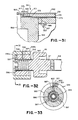
- FIG. 32 and 33 An alternative embodiment of a rear bearing support assembly 591 is shown in Figures 32 and 33.
- the shaft 412 is connected in a conventional manner to a ceramic coupling 66 by the use of a Kovar ring 67.
- the rear shaft support assembly 591 is provided with a rotor support 592.
- the rotor support 592 is bonded to a Kovar sleeve 593 which is bonded to the ceramic coupling 66.
- the outer race of the ball bearing assembly 81, rather than being directly mounted in the rotor support 592 is slipped into the sleeve 593 and the force of a helical spring 594 disposed within the sleeve 593.
- the segments are cast in a suitable conducting material such as copper or a copper alloy to provide copper segments 601 disposed on opposite sides of the magnetic steel segments.
- a suitable conducting material such as copper or a copper alloy to provide copper segments 601 disposed on opposite sides of the magnetic steel segments.
- FIG. 34 and 35 Still another embodiment of an x-ray tube construction incorporating the present invention is shown in Figures 34 and 35 in which an offset cathode assembly is provided.
- the cathode assembly has been in alignment with the high voltage receptacle for the cathode which in many cases has caused undue heating of the RTV of the high voltage receptacle.
- the arrangement shown in Figures 34 and 35 is utilized.
- a heat cage 602 is provided which has a cross plate 603 having an opening 604 therein in which there is disposed a cathode assembly 605 of the type hereinbefore described.
- the cathode assembly 605 is secured to the washer 611 in a suitable manner as for example by the use of standoff screws 612 which are threaded into the cathode assembly and which are adjusted in an appropriate position by having the screws 612 extend through the washer 611 and holding the cathode assembly in a desired position by nuts 613 threaded onto the screws on opposite sides of the washer 611.
- Conductors 616 are provided for making the connections from the cathode assembly 604 to the receptacle 442 as shown particularly in Figure 35.
- the heat generated by the cathode assembly 442 is spaced away from the high voltage receptacle 442 to thereby reduce the heat to which the high voltage receptacle 442 is subjected to. This helps to ensure that there will not be failures in the high voltage receptacle 442.
- the construction is such that when the tube is returned to the manufacturer many of the expensive parts thereof can be salvaged and used in remanufactured tubes.
- the construction of the tube is such that the anode and cathode feedthroughs are mounted to accommodate a long shaft so that one extremity of the shaft can extend therebetween.
Landscapes
- X-Ray Techniques (AREA)
Abstract
Description
- This invention relates to x-ray tubes and more particularly to air cooled metal ceramic x-ray tubes.
- This application is a continuation-in-part of application serial No. 126,842 filed on November 30, 1987.
- Typically in conventional x-ray tubes both the anode and the cathode are vacuum sealed in a glass envelope. Electrons released by the hot cathode filament are accelerated toward the anode by a high voltage. These high energy electrons generate x-rays upon impact on the solid anode and at the same time generate copious amounts of heat. The tube is mounted in a housing to protect the environment from unwanted x-rays. The housing typically of a rotating anode x-ray tube is filled with oil to provide electrical insulation and also to absorb heat generated by the anode. Such conventional x-ray tubes have numerous disadvantages including high cost and relatively short lifetimes. The oil cooling utilized greatly increases the cost of insulation and also inhibits repair of the same. There is therefore a need for a new and improved x-ray tube construction which overcomes these disadvantages.
- In general it is the object of the present invention to provide an x-ray tube construction which utilizes metal and ceramic in its construction rather than a glass envelope.
- Another object of the invention is to provide a construction of the above character which can be manufactured to high precision allowing the incorporation of double-ended bearings.
- Another object of the invention is to provide an x-ray tube construction of the above character in which a precise focal spot alignment can be obtained.
- Another object of the invention is to provide an x-ray tube construction of the above character in which arcing created by filament evaporation onto glass is eliminated.
- Another object of the invention is to provide an x-ray tube construction of the above character in which the back scattered electrons are absorbed by surrounding metal resulting in less off focus radiation and improved image contrast.
- Another object of the invention is to provide an x-ray tube construction of the above character in which the bearings are protected from heat dissipated from the anode.
- Another object of the invention is to provide an x-ray tube construction of the above character in which the feedthroughs and in particular the cathode feedthrough is protected from the anode heat.
- Another object of the invention is to provide an x-ray tube construction of the above character which can withstand higher temperatures than can be accommodated with glass tubes.
- Another object of the invention is to provide an x-ray tube construction of the above character in which greatly improved heat dissipating qualities have been incorporated into the tube.
- Another object of the invention is to provide an x-ray tube construction of the above character having an improved x-ray window construction.
- Another object of the invention is to provide an x-ray tube construction of the above character which includes improved cable terminations.
- Another object of the invention is to provide an x-ray tube construction of the above character in which the high voltage receptacles provided can accommodate various types of federal standard terminals.
- Another object of the invention is to provide an x-ray tube construction of the above character in which different types of high temperature shafts can be accommodated.
- Another object of the invention is to provide an x-ray tube construction of the above character having high temperature shafts which carry heat emissive coatings thereon to facilitate the emission of heat from the shaft.
- Another object of the invention is to provide an x-ray tube construction of the above character which eliminates the need for an insulating oil bath and which can operate with and without forced air cooling.
- Another object of the invention is to provide an x-ray tube construction of the above character which is of reduced size and weight.
- Another object of the invention is to provide an x-ray tube construction of the above character in which the bearing life is improved dramatically.
- Another object of the invention is to provide an x-ray tube construction of the above character which makes possible the use of heavier anodes with resulting higher heat storage capacity.
- Another object of the invention is to provide an x-ray tube construction of the above character in which a heat cage is provided which is thermally extended to the rear end of the tube to provide an efficient heat exchange with forced air cooling.
- Another object of the invention is to provide an x-ray tube construction of the above character in which forced air cooling is utilized.
- Another object of the invention is to provide an x-ray tube construction of the above character in which heat dissipated from the anode is diverted to the exterior before reaching the extremities of the shaft.
- Another object of the invention is to provide an x-ray tube construction of the above character in which the shielding is in intimate contact with the aluminum housing and the stainless steel envelope to provide excellent heat transfer characteristics.
- Another object of the invention is to provide an x-ray tube construction of the above character in which replacement of the tube in the field can be readily accomplished.
- Another object of the invention is to provide an x-ray tube construction of the above character in which a ceramic coupling is provided between the shaft and the rotor permitting the rotor to operate at the same ground potential as the stator.
- Another object of the invention is to provide an x-ray tube construction of the above character in which intimate electromagnetic coupling is achieved between the rotor and the stator.
- Another object of the invention is to provide an x-ray tube construction of the above character in which the anode can be rapidly accelerated and decelerated.
- Another object of the invention is to provide an x-ray tube construction of the above character which can lend itself to compact lightweight applications such as for mobile systems, C-ARM and mammography.
- Another object of the invention is to provide an x-ray tube construction of the above character in which microfocus x-ray spots can be obtained.
- Another object of the invention is to provide an x-ray tube construction of the above character which permits a higher anode speed making possible reduced anode diameter without losing power capability and the requirements needed for mammography and other similar applications.
- Another object of the invention is to provide an x-ray tube construction of the above character which can provide multiple focal spots with three or four-pole federal standard terminals.
- Another object of the invention is to provide an x-ray tube construction of the above character in which high voltage receptacles are provided with inserts having pins therein which can be readily adjusted to accommodate either the three pole or four pole federal standard terminations.
- Another object of the invention is to provide an x-ray tube construction of the above character which utilizes a heat cage which is sealed in such a manner so as to provide a vacuum and also to provide excellent heat transfer through the heat cage.
- Another object of the invention is to provide an x-ray tube construction of the above character which is provided with a heat cage which has been formed utilizing an electron beam weld to establish good mechanical contact to facilitate the transfer of heat.
- Another object of the invention is to provide an x-ray tube of the above construction which has been assembled in such a manner so that there are compensating movements of the rotor shaft during operation of the x-ray tube so that the anode remains in a relatively stationary position with respect to the movement longitudinally of the axis of the shaft.
- Another object of the invention is to provide an x-ray tube construction of the above character in which the cooling fins are brazed directly to the heat cage.
- Another object of the invention is to provide an x-ray tube construction of the above character in which special means is provided to minimize the effects of corona.
- Another object of the invention is to provide an x-ray tube construction of the above character in which a heat choke is provided for protecting the rear bearing.
- Another object of the invention is to provide an x-ray tube construction of the above character in which a split squirrel cage motor is utilized.
- Another object of the invention is to provide an x-ray tube construction of the above character in which the squirrel cage rotor is comprised of magnetic steel segments encased in copper.
- Another object of the invention is to provide an x-ray tube construction of the above character in which the cathode feed through is offset from the high voltage terminals to minimize heating of the insulating material provided in and around the high voltage terminals.
- Another object of the invention is to provide an x-ray tube construction of the above character which can be readily repaired.
- Additional objects and features of the invention will appear from the following description in which the preferred embodiments are set forth in the accompanying drawings.
- Figure 1 is a side elevational view with certain portions broken away of a air cooled metal ceramic x-ray tube construction incorporating the present invention.
- Figure 2 is an end view looking along the line 2-2 of Figure 1.
- Figure 3 is an end view looking along the line 3-3 of Figure 1.
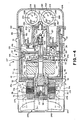
- Figure 4 is a cross sectional view taken along the line 4-4 of Figure 1.
- Figure 5 is an enlarged partial cross-sectional view showing the rear bearing construction utilized in the construction shown in Figure 4.
- Figure 6 is an enlarged cross-sectional view of the central portion of the drive shaft and showing the anode plate mounted thereon.
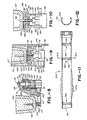
- Figure 7 is an enlarged cross-sectional view showing the construction of the x-ray tube in the vicinity of the x-ray window.
- Figure 8 is an enlarged cross-sectional view of the anode feedthrough and the front bearing construction.
- Figure 9 is a cross-sectional view showing the cathode feedthrough and the cathode assembly.
- Figure 10 is a cross-sectional view showing the cathode feedthrough and cathode assembly rotated by 90° from that shown in Figure 9 but omitting the male banana type plugs and the spring metal clamps.
- Figure 11 is a cross-sectional view of another embodiment of a shaft for the tube construction shown in Figure 1.
- Figure 12 is a partial cross-sectional view taken along the line 12-12 of Figure 11.
- Figures 13A, 13B, 13C and 13D are plan views of four different inserts used to accommodate four different federal terminations in the high voltage receptacles in the x-ray tube construction.
- Figure 14 is a cross-sectional view similar to that shown in Figure 3 showing another embodiment of an x-ray tube construction incorporating the present invention and taken along the line 14-14 of Figure 17.
- Figure 15 is a top plan view of the anode plate shown in Figure 14.
- Figure 16 is an isometric view of the coupling for mounting the anode plate on the shaft as shown in Figure 13.
- Figure 17 is a top plan view of the end cap shown in Figure 14.
- Figure 18 is a cross-sectional view taken along the line 18-18 of Figure 17.
- Figure 19 is a cross-sectional view of a syringe showing the same used for making a cable terminal.
- Figure 20 is a cross-sectional view of a cable terminal made with the syringe shown in Figure19.
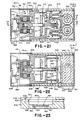
- Figure 21 is a side elevational view in cross section of another embodiment of an air-cooled metal ceramic x-ray tube construction incorporating the present invention and utilizing a single wall construction.
- Figure 22 is a cross sectional view taken along the line 22-22 of Figure 21.
- Figure 23 is an enlarged cross sectional view of the x-ray window construction provided in the x-ray tube construction shown in Figures 21 and 22.
- Figure 24 is a cross sectional view taken along the line 24-24 of Figure 21 and particularly shows the high voltage terminals and the receptacle for federal standard terminations.
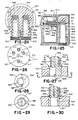
- Figure 25 is a cross sectional view of an alternative arrangement of high voltage receptacles.
- Figure 26 is an enlarged view of one of the inserts utilized in the receptacle shown in Figures 24 and 25.
- Figure 27 is an enlarged cross sectional view of one of the eccentric pins utilized in the insert shown in Figure 26.
- Figure 28 is an end view looking along the line 28-28 of Figure 27.
- Figure 29 is an end view looking along the line 29-29 of Figure 27.
- Figure 30 is a cross sectional view of the central pin utilized in the insert shown in Figure 26.
- Figure 31 is a partial cross sectional view of another embodiment of an x-ray tube construction incorporating the present invention utilizing a double wall construction.
- Figure 32 is a partial side elevational view showing an alternative bearing support for the x-ray tube construction shown in the present invention.
- Figure 33 is a view taken along the line 33-33 of Figure 31.
- Figure 34 is cross sectional view of another embodiment of an x-ray tube construction incorporating the present invention taken along the line 34-34 of Figure 35 and showing an offset cathode assembly.
- Figure 35 is a cross-sectional view taken along the line 35-35 of Figure 34.
- In general, the x-ray tube construction of the present invention is comprised of a housing with a metal tube envelope therein and a shaft. An anode plate is carried by the shaft. Bearings are disposed on opposite sides of the anode plate and rotatably mount the shaft in the envelope. A motor drive is coupled to the shaft for rotating the shaft and the anode plate carried thereby. A cathode is provided for supplying electrons which are accelerated by a high voltage to the anode plate for creating x-rays upon impingement with the anode plate. A heat cage is disposed in the housing and the envelope and surrounds the anode plate. X-ray shielding means is disposed within the housing between the envelope and the housing. Windows are provided in the shielding means, the metal envelope and in the heat cage to permit x-rays to pass therethrough. Particularly novel means is provided for dissipating the heat generated in the anode and for dissipating the same exterior of the housing prior to the heat passing to the opposite extremities of the shaft. Shaft constructions have been utilized which inhibit the travel of heat to the opposite ends of the shafts and thereby serving to protect the bearings rotatably supporting the shaft.
- As shown more particularly in Figures 1-13 of the drawings, the air cooled metal ceramic
x-ray tube construction 21 consists of acylindrical housing 22 formed of a suitable material such as aluminum. Thecylindrical housing 22 can be formed as an investment casting. Thehousing 22 is closed at one end and open at the other end to provide a cylindrical interior recess 23 which is coated to facilitate the adherence of lead thereto. For this purpose an electroless nickel plating is provided. The exterior of thecylindrical housing 22 is provided with a flat 24 on one side thereof which serves as a collimator support base. It is provided with a plurality of threadedholes 26 provided in two spaced parallel rows extending longitudinally of the housing and four additional threadedholes 27 disposed at the corners of an imaginary rectangle surrounding anopening 28 which can accommodate multipurpose windows to permit thex-ray tube 21 to be utilized for CT as well as conventional x-ray imaging. As can be seen theopening 28 is basically in the fob of a rectangle which can be utilized for conventional x-ray imaging. It is also provided with sidewardly extendingslots 29 disposed on two sides of therectangular opening 28 to facilitate use with a 60° fan beam for CT scanning. - The exterior surface of the cylindrical housing with the exception of the flat 24 is provided with longitudinally and radially extending
fins 31 which are spaced circumferentially exterior of thecylindrical housing 22. Thefins 31 serve as heat radiating fins. By way of example, 36 of such fins can be provided around the outer circumference of thehousing 22. Thehousing 22 on its extremities is provided withtrunnion interfaces fins 31 extending longitudinally beyond the closed end portion 22a haveslots 36 extending therethrough through which air can pass as hereinafter described. The housing is also provided with a pair of diametrically disposed cylindrical recesses 37 (see Figure 2) which extend into and between twofins 31 and are adjusted to receive connectors of a conventional harness (not shown) to provide power for a purpose hereinafter described. - A
cylindrical vacuum envelope 41 is mounted within the cylindrical recess 23 of thecylindrical housing 22. It is open at one end. Thevacuum envelope 41 is provided with acircular base 42 which has a thin walledcylindrical sleeve 43 secured thereto by suitable means such as welding or brazing. The base 42 can be formed of a suitable material such as copper of the type hereinafter described. Thesleeve 43 can be formed of a suitable material such as stainless steel. Thesleeve 43 is provided with thinnedwall portion 43a which serves as a window through which x-rays can pass as hereinafter described. The thinned wall portion can be provided by machining a rectangular recess on the exterior surface of thesleeve 43 to provide a thinnedwall portion 43a of a suitable thickness such as approximately .005 inches. Thebase 42 closes the other end and is provided with a hole 44 which is in registration with the hole 34. Alead liner 46 is provided between thevacuum envelope 41 and the interior of thecylindrical housing 22. This lead envelope can be formed in a suitable manner such as by pouring molten lead into the space between thevacuum envelope 41 and the interior of thecylindrical housing 22. Since the interior wall of thecylindrical housing 22 has been coated with electroless nickel, the introduction of the lead into the cylindrical recess 23 causes a solder-like bond to be formed between the lead and thecylindrical housing 32 and thesleeve 43 of thetube envelope 41. Thelead liner 46 serves two purposes, first as a massive heat sink for the x-ray tube construction and second as a shield against stray radiation which may attempt to pass from within the tube. Because of the excellent bond formed between the lead liner and thealuminum housing 22, there is good heat transfer from the lead to the housing and thefins 31 carried by the housing. Awindow 47 is provided in thelead liner 46 which is in registration with theopening 28. - A
cylindrical heat cage 48 is provided within the interior of thevacuum envelope 41. This heat cage has one end seated in anannular recess 49 provided in thebase 42 of thevacuum envelope 41 and is bonded therein by suitable means such as soldering or brazing. The lower extremity of theheat cage 48 is provided with a plurality of holes oropenings 51 which are spaced circumferentially around theheat cage 48 and are provided to permit the escape of any cleaning agent which may be used during assembly and becomes entrapped between thecage 48 and thesleeve 43. - The
heat cage 48 is formed of a suitable material such as a chromium copper in which the chromium content is approximately 1% by weight. The copper is provided with a chromium content so that it is possible to cause an oxide of chromium to be formed on the exterior surface of the same during heating of the same in an atmosphere of wet hydrogen. It has been found that this oxidation process provides a greening of the exterior surface caused by the formation of a chromium oxide coating on the exterior surface of the heat cage. This coating provides an excellent heat emission surface which substantially enhances the heat dissipating capabilities of theheat cage 48. - The
heat cage 48 can be formed in a suitable manner such as by casting. Alternatively it can be formed from machined copper and chromium plated to provide a chromium oxide emissive coating. Theheat cage 48 is provided with awindow 53 which is in registration with theopening 28 provided in thecylindrical housing 22 through which the x-rays which are generated within thetube 21 can pass as hereinafter described. - A
curved plate 56 which is curved in one direction is formed of a suitable material such as beryllium. Beryllium is desirable because it has a low absorption coefficient for x-rays but provides protection for the stainlesssteel window portion 43a from damage by secondary electrons being emitted from within thetube 21. - The
plate 56 which serves as an x-ray window is held in place over theopenings heat cage 48. Alternatively the plate can be loosely held in a frame (not shown) secured between thesleeve 43 and theheat cage 48. By way of example the beryllium window can have a thickness of approximately 4 mils to protect a stainless steel wall 5 mils thick. - A
shaft assembly 61 is rotatably mounted within thecylindrical housing 22 and theenvelope 41 and extends through the holes 44 and 34. Theshaft assembly 61 consists of ashaft 62 formed of a suitable material which is capable of withstanding high temperatures. For example a material called Hastalloy or also identified as Haynes No. 230 can be used. - The
shaft 62 is hollow as shown and can be formed in a suitable manner such as by machining. It is provided with a thickenedportion 62a which is intermediate the ends of the shaft. The thickened portion is provided with anannular seat 63 which abuts ashoulder 64. Theshaft 62 is provided with relatively long thin-walled portions 62b and 62c on opposite ends of thethicker portion 62a. The portions 62b and 62c can have a suitable wall thickness as for example .020 to .025 inches. These thin-walled portions are provided to inhibit the travel of heat towards both extremities of the shaft. - The Hastalloy material from which the
shaft 62 is formed has a high percentage of chromium in it as for example in the range of approximately 32% by weight. The shaft is heated up to a suitable temperature as for example approximately 1,100°C in a wet hydrogen atmosphere to cause a chrome oxide coating to form on the shaft which has the greenish appearance. This oxide coating on the exterior of theshaft 62 provides excellent heat emission from the shaft. - A solid
ceramic coupling 66 is mounted on one end of theshaft 62. It is provided withmetal Kovar collars metal collar 67 is secured to one end of theHastalloy shaft 62 by suitable means such as brazing. Thecoupling 66 has askirt portion 68 to enhance the voltage insulating capabilities of the part. Themetal collar 68 at the other end of thecoupling 66 is also secured by suitable means such as brazing to acylindrical sleeve 71 of a suitable material such as stainless steel. - The
sleeve 71 serves as a rotor support and has a cylindricalsquirrel cage rotor 72 mounted thereon and held in place by a circular plate orwasher 73 formed of suitable material such as stainless steel. Theplate 73 is secured to therotor support sleeve 71 by suitable means such as screws 74. Adrive pin 76 is carried by the outer extremity of theplate 73 and extends upwardly into thesquirrel cage rotor 72. Thesquirrel cage rotor 72 is formed in a conventional manner as for example of alternating strips of copper and magnetic steel. Thewasher 73 can be utilized for balancing purposes for balancing one end of theshaft 62. This can be accomplished by removing the plate orwasher 73 and shaving material from the same in appropriate locations to achieve the desired balance for theshaft assembly 61. - Means is provided within the
envelope 41 for mounting theshaft assembly 61 for rotatable movement within the envelope in a direction in which the axis of rotation extends longitudinally of theenvelope 41. Such means is provided for mounting one end of the shaft carrying therotor 72 and consists of a rear ball bearing assembly 81 (see Figure 5) having anouter race 82 which is mounted within and secured to therotor support sleeve 71. Theouter race 82 is adapted to rotate with therotor support sleeve 71. Theinner race 83 of the ball bearing assembly is held in a stationary position with respect to the envelope and is supported in such a manner so as to accommodate the expansion and retraction of theball bearing assembly 81 during operation of thex-ray tube 21. A flangedbearing support member 84 extends into theinner race 83 and is secured to theinner race 83 by suitable means such as acollar 86 overlying awave washer 87 engaging the inner race. Thecollar 86 is retained against theyieldable wave washer 87 by apin 88 extending through the flangedbearing support member 84. The flangedbearing support member 84 is provided with a bore 91 which is adapted to receive a pin 92 that extends at right angles from acircular support plate 93. The pin 92 is provided with a flat 94 extending longitudinally of the same and disposed on one side of the pin which is adapted to engage thepin 88 extending substantially diametrically of the flangedbearing support member 84. This prevents rotation of theflanged bearing member 84 and theinner race 83 carried thereby. - A
rotor housing 96 is provided for enclosing therotor 72 within a vacuum-tight enclosure and also for providing support for thesupport plate 93 to prevent rotation of the same. Thisrotor housing 96 consists of arotor sleeve 97 which has one end bonded in the hole 44 of theplate 42 by a suitable means such as brazing. The other end of therotor sleeve 97 is closed off byrotor end plate 98 that is secured to therotor sleeve 97 by suitable means such as brazing. Therotor sleeve 97 is provided with athin wall portion 97a intermediate the ends of the same as for example having a thickness of approximately 12 mils to provide good magnetic coupling between the rotor and the stator. Thesupport plate 93 is mounted in a fixed position within therotor housing 96 by a suitable means such as a C-ring 98 seated in anannular recess 99 provided on the interior surface of therotor sleeve 97. From the foregoing construction it can be seen that the interior of the rotor sleeve is in communication with the interior of thevacuum envelope 41. - Front bearing support means 101 (see Figure 8) is provided for mounting the other end of the
shaft 62 and consists of a cylindrical cup-shapedfront bearing housing 102 which is seated within the front extremity of theshaft 62. Theouter race 103 of a frontball bearing assembly 104 is seated within thefront bearing housing 102 for rotation therewith. Theouter race 103 of theball bearing assembly 104 is retained within the cup-shapedfront bearing housing 102 by suitable means such as a C-ring 106. Yieldable spring means is provided in the form of ahelical coil spring 107 formed of a suitable high temperature material such as stainless steel or Inconel which has one end engaging thefront bearing housing 102 and has the other end engaging awasher 108. Thewasher 108 engages a push-rod pin 109 which is mounted in a push-rod 111. The push-rod 111 is slidably mounted in thefront bearing housing 102 and has its rear distal extremity adapted to engage apush disc 112 slidably mounted within theshaft 62. The push disc 112 (see Figure 6) is provided with a dishedrecess 113 which is adapted to receive the rear end of the push-rod 111. Thepush disc 112 engages aclamping pin 116 which extends throughelongated slots 117 provided in theshaft 62. The longer axes of theslots 117 extend in a direction axially of theshaft 62. The outer extremities of theclamping pin 116 are seated inslots 118 provided on the front surface of ananode washer 119. Theanode washer 119 engages ananode plate 121 which is mounted on theannular seat 63 of theshaft 62 and is seated against theshoulder 64. Theanode washer 119 is yieldably retained in engagement with theshoulder 64 by thepin 116 which is yieldably urged rearwardly by thespring 107. From the construction hereinbefore described it can be seen that thespring 107 serves to yieldably urge theanode plate 121 towards theshoulder 64 provided on theshaft 62. - The
anode plate 121 is provided with aspecial surface 122 formed of rhenium tungsten material of a conventional type. It can be seen that thesurface 122 is disposed at an angle and is positioned so that electrons striking the same will form x-rays that will pass through theopening 28. A largeannular graphite block 126 is carried by theanode plate 121 and serves as a large heat sink as hereinafter described. - The front
ball bearing assembly 104 is provided with an inner race 131 (see Figure 8). A frontbearing support member 132 is mounted in the inner race. A spacer 133 is mounted on thebearing support member 132 and engages theinner race 131. Thebearing support member 132 also extends through ahole 134 provided in abearing support bracket 136 and is retained in thehole 134 by anut 137 threaded onto the frontbearing support member 132 to retain the inner race of the ball bearing assembly in a stationary or non-rotatable position while retaining it in a fixed position within thetube envelope 41. The L-shapedbracket 136 is mounted upon a crossbar 139 formed of a suitable high temperature non-conducting insulating material such as silicon nitride. Thebracket 136 is retained on the bar 139 by aspring clamp 141 secured to thebracket 136 by a suitable means such as abolt 142. The bar 139 extends across thevacuum envelope 41 and is mounted upon a pair of support brackets (not shown) on opposite ends of the same which support the same on acircular cross plate 146. The brackets (not shown) which carry the bar 139 and theplate 146 are formed of a suitable metal such as stainless steel. Thecross plate 146 overlies acage cover plate 147 formed of the same copper material as thecopper heat cage 48. Thecover plate 147 overlies anannular flange 148 provided on thecage 48. Means is provided for establishing intimate contact between thecover plate 147 and theflange 148 of thecage 48 and includes a C-ring 151 seated inannular recess 152 in thecage 48. The C-ring 151 captures the outer circumferential surface of the cross plate 146.Thecross plate 146 carries a plurality ofscrews 153 near its outer margin which are adapted to engage thecover plate 147. It can be seen by adjusting thescrews 153 large forces can be provided on thecover plate 147 to form a n intimate contact with theflange 148 when thecross plate 146 is in engagement with the C-ring 151. - The
cover plate 147 and thecross plate 146 are provided with alignedopenings 154 and 156 through which theshaft assembly 61 extends and on which theanode plate 121 is mounted. A major amount of the heat given off by theanode plate 121 is absorbed by thecross plates front bearing assembly 104 from high heat. The heat from thecross plates heat cage 48 which dissipates the heat through thelead liner 46 and the finnedcylindrical housing 22. - A
circular mounting ring 161 is mounted on the end of thesleeve 43 and is of greater thickness thansleeve 43. The mountingring 161 is secured to thesleeve 43 by suitable means such as brazing. A circular terminal or top mountingplate 162 is mounted upon the mountingring 161. The mountingring 161 is formed of a suitable material such as stainless steel material hereinbefore described. Theplate 162 is formed of a suitable material such as stainless steel also. To augment the seal which is provided between the mountingring 161 and theplate 162, astrip 163 of a suitable material such as stainless steel is welded to theplate 162 and to the mountingring 163. When it is desired to remove this seal, thisstainless steel ring 163 can be removed by machining and then thetop cover plate 162 can be removed to facilitate the repair of the tube when necessary. - A cup-shaped
ceramic anode feedthrough 166 and a cup-shapedceramic cathode feedthrough 167 are mounted inholes cover plate 162. Thefeedthroughs Kovar metal skirts 171 which are welded to the stainlesssteel cover plate 162 to provide vacuum-tight seals. Theanode feedthrough 166 is provided with a single externalfemale terminal 174 which receives an internal male banana-type plug 176 mounted within thefeedthrough 166. The terminal 174 engages themetal spring clamp 141. Theclamp 141 carries a coil spring 177 through which the terminal 174 extends. The spring 177 makes electrical contact with theplate 178 which is electrically connected to the terminal 174. Theclamp 141 makes electrical contact to theanode shaft 62 through thebracket 196 and through the frontball bearing assembly 104. - The
cathode feedthrough 167 is provided with five female terminals with onecentral grid terminal 181 and onecommon terminal 182 and threefilament terminals 183 disposed around thecentral terminal 181. Corresponding male banana-type plugs 184 are mounted internally of thefeedthrough 167 in thefemale terminals - A
conventional cathode assembly 186 is provided which has threefilaments 187. One end of each of thefilaments 187 is connected to one of thefilament terminals 183 and the other end is connected to thecommon terminal 182. One of thefilaments 187 is shown in Figure 9. Thecathode assembly 186 is carried by a pair of screws 188 (see Figure 10) which are threaded into thecathode assembly 186. Thescrews 188 are carried by aquartz disc 191 which is provided as a subassembly 192 and is mounted upon theterminals cathode feedthrough 167.Lock nuts 189 are provided on thescrews 188 and serve to clamp thecathode assembly 186 onto the screws.Lock nuts 190 are also provided on these screws and serve to secure the screws to thequartz disc 191. This subassembly 192 can be supported in a suitable manner. For example, as shown in particularly Figures 9 and 10, asecond quartz disc 193 is provided which is also mounted upon theterminals metal washer 194 mounted on the terminals and disposed between thedisc 193 and the lower extremity of thecathode feedthrough 167.Additional washers 196 are mounted on the same terminals and serve to space thequartz disc 191 fromdisc 193. Spring-like contact elements 197 in the form of metallic strips of a suitable material such as nickel are provided. Thesestrips 197 are provided withU-shaped extremities 197a which are secured to the outer extremities of theterminals terminals U-shaped extremities 197a. - The
springs 199 serve two functions, one to yieldably urge thequartz disc 191 in a direction toward thefeedthrough terminal 167 and the other to ensure that the spring-like strips 197 make good electrical contact with the terminals. The other ends of thestrips 197 are secured toposts 200 provided on thecathode assembly 186. - Additional means is provided for insulating the cathode assembly from heat and consists of an
outer sleeve 202 of stainless steel surrounding aquartz tube 203. The upper extremity of thestainless steel sleeve 202 is secured to thecover plate 162 by bringing it to the lower extremity of theskirt 171 of thecathode feedthrough 167. Thesleeve 202 can be of suitable thickness such as .005 inch. As can be seen particularly in Figure 4, thecathode assembly 186 extends throughholes plates filament 27 are directed onto therhenium tungsten surface 132 to create x-rays which travel through thewindow 28. Thecover plate 162 is provided with a pinch-offtube 211 which can be pinched off after thevacuum envelope 41 has been evacuated. A cover 212 is provided for covering the pinch-offtube 211. A viewing window (not shown) is also provided in the cover plate 212. - A termination is provided for the x-ray tube which conforms to present federal termination standards for x-ray tubes. Thus there has been provided an
end cap 216 formed of a suitable material such as lead which seats over one extremity of thecylindrical housing 22. Theend cap 216 is provided with a planar surface 217 in which tworeceptacles end cap 216 not required for thereceptacles cathode feedthroughs material 221 such as an RTV silicon rubber.Cables receptacles cables - Suitable means is provided for securing the
end cap 216 to thecylindrical housing 22 to ensure that there is no leakage of x-rays from within the tube. Such means consists of hook-like elements 226 formed of stainless steel having onehooklike portion 226a secured to theplate 162 and which extend outwardly between the interior of the lower extremity of theend cap 216 and the exterior of thecylindrical housing 22. The hook-like elements 226 also have hook-like portions 226b which are connected to hook-like portions 227a of yieldable means in the form ofsprings 227 which extend longitudinally of the cylindrical housing between the fins 31 (see Figure 1). Hook-like elements 227b provided on the other ends of thesprings 227 are secured to the other end of thehousing 22 by connection to thetrunnion interface 32. - A
stator assembly 231 is provided as a part of the squirrel cage motor for the x-ray tube. It is of conventional construction and is provided with alaminated core 232 which carrieswindings 233. Means is provided for securing thestator assembly 231 to thecylindrical housing 22 and consists of threadedbushings 236 which are secured to the core by suitable means such as welding.Screws 237 are threaded into the threadedbushings 236 and extend inwardly to engage the bottom side of thehousing 22.Springs 238 are provided on the screws between thebushings 236 and atriangular plate 239. Means is provided for securing theplate 239 to thehousing 22 and consists ofsprings 241 which have one end of the same hooked to the corners of thetriangular plate 239 and have the other end secured to pins 242 carried by thehousing 22. Afan assembly 246 is mounted on theplate 239 and is provided with a centrally disposedmotor 247 which drives afan blade 248. - Suitable means is provided for enclosing the
fan assembly 247 and the rear extremity of thefinned housing 22 and includes acylindrical grill 251 and anend cover grill 252. Thecylindrical grill 251 and theend cover grill 252 can be spot welded to each other and secured to thehousing 22 by suitable means such as springs (not shown). - Means is provided for supplying power to the
stator assembly 231 of the squirrel cage motor and to thefan assembly 246 and consists of aterminal block 253 secured to the housing 22 (see Figure 1) and connected to acable 254 disposed longitudinally of thetube 21 between two of thefinds 31 and connected to aconnector 256 which is adapted to be connected to a suitable source of power such as 110 volts 60 cycle A.C. - Operation and use of the air-cooled metal ceramic x-ray tube construction hereinbefore described may now be briefly described as follows. Let it be assumed that the
x-ray tube 22 has been mounted in an x-ray apparatus and connected to suitable power supplies. Thus thecables x-ray tube 22. In addition, power is connected to theconnector 256 connected to thefan motor 246 and to the alternating current squirrel cage motor comprised of therotor 72 and thestator assembly 231. - Electrons generated by the selected
heated filament 187 of thecathode assembly 186 are subjected to a high voltage placed between the cathode and the anode and are rapidly accelerated to travel in the evacuatedenvelope 41 toward thesurface 122 of therotating anode plate 121 as indicated by therays 271. These electrons upon striking theinclined surface 122 generate x-rays indicated by therays 272 which are propagated in a direction at substantially right angles to thebeam 271 and pass through theopening 153 through theberyllium window 56 and through the thinned down stainlesssteel window portion 43a provided in thevacuum envelope 41. The x-rays then pass throughwindow 47 provided in thelead liner 46 and through theopening 28 provided in thehousing 22 as shown particularly in Figure 7. The copious amounts of heat which are generated at the time the x-rays are generated are dissipated into theanode plate 121 which dissipates its heat into the largegraphite heat sink 126. The heat which is radiated from thegraphite heat sink 126 and theanode plate 121 is collected by the highly conductive relatively thick walls of theheat cage 48 which surrounds theanode plate 121. As hereinbefore explained, theheat cage 48 is thermally extended to the rear of the tube and is joined to the base 42 to provide for an efficient heat exchange with the forced air which is being directed from the rear of the tube between the fins 31a and upwardly towards the base 22a of thecylindrical housing 22 as indicated by thearrows 276. As explained previously, an excellent heat transfer interface is provided between the base 22a of the housing, thelead liner 46 and thebase 42 of thevacuum envelope 41 and also forming the base for thecopper heat cage 48. For this reason a major portion of the heat dissipated by the anode is dissipated from the tube before it can reach the thin walls of the tube, the ceramic connectors and the bearings provided for mounting the shaft. As hereinbefore explained, particular design features have been incorporated in the x-ray tube to inhibit the transfer of heat to the double-ended bearing construction. Thus as explained previously, theshaft 62 is provided with very thin walled portions on opposite sides of the location at which theanode plate 121 is mounted on theshaft 62 to substantially inhibit the transfer of heat along the shaft towards the bearings mounted on each end of the shaft. By utilizing a construction of this type, it is possible to provide an x-ray tube which can be air-cooled and which does not require the use of more sophisticated oil cooling techniques and the like. - From the foregoing description, it can be seen that the high voltage connectors which are utilized in the x-ray tube are fully integrated into the tube permitting the high voltage to be supplied directly to the tube. The
shaft 62 is mounted upon two bearings which are located on opposite sides of theanode plate 121 at the remote ends of the tube facilitating shielding of the bearings from the anode heat radiation. The double-ended bearing construction utilized is facilitated by the metal ceramic design incorporated into the tube. The construction of the tube has made it possible to increase bearing life dramatically. The bearing construction makes possible the support of heavier anodes thereby making possible higher heat storage capabilities. The construction also makes possible higher anode heat dissipation capabilities because of the thermal protection provided for the bearings. The double-ended bearing support provided for the shaft reduces mechanical stresses on the shaft and reduces the likelihood of the bending of the shaft when it is subjected to the extreme heat encountered within the x-ray tube. Also because of the bearing construction provided it is possible to provide improved mechanical stability, and greatly reduced likelihood of vibrations developing during the tube life. Higher rotational speeds are permissible with the use of the shaft disclosed with its bearing supports making it possible the use of higher power or smaller focal spots where size is important to provide a reduction in anode size for mobile applications. - As hereinbefore described, the rear end of the
shaft 62 is provided with high strengthceramic coupling 66 which provides high voltage insulation between the anode and the rotor and permits the rotor to be operated at the same ground potential as the stator. For that reason, short distances can be utilized to establish an intimate electromagnetic coupling between the rotor and the stator of the motor while still maintaining the rotor in a vacuum. This construction makes it possible to utilize a low cost, low power electrical supply. - The x-ray tube construction of the present invention is particularly adapted for use in newly manufactured x-ray equipment. However it is constructed in such a manner that it can be utilized to retrofit existing x-ray equipment. Because of the construction utilized in the x-ray tube, there is a sharply reduced service and replacement expense associated with the tube. The tube is plug compatible with the existing CT and conventional x-ray equipment. The construction of the tube utilizing a metal ceramic construction with air cooling makes it possible to eliminate the use of expensive oil cooling.
- The x-ray tube construction of the present invention can have a weight ranging from approximately 30 to 45 pounds. It can have a length ranging from 10 to 15 inches with a diameter of approximately 6.5 inches. It can be operated at voltages up to 150 kilovolts. Rotor speeds of 1,200 rpm with 1 to 2 second acceleration and deceleration can be accomplished. The anode can be approximately 4.250 inches in diameter and has a heat storage capacity which can range from 400,000 to 2,000,000 heat units. The construction is capable of dissipating 2,000 to 3,000 watts of energy. The construction of the tube is such that the external temperature of the housing should not exceed 140° Fahrenheit. Excellent protection against radiation is provided. The high voltage termination utilized meets the federal standards.
- In Figures 11 and 12 there is shown a modified
shaft 279 corresponding to theshaft 62 hereinbefore described. Theshaft 279 differs from theshaft 62 in that it is provided with a plurality ofrectangular slots 281 arranged in pairs or two spaced apart parallel rows with the slots in one row overlapping the slots in the other row. The major axis of each of the slots extends in a direction perpendicular to the longitudinal axis of theshaft 62a. One or more pairs of rows of slots can be provided on the shaft on opposite ends of theshaft 279 and spaced away from the thicker walled portion 279a. Thus there are provided two spaced apart pairs 282 and 283 on the front end of theshaft 279 and asingle pair 284 on the rear end of theshaft 279. Theslots 281 serve to inhibit heat transfer longitudinally of the shaft by providing less mass for the heat to travel through and also by providing a staggered circuitous path for heat to flow through the pairs of rows. - Means is provided in the
receptacles receptacles circular plates 286 of a suitable insulating material such as RTV silicon rubber in which there has been provided five male banana-type terminals 287-291. The terminal 287 is the grid terminal, the terminal 288 is the common terminal and theterminals registration notch 292 is provided in each of thereceptacles - A plurality of
inserts receptacles circular plates 297 of a suitable insulating material such as an RTV silicon rubber. - The inserts 293-296 are provided with a plurality of
smaller holes receptacle 299 can be the grid receptacle, thereceptacle 300 the common receptacle, andreceptacles receptacle 304 serves as the grid receptacle, 305 as the common receptacle, andreceptacles insert 293 serves to accommodate a three pole federal high voltage terminal which provides supply voltage for the large and the medium focus of the three foci in the x-ray tube, whereas theinsert 294 serves to accommodate a four pole federal high voltage terminal which provides supply voltages for the grid, the large and the medium focus of the three foci in the x-ray tube. The insert 295 accommodates a three pole federal terminal to supply the large and the small filaments of the three filaments in the x-ray tube whereas theinsert 296 accommodates a four pole federal high voltage terminal to supply voltage to the grid, the large and the small focal spots provided by the three filaments in the x-ray tube. In those terminals where no grid connection is provided, the grid receptacle is connected to the common receptacle by aconductor 308 embedded in the insulating material of the insert so that the common and grid receptacles are interconnected. - A central threaded bore 309 is provided for receiving a threaded service tool for removing and inserting the inserts 293-296.
- In this way it can be seen that by utilizing the inserts 293-296 four different federal terminations can be utilized with the x-ray tube. This makes it possible for the user to establish which federal termination the user desires. It also makes it possible for a user to make a change in the field from one federal termination to another.
- An
observation window 406 is provided in theend cap 351. It is formed of arod 407 of lead glass to permit viewing during operation of the tube. - In addition a four pole terminal adapter can accommodate all three focal spots provided by the three filaments of the x-ray tube if no grid voltage supply is required.
- Another embodiment of the air cooled metal ceramic x-ray tube construction incorporating the present invention is shown in Figures 14-20. The
x-ray tube 310 therein shown consists of many parts which are identical or substantially identical thex-ray tube 21 hereinbefore described and given th e appropriate corresponding numerals. One of the principal differences between thex-ray tube 310 and thex-ray tube 21 is the use of acolumbium shaft assembly 311 in place of theHastalloy shaft assembly 61. Theshaft 311 consists of a hollow thin-walled shaft 312 formed of a suitable high temperature material such as columbium. Such a shaft should be able to withstand temperatures up to 1700°C whereas such a shaft formed of Hastalloy should be able to withstand a temperature of approximately 1100°C. Theshaft 312 can have a suitable wall thickness ranging from .020 to .040 inches and preferably a thickness of approximately .030 inch. One end of theshaft 312 is brazed to ametal collar 313 formed of a suitable material such as columbium which is brazed to theshaft 312 and which is mounted on one end of theceramic coupling 66. - A large cylindrical heat sink 316 formed of a suitable material such as stainless steel having a chromium content so that an emissive coating of chromium oxide is formed on the same when heated in a wet hydrogen atmosphere as hereinbefore described. The heat sink 316 is provided with a large
central bore 317 extending longitudinally the length thereof. Thebore 317 is of a size which is substantially greater than the external diameter of theshaft 312 so that there is provided anannular space 318 between theshaft 312 and the heat sink 316. The heat sink 316 is provided with a well 319 in the front end thereof which is adapted to receive theouter race 103 of theball bearing assembly 104. The heat sink 316 is retained on theshaft 312 by suitable means such as apin 321 extending diametrically of theshaft 312. The cylindrical heat sink 316 is provided with three circumferentially spaced threadedbores 323 in which there are mounted setscrews 324. Theset screws 324 are adjustable within the bores and are used for balancing the heat sink 316 as well as themetal anode 326 formed of a suitable material such as molybdenum which carries an inclinedannular surface 327 formed of rhenium and tungsten that serves as the target for the electron beam. - Means is provided for mounting the
anode plate 326 on theshaft 312 and consists of acoupling 331. An isometric view of thecoupling 331 is shown in Figure 15. It can be formed from a cylindrical block of columbium in which there has been machinedannular recesses parallel flats 334 are formed on theportion 331a between theannular recesses flats 336 are formed on theportion 331b on the other side of therecess 333. Abore 338 has been provided extending from the front side of thecoupling 331 and opens into a larger bore 339 (see Figure 13) extending through the other end of thecoupling 331. Thebore 339 as shown in Figure 13 is of a size so that it is substantially larger than theshaft 312 so as to provide a substantial space between the shaft and the interior of thecoupling 331. - The
anode plate 326 is constructed in a manner so as to be able to receive thecoupling 331. It is provided with acentral bore 341. Thebore 341 opens into four substantiallysemicircular lobes 342 which are spaced 90° apart (see Figure 15). Theselobes 342 facilitate the insertion of the coupling into the anode plate. Thecoupling 331 is introduced through the rear side with theflats opposed lobes 342 so that it extends through the anode plate. After thecoupling 331 has been inserted through the anode plate,washers 346 and 347 are inserted. - The
coupling 331 is held in place by suitable means such as awasher 346 which engages theanode plate 336 and a plate 347 which is rotated in position over theportion 331b and so it underlies theportion 331b to lock the anode plate onto thecoupling 331. Thecoupling 331 can be secured to theshaft 312 in a suitable manner such as welding. - The x-ray tube construction which is shown in Figure l4 is a compact version and is for use when lower output requirements can be tolerated. In order to make it compact, the
fan assembly 246 provided in the previous embodiment has been omitted so that the cooling relied upon for the tube occurs through the transfer of heat to ambient air without the necessity of forced air cooling. This type of tube is limited in output but can serve many high performance applications. - A special termination terminal has been provided for the
tube 310 and consists of anend cap 351 formed of lead. Theend cap 351 can be held in place in the same manner as theend cap 216 in the previous embodiment. Theend cap 351 is provided with a pair of L-shapedintegral protrusions openings high voltage cables Collars 359 are mounted on thecables openings protrusions cables - The cable shown in Figure 17 is of a conventional type and consists of
conductors 364 formed of a suitable material such as copper which are enclosed within asheath 366 of conducting rubber to minimize corona discharge. Thesheath 366 is enclosed inEPR rubber 367 to provide the termination terminal 361. The cables are also enclosed with anadditional braided sheath 368 covered by avinyl sheath 369. - In preparation of a special terminal 361, the ends of the
conductors 364 are stripped clean and thereafter female threadedfittings 371 are crimped onto the conductors. Asyringe 372 of the type shown in Figure 19 is then utilized to place vulcanized rubber around thefittings 371. Thesyringe 372 consists of acylinder 373 formed of suitable material such as aluminum in which apiston 374 is slidably mounted. The piston is carried by apiston rod 376 which is threaded into a threaded portion 373a provided on the proximal extremity of thecylinder 373. Ahandle 377 is mounted in the piston rod and is provided for rotating the piston rod so that thepiston 374 can be advanced and retracted. Thesyringe 372 is adapted to be utilized in connection with acylindrical split mold 381 formed of a suitable material such as aluminum which is adapted to fit over the proximal extremity of thecable 358 and be secured thereto by ahose clamp 382. Aconductive rubber sleeve 385 is placed in themold 381 near the proximal extremity thereof. Acircular plate 383 then is mounted on the other end of themember 381 and is secured to thefittings 371 byscrews 384. Theplate 383 is provided withadditional holes 386 through which an insulating material such as an EPR silicon rubber can be extruded. Themember 381 with theplate 383 secured thereto is adapted to be inserted into anannular recess 388 provided in the distal extremity of thecylinder 373 and is retained therein bybushings 389 extending through thecylinder 373 and extending through into thecylindrical member 381 to retain themember 381 connected to thecylinder 373. After the EPR silicon rubber has been introduced into thecylinder 373, thepiston 374 can be actuated to force the silicon rubber into themember 381 to fill the space between the fittings with the silicon rubber. After this has been accomplished aheater 391 is placed around the mold formed by thesplit casing 381 and heat is applied to the mold to cure the EPR silicon rubber to vulcanize the same about thefittings 371 to provide a vulcanizedrubber region 391 at the end of thecable 358. - After appropriate heat cured vulcanization, the
bushings 389 are removed and thesyringe 372 is separated from the casing ormold 381. Theheater 391 is removed and thereafter thesplit casing 381. Thescrews 384 are then removed as is theplate 383. Thereafter, anotherplate 396 formed of an insulating material is provided andbanana type terminals 397 are threaded into thefittings 371 to hold theplate 396 in place to complete the terminal 361 with thecable 358. Thecable 357 can be provided with asimilar terminal 399. The terminal 399 can be inserted into theopening 354 incap 351. The terminal 399 is bent through approximately 90° by being pushed through acurved passage 401 which has previously been formed within theend cap 351 byRTV silicon rubber 402 therein. The curved passage makes it possible to direct thecable terminal 399 so that the banana plug fitting 397 carried thereby can be pushed into the female receptacle carried by thefeedthrough 166. - In this way it can be seen that in the event of damage of a high voltage cable, the cable can be readily repaired by cutting off the damaged portion and building a new terminal on the same in the field and thereafter inserting the terminal into the end cap.
- The operation and use of the x-ray tube shown in Figure 14 is substantially identical to that hereinbefore described. However, the tube is more compact and lighter in weight than the x-ray tube hereinbefore previously described. It is able to withstand the high temperature encountered without forced air cooling.
- The
x-ray tube construction 401 shown in Figures 21 and 22 is in many respects similar to that hereinbefore described in connection with the previous embodiments. Thus it is comprised of acylindrical aluminum housing 402. Aheat cage 403 is part of the vacuum tube envelope mounted within thehousing 402 and is formed of a suitable material such as copper. Theheat cage 403 is relatively massive and is provided with a bottom orend wall 404 and acylindrical side wall 406. As shown, theheat cage 403 is formed as one piece. However, it should be appreciated that thecylindrical side wall 406 can be provided as one piece and thebottom wall 404 as another piece and the two pieces joined together by suitable means such as electron beam welding or brazing. Across lid 408 also formed of a suitable material such as copper serves as another end wall and is bonded to thecylindrical side wall 406 by suitable means such as an electron beam weld indicated by theline 409. - An
anode 411 of the type hereinbefore described is mounted within theheat cage 403 and is carried by ashaft 412 supported by afront bearing assembly 413 and arear bearing assembly 414 of the type hereinbefore described. Asquirrel cage motor 416 is provided for driving theshaft 412 and theanode 411 carried thereby. - The heat cage is provided with a plurality (50 to 200 and preferably approximately 100) of
flat copper fins 421 which are secured to the end plate orbottom wall 404 of theheat cage 403 by suitable means such as brazing. The fins can be of a suitable size such as, for example, .010 to .100 and preferably .060 inches in thickness and having a length approximately 1 to 4 and preferably 2.5 inches and a width from 1.5 to 2 inches. These fins are spaced circumferentially around thecage 403. It is found it is preferable to nickle plate thefins 421 so they will not corrode and oxidize when heated. Afan 423 is mounted within thehousing 402 and is driven by amotor 424 to force air through and between thefins 421, with nickel or silver, for example, to provide cooling to the fins which serve to radiate heat from the heat sink orheat cage 403. Thus it can be seen in the present embodiment that the fins are directly brazed to the heat cage whereas in previous embodiments the fins formed a part of the housing. Theheat cage 403 is supported within thehousing 402 by a mountingring 426 by suitable means such as brazing. - The
front bearing assembly 413 is supported in a fixed position by across bar 428 which is formed of a suitable insulating material such as a ceramic. Thecross bar 428 can have a suitable width of 3/4th of an inch and a suitable thickness of 1/4 of an inch. Thecross bar 428 is supported by standoffs or posts 429. Theposts 429 are formed oftubes 431 of a suitable material such as stainless steel No. 304 having a suitable wall thickness, as for example, .020 inches. One end of each of thetubes 431 is brazed to thecross lid 408. A threadedscrew 432 is brazed into the other end of thetube 431 and extends through thecross bar 428. Thecross bar 428 is secured to thescrew 432 by nuts 433. Thenuts 433 serve to retain thecross bar 428 in a fixed position to support thefront bearing assembly 413 in a fixed position whereas therear bearing assembly 414 is floating in the manner hereinbefore described for the previous embodiments in which therear bearing assembly 414 serves as the floating bearing and is provided at the cold or cooler end of what can be characterized as themotor sub-assembly 436. - The
motor sub-assembly 436 is adapted to mate with ahigh voltage sub-assembly 437. Thehigh voltage sub-assembly 437 consists of acircular plate 438 formed of a suitable material such as stainless steel.High voltage receptacles plate 438. Thetop plate 438 is brazed to acylindrical sleeve 446 formed of a suitable material such as stainless steel. The other extremity of thesleeve 446 is bonded to thecopper cross lid 408 by suitable means such as brazing. The bonds which are formed between thesleeve 446 and thetop plate 438 and with thecross lid 408 should be vacuum tight. - A
window construction 451 for permitting x-rays to pass from thex-ray tube 401 and is shown particularly in Figure 24. Thewindow construction 451 is formed in the following manner. Arectangular opening 452 is provided which extends through the side wall and opens through the heat cage so that x-rays which are deflected from theanode 411 can pass through the heat cage. Arecess 453 of a size which is larger than theopening 452 surrounds theopening 452 and provides ashoulder 454. Anotherrecess 456 is also provided in theside wall 406 and has a size which is greater than therecess 453 and surrounds therecess 453. Anopening 457 of the same size as therecess 456 is provided in a lead liner orsleeve 458 which is formed in the manner hereinafter described which surrounds thecylindrical side wall 406 of theheat cage 403. Thelead sleeve 458 is disposed between thehousing 402 and thecylindrical side wall 406. The housing is provided with anopening 459 which is larger in size than theopening 457. Arectangular frame 461 formed of a suitable material such as stainless steel and having a suitable thickness such as .040 inches is brazed into therecess 453 and rests against theshoulder 454 by brazing the same to thecopper side wall 406. Theframe 461 carries aberyllium window 462 also having a suitable thickness, as for example, .040 inches and which also rests against theshoulder 454. Theberyllium window 462 is secured to theframe 461 by brazing or loose slip fit into theframe 461. In order to provide a vacuum tight seal for the window construction 451 athin sheet 464 ofstainless steel 304 having a suitable thickness, as for example, .001 to .005 inches is also provided in therecess 453 and overlies thestainless steel frame 461 and theberyllium window 462. It is brazed to theframe 461 to form a vacuum tight seal between theside wall 406 and theopening 452. Brazing of all parts for the heat cage asfins 421window construction 451 and rotor sleeve can be performed in one single brazing procedure. - Alternatively, the
window construction 451 can be constructed by omitting theframe 461 and bonding theberyllium window 462 directly to thecopper heat cage 403 onto theshoulder 454 to provide a vacuum tight seal. The beryllium window is nickel plated and then brazed to theheat cage 403 in wet or dry hydrogen atmosphere or in a vacuum brazing furnace. The nickel plating on the beryllium window protects the beryllium window in the same manner as the thinstainless steel sheet 464. - The lead sleeve or
liner 458 surrounds theheat cage 403. It also surrounds thehigh voltage sub-assembly 437 and particularly thestainless steel sleeve 446 forming a part of the high voltage assembly. Thelead sleeve liner 458 can be provided by utilizing the space between thehousing 402 and theheat cage 403 and thesleeve 446 as a mold and then pouring molten lead which can have a temperature of approximately 350° C into this space and then permitting the molten lead to harden to provide the desired x-ray shielding for the tube. - Alternatively, the lead liner or
sleeve 458 can be provided by mounting a tube construction hereinbefore described in a cylindrical fixture and then casting the lead around the tube and removing the fixture. Thereafter, thehousing 402 can be slid over the lead liner to provide a direct mechanical interface between the housing, the envelope for the tube formed by theheat cage 403 and thesleeve 446. - In order to facilitate the heat interchange between the tube and the
housing 402, certain additional steps can be taken. For example, the stainless steel sleeve can be nickel plated. Also thecopper heat cage 403 can be provided with a nickel plating, thus facilitating good heat transfer. The use of such surfaces with the lead promotes a solder-type interface which facilitates a conduction type transfer of heat to thehousing 402. - The construction of a lead liner in this manner is advantageous in the subsequent repair of the tube. If an x-ray tube is returned for repair, the housing can be slid off. The lead liner can be slid open and removed. Thereafter it can be melted down and reused again.
- The
window construction 451 has the same advantages of window constructions hereinbefore provided. The stainless steel wall orsheet 464 provides vacuum integrity for the tube whereas the rather thick .040 beryllium window avoids burnout of thestainless steel sheet 464 by substantially reducing the secondary electron bombardment without absorbing useful radiation. - A
pump stud 471 has been provided in the tube near the rear end of the tube as shown in Figure 21 and extends through theheat cage 403 and is provided for evacuating the tube envelope. Thepump stud 471 is in the form of a copper tube which extends between thefins 421. When the pump down of the tube has been completed, the tube can be pinched off as shown and then can be pushed back so that it extends between two of thefins 421 and thus not interfering with the housing to be mounted around the x-ray tube. - Each of the
high voltage receptacles ceramic member 476 of the type hereinbefore described. Asleeve 477 is disposed within theceramic member 476 but outside the tube vacuum and is formed of a suitable heat conductive material such as copper. Thesleeve 477 extends substantially the entire length of the interior of theceramic member 476. It can be provided with a portion 477a at the lower extremity which is thicker in cross section than the remainder of the sleeve to improve heat conduction along the sleeve. An insulatingmaterial 478 of a suitable type such as RTV is provided between the interior of theceramic member 476 and the exterior of thecopper sleeve 477. - Each of the cathode and anode
high voltage receptacle receptacles 486 which are mounted in theceramic member receptacles 486 outside the tube vacuum and are connected toconductors 488 which are connected to the federal standard terminal hereinafter described as a part of the tube. - The
terminals 486 of the anodehigh voltage receptacle 441 are connected by a spring loadedconductor 491 to theshaft 412 so that it applies a high voltage to theanode 411. The female receptacles orterminals 486 of the cathodehigh voltage receptacle 442 are connected byconductors 493 to acathode assembly 496 of the type hereinbefore described. - A cup-shaped
corona suppression member 498 is provided around thefemale terminals 486. It is mounted on theceramic member 476 by mountingposts 499. Themember 498 also serve as a heat radiation barrier between interior tube components at high temperature and the RTV insulation provided in the terminal. - The
sleeve 477 which is provided within as a part of thehigh voltage receptacle ceramic member 476. Thesleeve 477 performs additional functions. It is effective from transferring heat from the lowermost part of the receptacle to distribute the heat over the entire high voltage receptacle and thus serves to provide a cooling effect for at least the lower portion of the receptacle. In addition, the provision of thecopper sleeve 477 reduces the amount of space which is occupied by theRTV insulating material 478. Since the volume of the RTV is reduced this reduces the amount of contraction and expansion which must be accommodated which occurs with the heating and cooling of the RTV insulating material. This is important because the RTV insulating material has a relatively high coefficient of expansion so that it expands greatly upon the application of heat. Even though this expansion occurs, the effect is much less pronounced because the amount of RTV insulating material utilized is substantially reduced by the use of thecopper sleeve 477. - First and
second receptacles 501 and 502 are provided which are adapted to receive federal standard 72 3 or 4 pole cables. Thereceptacles 501 and 502 extend at approximately 90° with respect to thehigh voltage receptacles receptacles 501 and 502 each are provided with asleeve 506 formed of a suitable insulating material such as a plastic. As can be seen from Figure 24, the outer extremity of thehousings 506 extend beyond the cylindrical side wall provided by thehousing 402. RTV siliconerubber insulating material 507 surrounds thesleeve 506. The sleeves are provided withcylindrical recesses 508 for receiving federal standard terminations. Lead shielding 509 is provided around the frontal portions of thesleeves 506 of thereceptacles 501 and 502. Threaded rings 510 of stainless steel are embedded in the lead shielding 509 for receiving the federal standard terminations. This shielding augments the other lead shielding 503 provided with the interior ofaluminum cover 504 for the x-ray tube which is similar to that hereinbefore described. - A slightly different arrangement for the
receptacles 501 and 502 is shown in Figure 25 in which thereceptacles 501 and 502 face in opposite directions to make maximum use of the space within thecover 504 and so that rear extremities of each of the receptacles overlies and is in line with the associated high voltage receptacle disposed at right angles thereto. - Each of the
receptacles 501 and 502 is provided with aninsert 511 of the type shown in Figure 26. Theinsert 511 is in the form of a circular member formed of a suitable insulating material such as RTV silicone rubber. It is provided with thecentral hole 512 and fouradditional holes central hole 512 and the outer margin of the insert. Theholes eccentric pins 521 of the type shown in Figure 27 whereas thecentral hole 512 is adapted to receive acentral pin 522 of the type shown in Figure 30. Theeccentric pins 521 and the pin central 522 can be formed of a suitable electrically conductive material such as beryllium copper. Each of theeccentric pins 521 is provided with acylindrical body 523 which has abore 524 provided therein which opens through theforward surface 526 of the cylindrical body. Thebore 524 is offset in a lateral direction from the longitudinal axis of thecylindrical body 523 by a suitable distance such as .062 inches. Ascrewdriver slot 527 also extends through thesurface 526 and extends diametrically of thecylindrical body 523. Thecylindrical body 523 is provided with acylindrical protrusion 528 which is axially aligned with thecylindrical body 523. Theprotrusion 528 is provided with aslot 529 extending diametrically therethrough and extending the length of the protrusion so that the protrusion is in the form of twoparts 528a and 528b. Aremovable spring clip 531 formed of a suitable material such as beryllium copper is mounted on theprotrusion 528. Theclip 531 is provided with anextension 532 which is adapted to have one of theconductors 488 brazed or soldered thereto to form an electrical connection. - The
central pin 522 is provided with acylindrical body 534 which has a centrally disposed bore 536 opening through theforward surface 537 thereof. Thebore 536 is the same size as thebore 524 provided in thepin 521 and is adapted to receive a male plug of the banana type. Thepin 522 is also provided with acylindrical protrusion 538 which is formed integral with thecylindrical body 534. Aslot 539 is formed therein extending diametrically thereof and extending the length thereof which serves to divide thecylindrical protrusion 538 intoportions 538a and 538b. Aspring clip 531 of the type hereinbefore described with thepin 521 is mounted on theprotrusion 538 and is also adapted to be connected to one of theconductors 488. - The use of the off-centered or
eccentric pins 521 makes it very easy to accommodate either a three-pole or four-pole federal standard termination carrying male terminals. By rotating thepins 521 by the use of the screwdriver slots, it is possible to position the three pins in theholes bores 524 are in alignment with a bolt circle of .687 inches to make it possible to mate with a federal standard three pole termination. Similarly by rotating theeccentric pins 521 to other positions, the pins provided in theholes bores 524 therein are in alignment with a bolt circle of .812 inches which corresponds to thefederal standard 4 pole termination. If additional connections are required, they can be readily accomplished by placing the conducting wires as, for example, by the use of aconductor 541 which can be brazed or soldered to the appropriate terminals. Thus as shown in Figure 26, aconductor 541 can be utilized for connecting the pins in theholes - It can be seen that with the foregoing construction that by utilizing the appropriate pins in the insert and additional simple wiring it is possible to provide a number of combinations, for example, it is possible to provide three focus spots for equipment having such capabilities or two focus spots. In addition to providing this great flexibility for different applications, the x-ray tube construction readily meets radiation safety requirements because the housing itself is shielded along its cylindrical surface and the
receptacles 501 and 502 are shielded by a cast lead structure as shown in Figure 25. Also in order to minimize radiation escaping from the x-ray tube, a folded terminal arrangement is provided in which thehigh voltage receptacles receptacles 501 and 502. - In order to minimize the effects of corona, a cup-shaped
member 546 is provided which surrounds theprotrusions 528 on thepins 521 and theprotrusions 538 on thepins 522. This cup-shapedmember 546 is secured to thesleeve 477 and thesleeve 477 is connected to aclip 531 mounted on one of theprotrusions 528 carried by theinsert 511. As in the previous embodiments, thereceptacles 501 and 502 are surrounded with a suitable insulating material such as the RTV silicone rubber. - Operation and use of the x-ray tube construction shown in Figures 21-30 may now be briefly described as follows. In general, the operation is very similar to that of the constructions hereinbefore provided. However, the x-ray tube construction in the present embodiment has greater heat dissipation capabilities because of the relatively massive
copper heat cage 403 which is provided which has a relatively thick bottom wall orend plate 404 and a relatively thickcylindrical side wall 406 which have the capability of transferring large quantities of heat through the lead to thealuminum housing 402 and to thefins 471 which are to be brazed thereto and which are provided with cooling air from thefan 423 which flows through the fins in a general manner indicated by thearrows 551. Excellent heat transfer characteristics are also obtained because the cross lid is bonded with a very good bond as, for example, the electron beam weld hereinbefore described to theheat cage 403. This bond, as hereinbefore described, in addition to providing a good mechanical heat transfer bond also provides a good vacuum tight seal for the interior of the tube. - In the event it is necessary to repair the tube, the
aluminum housing 402 can be removed. Thelead sleeve 458 can be cut and peeled off. This exposes the heat cage assembly comprised of theheat cage 403 and thecross plate 408 and theweld line 409. This heat cage can be opened up by machining a groove into the heat cage of a suitable width, as for example, approximately 1/8th of an inch making it possible to remove thecross lid 408 and giving access to the interior components. As soon as the necessary repairs have been made, a ring of the same thickness as the material removed during the machining operation, as for example 1/8th inch thickness and formed of the same material as the heat cage can be inserted between the top of theheat cage 403 and thecross plate 408. In place a single electron beam weld, two electron beam welds can be provided to form the good mechanical seal between the parts as well as a good vacuum seal. The lead sheath and the exterior housing can then be replaced in the same manner as hereinbefore described in connection with the original fabrication of the x-ray tube. - In addition to the foregoing, the x-ray tube construction shown in Figures 21 through 30 has numerous advantages which were pointed out in connection with the description of each of the several portions of the x-ray tube which are different from the previous embodiments.
- In Figure 31 there is shown a partial cross sectional view of an x-ray tube construction which utilizes a double wall construction. The view which is shown in Figure 31 is the view showing the tube after it has been originally manufactured and then returned for repairs and reworked. The
x-ray tube construction 561 shown in Figure 31 is comprised of aheat cage 562 formed of the same copper type material hereinbefore described which is provided with a bottom orend wall 563 and a cylindrical side wall 564.Fins 566 are brazed to theend wall 563. A mountingring 568 is provided for mounting theheat cage 562. The mountingring 568 is provided with an integralupstanding sleeve 569 also formed of stainless steel which is abutted against the lower extremity of thesleeve 572 along theline 571. Thecylindrical sleeve 572 forms a part of a high voltage terminal assembly of the type hereinbefore described. Theheat cage 562 is formed in such a manner so that when thesleeve 572 is mounted thereon, anannular space 573 at a suitable thickness as, for example, .040 inches is provided between the exterior surface of the side wall 564 and the interior surface of thesleeve 572. - In order to provide vacuum integrity for the tube a
ring 576 formed of a suitable material such as stainless steel of a suitable thickness as, for example, .005 inches is wrapped around the portion of thesleeves line 571. Thisring 576 is welded to the mountingring 568 by a TIG weld along theline 577 and to thesleeve 572 along theweld line 578, providing a vacuum-tight bridge member over the joint 571 and to thereby seal off the tube. - The x-ray tube construction also includes the
lead sleeve 581 which can be formed in the manner hereinbefore described which is enclosed by thealuminum housing 582. - Let it be assumed that an x-ray tube utilizing the construction shown in Figure 31 has been returned for repairs. The tube can be readily opened by removing the
housing 582, slitting thelead sheath 581 and removing the lead sheath or sleeve giving access to the heat cage, further removingthin sleeve 576 and thereby permitting removal of thesleeve 572. The heat cage can then be machined open by machining at the bottom extremity of the wall adjacent theend place 563. After the tube has been opened for repair and it is desired to close it again, aring 586 formed of the same material as the heat cage can be utilized. This ring has the same thickness as the material which has been removed during the prior machining operation. Thereafter, first and second electron beam welds along thelines sleeve 572 is put in place and thereafter thering 576 welded in place to provide the desired vacuum integrity. Thereafter, thelead sleeve 581 can be installed with thehousing 582. - An alternative embodiment of a rear bearing support assembly 591 is shown in Figures 32 and 33. As shown, the
shaft 412 is connected in a conventional manner to aceramic coupling 66 by the use of aKovar ring 67. The rear shaft support assembly 591 is provided with arotor support 592. Therotor support 592 is bonded to aKovar sleeve 593 which is bonded to theceramic coupling 66. The outer race of theball bearing assembly 81, rather than being directly mounted in therotor support 592 is slipped into thesleeve 593 and the force of ahelical spring 594 disposed within thesleeve 593. Thesleeve 593 is of such a size so that there is anannular space 596 provided between thesleeve 593 and therotor support 592. Therotor support 592 is centered or balanced with respect to thesleeve 593 by threeadjustment screws 597 as shown particularly in Figure 33. A cup-like rotor 598 is mounted over the rotor support orcore 592 and is secured to the rotor support by adowel pin 599. The rotor is provided with anannular flange portion 598a which underlies the outer race of theball bearing assembly 81 and retains the bearingassembly 81 on theshaft 412. The rotor is formed of a plurality ofelongate segments 600 of a suitable magnetic material which are rectangular in cross section. The segments are cast in a suitable conducting material such as copper or a copper alloy to providecopper segments 601 disposed on opposite sides of the magnetic steel segments. With the arrangement shown in Figures 32 and 33, it can be seen that every other segment is formed of magnetic steel and the intervening segments are formed of copper so that each steel segment has a copper segment on opposite sides of thesquirrel cage rotor 598. - The
sleeve 593 serves as a heat choke and helps to keep theouter bearing assembly 81 cool during operation of the x-ray tube. It can be seen that the bearingassembly 81 is separated from therotor support 592 by theannular space 596 and that is necessary for heat to travel to the bearingassembly 81 must travel through the relatively thin Kovar sleeve having a thickness of approximately .020 inches. The split rotor construction with aseparate rotor core 592 androtor 598 facilitates manufacture. The use of the separate rotor core orsupport 592 facilitates brazing of the rotor support or core toKovar sleeve 593 and brazing of thesleeve 593 to theceramic coupling 66 in a single operation. Therotor 598 can thereafter be affixed as hereinbefore described. - Still another embodiment of an x-ray tube construction incorporating the present invention is shown in Figures 34 and 35 in which an offset cathode assembly is provided. In the previous embodiments, the cathode assembly has been in alignment with the high voltage receptacle for the cathode which in many cases has caused undue heating of the RTV of the high voltage receptacle. In order to overcome this problem, the arrangement shown in Figures 34 and 35 is utilized. In this embodiment of the x-ray tube construction, a
heat cage 602 is provided which has across plate 603 having anopening 604 therein in which there is disposed a cathode assembly 605 of the type hereinbefore described. The cathode assembly 605 is offset so it is out of alignment with the highvoltage cathode receptacle 442 as shown particularly in Figure 34. The cathode assembly is mounted upon the top late 438 which carries thereceptacle 442 in a suitable manner such as by use of an insulatingceramic rod 606 which is brazed to a small plate orwasher 607 formed of a Kovar. TheKovar washer 607 is secured to thetop plate 438 in a suitable manner such as byscrews 608. The other end of the ceramic rod is provided with another circular plate orwasher 611 which is brazed to theceramic rod 606. The cathode assembly 605 is secured to thewasher 611 in a suitable manner as for example by the use of standoff screws 612 which are threaded into the cathode assembly and which are adjusted in an appropriate position by having thescrews 612 extend through thewasher 611 and holding the cathode assembly in a desired position bynuts 613 threaded onto the screws on opposite sides of thewasher 611.Conductors 616 are provided for making the connections from thecathode assembly 604 to thereceptacle 442 as shown particularly in Figure 35. - It can be seen by offsetting the
cathode assembly 604 in this manner, the heat generated by thecathode assembly 442 is spaced away from thehigh voltage receptacle 442 to thereby reduce the heat to which thehigh voltage receptacle 442 is subjected to. This helps to ensure that there will not be failures in thehigh voltage receptacle 442. - It can be seen from the foregoing that there has been provided a metal ceramic x-ray tube construction which has many advantageous features. The need for an insulating oil bath has been eliminated while still making it possible to operate the tube with forced air cooling and in certain compact smaller size versions to operate the tube without forced air cooling. As can be seen particular attention has been paid to the manner in which heat is dissipated from the anode while at the same time protecting the bearings supporting the shaft from heat generated by the anode. A particular unique x-ray window has been provided as well as improved cable terminations. The x-ray tube is constructed in such a manner so that repairs can be accomplished with ease. The construction is such that when the tube is returned to the manufacturer many of the expensive parts thereof can be salvaged and used in remanufactured tubes. The construction of the tube is such that the anode and cathode feedthroughs are mounted to accommodate a long shaft so that one extremity of the shaft can extend therebetween.
Claims (44)
Applications Claiming Priority (4)
| Application Number | Priority Date | Filing Date | Title |
|---|---|---|---|
| US07/126,842 US5056126A (en) | 1987-11-30 | 1987-11-30 | Air cooled metal ceramic x-ray tube construction |
| US07/273,553 US4964148A (en) | 1987-11-30 | 1988-11-21 | Air cooled metal ceramic x-ray tube construction |
| US126842 | 1993-09-20 | ||
| US273553 | 1994-07-11 |
Publications (3)
| Publication Number | Publication Date |
|---|---|
| EP0319244A2 true EP0319244A2 (en) | 1989-06-07 |
| EP0319244A3 EP0319244A3 (en) | 1989-09-13 |
| EP0319244B1 EP0319244B1 (en) | 1994-05-25 |
Family
ID=26825089
Family Applications (1)
| Application Number | Title | Priority Date | Filing Date |
|---|---|---|---|
| EP88311291A Expired - Lifetime EP0319244B1 (en) | 1987-11-30 | 1988-11-29 | Air cooled metal ceramic x-ray tube construction |
Country Status (5)
| Country | Link |
|---|---|
| US (1) | US4964148A (en) |
| EP (1) | EP0319244B1 (en) |
| JP (1) | JPH01272037A (en) |
| CA (1) | CA1303116C (en) |
| DE (1) | DE3889715T2 (en) |
Cited By (20)
| Publication number | Priority date | Publication date | Assignee | Title |
|---|---|---|---|---|
| EP0768699A1 (en) * | 1995-09-27 | 1997-04-16 | Kevex X-Ray Inc. | X-ray tube and barrier means therefor |
| WO1999012183A1 (en) * | 1997-08-29 | 1999-03-11 | Varian Associates, Inc. | X-ray generating apparatus with integral housing |
| FR2782836A1 (en) * | 1998-08-25 | 2000-03-03 | Gen Electric | Rotating X-ray tube for e.g. medical diagnostic imaging, has electroplating coating on casing to prevent lead contamination of cooling oil |
| EP1321959A1 (en) * | 2001-12-10 | 2003-06-25 | LEO Elektronenmikroskopie GmbH | Ionizing radiation generating device |
| WO2003049138A3 (en) * | 2001-12-04 | 2004-04-15 | X Ray Optical Sys Inc | Method and device for cooling and electrically insulating a high-voltage, heat-generating component such as an x-ray tube |
| EP1478007A1 (en) * | 2003-05-13 | 2004-11-17 | GE Medical Systems Global Technology Company LLC | Target attachment assembly |
| EP1124249A3 (en) * | 2000-02-10 | 2005-02-09 | Koninklijke Philips Electronics N.V. | X-ray tube bearing |
| US7110506B2 (en) | 2001-12-04 | 2006-09-19 | X-Ray Optical Systems, Inc. | Method and device for cooling and electrically insulating a high-voltage, heat-generating component such as an x-ray tube for analyzing fluid streams |
| US9579714B1 (en) | 2015-12-17 | 2017-02-28 | General Electric Company | Method and assembly for forming components having internal passages using a lattice structure |
| US9968991B2 (en) | 2015-12-17 | 2018-05-15 | General Electric Company | Method and assembly for forming components having internal passages using a lattice structure |
| US9987677B2 (en) | 2015-12-17 | 2018-06-05 | General Electric Company | Method and assembly for forming components having internal passages using a jacketed core |
| US10046389B2 (en) | 2015-12-17 | 2018-08-14 | General Electric Company | Method and assembly for forming components having internal passages using a jacketed core |
| US10099283B2 (en) | 2015-12-17 | 2018-10-16 | General Electric Company | Method and assembly for forming components having an internal passage defined therein |
| US10099284B2 (en) | 2015-12-17 | 2018-10-16 | General Electric Company | Method and assembly for forming components having a catalyzed internal passage defined therein |
| US10099276B2 (en) | 2015-12-17 | 2018-10-16 | General Electric Company | Method and assembly for forming components having an internal passage defined therein |
| US10118217B2 (en) | 2015-12-17 | 2018-11-06 | General Electric Company | Method and assembly for forming components having internal passages using a jacketed core |
| US10137499B2 (en) | 2015-12-17 | 2018-11-27 | General Electric Company | Method and assembly for forming components having an internal passage defined therein |
| US10150158B2 (en) | 2015-12-17 | 2018-12-11 | General Electric Company | Method and assembly for forming components having internal passages using a jacketed core |
| US10286450B2 (en) | 2016-04-27 | 2019-05-14 | General Electric Company | Method and assembly for forming components using a jacketed core |
| US10335853B2 (en) | 2016-04-27 | 2019-07-02 | General Electric Company | Method and assembly for forming components using a jacketed core |
Families Citing this family (28)
| Publication number | Priority date | Publication date | Assignee | Title |
|---|---|---|---|---|
| US5185774A (en) * | 1990-11-23 | 1993-02-09 | Pxt Technology, Inc. | X-ray tube construction |
| FR2670299B1 (en) * | 1990-12-07 | 1993-01-22 | Thomson Composants Militaires | INTEGRATED CIRCUIT WITH PERIPHERAL TEST CONTROLLER. |
| US5173931A (en) * | 1991-11-04 | 1992-12-22 | Norman Pond | High-intensity x-ray source with variable cooling |
| US6619842B1 (en) * | 1997-08-29 | 2003-09-16 | Varian Medical Systems, Inc. | X-ray tube and method of manufacture |
| US6064718A (en) * | 1998-09-29 | 2000-05-16 | The United States Of America As Represented By The Secretary Of The Navy | Field emission tube for a mobile X-ray unit |
| US6257762B1 (en) * | 1999-02-19 | 2001-07-10 | General Electric Company | Lead surface coating for an x-ray tube casing |
| US6282262B1 (en) * | 1999-11-10 | 2001-08-28 | Varian Medical Systems, Inc. | X-ray tube and method of manufacture |
| US6563908B1 (en) * | 1999-11-11 | 2003-05-13 | Kevex X-Ray, Inc. | High reliability high voltage device housing system |
| US6749337B1 (en) * | 2000-01-26 | 2004-06-15 | Varian Medical Systems, Inc. | X-ray tube and method of manufacture |
| US7079624B1 (en) | 2000-01-26 | 2006-07-18 | Varian Medical Systems, Inc. | X-Ray tube and method of manufacture |
| JP2002124396A (en) * | 2000-08-18 | 2002-04-26 | Marconi Medical Systems Inc | Disconnectable electrical connection device and method |
| WO2002035574A1 (en) * | 2000-10-23 | 2002-05-02 | Varian Medical Systems, Inc. | X-ray tube and method of manufacture |
| JP3961262B2 (en) * | 2001-10-31 | 2007-08-22 | ジーイー・メディカル・システムズ・グローバル・テクノロジー・カンパニー・エルエルシー | X-ray generator |
| JP3898029B2 (en) * | 2001-10-31 | 2007-03-28 | ジーイー・メディカル・システムズ・グローバル・テクノロジー・カンパニー・エルエルシー | X-ray generator |
| US7180981B2 (en) | 2002-04-08 | 2007-02-20 | Nanodynamics-88, Inc. | High quantum energy efficiency X-ray tube and targets |
| US7209546B1 (en) | 2002-04-15 | 2007-04-24 | Varian Medical Systems Technologies, Inc. | Apparatus and method for applying an absorptive coating to an x-ray tube |
| US6989486B2 (en) * | 2003-03-26 | 2006-01-24 | Xoft Microtube, Inc. | High voltage cable for a miniature x-ray tube |
| JP5106789B2 (en) * | 2006-05-31 | 2012-12-26 | 株式会社日立メディコ | X-ray tube apparatus and X-ray CT apparatus |
| US7376218B2 (en) * | 2006-08-16 | 2008-05-20 | Endicott Interconnect Technologies, Inc. | X-ray source assembly |
| US7929664B2 (en) | 2007-02-13 | 2011-04-19 | Sentinel Scanning Corporation | CT scanning and contraband detection |
| JP5414167B2 (en) * | 2007-11-02 | 2014-02-12 | 株式会社東芝 | X-ray tube device |
| US8340245B2 (en) | 2009-06-05 | 2012-12-25 | Sentinel Scanning Corporation | Transportation container inspection system and method |
| US8385505B2 (en) * | 2009-06-19 | 2013-02-26 | Varian Medical Systems, Inc. | X-ray tube bearing assembly |
| JP5322888B2 (en) * | 2009-10-30 | 2013-10-23 | 株式会社東芝 | X-ray tube |
| JP6573380B2 (en) * | 2015-07-27 | 2019-09-11 | キヤノン株式会社 | X-ray generator and X-ray imaging system |
| EP3419042A1 (en) * | 2017-06-23 | 2018-12-26 | Koninklijke Philips N.V. | X-ray tube insulator |
| WO2019127599A1 (en) | 2017-12-31 | 2019-07-04 | Shanghai United Imaging Healthcare Co., Ltd. | Radiation emission device |
| CN115702795A (en) * | 2021-08-05 | 2023-02-17 | 通用电气精准医疗有限责任公司 | Suspension device and X-ray imaging system |
Family Cites Families (18)
| Publication number | Priority date | Publication date | Assignee | Title |
|---|---|---|---|---|
| US1715151A (en) * | 1925-09-19 | 1929-05-28 | Westinghouse Lamp Co | Composite anode for x-ray tubes |
| US2090582A (en) * | 1934-02-09 | 1937-08-17 | Gen Electric X Ray Corp | X-ray tube |
| US2040156A (en) * | 1934-11-30 | 1936-05-12 | Westinghouse Lamp Co | Shockproof x-ray tube |
| US2121632A (en) * | 1936-05-11 | 1938-06-21 | Gen Electric X Ray Corp | X-ray tube |
| FR962793A (en) * | 1942-08-17 | 1950-06-20 | ||
| DE2610660C3 (en) * | 1976-03-13 | 1979-02-22 | Philips Patentverwaltung Gmbh, 2000 Hamburg | Rotating anode X-ray tube |
| US4187442A (en) * | 1978-09-05 | 1980-02-05 | General Electric Company | Rotating anode X-ray tube with improved thermal capacity |
| US4355410A (en) * | 1980-10-27 | 1982-10-19 | X-Ray Manufacturing & Supply, Inc. | Industrial X-ray machine |
| DE3107949A1 (en) * | 1981-03-02 | 1982-09-16 | Siemens AG, 1000 Berlin und 8000 München | X-RAY TUBES |
| US4811375A (en) * | 1981-12-02 | 1989-03-07 | Medical Electronic Imaging Corporation | X-ray tubes |
| DK533882A (en) * | 1981-12-02 | 1983-06-03 | Litton Industrial Products | X-ray tubes |
| US4514204A (en) * | 1983-03-21 | 1985-04-30 | Air Products And Chemicals, Inc. | Bakeable cryopump |
| EP0229192A1 (en) * | 1985-07-11 | 1987-07-22 | Heinrich F. Klostermann | X-ray tube rotor mounting |
| US4545064A (en) * | 1983-10-28 | 1985-10-01 | Litton Systems, Inc. | X-ray tube rotor mounting |
| US4577339A (en) * | 1983-10-28 | 1986-03-18 | Klostermann Heinrich F | Cable termination for x-ray tubes |
| FR2566960B1 (en) * | 1984-06-29 | 1986-11-14 | Thomson Cgr | X-RAY TUBE WITH ROTATING ANODE AND METHOD FOR FIXING A ROTATING ANODE ON A SUPPORT AXIS |
| US4674109A (en) * | 1984-09-29 | 1987-06-16 | Kabushiki Kaisha Toshiba | Rotating anode x-ray tube device |
| US4679220A (en) * | 1985-01-23 | 1987-07-07 | Kabushiki Kaisha Toshiba | X-ray tube device with a rotatable anode |
-
1988
- 1988-11-21 US US07/273,553 patent/US4964148A/en not_active Expired - Fee Related
- 1988-11-29 DE DE3889715T patent/DE3889715T2/en not_active Expired - Fee Related
- 1988-11-29 CA CA000584467A patent/CA1303116C/en not_active Expired - Lifetime
- 1988-11-29 EP EP88311291A patent/EP0319244B1/en not_active Expired - Lifetime
- 1988-11-30 JP JP63303863A patent/JPH01272037A/en active Pending
Cited By (25)
| Publication number | Priority date | Publication date | Assignee | Title |
|---|---|---|---|---|
| EP0768699A1 (en) * | 1995-09-27 | 1997-04-16 | Kevex X-Ray Inc. | X-ray tube and barrier means therefor |
| WO1999012183A1 (en) * | 1997-08-29 | 1999-03-11 | Varian Associates, Inc. | X-ray generating apparatus with integral housing |
| EP1475819A3 (en) * | 1997-08-29 | 2005-02-09 | Varian Medical Systems Technologies, Inc. | X-ray generating apparatus with integral housing |
| FR2782836A1 (en) * | 1998-08-25 | 2000-03-03 | Gen Electric | Rotating X-ray tube for e.g. medical diagnostic imaging, has electroplating coating on casing to prevent lead contamination of cooling oil |
| EP1124249A3 (en) * | 2000-02-10 | 2005-02-09 | Koninklijke Philips Electronics N.V. | X-ray tube bearing |
| WO2003049138A3 (en) * | 2001-12-04 | 2004-04-15 | X Ray Optical Sys Inc | Method and device for cooling and electrically insulating a high-voltage, heat-generating component such as an x-ray tube |
| US7110506B2 (en) | 2001-12-04 | 2006-09-19 | X-Ray Optical Systems, Inc. | Method and device for cooling and electrically insulating a high-voltage, heat-generating component such as an x-ray tube for analyzing fluid streams |
| US7519159B2 (en) | 2001-12-04 | 2009-04-14 | X-Ray Optical Systems, Inc. | Method and device for cooling and electrically insulating a high voltage, heat-generating component such as an x-ray tube for analyzing fluid streams |
| EP1321959A1 (en) * | 2001-12-10 | 2003-06-25 | LEO Elektronenmikroskopie GmbH | Ionizing radiation generating device |
| US6787779B2 (en) | 2001-12-10 | 2004-09-07 | Leo Elektronenmikroskopie Gmbh | Apparatus wherein ionizing radiation is generated |
| EP1478007A1 (en) * | 2003-05-13 | 2004-11-17 | GE Medical Systems Global Technology Company LLC | Target attachment assembly |
| US9968991B2 (en) | 2015-12-17 | 2018-05-15 | General Electric Company | Method and assembly for forming components having internal passages using a lattice structure |
| US10099276B2 (en) | 2015-12-17 | 2018-10-16 | General Electric Company | Method and assembly for forming components having an internal passage defined therein |
| US9975176B2 (en) | 2015-12-17 | 2018-05-22 | General Electric Company | Method and assembly for forming components having internal passages using a lattice structure |
| US9987677B2 (en) | 2015-12-17 | 2018-06-05 | General Electric Company | Method and assembly for forming components having internal passages using a jacketed core |
| US10046389B2 (en) | 2015-12-17 | 2018-08-14 | General Electric Company | Method and assembly for forming components having internal passages using a jacketed core |
| US10099283B2 (en) | 2015-12-17 | 2018-10-16 | General Electric Company | Method and assembly for forming components having an internal passage defined therein |
| US10099284B2 (en) | 2015-12-17 | 2018-10-16 | General Electric Company | Method and assembly for forming components having a catalyzed internal passage defined therein |
| US9579714B1 (en) | 2015-12-17 | 2017-02-28 | General Electric Company | Method and assembly for forming components having internal passages using a lattice structure |
| US10118217B2 (en) | 2015-12-17 | 2018-11-06 | General Electric Company | Method and assembly for forming components having internal passages using a jacketed core |
| US10137499B2 (en) | 2015-12-17 | 2018-11-27 | General Electric Company | Method and assembly for forming components having an internal passage defined therein |
| US10150158B2 (en) | 2015-12-17 | 2018-12-11 | General Electric Company | Method and assembly for forming components having internal passages using a jacketed core |
| US10286450B2 (en) | 2016-04-27 | 2019-05-14 | General Electric Company | Method and assembly for forming components using a jacketed core |
| US10335853B2 (en) | 2016-04-27 | 2019-07-02 | General Electric Company | Method and assembly for forming components using a jacketed core |
| US10981221B2 (en) | 2016-04-27 | 2021-04-20 | General Electric Company | Method and assembly for forming components using a jacketed core |
Also Published As
| Publication number | Publication date |
|---|---|
| JPH01272037A (en) | 1989-10-31 |
| EP0319244B1 (en) | 1994-05-25 |
| DE3889715D1 (en) | 1994-06-30 |
| EP0319244A3 (en) | 1989-09-13 |
| US4964148A (en) | 1990-10-16 |
| DE3889715T2 (en) | 1994-12-01 |
| CA1303116C (en) | 1992-06-09 |
Similar Documents
| Publication | Publication Date | Title |
|---|---|---|
| US4964148A (en) | Air cooled metal ceramic x-ray tube construction | |
| US5056126A (en) | Air cooled metal ceramic x-ray tube construction | |
| EP0935812B1 (en) | X-ray generating apparatus with integral housing | |
| US6215852B1 (en) | Thermal energy storage and transfer assembly | |
| JP5450916B2 (en) | X-ray tube | |
| EP1104003B1 (en) | Mammography X-ray tube having an integral housing assembly | |
| EP2495747B1 (en) | X-ray tube | |
| US4884292A (en) | Air-cooled X-ray tube | |
| US5515413A (en) | X-ray tube cathode cup assembly | |
| JPH1064460A (en) | X-ray tube | |
| JPH04315752A (en) | High-output rotary-anode x-ray tube | |
| US2121630A (en) | X-ray apparatus | |
| US6362415B1 (en) | HV connector with heat transfer device for X-ray tube | |
| US20040096037A1 (en) | Thermally high conductive HV connector for a mono-polar CT tube | |
| EP1096544A1 (en) | X-ray tube | |
| US5672085A (en) | Methods of making an improved x-ray tube cathode cup assembly | |
| US9728369B2 (en) | Two-part high voltage vacuum feed through for an electron tube | |
| US7142639B2 (en) | High voltage connector for x-ray tube | |
| JP2726252B2 (en) | X-ray tube | |
| EP0768699B1 (en) | X-ray tube and barrier means therefor | |
| JP2006302648A (en) | Rotary positive electrode x-ray tube device | |
| GB2261765A (en) | Collector for a travelling-wave tube | |
| KR20220075093A (en) | Rotating anode type X-ray tube device with fixing device with insulating film | |
| JPH0864386A (en) | Rotating anode X-ray tube device | |
| JPH0785826A (en) | X-ray tube device |
Legal Events
| Date | Code | Title | Description |
|---|---|---|---|
| PUAI | Public reference made under article 153(3) epc to a published international application that has entered the european phase |
Free format text: ORIGINAL CODE: 0009012 |
|
| AK | Designated contracting states |
Kind code of ref document: A2 Designated state(s): DE FR GB |
|
| PUAL | Search report despatched |
Free format text: ORIGINAL CODE: 0009013 |
|
| AK | Designated contracting states |
Kind code of ref document: A3 Designated state(s): DE FR GB |
|
| 17P | Request for examination filed |
Effective date: 19900313 |
|
| RAP3 | Party data changed (applicant data changed or rights of an application transferred) |
Owner name: MEICOR, INC. |
|
| 17Q | First examination report despatched |
Effective date: 19921013 |
|
| 111Z | Information provided on other rights and legal means of execution |
Free format text: DE FR GB |
|
| RAP1 | Party data changed (applicant data changed or rights of an application transferred) |
Owner name: THERATRONICS INTERNATIONAL LIMITED |
|
| GRAA | (expected) grant |
Free format text: ORIGINAL CODE: 0009210 |
|
| AK | Designated contracting states |
Kind code of ref document: B1 Designated state(s): DE FR GB |
|
| REF | Corresponds to: |
Ref document number: 3889715 Country of ref document: DE Date of ref document: 19940630 |
|
| ET | Fr: translation filed | ||
| PGFP | Annual fee paid to national office [announced via postgrant information from national office to epo] |
Ref country code: GB Payment date: 19941111 Year of fee payment: 7 |
|
| PGFP | Annual fee paid to national office [announced via postgrant information from national office to epo] |
Ref country code: FR Payment date: 19941125 Year of fee payment: 7 |
|
| PGFP | Annual fee paid to national office [announced via postgrant information from national office to epo] |
Ref country code: DE Payment date: 19941129 Year of fee payment: 7 |
|
| PLBE | No opposition filed within time limit |
Free format text: ORIGINAL CODE: 0009261 |
|
| STAA | Information on the status of an ep patent application or granted ep patent |
Free format text: STATUS: NO OPPOSITION FILED WITHIN TIME LIMIT |
|
| 26N | No opposition filed | ||
| PG25 | Lapsed in a contracting state [announced via postgrant information from national office to epo] |
Ref country code: GB Effective date: 19951129 |
|
| GBPC | Gb: european patent ceased through non-payment of renewal fee |
Effective date: 19951129 |
|
| PG25 | Lapsed in a contracting state [announced via postgrant information from national office to epo] |
Ref country code: FR Effective date: 19960731 |
|
| PG25 | Lapsed in a contracting state [announced via postgrant information from national office to epo] |
Ref country code: DE Effective date: 19960801 |
|
| REG | Reference to a national code |
Ref country code: FR Ref legal event code: ST |