EP0315701B1 - Biphenyl compound - Google Patents
Biphenyl compound Download PDFInfo
- Publication number
- EP0315701B1 EP0315701B1 EP19880904649 EP88904649A EP0315701B1 EP 0315701 B1 EP0315701 B1 EP 0315701B1 EP 19880904649 EP19880904649 EP 19880904649 EP 88904649 A EP88904649 A EP 88904649A EP 0315701 B1 EP0315701 B1 EP 0315701B1
- Authority
- EP
- European Patent Office
- Prior art keywords
- compound
- fluoro
- oxy
- methylhexyl
- mixture
- Prior art date
- Legal status (The legal status is an assumption and is not a legal conclusion. Google has not performed a legal analysis and makes no representation as to the accuracy of the status listed.)
- Expired - Lifetime
Links
- ZUOUZKKEUPVFJK-UHFFFAOYSA-N phenylbenzene Natural products C1=CC=CC=C1C1=CC=CC=C1 ZUOUZKKEUPVFJK-UHFFFAOYSA-N 0.000 title claims abstract description 17
- -1 Biphenyl compound Chemical class 0.000 title claims abstract description 11
- 239000004305 biphenyl Substances 0.000 title claims abstract description 10
- 235000010290 biphenyl Nutrition 0.000 title claims abstract description 10
- 150000001875 compounds Chemical class 0.000 claims abstract description 149
- 239000000203 mixture Substances 0.000 claims abstract description 98
- 125000004432 carbon atom Chemical group C* 0.000 claims abstract description 12
- 125000000217 alkyl group Chemical group 0.000 claims abstract description 8
- 125000004435 hydrogen atom Chemical group [H]* 0.000 claims abstract description 8
- 229910052801 chlorine Chemical group 0.000 claims abstract description 6
- 125000001309 chloro group Chemical group Cl* 0.000 claims abstract description 6
- 229910052731 fluorine Inorganic materials 0.000 claims abstract description 6
- 125000005843 halogen group Chemical group 0.000 claims abstract description 5
- 229910052799 carbon Inorganic materials 0.000 claims abstract description 4
- 125000001153 fluoro group Chemical group F* 0.000 claims abstract 3
- 239000007788 liquid Substances 0.000 claims description 49
- 125000004429 atom Chemical group 0.000 claims description 8
- PXGOKWXKJXAPGV-UHFFFAOYSA-N Fluorine Chemical compound FF PXGOKWXKJXAPGV-UHFFFAOYSA-N 0.000 claims description 3
- 239000011737 fluorine Substances 0.000 claims description 3
- 239000005262 ferroelectric liquid crystals (FLCs) Substances 0.000 abstract description 9
- 125000001424 substituent group Chemical group 0.000 abstract description 2
- UHOVQNZJYSORNB-UHFFFAOYSA-N Benzene Chemical compound C1=CC=CC=C1 UHOVQNZJYSORNB-UHFFFAOYSA-N 0.000 description 162
- 101150032584 oxy-4 gene Proteins 0.000 description 87
- XLYOFNOQVPJJNP-UHFFFAOYSA-N water Substances O XLYOFNOQVPJJNP-UHFFFAOYSA-N 0.000 description 61
- 238000006243 chemical reaction Methods 0.000 description 48
- 239000007858 starting material Substances 0.000 description 45
- 230000010287 polarization Effects 0.000 description 44
- 238000005259 measurement Methods 0.000 description 42
- 230000007704 transition Effects 0.000 description 42
- 239000007795 chemical reaction product Substances 0.000 description 41
- 238000013019 agitation Methods 0.000 description 40
- 150000001793 charged compounds Chemical class 0.000 description 40
- 238000004949 mass spectrometry Methods 0.000 description 40
- 239000012295 chemical reaction liquid Substances 0.000 description 34
- 239000010446 mirabilite Substances 0.000 description 33
- RSIJVJUOQBWMIM-UHFFFAOYSA-L sodium sulfate decahydrate Chemical compound O.O.O.O.O.O.O.O.O.O.[Na+].[Na+].[O-]S([O-])(=O)=O RSIJVJUOQBWMIM-UHFFFAOYSA-L 0.000 description 33
- JHIVVAPYMSGYDF-UHFFFAOYSA-N cyclohexanone Chemical compound O=C1CCCCC1 JHIVVAPYMSGYDF-UHFFFAOYSA-N 0.000 description 30
- BWHMMNNQKKPAPP-UHFFFAOYSA-L potassium carbonate Chemical compound [K+].[K+].[O-]C([O-])=O BWHMMNNQKKPAPP-UHFFFAOYSA-L 0.000 description 28
- 238000004811 liquid chromatography Methods 0.000 description 27
- 239000002904 solvent Substances 0.000 description 26
- 238000004847 absorption spectroscopy Methods 0.000 description 24
- YMWUJEATGCHHMB-UHFFFAOYSA-N Dichloromethane Chemical compound ClCCl YMWUJEATGCHHMB-UHFFFAOYSA-N 0.000 description 21
- 239000000243 solution Substances 0.000 description 21
- VEXZGXHMUGYJMC-UHFFFAOYSA-N Hydrochloric acid Chemical compound Cl VEXZGXHMUGYJMC-UHFFFAOYSA-N 0.000 description 19
- HEMHJVSKTPXQMS-UHFFFAOYSA-M Sodium hydroxide Chemical compound [OH-].[Na+] HEMHJVSKTPXQMS-UHFFFAOYSA-M 0.000 description 18
- VYPSYNLAJGMNEJ-UHFFFAOYSA-N Silicium dioxide Chemical compound O=[Si]=O VYPSYNLAJGMNEJ-UHFFFAOYSA-N 0.000 description 17
- 238000004566 IR spectroscopy Methods 0.000 description 16
- 238000004128 high performance liquid chromatography Methods 0.000 description 15
- JUJWROOIHBZHMG-UHFFFAOYSA-N Pyridine Chemical compound C1=CC=NC=C1 JUJWROOIHBZHMG-UHFFFAOYSA-N 0.000 description 14
- 238000004440 column chromatography Methods 0.000 description 14
- 229910000027 potassium carbonate Inorganic materials 0.000 description 14
- 239000000741 silica gel Substances 0.000 description 14
- 229910002027 silica gel Inorganic materials 0.000 description 14
- VMKOFRJSULQZRM-UHFFFAOYSA-N 1-bromooctane Chemical compound CCCCCCCCBr VMKOFRJSULQZRM-UHFFFAOYSA-N 0.000 description 13
- 239000000706 filtrate Substances 0.000 description 13
- 239000007787 solid Substances 0.000 description 13
- 238000005406 washing Methods 0.000 description 13
- 239000007864 aqueous solution Substances 0.000 description 12
- JGJLWPGRMCADHB-UHFFFAOYSA-N hypobromite Chemical compound Br[O-] JGJLWPGRMCADHB-UHFFFAOYSA-N 0.000 description 12
- VLKZOEOYAKHREP-UHFFFAOYSA-N n-Hexane Chemical compound CCCCCC VLKZOEOYAKHREP-UHFFFAOYSA-N 0.000 description 12
- FYSNRJHAOHDILO-UHFFFAOYSA-N thionyl chloride Chemical compound ClS(Cl)=O FYSNRJHAOHDILO-UHFFFAOYSA-N 0.000 description 12
- XKVLZBNEPALHIO-YFKPBYRVSA-N (2s)-1-bromo-2-methylbutane Chemical compound CC[C@H](C)CBr XKVLZBNEPALHIO-YFKPBYRVSA-N 0.000 description 11
- 239000003480 eluent Substances 0.000 description 11
- 235000011181 potassium carbonates Nutrition 0.000 description 11
- 239000000126 substance Substances 0.000 description 11
- FERFGZFIMRTDGV-GLGOKHISSA-N (6S)-2-bromo-6-fluoro-6-(4-methylhexoxy)cyclohexa-1,3-diene Chemical compound F[C@]1(CC=CC(=C1)Br)OCCCC(CC)C FERFGZFIMRTDGV-GLGOKHISSA-N 0.000 description 10
- RTZKZFJDLAIYFH-UHFFFAOYSA-N Diethyl ether Chemical compound CCOCC RTZKZFJDLAIYFH-UHFFFAOYSA-N 0.000 description 10
- LFQSCWFLJHTTHZ-UHFFFAOYSA-N Ethanol Chemical compound CCO LFQSCWFLJHTTHZ-UHFFFAOYSA-N 0.000 description 10
- MHAJPDPJQMAIIY-UHFFFAOYSA-N Hydrogen peroxide Chemical compound OO MHAJPDPJQMAIIY-UHFFFAOYSA-N 0.000 description 10
- QTBSBXVTEAMEQO-UHFFFAOYSA-N Acetic acid Chemical compound CC(O)=O QTBSBXVTEAMEQO-UHFFFAOYSA-N 0.000 description 9
- WFDIJRYMOXRFFG-UHFFFAOYSA-N Acetic anhydride Chemical compound CC(=O)OC(C)=O WFDIJRYMOXRFFG-UHFFFAOYSA-N 0.000 description 9
- KWYUFKZDYYNOTN-UHFFFAOYSA-M Potassium hydroxide Chemical compound [OH-].[K+] KWYUFKZDYYNOTN-UHFFFAOYSA-M 0.000 description 9
- NTQYXUJLILNTFH-UHFFFAOYSA-N nonanoyl chloride Chemical compound CCCCCCCCC(Cl)=O NTQYXUJLILNTFH-UHFFFAOYSA-N 0.000 description 9
- QIXNVYCYRYRCAK-ZETCQYMHSA-N (4s)-1-bromo-4-methylhexane Chemical compound CC[C@H](C)CCCBr QIXNVYCYRYRCAK-ZETCQYMHSA-N 0.000 description 8
- MKSCXFBUEVNCJM-UHFFFAOYSA-N 4-bromodecoxybenzene Chemical compound CCCCCCC(Br)CCCOC1=CC=CC=C1 MKSCXFBUEVNCJM-UHFFFAOYSA-N 0.000 description 8
- HEDRZPFGACZZDS-UHFFFAOYSA-N Chloroform Chemical compound ClC(Cl)Cl HEDRZPFGACZZDS-UHFFFAOYSA-N 0.000 description 8
- SLUNEGLMXGHOLY-UHFFFAOYSA-N benzene;hexane Chemical compound CCCCCC.C1=CC=CC=C1 SLUNEGLMXGHOLY-UHFFFAOYSA-N 0.000 description 8
- UCVODTZQZHMTPN-UHFFFAOYSA-N heptanoyl chloride Chemical compound CCCCCCC(Cl)=O UCVODTZQZHMTPN-UHFFFAOYSA-N 0.000 description 8
- NIQQIJXGUZVEBB-UHFFFAOYSA-N methanol;propan-2-one Chemical compound OC.CC(C)=O NIQQIJXGUZVEBB-UHFFFAOYSA-N 0.000 description 8
- KBPLFHHGFOOTCA-UHFFFAOYSA-N 1-Octanol Chemical compound CCCCCCCCO KBPLFHHGFOOTCA-UHFFFAOYSA-N 0.000 description 7
- 239000013078 crystal Substances 0.000 description 7
- UMJSCPRVCHMLSP-UHFFFAOYSA-N pyridine Natural products COC1=CC=CN=C1 UMJSCPRVCHMLSP-UHFFFAOYSA-N 0.000 description 7
- WEYQGYWCGKSZNZ-ABLWVSNPSA-N (5S)-5-fluoro-5-(4-methylhexoxy)cyclohexa-1,3-diene Chemical compound F[C@]1(CC=CC=C1)OCCCC(CC)C WEYQGYWCGKSZNZ-ABLWVSNPSA-N 0.000 description 6
- MYMSJFSOOQERIO-UHFFFAOYSA-N 1-bromodecane Chemical compound CCCCCCCCCCBr MYMSJFSOOQERIO-UHFFFAOYSA-N 0.000 description 6
- NGNBDVOYPDDBFK-UHFFFAOYSA-N 2-[2,4-di(pentan-2-yl)phenoxy]acetyl chloride Chemical compound CCCC(C)C1=CC=C(OCC(Cl)=O)C(C(C)CCC)=C1 NGNBDVOYPDDBFK-UHFFFAOYSA-N 0.000 description 6
- 230000002378 acidificating effect Effects 0.000 description 6
- GDTBXPJZTBHREO-UHFFFAOYSA-N bromine Chemical compound BrBr GDTBXPJZTBHREO-UHFFFAOYSA-N 0.000 description 6
- BDAGIHXWWSANSR-UHFFFAOYSA-N methanoic acid Natural products OC=O BDAGIHXWWSANSR-UHFFFAOYSA-N 0.000 description 6
- GEHJYWRUCIMESM-UHFFFAOYSA-L sodium sulfite Chemical compound [Na+].[Na+].[O-]S([O-])=O GEHJYWRUCIMESM-UHFFFAOYSA-L 0.000 description 6
- 238000003756 stirring Methods 0.000 description 6
- MAPFGEUFGZJKJT-NSHDSACASA-N 1-bromo-3-[(4S)-4-methylhexoxy]benzene Chemical compound BrC1=CC(=CC=C1)OCCC[C@H](CC)C MAPFGEUFGZJKJT-NSHDSACASA-N 0.000 description 5
- 239000004988 Nematic liquid crystal Substances 0.000 description 5
- 239000004990 Smectic liquid crystal Substances 0.000 description 5
- 229910052794 bromium Inorganic materials 0.000 description 5
- 238000004821 distillation Methods 0.000 description 5
- NQGIJDNPUZEBRU-UHFFFAOYSA-N dodecanoyl chloride Chemical compound CCCCCCCCCCCC(Cl)=O NQGIJDNPUZEBRU-UHFFFAOYSA-N 0.000 description 5
- 238000001914 filtration Methods 0.000 description 5
- 239000012046 mixed solvent Substances 0.000 description 5
- 230000007935 neutral effect Effects 0.000 description 5
- 239000012044 organic layer Substances 0.000 description 5
- 238000004809 thin layer chromatography Methods 0.000 description 5
- OSAJEDLZUNABQR-UHFFFAOYSA-N (4-bromo-2-fluorodecoxy)benzene Chemical compound CCCCCCC(Br)CC(F)COC1=CC=CC=C1 OSAJEDLZUNABQR-UHFFFAOYSA-N 0.000 description 4
- VHUUQVKOLVNVRT-UHFFFAOYSA-N Ammonium hydroxide Chemical compound [NH4+].[OH-] VHUUQVKOLVNVRT-UHFFFAOYSA-N 0.000 description 4
- IJGRMHOSHXDMSA-UHFFFAOYSA-N Atomic nitrogen Chemical compound N#N IJGRMHOSHXDMSA-UHFFFAOYSA-N 0.000 description 4
- WKBOTKDWSSQWDR-UHFFFAOYSA-N Bromine atom Chemical compound [Br] WKBOTKDWSSQWDR-UHFFFAOYSA-N 0.000 description 4
- 0 C*(C)Oc(c(*)c1*)ccc1-c1ccc(*)c(*)c1*1CC1 Chemical compound C*(C)Oc(c(*)c1*)ccc1-c1ccc(*)c(*)c1*1CC1 0.000 description 4
- 239000007818 Grignard reagent Substances 0.000 description 4
- 235000011114 ammonium hydroxide Nutrition 0.000 description 4
- MWKFXSUHUHTGQN-UHFFFAOYSA-N decan-1-ol Chemical compound CCCCCCCCCCO MWKFXSUHUHTGQN-UHFFFAOYSA-N 0.000 description 4
- 150000004795 grignard reagents Chemical class 0.000 description 4
- ZSIAUFGUXNUGDI-UHFFFAOYSA-N hexan-1-ol Chemical compound CCCCCCO ZSIAUFGUXNUGDI-UHFFFAOYSA-N 0.000 description 4
- 230000004044 response Effects 0.000 description 4
- RIOQSEWOXXDEQQ-UHFFFAOYSA-N triphenylphosphine Chemical compound C1=CC=CC=C1P(C=1C=CC=CC=1)C1=CC=CC=C1 RIOQSEWOXXDEQQ-UHFFFAOYSA-N 0.000 description 4
- JVRMWYGXSATRTH-UHFFFAOYSA-N (4-bromo-3-fluorodecoxy)benzene Chemical compound CCCCCCC(Br)C(F)CCOC1=CC=CC=C1 JVRMWYGXSATRTH-UHFFFAOYSA-N 0.000 description 3
- RYHBNJHYFVUHQT-UHFFFAOYSA-N 1,4-Dioxane Chemical compound C1COCCO1 RYHBNJHYFVUHQT-UHFFFAOYSA-N 0.000 description 3
- KDIKIDPKZYEJGA-UHFFFAOYSA-N 1-[4-(3-chloro-4-hydroxyphenyl)phenyl]ethanone Chemical group C1=CC(C(=O)C)=CC=C1C1=CC=C(O)C(Cl)=C1 KDIKIDPKZYEJGA-UHFFFAOYSA-N 0.000 description 3
- HFHFGHLXUCOHLN-UHFFFAOYSA-N 2-fluorophenol Chemical compound OC1=CC=CC=C1F HFHFGHLXUCOHLN-UHFFFAOYSA-N 0.000 description 3
- SJTBRFHBXDZMPS-UHFFFAOYSA-N 3-fluorophenol Chemical compound OC1=CC=CC(F)=C1 SJTBRFHBXDZMPS-UHFFFAOYSA-N 0.000 description 3
- OSWFIVFLDKOXQC-UHFFFAOYSA-N 4-(3-methoxyphenyl)aniline Chemical compound COC1=CC=CC(C=2C=CC(N)=CC=2)=C1 OSWFIVFLDKOXQC-UHFFFAOYSA-N 0.000 description 3
- GZFGOTFRPZRKDS-UHFFFAOYSA-N 4-bromophenol Chemical compound OC1=CC=C(Br)C=C1 GZFGOTFRPZRKDS-UHFFFAOYSA-N 0.000 description 3
- OKKJLVBELUTLKV-UHFFFAOYSA-N Methanol Chemical compound OC OKKJLVBELUTLKV-UHFFFAOYSA-N 0.000 description 3
- 239000004372 Polyvinyl alcohol Substances 0.000 description 3
- 235000019253 formic acid Nutrition 0.000 description 3
- 239000011521 glass Substances 0.000 description 3
- 125000004051 hexyl group Chemical group [H]C([H])([H])C([H])([H])C([H])([H])C([H])([H])C([H])([H])C([H])([H])* 0.000 description 3
- 239000004973 liquid crystal related substance Substances 0.000 description 3
- 238000000034 method Methods 0.000 description 3
- 229920002451 polyvinyl alcohol Polymers 0.000 description 3
- 235000015320 potassium carbonate Nutrition 0.000 description 3
- 235000011118 potassium hydroxide Nutrition 0.000 description 3
- 235000010265 sodium sulphite Nutrition 0.000 description 3
- QAOWNCQODCNURD-UHFFFAOYSA-N sulfuric acid Substances OS(O)(=O)=O QAOWNCQODCNURD-UHFFFAOYSA-N 0.000 description 3
- NROVYJQVDANFRA-UHFFFAOYSA-N (4-bromo-3-fluorooctoxy)benzene Chemical compound CCCCC(Br)C(F)CCOC1=CC=CC=C1 NROVYJQVDANFRA-UHFFFAOYSA-N 0.000 description 2
- TWDAVWNDGHYAJZ-VIFPVBQESA-N (6s)-1-bromo-6-methyloctane Chemical compound CC[C@H](C)CCCCCBr TWDAVWNDGHYAJZ-VIFPVBQESA-N 0.000 description 2
- ICEHONGFVQGUFZ-UHFFFAOYSA-N 1-[4-(3-chloro-4-ethoxyphenyl)phenyl]ethanone Chemical group C1=C(Cl)C(OCC)=CC=C1C1=CC=C(C(C)=O)C=C1 ICEHONGFVQGUFZ-UHFFFAOYSA-N 0.000 description 2
- YQAGWSGMAHKQHM-UHFFFAOYSA-N 1-[4-(3-chloro-4-octoxyphenyl)phenyl]ethanone Chemical group C1=C(Cl)C(OCCCCCCCC)=CC=C1C1=CC=C(C(C)=O)C=C1 YQAGWSGMAHKQHM-UHFFFAOYSA-N 0.000 description 2
- VVEUAXHYRAFURV-UHFFFAOYSA-N 1-[4-(3-fluoro-4-hydroxyphenyl)phenyl]ethanone Chemical group C1=CC(C(=O)C)=CC=C1C1=CC=C(O)C(F)=C1 VVEUAXHYRAFURV-UHFFFAOYSA-N 0.000 description 2
- OLQMZOJTNRZQMI-UHFFFAOYSA-N 1-[4-(3-fluoro-4-methoxyphenyl)phenyl]ethanone Chemical group C1=C(F)C(OC)=CC=C1C1=CC=C(C(C)=O)C=C1 OLQMZOJTNRZQMI-UHFFFAOYSA-N 0.000 description 2
- VKFCHNYXVAOYQM-UHFFFAOYSA-N 1-[4-(4-ethoxyphenyl)phenyl]ethanone Chemical group C1=CC(OCC)=CC=C1C1=CC=C(C(C)=O)C=C1 VKFCHNYXVAOYQM-UHFFFAOYSA-N 0.000 description 2
- NFDKJVCISKSMGP-JTQLQIEISA-N 1-bromo-2-fluoro-3-[(4S)-4-methylhexoxy]benzene Chemical compound FC=1C(=CC=CC=1Br)OCCC[C@H](CC)C NFDKJVCISKSMGP-JTQLQIEISA-N 0.000 description 2
- YZWKKMVJZFACSU-UHFFFAOYSA-N 1-bromopentane Chemical compound CCCCCBr YZWKKMVJZFACSU-UHFFFAOYSA-N 0.000 description 2
- MPDHUQQACJMKOL-NSHDSACASA-N 1-fluoro-2-[(4s)-4-methylhexoxy]benzene Chemical compound CC[C@H](C)CCCOC1=CC=CC=C1F MPDHUQQACJMKOL-NSHDSACASA-N 0.000 description 2
- VACQQHZZCOZKJC-UHFFFAOYSA-N 2-fluoro-1-methoxy-4-phenylbenzene Chemical group C1=C(F)C(OC)=CC=C1C1=CC=CC=C1 VACQQHZZCOZKJC-UHFFFAOYSA-N 0.000 description 2
- LYXXWFDNOOSQKZ-UHFFFAOYSA-N 2-fluorodecoxybenzene Chemical compound CCCCCCCCC(F)COC1=CC=CC=C1 LYXXWFDNOOSQKZ-UHFFFAOYSA-N 0.000 description 2
- CRJZDLRGWVMCTH-UHFFFAOYSA-N 2-fluorooctoxybenzene Chemical compound CCCCCCC(F)COC1=CC=CC=C1 CRJZDLRGWVMCTH-UHFFFAOYSA-N 0.000 description 2
- KTOQRRDVVIDEAA-UHFFFAOYSA-N 2-methylpropane Chemical compound [CH2]C(C)C KTOQRRDVVIDEAA-UHFFFAOYSA-N 0.000 description 2
- BMYNFMYTOJXKLE-UHFFFAOYSA-N 3-azaniumyl-2-hydroxypropanoate Chemical compound NCC(O)C(O)=O BMYNFMYTOJXKLE-UHFFFAOYSA-N 0.000 description 2
- KRQWEJFAUQYBJJ-UHFFFAOYSA-N 3-fluorodecoxybenzene Chemical compound CCCCCCCC(F)CCOC1=CC=CC=C1 KRQWEJFAUQYBJJ-UHFFFAOYSA-N 0.000 description 2
- AEGHOUUAQFMNDQ-UHFFFAOYSA-N 3-fluorooctoxybenzene Chemical compound CCCCCC(F)CCOC1=CC=CC=C1 AEGHOUUAQFMNDQ-UHFFFAOYSA-N 0.000 description 2
- XMUJBDTVTOWJJV-UHFFFAOYSA-N 4-(3-chloro-4-octoxyphenyl)phenol Chemical group C1=C(Cl)C(OCCCCCCCC)=CC=C1C1=CC=C(O)C=C1 XMUJBDTVTOWJJV-UHFFFAOYSA-N 0.000 description 2
- DWNXGZBXFDNKOR-UHFFFAOYSA-N 4-bromo-2-fluoro-1-methoxybenzene Chemical compound COC1=CC=C(Br)C=C1F DWNXGZBXFDNKOR-UHFFFAOYSA-N 0.000 description 2
- CSCPPACGZOOCGX-UHFFFAOYSA-N Acetone Chemical compound CC(C)=O CSCPPACGZOOCGX-UHFFFAOYSA-N 0.000 description 2
- LRHPLDYGYMQRHN-UHFFFAOYSA-N N-Butanol Chemical compound CCCCO LRHPLDYGYMQRHN-UHFFFAOYSA-N 0.000 description 2
- 101100030361 Neurospora crassa (strain ATCC 24698 / 74-OR23-1A / CBS 708.71 / DSM 1257 / FGSC 987) pph-3 gene Proteins 0.000 description 2
- 230000009471 action Effects 0.000 description 2
- VSCWAEJMTAWNJL-UHFFFAOYSA-K aluminium trichloride Chemical compound Cl[Al](Cl)Cl VSCWAEJMTAWNJL-UHFFFAOYSA-K 0.000 description 2
- JZPPLVLVJKSTNB-UHFFFAOYSA-N benzene;methanol;propan-2-one Chemical compound OC.CC(C)=O.C1=CC=CC=C1 JZPPLVLVJKSTNB-UHFFFAOYSA-N 0.000 description 2
- QARVLSVVCXYDNA-UHFFFAOYSA-N bromobenzene Chemical compound BrC1=CC=CC=C1 QARVLSVVCXYDNA-UHFFFAOYSA-N 0.000 description 2
- 125000002704 decyl group Chemical group [H]C([H])([H])C([H])([H])C([H])([H])C([H])([H])C([H])([H])C([H])([H])C([H])([H])C([H])([H])C([H])([H])C([H])([H])* 0.000 description 2
- 239000003989 dielectric material Substances 0.000 description 2
- 238000004817 gas chromatography Methods 0.000 description 2
- 239000011777 magnesium Substances 0.000 description 2
- 239000000463 material Substances 0.000 description 2
- ARGDYOIRHYLIMT-UHFFFAOYSA-N n,n-dichloro-4-methylbenzenesulfonamide Chemical compound CC1=CC=C(S(=O)(=O)N(Cl)Cl)C=C1 ARGDYOIRHYLIMT-UHFFFAOYSA-N 0.000 description 2
- 229910052757 nitrogen Inorganic materials 0.000 description 2
- PIBWKRNGBLPSSY-UHFFFAOYSA-L palladium(II) chloride Chemical compound Cl[Pd]Cl PIBWKRNGBLPSSY-UHFFFAOYSA-L 0.000 description 2
- 125000001997 phenyl group Chemical group [H]C1=C([H])C([H])=C(*)C([H])=C1[H] 0.000 description 2
- 238000002360 preparation method Methods 0.000 description 2
- 239000011541 reaction mixture Substances 0.000 description 2
- 238000010992 reflux Methods 0.000 description 2
- 238000010189 synthetic method Methods 0.000 description 2
- FTJHYGJLHCGQHQ-QMMMGPOBSA-N (2s)-2-bromooctane Chemical compound CCCCCC[C@H](C)Br FTJHYGJLHCGQHQ-QMMMGPOBSA-N 0.000 description 1
- ISHHXYOBLOXQCH-UHFFFAOYSA-N (4-bromo-2-fluorooctoxy)benzene Chemical compound CCCCC(Br)CC(F)COC1=CC=CC=C1 ISHHXYOBLOXQCH-UHFFFAOYSA-N 0.000 description 1
- DXXRWDCBHNIVBQ-UHFFFAOYSA-N 1-[4-(4-hydroxyphenyl)phenyl]ethanone Chemical group C1=CC(C(=O)C)=CC=C1C1=CC=C(O)C=C1 DXXRWDCBHNIVBQ-UHFFFAOYSA-N 0.000 description 1
- QQICSHXWNGYLGO-JTQLQIEISA-N 1-bromo-2-fluoro-4-[(4s)-4-methylhexoxy]benzene Chemical compound CC[C@H](C)CCCOC1=CC=C(Br)C(F)=C1 QQICSHXWNGYLGO-JTQLQIEISA-N 0.000 description 1
- PBLNBZIONSLZBU-UHFFFAOYSA-N 1-bromododecane Chemical compound CCCCCCCCCCCCBr PBLNBZIONSLZBU-UHFFFAOYSA-N 0.000 description 1
- MNDIARAMWBIKFW-UHFFFAOYSA-N 1-bromohexane Chemical compound CCCCCCBr MNDIARAMWBIKFW-UHFFFAOYSA-N 0.000 description 1
- KOFZTCSTGIWCQG-UHFFFAOYSA-N 1-bromotetradecane Chemical compound CCCCCCCCCCCCCCBr KOFZTCSTGIWCQG-UHFFFAOYSA-N 0.000 description 1
- JIXDOBAQOWOUPA-UHFFFAOYSA-N 1-fluoro-2-methoxybenzene Chemical compound COC1=CC=CC=C1F JIXDOBAQOWOUPA-UHFFFAOYSA-N 0.000 description 1
- WEYQGYWCGKSZNZ-UHFFFAOYSA-N 5-fluoro-5-(4-methylhexoxy)cyclohexa-1,3-diene Chemical compound FC1(CC=CC=C1)OCCCC(CC)C WEYQGYWCGKSZNZ-UHFFFAOYSA-N 0.000 description 1
- ZCYVEMRRCGMTRW-UHFFFAOYSA-N 7553-56-2 Chemical compound [I] ZCYVEMRRCGMTRW-UHFFFAOYSA-N 0.000 description 1
- UJKNZJJUBVFGBH-UHFFFAOYSA-N CC(C(C=C1C)c(cc2)ccc2O)C=C1O Chemical compound CC(C(C=C1C)c(cc2)ccc2O)C=C1O UJKNZJJUBVFGBH-UHFFFAOYSA-N 0.000 description 1
- 101100065878 Caenorhabditis elegans sec-10 gene Proteins 0.000 description 1
- FYYHWMGAXLPEAU-UHFFFAOYSA-N Magnesium Chemical compound [Mg] FYYHWMGAXLPEAU-UHFFFAOYSA-N 0.000 description 1
- XXDKRMQJHKMZPC-AWEZNQCLSA-N [(2s)-octan-2-yl] 4-methylbenzenesulfonate Chemical compound CCCCCC[C@H](C)OS(=O)(=O)C1=CC=C(C)C=C1 XXDKRMQJHKMZPC-AWEZNQCLSA-N 0.000 description 1
- HQSHAZLGVDYADJ-NSHDSACASA-N [(2s)-pentan-2-yl] 4-methylbenzenesulfonate Chemical compound CCC[C@H](C)OS(=O)(=O)C1=CC=C(C)C=C1 HQSHAZLGVDYADJ-NSHDSACASA-N 0.000 description 1
- 238000000862 absorption spectrum Methods 0.000 description 1
- WETWJCDKMRHUPV-UHFFFAOYSA-N acetyl chloride Chemical compound CC(Cl)=O WETWJCDKMRHUPV-UHFFFAOYSA-N 0.000 description 1
- 239000012346 acetyl chloride Substances 0.000 description 1
- 208000003464 asthenopia Diseases 0.000 description 1
- 230000009286 beneficial effect Effects 0.000 description 1
- 230000005540 biological transmission Effects 0.000 description 1
- 230000015572 biosynthetic process Effects 0.000 description 1
- 238000009835 boiling Methods 0.000 description 1
- RDHPKYGYEGBMSE-UHFFFAOYSA-N bromoethane Chemical compound CCBr RDHPKYGYEGBMSE-UHFFFAOYSA-N 0.000 description 1
- CASOXAYOCHCWQU-UHFFFAOYSA-N butan-2-one;ethanol Chemical compound CCO.CCC(C)=O CASOXAYOCHCWQU-UHFFFAOYSA-N 0.000 description 1
- 230000008859 change Effects 0.000 description 1
- OQNGCCWBHLEQFN-UHFFFAOYSA-N chloroform;hexane Chemical compound ClC(Cl)Cl.CCCCCC OQNGCCWBHLEQFN-UHFFFAOYSA-N 0.000 description 1
- 238000010908 decantation Methods 0.000 description 1
- 238000011161 development Methods 0.000 description 1
- 238000001035 drying Methods 0.000 description 1
- 230000003028 elevating effect Effects 0.000 description 1
- 238000011156 evaluation Methods 0.000 description 1
- 238000002474 experimental method Methods 0.000 description 1
- 230000006872 improvement Effects 0.000 description 1
- 229910003437 indium oxide Inorganic materials 0.000 description 1
- PJXISJQVUVHSOJ-UHFFFAOYSA-N indium(iii) oxide Chemical compound [O-2].[O-2].[O-2].[In+3].[In+3] PJXISJQVUVHSOJ-UHFFFAOYSA-N 0.000 description 1
- 239000004615 ingredient Substances 0.000 description 1
- 230000000977 initiatory effect Effects 0.000 description 1
- 229910052740 iodine Inorganic materials 0.000 description 1
- 239000011630 iodine Substances 0.000 description 1
- 239000010410 layer Substances 0.000 description 1
- 229910052749 magnesium Inorganic materials 0.000 description 1
- 238000001819 mass spectrum Methods 0.000 description 1
- 238000002844 melting Methods 0.000 description 1
- 230000008018 melting Effects 0.000 description 1
- 230000003287 optical effect Effects 0.000 description 1
- 229920002120 photoresistant polymer Polymers 0.000 description 1
- 150000003839 salts Chemical class 0.000 description 1
- DCKVNWZUADLDEH-UHFFFAOYSA-N sec-butyl acetate Chemical compound CCC(C)OC(C)=O DCKVNWZUADLDEH-UHFFFAOYSA-N 0.000 description 1
- 125000006850 spacer group Chemical group 0.000 description 1
- 238000003786 synthesis reaction Methods 0.000 description 1
- 239000010409 thin film Substances 0.000 description 1
- 230000000007 visual effect Effects 0.000 description 1
Classifications
-
- C—CHEMISTRY; METALLURGY
- C09—DYES; PAINTS; POLISHES; NATURAL RESINS; ADHESIVES; COMPOSITIONS NOT OTHERWISE PROVIDED FOR; APPLICATIONS OF MATERIALS NOT OTHERWISE PROVIDED FOR
- C09K—MATERIALS FOR MISCELLANEOUS APPLICATIONS, NOT PROVIDED FOR ELSEWHERE
- C09K19/00—Liquid crystal materials
- C09K19/04—Liquid crystal materials characterised by the chemical structure of the liquid crystal components, e.g. by a specific unit
- C09K19/06—Non-steroidal liquid crystal compounds
- C09K19/08—Non-steroidal liquid crystal compounds containing at least two non-condensed rings
- C09K19/10—Non-steroidal liquid crystal compounds containing at least two non-condensed rings containing at least two benzene rings
- C09K19/12—Non-steroidal liquid crystal compounds containing at least two non-condensed rings containing at least two benzene rings at least two benzene rings directly linked, e.g. biphenyls
- C09K19/126—Compounds containing at least one asymmetric carbon atom
-
- C—CHEMISTRY; METALLURGY
- C07—ORGANIC CHEMISTRY
- C07C—ACYCLIC OR CARBOCYCLIC COMPOUNDS
- C07C43/00—Ethers; Compounds having groups, groups or groups
- C07C43/02—Ethers
- C07C43/20—Ethers having an ether-oxygen atom bound to a carbon atom of a six-membered aromatic ring
- C07C43/225—Ethers having an ether-oxygen atom bound to a carbon atom of a six-membered aromatic ring containing halogen
-
- C—CHEMISTRY; METALLURGY
- C07—ORGANIC CHEMISTRY
- C07C—ACYCLIC OR CARBOCYCLIC COMPOUNDS
- C07C49/00—Ketones; Ketenes; Dimeric ketenes; Ketonic chelates
- C07C49/76—Ketones containing a keto group bound to a six-membered aromatic ring
- C07C49/84—Ketones containing a keto group bound to a six-membered aromatic ring containing ether groups, groups, groups, or groups
Definitions
- the present invention relates to new liquid crystalline compounds as well as liquid crystalline compositions containing at least one of the liquid crystalline compounds. More particularly, the present invention relates to ferroelectric liquid crystals and to new biphenyl compounds which are useful as components for preparing practical ferroelectric liquid crystalline compositions and excellent in chemical stability as well as liquid crystalline compositions containing at least one of the biphenyl compounds.
- liquid crystalline display elements have such beneficial characteristics as no eyestrain because of their light-receiving property, extremely low consumption of electric power, a thin structure, etc. and are widely utilized for watches, electronic desk computers, personal word processors, etc.
- these display elements utilize nematic liquid crystals and so have a shortcoming that they are slow in response speed.
- various studies have been made to overcome this shortcoming, a satisfactory improvement has not yet been made to overcome this shortcoming.
- the ferroelectric liquid crystals were found by R.B. Meyer et al. [J. Physique, 36, L-69(1975)]. As the ferroelectric liquid crystals enable high speed response as compared with the nematic liquid crystals, studies for display elements using the ferroelectric liquid crystals are now actively made [N.A. Clark, S.T. Lagerwall Appl. Phys. Lett. 36, 899(1980)].
- ferroelectric liquid crystals i.e. chiral smectic C phase (referred to hereinafter briefly as SmC* phase) and chiral smectic H phase (referred to hereinafter briefly as SmH* phase)
- SmC* phase ferroelectric liquid crystals
- SmH* phase chiral smectic H phase
- the ferroelectric liquid crystals for display elements are not used singly but are used as a composition comprising plural kinds of ferroelectric liquid crystals.
- EP-A-74608 discloses biphenyl derivatives and their use in liquid crystal materials, particularly liquid crystal dielectrics having a nematic phase in a required temperature range.
- JP-A-5976029 discloses racemic 2,2'-difluoro substituted biphenyl compounds and their use in nematic liquid crystal material.
- US-A-4,544,771 discloses halogenobiphenyl derivatives and their use as Components of liquid crystal dielectrics, in particular for nematic phase with a high optical anisotropy, for electric-optical display elements.
- the present invention provides substances having a ferroelectric liquid crystalline phase at about room temperature and being excellent in practical value as compared with these compounds.
- the present invention provides an optically active biphenyl compound of the general formula: wherein R* is an alkyl group having an asymmetric carbon atom and 4-14 carbon atoms, any one or two of X1, X2, X3 and X4 is/are a fluorine or chlorine atom/atoms and the others hydrogen atoms, and Y is R, OR, COOR or OCOR where R is an alkyl group with 3-14 carbon atoms, with the proviso that when X1 is a halogen atom, Y should not be R, and with the further proviso that the optically active biphenyl compound of the general formula (I) does not comprise one of the following compounds: and a liquid crystalline composition characterized by containing at least one of these compounds.
- the new ferroelectric liquid crystalline compounds themselves of the present invention possess a broad SmC* phase at room temperature range, but the temperature range of the SmC* phase can further be broadened by making a mixture of the compounds of the above formula (I) or adding the compounds to other compositions.
- the new biphenyl derivatives of the present invention are substances effectively utilizable for broadening the working temperature range of display elements.
- the compounds of the present invention can be synthesized through a synthesis route as will be shown hereinafter according to chemical synthetic reactions synthetic methods known per se.
- the new biphenyl compounds of the present invention can be synthesized through a plurality of routes, for example, according to the routes shown below.
- a reaction vessel was charged with 19 g of decyl bromide, 15 g of 4-bromophenol, 24 g of K2CO3 and 150 ml of cyclohexanone, and the mixture was heated with stirring for 9 hours at 120-130°C.
- reaction vessel was charged with 20g of (s)-4-methylhexyl bromide, 12 g of 2-fluorophenol, 24 g of K2CO3 and 150 ml of cyclohexanone, and the mixture was heated with stirring for 11 hours at 120-130°C.
- a reaction vessel was charged with 20 g of the (s)-2-fluoro-(4'-methylhexyl)oxybenzene obtained in the above (b) and 50 ml of chloroform. To this mixture was added with stirring 16 g of Br2 at room temperature. The stirring was continued for 4 hours, and the reaction mixture was poured into an aqueous solution of NaOH. The organic layer separated was washed with water and dried over Glauber's salt.
- a reaction vessel was charged with 0.84 g of Mg, and a proper amount of a solution of 11 g of 4-bromodecyloxybenzene obtained in the above (a) in 20 ml of THF was poured thereinto. A small piece of I2 was then added and the mixture was warmed to initiate reaction. The remaining THF solution was slowly added dropwise to the mixture under reflux and agitation. After the addition, the mixture was refluxed for 2 hours to prepare a Grignard reagent.
- This compound was confirmed to be at least 99% by liquid chromatography. This compound was confirmed to be the end product in view of its measurement by infra-red absorption spectrometry and its molecular ion peak found at 442 by mass spectrometry and in view of the relation to the starting materials used.
- This compound was inserted into a Mettler hot stage FP-82 and its phase transition was observed under a polarization microscope. A result of the observation is shown in Table 1.
- a reaction vessel was charged with 128 g (1.016 mol) of 2-fluoroanisole and 250 ml of chloroform. To this mixture was added dropwise under agitation at room temperature 177 g (1.106 mol) of bromine over the period of at least 3 hours. The reaction liquid was poured into a diluted aqueous solution of NaOH, and the chloroform layer was separated, washed with a solution of edible salt and dried over Glauber's salt. The solvent was distilled off and the residue was distilled under reduced pressure to obtain 2-fluoro-4-bromoanisole. Yield 192 g (Yield rate: 92.3%) b.p. 107-118°C/25-31 mmHg GLC at least 99%
- a reaction vessel was charged with 22 g (0.905 mol) of magnesium, a small amount of iodine and 50 ml of THF in a stream of nitrogen.
- Into this mixture was poured a proper amount of a solution of 144 g (0.917 mol) of bromobenzene in 150 ml of THF, and the mixture was then warmed. After initiation of the reaction, the remaining THF solution was added dropwise to the mixture under reflux and agitation. After the addition, the mixture was refluxed for 2 hours to prepare a Grignard reagent.
- a reaction vessel was charged with 95 g (0.470 mol) of 3-fluoro-4-methoxybiphenyl obtained in (b) and 400 ml of methylene chloride. To this mixture was added under agitation below 0°C 94 g (0.705 mol) of anhydrous aluminum chloride in small portions and was then added dropwise 56 g (0.705 mol) of acetyl chloride. After the addition, the mixture was stirred for 6 hours while elevating the temperature gradually. The reaction liquid was poured into diluted hydrochloric acid, and the organic layer was washed with water and dried over Glauber's salt. The solvent was distilled off and the residue was recrystallized from chloroform to obtain 3-fluoro-4-methoxy-4'-acetylbiphenyl. Yield 114 g (99.3%) GLC at least 99%
- a reaction vessel was charged with 84 g (0.344 mol) of 3-fluoro-4-methoxy-4'-acetylbiphenyl obtained in (c), 700 ml of 48% hydrobromic acid and 900 ml of acetic acid, and the mixture was heated with stirring for 12 hours at 100-110°C.
- the reaction liquid was poured into water and the precipitated crystals were collected by filtration, washed with water and purified by way of column chromatography on silica gel using methylene chloride as an eluent whereupon 3-fluoro-4-hydroxy-4'-acetylbiphenyl was obtained. Yield 58 g (73.2%) GLC at least 99%
- a reaction vessel was charged with 12.6 g of 3-fluoro-4-hydroxy-4'-acetylbiphenyl obtained in (d), 9.3 g of (s)-2-methylbutyl bromide, 15.1 g of potassium carbonate and 200 ml of cyclohexanone, and the mixture was heated with stirring for 20 hours at 90-100°C.
- the reaction liquid was filtered and the solid matter obtained was washed with benzene. The filtrate and the washing were combined, washed with water and then dried over Glauber's salt.
- a reaction vessel was charged with 8.0 g of (s)-3-fluoro-4-(2''-methylbutyl)oxy-4'-acetylbiphenyl obtained in (e), 36 g of 88% formic acid and 90 ml of methylene chloride. To the mixture were successively added dropwise under agitation at room temperature 16 g of acetic anhydride, 1.0 ml of concentrated sulfuric acid and 30 g of 35% hydrogen peroxide. After the addition, the mixture was refluxed until the starting material disappeared in TLC (Kieselgel 60F254, developing liquid: benzene). The reaction liquid was poured into water and the mixture was stirred for 1 hour.
- the organic layer was washed with water until the washing liquid became neutral and then dried over Glauber's salt.
- the solvent was distilled off, and 70 ml of methanol and 20 ml of a 40% aqueous solution of KOH were added to the resultant residue.
- the mixture was reacted together for 3 hours at 70°C under agitation.
- the reaction liquid was poured into water, and the mixture was made acidic with hydrochloric acid.
- the mixture was extracted with ether, end the extract was washed with water and dried over Glauber's salt.
- reaction vessel was charged with 1.5 g of (s)-3-fluoro-4-(2''-methylbutyl)oxy-4'-hydroxybiphenyl obtained in (f), 2.0 g of octyl bromide, 1.35 g of potassium carbonate and 25 ml of cyclohexanone, and the mixture was reacted together for 15 hours at 90-100°C.
- the reaction liquid was filtered and the resultant solid matter was washed with benzene. The filtrate and the washing liquid were combined, washed with water and dried over Glauber's salt.
- This compound was inserted into a Mettler hot stage FP-82 and its phase transition was observed under a polarization microscope. A result of the observation is shown in Table 1.
- Example 2-(g) Except that 1.8 g of pentyl bromide, 2.2 g of decyl bromide or 2.4 g of dodecyl bromide was used in place of 2.0 g of octyl bromide in Example 2-(g), an operation was carried out in a similar manner whereby the corresponding compounds shown by the following formulas were obtained in a yield of 1.0 g (56.2%), 0.7 g (34.5%) or 1.5 g (70%), respectively.
- reaction vessel was charged with 1.5 g of (s)-3-fluoro-4-(4''-methylhexyl)oxy-4'-hydroxybiphenyl obtained in the above (a), 1.1 g of octyl bromide, 1.71 g of potassium carbonate and 20 ml of cyclohexanone, and the mixture was reacted together for 15 hours at 90-100°C.
- the reaction liquid was filtered and the resultant solid matter was washed with benzene.
- the filtrate was combined with the washing liquid, washed with water and dried over Glauber's salt.
- This compound was inserted into a Mettler hot stage FP-82 and its phase transition was observed under a polarization microscope. A result of the observation is shown in Table 1.
- This compound was inserted into a Mettler hot stage FP-82 and its phase transition was observed under a polarization microscope. A result of the observation is shown in Table 1.
- reaction vessel was charged with 1.0 g of (s)-3-fluoro-4-(4''-methyloctyl)oxy-4'-hydroxybiphenyl obtained in the above (a), 1.2 g of octyl bromide, 1.0 g of potassium carbonate and 25 ml of cyclohexanone, and the mixture was reacted together for 15 hours at 90-100°C.
- the reaction liquid was filtered and the resultant solid matter was washed with benzene. The filtrate and the washing liquid were combined, washed with water and dried over Glauber's salt.
- This compound was inserted into a Mettler hot stage FP-82 and its phase transition was observed under a polarization microscope. A result of the observation is shown in Table 1.
- Example 8-(b) Except that 1.0 g of hexyl bromide was used in place of 1.2 g of octyl bromide in Example 8-(b), an operation was carried out in a similar manner whereby 1.1 g (yield: 88%) of the corresponding (s)-3-fluoro-4-(6''-methyloctyl)oxy-4'-hexyloxybiphenyl was obtained.
- the purity of this was at least 99% by liquid chromatography.
- the obtained substance was confirmed to be the end product in view of their measurement by infra-red rays absorption spectrometry and their molecular ion peak found at 414 by mass spectrometry and in view of the relation to the starting material used.
- reaction vessel was charged with 1.0 g of (s)-3-fluoro-4-(1''-methylbutyl)oxy-4'-hydroxybiphenyl, 1.4 g of octyl bromide, 1.0 g of potassium carbonate and 25 ml of cyclohexanone, and the mixture was reacted together for 15 hours at 90-100°C.
- the reaction liquid was filtered and the resultant solid matter was washed with benzene. The filtrate and the washing liquid were combined, washed with water and dried over Glauber's salt.
- This compound was inserted into a Mettler hot stage FP-82 and its phone transition was observed under a polarization microscope. A result of the observation is shown in Table 1.
- Example 11-(b) Except that 1.6 g of decyl bromide or 2.0 g of tetradecyl bromide was used in place of 1.4 g of octyl bromide in Example 11-(b), an operation was carried out in a similar manner whereby 0.7 g (yield: 47%) or 0.8 g (yield: 47%) of the corresponding (s)-3-fluoro-4-(1''-methylbutyl)oxy-4'-decyloxybiphenyl or (s)-3-fluoro-4-(1''-methylbutyl)oxy-4'-tetradeoyloxybiphenyl, respectively, was obtained.
- reaction vessel was charged with 1.4 g of (s)-3-fluoro-4-(1''-methylheptyl)oxy-4'-hydroxybiphenyl obtained in the above (a), 1.8 g of decyl bromide, 1.9 g of potassium carbonate and 25 ml of cyclohexanone, and the mixture was reacted together for 15 hours at 90-100°C.
- the reaction liquid was filtered and the resultant solid matter was washed with benzene. The filtrate and the washing liquid were combined, washed with water and dried over Glauber's salt.
- This compound was confirmed to be the end product in view of its measurement by infra-red rays absorption spectrometry and its molecular ion peak found at 456 by mass spectrometry and in view of the relation to the starting materials used.
- This compound was inserted into a Mettler hot stage FP-82 and its phase transition was observed under a polarization microscope. A result of the observation is shown in Table 1.
- This compound was confirmed to be the end product in view of its measurement by infra-red rays absorption spectrometry and its molecular ion peak found at 442 by mass spectrometry and in view of the relation to the starting materials used.
- This compound was inserted into a Mettler hot stage FP-82 and its phase transition was observed under a polarization microscope. A result of the observation is shown in Table 1.
- reaction vessel was charged with 48.4 g of 4-bromophenol, 50 g of (s)-4-methylhexyl bromide, 65 g of K2CO3 and 700 ml of cyclohexanone, and the mixture was reacted together at 120-130°C until the starting materials disappeared (confirmed by gas chromatography). For this, 6 hours were required.
- reaction liquid was poured into water and extracted with ether. After that, the extract was washed with a diluted aqueous solution of NaOH and then with water to make the extract neutral. After drying the extract over Glauber's salt, the ether was removed by distillation and the residue was distilled under reduced pressure whereupon 68 g of (s)-4-bromo-(4'-methylhexyl)oxybenzene was obtained. b.p. 120-123°C/0.5 mmHg GLC at least 93%
- Example 1-(d) the operation was carried out similarly except that (s)-4-bromo-(4'-methylhexyl)oxybenzene obtained in the above (a) was used in place of 4-bromo-decyloxybenzene while 3-fluoro-4-bromo-decyloxybenzene obtained in the above (c) was used in place of (s)-3-fluoro-4-bromo(4'-methylhexyl)oxybenzene, whereby 0.33 g of (s)-4-(4''-methylhexyl)oxy-2'-fluoro-4'-decyloxybiphenyl was obtained.
- This compound was confirmed to be the end product in view of its measurement by infra-red rays absorption spectrometry and its molecular ion peak found at 442 by mass spectrometry and in view of the relation to the starting materials used.
- This compound was inserted into a Mettler hot stage FP-82 and its phase transition was observed under a polarization microscope. A result of the observation is shown in Table 1.
- Example 1-(b) octyl bromide was used in place of (s)-4-methylhexyl bromide while 3-fluorophenol was used in place of 2-fluorophenol, the operation was carried out similarly whereby 18 g of 3-fluoro-octyloxybenzene was obtained.
- Example 1-(c) the operation was carried out similarly except that 3-fluoro-octyloxybenzene obtained in (a) was used in place of 2-fluoro-(4'-methylhexyl)oxybenzene, whereby 18 g of 3-fluoro-4-bromo-octyloxybenzene was obtained.
- Example 1-(d) the operation was carried out similarly except that (s)-4-bromo-(4'-methylhexyl)oxybenzene obtained in Example 16-(a) was used in place of 4-bromo-decyloxybenzene while 3-fluoro-4-bromo-octyloxybenzene obtained in (b) was used in place of (s)-2-fluoro-4-bromo-(4'-methylhexyl)oxybenzene, whereby (s)-4-(4''-methylhexyl)oxy-2'-fluoro-4'-octyloxybenzene was obtained. Yield 0.5 g (3.7%) The purity of this compound was at least 99% by liquid chromatography. This compound was confirmed to be the end product in view of its measurement by infra-red rays absorption spectrometry and its molecular ion peak found at 414 by mass spectrometry and in view of the relation to the starting materials used.
- This compound was inserted into a Mettler hot stage FP-82 and its phase transition was observed under a polarization microscope. A result of the observation is shown in Table 1.
- Example 1-(b) the operation was carried out similarly except that decyl bromide was used in place of (s)-4-methylhexyl bromide, whereby 20 g of 2-fluoro-decyloxybenzene was obtained.
- Example 1-(c) the operation was carried out similarly except that 2-fluoro-decyloxybenzene obtained in (a) was used in place of (s)-2-fluoro-(4'-methylhexyl)oxybenzene, whereby 17.2 g of 2-fluoro-4-bromo-decyloxybenzene was obtained.
- Example 1-(d) the operation was carried out similarly except that (s)-4-bromo-(4'-methylhexyl)oxybenzene obtained in Example 16-(a) was used in place of 4-bromo-decyloxybenzene while 2-fluoro-4-bromo-decyloxybenzene obtained in (b) was used in place of (s)-2-fluoro-4-bromo-(4'-methylhexyl)oxybenzene, whereby 1.2 g of (s)-4-(4''-methylhexyl)oxy-3'-fluoro-4'-decyloxbiphenyl was obtained The purity of this compound was at least 99% by liquid chromatography. This compound was confirmed to be the end product in view of its measurement by infra-red rays absorption spectrometry and its molecular ion peak found at 442 by mass spectrometry and in view of the relation to the starting materials used.
- This compound was inserted into a Mettler hot stage FP-82 and its phase transition was observed under a polarization microscope. A result of the observation is shown in Table 1.
- Example 1-(b) the operation was carried out similarly except that octyl bromide was used in place of (s)-4-methylhexyl bromide, whereby 22 g of 2-fluoro-octyloxybenzene was obtained.
- Example 1-(c) the operation was carried out similarly except that 2-fluoro-octyloxybenzene obtained in (a) was used in place of (s)-2-fluoro-(4'-methylhexyl)oxybenzene, whereby 19.3 g of 2-fluoro-4-bromo-decyloxybenzene was obtained.
- Example 1-(d) the operation was carried out similarly except that (s)-4-bromo-(4'-methylhexyl)oxybenzene obtained in Example 16-(a) was used in place of 4-bromo-decyloxybenzene while 2-fluoro-4-bromo-octyloxybenzene obtained in (b) was used in place of (s)-2-fluoro-4-bromo-(4'-methylhexyl)oxybenzene, whereby 4.4 g of (s)-4-(4''-methylhexyl)oxy-3'-fluoro-4'-octyloxybiphenyl was obtained.
- This compound was confirmed to be the end product in view of its measurement by infra-red rays absorption spectrometry and its molecular ion peak found at 414 by mass spectrometry and in view of the relation to the starting materials used.
- This compound was inserted into a Mettler hot stage FP-82 and its phase transition was observed under a polarization microscope. A result of the observation is shown in Table 1.
- Example 1-(d) the operation was carried out similarly except that (s)-2-fluoro-4-bromo-(4'-methylhexyl)oxybenzene obtained in Example 1-(c) was used in place of 4-bromo-decyloxybenzene while 2-fluoro-4-bromo-decyloxybenzene obtained in Example 18-(b) was used in place of (s)-2-fluoro-4-bromo-(4'-methylhexyl)oxybenzene, whereby 1.07 g of (s)-3,3'-difluoro-4-(4''-methylhexyl)oxy-4'-decyloxybiphenyl was obtained.
- This compound was confirmed to be the end product in view of its measurement by infra-red rays absorption spectrometry and its molecular ion peak found at 460 by mass spectrometry and in view of the relation to the starting materials used.
- This compound was inserted into a Mettler hot stage FP-82 and its phase transition was observed under a polarization microscope. A result of the observation is shown in Table 1.
- Example 1-(d) the operation was carried out similarly except that (s)-2-fluoro-4-bromo-(4'-methylhexyl)oxybenzene obtained in Example 1-(c) was used in place of 4-bromo-decyloxybenzene while 3-fluoro-4-bromo-decyloxybenzene obtained in Example 16-(c) was used in place of (s)-2-fluoro-4-bromo-(4'-methylhexyl)oxybenzene, whereby 1.12 g of (s)-3,2'-difluoro-4-(4''-methylhexyl)oxy-4'-decyloxybiphenyl was obtained.
- This compound was confirmed to be the end product in view of its measurement by infra-red rays absorption spectrometry and its molecular ion peak found at 460 by mass spectrometry and in view of the relation to the starting materials used.
- This compound was inserted into a Mettler hot stage FP-82 and its phase transition was observed under a polarization microscope. A result of the observation is shown in Table 1.
- a reaction vessel was charged with 4.6 g of NaOH and 40 ml of water. To the mixture under agitation was added dropwise below 5°C 6.5 g of bromine. After the addition, the mixture was stirred for 1.5 hours below 10°C to prepare an aqueous solution of a hypobromite.
- a separate reaction vessel was charged with 1.95 g of (s)-3-fluoro-4-(2''-methylbutyl)oxy-4'-acetylbiphenyl obtained in Example 2-(e) and 25 ml of dioxane. To this mixture under agitation was added dropwise at room temperature, the previously prepared aqueous solution of the hypobromite. After the addition, the mixture was heated under heat for 3 hours at 50-60°C.
- a reaction vessel was charged with 1.6 g of (s)-3-fluoro-4-(2''-methylbutyl)oxy-4'-biphenylcarboxylic acid obtained in (a) and 50 ml of benzene. To this mixture under agitation was added dropwise 2 g of thionyl chloride at room temperature, and the whole was refluxed for 6 hours. After completion of the reaction, excess thionyl chloride and benzene were distilled off, and 1.6 g of crude acid chloride was obtained by repeating addition of benzene to the residue and removal of the benzene by distillation.
- a separate vessel was charged with 0.8 g of octyl alcohol, 20 ml of benzene and 1.0 g of pyridine. To the mixture under agitation at room temperature was added dropwise a solution of the previously prepared acid chloride in 20 ml of benzene, and the whole was refluxed for 7 hours. The reaction liquid was poured into water and extracted with benzene. The extract was washed with water and dried over Glauber's salt.
- This compound was inserted into a Mettler hot stage FP-82 and its phase transition was observed under a polarization microscope. A result of the observation is shown in Table 1.
- a reaction vessel was charged with 21.2 g of NaOH and 100 ml of water. To this mixture under agitation below 5°C was added dropwise 29 g of bromine. After the addition, the mixture was stirred for 1.5 hours below 10°C to prepare an aqueous solution of a hypobromite.
- a separate vessel was charged with 11 g of (s)-3-fluoro-4-(6''-methyloctyl)oxy-4'-acetylbiphenyl obtained as an intermediate in Example 8-(a) and 100 ml of dioxane. To this mixture under agitation at room temperature was added dropwise the previously prepared aqueous hypobromite solution.
- a reaction vessel was charged with 4.5 g of (s)-3-fluoro-4-(6''-methyloctyl)oxy-4'-biphenylcarboxylic acid obtained in (a) and 50 ml of benzene.
- To the mixture under agitation at room temperature was added dropwise 5 g of thionyl chloride, and the whole was refluxed for 11 hours.
- excess thionyl chloride and benzene were distilled off, and 4.66 g of crude acid chloride was obtained by repeating addition of benzene to the residue and removal of the benzene by distillation.
- a separate vessel was charged with 0.55 g of octyl alcohol, 20 ml of benzene and 0.43 g of pyridine. To the mixture under agitation at room temperature was added dropwise a solution of the previously prepared acid chloride in 20 ml of benzene, and the whole was refluxed for 13 hours. The reaction liquid was poured into water and extracted with benzene. The extract was washed with water and dried over Glauber's salt.
- This compound was inserted into a Mettler hot stage FP-82 and its phase transition was observed under a polarization microscope. A result of the observation is shown in Table 1.
- a reaction vessel was charged with 8.8 g of NaOH and 30 ml of water. To the mixture under agitation below 5°C was added dropwise 14 g of bromine. After the addition, the mixture was stirred for 1.5 hours below 10°C to prepare an aqueous solution of a hypobromite.
- a separate vessel was charged with 4.06g (s)-3-fluoro-4-(1''-methylheptyl)oxy-4'-acetylbiphenyl obtained as an intermediate in Example 14-(a) and 75 ml of dioxane. To the mixture under agitation at room temperature was added dropwise a solution of the previously prepared aqueous solution of hypobromite, and the whole was heated for 5 hours at 50-60°C under agitation.
- a reaction vessel was charged with 3.9 g of (s)-3-fluoro-4-(1''-methylheptyl)oxy-4'-biphenylcarboxylic acid obtained in (a) and 50 ml of benzene. To this mixture under agitation at room temperature was added dropwise 4 g of thionyl chloride, and the whole was refluxed for 12 hours. After completion of the reaction, excess thionyl chloride and benzene were distilled off, and 4.55 g of crude acid chloride was obtained by repeating addition of benzene to the residue and removal of the benzene by distillation.
- a separate vessel was charged with 0.47 g of octyl alcohol, 20 ml of benzene and 0.52 g of pyridine. To the mixture under agitation at room temperature was added dropwise a solution of 1.2 g of the previously prepared acid chloride in 20 ml of benzene, and the whole was refluxed for 7 hours. The reaction liquid was poured into water and extracted with benzene. The extract was washed with water and dried over Glauber's salt.
- This compound was inserted into a Mettler hot stage FP-82 and its phase transition was observed under a polarization microscope. A result of the observation is shown in Table 1.
- a reaction vessel was charged with 1.01 g of (s)-3-fluoro-4-(2''-methylbutyl)oxy-4'-hydroxybiphenyl obtained in Example 2-(f), 0.65 g of pyridine and 20 ml of benzene.
- To the mixture under agitation at room temperature was added dropwise a solution of 0.82 g of nonanoyl chloride in 5 ml of benzene, and the whole was refluxed for 4 hours under agitation.
- the reaction liquid was poured into water and extracted with benzene. The extract was washed with water, treated with ammonia water, washed with water and dried over Glauber's salt.
- This compound was confirmed to be the end product in view of its measurement by infra-red rays absorption spectrometry and its molecular ion peak found at 415 by mass spectrometry and in view of the relation to the starting materials used.
- This compound was inserted into a Mettler hot stage FP-82 and its phase transition was observed under a polarization microscope. A result of the observation is shown in Table 1.
- Example 30 the operation was carried out similarly except that 1.01 g of dodecanoyl chloride was used in place of 0.82 g of nonanoyl chloride, whereby 1.23 g (55.8%) of (s)-3-fluoro-4-(2''-methylbutyl)oxy-4'-dodecanoyloxybiphenyl was obtained.
- This compound was confirmed to be the end product in view of its measurement by infra-red rays absorption spectrometry and its molecular ion peak found at 457 by mass spectrometry and in view of the relation to the starting materials used.
- This compound was inserted into a Mettler hot stage FP-82 and its phase transition was observed under a polarization microscope. A result of the observation is shown in Table 1.
- a reaction vessel was charged with 1.5 g of (s)-3-fluoro-4-(4''-methylhexyl)oxy-4'-hydroxybiphenyl obtained in Example 6-(a), 1.13 g of pyridine and 30 ml of benzene. To this mixture under agitation at room temperature was added dropwise a solution of 1.06 g of nonanoyl chloride in 10 ml of benzene, and the whole was refluxed for 14 hours. The reaction mixture was poured into water and extracted with benzene. The extract was washed with water, treated with ammonia water, washed with water and dried over Glauber's salt.
- This compound was confirmed to be the end product in view of its measurement by infra-red rays absorption spectrometry and its molecular ion peak found at 442 by mass spectrometry and in view of the relation to the starting materials used.
- This compound was inserted into a Mettler hot stage FP-82 and its phase transition was observed under a polarization microscope. A result of the observation is shown in Table 1.
- a reaction vessel was charged with 1.01 g (s)-3-fluoro-4-(1''-methylbutyl)oxy-4'-hydroxybiphenyl obtained in Example 11-(a), 0.65 g of pyridine and 20 ml of benzene. To the mixture under agitation at room temperature was added dropwise a solution of 0.82 g of nonanoyl chloride in 5 ml of benzene, and the whole was refluxed for 4 hours under agitation. The reaction liquid was poured into water and extracted with benzene. The extract was washed with water, treated with ammonia water, washed with water and dried over Glauber's salt.
- This compound was confirmed to be the end product in view of its measurement by infra-red rays absorption spectrometry and its molecular ion peak found at 414 by mass spectrometry and in view of the relation to the starting materials used.
- This compound was inserted into a Mettler hot stage FP-82 and its phase transition was observed under a polarization microscope. A result of the observation is shown in Table 1.
- Example 35 the operation was carried out similarly except that 1.0 g of dodecanoyl chloride or 0.62 g of heptanoyl chloride was used in place of 0.82 g of nonanoyl chloride, whereby 0.49 g (29%) or 0.39 g (28%) of the corresponding (s)-3-fluoro-4-(1"-methylbutyl)oxy-4'-dodecanoyloxybiphenyl or (s)-3-fluoro-4-(1"-methylbutyl)-oxy-4'-heptanoylchloride, respectively, were obtained.
- a reaction vessel was charged with 230 g of 4-hydroxy-4'-acetylbiphenyl, 164 g of ethyl bromide, 276 g of potassium carbonate and 1.7 l of cyclohexanone. The mixture was reacted together under agitation for 3 hours at 65-70°C and then for 6 hours at 95-100°C. The reaction liquid was filtered and the resultant solid matter was washed with benzene. The filtrate and the washing liquid were combined, washed with water and dried over Glauber's salt. The solvents were distilled off and the residue was recrystallized from a mixed solvent of acetone-methanol to obtain 4-ethoxy-4'-acetylbiphenyl. Yield 240 g (93%) GLC 90.1%
- a reaction vessel was charged with 240 g of 4-ethoxy-4'-acetylbiphenyl obtained in (a), 1.8 l of acetic acid, 25 ml of concentrated hydrochloric acid and 125 g of dichloramine-T. The mixture was reacted together at 100°C under agitation while occasionally adding dichloramine-T and concentrated hydrochloric acid, until the starting materials disappeared (confirmed by GLC). For this, 56 hours were required.
- reaction liquid was poured into water and washed with water by decantation until the washed liquid became neutral.
- the reaction product was extracted with methylene chloride and the extract was dried over Glauber's salt.
- the solvents were distilled off and the residue was recrystallized from a mixed solvent of ethanol-methyl ethyl ketone and then from hexane to obtain 3-chloro-4-ethoxy-4'-acetylbiphenyl. Yield 78 g (28%) GLC 80%
- a reaction vessel was charged with 78 g of 3-chloro-4-ethoxy-4'-acetylbiphenyl obtained in (b), 780 ml of 48% hydrobromic acid and 1.2 l of acetic acid, and the mixture was heated under agitation for 23 hours at 100-110°C.
- the reaction liquid was poured into water and the precipitated crystals were collected by filtration, washed with water and purified by way of column chromatography on silica gel using methylene chloride as an eluent, whereby 3-chloro-4-hydroxy-4'-acetylbiphenyl was obtained. Yield 27.9 g (40%) GLC 98%
- a reaction vessel was charged with 7.5 g of 3-chloro-4-hydroxy-4'-acetylbiphenyl obtained in (c), 6.8 g of (s)-2-methylbutyl bromide, 6.2 g of potassium carbonate and 150 ml of cyclohexanone, and the mixture was heated under agitation for 23 hours at 90-100°C.
- the reaction liquid was filtered and the resultant solid matter was washed with benzene.
- the filtrate was combined with the washed liquid, washed with water and dried over Glauber's salt.
- reaction vessel was charged with 6.9 g of (s)-3-chloro-4-(2''-methylbutyl)oxy-4'-acetylbiphenyl obtained in (d), 40 g of 88% formic acid and 80 ml of methylene chloride.
- To this mixture under agitation at room temperature were successively added dropwise 15 g of acetic anhydride, 1 ml of concentrated sulfuric acid and 15 g of 35% hydrogen peroxide. After the addition, the mixture was refluxed under agitation while occasionally adding 35% hydrogen peroxide thereto until the starting materials disappeared by TLC (Kieselgel 60F 254, developing liquid: benzene). The reaction liquid was poured into water and the mixture was stirred for 1 hour.
- the organic layer was washed with water until the washing liquid became neutral, and then dried over Glauber's salt.
- the solvents were distilled off, and 80 ml of ethanol and 15 ml of an aqueous 35% caustic potash solution to the resultant residue.
- the mixture was refluxed under agitation for 5 hours.
- the reaction liquid was poured into water and the mixture was made acidic with hydrochloric acid and then extracted with ether.
- the extract was washed with water and dried over Glauber's salt.
- the solvents were distilled off and the residue was purified by way of column chromatography on silica gel whereby (s)-3-chloro-4-(2''-methylbutyl)oxy-4'-hydroxybiphenyl was obtained. Yield 4.5 g (68.4%)
- reaction vessel was charged with 0.8 g of (s)-3-chloro-4-(2''-methylbutyl)oxy-4'-hydroxybiphenyl obtained in (e), 1 ml of pyridine and 25 ml of benzene.
- To the mixture under agitation at room temperature was added dropwise a solution of 0.6 g of heptanoyl chloride in 5 ml of benzene, and the whole was refluxed for 4 hours under agitation.
- the reaction liquid was poured into water and extracted with benzene. The extract was washed with water, treated with ammonia water, washed with water and then dried over Glauber's salt.
- the benzene was distilled off and the residue was purified by way of column chromatography on silica gel using hexane-benzene (2:1) as an eluent, whereby (s)-3-chloro-4-(2''-methylbutyl)oxy-4'-heptanoyloxybiphenyl was obtained. Yield 0.58 g (50%) The purity of this compound was at least 99% by HPLC. This compound was confirmed to be the end product in view of its measurement by IR absorption spectrometry and its molecular ion peak found at 402 by mass spectrometry and in view of the relation to the starting materials used.
- This compound was inserted into a Mettler hot stage FP-82 and its phase transition was observed under a polarization microscope. A result of the observation is shown in Table 1.
- Example 38-(f) the operation was carried out similarly except that 0.7 g of nonanoyl chloride was used in place of 0.6 g of heptanoyl chloride, whereby (s)-3-chloro-4-(2''-methylbutyl)oxy-4'-nonanoyloxybiphenyl was obtained. Yield 0.75 g (65%) The purity of this compound was at least 98% by HPLC. This compound was confirmed to be the end product in view of its measurement by IR absorption spectrometry and its molecular ion peak found at 430 by mass spectrometry and in view of the relation to the starting materials used.
- This compound was inserted into a Mettler hot stage FP-82 and its phase transition was observed under a polarization microscope. A result of the observation is shown in Table 1.
- Example 38-(f) the operation was carried out similarly except that 0.88 g of dodecanoyl chloride was used in place of 0.6 g of heptanoyl chloride, whereby (s)-3-chloro-4-(2''-methylbutyl)oxy-4'-dodecanoyloxybiphenyl was obtained. Yield 0.73 g (56%) The purity of this compound was at least 99% by HPLC. This compound was confirmed to be the end product in view of its measurement by IR absorption spectrometry and its molecular ion peak found at 472 by mass spectrometry and in view of the relation to the starting materials used.
- This compound was inserted into a Mettler hot stage FP-82 and its phase transition was observed under a polarization microscope. A result of the observation is shown in Table 1.
- Example 38-(d) the operation was carried out similarly except that 8.1 g of (s)-4-methylhexyl bromide was used in place of 6.8 g of (s)-2-methylbutyl bromide, whereby (s)-3-chloro-4-(4''-methylhexyl)oxy-4'-acetylbiphenyl was obtained. Yield 9.2 g (89%) GLC 99.2%
- Example 38-(e) the operation was carried out similarly except that 7.6 g of (s)-3-chloro-4-(4''-methylhexyl)oxy-4'-acetylbiphenyl obtained in (a) was used in place of 6.9 g of (s)-3-chloro-4-(2''-methylbutyl)oxy-4'-acetylbiphenyl, whereby (s)-3-chloro-4-(4''-methylhexyl)oxy-4'-hydroxybiphenyl was obtained. Yield 3.7 g (53.4%) GLC 96%
- Example 38-(f) the operation was carried out similarly except that 0.9 g of (s)-3-chloro-4-(4''-methylhexyl)oxy-4'-hydroxybiphenyl obtained in (b) was used in place of 0.8 g of (s)-3-chloro-4-(2''-methylbutyl)oxy-4'-hydroxybiphenyl, whereby (s)-3-chloro-4-(4''-methylhexyl)oxy-4'-heptanoyloxybiphenyl was obtained. Yield 0.78 g (64%) The purity of this compound was at least 99% by HPLC. This compound was confirmed to be the end product in view of its measurement by IR absorption spectrometry and its molecular ion peak found at 430 by mass spectrometry and in view of the relation to the starting materials used.
- This compound was inserted into a Mettler hot stage FP-82 and its phase transition was observed under a polarization microscope. A result of the observation is shown in Table 1.
- Example 38-(f) the operation was carried out similarly except that 0.9 g of (s)-3-chloro-4-(4''-methylhexyl)oxy-4'-hydroxybiphenyl obtained in 42-(b) was used in place of 0.8 g of (s)-3-chloro-4-(2''-methylbutyl)oxy-4'-hydroxybiphenyl while 0.7 g of nonanoyl chloride was used in place of 0.6 g of heptanoyl chloride, whereby (s)-3-chloro-4-(4''-methylhexyl)oxy-4'-nonanoyloxybiphenyl was obtained.
- This compound was inserted into a Mettler hot stage FP-82 and its phase transition was observed under a polarization microscope. A result of the observation is shown in Table 1.
- Example 38-(f) the operation was carried out similarly except that 0.9 g of (s)-3-chloro-4-(4''-methylhexyl)oxy-4'-hydroxybiphenyl obtained in 42-(b) was used in place of 0.8 g of (s)-3-chloro-4-(2''-methylbutyl)oxy-4'-hydroxybiphenyl while 0.9 g of dodecanoyl chloride was used in place of 0.6 g of heptanoyl chloride, whereby (s)-3-chloro-4-(4''-methylhexyl)oxy-4'-dodecanoyloxybiphenyl was obtained.
- This compound was inserted into a Mettler hot stage FP-82 and its phase transition was observed under a polarization microscope. A result of the observation is shown in Table 1.
- a reaction vessel was charged with 1.0 g of (s)-3-chloro-4-(4''-methylhexyl)oxy-4'-hydroxybiphenyl obtained in Example 42-(b), 1.4 g of octyl bromide, 1.0 g of potassium carbonate and 25 ml of cyclohexanone, and the mixture was reacted together under agitation for 13 hours at 70-80°C.
- the reaction liquid was filtered and the resultant solid matter was washed with benzene.
- the filtrate was combined with the washing liquid, washed with water and dried over Glauber's salt.
- This compound was inserted into a Mettler hot stage FP-82 and its phase transition was observed under a polarization microscope. A result of the observation is shown in Table 1.
- Example 44 the operation was carried out similarly except that 1.6 g of decyl bromide was used in place of 1.4 g of octyl bromide, whereby (s)-3-chloro-4-(4''-methylhexyl)oxy-4'-decyloxybiphenyl was obtained. Yield 1.12 g (78.6%) The purity of this compound was at least 99% by HPLC. This compound was confirmed to be the end product in view of its measurement by IR absorption spectrometry and its molecular ion peak found at 458 by mass spectrometry and in view of the relation to the starting materials used.
- This compound was inserted into a Mettler hot stage FP-82 and its phase transition was observed under a polarization microscope. A result of the observation is shown in Table 1.
- a reaction vessel was charged with 9.4 g of 3-chloro-4-hydroxy-4'-acetylbiphenyl obtained in Example 39-(c), 15.0 g of (s)-1-methylheptyl bromide, 10 g of potassium carbonate and 150 ml of cyclohexanone, and the mixture was heated under agitation for 13 hours at 80-90°C.
- the reaction liquid was filtered and the resultant solid matter was washed with benzene.
- the filtrate was combined with the washing liquid, washed with water and dried over Glauber's salt.
- a reaction vessel was charged with the residue obtained in (a) [crude (s)-3-chloro-4-(1''-methylheptyl)oxy-4'-acetylbiphenyl], 50 g of 88% formic acid and 120 ml of methylene chloride.
- To the mixture under agitation at room temperature were successively added dropwise 21 g of acetic anhydride, 1 ml of concentrated sulfuric acid and 21 g of 35% hydrogen peroxide. After the addition, the mixture was refluxed under agitation while occasionally adding 35% hydrogen peroxide until the starting materials disappeared by TLC (Kieselgel 60F 254, developing liquid: benzene).
- the reaction liquid was poured into water and stirred for 1 hour.
- Example 38-(f) the operation was carried out similarly except that 0.93 g of (s)-3-chloro-4-(1''-methylheptyl)oxy-4'-hydroxybiphenyl obtained in (b) was used in place of 0.8 g of (s)-3-chloro-4-(2''-methylbutyl)oxy-4'-hydroxybiphenyl while 0.7 g of nonanoyl chloride was used in place of 0.6 g of heptanoyl chloride, whereby (s)-3-chloro-4-(1''-methylheptyl)oxy-4'-nonanoyloxybiphenyl was obtained.
- This compound was inserted into a Mettler hot stage FP-82 and its phase transition was observed under a polarization microscope. A result of the observation is shown in Table 1.
- Example 38-(d) the operation was carried out similarly except that 8.7 g of octyl bromide was used in place of 6.8 g of (s)-2-methylbutyl bromide, whereby 3-chloro-4-octyloxy-4'-acetylbiphenyl was obtained. Yield 8.5 g (79%) GLC 93.5%
- Example 38-(e) the operation was carried out similarly except that 7.9 g of 3-chloro-4-octyloxy-4'-acetylbiphenyl obtained in (a) was used in place of 6.9 g of (s)-3-chloro-4-(2''-methylbutyl)oxy-4'-acetylbiphenyl, whereby 3-chloro-4-octyloxy-4'-hydroxybiphenyl was obtained. Yield 5.3 g (72.7%)
- a reaction vessel was charged with 1.0 g of 3-chloro-4-octyloxy-4'-hydroxybiphenyl obtained in this Example (b), 0.8 g of (s)-2-methylbutyl bromide, 1.0 g of potassium carbonate and 25 ml of cyclohexanone, and the mixture was reacted together under agitation for 13 hours at 80-90°C.
- the reaction liquid was filtered and the resultant solid matter was washed with benzene.
- the filtrate was combined with the washing solution, washed with water and dried over Glauber's salt.
- This compound was inserted into a Mettler hot stage FP-82 and its phase transition was observed under a polarization microscope. A result of the observation is shown in Table 1.
- Example 47-(c) the operation was carried out similarly except that 0.95 g of (s)-4-methylhexyl bromide was used in place of 0.8 g of (s)-2-methylbutyl bromide, whereby (s)-3-chloro-4-octyloxy-4'-(4''-methylhexyl)oxybiphenyl was obtained. Yield 1.1 g (85%) The purity of this compound was at least 99% by HPLC. This compound was confirmed to be the end product in view of its measurement by IR absorption spectrometry and its molecular ion peak found at 430 by mass spectrometry and in view of the relation to the starting materials used.
- This compound was inserted into a Mettler hot stage FP-82 and its phase transition was observed under a polarization microscope. A result of the observation is shown in Table 1.
- Example 47-(c) the operation was carried out similarly except that 1.1 g of (s)-6-methyloctyl bromide was used in place of 0.8 g of (s)-2-methylbutyl bromide, whereby (s)-3-chloro-4-octyloxy-4'-(6''-methyloctyl)oxybiphenyl was obtained. Yield 0.78 g (57%) The purity of this compound was at least 99% by HPLC. This compound was confirmed to be the end product in view of its measurement by IR absorption spectrometry and its molecular ion peak found at 458 by mass spectrometry and in view of the relation to the starting materials used.
- This compound was inserted into a Mettler hot stage FP-82 and its phase transition was observed under a polarization microscope. A result of the observation is shown in Table 1.
- This liquid crystalline element was set in a polarization microscope provided with a hot stage, and the temperature of the element was lowered by 0.1 degree per minute from the state of isotropic liquid. After obtaining a monodomain in a visual field of the microscope, change in intensity of transmission light in case of applying a square wave of 200 Hz to the element was measured by using photodiodes, a photosenser amplifier and a digital storage scope. A result of the measurement is shown below.
- Compound Response time Voltage applied Measurement temperature Compound of Example 6 380 ⁇ sec 10 V 69 °C
- Compound of Example 37 380 ⁇ sec 50 V 6.9°C
- Example 1 The compound obtained in Example 1 and the compound obtained in Example 33 were mixed in a ratio of 1:1 to prepare a liquid crystalline composition.
- this composition changed from I to SmC* at 71°C and from SmC* to C at 29.5°C so that the range of temperature for the SmC* phase was 41.5 degrees.
- This liquid crystalline composition was enclosed in a liquid crystalline cell prepared by applying polyvinyl alcohol onto the surface of two glass basal plates provided with transparent electrodes, subjecting the plates to a rubbing treatment, and combining the plates so that their direction of rubbing might be parallel and the thickness of the cell might become 3 ⁇ m, and the composition was gradually cooled from the state of isotropic liquid to SmC*.
- This liquid crystalline element was interposed between two polarization panels. When a 20 Hz triangle wave of 20 V was applied to the element, a distinct switching action was detected.
- This liquid crystalline composition is a strongly dielectric liquid crystalline composition utilizable for electro-optical elements.
- Example 1 The compound obtained in Example 1 and the compound obtained in Example 43 were mixed in a ratio of 1:1 to prepare a liquid crystalline composition, which was then inserted into a Mettler hot stage FP-82 and observed under a polarization microscope to check the phase transition of the composition. It was found that the SmC* phase existed within the range of 38-63°C and that the range of temperature for the SmC* phase of this composition was broadened as compared with that of the individual compounds.
- This composition was enclosed in a liquid crystalline cell prepared by applying polyvinyl alcohol onto the surface of two glass basal plates provided with transparent electrodes, subjecting the plates to a rubbing treatment, and combining the plates so that their direction of rubbing might be parallel and the thickness of the cell might become 3 ⁇ m, and the composition was gradually cooled from the state of isotropic liquid to SmC*.
- This liquid crystalline element was interposed between two polarization panels. When a 20 Hz triangle wave of 20 V was applied to the element, a distinct switching action was detected.
- This liquid crystalline composition is a strongly dielectric liquid crystalline composition utilizable for electro-optical elements.
Landscapes
- Chemical & Material Sciences (AREA)
- Organic Chemistry (AREA)
- Crystallography & Structural Chemistry (AREA)
- Engineering & Computer Science (AREA)
- Materials Engineering (AREA)
- Organic Low-Molecular-Weight Compounds And Preparation Thereof (AREA)
- Liquid Crystal Substances (AREA)
Abstract
Description
- The present invention relates to new liquid crystalline compounds as well as liquid crystalline compositions containing at least one of the liquid crystalline compounds. More particularly, the present invention relates to ferroelectric liquid crystals and to new biphenyl compounds which are useful as components for preparing practical ferroelectric liquid crystalline compositions and excellent in chemical stability as well as liquid crystalline compositions containing at least one of the biphenyl compounds.
- At present, various kinds of display elements are put into practice among which liquid crystalline display elements have such beneficial characteristics as no eyestrain because of their light-receiving property, extremely low consumption of electric power, a thin structure, etc. and are widely utilized for watches, electronic desk computers, personal word processors, etc. However, these display elements utilize nematic liquid crystals and so have a shortcoming that they are slow in response speed. Although various studies have been made to overcome this shortcoming, a satisfactory improvement has not yet been made to overcome this shortcoming.
- For the above reasons, studies different from those using nematic liquid crystals are also actively made, one of which uses ferroelectric liquid crystals.
- The ferroelectric liquid crystals were found by R.B. Meyer et al. [J. Physique, 36, L-69(1975)]. As the ferroelectric liquid crystals enable high speed response as compared with the nematic liquid crystals, studies for display elements using the ferroelectric liquid crystals are now actively made [N.A. Clark, S.T. Lagerwall Appl. Phys. Lett. 36, 899(1980)].
- As the display of this type utilizes ferroelectric liquid crystals, i.e. chiral smectic C phase (referred to hereinafter briefly as SmC* phase) and chiral smectic H phase (referred to hereinafter briefly as SmH* phase), liquid crystalline substances in which these phases exist around at room temperature are desired.
- As in the case of nematic liquid crystals, the ferroelectric liquid crystals for display elements are not used singly but are used as a composition comprising plural kinds of ferroelectric liquid crystals.
- Generally, suitably selected single compounds are mixed to prepare a composition having the required properties. Among known compounds, however, the number of ferroelectric liquid crystalline compounds utilizable as ingredients for such composition is extremely small. Accordingly, development of new compounds, especially substances having a ferroelectric liquid crystalline phase at about room temperature is desired and strongly demanded. It is an object of the present invention to provide new substances satisfy such demand.
- Among the known biphenyl compounds having a similar structure, those having no substituent on their benzene rings are disclosed, for example, in Japanese Laid-open Patent Appln. Nos. Sho. 59-118744, 62-56455, 60-218358, 60-13729, 60-187421, 63-22533, 59-219251 and 60-51147, and those having a halogen atom or atoms on their benzene rings are disclosed, for example, in Japanese Laid-open Patent Appln. Nos.Sho. 61-249953 and 62-255446 and EP-A-243 209.
- EP-A-74608 discloses biphenyl derivatives and their use in liquid crystal materials, particularly liquid crystal dielectrics having a nematic phase in a required temperature range.
- JP-A-5976029 discloses racemic 2,2'-difluoro substituted biphenyl compounds and their use in nematic liquid crystal material.
- US-A-4,544,771 discloses halogenobiphenyl derivatives and their use as Components of liquid crystal dielectrics, in particular for nematic phase with a high optical anisotropy, for electric-optical display elements.
- The present invention provides substances having a ferroelectric liquid crystalline phase at about room temperature and being excellent in practical value as compared with these compounds.
- The present invention provides an optically active biphenyl compound of the general formula:

wherein R* is an alkyl group having an asymmetric carbon atom and 4-14 carbon atoms, any one or two of X₁, X₂, X₃ and X₄ is/are a fluorine or chlorine atom/atoms and the others hydrogen atoms, and Y is R, OR, COOR or OCOR where R is an alkyl group with 3-14 carbon atoms, with the proviso that when X₁ is a halogen atom, Y should not be R, and with the further proviso that the optically active biphenyl compound of the general formula (I) does not comprise one of the following compounds: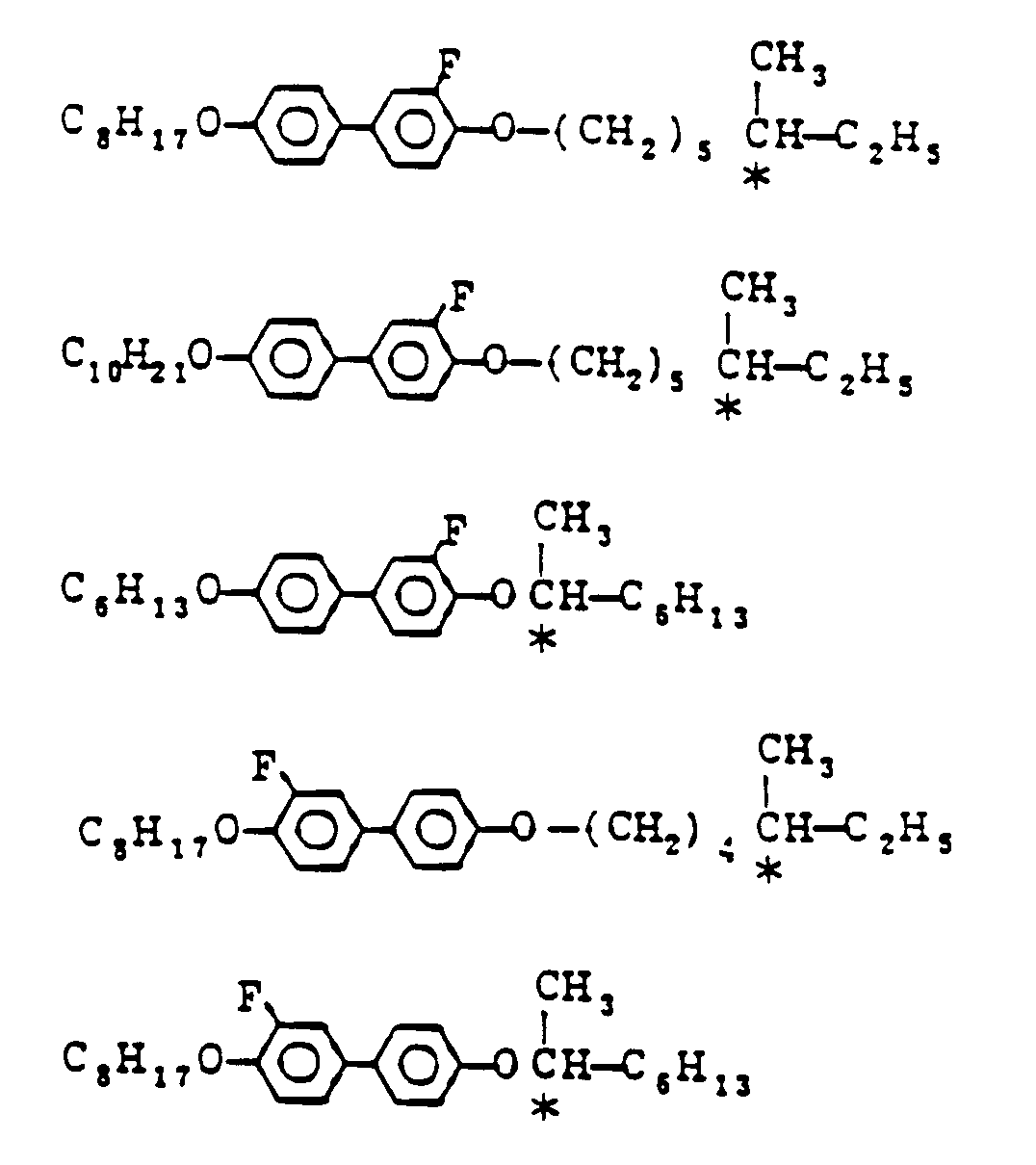
and a liquid crystalline composition characterized by containing at least one of these compounds. The new ferroelectric liquid crystalline compounds themselves of the present invention possess a broad SmC* phase at room temperature range, but the temperature range of the SmC* phase can further be broadened by making a mixture of the compounds of the above formula (I) or adding the compounds to other compositions. The new biphenyl derivatives of the present invention are substances effectively utilizable for broadening the working temperature range of display elements. - The compounds of the present invention can be synthesized through a synthesis route as will be shown hereinafter according to chemical synthetic reactions synthetic methods known per se.
- The chemical synthetic reactions and synthetic methods known from the past are, for example, reactions and methods disclosed in Houben-Weyl, Methoden der Organischen Chemie, etc. which are widely known in this art.
- The present invention will now be explained in more detail, showing the synthetic route and examples for the preparation of the new compounds concerned with the present invention.
- The new biphenyl compounds of the present invention can be synthesized through a plurality of routes, for example, according to the routes shown below.


- The following examples illustrate the compounds of this invention and the preparation thereof, wherein the notations and abbreviations used are as follows:
- TLC
- : thin layer chromatography
- HPLC
- : high speed liquid chromatography
- GLC
- : gas chromatography
- I.R.
- : infra-red rays absorption spectra
- Mass
- : Mass spectra
- b.p.
- : boiling point
- m.p.
- : melting point
- C
- : crystals
- SX, SmX
- : unidentified smectic phase
- SC*, SmC*
- : chiral smectic C phase
- SA, SmA
- : smectic A phase
- Cho
- : choresteric phase
- I
- : isotropic liquid
- ?
- : temperature being indefinite
-

- A reaction vessel was charged with 19 g of decyl bromide, 15 g of 4-bromophenol, 24 g of K₂CO₃ and 150 ml of cyclohexanone, and the mixture was heated with stirring for 9 hours at 120-130°C.
- After completion of the reaction, a solid matter was filtered off by suction and the filtrate was washed with water and dried over Glauber's salt. The cyclohexanone was distilled off and the residue was distilled under reduced pressure whereby 24 g of 4-bromodecyloxybenzene was obtained.
b.p. 152-163°C/1 mmHg
GLC at least 92%
- A reaction vessel was charged with 20g of (s)-4-methylhexyl bromide, 12 g of 2-fluorophenol, 24 g of K₂CO₃ and 150 ml of cyclohexanone, and the mixture was heated with stirring for 11 hours at 120-130°C.
- After completion of the reaction, a solid matter was filtered off by suction and the filtrate was washed with water and dried over Glauber's salt. The solvent was distilled off and the residue was distilled under reduced pressure whereby 22 g of (s)-2-fluoro-(4'-methylhexyl)oxybenzene was obtained.
b.p. 81-90°C/0.6 mmHg
GLC at least 98%
- A reaction vessel was charged with 20 g of the (s)-2-fluoro-(4'-methylhexyl)oxybenzene obtained in the above (b) and 50 ml of chloroform. To this mixture was added with stirring 16 g of Br₂ at room temperature. The stirring was continued for 4 hours, and the reaction mixture was poured into an aqueous solution of NaOH. The organic layer separated was washed with water and dried over Glauber's salt.
- The solvent was distilled off and the residue was distilled under reduced pressure whereby 20 g of (s)-2-fluoro-4-bromo-(4'-methylhexyl)oxybenzene was obtained.
b.p. 88-94°C/0.15 mmHg
GLC at least 97%
- A reaction vessel was charged with 0.84 g of Mg, and a proper amount of a solution of 11 g of 4-bromodecyloxybenzene obtained in the above (a) in 20 ml of THF was poured thereinto. A small piece of I₂ was then added and the mixture was warmed to initiate reaction. The remaining THF solution was slowly added dropwise to the mixture under reflux and agitation. After the addition, the mixture was refluxed for 2 hours to prepare a Grignard reagent.
- A separate vessel was charged with 0.2 g of Cl₂Pd(PPh₃)₂ and 50 ml of THF, and 2 ml of a 1M solution of (iso-C₄H₉)₂AlH/hexane was added thereto in a stream of N₂. To this mixture was added a solution of 10 g of (s)-2-fluoro-4-bromo-(4'-methylhexyl)oxybenzene obtained in the above (c) in 30 ml of THF. This mixture was warmed, and the Grignard reagent previously prepared was added dropwise thereto at 50-55°C. The reaction liquid was aged for 2 hours at the same temperature, poured into diluted hydrochloric acid and extracted with benzene. The extract was washed with water and dried over Glauber's salt. The benzene was distilled off and the residue was purified by way of column chromatography on silica gel using hexane-benzene (10:1) as eluent. The resultant crystals were recrystallized from acetone to give 1.7 g of (s)-4-decyloxy-3'-fluoro-4'-(4''-methylhexyl)oxybiphenyl.
- The purity of this compound was confirmed to be at least 99% by liquid chromatography. This compound was confirmed to be the end product in view of its measurement by infra-red absorption spectrometry and its molecular ion peak found at 442 by mass spectrometry and in view of the relation to the starting materials used.
- This compound was inserted into a Mettler hot stage FP-82 and its phase transition was observed under a polarization microscope. A result of the observation is shown in Table 1.
-

- A reaction vessel was charged with 128 g (1.016 mol) of 2-fluoroanisole and 250 ml of chloroform. To this mixture was added dropwise under agitation at room temperature 177 g (1.106 mol) of bromine over the period of at least 3 hours. The reaction liquid was poured into a diluted aqueous solution of NaOH, and the chloroform layer was separated, washed with a solution of edible salt and dried over Glauber's salt. The solvent was distilled off and the residue was distilled under reduced pressure to obtain 2-fluoro-4-bromoanisole.
Yield 192 g (Yield rate: 92.3%)
b.p. 107-118°C/25-31 mmHg
GLC at least 99%
- A reaction vessel was charged with 22 g (0.905 mol) of magnesium, a small amount of iodine and 50 ml of THF in a stream of nitrogen. Into this mixture was poured a proper amount of a solution of 144 g (0.917 mol) of bromobenzene in 150 ml of THF, and the mixture was then warmed. After initiation of the reaction, the remaining THF solution was added dropwise to the mixture under reflux and agitation. After the addition, the mixture was refluxed for 2 hours to prepare a Grignard reagent.
- A separate vessel was charged with 3.6 g of Cl₂Pd(PPh₃)₂ and 100 ml of THF. To the mixture were added in a stream of nitrogen 26 ml of a 1 mol solution of (iso-C₄H₉)₂AlH/hexane and then a solution of 120 g (0.585 mol) of 2-fluoro-4-bromoanisole obtained in (a) in 150 ml of THF.
- The mixture was warmed and the previously prepared Grignard reagent was added dropwise thereto at 50-60°C. The mixture was aged for 2 hours at the same temperature. After completion of the reaction, the reaction liquid was poured into diluted hydrochloric acid and extracted with benzene. The extract was washed with water and dried over Glauber's salt. The solvent was distilled off and the residue was recrystallized from a mixed solvent of chloroform-hexane and then purified by way of column chromatography on silica gel using hexane as an eluent whereby 3-fluoro-4-methoxybiphenyl was obtained.
Yield 96 g (81.3%)
GLC at least 98%
- A reaction vessel was charged with 95 g (0.470 mol) of 3-fluoro-4-methoxybiphenyl obtained in (b) and 400 ml of methylene chloride. To this mixture was added under agitation below 0°C 94 g (0.705 mol) of anhydrous aluminum chloride in small portions and was then added dropwise 56 g (0.705 mol) of acetyl chloride. After the addition, the mixture was stirred for 6 hours while elevating the temperature gradually. The reaction liquid was poured into diluted hydrochloric acid, and the organic layer was washed with water and dried over Glauber's salt. The solvent was distilled off and the residue was recrystallized from chloroform to obtain 3-fluoro-4-methoxy-4'-acetylbiphenyl.
Yield 114 g (99.3%)
GLC at least 99%
- A reaction vessel was charged with 84 g (0.344 mol) of 3-fluoro-4-methoxy-4'-acetylbiphenyl obtained in (c), 700 ml of 48% hydrobromic acid and 900 ml of acetic acid, and the mixture was heated with stirring for 12 hours at 100-110°C. The reaction liquid was poured into water and the precipitated crystals were collected by filtration, washed with water and purified by way of column chromatography on silica gel using methylene chloride as an eluent whereupon 3-fluoro-4-hydroxy-4'-acetylbiphenyl was obtained.
Yield 58 g (73.2%)
GLC at least 99%
- A reaction vessel was charged with 12.6 g of 3-fluoro-4-hydroxy-4'-acetylbiphenyl obtained in (d), 9.3 g of (s)-2-methylbutyl bromide, 15.1 g of potassium carbonate and 200 ml of cyclohexanone, and the mixture was heated with stirring for 20 hours at 90-100°C. The reaction liquid was filtered and the solid matter obtained was washed with benzene. The filtrate and the washing were combined, washed with water and then dried over Glauber's salt.
- The solvents were distilled off and the residue was recrystallized from acetone-methanol whereupon (s)-3-fluoro-4-(2''-methylbutyl)oxy-4'-acetylbiphenyl was obtained.
Yield 10.8 g (65.5%)
GLC at least 99%
- A reaction vessel was charged with 8.0 g of (s)-3-fluoro-4-(2''-methylbutyl)oxy-4'-acetylbiphenyl obtained in (e), 36 g of 88% formic acid and 90 ml of methylene chloride. To the mixture were successively added dropwise under agitation at room temperature 16 g of acetic anhydride, 1.0 ml of concentrated sulfuric acid and 30 g of 35% hydrogen peroxide. After the addition, the mixture was refluxed until the starting material disappeared in TLC (Kieselgel 60F254, developing liquid: benzene). The reaction liquid was poured into water and the mixture was stirred for 1 hour. The organic layer was washed with water until the washing liquid became neutral and then dried over Glauber's salt. The solvent was distilled off, and 70 ml of methanol and 20 ml of a 40% aqueous solution of KOH were added to the resultant residue. The mixture was reacted together for 3 hours at 70°C under agitation. The reaction liquid was poured into water, and the mixture was made acidic with hydrochloric acid. The mixture was extracted with ether, end the extract was washed with water and dried over Glauber's salt. The solvent was distilled off and the residue was purified by way of column chromatography on silica gel whereupon (s)-3-fluoro-4-(2''-methylbutyl)-4'-hydroxybiphenyl was obtained.
Yield 5.2 g (71.2%)
GLC at least 98%
- A reaction vessel was charged with 1.5 g of (s)-3-fluoro-4-(2''-methylbutyl)oxy-4'-hydroxybiphenyl obtained in (f), 2.0 g of octyl bromide, 1.35 g of potassium carbonate and 25 ml of cyclohexanone, and the mixture was reacted together for 15 hours at 90-100°C. The reaction liquid was filtered and the resultant solid matter was washed with benzene. The filtrate and the washing liquid were combined, washed with water and dried over Glauber's salt. The solvents were distilled off and the resultant residue was recrystallized from acetone-methanol to obtain (s)-3-fluoro-4-(2''-methylbutyl)oxy-4'-octyloxybiphenyl.
Yield 0.9 g (47.6%)
The purity of this compound was at least 99% by liquid chromatography. The resultant compound was confirmed to be the end product in view of its measurement by infra-red absorption spectrometry and its molecular ion peak found at 386 by mass spectrometry and in view of the relation to the starting materials used. - This compound was inserted into a Mettler hot stage FP-82 and its phase transition was observed under a polarization microscope. A result of the observation is shown in Table 1.
- Except that 1.8 g of pentyl bromide, 2.2 g of decyl bromide or 2.4 g of dodecyl bromide was used in place of 2.0 g of octyl bromide in Example 2-(g), an operation was carried out in a similar manner whereby the corresponding compounds shown by the following formulas were obtained in a yield of 1.0 g (56.2%), 0.7 g (34.5%) or 1.5 g (70%), respectively.
- The purity of these compounds were at least 99% by liquid chromatography. These compounds ware confirmed to be the end products in view of measurement by infra-red absorption spectrometry and their molecular ion peaks found at 344, 414 and 442, respectively, by mass spectrometry and in view of the relation to the starting materials used.
- These compounds were inserted into a Mettler hot stage FP-82 and their phase transition was observed under a polarization microscope. Results of the observation are shown in Table 1.

-

- Except that 10.7 g of (s)-4-methylhexyl bromide was used in place of 9.3 g of (s)-2-methylbutyl bromide in Example 2-(e), an operation was carried out in a similar manner whereby (s)-3-fluoro-4-(4''-methylhexyl)oxy-4'-acetylbiphenyl was obtained in a yield of 15 g (70%). Except that 9.2 g of this compound was used in place of 8.0 g of (s)-3-fluoro-4-(2''-methylbutyl)oxy-4'-acetylbiphenyl in Example 2-(f), an operation was carried out in a similar manner whereby (s)-3-fluoro-4-(4''-methylhexyl)oxy-4'-hydroxybiphenyl was obtained.
Yield 5.7 g (66.8%) was obtained.
GLC at least 97%
- A reaction vessel was charged with 1.5 g of (s)-3-fluoro-4-(4''-methylhexyl)oxy-4'-hydroxybiphenyl obtained in the above (a), 1.1 g of octyl bromide, 1.71 g of potassium carbonate and 20 ml of cyclohexanone, and the mixture was reacted together for 15 hours at 90-100°C. The reaction liquid was filtered and the resultant solid matter was washed with benzene. The filtrate was combined with the washing liquid, washed with water and dried over Glauber's salt. The solvents were distilled off and the resultant residue was recrystallized from acetone-methanol to obtain (s)-3-fluoro-4-(4''-methylhexyl)oxy-4'-octyloxybiphenyl.
Yield 1.0 g (48.1%)
The purity of this compound was at least 99% by liquid chromatography. This compound was confirmed to be the end product in view of its measurement by infra-red absorption spectrometry and its molecular ion peak found at 414 by mass spectrometry and in view of the relation to the starting materials used. - This compound was inserted into a Mettler hot stage FP-82 and its phase transition was observed under a polarization microscope. A result of the observation is shown in Table 1.
-

- Except that 0.85 g of pentyl bromide was used in place of 1.1 g of octyl bromide in Example 6-(b), an operation was carried out in a similar manner to obtain (s)-3-fluoro-4-(4''-methylhexyl)oxy-4'-pentyloxybiphenyl.
Yield 1.4 g (76.8%)
The purity of this compound was at least 99% by liquid chromatography. This compound was confirmed to be the end product in view of its measurement by infra-red rays absorption spectrometry and its molecular ion peak found at 372 by mass spectrometry and in view of the reaction to the starting materials used. - This compound was inserted into a Mettler hot stage FP-82 and its phase transition was observed under a polarization microscope. A result of the observation is shown in Table 1.
-

- Except that 12.7 g of (s)-6-methyloctyl bromide was used in place of 9.3 g of (s)-2-methylbutyl bromide in Example 2-(e), an operation was carried out in a similar manner whereby (s)-3-fluoro-4-(6''-methyloctyl)oxy-4'-acetylbiphenyl was obtained in a yield of 13.1 g (67%). Except that 10 g of this compound was used in place of 8.0 g of (s)-3-fluoro-4-(2''-methylbutyl)oxy-4'-acetylbiphenyl in Example 2-(f), an operation was carried out in a similar manner whereby (s)-3-fluoro-4-(6''-methyloctyl)oxy-4'-hydroxybiphenyl was obtained in a yield of 2.7 g (29%).
GLC at least 99%
- A reaction vessel was charged with 1.0 g of (s)-3-fluoro-4-(4''-methyloctyl)oxy-4'-hydroxybiphenyl obtained in the above (a), 1.2 g of octyl bromide, 1.0 g of potassium carbonate and 25 ml of cyclohexanone, and the mixture was reacted together for 15 hours at 90-100°C. The reaction liquid was filtered and the resultant solid matter was washed with benzene. The filtrate and the washing liquid were combined, washed with water and dried over Glauber's salt. The solvents were removed by distillation and the resultant residue was recrystallized from acetone-methanol to obtain (s)-3-fluoro-4-(4''-methyloctyl)oxy-4'-octyloxybiphenyl.
Yield 0.84 g (63.2%)
The purity of this compound was at least 99% by liquid chromatography. Further, this compound was confirmed to be the end product in view of its measurement by infra-red rays absorption spectrometry and its molecular ion peak found at 442 by mass spectrometry and in view of the relation to the starting materials used. - This compound was inserted into a Mettler hot stage FP-82 and its phase transition was observed under a polarization microscope. A result of the observation is shown in Table 1.
-

- Except that 1.0 g of hexyl bromide was used in place of 1.2 g of octyl bromide in Example 8-(b), an operation was carried out in a similar manner whereby 1.1 g (yield: 88%) of the corresponding (s)-3-fluoro-4-(6''-methyloctyl)oxy-4'-hexyloxybiphenyl was obtained.
- The purity of this was at least 99% by liquid chromatography. The obtained substance was confirmed to be the end product in view of their measurement by infra-red rays absorption spectrometry and their molecular ion peak found at 414 by mass spectrometry and in view of the relation to the starting material used.
- This was inserted into a Mettler hot stage FP-82 and its phase transition was observed under a polarization microscope. Result of the observation are shown in Table 1.
-

- Except that 14.9 g of (s)-1-methylbutyl tosylate was used in place of 9.3 g of (s)-2-methylbutyl bromide in Example 2-(e), an operation was carried out in a similar manner whereby (s)-3-fluoro-4-(1''-methylbutyl)oxy-4'-acetylbiphenyl was obtained in a yield of 10.2 g (yield rate: 62%). Except that 8 g of this compound was used in place of 8 g of (s)-3-fluoro-4-(2''-methylbutyl)oxy-4'-acetylbiphenyl in Example 2-(f), an operation was carried out in a similar manner whereby (s)-3-fluoro-4-(1''-methylbutyl)oxy-4'-hydroxybiphenyl was obtained in a yield of 5.0 g (yield rate: 65.3%).
GLC at least 97%.
- A reaction vessel was charged with 1.0 g of (s)-3-fluoro-4-(1''-methylbutyl)oxy-4'-hydroxybiphenyl, 1.4 g of octyl bromide, 1.0 g of potassium carbonate and 25 ml of cyclohexanone, and the mixture was reacted together for 15 hours at 90-100°C. The reaction liquid was filtered and the resultant solid matter was washed with benzene. The filtrate and the washing liquid were combined, washed with water and dried over Glauber's salt. The solvents were distilled off and the residue was recrystallized from acetone-methanol to obtain (s)-3-fluoro-4-(1''-methylbutyl)oxy-4'-octyloxybiphenyl.
Yield 0.6 g (43.2%)
The purity of this compound was at least 99% by liquid chromatography. This compound was confirmed to be the end product in view of its measurement by infra-red rays absorption spectrometry and its molecular ion peak found at 386 by mass spectrometry and in view of the relation to the starting materials used. - This compound was inserted into a Mettler hot stage FP-82 and its phone transition was observed under a polarization microscope. A result of the observation is shown in Table 1.
-

- Except that 1.6 g of decyl bromide or 2.0 g of tetradecyl bromide was used in place of 1.4 g of octyl bromide in Example 11-(b), an operation was carried out in a similar manner whereby 0.7 g (yield: 47%) or 0.8 g (yield: 47%) of the corresponding (s)-3-fluoro-4-(1''-methylbutyl)oxy-4'-decyloxybiphenyl or (s)-3-fluoro-4-(1''-methylbutyl)oxy-4'-tetradeoyloxybiphenyl, respectively, was obtained.
- The purity of these was at least 99% by liquid chromatography. These substances were confirmed to be the end products in view of their measurement by infra-red rays absorption spectrometry and their molecular ion peaks found at 414 and 470 by mass spectrometry and in view of the relation to the starting materials used.
- These compounds were inserted into a Mettler hot stage FP-82 and their phase transition was observed under a polarization microscope. Result of the observations are shown in Table 1.
-

- Except that 18 g of (s)-1-methylheptyl tosylate was used in place of 9.3 g of (s)-2-methylbutyl bromide in Example 2-(e), an operation was carried out in a similar manner whereby 9.1 g (yield: 46.8%) of (s)-3-fluoro-4-(1''-methylheptyl)oxy-4'-acetylbiphenyl was obtained. Except that 9.1 g of this compound was used in place of 8.0 g of (s)-3-fluoro-4-(2''-methylbutyl)oxy-4'-acetylbiphenyl in Example 2-(f), an operation was carried out in a similar manner to obtain 3.2 g (yield: 37.9%) of (s)-3-fluoro-4-(1''-methylheptyl)oxy-4'-hydroxybiphenyl.

- A reaction vessel was charged with 1.4 g of (s)-3-fluoro-4-(1''-methylheptyl)oxy-4'-hydroxybiphenyl obtained in the above (a), 1.8 g of decyl bromide, 1.9 g of potassium carbonate and 25 ml of cyclohexanone, and the mixture was reacted together for 15 hours at 90-100°C. The reaction liquid was filtered and the resultant solid matter was washed with benzene. The filtrate and the washing liquid were combined, washed with water and dried over Glauber's salt. The solvents were distilled off and the residue obtained was recrystallized from acetone-methanol to obtain 1.2 g (yield: 60%) of (s)-3-fluoro-4-(1''-methylheptyl)oxy-4'-decyloxybiphenyl.
- The purity of this compound was at least 99% by liquid chromatography. This compound was confirmed to be the end product in view of its measurement by infra-red rays absorption spectrometry and its molecular ion peak found at 456 by mass spectrometry and in view of the relation to the starting materials used.
- This compound was inserted into a Mettler hot stage FP-82 and its phase transition was observed under a polarization microscope. A result of the observation is shown in Table 1.
-

- Using 3-fluorophenol similarly in place of 2-fluorophenol in Example 1-(b), 20 g of (s)-3-fluoro-(4'-methylhexyl)oxybenzene was obtained.
b.p. 109-110°C/5 mmHg
GLC at least 99%
- Using (s)-3-fluoro-(4'-methylhexyl)oxybenzene obtained in the above (a) similarly in place of (s)-2-fluoro-(4'-methylhexyl)oxybenzene in Example 1-(c), 21 g of (s)-3-fluoro-4-bromo-(4'-methylhexyl)oxybenzene was obtained.
b.p. 114-121°C/ mmHg
GLC 76% (others were structurally isomeric brominated compounds)
- Using (s)-3-fluoro-4-bromo-(4'-methylhexyl)oxybenzene obtained in the above (b) in place of (s)-2-fluoro-4-bromo-(4'-methylhexyl)oxybenzene in Example 1-(d), an operation was carried out similarly whereby 1.2 g of (s)-4-decyloxy-2'-fluoro-4'-(4''-methylhexyl)oxybiphenyl was obtained.
- The purity of this compound was at least 99% by liquid chromatography. This compound was confirmed to be the end product in view of its measurement by infra-red rays absorption spectrometry and its molecular ion peak found at 442 by mass spectrometry and in view of the relation to the starting materials used.
- This compound was inserted into a Mettler hot stage FP-82 and its phase transition was observed under a polarization microscope. A result of the observation is shown in Table 1.
-

- A reaction vessel was charged with 48.4 g of 4-bromophenol, 50 g of (s)-4-methylhexyl bromide, 65 g of K₂CO₃ and 700 ml of cyclohexanone, and the mixture was reacted together at 120-130°C until the starting materials disappeared (confirmed by gas chromatography). For this, 6 hours were required.
- The reaction liquid was poured into water and extracted with ether. After that, the extract was washed with a diluted aqueous solution of NaOH and then with water to make the extract neutral. After drying the extract over Glauber's salt, the ether was removed by distillation and the residue was distilled under reduced pressure whereupon 68 g of (s)-4-bromo-(4'-methylhexyl)oxybenzene was obtained.
b.p. 120-123°C/0.5 mmHg
GLC at least 93%
- Using 3-fluorophenol in place of 4-bromophenol in Example 1-(a), an operation was carried out similarly whereby 19.5 g of 3-fluoro-decyloxybenzene was obtained.
b.p. 105-108°C/0.3 mmHg
GLC at least 99%
- Using 3-fluoro-decyloxybenzene obtained in (b) in place of (s)-2-fluoro-(4'-methylhexyl)oxybenzene in Example 1-(c), an operation was carried out similarly whereby 18 g of 3-fluoro-4-bromo-decyloxybenzene was obtained.
b.p. 103-110°C/0.5 mmHg
GLC 84% (others were structurally isomeric bromine compounds)
- In Example 1-(d), the operation was carried out similarly except that (s)-4-bromo-(4'-methylhexyl)oxybenzene obtained in the above (a) was used in place of 4-bromo-decyloxybenzene while 3-fluoro-4-bromo-decyloxybenzene obtained in the above (c) was used in place of (s)-3-fluoro-4-bromo(4'-methylhexyl)oxybenzene, whereby 0.33 g of (s)-4-(4''-methylhexyl)oxy-2'-fluoro-4'-decyloxybiphenyl was obtained.
- The purity of this compound was at least 99% by liquid chromatography. This compound was confirmed to be the end product in view of its measurement by infra-red rays absorption spectrometry and its molecular ion peak found at 442 by mass spectrometry and in view of the relation to the starting materials used.
- This compound was inserted into a Mettler hot stage FP-82 and its phase transition was observed under a polarization microscope. A result of the observation is shown in Table 1.
-

- Except that in Example 1-(b) octyl bromide was used in place of (s)-4-methylhexyl bromide while 3-fluorophenol was used in place of 2-fluorophenol, the operation was carried out similarly whereby 18 g of 3-fluoro-octyloxybenzene was obtained.

- In Example 1-(c), the operation was carried out similarly except that 3-fluoro-octyloxybenzene obtained in (a) was used in place of 2-fluoro-(4'-methylhexyl)oxybenzene, whereby 18 g of 3-fluoro-4-bromo-octyloxybenzene was obtained.
b.p. 139-142°C/0.9 mmHg
- In Example 1-(d), the operation was carried out similarly except that (s)-4-bromo-(4'-methylhexyl)oxybenzene obtained in Example 16-(a) was used in place of 4-bromo-decyloxybenzene while 3-fluoro-4-bromo-octyloxybenzene obtained in (b) was used in place of (s)-2-fluoro-4-bromo-(4'-methylhexyl)oxybenzene, whereby (s)-4-(4''-methylhexyl)oxy-2'-fluoro-4'-octyloxybenzene was obtained.
Yield 0.5 g (3.7%)
The purity of this compound was at least 99% by liquid chromatography. This compound was confirmed to be the end product in view of its measurement by infra-red rays absorption spectrometry and its molecular ion peak found at 414 by mass spectrometry and in view of the relation to the starting materials used. - This compound was inserted into a Mettler hot stage FP-82 and its phase transition was observed under a polarization microscope. A result of the observation is shown in Table 1.
-

- In Example 1-(b), the operation was carried out similarly except that decyl bromide was used in place of (s)-4-methylhexyl bromide, whereby 20 g of 2-fluoro-decyloxybenzene was obtained.

- In Example 1-(c), the operation was carried out similarly except that 2-fluoro-decyloxybenzene obtained in (a) was used in place of (s)-2-fluoro-(4'-methylhexyl)oxybenzene, whereby 17.2 g of 2-fluoro-4-bromo-decyloxybenzene was obtained.
b.p. 147°C/0.7 mmHg
GLC at least 98%
- In Example 1-(d), the operation was carried out similarly except that (s)-4-bromo-(4'-methylhexyl)oxybenzene obtained in Example 16-(a) was used in place of 4-bromo-decyloxybenzene while 2-fluoro-4-bromo-decyloxybenzene obtained in (b) was used in place of (s)-2-fluoro-4-bromo-(4'-methylhexyl)oxybenzene, whereby 1.2 g of (s)-4-(4''-methylhexyl)oxy-3'-fluoro-4'-decyloxbiphenyl was obtained
The purity of this compound was at least 99% by liquid chromatography. This compound was confirmed to be the end product in view of its measurement by infra-red rays absorption spectrometry and its molecular ion peak found at 442 by mass spectrometry and in view of the relation to the starting materials used. - This compound was inserted into a Mettler hot stage FP-82 and its phase transition was observed under a polarization microscope. A result of the observation is shown in Table 1.
-

- In Example 1-(b), the operation was carried out similarly except that octyl bromide was used in place of (s)-4-methylhexyl bromide, whereby 22 g of 2-fluoro-octyloxybenzene was obtained.

- In Example 1-(c), the operation was carried out similarly except that 2-fluoro-octyloxybenzene obtained in (a) was used in place of (s)-2-fluoro-(4'-methylhexyl)oxybenzene, whereby 19.3 g of 2-fluoro-4-bromo-decyloxybenzene was obtained.
b.p. 122-130°C/0.3-1.0 mmHg
- In Example 1-(d), the operation was carried out similarly except that (s)-4-bromo-(4'-methylhexyl)oxybenzene obtained in Example 16-(a) was used in place of 4-bromo-decyloxybenzene while 2-fluoro-4-bromo-octyloxybenzene obtained in (b) was used in place of (s)-2-fluoro-4-bromo-(4'-methylhexyl)oxybenzene, whereby 4.4 g of (s)-4-(4''-methylhexyl)oxy-3'-fluoro-4'-octyloxybiphenyl was obtained.
- The purity of this compound was at least 99% by liquid chromatography. This compound was confirmed to be the end product in view of its measurement by infra-red rays absorption spectrometry and its molecular ion peak found at 414 by mass spectrometry and in view of the relation to the starting materials used.
- This compound was inserted into a Mettler hot stage FP-82 and its phase transition was observed under a polarization microscope. A result of the observation is shown in Table 1.
-

- In Example 1-(d), the operation was carried out similarly except that (s)-2-fluoro-4-bromo-(4'-methylhexyl)oxybenzene obtained in Example 1-(c) was used in place of 4-bromo-decyloxybenzene while 2-fluoro-4-bromo-decyloxybenzene obtained in Example 18-(b) was used in place of (s)-2-fluoro-4-bromo-(4'-methylhexyl)oxybenzene, whereby 1.07 g of (s)-3,3'-difluoro-4-(4''-methylhexyl)oxy-4'-decyloxybiphenyl was obtained.
- The purity of this compound was at least 99% by liquid chromatography. This compound was confirmed to be the end product in view of its measurement by infra-red rays absorption spectrometry and its molecular ion peak found at 460 by mass spectrometry and in view of the relation to the starting materials used.
- This compound was inserted into a Mettler hot stage FP-82 and its phase transition was observed under a polarization microscope. A result of the observation is shown in Table 1.
-

- In Example 1-(d), the operation was carried out similarly except that (s)-2-fluoro-4-bromo-(4'-methylhexyl)oxybenzene obtained in Example 1-(c) was used in place of 4-bromo-decyloxybenzene while 3-fluoro-4-bromo-decyloxybenzene obtained in Example 16-(c) was used in place of (s)-2-fluoro-4-bromo-(4'-methylhexyl)oxybenzene, whereby 1.12 g of (s)-3,2'-difluoro-4-(4''-methylhexyl)oxy-4'-decyloxybiphenyl was obtained.
- The purity of this compound was at least 99% by liquid chromatography. This compound was confirmed to be the end product in view of its measurement by infra-red rays absorption spectrometry and its molecular ion peak found at 460 by mass spectrometry and in view of the relation to the starting materials used.
- This compound was inserted into a Mettler hot stage FP-82 and its phase transition was observed under a polarization microscope. A result of the observation is shown in Table 1.
-

- A reaction vessel was charged with 4.6 g of NaOH and 40 ml of water. To the mixture under agitation was added dropwise below 5°C 6.5 g of bromine. After the addition, the mixture was stirred for 1.5 hours below 10°C to prepare an aqueous solution of a hypobromite. A separate reaction vessel was charged with 1.95 g of (s)-3-fluoro-4-(2''-methylbutyl)oxy-4'-acetylbiphenyl obtained in Example 2-(e) and 25 ml of dioxane. To this mixture under agitation was added dropwise at room temperature, the previously prepared aqueous solution of the hypobromite. After the addition, the mixture was heated under heat for 3 hours at 50-60°C. The reaction liquid was poured into an aqueous solution of sodium sulfite and the mixture was made acidic with hydrochloric acid. The precipitated crystals were collected by filtration, washed with water and dried whereupon (s)-3-fluoro-4-(2''-methylbutyl)oxy-4'-biphenylcarboxylic acid was obtained.
Yield 1.6 g (81.6%)
- A reaction vessel was charged with 1.6 g of (s)-3-fluoro-4-(2''-methylbutyl)oxy-4'-biphenylcarboxylic acid obtained in (a) and 50 ml of benzene. To this mixture under agitation was added dropwise 2 g of thionyl chloride at room temperature, and the whole was refluxed for 6 hours. After completion of the reaction, excess thionyl chloride and benzene were distilled off, and 1.6 g of crude acid chloride was obtained by repeating addition of benzene to the residue and removal of the benzene by distillation.
- A separate vessel was charged with 0.8 g of octyl alcohol, 20 ml of benzene and 1.0 g of pyridine. To the mixture under agitation at room temperature was added dropwise a solution of the previously prepared acid chloride in 20 ml of benzene, and the whole was refluxed for 7 hours. The reaction liquid was poured into water and extracted with benzene. The extract was washed with water and dried over Glauber's salt. The solvent was distilled off and the residue was purified by way of column chromatography on silica gel using hexane-benzene (4:1) as an eluent, and recrystallized from ethanol to obtain (s)-3-fluoro-4-(2''-methylbutyl)oxy-4'-biphenylcarboxylic acid octyl ester.
Yield 1.0 g (44.2%)
The purity of this compound was at least 99% by liquid chromatography. This compound was confirmed to be the end product in view of its measurement by infra-red rays absorption spectrometry and its molecular ion peak found at 414 by mass spectrometry and in view of the relation to the starting materials used. - This compound was inserted into a Mettler hot stage FP-82 and its phase transition was observed under a polarization microscope. A result of the observation is shown in Table 1.
-

- A reaction vessel was charged with 21.2 g of NaOH and 100 ml of water. To this mixture under agitation below 5°C was added dropwise 29 g of bromine. After the addition, the mixture was stirred for 1.5 hours below 10°C to prepare an aqueous solution of a hypobromite. In a separate vessel was charged with 11 g of (s)-3-fluoro-4-(6''-methyloctyl)oxy-4'-acetylbiphenyl obtained as an intermediate in Example 8-(a) and 100 ml of dioxane. To this mixture under agitation at room temperature was added dropwise the previously prepared aqueous hypobromite solution. After the addition, the mixture was heated for 3 hours at 50-60°C under agitation. The reaction liquid was poured into an aqueous solution of sodium sulfite and the mixture was made acidic with hydrochloric acid. The precipitated crystals were collected by filtration, washed with water and dried to obtain (s)-3-fluoro-4-(6''-methyloctyl)oxy-4'-biphenylcarboxylic acid.
Yield 9.85 g (88.7%)
- A reaction vessel was charged with 4.5 g of (s)-3-fluoro-4-(6''-methyloctyl)oxy-4'-biphenylcarboxylic acid obtained in (a) and 50 ml of benzene. To the mixture under agitation at room temperature was added dropwise 5 g of thionyl chloride, and the whole was refluxed for 11 hours. After completion of the reaction, excess thionyl chloride and benzene were distilled off, and 4.66 g of crude acid chloride was obtained by repeating addition of benzene to the residue and removal of the benzene by distillation.
- A separate vessel was charged with 0.55 g of octyl alcohol, 20 ml of benzene and 0.43 g of pyridine. To the mixture under agitation at room temperature was added dropwise a solution of the previously prepared acid chloride in 20 ml of benzene, and the whole was refluxed for 13 hours. The reaction liquid was poured into water and extracted with benzene. The extract was washed with water and dried over Glauber's salt. The solvent was distilled off and the residue was purified by way of column chromatography on silica gel using hexane-benzene (4:1) as an eluent, and recrystallized from ethanol to obtain (s)-3-fluoro-4-(6''-methyloctyl)oxy-4'-biphenylcarboxylic acid octyl ester.
Yield 0.76 g (49%)
The purity of this compound was at least 98% by liquid chromatography. This compound was confirmed to be the end product in view of its measurement by infra-red rays absorption spectrometry and its molecular ion peak found at 470 by mass spectrometry and in view of the relation to the starting materials used. - This compound was inserted into a Mettler hot stage FP-82 and its phase transition was observed under a polarization microscope. A result of the observation is shown in Table 1.
-

- R =
- C₄H₉ (Example 24), C₆H₁₃ (Example 25), C₁₀H₂₁ (Example 26)
- The purity of these compounds were at least 99% by liquid chromatography. These compounds were confirmed to be the end products in view of their measurement by infra-red rays absorption spectrometry and their molecular ion peaks found at 414, 442 and 498 by mass spectrometry and in view of the relation to the starting materials used.
- These compounds were inserted into a Mettler hot stage FP-82 and their phase transition was observed under a polarization microscope. Results of the observation are shown in Table 1.
-

- A reaction vessel was charged with 8.8 g of NaOH and 30 ml of water. To the mixture under agitation below 5°C was added dropwise 14 g of bromine. After the addition, the mixture was stirred for 1.5 hours below 10°C to prepare an aqueous solution of a hypobromite. A separate vessel was charged with 4.06g (s)-3-fluoro-4-(1''-methylheptyl)oxy-4'-acetylbiphenyl obtained as an intermediate in Example 14-(a) and 75 ml of dioxane. To the mixture under agitation at room temperature was added dropwise a solution of the previously prepared aqueous solution of hypobromite, and the whole was heated for 5 hours at 50-60°C under agitation. The reaction liquid was poured into an aqueous solution of sodium sulfite and the mixture was made acidic with hydrochloric acid. The precipitated crystals were collected by filtration, washed with water and dried to obtain (s)-3-fluoro-4-(1''-methylheptyl)oxy-4'-biphenylcarboxylic acid was obtained.
Yield 4.07 g (99.8%)
- A reaction vessel was charged with 3.9 g of (s)-3-fluoro-4-(1''-methylheptyl)oxy-4'-biphenylcarboxylic acid obtained in (a) and 50 ml of benzene. To this mixture under agitation at room temperature was added dropwise 4 g of thionyl chloride, and the whole was refluxed for 12 hours. After completion of the reaction, excess thionyl chloride and benzene were distilled off, and 4.55 g of crude acid chloride was obtained by repeating addition of benzene to the residue and removal of the benzene by distillation.
- A separate vessel was charged with 0.47 g of octyl alcohol, 20 ml of benzene and 0.52 g of pyridine. To the mixture under agitation at room temperature was added dropwise a solution of 1.2 g of the previously prepared acid chloride in 20 ml of benzene, and the whole was refluxed for 7 hours. The reaction liquid was poured into water and extracted with benzene. The extract was washed with water and dried over Glauber's salt. The solvent was distilled off and the residue was purified by way of column chromatography on silica gel using hexane-benzene (4:1) as an eluent, and recrystallized from ethanol to obtain (s)-3-fluoro-4-(1''-methylheptyl)oxy-4'-biphenylcarboxylic acid octyl ester.
Yield 1.16 g (yield rate: 77%)
The purity of this compound was at least 99% by liquid chromatography. This compound was confirmed to be the end product in view of its measurement by infra-red rays absorption spectrometry and its molecular ion peak found at 456 by mass spectrometry and in view of the relation to the starting materials used. - This compound was inserted into a Mettler hot stage FP-82 and its phase transition was observed under a polarization microscope. A result of the observation is shown in Table 1.
-

- R =
- C₆H₁₃ (Example 28), C₁₀H₂₁ (Example 29)
- The purity of these compounds were at least 99% by liquid chromatography. These compounds were confirmed to be the end products in view of their measurement by infra-red rays absorption spectrometry and their molecular ion peaks found at 428 and 484 by mass spectrometry and in view of the relation to the starting materials used.
- These compounds were inserted into a Mettler hot stage FP-82 and their phase transition was observed under a polarization microscope. Results of the observation are shown in Table 1.
-

- A reaction vessel was charged with 1.01 g of (s)-3-fluoro-4-(2''-methylbutyl)oxy-4'-hydroxybiphenyl obtained in Example 2-(f), 0.65 g of pyridine and 20 ml of benzene. To the mixture under agitation at room temperature was added dropwise a solution of 0.82 g of nonanoyl chloride in 5 ml of benzene, and the whole was refluxed for 4 hours under agitation. The reaction liquid was poured into water and extracted with benzene. The extract was washed with water, treated with ammonia water, washed with water and dried over Glauber's salt. The benzene was then distilled off and the residue was purified by way of column chromatography on silica gel using hexane-benzene (2:1) as an eluent whereby 0.66 g (43.1%) of (s)-3-fluoro-4-(2''-methylbutyl)oxy-4'-nonanoyloxybiphenyl was obtained.
- The purity of this compound was at least 99% by liquid chromatography. This compound was confirmed to be the end product in view of its measurement by infra-red rays absorption spectrometry and its molecular ion peak found at 415 by mass spectrometry and in view of the relation to the starting materials used.
- This compound was inserted into a Mettler hot stage FP-82 and its phase transition was observed under a polarization microscope. A result of the observation is shown in Table 1.
-

- In Example 30, the operation was carried out similarly except that 1.01 g of dodecanoyl chloride was used in place of 0.82 g of nonanoyl chloride, whereby 1.23 g (55.8%) of (s)-3-fluoro-4-(2''-methylbutyl)oxy-4'-dodecanoyloxybiphenyl was obtained.
- The purity of this compound was at least 99% by liquid chromatography. This compound was confirmed to be the end product in view of its measurement by infra-red rays absorption spectrometry and its molecular ion peak found at 457 by mass spectrometry and in view of the relation to the starting materials used.
- This compound was inserted into a Mettler hot stage FP-82 and its phase transition was observed under a polarization microscope. A result of the observation is shown in Table 1.
-

- A reaction vessel was charged with 1.5 g of (s)-3-fluoro-4-(4''-methylhexyl)oxy-4'-hydroxybiphenyl obtained in Example 6-(a), 1.13 g of pyridine and 30 ml of benzene. To this mixture under agitation at room temperature was added dropwise a solution of 1.06 g of nonanoyl chloride in 10 ml of benzene, and the whole was refluxed for 14 hours. The reaction mixture was poured into water and extracted with benzene. The extract was washed with water, treated with ammonia water, washed with water and dried over Glauber's salt. The benzene was distilled off and the residue was purified by way of column chromatography on silica gel using hexane-benzene (2:1) as an eluent, whereby 0.51 g (23.2%) of (s)-3-fluoro-4-(4''-methylhexyl)oxy-4'-nonanoyloxybiphenyl was obtained.
- The purity of this compound was at least 98% by liquid chromatography. This compound was confirmed to be the end product in view of its measurement by infra-red rays absorption spectrometry and its molecular ion peak found at 442 by mass spectrometry and in view of the relation to the starting materials used.
- This compound was inserted into a Mettler hot stage FP-82 and its phase transition was observed under a polarization microscope. A result of the observation is shown in Table 1.
-

- R =
- C₆H₁₃ (Example 34) C₁₁H₂₃ (Example 35)
- The purity of these compounds were at least 99% by HPLC. These compounds were confirmed to be the end products in view of their measurement by infra-red rays absorption spectrometry and their molecular ion peaks found at 414 and 484 by mass spectrometry and in view of the relation to the starting materials used.
- These compounds were inserted into a Mettler hot stage FP-82 and their phase transition was observed under a polarization microscope. Results of the observation are shown in Table 1.
-

- A reaction vessel was charged with 1.01 g (s)-3-fluoro-4-(1''-methylbutyl)oxy-4'-hydroxybiphenyl obtained in Example 11-(a), 0.65 g of pyridine and 20 ml of benzene. To the mixture under agitation at room temperature was added dropwise a solution of 0.82 g of nonanoyl chloride in 5 ml of benzene, and the whole was refluxed for 4 hours under agitation. The reaction liquid was poured into water and extracted with benzene. The extract was washed with water, treated with ammonia water, washed with water and dried over Glauber's salt. The benzene was distilled off and the residue was purified by way of column chromatography on silica gel using hexanebenzene (2:1) as an eluent, whereby 0.57 g (37%) of (s)-3-fluoro-4-(1''-methylbutyl)oxy-4'-nonanoyloxybiphenyl was obtained.
- The purity of this compound was at least 99% by liquid chromatography. This compound was confirmed to be the end product in view of its measurement by infra-red rays absorption spectrometry and its molecular ion peak found at 414 by mass spectrometry and in view of the relation to the starting materials used.
- This compound was inserted into a Mettler hot stage FP-82 and its phase transition was observed under a polarization microscope. A result of the observation is shown in Table 1.
-

- In Example 35, the operation was carried out similarly except that 1.0 g of dodecanoyl chloride or 0.62 g of heptanoyl chloride was used in place of 0.82 g of nonanoyl chloride, whereby 0.49 g (29%) or 0.39 g (28%) of the corresponding (s)-3-fluoro-4-(1"-methylbutyl)oxy-4'-dodecanoyloxybiphenyl or (s)-3-fluoro-4-(1"-methylbutyl)-oxy-4'-heptanoylchloride, respectively, were obtained.
- The purity of these compounds were at least 99% by HPLC. These compounds were confirmed to be the end products in view of their measurement by infrared rays absorption spectrometry and their molecular ion peaks found at 456 and 386 by mass spectrometry and in view of the relation to the starting materials used.
- These compounds were inserted into a Mettler hot stage FP-82 and their phase transition was observed under a polarization microscope. Results of the observation are shown in Table 1.
-

- A reaction vessel was charged with 230 g of 4-hydroxy-4'-acetylbiphenyl, 164 g of ethyl bromide, 276 g of potassium carbonate and 1.7 ℓ of cyclohexanone. The mixture was reacted together under agitation for 3 hours at 65-70°C and then for 6 hours at 95-100°C. The reaction liquid was filtered and the resultant solid matter was washed with benzene. The filtrate and the washing liquid were combined, washed with water and dried over Glauber's salt. The solvents were distilled off and the residue was recrystallized from a mixed solvent of acetone-methanol to obtain 4-ethoxy-4'-acetylbiphenyl.
Yield 240 g (93%)
GLC 90.1%
- A reaction vessel was charged with 240 g of 4-ethoxy-4'-acetylbiphenyl obtained in (a), 1.8 ℓ of acetic acid, 25 ml of concentrated hydrochloric acid and 125 g of dichloramine-T. The mixture was reacted together at 100°C under agitation while occasionally adding dichloramine-T and concentrated hydrochloric acid, until the starting materials disappeared (confirmed by GLC). For this, 56 hours were required.
- The reaction liquid was poured into water and washed with water by decantation until the washed liquid became neutral. The reaction product was extracted with methylene chloride and the extract was dried over Glauber's salt. The solvents were distilled off and the residue was recrystallized from a mixed solvent of ethanol-methyl ethyl ketone and then from hexane to obtain 3-chloro-4-ethoxy-4'-acetylbiphenyl.
Yield 78 g (28%)
GLC 80%
- A reaction vessel was charged with 78 g of 3-chloro-4-ethoxy-4'-acetylbiphenyl obtained in (b), 780 ml of 48% hydrobromic acid and 1.2 ℓ of acetic acid, and the mixture was heated under agitation for 23 hours at 100-110°C. The reaction liquid was poured into water and the precipitated crystals were collected by filtration, washed with water and purified by way of column chromatography on silica gel using methylene chloride as an eluent, whereby 3-chloro-4-hydroxy-4'-acetylbiphenyl was obtained.
Yield 27.9 g (40%)
GLC 98%
- A reaction vessel was charged with 7.5 g of 3-chloro-4-hydroxy-4'-acetylbiphenyl obtained in (c), 6.8 g of (s)-2-methylbutyl bromide, 6.2 g of potassium carbonate and 150 ml of cyclohexanone, and the mixture was heated under agitation for 23 hours at 90-100°C. The reaction liquid was filtered and the resultant solid matter was washed with benzene. The filtrate was combined with the washed liquid, washed with water and dried over Glauber's salt. The solvents were distilled off and the residue was recrystallized from acetone-methanol to obtain (s)-3-chloro-4-(2''-methylbutyl)oxy-4'-acetylbiphenyl.
Yield 6.9 g (73%)
GLC 98.5%
- A reaction vessel was charged with 6.9 g of (s)-3-chloro-4-(2''-methylbutyl)oxy-4'-acetylbiphenyl obtained in (d), 40 g of 88% formic acid and 80 ml of methylene chloride. To this mixture under agitation at room temperature were successively added dropwise 15 g of acetic anhydride, 1 ml of concentrated sulfuric acid and 15 g of 35% hydrogen peroxide. After the addition, the mixture was refluxed under agitation while occasionally adding 35% hydrogen peroxide thereto until the starting materials disappeared by TLC (Kieselgel 60F 254, developing liquid: benzene). The reaction liquid was poured into water and the mixture was stirred for 1 hour. The organic layer was washed with water until the washing liquid became neutral, and then dried over Glauber's salt. The solvents were distilled off, and 80 ml of ethanol and 15 ml of an aqueous 35% caustic potash solution to the resultant residue. The mixture was refluxed under agitation for 5 hours. The reaction liquid was poured into water and the mixture was made acidic with hydrochloric acid and then extracted with ether. The extract was washed with water and dried over Glauber's salt. The solvents were distilled off and the residue was purified by way of column chromatography on silica gel whereby (s)-3-chloro-4-(2''-methylbutyl)oxy-4'-hydroxybiphenyl was obtained.
Yield 4.5 g (68.4%)
- A reaction vessel was charged with 0.8 g of (s)-3-chloro-4-(2''-methylbutyl)oxy-4'-hydroxybiphenyl obtained in (e), 1 ml of pyridine and 25 ml of benzene. To the mixture under agitation at room temperature was added dropwise a solution of 0.6 g of heptanoyl chloride in 5 ml of benzene, and the whole was refluxed for 4 hours under agitation. The reaction liquid was poured into water and extracted with benzene. The extract was washed with water, treated with ammonia water, washed with water and then dried over Glauber's salt. The benzene was distilled off and the residue was purified by way of column chromatography on silica gel using hexane-benzene (2:1) as an eluent, whereby (s)-3-chloro-4-(2''-methylbutyl)oxy-4'-heptanoyloxybiphenyl was obtained.
Yield 0.58 g (50%)
The purity of this compound was at least 99% by HPLC. This compound was confirmed to be the end product in view of its measurement by IR absorption spectrometry and its molecular ion peak found at 402 by mass spectrometry and in view of the relation to the starting materials used. - This compound was inserted into a Mettler hot stage FP-82 and its phase transition was observed under a polarization microscope. A result of the observation is shown in Table 1.
-

- In Example 38-(f), the operation was carried out similarly except that 0.7 g of nonanoyl chloride was used in place of 0.6 g of heptanoyl chloride, whereby (s)-3-chloro-4-(2''-methylbutyl)oxy-4'-nonanoyloxybiphenyl was obtained.
Yield 0.75 g (65%)
The purity of this compound was at least 98% by HPLC. This compound was confirmed to be the end product in view of its measurement by IR absorption spectrometry and its molecular ion peak found at 430 by mass spectrometry and in view of the relation to the starting materials used. - This compound was inserted into a Mettler hot stage FP-82 and its phase transition was observed under a polarization microscope. A result of the observation is shown in Table 1.
-

- In Example 38-(f), the operation was carried out similarly except that 0.88 g of dodecanoyl chloride was used in place of 0.6 g of heptanoyl chloride, whereby (s)-3-chloro-4-(2''-methylbutyl)oxy-4'-dodecanoyloxybiphenyl was obtained.
Yield 0.73 g (56%)
The purity of this compound was at least 99% by HPLC. This compound was confirmed to be the end product in view of its measurement by IR absorption spectrometry and its molecular ion peak found at 472 by mass spectrometry and in view of the relation to the starting materials used. - This compound was inserted into a Mettler hot stage FP-82 and its phase transition was observed under a polarization microscope. A result of the observation is shown in Table 1.
-

- In Example 38-(d), the operation was carried out similarly except that 8.1 g of (s)-4-methylhexyl bromide was used in place of 6.8 g of (s)-2-methylbutyl bromide, whereby (s)-3-chloro-4-(4''-methylhexyl)oxy-4'-acetylbiphenyl was obtained.
Yield 9.2 g (89%)
GLC 99.2%
- In Example 38-(e), the operation was carried out similarly except that 7.6 g of (s)-3-chloro-4-(4''-methylhexyl)oxy-4'-acetylbiphenyl obtained in (a) was used in place of 6.9 g of (s)-3-chloro-4-(2''-methylbutyl)oxy-4'-acetylbiphenyl, whereby (s)-3-chloro-4-(4''-methylhexyl)oxy-4'-hydroxybiphenyl was obtained.
Yield 3.7 g (53.4%)
GLC 96%
- In Example 38-(f), the operation was carried out similarly except that 0.9 g of (s)-3-chloro-4-(4''-methylhexyl)oxy-4'-hydroxybiphenyl obtained in (b) was used in place of 0.8 g of (s)-3-chloro-4-(2''-methylbutyl)oxy-4'-hydroxybiphenyl, whereby (s)-3-chloro-4-(4''-methylhexyl)oxy-4'-heptanoyloxybiphenyl was obtained.
Yield 0.78 g (64%)
The purity of this compound was at least 99% by HPLC. This compound was confirmed to be the end product in view of its measurement by IR absorption spectrometry and its molecular ion peak found at 430 by mass spectrometry and in view of the relation to the starting materials used. - This compound was inserted into a Mettler hot stage FP-82 and its phase transition was observed under a polarization microscope. A result of the observation is shown in Table 1.
-

- In Example 38-(f), the operation was carried out similarly except that 0.9 g of (s)-3-chloro-4-(4''-methylhexyl)oxy-4'-hydroxybiphenyl obtained in 42-(b) was used in place of 0.8 g of (s)-3-chloro-4-(2''-methylbutyl)oxy-4'-hydroxybiphenyl while 0.7 g of nonanoyl chloride was used in place of 0.6 g of heptanoyl chloride, whereby (s)-3-chloro-4-(4''-methylhexyl)oxy-4'-nonanoyloxybiphenyl was obtained.
Yield 0.91 g (71%)
The purity of this compound was at least 98% by HPLC. This compound was confirmed to be the end product in view of its measurement by IR absorption spectrometry and its molecular ion peak found at 458 by mass spectrometry and in view of the relation to the starting materials used. - This compound was inserted into a Mettler hot stage FP-82 and its phase transition was observed under a polarization microscope. A result of the observation is shown in Table 1.
-

- In Example 38-(f), the operation was carried out similarly except that 0.9 g of (s)-3-chloro-4-(4''-methylhexyl)oxy-4'-hydroxybiphenyl obtained in 42-(b) was used in place of 0.8 g of (s)-3-chloro-4-(2''-methylbutyl)oxy-4'-hydroxybiphenyl while 0.9 g of dodecanoyl chloride was used in place of 0.6 g of heptanoyl chloride, whereby (s)-3-chloro-4-(4''-methylhexyl)oxy-4'-dodecanoyloxybiphenyl was obtained.
Yield 0.96 g (68.5%)
The purity of this compound was at least 98% by HPLC. This compound was confirmed to be the end product in view of its measurement by IR absorption spectrometry and its molecular ion peak found at 500 by mass spectrometry and in view of the relation to the starting materials used. - This compound was inserted into a Mettler hot stage FP-82 and its phase transition was observed under a polarization microscope. A result of the observation is shown in Table 1.
-

- A reaction vessel was charged with 1.0 g of (s)-3-chloro-4-(4''-methylhexyl)oxy-4'-hydroxybiphenyl obtained in Example 42-(b), 1.4 g of octyl bromide, 1.0 g of potassium carbonate and 25 ml of cyclohexanone, and the mixture was reacted together under agitation for 13 hours at 70-80°C. The reaction liquid was filtered and the resultant solid matter was washed with benzene. The filtrate was combined with the washing liquid, washed with water and dried over Glauber's salt. The solvents were removed and the residue was recrystallized from a mixed solvent of acetone-methanol-benzene to obtain (s)-3-chloro-4-(4''-methylhexyl)oxy-4'-octyloxybiphenyl.
Yield 1.1 g (81.5%)
The purity of this compound was at least 99% by HPLC. This compound was confirmed to be the end product in view of its measurement by IR absorption spectrometry and its molecular ion peak found at 430 by mass spectrometry and in view of the relation to the starting materials used. - This compound was inserted into a Mettler hot stage FP-82 and its phase transition was observed under a polarization microscope. A result of the observation is shown in Table 1.
-

- In Example 44, the operation was carried out similarly except that 1.6 g of decyl bromide was used in place of 1.4 g of octyl bromide, whereby (s)-3-chloro-4-(4''-methylhexyl)oxy-4'-decyloxybiphenyl was obtained.
Yield 1.12 g (78.6%)
The purity of this compound was at least 99% by HPLC. This compound was confirmed to be the end product in view of its measurement by IR absorption spectrometry and its molecular ion peak found at 458 by mass spectrometry and in view of the relation to the starting materials used. - This compound was inserted into a Mettler hot stage FP-82 and its phase transition was observed under a polarization microscope. A result of the observation is shown in Table 1.
-

- A reaction vessel was charged with 9.4 g of 3-chloro-4-hydroxy-4'-acetylbiphenyl obtained in Example 39-(c), 15.0 g of (s)-1-methylheptyl bromide, 10 g of potassium carbonate and 150 ml of cyclohexanone, and the mixture was heated under agitation for 13 hours at 80-90°C. The reaction liquid was filtered and the resultant solid matter was washed with benzene. The filtrate was combined with the washing liquid, washed with water and dried over Glauber's salt. The solvents were distilled off to obtain a residue [crude (s)-3-chloro-4-(1''-methylheptyl)oxy-4'-acetylbiphenyl, GLC 93%], which was used as such for the next step.

- A reaction vessel was charged with the residue obtained in (a) [crude (s)-3-chloro-4-(1''-methylheptyl)oxy-4'-acetylbiphenyl], 50 g of 88% formic acid and 120 ml of methylene chloride. To the mixture under agitation at room temperature were successively added dropwise 21 g of acetic anhydride, 1 ml of concentrated sulfuric acid and 21 g of 35% hydrogen peroxide. After the addition, the mixture was refluxed under agitation while occasionally adding 35% hydrogen peroxide until the starting materials disappeared by TLC (Kieselgel 60F 254, developing liquid: benzene). The reaction liquid was poured into water and stirred for 1 hour. The organic layer was washed with water until the washing liquid became neutral, and then dried over Glauber's salt. The solvents were distilled off, and 100 ml of ethanol and 20 ml of an aqueous 35% caustic potash solution were added to the resultant residue. The mixture was refluxed under agitation for 5 hours and the reaction liquid was poured into water. The mixture was made acidic with hydrochloric acid and extracted with ether. The extract was washed with water and dried over Glauber's salt. The solvent was distilled off and the residue was purified by column chromatography on silica gel whereby (s)-3-chloro-4-(1''-methylheptyl)oxy-4'-hydroxybiphenyl was obtained.
Yield 5.4 g [46.7%, a total yield from (a)]
GLC 99.8%
- In Example 38-(f), the operation was carried out similarly except that 0.93 g of (s)-3-chloro-4-(1''-methylheptyl)oxy-4'-hydroxybiphenyl obtained in (b) was used in place of 0.8 g of (s)-3-chloro-4-(2''-methylbutyl)oxy-4'-hydroxybiphenyl while 0.7 g of nonanoyl chloride was used in place of 0.6 g of heptanoyl chloride, whereby (s)-3-chloro-4-(1''-methylheptyl)oxy-4'-nonanoyloxybiphenyl was obtained.
Yield 0.41 g (30.8%)
The purity of this compound was at least 98% by HPLC. This compound was confirmed to be the end product in view of its measurement by IR absorption spectrometry and its molecular ion peak found at 472 by mass spectrometry and in view of the relation to the starting materials used. - This compound was inserted into a Mettler hot stage FP-82 and its phase transition was observed under a polarization microscope. A result of the observation is shown in Table 1.
-

- In Example 38-(d), the operation was carried out similarly except that 8.7 g of octyl bromide was used in place of 6.8 g of (s)-2-methylbutyl bromide, whereby 3-chloro-4-octyloxy-4'-acetylbiphenyl was obtained.
Yield 8.5 g (79%)
GLC 93.5%
- In Example 38-(e), the operation was carried out similarly except that 7.9 g of 3-chloro-4-octyloxy-4'-acetylbiphenyl obtained in (a) was used in place of 6.9 g of (s)-3-chloro-4-(2''-methylbutyl)oxy-4'-acetylbiphenyl, whereby 3-chloro-4-octyloxy-4'-hydroxybiphenyl was obtained.
Yield 5.3 g (72.7%)
- A reaction vessel was charged with 1.0 g of 3-chloro-4-octyloxy-4'-hydroxybiphenyl obtained in this Example (b), 0.8 g of (s)-2-methylbutyl bromide, 1.0 g of potassium carbonate and 25 ml of cyclohexanone, and the mixture was reacted together under agitation for 13 hours at 80-90°C. The reaction liquid was filtered and the resultant solid matter was washed with benzene. The filtrate was combined with the washing solution, washed with water and dried over Glauber's salt. The solvents were distilled off and the residue was recrystallized from a mixed solvent of acetone-methanol-benzene to obtain (s)-3-chloro-4-octyloxy-4'-(2''-methylbutyl)oxybiphenyl.
Yield 0.6 g (50%)
The purity of this compound was at least 99% by HPLC. This compound was confirmed to be the end product in view of its measurement by IR absorption spectrometry and its molecular ion peak found at 402 by mass spectrometry and in view of the relation to the starting materials used. - This compound was inserted into a Mettler hot stage FP-82 and its phase transition was observed under a polarization microscope. A result of the observation is shown in Table 1.
-

- In Example 47-(c), the operation was carried out similarly except that 0.95 g of (s)-4-methylhexyl bromide was used in place of 0.8 g of (s)-2-methylbutyl bromide, whereby (s)-3-chloro-4-octyloxy-4'-(4''-methylhexyl)oxybiphenyl was obtained.
Yield 1.1 g (85%)
The purity of this compound was at least 99% by HPLC. This compound was confirmed to be the end product in view of its measurement by IR absorption spectrometry and its molecular ion peak found at 430 by mass spectrometry and in view of the relation to the starting materials used. - This compound was inserted into a Mettler hot stage FP-82 and its phase transition was observed under a polarization microscope. A result of the observation is shown in Table 1.
-

- In Example 47-(c), the operation was carried out similarly except that 1.1 g of (s)-6-methyloctyl bromide was used in place of 0.8 g of (s)-2-methylbutyl bromide, whereby (s)-3-chloro-4-octyloxy-4'-(6''-methyloctyl)oxybiphenyl was obtained.
Yield 0.78 g (57%)
The purity of this compound was at least 99% by HPLC. This compound was confirmed to be the end product in view of its measurement by IR absorption spectrometry and its molecular ion peak found at 458 by mass spectrometry and in view of the relation to the starting materials used. - This compound was inserted into a Mettler hot stage FP-82 and its phase transition was observed under a polarization microscope. A result of the observation is shown in Table 1.
- Using the compounds obtained in Examples 6 and 37 of the present invention, their response speed was measured according to the following method: A thin film of polyvinyl alcohol was coated on two panels of a glass basal plate with a transparent electrodes of indium oxide, and a rubbing treatment was made in a definite direction. On one panel of the basal plate was formed a spacer of 3 µ in thickness using a photoresist of negative type. This basal plate was combined with the other basal plate so as to make their direction of rubbing parallel to compose an element for evaluation. In this manner, two sets of the element were prepared. The elements were enclosed under reduced pressure with the compounds obtained in Examples 6 and 38 in the state of isotropic liquid to prepare liquid crystalline elements.
- This liquid crystalline element was set in a polarization microscope provided with a hot stage, and the temperature of the element was lowered by 0.1 degree per minute from the state of isotropic liquid. After obtaining a monodomain in a visual field of the microscope, change in intensity of transmission light in case of applying a square wave of 200 Hz to the element was measured by using photodiodes, a photosenser amplifier and a digital storage scope. A result of the measurement is shown below.
Compound Response time Voltage applied Measurement temperature Compound of Example 6 380 µ sec 10 V 69 °C Compound of Example 37 380 µ sec 50 V 6.9°C - The compound obtained in Example 1 and the compound obtained in Example 33 were mixed in a ratio of 1:1 to prepare a liquid crystalline composition. On lowering the temperature, this composition changed from I to SmC* at 71°C and from SmC* to C at 29.5°C so that the range of temperature for the SmC* phase was 41.5 degrees. This liquid crystalline composition was enclosed in a liquid crystalline cell prepared by applying polyvinyl alcohol onto the surface of two glass basal plates provided with transparent electrodes, subjecting the plates to a rubbing treatment, and combining the plates so that their direction of rubbing might be parallel and the thickness of the cell might become 3 µm, and the composition was gradually cooled from the state of isotropic liquid to SmC*.
- This liquid crystalline element was interposed between two polarization panels. When a 20 Hz triangle wave of 20 V was applied to the element, a distinct switching action was detected.
- This liquid crystalline composition is a strongly dielectric liquid crystalline composition utilizable for electro-optical elements.
- The compound obtained in Example 1 and the compound obtained in Example 43 were mixed in a ratio of 1:1 to prepare a liquid crystalline composition, which was then inserted into a Mettler hot stage FP-82 and observed under a polarization microscope to check the phase transition of the composition. It was found that the SmC* phase existed within the range of 38-63°C and that the range of temperature for the SmC* phase of this composition was broadened as compared with that of the individual compounds. This composition was enclosed in a liquid crystalline cell prepared by applying polyvinyl alcohol onto the surface of two glass basal plates provided with transparent electrodes, subjecting the plates to a rubbing treatment, and combining the plates so that their direction of rubbing might be parallel and the thickness of the cell might become 3 µm, and the composition was gradually cooled from the state of isotropic liquid to SmC*. This liquid crystalline element was interposed between two polarization panels. When a 20 Hz triangle wave of 20 V was applied to the element, a distinct switching action was detected. This liquid crystalline composition is a strongly dielectric liquid crystalline composition utilizable for electro-optical elements.


In Example 23-(b), the operation was carried out similarly except that 0.31 g of butanol, 0.43 g of hexanol or 0.66 g of decyl alcohol was used in place of 0.55 g of octanol, whereby 0.61 g (47.3%), 0.95 g (47.3%) or 1.04 g (57.9%) of the corresponding (s)-3-fluoro-4-(6''-methyloctyl)oxy-4'-biphenylcarboxylic acid butyl ester, (s)-3-fluoro-4-(6''-methyloctyl)oxy-4'-biphenylcarboxylic acid hexyl ester or (s)-3-fluoro-4-(6''-methyloctyl)oxy-4'-biphenylcarboxylic acid decyl ester, respectively, were obtained.
In Example 27-(b), the operation was carried out similarly except that 0.37 g of hexanol or 0.58 g of decyl alcohol was used in place of 0.47 g of octanol, whereby 0.75 g (64.6%) or 1.28 g (78.0%) of the corresponding (s)-3-fluoro-4-(1''-methylheptyl)oxy-4'-biphenylcarboxylic acid hexyl ester and (s)-3-fluoro-4-(1''-methylheptyl)oxy-4'-biphenylcarboxylic acid decyl ester, respectively, were obtained.
In Example 33, the operation was carried out similarly except that 0.91 g of heptanoyl chloride or 1.30 g of dodecanoyl chloride was used in place of 1.06 g of nonanoyl chloride, whereby 1.16 g (56.3%) or 0.93 g (38.8%) of the corresponding (s)-3-fluoro-4-(4''-methylhexyl)oxy-4'-heptanoyloxybiphenyl or (s)-3-fluoro-4-(4''-methylhexyl)oxy-4'-dodecanoyloxybiphenyl, respectively, were obtained.
Claims (6)
- An optically active biphenyl compound of the general formula:


- The biphenyl compound according to claim 1, wherein any one or two of X₁, X₂, X₃ and X₄ in the above general formula (I) is/are a fluorine atom/atoms and the others are hydrogen atoms.
- The biphenyl compound according to claim 1, wherein any one or two of X₁, X₂, X₃ and X₄ in the above general formula (I) is/are a chlorine atom/atoms and the others are hydrogen atoms.
- A liquid crystalline composition which is characterized by containing at least one optically active biphenyl compound of the general formula:

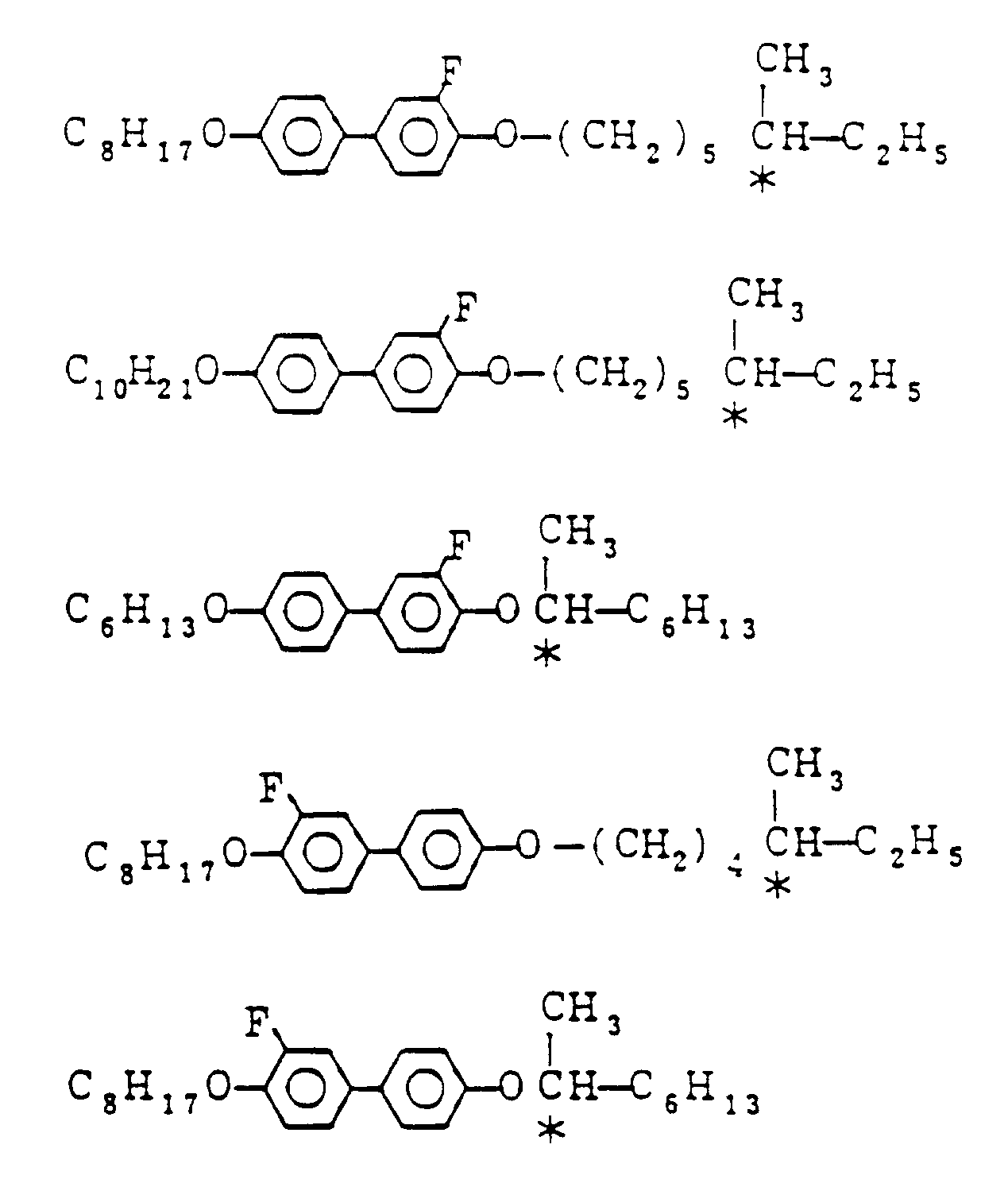
- The liquid crystalline composition according to claim 4, wherein any one or two of X₁, X₂, X₃ and X₄ in the above general formula (I) is/are a fluorine atom/atoms and the others are hydrogen atoms.
- The liquid crystalline composition according to claim 4, wherein any one or two of X₁, X₂, X₃ and X₄ in the above general formula (I) is/are a chlorine atom/atoms and the others are hydrogen atoms.
Applications Claiming Priority (4)
| Application Number | Priority Date | Filing Date | Title |
|---|---|---|---|
| JP131545/87 | 1987-05-29 | ||
| JP13154587 | 1987-05-29 | ||
| JP31230987 | 1987-12-11 | ||
| JP312309/87 | 1987-12-11 |
Publications (3)
| Publication Number | Publication Date |
|---|---|
| EP0315701A1 EP0315701A1 (en) | 1989-05-17 |
| EP0315701A4 EP0315701A4 (en) | 1989-09-19 |
| EP0315701B1 true EP0315701B1 (en) | 1993-12-29 |
Family
ID=26466362
Family Applications (1)
| Application Number | Title | Priority Date | Filing Date |
|---|---|---|---|
| EP19880904649 Expired - Lifetime EP0315701B1 (en) | 1987-05-29 | 1988-05-27 | Biphenyl compound |
Country Status (3)
| Country | Link |
|---|---|
| EP (1) | EP0315701B1 (en) |
| DE (1) | DE3886692T2 (en) |
| WO (1) | WO1988009320A1 (en) |
Families Citing this family (5)
| Publication number | Priority date | Publication date | Assignee | Title |
|---|---|---|---|---|
| GB8813024D0 (en) * | 1988-06-02 | 1988-07-06 | Merck Patent Gmbh | Fluorinated biphenyldiole derivatives |
| JP2655333B2 (en) * | 1988-09-01 | 1997-09-17 | 関東化学 株式会社 | Novel p-terphenyl derivative and liquid crystal composition |
| DE59009867D1 (en) * | 1989-05-20 | 1995-12-21 | Hoechst Ag | Liquid crystal medium with a smectic C phase. |
| US5543078A (en) * | 1991-04-24 | 1996-08-06 | University Research Corporation | Ferroelectric liquid crystals for nonlinear optics applications |
| GB2285810A (en) | 1994-01-10 | 1995-07-26 | Secr Defence | Smectic liquid crystal materials for electroclinic or nonlinear optic devices |
Family Cites Families (7)
| Publication number | Priority date | Publication date | Assignee | Title |
|---|---|---|---|---|
| DE3136624A1 (en) * | 1981-09-15 | 1983-03-31 | Merck Patent Gmbh, 6100 Darmstadt | LIQUID CRYSTALLINE HALOGEN COMPOUNDS, METHOD FOR THE PRODUCTION THEREOF, THESE DIELECTRICS CONTAINING THEM AND ELECTRO-OPTICAL DISPLAY ELEMENT |
| JPS58121225A (en) * | 1982-01-04 | 1983-07-19 | メルク・パテント・ゲゼルシャフト・ミット・ベシュレンクテル・ハフツング | Anisotropic compound having nematic phase and liquid crystal mixture containing the compound |
| DE3208089A1 (en) * | 1982-03-06 | 1983-09-08 | Merck Patent Gmbh, 6100 Darmstadt | HALOGEN BIPHENYL DERIVATIVES |
| JPH0678280B2 (en) * | 1985-04-26 | 1994-10-05 | 大日本インキ化学工業株式会社 | Ferroelectric compound and liquid crystal composition |
| JPH0735352B2 (en) * | 1986-04-25 | 1995-04-19 | チッソ株式会社 | 3-substituted biphenyl compound |
| JPS63137983A (en) * | 1986-11-28 | 1988-06-09 | Chisso Corp | Ferroelectric liquid crystal mixture for guest-host type display device |
| JPH0784402B2 (en) * | 1986-12-16 | 1995-09-13 | チッソ株式会社 | New optically active liquid crystalline biphenyl compound |
-
1988
- 1988-05-27 EP EP19880904649 patent/EP0315701B1/en not_active Expired - Lifetime
- 1988-05-27 DE DE3886692T patent/DE3886692T2/en not_active Expired - Fee Related
- 1988-05-27 WO PCT/JP1988/000520 patent/WO1988009320A1/en not_active Ceased
Also Published As
| Publication number | Publication date |
|---|---|
| DE3886692T2 (en) | 1994-07-28 |
| EP0315701A1 (en) | 1989-05-17 |
| DE3886692D1 (en) | 1994-02-10 |
| EP0315701A4 (en) | 1989-09-19 |
| WO1988009320A1 (en) | 1988-12-01 |
Similar Documents
| Publication | Publication Date | Title |
|---|---|---|
| EP0360042B1 (en) | p-Terphenyl derivatives and liquid crystalline compositions | |
| KR920004141B1 (en) | Smectic liquid crystal composition | |
| US4911863A (en) | Alkylbyphenyloxyacetic acid esters and their use in smectic liquid crystal materials | |
| US4921632A (en) | Liquid crystal compounds and compositions | |
| US6613245B1 (en) | Crosslinkable liquid crystalline compounds | |
| US4828754A (en) | Novel liquid crystalline compounds having substituents | |
| EP0237007A2 (en) | Fluoroalkane derivative and liquid crystal composition | |
| EP0133489A2 (en) | Nematic compounds | |
| EP0231853B1 (en) | Optically active carboxylic acid derivatives and liquid crystalline compositions comprising them | |
| US5811029A (en) | Benzene derivatives, and a liquid-crystalline medium | |
| JPH0662557B2 (en) | Phenyl isothiocyanates | |
| JPS6321657B2 (en) | ||
| US4623477A (en) | Ester compounds having a pyrimidine ring | |
| US5152919A (en) | Optically active compounds, liquid crystal compositions comprising said compounds, and liquid crystal optical modulators using said compositions | |
| US4895986A (en) | 2,2'-difluoro-4-alkoxy-4'-hydroxydiphenyls and their derivatives, their production process and their use in liquid crystal display devices | |
| EP0484849B1 (en) | Optically active alcohol, process for producing same and liquid crystal compound using same | |
| EP0315701A1 (en) | Biphenyl compound | |
| US5397504A (en) | Biphenyl compound | |
| EP0376294B1 (en) | Optically active compounds, liquid crystal compositions comprising said compounds, and liquid crystal optical modulators using said compositions | |
| US5204017A (en) | Difluorobenzonitriles and liquid-crystalline medium | |
| KR20000036036A (en) | Liquid crystal materials | |
| JPS63500665A (en) | Bicyclooctane derivative | |
| JP2531966B2 (en) | Novel cyclobutane derivative and liquid crystal composition containing these derivatives | |
| US5545747A (en) | Cyclobutanecarboxylic acid derivatives and liquid crystalline compositions containing them | |
| JPH02138235A (en) | Optically active compound, the same intermediate, liquid crystal composition containing same compound and liquid crystal light modulator using same liquid crystal composition |
Legal Events
| Date | Code | Title | Description |
|---|---|---|---|
| PUAI | Public reference made under article 153(3) epc to a published international application that has entered the european phase |
Free format text: ORIGINAL CODE: 0009012 |
|
| AK | Designated contracting states |
Kind code of ref document: A1 Designated state(s): CH DE FR GB LI |
|
| 17P | Request for examination filed |
Effective date: 19890530 |
|
| A4 | Supplementary search report drawn up and despatched |
Effective date: 19890919 |
|
| 17Q | First examination report despatched |
Effective date: 19911204 |
|
| GRAA | (expected) grant |
Free format text: ORIGINAL CODE: 0009210 |
|
| AK | Designated contracting states |
Kind code of ref document: B1 Designated state(s): CH DE FR GB LI |
|
| REF | Corresponds to: |
Ref document number: 3886692 Country of ref document: DE Date of ref document: 19940210 |
|
| ET | Fr: translation filed | ||
| PLBE | No opposition filed within time limit |
Free format text: ORIGINAL CODE: 0009261 |
|
| STAA | Information on the status of an ep patent application or granted ep patent |
Free format text: STATUS: NO OPPOSITION FILED WITHIN TIME LIMIT |
|
| 26N | No opposition filed | ||
| REG | Reference to a national code |
Ref country code: GB Ref legal event code: IF02 |
|
| PGFP | Annual fee paid to national office [announced via postgrant information from national office to epo] |
Ref country code: GB Payment date: 20020503 Year of fee payment: 15 |
|
| PGFP | Annual fee paid to national office [announced via postgrant information from national office to epo] |
Ref country code: FR Payment date: 20020517 Year of fee payment: 15 |
|
| PGFP | Annual fee paid to national office [announced via postgrant information from national office to epo] |
Ref country code: CH Payment date: 20020524 Year of fee payment: 15 |
|
| PGFP | Annual fee paid to national office [announced via postgrant information from national office to epo] |
Ref country code: DE Payment date: 20020531 Year of fee payment: 15 |
|
| PG25 | Lapsed in a contracting state [announced via postgrant information from national office to epo] |
Ref country code: GB Free format text: LAPSE BECAUSE OF NON-PAYMENT OF DUE FEES Effective date: 20030527 |
|
| PG25 | Lapsed in a contracting state [announced via postgrant information from national office to epo] |
Ref country code: LI Free format text: LAPSE BECAUSE OF NON-PAYMENT OF DUE FEES Effective date: 20030531 Ref country code: CH Free format text: LAPSE BECAUSE OF NON-PAYMENT OF DUE FEES Effective date: 20030531 |
|
| PG25 | Lapsed in a contracting state [announced via postgrant information from national office to epo] |
Ref country code: DE Free format text: LAPSE BECAUSE OF NON-PAYMENT OF DUE FEES Effective date: 20031202 |
|
| REG | Reference to a national code |
Ref country code: CH Ref legal event code: PL |
|
| GBPC | Gb: european patent ceased through non-payment of renewal fee |
Effective date: 20030527 |
|
| PG25 | Lapsed in a contracting state [announced via postgrant information from national office to epo] |
Ref country code: FR Free format text: LAPSE BECAUSE OF NON-PAYMENT OF DUE FEES Effective date: 20040130 |
|
| REG | Reference to a national code |
Ref country code: FR Ref legal event code: ST |