EP0313073A2 - Verfahren und Vorrichtung zur elektrostatischen Spannungsanregung - Google Patents
Verfahren und Vorrichtung zur elektrostatischen Spannungsanregung Download PDFInfo
- Publication number
- EP0313073A2 EP0313073A2 EP88117578A EP88117578A EP0313073A2 EP 0313073 A2 EP0313073 A2 EP 0313073A2 EP 88117578 A EP88117578 A EP 88117578A EP 88117578 A EP88117578 A EP 88117578A EP 0313073 A2 EP0313073 A2 EP 0313073A2
- Authority
- EP
- European Patent Office
- Prior art keywords
- set forth
- metal
- potential
- region
- alpha
- Prior art date
- Legal status (The legal status is an assumption and is not a legal conclusion. Google has not performed a legal analysis and makes no representation as to the accuracy of the status listed.)
- Withdrawn
Links
- 238000000034 method Methods 0.000 title claims abstract description 98
- 230000005284 excitation Effects 0.000 title description 92
- 230000008569 process Effects 0.000 title description 33
- 239000002245 particle Substances 0.000 claims abstract description 48
- 239000012857 radioactive material Substances 0.000 claims abstract description 46
- 230000005262 alpha decay Effects 0.000 claims abstract description 44
- 239000000463 material Substances 0.000 claims abstract description 38
- 230000005255 beta decay Effects 0.000 claims abstract description 27
- 230000005253 gamme decay Effects 0.000 claims abstract description 15
- 230000002708 enhancing effect Effects 0.000 claims abstract 3
- 230000004927 fusion Effects 0.000 claims description 63
- XLYOFNOQVPJJNP-UHFFFAOYSA-N water Substances O XLYOFNOQVPJJNP-UHFFFAOYSA-N 0.000 claims description 55
- 229910052751 metal Inorganic materials 0.000 claims description 48
- 239000002184 metal Substances 0.000 claims description 48
- 230000004992 fission Effects 0.000 claims description 38
- BASFCYQUMIYNBI-UHFFFAOYSA-N platinum Chemical compound [Pt] BASFCYQUMIYNBI-UHFFFAOYSA-N 0.000 claims description 35
- QSHDDOUJBYECFT-UHFFFAOYSA-N mercury Chemical compound [Hg] QSHDDOUJBYECFT-UHFFFAOYSA-N 0.000 claims description 24
- 239000002826 coolant Substances 0.000 claims description 21
- MHOVAHRLVXNVSD-UHFFFAOYSA-N rhodium atom Chemical compound [Rh] MHOVAHRLVXNVSD-UHFFFAOYSA-N 0.000 claims description 21
- 229910052703 rhodium Inorganic materials 0.000 claims description 20
- 239000010948 rhodium Substances 0.000 claims description 20
- 238000006243 chemical reaction Methods 0.000 claims description 17
- 238000005421 electrostatic potential Methods 0.000 claims description 17
- 238000005202 decontamination Methods 0.000 claims description 16
- 229910052697 platinum Inorganic materials 0.000 claims description 16
- 230000003588 decontaminative effect Effects 0.000 claims description 15
- 229910052753 mercury Inorganic materials 0.000 claims description 15
- 230000001965 increasing effect Effects 0.000 claims description 12
- 239000012530 fluid Substances 0.000 claims description 10
- 229910052709 silver Inorganic materials 0.000 claims description 9
- 239000004332 silver Substances 0.000 claims description 9
- JFALSRSLKYAFGM-UHFFFAOYSA-N uranium(0) Chemical compound [U] JFALSRSLKYAFGM-UHFFFAOYSA-N 0.000 claims description 9
- 230000008859 change Effects 0.000 claims description 8
- PCHJSUWPFVWCPO-UHFFFAOYSA-N gold Chemical compound [Au] PCHJSUWPFVWCPO-UHFFFAOYSA-N 0.000 claims description 8
- 239000010931 gold Substances 0.000 claims description 8
- 229910052737 gold Inorganic materials 0.000 claims description 8
- 238000009377 nuclear transmutation Methods 0.000 claims description 7
- KDLHZDBZIXYQEI-UHFFFAOYSA-N Palladium Chemical compound [Pd] KDLHZDBZIXYQEI-UHFFFAOYSA-N 0.000 claims description 6
- ZSLUVFAKFWKJRC-UHFFFAOYSA-N thorium Chemical compound [Th] ZSLUVFAKFWKJRC-UHFFFAOYSA-N 0.000 claims description 5
- 239000013505 freshwater Substances 0.000 claims description 4
- 150000003839 salts Chemical group 0.000 claims description 4
- OYEHPCDNVJXUIW-FTXFMUIASA-N 239Pu Chemical compound [239Pu] OYEHPCDNVJXUIW-FTXFMUIASA-N 0.000 claims description 3
- 239000006227 byproduct Substances 0.000 claims description 3
- 229910052763 palladium Inorganic materials 0.000 claims description 3
- 238000010248 power generation Methods 0.000 claims description 3
- JFALSRSLKYAFGM-OIOBTWANSA-N uranium-235 Chemical compound [235U] JFALSRSLKYAFGM-OIOBTWANSA-N 0.000 claims description 3
- KJTLSVCANCCWHF-UHFFFAOYSA-N Ruthenium Chemical compound [Ru] KJTLSVCANCCWHF-UHFFFAOYSA-N 0.000 claims 2
- QSHDDOUJBYECFT-BJUDXGSMSA-N [200Hg] Chemical compound [200Hg] QSHDDOUJBYECFT-BJUDXGSMSA-N 0.000 claims 2
- JDIBGQFKXXXXPN-UHFFFAOYSA-N bismuth(3+) Chemical compound [Bi+3] JDIBGQFKXXXXPN-UHFFFAOYSA-N 0.000 claims 2
- 229910052741 iridium Inorganic materials 0.000 claims 2
- GKOZUEZYRPOHIO-UHFFFAOYSA-N iridium atom Chemical compound [Ir] GKOZUEZYRPOHIO-UHFFFAOYSA-N 0.000 claims 2
- 229910052762 osmium Inorganic materials 0.000 claims 2
- SYQBFIAQOQZEGI-UHFFFAOYSA-N osmium atom Chemical compound [Os] SYQBFIAQOQZEGI-UHFFFAOYSA-N 0.000 claims 2
- 229910052702 rhenium Inorganic materials 0.000 claims 2
- WUAPFZMCVAUBPE-UHFFFAOYSA-N rhenium atom Chemical compound [Re] WUAPFZMCVAUBPE-UHFFFAOYSA-N 0.000 claims 2
- 229910052707 ruthenium Inorganic materials 0.000 claims 2
- 239000000446 fuel Substances 0.000 description 41
- 230000000694 effects Effects 0.000 description 22
- 238000004519 manufacturing process Methods 0.000 description 19
- 238000005381 potential energy Methods 0.000 description 19
- 230000004888 barrier function Effects 0.000 description 17
- 238000007499 fusion processing Methods 0.000 description 15
- 238000002474 experimental method Methods 0.000 description 13
- 230000002285 radioactive effect Effects 0.000 description 13
- 238000013461 design Methods 0.000 description 10
- 229910052770 Uranium Inorganic materials 0.000 description 9
- 230000005271 beta minus decay Effects 0.000 description 9
- 230000007423 decrease Effects 0.000 description 9
- 239000002901 radioactive waste Substances 0.000 description 9
- 238000012360 testing method Methods 0.000 description 9
- BQCADISMDOOEFD-UHFFFAOYSA-N Silver Chemical compound [Ag] BQCADISMDOOEFD-UHFFFAOYSA-N 0.000 description 8
- SWQJXJOGLNCZEY-UHFFFAOYSA-N helium atom Chemical compound [He] SWQJXJOGLNCZEY-UHFFFAOYSA-N 0.000 description 8
- ZSLUVFAKFWKJRC-YPZZEJLDSA-N thorium-230 Chemical compound [230Th] ZSLUVFAKFWKJRC-YPZZEJLDSA-N 0.000 description 8
- 125000004429 atom Chemical group 0.000 description 7
- 229910052734 helium Inorganic materials 0.000 description 7
- 239000001307 helium Substances 0.000 description 7
- 238000012986 modification Methods 0.000 description 7
- 230000004048 modification Effects 0.000 description 7
- 239000003990 capacitor Substances 0.000 description 6
- 230000003247 decreasing effect Effects 0.000 description 6
- 229910052739 hydrogen Inorganic materials 0.000 description 6
- 239000001257 hydrogen Substances 0.000 description 6
- 230000005855 radiation Effects 0.000 description 6
- 238000012795 verification Methods 0.000 description 6
- 239000002828 fuel tank Substances 0.000 description 5
- 239000000047 product Substances 0.000 description 5
- 239000002915 spent fuel radioactive waste Substances 0.000 description 5
- UFHFLCQGNIYNRP-UHFFFAOYSA-N Hydrogen Chemical compound [H][H] UFHFLCQGNIYNRP-UHFFFAOYSA-N 0.000 description 4
- 238000011109 contamination Methods 0.000 description 4
- 229910052805 deuterium Inorganic materials 0.000 description 4
- 238000005259 measurement Methods 0.000 description 4
- 230000005658 nuclear physics Effects 0.000 description 4
- 238000001228 spectrum Methods 0.000 description 4
- 230000002269 spontaneous effect Effects 0.000 description 4
- 230000001052 transient effect Effects 0.000 description 4
- YZCKVEUIGOORGS-OUBTZVSYSA-N Deuterium Chemical compound [2H] YZCKVEUIGOORGS-OUBTZVSYSA-N 0.000 description 3
- YZCKVEUIGOORGS-NJFSPNSNSA-N Tritium Chemical compound [3H] YZCKVEUIGOORGS-NJFSPNSNSA-N 0.000 description 3
- 238000000429 assembly Methods 0.000 description 3
- 230000000712 assembly Effects 0.000 description 3
- 230000015572 biosynthetic process Effects 0.000 description 3
- 230000005611 electricity Effects 0.000 description 3
- 239000003502 gasoline Substances 0.000 description 3
- WABPQHHGFIMREM-UHFFFAOYSA-N lead(0) Chemical compound [Pb] WABPQHHGFIMREM-UHFFFAOYSA-N 0.000 description 3
- 230000007246 mechanism Effects 0.000 description 3
- 230000035515 penetration Effects 0.000 description 3
- 238000011160 research Methods 0.000 description 3
- 238000003786 synthesis reaction Methods 0.000 description 3
- 238000012546 transfer Methods 0.000 description 3
- 229910052722 tritium Inorganic materials 0.000 description 3
- 229910052695 Americium Inorganic materials 0.000 description 2
- ZOXJGFHDIHLPTG-UHFFFAOYSA-N Boron Chemical compound [B] ZOXJGFHDIHLPTG-UHFFFAOYSA-N 0.000 description 2
- 238000005481 NMR spectroscopy Methods 0.000 description 2
- 229910052781 Neptunium Inorganic materials 0.000 description 2
- 238000010795 Steam Flooding Methods 0.000 description 2
- LXQXZNRPTYVCNG-UHFFFAOYSA-N americium atom Chemical compound [Am] LXQXZNRPTYVCNG-UHFFFAOYSA-N 0.000 description 2
- 238000013459 approach Methods 0.000 description 2
- 230000005266 beta plus decay Effects 0.000 description 2
- 229910052796 boron Inorganic materials 0.000 description 2
- 229910052793 cadmium Inorganic materials 0.000 description 2
- BDOSMKKIYDKNTQ-UHFFFAOYSA-N cadmium atom Chemical compound [Cd] BDOSMKKIYDKNTQ-UHFFFAOYSA-N 0.000 description 2
- 238000004364 calculation method Methods 0.000 description 2
- 239000004020 conductor Substances 0.000 description 2
- 238000010276 construction Methods 0.000 description 2
- 238000001514 detection method Methods 0.000 description 2
- 238000011161 development Methods 0.000 description 2
- 230000018109 developmental process Effects 0.000 description 2
- 238000009826 distribution Methods 0.000 description 2
- 230000005686 electrostatic field Effects 0.000 description 2
- 239000003574 free electron Substances 0.000 description 2
- 239000007789 gas Substances 0.000 description 2
- 238000010438 heat treatment Methods 0.000 description 2
- 150000002431 hydrogen Chemical class 0.000 description 2
- 230000001939 inductive effect Effects 0.000 description 2
- 230000003993 interaction Effects 0.000 description 2
- 150000002739 metals Chemical class 0.000 description 2
- LFNLGNPSGWYGGD-UHFFFAOYSA-N neptunium atom Chemical compound [Np] LFNLGNPSGWYGGD-UHFFFAOYSA-N 0.000 description 2
- 229910052755 nonmetal Inorganic materials 0.000 description 2
- 230000010355 oscillation Effects 0.000 description 2
- 230000003534 oscillatory effect Effects 0.000 description 2
- 239000008188 pellet Substances 0.000 description 2
- 239000004033 plastic Substances 0.000 description 2
- 239000010970 precious metal Substances 0.000 description 2
- 230000005258 radioactive decay Effects 0.000 description 2
- BKVIYDNLLOSFOA-UHFFFAOYSA-N thallium Chemical compound [Tl] BKVIYDNLLOSFOA-UHFFFAOYSA-N 0.000 description 2
- 239000002699 waste material Substances 0.000 description 2
- ZSLUVFAKFWKJRC-IGMARMGPSA-N 232Th Chemical compound [232Th] ZSLUVFAKFWKJRC-IGMARMGPSA-N 0.000 description 1
- BDOSMKKIYDKNTQ-OUBTZVSYSA-N Cadmium-113 Chemical compound [113Cd] BDOSMKKIYDKNTQ-OUBTZVSYSA-N 0.000 description 1
- WHXSMMKQMYFTQS-UHFFFAOYSA-N Lithium Chemical compound [Li] WHXSMMKQMYFTQS-UHFFFAOYSA-N 0.000 description 1
- 229910052778 Plutonium Inorganic materials 0.000 description 1
- HZEBHPIOVYHPMT-OUBTZVSYSA-N Polonium-210 Chemical compound [210Po] HZEBHPIOVYHPMT-OUBTZVSYSA-N 0.000 description 1
- 241001637516 Polygonia c-album Species 0.000 description 1
- -1 Pt198 Chemical compound 0.000 description 1
- 229910000831 Steel Inorganic materials 0.000 description 1
- 235000019892 Stellar Nutrition 0.000 description 1
- CIOAGBVUUVVLOB-NJFSPNSNSA-N Strontium-90 Chemical compound [90Sr] CIOAGBVUUVVLOB-NJFSPNSNSA-N 0.000 description 1
- 229910052776 Thorium Inorganic materials 0.000 description 1
- 239000000654 additive Substances 0.000 description 1
- 230000000996 additive effect Effects 0.000 description 1
- 229910045601 alloy Inorganic materials 0.000 description 1
- 239000000956 alloy Substances 0.000 description 1
- 239000004411 aluminium Substances 0.000 description 1
- 229910052782 aluminium Inorganic materials 0.000 description 1
- XAGFODPZIPBFFR-UHFFFAOYSA-N aluminium Chemical compound [Al] XAGFODPZIPBFFR-UHFFFAOYSA-N 0.000 description 1
- 238000004458 analytical method Methods 0.000 description 1
- 229910052797 bismuth Inorganic materials 0.000 description 1
- JCXGWMGPZLAOME-UHFFFAOYSA-N bismuth atom Chemical compound [Bi] JCXGWMGPZLAOME-UHFFFAOYSA-N 0.000 description 1
- 229910052799 carbon Inorganic materials 0.000 description 1
- 239000003054 catalyst Substances 0.000 description 1
- 239000002800 charge carrier Substances 0.000 description 1
- 238000005253 cladding Methods 0.000 description 1
- 238000002485 combustion reaction Methods 0.000 description 1
- 238000009795 derivation Methods 0.000 description 1
- 150000001975 deuterium Chemical group 0.000 description 1
- 238000009792 diffusion process Methods 0.000 description 1
- 239000003814 drug Substances 0.000 description 1
- 230000005684 electric field Effects 0.000 description 1
- 230000008030 elimination Effects 0.000 description 1
- 238000003379 elimination reaction Methods 0.000 description 1
- 230000005279 excitation period Effects 0.000 description 1
- 230000005281 excited state Effects 0.000 description 1
- 238000004880 explosion Methods 0.000 description 1
- 238000000605 extraction Methods 0.000 description 1
- 230000002349 favourable effect Effects 0.000 description 1
- 230000006698 induction Effects 0.000 description 1
- 229910052500 inorganic mineral Inorganic materials 0.000 description 1
- 239000012212 insulator Substances 0.000 description 1
- 150000002500 ions Chemical class 0.000 description 1
- 238000002955 isolation Methods 0.000 description 1
- 229910052743 krypton Inorganic materials 0.000 description 1
- 238000005369 laser isotope separation Methods 0.000 description 1
- 229910052745 lead Inorganic materials 0.000 description 1
- WABPQHHGFIMREM-AKLPVKDBSA-N lead-210 Chemical compound [210Pb] WABPQHHGFIMREM-AKLPVKDBSA-N 0.000 description 1
- 229910052744 lithium Inorganic materials 0.000 description 1
- 238000004949 mass spectrometry Methods 0.000 description 1
- 239000011707 mineral Substances 0.000 description 1
- 238000005065 mining Methods 0.000 description 1
- 229910052754 neon Inorganic materials 0.000 description 1
- 229910052756 noble gas Inorganic materials 0.000 description 1
- 150000002835 noble gases Chemical class 0.000 description 1
- 239000000615 nonconductor Substances 0.000 description 1
- 150000002843 nonmetals Chemical class 0.000 description 1
- OYEHPCDNVJXUIW-UHFFFAOYSA-N plutonium atom Chemical compound [Pu] OYEHPCDNVJXUIW-UHFFFAOYSA-N 0.000 description 1
- HZEBHPIOVYHPMT-UHFFFAOYSA-N polonium atom Chemical compound [Po] HZEBHPIOVYHPMT-UHFFFAOYSA-N 0.000 description 1
- 238000005036 potential barrier Methods 0.000 description 1
- 238000010791 quenching Methods 0.000 description 1
- 230000009467 reduction Effects 0.000 description 1
- 230000004044 response Effects 0.000 description 1
- 238000012552 review Methods 0.000 description 1
- 239000011435 rock Substances 0.000 description 1
- 239000013535 sea water Substances 0.000 description 1
- 238000010517 secondary reaction Methods 0.000 description 1
- 239000010935 stainless steel Substances 0.000 description 1
- 229910001220 stainless steel Inorganic materials 0.000 description 1
- 239000010959 steel Substances 0.000 description 1
- 230000002459 sustained effect Effects 0.000 description 1
- BKVIYDNLLOSFOA-IGMARMGPSA-N thallium-204 Chemical compound [204Tl] BKVIYDNLLOSFOA-IGMARMGPSA-N 0.000 description 1
- ZCUFMDLYAMJYST-UHFFFAOYSA-N thorium dioxide Chemical compound O=[Th]=O ZCUFMDLYAMJYST-UHFFFAOYSA-N 0.000 description 1
- 229910003452 thorium oxide Inorganic materials 0.000 description 1
- 230000007704 transition Effects 0.000 description 1
- 239000002914 transuranic radioactive waste Substances 0.000 description 1
- 239000002023 wood Substances 0.000 description 1
- 229910052724 xenon Inorganic materials 0.000 description 1
- RPSSQXXJRBEGEE-UHFFFAOYSA-N xenon tetrafluoride Chemical compound F[Xe](F)(F)F RPSSQXXJRBEGEE-UHFFFAOYSA-N 0.000 description 1
Images

Classifications
-
- G—PHYSICS
- G21—NUCLEAR PHYSICS; NUCLEAR ENGINEERING
- G21K—TECHNIQUES FOR HANDLING PARTICLES OR IONISING RADIATION NOT OTHERWISE PROVIDED FOR; IRRADIATION DEVICES; GAMMA RAY OR X-RAY MICROSCOPES
- G21K1/00—Arrangements for handling particles or ionising radiation, e.g. focusing or moderating
-
- Y—GENERAL TAGGING OF NEW TECHNOLOGICAL DEVELOPMENTS; GENERAL TAGGING OF CROSS-SECTIONAL TECHNOLOGIES SPANNING OVER SEVERAL SECTIONS OF THE IPC; TECHNICAL SUBJECTS COVERED BY FORMER USPC CROSS-REFERENCE ART COLLECTIONS [XRACs] AND DIGESTS
- Y02—TECHNOLOGIES OR APPLICATIONS FOR MITIGATION OR ADAPTATION AGAINST CLIMATE CHANGE
- Y02E—REDUCTION OF GREENHOUSE GAS [GHG] EMISSIONS, RELATED TO ENERGY GENERATION, TRANSMISSION OR DISTRIBUTION
- Y02E30/00—Energy generation of nuclear origin
- Y02E30/10—Nuclear fusion reactors
Definitions
- This patent disclosure describes applications of the electrostatic voltage excitation process for: 1) Decontamination of radioactive waste at nuclear power sites and elsewhere; 2) The generation of nuclear power using alpha, beta and gamma emitting materials as fuel; 3) The generation of fusion power from low voltage deuteron-deuteron interaction in water; and 4) The production of precious metals like rhodium and platinum by accelerated alpha decay.
- An electrostatic generator such as a Van de Graaff generator, is suitable for carrying out this process. Its spherical or cylindrical terminal receives a charge from a moving, insulated belt or chain. The electrostatic field inside the cavity is zero by Gauss' theorum, while beyond the terminal surface a field exists. For a sphere the field is:
- the primary object of the present invention is to provide apparatus and a method for using electrostatic voltage excitation to modify the Coulomb barrier of material, such as radioactive materials or water, to enhance alpha, beta and gamma decay from the materials or to provide for low voltage deuteron-deuteron fusion of water, whereby said materials can be decontaminated or be used for generating power as well as - for the transmutation of one metal of low value into another metal of high value.
- material such as radioactive materials or water
- the principal source of radioactive waste is at nuclear power plants, where the spent fuel rods are stored underwater. There are about 400 nuclear power plants in the world, of which 106 are located in the United States. There are definite plans for the construction of 225 more plants worldwide. The spent fuel rods, and other radioactive waste produced by this nation's operating fission burner reactors has been accumulating since 1945. The level of radioactive waste in the United States is now estimated to be anywhere from 9,000 to 40,000 metric tons. The worldwide radioactive waste from fission power plants may well be in excess of 100,000 metric tons.
- Electrostatic voltage excitation is more effective than laser excitation. This is especially the case when the contamination samples are large in comparison with spot size. Electrostatic voltage excitation should be used when there are large volumes of radioactive waste awaiting decontamination, as at nuclear power plants.
- the source we used was a closed 54.2 micro-curie alpha emitter. This source was embedded in a plastic cylinder six mm thick so that no alphas were detectable.
- the radiation which penetrates the cylinder is a discrete gamma spectrum consisting of nine gamma lines in the range from 11.871 to 59.5364 keV. Seven of these lines are associated with the excited states of neptunium, the alpha daughter of americium. The other two gammas are electric dipole transitions.
- the initial pre-excitation Am24' count on our Geiger counter was 595 cps.
- the Am 241 source was analyzed with an x-ray spectrometer at San Jose State University by Dr. Peter Englert, a radiation chemist.
- the numerical printout for the excited source was compared with an unexcited source.
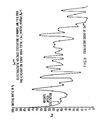
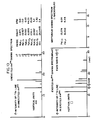
- the spectra differ as shown in Table A-2a as follows: 1) All of the NpL lines in the excited source are more intense than in the unexcited source, but the yEl line is less intense. 2) The total count for the excited source exceeded that of the unexcited source by a factor of 2.15- a value which is about the same as the GM ratio. 3) There is evidence of PaLa and PaL;8 in the excited spectrum. These are photons from Neptunium, the first alpha daughter of Americium (see Fig. 10).
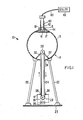
- An electrostatic generator to illustrate the teachings of decontamination of the present invention is broadly denoted by the numeral 10 and is shown in Fig. 1.
- the purpose of the generator is to excite the electrons, protons, and alpha particles inside the atoms in radioactive materials, thereby increasing the counting rate or rate of decay of alpha, beta and gamma particles from the materials and thereby decontaminating the materials.
- the decontamination is accomplished in the generator of Fig. 1 by the application of a stimulus in the form of a negative electrical potential on the surface and inside the generator including all the atoms is the radiactive material.
- a stimulus in the form of a negative electrical potential on the surface and inside the generator including all the atoms is the radiactive material.
- the negative electrostatic potential excites the charged particles inside the atoms, the counting rate or rate of emission of alpha, beta and gamma particles is increased to thereby accelerate particle decay and thereby the decontamination of the radioactive materials.
- Generator 10 includes hollow body or sphere 13 forming part of a generator mechanism 14.
- a radioactive sample 15 to be enhanced or decontaminated is placed on a platform 16 supported by a bracket 17 on the interior of sphere 13 near the upper end thereof adjacent to hole 19 in the sphere.
- the radioactive sample is within the sphere and will be subjected to the electrostatic potential generated in the sphere as hereinafter described.
- the sphere 13 is supported on legs 22 on a base 23 which is grounded.
- legs 22 must be electrical insulators.
- Sphere 13 receives electrical charges by way of an insulated moving belt 24 which extends between an interior pulley 26 within sphere 13 and an exterior pulley 28 carried in some suitable manner and on base 23.
- Drive mechanism 30 is a motor providing rotation of motion of exterior pulley 128.
- a voltage generator is located near pulley 28 near the base plate 23.
- Generator 36 delivers charges to belt 24 by way of a pair of electrically conducting needles 38 which contact belt 24 on either side of pulley 28.
- Generator 26 is typically capable of delivering voltages in the range of 50,000 to 500,000 volts.
- generator 10 The purpose of generator 10 is to provide a large negative electrostatic potential with no field at the site of the sample 15. This can be accomplished by placing the sample 15 anywhere within or on the sphere 13.
- the radioactive sample 15 can comprise an alpha, beta or gamma emitter.
- An alpha emitter defining the sample 15 can be, for instance, thorium 230, uranium 235 or plutonium 239. These three sources have half lives of 8 x 10 4 years, 7.1 x1 08 years and 24,360 years, respectively. There are a few hundred alpha emitters with half lives ranging from less than a millisecond (Fr 215 ) to billions of years (Uranium 238).
- Tests were conducted with generator 10 with sample 15 located as shown in Fig. 1. These tests were conducted with the use of a Geiger-Mueller tube 40 adjustably carried by a tube 42 secured by an annular ring 44 to the outer surfaces sphere 13. Tube 42 surrounds hole 19 so that alpha, beta or gamma particles emitted from sample 15 will be directed to tube 40 and sensed thereby.
- a scaler 46 is coupled by a cable 48 to a Geiger-Mueller tube 40.
- the principal radioactive source was thorium 230 with an activity of 0.1 Ci. This was sample 15.
- the sample was electrodeposited and diffusion bonded on platform 17 which, for purposes of illustration, was a .001 inch platinum plate in a metal cylinder with a diameter of 24 millimeters and a thickness of three millimeters. This source was made to specification by the Isotope Products Laboratories of Burbank, California.
- the Geiger-Mueller tube 40 and scaler 46 were obtained from Nucleus, Inc. of Oak Ridge, Tennessee.
- the Geiger-Mueller tube (model PK2) detects alpha, beta and gamma particles.
- the scaler 46 (model 500) was coupled by cable 48 to the Geiger-Mueller tube, the cable being an eight foot coaxial MHP cable to shield the same against the effects of the high voltage generator 10.
- Generator 10 was a 450,000 volt generator of negative polarity. It was obtained from Wabash Instrument Company (model N 100-V) of Wabash, Indiana. The diameter of sphere 13 of the generator was approximately 25 centimeters.
- the sample 15 was housed in a metal clamp inside the sphere 13.
- This clamp was annular base 44 which can be wood or plastic on the outside of sphere 13.
- the sensor tube 40 was inserted to various depths into a 3.5 centimeter diameter hole in base 44.
- the size of hole 19 was 15 millimeters at the top of sphere 13.
- the voltage achieved with the particular Van de Graaff generator was approximately 50,000 volts. Measurements of the voltage were made from spark lengths by estimating 30,000 volts per inch. A better measure is provided by the source-to-sensor distance. This gives reasonable voltage values if the speed of belt 24 is increased slowly to the point-where there is an electron discharge and the scaler goes off scale.
- the present invention postulates that an external, electrostatic potential penetrates to the center of each nucleus of-each material. Rapid penetration of the potential is assured if the material is an electrical conductor and is housed in a metallic environment.
- the generator 10 is a simple and convenient high voltage source which acts to excite charged particles. On the spherical surface of radius a, the voltage is equal to Q/4 ⁇ 0a, where Q is the charge, negative or positive, delivered by the belt. This.-potential is constant inside the sphere 13 where the electrical field is zero at all locations within the sphere.
- the enhancement values have a, standard deviation of about five percent.
- the voltage readings are accurate to 1.8 kv.
- the principal experimental difficulty was in measuring the voltage of the generator.
- the generator 10 of Fig. 1 has limitations as to the voltage which it can generate due to the way in which the voltage is measured, i.e., by the height of the Geiger-Mueller tube 40 in tube 42. Thus, generator 10 is limited to relatively low voltages.
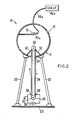
- a Geiger-Mueller sensor 40a is placed in sphere 13 adjacent to the sample 15 to be enhanced or decontaminated as shown in Fig. 2, and a relatively long, insulated lead 48a is coupled to the sensor and passes through opening 19 of sphere 13. The outer end of lead 48a is coupled to a scaler 46a. In this way, relatively high voltages can be achieved with a generator because of the elimination of the Geiger-Mueller sensor 40 as shown in Fig. 1.
- the Decontamination Tables describe the history of four sources. It is significant that independent calibrations were made before and after high voltage excitation.
- the generation of electrical energy and the decontamination of nuclear waste are of great social and economic significance.
- the electrostatic voltage excitation process is capable of accomplishing these two objectives at the same time.
- Uranium 238 and Thorium 232 Two fuel sources of interest in the development of alpha, beta and gamma power are Uranium 238 and Thorium 232. Their decay chains are detailed in Tables 1 and 2. The decay of one metric ton of U 238 to Pb 296 is the energy equivalent of about 3,500,000 barrels of oil. Similarly the decay of one metric ton of Th 232 to Pb 208 is equivalent in energy to about 2,900,000 barrels of oil.
- U 235 and Pu 239 Two fuels currently in use in the generation of fission power are U 235 and Pu 239 .
- the former has a natural abundance of 0.711 %.
- a uranium fuel rod must be enriched to about 3% U 235 in order for it to be useful in the generation of fission energy.
- P U 239 does not occur in nature, but it may be produced from U 238 , as mentioned in Appendix A, Eq. A-25..
- a typical fission reactor releases 8.20 x 10 10 joules for one gram of fissioned U 235 . This value is based on the fact that the fission of one U 235 atom yields 200 MeV.
- the total energy released in the alpha and beta decay of U 238 to Pb 206 is 2.09 x 10 10 joules, as calculated in Table 1.
- a voltage of - - 630 kV will change the natural lifetime to an excited lifetime of - 25 years.
- the average power produced by one metric ton of U 238 for 25 years by alpha, beta and gamma depletion is 28.42 MW.
- the corresponding value for one metric ton of Th 232 is 23.72 MW.
- Eq. (1) is a convenient formula, which is easily obtained by subtracting (8) from (7). Quantitative experimental evidence for this effect is given for Th 23 ° and other nuclides in Appendices B and C.
- Thorium 230 has a natural half-life T 1/2 of 75,400 years. This isotope decays to Pb 206 through a chain of seven alphas and four beta minuses.
- a Th 230 source underwent electrostatic voltage excitation for twelve hours at - - 400 kV. After the generator was turned off, the radiation count decayed to background in about six weeks. It has remained stable at background for six months.
- the Th 230 decay chain there are three relatively long lived alpha decays and one twenty-one year beta decay. Evidently this excitation process removed all the alpha and beta activity in the Th 230 source in a time which is extremely short in comparison with 75,400 years. Similar results were observed in the accelerted alpha decay of Po 210 .
- the lifetime depends exponentially on the polarity and magnitude of the excitation voltage. Theory predicts and experiment confirms that the rate of alpha decay is extremely sensitive to voltage control. This voltage is the homogeneous excitation potential in the cavity of a charged electrostatic generator, such as a Van de Graaff generator..
- Electrons near the surface of the sample may drift towards the surface of the terminal. However, the majority will remain inside the source volume. This cloud of “free” electrons is similar to the "free” electrons in a metal. It is well known that the Knight shift in the NMR frequency in metals is due to an electron density ⁇ * ⁇ (0) at the nucleus, which is greater than for non-metals.
- beta decay rates It is believed that the mechanism for the observed increase in beta decay rates is that ⁇ * ⁇ (0) is increased as the atomic electrons are ionized.
- the electron density at the nucleus is a crucial parameter in the theory of beta decay, as discussed in Appendix A, Section I-C. A more detailed discussion of accelerated beta decay is given in Appendix D.
- the conversion of existing nuclear fission plants to alpha, beta and gamma reactors is quite simple in principle.
- the essential change is the replacement of the fission reactor core with an alpha, beta and gamma reactor core.
- the fission reactor cores usually use water as a coolant.
- the heat generated in the nuclear process is passed to the coolant which circulates through pipes totally enclosed in the reactor vessel.
- This fluid is conveyed to a heat exchanger where water in a secondary loop is converted to steam.
- the steam drives a turbine or other load which generates electricity.
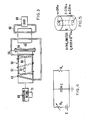
- an electrostatic generator 50 has a cylindrical, hollow body 52 provided with an open end which is covered by an end plate 54 and secured in place to an annular flange 56 surrounding the open end of the body 52.
- Means 58 with control 71 is provided for charging the generator 50 to an electrostatic potential, such as in the range of 50 kV to 5,000 kV.
- the body 52 is provided with a mass 60 of radioactive material which is to be used in generation of power by application of an electrostatic potential to the radioactive materials.
- a coolant flowing through an outer coil 62 surrounding body 52 carries heat energy to a heat exchanger 64 which transfers heat to another fluid in a closed loop 66 coupled with a load 68 to be driven by the energy imparted to the coolant in coil 62 by particle decay.
- the numeral 70 in Fig. 3 represents a mass of a beta emitter which is used with generator 50 to provide sufficient electrons to cancel out the positive charges delivered by the alpha emitter 60 of the radioactive materials in the generator 50. A discussion of this feature follows hereinafter.
- each fuel assembly consisting of about 200 fuel rods.
- Each rod consists of U0 2 pellets 5 mm in diameter and 10 mm long, inserted in a thin walled stainless steel tube. This tube is referred to as cladding. It keeps the fission products from getting into the coolant water.
- Each fuel assembly weighs 545 kg. The total weight of the complete fission power assembly is about 98.1 metric tons.
- Fission power is activated by thermal neutrons. Control rods made of Boron1 or Cadmium113, with high neutron capture cross sections are used to maintain the desired power level. If the control rods are lowered into the assembly, the power level decreases. If they are raised, the power level increases.
- alpha reactor it is not necessary to use as much fuel as in the fission reactor. This is because the alpha energy stored in a rod consisting of 97% U 238 and 3% U 235 is about 8.46 times greater than the potential fission energy, as explained earlier. Twenty-four assemblies, each consisting of 200 spent fission fuel rods will suffice. The total weight is about 13.1 metric tons.
- Alpha, beta and gamma power is activated by an electrostatic generator 50 (Fig. 3). The fuel assemblies are loaded in the cavity of the high voltage terminal. Control is maintained by the polarity and magnitude of the DC voltage on the generator terminal. A negative voltage increases the alpha power. A zero voltage shuts the power off, but not completely. There is a low level of oscillating power production which may persist for a few weeks.
- the interior volume of a conventional electrostatic generator 50 (Fig. 3) can easily accomodate 13 metric tons of U 238 or Th 232 .
- the density of U0 2 and of Th0 2 is 10.96 and 9.86 gm/cm 3 respectively.
- the National Electrostatics Co. electrostatic generator, Pelletron Model 5SDH-2 is equipped with an accelerator tank which is 3.71 m in length and 1.07 m in diameter. The corresponding volume is 3.34 m 3 , which is about 2.5 times the volume of the fuel.
- the high voltage on the terminal is generated by a charging chain system.
- This consists of metal pellets joined by insulating links.
- Charge transfer is by a controlled induction system. Desired terminal voltages are maintained within less than 1 %.
- the charging system must be large enough to maintain a voltage of-630 kV for a fuel lifetime of 25 years.
- the negative charge on the terminal surface is being continuously reduced by the alpha particles released from the source.
- M mass of fuel
- M At atomic mass
- N A Avogadro's number.
- the conventional electrostatic generator is a high voltage, low current device with typical operating currents of about 200-250 microamps, far below the current needed for a large fuel load.
- beta decay rates are enhanced by a factor of 30-35 under the influence of a negative voltage - - 630 kV.
- the actual enhancement factor may be much higher, as in the case of Pb 210 -(see Section III-B and Appendix D).
- beta emitters will compensate for the positive charge delivered by 13.1 metric tons of alpha, beta and gamma fuel?
- the average enhanced activity is 6.77 x 10 3 curies/gm or 2.51 x 10 17 disintegrations/sec. This means that 337 kilograms of these beta emitters will provide sufficient electrons to cancel out the positive charges delivered by the alpha emitters. This mass is 2.6% of the total mass of the 13.1 metric tons of spent fission fuel. If the actual mass of beta emitters in the spent rods is less than this, the fuel could be enriched with beta minus sources.
- the beta emitters Th 230 and Pa 234 will facilitate the consumption of U 238 . They are the next two isotopes in the U 238 chain (See Table 1). Similarly the beta emitters Pa 228 and Ac 228 will facilitate energy release in the Th 232 chain (see Table 2).
- the deuteron-deuteron fusion process complements the alpha decay process. Both occur by Coulomb barrier modification. (See reference A-2, Gasiorowicz, p. 93 and M.G. Bowler, Nuclear Physics, Pergamon Press, Oxford, 1973 p. 272 and 322.)
- the electrostatic voltage excitation process is capable of inducing Coulomb barrier penetration by deuterons at low ambient temperatures. The theory of this effect and its experimental verification with small samples of water is given in Appendix E.
- the water showed no activity prior to voltage excitation.
- the Geiger counter detected an activity as high as thirty times background.
- the drop evaporated completely in one hour. After the voltage was switched off, the count continued substantially above background for about two hours.
- the excitation voltage required for a 25 year lifetime for deuteron fuel is -129 volts as compared to - 630 kV for U 238 and Th 232 . Why is there such a large difference?
- deuterons release 31.25 MeV, which may be used to generate electricity.
- the tritium may be used again in a D-T reaction.
- the products of this series of fusion reactions are helium, hydrogen, neutrons and - 5.21 MeV of energy for each deuteron. Table 7 gives the energy content in deuterium.
- the combustion of one gallon of gasoline yields about 1.255 x 10 8 joules.
- the deuteron fuel energy in one gallon of water is equivalent to about 300 gallons of gasoline.
- the energy content in one gallon of water is 3.740 x10 10 joules. This is due to the deuterons in the water.
- the proton is by far the most abundant, at 99.988%.
- the deuteron has a natural abundance of 0.015%.
- Tritium undergoes beta decay with a half-life of twelve years.
- the entries in the fourth and fifth columns of Table 9 are calculated from this natural abundance data.
- the number of liters required for a given power level P and lifetime r is given by the relation
- a grounded pressure vessel surrounds the fuel tank. This accomodates the coolant fluid. Either of two coolants used in fission reactors could be used, helium gas or water.
- the coolant fluid transfers the heat generated in the fusion process to the heat exchanger, where water is converted into steam.
- the steam drives a turbine which generates electrical power. See Fig. 3.
- the apparatus of Fig. 3 is suitable for use to provide power from the deuteron-deuteron fusion process.
- body 52 of generator 50 can be partially or completely filled with water and a charging means 58 operated to provide an excitation voltage in a certain range, such as 100 volts to 2,000 volts.
- a coil 62 provides a grounded pressure vessel surrounding body 52 of generator 50. The energy produced within body 52 will be carried by the coolant in coil 62 to the heat exchanger 64 where heat energy is provided to the fluid in loop 66 coupled to load 68.
- Charging means 58 has a means 71 for varying the polarity and magnitude of the voltage applied to body 52.
- the power level is controlled by varying the voltage on the surface of the fuel tank by control means 71.
- the electrostatic voltage excites the fuel inside the tank. If ⁇ is negative and is increased in magnitude, the power level rises. If ⁇ is turned to zero the power level exhibits transient. oscillations which decay to background. They can be damped out by a positive voltage.
- An equivalent circuit may be used to represent control means 71. See Fig. 4.
- a variable resistor R s is used to regulate the voltage which appears across the capacitor.
- the negative electrode of the capacitor is the conducting surface of the fuel tank.
- the grounded terminal is the pressure vessel. The dimensions of this cylindrical capacitor are shown in Fig. 5.
- the positive deuteron current is
- the purpose of the load resistance R L is to draw an electron current from the seat of EMF which neutralizes the positive deuteron current.
- fusion reactors for home heating and to power vehicles is quite similar to the design of a fusion reactor for a nuclear power plant. However, all the parameters are scaled down.
- the fusion core in automobiles could be air cooled or water cooled.
- the deuteron-deuteron fusion process produces energy, helium, hydrogen and neutrons.
- the neutrons have energies of 2.45 and 14.1 MeV, (Eqs. 15 and 18).
- Water in the fuel and in the coolant acts as a moderator. This thermalizes the fast neutrons.
- These slow neutrons can be substantially reduced if the reactor core is lined with boron or cadmium. These materials have a high capture cross section for thermal neutrons.
- Electrostatic voltage excitation accelerates or induces decay.
- the decay energy Q, of a nuclide which disintegrates spontaneously, is positive.
- the process is exothermic and occurs with a lifetime r, which ranges from microseconds to billions of years depending on Q and the charge of the daughter nucleus.
- Electrostatic voltage excitation changes the potential energy of alpha particles, protons, and atomic electrons. This has an exponential effect on the lifetime of alpha emitters and a substantial effect on the lifetime of beta and gamma emitters. This is discussed in Appendices B and C and in Section III-B of this patent application.
- the decay energy Q, of a nuclide which is stable against alpha decay is negative.
- the process is endothermic. No spontaneous decay occurs.
- Electrostatic voltage excitation with a potential energy IVI>IQI will induce decay with a lifetime T , which for alpha decay decreases as the magnitude of the negative voltage increases.
- the weak interaction decay rate is also increased, but not exponentially as it is in alpha decay.
- the voltage required to induce is in the MW range. This is readily available in standard research electrostatic generators. If the sample is small enough, the generator's charging current of - 200 microamps will suffice to maintain a few million volts on the terminal. For larger samples of alpha emitters, the positive alpha current can be offset if a sufficiently large beta minus source is introduced into the generator cavity. If this is not done, the negative charge on the terminal will become neutralized, the negative potential will decrease in magnitude, and the generator motor will heat up due to the overload. Electrostatic generators are designed to switch off if they become overheated.
- Nuclear chemistry is greatly simplified by the use of isotope charts like the one exhibited in Table 11.
- the construction of a decay scheme is straightforward, and it leads from a stable and inexpensive isotope to a valuable isotope by successive induced or spontaneous alpha and beta minus decays.
- Rh 103 a stable isotope of rhodium with a natural abundance of 100%.
- rhodium which is used as an alloy to harden platinum and palladium, as a catalyst and in jewelry.
- the supply of rhodium is quite limited and it is the most valuable precious metal. Only about eight tons are produced annually worldwide. According to Skilling's Mining Review, November 28, 1987, metal prices per ounce were: Silver, 6.88; Gold, 470.85; Platinum, 500.00; Rhodium, 1200.00
- Rhodium may be produced from the stable isotopes of silver by induced alpha decay.
- the first step is to calculate the decay constants for the reactions which describe the production and decay of rhodium.
- the second step is to choose an excitation voltage which results in a convenient lifetime.
- , Z 1 45.
- the corresponding voltage is -2.30 MV.
- the resulting ⁇ 2 3189 days, which is large compared to ⁇ 1 . Since the rhodium lifetime is much longer than that of the silver parent, the two decays are effectively decoupled; the first decay is finished before much happens in the second. (Bernard L. Cohen, Concepts of Nuclear Physics, McGraw Hill Book Co., New York, (1971), p.198.)
- the current delivered by the alphas from silver is the current delivered by the alphas from silver.
- Charge compensation may be provided by negative charge carriers from beta decay sources, as described in Section III-D.
- Table 10 shows that 80% of the stable isotopes of mercury decay by induced emission to 100% of the stable isotopes of platinum.
- the Q values for the production and decay of platinum are all exothermic.
- process a is unfavorable because it involves only a minute amount of mercury.
- Processes b, c and d in Table 10 pose difficulties because for any given voltage ⁇ , the platinum formed will decay much faster than the mercury.
- process e in Table 10 is favorable.
- Hg 202 has a natural abundance of 29.65%.
- the Q for platinum production is larger than the Q for platinum decay.
- 80 Hg 196 by laser isotope separation.
- the synthesis of this isotope by electrostatic voltage excitation represents an alternate approach.
- a starting point in the production of 80 Hg 196 is the 80 Hg 200 isotope of mercury with a natural abundance of 23.1%. Instead of exciting induced alpha and beta minus decay, it is possible to induce an appropriate fusion process.
- Hg 196 is more likely to decay than by fusion.
- the fusion of Mo 100 requires an excitation voltage in excess of -77.6 MV. This is beyond the capability of state of the art electrostatic generators.
Landscapes
- Physics & Mathematics (AREA)
- Spectroscopy & Molecular Physics (AREA)
- Engineering & Computer Science (AREA)
- General Engineering & Computer Science (AREA)
- High Energy & Nuclear Physics (AREA)
- Particle Accelerators (AREA)
- Measurement Of Radiation (AREA)
Applications Claiming Priority (4)
| Application Number | Priority Date | Filing Date | Title |
|---|---|---|---|
| US11285487A | 1987-10-23 | 1987-10-23 | |
| US112854 | 1987-10-23 | ||
| US239146 | 1988-08-31 | ||
| US07/239,146 US4961880A (en) | 1988-08-31 | 1988-08-31 | Electrostatic voltage excitation process and apparatus |
Publications (2)
| Publication Number | Publication Date |
|---|---|
| EP0313073A2 true EP0313073A2 (de) | 1989-04-26 |
| EP0313073A3 EP0313073A3 (de) | 1990-04-18 |
Family
ID=26810425
Family Applications (1)
| Application Number | Title | Priority Date | Filing Date |
|---|---|---|---|
| EP88117578A Withdrawn EP0313073A3 (de) | 1987-10-23 | 1988-10-21 | Verfahren und Vorrichtung zur elektrostatischen Spannungsanregung |
Country Status (2)
| Country | Link |
|---|---|
| EP (1) | EP0313073A3 (de) |
| JP (1) | JPH01199200A (de) |
Cited By (2)
| Publication number | Priority date | Publication date | Assignee | Title |
|---|---|---|---|---|
| WO1996016414A1 (en) * | 1994-11-18 | 1996-05-30 | Jury Alexeevich Baurov | Method of controlling weak interactions of elementary particles of matter |
| JP2017173292A (ja) * | 2016-03-18 | 2017-09-28 | 鋼 貝沼 | トリチウム消滅装置およびトリチウム消滅方法 |
Families Citing this family (1)
| Publication number | Priority date | Publication date | Assignee | Title |
|---|---|---|---|---|
| CN1118635A (zh) * | 1993-02-26 | 1996-03-13 | 高桥昭男 | 原子转变装置 |
-
1988
- 1988-10-21 EP EP88117578A patent/EP0313073A3/de not_active Withdrawn
- 1988-10-22 JP JP63267015A patent/JPH01199200A/ja active Pending
Non-Patent Citations (2)
| Title |
|---|
| E.O.S. TRANS. AM. GEOPHYS. UNION, U.S.A., vol. 54, no. 4, April 1973, page 505, 54th Annual Meeting of the American Geophysical Union (Abstracts only); W.K. HENSLEY et al.: "Effect of pressure on the radioactive decay constant of /sup 7/BE" * |
| NATURE, vol. 262, 8th July 1976, pages 118-120, McMillan Journals Ltd, London, GB; B.W. RUST et al.: "Evidence for a radioactive decay hypothesis for supernova luminosity" * |
Cited By (2)
| Publication number | Priority date | Publication date | Assignee | Title |
|---|---|---|---|---|
| WO1996016414A1 (en) * | 1994-11-18 | 1996-05-30 | Jury Alexeevich Baurov | Method of controlling weak interactions of elementary particles of matter |
| JP2017173292A (ja) * | 2016-03-18 | 2017-09-28 | 鋼 貝沼 | トリチウム消滅装置およびトリチウム消滅方法 |
Also Published As
| Publication number | Publication date |
|---|---|
| JPH01199200A (ja) | 1989-08-10 |
| EP0313073A3 (de) | 1990-04-18 |
Similar Documents
| Publication | Publication Date | Title |
|---|---|---|
| Cameron | Nuclear fission reactors | |
| KR101752524B1 (ko) | 주요 중성자원 멀티플라이어 어셈블리 | |
| EP1573749B1 (de) | System und verfahren zum zerstören von radioaktivem abfall | |
| US20170263337A1 (en) | Methods and apparatus for enhanced nuclear reactions | |
| US4961880A (en) | Electrostatic voltage excitation process and apparatus | |
| Bykov et al. | Application of radioactive isotopes for beta-voltaic generators | |
| EP0313073A2 (de) | Verfahren und Vorrichtung zur elektrostatischen Spannungsanregung | |
| Spowart | Neutron radiography | |
| US20150380119A1 (en) | Method and apparatus for synthesizing radioactive technetium-99m-containing substance | |
| EP0099946B1 (de) | Verfahren und Einrichtung zum Bewirken des nuklearen Beta-Zerfalls | |
| Vértes et al. | Nuclear methods in mineralogy and geology: techniques and applications | |
| Schubert | Nuclear power from lunar ISRU | |
| US20170263338A1 (en) | Exothermic Transmutation Method | |
| Duncan et al. | Prospects For A New Light Nuclei, Fission Fusion Energy Cycle | |
| Smith et al. | Nuclear Physics, Radioisotope Fuels, and Protective Components | |
| Kovalenko et al. | Neutron source based on the multifunctional accelerator complex of the NSC KIPT | |
| Tanabe | Sources of energetic quanta (EQ)(radiation sources) | |
| Fiore et al. | The Frascati neutron generator: Present activities and future upgrades | |
| BRoDA | Nuclear chemistry | |
| RU2200353C1 (ru) | Способ дезактивации радиоактивных отходов | |
| WO2005065095A2 (en) | Controlled alpha multiplication device | |
| Tsyganov | Nuclear Fusion Processes in a Conductive Crystal Medium | |
| Kelly et al. | Radiation Environments and Exposure Considerations for the Multi‐Mission Radioisotope Thermoelectric Generator | |
| Kim et al. | DD Neutron measurements on a 40 kV, 60 a neutral beam test facility | |
| Tolmie | Source Development |
Legal Events
| Date | Code | Title | Description |
|---|---|---|---|
| PUAI | Public reference made under article 153(3) epc to a published international application that has entered the european phase |
Free format text: ORIGINAL CODE: 0009012 |
|
| AK | Designated contracting states |
Kind code of ref document: A2 Designated state(s): DE FR GB |
|
| PUAL | Search report despatched |
Free format text: ORIGINAL CODE: 0009013 |
|
| AK | Designated contracting states |
Kind code of ref document: A3 Designated state(s): DE FR GB |
|
| 17P | Request for examination filed |
Effective date: 19900927 |
|
| 17Q | First examination report despatched |
Effective date: 19930611 |
|
| STAA | Information on the status of an ep patent application or granted ep patent |
Free format text: STATUS: THE APPLICATION IS DEEMED TO BE WITHDRAWN |
|
| 18D | Application deemed to be withdrawn |
Effective date: 19930501 |