EP0313070A2 - Ornament and method of manufacturing the same - Google Patents
Ornament and method of manufacturing the same Download PDFInfo
- Publication number
- EP0313070A2 EP0313070A2 EP88117570A EP88117570A EP0313070A2 EP 0313070 A2 EP0313070 A2 EP 0313070A2 EP 88117570 A EP88117570 A EP 88117570A EP 88117570 A EP88117570 A EP 88117570A EP 0313070 A2 EP0313070 A2 EP 0313070A2
- Authority
- EP
- European Patent Office
- Prior art keywords
- ring
- wire
- wound
- alloy
- wire rod
- Prior art date
- Legal status (The legal status is an assumption and is not a legal conclusion. Google has not performed a legal analysis and makes no representation as to the accuracy of the status listed.)
- Granted
Links
Images

Classifications
-
- A—HUMAN NECESSITIES
- A44—HABERDASHERY; JEWELLERY
- A44C—PERSONAL ADORNMENTS, e.g. JEWELLERY; COINS
- A44C25/00—Miscellaneous fancy ware for personal wear, e.g. pendants, crosses, crucifixes, charms
-
- A—HUMAN NECESSITIES
- A44—HABERDASHERY; JEWELLERY
- A44C—PERSONAL ADORNMENTS, e.g. JEWELLERY; COINS
- A44C27/00—Making jewellery or other personal adornments
- A44C27/001—Materials for manufacturing jewellery
- A44C27/002—Metallic materials
- A44C27/003—Metallic alloys
-
- C—CHEMISTRY; METALLURGY
- C22—METALLURGY; FERROUS OR NON-FERROUS ALLOYS; TREATMENT OF ALLOYS OR NON-FERROUS METALS
- C22F—CHANGING THE PHYSICAL STRUCTURE OF NON-FERROUS METALS AND NON-FERROUS ALLOYS
- C22F1/00—Changing the physical structure of non-ferrous metals or alloys by heat treatment or by hot or cold working
- C22F1/006—Resulting in heat recoverable alloys with a memory effect
-
- C—CHEMISTRY; METALLURGY
- C08—ORGANIC MACROMOLECULAR COMPOUNDS; THEIR PREPARATION OR CHEMICAL WORKING-UP; COMPOSITIONS BASED THEREON
- C08L—COMPOSITIONS OF MACROMOLECULAR COMPOUNDS
- C08L2201/00—Properties
- C08L2201/12—Shape memory
-
- Y—GENERAL TAGGING OF NEW TECHNOLOGICAL DEVELOPMENTS; GENERAL TAGGING OF CROSS-SECTIONAL TECHNOLOGIES SPANNING OVER SEVERAL SECTIONS OF THE IPC; TECHNICAL SUBJECTS COVERED BY FORMER USPC CROSS-REFERENCE ART COLLECTIONS [XRACs] AND DIGESTS
- Y10—TECHNICAL SUBJECTS COVERED BY FORMER USPC
- Y10S—TECHNICAL SUBJECTS COVERED BY FORMER USPC CROSS-REFERENCE ART COLLECTIONS [XRACs] AND DIGESTS
- Y10S420/00—Alloys or metallic compositions
- Y10S420/902—Superplastic
Definitions
- the present invention relates to an improvement in the ornaments.
- the invention provides a new function to the ornaments by giving a new function of superelasticity to wound ring component to be worn.
- bracelets, rings, necklaces, etc. as the ornaments.
- the putting-on of said bracelet etc. has been performed traditionally by allowing a pair of clasps on both ends of core wire to engage with each other in a state of the core wires such as string, chain, etc, being wound up around the arm etc.
- the invention has been made to solve the technical problems as described above.
- the first of the invention is an ornament characterized in that a metallic alloy wire provided with a characteristic to show the superelastic effect at room temperature by making the metallic texture Austenite phase is overlapped on both ends and formed into an approximately circular ring shape to form a wound ring
- the second of the invention is a method of manufacturing the ornament characterized in that a prime wire of Ni-Ti type alloy is submitted to the cold processing rating from 20 to 50 % to form a round or angular wire rod, said wire rod is wound up around a stick or pipe with a fixed outer diameter and submitted to the heat treatment at 300 to 600 °C under restraint of both ends of wire rod to form a wound ring of approximately circular ring shape and simultaneously the superelastic effect is given to said ring at room temperature by making the metallic texture thereof Austenite phase.
- Fig. 1 and Fig. 2 (A) and (B) are external appearances showing one example of the invention, respectively.
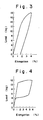
- Fig. 3 is a relationship between stress and strain of Ni49.4-Ti49.4-Fel.2 (at% each) alloy at an elastic state of hardening treatment type.
- Fig. 4 is a relationship between stress and strain of the same alloy at a superelastic state.
- so-called superelastic characteristic both characteristics of restoring characteristic amounting several percents due to the superelasticity and characterixtic capable of restoring by a fixed stress as the case of rubber
- the ornament With which the crasps become unnecessary resulting in the removal of nuisance of putting-on and taking-off due to the crasps, the appearance becomes better as a result of detaching the crasps, the permissible range in the thickness of arm etc. becomes very wide, yet comfortable feeling of fitness can be given, and, in addition, even if repeating the expansion and the restoration of the diameter of ring many times, there occurs no breaking and the diameter of ring is also hard to change.
- alloy compositions suitable for the invention are Ni (50.7-51.5 at %)-Ti(49.3-48.5 at %) alloy (hereinafter, at% is omitted), Ni(48.0-51.0)-Ti(50.0-48.5)-Cr(0-2.5) alloy and Ni(47.0-51.0)-Ti(50.5-48.5)-Fe(0-2.5) alloy.
- room temperature means a range from about 0 °C to the body temperature (36 °C).
- a statement that the superelastic effect is shown at room temperature means a phenomenon wherein several percents of strain are generated when applying the stress at room temperature and the strain restores to 0 when removing the stress. Still more, the reason why the etxture of metallic alloy wire was made Austenite phase at room temperature is for the provision of superelastic effect to metallic alloy wire.
- the alloys of Ni-Ti type etc. are undergone the phase transformation from Martensite phase to Austenite phase through the increase in temperature, but, in the case of metallic alloy wire for ring according to the invention, it is desirable to establish the Af point(a temperature to complete the transformation to Austenite phase) to not higher than 0 °C. This is because of that the alloy wire comprising Martensite phase at room temperature is soft and do not show the effect of superelasticity.
- the stress-strain curve of one obtained by giving the treatment as intense as 30 % to Ni49.4-Ti49.4-Fel.2 alloy shows the elasticity of hardening treatment type having 4 % elongation at ordinary temperature under a load of 18 kg.
- 1.6 % strain remains showing no superelasticity.
- WHereas if submitting this material to the heat treatment for 1 hour at a temperature of 500 °C, 6 % elongation is exhibited at room temperature under a load of about 12 kg, as shown in Fig. 4, and, when decreasing the load to 0, the elongation returns to 0 coming to have the superelasticity.
- the gist of the invention lies in that a metallic alloy wire provided with the characteristic to show the superelasticity at room temperature or a temperature of not lower than about 0 °C is formed into a wound ring component to make the ornaments such as bracelet, ring, necklace, etc.
- the shape of the section of alloy wire may be round or angular.
- pearls of other ornamental articles are attached to such wound ring, or the surface treatments such as gold plating etc. are given to said ring to enhance the balue added.
- Ni-Ti type alloys such as Ni-Ti alloy, Ni-Ti-Cr alloy, Ni-Ti-Fe alloy, Ni-Ti-Co alloy, etc. are used as the alloy wire rods is because of that they are overall superior as the ornaments in respective points of superelastic characteristic after the heat treatment, corrosion resistance on light weight.
- said alloy wire rod is first submitted to the cold processing rating from 20 to 50 %, said wire rod is wound up around a stick or pipe with a fixed outer diameter and submitted to the heat treatment at 300 to 600 °C under restraint of both ends of wire is for providing the characteristic to show the superelastic effect to wire rod at room temperature (about 0-36 °C) by making the metallic mixture thereof Austenite phase. If the initial cold processing rate is under 20 % of the temperature of subsequent heat treatment is under 300 °C or over 600 °C, the characteristic of superelasticity becomes poor.
- the time for heat treatment is preferable to be 30 minutes to 2 hours.
- the wire rod finished the cold processing is submitted to the heat treatment after wound up around a stick or pipe with a fixed outer diameter.
- the fixed outer diameter means the shape of aiming ornament and is not confined to the values below.
- the outer diameter is about 50 mm ⁇ or so in the case of bracelet, 16 mm ⁇ or so in the case of a ring, or further the shape is a flat ellipse with a major axis of about 130 mm and a minor axis of about 100 mm of so.
- the bracelet, necklace, etc. may be cut to a necessary number of turns, for example, 1.2 turns or 2.2 turns or so to make the wound shape ring component after they were wound up in many turns around stick and submitted to the heat treatment, or they may be wound up around stick etc. and submitted to the heat treatment fixing both ends thereof after they were cut to a fixed length (for example, 1.2 turns or 2.2 turns). In the cases of ring etc. the latter is sametimes preferable.
- the heating in the heat treatment aforementioned is carried out by using electric furnace etc., for example, when heating whole ring components of the ornaments such as bracelet, ring, etc. under same conditions, while it is carried out by the methods such as electric heating, gas flame heating, etc., which permit to heat locally, for example, when heating each portion of ring componets of the ornaments such as necklace etc. under different conditions.
- the alloy composition As described, by combining the alloy composition with the processing and heat treatment conditions, it is possible to make the superelastic characteristic of ornament show at about 0 °C or higher. That is to say, the ring component of the ornament become to have the superelastic characteristic whenever it is worn.
- a prime wire of Ni49.4-Ti49.4-Fel.2 (at% each) with a wire diameter of 0.84 mm was subjected to the cold drawing and to the intermediate annealing for the cold processing in a rate of about 30 % and then formed into a wire diameter of 0.7 mm ⁇ .
- This wire with 0.7 mm ⁇ was wound around a stick with 50 mm ⁇ and, restraining both ends of wire, it was heated for 60 minutes in an electric furnace of 500 °C to process the wire rod so that it shows the superelastic characteristic at 0 °C or higher.
- the Af point of this wire rod was 0 °C.
- the wire rod manufactured in this way was cut to make a ring component with a diameter of 50 mm ⁇ and a number of turns of 2.2 as shown in Fig. 1.
- this ring component When loading this ring component at 20 °C to expand the diameter of ring from 50 mm ⁇ to 100 mm ⁇ and then unloading, the diameter returned to original 50 mm ⁇ .
- the diameter of ring As a result of having repeated such test 1000 times, the diameter of ring remained to be 50 mm ⁇ and proved not to deteriorate.
- a stainless steel wire with a wire diameter of 0.7 mm ⁇ which had been submitted to the cold processing, was wound up around a stick to make a ring component (comparative article 1) with a diameter of 50 mm ⁇ and a number of turns of 2.2 as shown in Fig. 1.
- a 30 % cold processed wire with a wire diameter of 0.7 mm which comprises Ni49.4-Ti49.4-Fel.2(at % each) alloy, was wound up around a stick to make a ring component (comparative article 2) with a diameter of 50 mm ⁇ and a number of turns of 2.2.
- a prime wire of Ni49.5-Ti49.5-Cr1.0 alloy with a wire diameter of 0.84 mm was manufactured under similar conditions to Example 1 and, by heating for 60 minutes in an electric furnace of 550 °C, a superelastic ring component (diameter: 50 mm ⁇ ) was name up. The Af point of this wire rod of ring component was -3 °C.
- a double-turn bracelet(3) (inner diameter: about 45 mm ⁇ ) compactly threaded the pearls(2) on this ring component was made as shown in Fig. 2(A).
- This bracelet (3) was expanded to an inner diameter of about 100 mm ⁇ and put on the arm removing the load. At this time, the fit was sufficient without sliding down and comfortable feeling of fitness was obtained. besides, the force to expand to 100 mm ⁇ was slight. Moreover, when loading this bracelet at 20 °C expand the inner diameter from 45 mm ⁇ to 100 mm ⁇ and then unloading. The diameter returned to orginal 45 mm ⁇ . As a result of having repeated such test 500 times, the inner diameter remained to be original 45 mm ⁇ and proved not to deteriorate.
- This bracelet was excellent in external appearance since the crisps were not seen and the feeling when putting on the arm was also good.
- this single-turn bracelet was tried to put on the arm and take off therefrom 100 times, but the deterioration of the feeling of fitness was not perceived proving to be good.
- the invention due to the provision of the superelastic characteristic to the wound ring component of the ornament at room temperature by making the metallic texture thereof Austenite phase, this can be put on and taken off without using the crasps etc.
- the invention exerts therefore such excellent effects that the ornamental articles are excellent in the appearance, the permissible range in the thickness of arm etc. is also very wide, they fit perfectly to the arm etc. to produce comfortable feeling of fitness, yet the diameter of ring does not change despite the repeated putting-on and taking-off, and the like.
Landscapes
- Chemical & Material Sciences (AREA)
- Engineering & Computer Science (AREA)
- Materials Engineering (AREA)
- Manufacturing & Machinery (AREA)
- Physics & Mathematics (AREA)
- Thermal Sciences (AREA)
- Crystallography & Structural Chemistry (AREA)
- Mechanical Engineering (AREA)
- Metallurgy (AREA)
- Organic Chemistry (AREA)
- Adornments (AREA)
- Heat Treatment Of Articles (AREA)
Abstract
Description
- The present invention relates to an improvement in the ornaments. In particular, the invention provides a new function to the ornaments by giving a new function of superelasticity to wound ring component to be worn.
- There are bracelets, rings, necklaces, etc. as the ornaments. In the cases of bracelet etc., the putting-on of said bracelet etc. has been performed traditionally by allowing a pair of clasps on both ends of core wire to engage with each other in a state of the core wires such as string, chain, etc, being wound up around the arm etc. Also, in recent, there is such one that permits the putting-on without using the clasps on both ends of core wire by allowing both ends to overlap and by winding in an approximately circular ring shape using spring materials with restorative property of piano wire or stainless steel wire.
- With the bracelet etc. used the clasps on both sider of core wire, there are problems as follows:
- (a) Because the putting-on and the taking-off of bracelet etc. are performed through the engagement of clasps, the putting-on and the taking-off of said bracelet etc. are very troublesome.
- (b) Because the both ends of bracelet etc. formed into a size of fixed length are fastened through the crasps, there occurs an inconvenience that the bracelet etc. cannot be put on the arm etc. of other person when they are made meeting the thickness of arm etc. of a particular wearer.
- (c)Because the crasps are used, there is a drawback that the appearance as an ornament is injured by said clasps.
- Moreover, with the bracelet etc. of approximately circular wound ring from which the crasps are detached by using spring materials with restorative property, such points that the putting-on and the taking-off are simple, the permissible range in the thickness of arm etc. is wide, the crasps injuring the appearance can be detached, and the like are improved. However, due to that the quantity of elastic strain of spring material made of piano wire or stainless steel wire is as low as about 0.5%, that the elastic stress is high, and the like, a large force is necessary to expand the circular ring. Moreover, due to a large tightening force on the arm etc., the fit cannot be made sufficient tending to occur unpleasant feeling. Still more, if repeating the expansion and the restoration of circular ring, it tends not only to become large but also to break.
- For these reasons, the advent of approximately circular ring-like bracelet etc. with which the putting-on and the taking-off can be made without using the crasps etc. injuring the appearance, large force is not needed to expand the circular ring, yet the fit is sufficient to give a comfortable feeling of fitness when putting on the arm etc., and still the permissible range in the thickness of arm etc. is very wide has been desired.
- The invention has been made to solve the technical problems as described above.
- The first of the invention is an ornament characterized in that a metallic alloy wire provided with a characteristic to show the superelastic effect at room temperature by making the metallic texture Austenite phase is overlapped on both ends and formed into an approximately circular ring shape to form a wound ring, and the second of the invention is a method of manufacturing the ornament characterized in that a prime wire of Ni-Ti type alloy is submitted to the cold processing rating from 20 to 50 % to form a round or angular wire rod, said wire rod is wound up around a stick or pipe with a fixed outer diameter and submitted to the heat treatment at 300 to 600 °C under restraint of both ends of wire rod to form a wound ring of approximately circular ring shape and simultaneously the superelastic effect is given to said ring at room temperature by making the metallic texture thereof Austenite phase.
- Fig. 1 and Fig. 2 (A) and (B) are external appearances showing one example of the invention, respectively. Fig. 3 is a relationship between stress and strain of Ni49.4-Ti49.4-Fel.2 (at% each) alloy at an elastic state of hardening treatment type. Fig. 4 is a relationship between stress and strain of the same alloy at a superelastic state.
- In the first place, the constitution and the effect of the first invention will be explained.
- In the invention, the reason why a metallic alloy wire provided with the characteristic to show the superelastic effect at room temperature by making the metallic texture Austenite phase is formed into a wound ring is as follows:
- By providing beforehand a large strain-restoring characteristic, so-called superelastic characteristic (both characteristics of restoring characteristic amounting several percents due to the superelasticity and characterixtic capable of restoring by a fixed stress as the case of rubber) to the metallic alloy wire to be used for the wound ring, it is possible to make the ornament, with which the crasps become unnecessary resulting in the removal of nuisance of putting-on and taking-off due to the crasps, the appearance becomes better as a result of detaching the crasps, the permissible range in the thickness of arm etc. becomes very wide, yet comfortable feeling of fitness can be given, and, in addition, even if repeating the expansion and the restoration of the diameter of ring many times, there occurs no breaking and the diameter of ring is also hard to change.
- As the metallic alloy wires to be used here, to which the superelastic characteristic is given, besides Ni-Ti alloy, Ni-Ti-Cr alloy, Ni-Ti-Fe alloy and Ni-Ti-Co alloy, Cu-Al-Ni alloy, Cu-Zn-X(X=Si, Sn, Al, etc.) alloy and the like are possible for use, but Ni-Ti type alloys are most suitable in the points of superelastic characteristic, corrosion resistance, light weight, etc.
- Concrete alloy compositions suitable for the invention are Ni (50.7-51.5 at %)-Ti(49.3-48.5 at %) alloy (hereinafter, at% is omitted), Ni(48.0-51.0)-Ti(50.0-48.5)-Cr(0-2.5) alloy and Ni(47.0-51.0)-Ti(50.5-48.5)-Fe(0-2.5) alloy.
- Moreover, in the invention, room temperature means a range from about 0 °C to the body temperature (36 °C). Furthermore, a statement that the superelastic effect is shown at room temperature means a phenomenon wherein several percents of strain are generated when applying the stress at room temperature and the strain restores to 0 when removing the stress. Still more, the reason why the etxture of metallic alloy wire was made Austenite phase at room temperature is for the provision of superelastic effect to metallic alloy wire. The alloys of Ni-Ti type etc., so refering here, are undergone the phase transformation from Martensite phase to Austenite phase through the increase in temperature, but, in the case of metallic alloy wire for ring according to the invention, it is desirable to establish the Af point(a temperature to complete the transformation to Austenite phase) to not higher than 0 °C. This is because of that the alloy wire comprising Martensite phase at room temperature is soft and do not show the effect of superelasticity.
- Here, explanation will be made about the elasticity of hardening treatment type and the superelasticity. For example, as shown in Fig. 3, the stress-strain curve of one obtained by giving the treatment as intense as 30 % to Ni49.4-Ti49.4-Fel.2 alloy shows the elasticity of hardening treatment type having 4 % elongation at ordinary temperature under a load of 18 kg. When decerasing the load to 0, however, 1.6 % strain remains showing no superelasticity. WHereas if submitting this material to the heat treatment for 1 hour at a temperature of 500 °C, 6 % elongation is exhibited at room temperature under a load of about 12 kg, as shown in Fig. 4, and, when decreasing the load to 0, the elongation returns to 0 coming to have the superelasticity.
- The gist of the invention lies in that a metallic alloy wire provided with the characteristic to show the superelasticity at room temperature or a temperature of not lower than about 0 °C is formed into a wound ring component to make the ornaments such as bracelet, ring, necklace, etc. In this case, the shape of the section of alloy wire may be round or angular. Moreover, in the invention, pearls of other ornamental articles are attached to such wound ring, or the surface treatments such as gold plating etc. are given to said ring to enhance the balue added.
- Next, the constitution and the effect of the second invention being a method of manufacturing the ornaments will be explained.
- The constitution of the invention is as described above, and the reason why said Ni-Ti type alloys such as Ni-Ti alloy, Ni-Ti-Cr alloy, Ni-Ti-Fe alloy, Ni-Ti-Co alloy, etc. are used as the alloy wire rods is because of that they are overall superior as the ornaments in respective points of superelastic characteristic after the heat treatment, corrosion resistance on light weight.
- Moreover, the reason why said alloy wire rod is first submitted to the cold processing rating from 20 to 50 %, said wire rod is wound up around a stick or pipe with a fixed outer diameter and submitted to the heat treatment at 300 to 600 °C under restraint of both ends of wire is for providing the characteristic to show the superelastic effect to wire rod at room temperature (about 0-36 °C) by making the metallic mixture thereof Austenite phase. If the initial cold processing rate is under 20 % of the temperature of subsequent heat treatment is under 300 °C or over 600 °C, the characteristic of superelasticity becomes poor.
- Moreover, if the initial cold processing rate exceeds 50 %, the processing of wire rod becomes difficult. Besides, the time for heat treatment is preferable to be 30 minutes to 2 hours.
- According to the invention, the wire rod finished the cold processing is submitted to the heat treatment after wound up around a stick or pipe with a fixed outer diameter. Here, the fixed outer diameter means the shape of aiming ornament and is not confined to the values below. For example, the outer diameter is about 50 mm ⌀ or so in the case of bracelet, 16 mm ⌀ or so in the case of a ring, or further the shape is a flat ellipse with a major axis of about 130 mm and a minor axis of about 100 mm of so.
- Besides, the bracelet, necklace, etc. may be cut to a necessary number of turns, for example, 1.2 turns or 2.2 turns or so to make the wound shape ring component after they were wound up in many turns around stick and submitted to the heat treatment, or they may be wound up around stick etc. and submitted to the heat treatment fixing both ends thereof after they were cut to a fixed length (for example, 1.2 turns or 2.2 turns). In the cases of ring etc. the latter is sametimes preferable.
- The heating in the heat treatment aforementioned is carried out by using electric furnace etc., for example, when heating whole ring components of the ornaments such as bracelet, ring, etc. under same conditions, while it is carried out by the methods such as electric heating, gas flame heating, etc., which permit to heat locally, for example, when heating each portion of ring componets of the ornaments such as necklace etc. under different conditions.
- As described, by combining the alloy composition with the processing and heat treatment conditions, it is possible to make the superelastic characteristic of ornament show at about 0 °C or higher. That is to say, the ring component of the ornament become to have the superelastic characteristic whenever it is worn.
- If following, one example of the invention will be illustrated.
- A prime wire of Ni49.4-Ti49.4-Fel.2 (at% each) with a wire diameter of 0.84 mm was subjected to the cold drawing and to the intermediate annealing for the cold processing in a rate of about 30 % and then formed into a wire diameter of 0.7 mm ⌀. This wire with 0.7 mm⌀ was wound around a stick with 50 mm⌀ and, restraining both ends of wire, it was heated for 60 minutes in an electric furnace of 500 °C to process the wire rod so that it shows the superelastic characteristic at 0 °C or higher. The Af point of this wire rod was 0 °C. The wire rod manufactured in this way was cut to make a ring component with a diameter of 50 mm⌀ and a number of turns of 2.2 as shown in Fig. 1. When loading this ring component at 20 °C to expand the diameter of ring from 50 mm⌀ to 100 mm⌀ and then unloading, the diameter returned to original 50 mm⌀. As a result of having repeated such test 1000 times, the diameter of ring remained to be 50 mm⌀ and proved not to deteriorate.
- A stainless steel wire with a wire diameter of 0.7 mm⌀, which had been submitted to the cold processing, was wound up around a stick to make a ring component (comparative article 1) with a diameter of 50 mm⌀ and a number of turns of 2.2 as shown in Fig. 1. Also, a 30 % cold processed wire with a wire diameter of 0.7 mm, which comprises Ni49.4-Ti49.4-Fel.2(at % each) alloy, was wound up around a stick to make a ring component (comparative article 2) with a diameter of 50 mm⌀ and a number of turns of 2.2.
- When loading these
comparative articles - Besides, in the case of stainless steel wire, a larger force was needed to expand the circular ring.
- A prime wire of Ni49.5-Ti49.5-Cr1.0 alloy with a wire diameter of 0.84 mm was manufactured under similar conditions to Example 1 and, by heating for 60 minutes in an electric furnace of 550 °C, a superelastic ring component (diameter: 50 mm⌀ ) was name up. The Af point of this wire rod of ring component was -3 °C. A double-turn bracelet(3) (inner diameter: about 45 mm⌀) compactly threaded the pearls(2) on this ring component was made as shown in Fig. 2(A).
- This bracelet (3) was expanded to an inner diameter of about 100 mm⌀ and put on the arm removing the load. At this time, the fit was sufficient without sliding down and comfortable feeling of fitness was obtained. besides, the force to expand to 100 mm⌀ was slight. Moreover, when loading this bracelet at 20 °C expand the inner diameter from 45 mm⌀ to 100 mm⌀ and then unloading. The diameter returned to orginal 45 mm⌀. As a result of having repeated such test 500 times, the inner diameter remained to be original 45 mm⌀ and proved not to deteriorate.
- Similar treatments were given to the same Ni-Ti-Fe alloy wire as in Example 1 and a superelastic ring component with a diameter of 50 mm⌀ in a shape of winding of 1.2 turns was made up. A single-turn bracelet(5) disposed the pearls(2) and additionally other seven ornamental beads(4) in good appearance on said ring component was made as shown in Fig. 2(B).
- This bracelet was excellent in external appearance since the crisps were not seen and the feeling when putting on the arm was also good.
- Besides, this single-turn bracelet was tried to put on the arm and take off therefrom 100 times, but the deterioration of the feeling of fitness was not perceived proving to be good.
- In accordance with the invention, due to the provision of the superelastic characteristic to the wound ring component of the ornament at room temperature by making the metallic texture thereof Austenite phase, this can be put on and taken off without using the crasps etc. The invention exerts therefore such excellent effects that the ornamental articles are excellent in the appearance, the permissible range in the thickness of arm etc. is also very wide, they fit perfectly to the arm etc. to produce comfortable feeling of fitness, yet the diameter of ring does not change despite the repeated putting-on and taking-off, and the like.
Claims (4)
- (1) An ornament characterized in that a metallic alloy wire provided with a characteristic to show the superelastic effect at room temperature by making the metallic texture Austenite phase is overlapped on both ends and formed into an approximately circular ring shape to form a wound ring.
- (2) The ornament according to Claim 1, wherein the Ni-Ti type alloy is used for the metallic alloy wire to be provided with the superelastic effect.
- (3) The ornament according to Claim 1 or Claim 2, wherein pearls or other ornamental articles are attached to the wound ring or surface treatment such as plating etc. are given to said ring.
- (4) A method of manufacturing the ornament characterized in that a prime wire of Ni-Ti type alloy is submitted to the cold processing rating from 20 to 50 % to form a round or angular wire rod, said wire rod is wound up around a stick or pipe with a fixed outer diameter and submitted to the heat treatment at 300 to 600 °C under restraint of both ends of wire rod to form the wound ring of approxiamtely circular ring shape and simultaneously the superelastic effect is given to said ring at room temperature by making the metallic texture thereof Austenite phase.
Applications Claiming Priority (2)
| Application Number | Priority Date | Filing Date | Title |
|---|---|---|---|
| JP267959/87 | 1987-10-23 | ||
| JP62267959A JPH01110303A (en) | 1987-10-23 | 1987-10-23 | Accessory and production thereof |
Publications (3)
| Publication Number | Publication Date |
|---|---|
| EP0313070A2 true EP0313070A2 (en) | 1989-04-26 |
| EP0313070A3 EP0313070A3 (en) | 1990-03-14 |
| EP0313070B1 EP0313070B1 (en) | 1994-01-12 |
Family
ID=17451972
Family Applications (1)
| Application Number | Title | Priority Date | Filing Date |
|---|---|---|---|
| EP88117570A Expired - Lifetime EP0313070B1 (en) | 1987-10-23 | 1988-10-21 | Ornament and method of manufacturing the same |
Country Status (6)
| Country | Link |
|---|---|
| US (1) | US4943326A (en) |
| EP (1) | EP0313070B1 (en) |
| JP (1) | JPH01110303A (en) |
| KR (1) | KR950006857B1 (en) |
| DE (1) | DE3887073T2 (en) |
| ES (1) | ES2050693T3 (en) |
Cited By (9)
| Publication number | Priority date | Publication date | Assignee | Title |
|---|---|---|---|---|
| DE9114620U1 (en) * | 1991-11-23 | 1992-05-07 | Johnen, Constanze, 7770 Ueberlingen | Jewellery to vary |
| US5503691A (en) * | 1992-05-06 | 1996-04-02 | Mintek | The aesthetic enhancement or modification of articles or components made of non-ferrous metals |
| EP0709482A1 (en) * | 1994-10-28 | 1996-05-01 | Kazuhiro Otsuka | Method of manufacturing high-temperature shape memory alloys |
| DE4444735A1 (en) * | 1994-11-02 | 1996-05-09 | Foerster Bernhard Gmbh | Spring powered jewellery clasp |
| FR2769185A1 (en) * | 1997-10-02 | 1999-04-09 | Memometal Ind | Metal wire holder, especially a key ring, made of a shape memory alloy |
| DE19934312A1 (en) * | 1999-07-21 | 2001-02-08 | Euroflex Schuesler Gmbh | Jewellery article is made from material having shape memory effect and super-elastic behaviour thermally treated into final shape |
| US7313929B2 (en) * | 2004-02-04 | 2008-01-01 | Unique Mums, Llc | Wearable record tracking device and method of using |
| EP3572549A1 (en) | 2018-05-24 | 2019-11-27 | Richemont International S.A. | Jewellery item |
| CH721941A1 (en) * | 2024-06-28 | 2026-01-15 | Plvs Sarl | JEWELRY PIECE WITH INTERCHANGEABLE DECORATION |
Families Citing this family (24)
| Publication number | Priority date | Publication date | Assignee | Title |
|---|---|---|---|---|
| USRE36628E (en) * | 1987-01-07 | 2000-03-28 | Terumo Kabushiki Kaisha | Method of manufacturing a differentially heat treated catheter guide wire |
| US5171383A (en) * | 1987-01-07 | 1992-12-15 | Terumo Kabushiki Kaisha | Method of manufacturing a differentially heat treated catheter guide wire |
| US5137446A (en) * | 1990-06-07 | 1992-08-11 | Tokin Corporation And Tomy, Inc. | Orthodontic implement controllable of correction force |
| US6165292A (en) * | 1990-12-18 | 2000-12-26 | Advanced Cardiovascular Systems, Inc. | Superelastic guiding member |
| US6682608B2 (en) * | 1990-12-18 | 2004-01-27 | Advanced Cardiovascular Systems, Inc. | Superelastic guiding member |
| US5261871A (en) * | 1991-12-12 | 1993-11-16 | Greenfield Raphael L | Orthopedic device |
| US5419788A (en) * | 1993-12-10 | 1995-05-30 | Johnson Service Company | Extended life SMA actuator |
| US5769973A (en) * | 1995-11-09 | 1998-06-23 | Smith, Jr.; Robert P. | High performance automotive clutch with modified pressure plate for sustained increased spring force |
| JP3026934U (en) * | 1996-01-19 | 1996-07-30 | 株式会社アートアンドクラフト | Trinkets |
| US6508754B1 (en) | 1997-09-23 | 2003-01-21 | Interventional Therapies | Source wire for radiation treatment |
| US6149742A (en) * | 1998-05-26 | 2000-11-21 | Lockheed Martin Corporation | Process for conditioning shape memory alloys |
| WO2001039695A2 (en) * | 1999-12-01 | 2001-06-07 | Advanced Cardiovascular Systems, Inc. | Nitinol alloy composition for vascular stents |
| US6602272B2 (en) | 2000-11-02 | 2003-08-05 | Advanced Cardiovascular Systems, Inc. | Devices configured from heat shaped, strain hardened nickel-titanium |
| US7976648B1 (en) | 2000-11-02 | 2011-07-12 | Abbott Cardiovascular Systems Inc. | Heat treatment for cold worked nitinol to impart a shape setting capability without eventually developing stress-induced martensite |
| US6855161B2 (en) | 2000-12-27 | 2005-02-15 | Advanced Cardiovascular Systems, Inc. | Radiopaque nitinol alloys for medical devices |
| EP1238600A1 (en) * | 2001-03-08 | 2002-09-11 | Thierry Holemans | NA device using shape memory alloys and a bias element to reduce the thermal hysteresis of the phase change |
| US7942892B2 (en) | 2003-05-01 | 2011-05-17 | Abbott Cardiovascular Systems Inc. | Radiopaque nitinol embolic protection frame |
| US7455737B2 (en) * | 2003-08-25 | 2008-11-25 | Boston Scientific Scimed, Inc. | Selective treatment of linear elastic materials to produce localized areas of superelasticity |
| WO2010051515A1 (en) | 2008-10-31 | 2010-05-06 | Fort Wayne Metals Research Products Corporation | Method for imparting improved fatigue strength to wire made of shape memory alloys, and medical devices made from such wire |
| US20130074778A1 (en) * | 2011-06-23 | 2013-03-28 | Lawrence I. Wechsler | Linking structures |
| WO2018154834A1 (en) * | 2017-02-23 | 2018-08-30 | 一夫 岡村 | Accessory |
| JP7075736B2 (en) * | 2017-02-23 | 2022-05-26 | 一夫 岡村 | Jewelery |
| DE102020206620A1 (en) * | 2020-05-27 | 2021-12-02 | Dr. Alex Wellendorff Gmbh & Co. Kg | Alloy, in particular noble metal alloy, semifinished product made from such an alloy, piece of jewelry with at least one such semifinished product, and method for producing such a semifinished product |
| US12414644B2 (en) * | 2020-07-23 | 2025-09-16 | Sheri Baldis | Multi-purpose hanger for tree ornaments |
Family Cites Families (4)
| Publication number | Priority date | Publication date | Assignee | Title |
|---|---|---|---|---|
| US3174851A (en) * | 1961-12-01 | 1965-03-23 | William J Buehler | Nickel-base alloys |
| DE1181467B (en) * | 1963-01-23 | 1964-11-12 | Dr Guenter Wassermann | Piece of jewelry |
| JPS59230189A (en) * | 1983-06-13 | 1984-12-24 | 松下電器産業株式会社 | Heat sensor |
| CA1269915A (en) * | 1984-11-06 | 1990-06-05 | John A. Simpson | Method of processing a nickel/titanium-based shape memory alloy and article produced therefrom |
-
1987
- 1987-10-23 JP JP62267959A patent/JPH01110303A/en active Pending
-
1988
- 1988-10-20 US US07/260,030 patent/US4943326A/en not_active Expired - Fee Related
- 1988-10-21 ES ES88117570T patent/ES2050693T3/en not_active Expired - Lifetime
- 1988-10-21 EP EP88117570A patent/EP0313070B1/en not_active Expired - Lifetime
- 1988-10-21 DE DE3887073T patent/DE3887073T2/en not_active Expired - Fee Related
- 1988-10-22 KR KR1019880013803A patent/KR950006857B1/en not_active Expired - Fee Related
Cited By (9)
| Publication number | Priority date | Publication date | Assignee | Title |
|---|---|---|---|---|
| DE9114620U1 (en) * | 1991-11-23 | 1992-05-07 | Johnen, Constanze, 7770 Ueberlingen | Jewellery to vary |
| US5503691A (en) * | 1992-05-06 | 1996-04-02 | Mintek | The aesthetic enhancement or modification of articles or components made of non-ferrous metals |
| EP0709482A1 (en) * | 1994-10-28 | 1996-05-01 | Kazuhiro Otsuka | Method of manufacturing high-temperature shape memory alloys |
| DE4444735A1 (en) * | 1994-11-02 | 1996-05-09 | Foerster Bernhard Gmbh | Spring powered jewellery clasp |
| FR2769185A1 (en) * | 1997-10-02 | 1999-04-09 | Memometal Ind | Metal wire holder, especially a key ring, made of a shape memory alloy |
| DE19934312A1 (en) * | 1999-07-21 | 2001-02-08 | Euroflex Schuesler Gmbh | Jewellery article is made from material having shape memory effect and super-elastic behaviour thermally treated into final shape |
| US7313929B2 (en) * | 2004-02-04 | 2008-01-01 | Unique Mums, Llc | Wearable record tracking device and method of using |
| EP3572549A1 (en) | 2018-05-24 | 2019-11-27 | Richemont International S.A. | Jewellery item |
| CH721941A1 (en) * | 2024-06-28 | 2026-01-15 | Plvs Sarl | JEWELRY PIECE WITH INTERCHANGEABLE DECORATION |
Also Published As
| Publication number | Publication date |
|---|---|
| EP0313070B1 (en) | 1994-01-12 |
| US4943326A (en) | 1990-07-24 |
| ES2050693T3 (en) | 1994-06-01 |
| DE3887073D1 (en) | 1994-02-24 |
| JPH01110303A (en) | 1989-04-27 |
| EP0313070A3 (en) | 1990-03-14 |
| KR890006182A (en) | 1989-06-12 |
| KR950006857B1 (en) | 1995-06-23 |
| DE3887073T2 (en) | 1994-08-11 |
Similar Documents
| Publication | Publication Date | Title |
|---|---|---|
| US4943326A (en) | Ornament and method of manufacturing the same | |
| AU745293B2 (en) | Process for the improved ductility of nitinol | |
| JP2593088B2 (en) | Eyeglass frame and manufacturing method thereof | |
| US5958159A (en) | Process for the production of a superelastic material out of a nickel and titanium alloy | |
| US6675610B2 (en) | Jewelry including shape memory alloy elements | |
| EP1711641A1 (en) | Platinum alloy and method of production thereof | |
| JP2004518510A (en) | Shape memory device whose shape changes with small temperature changes | |
| EP2792022B1 (en) | Superelastic wire and method of formation | |
| WO2000032829A1 (en) | Heat-treatable platinum-gallium-palladium alloy for jewelry | |
| JP2541802B2 (en) | Shape memory TiNiV alloy and manufacturing method thereof | |
| US5919322A (en) | Alloy, in particular for use in the manufacture of frames for glass, jewelry, and the like | |
| JPS5976843A (en) | Platinum alloy for accessory | |
| JPH11269585A (en) | Titanium-vanadium-aluminum superelastic alloy and its production | |
| JPH0313535A (en) | Shape memory alloy | |
| JPS63127225A (en) | Spectacles parts | |
| JPH10102168A (en) | Alloy for manufacture of frame of spectacles, personal ornament and other metallic members, personal ornaments, frame of spectacles and its members, and intermediate product and raw material for products of these kinds | |
| JPS622026B2 (en) | ||
| TR2024000949A2 (en) | TURNING SHAPE MEMORY FEATURED NITI ALLOY WIRES INTO HIGH ELASTIC SPRINGS FOR JEWELRY APPLICATIONS | |
| JPH0551682A (en) | Superelastic material and its production | |
| JPS6389816A (en) | Spectacles parts | |
| JPS61272336A (en) | Ornamental platinum alloy | |
| JPS62284668A (en) | Reticulated body | |
| Ozawa et al. | Ornament and method of manufacturing the same | |
| JPS61272335A (en) | Ornamental platinum alloy | |
| JPH0222437A (en) | Super elastic ti-ni-v-cr alloy, super elastic element and manufacture of super elastic element |
Legal Events
| Date | Code | Title | Description |
|---|---|---|---|
| PUAI | Public reference made under article 153(3) epc to a published international application that has entered the european phase |
Free format text: ORIGINAL CODE: 0009012 |
|
| AK | Designated contracting states |
Kind code of ref document: A2 Designated state(s): CH DE ES FR GB IT LI |
|
| PUAL | Search report despatched |
Free format text: ORIGINAL CODE: 0009013 |
|
| AK | Designated contracting states |
Kind code of ref document: A3 Designated state(s): CH DE ES FR GB IT LI |
|
| 17P | Request for examination filed |
Effective date: 19900801 |
|
| 17Q | First examination report despatched |
Effective date: 19911203 |
|
| GRAA | (expected) grant |
Free format text: ORIGINAL CODE: 0009210 |
|
| AK | Designated contracting states |
Kind code of ref document: B1 Designated state(s): CH DE ES FR GB IT LI |
|
| ITF | It: translation for a ep patent filed | ||
| REF | Corresponds to: |
Ref document number: 3887073 Country of ref document: DE Date of ref document: 19940224 |
|
| ET | Fr: translation filed | ||
| REG | Reference to a national code |
Ref country code: ES Ref legal event code: FG2A Ref document number: 2050693 Country of ref document: ES Kind code of ref document: T3 |
|
| PLBE | No opposition filed within time limit |
Free format text: ORIGINAL CODE: 0009261 |
|
| 26N | No opposition filed | ||
| PGFP | Annual fee paid to national office [announced via postgrant information from national office to epo] |
Ref country code: FR Payment date: 19991011 Year of fee payment: 12 |
|
| PGFP | Annual fee paid to national office [announced via postgrant information from national office to epo] |
Ref country code: GB Payment date: 19991020 Year of fee payment: 12 Ref country code: ES Payment date: 19991020 Year of fee payment: 12 |
|
| PGFP | Annual fee paid to national office [announced via postgrant information from national office to epo] |
Ref country code: DE Payment date: 19991022 Year of fee payment: 12 |
|
| PGFP | Annual fee paid to national office [announced via postgrant information from national office to epo] |
Ref country code: CH Payment date: 19991027 Year of fee payment: 12 |
|
| PG25 | Lapsed in a contracting state [announced via postgrant information from national office to epo] |
Ref country code: GB Free format text: LAPSE BECAUSE OF NON-PAYMENT OF DUE FEES Effective date: 20001021 |
|
| PG25 | Lapsed in a contracting state [announced via postgrant information from national office to epo] |
Ref country code: ES Free format text: LAPSE BECAUSE OF NON-PAYMENT OF DUE FEES Effective date: 20001022 |
|
| PG25 | Lapsed in a contracting state [announced via postgrant information from national office to epo] |
Ref country code: LI Free format text: LAPSE BECAUSE OF NON-PAYMENT OF DUE FEES Effective date: 20001031 Ref country code: CH Free format text: LAPSE BECAUSE OF NON-PAYMENT OF DUE FEES Effective date: 20001031 |
|
| GBPC | Gb: european patent ceased through non-payment of renewal fee |
Effective date: 20001021 |
|
| REG | Reference to a national code |
Ref country code: CH Ref legal event code: PL |
|
| PG25 | Lapsed in a contracting state [announced via postgrant information from national office to epo] |
Ref country code: FR Free format text: LAPSE BECAUSE OF NON-PAYMENT OF DUE FEES Effective date: 20010629 |
|
| PG25 | Lapsed in a contracting state [announced via postgrant information from national office to epo] |
Ref country code: DE Free format text: LAPSE BECAUSE OF NON-PAYMENT OF DUE FEES Effective date: 20010703 |
|
| REG | Reference to a national code |
Ref country code: FR Ref legal event code: ST |
|
| REG | Reference to a national code |
Ref country code: ES Ref legal event code: FD2A Effective date: 20011113 |
|
| PG25 | Lapsed in a contracting state [announced via postgrant information from national office to epo] |
Ref country code: IT Free format text: LAPSE BECAUSE OF NON-PAYMENT OF DUE FEES;WARNING: LAPSES OF ITALIAN PATENTS WITH EFFECTIVE DATE BEFORE 2007 MAY HAVE OCCURRED AT ANY TIME BEFORE 2007. THE CORRECT EFFECTIVE DATE MAY BE DIFFERENT FROM THE ONE RECORDED. Effective date: 20051021 |