EP0306756B1 - Optical elements - Google Patents
Optical elements Download PDFInfo
- Publication number
- EP0306756B1 EP0306756B1 EP88113589A EP88113589A EP0306756B1 EP 0306756 B1 EP0306756 B1 EP 0306756B1 EP 88113589 A EP88113589 A EP 88113589A EP 88113589 A EP88113589 A EP 88113589A EP 0306756 B1 EP0306756 B1 EP 0306756B1
- Authority
- EP
- European Patent Office
- Prior art keywords
- weight
- meth
- optionally
- denotes
- alkyl
- Prior art date
- Legal status (The legal status is an assumption and is not a legal conclusion. Google has not performed a legal analysis and makes no representation as to the accuracy of the status listed.)
- Expired - Lifetime
Links
Classifications
-
- G—PHYSICS
- G02—OPTICS
- G02B—OPTICAL ELEMENTS, SYSTEMS OR APPARATUS
- G02B1/00—Optical elements characterised by the material of which they are made; Optical coatings for optical elements
- G02B1/04—Optical elements characterised by the material of which they are made; Optical coatings for optical elements made of organic materials, e.g. plastics
- G02B1/041—Lenses
- G02B1/043—Contact lenses
-
- C—CHEMISTRY; METALLURGY
- C08—ORGANIC MACROMOLECULAR COMPOUNDS; THEIR PREPARATION OR CHEMICAL WORKING-UP; COMPOSITIONS BASED THEREON
- C08F—MACROMOLECULAR COMPOUNDS OBTAINED BY REACTIONS ONLY INVOLVING CARBON-TO-CARBON UNSATURATED BONDS
- C08F230/00—Copolymers of compounds having one or more unsaturated aliphatic radicals, each having only one carbon-to-carbon double bond, and containing phosphorus, selenium, tellurium or a metal
- C08F230/04—Copolymers of compounds having one or more unsaturated aliphatic radicals, each having only one carbon-to-carbon double bond, and containing phosphorus, selenium, tellurium or a metal containing a metal
- C08F230/08—Copolymers of compounds having one or more unsaturated aliphatic radicals, each having only one carbon-to-carbon double bond, and containing phosphorus, selenium, tellurium or a metal containing a metal containing silicon
-
- C—CHEMISTRY; METALLURGY
- C08—ORGANIC MACROMOLECULAR COMPOUNDS; THEIR PREPARATION OR CHEMICAL WORKING-UP; COMPOSITIONS BASED THEREON
- C08F—MACROMOLECULAR COMPOUNDS OBTAINED BY REACTIONS ONLY INVOLVING CARBON-TO-CARBON UNSATURATED BONDS
- C08F220/00—Copolymers of compounds having one or more unsaturated aliphatic radicals, each having only one carbon-to-carbon double bond, and only one being terminated by only one carboxyl radical or a salt, anhydride ester, amide, imide or nitrile thereof
- C08F220/02—Monocarboxylic acids having less than ten carbon atoms; Derivatives thereof
- C08F220/10—Esters
- C08F220/38—Esters containing sulfur
- C08F220/387—Esters containing sulfur and containing nitrogen and oxygen
-
- C—CHEMISTRY; METALLURGY
- C08—ORGANIC MACROMOLECULAR COMPOUNDS; THEIR PREPARATION OR CHEMICAL WORKING-UP; COMPOSITIONS BASED THEREON
- C08F—MACROMOLECULAR COMPOUNDS OBTAINED BY REACTIONS ONLY INVOLVING CARBON-TO-CARBON UNSATURATED BONDS
- C08F230/00—Copolymers of compounds having one or more unsaturated aliphatic radicals, each having only one carbon-to-carbon double bond, and containing phosphorus, selenium, tellurium or a metal
- C08F230/04—Copolymers of compounds having one or more unsaturated aliphatic radicals, each having only one carbon-to-carbon double bond, and containing phosphorus, selenium, tellurium or a metal containing a metal
- C08F230/08—Copolymers of compounds having one or more unsaturated aliphatic radicals, each having only one carbon-to-carbon double bond, and containing phosphorus, selenium, tellurium or a metal containing a metal containing silicon
- C08F230/085—Copolymers of compounds having one or more unsaturated aliphatic radicals, each having only one carbon-to-carbon double bond, and containing phosphorus, selenium, tellurium or a metal containing a metal containing silicon the monomer being a polymerisable silane, e.g. (meth)acryloyloxy trialkoxy silanes or vinyl trialkoxysilanes
Definitions
- the present invention relates to optical contact objects made from optionally crosslinked copolymers based on siloxanyl and fluoro- (meth) acrylates.
- Optical contact objects in the context of the present invention are preferably contact lenses and scleral shells.
- the contact lenses on the market can be divided into hard and soft materials.
- the soft lenses which sit close to the eye, must have a high oxygen permeability, since the oxygen supply takes place to a particular extent via the atmosphere. This is achieved through a very high proportion of water (hydrogel lenses) or the use of highly permeable silicones that are hydrophilized on the surface.
- Hard contact lens materials offer the advantage that in addition to permeation through the lens, the eye can also be supplied with oxygen by exchanging the tear fluid, since the lenses float on the eye. A prerequisite for this is sufficient hydrophilicity of the material, which allows the lens to be wetted by the tear fluid.
- Another advantage of the hard lenses is their extremely easy maintenance. Due to the low water content, the risk of turbidity due to protein and lipoid deposits and bacterial contamination is greatly reduced (O.C. Geyer, Kunststoff-Linsen - aber correctly, Schnetztor Verlag, Konstanz, 1979).
- Hard contact lens materials made from crosslinked copolymers based on siloxanyl methacrylic acid esters and / or fluorine methacrylates are known (US Pat. No. 3,808,178; WO 86/04342). Compared to polymethyl methacrylate, these materials are characterized by a significantly higher oxygen permeability.
- hydrophilization of the surface for example by corona discharge or plasma treatment, improves the wettability in the short term, but after a longer period of wear the lens loses its good compatibility because the very thin hydrophilic layer is destroyed by mechanical and enzymatic stress.
- hydrophilic monomers can be used as comonomers [DE-A 3 329 722; Polym. Technology Corp. (09/30/82)].
- these have a relatively high water absorption, which increases the risk of lipoid deposits.
- the polymers soften and are therefore more difficult to process and have insufficient radius stability.
- the contact optical objects according to the invention have excellent oxygen permeability, combined with good wettability, low water absorption and high long-term stability.
- Monomers of component A) are generally 2- (N-alkyl-perfluoroalkylsulfonamido) alkyl (meth) acrylates of the formula I.
- Lower alkyl means branched and unbranched hydrocarbon radicals having 1 to 6 carbon atoms. Examples include methyl, ethyl, n-propyl, iso-propyl, n-butyl, iso-butyl, t-butyl, pentyl, iso-pentyl, neopentyl, n-hexyl and iso-hexyl. Methyl, ethyl and isopropyl are particularly preferred, and methyl is particularly preferred.
- Cycloalkyl means cyclic hydrocarbon radicals with 5 to 9 carbon atoms. Examples include cyclopentyl, cyclohexyl, cycloheptyl and cyclooctyl. Cyclopentyl and cyclohexyl are preferred, particularly preferably cyclohexyl.
- Aryl means an aromatic hydrocarbon radical with 6 to 12 carbon atoms. Examples include phenyl, naphthyl, biphenylyl and benzyl. Preferred aryl radicals are phenyl and benzyl.
- the 2- (N-alkyl-perfluoroalkylsulfonamido) alkyl (meth) acrylates are known and can be prepared from the corresponding perfluoroalkylsulfonamides by reaction with corresponding halohydrins and subsequent esterification with (meth) acrylic acid (US Pat. No. 2,803,615).
- Preferred 2- (N-alkyl-perfluoroalkylsulfonamido) alkyl (meth) acrylates are 2- (N-methyl-perfluorobutylsulfonamido) ethyl methacrylate and 2- (N-methyl-perfluorooctylsulfonamido) ethyl methacrylate.
- 2- (N-Methyl-Perfluorobutylsulfonamido) ethyl methacrylate (C4FM) is particularly preferred.
- the contact optical articles according to the invention can generally contain 5 to 40% by weight, preferably 10 to 40% by weight and particularly preferably 10 to 30% by weight of the fluoromonomer in the polymer.
- Lower alkyl generally means branched and unbranched hydrocarbon radicals having 1 to 6 carbon atoms. Examples include methyl, ethyl, n-propyl, iso-propyl, n-butyl, iso-butyl, t-butyl, pentyl, iso-pentyl, neopentyl, n-hexyl and iso-hexyl. Methyl, ethyl and Isopropyl and particularly preferably methyl listed.
- Cyclic hydrocarbon radicals having 5 to 9 carbon atoms are generally mentioned as cycloalkyl. Examples include cyclopentyl, cyclohexyl, cycloheptyl and cyclooctyl. Cyclopentyl and cyclohexyl are preferred, and cyclohexyl is particularly preferred.
- Alkoxy generally means an oxygen-bonded straight-chain or branched hydrocarbon radical having 1 to about 8 carbon atoms. Lower alkoxy having 1 to about 6 carbon atoms is preferred. Examples include methoxy, ethoxy, propoxy, iso-propoxy, butoxy, iso-butoxy, tert-butoxy, pentoxy, iso-pentoxy, hexoxy and iso-hexoxy. Methoxy and ethoxy are particularly preferred.
- Aryl generally means an aromatic hydrocarbon radical having 6 to 12 carbon atoms. Examples include phenyl, naphthyl, biphenylyl and benzyl. Preferred aryl radicals are phenyl and benzyl.
- Divalent alkylene (Z) generally means a divalent unbranched or branched hydrocarbon chain with 2 to 24 carbon atoms. Alkylene radicals having 6 to 9 carbon atoms are preferred. Examples include methylene, ethylene, trimethylene, tetramethylene, pentamethylene, 2,2-dimethyltrimethylene, hexamethylene and 2,2,4-trimethylhexamethylene. Hexamethylene and 2,2,4-trimethylhexamethylene are particularly preferred.
- Divalent cycloalkylene (Z) generally means a divalent cyclic hydrocarbon radical with 5 to 9 carbon atoms.
- Examples include cyclopentylene, cyclohexylene, cycloheptylene and cyclooctylene. Cyclopentylene and cyclohexylene are preferred. Cyclohexylene is particularly preferred.
- Divalent arylene (Z) generally means a divalent aromatic hydrocarbon radical with 6 to 12 carbon atoms. Phenylene, naphthylene and biphenylene radicals are preferred. The phenylene radical is particularly preferred.
- Divalent radicals with 7 to 24 carbon atoms from alkylene, cycloalkylene and / or arylene groups are, for example, methylene-di-p-phenylene and 2,2-propylene-di-p-phenylene.
- Siloxanyl (meth) acrylic acid esters of the formula II can be, for example: ⁇ -methacryloxypropyltrimethoxysilane (MEMO): and its derivatives, such as, for example: ⁇ -methacryloxypropyl-tris (trimethylsiloxy) silane (TRIS): 1,3-bis ( ⁇ -methacryloxypropyl) -1,1,3,3-tetra (trimethylsiloxy) disiloxane (TETRA): ⁇ -methacryloxypropyl-tris (3-acetoxypropyldimethylsiloxy) silane (ATRIS): and ⁇ -methacryloxypropyl-bis- (trimethylsiloxy) - (3-acetoxypropyldimethylsiloxy) silane.
- MEMO ⁇ -methacryloxypropyltrimethoxysilane
- TRIS 1,3-bis ( ⁇ -methacryloxypropyl) -1,1,3,3-tetra (trimethyls
- ⁇ -methacryloxypropyl-bis (3-acetoxypropyldimethylsiloxy) trimethylsiloxy) silane.
- ⁇ -methacryloxypropyl-tris (3-hydroxypropyldimethylsiloxy) silane (HTRIS)
- HTRIS hydroxypropyldimethylsiloxy
- ⁇ -methacryloxypropyl-bis- (3-hydroxypropyldimethylsiloxy) - (trimethylsiloxy) silane
- ⁇ -methacryloxypropyl-bis (3-hydroxypropyldimethylsiloxy) - (3-hydroxypropyldimethylsiloxy) silane.
- the compounds can be prepared from ⁇ -methacryloxypropyltrimethoxysilane and the corresponding functionalized chlorosiloxides or acetoxysilanes by hydrolysis (DE-A 3,244,877; DE-A 3,309,631).
- siloxanyl methacrylates of the formula II are, for example: Hydrolysis products of the reaction of ⁇ -methacryloxypropyltrimethoxysilane with dichlorodimethylsilane and chlorotrimethylsilane (DE-A 3,329,722), ⁇ -methacryloxypropylpentamethyldisiloxane (US 3,808,178) and ⁇ -methacryloxypropyldimethyl (nonamethyltetrasiloxanyl) silane (US 4,303,772).
- Siloxanyl methacrylates of the formula III are, for example, reaction products of ⁇ -allyloxyethyl methacrylate with polysiloxanes containing SiH groups (EP-A 130,731).
- Siloxanyl methacrylates of the formula IV can be prepared by reacting isocyanatoethyl methacrylate with hydroxy- or aminoalkyl-terminated polysiloxanes (EP-A 127.321; Yu X., Nagarajan HRJ Appl.Pol. Sci. 30 , 2115 (1985).
- Examples of compounds of the formula V are silicone methacrylate macromers which can be prepared by reacting hydroxyalkyl-terminated polysiloxanes such as, for example, polydimethylsiloxane-triol with 1-isocyanatomethyl-5-isocyanato-1,3,3-trimethylcyclohexane and ⁇ -hydroxyethyl methacrylate.
- the methacrylic radical in the compounds of the formula V is linked to the polysiloxane via urethane, thiourethane, urea or amide functions (Cameron EG, Chisholm MS Polymer 1985, 26 (3), 437; US 4,136,250; EP-A 109,355).
- Preferred siloxanyl methacrylates are:
- ⁇ -methacryloxypropyltrimethoxysilane MEMO
- ⁇ -methacryloxypropyl-tris trimethylsiloxy) silane
- TETRA 1,3-bis ( ⁇ -methacryloxypropyl) -1,1,3,3-tetra (trimethylsiloxy) disiloxane
- TETRA 1,3-bis ( ⁇ -methacryloxypropyl) -1,1,3,3-tetra (trimethylsiloxy) disiloxane
- TETRA 1,3-bis ( ⁇ -methacryloxypropyl) -1,1,3,3-tetra (trimethylsiloxy) disiloxane
- TETRA 1,3-bis ( ⁇ -methacryloxypropyl) -1,1,3,3-tetra (trimethylsiloxy) disiloxane
- ⁇ -methacryloxypropyl-tris (3-acetoxypropyldimethylsiloxy) silane
- HTRIS ⁇ -methacryloxy
- the contact optical objects according to the invention generally contain 5 to 60% by weight of siloxanyl methacrylate. They preferably contain 10 to 55% by weight, and particularly preferably 20 to 40% by weight, of the monomers in the polymer.
- the contact optical objects according to the invention may optionally contain non-hydrophilic vinyl monomers as component C).
- Preferred vinyl monomers are, for example, (meth) acrylic acid derivatives such as C1 to C12 alkyl or cycloalkyl esters of (meth) acrylic acid.
- Examples include: Methyl (meth) acrylate, ethyl (meth) acrylate, propyl (meth) acrylate, butyl (meth) acrylate, 2-ethylhexyl (meth) acrylate, (iso) bornyl (meth) acrylate, bicycloheptanyl (meth) acrylate and cyclohexyl (meth ) acrylate.
- a particularly preferred vinyl monomer is methyl methacrylate.
- the contact optical articles according to the invention generally contain up to 65% by weight of non-hydrophilic vinyl monomers. They preferably contain 10 to 60% by weight and particularly preferably 20 to 55% by weight of the monomers in the polymer.
- the contact optical objects according to the invention can optionally contain, as component D), hydrophilic vinyl monomers.
- Preferred vinyl monomers are, for example, N-vinyl lactams and vinyl amides and (meth) acrylic acid derivatives.
- vinyl lactams are N-vinylpyrrolidone and (meth) acrylic acid derivatives are (meth) acrylic acid and (meth) acrylamides.
- hydrophilic vinyl monomers are N-vinylpyrrolidone and N-vinyl-N-methylacetamide.
- the contact optical articles according to the invention optionally contain up to 20% by weight of hydrophilic vinyl monomers. They preferably contain up to 10% by weight and particularly preferably up to 5% by weight of the monomers in the polymer.
- the contact optical objects according to the invention can optionally contain bi- or polyfunctional vinyl monomers as crosslinker component E).
- polyfunctional methacrylates such as ethylene glycol dimethacrylate, propylene glycol dimethacrylate, diethylene glycol dimethacrylate, 1,4-butanediol dimethacrylate, 1,6-hexanediol dimethacrylate, trimethylolpropane trimethacrylate, allyl methacrylate, vinyl methacrylate, (meth) acrylate of ethoxylated or propoxylated hydroxyl-tricyclo [5.2.1.0 2,6] decane are for example bi- Derivatives (cf.
- bis- or polyfunctional siloxanyl methacrylates such as 1,3-bis ( ⁇ -methacryloxypropyl) -1,1,3,3-tetra (trimethylsiloxy) disiloxane and 1,3-bis ( ⁇ -methacryloxypropyl) -1.1 , 3,3-tetramethyldisiloxane listed.
- Particularly preferred crosslinkers are dimethacrylates such as ethylene glycol dimethacrylate and mixtures thereof.
- the contact optical objects according to the invention generally contain 0 to 10% by weight of crosslinking agents. They preferably contain 0.1 to 5% by weight.
- peroxides such as dibenzoyl peroxide, dilauroyl peroxide or azo compounds such as azoisobutyronitrile can be used as radical initiators.
- photo initiators such as 2,2-dimethoxy-2-phenylacetophenone, diethoxyacetophenone, 1-hydroxycyclohexyl phenyl ketone or benzoin propyl or isobutyl ether can be used as polymerization initiators.
- a preferred embodiment of the method according to the invention is the polymerization as bulk polymerization in plate chambers, glass tubes, plastic tubes or cups.
- the embodiment is preferably selected in plate chambers or from polyolefin tubes or cells.
- the materials thus obtained contain practically no water-extractable components.
- their water content after hydration is 0.5 to 2% by weight (based on the hydrated state).
- the wetting contact angles are in the range of 68 to 75 °, and the oxygen permeability amounts to values of 300 to 1250 cm3O2 / (m2 ⁇ 24h ⁇ bar).
- the Shore D hardness of 70 to 85 ensure good processability and scratch resistance comparable to that of polymethyl methacrylate materials.
- the surfaces of the contact lenses produced from the materials according to the invention show no microcracking in the xenon test after 1000 hours of irradiation under the electron beam scanning microscope.
- contact lenses made from the material according to the invention are particularly suitable as VT lenses (extended wear lenses). Biological tests have shown that there is no irritation on the rabbit eye when worn continuously for a period of 30 days and that the lenses remain fog-free and without deposits.
- a particular advantage of the contact optical objects according to the invention is the very good wettability with very high oxygen permeability at the same time.
- This effect of 2- (N-alkyl-perfluoroalkylsulfonamido) alkyl (meth) acrylate is all the more surprising since the fluoromonomers have been used to make the surfaces of plastics, leather, metals and textiles oil and water repellent (US 2,803. 615; US 3,100,180).
- the radical polymerizations were carried out in polypropylene tubes ( ⁇ 12 mm).
- the polymerizations were started photochemically and irradiated with UV fluorescent light at 40 ° C. for 24 h.
- UV light was irradiated for a further three days, the mold was removed and then annealed at 80 ° C. in a drying cabinet for one day. Blanks were made from the cylindrical shapes and contact lenses were made from them by turning and polishing.
- the Shore D values (according to DIN 53 505) of the materials were determined in the dry state. For this purpose, roughly 7 mm thick blanks are turned and ground flat.
- the water-wetting contact angles were determined with a video system.
- the oxygen permeabilities were determined by mass spectroscopy. With a partial pressure difference of one bar, oxygen was forced through samples of approx. 1.5 mm thickness and 12 mm ⁇ over a period of 24 h. The measurements were carried out at 35 ° C, a relative humidity of 100% and an additional humidification of the material with a drop of H2O.
- the transmissibilities are standardized to a sample thickness of 1 mm.
- Table 2 Physical properties of the materials E.g. Shore-D H2O [%] ⁇ [°] O2 permeability [cm3O2 / m2 ⁇ 24h ⁇ bar)] 1 80 1.5 75 1059 2nd 80 1.4 86 705 3rd 81 1.5 74 813 4th 84 1.0 70 280 5 82 2.0 76 318 6 75 2.7 76 800 7 83 0.7 73 650 8th 82 1.2 74 740 9 83 1.8 74 760 10th 83 2.1 75 800 11 83 1.0 74 630 12th 82 1.3 74 640 13 82 1.6 75 750 14 78 1.5 80 310 15 80 1.4 79 510 16 76 1.1 70 630 17th 79 1.9 75 760 18th 79 1.1 70 515
Landscapes
- Chemical & Material Sciences (AREA)
- Physics & Mathematics (AREA)
- Medicinal Chemistry (AREA)
- Health & Medical Sciences (AREA)
- Optics & Photonics (AREA)
- Chemical Kinetics & Catalysis (AREA)
- General Physics & Mathematics (AREA)
- Polymers & Plastics (AREA)
- Organic Chemistry (AREA)
- Addition Polymer Or Copolymer, Post-Treatments, Or Chemical Modifications (AREA)
- Eyeglasses (AREA)
- Organic Low-Molecular-Weight Compounds And Preparation Thereof (AREA)
- Optical Communication System (AREA)
- Optical Head (AREA)
Abstract
Description
Die vorliegende Erfindung betrifft kontaktoptische Gegenstände aus gegebenenfalls vernetzten Copolymerisaten auf Basis von Siloxanyl- und Fluoro-(Meth)acrylaten.The present invention relates to optical contact objects made from optionally crosslinked copolymers based on siloxanyl and fluoro- (meth) acrylates.
Kontaktoptische Gegenstände im Rahmen der vorliegenden Erfindung sind bevorzugt Kontaktlinsen und Skleralschalen.Optical contact objects in the context of the present invention are preferably contact lenses and scleral shells.
Die auf dem Markt befindlichen Kontaktlinsen lassen sich in harte und weiche Materialien unterteilen. Die weichen Linsen, die eng am Auge sitzen, müssen über eine hohe Sauerstoffdurchlässigkeit verfügen, da die Sauerstoffversorgung in besonderem Maße über die Atmosphäre stattfindet. Dieses wird durch einen sehr hohen Wasseranteil (Hydrogel-Linsen) oder den Einsatz von hochpermeablen Silikonen, die oberflächlich hydrophiliert sind, erreicht.The contact lenses on the market can be divided into hard and soft materials. The soft lenses, which sit close to the eye, must have a high oxygen permeability, since the oxygen supply takes place to a particular extent via the atmosphere. This is achieved through a very high proportion of water (hydrogel lenses) or the use of highly permeable silicones that are hydrophilized on the surface.
Harte Kontaktlinsen-Materialien bieten den Vorteil, daß außer der Permeation durch die Linse auch durch den Austausch der Tränenflüssigkeit das Auge mit Sauerstoff versorgt werden kann, da die Linsen auf dem Auge schwimmen. Voraussetzung hierfür ist eine ausreichende Hydrophilie des Materials, die eine Benetzung der Linse durch die Tränenflüssigkeit ermöglicht.Hard contact lens materials offer the advantage that in addition to permeation through the lens, the eye can also be supplied with oxygen by exchanging the tear fluid, since the lenses float on the eye. A prerequisite for this is sufficient hydrophilicity of the material, which allows the lens to be wetted by the tear fluid.
Ein weiterer Vorteil der harten Linsen ist ihre äußerst problemlose Pflege. Durch den geringen Wasseranteil ist die Gefahr von Trübung durch Protein- und Lipoidablagerungen und die bakterielle Verunreinigung stark herabgesetzt (O.C. Geyer, Kontakt-Linsen - aber richtig, Schnetztor Verlag, Konstanz, 1979).Another advantage of the hard lenses is their extremely easy maintenance. Due to the low water content, the risk of turbidity due to protein and lipoid deposits and bacterial contamination is greatly reduced (O.C. Geyer, Kontakt-Linsen - aber correctly, Schnetztor Verlag, Konstanz, 1979).
Harte Kontaktlinsen-Materialien, aus vernetzten Copolymerisaten auf Basis von Siloxanyl-Methacrylsäureestern und/oder Fluor-Methacrylaten sind bekannt (US 3.808.178; WO 86/04342). Gegenüber Polymethylmethacrylat zeichnen sich diese Materialien durch eine deutlich höhere Sauerstoffdurchlässigkeit aus.Hard contact lens materials made from crosslinked copolymers based on siloxanyl methacrylic acid esters and / or fluorine methacrylates are known (US Pat. No. 3,808,178; WO 86/04342). Compared to polymethyl methacrylate, these materials are characterized by a significantly higher oxygen permeability.
Nachteile der oben beschriebenen Materialien sind allerdings die unbefriedigenden Oberflächeneigenschaften. Aufgrund der hohen Silikon- bzw. Fluoranteile kommt es zu schlechten Oberflächenbenetzbarkeiten, wodurch der Tragekomfort der Linse herabgesetzt wird.Disadvantages of the materials described above, however, are the unsatisfactory surface properties. The high silicon and fluorine content leads to poor surface wettability, which reduces the wearing comfort of the lens.
Eine nachträgliche Hydrophilierung der Oberfläche, beispielsweise durch Coronaentladung oder Plasmabehandlung, verbessert kurzfristig die Benetzbarkeit, doch nach längerem Tragen verliert die Linse ihre gute Verträglichkeit, da die sehr dünne hydrophile Schicht durch mechanische und enzymatische Belastung zerstört wird.Subsequent hydrophilization of the surface, for example by corona discharge or plasma treatment, improves the wettability in the short term, but after a longer period of wear the lens loses its good compatibility because the very thin hydrophilic layer is destroyed by mechanical and enzymatic stress.
Ein weiterer Nachteil der harten Materialien auf Basis von Siloxanyl-Methacrylaten besteht in der mangelnden Langzeitstabilität. Unter dem Einfluß von Licht und enzymatischem Abbau verwittern die Oberflächen und es kommt zu Mikrorissen, die die optischen Eigenschaften stark beeinträchtigen.Another disadvantage of the hard materials based on siloxanyl methacrylates is the lack of long-term stability. Under the influence of light and enzymatic degradation, the surfaces weather and there are microcracks that severely impair the optical properties.
Um die Hydrophilie der Materialien zu verbessern, können hydrophile Monomere als Comonomere eingesetzt werden [DE-A 3 329 722; Polym. Technology Corp. (30.09.82)]. Diese weisen jedoch eine relativ hohe Wasseraufnahme auf, womit die Gefahr von Lipoidablagerungen steigt. Außerdem erweichen die Polymerisate und sind damit schlechter verarbeitbar und verfügen über ungenügende Radienstabilität.In order to improve the hydrophilicity of the materials, hydrophilic monomers can be used as comonomers [DE-A 3 329 722; Polym. Technology Corp. (09/30/82)]. However, these have a relatively high water absorption, which increases the risk of lipoid deposits. In addition, the polymers soften and are therefore more difficult to process and have insufficient radius stability.
Es wurden kontaktoptische Gegenstände aus gegebenenfalls vernetzten Copolymerisaten gefunden, die dadurch gekennzeichnet sind, daß sie als Comonomere die Komponenten
- A) 5 bis 40 Gew.-% eines 2-N-(Alkyl-perfluoralkylsulfonamido)-alkyl(meth)acrylats der Formel

- R¹
- H, CH₃,
- R²
- H, Niederalkyl, Cycloalkyl, Aryl,
- n
- eine Zahl von 1 bis 6,
- m
- eine Zahl von 0 bis 11
- B) 5 bis 60 Gew.-% eines Siloxanyl-(Meth)acrylsäureesters oder eines Gemisches verschiedener Siloxanyl-(Meth)acrylsäureester,
- C) gegebenenfalls bis zu 65 Gew.-% eines nicht hydrophilen Vinylmonomeren,
- D) gegebenenfalls bis zu 20 Gew.-% eines hydrophilen Vinylmonomeren und
- E) gegebenenfalls bis zu 10 Gew.-% eines nicht unter B) fallenden bis- oder polyfunktionellen Vinylmonomeren im Polymeren enthalten, wobei die Summe der Gewichtsprozente A) bis E) 100 beträgt.
- A) 5 to 40 wt .-% of a 2-N- (alkyl-perfluoroalkylsulfonamido) alkyl (meth) acrylate of the formula
- R¹
- H, CH₃,
- R²
- H, lower alkyl, cycloalkyl, aryl,
- n
- a number from 1 to 6,
- m
- a number from 0 to 11
- B) 5 to 60% by weight of a siloxanyl (meth) acrylic acid ester or a mixture of different siloxanyl (meth) acrylic acid esters,
- C) optionally up to 65% by weight of a non-hydrophilic vinyl monomer,
- D) optionally up to 20% by weight of a hydrophilic vinyl monomer and
- E) optionally up to 10% by weight of a bis- or polyfunctional vinyl monomer not covered by B) contained in the polymer, the sum of the percentages by weight A) to E) being 100.
Überraschenderweise verfügen die erfindungsgemäßen kontaktoptischen Gegenstände über eine exzellente Sauerstoffdurchlässigkeit, verbunden mit guter Benetzbarkeit, geringer Wasseraufnahme und hoher Langzeitstabilität.Surprisingly, the contact optical objects according to the invention have excellent oxygen permeability, combined with good wettability, low water absorption and high long-term stability.
Monomere der Komponente A) sind im allgemeinen 2-(N-Alkyl-Perfluoroalkylsulfonamido)alkyl(meth)acrylate der Formel I.Monomers of component A) are generally 2- (N-alkyl-perfluoroalkylsulfonamido) alkyl (meth) acrylates of the formula I.
Niederalkyl bedeutet verzweigte und unverzweigte Kohlenwasserstoff-Reste mit 1 bis 6 Kohlenstoffatomen. Als Beispiele seien genannt Methyl, Ethyl, n-Propyl, iso-Propyl, n-Butyl, iso-Butyl, t-Butyl, Pentyl, iso-Pentyl, Neopentyl, n-Hexyl und iso-Hexyl. Bevorzugt seien Methyl, Ethyl und iso-Propyl und besonders bevorzugt Methyl aufgeführt.Lower alkyl means branched and unbranched hydrocarbon radicals having 1 to 6 carbon atoms. Examples include methyl, ethyl, n-propyl, iso-propyl, n-butyl, iso-butyl, t-butyl, pentyl, iso-pentyl, neopentyl, n-hexyl and iso-hexyl. Methyl, ethyl and isopropyl are particularly preferred, and methyl is particularly preferred.
Cycloalkyl bedeutet cyclische Kohlenwasserstoffreste mit 5 bis 9 Kohlenstoffatomen. Beispielsweise seien genannt Cyclopentyl, Cyclohexyl, Cycloheptyl und Cyclooctyl. Bevorzugt werden Cyclopentyl und Cyclohexyl, besonders bevorzugt Cyclohexyl.Cycloalkyl means cyclic hydrocarbon radicals with 5 to 9 carbon atoms. Examples include cyclopentyl, cyclohexyl, cycloheptyl and cyclooctyl. Cyclopentyl and cyclohexyl are preferred, particularly preferably cyclohexyl.
Aryl bedeutet einen aromatischen Kohlenwasserstoffrest mit 6 bis 12 Kohlenstoffatomen. Beispielsweise seien Phenyl, Naphthyl, Biphenylyl und Benzyl genannt. Bevorzugte Arylreste sind Phenyl und Benzyl.Aryl means an aromatic hydrocarbon radical with 6 to 12 carbon atoms. Examples include phenyl, naphthyl, biphenylyl and benzyl. Preferred aryl radicals are phenyl and benzyl.
Die 2-(N-Alkyl-Perfluoroalkylsulfonamido)alkyl(meth)acrylate sind bekannt und können aus den entsprechenden Perfluoralkylsulfonamiden durch Umsetzung mit entsprechenden Halohydrinen und nachfolgender Veresterung mit (Meth)acrylsäure hergestellt werden (US 2.803.615). Bevorzugte 2-(N-Alkyl-Perfluoroalkylsulfonamido)alkyl(meth)acrylate sind 2-(N-Methyl-Perfluorobutylsulfonamido)ethylmethacrylat und 2-(N-Methyl-Perfluorooctylsulfonamido)ethylmethacrylat. Besonders bevorzugt ist 2-(N-Methyl-Perfluorobutylsulfonamido)ethylmethacrylat (C₄FM).The 2- (N-alkyl-perfluoroalkylsulfonamido) alkyl (meth) acrylates are known and can be prepared from the corresponding perfluoroalkylsulfonamides by reaction with corresponding halohydrins and subsequent esterification with (meth) acrylic acid (US Pat. No. 2,803,615). Preferred 2- (N-alkyl-perfluoroalkylsulfonamido) alkyl (meth) acrylates are 2- (N-methyl-perfluorobutylsulfonamido) ethyl methacrylate and 2- (N-methyl-perfluorooctylsulfonamido) ethyl methacrylate. 2- (N-Methyl-Perfluorobutylsulfonamido) ethyl methacrylate (C₄FM) is particularly preferred.
Die erfindungsgemäßen kontaktoptischen Gegenstände können im allgemeinen 5 bis 40 Gew.-%, bevorzugt 10 bis 40 Gew.-% und besonders bevorzugt 10 bis 30 Gew.-% des Fluormonomeren im Polymeren enthalten.The contact optical articles according to the invention can generally contain 5 to 40% by weight, preferably 10 to 40% by weight and particularly preferably 10 to 30% by weight of the fluoromonomer in the polymer.
Monomere der Komponente B) sind im allgemeinen Siloxanyl-(Meth)acrylate wie beispielsweise:
- 1. Verbindungen der Formel

- m
- für 0 oder 1 steht,
- n
- für eine Zahl von 1 bis 3 steht,
- R³, R⁴ und R⁵
- gleich oder verschieden sind und für Alkoxy, Niederalkyl, Cycloalkyl, Aryl, Trimethylsiloxy, Polysiloxy oder den Rest

- n, R³, R⁴
- die oben genannten Bedeutungen haben, und
- X
- für Hydroxy, Acetoxy, Alkoxy, Amino, Mercapto, Glycidoxy oder Carboxy steht.
- 2. Verbindungen der Formel

- m und n
- unabhängig für eine Zahl von 1 bis 3 steht,
- R³, R⁴ und R⁵
- gleich oder verschieden sind und für Alkoxy, Niederalkyl, Cycloalkyl, Aryl, Trimethylsiloxy, Polysiloxy oder den Rest

- n, R³, R⁴
- die oben genannten Bedeutungen haben, und
- X
- für Hydroxy, Acetoxy, Alkoxy, Amino, Mercapto, Glycidoxy oder Carboxy steht.
- 3. Verbindungen der Formel
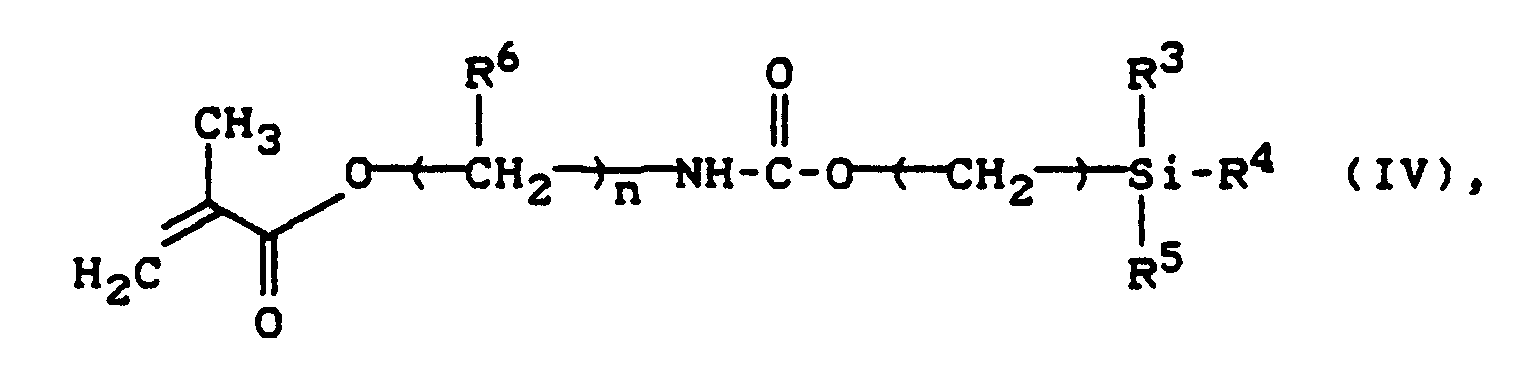
- n
- für eine Zahl von 1 bis 3 steht,
- R³, R⁴ und R⁵
- gleich oder verschieden sind und für Alkoxy, Niederalkyl, Cycloalkyl, Aryl, Trimethylsiloxy, Polysiloxy oder den Rest

- n, R³, R⁴
- die oben genannten Bedeutungen haben, und
- X
- für Hydroxy, Acetoxy, Alkoxy, Amino, Mercapto, Glycidoxy oder Carboxy steht, und
- R⁶
- für Niederalkyl oder Cycloalkyl steht.
- 4. Verbindungen der Formel

- n
- für eine Zahl von 1 bis 3 steht,
- R³, R⁴ und R⁵
- gleich oder verschieden sind und für Alkoxy, Niederalkyl, Cycloalkyl, Aryl, Trimethylsiloxy, Polysiloxy oder den Rest

- n, R³, R⁴
- die oben genannten Bedeutungen haben, und
- X
- für Hydroxy, Acetoxy, Alkoxy, Amino, Mercapto, Glycidoxy oder Carboxy steht,
- R⁶
- für H, Niederalkyl oder Cycloalkyl steht,
- Y
- für O, S oder den Rest

- R⁶
- die oben genannte Bedeutung hat, und
- Z
- für ein divalentes C₂ bis C₂₄-Alkylen, C₅ bis C₉-Cycloalkylen, C₆ bis C₁₂-Arylen oder einen divalenten Rest mit 7 bis 24 Kohlenstoffatomen aus Alkylen, Cycloalkylen und/oder Arylengruppen steht.
- 1. Compounds of the formula
- m
- represents 0 or 1,
- n
- represents a number from 1 to 3,
- R³, R⁴ and R⁵
- are identical or different and for alkoxy, lower alkyl, cycloalkyl, aryl, trimethylsiloxy, polysiloxy or the rest
- n, R³, R⁴
- have the meanings given above, and
- X
- represents hydroxy, acetoxy, alkoxy, amino, mercapto, glycidoxy or carboxy.
- 2. Compounds of the formula
- m and n
- independently represents a number from 1 to 3,
- R³, R⁴ and R⁵
- are identical or different and for alkoxy, lower alkyl, cycloalkyl, aryl, trimethylsiloxy, polysiloxy or the rest
- n, R³, R⁴
- have the meanings given above, and
- X
- represents hydroxy, acetoxy, alkoxy, amino, mercapto, glycidoxy or carboxy.
- 3. Compounds of the formula
- n
- represents a number from 1 to 3,
- R³, R⁴ and R⁵
- are identical or different and for alkoxy, lower alkyl, cycloalkyl, aryl, trimethylsiloxy, polysiloxy or the rest
- n, R³, R⁴
- have the meanings given above, and
- X
- represents hydroxy, acetoxy, alkoxy, amino, mercapto, glycidoxy or carboxy, and
- R⁶
- represents lower alkyl or cycloalkyl.
- 4. Compounds of the formula
- n
- represents a number from 1 to 3,
- R³, R⁴ and R⁵
- are identical or different and for alkoxy, lower alkyl, cycloalkyl, aryl, trimethylsiloxy, polysiloxy or the rest
- n, R³, R⁴
- have the meanings given above, and
- X
- represents hydroxy, acetoxy, alkoxy, amino, mercapto, glycidoxy or carboxy,
- R⁶
- represents H, lower alkyl or cycloalkyl,
- Y
- for O, S or the rest
- R⁶
- has the meaning given above, and
- Z
- represents a divalent C₂ to C₂₄ alkylene, C₅ to C₉ cycloalkylene, C₆ to C₁₂ arylene or a divalent radical having 7 to 24 carbon atoms from alkylene, cycloalkylene and / or arylene groups.
Niederalkyl bedeutet im allgemeinen verzweigte und unverzweigte Kohlenwasserstoff-Reste mit 1 bis 6 Kohlenstoffatomen. Als Beispiele seien genannt Methyl, Ethyl, n-Propyl, iso-Propyl, n-Butyl, iso-Butyl, t-Butyl, Pentyl, iso-Pentyl, Neopentyl, n-Hexyl und iso-Hexyl, Bevorzugt seien Methyl, Ethyl und iso-Propyl und besonders bevorzugt Methyl aufgeführt.Lower alkyl generally means branched and unbranched hydrocarbon radicals having 1 to 6 carbon atoms. Examples include methyl, ethyl, n-propyl, iso-propyl, n-butyl, iso-butyl, t-butyl, pentyl, iso-pentyl, neopentyl, n-hexyl and iso-hexyl. Methyl, ethyl and Isopropyl and particularly preferably methyl listed.
Als Cycloalkyl seien im allgemeinen cyclische Kohlenwasserstoffreste mit 5 bis 9 Kohlenstoffatomen genannt. Beispielsweise seien genannt Cyclopentyl, Cyclohexyl, Cycloheptyl und Cyclooctyl, Bevorzugt werden Cyclopentyl und Cyclohexyl, besonders bevorzugt Cyclohexyl.Cyclic hydrocarbon radicals having 5 to 9 carbon atoms are generally mentioned as cycloalkyl. Examples include cyclopentyl, cyclohexyl, cycloheptyl and cyclooctyl. Cyclopentyl and cyclohexyl are preferred, and cyclohexyl is particularly preferred.
Alkoxy bedeutet im allgemeinen einen über Sauerstoff gebundenen geradkettigen oder verzweigten Kohlenwasserstoffrest mit 1 bis etwa 8 Kohlenstoffatomen. Bevorzugt wird Niederalkoxy mit 1 bis etwa 6 Kohlenstoffatomen. Beispielsweise seien genannt Methoxy, Ethoxy, Propoxy, iso-Propoxy, Butoxy, iso-Butoxy, tert.-Butoxy, Pentoxy, iso-Pentoxy, Hexoxy und iso-Hexoxy, Besonders bevorzugt werden Methoxy und Ethoxy.Alkoxy generally means an oxygen-bonded straight-chain or branched hydrocarbon radical having 1 to about 8 carbon atoms. Lower alkoxy having 1 to about 6 carbon atoms is preferred. Examples include methoxy, ethoxy, propoxy, iso-propoxy, butoxy, iso-butoxy, tert-butoxy, pentoxy, iso-pentoxy, hexoxy and iso-hexoxy. Methoxy and ethoxy are particularly preferred.
Aryl bedeutet im allgemeinen einen aromatischen Kohlenwasserstoffrest mit 6 bis 12 Kohlenstoffatomen. Beispielsweise seien Phenyl, Naphthyl, Biphenylyl und Benzyl genannt. Bevorzugte Arylreste sind Phenyl und Benzyl.Aryl generally means an aromatic hydrocarbon radical having 6 to 12 carbon atoms. Examples include phenyl, naphthyl, biphenylyl and benzyl. Preferred aryl radicals are phenyl and benzyl.
Divalentes Alkylen (Z) bedeutet im allgemeinen eine zweibindige unverzweigte oder verzweigte Kohlenwassetstoffkette mit 2 bis 24 Kohlenstoffatomen. Bevorzugt werden Alkylen-Reste mit 6 bis 9 Kohlenstoffatomen. Beispielsweise seien genannt Methylen, Ethylen, Trimethylen, Tetramethylen, Pentamethylen, 2,2-Dimethyltrimethylen, Hexamethylen und 2,2,4-Trimethylhexamethylen. Besonders bevorzugt sind Hexamethylen und 2,2,4-Trimethylhexamethylen.Divalent alkylene (Z) generally means a divalent unbranched or branched hydrocarbon chain with 2 to 24 carbon atoms. Alkylene radicals having 6 to 9 carbon atoms are preferred. Examples include methylene, ethylene, trimethylene, tetramethylene, pentamethylene, 2,2-dimethyltrimethylene, hexamethylene and 2,2,4-trimethylhexamethylene. Hexamethylene and 2,2,4-trimethylhexamethylene are particularly preferred.
Divalentes Cycloalkylen (Z) bedeutet im allgemeinen einen zweibindigen cyclischen Kohlenwasserstoffrest mit 5 bis 9 Kohlenstoffatomen.Divalent cycloalkylene (Z) generally means a divalent cyclic hydrocarbon radical with 5 to 9 carbon atoms.
Beispielsweise seien genannt Cyclopentylen, Cyclohexylen, Cycloheptylen und Cyclooctylen. Bevorzugt werden Cyclopentylen und Cyclohexylen. Besonders bevorzugt wird Cyclohexylen.Examples include cyclopentylene, cyclohexylene, cycloheptylene and cyclooctylene. Cyclopentylene and cyclohexylene are preferred. Cyclohexylene is particularly preferred.
Divalentes Arylen (Z) bedeutet im allgemeinen einen zweibindigen aromatischen Kohlenwasserstoffrest mit 6 bis 12 Kohlenstoffatomen. Bevorzugt werden Phenylen-, Naphthylen- und Biphenylen-Rest. Besonders bevorzugt ist der Phenylen-Rest.Divalent arylene (Z) generally means a divalent aromatic hydrocarbon radical with 6 to 12 carbon atoms. Phenylene, naphthylene and biphenylene radicals are preferred. The phenylene radical is particularly preferred.
Divalente Reste mit 7 bis 24 Kohlenstoffatomen aus Alkylen, Cycloalkylen und/oder Arylengruppen sind beispielsweise Methylen-di-p-phenylen und 2,2-Propylen-di-p-phenylen.Divalent radicals with 7 to 24 carbon atoms from alkylene, cycloalkylene and / or arylene groups are, for example, methylene-di-p-phenylene and 2,2-propylene-di-p-phenylene.
Polysiloxyl bedeutet im allgemeinen geradkettige oder verzweigte, bevorzugt verzweigte, Polysiloxy-Reste der allgemeinen Formel

in der
- n
- für eine Zahl von 1 bis 3 steht,
- R³, R⁴ und R⁵
- gleich oder verschieden sind und für Alkoxy, Niederalkyl, Cycloalkyl, Aryl, Trimethylsiloxy oder den Rest

- n, R³, R⁴
- die oben genannten Bedeutungen haben, und
- X
- für Hydroxy, Acetoxy, Alkoxy, Amino, Mercapto, Glycidoxy oder Carboxy steht,


Polysiloxyl generally means straight-chain or branched, preferably branched, polysiloxy radicals of the general formula
in the
- n
- represents a number from 1 to 3,
- R³, R⁴ and R⁵
- are the same or different and for alkoxy, lower alkyl, cycloalkyl, aryl, trimethylsiloxy or the rest
- n, R³, R⁴
- have the meanings given above, and
- X
- represents hydroxy, acetoxy, alkoxy, amino, mercapto, glycidoxy or carboxy,
Siloxanyl-(Meth)acrylsäureester der Formel II können zum Beispiel sein: γ-Methacryloxypropyltrimethoxysilan (MEMO):

sowie dessen Derivate, wie beispielsweise: γ-Methacryloxypropyl-tris-(trimethylsiloxy)silan (TRIS):

1,3-Bis(γ-methacryloxypropyl)-1,1,3,3-tetra(trimethylsiloxy)-disiloxan (TETRA):

γ-Methacryloxypropyl-tris-(3-acetoxypropyldimethylsiloxy)silan (ATRIS):

sowie γ-Methacryloxypropyl-bis-(trimethylsiloxy)-(3-acetoxypropyldimethylsiloxy)silan.
γ-Methacryloxypropyl-bis-(3-acetoxypropyldimethylsiloxy)-trimethylsiloxy)-silan.
γ-Methacryloxypropyl-tris-(3-hydroxypropyldimethylsiloxy)silan (HTRIS),
γ-Methacryloxypropyl-bis-(3-hydroxypropyldimethylsiloxy)-(trimethylsiloxy)silan und
γ-Methacryloxypropyl-bis-(trimethylsiloxy)-(3-hydroxypropyldimethylsiloxy)silan.Siloxanyl (meth) acrylic acid esters of the formula II can be, for example: γ-methacryloxypropyltrimethoxysilane (MEMO):
and its derivatives, such as, for example: γ-methacryloxypropyl-tris (trimethylsiloxy) silane (TRIS):
1,3-bis (γ-methacryloxypropyl) -1,1,3,3-tetra (trimethylsiloxy) disiloxane (TETRA):
γ-methacryloxypropyl-tris (3-acetoxypropyldimethylsiloxy) silane (ATRIS):
and γ-methacryloxypropyl-bis- (trimethylsiloxy) - (3-acetoxypropyldimethylsiloxy) silane.
γ-methacryloxypropyl-bis (3-acetoxypropyldimethylsiloxy) trimethylsiloxy) silane.
γ-methacryloxypropyl-tris (3-hydroxypropyldimethylsiloxy) silane (HTRIS),
γ-methacryloxypropyl-bis- (3-hydroxypropyldimethylsiloxy) - (trimethylsiloxy) silane and
γ-methacryloxypropyl-bis (trimethylsiloxy) - (3-hydroxypropyldimethylsiloxy) silane.
Die Verbindungen sind aus γ-Methacryloxypropyltrimethoxysilan und den entsprechenden funktionalisierten Chlor- bzw. Acetoxysilanen durch Hydrolyse herstellbar (DE-A 3.244.877; DE-A 3.309.631).The compounds can be prepared from γ-methacryloxypropyltrimethoxysilane and the corresponding functionalized chlorosiloxides or acetoxysilanes by hydrolysis (DE-A 3,244,877; DE-A 3,309,631).
Weitere bekannte Siloxanyl-Methacrylate der Formel II sind beispielsweise:
Hydrolyseprodukte der Reaktion von δ-Methacryloxypropyltrimethoxysilan mit Dichlorodimethylsilan und Chlorotrimethylsilan (DE-A 3.329.722),
γ-Methacryloxypropylpentamethyldisiloxan (US 3.808.178) und
γ-Methacryloxypropyldimethyl(nonamethyltetrasiloxanyl)silan (US 4.303.772).Further known siloxanyl methacrylates of the formula II are, for example:
Hydrolysis products of the reaction of δ-methacryloxypropyltrimethoxysilane with dichlorodimethylsilane and chlorotrimethylsilane (DE-A 3,329,722),
γ-methacryloxypropylpentamethyldisiloxane (US 3,808,178) and
γ-methacryloxypropyldimethyl (nonamethyltetrasiloxanyl) silane (US 4,303,772).
Siloxanyl-Methacrylate der Formel III sind beispielsweise Umsetzungsprodukte von β-Allyloxyethyl-methacrylat mit SiH-Gruppen-haltigen Polysiloxanen (EP-A 130.731).Siloxanyl methacrylates of the formula III are, for example, reaction products of β-allyloxyethyl methacrylate with polysiloxanes containing SiH groups (EP-A 130,731).
Siloxanyl-Methacrylate der Formel IV können durch Umsetzung von Isocyanatoethylmethacrylat mit Hydroxy- oder Aminoalkyl-terminierten Polysiloxanen hergestellt werden (EP-A 127.321; Yu X., Nagarajan H.R. J. Appl.Pol.Sci. 30, 2115 (1985).Siloxanyl methacrylates of the formula IV can be prepared by reacting isocyanatoethyl methacrylate with hydroxy- or aminoalkyl-terminated polysiloxanes (EP-A 127.321; Yu X., Nagarajan HRJ Appl.Pol. Sci. 30 , 2115 (1985).
Für Verbindungen der Formel V seien beispielsweise Siliconmethacrylat-Makromere genannt, die durch Umsetzung von Hydroxyalkyl-terminierten Polysiloxanen wie z.B. Polydimethylsiloxan-triol mit 1-Isocyanatomethyl-5-isocyanato-1,3,3-trimethylcyclohexan und β-Hydroxyethylmethacrylat hergestellt werden können. Der Methacryl-Rest ist bei den Verbindungen der Formel V mit dem Polysiloxan über Urethan, Thiourethan, Harnstoff oder Amidfunktionen verknüpft (Cameron E.G., Chisholm M.S. Polymer 1985, 26(3), 437; US 4.136.250; EP-A 109.355).Examples of compounds of the formula V are silicone methacrylate macromers which can be prepared by reacting hydroxyalkyl-terminated polysiloxanes such as, for example, polydimethylsiloxane-triol with 1-isocyanatomethyl-5-isocyanato-1,3,3-trimethylcyclohexane and β-hydroxyethyl methacrylate. The methacrylic radical in the compounds of the formula V is linked to the polysiloxane via urethane, thiourethane, urea or amide functions (Cameron EG, Chisholm MS Polymer 1985, 26 (3), 437; US 4,136,250; EP-A 109,355).
Bevorzugt verwendete Siloxanyl-Methacrylate sind:Preferred siloxanyl methacrylates are:
γ-Methacryloxypropyltrimethoxysilan (MEMO),
γ-Methacryloxypropyl-tris-(trimethylsiloxy)silan (TRIS),
1,3-Bis(γ-methacryloxypropyl)-1,1,3,3-tetra(trimethylsiloxy)disiloxan (TETRA),
γ-Methacryloxypropyl-tris-(3-acetoxypropyldimethylsiloxy)silan (ATRIS),
γ-Methacryloxypropyl-tris-(3-hydroxypropyldimethylsiloxy)silan (HTRIS)
und Mischungen hieraus.
Besonders bevorzugt sind Mischungen aus TRIS, ATRIS, HTRIS und C4FM.γ-methacryloxypropyltrimethoxysilane (MEMO),
γ-methacryloxypropyl-tris (trimethylsiloxy) silane (TRIS),
1,3-bis (γ-methacryloxypropyl) -1,1,3,3-tetra (trimethylsiloxy) disiloxane (TETRA),
γ-methacryloxypropyl-tris (3-acetoxypropyldimethylsiloxy) silane (ATRIS),
γ-methacryloxypropyl-tris (3-hydroxypropyldimethylsiloxy) silane (HTRIS)
and mixtures thereof.
Mixtures of TRIS, ATRIS, HTRIS and C4FM are particularly preferred.
Die erfindungsgemäß kontaktoptischen Gegenstände enthalten im allgemeinen 5 bis 60 Gew.-% Siloxanyl-Methacrylat. Bevorzugt enthalten sie 10 bis 55 Gew.-%, und besonders bevorzugt 20 bis 40 Gew.-% der Monomeren im Polymeren.The contact optical objects according to the invention generally contain 5 to 60% by weight of siloxanyl methacrylate. They preferably contain 10 to 55% by weight, and particularly preferably 20 to 40% by weight, of the monomers in the polymer.
Die erfindungsgemäß kontaktoptischen Gegenstände können gegebenenfalls als Komponente C) nicht hydrophile Vinylmonomeren enthalten. Bevorzugte Vinylmonomere sind beispielsweise (Meth)acrylsäure-Derivate wie C₁ bis C₁₂-Alkyl- bzw. Cycloalkylester der (Meth)acrylsäure.The contact optical objects according to the invention may optionally contain non-hydrophilic vinyl monomers as component C). Preferred vinyl monomers are, for example, (meth) acrylic acid derivatives such as C₁ to C₁₂ alkyl or cycloalkyl esters of (meth) acrylic acid.
Beispielsweise seien genannt:
Methyl(meth)acrylat, Ethyl(meth)acrylat, Propyl(meth)acrylat, Butyl(meth)acrylat, 2-Ethylhexyl(meth)acrylat, (Iso)bornyl(meth)acrylat, Bicycloheptanyl(meth)acrylat und Cyclohexyl(meth)acrylat. Besonders bevorzugtes Vinylmonomer ist Methylmethacrylat.Examples include:
Methyl (meth) acrylate, ethyl (meth) acrylate, propyl (meth) acrylate, butyl (meth) acrylate, 2-ethylhexyl (meth) acrylate, (iso) bornyl (meth) acrylate, bicycloheptanyl (meth) acrylate and cyclohexyl (meth ) acrylate. A particularly preferred vinyl monomer is methyl methacrylate.
Die erfindungsgemäß kontaktoptischen Gegenstände enthalten im allgemeinen bis zu 65 Gew.-% an nicht hydrophilen Vinylmonomeren. Bevorzugt enthalten sie 10 bis 60 Gew.-% und besonders bevorzugt 20 bis 55 Gew.-% der Monomeren im Polymeren.The contact optical articles according to the invention generally contain up to 65% by weight of non-hydrophilic vinyl monomers. They preferably contain 10 to 60% by weight and particularly preferably 20 to 55% by weight of the monomers in the polymer.
Die erfindungsgemäß kontaktoptischen Gegenstände können gegebenenfalls als Komponente D) hydrophile Vinylmonomere enthalten. Bevorzugte Vinylmonomere sind beispielsweise N-Vinyllactame und Vinylamide und (Meth)acrylsäure-Derivate.The contact optical objects according to the invention can optionally contain, as component D), hydrophilic vinyl monomers. Preferred vinyl monomers are, for example, N-vinyl lactams and vinyl amides and (meth) acrylic acid derivatives.
Als Vinyllactame sei beispielsweise N-Vinylpyrrolidon und als (Meth)acrylsäure-Derivate seien (Meth)acrylsäure und (Meth)acrylamide aufgeführt.Examples of vinyl lactams are N-vinylpyrrolidone and (meth) acrylic acid derivatives are (meth) acrylic acid and (meth) acrylamides.
Besonders bevorzugte hydrophile Vinylmonomere sind N-Vinylpyrrolidon und N-Vinyl-N-Methylacetamid.Particularly preferred hydrophilic vinyl monomers are N-vinylpyrrolidone and N-vinyl-N-methylacetamide.
Die erfindungsgemäß kontaktoptischen Gegenstände enthalten gegebenenfalls bis zu 20 Gew.-% an hydrophilen Vinylmonomeren. Bevorzugt enthalten sie bis zu 10 Gew.-% und besonders bevorzugt bis zu 5 Gew.-% der Monomeren im Polymeren.The contact optical articles according to the invention optionally contain up to 20% by weight of hydrophilic vinyl monomers. They preferably contain up to 10% by weight and particularly preferably up to 5% by weight of the monomers in the polymer.
Die erfindungsgemäß kontaktoptischen Gegenstände können gegebenenfalls als Vernetzer-Komponente E) bi- oder polyfunktionelle Vinylmonomere enthalten. Hier seien beispielsweise bi- oder polyfunktionelle Methacrylsäureester wie Ethylenglycoldimethacrylat, Propylenglycoldimethacrylat, Diethylenglycoldimethacrylat, 1,4-Butandioldimethacrylat, 1,6-Hexandioldimethacrylat, Trimethylolpropantrimethacrylat, Allylmethacrylat, Vinylmethacrylat, (Meth)acrylsäureester ethoxylierter oder propoxylierter hydroxylgruppenhaltiger Tricyclo[5.2.1.02.6]decan-Derivate (vgl. DE-A 2.931.925) und Bisphenol-A-Dimethacrylat, sowie bi- oder polyfunktionelle Vinyl- oder Allyl-Vernetzer wie beispielsweise Butandioldivinylether, Divinylethylenharnstoff, Divinylpropylenharnstoff, Divinylbenzol, Triallylcyanurat, Triallylisocyanurat, Diethylenglycol-bis(allylcarbonat), Diallylitaconat, 3,3'-Ethyliden-bis(N-vinyl-2-pyrrolidon), Diallylmaleat, Diallylfumarat, Dimethallylfumarat, Dimethallylmaleat, Diallyldiglycolat, Diallyloxalat, Diallyladipat, Diallylsuccinat, Diallylazelat, Divinyladipat, Triallyltrimellitat und N,N-Diallymelamin genannt. Außerdem seien bis- oder polyfunktionelle Siloxanyl-Methacrylate wie beispielsweise 1,3-Bis(γ-methacryloxypropyl)-1,1,3,3-tetra(trimethylsiloxy)disiloxan und 1,3-Bis(γ-methacryloxypropyl)-1,1,3,3-tetramethyldisiloxan aufgeführt.The contact optical objects according to the invention can optionally contain bi- or polyfunctional vinyl monomers as crosslinker component E). Here, or polyfunctional methacrylates such as ethylene glycol dimethacrylate, propylene glycol dimethacrylate, diethylene glycol dimethacrylate, 1,4-butanediol dimethacrylate, 1,6-hexanediol dimethacrylate, trimethylolpropane trimethacrylate, allyl methacrylate, vinyl methacrylate, (meth) acrylate of ethoxylated or propoxylated hydroxyl-tricyclo [5.2.1.0 2,6] decane are for example bi- Derivatives (cf. DE-A 2.931.925) and bisphenol A dimethacrylate, as well as bi- or polyfunctional vinyl or allyl crosslinking agents such as, for example, butanediol divinyl ether, divinylethylene urea, divinyl propylene urea, divinyl benzene, triallyl cyanurate, triallyl isocyanurate, diethylene glycol bis (allyl glycol) bis ( Diallyl itaconate, 3,3'-ethylidene bis (N-vinyl-2-pyrrolidone), diallyl maleate, diallyl fumarate, dimethallyl fumarate, dimethallyl maleate, diallyl diglycolate, diallyl oxalate, diallyl adipate, diallylsuccinate, diallyl nellate, triallyl nellimellellate, diviallyl adlamellellate, diviallyl adlamellellate, divinyll adellate, divinyll adellate, divinyll adellate, divinyll adellate, divinyl adipellate. In addition, bis- or polyfunctional siloxanyl methacrylates such as 1,3-bis (γ-methacryloxypropyl) -1,1,3,3-tetra (trimethylsiloxy) disiloxane and 1,3-bis (γ-methacryloxypropyl) -1.1 , 3,3-tetramethyldisiloxane listed.
Besonders bevorzugte Vernetzer sind Dimethacrylate wie Ethylenglycoldimethacrylat und Gemische hieraus.Particularly preferred crosslinkers are dimethacrylates such as ethylene glycol dimethacrylate and mixtures thereof.
Die erfindungsgemäß kontaktoptischen Gegenstände enthalten im allgemeinen 0 bis 10 Gew.-% an Vernetzern. Bevorzugt enthalten sie 0.1 bis 5 Gew.-%.The contact optical objects according to the invention generally contain 0 to 10% by weight of crosslinking agents. They preferably contain 0.1 to 5% by weight.
Es wurde ein Verfahren zur Herstellung von kontaktoptischen Gegenständen gefunden, das dadurch gekennzeichnet ist, daß man
- A) 5 bis 40 Gew.-Teile eines 2-(N-Alkyl-Perfluoroalkylsulfonamido)-alkyl(meth)acrylats der Formel

- R¹
- H, CH₃,
- R²
- H, Niederalkyl, Cycloalkyl, Aryl,
- n
- eine Zahl von 1 bis 6,
- m
- eine Zahl von 0 bis 11
- B) 5 bis 60 Gew.-Teile eines (Meth)acrylsäureesters oder eines Gemisches verschiedener Polyorganosiloxan-(Meth)acrylsäureester,
- C) gegebenenfalls bis zu 60 Gew.-Teile eines nicht hydrophilen Vinylmonomeren,
- D) gegebenenfalls bis zu 20 Gew.-Teile eines hydrophilen Vinylmonomeren und
- E) gegebenenfalls bis zu 10 Gew.-Teile eines nicht unter B) fallenden bi- oder polyfunktionellen Vinylmonomeren
- A) 5 to 40 parts by weight of a 2- (N-alkyl-perfluoroalkylsulfonamido) alkyl (meth) acrylate of the formula
- R¹
- H, CH₃,
- R²
- H, lower alkyl, cycloalkyl, aryl,
- n
- a number from 1 to 6,
- m
- a number from 0 to 11
- B) 5 to 60 parts by weight of a (meth) acrylic acid ester or a mixture of different polyorganosiloxane (meth) acrylic acid esters,
- C) optionally up to 60 parts by weight of a non-hydrophilic vinyl monomer,
- D) optionally up to 20 parts by weight of a hydrophilic vinyl monomer and
- E) optionally up to 10 parts by weight of a bi- or polyfunctional vinyl monomer not covered by B)
Als Radikalstarter können beispielsweise Peroxide wie Dibenzoylperoxid, Dilauroylperoxid oder Azoverbindungen wie Azoisobutyronitril verwendet werden. Auch Photoinitiatoren wie beispielsweise 2,2-Dimethoxy-2-phenylacetophenon, Diethoxyacetophenon, 1-Hydroxycyclohexyl-Phenylketon oder Benzoin-propyl- oder isobutyl-ether können als Polymerisationsstarter eingesetzt werden.For example, peroxides such as dibenzoyl peroxide, dilauroyl peroxide or azo compounds such as azoisobutyronitrile can be used as radical initiators. Also photo initiators such as 2,2-dimethoxy-2-phenylacetophenone, diethoxyacetophenone, 1-hydroxycyclohexyl phenyl ketone or benzoin propyl or isobutyl ether can be used as polymerization initiators.
Eine bevorzugte Ausführungsform des erfindungsgemäßen Verfahrens ist die Polymerisation als Massepolymerisation in Plattenkammern, Glasröhrchen, Kunststoff-Röhrchen oder -Näpfchen. Bevorzugt wird die Ausführungsform in Plattenkammern oder aus Polyolefinen-Röhrchen bzw. -Näpfchen gewählt.A preferred embodiment of the method according to the invention is the polymerization as bulk polymerization in plate chambers, glass tubes, plastic tubes or cups. The embodiment is preferably selected in plate chambers or from polyolefin tubes or cells.
Die so erhaltenen Materialien enthalten praktische keine wasserextrahierbaren Bestandteile. Ihr Wassergehalt nach Hydratisierung beläuft sich je nach Anteil der hydrophilen Monomeren auf 0.5 bis 2 Gew.-% (bezogen auf hydratisierten Zustand).The materials thus obtained contain practically no water-extractable components. Depending on the proportion of the hydrophilic monomers, their water content after hydration is 0.5 to 2% by weight (based on the hydrated state).
Die Benetzungs-Randwinkel liegen im Bereich von 68 bis 75°, und die Sauerstoffdurchlässigkeiten belaufen sich auf Werte von 300 bis 1250 cm³O₂/(m²·24h·bar).The wetting contact angles are in the range of 68 to 75 °, and the oxygen permeability amounts to values of 300 to 1250 cm³O₂ / (m² · 24h · bar).
Die Shore-D-Härten von 70 bis 85 gewährleisten eine gute Verarbeitbarkeit und eine mit Polymethylmethacrylat-Materialien vergleichbare Kratzfestigkeit.The Shore D hardness of 70 to 85 ensure good processability and scratch resistance comparable to that of polymethyl methacrylate materials.
Die Oberflächen der aus den erfindungsgemäßen Materialien hergestellten Kontaktlinsen zeigen im Xenontest nach 1000 Stunden Bestrahlung unter dem Elektronenstrahl-Raster-Mikroskop keinerlei Mikrorißbildung.The surfaces of the contact lenses produced from the materials according to the invention show no microcracking in the xenon test after 1000 hours of irradiation under the electron beam scanning microscope.
Aufgrund der hohen Sauerstoffdurchlässigkeit, der guten Benetzbarkeit und der hervorragenden Stabilität eignen sich Kontaktlinsen aus dem erfindungsgemäßen Material besonders als VT-Linsen (Verlängertes-Tragen-Linsen). In biologischen Prüfungen konnte nachgewiesen werden, daß auf dem Kaninchenauge ununterbrochenem Tragen über eine Periode von 30 Tagen keine Reizerscheinungen auftreten und die Linsen beschlagfrei und ohne Ablagerungen blieben.Due to the high oxygen permeability, the good wettability and the excellent stability, contact lenses made from the material according to the invention are particularly suitable as VT lenses (extended wear lenses). Biological tests have shown that there is no irritation on the rabbit eye when worn continuously for a period of 30 days and that the lenses remain fog-free and without deposits.
Ein besonderer Vorteil der erfindungsgemäß kontaktoptischen Gegenstände ist die sehr gute Benetzbarkeit bei gleichzeitig sehr hoher Sauerstoffdurchlässigkeit. Dieser Effekt des 2-(N-Alkyl-Perfluoroalkylsulfonamido)alkyl(meth)acrylats ist um so überraschender, als die Fluormonomere bisher benutzt wurden, um die Oberflächen von Kunststoffen, Leder, Metallen und Textilien öl- und wasserabweisend zu gestalten (US 2.803.615; US 3.100.180).A particular advantage of the contact optical objects according to the invention is the very good wettability with very high oxygen permeability at the same time. This effect of 2- (N-alkyl-perfluoroalkylsulfonamido) alkyl (meth) acrylate is all the more surprising since the fluoromonomers have been used to make the surfaces of plastics, leather, metals and textiles oil and water repellent (US 2,803. 615; US 3,100,180).
Die radikalischen Polymerisationen wurden in Polypropylen-Röhrchen (⌀ 12 mm) durchgeführt.The radical polymerizations were carried out in polypropylene tubes (⌀ 12 mm).
Monomermischungen der Komponenten
- A) 2-(N-Alkyl-Perfluoroalkylsulfonamido)alkyl(meth)acrylat,
- B) Siloxan-(Meth)acrylat,
- C) nicht-hydrophiles Vinylmonomer,
- D) hydrophiles Vinylmonomer und
- E) bi- oder polyfunktionelles Vinylmonomer
- A) 2- (N-alkyl-perfluoroalkylsulfonamido) alkyl (meth) acrylate,
- B) siloxane (meth) acrylate,
- C) non-hydrophilic vinyl monomer,
- D) hydrophilic vinyl monomer and
- E) bi- or polyfunctional vinyl monomer
Die Polymerisationen wurden photochemisch gestartet und bei 40°C 24 h mit UV-Fluoreszenz-Licht bestrahlt.The polymerizations were started photochemically and irradiated with UV fluorescent light at 40 ° C. for 24 h.
Danach wurde weitere drei Tage mit UV-Licht bestrahlt, entformt und anschließend ein Tag im Trockenschrank bei 80°C getempert. Aus den zylindrischen Formen wurden Rohlingen und aus diesen durch Drehen und Polieren Kontaktlinsen gefertigt.Thereafter, UV light was irradiated for a further three days, the mold was removed and then annealed at 80 ° C. in a drying cabinet for one day. Blanks were made from the cylindrical shapes and contact lenses were made from them by turning and polishing.
Von den Materialien wurden im trockenen Zustand die Shore D-Werte (nach DIN 53 505) bestimmt. Dazu werden ca. 7 mm dicke Rohlinge gedreht und plan geschliffen.The Shore D values (according to DIN 53 505) of the materials were determined in the dry state. For this purpose, roughly 7 mm thick blanks are turned and ground flat.
Die Wasser-Benetzungs-Randwinkel wurden mit einem Video-System ermittelt. Angegeben sind die Mittelwerte aus 10 dynamischen Randwinkeln, die in einem Zeitbereich von 10 sec bestimmt wurden.The water-wetting contact angles were determined with a video system. The mean values from 10 dynamic contact angles, which were determined in a time range of 10 seconds, are given.
Die Sauerstoffdurchlässigkeiten wurden massenspectroskopisch bestimmt. Mit einer Partialdruckdifferenz von einem bar wurde Sauerstoff über eine Periode von 24 h durch Proben von ca. 1,5 mm Dicke und 12 mm ⌀ gedrückt. Die Messungen wurden bei 35°C, einer relativen Luftfeuchte von 100 % und einer zusätzlichen Befeuchtung des Materials mit einem Tropfen H₂O durchgeführt.The oxygen permeabilities were determined by mass spectroscopy. With a partial pressure difference of one bar, oxygen was forced through samples of approx. 1.5 mm thickness and 12 mm ⌀ over a period of 24 h. The measurements were carried out at 35 ° C, a relative humidity of 100% and an additional humidification of the material with a drop of H₂O.
Die Transmissibilitäten sind auf eine Probendicke von 1 mm normiert.

Claims (9)
- Contact-optical objects comprising wettable, optionally crosslinked copolymers, composed of olefinically unsaturated monomers, characterized in that said objects contain in the polymer, as comonomers, the components:A) 5 to 40 %, by weight, of a (N-alkyl-perfluoroalkylsulfonamido)-alkyl(meth)acrylate of the formula
 R¹ denotes H, CH₃,R² denotes H, alkyl having 1 to 6 carbon atoms, cycloalkyl having 5 to 9 carbon atoms, aryl having 6 to 12 carbon atoms,n denotes a number from 1 to 6,m denotes an number from 0 to 11,B) 5 to 60 %, by weight, of a siloxanyl-(meth)acrylic acid ester or of a mixture of different siloxanyl-(meth)acrylic acid esters,C) optionally, up to 65 %, by weight, of a non-hydrophilic vinylic monomer,D) optionally, up to 20 %, by weight, of a hydrophilic vinylic monomer, andE) optionally, up to 10 %, by weight, of a bis- or polyfunctional vinylic monomer not covered by B),with the total of percents, by weight, of A) to E) being 100.
 - The contact-optical objects of claim 1, characterized in that said objects contain 10 to 40 %, by weight, of (N-alkylperfluoroalkylsulfonamido)-alkyl(meth)acrylate in said polymer.
- The contact-optical objects of claims 1 and 2, characterized in that said objects contain 10 to 55 %, by weight, of a siloxanyl-(meth)acrylate or of a mixture of different siloxanyl-(meth)acrylates in said polymer.
- The contact-optical objects of claims 1 to 3, characterized in that said objects contain 20 to 55 %, by weight, of a non-hydrophilic vinylic monomer in said polymer.
- The contact-optical objects of claims 1 to 4, characterized in that said objects optionally contain up to 10 %, by weight, of a hydrophilic vinylic monomer in said polymer.
- The contact-optical objects of claims 1 to 5, characterized in that said objects optionally contain 0.1 to 5 %, by weight, of a bi- or polyfunctional vinylic monomer not being covered by B) in said polymer.
- A process for the preparation of contact-optical objects, characterized in thatA) 5 to 40 parts by weight of a (N-alkyl-perfluoroalkylsulfonamido)-alkyl(meth)acrylate of the formula
 R¹ denotes H, CH₃R² denotes H, alkyl having 1 to 6 carbon atoms, cycloalkyl having 5 to 9 carbon atoms, aryl having 6 to 12 carbon atoms,n denotes a number from 1 to 6,m denotes a number from 0 to 11,B) 5 to 60 parts by weight of a siloxanyl-(meth)acrylic acid ester or of a mixture of different siloxanyl-(meth)acrylic acid esters,C) optionally, up to 65 parts by weight of a non-hydrophilic vinylic monomer,D) optionally, up to 20 parts by weight of a hydrophilic vinylic monomer, andE) optionally, up to 10 parts by weight of a bi- or polyfunctional vinylic monomer not being covered by B)are polymerized in the presence of a radical initiator, with the total of the parts by weight being 100.
 - Use of wettable, optionally crosslinked copolymers composed of olefinically unsaturated monomers, said copolymers containingA) 5 to 40 %, by weight, of a perfluoroalkylsulfonamidoalkyl(meth)acrylate of the formula
 R¹ denotes H, CH₃R² denotes H, alkyl having 1 to 6 carbon atoms, cycloalkyl having 5 to 9 carbon atoms, aryl having 6 to 12 carbon atoms,n denotes a number from 1 to 6;m denotes a number from 0 to 11,B) 5 to 60 %, by weight, of a polyorganosiloxane-(meth)acrylic acid ester or of a mixture of different polyorganosiloxane-(meth)-acrylic acid esters,C) optionally, up to 65 %, by weight, of a non-hydrophilic vinylic monomer,D) optionally, up to 20 %, by weight, of a hydrophilic vinylic monomer, andE) optionally up to 10 %, by weight, of a bi- or polyfunctional vinylic monomer not being covered by B),with the total of the percents by weight of A) to E) being 100, for contact-optical objects.
 - The use of claim 8 for contact lenses or scleral lenses.
Priority Applications (1)
| Application Number | Priority Date | Filing Date | Title |
|---|---|---|---|
| AT88113589T ATE85350T1 (en) | 1987-09-03 | 1988-08-22 | CONTACT OPTICAL OBJECTS. |
Applications Claiming Priority (2)
| Application Number | Priority Date | Filing Date | Title |
|---|---|---|---|
| DE3729457 | 1987-09-03 | ||
| DE19873729457 DE3729457A1 (en) | 1987-09-03 | 1987-09-03 | CONTACT OPTICAL ITEMS |
Publications (3)
| Publication Number | Publication Date |
|---|---|
| EP0306756A2 EP0306756A2 (en) | 1989-03-15 |
| EP0306756A3 EP0306756A3 (en) | 1990-12-19 |
| EP0306756B1 true EP0306756B1 (en) | 1993-02-03 |
Family
ID=6335142
Family Applications (1)
| Application Number | Title | Priority Date | Filing Date |
|---|---|---|---|
| EP88113589A Expired - Lifetime EP0306756B1 (en) | 1987-09-03 | 1988-08-22 | Optical elements |
Country Status (5)
| Country | Link |
|---|---|
| EP (1) | EP0306756B1 (en) |
| JP (1) | JPH01133022A (en) |
| AT (1) | ATE85350T1 (en) |
| DE (2) | DE3729457A1 (en) |
| ES (1) | ES2040299T3 (en) |
Cited By (5)
| Publication number | Priority date | Publication date | Assignee | Title |
|---|---|---|---|---|
| WO1992017555A1 (en) * | 1991-03-26 | 1992-10-15 | Minnesota Mining And Manufacturing Company | Pressure-sensitive adhesive tape and a process for producing same |
| US6664354B2 (en) | 1999-10-27 | 2003-12-16 | 3M Innovative Properties Company | Fluorochemical sulfonamide surfactants |
| US6951894B1 (en) | 1994-09-06 | 2005-10-04 | Ciba Vision Corporation | Extended wear ophthalmic lens |
| US7468398B2 (en) | 1994-09-06 | 2008-12-23 | Ciba Vision Corporation | Extended wear ophthalmic lens |
| US9056878B2 (en) | 2006-09-29 | 2015-06-16 | Johnson & Johnson Vision Care, Inc. | Hydrolysis-resistant silicone compounds |
Families Citing this family (8)
| Publication number | Priority date | Publication date | Assignee | Title |
|---|---|---|---|---|
| US5258458A (en) * | 1991-02-28 | 1993-11-02 | Minnesota Mining And Manufacturing Company | Composition for providing oil and water repellency |
| WO2003027123A1 (en) * | 2000-02-07 | 2003-04-03 | Johnson & Johnson Vision Care, Inc. | Monomers, polymers and ophthalmic lenses |
| JP4524838B2 (en) * | 2000-02-07 | 2010-08-18 | 東レ株式会社 | Ophthalmic lens |
| US8569538B2 (en) | 2006-06-30 | 2013-10-29 | Johnson & Johnson Vision Care, Inc. | Acryloyl materials for molded plastics |
| US9056880B2 (en) | 2006-09-29 | 2015-06-16 | Johnson & Johnson Vision Care, Inc. | Process for producing hydrolysis-resistant silicone compounds |
| US8080622B2 (en) | 2007-06-29 | 2011-12-20 | Johnson & Johnson Vision Care, Inc. | Soluble silicone prepolymers |
| US7897654B2 (en) | 2007-12-27 | 2011-03-01 | Johnson & Johnson Vision Care Inc. | Silicone prepolymer solutions |
| EP3361307B1 (en) * | 2015-10-07 | 2020-10-21 | Seed Co., Ltd. | Process for producing a non hydrated ocular lens |
Family Cites Families (3)
| Publication number | Priority date | Publication date | Assignee | Title |
|---|---|---|---|---|
| EP0190993B1 (en) * | 1985-01-30 | 1989-11-08 | Ciba-Geigy Ag | Perfluoroalkylsulfonoalkyl acrylates and methacrylates, process for their preparation and their use |
| CA1222845A (en) * | 1986-02-06 | 1987-06-09 | Progressive Chemical Research Ltd. | Silicone-sulfone and silicone-fluorocarbon-sulfone gas permeable contact lenses and compositions thereof |
| US4990582A (en) * | 1986-07-18 | 1991-02-05 | Salamone Joseph C | Fluorine containing soft contact lens hydrogels |
-
1987
- 1987-09-03 DE DE19873729457 patent/DE3729457A1/en not_active Withdrawn
-
1988
- 1988-08-22 EP EP88113589A patent/EP0306756B1/en not_active Expired - Lifetime
- 1988-08-22 AT AT88113589T patent/ATE85350T1/en not_active IP Right Cessation
- 1988-08-22 ES ES198888113589T patent/ES2040299T3/en not_active Expired - Lifetime
- 1988-08-22 DE DE8888113589T patent/DE3878099D1/en not_active Expired - Fee Related
- 1988-09-02 JP JP63218693A patent/JPH01133022A/en active Pending
Cited By (10)
| Publication number | Priority date | Publication date | Assignee | Title |
|---|---|---|---|---|
| WO1992017555A1 (en) * | 1991-03-26 | 1992-10-15 | Minnesota Mining And Manufacturing Company | Pressure-sensitive adhesive tape and a process for producing same |
| US5518811A (en) * | 1991-03-26 | 1996-05-21 | Minnesota Mining And Manufacturing Company | Pressure-sensitive adhesive tape and a process for producing same |
| US6951894B1 (en) | 1994-09-06 | 2005-10-04 | Ciba Vision Corporation | Extended wear ophthalmic lens |
| US7468398B2 (en) | 1994-09-06 | 2008-12-23 | Ciba Vision Corporation | Extended wear ophthalmic lens |
| US7538146B2 (en) | 1994-09-06 | 2009-05-26 | Ciba Vision Corporation | Extended wear ophthalmic lens |
| US7553880B2 (en) | 1994-09-06 | 2009-06-30 | Ciba Vision Corporation | Extended wear ophthalmic lens |
| US8415404B2 (en) | 1994-09-06 | 2013-04-09 | Ciba Vision Corporation | Extended wear ophthalmic lens |
| US8568626B2 (en) | 1994-09-06 | 2013-10-29 | Ciba Vision Corporation | Extended wear ophthalmic lens |
| US6664354B2 (en) | 1999-10-27 | 2003-12-16 | 3M Innovative Properties Company | Fluorochemical sulfonamide surfactants |
| US9056878B2 (en) | 2006-09-29 | 2015-06-16 | Johnson & Johnson Vision Care, Inc. | Hydrolysis-resistant silicone compounds |
Also Published As
| Publication number | Publication date |
|---|---|
| ES2040299T3 (en) | 1993-10-16 |
| ATE85350T1 (en) | 1993-02-15 |
| EP0306756A2 (en) | 1989-03-15 |
| DE3729457A1 (en) | 1989-03-16 |
| JPH01133022A (en) | 1989-05-25 |
| DE3878099D1 (en) | 1993-03-18 |
| EP0306756A3 (en) | 1990-12-19 |
Similar Documents
| Publication | Publication Date | Title |
|---|---|---|
| EP0241796B1 (en) | Composition for contact lenses | |
| DE69216100T2 (en) | WETABLE SILICONE-HYDROGEL COMPOSITIONS AND METHOD FOR THE PRODUCTION THEREOF | |
| DE69312291T2 (en) | Wettable polysiloxane hydrogels | |
| DE3880336T2 (en) | CONTINUOUSLY WEARABLE LENSES WITH IMPROVED PHYSICAL PROPERTIES. | |
| DE69211707T2 (en) | COMPOSITIONS OF WETABLE SILICONE HYDROGENS AND METHOD FOR THE PRODUCTION THEREOF | |
| DE69211152T2 (en) | COMPOSITIONS OF WETABLE SILICONE HYDROGELS AND METHOD FOR THE PRODUCTION THEREOF | |
| DE69314055T2 (en) | SILOXY-FUNCTIONAL MACROMONOMER | |
| US4440918A (en) | Contact lens containing a fluorinated telechelic polyether | |
| DE60103597T2 (en) | MATERIAL FOR AN OKULAR LENS | |
| EP0176481B1 (en) | Unsaturated polysiloxanes, polymerizable compositions and contact lenses therefrom | |
| DE69407573T2 (en) | FLUORSILOXANHYDROGELE | |
| DE69121581T2 (en) | SURFACE-ACTIVE MACROMONOMERS | |
| US4463149A (en) | Silicone-containing contact lens material and contact lenses made thereof | |
| EP0109355B1 (en) | Silicon-containing polymers having an increased oxygen permeability | |
| DE69225151T2 (en) | Hard contact lenses with improved oxygen permeability | |
| US4235985A (en) | Polymer for contact lens and contact lens made thereof | |
| EP0306756B1 (en) | Optical elements | |
| EP0425436B1 (en) | Reactive silicone and/or fluorine containing hydrophilic prepolymers and polymers thereof | |
| DE69733406T2 (en) | Plastic articles for medical applications | |
| DE69912352T2 (en) | Biomedical device with humectant coatings | |
| DE3244877A1 (en) | CONTACT LENS MATERIAL WITH SILICONE AND CONTACT LENS MADE THEREOF | |
| US5196493A (en) | Polymers and hard, gas-permeable contact lenses made therefrom | |
| JP2578472B2 (en) | Polyvinyl end-functional macromers, polymers thereof and contact lenses made therefrom | |
| US4868260A (en) | Hard contact lens material consisting of alkyl fumarate and silicon-alkyl fumarate copolymers | |
| CA1261998A (en) | Lens composition, article and method of manufacture |
Legal Events
| Date | Code | Title | Description |
|---|---|---|---|
| PUAI | Public reference made under article 153(3) epc to a published international application that has entered the european phase |
Free format text: ORIGINAL CODE: 0009012 |
|
| 17P | Request for examination filed |
Effective date: 19880822 |
|
| AK | Designated contracting states |
Kind code of ref document: A2 Designated state(s): AT BE CH DE ES FR GB IT LI NL SE |
|
| PUAL | Search report despatched |
Free format text: ORIGINAL CODE: 0009013 |
|
| AK | Designated contracting states |
Kind code of ref document: A3 Designated state(s): AT BE CH DE ES FR GB IT LI NL SE |
|
| 17Q | First examination report despatched |
Effective date: 19920428 |
|
| RAP1 | Party data changed (applicant data changed or rights of an application transferred) |
Owner name: GEYER, OTTO-CHRISTIAN, DR. |
|
| GRAA | (expected) grant |
Free format text: ORIGINAL CODE: 0009210 |
|
| AK | Designated contracting states |
Kind code of ref document: B1 Designated state(s): AT BE CH DE ES FR GB IT LI NL SE |
|
| REF | Corresponds to: |
Ref document number: 85350 Country of ref document: AT Date of ref document: 19930215 Kind code of ref document: T |
|
| REF | Corresponds to: |
Ref document number: 3878099 Country of ref document: DE Date of ref document: 19930318 |
|
| ITF | It: translation for a ep patent filed | ||
| GBT | Gb: translation of ep patent filed (gb section 77(6)(a)/1977) |
Effective date: 19930423 |
|
| ET | Fr: translation filed | ||
| ITTA | It: last paid annual fee | ||
| PLBE | No opposition filed within time limit |
Free format text: ORIGINAL CODE: 0009261 |
|
| STAA | Information on the status of an ep patent application or granted ep patent |
Free format text: STATUS: NO OPPOSITION FILED WITHIN TIME LIMIT |
|
| REG | Reference to a national code |
Ref country code: CH Ref legal event code: PUE Owner name: CIBA-GEIGY AG |
|
| REG | Reference to a national code |
Ref country code: GB Ref legal event code: 732E |
|
| ITPR | It: changes in ownership of a european patent |
Owner name: CESSIONE;CIBA - GEIGY AG |
|
| 26N | No opposition filed | ||
| NLS | Nl: assignments of ep-patents |
Owner name: CIBA-GEIGY A.G. TE BAZEL, ZWITSERLAND. |
|
| REG | Reference to a national code |
Ref country code: ES Ref legal event code: PC2A Owner name: CIBA-GEIGY AG |
|
| REG | Reference to a national code |
Ref country code: FR Ref legal event code: TP |
|
| EAL | Se: european patent in force in sweden |
Ref document number: 88113589.1 |
|
| PGFP | Annual fee paid to national office [announced via postgrant information from national office to epo] |
Ref country code: CH Payment date: 19951115 Year of fee payment: 8 |
|
| PGFP | Annual fee paid to national office [announced via postgrant information from national office to epo] |
Ref country code: FR Payment date: 19960625 Year of fee payment: 9 |
|
| PGFP | Annual fee paid to national office [announced via postgrant information from national office to epo] |
Ref country code: NL Payment date: 19960630 Year of fee payment: 9 |
|
| PGFP | Annual fee paid to national office [announced via postgrant information from national office to epo] |
Ref country code: DE Payment date: 19960703 Year of fee payment: 9 |
|
| PGFP | Annual fee paid to national office [announced via postgrant information from national office to epo] |
Ref country code: AT Payment date: 19960709 Year of fee payment: 9 |
|
| PGFP | Annual fee paid to national office [announced via postgrant information from national office to epo] |
Ref country code: GB Payment date: 19960715 Year of fee payment: 9 |
|
| PGFP | Annual fee paid to national office [announced via postgrant information from national office to epo] |
Ref country code: ES Payment date: 19960809 Year of fee payment: 9 |
|
| PGFP | Annual fee paid to national office [announced via postgrant information from national office to epo] |
Ref country code: SE Payment date: 19960826 Year of fee payment: 9 |
|
| PG25 | Lapsed in a contracting state [announced via postgrant information from national office to epo] |
Ref country code: LI Effective date: 19960831 Ref country code: CH Effective date: 19960831 |
|
| PGFP | Annual fee paid to national office [announced via postgrant information from national office to epo] |
Ref country code: BE Payment date: 19961009 Year of fee payment: 9 |
|
| REG | Reference to a national code |
Ref country code: CH Ref legal event code: PL |
|
| PG25 | Lapsed in a contracting state [announced via postgrant information from national office to epo] |
Ref country code: GB Free format text: LAPSE BECAUSE OF NON-PAYMENT OF DUE FEES Effective date: 19970822 Ref country code: AT Free format text: LAPSE BECAUSE OF NON-PAYMENT OF DUE FEES Effective date: 19970822 |
|
| PG25 | Lapsed in a contracting state [announced via postgrant information from national office to epo] |
Ref country code: SE Free format text: LAPSE BECAUSE OF NON-PAYMENT OF DUE FEES Effective date: 19970823 Ref country code: ES Free format text: THE PATENT HAS BEEN ANNULLED BY A DECISION OF A NATIONAL AUTHORITY Effective date: 19970823 |
|
| PG25 | Lapsed in a contracting state [announced via postgrant information from national office to epo] |
Ref country code: BE Free format text: LAPSE BECAUSE OF NON-PAYMENT OF DUE FEES Effective date: 19970831 |
|
| BERE | Be: lapsed |
Owner name: CIBA-GEIGY A.G. Effective date: 19970831 |
|
| PG25 | Lapsed in a contracting state [announced via postgrant information from national office to epo] |
Ref country code: NL Free format text: LAPSE BECAUSE OF NON-PAYMENT OF DUE FEES Effective date: 19980301 |
|
| GBPC | Gb: european patent ceased through non-payment of renewal fee |
Effective date: 19970822 |
|
| PG25 | Lapsed in a contracting state [announced via postgrant information from national office to epo] |
Ref country code: FR Free format text: LAPSE BECAUSE OF NON-PAYMENT OF DUE FEES Effective date: 19980430 |
|
| PG25 | Lapsed in a contracting state [announced via postgrant information from national office to epo] |
Ref country code: DE Free format text: LAPSE BECAUSE OF NON-PAYMENT OF DUE FEES Effective date: 19980501 |
|
| EUG | Se: european patent has lapsed |
Ref document number: 88113589.1 |
|
| NLV4 | Nl: lapsed or anulled due to non-payment of the annual fee |
Effective date: 19980301 |
|
| REG | Reference to a national code |
Ref country code: FR Ref legal event code: ST |
|
| REG | Reference to a national code |
Ref country code: ES Ref legal event code: FD2A Effective date: 20001204 |
|
| PG25 | Lapsed in a contracting state [announced via postgrant information from national office to epo] |
Ref country code: IT Free format text: LAPSE BECAUSE OF NON-PAYMENT OF DUE FEES;WARNING: LAPSES OF ITALIAN PATENTS WITH EFFECTIVE DATE BEFORE 2007 MAY HAVE OCCURRED AT ANY TIME BEFORE 2007. THE CORRECT EFFECTIVE DATE MAY BE DIFFERENT FROM THE ONE RECORDED. Effective date: 20050822 |