EP0305442B1 - Fungicide compositions - Google Patents
Fungicide compositions Download PDFInfo
- Publication number
- EP0305442B1 EP0305442B1 EP88902191A EP88902191A EP0305442B1 EP 0305442 B1 EP0305442 B1 EP 0305442B1 EP 88902191 A EP88902191 A EP 88902191A EP 88902191 A EP88902191 A EP 88902191A EP 0305442 B1 EP0305442 B1 EP 0305442B1
- Authority
- EP
- European Patent Office
- Prior art keywords
- fungicide
- fungicides
- mixture
- bis
- dithiocarbamate
- Prior art date
- Legal status (The legal status is an assumption and is not a legal conclusion. Google has not performed a legal analysis and makes no representation as to the accuracy of the status listed.)
- Expired - Lifetime
Links
- 239000000417 fungicide Substances 0.000 title claims abstract description 67
- 230000000855 fungicidal effect Effects 0.000 title claims abstract description 39
- 239000000203 mixture Substances 0.000 title claims description 75
- 239000004480 active ingredient Substances 0.000 claims abstract description 18
- TWFZGCMQGLPBSX-UHFFFAOYSA-N carbendazim Chemical compound C1=CC=C2NC(NC(=O)OC)=NC2=C1 TWFZGCMQGLPBSX-UHFFFAOYSA-N 0.000 claims description 28
- YTOPFCCWCSOHFV-UHFFFAOYSA-N 2,6-dimethyl-4-tridecylmorpholine Chemical compound CCCCCCCCCCCCCN1CC(C)OC(C)C1 YTOPFCCWCSOHFV-UHFFFAOYSA-N 0.000 claims description 14
- 238000011282 treatment Methods 0.000 claims description 13
- 239000006013 carbendazim Substances 0.000 claims description 12
- ZQEIXNIJLIKNTD-UHFFFAOYSA-N methyl N-(2,6-dimethylphenyl)-N-(methoxyacetyl)alaninate Chemical compound COCC(=O)N(C(C)C(=O)OC)C1=C(C)C=CC=C1C ZQEIXNIJLIKNTD-UHFFFAOYSA-N 0.000 claims description 8
- KKMLIVYBGSAJPM-UHFFFAOYSA-L propineb Chemical compound [Zn+2].[S-]C(=S)NC(C)CNC([S-])=S KKMLIVYBGSAJPM-UHFFFAOYSA-L 0.000 claims description 8
- 208000015181 infectious disease Diseases 0.000 claims description 7
- 239000005807 Metalaxyl Substances 0.000 claims description 6
- YKSNLCVSTHTHJA-UHFFFAOYSA-L maneb Chemical compound [Mn+2].[S-]C(=S)NCCNC([S-])=S YKSNLCVSTHTHJA-UHFFFAOYSA-L 0.000 claims description 6
- 238000000034 method Methods 0.000 claims description 6
- 239000005734 Benalaxyl Substances 0.000 claims description 5
- QNAYBMKLOCPYGJ-REOHCLBHSA-M L-alaninate Chemical compound C[C@H](N)C([O-])=O QNAYBMKLOCPYGJ-REOHCLBHSA-M 0.000 claims description 5
- CJPQIRJHIZUAQP-UHFFFAOYSA-N methyl N-(2,6-dimethylphenyl)-N-(phenylacetyl)alaninate Chemical compound CC=1C=CC=C(C)C=1N(C(C)C(=O)OC)C(=O)CC1=CC=CC=C1 CJPQIRJHIZUAQP-UHFFFAOYSA-N 0.000 claims description 5
- 239000005809 Metiram Substances 0.000 claims description 4
- YNAVUWVOSKDBBP-UHFFFAOYSA-N Morpholine Chemical compound C1COCCN1 YNAVUWVOSKDBBP-UHFFFAOYSA-N 0.000 claims description 4
- 239000005823 Propineb Substances 0.000 claims description 4
- 239000007983 Tris buffer Substances 0.000 claims description 4
- HCHKCACWOHOZIP-UHFFFAOYSA-N Zinc Chemical compound [Zn] HCHKCACWOHOZIP-UHFFFAOYSA-N 0.000 claims description 4
- FPIPGXGPPPQFEQ-OVSJKPMPSA-N all-trans-retinol Chemical compound OC\C=C(/C)\C=C\C=C(/C)\C=C\C1=C(C)CCCC1(C)C FPIPGXGPPPQFEQ-OVSJKPMPSA-N 0.000 claims description 4
- 239000012990 dithiocarbamate Substances 0.000 claims description 4
- JMXKCYUTURMERF-UHFFFAOYSA-N dodemorph Chemical compound C1C(C)OC(C)CN1C1CCCCCCCCCCC1 JMXKCYUTURMERF-UHFFFAOYSA-N 0.000 claims description 4
- 229920000257 metiram Polymers 0.000 claims description 4
- YFNCATAIYKQPOO-UHFFFAOYSA-N thiophanate Chemical compound CCOC(=O)NC(=S)NC1=CC=CC=C1NC(=S)NC(=O)OCC YFNCATAIYKQPOO-UHFFFAOYSA-N 0.000 claims description 4
- RIOXQFHNBCKOKP-UHFFFAOYSA-N benomyl Chemical compound C1=CC=C2N(C(=O)NCCCC)C(NC(=O)OC)=NC2=C1 RIOXQFHNBCKOKP-UHFFFAOYSA-N 0.000 claims description 3
- DKVNPHBNOWQYFE-UHFFFAOYSA-N carbamodithioic acid Chemical compound NC(S)=S DKVNPHBNOWQYFE-UHFFFAOYSA-N 0.000 claims description 3
- WJCNZQLZVWNLKY-UHFFFAOYSA-N thiabendazole Chemical compound S1C=NC(C=2NC3=CC=CC=C3N=2)=C1 WJCNZQLZVWNLKY-UHFFFAOYSA-N 0.000 claims description 3
- RYAUSSKQMZRMAI-ALOPSCKCSA-N (2S,6R)-4-[3-(4-tert-butylphenyl)-2-methylpropyl]-2,6-dimethylmorpholine Chemical compound C=1C=C(C(C)(C)C)C=CC=1CC(C)CN1C[C@H](C)O[C@H](C)C1 RYAUSSKQMZRMAI-ALOPSCKCSA-N 0.000 claims description 2
- OWDLFBLNMPCXSD-UHFFFAOYSA-N 2-chloro-N-(2,6-dimethylphenyl)-N-(2-oxotetrahydrofuran-3-yl)acetamide Chemical compound CC1=CC=CC(C)=C1N(C(=O)CCl)C1C(=O)OCC1 OWDLFBLNMPCXSD-UHFFFAOYSA-N 0.000 claims description 2
- SBUKOHLFHYSZNG-UHFFFAOYSA-N 4-dodecyl-2,6-dimethylmorpholine Chemical compound CCCCCCCCCCCCN1CC(C)OC(C)C1 SBUKOHLFHYSZNG-UHFFFAOYSA-N 0.000 claims description 2
- KRZUZYJEQBXUIN-UHFFFAOYSA-N Cyprofuram Chemical compound ClC1=CC=CC(N(C2C(OCC2)=O)C(=O)C2CC2)=C1 KRZUZYJEQBXUIN-UHFFFAOYSA-N 0.000 claims description 2
- BWGNESOTFCXPMA-UHFFFAOYSA-N Dihydrogen disulfide Chemical compound SS BWGNESOTFCXPMA-UHFFFAOYSA-N 0.000 claims description 2
- 239000005765 Dodemorph Substances 0.000 claims description 2
- 239000005778 Fenpropimorph Substances 0.000 claims description 2
- 239000005802 Mancozeb Substances 0.000 claims description 2
- 239000011717 all-trans-retinol Substances 0.000 claims description 2
- 235000019169 all-trans-retinol Nutrition 0.000 claims description 2
- MITFXPHMIHQXPI-UHFFFAOYSA-N benzoxaprofen Natural products N=1C2=CC(C(C(O)=O)C)=CC=C2OC=1C1=CC=C(Cl)C=C1 MITFXPHMIHQXPI-UHFFFAOYSA-N 0.000 claims description 2
- 244000053095 fungal pathogen Species 0.000 claims description 2
- 229920000940 maneb Polymers 0.000 claims description 2
- CIEXPHRYOLIQQD-UHFFFAOYSA-N methyl N-(2,6-dimethylphenyl)-N-2-furoylalaninate Chemical compound CC=1C=CC=C(C)C=1N(C(C)C(=O)OC)C(=O)C1=CC=CO1 CIEXPHRYOLIQQD-UHFFFAOYSA-N 0.000 claims description 2
- UWVQIROCRJWDKL-UHFFFAOYSA-N oxadixyl Chemical compound CC=1C=CC=C(C)C=1N(C(=O)COC)N1CCOC1=O UWVQIROCRJWDKL-UHFFFAOYSA-N 0.000 claims description 2
- 229960004546 thiabendazole Drugs 0.000 claims description 2
- QGHREAKMXXNCOA-UHFFFAOYSA-N thiophanate-methyl Chemical compound COC(=O)NC(=S)NC1=CC=CC=C1NC(=S)NC(=O)OC QGHREAKMXXNCOA-UHFFFAOYSA-N 0.000 claims description 2
- 150000003751 zinc Chemical class 0.000 claims description 2
- AMHNZOICSMBGDH-UHFFFAOYSA-L zineb Chemical compound [Zn+2].[S-]C(=S)NCCNC([S-])=S AMHNZOICSMBGDH-UHFFFAOYSA-L 0.000 claims description 2
- 239000011885 synergistic combination Substances 0.000 abstract description 2
- 238000003756 stirring Methods 0.000 description 24
- 239000000843 powder Substances 0.000 description 19
- GPRLSGONYQIRFK-MNYXATJNSA-N triton Chemical compound [3H+] GPRLSGONYQIRFK-MNYXATJNSA-N 0.000 description 19
- 241000235349 Ascomycota Species 0.000 description 16
- 241000233654 Oomycetes Species 0.000 description 14
- 241000233678 Peronosporales Species 0.000 description 14
- 239000000725 suspension Substances 0.000 description 14
- 239000000243 solution Substances 0.000 description 13
- 241000196324 Embryophyta Species 0.000 description 12
- 241000233866 Fungi Species 0.000 description 12
- 239000002245 particle Substances 0.000 description 11
- LYCAIKOWRPUZTN-UHFFFAOYSA-N Ethylene glycol Chemical compound OCCO LYCAIKOWRPUZTN-UHFFFAOYSA-N 0.000 description 9
- VYPSYNLAJGMNEJ-UHFFFAOYSA-N Silicium dioxide Chemical compound O=[Si]=O VYPSYNLAJGMNEJ-UHFFFAOYSA-N 0.000 description 9
- 229920004897 Triton X-45 Polymers 0.000 description 8
- 230000000694 effects Effects 0.000 description 8
- 238000002474 experimental method Methods 0.000 description 8
- 239000011049 pearl Substances 0.000 description 7
- XLYOFNOQVPJJNP-UHFFFAOYSA-N water Substances O XLYOFNOQVPJJNP-UHFFFAOYSA-N 0.000 description 7
- 241000221198 Basidiomycota Species 0.000 description 6
- 241000221785 Erysiphales Species 0.000 description 6
- 201000010099 disease Diseases 0.000 description 6
- 208000037265 diseases, disorders, signs and symptoms Diseases 0.000 description 6
- 241000894007 species Species 0.000 description 6
- 239000000080 wetting agent Substances 0.000 description 6
- 241001523973 Xylariales Species 0.000 description 5
- 239000008187 granular material Substances 0.000 description 5
- 244000052769 pathogen Species 0.000 description 5
- 241000223218 Fusarium Species 0.000 description 4
- 244000068988 Glycine max Species 0.000 description 4
- 235000010469 Glycine max Nutrition 0.000 description 4
- DGAQECJNVWCQMB-PUAWFVPOSA-M Ilexoside XXIX Chemical compound C[C@@H]1CC[C@@]2(CC[C@@]3(C(=CC[C@H]4[C@]3(CC[C@@H]5[C@@]4(CC[C@@H](C5(C)C)OS(=O)(=O)[O-])C)C)[C@@H]2[C@]1(C)O)C)C(=O)O[C@H]6[C@@H]([C@H]([C@@H]([C@H](O6)CO)O)O)O.[Na+] DGAQECJNVWCQMB-PUAWFVPOSA-M 0.000 description 4
- 208000031888 Mycoses Diseases 0.000 description 4
- 239000005662 Paraffin oil Substances 0.000 description 4
- 241000233679 Peronosporaceae Species 0.000 description 4
- 240000004713 Pisum sativum Species 0.000 description 4
- 235000010582 Pisum sativum Nutrition 0.000 description 4
- 150000001875 compounds Chemical class 0.000 description 4
- 239000011521 glass Substances 0.000 description 4
- 239000012456 homogeneous solution Substances 0.000 description 4
- 238000000265 homogenisation Methods 0.000 description 4
- 238000011081 inoculation Methods 0.000 description 4
- 229910052708 sodium Inorganic materials 0.000 description 4
- 239000011734 sodium Substances 0.000 description 4
- 230000002195 synergetic effect Effects 0.000 description 4
- 238000009736 wetting Methods 0.000 description 4
- UHPMCKVQTMMPCG-UHFFFAOYSA-N 5,8-dihydroxy-2-methoxy-6-methyl-7-(2-oxopropyl)naphthalene-1,4-dione Chemical compound CC1=C(CC(C)=O)C(O)=C2C(=O)C(OC)=CC(=O)C2=C1O UHPMCKVQTMMPCG-UHFFFAOYSA-N 0.000 description 3
- 240000008067 Cucumis sativus Species 0.000 description 3
- 235000010799 Cucumis sativus var sativus Nutrition 0.000 description 3
- 241000223221 Fusarium oxysporum Species 0.000 description 3
- 244000020551 Helianthus annuus Species 0.000 description 3
- 235000003222 Helianthus annuus Nutrition 0.000 description 3
- 241000233629 Phytophthora parasitica Species 0.000 description 3
- 240000003768 Solanum lycopersicum Species 0.000 description 3
- CZMRCDWAGMRECN-UGDNZRGBSA-N Sucrose Chemical compound O[C@H]1[C@H](O)[C@@H](CO)O[C@@]1(CO)O[C@@H]1[C@H](O)[C@@H](O)[C@H](O)[C@@H](CO)O1 CZMRCDWAGMRECN-UGDNZRGBSA-N 0.000 description 3
- 229930006000 Sucrose Natural products 0.000 description 3
- 241000221561 Ustilaginales Species 0.000 description 3
- 241000082085 Verticillium <Phyllachorales> Species 0.000 description 3
- 240000008042 Zea mays Species 0.000 description 3
- 235000002017 Zea mays subsp mays Nutrition 0.000 description 3
- 239000011149 active material Substances 0.000 description 3
- 239000003795 chemical substances by application Substances 0.000 description 3
- JYIMWRSJCRRYNK-UHFFFAOYSA-N dialuminum;disodium;oxygen(2-);silicon(4+);hydrate Chemical compound O.[O-2].[O-2].[O-2].[O-2].[O-2].[O-2].[Na+].[Na+].[Al+3].[Al+3].[Si+4] JYIMWRSJCRRYNK-UHFFFAOYSA-N 0.000 description 3
- 235000013681 dietary sucrose Nutrition 0.000 description 3
- 229940093476 ethylene glycol Drugs 0.000 description 3
- 230000002538 fungal effect Effects 0.000 description 3
- 230000012010 growth Effects 0.000 description 3
- 230000005764 inhibitory process Effects 0.000 description 3
- 239000000463 material Substances 0.000 description 3
- 230000035945 sensitivity Effects 0.000 description 3
- 238000010008 shearing Methods 0.000 description 3
- RMAQACBXLXPBSY-UHFFFAOYSA-N silicic acid Chemical compound O[Si](O)(O)O RMAQACBXLXPBSY-UHFFFAOYSA-N 0.000 description 3
- 235000012239 silicon dioxide Nutrition 0.000 description 3
- 239000002689 soil Substances 0.000 description 3
- 229960004793 sucrose Drugs 0.000 description 3
- 231100000331 toxic Toxicity 0.000 description 3
- 230000002588 toxic effect Effects 0.000 description 3
- HYZJCKYKOHLVJF-UHFFFAOYSA-N 1H-benzimidazole Chemical compound C1=CC=C2NC=NC2=C1 HYZJCKYKOHLVJF-UHFFFAOYSA-N 0.000 description 2
- CSCPPACGZOOCGX-UHFFFAOYSA-N Acetone Chemical compound CC(C)=O CSCPPACGZOOCGX-UHFFFAOYSA-N 0.000 description 2
- 229910002012 Aerosil® Inorganic materials 0.000 description 2
- 229920001817 Agar Polymers 0.000 description 2
- 241000228212 Aspergillus Species 0.000 description 2
- OKTJSMMVPCPJKN-UHFFFAOYSA-N Carbon Chemical compound [C] OKTJSMMVPCPJKN-UHFFFAOYSA-N 0.000 description 2
- 241000228427 Eurotiales Species 0.000 description 2
- 241000221661 Helotiales Species 0.000 description 2
- 241000221775 Hypocreales Species 0.000 description 2
- 235000007688 Lycopersicon esculentum Nutrition 0.000 description 2
- YXLXNENXOJSQEI-UHFFFAOYSA-L Oxine-copper Chemical compound [Cu+2].C1=CN=C2C([O-])=CC=CC2=C1.C1=CN=C2C([O-])=CC=CC2=C1 YXLXNENXOJSQEI-UHFFFAOYSA-L 0.000 description 2
- 241000222383 Polyporales Species 0.000 description 2
- 241001281805 Pseudoperonospora cubensis Species 0.000 description 2
- 241000233639 Pythium Species 0.000 description 2
- 241000813090 Rhizoctonia solani Species 0.000 description 2
- 240000006677 Vicia faba Species 0.000 description 2
- 235000016383 Zea mays subsp huehuetenangensis Nutrition 0.000 description 2
- 230000009471 action Effects 0.000 description 2
- 239000008272 agar Substances 0.000 description 2
- 230000015572 biosynthetic process Effects 0.000 description 2
- 239000000969 carrier Substances 0.000 description 2
- 238000011109 contamination Methods 0.000 description 2
- 238000001035 drying Methods 0.000 description 2
- 239000000839 emulsion Substances 0.000 description 2
- 238000011049 filling Methods 0.000 description 2
- 235000009973 maize Nutrition 0.000 description 2
- 230000001717 pathogenic effect Effects 0.000 description 2
- 230000003032 phytopathogenic effect Effects 0.000 description 2
- 235000010482 polyoxyethylene sorbitan monooleate Nutrition 0.000 description 2
- 229920000053 polysorbate 80 Polymers 0.000 description 2
- 230000008569 process Effects 0.000 description 2
- 108090000623 proteins and genes Proteins 0.000 description 2
- 230000009467 reduction Effects 0.000 description 2
- 239000000126 substance Substances 0.000 description 2
- BDHFUVZGWQCTTF-UHFFFAOYSA-M sulfonate Chemical compound [O-]S(=O)=O BDHFUVZGWQCTTF-UHFFFAOYSA-M 0.000 description 2
- 229910002018 Aerosil® 300 Inorganic materials 0.000 description 1
- 241000919507 Albugo candida Species 0.000 description 1
- 241000223600 Alternaria Species 0.000 description 1
- 239000005995 Aluminium silicate Substances 0.000 description 1
- 235000017060 Arachis glabrata Nutrition 0.000 description 1
- 244000105624 Arachis hypogaea Species 0.000 description 1
- 235000010777 Arachis hypogaea Nutrition 0.000 description 1
- 235000018262 Arachis monticola Nutrition 0.000 description 1
- 241000193830 Bacillus <bacterium> Species 0.000 description 1
- 241000894006 Bacteria Species 0.000 description 1
- 235000021533 Beta vulgaris Nutrition 0.000 description 1
- 241000335053 Beta vulgaris Species 0.000 description 1
- 241000219310 Beta vulgaris subsp. vulgaris Species 0.000 description 1
- 241001465180 Botrytis Species 0.000 description 1
- 241000233685 Bremia lactucae Species 0.000 description 1
- 235000004936 Bromus mango Nutrition 0.000 description 1
- 239000005746 Carboxin Substances 0.000 description 1
- 241000593874 Chondrostereum purpureum Species 0.000 description 1
- 241000207199 Citrus Species 0.000 description 1
- 241001464977 Clavibacter michiganensis subsp. michiganensis Species 0.000 description 1
- 241001430230 Clavibacter nebraskensis Species 0.000 description 1
- 241000222199 Colletotrichum Species 0.000 description 1
- 229920000742 Cotton Polymers 0.000 description 1
- 241000990232 Curtobacterium flaccumfaciens pv. flaccumfaciens Species 0.000 description 1
- 241001645345 Diaporthe perniciosa Species 0.000 description 1
- 241001508801 Diaporthe phaseolorum Species 0.000 description 1
- 241000221787 Erysiphe Species 0.000 description 1
- VGGSQFUCUMXWEO-UHFFFAOYSA-N Ethene Chemical compound C=C VGGSQFUCUMXWEO-UHFFFAOYSA-N 0.000 description 1
- 239000005977 Ethylene Substances 0.000 description 1
- 206010017533 Fungal infection Diseases 0.000 description 1
- 241000223195 Fusarium graminearum Species 0.000 description 1
- 241000245654 Gladiolus Species 0.000 description 1
- 240000008905 Gladiolus dalenii Species 0.000 description 1
- 235000009977 Gladiolus dalenii Nutrition 0.000 description 1
- 241000131505 Gloriosa Species 0.000 description 1
- 241000896246 Golovinomyces cichoracearum Species 0.000 description 1
- 241001632576 Hyacinthus Species 0.000 description 1
- 240000008415 Lactuca sativa Species 0.000 description 1
- 235000003228 Lactuca sativa Nutrition 0.000 description 1
- 229920001732 Lignosulfonate Polymers 0.000 description 1
- 241000220225 Malus Species 0.000 description 1
- 235000011430 Malus pumila Nutrition 0.000 description 1
- 235000015103 Malus silvestris Nutrition 0.000 description 1
- 240000007228 Mangifera indica Species 0.000 description 1
- 235000014826 Mangifera indica Nutrition 0.000 description 1
- 241000219823 Medicago Species 0.000 description 1
- 241001534746 Mungos mungo Species 0.000 description 1
- 241001149471 Nectria cinnabarina Species 0.000 description 1
- 244000061176 Nicotiana tabacum Species 0.000 description 1
- 235000002637 Nicotiana tabacum Nutrition 0.000 description 1
- 241000368696 Nigrospora oryzae Species 0.000 description 1
- 229910019142 PO4 Inorganic materials 0.000 description 1
- 206010034133 Pathogen resistance Diseases 0.000 description 1
- 241000228143 Penicillium Species 0.000 description 1
- 241001223281 Peronospora Species 0.000 description 1
- 241001670201 Peronospora destructor Species 0.000 description 1
- 241001670203 Peronospora manshurica Species 0.000 description 1
- 241000201565 Peronospora viciae f. sp. pisi Species 0.000 description 1
- 244000025272 Persea americana Species 0.000 description 1
- 235000008673 Persea americana Nutrition 0.000 description 1
- 206010034759 Petit mal epilepsy Diseases 0.000 description 1
- 235000010627 Phaseolus vulgaris Nutrition 0.000 description 1
- 244000046052 Phaseolus vulgaris Species 0.000 description 1
- 241000975369 Phoma betae Species 0.000 description 1
- 241000932914 Physalospora obtusa Species 0.000 description 1
- 241000233614 Phytophthora Species 0.000 description 1
- 241000233622 Phytophthora infestans Species 0.000 description 1
- 241000233626 Plasmopara Species 0.000 description 1
- 241000233610 Plasmopara halstedii Species 0.000 description 1
- 241001281803 Plasmopara viticola Species 0.000 description 1
- 206010037888 Rash pustular Diseases 0.000 description 1
- 240000000111 Saccharum officinarum Species 0.000 description 1
- 235000007201 Saccharum officinarum Nutrition 0.000 description 1
- 241000342322 Sclerospora graminicola Species 0.000 description 1
- 241000221696 Sclerotinia sclerotiorum Species 0.000 description 1
- 244000061456 Solanum tuberosum Species 0.000 description 1
- 235000002595 Solanum tuberosum Nutrition 0.000 description 1
- 240000006394 Sorghum bicolor Species 0.000 description 1
- 235000015505 Sorghum bicolor subsp. bicolor Nutrition 0.000 description 1
- 235000011684 Sorghum saccharatum Nutrition 0.000 description 1
- 244000062793 Sorghum vulgare Species 0.000 description 1
- 241000579741 Sphaerotheca <fungi> Species 0.000 description 1
- 235000009184 Spondias indica Nutrition 0.000 description 1
- 241000191940 Staphylococcus Species 0.000 description 1
- 241000116011 Stenocarpella macrospora Species 0.000 description 1
- 241000187747 Streptomyces Species 0.000 description 1
- 235000021536 Sugar beet Nutrition 0.000 description 1
- ATJFFYVFTNAWJD-UHFFFAOYSA-N Tin Chemical compound [Sn] ATJFFYVFTNAWJD-UHFFFAOYSA-N 0.000 description 1
- 241000219793 Trifolium Species 0.000 description 1
- 241000722921 Tulipa gesneriana Species 0.000 description 1
- 241000221566 Ustilago Species 0.000 description 1
- 241000514371 Ustilago avenae Species 0.000 description 1
- 244000301083 Ustilago maydis Species 0.000 description 1
- 235000015919 Ustilago maydis Nutrition 0.000 description 1
- 241000228452 Venturia inaequalis Species 0.000 description 1
- 235000010749 Vicia faba Nutrition 0.000 description 1
- 235000002096 Vicia faba var. equina Nutrition 0.000 description 1
- 241001668516 Xanthomonas citri subsp. malvacearum Species 0.000 description 1
- 241000194062 Xanthomonas phaseoli Species 0.000 description 1
- 241000589643 Xanthomonas translucens Species 0.000 description 1
- 235000013289 Xanthosoma Nutrition 0.000 description 1
- 241000743049 Xanthosoma Species 0.000 description 1
- 241001252359 Xenodidymella applanata Species 0.000 description 1
- 235000005824 Zea mays ssp. parviglumis Nutrition 0.000 description 1
- 238000009825 accumulation Methods 0.000 description 1
- 239000013543 active substance Substances 0.000 description 1
- -1 acyl alanines Chemical class 0.000 description 1
- 235000004279 alanine Nutrition 0.000 description 1
- XAGFODPZIPBFFR-UHFFFAOYSA-N aluminium Chemical compound [Al] XAGFODPZIPBFFR-UHFFFAOYSA-N 0.000 description 1
- 229910052782 aluminium Inorganic materials 0.000 description 1
- 239000004411 aluminium Substances 0.000 description 1
- 235000012211 aluminium silicate Nutrition 0.000 description 1
- 150000001450 anions Chemical class 0.000 description 1
- 230000008485 antagonism Effects 0.000 description 1
- 239000007864 aqueous solution Substances 0.000 description 1
- 230000008901 benefit Effects 0.000 description 1
- 210000000081 body of the sternum Anatomy 0.000 description 1
- 230000000711 cancerogenic effect Effects 0.000 description 1
- GYSSRZJIHXQEHQ-UHFFFAOYSA-N carboxin Chemical compound S1CCOC(C)=C1C(=O)NC1=CC=CC=C1 GYSSRZJIHXQEHQ-UHFFFAOYSA-N 0.000 description 1
- 231100000315 carcinogenic Toxicity 0.000 description 1
- 239000012876 carrier material Substances 0.000 description 1
- 239000000919 ceramic Substances 0.000 description 1
- 235000013339 cereals Nutrition 0.000 description 1
- 235000020971 citrus fruits Nutrition 0.000 description 1
- 230000000052 comparative effect Effects 0.000 description 1
- 239000012141 concentrate Substances 0.000 description 1
- 230000001276 controlling effect Effects 0.000 description 1
- 239000012050 conventional carrier Substances 0.000 description 1
- 235000005822 corn Nutrition 0.000 description 1
- 239000012297 crystallization seed Substances 0.000 description 1
- 230000001419 dependent effect Effects 0.000 description 1
- 239000002270 dispersing agent Substances 0.000 description 1
- 239000006185 dispersion Substances 0.000 description 1
- 150000004659 dithiocarbamates Chemical class 0.000 description 1
- 238000010410 dusting Methods 0.000 description 1
- 239000003995 emulsifying agent Substances 0.000 description 1
- 239000003344 environmental pollutant Substances 0.000 description 1
- 150000002148 esters Chemical class 0.000 description 1
- 238000011156 evaluation Methods 0.000 description 1
- 239000002360 explosive Substances 0.000 description 1
- 230000002349 favourable effect Effects 0.000 description 1
- 230000009969 flowable effect Effects 0.000 description 1
- 238000007710 freezing Methods 0.000 description 1
- 244000000004 fungal plant pathogen Species 0.000 description 1
- 230000002068 genetic effect Effects 0.000 description 1
- 150000004676 glycans Chemical class 0.000 description 1
- 230000009036 growth inhibition Effects 0.000 description 1
- 238000009396 hybridization Methods 0.000 description 1
- 238000011534 incubation Methods 0.000 description 1
- 239000003112 inhibitor Substances 0.000 description 1
- NLYAJNPCOHFWQQ-UHFFFAOYSA-N kaolin Chemical compound O.O.O=[Al]O[Si](=O)O[Si](=O)O[Al]=O NLYAJNPCOHFWQQ-UHFFFAOYSA-N 0.000 description 1
- 239000007788 liquid Substances 0.000 description 1
- 230000007246 mechanism Effects 0.000 description 1
- QSHDDOUJBYECFT-UHFFFAOYSA-N mercury Chemical compound [Hg] QSHDDOUJBYECFT-UHFFFAOYSA-N 0.000 description 1
- 229910052753 mercury Inorganic materials 0.000 description 1
- 239000002207 metabolite Substances 0.000 description 1
- 239000003094 microcapsule Substances 0.000 description 1
- 235000019713 millet Nutrition 0.000 description 1
- 238000002156 mixing Methods 0.000 description 1
- 150000002780 morpholines Chemical class 0.000 description 1
- 238000010899 nucleation Methods 0.000 description 1
- 244000045947 parasite Species 0.000 description 1
- 235000020232 peanut Nutrition 0.000 description 1
- 239000000575 pesticide Substances 0.000 description 1
- NBIIXXVUZAFLBC-UHFFFAOYSA-K phosphate Chemical compound [O-]P([O-])([O-])=O NBIIXXVUZAFLBC-UHFFFAOYSA-K 0.000 description 1
- 239000010452 phosphate Substances 0.000 description 1
- 231100000208 phytotoxic Toxicity 0.000 description 1
- 230000000885 phytotoxic effect Effects 0.000 description 1
- 230000008635 plant growth Effects 0.000 description 1
- 231100000719 pollutant Toxicity 0.000 description 1
- 229920001282 polysaccharide Polymers 0.000 description 1
- 239000005017 polysaccharide Substances 0.000 description 1
- 230000003389 potentiating effect Effects 0.000 description 1
- 238000002360 preparation method Methods 0.000 description 1
- 230000001681 protective effect Effects 0.000 description 1
- 208000029561 pustule Diseases 0.000 description 1
- 238000011158 quantitative evaluation Methods 0.000 description 1
- 239000011044 quartzite Substances 0.000 description 1
- 230000001105 regulatory effect Effects 0.000 description 1
- 230000004044 response Effects 0.000 description 1
- 238000004062 sedimentation Methods 0.000 description 1
- 239000007787 solid Substances 0.000 description 1
- 230000000392 somatic effect Effects 0.000 description 1
- 238000009331 sowing Methods 0.000 description 1
- 238000001228 spectrum Methods 0.000 description 1
- 230000002269 spontaneous effect Effects 0.000 description 1
- 238000005507 spraying Methods 0.000 description 1
- 230000004083 survival effect Effects 0.000 description 1
- 239000004546 suspension concentrate Substances 0.000 description 1
- 208000024891 symptom Diseases 0.000 description 1
- 230000009885 systemic effect Effects 0.000 description 1
- 229910052718 tin Inorganic materials 0.000 description 1
- 231100000419 toxicity Toxicity 0.000 description 1
- 230000001988 toxicity Effects 0.000 description 1
- 235000013311 vegetables Nutrition 0.000 description 1
- 239000002676 xenobiotic agent Substances 0.000 description 1
Classifications
-
- A—HUMAN NECESSITIES
- A01—AGRICULTURE; FORESTRY; ANIMAL HUSBANDRY; HUNTING; TRAPPING; FISHING
- A01N—PRESERVATION OF BODIES OF HUMANS OR ANIMALS OR PLANTS OR PARTS THEREOF; BIOCIDES, e.g. AS DISINFECTANTS, AS PESTICIDES OR AS HERBICIDES; PEST REPELLANTS OR ATTRACTANTS; PLANT GROWTH REGULATORS
- A01N47/00—Biocides, pest repellants or attractants, or plant growth regulators containing organic compounds containing a carbon atom not being member of a ring and having no bond to a carbon or hydrogen atom, e.g. derivatives of carbonic acid
- A01N47/08—Biocides, pest repellants or attractants, or plant growth regulators containing organic compounds containing a carbon atom not being member of a ring and having no bond to a carbon or hydrogen atom, e.g. derivatives of carbonic acid the carbon atom having one or more single bonds to nitrogen atoms
- A01N47/28—Ureas or thioureas containing the groups >N—CO—N< or >N—CS—N<
- A01N47/34—Ureas or thioureas containing the groups >N—CO—N< or >N—CS—N< containing the groups, e.g. biuret; Thio analogues thereof; Urea-aldehyde condensation products
-
- A—HUMAN NECESSITIES
- A01—AGRICULTURE; FORESTRY; ANIMAL HUSBANDRY; HUNTING; TRAPPING; FISHING
- A01N—PRESERVATION OF BODIES OF HUMANS OR ANIMALS OR PLANTS OR PARTS THEREOF; BIOCIDES, e.g. AS DISINFECTANTS, AS PESTICIDES OR AS HERBICIDES; PEST REPELLANTS OR ATTRACTANTS; PLANT GROWTH REGULATORS
- A01N43/00—Biocides, pest repellants or attractants, or plant growth regulators containing heterocyclic compounds
- A01N43/72—Biocides, pest repellants or attractants, or plant growth regulators containing heterocyclic compounds having rings with nitrogen atoms and oxygen or sulfur atoms as ring hetero atoms
- A01N43/84—Biocides, pest repellants or attractants, or plant growth regulators containing heterocyclic compounds having rings with nitrogen atoms and oxygen or sulfur atoms as ring hetero atoms six-membered rings with one nitrogen atom and either one oxygen atom or one sulfur atom in positions 1,4
-
- A—HUMAN NECESSITIES
- A01—AGRICULTURE; FORESTRY; ANIMAL HUSBANDRY; HUNTING; TRAPPING; FISHING
- A01N—PRESERVATION OF BODIES OF HUMANS OR ANIMALS OR PLANTS OR PARTS THEREOF; BIOCIDES, e.g. AS DISINFECTANTS, AS PESTICIDES OR AS HERBICIDES; PEST REPELLANTS OR ATTRACTANTS; PLANT GROWTH REGULATORS
- A01N47/00—Biocides, pest repellants or attractants, or plant growth regulators containing organic compounds containing a carbon atom not being member of a ring and having no bond to a carbon or hydrogen atom, e.g. derivatives of carbonic acid
- A01N47/08—Biocides, pest repellants or attractants, or plant growth regulators containing organic compounds containing a carbon atom not being member of a ring and having no bond to a carbon or hydrogen atom, e.g. derivatives of carbonic acid the carbon atom having one or more single bonds to nitrogen atoms
- A01N47/10—Carbamic acid derivatives, i.e. containing the group —O—CO—N<; Thio analogues thereof
- A01N47/12—Carbamic acid derivatives, i.e. containing the group —O—CO—N<; Thio analogues thereof containing a —O—CO—N< group, or a thio analogue thereof, neither directly attached to a ring nor the nitrogen atom being a member of a heterocyclic ring
- A01N47/14—Di-thio analogues thereof
-
- A—HUMAN NECESSITIES
- A01—AGRICULTURE; FORESTRY; ANIMAL HUSBANDRY; HUNTING; TRAPPING; FISHING
- A01N—PRESERVATION OF BODIES OF HUMANS OR ANIMALS OR PLANTS OR PARTS THEREOF; BIOCIDES, e.g. AS DISINFECTANTS, AS PESTICIDES OR AS HERBICIDES; PEST REPELLANTS OR ATTRACTANTS; PLANT GROWTH REGULATORS
- A01N47/00—Biocides, pest repellants or attractants, or plant growth regulators containing organic compounds containing a carbon atom not being member of a ring and having no bond to a carbon or hydrogen atom, e.g. derivatives of carbonic acid
- A01N47/08—Biocides, pest repellants or attractants, or plant growth regulators containing organic compounds containing a carbon atom not being member of a ring and having no bond to a carbon or hydrogen atom, e.g. derivatives of carbonic acid the carbon atom having one or more single bonds to nitrogen atoms
- A01N47/10—Carbamic acid derivatives, i.e. containing the group —O—CO—N<; Thio analogues thereof
- A01N47/18—Carbamic acid derivatives, i.e. containing the group —O—CO—N<; Thio analogues thereof containing a —O—CO—N< group, or a thio analogue thereof, directly attached to a heterocyclic or cycloaliphatic ring
-
- A—HUMAN NECESSITIES
- A01—AGRICULTURE; FORESTRY; ANIMAL HUSBANDRY; HUNTING; TRAPPING; FISHING
- A01N—PRESERVATION OF BODIES OF HUMANS OR ANIMALS OR PLANTS OR PARTS THEREOF; BIOCIDES, e.g. AS DISINFECTANTS, AS PESTICIDES OR AS HERBICIDES; PEST REPELLANTS OR ATTRACTANTS; PLANT GROWTH REGULATORS
- A01N47/00—Biocides, pest repellants or attractants, or plant growth regulators containing organic compounds containing a carbon atom not being member of a ring and having no bond to a carbon or hydrogen atom, e.g. derivatives of carbonic acid
- A01N47/08—Biocides, pest repellants or attractants, or plant growth regulators containing organic compounds containing a carbon atom not being member of a ring and having no bond to a carbon or hydrogen atom, e.g. derivatives of carbonic acid the carbon atom having one or more single bonds to nitrogen atoms
- A01N47/10—Carbamic acid derivatives, i.e. containing the group —O—CO—N<; Thio analogues thereof
- A01N47/26—Oxidation products of dithiocarbamic acid derivatives, e.g. thiuram sulfides
-
- A—HUMAN NECESSITIES
- A01—AGRICULTURE; FORESTRY; ANIMAL HUSBANDRY; HUNTING; TRAPPING; FISHING
- A01N—PRESERVATION OF BODIES OF HUMANS OR ANIMALS OR PLANTS OR PARTS THEREOF; BIOCIDES, e.g. AS DISINFECTANTS, AS PESTICIDES OR AS HERBICIDES; PEST REPELLANTS OR ATTRACTANTS; PLANT GROWTH REGULATORS
- A01N47/00—Biocides, pest repellants or attractants, or plant growth regulators containing organic compounds containing a carbon atom not being member of a ring and having no bond to a carbon or hydrogen atom, e.g. derivatives of carbonic acid
- A01N47/08—Biocides, pest repellants or attractants, or plant growth regulators containing organic compounds containing a carbon atom not being member of a ring and having no bond to a carbon or hydrogen atom, e.g. derivatives of carbonic acid the carbon atom having one or more single bonds to nitrogen atoms
- A01N47/28—Ureas or thioureas containing the groups >N—CO—N< or >N—CS—N<
- A01N47/38—Ureas or thioureas containing the groups >N—CO—N< or >N—CS—N< containing the group >N—CO—N< where at least one nitrogen atom is part of a heterocyclic ring; Thio analogues thereof
-
- A—HUMAN NECESSITIES
- A01—AGRICULTURE; FORESTRY; ANIMAL HUSBANDRY; HUNTING; TRAPPING; FISHING
- A01N—PRESERVATION OF BODIES OF HUMANS OR ANIMALS OR PLANTS OR PARTS THEREOF; BIOCIDES, e.g. AS DISINFECTANTS, AS PESTICIDES OR AS HERBICIDES; PEST REPELLANTS OR ATTRACTANTS; PLANT GROWTH REGULATORS
- A01N53/00—Biocides, pest repellants or attractants, or plant growth regulators containing cyclopropane carboxylic acids or derivatives thereof
Definitions
- the invention relates to synergistic combinations of known fungicides and their application in plant protection.
- N-alkyl-morpholines are applied as fungicides in plant protection (DE 1164152 and 1198125, and DD 140112).
- a disadvantage of the known agents is that they have only a narrow spectrum of activity, especially for mildew fungi (Erysiphales) in cereals. Because of their phytotoxic side effects they can be used only in a restricted field of application.
- acylamide derivatives possess a good efficacy against fungi of the group of Oomycetes, but they are inactive against other plant pathogenic fungi of economical importance.
- benzimidazole and dithiocarbamate fungicides are applied in plant protection to control fungal diseases (GB 1 193 461, 1 190 614 and 1 000 137).
- a disadvantage of the benzimidazole fungicides results from the quick appearance of resistance in the target fungus population.
- N-alkylmorpholine derivatives in combination with methyl-N-(2-methoxyacetyl)-N-(2,6-dimethylphenyl)-D,L-alaninate are beneficially used against fungal diseases.
- EP-A-193 922 discloses synergistic fungicides and plant growth regulating agents comprising a combination selected from a specific group of morpholines and a fungicide selected from a specific group of acyl alanines. Ternary combinations with these fungicides are not mentioned in this document.
- compositions of the present invention contain as active ingredient a mixture of
- the active ingredient mixture amounts to 5 - 95 percent by weight.
- compositions of the invention the ratio of the components A, B and C is advantageously 1:4:4, and the ratio of the components A, B and D is advantageously 1:4:10.
- the compositions according to the invention can be advantageously used to control diseases caused by various species of fungi.
- synergism Another method of determination of synergism is based on the HORSFALL model where the toxic effects of various treatments are compared at the same concentration level, i.e., each component of the fungicide mixture is tested with the total amount of the mixture applied, and the criterion of synergism is as follows: LSD 5% comb ⁇
- composition of the present invention resides in the reduced risk of resistance formation, that means in the reduced occurence of fungal strains resistant against the above-mentioned compounds under the selection pressure of the-claimed fungicides. This is due to the different mode of action of the components, and to the abscence of positive cross-resistance among the components.
- compositions according to the invention can be used for the reduction of heterogeneous fungal populations, which cannot be controlled satisfactorily by conventional application of the individual components and/or of their binary mixtures.
- phytopathogenic fungi such as Plasmopara halstedii (Peronosporales, Ooomycetes), Peronospora manshurica (Peronosporales, Oomycetes), Sclerospora graminicola (Peronosporales, Oomycetes), S.macrospora, Peronospora pisi (Peronosporales, Oomycetes), Ustilago maydis (Ustilaginales, Basidiomycetes), Ustilago avenae (Ustilaginales, Basidiomycetes), Fusarium oxysporum (Deuteromycetes), Verticillium spp.
- Powdery mildews for example Erysiphe spp. (Erysiphales, Ascomycetes), Aspergillus spp. (Eurotiales, Ascomycetes), Penicillium spp. (Eurotiales, Ascomycetes), Phoma betae (Dothiales, Ascomycetes), Ph.
- Diaporthe phaseolorum (Sphaeriales, Ascomycetes), Phomopsis mali (Sphaeriales, Ascomycetes), Ceratocysticum ulmi (Sphaeriales, Ascomycetes), Botrytis spp. (Helotiales, Ascomycetes), Sclerotinia sclerotiorum (Helotiales, Ascomycetes), Ustilago spp. (Ustilaginales, Basidiomycetes), Verticillium sppl. Rhizoctonia solani (Polyporales, Basidiomycetes), St. purpureum. , Tr.
- compositions according to the invention can be formulated in a conventional way, e.g in the form of wettable powders, granulates or microcapsules, emulsion concentrates or flowables (WP, EC, FW, G, SD).
- WP wettable powders
- granulates or microcapsules emulsion concentrates or flowables
- WP flowables
- the active ingredients are dissolved in conventional liquid carriers, if desired, in the presence of surface-active auxiliaries, or dispersed, or admixed with solid carriers, or formulated according to other known processes.
- compositions of the invention comprise the active ingredients in an amount of 5 to 95 weight percent, and advantageously in an amount of 5 to 50 weight percent.
- the compositions can be applied in conventional ways, e.g. by spraying, dusting or submerging for dispersion, or for seed dressing.
- the applied quantities depend on the aim of application and generally amount to 0.3 to 5 kg of active ingredient/ha.
- the composition,of the invention may be used for the treatment of sugar beet (Beta vulgaris), sunflower, soya, potato, tomato, corn, wheet, cucumber, vine, tobacco, broom-corn, millet, horse-bean (Vicia faba), cotton, citrus spp.,apple, sugar-cane, avocado, mango (Mungos mungo), lettuce, anion, tulip, hyacinth, gladiolus (sword-lily), pea, bean, peanut, medic (Medicago), clover and batata (Xanthosoma spp.) plants susceptible to pathogenic fungal infections.
- composition according to the invention and their action are illustrated by the following examples.
- Tensilin FN 80 Alkyl-aryl-polyglycolether; Triton X-l5, X-45 and X-ll4 (Rohm and Haas): octylphenolpolyglycolether; Tensiofix CG 2l, B 7425 (Tensia): alkyl-aralkyl-sulphonate and phosphate, esters and non-ionic surface-active material mixtures, respectively; Emulsogen M (Hoechst): fatty alcohol-polyglycolether; Atlox 5320 (Atlas ICI): non-ionic surface-active material; wetting agent IS (Hoechst): Dialkylsulfosuccinate.
- Atlox 4862 Alkyl-aryl-sulfonate-formaldehyde-condensate.
- Wessalon S (Degussa): synthetic silicic acid; Aerosil 300 (Degussa): silicic acid with great specific surface; Saccharose; Zeolex 4l4 (Zeofin): sodium-aliminium-silicate; Paraffin oil.
- Tensiofix 82l (Tenzia): synthetic polysaccharide.
- the powder mixture is granulated in 2 portions in a laboratory granulator with water (to 500 g of the powder mixture 66 ml of water are added).
- the granulate formed is dried in a drying oven at 60 °C till constant weight.
- the particle size distribution of the granulate is such that 95% are between 0.l and 0.6 mm.
- the floating capacity of the product obtained is 84 % according to CIPAC.
- a homogenizer of 3 l capacity l50 g of Zeolex 4l4 are filled as a carrier.
- 266 g of Tridemorph 6.8 g of Triton X-l5, 6.8 g of Triton X-45 and 54.2 g of Triton X-ll4 are mixed with slow stirring.
- a homogeneous solution is obtained, which is transferred into the homogenizer while uniformly stirring.
- 266 g of Carbendazim and 66.6 g of Benalaxyl are introduced.
- the mixture is homogenized; thereafter 88.6 g of saccharose, 30 g of wetting agent IS (Hoechst) and 65 g of sodium lignine-sulfonate are added with continuous stirring.
- wetting agent IS Hoechst
- the powder mixture is ground in an air jet mill to a particle size of 10 ⁇ m.
- the floating capacity of the powder mixture obtained is 87% according to CIPAC, the wetting time is 18 s.
- Tridemorph 0.23 g of Triton X-l5, 0.23 g of Triton X-45 and l.84 g of Triton X-ll4 (previously homogenized).
- the floating capacity of the suspension is 97% according to CIPAC 98% of the (particles 5 ⁇ m).
- the powder mixture is then granulated in 2 portions in a laboratory granulator with water (to 500 g of the powder mixture 66 ml of water are added).
- the granulate formed is dried in a drying oven at 60 °C till constant weight.
- the particle size distribution of the granulate is such that 95% of the particles are between 0.l and 0.6 mm.
- the floating capacity of the product obtained is 84% according to CIPAC.
- the mixture is homogenized; thereafter 44.3 g of saccharose, l5 g of wetting agent IS (Hoechst) and 32.5 g of sodium lignine-sulfonate are added with continuous stirring. Later the mixture is stirred for further 3 minutes.
- the powder mixture is ground in an air jet mill to a particle size of l0 ⁇ m.
- the floating capacity of the powder mixture obtained is 87% according to CIPAC; the wetting time is l8 s.
- Seeds of the peas ( Pisum sativum cv.Gloriosa) were surface sterilized with 0.l% sublimate prior to dressing and treated thereafter with active agents formulated as 25 WP. To improve the adhesion in the dressing process, a TWEEN 80 solution was added. The dressed seeds were sown into an infested soil. l4 days after emergence both qualitative and quantitative evaluation of the fungicidal efficacy were carried out.
- the used 25 WP had the following composition: 25 weight% of active ingredient or ingredients, respectively; 5 weight% of Ca-ligninsulfonate 5 weight% of Tween 80 l7 weight% of silicic acid 45 weight% of kaolin.
- Solanum lycopersicum plants, cv. "Tamina”, at four-leaf stage were drop-wet sprayed with the combinations on the basis of 25 WP.
- the inoculation of the plants with a zoospore suspension was carried out after the fungicide was dried up. After the inoculation the plants were kept for one day in a humid chamber at l6 to l8 °C and for five further days in the greenhouse at 20 °C. Thereafter the typical leaf-lesions appeared, and their extension was used as a measure for determining the degree of infection.
- the disease development was checked several days after the treatment by counting the number of visible pustules on the leaves. The inhibition of the disease rate was calculated and expressed in percent of the untreated control.
- the efficiency of the individual treatments was evaluated first in the laboratory by determining the composition of pathogens (the contamination rate of 2 x l00 seeds of soyabean).
- the yield of soyabean treated with different fungicides was measured, and expressed in kg/lot (2 m2).
- Plants at seeding stage are endangered by a number of soil- and seed-borne seedling- and root diseases caused by fungi of various taxonomic position (usually named pathogene "associated with the root rot complex" of plants - cf. G. DIXON : Vegetable Crop Diseases, The Macmillan Press Ltd, London, 1981).
- the fungicidal effect was characterized by the percentage of inhibition of radial growth of colonies.
- MPT Most Potent Treatment
Landscapes
- Life Sciences & Earth Sciences (AREA)
- Agronomy & Crop Science (AREA)
- Pest Control & Pesticides (AREA)
- Plant Pathology (AREA)
- Health & Medical Sciences (AREA)
- Engineering & Computer Science (AREA)
- Dentistry (AREA)
- General Health & Medical Sciences (AREA)
- Wood Science & Technology (AREA)
- Zoology (AREA)
- Environmental Sciences (AREA)
- Agricultural Chemicals And Associated Chemicals (AREA)
Abstract
Description
- The invention relates to synergistic combinations of known fungicides and their application in plant protection.
- N-alkyl-morpholines are applied as fungicides in plant protection (DE 1164152 and 1198125, and DD 140112).
- A disadvantage of the known agents is that they have only a narrow spectrum of activity, especially for mildew fungi (Erysiphales) in cereals. Because of their phytotoxic side effects they can be used only in a restricted field of application.
- The various acylamide derivatives (DD 118 979 and 118 510, DE 2 515 091, 1 448 810 and 2 903 612, GB 1 603 730 and EP 26 873), on the other hand, possess a good efficacy against fungi of the group of Oomycetes, but they are inactive against other plant pathogenic fungi of economical importance.
- Furthermore, it is known that benzimidazole and dithiocarbamate fungicides are applied in plant protection to control fungal diseases (GB 1 193 461, 1 190 614 and 1 000 137). A disadvantage of the benzimidazole fungicides results from the quick appearance of resistance in the target fungus population.
- For the simultaneous control of different species of fungi the use of a mixture of N-alkylmorpholines with dithiocarbamates was recommended (DD 111 014).
- It is also known that N-alkylmorpholine derivatives in combination with methyl-N-(2-methoxyacetyl)-N-(2,6-dimethylphenyl)-D,L-alaninate (HU T/33363) are beneficially used against fungal diseases.
- EP-A-193 922 discloses synergistic fungicides and plant growth regulating agents comprising a combination selected from a specific group of morpholines and a fungicide selected from a specific group of acyl alanines. Ternary combinations with these fungicides are not mentioned in this document.
- It is the object of the invention to provide fungicide compositions having better properties for the practical control of fungal diseases and a corresponding treatment method.
- The above object is achieved according to claims 1 and 10. The dependent claims relate to preferred embodiments.
- The fungicide compositions of the present invention contain as active ingredient a mixture of
- (A) One of the following fungicides:
- (A₁) Methyl-N-(2,6-dimethylphenyl)-N-(2′-methoxyacetyl)-D,L-alaninate (Metalaxyl),
- (A₂)methyl-N-(2,6-dimethylphenyl)-N-furoyl-(2)-D,L-alaninate (Furalaxyl),
- (A₃)methyl-N-(phenylacetyl-N-(2,6-dimethylphenyl)-D,L-alaninate (Benalaxyl),
- (A₄)(±)- α-(2-chloro-N-(2,6-dimethylphenyl)-acetamido)-γ-butyrolactone (Ofurace),
- (A₅)(±)- α-[N-(3-chlorophenyl)-cyclopropane-carboxamido]-γ-butyrolactone (Cyprofuram),
- (A₆)2-methoxy-N-(2-oxo-1,3-oxazolidin-3-yl-aceto-2′6′-xylidide (Oxadixyl),
- (A₇)methyl-N-isoxazol-5-yl-N-(2,6-dimethylphenyl)-D,L-alaninate (LAB 149202 F),
- (A₈)N-(2,6-dimethylphenyl)-2-methoxy-N-(tetrahydro-2-oxofuranyl)-acetamide (RE 26745),
- (B) one of the following morpholine fungicides:
- (B₁) 2,6-Dimethyl-4-tridecylmorpholine (Tridemorph),
- (B₂) 4-cyclododecyl-2,6-dimethylmorpholine (Dodemorph),
- (B₃)(±)-cis-4-[3-(4-tert-butylphenyl)-2-methyl-propyl]-2,6-dimethylmorpholine (Fenpropimorph),
- (B₄) mixture of N-alkyl(C₁₂)-2,6-dimethylmorpholine and
N-alkyl(C₁₂)-2,5-dimethylmorpholine (Aldimorph),
- (C) one of the following fungicides:
- (C₁)Diethyl-4,4′-(o-phenylene)-bis(3-thioallophanate) (Thiophanate),
- (C₂)dimethyl-4,4′-(o-phenylene)-bis(3-thioallophanate) (Thiophanat-Methyl),
- (C₃)methyl-benzimidazol-2-yl-carbamate (Carbendazim or BCM),
- (C₄)methyl-1-(butylcarbamoyl)-benzimidazol-2-yl-carbamate (Benomyl),
- (C₅)2-thiazol-4-Yl-1H-benzimidazole (Thiabendazol),
- (D) one of the following dithiocarbamate or disulfide fungicides:
- (D₁) Zinc ethylene-bis(dithiocarbamate) (polymeric) (Zineb),
- (D₂) manganese ethylene-bis(dithiocarbamate) (polymeric) (Maneb),
- (D₃) manganese ethylene-bis(dithiocarbamate) (polymeric) complex with zinc salt (Mancozeb),
- (D₄) tris[zink ammoniate-ethylene-bis(dithiocarbamate)]-tetrahydro-1,2,4,7-dithiadiazocin-3,8-dithione (polymeric) (Metiram),
- (D₅) zinc propylene-bis(dithiocarbamate) (polymeric) (Propineb),
- (D₆) mixture of tris[Zink ammoniate-ethylene-bis-(dithiocarbamate)]-tetrahydro-1,2,4,7-dithiadiazocin-3,8-dithione (polymeric) (Metiram) and
zinc propylene-bis(dithiocarbamate) (Propineb),
in a ratio of 1:3 (Polycarbazin),
- The active ingredient mixture amounts to 5 - 95 percent by weight.
- In the compositions of the invention, the ratio of the components A, B and C is advantageously 1:4:4, and the ratio of the components A, B and D is advantageously 1:4:10. The compositions according to the invention can be advantageously used to control diseases caused by various species of fungi.
- Surprisingly it was found that the fungicide compositions of the invention have an increased activity against numerous species of fungi, which is based on a synergistic, superadditive effect. This can be calculated e.g. according to the Colby formula
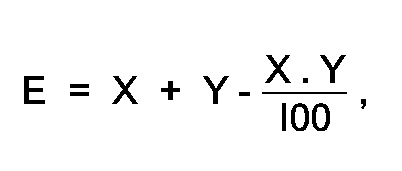
wherein
X is the efficiency of the components A + B,
and
Y is the efficiency of the components C + D. - Another method of determination of synergism is based on the HORSFALL model where the toxic effects of various treatments are compared at the same concentration level, i.e., each component of the fungicide mixture is tested with the total amount of the mixture applied, and the criterion of synergism is as follows:


CTi is the efficiency of the "i" variant of the treatment with the fungicidal mixture,
MRVmax is the maximum response value of the most toxic combination partner, if it was used alone, with the total amount of the mixture concerned. - Positive Xi indicates synergism, negative Xi indicates antagonism.
- In the SUN model, a Comparative Toxicity Index is calculated as follows:

wherein
ED₅₀ is the efficiency of the known mixture Y,
ED
a and b indicate the current mass parts of the partners Y and Z in the combination. - An additional advantage of the composition of the present invention resides in the reduced risk of resistance formation, that means in the reduced occurence of fungal strains resistant against the above-mentioned compounds under the selection pressure of the-claimed fungicides. This is due to the different mode of action of the components, and to the abscence of positive cross-resistance among the components.
- Due to the above-mentioned reasons, the compositions according to the invention can be used for the reduction of heterogeneous fungal populations, which cannot be controlled satisfactorily by conventional application of the individual components and/or of their binary mixtures. Based on the systemic properties of some components, phytopathogenic fungi such as Plasmopara halstedii (Peronosporales, Ooomycetes), Peronospora manshurica (Peronosporales, Oomycetes), Sclerospora graminicola (Peronosporales, Oomycetes), S.macrospora, Peronospora pisi (Peronosporales, Oomycetes), Ustilago maydis (Ustilaginales, Basidiomycetes), Ustilago avenae (Ustilaginales, Basidiomycetes), Fusarium oxysporum (Deuteromycetes), Verticillium spp. (Deuteromycetes), Rhizoctonia solani (Polyporales, Basidiomycetes), Stereum purpureum (Basidiomycetes), etc., can be controlled effectively, and newly developed parts of the plants can also be protected. With an optimal combination of the active ingredients according to the invention the following groups of phytopathogenic fungi can be controlled: Powdery mildews, for example Erysiphe spp. (Erysiphales, Ascomycetes), Aspergillus spp. (Eurotiales, Ascomycetes), Penicillium spp. (Eurotiales, Ascomycetes), Phoma betae (Dothiales, Ascomycetes), Ph. macdonaldii, Didymella applanata (Dothiales, Ascomycetes), Fusarium graminearum (Hypocreales, Ascomycetes), Nectria cinnabarina (Hypocreales, Ascomycetes), Venturia inaequalis (Dothiales, Ascomycetes), Khuskia oryzae (Sphaeriales, Ascomycetes), Colletotrichum atramantarium (Sphaeriales, Ascomycetes), Coll. dematium, Diaporthe phaseolorum (Sphaeriales, Ascomycetes), Phomopsis mali (Sphaeriales, Ascomycetes), Ceratocysticum ulmi (Sphaeriales, Ascomycetes), Botrytis spp. (Helotiales, Ascomycetes), Sclerotinia sclerotiorum (Helotiales, Ascomycetes), Ustilago spp. (Ustilaginales, Basidiomycetes), Verticillium sppl. Rhizoctonia solani (Polyporales, Basidiomycetes), St. purpureum., Tr. versicolor, Sphaeropsis malorum, Pythium spp. (Peronosporales, Oomycetes), Phytophthora spp. (Peronosporales, Oomycetes), Albugo candida, (Peronosporales, Oomycetes), Bremia lactucae (Peronosporales, Oomycetes), Peronospora destructor (Peronosporales, Oomycetes), Plasmopara viticola (Peronosporales, Oomycetes), Pseudoperonospora cubensis (Peronosporales, Oomycetes), Peronospora spp. (Peronosporales, Oomycetes), Alternaria spp. (Deuteromycetes), Fusarium oxysporum and other Fusarium spp. (Deuteromycetes), Verticillium spp. (Deuteromycetes). They are also useful against Gram-positive and Gram-negative bacteria (Corynebacterium michiganense, C. nebraskense, C. flaccumfaciens and Xanthomonas malvacearum, X. phaseoli, X. translucens pv. oryzae), and human-related Bacillus, Staphylococcus and Streptomyces spp., too.
- The compositions according to the invention can be formulated in a conventional way, e.g in the form of wettable powders, granulates or microcapsules, emulsion concentrates or flowables (WP, EC, FW, G, SD). For this purpose, the active ingredients are dissolved in conventional liquid carriers, if desired, in the presence of surface-active auxiliaries, or dispersed, or admixed with solid carriers, or formulated according to other known processes.
- The compositions of the invention comprise the active ingredients in an amount of 5 to 95 weight percent, and advantageously in an amount of 5 to 50 weight percent. The compositions can be applied in conventional ways, e.g. by spraying, dusting or submerging for dispersion, or for seed dressing.
- The applied quantities depend on the aim of application and generally amount to 0.3 to 5 kg of active ingredient/ha. The composition,of the invention may be used for the treatment of sugar beet (Beta vulgaris), sunflower, soya, potato, tomato, corn, wheet, cucumber, vine, tobacco, broom-corn, millet, horse-bean (Vicia faba), cotton, citrus spp.,apple, sugar-cane, avocado, mango (Mungos mungo), lettuce, anion, tulip, hyacinth, gladiolus (sword-lily), pea, bean, peanut, medic (Medicago), clover and batata (Xanthosoma spp.) plants susceptible to pathogenic fungal infections.
- The composition according to the invention and their action are illustrated by the following examples.
- Tensilin FN 80 (Kutrilin): Alkyl-aryl-polyglycolether;
Triton X-l5, X-45 and X-ll4 (Rohm and Haas): octylphenolpolyglycolether;
Tensiofix CG 2l, B 7425 (Tensia): alkyl-aralkyl-sulphonate and phosphate, esters and non-ionic surface-active material mixtures, respectively;
Emulsogen M (Hoechst): fatty alcohol-polyglycolether;
Atlox 5320 (Atlas ICI): non-ionic surface-active material; wetting agent IS (Hoechst): Dialkylsulfosuccinate. - Sodium-ligninesulfonate;
Atlox 4862: Alkyl-aryl-sulfonate-formaldehyde-condensate. - Ethylene glycol
- Wessalon S (Degussa): synthetic silicic acid;
Aerosil 300 (Degussa): silicic acid with great specific surface;
Saccharose;
Zeolex 4l4 (Zeofin): sodium-aliminium-silicate;
Paraffin oil. - Tensiofix 82l (Tenzia): synthetic polysaccharide.
- In 508 g of water 2l.2 g of Tensilin FN 80, 7.6 g of Tensiofix CG 2l, and 7.6 g of Tensiofix B 7425 are dissolved. To the solution with slow stirring 47.5 of ethylene-glycol and under vigorous stirring l56 g of Carbendazim and 38 g of LAB l49202 are added. After homogenization the suspension is transferred into an atritor of l.5 liter capacity which contains siliquartzite pearls of l mm in diameter. The atritor is operated for 30 minutes at a rotational speed of l440 min⁻¹ and then at 30 min⁻¹. To the suspension the following solution is added: l56 g of Tridemorph, 4 g of Triton X-l5, 3l.2 g of Triton X-ll4. After stirring, l6.8 g of paraffin oil and l.8 g of Emulsogen M are added to the suspension. After stirring the glass pearls (quartzite pearls) are separated by means of a screen. The floating capacity of the suspension concentrate amounts to 95% according to the CIPAC method.
- Into a powder homogenizer of 3 l capacity 200 g of Wessalon S are introduced. Then 26l g of Tridemorph, 6.6 g of Triton X-l5, 52.8 g of Triton X-ll4 and 6.6 g of Triton X-45 are added. By slow stirring a homogeneous solution is prepared. This solution is added to Wesselon S with slow stirring. After further stirring, 250 g of Carbendazim and 88 g of LAB l49202 are added. After 5 minutes of homogenization, 50 g of Atlox 5320 and 75 g of Atlox 4862 are added, and after further 5 minutes the mixture is completed by addition of l0 g of Aerosil. The powder mixture is granulated in 2 portions in a laboratory granulator with water (to 500 g of the powder mixture 66 ml of water are added). The granulate formed is dried in a drying oven at 60 °C till constant weight. The particle size distribution of the granulate is such that 95% are between 0.l and 0.6 mm. The floating capacity of the product obtained is 84 % according to CIPAC.
- Into a homogenizer of 3 l capacity l50 g of Zeolex 4l4 are filled as a carrier. In a separate vessel 266 g of Tridemorph, 6.8 g of Triton X-l5, 6.8 g of Triton X-45 and 54.2 g of Triton X-ll4 are mixed with slow stirring. A homogeneous solution is obtained, which is transferred into the homogenizer while uniformly stirring. After homogenizing 266 g of Carbendazim and 66.6 g of Benalaxyl are introduced. The mixture is homogenized; thereafter 88.6 g of saccharose, 30 g of wetting agent IS (Hoechst) and 65 g of sodium lignine-sulfonate are added with continuous stirring.
- The powder mixture is ground in an air jet mill to a particle size of 10 µm. The floating capacity of the powder mixture obtained is 87% according to CIPAC, the wetting time is 18 s.
- In an atritor of l.5 l capacity 60.54 g of water and 6.55 g of ethylene glycol are mixed. To the solution 2.2l g of Tensiofix B 7425, l.7 g of Tensilin FN 80, l2.5 g of Carbendazim and 3.l g of Benalaxyl are added. The atritor is then filled with siliquartzite glass pearls of 2 mm in diameter, and the mixing mechanism of the atritor is operated for 30 min with a speed of 800 min⁻¹. After this period the following solution is added to the suspension: 9.4 g of Tridemorph, 0.23 g of Triton X-l5, 0.23 g of Triton X-45 and l.84 g of Triton X-ll4 (previously homogenized).
- After stirring l.35 g of paraffin oil and 0.l5 g of Emulsogen M are added to the mixture. The siliquartzite glass pearls are then filtered from the suspension. Thereafter, 0.2 g Tensiofix 82l are added to the solution with use of a stirrer with a big shearing moment.
- The floating capacity of the suspension is 97% according to CIPAC 98% of the (particles 5 µm).
- To 605.4 g of water 65 g of ethylene glyxol, 22.2 g Tensiofix CG-2l and l7 g Tensilin FN-80 are added.
- With application of a stirrer with a big shearing moment, l25 g of Carbendazim and 3l g of Metalaxyl are continuously added to the solution. Then, the suspension is homogenized at maximum speed of the stirrer (l2000 min⁻¹). The suspension is poured into a laboratory atritor of l500 ml, and the atritor is filled with ceramic pearls of l mm in diameter. The stirrer of the atritor is operated with maximum speed (l440 min⁻¹) for 30 minutes. Thereafter a solution of 94 g of Tridemorph, 2.3 g of Triton X-l5, 2.3 g of Triton X-45 and l8.4 g of Triton X-ll4 is introduced into the atritor, and stirring is continued for further 5 minutes. The glass pearls are then removed from the suspension with a screen. With application of a stirrer with a big shearing moment, a suspension consisting of l3.5 g of paraffin oil, l.5 g of Emulsogen M and 2 g of Tensiofix 82l previously prepared in a similar manner is added, and the material is homogenized for 3 minutes. The floating capacity of the suspension obtained is 92% according to CIPAC. The average particle size is such that 97% of the particles are < 5 µm.
- Into a laboratory powder homogenizer of 3 l capacity 300 g of Wessalon are introduced. To 266 g of Tridemorph 4 g of Triton X-l5, 4 g of triton X-45 and 25 g of Triton X-ll4 are added with slow stirring. Then, the Tridemorph solution is slowly poured into the powder homogenizer with stirring. Thereafter, while further stirring, a mixture of 266 g of Carbendazim, 66 g of Metalaxyl, 30 g of the wetting agent IS and 39 g of sodium lignine sulfonate are added. After 2 minutes of post-homogenization the powder mixture is ground in a laboratory air jet mill to particles having a particle size of < 10 µm. The floating capacity of the powder mixture is 86% according to CIPAC; the wetting time is 23 s.
- Into a powder homogenizer of 3 l capacity 549.5 g of Wessalon S are introduced. To l3l g of Tridemorph 3.3 g of Triton X-l5, 26.4 g of Triton X-ll4 and 3.3 g of Triton X-45 are added, and by slow stirring a homogeneous solution is prepared. This solution is added to the Wessalon S while slow by stirring. After further stirring l75 g of Carbensazim and 44 g of LAB l49202 are added. After 5 minutes of homogenization 25 g of Atlox 5320 and 37.5 g of Atlox 4862 are added, and after further 5 minutes the mixture is completed by addition of l0 g of Aerosil. The powder mixture is then granulated in 2 portions in a laboratory granulator with water (to 500 g of the powder mixture 66 ml of water are added). The granulate formed is dried in a drying oven at 60 °C till constant weight. The particle size distribution of the granulate is such that 95% of the particles are between 0.l and 0.6 mm. The floating capacity of the product obtained is 84% according to CIPAC.
- Into a homogenizer of 3 l capacity 575 g of Zeolex 4l4 are charged as a carrier. In a separate vessel l33 g of Tridemorph, 3l4 g of Triton X-l5, 3.4 g of Triton X-45 and 27.l g of Triton X-ll4 are mixed by slowly stirring. A homogeneous solution is obtained, which is transferred with uniform stirring into the homogenizer. After homogenizing l33 g of Carbendazim and 33.3 g of Benalaxyl are introduced. The mixture is homogenized; thereafter 44.3 g of saccharose, l5 g of wetting agent IS (Hoechst) and 32.5 g of sodium lignine-sulfonate are added with continuous stirring. Later the mixture is stirred for further 3 minutes.
- The powder mixture is ground in an air jet mill to a particle size of l0 µm. The floating capacity of the powder mixture obtained is 87% according to CIPAC; the wetting time is l8 s.
- In a laboratory powder homogenizer of 3 l capacity 648 g of Wessalon are introduced. To l33 g of Tridemorph 2 g of Triton X-l5, 2 g of Triton X-45 and l2.5 g of Triton X-ll4 are added with slow stirring. The Tridemorph-solution is then slowly poured into the powder homogenizer under stirring. Thereafter while further stirring a mixture of l33 g of Carbendazim, 33 g of Metaxalyl, l5 g of wetting agent IS and l9.5 g of sodium lignine sulfonate are added. After 2 minutes of posthomogenization the powder mixture is ground in a laboratory air jet mill to a particles size of < l0 µm. The floating capacity of the powder mixture is 86% according to CIPAC; the wetting time is 23 s.
- Sunflower germlings with the root initials, l-5 mm in length, were inoculated with a zoospore suspension (2.5 x l0⁵ spores/ml) of the downy mildew fungus (Plasmopara halsteddi (Farl.), Berlese et de Toni, Peronosporales, Oomycetes). 24 hours after inoculation the germlings were immersed into the aqueous solutions/emulsions/suspensions of the chemicals to be tested for l8 h. The germlings were then planted into sterile soil and grown in the greenhouse until the evaluation of the effectivity of treatments. All measures not described in detail here in, and the assessments were made as described by OROS and VIRANYI, Ann. appl. Biol. ll0 (1987) 53-63.
- The efficiency of treatments was characterized by the ED₅₀ (mg/l) value, and the significance of the synergistic effect was tested according to SUN (l950).

- Seeds of the peas (Pisum sativum cv.Gloriosa) were surface sterilized with 0.l% sublimate prior to dressing and treated thereafter with active agents formulated as 25 WP. To improve the adhesion in the dressing process, a TWEEN 80 solution was added. The dressed seeds were sown into an infested soil. l4 days after emergence both qualitative and quantitative evaluation of the fungicidal efficacy were carried out.
- The efficiency was calculated as follows:
Efficiency % = l00 -
A = Infection rate (%) of the treated plants,
B = Infection rate (%) of the control plants.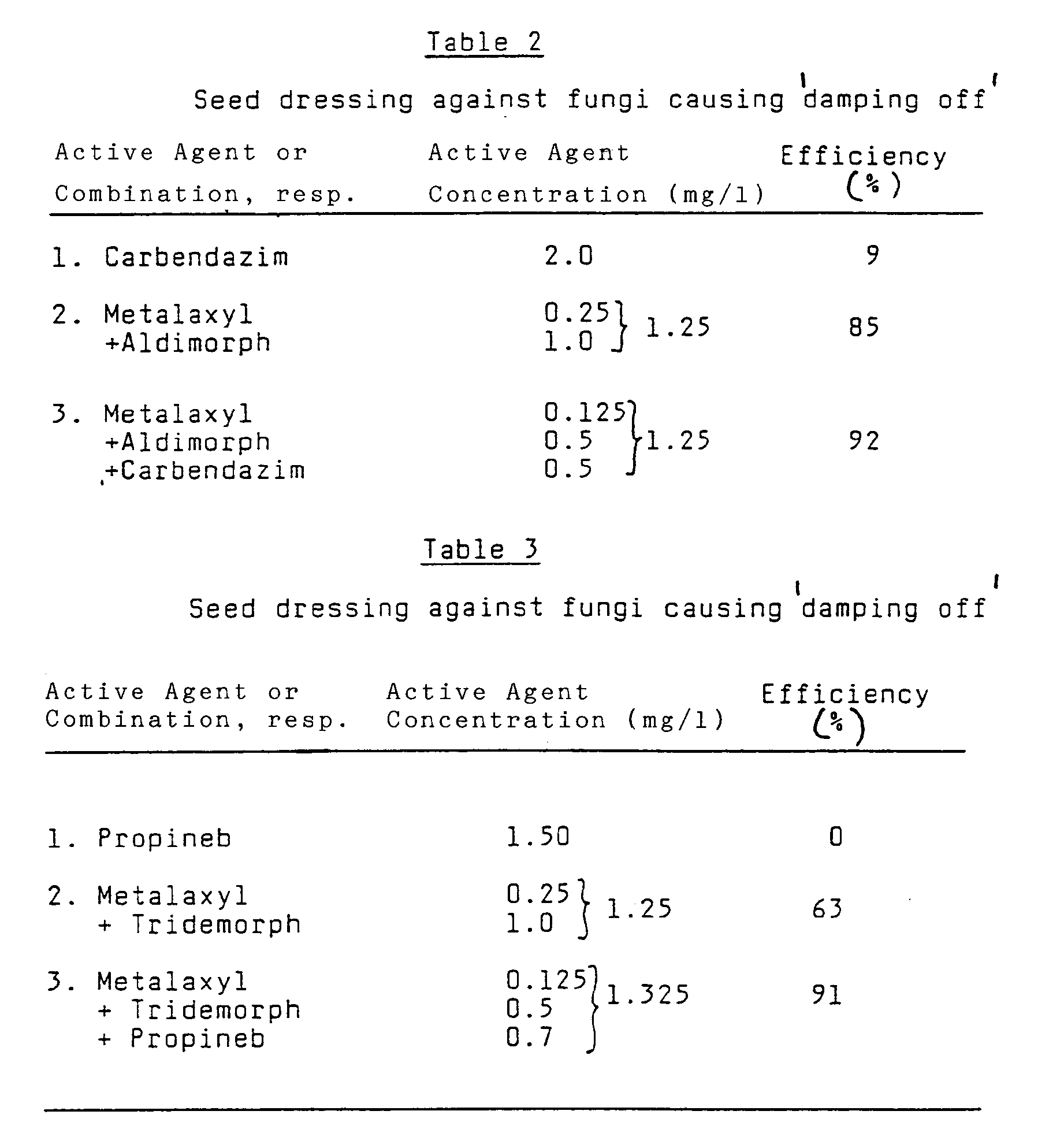


- The used 25 WP had the following composition:
25 weight% of active ingredient or ingredients, respectively;
5 weight% of Ca-ligninsulfonate
5 weight% of Tween 80
l7 weight% of silicic acid
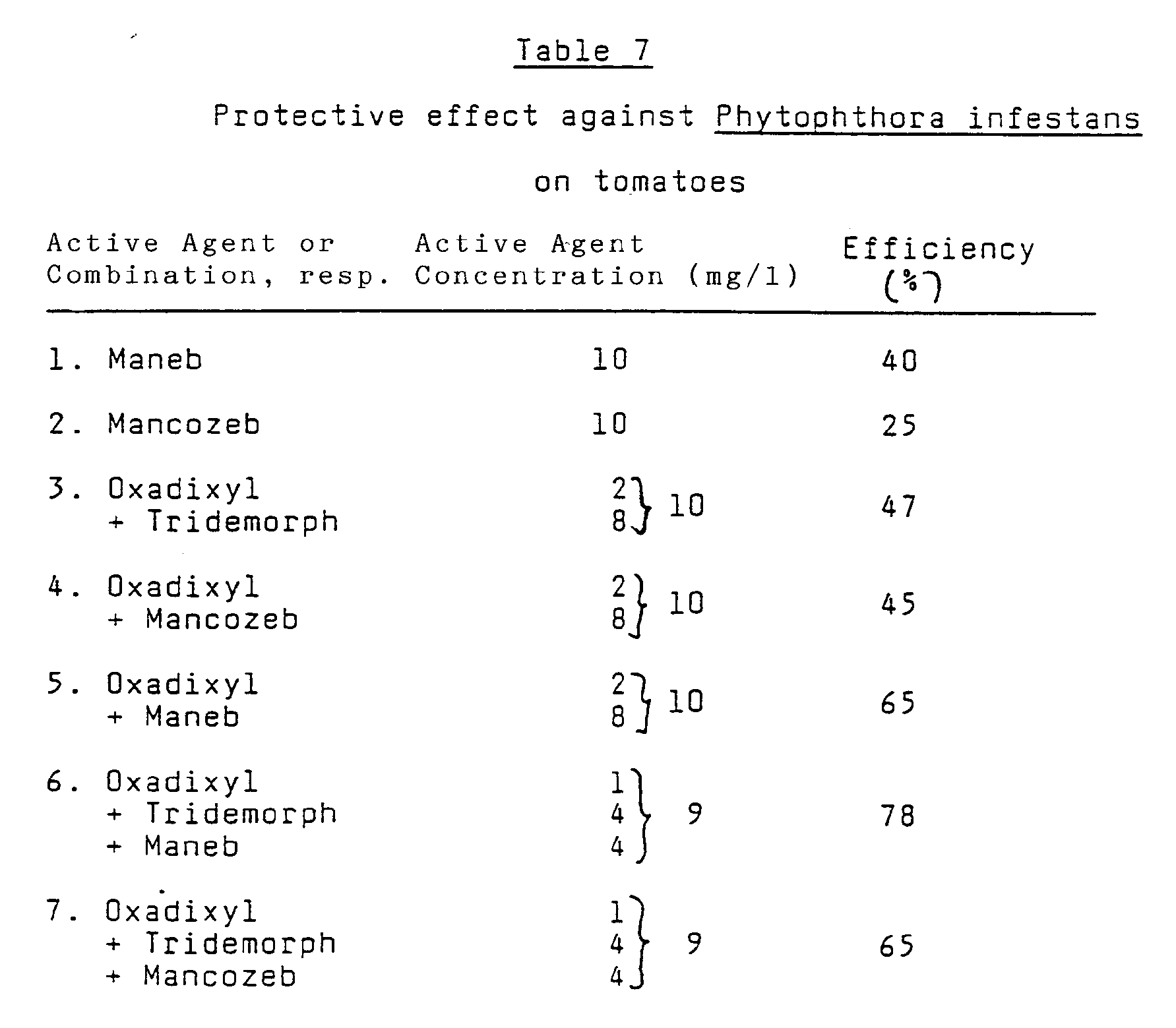
45 weight% of kaolin. - Solanum lycopersicum plants, cv. "Tamina", at four-leaf stage were drop-wet sprayed with the combinations on the basis of 25 WP. The inoculation of the plants with a zoospore suspension was carried out after the fungicide was dried up. After the inoculation the plants were kept for one day in a humid chamber at l6 to l8 °C and for five further days in the greenhouse at 20 °C. Thereafter the typical leaf-lesions appeared, and their extension was used as a measure for determining the degree of infection.



- An acetone solution of the fungicides to be tested was admixed in a suitable amount to agar media, and 4 hours after pouring out into Petri dishes, the plates were inoculated with 3-3 mycelium cuts; after an inoculation period of 72 h the diameter of the cultures was measured. The growth inhibition was expressed, based on an untreated control, according to the following equation:

- Xij
- = colony diameter measured on compound j (or combination thereof) contained in medium plate of the given species i,
- Xicontr.
- = colony diameter of species i measured on medium plate free of xenobiotics.
- The data were analysed by means of variance analysis and the results are summarized in Table 9.

- Both powdery and downy mildew pathogens associated in a complex leaf disease can severely damage the leaf surface on cucumber causing a serious yield loss.
- Series of leaf treatments were carried out when first symptoms occurred caused by powdery mildews (Sphaerotheca fulginea and Erysiphe cichoracearum, Erysiphales, Ascomycetes) and Downy mildew (Pseudoperonospora cubensis, Peronosporales, Oomycetes).
- The disease development was checked several days after the treatment by counting the number of visible pustules on the leaves. The inhibition of the disease rate was calculated and expressed in percent of the untreated control.
- The results are summarized in Table 10.

- The infection rate of a maize seed lot by Fusarium species used for laboratory purposes amounted to 29.5%, but the total contamination had reached l00% so that it was unsuitable for sowing.
- After the treatment the infection rate of 4 x l00 seed pieces was evaluated following an incubation on Papa-vizas-medium. The effect of the combinations of the present invention (CHBA 6-ll) was compared with the standard mixture Kolfugo Extra (20% Carbendazim) + Quinolate V-4-X (2.0 l/t + l.0 kg/t, respectively) commonly used in Hungary. The results are summarized in Table l2.

Apron 35 SP:Metalaxyl
Kolfugo 25 FW:BCM
Kolfugo extra:BCM
Quinolate V-4-X:Carboxin + Cu-oxyquinolate
- The efficiency of the individual treatments was evaluated first in the laboratory by determining the composition of pathogens (the contamination rate of 2 x l00 seeds of soyabean). In a field experiment, the yield of soyabean treated with different fungicides was measured, and expressed in kg/lot (2 m²).
- The results obtained are summarized in Table l3.

- Plants at seeding stage are endangered by a number of soil- and seed-borne seedling- and root diseases caused by fungi of various taxonomic position (usually named pathogene "associated with the root rot complex" of plants - cf. G. DIXON : Vegetable Crop Diseases, The Macmillan Press Ltd, London, 1981).
- It is possible to eliminate certain pathogenic species with an efficient fungicide. However, the species non-sensitive to a given compound can increase in an explosive manner. The use of broad-spectrum fungicides may overcome this problem. Such compounds, however, are often harmful pollutants of the environment. The accumulation of toxic materials (e.g. mercury, tin, aluminium, or carcinogenic metabolites, such as ETU) can not be excluded, and one must renounce their use. Against the highly efficient and selective fungicide preparations that are harmless to nature and mankind (e.g. Carbendazim, Metalaxyl), the target organisms (plant parasites) become quickly resistant. The resistance is due to genetic reasons. In the population of the pathogens there appear individuals that carry genes responsible for the reduction of fungicide sensitivity. Individuals carrying such genes that had been treated with the given fungicide will increase in number dramatically. Moreover, in the soil fungi of various taxonomic position are associated with the root rot complex that makes it necessary to use broad-spectrum fungicides. The use of especially selected and optimized mixtures is necessary due to the requirement of treatment as highly selective as possible and at the same time combating the formation of established populations resistant to the given fungicides. In Table l4, a model experiment is shown, which proves that in the case of a fungal population consisting of individuals of different fungicide sensitivity and associated with root rot complex, a successful control can be achieved by appropriate combination of synergistically interacting fungicides. Beside the fact, that the pathogenes associated with root rot complex can be controlled with certainty, a synergistic fungicide combination will reduce costs and decrease the pesticide pressure to nature simply due to its increased efficacy vis-à-vis the target organisms.
- Furthermore there is a favorable economic effect: Due to the reduced amount of chemicals to be applied for achieving the same effect, these result reduced costs of application, and increased yields due to a reduced probability of resistance development.
- By means of somatic hybridization (Molnar et. al., Exp. Mycol. 9 (1985) 326-333.), and by means of mass selection of spontaneous mutants (Oros, Tag.-Ber. Akad. LdW. DDR., Berlin, 253 (1987) S l77-l83), respectively, Fusarium oxysporum and Phytophthora parasitica strains/clones of extremely different fungicide sensitivity were prepared for the experiments. The efficacy of the fungicides was determined in conventional agar plates by measuring the radial mycelium growth after 48 hours.
- The fungicidal effect was characterized by the percentage of inhibition of radial growth of colonies.
- As the survival of a population in the presence of a harmful factor is always determined by the most resistant part of this population, the Most Potent Treatment (MPT) was used for comparing efficacies in the experiment.

wherein the weight ratio of the components A:B:C is 1:3-5:1-6, and the weight ratio of the components A:B:D is 1:3-5:5-10, and the ratio A:B:C may also be in the case of the mixture A₇B₄C₄ equal to 1:2:2, and in the case of the mixture A₃B₁C₄ equal to 1:1,11:1,22, and the ratio A:B:D may also be in the case of the mixtures A₆B₁D₂ and A₆B₁D₃ equal to 1:4:4,
in addition to conventional carriers and auxiliaries.
Claims (10)
- Fungicide compositions, containing as active ingredient a mixture of(A) One of the following fungicides:(A₁)Methyl-N-(2,6-dimethylphenyl)-N-(2′-methoxyacetyl)-D,L-alaninate (Metalaxyl),(A₂)methyl-N-(2,6-dimethylphenyl)-N-furoyl-(2)-D,L-alaninate (Furalaxyl),(A₃)methyl-N-(phenylacetyl-N-(2,6-dimethylphenyl)-D,L-alaninate (Benalaxyl),(A₄)(±)-α-(2-chloro-N-(2,6-dimethylphenyl)-acetamido)-γ-butyrolactone (Ofurace),(A₅)(±)-α-[N-(3-chlorophenyl)-cyclopropane-carboxamidol]-γ-butyrolactone (Cyprofuram),(A₆)2-methoxy-N-(2-oxo-1,3-oxazolidin-3-yl-aceto-2′6′-xylidide (Oxadixyl),(A₇)methyl-N-isoxazol-5-yl-N-(2,6-dimethylphinyl)-D,L-alaninate,(A₈)N-(2,6-dimethylphenyl)-2-methoxy-N-(tetrahydro-2-oxofuranyl)-acetamide,and(B) one of the following morpholine fungicides:(B₁) 2,6-Dimethyl-4-tridecylmorpholine (Tridemorph),(B₂) 4-cyclododecyl-2,6-dimethylmorpholine (Dodemorph),(B₃)(±)-cis-4-[3-(4-tert-butylphenyl)-2-methylpropyl]-2,6-dimethylyorpholine (Fenpropimorph),(B₄)mixture of N-alkyl(C₁₂)-2,6-dimethylmorpholine andtogether with either
N-alkyl(C₁₂)-2,5-dimethylmorpholine (Aldimorph),(C) one of the following fungicides:(C₁) Diethyl-4,4′-(o-phenylene)-bis(3-thioallophanate) (Thiophanate),(C₂) dimethyl-4,4′-(o-phenylene)-bis(3-thioallophanate) (Thiophanat-Methyl),(C₃) methyl-benzimidazol-2-yl-carbamate (Carbendazim),(C₄) methyl-1-(butylcarbamoyl)-benzimidazol-2-yl-carbamate (Benomyl),(C₅) 2-thiazol-4-yl-1H-benzimidazole (Thiabendazol),or(D) one of the following dithiocarbamate or disulfide fungicides:(D₁) Zinc ethylene-bis(dithiocarbamate) (polymeric) (Zineb),(D₂) manganese ethylene-bis(dithiocarbamate) (polymeric) (Maneb),(D₃) manganese ethylene-bis(dithiocarbamate) (polymeric) complex with zinc salt (Mancozeb),(D₄) tris[zink ammoniate-ethylene-bis(dithiocarbamate)]-tetrahydro-1,2,4,7-dithiadiazocin-3,8-dithione (polymeric) (Metiram),(D₅) zinc propylene-bis(dithiocarbamate) (polymeric) (Propineb),(D₆) mixture of tris[zink ammoniate-ethylene-bis-(dithiocarbamate)]-tetrahydro-1,2,4,7-dithiadiazocin-3,8-dithione (polymeric) (Metiram) andwherein the weight ratio of the components A:B:C is 1:3-5:1-6. and the weight ratio of the components A:B:D is 1:3-5:5-10, and the ratio A:B:C may also be in the case of the mixture A₇B₄C₄ equal to 1:2:2, and in the case of the mixture A₃B₁C₄ equal to 1:1,11:1,22, and the ratio A:B:D may also be in the case of the mixtures A₆B₁D₂ and A₆B₁D₃ equal to 1:4:4,
zinc propylene-bis(dithiocarbamate) (Propineb)
in a ratio of 1:3 (Polycarbazin),
together with a fungicidally acceptable inert carrier. - Fungicide compositions according to claim 1, wherein the weight ratio of the components A:B:C is 1:4:4, or the weight ratio of the components A:B:D is 1:4:10.
- Fungicide compositions according to claim 1 or 2 containing as active ingredient a mixture of(A) one of the fungicides A₁ to A₈,(B) one of the fungicides B₁ and B₄,
and(C) one of the fungicides C₃ and C₄, - Fungicide compositions according to one of claims 1 to 3, containing as active ingredient a mixture of(A) one of the fungicides A₃, A₄ and A₆,(B) one of the fungicides B₁ and B₄,
and(C) the fungicide C₃. - Fungicide compositions according to claim 1 or 2, containing as active ingredient a mixture of(A) the fungicide A₁,(B) one of the fungicides B₁ and B₄,
and(C) the fungicide C₃. - Fungicide compositions according to claim 1, containing as active ingredient a mixture of(A) one of the fungicides A₁ to A₈,(B) the fungicide B₁,
and(D) one of the fungicides D₂, D₃, D₄ and D₅,
wherein the weight ratio of the components A:B:D is 1:3,5-5:10. - Fungicide composition according to claim 1, containing as active ingredient a mixture of(A) the fungicide A₁,(B) the fungicide B₁,
and(D) the fungicide D₅,
wherein the weight ratio of the components A:B:D is 1:4:5-6. - Fungicide composition according to claim 1, containing as active ingredient a mixture of(A) the fungicide A₁,(B) the fungicide B₁,
and(D) the fungicide D₁,
wherein the weight ratio of the components A:B:D is 1:4:10. - Fungicide compositions according to claim 1, containing as active ingredient a mixture of(A) the fungicide A₆,(B) one of the fungicides B₁ and B₄,
and(D) one of the fungicides D₂, D₃ and D₅,
wherein the weight ratio of the components A:B:D is 1:4:4-10. - Method for fungicidal treatment of plants, particularly cultivated plants, susceptible to infection by pathogenic fungi,
characterized by administering a fungicidally effective amount of one of the compositions according to claims 1 to 9 to the plants.
Priority Applications (1)
| Application Number | Priority Date | Filing Date | Title |
|---|---|---|---|
| AT88902191T ATE80257T1 (en) | 1987-03-09 | 1988-03-08 | FUNGICIDAL COMPOSITIONS. |
Applications Claiming Priority (3)
| Application Number | Priority Date | Filing Date | Title |
|---|---|---|---|
| HU98387 | 1987-03-09 | ||
| HU87983A HU198825B (en) | 1987-03-09 | 1987-03-09 | Synergic fungicides |
| CA000561302A CA1336809C (en) | 1987-03-09 | 1988-03-11 | Fungicide compositions |
Publications (2)
| Publication Number | Publication Date |
|---|---|
| EP0305442A1 EP0305442A1 (en) | 1989-03-08 |
| EP0305442B1 true EP0305442B1 (en) | 1992-09-09 |
Family
ID=25671770
Family Applications (1)
| Application Number | Title | Priority Date | Filing Date |
|---|---|---|---|
| EP88902191A Expired - Lifetime EP0305442B1 (en) | 1987-03-09 | 1988-03-08 | Fungicide compositions |
Country Status (17)
| Country | Link |
|---|---|
| US (2) | US4988693A (en) |
| EP (1) | EP0305442B1 (en) |
| JP (1) | JP2582885B2 (en) |
| CN (1) | CN1028343C (en) |
| AR (1) | AR243726A1 (en) |
| AT (1) | ATE80257T1 (en) |
| AU (1) | AU604106B2 (en) |
| CA (1) | CA1336809C (en) |
| CZ (2) | CZ283319B6 (en) |
| DD (1) | DD271256A1 (en) |
| DE (1) | DE3874462T2 (en) |
| EG (1) | EG18602A (en) |
| HU (1) | HU198825B (en) |
| IL (1) | IL85590A (en) |
| PL (1) | PL271084A1 (en) |
| RU (1) | RU2058077C1 (en) |
| WO (1) | WO1988006841A1 (en) |
Families Citing this family (9)
| Publication number | Priority date | Publication date | Assignee | Title |
|---|---|---|---|---|
| FR2743471B1 (en) * | 1996-01-17 | 2001-07-06 | Clause Semences | COMPOSITION AND METHOD FOR THE TREATMENT OF VEGETABLE CROPS AGAINST PEST SOIL COMPLEXES |
| US5925616A (en) * | 1996-08-09 | 1999-07-20 | Buckman Laboratories International, Inc. | Treatment of fungal infections using a combination of an anti-fungal compound and an H-alkyl heterocyclic compound |
| KR100487188B1 (en) * | 1997-03-05 | 2005-05-03 | 신젠타 파티서페이션즈 아게 | Fungicidal compositions based on metalaxyl |
| DE19834028A1 (en) | 1998-07-28 | 2000-02-03 | Wolman Gmbh Dr | Process for treating wood against infestation by wood-damaging fungi |
| CA2528198A1 (en) * | 2003-06-18 | 2004-12-23 | Basf Aktiengesellschaft | Fungicidal mixtures based on a triazolopyrimidine derivative |
| US20070149409A1 (en) * | 2003-12-29 | 2007-06-28 | Hi-Cap Formulations Ltd. | Pesticide formulations with substituted biopolymers and organic polymers for improving residual activity, droplet size, adherence and rainfastness on leaves and reduction in soil leaching |
| EP3262940A1 (en) * | 2008-01-15 | 2018-01-03 | Bayer Intellectual Property GmbH | Pesticide composition comprising a tetrazolyloxime derivative and an insecticide active substance |
| US9700055B2 (en) * | 2011-05-11 | 2017-07-11 | Syngenta Participations Ag | Seed treatment method and composition |
| CN115530175A (en) * | 2017-10-17 | 2022-12-30 | Upl有限公司 | Agrochemical combinations |
Family Cites Families (5)
| Publication number | Priority date | Publication date | Assignee | Title |
|---|---|---|---|---|
| OA04979A (en) * | 1974-04-09 | 1980-11-30 | Ciba Geigy | New aniline derivatives useful as microbicidal agents and their preparation process. |
| BG28977A3 (en) * | 1978-02-02 | 1980-08-15 | Montedison Spa | Fungicide means and method for fungus fighting |
| DE2940189A1 (en) * | 1979-10-04 | 1981-04-16 | Basf Ag, 6700 Ludwigshafen | ISOXAZOLYLCARBONIC ACID ANILIDE, METHOD FOR THE PRODUCTION THEREOF AND THEIR USE AS FUNGICIDES |
| KR20090098710A (en) | 2008-03-14 | 2009-09-17 | 주식회사 씨티아이바이오 | Peptide Nucleic Acid Derivatives with Good Cell Permeability and Nucleic Acid Binding Capacity |
| JP5443573B2 (en) | 2012-09-28 | 2014-03-19 | 株式会社東芝 | Radioactive waste storage container |
-
1987
- 1987-03-09 HU HU87983A patent/HU198825B/en not_active IP Right Cessation
-
1988
- 1988-02-29 IL IL85590A patent/IL85590A/en not_active IP Right Cessation
- 1988-03-07 EG EG126/88A patent/EG18602A/en active
- 1988-03-08 DE DE8888902191T patent/DE3874462T2/en not_active Expired - Fee Related
- 1988-03-08 US US07/290,108 patent/US4988693A/en not_active Expired - Fee Related
- 1988-03-08 DD DD88313501A patent/DD271256A1/en not_active IP Right Cessation
- 1988-03-08 RU SU884613055A patent/RU2058077C1/en active
- 1988-03-08 WO PCT/HU1988/000013 patent/WO1988006841A1/en not_active Ceased
- 1988-03-08 JP JP63502248A patent/JP2582885B2/en not_active Expired - Lifetime
- 1988-03-08 AU AU13994/88A patent/AU604106B2/en not_active Ceased
- 1988-03-08 EP EP88902191A patent/EP0305442B1/en not_active Expired - Lifetime
- 1988-03-08 AT AT88902191T patent/ATE80257T1/en not_active IP Right Cessation
- 1988-03-08 CZ CS901682A patent/CZ283319B6/en not_active IP Right Cessation
- 1988-03-09 AR AR88310262A patent/AR243726A1/en active
- 1988-03-09 CN CN88102052A patent/CN1028343C/en not_active Expired - Fee Related
- 1988-03-09 CZ CS881534A patent/CZ283993B6/en unknown
- 1988-03-09 PL PL27108488A patent/PL271084A1/en unknown
- 1988-03-11 CA CA000561302A patent/CA1336809C/en not_active Expired - Fee Related
-
1990
- 1990-05-21 US US07/526,181 patent/US5043338A/en not_active Expired - Fee Related
Non-Patent Citations (2)
| Title |
|---|
| H.Martin and C.R. Worthing "Pesticide Manual", 5th edition, January 1977, British Crop Protection Council, see pages 227, 525 * |
| H.Martin and C.R.Worthing "Pesticide Manual", 5th. edition, January 1977, British Crop Protection Council, see pages 33, 78, 510, 511 * |
Also Published As
| Publication number | Publication date |
|---|---|
| IL85590A0 (en) | 1988-08-31 |
| US5043338A (en) | 1991-08-27 |
| HU198825B (en) | 1989-12-28 |
| HUT45837A (en) | 1988-09-28 |
| CN88102052A (en) | 1988-09-21 |
| CZ153488A3 (en) | 1997-10-15 |
| IL85590A (en) | 1992-05-25 |
| JP2582885B2 (en) | 1997-02-19 |
| AR243726A1 (en) | 1993-09-30 |
| CZ283319B6 (en) | 1998-02-18 |
| WO1988006841A1 (en) | 1988-09-22 |
| CA1336809C (en) | 1995-08-29 |
| US4988693A (en) | 1991-01-29 |
| PL271084A1 (en) | 1989-03-06 |
| ATE80257T1 (en) | 1992-09-15 |
| AU1399488A (en) | 1988-10-10 |
| AU604106B2 (en) | 1990-12-06 |
| EP0305442A1 (en) | 1989-03-08 |
| CZ283993B6 (en) | 1998-07-15 |
| CZ168290A3 (en) | 1997-10-15 |
| EG18602A (en) | 1993-06-30 |
| DD271256A1 (en) | 1989-08-30 |
| DE3874462T2 (en) | 1993-01-21 |
| DE3874462D1 (en) | 1992-10-15 |
| JPH02503311A (en) | 1990-10-11 |
| CN1028343C (en) | 1995-05-10 |
| RU2058077C1 (en) | 1996-04-20 |
Similar Documents
| Publication | Publication Date | Title |
|---|---|---|
| US5491165A (en) | Fungicidal active compound combinations | |
| DE2639405C2 (en) | Phenylglyoxylnitrile-2-oxime cyanomethyl ether, a process for its preparation and agents which contain herbicides which are harmful to crops as antidotes | |
| EP0236272A1 (en) | Fungicidal use of a cyanopyrrole derivative | |
| US5043338A (en) | Fungicide compositions | |
| US3873700A (en) | Fungicidal compositions and method for protecting plants by the use thereof | |
| DE69601666T2 (en) | Synergistic fungicidal compositions containing N-acetonylbenzamides | |
| JPH058161B2 (en) | ||
| FI68498B (en) | BLACKING FOR BREAKING OF PHYTOPATOGENIC SWEETS | |
| US20090099127A1 (en) | Nematicidal Compositions and Methods | |
| CN100393212C (en) | A kind of bactericidal, insecticidal composition | |
| NO144125B (en) | FUNGICID FOR BEAUTY OF SEA CORN. | |
| EP0232012B1 (en) | Dihaloformaldoximes | |
| JPH10109909A (en) | Method for controlling benzimidazole-resistant bacteria | |
| JPH05155718A (en) | Seed disinfectant | |
| GB1564387A (en) | Germicidal herbicide compositions for use in agriculture and horticulture containing active ingredients amides of alkylthioalkylsulphinyl and alkylsulphonyl-acrylic acids | |
| US3366538A (en) | Method of disinfecting seeds | |
| AT261313B (en) | Method for controlling phytopathogenic fungi or earth-dwelling nematodes | |
| US4329476A (en) | Alkylthiodiazatrithiapentalenes | |
| EP0034205A1 (en) | Fungicidal sulphonyl or sulphinyl acetanilides, process for their preparation and pesticidal compositions containing them | |
| Miglani et al. | Genotoxic effects of carbofuran and monocrotophos on Allium cepa L. root | |
| JPS5839802B2 (en) | Drug-resistant bacteria control agent | |
| JPH0121804B2 (en) | ||
| JPH04257506A (en) | Fungicidal composition for agricultural and horticultural use | |
| HK1038294A (en) | Method for controlling phytopathogenic fungi | |
| HK1038293A (en) | Method for controlling phytopathogenic fungi |
Legal Events
| Date | Code | Title | Description |
|---|---|---|---|
| PUAI | Public reference made under article 153(3) epc to a published international application that has entered the european phase |
Free format text: ORIGINAL CODE: 0009012 |
|
| 17P | Request for examination filed |
Effective date: 19881025 |
|
| AK | Designated contracting states |
Kind code of ref document: A1 Designated state(s): AT BE CH DE FR GB IT LI LU NL SE |
|
| RBV | Designated contracting states (corrected) |
Designated state(s): AT BE CH DE FR GB IT LI NL SE |
|
| RIN1 | Information on inventor provided before grant (corrected) |
Inventor name: OROS, GYULA Inventor name: MARMAROSINE KELLNER,KATALIN Inventor name: ANGYAN,SANDOR Inventor name: SCHUESZLER, ERZSEBET Inventor name: SZEGOE, ANDRAS Inventor name: SOS,JOZSEF Inventor name: REJTOE, LAJOS Inventor name: DETRE, TAMAS |
|
| RAP3 | Party data changed (applicant data changed or rights of an application transferred) |
Owner name: CHINOIN GYOGYSZER ES VEGYESZETI TERMEKEK GYARA RT. |
|
| 17Q | First examination report despatched |
Effective date: 19910319 |
|
| GRAA | (expected) grant |
Free format text: ORIGINAL CODE: 0009210 |
|
| AK | Designated contracting states |
Kind code of ref document: B1 Designated state(s): AT BE CH DE FR GB IT LI NL SE |
|
| REF | Corresponds to: |
Ref document number: 80257 Country of ref document: AT Date of ref document: 19920915 Kind code of ref document: T |
|
| REF | Corresponds to: |
Ref document number: 3874462 Country of ref document: DE Date of ref document: 19921015 |
|
| ET | Fr: translation filed | ||
| ITF | It: translation for a ep patent filed | ||
| PLBE | No opposition filed within time limit |
Free format text: ORIGINAL CODE: 0009261 |
|
| STAA | Information on the status of an ep patent application or granted ep patent |
Free format text: STATUS: NO OPPOSITION FILED WITHIN TIME LIMIT |
|
| 26N | No opposition filed | ||
| EAL | Se: european patent in force in sweden |
Ref document number: 88902191.1 |
|
| PGFP | Annual fee paid to national office [announced via postgrant information from national office to epo] |
Ref country code: FR Payment date: 19980127 Year of fee payment: 11 |
|
| PGFP | Annual fee paid to national office [announced via postgrant information from national office to epo] |
Ref country code: SE Payment date: 19980129 Year of fee payment: 11 |
|
| PGFP | Annual fee paid to national office [announced via postgrant information from national office to epo] |
Ref country code: GB Payment date: 19980304 Year of fee payment: 11 |
|
| PGFP | Annual fee paid to national office [announced via postgrant information from national office to epo] |
Ref country code: BE Payment date: 19980318 Year of fee payment: 11 |
|
| PGFP | Annual fee paid to national office [announced via postgrant information from national office to epo] |
Ref country code: AT Payment date: 19980325 Year of fee payment: 11 |
|
| PGFP | Annual fee paid to national office [announced via postgrant information from national office to epo] |
Ref country code: NL Payment date: 19980330 Year of fee payment: 11 |
|
| PGFP | Annual fee paid to national office [announced via postgrant information from national office to epo] |
Ref country code: DE Payment date: 19980529 Year of fee payment: 11 |
|
| PGFP | Annual fee paid to national office [announced via postgrant information from national office to epo] |
Ref country code: CH Payment date: 19980617 Year of fee payment: 11 |
|
| PG25 | Lapsed in a contracting state [announced via postgrant information from national office to epo] |
Ref country code: GB Free format text: LAPSE BECAUSE OF NON-PAYMENT OF DUE FEES Effective date: 19990308 Ref country code: AT Free format text: LAPSE BECAUSE OF NON-PAYMENT OF DUE FEES Effective date: 19990308 |
|
| PG25 | Lapsed in a contracting state [announced via postgrant information from national office to epo] |
Ref country code: SE Free format text: LAPSE BECAUSE OF NON-PAYMENT OF DUE FEES Effective date: 19990309 |
|
| PG25 | Lapsed in a contracting state [announced via postgrant information from national office to epo] |
Ref country code: LI Free format text: LAPSE BECAUSE OF NON-PAYMENT OF DUE FEES Effective date: 19990331 Ref country code: CH Free format text: LAPSE BECAUSE OF NON-PAYMENT OF DUE FEES Effective date: 19990331 Ref country code: BE Free format text: LAPSE BECAUSE OF NON-PAYMENT OF DUE FEES Effective date: 19990331 |
|
| BERE | Be: lapsed |
Owner name: CHINOIN GYOGYSZER ES VEGYESZETI TERMEKEK GYARA RT Effective date: 19990331 |
|
| PG25 | Lapsed in a contracting state [announced via postgrant information from national office to epo] |
Ref country code: NL Free format text: LAPSE BECAUSE OF NON-PAYMENT OF DUE FEES Effective date: 19991001 |
|
| GBPC | Gb: european patent ceased through non-payment of renewal fee |
Effective date: 19990308 |
|
| EUG | Se: european patent has lapsed |
Ref document number: 88902191.1 |
|
| REG | Reference to a national code |
Ref country code: CH Ref legal event code: PL |
|
| PG25 | Lapsed in a contracting state [announced via postgrant information from national office to epo] |
Ref country code: FR Free format text: LAPSE BECAUSE OF NON-PAYMENT OF DUE FEES Effective date: 19991130 |
|
| NLV4 | Nl: lapsed or anulled due to non-payment of the annual fee |
Effective date: 19991001 |
|
| EUG | Se: european patent has lapsed |
Ref document number: 88902191.1 |
|
| REG | Reference to a national code |
Ref country code: FR Ref legal event code: ST |
|
| PG25 | Lapsed in a contracting state [announced via postgrant information from national office to epo] |
Ref country code: DE Free format text: LAPSE BECAUSE OF NON-PAYMENT OF DUE FEES Effective date: 20000101 |
|
| PG25 | Lapsed in a contracting state [announced via postgrant information from national office to epo] |
Ref country code: IT Free format text: LAPSE BECAUSE OF NON-PAYMENT OF DUE FEES;WARNING: LAPSES OF ITALIAN PATENTS WITH EFFECTIVE DATE BEFORE 2007 MAY HAVE OCCURRED AT ANY TIME BEFORE 2007. THE CORRECT EFFECTIVE DATE MAY BE DIFFERENT FROM THE ONE RECORDED. Effective date: 20050308 |