EP0305093B1 - Imidazo(1,2-b)pyridazine derivatives - Google Patents
Imidazo(1,2-b)pyridazine derivatives Download PDFInfo
- Publication number
- EP0305093B1 EP0305093B1 EP88307513A EP88307513A EP0305093B1 EP 0305093 B1 EP0305093 B1 EP 0305093B1 EP 88307513 A EP88307513 A EP 88307513A EP 88307513 A EP88307513 A EP 88307513A EP 0305093 B1 EP0305093 B1 EP 0305093B1
- Authority
- EP
- European Patent Office
- Prior art keywords
- group
- compound
- imidazo
- pyridazin
- carbamate
- Prior art date
- Legal status (The legal status is an assumption and is not a legal conclusion. Google has not performed a legal analysis and makes no representation as to the accuracy of the status listed.)
- Expired - Lifetime
Links
- 150000004942 imidazo[1,2-b]pyridazines Chemical class 0.000 title 1
- 150000001875 compounds Chemical class 0.000 claims description 174
- LFQSCWFLJHTTHZ-UHFFFAOYSA-N Ethanol Chemical compound CCO LFQSCWFLJHTTHZ-UHFFFAOYSA-N 0.000 claims description 67
- 239000000543 intermediate Substances 0.000 claims description 44
- KXDHJXZQYSOELW-UHFFFAOYSA-M Carbamate Chemical compound NC([O-])=O KXDHJXZQYSOELW-UHFFFAOYSA-M 0.000 claims description 39
- 125000002496 methyl group Chemical group [H]C([H])([H])* 0.000 claims description 39
- 125000004526 pyridazin-2-yl group Chemical group N1N(C=CC=C1)* 0.000 claims description 39
- 238000000034 method Methods 0.000 claims description 36
- 238000006243 chemical reaction Methods 0.000 claims description 29
- 125000003118 aryl group Chemical group 0.000 claims description 25
- -1 hydroxy, amino Chemical group 0.000 claims description 25
- 150000003839 salts Chemical class 0.000 claims description 25
- 125000004178 (C1-C4) alkyl group Chemical group 0.000 claims description 23
- 206010028980 Neoplasm Diseases 0.000 claims description 22
- 125000001495 ethyl group Chemical group [H]C([H])([H])C([H])([H])* 0.000 claims description 20
- 125000000229 (C1-C4)alkoxy group Chemical group 0.000 claims description 19
- 230000000259 anti-tumor effect Effects 0.000 claims description 16
- 239000003795 chemical substances by application Substances 0.000 claims description 16
- 125000000623 heterocyclic group Chemical group 0.000 claims description 16
- 125000000217 alkyl group Chemical group 0.000 claims description 13
- 125000001997 phenyl group Chemical group [H]C1=C([H])C([H])=C(*)C([H])=C1[H] 0.000 claims description 13
- 125000003178 carboxy group Chemical group [H]OC(*)=O 0.000 claims description 12
- 229910052736 halogen Inorganic materials 0.000 claims description 12
- 125000004435 hydrogen atom Chemical group [H]* 0.000 claims description 12
- 125000004765 (C1-C4) haloalkyl group Chemical group 0.000 claims description 11
- 125000002837 carbocyclic group Chemical group 0.000 claims description 11
- 125000005843 halogen group Chemical group 0.000 claims description 11
- 229910006069 SO3H Inorganic materials 0.000 claims description 10
- NINIDFKCEFEMDL-UHFFFAOYSA-N Sulfur Chemical group [S] NINIDFKCEFEMDL-UHFFFAOYSA-N 0.000 claims description 10
- QVGXLLKOCUKJST-UHFFFAOYSA-N atomic oxygen Chemical compound [O] QVGXLLKOCUKJST-UHFFFAOYSA-N 0.000 claims description 10
- 125000004093 cyano group Chemical group *C#N 0.000 claims description 10
- 229910052760 oxygen Inorganic materials 0.000 claims description 10
- 239000001301 oxygen Substances 0.000 claims description 10
- 125000001424 substituent group Chemical group 0.000 claims description 9
- 239000003814 drug Substances 0.000 claims description 8
- 150000002367 halogens Chemical class 0.000 claims description 7
- UMSHZWFCVXIDEO-UHFFFAOYSA-N methyl n-[6-[(3,4,5-trimethoxyphenyl)methoxy]imidazo[1,2-b]pyridazin-2-yl]carbamate Chemical compound C1=CC2=NC(NC(=O)OC)=CN2N=C1OCC1=CC(OC)=C(OC)C(OC)=C1 UMSHZWFCVXIDEO-UHFFFAOYSA-N 0.000 claims description 7
- 230000008569 process Effects 0.000 claims description 7
- 125000005842 heteroatom Chemical group 0.000 claims description 6
- 229910052739 hydrogen Inorganic materials 0.000 claims description 6
- 239000001257 hydrogen Substances 0.000 claims description 6
- 125000000304 alkynyl group Chemical group 0.000 claims description 5
- IJGRMHOSHXDMSA-UHFFFAOYSA-N nitrogen Substances N#N IJGRMHOSHXDMSA-UHFFFAOYSA-N 0.000 claims description 5
- 239000008194 pharmaceutical composition Substances 0.000 claims description 5
- 125000004169 (C1-C6) alkyl group Chemical group 0.000 claims description 4
- 125000004429 atom Chemical group 0.000 claims description 4
- 239000003153 chemical reaction reagent Substances 0.000 claims description 4
- 239000003937 drug carrier Substances 0.000 claims description 4
- 238000004519 manufacturing process Methods 0.000 claims description 4
- 125000001624 naphthyl group Chemical group 0.000 claims description 4
- 229910052757 nitrogen Inorganic materials 0.000 claims description 4
- 125000002924 primary amino group Chemical group [H]N([H])* 0.000 claims description 4
- ZSTIQCOKJAIOHD-UHFFFAOYSA-N 2-methoxyethyl n-[6-[(3,4,5-trimethoxyphenyl)methoxy]imidazo[1,2-b]pyridazin-2-yl]carbamate Chemical compound C1=CC2=NC(NC(=O)OCCOC)=CN2N=C1OCC1=CC(OC)=C(OC)C(OC)=C1 ZSTIQCOKJAIOHD-UHFFFAOYSA-N 0.000 claims description 3
- 239000005864 Sulphur Chemical group 0.000 claims description 3
- 230000015572 biosynthetic process Effects 0.000 claims description 3
- DNBZTDANOZGOAI-UHFFFAOYSA-N methyl n-[6-[(2-bromo-3,4,5-trimethoxyphenyl)methoxy]imidazo[1,2-b]pyridazin-2-yl]carbamate Chemical compound C1=CC2=NC(NC(=O)OC)=CN2N=C1OCC1=CC(OC)=C(OC)C(OC)=C1Br DNBZTDANOZGOAI-UHFFFAOYSA-N 0.000 claims description 3
- LFWUCKGBKGZBCU-UHFFFAOYSA-N methyl n-[6-[(3-methylphenyl)methoxy]imidazo[1,2-b]pyridazin-2-yl]carbamate Chemical compound C1=CC2=NC(NC(=O)OC)=CN2N=C1OCC1=CC=CC(C)=C1 LFWUCKGBKGZBCU-UHFFFAOYSA-N 0.000 claims description 3
- QJGQUHMNIGDVPM-UHFFFAOYSA-N nitrogen group Chemical group [N] QJGQUHMNIGDVPM-UHFFFAOYSA-N 0.000 claims description 3
- 150000004892 pyridazines Chemical class 0.000 claims description 3
- 125000002373 5 membered heterocyclic group Chemical group 0.000 claims description 2
- 125000004070 6 membered heterocyclic group Chemical group 0.000 claims description 2
- QNJGFFCNIJINHK-UHFFFAOYSA-N methyl n-[6-[(4-ethoxy-3,5-dimethoxyphenyl)methoxy]imidazo[1,2-b]pyridazin-2-yl]carbamate Chemical compound C1=C(OC)C(OCC)=C(OC)C=C1COC1=NN2C=C(NC(=O)OC)N=C2C=C1 QNJGFFCNIJINHK-UHFFFAOYSA-N 0.000 claims description 2
- KYXAHYBZZGIFDN-UHFFFAOYSA-N methyl n-methyl-n-[6-[(3,4,5-trimethoxyphenyl)methoxy]imidazo[1,2-b]pyridazin-2-yl]carbamate Chemical compound C1=CC2=NC(N(C)C(=O)OC)=CN2N=C1OCC1=CC(OC)=C(OC)C(OC)=C1 KYXAHYBZZGIFDN-UHFFFAOYSA-N 0.000 claims description 2
- 125000004414 alkyl thio group Chemical group 0.000 claims 8
- 125000003545 alkoxy group Chemical group 0.000 claims 6
- 125000000008 (C1-C10) alkyl group Chemical group 0.000 claims 4
- 125000006376 (C3-C10) cycloalkyl group Chemical group 0.000 claims 4
- 125000006374 C2-C10 alkenyl group Chemical group 0.000 claims 4
- 125000006717 (C3-C10) cycloalkenyl group Chemical group 0.000 claims 3
- 125000004454 (C1-C6) alkoxycarbonyl group Chemical group 0.000 claims 1
- 125000004453 alkoxycarbonyl group Chemical group 0.000 claims 1
- YZBNAVNBWIJVQU-UHFFFAOYSA-N butyl n-[6-[(3,4,5-trimethoxyphenyl)methoxy]imidazo[1,2-b]pyridazin-2-yl]carbamate Chemical compound C1=CC2=NC(NC(=O)OCCCC)=CN2N=C1OCC1=CC(OC)=C(OC)C(OC)=C1 YZBNAVNBWIJVQU-UHFFFAOYSA-N 0.000 claims 1
- NNQUTPFORHPSNB-UHFFFAOYSA-N ethyl n-[6-[(3,4,5-trimethoxyphenyl)methoxy]imidazo[1,2-b]pyridazin-2-yl]carbamate Chemical compound C1=CC2=NC(NC(=O)OCC)=CN2N=C1OCC1=CC(OC)=C(OC)C(OC)=C1 NNQUTPFORHPSNB-UHFFFAOYSA-N 0.000 claims 1
- BDORSJJGLQGTPI-UHFFFAOYSA-N propyl n-[6-[(3,4,5-trimethoxyphenyl)methoxy]imidazo[1,2-b]pyridazin-2-yl]carbamate Chemical compound C1=CC2=NC(NC(=O)OCCC)=CN2N=C1OCC1=CC(OC)=C(OC)C(OC)=C1 BDORSJJGLQGTPI-UHFFFAOYSA-N 0.000 claims 1
- IAZDPXIOMUYVGZ-UHFFFAOYSA-N Dimethylsulphoxide Chemical compound CS(C)=O IAZDPXIOMUYVGZ-UHFFFAOYSA-N 0.000 description 83
- 125000000956 methoxy group Chemical group [H]C([H])([H])O* 0.000 description 82
- 125000001570 methylene group Chemical group [H]C([H])([*:1])[*:2] 0.000 description 59
- 239000000203 mixture Substances 0.000 description 57
- 239000007787 solid Substances 0.000 description 52
- XLYOFNOQVPJJNP-UHFFFAOYSA-N water Substances O XLYOFNOQVPJJNP-UHFFFAOYSA-N 0.000 description 50
- HEDRZPFGACZZDS-MICDWDOJSA-N Trichloro(2H)methane Chemical compound [2H]C(Cl)(Cl)Cl HEDRZPFGACZZDS-MICDWDOJSA-N 0.000 description 44
- OKKJLVBELUTLKV-UHFFFAOYSA-N Methanol Chemical compound OC OKKJLVBELUTLKV-UHFFFAOYSA-N 0.000 description 36
- YMWUJEATGCHHMB-UHFFFAOYSA-N Dichloromethane Chemical compound ClCCl YMWUJEATGCHHMB-UHFFFAOYSA-N 0.000 description 33
- IAZDPXIOMUYVGZ-WFGJKAKNSA-N Dimethyl sulfoxide Chemical compound [2H]C([2H])([2H])S(=O)C([2H])([2H])[2H] IAZDPXIOMUYVGZ-WFGJKAKNSA-N 0.000 description 33
- VYPSYNLAJGMNEJ-UHFFFAOYSA-N Silicium dioxide Chemical compound O=[Si]=O VYPSYNLAJGMNEJ-UHFFFAOYSA-N 0.000 description 30
- ZMXDDKWLCZADIW-UHFFFAOYSA-N N,N-Dimethylformamide Chemical compound CN(C)C=O ZMXDDKWLCZADIW-UHFFFAOYSA-N 0.000 description 28
- 239000000047 product Substances 0.000 description 24
- 210000004027 cell Anatomy 0.000 description 23
- 238000012360 testing method Methods 0.000 description 23
- RTZKZFJDLAIYFH-UHFFFAOYSA-N Diethyl ether Chemical compound CCOCC RTZKZFJDLAIYFH-UHFFFAOYSA-N 0.000 description 21
- HEMHJVSKTPXQMS-UHFFFAOYSA-M Sodium hydroxide Chemical compound [OH-].[Na+] HEMHJVSKTPXQMS-UHFFFAOYSA-M 0.000 description 21
- 239000000243 solution Substances 0.000 description 21
- 230000000694 effects Effects 0.000 description 20
- YXFVVABEGXRONW-UHFFFAOYSA-N Toluene Chemical compound CC1=CC=CC=C1 YXFVVABEGXRONW-UHFFFAOYSA-N 0.000 description 19
- 238000005481 NMR spectroscopy Methods 0.000 description 17
- 238000009472 formulation Methods 0.000 description 17
- 239000000843 powder Substances 0.000 description 17
- 239000002904 solvent Substances 0.000 description 15
- AOJJSUZBOXZQNB-TZSSRYMLSA-N Doxorubicin Chemical compound O([C@H]1C[C@@](O)(CC=2C(O)=C3C(=O)C=4C=CC=C(C=4C(=O)C3=C(O)C=21)OC)C(=O)CO)[C@H]1C[C@H](N)[C@H](O)[C@H](C)O1 AOJJSUZBOXZQNB-TZSSRYMLSA-N 0.000 description 14
- RJURFGZVJUQBHK-UHFFFAOYSA-N actinomycin D Natural products CC1OC(=O)C(C(C)C)N(C)C(=O)CN(C)C(=O)C2CCCN2C(=O)C(C(C)C)NC(=O)C1NC(=O)C1=C(N)C(=O)C(C)=C2OC(C(C)=CC=C3C(=O)NC4C(=O)NC(C(N5CCCC5C(=O)N(C)CC(=O)N(C)C(C(C)C)C(=O)OC4C)=O)C(C)C)=C3N=C21 RJURFGZVJUQBHK-UHFFFAOYSA-N 0.000 description 14
- 239000000377 silicon dioxide Substances 0.000 description 14
- 125000004123 n-propyl group Chemical group [H]C([H])([H])C([H])([H])C([H])([H])* 0.000 description 13
- 238000003756 stirring Methods 0.000 description 13
- QTBSBXVTEAMEQO-UHFFFAOYSA-N Acetic acid Chemical compound CC(O)=O QTBSBXVTEAMEQO-UHFFFAOYSA-N 0.000 description 12
- XEKOWRVHYACXOJ-UHFFFAOYSA-N Ethyl acetate Chemical compound CCOC(C)=O XEKOWRVHYACXOJ-UHFFFAOYSA-N 0.000 description 12
- HQKMJHAJHXVSDF-UHFFFAOYSA-L magnesium stearate Chemical compound [Mg+2].CCCCCCCCCCCCCCCCCC([O-])=O.CCCCCCCCCCCCCCCCCC([O-])=O HQKMJHAJHXVSDF-UHFFFAOYSA-L 0.000 description 12
- 230000009467 reduction Effects 0.000 description 12
- 0 CC=C(C)N=C(C)C=CC(***)=* Chemical compound CC=C(C)N=C(C)C=CC(***)=* 0.000 description 11
- WORJEOGGNQDSOE-UHFFFAOYSA-N chloroform;methanol Chemical compound OC.ClC(Cl)Cl WORJEOGGNQDSOE-UHFFFAOYSA-N 0.000 description 11
- HEDRZPFGACZZDS-UHFFFAOYSA-N Chloroform Chemical compound ClC(Cl)Cl HEDRZPFGACZZDS-UHFFFAOYSA-N 0.000 description 10
- WSFSSNUMVMOOMR-UHFFFAOYSA-N Formaldehyde Chemical compound O=C WSFSSNUMVMOOMR-UHFFFAOYSA-N 0.000 description 10
- 235000019256 formaldehyde Nutrition 0.000 description 10
- 238000001727 in vivo Methods 0.000 description 10
- 238000010992 reflux Methods 0.000 description 10
- JPJALAQPGMAKDF-UHFFFAOYSA-N selenium dioxide Chemical compound O=[Se]=O JPJALAQPGMAKDF-UHFFFAOYSA-N 0.000 description 10
- 210000004881 tumor cell Anatomy 0.000 description 10
- OISVCGZHLKNMSJ-UHFFFAOYSA-N 2,6-dimethylpyridine Chemical compound CC1=CC=CC(C)=N1 OISVCGZHLKNMSJ-UHFFFAOYSA-N 0.000 description 9
- 241000282414 Homo sapiens Species 0.000 description 9
- PMZURENOXWZQFD-UHFFFAOYSA-L Sodium Sulfate Chemical compound [Na+].[Na+].[O-]S([O-])(=O)=O PMZURENOXWZQFD-UHFFFAOYSA-L 0.000 description 9
- 239000002253 acid Substances 0.000 description 9
- 239000002585 base Substances 0.000 description 9
- 125000004432 carbon atom Chemical group C* 0.000 description 9
- 239000004615 ingredient Substances 0.000 description 9
- 238000002360 preparation method Methods 0.000 description 9
- 102000004243 Tubulin Human genes 0.000 description 8
- 108090000704 Tubulin Proteins 0.000 description 8
- 238000003556 assay Methods 0.000 description 8
- 239000000872 buffer Substances 0.000 description 8
- 239000000460 chlorine Substances 0.000 description 8
- 229910052938 sodium sulfate Inorganic materials 0.000 description 8
- 235000011152 sodium sulphate Nutrition 0.000 description 8
- OGWKCGZFUXNPDA-XQKSVPLYSA-N vincristine Chemical compound C([N@]1C[C@@H](C[C@]2(C(=O)OC)C=3C(=CC4=C([C@]56[C@H]([C@@]([C@H](OC(C)=O)[C@]7(CC)C=CCN([C@H]67)CC5)(O)C(=O)OC)N4C=O)C=3)OC)C[C@@](C1)(O)CC)CC1=C2NC2=CC=CC=C12 OGWKCGZFUXNPDA-XQKSVPLYSA-N 0.000 description 8
- 229960004528 vincristine Drugs 0.000 description 8
- OGWKCGZFUXNPDA-UHFFFAOYSA-N vincristine Natural products C1C(CC)(O)CC(CC2(C(=O)OC)C=3C(=CC4=C(C56C(C(C(OC(C)=O)C7(CC)C=CCN(C67)CC5)(O)C(=O)OC)N4C=O)C=3)OC)CN1CCC1=C2NC2=CC=CC=C12 OGWKCGZFUXNPDA-UHFFFAOYSA-N 0.000 description 8
- CYSGHNMQYZDMIA-UHFFFAOYSA-N 1,3-Dimethyl-2-imidazolidinon Chemical compound CN1CCN(C)C1=O CYSGHNMQYZDMIA-UHFFFAOYSA-N 0.000 description 7
- 108010092160 Dactinomycin Proteins 0.000 description 7
- PEDCQBHIVMGVHV-UHFFFAOYSA-N Glycerine Chemical compound OCC(O)CO PEDCQBHIVMGVHV-UHFFFAOYSA-N 0.000 description 7
- VEXZGXHMUGYJMC-UHFFFAOYSA-N Hydrochloric acid Chemical compound Cl VEXZGXHMUGYJMC-UHFFFAOYSA-N 0.000 description 7
- 241001465754 Metazoa Species 0.000 description 7
- 239000007832 Na2SO4 Substances 0.000 description 7
- RJURFGZVJUQBHK-IIXSONLDSA-N actinomycin D Chemical compound C[C@H]1OC(=O)[C@H](C(C)C)N(C)C(=O)CN(C)C(=O)[C@@H]2CCCN2C(=O)[C@@H](C(C)C)NC(=O)[C@H]1NC(=O)C1=C(N)C(=O)C(C)=C2OC(C(C)=CC=C3C(=O)N[C@@H]4C(=O)N[C@@H](C(N5CCC[C@H]5C(=O)N(C)CC(=O)N(C)[C@@H](C(C)C)C(=O)O[C@@H]4C)=O)C(C)C)=C3N=C21 RJURFGZVJUQBHK-IIXSONLDSA-N 0.000 description 7
- 229940009456 adriamycin Drugs 0.000 description 7
- 229910052681 coesite Inorganic materials 0.000 description 7
- 229910052906 cristobalite Inorganic materials 0.000 description 7
- 229960000640 dactinomycin Drugs 0.000 description 7
- 238000000338 in vitro Methods 0.000 description 7
- 125000004108 n-butyl group Chemical group [H]C([H])([H])C([H])([H])C([H])([H])C([H])([H])* 0.000 description 7
- 235000012239 silicon dioxide Nutrition 0.000 description 7
- 229910052682 stishovite Inorganic materials 0.000 description 7
- 239000000725 suspension Substances 0.000 description 7
- 229910052905 tridymite Inorganic materials 0.000 description 7
- QGZKDVFQNNGYKY-UHFFFAOYSA-N Ammonia Chemical compound N QGZKDVFQNNGYKY-UHFFFAOYSA-N 0.000 description 6
- UHOVQNZJYSORNB-UHFFFAOYSA-N Benzene Chemical compound C1=CC=CC=C1 UHOVQNZJYSORNB-UHFFFAOYSA-N 0.000 description 6
- XTHFKEDIFFGKHM-UHFFFAOYSA-N Dimethoxyethane Chemical compound COCCOC XTHFKEDIFFGKHM-UHFFFAOYSA-N 0.000 description 6
- GHASVSINZRGABV-UHFFFAOYSA-N Fluorouracil Chemical compound FC1=CNC(=O)NC1=O GHASVSINZRGABV-UHFFFAOYSA-N 0.000 description 6
- FBOZXECLQNJBKD-ZDUSSCGKSA-N L-methotrexate Chemical compound C=1N=C2N=C(N)N=C(N)C2=NC=1CN(C)C1=CC=C(C(=O)N[C@@H](CCC(O)=O)C(O)=O)C=C1 FBOZXECLQNJBKD-ZDUSSCGKSA-N 0.000 description 6
- 241000699670 Mus sp. Species 0.000 description 6
- 229940079593 drug Drugs 0.000 description 6
- 229960002949 fluorouracil Drugs 0.000 description 6
- 230000008570 general process Effects 0.000 description 6
- 239000008187 granular material Substances 0.000 description 6
- 235000019359 magnesium stearate Nutrition 0.000 description 6
- 229960000485 methotrexate Drugs 0.000 description 6
- CTSLXHKWHWQRSH-UHFFFAOYSA-N oxalyl chloride Chemical compound ClC(=O)C(Cl)=O CTSLXHKWHWQRSH-UHFFFAOYSA-N 0.000 description 6
- 239000002244 precipitate Substances 0.000 description 6
- 239000008213 purified water Substances 0.000 description 6
- JVANLUCASVHWEW-UHFFFAOYSA-N pyridazine Chemical compound N1=C=C=C=C=N1 JVANLUCASVHWEW-UHFFFAOYSA-N 0.000 description 6
- 239000003826 tablet Substances 0.000 description 6
- 238000005303 weighing Methods 0.000 description 6
- UBQKVJZIMQFZFL-UHFFFAOYSA-N 1,1-dichloro-3-nitrosourea Chemical compound ClN(Cl)C(=O)NN=O UBQKVJZIMQFZFL-UHFFFAOYSA-N 0.000 description 5
- 208000028018 Lymphocytic leukaemia Diseases 0.000 description 5
- 241001529936 Murinae Species 0.000 description 5
- 238000002835 absorbance Methods 0.000 description 5
- 229960000583 acetic acid Drugs 0.000 description 5
- 239000013078 crystal Substances 0.000 description 5
- 239000003480 eluent Substances 0.000 description 5
- 208000003747 lymphoid leukemia Diseases 0.000 description 5
- JOOXCMJARBKPKM-UHFFFAOYSA-N 4-oxopentanoic acid Chemical compound CC(=O)CCC(O)=O JOOXCMJARBKPKM-UHFFFAOYSA-N 0.000 description 4
- WKBOTKDWSSQWDR-UHFFFAOYSA-N Bromine atom Chemical compound [Br] WKBOTKDWSSQWDR-UHFFFAOYSA-N 0.000 description 4
- 229920002261 Corn starch Polymers 0.000 description 4
- 241000124008 Mammalia Species 0.000 description 4
- KEAYESYHFKHZAL-UHFFFAOYSA-N Sodium Chemical compound [Na] KEAYESYHFKHZAL-UHFFFAOYSA-N 0.000 description 4
- UIIMBOGNXHQVGW-UHFFFAOYSA-M Sodium bicarbonate Chemical compound [Na+].OC([O-])=O UIIMBOGNXHQVGW-UHFFFAOYSA-M 0.000 description 4
- 229910052783 alkali metal Inorganic materials 0.000 description 4
- 125000003342 alkenyl group Chemical group 0.000 description 4
- 239000000010 aprotic solvent Substances 0.000 description 4
- 230000037396 body weight Effects 0.000 description 4
- 239000008120 corn starch Substances 0.000 description 4
- 239000006071 cream Substances 0.000 description 4
- 239000012043 crude product Substances 0.000 description 4
- 125000000392 cycloalkenyl group Chemical group 0.000 description 4
- 125000000753 cycloalkyl group Chemical group 0.000 description 4
- 230000034994 death Effects 0.000 description 4
- 231100000517 death Toxicity 0.000 description 4
- 239000000706 filtrate Substances 0.000 description 4
- 239000000796 flavoring agent Substances 0.000 description 4
- SYWSERLZKPGKDI-UHFFFAOYSA-N methyl n-(2-chloroacetyl)carbamate Chemical compound COC(=O)NC(=O)CCl SYWSERLZKPGKDI-UHFFFAOYSA-N 0.000 description 4
- 230000000986 microtubule polymerisation Effects 0.000 description 4
- 239000012074 organic phase Substances 0.000 description 4
- XHXFXVLFKHQFAL-UHFFFAOYSA-N phosphoryl trichloride Chemical compound ClP(Cl)(Cl)=O XHXFXVLFKHQFAL-UHFFFAOYSA-N 0.000 description 4
- LPNYRYFBWFDTMA-UHFFFAOYSA-N potassium tert-butoxide Chemical compound [K+].CC(C)(C)[O-] LPNYRYFBWFDTMA-UHFFFAOYSA-N 0.000 description 4
- 239000012312 sodium hydride Substances 0.000 description 4
- 229910000104 sodium hydride Inorganic materials 0.000 description 4
- 229940080313 sodium starch Drugs 0.000 description 4
- BGKGJVKPQHKRCP-UHFFFAOYSA-N (4-ethoxy-3,5-dimethoxyphenyl)methanol Chemical compound CCOC1=C(OC)C=C(CO)C=C1OC BGKGJVKPQHKRCP-UHFFFAOYSA-N 0.000 description 3
- AAILEWXSEQLMNI-UHFFFAOYSA-N 1h-pyridazin-6-one Chemical compound OC1=CC=CN=N1 AAILEWXSEQLMNI-UHFFFAOYSA-N 0.000 description 3
- XWKFPIODWVPXLX-UHFFFAOYSA-N 2-methyl-5-methylpyridine Natural products CC1=CC=C(C)N=C1 XWKFPIODWVPXLX-UHFFFAOYSA-N 0.000 description 3
- DTXVKPOKPFWSFF-UHFFFAOYSA-N 3(S)-hydroxy-13-cis-eicosenoyl-CoA Chemical compound NC1=CC=C(Cl)N=N1 DTXVKPOKPFWSFF-UHFFFAOYSA-N 0.000 description 3
- WEVYAHXRMPXWCK-UHFFFAOYSA-N Acetonitrile Chemical compound CC#N WEVYAHXRMPXWCK-UHFFFAOYSA-N 0.000 description 3
- 102000029749 Microtubule Human genes 0.000 description 3
- 108091022875 Microtubule Proteins 0.000 description 3
- 241000699666 Mus <mouse, genus> Species 0.000 description 3
- 229930006000 Sucrose Natural products 0.000 description 3
- CZMRCDWAGMRECN-UGDNZRGBSA-N Sucrose Chemical compound O[C@H]1[C@H](O)[C@@H](CO)O[C@@]1(CO)O[C@@H]1[C@H](O)[C@@H](O)[C@H](O)[C@@H](CO)O1 CZMRCDWAGMRECN-UGDNZRGBSA-N 0.000 description 3
- ZMANZCXQSJIPKH-UHFFFAOYSA-N Triethylamine Chemical compound CCN(CC)CC ZMANZCXQSJIPKH-UHFFFAOYSA-N 0.000 description 3
- XJGUKDJAOUXADK-UHFFFAOYSA-N [difluoro(naphthalen-2-yl)methyl]phosphonic acid Chemical compound C1=CC=CC2=CC(C(F)(F)P(O)(=O)O)=CC=C21 XJGUKDJAOUXADK-UHFFFAOYSA-N 0.000 description 3
- 210000004556 brain Anatomy 0.000 description 3
- GDTBXPJZTBHREO-UHFFFAOYSA-N bromine Substances BrBr GDTBXPJZTBHREO-UHFFFAOYSA-N 0.000 description 3
- 229910052794 bromium Inorganic materials 0.000 description 3
- 229910052801 chlorine Inorganic materials 0.000 description 3
- 230000001332 colony forming effect Effects 0.000 description 3
- 238000002425 crystallisation Methods 0.000 description 3
- 125000002147 dimethylamino group Chemical group [H]C([H])([H])N(*)C([H])([H])[H] 0.000 description 3
- 239000000284 extract Substances 0.000 description 3
- 238000003818 flash chromatography Methods 0.000 description 3
- 235000013355 food flavoring agent Nutrition 0.000 description 3
- XPFVYQJUAUNWIW-UHFFFAOYSA-N furfuryl alcohol Chemical compound OCC1=CC=CO1 XPFVYQJUAUNWIW-UHFFFAOYSA-N 0.000 description 3
- 239000012362 glacial acetic acid Substances 0.000 description 3
- 235000011187 glycerol Nutrition 0.000 description 3
- 150000004820 halides Chemical class 0.000 description 3
- GNOIPBMMFNIUFM-UHFFFAOYSA-N hexamethylphosphoric triamide Chemical compound CN(C)P(=O)(N(C)C)N(C)C GNOIPBMMFNIUFM-UHFFFAOYSA-N 0.000 description 3
- MWXFOZPSPQOAFK-UHFFFAOYSA-N imidazo[1,2-b]pyridazin-2-yl carbamate Chemical compound C(N)(OC=1N=C2N(N=CC=C2)C1)=O MWXFOZPSPQOAFK-UHFFFAOYSA-N 0.000 description 3
- 238000011534 incubation Methods 0.000 description 3
- 208000032839 leukemia Diseases 0.000 description 3
- 239000002609 medium Substances 0.000 description 3
- 210000004688 microtubule Anatomy 0.000 description 3
- 238000007911 parenteral administration Methods 0.000 description 3
- 229910052697 platinum Inorganic materials 0.000 description 3
- BASFCYQUMIYNBI-UHFFFAOYSA-N platinum Substances [Pt] BASFCYQUMIYNBI-UHFFFAOYSA-N 0.000 description 3
- 239000003755 preservative agent Substances 0.000 description 3
- 230000002062 proliferating effect Effects 0.000 description 3
- 230000035755 proliferation Effects 0.000 description 3
- 239000005720 sucrose Substances 0.000 description 3
- 239000006228 supernatant Substances 0.000 description 3
- 125000000999 tert-butyl group Chemical group [H]C([H])([H])C(*)(C([H])([H])[H])C([H])([H])[H] 0.000 description 3
- UMGDCJDMYOKAJW-UHFFFAOYSA-N thiourea Chemical compound NC(N)=S UMGDCJDMYOKAJW-UHFFFAOYSA-N 0.000 description 3
- 125000002023 trifluoromethyl group Chemical group FC(F)(F)* 0.000 description 3
- 239000008215 water for injection Substances 0.000 description 3
- LEBQTCCCNMTXSF-UHFFFAOYSA-N (2,5-dimethylphenyl)methanol Chemical compound CC1=CC=C(C)C(CO)=C1 LEBQTCCCNMTXSF-UHFFFAOYSA-N 0.000 description 2
- QPHLRCUCFDXGLY-UHFFFAOYSA-N (3,4,5-trimethoxyphenyl)methanol Chemical compound COC1=CC(CO)=CC(OC)=C1OC QPHLRCUCFDXGLY-UHFFFAOYSA-N 0.000 description 2
- RYHBNJHYFVUHQT-UHFFFAOYSA-N 1,4-Dioxane Chemical compound C1COCCO1 RYHBNJHYFVUHQT-UHFFFAOYSA-N 0.000 description 2
- XZRHNAFEYMSXRG-UHFFFAOYSA-N 2,5-dimethylbenzoic acid Chemical compound CC1=CC=C(C)C(C(O)=O)=C1 XZRHNAFEYMSXRG-UHFFFAOYSA-N 0.000 description 2
- HZAXFHJVJLSVMW-UHFFFAOYSA-N 2-Aminoethan-1-ol Chemical compound NCCO HZAXFHJVJLSVMW-UHFFFAOYSA-N 0.000 description 2
- OPHQOIGEOHXOGX-UHFFFAOYSA-N 3,4,5-trimethoxybenzaldehyde Chemical compound COC1=CC(C=O)=CC(OC)=C1OC OPHQOIGEOHXOGX-UHFFFAOYSA-N 0.000 description 2
- FVGYUBONAUARGA-UHFFFAOYSA-N 3-[2-(3,4,5-trimethoxyphenyl)ethyl]-1h-pyridazin-6-one Chemical compound COC1=C(OC)C(OC)=CC(CCC2=NNC(=O)C=C2)=C1 FVGYUBONAUARGA-UHFFFAOYSA-N 0.000 description 2
- VHYFNPMBLIVWCW-UHFFFAOYSA-N 4-Dimethylaminopyridine Chemical compound CN(C)C1=CC=NC=C1 VHYFNPMBLIVWCW-UHFFFAOYSA-N 0.000 description 2
- PCUNDPMNYVZCBE-UHFFFAOYSA-N 6-[(3,4,5-trimethoxyphenyl)methoxy]imidazo[1,2-b]pyridazine-2-carbonyl azide Chemical compound COC1=C(OC)C(OC)=CC(COC2=NN3C=C(N=C3C=C2)C(=O)N=[N+]=[N-])=C1 PCUNDPMNYVZCBE-UHFFFAOYSA-N 0.000 description 2
- DKAAMZZLUZUGHC-UHFFFAOYSA-N 6-[(3,4,5-trimethoxyphenyl)methoxy]pyridazin-3-amine Chemical compound COC1=C(OC)C(OC)=CC(COC=2N=NC(N)=CC=2)=C1 DKAAMZZLUZUGHC-UHFFFAOYSA-N 0.000 description 2
- 229920000936 Agarose Polymers 0.000 description 2
- IEZWVRFBLJXVKO-UHFFFAOYSA-N COC1=C(OC)C(OC)=CC(COC2=NN3C=C(N=C3C=C2)C(O)=O)=C1 Chemical compound COC1=C(OC)C(OC)=CC(COC2=NN3C=C(N=C3C=C2)C(O)=O)=C1 IEZWVRFBLJXVKO-UHFFFAOYSA-N 0.000 description 2
- 101100219382 Caenorhabditis elegans cah-2 gene Proteins 0.000 description 2
- ZAMOUSCENKQFHK-UHFFFAOYSA-N Chlorine atom Chemical compound [Cl] ZAMOUSCENKQFHK-UHFFFAOYSA-N 0.000 description 2
- 206010009944 Colon cancer Diseases 0.000 description 2
- 238000002965 ELISA Methods 0.000 description 2
- OAKJQQAXSVQMHS-UHFFFAOYSA-N Hydrazine Chemical compound NN OAKJQQAXSVQMHS-UHFFFAOYSA-N 0.000 description 2
- DGAQECJNVWCQMB-PUAWFVPOSA-M Ilexoside XXIX Chemical compound C[C@@H]1CC[C@@]2(CC[C@@]3(C(=CC[C@H]4[C@]3(CC[C@@H]5[C@@]4(CC[C@@H](C5(C)C)OS(=O)(=O)[O-])C)C)[C@@H]2[C@]1(C)O)C)C(=O)O[C@H]6[C@@H]([C@H]([C@@H]([C@H](O6)CO)O)O)O.[Na+] DGAQECJNVWCQMB-PUAWFVPOSA-M 0.000 description 2
- SIKJAQJRHWYJAI-UHFFFAOYSA-N Indole Chemical compound C1=CC=C2NC=CC2=C1 SIKJAQJRHWYJAI-UHFFFAOYSA-N 0.000 description 2
- GUBGYTABKSRVRQ-QKKXKWKRSA-N Lactose Natural products OC[C@H]1O[C@@H](O[C@H]2[C@H](O)[C@@H](O)C(O)O[C@@H]2CO)[C@H](O)[C@@H](O)[C@H]1O GUBGYTABKSRVRQ-QKKXKWKRSA-N 0.000 description 2
- KDLHZDBZIXYQEI-UHFFFAOYSA-N Palladium Chemical compound [Pd] KDLHZDBZIXYQEI-UHFFFAOYSA-N 0.000 description 2
- ISWSIDIOOBJBQZ-UHFFFAOYSA-N Phenol Chemical compound OC1=CC=CC=C1 ISWSIDIOOBJBQZ-UHFFFAOYSA-N 0.000 description 2
- JUJWROOIHBZHMG-UHFFFAOYSA-N Pyridine Chemical compound C1=CC=NC=C1 JUJWROOIHBZHMG-UHFFFAOYSA-N 0.000 description 2
- 239000012980 RPMI-1640 medium Substances 0.000 description 2
- PXIPVTKHYLBLMZ-UHFFFAOYSA-N Sodium azide Chemical compound [Na+].[N-]=[N+]=[N-] PXIPVTKHYLBLMZ-UHFFFAOYSA-N 0.000 description 2
- WQDUMFSSJAZKTM-UHFFFAOYSA-N Sodium methoxide Chemical compound [Na+].[O-]C WQDUMFSSJAZKTM-UHFFFAOYSA-N 0.000 description 2
- WYURNTSHIVDZCO-UHFFFAOYSA-N Tetrahydrofuran Chemical compound C1CCOC1 WYURNTSHIVDZCO-UHFFFAOYSA-N 0.000 description 2
- DTQVDTLACAAQTR-UHFFFAOYSA-N Trifluoroacetic acid Chemical compound OC(=O)C(F)(F)F DTQVDTLACAAQTR-UHFFFAOYSA-N 0.000 description 2
- OKJPEAGHQZHRQV-UHFFFAOYSA-N Triiodomethane Natural products IC(I)I OKJPEAGHQZHRQV-UHFFFAOYSA-N 0.000 description 2
- 230000002378 acidificating effect Effects 0.000 description 2
- 150000007513 acids Chemical class 0.000 description 2
- 125000003282 alkyl amino group Chemical group 0.000 description 2
- 230000029936 alkylation Effects 0.000 description 2
- 238000005804 alkylation reaction Methods 0.000 description 2
- 150000001412 amines Chemical class 0.000 description 2
- 229910021529 ammonia Inorganic materials 0.000 description 2
- XCPGHVQEEXUHNC-UHFFFAOYSA-N amsacrine Chemical compound COC1=CC(NS(C)(=O)=O)=CC=C1NC1=C(C=CC=C2)C2=NC2=CC=CC=C12 XCPGHVQEEXUHNC-UHFFFAOYSA-N 0.000 description 2
- 229960001220 amsacrine Drugs 0.000 description 2
- 239000003242 anti bacterial agent Substances 0.000 description 2
- 229940088710 antibiotic agent Drugs 0.000 description 2
- 125000003710 aryl alkyl group Chemical group 0.000 description 2
- CBHOOMGKXCMKIR-UHFFFAOYSA-N azane;methanol Chemical compound N.OC CBHOOMGKXCMKIR-UHFFFAOYSA-N 0.000 description 2
- 239000011230 binding agent Substances 0.000 description 2
- 210000004369 blood Anatomy 0.000 description 2
- 239000008280 blood Substances 0.000 description 2
- 244000309466 calf Species 0.000 description 2
- 201000011510 cancer Diseases 0.000 description 2
- 239000002775 capsule Substances 0.000 description 2
- XNRHTMDHGDWBGP-UHFFFAOYSA-N carbamic acid;hydrochloride Chemical compound Cl.NC(O)=O XNRHTMDHGDWBGP-UHFFFAOYSA-N 0.000 description 2
- 229910002091 carbon monoxide Inorganic materials 0.000 description 2
- 150000001732 carboxylic acid derivatives Chemical class 0.000 description 2
- 150000001735 carboxylic acids Chemical class 0.000 description 2
- 239000001913 cellulose Substances 0.000 description 2
- 229920002678 cellulose Polymers 0.000 description 2
- 238000004587 chromatography analysis Methods 0.000 description 2
- 238000004040 coloring Methods 0.000 description 2
- 238000001816 cooling Methods 0.000 description 2
- 229940127089 cytotoxic agent Drugs 0.000 description 2
- 239000002254 cytotoxic agent Substances 0.000 description 2
- 231100000599 cytotoxic agent Toxicity 0.000 description 2
- 230000001472 cytotoxic effect Effects 0.000 description 2
- 230000007423 decrease Effects 0.000 description 2
- 238000010790 dilution Methods 0.000 description 2
- 239000012895 dilution Substances 0.000 description 2
- 229960001760 dimethyl sulfoxide Drugs 0.000 description 2
- 150000002148 esters Chemical class 0.000 description 2
- HHFAWKCIHAUFRX-UHFFFAOYSA-N ethoxide Chemical compound CC[O-] HHFAWKCIHAUFRX-UHFFFAOYSA-N 0.000 description 2
- 125000001301 ethoxy group Chemical group [H]C([H])([H])C([H])([H])O* 0.000 description 2
- 238000001704 evaporation Methods 0.000 description 2
- 230000008020 evaporation Effects 0.000 description 2
- 125000004005 formimidoyl group Chemical group [H]\N=C(/[H])* 0.000 description 2
- 239000001963 growth medium Substances 0.000 description 2
- 230000002140 halogenating effect Effects 0.000 description 2
- 238000010438 heat treatment Methods 0.000 description 2
- 230000007062 hydrolysis Effects 0.000 description 2
- 238000006460 hydrolysis reaction Methods 0.000 description 2
- 150000005233 imidazopyridazines Chemical class 0.000 description 2
- UEXQBEVWFZKHNB-UHFFFAOYSA-N intermediate 29 Natural products C1=CC(N)=CC=C1NC1=NC=CC=N1 UEXQBEVWFZKHNB-UHFFFAOYSA-N 0.000 description 2
- 238000001990 intravenous administration Methods 0.000 description 2
- HVTICUPFWKNHNG-UHFFFAOYSA-N iodoethane Chemical compound CCI HVTICUPFWKNHNG-UHFFFAOYSA-N 0.000 description 2
- INQOMBQAUSQDDS-UHFFFAOYSA-N iodomethane Chemical compound IC INQOMBQAUSQDDS-UHFFFAOYSA-N 0.000 description 2
- 125000001449 isopropyl group Chemical group [H]C([H])([H])C([H])(*)C([H])([H])[H] 0.000 description 2
- 239000008101 lactose Substances 0.000 description 2
- 239000007788 liquid Substances 0.000 description 2
- 239000000314 lubricant Substances 0.000 description 2
- 208000019420 lymphoid neoplasm Diseases 0.000 description 2
- 125000001160 methoxycarbonyl group Chemical group [H]C([H])([H])OC(*)=O 0.000 description 2
- XMJHPCRAQCTCFT-UHFFFAOYSA-N methyl chloroformate Chemical group COC(Cl)=O XMJHPCRAQCTCFT-UHFFFAOYSA-N 0.000 description 2
- BLFMWXKDKGHEAS-UHFFFAOYSA-N methyl n-[6-[(2,3-dimethoxyphenyl)methoxy]imidazo[1,2-b]pyridazin-2-yl]carbamate Chemical compound C1=CC2=NC(NC(=O)OC)=CN2N=C1OCC1=CC=CC(OC)=C1OC BLFMWXKDKGHEAS-UHFFFAOYSA-N 0.000 description 2
- HSZQZVOMZVDUMW-UHFFFAOYSA-N methyl n-[6-[(2,5-dimethoxyphenyl)methoxy]imidazo[1,2-b]pyridazin-2-yl]carbamate Chemical compound C1=CC2=NC(NC(=O)OC)=CN2N=C1OCC1=CC(OC)=CC=C1OC HSZQZVOMZVDUMW-UHFFFAOYSA-N 0.000 description 2
- 238000000465 moulding Methods 0.000 description 2
- WHQSYGRFZMUQGQ-UHFFFAOYSA-N n,n-dimethylformamide;hydrate Chemical compound O.CN(C)C=O WHQSYGRFZMUQGQ-UHFFFAOYSA-N 0.000 description 2
- 239000003960 organic solvent Substances 0.000 description 2
- 239000000546 pharmaceutical excipient Substances 0.000 description 2
- 239000002953 phosphate buffered saline Substances 0.000 description 2
- 239000001267 polyvinylpyrrolidone Substances 0.000 description 2
- 229920000036 polyvinylpyrrolidone Polymers 0.000 description 2
- 235000013855 polyvinylpyrrolidone Nutrition 0.000 description 2
- BWHMMNNQKKPAPP-UHFFFAOYSA-L potassium carbonate Chemical compound [K+].[K+].[O-]C([O-])=O BWHMMNNQKKPAPP-UHFFFAOYSA-L 0.000 description 2
- 230000003389 potentiating effect Effects 0.000 description 2
- 239000011541 reaction mixture Substances 0.000 description 2
- 238000011160 research Methods 0.000 description 2
- 229920006395 saturated elastomer Polymers 0.000 description 2
- 210000002966 serum Anatomy 0.000 description 2
- 239000000741 silica gel Substances 0.000 description 2
- 229910002027 silica gel Inorganic materials 0.000 description 2
- 239000011734 sodium Substances 0.000 description 2
- 229910052708 sodium Inorganic materials 0.000 description 2
- 229910000030 sodium bicarbonate Inorganic materials 0.000 description 2
- 235000017557 sodium bicarbonate Nutrition 0.000 description 2
- 239000012279 sodium borohydride Substances 0.000 description 2
- 229910000033 sodium borohydride Inorganic materials 0.000 description 2
- RNVYQYLELCKWAN-UHFFFAOYSA-N solketal Chemical compound CC1(C)OCC(CO)O1 RNVYQYLELCKWAN-UHFFFAOYSA-N 0.000 description 2
- 229910001220 stainless steel Inorganic materials 0.000 description 2
- 239000010935 stainless steel Substances 0.000 description 2
- 125000000547 substituted alkyl group Chemical group 0.000 description 2
- 239000004094 surface-active agent Substances 0.000 description 2
- 230000004083 survival effect Effects 0.000 description 2
- 239000006188 syrup Substances 0.000 description 2
- 235000020357 syrup Nutrition 0.000 description 2
- NIMXTWQFXZXEBG-UHFFFAOYSA-N tert-butyl n-[6-[(3,4,5-trimethoxyphenyl)methoxy]imidazo[1,2-b]pyridazin-2-yl]carbamate Chemical compound COC1=C(OC)C(OC)=CC(COC2=NN3C=C(NC(=O)OC(C)(C)C)N=C3C=C2)=C1 NIMXTWQFXZXEBG-UHFFFAOYSA-N 0.000 description 2
- 150000003573 thiols Chemical class 0.000 description 2
- FYSNRJHAOHDILO-UHFFFAOYSA-N thionyl chloride Chemical compound ClS(Cl)=O FYSNRJHAOHDILO-UHFFFAOYSA-N 0.000 description 2
- 210000001519 tissue Anatomy 0.000 description 2
- PBLNHHSDYFYZNC-UHFFFAOYSA-N (1-naphthyl)methanol Chemical compound C1=CC=C2C(CO)=CC=CC2=C1 PBLNHHSDYFYZNC-UHFFFAOYSA-N 0.000 description 1
- CRLBBOBKCLYCJK-UHFFFAOYSA-N (2,3-dimethoxyphenyl)methanol Chemical compound COC1=CC=CC(CO)=C1OC CRLBBOBKCLYCJK-UHFFFAOYSA-N 0.000 description 1
- WGQMUABRZGUAOS-UHFFFAOYSA-N (2,5-dimethoxyphenyl)methanol Chemical compound COC1=CC=C(OC)C(CO)=C1 WGQMUABRZGUAOS-UHFFFAOYSA-N 0.000 description 1
- VZCSSFQOHKXZNR-UHFFFAOYSA-N (2-chloroacetyl)carbamic acid Chemical class OC(=O)NC(=O)CCl VZCSSFQOHKXZNR-UHFFFAOYSA-N 0.000 description 1
- SBUIQTMDIOLKAL-UHFFFAOYSA-N (2-ethylphenyl)methanol Chemical compound CCC1=CC=CC=C1CO SBUIQTMDIOLKAL-UHFFFAOYSA-N 0.000 description 1
- NWZSZGALRFJKBT-KNIFDHDWSA-N (2s)-2,6-diaminohexanoic acid;(2s)-2-hydroxybutanedioic acid Chemical compound OC(=O)[C@@H](O)CC(O)=O.NCCCC[C@H](N)C(O)=O NWZSZGALRFJKBT-KNIFDHDWSA-N 0.000 description 1
- RUPONURESHSCBM-UHFFFAOYSA-N (3,4,5-trimethylphenyl)methanol Chemical compound CC1=CC(CO)=CC(C)=C1C RUPONURESHSCBM-UHFFFAOYSA-N 0.000 description 1
- GPEAAFBCXCIFQS-UHFFFAOYSA-N (3-methoxynaphthalen-1-yl)methanol Chemical compound C1=CC=CC2=CC(OC)=CC(CO)=C21 GPEAAFBCXCIFQS-UHFFFAOYSA-N 0.000 description 1
- OGPIBXIQNMQSPY-FDDCHVKYSA-N (S,S)-tubulozole Chemical compound C1=CC(NC(=O)OCC)=CC=C1SC[C@H]1O[C@](CN2C=NC=C2)(C=2C(=CC(Cl)=CC=2)Cl)OC1 OGPIBXIQNMQSPY-FDDCHVKYSA-N 0.000 description 1
- HAXZCEGTHXOJFW-UHFFFAOYSA-N 2,2,2-trifluoroacetic acid;6-[(3,4,5-trimethoxyphenyl)methoxy]imidazo[1,2-b]pyridazin-2-amine Chemical compound OC(=O)C(F)(F)F.COC1=C(OC)C(OC)=CC(COC2=NN3C=C(N)N=C3C=C2)=C1 HAXZCEGTHXOJFW-UHFFFAOYSA-N 0.000 description 1
- 125000004206 2,2,2-trifluoroethyl group Chemical group [H]C([H])(*)C(F)(F)F 0.000 description 1
- LJUYSZFRBYVZLC-UHFFFAOYSA-N 2,2,2-trifluoroethyl n-[6-[(3,4,5-trimethoxyphenyl)methoxy]imidazo[1,2-b]pyridazin-2-yl]carbamate Chemical compound COC1=C(OC)C(OC)=CC(COC2=NN3C=C(NC(=O)OCC(F)(F)F)N=C3C=C2)=C1 LJUYSZFRBYVZLC-UHFFFAOYSA-N 0.000 description 1
- RJUNCCNDJGOZLU-UHFFFAOYSA-N 2,3-dihydroxypropyl n-[6-[(3,4,5-trimethoxyphenyl)methoxy]imidazo[1,2-b]pyridazin-2-yl]carbamate Chemical compound COC1=C(OC)C(OC)=CC(COC2=NN3C=C(NC(=O)OCC(O)CO)N=C3C=C2)=C1 RJUNCCNDJGOZLU-UHFFFAOYSA-N 0.000 description 1
- DDSJXCGGOXKGSJ-UHFFFAOYSA-N 2-(3,4,5-trimethoxyphenyl)acetic acid Chemical compound COC1=CC(CC(O)=O)=CC(OC)=C1OC DDSJXCGGOXKGSJ-UHFFFAOYSA-N 0.000 description 1
- CMHJWVUNNCFNOH-UHFFFAOYSA-N 2-(3,4,5-trimethoxyphenyl)ethanol Chemical compound COC1=CC(CCO)=CC(OC)=C1OC CMHJWVUNNCFNOH-UHFFFAOYSA-N 0.000 description 1
- ODGCBAXMGJOXOU-UHFFFAOYSA-N 2-(dimethylamino)ethyl n-[6-[(3,4,5-trimethoxyphenyl)methoxy]imidazo[1,2-b]pyridazin-2-yl]carbamate Chemical compound COC1=C(OC)C(OC)=CC(COC2=NN3C=C(NC(=O)OCCN(C)C)N=C3C=C2)=C1 ODGCBAXMGJOXOU-UHFFFAOYSA-N 0.000 description 1
- NGNBDVOYPDDBFK-UHFFFAOYSA-N 2-[2,4-di(pentan-2-yl)phenoxy]acetyl chloride Chemical compound CCCC(C)C1=CC=C(OCC(Cl)=O)C(C(C)CCC)=C1 NGNBDVOYPDDBFK-UHFFFAOYSA-N 0.000 description 1
- JKMHFZQWWAIEOD-UHFFFAOYSA-N 2-[4-(2-hydroxyethyl)piperazin-1-yl]ethanesulfonic acid Chemical compound OCC[NH+]1CCN(CCS([O-])(=O)=O)CC1 JKMHFZQWWAIEOD-UHFFFAOYSA-N 0.000 description 1
- GRWKNBPOGBTZMN-UHFFFAOYSA-N 2-benzyl-3-phenylpropane-1,2-diamine Chemical compound C=1C=CC=CC=1CC(N)(CN)CC1=CC=CC=C1 GRWKNBPOGBTZMN-UHFFFAOYSA-N 0.000 description 1
- CGMMPMYKMDITEA-UHFFFAOYSA-N 2-ethylbenzoic acid Chemical compound CCC1=CC=CC=C1C(O)=O CGMMPMYKMDITEA-UHFFFAOYSA-N 0.000 description 1
- VDLVWJBXLSBWSU-UHFFFAOYSA-N 2-methoxyethyl n-(2-chloroacetyl)carbamate Chemical compound COCCOC(=O)NC(=O)CCl VDLVWJBXLSBWSU-UHFFFAOYSA-N 0.000 description 1
- SDTMFDGELKWGFT-UHFFFAOYSA-N 2-methylpropan-2-olate Chemical compound CC(C)(C)[O-] SDTMFDGELKWGFT-UHFFFAOYSA-N 0.000 description 1
- ILYSAKHOYBPSPC-UHFFFAOYSA-N 2-phenylbenzoic acid Chemical compound OC(=O)C1=CC=CC=C1C1=CC=CC=C1 ILYSAKHOYBPSPC-UHFFFAOYSA-N 0.000 description 1
- ZDFKSZDMHJHQHS-UHFFFAOYSA-N 2-tert-butylbenzoic acid Chemical compound CC(C)(C)C1=CC=CC=C1C(O)=O ZDFKSZDMHJHQHS-UHFFFAOYSA-N 0.000 description 1
- 125000005809 3,4,5-trimethoxyphenyl group Chemical group [H]C1=C(OC([H])([H])[H])C(OC([H])([H])[H])=C(OC([H])([H])[H])C([H])=C1* 0.000 description 1
- OWBVULKHVZHYPN-UHFFFAOYSA-N 3,4,5-trimethylbenzoic acid Chemical compound CC1=CC(C(O)=O)=CC(C)=C1C OWBVULKHVZHYPN-UHFFFAOYSA-N 0.000 description 1
- FNCRWFSUYPEDSM-UHFFFAOYSA-N 3-(diethylamino)benzoic acid Chemical compound CCN(CC)C1=CC=CC(C(O)=O)=C1 FNCRWFSUYPEDSM-UHFFFAOYSA-N 0.000 description 1
- NEGFNJRAUMCZMY-UHFFFAOYSA-N 3-(dimethylamino)benzoic acid Chemical compound CN(C)C1=CC=CC(C(O)=O)=C1 NEGFNJRAUMCZMY-UHFFFAOYSA-N 0.000 description 1
- ZCCNWBPFIBQFQX-UHFFFAOYSA-N 3-(methylamino)benzoic acid Chemical compound CNC1=CC=CC(C(O)=O)=C1 ZCCNWBPFIBQFQX-UHFFFAOYSA-N 0.000 description 1
- ZMKXACLNOVJVHN-UHFFFAOYSA-N 3-[2-(3,4,5-trimethoxyphenyl)ethyl]-4,5-dihydro-1h-pyridazin-6-one Chemical compound COC1=C(OC)C(OC)=CC(CCC=2CCC(=O)NN=2)=C1 ZMKXACLNOVJVHN-UHFFFAOYSA-N 0.000 description 1
- YPQRTMJPWCJMEI-UHFFFAOYSA-N 3-chloro-6-[2-(3,4,5-trimethoxyphenyl)ethyl]pyridazine Chemical compound COC1=C(OC)C(OC)=CC(CCC=2N=NC(Cl)=CC=2)=C1 YPQRTMJPWCJMEI-UHFFFAOYSA-N 0.000 description 1
- KDCWMJAKDVZCAO-UHFFFAOYSA-N 3-methoxynaphthalene-1-carboxylic acid Chemical compound C1=CC=CC2=CC(OC)=CC(C(O)=O)=C21 KDCWMJAKDVZCAO-UHFFFAOYSA-N 0.000 description 1
- FHSUFDYFOHSYHI-UHFFFAOYSA-N 3-oxopentanoic acid Chemical compound CCC(=O)CC(O)=O FHSUFDYFOHSYHI-UHFFFAOYSA-N 0.000 description 1
- LEBHLKBFGGFWJI-UHFFFAOYSA-N 4-oxo-8-(3,4,5-trimethoxyphenyl)oct-5-enoic acid Chemical compound COC1=CC(CCC=CC(=O)CCC(O)=O)=CC(OC)=C1OC LEBHLKBFGGFWJI-UHFFFAOYSA-N 0.000 description 1
- HTWYDJBNRNNDOH-UHFFFAOYSA-N 6-(naphthalen-1-ylmethoxy)pyridazin-3-amine Chemical compound N1=NC(N)=CC=C1OCC1=CC=CC2=CC=CC=C12 HTWYDJBNRNNDOH-UHFFFAOYSA-N 0.000 description 1
- NCQHLTKBIQOCKG-UHFFFAOYSA-N 6-(pyridin-2-ylmethoxy)pyridazin-3-amine Chemical compound N1=NC(N)=CC=C1OCC1=CC=CC=N1 NCQHLTKBIQOCKG-UHFFFAOYSA-N 0.000 description 1
- BVNLVHKCQBRFFZ-UHFFFAOYSA-N 6-(thiophen-2-ylmethoxy)pyridazin-3-amine Chemical compound N1=NC(N)=CC=C1OCC1=CC=CS1 BVNLVHKCQBRFFZ-UHFFFAOYSA-N 0.000 description 1
- ZMYFIQCZWWGGLE-UHFFFAOYSA-N 6-[(2,3-dimethoxyphenyl)methoxy]pyridazin-3-amine Chemical compound COC1=CC=CC(COC=2N=NC(N)=CC=2)=C1OC ZMYFIQCZWWGGLE-UHFFFAOYSA-N 0.000 description 1
- MNXQWUNELJFCFY-UHFFFAOYSA-N 6-[(2,5-dimethoxyphenyl)methoxy]pyridazin-3-amine Chemical compound COC1=CC=C(OC)C(COC=2N=NC(N)=CC=2)=C1 MNXQWUNELJFCFY-UHFFFAOYSA-N 0.000 description 1
- FVANPOBQCMQMFU-UHFFFAOYSA-N 6-[(2,5-dimethylphenyl)methoxy]pyridazin-3-amine Chemical compound CC1=CC=C(C)C(COC=2N=NC(N)=CC=2)=C1 FVANPOBQCMQMFU-UHFFFAOYSA-N 0.000 description 1
- JIJPIQZKSRFGRR-UHFFFAOYSA-N 6-[(2-bromo-3,4,5-trimethoxyphenyl)methoxy]pyridazin-3-amine Chemical compound COC1=C(OC)C(OC)=CC(COC=2N=NC(N)=CC=2)=C1Br JIJPIQZKSRFGRR-UHFFFAOYSA-N 0.000 description 1
- SRNZYSKVORTNOP-UHFFFAOYSA-N 6-[(2-ethylphenyl)methoxy]pyridazin-3-amine Chemical compound CCC1=CC=CC=C1COC1=CC=C(N)N=N1 SRNZYSKVORTNOP-UHFFFAOYSA-N 0.000 description 1
- MLLALLIBVFOZAL-UHFFFAOYSA-N 6-[(2-methoxyphenyl)methoxy]pyridazin-3-amine Chemical compound COC1=CC=CC=C1COC1=CC=C(N)N=N1 MLLALLIBVFOZAL-UHFFFAOYSA-N 0.000 description 1
- RUZXAJZSYYLYDB-UHFFFAOYSA-N 6-[(2-phenylphenyl)methoxy]pyridazin-3-amine Chemical compound N1=NC(N)=CC=C1OCC1=CC=CC=C1C1=CC=CC=C1 RUZXAJZSYYLYDB-UHFFFAOYSA-N 0.000 description 1
- TYTHZLMZFQJMBH-UHFFFAOYSA-N 6-[(2-tert-butylphenyl)methoxy]pyridazin-3-amine Chemical compound CC(C)(C)C1=CC=CC=C1COC1=CC=C(N)N=N1 TYTHZLMZFQJMBH-UHFFFAOYSA-N 0.000 description 1
- QDQHCAQQDUZCJW-UHFFFAOYSA-N 6-[(3,4,5-trimethoxyphenyl)methylsulfanyl]pyridazin-3-amine Chemical compound COC1=C(OC)C(OC)=CC(CSC=2N=NC(N)=CC=2)=C1 QDQHCAQQDUZCJW-UHFFFAOYSA-N 0.000 description 1
- SBHKMAXEOILEDQ-UHFFFAOYSA-N 6-[(3,4,5-trimethylphenyl)methoxy]pyridazin-3-amine Chemical compound CC1=C(C)C(C)=CC(COC=2N=NC(N)=CC=2)=C1 SBHKMAXEOILEDQ-UHFFFAOYSA-N 0.000 description 1
- UHWXRTBTGYMOFH-UHFFFAOYSA-N 6-[(3,5-dimethoxyphenyl)methoxy]pyridazin-3-amine Chemical compound COC1=CC(OC)=CC(COC=2N=NC(N)=CC=2)=C1 UHWXRTBTGYMOFH-UHFFFAOYSA-N 0.000 description 1
- ASAZKLMHIAGPNY-UHFFFAOYSA-N 6-[(3-chlorophenyl)methoxy]pyridazin-3-amine Chemical compound N1=NC(N)=CC=C1OCC1=CC=CC(Cl)=C1 ASAZKLMHIAGPNY-UHFFFAOYSA-N 0.000 description 1
- YJSWBSXVQAZMRV-UHFFFAOYSA-N 6-[(3-methoxynaphthalen-1-yl)methoxy]pyridazin-3-amine Chemical compound C=12C=CC=CC2=CC(OC)=CC=1COC1=CC=C(N)N=N1 YJSWBSXVQAZMRV-UHFFFAOYSA-N 0.000 description 1
- FISOKHNPGULXII-UHFFFAOYSA-N 6-[(3-methoxyphenyl)methoxy]pyridazin-3-amine Chemical compound COC1=CC=CC(COC=2N=NC(N)=CC=2)=C1 FISOKHNPGULXII-UHFFFAOYSA-N 0.000 description 1
- OLQHUXDZKDWMQN-UHFFFAOYSA-N 6-[(3-methylphenyl)methoxy]pyridazin-3-amine Chemical compound CC1=CC=CC(COC=2N=NC(N)=CC=2)=C1 OLQHUXDZKDWMQN-UHFFFAOYSA-N 0.000 description 1
- IBTYMVXYVUIRQC-UHFFFAOYSA-N 6-[(4-ethoxy-3,5-dimethoxyphenyl)methoxy]pyridazin-3-amine Chemical compound C1=C(OC)C(OCC)=C(OC)C=C1COC1=CC=C(N)N=N1 IBTYMVXYVUIRQC-UHFFFAOYSA-N 0.000 description 1
- INFSIEAKIMJPJO-UHFFFAOYSA-N 6-[2-(3,4,5-trimethoxyphenyl)ethoxy]pyridazin-3-amine Chemical compound COC1=C(OC)C(OC)=CC(CCOC=2N=NC(N)=CC=2)=C1 INFSIEAKIMJPJO-UHFFFAOYSA-N 0.000 description 1
- QYWQIYKYAVZMNV-UHFFFAOYSA-N 6-[[3-(diethylamino)phenyl]methoxy]pyridazin-3-amine Chemical compound CCN(CC)C1=CC=CC(COC=2N=NC(N)=CC=2)=C1 QYWQIYKYAVZMNV-UHFFFAOYSA-N 0.000 description 1
- AJTYIWQHDGBCPE-UHFFFAOYSA-N 6-[[3-(dimethylamino)phenyl]methoxy]pyridazin-3-amine Chemical compound CN(C)C1=CC=CC(COC=2N=NC(N)=CC=2)=C1 AJTYIWQHDGBCPE-UHFFFAOYSA-N 0.000 description 1
- WCCMOBLURCNYEH-UHFFFAOYSA-N 6-[[3-(methylamino)phenyl]methoxy]pyridazin-3-amine Chemical compound CNC1=CC=CC(COC=2N=NC(N)=CC=2)=C1 WCCMOBLURCNYEH-UHFFFAOYSA-N 0.000 description 1
- 239000004475 Arginine Substances 0.000 description 1
- KZBUYRJDOAKODT-UHFFFAOYSA-N Chlorine Chemical compound ClCl KZBUYRJDOAKODT-UHFFFAOYSA-N 0.000 description 1
- CMSMOCZEIVJLDB-UHFFFAOYSA-N Cyclophosphamide Chemical compound ClCCN(CCCl)P1(=O)NCCCO1 CMSMOCZEIVJLDB-UHFFFAOYSA-N 0.000 description 1
- FBPFZTCFMRRESA-FSIIMWSLSA-N D-Glucitol Natural products OC[C@H](O)[C@H](O)[C@@H](O)[C@H](O)CO FBPFZTCFMRRESA-FSIIMWSLSA-N 0.000 description 1
- FBPFZTCFMRRESA-JGWLITMVSA-N D-glucitol Chemical compound OC[C@H](O)[C@@H](O)[C@H](O)[C@H](O)CO FBPFZTCFMRRESA-JGWLITMVSA-N 0.000 description 1
- ZAFNJMIOTHYJRJ-UHFFFAOYSA-N Diisopropyl ether Chemical compound CC(C)OC(C)C ZAFNJMIOTHYJRJ-UHFFFAOYSA-N 0.000 description 1
- 208000001382 Experimental Melanoma Diseases 0.000 description 1
- PXGOKWXKJXAPGV-UHFFFAOYSA-N Fluorine Chemical compound FF PXGOKWXKJXAPGV-UHFFFAOYSA-N 0.000 description 1
- WQZGKKKJIJFFOK-GASJEMHNSA-N Glucose Natural products OC[C@H]1OC(O)[C@H](O)[C@@H](O)[C@@H]1O WQZGKKKJIJFFOK-GASJEMHNSA-N 0.000 description 1
- 241000282412 Homo Species 0.000 description 1
- UFHFLCQGNIYNRP-UHFFFAOYSA-N Hydrogen Chemical compound [H][H] UFHFLCQGNIYNRP-UHFFFAOYSA-N 0.000 description 1
- CPELXLSAUQHCOX-UHFFFAOYSA-N Hydrogen bromide Chemical compound Br CPELXLSAUQHCOX-UHFFFAOYSA-N 0.000 description 1
- 206010058467 Lung neoplasm malignant Diseases 0.000 description 1
- 206010025323 Lymphomas Diseases 0.000 description 1
- KDXKERNSBIXSRK-UHFFFAOYSA-N Lysine Natural products NCCCCC(N)C(O)=O KDXKERNSBIXSRK-UHFFFAOYSA-N 0.000 description 1
- 239000004472 Lysine Substances 0.000 description 1
- AFVFQIVMOAPDHO-UHFFFAOYSA-M Methanesulfonate Chemical compound CS([O-])(=O)=O AFVFQIVMOAPDHO-UHFFFAOYSA-M 0.000 description 1
- DBTDEFJAFBUGPP-UHFFFAOYSA-N Methanethial Chemical compound S=C DBTDEFJAFBUGPP-UHFFFAOYSA-N 0.000 description 1
- UEEJHVSXFDXPFK-UHFFFAOYSA-N N-dimethylaminoethanol Chemical compound CN(C)CCO UEEJHVSXFDXPFK-UHFFFAOYSA-N 0.000 description 1
- KYRVNWMVYQXFEU-UHFFFAOYSA-N Nocodazole Chemical compound C1=C2NC(NC(=O)OC)=NC2=CC=C1C(=O)C1=CC=CS1 KYRVNWMVYQXFEU-UHFFFAOYSA-N 0.000 description 1
- 239000006146 Roswell Park Memorial Institute medium Substances 0.000 description 1
- 206010039491 Sarcoma Diseases 0.000 description 1
- BUGBHKTXTAQXES-UHFFFAOYSA-N Selenium Chemical compound [Se] BUGBHKTXTAQXES-UHFFFAOYSA-N 0.000 description 1
- FAPWRFPIFSIZLT-UHFFFAOYSA-M Sodium chloride Chemical compound [Na+].[Cl-] FAPWRFPIFSIZLT-UHFFFAOYSA-M 0.000 description 1
- RHQDFWAXVIIEBN-UHFFFAOYSA-N Trifluoroethanol Chemical compound OCC(F)(F)F RHQDFWAXVIIEBN-UHFFFAOYSA-N 0.000 description 1
- XSQUKJJJFZCRTK-UHFFFAOYSA-N Urea Natural products NC(N)=O XSQUKJJJFZCRTK-UHFFFAOYSA-N 0.000 description 1
- JXLYSJRDGCGARV-WWYNWVTFSA-N Vinblastine Natural products O=C(O[C@H]1[C@](O)(C(=O)OC)[C@@H]2N(C)c3c(cc(c(OC)c3)[C@]3(C(=O)OC)c4[nH]c5c(c4CCN4C[C@](O)(CC)C[C@H](C3)C4)cccc5)[C@@]32[C@H]2[C@@]1(CC)C=CCN2CC3)C JXLYSJRDGCGARV-WWYNWVTFSA-N 0.000 description 1
- ZPYKUNKNLHBYDF-UHFFFAOYSA-N [3-(diethylamino)phenyl]methanol Chemical compound CCN(CC)C1=CC=CC(CO)=C1 ZPYKUNKNLHBYDF-UHFFFAOYSA-N 0.000 description 1
- YTUXZVSDDHCTBZ-UHFFFAOYSA-N [3-(dimethylamino)phenyl]methanol Chemical compound CN(C)C1=CC=CC(CO)=C1 YTUXZVSDDHCTBZ-UHFFFAOYSA-N 0.000 description 1
- DNVZBSNOPWTRTA-UHFFFAOYSA-N [3-(methylamino)phenyl]methanol Chemical compound CNC1=CC=CC(CO)=C1 DNVZBSNOPWTRTA-UHFFFAOYSA-N 0.000 description 1
- 150000001298 alcohols Chemical class 0.000 description 1
- 150000001299 aldehydes Chemical class 0.000 description 1
- 150000001340 alkali metals Chemical class 0.000 description 1
- 229910052784 alkaline earth metal Inorganic materials 0.000 description 1
- 150000001342 alkaline earth metals Chemical class 0.000 description 1
- 150000001350 alkyl halides Chemical class 0.000 description 1
- 125000003277 amino group Chemical group 0.000 description 1
- 230000001740 anti-invasion Effects 0.000 description 1
- 230000002001 anti-metastasis Effects 0.000 description 1
- 229940041181 antineoplastic drug Drugs 0.000 description 1
- 239000003963 antioxidant agent Substances 0.000 description 1
- 239000007864 aqueous solution Substances 0.000 description 1
- ODKSFYDXXFIFQN-UHFFFAOYSA-N arginine Natural products OC(=O)C(N)CCCNC(N)=N ODKSFYDXXFIFQN-UHFFFAOYSA-N 0.000 description 1
- 150000001540 azides Chemical class 0.000 description 1
- WPYMKLBDIGXBTP-UHFFFAOYSA-N benzoic acid group Chemical group C(C1=CC=CC=C1)(=O)O WPYMKLBDIGXBTP-UHFFFAOYSA-N 0.000 description 1
- 125000000051 benzyloxy group Chemical group [H]C1=C([H])C([H])=C(C([H])=C1[H])C([H])([H])O* 0.000 description 1
- 210000004204 blood vessel Anatomy 0.000 description 1
- 150000001669 calcium Chemical class 0.000 description 1
- 125000006355 carbonyl methylene group Chemical group [H]C([H])([*:2])C([*:1])=O 0.000 description 1
- 239000003054 catalyst Substances 0.000 description 1
- 238000009903 catalytic hydrogenation reaction Methods 0.000 description 1
- 210000003710 cerebral cortex Anatomy 0.000 description 1
- 230000008859 change Effects 0.000 description 1
- 238000002512 chemotherapy Methods 0.000 description 1
- 229940110456 cocoa butter Drugs 0.000 description 1
- 235000019868 cocoa butter Nutrition 0.000 description 1
- 201000010897 colon adenocarcinoma Diseases 0.000 description 1
- 208000029742 colonic neoplasm Diseases 0.000 description 1
- 230000005757 colony formation Effects 0.000 description 1
- 239000007891 compressed tablet Substances 0.000 description 1
- 238000007906 compression Methods 0.000 description 1
- 230000006835 compression Effects 0.000 description 1
- 239000012050 conventional carrier Substances 0.000 description 1
- 239000002178 crystalline material Substances 0.000 description 1
- 230000008025 crystallization Effects 0.000 description 1
- 239000012228 culture supernatant Substances 0.000 description 1
- 229960004397 cyclophosphamide Drugs 0.000 description 1
- 230000002939 deleterious effect Effects 0.000 description 1
- 239000011928 denatured alcohol Substances 0.000 description 1
- 230000001627 detrimental effect Effects 0.000 description 1
- 239000008121 dextrose Substances 0.000 description 1
- WGLUMOCWFMKWIL-UHFFFAOYSA-N dichloromethane;methanol Chemical compound OC.ClCCl WGLUMOCWFMKWIL-UHFFFAOYSA-N 0.000 description 1
- ZBCBWPMODOFKDW-UHFFFAOYSA-N diethanolamine Chemical class OCCNCCO ZBCBWPMODOFKDW-UHFFFAOYSA-N 0.000 description 1
- 239000003085 diluting agent Substances 0.000 description 1
- LOKCTEFSRHRXRJ-UHFFFAOYSA-I dipotassium trisodium dihydrogen phosphate hydrogen phosphate dichloride Chemical compound P(=O)(O)(O)[O-].[K+].P(=O)(O)([O-])[O-].[Na+].[Na+].[Cl-].[K+].[Cl-].[Na+] LOKCTEFSRHRXRJ-UHFFFAOYSA-I 0.000 description 1
- 230000007646 directional migration Effects 0.000 description 1
- 239000002270 dispersing agent Substances 0.000 description 1
- 239000012153 distilled water Substances 0.000 description 1
- UZZWBUYVTBPQIV-UHFFFAOYSA-N dme dimethoxyethane Chemical compound COCCOC.COCCOC UZZWBUYVTBPQIV-UHFFFAOYSA-N 0.000 description 1
- 239000002552 dosage form Substances 0.000 description 1
- 239000003684 drug solvent Substances 0.000 description 1
- 238000001035 drying Methods 0.000 description 1
- 239000000839 emulsion Substances 0.000 description 1
- ZYBWTEQKHIADDQ-UHFFFAOYSA-N ethanol;methanol Chemical compound OC.CCO ZYBWTEQKHIADDQ-UHFFFAOYSA-N 0.000 description 1
- VICYTAYPKBLQFB-UHFFFAOYSA-N ethyl 3-bromo-2-oxopropanoate Chemical compound CCOC(=O)C(=O)CBr VICYTAYPKBLQFB-UHFFFAOYSA-N 0.000 description 1
- RIFGWPKJUGCATF-UHFFFAOYSA-N ethyl chloroformate Chemical compound CCOC(Cl)=O RIFGWPKJUGCATF-UHFFFAOYSA-N 0.000 description 1
- WMKXMEBGSGFRMT-UHFFFAOYSA-N ethyl n-(2-chloroacetyl)carbamate Chemical compound CCOC(=O)NC(=O)CCl WMKXMEBGSGFRMT-UHFFFAOYSA-N 0.000 description 1
- NOYCRQMILDSHNI-UHFFFAOYSA-N ethyl n-[6-(naphthalen-1-ylmethoxy)imidazo[1,2-b]pyridazin-2-yl]carbamate Chemical compound C1=CC=C2C(COC3=NN4C=C(N=C4C=C3)NC(=O)OCC)=CC=CC2=C1 NOYCRQMILDSHNI-UHFFFAOYSA-N 0.000 description 1
- CKTOENLCWLTSCM-UHFFFAOYSA-N ethyl n-[6-[(2,5-dimethoxyphenyl)methoxy]imidazo[1,2-b]pyridazin-2-yl]carbamate Chemical compound C1=CC2=NC(NC(=O)OCC)=CN2N=C1OCC1=CC(OC)=CC=C1OC CKTOENLCWLTSCM-UHFFFAOYSA-N 0.000 description 1
- 238000001914 filtration Methods 0.000 description 1
- 229910052731 fluorine Inorganic materials 0.000 description 1
- 239000011737 fluorine Substances 0.000 description 1
- 239000012520 frozen sample Substances 0.000 description 1
- 125000002541 furyl group Chemical group 0.000 description 1
- 239000007903 gelatin capsule Substances 0.000 description 1
- 150000008282 halocarbons Chemical class 0.000 description 1
- 150000002391 heterocyclic compounds Chemical class 0.000 description 1
- IKDUDTNKRLTJSI-UHFFFAOYSA-N hydrazine monohydrate Substances O.NN IKDUDTNKRLTJSI-UHFFFAOYSA-N 0.000 description 1
- 150000004678 hydrides Chemical class 0.000 description 1
- 229930195733 hydrocarbon Natural products 0.000 description 1
- 150000002430 hydrocarbons Chemical class 0.000 description 1
- 125000002887 hydroxy group Chemical group [H]O* 0.000 description 1
- 239000007943 implant Substances 0.000 description 1
- PZOUSPYUWWUPPK-UHFFFAOYSA-N indole Natural products CC1=CC=CC2=C1C=CN2 PZOUSPYUWWUPPK-UHFFFAOYSA-N 0.000 description 1
- RKJUIXBNRJVNHR-UHFFFAOYSA-N indolenine Natural products C1=CC=C2CC=NC2=C1 RKJUIXBNRJVNHR-UHFFFAOYSA-N 0.000 description 1
- 239000003701 inert diluent Substances 0.000 description 1
- 238000001802 infusion Methods 0.000 description 1
- 239000003112 inhibitor Substances 0.000 description 1
- 230000002401 inhibitory effect Effects 0.000 description 1
- 230000005764 inhibitory process Effects 0.000 description 1
- 238000002347 injection Methods 0.000 description 1
- 239000007924 injection Substances 0.000 description 1
- 238000007918 intramuscular administration Methods 0.000 description 1
- JORABGDXCIBAFL-UHFFFAOYSA-M iodonitrotetrazolium chloride Chemical compound [Cl-].C1=CC([N+](=O)[O-])=CC=C1N1[N+](C=2C=CC(I)=CC=2)=NC(C=2C=CC=CC=2)=N1 JORABGDXCIBAFL-UHFFFAOYSA-M 0.000 description 1
- 239000012948 isocyanate Substances 0.000 description 1
- 150000002513 isocyanates Chemical class 0.000 description 1
- 229910052744 lithium Inorganic materials 0.000 description 1
- 239000012280 lithium aluminium hydride Substances 0.000 description 1
- 239000007937 lozenge Substances 0.000 description 1
- 201000005296 lung carcinoma Diseases 0.000 description 1
- 239000000463 material Substances 0.000 description 1
- 239000012528 membrane Substances 0.000 description 1
- 210000002418 meninge Anatomy 0.000 description 1
- PQMUSQPYBBTVCL-UHFFFAOYSA-N methyl n-[6-(naphthalen-1-ylmethoxy)imidazo[1,2-b]pyridazin-2-yl]carbamate Chemical compound C1=CC=C2C(COC3=NN4C=C(N=C4C=C3)NC(=O)OC)=CC=CC2=C1 PQMUSQPYBBTVCL-UHFFFAOYSA-N 0.000 description 1
- IGWLJPORKCBTAT-UHFFFAOYSA-N methyl n-[6-[(2,5-dimethylphenyl)methoxy]imidazo[1,2-b]pyridazin-2-yl]carbamate Chemical compound C1=CC2=NC(NC(=O)OC)=CN2N=C1OCC1=CC(C)=CC=C1C IGWLJPORKCBTAT-UHFFFAOYSA-N 0.000 description 1
- URBLKVIBQQFYSD-UHFFFAOYSA-N methyl n-[6-[(2-ethylphenyl)methoxy]imidazo[1,2-b]pyridazin-2-yl]carbamate Chemical compound CCC1=CC=CC=C1COC1=NN2C=C(NC(=O)OC)N=C2C=C1 URBLKVIBQQFYSD-UHFFFAOYSA-N 0.000 description 1
- CQOOHNPRTHXTBN-UHFFFAOYSA-N methyl n-[6-[(3,5-dimethoxyphenyl)methoxy]imidazo[1,2-b]pyridazin-2-yl]carbamate Chemical compound C1=CC2=NC(NC(=O)OC)=CN2N=C1OCC1=CC(OC)=CC(OC)=C1 CQOOHNPRTHXTBN-UHFFFAOYSA-N 0.000 description 1
- DLSFOAGHEFOKQU-UHFFFAOYSA-N methyl n-[6-[(3-chlorophenyl)methoxy]imidazo[1,2-b]pyridazin-2-yl]carbamate Chemical compound C1=CC2=NC(NC(=O)OC)=CN2N=C1OCC1=CC=CC(Cl)=C1 DLSFOAGHEFOKQU-UHFFFAOYSA-N 0.000 description 1
- NQYLMTLRKHBLLV-UHFFFAOYSA-N methyl n-[6-[(3-methoxyphenyl)methoxy]imidazo[1,2-b]pyridazin-2-yl]carbamate Chemical compound C1=CC2=NC(NC(=O)OC)=CN2N=C1OCC1=CC=CC(OC)=C1 NQYLMTLRKHBLLV-UHFFFAOYSA-N 0.000 description 1
- LUTVJNKKBFQCHV-UHFFFAOYSA-N methyl n-[6-[[3,5-dimethoxy-4-(2-methoxyethoxymethoxy)phenyl]methoxy]imidazo[1,2-b]pyridazin-2-yl]carbamate Chemical compound C1=C(OC)C(OCOCCOC)=C(OC)C=C1COC1=NN2C=C(NC(=O)OC)N=C2C=C1 LUTVJNKKBFQCHV-UHFFFAOYSA-N 0.000 description 1
- CXKWCBBOMKCUKX-UHFFFAOYSA-M methylene blue Chemical compound [Cl-].C1=CC(N(C)C)=CC2=[S+]C3=CC(N(C)C)=CC=C3N=C21 CXKWCBBOMKCUKX-UHFFFAOYSA-M 0.000 description 1
- 229960000907 methylthioninium chloride Drugs 0.000 description 1
- 231100000782 microtubule inhibitor Toxicity 0.000 description 1
- 238000002156 mixing Methods 0.000 description 1
- VMGAPWLDMVPYIA-HIDZBRGKSA-N n'-amino-n-iminomethanimidamide Chemical compound N\N=C\N=N VMGAPWLDMVPYIA-HIDZBRGKSA-N 0.000 description 1
- HSZCJVZRHXPCIA-UHFFFAOYSA-N n-benzyl-n-ethylaniline Chemical compound C=1C=CC=CC=1N(CC)CC1=CC=CC=C1 HSZCJVZRHXPCIA-UHFFFAOYSA-N 0.000 description 1
- 229910000069 nitrogen hydride Inorganic materials 0.000 description 1
- 229950006344 nocodazole Drugs 0.000 description 1
- 238000000655 nuclear magnetic resonance spectrum Methods 0.000 description 1
- 238000010979 pH adjustment Methods 0.000 description 1
- 229910052763 palladium Inorganic materials 0.000 description 1
- 239000008188 pellet Substances 0.000 description 1
- 239000012466 permeate Substances 0.000 description 1
- 239000012071 phase Substances 0.000 description 1
- DQUABPGIXLGYAI-UHFFFAOYSA-N phenyl n-[6-[(3,4,5-trimethoxyphenyl)methoxy]imidazo[1,2-b]pyridazin-2-yl]carbamate Chemical compound COC1=C(OC)C(OC)=CC(COC2=NN3C=C(NC(=O)OC=4C=CC=CC=4)N=C3C=C2)=C1 DQUABPGIXLGYAI-UHFFFAOYSA-N 0.000 description 1
- UHZYTMXLRWXGPK-UHFFFAOYSA-N phosphorus pentachloride Chemical compound ClP(Cl)(Cl)(Cl)Cl UHZYTMXLRWXGPK-UHFFFAOYSA-N 0.000 description 1
- FAIAAWCVCHQXDN-UHFFFAOYSA-N phosphorus trichloride Chemical compound ClP(Cl)Cl FAIAAWCVCHQXDN-UHFFFAOYSA-N 0.000 description 1
- 229920003023 plastic Polymers 0.000 description 1
- 239000004033 plastic Substances 0.000 description 1
- 235000010482 polyoxyethylene sorbitan monooleate Nutrition 0.000 description 1
- 229920000053 polysorbate 80 Polymers 0.000 description 1
- 150000003109 potassium Chemical class 0.000 description 1
- 229910000027 potassium carbonate Inorganic materials 0.000 description 1
- BDAWXSQJJCIFIK-UHFFFAOYSA-N potassium methoxide Chemical compound [K+].[O-]C BDAWXSQJJCIFIK-UHFFFAOYSA-N 0.000 description 1
- 229940002612 prodrug Drugs 0.000 description 1
- 239000000651 prodrug Substances 0.000 description 1
- PLUFUQWYWZOOFQ-UHFFFAOYSA-N propyl n-(2-chloroacetyl)carbamate Chemical compound CCCOC(=O)NC(=O)CCl PLUFUQWYWZOOFQ-UHFFFAOYSA-N 0.000 description 1
- 102000004169 proteins and genes Human genes 0.000 description 1
- 108090000623 proteins and genes Proteins 0.000 description 1
- 238000000746 purification Methods 0.000 description 1
- SHNUBALDGXWUJI-UHFFFAOYSA-N pyridin-2-ylmethanol Chemical compound OCC1=CC=CC=N1 SHNUBALDGXWUJI-UHFFFAOYSA-N 0.000 description 1
- UMJSCPRVCHMLSP-UHFFFAOYSA-N pyridine Natural products COC1=CC=CN=C1 UMJSCPRVCHMLSP-UHFFFAOYSA-N 0.000 description 1
- 125000004076 pyridyl group Chemical group 0.000 description 1
- 125000002943 quinolinyl group Chemical group N1=C(C=CC2=CC=CC=C12)* 0.000 description 1
- 238000001953 recrystallisation Methods 0.000 description 1
- 239000013074 reference sample Substances 0.000 description 1
- BOLDJAUMGUJJKM-LSDHHAIUSA-N renifolin D Natural products CC(=C)[C@@H]1Cc2c(O)c(O)ccc2[C@H]1CC(=O)c3ccc(O)cc3O BOLDJAUMGUJJKM-LSDHHAIUSA-N 0.000 description 1
- 229940016590 sarkosyl Drugs 0.000 description 1
- 108700004121 sarkosyl Proteins 0.000 description 1
- 229910052711 selenium Inorganic materials 0.000 description 1
- 239000011669 selenium Substances 0.000 description 1
- 238000007493 shaping process Methods 0.000 description 1
- 238000010898 silica gel chromatography Methods 0.000 description 1
- 239000002002 slurry Substances 0.000 description 1
- 239000011780 sodium chloride Substances 0.000 description 1
- KSAVQLQVUXSOCR-UHFFFAOYSA-M sodium lauroyl sarcosinate Chemical compound [Na+].CCCCCCCCCCCC(=O)N(C)CC([O-])=O KSAVQLQVUXSOCR-UHFFFAOYSA-M 0.000 description 1
- 239000000600 sorbitol Substances 0.000 description 1
- 238000010561 standard procedure Methods 0.000 description 1
- 239000007858 starting material Substances 0.000 description 1
- 238000007920 subcutaneous administration Methods 0.000 description 1
- 150000005846 sugar alcohols Polymers 0.000 description 1
- 125000001273 sulfonato group Chemical group [O-]S(*)(=O)=O 0.000 description 1
- 239000000829 suppository Substances 0.000 description 1
- KCDXJAYRVLXPFO-UHFFFAOYSA-N syringaldehyde Chemical compound COC1=CC(C=O)=CC(OC)=C1O KCDXJAYRVLXPFO-UHFFFAOYSA-N 0.000 description 1
- COBXDAOIDYGHGK-UHFFFAOYSA-N syringaldehyde Natural products COC1=CC=C(C=O)C(OC)=C1O COBXDAOIDYGHGK-UHFFFAOYSA-N 0.000 description 1
- 238000010998 test method Methods 0.000 description 1
- YLQBMQCUIZJEEH-UHFFFAOYSA-N tetrahydrofuran Natural products C=1C=COC=1 YLQBMQCUIZJEEH-UHFFFAOYSA-N 0.000 description 1
- 230000001225 therapeutic effect Effects 0.000 description 1
- 238000002560 therapeutic procedure Methods 0.000 description 1
- 239000002562 thickening agent Substances 0.000 description 1
- 125000001544 thienyl group Chemical group 0.000 description 1
- 239000003104 tissue culture media Substances 0.000 description 1
- JOXIMZWYDAKGHI-UHFFFAOYSA-M toluene-4-sulfonate Chemical compound CC1=CC=C(S([O-])(=O)=O)C=C1 JOXIMZWYDAKGHI-UHFFFAOYSA-M 0.000 description 1
- 230000000699 topical effect Effects 0.000 description 1
- 231100000331 toxic Toxicity 0.000 description 1
- 230000002588 toxic effect Effects 0.000 description 1
- 231100000419 toxicity Toxicity 0.000 description 1
- 230000001988 toxicity Effects 0.000 description 1
- 238000007817 turbidimetric assay Methods 0.000 description 1
- 229960003048 vinblastine Drugs 0.000 description 1
- JXLYSJRDGCGARV-XQKSVPLYSA-N vincaleukoblastine Chemical compound C([C@@H](C[C@]1(C(=O)OC)C=2C(=CC3=C([C@]45[C@H]([C@@]([C@H](OC(C)=O)[C@]6(CC)C=CCN([C@H]56)CC4)(O)C(=O)OC)N3C)C=2)OC)C[C@@](C2)(O)CC)N2CCC2=C1NC1=CC=CC=C21 JXLYSJRDGCGARV-XQKSVPLYSA-N 0.000 description 1
- 125000000391 vinyl group Chemical group [H]C([*])=C([H])[H] 0.000 description 1
Classifications
-
- C—CHEMISTRY; METALLURGY
- C07—ORGANIC CHEMISTRY
- C07D—HETEROCYCLIC COMPOUNDS
- C07D487/00—Heterocyclic compounds containing nitrogen atoms as the only ring hetero atoms in the condensed system, not provided for by groups C07D451/00 - C07D477/00
- C07D487/02—Heterocyclic compounds containing nitrogen atoms as the only ring hetero atoms in the condensed system, not provided for by groups C07D451/00 - C07D477/00 in which the condensed system contains two hetero rings
- C07D487/04—Ortho-condensed systems
-
- A—HUMAN NECESSITIES
- A61—MEDICAL OR VETERINARY SCIENCE; HYGIENE
- A61P—SPECIFIC THERAPEUTIC ACTIVITY OF CHEMICAL COMPOUNDS OR MEDICINAL PREPARATIONS
- A61P35/00—Antineoplastic agents
Definitions
- the present invention relates to heterocyclic compounds which have been found to have cytotoxic activity. More specifically, the invention concerns imidazopyridazine derivatives, methods for their preparation, pharmaceutical formulations containing them and their use as cytotoxic agents, in particular as antitumour agents.
- antitumour agents which have differing degrees of efficacy.
- Standard clinically used agents include adriamycin, actinomycin D, methotrexate, 5-fluorouracil, cis-platinum, vincristine and vinblastine.
- these presently available anti-tumour agents are known to have various disadvantages, such as toxicity to healthy cells and resistance to certain tumour types.
- vincristine is known to be an inhibitor of microtubule function.
- Other compounds which exhibit microtubule inhibitory activity and which have been reported to be potential antitumour agents are nocodazole, tubulazole and NSC - 181928; However, none of these compounds has yet been proven clinically.
- R1 represents an optionally substituted carbocyclic
- a carbocyclic aryl group may contain 6 or 10 ring members, e.g. phenyl and naphthyl, and contains at least one aromatic ring.
- a heterocyclic aryl group may contain from 5-10 atoms in the ring, at least one of which is a heteroatom.
- the heterocyclic ring typically contains from 1-4 heteroatoms selected from nitrogen, oxygen and sulphur. Examples of suitable heterocyclic rings include thienyl, furyl, pyridyl, indole and quinoline rings.
- Substituents which may be present on the carbocyclic or heterocyclic aryl group include C1 ⁇ 6alkyl, C1 ⁇ 4alkoxy (which may itself be optionally substituted by a C1 ⁇ 2alkoxy or C1 ⁇ 2alkoxy-C1 ⁇ 2alkoxy group), halogen (e.g. fluorine, chlorine or bromine), amino (optionally substituted by one or two C1 ⁇ 4alkyl groups), C1 ⁇ 4 haloalkyl (e.g. trifluoromethyl), C1 ⁇ 4alkylthio, carboxy, C1 ⁇ 4alkoxycarbonyl, -SO3H, cyano and phenyl.
- the carbocyclic or heterocyclic anyl group may suitably carry from 1 to 4 substituents.
- alkyl groups R1 and R2 present in general formula (I) may be straight or branched chain alkyl groups, and may contain 1-10 carbon atoms, e.g. 3-10 carbon atoms.
- An alkenyl or alkynyl group may contain 2-10 carbon atoms e.g. 3-10 carbon atoms.
- a cycloalkyl or cycloalkenyl group may contain from 3-10 carbon atoms.
- Substituents which may be present on an alkyl, alkenyl, alkynyl, cycloalkyl or cycloalkenyl group include halogen atoms, C1 ⁇ 4alkoxy groups, hydroxy, amino (optionally substituted by one or two C1 ⁇ 4alkyl groups) C1 ⁇ 4haloalkyl (e.g. trifluoromethyl), C1 ⁇ 4alkylthio, carboxy, C1 ⁇ 4alkoxycarbonyl, -SO3H and cyano.
- R2 represents an aralkyl group this may contain from 1 to 4 atoms in the alkyl portion and the aryl portion may be a carbocylic or heterocyclic aryl group as defined above for R1 and R2.
- R1 represents an alkyl group this preferably contains more than two carbon atoms, e.g. C3 ⁇ 6alkyl.
- R2 represents an alkyl group this preferably contains from 1 to 6 carbon atoms, eg 1 to 4 carbon atoms.
- R3 or R4 represents an alkyl group this may be straight or branched chain and may contain 1-4 carbon atoms.
- Certain compounds of formula (I) may form salts.
- compounds (I) which contain a basic amino group may form salts with acids
- compounds which contain an acidic group may form salts with bases.
- Suitable acid addition salts include those formed from hydrochloric, hydrobromide, nitric, perchloric, sulphuric, citric, tartaric, phosphoric, lactic, benzoic, glutamic, oxalic, aspartic, pyruvic, acetic, succinic, fumaric, maleic, oxaloacetic, isethionic, stearic, phthalic, methanesulphonic, p-toluene sulphonic, benzenesulphonic, lactobionic and glucuronic acids.
- Suitable base salts include inorganic base salts such as alkali metal (e.g. sodium and potassium) salts and alkaline earth metal (e.g.
- salts will be pharmaceutically acceptable.
- organic base salts e.g. phenylethylbenzylamine, dibenzylethylenediamine, ethanolamine and diethanolamine salts
- amino acid salts e.g. lysine and arginine.
- the salts will be pharmaceutically acceptable.
- R1 preferably represents an optionally substituted phenyl or naphthyl group, an optionally substituted 5-or 6- membered heterocyclic aryl group, containing from 1 to 4, e.g. 1 or 2, heteroatoms selected from nitrogen, oxygen and sulphur.
- Preferred substituents which may be present in the group R1 include C1 ⁇ 4alkoxy, C1 ⁇ 4alkyl, and mono-or-di-(C1 ⁇ 4)alkylamino groups and halogen atoms.
- R1 further preferably represents an unsubstituted alkyl group, e.g. a C3 ⁇ 6alkyl group.
- R2 preferably represents a phenyl group or an optionally substituted C1 ⁇ 4alkyl group.
- Preferred substituents which may be present in the group R2 include C1 ⁇ 4haloalkyl (e.g. trifluoromethyl), C1 ⁇ 4alkoxy, hydroxy, halogen, mono-or-di-(C1 ⁇ 4)alkylamino and nitrogen-attached 5-or-6 membered heterocyclic groups (e.g. morpholino, piperidino, pyrrolidino).
- R2 is a C1 ⁇ 4alkyl group.
- R3 is preferably hydrogen or methyl.
- Y preferably represents -CH2-.
- R1 represents a phenyl or naphthyl group which may be substituted by 1 to 4 substituents selected from C1 ⁇ 4alkoxy (eg methoxy or ethoxy), C1 ⁇ 4alkyl (eg methyl, ethyl, n-propyl, i-propyl, n-butyl or t-butyl), and halogen (eg bromine or chlorine);
- R2 represents a C1 ⁇ 4alkyl group (preferably methyl or ethyl);
- R3 represents hydrogen or methyl;
- Y-X represents the group -CH2O-; and salts and physiologically functional derivatives thereof.
- Particularly preferred compounds according to the present invention on the basis of their activity, include: methyl N -[6-(3,4,5-trimethoxybenzyloxy)imidazo[1,2-b]pyridazin-2-yl] carbamate, methyl N -[6-(3,5-dimethoxybenzyloxy)imidazo[1,2-b]pyridazin-2-yl]carbamate, methyl N -[6-(2,5-dimethoxybenzyloxy)imidazo[1,2-b]pyridazin-2-yl]carbamate, methyl N -[6-(1-naphthylmethyloxy)imidazo[1,2-b]pyridazin-2-yl]carbamate, methyl N -[6-(3-methylbenzyloxy)imidazo[1,2-b]pyridazin-2-yl]carbamate, methyl N -[6-(2,3-dimethoxybenzyloxy)imidazo[
- Compounds of the present invention have cytotoxic activity, i.e. they are toxic to certain living cells which are detrimental to mammals, for example tumour cells.
- compounds of general formula (I) have been found to exhibit potent anti-tumour activity against P388 in vitro in proliferative assays and in the more stringent colony-forming assays.
- compounds of the invention effected a reduction in the number of tumour cells in mice bearing ascitic P388/0 leukaemia tumours, and a consequent increase in survival duration as compared to an untreated tumour bearing control group.
- a particularly preferred compound on the basis of its activity is methyl N-[6-(3,4,5-trimethoxybenzyloxy)imidazo[1,2-b]pyridazin-2-yl]carbamate, and physiologically functional derivatives thereof. This compound has further been found to exhibit good activity against various murine tumours in vivo (B16 melanoma and L1210 leukaemia).
- the present invention also provides a process for preparing compounds of general formula (I), which process comprises:-
- General process (A) may conveniently be effected in an aprotic solvent, such as dimethylformamide, 1,3-dimethylimidazolidinone, or hexamethylphosphoramide, and at a non-extreme temperature, for example at between 50-120°C.
- an aprotic solvent such as dimethylformamide, 1,3-dimethylimidazolidinone, or hexamethylphosphoramide
- the reaction will generally be conducted in the presence of a base, such as potassium t-butoxide in a solvent such as dimethoxyethane.
- a base such as potassium t-butoxide
- a solvent such as dimethoxyethane
- Alternative bases and solvents which may be employed in this reaction include sodium hydride in an aprotic solvent such as dimethylformamide or dimethyl sulphoxide, and sodium methoxide or ethoxide in an alcohol such as methanol or ethanol, or an aprotic solvent such as those mentioned hereinabove.
- Compounds of formula (IX) may be prepared by reacting an appropriate arylaldehyde R1CHO with 3-oxopentanoic acid (laevulinic acid) in the presence of a base in aqueous alcohol followed by reaction with hydrazine under acidic conditions to give a compound of formula (X): which may be dehydrogenated e.g. using selenium dioxide in an alcohol e.g. ethanol to give a compound of formula (IX).
- the ethenyl moiety in the compound of formula (IX) or (X) may first be reduced, for example by catalytic hydrogenation using e.g. palladium on charcoal.
- Compounds of formula (III) may be prepared by reaction of the corresponding haloacetamide of formula (XI): with oxalyl chloride, and an alcohol R2OH, according to methods well known in the art.
- Alcohols of general formula (V) may be prepared from the corresponding carboxylic acids or carboxaldehydes using standard procedures, e.g. by reduction with sodium borohydride in a solvent such as methanol or ethanol, or with lithium aluminium hydride in a solvent such as diethyl ether or tetrahydrofuran.
- a thiol of general formula (V) may be prepared from the corresponding halide R1 CH2Z3 (wherein Z3 is a halogen atom) by reaction with thiourea in a solvent such as ethanol, to give the corresponding isothiouronium salt, and subsequent hydrolysis e.g. with sodium hydroxide solution.
- Amines of general formula (V) may be prepared in conventional manner, by reaction of a corresponding halide with ammonia.
- Reaction of a compound of general formula (IV) with a compound of general formula (V) according to process (B) will generally be effected in the presence of a base.
- Suitable bases include alkali metal alkoxides such as sodium or potassium methoxide, ethoxide or t-butoxide.
- the reaction may be conveniently carried out in a solvent, such as dimethoxyethane; an alcohol e.g. methanol or ethanol, or an aprotic solvent such as dimethylformamide or dimethylsulphoxide.
- Compounds of general formula (IV) may be prepared by reacting a compound of formula (VII) with a compound of formula (III) in an analogous manner to general process (A) described above.
- General process (C) may be effected by heating a compound of formula (VI) to a temperature in the range 80 to 150°C, optionally in the presence of a solvent, and reacting with an alcohol R2OH.
- Suitable solvents include inert organic solvents such as hydrocarbons e.g. benzene or toluene. Alternatively the alcohol R2OH may itself act as the solvent.
- Acyl-azide derivatives of formula (VI) may be prepared from the corresponding carboxylic acids by formation of an activated acid derivative, (e.g. an acid halide such as an acid chloride formed by reaction with a halogenating agent such as oxalyl chloride, thionyl chloride or phosphorus pentachloride) followed by reaction with an azide e.g. an alkali metal azide, conveniently in an aqueous ether solution e.g. aqueous dioxan.
- an activated acid derivative e.g. an acid halide such as an acid chloride formed by reaction with a halogenating agent such as oxalyl chloride, thionyl chloride or phosphorus pentachloride
- an azide e.g. an alkali metal azide
- the carboxylic acid derivatives corresponding to compounds (VI) may themselves be prepared by reacting a compound of formula (II) with ethyl bromopyruvate using analogous conditions to general process (A) above, to give an ester, followed by hydrolysis to give the desired acid.
- a reagent serving to introduce the group -CO2R2 may be the corresponding haloformate, eg an alkylhaloformate such as methyl-or ethyl-chloroformate.
- Compounds of formula (VII) may themselves be prepared from a compound of formula (I) by removal of a group -CO2R2, (preferably a labile group such as t-butoxycarbonyl) under acid conditions (using e.g. an optionally halogenated carboxylic acid such as formic, chloroformic or trifluoacetic acid), optionally in the presence of a solvent, e.g. a halogenated hydrocarbon such as dichloromethane.
- a solvent e.g. a halogenated hydrocarbon such as dichloromethane.
- one compound of formula (I) may be converted into a different compound of formula (I), by removal of one group - CO2R2 and reaction to introduce a different group -CO2R2 as
- Conversion of a compound of formula (I) into a different compound of formula (I) according to general process (E) may be achieved for example by replacing an esterifying group R2 in the compound of formula (I) by a different group R2 by heating a compound (I) with an appropriate alcohol in the presence of a base, for example an alkali metal alkoxide such as potassium t-butoxide, at a temperature in the range 50 to 180°C.
- a base for example an alkali metal alkoxide such as potassium t-butoxide
- Interconversion according to process (E) may also be achieved by alkylation of a compound wherein R3 is a hydrogen atom, to provide a compound wherein R3 is an alkyl group.
- Alkylation may be effected in conventional manner, for example using an alkyl halide, eg methyl or ethyl iodide, in the presence of a base, eg sodium hydride.
- the compounds of the present invention are useful for the treatment of tumours. They may be employed in treating various forms of cancer including leukaemias, lymphomas, sarcomas and solid tumours.
- the invention thus further provides a method for the treatment of tumours in animals, including mammals, especially humans, which comprises the administration of a clinically useful amount of compound of formula (I) or a pharmaceutically acceptable salt or physiologically functional derivative in a pharmaceutically useful form, once or several times a day or in any other appropriate schedule, orally, rectally, parenterally, or applied topically.
- a compound of formula (I) or a pharmaceutically acceptable salt or physiologically functional derivative thereof for use in therapy for example as an antitumour agent.
- the amount of compound of formula (I) required to be effective as a cytotoxic agent will, of course, vary and is ultimately at the discretion of the medical or veterinary practitioner.
- the factors to be considered include the condition being treated, the route of administration, and nature of the formulation, the mammal's body weight, surface area, age and general condition, and the particular compound to be administered.
- a suitable effective antitumour dose is in the range of about 0.01 to about 120mg/kg bodyweight, eg 0.1 to about 120 mg/kg body weight, preferably in the range of about 0.1 to 50 mg/kg, for example 0.5 to 5 mg/kg.
- the total daily dose may be given as a single dose, multiple doses, e.g ., two to six times per day or by intravenous infusion for selected duration.
- multiple doses e.g ., two to six times per day or by intravenous infusion for selected duration.
- the dose range would be about 8 to 9000 mg per day, and a typical dose could be about 50 mg per day. If discrete multiple doses are indicated treatment might typically be 15 mg of a compound of formula (I) given up to 4 times per day.
- Formulations of the present invention for medical use, comprise a compound of formula (I) or a salt thereof together with one or more pharmaceutically acceptable carriers and optionally other therapeutic ingredients.
- the carrier(s) should be pharmaceutically acceptable in the sense of being compatible with the other ingredients of the formulation and not deleterious to the recipient thereof.
- the present invention therefore, further provides a pharmaceutical formulation comprising a compound of formula (I) or a pharmaceutically acceptable salt or physiologically functional derivative thereof together with a pharmaceutically acceptable carrier therefor.
- a method for the preparation of a pharmaceutical formulation comprising bringing into association a compound of formula (I) or a pharmaceutically acceptable salt or physiologically functional derivative thereof, and a pharmaceutically acceptable carrier therefor.
- Formulations according to the present invention include those suitable for oral, topical, rectal or parenteral (including subcutaneous, intramuscular and intravenous) administration.
- Preferred formulations are those suitable for oral or parenteral administration.
- the formulations may conveniently be presented in unit dosage form and may be prepared by any of the methods well known in the art of pharmacy. All methods include the step of bringing the active compound into association with a carrier which constitutes one or more accessory ingredients. In general, the formulations are prepared by uniformly and intimately bringing the active compound into association with a liquid carrier or a finely divided solid carrier or both and then, if necessary, shaping the product into desired formulations.
- Formulations of the present invention suitable for oral administration may be presented as discrete units such as capsules, cachets, tablets or lozenges, each containing a predetermined amount of the active compound; as a powder or granules; or a solution or suspension in an aqueous or non-aqueous liquid such as a syrup, an elixir, an emulsion or a draught.
- a tablet may be made by compression or moulding, optionally with one or more accessory ingredients.
- Compressed tablets may be prepared by compressing in a suitable machine the active compound in a free-flowing form such as a powder or granules, optionally mixed with a binder, lubricant, inert diluent, surface active or dispersing agent.
- Moulded tablets may be made by moulding in a suitable machine a mixture of the powdered active compound with any suitable carrier.
- a syrup may be made by adding the active compound to a concentrated, aqueous solution of a sugar, for example sucrose, to which may also be added any accessory ingredients.
- a sugar for example sucrose
- Such accessory ingredient(s) may include flavourings, an agent to retard crystallization of the sugar or an agent to increase the solubility of any other ingredients, such as a polyhydric alcohol for example glycerol or sorbitol.
- Formulations for rectal administration may be presented as a suppository with a conventional carrier such as cocoa butter.
- Formulations suitable for parenteral administration conveniently comprise a sterile aqueous preparation of the active compound which is preferably isotonic with the blood of the recipient.
- Such formulations suitably comprise a solution of a pharmaceutically and pharmacologically acceptable acid addition salt of a compound of the formula (I) that is isotonic with the blood of the recipient.
- Useful formulations also comprise concentrated solutions or solids containing the compound of formula (I) which upon dilution with an appropriate solvent give a solution for parenteral administration as above.
- the formulations of this invention may further include one or more accessory ingredient(s) selected from diluents, buffers, flavouring agents, binders, surface active agents, thickeners, lubricants, preservatives (including antioxidants) and the like.
- the present invention provides the use of a compound of formula (I) or a pharmaceutically acceptable salt or physiologically functional derivative thereof for the manufacture of a medicament for the treatment of tumours.
- Proton nuclear magnetic resonance spectra were obtained on a Bruker AH200 FT NMR or Bruker HFX90 FT NMR machine.
- Alcohol prepared by LAH reduction of 3,4,5-trimethoxyphenylacetic acid (Aldrich).
- Example 23(d) A similar procedure was followed to that described in Example 23(d) except that the crude product was chromatographed on SiO2 eluting with 5% methanol-chloroform with subsequent recrystallisation from DMF-water to yield the title compound as a powder, m.p. 193-5°, NMR ⁇ H (d6 DMSO) 10.35 (1H, br.
- Example 23 (d) A similar procedure was followed to that described in Example 23 (d) except that the crude product was chromatographed on SiO2 eluting with 5% methanol-chloroform and boiled with a little ethanol to give the title compound as a powder, m.p. 161-162°, Nmr ⁇ H (d6 DMSO) 10.30 (1H, br.
- Sodium hydride (1.26g, 60%, 31.5mMol) was added portionwise to a stirred suspension of methyl N -[6-(3,4,5-trimethoxybenzyloxy)imidazo[1,2-b)-pyridazin-2-yl]carbamate (9.51g, 24.5mMol) in DMEU (100ml) under N2 at ambient temperature.
- the mixture was treated with iodomethane (4.9g, 2.15ml, 35mMol) and after a further 1 hour the mixture was treated with molar equivalents of sodium hydride and iodomethane.
- Example 23(c) The product of Example 23(c) was reacted with solketal using a similar procedure to that described in Example 23(d) except that upon completion of the reaction between the acyl azide and solketal the crude mixture was evaporated in vacuo and then heated at 60-70°C for 0.5 hours with dilute hydrochloric acid and ethanol. The reaction mixture was neutralised with sodium bicarbonate solution, evaporated in vacuo and chromatographed on SiO2 eluting with 7% methanol-chloroform to give the title compound as a white solid, m.p.
- Example 23(c) The product of Example 23(c) was reacted with (2-dimethylamino)ethanol using a similar procedure to that described in Example 23(d) except that the crude product was chromatographed on SiO2 eluting with 5% methanol-chloroform to give a solid which was washed with ethanol and dried to give the title compound as a white powder, m.p.
- Example 23(c) The product of Example 23(c) was reacted with phenol using a similar procedure to that described in Example 23(d) except that the crude product was chromatographed on SiO2 eluting with 5% methanol-chloroform to give a solid which was washed with acetonitrile and dried to give the title compound as a white powder, m.p.
- Example 23C 6-(3,4,5-Trimethoxybenzyloxy)imidazo[1,2-b]pyridazine-2-carboxylic acid azide (Example 23C) (1.0g, 2.6mmol) was heated under reflux for 24h in toluene (20ml) and methanol ( ca 1.5ml). The mixture was cooled and evaporated in vacuo to give a yellow solid which was recrystallised from DMF and water to yield the title product (1.05g), mp. 213-215° and NMR identical to the product of Example 1.
- the tubes are balanced and centrifuged at 100,000g, (1h at 27°C) in a pre-warmed rotor.
- the high-speed pellet is resuspended in V/4 ml BB buffer and the preparation stirred on ice for 30 min and centrifuged at 100,000g (1h at 4°C) to remove the cold-stable microtubules.
- An equal volume of BB2G buffer is added to the supernatant which is frozen rapidly in 5ml samples in plastic weighing dishes floated on a solid CO2/ethanol slurry, and stored overnight at -80°C. After ca.
- a 1ml spectrophotometer cuvette 100 ⁇ l 10mM GTP (Li salt) made up in BB buffer, 10 ⁇ l H2O or DMSO - depending on selected drug solvent, BB buffer and tubulin preparation such that the final increase in A 350nm is 0.15 units after 16 mins (approx. 100 ⁇ l of tubulin prep. or 2.5 mg protein) in a final volume of 1ml at 37°C. All reagents are stored on ice.
- 10mM GTP Li salt
- Polymerisation is initiated by raising the temperature to 37°C and the increase in A 350nm of triplicate samples against a reference cuvette is recorded.
- the reference sample includes a similar incubation mixture either without tubulin or with the addition of 1 mM Ca2+.
- the increase over initial A 350nm 10 min after the completion of lag phase (control polymerisation is 80% complete within this time) is calculated and expressed as a percentage of the control value, for a range of drug concentrations.
- the drug concentration required to give a 50% change (IC50) in the control value is determined.
- cells from an in vitro-adapted line of the mouse lymphoid neoplasm, P388 are first exposed to serially diluted concentrations of test compound over a 24 hour period in culture. Thereafter, the ability of such treated cells to form discrete colonies over a 14 day period after resuspension in a semi-solid drug-free medium is determined.
- the cells are counted and a known number of live cells transferred to a 15 ml centrifuge tube to which 4 mls of a 0.25 percent low temperature gelling agarose solution in complete RPMI tissue culture medium is then added. After 13 days incubation at 37°C, 1ml of 1 % p-Iodonitrotetrazolium violet is added to the top of each tube and allowed to permeate through the agarose for a further 24 to 48 hrs. This dye is metabolised by living cells to produce an insoluble red crystalline product which facilitates counting of the colonies. Samples are taken from each tube and the number of colonies containing a minimum of 50 cells is determined. The concentration of compound necessary to inhibit colony formation by 50 percent relative to that of control cells incubated under identical conditions but in the absence of the test compound is determined.
- CD2-F1 mice of the same sex, weighing within a 3 gram range surrounding 20 g, are used for this test.
- Control and test animals are injected intraperitoneally with a suspension of 106 viable P388/O tumour cells on day 0.
- each dose level group contains 6 animals.
- the test compounds are prepared either in physiologic saline containing 0.05% Tween 80 or distilled water containing 5% dextrose and are administered intraperitoneally on days 1,5 and 9 relative to tumour implant. Doses are on a mg/kg basis according to individual animals' body weights. The day of death for each animal is recorded and the median day of death identified for each group. The difference between the median survival time for treated and control groups is expressed as a percentage increase in life span (%ILS).
- Test compounds are prepared as described for the lymphocytic leukemia P388/0 test (C) and administered intraperitoneally at various dose levels to groups of 6 CD2-F1 mice, of the same sex, weighing 20 ⁇ 3g, on days 1, 5 and 9. The mice are observed for up to 14 days (from day 1), the number of deaths in each group recorded and the LD20 determined.
- Example 1 Using a similar procedure to the Lymphocytic Leukaemia P388/0 test, the compound of Example 1 was evaluated against P388/0 tumours which had been made resistant to the following standard, clinically used anti-tumour agents: bis-chloronitrosourea (BCNU) cylophosphamide (CPA) adriamycin (ADR) actinomycin D (ActD) methotrexate (MTX) 5-fluorouracil (5FU) Cis-platinum (Cis-Pt) Vincristine (VCR) Amsacrine (AMSA)
- BCNU bis-chloronitrosourea
- CNU cylophosphamide
- ADR actinomycin D
- MTX methotrexate
- 5FU Cis-platinum
- VCR Amsacrine
- Cells from the human tumour cell lines DLD-1, HCT-116, WiDr and A549 are exposed to seriallly diluted concentrations of test compounds over a 96 hour period in culture. The ability of such cells to proliferate over the test period is determined.
- Cells in log growth are plated into 96 well multiwell tissue culture dishes in 100 ⁇ l/well of RPMI 1640 culture medium supplemented with 10% foetal calf serum, antibiotics and test compound. All compounds are formulated initially at appropriate concentrations in DMSO, the final concentrations in this solvent being twenty times that required in the plate. A final 1 in 10 dilution in complete medium is then made before adding 100 ⁇ l to each well of the plate. All compounds are evaluated at concentrations ranging serially in four fold decrements from a top concentration some four fold greater than that already known to inhibit the proliferation of cells from the mouse lymphoid neoplasm, P388D1 by about 80 to 90 percent in a primary proliferative assay.
- the IC50 is defined as that concentration of drug which decreases absorbance to 50% of that in control (drug-free) cultures. This method is used for the DLD-1 cell line. b) 20 ⁇ l of MTT (5mg/ml in PBS) is added to each well. After an incubation period of 4 hours the medium from each well is aspirated and replaced with 200 ⁇ l DMSO to dissolve the formazan crystals formed. Absorbances are read by an ELISA plate spectrophotometer at a wavelength of 540nm. The IC50 is defined as that concentration of drug which decreases absorbance to 50% of that in control (drug-free) cultures. This method is used for the WiDr, HCT-116 and A549 cell lines.
- a suspension of 106 tumour cells is implanted intraperitoneally into control and test animals on day zero.
- B16 tumour cells are administered intraperitoneally as a 1:10 Brei of cells on day zero.
- the test compound is administered intraperitoneally on days 1, 5 and 9.
- For the B16 and M5076 tests there are 10 mice per treated group and for L1210 there are 6 mice per treated group.
- the day of death for each animal is recorded and the %ILS (percentage increase in life-span) calculated.
- the results are given in Table 7.
- Table 7 In Vivo Activity against murine tumours Tumour Dose (mg/kg) Mean % ILS ( ⁇ SEM) No of expts M5076 5 28 1 L1210 10 134 ( ⁇ 72) 2 B16 5 69 ( ⁇ 4) 3
- the Compound of formula (I) is finely ground and intimately mixed with the powdered excipients, pregelatinised corn starch and sodium starch glycollate.
- the powders are wetted with purified water to form granules.
- the granules are dried and mixed with the magnesium stearate.
- the formulation is then compressed into tablets weighing approximately 184 mg each.
- the Compound of formula (I) is finely ground and intimately mixed with the powdered excipients, sodium starch glycollate and lactose.
- the powders are wetted with a solution of polyvinylpyrrolidone dissolved in purified water and denatured alcohol to form granules.
- the granules are dried and mixed with the magnesium stearate.
- the formulation is then compressed into tablets weighing approximately 222 mg each.
- the finely divided compound of formula (I) is mixed with powdered corn starch.
- the dried powder is mixed with magnesium stearate and filled into hard-shell gelatin capsules.
- the compound of formula (I) is suspended in the glycerin and a portion of the purified water.
- the sucrose and preserving agent are dissolved in another portion of hot purified water, and then the colouring agent is added and dissolved, followed by the dispersible cellulose.
- the two preparations are mixed and cooled before the flavouring agent is added.
- Purified water is added to final volume. The resulting suspension is throughly mixed.
- the compound of formula (I) is added to a portion of the Water for Injections.
- the pH is adjusted with hydrochloric acid to dissolve the compound.
- Water for Injections is added to final volume and solution is complete after thorough mixing.
- the solution is sterilised by filtration through a 0.22 micrometer membrane filter and aseptically filled into sterile 10 ml ampoules or vials.
Landscapes
- Organic Chemistry (AREA)
- Chemical & Material Sciences (AREA)
- Health & Medical Sciences (AREA)
- Life Sciences & Earth Sciences (AREA)
- General Health & Medical Sciences (AREA)
- Nuclear Medicine, Radiotherapy & Molecular Imaging (AREA)
- General Chemical & Material Sciences (AREA)
- Pharmacology & Pharmacy (AREA)
- Chemical Kinetics & Catalysis (AREA)
- Animal Behavior & Ethology (AREA)
- Medicinal Chemistry (AREA)
- Public Health (AREA)
- Veterinary Medicine (AREA)
- Pharmaceuticals Containing Other Organic And Inorganic Compounds (AREA)
- Nitrogen Condensed Heterocyclic Rings (AREA)
- Nitrogen And Oxygen Or Sulfur-Condensed Heterocyclic Ring Systems (AREA)
- Plural Heterocyclic Compounds (AREA)
Description
- The present invention relates to heterocyclic compounds which have been found to have cytotoxic activity. More specifically, the invention concerns imidazopyridazine derivatives, methods for their preparation, pharmaceutical formulations containing them and their use as cytotoxic agents, in particular as antitumour agents.
- Research in the area of cancer chemotherapy has produced a variety of antitumour agents, which have differing degrees of efficacy. Standard clinically used agents include adriamycin, actinomycin D, methotrexate, 5-fluorouracil, cis-platinum, vincristine and vinblastine. However, these presently available anti-tumour agents are known to have various disadvantages, such as toxicity to healthy cells and resistance to certain tumour types.
- In addition to having anti-tumour activity, vincristine is known to be an inhibitor of microtubule function. Other compounds which exhibit microtubule inhibitory activity and which have been reported to be potential antitumour agents are nocodazole, tubulazole and NSC - 181928;


However, none of these compounds has yet been proven clinically. - There is thus a continuing need for new and improved anti-tumour agents.
- We have now found a novel class of imidazopyridazine derivatives which exhibit potent anti-tumour activity.
- In a first aspect, the present invention provides a compound of general formula (I)

wherein
R¹ represents an optionally substituted carbocyclic or heterocyclic aryl group, or an optionally substituted alkyl, alkenyl, cycloalkyl or cycloalkenyl group;
R² represents an optionally substituted alkyl, alkenyl, alkynyl, cycloalkyl or cycloalkenyl group or an optionally substituted carbocyclic or heterocyclic aryl or aralkyl group;
R³ represents a hydrogen atom or an alkyl group;
and either
X represents an oxygen or sulphur atom, a group -CH₂- or a group NR⁴ where R⁴ represents a hydrogen atom or a C₁₋₄ alkyl group; and
Y represents a group -CH₂- or -CH₂CH₂-
or
X-Y together represent the group
-CH=CH-;
and salts and physiologically functional derivatives thereof. - Referring to the groups R¹ and R² in the general formula (I) a carbocyclic aryl group may contain 6 or 10 ring members, e.g. phenyl and naphthyl, and contains at least one aromatic ring. A heterocyclic aryl group may contain from 5-10 atoms in the ring, at least one of which is a heteroatom. The heterocyclic ring typically contains from 1-4 heteroatoms selected from nitrogen, oxygen and sulphur. Examples of suitable heterocyclic rings include thienyl, furyl, pyridyl, indole and quinoline rings.
- Substituents which may be present on the carbocyclic or heterocyclic aryl group include C₁₋₆alkyl, C₁₋₄alkoxy (which may itself be optionally substituted by a C₁₋₂alkoxy or C₁₋₂alkoxy-C₁₋₂alkoxy group), halogen (e.g. fluorine, chlorine or bromine), amino (optionally substituted by one or two C₁₋₄alkyl groups), C₁₋₄ haloalkyl (e.g. trifluoromethyl), C₁₋₄alkylthio, carboxy, C₁₋₄alkoxycarbonyl, -SO₃H, cyano and phenyl. The carbocyclic or heterocyclic anyl group may suitably carry from 1 to 4 substituents.
- Unless otherwise indicated, alkyl groups R¹ and R² present in general formula (I) may be straight or branched chain alkyl groups, and may contain 1-10 carbon atoms, e.g. 3-10 carbon atoms. An alkenyl or alkynyl group may contain 2-10 carbon atoms e.g. 3-10 carbon atoms. A cycloalkyl or cycloalkenyl group may contain from 3-10 carbon atoms. Substituents which may be present on an alkyl, alkenyl, alkynyl, cycloalkyl or cycloalkenyl group include halogen atoms, C₁₋₄alkoxy groups, hydroxy, amino (optionally substituted by one or two C₁₋₄alkyl groups) C₁₋₄haloalkyl (e.g. trifluoromethyl), C₁₋₄alkylthio, carboxy, C₁₋₄alkoxycarbonyl, -SO₃H and cyano.
- When R² represents an aralkyl group this may contain from 1 to 4 atoms in the alkyl portion and the aryl portion may be a carbocylic or heterocyclic aryl group as defined above for R¹ and R².
- When R¹ represents an alkyl group this preferably contains more than two carbon atoms, e.g. C₃₋₆alkyl.
- When R² represents an alkyl group this preferably contains from 1 to 6 carbon atoms, eg 1 to 4 carbon atoms.
- When R³ or R⁴ represents an alkyl group this may be straight or branched chain and may contain 1-4 carbon atoms.
- Certain compounds of formula (I) may form salts. Thus, compounds (I) which contain a basic amino group may form salts with acids, and compounds which contain an acidic group may form salts with bases.
- Suitable acid addition salts include those formed from hydrochloric, hydrobromide, nitric, perchloric, sulphuric, citric, tartaric, phosphoric, lactic, benzoic, glutamic, oxalic, aspartic, pyruvic, acetic, succinic, fumaric, maleic, oxaloacetic, isethionic, stearic, phthalic, methanesulphonic, p-toluene sulphonic, benzenesulphonic, lactobionic and glucuronic acids. Suitable base salts include inorganic base salts such as alkali metal (e.g. sodium and potassium) salts and alkaline earth metal (e.g. calcium) salts; organic base salts e.g. phenylethylbenzylamine, dibenzylethylenediamine, ethanolamine and diethanolamine salts; and amino acid salts e.g. lysine and arginine. Most preferably, the salts will be pharmaceutically acceptable.
- In the compounds of general formula (I) R¹ preferably represents an optionally substituted phenyl or naphthyl group, an optionally substituted 5-or 6- membered heterocyclic aryl group, containing from 1 to 4, e.g. 1 or 2, heteroatoms selected from nitrogen, oxygen and sulphur. Preferred substituents which may be present in the group R¹ include C₁₋₄alkoxy, C₁₋₄alkyl, and mono-or-di-(C₁₋₄)alkylamino groups and halogen atoms. R¹ further preferably represents an unsubstituted alkyl group, e.g. a C₃₋₆alkyl group.
- R² preferably represents a phenyl group or an optionally substituted C₁₋₄alkyl group. Preferred substituents which may be present in the group R² include C₁₋₄haloalkyl (e.g. trifluoromethyl), C₁₋₄alkoxy, hydroxy, halogen, mono-or-di-(C₁₋₄)alkylamino and nitrogen-attached 5-or-6 membered heterocyclic groups (e.g. morpholino, piperidino, pyrrolidino). Advantageously R² is a C₁₋₄alkyl group.
- R³ is preferably hydrogen or methyl.
- Y preferably represents -CH₂-. The group -Y-X- preferably represents -CH₂O-, -CH₂S-, -CH₂CH₂- or -CH=CH-
A particularly preferred group of compounds of formula (I) are those in which R¹ represents a phenyl or naphthyl group which may be substituted by 1 to 4 substituents selected from C₁₋₄alkoxy (eg methoxy or ethoxy), C₁₋₄alkyl (eg methyl, ethyl, n-propyl, i-propyl, n-butyl or t-butyl), and halogen (eg bromine or chlorine);
R² represents a C₁₋₄alkyl group (preferably methyl or ethyl);
R³ represents hydrogen or methyl; and
Y-X represents the group -CH₂O-;
and salts and physiologically functional derivatives thereof. - Particularly preferred compounds according to the present invention on the basis of their activity, include:
methyl N-[6-(3,4,5-trimethoxybenzyloxy)imidazo[1,2-b]pyridazin-2-yl] carbamate,
methyl N-[6-(3,5-dimethoxybenzyloxy)imidazo[1,2-b]pyridazin-2-yl]carbamate,
methyl N-[6-(2,5-dimethoxybenzyloxy)imidazo[1,2-b]pyridazin-2-yl]carbamate,
methyl N-[6-(1-naphthylmethyloxy)imidazo[1,2-b]pyridazin-2-yl]carbamate,
methyl N-[6-(3-methylbenzyloxy)imidazo[1,2-b]pyridazin-2-yl]carbamate,
methyl N-[6-(2,3-dimethoxybenzyloxy)imidazo[1,2-b]pyridazin-2-yl]carbamate,
methyl N-[6-(2,5-dimethylbenzyloxy)imidazo[1,2-b]pyridazin-2-yl]carbamate,
ethyl N-[6-(2,5-dimethoxybenzyloxy)imidazo[1,2-b]pyridazin-2-yl]carbamate,
ethyl N-[6-(3,4,5-trimethoxybenzyloxy)imidazo[1,2-b]pyridazin-2-yl] carbamate,
methyl N-methyl-N-[6-(3,4,5-trimethoxybenzyloxy)imidazo[1,2-b]pyridazin-2-yl]carbamate,
methyl N-[6-(2-bromo-3,4,5-trimethoxybenzyloxy)imidazo[1,2-b]pyridazin-2-yl]carbamate,
n-propyl N-[6-(3,4,5-trimethoxybenzyloxy)imidazo[1,2-b]pyridazin-2-yl] carbamate, and
n-butyl N-[6-(3,4,5-trimethoxybenzyloxy)imidazo[1,2-b]pyridazin-2-yl] carbamate,
2-methoxyethyl N-[6-(3,4,5-trimethoxybenzyloxy)imidazo[1,2-b]pyridazin-2-yl]carbamate,
methyl N-[6-(3,5-dimethoxy-4-ethoxybenzyloxy)imidazo[1,2-b]pyridazin-2-yl] carbamate,
and physiologically functional derivatives thereof. - Compounds of the present invention have cytotoxic activity, i.e. they are toxic to certain living cells which are detrimental to mammals, for example tumour cells.
- The antitumour acitvity of compounds of general formula (I) has been demonstrated in a number of standard tests both in vitro and in vivo, primarily by activity against murine leukaemic cell lines e.g. P388.
- Thus, compounds of general formula (I) have been found to exhibit potent anti-tumour activity against P388 in vitro in proliferative assays and in the more stringent colony-forming assays. In vivo, compounds of the invention effected a reduction in the number of tumour cells in mice bearing ascitic P388/0 leukaemia tumours, and a consequent increase in survival duration as compared to an untreated tumour bearing control group.
- Activity in the above standard in vivo tumour test has been reported to be indicative of antitumour activity in man (A. Goldin et al, in Methods in Cancer Research ed. V.T. DeVita Jr. and H. Busch, 16 198-199, Academic Press N.Y. 1979).
- Compounds of the invention have also been found to interfere with tubulin function, as evidenced by inhibition of tubulin polymerisation in vitro.
- It has previously been reported that compounds which act as microtubule inhibitors appear to block the directional migration of tumour cells. It is therefore believed that compounds of the present invention will have anti-invasive and antimetastatic properties.
- In addition to the above described properties, several preferred compounds of the invention have been found to exhibit activity against a variety of human tumour cell lines in vitro (DLD-1 human colon carcinoma, WiDr human colon adenocarcinoma, HCT-116 human colon carcinoma and A549 human lung carcinoma) indicating that the compounds have broad spectrum antitumour activity.
- A particularly preferred compound on the basis of its activity is methyl N-[6-(3,4,5-trimethoxybenzyloxy)imidazo[1,2-b]pyridazin-2-yl]carbamate, and physiologically functional derivatives thereof. This compound has further been found to exhibit good activity against various murine tumours in vivo (B16 melanoma and L1210 leukaemia). In addition it has also been found advantageously to exhibit good activity in vivo against strains of P388 which are resistant to the major clinically used anti-tumour agents including cyclophosphamide, methotrexate, actinomycin D, vincristine, adriamycin, 5-fluorouracil, cis-platinum, bis-chloronitrosourea and amsacrine. It is believed that the adriamycin, vincristine and actinomycin D-resistant tumours are in fact resistant to a wide variety of antitumour drugs.
- Without wishing to be bound by theory it is believed that certain compounds according to the invention act as pro-drugs. Thus, compounds of formula (I) wherein R³ is an alkyl group have higher activity in vivo than would be expected on the basis of their in vitro activity, and it is believed that they are converted in vivo into a compound of formula (I) wherein R¹ is hydrogen.
- According to a further aspect, the present invention also provides a process for preparing compounds of general formula (I), which process comprises:-
- (A) reaction of a pyridazine derivative of general formula (II)


- (B) reaction of a pyridazine derivative of general formula (IV)

R¹CH₂X¹H (V)
(wherein R¹ is as hereinbefore defined and X¹ represents an oxygen or sulphur atom or a group NR⁴ as hereinbefore defined); - (C) reaction of a compound of formula (VI)

- (D) reaction of a compound of formula (VII)

- (E) conversion of one compound of formula (I) into another compound of formula (I) for example by exchanging one esterifying group R² for a different esterifying group R²; or by alklation of a compound of formula (I) wherein R³ represents hydrogen; followed if desired and/or appropriate by salt formation.
- General process (A) may conveniently be effected in an aprotic solvent, such as dimethylformamide, 1,3-dimethylimidazolidinone, or hexamethylphosphoramide, and at a non-extreme temperature, for example at between 50-120°C.
- Compounds of general formula (II) wherein X represents an oxygen or sulphur atom or a group NR⁴ may be prepared by reaction of an appropriate alcohol, thiol or amine of formula (V) as defined above with a compound of formula (VIII):
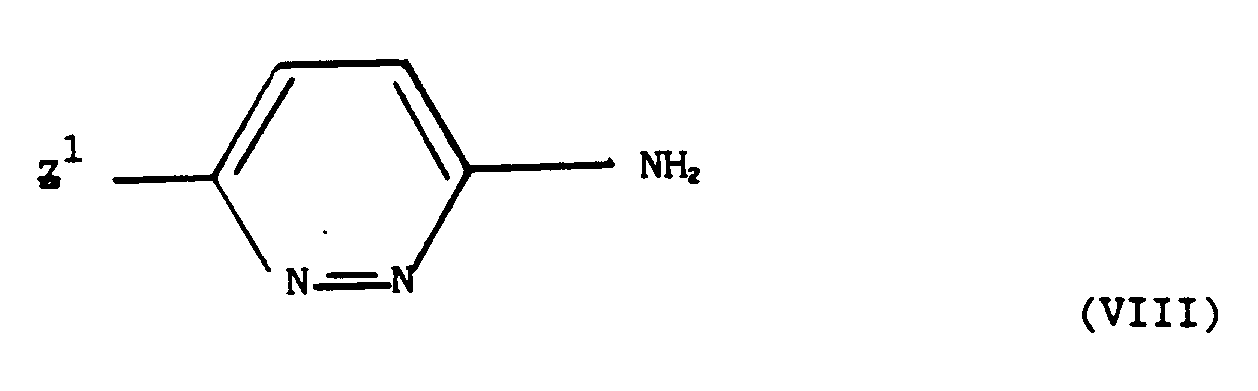
(wherein Z¹ is as hereinbefore defined). - The reaction will generally be conducted in the presence of a base, such as potassium t-butoxide in a solvent such as dimethoxyethane. Alternative bases and solvents which may be employed in this reaction include sodium hydride in an aprotic solvent such as dimethylformamide or dimethyl sulphoxide, and sodium methoxide or ethoxide in an alcohol such as methanol or ethanol, or an aprotic solvent such as those mentioned hereinabove.
- Compounds of formula (II) wherein X and Y together represent the group -CH=CH- may be prepared from a compound of formula (IX) by successive reactions with a halogenating agent such as phosphorous trichloride and ammonia.

Compounds of formula (IX) may be prepared by reacting an appropriate arylaldehyde R¹CHO with 3-oxopentanoic acid (laevulinic acid) in the presence of a base in aqueous alcohol followed by reaction with hydrazine under acidic conditions to give a compound of formula (X):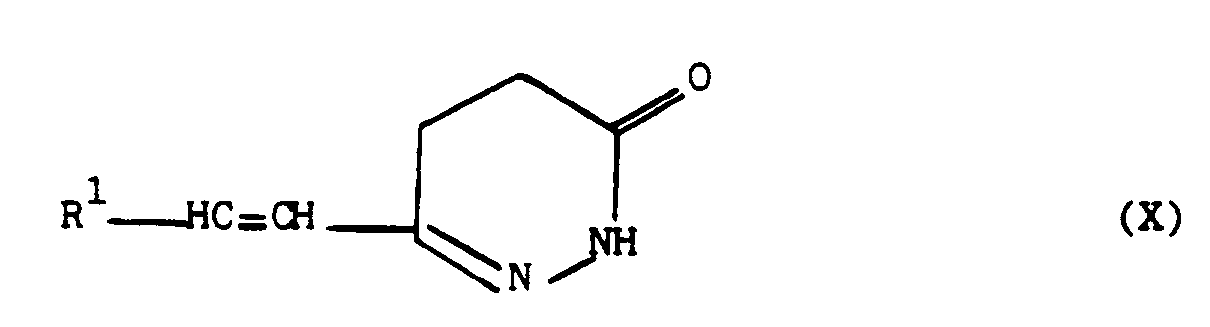
which may be dehydrogenated e.g. using selenium dioxide in an alcohol e.g. ethanol to give a compound of formula (IX). - When it is desired to prepare compounds of formula (II) wherein X and Y are both methylene groups the ethenyl moiety in the compound of formula (IX) or (X) may first be reduced, for example by catalytic hydrogenation using e.g. palladium on charcoal.
- Compounds of formula (III) may be prepared by reaction of the corresponding haloacetamide of formula (XI):

with oxalyl chloride, and an alcohol R²OH, according to methods well known in the art. - Alcohols of general formula (V) may be prepared from the corresponding carboxylic acids or carboxaldehydes using standard procedures, e.g. by reduction with sodium borohydride in a solvent such as methanol or ethanol, or with lithium aluminium hydride in a solvent such as diethyl ether or tetrahydrofuran.
- A thiol of general formula (V) may be prepared from the corresponding halide R¹ CH₂Z³ (wherein Z³ is a halogen atom) by reaction with thiourea in a solvent such as ethanol, to give the corresponding isothiouronium salt, and subsequent hydrolysis e.g. with sodium hydroxide solution.
- Amines of general formula (V) may be prepared in conventional manner, by reaction of a corresponding halide with ammonia.
- Reaction of a compound of general formula (IV) with a compound of general formula (V) according to process (B) will generally be effected in the presence of a base. Suitable bases include alkali metal alkoxides such as sodium or potassium methoxide, ethoxide or t-butoxide. The reaction may be conveniently carried out in a solvent, such as dimethoxyethane; an alcohol e.g. methanol or ethanol, or an aprotic solvent such as dimethylformamide or dimethylsulphoxide.
- Compounds of general formula (IV) may be prepared by reacting a compound of formula (VII) with a compound of formula (III) in an analogous manner to general process (A) described above.
- General process (C) may be effected by heating a compound of formula (VI) to a temperature in the range 80 to 150°C, optionally in the presence of a solvent, and reacting with an alcohol R²OH.
- Suitable solvents include inert organic solvents such as hydrocarbons e.g. benzene or toluene. Alternatively the alcohol R²OH may itself act as the solvent.
- It is believed that process (C) proceeds via an intermediate isocyanate derivative of formula (XII)

Acyl-azide derivatives of formula (VI) may be prepared from the corresponding carboxylic acids by formation of an activated acid derivative, (e.g. an acid halide such as an acid chloride formed by reaction with a halogenating agent such as oxalyl chloride, thionyl chloride or phosphorus pentachloride) followed by reaction with an azide e.g. an alkali metal azide, conveniently in an aqueous ether solution e.g. aqueous dioxan. The carboxylic acid derivatives corresponding to compounds (VI) may themselves be prepared by reacting a compound of formula (II) with ethyl bromopyruvate using analogous conditions to general process (A) above, to give an ester, followed by hydrolysis to give the desired acid. - In process (D) a reagent serving to introduce the group -CO₂R² may be the corresponding haloformate, eg an alkylhaloformate such as methyl-or ethyl-chloroformate. Compounds of formula (VII) may themselves be prepared from a compound of formula (I) by removal of a group -CO₂R², (preferably a labile group such as t-butoxycarbonyl) under acid conditions (using e.g. an optionally halogenated carboxylic acid such as formic, chloroformic or trifluoacetic acid), optionally in the presence of a solvent, e.g. a halogenated hydrocarbon such as dichloromethane. Thus, in a particular embodiment of process (D) one compound of formula (I) may be converted into a different compound of formula (I), by removal of one group - CO₂R² and reaction to introduce a different group -CO₂R² as described above.
- Conversion of a compound of formula (I) into a different compound of formula (I) according to general process (E) may be achieved for example by replacing an esterifying group R² in the compound of formula (I) by a different group R² by heating a compound (I) with an appropriate alcohol in the presence of a base, for example an alkali metal alkoxide such as potassium t-butoxide, at a temperature in the range 50 to 180°C. Whilst such ester exchange may be carried out as a separate reaction step, it may also conveniently be effected during the course of the reaction between a compound of formula (IV) with a compound (V) according to general process (B).
- Interconversion according to process (E) may also be achieved by alkylation of a compound wherein R³ is a hydrogen atom, to provide a compound wherein R³ is an alkyl group. Alkylation may be effected in conventional manner, for example using an alkyl halide, eg methyl or ethyl iodide, in the presence of a base, eg sodium hydride.
- Those intermediates of formulae (II), (IV), (VI), (VII) and (VIII) which are novel form a further aspect of the present invention. Preferred intermediates are those of formulae (II), (IV) and (VI).
- The compounds of the present invention are useful for the treatment of tumours. They may be employed in treating various forms of cancer including leukaemias, lymphomas, sarcomas and solid tumours.
- The invention thus further provides a method for the treatment of tumours in animals, including mammals, especially humans, which comprises the administration of a clinically useful amount of compound of formula (I) or a pharmaceutically acceptable salt or physiologically functional derivative in a pharmaceutically useful form, once or several times a day or in any other appropriate schedule, orally, rectally, parenterally, or applied topically.
- In addition, there is provided as a further, or alternative, aspect of the invention, a compound of formula (I) or a pharmaceutically acceptable salt or physiologically functional derivative thereof for use in therapy, for example as an antitumour agent.
- The amount of compound of formula (I) required to be effective as a cytotoxic agent will, of course, vary and is ultimately at the discretion of the medical or veterinary practitioner. The factors to be considered include the condition being treated, the route of administration, and nature of the formulation, the mammal's body weight, surface area, age and general condition, and the particular compound to be administered. A suitable effective antitumour dose is in the range of about 0.01 to about 120mg/kg bodyweight, eg 0.1 to about 120 mg/kg body weight, preferably in the range of about 0.1 to 50 mg/kg, for example 0.5 to 5 mg/kg. The total daily dose may be given as a single dose, multiple doses, e.g., two to six times per day or by intravenous infusion for selected duration. For example, for a 75 kg mammal, the dose range would be about 8 to 9000 mg per day, and a typical dose could be about 50 mg per day. If discrete multiple doses are indicated treatment might typically be 15 mg of a compound of formula (I) given up to 4 times per day.
- Whilst it is possible for the active compound to be administered alone, it is preferable to present the active compound in a pharmaceutical formulation. Formulations of the present invention, for medical use, comprise a compound of formula (I) or a salt thereof together with one or more pharmaceutically acceptable carriers and optionally other therapeutic ingredients. The carrier(s) should be pharmaceutically acceptable in the sense of being compatible with the other ingredients of the formulation and not deleterious to the recipient thereof.
- The present invention, therefore, further provides a pharmaceutical formulation comprising a compound of formula (I) or a pharmaceutically acceptable salt or physiologically functional derivative thereof together with a pharmaceutically acceptable carrier therefor.
- There is also provided a method for the preparation of a pharmaceutical formulation comprising bringing into association a compound of formula (I) or a pharmaceutically acceptable salt or physiologically functional derivative thereof, and a pharmaceutically acceptable carrier therefor.
- Formulations according to the present invention include those suitable for oral, topical, rectal or parenteral (including subcutaneous, intramuscular and intravenous) administration. Preferred formulations are those suitable for oral or parenteral administration.
- The formulations may conveniently be presented in unit dosage form and may be prepared by any of the methods well known in the art of pharmacy. All methods include the step of bringing the active compound into association with a carrier which constitutes one or more accessory ingredients. In general, the formulations are prepared by uniformly and intimately bringing the active compound into association with a liquid carrier or a finely divided solid carrier or both and then, if necessary, shaping the product into desired formulations.
- Formulations of the present invention suitable for oral administration may be presented as discrete units such as capsules, cachets, tablets or lozenges, each containing a predetermined amount of the active compound; as a powder or granules; or a solution or suspension in an aqueous or non-aqueous liquid such as a syrup, an elixir, an emulsion or a draught.
- A tablet may be made by compression or moulding, optionally with one or more accessory ingredients. Compressed tablets may be prepared by compressing in a suitable machine the active compound in a free-flowing form such as a powder or granules, optionally mixed with a binder, lubricant, inert diluent, surface active or dispersing agent. Moulded tablets may be made by moulding in a suitable machine a mixture of the powdered active compound with any suitable carrier.
- A syrup may be made by adding the active compound to a concentrated, aqueous solution of a sugar, for example sucrose, to which may also be added any accessory ingredients. Such accessory ingredient(s) may include flavourings, an agent to retard crystallization of the sugar or an agent to increase the solubility of any other ingredients, such as a polyhydric alcohol for example glycerol or sorbitol.
- Formulations for rectal administration may be presented as a suppository with a conventional carrier such as cocoa butter.
- Formulations suitable for parenteral administration conveniently comprise a sterile aqueous preparation of the active compound which is preferably isotonic with the blood of the recipient. Such formulations suitably comprise a solution of a pharmaceutically and pharmacologically acceptable acid addition salt of a compound of the formula (I) that is isotonic with the blood of the recipient.
- Useful formulations also comprise concentrated solutions or solids containing the compound of formula (I) which upon dilution with an appropriate solvent give a solution for parenteral administration as above.
- In addition to the aforementioned ingredients, the formulations of this invention may further include one or more accessory ingredient(s) selected from diluents, buffers, flavouring agents, binders, surface active agents, thickeners, lubricants, preservatives (including antioxidants) and the like.
- In a further aspect the present invention provides the use of a compound of formula (I) or a pharmaceutically acceptable salt or physiologically functional derivative thereof for the manufacture of a medicament for the treatment of tumours.
- The invention will now be illustrated by the following Examples.
- All temperatures are in degrees Celcius (°C).
- Proton nuclear magnetic resonance spectra were obtained on a Bruker AH200 FT NMR or Bruker HFX90 FT NMR machine.
- The following abbreviations are used in the preparations and Examples
DME - dimethoxyethane
DMEU - 1,3-dimethyl-2-imidazolidone.
LAH - lithium aluminumum hydride. - 3,4,5-Trimethoxybenzyl alcohol (Aldrich 19.82g, 0.1mol), dissolved in DME (20ml), was added over 15mins to a suspension of potassium t-butoxide (11.22g, 0.1mol) in DME (80ml) with stirring under N₂ and cooling in an ice-bath. After 0.5h the mixture was treated with 3-amino-6-chloropyridazine (Helv. Chim. Acta. 1954, 37, 121, J.Druey, Kd.Meier and K.Eichenberger) (12.95g, 0.1mol) and after 1.5h was heated under reflux for 3h. The mixture was cooled and filtered and the filtered solid washed with ether. The filtrate was evaporated in vacuo to give an oil which was partitioned between ethyl acetate and water. The organic phase was washed with water, dried (Na₂SO₄) and evaporated to give an oil (A) which was chromatographed on silica gel eluting with 5% methanol-chloroform. Eluted fractions were combined to give an oil (B) which was triturated with chloroform and di-isopropyl ether to yield the title compound as an off-white solid (9.44g), m.p. = 142-4°; Nmr. δH (CDCl₃) 6.87 (1H, JAB8.8Hz 5-H), 6.78 (1H, JAB8.8Hz, 4-H), 6.72 (2H, s, PhH), 5.38 (2H, s, CH₂), 4.45 (2H, br. s, NH₂) 3.87 (6H,s,OMe) and 3.84(3H,s,OMe).
- 2,5-Dimethoxybenzyl alcohol (30.6g, 0.182mol) in DME (20ml) was added to potassium t-butoxide (20.38g, 0.182mol) in DME (60ml) with stirring under N₂ and cooling in an ice-bath. After 0.5h, the mixture was treated with 3-amino-6-chloropyridazine and after 1.5 hours was heated under reflux for 5h, then cooled and filtered. The filtrate was evaporated in vacuo and partitioned between ethyl acetate and water. The organic phase was washed with water, dried (Na₂SO₄) and evaporated to give a solid (A) which was recrystallised from toluene to give a solid (B). This was chromatographed on silica gel eluting with 5% methanol-chloroform to yield the title compound as a white solid (27g),
m.p. = 94-94.5°, Nmr δH(CDCl₃) 7.05 (1H,m, PhH), 6.90-6.73 (4H,m,ArH), 5.42 (2H,s,CH₂), 4.5 (2H,brs, NH₂) and, 3.78 and 3.75 (6H,s,OMe). - The following compounds were prepared from the appropriate alcohol by the general procedure described for Intermediates 1 and 2:
- (3) 3-Amino-6-(1-naphthylmethyloxy)pyridazine, m.p. 143-144°,Nmr δH (d₆-DMSO) 8.00 (3H,m,napth H), 7.55 (4H,m,napth H), 6.97 (1H, JAB 8.8Hz 4-H), 6.89 (1H, JAB 8.8Hz 5-H), 6.0 (2H,s,CH₂) and 5.80 (2H,s,NH₂). (From 1-naphthylmethanol, Aldrich)
- (4) 3-Amino-6-(3-methoxybenzyloxy)pyridazine, m.p. 55-60°, Nmr δH (d₆-DMSO) 7.38 (1H,dd, J8-4Hz,PhH), 7.13-6.89 (5H,m,ArH), 6.05 (2H,s,NH₂), 5.35 (2H,s,CH₂) and 3.82 (3H,s,OMe).
- (5) 3-Amino-6-(3,5-dimethoxybenzyloxy)pyridazine, m.p. 89-92°,Nmr δH (d₆-DMSO) 6.88 (1H, JAB 8.8Hz,5-H), 6.75 (1H, JAB 8.8Hz, 4-H), 6.62 (2H,d, 2'-H and 6'-H), 6.42 (1H,t,4'-H), 5.35 (2H,s,CH₂), 4.53 (2H,br.s, NH₂) and 3.75 (6H,s,OMe).
- (6) 3-Amino-6-(3-Methylbenzyloxy)pyridazine, Nmr δH (d₆-DMSO) 7.40-7.10 (4H,m,PhH), 6.90 (2H, JAB 8.8Hz, 4-H and 5-H), 5.91 (2H,br.s,NH₂), 5.17 (2H,s,CH₂) and 2.31 (3H,s,Me); M/Z 215 (M⁺, 30%), 198 (9), 123 (23), 111(31) and 105(100).
- (7) 3-Amino-6-(3-dimethylaminobenzyloxy)pyridazine, m.p. 127.129°, Nmr δH (d₆-DMSO) 7.25 (1H,t,5'-H), 7.00 (1H, JAB8.8Hz, 4-H), 6.92 (1H, JAB 8.8Hz, 5-H), 6.90-6.70 (3H,m, 2'-,4'- and 6'-H), 5.95 (2H,s,CH₂), 5.30 (2H,br.s,NH₂) and 2.98 (6H,s,NMe₂).
(From 3-dimethylaminobenzylalcohol, prepared by LAH reduction of 3-dimethylaminobenzoic acid, Aldrich) - (8) 3-Amino-6-(2-methoxybenzyloxy)pyridazine, m.p. 166-168°, Nmr δH (CDCl₃) 7.8 (1H,dd, J6.7 and 2.2Hz, PhH), 7.30 (1H,dd, J6.6 and 2.2Hz,PhH), 6.98 (1H,dt, J6.6Hz,PhH), 6.92 (1H,d,J6.6Hz, PhH), 6.90 (1H,JAB 8.8Hz,5-H), 6.78 (1H, JAB 8.8Hz, 4-H), 5.5 (2H,s,CH₂), 4.42 (2H,br.s,NH₂) and 3.87 (3H,s,OMe).
- (9) 3-Amino-6-[3,5-dimethoxy(4-methoxyethoxymethoxy)benzyloxy]pyridazine, m.p. 110-114°, Nmr, δH (CDCl₃) 6.88 (1H, JAB 8.8Hz, 5-H), 6.78 (1H, JAB 8.8Hz, 4-H), 6.7 (2H,5,2'- and 6'-H), 5.35 (2H,s,CH₂), 5.2 (2H,s,CH₂), 4.49 (2H,br.s,NH₂), 4.05 (2H,m,CH₂) 3,85 (6H,s,OMe), 3.61-3.51 (2H,m,CH₂) and 3.35 (3H,s,OMe).
- (10) 3-Amino-6-(3-chlorobenzyloxy)pyridazine, Nmr δH (d₆-DMSO) 7.51-7.32 (4H,m,PhH), 6.91 (2H, JAB 8.8Hz, 4H and 5-H), 5.92 (2H,br.s,NH₂) and 5.34 (2H,s,CH₂); M/Z 235 (M⁺, 68%), 218(10), 125 (65) and 97 (100).
- (11) 3-Amino-6-(2-thienylmethyloxy)pyridazine, m.p. 101.103°, Nmr δH (d₆-DMSO), 7.52 (1H,d,5'-H), 7.20 (1H,d,3'-H), 7.02 (1H,dd,4'-H), 6.94 and 6.85 (2H, JAB 8.8Hz, 4-H and 5-H), 5.95 (2H,s,CH₂) and 5.50 (2H,s,NH₂).
- (12) 3-Amino-6-(3,4,5-trimethoxybenzylthio)pyridazine was prepared according to the method described for Intermediates 1 and 2 using 3,4,5-trimethoxybenzylthiol and 3-amino-6-chloro pyridazine to give the product, m.p. 143.146°, Nmr δH (CDCl₃) 7.07 and 6.63 (2H, JAB 8.8Hz, 4-H and 5-H), 6.66 (2H,s,PhH) 4.63 (2H,br.s,NH₂), 4.44 (2H,s,CH₂), 3.85 (6H,s,OMe) and 3.84 (3H,s,OMe).
- The procedure described by R.J. Bochis et.al, J.Med.Chem 1978, 21, 235 was followed to yield the title compound m.p. 97-99°, Nmr δH (d₆-DMSO) 11.07 (1H,br.s,NH), 4.56 (2h,s,ClCH₂), 4.28 (2H,m, CO.OCH₂), 3.62 (2H,m,CH₂OMe) and 3.34 (3H,s,Me).
- The following intermediates of formula (III) are known from the literature references indicated:
Z-CH₂CONHCO₂R²
Intermediate No. Z R² Literature ref. 14 Cl CH₃ a 15 Br t-Butyl b 16 Cl -CH₂CH₃ c 17 Cl -CH₂CH₂CH₃ c 18 Cl -(CH₂)₃CH₃ c 19 Cl -iso-propyl d (a) R.J. Bochis et.al J.Med.Chem 1978, 21 235.
(b) N.J. Leonard and K.A. Cruikshank - J.Org.Chem, 1985, 50 2480
(c) M. Pianka and D.J. Pelton J.Chem.Soc. 1960, 983
(d) G.I. Derkach and V.P. Belaya, Zh Obsch. Khim, 1966, 36, 1942. - The following compounds were prepared by the general procedure described for Intermediates (1) and (2), using the apropriate alcohol as starting material.
- From 2,3-dimethoxybenzylalcohol (Aldrich) to give the title compound mp. 103-106°, NMR δH(CDCl₃) 7.12-7.05(2H,m,5'and 6'H); 6.91(1H,m,4'H), to 6.85(1H,JAB9Hz,5H), 6.77(1H,JAB9Hz,4H); 5.50(2H,s,ArCH₂); 4.50(2H,brs, NH₂) and 3.89(6H,s,OCH₃).
- From 3,5-dimethoxy-4-ethoxybenzylalcohol to give the title compound m.p.169-171°, NMR δH(CDCl₃)6.89(1H,JAB8.8Hz,5H); 6.79(1H,JAB8.8Hz,4H); 6.70(2H,s,ArH); 5.38(2H,s,ArCH₂); 4.48(2H,brs,NH₂); 4.06(2H,q,J7Hz, CH₂CH₃); 3.88(6H,s,OCH₃) and 1.38(3H,t,J7Hz,CH₂CH₃).
- 3,5-Dimethoxy-4-ethoxybenzylalcohol was prepared as follows:-
- a) 3.5-Dimethoxy-4-ethoxybenzaldehyde
A mixture of syringaldehyde (50g, 0.275 mol), ethyl iodide (85.8g, 0.55mol) and potassium carbonate (151.7g, 1.09 mol) in DMF (60ml) was stirred and heated at 60-70° for 6h. The mixture was cooled and evaporated in vacuo then treated with water and extracted with diethyl ether. The extracts were dried (Na₂SO₄) and evaporated to give the title compound (59g) as a white solid, pure by tlc, and used without further purification. - b) 3,5-Dimethoxy-4-ethoxybenzylalcohol
The product from the previous reaction (59g, 0.28 mol) was dissolved in methanol-ethanol (600ml, 1:1) and treated with sodium borohydride (10.8g, 0.285 mol) portionwise over 1h. The mixture was stirred for 24h at ambient temperature then treated slowly with water (50ml) to provide a precipitate. The mixture was evaporated to remove organic solvents, treated with water (300ml) and extracted with chloroform. The extracts were dried (Na₂SO₄) and evaporated to give a white solid which was recrystallised from ether to give the title compound (26g) as white needles. - From 2-t-butylbenzyl alcohol to give title compound mp. 147-9°δH(DMSO) 7.4(2H,m,ArH), 7.28(2H,m,ArH), 6.9(1H,JAB,8Hz,4H), 6.85(1H,JAB,8Hz,5H), 6.0(2H,brs,NH₂), 5.5(2H,s,CH₂), 1.4(9H,s,Me₃).
(Acohol prepared by LAH reduction of 2-t-butylbenzoic acid; M.Crawford and F.H.C. Stewart, J. Chem. Soc., 1952, 4444). - From 2-ethylbenzylalcohol.
- Alcohol prepared from 2-ethylbenzoic acid (M.Crawford and F.H.C.Stewart, J.Chem.Soc. 1952, 4444) by reduction with LAH.
- From 2,5-dimethylbenzylalcohol to give title compound mp. 109-111°C
Alcohol prepared by LAH reduction of 2,5-dimethylbenzoic acid (Aldrich). - From 3,4,5-trimethylbenzylalcohol.
- Alcohol prepared by LAH reduction of 3,4,5-trimethylbenzoic acid (G.H. Kosolapoff, J.Am. Chem. Soc. 69, 1652, 1947).
- From 2-Phenylbonzylalcohol.
- Alcohol prepared by LAH reduction of 2-phenylbenzoic acid (Aldrich).
- From 3-diethylaminobenzylalcohol to give title compound mp. 115-118°C.
δH(DMSO), 7.15(1H,t,5'H), 6.95(1H,JAB,8Hz,4H), 6.85(1H,JAB,8Hz,5H), 6.75(1H,brs,2'H), 6.65(2H,m,4'H+6'H), 5.9(2H,s,NH₂), 5.25(2H,s,CH₂O), 3.3(4H,quad,2xCH₂N), 1.05(6H,t,2xMe). - Alcohol prepared by LAH reduction of 3-diethylaminobenzoic acid (P. Griess, Chem. Ber., 5 1041, 1872)
- From 3-methylaminobenzylalcohol to give the title compound as a gum.
δH(DMSO) 7.1(1H,t,5'H), 6.95(1H,JAB,8Hz,4H), 6.85(1H,JAB,8Hz,5H), 6.6(2H,m,2ArH), 6.45(1H,d,ArH), 5.95(2H,s,NH₂), 5.65(1H,brs,NH), 5.2(2H,s,CH₂O), 2.65(3H,s,MeN). - Alcohol prepared by LAH reduction of 3-methylaminobenzoic acid (J. Houben and W. Brassert. Chem. Ber., 43 209, 1910)
- From 3-methoxy-1-naphthylmethanol to give the title compound mp. 167-170°C.
δH(DMSO), 7.95(2H,2d,2ArH), 7.40(3H,m,3ArH), 7.30(1H,s,2'H), 7.0(1H,JAB,8Hz,4H), 6.90(1H,JAB,8Hz,5H), 6.00(2H,s,NH₂), 5.75(2H,s,CH₂O), 3.90(3H,s,OMe). - Alcohol prepared by LAH reduction of 3-methoxy-1-naphthoic acid (R. Lesser and G. Gad, Chem. Ber., 58B, 2551 - 9, 1925)
- From 2-(3,4,5-trimethoxyphenyl)ethanol to give an oil.
δH(DMSO), 6.95(1H,JAB,8Hz,4H), 6.90(1H,JAB,8Hz,5H), 6.60(2H,s,2ArH) 6.25(2H,brs,NH₂), 4.45(2H,t,CH₂O), 3.75(6H,s,3MeO and 5MeO), 3.58(3H,s,4MeO), 3.0(2H,t,CH₂). - Alcohol prepared by LAH reduction of 3,4,5-trimethoxyphenylacetic acid (Aldrich).
- From 2-pyridylmethanol (Aldrich) to give the title compound mp. 114-115°. Nmr δH (d₆-DMSO), 8.65(1H,d,6'-H), 7.85(1H, tr of d, 5'-H), 7.55(1H,d,3'-H), 7.45(1H,m,4'-H), 7.10(1H, JAB 8.8Hz, 4-H), 6.95(1H, JAB 8.8Hz, 5-H), 6.05(2H,s,NH₂), 5.45(2H,s,CH₂).
- From furfurylalcohol to give the title compound mp. 96-99°. Nmr δH (d₆-DMSO), 7.70(1H,d,5'-H), 6.90(1H, JAB 8.8Hz, 4-H), 6,85(1H, JAB 8.8Hz, 5-H), 6.60(1H,d,4'-H), 6.50(1H,s,3'-H), 5.95(2H,s,NH₂), 5.30(2H,s,CH₂).
- Intermediate 1 (29.1g, 0.1mol), and methyl N-chloroacetylcarbamate (15.15g, 0.1mol) were heated at 100° for 3h with stirring under N₂ in dry 1,3-dimethyl-2-imidazolidinone (DMEU) (100ml). The mixture was cooled, poured onto iced sodium bicarbonate solution and filtered to give a solid which was washed with water. The solid was dissolved in 5% methanol-chloroform and eluted through florosil. Evaporation gave a solid which was recrystallised from dimethylformamide and water to give the title compound as a white powder (14g), m.p. 217-220°, Nmr δH (d₆-DMSO) 10.36 (1H, br.s, NH), 7.87 (1H, JAB 8.8Hz, 8-H), 7.85 (1H,s,3-H), 6.87 (1H, JAB 8.8Hz, 7-H), 6.85 (2H,s,PhH), 5.25 (2H,s,CH₂), 3.79, 3.70 and 3.56 (2H,s,OMe).
- Intermediate 2 (2.61g, 10mmol), 2,6-lutidine (1.04g, 10mmol) and ethyl N-chloroacetylcarbamate (1.66g, 10mmol) were heated at 100° for 3h with stirring under N₂ in dry DMEU (10ml). The mixture was cooled and filtered and the solid washed with water and ether then passed through florosil, eluting with 5% methanol-chloroform. Evaporation of the eluate gave a solid which was recrystallised from dimethylformamide and water to give the title compound as a white powder (1.26g), m.p. 210-211°, Nmr δH (d₆-DMSO) 10.24 (1H,br.s,NH), 7.85 (2H,M,3-H and 8-H), 7.10-6.86 (4H,m,7-H and PhH), 5.27 (2H,s,CH₂Ar), 4.17 (2H,q, J 6.6Hz, CH₂CH₃), 3.78 and 3.73 (6H,s,OMe) and 1.27 (3H,t,J 6.6Hz, CH₂CH₃).
- Intermediate 2 (12.0g, 0.046mol), 2,6-lutidine (4.92g, 0.046mol) and methyl N-chloroacetyl carbamate (6.97g, 0.046mol) were heated with stirring under N₂ at 100° for 4h in dry DMEU (46ml). The mixture was added to iced-water and then filtered to give a solid which was recrystallised from dimethylformamide and water to give the title compound as a light brown powder (2.46g), m.p. 228-230°, Nmr δH (d₆-DMSO) 10.30 (1H,br.s,NH), 7.88 (1H, JAB 8.8Hz, 8-H), 7.85 (1H,s,3-H), 7.12-6.85 (4H,m, ArH), 5.32 (2H,s,CH₂), and 3.79, 3.72 and 3.69 (9H,s, OMe).
- The following compounds were prepared by the general procedure described in Examples 1-3 by reacting the 3-amino-6- substituted pyridazines with the appropriate chloroacetylcarbamates.
- (4) n-Propyl N-[6-(3,4,5-trimethoxybenzyloxy)imidazo[1,2-b]pyridazin-2-yl] carbamate, m.p. 174-175°, Nmr δH (d₆-DMSO) 10.25 (1H,br.s,NH), 7.87 (1H, JAB 8.8Hz, 8-H), 7.85 (1H,s,3-H) 6.87 (1H, JAB 8.8Hz, 7-H), 6.85 (2H,s,PhH), 5.26 (2H,s,CH₂Ar), 4.07 (2H,t,J6Hz, CH₂CH₂CH₃), 3.80 (6H,s,OMe), 3.68 (3H,s,OMe), 1.55 (2H,dt,J6Hz, CH₂CH₂CH₃) and 0.94 (3H,t,J6Hz, CH₂CH₂CH₃)
- (5) n-Butyl N-[6-(3,4,5-trimethoxybenzyloxy)imidazo[1,2-b]pyridazin-2-yl] carbamate, m.p. 185-187°, Nmr δH (d₆-DMSO) 10.23 (1H,br.s,NH), 7.85 (1H,JAB 8.8Hz, 8-H), 7.8 (1H,s,3-H), 6.86 (1H, JAB 8.8Hz, 7-H), 6.65 (2H,s,PhH), 5.27 (2H,s,CH₂Ar), 4.12 (2H,t,J 6Hz, CH₂CH₂CH₂CH₃), 3.80 (6H,s,OMe), 3.67 (3H,s,OMe), 1.61 (2H,m,CH₂CH₂CH₂CH₃), 1.38 (2H,m,CH₂CH₂CH₂CH₃) and 0.92 (3H,t,J6Hz, CH₂CH₂CH₂CH₃).
- (6) n-Propyl N-[6-(2,5-dimethoxybenzyloxy)imidazo[1,2-b]pyridazin-2-yl] carbamate, m.p. 199-200°, Nmr δH (d₆-DMSO) 9.93 (1H,br.s,NH), 7.87 (2H,m,3-H and 8-H), 7.17-6.89 (4H,m, 7-H and PhH), 5.42 (2H,s,CH₂Ar), 4.17 (2H,t,J6Hz, CH₂CH₂CH₃), 3.85 and 3.80 (6H,s,OMe), 1.73 (2H,dt,J6Hz, CH₂CH₂CH₃) and 1.04 (3H,t,J6Hz, CH₂CH₂CH₃).
- (7) Ethyl N-[6-(3,4,5-trimethoxybenzyloxy)imidazo[1,2-b]pyridazin-2- yl] carbamate, m.p. 204-206°, Nmr δH(d₆-DMSO) 10.25 (1H,br.s,NH), 7.85 (1H, JAB 8.8Hz, 8-H), 7.83 (1H,s,3-H) 6.85 (1H, JAB 8.8Hz, 7-H), 6.64 (2H,s,PhH), 5.27 (2H,s,CH₂Ar), 4.15 (2H,q,J6Hz, CH₂CH₃), 3.28 (6H,s,OMe), 3.16 (3H,s,OMe) and 1.25 (3H,t,J6Hz, CH₂CH₃).
- (8) 2-Methoxyethyl N-[6-(3,4,5-trimethoxybenzyloxy)imidazo[1,2-b]pyridazin -2-yl]carbamate, m.p. 183-185°, Nmr δH(d₆-DMSO) 10.36 (1H, br.s, NH), 7.85 (1H, JAB 8.8Hz, 8-H), 7.83 (1H,s,3-H), 6.85 (1H, JAB 8.8Hz, 7-H), 6.84 (2H,s,PhH), 5.26 (2H,s,CH₂Ar), 4.25 (2H,m, COCH₂), 3.79 (6H,s,OMe), 3.18 (3H,s,OMe) 3.08 (2H,m,CH₂OMe) and 3.32 (3H,s,CH₂OMe).
- (9) Methyl N-[6-(1-Naphthylmethyloxy)imidazo[1,2-b]pyridazin-2-yl] carbamate, m.p. 243-246°, δH(d₆DMSO) 10.05 (1H,br.s, NH), 8.25-7.55 (9H,m,napth H and 3-H and 8-H), 6.92 (1H,JAB 8.8Hz, 7-H), 5.92 (2H,s, CH₂ and 3.80 (3H,s,OMe).
- (10) Methyl N-[6-(2-Methoxybenzyloxy)imidazo[1,2-b]pyridazin-2yl] carbamate, m.p. 241-243°, δH(d₆DMSO) 10.1 (1H,br.s, NH), 7.92 (1H, s, 3-H), 7.65 (1H, JAB 8.8Hz, 8-H), 7.45 (1H,d,J7Hz, PhH), 7.35 (1H,dd,J7Hz, PhH), 6.95 (2H,m,PhH), 6.72 (1H, JAB 8.8Hz, 7-H), 5.36 (2H,s,CH₂), 3.89 (3H,s,OMe), and 3.77 (3H,s,OMe).
- (11) Methyl N-[6-(3,5-Dimethoxybenzyloxy)imidazo[1,2-b)pyridazin-2-yl] carbamate, m.p. 236-238°, δH (d₆DMSO) 10.30 (1H,br.s,NH), 7.88 1H, JAB, 8.8Hz, 8-H), 7.82 (1H,s,3-H), 6.90 (1H,JAB 8.8Hz, 7-H), 6.66 (2H,d,J0.9Hz, 2'-H and 6'-H), 6.46 (1H,t,J0.9Hz, 4'-H), 5.36 (2H,s,CH₂), 3.78 (6H,s,OMe) and 3.70 (3H,s,OMe).
- (12) Methyl N-[6-(3-methylbenzyloxy)imidazo[1,2-b]pyridazin-2-yl]carbamate, m.p. 205-208°, Nmr δH (d₆-DMSO) 9.95 (1H,br.s,NH), 7.85 (1H,s,3-H), 7.80 (1H, JAB 8.8Hz, 8-H), 7.30 (3H,m, 2'-H,4'-H and 6'-H), 7.15 1H,m,5'-H), 6.82 (1H, J AB 8.8Hz, 7-H), 5.80 (2H,s,CH₂), 3.72 (3H,s,OMe) and 2.34 (3H,s,Me).
- (13) t-Butyl N-[6-(3,4,5-trimethoxybenzyloxy)imidazo[1,2-b]pyridazin-2-yl] carbamate, m.p. 191.5-192.5°, Nmr δH (d₆-DMSO) 9.95 (1H,br.s, NH), 7.85 (1H,JAB 8.8Hz, 8-H), 7.79 (1H, br.s, 3-H) 6.87 (1H, JAB 8.8Hz, 7-H) 6.86 (2H,s,PhH), 5.25 (2H,s,CH₂), 3.79 (6H,s,OMe), 3.68 (3H,s,OMe) and 1.50 (9H, s, t-Bu).
- (14) Methyl N-[6-(3,4,5-trimethoxybenzylthio)imidazo[1,2-b]pyridazin-2-yl] carbamate, m.p. 221-223°, Nmr δH (d₆-DMSO) 10.51 (1H,br.s,NH), 8.11 (1H,s,3-H), 7.87 (1H, JAB 8.8Hz, 8-H), 7.17 (1H, JAB 8.8Hz, 7-H), 6.88 (2H,s,PhH), 4.49 (2H,s,CH₂), 3.83 (6H,s,OMe) and 3.70 (3H,s,OMe).
- (15) Methyl N-[6-(dimethylaminobenzyloxy)imidazo[1,2-b]pyridazin-2-yl] carbamate, m.p. 200-203° Nmr δH (d₆-DMSO) 10.05 (1H, br.s,NH), 7.93 (1H,s,3-H) 7.90 (1H, JAB 8.8Hz, 8-H), 7.30 (1H,t,5'-H), 6.95-6.80 (4H,m,2'-H.4'-H, 6'-H and 7-H), 5.40 (2H,s,CH₂), 3.78 (3H,s,MeO) and 2.98 (6H,s,NMe₂)
- (16) Methyl N-[6-(3-Methoxybenzyloxy)imidazo[1,2-b]pyridazin-2-yl]carbamate m.p. 184-189.5°, Nmr δH (CDCl₃) 10.55 (1H, br.s, NH), 8.02 (1H, br.s, 3-H), 7.75 (1H, JAB 8.8Hz, 8-H),7.32 (1H,dd,J7.5Hz, 5'-H), 7.07 (2H,m,ArH), 6.88 (1H,dd,J7.5 and 2Hz, ArH). 6.70 (1H, JAB 8.8Hz, 7-H), 5.34 (2H,s,CH₂), 3.88 and 3.83 (6H,s,OMe).
- (17) Ethyl N-(6-benzyloxyimidazo[1,2-b]pyridazin-2-yl]carbamate, m.p. > 211° (decomp), Nmr δH (d₆-DMSO) 10.25 (1H,br.s,NH), 7.87 (1H, JAB 8.8Hz, 8-H), 7.72 (1H,s,3-H), 7.57-7.37 (5H,m,Ph), 5.35 (2H,s,CH₂Ar), 4.15 (2H,q,J6Hz, CH₂CH₃) and 1.27 (3H,t,J6Hz, CH₂CH₃).
- (18) Methyl N-(6-n-butylthioimidazo[1,2-b]pyridazin-2-yl]carbamate, m.p. 170-171°, Nmr δH(d₆-DMSO) 10.40 (1H,br.s,NH), 7.94 (1H,s,3H), 7.76 (1H, JAB8.8Hz, 8-H), 7.06 (1H, JAB8.8Hz, 7-H), 3.72 (3H,s,OMe), 3.18 (2H,t,J6Hz, CH₂S), 1.68 (2H,m,CH₂CH₂S), 1.44 (2H,m,CH₂CH₂CH₂S) and 0.93 (3H,t,J6Hz, CH₃CH₂CH₂S).
- (19) Methyl N-(6-benzylthioimidazo[1,2-b]pyridazin-2-yl]carbamate, m.p. 223-225° (decomp), Nmr δH (d₆-DMSO) 10.42 (1H,br,s,NH), 7.99 (1H,s,3-H), 7.77 (1H, JAB8.8Hz, 8-H), 7.52-7.20 (5H,m,Ph), 7.07 (1H, JAB8.8Hz, 7-H), 4.45 (2H,s,CH₂) and 3.68 (3H,s,OMe).
- (20) Methyl N-[6-(3,5-dimethoxy-4-(methoxyethoxymethoxy)benzyloxy)imidazo [1,2-b]pyridazin-2-yl]carbamate, m.p. 149-150°, Nmr δH (CDCl₃) 9.58 (1H,br.s, NH), 8.02 (1H, br.s, 3-H) 7.75 (1H, JAB8.8Hz, 8-H), 6.75 (1H, JAB 8.8Hz, 7-H), 6.70 (2H,s,2'-H and 6'-H), 5.29 (2H,s,CH₂), 5.18 (2H,s,CH₂), 4.08-3.91 (2H,m,CH₂), 3.85 (9H,s,OMe), 3.6-3.45 (2H,m,CH₂) and 3.35 (3H,s,OMe).
- (21) Methyl N-[6-(3-chlorobenzyloxy)imidazo[1,2-b]pyridazin-2-yl]carbamate m.p. 268-270°, Nmr δH (d₆-DMSO) 10.32 (1H,br.s,NH) 7.87 (1H,JAB 8.8Hz,8-H),7.83 (1H,s,3-H), 7.61 (1H,s,2'-H), 7.53-7.41 (3H,m,PhH), 6.91 (1H,JAB8.8Hz, 7-H) 5.38 (2H,s,CH₂) and 3.68 (3H,s,OMe).
- (22) Methyl N-[6-(2-thienylmethylimidazo[1,2-b]pyridazin-2-yl] carbamate, m.p. 207-209°, Nmr δH (d₆-DMSO), 10.38 (1H,br.s,NH), 7.85 (1H,s,3-H), 7.82 (1H,JAB8.8Hz,8-H), 7.58 (1H,d,5'-H), 7.30 (1H,d,3'-H), 7.05 (1H,t, 4'-H), 6.82 (1H, JAB 8.8Hz, 7-H), 5.56 (2H,s,CH₂) and 3.66 (3H,s,OMe).
-
- a) Ethyl 6-(3,4,5-trimethoxybenzyloxy)imidazo[1,2-b]pyridazine-2-carboxylate
Ethyl bromopyruvate (117g,0.6 mol) was added to 3-amino-6-(3,4,5-trimethoxy)pyridazine (174.6g, 0.6mol) and 2,6-lutidine (62.4g, 0.6 mol) in dry DMF (600 ml) with stirring under N₂. The mixture was heated at 100° for 3h, cooled and concentrated in vacuo then treated with water and filtered to give a brown solid which was washed with water and ether. The solid was crystallised from DMF and water to give the title compound as a crystalline solid (88g), m.p. 159.163°, Nmr δH (CDCl₃) 8.31 (1H,s,3H), 7.84 (1H,JAB 8.8Hz, 8H), 6.82 (1H, JAB 8.8Hz, 7H), 6.70 (2H,s,ArH), 5.30 (2H,s,CH₂Ar), 4.45 (2H,q, J7Hz, OCH₂CH₃), 3.88 (6H,s,OCH₃), 3.86 (3H, s, OCH₃) and 1.44 (3H,t,J7Hz,CH₃). - b) 6(3,4,5-Trimethoxybenzyloxy)imidazo[1,2-b-]pyridazine-2-carboxylic acid
The product of stage (a) (1.94g, 5mmol) was heated under reflux with stirring with sodium hydroxide solution (1ml, 10M, 10 mmol), water (9 ml) and methanol (5ml) for 20 min. The mixture was cooled and acidified with dilute hydrochloric acid and filtered to give a solid which was dried at 60° in vacuo to give the title compound as a powder (1.5g), m.p. 224-226° (decomp), Nmr δH(d₆-DMSO) 8.56 (1H,s,3H), 8.07 (1H,JAB 8.8Hz, 8H), 7.05 (1H, JAB 8.8Hz, 7H) 6.88 (2H,s,ArH), 5.29 (2H,s,CH₂Ar), 3.82 (6H, s, OCH₃)3.68 (3H, s, OCH₃) and 3.32 (1H, br.s, CO₂H). - c) 6-(3,4,5-Trimethoxybenzyloxy)imidazo[1,2-b-]pyridazine-2-carboxylic acid azide
Oxalyl chloride (0.13 ml, 1.5mmol) was added to the product of stage (b) (0.36g, 1 mmol) and pyridine (0.079g, 1 mmol) in dry benzene (5 ml) with stirring under N₂. The mixture was heated under reflux for 3h, cooled, and evaporated in vacuo to give a grey solid:
This solid was treated with dioxan (10 ml), water (10 ml) and sodium azide (excess) and stirred vigorously overnight at ambient temperature. The mixture was filtered and the solid dried in vacuo to give the title compound as a powder (0.29g), m.p. >139° (decomp), Nmr δH (CDCl₃) 8.35 (1H,s,3H) 7.85 (1H, JAB 8.8Hz, 8H), 6.85 (1H, JAB 8.8Hz, 7H), 6.70 (2H,s, ArH), 5.31(2H,s,CH₂Ar), 3.90 (6H,s,OCH₃) and 3.88(3H,s,OCH₃). - d) 2,2,2-Trifluoroethyl-N-[6(3,4,5-trimethoxybenzyloxy)imidazo[1,2-b-] pyridazine-2-yl]carbamate
The product of stage (c) (2.3g, 6mmol), 2,2,2-trifluoroethanol (ca-3ml) and toluene (60 ml) were heated with stirring under N₂ at reflux until t.l.c. showed complete reaction (ca 2h.).
The mixture was cooled overnight and filtered to give a solid which was washed with ether and dried to give the title compound as a powder (0.43g), m.p. 205-210° (decomp.) Nmr δH(d₆ DMSO) 10.81 (1H,br. s,NH), 7.88 (1H, JAB 8.8Hz, 8H), 7.85 (1H,s,3H), 6.90 (1H,JAB 8Hz, 7H), 6.85 (2H,s, ArH), 5.25 (2H, s, CH₂Ar) 4.83 (2H,q, J9Hz, CH₂CF₃), 3.76 (6H, s, OCH₃) and 3.65 (3H, s, OCH₃). - A similar procedure was followed to that described in Example 23(d) except that the crude product was chromatographed on SiO₂ eluting with 5% methanol-chloroform with subsequent recrystallisation from DMF-water to yield the title compound as a powder, m.p. 193-5°, NMR δH (d₆ DMSO) 10.35 (1H, br. s, NH) 7.85 (1H, JAB, 8.8Hz, 8H), 7.83 (1H, s, 3H), 6.86 (1H, JAB 8.8Hz, 3H), 6.84 (2H, s, ArH), 5.25 (2H, s, CH₂Ar), 4.82 (1H, t, J4Hz, OH), 4.15 (2H, m), 3.80 (6H, s, OCH₃) and 3.66 (5H, m, OCH₂ and OCH₃).
- A similar procedure was followed to that described in Example 23 (d) except that the crude product was chromatographed on SiO₂ eluting with 5% methanol-chloroform and boiled with a little ethanol to give the title compound as a powder, m.p. 161-162°, Nmr δH (d₆ DMSO) 10.30 (1H, br. s, NH), 7.88 (1H, s, 3H), 7.85 (1H, JAB, 8.8Hz 8H), 6.87 (1H, JAB ,8.8Hz, 7H), 6.85 (2H, s, ArH), 5.26 (2H, s,CH₂Ar), 4.22 (2H, t, J5Hz, CO.OCH₂ 3.80 (6H,s, OCH₃), 3.68 (3H, s, OCH₃), 3.58 (4H, m, CH₂OCH₂), 2.59 (2H, t, J5Hz, CO.OCH₂CH₂N) and 2.45 (4H, m, CH₂NCH₂).
- Sodium hydride (1.26g, 60%, 31.5mMol) was added portionwise to a stirred suspension of methyl N-[6-(3,4,5-trimethoxybenzyloxy)imidazo[1,2-b)-pyridazin-2-yl]carbamate (9.51g, 24.5mMol) in DMEU (100ml) under N₂ at ambient temperature. The mixture was treated with iodomethane (4.9g, 2.15ml, 35mMol) and after a further 1 hour the mixture was treated with molar equivalents of sodium hydride and iodomethane. After 2 hours the mixture was poured into water (100ml) and was filtered to give a white solid which was chromatographed on SiO₂ eluting with 2% methanol-chloroform. The product was recrystallised from DMF and water to yield the title compound as a white powder (8.29g), m.p. 177-178°C, NMR δH (d₆ DMSO) 8.04(1H,s,3H), 7.96(1H,JAB,8.8Hz,8H), 6.92(1H,JAB,8.8Hz, 7H), 6,86(2H,s, ArH), 5.25(2H,s,CH₂), 3.79(9H,s,OCH₃), 3.68(3H,s,CO.OCH₃) and 3.42(3H,s,NCH₃).
- A similar procedure was followed as described in Example 26 to give the title compound as a white solid, m.p. 153-155°C, NMR δH(d₆DMSO), 8.04(1H,s,3H), 7.96(1H,JAB,8.8Hz,8H), 6.92(1H,JAB,8.8Hz,7H), 6.86(2H,s,ArH), 5.25((2H,s,ArCH₂), 3.90(2H,q,CH₂CH₃), 3.78(9H,s,ArOCH₃), 3.66(3H,s,NCH₃) and 1.19(3H,t,CH₂CH₃).
- The product of Example 23(c) was reacted with solketal using a similar procedure to that described in Example 23(d) except that upon completion of the reaction between the acyl azide and solketal the crude mixture was evaporated in vacuo and then heated at 60-70°C for 0.5 hours with dilute hydrochloric acid and ethanol. The reaction mixture was neutralised with sodium bicarbonate solution, evaporated in vacuo and chromatographed on SiO₂ eluting with 7% methanol-chloroform to give the title compound as a white solid, m.p. 175-176°C, NMR δH(d₆DMSO)10.28(1H,brs,NH), 7.88(1H,JAB 8.8Hz,8H), 7.86(1H,s,3H), 6.87(1H,JAB 8.8Hz,7H), 6.85(2H,s,ArH), 5.28(2H,s, ArCH₂), 4.90(1H,d,J4Hz,2'-OH), 4.65(1H,t,J4Hz,1'-OH), 4.20-4.0(2H,m, CO.OCH₂), 3.80(6H,s,OCH₃), 3.80-3.70(1H,m,HO-CH), 3.69(3H,s,OCH₃) and 3.40(2H,t,J4Hz,HOCH₂).
- The product of Example 23(c) was reacted with (2-dimethylamino)ethanol using a similar procedure to that described in Example 23(d) except that the crude product was chromatographed on SiO₂ eluting with 5% methanol-chloroform to give a solid which was washed with ethanol and dried to give the title compound as a white powder, m.p. 185-186°C, NMR δH (d₆DMSO), 10.32(1H,brs,NH), 7.88(1H,JAB,8.8Hz,8H), 7.85(1H,s,3H), 6.89(1H,JAB,8.8Hz, 7H), 6.85(2H,s,ArH), 5.77(2H,s,ArCH₂), 4.60(2H,t,J4Hz, CO.OCH₂), 3.80(6H, s,OCH₃), 3.69(3H,s,OCH₃), 2.50(2H,t,CH₂N) and 2.21(6H,s,NMe₂).
- The product of Example 23(c) was reacted with phenol using a similar procedure to that described in Example 23(d) except that the crude product was chromatographed on SiO₂ eluting with 5% methanol-chloroform to give a solid which was washed with acetonitrile and dried to give the title compound as a white powder, m.p. 210-213°C, NMR δH(CDCl₃) 10.12(1H,brs,NH), 8.05(1H,s,3H), 7.80(1H,JAB,8,8Hz,8H), 7.55-7.15(5H,m,Ph), 6.69(2H,s,ArH), 6.67(1H,JAB,8.8Hz,7H), 5.28(2H,s,ArCH₂) and 3.90(9H,s,OCH₃).
-
- a) 3-Amino-6-(3,4,5-trimethoxybenzyloxy)pyridazine (Intermediate 1, 2.91g, 10mMol) in acetic acid (20ml) was treated dropwise with a solution of bromine (1.59g, 10mMol) in acetic acid (2ml) over 5 minutes. After 0.5 hours, the mixture was filtered to give a cream solid which was suspended in water and basified with sodium hydroxide solution. The mixture was extracted with chloroform and the extracts were washed with water, dried (Na₂SO₄) and evaporated in vacuo to yield a cream solid which was recrystallised from toluene to give the title compound (2.76g) as cream needles, m.p. 160-161°C, NMR δH(CDCl₃) 6.93(1H,s,ArH) 6.91(1H,AB,8.8Hz,5H), 6.80(1H,JAB,8.8Hz,4H), 5.49(2H,s,CH₂), 4.95(2H, brs,NH₂), 3.91(3H,s,OCH₃), 3.90(3H,s,OCH₃) and 3.89(3H,s,OCH₃).
- b) Methyl N-[6-(2-bromo-3,4,5-trimethoxybenzyloxy)imidazo[1,2-b] pyridazin-2-yl]carbamate
A similar procedure was followed to that described in Examples 1-3 to give the title compound as a white powder, m.p. 218-219°C, NMR δH (CDCl₃) 9.45(1H,brs,NH), 8.03(1H,brs,3H), 7.75(1H,JAB,8.8Hz,8H), 6.94(1H,s,ArH), 6.75(1H,JAB,8.8Hz,7H), 5.40(2H,s,ArCH₂) and 3.96-3.86(12H,m,OCH₃). - The following compounds were prepared using a similar procedure to that described in Examples 1-3:
- m.p. 210-211°C, NMR δH d₆(DMSO) 10.35(1H,brs,NH), 7.86(1H, JAB, 8.8Hz,8H), 7.84(1H,s,3H), 7.10(3H,s,PhH), 6.88(1H,JAB,8.8Hz,7H), 5.35(2H,s,CH₂), and 3.86,3.80 and 3.72(9H,s,OCH₃).
- m.p. 190-193°, NMR δH (d₆DMSO) 10.33(1H,brs,NH), 7.88(1H,JAB,8.8Hz,8H), 7.85(1H,s,3H), 6.88(1H,JAB,8.8Hz,7H), 6.85(2H,s,ArH), 5.77(2H,s,ArCH₂, 3.90(2H,q,J7Hz,CH₂CH₃), 3.80(6H,s, ArOCH₃), 3.69(3H,s,CO.OCH₃) and 1.24(3H,t,J7Hz,CH₂CH₃).
- m.p. 220 - 223° δH(DMSO) 9.95 (1H, brs, NH), 7.85 (1H, s, 3H), 7.8 (1H, JAB 8Hz, 8H), 7.5(2H, m, ArH), 7.28 (2H, m, ArH), 6.8 (1H, JAB 8Hz, 7H), 5.5 (2H, s, CH₂), 3.7(3H, s, OMe), 1.4(9H, s, Me₃).
(From Intermediate 22). - m.p. 190 - 191° δH(DMSO) 9.95 (1H, brs, NH), 7.85( 1H, s, 3H), 7.8(1H, JAB 8Hz, 8H), 7.45 (1H, d, ArH), 7.3 (3H, m, ArH), 6.8 (1H, JAB 8Hz, 7H) 5.4 (2H, s, O-CH₂), 3.7 (3H, s, OMe), 2.7 (2H, quad, CH₂), 1.2 (3H, t, Me).
(From Intermediate 23). - m.p. 196 - 7° δH(DMSO) 9.85 (1H, brs, NH), 7.85 (1H, s, 3H), 7.80 (1H, JAB 8Hz, 8H), 7.25 (1H, s, 6'H), 7.1 (2H, 2d, 3'H and 4'H), 6.8 (1H, JAB 8Hz, 7H), 5.35 (2H, s, OCH₂), 4.1 (2H, t, OCH₂), 2.3 (6H, 2s, 2 x ArMe), 1.7(2H, quad, CH₂), 0.95 (3H, t, Me).
(From n-propylchloroacetylcarbamate and Intermediate 24). - m.p. 227 - 229° δH(DMSO) 9.90 (1H, brs, NH), 7.85 (1H, s, 3H), 7.75 (1H, JAB 8Hz, 8H), 7.15 (2H, s, ArH), 6.80 (1H, JAB 8Hz, 7H), 5.25 (2H, s, OCH₂), 3.7 (3H, s, OMe), 2.28 (6H, s, 2 x ArMe), 2.15 (3H, s, ArMe).
(From Intermediate 25). - m.p. 203-204. δH(DMSO) 9.92(1H,brs,NH), 7.75(1H,JAB 8Hz,8H), 7.70(1H,s,3H) 7.4(9H,m,9ArH), 6.75(1H,JAB 8Hz,7H), 5.3(2H,s,OCH₂), 3.7(3H,s,OCH₃).
(From Intermediate 26). - m.p. 220 - 225° δH(DMSO), 10.35 (1H, brs, NH), 7.9 (1H, JAB 8Hz, 8H), 7.8 (1H, s, 3H), 7.6 (4H, m, 4 x ArH), 6.9 (1H, JAB 8Hz, 7H), 5.4 (2H, s, CH₂O), 3.7 (3H, s, OMe) 3.5 (4H, brs, 2 x CH₂N), 1.05 (6H, t, 2 x Me).
(From Intermediate 27). - m.p. 213 - 215° (dec) δH(DMSO) 10.4 (1H, brs, NH), 7.9 (1H, JAB 8Hz, 8H), 7.85 (1H, s, 3H), 7.3 (4H, m, 4ArH), 6.9 (1H, JAB 8Hz, 7H), 5.4 (2H, s, CH₂O), 3.7 (3H, s, OMe), 2.85 (3H, s, MeN).
(From Intermediate 28). - m.p. 204 - 8 δH(DMSO) 9.95 (1H, brs, NH), 7.85 (1H, s, 3H), 7.80 (1H, JAB 8Hz, 8H), 7.2 (1H, t, 5'H), 6.85 (1H, JAB 8Hz, 7H), 6.75 (3H, m, 3ArH), 5.3 (2H, s, CH₂O), 4.2 (2H, quad, OCH₂), 2.9 (6H, s, Me₂N), 1.25 (3H, t, Me).
(From Intermediate 7). - m.p. 240 - 245° δH(DMSO), 10.0 (1H, brs, NH), 8.2 (1H, m, ArH), 8.05 (2H, m, 2ArH), 7.95 (1H, s, 3H), 7.90 (1H, JAB 8Hz, 8H), 7.85 (1H, d, 2'H), 7.65 (3H, m, 3ArH), 6.90 (1H, JAB 8Hz, 7H), 5.95 (2H, s, CH₂O), 4.25 (2H, quad, OCH₂), 1.35 (3H, t, Me).
(From Intermediate 3) - m.p. 208 - 210° δH(DMSO), 10.25 (1H, brs, NH), 8.15 (1H, m, ArH), 8.00 (2H, m, 2ArH), 7.90 (1H, s, 3H), 7.85 (1H, JAB 8Hz, 8H), 7.75 (1H, d, 2'H), 7.60 (3H, m, 3ArH), 6.85 (1H, JAB 8Hz, 7H), 5.8 (2H, s, OCH₂), 4.1 (2H, t, OCH₂), 1.65 (2H, m, CH₂), 0.9 (3H, t, Me).
(From Intermediate 3). - δH(DMSO) 10.0 (1H, brs, NH), 8.1 (1H, d, ArH), 7.9 (2H, m, ArH + 3H), 7.85 (1H, JAB 8Hz, 8H), 6.85 (1H, JAB 8Hz, 7H), 5.8 (2H, s, CH₂O), 3.90 (3H, s, OMe), 3.7 (3H, s, OMe).
(From Intermediate 29). - m.p. 203 - 6° δH(DMSO) 9.95 (1H, brs, NH), 7.80 (1H, s, 3H), 7.75 (1H, JAB 8Hz, 8H), 6.8 (1H, JAB 8Hz, 7H), 6.65 (2H, s, 2ArH), 4.5 (2H, t, CH₂O), 3.8 (6H, s, 3MeO, 5MeO), 3.7 (3H, s, OMe), 3.65 (3H, s, 4MeO), 3.0 (2H, t, CH₂).
(From Intermediate 30). -
- a) 4-Oxo-6-(3,4,5-trimethoxyphenethyl)hex-5-enoic acid
A solution of laevulinic acid (50g, 0.43 mol) in water (200 ml) was added to a mixture of 3,4,5- trimethoxybenzaldehyde (85g, 0.43 mol) in ethanol (150 ml) and sodium hydroxide solution (5%, 700 ml). The mixture was warmed with vigorous stirring until all the aldehyde had dissolved and was then poured onto ice (ca 2 Kg). It was then acidified to pH3 - 4 and left overnight. The crystalline material formed was filtered off, dried in vacuo and then recrystallised from ethanol to give pale yellow crystals (30.08g), m.p. 187 - 9°.
N.m.r. δH(d₆-DMSO), 7.57 (1H, d, JA1B1 = 18.0Hz, CH), 7.08(2H, s, 2'H, 6'H), 6.91 (1H, d, JAB = 18.0 Hz, CH), 3.83 (6H, s, 3'-MeO and 5'MeO), 3.70 (1H, s, 4'MeO), 3.33 (1H, br. m. unres, CO₂H), 2.92 (2H, t, JA2B2 = 7.0 Hz, CH₂) and 2.50 2H, t, JA2B2 = 7.0Hz, CH₂). - b) 4.5-dihydro-6-(3,4,5-trimethoxy-α-styryl) pyridazin-3(2H)-one
4-Oxo-6-(3,4,5-trimethoxyphenethyl)hex-5-enoic acid (20g, 0.068 mol) was dissolved in glacial acetic acid (240 ml) and then hydrazine hydrate (3.4g, 0.068 mol) was added. The mixture was heated under reflux for 2.5h, cooled and poured into water (ca 21). After standing overnight, the crystals formed were filtered at the pump and dried in vacuo to give the product (13.58 g). A portion (3.5g) was recrystallised from methanol and gave pale yellow crystals (3.18g), m.p. 173 - 5°.
N.m.r. δH(CDCl₃), 8.91 (1H, brs, NH), 6.82 (2H, s, CH, CH), 6.70 (2H, s, CH, CH), 3.89 (6H, s, 3'-MeO and 5'-MeO), 3.87 (3H, s, 4'MeO), 2.82 (2H, t, JAB = 9.0Hz) and 2.56 (2H, t, JAB = 9.0Hz). - c) 4,5-Dihydro-6-(3,4,5-trimethoxyphenethyl)pyridazin-3(2H)-one
4,5-Dihydro-6-(3,4,5-trimethoxy-α-styryl)pyridazin-3(2H)-one (5g, 0.017 mol) was hydrogenated (85°, 10atm H₂) on glacial acetic acid (150 ml) in the presence of 10% Pd/G catalyst (0.25g until the requisite uptake of hydrogen had occurred. The mixture was then filtered through Hyflo, and the filtrate evaporated in vacuo at 35°. The remaining traces of glacial acetic acid were removed by azeotroping with toluene and the brown solid (4.9g) purified further by silica gel chromatography, with 1% methanol/dichloromethane as the eluent. Removal of the solvent from the appropriate fractions gave the product as a white solid (3.04g), m.p. 116 - 117°.
N.m.r. δH(CHCl₃), 8.46 (1H, s, br, NH), 6.43 (2H, s, 2'H, 6'H), 3.83 (6H, s, 3'MeO and 5'MeO), 3.81 (3H, s, 4'MeO), 2.84 (2H, t, JAB = 7Hz, CH₂), 2.61 (2H, t, JAB = 7Hz) and 1.95 (4H, m, part. res, CH₂, CH₂). - d) 6-(3,4,5-Trimethoxyphenethyl) pyridazin-3(2H)-one
4,5-Dihydro-6-(3,4,5-trimethoxyphenethyl pyridizan-3(2H)-one (1.72g, 5.93 m mol) and selenium dioxide (0.98g, 8.83 m mol) was refluxed in ethanol (80 ml) for 4.5 days. More selenium dioxide (0.5g, 4.51 m mol) was added and the mixture was refluxed for a further 5 days. The mixture was filtered to remove selenium which had separated and the filtrate evaporated in vacuo to give a brown sticky solid (2.21g). This solid was subjected to flash chromatography on silica with 1 - 2% methanol-dichloromethane as the eluent. Combination of the appropriate fractions gave the product as a sandy-brown crystalline solid (1.43g), m.p. 122 - 4°.
N.m.r. δH (CDCl₃) 11.64 (1H, brs, NH), 7.08 (1H, d, JAB = 6Hz, HetCH), 6.89 (1H, d, JAB = 6Hz, HetCH), 6.48 (2H, s, 2'H, 6'H), 3.83 (9H, 2s, 3'MeO and 5'MeO, 4'MeO) and 2.82 (4H, s, CH₂-CH₂). - e) 3-Chloro-6-(3,4,5-trimethoxyphenethyl) pyridazine
A mixture of 6-(3,4,5-Trimethoxyphenethyl)pyridazin-3(2H)-one (2.80g; 9.65 mmol) and phosphorus oxychloride (70 ml) was heated at 100° for 1h, cooled to room temperature and hydrolysed by careful, gradual addition to water over 3h, so that the temperature did not exceed 30°. The mixture was then basified to pH12 by the addition of sodium hydroxide solution (10N, 700 ml) and then left at 4° overnight. The precipitate was filtered at the pump washed well with water to remove inorganic salts and the residue on the sinter taken up in dichloromethane. After drying (sodium sulphate), removal of the solvent gave a light-brown solid (2.84g) which was purified by 'flash' chromatography on silica, with 10% of ethyl acetate/dichloromethane as the eluent. Appropriate fractions were combined to give a white solid (2.16g), m.p. 105 - 106°.
N.m.r. δH(CDCl₃) 7.38 (1H, d, JAB = 9Hz, HetCH), 7.16 (1H, d, JAB = 9Hz, HetCH), 6.37 (2H, s, 2'H, 6'H), 3.82 (9H, St 3'MeO, 4'MeO and 5'MeO), 3.37 (2H, t, JA2B2 = 9H, CH₂), and 3.04 (2H, t, JA2B2, 9HzCH₂). - f) 3-Amino-6-(3,4,5-trimethoxyphenethyl) pyridazine
3-Chloro-6-(3,4,5-trimethoxyphenethyl)pyridazine (1.97g, 6.38mol) in methanolic ammonia (saturated, 800ml) was heated in a stainless steel autoclave at 150° for 65h and then allowed to cool. The mixture was then evaporated, in vacuo to give a dark-brown sticky solid (2.84g), which was subjected to flash chromatography on silica with 3% methanol/dichloromethane as the eluent. Combination of the relevant fractions afforded the product as a white solid (0.56g), m.p. 130 - 132°.
N.m.r. δH(CDCl₃) 6.96 (1H, d, JAB = 9.0Hz, HetCH), 6.67 (1H, br, d, JAB = 9.0Hz, HetCH), 6.42 (2H, s, 2'H, 6'H), 4.74 and 1.98 (2H, brs, -NH₂), 3.83 (9H, s, 3'MeO, 4'MeO 5'Meo), 3.13 (2H, part res m., CH₂) and 3.01 (2H part res. m., CH₂). - g) Methyl N-6-(3,4,5-trimethoxyphenethyl)imidazo [1,2-b-] pyridazin -2-yl carbamate
3-Amino-6-(3,4,5-trimethoxyphenethyl) pyridazine (0.50g, 1.73mmol) and methyl N-chloroacetylcarbamate (0.26g; 1.74mmol) were heated in dry hexamethylphosphoramide (distilled from CaH₂ in vacuo, 15ml) with stirring for 4h at 100°C under nitrogen. The mixture was then cooled, poured into water (150ml), whereupon a precipitate formed. After standing overnight the precipitate was filtered off and dried in vacuo to yield a cream-coloured crystalline solid (0.53g). This was purified further by flash chromatography (silica, 1-2% methanol/dichloromethane as eluent) and crystallisation from ethyl acetate to give off-white crystals (0.18g), m.p. 175-6°.
N.M.R. δH(CDCl₃) 10.17 (1H, br.s, NH), 8.18 (1H, br.s, Het 3-H); 7.77 (1H,d,JAB = 10Hz, Het CH), 6.85 (1H,d,JAB = 10Hz, HetCH), 6.42(2H,s,2'-H,6'-H), 3.88 (3H,s, CO₂Me) and 3.82 (9H,s, 3-MeO, 4'-MeO, 5'-MeO), 3.12 (2H,part.res.m, CH₂) and 3.02 (2H,part.res.m,CH₂). -
- a) 6-(3,4,5-trimethoxy-α-styryl)pyridazin-3(2H)-one
The compound of Example 46(b) (10.0g,34.4mmol) and selenium dioxide (10g,90.1mmol) were heated under reflux in ethanol (300ml) for 80h. A further charge of selenium dioxide (10g) was added and the reflux continued for a further 40h. The reaction mixture was then filtered through 'Hyflo', evaporated and the residue dried in vacuo to give a dark-brown sticky solid (14.48g). This was then chromatographed on silica with 1-2% methanol/dichloromethane. Combination of the appropriate fractions, followed by crystallisation from methanol afforded the product as a sandy-brown solid (5.57g),m.p. 194-196°c.
N.M.R. δh (CDCl₃) 11.95(1H,br.s,NH),7.66(1H,d,=10Hz,Het CH), 7.10 (1H,d, =18Hz,CH),7.01(1H,d,
 =10Hz,HetCH,6.92(1H,d,
 =18Hz,CH),6.74(2H,s,2'-H,6'-H), 3.91 (6H,s, 3'-MeO, 5'-MeO) and 3.88 (3H,4'-MeO).

- b) 3-Chloro-6-(3,4,5-trimethoxy-α-styryl)pyridazine
6-(3,4,5-trimethoxy-α-styryl)pyridazin-3(2H)-one (5.3g,0.018mol) in phosphorus oxychloride (150ml) was heated at 100° for 1.25h. The mixture was then added to water (31)over 2h, keeping the temperature in the range 10-30°C. The mixture was then carefully basifed to pH10 with sodium hydroxide solution (10N,1.31). After standing overnight, the precipitate was filtered off and dried in vacuo to give the product as a sand-brown solid (6.24g). A portion recrystallised from ethanol had m.p.162-163.5°C.
N.m.r. δh (CDCl₃) 7.64 (1H,d, =10Hz,Het CH), 7.54 (1H,d , =18Hz, CH), 7.48(1H,d,
 =10Hz,Het CH), 7.27 (1H,d,
 =18Hz,CH), 6.82 (2H,s,2'-H,6'-H), 3.92 (6H,s,3'-MeO and 5'-MeO)and 3.88 (3H,s,4'-MeO).

- (c) 3-Amino-6-(trimethoxy-α-styryl)pyridazine
3-Chloro-6-(3,4,5-trimethoxy-α-styryl)pyridazine(5.5g,17.1mmol) in methanolic ammonia (saturated, 800ml) was heated in a stainless steel autoclave at 150°C for 100h and then allowed to cool. Removal of the solvent and chromatography on silica (2% methanol/dichloromethane) afforded the product as a lift-brown solid (1.58g), m.p. 139-142°
N.m.r. δh (CDCl₃) 7.49 (1H,d,=10Hz CH), 7.24 (2H,2 x superimposed d, = (10Hz,2xCH), 6.75 (3H,d superimposed on s,
 =10Hz,CH,2'-H,6'-H) 4.85 (2H,br.s, NH₂), 3.92(6H,s, 3-MeO and 5-MeO) and 3.87(3H,s,4-MeO).

- (d) Methyl N-6-(3,4,5-trimethoxy-α-styryl)imidazo[1,2-b]pyridazin -2-yl carbamate
3-Amino-6-(3,4,5-trimethoxy-α-styryl)pyridazine (1.36g, 4.72 mmol) and methyl N-chloroacetylcarbamate (0.68g, 4.49 mol) were heated in dry hexamethylphosphoramide (distilled from CaH₂ in vacuo 30 ml) with stirring for 4h at 100°. The mixture was then cooled and poured into water (40 ml). The precipitate which formed was filtered off and dried in vacuo to give a yellow-brown solid (1.0g). This was chromatographed on silica to give the product as a pale yellow solid (0.4g), m.p. 217-9°.
N.m.r. δH(d₆-DMSO) 10.49(1H,br.s,NH), 7.99(1H,s,Het 3-H), 7.94(2H,d,JA₁B₁=10Hz, HetCH), 7.60(2H,d,JA₂B₂=18Hz, CH), 7.58(2H,d, JA₁B₁=10Hz, HetCH), 7.28(2H,d,JA₂B₂=18Hz,CH), 7.04(2H,s,2'H,6'H), 3.87(6H,s,3'-MeO and 5'-MeO), [3.72(3H,s) and 3.70(2H,s)] (CO₂Me and 4'-MeO). - 6-(3,4,5-Trimethoxybenzyloxy)imidazo[1,2-b]pyridazine-2-carboxylic acid azide (Example 23C) (1.0g, 2.6mmol) was heated under reflux for 24h in toluene (20ml) and methanol (ca 1.5ml). The mixture was cooled and evaporated in vacuo to give a yellow solid which was recrystallised from DMF and water to yield the title product (1.05g), mp. 213-215° and NMR identical to the product of Example 1.
-
- a) 2-Amino-6-(3,4,5-trimethoxybenzyloxy)imidazo[1,2-b]pyridazine trifluoroacetate.
t-Butyl N-[6-(3,4,5-trimethoxybenzyloxy)imidazo[1,2-b]pyridazin-2-yl] carbamate (Example 13, 0.43g, 1mmol) was dissolved in dichloromethane (2ml) and treated with trifluoroacetic acid (1ml). After 2h at ambient temperature the mixture was evaporated in vacuo to give a brown oil which was triturated with diethyl ether to give the title compound (0.25g) as a cream solid, m.p. 150-157°, NMR δH (DMSO) 8.0 (1H, JAB 8.8Hz, 8H), 7.48(1H, s, 3H), 7.16(1H, JAB 8.8Hz, 7H), 6.44(2H, s, CH₂), 4.5(brs, NH₃), 3.89(6H, s, OMe) and 3.75(3H, s, OMe). - b) Methyl N-6-(3,4,5-trimethoxybenzyloxy)imidazo[1,2-b]pyridazine-2-yl]carbamate.
The product of stage (a) (1.0g, 3.03 mmol) was suspended in dichloromethane and shaken with dilute sodium hydroxide solution. The organic phase was dried (Na₂SO₄) and evaporated to give a brown oil which was dissolved in dichloromethane and treated, with stirring, with triethylamine (0.42ml, 3.03mmol), methyl chloroformate (0.23ml, 3.03mmol) and 4-dimethylaminopyridine (18mg, 0.3mmol). The mixture was stirred at ambient temperature for 17h then heated under reflux for 2h and evaporated in vacuo. The resulting solid was partioned between chloroform and water, the organic phase was separated, dried (Na₂SO₄) and evaporated to give a solid which was chromatographed on SiO₂ eluting with 2% methanol-chloroform. The product was recrystallised from DMF-H₂O to give the title compound (0.27g), mp. 210-212°, NMR identical to the product of Example 1. - The following compounds were prepared using a similar procedure to that described in Examples 1-3:-
- mp. 208-209° Nmr δH (d₆-DMSO), 10.05(1H, br.s, NH), 7.95 (1H, JAB 8.8Hz, 8H), 7.85(1H,s,3-H), 7.35(1H,s,6'-H), 7.20(2H, JAB 8.8 Hz, 7H + d, 3' or 4'-H), 6.90(1H,d,3' or 4'-H), 5.90(2H,s,CH₂), 3.80(3H,s,OMe), 2.4(3H,s,Me), 2.35(3H,s,Me).
(From Intermediate 24). - mp. 231-233°(dec) Nmr δH (d₆-DMSO), 9.95(1H, br.s,NH), 8.55(1H,d,6'-H), 7.85(3H,m,8-H + 3-H + 5'-H), 7.55(1H,d,3'-H), 7.35(1H,m,4'-H), 6.90(1H, JAB 8.8Hz, 7-H), 5.45(2H,s,CH₂), 3.70(3H,s,OMe).
(From Intermediate 31). - mp. 220-224° Nmr δH (d₆-DMSO), 10.05(1H, br.s, NH), 7.95(1H,s,3-H), 7.90(1H, JAB 8.8Hz, 8-H), 7.75(1H,brs,5'-H), 6.90(1H, JAB 8.8Hz, 7-H), 6.75(1H,d,4'-H), 6.55(1H, br.s,3'-H), 5.45(2H,s,CH₂), 3.80(3H,s,OMe).
(From Intermediate 32). -
- a) Fresh horse brain -
- b) Buffers:

- All manipulations are performed at 4°C unless otherwise specified. The horse brain is washed in ice-cold BBG buffer and superficial meninges and blood vessels removed. After weighing, cerebral cortices are chopped, homogenised in 75ml BBG buffer/100g brain, centrifuged at 6500g for 15 min and after removal of supernatant, re-centrifuged at 100,000g for 75 min. The volume of the supernatant (Vml) is measured and V/10 ml 10mM GTP (Li salt) in H₂O added. The mixture is incubated in sealed centrifuge tubes (30 min, 34°C) in a shaking water bath to polymerise the tubulin. After polymerisation the tubes are balanced and centrifuged at 100,000g, (1h at 27°C) in a pre-warmed rotor. The high-speed pellet is resuspended in V/4 ml BB buffer and the preparation stirred on ice for 30 min and centrifuged at 100,000g (1h at 4°C) to remove the cold-stable microtubules. An equal volume of BB2G buffer is added to the supernatant which is frozen rapidly in 5ml samples in plastic weighing dishes floated on a solid CO₂/ethanol slurry, and stored overnight at -80°C. After ca. 18 hours the frozen samples of tubulin are thawed, 10mM GTP in H₂O added to give a final concentration of 1mM, and the new volume (Wml), is measured. The polymerisation/depolymerisation cycle is repeated exactly as above but substituting W for V to give twice-cycled tubulin.
- Apparatus: recording spectrophotometer with a 6-position, thermostatted cuvette holder; full scale deflection = 0.2 absorbance units.
- In a 1ml spectrophotometer cuvette are mixed 100µl 10mM GTP (Li salt) made up in BB buffer, 10µl H₂O or DMSO - depending on selected drug solvent, BB buffer and tubulin preparation such that the final increase in A350nm is 0.15 units after 16 mins (approx. 100µl of tubulin prep. or 2.5 mg protein) in a final volume of 1ml at 37°C. All reagents are stored on ice.
- Polymerisation is initiated by raising the temperature to 37°C and the increase in A350nm of triplicate samples against a reference cuvette is recorded. The reference sample includes a similar incubation mixture either without tubulin or with the addition of 1 mM Ca²⁺. The increase over initial A350nm 10 min after the completion of lag phase (control polymerisation is 80% complete within this time) is calculated and expressed as a percentage of the control value, for a range of drug concentrations. The drug concentration required to give a 50% change (IC₅₀) in the control value is determined.
-
Table 1 Compound of Ex. No Total tubulin polymerisation IC₅₀ (µm) 1 0.42 2 0.14 3 0.41 4 0.37 5 0.49 7 0.52 8 0.23 9 0.89 11 4.24 12 1.21 - In this assay, cells from an in vitro-adapted line of the mouse lymphoid neoplasm, P388 are first exposed to serially diluted concentrations of test compound over a 24 hour period in culture. Thereafter, the ability of such treated cells to form discrete colonies over a 14 day period after resuspension in a semi-solid drug-free medium is determined.
- Initially cells in log growth are plated into individual 25cm² tissue culture flasks each containing a final volume of 5 mls of Hepes buffered RPMI 1640 culture medium supplemented with 10 percent foetal calf serum, antibiotics and test compound. All compounds are formulated initially at appropriate concentrations in DMSO, 25 microlitres of which is then added to each flask. All compounds are evaluated at concentrations ranging serially in four fold decrements from a top concentration some four fold greater than that already known to inhibit the proliferation of these cells by about 80 to 90 percent in the primary proliferative assay.
- After 24 hrs exposure to the test compound the cells are counted and a known number of live cells transferred to a 15 ml centrifuge tube to which 4 mls of a 0.25 percent low temperature gelling agarose solution in complete RPMI tissue culture medium is then added. After 13 days incubation at 37°C, 1ml of 1 % p-Iodonitrotetrazolium violet is added to the top of each tube and allowed to permeate through the agarose for a further 24 to 48 hrs. This dye is metabolised by living cells to produce an insoluble red crystalline product which facilitates counting of the colonies. Samples are taken from each tube and the number of colonies containing a minimum of 50 cells is determined. The concentration of compound necessary to inhibit colony formation by 50 percent relative to that of control cells incubated under identical conditions but in the absence of the test compound is determined.
-
Table 2 P388 D₁ Colony-forming Assay Compound of Example No. IC₅₀ (M) 1 1.32 x 10⁻⁸ 2 5.16 x 10⁻¹⁰ 3 2.15 x 10⁻⁹ 4 5.12 x 10⁻⁹ 5 1.26 x 10⁻⁸ 7 6.34 x 10⁻⁹ 8 2.93 x 10⁻⁹ 11 4.10 x 10⁻⁸ - CD2-F₁ mice, of the same sex, weighing within a 3 gram range surrounding 20 g, are used for this test. Control and test animals are injected intraperitoneally with a suspension of 10⁶ viable P388/O tumour cells on day 0. In each test several dose levels which bracket the LD₂₀ for the compound are evaluated; each dose level group contains 6 animals. The test compounds are prepared either in physiologic saline containing 0.05% Tween 80 or distilled water containing 5% dextrose and are administered intraperitoneally on days 1,5 and 9 relative to tumour implant. Doses are on a mg/kg basis according to individual animals' body weights. The day of death for each animal is recorded and the median day of death identified for each group. The difference between the median survival time for treated and control groups is expressed as a percentage increase in life span (%ILS).
-
Table 3 Lymphocytic Leukaemia P388/0 Test Compound of Example No. Dose(mg/kg) %ILS 30 Day survivors 60 Day survivors 1 10 300 6/6 2/6 2 7.3 31 3 50 136 4 20 44 5 150 61 7 5 111 8 10 44 9 200 180 11 675 155 1/6 0/6 12 675 170 26 300 263 32 750 280 1/6 33 200 240 3/6 (Day 51) - Test compounds are prepared as described for the lymphocytic leukemia P388/0 test (C) and administered intraperitoneally at various dose levels to groups of 6 CD2-F₁ mice, of the same sex, weighing 20±3g, on days 1, 5 and 9. The mice are observed for up to 14 days (from day 1), the number of deaths in each group recorded and the LD₂₀ determined.
-
Table 4 Compound of Example No LD₂₀ (mg/kg) 1 20-30 2 5 3 200 4 20 5 140 7 15 8 15 9 450 11 >450 12 >450 26 450 31 165 32 >450 - Using a similar procedure to the Lymphocytic Leukaemia P388/0 test, the compound of Example 1 was evaluated against P388/0 tumours which had been made resistant to the following standard, clinically used anti-tumour agents:
bis-chloronitrosourea (BCNU)
cylophosphamide (CPA)
adriamycin (ADR)
actinomycin D (ActD)
methotrexate (MTX)
5-fluorouracil (5FU)
Cis-platinum (Cis-Pt)
Vincristine (VCR)
Amsacrine (AMSA) -
Table 5 In vivo activity of the Compound of Example 1 against drug resistant tumours Tumour/Resistance Compound Optimum Dose (mg/kg) %ILS 60 Day Survivors P388/BCNU Ex.1 7.5 +131 0/6 BCNU 2.0 +36 0/6 P388/Cis-Pt Ex.1 10.0 +50 1/6 Cis-Pt 5.3 +21 0/6 P388/AMSA Ex.1 5.0 +134 4/6 (day 31) P388/ADR Ex.1 10.0 +90 0/6 ADR 4.5 +27 0/6 P388/MTX Ex.1 7.5 +100 1/6 MTX 3.0 +15 0/6 P388/ActD Ex.1 12.5 +109 1/6 ActD 0.5 +27 0/6 P388/CPA Ex.1 12.5 +150 1/6 CPA 265.0 +55 0/6 P388/VCR Ex.1 12.5 +145 3/6 VCR 1.5 +36 0/6 P388/5FU Ex.1 10.0 +92 0/6 5FU 20.0 +71 0/6 - Cells from the human tumour cell lines DLD-1, HCT-116, WiDr and A549 are exposed to seriallly diluted concentrations of test compounds over a 96 hour period in culture. The ability of such cells to proliferate over the test period is determined.
- Cells in log growth are plated into 96 well multiwell tissue culture dishes in 100µl/well of RPMI 1640 culture medium supplemented with 10% foetal calf serum, antibiotics and test compound. All compounds are formulated initially at appropriate concentrations in DMSO, the final concentrations in this solvent being twenty times that required in the plate. A final 1 in 10 dilution in complete medium is then made before adding 100µl to each well of the plate. All compounds are evaluated at concentrations ranging serially in four fold decrements from a top concentration some four fold greater than that already known to inhibit the proliferation of cells from the mouse lymphoid neoplasm, P388D1 by about 80 to 90 percent in a primary proliferative assay.
- After 96 hours the proliferation of cells exposed to test compound is comapared with control untreated cells by one of two methods:-
a) Culture supernatants are aspirated and cells fixed and stained by adding a solution of methylene blue (5g per litre of 50% ethanol: water, 100µl/well). After 30 minutes at room temperature unbound stain is washed off by immersing plates in water. Stained cells are solubilised overnight using 1% Sarkosyl (Sigma) in phosphate-buffered saline (100µl/well). Absorbances are read by an ELISA plate spectrophotometer at a wavelength of 620nm. The IC50 is defined as that concentration of drug which decreases absorbance to 50% of that in control (drug-free) cultures. This method is used for the DLD-1 cell line.
b) 20µl of MTT (5mg/ml in PBS) is added to each well. After an incubation period of 4 hours the medium from each well is aspirated and replaced with 200µl DMSO to dissolve the formazan crystals formed. Absorbances are read by an ELISA plate spectrophotometer at a wavelength of 540nm. The IC50 is defined as that concentration of drug which decreases absorbance to 50% of that in control (drug-free) cultures. This method is used for the WiDr, HCT-116 and A549 cell lines.Table 6 In Vitro Activity against human tumour cell lines Compound of Example No DLD-1(a) WiDr(b) IC₅₀ (µM) x 10⁻³ HCT-116(b) A549(b) 1 11.60 30.00 9.20 23.97 2 2.90 4.57 2.80 3.42 3 1.35 0.92 1.91 1.92 4 6.63 10.98 5.45 20.81 5 7.34 3.65 3.30 4.36 7 5.92 19.70 8.25 22.40 8 8.82 41.00 20.52 38.96
G. In vivo activity of the compound of Example 1 against murine tumours
Using a similar procedure to the Lymphocytic Leukaemia P388/0 test the compound of Example 1 was evaluated against the murine tumours B16, L1210 and M5076. A suspension of 10⁶ tumour cells is implanted intraperitoneally into control and test animals on day zero. B16 tumour cells are administered intraperitoneally as a 1:10 Brei of cells on day zero. The test compound is administered intraperitoneally on days 1, 5 and 9. For the B16 and M5076 tests there are 10 mice per treated group and for L1210 there are 6 mice per treated group. The day of death for each animal is recorded and the %ILS (percentage increase in life-span) calculated. The results are given in Table 7.Table 7 In Vivo Activity against murine tumours Tumour Dose (mg/kg) Mean % ILS (± SEM) No of expts M5076 5 28 1 L1210 10 134 (±72) 2 B16 5 69 (±4) 3 -
Compound of Formula I (as hydrochloride) 100.0 mg Pregelatinised Corn Starch 60.0 mg Sodium Starch Glycollate 20.0 mg Magnesium Stearate 4.0 mg - The Compound of formula (I) is finely ground and intimately mixed with the powdered excipients, pregelatinised corn starch and sodium starch glycollate. The powders are wetted with purified water to form granules. The granules are dried and mixed with the magnesium stearate. The formulation is then compressed into tablets weighing approximately 184 mg each.
-
Compound of formula (I) 100.0 mg Sodium Starch Glycollate 20.0 mg Lactose 83.8 mg Magnesium Stearate 4.2 mg Polyvinylpyrrolidone 14.0 mg - The Compound of formula (I) is finely ground and intimately mixed with the powdered excipients, sodium starch glycollate and lactose. The powders are wetted with a solution of polyvinylpyrrolidone dissolved in purified water and denatured alcohol to form granules. The granules are dried and mixed with the magnesium stearate. The formulation is then compressed into tablets weighing approximately 222 mg each.
-
Compound of formula (I) 100.0 mg Corn Starch 50.0 mg Magnesium Stearate 3.0 mg - The finely divided compound of formula (I) is mixed with powdered corn starch. The dried powder is mixed with magnesium stearate and filled into hard-shell gelatin capsules.
-
Compound of formula (I) 100.0 mg Dispersible Cellulose 100.0 mg Glycerin 500.0 mg Sucrose 3,500.0 mg Flavouring Agent q.s. Colouring Agent q.s. Preserving Agent 0.1% Purified Water q.s. to 5.0 ml - The compound of formula (I) is suspended in the glycerin and a portion of the purified water. The sucrose and preserving agent are dissolved in another portion of hot purified water, and then the colouring agent is added and dissolved, followed by the dispersible cellulose. The two preparations are mixed and cooled before the flavouring agent is added. Purified water is added to final volume. The resulting suspension is throughly mixed.
-
Compound of formula (I) 5.0 mg Hydrochloric Acid as needed for pH adjustment Water for Injections q.s. to 10 ml - The compound of formula (I) is added to a portion of the Water for Injections. The pH is adjusted with hydrochloric acid to dissolve the compound. Water for Injections is added to final volume and solution is complete after thorough mixing. The solution is sterilised by filtration through a 0.22 micrometer membrane filter and aseptically filled into sterile 10 ml ampoules or vials.
Claims (12)
- A compound of general formula (I)

R¹ represents a carbocyclic aryl group having 6 or 10 ring members and containing at least one aromatic ring, a heterocyclic aryl group having 5 to 10 ring members, each optionally substituted by one to four substituents selected from C₁₋₆ alkyl, C₁₋₄ alkoxy (itself optionally substituted by C₁₋₂ alkoxy or C₁₋₂ alkoxy-C₁₋₂ alkoxy), halogen, amino (itself optionally substituted by one or two C₁₋₄ alkyl), C₁₋₄ haloalkyl, C₁₋₄ alkylthio, carboxy, C₁₋₄ alkoxy carbonyl, -SO₃H, cyano and phenyl, or R¹ represents C₁₋₁₀ alkyl, C₂₋₁₀ alkenyl, C₃₋₁₀ cycloalkyl or C₃₋₁₀ cycloalkenyl each optionally substituted by halogen, C₁₋₄ alkoxy, hydroxy, amino (itself optionally substituted by one or two C₁₋₄ alkyl), C₁₋₄ haloalkyl, C₁₋₄ alkylthio, carboxy, C₁₋₄ alkoxy carbonyl, -SO₃H or cyano;
R² represents C₁₋₁₀ alkyl, C₂₋₁₀ alkenyl, C₂₋₁₀ alkynyl, C₃₋₁₀ cycloalkyl or C₃₋₁₀ cycloalkenyl each optionally substituted by halogen, C₁₋₄ alkoxy, hydroxy, amino (itself optionally substituted by one or two C₁₋₄ alkyl), C₁₋₄ haloalkyl, C₁₋₄ alkylthio, carboxy, C₁₋₄ alkoxy carbonyl, -SO₃H or cyano, or R² represents a carbocyclic aryl group having 6 or 10 ring members and containing at least one aromatic ring, a heterocyclic aryl group having 5 to 10 ring members each optionally substituted as hereinbefore defined or an ayl (C₁₋₄) alkyl group wherein the aryl portion is a carbocyclic or heterocyclic aryl group as hereinbefore defined;
R³ represents a hydrogen atom or a C₁₋₄ alkyl group;
and either
X represents an oxygen or sulphur atom, a group -CH₂- or a group NR⁴ where R⁴ represents a hydrogen atom or a C₁₋₄ alkyl group;
and
Y represents a group -CH₂- or -CH₂CH₂-
or
X-Y together represent the group -CH=CH-;
and salts and physiologically functional derivatives thereof. - A compound of formula (IA)

R¹ represents a carbocyclic aryl group containing 6 or 10 ring members, a heterocyclic aryl group containing from 5 to 7 atoms in the ring, at least one of which is a heteroatom, the heterocyclic ring optionally being fused to a phenyl ring, each optionally substituted by one to four substituents selected from C₁₋₆ alkyl, C₁₋₄ alkoxy (itself optionally substituted by C₁₋₂ alkoxy or C₁₋₂ alkoxy-C₁₋₂ alkoxy), halogen, amino (itself optionally substituted by one or two C₁₋₄ alkyl), C₁₋₄ haloalkyl, C₁₋₄ alkylthio, carboxy, C₁₋₆ alkoxy carbonyl, -SO₃H, cyano and phenyl or R¹ represents C₁₋₁₀ alkyl, C₂₋₁₀ alkenyl, C₃₋₁₀ cycloalkyl or C₃₋₁₀ cycloalkenyl, each optionally substituted by halogen, C₁₋₄ alkoxy, hydroxy, amino (itself optionally substituted by one or two C₁₋₄ alkyl), C₁₋₄ haloalkyl, C₁₋₄ alkylthio, carboxy, C₁₋₄ alkoxy carbonyl, -SO₃H or cyano;
R² represents C₁₋₁₀ alkyl, C₂₋₁₀ alkenyl, C₂₋₁₀ alkynyl or C₃₋₁₀ cycloalkyl group each optionally substituted by halogen, C₁₋₄ alkoxy, hydroxy, amino (itself optionally substituted by one or two C₁₋₄ alkyl), C₁₋₄ haloalkyl, C₁₋₄ alkylthio, carboxy, C₁₋₄ alkoxycarbonyl, -SO₃H or cyano, or R² represents a carbocyclic aryl group containing 6 or 10 ring members, a heterocyclic aryl group containing from 5 to 7 atoms in the ring at least one of which is a hetero atom optionally substituted as hereinbefore defined, the heterocyclic ring optionally being fused to a phenyl ring, or an aryl (C₁₋₄) alkyl group wherein the aryl portion is a carbocyclic or heterocyclic aryl group as hereinbefore defined;
R³ represents a hydrogen atom or a C₁₋₄ alkyl group;
and either X represents an oxygen or sulphur atom, a group -CH₂-, or a group NR⁴ where R⁴ represents a hydrogen atom or a C₁₋₄ alkyl group and Y represents a group -CH₂-, or X-Y together represent the group -CH=CH-;
and salts thereof. - A compound as claimed in claim 1 or claim 2 wherein R¹ represents a phenyl, naphthyl or a 5 or 6 membered heterocyclic aryl group containing from 1 to 4 heteroatoms selected from nitrogen, oxygen or sulphur each optionally substituted by one to four substituents selected from C₁₋₆ alkyl, C₁₋₄ alkoxy (itself optionally substituted by C₁₋₂ alkoxy or C₁₋₂ alkoxy-C₁₋₂ alkoxy), halogen, amino (itself optionally substituted by one or two C₁₋₄ alkyl), C₁₋₄ haloalkyl, C₁₋₄ alkylthio, carboxy, C₁₋₄ alkoxy carbonyl, -SO₃H, cyano and phenyl or R¹ represents a C₃₋₆ alkyl group.
- A compound as claimed in any one of claims 1 to 3 wherein R² represents a phenyl group or a C₁₋₄ alkyl group optionally substituted by halogen, C₁₋₄ alkoxy, hydroxy, amino (itself optionally substituted by one or two C₁₋₄ alkyl), C₁₋₄ haloalkyl, C₁₋₄ alkylthio, carboxy, C₁₋₄ alkoxy carbonyl, -SO₃H or cyano.
- A compound as claimed in any of claims 1 to 4 wherein R³ represents hydrogen or methyl.
- A compound as claimed in any of claims 1 to 5 wherein Y represents -CH₂-, X represents an oxygen or sulphur atom or -CH₂- or the group Y-X represents -CH=CH-.
- A compound as claimed in Claim 1 which is:
methyl N-[6-(3,4,5-trimethoxybenzyloxy)imidazo[1,2-b]pyridazin-2-yl]carbamate;
methyl N-[6-(3,5-dimethoxybenzyloxy)imidazo[1,2-b]pyridazin-2-yl] carbamate;
methyl N-[6-(2,5-dimethoxybenzyloxy)imidazo[1,2-b]pyridazin-2-yl] carbamate;
methyl N-[6-(1-naphthylmethyloxy)imidazo[1,2-b]pyridazin-2-yl] carbamate;
methyl N-[6-(3-methylbenzyloxy)imidazo[1,2-b]pyridazin-2-yl]carbamate;
methyl N-[6-(2,3-dimethoxybenzyloxy)imidazo[1,2-b]pyridazin-2-yl] carbamate;
methyl N-[6-(2,5-dimethylbenzyloxy)imidazo[1,2-b]pyridazin-2-yl] carbamate;
ethyl N-[6-(2,5-dimethoxybenzyloxy)imidazo[1,2-b]pyridazin-2-yl] carbamate;
ethyl N-[6-(3,4,5-trimethoxybenzyloxy)imidazo[1,2-b]pyridazin-2-yl]carbamate;
methyl N-methyl-N-[6-(3,4,5-trimethoxybenzyloxy)imidazo[1,2-b] pyridazin-2-yl]carbamate;
methyl N-[6-(2-bromo-3,4,5-trimethoxybenzyloxy)imidazo[1,2-b] pyridazin-2-yl]carbamate;
n-propyl N-[6-(3,4,5-trimethoxybenzyloxy)imidazo[1,2-b]pyridazin-2-yl]carbamate;
n-butyl N-[6-(3,4,5-trimethoxybenzyloxy)imidazo[1,2-b]pyridazin-2-yl]carbamate;
2-methoxyethyl N-[6-(3,4,5-trimethoxybenzyloxy)imidazo[1,2-b] pyridazin-2-yl]carbamate; or
methyl N-[6-(3,5-dimethoxy-4-ethoxybenzyloxy)imidazo[1,2-b]pyridazin-2-yl]carbamate;
and physiologically functional derivatives thereof. - A pharmaceutical formulation, comprising a compound of formula (I) or a pharmaceutically acceptable salt or physiologically functional derivative thereof together with a pharmaceutically acceptable carrier therefor.
- A compound of formula (I) or a pharmaceutically acceptable salt or physiologically functional derivative thereof for use as an antitumour agent.
- Use of a compound of formula (I) or a pharmaceutically acceptable salt or physiologically functional derivative thereof for the manufacture of a medicament for the treatment of tumours.
- A process for preparing compounds of general formula (I), which process comprises:-(A) reaction of a pyridazine derivative of general formula (II):

 (B) reaction of a pyridasine derivative of general formula (IV):

R¹CH₂X¹H (V)
(wherein R¹ is as defined in claim 1 and X¹ represents an oxygen or sulphur atom or a group NR⁴ as defined in claim 1);(C) reaction of a compound of formula (VI): (D) reaction of a compound of formula (VII)
 (E) conversion of one compound of formula (I) into another compound of formula (I); followed if desired and/or appropriate by salt formation.
- Intermediates of the formula (II):

of the formula (IV):
of the formula (VI):
of the formula (VII):

Priority Applications (1)
| Application Number | Priority Date | Filing Date | Title |
|---|---|---|---|
| AT88307513T ATE103919T1 (en) | 1987-08-15 | 1988-08-12 | IMIDAZO(1,2-B>PYRIDAZINE DERIVATES. |
Applications Claiming Priority (2)
| Application Number | Priority Date | Filing Date | Title |
|---|---|---|---|
| GB8719368 | 1987-08-15 | ||
| GB878719368A GB8719368D0 (en) | 1987-08-15 | 1987-08-15 | Heterocyclic compounds |
Publications (2)
| Publication Number | Publication Date |
|---|---|
| EP0305093A1 EP0305093A1 (en) | 1989-03-01 |
| EP0305093B1 true EP0305093B1 (en) | 1994-04-06 |
Family
ID=10622364
Family Applications (1)
| Application Number | Title | Priority Date | Filing Date |
|---|---|---|---|
| EP88307513A Expired - Lifetime EP0305093B1 (en) | 1987-08-15 | 1988-08-12 | Imidazo(1,2-b)pyridazine derivatives |
Country Status (28)
| Country | Link |
|---|---|
| US (5) | US5091531A (en) |
| EP (1) | EP0305093B1 (en) |
| JP (1) | JPS6468375A (en) |
| KR (1) | KR890003764A (en) |
| CN (2) | CN1031532A (en) |
| AP (1) | AP89A (en) |
| AT (1) | ATE103919T1 (en) |
| AU (1) | AU613392B2 (en) |
| CA (1) | CA1336432C (en) |
| DD (1) | DD289529A5 (en) |
| DE (1) | DE3888897T2 (en) |
| DK (1) | DK168954B1 (en) |
| ES (1) | ES2063039T3 (en) |
| FI (1) | FI89600C (en) |
| GB (1) | GB8719368D0 (en) |
| HU (1) | HU204052B (en) |
| IL (1) | IL87435A (en) |
| MC (1) | MC1969A1 (en) |
| MX (1) | MX12655A (en) |
| MY (1) | MY103602A (en) |
| NO (1) | NO168305C (en) |
| NZ (1) | NZ225808A (en) |
| PH (1) | PH25741A (en) |
| PL (3) | PL160044B1 (en) |
| PT (1) | PT88260B (en) |
| RU (3) | RU1769759C (en) |
| YU (3) | YU47200B (en) |
| ZA (1) | ZA885996B (en) |
Families Citing this family (16)
| Publication number | Priority date | Publication date | Assignee | Title |
|---|---|---|---|---|
| GB8719368D0 (en) * | 1987-08-15 | 1987-09-23 | Wellcome Found | Heterocyclic compounds |
| PH27291A (en) * | 1989-01-31 | 1993-05-04 | Takeda Chemical Industries Ltd | Imidazolpyrimidazines their production and use |
| EP0440119A1 (en) * | 1990-01-31 | 1991-08-07 | Takeda Chemical Industries, Ltd. | Imidazopyridazine compounds, their production and use |
| DE69106902T2 (en) * | 1990-03-01 | 1995-07-06 | Takeda Chemical Industries Ltd | Imidazopyridazines, their production and use. |
| ATE256128T1 (en) * | 1998-10-21 | 2003-12-15 | Takeda Chemical Industries Ltd | CONDENSED PYRIDAZINE DERIVATIVES, METHOD FOR THEIR PRODUCTION AND THEIR USE |
| NZ523807A (en) * | 2000-06-30 | 2004-09-24 | Wyeth Corp | Substituted-triazolopyrimidines as anticancer agents |
| JP3767352B2 (en) | 2000-09-18 | 2006-04-19 | トヨタ自動車株式会社 | Control device for internal combustion engine |
| US6960584B2 (en) * | 2001-04-10 | 2005-11-01 | Merck & Co., Inc. | Inhibitors of Akt activity |
| WO2008016192A2 (en) * | 2006-08-04 | 2008-02-07 | Takeda Pharmaceutical Company Limited | Fused heterocyclic derivative and use thereof |
| US7750007B2 (en) * | 2006-11-06 | 2010-07-06 | Supergen, Inc. | Imidazo[1,2-beta]pyridazine and pyrazolo[1,5-alpha]pyrimidine derivatives and their use as protein kinase inhibitors |
| CA2696631A1 (en) * | 2007-08-17 | 2009-02-26 | Icagen, Inc. | Heterocycles as potassium channel modulators |
| US8431608B2 (en) | 2007-08-17 | 2013-04-30 | Icagen Inc. | Heterocycles as potassium channel modulators |
| PE20091468A1 (en) * | 2008-02-28 | 2009-10-22 | Novartis Ag | DERIVATIVES OF 3-METHYL-IMIDAZINE- [1,2-b] -PYRIDAZINE |
| US20110105457A1 (en) * | 2008-04-18 | 2011-05-05 | Shionogi & Co., Ltd. | Heterocyclic compound having inhibitory activity on pi3k |
| UY32049A (en) * | 2008-08-14 | 2010-03-26 | Takeda Pharmaceutical | CMET INHIBITORS |
| TW201437211A (en) * | 2013-03-01 | 2014-10-01 | Bayer Pharma AG | Substituted imidazolium |
Citations (6)
| Publication number | Priority date | Publication date | Assignee | Title |
|---|---|---|---|---|
| CH639662A5 (en) * | 1977-05-16 | 1983-11-30 | Merck & Co Inc | IMIDAZOAZINE AND IMIDAZODIAZINE. |
| US4464372A (en) * | 1982-08-16 | 1984-08-07 | Schering Corporation | Imidazo[1,2-b]pyridazines |
| DE3401911A1 (en) * | 1984-01-20 | 1985-08-01 | A. Nattermann & Cie GmbH, 5000 Köln | SUBSTITUTED 4,5-DIHYDRO-6-VINYL-3 (2H) -PYRIDAZINONE AND 6-VINYL-3 (2H) -PYRIDAZINONE AND METHOD FOR THE PRODUCTION THEREOF |
| DE3527036A1 (en) * | 1985-07-27 | 1987-02-05 | Merck Patent Gmbh | 6-Arylalkenylpyridazinones |
| WO1989001333A1 (en) * | 1987-08-07 | 1989-02-23 | The Australian National University | IMIDAZO[1,2-b]PYRIDAZINES |
| WO1989001478A1 (en) * | 1987-08-07 | 1989-02-23 | The Australian National University | ARYLOXY- AND ARALKYLTHIO-IMIDAZO[1,2-b]PYRIDAZINES |
Family Cites Families (21)
| Publication number | Priority date | Publication date | Assignee | Title |
|---|---|---|---|---|
| GB305093A (en) * | 1928-01-30 | 1929-07-25 | British Continental Motors Ltd | Improvements relating to induction passages of sleeve-valve internal combustion engines |
| US3615639A (en) * | 1967-10-23 | 1971-10-26 | Eastman Kodak Co | Direct positive silver halide emulsions containing dyes as electron acceptors and spectral sensitizers |
| US3809691A (en) * | 1967-10-23 | 1974-05-07 | Eastman Kodak Co | Novel cyanine dyes with fused imidazolo nuclei |
| DE2043811A1 (en) * | 1970-09-03 | 1972-03-09 | E.I. du Pont de Nemours and Co., Wilmington, Del. (V.StA.) | Fungicidal and acaricidal alkyl 2-benzimi- - dazole carbomate derivs |
| US3725407A (en) * | 1971-04-08 | 1973-04-03 | American Cyanamid Co | 6-substituted amino-3-nitroimidazo(1,2-b)pyridazines and methods of preparing the same |
| FR2315507A1 (en) * | 1975-06-26 | 1977-01-21 | Roussel Uclaf | Insecticidal, acaricidal and nematocidal imidazo-pyridazines - prepd. from a hydroxy-imidazo-pyridazine and a chloro-phosphate |
| US4105767A (en) * | 1977-03-28 | 1978-08-08 | Merck & Co., Inc. | Imidazo [1,2-a] pyridines substituted with a thienyl, thiazolyl, or thiadiazolyl group |
| US4154835A (en) * | 1977-10-12 | 1979-05-15 | Merck & Co., Inc. | Anthelmintic imidazo [1,2-a] pyridines |
| US4330543A (en) * | 1978-12-14 | 1982-05-18 | Merck & Co., Inc. | Imidazoazines and imidazodiazines |
| US4221796A (en) * | 1979-09-19 | 1980-09-09 | E. R. Squibb & Sons, Inc. | Substituted imidazolo-pyridines and method |
| DE3131365A1 (en) * | 1981-08-07 | 1983-02-24 | Henkel KGaA, 4000 Düsseldorf | NEW DIGLYCIDYL-SUBSTITUTED HETEROCYCLIC COMPOUNDS, METHOD FOR THE PRODUCTION THEREOF AND THEIR USE IN PHARMACEUTICAL PREPARATIONS WITH CYTOSTATIC EFFECTIVENESS |
| JPS58126887A (en) * | 1981-09-26 | 1983-07-28 | Takeda Chem Ind Ltd | Novel 7-deazapurine derivative |
| US4460773A (en) * | 1982-02-05 | 1984-07-17 | Lion Corporation | 1-Phenyl-1H-pyrazolo [3,4-b]pyrazine derivatives and process for preparing same |
| IL69417A (en) * | 1982-08-27 | 1987-12-20 | Roussel Uclaf | 2-acyl imidazo(1,2-a)pyrimidines,their preparation and pharmaceutical compositions containing them |
| US4654347A (en) * | 1983-06-23 | 1987-03-31 | American Cyanamid Company | Aryl and heteroaryl[[7-(3-disubstituted amino)phenyl]pyrazolo[1,5-a]pyrimidin-3-yl]methanones |
| DE3423092A1 (en) * | 1984-06-22 | 1986-01-02 | Dr. Karl Thomae Gmbh, 7950 Biberach | NEW 8-ALKYLTHIO-2-PIPERAZINO-PYRIMIDO (5,4-D) PYRIMIDINE, THEIR PRODUCTION AND MEDICINAL PRODUCTS CONTAINING THESE COMPOUNDS |
| US4569934A (en) * | 1984-10-09 | 1986-02-11 | American Cyanamid Company | Imidazo[1,2-b]pyridazines |
| DE3446812A1 (en) * | 1984-12-21 | 1986-06-26 | Dr. Karl Thomae Gmbh, 7950 Biberach | NEW IMIDAZO DERIVATIVES, THEIR PRODUCTION AND MEDICINAL PRODUCTS CONTAINING THESE COMPOUNDS |
| DE3446778A1 (en) * | 1984-12-21 | 1986-07-03 | Dr. Karl Thomae Gmbh, 7950 Biberach | NEW IMIDAZO DERIVATIVES, THEIR PRODUCTION AND MEDICINAL PRODUCTS CONTAINING THESE COMPOUNDS |
| DE3542661A1 (en) * | 1985-12-03 | 1987-06-04 | Bayer Ag | IMIDAZOPYRIDAZINALKENSAEUREAMIDE, METHOD FOR THEIR PRODUCTION, INTERMEDIATE PRODUCTS FOR THEIR PRODUCTION |
| GB8719368D0 (en) * | 1987-08-15 | 1987-09-23 | Wellcome Found | Heterocyclic compounds |
-
1987
- 1987-08-15 GB GB878719368A patent/GB8719368D0/en active Pending
-
1988
- 1988-08-10 AP APAP/P/1988/000098A patent/AP89A/en active
- 1988-08-11 MC MC882000A patent/MC1969A1/en unknown
- 1988-08-12 AU AU20979/88A patent/AU613392B2/en not_active Ceased
- 1988-08-12 FI FI883758A patent/FI89600C/en not_active IP Right Cessation
- 1988-08-12 MX MX1265588A patent/MX12655A/en unknown
- 1988-08-12 PL PL1988290245A patent/PL160044B1/en unknown
- 1988-08-12 EP EP88307513A patent/EP0305093B1/en not_active Expired - Lifetime
- 1988-08-12 PH PH37401A patent/PH25741A/en unknown
- 1988-08-12 PL PL1988274216A patent/PL159008B1/en unknown
- 1988-08-12 RU SU884356488A patent/RU1769759C/en active
- 1988-08-12 NO NO883613A patent/NO168305C/en unknown
- 1988-08-12 PL PL1988290246A patent/PL160045B1/en unknown
- 1988-08-12 MY MYPI88000935A patent/MY103602A/en unknown
- 1988-08-12 DD DD88318868A patent/DD289529A5/en not_active IP Right Cessation
- 1988-08-12 DE DE3888897T patent/DE3888897T2/en not_active Expired - Fee Related
- 1988-08-12 CA CA000574614A patent/CA1336432C/en not_active Expired - Fee Related
- 1988-08-12 JP JP63200321A patent/JPS6468375A/en active Pending
- 1988-08-12 IL IL87435A patent/IL87435A/en not_active IP Right Cessation
- 1988-08-12 NZ NZ225808A patent/NZ225808A/en unknown
- 1988-08-12 KR KR1019880010374A patent/KR890003764A/en not_active Ceased
- 1988-08-12 YU YU156988A patent/YU47200B/en unknown
- 1988-08-12 HU HU884333A patent/HU204052B/en not_active IP Right Cessation
- 1988-08-12 PT PT88260A patent/PT88260B/en not_active IP Right Cessation
- 1988-08-12 ZA ZA885996A patent/ZA885996B/en unknown
- 1988-08-12 ES ES88307513T patent/ES2063039T3/en not_active Expired - Lifetime
- 1988-08-12 DK DK451588A patent/DK168954B1/en not_active IP Right Cessation
- 1988-08-12 CN CN88106693A patent/CN1031532A/en active Pending
- 1988-08-12 AT AT88307513T patent/ATE103919T1/en not_active IP Right Cessation
- 1988-08-12 US US07/231,894 patent/US5091531A/en not_active Expired - Fee Related
-
1989
- 1989-06-19 RU SU894614566A patent/RU2017741C1/en active
- 1989-07-25 RU SU894614684A patent/RU1836372C/en active
- 1989-10-18 YU YU202789A patent/YU47130B/en unknown
- 1989-10-18 YU YU202889A patent/YU47212B/en unknown
-
1993
- 1993-03-31 CN CN93103896A patent/CN1085901A/en active Pending
- 1993-09-17 US US08/122,699 patent/US5371219A/en not_active Expired - Fee Related
- 1993-09-17 US US08/123,529 patent/US5380759A/en not_active Expired - Fee Related
-
1994
- 1994-07-08 US US08/272,009 patent/US5447956A/en not_active Expired - Fee Related
-
1995
- 1995-06-02 US US08/458,225 patent/US5538970A/en not_active Expired - Fee Related
Patent Citations (6)
| Publication number | Priority date | Publication date | Assignee | Title |
|---|---|---|---|---|
| CH639662A5 (en) * | 1977-05-16 | 1983-11-30 | Merck & Co Inc | IMIDAZOAZINE AND IMIDAZODIAZINE. |
| US4464372A (en) * | 1982-08-16 | 1984-08-07 | Schering Corporation | Imidazo[1,2-b]pyridazines |
| DE3401911A1 (en) * | 1984-01-20 | 1985-08-01 | A. Nattermann & Cie GmbH, 5000 Köln | SUBSTITUTED 4,5-DIHYDRO-6-VINYL-3 (2H) -PYRIDAZINONE AND 6-VINYL-3 (2H) -PYRIDAZINONE AND METHOD FOR THE PRODUCTION THEREOF |
| DE3527036A1 (en) * | 1985-07-27 | 1987-02-05 | Merck Patent Gmbh | 6-Arylalkenylpyridazinones |
| WO1989001333A1 (en) * | 1987-08-07 | 1989-02-23 | The Australian National University | IMIDAZO[1,2-b]PYRIDAZINES |
| WO1989001478A1 (en) * | 1987-08-07 | 1989-02-23 | The Australian National University | ARYLOXY- AND ARALKYLTHIO-IMIDAZO[1,2-b]PYRIDAZINES |
Non-Patent Citations (3)
| Title |
|---|
| AUST. J. CHEM. (1983) 36, 1215-1220 * |
| AUST. J. CHEM. (1986) 39, 1803-1809 * |
| AUST. J. CHEM. (1987) 40, 1491-1497 * |
Also Published As
Similar Documents
| Publication | Publication Date | Title |
|---|---|---|
| JP4776842B2 (en) | Isomeric condensed pyrrolocarbazoles and isoindolones | |
| RU2487875C2 (en) | IMIDAZO[1,2-b]PYRIDAZINE AND PYRAZOLO[1,5-a]PYRIMIDINE DERIVATIVES AND USE THEREOF AS PROTEIN KINASE INHIBITOR | |
| AU747920B2 (en) | Bicyclic pyridine and pyrimidine derivatives as neuropeptide Y receptor antagonists | |
| AP89A (en) | Heterocyclic compounds. | |
| US5597831A (en) | 6-[X-(2-hydroxyethyl) aminoalkyl]-5,11-dioxo-5,6-dihydro-11-H-indeno[1,2-c]isoquinolines and their use as antineoplastic agents | |
| EP1003721A1 (en) | Benzylidene-1,3-dihydro-indol-2-one derivatives as receptor tyrosine kinase inhibitors, particularly of raf kinases | |
| KR20110108332A (en) | 6-cycloamino-2-thienyl-3- (pyridin-4-yl) imidazo [1,2-X] -pyridazine and 6-cycloamino-2-furanyl-3- (pyridin-4-yl Derivatives of imidazo [1,2-VIII] -pyridazine, preparation method thereof and therapeutic use | |
| EP0369145A2 (en) | Pyrrolo[3,2-e]pyrazolo[1,5-a]pyrimidine derivatives and medicines comprising the same | |
| KR101236676B1 (en) | Pyrido-pyrimidine derivatives, preparation thereof, therapeutic use thereof for treating cancer | |
| EP0643699B1 (en) | 6-(2-hydroxyethylaminoalkyl)-5,11-dioxo-5,6-dihydro-11h- indeno[1,2-c]isoquinolines and their use as antineoplastic agents | |
| PL192814B1 (en) | Novel acronicin compounds, method of obtaining them and pharmacological compoistions containing such compounds | |
| EP0491814B1 (en) | Tetracyclic imidazoquinazoline derivatives, preparation and pharmaceutical compositions | |
| EP2303880A2 (en) | Novel tricyclic derivatives, process for the preparation thereof and pharmaceutical compositions containing same | |
| EP4157844A1 (en) | 4-(7h-pyrrolo[2,3-d]pyrimidin-4-yl)-3,6-dihydropyridine-1-(2h)-carboxamide derivatives as limk and/or rock kinases inhibitors for use in the treatment of cancer | |
| CA3135449A1 (en) | Triazolopyrimidines based on thymine nucleobase and methods for producing them | |
| CZ20022083A3 (en) | Novel indenoindolone compounds, process of their preparation and pharmaceutical compositions in which they are comprised | |
| KR930001407B1 (en) | Novel isoindole derivatives and salts thereof, preparation method thereof and tumor therapeutic agent comprising the same | |
| CN120040445A (en) | Heterocyclopyridine-7-one compound and medical application thereof | |
| AU780528B2 (en) | Fused azepinone cyclin dependent kinase inhibitors |
Legal Events
| Date | Code | Title | Description |
|---|---|---|---|
| PUAI | Public reference made under article 153(3) epc to a published international application that has entered the european phase |
Free format text: ORIGINAL CODE: 0009012 |
|
| 17P | Request for examination filed |
Effective date: 19880818 |
|
| AK | Designated contracting states |
Kind code of ref document: A1 Designated state(s): AT BE CH DE ES FR GB GR IT LI LU NL SE |
|
| RAP3 | Party data changed (applicant data changed or rights of an application transferred) |
Owner name: THE WELLCOME FOUNDATION LIMITED |
|
| 17Q | First examination report despatched |
Effective date: 19910819 |
|
| ITTA | It: last paid annual fee | ||
| GRAA | (expected) grant |
Free format text: ORIGINAL CODE: 0009210 |
|
| ITF | It: translation for a ep patent filed | ||
| AK | Designated contracting states |
Kind code of ref document: B1 Designated state(s): AT BE CH DE ES FR GB GR IT LI LU NL SE |
|
| REF | Corresponds to: |
Ref document number: 103919 Country of ref document: AT Date of ref document: 19940415 Kind code of ref document: T |
|
| REF | Corresponds to: |
Ref document number: 3888897 Country of ref document: DE Date of ref document: 19940511 |
|
| ET | Fr: translation filed | ||
| PGFP | Annual fee paid to national office [announced via postgrant information from national office to epo] |
Ref country code: GR Payment date: 19940706 Year of fee payment: 7 |
|
| PGFP | Annual fee paid to national office [announced via postgrant information from national office to epo] |
Ref country code: CH Payment date: 19940707 Year of fee payment: 7 |
|
| PGFP | Annual fee paid to national office [announced via postgrant information from national office to epo] |
Ref country code: LU Payment date: 19940801 Year of fee payment: 7 |
|
| PGFP | Annual fee paid to national office [announced via postgrant information from national office to epo] |
Ref country code: SE Payment date: 19940809 Year of fee payment: 7 |
|
| PGFP | Annual fee paid to national office [announced via postgrant information from national office to epo] |
Ref country code: AT Payment date: 19940819 Year of fee payment: 7 |
|
| PGFP | Annual fee paid to national office [announced via postgrant information from national office to epo] |
Ref country code: BE Payment date: 19940829 Year of fee payment: 7 |
|
| PGFP | Annual fee paid to national office [announced via postgrant information from national office to epo] |
Ref country code: NL Payment date: 19940831 Year of fee payment: 7 |
|
| REG | Reference to a national code |
Ref country code: GR Ref legal event code: FG4A Free format text: 3012357 |
|
| REG | Reference to a national code |
Ref country code: ES Ref legal event code: FG2A Ref document number: 2063039 Country of ref document: ES Kind code of ref document: T3 |
|
| EAL | Se: european patent in force in sweden |
Ref document number: 88307513.7 |
|
| PLBE | No opposition filed within time limit |
Free format text: ORIGINAL CODE: 0009261 |
|
| STAA | Information on the status of an ep patent application or granted ep patent |
Free format text: STATUS: NO OPPOSITION FILED WITHIN TIME LIMIT |
|
| 26N | No opposition filed | ||
| PG25 | Lapsed in a contracting state [announced via postgrant information from national office to epo] |
Ref country code: LU Free format text: LAPSE BECAUSE OF NON-PAYMENT OF DUE FEES Effective date: 19950812 Ref country code: AT Effective date: 19950812 |
|
| PG25 | Lapsed in a contracting state [announced via postgrant information from national office to epo] |
Ref country code: SE Effective date: 19950813 |
|
| PG25 | Lapsed in a contracting state [announced via postgrant information from national office to epo] |
Ref country code: LI Effective date: 19950831 Ref country code: CH Effective date: 19950831 Ref country code: BE Effective date: 19950831 |
|
| PG25 | Lapsed in a contracting state [announced via postgrant information from national office to epo] |
Ref country code: GR Free format text: THE PATENT HAS BEEN ANNULLED BY A DECISION OF A NATIONAL AUTHORITY Effective date: 19960228 |
|
| BERE | Be: lapsed |
Owner name: THE WELLCOME FOUNDATION LTD Effective date: 19950831 |
|
| PG25 | Lapsed in a contracting state [announced via postgrant information from national office to epo] |
Ref country code: NL Effective date: 19960301 |
|
| REG | Reference to a national code |
Ref country code: CH Ref legal event code: PL |
|
| REG | Reference to a national code |
Ref country code: GR Ref legal event code: MM2A Free format text: 3012357 |
|
| NLV4 | Nl: lapsed or anulled due to non-payment of the annual fee |
Effective date: 19960301 |
|
| EUG | Se: european patent has lapsed |
Ref document number: 88307513.7 |
|
| PGFP | Annual fee paid to national office [announced via postgrant information from national office to epo] |
Ref country code: GB Payment date: 19960805 Year of fee payment: 9 |
|
| PGFP | Annual fee paid to national office [announced via postgrant information from national office to epo] |
Ref country code: FR Payment date: 19960809 Year of fee payment: 9 |
|
| PGFP | Annual fee paid to national office [announced via postgrant information from national office to epo] |
Ref country code: DE Payment date: 19960816 Year of fee payment: 9 |
|
| PGFP | Annual fee paid to national office [announced via postgrant information from national office to epo] |
Ref country code: ES Payment date: 19960830 Year of fee payment: 9 |
|
| PG25 | Lapsed in a contracting state [announced via postgrant information from national office to epo] |
Ref country code: GB Free format text: LAPSE BECAUSE OF NON-PAYMENT OF DUE FEES Effective date: 19970812 |
|
| PG25 | Lapsed in a contracting state [announced via postgrant information from national office to epo] |
Ref country code: ES Free format text: LAPSE BECAUSE OF THE APPLICANT RENOUNCES Effective date: 19970813 |
|
| GBPC | Gb: european patent ceased through non-payment of renewal fee |
Effective date: 19970812 |
|
| PG25 | Lapsed in a contracting state [announced via postgrant information from national office to epo] |
Ref country code: FR Free format text: LAPSE BECAUSE OF NON-PAYMENT OF DUE FEES Effective date: 19980430 |
|
| PG25 | Lapsed in a contracting state [announced via postgrant information from national office to epo] |
Ref country code: DE Free format text: LAPSE BECAUSE OF NON-PAYMENT OF DUE FEES Effective date: 19980501 |
|
| REG | Reference to a national code |
Ref country code: FR Ref legal event code: ST |
|
| REG | Reference to a national code |
Ref country code: ES Ref legal event code: FD2A Effective date: 20001009 |
|
| PG25 | Lapsed in a contracting state [announced via postgrant information from national office to epo] |
Ref country code: IT Free format text: LAPSE BECAUSE OF NON-PAYMENT OF DUE FEES;WARNING: LAPSES OF ITALIAN PATENTS WITH EFFECTIVE DATE BEFORE 2007 MAY HAVE OCCURRED AT ANY TIME BEFORE 2007. THE CORRECT EFFECTIVE DATE MAY BE DIFFERENT FROM THE ONE RECORDED. Effective date: 20050812 |