EP0302467A1 - Verbrennungsluftregelung bei einer Abfallverbrennungsanlage - Google Patents
Verbrennungsluftregelung bei einer Abfallverbrennungsanlage Download PDFInfo
- Publication number
- EP0302467A1 EP0302467A1 EP88112624A EP88112624A EP0302467A1 EP 0302467 A1 EP0302467 A1 EP 0302467A1 EP 88112624 A EP88112624 A EP 88112624A EP 88112624 A EP88112624 A EP 88112624A EP 0302467 A1 EP0302467 A1 EP 0302467A1
- Authority
- EP
- European Patent Office
- Prior art keywords
- signal
- combustion
- fuel
- combustion zone
- flow rate
- Prior art date
- Legal status (The legal status is an assumption and is not a legal conclusion. Google has not performed a legal analysis and makes no representation as to the accuracy of the status listed.)
- Withdrawn
Links
- 238000002485 combustion reaction Methods 0.000 title claims abstract description 176
- 239000000446 fuel Substances 0.000 claims abstract description 228
- 239000002699 waste material Substances 0.000 claims abstract description 117
- QVGXLLKOCUKJST-UHFFFAOYSA-N atomic oxygen Chemical compound [O] QVGXLLKOCUKJST-UHFFFAOYSA-N 0.000 claims abstract description 45
- 239000001301 oxygen Substances 0.000 claims abstract description 45
- 229910052760 oxygen Inorganic materials 0.000 claims abstract description 45
- 238000000034 method Methods 0.000 claims description 40
- 230000004044 response Effects 0.000 claims description 33
- 230000008569 process Effects 0.000 claims description 25
- 239000000567 combustion gas Substances 0.000 claims description 12
- VNWKTOKETHGBQD-UHFFFAOYSA-N methane Chemical compound C VNWKTOKETHGBQD-UHFFFAOYSA-N 0.000 claims description 8
- 239000007788 liquid Substances 0.000 claims description 5
- 239000003345 natural gas Substances 0.000 claims description 4
- 239000013056 hazardous product Substances 0.000 claims 4
- 239000002920 hazardous waste Substances 0.000 abstract description 15
- UGFAIRIUMAVXCW-UHFFFAOYSA-N Carbon monoxide Chemical compound [O+]#[C-] UGFAIRIUMAVXCW-UHFFFAOYSA-N 0.000 abstract description 2
- 239000003546 flue gas Substances 0.000 abstract description 2
- 239000000463 material Substances 0.000 description 11
- 238000005259 measurement Methods 0.000 description 7
- 230000002463 transducing effect Effects 0.000 description 5
- 230000006378 damage Effects 0.000 description 4
- 230000001105 regulatory effect Effects 0.000 description 4
- 230000033228 biological regulation Effects 0.000 description 3
- 230000008859 change Effects 0.000 description 3
- 230000001276 controlling effect Effects 0.000 description 3
- 230000003247 decreasing effect Effects 0.000 description 3
- 238000010586 diagram Methods 0.000 description 3
- 238000012546 transfer Methods 0.000 description 3
- 206010053615 Thermal burn Diseases 0.000 description 2
- 238000004458 analytical method Methods 0.000 description 2
- 238000000921 elemental analysis Methods 0.000 description 2
- 230000007613 environmental effect Effects 0.000 description 2
- 239000012530 fluid Substances 0.000 description 2
- 239000000295 fuel oil Substances 0.000 description 2
- 239000007789 gas Substances 0.000 description 2
- 239000010795 gaseous waste Substances 0.000 description 2
- 231100001261 hazardous Toxicity 0.000 description 2
- 239000010808 liquid waste Substances 0.000 description 2
- 238000012986 modification Methods 0.000 description 2
- 230000004048 modification Effects 0.000 description 2
- 239000000126 substance Substances 0.000 description 2
- 239000000809 air pollutant Substances 0.000 description 1
- 231100001243 air pollutant Toxicity 0.000 description 1
- 239000002956 ash Substances 0.000 description 1
- 239000010882 bottom ash Substances 0.000 description 1
- 230000001419 dependent effect Effects 0.000 description 1
- 230000000694 effects Effects 0.000 description 1
- 239000002440 industrial waste Substances 0.000 description 1
- 238000002347 injection Methods 0.000 description 1
- 239000007924 injection Substances 0.000 description 1
- 238000009434 installation Methods 0.000 description 1
- 230000014759 maintenance of location Effects 0.000 description 1
- 239000000203 mixture Substances 0.000 description 1
- 239000011368 organic material Substances 0.000 description 1
- 235000020030 perry Nutrition 0.000 description 1
- 238000004886 process control Methods 0.000 description 1
- 238000012545 processing Methods 0.000 description 1
- 238000010791 quenching Methods 0.000 description 1
- 230000000171 quenching effect Effects 0.000 description 1
- 238000011084 recovery Methods 0.000 description 1
- 230000014483 response to oxygen levels Effects 0.000 description 1
- 231100000817 safety factor Toxicity 0.000 description 1
- 238000005201 scrubbing Methods 0.000 description 1
- 230000008054 signal transmission Effects 0.000 description 1
- 239000002893 slag Substances 0.000 description 1
- 239000010891 toxic waste Substances 0.000 description 1
- 238000013519 translation Methods 0.000 description 1
- 238000009966 trimming Methods 0.000 description 1
Images


Classifications
-
- F—MECHANICAL ENGINEERING; LIGHTING; HEATING; WEAPONS; BLASTING
- F23—COMBUSTION APPARATUS; COMBUSTION PROCESSES
- F23N—REGULATING OR CONTROLLING COMBUSTION
- F23N1/00—Regulating fuel supply
- F23N1/02—Regulating fuel supply conjointly with air supply
- F23N1/022—Regulating fuel supply conjointly with air supply using electronic means
-
- F—MECHANICAL ENGINEERING; LIGHTING; HEATING; WEAPONS; BLASTING
- F23—COMBUSTION APPARATUS; COMBUSTION PROCESSES
- F23N—REGULATING OR CONTROLLING COMBUSTION
- F23N2223/00—Signal processing; Details thereof
- F23N2223/08—Microprocessor; Microcomputer
-
- F—MECHANICAL ENGINEERING; LIGHTING; HEATING; WEAPONS; BLASTING
- F23—COMBUSTION APPARATUS; COMBUSTION PROCESSES
- F23N—REGULATING OR CONTROLLING COMBUSTION
- F23N2241/00—Applications
- F23N2241/18—Incinerating apparatus
-
- F—MECHANICAL ENGINEERING; LIGHTING; HEATING; WEAPONS; BLASTING
- F23—COMBUSTION APPARATUS; COMBUSTION PROCESSES
- F23N—REGULATING OR CONTROLLING COMBUSTION
- F23N5/00—Systems for controlling combustion
- F23N5/003—Systems for controlling combustion using detectors sensitive to combustion gas properties
- F23N5/006—Systems for controlling combustion using detectors sensitive to combustion gas properties the detector being sensitive to oxygen
-
- F—MECHANICAL ENGINEERING; LIGHTING; HEATING; WEAPONS; BLASTING
- F23—COMBUSTION APPARATUS; COMBUSTION PROCESSES
- F23N—REGULATING OR CONTROLLING COMBUSTION
- F23N5/00—Systems for controlling combustion
- F23N5/18—Systems for controlling combustion using detectors sensitive to rate of flow of air or fuel
Definitions
- This invention relates to incineration of hazardous waste material.
- it relates to apparatus for controlling combustion air supplied to an incinerator.
- it relates to a method for automatically manipulating combustion air supplied to a hazardous waste incinerator so as to maintain an air supply of ample proportions as required under State and/or Federal regulations for the particular waste being burned.
- Incineration is a process used to burn waste substances in which all of the combustion factors, i.e. temperature, retention time, turbulence, and air supply, can be controlled.
- One of the basic requirements for incineration is therefore to maintain an air supply in the incinerator that is sufficient for waste destruction.
- incineration systems are playing an increasing role in the field of waste management.
- the use of incineration systems is especially preferred in the disposal of various hazardous wastes.
- incineration of hazardous waste material inherently poses a serious threat to environmental concerns, and is therefore regulated by State and Federal agencies. These regulations require complete combustion of the hazardous waste in order to effect control of emissions released to the atmosphere. It is thus necessary that computer systems be developed which can closely monitor and control the waste destruction process to insure that complete combustion of the hazardous waste material has taken place, and which can respond rapidly to compensate for upsets that can occur in the combustion process.
- RCRA Federal Resources Conservation and Recovery Act
- method and apparatus for automatically controlling the flow rate of multiple combustion air streams to an incinerator.
- the flow of combustion air to the incinerator is controlled in response to the fuel flow so as to automatically provide the oxygen required for complete combustion of the waste fuels burned in the incinerator.
- the quantity of excess oxygen included in the combustion air which is dependent, for example, on waste fuel properties and the fuel burning equipment utilized, is maintained at a value specified by the regulating agency for an analyzed batch of waste.
- the fuel flow is limited by the available air supply, the air flow is limited to match the limited fuel flow.
- the theoretical air to fuel ratio for each waste fuel stream and each auxiliary fuel stream is predetermined by the operator based on elemental analysis of the fuels.
- Two signals representative of the theoretical incinerator air supply required for combustion of all waste components are established.
- a first signal is established by multiplying the actual flow rate of each fuel which can be representative of an air limited flow rate, by its respective theoretical air to fuel ratio to determine the theoretical air requirement for each fuel, and then summing the theoretical air requirement for all fuels supplied to the incinerator.
- a second signal for the required incinerator air supply is established by multiplying the "commanded" flow rate of each fuel by its respective theoretical air to fuel ratio, and again summing the theoretical air requirements for all fuels supplied to the incinerator.
- commanded fuel flow rate is the maximum flow rate for that particular fuel that can be supplied to the incinerator to maintain an incinerator operating condition.
- the commanded fuel flow rate will be equal to the actual fuel flow rate. However, it is noted that the commanded fuel flow rate could change during a burn. For example, if a high incinerator temperature limit is approached the commanded fuel flow rate would be decreased. For a decreasing commanded fuel flow rate the actual fuel flow rate will at least temporarily be greater than the commanded flow rate. Conversely for an increasing commanded flow rate the commanded flow rate will at least temporarily be greater than the actual flow rate.
- the high signal select of these two signals is the control signal for combustion air.
- This selected control signal is then biased by a signal, which typifies an excess oxygen factor for trimming the theoretical air supply control signal.
- This trim factor indicates the increase in the magnitude of the theoretical air control signal that is required for complete combustion of all waste fuel supplied to the incinerator.
- This biased control signal is provided, after a split-range division, as set point signals to controllers for primary and secondary air.
- the combustion air provided to the incinerator is thus regulated with respect to the greater flow of waste fuel represented by the actual measured fuel flow and the commanded fuel flow.
- This scheme manipulates the air supply to the incinerator in parallel with the fuel supply and provides sufficient oxygen to completely combust the waste fuel at all times, e.g. even when the flow rate of waste fuel is increasing or decreasing.
- the invention is illustrated and described in terms of a rotary kiln type incinerator which accepts waste in liquid or gaseous form and also accepts an auxiliary fuel stream which is typically natural gas or fuel oil.
- the incinerator also includes an afterburner which insures complete combustion of exhaust gases from the kiln and in addition the afterburner accepts a liquid or gaseous waste fuel and the auxiliary fuel.
- the invention is described in terms of a rotary kiln type incinerator with an afterburner and having three conduits for supplying waste material, the applicability of the invention extends to any other type of incinerator which must control the combustion air supply to insure complete combustion of hazardous waste material.
- the invention is not limited by the number of waste material streams supplied to the incinerator.
- Some pertinent incineration processes in addition to the described rotary kiln process include liquid injection processes, fluidized bed processes, etc.
- FIG. 1 A specific control system configuration is set forth in FIG. 1 for the sake of illustration. However, the invention extends to different types of control system configurations which accomplish the purpose of the invention.
- Lines designated as signal lines in the drawings are electrical or pneumatic in this preferred embodiment.
- the signals associated with any computer or any transducer are electrical in form.
- the signals provided from flow sensors will generally be pneumatic in form. Transducing of these signals is not illustrated for the sake of simplicity because it is well known in the art that if a flow is measured in pneumatic form it must be transduced to electrical form if it is to be transmitted in electrical form by a flow transducer.
- transducing of the signals from analog form to digital form or from digital form to analog form is not illustrated because such transducing is also well known in the art.
- the invention is also applicable to mechanical, hydraulic or other signal means for transmitting information. In almost all control systems some combinations of electrical, pneumatic, mechanical or hydraulic signals will be used. However, use of any other type of signal transmission, compatible with the process and equipment in use, is within the scope of the invention.
- a digital computer is used in the preferred embodiment of this invention to calculate the required control signals based on measured process parameters as well as data supplied to the computer. Analog computers or other types of computing devices could also be used in the invention.
- the digital computer is preferably an OPTROL® DCS Process Computer System from Applied Automation, Inc., Bartlesville, Oklahoma.
- the controllers shown may utilize the various modes of control such as proportional, proportional-integral, proportional-derivative, or proportional-integral-derivative.
- proportional-integral-derivative controllers are utilized but any controller capable of accepting two input signals and producing a scaled output signal, representative of a comparison of the two input signals, is within the scope of the invention.
- the operation of proportional-integral-derivative controllers is well known in the art.
- the scaling of an output signal by a controller is well known in control systems art. Essentially, the output of a controller may be scaled to represent any desired factor or variable. An example of this is where a desired flow rate and an actual flow rate is compared by a controller. The output could be a signal representative of a desired change in the flow rate of some gas necessary to make the desired and actual flows equal. On the other hand, the same output signal could be scaled to represent a percentage or could be scaled to represent a temperature change required to make the desired and actual flows equal. If the controller output can range from 0 to 10 volts, which is typical, then the output signal could be scaled so that an output signal having a voltage level of 5.0 volts corresponds to 50 percent, some specified flow rate, or some specified temperature.
- the various transducing means used to measure parameters which characterize the process and the various signals generated thereby may take a variety of forms or formats.
- the control elements of the system can be implemented using electrical analog, digital electronic, pneumatic, hydraulic, mechanical or other similar types of equipment or combinations of one or more of such equipment types. While the presently preferred embodiment of the invention preferably utilizes a combination of pneumatic final control elements in conjunction with electrical analog signal handling and translation apparatus, the apparatus and method of the invention can be implemented using a variety of specific equipment available to and understood by those skilled in the process control art.
- the format of the various signals can be modified substantially in order to accommodate signal format requirements of the particular installation, safety factors, the physical characteristics of the measuring or control instruments and other similar factors.
- a raw flow measurement signal produced by a differential pressure orifice flow meter would ordinarily exhibit a generally proportional relationship to the square of the actual flow rate.
- Other measuring instruments might produce a signal which is proportional to the measured parameter, and still other transducing means may produce a signal which bears a more complicated, but known, relationship to the measured parameter.
- each signal representative of a measured process parameter or representative of a desired process value will bear a relationship to the measured parameter or desired value which permits designation of a specific measured or desired value by a specific signal value.
- a signal which is representative of a process measurement or desired process value is therefore one from which the information regarding the measured or desired value can be readily retrieved regardless of the exact mathematical relationship between the signal units and the measured or desired process units.
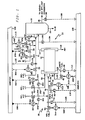
- an incinerator generally designated at 10 which comprises a feed system generally indicated at 28, a rotary kiln 12, a kiln combustion products transfer duct 14, an afterburner 16, and an afterburner combustion product transfer duct 26.
- the rotary kiln 12 which is mounted at a slight incline from the horizontal plane, transfers its combustion gases through duct means 14 to the afterburner 16 to insure complete combustion of waste material prior to treatment for air pollutants.
- the bottom ash that remains in the kiln 12 after a material is incinerated is removed through ash duct 18.
- the slag formed in afterburner 16 is removed through duct 20. Combustion gases from the afterburner 16 are transferred through duct means 26 for further processing which can include quenching, scrubbing, separating, etc.
- the feed system supplies hazardous/toxic waste to be burned in the incinerator through a plurality of fluid conduit means which can be equipped with waste burners if desired.
- hazardous liquid or gaseous waste material is analyzed at least for composition, and based on elemental analysis a determination of the theoretical air required for complete combustion is made.
- the waste is then stored in bulk storage tanks, not shown in Figure 1, according to the analysis.
- the preanalyzed material is then supplied to the kiln 12 from bulk storage tanks, not shown, through conduit means 30 or 32, or is supplied to the afterburner through conduit means 40.
- waste fuel as used in this specification means the hazardous waste material to be destroyed.
- the hazardous waste material supplied through control valve 46 operably located in conduit means 30 is typically a low BTU waste fuel pumped to the kiln 12 from a bulk storage tank, not shown.
- the hazardous waste material supplied to the kiln 12 through control valve 48 operably located in conduit means 32, and which can also be supplied to the afterburner 16 through control valve 50 operably located in conduit means 40 is typically an organic material having a high BTU content. It is supplied to the multi-fuel burner 38 associated with the kiln 12, and the multi-fuel burner 36 associated with the afterburner 16 where it is mixed with primary air supplied to the kiln through conduit means 22, and to the afterburner through conduit means 24. As previously stated burners 36 and 38 are multi-fuel burners which means liquid fuel, gaseous fuel and vaporous fuel can be supplied to burners 36 and 38.
- auxiliary fuel such as natural gas or fuel oil is also supplied to the burner 38 and the burner 36 through control valves 54 and 56 respectively which are located in conduit means 34 and 41 respectively.
- Secondary combustion air is also supplied to the kiln 12 through control valve 52 which is operably located in conduit means 58.
- control valves are utilized to manipulate the flow of combustion air to the kiln 12 and the afterburner 16 as required for control of the incinerator.
- oxygen content of the combustion products of the kiln and the afterburner are controlled by manipulating the flow rate of the combustion air supplied to the kiln and the afterburner.
- Flow transducer 88 in combination with flow sensor 102 which is operably located in conduit means 30 provides an output signal 114 which is representative of the actual flow rate of waste fuel through conduit means 30.
- Signal 114 is provided from the flow transducer 88 as an input to computer 100.
- Analyzer transducer 192 which is an oxygen analyzer operably located in conduit means 14 provides an output signal 194 which is representative of the percent oxygen content of the combustion gases exiting the kiln 12. Signal 194 is provided from analyzer transducer 192 as an input to computer 100.
- analyzer transducer 196 which is an oxygen analyzer operably located in conduit means 26 provides an output signal 198 which is representative of percent oxygen content of the combustion gases exiting the afterburner 16. Signal 198 is provided from analyzer transducer 196 as an input to computer 100.
- the computer 100 In response to the aforementioned process variables, the predetermined waste fuel analysis, and in response to oxygen level set points determined by the regulating agency for the particular type of hazardous waste being burned, the computer 100 provides three (3) control signals to manipulate combustion air to the incinerator as will be more fully described hereinafter.
- signal 114 which is representative of the actual flow rate of waste fuel flowing in conduit means 30 is provided to multiplying block 134.
- Signal 136 which is an operated entered input representative of the predetermined theoretical air to fuel ratio of the waste fuel flowing at conduit means 30 is provided as a second input to multiplying block 134.
- Signal 136 is multiplied by signal 114 to establish signal 138 which is representative of the theoretical air flow required for the combustion of the waste fuel flowing in conduit means 30.
- Signal 138 is provided to summing block 140.
- signals representative of the theoretical air flow required for each fuel supplied to the kiln are provided to summing blocks as illustrated in Fig. 3.
- signals 116 and 120 which are representative of the actual flow rates in conduit means 32, and 34 respectively are multiplied by signals 152 and 156 which are operator entered signals representative of the respective predetermined air to fuel ratios for the fluids flowing in conduit means 32 and 34 to provide the respective air flow signals 160 and 163 from multiplying blocks 144 and 150 respectively.
- Signals 138, 160 and 163 are summed in summation block 140 to establish signal 164 which is representative of the total theoretical air flow required for combustion of all fuel supplied to the kiln based on the actual (measured) fuel flow rates.
- Signal 164 is provided from summation block 140 as a first input to high select block 180.
- High select block 180 is also provided with signal 234 which is representative of the total theoretical air flow for complete combustion of all fuels supplied to the kiln based on the commanded fuel flow rates as will be described more fully below.
- Signal 296 which is representative of the desired flow rate of waste fuel flowing in conduit means 30 is provided from low select block 274 as a set point input to flow controller 310 illustrated in Fig. 1. As shown in Fig. 2 signal 296 is selected as the lower one of signals 272 and 288 which are both representative of a flow rate for the waste fuel flowing in conduit means 30. Signal 272 and 288 will generally be known since typically they are provided from an associated combustion fuel flow control system.
- signal 272 will typically be representative of a fuel flow rate for the waste fuel flowing in conduit means 30 required to prevent the incinerator from violating a particular constraint such as a maximum temperature, maximum pressure, or maximum heat release rate.
- Signal 272 is referred to as a "command" signal.
- a command signal is a signal representative of the maximum flow rate of a fuel that can be provided to maintain an incinerator operating condition.
- signal 288 is an air limiting signal, representative of the portion of the actual air flow in the kiln 12 available for combustion of the fuel flowing in conduit means 30. If signal 288 is selected for signal 296, the fuel flow through conduit means 30 is manipulated in response to the limited air flow which corresponds to the fraction of the total fuel that is supplied through conduit means 30. This condition creates a cross-limiting where the fuel flow in conduit means 30 is limited by the total available air, and the air flow is limited to match the limited fuel flow.
- the kiln air flow can be measured by any suitable means, for example, by summing air flows indicated by flow meters, not shown in the drawings, for primary and secondary air supplied to the kiln.
- Signal 272 is also provided from low select block 274 as an input to multiplying block 170 illustrated in Fig. 3.
- signals 298 and 300 which are representative of the desired fuel flow rates for fuel flowing in conduit means 32 and 34 respectively are provided from low select blocks 282 and 284 respectively as set point inputs to flow controllers 312 and 314 respectively.
- signals 276 and 278 which like signal 272 are fuel command signals are also provided as inputs to multiplying blocks 172 and 174 respectively illustrated in Fig. 3.
- Signals 290 and 292 illustrated in Fig. 2 are air limiting signals which, like signal 288 can be selected for control signals over their corresponding command signals if there is insufficient air available.
- Signal 136 which, as previously indicated, is representative of the air to fuel ratio of the waste fuel flowing in conduit means 30 is multiplied in multiplying block 170 by signal 272 to establish signal 224 which is representative of the theoretical air flow required to combust the fuel that could be supplied to the kiln 12 through conduit means 30 in response to fuel command signal 272.
- signals 152 and 156 are multiplied by signals 276 and 278 respectively in multiplying blocks 172 and 174 respectively to establish signals 266 and 230 respectively which are representative of the air flow required to completely combust the fuel supplied to the kiln through conduit means 32 and 34 respectively in response to their corresponding fuel command signals.
- Signals 224, 226 and 230 are summed in summation block 142 to establish signal 234 which is representative of the total theoretical air flow required for complete combustion of all fuel supplied to the kiln based on fuel commanded flow rates.
- Signal 234 is provided from summation block 142 as a second input to high select block 180.
- high select block 180 In response to signals 164 and 234 high select block 180 provides an output signal 236 which is representative of the highest flow rate represented by signals 164 and 234. Signal 236 is provided from high select block 180 as a first input to multiplying block 240.
- Signal 194 which is representative of the percent oxygen content of combustion gases exiting the kiln 12 is provided as a process variable input to oxygen controller 200.
- Signal 202 which is representative of the desired excess oxygen for the kiln combustion gases is provided as a set point signal for oxygen controller 200.
- Oxygen controller 200 provides an output signal 206 which is representative of the difference between signals 194 and 202, and which is scaled so as to be representative of an excess oxygen factor required to bias or trim the total theoretical air flow signal 236 so that the actual excess oxygen in the kiln combustion gases is substantially equal to the excess oxygen represented by set point signal 202.
- the excess oxygen factor indicates the increase in the magnitude of signal 236 required to obtain the air flow for complete combustion of waste fuel in the kiln 12.
- Signal 206 is provided from oxygen controller 200 as a second input to multiplying block 240.
- Signal 206 is multiplied by signal 236 in multiplying block 240 to establish signal 242 which is representative of the desired air flow for the kiln 12.
- Signal 242 is provided from multiplying block 240 as an input to the split-range computer block 244.
- the full scale output of a control signal is divided to operate over two or more portions of its full range so that different portions of the control signal can operate different valves or other final control devices.
- the full scale range of signal 242 is divided into two portions such that the lesser magnitude portion of signal 242 is provided as signal 330 to the set point of primary air controller 62.
- the greater magnitude portion of signal 242 is provided as signal 332 as the set point of secondary air controller 64 as illustrated in Fig. 1.
- Flow transducer 342 in combination with a flow sensor 344 operably located in conduit means 22 provides an output signal 340 which is representative of the actual air flow rate in conduit means 22.
- Flow controller 62 is also provided with signal 340 and in response to signals 340 and 330 flow controller 62 provides an output signal 346 which is responsive to the difference between signals 330 and 340.
- Signal 346 is scaled so as to be representative of the position of control valve 44 required to maintain the actual flow represented by signal 340 substantially equal to the desired flow represented by signal 330.
- Signal 346 is provided from flow controller 62 to control valve 44 and control valve 44 is manipulated in response thereto.
- signal 332 is provided from split-range computer block 244 as a set point signal for secondary air controller 64.
- Flow transducer 350 in combination with a flow sensor 352 operably located in conduit means 58 provides an output signal 354 which is representative of the actual air flow in conduit means 58.
- Signal 354 is provided as a process variable input to controller 64.
- controller 64 provides an output signal 356 which is responsive to the difference between signals 332 and 354.
- Signal 356 is scaled to be representative of the position of control valve 52 required to maintain the actual air flow rate in conduit means 58 represented by signal 354 substantially equal to the desired flow rate represented by set point signal 332.
- Signal 356 is provided from controller 64 to control valve 52 and control valve 52 is manipulated in response thereto.
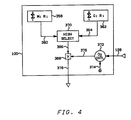
- Signal 360 is provided from computer block 358 as a first input to high select block 370.
- high select block 370 In response to signals 360 and 364 high select block 370 provides an output signal 366 which is representative of the highest flow rate represented by signals 360 and 364. Signal 366 is provided from high select block 370 as a first input to multiplying block 368. Signal 198 which is representative of the percent oxygen content of combustion gases exiting afterburner 16 is provided as a process variable input to the oxygen controller 372. Signal 374 which is representative of the desired excess oxygen for the afterburner combustion gases is provided as a set point signal for the oxygen controller 372.
- Oxygen controller 372 provides an output signal 376 which is representative of the difference between signals 374 and 198, and which is scaled to be representative of an excess oxygen factor required to bias or trim the total theoretical air flow as represented by signal 366 so that the actual excess oxygen in the afterburner is substantially equal to the excess oxygen represented by set point signal 374.
- the excess oxygen factor indicates the increase in the magnitude of signal 366 required to obtain the air flow for complete combustion of the waste fuel in afterburner 16.
- Signal 376 is provided from the oxygen controller 372 as a second input to multiplying block 368.
- Signal 376 is multiplied by signal 366 in multiplying block 368 to establish signal 378 which is representative of the desired air flow for the afterburner 16.
- Signal 378 is provided from multiplying block 368 as a set point input for flow controller 66 as illustrated in Fig. 1.
- Flow transducer 320 in combination with flow sensor 322 which is operably located in conduit means 24 provides an output signal 324 which is representative of the actual air flow in conduit means 24.
- Signal 324 is provided from flow transducer 320 as the process variable input to flow controller 66.
- flow controller 66 provides an output signal 326 which is responsive to the difference between signals 378 and 324 and is scaled to be representative of the position of control valve 68 required to maintain the actual combustion air flow to the afterburner substantially equal to the desired air flow represented by signal 378.
- Signal 326 is provided from flow controller 66 to control valve 68 and control valve 68 is manipulated in response thereto.
- the control system of the present invention will insure that the incinerator operates with sufficient air for complete combustion of the fuel supplied to the incinerator even when the fuel flow rate is changing.
- Figs. 1-4 Specific components which can be used in the practice of the invention as illustrated in Fig. 1 such as flow transducer 70, 72, 88, 90, 92, 320, 342, and 350; oxygen transducers 192 and 196; control valves 44, 46, 48, 50, 52, 54, 56 and 68; and flow controllers 62, 64, 66, 310, 312, and 314 are each well-know, commercially available control components such as are described at length in Perry's Chemical Engineers Handbook, 4th Edition, Chapter 22, McGraw-Hill.
- the controllers illustrated in Figs. 3 and 4 as well as the calculation blocks and the select circuits illustrated in Figs. 3 and 4 may be implemented by using a digital computer such as the OPTROL® DCS manufactured by Applied Automation, Inc., Bartlesville, Oklahoma.
Landscapes
- Engineering & Computer Science (AREA)
- Chemical & Material Sciences (AREA)
- Combustion & Propulsion (AREA)
- Mechanical Engineering (AREA)
- General Engineering & Computer Science (AREA)
- Incineration Of Waste (AREA)
Applications Claiming Priority (2)
| Application Number | Priority Date | Filing Date | Title |
|---|---|---|---|
| US07/082,153 US4742783A (en) | 1987-08-06 | 1987-08-06 | Incinerator combustion air control |
| US82153 | 1987-08-06 |
Publications (1)
| Publication Number | Publication Date |
|---|---|
| EP0302467A1 true EP0302467A1 (de) | 1989-02-08 |
Family
ID=22169389
Family Applications (1)
| Application Number | Title | Priority Date | Filing Date |
|---|---|---|---|
| EP88112624A Withdrawn EP0302467A1 (de) | 1987-08-06 | 1988-08-03 | Verbrennungsluftregelung bei einer Abfallverbrennungsanlage |
Country Status (2)
| Country | Link |
|---|---|
| US (1) | US4742783A (de) |
| EP (1) | EP0302467A1 (de) |
Cited By (1)
| Publication number | Priority date | Publication date | Assignee | Title |
|---|---|---|---|---|
| US11560493B2 (en) * | 2018-04-06 | 2023-01-24 | Ndsu Research Foundation | Use of amphiphilic surface modifying additives to improve performance of siloxane-polyurethane fouling-release coatings |
Families Citing this family (12)
| Publication number | Priority date | Publication date | Assignee | Title |
|---|---|---|---|---|
| DE3852174T2 (de) * | 1987-05-01 | 1995-06-29 | Ebara Corp | Verfahren zur steuerung der verbrennung für wirbelschichtverbrennungsanlagen. |
| DE3825933A1 (de) * | 1988-07-29 | 1990-02-01 | Martin Umwelt & Energietech | Verfahren zur regelung der feuerleistung bei verbrennungsanlagen |
| US4942832A (en) * | 1989-05-04 | 1990-07-24 | Bloom Engineering Company, Inc. | Method and device for controlling NOx emissions by vitiation |
| US5120214A (en) * | 1989-11-13 | 1992-06-09 | Control Techtronics, Inc. | Acoustical burner control system and method |
| US5044326A (en) * | 1990-03-14 | 1991-09-03 | Aqua-Chem, Inc. | Flammable waste liquid combustion system and method |
| US5176086A (en) * | 1992-03-16 | 1993-01-05 | Praxair Technology, Inc. | Method for operating an incinerator with simultaneous control of temperature and products of incomplete combustion |
| US6622645B2 (en) * | 2001-06-15 | 2003-09-23 | Honeywell International Inc. | Combustion optimization with inferential sensor |
| RU2415339C2 (ru) * | 2008-05-29 | 2011-03-27 | Мартин ГмбХ Фюр Умвельт-Унд Энергитехник | Установка для сжигания и способ регулирования установки для сжигания |
| US20110269081A1 (en) * | 2010-05-03 | 2011-11-03 | Bayer Materialscience Llc | Systems and processes for improved combustion control |
| DE102013104837B4 (de) * | 2012-05-11 | 2025-06-12 | Fisher-Rosemount Systems, Inc. | Verfahren und Vorrichtung zum Steuern von Verbrennungsprozesssystemen |
| US20140370183A1 (en) * | 2013-06-14 | 2014-12-18 | Roy A. Terry | Method Of Restoring A System Of Pipes |
| US20160018107A1 (en) * | 2014-07-18 | 2016-01-21 | Magnegas Corporation | Using an Arc-Produced Gas in the Production of Energy from Biomass |
Citations (4)
| Publication number | Priority date | Publication date | Assignee | Title |
|---|---|---|---|---|
| US4097218A (en) * | 1976-11-09 | 1978-06-27 | Mobil Oil Corporation | Means and method for controlling excess air inflow |
| DD133996A1 (de) * | 1977-12-21 | 1979-01-31 | Guenther Focke | Schaltung zum regeln des verbrennungsluftstromes in waermeerzeugungsanlagen |
| WO1986001581A1 (en) * | 1984-08-29 | 1986-03-13 | West John S | System and process for controlling the flow of air and fuel to a burner |
| US4576570A (en) * | 1984-06-08 | 1986-03-18 | Republic Steel Corporation | Automatic combustion control apparatus and method |
Family Cites Families (10)
| Publication number | Priority date | Publication date | Assignee | Title |
|---|---|---|---|---|
| US3607117A (en) * | 1969-07-28 | 1971-09-21 | Rust Engineering Co | Black liquor recovery boiler combustion and safety control system |
| US3734675A (en) * | 1971-07-13 | 1973-05-22 | Phillips Petroleum Co | Burner controlling apparatus and method |
| US4013023A (en) * | 1975-12-29 | 1977-03-22 | Envirotech Corporation | Incineration method and system |
| FR2443645A1 (fr) * | 1978-12-04 | 1980-07-04 | Air Liquide | Procede et installation de traitement de dechets industriels |
| US4330260A (en) * | 1979-01-31 | 1982-05-18 | Jorgensen Lars L S | Method and apparatus for regulating the combustion in a furnace |
| US4332206A (en) * | 1980-05-09 | 1982-06-01 | The Boeing Company | Afterburner for combustion of starved-air combustor fuel gas containing suspended solid fuel and fly ash |
| US4320709A (en) * | 1980-09-29 | 1982-03-23 | Pyro-Sciences, Inc. | Hazardous materials incineration system |
| US4520741A (en) * | 1981-12-31 | 1985-06-04 | Ensco, Inc. | Waste disposal |
| US4517906A (en) * | 1983-08-30 | 1985-05-21 | Zimpro Inc. | Method and apparatus for controlling auxiliary fuel addition to a pyrolysis furnace |
| US4557686A (en) * | 1984-07-16 | 1985-12-10 | Phillips Petroleum Company | Control of the flow of fuel to multiple burners |
-
1987
- 1987-08-06 US US07/082,153 patent/US4742783A/en not_active Expired - Fee Related
-
1988
- 1988-08-03 EP EP88112624A patent/EP0302467A1/de not_active Withdrawn
Patent Citations (4)
| Publication number | Priority date | Publication date | Assignee | Title |
|---|---|---|---|---|
| US4097218A (en) * | 1976-11-09 | 1978-06-27 | Mobil Oil Corporation | Means and method for controlling excess air inflow |
| DD133996A1 (de) * | 1977-12-21 | 1979-01-31 | Guenther Focke | Schaltung zum regeln des verbrennungsluftstromes in waermeerzeugungsanlagen |
| US4576570A (en) * | 1984-06-08 | 1986-03-18 | Republic Steel Corporation | Automatic combustion control apparatus and method |
| WO1986001581A1 (en) * | 1984-08-29 | 1986-03-13 | West John S | System and process for controlling the flow of air and fuel to a burner |
Cited By (1)
| Publication number | Priority date | Publication date | Assignee | Title |
|---|---|---|---|---|
| US11560493B2 (en) * | 2018-04-06 | 2023-01-24 | Ndsu Research Foundation | Use of amphiphilic surface modifying additives to improve performance of siloxane-polyurethane fouling-release coatings |
Also Published As
| Publication number | Publication date |
|---|---|
| US4742783A (en) | 1988-05-10 |
Similar Documents
| Publication | Publication Date | Title |
|---|---|---|
| US4742783A (en) | Incinerator combustion air control | |
| Holmblad et al. | Control of a cement kiln by fuzzy logic | |
| US7660639B2 (en) | Control system for control subject having combustion unit and control system for plant having boiler | |
| Sugeno | An introductory survey of fuzzy control | |
| US4739714A (en) | Incinerator combustion fuel control | |
| US4505668A (en) | Control of smoke emissions from a flare stack | |
| US4369803A (en) | Control of fuel gas blending | |
| US4497283A (en) | Boiler control | |
| CN1027178C (zh) | 从细粒至粉状的燃料在部分氧化[制取煤气]时,确定和控制燃料流量的方法 | |
| US4408569A (en) | Control of a furnace | |
| US4473490A (en) | Control of a reforming furnace | |
| EP1188987B1 (de) | Temperaturregelungsverfahren in Müllverbrennungsanlagen | |
| US4559785A (en) | Boiler control | |
| US4144997A (en) | Control of multiple fuel streams to a burner | |
| US4498428A (en) | Combustion control for a boiler | |
| US4979091A (en) | Control of a blending system | |
| US4583497A (en) | Boiler control | |
| CN101859102B (zh) | 燃煤锅炉的气体浓度推断方法以及气体浓度推断装置 | |
| US4557686A (en) | Control of the flow of fuel to multiple burners | |
| US4237092A (en) | Method and apparatus for producing carbon black | |
| CN112556441A (zh) | 轧钢加热炉及其烟气管网非对称特性动态控制方法 | |
| US4380317A (en) | Furnace control | |
| JP2025503980A (ja) | 熱燃焼システムを制御する方法 | |
| JPH028612A (ja) | 二系列以上の燃焼炉を有する燃焼装置の運転方法 | |
| JPS631494B2 (de) |
Legal Events
| Date | Code | Title | Description |
|---|---|---|---|
| PUAI | Public reference made under article 153(3) epc to a published international application that has entered the european phase |
Free format text: ORIGINAL CODE: 0009012 |
|
| AK | Designated contracting states |
Kind code of ref document: A1 Designated state(s): AT BE CH DE ES FR GB GR IT LI LU NL SE |
|
| 17P | Request for examination filed |
Effective date: 19890705 |
|
| 17Q | First examination report despatched |
Effective date: 19900118 |
|
| STAA | Information on the status of an ep patent application or granted ep patent |
Free format text: STATUS: THE APPLICATION HAS BEEN WITHDRAWN |
|
| 18W | Application withdrawn |
Withdrawal date: 19910110 |
|
| R18W | Application withdrawn (corrected) |
Effective date: 19910110 |