EP0296473A2 - Gamma radiation resistant polycarbonate compositions - Google Patents
Gamma radiation resistant polycarbonate compositions Download PDFInfo
- Publication number
- EP0296473A2 EP0296473A2 EP88109524A EP88109524A EP0296473A2 EP 0296473 A2 EP0296473 A2 EP 0296473A2 EP 88109524 A EP88109524 A EP 88109524A EP 88109524 A EP88109524 A EP 88109524A EP 0296473 A2 EP0296473 A2 EP 0296473A2
- Authority
- EP
- European Patent Office
- Prior art keywords
- bis
- alkyl
- composition
- aryl
- hydroxyphenyl
- Prior art date
- Legal status (The legal status is an assumption and is not a legal conclusion. Google has not performed a legal analysis and makes no representation as to the accuracy of the status listed.)
- Granted
Links
- 0 C*1c(cccc2)c2O[C@](*)C1 Chemical compound C*1c(cccc2)c2O[C@](*)C1 0.000 description 2
Classifications
-
- C—CHEMISTRY; METALLURGY
- C08—ORGANIC MACROMOLECULAR COMPOUNDS; THEIR PREPARATION OR CHEMICAL WORKING-UP; COMPOSITIONS BASED THEREON
- C08K—Use of inorganic or non-macromolecular organic substances as compounding ingredients
- C08K5/00—Use of organic ingredients
- C08K5/04—Oxygen-containing compounds
- C08K5/06—Ethers; Acetals; Ketals; Ortho-esters
-
- C—CHEMISTRY; METALLURGY
- C08—ORGANIC MACROMOLECULAR COMPOUNDS; THEIR PREPARATION OR CHEMICAL WORKING-UP; COMPOSITIONS BASED THEREON
- C08K—Use of inorganic or non-macromolecular organic substances as compounding ingredients
- C08K5/00—Use of organic ingredients
- C08K5/04—Oxygen-containing compounds
- C08K5/15—Heterocyclic compounds having oxygen in the ring
- C08K5/151—Heterocyclic compounds having oxygen in the ring having one oxygen atom in the ring
Definitions
- the invention relates to thermoplastic polycarbonate molding compositions which are rendered resistant to gamma-radiation by incorporating therewith about 0.1 to about 10 percent by weight of a stabilizing agent selected from the group consisting of wherein R is a hydrogen or a halogen atom or a C1-C10-alkyl, C6-C10 aryl, C6-C18 arylalkyl or a C4-C10 cycloalkyl radical, n is an integer of at least 1 and Y and Y′ independently are a hydrogen atom, an C6-C10 aryl, C1-C10 alkyl or a C6-C18 aralkyl radical or wherein m is 1 or 3-6, R1, R2 and R3 independently are hydrogen atoms or a C1-C10 alkyl, C6-C10 aryl or a C6-C18 arylalkyl radical.
- a stabilizing agent selected from the group consisting of wherein R is a hydrogen
- polycarbonate resin Because of its physical and mechanical properties polycarbonate resin was found to be eminently suitable for a variety of applications in the medical field. Applications which require sterilization by exposure to gamma radiation present a problem since polycarbonate tends to yellow and show increased haze.
- the art is noted to include U.S. Patent 4,624,972 which disclosed polycarbonate compositions resistant to gamma radiation containing an ester of an aromatic polycarboxylic acid.
- European Patent Application 152,012 disclosed a method for increasing the ionizing radiation resistance of polycarbonate by including in the composition a non-polymeric compound which is characterized by a strong oxidizing action and/or reaction at high reaction rate with active species such as E or OH radicals or hydrated electrons formed by ionizing radiation.
- dihydroxy compounds useful in the practice of the invention are hydroquinone, resorcinol, bis-(hydroxyphenyl) alkanes, bis-(hydroxyphenyl) ethers, bis-(hydroxyphenyl)-ketones, bis-(hydroxyphenyl)-sulfoxides, bis-(hydroxyphenyl)-sulfides, bis-(hydroxyphenyl)-sulfones, bis-(hydroxyphenyl)-sulfides, bis-(hydroxyphenyl)-sulfones, and ⁇ , ⁇ ′-bis-(hydroxyphenyl)-diisopropyl-benzenes, as well as their nuclear-alkylated compounds.
- the most preferred bisphenol is 2,2,-bis-(4-hydroxyphenyl)-propane (bisphenol A).
- the polycarbonates of the invention may entail in their structure units derived from one or more of the suitable bisphenols.
- phenolphthalein-based polycarbonates such as are described in U.S. Patents 3,036,036 and 4,210,741, both incorporated by reference herein.
- the polycarbonates of the invention may also be branched by condensing therein small quantities, e.g., 0.05-2.0 mol % (relative to the bisphenols) of polyhydroxyl compound.
- Polycarbonates of this type have been described, for example, in German Offenlegungsschriften 1,570,553; 2,116,974 and 2,113,374; British Patents 885,442 and 1,079,821 and U.S. Patent 3,544,514.
- polyhydroxyl compounds which may be used for this purpose: phloroglucinol; 4,6-dimethyl-2,4,6-tri-(4-hydroxyphenyl)-heptane; 1,3,5-tri-(4-hydroxyphenyl)-benzene; 1,1,1-tri-(4-hydroxyphenyl)-ethane; tri-(4-hydroxyphenyl)-phenylmethane; 2,2,-bis-[4,4′-dihydroxydiphenyl)-cyclohexyl]-propane; 2,4-bis-(4-hydroxy-1-isopropylidine)-phenol; 2,6-bis-(2′-dihydroxy-5′- methylbenzyl)-4-methylphenyl; 2,4-dihydroxy-benzoic acid; 2-(4-hydroxyphenyl)-2-(2,4-dihydroxyphenyl)-propane and 1,4-bis-(4,4′-dihydroxytriphenylmethyl)
- the preferred process for the preparation of polycarbonates is the interfacial polycondensation process.
- Suitable polycarbonate resins are available in commerce, for instance, under the tradenames Makrolon FCR, Makrolon 2600, Makrolon 2800 and Makrolon 3100, all of which are bisphenol A based homopolycarbonate resins differing in terms of their respective molecular weights and characterized in that their melt flow indices (MFR) per ASTM D-1238 are about 16.5-24, 13-16, 7.5-13.0 and 3.5-6.5 gm/10 min., respectively. These are products of Mobay Corporation of Pittsburgh, Pennsylvania.
- MFR melt flow indices
- the stabilizing agents of the invention conforming to the embodiments where Y and Y1 are hydrogen atoms are commercially available compounds, for instance, under the tradename Multranol from Mobay Corporation.
- the preparation of the preferred, end-blocked embodiment is demonstrated below.
- the more preferred embodiments of the stabilizing agent are the compounds of formula Ia wherein Y and Y1 denote end blocking groups derived from ethyl vinyl ether, or dihydropyran.
- the preferred end blocked stabilizer of the invention offers certain advantages over its unblocked counterpart - the embodiment where Y's are hydrogen atoms - since it is inert.
- a comparison of the optical properties of polycarbonate compositions containing these stabilizers show that the end-blocked embodiment is more effective than its counterpart at high molding temperatures.
- the table below summarize the comparison between compositions each containing 1% of a stabilizer. In Composition 1 the stabilizer conforms structurally to: and in Composition 2 the stabilizer was The polycarbonate resin was Makrolon M-40 (MFR 6-11.9 gm/10 min)
- R is as defined for Formula I and II above and where the catalyst is a Lewis acid such as toluene sulfonic acid, HCl or a benzene sulfonic acid.
- a polyether conforming structurally to Formula VII above (300 grams) was dissolved in 400 ml of tetrahydrofuran in a 100 ml three-necked flask. 0.25 grams of p-toluene sulfonic acid - a catalyst - was then added and the mixture stirred. After complete dissolution there was slowly added dihydropyran (26.4 g). A 5 degree exotherm occurred, raising the final temperature to about 60°C. The temperature was then raised to reflux for 8 additional hours. Afterward an appropriate amount of triethylamine was added to the solution to remove excess acid. The solution was then filtered and vacuum distilled to remove any unreacted dihydropyran and tetrahydrofuran from the product.
- compositions of the invention containing the end-blocked stabilizers prepared in accordance with Example 1 above were evaluated as to their optical properties both before and after exposure to gamma radiation.
- the tables below summarizes the results of the evaluation and includes a comparison between compositions containing no stabilizer and composition containing 0.5% and 1% of the stabilizer.
- the polycarbonate resin was Makrolon FCR and in Table 2 the resin was Makrolon 2800 which is a bisphenol-A based homopolymer having a melt flow index of about 6- 11.9 gm/10 min.
- compositions of the invention may be prepared by following conventional procedures for the preparation of polycarbonate molding compositions.
- the stabilizing agent may be introduced by directly mixing it with the polycarbonate.
- Other conventional additives may also be incorporated in the composition for their art-recognized utility. These include release agents, plasticizers, stabilizers, antioxidants, fillers, reinforcements and the like.
Landscapes
- Chemical & Material Sciences (AREA)
- Health & Medical Sciences (AREA)
- Chemical Kinetics & Catalysis (AREA)
- Medicinal Chemistry (AREA)
- Polymers & Plastics (AREA)
- Organic Chemistry (AREA)
- Compositions Of Macromolecular Compounds (AREA)
Abstract

Description
- The invention is directed to polycarbonate molding compositions and more particularly, to thermoplastic compositions resistant to gamma radiation.
- The invention relates to thermoplastic polycarbonate molding compositions which are rendered resistant to gamma-radiation by incorporating therewith about 0.1 to about 10 percent by weight of a stabilizing agent selected from the group consisting of


- Because of its physical and mechanical properties polycarbonate resin was found to be eminently suitable for a variety of applications in the medical field. Applications which require sterilization by exposure to gamma radiation present a problem since polycarbonate tends to yellow and show increased haze. The art is noted to include U.S. Patent 4,624,972 which disclosed polycarbonate compositions resistant to gamma radiation containing an ester of an aromatic polycarboxylic acid. European Patent Application 152,012 disclosed a method for increasing the ionizing radiation resistance of polycarbonate by including in the composition a non-polymeric compound which is characterized by a strong oxidizing action and/or reaction at high reaction rate with active species such as E or OH radicals or hydrated electrons formed by ionizing radiation. U.S. Patent 4,451,691 disclosed a container prepared from a copolyester which has been modified with either a dimer acid or a dimer glycol. The copolyester is said to have an improved resistance to gamma radiation. Radiation stable polyolefin compositions have been disclosed in U.S. Patent 4,460,445.
- The composition of the invention comprises a polycarbonate resin and a stabilizing agent in an amount sufficient to enhance the resistance of the resin to yellowness and to the formation of haze upon exposure to gamma radiation. Preferably, the composition contains about 0.1 to 10.0 percent of the stabilizing agent.
- The polycarbonate resins useful in the practice of the invention are homopolycarbonates, copolycarbonates and terpolycarbonates or mixtures thereof. The polycarbonates generally have a weight average molecular weight of 10,000-200,000, preferably 20,000-80,000 and their melt flow rate, per ASTM D-1238 at 300°C, is about 1 to about 65 gm/10 min., preferably about 2-15 gm/10 min. They may be prepared, for example, by the known diphasic interface process from a carbonic acid derivative such as phosgene and dihydroxy compounds by polycondensation (see German Offenlegungsschriften 2,063,050; 2,063,052; 1,570,703; 2,211,956; 2,211,957 and 2,248,817; French Patent 1,561,518; and the monograph H. Schnell, "Chemistry and Physics of Polycarbonates", Interscience Publishers, New York, 1964, all incorporated herein by reference).
- In the present context, dihydroxy compounds suitable for the preparation of the polycarbonates of the invention conform to the structural formulae (1) or (2)

A denotes an alkylene group with 1 to 8 carbon atoms, an alkylidene group with 2 to 8 carbon atoms, a cycloalkylene group with 5 to 15 carbon atoms, a cycloalkylidene group with 5 to 15 carbon atoms, a carbonyl group, an oxygen atom, a sulfur atom, -SO- or -SO₂- or a radical conforming to
Z denotes F, Cl, Br or C₁-C₄-alkyl and if several Z radicals are substituents in one aryl radical, they may be identical or different one from the other;
d denotes an integer of from 0 to 4; and
f denotes an integer of from 0 to 3. - Among the dihydroxy compounds useful in the practice of the invention are hydroquinone, resorcinol, bis-(hydroxyphenyl) alkanes, bis-(hydroxyphenyl) ethers, bis-(hydroxyphenyl)-ketones, bis-(hydroxyphenyl)-sulfoxides, bis-(hydroxyphenyl)-sulfides, bis-(hydroxyphenyl)-sulfones, bis-(hydroxyphenyl)-sulfides, bis-(hydroxyphenyl)-sulfones, andα,α′-bis-(hydroxyphenyl)-diisopropyl-benzenes, as well as their nuclear-alkylated compounds. These and further suitable aromatic dihydroxy compounds are described, for example, in U.S. Patents 3,028,356; 2,999,835; 3,148,172; 2,991,273; 3,271,367; and 2,999,846, all incorporated herein by reference. Further examples of suitable bisphenols are 2,2,-bis-(4-hydroxyphenyl)-propane (bisphenol A), 2,4-bis-(4-hydroxyphenyl)-2-methyl-butane, 1,1-bis-(4-hydroxyphenyl)-cyclohexane, α,α′-bis-(4-hydroxyphenyl)-p-diisopropylbenzene, 2,2,-bis-(3-methyl-4-hydroxyphenyl)-propane, 2,2,-bis-(3-chloro-4-hydroxyphenyl)-propane, bis-(3,5-dimethyl-4-hydroxyphenyl)- methane, 2,2,-bis-(3,5-dimethyl-4-hydroxyphenyl)-propane, bis-(3,5-dimethyl-4-hydroxyphenyl)-sulfide, bis-(3,5-dimethyl-4-hydroxyphenyl)-sulfoxide, bis-(3,5-dimethyl-4-hydroxyphenyl)-sulfone, hydroxybenzophenone, 2,4-bis-(3,5-dimethyl-4-hydroxyphenyl)-cyclohexane, α,α′-bis-(3,5-dimethyl-4-hydroxyphenyl)-p-diisopropylbenzene and 4,4′-sulfonyl diphenyl.
- Examples of particularly preferred aromatic bisphenols are 2,2-bis-(4-hydroxyphenyl)-propane, 2,2-bis-(3,5-dimethyl-4-hydroxyphenyl)-propane and 1,1,-bis-(4-hydroxyphenyl)-cyclohexane.
- The most preferred bisphenol is 2,2,-bis-(4-hydroxyphenyl)-propane (bisphenol A).
- The polycarbonates of the invention may entail in their structure units derived from one or more of the suitable bisphenols.
- Among the resins suitable in the practice of the invention are included phenolphthalein-based polycarbonates, copolycarbonates and terpolycarbonates such as are described in U.S. Patents 3,036,036 and 4,210,741, both incorporated by reference herein.
- The polycarbonates of the invention may also be branched by condensing therein small quantities, e.g., 0.05-2.0 mol % (relative to the bisphenols) of polyhydroxyl compound. Polycarbonates of this type have been described, for example, in German Offenlegungsschriften 1,570,553; 2,116,974 and 2,113,374; British Patents 885,442 and 1,079,821 and U.S. Patent 3,544,514. The following are some examples of polyhydroxyl compounds which may be used for this purpose: phloroglucinol; 4,6-dimethyl-2,4,6-tri-(4-hydroxyphenyl)-heptane; 1,3,5-tri-(4-hydroxyphenyl)-benzene; 1,1,1-tri-(4-hydroxyphenyl)-ethane; tri-(4-hydroxyphenyl)-phenylmethane; 2,2,-bis-[4,4′-dihydroxydiphenyl)-cyclohexyl]-propane; 2,4-bis-(4-hydroxy-1-isopropylidine)-phenol; 2,6-bis-(2′-dihydroxy-5′- methylbenzyl)-4-methylphenyl; 2,4-dihydroxy-benzoic acid; 2-(4-hydroxyphenyl)-2-(2,4-dihydroxyphenyl)-propane and 1,4-bis-(4,4′-dihydroxytriphenylmethyl)-benzene. Some of the other polyfunctional compounds are 2,4-dihydroxybenzoic acid, trimesic acid, cyanuric chloride and 3,3-bis-(4-hydroxyphenyl)-2-oxo-2,3-dihydroindole.
- In addition to the polycondensation process mentioned above, other processes for the preparation of the polycarbonates of the invention are polycondensation in a homogeneous phase and transesterification. The suitable processes are disclosed in the incorporated herein by references U.S. Patents 3,028,365; 2,999,846; 3,153,008; and 2,991,273.
- The preferred process for the preparation of polycarbonates is the interfacial polycondensation process.
- Other methods of synthesis in forming the polycarbonates of the invention such as disclosed in U.S. Patent 3,912,688, incorporated herein by reference, may be used.
- Suitable polycarbonate resins are available in commerce, for instance, under the tradenames Makrolon FCR, Makrolon 2600, Makrolon 2800 and Makrolon 3100, all of which are bisphenol A based homopolycarbonate resins differing in terms of their respective molecular weights and characterized in that their melt flow indices (MFR) per ASTM D-1238 are about 16.5-24, 13-16, 7.5-13.0 and 3.5-6.5 gm/10 min., respectively. These are products of Mobay Corporation of Pittsburgh, Pennsylvania.
- The stabilization agent in accordance with the present invention is a monomeric or a polymeric compound conforming structurally to


- A preferred stabilizing agent conforms to

- The stabilizing agents of the invention conforming to the embodiments where Y and Y¹ are hydrogen atoms are commercially available compounds, for instance, under the tradename Multranol from Mobay Corporation. The preparation of the preferred, end-blocked embodiment is demonstrated below. Among the more preferred embodiments of the stabilizing agent are the compounds of formula Ia wherein Y and Y¹ denote end blocking groups derived from ethyl vinyl ether, or dihydropyran.
- The preferred end blocked stabilizer of the invention offers certain advantages over its unblocked counterpart - the embodiment where Y's are hydrogen atoms - since it is inert. A comparison of the optical properties of polycarbonate compositions containing these stabilizers show that the end-blocked embodiment is more effective than its counterpart at high molding temperatures. The table below summarize the comparison between compositions each containing 1% of a stabilizer. In Composition 1 the stabilizer conforms structurally to:


- An additional comparison including the corresponding values for the unstabilized polycarbonate resins is shown below.

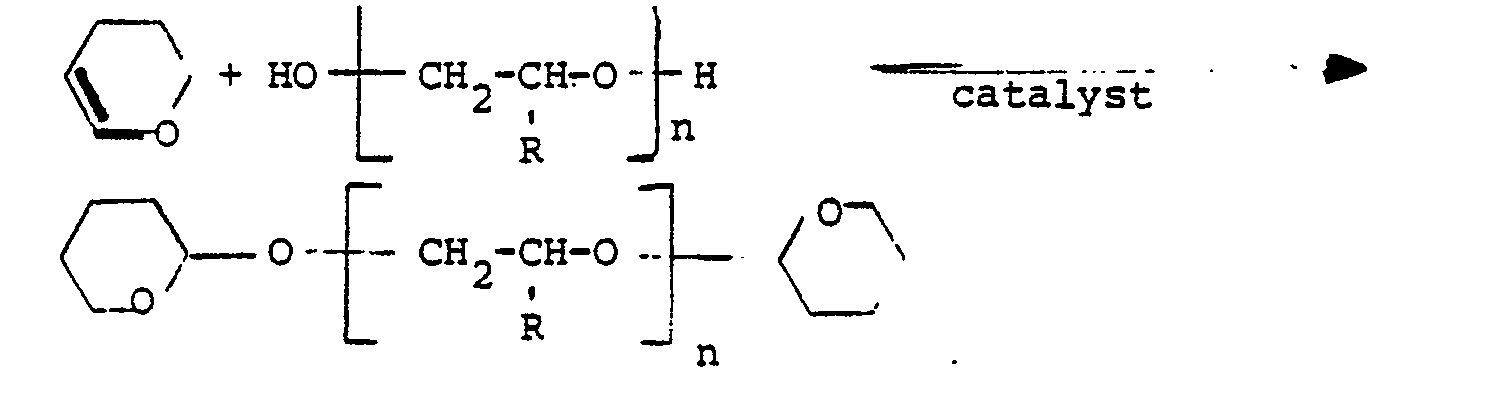
- The preparation of the preferred dihydropyran end-capped stabilizer is shown schematically as
- The invention is further illustrated but is not intended to be limited by the following examples in which all parts and percentages are by weight unless otherwise specified.
- A polyether conforming structurally to Formula VII above (300 grams) was dissolved in 400 ml of tetrahydrofuran in a 100 ml three-necked flask. 0.25 grams of p-toluene sulfonic acid - a catalyst - was then added and the mixture stirred. After complete dissolution there was slowly added dihydropyran (26.4 g). A 5 degree exotherm occurred, raising the final temperature to about 60°C. The temperature was then raised to reflux for 8 additional hours. Afterward an appropriate amount of triethylamine was added to the solution to remove excess acid. The solution was then filtered and vacuum distilled to remove any unreacted dihydropyran and tetrahydrofuran from the product.
- Compositions of the invention containing the end-blocked stabilizers prepared in accordance with Example 1 above were evaluated as to their optical properties both before and after exposure to gamma radiation. The tables below summarizes the results of the evaluation and includes a comparison between compositions containing no stabilizer and composition containing 0.5% and 1% of the stabilizer. In Table 1 the polycarbonate resin was Makrolon FCR and in Table 2 the resin was Makrolon 2800 which is a bisphenol-A based homopolymer having a melt flow index of about 6- 11.9 gm/10 min.


- The compositions of the invention may be prepared by following conventional procedures for the preparation of polycarbonate molding compositions. The stabilizing agent may be introduced by directly mixing it with the polycarbonate. Other conventional additives may also be incorporated in the composition for their art-recognized utility. These include release agents, plasticizers, stabilizers, antioxidants, fillers, reinforcements and the like.
- Although the invention has been described in detail in the foregoing for the purpose of illustration, it is to be understood that such detail is solely for that purpose and that variations can be made therein by those skilled in the art without departing from the spirit and scope of the invention except as it may be limited by the claims.
Claims (6)
(i) an aromatic polycarbonate resin and
(ii) a stabilizing agent selected from the group consisting of


Applications Claiming Priority (2)
| Application Number | Priority Date | Filing Date | Title |
|---|---|---|---|
| US6767087A | 1987-06-26 | 1987-06-26 | |
| US67670 | 1987-06-26 |
Publications (3)
| Publication Number | Publication Date |
|---|---|
| EP0296473A2 true EP0296473A2 (en) | 1988-12-28 |
| EP0296473A3 EP0296473A3 (en) | 1990-08-08 |
| EP0296473B1 EP0296473B1 (en) | 1992-10-14 |
Family
ID=22077581
Family Applications (1)
| Application Number | Title | Priority Date | Filing Date |
|---|---|---|---|
| EP88109524A Expired - Lifetime EP0296473B1 (en) | 1987-06-26 | 1988-06-15 | Gamma radiation resistant polycarbonate compositions |
Country Status (4)
| Country | Link |
|---|---|
| EP (1) | EP0296473B1 (en) |
| JP (1) | JPH0627255B2 (en) |
| CA (1) | CA1338226C (en) |
| DE (1) | DE3875284T2 (en) |
Cited By (20)
| Publication number | Priority date | Publication date | Assignee | Title |
|---|---|---|---|---|
| US4939186A (en) * | 1984-02-10 | 1990-07-03 | General Electric Company | Enhancing color stability to sterilizing radiation of polymer compositions |
| US4939185A (en) * | 1984-02-10 | 1990-07-03 | General Electric Company | Enhancing color stability to sterilizing radiation of polymer compositions |
| US4996246A (en) * | 1984-02-10 | 1991-02-26 | General Electric Company | Enhancing color stability to sterilizing radiation of polymer compositions |
| US4996248A (en) * | 1984-02-10 | 1991-02-26 | General Electic Company | Enhancing color stability to sterilizing radiation of polymer compositions |
| US4996245A (en) * | 1984-02-10 | 1991-02-26 | General Electric Company | Enhancing color stability to sterilizing radiation of polymer compositions |
| US4996244A (en) * | 1984-02-10 | 1991-02-26 | General Electric Company | Enhancing color stability to sterilizing radiation of polymer compositions |
| US4996247A (en) * | 1984-02-10 | 1991-02-26 | General Electric Company | Enhancing color stability to sterilizing radiation of polymer compositions |
| EP0359366A3 (en) * | 1988-09-06 | 1991-03-27 | Mitsubishi Kasei Corporation | Medical moldings and method for their preparation |
| US5006572A (en) * | 1989-01-24 | 1991-04-09 | Mobay Corporation | Gamma radiation resistant polycarbonate composition |
| EP0384134A3 (en) * | 1989-02-22 | 1991-04-24 | General Electric Company | Preparation of linear polycarbonates from cyclic oligomer compositions using aryl tetrahydropyranyl ether catalyst |
| EP0376289A3 (en) * | 1988-12-28 | 1991-07-31 | Mitsubishi Gas Chemical Company, Inc. | Polycarbonate resin composition for radiation sterilization |
| EP0439763A3 (en) * | 1990-01-30 | 1991-10-23 | Mobay Corporation | Gamma radiation resistant polyestercarbonate compositions |
| EP0535464A3 (en) * | 1991-10-01 | 1993-05-12 | Bayer Ag | Use of ring-aromatic sulphonic acid esters to stabilise thermoplastic polycarbonates against gamma radiation |
| EP0572889A1 (en) * | 1992-06-03 | 1993-12-08 | Bayer Corporation | Polycondensate composition stabilised against ionising-radiation induced degradation |
| US5476893A (en) * | 1991-06-12 | 1995-12-19 | Bayer Corporation | Use of nucleus-brominated phthalic acid anhydride for stabilizing thermoplastic polycarbonates against the effect of gamma-rays |
| EP0794218A3 (en) * | 1996-03-06 | 1998-12-16 | Mitsubishi Engineering-Plastics Corporation | Polycarbonate resin composition stabilized against radiation |
| US6166116A (en) * | 1999-06-03 | 2000-12-26 | The Dow Chemical Company | Carbonate polymer compositions stabilized against discoloration and physical property deterioration during sterilization by ionizing radiation |
| WO2008074696A1 (en) * | 2006-12-19 | 2008-06-26 | Saltigo Gmbh | Method for the homogeneously catalyzed production of terminal group-capped polyethers |
| WO2022086231A1 (en) * | 2020-10-23 | 2022-04-28 | 주식회사 엘지화학 | Polycarbonate composition and molded articles thereof |
| KR20220054207A (en) * | 2020-10-23 | 2022-05-02 | 주식회사 엘지화학 | Polycarbonate composition and molded articles thereof |
Families Citing this family (14)
| Publication number | Priority date | Publication date | Assignee | Title |
|---|---|---|---|---|
| JPH02238049A (en) * | 1989-03-10 | 1990-09-20 | Mitsubishi Gas Chem Co Inc | Polycarbonate molded article capable of being sterilized by irradiation |
| DE4127079C2 (en) * | 1991-07-16 | 2001-11-15 | Bayer Ag | Thermoplastic polycarbonates containing 0.01-10% by weight of polyalkylene oxides and 0.01-10% by weight of aromatic compounds which have isopropyl substituents, processes for their preparation, their use and processes for the production of products obtainable therefrom |
| KR100441551B1 (en) | 1995-07-12 | 2004-11-03 | 미쓰비시 엔지니어링-플라스틱스 코포레이션 | Polycarbonate resin composition |
| US6031033A (en) * | 1997-11-25 | 2000-02-29 | General Electric Company | Polycarbonate compositions comprising hindered amine light stabilizers and polyethers |
| JP4069364B2 (en) * | 2002-07-17 | 2008-04-02 | 三菱エンジニアリングプラスチックス株式会社 | Aromatic polycarbonate resin composition for light guide plate and surface light source body |
| US7078447B2 (en) | 2003-11-21 | 2006-07-18 | General Electric Company | Ionizing radiation stable polyarylestercarbonate compositions |
| JP5699240B1 (en) * | 2014-03-06 | 2015-04-08 | 三菱エンジニアリングプラスチックス株式会社 | Polycarbonate resin composition for thin optical parts and thin optical parts |
| CN105431488B (en) | 2013-07-26 | 2017-06-13 | 三菱工程塑料株式会社 | Thin walled optical component poly carbonate resin composition and thin walled optical component |
| JP5699188B2 (en) * | 2013-07-26 | 2015-04-08 | 三菱エンジニアリングプラスチックス株式会社 | Polycarbonate resin composition for thin optical parts and thin optical parts |
| JP6101745B2 (en) | 2015-01-07 | 2017-03-22 | 三菱エンジニアリングプラスチックス株式会社 | Polycarbonate resin composition for thin optical parts and thin optical parts |
| JP6522818B2 (en) | 2017-04-18 | 2019-05-29 | 三菱エンジニアリングプラスチックス株式会社 | Polycarbonate resin composition for optical parts and optical parts |
| EP3778773B1 (en) | 2018-03-27 | 2022-08-31 | Mitsubishi Engineering-Plastics Corporation | Polycarbonate resin composition |
| WO2021059884A1 (en) | 2019-09-25 | 2021-04-01 | 三菱瓦斯化学株式会社 | Polycarbonate resin |
| JP7163537B1 (en) * | 2021-03-25 | 2022-10-31 | 三菱エンジニアリングプラスチックス株式会社 | Polycarbonate resin composition |
Family Cites Families (2)
| Publication number | Priority date | Publication date | Assignee | Title |
|---|---|---|---|---|
| DE1282842B (en) * | 1963-04-11 | 1969-02-20 | Bayer Ag | Finely crystalline stretchable threads or films made of high molecular weight linear polycarbonates and processes for their production |
| US4904710A (en) * | 1985-10-31 | 1990-02-27 | The Dow Chemical Company | Gamma radiation resistant carbonate polymer compositions |
-
1988
- 1988-05-30 CA CA 568078 patent/CA1338226C/en not_active Expired - Fee Related
- 1988-06-15 EP EP88109524A patent/EP0296473B1/en not_active Expired - Lifetime
- 1988-06-15 DE DE19883875284 patent/DE3875284T2/en not_active Expired - Fee Related
- 1988-06-21 JP JP63151337A patent/JPH0627255B2/en not_active Expired - Fee Related
Cited By (28)
| Publication number | Priority date | Publication date | Assignee | Title |
|---|---|---|---|---|
| US4939186A (en) * | 1984-02-10 | 1990-07-03 | General Electric Company | Enhancing color stability to sterilizing radiation of polymer compositions |
| US4939185A (en) * | 1984-02-10 | 1990-07-03 | General Electric Company | Enhancing color stability to sterilizing radiation of polymer compositions |
| US4996246A (en) * | 1984-02-10 | 1991-02-26 | General Electric Company | Enhancing color stability to sterilizing radiation of polymer compositions |
| US4996248A (en) * | 1984-02-10 | 1991-02-26 | General Electic Company | Enhancing color stability to sterilizing radiation of polymer compositions |
| US4996245A (en) * | 1984-02-10 | 1991-02-26 | General Electric Company | Enhancing color stability to sterilizing radiation of polymer compositions |
| US4996244A (en) * | 1984-02-10 | 1991-02-26 | General Electric Company | Enhancing color stability to sterilizing radiation of polymer compositions |
| US4996247A (en) * | 1984-02-10 | 1991-02-26 | General Electric Company | Enhancing color stability to sterilizing radiation of polymer compositions |
| EP0359366A3 (en) * | 1988-09-06 | 1991-03-27 | Mitsubishi Kasei Corporation | Medical moldings and method for their preparation |
| US5118726A (en) * | 1988-12-28 | 1992-06-02 | Mitsubishi Gas Chemical Co., Ltd. | Polycarbonate resin composition for radiation sterilization |
| EP0376289A3 (en) * | 1988-12-28 | 1991-07-31 | Mitsubishi Gas Chemical Company, Inc. | Polycarbonate resin composition for radiation sterilization |
| US5006572A (en) * | 1989-01-24 | 1991-04-09 | Mobay Corporation | Gamma radiation resistant polycarbonate composition |
| EP0384134A3 (en) * | 1989-02-22 | 1991-04-24 | General Electric Company | Preparation of linear polycarbonates from cyclic oligomer compositions using aryl tetrahydropyranyl ether catalyst |
| EP0439763A3 (en) * | 1990-01-30 | 1991-10-23 | Mobay Corporation | Gamma radiation resistant polyestercarbonate compositions |
| US5476893A (en) * | 1991-06-12 | 1995-12-19 | Bayer Corporation | Use of nucleus-brominated phthalic acid anhydride for stabilizing thermoplastic polycarbonates against the effect of gamma-rays |
| EP0535464A3 (en) * | 1991-10-01 | 1993-05-12 | Bayer Ag | Use of ring-aromatic sulphonic acid esters to stabilise thermoplastic polycarbonates against gamma radiation |
| US5274009A (en) * | 1991-10-01 | 1993-12-28 | Bayer Aktiengesellschaft | Use of nuclear aromatic sulfonic acid esters for stabilizing thermoplastic polycarbonates against the effect of gamma-rays |
| EP0572889A1 (en) * | 1992-06-03 | 1993-12-08 | Bayer Corporation | Polycondensate composition stabilised against ionising-radiation induced degradation |
| US5382605A (en) * | 1992-06-03 | 1995-01-17 | Miles Inc. | Polycondensates which can be sterilized by γ-radiation |
| EP0794218A3 (en) * | 1996-03-06 | 1998-12-16 | Mitsubishi Engineering-Plastics Corporation | Polycarbonate resin composition stabilized against radiation |
| US6040367A (en) * | 1996-03-06 | 2000-03-21 | Mitsubishi Engineering-Plastics Corporation | Polycarbonate resin composition |
| US6166116A (en) * | 1999-06-03 | 2000-12-26 | The Dow Chemical Company | Carbonate polymer compositions stabilized against discoloration and physical property deterioration during sterilization by ionizing radiation |
| WO2008074696A1 (en) * | 2006-12-19 | 2008-06-26 | Saltigo Gmbh | Method for the homogeneously catalyzed production of terminal group-capped polyethers |
| US8742034B2 (en) | 2006-12-19 | 2014-06-03 | Saltigo Gmbh | Method for the homogeneously catalyzed production of terminal group-capped polyethers |
| WO2022086231A1 (en) * | 2020-10-23 | 2022-04-28 | 주식회사 엘지화학 | Polycarbonate composition and molded articles thereof |
| KR20220054207A (en) * | 2020-10-23 | 2022-05-02 | 주식회사 엘지화학 | Polycarbonate composition and molded articles thereof |
| CN115943185A (en) * | 2020-10-23 | 2023-04-07 | 株式会社Lg化学 | Polycarbonate composition and molded article thereof |
| US20230212390A1 (en) * | 2020-10-23 | 2023-07-06 | Lg Chem, Ltd. | Polycarbonate composition and molded articles thereof |
| EP4144800A4 (en) * | 2020-10-23 | 2023-09-27 | Lg Chem, Ltd. | Polycarbonate composition and molded articles thereof |
Also Published As
| Publication number | Publication date |
|---|---|
| EP0296473A3 (en) | 1990-08-08 |
| JPS6422959A (en) | 1989-01-25 |
| DE3875284D1 (en) | 1992-11-19 |
| JPH0627255B2 (en) | 1994-04-13 |
| CA1338226C (en) | 1996-04-02 |
| DE3875284T2 (en) | 1993-02-25 |
| EP0296473B1 (en) | 1992-10-14 |
Similar Documents
| Publication | Publication Date | Title |
|---|---|---|
| EP0296473B1 (en) | Gamma radiation resistant polycarbonate compositions | |
| US4804692A (en) | Gamma-radiation resistant polycarbonate compositions | |
| US4873271A (en) | Gamma radiation rsistant polycarbonate compositions | |
| JP2654216B2 (en) | Gamma ray irradiation resistant polycarbonate composition | |
| US5453457A (en) | Gamma-radiation-resistant polycarbonate composition | |
| US5187211A (en) | Gamma radiation resistant polycarbonate compositions | |
| US4874802A (en) | Polycarbonate compositions resistant to gamma radiation | |
| US4963598A (en) | Gamma radiation resistant polycarbonate compositions | |
| US5280050A (en) | Color-stable polycarbonate composition resistant to gamma-radiation | |
| US5214078A (en) | Gamma radiation resistant polycarbonate composition | |
| US5399658A (en) | Gamma-radiation-resistant polycarbonate composition | |
| US5382605A (en) | Polycondensates which can be sterilized by γ-radiation | |
| US5187208A (en) | Polycarbonate compositions resistant to gamma radiation | |
| EP0315865B1 (en) | Gamma-radiation resistant polycarbonate compositions | |
| EP1274781B1 (en) | Polycarbonate composition resistant to gamma radiation | |
| CA1335222C (en) | Hydrolytically stable polycarbonate compositions | |
| US6197853B1 (en) | Polycarbonate composition resistant to gamma radiation | |
| EP0439763A2 (en) | Gamma radiation resistant polyestercarbonate compositions | |
| HK1056189A (en) | Polycarbonate composition resistant to gamma radiation |
Legal Events
| Date | Code | Title | Description |
|---|---|---|---|
| PUAI | Public reference made under article 153(3) epc to a published international application that has entered the european phase |
Free format text: ORIGINAL CODE: 0009012 |
|
| 17P | Request for examination filed |
Effective date: 19880615 |
|
| AK | Designated contracting states |
Kind code of ref document: A2 Designated state(s): DE FR GB IT SE |
|
| PUAL | Search report despatched |
Free format text: ORIGINAL CODE: 0009013 |
|
| AK | Designated contracting states |
Kind code of ref document: A3 Designated state(s): DE FR GB IT SE |
|
| 17Q | First examination report despatched |
Effective date: 19910521 |
|
| GRAA | (expected) grant |
Free format text: ORIGINAL CODE: 0009210 |
|
| RAP1 | Party data changed (applicant data changed or rights of an application transferred) |
Owner name: MILES INC. |
|
| AK | Designated contracting states |
Kind code of ref document: B1 Designated state(s): DE FR GB IT SE |
|
| ITF | It: translation for a ep patent filed | ||
| REF | Corresponds to: |
Ref document number: 3875284 Country of ref document: DE Date of ref document: 19921119 |
|
| ET | Fr: translation filed | ||
| PLBE | No opposition filed within time limit |
Free format text: ORIGINAL CODE: 0009261 |
|
| STAA | Information on the status of an ep patent application or granted ep patent |
Free format text: STATUS: NO OPPOSITION FILED WITHIN TIME LIMIT |
|
| 26N | No opposition filed | ||
| EAL | Se: european patent in force in sweden |
Ref document number: 88109524.4 |
|
| REG | Reference to a national code |
Ref country code: GB Ref legal event code: IF02 |
|
| PGFP | Annual fee paid to national office [announced via postgrant information from national office to epo] |
Ref country code: DE Payment date: 20030512 Year of fee payment: 16 |
|
| PGFP | Annual fee paid to national office [announced via postgrant information from national office to epo] |
Ref country code: FR Payment date: 20030527 Year of fee payment: 16 |
|
| PGFP | Annual fee paid to national office [announced via postgrant information from national office to epo] |
Ref country code: SE Payment date: 20030530 Year of fee payment: 16 |
|
| PGFP | Annual fee paid to national office [announced via postgrant information from national office to epo] |
Ref country code: GB Payment date: 20030611 Year of fee payment: 16 |
|
| PG25 | Lapsed in a contracting state [announced via postgrant information from national office to epo] |
Ref country code: GB Free format text: LAPSE BECAUSE OF NON-PAYMENT OF DUE FEES Effective date: 20040615 |
|
| PG25 | Lapsed in a contracting state [announced via postgrant information from national office to epo] |
Ref country code: SE Free format text: LAPSE BECAUSE OF NON-PAYMENT OF DUE FEES Effective date: 20040616 |
|
| PG25 | Lapsed in a contracting state [announced via postgrant information from national office to epo] |
Ref country code: DE Free format text: LAPSE BECAUSE OF NON-PAYMENT OF DUE FEES Effective date: 20050101 |
|
| EUG | Se: european patent has lapsed | ||
| GBPC | Gb: european patent ceased through non-payment of renewal fee |
Effective date: 20040615 |
|
| EUG | Se: european patent has lapsed | ||
| PG25 | Lapsed in a contracting state [announced via postgrant information from national office to epo] |
Ref country code: FR Free format text: LAPSE BECAUSE OF NON-PAYMENT OF DUE FEES Effective date: 20050228 |
|
| REG | Reference to a national code |
Ref country code: FR Ref legal event code: ST |
|
| PG25 | Lapsed in a contracting state [announced via postgrant information from national office to epo] |
Ref country code: IT Free format text: LAPSE BECAUSE OF NON-PAYMENT OF DUE FEES;WARNING: LAPSES OF ITALIAN PATENTS WITH EFFECTIVE DATE BEFORE 2007 MAY HAVE OCCURRED AT ANY TIME BEFORE 2007. THE CORRECT EFFECTIVE DATE MAY BE DIFFERENT FROM THE ONE RECORDED. Effective date: 20050615 |