EP0296436B1 - Production of alkali-soluble carboxyl-functional aqueous emulsion thickeners - Google Patents
Production of alkali-soluble carboxyl-functional aqueous emulsion thickeners Download PDFInfo
- Publication number
- EP0296436B1 EP0296436B1 EP88109339A EP88109339A EP0296436B1 EP 0296436 B1 EP0296436 B1 EP 0296436B1 EP 88109339 A EP88109339 A EP 88109339A EP 88109339 A EP88109339 A EP 88109339A EP 0296436 B1 EP0296436 B1 EP 0296436B1
- Authority
- EP
- European Patent Office
- Prior art keywords
- monomer
- present
- amount
- surfactant
- sulfonic acid
- Prior art date
- Legal status (The legal status is an assumption and is not a legal conclusion. Google has not performed a legal analysis and makes no representation as to the accuracy of the status listed.)
- Expired
Links
- 239000000839 emulsion Substances 0.000 title claims description 18
- 238000004519 manufacturing process Methods 0.000 title description 11
- 239000002562 thickening agent Substances 0.000 title description 7
- 239000000178 monomer Substances 0.000 claims description 73
- 239000004094 surface-active agent Substances 0.000 claims description 31
- 229920001577 copolymer Polymers 0.000 claims description 21
- XLYOFNOQVPJJNP-UHFFFAOYSA-N water Substances O XLYOFNOQVPJJNP-UHFFFAOYSA-N 0.000 claims description 17
- 239000004816 latex Substances 0.000 claims description 15
- 229920000126 latex Polymers 0.000 claims description 15
- 238000007747 plating Methods 0.000 claims description 14
- JOYRKODLDBILNP-UHFFFAOYSA-N Ethyl urethane Chemical compound CCOC(N)=O JOYRKODLDBILNP-UHFFFAOYSA-N 0.000 claims description 13
- 238000000034 method Methods 0.000 claims description 13
- LSNNMFCWUKXFEE-UHFFFAOYSA-M Bisulfite Chemical compound OS([O-])=O LSNNMFCWUKXFEE-UHFFFAOYSA-M 0.000 claims description 11
- MNCGMVDMOKPCSQ-UHFFFAOYSA-M sodium;2-phenylethenesulfonate Chemical compound [Na+].[O-]S(=O)(=O)C=CC1=CC=CC=C1 MNCGMVDMOKPCSQ-UHFFFAOYSA-M 0.000 claims description 10
- 238000007334 copolymerization reaction Methods 0.000 claims description 8
- 125000003118 aryl group Chemical group 0.000 claims description 7
- JIGUQPWFLRLWPJ-UHFFFAOYSA-N Ethyl acrylate Chemical compound CCOC(=O)C=C JIGUQPWFLRLWPJ-UHFFFAOYSA-N 0.000 claims description 6
- CERQOIWHTDAKMF-UHFFFAOYSA-N Methacrylic acid Chemical compound CC(=C)C(O)=O CERQOIWHTDAKMF-UHFFFAOYSA-N 0.000 claims description 6
- PNJWIWWMYCMZRO-UHFFFAOYSA-N pent‐4‐en‐2‐one Natural products CC(=O)CC=C PNJWIWWMYCMZRO-UHFFFAOYSA-N 0.000 claims description 6
- 150000003839 salts Chemical class 0.000 claims description 4
- 125000002347 octyl group Chemical group [H]C([*])([H])C([H])([H])C([H])([H])C([H])([H])C([H])([H])C([H])([H])C([H])([H])C([H])([H])[H] 0.000 claims description 3
- 125000005504 styryl group Chemical group 0.000 claims description 3
- 230000008719 thickening Effects 0.000 claims description 3
- 125000005907 alkyl ester group Chemical group 0.000 claims 1
- 239000000047 product Substances 0.000 description 19
- BDHFUVZGWQCTTF-UHFFFAOYSA-M sulfonate Chemical compound [O-]S(=O)=O BDHFUVZGWQCTTF-UHFFFAOYSA-M 0.000 description 16
- IJGRMHOSHXDMSA-UHFFFAOYSA-N Atomic nitrogen Chemical compound N#N IJGRMHOSHXDMSA-UHFFFAOYSA-N 0.000 description 10
- 239000003945 anionic surfactant Substances 0.000 description 7
- 239000008367 deionised water Substances 0.000 description 7
- 229910021641 deionized water Inorganic materials 0.000 description 7
- 238000006116 polymerization reaction Methods 0.000 description 6
- 229910052757 nitrogen Inorganic materials 0.000 description 5
- APSBXTVYXVQYAB-UHFFFAOYSA-M sodium docusate Chemical compound [Na+].CCCCC(CC)COC(=O)CC(S([O-])(=O)=O)C(=O)OCC(CC)CCCC APSBXTVYXVQYAB-UHFFFAOYSA-M 0.000 description 5
- ZVEMLYIXBCTVOF-UHFFFAOYSA-N 1-(2-isocyanatopropan-2-yl)-3-prop-1-en-2-ylbenzene Chemical compound CC(=C)C1=CC=CC(C(C)(C)N=C=O)=C1 ZVEMLYIXBCTVOF-UHFFFAOYSA-N 0.000 description 4
- LCPVQAHEFVXVKT-UHFFFAOYSA-N 2-(2,4-difluorophenoxy)pyridin-3-amine Chemical compound NC1=CC=CN=C1OC1=CC=C(F)C=C1F LCPVQAHEFVXVKT-UHFFFAOYSA-N 0.000 description 4
- IGFHQQFPSIBGKE-UHFFFAOYSA-N Nonylphenol Natural products CCCCCCCCCC1=CC=C(O)C=C1 IGFHQQFPSIBGKE-UHFFFAOYSA-N 0.000 description 4
- -1 acrylate ester Chemical class 0.000 description 4
- 238000005187 foaming Methods 0.000 description 4
- 239000002736 nonionic surfactant Substances 0.000 description 4
- SNQQPOLDUKLAAF-UHFFFAOYSA-N nonylphenol Chemical compound CCCCCCCCCC1=CC=CC=C1O SNQQPOLDUKLAAF-UHFFFAOYSA-N 0.000 description 4
- CHQMHPLRPQMAMX-UHFFFAOYSA-L sodium persulfate Substances [Na+].[Na+].[O-]S(=O)(=O)OOS([O-])(=O)=O CHQMHPLRPQMAMX-UHFFFAOYSA-L 0.000 description 4
- 239000007787 solid Substances 0.000 description 4
- IAYPIBMASNFSPL-UHFFFAOYSA-N Ethylene oxide Chemical compound C1CO1 IAYPIBMASNFSPL-UHFFFAOYSA-N 0.000 description 3
- ULUAUXLGCMPNKK-UHFFFAOYSA-N Sulfobutanedioic acid Chemical class OC(=O)CC(C(O)=O)S(O)(=O)=O ULUAUXLGCMPNKK-UHFFFAOYSA-N 0.000 description 3
- 230000015572 biosynthetic process Effects 0.000 description 3
- 125000004432 carbon atom Chemical group C* 0.000 description 3
- 239000003999 initiator Substances 0.000 description 3
- 239000003973 paint Substances 0.000 description 3
- 239000002245 particle Substances 0.000 description 3
- 125000000217 alkyl group Chemical group 0.000 description 2
- 239000006185 dispersion Substances 0.000 description 2
- LQZZUXJYWNFBMV-UHFFFAOYSA-N dodecan-1-ol Chemical compound CCCCCCCCCCCCO LQZZUXJYWNFBMV-UHFFFAOYSA-N 0.000 description 2
- 239000013049 sediment Substances 0.000 description 2
- 238000000926 separation method Methods 0.000 description 2
- 239000000243 solution Substances 0.000 description 2
- 238000012430 stability testing Methods 0.000 description 2
- 230000000087 stabilizing effect Effects 0.000 description 2
- 150000003871 sulfonates Chemical class 0.000 description 2
- 150000003460 sulfonic acids Chemical class 0.000 description 2
- 125000004178 (C1-C4) alkyl group Chemical group 0.000 description 1
- DNIAPMSPPWPWGF-GSVOUGTGSA-N (R)-(-)-Propylene glycol Chemical compound C[C@@H](O)CO DNIAPMSPPWPWGF-GSVOUGTGSA-N 0.000 description 1
- JKTAIYGNOFSMCE-UHFFFAOYSA-N 2,3-di(nonyl)phenol Chemical compound CCCCCCCCCC1=CC=CC(O)=C1CCCCCCCCC JKTAIYGNOFSMCE-UHFFFAOYSA-N 0.000 description 1
- XHZPRMZZQOIPDS-UHFFFAOYSA-N 2-Methyl-2-[(1-oxo-2-propenyl)amino]-1-propanesulfonic acid Chemical compound OS(=O)(=O)CC(C)(C)NC(=O)C=C XHZPRMZZQOIPDS-UHFFFAOYSA-N 0.000 description 1
- DUIOKRXOKLLURE-UHFFFAOYSA-N 2-octylphenol Chemical compound CCCCCCCCC1=CC=CC=C1O DUIOKRXOKLLURE-UHFFFAOYSA-N 0.000 description 1
- 125000003903 2-propenyl group Chemical group [H]C([*])([H])C([H])=C([H])[H] 0.000 description 1
- IRLPACMLTUPBCL-KQYNXXCUSA-N 5'-adenylyl sulfate Chemical compound C1=NC=2C(N)=NC=NC=2N1[C@@H]1O[C@H](COP(O)(=O)OS(O)(=O)=O)[C@@H](O)[C@H]1O IRLPACMLTUPBCL-KQYNXXCUSA-N 0.000 description 1
- QGZKDVFQNNGYKY-UHFFFAOYSA-O Ammonium Chemical compound [NH4+] QGZKDVFQNNGYKY-UHFFFAOYSA-O 0.000 description 1
- OKTJSMMVPCPJKN-UHFFFAOYSA-N Carbon Chemical group [C] OKTJSMMVPCPJKN-UHFFFAOYSA-N 0.000 description 1
- XZMCDFZZKTWFGF-UHFFFAOYSA-N Cyanamide Chemical compound NC#N XZMCDFZZKTWFGF-UHFFFAOYSA-N 0.000 description 1
- SNRUBQQJIBEYMU-UHFFFAOYSA-N Dodecane Natural products CCCCCCCCCCCC SNRUBQQJIBEYMU-UHFFFAOYSA-N 0.000 description 1
- 240000007930 Oxalis acetosella Species 0.000 description 1
- 235000008098 Oxalis acetosella Nutrition 0.000 description 1
- ZLMJMSJWJFRBEC-UHFFFAOYSA-N Potassium Chemical compound [K] ZLMJMSJWJFRBEC-UHFFFAOYSA-N 0.000 description 1
- DBMJMQXJHONAFJ-UHFFFAOYSA-M Sodium laurylsulphate Chemical compound [Na+].CCCCCCCCCCCCOS([O-])(=O)=O DBMJMQXJHONAFJ-UHFFFAOYSA-M 0.000 description 1
- 239000002253 acid Substances 0.000 description 1
- 150000007513 acids Chemical class 0.000 description 1
- 125000002877 alkyl aryl group Chemical group 0.000 description 1
- 150000001412 amines Chemical class 0.000 description 1
- 239000007864 aqueous solution Substances 0.000 description 1
- XMRUJYGYYCLRGJ-UHFFFAOYSA-N azanium;2-[2-[2-[2-(4-nonylphenoxy)ethoxy]ethoxy]ethoxy]ethyl sulfate Chemical compound [NH4+].CCCCCCCCCC1=CC=C(OCCOCCOCCOCCOS([O-])(=O)=O)C=C1 XMRUJYGYYCLRGJ-UHFFFAOYSA-N 0.000 description 1
- BOOMOFPAGCSKKE-UHFFFAOYSA-N butane-2-sulfonic acid;prop-2-enamide Chemical compound NC(=O)C=C.CCC(C)S(O)(=O)=O BOOMOFPAGCSKKE-UHFFFAOYSA-N 0.000 description 1
- 238000006243 chemical reaction Methods 0.000 description 1
- 239000007795 chemical reaction product Substances 0.000 description 1
- 238000004140 cleaning Methods 0.000 description 1
- 230000000052 comparative effect Effects 0.000 description 1
- 229910003460 diamond Inorganic materials 0.000 description 1
- 239000010432 diamond Substances 0.000 description 1
- ZBCBWPMODOFKDW-UHFFFAOYSA-N diethanolamine Chemical compound OCCNCCO ZBCBWPMODOFKDW-UHFFFAOYSA-N 0.000 description 1
- 229940043237 diethanolamine Drugs 0.000 description 1
- 125000003438 dodecyl group Chemical group [H]C([H])([H])C([H])([H])C([H])([H])C([H])([H])C([H])([H])C([H])([H])C([H])([H])C([H])([H])C([H])([H])C([H])([H])C([H])([H])C([H])([H])* 0.000 description 1
- 238000010556 emulsion polymerization method Methods 0.000 description 1
- 238000007720 emulsion polymerization reaction Methods 0.000 description 1
- 125000004185 ester group Chemical group 0.000 description 1
- 150000002148 esters Chemical class 0.000 description 1
- 238000001914 filtration Methods 0.000 description 1
- 239000012467 final product Substances 0.000 description 1
- 239000011521 glass Substances 0.000 description 1
- 238000010438 heat treatment Methods 0.000 description 1
- 230000002209 hydrophobic effect Effects 0.000 description 1
- 125000002887 hydroxy group Chemical group [H]O* 0.000 description 1
- 239000000463 material Substances 0.000 description 1
- 125000002496 methyl group Chemical group [H]C([H])([H])* 0.000 description 1
- 239000000203 mixture Substances 0.000 description 1
- 229910052700 potassium Inorganic materials 0.000 description 1
- 239000011591 potassium Substances 0.000 description 1
- 238000005086 pumping Methods 0.000 description 1
- 230000035945 sensitivity Effects 0.000 description 1
- 235000019333 sodium laurylsulphate Nutrition 0.000 description 1
- XFTALRAZSCGSKN-UHFFFAOYSA-M sodium;4-ethenylbenzenesulfonate Chemical compound [Na+].[O-]S(=O)(=O)C1=CC=C(C=C)C=C1 XFTALRAZSCGSKN-UHFFFAOYSA-M 0.000 description 1
- BWYYYTVSBPRQCN-UHFFFAOYSA-M sodium;ethenesulfonate Chemical compound [Na+].[O-]S(=O)(=O)C=C BWYYYTVSBPRQCN-UHFFFAOYSA-M 0.000 description 1
- 238000003860 storage Methods 0.000 description 1
- 229920003048 styrene butadiene rubber Polymers 0.000 description 1
- 150000003673 urethanes Chemical class 0.000 description 1
Classifications
-
- C—CHEMISTRY; METALLURGY
- C08—ORGANIC MACROMOLECULAR COMPOUNDS; THEIR PREPARATION OR CHEMICAL WORKING-UP; COMPOSITIONS BASED THEREON
- C08F—MACROMOLECULAR COMPOUNDS OBTAINED BY REACTIONS ONLY INVOLVING CARBON-TO-CARBON UNSATURATED BONDS
- C08F220/00—Copolymers of compounds having one or more unsaturated aliphatic radicals, each having only one carbon-to-carbon double bond, and only one being terminated by only one carboxyl radical or a salt, anhydride ester, amide, imide or nitrile thereof
- C08F220/02—Monocarboxylic acids having less than ten carbon atoms; Derivatives thereof
- C08F220/04—Acids; Metal salts or ammonium salts thereof
Definitions
- This invention relates to the production of alkali-soluble aqueous emulsion copolymer thickeners of monoethylenically unsaturated monomers comprising large proportions of carboxyl-functional monomer and a monomer, preferably a urethane monomer, having surfactant characteristics. These emulsion copolymers are difficult to produce because of copolymer plating during copolymerization and the production of grit particles.
- the invention includes the superior emulsion copolymer product which is now obtained and which possesses superior characteristics when used as a thickener for aqueous latex paints.
- the urethane monomer having surfactant character would be assumed to add to the ample quantity of anionic surfactant already present to hold the suspended particles in stable emulsion during the polymerization process.
- the production of latex products using aqueous emulsion copolymerization does not normally encounter any significant problem.
- the copolymers under consideration in the patents noted previously include a large proportion of carboxyl-functional monomer in a copolymer which includes a significant proportion of monomer which is water insoluble, typically ethyl acrylate.
- the copolymerized emulsion is stable after it has been produced.
- the plating and grit-forming problem is, somehow, an aspect of the copolymerization process. It appears that the large proportion of carboxyl-functional monomer and the large proportion of the surfactant monomer somehow upsets the stability during the polymerization. The prior art does not contemplate this difficulty and it does not provide any suggestion of how to counter it.
- a monoethylenically unsaturated aromatic sulfonate salt such as sodium styrene sulfonate
- this has been used in polymerization processes for an extended period of time, including emulsion polymerizations.
- This is illustrated in U.S.-A-2.913,429, 2,971,935, 3,306,871 and 3,316,200.
- these patents do not relate to the production of copolymers including large proportions of carboxyl-functional monomer or large amounts of monomer having surfactant characteristics, or the production of copolymers having thickening characteristics.
- US-A-3 306 871 discloses an emulsion polymerization method for making an aqueous styrene-butadiene copolymer latex.
- monoethylenically unsaturated monomers comprising from 15% to 50%, preferably from 20% to 45% by weight of carboxyl-functional monomer, at least about 5%, preferably at least 20%, by weight of monomer having surfactant characteristics, preferably a urethane monomer, and the balance of the monomers being selected to provide a water insoluble copolymer, are copolymerized in aqueous emulsion in the presence of a salt of a monoethylenically unsaturated aromatic sulfonic acid, preferably sodium styrene sulfonate, in an amount of from about 0.1% up to about 6.0%, preferably from 0.2% to 1.5%, and most preferably from 0.4% to 1.0% by weight.
- a salt of a monoethylenically unsaturated aromatic sulfonic acid preferably sodium styrene sulfonate
- the surfactant monomers which may be used are set forth in US-A-4,384,096 and 4,514,552, and these will be discussed. However, it is preferred to use urethane monomers, most especially a urethane monomer having surfactant characteristic which includes styryl unsaturation. It may be important that the sulfonic acid used also contains styryl unsaturation.
- the preferred urethane monomers are thus nonionic urethane monomers which are the urethane reaction product of the defined monohydric nonionic surfactants with a monoethylenically unsaturated monoisocyanate, preferably one lacking ester groups like alpha, alpha-dimethyl-m-isopropenyl benzyl isocyanate (available as m-TMI from American Cyanamid).
- monohydric nonionic surfactants are themselves well known and are usually ethoxylated hydrophobes containing adducted ethylene oxide to provide the hydrophilic portion of the molecule.
- the hydrophobes are usually an aliphatic alcohol or alkyl phenol in which a carbon chain containing at least 6 carbon atoms provides the hydrophobic portion of the surfactant.
- These surfactants are illustrated by ethylene oxide adducts of dodecyl alcohol or octyl or nonyl phenol which are available in commerce and which contain about 5 to about 150, preferably 10 to 60 moles of ethylene oxide per mole of hydrophobe.
- the monohydric nonionic surfactant component is subject to considerable variation within the formula presented previously.
- the essence of the surfactant is a hydrophobe carrying a polyethoxylate chain (which may include some polypropoxylate groups) and which is terminated with a single hydroxy group.
- a polyethoxylate chain which may include some polypropoxylate groups
- the hydroxy-terminated polyethoxylate used herein is reacted with a monoethylenically unsaturated monoisocyanate, as has been illustrated, the result is a monoethylenically unsaturated urethane in which a polyethoxylate structure is associated with a copolymerizable monoethylenic group via a urethane linkage.
- the salt of a monoethylenically unsaturated aromatic sulfonic acid is preferably a sodium styrene sulfonate, albeit other monovalent bases, like potassium, ammonium or a volatile amine, like diethanol amine, can be used.
- these monoethylenic acids are used in an amount of from about 0.1% up to about 6.0%, by weight. Smaller amounts are generally ineffective, and larger amounts are costly and introduce water sensitivity into the final product.
- monoethylenic sulfonic acid it is important that the proportion of monoethylenic sulfonic acid be minimized to reduce cost and to provide the best properties. This can be accomplished by placing at least half of the total monoethylenic sulfonic acid in the aqueous precharge to which the bulk of the monomers being copolymerized is slowly added. The proportion of monoethylenic sulfonic acid needed to minimize plating and grit formation when it is in the precharge rather than distributed with the balance of the monomers is greatly reduced, and this is important. In preferred practice, substantially all of the sulfonic acid salt is present in the precharge, and this allows the most effective use of sodium styrene sulfonate in an amount of from 0.2% to 1.5%.
- copolymerization is carried out in the presence of an anionic surfactant in addition to the sulfonic acid salt.
- the preferred anionic surfactant is a sulfosuccinate surfactant, these being illustrated in the Example of preferred practice.
- the aqueous emulsion product is used in aqueous latex paints and these are stored in hot rooms to make sure they have adequate storage stability.
- Additional anionic surfactant such as sodium lauryl sulfate in an amount of about 4% of emulsion solids is usually post-added to the emulsion product to insure hot room stability.
- the post-addition of surfactant is not needed, and this is a significant improvement.
- the emulsion copolymer products produced by following the method of this invention possess different product characteristics from those which were produced in the absence of this invention, for those previous products required the post-addition of anionic surfactant to enable adequate hot room stability.
- Example 1 Comparative Example of Alkali-Soluble Associative Latex Thickener Prepared Without Sodium Styrene Sulfonate
- ethyl acrylate Into a separate vessel with mixing was charged 180 g ethyl acrylate, 210 g methacrylic acid, 233.3 g of a 90% aqueous dispersion of macromonomer (m-TMI adduct of a 50 mole ethoxylate of nonylphenol), 26.7 g Aerosol OT® surfactant and 12.5 g deionized water forming a hazy solution identified as a monomer premix.
- macromonomer m-TMI adduct of a 50 mole ethoxylate of nonylphenol
- Aerosol OT® surfactant 12.5 g deionized water forming a hazy solution identified as a monomer premix.
- the product which was then cooled and filtered, contained a moderate level of grit and the reactor was moderately plated.
- Total coagulum (grit + plating) for this product was 0.35% on total wet latex (1.16% on dry basis).
- severe separation occurred (10mm (0.4 inch)clear layer on top and 25mm (1.0 inch) solid sediment on bottom of a vial containing 75mm (3 inches) latex).
- Mechanical stability in a Hamilton Beach blender was only 6 minutes (20 minutes without gellation of coagulum is considered a passing value) with a high degree of foaming.
- Example 2 Alkali-Soluble Associative Latex Thickener With Sodium Styrene Sulfonate
- Example 2 Using the same equipment and general procedure of Example 1, 1291 g of deionized water was charged to the reactor and heated to 80°C. with nitrogen sparge.
- the monomer premix was prepared in a second vessel by charging 180 g ethyl acrylate, 207 g methacrylic acid, 233.3 g of a 90% aqueous dispersion of macromonomer (m-TMI adduct of a 50 mole ethoxylate of nonylphenol), 26.7 g Aerosol OT® surfactant and 12.5 g deionized water.
- control runs 1 and 2 Comparing control runs 1 and 2 with runs 3-7, the control shows slight to moderate plating and the production of a total of 0.43 to 0.66 parts of 35 grit per 100 parts of latex solids. Runs 3-7 show the product is clean with, at most, 0.01 parts of grit per 100 parts of latex solids.
- Runs 8 and 9 Comparing control runs 8 and 9 with runs 10-16, but using a different macromonomer, the control runs again show slight to moderate plating and the production of significant grit.
- Runs 10-12 show that using continuous addition of the sulfonate monomer, good results are obtained at 5% and 2.5% sulfonate monomer, but poor results when the sulfonate monomer was reduced to 1%.
- Runs 13-15 use a precharge of the sulfonate monomer, and now good results are obtained at 1% and 0.5% of sulfonate monomer. In run 15, poor results (but still better than the control) are obtained at only 0.2% of sulfonate monomer.
- Run 16 shows the absence of reactor plating using 1% of sulfonate monomer even when the polymerization surfactant has been omitted.
- the latex viscosity at 1% aqueous solution viscosity shown for runs 13 and 14 are preferred values.
- control run 17 which uses a different sulfonic monomer
- run 18 which uses a sulfonate monomer of this invention
- the invention run 18 produced a clean product with no grit, while the control produced a very heavy plating with a large proportion of grit.
- Control run 19 is similar to control run 17 using 5% sulfonic monomer, and is again a complete failure. In contrast, and using the same 5% of the sulfonate monomer of this invention, runs 20 and 21 produce a clean product with essentially no grit.
- Runs 22-25 show various sulfonic monomers used at 1% concentration. Only run 25 which used a sulfonate monomer in accordance with this invention produced satisfactory results.
Landscapes
- Chemical & Material Sciences (AREA)
- Health & Medical Sciences (AREA)
- Chemical Kinetics & Catalysis (AREA)
- Medicinal Chemistry (AREA)
- Polymers & Plastics (AREA)
- Organic Chemistry (AREA)
- Polymerisation Methods In General (AREA)
- Addition Polymer Or Copolymer, Post-Treatments, Or Chemical Modifications (AREA)
Description
- This invention relates to the production of alkali-soluble aqueous emulsion copolymer thickeners of monoethylenically unsaturated monomers comprising large proportions of carboxyl-functional monomer and a monomer, preferably a urethane monomer, having surfactant characteristics. These emulsion copolymers are difficult to produce because of copolymer plating during copolymerization and the production of grit particles. The invention includes the superior emulsion copolymer product which is now obtained and which possesses superior characteristics when used as a thickener for aqueous latex paints.
- Water-insoluble aqueous emulsion copolymers of monoethylenically unsaturated monomers which dissolve upon the addition of alkaline material to produce anionic copolymer thickeners because of the presence in the copolymer of large amounts of carboxyl-functional monomer and surfactant monomer having surfactant character form useful thickeners for aqueous emulsion paints. This is taught in U. S.-A-4,384,096 using acrylate ester monomers as the surfactant monomer. This is also taught in U. S.-A- 4,514,552.
- However, the production of these copolymers has been difficult because of the large proportion of carboxyl-functional monomer which must be present. This is because some of the copolymer plates out on the walls and other reactor surfaces during the copolymerization, and grit particles form in the emulsion product. This difficulty is aggravated when a proportion of surfactant monomer is present, as in the patents referred to. In some instances, and using a urethane monomer having surfactant character, as is preferred, up to about 30% of the desired copolymer product is lost by the plating and grit formation which has been described.
- The copolymerization difficulties which have been described can be tolerated. Monomer proportions can be adjusted to minimize these difficulties, but it is important to select the proportion of the monomers which are copolymerized for most effective thickening action, not to minimize production difficulties. The loss of product and the burden of cleaning the reactor can be accepted despite the added cost and the undesired reactor down time. The grit can be substantially completely removed by filtration. It is obviously desirable to overcome these difficulties, but we know of nothing in the prior art which would suggest what causes the problem or how to combat it.
- Also, the prior art products possess limitations which will be discussed, and it is desired to remove these product limitations, albeit we did not know that this might be accomplished, as will also be discussed.
- From a different standpoint, the urethane monomer having surfactant character would be assumed to add to the ample quantity of anionic surfactant already present to hold the suspended particles in stable emulsion during the polymerization process. The production of latex products using aqueous emulsion copolymerization does not normally encounter any significant problem. However, the copolymers under consideration in the patents noted previously include a large proportion of carboxyl-functional monomer in a copolymer which includes a significant proportion of monomer which is water insoluble, typically ethyl acrylate. The emlulsion copolymerization of monomers some of which are water insoluble, and some of which exhibit extensive water solubility may be involved in causing at least some of the plating and grit formation which is encountered, albeit these difficulties are also tied up with the presence of the surfactant monomer.
- Interestingly, the copolymerized emulsion is stable after it has been produced. The plating and grit-forming problem is, somehow, an aspect of the copolymerization process. It appears that the large proportion of carboxyl-functional monomer and the large proportion of the surfactant monomer somehow upsets the stability during the polymerization. The prior art does not contemplate this difficulty and it does not provide any suggestion of how to counter it.
- In this invention a monoethylenically unsaturated aromatic sulfonate salt, such as sodium styrene sulfonate, is used as a copolymerizable surfactant, and this has been used in polymerization processes for an extended period of time, including emulsion polymerizations. This is illustrated in U.S.-A-2.913,429, 2,971,935, 3,306,871 and 3,316,200. However, these patents do not relate to the production of copolymers including large proportions of carboxyl-functional monomer or large amounts of monomer having surfactant characteristics, or the production of copolymers having thickening characteristics. In particular, US-A-3 306 871 discloses an emulsion polymerization method for making an aqueous styrene-butadiene copolymer latex.
- Accordingly, the polymerization problem is a serious one, and we know of no clear explanation of the nature of the difficulty or any clear suggestion of how to resolve it.
- In accordance with this invention, monoethylenically unsaturated monomers comprising from 15% to 50%, preferably from 20% to 45% by weight of carboxyl-functional monomer, at least about 5%, preferably at least 20%, by weight of monomer having surfactant characteristics, preferably a urethane monomer, and the balance of the monomers being selected to provide a water insoluble copolymer, are copolymerized in aqueous emulsion in the presence of a salt of a monoethylenically unsaturated aromatic sulfonic acid, preferably sodium styrene sulfonate, in an amount of from about 0.1% up to about 6.0%, preferably from 0.2% to 1.5%, and most preferably from 0.4% to 1.0% by weight.
- The surfactant monomers which may be used are set forth in US-A-4,384,096 and 4,514,552, and these will be discussed. However, it is preferred to use urethane monomers, most especially a urethane monomer having surfactant characteristic which includes styryl unsaturation. It may be important that the sulfonic acid used also contains styryl unsaturation.
- The preferred urethane monomers having surfactant characteristics are derived from monohydric nonionic surfactants having the formula:
R-O ( CH₂-CHR'O)m (CH₂-CH₂O)n H
in which R is an alkyl group containing 6-22 carbon atoms (typically dodecyl) or an alkaryl group containing 8-22 carbon atoms (typically octyl phenol), R' is C₁-C₄ alkyl (typically methyl), n is an average number from about 6-150, and m is an average number of from 0-50 provided n is at least as great as m and n + m = 6-150. - The preferred urethane monomers are thus nonionic urethane monomers which are the urethane reaction product of the defined monohydric nonionic surfactants with a monoethylenically unsaturated monoisocyanate, preferably one lacking ester groups like alpha, alpha-dimethyl-m-isopropenyl benzyl isocyanate (available as m-TMI from American Cyanamid). The monohydric nonionic surfactants are themselves well known and are usually ethoxylated hydrophobes containing adducted ethylene oxide to provide the hydrophilic portion of the molecule. The hydrophobes are usually an aliphatic alcohol or alkyl phenol in which a carbon chain containing at least 6 carbon atoms provides the hydrophobic portion of the surfactant. These surfactants are illustrated by ethylene oxide adducts of dodecyl alcohol or octyl or nonyl phenol which are available in commerce and which contain about 5 to about 150, preferably 10 to 60 moles of ethylene oxide per mole of hydrophobe.
- The monohydric nonionic surfactant component is subject to considerable variation within the formula presented previously. The essence of the surfactant is a hydrophobe carrying a polyethoxylate chain (which may include some polypropoxylate groups) and which is terminated with a single hydroxy group. When the hydroxy-terminated polyethoxylate used herein is reacted with a monoethylenically unsaturated monoisocyanate, as has been illustrated, the result is a monoethylenically unsaturated urethane in which a polyethoxylate structure is associated with a copolymerizable monoethylenic group via a urethane linkage.
- Turning to the sulfonate monomer which is used, and as a matter of interest, replacement of sodium styrene sulfonate with other available ethylenically unsaturated sulfonate, including sodium vinyl sulfonate, acrylamidomethyl propane sulfonic acid and monoethylenically unsaturated sulfosuccinates do not help the problem. Indeed, the undesired plating and grit production are actually increased when these other ethylenically unsaturated sulfonates are used. We cannot explain these puzzling results.
- The salt of a monoethylenically unsaturated aromatic sulfonic acid is preferably a sodium styrene sulfonate, albeit other monovalent bases, like potassium, ammonium or a volatile amine, like diethanol amine, can be used. As previously indicated these monoethylenic acids are used in an amount of from about 0.1% up to about 6.0%, by weight. Smaller amounts are generally ineffective, and larger amounts are costly and introduce water sensitivity into the final product.
- It is important that the proportion of monoethylenic sulfonic acid be minimized to reduce cost and to provide the best properties. This can be accomplished by placing at least half of the total monoethylenic sulfonic acid in the aqueous precharge to which the bulk of the monomers being copolymerized is slowly added. The proportion of monoethylenic sulfonic acid needed to minimize plating and grit formation when it is in the precharge rather than distributed with the balance of the monomers is greatly reduced, and this is important. In preferred practice, substantially all of the sulfonic acid salt is present in the precharge, and this allows the most effective use of sodium styrene sulfonate in an amount of from 0.2% to 1.5%.
- In the normal practice of this invention, copolymerization is carried out in the presence of an anionic surfactant in addition to the sulfonic acid salt. The preferred anionic surfactant is a sulfosuccinate surfactant, these being illustrated in the Example of preferred practice.
- It has been pointed out that there is a balance of monomers which are selected to provide a water insoluble copolymer, and these are usually C₁ to C₈ alkyl esters of (meth)acrylic acid. Ethyl acrylate is particularly desirable. These esters are usually present in an amount of at least about 10%, preferably at least about 20%.
- The aqueous emulsion product is used in aqueous latex paints and these are stored in hot rooms to make sure they have adequate storage stability. Additional anionic surfactant, such as sodium lauryl sulfate in an amount of about 4% of emulsion solids is usually post-added to the emulsion product to insure hot room stability. In the preferred practice of this invention, it is found that the post-addition of surfactant is not needed, and this is a significant improvement. As a result, it is clear that the emulsion copolymer products produced by following the method of this invention possess different product characteristics from those which were produced in the absence of this invention, for those previous products required the post-addition of anionic surfactant to enable adequate hot room stability.
- The invention is illustrated in the examples and tables which follow in which all parts are by weight.
- Into a 3-liter glass reaction flask equipped with thermometer, stirrer, condenser, thermoregulated water bath, nitrogen inlet and pumps for continuous delivery of monomer and initiator solutions was charged 1291 grams deionized water. The water was sparged with nitrogen while heating to 80°C.
- Into a separate vessel with mixing was charged 180 g ethyl acrylate, 210 g methacrylic acid, 233.3 g of a 90% aqueous dispersion of macromonomer (m-TMI adduct of a 50 mole ethoxylate of nonylphenol), 26.7 g Aerosol OT® surfactant and 12.5 g deionized water forming a hazy solution identified as a monomer premix.
- Into a third vessel was charged 1.05 g sodium persulfate in 98.95 g deionized water. At 80°C., the nitrogen was switched from sparge to blanket, and 5.3 grams Aerosol OT® was charged to the reactor followed by 66.3 g (10%) of the monomer premix. After stabilizing the temperature for 10 minutes, 0.48 g sodium persulfate in 4.52 g deionized water was charged to the reactor. 40 minutes later, pumping of the monomer premix and initiator streams were started with the monomer premix being added over 2.5 hours and the initiator over 3 hours.
- The product, which was then cooled and filtered, contained a moderate level of grit and the reactor was moderately plated. Total coagulum (grit + plating) for this product was 0.35% on total wet latex (1.16% on dry basis). On hot room stability testing for 10 days at 54°C (130°F.), severe separation occurred (10mm (0.4 inch)clear layer on top and 25mm (1.0 inch) solid sediment on bottom of a vial containing 75mm (3 inches) latex). Mechanical stability in a Hamilton Beach blender was only 6 minutes (20 minutes without gellation of coagulum is considered a passing value) with a high degree of foaming.
- Using the same equipment and general procedure of Example 1, 1291 g of deionized water was charged to the reactor and heated to 80°C. with nitrogen sparge.
- The monomer premix was prepared in a second vessel by charging 180 g ethyl acrylate, 207 g methacrylic acid, 233.3 g of a 90% aqueous dispersion of macromonomer (m-TMI adduct of a 50 mole ethoxylate of nonylphenol), 26.7 g Aerosol OT® surfactant and 12.5 g deionized water.
- Into a third vessel was charged 1.05 g sodium persulfate in 98.5 g deionized water. At 80°C., the nitrogen was switched from sparge to blanket, and 5.3 g Aerosol OT® was charged to the reactor followed by 3.75 g of sodium persulfate (80% active), and 65.7 g (10%) of the monomer mix.
- After stabilizing the temperature at 80°C. for an additional half hour, the product was cooled and filtered. There was no reactor plating and little filtered grit. Total coagulum (grit + plating) for this product was 0.001% on total wet latex (0.003% on dry basis). On hot room stability testing for 10 days at 54°C (130°F.), there was no clear layer separation on top and only 2.5mm (0.1 inch) of sediment on the bottom of a vial containing 75mm (3 inches) of the latex. Mechanical stability in a Hamilton Beach blender was greater than 20 minutes with low foaming compared to Example 1.

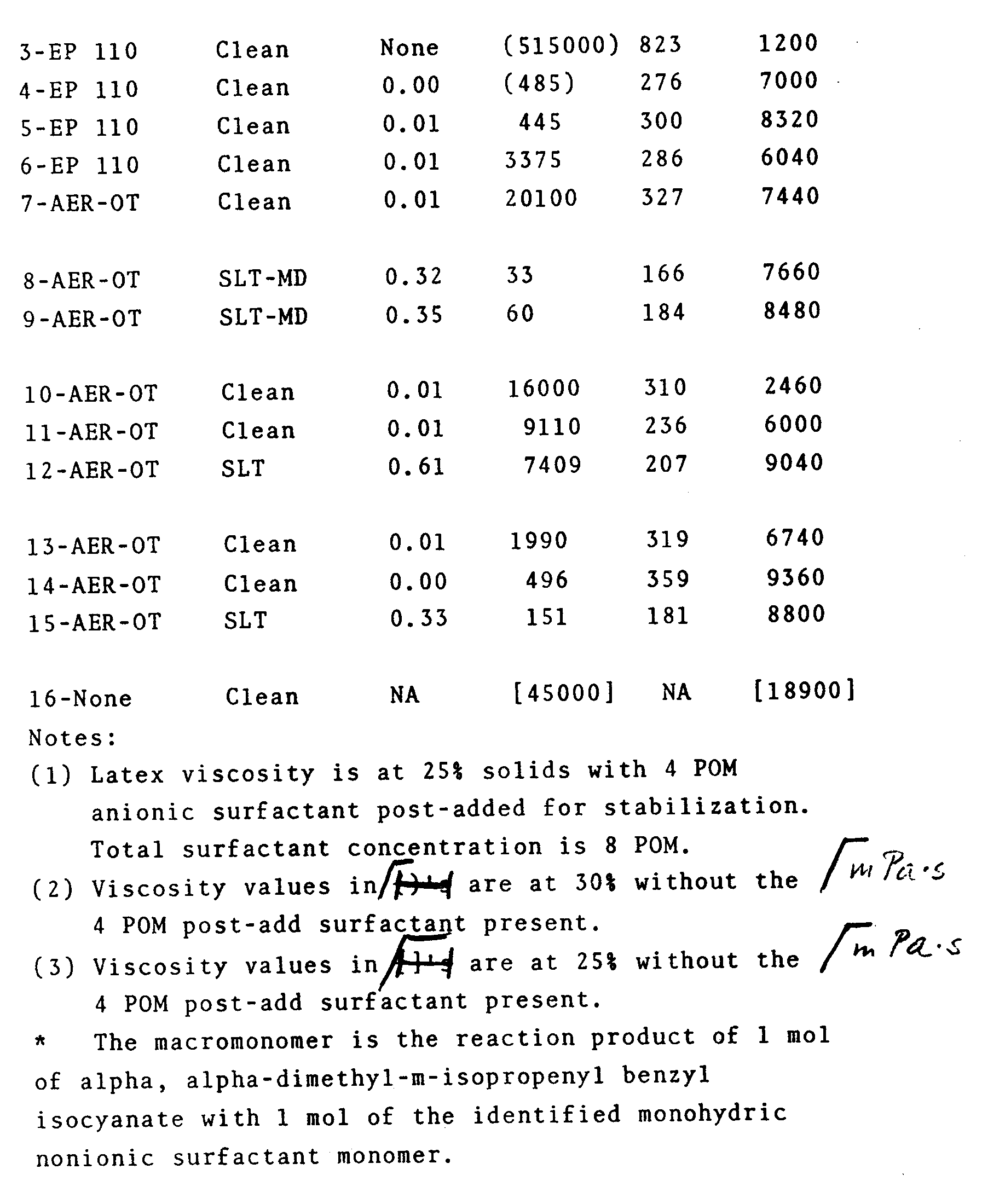
- Comparing control runs 1 and 2 with runs 3-7, the control shows slight to moderate plating and the production of a total of 0.43 to 0.66 parts of 35 grit per 100 parts of latex solids. Runs 3-7 show the product is clean with, at most, 0.01 parts of grit per 100 parts of latex solids.
- Comparing control runs 8 and 9 with runs 10-16, but using a different macromonomer, the control runs again show slight to moderate plating and the production of significant grit. Runs 10-12 show that using continuous addition of the sulfonate monomer, good results are obtained at 5% and 2.5% sulfonate monomer, but poor results when the sulfonate monomer was reduced to 1%. Runs 13-15 use a precharge of the sulfonate monomer, and now good results are obtained at 1% and 0.5% of sulfonate monomer. In run 15, poor results (but still better than the control) are obtained at only 0.2% of sulfonate monomer. Run 16 shows the absence of reactor plating using 1% of sulfonate monomer even when the polymerization surfactant has been omitted.
- As a matter of interest, the latex viscosity at 1% aqueous solution viscosity shown for runs 13 and 14 are preferred values.


- Comparing control run 17 which uses a different sulfonic monomer with run 18 which uses a sulfonate monomer of this invention, the invention run 18 produced a clean product with no grit, while the control produced a very heavy plating with a large proportion of grit.
- Control run 19 is similar to control run 17 using 5% sulfonic monomer, and is again a complete failure. In contrast, and using the same 5% of the sulfonate monomer of this invention, runs 20 and 21 produce a clean product with essentially no grit.
- Runs 22-25 show various sulfonic monomers used at 1% concentration. Only run 25 which used a sulfonate monomer in accordance with this invention produced satisfactory results.

- In runs 9A-9C, no sulfonate monomer was used, and the hot room stability was poor, except in run 9C where surfactant was post-added.
- In the remaining runs, the hot room stability was very good to excellent in the absence of any surfactant post-add, so this undesired addition can be avoided.

- In the absence of sulfonate monomer, the mechanical stability was poor and the foaming was high to very high. In contrast, and in this invention, the stability was much improved and foaming was reduced. In run 14D-, these improved results are obtained in the absence of any post-added surfactant, and the foam-resistance was better in the absence of post-added surfactant.
DEFINITIONS OF ABBREVIATIONS IN TABLES I - IV Abbreviation Definition AER-OT AEROSOL OT (Trade Name) Anionic Surfactant AMPS Acrylamide Methyl Propane Sulfonic Acid CNT Continuous Addition of Sulfonate Monomer CONC Concentration m Pa·s (cps) Millipascal-seconds (Centipoises) DNP Dinonyl Phenol EA Ethyl Acrylate EP-110 ALIPAL EP-110 (GAF), anionic surfactant HT High Temperature HVY Heavy KU Kreb's Units LEV Leveling LF40 TREM LF-40 (Diamond Shamrock), alkyl allyl sulfosuccinate monomer Loc. Location of sulfonate addition MAA Methacrylic Acid MD Moderate MM Macromonomer MON Monomer MS Mechanical Stability NA Not Available NaSS Sodium p-Styrene Sulfonate (Spinomar NaSS® from Toyo Soda Mfg. Co. Ltd.) nm Nanometers NP Nonyl Phenol PC All Sulfonate Monomer in Reactor Pre-Charge POL Parts per 100 parts of latex POLYM Polymerization
Claims (10)
- A method of carrying out an aqueous emulsion copolymerization to provide an alkali-soluble anionic copolymer having thickening characteristics while minimizing plating and grit problems comprising, copolymerizing in aqueous emulsion monoethylenically unsaturated monomers comprising from 15% to 50% by weight of carboxyl-functional monomer, at least about 5% by weight of monomer having surfactant characteristics, and the balance of the monomers being selected to provide a water insoluble copolymer, in the presence of a salt of a monoethylenically unsaturated aromatic sulfonic acid in an amount of from about 0.1% up to about 6.0%, by weight.
- The method of claim 1 in which the monomer having surfactant characteristics is a urethane monomer present in an amount of at least 20%, by weight.
- The method of claim 2 in which said urethane having surfactant characteristics includes styryl unsaturation.
- The method of claim 1 in which said monoethylenically unsaturated aromatic sulfonic acid is sodium styrene sulfonate present in an amount of from 0.2% to 1.5%.
- The method of claim 4 in which said sodium styrene sulfonate is present in an amount of from 0.4% to 1.0%.
- The method of claim 1 in which said carboxyl-functional monomer is present in an amount of from 20% to 45% by weight and said monomers selected to provide a water insoluble copolymer are C₁ to C₈ alkyl esters of (meth)acrylic acid present in an amount of at least 10%.
- The method of claim 6 in which said alkyl esters of (meth)acrylic acid are constituted by ethyl acrylate present in an amount of at least 20%.
- The method of claim 1 in which at least half of said salt of a monoethylenically unsaturated aromatic sulfonic acid is present in an aqueous precharge to which the remainder of said monomers is slowly added.
- The method of claim 8 in which said aromatic sulfonic acid is sodium styrene sulfonate present in an amount of from 0.2% to 1.5% and said aromatic sulfonic acid is substantially all present in said precharge.
- An aqueous latex thickened with the aqueous emulsion copolymer product of the method of claim 1 substantially devoid of post-added surfactant.
Applications Claiming Priority (2)
| Application Number | Priority Date | Filing Date | Title |
|---|---|---|---|
| US06/066,311 US4801671A (en) | 1987-06-25 | 1987-06-25 | Production of alkali-soluble, carboxyl-functional aqueous emulsion thickeners |
| US66311 | 1987-06-25 |
Publications (2)
| Publication Number | Publication Date |
|---|---|
| EP0296436A1 EP0296436A1 (en) | 1988-12-28 |
| EP0296436B1 true EP0296436B1 (en) | 1992-01-22 |
Family
ID=22068706
Family Applications (1)
| Application Number | Title | Priority Date | Filing Date |
|---|---|---|---|
| EP88109339A Expired EP0296436B1 (en) | 1987-06-25 | 1988-06-11 | Production of alkali-soluble carboxyl-functional aqueous emulsion thickeners |
Country Status (7)
| Country | Link |
|---|---|
| US (1) | US4801671A (en) |
| EP (1) | EP0296436B1 (en) |
| AU (1) | AU608859B2 (en) |
| CA (1) | CA1307615C (en) |
| DE (1) | DE3867921D1 (en) |
| ES (1) | ES2006927A6 (en) |
| PT (1) | PT87797B (en) |
Families Citing this family (61)
| Publication number | Priority date | Publication date | Assignee | Title |
|---|---|---|---|---|
| US4797223A (en) * | 1988-01-11 | 1989-01-10 | Rohm And Haas Company | Water soluble polymers for detergent compositions |
| FR2633930B1 (en) * | 1988-07-07 | 1991-04-19 | Coatex Sa | THICKENING AGENT FOR MODIFYING THE RHEOLOGICAL CHARACTERISTICS OF AQUEOUS LOADED AND / OR PIGMENTED, WHITE OR COLORED COMPOSITIONS |
| DE3935137A1 (en) * | 1989-10-21 | 1991-04-25 | Hoechst Ag | COPOLYMERISATES CONTAINING URETHAN GROUPS BASED ON ETHYLENICALLY UNSATURATED MONOMERS, METHODS FOR THEIR PRODUCTION AND THEIR USE |
| FI920502L (en) * | 1991-02-08 | 1992-08-09 | Sherwin Williams Co | FOERTJOCKNINGS MEDEL FOER BELAEGGNINGAR. |
| DE4139602C2 (en) * | 1991-11-30 | 1994-04-28 | Stockhausen Chem Fab Gmbh | New free-flowing, self-thickening thermoplastic powders, processes for their production and their use in heat-sealable pastes |
| US5292843A (en) * | 1992-05-29 | 1994-03-08 | Union Carbide Chemicals & Plastics Technology Corporation | Polymers containing macromonomers |
| US5739378A (en) * | 1992-05-29 | 1998-04-14 | Union Carbide Chemicals & Plastics Technology Corporation | Complex hydrophobe-containing oligomers |
| EP0642541A1 (en) * | 1992-05-29 | 1995-03-15 | Union Carbide Chemicals & Plastics Technology Corporation | Aqueous latexes containing macromonomeres |
| US5292828A (en) * | 1992-05-29 | 1994-03-08 | Union Carbide Chemicals & Plastics Technology Corporation | Polymers containing complex hydrophobic groups |
| US5488180A (en) * | 1992-05-29 | 1996-01-30 | Union Carbide Chemicals & Plastics Technology Corporation | Complex hydrophobe compounds |
| US5426182A (en) * | 1992-05-29 | 1995-06-20 | Union Carbide Chemical & Plastics Technology Corporation | Polysaccharides containing complex hydrophobic groups |
| US5461100A (en) * | 1992-05-29 | 1995-10-24 | Union Carbide Chemicals & Plastics Technology Corporation | Aircraft anti-icing fluids |
| US5399618A (en) * | 1993-06-28 | 1995-03-21 | Union Carbide Chemical & Plastics Technology Corporation | Processes for preparing aqueous polymer emulsions |
| US5708068A (en) * | 1995-01-16 | 1998-01-13 | Union Carbide Chemicals & Plastics Technology Corporation | Aircraft deicing/anti-icing fluids thickened by associative polymers |
| US5962580A (en) * | 1995-06-07 | 1999-10-05 | Rohm And Haas Company | Method for providing a waterborne coating composition with improved color acceptance |
| DE19600405A1 (en) | 1996-01-08 | 1997-07-10 | Basf Ag | Process for the preparation of water-insoluble polymers |
| WO1999009104A1 (en) * | 1997-08-15 | 1999-02-25 | Eastman Chemical Company | The use of surfactants as plasticizers to reduce volatile organic compounds in water-based polymer coating compositions |
| CA2335242C (en) * | 1998-06-15 | 2005-03-01 | Union Carbide Chemicals & Plastics Technology Corporation | Alkali soluble latex thickeners |
| US6869996B1 (en) | 1999-06-08 | 2005-03-22 | The Sherwin-Williams Company | Waterborne coating having improved chemical resistance |
| US6683129B1 (en) * | 2000-03-31 | 2004-01-27 | National Starch And Chemical Investment Holding Corporation | Salt sensitive aqueous emulsions |
| US6646058B1 (en) | 2001-02-21 | 2003-11-11 | The Sherwin-Williams Company | Water-borne paint composition having improved hiding and scrub-resistance |
| US20030008591A1 (en) * | 2001-06-18 | 2003-01-09 | Parsons John C. | Water dispersible, salt sensitive nonwoven materials |
| US7056868B2 (en) * | 2001-07-30 | 2006-06-06 | Cabot Corporation | Hydrophobe associative polymers and compositions and methods employing them |
| US7378479B2 (en) * | 2002-09-13 | 2008-05-27 | Lubrizol Advanced Materials, Inc. | Multi-purpose polymers, methods and compositions |
| US20040241130A1 (en) * | 2002-09-13 | 2004-12-02 | Krishnan Tamareselvy | Multi-purpose polymers, methods and compositions |
| EP1403347B1 (en) * | 2002-09-26 | 2006-11-15 | Nippon Shokubai Co., Ltd. | Thickener for water-based vibration damper |
| US7759296B2 (en) * | 2003-06-19 | 2010-07-20 | Lubrizol Advanced Materials, Inc. | Cationic polymers and fixative application therefor |
| WO2006042220A1 (en) * | 2004-10-08 | 2006-04-20 | The Sherwin-Williams Company | Self crosslinking waterborne coatings |
| US7329705B2 (en) | 2005-05-03 | 2008-02-12 | Celanese International Corporation | Salt-sensitive binder compositions with N-alkyl acrylamide and fibrous articles incorporating same |
| US7320831B2 (en) * | 2005-05-03 | 2008-01-22 | Celanese International Corporation | Salt-sensitive vinyl acetate binder compositions and fibrous article incorporating same |
| US7989545B2 (en) * | 2006-01-25 | 2011-08-02 | Celanese International Corporations | Salt-sensitive binders for nonwoven webs and method of making same |
| US8013092B1 (en) | 2006-12-20 | 2011-09-06 | The Sherwin-Williams Company | Waterborne coating |
| US20090123773A1 (en) * | 2007-11-14 | 2009-05-14 | Rajeev Farwaha | Salt-sensitive binders containing vinyl acetate for nonwoven webs and method of making same |
| ES2507142T3 (en) | 2009-12-14 | 2014-10-14 | Lubrizol Advanced Materials, Inc. | Cassia derivatives |
| CA2791853C (en) * | 2010-02-12 | 2018-03-06 | Rhodia Operations | Rheology modifier compositions and methods of use |
| WO2011137218A1 (en) | 2010-04-29 | 2011-11-03 | Lubrizol Advanced Materials, Inc. | Cassia derivatives |
| CN103068865B (en) | 2010-07-09 | 2016-01-13 | 路博润高级材料公司 | Structured Acrylate Copolymer Thickener |
| JP5991972B2 (en) | 2010-07-09 | 2016-09-14 | ルブリゾル アドバンスド マテリアルズ, インコーポレイテッド | Acrylic copolymer thickener blend |
| WO2012030750A2 (en) | 2010-09-02 | 2012-03-08 | Lubrizol Advanced Materials, Inc. | Polymers and compositions |
| JP2014500236A (en) | 2010-09-30 | 2014-01-09 | ルブリゾル アドバンスド マテリアルズ, インコーポレイテッド | Structured acrylate copolymers for use in multiphase systems |
| JP6000261B2 (en) | 2010-10-05 | 2016-09-28 | ルブリゾル アドバンスド マテリアルズ, インコーポレイテッド | Acrylate copolymer thickener |
| CN103747777A (en) | 2011-06-10 | 2014-04-23 | 路博润高级材料公司 | Cassia derivatives |
| US9579272B2 (en) | 2012-06-15 | 2017-02-28 | Lubrizol Advanced Materials, Inc. | Alkyl glycoside-based micellar thickeners for surfactant systems |
| US9872824B2 (en) | 2013-02-06 | 2018-01-23 | Lubrizol Advanced Materials, Inc. | Semi-permanent hair straightening composition and method |
| WO2015042013A1 (en) | 2013-09-18 | 2015-03-26 | Lubrizol Advanced Materials, Inc. | Stable linear polymers |
| EP3065831A1 (en) | 2013-11-08 | 2016-09-14 | Lubrizol Advanced Materials, Inc. | Semi-permanent hair straightening composition and method |
| WO2016178660A1 (en) | 2014-05-02 | 2016-11-10 | Hercules Inncorporated | Personal care composition for a keratin substrate comprising conditioning and/or styling polymer |
| JP2019501260A (en) | 2015-12-23 | 2019-01-17 | ルブリゾル アドバンスド マテリアルズ, インコーポレイテッド | Hydrophobic modified alkali swellable emulsion polymer |
| JP2020531533A (en) | 2017-08-22 | 2020-11-05 | ルブリゾル アドバンスド マテリアルズ, インコーポレイテッド | Soap compositions and treatments to relieve winter-related pruritus |
| WO2019094668A1 (en) | 2017-11-10 | 2019-05-16 | Lubrizol Advanced Materials, Inc. | Process for preparing and compositions of macrosphere formulations |
| WO2019126162A1 (en) | 2017-12-20 | 2019-06-27 | Lubrizol Advanced Materials, Inc. | Cleansing composition containing oil with foaming properties |
| EP3764981A1 (en) | 2018-03-16 | 2021-01-20 | Lubrizol Advanced Materials, Inc. | Foaming cleanser compositions containing a non-polar oil and amphiphilic polymer |
| KR20210008483A (en) | 2018-04-12 | 2021-01-22 | 루브리졸 어드밴스드 머티어리얼스, 인코포레이티드 | Hair modification composition and method thereof |
| WO2020123609A1 (en) | 2018-12-11 | 2020-06-18 | Lubrizol Advanced Materials, Inc. | Compositions and treatment methods for the mitigation of winter season related pruritus |
| WO2020131678A1 (en) | 2018-12-19 | 2020-06-25 | Lubrizol Advanced Materials, Inc. | Cleansing composition and method |
| EP3937900B1 (en) | 2019-03-14 | 2023-08-02 | Lubrizol Advanced Materials, Inc. | Enhanced silicon deposition compositions and method therefore |
| MX2022007454A (en) | 2019-12-16 | 2022-08-17 | Warwick International Group Ltd | High viscosity elastic gels and uses therefor. |
| CN116615506A (en) | 2020-12-18 | 2023-08-18 | 汉高股份有限及两合公司 | Aqueous composition for vehicle sound damping applications |
| WO2022245758A1 (en) | 2021-05-17 | 2022-11-24 | Lubrizol Advanced Materials, Inc. | Hair color compositions for mitigating color loss |
| US20240366701A1 (en) | 2021-09-03 | 2024-11-07 | Lubrizol Advanced Materials, Inc. | Extract of myrothamnus sp for promoting hair growth |
| WO2025117353A1 (en) | 2023-11-30 | 2025-06-05 | Lubrizol Advanced Materials, Inc. | Crosslinked and hydrophobically modified xanthan gum |
Family Cites Families (11)
| Publication number | Priority date | Publication date | Assignee | Title |
|---|---|---|---|---|
| US3306871A (en) * | 1959-09-23 | 1967-02-28 | Dow Chemical Co | Synthetic latexes comprising ar-monovinyl aromatic sulfonic acid saltstyrene-butadiene terpolymers |
| NL134017C (en) * | 1965-10-29 | |||
| JPS4836430B1 (en) * | 1970-08-13 | 1973-11-05 | ||
| US4384096A (en) * | 1979-08-27 | 1983-05-17 | The Dow Chemical Company | Liquid emulsion polymers useful as pH responsive thickeners for aqueous systems |
| US4514552A (en) * | 1984-08-23 | 1985-04-30 | Desoto, Inc. | Alkali soluble latex thickeners |
| CA1279741C (en) * | 1984-09-28 | 1991-01-29 | Alton J. Gasper | Grouting composition |
| JPS61204211A (en) * | 1985-03-08 | 1986-09-10 | Kansai Paint Co Ltd | Aqueous coating composition |
| US4600761A (en) * | 1985-04-04 | 1986-07-15 | Alco Chemical Corporation | Acrylic emulsion copolymers for thickening aqueous systems and copolymerizable surfactant monomers for use therein |
| US4703080A (en) * | 1985-04-29 | 1987-10-27 | Desoto, Inc. | Aqueous latices having improved coating rheology |
| AU612965B2 (en) * | 1985-08-12 | 1991-07-25 | Ciba Specialty Chemicals Water Treatments Limited | Polymeric thickeners and their production |
| FR2633930B1 (en) * | 1988-07-07 | 1991-04-19 | Coatex Sa | THICKENING AGENT FOR MODIFYING THE RHEOLOGICAL CHARACTERISTICS OF AQUEOUS LOADED AND / OR PIGMENTED, WHITE OR COLORED COMPOSITIONS |
-
1987
- 1987-06-25 US US06/066,311 patent/US4801671A/en not_active Expired - Fee Related
-
1988
- 1988-04-15 CA CA000564254A patent/CA1307615C/en not_active Expired - Fee Related
- 1988-05-04 ES ES8801360A patent/ES2006927A6/en not_active Expired
- 1988-06-11 DE DE8888109339T patent/DE3867921D1/en not_active Expired - Lifetime
- 1988-06-11 EP EP88109339A patent/EP0296436B1/en not_active Expired
- 1988-06-22 PT PT87797A patent/PT87797B/en not_active IP Right Cessation
- 1988-06-23 AU AU18333/88A patent/AU608859B2/en not_active Ceased
Also Published As
| Publication number | Publication date |
|---|---|
| CA1307615C (en) | 1992-09-15 |
| AU608859B2 (en) | 1991-04-18 |
| AU1833388A (en) | 1989-01-05 |
| PT87797A (en) | 1988-07-01 |
| EP0296436A1 (en) | 1988-12-28 |
| PT87797B (en) | 1992-10-30 |
| ES2006927A6 (en) | 1989-05-16 |
| DE3867921D1 (en) | 1992-03-05 |
| US4801671A (en) | 1989-01-31 |
Similar Documents
| Publication | Publication Date | Title |
|---|---|---|
| US4801671A (en) | Production of alkali-soluble, carboxyl-functional aqueous emulsion thickeners | |
| EP0173109B1 (en) | Alkali soluble latex thickeners | |
| JP2553841B2 (en) | Polymer thickener and composition containing the thickener | |
| US7585927B2 (en) | Reactive surfactants and their use in emulsions and dispersions | |
| EP0197635B1 (en) | Acrylic emulsion copolymers for thickening aqueous systems and copolymerizable surfactant monomers for use therein | |
| EP0710675B1 (en) | Improved method for forming polymers | |
| US4246387A (en) | Emulsion polymerization with sulfonated alkoxylated alkyl arylol maleates | |
| IE840800L (en) | Copolymer | |
| JPH0825985B2 (en) | Nonionic urethane monomer | |
| US5914442A (en) | Aqueous solutions or dispersions of copolymers | |
| US6869994B1 (en) | Carboxylated polymer composition | |
| JPH0218357B2 (en) | ||
| US20030171489A1 (en) | Saline aqueous dispersions of water soluble (co) polymers based on cationic monomers, method for making same and uses thereof | |
| US5109091A (en) | Copolymers containing carboxyl groups, their preparation, and their use as thickeners | |
| EP0452399B1 (en) | Propoxylated alkali-soluble thickeners | |
| JPH057403B2 (en) | ||
| JP2001240633A (en) | New copolymer | |
| JPH11514699A (en) | Aqueous compositions thickened with acrylate-based polymer rheology modifiers | |
| EP0333499B1 (en) | Polymerisation processes and products obtained from these | |
| JPH05501575A (en) | Method for producing stable polymer dispersions using amphoteric polymers as stabilizers | |
| JP2804978B2 (en) | Modifier for polymer, method for producing the same, and method for modifying polymer using the same | |
| US20030166771A1 (en) | Water soluble saline aqueous dispersion of copolymers based on cationic monomers, method for making same and uses thereof | |
| JP2001106748A (en) | New copolymer | |
| JPH0242089B2 (en) |
Legal Events
| Date | Code | Title | Description |
|---|---|---|---|
| PUAI | Public reference made under article 153(3) epc to a published international application that has entered the european phase |
Free format text: ORIGINAL CODE: 0009012 |
|
| AK | Designated contracting states |
Kind code of ref document: A1 Designated state(s): BE DE FR GB IT NL SE |
|
| 17P | Request for examination filed |
Effective date: 19890408 |
|
| 17Q | First examination report despatched |
Effective date: 19900305 |
|
| GRAA | (expected) grant |
Free format text: ORIGINAL CODE: 0009210 |
|
| AK | Designated contracting states |
Kind code of ref document: B1 Designated state(s): BE DE FR GB IT NL SE |
|
| REF | Corresponds to: |
Ref document number: 3867921 Country of ref document: DE Date of ref document: 19920305 |
|
| ET | Fr: translation filed | ||
| ITF | It: translation for a ep patent filed | ||
| PLBE | No opposition filed within time limit |
Free format text: ORIGINAL CODE: 0009261 |
|
| STAA | Information on the status of an ep patent application or granted ep patent |
Free format text: STATUS: NO OPPOSITION FILED WITHIN TIME LIMIT |
|
| 26N | No opposition filed | ||
| PGFP | Annual fee paid to national office [announced via postgrant information from national office to epo] |
Ref country code: DE Payment date: 19940328 Year of fee payment: 7 |
|
| PGFP | Annual fee paid to national office [announced via postgrant information from national office to epo] |
Ref country code: SE Payment date: 19940329 Year of fee payment: 7 |
|
| PGFP | Annual fee paid to national office [announced via postgrant information from national office to epo] |
Ref country code: GB Payment date: 19940331 Year of fee payment: 7 |
|
| PGFP | Annual fee paid to national office [announced via postgrant information from national office to epo] |
Ref country code: FR Payment date: 19940405 Year of fee payment: 7 |
|
| PGFP | Annual fee paid to national office [announced via postgrant information from national office to epo] |
Ref country code: BE Payment date: 19940427 Year of fee payment: 7 |
|
| PGFP | Annual fee paid to national office [announced via postgrant information from national office to epo] |
Ref country code: NL Payment date: 19940630 Year of fee payment: 7 |
|
| EAL | Se: european patent in force in sweden |
Ref document number: 88109339.7 |
|
| PG25 | Lapsed in a contracting state [announced via postgrant information from national office to epo] |
Ref country code: GB Effective date: 19950611 |
|
| PG25 | Lapsed in a contracting state [announced via postgrant information from national office to epo] |
Ref country code: SE Effective date: 19950612 |
|
| PG25 | Lapsed in a contracting state [announced via postgrant information from national office to epo] |
Ref country code: BE Effective date: 19950630 |
|
| BERE | Be: lapsed |
Owner name: DESOTO INC. Effective date: 19950630 |
|
| PG25 | Lapsed in a contracting state [announced via postgrant information from national office to epo] |
Ref country code: NL Effective date: 19960101 |
|
| GBPC | Gb: european patent ceased through non-payment of renewal fee |
Effective date: 19950611 |
|
| PG25 | Lapsed in a contracting state [announced via postgrant information from national office to epo] |
Ref country code: FR Effective date: 19960229 |
|
| NLV4 | Nl: lapsed or anulled due to non-payment of the annual fee |
Effective date: 19960101 |
|
| PG25 | Lapsed in a contracting state [announced via postgrant information from national office to epo] |
Ref country code: DE Effective date: 19960301 |
|
| EUG | Se: european patent has lapsed |
Ref document number: 88109339.7 |
|
| REG | Reference to a national code |
Ref country code: FR Ref legal event code: ST |
|
| PG25 | Lapsed in a contracting state [announced via postgrant information from national office to epo] |
Ref country code: IT Free format text: LAPSE BECAUSE OF NON-PAYMENT OF DUE FEES;WARNING: LAPSES OF ITALIAN PATENTS WITH EFFECTIVE DATE BEFORE 2007 MAY HAVE OCCURRED AT ANY TIME BEFORE 2007. THE CORRECT EFFECTIVE DATE MAY BE DIFFERENT FROM THE ONE RECORDED. Effective date: 20050611 |